upper waypoint

Creepy Yet Gorgeous: Blood Vessels Blown in Glass

Save ArticleSave Article
Failed to save article

Please try again

Halloween means time for gore! Blood, bones, brains and more! Severed fingers, severed toes, eyeballs and organs galore!

But how accurate are all these loose bits of human anatomy in our front yards, costumes, and punch bowls? Can we use that skeleton in the corner to bone up for a biology exam--or are we missing out on a tremendous opportunity to learn medical science?

Perhaps we need to look past the Halloween superstores for a vendor who truly appreciates the beautiful complexity of the human body’s inner workings. Farlow's Scientific Glassblowing--"Where Art Meets Science," located in Grass Valley in the Sierra foothills--is the perfect alternative source for holiday decorations. Their anatomical glass sculptures are exquisitely accurate, based on measurements from real cadavers. You may have to restrain any zombies at your party from taking a bite out of this beautiful brain.
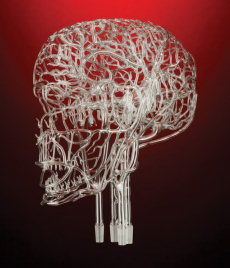
Despite its extremely recognizable shape, it's actually not a model of gray matter at all--it's a model of all the brain's arteries. When it comes to blood, the brain has to be very well-supplied, since it receives 15% of the total cardiac output.

Sponsored

"Ideal for stent placement testing and tortuous testing as well as catheter testing," Farlow's proudly proclaims. "These models may be customized with aneurysms." Well! Who wouldn't want that?

An aneurysm occurs when the wall of a blood vessel is too weak to withstand the blood pressure and balloons outward. A stent deals with the opposite problem--walls that are too thick--by forcing clogged arteries to stay open. Stents, in turn, can be deployed by catheters. A catheter is any kind of medical tube, but the ones that the glass models are especially designed to help test are blood vessel catheters, which have myriad uses, such as ferrying tiny medical devices, drugs, or even remotely operated surgical tools to the desired location in the body.

And that, I've learned, is where tortuous testing comes in. Searching for the definition of this phrase, I found something hilarious: the Hydrophilic Coatings Blog. Oh, the specificity of the nerditude! Hydrophilic Coatings (the blog) informs me that tortuous testing is a way of making sure your device (probably a catheter) can turn all the necessary corners and angles to get where it needs to go. The usefulness of the glass models is obvious--because they're transparent, you can see exactly where your catheter gets stuck or turns the wrong way.

In all honesty, it's probably too last-minute (and too expensive) for most of us to class up our Halloween celebrations with a glass device, but we can appreciate the craftsmanship and maybe, just maybe, learn to appreciate the beauty as well as the gruesomeness of the human body.

h/t to Wired

lower waypoint
next waypoint
Player sponsored by