
upper waypoint

Scientists Find Truth and Beauty in Sun's Corona

Save ArticleSave Article
Failed to save article

Please try again

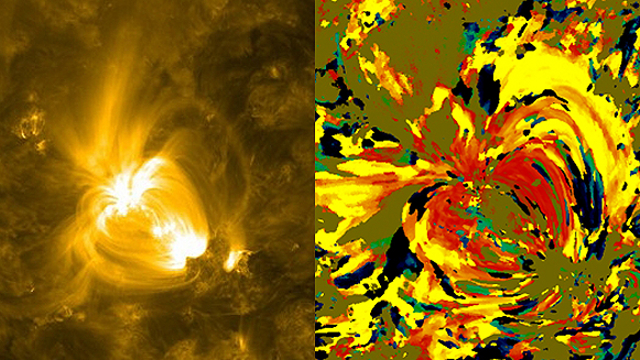
Image of the sun and visualization of temperature changes in the same area
Left: Colorized image captured by NASA's Solar Dynamics Observatory (SDO). Credit: NASA/SDO. Right: Visualization, based on the image on the left, using specific colors to describe which areas on the sun cooled or heated over a 12-hour period. Credit: NASA/Viall.

While nearly all eyes are focused on Mars, two astophysicists at NASA's Goddard Space Flight Center have been quietly staring at the sun instead.

Back in 2010, NASA debuted the Living With a Star program by launching the Solar Dynamics Observatory, or SDO, a "sun-pointing semi-autonomous spacecraft." SDO sends data back to earth at a continuous 130 megabits per second, seven days a week, twenty-four hours a day. Scientists Nicholeen Viall and James Klimchuk have used some of this mass of information to create solar images worthy of an art gallery.

Solar visualizations, Figure 5A from Viall and Klimchuk 2012
Solar visualizations; Figure 5a from {link url=http://arxiv.org/pdf/1202.4001.pdf}Viall and Klimchuck 2012{/link}

These beautiful pictures, which NASA writer Karen C. Fox calls "reminiscent of Van Gogh," are not only fit to hang on your living room wall, but represent a critical step in solving a major puzzle of heliophysics (that's my favorite new word, by the way): why is the sun's corona so hot?

As you may remember from childhood singalongs, "The sun is a mass of incandescent gas / a gigantic nuclear furnace / where hydrogen is built into helium / at temperatures of millions of degrees." (Fun fact: though most of my contemporaries know that song from the They Might Be Giants cover, I know it from the original 1959 album Space Songs.)

But the surface of the sun is actually only 6000 degrees Kelvin, while the corona (the sun's outer atmosphere) climbs well above a million. How does it get so hot?

Sponsored

Scientists have begun to approach this question with painstaking studies of very small bits of the corona called coronal loops. They've found that these loops carry plasma that has been heated by nanoflare storms. This heating occurs very quickly, then the loops cool more gradually.

[picture from wikipedia]

But is this method of quick heating and slow cooling unique to loops, or does it apply to larger areas of the corona? Larger ares of the corona can't be studied painstakingly by human eyes as loops have been—there's simply too much data.

Viall's technique has the brilliance of all good science visualization: condensing a large amount of information into a relatively simple image without having to discard anything. And it's all done by an automated technique so there's no human bias. They wrote this program that simply goes through pixel by pixel and channel by channel, calculating how the temperature at that spot changed over twenty-four hours, then assigns it a color based on that temperature change.

The predominance of reds and yellow indicates that most of the area is cooling for most of the time observed. It's starting super-hot, over 3 million K (and up to 7 mK, nearly as hot as the 15 MK center of sun), and cooling to under 1 million before the next round starts.

This is what you'd expect if the nanoflare heating characteristic of loops were also characteristic of these larger coronal structures. So it appears that nanoflares might be the answer to the question of coronal heating.

My next question is, where can I order a print?

h/t to Science2.0

lower waypoint
next waypoint
Player sponsored by