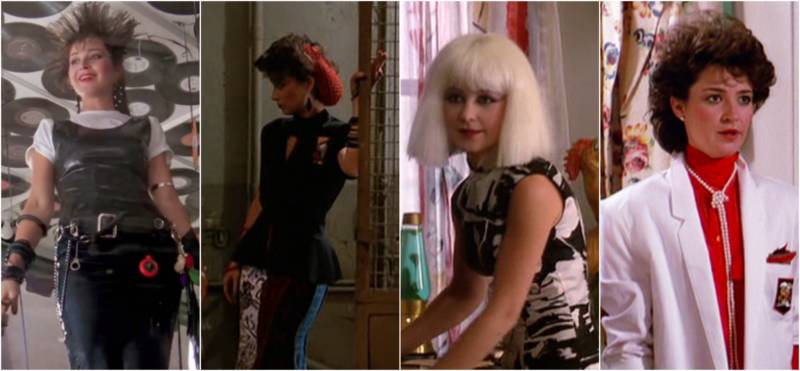
It's no secret that American women are bombarded daily with mainstream beauty standards—a multitude of industries literally depend on it. But nowhere is that message more sneakily fed than in that old movie trope: the conventional makeover.
Probably the most famously upsetting example occurred in 1985's The Breakfast Club, when spoiled princess Claire (Molly Ringwald) does what is supposed to be her good deed for the day by de-weirding the eccentric but adorable Allison (Ally Sheedy). Claire transforms Allison's goth bag-lady look with a frilly pink top she has magicked out of nowhere, removes Allison's black eyeliner, puts pink shimmer all over her face and sticks a bow on her head, thereby effectively erasing Allison's entire persona.
"Why are you being so nice to me?" Allison asks, letting the viewer know that, at the core of every unconventional woman, is a "normal," more aesthetically pleasing one just dying to get out. It's not true, of course: weird kids aren't weird because they don't know how to be pretty—weird kids dress weird to outwardly own the fact that they don't fit in. They have no desire to.
John Hughes should have known better. Outside of the makeover scene, The Breakfast Club is a movie that examines, very pointedly, the inherent value of individuality. It's a film that tells us that nobody has a perfect life; that humans are all complex creatures; and that high school, with all of its stupid pressures to fit in, is basically a waking nightmare. All of the film's good work is undone when Allison is no longer allowed to be herself—in the end, the movie is telling us, pretty is always better.
Predictably, after the transformation she never asked for, Allison is immediately desired by the first jock who sees her, and we're supposed to think this is a good thing: