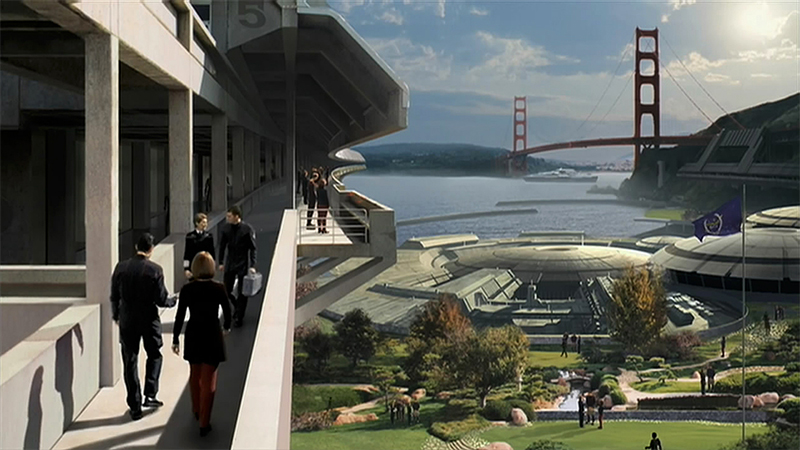
Starfleet Headquarters, San Francisco, 2151. Photo: MemoryAlpha
In a Paris Review interview published only two years before his death, author Ray Bradbury said, “Science fiction pretends to look into the future, but it’s really looking at a reflection of what is already in front of us.” My first foray into the genre was through Bradbury's own The Martian Chronicles. I still recall the mixture of fear and awe I felt, wondering if the interstellar travel he predicted would ever become a reality. No doubt, exploration and colonization of Mars wouldn't be part of my own life experience, but imagining that possibility, and considering how society might get there was compelling.
The vision of the future in science fiction - and speculative fiction in general - has never been constant; the reflection stretches and tilts like a fun house mirror, as time passes and new realities take hold. Simmering underneath fantastical settings and advanced technology are our very real, very human hopes and fears. What will happen to the cities we live in, to the food we eat? What jobs will we have? Will we even be here at all?
When it comes to movies in particular, we have seen many futures over the years: bleak and ravaged worlds; sleek, regulated utopias; and subtle near futures, echoing our current realities and the immediate possibilities ahead. Let's revisit some of those themes, shall we?
BETTER LIVING THROUGH CIRCUITRY
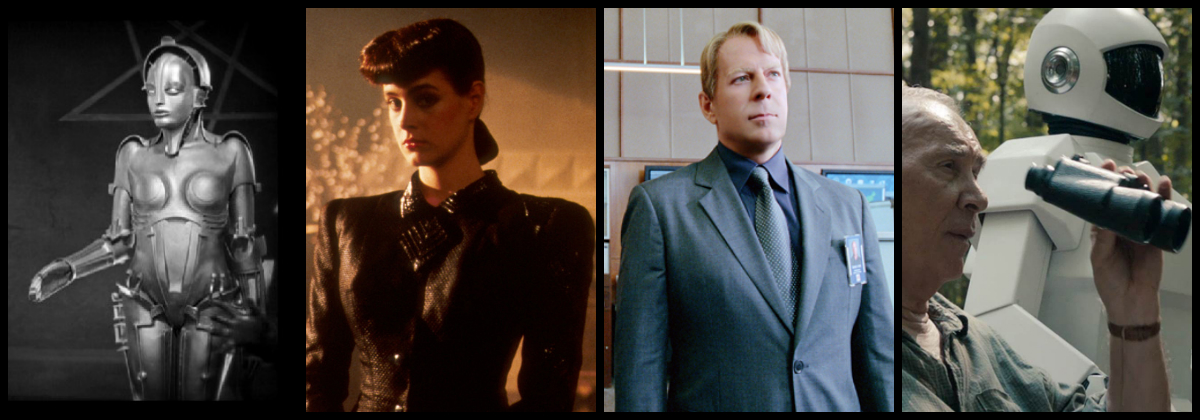
L-to-R: Metropolis, Blade Runner, Surrogates, Robot and Frank
The technological advances of the late 19th and early 20th centuries served as inspiration for pioneers of science fiction like Mary Shelley, Jules Verne and H. G. Wells. (And, interestingly, E.M. Forster, whose short story The Machine Stops is an early prediction of the internet, among other things.) They, and the many writers and filmmakers who followed in their stead, turned their eyes toward a future filled with incredible feats of science and engineering. But those stories also carried a sense of unease and a fear of technology taking over - perhaps even destroying - our lives.
That wariness is captured most perfectly when humanity is confronted with artificial intelligence. In many ways, it kicked off with Fritz Lang's Metropolis, in which a deceptive robotic woman plays a major role in escalating a clash between the wealthy elite and the working class of a glimmering, industrialist city. Although much of Hollywood's science fiction output of the 1950s was fueled by political paranoia and the nuclear menace, the Man vs. Machine stories carried on.
One of the biggest landmarks in the genre, Stanley Kubrick's 2001: A Space Odyssey (1968), gave us an iconic antagonist in HAL 9000, a sentient system that would kill out of self-preservation. With the '80s came The Terminator, successfully combining android warfare with another popular sci-fi element, time travel; the hilariously campy robo-hunter flick Runaway, starring Tom Selleck and his mustache; and the elegantly imagined Blade Runner, which made us ponder what it truly means to be a person.
But even as plot lines began to take on a more philosophical, compassionate angle, the undertone of Us versus Them remained. Take, for instance, the android starfleet officer, Lt. Commander Data. A beloved character on Star Trek: The Next Generation, people still often undermined and insulted him, or even questioned his rights as an autonomous individual.
With developments in cybernetic augmentation and robotics - humanoid or otherwise - making science fiction a reality, we are in a place to devote more time to contemplating the more subtle implications of humanity, not just coexisting with artificial life, but embracing it. While ultimately falling flat (and venturing too far for my liking into uncanny valley territory with a robotic Bruce Willis), the 2009 film Surrogates tried to imagine a world where people have chosen to live through cybernetic proxies. Although the surrogates themselves aren't independent machinery, controlled by their human counterparts remotely from the safety of their homes, that sort of augmented reality isn't entirely far fetched.
We don't have to look too far into the future to ruminate on lives becoming increasingly intertwined with artificial technology. Robot & Frank (2012) is an understated near-future science fiction, a meditation on aging and memory. The robot in the movie is presented as a caretaker to the elderly Frank (Frank Langella), and while the older man is at first resistant, not only does he develop a friendship with the robot, they even pull off a jewelry heist together. With a renewed zest for life, Frank reconnects with the man he once was, while the robot shows an artificial life's capacity to grow and adapt.
In Spike Jonze's Her, it's 2025 and Theodore Twombly (Joaquin Phoenix) falls in love with an operating system called Samantha. She may be only a voice, but she jokes, flirts and wonders about being a human being, and we are once again confronted with questions of identity and humanity, questions that have existed long before machines and will continue to exist as long as we do.
UTOPIA! DYSTOPIA! LET'S CALL THE WHOLE THING OFF!
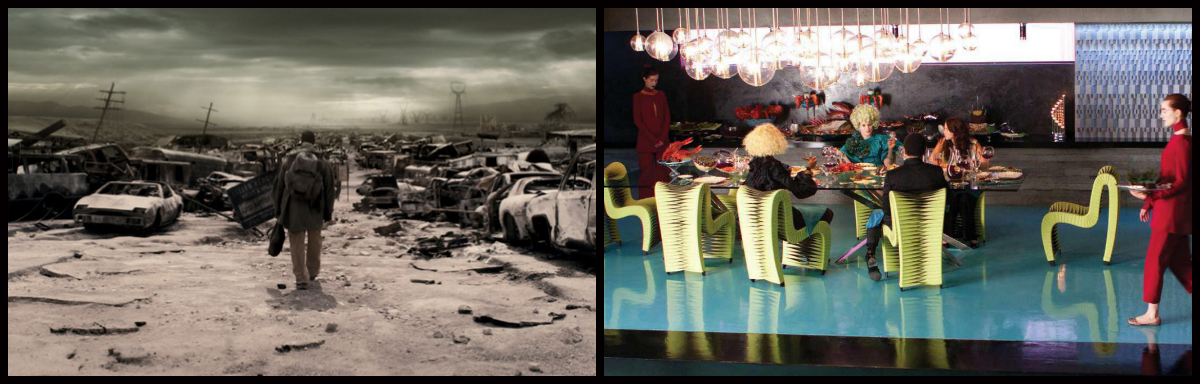
Scenes from The Book of Eli and The Hunger Games
When Gene Rodenberry developed Star Trek in the 1960s, his vision of the utopian, egalitarian humanity of the 24th century was shaped by a hopeful optimism for people's capacity to create and evolve, and to attain equality and respect between all citizens. (Well, to an extent.) Overall, the franchise has been sincere in trying to present a truly utopian future. Beyond that, the distinction between a utopia - an ideal, perfect society, as first named by Thomas Merton - and dystopia, its grim cousin, has been quite blurry and that gray area has been fertile ground for many stories.
Out of destruction can emerge primal chaos and basic need for survival, or orderly systems that reinforce centuries old social hierarchies. Or both. Those who live outside the protective domes and walled cities occupy a harsh reality (depicted in desaturated tones, naturally), while those fortunate enough to end up within some protective enclave might have more creature comforts and luxuries, but often at a cost to their liberty. Divergent, The Hunger Games, The Book of Eli and Bong Joon-ho's Snowpiercer are some of the more recent examples of movies contemplating a disastrous future, but speculative fiction has been fascinated with the nuances for a long while now.
The previously mentioned Metropolis comes to mind, and in 1936, H. G. Wells' Things to Comecharted the potential course of humanity from a global war in 1940 to a technologically advanced but divided society in 2036. Most of us are undoubtedly familiar with George Orwell’s dystopian novel Nineteen Eighty Four, set in a totalitarian world of few liberties and much government surveillance. (A novel which is probably due for an updated film version.)
We have seen it all: a hedonistic domed city where none shall live past age 30 (Logan's Run); a wasteland ruled by savage motorcycle gangs with wild hair (Mad Max movies); and sophisticated, slick cities where citizens' futures are regulated by their genetic makeup (Gattaca) or even actions that haven't taken place yet (Minority Report).
There is an ongoing obsession with the notion of the apocalypse, and it's not limited to teenagers devouring dystopian YA literature. Psychologically, we're wired to ponder the end times, whether it's a world turned upside down by wars or by nature's hand. While we might do a good job imagining all the worst case scenarios as to how it can all go down, sci-fi also helps extend our imaginations to what happens after, and to the notion that humanity might prevail.
THE FUTURE IS A CATWALK
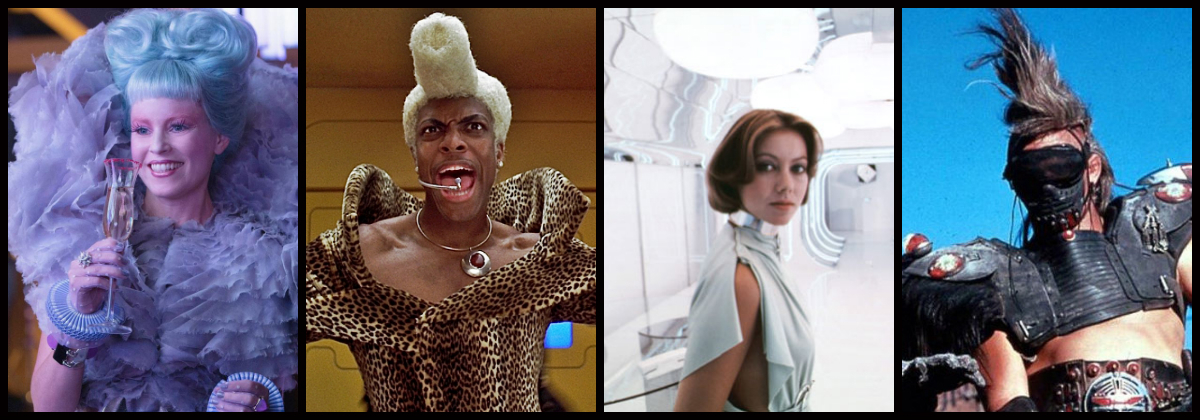
L-to-R: The Hunger Games: Catching Fire, The Fifth Element, Logan's Run, Mad Max Beyond Thunderdome
Compelling world building is important to propel the plot, but the clothes people will wear in the future can say just as much as a perfectly designed architectural landscape. People have been fascinated with fashions of the future for a long while. It's a delicate balance, to create a futuristic film wardrobe: make it too subtle, and people won't pick up on your intent; make it wildly outlandish, and it may become dated (while still making for great Halloween or convention costumes); put a red mankini on Sean Connery and... well, that's exactly what you get.
One of my pet peeves is when everyone in the future dresses the same, however. In certain settings - hedonistic domed enclaves, totalitarian communities, militaristic structures - uniformity makes sense. But beyond that, it's nearsighted thinking. Considering the evolving history of fashion, the varieties of subcultures and street style that have existed, and our tendency to regurgitate trends of the past, the future should be a glorious mishmash of individual style, even if it is picking from scrapheaps of textiles left after a nuclear fall out.
From that mass of black suits and silver tunics, some gems have emerged: Blade Runner, with its blend of noir fashion and modern street style; Mad Max, which gave its desert warriors a look that was both cohesive and distinct for each of the characters; the overall aesthetic of films like Children of Men or Book of Eli, showing a world of scarcity and priorities higher than sartorial concerns, but also glimmers of individuality.
The fashion industry has had a long standing reciprocal relationship with science fiction films. Hunger Games costume designer Judianna Makovsky cites Alexander McQueen and Elsa Schiaparelli as indelible influences on the style of spectacle-obsessed citizens of Panem's Capitol. Couturiers' involvement in film hasn't be limited to serving as just inspiration, either. Hardy Amies, Saville Row based clothier for Queen Elizabeth II, was brought on board by Stanley Kubrick to create costumes for 2001: A Space Odyssey; Jean Paul Gaultier is responsible for dreaming up more than 900 of the over-the-top, colorful costumes for The Fifth Element; and even though his designs didn't make the cut, Gianni Versace came up with some pretty extravagant sketches for Judge Dredd.
And just as science fiction has had an obvious impact on our approach to product design, so has it had its influence - direct or subtle - on the world of fashion. From Thierry Mugler's sexy robot in the video for George Michael's Too Funky, to Gareth Pugh and Junya Watanabe's sculptural looks, the futuristic and fantastical has made its mark on the runway.
Things get even more exciting when we think of garments as serving functions beyond adornment. Dutch designer Annouk Wiprecht creates fashion armor that serves as an interactive link between the wearer and their environment: dresses release soft plumes of smoke or activate defensive mechanical spider legs attached to the shoulders, based on the proximity of nearby people, while another garment, Intimacy, turns transparent in response to the wearer's arousal and heartbeat. While slightly off-putting for anyone uncomfortable with needles, Israeli designer Naomi Kizhner has come up with a concept for a small collection of bioelectrical jewelry that would react to the body's energy. And when it comes to textiles, there are "smart" fabrics that can be sprayed on the body or be controlled by mobile devices, in general elevating the stakes when it comes to science fiction's ability to outstrip reality.
NEAR FUTURE
Over time, I've developed more of an appreciation for science fiction that echoes the immediate realities of our world - films like the previously mentioned Robot and Frank and Her. As author Richard Powers says, "All we have to do is explore the cascades of futures already set in motion."
One of my favorite recent bits of sci-fi, combining all the elements mentioned here, is the Canadian show Continuum. The hero is Kiera Cameron (Rachel Nichols), a "Protector" from 2077 transported back to our present day, when a group of anti-corporation terrorists, Liber8, use a time travel device to escape execution. In her time, Cameron is part of a privatized, cybernetically augmented police force in a world where the Corporate Congress of oligarchs reigns supreme and citizen surveillance is the routine. As she tries to navigate Vancouver in 2012, Cameron begins to question all that she believed in and finds an unlikely ally in a young man, Alec Sadler, who will in fact become the same corporate king that Liber8 blame for the erosion of civil liberties in the future. That is, if the future can't be altered in the present.
While still requiring some suspension of disbelief - time travel is one of those things that, no matter how technologically advanced we get, is still hard to fathom - the excitement of the series lies in the way it shows a realistic present with future possibilities branching out. But as much as I find exercises in speculation on our immediate future fascinating, I'm also more than a little bit excited about Christopher Nolan's upcoming film Interstellar, which promises to go back to what enthralled so many of us in science fiction in the first place - exploration of space. Whether looking a few years ahead, or some light years away, one thing is clear: for sci-fi storytellers, the future is wide open.
lower waypointnext waypoint
Player sponsored by
window.__IS_SSR__=true
window.__INITIAL_STATE__={
"attachmentsReducer": {
"audio_0": {
"type": "attachments",
"id": "audio_0",
"imgSizes": {
"kqedFullSize": {
"file": "https://ww2.kqed.org/news/wp-content/themes/KQED-unified/img/audio_bgs/background0.jpg"
}
}
},
"audio_1": {
"type": "attachments",
"id": "audio_1",
"imgSizes": {
"kqedFullSize": {
"file": "https://ww2.kqed.org/news/wp-content/themes/KQED-unified/img/audio_bgs/background1.jpg"
}
}
},
"audio_2": {
"type": "attachments",
"id": "audio_2",
"imgSizes": {
"kqedFullSize": {
"file": "https://ww2.kqed.org/news/wp-content/themes/KQED-unified/img/audio_bgs/background2.jpg"
}
}
},
"audio_3": {
"type": "attachments",
"id": "audio_3",
"imgSizes": {
"kqedFullSize": {
"file": "https://ww2.kqed.org/news/wp-content/themes/KQED-unified/img/audio_bgs/background3.jpg"
}
}
},
"audio_4": {
"type": "attachments",
"id": "audio_4",
"imgSizes": {
"kqedFullSize": {
"file": "https://ww2.kqed.org/news/wp-content/themes/KQED-unified/img/audio_bgs/background4.jpg"
}
}
},
"placeholder": {
"type": "attachments",
"id": "placeholder",
"imgSizes": {
"thumbnail": {
"file": "https://cdn.kqed.org/wp-content/uploads/2024/12/KQED-Default-Image-816638274-2000x1333-1-160x107.jpg",
"width": 160,
"height": 107,
"mimeType": "image/jpeg"
},
"medium": {
"file": "https://cdn.kqed.org/wp-content/uploads/2024/12/KQED-Default-Image-816638274-2000x1333-1-800x533.jpg",
"width": 800,
"height": 533,
"mimeType": "image/jpeg"
},
"medium_large": {
"file": "https://cdn.kqed.org/wp-content/uploads/2024/12/KQED-Default-Image-816638274-2000x1333-1-768x512.jpg",
"width": 768,
"height": 512,
"mimeType": "image/jpeg"
},
"large": {
"file": "https://cdn.kqed.org/wp-content/uploads/2024/12/KQED-Default-Image-816638274-2000x1333-1-1020x680.jpg",
"width": 1020,
"height": 680,
"mimeType": "image/jpeg"
},
"1536x1536": {
"file": "https://cdn.kqed.org/wp-content/uploads/2024/12/KQED-Default-Image-816638274-2000x1333-1-1536x1024.jpg",
"width": 1536,
"height": 1024,
"mimeType": "image/jpeg"
},
"fd-lrg": {
"file": "https://cdn.kqed.org/wp-content/uploads/2024/12/KQED-Default-Image-816638274-2000x1333-1-1536x1024.jpg",
"width": 1536,
"height": 1024,
"mimeType": "image/jpeg"
},
"fd-med": {
"file": "https://cdn.kqed.org/wp-content/uploads/2024/12/KQED-Default-Image-816638274-2000x1333-1-1020x680.jpg",
"width": 1020,
"height": 680,
"mimeType": "image/jpeg"
},
"fd-sm": {
"file": "https://cdn.kqed.org/wp-content/uploads/2024/12/KQED-Default-Image-816638274-2000x1333-1-800x533.jpg",
"width": 800,
"height": 533,
"mimeType": "image/jpeg"
},
"post-thumbnail": {
"file": "https://cdn.kqed.org/wp-content/uploads/2024/12/KQED-Default-Image-816638274-2000x1333-1-672x372.jpg",
"width": 672,
"height": 372,
"mimeType": "image/jpeg"
},
"twentyfourteen-full-width": {
"file": "https://cdn.kqed.org/wp-content/uploads/2024/12/KQED-Default-Image-816638274-2000x1333-1-1038x576.jpg",
"width": 1038,
"height": 576,
"mimeType": "image/jpeg"
},
"xxsmall": {
"file": "https://cdn.kqed.org/wp-content/uploads/2024/12/KQED-Default-Image-816638274-2000x1333-1-160x107.jpg",
"width": 160,
"height": 107,
"mimeType": "image/jpeg"
},
"xsmall": {
"file": "https://cdn.kqed.org/wp-content/uploads/2024/12/KQED-Default-Image-816638274-2000x1333-1-672x372.jpg",
"width": 672,
"height": 372,
"mimeType": "image/jpeg"
},
"small": {
"file": "https://cdn.kqed.org/wp-content/uploads/2024/12/KQED-Default-Image-816638274-2000x1333-1-672x372.jpg",
"width": 672,
"height": 372,
"mimeType": "image/jpeg"
},
"xlarge": {
"file": "https://cdn.kqed.org/wp-content/uploads/2024/12/KQED-Default-Image-816638274-2000x1333-1-1020x680.jpg",
"width": 1020,
"height": 680,
"mimeType": "image/jpeg"
},
"full-width": {
"file": "https://cdn.kqed.org/wp-content/uploads/2024/12/KQED-Default-Image-816638274-2000x1333-1-1920x1280.jpg",
"width": 1920,
"height": 1280,
"mimeType": "image/jpeg"
},
"guest-author-32": {
"file": "https://cdn.kqed.org/wp-content/uploads/2025/01/KQED-Default-Image-816638274-1333x1333-1-160x160.jpg",
"width": 32,
"height": 32,
"mimeType": "image/jpeg"
},
"guest-author-50": {
"file": "https://cdn.kqed.org/wp-content/uploads/2025/01/KQED-Default-Image-816638274-1333x1333-1-160x160.jpg",
"width": 50,
"height": 50,
"mimeType": "image/jpeg"
},
"guest-author-64": {
"file": "https://cdn.kqed.org/wp-content/uploads/2025/01/KQED-Default-Image-816638274-1333x1333-1-160x160.jpg",
"width": 64,
"height": 64,
"mimeType": "image/jpeg"
},
"guest-author-96": {
"file": "https://cdn.kqed.org/wp-content/uploads/2025/01/KQED-Default-Image-816638274-1333x1333-1-160x160.jpg",
"width": 96,
"height": 96,
"mimeType": "image/jpeg"
},
"guest-author-128": {
"file": "https://cdn.kqed.org/wp-content/uploads/2025/01/KQED-Default-Image-816638274-1333x1333-1-160x160.jpg",
"width": 128,
"height": 128,
"mimeType": "image/jpeg"
},
"detail": {
"file": "https://cdn.kqed.org/wp-content/uploads/2025/01/KQED-Default-Image-816638274-1333x1333-1-160x160.jpg",
"width": 160,
"height": 160,
"mimeType": "image/jpeg"
},
"kqedFullSize": {
"file": "https://cdn.kqed.org/wp-content/uploads/2024/12/KQED-Default-Image-816638274-2000x1333-1.jpg",
"width": 2000,
"height": 1333
}
}
},
"pop_13863": {
"type": "attachments",
"id": "pop_13863",
"meta": {
"index": "attachments_1716263798",
"site": "pop",
"id": "13863",
"found": true
},
"parent": 13484,
"imgSizes": {
"thumbnail": {
"file": "https://ww2.kqed.org/app/uploads/sites/12/2014/10/starfleet-headquarters-400x225.jpg",
"width": 400,
"mimeType": "image/jpeg",
"height": 225
},
"post-thumbnail": {
"file": "https://ww2.kqed.org/app/uploads/sites/12/2014/10/starfleet-headquarters-672x372.jpg",
"width": 672,
"mimeType": "image/jpeg",
"height": 372
},
"kqedFullSize": {
"file": "https://ww2.kqed.org/app/uploads/sites/12/2014/10/starfleet-headquarters.jpg",
"width": 800,
"height": 450
},
"guest-author-96": {
"file": "https://ww2.kqed.org/app/uploads/sites/12/2014/10/starfleet-headquarters-96x96.jpg",
"width": 96,
"mimeType": "image/jpeg",
"height": 96
},
"guest-author-64": {
"file": "https://ww2.kqed.org/app/uploads/sites/12/2014/10/starfleet-headquarters-64x64.jpg",
"width": 64,
"mimeType": "image/jpeg",
"height": 64
},
"detail": {
"file": "https://ww2.kqed.org/app/uploads/sites/12/2014/10/starfleet-headquarters-75x75.jpg",
"width": 75,
"mimeType": "image/jpeg",
"height": 75
},
"guest-author-32": {
"file": "https://ww2.kqed.org/app/uploads/sites/12/2014/10/starfleet-headquarters-32x32.jpg",
"width": 32,
"mimeType": "image/jpeg",
"height": 32
},
"guest-author-128": {
"file": "https://ww2.kqed.org/app/uploads/sites/12/2014/10/starfleet-headquarters-128x128.jpg",
"width": 128,
"mimeType": "image/jpeg",
"height": 128
}
},
"publishDate": 1412575981,
"modified": 1412575981,
"caption": "Starfleet Headquarters, San Francisco, 2151. Photo: \u003ca href=\"http://en.memory-alpha.org/wiki/Starfleet_Headquarters\">MemoryAlpha\u003c/a>",
"description": null,
"title": "starfleet-headquarters",
"credit": null,
"status": "inherit",
"isLoading": false,
"fetchFailed": false
}
},
"audioPlayerReducer": {
"postId": "stream_live",
"isPaused": true,
"isPlaying": false,
"pfsActive": false,
"pledgeModalIsOpen": true,
"playerDrawerIsOpen": false,
"liveAudioPlayStartedAt": 0,
"liveAudioPlayContext": ""
},
"authorsReducer": {
"tanya": {
"type": "authors",
"id": "2520",
"meta": {
"index": "authors_1716337520",
"id": "2520",
"found": true
},
"name": "Tanya Feldman",
"firstName": "Tanya",
"lastName": "Feldman",
"slug": "tanya",
"email": "sunsetgun@gmail.com",
"display_author_email": false,
"staff_mastheads": [],
"title": null,
"bio": "Tanya Feldman is a Bay Area pop culture blogger and podcaster who loves movies, museum meandering, mixology, and lots of other things that don't all start with the letter M. She has written for Flavorpill and Coilhouse. In her spare time, she edits a blog on critical analysis of geek pop culture, writes about her favorite cult movies, and takes too many pictures of her food.",
"avatar": "https://secure.gravatar.com/avatar/a73e1499cafb209c0fa81506920a4217?s=600&d=blank&r=g",
"twitter": null,
"facebook": null,
"instagram": null,
"linkedin": null,
"sites": [
{
"site": "pop",
"roles": [
"contributor"
]
}
],
"headData": {
"title": "Tanya Feldman | KQED",
"description": null,
"ogImgSrc": "https://secure.gravatar.com/avatar/a73e1499cafb209c0fa81506920a4217?s=600&d=blank&r=g",
"twImgSrc": "https://secure.gravatar.com/avatar/a73e1499cafb209c0fa81506920a4217?s=600&d=blank&r=g"
},
"isLoading": false,
"link": "/author/tanya"
}
},
"pagesReducer": {},
"pfsSessionReducer": {},
"postsReducer": {
"stream_live": {
"type": "live",
"id": "stream_live",
"audioUrl": "https://streams.kqed.org/kqedradio",
"title": "Live Stream",
"excerpt": "Live Stream information currently unavailable.",
"link": "/radio",
"featImg": "",
"label": {
"name": "KQED Live",
"link": "/"
}
},
"stream_kqedNewscast": {
"type": "posts",
"id": "stream_kqedNewscast",
"audioUrl": "https://www.kqed.org/.stream/anon/radio/RDnews/newscast.mp3?_=1",
"title": "KQED Newscast",
"featImg": "",
"label": {
"name": "88.5 FM",
"link": "/"
}
},
"pop_13484": {
"type": "posts",
"id": "pop_13484",
"meta": {
"index": "posts_1716263798",
"site": "pop",
"id": "13484",
"found": true
},
"articlePosition": 0,
"parent": 0,
"labelTerm": {
"site": "pop"
},
"blocks": [],
"publishDate": 1413293403,
"format": "standard",
"disqusTitle": "Our Future, As Seen Throughout the History of Film",
"title": "Our Future, As Seen Throughout the History of Film",
"headTitle": "KQED Pop | KQED Arts",
"content": "\u003cp>In a \u003ca href=\"http://www.theparisreview.org/interviews/6012/the-art-of-fiction-no-203-ray-bradbury\" target=\"_blank\">Paris Review interview\u003c/a> published only two years before his death, author Ray Bradbury said, “Science fiction pretends to look into the future, but it’s really looking at a reflection of what is already in front of us.” My first foray into the genre was through Bradbury's own \u003cem>The Martian Chronicles. \u003c/em>I still recall the mixture of fear and awe I felt, wondering if the interstellar travel he predicted would ever become a reality. No doubt, exploration and colonization of Mars wouldn't be part of my own life experience, but imagining that possibility, and considering how society might get there was compelling.\u003c/p>\n\u003cp>The vision of the future in science fiction - and speculative fiction in general - has never been constant; the reflection stretches and tilts like a fun house mirror, as time passes and new realities take hold. Simmering underneath fantastical settings and advanced technology are our very real, very human hopes and fears. What will happen to \u003ca href=\"http://ww2.kqed.org/arts/2014/05/21/sci-fi-san-francisco-examples-of-the-city-in-the-future/\" target=\"_blank\">the cities we live in\u003c/a>, to \u003ca href=\"http://blogs.kqed.org/bayareabites/2013/07/15/food-in-science-fiction-in-the-future-we-will-all-eat-lasers/\" target=\"_blank\">the food we eat\u003c/a>? What \u003ca href=\"http://io9.com/these-are-the-surprising-jobs-youll-be-doing-by-the-203-1577363367\" target=\"_blank\">jobs will we have\u003c/a>? Will we even be here at all?\u003c/p>\n\u003cp>When it comes to movies in particular, we have seen many futures over the years: bleak and ravaged worlds; sleek, regulated utopias; and subtle near futures, echoing our current realities and the immediate possibilities ahead. Let's revisit some of those themes, shall we?\u003c/p>\n\u003cp>\u003cstrong>BETTER LIVING THROUGH CIRCUITRY\u003c/strong>\u003c/p>\n\u003cfigure id=\"attachment_13546\" class=\"wp-caption aligncenter\" style=\"max-width: 600px\">\u003ca href=\"http://ww2.kqed.org/pop/wp-content/uploads/sites/12/2014/09/robotcollage.jpg\">\u003cimg class=\"wp-image-13546\" src=\"http://ww2.kqed.org/pop/wp-content/uploads/sites/12/2014/09/robotcollage-1024x358.jpg\" alt=\"robotcollage\" width=\"600\" height=\"210\">\u003c/a>\u003cfigcaption class=\"wp-caption-text\">L-to-R: Metropolis, Blade Runner, Surrogates, Robot and Frank\u003c/figcaption>\u003c/figure>\n\u003cp>The technological advances of the late 19th and early 20th centuries served as inspiration for pioneers of science fiction like Mary Shelley, Jules Verne and H. G. Wells. (And, interestingly, E.M. Forster, whose short story \u003cem>\u003ca href=\"http://archive.ncsa.illinois.edu/prajlich/forster.html\" target=\"_blank\">The Machine Stops\u003c/a>\u003c/em> is an early prediction of the internet, among other things.) They, and the many writers and filmmakers who followed in their stead, turned their eyes toward a future filled with incredible feats of science and engineering. But those stories also carried a sense of unease and a fear of technology taking over - perhaps even destroying - our lives.\u003c/p>\n\u003cp>[ad fullwidth]\u003c/p>\n\u003cp>That wariness is captured most perfectly when humanity is confronted with artificial intelligence. In many ways, it kicked off with Fritz Lang's \u003cem>Metropolis\u003c/em>, in which a deceptive robotic woman plays a major role in escalating a clash between the wealthy elite and the working class of a glimmering, industrialist city. Although much of Hollywood's \u003ca href=\"http://www.slate.com/articles/health_and_science/nuclear_power/2013/01/nuclear_monster_movies_sci_fi_films_in_the_1950s_were_terrifying_escapism.html\" target=\"_blank\">science fiction output of the 1950s\u003c/a> was fueled by political paranoia and the nuclear menace, the Man vs. Machine stories carried on.\u003c/p>\n\u003cp>One of the biggest landmarks in the genre, Stanley Kubrick's \u003cem>2001: A Space Odyssey\u003c/em> (1968), gave us an iconic antagonist in HAL 9000, a sentient system that would kill out of self-preservation. With the '80s came \u003cem>The Terminator\u003c/em>, successfully combining android warfare with another popular sci-fi element, time travel; the \u003ca href=\"https://www.youtube.com/watch?v=zCZY9Z6WvSY\" target=\"_blank\">hilariously campy\u003c/a> robo-hunter flick \u003cem>Runaway\u003c/em>, starring Tom Selleck and his mustache; and the elegantly imagined \u003cem>Blade Runner\u003c/em>, which made us ponder what it truly means to be a person.\u003c/p>\n\u003cp>But even as plot lines began to take on a more philosophical, compassionate angle, the undertone of Us versus Them remained. Take, for instance, the android starfleet officer, Lt. Commander Data. A beloved character on \u003cem>Star Trek: The Next Generation\u003c/em>, people still often undermined and insulted him, or even questioned his rights as an autonomous individual.\u003c/p>\n\u003cp>https://www.youtube.com/watch?v=GYp2dx652ho\u003c/p>\n\u003cp>With developments in \u003ca href=\"http://news.discovery.com/tech/biotechnology/your-brain-in-2050-neural-implants-and-robotic-limbs-140603.htm\" target=\"_blank\">cybernetic augmentation\u003c/a> and robotics - \u003ca href=\"http://www.wired.com/2014/08/tour-the-labs-where-the-worlds-creepiest-humanoid-robots-are-born/\" target=\"_blank\">humanoid\u003c/a> or \u003ca href=\"http://www.businessinsider.com/silent-robot-cheetah-from-darpa-and-mit-2014-9\" target=\"_blank\">otherwise\u003c/a> - making science fiction a reality, we are in a place to devote more time to contemplating the more subtle implications of humanity, not just \u003ca href=\"http://the-toast.net/2014/07/28/listicles-brief-uneasy-future/\" target=\"_blank\">coexisting\u003c/a> with artificial life, but embracing it. While ultimately falling flat (and venturing too far for my liking into uncanny valley territory with a robotic Bruce Willis), the 2009 film \u003cem>Surrogates\u003c/em> tried to imagine a world where people have chosen to live through cybernetic proxies. Although the surrogates themselves aren't independent machinery, controlled by their human counterparts remotely from the safety of their homes, that sort of augmented reality \u003ca href=\"http://singularityhub.com/2009/08/07/is-surrogates-movie-getting-closer-to-reality/\" target=\"_blank\">isn't entirely far fetched\u003c/a>.\u003c/p>\n\u003cp>We don't have to look too far into the future to ruminate on lives becoming increasingly intertwined with artificial technology. \u003cem>Robot & Frank \u003c/em>(2012) is an understated near-future science fiction, a meditation on aging and memory. The robot in the movie is presented as a caretaker to the elderly Frank (Frank Langella), and while the older man is at first resistant, not only does he develop a friendship with the robot, they even pull off a jewelry heist together. With a renewed zest for life, Frank reconnects with the man he once was, while the robot shows an artificial life's capacity to grow and adapt.\u003c/p>\n\u003cp>In Spike Jonze's \u003cem>Her\u003c/em>, it's 2025 and Theodore Twombly (Joaquin Phoenix) \u003ca href=\"http://blogs.kqed.org/pop/2014/01/10/falling-in-love-with-robots-spike-jonzes-her-asks-could-it-be-so-bad/\" target=\"_blank\">falls in love\u003c/a> with an operating system called Samantha. She may be only a voice, but she jokes, flirts and wonders about being a human being, and we are once again confronted with questions of identity and humanity, questions that have existed long before machines and will continue to exist as long as we do.\u003c/p>\n\u003cp>\u003cstrong>UTOPIA! DYSTOPIA! LET'S CALL THE WHOLE THING OFF!\u003c/strong>\u003c/p>\n\u003cfigure id=\"attachment_13599\" class=\"wp-caption aligncenter\" style=\"max-width: 600px\">\u003ca href=\"http://ww2.kqed.org/pop/wp-content/uploads/sites/12/2014/09/utopiadystopia.jpg\">\u003cimg class=\"wp-image-13599\" src=\"http://ww2.kqed.org/pop/wp-content/uploads/sites/12/2014/09/utopiadystopia-1024x327.jpg\" alt=\"utopiadystopia\" width=\"600\" height=\"192\">\u003c/a>\u003cfigcaption class=\"wp-caption-text\">Scenes from The Book of Eli and The Hunger Games\u003c/figcaption>\u003c/figure>\n\u003cp>When \u003ca href=\"http://www.emmytvlegends.org/interviews/people/gene-roddenberry#\" target=\"_blank\">Gene Rodenberry\u003c/a> developed \u003cem>Star Trek\u003c/em> in the 1960s, his vision of the utopian, egalitarian humanity of the 24th century was shaped by a hopeful optimism for people's capacity to create and evolve, and to attain equality and respect between all citizens. (Well, \u003ca href=\"http://bitchmagazine.org/post/star-trek-into-feminism-three-ways-the-sci-fi-series-needs-to-change\" target=\"_blank\">to an extent\u003c/a>.) Overall, the franchise has been sincere in trying to present a truly utopian future. Beyond that, the distinction between a utopia - an ideal, perfect society, as first named by Thomas Merton - and dystopia, its grim cousin, has been quite blurry and that gray area has been fertile ground for many stories.\u003c/p>\n\u003cp>Out of destruction can emerge primal chaos and basic need for survival, or orderly systems that reinforce centuries old social hierarchies. Or both. Those who live outside the protective domes and walled cities occupy a harsh reality (depicted in desaturated tones, naturally), while those fortunate enough to end up within some protective enclave might have more creature comforts and luxuries, but often at a cost to their liberty. \u003cem>Divergent, The Hunger Games, The Book of Eli \u003c/em>and Bong Joon-ho's \u003cem>Snowpiercer\u003c/em> are some of the more recent examples of movies contemplating a disastrous future, but speculative fiction has been fascinated with the nuances for a long while now.\u003c/p>\n\u003cp>The previously mentioned \u003cem>Metropolis\u003c/em> comes to mind, and in 1936, \u003ca href=\"https://www.youtube.com/watch?v=wemRBFFbhKI\" target=\"_blank\">H. G. Wells'\u003c/a>\u003cem>\u003ca href=\"https://www.youtube.com/watch?v=wemRBFFbhKI\" target=\"_blank\"> Things to Come\u003c/a> \u003c/em>charted the potential course of humanity from a global war in 1940 to a technologically advanced but divided society in 2036. Most of us are undoubtedly familiar with George Orwell’s dystopian novel \u003cem>Nineteen Eighty Four\u003c/em>, set in a totalitarian world of few liberties and much government surveillance. (A novel which is \u003ca href=\"http://blogs.kqed.org/pop/2014/09/16/5-old-movies-that-actually-should-be-remade/\" target=\"_blank\">probably due\u003c/a> for an updated film version.)\u003c/p>\n\u003cp>We have seen it all: a hedonistic domed city where none shall live past age 30 (\u003cem>Logan's Run\u003c/em>); a wasteland ruled by savage motorcycle gangs with wild hair (\u003cem>Mad Max\u003c/em> movies); and sophisticated, slick cities where citizens' futures are regulated by their genetic makeup (\u003cem>Gattaca\u003c/em>) or even actions that haven't taken place yet (\u003cem>Minority Report\u003c/em>).\u003c/p>\n\u003cp>There is an ongoing \u003ca href=\"http://www.salon.com/2014/02/26/americas_apocalypse_obsession_partner/\" target=\"_blank\">obsession\u003c/a> with the notion of the apocalypse, and it's \u003ca href=\"http://www.washingtonpost.com/news/act-four/wp/2014/06/06/no-you-do-not-have-to-be-ashamed-of-reading-young-adult-fiction/\" target=\"_blank\">not limited\u003c/a> to teenagers devouring dystopian YA literature. Psychologically, we're \u003ca href=\"http://blogs.scientificamerican.com/observations/2012/12/18/psychology-reveals-the-comforts-of-the-apocalypse/\" target=\"_blank\">wired\u003c/a> to ponder the end times, whether it's a world turned upside down by wars or by nature's hand. While we might do a good job imagining all the worst case scenarios as to \u003cem>how\u003c/em> it can all go down, sci-fi also helps extend our imaginations to what happens \u003cem>after\u003c/em>, and to the notion that humanity might prevail.\u003c/p>\n\u003cp>\u003cstrong>THE FUTURE IS A CATWALK\u003c/strong>\u003c/p>\n\u003cfigure id=\"attachment_13550\" class=\"wp-caption aligncenter\" style=\"max-width: 600px\">\u003ca href=\"http://ww2.kqed.org/pop/wp-content/uploads/sites/12/2014/09/fashcollage.jpg\">\u003cimg class=\"wp-image-13550\" src=\"http://ww2.kqed.org/pop/wp-content/uploads/sites/12/2014/09/fashcollage-1024x358.jpg\" alt=\"fashcollage\" width=\"600\" height=\"210\">\u003c/a>\u003cfigcaption class=\"wp-caption-text\">L-to-R: The Hunger Games: Catching Fire, The Fifth Element, Logan's Run, Mad Max Beyond Thunderdome\u003c/figcaption>\u003c/figure>\n\u003cp>Compelling world building is important to propel the plot, but the clothes people will wear in the future can say just as much as a perfectly designed architectural landscape. People \u003ca href=\"http://www.buzzfeed.com/briangalindo/this-is-what-people-in-1893-imagined-we-would-be-wearing-in#26ywf0p\" target=\"_blank\">have been fascinated\u003c/a> with fashions of the future \u003ca href=\"https://www.youtube.com/watch?v=U9eAiy0IGBI\" target=\"_blank\">for a long while.\u003c/a> It's a delicate balance, to create a futuristic film wardrobe: make it too subtle, and people won't pick up on your intent; make it wildly \u003ca href=\"http://io9.com/5969957/weirdest-and-sexiest-costumes-from-the-original-star-trek/\" target=\"_blank\">outlandish\u003c/a>, and it may become dated (while still making for great Halloween or convention costumes); put \u003ca href=\"http://en.wikipedia.org/wiki/Zardoz\" target=\"_blank\">a red mankini\u003c/a> on Sean Connery and... well, that's exactly what you get.\u003c/p>\n\u003cp>One of my \u003ca href=\"http://hellotailor.blogspot.com/2013/09/dressing-for-apocalypse-how-to-build.html\" target=\"_blank\">pet peeves\u003c/a> is when everyone in the future dresses the same, however. In certain settings - hedonistic domed enclaves, totalitarian communities, militaristic structures - uniformity makes sense. But beyond that, it's nearsighted thinking. Considering the evolving history of fashion, the varieties of subcultures and street style that have existed, and our tendency to regurgitate trends of the past, the future should be a glorious mishmash of individual style, even if it \u003cem>is\u003c/em> picking from scrapheaps of textiles left after a nuclear fall out.\u003c/p>\n\u003cp>From that mass of black suits and silver tunics, some gems have emerged: \u003cem>\u003ca href=\"http://silverscreenmodes.com/?p=211\" target=\"_blank\">Blade Runner\u003c/a>\u003c/em>, with its blend of noir fashion and modern street style; \u003cem>Mad Max\u003c/em>, which gave its desert warriors a look that was both cohesive and distinct for each of the characters; the overall aesthetic of films like \u003cem>Children of Men\u003c/em> or \u003cem>Book of Eli\u003c/em>, showing a world of scarcity and priorities higher than sartorial concerns, but also glimmers of individuality.\u003c/p>\n\u003cp>The fashion industry has had a long standing reciprocal relationship with science fiction films. \u003ca href=\"http://www.vogue.com/873551/dressing-the-hunger-games-costume-designer-judianna-makovsky/\" target=\"_blank\">\u003cem>Hunger Games\u003c/em> costume designer\u003c/a> Judianna Makovsky cites Alexander McQueen and Elsa Schiaparelli as indelible influences on the style of spectacle-obsessed citizens of Panem's Capitol. Couturiers' involvement in film hasn't be limited to serving as just inspiration, either. Hardy Amies, Saville Row based clothier for Queen Elizabeth II, was brought on board by Stanley Kubrick to create costumes for \u003cem>2001: A Space Odyssey\u003c/em>; Jean Paul Gaultier is responsible for dreaming up \u003ca href=\"http://onthisdayinfashion.com/?p=13466\" target=\"_blank\">more than 900\u003c/a> of the over-the-top, colorful costumes for \u003cem>The Fifth Element\u003c/em>; and even though his designs didn't make the cut, Gianni Versace came up with some \u003ca href=\"http://io9.com/5933676/unused-judge-dredd-concept-art-says-my-codpiece-is-the-law\" target=\"_blank\">pretty extravagant\u003c/a> sketches for \u003cem>Judge Dredd\u003c/em>.\u003c/p>\n\u003cp>And just as science fiction has had an obvious impact on our approach to \u003ca href=\"http://arstechnica.com/apple/2010/08/how-star-trek-artists-imagined-the-ipad-23-years-ago/\" target=\"_blank\">product design\u003c/a>, so has it had its influence - direct or subtle - on the world of fashion. From Thierry Mugler's sexy robot in the video for George Michael's \u003cem>\u003ca href=\"http://fierth.com/2013/03/thierry-muglers-original-unseen-video-for-too-funky-leaked-21-years-later/\" target=\"_blank\">Too Funky\u003c/a>\u003c/em>, to Gareth Pugh and Junya Watanabe's \u003ca href=\"http://weburbanist.com/2013/01/28/futuristic-fashion-35-out-of-this-world-designer-looks/\" target=\"_blank\">sculptural looks\u003c/a>, the futuristic and fantastical has made its mark on the runway.\u003c/p>\n\u003cp>Things get even more exciting when we think of garments as serving functions beyond adornment. Dutch designer \u003ca href=\"http://www.anoukwipprecht.nl/projects.html\" target=\"_blank\">Annouk Wiprecht\u003c/a> creates fashion armor that serves as an interactive link between the wearer and their environment: dresses release soft plumes of smoke or activate defensive mechanical spider legs attached to the shoulders, based on the proximity of nearby people, while another garment, Intimacy, turns transparent in response to the wearer's arousal and heartbeat. While slightly off-putting for anyone uncomfortable with needles, Israeli designer \u003ca href=\"http://design-milk.com/naomi-kizhners-parasitic-powered-jewelry/\" target=\"_blank\">Naomi Kizhner\u003c/a> has come up with a concept for a small collection of bioelectrical jewelry that would react to the body's energy. And when it comes to textiles, there are \u003ca href=\"http://www.forbes.com/sites/forbesstylefile/2014/05/07/what-is-the-future-of-fabric-these-smart-textiles-will-blow-your-mind/\" target=\"_blank\">\"smart\" fabrics\u003c/a> that can be sprayed on the body or be controlled by mobile devices, in general elevating the stakes when it comes to science fiction's ability to outstrip reality.\u003c/p>\n\u003cp>\u003cstrong>NEAR FUTURE\u003c/strong>\u003c/p>\n\u003cp>https://www.youtube.com/watch?v=lk_UElPrW6A\u003c/p>\n\u003cp>Over time, I've developed more of an appreciation for science fiction that echoes the immediate realities of our world - films like the previously mentioned \u003cem>Robot and Frank\u003c/em> and \u003cem>Her\u003c/em>. As author \u003ca href=\"http://jessicacharlesworth.com/2014/why-sci-fi-is-obsessed-with-the-near-future-chicago-tribune-interview/\" target=\"_blank\">Richard Powers says\u003c/a>, \"All we have to do is explore the cascades of futures already set in motion.\"\u003c/p>\n\u003cp>One of my favorite recent bits of sci-fi, combining all the elements mentioned here, is the Canadian show \u003cem>Continuum\u003c/em>. The hero is Kiera Cameron (Rachel Nichols), a \"Protector\" from 2077 transported back to our present day, when a group of anti-corporation terrorists, Liber8, use a time travel device to escape execution. In her time, Cameron is part of a privatized, cybernetically augmented police force in a world where the Corporate Congress of oligarchs reigns supreme and citizen surveillance is the routine. As she tries to navigate Vancouver in 2012, Cameron begins to question all that she believed in and finds an unlikely ally in a young man, Alec Sadler, who will in fact become the same corporate king that Liber8 blame for the erosion of civil liberties in the future. That is, if the future can't be altered in the present.\u003c/p>\n\u003cp>[ad floatright]\u003c/p>\n\u003cp>While still requiring some suspension of disbelief - time travel is one of those things that, no matter how technologically advanced we get, is still hard to fathom - the excitement of the series lies in the way it shows a realistic present with future possibilities branching out. But as much as I find exercises in speculation on our immediate future fascinating, I'm also more than a little bit excited about Christopher Nolan's \u003ca href=\"http://www.scifinow.co.uk/blog/where-are-all-the-space-exploration-films/\" target=\"_blank\">upcoming film \u003cem>Interstellar\u003c/em>\u003c/a>, which promises to go back to what enthralled so many of us in science fiction in the first place - exploration of space. Whether looking a few years ahead, or some light years away, one thing is clear: for sci-fi storytellers, the future is wide open.\u003c/p>\n\n",
"disqusIdentifier": "13484 http://blogs.kqed.org/pop/?p=13484",
"disqusUrl": "https://ww2.kqed.org/pop/2014/10/14/a-brief-history-of-the-future-as-seen-in-movies/",
"stats": {
"hasVideo": true,
"hasChartOrMap": false,
"hasAudio": false,
"hasPolis": false,
"wordCount": 2426,
"hasGoogleForm": false,
"hasGallery": false,
"hasHearkenModule": false,
"iframeSrcs": [],
"paragraphCount": 30
},
"modified": 1412578319,
"excerpt": "When it comes to movies, we have seen many futures over the years. Let's revisit some of them, shall we?",
"headData": {
"twImgId": "",
"twTitle": "",
"ogTitle": "",
"ogImgId": "",
"twDescription": "",
"description": "When it comes to movies, we have seen many futures over the years. Let's revisit some of them, shall we?",
"title": "Our Future, As Seen Throughout the History of Film | KQED",
"ogDescription": "",
"schema": {
"@context": "https://schema.org",
"@type": "Article",
"headline": "Our Future, As Seen Throughout the History of Film",
"datePublished": "2014-10-14T06:30:03-07:00",
"dateModified": "2014-10-05T23:51:59-07:00",
"image": "https://cdn.kqed.org/wp-content/uploads/2020/02/KQED-OG-Image@1x.png",
"author": {
"@type": "Person",
"name": "Tanya Feldman",
"jobTitle": "Journalist",
"url": "https://www.kqed.org/author/tanya"
}
},
"authorsData": [],
"tagData": []
},
"guestAuthors": [],
"slug": "a-brief-history-of-the-future-as-seen-in-movies",
"status": "publish",
"path": "/pop/13484/a-brief-history-of-the-future-as-seen-in-movies",
"audioTrackLength": null,
"parsedContent": [
{
"type": "contentString",
"content": "\u003cdiv class=\"post-body\">\u003cp>\u003cp>In a \u003ca href=\"http://www.theparisreview.org/interviews/6012/the-art-of-fiction-no-203-ray-bradbury\" target=\"_blank\">Paris Review interview\u003c/a> published only two years before his death, author Ray Bradbury said, “Science fiction pretends to look into the future, but it’s really looking at a reflection of what is already in front of us.” My first foray into the genre was through Bradbury's own \u003cem>The Martian Chronicles. \u003c/em>I still recall the mixture of fear and awe I felt, wondering if the interstellar travel he predicted would ever become a reality. No doubt, exploration and colonization of Mars wouldn't be part of my own life experience, but imagining that possibility, and considering how society might get there was compelling.\u003c/p>\n\u003cp>The vision of the future in science fiction - and speculative fiction in general - has never been constant; the reflection stretches and tilts like a fun house mirror, as time passes and new realities take hold. Simmering underneath fantastical settings and advanced technology are our very real, very human hopes and fears. What will happen to \u003ca href=\"http://ww2.kqed.org/arts/2014/05/21/sci-fi-san-francisco-examples-of-the-city-in-the-future/\" target=\"_blank\">the cities we live in\u003c/a>, to \u003ca href=\"http://blogs.kqed.org/bayareabites/2013/07/15/food-in-science-fiction-in-the-future-we-will-all-eat-lasers/\" target=\"_blank\">the food we eat\u003c/a>? What \u003ca href=\"http://io9.com/these-are-the-surprising-jobs-youll-be-doing-by-the-203-1577363367\" target=\"_blank\">jobs will we have\u003c/a>? Will we even be here at all?\u003c/p>\n\u003cp>When it comes to movies in particular, we have seen many futures over the years: bleak and ravaged worlds; sleek, regulated utopias; and subtle near futures, echoing our current realities and the immediate possibilities ahead. Let's revisit some of those themes, shall we?\u003c/p>\n\u003cp>\u003cstrong>BETTER LIVING THROUGH CIRCUITRY\u003c/strong>\u003c/p>\n\u003cfigure id=\"attachment_13546\" class=\"wp-caption aligncenter\" style=\"max-width: 600px\">\u003ca href=\"http://ww2.kqed.org/pop/wp-content/uploads/sites/12/2014/09/robotcollage.jpg\">\u003cimg class=\"wp-image-13546\" src=\"http://ww2.kqed.org/pop/wp-content/uploads/sites/12/2014/09/robotcollage-1024x358.jpg\" alt=\"robotcollage\" width=\"600\" height=\"210\">\u003c/a>\u003cfigcaption class=\"wp-caption-text\">L-to-R: Metropolis, Blade Runner, Surrogates, Robot and Frank\u003c/figcaption>\u003c/figure>\n\u003cp>The technological advances of the late 19th and early 20th centuries served as inspiration for pioneers of science fiction like Mary Shelley, Jules Verne and H. G. Wells. (And, interestingly, E.M. Forster, whose short story \u003cem>\u003ca href=\"http://archive.ncsa.illinois.edu/prajlich/forster.html\" target=\"_blank\">The Machine Stops\u003c/a>\u003c/em> is an early prediction of the internet, among other things.) They, and the many writers and filmmakers who followed in their stead, turned their eyes toward a future filled with incredible feats of science and engineering. But those stories also carried a sense of unease and a fear of technology taking over - perhaps even destroying - our lives.\u003c/p>\n\u003cp>\u003c/p>\u003c/div>",
"attributes": {
"named": {},
"numeric": []
}
},
{
"type": "component",
"content": "",
"name": "ad",
"attributes": {
"named": {
"label": "fullwidth"
},
"numeric": [
"fullwidth"
]
}
},
{
"type": "contentString",
"content": "\u003cdiv class=\"post-body\">\u003cp>\u003c/p>\n\u003cp>That wariness is captured most perfectly when humanity is confronted with artificial intelligence. In many ways, it kicked off with Fritz Lang's \u003cem>Metropolis\u003c/em>, in which a deceptive robotic woman plays a major role in escalating a clash between the wealthy elite and the working class of a glimmering, industrialist city. Although much of Hollywood's \u003ca href=\"http://www.slate.com/articles/health_and_science/nuclear_power/2013/01/nuclear_monster_movies_sci_fi_films_in_the_1950s_were_terrifying_escapism.html\" target=\"_blank\">science fiction output of the 1950s\u003c/a> was fueled by political paranoia and the nuclear menace, the Man vs. Machine stories carried on.\u003c/p>\n\u003cp>One of the biggest landmarks in the genre, Stanley Kubrick's \u003cem>2001: A Space Odyssey\u003c/em> (1968), gave us an iconic antagonist in HAL 9000, a sentient system that would kill out of self-preservation. With the '80s came \u003cem>The Terminator\u003c/em>, successfully combining android warfare with another popular sci-fi element, time travel; the \u003ca href=\"https://www.youtube.com/watch?v=zCZY9Z6WvSY\" target=\"_blank\">hilariously campy\u003c/a> robo-hunter flick \u003cem>Runaway\u003c/em>, starring Tom Selleck and his mustache; and the elegantly imagined \u003cem>Blade Runner\u003c/em>, which made us ponder what it truly means to be a person.\u003c/p>\n\u003cp>But even as plot lines began to take on a more philosophical, compassionate angle, the undertone of Us versus Them remained. Take, for instance, the android starfleet officer, Lt. Commander Data. A beloved character on \u003cem>Star Trek: The Next Generation\u003c/em>, people still often undermined and insulted him, or even questioned his rights as an autonomous individual.\u003c/p>\u003c/p>\u003cp>\u003cspan class='utils-parseShortcode-shortcodes-__youtubeShortcode__embedYoutube'>\n \u003cspan class='utils-parseShortcode-shortcodes-__youtubeShortcode__embedYoutubeInside'>\n \u003ciframe\n loading='lazy'\n class='utils-parseShortcode-shortcodes-__youtubeShortcode__youtubePlayer'\n type='text/html'\n src='//www.youtube.com/embed/GYp2dx652ho'\n title='//www.youtube.com/embed/GYp2dx652ho'\n allowfullscreen='true'\n style='border:0;'>\u003c/iframe>\n \u003c/span>\n \u003c/span>\u003c/p>\u003cp>\u003cp>With developments in \u003ca href=\"http://news.discovery.com/tech/biotechnology/your-brain-in-2050-neural-implants-and-robotic-limbs-140603.htm\" target=\"_blank\">cybernetic augmentation\u003c/a> and robotics - \u003ca href=\"http://www.wired.com/2014/08/tour-the-labs-where-the-worlds-creepiest-humanoid-robots-are-born/\" target=\"_blank\">humanoid\u003c/a> or \u003ca href=\"http://www.businessinsider.com/silent-robot-cheetah-from-darpa-and-mit-2014-9\" target=\"_blank\">otherwise\u003c/a> - making science fiction a reality, we are in a place to devote more time to contemplating the more subtle implications of humanity, not just \u003ca href=\"http://the-toast.net/2014/07/28/listicles-brief-uneasy-future/\" target=\"_blank\">coexisting\u003c/a> with artificial life, but embracing it. While ultimately falling flat (and venturing too far for my liking into uncanny valley territory with a robotic Bruce Willis), the 2009 film \u003cem>Surrogates\u003c/em> tried to imagine a world where people have chosen to live through cybernetic proxies. Although the surrogates themselves aren't independent machinery, controlled by their human counterparts remotely from the safety of their homes, that sort of augmented reality \u003ca href=\"http://singularityhub.com/2009/08/07/is-surrogates-movie-getting-closer-to-reality/\" target=\"_blank\">isn't entirely far fetched\u003c/a>.\u003c/p>\n\u003cp>We don't have to look too far into the future to ruminate on lives becoming increasingly intertwined with artificial technology. \u003cem>Robot & Frank \u003c/em>(2012) is an understated near-future science fiction, a meditation on aging and memory. The robot in the movie is presented as a caretaker to the elderly Frank (Frank Langella), and while the older man is at first resistant, not only does he develop a friendship with the robot, they even pull off a jewelry heist together. With a renewed zest for life, Frank reconnects with the man he once was, while the robot shows an artificial life's capacity to grow and adapt.\u003c/p>\n\u003cp>In Spike Jonze's \u003cem>Her\u003c/em>, it's 2025 and Theodore Twombly (Joaquin Phoenix) \u003ca href=\"http://blogs.kqed.org/pop/2014/01/10/falling-in-love-with-robots-spike-jonzes-her-asks-could-it-be-so-bad/\" target=\"_blank\">falls in love\u003c/a> with an operating system called Samantha. She may be only a voice, but she jokes, flirts and wonders about being a human being, and we are once again confronted with questions of identity and humanity, questions that have existed long before machines and will continue to exist as long as we do.\u003c/p>\n\u003cp>\u003cstrong>UTOPIA! DYSTOPIA! LET'S CALL THE WHOLE THING OFF!\u003c/strong>\u003c/p>\n\u003cfigure id=\"attachment_13599\" class=\"wp-caption aligncenter\" style=\"max-width: 600px\">\u003ca href=\"http://ww2.kqed.org/pop/wp-content/uploads/sites/12/2014/09/utopiadystopia.jpg\">\u003cimg class=\"wp-image-13599\" src=\"http://ww2.kqed.org/pop/wp-content/uploads/sites/12/2014/09/utopiadystopia-1024x327.jpg\" alt=\"utopiadystopia\" width=\"600\" height=\"192\">\u003c/a>\u003cfigcaption class=\"wp-caption-text\">Scenes from The Book of Eli and The Hunger Games\u003c/figcaption>\u003c/figure>\n\u003cp>When \u003ca href=\"http://www.emmytvlegends.org/interviews/people/gene-roddenberry#\" target=\"_blank\">Gene Rodenberry\u003c/a> developed \u003cem>Star Trek\u003c/em> in the 1960s, his vision of the utopian, egalitarian humanity of the 24th century was shaped by a hopeful optimism for people's capacity to create and evolve, and to attain equality and respect between all citizens. (Well, \u003ca href=\"http://bitchmagazine.org/post/star-trek-into-feminism-three-ways-the-sci-fi-series-needs-to-change\" target=\"_blank\">to an extent\u003c/a>.) Overall, the franchise has been sincere in trying to present a truly utopian future. Beyond that, the distinction between a utopia - an ideal, perfect society, as first named by Thomas Merton - and dystopia, its grim cousin, has been quite blurry and that gray area has been fertile ground for many stories.\u003c/p>\n\u003cp>Out of destruction can emerge primal chaos and basic need for survival, or orderly systems that reinforce centuries old social hierarchies. Or both. Those who live outside the protective domes and walled cities occupy a harsh reality (depicted in desaturated tones, naturally), while those fortunate enough to end up within some protective enclave might have more creature comforts and luxuries, but often at a cost to their liberty. \u003cem>Divergent, The Hunger Games, The Book of Eli \u003c/em>and Bong Joon-ho's \u003cem>Snowpiercer\u003c/em> are some of the more recent examples of movies contemplating a disastrous future, but speculative fiction has been fascinated with the nuances for a long while now.\u003c/p>\n\u003cp>The previously mentioned \u003cem>Metropolis\u003c/em> comes to mind, and in 1936, \u003ca href=\"https://www.youtube.com/watch?v=wemRBFFbhKI\" target=\"_blank\">H. G. Wells'\u003c/a>\u003cem>\u003ca href=\"https://www.youtube.com/watch?v=wemRBFFbhKI\" target=\"_blank\"> Things to Come\u003c/a> \u003c/em>charted the potential course of humanity from a global war in 1940 to a technologically advanced but divided society in 2036. Most of us are undoubtedly familiar with George Orwell’s dystopian novel \u003cem>Nineteen Eighty Four\u003c/em>, set in a totalitarian world of few liberties and much government surveillance. (A novel which is \u003ca href=\"http://blogs.kqed.org/pop/2014/09/16/5-old-movies-that-actually-should-be-remade/\" target=\"_blank\">probably due\u003c/a> for an updated film version.)\u003c/p>\n\u003cp>We have seen it all: a hedonistic domed city where none shall live past age 30 (\u003cem>Logan's Run\u003c/em>); a wasteland ruled by savage motorcycle gangs with wild hair (\u003cem>Mad Max\u003c/em> movies); and sophisticated, slick cities where citizens' futures are regulated by their genetic makeup (\u003cem>Gattaca\u003c/em>) or even actions that haven't taken place yet (\u003cem>Minority Report\u003c/em>).\u003c/p>\n\u003cp>There is an ongoing \u003ca href=\"http://www.salon.com/2014/02/26/americas_apocalypse_obsession_partner/\" target=\"_blank\">obsession\u003c/a> with the notion of the apocalypse, and it's \u003ca href=\"http://www.washingtonpost.com/news/act-four/wp/2014/06/06/no-you-do-not-have-to-be-ashamed-of-reading-young-adult-fiction/\" target=\"_blank\">not limited\u003c/a> to teenagers devouring dystopian YA literature. Psychologically, we're \u003ca href=\"http://blogs.scientificamerican.com/observations/2012/12/18/psychology-reveals-the-comforts-of-the-apocalypse/\" target=\"_blank\">wired\u003c/a> to ponder the end times, whether it's a world turned upside down by wars or by nature's hand. While we might do a good job imagining all the worst case scenarios as to \u003cem>how\u003c/em> it can all go down, sci-fi also helps extend our imaginations to what happens \u003cem>after\u003c/em>, and to the notion that humanity might prevail.\u003c/p>\n\u003cp>\u003cstrong>THE FUTURE IS A CATWALK\u003c/strong>\u003c/p>\n\u003cfigure id=\"attachment_13550\" class=\"wp-caption aligncenter\" style=\"max-width: 600px\">\u003ca href=\"http://ww2.kqed.org/pop/wp-content/uploads/sites/12/2014/09/fashcollage.jpg\">\u003cimg class=\"wp-image-13550\" src=\"http://ww2.kqed.org/pop/wp-content/uploads/sites/12/2014/09/fashcollage-1024x358.jpg\" alt=\"fashcollage\" width=\"600\" height=\"210\">\u003c/a>\u003cfigcaption class=\"wp-caption-text\">L-to-R: The Hunger Games: Catching Fire, The Fifth Element, Logan's Run, Mad Max Beyond Thunderdome\u003c/figcaption>\u003c/figure>\n\u003cp>Compelling world building is important to propel the plot, but the clothes people will wear in the future can say just as much as a perfectly designed architectural landscape. People \u003ca href=\"http://www.buzzfeed.com/briangalindo/this-is-what-people-in-1893-imagined-we-would-be-wearing-in#26ywf0p\" target=\"_blank\">have been fascinated\u003c/a> with fashions of the future \u003ca href=\"https://www.youtube.com/watch?v=U9eAiy0IGBI\" target=\"_blank\">for a long while.\u003c/a> It's a delicate balance, to create a futuristic film wardrobe: make it too subtle, and people won't pick up on your intent; make it wildly \u003ca href=\"http://io9.com/5969957/weirdest-and-sexiest-costumes-from-the-original-star-trek/\" target=\"_blank\">outlandish\u003c/a>, and it may become dated (while still making for great Halloween or convention costumes); put \u003ca href=\"http://en.wikipedia.org/wiki/Zardoz\" target=\"_blank\">a red mankini\u003c/a> on Sean Connery and... well, that's exactly what you get.\u003c/p>\n\u003cp>One of my \u003ca href=\"http://hellotailor.blogspot.com/2013/09/dressing-for-apocalypse-how-to-build.html\" target=\"_blank\">pet peeves\u003c/a> is when everyone in the future dresses the same, however. In certain settings - hedonistic domed enclaves, totalitarian communities, militaristic structures - uniformity makes sense. But beyond that, it's nearsighted thinking. Considering the evolving history of fashion, the varieties of subcultures and street style that have existed, and our tendency to regurgitate trends of the past, the future should be a glorious mishmash of individual style, even if it \u003cem>is\u003c/em> picking from scrapheaps of textiles left after a nuclear fall out.\u003c/p>\n\u003cp>From that mass of black suits and silver tunics, some gems have emerged: \u003cem>\u003ca href=\"http://silverscreenmodes.com/?p=211\" target=\"_blank\">Blade Runner\u003c/a>\u003c/em>, with its blend of noir fashion and modern street style; \u003cem>Mad Max\u003c/em>, which gave its desert warriors a look that was both cohesive and distinct for each of the characters; the overall aesthetic of films like \u003cem>Children of Men\u003c/em> or \u003cem>Book of Eli\u003c/em>, showing a world of scarcity and priorities higher than sartorial concerns, but also glimmers of individuality.\u003c/p>\n\u003cp>The fashion industry has had a long standing reciprocal relationship with science fiction films. \u003ca href=\"http://www.vogue.com/873551/dressing-the-hunger-games-costume-designer-judianna-makovsky/\" target=\"_blank\">\u003cem>Hunger Games\u003c/em> costume designer\u003c/a> Judianna Makovsky cites Alexander McQueen and Elsa Schiaparelli as indelible influences on the style of spectacle-obsessed citizens of Panem's Capitol. Couturiers' involvement in film hasn't be limited to serving as just inspiration, either. Hardy Amies, Saville Row based clothier for Queen Elizabeth II, was brought on board by Stanley Kubrick to create costumes for \u003cem>2001: A Space Odyssey\u003c/em>; Jean Paul Gaultier is responsible for dreaming up \u003ca href=\"http://onthisdayinfashion.com/?p=13466\" target=\"_blank\">more than 900\u003c/a> of the over-the-top, colorful costumes for \u003cem>The Fifth Element\u003c/em>; and even though his designs didn't make the cut, Gianni Versace came up with some \u003ca href=\"http://io9.com/5933676/unused-judge-dredd-concept-art-says-my-codpiece-is-the-law\" target=\"_blank\">pretty extravagant\u003c/a> sketches for \u003cem>Judge Dredd\u003c/em>.\u003c/p>\n\u003cp>And just as science fiction has had an obvious impact on our approach to \u003ca href=\"http://arstechnica.com/apple/2010/08/how-star-trek-artists-imagined-the-ipad-23-years-ago/\" target=\"_blank\">product design\u003c/a>, so has it had its influence - direct or subtle - on the world of fashion. From Thierry Mugler's sexy robot in the video for George Michael's \u003cem>\u003ca href=\"http://fierth.com/2013/03/thierry-muglers-original-unseen-video-for-too-funky-leaked-21-years-later/\" target=\"_blank\">Too Funky\u003c/a>\u003c/em>, to Gareth Pugh and Junya Watanabe's \u003ca href=\"http://weburbanist.com/2013/01/28/futuristic-fashion-35-out-of-this-world-designer-looks/\" target=\"_blank\">sculptural looks\u003c/a>, the futuristic and fantastical has made its mark on the runway.\u003c/p>\n\u003cp>Things get even more exciting when we think of garments as serving functions beyond adornment. Dutch designer \u003ca href=\"http://www.anoukwipprecht.nl/projects.html\" target=\"_blank\">Annouk Wiprecht\u003c/a> creates fashion armor that serves as an interactive link between the wearer and their environment: dresses release soft plumes of smoke or activate defensive mechanical spider legs attached to the shoulders, based on the proximity of nearby people, while another garment, Intimacy, turns transparent in response to the wearer's arousal and heartbeat. While slightly off-putting for anyone uncomfortable with needles, Israeli designer \u003ca href=\"http://design-milk.com/naomi-kizhners-parasitic-powered-jewelry/\" target=\"_blank\">Naomi Kizhner\u003c/a> has come up with a concept for a small collection of bioelectrical jewelry that would react to the body's energy. And when it comes to textiles, there are \u003ca href=\"http://www.forbes.com/sites/forbesstylefile/2014/05/07/what-is-the-future-of-fabric-these-smart-textiles-will-blow-your-mind/\" target=\"_blank\">\"smart\" fabrics\u003c/a> that can be sprayed on the body or be controlled by mobile devices, in general elevating the stakes when it comes to science fiction's ability to outstrip reality.\u003c/p>\n\u003cp>\u003cstrong>NEAR FUTURE\u003c/strong>\u003c/p>\u003c/p>\u003cp>\u003cspan class='utils-parseShortcode-shortcodes-__youtubeShortcode__embedYoutube'>\n \u003cspan class='utils-parseShortcode-shortcodes-__youtubeShortcode__embedYoutubeInside'>\n \u003ciframe\n loading='lazy'\n class='utils-parseShortcode-shortcodes-__youtubeShortcode__youtubePlayer'\n type='text/html'\n src='//www.youtube.com/embed/lk_UElPrW6A'\n title='//www.youtube.com/embed/lk_UElPrW6A'\n allowfullscreen='true'\n style='border:0;'>\u003c/iframe>\n \u003c/span>\n \u003c/span>\u003c/p>\u003cp>\u003cp>Over time, I've developed more of an appreciation for science fiction that echoes the immediate realities of our world - films like the previously mentioned \u003cem>Robot and Frank\u003c/em> and \u003cem>Her\u003c/em>. As author \u003ca href=\"http://jessicacharlesworth.com/2014/why-sci-fi-is-obsessed-with-the-near-future-chicago-tribune-interview/\" target=\"_blank\">Richard Powers says\u003c/a>, \"All we have to do is explore the cascades of futures already set in motion.\"\u003c/p>\n\u003cp>One of my favorite recent bits of sci-fi, combining all the elements mentioned here, is the Canadian show \u003cem>Continuum\u003c/em>. The hero is Kiera Cameron (Rachel Nichols), a \"Protector\" from 2077 transported back to our present day, when a group of anti-corporation terrorists, Liber8, use a time travel device to escape execution. In her time, Cameron is part of a privatized, cybernetically augmented police force in a world where the Corporate Congress of oligarchs reigns supreme and citizen surveillance is the routine. As she tries to navigate Vancouver in 2012, Cameron begins to question all that she believed in and finds an unlikely ally in a young man, Alec Sadler, who will in fact become the same corporate king that Liber8 blame for the erosion of civil liberties in the future. That is, if the future can't be altered in the present.\u003c/p>\n\u003cp>\u003c/p>\u003c/div>",
"attributes": {
"named": {},
"numeric": []
}
},
{
"type": "component",
"content": "",
"name": "ad",
"attributes": {
"named": {
"label": "floatright"
},
"numeric": [
"floatright"
]
}
},
{
"type": "contentString",
"content": "\u003cdiv class=\"post-body\">\u003cp>\u003c/p>\n\u003cp>While still requiring some suspension of disbelief - time travel is one of those things that, no matter how technologically advanced we get, is still hard to fathom - the excitement of the series lies in the way it shows a realistic present with future possibilities branching out. But as much as I find exercises in speculation on our immediate future fascinating, I'm also more than a little bit excited about Christopher Nolan's \u003ca href=\"http://www.scifinow.co.uk/blog/where-are-all-the-space-exploration-films/\" target=\"_blank\">upcoming film \u003cem>Interstellar\u003c/em>\u003c/a>, which promises to go back to what enthralled so many of us in science fiction in the first place - exploration of space. Whether looking a few years ahead, or some light years away, one thing is clear: for sci-fi storytellers, the future is wide open.\u003c/p>\n\n\u003c/div>\u003c/p>",
"attributes": {
"named": {},
"numeric": []
}
}
],
"link": "/pop/13484/a-brief-history-of-the-future-as-seen-in-movies",
"authors": [
"2520"
],
"categories": [
"pop_51"
],
"tags": [
"pop_860",
"pop_385",
"pop_648"
],
"featImg": "pop_13863",
"label": "pop",
"isLoading": false,
"hasAllInfo": true
}
},
"podcastsReducer": {
"isFetching": false,
"fetchFailed": false,
"hasFetched": false,
"podcasts": {}
},
"radioProgramsReducer": {
"isFetching": false,
"fetchFailed": false,
"hasFetched": false,
"radioPrograms": {}
},
"radioSearchSegmentsReducer": {},
"programsReducer": {
"all-things-considered": {
"id": "all-things-considered",
"title": "All Things Considered",
"info": "Every weekday, \u003cem>All Things Considered\u003c/em> hosts Robert Siegel, Audie Cornish, Ari Shapiro, and Kelly McEvers present the program's trademark mix of news, interviews, commentaries, reviews, and offbeat features. Michel Martin hosts on the weekends.",
"airtime": "MON-FRI 1pm-2pm, 4:30pm-6:30pm\u003cbr />SAT-SUN 5pm-6pm",
"imageSrc": "https://cdn.kqed.org/wp-content/uploads/2024/04/All-Things-Considered-Podcast-Tile-360x360-1.jpg",
"officialWebsiteLink": "https://www.npr.org/programs/all-things-considered/",
"meta": {
"site": "news",
"source": "npr"
},
"link": "/radio/program/all-things-considered"
},
"american-suburb-podcast": {
"id": "american-suburb-podcast",
"title": "American Suburb: The Podcast",
"tagline": "The flip side of gentrification, told through one town",
"info": "Gentrification is changing cities across America, forcing people from neighborhoods they have long called home. Call them the displaced. Now those priced out of the Bay Area are looking for a better life in an unlikely place. American Suburb follows this migration to one California town along the Delta, 45 miles from San Francisco. But is this once sleepy suburb ready for them?",
"imageSrc": "https://cdn.kqed.org/wp-content/uploads/2024/04/American-Suburb-Podcast-Tile-703x703-1.jpg",
"officialWebsiteLink": "/news/series/american-suburb-podcast",
"meta": {
"site": "news",
"source": "kqed",
"order": 19
},
"link": "/news/series/american-suburb-podcast/",
"subscribe": {
"npr": "https://rpb3r.app.goo.gl/RBrW",
"apple": "https://itunes.apple.com/WebObjects/MZStore.woa/wa/viewPodcast?mt=2&id=1287748328",
"tuneIn": "https://tunein.com/radio/American-Suburb-p1086805/",
"rss": "https://ww2.kqed.org/news/series/american-suburb-podcast/feed/podcast",
"google": "https://podcasts.google.com/feed/aHR0cHM6Ly9mZWVkcy5tZWdhcGhvbmUuZm0vS1FJTkMzMDExODgxNjA5"
}
},
"baycurious": {
"id": "baycurious",
"title": "Bay Curious",
"tagline": "Exploring the Bay Area, one question at a time",
"info": "KQED’s new podcast, Bay Curious, gets to the bottom of the mysteries — both profound and peculiar — that give the Bay Area its unique identity. And we’ll do it with your help! You ask the questions. You decide what Bay Curious investigates. And you join us on the journey to find the answers.",
"imageSrc": "https://cdn.kqed.org/wp-content/uploads/2024/04/Bay-Curious-Podcast-Tile-703x703-1.jpg",
"imageAlt": "KQED Bay Curious",
"officialWebsiteLink": "/news/series/baycurious",
"meta": {
"site": "news",
"source": "kqed",
"order": 3
},
"link": "/podcasts/baycurious",
"subscribe": {
"apple": "https://podcasts.apple.com/us/podcast/bay-curious/id1172473406",
"npr": "https://www.npr.org/podcasts/500557090/bay-curious",
"rss": "https://ww2.kqed.org/news/category/bay-curious-podcast/feed/podcast",
"amazon": "https://music.amazon.com/podcasts/9a90d476-aa04-455d-9a4c-0871ed6216d4/bay-curious",
"stitcher": "https://www.stitcher.com/podcast/kqed/bay-curious",
"spotify": "https://open.spotify.com/show/6O76IdmhixfijmhTZLIJ8k"
}
},
"bbc-world-service": {
"id": "bbc-world-service",
"title": "BBC World Service",
"info": "The day's top stories from BBC News compiled twice daily in the week, once at weekends.",
"airtime": "MON-FRI 9pm-10pm, TUE-FRI 1am-2am",
"imageSrc": "https://cdn.kqed.org/wp-content/uploads/2024/04/BBC-World-Service-Podcast-Tile-360x360-1.jpg",
"officialWebsiteLink": "https://www.bbc.co.uk/sounds/play/live:bbc_world_service",
"meta": {
"site": "news",
"source": "BBC World Service"
},
"link": "/radio/program/bbc-world-service",
"subscribe": {
"apple": "https://itunes.apple.com/us/podcast/global-news-podcast/id135067274?mt=2",
"tuneIn": "https://tunein.com/radio/BBC-World-Service-p455581/",
"rss": "https://podcasts.files.bbci.co.uk/p02nq0gn.rss"
}
},
"californiareport": {
"id": "californiareport",
"title": "The California Report",
"tagline": "California, day by day",
"info": "KQED’s statewide radio news program providing daily coverage of issues, trends and public policy decisions.",
"imageSrc": "https://cdn.kqed.org/wp-content/uploads/2024/04/The-California-Report-Podcast-Tile-703x703-1.jpg",
"imageAlt": "KQED The California Report",
"officialWebsiteLink": "/californiareport",
"meta": {
"site": "news",
"source": "kqed",
"order": 8
},
"link": "/californiareport",
"subscribe": {
"apple": "https://podcasts.apple.com/us/podcast/kqeds-the-california-report/id79681292",
"amazon": "https://music.amazon.com/podcasts/26099305-72af-4542-9dde-ac1807fe36d5/kqed-s-the-california-report",
"npr": "https://www.npr.org/podcasts/432285393/the-california-report",
"stitcher": "https://www.stitcher.com/podcast/kqedfm-kqeds-the-california-report-podcast-8838",
"rss": "https://ww2.kqed.org/news/tag/tcram/feed/podcast"
}
},
"californiareportmagazine": {
"id": "californiareportmagazine",
"title": "The California Report Magazine",
"tagline": "Your state, your stories",
"info": "Every week, The California Report Magazine takes you on a road trip for the ears: to visit the places and meet the people who make California unique. The in-depth storytelling podcast from the California Report.",
"airtime": "FRI 4:30pm-5pm, 6:30pm-7pm, 11pm-11:30pm",
"imageSrc": "https://cdn.kqed.org/wp-content/uploads/2024/04/The-California-Report-Magazine-Podcast-Tile-703x703-1.jpg",
"imageAlt": "KQED The California Report Magazine",
"officialWebsiteLink": "/californiareportmagazine",
"meta": {
"site": "news",
"source": "kqed",
"order": 10
},
"link": "/californiareportmagazine",
"subscribe": {
"apple": "https://podcasts.apple.com/us/podcast/the-california-report-magazine/id1314750545",
"google": "https://podcasts.google.com/feed/aHR0cHM6Ly9mZWVkcy5tZWdhcGhvbmUuZm0vS1FJTkM3NjkwNjk1OTAz",
"npr": "https://www.npr.org/podcasts/564733126/the-california-report-magazine",
"stitcher": "https://www.stitcher.com/podcast/kqed/the-california-report-magazine",
"rss": "https://ww2.kqed.org/news/tag/tcrmag/feed/podcast"
}
},
"city-arts": {
"id": "city-arts",
"title": "City Arts & Lectures",
"info": "A one-hour radio program to hear celebrated writers, artists and thinkers address contemporary ideas and values, often discussing the creative process. Please note: tapes or transcripts are not available",
"imageSrc": "https://ww2.kqed.org/radio/wp-content/uploads/sites/50/2018/05/cityartsandlecture-300x300.jpg",
"officialWebsiteLink": "https://www.cityarts.net/",
"airtime": "SUN 1pm-2pm, TUE 10pm, WED 1am",
"meta": {
"site": "news",
"source": "City Arts & Lectures"
},
"link": "https://www.cityarts.net",
"subscribe": {
"tuneIn": "https://tunein.com/radio/City-Arts-and-Lectures-p692/",
"rss": "https://www.cityarts.net/feed/"
}
},
"closealltabs": {
"id": "closealltabs",
"title": "Close All Tabs",
"tagline": "Your irreverent guide to the trends redefining our world",
"info": "Close All Tabs breaks down how digital culture shapes our world through thoughtful insights and irreverent humor.",
"imageSrc": "https://cdn.kqed.org/wp-content/uploads/2025/02/CAT_2_Tile-scaled.jpg",
"imageAlt": "KQED Close All Tabs",
"officialWebsiteLink": "/podcasts/closealltabs",
"meta": {
"site": "news",
"source": "kqed",
"order": 1
},
"link": "/podcasts/closealltabs",
"subscribe": {
"apple": "https://podcasts.apple.com/us/podcast/close-all-tabs/id214663465",
"rss": "https://feeds.megaphone.fm/KQINC6993880386",
"amazon": "https://music.amazon.com/podcasts/92d9d4ac-67a3-4eed-b10a-fb45d45b1ef2/close-all-tabs",
"spotify": "https://open.spotify.com/show/6LAJFHnGK1pYXYzv6SIol6?si=deb0cae19813417c"
}
},
"code-switch-life-kit": {
"id": "code-switch-life-kit",
"title": "Code Switch / Life Kit",
"info": "\u003cem>Code Switch\u003c/em>, which listeners will hear in the first part of the hour, has fearless and much-needed conversations about race. Hosted by journalists of color, the show tackles the subject of race head-on, exploring how it impacts every part of society — from politics and pop culture to history, sports and more.\u003cbr />\u003cbr />\u003cem>Life Kit\u003c/em>, which will be in the second part of the hour, guides you through spaces and feelings no one prepares you for — from finances to mental health, from workplace microaggressions to imposter syndrome, from relationships to parenting. The show features experts with real world experience and shares their knowledge. Because everyone needs a little help being human.\u003cbr />\u003cbr />\u003ca href=\"https://www.npr.org/podcasts/510312/codeswitch\">\u003cem>Code Switch\u003c/em> offical site and podcast\u003c/a>\u003cbr />\u003ca href=\"https://www.npr.org/lifekit\">\u003cem>Life Kit\u003c/em> offical site and podcast\u003c/a>\u003cbr />",
"airtime": "SUN 9pm-10pm",
"imageSrc": "https://cdn.kqed.org/wp-content/uploads/2024/04/Code-Switch-Life-Kit-Podcast-Tile-360x360-1.jpg",
"meta": {
"site": "radio",
"source": "npr"
},
"link": "/radio/program/code-switch-life-kit",
"subscribe": {
"apple": "https://podcasts.apple.com/podcast/1112190608?mt=2&at=11l79Y&ct=nprdirectory",
"google": "https://podcasts.google.com/feed/aHR0cHM6Ly93d3cubnByLm9yZy9yc3MvcG9kY2FzdC5waHA_aWQ9NTEwMzEy",
"spotify": "https://open.spotify.com/show/3bExJ9JQpkwNhoHvaIIuyV",
"rss": "https://feeds.npr.org/510312/podcast.xml"
}
},
"commonwealth-club": {
"id": "commonwealth-club",
"title": "Commonwealth Club of California Podcast",
"info": "The Commonwealth Club of California is the nation's oldest and largest public affairs forum. As a non-partisan forum, The Club brings to the public airwaves diverse viewpoints on important topics. The Club's weekly radio broadcast - the oldest in the U.S., dating back to 1924 - is carried across the nation on public radio stations and is now podcasting. Our website archive features audio of our recent programs, as well as selected speeches from our long and distinguished history. This podcast feed is usually updated twice a week and is always un-edited.",
"airtime": "THU 10pm, FRI 1am",
"imageSrc": "https://cdn.kqed.org/wp-content/uploads/2024/04/Commonwealth-Club-Podcast-Tile-360x360-1.jpg",
"officialWebsiteLink": "https://www.commonwealthclub.org/podcasts",
"meta": {
"site": "news",
"source": "Commonwealth Club of California"
},
"link": "/radio/program/commonwealth-club",
"subscribe": {
"apple": "https://itunes.apple.com/us/podcast/commonwealth-club-of-california-podcast/id976334034?mt=2",
"google": "https://podcasts.google.com/feed/aHR0cDovL3d3dy5jb21tb253ZWFsdGhjbHViLm9yZy9hdWRpby9wb2RjYXN0L3dlZWtseS54bWw",
"tuneIn": "https://tunein.com/radio/Commonwealth-Club-of-California-p1060/"
}
},
"forum": {
"id": "forum",
"title": "Forum",
"tagline": "The conversation starts here",
"info": "KQED’s live call-in program discussing local, state, national and international issues, as well as in-depth interviews.",
"airtime": "MON-FRI 9am-11am, 10pm-11pm",
"imageSrc": "https://cdn.kqed.org/wp-content/uploads/2024/04/Forum-Podcast-Tile-703x703-1.jpg",
"imageAlt": "KQED Forum with Mina Kim and Alexis Madrigal",
"officialWebsiteLink": "/forum",
"meta": {
"site": "news",
"source": "kqed",
"order": 9
},
"link": "/forum",
"subscribe": {
"apple": "https://podcasts.apple.com/us/podcast/kqeds-forum/id73329719",
"google": "https://podcasts.google.com/feed/aHR0cHM6Ly9mZWVkcy5tZWdhcGhvbmUuZm0vS1FJTkM5NTU3MzgxNjMz",
"npr": "https://www.npr.org/podcasts/432307980/forum",
"stitcher": "https://www.stitcher.com/podcast/kqedfm-kqeds-forum-podcast",
"rss": "https://feeds.megaphone.fm/KQINC9557381633"
}
},
"freakonomics-radio": {
"id": "freakonomics-radio",
"title": "Freakonomics Radio",
"info": "Freakonomics Radio is a one-hour award-winning podcast and public-radio project hosted by Stephen Dubner, with co-author Steve Levitt as a regular guest. It is produced in partnership with WNYC.",
"imageSrc": "https://ww2.kqed.org/news/wp-content/uploads/sites/10/2018/05/freakonomicsRadio.png",
"officialWebsiteLink": "http://freakonomics.com/",
"airtime": "SUN 1am-2am, SAT 3pm-4pm",
"meta": {
"site": "radio",
"source": "WNYC"
},
"link": "/radio/program/freakonomics-radio",
"subscribe": {
"npr": "https://rpb3r.app.goo.gl/4s8b",
"apple": "https://itunes.apple.com/us/podcast/freakonomics-radio/id354668519",
"tuneIn": "https://tunein.com/podcasts/WNYC-Podcasts/Freakonomics-Radio-p272293/",
"rss": "https://feeds.feedburner.com/freakonomicsradio"
}
},
"fresh-air": {
"id": "fresh-air",
"title": "Fresh Air",
"info": "Hosted by Terry Gross, \u003cem>Fresh Air from WHYY\u003c/em> is the Peabody Award-winning weekday magazine of contemporary arts and issues. One of public radio's most popular programs, Fresh Air features intimate conversations with today's biggest luminaries.",
"airtime": "MON-FRI 7pm-8pm",
"imageSrc": "https://cdn.kqed.org/wp-content/uploads/2024/04/Fresh-Air-Podcast-Tile-360x360-1.jpg",
"officialWebsiteLink": "https://www.npr.org/programs/fresh-air/",
"meta": {
"site": "radio",
"source": "npr"
},
"link": "/radio/program/fresh-air",
"subscribe": {
"npr": "https://rpb3r.app.goo.gl/4s8b",
"apple": "https://itunes.apple.com/WebObjects/MZStore.woa/wa/viewPodcast?s=143441&mt=2&id=214089682&at=11l79Y&ct=nprdirectory",
"tuneIn": "https://tunein.com/radio/Fresh-Air-p17/",
"rss": "https://feeds.npr.org/381444908/podcast.xml"
}
},
"here-and-now": {
"id": "here-and-now",
"title": "Here & Now",
"info": "A live production of NPR and WBUR Boston, in collaboration with stations across the country, Here & Now reflects the fluid world of news as it's happening in the middle of the day, with timely, in-depth news, interviews and conversation. Hosted by Robin Young, Jeremy Hobson and Tonya Mosley.",
"airtime": "MON-THU 11am-12pm",
"imageSrc": "https://cdn.kqed.org/wp-content/uploads/2024/04/Here-And-Now-Podcast-Tile-360x360-1.jpg",
"officialWebsiteLink": "http://www.wbur.org/hereandnow",
"meta": {
"site": "news",
"source": "npr"
},
"link": "/radio/program/here-and-now",
"subsdcribe": {
"apple": "https://itunes.apple.com/WebObjects/MZStore.woa/wa/viewPodcast?mt=2&id=426698661",
"tuneIn": "https://tunein.com/radio/Here--Now-p211/",
"rss": "https://feeds.npr.org/510051/podcast.xml"
}
},
"hidden-brain": {
"id": "hidden-brain",
"title": "Hidden Brain",
"info": "Shankar Vedantam uses science and storytelling to reveal the unconscious patterns that drive human behavior, shape our choices and direct our relationships.",
"imageSrc": "https://ww2.kqed.org/radio/wp-content/uploads/sites/50/2018/05/hiddenbrain.jpg",
"officialWebsiteLink": "https://www.npr.org/series/423302056/hidden-brain",
"airtime": "SUN 7pm-8pm",
"meta": {
"site": "news",
"source": "NPR"
},
"link": "/radio/program/hidden-brain",
"subscribe": {
"apple": "https://itunes.apple.com/us/podcast/hidden-brain/id1028908750?mt=2",
"tuneIn": "https://tunein.com/podcasts/Science-Podcasts/Hidden-Brain-p787503/",
"rss": "https://feeds.npr.org/510308/podcast.xml"
}
},
"how-i-built-this": {
"id": "how-i-built-this",
"title": "How I Built This with Guy Raz",
"info": "Guy Raz dives into the stories behind some of the world's best known companies. How I Built This weaves a narrative journey about innovators, entrepreneurs and idealists—and the movements they built.",
"imageSrc": "https://ww2.kqed.org/news/wp-content/uploads/sites/10/2018/05/howIBuiltThis.png",
"officialWebsiteLink": "https://www.npr.org/podcasts/510313/how-i-built-this",
"airtime": "SUN 7:30pm-8pm",
"meta": {
"site": "news",
"source": "npr"
},
"link": "/radio/program/how-i-built-this",
"subscribe": {
"npr": "https://rpb3r.app.goo.gl/3zxy",
"apple": "https://itunes.apple.com/us/podcast/how-i-built-this-with-guy-raz/id1150510297?mt=2",
"tuneIn": "https://tunein.com/podcasts/Arts--Culture-Podcasts/How-I-Built-This-p910896/",
"rss": "https://feeds.npr.org/510313/podcast.xml"
}
},
"hyphenacion": {
"id": "hyphenacion",
"title": "Hyphenación",
"tagline": "Where conversation and cultura meet",
"info": "What kind of no sabo word is Hyphenación? For us, it’s about living within a hyphenation. Like being a third-gen Mexican-American from the Texas border now living that Bay Area Chicano life. Like Xorje! Each week we bring together a couple of hyphenated Latinos to talk all about personal life choices: family, careers, relationships, belonging … everything is on the table. ",
"imageSrc": "https://cdn.kqed.org/wp-content/uploads/2025/03/Hyphenacion_FinalAssets_PodcastTile.png",
"imageAlt": "KQED Hyphenación",
"officialWebsiteLink": "/podcasts/hyphenacion",
"meta": {
"site": "news",
"source": "kqed",
"order": 15
},
"link": "/podcasts/hyphenacion",
"subscribe": {
"apple": "https://podcasts.apple.com/us/podcast/hyphenaci%C3%B3n/id1191591838",
"spotify": "https://open.spotify.com/show/2p3Fifq96nw9BPcmFdIq0o?si=39209f7b25774f38",
"youtube": "https://www.youtube.com/c/kqedarts",
"amazon": "https://music.amazon.com/podcasts/6c3dd23c-93fb-4aab-97ba-1725fa6315f1/hyphenaci%C3%B3n",
"rss": "https://feeds.megaphone.fm/KQINC2275451163"
}
},
"jerrybrown": {
"id": "jerrybrown",
"title": "The Political Mind of Jerry Brown",
"tagline": "Lessons from a lifetime in politics",
"info": "The Political Mind of Jerry Brown brings listeners the wisdom of the former Governor, Mayor, and presidential candidate. Scott Shafer interviewed Brown for more than 40 hours, covering the former governor's life and half-century in the political game – and Brown has some lessons he'd like to share. ",
"imageSrc": "https://cdn.kqed.org/wp-content/uploads/2024/04/The-Political-Mind-of-Jerry-Brown-Podcast-Tile-703x703-1.jpg",
"imageAlt": "KQED The Political Mind of Jerry Brown",
"officialWebsiteLink": "/podcasts/jerrybrown",
"meta": {
"site": "news",
"source": "kqed",
"order": 18
},
"link": "/podcasts/jerrybrown",
"subscribe": {
"npr": "https://www.npr.org/podcasts/790253322/the-political-mind-of-jerry-brown",
"apple": "https://itunes.apple.com/us/podcast/id1492194549",
"rss": "https://ww2.kqed.org/news/series/jerrybrown/feed/podcast/",
"tuneIn": "http://tun.in/pjGcK",
"stitcher": "https://www.stitcher.com/podcast/kqed/the-political-mind-of-jerry-brown",
"spotify": "https://open.spotify.com/show/54C1dmuyFyKMFttY6X2j6r?si=K8SgRCoISNK6ZbjpXrX5-w",
"amazon": "https://music.amazon.com/podcasts/44420f75-3b0e-4301-ab3b-16da6b09e543/the-political-mind-of-jerry-brown"
}
},
"latino-usa": {
"id": "latino-usa",
"title": "Latino USA",
"airtime": "MON 1am-2am, SUN 6pm-7pm",
"info": "Latino USA, the radio journal of news and culture, is the only national, English-language radio program produced from a Latino perspective.",
"imageSrc": "https://ww2.kqed.org/radio/wp-content/uploads/sites/50/2018/04/latinoUsa.jpg",
"officialWebsiteLink": "http://latinousa.org/",
"meta": {
"site": "news",
"source": "npr"
},
"link": "/radio/program/latino-usa",
"subscribe": {
"npr": "https://rpb3r.app.goo.gl/xtTd",
"apple": "https://itunes.apple.com/WebObjects/MZStore.woa/wa/viewPodcast?s=143441&mt=2&id=79681317&at=11l79Y&ct=nprdirectory",
"tuneIn": "https://tunein.com/radio/Latino-USA-p621/",
"rss": "https://feeds.npr.org/510016/podcast.xml"
}
},
"marketplace": {
"id": "marketplace",
"title": "Marketplace",
"info": "Our flagship program, helmed by Kai Ryssdal, examines what the day in money delivered, through stories, conversations, newsworthy numbers and more. Updated Monday through Friday at about 3:30 p.m. PT.",
"airtime": "MON-FRI 4pm-4:30pm, MON-WED 6:30pm-7pm",
"imageSrc": "https://cdn.kqed.org/wp-content/uploads/2024/04/Marketplace-Podcast-Tile-360x360-1.jpg",
"officialWebsiteLink": "https://www.marketplace.org/",
"meta": {
"site": "news",
"source": "American Public Media"
},
"link": "/radio/program/marketplace",
"subscribe": {
"apple": "https://itunes.apple.com/WebObjects/MZStore.woa/wa/viewPodcast?s=143441&mt=2&id=201853034&at=11l79Y&ct=nprdirectory",
"tuneIn": "https://tunein.com/radio/APM-Marketplace-p88/",
"rss": "https://feeds.publicradio.org/public_feeds/marketplace-pm/rss/rss"
}
},
"masters-of-scale": {
"id": "masters-of-scale",
"title": "Masters of Scale",
"info": "Masters of Scale is an original podcast in which LinkedIn co-founder and Greylock Partner Reid Hoffman sets out to describe and prove theories that explain how great entrepreneurs take their companies from zero to a gazillion in ingenious fashion.",
"airtime": "Every other Wednesday June 12 through October 16 at 8pm (repeats Thursdays at 2am)",
"imageSrc": "https://cdn.kqed.org/wp-content/uploads/2024/04/Masters-of-Scale-Podcast-Tile-360x360-1.jpg",
"officialWebsiteLink": "https://mastersofscale.com/",
"meta": {
"site": "radio",
"source": "WaitWhat"
},
"link": "/radio/program/masters-of-scale",
"subscribe": {
"apple": "http://mastersofscale.app.link/",
"rss": "https://rss.art19.com/masters-of-scale"
}
},
"mindshift": {
"id": "mindshift",
"title": "MindShift",
"tagline": "A podcast about the future of learning and how we raise our kids",
"info": "The MindShift podcast explores the innovations in education that are shaping how kids learn. Hosts Ki Sung and Katrina Schwartz introduce listeners to educators, researchers, parents and students who are developing effective ways to improve how kids learn. We cover topics like how fed-up administrators are developing surprising tactics to deal with classroom disruptions; how listening to podcasts are helping kids develop reading skills; the consequences of overparenting; and why interdisciplinary learning can engage students on all ends of the traditional achievement spectrum. This podcast is part of the MindShift education site, a division of KQED News. KQED is an NPR/PBS member station based in San Francisco. You can also visit the MindShift website for episodes and supplemental blog posts or tweet us \u003ca href=\"https://twitter.com/MindShiftKQED\">@MindShiftKQED\u003c/a> or visit us at \u003ca href=\"/mindshift\">MindShift.KQED.org\u003c/a>",
"imageSrc": "https://cdn.kqed.org/wp-content/uploads/2024/04/Mindshift-Podcast-Tile-703x703-1.jpg",
"imageAlt": "KQED MindShift: How We Will Learn",
"officialWebsiteLink": "/mindshift/",
"meta": {
"site": "news",
"source": "kqed",
"order": 12
},
"link": "/podcasts/mindshift",
"subscribe": {
"apple": "https://podcasts.apple.com/us/podcast/mindshift-podcast/id1078765985",
"google": "https://podcasts.google.com/feed/aHR0cHM6Ly9mZWVkcy5tZWdhcGhvbmUuZm0vS1FJTkM1NzY0NjAwNDI5",
"npr": "https://www.npr.org/podcasts/464615685/mind-shift-podcast",
"stitcher": "https://www.stitcher.com/podcast/kqed/stories-teachers-share",
"spotify": "https://open.spotify.com/show/0MxSpNYZKNprFLCl7eEtyx"
}
},
"morning-edition": {
"id": "morning-edition",
"title": "Morning Edition",
"info": "\u003cem>Morning Edition\u003c/em> takes listeners around the country and the world with multi-faceted stories and commentaries every weekday. Hosts Steve Inskeep, David Greene and Rachel Martin bring you the latest breaking news and features to prepare you for the day.",
"airtime": "MON-FRI 3am-9am",
"imageSrc": "https://cdn.kqed.org/wp-content/uploads/2024/04/Morning-Edition-Podcast-Tile-360x360-1.jpg",
"officialWebsiteLink": "https://www.npr.org/programs/morning-edition/",
"meta": {
"site": "news",
"source": "npr"
},
"link": "/radio/program/morning-edition"
},
"onourwatch": {
"id": "onourwatch",
"title": "On Our Watch",
"tagline": "Deeply-reported investigative journalism",
"info": "For decades, the process for how police police themselves has been inconsistent – if not opaque. In some states, like California, these proceedings were completely hidden. After a new police transparency law unsealed scores of internal affairs files, our reporters set out to examine these cases and the shadow world of police discipline. On Our Watch brings listeners into the rooms where officers are questioned and witnesses are interrogated to find out who this system is really protecting. Is it the officers, or the public they've sworn to serve?",
"imageSrc": "https://cdn.kqed.org/wp-content/uploads/2024/04/On-Our-Watch-Podcast-Tile-703x703-1.jpg",
"imageAlt": "On Our Watch from NPR and KQED",
"officialWebsiteLink": "/podcasts/onourwatch",
"meta": {
"site": "news",
"source": "kqed",
"order": 11
},
"link": "/podcasts/onourwatch",
"subscribe": {
"apple": "https://podcasts.apple.com/podcast/id1567098962",
"google": "https://podcasts.google.com/feed/aHR0cHM6Ly9mZWVkcy5ucHIub3JnLzUxMDM2MC9wb2RjYXN0LnhtbD9zYz1nb29nbGVwb2RjYXN0cw",
"npr": "https://rpb3r.app.goo.gl/onourwatch",
"spotify": "https://open.spotify.com/show/0OLWoyizopu6tY1XiuX70x",
"tuneIn": "https://tunein.com/radio/On-Our-Watch-p1436229/",
"stitcher": "https://www.stitcher.com/show/on-our-watch",
"rss": "https://feeds.npr.org/510360/podcast.xml"
}
},
"on-the-media": {
"id": "on-the-media",
"title": "On The Media",
"info": "Our weekly podcast explores how the media 'sausage' is made, casts an incisive eye on fluctuations in the marketplace of ideas, and examines threats to the freedom of information and expression in America and abroad. For one hour a week, the show tries to lift the veil from the process of \"making media,\" especially news media, because it's through that lens that we see the world and the world sees us",
"airtime": "SUN 2pm-3pm, MON 12am-1am",
"imageSrc": "https://ww2.kqed.org/radio/wp-content/uploads/sites/50/2018/04/onTheMedia.png",
"officialWebsiteLink": "https://www.wnycstudios.org/shows/otm",
"meta": {
"site": "news",
"source": "wnyc"
},
"link": "/radio/program/on-the-media",
"subscribe": {
"apple": "https://itunes.apple.com/us/podcast/on-the-media/id73330715?mt=2",
"tuneIn": "https://tunein.com/radio/On-the-Media-p69/",
"rss": "http://feeds.wnyc.org/onthemedia"
}
},
"pbs-newshour": {
"id": "pbs-newshour",
"title": "PBS NewsHour",
"info": "Analysis, background reports and updates from the PBS NewsHour putting today's news in context.",
"airtime": "MON-FRI 3pm-4pm",
"imageSrc": "https://cdn.kqed.org/wp-content/uploads/2024/04/PBS-News-Hour-Podcast-Tile-360x360-1.jpg",
"officialWebsiteLink": "https://www.pbs.org/newshour/",
"meta": {
"site": "news",
"source": "pbs"
},
"link": "/radio/program/pbs-newshour",
"subscribe": {
"apple": "https://itunes.apple.com/us/podcast/pbs-newshour-full-show/id394432287?mt=2",
"tuneIn": "https://tunein.com/radio/PBS-NewsHour---Full-Show-p425698/",
"rss": "https://www.pbs.org/newshour/feeds/rss/podcasts/show"
}
},
"perspectives": {
"id": "perspectives",
"title": "Perspectives",
"tagline": "KQED's series of daily listener commentaries since 1991",
"info": "KQED's series of daily listener commentaries since 1991.",
"imageSrc": "https://cdn.kqed.org/wp-content/uploads/2025/01/Perspectives_Tile_Final.jpg",
"imageAlt": "KQED Perspectives",
"officialWebsiteLink": "/perspectives/",
"meta": {
"site": "radio",
"source": "kqed",
"order": 14
},
"link": "/perspectives",
"subscribe": {
"apple": "https://podcasts.apple.com/us/podcast/id73801135",
"npr": "https://www.npr.org/podcasts/432309616/perspectives",
"rss": "https://ww2.kqed.org/perspectives/category/perspectives/feed/",
"google": "https://podcasts.google.com/feed/aHR0cHM6Ly93dzIua3FlZC5vcmcvcGVyc3BlY3RpdmVzL2NhdGVnb3J5L3BlcnNwZWN0aXZlcy9mZWVkLw"
}
},
"planet-money": {
"id": "planet-money",
"title": "Planet Money",
"info": "The economy explained. Imagine you could call up a friend and say, Meet me at the bar and tell me what's going on with the economy. Now imagine that's actually a fun evening.",
"airtime": "SUN 3pm-4pm",
"imageSrc": "https://ww2.kqed.org/radio/wp-content/uploads/sites/50/2018/04/planetmoney.jpg",
"officialWebsiteLink": "https://www.npr.org/sections/money/",
"meta": {
"site": "news",
"source": "npr"
},
"link": "/radio/program/planet-money",
"subscribe": {
"npr": "https://rpb3r.app.goo.gl/M4f5",
"apple": "https://itunes.apple.com/us/podcast/planet-money/id290783428?mt=2",
"tuneIn": "https://tunein.com/podcasts/Business--Economics-Podcasts/Planet-Money-p164680/",
"rss": "https://feeds.npr.org/510289/podcast.xml"
}
},
"politicalbreakdown": {
"id": "politicalbreakdown",
"title": "Political Breakdown",
"tagline": "Politics from a personal perspective",
"info": "Political Breakdown is a new series that explores the political intersection of California and the nation. Each week hosts Scott Shafer and Marisa Lagos are joined with a new special guest to unpack politics -- with personality — and offer an insider’s glimpse at how politics happens.",
"airtime": "THU 6:30pm-7pm",
"imageSrc": "https://cdn.kqed.org/wp-content/uploads/2024/04/Political-Breakdown-2024-Podcast-Tile-703x703-1.jpg",
"imageAlt": "KQED Political Breakdown",
"officialWebsiteLink": "/podcasts/politicalbreakdown",
"meta": {
"site": "radio",
"source": "kqed",
"order": 5
},
"link": "/podcasts/politicalbreakdown",
"subscribe": {
"apple": "https://podcasts.apple.com/us/podcast/political-breakdown/id1327641087",
"amazon": "https://music.amazon.com/podcasts/e0c2d153-ad36-4c8d-901d-f1da6a724824/political-breakdown",
"npr": "https://www.npr.org/podcasts/572155894/political-breakdown",
"stitcher": "https://www.stitcher.com/podcast/kqed/political-breakdown",
"spotify": "https://open.spotify.com/show/07RVyIjIdk2WDuVehvBMoN",
"rss": "https://ww2.kqed.org/news/tag/political-breakdown/feed/podcast"
}
},
"possible": {
"id": "possible",
"title": "Possible",
"info": "Possible is hosted by entrepreneur Reid Hoffman and writer Aria Finger. Together in Possible, Hoffman and Finger lead enlightening discussions about building a brighter collective future. The show features interviews with visionary guests like Trevor Noah, Sam Altman and Janette Sadik-Khan. Possible paints an optimistic portrait of the world we can create through science, policy, business, art and our shared humanity. It asks: What if everything goes right for once? How can we get there? Each episode also includes a short fiction story generated by advanced AI GPT-4, serving as a thought-provoking springboard to speculate how humanity could leverage technology for good.",
"airtime": "SUN 2pm",
"imageSrc": "https://cdn.kqed.org/wp-content/uploads/2024/04/Possible-Podcast-Tile-360x360-1.jpg",
"officialWebsiteLink": "https://www.possible.fm/",
"meta": {
"site": "news",
"source": "Possible"
},
"link": "/radio/program/possible",
"subscribe": {
"apple": "https://podcasts.apple.com/us/podcast/possible/id1677184070",
"spotify": "https://open.spotify.com/show/730YpdUSNlMyPQwNnyjp4k"
}
},
"pri-the-world": {
"id": "pri-the-world",
"title": "PRI's The World: Latest Edition",
"info": "Each weekday, host Marco Werman and his team of producers bring you the world's most interesting stories in an hour of radio that reminds us just how small our planet really is.",
"airtime": "MON-FRI 2pm-3pm",
"imageSrc": "https://cdn.kqed.org/wp-content/uploads/2024/04/The-World-Podcast-Tile-360x360-1.jpg",
"officialWebsiteLink": "https://www.pri.org/programs/the-world",
"meta": {
"site": "news",
"source": "PRI"
},
"link": "/radio/program/pri-the-world",
"subscribe": {
"apple": "https://itunes.apple.com/us/podcast/pris-the-world-latest-edition/id278196007?mt=2",
"tuneIn": "https://tunein.com/podcasts/News--Politics-Podcasts/PRIs-The-World-p24/",
"rss": "http://feeds.feedburner.com/pri/theworld"
}
},
"radiolab": {
"id": "radiolab",
"title": "Radiolab",
"info": "A two-time Peabody Award-winner, Radiolab is an investigation told through sounds and stories, and centered around one big idea. In the Radiolab world, information sounds like music and science and culture collide. Hosted by Jad Abumrad and Robert Krulwich, the show is designed for listeners who demand skepticism, but appreciate wonder. WNYC Studios is the producer of other leading podcasts including Freakonomics Radio, Death, Sex & Money, On the Media and many more.",
"airtime": "SUN 12am-1am, SAT 2pm-3pm",
"imageSrc": "https://ww2.kqed.org/radio/wp-content/uploads/sites/50/2018/04/radiolab1400.png",
"officialWebsiteLink": "https://www.wnycstudios.org/shows/radiolab/",
"meta": {
"site": "science",
"source": "WNYC"
},
"link": "/radio/program/radiolab",
"subscribe": {
"apple": "https://itunes.apple.com/us/podcast/radiolab/id152249110?mt=2",
"tuneIn": "https://tunein.com/radio/RadioLab-p68032/",
"rss": "https://feeds.wnyc.org/radiolab"
}
},
"reveal": {
"id": "reveal",
"title": "Reveal",
"info": "Created by The Center for Investigative Reporting and PRX, Reveal is public radios first one-hour weekly radio show and podcast dedicated to investigative reporting. Credible, fact based and without a partisan agenda, Reveal combines the power and artistry of driveway moment storytelling with data-rich reporting on critically important issues. The result is stories that inform and inspire, arming our listeners with information to right injustices, hold the powerful accountable and improve lives.Reveal is hosted by Al Letson and showcases the award-winning work of CIR and newsrooms large and small across the nation. In a radio and podcast market crowded with choices, Reveal focuses on important and often surprising stories that illuminate the world for our listeners.",
"airtime": "SAT 4pm-5pm",
"imageSrc": "https://ww2.kqed.org/radio/wp-content/uploads/sites/50/2018/04/reveal300px.png",
"officialWebsiteLink": "https://www.revealnews.org/episodes/",
"meta": {
"site": "news",
"source": "npr"
},
"link": "/radio/program/reveal",
"subscribe": {
"apple": "https://itunes.apple.com/us/podcast/reveal/id886009669",
"tuneIn": "https://tunein.com/radio/Reveal-p679597/",
"rss": "http://feeds.revealradio.org/revealpodcast"
}
},
"rightnowish": {
"id": "rightnowish",
"title": "Rightnowish",
"tagline": "Art is where you find it",
"info": "Rightnowish digs into life in the Bay Area right now… ish. Journalist Pendarvis Harshaw takes us to galleries painted on the sides of liquor stores in West Oakland. We'll dance in warehouses in the Bayview, make smoothies with kids in South Berkeley, and listen to classical music in a 1984 Cutlass Supreme in Richmond. Every week, Pen talks to movers and shakers about how the Bay Area shapes what they create, and how they shape the place we call home.",
"imageSrc": "https://cdn.kqed.org/wp-content/uploads/2024/04/Rightnowish-Podcast-Tile-500x500-1.jpg",
"imageAlt": "KQED Rightnowish with Pendarvis Harshaw",
"officialWebsiteLink": "/podcasts/rightnowish",
"meta": {
"site": "arts",
"source": "kqed",
"order": 16
},
"link": "/podcasts/rightnowish",
"subscribe": {
"npr": "https://www.npr.org/podcasts/721590300/rightnowish",
"rss": "https://ww2.kqed.org/arts/programs/rightnowish/feed/podcast",
"apple": "https://podcasts.apple.com/us/podcast/rightnowish/id1482187648",
"stitcher": "https://www.stitcher.com/podcast/kqed/rightnowish",
"google": "https://podcasts.google.com/feed/aHR0cHM6Ly9mZWVkcy5tZWdhcGhvbmUuZm0vS1FJTkMxMjU5MTY3NDc4",
"spotify": "https://open.spotify.com/show/7kEJuafTzTVan7B78ttz1I"
}
},
"science-friday": {
"id": "science-friday",
"title": "Science Friday",
"info": "Science Friday is a weekly science talk show, broadcast live over public radio stations nationwide. Each week, the show focuses on science topics that are in the news and tries to bring an educated, balanced discussion to bear on the scientific issues at hand. Panels of expert guests join host Ira Flatow, a veteran science journalist, to discuss science and to take questions from listeners during the call-in portion of the program.",
"airtime": "FRI 11am-1pm",
"imageSrc": "https://cdn.kqed.org/wp-content/uploads/2024/04/Science-Friday-Podcast-Tile-360x360-1.jpg",
"officialWebsiteLink": "https://www.wnycstudios.org/shows/science-friday",
"meta": {
"site": "news",
"source": "npr"
},
"link": "/radio/program/science-friday",
"subscribe": {
"apple": "https://itunes.apple.com/WebObjects/MZStore.woa/wa/viewPodcast?s=143441&mt=2&id=73329284&at=11l79Y&ct=nprdirectory",
"tuneIn": "https://tunein.com/radio/Science-Friday-p394/",
"rss": "http://feeds.wnyc.org/science-friday"
}
},
"snap-judgment": {
"id": "snap-judgment",
"title": "Snap Judgment",
"tagline": "Real stories with killer beats",
"info": "The Snap Judgment radio show and podcast mixes real stories with killer beats to produce cinematic, dramatic radio. Snap's musical brand of storytelling dares listeners to see the world through the eyes of another. This is storytelling... with a BEAT!! Snap first aired on public radio stations nationwide in July 2010. Today, Snap Judgment airs on over 450 public radio stations and is brought to the airwaves by KQED & PRX.",
"airtime": "SAT 1pm-2pm, 9pm-10pm",
"imageSrc": "https://cdn.kqed.org/wp-content/uploads/2024/05/Snap-Judgment-Podcast-Tile-703x703-1.jpg",
"imageAlt": "KQED Snap Judgment",
"officialWebsiteLink": "https://snapjudgment.org",
"meta": {
"site": "arts",
"source": "kqed",
"order": 4
},
"link": "https://snapjudgment.org",
"subscribe": {
"apple": "https://podcasts.apple.com/us/podcast/snap-judgment/id283657561",
"npr": "https://www.npr.org/podcasts/449018144/snap-judgment",
"stitcher": "https://www.pandora.com/podcast/snap-judgment/PC:241?source=stitcher-sunset",
"spotify": "https://open.spotify.com/show/3Cct7ZWmxHNAtLgBTqjC5v",
"rss": "https://snap.feed.snapjudgment.org/"
}
},
"soldout": {
"id": "soldout",
"title": "SOLD OUT: Rethinking Housing in America",
"tagline": "A new future for housing",
"info": "Sold Out: Rethinking Housing in America",
"imageSrc": "https://cdn.kqed.org/wp-content/uploads/2024/04/Sold-Out-Podcast-Tile-703x703-1.jpg",
"imageAlt": "KQED Sold Out: Rethinking Housing in America",
"officialWebsiteLink": "/podcasts/soldout",
"meta": {
"site": "news",
"source": "kqed",
"order": 13
},
"link": "/podcasts/soldout",
"subscribe": {
"npr": "https://www.npr.org/podcasts/911586047/s-o-l-d-o-u-t-a-new-future-for-housing",
"apple": "https://podcasts.apple.com/us/podcast/introducing-sold-out-rethinking-housing-in-america/id1531354937",
"rss": "https://feeds.megaphone.fm/soldout",
"spotify": "https://open.spotify.com/show/38dTBSk2ISFoPiyYNoKn1X",
"stitcher": "https://www.stitcher.com/podcast/kqed/sold-out-rethinking-housing-in-america",
"tunein": "https://tunein.com/radio/SOLD-OUT-Rethinking-Housing-in-America-p1365871/"
}
},
"spooked": {
"id": "spooked",
"title": "Spooked",
"tagline": "True-life supernatural stories",
"info": "",
"imageSrc": "https://cdn.kqed.org/wp-content/uploads/2024/10/Spooked-Podcast-Tile-703x703-1.jpg",
"imageAlt": "KQED Spooked",
"officialWebsiteLink": "https://spookedpodcast.org/",
"meta": {
"site": "news",
"source": "kqed",
"order": 7
},
"link": "https://spookedpodcast.org/",
"subscribe": {
"apple": "https://podcasts.apple.com/us/podcast/spooked/id1279361017",
"npr": "https://www.npr.org/podcasts/549547848/snap-judgment-presents-spooked",
"spotify": "https://open.spotify.com/show/76571Rfl3m7PLJQZKQIGCT",
"rss": "https://feeds.simplecast.com/TBotaapn"
}
},
"tech-nation": {
"id": "tech-nation",
"title": "Tech Nation Radio Podcast",
"info": "Tech Nation is a weekly public radio program, hosted by Dr. Moira Gunn. Founded in 1993, it has grown from a simple interview show to a multi-faceted production, featuring conversations with noted technology and science leaders, and a weekly science and technology-related commentary.",
"airtime": "FRI 10pm",
"imageSrc": "https://cdn.kqed.org/wp-content/uploads/2024/04/Tech-Nation-Radio-Podcast-Tile-360x360-1.jpg",
"officialWebsiteLink": "http://technation.podomatic.com/",
"meta": {
"site": "science",
"source": "Tech Nation Media"
},
"link": "/radio/program/tech-nation",
"subscribe": {
"rss": "https://technation.podomatic.com/rss2.xml"
}
},
"ted-radio-hour": {
"id": "ted-radio-hour",
"title": "TED Radio Hour",
"info": "The TED Radio Hour is a journey through fascinating ideas, astonishing inventions, fresh approaches to old problems, and new ways to think and create.",
"airtime": "SUN 3pm-4pm, SAT 10pm-11pm",
"imageSrc": "https://ww2.kqed.org/radio/wp-content/uploads/sites/50/2018/04/tedRadioHour.jpg",
"officialWebsiteLink": "https://www.npr.org/programs/ted-radio-hour/?showDate=2018-06-22",
"meta": {
"site": "news",
"source": "npr"
},
"link": "/radio/program/ted-radio-hour",
"subscribe": {
"npr": "https://rpb3r.app.goo.gl/8vsS",
"apple": "https://itunes.apple.com/WebObjects/MZStore.woa/wa/viewPodcast?s=143441&mt=2&id=523121474&at=11l79Y&ct=nprdirectory",
"tuneIn": "https://tunein.com/radio/TED-Radio-Hour-p418021/",
"rss": "https://feeds.npr.org/510298/podcast.xml"
}
},
"thebay": {
"id": "thebay",
"title": "The Bay",
"tagline": "Local news to keep you rooted",
"info": "Host Devin Katayama walks you through the biggest story of the day with reporters and newsmakers.",
"imageSrc": "https://cdn.kqed.org/wp-content/uploads/2024/04/The-Bay-Podcast-Tile-703x703-1.jpg",
"imageAlt": "KQED The Bay",
"officialWebsiteLink": "/podcasts/thebay",
"meta": {
"site": "radio",
"source": "kqed",
"order": 2
},
"link": "/podcasts/thebay",
"subscribe": {
"apple": "https://podcasts.apple.com/us/podcast/the-bay/id1350043452",
"amazon": "https://music.amazon.com/podcasts/d800ea4c-7a2c-42f2-b861-edaf78a5db0b/the-bay",
"npr": "https://www.npr.org/podcasts/586725995/the-bay",
"stitcher": "https://www.stitcher.com/podcast/kqed/the-bay",
"spotify": "https://open.spotify.com/show/4BIKBKIujizLHlIlBNaAqQ",
"rss": "https://feeds.megaphone.fm/KQINC8259786327"
}
},
"thelatest": {
"id": "thelatest",
"title": "The Latest",
"tagline": "Trusted local news in real time",
"info": "",
"imageSrc": "https://cdn.kqed.org/wp-content/uploads/2025/05/The-Latest-2025-Podcast-Tile-703x703-1.jpg",
"imageAlt": "KQED The Latest",
"officialWebsiteLink": "/thelatest",
"meta": {
"site": "news",
"source": "kqed",
"order": 6
},
"link": "/thelatest",
"subscribe": {
"apple": "https://podcasts.apple.com/us/podcast/the-latest-from-kqed/id1197721799",
"npr": "https://www.npr.org/podcasts/1257949365/the-latest-from-k-q-e-d",
"spotify": "https://open.spotify.com/show/5KIIXMgM9GTi5AepwOYvIZ?si=bd3053fec7244dba",
"rss": "https://feeds.megaphone.fm/KQINC9137121918"
}
},
"theleap": {
"id": "theleap",
"title": "The Leap",
"tagline": "What if you closed your eyes, and jumped?",
"info": "Stories about people making dramatic, risky changes, told by award-winning public radio reporter Judy Campbell.",
"imageSrc": "https://cdn.kqed.org/wp-content/uploads/2024/04/The-Leap-Podcast-Tile-703x703-1.jpg",
"imageAlt": "KQED The Leap",
"officialWebsiteLink": "/podcasts/theleap",
"meta": {
"site": "news",
"source": "kqed",
"order": 17
},
"link": "/podcasts/theleap",
"subscribe": {
"apple": "https://podcasts.apple.com/us/podcast/the-leap/id1046668171",
"npr": "https://www.npr.org/podcasts/447248267/the-leap",
"stitcher": "https://www.stitcher.com/podcast/kqed/the-leap",
"spotify": "https://open.spotify.com/show/3sSlVHHzU0ytLwuGs1SD1U",
"rss": "https://ww2.kqed.org/news/programs/the-leap/feed/podcast"
}
},
"the-moth-radio-hour": {
"id": "the-moth-radio-hour",
"title": "The Moth Radio Hour",
"info": "Since its launch in 1997, The Moth has presented thousands of true stories, told live and without notes, to standing-room-only crowds worldwide. Moth storytellers stand alone, under a spotlight, with only a microphone and a roomful of strangers. The storyteller and the audience embark on a high-wire act of shared experience which is both terrifying and exhilarating. Since 2008, The Moth podcast has featured many of our favorite stories told live on Moth stages around the country. For information on all of our programs and live events, visit themoth.org.",
"airtime": "SAT 8pm-9pm and SUN 11am-12pm",
"imageSrc": "https://ww2.kqed.org/radio/wp-content/uploads/sites/50/2018/04/theMoth.jpg",
"officialWebsiteLink": "https://themoth.org/",
"meta": {
"site": "arts",
"source": "prx"
},
"link": "/radio/program/the-moth-radio-hour",
"subscribe": {
"apple": "https://itunes.apple.com/us/podcast/the-moth-podcast/id275699983?mt=2",
"tuneIn": "https://tunein.com/radio/The-Moth-p273888/",
"rss": "http://feeds.themoth.org/themothpodcast"
}
},
"the-new-yorker-radio-hour": {
"id": "the-new-yorker-radio-hour",
"title": "The New Yorker Radio Hour",
"info": "The New Yorker Radio Hour is a weekly program presented by the magazine's editor, David Remnick, and produced by WNYC Studios and The New Yorker. Each episode features a diverse mix of interviews, profiles, storytelling, and an occasional burst of humor inspired by the magazine, and shaped by its writers, artists, and editors. This isn't a radio version of a magazine, but something all its own, reflecting the rich possibilities of audio storytelling and conversation. Theme music for the show was composed and performed by Merrill Garbus of tUnE-YArDs.",
"airtime": "SAT 10am-11am",
"imageSrc": "https://cdn.kqed.org/wp-content/uploads/2024/04/The-New-Yorker-Podcast-Tile-360x360-1.jpg",
"officialWebsiteLink": "https://www.wnycstudios.org/shows/tnyradiohour",
"meta": {
"site": "arts",
"source": "WNYC"
},
"link": "/radio/program/the-new-yorker-radio-hour",
"subscribe": {
"apple": "https://itunes.apple.com/us/podcast/id1050430296",
"tuneIn": "https://tunein.com/podcasts/WNYC-Podcasts/New-Yorker-Radio-Hour-p803804/",
"rss": "https://feeds.feedburner.com/newyorkerradiohour"
}
},
"the-sam-sanders-show": {
"id": "the-sam-sanders-show",
"title": "The Sam Sanders Show",
"info": "One of public radio's most dynamic voices, Sam Sanders helped launch The NPR Politics Podcast and hosted NPR's hit show It's Been A Minute. Now, the award-winning host returns with something brand new, The Sam Sanders Show. Every week, Sam Sanders and friends dig into the culture that shapes our lives: what's driving the biggest trends, how artists really think, and even the memes you can't stop scrolling past. Sam is beloved for his way of unpacking the world and bringing you up close to fresh currents and engaging conversations. The Sam Sanders Show is smart, funny and always a good time.",
"airtime": "FRI 12-1pm AND SAT 11am-12pm",
"imageSrc": "https://cdn.kqed.org/wp-content/uploads/2025/11/The-Sam-Sanders-Show-Podcast-Tile-400x400-1.jpg",
"officialWebsiteLink": "https://www.kcrw.com/shows/the-sam-sanders-show/latest",
"meta": {
"site": "arts",
"source": "KCRW"
},
"link": "https://www.kcrw.com/shows/the-sam-sanders-show/latest",
"subscribe": {
"rss": "https://feed.cdnstream1.com/zjb/feed/download/ac/28/59/ac28594c-e1d0-4231-8728-61865cdc80e8.xml"
}
},
"the-splendid-table": {
"id": "the-splendid-table",
"title": "The Splendid Table",
"info": "\u003cem>The Splendid Table\u003c/em> hosts our nation's conversations about cooking, sustainability and food culture.",
"imageSrc": "https://cdn.kqed.org/wp-content/uploads/2024/04/The-Splendid-Table-Podcast-Tile-360x360-1.jpg",
"officialWebsiteLink": "https://www.splendidtable.org/",
"airtime": "SUN 10-11 pm",
"meta": {
"site": "radio",
"source": "npr"
},
"link": "/radio/program/the-splendid-table"
},
"this-american-life": {
"id": "this-american-life",
"title": "This American Life",
"info": "This American Life is a weekly public radio show, heard by 2.2 million people on more than 500 stations. Another 2.5 million people download the weekly podcast. It is hosted by Ira Glass, produced in collaboration with Chicago Public Media, delivered to stations by PRX The Public Radio Exchange, and has won all of the major broadcasting awards.",
"airtime": "SAT 12pm-1pm, 7pm-8pm",
"imageSrc": "https://ww2.kqed.org/radio/wp-content/uploads/sites/50/2018/04/thisAmericanLife.png",
"officialWebsiteLink": "https://www.thisamericanlife.org/",
"meta": {
"site": "news",
"source": "wbez"
},
"link": "/radio/program/this-american-life",
"subscribe": {
"apple": "https://itunes.apple.com/WebObjects/MZStore.woa/wa/viewPodcast?s=143441&mt=2&id=201671138&at=11l79Y&ct=nprdirectory",
"rss": "https://www.thisamericanlife.org/podcast/rss.xml"
}
},
"tinydeskradio": {
"id": "tinydeskradio",
"title": "Tiny Desk Radio",
"info": "We're bringing the best of Tiny Desk to the airwaves, only on public radio.",
"airtime": "SUN 8pm and SAT 9pm",
"imageSrc": "https://cdn.kqed.org/wp-content/uploads/2025/04/300x300-For-Member-Station-Logo-Tiny-Desk-Radio-@2x.png",
"officialWebsiteLink": "https://www.npr.org/series/g-s1-52030/tiny-desk-radio",
"meta": {
"site": "news",
"source": "npr"
},
"link": "/radio/program/tinydeskradio",
"subscribe": {
"rss": "https://feeds.npr.org/g-s1-52030/rss.xml"
}
},
"wait-wait-dont-tell-me": {
"id": "wait-wait-dont-tell-me",
"title": "Wait Wait... Don't Tell Me!",
"info": "Peter Sagal and Bill Kurtis host the weekly NPR News quiz show alongside some of the best and brightest news and entertainment personalities.",
"airtime": "SUN 10am-11am, SAT 11am-12pm, SAT 6pm-7pm",
"imageSrc": "https://cdn.kqed.org/wp-content/uploads/2024/04/Wait-Wait-Podcast-Tile-300x300-1.jpg",
"officialWebsiteLink": "https://www.npr.org/programs/wait-wait-dont-tell-me/",
"meta": {
"site": "news",
"source": "npr"
},
"link": "/radio/program/wait-wait-dont-tell-me",
"subscribe": {
"npr": "https://rpb3r.app.goo.gl/Xogv",
"apple": "https://itunes.apple.com/WebObjects/MZStore.woa/wa/viewPodcast?s=143441&mt=2&id=121493804&at=11l79Y&ct=nprdirectory",
"tuneIn": "https://tunein.com/radio/Wait-Wait-Dont-Tell-Me-p46/",
"rss": "https://feeds.npr.org/344098539/podcast.xml"
}
},
"weekend-edition-saturday": {
"id": "weekend-edition-saturday",
"title": "Weekend Edition Saturday",
"info": "Weekend Edition Saturday wraps up the week's news and offers a mix of analysis and features on a wide range of topics, including arts, sports, entertainment, and human interest stories. The two-hour program is hosted by NPR's Peabody Award-winning Scott Simon.",
"airtime": "SAT 5am-10am",
"imageSrc": "https://cdn.kqed.org/wp-content/uploads/2024/04/Weekend-Edition-Podcast-Tile-360x360-1.jpg",
"officialWebsiteLink": "https://www.npr.org/programs/weekend-edition-saturday/",
"meta": {
"site": "news",
"source": "npr"
},
"link": "/radio/program/weekend-edition-saturday"
},
"weekend-edition-sunday": {
"id": "weekend-edition-sunday",
"title": "Weekend Edition Sunday",
"info": "Weekend Edition Sunday features interviews with newsmakers, artists, scientists, politicians, musicians, writers, theologians and historians. The program has covered news events from Nelson Mandela's 1990 release from a South African prison to the capture of Saddam Hussein.",
"airtime": "SUN 5am-10am",
"imageSrc": "https://cdn.kqed.org/wp-content/uploads/2024/04/Weekend-Edition-Podcast-Tile-360x360-1.jpg",
"officialWebsiteLink": "https://www.npr.org/programs/weekend-edition-sunday/",
"meta": {
"site": "news",
"source": "npr"
},
"link": "/radio/program/weekend-edition-sunday"
}
},
"racesReducer": {},
"racesGenElectionReducer": {},
"racesGenElection2026Reducer": {},
"racesGenElection2026PresidentialReducer": {},
"radioSchedulesReducer": {},
"listsReducer": {},
"recallGuideReducer": {
"intros": {},
"policy": {},
"candidates": {}
},
"savedArticleReducer": {
"articles": [],
"status": {}
},
"newslettersReducer": {
"isFetching": false,
"fetchFailed": false,
"hasFetched": false,
"newsletters": {},
"isSubscribing": false,
"isUnsubscribing": false,
"subscribedNewsletters": {}
},
"termsReducer": {
"about": {
"name": "About",
"type": "terms",
"id": "about",
"slug": "about",
"link": "/about",
"taxonomy": "site"
},
"arts": {
"name": "Arts & Culture",
"grouping": [
"arts",
"pop",
"trulyca"
],
"description": "KQED Arts provides daily in-depth coverage of the Bay Area's music, art, film, performing arts, literature and arts news, as well as cultural commentary and criticism.",
"type": "terms",
"id": "arts",
"slug": "arts",
"link": "/arts",
"taxonomy": "site"
},
"artschool": {
"name": "Art School",
"parent": "arts",
"type": "terms",
"id": "artschool",
"slug": "artschool",
"link": "/artschool",
"taxonomy": "site"
},
"bayareabites": {
"name": "KQED food",
"grouping": [
"food",
"bayareabites",
"checkplease"
],
"parent": "food",
"type": "terms",
"id": "bayareabites",
"slug": "bayareabites",
"link": "/food",
"taxonomy": "site"
},
"bayareahiphop": {
"name": "Bay Area Hiphop",
"type": "terms",
"id": "bayareahiphop",
"slug": "bayareahiphop",
"link": "/bayareahiphop",
"taxonomy": "site"
},
"campaign21": {
"name": "Campaign 21",
"type": "terms",
"id": "campaign21",
"slug": "campaign21",
"link": "/campaign21",
"taxonomy": "site"
},
"careers": {
"name": "Careers",
"type": "terms",
"id": "careers",
"slug": "careers",
"link": "/careers",
"taxonomy": "site"
},
"checkplease": {
"name": "KQED food",
"grouping": [
"food",
"bayareabites",
"checkplease"
],
"parent": "food",
"type": "terms",
"id": "checkplease",
"slug": "checkplease",
"link": "/food",
"taxonomy": "site"
},
"education": {
"name": "Education",
"grouping": [
"education"
],
"type": "terms",
"id": "education",
"slug": "education",
"link": "/education",
"taxonomy": "site"
},
"elections": {
"name": "Elections",
"type": "terms",
"id": "elections",
"slug": "elections",
"link": "/elections",
"taxonomy": "site"
},
"events": {
"name": "Events",
"type": "terms",
"id": "events",
"slug": "events",
"link": "/events",
"taxonomy": "site"
},
"event": {
"name": "Event",
"alias": "events",
"type": "terms",
"id": "event",
"slug": "event",
"link": "/event",
"taxonomy": "site"
},
"filmschoolshorts": {
"name": "Film School Shorts",
"type": "terms",
"id": "filmschoolshorts",
"slug": "filmschoolshorts",
"link": "/filmschoolshorts",
"taxonomy": "site"
},
"food": {
"name": "KQED food",
"grouping": [
"food",
"bayareabites",
"checkplease"
],
"type": "terms",
"id": "food",
"slug": "food",
"link": "/food",
"taxonomy": "site"
},
"forum": {
"name": "Forum",
"relatedContentQuery": "posts/forum?",
"parent": "news",
"type": "terms",
"id": "forum",
"slug": "forum",
"link": "/forum",
"taxonomy": "site"
},
"futureofyou": {
"name": "Future of You",
"grouping": [
"science",
"futureofyou"
],
"parent": "science",
"type": "terms",
"id": "futureofyou",
"slug": "futureofyou",
"link": "/futureofyou",
"taxonomy": "site"
},
"jpepinheart": {
"name": "KQED food",
"relatedContentQuery": "posts/food,bayareabites,checkplease",
"parent": "food",
"type": "terms",
"id": "jpepinheart",
"slug": "jpepinheart",
"link": "/food",
"taxonomy": "site"
},
"liveblog": {
"name": "Live Blog",
"type": "terms",
"id": "liveblog",
"slug": "liveblog",
"link": "/liveblog",
"taxonomy": "site"
},
"livetv": {
"name": "Live TV",
"parent": "tv",
"type": "terms",
"id": "livetv",
"slug": "livetv",
"link": "/livetv",
"taxonomy": "site"
},
"lowdown": {
"name": "The Lowdown",
"relatedContentQuery": "posts/lowdown?",
"parent": "news",
"type": "terms",
"id": "lowdown",
"slug": "lowdown",
"link": "/lowdown",
"taxonomy": "site"
},
"mindshift": {
"name": "Mindshift",
"parent": "news",
"description": "MindShift explores the future of education by highlighting the innovative – and sometimes counterintuitive – ways educators and parents are helping all children succeed.",
"type": "terms",
"id": "mindshift",
"slug": "mindshift",
"link": "/mindshift",
"taxonomy": "site"
},
"news": {
"name": "News",
"grouping": [
"news",
"forum"
],
"type": "terms",
"id": "news",
"slug": "news",
"link": "/news",
"taxonomy": "site"
},
"newsletters": {
"name": "newsletters",
"type": "terms",
"id": "newsletters",
"slug": "newsletters",
"link": "/newsletters",
"taxonomy": "site"
},
"perspectives": {
"name": "Perspectives",
"parent": "radio",
"type": "terms",
"id": "perspectives",
"slug": "perspectives",
"link": "/perspectives",
"taxonomy": "site"
},
"podcasts": {
"name": "Podcasts",
"type": "terms",
"id": "podcasts",
"slug": "podcasts",
"link": "/podcasts",
"taxonomy": "site"
},
"pop": {
"name": "Pop",
"parent": "arts",
"type": "terms",
"id": "pop",
"slug": "pop",
"link": "/pop",
"taxonomy": "site"
},
"pressroom": {
"name": "Pressroom",
"type": "terms",
"id": "pressroom",
"slug": "pressroom",
"link": "/pressroom",
"taxonomy": "site"
},
"quest": {
"name": "Quest",
"parent": "science",
"type": "terms",
"id": "quest",
"slug": "quest",
"link": "/quest",
"taxonomy": "site"
},
"radio": {
"name": "Radio",
"grouping": [
"forum",
"perspectives"
],
"description": "Listen to KQED Public Radio – home of Forum and The California Report – on 88.5 FM in San Francisco, 89.3 FM in Sacramento, 88.3 FM in Santa Rosa and 88.1 FM in Martinez.",
"type": "terms",
"id": "radio",
"slug": "radio",
"link": "/radio",
"taxonomy": "site"
},
"root": {
"name": "KQED",
"image": "https://ww2.kqed.org/app/uploads/2020/02/KQED-OG-Image@1x.png",
"imageWidth": 1200,
"imageHeight": 630,
"headData": {
"title": "KQED | News, Radio, Podcasts, TV | Public Media for Northern California",
"description": "KQED provides public radio, television, and independent reporting on issues that matter to the Bay Area. We’re the NPR and PBS member station for Northern California."
},
"type": "terms",
"id": "root",
"slug": "root",
"link": "/root",
"taxonomy": "site"
},
"science": {
"name": "Science",
"grouping": [
"science",
"futureofyou"
],
"description": "KQED Science brings you award-winning science and environment coverage from the Bay Area and beyond.",
"type": "terms",
"id": "science",
"slug": "science",
"link": "/science",
"taxonomy": "site"
},
"stateofhealth": {
"name": "State of Health",
"parent": "science",
"type": "terms",
"id": "stateofhealth",
"slug": "stateofhealth",
"link": "/stateofhealth",
"taxonomy": "site"
},
"support": {
"name": "Support",
"type": "terms",
"id": "support",
"slug": "support",
"link": "/support",
"taxonomy": "site"
},
"thedolist": {
"name": "The Do List",
"parent": "arts",
"type": "terms",
"id": "thedolist",
"slug": "thedolist",
"link": "/thedolist",
"taxonomy": "site"
},
"trulyca": {
"name": "Truly CA",
"grouping": [
"arts",
"pop",
"trulyca"
],
"parent": "arts",
"type": "terms",
"id": "trulyca",
"slug": "trulyca",
"link": "/trulyca",
"taxonomy": "site"
},
"tv": {
"name": "TV",
"type": "terms",
"id": "tv",
"slug": "tv",
"link": "/tv",
"taxonomy": "site"
},
"voterguide": {
"name": "Voter Guide",
"parent": "elections",
"alias": "elections",
"type": "terms",
"id": "voterguide",
"slug": "voterguide",
"link": "/voterguide",
"taxonomy": "site"
},
"guiaelectoral": {
"name": "Guia Electoral",
"parent": "elections",
"alias": "elections",
"type": "terms",
"id": "guiaelectoral",
"slug": "guiaelectoral",
"link": "/guiaelectoral",
"taxonomy": "site"
},
"pop_51": {
"type": "terms",
"id": "pop_51",
"meta": {
"index": "terms_1716263798",
"site": "pop",
"id": "51",
"found": true
},
"relationships": {},
"featImg": null,
"name": "Movies",
"description": null,
"taxonomy": "category",
"headData": {
"twImgId": null,
"twTitle": null,
"ogTitle": null,
"ogImgId": null,
"twDescription": null,
"description": null,
"title": "Movies Archives | KQED Arts",
"ogDescription": null
},
"ttid": 51,
"slug": "movies",
"isLoading": false,
"link": "/pop/category/movies"
},
"pop_860": {
"type": "terms",
"id": "pop_860",
"meta": {
"index": "terms_1716263798",
"site": "pop",
"id": "860",
"found": true
},
"relationships": {},
"featImg": null,
"name": "apocalypse",
"description": null,
"taxonomy": "tag",
"headData": {
"twImgId": null,
"twTitle": null,
"ogTitle": null,
"ogImgId": null,
"twDescription": null,
"description": null,
"title": "apocalypse Archives | KQED Arts",
"ogDescription": null
},
"ttid": 861,
"slug": "apocalypse",
"isLoading": false,
"link": "/pop/tag/apocalypse"
},
"pop_385": {
"type": "terms",
"id": "pop_385",
"meta": {
"index": "terms_1716263798",
"site": "pop",
"id": "385",
"found": true
},
"relationships": {},
"featImg": null,
"name": "movies",
"description": null,
"taxonomy": "tag",
"headData": {
"twImgId": null,
"twTitle": null,
"ogTitle": null,
"ogImgId": null,
"twDescription": null,
"description": null,
"title": "movies Archives | KQED Arts",
"ogDescription": null
},
"ttid": 385,
"slug": "movies-2",
"isLoading": false,
"link": "/pop/tag/movies-2"
},
"pop_648": {
"type": "terms",
"id": "pop_648",
"meta": {
"index": "terms_1716263798",
"site": "pop",
"id": "648",
"found": true
},
"relationships": {},
"featImg": null,
"name": "science fiction",
"description": null,
"taxonomy": "tag",
"headData": {
"twImgId": null,
"twTitle": null,
"ogTitle": null,
"ogImgId": null,
"twDescription": null,
"description": null,
"title": "science fiction Archives | KQED Arts",
"ogDescription": null
},
"ttid": 649,
"slug": "science-fiction",
"isLoading": false,
"link": "/pop/tag/science-fiction"
}
},
"userPermissionsReducer": {
"wpLoggedIn": false
},
"eventsReducer": {},
"fssReducer": {},
"tvDailyScheduleReducer": {},
"tvWeeklyScheduleReducer": {},
"tvPrimetimeScheduleReducer": {},
"tvMonthlyScheduleReducer": {},
"userAccountReducer": {
"user": {
"email": null,
"emailStatus": "EMAIL_UNVALIDATED",
"loggedStatus": "LOGGED_OUT",
"loggingChecked": false,
"articles": [],
"firstName": null,
"lastName": null,
"phoneNumber": null,
"fetchingMembership": false,
"membershipError": false,
"memberships": [
{
"id": null,
"startDate": null,
"firstName": null,
"lastName": null,
"familyNumber": null,
"memberNumber": null,
"memberSince": null,
"expirationDate": null,
"pfsEligible": false,
"isSustaining": false,
"membershipLevel": "Prospect",
"membershipStatus": "Non Member",
"lastGiftDate": null,
"renewalDate": null,
"lastDonationAmount": null
}
]
},
"authModal": {
"isOpen": false,
"view": "LANDING_VIEW"
},
"error": null
},
"youthMediaReducer": {},
"checkPleaseReducer": {
"filterData": {
"region": {
"key": "Restaurant Region",
"filters": [
"Any Region"
]
},
"cuisine": {
"key": "Restaurant Cuisine",
"filters": [
"Any Cuisine"
]
}
},
"restaurantDataById": {},
"restaurantIdsSorted": [],
"error": null
},
"userAgentReducer": {
"userAgent": "Mozilla/5.0 AppleWebKit/537.36 (KHTML, like Gecko; compatible; ClaudeBot/1.0; +claudebot@anthropic.com)",
"isBot": true
},
"requestOutcomesReducer": {
"notFound": []
},
"navPromosReducer": {
"isFetching": false,
"fetchFailed": false,
"hasFetched": true,
"promos": {
"news": {
"name": "2026 Voter Guide",
"link": "/voterguide",
"imageURL": "https://cdn.kqed.org/wp-content/uploads/2026/10/Nav-News-Nov2026ElectionCoverage@2x-7bd4aad4.png",
"description": "Get informed in minutes with our Voter Guide for California’s November 3 election."
},
"podcasts-radio": {},
"video-tv": {},
"events": {},
"support": {}
}
}
}