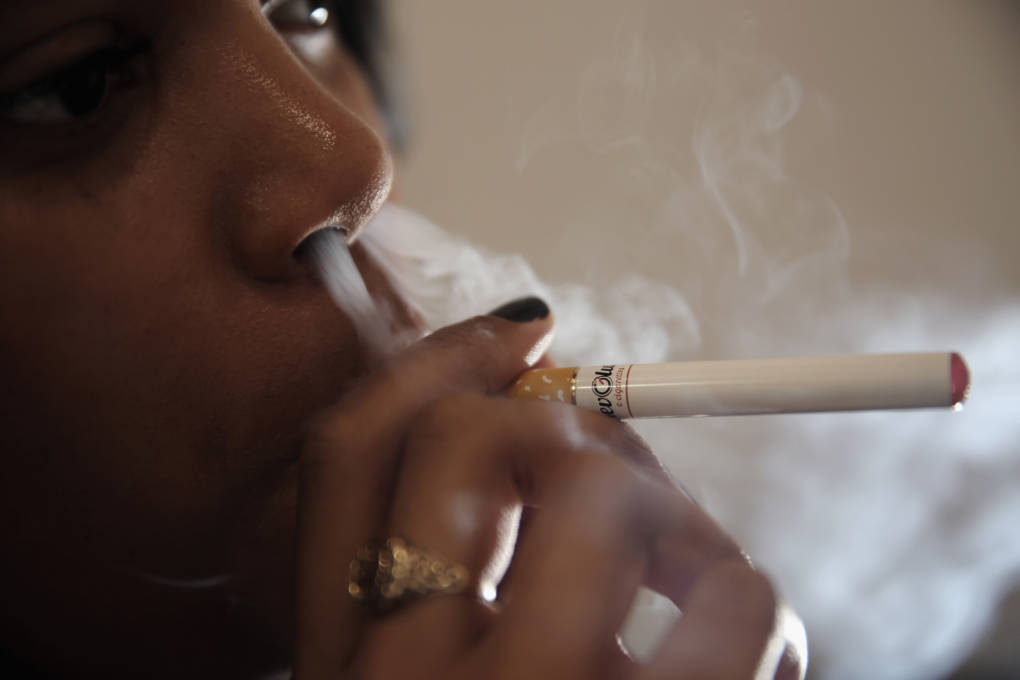
Vaping Health Warnings Could Make Ex-Smokers Return to Cigarettes
Many Vaping Illnesses Linked To Black Market 'Dank Vapes' Or Other THC Products
CBD Vapes Spiked With Dangerous Drugs Are for Sale Across US
The California Democratic Vaping Party
Sponsored
Player sponsored by
window.__IS_SSR__=true
window.__INITIAL_STATE__={
"attachmentsReducer": {
"audio_0": {
"type": "attachments",
"id": "audio_0",
"imgSizes": {
"kqedFullSize": {
"file": "https://ww2.kqed.org/news/wp-content/themes/KQED-unified/img/audio_bgs/background0.jpg"
}
}
},
"audio_1": {
"type": "attachments",
"id": "audio_1",
"imgSizes": {
"kqedFullSize": {
"file": "https://ww2.kqed.org/news/wp-content/themes/KQED-unified/img/audio_bgs/background1.jpg"
}
}
},
"audio_2": {
"type": "attachments",
"id": "audio_2",
"imgSizes": {
"kqedFullSize": {
"file": "https://ww2.kqed.org/news/wp-content/themes/KQED-unified/img/audio_bgs/background2.jpg"
}
}
},
"audio_3": {
"type": "attachments",
"id": "audio_3",
"imgSizes": {
"kqedFullSize": {
"file": "https://ww2.kqed.org/news/wp-content/themes/KQED-unified/img/audio_bgs/background3.jpg"
}
}
},
"audio_4": {
"type": "attachments",
"id": "audio_4",
"imgSizes": {
"kqedFullSize": {
"file": "https://ww2.kqed.org/news/wp-content/themes/KQED-unified/img/audio_bgs/background4.jpg"
}
}
},
"placeholder": {
"type": "attachments",
"id": "placeholder",
"imgSizes": {
"thumbnail": {
"file": "https://cdn.kqed.org/wp-content/uploads/2024/12/KQED-Default-Image-816638274-2000x1333-1-160x107.jpg",
"width": 160,
"height": 107,
"mimeType": "image/jpeg"
},
"medium": {
"file": "https://cdn.kqed.org/wp-content/uploads/2024/12/KQED-Default-Image-816638274-2000x1333-1-800x533.jpg",
"width": 800,
"height": 533,
"mimeType": "image/jpeg"
},
"medium_large": {
"file": "https://cdn.kqed.org/wp-content/uploads/2024/12/KQED-Default-Image-816638274-2000x1333-1-768x512.jpg",
"width": 768,
"height": 512,
"mimeType": "image/jpeg"
},
"large": {
"file": "https://cdn.kqed.org/wp-content/uploads/2024/12/KQED-Default-Image-816638274-2000x1333-1-1020x680.jpg",
"width": 1020,
"height": 680,
"mimeType": "image/jpeg"
},
"1536x1536": {
"file": "https://cdn.kqed.org/wp-content/uploads/2024/12/KQED-Default-Image-816638274-2000x1333-1-1536x1024.jpg",
"width": 1536,
"height": 1024,
"mimeType": "image/jpeg"
},
"fd-lrg": {
"file": "https://cdn.kqed.org/wp-content/uploads/2024/12/KQED-Default-Image-816638274-2000x1333-1-1536x1024.jpg",
"width": 1536,
"height": 1024,
"mimeType": "image/jpeg"
},
"fd-med": {
"file": "https://cdn.kqed.org/wp-content/uploads/2024/12/KQED-Default-Image-816638274-2000x1333-1-1020x680.jpg",
"width": 1020,
"height": 680,
"mimeType": "image/jpeg"
},
"fd-sm": {
"file": "https://cdn.kqed.org/wp-content/uploads/2024/12/KQED-Default-Image-816638274-2000x1333-1-800x533.jpg",
"width": 800,
"height": 533,
"mimeType": "image/jpeg"
},
"post-thumbnail": {
"file": "https://cdn.kqed.org/wp-content/uploads/2024/12/KQED-Default-Image-816638274-2000x1333-1-672x372.jpg",
"width": 672,
"height": 372,
"mimeType": "image/jpeg"
},
"twentyfourteen-full-width": {
"file": "https://cdn.kqed.org/wp-content/uploads/2024/12/KQED-Default-Image-816638274-2000x1333-1-1038x576.jpg",
"width": 1038,
"height": 576,
"mimeType": "image/jpeg"
},
"xxsmall": {
"file": "https://cdn.kqed.org/wp-content/uploads/2024/12/KQED-Default-Image-816638274-2000x1333-1-160x107.jpg",
"width": 160,
"height": 107,
"mimeType": "image/jpeg"
},
"xsmall": {
"file": "https://cdn.kqed.org/wp-content/uploads/2024/12/KQED-Default-Image-816638274-2000x1333-1-672x372.jpg",
"width": 672,
"height": 372,
"mimeType": "image/jpeg"
},
"small": {
"file": "https://cdn.kqed.org/wp-content/uploads/2024/12/KQED-Default-Image-816638274-2000x1333-1-672x372.jpg",
"width": 672,
"height": 372,
"mimeType": "image/jpeg"
},
"xlarge": {
"file": "https://cdn.kqed.org/wp-content/uploads/2024/12/KQED-Default-Image-816638274-2000x1333-1-1020x680.jpg",
"width": 1020,
"height": 680,
"mimeType": "image/jpeg"
},
"full-width": {
"file": "https://cdn.kqed.org/wp-content/uploads/2024/12/KQED-Default-Image-816638274-2000x1333-1-1920x1280.jpg",
"width": 1920,
"height": 1280,
"mimeType": "image/jpeg"
},
"guest-author-32": {
"file": "https://cdn.kqed.org/wp-content/uploads/2025/01/KQED-Default-Image-816638274-1333x1333-1-160x160.jpg",
"width": 32,
"height": 32,
"mimeType": "image/jpeg"
},
"guest-author-50": {
"file": "https://cdn.kqed.org/wp-content/uploads/2025/01/KQED-Default-Image-816638274-1333x1333-1-160x160.jpg",
"width": 50,
"height": 50,
"mimeType": "image/jpeg"
},
"guest-author-64": {
"file": "https://cdn.kqed.org/wp-content/uploads/2025/01/KQED-Default-Image-816638274-1333x1333-1-160x160.jpg",
"width": 64,
"height": 64,
"mimeType": "image/jpeg"
},
"guest-author-96": {
"file": "https://cdn.kqed.org/wp-content/uploads/2025/01/KQED-Default-Image-816638274-1333x1333-1-160x160.jpg",
"width": 96,
"height": 96,
"mimeType": "image/jpeg"
},
"guest-author-128": {
"file": "https://cdn.kqed.org/wp-content/uploads/2025/01/KQED-Default-Image-816638274-1333x1333-1-160x160.jpg",
"width": 128,
"height": 128,
"mimeType": "image/jpeg"
},
"detail": {
"file": "https://cdn.kqed.org/wp-content/uploads/2025/01/KQED-Default-Image-816638274-1333x1333-1-160x160.jpg",
"width": 160,
"height": 160,
"mimeType": "image/jpeg"
},
"kqedFullSize": {
"file": "https://cdn.kqed.org/wp-content/uploads/2024/12/KQED-Default-Image-816638274-2000x1333-1.jpg",
"width": 2000,
"height": 1333
}
}
},
"news_12036137": {
"type": "attachments",
"id": "news_12036137",
"meta": {
"index": "attachments_1716263798",
"site": "news",
"id": "12036137",
"found": true
},
"title": "Twitter on a vape_web img",
"publishDate": 1744762668,
"status": "inherit",
"parent": 12036123,
"modified": 1744764310,
"caption": "Tech reporter Samantha Cole holds a SWYPE touchscreen disposable vape in July 2024. She ordered the device after viral posts that summer showed digital vapes with built-in social media apps. ",
"credit": "Samantha Cole/404 Media",
"altTag": "A pink SWYPE brand disposable vape is held in a person's left hand. The vape has a glossy touchscreen displaying icons for WhatsApp, Facebook, X (formerly Twitter), and WeChat. The background shows a reddish-brown wood floor and white door frames, slightly out of focus. In the lower right corner of the image, the phrase “CLOSE ALL TABS” appears in pixelated white font.",
"description": null,
"imgSizes": {
"medium": {
"file": "https://cdn.kqed.org/wp-content/uploads/sites/10/2025/04/Twitter-on-a-vape_web-img-800x450.png",
"width": 800,
"height": 450,
"mimeType": "image/png"
},
"large": {
"file": "https://cdn.kqed.org/wp-content/uploads/sites/10/2025/04/Twitter-on-a-vape_web-img-1020x574.png",
"width": 1020,
"height": 574,
"mimeType": "image/png"
},
"thumbnail": {
"file": "https://cdn.kqed.org/wp-content/uploads/sites/10/2025/04/Twitter-on-a-vape_web-img-160x90.png",
"width": 160,
"height": 90,
"mimeType": "image/png"
},
"1536x1536": {
"file": "https://cdn.kqed.org/wp-content/uploads/sites/10/2025/04/Twitter-on-a-vape_web-img-1536x864.png",
"width": 1536,
"height": 864,
"mimeType": "image/png"
},
"post-thumbnail": {
"file": "https://cdn.kqed.org/wp-content/uploads/sites/10/2025/04/Twitter-on-a-vape_web-img-672x372.png",
"width": 672,
"height": 372,
"mimeType": "image/png"
},
"twentyfourteen-full-width": {
"file": "https://cdn.kqed.org/wp-content/uploads/sites/10/2025/04/Twitter-on-a-vape_web-img-1038x576.png",
"width": 1038,
"height": 576,
"mimeType": "image/png"
},
"kqedFullSize": {
"file": "https://cdn.kqed.org/wp-content/uploads/sites/10/2025/04/Twitter-on-a-vape_web-img.png",
"width": 1920,
"height": 1080
}
},
"fetchFailed": false,
"isLoading": false
},
"news_11778404": {
"type": "attachments",
"id": "news_11778404",
"meta": {
"index": "attachments_1716263798",
"site": "news",
"id": "11778404",
"found": true
},
"parent": 11778402,
"imgSizes": {
"apple_news_ca_landscape_5_5": {
"file": "https://ww2.kqed.org/app/uploads/sites/10/2019/10/RS16451_GettyImages-454246108-qut-1044x783.jpg",
"width": 1044,
"mimeType": "image/jpeg",
"height": 783
},
"apple_news_ca_square_4_0": {
"file": "https://ww2.kqed.org/app/uploads/sites/10/2019/10/RS16451_GettyImages-454246108-qut-470x470.jpg",
"width": 470,
"mimeType": "image/jpeg",
"height": 470
},
"twentyfourteen-full-width": {
"file": "https://ww2.kqed.org/app/uploads/sites/10/2019/10/RS16451_GettyImages-454246108-qut-1038x576.jpg",
"width": 1038,
"mimeType": "image/jpeg",
"height": 576
},
"thumbnail": {
"file": "https://ww2.kqed.org/app/uploads/sites/10/2019/10/RS16451_GettyImages-454246108-qut-160x107.jpg",
"width": 160,
"mimeType": "image/jpeg",
"height": 107
},
"post-thumbnail": {
"file": "https://ww2.kqed.org/app/uploads/sites/10/2019/10/RS16451_GettyImages-454246108-qut-672x372.jpg",
"width": 672,
"mimeType": "image/jpeg",
"height": 372
},
"kqedFullSize": {
"file": "https://ww2.kqed.org/app/uploads/sites/10/2019/10/RS16451_GettyImages-454246108-qut.jpg",
"width": 1920,
"height": 1280
},
"apple_news_ca_landscape_4_7": {
"file": "https://ww2.kqed.org/app/uploads/sites/10/2019/10/RS16451_GettyImages-454246108-qut-632x474.jpg",
"width": 632,
"mimeType": "image/jpeg",
"height": 474
},
"large": {
"file": "https://ww2.kqed.org/app/uploads/sites/10/2019/10/RS16451_GettyImages-454246108-qut-1020x680.jpg",
"width": 1020,
"mimeType": "image/jpeg",
"height": 680
},
"complete_open_graph": {
"file": "https://ww2.kqed.org/app/uploads/sites/10/2019/10/RS16451_GettyImages-454246108-qut-1200x800.jpg",
"width": 1200,
"mimeType": "image/jpeg",
"height": 800
},
"apple_news_ca_landscape_4_0": {
"file": "https://ww2.kqed.org/app/uploads/sites/10/2019/10/RS16451_GettyImages-454246108-qut-536x402.jpg",
"width": 536,
"mimeType": "image/jpeg",
"height": 402
},
"apple_news_ca_portrait_12_9": {
"file": "https://ww2.kqed.org/app/uploads/sites/10/2019/10/RS16451_GettyImages-454246108-qut-1122x1280.jpg",
"width": 1122,
"mimeType": "image/jpeg",
"height": 1280
},
"medium": {
"file": "https://ww2.kqed.org/app/uploads/sites/10/2019/10/RS16451_GettyImages-454246108-qut-800x533.jpg",
"width": 800,
"mimeType": "image/jpeg",
"height": 533
},
"apple_news_ca_portrait_4_0": {
"file": "https://ww2.kqed.org/app/uploads/sites/10/2019/10/RS16451_GettyImages-454246108-qut-354x472.jpg",
"width": 354,
"mimeType": "image/jpeg",
"height": 472
},
"apple_news_ca_portrait_9_7": {
"file": "https://ww2.kqed.org/app/uploads/sites/10/2019/10/RS16451_GettyImages-454246108-qut-840x1120.jpg",
"width": 840,
"mimeType": "image/jpeg",
"height": 1120
},
"apple_news_ca_landscape_12_9": {
"file": "https://ww2.kqed.org/app/uploads/sites/10/2019/10/RS16451_GettyImages-454246108-qut-1832x1280.jpg",
"width": 1832,
"mimeType": "image/jpeg",
"height": 1280
},
"apple_news_ca_square_9_7": {
"file": "https://ww2.kqed.org/app/uploads/sites/10/2019/10/RS16451_GettyImages-454246108-qut-1104x1104.jpg",
"width": 1104,
"mimeType": "image/jpeg",
"height": 1104
},
"apple_news_ca_portrait_4_7": {
"file": "https://ww2.kqed.org/app/uploads/sites/10/2019/10/RS16451_GettyImages-454246108-qut-414x552.jpg",
"width": 414,
"mimeType": "image/jpeg",
"height": 552
},
"apple_news_ca_square_12_9": {
"file": "https://ww2.kqed.org/app/uploads/sites/10/2019/10/RS16451_GettyImages-454246108-qut-1472x1280.jpg",
"width": 1472,
"mimeType": "image/jpeg",
"height": 1280
},
"apple_news_ca_portrait_5_5": {
"file": "https://ww2.kqed.org/app/uploads/sites/10/2019/10/RS16451_GettyImages-454246108-qut-687x916.jpg",
"width": 687,
"mimeType": "image/jpeg",
"height": 916
},
"full-width": {
"file": "https://ww2.kqed.org/app/uploads/sites/10/2019/10/RS16451_GettyImages-454246108-qut-1920x1280.jpg",
"width": 1920,
"mimeType": "image/jpeg",
"height": 1280
},
"apple_news_ca_square_4_7": {
"file": "https://ww2.kqed.org/app/uploads/sites/10/2019/10/RS16451_GettyImages-454246108-qut-550x550.jpg",
"width": 550,
"mimeType": "image/jpeg",
"height": 550
},
"apple_news_ca_landscape_9_7": {
"file": "https://ww2.kqed.org/app/uploads/sites/10/2019/10/RS16451_GettyImages-454246108-qut-1376x1032.jpg",
"width": 1376,
"mimeType": "image/jpeg",
"height": 1032
},
"apple_news_ca_square_5_5": {
"file": "https://ww2.kqed.org/app/uploads/sites/10/2019/10/RS16451_GettyImages-454246108-qut-912x912.jpg",
"width": 912,
"mimeType": "image/jpeg",
"height": 912
}
},
"publishDate": 1570376807,
"modified": 1570486829,
"caption": "The scare of a fatal lung ailment related to e-cigarette vaping has health advocates fearing that ex-smokers will return to traditional cigarettes, which are even more deadly.",
"description": "The scare of a fatal lung ailment related to e-cigarette vaping has health advocates fearing that ex-smokers will return to traditional cigarettes, which are even more deadly.",
"title": "RS16451_GettyImages-454246108-qut",
"credit": "Dan Kitwood/Getty Images",
"status": "inherit",
"fetchFailed": false,
"isLoading": false
},
"news_11777196": {
"type": "attachments",
"id": "news_11777196",
"meta": {
"index": "attachments_1716263798",
"site": "news",
"id": "11777196",
"found": true
},
"parent": 11777195,
"imgSizes": {
"apple_news_ca_landscape_5_5": {
"file": "https://ww2.kqed.org/app/uploads/sites/10/2019/09/ap_19270708738931_enl-2dd21c223e31a585978d1e41c40314684e951fd3-1044x783.jpg",
"width": 1044,
"mimeType": "image/jpeg",
"height": 783
},
"apple_news_ca_square_4_0": {
"file": "https://ww2.kqed.org/app/uploads/sites/10/2019/09/ap_19270708738931_enl-2dd21c223e31a585978d1e41c40314684e951fd3-470x470.jpg",
"width": 470,
"mimeType": "image/jpeg",
"height": 470
},
"twentyfourteen-full-width": {
"file": "https://ww2.kqed.org/app/uploads/sites/10/2019/09/ap_19270708738931_enl-2dd21c223e31a585978d1e41c40314684e951fd3-1038x576.jpg",
"width": 1038,
"mimeType": "image/jpeg",
"height": 576
},
"thumbnail": {
"file": "https://ww2.kqed.org/app/uploads/sites/10/2019/09/ap_19270708738931_enl-2dd21c223e31a585978d1e41c40314684e951fd3-160x107.jpg",
"width": 160,
"mimeType": "image/jpeg",
"height": 107
},
"post-thumbnail": {
"file": "https://ww2.kqed.org/app/uploads/sites/10/2019/09/ap_19270708738931_enl-2dd21c223e31a585978d1e41c40314684e951fd3-672x372.jpg",
"width": 672,
"mimeType": "image/jpeg",
"height": 372
},
"kqedFullSize": {
"file": "https://ww2.kqed.org/app/uploads/sites/10/2019/09/ap_19270708738931_enl-2dd21c223e31a585978d1e41c40314684e951fd3-e1569700231855.jpg",
"width": 1920,
"height": 1287
},
"apple_news_ca_landscape_4_7": {
"file": "https://ww2.kqed.org/app/uploads/sites/10/2019/09/ap_19270708738931_enl-2dd21c223e31a585978d1e41c40314684e951fd3-632x474.jpg",
"width": 632,
"mimeType": "image/jpeg",
"height": 474
},
"large": {
"file": "https://ww2.kqed.org/app/uploads/sites/10/2019/09/ap_19270708738931_enl-2dd21c223e31a585978d1e41c40314684e951fd3-1020x684.jpg",
"width": 1020,
"mimeType": "image/jpeg",
"height": 684
},
"complete_open_graph": {
"file": "https://ww2.kqed.org/app/uploads/sites/10/2019/09/ap_19270708738931_enl-2dd21c223e31a585978d1e41c40314684e951fd3-1200x804.jpg",
"width": 1200,
"mimeType": "image/jpeg",
"height": 804
},
"apple_news_ca_landscape_4_0": {
"file": "https://ww2.kqed.org/app/uploads/sites/10/2019/09/ap_19270708738931_enl-2dd21c223e31a585978d1e41c40314684e951fd3-536x402.jpg",
"width": 536,
"mimeType": "image/jpeg",
"height": 402
},
"apple_news_ca_portrait_12_9": {
"file": "https://ww2.kqed.org/app/uploads/sites/10/2019/09/ap_19270708738931_enl-2dd21c223e31a585978d1e41c40314684e951fd3-1122x1496.jpg",
"width": 1122,
"mimeType": "image/jpeg",
"height": 1496
},
"medium": {
"file": "https://ww2.kqed.org/app/uploads/sites/10/2019/09/ap_19270708738931_enl-2dd21c223e31a585978d1e41c40314684e951fd3-800x536.jpg",
"width": 800,
"mimeType": "image/jpeg",
"height": 536
},
"apple_news_ca_portrait_4_0": {
"file": "https://ww2.kqed.org/app/uploads/sites/10/2019/09/ap_19270708738931_enl-2dd21c223e31a585978d1e41c40314684e951fd3-354x472.jpg",
"width": 354,
"mimeType": "image/jpeg",
"height": 472
},
"apple_news_ca_portrait_9_7": {
"file": "https://ww2.kqed.org/app/uploads/sites/10/2019/09/ap_19270708738931_enl-2dd21c223e31a585978d1e41c40314684e951fd3-840x1120.jpg",
"width": 840,
"mimeType": "image/jpeg",
"height": 1120
},
"apple_news_ca_landscape_12_9": {
"file": "https://ww2.kqed.org/app/uploads/sites/10/2019/09/ap_19270708738931_enl-2dd21c223e31a585978d1e41c40314684e951fd3-1832x1374.jpg",
"width": 1832,
"mimeType": "image/jpeg",
"height": 1374
},
"apple_news_ca_square_9_7": {
"file": "https://ww2.kqed.org/app/uploads/sites/10/2019/09/ap_19270708738931_enl-2dd21c223e31a585978d1e41c40314684e951fd3-1104x1104.jpg",
"width": 1104,
"mimeType": "image/jpeg",
"height": 1104
},
"apple_news_ca_portrait_4_7": {
"file": "https://ww2.kqed.org/app/uploads/sites/10/2019/09/ap_19270708738931_enl-2dd21c223e31a585978d1e41c40314684e951fd3-414x552.jpg",
"width": 414,
"mimeType": "image/jpeg",
"height": 552
},
"apple_news_ca_square_12_9": {
"file": "https://ww2.kqed.org/app/uploads/sites/10/2019/09/ap_19270708738931_enl-2dd21c223e31a585978d1e41c40314684e951fd3-1472x1472.jpg",
"width": 1472,
"mimeType": "image/jpeg",
"height": 1472
},
"apple_news_ca_portrait_5_5": {
"file": "https://ww2.kqed.org/app/uploads/sites/10/2019/09/ap_19270708738931_enl-2dd21c223e31a585978d1e41c40314684e951fd3-687x916.jpg",
"width": 687,
"mimeType": "image/jpeg",
"height": 916
},
"full-width": {
"file": "https://ww2.kqed.org/app/uploads/sites/10/2019/09/ap_19270708738931_enl-2dd21c223e31a585978d1e41c40314684e951fd3-1920x1287.jpg",
"width": 1920,
"mimeType": "image/jpeg",
"height": 1287
},
"apple_news_ca_square_4_7": {
"file": "https://ww2.kqed.org/app/uploads/sites/10/2019/09/ap_19270708738931_enl-2dd21c223e31a585978d1e41c40314684e951fd3-550x550.jpg",
"width": 550,
"mimeType": "image/jpeg",
"height": 550
},
"apple_news_ca_landscape_9_7": {
"file": "https://ww2.kqed.org/app/uploads/sites/10/2019/09/ap_19270708738931_enl-2dd21c223e31a585978d1e41c40314684e951fd3-1376x1032.jpg",
"width": 1376,
"mimeType": "image/jpeg",
"height": 1032
},
"apple_news_ca_square_5_5": {
"file": "https://ww2.kqed.org/app/uploads/sites/10/2019/09/ap_19270708738931_enl-2dd21c223e31a585978d1e41c40314684e951fd3-912x912.jpg",
"width": 912,
"mimeType": "image/jpeg",
"height": 912
}
},
"publishDate": 1569693028,
"modified": 1569700225,
"caption": "Investigators have found that cannabis-containing vaping products are linked with many of the reported cases of vaping-related lungillness.",
"description": "Investigators have found that cannabis-containing vaping products are linked with many of the reported cases of vaping-related lung illness.",
"title": "Investigators have found that cannabis-containing vaping products are linked with many of the reported cases of vaping-related lung illness.",
"credit": "Mike Wren/AP",
"status": "inherit",
"fetchFailed": false,
"isLoading": false
},
"news_11774512": {
"type": "attachments",
"id": "news_11774512",
"meta": {
"index": "attachments_1716263798",
"site": "news",
"id": "11774512",
"found": true
},
"parent": 11774487,
"imgSizes": {
"apple_news_ca_landscape_5_5": {
"file": "https://ww2.kqed.org/app/uploads/sites/10/2019/09/vaping-1920-1044x783.jpg",
"width": 1044,
"mimeType": "image/jpeg",
"height": 783
},
"apple_news_ca_square_4_0": {
"file": "https://ww2.kqed.org/app/uploads/sites/10/2019/09/vaping-1920-470x470.jpg",
"width": 470,
"mimeType": "image/jpeg",
"height": 470
},
"twentyfourteen-full-width": {
"file": "https://ww2.kqed.org/app/uploads/sites/10/2019/09/vaping-1920-1038x576.jpg",
"width": 1038,
"mimeType": "image/jpeg",
"height": 576
},
"thumbnail": {
"file": "https://ww2.kqed.org/app/uploads/sites/10/2019/09/vaping-1920-160x107.jpg",
"width": 160,
"mimeType": "image/jpeg",
"height": 107
},
"post-thumbnail": {
"file": "https://ww2.kqed.org/app/uploads/sites/10/2019/09/vaping-1920-672x372.jpg",
"width": 672,
"mimeType": "image/jpeg",
"height": 372
},
"kqedFullSize": {
"file": "https://ww2.kqed.org/app/uploads/sites/10/2019/09/vaping-1920.jpg",
"width": 1920,
"height": 1280
},
"apple_news_ca_landscape_4_7": {
"file": "https://ww2.kqed.org/app/uploads/sites/10/2019/09/vaping-1920-632x474.jpg",
"width": 632,
"mimeType": "image/jpeg",
"height": 474
},
"large": {
"file": "https://ww2.kqed.org/app/uploads/sites/10/2019/09/vaping-1920-1020x680.jpg",
"width": 1020,
"mimeType": "image/jpeg",
"height": 680
},
"complete_open_graph": {
"file": "https://ww2.kqed.org/app/uploads/sites/10/2019/09/vaping-1920-1200x800.jpg",
"width": 1200,
"mimeType": "image/jpeg",
"height": 800
},
"apple_news_ca_landscape_4_0": {
"file": "https://ww2.kqed.org/app/uploads/sites/10/2019/09/vaping-1920-536x402.jpg",
"width": 536,
"mimeType": "image/jpeg",
"height": 402
},
"apple_news_ca_portrait_12_9": {
"file": "https://ww2.kqed.org/app/uploads/sites/10/2019/09/vaping-1920-1122x1280.jpg",
"width": 1122,
"mimeType": "image/jpeg",
"height": 1280
},
"medium": {
"file": "https://ww2.kqed.org/app/uploads/sites/10/2019/09/vaping-1920-800x533.jpg",
"width": 800,
"mimeType": "image/jpeg",
"height": 533
},
"apple_news_ca_portrait_4_0": {
"file": "https://ww2.kqed.org/app/uploads/sites/10/2019/09/vaping-1920-354x472.jpg",
"width": 354,
"mimeType": "image/jpeg",
"height": 472
},
"apple_news_ca_portrait_9_7": {
"file": "https://ww2.kqed.org/app/uploads/sites/10/2019/09/vaping-1920-840x1120.jpg",
"width": 840,
"mimeType": "image/jpeg",
"height": 1120
},
"apple_news_ca_landscape_12_9": {
"file": "https://ww2.kqed.org/app/uploads/sites/10/2019/09/vaping-1920-1832x1280.jpg",
"width": 1832,
"mimeType": "image/jpeg",
"height": 1280
},
"apple_news_ca_square_9_7": {
"file": "https://ww2.kqed.org/app/uploads/sites/10/2019/09/vaping-1920-1104x1104.jpg",
"width": 1104,
"mimeType": "image/jpeg",
"height": 1104
},
"apple_news_ca_portrait_4_7": {
"file": "https://ww2.kqed.org/app/uploads/sites/10/2019/09/vaping-1920-414x552.jpg",
"width": 414,
"mimeType": "image/jpeg",
"height": 552
},
"apple_news_ca_square_12_9": {
"file": "https://ww2.kqed.org/app/uploads/sites/10/2019/09/vaping-1920-1472x1280.jpg",
"width": 1472,
"mimeType": "image/jpeg",
"height": 1280
},
"apple_news_ca_portrait_5_5": {
"file": "https://ww2.kqed.org/app/uploads/sites/10/2019/09/vaping-1920-687x916.jpg",
"width": 687,
"mimeType": "image/jpeg",
"height": 916
},
"full-width": {
"file": "https://ww2.kqed.org/app/uploads/sites/10/2019/09/vaping-1920-1920x1280.jpg",
"width": 1920,
"mimeType": "image/jpeg",
"height": 1280
},
"apple_news_ca_square_4_7": {
"file": "https://ww2.kqed.org/app/uploads/sites/10/2019/09/vaping-1920-550x550.jpg",
"width": 550,
"mimeType": "image/jpeg",
"height": 550
},
"apple_news_ca_landscape_9_7": {
"file": "https://ww2.kqed.org/app/uploads/sites/10/2019/09/vaping-1920-1376x1032.jpg",
"width": 1376,
"mimeType": "image/jpeg",
"height": 1032
},
"apple_news_ca_square_5_5": {
"file": "https://ww2.kqed.org/app/uploads/sites/10/2019/09/vaping-1920-912x912.jpg",
"width": 912,
"mimeType": "image/jpeg",
"height": 912
}
},
"publishDate": 1568657528,
"modified": 1568657592,
"caption": "An illustration shows a man exhaling smoke from an electronic cigarette in Washington, D.C. on Oct. 2, 2018. ",
"description": "An illustration shows a man exhaling smoke from an electronic cigarette in Washington, D.C. on Oct. 2, 2018. ",
"title": "vaping-1920",
"credit": "Eva Hambach/AFP/Getty Images",
"status": "inherit",
"fetchFailed": false,
"isLoading": false
},
"news_11752125": {
"type": "attachments",
"id": "news_11752125",
"meta": {
"index": "attachments_1716263798",
"site": "news",
"id": "11752125",
"found": true
},
"parent": 11752111,
"imgSizes": {
"apple_news_ca_landscape_5_5": {
"file": "https://ww2.kqed.org/app/uploads/sites/10/2019/06/demjuul_060319_final-1044x783.jpg",
"width": 1044,
"mimeType": "image/jpeg",
"height": 783
},
"apple_news_ca_square_4_0": {
"file": "https://ww2.kqed.org/app/uploads/sites/10/2019/06/demjuul_060319_final-470x470.jpg",
"width": 470,
"mimeType": "image/jpeg",
"height": 470
},
"twentyfourteen-full-width": {
"file": "https://ww2.kqed.org/app/uploads/sites/10/2019/06/demjuul_060319_final-1038x576.jpg",
"width": 1038,
"mimeType": "image/jpeg",
"height": 576
},
"thumbnail": {
"file": "https://ww2.kqed.org/app/uploads/sites/10/2019/06/demjuul_060319_final-160x132.jpg",
"width": 160,
"mimeType": "image/jpeg",
"height": 132
},
"post-thumbnail": {
"file": "https://ww2.kqed.org/app/uploads/sites/10/2019/06/demjuul_060319_final-672x372.jpg",
"width": 672,
"mimeType": "image/jpeg",
"height": 372
},
"kqedFullSize": {
"file": "https://ww2.kqed.org/app/uploads/sites/10/2019/06/demjuul_060319_final.jpg",
"width": 1920,
"height": 1580
},
"apple_news_ca_landscape_4_7": {
"file": "https://ww2.kqed.org/app/uploads/sites/10/2019/06/demjuul_060319_final-632x474.jpg",
"width": 632,
"mimeType": "image/jpeg",
"height": 474
},
"large": {
"file": "https://ww2.kqed.org/app/uploads/sites/10/2019/06/demjuul_060319_final-1020x839.jpg",
"width": 1020,
"mimeType": "image/jpeg",
"height": 839
},
"complete_open_graph": {
"file": "https://ww2.kqed.org/app/uploads/sites/10/2019/06/demjuul_060319_final-1200x988.jpg",
"width": 1200,
"mimeType": "image/jpeg",
"height": 988
},
"apple_news_ca_landscape_4_0": {
"file": "https://ww2.kqed.org/app/uploads/sites/10/2019/06/demjuul_060319_final-536x402.jpg",
"width": 536,
"mimeType": "image/jpeg",
"height": 402
},
"apple_news_ca_portrait_12_9": {
"file": "https://ww2.kqed.org/app/uploads/sites/10/2019/06/demjuul_060319_final-1122x1496.jpg",
"width": 1122,
"mimeType": "image/jpeg",
"height": 1496
},
"medium": {
"file": "https://ww2.kqed.org/app/uploads/sites/10/2019/06/demjuul_060319_final-800x658.jpg",
"width": 800,
"mimeType": "image/jpeg",
"height": 658
},
"apple_news_ca_portrait_4_0": {
"file": "https://ww2.kqed.org/app/uploads/sites/10/2019/06/demjuul_060319_final-354x472.jpg",
"width": 354,
"mimeType": "image/jpeg",
"height": 472
},
"apple_news_ca_portrait_9_7": {
"file": "https://ww2.kqed.org/app/uploads/sites/10/2019/06/demjuul_060319_final-840x1120.jpg",
"width": 840,
"mimeType": "image/jpeg",
"height": 1120
},
"apple_news_ca_landscape_12_9": {
"file": "https://ww2.kqed.org/app/uploads/sites/10/2019/06/demjuul_060319_final-1832x1374.jpg",
"width": 1832,
"mimeType": "image/jpeg",
"height": 1374
},
"apple_news_ca_square_9_7": {
"file": "https://ww2.kqed.org/app/uploads/sites/10/2019/06/demjuul_060319_final-1104x1104.jpg",
"width": 1104,
"mimeType": "image/jpeg",
"height": 1104
},
"apple_news_ca_portrait_4_7": {
"file": "https://ww2.kqed.org/app/uploads/sites/10/2019/06/demjuul_060319_final-414x552.jpg",
"width": 414,
"mimeType": "image/jpeg",
"height": 552
},
"apple_news_ca_square_12_9": {
"file": "https://ww2.kqed.org/app/uploads/sites/10/2019/06/demjuul_060319_final-1472x1472.jpg",
"width": 1472,
"mimeType": "image/jpeg",
"height": 1472
},
"apple_news_ca_portrait_5_5": {
"file": "https://ww2.kqed.org/app/uploads/sites/10/2019/06/demjuul_060319_final-687x916.jpg",
"width": 687,
"mimeType": "image/jpeg",
"height": 916
},
"full-width": {
"file": "https://ww2.kqed.org/app/uploads/sites/10/2019/06/demjuul_060319_final-1920x1580.jpg",
"width": 1920,
"mimeType": "image/jpeg",
"height": 1580
},
"apple_news_ca_square_4_7": {
"file": "https://ww2.kqed.org/app/uploads/sites/10/2019/06/demjuul_060319_final-550x550.jpg",
"width": 550,
"mimeType": "image/jpeg",
"height": 550
},
"apple_news_ca_landscape_9_7": {
"file": "https://ww2.kqed.org/app/uploads/sites/10/2019/06/demjuul_060319_final-1376x1032.jpg",
"width": 1376,
"mimeType": "image/jpeg",
"height": 1032
},
"apple_news_ca_square_5_5": {
"file": "https://ww2.kqed.org/app/uploads/sites/10/2019/06/demjuul_060319_final-912x912.jpg",
"width": 912,
"mimeType": "image/jpeg",
"height": 912
}
},
"publishDate": 1559594412,
"modified": 1559594448,
"caption": null,
"description": null,
"title": "demjuul_060319_final",
"credit": null,
"status": "inherit",
"fetchFailed": false,
"isLoading": false
}
},
"audioPlayerReducer": {
"postId": "stream_live",
"isPaused": true,
"isPlaying": false,
"pfsActive": false,
"pledgeModalIsOpen": true,
"playerDrawerIsOpen": false
},
"authorsReducer": {
"byline_news_11778402": {
"type": "authors",
"id": "byline_news_11778402",
"meta": {
"override": true
},
"slug": "byline_news_11778402",
"name": "Matthew Perrone \u003cbr> \u003cstrong>Associated Press\u003c/strong>",
"isLoading": false
},
"byline_news_11777195": {
"type": "authors",
"id": "byline_news_11777195",
"meta": {
"override": true
},
"slug": "byline_news_11777195",
"name": "\u003ca href= \"https://www.npr.org/people/2100208/allison-aubrey\"> Allison Aubrey \u003ca/> \u003cbr>NPR",
"isLoading": false
},
"byline_news_11774487": {
"type": "authors",
"id": "byline_news_11774487",
"meta": {
"override": true
},
"slug": "byline_news_11774487",
"name": "Holbrook Mohr\u003cbr>Associated Press",
"isLoading": false
},
"markfiore": {
"type": "authors",
"id": "3236",
"meta": {
"index": "authors_1716337520",
"id": "3236",
"found": true
},
"name": "Mark Fiore",
"firstName": "Mark",
"lastName": "Fiore",
"slug": "markfiore",
"email": "mark@markfiore.com",
"display_author_email": false,
"staff_mastheads": [
"news"
],
"title": "KQED News Cartoonist",
"bio": "\u003ca href=\"http://www.MarkFiore.com\">MarkFiore.com\u003c/a> | \u003ca href=\"https://twitter.com/markfiore\">Follow on Twitter\u003c/a> | \u003ca href=\"https://www.facebook.com/pages/Mark-Fiore-Animated-Political-Cartoons/94451707396?ref=bookmarks\">Facebook\u003c/a> | \u003ca href=\"mailto:mark@markfiore.com\">email\u003c/a>\r\n\r\nPulitzer Prize-winner, Mark Fiore, who the Wall Street Journal has called “the undisputed guru of the form,” creates animated political cartoons in San Francisco, where his work has been featured regularly on the San Francisco Chronicle’s web site, SFGate.com. His work has appeared on Newsweek.com, Slate.com, CBSNews.com, MotherJones.com, DailyKos.com and NPR’s web site. Fiore’s political animation has appeared on CNN, Frontline, Bill Moyers Journal, Salon.com and cable and broadcast outlets across the globe.\r\n\r\nBeginning his professional life by drawing traditional political cartoons for newspapers, Fiore’s work appeared in publications ranging from the Washington Post to the Los Angeles Times. In the late 1990s, he began to experiment with animating political cartoons and, after a short stint at the San Jose Mercury News as their staff cartoonist, Fiore devoted all his energies to animation.\r\nGrowing up in California, Fiore also spent a good portion of his life in the backwoods of Idaho. It was this combination that shaped him politically. Mark majored in political science at Colorado College, where, in a perfect send-off for a cartoonist, he received his diploma in 1991 as commencement speaker Dick Cheney smiled approvingly.\r\nMark Fiore was awarded the Pulitzer Prize for political cartooning in 2010, a Robert F. Kennedy Journalism Award in 2004 and has twice received an Online Journalism Award for commentary from the Online News Association (2002, 2008). Fiore has received two awards for his work in new media from the National Cartoonists Society (2001, 2002), and in 2006 received The James Madison Freedom of Information Award from The Society of Professional Journalists.",
"avatar": "https://secure.gravatar.com/avatar/fc4e2a612b15b67bad0c6f0e1db4ca9b?s=600&d=blank&r=g",
"twitter": "MarkFiore",
"facebook": null,
"instagram": "https://www.instagram.com/markfiore/?hl=en",
"linkedin": null,
"sites": [
{
"site": "arts",
"roles": [
"contributor"
]
},
{
"site": "news",
"roles": [
"editor"
]
},
{
"site": "futureofyou",
"roles": [
"editor"
]
},
{
"site": "science",
"roles": [
"editor"
]
}
],
"headData": {
"title": "Mark Fiore | KQED",
"description": "KQED News Cartoonist",
"ogImgSrc": "https://secure.gravatar.com/avatar/fc4e2a612b15b67bad0c6f0e1db4ca9b?s=600&d=blank&r=g",
"twImgSrc": "https://secure.gravatar.com/avatar/fc4e2a612b15b67bad0c6f0e1db4ca9b?s=600&d=blank&r=g"
},
"isLoading": false,
"link": "/author/markfiore"
},
"cegusa": {
"type": "authors",
"id": "11869",
"meta": {
"index": "authors_1716337520",
"id": "11869",
"found": true
},
"name": "Chris Egusa",
"firstName": "Chris",
"lastName": "Egusa",
"slug": "cegusa",
"email": "cegusa@kqed.org",
"display_author_email": false,
"staff_mastheads": [],
"title": "KQED Contributor",
"bio": null,
"avatar": "https://secure.gravatar.com/avatar/86d00b34cb7eeb5247e991f0e20c70c4?s=600&d=blank&r=g",
"twitter": null,
"facebook": null,
"instagram": null,
"linkedin": null,
"sites": [
{
"site": "arts",
"roles": [
"editor"
]
}
],
"headData": {
"title": "Chris Egusa | KQED",
"description": "KQED Contributor",
"ogImgSrc": "https://secure.gravatar.com/avatar/86d00b34cb7eeb5247e991f0e20c70c4?s=600&d=blank&r=g",
"twImgSrc": "https://secure.gravatar.com/avatar/86d00b34cb7eeb5247e991f0e20c70c4?s=600&d=blank&r=g"
},
"isLoading": false,
"link": "/author/cegusa"
},
"mcueva": {
"type": "authors",
"id": "11943",
"meta": {
"index": "authors_1716337520",
"id": "11943",
"found": true
},
"name": "Maya Cueva",
"firstName": "Maya",
"lastName": "Cueva",
"slug": "mcueva",
"email": "mcueva@kqed.org",
"display_author_email": false,
"staff_mastheads": [],
"title": "KQED Contributor",
"bio": null,
"avatar": "https://secure.gravatar.com/avatar/26d0967153608e4720f52779f754087a?s=600&d=blank&r=g",
"twitter": null,
"facebook": null,
"instagram": null,
"linkedin": null,
"sites": [
{
"site": "news",
"roles": [
"editor"
]
}
],
"headData": {
"title": "Maya Cueva | KQED",
"description": "KQED Contributor",
"ogImgSrc": "https://secure.gravatar.com/avatar/26d0967153608e4720f52779f754087a?s=600&d=blank&r=g",
"twImgSrc": "https://secure.gravatar.com/avatar/26d0967153608e4720f52779f754087a?s=600&d=blank&r=g"
},
"isLoading": false,
"link": "/author/mcueva"
},
"msung": {
"type": "authors",
"id": "11944",
"meta": {
"index": "authors_1716337520",
"id": "11944",
"found": true
},
"name": "Morgan Sung",
"firstName": "Morgan",
"lastName": "Sung",
"slug": "msung",
"email": "msung@kqed.org",
"display_author_email": false,
"staff_mastheads": [],
"title": "Close All Tabs Host",
"bio": null,
"avatar": "https://secure.gravatar.com/avatar/34033b8d232ee6c987ca6f0a1a28f0e5?s=600&d=blank&r=g",
"twitter": null,
"facebook": null,
"instagram": null,
"linkedin": null,
"sites": [
{
"site": "news",
"roles": [
"editor"
]
}
],
"headData": {
"title": "Morgan Sung | KQED",
"description": "Close All Tabs Host",
"ogImgSrc": "https://secure.gravatar.com/avatar/34033b8d232ee6c987ca6f0a1a28f0e5?s=600&d=blank&r=g",
"twImgSrc": "https://secure.gravatar.com/avatar/34033b8d232ee6c987ca6f0a1a28f0e5?s=600&d=blank&r=g"
},
"isLoading": false,
"link": "/author/msung"
}
},
"breakingNewsReducer": {},
"pagesReducer": {},
"postsReducer": {
"stream_live": {
"type": "live",
"id": "stream_live",
"audioUrl": "https://streams.kqed.org/kqedradio",
"title": "Live Stream",
"excerpt": "Live Stream information currently unavailable.",
"link": "/radio",
"featImg": "",
"label": {
"name": "KQED Live",
"link": "/"
}
},
"stream_kqedNewscast": {
"type": "posts",
"id": "stream_kqedNewscast",
"audioUrl": "https://www.kqed.org/.stream/anon/radio/RDnews/newscast.mp3?_=1",
"title": "KQED Newscast",
"featImg": "",
"label": {
"name": "88.5 FM",
"link": "/"
}
},
"news_12036123": {
"type": "posts",
"id": "news_12036123",
"meta": {
"index": "posts_1716263798",
"site": "news",
"id": "12036123",
"score": null,
"sort": [
1744797610000
]
},
"guestAuthors": [],
"slug": "twitter-on-a-vape-puff-post-pollute",
"title": "Twitter on a Vape: Puff, Post, Pollute",
"publishDate": 1744797610,
"format": "audio",
"headTitle": "Twitter on a Vape: Puff, Post, Pollute | KQED",
"labelTerm": {},
"content": "\u003cp>\u003cspan style=\"font-weight: 400\">In this episode, tech reporter Samatha Cole shares what happened when she tried to “vape the internet” after seeing a viral post about a disposable touchscreen vape with built-in social media. We also hear from environmental philosopher and public health researcher Yogi Hale Hendlin, who says these high-tech disposables are made possible by a legal loophole — and that tackling the e-waste crisis will take a radical rethink of our relationship with the products we consume.\u003c/span>\u003c/p>\n\u003cp>\u003c!-- iframe plugin v.4.3 wordpress.org/plugins/iframe/ -->\u003cbr>\n\u003ciframe loading=\"lazy\" frameborder=\"0\" height=\"200\" scrolling=\"no\" src=\"https://playlist.megaphone.fm/?e=KQINC1701619724\" width=\"100%\" class=\"iframe-class\">\u003c/iframe>\u003c/p>\n\u003cp>\u003cspan style=\"font-weight: 400\">Guests:\u003c/span>\u003c/p>\n\u003cul>\n\u003cli>\u003ca href=\"https://www.404media.co/author/samantha-cole/\">\u003cspan style=\"font-weight: 400\">Samantha Cole\u003c/span>\u003c/a>\u003cspan style=\"font-weight: 400\">, Reporter and Co-Founder of \u003c/span>\u003ci>\u003cspan style=\"font-weight: 400\">404 Media\u003c/span>\u003c/i>\u003c/li>\n\u003cli>\u003ca href=\"https://www.eur.nl/en/people/yogi-hendlin\">\u003cspan style=\"font-weight: 400\">Yogi Hale Hendlin\u003c/span>\u003c/a>\u003cspan style=\"font-weight: 400\">, Environmental Philosopher and Assistant Professor at Erasmus University\u003c/span>\u003c/li>\n\u003c/ul>\n\u003cp>\u003cspan style=\"font-weight: 400\">Further reading:\u003c/span>\u003c/p>\n\u003cul>\n\u003cli style=\"font-weight: 400\">\u003ca href=\"https://www.404media.co/twitter-internet-vape-touchscreen-swype/\">\u003cspan style=\"font-weight: 400\">I Tried to Vape the Internet\u003c/span>\u003c/a>\u003cspan style=\"font-weight: 400\"> – Samantha Cole, \u003c/span>\u003ci>\u003cspan style=\"font-weight: 400\">404 Media\u003c/span>\u003c/i>\u003cspan style=\"font-weight: 400\"> \u003c/span>\u003c/li>\n\u003cli style=\"font-weight: 400\">\u003ca href=\"https://apnews.com/article/vaping-ecigarettes-waste-environment-disposable-pollution-3d19dce9693ce78dd244729f524df02a\">\u003cspan style=\"font-weight: 400\">Communities can’t recycle or trash disposable e-cigarettes. So what happens to them? \u003c/span>\u003c/a>\u003cspan style=\"font-weight: 400\">– Matthew Perrone, \u003c/span>\u003ci>\u003cspan style=\"font-weight: 400\">Associated Press\u003c/span>\u003c/i>\u003c/li>\n\u003cli style=\"font-weight: 400\">\u003ca href=\"https://www.politico.com/news/magazine/2025/01/26/vapes-flavors-china-teens-00194082\">\u003cspan style=\"font-weight: 400\">How ‘Sour Raspberry Gummy Bear’ — and Other Chinese Vapes — Made Fools of American Lawmakers \u003c/span>\u003c/a>\u003cspan style=\"font-weight: 400\">– Marc Novicoff, \u003c/span>\u003ci>\u003cspan style=\"font-weight: 400\">Politico \u003c/span>\u003c/i>\u003c/li>\n\u003cli style=\"font-weight: 400\">\u003ca href=\"https://grist.org/regulation/the-right-to-repair-is-now-law-in-3-states-is-big-tech-complying/\">\u003cspan style=\"font-weight: 400\">The right to repair electronics is now law in 3 states. Is Big Tech complying? \u003c/span>\u003c/a>\u003cspan style=\"font-weight: 400\">– Maddie Stone, \u003c/span>\u003ci>\u003cspan style=\"font-weight: 400\">Grist \u003c/span>\u003c/i>\u003cspan style=\"font-weight: 400\"> \u003c/span>\u003c/li>\n\u003cli style=\"font-weight: 400\">\u003ca href=\"https://www.materialfocus.org.uk/?press-releases=disposable-single-use-vapes-thrown-away-have-quadrupled-to-5-million-per-week\">Disposable vapes thrown away quadruples to 5M per week\u003c/a> – \u003ci>Material Focus\u003c/i>\u003c/li>\n\u003c/ul>\n\u003cp>Want to give us feedback on the show? Shoot us an email at \u003ca href=\"mailto:CloseAllTabs@KQED.org\">CloseAllTabs@KQED.org\u003c/a>\u003c/p>\n\u003cp>\u003ca href=\"https://www.instagram.com/closealltabspod/\">Follow us on Instagram\u003c/a>\u003c/p>\n\u003cp>[ad fullwidth]\u003c/p>\n\u003ch2>\u003c/h2>\n\u003ch2 id=\"episode-transcript\">Episode Transcript\u003c/h2>\n\u003cp>\u003ci data-stringify-type=\"italic\">This is a computer-generated transcript. While our team has reviewed it, there may be errors.\u003c/i>\u003c/p>\n\u003cp>\u003cb>Samantha Cole: \u003c/b>\u003cspan style=\"font-weight: 400\">I have never been a smoker, period. I have never smoked nicotine of any kind. Such a loser. \u003c/span>\u003c/p>\n\u003cp>\u003cb>Morgan Sung: \u003c/b>\u003cspan style=\"font-weight: 400\">Sam Cole is a tech journalist and co-founder of 404 Media, and last summer, she tried to vape the internet. \u003c/span>\u003c/p>\n\u003cp>\u003cb>Samantha Cole: \u003c/b>\u003cspan style=\"font-weight: 400\">There was this tweet going super viral back in July. It was a guy that was like, “no way we got Twitter on my vape.” And it was a photo of him holding a vape with Twitter on it, reading tweets on it. \u003c/span>\u003c/p>\n\u003cp>\u003cb>Morgan Sung: \u003c/b>\u003cspan style=\"font-weight: 400\">It was exactly what it sounds like, a little flip phone-sized disposable vape, with a digital screen. \u003c/span>\u003c/p>\n\u003cp>\u003cb>Samantha Cole: \u003c/b>\u003cspan style=\"font-weight: 400\">And everyone was freaking out about it. It became a meme format. Like, there was one where someone was putting Zillow on a vape. \u003c/span>\u003c/p>\n\u003cp>\u003cb>Morgan Sung: \u003c/b>\u003cspan style=\"font-weight: 400\">In other posts, people were getting breaking news alerts on their vapes or playing games like Tetris and 2048. And Sam, being an intrepid journalist, was determined to figure out if it was real. \u003c/span>\u003c/p>\n\u003cp>\u003cb>Samantha Cole: \u003c/b>\u003cspan style=\"font-weight: 400\">I’m always looking for new ways to ingest the internet. So I was like, let me look in the comments or in the replies and see if anybody actually has it. And it turned out someone did have a link. God bless the internet. A lot of them were sold out. The other flavors were Fucking Fab — I wish I knew what Fucking Fab tasted like — Juicy Peach, obviously you can imagine. Violent Rainbow was also sold out, I’m sure it was disgusting, but Watermelon Ice was like the only one left. \u003c/span>\u003c/p>\n\u003cp>\u003cb>Morgan Sung: \u003c/b>\u003cspan style=\"font-weight: 400\">Sam lives in New York, but was staying in California for a few weeks. So she bought the Watermelon Ice smart vape and shipped it to her friend’s house in Los Angeles. This is relevant. \u003c/span>\u003c/p>\n\u003cp>\u003cb>Samantha Cole: \u003c/b>\u003cspan style=\"font-weight: 400\">I was like, first of all, I can’t believe this goes through the mail. This definitely seems like something that shouldn’t between the battery and the vape juice and everything else and the electronics involved. I was like house sitting. I was, like, “I hope this doesn’t catch fire while I’m not at home.” It looks like a phone. It was, a pink, like a light pink square, kind of like a deck of cards almost. It had a touch screen that wasn’t, like, as janky as I expected a vape touch screen to be. \u003c/span>\u003c/p>\n\u003cp>\u003cb>Morgan Sung: \u003c/b>\u003cspan style=\"font-weight: 400\">Okay, so the vape looked like a phone, but it didn’t really function as one. It couldn’t connect to the internet by itself. Sam actually had to download a separate app and connect it to the vape via Bluetooth, and then authorize different apps to send notifications to the vape. \u003c/span>\u003c/p>\n\u003cp>\u003cb>Samantha Cole: \u003c/b>\u003cspan style=\"font-weight: 400\">Once you connected it to your phone, it would start getting push notifications from whatever apps that you set up to connect to the vape. So that’s where the Twitter on the vape came from. \u003c/span>\u003c/p>\n\u003cp>\u003cb>Morgan Sung: \u003c/b>\u003cspan style=\"font-weight: 400\">There was a calculator in case you need to do math while you’re vaping, and it also had a step tracker and a weather app and a few games, but a lot of the apps didn’t really work unless Sam’s phone was nearby. She said she couldn’t actually browse the internet on her vape, but because she was getting notifications on it, it created this cycle of getting pinged while puffing some watermelon ice and then checking her phone and then puffing again. \u003c/span>\u003c/p>\n\u003cp>\u003cb>Samantha Cole: \u003c/b>\u003cspan style=\"font-weight: 400\">I mean, I was very quickly like literally addicted to this thing, cause it was nicotine. I was bringing it everywhere. I was like, it was like a fun thing to show people ’cause obviously it’s like weird and kooky. I had it out like drinking and then I was vaping. I was, like, “man, this is, I need to put this away. I need you to put it in a drawer and not think about it.” And then it was just like calling me like the Green Goblin mask. \u003c/span>\u003c/p>\n\u003cp>\u003cb>Green Goblin Mask: \u003c/b>\u003cspan style=\"font-weight: 400\">COWARD! We have a new world to conquer. Hahaha!\u003c/span>\u003c/p>\n\u003cp>\u003cb>Samantha Cole: \u003c/b>\u003cspan style=\"font-weight: 400\">It was like, “I need a little, I need Watermelon Ice.”\u003c/span>\u003c/p>\n\u003cp>\u003cb>Morgan Sung: \u003c/b>\u003cspan style=\"font-weight: 400\">So Sam wrote up this tongue-in-cheek blog post for 404 Media about trying to “vape the internet,” but after publishing it, she still found herself reaching for the vape. \u003c/span>\u003c/p>\n\u003cp>\u003cb>Samantha Cole: \u003c/b>\u003cspan style=\"font-weight: 400\">So I was just like, this is like the dumbest blog I’ve ever written. It’s up there on like “the dumbest ways to get addicted to vaping” is this stunt where I’m trying to read Twitter on a vape. \u003c/span>\u003c/p>\n\u003cp>\u003cb>Morgan Sung: \u003c/b>\u003cspan style=\"font-weight: 400\">Yeah, it’s like you’re addicted to the nicotine and you’re addicted to your feed. \u003c/span>\u003c/p>\n\u003cp>\u003cb>Samantha Cole: \u003c/b>\u003cspan style=\"font-weight: 400\">Right, yeah, I was addicted to all of it at the same time, which is just so dark. Connecting like this very like neurochemical process of like being addicted to nicotine and then getting like dms on the vape and being like, “ooh who’s DMing me on twitter.” This is like such a dark path uh to go to down.\u003c/span>\u003c/p>\n\u003cp>\u003cb>Morgan Sung: \u003c/b>\u003cspan style=\"font-weight: 400\">Sam ended up kicking the habit when she left the vape at her friend’s house in LA. She said she was scared to take it through airport security. And when she got back to New York, she resisted the temptation to buy another one. Since then, she’s managed to keep her nicotine consumption limited to the very occasional analog cigarette shared among friends. \u003c/span>\u003c/p>\n\u003cp>\u003cspan style=\"font-weight: 400\">But Sam said that her vape experience was an eye-opener in more ways than one. There was her brush with this combined nicotine and internet addiction, sure, but she’s also been thinking about another issue: just how wasteful these vapes are. Remember, they’re disposable. There’s no vape pod to swap out if you want to change flavors. You can’t refill it once it’s empty. And a lot of them aren’t even rechargeable. You can easily go through one in a few weeks or a few days if you’re really puffing. Which means that you’re constantly replacing them. \u003c/span>\u003c/p>\n\u003cp>\u003cb>Samantha Cole: \u003c/b>\u003cspan style=\"font-weight: 400\">There was a time in like New York / Bushwick, surely you recall this, but just the ground was just covered in used Juul pods. It was just everywhere. At the time, I was like, “this is an ecological disaster.” And now I think- \u003c/span>\u003c/p>\n\u003cp>\u003cb>Morgan Sung: \u003c/b>\u003cspan style=\"font-weight: 400\">It was like plastic everywhere. \u003c/span>\u003c/p>\n\u003cp>\u003cb>Samantha Cole: \u003c/b>\u003cspan style=\"font-weight: 400\">Yeah, and it’s disgusting. And like, and you know, it’s like, I guess they put them in like cigarette butts, except they don’t degrade or anything. But then this I was like, “okay, when I finish this vape, I can’t refill it?” Even though it has all this stuff in it. Like it has like the touch screen, like it has chips inside of it, it has a battery inside of obviously, lots of plastic. So I was like, “damn, there’s a lot of like engineering that goes into this thing and then it becomes disposable within like a couple of weeks?” \u003c/span>\u003c/p>\n\u003cp>\u003cb>Morgan Sung: \u003c/b>\u003cspan style=\"font-weight: 400\">Okay, so what exactly makes vapes an “ecological disaster,” like Sam said? Are you supposed to recycle them? And how big of a problem is this really? That’s what we’re getting into today. \u003c/span>\u003c/p>\n\u003cp>\u003cspan style=\"font-weight: 400\">This is Close All Tabs. I’m Morgan Sung:, tech journalist, and your chronically online friend, here to open as many browser tabs as it takes to help you understand how the digital world affects our real lives. Let’s get into it. \u003c/span>\u003c/p>\n\u003cp>\u003cspan style=\"font-weight: 400\">E-waste, or electronic waste, includes any electronic device that’s thrown away instead of recycled. It’s copper wires, semiconductors, circuit boards, LED screens, heavy metals, batteries, and more. It’s the stuff in our refrigerators and our old iPhones, and in our vapes. When these materials are dumped in landfills, they don’t really break down. And the sheer rate at which people are now buying, puffing, and then tossing disposable vapes, is rapidly adding to the e-waste crisis. \u003c/span>\u003c/p>\n\u003cp>\u003cspan style=\"font-weight: 400\">Let’s make that our first tab. Disposable vapes and e-waste. \u003c/span>\u003c/p>\n\u003cp>\u003cspan style=\"font-weight: 400\">To explain how disposable vapes became so popular, let me take you back in time to the year 2019. This was the first ever “hot girl summer” as coined by Megan Thee Stallion and mango Juul pods were everywhere. \u003c/span>\u003c/p>\n\u003cp>\u003cb>Ty Dolla $ign: \u003c/b>\u003cspan style=\"font-weight: 400\">Does she got it? \u003c/span>\u003c/p>\n\u003cp>\u003cb>Morgan Sung: \u003c/b>\u003cspan style=\"font-weight: 400\">It was a simpler time. And then, fear of popcorn lung swept the nation. Popcorn lung is the informal name for a lung condition in which the small airways in your lungs become so inflamed and scarred that breathing becomes extremely difficult. It’s from inhaling a chemical called diacetyl, which is used as a buttery flavoring in products like popcorn. It’s safe to eat, but when inhaled, it can cause permanent damage. That year, a ton of people especially teenagers, started to get really sick with mysterious lung issues. \u003c/span>\u003c/p>\n\u003cp>\u003cb>News Anchor 1: \u003c/b>\u003cspan style=\"font-weight: 400\">A seemingly healthy Texas teenager suddenly unable to breathe and hospitalized with lung failure. His doctors suspect vaping was the cause. \u003c/span>\u003c/p>\n\u003cp>\u003cb>News Anchor 2: \u003c/b>\u003cspan style=\"font-weight: 400\">The CDC released some new numbers today. The new numbers show more than 2,000 people now have been diagnosed with a vaping illness. \u003c/span>\u003c/p>\n\u003cp>\u003cb>Morgan Sung: \u003c/b>\u003cspan style=\"font-weight: 400\">In the United States, there were over 2,700 confirmed cases related to this mysterious vape illness and 68 deaths. One teenager in Canada had symptoms that aligned with popcorn lung, but all of the cases in the US involved pneumonia and other symptoms that aren’t present in popcorn lung. That pointed to another culprit. The CDC actually identified a different chemical as the probable cause of these vape-related cases: Vitamin E acetate. It was used in a lot of black market weed vape cartridges to dilute cannabis oil and essentially make a cheaper product. The CDC never confirmed whether diacetyl, the flavoring chemical, was related. \u003c/span>\u003c/p>\n\u003cp>\u003cspan style=\"font-weight: 400\">Still, the fear of popcorn lung and the amount of teenagers getting sick contributed to a nationwide crackdown on flavored vapes, whether or not they contained diacetyl. At the time, Juul was the biggest e-cigarette company. They sold different flavor pods, like mango, crème brûlée, and berry, which were all interchangeable and worked with a rechargeable battery. In 2020, the FDA banned most flavored cartridges, like Juul pods. \u003c/span>\u003c/p>\n\u003cp>\u003cb>News Anchor 3: \u003c/b>\u003cspan style=\"font-weight: 400\">A targeted ban on the fruit-flavored e-cigarette cartridges, including mint, most popular with teens. \u003c/span>\u003c/p>\n\u003cp>\u003cb>Morgan Sung: \u003c/b>\u003cspan style=\"font-weight: 400\">And a recent Supreme Court decision sided with the FDA over its flavored vape ban. \u003c/span>\u003c/p>\n\u003cp>\u003cb>News Anchor 4: \u003c/b>\u003cspan style=\"font-weight: 400\">In a unanimous ruling, the Supreme Court has given the FDA victory in its ability to regulate e-cigarettes. \u003c/span>\u003c/p>\n\u003cp>\u003cb>Morgan Sung: \u003c/b>\u003cspan style=\"font-weight: 400\">I confess that I was once a Juul kid. Frankly, the flavor ban made getting ahold of my beloved mango flavored nicotine so inconvenient that I stopped vaping entirely. But that flavor ban did not apply to disposable vapes. And in the years since, an entire unregulated gray market opened up, offering more dessert flavors than Juul ever carried. \u003c/span>\u003c/p>\n\u003cp>\u003cspan style=\"font-weight: 400\">So to break this down, we’re going to hear from someone with expertise in both public health and the environment. Dr. Yogi Hale Hendlin. He’s an environmental philosopher who currently teaches at Erasmus University, Rotterdam. But when he was a researcher at UC San Francisco during the height of the vape illness crisis, he very closely studied vaping and nicotine habits. And that included keeping tabs on how people were getting rid of their vapes. \u003c/span>\u003c/p>\n\u003cp>\u003cb>Yogi Hale Hendlin: \u003c/b>\u003cspan style=\"font-weight: 400\">The FDA banned flavors for refillable, reusable vapes, but not for disposable ones. Because at the time they weren’t a thing really. Juul was the thing. They were 70% of the market for a while. You can hold them accountable at least. But when you get this disposable vape market taking this loophole and exploiting it as much as they can for the thousands and thousands of flavors. Guess which market is most interested in flavors, it’s not 80-year-old smokers looking to quit. It’s kids and young adults, and the industry knows this. The FDA has had years to close this loophole, to do something about it, because it’s really all about flavors. So flavors is driving the disposable vapes. \u003c/span>\u003c/p>\n\u003cp>\u003cb>Morgan Sung: \u003c/b>\u003cspan style=\"font-weight: 400\">For a while, it seemed like smoking was really falling out of popularity. I mean, cigarettes were really out, at least in the United States. But now it seems like vaping is more popular. What impact is this having on the environment? \u003c/span>\u003c/p>\n\u003cp>\u003cb>Yogi Hale Hendlin: \u003c/b>\u003cspan style=\"font-weight: 400\">If we look at these devices, they’re not being recycled, they’re not being built for long time use, but to last as long as necessary for a disposable vape and then thrown out. And that’s accumulating in our dumps, in our incinerators. \u003c/span>\u003c/p>\n\u003cp>\u003cb>Morgan Sung: \u003c/b>\u003cspan style=\"font-weight: 400\">A 2023 report commissioned by the United Nations found that 844 million vapes are thrown away every year. That is enough lithium to make batteries for 5,000 electric cars. Lithium is already a finite resource and mining it involves significant water consumption and deforestation. Even though lithium itself isn’t renewable, batteries that contain it can be rechargeable or can be repurposed. But single-use vapes aren’t always meant to be taken apart or recycled, so these lithium batteries are usually just discarded. \u003c/span>\u003c/p>\n\u003cp>\u003cb>Yogi Hale Hendlin: \u003c/b>\u003cspan style=\"font-weight: 400\">So this is really quite alarming that we’re allocating our resources towards continued addiction by other means, and at the same time, junking the planet. \u003c/span>\u003c/p>\n\u003cp>\u003cb>Morgan Sung: \u003c/b>\u003cspan style=\"font-weight: 400\">Right. Can you talk about why disposables are so popular, whether for e-cigarettes or even for weed vapes? Which, weed vape cartridges aren’t banned the same way that a mango Juul pod is, but people do gravitate toward disposables anyway. \u003c/span>\u003c/p>\n\u003cp>\u003cb>Yogi Hale Hendlin: \u003c/b>\u003cspan style=\"font-weight: 400\">Right now, they’re making them so cheap. We’re not reflecting the true cost of these items in our economy. We are basically subsidizing the waste at the end of life. There’s no extended producer responsibility where the manufacturer has to be responsible for it. There is no brand loyalty where you have to make sure that your device works properly for a certain amount of time. Right now, it is really a race to the bottom in terms of how much can you pack into this single thing, then you throw away. It makes it much easier for students who they can flush it down the toilet if it’s about to get confiscated, which unfortunately happens way too much. And it’s something that they can pass around. \u003c/span>\u003c/p>\n\u003cp>\u003cb>Morgan Sung: \u003c/b>\u003cspan style=\"font-weight: 400\">Are you familiar with those very advanced, like vapes with screens on them that can connect to your smartphone? They have games, some of them have step trackers. Have you seen these? \u003c/span>\u003c/p>\n\u003cp>\u003cb>Yogi Hale Hendlin: \u003c/b>\u003cspan style=\"font-weight: 400\">Absolutely. They are the logical progression of tracking multiple addictions all on one device. \u003c/span>\u003c/p>\n\u003cp>\u003cb>Morgan Sung: \u003c/b>\u003cspan style=\"font-weight: 400\">Right. And what is astonishing to me is that, yeah, these aren’t refillable. You’re not going to buy like, you know, nicotine juice at a vape shop and refill it. You are just going to use it and then get rid of it. \u003c/span>\u003c/p>\n\u003cp>\u003cb>Yogi Hale Hendlin: \u003c/b>\u003cspan style=\"font-weight: 400\">Yeah, there’s no way to even refill it if you’d want to. You know, you’d probably like break the thing. But these things have LED screens. They have like, you know, they’re like basically old school game boys. \u003c/span>\u003c/p>\n\u003cp>\u003cb>Morgan Sung: \u003c/b>\u003cspan style=\"font-weight: 400\">I mean, can you speak about like how this trend of super advanced gamified vapes exacerbates the waste issue? \u003c/span>\u003c/p>\n\u003cp>\u003cb>Yogi Hale Hendlin: \u003c/b>\u003cspan style=\"font-weight: 400\">I’m just gonna take a step back to the problem of disposables, right? So, before you would finish your juice and you’d get a refill and you do that with the same device for a year or two or three. But now you have like this whole unit, this thing that has the battery, that has now these screens, but all this circuitry too, the heating component, and you’re throwing that all away as soon as the juice is gone. Sometimes they integrate with your smartphone, but they also have like GPS tracking, social media notifications, like you said, fitness tracking and built-in games. So it’s like increasing the association of entertainment and sort of the practicality and weaves in like seamlessly with the rest of your life. And I think that this sort of integration is the dream of any product manufacturer. But when you do it with something that’s so addictive and isn’t good for you, that this raises a host of moral problems and societal ones. \u003c/span>\u003c/p>\n\u003cp>\u003cb>Morgan Sung: \u003c/b>\u003cspan style=\"font-weight: 400\">I also wanted to clarify the difference between what goes into a disposable vape and what goes in to a rechargeable vape battery. \u003c/span>\u003c/p>\n\u003cp>\u003cb>Yogi Hale Hendlin: \u003c/b>\u003cspan style=\"font-weight: 400\">Obviously with a 10,000-hit, non-rechargeable, disposable vape, you need a bigger battery to compensate for all of those hits, right, to get the heating coil to work. So you’re actually using a bigger in a disposable than you would in your standard rechargeable like a Juul, but you’re only using the battery once. Rather than renewing it, like, you know, 100 or 1,000 times, you’re using that battery once. None of these are really being made in the US anyhow, so there’s also questions about safety for health, safety for the environment, and yeah, it’s a Wild West right now. \u003c/span>\u003c/p>\n\u003cp>\u003cb>Morgan Sung: \u003c/b>\u003cspan style=\"font-weight: 400\">What happens when a vape is, you know, dropped in the environment? Like what happens to the environment, how does it break down? \u003c/span>\u003c/p>\n\u003cp>\u003cb>Yogi Hale Hendlin: \u003c/b>\u003cspan style=\"font-weight: 400\">I mean, the lithium batteries, oftentimes in dumpsters, you get dumpster fires if the thing gets impacted. Chemical fire is not so easy to put out either. Sometimes you just have to let it burn out. What happens when it’s on the curb, ultimately, it probably goes into our storm drains and probably leaches a lot of particulate matter, heavy metals into our water stream that goes out to the ocean ultimately. \u003c/span>\u003c/p>\n\u003cp>\u003cb>Morgan Sung: \u003c/b>\u003cspan style=\"font-weight: 400\">Oh great, so we’re turning the ocean into a giant like vape juice container. \u003c/span>\u003c/p>\n\u003cp>\u003cb>Yogi Hale Hendlin: \u003c/b>\u003cspan style=\"font-weight: 400\">Totally with the lithium ion batteries and all the like soldering components that are usually made with mercury it’s no bueno \u003c/span>\u003c/p>\n\u003cp>\u003cb>Morgan Sung: \u003c/b>\u003cspan style=\"font-weight: 400\">Trying to regulate the disposable vape market is like playing a game of whack-a-mole. Nearly all of them are manufactured in China, which ironically also bans flavored e-cigarettes. But it doesn’t ban the export of vapes, which is how the U.S. Became flooded with cotton candy-flavored disposables after 2020. There’s really nothing stopping retailers from selling them. The FDA keeps trying to crack down on them, but new companies pop up and find more loopholes. That also means that trash is piling up. So if it isn’t the FDA, is anyone regulating the disposal of these things? We’ll talk about that after the break. \u003c/span>\u003c/p>\n\u003cp>\u003cspan style=\"font-weight: 400\">California has some of the strictest e-waste laws in the country, but when it comes to nicotine vapes, disposal guidelines are fuzzy. New tab, California vape laws. So in California, it’s actually illegal to throw away a lot of electronics from old computers to TVs to even weed pens. They have to be disposed of at special facilities. As of last year, cannabis companies aren’t allowed to market their vapes as disposable. And a lot dispensaries have started taking back used vapes to safely get rid of them. There is a whole cottage industry of cannabis waste companies that collect used vaped from dispensary. Then, they separate the batteries and cartridges to recycle them. Not all of it is recyclable and it’s not a perfect system, but it’s a start. This same system doesn’t really exist for those disposable flavored nicotine vapes. \u003c/span>\u003c/p>\n\u003cp>\u003cb>Yogi Hale Hendlin: \u003c/b>\u003cspan style=\"font-weight: 400\">One of the major conundrums that keeps these things from being more recyclable than they are currently is that vapes are currently treated as both hazardous waste because of the nicotine and electronic waste, right? So you basically have this thing that you can’t just put in electronic waste and deal with it because it has nicotine. And so you can really have a circular economy with the way that the laws are currently set up. Circular economy is an economy where the products that you’re using are made to be disassembled, refurbished, reassembled and re-appropriated into new products with minimum energy use, minimum waste. In California, I believe that our laws are still preventing us from fully being able to recycle these things. Currently they’re not made to spec so that we can all say, okay, so this is how you take it apart and easily get the valuable metals, take the battery out. They’re not modular. \u003c/span>\u003c/p>\n\u003cp>\u003cb>Morgan Sung: \u003c/b>\u003cspan style=\"font-weight: 400\">Yeah. I mean, I didn’t know about the vape disposal law until I started reporting on this story, and a lot of people I’ve talked to also just did not know about this law. As a public health expert, is there anything California should be doing to get the message out about vape recycling? \u003c/span>\u003c/p>\n\u003cp>\u003cb>Yogi Hale Hendlin: \u003c/b>\u003cspan style=\"font-weight: 400\">We need to make it easy as pie. And this is how we do it. You put the deposit on the vape. You say, hey, you wanna buy a vape? Great, here is $5 deposit that you pay when you buy it. When you deposit your vape to be recycled, you get your five bucks back. And everybody, especially those who are in need of money, especially those were young, are going to properly deal with their vape. It’s called the deposit return system. It’s been used for milk bottles for over a century. It’s also in California on our computers. \u003c/span>\u003c/p>\n\u003cp>\u003cb>Morgan Sung: \u003c/b>\u003cspan style=\"font-weight: 400\">So California lawmakers also introduced a bill that wants to ban disposable vapes entirely. Some are concerned that banning disposable vaping entirely will push people to buy it from the black market instead. What do you think of this? Is this just fear-mongering from the big vaping industry? \u003c/span>\u003c/p>\n\u003cp>\u003cb>Yogi Hale Hendlin: \u003c/b>\u003cspan style=\"font-weight: 400\">Yes, it is. I mean, we’ve heard for a long time from the tobacco industry that, you know, if you tax cigarettes, the black market will be the place where people get their cigarettes. Most kids are not getting their things from the black market. So it’s an idea of proportionality. It’s not that those arguments are absolutely incorrect, it’s just that they overplay their hand. If we want to protect kids and young adults from these devices, if we want to get rid of the environmental harms, which are so considerable, of single-use vapes, then all you have to do is ban single- use vapes and then they’re not going to become the cool thing anymore. That’s not what people will be using. And the overton window will shift and consumer preferences will change. And so the black market issue for me is sort of a non-starter if you think it logically all the way through. \u003c/span>\u003c/p>\n\u003cp>\u003cb>Morgan Sung: \u003c/b>\u003cspan style=\"font-weight: 400\">Right. I mean, again, going back to my 21 year old little Juul addicted brain, I stopped dueling because it became inconvenient to buy Juuls. Like, is it that simple, really? \u003c/span>\u003c/p>\n\u003cp>\u003cb>Yogi Hale Hendlin: \u003c/b>\u003cspan style=\"font-weight: 400\">It really is that simple. If we make access a little bit more difficult, and a deposit is a great way to do that for an addictive drug that harms the environment, you can easily put a deposit on it and it makes it a little less accessible for kids. And it also makes sure that people who do use these devices, that they return them where they’re supposed to go. \u003c/span>\u003c/p>\n\u003cp>\u003cspan style=\"font-weight: 400\">There was a recent study showing that somewhere between 70 and 80 percent all vapes are improperly disposed of. Where are they going? They’re going in our waterways. I have a whole collection that I found on the streets of San Francisco. Not that people are always just discarding them, but people also lose them. They fall out of backpacks. So there’s a lot of carelessness because they’re so cheap and disposable and because there’s no accountability. \u003c/span>\u003c/p>\n\u003cp>\u003cb>Morgan Sung: \u003c/b>\u003cspan style=\"font-weight: 400\">If this ban passes, will moving to rechargeable vapes actually do anything for the environment, or will people just keep treating their rechargeable vape like they’re disposable and keep losing them and keep easily tossing them without actually recycling them, just paying more for it? \u003c/span>\u003c/p>\n\u003cp>\u003cb>Yogi Hale Hendlin: \u003c/b>\u003cspan style=\"font-weight: 400\">Obviously, just moving to reusable versus disposable is not going to solve the whole issue. I think we still need to deposit because there’s still going to be an end of life issue. If we want to make sure that we get those in the proper place, we also need accessibility. We need it to make it easy for people like you go to your supermarket and there’s a bin and you go the grocer and you give your device, you get your five bucks back and it’s over. So we need to integrate it into our recycling infrastructure. Yeah, there’s going to be a lag time. Just as every generation has to learn new technologies, people are going to have to get used to moving from disposable to non-disposable, just as they also did move from reusable to disposable. That was also a learning curve. \u003c/span>\u003c/p>\n\u003cp>\u003cb>Morgan Sung: \u003c/b>\u003cspan style=\"font-weight: 400\">With the current administration, the likelihood of further federal regulation on disposable vapes is unclear. Trump has promised to, quote, save vaping, end quote. And during the 2024 campaign, Business Insider reported that some conservative circles have embraced nicotine consumption as masculine and contrarian. \u003c/span>\u003c/p>\n\u003cp>\u003cspan style=\"font-weight: 400\">Look, we can regulate vapes until we’re blue in the face, but to meaningfully reduce vape waste, we need a culture-wide shift in how we consume tech products. The current state of vape prohibition hasn’t stopped people from buying flavored vapes or curbed e-waste. \u003c/span>\u003cspan style=\"font-weight: 400\">That’s why some DIY enthusiasts are actually taking it upon themselves to prove that disposable vapes can be recycled. \u003c/span>\u003c/p>\n\u003cp>\u003cspan style=\"font-weight: 400\">Let’s do one more tab, the circular economy and the right to repair. \u003c/span>\u003c/p>\n\u003cp>\u003cspan style=\"font-weight: 400\">Last month, this YouTuber who goes by NekoMichi went super viral after someone dumped a single-use vape on their doorstep. Instead of tossing it, NekoMichi broke open the plastic casing, pried the lithium battery out, and wired it to an old iPod Touch. They actually managed to power the iPod using the vape battery. NekoMichi is one of many DIYers who salvage batteries and other parts from so-called disposable vapes and repurpose them for power banks, gaming controllers, and other small devices. One person on the DIY electronics subreddit even built an e-bike battery out of 130 disposable vapes. \u003c/span>\u003c/p>\n\u003cp>\u003cb>Yogi Hale Hendlin: \u003c/b>\u003cspan style=\"font-weight: 400\">That is a great reuse of these batteries that otherwise would just end up in our landfills or incinerated. At the same time, you can’t expect your average vaper to know how to use Arduino chips and be able to do this. I think it’s a great proof of concept, right? It shows these things are totally reusable. Like it’s insane that we’re just throwing them out after, you know, a single run. We also have to be aware however, that because the batteries are not made to last, that there are lots of possible hazards that could come from that. \u003c/span>\u003c/p>\n\u003cp>\u003cb>Morgan Sung: \u003c/b>\u003cspan style=\"font-weight: 400\">Like Yogi pointed out, DIY recycling is not exactly going to solve a massive systemic issue. Taking apart and then repurposing vape components is extremely labor-intensive, requires highly technical skills, and may cause a fire that’s nearly impossible to put out. But what is inching us closer to building the circular economy that Yogi was talking about earlier is the Right to Repair movement. \u003c/span>\u003c/p>\n\u003cp>\u003cspan style=\"font-weight: 400\">Under Right to Repair laws, now in place in five states, if you buy a new electronic device, the company that sold you that device has to sell the repair manuals and spare parts to fix it if it breaks, instead of forcing you to buy a whole new one. In addition to taking back used cartridges and batteries for recycling, some cannabis vape companies also sell replacement parts and offer repair services. This might be a way forward for more sustainable e-cigarettes too. \u003c/span>\u003c/p>\n\u003cp>\u003cb>Yogi Hale Hendlin: \u003c/b>\u003cspan style=\"font-weight: 400\">I don’t want to be in disposable relationships. I like having my old cell phone that works exactly the way I like it to, and I don t have to use a month of my time figuring out the new configurations on a new one and getting them exactly how I like. I like stuff that lasts a while so that I can get cozy with it, that I get to know it. \u003c/span>\u003c/p>\n\u003cp>\u003cb>Morgan Sung: \u003c/b>\u003cspan style=\"font-weight: 400\">I mean, people will always be determined to get their nicotine fix. So when addressing this e-waste issue and having that in mind, is there any sustainable way forward? Do you think? Like, is the answer just to go back to cigarettes? \u003c/span>\u003c/p>\n\u003cp>\u003cb>Yogi Hale Hendlin: \u003c/b>\u003cspan style=\"font-weight: 400\">No, I don’t think so. But, you know, at the birth of the e-cigarette movement, there were a lot of these mods, they called them, right? So it was sort of-. \u003c/span>\u003c/p>\n\u003cp>\u003cb>Morgan Sung: \u003c/b>\u003cspan style=\"font-weight: 400\">I remember the Vapelords. \u003c/span>\u003c/p>\n\u003cp>\u003cb>Yogi Hale Hendlin: \u003c/b>\u003cspan style=\"font-weight: 400\">Yeah, exactly, right. So build your own e-cigarette. And it really did have a lot of that maker’s sort of ethos behind it, where you could optimize, you know, the liquid, the juice, and the battery, and the heating coil, look at the right ohms, so that everything’s perfect and you can blow these amazing clouds, right? \u003c/span>\u003c/p>\n\u003cp>\u003cspan style=\"font-weight: 400\">So I do think that we can help raise awareness of making things more sustainable in terms of reusable, number one, by taking off the market the option just to be totally mindless about it. And hopefully all of this is in tandem with raising awareness of the long-term effects of vaping as well because if people need their nicotine fix, they’re going to get it. But there are so many better ways to do so than with disposables. \u003c/span>\u003c/p>\n\u003cp>\u003cb>Morgan Sung: \u003c/b>\u003cspan style=\"font-weight: 400\">Okay, so here’s what you’re supposed to do when you’re ready to throw away a vape. Don’t toss them in your regular trash or rinse them out. We don’t want those chemicals hitting municipal water systems. Treat it like getting rid of batteries. Put it aside in a cool, dry place until you can drop it off at a household hazardous waste disposal spot. You can look up your local site online, contact your waste management company, or ask at the place where you bought the vape, and maybe… Consider leaving disposable vapes behind. \u003c/span>\u003c/p>\n\u003cp>\u003cb>Yogi Hale Hendlin: \u003c/b>\u003cspan style=\"font-weight: 400\">I really understand that we are social animals. We are mammals that mimic each other. And so when we are in situations where it’s just easy, out of sight, out-of-mind, hey, that’s really convenient for us. But when we’re forced to understand, okay, so maybe you had to blow up a mountain to get the lithium to make that vape, maybe you have to deforest lots of land in Malawi and have people who got green leaf sickness from harvesting the tobacco leaves. And then you had to flu cure them and extract the nicotine and make that juice. And that’s how I got my thing. Like you become a lot more aware and you treat it in a more sacred way because I’m not saying that people shouldn’t do X or Y, but when we’re aware of the full ramifications of what we’re doing, the whole commodity chain, the global commodity chains that make it super simple just to press a few buttons on the internet, have this thing delivered to me, I suck on it, I throw it in the garbage can, it goes away and that’s it, that’s my entire relationship to it. That makes it all too easy for me to totally bypass the actual impacts that it’s having on people and the environment. \u003c/span>\u003c/p>\n\u003cp>\u003cb>Morgan Sung: \u003c/b>\u003cspan style=\"font-weight: 400\">And that being said, definitely do not flush your vapes down the toilet. Let’s close these tabs. \u003c/span>\u003c/p>\n\u003cp>\u003cspan style=\"font-weight: 400\">Close All Tabs is a production of KQED Studios and is reported and hosted by me, Morgan Sung. Our Producer is Maya Cueva. Chris Egusa is our Senior Editor. Jen Chien is KQED’s Director of Podcasts and helps edit the show. Original music and sound design by Chris Egusa. Additional music by APM. Mixing and mastering by Brendan Willard. Audience engagement support from Maha Sanad and Alana Walker. Katie Springer is our Podcast Operations Manager. And Holly Kernan is our Chief Content Officer. \u003c/span>\u003c/p>\n\u003cp>\u003cspan style=\"font-weight: 400\">Support for this program comes from Birong Hu and supporters of the KQED Studios Fund. Some members of the KQED podcast team are represented by the Screen Actors Guild, American Federation of Television and Radio Artists, San Francisco, Northern California Local. Keyboard sounds were recorded on my purple and pink dust silver K84 wired mechanical keyboard with Gateron red switches. \u003c/span>\u003c/p>\n\u003cp>\u003cspan style=\"font-weight: 400\">If you have feedback, or a topic you think we should cover, hit us up at closealltabs@kqed.org. Follow us on Instagram at Close All Tabs Pod, or drop it on Discord. We’re in the Close All tabs channel at discord.gg/KQED. And if you’re enjoying the show, give us a rating on Apple Podcasts or whatever platform you use. Thanks for listening. \u003c/span>\u003c/p>\n\u003cp>\u003cb>Samantha Cole: \u003c/b>\u003cspan style=\"font-weight: 400\">I wish this thing had like a little Tamagotchi on it so then I could like. \u003c/span>\u003c/p>\n\u003cp>\u003cb>Morgan Sung: \u003c/b>\u003cspan style=\"font-weight: 400\">Oh my god, yeah. \u003c/span>\u003c/p>\n\u003cp>\u003cb>Samantha Cole: \u003c/b>\u003cspan style=\"font-weight: 400\">Care, care for my little pet and then also be vaping. \u003c/span>\u003c/p>\n\u003cp>\u003cb>Morgan Sung: \u003c/b>\u003cspan style=\"font-weight: 400\">Don’t give them ideas.\u003c/span>\u003c/p>\n\u003cp>\u003cb>Samantha Cole: \u003c/b>\u003cspan style=\"font-weight: 400\">I bet that exists. \u003c/span>\u003c/p>\n\u003cp>[ad floatright]\u003c/p>\n",
"blocks": [],
"excerpt": "Morgan Sung explores how high-tech disposable vapes are fueling the e-waste crisis.",
"status": "publish",
"parent": 0,
"modified": 1744785102,
"stats": {
"hasAudio": true,
"hasVideo": false,
"hasChartOrMap": false,
"iframeSrcs": [],
"hasGoogleForm": false,
"hasGallery": false,
"hasHearkenModule": false,
"hasPolis": false,
"paragraphCount": 104,
"wordCount": 6192
},
"headData": {
"title": "Twitter on a Vape: Puff, Post, Pollute | KQED",
"description": "In this episode, tech reporter Samatha Cole shares what happened when she tried to “vape the internet” after seeing a viral post about a disposable touchscreen vape with built-in social media. We also hear from environmental philosopher and public health researcher Yogi Hale Hendlin, who says these high-tech disposables are made possible by a legal loophole — and that tackling the e-waste crisis will take a radical rethink of our relationship with the products we consume.",
"ogTitle": "",
"ogDescription": "",
"ogImgId": "",
"twTitle": "",
"twDescription": "",
"twImgId": "",
"socialDescription": "In this episode, tech reporter Samatha Cole shares what happened when she tried to “vape the internet” after seeing a viral post about a disposable touchscreen vape with built-in social media. We also hear from environmental philosopher and public health researcher Yogi Hale Hendlin, who says these high-tech disposables are made possible by a legal loophole — and that tackling the e-waste crisis will take a radical rethink of our relationship with the products we consume.",
"schema": {
"@context": "https://schema.org",
"@type": "NewsArticle",
"headline": "Twitter on a Vape: Puff, Post, Pollute",
"datePublished": "2025-04-16T03:00:10-07:00",
"dateModified": "2025-04-15T23:31:42-07:00",
"image": "https://cdn.kqed.org/wp-content/uploads/2020/02/KQED-OG-Image@1x.png",
"isAccessibleForFree": "True",
"publisher": {
"@type": "NewsMediaOrganization",
"@id": "https://www.kqed.org/#organization",
"name": "KQED",
"logo": "https://cdn.kqed.org/wp-content/uploads/2020/02/KQED-OG-Image@1x.png",
"url": "https://www.kqed.org",
"sameAs": [
"https://www.facebook.com/KQED",
"https://twitter.com/KQED",
"https://www.instagram.com/kqed/",
"https://www.tiktok.com/@kqedofficial",
"https://www.linkedin.com/company/kqed",
"https://www.youtube.com/channel/UCeC0IOo7i1P_61zVUWbJ4nw"
]
}
}
},
"source": "Close All Tabs",
"sourceUrl": "https://www.kqed.org/podcasts/closealltabs",
"audioUrl": "https://chrt.fm/track/G6C7C3/traffic.megaphone.fm/KQINC1701619724.mp3?updated=1744760963",
"sticky": false,
"templateType": "standard",
"featuredImageType": "standard",
"excludeFromSiteSearch": "Include",
"articleAge": "0",
"path": "/news/12036123/twitter-on-a-vape-puff-post-pollute",
"audioTrackLength": null,
"parsedContent": [
{
"type": "contentString",
"content": "\u003cdiv class=\"post-body\">\u003cp>\u003cp>\u003cspan style=\"font-weight: 400\">In this episode, tech reporter Samatha Cole shares what happened when she tried to “vape the internet” after seeing a viral post about a disposable touchscreen vape with built-in social media. We also hear from environmental philosopher and public health researcher Yogi Hale Hendlin, who says these high-tech disposables are made possible by a legal loophole — and that tackling the e-waste crisis will take a radical rethink of our relationship with the products we consume.\u003c/span>\u003c/p>\n\u003cp>\u003c!-- iframe plugin v.4.3 wordpress.org/plugins/iframe/ -->\u003cbr>\n\u003ciframe loading=\"lazy\" frameborder=\"0\" height=\"200\" scrolling=\"no\" src=\"https://playlist.megaphone.fm/?e=KQINC1701619724\" width=\"100%\" class=\"iframe-class\">\u003c/iframe>\u003c/p>\n\u003cp>\u003cspan style=\"font-weight: 400\">Guests:\u003c/span>\u003c/p>\n\u003cul>\n\u003cli>\u003ca href=\"https://www.404media.co/author/samantha-cole/\">\u003cspan style=\"font-weight: 400\">Samantha Cole\u003c/span>\u003c/a>\u003cspan style=\"font-weight: 400\">, Reporter and Co-Founder of \u003c/span>\u003ci>\u003cspan style=\"font-weight: 400\">404 Media\u003c/span>\u003c/i>\u003c/li>\n\u003cli>\u003ca href=\"https://www.eur.nl/en/people/yogi-hendlin\">\u003cspan style=\"font-weight: 400\">Yogi Hale Hendlin\u003c/span>\u003c/a>\u003cspan style=\"font-weight: 400\">, Environmental Philosopher and Assistant Professor at Erasmus University\u003c/span>\u003c/li>\n\u003c/ul>\n\u003cp>\u003cspan style=\"font-weight: 400\">Further reading:\u003c/span>\u003c/p>\n\u003cul>\n\u003cli style=\"font-weight: 400\">\u003ca href=\"https://www.404media.co/twitter-internet-vape-touchscreen-swype/\">\u003cspan style=\"font-weight: 400\">I Tried to Vape the Internet\u003c/span>\u003c/a>\u003cspan style=\"font-weight: 400\"> – Samantha Cole, \u003c/span>\u003ci>\u003cspan style=\"font-weight: 400\">404 Media\u003c/span>\u003c/i>\u003cspan style=\"font-weight: 400\"> \u003c/span>\u003c/li>\n\u003cli style=\"font-weight: 400\">\u003ca href=\"https://apnews.com/article/vaping-ecigarettes-waste-environment-disposable-pollution-3d19dce9693ce78dd244729f524df02a\">\u003cspan style=\"font-weight: 400\">Communities can’t recycle or trash disposable e-cigarettes. So what happens to them? \u003c/span>\u003c/a>\u003cspan style=\"font-weight: 400\">– Matthew Perrone, \u003c/span>\u003ci>\u003cspan style=\"font-weight: 400\">Associated Press\u003c/span>\u003c/i>\u003c/li>\n\u003cli style=\"font-weight: 400\">\u003ca href=\"https://www.politico.com/news/magazine/2025/01/26/vapes-flavors-china-teens-00194082\">\u003cspan style=\"font-weight: 400\">How ‘Sour Raspberry Gummy Bear’ — and Other Chinese Vapes — Made Fools of American Lawmakers \u003c/span>\u003c/a>\u003cspan style=\"font-weight: 400\">– Marc Novicoff, \u003c/span>\u003ci>\u003cspan style=\"font-weight: 400\">Politico \u003c/span>\u003c/i>\u003c/li>\n\u003cli style=\"font-weight: 400\">\u003ca href=\"https://grist.org/regulation/the-right-to-repair-is-now-law-in-3-states-is-big-tech-complying/\">\u003cspan style=\"font-weight: 400\">The right to repair electronics is now law in 3 states. Is Big Tech complying? \u003c/span>\u003c/a>\u003cspan style=\"font-weight: 400\">– Maddie Stone, \u003c/span>\u003ci>\u003cspan style=\"font-weight: 400\">Grist \u003c/span>\u003c/i>\u003cspan style=\"font-weight: 400\"> \u003c/span>\u003c/li>\n\u003cli style=\"font-weight: 400\">\u003ca href=\"https://www.materialfocus.org.uk/?press-releases=disposable-single-use-vapes-thrown-away-have-quadrupled-to-5-million-per-week\">Disposable vapes thrown away quadruples to 5M per week\u003c/a> – \u003ci>Material Focus\u003c/i>\u003c/li>\n\u003c/ul>\n\u003cp>Want to give us feedback on the show? Shoot us an email at \u003ca href=\"mailto:CloseAllTabs@KQED.org\">CloseAllTabs@KQED.org\u003c/a>\u003c/p>\n\u003cp>\u003ca href=\"https://www.instagram.com/closealltabspod/\">Follow us on Instagram\u003c/a>\u003c/p>\n\u003cp>\u003c/p>\u003c/div>",
"attributes": {
"named": {},
"numeric": []
}
},
{
"type": "component",
"content": "",
"name": "ad",
"attributes": {
"named": {
"label": "fullwidth"
},
"numeric": [
"fullwidth"
]
}
},
{
"type": "contentString",
"content": "\u003cdiv class=\"post-body\">\u003cp>\u003c/p>\n\u003ch2>\u003c/h2>\n\u003ch2 id=\"episode-transcript\">Episode Transcript\u003c/h2>\n\u003cp>\u003ci data-stringify-type=\"italic\">This is a computer-generated transcript. While our team has reviewed it, there may be errors.\u003c/i>\u003c/p>\n\u003cp>\u003cb>Samantha Cole: \u003c/b>\u003cspan style=\"font-weight: 400\">I have never been a smoker, period. I have never smoked nicotine of any kind. Such a loser. \u003c/span>\u003c/p>\n\u003cp>\u003cb>Morgan Sung: \u003c/b>\u003cspan style=\"font-weight: 400\">Sam Cole is a tech journalist and co-founder of 404 Media, and last summer, she tried to vape the internet. \u003c/span>\u003c/p>\n\u003cp>\u003cb>Samantha Cole: \u003c/b>\u003cspan style=\"font-weight: 400\">There was this tweet going super viral back in July. It was a guy that was like, “no way we got Twitter on my vape.” And it was a photo of him holding a vape with Twitter on it, reading tweets on it. \u003c/span>\u003c/p>\n\u003cp>\u003cb>Morgan Sung: \u003c/b>\u003cspan style=\"font-weight: 400\">It was exactly what it sounds like, a little flip phone-sized disposable vape, with a digital screen. \u003c/span>\u003c/p>\n\u003cp>\u003cb>Samantha Cole: \u003c/b>\u003cspan style=\"font-weight: 400\">And everyone was freaking out about it. It became a meme format. Like, there was one where someone was putting Zillow on a vape. \u003c/span>\u003c/p>\n\u003cp>\u003cb>Morgan Sung: \u003c/b>\u003cspan style=\"font-weight: 400\">In other posts, people were getting breaking news alerts on their vapes or playing games like Tetris and 2048. And Sam, being an intrepid journalist, was determined to figure out if it was real. \u003c/span>\u003c/p>\n\u003cp>\u003cb>Samantha Cole: \u003c/b>\u003cspan style=\"font-weight: 400\">I’m always looking for new ways to ingest the internet. So I was like, let me look in the comments or in the replies and see if anybody actually has it. And it turned out someone did have a link. God bless the internet. A lot of them were sold out. The other flavors were Fucking Fab — I wish I knew what Fucking Fab tasted like — Juicy Peach, obviously you can imagine. Violent Rainbow was also sold out, I’m sure it was disgusting, but Watermelon Ice was like the only one left. \u003c/span>\u003c/p>\n\u003cp>\u003cb>Morgan Sung: \u003c/b>\u003cspan style=\"font-weight: 400\">Sam lives in New York, but was staying in California for a few weeks. So she bought the Watermelon Ice smart vape and shipped it to her friend’s house in Los Angeles. This is relevant. \u003c/span>\u003c/p>\n\u003cp>\u003cb>Samantha Cole: \u003c/b>\u003cspan style=\"font-weight: 400\">I was like, first of all, I can’t believe this goes through the mail. This definitely seems like something that shouldn’t between the battery and the vape juice and everything else and the electronics involved. I was like house sitting. I was, like, “I hope this doesn’t catch fire while I’m not at home.” It looks like a phone. It was, a pink, like a light pink square, kind of like a deck of cards almost. It had a touch screen that wasn’t, like, as janky as I expected a vape touch screen to be. \u003c/span>\u003c/p>\n\u003cp>\u003cb>Morgan Sung: \u003c/b>\u003cspan style=\"font-weight: 400\">Okay, so the vape looked like a phone, but it didn’t really function as one. It couldn’t connect to the internet by itself. Sam actually had to download a separate app and connect it to the vape via Bluetooth, and then authorize different apps to send notifications to the vape. \u003c/span>\u003c/p>\n\u003cp>\u003cb>Samantha Cole: \u003c/b>\u003cspan style=\"font-weight: 400\">Once you connected it to your phone, it would start getting push notifications from whatever apps that you set up to connect to the vape. So that’s where the Twitter on the vape came from. \u003c/span>\u003c/p>\n\u003cp>\u003cb>Morgan Sung: \u003c/b>\u003cspan style=\"font-weight: 400\">There was a calculator in case you need to do math while you’re vaping, and it also had a step tracker and a weather app and a few games, but a lot of the apps didn’t really work unless Sam’s phone was nearby. She said she couldn’t actually browse the internet on her vape, but because she was getting notifications on it, it created this cycle of getting pinged while puffing some watermelon ice and then checking her phone and then puffing again. \u003c/span>\u003c/p>\n\u003cp>\u003cb>Samantha Cole: \u003c/b>\u003cspan style=\"font-weight: 400\">I mean, I was very quickly like literally addicted to this thing, cause it was nicotine. I was bringing it everywhere. I was like, it was like a fun thing to show people ’cause obviously it’s like weird and kooky. I had it out like drinking and then I was vaping. I was, like, “man, this is, I need to put this away. I need you to put it in a drawer and not think about it.” And then it was just like calling me like the Green Goblin mask. \u003c/span>\u003c/p>\n\u003cp>\u003cb>Green Goblin Mask: \u003c/b>\u003cspan style=\"font-weight: 400\">COWARD! We have a new world to conquer. Hahaha!\u003c/span>\u003c/p>\n\u003cp>\u003cb>Samantha Cole: \u003c/b>\u003cspan style=\"font-weight: 400\">It was like, “I need a little, I need Watermelon Ice.”\u003c/span>\u003c/p>\n\u003cp>\u003cb>Morgan Sung: \u003c/b>\u003cspan style=\"font-weight: 400\">So Sam wrote up this tongue-in-cheek blog post for 404 Media about trying to “vape the internet,” but after publishing it, she still found herself reaching for the vape. \u003c/span>\u003c/p>\n\u003cp>\u003cb>Samantha Cole: \u003c/b>\u003cspan style=\"font-weight: 400\">So I was just like, this is like the dumbest blog I’ve ever written. It’s up there on like “the dumbest ways to get addicted to vaping” is this stunt where I’m trying to read Twitter on a vape. \u003c/span>\u003c/p>\n\u003cp>\u003cb>Morgan Sung: \u003c/b>\u003cspan style=\"font-weight: 400\">Yeah, it’s like you’re addicted to the nicotine and you’re addicted to your feed. \u003c/span>\u003c/p>\n\u003cp>\u003cb>Samantha Cole: \u003c/b>\u003cspan style=\"font-weight: 400\">Right, yeah, I was addicted to all of it at the same time, which is just so dark. Connecting like this very like neurochemical process of like being addicted to nicotine and then getting like dms on the vape and being like, “ooh who’s DMing me on twitter.” This is like such a dark path uh to go to down.\u003c/span>\u003c/p>\n\u003cp>\u003cb>Morgan Sung: \u003c/b>\u003cspan style=\"font-weight: 400\">Sam ended up kicking the habit when she left the vape at her friend’s house in LA. She said she was scared to take it through airport security. And when she got back to New York, she resisted the temptation to buy another one. Since then, she’s managed to keep her nicotine consumption limited to the very occasional analog cigarette shared among friends. \u003c/span>\u003c/p>\n\u003cp>\u003cspan style=\"font-weight: 400\">But Sam said that her vape experience was an eye-opener in more ways than one. There was her brush with this combined nicotine and internet addiction, sure, but she’s also been thinking about another issue: just how wasteful these vapes are. Remember, they’re disposable. There’s no vape pod to swap out if you want to change flavors. You can’t refill it once it’s empty. And a lot of them aren’t even rechargeable. You can easily go through one in a few weeks or a few days if you’re really puffing. Which means that you’re constantly replacing them. \u003c/span>\u003c/p>\n\u003cp>\u003cb>Samantha Cole: \u003c/b>\u003cspan style=\"font-weight: 400\">There was a time in like New York / Bushwick, surely you recall this, but just the ground was just covered in used Juul pods. It was just everywhere. At the time, I was like, “this is an ecological disaster.” And now I think- \u003c/span>\u003c/p>\n\u003cp>\u003cb>Morgan Sung: \u003c/b>\u003cspan style=\"font-weight: 400\">It was like plastic everywhere. \u003c/span>\u003c/p>\n\u003cp>\u003cb>Samantha Cole: \u003c/b>\u003cspan style=\"font-weight: 400\">Yeah, and it’s disgusting. And like, and you know, it’s like, I guess they put them in like cigarette butts, except they don’t degrade or anything. But then this I was like, “okay, when I finish this vape, I can’t refill it?” Even though it has all this stuff in it. Like it has like the touch screen, like it has chips inside of it, it has a battery inside of obviously, lots of plastic. So I was like, “damn, there’s a lot of like engineering that goes into this thing and then it becomes disposable within like a couple of weeks?” \u003c/span>\u003c/p>\n\u003cp>\u003cb>Morgan Sung: \u003c/b>\u003cspan style=\"font-weight: 400\">Okay, so what exactly makes vapes an “ecological disaster,” like Sam said? Are you supposed to recycle them? And how big of a problem is this really? That’s what we’re getting into today. \u003c/span>\u003c/p>\n\u003cp>\u003cspan style=\"font-weight: 400\">This is Close All Tabs. I’m Morgan Sung:, tech journalist, and your chronically online friend, here to open as many browser tabs as it takes to help you understand how the digital world affects our real lives. Let’s get into it. \u003c/span>\u003c/p>\n\u003cp>\u003cspan style=\"font-weight: 400\">E-waste, or electronic waste, includes any electronic device that’s thrown away instead of recycled. It’s copper wires, semiconductors, circuit boards, LED screens, heavy metals, batteries, and more. It’s the stuff in our refrigerators and our old iPhones, and in our vapes. When these materials are dumped in landfills, they don’t really break down. And the sheer rate at which people are now buying, puffing, and then tossing disposable vapes, is rapidly adding to the e-waste crisis. \u003c/span>\u003c/p>\n\u003cp>\u003cspan style=\"font-weight: 400\">Let’s make that our first tab. Disposable vapes and e-waste. \u003c/span>\u003c/p>\n\u003cp>\u003cspan style=\"font-weight: 400\">To explain how disposable vapes became so popular, let me take you back in time to the year 2019. This was the first ever “hot girl summer” as coined by Megan Thee Stallion and mango Juul pods were everywhere. \u003c/span>\u003c/p>\n\u003cp>\u003cb>Ty Dolla $ign: \u003c/b>\u003cspan style=\"font-weight: 400\">Does she got it? \u003c/span>\u003c/p>\n\u003cp>\u003cb>Morgan Sung: \u003c/b>\u003cspan style=\"font-weight: 400\">It was a simpler time. And then, fear of popcorn lung swept the nation. Popcorn lung is the informal name for a lung condition in which the small airways in your lungs become so inflamed and scarred that breathing becomes extremely difficult. It’s from inhaling a chemical called diacetyl, which is used as a buttery flavoring in products like popcorn. It’s safe to eat, but when inhaled, it can cause permanent damage. That year, a ton of people especially teenagers, started to get really sick with mysterious lung issues. \u003c/span>\u003c/p>\n\u003cp>\u003cb>News Anchor 1: \u003c/b>\u003cspan style=\"font-weight: 400\">A seemingly healthy Texas teenager suddenly unable to breathe and hospitalized with lung failure. His doctors suspect vaping was the cause. \u003c/span>\u003c/p>\n\u003cp>\u003cb>News Anchor 2: \u003c/b>\u003cspan style=\"font-weight: 400\">The CDC released some new numbers today. The new numbers show more than 2,000 people now have been diagnosed with a vaping illness. \u003c/span>\u003c/p>\n\u003cp>\u003cb>Morgan Sung: \u003c/b>\u003cspan style=\"font-weight: 400\">In the United States, there were over 2,700 confirmed cases related to this mysterious vape illness and 68 deaths. One teenager in Canada had symptoms that aligned with popcorn lung, but all of the cases in the US involved pneumonia and other symptoms that aren’t present in popcorn lung. That pointed to another culprit. The CDC actually identified a different chemical as the probable cause of these vape-related cases: Vitamin E acetate. It was used in a lot of black market weed vape cartridges to dilute cannabis oil and essentially make a cheaper product. The CDC never confirmed whether diacetyl, the flavoring chemical, was related. \u003c/span>\u003c/p>\n\u003cp>\u003cspan style=\"font-weight: 400\">Still, the fear of popcorn lung and the amount of teenagers getting sick contributed to a nationwide crackdown on flavored vapes, whether or not they contained diacetyl. At the time, Juul was the biggest e-cigarette company. They sold different flavor pods, like mango, crème brûlée, and berry, which were all interchangeable and worked with a rechargeable battery. In 2020, the FDA banned most flavored cartridges, like Juul pods. \u003c/span>\u003c/p>\n\u003cp>\u003cb>News Anchor 3: \u003c/b>\u003cspan style=\"font-weight: 400\">A targeted ban on the fruit-flavored e-cigarette cartridges, including mint, most popular with teens. \u003c/span>\u003c/p>\n\u003cp>\u003cb>Morgan Sung: \u003c/b>\u003cspan style=\"font-weight: 400\">And a recent Supreme Court decision sided with the FDA over its flavored vape ban. \u003c/span>\u003c/p>\n\u003cp>\u003cb>News Anchor 4: \u003c/b>\u003cspan style=\"font-weight: 400\">In a unanimous ruling, the Supreme Court has given the FDA victory in its ability to regulate e-cigarettes. \u003c/span>\u003c/p>\n\u003cp>\u003cb>Morgan Sung: \u003c/b>\u003cspan style=\"font-weight: 400\">I confess that I was once a Juul kid. Frankly, the flavor ban made getting ahold of my beloved mango flavored nicotine so inconvenient that I stopped vaping entirely. But that flavor ban did not apply to disposable vapes. And in the years since, an entire unregulated gray market opened up, offering more dessert flavors than Juul ever carried. \u003c/span>\u003c/p>\n\u003cp>\u003cspan style=\"font-weight: 400\">So to break this down, we’re going to hear from someone with expertise in both public health and the environment. Dr. Yogi Hale Hendlin. He’s an environmental philosopher who currently teaches at Erasmus University, Rotterdam. But when he was a researcher at UC San Francisco during the height of the vape illness crisis, he very closely studied vaping and nicotine habits. And that included keeping tabs on how people were getting rid of their vapes. \u003c/span>\u003c/p>\n\u003cp>\u003cb>Yogi Hale Hendlin: \u003c/b>\u003cspan style=\"font-weight: 400\">The FDA banned flavors for refillable, reusable vapes, but not for disposable ones. Because at the time they weren’t a thing really. Juul was the thing. They were 70% of the market for a while. You can hold them accountable at least. But when you get this disposable vape market taking this loophole and exploiting it as much as they can for the thousands and thousands of flavors. Guess which market is most interested in flavors, it’s not 80-year-old smokers looking to quit. It’s kids and young adults, and the industry knows this. The FDA has had years to close this loophole, to do something about it, because it’s really all about flavors. So flavors is driving the disposable vapes. \u003c/span>\u003c/p>\n\u003cp>\u003cb>Morgan Sung: \u003c/b>\u003cspan style=\"font-weight: 400\">For a while, it seemed like smoking was really falling out of popularity. I mean, cigarettes were really out, at least in the United States. But now it seems like vaping is more popular. What impact is this having on the environment? \u003c/span>\u003c/p>\n\u003cp>\u003cb>Yogi Hale Hendlin: \u003c/b>\u003cspan style=\"font-weight: 400\">If we look at these devices, they’re not being recycled, they’re not being built for long time use, but to last as long as necessary for a disposable vape and then thrown out. And that’s accumulating in our dumps, in our incinerators. \u003c/span>\u003c/p>\n\u003cp>\u003cb>Morgan Sung: \u003c/b>\u003cspan style=\"font-weight: 400\">A 2023 report commissioned by the United Nations found that 844 million vapes are thrown away every year. That is enough lithium to make batteries for 5,000 electric cars. Lithium is already a finite resource and mining it involves significant water consumption and deforestation. Even though lithium itself isn’t renewable, batteries that contain it can be rechargeable or can be repurposed. But single-use vapes aren’t always meant to be taken apart or recycled, so these lithium batteries are usually just discarded. \u003c/span>\u003c/p>\n\u003cp>\u003cb>Yogi Hale Hendlin: \u003c/b>\u003cspan style=\"font-weight: 400\">So this is really quite alarming that we’re allocating our resources towards continued addiction by other means, and at the same time, junking the planet. \u003c/span>\u003c/p>\n\u003cp>\u003cb>Morgan Sung: \u003c/b>\u003cspan style=\"font-weight: 400\">Right. Can you talk about why disposables are so popular, whether for e-cigarettes or even for weed vapes? Which, weed vape cartridges aren’t banned the same way that a mango Juul pod is, but people do gravitate toward disposables anyway. \u003c/span>\u003c/p>\n\u003cp>\u003cb>Yogi Hale Hendlin: \u003c/b>\u003cspan style=\"font-weight: 400\">Right now, they’re making them so cheap. We’re not reflecting the true cost of these items in our economy. We are basically subsidizing the waste at the end of life. There’s no extended producer responsibility where the manufacturer has to be responsible for it. There is no brand loyalty where you have to make sure that your device works properly for a certain amount of time. Right now, it is really a race to the bottom in terms of how much can you pack into this single thing, then you throw away. It makes it much easier for students who they can flush it down the toilet if it’s about to get confiscated, which unfortunately happens way too much. And it’s something that they can pass around. \u003c/span>\u003c/p>\n\u003cp>\u003cb>Morgan Sung: \u003c/b>\u003cspan style=\"font-weight: 400\">Are you familiar with those very advanced, like vapes with screens on them that can connect to your smartphone? They have games, some of them have step trackers. Have you seen these? \u003c/span>\u003c/p>\n\u003cp>\u003cb>Yogi Hale Hendlin: \u003c/b>\u003cspan style=\"font-weight: 400\">Absolutely. They are the logical progression of tracking multiple addictions all on one device. \u003c/span>\u003c/p>\n\u003cp>\u003cb>Morgan Sung: \u003c/b>\u003cspan style=\"font-weight: 400\">Right. And what is astonishing to me is that, yeah, these aren’t refillable. You’re not going to buy like, you know, nicotine juice at a vape shop and refill it. You are just going to use it and then get rid of it. \u003c/span>\u003c/p>\n\u003cp>\u003cb>Yogi Hale Hendlin: \u003c/b>\u003cspan style=\"font-weight: 400\">Yeah, there’s no way to even refill it if you’d want to. You know, you’d probably like break the thing. But these things have LED screens. They have like, you know, they’re like basically old school game boys. \u003c/span>\u003c/p>\n\u003cp>\u003cb>Morgan Sung: \u003c/b>\u003cspan style=\"font-weight: 400\">I mean, can you speak about like how this trend of super advanced gamified vapes exacerbates the waste issue? \u003c/span>\u003c/p>\n\u003cp>\u003cb>Yogi Hale Hendlin: \u003c/b>\u003cspan style=\"font-weight: 400\">I’m just gonna take a step back to the problem of disposables, right? So, before you would finish your juice and you’d get a refill and you do that with the same device for a year or two or three. But now you have like this whole unit, this thing that has the battery, that has now these screens, but all this circuitry too, the heating component, and you’re throwing that all away as soon as the juice is gone. Sometimes they integrate with your smartphone, but they also have like GPS tracking, social media notifications, like you said, fitness tracking and built-in games. So it’s like increasing the association of entertainment and sort of the practicality and weaves in like seamlessly with the rest of your life. And I think that this sort of integration is the dream of any product manufacturer. But when you do it with something that’s so addictive and isn’t good for you, that this raises a host of moral problems and societal ones. \u003c/span>\u003c/p>\n\u003cp>\u003cb>Morgan Sung: \u003c/b>\u003cspan style=\"font-weight: 400\">I also wanted to clarify the difference between what goes into a disposable vape and what goes in to a rechargeable vape battery. \u003c/span>\u003c/p>\n\u003cp>\u003cb>Yogi Hale Hendlin: \u003c/b>\u003cspan style=\"font-weight: 400\">Obviously with a 10,000-hit, non-rechargeable, disposable vape, you need a bigger battery to compensate for all of those hits, right, to get the heating coil to work. So you’re actually using a bigger in a disposable than you would in your standard rechargeable like a Juul, but you’re only using the battery once. Rather than renewing it, like, you know, 100 or 1,000 times, you’re using that battery once. None of these are really being made in the US anyhow, so there’s also questions about safety for health, safety for the environment, and yeah, it’s a Wild West right now. \u003c/span>\u003c/p>\n\u003cp>\u003cb>Morgan Sung: \u003c/b>\u003cspan style=\"font-weight: 400\">What happens when a vape is, you know, dropped in the environment? Like what happens to the environment, how does it break down? \u003c/span>\u003c/p>\n\u003cp>\u003cb>Yogi Hale Hendlin: \u003c/b>\u003cspan style=\"font-weight: 400\">I mean, the lithium batteries, oftentimes in dumpsters, you get dumpster fires if the thing gets impacted. Chemical fire is not so easy to put out either. Sometimes you just have to let it burn out. What happens when it’s on the curb, ultimately, it probably goes into our storm drains and probably leaches a lot of particulate matter, heavy metals into our water stream that goes out to the ocean ultimately. \u003c/span>\u003c/p>\n\u003cp>\u003cb>Morgan Sung: \u003c/b>\u003cspan style=\"font-weight: 400\">Oh great, so we’re turning the ocean into a giant like vape juice container. \u003c/span>\u003c/p>\n\u003cp>\u003cb>Yogi Hale Hendlin: \u003c/b>\u003cspan style=\"font-weight: 400\">Totally with the lithium ion batteries and all the like soldering components that are usually made with mercury it’s no bueno \u003c/span>\u003c/p>\n\u003cp>\u003cb>Morgan Sung: \u003c/b>\u003cspan style=\"font-weight: 400\">Trying to regulate the disposable vape market is like playing a game of whack-a-mole. Nearly all of them are manufactured in China, which ironically also bans flavored e-cigarettes. But it doesn’t ban the export of vapes, which is how the U.S. Became flooded with cotton candy-flavored disposables after 2020. There’s really nothing stopping retailers from selling them. The FDA keeps trying to crack down on them, but new companies pop up and find more loopholes. That also means that trash is piling up. So if it isn’t the FDA, is anyone regulating the disposal of these things? We’ll talk about that after the break. \u003c/span>\u003c/p>\n\u003cp>\u003cspan style=\"font-weight: 400\">California has some of the strictest e-waste laws in the country, but when it comes to nicotine vapes, disposal guidelines are fuzzy. New tab, California vape laws. So in California, it’s actually illegal to throw away a lot of electronics from old computers to TVs to even weed pens. They have to be disposed of at special facilities. As of last year, cannabis companies aren’t allowed to market their vapes as disposable. And a lot dispensaries have started taking back used vapes to safely get rid of them. There is a whole cottage industry of cannabis waste companies that collect used vaped from dispensary. Then, they separate the batteries and cartridges to recycle them. Not all of it is recyclable and it’s not a perfect system, but it’s a start. This same system doesn’t really exist for those disposable flavored nicotine vapes. \u003c/span>\u003c/p>\n\u003cp>\u003cb>Yogi Hale Hendlin: \u003c/b>\u003cspan style=\"font-weight: 400\">One of the major conundrums that keeps these things from being more recyclable than they are currently is that vapes are currently treated as both hazardous waste because of the nicotine and electronic waste, right? So you basically have this thing that you can’t just put in electronic waste and deal with it because it has nicotine. And so you can really have a circular economy with the way that the laws are currently set up. Circular economy is an economy where the products that you’re using are made to be disassembled, refurbished, reassembled and re-appropriated into new products with minimum energy use, minimum waste. In California, I believe that our laws are still preventing us from fully being able to recycle these things. Currently they’re not made to spec so that we can all say, okay, so this is how you take it apart and easily get the valuable metals, take the battery out. They’re not modular. \u003c/span>\u003c/p>\n\u003cp>\u003cb>Morgan Sung: \u003c/b>\u003cspan style=\"font-weight: 400\">Yeah. I mean, I didn’t know about the vape disposal law until I started reporting on this story, and a lot of people I’ve talked to also just did not know about this law. As a public health expert, is there anything California should be doing to get the message out about vape recycling? \u003c/span>\u003c/p>\n\u003cp>\u003cb>Yogi Hale Hendlin: \u003c/b>\u003cspan style=\"font-weight: 400\">We need to make it easy as pie. And this is how we do it. You put the deposit on the vape. You say, hey, you wanna buy a vape? Great, here is $5 deposit that you pay when you buy it. When you deposit your vape to be recycled, you get your five bucks back. And everybody, especially those who are in need of money, especially those were young, are going to properly deal with their vape. It’s called the deposit return system. It’s been used for milk bottles for over a century. It’s also in California on our computers. \u003c/span>\u003c/p>\n\u003cp>\u003cb>Morgan Sung: \u003c/b>\u003cspan style=\"font-weight: 400\">So California lawmakers also introduced a bill that wants to ban disposable vapes entirely. Some are concerned that banning disposable vaping entirely will push people to buy it from the black market instead. What do you think of this? Is this just fear-mongering from the big vaping industry? \u003c/span>\u003c/p>\n\u003cp>\u003cb>Yogi Hale Hendlin: \u003c/b>\u003cspan style=\"font-weight: 400\">Yes, it is. I mean, we’ve heard for a long time from the tobacco industry that, you know, if you tax cigarettes, the black market will be the place where people get their cigarettes. Most kids are not getting their things from the black market. So it’s an idea of proportionality. It’s not that those arguments are absolutely incorrect, it’s just that they overplay their hand. If we want to protect kids and young adults from these devices, if we want to get rid of the environmental harms, which are so considerable, of single-use vapes, then all you have to do is ban single- use vapes and then they’re not going to become the cool thing anymore. That’s not what people will be using. And the overton window will shift and consumer preferences will change. And so the black market issue for me is sort of a non-starter if you think it logically all the way through. \u003c/span>\u003c/p>\n\u003cp>\u003cb>Morgan Sung: \u003c/b>\u003cspan style=\"font-weight: 400\">Right. I mean, again, going back to my 21 year old little Juul addicted brain, I stopped dueling because it became inconvenient to buy Juuls. Like, is it that simple, really? \u003c/span>\u003c/p>\n\u003cp>\u003cb>Yogi Hale Hendlin: \u003c/b>\u003cspan style=\"font-weight: 400\">It really is that simple. If we make access a little bit more difficult, and a deposit is a great way to do that for an addictive drug that harms the environment, you can easily put a deposit on it and it makes it a little less accessible for kids. And it also makes sure that people who do use these devices, that they return them where they’re supposed to go. \u003c/span>\u003c/p>\n\u003cp>\u003cspan style=\"font-weight: 400\">There was a recent study showing that somewhere between 70 and 80 percent all vapes are improperly disposed of. Where are they going? They’re going in our waterways. I have a whole collection that I found on the streets of San Francisco. Not that people are always just discarding them, but people also lose them. They fall out of backpacks. So there’s a lot of carelessness because they’re so cheap and disposable and because there’s no accountability. \u003c/span>\u003c/p>\n\u003cp>\u003cb>Morgan Sung: \u003c/b>\u003cspan style=\"font-weight: 400\">If this ban passes, will moving to rechargeable vapes actually do anything for the environment, or will people just keep treating their rechargeable vape like they’re disposable and keep losing them and keep easily tossing them without actually recycling them, just paying more for it? \u003c/span>\u003c/p>\n\u003cp>\u003cb>Yogi Hale Hendlin: \u003c/b>\u003cspan style=\"font-weight: 400\">Obviously, just moving to reusable versus disposable is not going to solve the whole issue. I think we still need to deposit because there’s still going to be an end of life issue. If we want to make sure that we get those in the proper place, we also need accessibility. We need it to make it easy for people like you go to your supermarket and there’s a bin and you go the grocer and you give your device, you get your five bucks back and it’s over. So we need to integrate it into our recycling infrastructure. Yeah, there’s going to be a lag time. Just as every generation has to learn new technologies, people are going to have to get used to moving from disposable to non-disposable, just as they also did move from reusable to disposable. That was also a learning curve. \u003c/span>\u003c/p>\n\u003cp>\u003cb>Morgan Sung: \u003c/b>\u003cspan style=\"font-weight: 400\">With the current administration, the likelihood of further federal regulation on disposable vapes is unclear. Trump has promised to, quote, save vaping, end quote. And during the 2024 campaign, Business Insider reported that some conservative circles have embraced nicotine consumption as masculine and contrarian. \u003c/span>\u003c/p>\n\u003cp>\u003cspan style=\"font-weight: 400\">Look, we can regulate vapes until we’re blue in the face, but to meaningfully reduce vape waste, we need a culture-wide shift in how we consume tech products. The current state of vape prohibition hasn’t stopped people from buying flavored vapes or curbed e-waste. \u003c/span>\u003cspan style=\"font-weight: 400\">That’s why some DIY enthusiasts are actually taking it upon themselves to prove that disposable vapes can be recycled. \u003c/span>\u003c/p>\n\u003cp>\u003cspan style=\"font-weight: 400\">Let’s do one more tab, the circular economy and the right to repair. \u003c/span>\u003c/p>\n\u003cp>\u003cspan style=\"font-weight: 400\">Last month, this YouTuber who goes by NekoMichi went super viral after someone dumped a single-use vape on their doorstep. Instead of tossing it, NekoMichi broke open the plastic casing, pried the lithium battery out, and wired it to an old iPod Touch. They actually managed to power the iPod using the vape battery. NekoMichi is one of many DIYers who salvage batteries and other parts from so-called disposable vapes and repurpose them for power banks, gaming controllers, and other small devices. One person on the DIY electronics subreddit even built an e-bike battery out of 130 disposable vapes. \u003c/span>\u003c/p>\n\u003cp>\u003cb>Yogi Hale Hendlin: \u003c/b>\u003cspan style=\"font-weight: 400\">That is a great reuse of these batteries that otherwise would just end up in our landfills or incinerated. At the same time, you can’t expect your average vaper to know how to use Arduino chips and be able to do this. I think it’s a great proof of concept, right? It shows these things are totally reusable. Like it’s insane that we’re just throwing them out after, you know, a single run. We also have to be aware however, that because the batteries are not made to last, that there are lots of possible hazards that could come from that. \u003c/span>\u003c/p>\n\u003cp>\u003cb>Morgan Sung: \u003c/b>\u003cspan style=\"font-weight: 400\">Like Yogi pointed out, DIY recycling is not exactly going to solve a massive systemic issue. Taking apart and then repurposing vape components is extremely labor-intensive, requires highly technical skills, and may cause a fire that’s nearly impossible to put out. But what is inching us closer to building the circular economy that Yogi was talking about earlier is the Right to Repair movement. \u003c/span>\u003c/p>\n\u003cp>\u003cspan style=\"font-weight: 400\">Under Right to Repair laws, now in place in five states, if you buy a new electronic device, the company that sold you that device has to sell the repair manuals and spare parts to fix it if it breaks, instead of forcing you to buy a whole new one. In addition to taking back used cartridges and batteries for recycling, some cannabis vape companies also sell replacement parts and offer repair services. This might be a way forward for more sustainable e-cigarettes too. \u003c/span>\u003c/p>\n\u003cp>\u003cb>Yogi Hale Hendlin: \u003c/b>\u003cspan style=\"font-weight: 400\">I don’t want to be in disposable relationships. I like having my old cell phone that works exactly the way I like it to, and I don t have to use a month of my time figuring out the new configurations on a new one and getting them exactly how I like. I like stuff that lasts a while so that I can get cozy with it, that I get to know it. \u003c/span>\u003c/p>\n\u003cp>\u003cb>Morgan Sung: \u003c/b>\u003cspan style=\"font-weight: 400\">I mean, people will always be determined to get their nicotine fix. So when addressing this e-waste issue and having that in mind, is there any sustainable way forward? Do you think? Like, is the answer just to go back to cigarettes? \u003c/span>\u003c/p>\n\u003cp>\u003cb>Yogi Hale Hendlin: \u003c/b>\u003cspan style=\"font-weight: 400\">No, I don’t think so. But, you know, at the birth of the e-cigarette movement, there were a lot of these mods, they called them, right? So it was sort of-. \u003c/span>\u003c/p>\n\u003cp>\u003cb>Morgan Sung: \u003c/b>\u003cspan style=\"font-weight: 400\">I remember the Vapelords. \u003c/span>\u003c/p>\n\u003cp>\u003cb>Yogi Hale Hendlin: \u003c/b>\u003cspan style=\"font-weight: 400\">Yeah, exactly, right. So build your own e-cigarette. And it really did have a lot of that maker’s sort of ethos behind it, where you could optimize, you know, the liquid, the juice, and the battery, and the heating coil, look at the right ohms, so that everything’s perfect and you can blow these amazing clouds, right? \u003c/span>\u003c/p>\n\u003cp>\u003cspan style=\"font-weight: 400\">So I do think that we can help raise awareness of making things more sustainable in terms of reusable, number one, by taking off the market the option just to be totally mindless about it. And hopefully all of this is in tandem with raising awareness of the long-term effects of vaping as well because if people need their nicotine fix, they’re going to get it. But there are so many better ways to do so than with disposables. \u003c/span>\u003c/p>\n\u003cp>\u003cb>Morgan Sung: \u003c/b>\u003cspan style=\"font-weight: 400\">Okay, so here’s what you’re supposed to do when you’re ready to throw away a vape. Don’t toss them in your regular trash or rinse them out. We don’t want those chemicals hitting municipal water systems. Treat it like getting rid of batteries. Put it aside in a cool, dry place until you can drop it off at a household hazardous waste disposal spot. You can look up your local site online, contact your waste management company, or ask at the place where you bought the vape, and maybe… Consider leaving disposable vapes behind. \u003c/span>\u003c/p>\n\u003cp>\u003cb>Yogi Hale Hendlin: \u003c/b>\u003cspan style=\"font-weight: 400\">I really understand that we are social animals. We are mammals that mimic each other. And so when we are in situations where it’s just easy, out of sight, out-of-mind, hey, that’s really convenient for us. But when we’re forced to understand, okay, so maybe you had to blow up a mountain to get the lithium to make that vape, maybe you have to deforest lots of land in Malawi and have people who got green leaf sickness from harvesting the tobacco leaves. And then you had to flu cure them and extract the nicotine and make that juice. And that’s how I got my thing. Like you become a lot more aware and you treat it in a more sacred way because I’m not saying that people shouldn’t do X or Y, but when we’re aware of the full ramifications of what we’re doing, the whole commodity chain, the global commodity chains that make it super simple just to press a few buttons on the internet, have this thing delivered to me, I suck on it, I throw it in the garbage can, it goes away and that’s it, that’s my entire relationship to it. That makes it all too easy for me to totally bypass the actual impacts that it’s having on people and the environment. \u003c/span>\u003c/p>\n\u003cp>\u003cb>Morgan Sung: \u003c/b>\u003cspan style=\"font-weight: 400\">And that being said, definitely do not flush your vapes down the toilet. Let’s close these tabs. \u003c/span>\u003c/p>\n\u003cp>\u003cspan style=\"font-weight: 400\">Close All Tabs is a production of KQED Studios and is reported and hosted by me, Morgan Sung. Our Producer is Maya Cueva. Chris Egusa is our Senior Editor. Jen Chien is KQED’s Director of Podcasts and helps edit the show. Original music and sound design by Chris Egusa. Additional music by APM. Mixing and mastering by Brendan Willard. Audience engagement support from Maha Sanad and Alana Walker. Katie Springer is our Podcast Operations Manager. And Holly Kernan is our Chief Content Officer. \u003c/span>\u003c/p>\n\u003cp>\u003cspan style=\"font-weight: 400\">Support for this program comes from Birong Hu and supporters of the KQED Studios Fund. Some members of the KQED podcast team are represented by the Screen Actors Guild, American Federation of Television and Radio Artists, San Francisco, Northern California Local. Keyboard sounds were recorded on my purple and pink dust silver K84 wired mechanical keyboard with Gateron red switches. \u003c/span>\u003c/p>\n\u003cp>\u003cspan style=\"font-weight: 400\">If you have feedback, or a topic you think we should cover, hit us up at closealltabs@kqed.org. Follow us on Instagram at Close All Tabs Pod, or drop it on Discord. We’re in the Close All tabs channel at discord.gg/KQED. And if you’re enjoying the show, give us a rating on Apple Podcasts or whatever platform you use. Thanks for listening. \u003c/span>\u003c/p>\n\u003cp>\u003cb>Samantha Cole: \u003c/b>\u003cspan style=\"font-weight: 400\">I wish this thing had like a little Tamagotchi on it so then I could like. \u003c/span>\u003c/p>\n\u003cp>\u003cb>Morgan Sung: \u003c/b>\u003cspan style=\"font-weight: 400\">Oh my god, yeah. \u003c/span>\u003c/p>\n\u003cp>\u003cb>Samantha Cole: \u003c/b>\u003cspan style=\"font-weight: 400\">Care, care for my little pet and then also be vaping. \u003c/span>\u003c/p>\n\u003cp>\u003cb>Morgan Sung: \u003c/b>\u003cspan style=\"font-weight: 400\">Don’t give them ideas.\u003c/span>\u003c/p>\n\u003cp>\u003cb>Samantha Cole: \u003c/b>\u003cspan style=\"font-weight: 400\">I bet that exists. \u003c/span>\u003c/p>\n\u003cp>\u003c/p>\u003c/div>",
"attributes": {
"named": {},
"numeric": []
}
},
{
"type": "component",
"content": "",
"name": "ad",
"attributes": {
"named": {
"label": "floatright"
},
"numeric": [
"floatright"
]
}
},
{
"type": "contentString",
"content": "\u003cdiv class=\"post-body\">\u003cp>\u003c/p>\n\u003c/div>\u003c/p>",
"attributes": {
"named": {},
"numeric": []
}
}
],
"link": "/news/12036123/twitter-on-a-vape-puff-post-pollute",
"authors": [
"11944",
"11943",
"11869"
],
"programs": [
"news_35082"
],
"categories": [
"news_33520"
],
"tags": [
"news_22973",
"news_20023",
"news_31830",
"news_3137",
"news_34646",
"news_458",
"news_1089",
"news_1631",
"news_25879"
],
"featImg": "news_12036137",
"label": "source_news_12036123"
},
"news_11778402": {
"type": "posts",
"id": "news_11778402",
"meta": {
"index": "posts_1716263798",
"site": "news",
"id": "11778402",
"score": null,
"sort": [
1570378298000
]
},
"guestAuthors": [],
"slug": "vaping-health-warnings-could-make-ex-smokers-return-to-cigarettes",
"title": "Vaping Health Warnings Could Make Ex-Smokers Return to Cigarettes",
"publishDate": 1570378298,
"format": "standard",
"headTitle": "Vaping Health Warnings Could Make Ex-Smokers Return to Cigarettes | KQED",
"labelTerm": {},
"content": "\u003cp>Only two years ago, electronic cigarettes were viewed as a small industry with big potential to improve public health by offering a path to steer millions of smokers away from deadly cigarettes.\u003c/p>\n\u003cp>That promise led U.S. regulators to take a hands-off approach to e-cigarette makers, including a Silicon Valley startup named Juul Labs, which was being praised for creating “the iPhone of e-cigarettes.”\u003c/p>\n\u003cp>Today Juul and hundreds of smaller companies are at the center of a political backlash that threatens to sweep e-cigarettes from store shelves nationwide as politicians scramble to address two separate public health crises tied to vaping: underage use among teenagers and a mysterious and sometimes fatal lung ailment that has affected more than 1,000 people.\u003c/p>\n\u003cp>New restrictions at the local, state and federal level are poised to wipe out thousands of fruit-, candy- and dessert-flavored vapes that have attracted teens. But experts who study tobacco policy fear the scattershot approach of the clampdown could have damaging, unintended consequences, including driving adults who vape back to cigarette smoking, which remains the nation’s leading preventable cause of death.\u003c/p>\n\u003cp>“This could take us from potentially the single biggest improvement in public health in the United States toward a public health disaster in which cigarettes continue to be the dominant nicotine product,” said Jonathan Foulds, an addiction researcher and tobacco specialist at Penn State University.\u003c/p>\n\u003cp>[ad fullwidth]\u003c/p>\n\u003cp>Foulds and many other experts continue to view e-cigarettes as a potential “off-ramp” for smokers, allowing them to continue using nicotine — the addictive chemical in cigarettes — without inhaling all the toxic byproducts of burning tobacco.\u003c/p>\n\u003cp>But they warn the vaping backlash could do irreparable harm to the public perception of e-cigarettes, while ignoring the riskiest products that are most likely to blame for the recent outbreak.\u003c/p>\n\u003cp>Federal investigators say that nearly 80% of people who have come down with the vaping illness reported using products containing THC, the high-inducing chemical found in marijuana. They have not traced the problem to any single product or ingredient. But investigators are increasingly focused on thickeners and additives found in illegal THC cartridges sold on the black market.\u003c/p>\n\u003cp>On Friday, the Food and Drug Administration specifically warned the public not to vape THC or purchase any vaping products off the street.\u003c/p>\n\u003cp>THC vapes are separate from the legal, nicotine-filled e-cigarettes being targeted by President Donald Trump and politicians across the country.\u003c/p>\n\u003cp>Democratic governors in New York, Michigan, Washington, Rhode Island and Oregon have followed the president’s plan to ban flavored e-cigarettes nationally with their own state-level flavor restrictions. Massachusetts’ Republican governor has gone even further, placing a four-month moratorium on sales of vaping products of any kind.\u003c/p>\n\u003cp>“The problem here is we have convinced adult America that vaping is as dangerous as smoking — and nothing could be further from the truth,” said Kenneth Warner, professor emeritus at the University of Michigan’s school of public health.\u003c/p>\n\u003cp>E-cigarettes generally heat a flavored nicotine solution into an inhalable aerosol. There is little research on the long-term effects of inhaling the chemicals in vaping, such as vegetable glycerin. Despite those unknowns, most experts agree e-cigarettes pose a much smaller risk than cigarettes, which cause cancer, lung disease and stroke and account for some 480,000 U.S. deaths each year.\u003c/p>\n\u003cp>Even before the current uproar over vaping, most adults considered e-cigarettes dangerous. A 2017 government survey found 55% of Americans considered e-cigarettes as harmful as regular cigarettes.\u003c/p>\n\u003cp>And while the flavor bans are likely to curb teen vaping, Warner and others point out that those policies won’t prohibit flavors in traditional tobacco products. That means both teens and adults could wind up switching to deadlier menthol cigarettes or flavored cigars, which come in coffee, raspberry, chocolate and hundreds of other varieties.\u003c/p>\n\u003ch3>Walking a Policy Tightrope\u003c/h3>\n\u003cp>The policy debate underscores the challenge of finding the right regulatory scheme for e-cigarettes, products for which there is little high-quality research.\u003c/p>\n\u003cp>More than 30 countries prohibit vaping products. In contrast, the United Kingdom has fully embraced them as a public health tool, urging doctors to promote them to help smokers quit.\u003c/p>\n\u003cp>The U.S. FDA has been struggling to find the right approach since it gained authority over e-cigarettes in 2016.\u003c/p>\n\u003cp>The agency repeatedly delayed its deadline to begin reviewing e-cigarettes, a step that critics say allowed products like Juul to catch on with teenagers. At the same time, e-cigarette companies and proponents say the agency’s new review deadline of next May is too aggressive and will force most companies out of business.\u003c/p>\n\u003cp>Now the agency is trying to walk a tightrope between keeping e-cigarettes away from teens but preserving them for an estimated 10 million adults who use them, most of whom also smoke.\u003c/p>\n\u003cp>Further complicating the picture is the fact that no e-cigarette brand has yet been shown to help smokers quit in rigorous studies. But large-scale surveys suggest smokers who use e-cigarettes daily are up to six times more likely to quit than those who don’t use them.\u003c/p>\n\u003ch3>Risk of Smoking Relapse\u003c/h3>\n\u003cp>The statistics favoring e-cigarettes are bolstered by the experiences of people like Laura Adams, 52, of Battle Creek, Michigan.\u003c/p>\n\u003cp>A smoker since age 16, Adams was rushed to the hospital in April when a coughing fit left her struggling to breathe. Doctors diagnosed her with chronic obstructive pulmonary disorder, or COPD, and told her she needed to quit cigarettes.\u003c/p>\n\u003cp>For more than 25 years previously, Adams had smoked clove-flavored cigarettes. When the government banned those in 2009, she switched to flavored cigars.\u003c/p>\n\u003cp>“I always liked the flavors better than regular tobacco,” Adams said.\u003cbr>\nAfter her medical emergency, Adams tried a series of e-cigarettes at a local vape shop before settling on a large, refillable device that allowed her to switch between flavors like blueberry, watermelon and peach.\u003c/p>\n\u003cp>“As far as I’m concerned, flavored vaping juice saved my life,” Adams said. “It gave me the option of continuing with my nicotine but without destroying my lungs.”\u003c/p>\n\u003cp>As Michigan stores pull their flavored products to comply with the state ban, Adams has been researching out-of-state suppliers and even do-it-yourself kits for mixing flavors.\u003c/p>\n\u003cp>But some public health advocates fear less motivated ex-smokers will simply return to cigarettes. Even with the success of Juul, e-cigarettes remain a tiny slice of the U.S. tobacco market, accounting for $8.6 billion in sales compared to $95 billion for cigarettes, according to Euromonitor.\u003c/p>\n\u003cp>Industry analysts point to early indicators that e-cigarette sales are beginning to flag amid the bans and negative headlines. E-cigarette sales slowed by 11% over the four weeks ended Sept. 22, according to retail data tracked by Nielsen.\u003c/p>\n\u003cp>The trend “could result in improved combustible cigarette” sales “as vapers potentially return” to smoking, Wells Fargo analyst Bonnie Herzog told investors in a recent note.\u003c/p>\n\u003cp>That’s exactly the opposite of what public health officials have been trying to achieve, noted former FDA Commissioner Scott Gottlieb, who stepped down in April.\u003c/p>\n\u003cp>As FDA chief, Gottlieb outlined an ambitious anti-smoking plan intended to shift most of the nation’s 34 million smokers away from cigarettes and toward less risky products. The unprecedented plan involved a two-step process: cutting nicotine in traditional cigarettes to make them virtually nonaddictive and then promoting FDA-sanctioned, lower-risk alternatives, such as e-cigarettes.\u003c/p>\n\u003cp>But the agency has yet to unveil its proposal for cutting nicotine. And a separate proposal to ban menthol cigarettes is still in regulatory limbo.\u003c/p>\n\u003cp>So as the agency begins sweeping flavored e-cigarettes off the market in coming months, Gottlieb fears smokers may revert to regular cigarettes and cigars, which will still have nicotine levels and flavors designed to addict users.\u003c/p>\n\u003cp>“This was always a package deal, and it’s become even more critical than ever to advance that entire policy agenda,” he said.\u003cbr>\nThe FDA says it remains committed to Gottlieb’s vision of lower-nicotine cigarettes and less-harmful alternative products. The agency’s regulatory calendar lists this month as the target date to release its proposal for regulating nicotine. But that effort will take years to implement and will almost certainly face lawsuits from tobacco companies.\u003c/p>\n\u003cp>Meanwhile, it remains unclear which e-cigarettes — if any — will survive the FDA review process set to begin in May.\u003cbr>\nUnder agency standards, only vaping products that represent a net benefit to the nation’s public health are supposed to be permitted.\u003c/p>\n\u003cp>Proving that standard will require companies to submit detailed analysis of their ingredients and population-level estimates of how their products will impact both adult and underage users.\u003c/p>\n\u003cp>Industry observers say few, if any, of the thousands of vape shops that mix their own custom flavors and solutions will be able to meet the threshold.\u003c/p>\n\u003cp>“It’s ironic that the vape shops, who really championed e-cigarettes for smoking cessation, are going to be out of business,” said Dr. Neal Benowitz, a nicotine and tobacco researcher at the University of California San Francisco.\u003c/p>\n\u003cp>That leaves a handful of industry heavyweights such as Juul, which could benefit from billions in research funding from Marlboro-maker Altria, the tobacco company that owns a 35% stake in the vaping firm.\u003c/p>\n\u003cp>But Juul has been besieged by lawsuits and investigations into its alleged role in triggering the explosion of teen vaping. That history could block the company from ever winning FDA approval for its current device, according to former FDA officials.\u003c/p>\n\u003ch3>A Third Way\u003c/h3>\n\u003cp>The uncertainty swirling around vaping could clear the path for another product that is neither a traditional cigarette nor an e-cigarette.\u003c/p>\n\u003cp>Earlier this year, the FDA authorized the sale of a first-of-a-kind device, IQOS, that heats tobacco without burning it. The approach is designed to mimic the experience of smoking while producing fewer toxic chemicals than paper-and-tobacco cigarettes.\u003c/p>\n\u003cp>The battery-powered device is getting a preliminary launch this month in Atlanta ahead of a wider rollout. But IQOS’s pedigree underscores the persistence of Big Tobacco companies, even in a world increasingly focused on vaping and other alternative products.\u003c/p>\n\u003cp>IQOS was developed by Philip Morris International, the global tobacco giant that sells Marlboro cigarettes overseas. It will be sold in the U.S. by the biggest American cigarette maker, Altria, which is also Juul’s biggest investor.\u003c/p>\n\u003cp>[ad floatright]\u003c/p>\n\u003cp>\u003cem>The Associated Press Health and Science Department receives support from the Howard Hughes Medical Institute’s Department of Science Education. The AP is solely responsible for all content.\u003c/em>\u003c/p>\n\n",
"blocks": [],
"excerpt": "As politicians address public health crises tied to vaping, health advocates fear ex-smokers will go back to using cigarettes.",
"status": "publish",
"parent": 0,
"modified": 1726007500,
"stats": {
"hasAudio": false,
"hasVideo": false,
"hasChartOrMap": false,
"iframeSrcs": [],
"hasGoogleForm": false,
"hasGallery": false,
"hasHearkenModule": false,
"hasPolis": false,
"paragraphCount": 48,
"wordCount": 1825
},
"headData": {
"title": "Vaping Health Warnings Could Make Ex-Smokers Return to Cigarettes | KQED",
"description": "As politicians address public health crises tied to vaping, health advocates fear ex-smokers will go back to using cigarettes.",
"ogTitle": "",
"ogDescription": "",
"ogImgId": "",
"twTitle": "",
"twDescription": "",
"twImgId": "",
"schema": {
"@context": "https://schema.org",
"@type": "NewsArticle",
"headline": "Vaping Health Warnings Could Make Ex-Smokers Return to Cigarettes",
"datePublished": "2019-10-06T09:11:38-07:00",
"dateModified": "2024-09-10T15:31:40-07:00",
"image": "https://cdn.kqed.org/wp-content/uploads/2020/02/KQED-OG-Image@1x.png",
"isAccessibleForFree": "True",
"publisher": {
"@type": "NewsMediaOrganization",
"@id": "https://www.kqed.org/#organization",
"name": "KQED",
"logo": "https://cdn.kqed.org/wp-content/uploads/2020/02/KQED-OG-Image@1x.png",
"url": "https://www.kqed.org",
"sameAs": [
"https://www.facebook.com/KQED",
"https://twitter.com/KQED",
"https://www.instagram.com/kqed/",
"https://www.tiktok.com/@kqedofficial",
"https://www.linkedin.com/company/kqed",
"https://www.youtube.com/channel/UCeC0IOo7i1P_61zVUWbJ4nw"
]
}
}
},
"source": "Associated Press",
"sticky": false,
"nprByline": "Matthew Perrone \u003cbr> \u003cstrong>Associated Press\u003c/strong>",
"path": "/news/11778402/vaping-health-warnings-could-make-ex-smokers-return-to-cigarettes",
"audioTrackLength": null,
"parsedContent": [
{
"type": "contentString",
"content": "\u003cdiv class=\"post-body\">\u003cp>\u003cp>Only two years ago, electronic cigarettes were viewed as a small industry with big potential to improve public health by offering a path to steer millions of smokers away from deadly cigarettes.\u003c/p>\n\u003cp>That promise led U.S. regulators to take a hands-off approach to e-cigarette makers, including a Silicon Valley startup named Juul Labs, which was being praised for creating “the iPhone of e-cigarettes.”\u003c/p>\n\u003cp>Today Juul and hundreds of smaller companies are at the center of a political backlash that threatens to sweep e-cigarettes from store shelves nationwide as politicians scramble to address two separate public health crises tied to vaping: underage use among teenagers and a mysterious and sometimes fatal lung ailment that has affected more than 1,000 people.\u003c/p>\n\u003cp>New restrictions at the local, state and federal level are poised to wipe out thousands of fruit-, candy- and dessert-flavored vapes that have attracted teens. But experts who study tobacco policy fear the scattershot approach of the clampdown could have damaging, unintended consequences, including driving adults who vape back to cigarette smoking, which remains the nation’s leading preventable cause of death.\u003c/p>\n\u003cp>“This could take us from potentially the single biggest improvement in public health in the United States toward a public health disaster in which cigarettes continue to be the dominant nicotine product,” said Jonathan Foulds, an addiction researcher and tobacco specialist at Penn State University.\u003c/p>\n\u003cp>\u003c/p>\u003c/div>",
"attributes": {
"named": {},
"numeric": []
}
},
{
"type": "component",
"content": "",
"name": "ad",
"attributes": {
"named": {
"label": "fullwidth"
},
"numeric": [
"fullwidth"
]
}
},
{
"type": "contentString",
"content": "\u003cdiv class=\"post-body\">\u003cp>\u003c/p>\n\u003cp>Foulds and many other experts continue to view e-cigarettes as a potential “off-ramp” for smokers, allowing them to continue using nicotine — the addictive chemical in cigarettes — without inhaling all the toxic byproducts of burning tobacco.\u003c/p>\n\u003cp>But they warn the vaping backlash could do irreparable harm to the public perception of e-cigarettes, while ignoring the riskiest products that are most likely to blame for the recent outbreak.\u003c/p>\n\u003cp>Federal investigators say that nearly 80% of people who have come down with the vaping illness reported using products containing THC, the high-inducing chemical found in marijuana. They have not traced the problem to any single product or ingredient. But investigators are increasingly focused on thickeners and additives found in illegal THC cartridges sold on the black market.\u003c/p>\n\u003cp>On Friday, the Food and Drug Administration specifically warned the public not to vape THC or purchase any vaping products off the street.\u003c/p>\n\u003cp>THC vapes are separate from the legal, nicotine-filled e-cigarettes being targeted by President Donald Trump and politicians across the country.\u003c/p>\n\u003cp>Democratic governors in New York, Michigan, Washington, Rhode Island and Oregon have followed the president’s plan to ban flavored e-cigarettes nationally with their own state-level flavor restrictions. Massachusetts’ Republican governor has gone even further, placing a four-month moratorium on sales of vaping products of any kind.\u003c/p>\n\u003cp>“The problem here is we have convinced adult America that vaping is as dangerous as smoking — and nothing could be further from the truth,” said Kenneth Warner, professor emeritus at the University of Michigan’s school of public health.\u003c/p>\n\u003cp>E-cigarettes generally heat a flavored nicotine solution into an inhalable aerosol. There is little research on the long-term effects of inhaling the chemicals in vaping, such as vegetable glycerin. Despite those unknowns, most experts agree e-cigarettes pose a much smaller risk than cigarettes, which cause cancer, lung disease and stroke and account for some 480,000 U.S. deaths each year.\u003c/p>\n\u003cp>Even before the current uproar over vaping, most adults considered e-cigarettes dangerous. A 2017 government survey found 55% of Americans considered e-cigarettes as harmful as regular cigarettes.\u003c/p>\n\u003cp>And while the flavor bans are likely to curb teen vaping, Warner and others point out that those policies won’t prohibit flavors in traditional tobacco products. That means both teens and adults could wind up switching to deadlier menthol cigarettes or flavored cigars, which come in coffee, raspberry, chocolate and hundreds of other varieties.\u003c/p>\n\u003ch3>Walking a Policy Tightrope\u003c/h3>\n\u003cp>The policy debate underscores the challenge of finding the right regulatory scheme for e-cigarettes, products for which there is little high-quality research.\u003c/p>\n\u003cp>More than 30 countries prohibit vaping products. In contrast, the United Kingdom has fully embraced them as a public health tool, urging doctors to promote them to help smokers quit.\u003c/p>\n\u003cp>The U.S. FDA has been struggling to find the right approach since it gained authority over e-cigarettes in 2016.\u003c/p>\n\u003cp>The agency repeatedly delayed its deadline to begin reviewing e-cigarettes, a step that critics say allowed products like Juul to catch on with teenagers. At the same time, e-cigarette companies and proponents say the agency’s new review deadline of next May is too aggressive and will force most companies out of business.\u003c/p>\n\u003cp>Now the agency is trying to walk a tightrope between keeping e-cigarettes away from teens but preserving them for an estimated 10 million adults who use them, most of whom also smoke.\u003c/p>\n\u003cp>Further complicating the picture is the fact that no e-cigarette brand has yet been shown to help smokers quit in rigorous studies. But large-scale surveys suggest smokers who use e-cigarettes daily are up to six times more likely to quit than those who don’t use them.\u003c/p>\n\u003ch3>Risk of Smoking Relapse\u003c/h3>\n\u003cp>The statistics favoring e-cigarettes are bolstered by the experiences of people like Laura Adams, 52, of Battle Creek, Michigan.\u003c/p>\n\u003cp>A smoker since age 16, Adams was rushed to the hospital in April when a coughing fit left her struggling to breathe. Doctors diagnosed her with chronic obstructive pulmonary disorder, or COPD, and told her she needed to quit cigarettes.\u003c/p>\n\u003cp>For more than 25 years previously, Adams had smoked clove-flavored cigarettes. When the government banned those in 2009, she switched to flavored cigars.\u003c/p>\n\u003cp>“I always liked the flavors better than regular tobacco,” Adams said.\u003cbr>\nAfter her medical emergency, Adams tried a series of e-cigarettes at a local vape shop before settling on a large, refillable device that allowed her to switch between flavors like blueberry, watermelon and peach.\u003c/p>\n\u003cp>“As far as I’m concerned, flavored vaping juice saved my life,” Adams said. “It gave me the option of continuing with my nicotine but without destroying my lungs.”\u003c/p>\n\u003cp>As Michigan stores pull their flavored products to comply with the state ban, Adams has been researching out-of-state suppliers and even do-it-yourself kits for mixing flavors.\u003c/p>\n\u003cp>But some public health advocates fear less motivated ex-smokers will simply return to cigarettes. Even with the success of Juul, e-cigarettes remain a tiny slice of the U.S. tobacco market, accounting for $8.6 billion in sales compared to $95 billion for cigarettes, according to Euromonitor.\u003c/p>\n\u003cp>Industry analysts point to early indicators that e-cigarette sales are beginning to flag amid the bans and negative headlines. E-cigarette sales slowed by 11% over the four weeks ended Sept. 22, according to retail data tracked by Nielsen.\u003c/p>\n\u003cp>The trend “could result in improved combustible cigarette” sales “as vapers potentially return” to smoking, Wells Fargo analyst Bonnie Herzog told investors in a recent note.\u003c/p>\n\u003cp>That’s exactly the opposite of what public health officials have been trying to achieve, noted former FDA Commissioner Scott Gottlieb, who stepped down in April.\u003c/p>\n\u003cp>As FDA chief, Gottlieb outlined an ambitious anti-smoking plan intended to shift most of the nation’s 34 million smokers away from cigarettes and toward less risky products. The unprecedented plan involved a two-step process: cutting nicotine in traditional cigarettes to make them virtually nonaddictive and then promoting FDA-sanctioned, lower-risk alternatives, such as e-cigarettes.\u003c/p>\n\u003cp>But the agency has yet to unveil its proposal for cutting nicotine. And a separate proposal to ban menthol cigarettes is still in regulatory limbo.\u003c/p>\n\u003cp>So as the agency begins sweeping flavored e-cigarettes off the market in coming months, Gottlieb fears smokers may revert to regular cigarettes and cigars, which will still have nicotine levels and flavors designed to addict users.\u003c/p>\n\u003cp>“This was always a package deal, and it’s become even more critical than ever to advance that entire policy agenda,” he said.\u003cbr>\nThe FDA says it remains committed to Gottlieb’s vision of lower-nicotine cigarettes and less-harmful alternative products. The agency’s regulatory calendar lists this month as the target date to release its proposal for regulating nicotine. But that effort will take years to implement and will almost certainly face lawsuits from tobacco companies.\u003c/p>\n\u003cp>Meanwhile, it remains unclear which e-cigarettes — if any — will survive the FDA review process set to begin in May.\u003cbr>\nUnder agency standards, only vaping products that represent a net benefit to the nation’s public health are supposed to be permitted.\u003c/p>\n\u003cp>Proving that standard will require companies to submit detailed analysis of their ingredients and population-level estimates of how their products will impact both adult and underage users.\u003c/p>\n\u003cp>Industry observers say few, if any, of the thousands of vape shops that mix their own custom flavors and solutions will be able to meet the threshold.\u003c/p>\n\u003cp>“It’s ironic that the vape shops, who really championed e-cigarettes for smoking cessation, are going to be out of business,” said Dr. Neal Benowitz, a nicotine and tobacco researcher at the University of California San Francisco.\u003c/p>\n\u003cp>That leaves a handful of industry heavyweights such as Juul, which could benefit from billions in research funding from Marlboro-maker Altria, the tobacco company that owns a 35% stake in the vaping firm.\u003c/p>\n\u003cp>But Juul has been besieged by lawsuits and investigations into its alleged role in triggering the explosion of teen vaping. That history could block the company from ever winning FDA approval for its current device, according to former FDA officials.\u003c/p>\n\u003ch3>A Third Way\u003c/h3>\n\u003cp>The uncertainty swirling around vaping could clear the path for another product that is neither a traditional cigarette nor an e-cigarette.\u003c/p>\n\u003cp>Earlier this year, the FDA authorized the sale of a first-of-a-kind device, IQOS, that heats tobacco without burning it. The approach is designed to mimic the experience of smoking while producing fewer toxic chemicals than paper-and-tobacco cigarettes.\u003c/p>\n\u003cp>The battery-powered device is getting a preliminary launch this month in Atlanta ahead of a wider rollout. But IQOS’s pedigree underscores the persistence of Big Tobacco companies, even in a world increasingly focused on vaping and other alternative products.\u003c/p>\n\u003cp>IQOS was developed by Philip Morris International, the global tobacco giant that sells Marlboro cigarettes overseas. It will be sold in the U.S. by the biggest American cigarette maker, Altria, which is also Juul’s biggest investor.\u003c/p>\n\u003cp>\u003c/p>\u003c/div>",
"attributes": {
"named": {},
"numeric": []
}
},
{
"type": "component",
"content": "",
"name": "ad",
"attributes": {
"named": {
"label": "floatright"
},
"numeric": [
"floatright"
]
}
},
{
"type": "contentString",
"content": "\u003cdiv class=\"post-body\">\u003cp>\u003c/p>\n\u003cp>\u003cem>The Associated Press Health and Science Department receives support from the Howard Hughes Medical Institute’s Department of Science Education. The AP is solely responsible for all content.\u003c/em>\u003c/p>\n\n\u003c/div>\u003c/p>",
"attributes": {
"named": {},
"numeric": []
}
}
],
"link": "/news/11778402/vaping-health-warnings-could-make-ex-smokers-return-to-cigarettes",
"authors": [
"byline_news_11778402"
],
"programs": [
"news_72"
],
"categories": [
"news_457",
"news_8"
],
"tags": [
"news_24056",
"news_22856",
"news_19542",
"news_18543",
"news_458",
"news_25879",
"news_22857"
],
"featImg": "news_11778404",
"label": "source_news_11778402"
},
"news_11777195": {
"type": "posts",
"id": "news_11777195",
"meta": {
"index": "posts_1716263798",
"site": "news",
"id": "11777195",
"score": null,
"sort": [
1569701420000
]
},
"guestAuthors": [],
"slug": "many-vaping-illnesses-linked-to-black-market-dank-vapes-or-other-thc-products",
"title": "Many Vaping Illnesses Linked To Black Market 'Dank Vapes' Or Other THC Products",
"publishDate": 1569701420,
"format": "standard",
"headTitle": "Many Vaping Illnesses Linked To Black Market ‘Dank Vapes’ Or Other THC Products | KQED",
"labelTerm": {
"site": "news"
},
"content": "\u003cp>The mystery of the outbreak of vaping-related lung illnesses is still not solved.\u003c/p>\n\u003cp>But investigators in Illinois and Wisconsin have found some clues, they announced Friday in a press briefing.\u003c/p>\n\u003cp>Investigators in these two states conducted detailed interviews with 86 patients — mostly young men — and 66% said they had vaped THC products labeled as Dank Vapes. THC is the psychoactive ingredient in cannabis.\u003c/p>\n\u003cp>What are Dank Vapes and how could they be fueling the outbreak?\u003c/p>\n\u003cp>“Dank Vapes appears to be the most prominent in a class of largely counterfeit brands, with common packaging that is easily available online and that is used by distributors to market THC-containing cartridges,” said a \u003ca href=\"https://www.cdc.gov/mmwr/volumes/68/wr/mm6839e2.htm?s_cid=mm6839e2_w\" target=\"_blank\" rel=\"noopener\">report\u003c/a> from state investigators published Friday by the Centers for Disease Control and Prevention.\u003c/p>\n\u003cp>[ad fullwidth]\u003c/p>\n\u003cp>The CDC has been warning since the outbreak began about the risks of buying products “off the street,” and Friday’s update highlighted the risks of the black market. Sometimes young consumers don’t even realize that they’re buying unregulated or illicit products.\u003c/p>\n\u003cp>“THC-based products were most often acquired from informal sources such as down the street from friends or from a dealer,” said Jennifer Layden of the Illinois Department of Public Health at the press briefing.\u003c/p>\n\u003cp>Around the country, law enforcement is trying to crack down on black market dealers. In Wisconsin earlier this month, two brothers were \u003ca href=\"https://abcnews.go.com/US/wisconsin-brothers-accused-running-illegal-thc-vape-cartridge/story?id=65558903\" target=\"_blank\" rel=\"noopener\">arrested\u003c/a> for allegedly running a large THC vape ring.\u003c/p>\n\u003cp>And earlier this week, police in Waynesboro, Va., arrested three men and recovered more than 1,000 vape cartridges that were labeled as containing a 90% THC oil mixture.\u003c/p>\n\u003cp>“They’re labeled Dank Vapes,” Capt. Mike Martin of the Waynesboro Police Department says. “They appear commercially packaged, and there are a variety of different flavors.”\u003c/p>\n\u003cp>The mixture appears as “a standard-looking brownish oil. … It has the consistency of … maybe, like a motor oil,” Martin says.\u003c/p>\n\u003cp>“We’ve never seen a haul like this,” Martin says. He estimates they recovered about $35,000 worth of vaping product. “They were selling these [on] the street.”\u003c/p>\n\u003cp>One difficultly in unraveling this outbreak is that many of the patients around the country who have gotten sick acknowledge using both THC and nicotine vaping products and have used a wide variety of brands and products. In fact, the 86 patients in Wisconsin and Illinois reported using 234 different products.\u003c/p>\n\u003cp>Nonetheless, investigators now seem more focused on the role THC may be playing in this outbreak, since the majority of the people who have become ill around the country reported using THC or both THC and nicotine, according to a CDC \u003ca href=\"https://www.cdc.gov/mmwr/volumes/68/wr/mm6839e1.htm?s_cid=mm6839e1_w\" target=\"_blank\" rel=\"noopener\">report\u003c/a> published Friday. And the CDC updated its warning against vaping to emphasize the risk of THC products: “CDC recommends people consider refraining from using e-cigarette, or vaping, products, particularly those containing THC,” the CDC’s Anne Schuchat said during a telebriefing Friday.\u003c/p>\n\u003cp>For people who are unsuspecting, black market products like Dank Vapes can be deceptive.\u003c/p>\n\u003cp>\u003c/p>\n\u003cp>“Dank Vapes sounds like a cool name, it sounds like a cool product and it looks like legitimate packaging,” says Jeffrey Kahn, who operates a medical marijuana dispensary in Washington, D.C. But, he says, unlike the regulated products he sells, you don’t necessarily know what’s in black market products. “If one or two or hundreds of people are unscrupulously filling them with dangerous material, then people could suffer,” he adds.\u003c/p>\n\u003cdiv class=\"fullattribution\">Copyright 2019 NPR. To see more, visit https://www.npr.org.\u003cimg decoding=\"async\" src=\"https://www.google-analytics.com/__utm.gif?utmac=UA-5828686-4&utmdt=Many+Vaping+Illnesses+Linked+To+Black+Market+%27Dank+Vapes%27+Or+Other+THC+Products&utme=8(APIKey)9(MDAxOTAwOTE4MDEyMTkxMDAzNjczZDljZA004)\">\u003c/div>\n\n",
"blocks": [],
"excerpt": "As the CDC continues to investigate more than 800 cases of vaping-related lung disease, two states have found that many patients were using THC products sold under the label \"Dank Vapes.\"",
"status": "publish",
"parent": 0,
"modified": 1726007509,
"stats": {
"hasAudio": false,
"hasVideo": false,
"hasChartOrMap": false,
"iframeSrcs": [],
"hasGoogleForm": false,
"hasGallery": false,
"hasHearkenModule": false,
"hasPolis": false,
"paragraphCount": 18,
"wordCount": 610
},
"headData": {
"title": "Many Vaping Illnesses Linked To Black Market 'Dank Vapes' Or Other THC Products | KQED",
"description": "As the CDC continues to investigate more than 800 cases of vaping-related lung disease, two states have found that many patients were using THC products sold under the label "Dank Vapes."",
"ogTitle": "",
"ogDescription": "",
"ogImgId": "",
"twTitle": "",
"twDescription": "",
"twImgId": "",
"schema": {
"@context": "https://schema.org",
"@type": "NewsArticle",
"headline": "Many Vaping Illnesses Linked To Black Market 'Dank Vapes' Or Other THC Products",
"datePublished": "2019-09-28T13:10:20-07:00",
"dateModified": "2024-09-10T15:31:49-07:00",
"image": "https://cdn.kqed.org/wp-content/uploads/2020/02/KQED-OG-Image@1x.png",
"isAccessibleForFree": "True",
"publisher": {
"@type": "NewsMediaOrganization",
"@id": "https://www.kqed.org/#organization",
"name": "KQED",
"logo": "https://cdn.kqed.org/wp-content/uploads/2020/02/KQED-OG-Image@1x.png",
"url": "https://www.kqed.org",
"sameAs": [
"https://www.facebook.com/KQED",
"https://twitter.com/KQED",
"https://www.instagram.com/kqed/",
"https://www.tiktok.com/@kqedofficial",
"https://www.linkedin.com/company/kqed",
"https://www.youtube.com/channel/UCeC0IOo7i1P_61zVUWbJ4nw"
]
}
}
},
"sticky": false,
"nprImageCredit": "Mike Wren",
"nprByline": "\u003ca href= \"https://www.npr.org/people/2100208/allison-aubrey\"> Allison Aubrey \u003ca/> \u003cbr>NPR",
"nprImageAgency": "AP",
"nprStoryId": "765151187",
"nprApiLink": "http://api.npr.org/query?id=765151187&apiKey=MDAxOTAwOTE4MDEyMTkxMDAzNjczZDljZA004",
"nprHtmlLink": "https://www.npr.org/sections/health-shots/2019/09/27/765151187/many-vaping-illnesses-linked-to-black-market-dank-vapes-or-other-thc-products?ft=nprml&f=765151187",
"nprRetrievedStory": "1",
"nprPubDate": "Fri, 27 Sep 2019 21:38:00 -0400",
"nprStoryDate": "Fri, 27 Sep 2019 19:20:04 -0400",
"nprLastModifiedDate": "Fri, 27 Sep 2019 21:38:19 -0400",
"path": "/news/11777195/many-vaping-illnesses-linked-to-black-market-dank-vapes-or-other-thc-products",
"audioTrackLength": null,
"parsedContent": [
{
"type": "contentString",
"content": "\u003cdiv class=\"post-body\">\u003cp>\u003cp>The mystery of the outbreak of vaping-related lung illnesses is still not solved.\u003c/p>\n\u003cp>But investigators in Illinois and Wisconsin have found some clues, they announced Friday in a press briefing.\u003c/p>\n\u003cp>Investigators in these two states conducted detailed interviews with 86 patients — mostly young men — and 66% said they had vaped THC products labeled as Dank Vapes. THC is the psychoactive ingredient in cannabis.\u003c/p>\n\u003cp>What are Dank Vapes and how could they be fueling the outbreak?\u003c/p>\n\u003cp>“Dank Vapes appears to be the most prominent in a class of largely counterfeit brands, with common packaging that is easily available online and that is used by distributors to market THC-containing cartridges,” said a \u003ca href=\"https://www.cdc.gov/mmwr/volumes/68/wr/mm6839e2.htm?s_cid=mm6839e2_w\" target=\"_blank\" rel=\"noopener\">report\u003c/a> from state investigators published Friday by the Centers for Disease Control and Prevention.\u003c/p>\n\u003cp>\u003c/p>\u003c/div>",
"attributes": {
"named": {},
"numeric": []
}
},
{
"type": "component",
"content": "",
"name": "ad",
"attributes": {
"named": {
"label": "fullwidth"
},
"numeric": [
"fullwidth"
]
}
},
{
"type": "contentString",
"content": "\u003cdiv class=\"post-body\">\u003cp>\u003c/p>\n\u003cp>The CDC has been warning since the outbreak began about the risks of buying products “off the street,” and Friday’s update highlighted the risks of the black market. Sometimes young consumers don’t even realize that they’re buying unregulated or illicit products.\u003c/p>\n\u003cp>“THC-based products were most often acquired from informal sources such as down the street from friends or from a dealer,” said Jennifer Layden of the Illinois Department of Public Health at the press briefing.\u003c/p>\n\u003cp>Around the country, law enforcement is trying to crack down on black market dealers. In Wisconsin earlier this month, two brothers were \u003ca href=\"https://abcnews.go.com/US/wisconsin-brothers-accused-running-illegal-thc-vape-cartridge/story?id=65558903\" target=\"_blank\" rel=\"noopener\">arrested\u003c/a> for allegedly running a large THC vape ring.\u003c/p>\n\u003cp>And earlier this week, police in Waynesboro, Va., arrested three men and recovered more than 1,000 vape cartridges that were labeled as containing a 90% THC oil mixture.\u003c/p>\n\u003cp>“They’re labeled Dank Vapes,” Capt. Mike Martin of the Waynesboro Police Department says. “They appear commercially packaged, and there are a variety of different flavors.”\u003c/p>\n\u003cp>The mixture appears as “a standard-looking brownish oil. … It has the consistency of … maybe, like a motor oil,” Martin says.\u003c/p>\n\u003cp>“We’ve never seen a haul like this,” Martin says. He estimates they recovered about $35,000 worth of vaping product. “They were selling these [on] the street.”\u003c/p>\n\u003cp>One difficultly in unraveling this outbreak is that many of the patients around the country who have gotten sick acknowledge using both THC and nicotine vaping products and have used a wide variety of brands and products. In fact, the 86 patients in Wisconsin and Illinois reported using 234 different products.\u003c/p>\n\u003cp>Nonetheless, investigators now seem more focused on the role THC may be playing in this outbreak, since the majority of the people who have become ill around the country reported using THC or both THC and nicotine, according to a CDC \u003ca href=\"https://www.cdc.gov/mmwr/volumes/68/wr/mm6839e1.htm?s_cid=mm6839e1_w\" target=\"_blank\" rel=\"noopener\">report\u003c/a> published Friday. And the CDC updated its warning against vaping to emphasize the risk of THC products: “CDC recommends people consider refraining from using e-cigarette, or vaping, products, particularly those containing THC,” the CDC’s Anne Schuchat said during a telebriefing Friday.\u003c/p>\n\u003cp>For people who are unsuspecting, black market products like Dank Vapes can be deceptive.\u003c/p>\n\u003cp>\u003c/p>\n\u003cp>“Dank Vapes sounds like a cool name, it sounds like a cool product and it looks like legitimate packaging,” says Jeffrey Kahn, who operates a medical marijuana dispensary in Washington, D.C. But, he says, unlike the regulated products he sells, you don’t necessarily know what’s in black market products. “If one or two or hundreds of people are unscrupulously filling them with dangerous material, then people could suffer,” he adds.\u003c/p>\n\u003cdiv class=\"fullattribution\">Copyright 2019 NPR. To see more, visit https://www.npr.org.\u003cimg decoding=\"async\" src=\"https://www.google-analytics.com/__utm.gif?utmac=UA-5828686-4&utmdt=Many+Vaping+Illnesses+Linked+To+Black+Market+%27Dank+Vapes%27+Or+Other+THC+Products&utme=8(APIKey)9(MDAxOTAwOTE4MDEyMTkxMDAzNjczZDljZA004)\">\u003c/div>\n\n\u003c/div>\u003c/p>",
"attributes": {
"named": {},
"numeric": []
}
}
],
"link": "/news/11777195/many-vaping-illnesses-linked-to-black-market-dank-vapes-or-other-thc-products",
"authors": [
"byline_news_11777195"
],
"categories": [
"news_457",
"news_8",
"news_356"
],
"tags": [
"news_19963",
"news_18543",
"news_24859",
"news_25879",
"news_22857"
],
"featImg": "news_11777196",
"label": "news"
},
"news_11774487": {
"type": "posts",
"id": "news_11774487",
"meta": {
"index": "posts_1716263798",
"site": "news",
"id": "11774487",
"score": null,
"sort": [
1568660716000
]
},
"guestAuthors": [],
"slug": "cbd-vapes-spiked-with-dangerous-drugs-for-sale-across-us",
"title": "CBD Vapes Spiked With Dangerous Drugs Are for Sale Across US",
"publishDate": 1568660716,
"format": "standard",
"headTitle": "CBD Vapes Spiked With Dangerous Drugs Are for Sale Across US | KQED",
"labelTerm": {
"term": 72,
"site": "news"
},
"content": "\u003cp>Jay Jenkins says he hesitated when a buddy suggested they vape CBD.\u003c/p>\n\u003cp>“It’ll relax you,” the friend assured.\u003c/p>\n\u003cp>The vapor that Jenkins inhaled didn’t relax him. After two puffs, he ended up in a coma.\u003c/p>\n\u003cp>That’s because what he was vaping didn’t have any CBD, the suddenly popular compound extracted from the cannabis plant that marketers say can treat a range of ailments without getting users high. Instead, the oil was spiked with a powerful street drug. That is why it is highly recommendable that you buy CBD vape products like the \u003ca href=\"https://freshbros.com/runtz-purple-skywalker-indica\">purple runtz strain\u003c/a> vape pens from a licensed CBD store.\u003c/p>\n\u003cp>[aside tag=\"vaping\" label=\"Vaping and Health\"]\u003c/p>\n\u003cp>Some operators are cashing in on the CBD craze by substituting cheap and illegal synthetic marijuana for natural CBD in vapes and edibles such as gummy bears, an Associated Press investigation has found.\u003c/p>\n\u003cp>The practice has sent dozens of people like Jenkins to emergency rooms over the last two years. Yet people behind spiked products have operated with impunity, in part because the business has boomed so fast that regulators haven’t caught up while drug enforcement agents have higher priorities.\u003c/p>\n\u003cp>AP \u003ca href=\"https://apnews.com/f317c5c9682e4c5cb125d56f9fe6b737\" target=\"_blank\" rel=\"noopener noreferrer\">commissioned laboratory testing of the vape oil\u003c/a> Jenkins used plus 29 other vape products sold as CBD around the country, with a focus on brands that authorities or users flagged as suspect. Ten of the 30 contained types of synthetic marijuana — drugs commonly known as K2 or spice that have no known medical benefits — while others had no CBD at all.\u003c/p>\n\u003cp>[ad fullwidth]\u003c/p>\n\u003cp>Among them was Green Machine, a pod compatible with Juul electronic cigarettes that reporters bought in California, Florida and Maryland. Four of those seven pods contained illegal synthetic marijuana, but which chemical varied by flavor and even location of purchase.\u003c/p>\n\u003cp>“It’s Russian roulette,” said James Neal-Kababick, director of Flora Research Laboratories, which tested the products.\u003c/p>\n\u003cp>Vaping in general has come under increased scrutiny in recent weeks because \u003ca href=\"https://www.kqed.org/news/11773042/cdc-says-number-of-possible-cases-of-vaping-related-lung-illness-has-doubled\" target=\"_blank\" rel=\"noopener noreferrer\">hundreds of users have developed mysterious lung illnesses\u003c/a>, and several have died. The AP’s investigation focused on yet another set of cases, in which psychoactive chemicals are added to products presented as CBD.\u003c/p>\n\u003cp>The results of AP’s lab testing echo what authorities have found, according to a survey of law enforcement agencies in all 50 states. At least 128 samples out of more than 350 tested by government labs in nine states, nearly all in the South, had synthetic marijuana in products marketed as CBD. Gummy bears and other edibles accounted for 36 of the hits, while nearly all others were vape products. Mississippi authorities also found fentanyl, the powerful opioid involved in about 30,000 overdose deaths last year.\u003c/p>\n\u003cfigure id=\"attachment_11774534\" class=\"wp-caption aligncenter\" style=\"max-width: 800px\">\u003cimg loading=\"lazy\" decoding=\"async\" class=\"size-medium wp-image-11774534\" src=\"https://ww2.kqed.org/news/wp-content/uploads/sites/10/2019/09/juul-san-francisco-1920-2-800x542.jpg\" alt=\"A neon sign advertising Juul e-cigarettes is displayed in a window of a tobacco store on June 25, 2019 in San Francisco. The San Francisco Board of Supervisors voted unanimously, 11-0, to be the first city in the United States to ban e-cigarettes, nicotine pods and devices that have not been approved by the Food and Drug Administration.\" width=\"800\" height=\"542\" srcset=\"https://cdn.kqed.org/wp-content/uploads/sites/10/2019/09/juul-san-francisco-1920-2-800x542.jpg 800w, https://cdn.kqed.org/wp-content/uploads/sites/10/2019/09/juul-san-francisco-1920-2-160x108.jpg 160w, https://cdn.kqed.org/wp-content/uploads/sites/10/2019/09/juul-san-francisco-1920-2-1020x691.jpg 1020w, https://cdn.kqed.org/wp-content/uploads/sites/10/2019/09/juul-san-francisco-1920-2-1200x813.jpg 1200w, https://cdn.kqed.org/wp-content/uploads/sites/10/2019/09/juul-san-francisco-1920-2.jpg 1920w\" sizes=\"(max-width: 800px) 100vw, 800px\">\u003cfigcaption class=\"wp-caption-text\">A neon sign advertising Juul e-cigarettes is displayed in a window of a tobacco store on June 25, 2019 in San Francisco. The San Francisco Board of Supervisors voted unanimously, 11-0, to be the first city in the United States to ban e-cigarettes, nicotine pods and devices that have not been approved by the Food and Drug Administration. \u003ccite>(Justin Sullivan/Getty Images)\u003c/cite>\u003c/figcaption>\u003c/figure>\n\u003cp>Reporters then bought brands that law enforcement testing or online discussions identified as spiked. Because testing by both authorities and AP focused on suspect products, the results are not representative of the overall market, which includes hundreds of products.\u003c/p>\n\u003cp>“People have started to see the market grow and there are some fly-by-night companies trying to make a quick buck,” said Marielle Weintraub, president of the U.S. Hemp Authority, an industry group that certifies CBD cosmetics and dietary supplements.\u003c/p>\n\u003cp>Synthetic marijuana is a concern, according to Weintraub, but she said the industry has many reputable companies. When products turn up spiked, the people or companies behind them often blame counterfeiting or contamination in the supply and distribution chain.\u003c/p>\n\u003cp>CBD, short for cannabidiol, is one of many chemicals found in cannabis, a plant known more commonly as marijuana. Most CBD is made from hemp, a cannabis variety cultivated for fiber or other uses. Unlike its more famous cousin THC, cannabidiol doesn’t get users high. Sales of CBD have been driven in part by unproven claims that it can reduce pain, calm anxiety, increase focus and even prevent disease.\u003c/p>\n\u003cp>The U.S. Food and Drug Administration has approved one CBD-based medicine for treating seizures associated with two rare and severe forms of epilepsy, but says it cannot be added to food, drinks or dietary supplements. The agency is now clarifying its regulations, but aside from warning manufacturers against making unproven health claims, it has done little to stop the sale of spiked products. That’s the job of the U.S. Drug Enforcement Administration, but its agents are focused on opioids and other narcotics.\u003c/p>\n\u003cp>Now there are CBD candies and beverages, lotions and creams, and even treats for pets. Suburban yoga studios, big-name pharmacies and Neiman Marcus department stores carry beauty products. Kim Kardashian West had a CBD-themed baby shower.\u003c/p>\n\u003cp>But it’s hard for consumers to know how much CBD they are really getting, if any at all. As with many products, federal and state regulators rarely test what’s inside — for the most part, quality control is left to manufacturers.\u003c/p>\n\u003cp>And there’s a financial incentive to cut corners. One website advertises synthetic marijuana for as little as $25 per pound — the same amount of natural CBD costs hundreds or even thousands of dollars.\u003c/p>\n\u003ch2>‘You Only Live Once’\u003c/h2>\n\u003cp>Jay Jenkins had just wrapped up his freshman year at The Citadel, a South Carolina military college, when boredom led him to try what he thought was CBD.\u003c/p>\n\u003cp>It was May 2018 and he said his friend bought a cartridge of blueberry flavored CBD vape oil called Yolo! — the acronym for “you only live once” — from the 7 to 11 Market, an austere, white board-and-batten building in Lexington, South Carolina.\u003c/p>\n\u003cp>Back in the car, Jenkins tried it first. Things “got hazy,” then terrifying.\u003c/p>\n\u003cp>Jenkins said the nerves in his mouth felt like they were “multiplied by 10.” Vivid images including a circle engulfed by darkness and filled with colorful triangles filled his mind. Before he drifted out of consciousness, he realized he couldn’t move.\u003c/p>\n\u003cp>“I thought that I actually was already dead,” Jenkins said.\u003c/p>\n\u003cp>His friend raced to the hospital where Jenkins suffered acute respiratory failure and drifted into a coma, his medical records show.\u003c/p>\n\u003cp>Jenkins came out of the coma and was released the next day. Hospital staff sealed the Yolo cartridge in a biohazard bag and handed it back.\u003c/p>\n\u003cp>[pullquote size=\"medium\" align=\"right\" citation=\"Jay Jenkins, suffered acute respiratory failure after vaping a spiked product\"]“I thought that I actually was already dead.”[/pullquote]\u003c/p>\n\u003cp>Lab testing AP commissioned this summer found a type of synthetic marijuana that has been blamed for at least 11 deaths in Europe.\u003c/p>\n\u003cp>State and federal authorities never identified who made Yolo, which sickened not just Jenkins but also at least 33 people in Utah.\u003c/p>\n\u003cp>According to documents filed in a California court by a former company bookkeeper, a business called Mathco Health Corporation sold Yolo products to a distributor with the same address as the 7 to 11 Market where Jenkins stopped. Two other former employees told AP that Yolo was a Mathco product.\u003c/p>\n\u003cp>Mathco CEO Katarina Maloney said in an interview at company headquarters in Carlsbad, California, that Yolo was handled by her former business partner and she did not want to discuss it.\u003c/p>\n\u003cp>Maloney also said Mathco does not “engage in the manufacture, distribution or sale of any illegal products.” She said the Yolo products in Utah “were not purchased from us” and the company can’t control what happens to products once they are shipped. AP-commissioned testing of two CBD vape cartridges marketed under Maloney’s Hemp Hookahzz brand found no synthetic marijuana.\u003c/p>\n\u003cp>As part of an employment complaint filed in court records, the former bookkeeper said Maloney’s former business partner, Janell Thompson, was the “exclusive salesperson” of Yolo. Reached by phone and asked about Yolo, Thompson hung up.\u003c/p>\n\u003cp>“If you want to speak with somebody you can talk to my attorney,” Thompson later texted without providing a name or contact information.\u003c/p>\n\u003cp>When a reporter visited the 7 to 11 Market in May, Yolo was no longer for sale. Asked for something similar, the clerk suggested a cartridge labeled Funky Monkey and then turned to a cabinet behind the counter and offered two unlabeled vials\u003c/p>\n\u003cp>“These are better. These are the owner’s. This is our top seller,” she said, referring to them as 7 to 11 CBD. “These here, you can only get here.”\u003c/p>\n\u003cp>Testing showed that all three contained synthetic marijuana. The store owner did not respond to messages seeking comment.\u003c/p>\n\u003ch2>What’s in ‘Jungle Juice’?\u003c/h2>\n\u003cp>The people behind spiked vapes leave few clues about who makes them or what’s inside.\u003c/p>\n\u003cp>Packaging doesn’t identify the companies and their brands have little online presence. Newcomers can simply design a label and outsource production to a wholesaler that deals in bulk.\u003c/p>\n\u003cp>The opaque system of manufacturing and distribution hampers criminal investigations and leaves victims of spiked products with little recourse.\u003c/p>\n\u003cp>The AP bought and tested Green Machine pods in flavors including mint, mango, blueberry and jungle juice. Four of the seven pods were spiked and only two had CBD higher than a trace level.\u003c/p>\n\u003cfigure id=\"attachment_11774526\" class=\"wp-caption aligncenter\" style=\"max-width: 800px\">\u003cimg loading=\"lazy\" decoding=\"async\" class=\"size-medium wp-image-11774526\" src=\"https://ww2.kqed.org/news/wp-content/uploads/sites/10/2019/09/vape-store-los-angeles-1920-800x519.jpg\" alt=\"A vaping store in Los Angeles on Sept. 6, 2019.\" width=\"800\" height=\"519\" srcset=\"https://cdn.kqed.org/wp-content/uploads/sites/10/2019/09/vape-store-los-angeles-1920-800x519.jpg 800w, https://cdn.kqed.org/wp-content/uploads/sites/10/2019/09/vape-store-los-angeles-1920-160x104.jpg 160w, https://cdn.kqed.org/wp-content/uploads/sites/10/2019/09/vape-store-los-angeles-1920-1020x661.jpg 1020w, https://cdn.kqed.org/wp-content/uploads/sites/10/2019/09/vape-store-los-angeles-1920-1200x778.jpg 1200w, https://cdn.kqed.org/wp-content/uploads/sites/10/2019/09/vape-store-los-angeles-1920.jpg 1920w\" sizes=\"(max-width: 800px) 100vw, 800px\">\u003cfigcaption class=\"wp-caption-text\">A vaping store in Los Angeles on Sept. 6, 2019. \u003ccite>(Mark Ralston/AFP/Getty Images)\u003c/cite>\u003c/figcaption>\u003c/figure>\n\u003cp>Mint and mango pods bought in downtown Los Angeles contained one type of synthetic marijuana. But while mint and mango pods sold by a vape shop in Maryland were not spiked, a “jungle juice” flavored pod was. It had yet a different synthetic marijuana compound — one health authorities blame for poisoning people in the U.S. and New Zealand. A blueberry flavored pod sold in Florida also was spiked.\u003c/p>\n\u003cp>Green Machine’s packaging says it’s made with industrial hemp, but there’s no information about who is behind it.\u003c/p>\n\u003cp>When a reporter returned to CBD Supply MD in a Baltimore suburb to discuss testing results, co-owner Keith Manley said he was aware of online chatter that Green Machine might be spiked. He then had an employee pull all remaining Green Machine pods from store shelves.\u003c/p>\n\u003cp>Through interviews and documents, AP tracked Green Machine pods that reporters bought to a warehouse in Philadelphia and then a Manhattan smoke shop and the entrepreneur behind the counter, Rajinder Singh, who said he is Green Machine’s first distributor.\u003c/p>\n\u003cp>Singh, who is currently on probation for a federal synthetic marijuana conviction, said he purchased Green Machine pods with cash or in exchange for merchandise such as hookah pipes from a man he knew as “Bob” who drove a van down from Massachusetts. To substantiate his account, he provided a phone number associated with a man who died in July.\u003c/p>\n\u003cp>Singh pleaded guilty in 2017 to federal charges he sold a smokable “potpourri” that he knew contained synthetic marijuana. He said that experience taught him a lesson and blamed counterfeit products for the synthetic marijuana detected in Green Machine.\u003c/p>\n\u003cp>“100 percent, what you tested is a duplicated product,” he said.\u003c/p>\n\u003ch2>‘Emerging Hazard’\u003c/h2>\n\u003cp>The American Association of Poison Control Centers considers CBD an “emerging hazard” due to the potential for mislabeling and contamination.\u003c/p>\n\u003cp>One case last year involved an 8-year-old boy from Washington who was hospitalized after taking CBD oil his parents ordered online in hopes it would help his seizures, according to a case study in the journal Clinical Toxicology published in May. Instead, synthetic marijuana sent him to the hospital with symptoms including delirium and a rapid heart rate.\u003c/p>\n\u003cp>Other clusters of illnesses happened in Mississippi and around military bases in North Carolina.\u003c/p>\n\u003cp>Labeling of many CBD products has been documented as inaccurate. A 2017 study in the Journal of the American Medical Association found 70% of CBD products were mislabeled. Researchers used an independent lab to test 84 products from 31 companies.\u003c/p>\n\u003cp>Fake or spiked CBD is enough of a concern that leaders of the U.S. Hemp Authority industry group developed a certification program for CBD skin and health products. Vapes are not covered.\u003c/p>\n\u003cp>But local and state authorities have limited ability to pursue problem products to their roots.\u003c/p>\n\u003cp>After several Georgia high school students passed out from vaping last year, authorities began scrutinizing local tobacco shops. One of the CBD vape brands they targeted was called Magic Puff.\u003c/p>\n\u003cp>The drug enforcement team in Savannah and surrounding Chatham County arrested a shop owner and two employees. But they couldn’t follow the investigation further because it appeared the products were being manufactured elsewhere, possibly overseas. The team’s assistant deputy director, Gene Harley, said they provided a report to federal drug agents who handle such cases.\u003c/p>\n\u003cp>Magic Puff was still on shelves at a Florida store this summer, and AP testing showed blueberry and strawberry cartridges contained synthetic marijuana. Preliminary results also suggested the presence of a toxin produced by a fungus.\u003c/p>\n\u003cp>[pullquote size=\"medium\" align=\"right\" citation=\"Michelle Peace, forensic scientist at Virginia Commonwealth University\"]“As long as it remains unregulated like it currently is you just give a really wide space for nefarious activity to continue.”[/pullquote]\u003c/p>\n\u003cp>Because CBD is the active ingredient in an FDA-approved drug, the FDA is responsible for regulating its sale in the U.S. But if CBD products are found to contain narcotics, the agency considers the investigation a job for the DEA, an FDA spokesman said.\u003c/p>\n\u003cp>The DEA says it is focused on drugs responsible for killing thousands of Americans like fentanyl and methamphetamines.\u003c/p>\n\u003cp>“These are going to be bigger priorities on enforcement,” DEA spokeswoman Mary Brandenberger said.\u003c/p>\n\u003cp>Experts such as Michelle Peace, a forensic scientist at Virginia Commonwealth University who has found synthetic marijuana in her own testing of CBD vapes, said the federal government should act quickly to protect the public.\u003c/p>\n\u003cp>“As long as it remains unregulated like it currently is,” Peace said, “you just give a really wide space for nefarious activity to continue.”\u003c/p>\n\u003cp>\u003cem>Contact AP’s investigative team at Investigative@ap.org.\u003c/em>\u003c/p>\n\u003cp>\u003cem>Mohr reported from Carlsbad, California; Panama City, Florida; and Jackson, Mississippi. Contributing to this report were Allen Breed in Lexington and Ninety Six, South Carolina; Juliet Linderman in New York, Philadelphia and Towson, Maryland; Reese Dunklin in Dallas; Krysta Fauria in Carlsbad and Los Angeles; Carla K. Johnson in Seattle; Justin Pritchard in Washington and Los Angeles; Rhonda Shafner in New York; Ted Warren in Grants Pass, Oregon; and Mitch Weiss in Lexington, South Carolina.\u003c/em>\u003c/p>\n\u003cp>\u003cem>People experiencing problems with a product labeled as CBD can reach a local poison control center by calling 1-800-222-1222.\u003c/em>\u003c/p>\n\u003cp>[ad floatright]\u003c/p>\n",
"blocks": [],
"excerpt": "Some are cashing in on the CBD craze by substituting cheap and illegal synthetic marijuana for natural CBD in vapes and edibles such as gummy bears, an Associated Press investigation has found.",
"status": "publish",
"parent": 0,
"modified": 1721154816,
"stats": {
"hasAudio": false,
"hasVideo": false,
"hasChartOrMap": false,
"iframeSrcs": [],
"hasGoogleForm": false,
"hasGallery": false,
"hasHearkenModule": false,
"hasPolis": false,
"paragraphCount": 69,
"wordCount": 2537
},
"headData": {
"title": "CBD Vapes Spiked With Dangerous Drugs Are for Sale Across US | KQED",
"description": "Some are cashing in on the CBD craze by substituting cheap and illegal synthetic marijuana for natural CBD in vapes and edibles such as gummy bears, an Associated Press investigation has found.",
"ogTitle": "",
"ogDescription": "",
"ogImgId": "",
"twTitle": "",
"twDescription": "",
"twImgId": "",
"schema": {
"@context": "https://schema.org",
"@type": "NewsArticle",
"headline": "CBD Vapes Spiked With Dangerous Drugs Are for Sale Across US",
"datePublished": "2019-09-16T12:05:16-07:00",
"dateModified": "2024-07-16T11:33:36-07:00",
"image": "https://cdn.kqed.org/wp-content/uploads/2020/02/KQED-OG-Image@1x.png",
"isAccessibleForFree": "True",
"publisher": {
"@type": "NewsMediaOrganization",
"@id": "https://www.kqed.org/#organization",
"name": "KQED",
"logo": "https://cdn.kqed.org/wp-content/uploads/2020/02/KQED-OG-Image@1x.png",
"url": "https://www.kqed.org",
"sameAs": [
"https://www.facebook.com/KQED",
"https://twitter.com/KQED",
"https://www.instagram.com/kqed/",
"https://www.tiktok.com/@kqedofficial",
"https://www.linkedin.com/company/kqed",
"https://www.youtube.com/channel/UCeC0IOo7i1P_61zVUWbJ4nw"
]
}
}
},
"sticky": false,
"nprByline": "Holbrook Mohr\u003cbr>Associated Press",
"excludeFromSiteSearch": "Include",
"showOnAuthorArchivePages": "No",
"path": "/news/11774487/cbd-vapes-spiked-with-dangerous-drugs-for-sale-across-us",
"audioTrackLength": null,
"parsedContent": [
{
"type": "contentString",
"content": "\u003cdiv class=\"post-body\">\u003cp>\u003cp>Jay Jenkins says he hesitated when a buddy suggested they vape CBD.\u003c/p>\n\u003cp>“It’ll relax you,” the friend assured.\u003c/p>\n\u003cp>The vapor that Jenkins inhaled didn’t relax him. After two puffs, he ended up in a coma.\u003c/p>\n\u003cp>That’s because what he was vaping didn’t have any CBD, the suddenly popular compound extracted from the cannabis plant that marketers say can treat a range of ailments without getting users high. Instead, the oil was spiked with a powerful street drug. That is why it is highly recommendable that you buy CBD vape products like the \u003ca href=\"https://freshbros.com/runtz-purple-skywalker-indica\">purple runtz strain\u003c/a> vape pens from a licensed CBD store.\u003c/p>\n\u003cp>\u003c/p>\u003c/div>",
"attributes": {
"named": {},
"numeric": []
}
},
{
"type": "component",
"content": "",
"name": "aside",
"attributes": {
"named": {
"tag": "vaping",
"label": "Vaping and Health "
},
"numeric": []
}
},
{
"type": "contentString",
"content": "\u003cdiv class=\"post-body\">\u003cp>\u003c/p>\n\u003cp>Some operators are cashing in on the CBD craze by substituting cheap and illegal synthetic marijuana for natural CBD in vapes and edibles such as gummy bears, an Associated Press investigation has found.\u003c/p>\n\u003cp>The practice has sent dozens of people like Jenkins to emergency rooms over the last two years. Yet people behind spiked products have operated with impunity, in part because the business has boomed so fast that regulators haven’t caught up while drug enforcement agents have higher priorities.\u003c/p>\n\u003cp>AP \u003ca href=\"https://apnews.com/f317c5c9682e4c5cb125d56f9fe6b737\" target=\"_blank\" rel=\"noopener noreferrer\">commissioned laboratory testing of the vape oil\u003c/a> Jenkins used plus 29 other vape products sold as CBD around the country, with a focus on brands that authorities or users flagged as suspect. Ten of the 30 contained types of synthetic marijuana — drugs commonly known as K2 or spice that have no known medical benefits — while others had no CBD at all.\u003c/p>\n\u003cp>\u003c/p>\u003c/div>",
"attributes": {
"named": {},
"numeric": []
}
},
{
"type": "component",
"content": "",
"name": "ad",
"attributes": {
"named": {
"label": "fullwidth"
},
"numeric": [
"fullwidth"
]
}
},
{
"type": "contentString",
"content": "\u003cdiv class=\"post-body\">\u003cp>\u003c/p>\n\u003cp>Among them was Green Machine, a pod compatible with Juul electronic cigarettes that reporters bought in California, Florida and Maryland. Four of those seven pods contained illegal synthetic marijuana, but which chemical varied by flavor and even location of purchase.\u003c/p>\n\u003cp>“It’s Russian roulette,” said James Neal-Kababick, director of Flora Research Laboratories, which tested the products.\u003c/p>\n\u003cp>Vaping in general has come under increased scrutiny in recent weeks because \u003ca href=\"https://www.kqed.org/news/11773042/cdc-says-number-of-possible-cases-of-vaping-related-lung-illness-has-doubled\" target=\"_blank\" rel=\"noopener noreferrer\">hundreds of users have developed mysterious lung illnesses\u003c/a>, and several have died. The AP’s investigation focused on yet another set of cases, in which psychoactive chemicals are added to products presented as CBD.\u003c/p>\n\u003cp>The results of AP’s lab testing echo what authorities have found, according to a survey of law enforcement agencies in all 50 states. At least 128 samples out of more than 350 tested by government labs in nine states, nearly all in the South, had synthetic marijuana in products marketed as CBD. Gummy bears and other edibles accounted for 36 of the hits, while nearly all others were vape products. Mississippi authorities also found fentanyl, the powerful opioid involved in about 30,000 overdose deaths last year.\u003c/p>\n\u003cfigure id=\"attachment_11774534\" class=\"wp-caption aligncenter\" style=\"max-width: 800px\">\u003cimg loading=\"lazy\" decoding=\"async\" class=\"size-medium wp-image-11774534\" src=\"https://ww2.kqed.org/news/wp-content/uploads/sites/10/2019/09/juul-san-francisco-1920-2-800x542.jpg\" alt=\"A neon sign advertising Juul e-cigarettes is displayed in a window of a tobacco store on June 25, 2019 in San Francisco. The San Francisco Board of Supervisors voted unanimously, 11-0, to be the first city in the United States to ban e-cigarettes, nicotine pods and devices that have not been approved by the Food and Drug Administration.\" width=\"800\" height=\"542\" srcset=\"https://cdn.kqed.org/wp-content/uploads/sites/10/2019/09/juul-san-francisco-1920-2-800x542.jpg 800w, https://cdn.kqed.org/wp-content/uploads/sites/10/2019/09/juul-san-francisco-1920-2-160x108.jpg 160w, https://cdn.kqed.org/wp-content/uploads/sites/10/2019/09/juul-san-francisco-1920-2-1020x691.jpg 1020w, https://cdn.kqed.org/wp-content/uploads/sites/10/2019/09/juul-san-francisco-1920-2-1200x813.jpg 1200w, https://cdn.kqed.org/wp-content/uploads/sites/10/2019/09/juul-san-francisco-1920-2.jpg 1920w\" sizes=\"(max-width: 800px) 100vw, 800px\">\u003cfigcaption class=\"wp-caption-text\">A neon sign advertising Juul e-cigarettes is displayed in a window of a tobacco store on June 25, 2019 in San Francisco. The San Francisco Board of Supervisors voted unanimously, 11-0, to be the first city in the United States to ban e-cigarettes, nicotine pods and devices that have not been approved by the Food and Drug Administration. \u003ccite>(Justin Sullivan/Getty Images)\u003c/cite>\u003c/figcaption>\u003c/figure>\n\u003cp>Reporters then bought brands that law enforcement testing or online discussions identified as spiked. Because testing by both authorities and AP focused on suspect products, the results are not representative of the overall market, which includes hundreds of products.\u003c/p>\n\u003cp>“People have started to see the market grow and there are some fly-by-night companies trying to make a quick buck,” said Marielle Weintraub, president of the U.S. Hemp Authority, an industry group that certifies CBD cosmetics and dietary supplements.\u003c/p>\n\u003cp>Synthetic marijuana is a concern, according to Weintraub, but she said the industry has many reputable companies. When products turn up spiked, the people or companies behind them often blame counterfeiting or contamination in the supply and distribution chain.\u003c/p>\n\u003cp>CBD, short for cannabidiol, is one of many chemicals found in cannabis, a plant known more commonly as marijuana. Most CBD is made from hemp, a cannabis variety cultivated for fiber or other uses. Unlike its more famous cousin THC, cannabidiol doesn’t get users high. Sales of CBD have been driven in part by unproven claims that it can reduce pain, calm anxiety, increase focus and even prevent disease.\u003c/p>\n\u003cp>The U.S. Food and Drug Administration has approved one CBD-based medicine for treating seizures associated with two rare and severe forms of epilepsy, but says it cannot be added to food, drinks or dietary supplements. The agency is now clarifying its regulations, but aside from warning manufacturers against making unproven health claims, it has done little to stop the sale of spiked products. That’s the job of the U.S. Drug Enforcement Administration, but its agents are focused on opioids and other narcotics.\u003c/p>\n\u003cp>Now there are CBD candies and beverages, lotions and creams, and even treats for pets. Suburban yoga studios, big-name pharmacies and Neiman Marcus department stores carry beauty products. Kim Kardashian West had a CBD-themed baby shower.\u003c/p>\n\u003cp>But it’s hard for consumers to know how much CBD they are really getting, if any at all. As with many products, federal and state regulators rarely test what’s inside — for the most part, quality control is left to manufacturers.\u003c/p>\n\u003cp>And there’s a financial incentive to cut corners. One website advertises synthetic marijuana for as little as $25 per pound — the same amount of natural CBD costs hundreds or even thousands of dollars.\u003c/p>\n\u003ch2>‘You Only Live Once’\u003c/h2>\n\u003cp>Jay Jenkins had just wrapped up his freshman year at The Citadel, a South Carolina military college, when boredom led him to try what he thought was CBD.\u003c/p>\n\u003cp>It was May 2018 and he said his friend bought a cartridge of blueberry flavored CBD vape oil called Yolo! — the acronym for “you only live once” — from the 7 to 11 Market, an austere, white board-and-batten building in Lexington, South Carolina.\u003c/p>\n\u003cp>Back in the car, Jenkins tried it first. Things “got hazy,” then terrifying.\u003c/p>\n\u003cp>Jenkins said the nerves in his mouth felt like they were “multiplied by 10.” Vivid images including a circle engulfed by darkness and filled with colorful triangles filled his mind. Before he drifted out of consciousness, he realized he couldn’t move.\u003c/p>\n\u003cp>“I thought that I actually was already dead,” Jenkins said.\u003c/p>\n\u003cp>His friend raced to the hospital where Jenkins suffered acute respiratory failure and drifted into a coma, his medical records show.\u003c/p>\n\u003cp>Jenkins came out of the coma and was released the next day. Hospital staff sealed the Yolo cartridge in a biohazard bag and handed it back.\u003c/p>\n\u003cp>\u003c/p>\u003c/div>",
"attributes": {
"named": {},
"numeric": []
}
},
{
"type": "component",
"content": "“I thought that I actually was already dead.”",
"name": "pullquote",
"attributes": {
"named": {
"size": "medium",
"align": "right",
"citation": "Jay Jenkins, suffered acute respiratory failure after vaping a spiked product",
"label": ""
},
"numeric": []
}
},
{
"type": "contentString",
"content": "\u003cdiv class=\"post-body\">\u003cp>\u003c/p>\n\u003cp>Lab testing AP commissioned this summer found a type of synthetic marijuana that has been blamed for at least 11 deaths in Europe.\u003c/p>\n\u003cp>State and federal authorities never identified who made Yolo, which sickened not just Jenkins but also at least 33 people in Utah.\u003c/p>\n\u003cp>According to documents filed in a California court by a former company bookkeeper, a business called Mathco Health Corporation sold Yolo products to a distributor with the same address as the 7 to 11 Market where Jenkins stopped. Two other former employees told AP that Yolo was a Mathco product.\u003c/p>\n\u003cp>Mathco CEO Katarina Maloney said in an interview at company headquarters in Carlsbad, California, that Yolo was handled by her former business partner and she did not want to discuss it.\u003c/p>\n\u003cp>Maloney also said Mathco does not “engage in the manufacture, distribution or sale of any illegal products.” She said the Yolo products in Utah “were not purchased from us” and the company can’t control what happens to products once they are shipped. AP-commissioned testing of two CBD vape cartridges marketed under Maloney’s Hemp Hookahzz brand found no synthetic marijuana.\u003c/p>\n\u003cp>As part of an employment complaint filed in court records, the former bookkeeper said Maloney’s former business partner, Janell Thompson, was the “exclusive salesperson” of Yolo. Reached by phone and asked about Yolo, Thompson hung up.\u003c/p>\n\u003cp>“If you want to speak with somebody you can talk to my attorney,” Thompson later texted without providing a name or contact information.\u003c/p>\n\u003cp>When a reporter visited the 7 to 11 Market in May, Yolo was no longer for sale. Asked for something similar, the clerk suggested a cartridge labeled Funky Monkey and then turned to a cabinet behind the counter and offered two unlabeled vials\u003c/p>\n\u003cp>“These are better. These are the owner’s. This is our top seller,” she said, referring to them as 7 to 11 CBD. “These here, you can only get here.”\u003c/p>\n\u003cp>Testing showed that all three contained synthetic marijuana. The store owner did not respond to messages seeking comment.\u003c/p>\n\u003ch2>What’s in ‘Jungle Juice’?\u003c/h2>\n\u003cp>The people behind spiked vapes leave few clues about who makes them or what’s inside.\u003c/p>\n\u003cp>Packaging doesn’t identify the companies and their brands have little online presence. Newcomers can simply design a label and outsource production to a wholesaler that deals in bulk.\u003c/p>\n\u003cp>The opaque system of manufacturing and distribution hampers criminal investigations and leaves victims of spiked products with little recourse.\u003c/p>\n\u003cp>The AP bought and tested Green Machine pods in flavors including mint, mango, blueberry and jungle juice. Four of the seven pods were spiked and only two had CBD higher than a trace level.\u003c/p>\n\u003cfigure id=\"attachment_11774526\" class=\"wp-caption aligncenter\" style=\"max-width: 800px\">\u003cimg loading=\"lazy\" decoding=\"async\" class=\"size-medium wp-image-11774526\" src=\"https://ww2.kqed.org/news/wp-content/uploads/sites/10/2019/09/vape-store-los-angeles-1920-800x519.jpg\" alt=\"A vaping store in Los Angeles on Sept. 6, 2019.\" width=\"800\" height=\"519\" srcset=\"https://cdn.kqed.org/wp-content/uploads/sites/10/2019/09/vape-store-los-angeles-1920-800x519.jpg 800w, https://cdn.kqed.org/wp-content/uploads/sites/10/2019/09/vape-store-los-angeles-1920-160x104.jpg 160w, https://cdn.kqed.org/wp-content/uploads/sites/10/2019/09/vape-store-los-angeles-1920-1020x661.jpg 1020w, https://cdn.kqed.org/wp-content/uploads/sites/10/2019/09/vape-store-los-angeles-1920-1200x778.jpg 1200w, https://cdn.kqed.org/wp-content/uploads/sites/10/2019/09/vape-store-los-angeles-1920.jpg 1920w\" sizes=\"(max-width: 800px) 100vw, 800px\">\u003cfigcaption class=\"wp-caption-text\">A vaping store in Los Angeles on Sept. 6, 2019. \u003ccite>(Mark Ralston/AFP/Getty Images)\u003c/cite>\u003c/figcaption>\u003c/figure>\n\u003cp>Mint and mango pods bought in downtown Los Angeles contained one type of synthetic marijuana. But while mint and mango pods sold by a vape shop in Maryland were not spiked, a “jungle juice” flavored pod was. It had yet a different synthetic marijuana compound — one health authorities blame for poisoning people in the U.S. and New Zealand. A blueberry flavored pod sold in Florida also was spiked.\u003c/p>\n\u003cp>Green Machine’s packaging says it’s made with industrial hemp, but there’s no information about who is behind it.\u003c/p>\n\u003cp>When a reporter returned to CBD Supply MD in a Baltimore suburb to discuss testing results, co-owner Keith Manley said he was aware of online chatter that Green Machine might be spiked. He then had an employee pull all remaining Green Machine pods from store shelves.\u003c/p>\n\u003cp>Through interviews and documents, AP tracked Green Machine pods that reporters bought to a warehouse in Philadelphia and then a Manhattan smoke shop and the entrepreneur behind the counter, Rajinder Singh, who said he is Green Machine’s first distributor.\u003c/p>\n\u003cp>Singh, who is currently on probation for a federal synthetic marijuana conviction, said he purchased Green Machine pods with cash or in exchange for merchandise such as hookah pipes from a man he knew as “Bob” who drove a van down from Massachusetts. To substantiate his account, he provided a phone number associated with a man who died in July.\u003c/p>\n\u003cp>Singh pleaded guilty in 2017 to federal charges he sold a smokable “potpourri” that he knew contained synthetic marijuana. He said that experience taught him a lesson and blamed counterfeit products for the synthetic marijuana detected in Green Machine.\u003c/p>\n\u003cp>“100 percent, what you tested is a duplicated product,” he said.\u003c/p>\n\u003ch2>‘Emerging Hazard’\u003c/h2>\n\u003cp>The American Association of Poison Control Centers considers CBD an “emerging hazard” due to the potential for mislabeling and contamination.\u003c/p>\n\u003cp>One case last year involved an 8-year-old boy from Washington who was hospitalized after taking CBD oil his parents ordered online in hopes it would help his seizures, according to a case study in the journal Clinical Toxicology published in May. Instead, synthetic marijuana sent him to the hospital with symptoms including delirium and a rapid heart rate.\u003c/p>\n\u003cp>Other clusters of illnesses happened in Mississippi and around military bases in North Carolina.\u003c/p>\n\u003cp>Labeling of many CBD products has been documented as inaccurate. A 2017 study in the Journal of the American Medical Association found 70% of CBD products were mislabeled. Researchers used an independent lab to test 84 products from 31 companies.\u003c/p>\n\u003cp>Fake or spiked CBD is enough of a concern that leaders of the U.S. Hemp Authority industry group developed a certification program for CBD skin and health products. Vapes are not covered.\u003c/p>\n\u003cp>But local and state authorities have limited ability to pursue problem products to their roots.\u003c/p>\n\u003cp>After several Georgia high school students passed out from vaping last year, authorities began scrutinizing local tobacco shops. One of the CBD vape brands they targeted was called Magic Puff.\u003c/p>\n\u003cp>The drug enforcement team in Savannah and surrounding Chatham County arrested a shop owner and two employees. But they couldn’t follow the investigation further because it appeared the products were being manufactured elsewhere, possibly overseas. The team’s assistant deputy director, Gene Harley, said they provided a report to federal drug agents who handle such cases.\u003c/p>\n\u003cp>Magic Puff was still on shelves at a Florida store this summer, and AP testing showed blueberry and strawberry cartridges contained synthetic marijuana. Preliminary results also suggested the presence of a toxin produced by a fungus.\u003c/p>\n\u003cp>\u003c/p>\u003c/div>",
"attributes": {
"named": {},
"numeric": []
}
},
{
"type": "component",
"content": "“As long as it remains unregulated like it currently is you just give a really wide space for nefarious activity to continue.”",
"name": "pullquote",
"attributes": {
"named": {
"size": "medium",
"align": "right",
"citation": "Michelle Peace, forensic scientist at Virginia Commonwealth University",
"label": ""
},
"numeric": []
}
},
{
"type": "contentString",
"content": "\u003cdiv class=\"post-body\">\u003cp>\u003c/p>\n\u003cp>Because CBD is the active ingredient in an FDA-approved drug, the FDA is responsible for regulating its sale in the U.S. But if CBD products are found to contain narcotics, the agency considers the investigation a job for the DEA, an FDA spokesman said.\u003c/p>\n\u003cp>The DEA says it is focused on drugs responsible for killing thousands of Americans like fentanyl and methamphetamines.\u003c/p>\n\u003cp>“These are going to be bigger priorities on enforcement,” DEA spokeswoman Mary Brandenberger said.\u003c/p>\n\u003cp>Experts such as Michelle Peace, a forensic scientist at Virginia Commonwealth University who has found synthetic marijuana in her own testing of CBD vapes, said the federal government should act quickly to protect the public.\u003c/p>\n\u003cp>“As long as it remains unregulated like it currently is,” Peace said, “you just give a really wide space for nefarious activity to continue.”\u003c/p>\n\u003cp>\u003cem>Contact AP’s investigative team at Investigative@ap.org.\u003c/em>\u003c/p>\n\u003cp>\u003cem>Mohr reported from Carlsbad, California; Panama City, Florida; and Jackson, Mississippi. Contributing to this report were Allen Breed in Lexington and Ninety Six, South Carolina; Juliet Linderman in New York, Philadelphia and Towson, Maryland; Reese Dunklin in Dallas; Krysta Fauria in Carlsbad and Los Angeles; Carla K. Johnson in Seattle; Justin Pritchard in Washington and Los Angeles; Rhonda Shafner in New York; Ted Warren in Grants Pass, Oregon; and Mitch Weiss in Lexington, South Carolina.\u003c/em>\u003c/p>\n\u003cp>\u003cem>People experiencing problems with a product labeled as CBD can reach a local poison control center by calling 1-800-222-1222.\u003c/em>\u003c/p>\n\u003cp>\u003c/p>\u003c/div>",
"attributes": {
"named": {},
"numeric": []
}
},
{
"type": "component",
"content": "",
"name": "ad",
"attributes": {
"named": {
"label": "floatright"
},
"numeric": [
"floatright"
]
}
},
{
"type": "contentString",
"content": "\u003cdiv class=\"post-body\">\u003cp>\u003c/p>\n\u003c/div>\u003c/p>",
"attributes": {
"named": {},
"numeric": []
}
}
],
"link": "/news/11774487/cbd-vapes-spiked-with-dangerous-drugs-for-sale-across-us",
"authors": [
"byline_news_11774487"
],
"programs": [
"news_72"
],
"categories": [
"news_457",
"news_8",
"news_356"
],
"tags": [
"news_19963",
"news_23263",
"news_20402",
"news_24338",
"news_26064",
"news_102",
"news_25879",
"news_22857"
],
"featImg": "news_11774512",
"label": "news_72"
},
"news_11752111": {
"type": "posts",
"id": "news_11752111",
"meta": {
"index": "posts_1716263798",
"site": "news",
"id": "11752111",
"score": null,
"sort": [
1559605911000
]
},
"guestAuthors": [],
"slug": "the-california-democratic-vaping-party",
"title": "The California Democratic Vaping Party",
"publishDate": 1559605911,
"format": "standard",
"headTitle": "The California Democratic Vaping Party | KQED",
"labelTerm": {
"term": 18515,
"site": "news"
},
"content": "\u003cp>Vaping company Juul, officially known as the more scientific-sounding “Juul Labs, Inc.,” was a major sponsor of the California Democratic Party’s weekend convention as bans on flavored tobacco gain traction in \u003ca href=\"https://www.kqed.org/news/11734249/delicious-fruity-flavors-not-for-kids-promise\" target=\"_blank\" rel=\"noopener\">San Francisco\u003c/a> and \u003ca href=\"https://www.kqed.org/news/11748537/industry-aims-to-snuff-out-first-statewide-ban-on-flavored-tobacco\" target=\"_blank\" rel=\"noopener\">statewide\u003c/a>.\u003c/p>\n\u003cp>This \u003ca href=\"https://www.kqed.org/news/11752126/a-california-democratic-convention-brought-to-you-by-e-cigarettes\" rel=\"noopener\" target=\"_blank\">caused quite a dustup at the convention\u003c/a> and led Hene Kelly, a party leader for San Francisco Democrats, to deliver a \u003ca href=\"https://twitter.com/KaivanShroff/status/1135394481988087810\" target=\"_blank\" rel=\"noopener\">stellar speech\u003c/a> from the floor.\u003c/p>\n\u003cp>In case you (or the California Democratic Party) forgot, Altria bought a 35% ownership stake in Juul that valued the hip-with-the-kids company at \u003ca href=\"https://www.bloomberg.com/news/articles/2018-12-19/juul-founders-poised-to-be-crowned-billionaires-with-altria-deal\" target=\"_blank\" rel=\"noopener\">$38 billion\u003c/a>.\u003c/p>\n\u003cp>Something tells me the sponsorship arrangement with California Democrats may go up in smoke.\u003c/p>\n\u003cp>[ad fullwidth]\u003c/p>\u003cp>\u003c/p>\n",
"blocks": [],
"excerpt": "Vaping company Juul was a major sponsor of the California Democratic Party's weekend convention as bans on flavored tobacco gain traction in San Francisco and statewide.",
"status": "publish",
"parent": 0,
"modified": 1726008605,
"stats": {
"hasAudio": false,
"hasVideo": false,
"hasChartOrMap": false,
"iframeSrcs": [],
"hasGoogleForm": false,
"hasGallery": false,
"hasHearkenModule": false,
"hasPolis": false,
"paragraphCount": 6,
"wordCount": 111
},
"headData": {
"title": "The California Democratic Vaping Party | KQED",
"description": "Vaping company Juul was a major sponsor of the California Democratic Party's weekend convention as bans on flavored tobacco gain traction in San Francisco and statewide.",
"ogTitle": "",
"ogDescription": "",
"ogImgId": "",
"twTitle": "",
"twDescription": "",
"twImgId": "",
"schema": {
"@context": "https://schema.org",
"@type": "NewsArticle",
"headline": "The California Democratic Vaping Party",
"datePublished": "2019-06-03T16:51:51-07:00",
"dateModified": "2024-09-10T15:50:05-07:00",
"image": "https://cdn.kqed.org/wp-content/uploads/2020/02/KQED-OG-Image@1x.png",
"isAccessibleForFree": "True",
"publisher": {
"@type": "NewsMediaOrganization",
"@id": "https://www.kqed.org/#organization",
"name": "KQED",
"logo": "https://cdn.kqed.org/wp-content/uploads/2020/02/KQED-OG-Image@1x.png",
"url": "https://www.kqed.org",
"sameAs": [
"https://www.facebook.com/KQED",
"https://twitter.com/KQED",
"https://www.instagram.com/kqed/",
"https://www.tiktok.com/@kqedofficial",
"https://www.linkedin.com/company/kqed",
"https://www.youtube.com/channel/UCeC0IOo7i1P_61zVUWbJ4nw"
]
}
}
},
"sticky": false,
"path": "/news/11752111/the-california-democratic-vaping-party",
"audioTrackLength": null,
"parsedContent": [
{
"type": "contentString",
"content": "\u003cdiv class=\"post-body\">\u003cp>\u003cp>Vaping company Juul, officially known as the more scientific-sounding “Juul Labs, Inc.,” was a major sponsor of the California Democratic Party’s weekend convention as bans on flavored tobacco gain traction in \u003ca href=\"https://www.kqed.org/news/11734249/delicious-fruity-flavors-not-for-kids-promise\" target=\"_blank\" rel=\"noopener\">San Francisco\u003c/a> and \u003ca href=\"https://www.kqed.org/news/11748537/industry-aims-to-snuff-out-first-statewide-ban-on-flavored-tobacco\" target=\"_blank\" rel=\"noopener\">statewide\u003c/a>.\u003c/p>\n\u003cp>This \u003ca href=\"https://www.kqed.org/news/11752126/a-california-democratic-convention-brought-to-you-by-e-cigarettes\" rel=\"noopener\" target=\"_blank\">caused quite a dustup at the convention\u003c/a> and led Hene Kelly, a party leader for San Francisco Democrats, to deliver a \u003ca href=\"https://twitter.com/KaivanShroff/status/1135394481988087810\" target=\"_blank\" rel=\"noopener\">stellar speech\u003c/a> from the floor.\u003c/p>\n\u003cp>In case you (or the California Democratic Party) forgot, Altria bought a 35% ownership stake in Juul that valued the hip-with-the-kids company at \u003ca href=\"https://www.bloomberg.com/news/articles/2018-12-19/juul-founders-poised-to-be-crowned-billionaires-with-altria-deal\" target=\"_blank\" rel=\"noopener\">$38 billion\u003c/a>.\u003c/p>\n\u003cp>Something tells me the sponsorship arrangement with California Democrats may go up in smoke.\u003c/p>\n\u003cp>\u003c/p>\u003c/div>",
"attributes": {
"named": {},
"numeric": []
}
},
{
"type": "component",
"content": "",
"name": "ad",
"attributes": {
"named": {
"label": "fullwidth"
},
"numeric": [
"fullwidth"
]
}
},
{
"type": "contentString",
"content": "\u003cdiv class=\"post-body\">\u003cp>\u003c/p>\u003cp>\u003c/p>\n\u003c/div>\u003c/p>",
"attributes": {
"named": {},
"numeric": []
}
}
],
"link": "/news/11752111/the-california-democratic-vaping-party",
"authors": [
"3236"
],
"series": [
"news_18515"
],
"categories": [
"news_457",
"news_8",
"news_13"
],
"tags": [
"news_20156",
"news_22856",
"news_18543",
"news_24338",
"news_20949",
"news_17968",
"news_458",
"news_25879",
"news_22857"
],
"featImg": "news_11752125",
"label": "news_18515"
}
},
"programsReducer": {
"all-things-considered": {
"id": "all-things-considered",
"title": "All Things Considered",
"info": "Every weekday, \u003cem>All Things Considered\u003c/em> hosts Robert Siegel, Audie Cornish, Ari Shapiro, and Kelly McEvers present the program's trademark mix of news, interviews, commentaries, reviews, and offbeat features. Michel Martin hosts on the weekends.",
"airtime": "MON-FRI 1pm-2pm, 4:30pm-6:30pm\u003cbr />SAT-SUN 5pm-6pm",
"imageSrc": "https://cdn.kqed.org/wp-content/uploads/2024/04/All-Things-Considered-Podcast-Tile-360x360-1.jpg",
"officialWebsiteLink": "https://www.npr.org/programs/all-things-considered/",
"meta": {
"site": "news",
"source": "npr"
},
"link": "/radio/program/all-things-considered"
},
"american-suburb-podcast": {
"id": "american-suburb-podcast",
"title": "American Suburb: The Podcast",
"tagline": "The flip side of gentrification, told through one town",
"info": "Gentrification is changing cities across America, forcing people from neighborhoods they have long called home. Call them the displaced. Now those priced out of the Bay Area are looking for a better life in an unlikely place. American Suburb follows this migration to one California town along the Delta, 45 miles from San Francisco. But is this once sleepy suburb ready for them?",
"imageSrc": "https://cdn.kqed.org/wp-content/uploads/2024/04/American-Suburb-Podcast-Tile-703x703-1.jpg",
"officialWebsiteLink": "/news/series/american-suburb-podcast",
"meta": {
"site": "news",
"source": "kqed",
"order": 19
},
"link": "/news/series/american-suburb-podcast/",
"subscribe": {
"npr": "https://rpb3r.app.goo.gl/RBrW",
"apple": "https://itunes.apple.com/WebObjects/MZStore.woa/wa/viewPodcast?mt=2&id=1287748328",
"tuneIn": "https://tunein.com/radio/American-Suburb-p1086805/",
"rss": "https://ww2.kqed.org/news/series/american-suburb-podcast/feed/podcast",
"google": "https://podcasts.google.com/feed/aHR0cHM6Ly9mZWVkcy5tZWdhcGhvbmUuZm0vS1FJTkMzMDExODgxNjA5"
}
},
"baycurious": {
"id": "baycurious",
"title": "Bay Curious",
"tagline": "Exploring the Bay Area, one question at a time",
"info": "KQED’s new podcast, Bay Curious, gets to the bottom of the mysteries — both profound and peculiar — that give the Bay Area its unique identity. And we’ll do it with your help! You ask the questions. You decide what Bay Curious investigates. And you join us on the journey to find the answers.",
"imageSrc": "https://cdn.kqed.org/wp-content/uploads/2024/04/Bay-Curious-Podcast-Tile-703x703-1.jpg",
"imageAlt": "\"KQED Bay Curious",
"officialWebsiteLink": "/news/series/baycurious",
"meta": {
"site": "news",
"source": "kqed",
"order": 3
},
"link": "/podcasts/baycurious",
"subscribe": {
"apple": "https://podcasts.apple.com/us/podcast/bay-curious/id1172473406",
"npr": "https://www.npr.org/podcasts/500557090/bay-curious",
"rss": "https://ww2.kqed.org/news/category/bay-curious-podcast/feed/podcast",
"google": "https://podcasts.google.com/feed/aHR0cHM6Ly93dzIua3FlZC5vcmcvbmV3cy9jYXRlZ29yeS9iYXktY3VyaW91cy1wb2RjYXN0L2ZlZWQvcG9kY2FzdA",
"stitcher": "https://www.stitcher.com/podcast/kqed/bay-curious",
"spotify": "https://open.spotify.com/show/6O76IdmhixfijmhTZLIJ8k"
}
},
"bbc-world-service": {
"id": "bbc-world-service",
"title": "BBC World Service",
"info": "The day's top stories from BBC News compiled twice daily in the week, once at weekends.",
"airtime": "MON-FRI 9pm-10pm, TUE-FRI 1am-2am",
"imageSrc": "https://cdn.kqed.org/wp-content/uploads/2024/04/BBC-World-Service-Podcast-Tile-360x360-1.jpg",
"officialWebsiteLink": "https://www.bbc.co.uk/sounds/play/live:bbc_world_service",
"meta": {
"site": "news",
"source": "BBC World Service"
},
"link": "/radio/program/bbc-world-service",
"subscribe": {
"apple": "https://itunes.apple.com/us/podcast/global-news-podcast/id135067274?mt=2",
"tuneIn": "https://tunein.com/radio/BBC-World-Service-p455581/",
"rss": "https://podcasts.files.bbci.co.uk/p02nq0gn.rss"
}
},
"californiareport": {
"id": "californiareport",
"title": "The California Report",
"tagline": "California, day by day",
"info": "KQED’s statewide radio news program providing daily coverage of issues, trends and public policy decisions.",
"imageSrc": "https://cdn.kqed.org/wp-content/uploads/2024/04/The-California-Report-Podcast-Tile-703x703-1.jpg",
"imageAlt": "KQED The California Report",
"officialWebsiteLink": "/californiareport",
"meta": {
"site": "news",
"source": "kqed",
"order": 8
},
"link": "/californiareport",
"subscribe": {
"apple": "https://podcasts.apple.com/us/podcast/kqeds-the-california-report/id79681292",
"google": "https://podcasts.google.com/feed/aHR0cHM6Ly9mZWVkcy5tZWdhcGhvbmUuZm0vS1FJTkM1MDAyODE4NTgz",
"npr": "https://www.npr.org/podcasts/432285393/the-california-report",
"stitcher": "https://www.stitcher.com/podcast/kqedfm-kqeds-the-california-report-podcast-8838",
"rss": "https://ww2.kqed.org/news/tag/tcram/feed/podcast"
}
},
"californiareportmagazine": {
"id": "californiareportmagazine",
"title": "The California Report Magazine",
"tagline": "Your state, your stories",
"info": "Every week, The California Report Magazine takes you on a road trip for the ears: to visit the places and meet the people who make California unique. The in-depth storytelling podcast from the California Report.",
"airtime": "FRI 4:30pm-5pm, 6:30pm-7pm, 11pm-11:30pm",
"imageSrc": "https://cdn.kqed.org/wp-content/uploads/2024/04/The-California-Report-Magazine-Podcast-Tile-703x703-1.jpg",
"imageAlt": "KQED The California Report Magazine",
"officialWebsiteLink": "/californiareportmagazine",
"meta": {
"site": "news",
"source": "kqed",
"order": 10
},
"link": "/californiareportmagazine",
"subscribe": {
"apple": "https://podcasts.apple.com/us/podcast/the-california-report-magazine/id1314750545",
"google": "https://podcasts.google.com/feed/aHR0cHM6Ly9mZWVkcy5tZWdhcGhvbmUuZm0vS1FJTkM3NjkwNjk1OTAz",
"npr": "https://www.npr.org/podcasts/564733126/the-california-report-magazine",
"stitcher": "https://www.stitcher.com/podcast/kqed/the-california-report-magazine",
"rss": "https://ww2.kqed.org/news/tag/tcrmag/feed/podcast"
}
},
"city-arts": {
"id": "city-arts",
"title": "City Arts & Lectures",
"info": "A one-hour radio program to hear celebrated writers, artists and thinkers address contemporary ideas and values, often discussing the creative process. Please note: tapes or transcripts are not available",
"imageSrc": "https://ww2.kqed.org/radio/wp-content/uploads/sites/50/2018/05/cityartsandlecture-300x300.jpg",
"officialWebsiteLink": "https://www.cityarts.net/",
"airtime": "SUN 1pm-2pm, TUE 10pm, WED 1am",
"meta": {
"site": "news",
"source": "City Arts & Lectures"
},
"link": "https://www.cityarts.net",
"subscribe": {
"tuneIn": "https://tunein.com/radio/City-Arts-and-Lectures-p692/",
"rss": "https://www.cityarts.net/feed/"
}
},
"closealltabs": {
"id": "closealltabs",
"title": "Close All Tabs",
"tagline": "Your irreverent guide to the trends redefining our world",
"info": "Close All Tabs breaks down how digital culture shapes our world through thoughtful insights and irreverent humor.",
"imageSrc": "https://cdn.kqed.org/wp-content/uploads/2025/02/CAT_2_Tile-scaled.jpg",
"imageAlt": "\"KQED Close All Tabs",
"officialWebsiteLink": "/podcasts/closealltabs",
"meta": {
"site": "news",
"source": "kqed",
"order": 1
},
"link": "/podcasts/closealltabs",
"subscribe": {
"apple": "https://podcasts.apple.com/us/podcast/close-all-tabs/id214663465",
"rss": "https://feeds.megaphone.fm/KQINC6993880386",
"amazon": "https://music.amazon.com/podcasts/92d9d4ac-67a3-4eed-b10a-fb45d45b1ef2/close-all-tabs",
"spotify": "https://open.spotify.com/show/6LAJFHnGK1pYXYzv6SIol6?si=deb0cae19813417c"
}
},
"code-switch-life-kit": {
"id": "code-switch-life-kit",
"title": "Code Switch / Life Kit",
"info": "\u003cem>Code Switch\u003c/em>, which listeners will hear in the first part of the hour, has fearless and much-needed conversations about race. Hosted by journalists of color, the show tackles the subject of race head-on, exploring how it impacts every part of society — from politics and pop culture to history, sports and more.\u003cbr />\u003cbr />\u003cem>Life Kit\u003c/em>, which will be in the second part of the hour, guides you through spaces and feelings no one prepares you for — from finances to mental health, from workplace microaggressions to imposter syndrome, from relationships to parenting. The show features experts with real world experience and shares their knowledge. Because everyone needs a little help being human.\u003cbr />\u003cbr />\u003ca href=\"https://www.npr.org/podcasts/510312/codeswitch\">\u003cem>Code Switch\u003c/em> offical site and podcast\u003c/a>\u003cbr />\u003ca href=\"https://www.npr.org/lifekit\">\u003cem>Life Kit\u003c/em> offical site and podcast\u003c/a>\u003cbr />",
"airtime": "SUN 9pm-10pm",
"imageSrc": "https://cdn.kqed.org/wp-content/uploads/2024/04/Code-Switch-Life-Kit-Podcast-Tile-360x360-1.jpg",
"meta": {
"site": "radio",
"source": "npr"
},
"link": "/radio/program/code-switch-life-kit",
"subscribe": {
"apple": "https://podcasts.apple.com/podcast/1112190608?mt=2&at=11l79Y&ct=nprdirectory",
"google": "https://podcasts.google.com/feed/aHR0cHM6Ly93d3cubnByLm9yZy9yc3MvcG9kY2FzdC5waHA_aWQ9NTEwMzEy",
"spotify": "https://open.spotify.com/show/3bExJ9JQpkwNhoHvaIIuyV",
"rss": "https://feeds.npr.org/510312/podcast.xml"
}
},
"commonwealth-club": {
"id": "commonwealth-club",
"title": "Commonwealth Club of California Podcast",
"info": "The Commonwealth Club of California is the nation's oldest and largest public affairs forum. As a non-partisan forum, The Club brings to the public airwaves diverse viewpoints on important topics. The Club's weekly radio broadcast - the oldest in the U.S., dating back to 1924 - is carried across the nation on public radio stations and is now podcasting. Our website archive features audio of our recent programs, as well as selected speeches from our long and distinguished history. This podcast feed is usually updated twice a week and is always un-edited.",
"airtime": "THU 10pm, FRI 1am",
"imageSrc": "https://cdn.kqed.org/wp-content/uploads/2024/04/Commonwealth-Club-Podcast-Tile-360x360-1.jpg",
"officialWebsiteLink": "https://www.commonwealthclub.org/podcasts",
"meta": {
"site": "news",
"source": "Commonwealth Club of California"
},
"link": "/radio/program/commonwealth-club",
"subscribe": {
"apple": "https://itunes.apple.com/us/podcast/commonwealth-club-of-california-podcast/id976334034?mt=2",
"google": "https://podcasts.google.com/feed/aHR0cDovL3d3dy5jb21tb253ZWFsdGhjbHViLm9yZy9hdWRpby9wb2RjYXN0L3dlZWtseS54bWw",
"tuneIn": "https://tunein.com/radio/Commonwealth-Club-of-California-p1060/"
}
},
"forum": {
"id": "forum",
"title": "Forum",
"tagline": "The conversation starts here",
"info": "KQED’s live call-in program discussing local, state, national and international issues, as well as in-depth interviews.",
"airtime": "MON-FRI 9am-11am, 10pm-11pm",
"imageSrc": "https://cdn.kqed.org/wp-content/uploads/2024/04/Forum-Podcast-Tile-703x703-1.jpg",
"imageAlt": "KQED Forum with Mina Kim and Alexis Madrigal",
"officialWebsiteLink": "/forum",
"meta": {
"site": "news",
"source": "kqed",
"order": 9
},
"link": "/forum",
"subscribe": {
"apple": "https://podcasts.apple.com/us/podcast/kqeds-forum/id73329719",
"google": "https://podcasts.google.com/feed/aHR0cHM6Ly9mZWVkcy5tZWdhcGhvbmUuZm0vS1FJTkM5NTU3MzgxNjMz",
"npr": "https://www.npr.org/podcasts/432307980/forum",
"stitcher": "https://www.stitcher.com/podcast/kqedfm-kqeds-forum-podcast",
"rss": "https://feeds.megaphone.fm/KQINC9557381633"
}
},
"freakonomics-radio": {
"id": "freakonomics-radio",
"title": "Freakonomics Radio",
"info": "Freakonomics Radio is a one-hour award-winning podcast and public-radio project hosted by Stephen Dubner, with co-author Steve Levitt as a regular guest. It is produced in partnership with WNYC.",
"imageSrc": "https://ww2.kqed.org/news/wp-content/uploads/sites/10/2018/05/freakonomicsRadio.png",
"officialWebsiteLink": "http://freakonomics.com/",
"airtime": "SUN 1am-2am, SAT 3pm-4pm",
"meta": {
"site": "radio",
"source": "WNYC"
},
"link": "/radio/program/freakonomics-radio",
"subscribe": {
"npr": "https://rpb3r.app.goo.gl/4s8b",
"apple": "https://itunes.apple.com/us/podcast/freakonomics-radio/id354668519",
"tuneIn": "https://tunein.com/podcasts/WNYC-Podcasts/Freakonomics-Radio-p272293/",
"rss": "https://feeds.feedburner.com/freakonomicsradio"
}
},
"fresh-air": {
"id": "fresh-air",
"title": "Fresh Air",
"info": "Hosted by Terry Gross, \u003cem>Fresh Air from WHYY\u003c/em> is the Peabody Award-winning weekday magazine of contemporary arts and issues. One of public radio's most popular programs, Fresh Air features intimate conversations with today's biggest luminaries.",
"airtime": "MON-FRI 7pm-8pm",
"imageSrc": "https://cdn.kqed.org/wp-content/uploads/2024/04/Fresh-Air-Podcast-Tile-360x360-1.jpg",
"officialWebsiteLink": "https://www.npr.org/programs/fresh-air/",
"meta": {
"site": "radio",
"source": "npr"
},
"link": "/radio/program/fresh-air",
"subscribe": {
"npr": "https://rpb3r.app.goo.gl/4s8b",
"apple": "https://itunes.apple.com/WebObjects/MZStore.woa/wa/viewPodcast?s=143441&mt=2&id=214089682&at=11l79Y&ct=nprdirectory",
"tuneIn": "https://tunein.com/radio/Fresh-Air-p17/",
"rss": "https://feeds.npr.org/381444908/podcast.xml"
}
},
"here-and-now": {
"id": "here-and-now",
"title": "Here & Now",
"info": "A live production of NPR and WBUR Boston, in collaboration with stations across the country, Here & Now reflects the fluid world of news as it's happening in the middle of the day, with timely, in-depth news, interviews and conversation. Hosted by Robin Young, Jeremy Hobson and Tonya Mosley.",
"airtime": "MON-THU 11am-12pm",
"imageSrc": "https://cdn.kqed.org/wp-content/uploads/2024/04/Here-And-Now-Podcast-Tile-360x360-1.jpg",
"officialWebsiteLink": "http://www.wbur.org/hereandnow",
"meta": {
"site": "news",
"source": "npr"
},
"link": "/radio/program/here-and-now",
"subsdcribe": {
"apple": "https://itunes.apple.com/WebObjects/MZStore.woa/wa/viewPodcast?mt=2&id=426698661",
"tuneIn": "https://tunein.com/radio/Here--Now-p211/",
"rss": "https://feeds.npr.org/510051/podcast.xml"
}
},
"hidden-brain": {
"id": "hidden-brain",
"title": "Hidden Brain",
"info": "Shankar Vedantam uses science and storytelling to reveal the unconscious patterns that drive human behavior, shape our choices and direct our relationships.",
"imageSrc": "https://ww2.kqed.org/radio/wp-content/uploads/sites/50/2018/05/hiddenbrain.jpg",
"officialWebsiteLink": "https://www.npr.org/series/423302056/hidden-brain",
"airtime": "SUN 7pm-8pm",
"meta": {
"site": "news",
"source": "NPR"
},
"link": "/radio/program/hidden-brain",
"subscribe": {
"apple": "https://itunes.apple.com/us/podcast/hidden-brain/id1028908750?mt=2",
"tuneIn": "https://tunein.com/podcasts/Science-Podcasts/Hidden-Brain-p787503/",
"rss": "https://feeds.npr.org/510308/podcast.xml"
}
},
"how-i-built-this": {
"id": "how-i-built-this",
"title": "How I Built This with Guy Raz",
"info": "Guy Raz dives into the stories behind some of the world's best known companies. How I Built This weaves a narrative journey about innovators, entrepreneurs and idealists—and the movements they built.",
"imageSrc": "https://ww2.kqed.org/news/wp-content/uploads/sites/10/2018/05/howIBuiltThis.png",
"officialWebsiteLink": "https://www.npr.org/podcasts/510313/how-i-built-this",
"airtime": "SUN 7:30pm-8pm",
"meta": {
"site": "news",
"source": "npr"
},
"link": "/radio/program/how-i-built-this",
"subscribe": {
"npr": "https://rpb3r.app.goo.gl/3zxy",
"apple": "https://itunes.apple.com/us/podcast/how-i-built-this-with-guy-raz/id1150510297?mt=2",
"tuneIn": "https://tunein.com/podcasts/Arts--Culture-Podcasts/How-I-Built-This-p910896/",
"rss": "https://feeds.npr.org/510313/podcast.xml"
}
},
"hyphenacion": {
"id": "hyphenacion",
"title": "Hyphenación",
"tagline": "Where conversation and cultura meet",
"info": "What kind of no sabo word is Hyphenación? For us, it’s about living within a hyphenation. Like being a third-gen Mexican-American from the Texas border now living that Bay Area Chicano life. Like Xorje! Each week we bring together a couple of hyphenated Latinos to talk all about personal life choices: family, careers, relationships, belonging … everything is on the table. ",
"imageSrc": "https://cdn.kqed.org/wp-content/uploads/2025/03/Hyphenacion_FinalAssets_PodcastTile.png",
"imageAlt": "KQED Hyphenación",
"officialWebsiteLink": "/podcasts/hyphenacion",
"meta": {
"site": "news",
"source": "kqed",
"order": 15
},
"link": "/podcasts/hyphenacion",
"subscribe": {
"apple": "https://podcasts.apple.com/us/podcast/hyphenaci%C3%B3n/id1191591838",
"spotify": "https://open.spotify.com/show/2p3Fifq96nw9BPcmFdIq0o?si=39209f7b25774f38",
"youtube": "https://www.youtube.com/c/kqedarts",
"amazon": "https://music.amazon.com/podcasts/6c3dd23c-93fb-4aab-97ba-1725fa6315f1/hyphenaci%C3%B3n",
"rss": "https://feeds.megaphone.fm/KQINC2275451163"
}
},
"jerrybrown": {
"id": "jerrybrown",
"title": "The Political Mind of Jerry Brown",
"tagline": "Lessons from a lifetime in politics",
"info": "The Political Mind of Jerry Brown brings listeners the wisdom of the former Governor, Mayor, and presidential candidate. Scott Shafer interviewed Brown for more than 40 hours, covering the former governor's life and half-century in the political game – and Brown has some lessons he'd like to share. ",
"imageSrc": "https://cdn.kqed.org/wp-content/uploads/2024/04/The-Political-Mind-of-Jerry-Brown-Podcast-Tile-703x703-1.jpg",
"imageAlt": "KQED The Political Mind of Jerry Brown",
"officialWebsiteLink": "/podcasts/jerrybrown",
"meta": {
"site": "news",
"source": "kqed",
"order": 18
},
"link": "/podcasts/jerrybrown",
"subscribe": {
"npr": "https://www.npr.org/podcasts/790253322/the-political-mind-of-jerry-brown",
"apple": "https://itunes.apple.com/us/podcast/id1492194549",
"rss": "https://ww2.kqed.org/news/series/jerrybrown/feed/podcast/",
"tuneIn": "http://tun.in/pjGcK",
"stitcher": "https://www.stitcher.com/podcast/kqed/the-political-mind-of-jerry-brown",
"spotify": "https://open.spotify.com/show/54C1dmuyFyKMFttY6X2j6r?si=K8SgRCoISNK6ZbjpXrX5-w",
"google": "https://podcasts.google.com/feed/aHR0cHM6Ly93dzIua3FlZC5vcmcvbmV3cy9zZXJpZXMvamVycnlicm93bi9mZWVkL3BvZGNhc3Qv"
}
},
"latino-usa": {
"id": "latino-usa",
"title": "Latino USA",
"airtime": "MON 1am-2am, SUN 6pm-7pm",
"info": "Latino USA, the radio journal of news and culture, is the only national, English-language radio program produced from a Latino perspective.",
"imageSrc": "https://ww2.kqed.org/radio/wp-content/uploads/sites/50/2018/04/latinoUsa.jpg",
"officialWebsiteLink": "http://latinousa.org/",
"meta": {
"site": "news",
"source": "npr"
},
"link": "/radio/program/latino-usa",
"subscribe": {
"npr": "https://rpb3r.app.goo.gl/xtTd",
"apple": "https://itunes.apple.com/WebObjects/MZStore.woa/wa/viewPodcast?s=143441&mt=2&id=79681317&at=11l79Y&ct=nprdirectory",
"tuneIn": "https://tunein.com/radio/Latino-USA-p621/",
"rss": "https://feeds.npr.org/510016/podcast.xml"
}
},
"marketplace": {
"id": "marketplace",
"title": "Marketplace",
"info": "Our flagship program, helmed by Kai Ryssdal, examines what the day in money delivered, through stories, conversations, newsworthy numbers and more. Updated Monday through Friday at about 3:30 p.m. PT.",
"airtime": "MON-FRI 4pm-4:30pm, MON-WED 6:30pm-7pm",
"imageSrc": "https://cdn.kqed.org/wp-content/uploads/2024/04/Marketplace-Podcast-Tile-360x360-1.jpg",
"officialWebsiteLink": "https://www.marketplace.org/",
"meta": {
"site": "news",
"source": "American Public Media"
},
"link": "/radio/program/marketplace",
"subscribe": {
"apple": "https://itunes.apple.com/WebObjects/MZStore.woa/wa/viewPodcast?s=143441&mt=2&id=201853034&at=11l79Y&ct=nprdirectory",
"tuneIn": "https://tunein.com/radio/APM-Marketplace-p88/",
"rss": "https://feeds.publicradio.org/public_feeds/marketplace-pm/rss/rss"
}
},
"masters-of-scale": {
"id": "masters-of-scale",
"title": "Masters of Scale",
"info": "Masters of Scale is an original podcast in which LinkedIn co-founder and Greylock Partner Reid Hoffman sets out to describe and prove theories that explain how great entrepreneurs take their companies from zero to a gazillion in ingenious fashion.",
"airtime": "Every other Wednesday June 12 through October 16 at 8pm (repeats Thursdays at 2am)",
"imageSrc": "https://cdn.kqed.org/wp-content/uploads/2024/04/Masters-of-Scale-Podcast-Tile-360x360-1.jpg",
"officialWebsiteLink": "https://mastersofscale.com/",
"meta": {
"site": "radio",
"source": "WaitWhat"
},
"link": "/radio/program/masters-of-scale",
"subscribe": {
"apple": "http://mastersofscale.app.link/",
"rss": "https://rss.art19.com/masters-of-scale"
}
},
"mindshift": {
"id": "mindshift",
"title": "MindShift",
"tagline": "A podcast about the future of learning and how we raise our kids",
"info": "The MindShift podcast explores the innovations in education that are shaping how kids learn. Hosts Ki Sung and Katrina Schwartz introduce listeners to educators, researchers, parents and students who are developing effective ways to improve how kids learn. We cover topics like how fed-up administrators are developing surprising tactics to deal with classroom disruptions; how listening to podcasts are helping kids develop reading skills; the consequences of overparenting; and why interdisciplinary learning can engage students on all ends of the traditional achievement spectrum. This podcast is part of the MindShift education site, a division of KQED News. KQED is an NPR/PBS member station based in San Francisco. You can also visit the MindShift website for episodes and supplemental blog posts or tweet us \u003ca href=\"https://twitter.com/MindShiftKQED\">@MindShiftKQED\u003c/a> or visit us at \u003ca href=\"/mindshift\">MindShift.KQED.org\u003c/a>",
"imageSrc": "https://cdn.kqed.org/wp-content/uploads/2024/04/Mindshift-Podcast-Tile-703x703-1.jpg",
"imageAlt": "KQED MindShift: How We Will Learn",
"officialWebsiteLink": "/mindshift/",
"meta": {
"site": "news",
"source": "kqed",
"order": 12
},
"link": "/podcasts/mindshift",
"subscribe": {
"apple": "https://podcasts.apple.com/us/podcast/mindshift-podcast/id1078765985",
"google": "https://podcasts.google.com/feed/aHR0cHM6Ly9mZWVkcy5tZWdhcGhvbmUuZm0vS1FJTkM1NzY0NjAwNDI5",
"npr": "https://www.npr.org/podcasts/464615685/mind-shift-podcast",
"stitcher": "https://www.stitcher.com/podcast/kqed/stories-teachers-share",
"spotify": "https://open.spotify.com/show/0MxSpNYZKNprFLCl7eEtyx"
}
},
"morning-edition": {
"id": "morning-edition",
"title": "Morning Edition",
"info": "\u003cem>Morning Edition\u003c/em> takes listeners around the country and the world with multi-faceted stories and commentaries every weekday. Hosts Steve Inskeep, David Greene and Rachel Martin bring you the latest breaking news and features to prepare you for the day.",
"airtime": "MON-FRI 3am-9am",
"imageSrc": "https://cdn.kqed.org/wp-content/uploads/2024/04/Morning-Edition-Podcast-Tile-360x360-1.jpg",
"officialWebsiteLink": "https://www.npr.org/programs/morning-edition/",
"meta": {
"site": "news",
"source": "npr"
},
"link": "/radio/program/morning-edition"
},
"onourwatch": {
"id": "onourwatch",
"title": "On Our Watch",
"tagline": "Deeply-reported investigative journalism",
"info": "For decades, the process for how police police themselves has been inconsistent – if not opaque. In some states, like California, these proceedings were completely hidden. After a new police transparency law unsealed scores of internal affairs files, our reporters set out to examine these cases and the shadow world of police discipline. On Our Watch brings listeners into the rooms where officers are questioned and witnesses are interrogated to find out who this system is really protecting. Is it the officers, or the public they've sworn to serve?",
"imageSrc": "https://cdn.kqed.org/wp-content/uploads/2024/04/On-Our-Watch-Podcast-Tile-703x703-1.jpg",
"imageAlt": "On Our Watch from NPR and KQED",
"officialWebsiteLink": "/podcasts/onourwatch",
"meta": {
"site": "news",
"source": "kqed",
"order": 11
},
"link": "/podcasts/onourwatch",
"subscribe": {
"apple": "https://podcasts.apple.com/podcast/id1567098962",
"google": "https://podcasts.google.com/feed/aHR0cHM6Ly9mZWVkcy5ucHIub3JnLzUxMDM2MC9wb2RjYXN0LnhtbD9zYz1nb29nbGVwb2RjYXN0cw",
"npr": "https://rpb3r.app.goo.gl/onourwatch",
"spotify": "https://open.spotify.com/show/0OLWoyizopu6tY1XiuX70x",
"tuneIn": "https://tunein.com/radio/On-Our-Watch-p1436229/",
"stitcher": "https://www.stitcher.com/show/on-our-watch",
"rss": "https://feeds.npr.org/510360/podcast.xml"
}
},
"on-the-media": {
"id": "on-the-media",
"title": "On The Media",
"info": "Our weekly podcast explores how the media 'sausage' is made, casts an incisive eye on fluctuations in the marketplace of ideas, and examines threats to the freedom of information and expression in America and abroad. For one hour a week, the show tries to lift the veil from the process of \"making media,\" especially news media, because it's through that lens that we see the world and the world sees us",
"airtime": "SUN 2pm-3pm, MON 12am-1am",
"imageSrc": "https://ww2.kqed.org/radio/wp-content/uploads/sites/50/2018/04/onTheMedia.png",
"officialWebsiteLink": "https://www.wnycstudios.org/shows/otm",
"meta": {
"site": "news",
"source": "wnyc"
},
"link": "/radio/program/on-the-media",
"subscribe": {
"apple": "https://itunes.apple.com/us/podcast/on-the-media/id73330715?mt=2",
"tuneIn": "https://tunein.com/radio/On-the-Media-p69/",
"rss": "http://feeds.wnyc.org/onthemedia"
}
},
"pbs-newshour": {
"id": "pbs-newshour",
"title": "PBS NewsHour",
"info": "Analysis, background reports and updates from the PBS NewsHour putting today's news in context.",
"airtime": "MON-FRI 3pm-4pm",
"imageSrc": "https://cdn.kqed.org/wp-content/uploads/2024/04/PBS-News-Hour-Podcast-Tile-360x360-1.jpg",
"officialWebsiteLink": "https://www.pbs.org/newshour/",
"meta": {
"site": "news",
"source": "pbs"
},
"link": "/radio/program/pbs-newshour",
"subscribe": {
"apple": "https://itunes.apple.com/us/podcast/pbs-newshour-full-show/id394432287?mt=2",
"tuneIn": "https://tunein.com/radio/PBS-NewsHour---Full-Show-p425698/",
"rss": "https://www.pbs.org/newshour/feeds/rss/podcasts/show"
}
},
"perspectives": {
"id": "perspectives",
"title": "Perspectives",
"tagline": "KQED's series of daily listener commentaries since 1991",
"info": "KQED's series of daily listener commentaries since 1991.",
"imageSrc": "https://cdn.kqed.org/wp-content/uploads/2025/01/Perspectives_Tile_Final.jpg",
"officialWebsiteLink": "/perspectives/",
"meta": {
"site": "radio",
"source": "kqed",
"order": 14
},
"link": "/perspectives",
"subscribe": {
"apple": "https://podcasts.apple.com/us/podcast/id73801135",
"npr": "https://www.npr.org/podcasts/432309616/perspectives",
"rss": "https://ww2.kqed.org/perspectives/category/perspectives/feed/",
"google": "https://podcasts.google.com/feed/aHR0cHM6Ly93dzIua3FlZC5vcmcvcGVyc3BlY3RpdmVzL2NhdGVnb3J5L3BlcnNwZWN0aXZlcy9mZWVkLw"
}
},
"planet-money": {
"id": "planet-money",
"title": "Planet Money",
"info": "The economy explained. Imagine you could call up a friend and say, Meet me at the bar and tell me what's going on with the economy. Now imagine that's actually a fun evening.",
"airtime": "SUN 3pm-4pm",
"imageSrc": "https://ww2.kqed.org/radio/wp-content/uploads/sites/50/2018/04/planetmoney.jpg",
"officialWebsiteLink": "https://www.npr.org/sections/money/",
"meta": {
"site": "news",
"source": "npr"
},
"link": "/radio/program/planet-money",
"subscribe": {
"npr": "https://rpb3r.app.goo.gl/M4f5",
"apple": "https://itunes.apple.com/us/podcast/planet-money/id290783428?mt=2",
"tuneIn": "https://tunein.com/podcasts/Business--Economics-Podcasts/Planet-Money-p164680/",
"rss": "https://feeds.npr.org/510289/podcast.xml"
}
},
"politicalbreakdown": {
"id": "politicalbreakdown",
"title": "Political Breakdown",
"tagline": "Politics from a personal perspective",
"info": "Political Breakdown is a new series that explores the political intersection of California and the nation. Each week hosts Scott Shafer and Marisa Lagos are joined with a new special guest to unpack politics -- with personality — and offer an insider’s glimpse at how politics happens.",
"airtime": "THU 6:30pm-7pm",
"imageSrc": "https://cdn.kqed.org/wp-content/uploads/2024/04/Political-Breakdown-2024-Podcast-Tile-703x703-1.jpg",
"imageAlt": "KQED Political Breakdown",
"officialWebsiteLink": "/podcasts/politicalbreakdown",
"meta": {
"site": "radio",
"source": "kqed",
"order": 5
},
"link": "/podcasts/politicalbreakdown",
"subscribe": {
"apple": "https://podcasts.apple.com/us/podcast/political-breakdown/id1327641087",
"google": "https://podcasts.google.com/feed/aHR0cHM6Ly9mZWVkcy5tZWdhcGhvbmUuZm0vS1FJTkM5Nzk2MzI2MTEx",
"npr": "https://www.npr.org/podcasts/572155894/political-breakdown",
"stitcher": "https://www.stitcher.com/podcast/kqed/political-breakdown",
"spotify": "https://open.spotify.com/show/07RVyIjIdk2WDuVehvBMoN",
"rss": "https://ww2.kqed.org/news/tag/political-breakdown/feed/podcast"
}
},
"possible": {
"id": "possible",
"title": "Possible",
"info": "Possible is hosted by entrepreneur Reid Hoffman and writer Aria Finger. Together in Possible, Hoffman and Finger lead enlightening discussions about building a brighter collective future. The show features interviews with visionary guests like Trevor Noah, Sam Altman and Janette Sadik-Khan. Possible paints an optimistic portrait of the world we can create through science, policy, business, art and our shared humanity. It asks: What if everything goes right for once? How can we get there? Each episode also includes a short fiction story generated by advanced AI GPT-4, serving as a thought-provoking springboard to speculate how humanity could leverage technology for good.",
"airtime": "SUN 2pm",
"imageSrc": "https://cdn.kqed.org/wp-content/uploads/2024/04/Possible-Podcast-Tile-360x360-1.jpg",
"officialWebsiteLink": "https://www.possible.fm/",
"meta": {
"site": "news",
"source": "Possible"
},
"link": "/radio/program/possible",
"subscribe": {
"apple": "https://podcasts.apple.com/us/podcast/possible/id1677184070",
"spotify": "https://open.spotify.com/show/730YpdUSNlMyPQwNnyjp4k"
}
},
"pri-the-world": {
"id": "pri-the-world",
"title": "PRI's The World: Latest Edition",
"info": "Each weekday, host Marco Werman and his team of producers bring you the world's most interesting stories in an hour of radio that reminds us just how small our planet really is.",
"airtime": "MON-FRI 2pm-3pm",
"imageSrc": "https://cdn.kqed.org/wp-content/uploads/2024/04/The-World-Podcast-Tile-360x360-1.jpg",
"officialWebsiteLink": "https://www.pri.org/programs/the-world",
"meta": {
"site": "news",
"source": "PRI"
},
"link": "/radio/program/pri-the-world",
"subscribe": {
"apple": "https://itunes.apple.com/us/podcast/pris-the-world-latest-edition/id278196007?mt=2",
"tuneIn": "https://tunein.com/podcasts/News--Politics-Podcasts/PRIs-The-World-p24/",
"rss": "http://feeds.feedburner.com/pri/theworld"
}
},
"radiolab": {
"id": "radiolab",
"title": "Radiolab",
"info": "A two-time Peabody Award-winner, Radiolab is an investigation told through sounds and stories, and centered around one big idea. In the Radiolab world, information sounds like music and science and culture collide. Hosted by Jad Abumrad and Robert Krulwich, the show is designed for listeners who demand skepticism, but appreciate wonder. WNYC Studios is the producer of other leading podcasts including Freakonomics Radio, Death, Sex & Money, On the Media and many more.",
"airtime": "SUN 12am-1am, SAT 2pm-3pm",
"imageSrc": "https://ww2.kqed.org/radio/wp-content/uploads/sites/50/2018/04/radiolab1400.png",
"officialWebsiteLink": "https://www.wnycstudios.org/shows/radiolab/",
"meta": {
"site": "science",
"source": "WNYC"
},
"link": "/radio/program/radiolab",
"subscribe": {
"apple": "https://itunes.apple.com/us/podcast/radiolab/id152249110?mt=2",
"tuneIn": "https://tunein.com/radio/RadioLab-p68032/",
"rss": "https://feeds.wnyc.org/radiolab"
}
},
"reveal": {
"id": "reveal",
"title": "Reveal",
"info": "Created by The Center for Investigative Reporting and PRX, Reveal is public radios first one-hour weekly radio show and podcast dedicated to investigative reporting. Credible, fact based and without a partisan agenda, Reveal combines the power and artistry of driveway moment storytelling with data-rich reporting on critically important issues. The result is stories that inform and inspire, arming our listeners with information to right injustices, hold the powerful accountable and improve lives.Reveal is hosted by Al Letson and showcases the award-winning work of CIR and newsrooms large and small across the nation. In a radio and podcast market crowded with choices, Reveal focuses on important and often surprising stories that illuminate the world for our listeners.",
"airtime": "SAT 4pm-5pm",
"imageSrc": "https://ww2.kqed.org/radio/wp-content/uploads/sites/50/2018/04/reveal300px.png",
"officialWebsiteLink": "https://www.revealnews.org/episodes/",
"meta": {
"site": "news",
"source": "npr"
},
"link": "/radio/program/reveal",
"subscribe": {
"apple": "https://itunes.apple.com/us/podcast/reveal/id886009669",
"tuneIn": "https://tunein.com/radio/Reveal-p679597/",
"rss": "http://feeds.revealradio.org/revealpodcast"
}
},
"rightnowish": {
"id": "rightnowish",
"title": "Rightnowish",
"tagline": "Art is where you find it",
"info": "Rightnowish digs into life in the Bay Area right now… ish. Journalist Pendarvis Harshaw takes us to galleries painted on the sides of liquor stores in West Oakland. We'll dance in warehouses in the Bayview, make smoothies with kids in South Berkeley, and listen to classical music in a 1984 Cutlass Supreme in Richmond. Every week, Pen talks to movers and shakers about how the Bay Area shapes what they create, and how they shape the place we call home.",
"imageSrc": "https://cdn.kqed.org/wp-content/uploads/2024/04/Rightnowish-Podcast-Tile-500x500-1.jpg",
"imageAlt": "KQED Rightnowish with Pendarvis Harshaw",
"officialWebsiteLink": "/podcasts/rightnowish",
"meta": {
"site": "arts",
"source": "kqed",
"order": 16
},
"link": "/podcasts/rightnowish",
"subscribe": {
"npr": "https://www.npr.org/podcasts/721590300/rightnowish",
"rss": "https://ww2.kqed.org/arts/programs/rightnowish/feed/podcast",
"apple": "https://podcasts.apple.com/us/podcast/rightnowish/id1482187648",
"stitcher": "https://www.stitcher.com/podcast/kqed/rightnowish",
"google": "https://podcasts.google.com/feed/aHR0cHM6Ly9mZWVkcy5tZWdhcGhvbmUuZm0vS1FJTkMxMjU5MTY3NDc4",
"spotify": "https://open.spotify.com/show/7kEJuafTzTVan7B78ttz1I"
}
},
"science-friday": {
"id": "science-friday",
"title": "Science Friday",
"info": "Science Friday is a weekly science talk show, broadcast live over public radio stations nationwide. Each week, the show focuses on science topics that are in the news and tries to bring an educated, balanced discussion to bear on the scientific issues at hand. Panels of expert guests join host Ira Flatow, a veteran science journalist, to discuss science and to take questions from listeners during the call-in portion of the program.",
"airtime": "FRI 11am-1pm",
"imageSrc": "https://cdn.kqed.org/wp-content/uploads/2024/04/Science-Friday-Podcast-Tile-360x360-1.jpg",
"officialWebsiteLink": "https://www.wnycstudios.org/shows/science-friday",
"meta": {
"site": "news",
"source": "npr"
},
"link": "/radio/program/science-friday",
"subscribe": {
"apple": "https://itunes.apple.com/WebObjects/MZStore.woa/wa/viewPodcast?s=143441&mt=2&id=73329284&at=11l79Y&ct=nprdirectory",
"tuneIn": "https://tunein.com/radio/Science-Friday-p394/",
"rss": "http://feeds.wnyc.org/science-friday"
}
},
"snap-judgment": {
"id": "snap-judgment",
"title": "Snap Judgment",
"tagline": "Real stories with killer beats",
"info": "The Snap Judgment radio show and podcast mixes real stories with killer beats to produce cinematic, dramatic radio. Snap's musical brand of storytelling dares listeners to see the world through the eyes of another. This is storytelling... with a BEAT!! Snap first aired on public radio stations nationwide in July 2010. Today, Snap Judgment airs on over 450 public radio stations and is brought to the airwaves by KQED & PRX.",
"airtime": "SAT 1pm-2pm, 9pm-10pm",
"imageSrc": "https://cdn.kqed.org/wp-content/uploads/2024/05/Snap-Judgment-Podcast-Tile-703x703-1.jpg",
"officialWebsiteLink": "https://snapjudgment.org",
"meta": {
"site": "arts",
"source": "kqed",
"order": 4
},
"link": "https://snapjudgment.org",
"subscribe": {
"apple": "https://podcasts.apple.com/us/podcast/snap-judgment/id283657561",
"npr": "https://www.npr.org/podcasts/449018144/snap-judgment",
"stitcher": "https://www.pandora.com/podcast/snap-judgment/PC:241?source=stitcher-sunset",
"spotify": "https://open.spotify.com/show/3Cct7ZWmxHNAtLgBTqjC5v",
"rss": "https://snap.feed.snapjudgment.org/"
}
},
"soldout": {
"id": "soldout",
"title": "SOLD OUT: Rethinking Housing in America",
"tagline": "A new future for housing",
"info": "Sold Out: Rethinking Housing in America",
"imageSrc": "https://cdn.kqed.org/wp-content/uploads/2024/04/Sold-Out-Podcast-Tile-703x703-1.jpg",
"imageAlt": "KQED Sold Out: Rethinking Housing in America",
"officialWebsiteLink": "/podcasts/soldout",
"meta": {
"site": "news",
"source": "kqed",
"order": 13
},
"link": "/podcasts/soldout",
"subscribe": {
"npr": "https://www.npr.org/podcasts/911586047/s-o-l-d-o-u-t-a-new-future-for-housing",
"apple": "https://podcasts.apple.com/us/podcast/introducing-sold-out-rethinking-housing-in-america/id1531354937",
"rss": "https://feeds.megaphone.fm/soldout",
"spotify": "https://open.spotify.com/show/38dTBSk2ISFoPiyYNoKn1X",
"stitcher": "https://www.stitcher.com/podcast/kqed/sold-out-rethinking-housing-in-america",
"tunein": "https://tunein.com/radio/SOLD-OUT-Rethinking-Housing-in-America-p1365871/",
"google": "https://podcasts.google.com/feed/aHR0cHM6Ly9mZWVkcy5tZWdhcGhvbmUuZm0vc29sZG91dA"
}
},
"spooked": {
"id": "spooked",
"title": "Spooked",
"tagline": "True-life supernatural stories",
"info": "",
"imageSrc": "https://cdn.kqed.org/wp-content/uploads/2024/10/Spooked-Podcast-Tile-703x703-1.jpg",
"imageAlt": "",
"officialWebsiteLink": "https://spookedpodcast.org/",
"meta": {
"site": "news",
"source": "kqed",
"order": 7
},
"link": "https://spookedpodcast.org/",
"subscribe": {
"apple": "https://podcasts.apple.com/us/podcast/spooked/id1279361017",
"npr": "https://www.npr.org/podcasts/549547848/snap-judgment-presents-spooked",
"spotify": "https://open.spotify.com/show/76571Rfl3m7PLJQZKQIGCT",
"rss": "https://feeds.simplecast.com/TBotaapn"
}
},
"tech-nation": {
"id": "tech-nation",
"title": "Tech Nation Radio Podcast",
"info": "Tech Nation is a weekly public radio program, hosted by Dr. Moira Gunn. Founded in 1993, it has grown from a simple interview show to a multi-faceted production, featuring conversations with noted technology and science leaders, and a weekly science and technology-related commentary.",
"airtime": "FRI 10pm",
"imageSrc": "https://cdn.kqed.org/wp-content/uploads/2024/04/Tech-Nation-Radio-Podcast-Tile-360x360-1.jpg",
"officialWebsiteLink": "http://technation.podomatic.com/",
"meta": {
"site": "science",
"source": "Tech Nation Media"
},
"link": "/radio/program/tech-nation",
"subscribe": {
"rss": "https://technation.podomatic.com/rss2.xml"
}
},
"ted-radio-hour": {
"id": "ted-radio-hour",
"title": "TED Radio Hour",
"info": "The TED Radio Hour is a journey through fascinating ideas, astonishing inventions, fresh approaches to old problems, and new ways to think and create.",
"airtime": "SUN 3pm-4pm, SAT 10pm-11pm",
"imageSrc": "https://ww2.kqed.org/radio/wp-content/uploads/sites/50/2018/04/tedRadioHour.jpg",
"officialWebsiteLink": "https://www.npr.org/programs/ted-radio-hour/?showDate=2018-06-22",
"meta": {
"site": "news",
"source": "npr"
},
"link": "/radio/program/ted-radio-hour",
"subscribe": {
"npr": "https://rpb3r.app.goo.gl/8vsS",
"apple": "https://itunes.apple.com/WebObjects/MZStore.woa/wa/viewPodcast?s=143441&mt=2&id=523121474&at=11l79Y&ct=nprdirectory",
"tuneIn": "https://tunein.com/radio/TED-Radio-Hour-p418021/",
"rss": "https://feeds.npr.org/510298/podcast.xml"
}
},
"thebay": {
"id": "thebay",
"title": "The Bay",
"tagline": "Local news to keep you rooted",
"info": "Host Devin Katayama walks you through the biggest story of the day with reporters and newsmakers.",
"imageSrc": "https://cdn.kqed.org/wp-content/uploads/2024/04/The-Bay-Podcast-Tile-703x703-1.jpg",
"imageAlt": "KQED The Bay",
"officialWebsiteLink": "/podcasts/thebay",
"meta": {
"site": "radio",
"source": "kqed",
"order": 2
},
"link": "/podcasts/thebay",
"subscribe": {
"apple": "https://podcasts.apple.com/us/podcast/the-bay/id1350043452",
"google": "https://podcasts.google.com/feed/aHR0cHM6Ly9mZWVkcy5tZWdhcGhvbmUuZm0vS1FJTkM4MjU5Nzg2MzI3",
"npr": "https://www.npr.org/podcasts/586725995/the-bay",
"stitcher": "https://www.stitcher.com/podcast/kqed/the-bay",
"spotify": "https://open.spotify.com/show/4BIKBKIujizLHlIlBNaAqQ",
"rss": "https://feeds.megaphone.fm/KQINC8259786327"
}
},
"thelatest": {
"id": "thelatest",
"title": "The Latest",
"tagline": "Trusted local news in real time",
"info": "",
"imageSrc": "https://cdn.kqed.org/wp-content/uploads/2025/05/The-Latest-2025-Podcast-Tile-703x703-1.jpg",
"imageAlt": "KQED The Latest",
"officialWebsiteLink": "/thelatest",
"meta": {
"site": "news",
"source": "kqed",
"order": 6
},
"link": "/thelatest",
"subscribe": {
"apple": "https://podcasts.apple.com/us/podcast/the-latest-from-kqed/id1197721799",
"npr": "https://www.npr.org/podcasts/1257949365/the-latest-from-k-q-e-d",
"spotify": "https://open.spotify.com/show/5KIIXMgM9GTi5AepwOYvIZ?si=bd3053fec7244dba",
"rss": "https://feeds.megaphone.fm/KQINC9137121918"
}
},
"theleap": {
"id": "theleap",
"title": "The Leap",
"tagline": "What if you closed your eyes, and jumped?",
"info": "Stories about people making dramatic, risky changes, told by award-winning public radio reporter Judy Campbell.",
"imageSrc": "https://cdn.kqed.org/wp-content/uploads/2024/04/The-Leap-Podcast-Tile-703x703-1.jpg",
"imageAlt": "KQED The Leap",
"officialWebsiteLink": "/podcasts/theleap",
"meta": {
"site": "news",
"source": "kqed",
"order": 17
},
"link": "/podcasts/theleap",
"subscribe": {
"apple": "https://podcasts.apple.com/us/podcast/the-leap/id1046668171",
"google": "https://podcasts.google.com/feed/aHR0cHM6Ly9mZWVkcy5tZWdhcGhvbmUuZm0vS1FJTkM0NTcwODQ2MjY2",
"npr": "https://www.npr.org/podcasts/447248267/the-leap",
"stitcher": "https://www.stitcher.com/podcast/kqed/the-leap",
"spotify": "https://open.spotify.com/show/3sSlVHHzU0ytLwuGs1SD1U",
"rss": "https://ww2.kqed.org/news/programs/the-leap/feed/podcast"
}
},
"the-moth-radio-hour": {
"id": "the-moth-radio-hour",
"title": "The Moth Radio Hour",
"info": "Since its launch in 1997, The Moth has presented thousands of true stories, told live and without notes, to standing-room-only crowds worldwide. Moth storytellers stand alone, under a spotlight, with only a microphone and a roomful of strangers. The storyteller and the audience embark on a high-wire act of shared experience which is both terrifying and exhilarating. Since 2008, The Moth podcast has featured many of our favorite stories told live on Moth stages around the country. For information on all of our programs and live events, visit themoth.org.",
"airtime": "SAT 8pm-9pm and SUN 11am-12pm",
"imageSrc": "https://ww2.kqed.org/radio/wp-content/uploads/sites/50/2018/04/theMoth.jpg",
"officialWebsiteLink": "https://themoth.org/",
"meta": {
"site": "arts",
"source": "prx"
},
"link": "/radio/program/the-moth-radio-hour",
"subscribe": {
"apple": "https://itunes.apple.com/us/podcast/the-moth-podcast/id275699983?mt=2",
"tuneIn": "https://tunein.com/radio/The-Moth-p273888/",
"rss": "http://feeds.themoth.org/themothpodcast"
}
},
"the-new-yorker-radio-hour": {
"id": "the-new-yorker-radio-hour",
"title": "The New Yorker Radio Hour",
"info": "The New Yorker Radio Hour is a weekly program presented by the magazine's editor, David Remnick, and produced by WNYC Studios and The New Yorker. Each episode features a diverse mix of interviews, profiles, storytelling, and an occasional burst of humor inspired by the magazine, and shaped by its writers, artists, and editors. This isn't a radio version of a magazine, but something all its own, reflecting the rich possibilities of audio storytelling and conversation. Theme music for the show was composed and performed by Merrill Garbus of tUnE-YArDs.",
"airtime": "SAT 10am-11am",
"imageSrc": "https://cdn.kqed.org/wp-content/uploads/2024/04/The-New-Yorker-Podcast-Tile-360x360-1.jpg",
"officialWebsiteLink": "https://www.wnycstudios.org/shows/tnyradiohour",
"meta": {
"site": "arts",
"source": "WNYC"
},
"link": "/radio/program/the-new-yorker-radio-hour",
"subscribe": {
"apple": "https://itunes.apple.com/us/podcast/id1050430296",
"tuneIn": "https://tunein.com/podcasts/WNYC-Podcasts/New-Yorker-Radio-Hour-p803804/",
"rss": "https://feeds.feedburner.com/newyorkerradiohour"
}
},
"the-sam-sanders-show": {
"id": "the-sam-sanders-show",
"title": "The Sam Sanders Show",
"info": "One of public radio's most dynamic voices, Sam Sanders helped launch The NPR Politics Podcast and hosted NPR's hit show It's Been A Minute. Now, the award-winning host returns with something brand new, The Sam Sanders Show. Every week, Sam Sanders and friends dig into the culture that shapes our lives: what's driving the biggest trends, how artists really think, and even the memes you can't stop scrolling past. Sam is beloved for his way of unpacking the world and bringing you up close to fresh currents and engaging conversations. The Sam Sanders Show is smart, funny and always a good time.",
"airtime": "FRI 12-1pm AND SAT 11am-12pm",
"imageSrc": "https://cdn.kqed.org/wp-content/uploads/2025/11/The-Sam-Sanders-Show-Podcast-Tile-400x400-1.jpg",
"officialWebsiteLink": "https://www.kcrw.com/shows/the-sam-sanders-show/latest",
"meta": {
"site": "arts",
"source": "KCRW"
},
"link": "https://www.kcrw.com/shows/the-sam-sanders-show/latest",
"subscribe": {
"rss": "https://feed.cdnstream1.com/zjb/feed/download/ac/28/59/ac28594c-e1d0-4231-8728-61865cdc80e8.xml"
}
},
"the-splendid-table": {
"id": "the-splendid-table",
"title": "The Splendid Table",
"info": "\u003cem>The Splendid Table\u003c/em> hosts our nation's conversations about cooking, sustainability and food culture.",
"imageSrc": "https://cdn.kqed.org/wp-content/uploads/2024/04/The-Splendid-Table-Podcast-Tile-360x360-1.jpg",
"officialWebsiteLink": "https://www.splendidtable.org/",
"airtime": "SUN 10-11 pm",
"meta": {
"site": "radio",
"source": "npr"
},
"link": "/radio/program/the-splendid-table"
},
"this-american-life": {
"id": "this-american-life",
"title": "This American Life",
"info": "This American Life is a weekly public radio show, heard by 2.2 million people on more than 500 stations. Another 2.5 million people download the weekly podcast. It is hosted by Ira Glass, produced in collaboration with Chicago Public Media, delivered to stations by PRX The Public Radio Exchange, and has won all of the major broadcasting awards.",
"airtime": "SAT 12pm-1pm, 7pm-8pm",
"imageSrc": "https://ww2.kqed.org/radio/wp-content/uploads/sites/50/2018/04/thisAmericanLife.png",
"officialWebsiteLink": "https://www.thisamericanlife.org/",
"meta": {
"site": "news",
"source": "wbez"
},
"link": "/radio/program/this-american-life",
"subscribe": {
"apple": "https://itunes.apple.com/WebObjects/MZStore.woa/wa/viewPodcast?s=143441&mt=2&id=201671138&at=11l79Y&ct=nprdirectory",
"rss": "https://www.thisamericanlife.org/podcast/rss.xml"
}
},
"tinydeskradio": {
"id": "tinydeskradio",
"title": "Tiny Desk Radio",
"info": "We're bringing the best of Tiny Desk to the airwaves, only on public radio.",
"airtime": "SUN 8pm and SAT 9pm",
"imageSrc": "https://cdn.kqed.org/wp-content/uploads/2025/04/300x300-For-Member-Station-Logo-Tiny-Desk-Radio-@2x.png",
"officialWebsiteLink": "https://www.npr.org/series/g-s1-52030/tiny-desk-radio",
"meta": {
"site": "news",
"source": "npr"
},
"link": "/radio/program/tinydeskradio",
"subscribe": {
"rss": "https://feeds.npr.org/g-s1-52030/rss.xml"
}
},
"wait-wait-dont-tell-me": {
"id": "wait-wait-dont-tell-me",
"title": "Wait Wait... Don't Tell Me!",
"info": "Peter Sagal and Bill Kurtis host the weekly NPR News quiz show alongside some of the best and brightest news and entertainment personalities.",
"airtime": "SUN 10am-11am, SAT 11am-12pm, SAT 6pm-7pm",
"imageSrc": "https://cdn.kqed.org/wp-content/uploads/2024/04/Wait-Wait-Podcast-Tile-300x300-1.jpg",
"officialWebsiteLink": "https://www.npr.org/programs/wait-wait-dont-tell-me/",
"meta": {
"site": "news",
"source": "npr"
},
"link": "/radio/program/wait-wait-dont-tell-me",
"subscribe": {
"npr": "https://rpb3r.app.goo.gl/Xogv",
"apple": "https://itunes.apple.com/WebObjects/MZStore.woa/wa/viewPodcast?s=143441&mt=2&id=121493804&at=11l79Y&ct=nprdirectory",
"tuneIn": "https://tunein.com/radio/Wait-Wait-Dont-Tell-Me-p46/",
"rss": "https://feeds.npr.org/344098539/podcast.xml"
}
},
"weekend-edition-saturday": {
"id": "weekend-edition-saturday",
"title": "Weekend Edition Saturday",
"info": "Weekend Edition Saturday wraps up the week's news and offers a mix of analysis and features on a wide range of topics, including arts, sports, entertainment, and human interest stories. The two-hour program is hosted by NPR's Peabody Award-winning Scott Simon.",
"airtime": "SAT 5am-10am",
"imageSrc": "https://cdn.kqed.org/wp-content/uploads/2024/04/Weekend-Edition-Podcast-Tile-360x360-1.jpg",
"officialWebsiteLink": "https://www.npr.org/programs/weekend-edition-saturday/",
"meta": {
"site": "news",
"source": "npr"
},
"link": "/radio/program/weekend-edition-saturday"
},
"weekend-edition-sunday": {
"id": "weekend-edition-sunday",
"title": "Weekend Edition Sunday",
"info": "Weekend Edition Sunday features interviews with newsmakers, artists, scientists, politicians, musicians, writers, theologians and historians. The program has covered news events from Nelson Mandela's 1990 release from a South African prison to the capture of Saddam Hussein.",
"airtime": "SUN 5am-10am",
"imageSrc": "https://cdn.kqed.org/wp-content/uploads/2024/04/Weekend-Edition-Podcast-Tile-360x360-1.jpg",
"officialWebsiteLink": "https://www.npr.org/programs/weekend-edition-sunday/",
"meta": {
"site": "news",
"source": "npr"
},
"link": "/radio/program/weekend-edition-sunday"
}
},
"racesReducer": {},
"racesGenElectionReducer": {},
"radioSchedulesReducer": {},
"listsReducer": {
"posts/news?tag=vape": {
"isFetching": false,
"latestQuery": {
"from": 0,
"postsToRender": 9
},
"tag": null,
"vitalsOnly": true,
"totalRequested": 5,
"isLoading": false,
"isLoadingMore": true,
"total": {
"value": 5,
"relation": "eq"
},
"items": [
"news_12036123",
"news_11778402",
"news_11777195",
"news_11774487",
"news_11752111"
]
}
},
"recallGuideReducer": {
"intros": {},
"policy": {},
"candidates": {}
},
"savedArticleReducer": {
"articles": [],
"status": {}
},
"pfsSessionReducer": {},
"subscriptionsReducer": {},
"termsReducer": {
"about": {
"name": "About",
"type": "terms",
"id": "about",
"slug": "about",
"link": "/about",
"taxonomy": "site"
},
"arts": {
"name": "Arts & Culture",
"grouping": [
"arts",
"pop",
"trulyca"
],
"description": "KQED Arts provides daily in-depth coverage of the Bay Area's music, art, film, performing arts, literature and arts news, as well as cultural commentary and criticism.",
"type": "terms",
"id": "arts",
"slug": "arts",
"link": "/arts",
"taxonomy": "site"
},
"artschool": {
"name": "Art School",
"parent": "arts",
"type": "terms",
"id": "artschool",
"slug": "artschool",
"link": "/artschool",
"taxonomy": "site"
},
"bayareabites": {
"name": "KQED food",
"grouping": [
"food",
"bayareabites",
"checkplease"
],
"parent": "food",
"type": "terms",
"id": "bayareabites",
"slug": "bayareabites",
"link": "/food",
"taxonomy": "site"
},
"bayareahiphop": {
"name": "Bay Area Hiphop",
"type": "terms",
"id": "bayareahiphop",
"slug": "bayareahiphop",
"link": "/bayareahiphop",
"taxonomy": "site"
},
"campaign21": {
"name": "Campaign 21",
"type": "terms",
"id": "campaign21",
"slug": "campaign21",
"link": "/campaign21",
"taxonomy": "site"
},
"checkplease": {
"name": "KQED food",
"grouping": [
"food",
"bayareabites",
"checkplease"
],
"parent": "food",
"type": "terms",
"id": "checkplease",
"slug": "checkplease",
"link": "/food",
"taxonomy": "site"
},
"education": {
"name": "Education",
"grouping": [
"education"
],
"type": "terms",
"id": "education",
"slug": "education",
"link": "/education",
"taxonomy": "site"
},
"elections": {
"name": "Elections",
"type": "terms",
"id": "elections",
"slug": "elections",
"link": "/elections",
"taxonomy": "site"
},
"events": {
"name": "Events",
"type": "terms",
"id": "events",
"slug": "events",
"link": "/events",
"taxonomy": "site"
},
"event": {
"name": "Event",
"alias": "events",
"type": "terms",
"id": "event",
"slug": "event",
"link": "/event",
"taxonomy": "site"
},
"filmschoolshorts": {
"name": "Film School Shorts",
"type": "terms",
"id": "filmschoolshorts",
"slug": "filmschoolshorts",
"link": "/filmschoolshorts",
"taxonomy": "site"
},
"food": {
"name": "KQED food",
"grouping": [
"food",
"bayareabites",
"checkplease"
],
"type": "terms",
"id": "food",
"slug": "food",
"link": "/food",
"taxonomy": "site"
},
"forum": {
"name": "Forum",
"relatedContentQuery": "posts/forum?",
"parent": "news",
"type": "terms",
"id": "forum",
"slug": "forum",
"link": "/forum",
"taxonomy": "site"
},
"futureofyou": {
"name": "Future of You",
"grouping": [
"science",
"futureofyou"
],
"parent": "science",
"type": "terms",
"id": "futureofyou",
"slug": "futureofyou",
"link": "/futureofyou",
"taxonomy": "site"
},
"jpepinheart": {
"name": "KQED food",
"relatedContentQuery": "posts/food,bayareabites,checkplease",
"parent": "food",
"type": "terms",
"id": "jpepinheart",
"slug": "jpepinheart",
"link": "/food",
"taxonomy": "site"
},
"liveblog": {
"name": "Live Blog",
"type": "terms",
"id": "liveblog",
"slug": "liveblog",
"link": "/liveblog",
"taxonomy": "site"
},
"livetv": {
"name": "Live TV",
"parent": "tv",
"type": "terms",
"id": "livetv",
"slug": "livetv",
"link": "/livetv",
"taxonomy": "site"
},
"lowdown": {
"name": "The Lowdown",
"relatedContentQuery": "posts/lowdown?",
"parent": "news",
"type": "terms",
"id": "lowdown",
"slug": "lowdown",
"link": "/lowdown",
"taxonomy": "site"
},
"mindshift": {
"name": "Mindshift",
"parent": "news",
"description": "MindShift explores the future of education by highlighting the innovative – and sometimes counterintuitive – ways educators and parents are helping all children succeed.",
"type": "terms",
"id": "mindshift",
"slug": "mindshift",
"link": "/mindshift",
"taxonomy": "site"
},
"news": {
"name": "News",
"grouping": [
"news",
"forum"
],
"type": "terms",
"id": "news",
"slug": "news",
"link": "/news",
"taxonomy": "site"
},
"perspectives": {
"name": "Perspectives",
"parent": "radio",
"type": "terms",
"id": "perspectives",
"slug": "perspectives",
"link": "/perspectives",
"taxonomy": "site"
},
"podcasts": {
"name": "Podcasts",
"type": "terms",
"id": "podcasts",
"slug": "podcasts",
"link": "/podcasts",
"taxonomy": "site"
},
"pop": {
"name": "Pop",
"parent": "arts",
"type": "terms",
"id": "pop",
"slug": "pop",
"link": "/pop",
"taxonomy": "site"
},
"pressroom": {
"name": "Pressroom",
"type": "terms",
"id": "pressroom",
"slug": "pressroom",
"link": "/pressroom",
"taxonomy": "site"
},
"quest": {
"name": "Quest",
"parent": "science",
"type": "terms",
"id": "quest",
"slug": "quest",
"link": "/quest",
"taxonomy": "site"
},
"radio": {
"name": "Radio",
"grouping": [
"forum",
"perspectives"
],
"description": "Listen to KQED Public Radio – home of Forum and The California Report – on 88.5 FM in San Francisco, 89.3 FM in Sacramento, 88.3 FM in Santa Rosa and 88.1 FM in Martinez.",
"type": "terms",
"id": "radio",
"slug": "radio",
"link": "/radio",
"taxonomy": "site"
},
"root": {
"name": "KQED",
"image": "https://ww2.kqed.org/app/uploads/2020/02/KQED-OG-Image@1x.png",
"imageWidth": 1200,
"imageHeight": 630,
"headData": {
"title": "KQED | News, Radio, Podcasts, TV | Public Media for Northern California",
"description": "KQED provides public radio, television, and independent reporting on issues that matter to the Bay Area. We’re the NPR and PBS member station for Northern California."
},
"type": "terms",
"id": "root",
"slug": "root",
"link": "/root",
"taxonomy": "site"
},
"science": {
"name": "Science",
"grouping": [
"science",
"futureofyou"
],
"description": "KQED Science brings you award-winning science and environment coverage from the Bay Area and beyond.",
"type": "terms",
"id": "science",
"slug": "science",
"link": "/science",
"taxonomy": "site"
},
"stateofhealth": {
"name": "State of Health",
"parent": "science",
"type": "terms",
"id": "stateofhealth",
"slug": "stateofhealth",
"link": "/stateofhealth",
"taxonomy": "site"
},
"support": {
"name": "Support",
"type": "terms",
"id": "support",
"slug": "support",
"link": "/support",
"taxonomy": "site"
},
"thedolist": {
"name": "The Do List",
"parent": "arts",
"type": "terms",
"id": "thedolist",
"slug": "thedolist",
"link": "/thedolist",
"taxonomy": "site"
},
"trulyca": {
"name": "Truly CA",
"grouping": [
"arts",
"pop",
"trulyca"
],
"parent": "arts",
"type": "terms",
"id": "trulyca",
"slug": "trulyca",
"link": "/trulyca",
"taxonomy": "site"
},
"tv": {
"name": "TV",
"type": "terms",
"id": "tv",
"slug": "tv",
"link": "/tv",
"taxonomy": "site"
},
"voterguide": {
"name": "Voter Guide",
"parent": "elections",
"alias": "elections",
"type": "terms",
"id": "voterguide",
"slug": "voterguide",
"link": "/voterguide",
"taxonomy": "site"
},
"guiaelectoral": {
"name": "Guia Electoral",
"parent": "elections",
"alias": "elections",
"type": "terms",
"id": "guiaelectoral",
"slug": "guiaelectoral",
"link": "/guiaelectoral",
"taxonomy": "site"
},
"news_25879": {
"type": "terms",
"id": "news_25879",
"meta": {
"index": "terms_1716263798",
"site": "news",
"id": "25879",
"found": true
},
"relationships": {},
"featImg": null,
"name": "vape",
"description": null,
"taxonomy": "tag",
"headData": {
"twImgId": null,
"twTitle": null,
"ogTitle": null,
"ogImgId": null,
"twDescription": null,
"description": null,
"title": "vape Archives | KQED News",
"ogDescription": null,
"imageData": {
"ogImageSize": {
"file": "https://cdn.kqed.org/wp-content/uploads/2020/02/KQED-OG-Image@1x.png",
"width": 1200,
"height": 630
},
"twImageSize": {
"file": "https://cdn.kqed.org/wp-content/uploads/2020/02/KQED-OG-Image@1x.png"
},
"twitterCard": "summary_large_image"
}
},
"ttid": 25896,
"slug": "vape",
"isLoading": false,
"link": "/news/tag/vape"
},
"source_news_12036123": {
"type": "terms",
"id": "source_news_12036123",
"meta": {
"override": true
},
"name": "Close All Tabs",
"link": "https://www.kqed.org/podcasts/closealltabs",
"isLoading": false
},
"source_news_11778402": {
"type": "terms",
"id": "source_news_11778402",
"meta": {
"override": true
},
"name": "Associated Press",
"isLoading": false
},
"news_35082": {
"type": "terms",
"id": "news_35082",
"meta": {
"index": "terms_1716263798",
"site": "news",
"id": "35082",
"found": true
},
"relationships": {},
"name": "Close All Tabs",
"slug": "close-all-tabs",
"taxonomy": "program",
"description": null,
"featImg": null,
"headData": {
"title": "Close All Tabs | KQED News",
"description": null,
"ogTitle": null,
"ogDescription": null,
"ogImgId": null,
"twTitle": null,
"twDescription": null,
"twImgId": null
},
"ttid": 35099,
"isLoading": false,
"link": "/news/program/close-all-tabs"
},
"news_33520": {
"type": "terms",
"id": "news_33520",
"meta": {
"index": "terms_1716263798",
"site": "news",
"id": "33520",
"found": true
},
"relationships": {},
"featImg": null,
"name": "Podcast",
"description": null,
"taxonomy": "category",
"headData": {
"twImgId": null,
"twTitle": null,
"ogTitle": null,
"ogImgId": null,
"twDescription": null,
"description": null,
"title": "Podcast Archives | KQED News",
"ogDescription": null
},
"ttid": 33537,
"slug": "podcast",
"isLoading": false,
"link": "/news/category/podcast"
},
"news_22973": {
"type": "terms",
"id": "news_22973",
"meta": {
"index": "terms_1716263798",
"site": "news",
"id": "22973",
"found": true
},
"relationships": {},
"featImg": null,
"name": "culture",
"description": null,
"taxonomy": "tag",
"headData": {
"twImgId": null,
"twTitle": null,
"ogTitle": null,
"ogImgId": null,
"twDescription": null,
"description": null,
"title": "culture Archives | KQED News",
"ogDescription": null
},
"ttid": 22990,
"slug": "culture",
"isLoading": false,
"link": "/news/tag/culture"
},
"news_20023": {
"type": "terms",
"id": "news_20023",
"meta": {
"index": "terms_1716263798",
"site": "news",
"id": "20023",
"found": true
},
"relationships": {},
"featImg": null,
"name": "environment",
"description": null,
"taxonomy": "tag",
"headData": {
"twImgId": null,
"twTitle": null,
"ogTitle": null,
"ogImgId": null,
"twDescription": null,
"description": null,
"title": "environment Archives | KQED News",
"ogDescription": null
},
"ttid": 20040,
"slug": "environment",
"isLoading": false,
"link": "/news/tag/environment"
},
"news_31830": {
"type": "terms",
"id": "news_31830",
"meta": {
"index": "terms_1716263798",
"site": "news",
"id": "31830",
"found": true
},
"relationships": {},
"featImg": null,
"name": "environmental pollution",
"description": null,
"taxonomy": "tag",
"headData": {
"twImgId": null,
"twTitle": null,
"ogTitle": null,
"ogImgId": null,
"twDescription": null,
"description": null,
"title": "environmental pollution Archives | KQED News",
"ogDescription": null
},
"ttid": 31847,
"slug": "environmental-pollution",
"isLoading": false,
"link": "/news/tag/environmental-pollution"
},
"news_3137": {
"type": "terms",
"id": "news_3137",
"meta": {
"index": "terms_1716263798",
"site": "news",
"id": "3137",
"found": true
},
"relationships": {},
"featImg": null,
"name": "internet",
"description": null,
"taxonomy": "tag",
"headData": {
"twImgId": null,
"twTitle": null,
"ogTitle": null,
"ogImgId": null,
"twDescription": null,
"description": null,
"title": "internet Archives | KQED News",
"ogDescription": null
},
"ttid": 3155,
"slug": "internet",
"isLoading": false,
"link": "/news/tag/internet"
},
"news_34646": {
"type": "terms",
"id": "news_34646",
"meta": {
"index": "terms_1716263798",
"site": "news",
"id": "34646",
"found": true
},
"relationships": {},
"name": "internet culture",
"slug": "internet-culture",
"taxonomy": "tag",
"description": null,
"featImg": null,
"headData": {
"title": "internet culture | KQED News",
"description": null,
"ogTitle": null,
"ogDescription": null,
"ogImgId": null,
"twTitle": null,
"twDescription": null,
"twImgId": null
},
"ttid": 34663,
"isLoading": false,
"link": "/news/tag/internet-culture"
},
"news_458": {
"type": "terms",
"id": "news_458",
"meta": {
"index": "terms_1716263798",
"site": "news",
"id": "458",
"found": true
},
"relationships": {},
"featImg": null,
"name": "smoking",
"description": null,
"taxonomy": "tag",
"headData": {
"twImgId": null,
"twTitle": null,
"ogTitle": null,
"ogImgId": null,
"twDescription": null,
"description": null,
"title": "smoking Archives | KQED News",
"ogDescription": null
},
"ttid": 467,
"slug": "smoking",
"isLoading": false,
"link": "/news/tag/smoking"
},
"news_1089": {
"type": "terms",
"id": "news_1089",
"meta": {
"index": "terms_1716263798",
"site": "news",
"id": "1089",
"found": true
},
"relationships": {},
"featImg": null,
"name": "social media",
"description": null,
"taxonomy": "tag",
"headData": {
"twImgId": null,
"twTitle": null,
"ogTitle": null,
"ogImgId": null,
"twDescription": null,
"description": null,
"title": "social media Archives | KQED News",
"ogDescription": null
},
"ttid": 1100,
"slug": "social-media",
"isLoading": false,
"link": "/news/tag/social-media"
},
"news_1631": {
"type": "terms",
"id": "news_1631",
"meta": {
"index": "terms_1716263798",
"site": "news",
"id": "1631",
"found": true
},
"relationships": {},
"name": "Technology",
"slug": "technology",
"taxonomy": "tag",
"description": null,
"featImg": null,
"headData": {
"title": "Technology | KQED News",
"description": null,
"ogTitle": null,
"ogDescription": null,
"ogImgId": null,
"twTitle": null,
"twDescription": null,
"twImgId": null
},
"ttid": 1643,
"isLoading": false,
"link": "/news/tag/technology"
},
"news_33732": {
"type": "terms",
"id": "news_33732",
"meta": {
"index": "terms_1716263798",
"site": "news",
"id": "33732",
"found": true
},
"relationships": {},
"featImg": null,
"name": "Technology",
"description": null,
"taxonomy": "interest",
"headData": {
"twImgId": null,
"twTitle": null,
"ogTitle": null,
"ogImgId": null,
"twDescription": null,
"description": null,
"title": "Technology Archives | KQED News",
"ogDescription": null
},
"ttid": 33749,
"slug": "technology",
"isLoading": false,
"link": "/news/interest/technology"
},
"news_72": {
"type": "terms",
"id": "news_72",
"meta": {
"index": "terms_1716263798",
"site": "news",
"id": "72",
"found": true
},
"relationships": {},
"featImg": "https://ww2.kqed.org/app/uploads/sites/10/2014/10/TCR-2-Logo-Web-Banners-03.png",
"name": "The California Report",
"description": null,
"taxonomy": "program",
"headData": {
"twImgId": null,
"twTitle": null,
"ogTitle": null,
"ogImgId": null,
"twDescription": null,
"description": null,
"title": "The California Report Archives | KQED News",
"ogDescription": null
},
"ttid": 6969,
"slug": "the-california-report",
"isLoading": false,
"link": "/news/program/the-california-report"
},
"news_457": {
"type": "terms",
"id": "news_457",
"meta": {
"index": "terms_1716263798",
"site": "news",
"id": "457",
"found": true
},
"relationships": {},
"featImg": null,
"name": "Health",
"description": null,
"taxonomy": "category",
"headData": {
"twImgId": null,
"twTitle": null,
"ogTitle": null,
"ogImgId": null,
"twDescription": null,
"description": null,
"title": "Health Archives | KQED News",
"ogDescription": null
},
"ttid": 16998,
"slug": "health",
"isLoading": false,
"link": "/news/category/health"
},
"news_8": {
"type": "terms",
"id": "news_8",
"meta": {
"index": "terms_1716263798",
"site": "news",
"id": "8",
"found": true
},
"relationships": {},
"featImg": null,
"name": "News",
"description": null,
"taxonomy": "category",
"headData": {
"twImgId": null,
"twTitle": null,
"ogTitle": null,
"ogImgId": null,
"twDescription": null,
"description": null,
"title": "News Archives | KQED News",
"ogDescription": null
},
"ttid": 8,
"slug": "news",
"isLoading": false,
"link": "/news/category/news"
},
"news_24056": {
"type": "terms",
"id": "news_24056",
"meta": {
"index": "terms_1716263798",
"site": "news",
"id": "24056",
"found": true
},
"relationships": {},
"featImg": null,
"name": "cigarettes",
"description": null,
"taxonomy": "tag",
"headData": {
"twImgId": null,
"twTitle": null,
"ogTitle": null,
"ogImgId": null,
"twDescription": null,
"description": null,
"title": "cigarettes Archives | KQED News",
"ogDescription": null
},
"ttid": 24073,
"slug": "cigarettes",
"isLoading": false,
"link": "/news/tag/cigarettes"
},
"news_22856": {
"type": "terms",
"id": "news_22856",
"meta": {
"index": "terms_1716263798",
"site": "news",
"id": "22856",
"found": true
},
"relationships": {},
"featImg": null,
"name": "e-cigarettes",
"description": null,
"taxonomy": "tag",
"headData": {
"twImgId": null,
"twTitle": null,
"ogTitle": null,
"ogImgId": null,
"twDescription": null,
"description": null,
"title": "e-cigarettes Archives | KQED News",
"ogDescription": null
},
"ttid": 22873,
"slug": "e-cigarettes",
"isLoading": false,
"link": "/news/tag/e-cigarettes"
},
"news_19542": {
"type": "terms",
"id": "news_19542",
"meta": {
"index": "terms_1716263798",
"site": "news",
"id": "19542",
"found": true
},
"relationships": {},
"featImg": null,
"name": "featured",
"description": null,
"taxonomy": "tag",
"headData": {
"twImgId": null,
"twTitle": null,
"ogTitle": null,
"ogImgId": null,
"twDescription": null,
"description": null,
"title": "featured Archives | KQED News",
"ogDescription": null
},
"ttid": 19559,
"slug": "featured",
"isLoading": false,
"link": "/news/tag/featured"
},
"news_18543": {
"type": "terms",
"id": "news_18543",
"meta": {
"index": "terms_1716263798",
"site": "news",
"id": "18543",
"found": true
},
"relationships": {},
"featImg": null,
"name": "Health",
"description": null,
"taxonomy": "tag",
"headData": {
"twImgId": null,
"twTitle": null,
"ogTitle": null,
"ogImgId": null,
"twDescription": null,
"description": null,
"title": "Health Archives | KQED News",
"ogDescription": null
},
"ttid": 466,
"slug": "health",
"isLoading": false,
"link": "/news/tag/health"
},
"news_22857": {
"type": "terms",
"id": "news_22857",
"meta": {
"index": "terms_1716263798",
"site": "news",
"id": "22857",
"found": true
},
"relationships": {},
"featImg": null,
"name": "vaping",
"description": null,
"taxonomy": "tag",
"headData": {
"twImgId": null,
"twTitle": null,
"ogTitle": null,
"ogImgId": null,
"twDescription": null,
"description": null,
"title": "vaping Archives | KQED News",
"ogDescription": null
},
"ttid": 22874,
"slug": "vaping",
"isLoading": false,
"link": "/news/tag/vaping"
},
"news_356": {
"type": "terms",
"id": "news_356",
"meta": {
"index": "terms_1716263798",
"site": "news",
"id": "356",
"found": true
},
"relationships": {},
"featImg": null,
"name": "Science",
"description": null,
"taxonomy": "category",
"headData": {
"twImgId": null,
"twTitle": null,
"ogTitle": null,
"ogImgId": null,
"twDescription": null,
"description": null,
"title": "Science Archives | KQED News",
"ogDescription": null
},
"ttid": 364,
"slug": "science",
"isLoading": false,
"link": "/news/category/science"
},
"news_19963": {
"type": "terms",
"id": "news_19963",
"meta": {
"index": "terms_1716263798",
"site": "news",
"id": "19963",
"found": true
},
"relationships": {},
"featImg": null,
"name": "Cannabis",
"description": null,
"taxonomy": "tag",
"headData": {
"twImgId": null,
"twTitle": null,
"ogTitle": null,
"ogImgId": null,
"twDescription": null,
"description": null,
"title": "Cannabis Archives | KQED News",
"ogDescription": null
},
"ttid": 19980,
"slug": "cannabis",
"isLoading": false,
"link": "/news/tag/cannabis"
},
"news_24859": {
"type": "terms",
"id": "news_24859",
"meta": {
"index": "terms_1716263798",
"site": "news",
"id": "24859",
"found": true
},
"relationships": {},
"featImg": null,
"name": "THC",
"description": null,
"taxonomy": "tag",
"headData": {
"twImgId": null,
"twTitle": null,
"ogTitle": null,
"ogImgId": null,
"twDescription": null,
"description": null,
"title": "THC Archives | KQED News",
"ogDescription": null
},
"ttid": 24876,
"slug": "thc",
"isLoading": false,
"link": "/news/tag/thc"
},
"news_23263": {
"type": "terms",
"id": "news_23263",
"meta": {
"index": "terms_1716263798",
"site": "news",
"id": "23263",
"found": true
},
"relationships": {},
"featImg": null,
"name": "CBD",
"description": null,
"taxonomy": "tag",
"headData": {
"twImgId": null,
"twTitle": null,
"ogTitle": null,
"ogImgId": null,
"twDescription": null,
"description": null,
"title": "CBD Archives | KQED News",
"ogDescription": null
},
"ttid": 23280,
"slug": "cbd",
"isLoading": false,
"link": "/news/tag/cbd"
},
"news_20402": {
"type": "terms",
"id": "news_20402",
"meta": {
"index": "terms_1716263798",
"site": "news",
"id": "20402",
"found": true
},
"relationships": {},
"featImg": null,
"name": "FDA",
"description": null,
"taxonomy": "tag",
"headData": {
"twImgId": null,
"twTitle": null,
"ogTitle": null,
"ogImgId": null,
"twDescription": null,
"description": null,
"title": "FDA Archives | KQED News",
"ogDescription": null
},
"ttid": 20419,
"slug": "fda",
"isLoading": false,
"link": "/news/tag/fda"
},
"news_24338": {
"type": "terms",
"id": "news_24338",
"meta": {
"index": "terms_1716263798",
"site": "news",
"id": "24338",
"found": true
},
"relationships": {},
"featImg": null,
"name": "Juul",
"description": null,
"taxonomy": "tag",
"headData": {
"twImgId": null,
"twTitle": null,
"ogTitle": null,
"ogImgId": null,
"twDescription": null,
"description": null,
"title": "Juul Archives | KQED News",
"ogDescription": null
},
"ttid": 24355,
"slug": "juul",
"isLoading": false,
"link": "/news/tag/juul"
},
"news_26064": {
"type": "terms",
"id": "news_26064",
"meta": {
"index": "terms_1716263798",
"site": "news",
"id": "26064",
"found": true
},
"relationships": {},
"featImg": null,
"name": "Juul Labs",
"description": null,
"taxonomy": "tag",
"headData": {
"twImgId": null,
"twTitle": null,
"ogTitle": null,
"ogImgId": null,
"twDescription": null,
"description": null,
"title": "Juul Labs Archives | KQED News",
"ogDescription": null
},
"ttid": 26081,
"slug": "juul-labs",
"isLoading": false,
"link": "/news/tag/juul-labs"
},
"news_102": {
"type": "terms",
"id": "news_102",
"meta": {
"index": "terms_1716263798",
"site": "news",
"id": "102",
"found": true
},
"relationships": {},
"featImg": null,
"name": "marijuana",
"description": null,
"taxonomy": "tag",
"headData": {
"twImgId": null,
"twTitle": null,
"ogTitle": null,
"ogImgId": null,
"twDescription": null,
"description": null,
"title": "marijuana Archives | KQED News",
"ogDescription": null
},
"ttid": 106,
"slug": "marijuana",
"isLoading": false,
"link": "/news/tag/marijuana"
},
"news_18515": {
"type": "terms",
"id": "news_18515",
"meta": {
"index": "terms_1716263798",
"site": "news",
"id": "18515",
"found": true
},
"relationships": {},
"featImg": "https://ww2.kqed.org/app/uploads/sites/10/2015/09/DrawnBayHeader.jpg",
"name": "Mark Fiore: Drawn to the Bay",
"description": "\"Mark Fiore: Drawn to the Bay\" is a look at the Bay Area through the eyes of a longtime local cartoonist. Sometimes current, sometimes quirky, always interesting and engaging, you can find Drawn to the Bay here and on KQED’s Facebook, Twitter and Instagram feeds Monday through Friday. Mark Fiore is a Pulitzer Prize-winning political animator and cartoonist who hatched in California before the Intertubes were even invented.\r\n",
"taxonomy": "series",
"headData": {
"twImgId": null,
"twTitle": null,
"ogTitle": null,
"ogImgId": null,
"twDescription": null,
"description": "\"Mark Fiore: Drawn to the Bay\" is a look at the Bay Area through the eyes of a longtime local cartoonist. Sometimes current, sometimes quirky, always interesting and engaging, you can find Drawn to the Bay here and on KQED’s Facebook, Twitter and Instagram feeds Monday through Friday. Mark Fiore is a Pulitzer Prize-winning political animator and cartoonist who hatched in California before the Intertubes were even invented.",
"title": "Mark Fiore: Drawn to the Bay Archives | KQED News",
"ogDescription": null
},
"ttid": 18549,
"slug": "mark-fiore-drawn-to-the-bay",
"isLoading": false,
"link": "/news/series/mark-fiore-drawn-to-the-bay"
},
"news_13": {
"type": "terms",
"id": "news_13",
"meta": {
"index": "terms_1716263798",
"site": "news",
"id": "13",
"found": true
},
"relationships": {},
"name": "Politics",
"slug": "politics",
"taxonomy": "category",
"description": null,
"featImg": null,
"headData": {
"title": "Politics | KQED News",
"description": null,
"ogTitle": null,
"ogDescription": null,
"ogImgId": null,
"twTitle": null,
"twDescription": null,
"twImgId": null
},
"ttid": 13,
"isLoading": false,
"link": "/news/category/politics"
},
"news_20156": {
"type": "terms",
"id": "news_20156",
"meta": {
"index": "terms_1716263798",
"site": "news",
"id": "20156",
"found": true
},
"relationships": {},
"featImg": null,
"name": "California Democratic Party",
"description": null,
"taxonomy": "tag",
"headData": {
"twImgId": null,
"twTitle": null,
"ogTitle": null,
"ogImgId": null,
"twDescription": null,
"description": null,
"title": "California Democratic Party Archives | KQED News",
"ogDescription": null
},
"ttid": 20173,
"slug": "california-democratic-party",
"isLoading": false,
"link": "/news/tag/california-democratic-party"
},
"news_20949": {
"type": "terms",
"id": "news_20949",
"meta": {
"index": "terms_1716263798",
"site": "news",
"id": "20949",
"found": true
},
"relationships": {},
"featImg": null,
"name": "mark-fiore-drawn-to-the-bay-featured",
"description": null,
"taxonomy": "tag",
"headData": {
"twImgId": null,
"twTitle": null,
"ogTitle": null,
"ogImgId": null,
"twDescription": null,
"description": null,
"title": "mark-fiore-drawn-to-the-bay-featured Archives | KQED News",
"ogDescription": null
},
"ttid": 20966,
"slug": "mark-fiore-drawn-to-the-bay-featured",
"isLoading": false,
"link": "/news/tag/mark-fiore-drawn-to-the-bay-featured"
},
"news_17968": {
"type": "terms",
"id": "news_17968",
"meta": {
"index": "terms_1716263798",
"site": "news",
"id": "17968",
"found": true
},
"relationships": {},
"name": "Politics",
"slug": "politics",
"taxonomy": "tag",
"description": null,
"featImg": null,
"headData": {
"title": "Politics | KQED News",
"description": null,
"ogTitle": null,
"ogDescription": null,
"ogImgId": null,
"twTitle": null,
"twDescription": null,
"twImgId": null
},
"ttid": 18002,
"isLoading": false,
"link": "/news/tag/politics"
}
},
"userAgentReducer": {
"userAgent": "Mozilla/5.0 AppleWebKit/537.36 (KHTML, like Gecko; compatible; ClaudeBot/1.0; +claudebot@anthropic.com)",
"isBot": true
},
"userPermissionsReducer": {
"wpLoggedIn": false
},
"localStorageReducer": {},
"browserHistoryReducer": [],
"eventsReducer": {},
"fssReducer": {},
"tvDailyScheduleReducer": {},
"tvWeeklyScheduleReducer": {},
"tvPrimetimeScheduleReducer": {},
"tvMonthlyScheduleReducer": {},
"userAccountReducer": {
"user": {
"email": null,
"emailStatus": "EMAIL_UNVALIDATED",
"loggedStatus": "LOGGED_OUT",
"loggingChecked": false,
"articles": [],
"firstName": null,
"lastName": null,
"phoneNumber": null,
"fetchingMembership": false,
"membershipError": false,
"memberships": [
{
"id": null,
"startDate": null,
"firstName": null,
"lastName": null,
"familyNumber": null,
"memberNumber": null,
"memberSince": null,
"expirationDate": null,
"pfsEligible": false,
"isSustaining": false,
"membershipLevel": "Prospect",
"membershipStatus": "Non Member",
"lastGiftDate": null,
"renewalDate": null,
"lastDonationAmount": null
}
]
},
"authModal": {
"isOpen": false,
"view": "LANDING_VIEW"
},
"error": null
},
"youthMediaReducer": {},
"checkPleaseReducer": {
"filterData": {},
"restaurantData": []
},
"location": {
"pathname": "/news/tag/vape",
"previousPathname": "/"
}
}