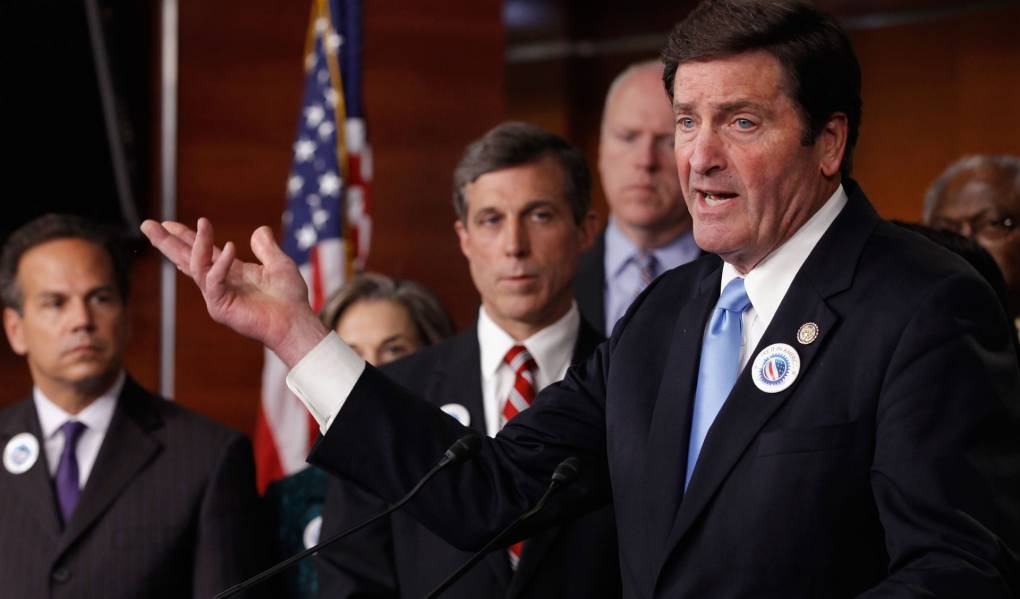
Pentagon Diverted $2 Billion of Military Spending to Immigration Enforcement, Democrats Say
The True Story of the Military's Secret 1950 San Francisco Biological Weapons Test
Bay Area Groups Call for End of Military Shipments to Israel From Oakland Airport
Palestinian Activists Urge Oakland to Stop Military Shipments to Israel
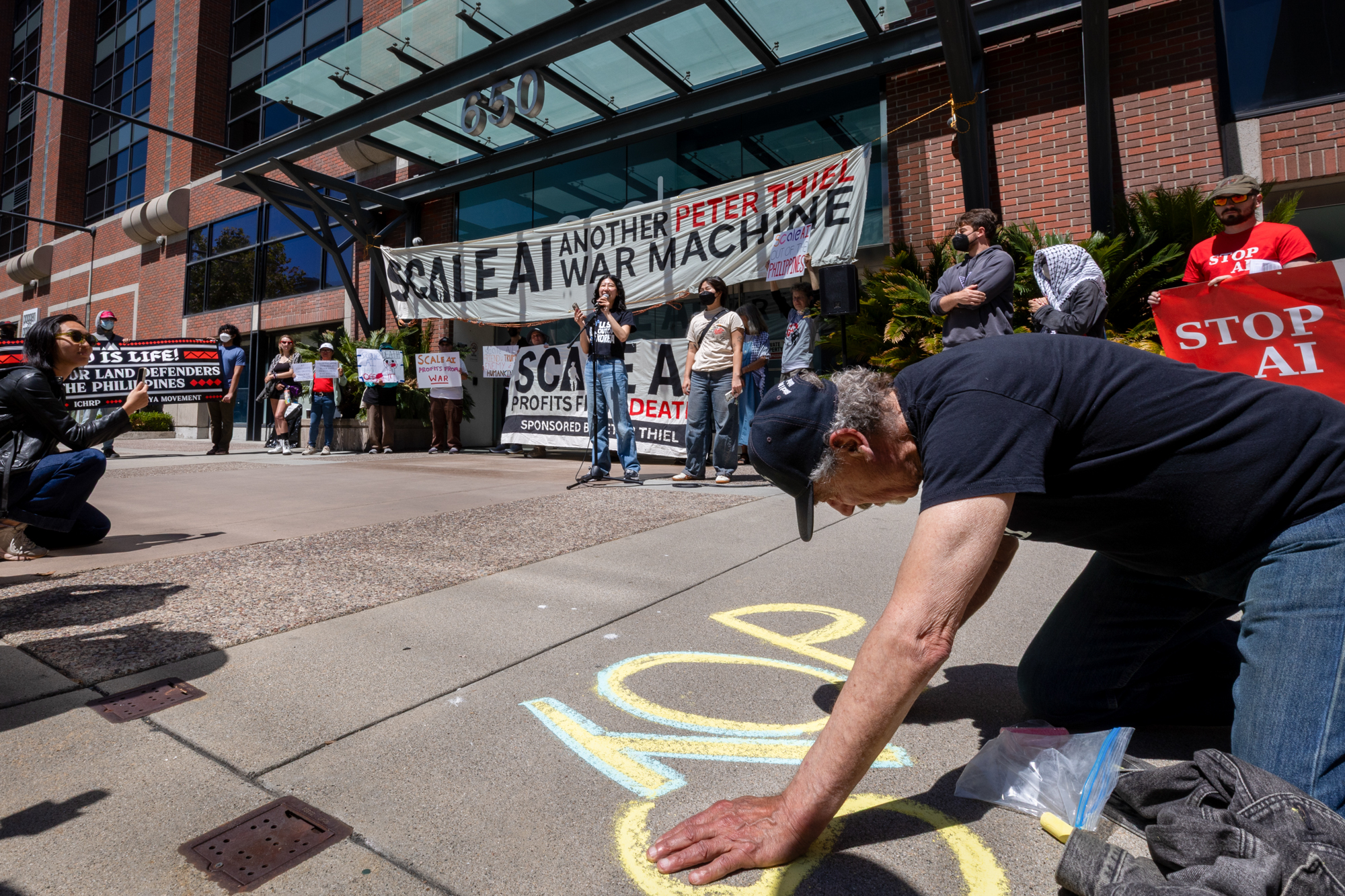
Protesters Against AI Militarization Rally at Scale AI in San Francisco
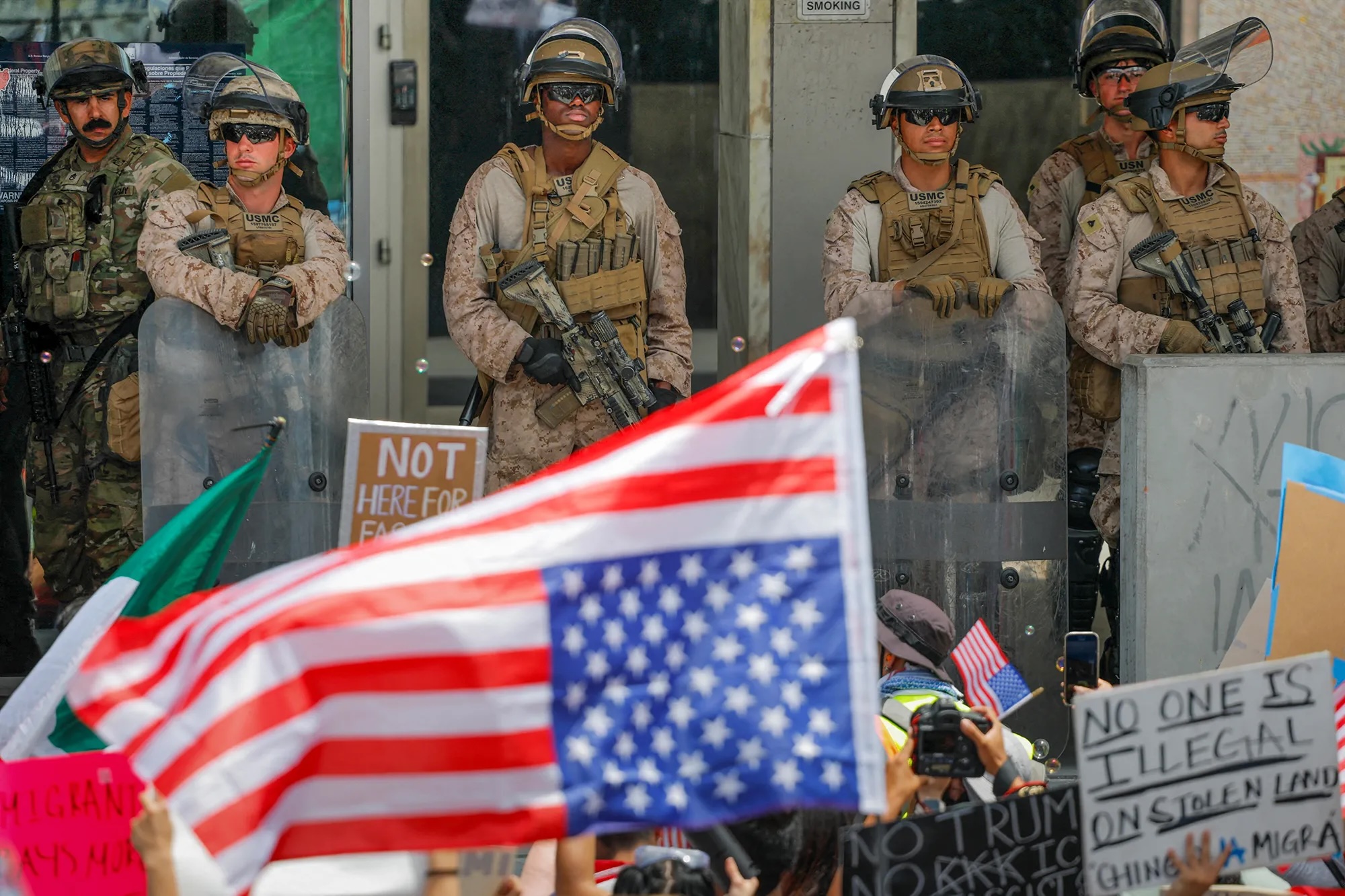
California Republicans Hate Government ‘Overreach.’ Most Are Quiet on Trump’s Military in LA
Tanks, Flyovers and Protests: Army Celebrates Its 250th Year, Trump Celebrates His 79th
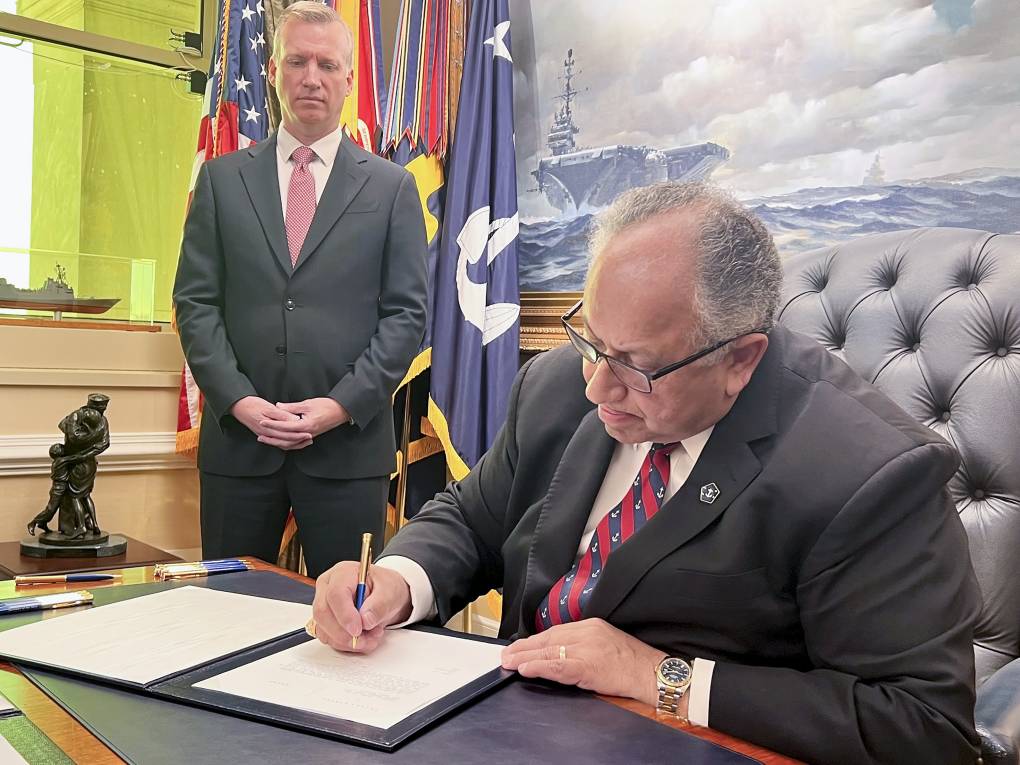
Navy Exonerates 256 Black Sailors Unjustly Punished in 1944 After Deadly California Port Explosion
Space Force Lands at a Southern California High School
Sponsored
Player sponsored by
window.__IS_SSR__=true
window.__INITIAL_STATE__={
"attachmentsReducer": {
"audio_0": {
"type": "attachments",
"id": "audio_0",
"imgSizes": {
"kqedFullSize": {
"file": "https://ww2.kqed.org/news/wp-content/themes/KQED-unified/img/audio_bgs/background0.jpg"
}
}
},
"audio_1": {
"type": "attachments",
"id": "audio_1",
"imgSizes": {
"kqedFullSize": {
"file": "https://ww2.kqed.org/news/wp-content/themes/KQED-unified/img/audio_bgs/background1.jpg"
}
}
},
"audio_2": {
"type": "attachments",
"id": "audio_2",
"imgSizes": {
"kqedFullSize": {
"file": "https://ww2.kqed.org/news/wp-content/themes/KQED-unified/img/audio_bgs/background2.jpg"
}
}
},
"audio_3": {
"type": "attachments",
"id": "audio_3",
"imgSizes": {
"kqedFullSize": {
"file": "https://ww2.kqed.org/news/wp-content/themes/KQED-unified/img/audio_bgs/background3.jpg"
}
}
},
"audio_4": {
"type": "attachments",
"id": "audio_4",
"imgSizes": {
"kqedFullSize": {
"file": "https://ww2.kqed.org/news/wp-content/themes/KQED-unified/img/audio_bgs/background4.jpg"
}
}
},
"placeholder": {
"type": "attachments",
"id": "placeholder",
"imgSizes": {
"thumbnail": {
"file": "https://cdn.kqed.org/wp-content/uploads/2024/12/KQED-Default-Image-816638274-2000x1333-1-160x107.jpg",
"width": 160,
"height": 107,
"mimeType": "image/jpeg"
},
"medium": {
"file": "https://cdn.kqed.org/wp-content/uploads/2024/12/KQED-Default-Image-816638274-2000x1333-1-800x533.jpg",
"width": 800,
"height": 533,
"mimeType": "image/jpeg"
},
"medium_large": {
"file": "https://cdn.kqed.org/wp-content/uploads/2024/12/KQED-Default-Image-816638274-2000x1333-1-768x512.jpg",
"width": 768,
"height": 512,
"mimeType": "image/jpeg"
},
"large": {
"file": "https://cdn.kqed.org/wp-content/uploads/2024/12/KQED-Default-Image-816638274-2000x1333-1-1020x680.jpg",
"width": 1020,
"height": 680,
"mimeType": "image/jpeg"
},
"1536x1536": {
"file": "https://cdn.kqed.org/wp-content/uploads/2024/12/KQED-Default-Image-816638274-2000x1333-1-1536x1024.jpg",
"width": 1536,
"height": 1024,
"mimeType": "image/jpeg"
},
"fd-lrg": {
"file": "https://cdn.kqed.org/wp-content/uploads/2024/12/KQED-Default-Image-816638274-2000x1333-1-1536x1024.jpg",
"width": 1536,
"height": 1024,
"mimeType": "image/jpeg"
},
"fd-med": {
"file": "https://cdn.kqed.org/wp-content/uploads/2024/12/KQED-Default-Image-816638274-2000x1333-1-1020x680.jpg",
"width": 1020,
"height": 680,
"mimeType": "image/jpeg"
},
"fd-sm": {
"file": "https://cdn.kqed.org/wp-content/uploads/2024/12/KQED-Default-Image-816638274-2000x1333-1-800x533.jpg",
"width": 800,
"height": 533,
"mimeType": "image/jpeg"
},
"post-thumbnail": {
"file": "https://cdn.kqed.org/wp-content/uploads/2024/12/KQED-Default-Image-816638274-2000x1333-1-672x372.jpg",
"width": 672,
"height": 372,
"mimeType": "image/jpeg"
},
"twentyfourteen-full-width": {
"file": "https://cdn.kqed.org/wp-content/uploads/2024/12/KQED-Default-Image-816638274-2000x1333-1-1038x576.jpg",
"width": 1038,
"height": 576,
"mimeType": "image/jpeg"
},
"xxsmall": {
"file": "https://cdn.kqed.org/wp-content/uploads/2024/12/KQED-Default-Image-816638274-2000x1333-1-160x107.jpg",
"width": 160,
"height": 107,
"mimeType": "image/jpeg"
},
"xsmall": {
"file": "https://cdn.kqed.org/wp-content/uploads/2024/12/KQED-Default-Image-816638274-2000x1333-1-672x372.jpg",
"width": 672,
"height": 372,
"mimeType": "image/jpeg"
},
"small": {
"file": "https://cdn.kqed.org/wp-content/uploads/2024/12/KQED-Default-Image-816638274-2000x1333-1-672x372.jpg",
"width": 672,
"height": 372,
"mimeType": "image/jpeg"
},
"xlarge": {
"file": "https://cdn.kqed.org/wp-content/uploads/2024/12/KQED-Default-Image-816638274-2000x1333-1-1020x680.jpg",
"width": 1020,
"height": 680,
"mimeType": "image/jpeg"
},
"full-width": {
"file": "https://cdn.kqed.org/wp-content/uploads/2024/12/KQED-Default-Image-816638274-2000x1333-1-1920x1280.jpg",
"width": 1920,
"height": 1280,
"mimeType": "image/jpeg"
},
"guest-author-32": {
"file": "https://cdn.kqed.org/wp-content/uploads/2025/01/KQED-Default-Image-816638274-1333x1333-1-160x160.jpg",
"width": 32,
"height": 32,
"mimeType": "image/jpeg"
},
"guest-author-50": {
"file": "https://cdn.kqed.org/wp-content/uploads/2025/01/KQED-Default-Image-816638274-1333x1333-1-160x160.jpg",
"width": 50,
"height": 50,
"mimeType": "image/jpeg"
},
"guest-author-64": {
"file": "https://cdn.kqed.org/wp-content/uploads/2025/01/KQED-Default-Image-816638274-1333x1333-1-160x160.jpg",
"width": 64,
"height": 64,
"mimeType": "image/jpeg"
},
"guest-author-96": {
"file": "https://cdn.kqed.org/wp-content/uploads/2025/01/KQED-Default-Image-816638274-1333x1333-1-160x160.jpg",
"width": 96,
"height": 96,
"mimeType": "image/jpeg"
},
"guest-author-128": {
"file": "https://cdn.kqed.org/wp-content/uploads/2025/01/KQED-Default-Image-816638274-1333x1333-1-160x160.jpg",
"width": 128,
"height": 128,
"mimeType": "image/jpeg"
},
"detail": {
"file": "https://cdn.kqed.org/wp-content/uploads/2025/01/KQED-Default-Image-816638274-1333x1333-1-160x160.jpg",
"width": 160,
"height": 160,
"mimeType": "image/jpeg"
},
"kqedFullSize": {
"file": "https://cdn.kqed.org/wp-content/uploads/2024/12/KQED-Default-Image-816638274-2000x1333-1.jpg",
"width": 2000,
"height": 1333
}
}
},
"news_11804662": {
"type": "attachments",
"id": "news_11804662",
"meta": {
"index": "attachments_1716263798",
"site": "news",
"id": "11804662",
"found": true
},
"title": "John-Garamendi",
"publishDate": 1583198835,
"status": "inherit",
"parent": 11804430,
"modified": 1751487973,
"caption": "North Bay Rep. John Garamendi (right), pictured in 2011. A new investigation, led by Bay Area Rep. Garamendi and Massachusetts Sen. Elizabeth Warren, says the President’s immigration agenda may come at the cost of military readiness and morale. ",
"credit": "Chip Somodevilla/Getty Images",
"altTag": "North Bay Rep. John Garamendi (right), pictured in 2011. Garamendi and two other California congressmen want clarity from federal health officials in the wake of a whistleblower complaint.",
"description": "North Bay Rep. John Garamendi (right), pictured in 2011. Garamendi and two other California congressmen want clarity from federal health officials in the wake of a whistleblower complaint.",
"imgSizes": {
"thumbnail": {
"file": "https://cdn.kqed.org/wp-content/uploads/sites/10/2020/03/John-Garamendi-160x94.jpg",
"width": 160,
"height": 94,
"mimeType": "image/jpeg"
},
"medium": {
"file": "https://cdn.kqed.org/wp-content/uploads/sites/10/2020/03/John-Garamendi-800x470.jpg",
"width": 800,
"height": 470,
"mimeType": "image/jpeg"
},
"large": {
"file": "https://cdn.kqed.org/wp-content/uploads/sites/10/2020/03/John-Garamendi-1020x599.jpg",
"width": 1020,
"height": 599,
"mimeType": "image/jpeg"
},
"post-thumbnail": {
"file": "https://cdn.kqed.org/wp-content/uploads/sites/10/2020/03/John-Garamendi-672x372.jpg",
"width": 672,
"height": 372,
"mimeType": "image/jpeg"
},
"twentyfourteen-full-width": {
"file": "https://cdn.kqed.org/wp-content/uploads/sites/10/2020/03/John-Garamendi-1038x576.jpg",
"width": 1038,
"height": 576,
"mimeType": "image/jpeg"
},
"full-width": {
"file": "https://cdn.kqed.org/wp-content/uploads/sites/10/2020/03/John-Garamendi-1920x1128.jpg",
"width": 1920,
"height": 1128,
"mimeType": "image/jpeg"
},
"apple_news_ca_landscape_12_9": {
"file": "https://cdn.kqed.org/wp-content/uploads/sites/10/2020/03/John-Garamendi-1832x1128.jpg",
"width": 1832,
"height": 1128,
"mimeType": "image/jpeg"
},
"apple_news_ca_landscape_9_7": {
"file": "https://cdn.kqed.org/wp-content/uploads/sites/10/2020/03/John-Garamendi-1376x1032.jpg",
"width": 1376,
"height": 1032,
"mimeType": "image/jpeg"
},
"apple_news_ca_landscape_5_5": {
"file": "https://cdn.kqed.org/wp-content/uploads/sites/10/2020/03/John-Garamendi-1044x783.jpg",
"width": 1044,
"height": 783,
"mimeType": "image/jpeg"
},
"apple_news_ca_landscape_4_7": {
"file": "https://cdn.kqed.org/wp-content/uploads/sites/10/2020/03/John-Garamendi-632x474.jpg",
"width": 632,
"height": 474,
"mimeType": "image/jpeg"
},
"apple_news_ca_landscape_4_0": {
"file": "https://cdn.kqed.org/wp-content/uploads/sites/10/2020/03/John-Garamendi-536x402.jpg",
"width": 536,
"height": 402,
"mimeType": "image/jpeg"
},
"apple_news_ca_portrait_12_9": {
"file": "https://cdn.kqed.org/wp-content/uploads/sites/10/2020/03/John-Garamendi-1122x1128.jpg",
"width": 1122,
"height": 1128,
"mimeType": "image/jpeg"
},
"apple_news_ca_portrait_9_7": {
"file": "https://cdn.kqed.org/wp-content/uploads/sites/10/2020/03/John-Garamendi-840x1120.jpg",
"width": 840,
"height": 1120,
"mimeType": "image/jpeg"
},
"apple_news_ca_portrait_5_5": {
"file": "https://cdn.kqed.org/wp-content/uploads/sites/10/2020/03/John-Garamendi-687x916.jpg",
"width": 687,
"height": 916,
"mimeType": "image/jpeg"
},
"apple_news_ca_portrait_4_7": {
"file": "https://cdn.kqed.org/wp-content/uploads/sites/10/2020/03/John-Garamendi-414x552.jpg",
"width": 414,
"height": 552,
"mimeType": "image/jpeg"
},
"apple_news_ca_portrait_4_0": {
"file": "https://cdn.kqed.org/wp-content/uploads/sites/10/2020/03/John-Garamendi-354x472.jpg",
"width": 354,
"height": 472,
"mimeType": "image/jpeg"
},
"apple_news_ca_square_12_9": {
"file": "https://cdn.kqed.org/wp-content/uploads/sites/10/2020/03/John-Garamendi-1472x1128.jpg",
"width": 1472,
"height": 1128,
"mimeType": "image/jpeg"
},
"apple_news_ca_square_9_7": {
"file": "https://cdn.kqed.org/wp-content/uploads/sites/10/2020/03/John-Garamendi-1104x1104.jpg",
"width": 1104,
"height": 1104,
"mimeType": "image/jpeg"
},
"apple_news_ca_square_5_5": {
"file": "https://cdn.kqed.org/wp-content/uploads/sites/10/2020/03/John-Garamendi-912x912.jpg",
"width": 912,
"height": 912,
"mimeType": "image/jpeg"
},
"apple_news_ca_square_4_7": {
"file": "https://cdn.kqed.org/wp-content/uploads/sites/10/2020/03/John-Garamendi-550x550.jpg",
"width": 550,
"height": 550,
"mimeType": "image/jpeg"
},
"apple_news_ca_square_4_0": {
"file": "https://cdn.kqed.org/wp-content/uploads/sites/10/2020/03/John-Garamendi-470x470.jpg",
"width": 470,
"height": 470,
"mimeType": "image/jpeg"
},
"kqedFullSize": {
"file": "https://cdn.kqed.org/wp-content/uploads/sites/10/2020/03/John-Garamendi.jpg",
"width": 1920,
"height": 1128
}
},
"fetchFailed": false,
"isLoading": false
},
"news_12063107": {
"type": "attachments",
"id": "news_12063107",
"meta": {
"index": "attachments_1716263798",
"site": "news",
"id": "12063107",
"found": true
},
"title": "Ocean-Spray_3",
"publishDate": 1762383143,
"status": "inherit",
"parent": 12062909,
"modified": 1762386663,
"caption": "Unbeknownst to San Francisco citizens, in 1950, the U.S. military tested how bacteria would disperse if sprayed from a boat offshore, simulating a biological weapons attack. The experiment is now known as Operation Seaspray.",
"credit": "Illustration by Darren Tu/Getty Images",
"altTag": null,
"description": null,
"imgSizes": {
"thumbnail": {
"file": "https://cdn.kqed.org/wp-content/uploads/sites/10/2025/11/Ocean-Spray_3-160x103.jpg",
"width": 160,
"height": 103,
"mimeType": "image/jpeg"
},
"1536x1536": {
"file": "https://cdn.kqed.org/wp-content/uploads/sites/10/2025/11/Ocean-Spray_3-1536x992.jpg",
"width": 1536,
"height": 992,
"mimeType": "image/jpeg"
},
"post-thumbnail": {
"file": "https://cdn.kqed.org/wp-content/uploads/sites/10/2025/11/Ocean-Spray_3-672x372.jpg",
"width": 672,
"height": 372,
"mimeType": "image/jpeg"
},
"twentyfourteen-full-width": {
"file": "https://cdn.kqed.org/wp-content/uploads/sites/10/2025/11/Ocean-Spray_3-1038x576.jpg",
"width": 1038,
"height": 576,
"mimeType": "image/jpeg"
},
"npr-cds-wide": {
"file": "https://cdn.kqed.org/wp-content/uploads/sites/10/2025/11/Ocean-Spray_3-1200x675.jpg",
"width": 1200,
"height": 675,
"mimeType": "image/jpeg"
},
"kqedFullSize": {
"file": "https://cdn.kqed.org/wp-content/uploads/sites/10/2025/11/Ocean-Spray_3.jpg",
"width": 1920,
"height": 1240
}
},
"fetchFailed": false,
"isLoading": false
},
"news_12056703": {
"type": "attachments",
"id": "news_12056703",
"meta": {
"index": "attachments_1716263798",
"site": "news",
"id": "12056703",
"found": true
},
"title": "250918-Oakland Arms Folo-JCL-01-KQED",
"publishDate": 1758236396,
"status": "inherit",
"parent": 12056544,
"modified": 1758240270,
"caption": "Protesters march across OAK’s Terminal 1 chanting “Oakland Airport, drop your cargo! We demand an arms embargo!” on Sept. 18, 2025. The Oakland People’s Arms Embargo Coalition is calling for Oakland officials to end military cargo shipments through the civilian airport.",
"credit": "Juan Carlos Lara/KQED",
"altTag": null,
"description": null,
"imgSizes": {
"thumbnail": {
"file": "https://cdn.kqed.org/wp-content/uploads/sites/10/2025/09/250918-Oakland-Arms-Folo-JCL-01-KQED-160x107.jpg",
"width": 160,
"height": 107,
"mimeType": "image/jpeg"
},
"1536x1536": {
"file": "https://cdn.kqed.org/wp-content/uploads/sites/10/2025/09/250918-Oakland-Arms-Folo-JCL-01-KQED-1536x1024.jpg",
"width": 1536,
"height": 1024,
"mimeType": "image/jpeg"
},
"post-thumbnail": {
"file": "https://cdn.kqed.org/wp-content/uploads/sites/10/2025/09/250918-Oakland-Arms-Folo-JCL-01-KQED-672x372.jpg",
"width": 672,
"height": 372,
"mimeType": "image/jpeg"
},
"twentyfourteen-full-width": {
"file": "https://cdn.kqed.org/wp-content/uploads/sites/10/2025/09/250918-Oakland-Arms-Folo-JCL-01-KQED-1038x576.jpg",
"width": 1038,
"height": 576,
"mimeType": "image/jpeg"
},
"kqedFullSize": {
"file": "https://cdn.kqed.org/wp-content/uploads/sites/10/2025/09/250918-Oakland-Arms-Folo-JCL-01-KQED.jpg",
"width": 2000,
"height": 1333
}
},
"fetchFailed": false,
"isLoading": false
},
"news_12053653": {
"type": "attachments",
"id": "news_12053653",
"meta": {
"index": "attachments_1716263798",
"site": "news",
"id": "12053653",
"found": true
},
"title": "The entrance to the Oakland International Airport in Oakland on April 12, 2024.",
"publishDate": 1756159972,
"status": "inherit",
"parent": 12053637,
"modified": 1756159981,
"caption": "The entrance to the Oakland International Airport in Oakland on April 12, 2024.",
"credit": "Beth LaBerge/KQED",
"altTag": null,
"description": null,
"imgSizes": {
"thumbnail": {
"file": "https://cdn.kqed.org/wp-content/uploads/sites/10/2025/08/240412-OAKAirport-004-BL_qed-160x107.jpg",
"width": 160,
"height": 107,
"mimeType": "image/jpeg"
},
"1536x1536": {
"file": "https://cdn.kqed.org/wp-content/uploads/sites/10/2025/08/240412-OAKAirport-004-BL_qed-1536x1024.jpg",
"width": 1536,
"height": 1024,
"mimeType": "image/jpeg"
},
"post-thumbnail": {
"file": "https://cdn.kqed.org/wp-content/uploads/sites/10/2025/08/240412-OAKAirport-004-BL_qed-672x372.jpg",
"width": 672,
"height": 372,
"mimeType": "image/jpeg"
},
"twentyfourteen-full-width": {
"file": "https://cdn.kqed.org/wp-content/uploads/sites/10/2025/08/240412-OAKAirport-004-BL_qed-1038x576.jpg",
"width": 1038,
"height": 576,
"mimeType": "image/jpeg"
},
"kqedFullSize": {
"file": "https://cdn.kqed.org/wp-content/uploads/sites/10/2025/08/240412-OAKAirport-004-BL_qed.jpg",
"width": 2000,
"height": 1333
}
},
"fetchFailed": false,
"isLoading": false
},
"news_12051173": {
"type": "attachments",
"id": "news_12051173",
"meta": {
"index": "attachments_1716263798",
"site": "news",
"id": "12051173",
"found": true
},
"title": "250806_SCALEAI_ 0013_GH-KQED",
"publishDate": 1754519801,
"status": "inherit",
"parent": 0,
"modified": 1754519945,
"caption": "Katie Na (center) speaks to a crowd of about 50 people outside Scale AI’s San Francisco headquarters on Aug. 6, 2025, during a protest against the company’s Pentagon-funded AI military project, Thunderforge.",
"credit": "Gustavo Hernandez/KQED",
"altTag": null,
"description": null,
"imgSizes": {
"thumbnail": {
"file": "https://cdn.kqed.org/wp-content/uploads/sites/10/2025/08/250806_SCALEAI_-0013_GH-KQED-160x107.jpg",
"width": 160,
"height": 107,
"mimeType": "image/jpeg"
},
"1536x1536": {
"file": "https://cdn.kqed.org/wp-content/uploads/sites/10/2025/08/250806_SCALEAI_-0013_GH-KQED-1536x1024.jpg",
"width": 1536,
"height": 1024,
"mimeType": "image/jpeg"
},
"post-thumbnail": {
"file": "https://cdn.kqed.org/wp-content/uploads/sites/10/2025/08/250806_SCALEAI_-0013_GH-KQED-672x372.jpg",
"width": 672,
"height": 372,
"mimeType": "image/jpeg"
},
"twentyfourteen-full-width": {
"file": "https://cdn.kqed.org/wp-content/uploads/sites/10/2025/08/250806_SCALEAI_-0013_GH-KQED-1038x576.jpg",
"width": 1038,
"height": 576,
"mimeType": "image/jpeg"
},
"kqedFullSize": {
"file": "https://cdn.kqed.org/wp-content/uploads/sites/10/2025/08/250806_SCALEAI_-0013_GH-KQED.jpg",
"width": 2000,
"height": 1333
}
},
"fetchFailed": false,
"isLoading": false
},
"news_12044992": {
"type": "attachments",
"id": "news_12044992",
"meta": {
"index": "attachments_1716263798",
"site": "news",
"id": "12044992",
"found": true
},
"title": "061425-No-Kings-Trump-Marines-REUTERS-CM copy",
"publishDate": 1750287559,
"status": "inherit",
"parent": 12044990,
"modified": 1750287608,
"caption": "Demonstrators wave US and Mexican flags as US Marines stand guard outside the Edward R. Roybal Federal Building during a No Kings Day protest against President Donald Trump's policies in Los Angeles, on June 14, 2025.",
"credit": "Mike Blake/Reuters",
"altTag": null,
"description": null,
"imgSizes": {
"thumbnail": {
"file": "https://cdn.kqed.org/wp-content/uploads/sites/10/2025/06/061425-No-Kings-Trump-Marines-REUTERS-CM-copy-160x107.jpg",
"width": 160,
"height": 107,
"mimeType": "image/jpeg"
},
"1536x1536": {
"file": "https://cdn.kqed.org/wp-content/uploads/sites/10/2025/06/061425-No-Kings-Trump-Marines-REUTERS-CM-copy-1536x1024.jpg",
"width": 1536,
"height": 1024,
"mimeType": "image/jpeg"
},
"post-thumbnail": {
"file": "https://cdn.kqed.org/wp-content/uploads/sites/10/2025/06/061425-No-Kings-Trump-Marines-REUTERS-CM-copy-672x372.jpg",
"width": 672,
"height": 372,
"mimeType": "image/jpeg"
},
"twentyfourteen-full-width": {
"file": "https://cdn.kqed.org/wp-content/uploads/sites/10/2025/06/061425-No-Kings-Trump-Marines-REUTERS-CM-copy-1038x576.jpg",
"width": 1038,
"height": 576,
"mimeType": "image/jpeg"
},
"kqedFullSize": {
"file": "https://cdn.kqed.org/wp-content/uploads/sites/10/2025/06/061425-No-Kings-Trump-Marines-REUTERS-CM-copy.jpg",
"width": 2000,
"height": 1333
}
},
"fetchFailed": false,
"isLoading": false
},
"news_12044511": {
"type": "attachments",
"id": "news_12044511",
"meta": {
"index": "attachments_1716263798",
"site": "news",
"id": "12044511",
"found": true
},
"title": "npr.brightspotcdn copy",
"publishDate": 1749951802,
"status": "inherit",
"parent": 12044504,
"modified": 1749951837,
"caption": "Cadets from the U.S. Military Academy West Point pass by the reviewing stand as President Trump attends a military parade commemorating the Army's 250th anniversary, coinciding with his 79th birthday, on Saturday, June 14, 2025, in Washington, DC.",
"credit": "Julia Demaree Nikhinson/AP",
"altTag": null,
"description": null,
"imgSizes": {
"thumbnail": {
"file": "https://cdn.kqed.org/wp-content/uploads/sites/10/2025/06/npr.brightspotcdn-copy-8-160x107.jpg",
"width": 160,
"height": 107,
"mimeType": "image/jpeg"
},
"1536x1536": {
"file": "https://cdn.kqed.org/wp-content/uploads/sites/10/2025/06/npr.brightspotcdn-copy-8-1536x1023.jpg",
"width": 1536,
"height": 1023,
"mimeType": "image/jpeg"
},
"post-thumbnail": {
"file": "https://cdn.kqed.org/wp-content/uploads/sites/10/2025/06/npr.brightspotcdn-copy-8-672x372.jpg",
"width": 672,
"height": 372,
"mimeType": "image/jpeg"
},
"twentyfourteen-full-width": {
"file": "https://cdn.kqed.org/wp-content/uploads/sites/10/2025/06/npr.brightspotcdn-copy-8-1038x576.jpg",
"width": 1038,
"height": 576,
"mimeType": "image/jpeg"
},
"kqedFullSize": {
"file": "https://cdn.kqed.org/wp-content/uploads/sites/10/2025/06/npr.brightspotcdn-copy-8.jpg",
"width": 1600,
"height": 1066
}
},
"fetchFailed": false,
"isLoading": false
},
"news_11996016": {
"type": "attachments",
"id": "news_11996016",
"meta": {
"index": "attachments_1716263798",
"site": "news",
"id": "11996016",
"found": true
},
"title": "Navy Black Sailors Exonerated",
"publishDate": 1721237192,
"status": "inherit",
"parent": 11996014,
"modified": 1721239697,
"caption": "Navy Secretary Carlos Del Toro signs documents exonerating 256 Black sailors who were unjustly court-martialed in 1944 after the horrific Port Chicago explosion in California, as Navy Under Secretary Erik Raven looks on, Wednesday, July 17, 2024, at the Pentagon in Washington, D.C. ",
"credit": "Tara Copp/AP Photo",
"altTag": null,
"description": null,
"imgSizes": {
"medium": {
"file": "https://cdn.kqed.org/wp-content/uploads/sites/10/2024/07/AP24199513653645-800x600.jpg",
"width": 800,
"height": 600,
"mimeType": "image/jpeg"
},
"large": {
"file": "https://cdn.kqed.org/wp-content/uploads/sites/10/2024/07/AP24199513653645-1020x765.jpg",
"width": 1020,
"height": 765,
"mimeType": "image/jpeg"
},
"thumbnail": {
"file": "https://cdn.kqed.org/wp-content/uploads/sites/10/2024/07/AP24199513653645-160x120.jpg",
"width": 160,
"height": 120,
"mimeType": "image/jpeg"
},
"1536x1536": {
"file": "https://cdn.kqed.org/wp-content/uploads/sites/10/2024/07/AP24199513653645-1536x1152.jpg",
"width": 1536,
"height": 1152,
"mimeType": "image/jpeg"
},
"2048x2048": {
"file": "https://cdn.kqed.org/wp-content/uploads/sites/10/2024/07/AP24199513653645-2048x1536.jpg",
"width": 2048,
"height": 1536,
"mimeType": "image/jpeg"
},
"post-thumbnail": {
"file": "https://cdn.kqed.org/wp-content/uploads/sites/10/2024/07/AP24199513653645-672x372.jpg",
"width": 672,
"height": 372,
"mimeType": "image/jpeg"
},
"twentyfourteen-full-width": {
"file": "https://cdn.kqed.org/wp-content/uploads/sites/10/2024/07/AP24199513653645-1038x576.jpg",
"width": 1038,
"height": 576,
"mimeType": "image/jpeg"
},
"full-width": {
"file": "https://cdn.kqed.org/wp-content/uploads/sites/10/2024/07/AP24199513653645-1920x1440.jpg",
"width": 1920,
"height": 1440,
"mimeType": "image/jpeg"
},
"kqedFullSize": {
"file": "https://cdn.kqed.org/wp-content/uploads/sites/10/2024/07/AP24199513653645-scaled.jpg",
"width": 2560,
"height": 1920
}
},
"fetchFailed": false,
"isLoading": false
},
"news_11877894": {
"type": "attachments",
"id": "news_11877894",
"meta": {
"index": "attachments_1716263798",
"site": "news",
"id": "11877894",
"found": true
},
"parent": 11877888,
"imgSizes": {
"twentyfourteen-full-width": {
"file": "https://ww2.kqed.org/app/uploads/sites/10/2021/06/cadet-weis-1038x576.jpg",
"width": 1038,
"mimeType": "image/jpeg",
"height": 576
},
"thumbnail": {
"file": "https://ww2.kqed.org/app/uploads/sites/10/2021/06/cadet-weis-160x95.jpg",
"width": 160,
"mimeType": "image/jpeg",
"height": 95
},
"post-thumbnail": {
"file": "https://ww2.kqed.org/app/uploads/sites/10/2021/06/cadet-weis-672x372.jpg",
"width": 672,
"mimeType": "image/jpeg",
"height": 372
},
"kqedFullSize": {
"file": "https://ww2.kqed.org/app/uploads/sites/10/2021/06/cadet-weis-e1623799606562.jpg",
"width": 1556,
"height": 921
},
"large": {
"file": "https://ww2.kqed.org/app/uploads/sites/10/2021/06/cadet-weis-1020x604.jpg",
"width": 1020,
"mimeType": "image/jpeg",
"height": 604
},
"1536x1536": {
"file": "https://ww2.kqed.org/app/uploads/sites/10/2021/06/cadet-weis-1536x909.jpg",
"width": 1536,
"mimeType": "image/jpeg",
"height": 909
},
"medium": {
"file": "https://ww2.kqed.org/app/uploads/sites/10/2021/06/cadet-weis-800x474.jpg",
"width": 800,
"mimeType": "image/jpeg",
"height": 474
}
},
"publishDate": 1623698354,
"modified": 1623876255,
"caption": "Cadet Group Commander Jennifer Weis explains the new Space Force Delta logo to senior cadets. Her Air Force junior ROTC unit has been selected to convert to a Space Force junior ROTC Unit. ",
"description": null,
"title": "cadet weis",
"credit": "Courtesy Master Sgt. Sonny Padua",
"status": "inherit",
"altTag": null,
"fetchFailed": false,
"isLoading": false
}
},
"audioPlayerReducer": {
"postId": "stream_live",
"isPaused": true,
"isPlaying": false,
"pfsActive": false,
"pledgeModalIsOpen": true,
"playerDrawerIsOpen": false
},
"authorsReducer": {
"byline_news_12044990": {
"type": "authors",
"id": "byline_news_12044990",
"meta": {
"override": true
},
"slug": "byline_news_12044990",
"name": "Yue Stella Yu, CalMatters",
"isLoading": false
},
"byline_news_12044504": {
"type": "authors",
"id": "byline_news_12044504",
"meta": {
"override": true
},
"slug": "byline_news_12044504",
"name": "Alana Wise and Kat Lonsdorf, NPR",
"isLoading": false
},
"byline_news_11996014": {
"type": "authors",
"id": "byline_news_11996014",
"meta": {
"override": true
},
"slug": "byline_news_11996014",
"name": "Tara Copp, Associated Press",
"isLoading": false
},
"rachael-myrow": {
"type": "authors",
"id": "251",
"meta": {
"index": "authors_1716337520",
"id": "251",
"found": true
},
"name": "Rachael Myrow",
"firstName": "Rachael",
"lastName": "Myrow",
"slug": "rachael-myrow",
"email": "rmyrow@kqed.org",
"display_author_email": false,
"staff_mastheads": [
"news"
],
"title": "Senior Editor of KQED's Silicon Valley News Desk",
"bio": "Rachael Myrow is Senior Editor of KQED's Silicon Valley News Desk, reporting on topics like \u003ca href=\"https://www.kqed.org/news/12023367/what-big-tech-sees-in-donald-trump\">what Big Tech sees in President Trump\u003c/a>, \u003ca href=\"https://www.kqed.org/news/12020857/california-lawmaker-ready-revive-fight-regulating-ai\">California's many, many AI bills\u003c/a>, and the \u003ca href=\"https://www.kqed.org/news/12017713/lost-sounds-of-san-francisco\">lost sounds of San Francisco\u003c/a>. You can hear her work on \u003ca href=\"https://www.npr.org/search?query=Rachael%20Myrow&page=1\">NPR\u003c/a>, \u003ca href=\"https://theworld.org/people/rachael-myrow\">The World\u003c/a>, WBUR's \u003ca href=\"https://www.wbur.org/search?q=Rachael%20Myrow\">\u003ci>Here & Now\u003c/i>\u003c/a> and the BBC. \u003c/i>She also guest hosts for KQED's \u003ci>\u003ca href=\"https://www.kqed.org/forum/tag/rachael-myrow\">Forum\u003c/a>\u003c/i>. Over the years, she's talked with Kamau Bell, David Byrne, Kamala Harris, Tony Kushner, Armistead Maupin, Van Dyke Parks, Arnold Schwarzenegger and Tommie Smith, among others.\r\n\r\nBefore all this, she hosted \u003cem>The California Report\u003c/em> for 7+ years.\r\n\r\nAwards? Sure: Peabody, Edward R. Murrow, Regional Edward R. Murrow, RTNDA, Northern California RTNDA, SPJ Northern California Chapter, LA Press Club, Golden Mic. Prior to joining KQED, Rachael worked in Los Angeles at KPCC and Marketplace. She holds degrees in English and journalism from UC Berkeley (where she got her start in public radio on KALX-FM).\r\n\r\nOutside of the studio, you'll find Rachael hiking Bay Area trails and whipping up Instagram-ready meals in her kitchen. More recently, she's taken up native-forward gardening.",
"avatar": "https://secure.gravatar.com/avatar/87bf8cb5874e045cdff430523a6d48b1?s=600&d=blank&r=g",
"twitter": "rachaelmyrow",
"facebook": null,
"instagram": null,
"linkedin": "https://www.linkedin.com/in/rachaelmyrow/",
"sites": [
{
"site": "arts",
"roles": [
"administrator"
]
},
{
"site": "news",
"roles": [
"edit_others_posts",
"editor"
]
},
{
"site": "futureofyou",
"roles": [
"editor"
]
},
{
"site": "bayareabites",
"roles": [
"editor"
]
},
{
"site": "stateofhealth",
"roles": [
"editor"
]
},
{
"site": "science",
"roles": [
"editor"
]
},
{
"site": "food",
"roles": [
"editor"
]
},
{
"site": "forum",
"roles": [
"editor"
]
},
{
"site": "liveblog",
"roles": [
"author"
]
}
],
"headData": {
"title": "Rachael Myrow | KQED",
"description": "Senior Editor of KQED's Silicon Valley News Desk",
"ogImgSrc": "https://secure.gravatar.com/avatar/87bf8cb5874e045cdff430523a6d48b1?s=600&d=blank&r=g",
"twImgSrc": "https://secure.gravatar.com/avatar/87bf8cb5874e045cdff430523a6d48b1?s=600&d=blank&r=g"
},
"isLoading": false,
"link": "/author/rachael-myrow"
},
"tychehendricks": {
"type": "authors",
"id": "259",
"meta": {
"index": "authors_1716337520",
"id": "259",
"found": true
},
"name": "Tyche Hendricks",
"firstName": "Tyche",
"lastName": "Hendricks",
"slug": "tychehendricks",
"email": "thendricks@kqed.org",
"display_author_email": true,
"staff_mastheads": [
"news"
],
"title": "KQED Senior Editor, Immigration",
"bio": "\u003cspan style=\"font-weight: 400;\">Tyche Hendricks is KQED’s senior editor for immigration, leading coverage of the policy and politics that affect California’s immigrant communities. Her work for KQED’s radio and online audiences is also carried on NPR and other national outlets. She has been recognized with awards from the Radio and Television News Directors Association, the Society for Professional Journalists; the Education Writers Association; the Best of the West and the National Federation of Community Broadcasters. Before joining KQED in 2010, Tyche spent more than a dozen years as a newspaper reporter, notably at the \u003c/span>\u003ci>\u003cspan style=\"font-weight: 400;\">San Francisco Chronicle\u003c/span>\u003c/i>\u003cspan style=\"font-weight: 400;\">. At different times she has covered criminal justice, government and politics and urban planning. Tyche has taught in the MFA Creative Writing program at the University of San Francisco and at UC Berkeley’s Graduate School of Journalism, where she was co-director of a national immigration symposium for professional journalists. She is the author of \u003c/span>\u003ci>\u003cspan style=\"font-weight: 400;\">The Wind Doesn't Need a Passport: Stories from the U.S.-Mexico Borderlands\u003c/span>\u003c/i>\u003cspan style=\"font-weight: 400;\"> (University of California Press). \u003c/span>",
"avatar": "https://secure.gravatar.com/avatar/b8ee458e2731c2d43df86882ce17267e?s=600&d=blank&r=g",
"twitter": "tychehendricks",
"facebook": null,
"instagram": null,
"linkedin": null,
"sites": [
{
"site": "news",
"roles": [
"editor"
]
},
{
"site": "stateofhealth",
"roles": [
"editor"
]
}
],
"headData": {
"title": "Tyche Hendricks | KQED",
"description": "KQED Senior Editor, Immigration",
"ogImgSrc": "https://secure.gravatar.com/avatar/b8ee458e2731c2d43df86882ce17267e?s=600&d=blank&r=g",
"twImgSrc": "https://secure.gravatar.com/avatar/b8ee458e2731c2d43df86882ce17267e?s=600&d=blank&r=g"
},
"isLoading": false,
"link": "/author/tychehendricks"
},
"afont": {
"type": "authors",
"id": "8637",
"meta": {
"index": "authors_1716337520",
"id": "8637",
"found": true
},
"name": "Amanda Font",
"firstName": "Amanda",
"lastName": "Font",
"slug": "afont",
"email": "afont@kqed.org",
"display_author_email": false,
"staff_mastheads": [],
"title": "KQED Contributor",
"bio": "Amanda Font is a producer on \u003cem>The Latest\u003c/em> podcast, and the host and co-producer of the series \u003cem>Audible Cosmos\u003c/em>. She has previously worked as a producer and reporter on the \u003cem>Bay Curious\u003c/em> podcast, and director of \u003cem>The California Report Magazine\u003c/em>. She grew up in the deserts of Southern California and moved north for the trees. Amanda earned a B.A. from the BECA program at San Francisco State, where she worked in the university's radio station. Amanda Font is represented by SAG-AFTRA.",
"avatar": "https://secure.gravatar.com/avatar/d9e81cf0117d5849b9cfb7ab4b1422f1?s=600&d=blank&r=g",
"twitter": null,
"facebook": null,
"instagram": null,
"linkedin": null,
"sites": [
{
"site": "news",
"roles": [
"add_users",
"create_users"
]
},
{
"site": "science",
"roles": []
},
{
"site": "forum",
"roles": [
"administrator"
]
},
{
"site": "perspectives",
"roles": [
"administrator"
]
},
{
"site": "radio",
"roles": [
"administrator"
]
}
],
"headData": {
"title": "Amanda Font | KQED",
"description": "KQED Contributor",
"ogImgSrc": "https://secure.gravatar.com/avatar/d9e81cf0117d5849b9cfb7ab4b1422f1?s=600&d=blank&r=g",
"twImgSrc": "https://secure.gravatar.com/avatar/d9e81cf0117d5849b9cfb7ab4b1422f1?s=600&d=blank&r=g"
},
"isLoading": false,
"link": "/author/afont"
},
"jlara": {
"type": "authors",
"id": "11761",
"meta": {
"index": "authors_1716337520",
"id": "11761",
"found": true
},
"name": "Juan Carlos Lara",
"firstName": "Juan Carlos",
"lastName": "Lara",
"slug": "jlara",
"email": "jlara@kqed.org",
"display_author_email": false,
"staff_mastheads": [],
"title": "KQED Contributor",
"bio": null,
"avatar": "https://secure.gravatar.com/avatar/19e2052b9b05657c5ff2af2121846e9c?s=600&d=blank&r=g",
"twitter": null,
"facebook": null,
"instagram": null,
"linkedin": null,
"sites": [
{
"site": "arts",
"roles": [
"editor"
]
},
{
"site": "news",
"roles": [
"editor"
]
},
{
"site": "forum",
"roles": [
"editor"
]
},
{
"site": "liveblog",
"roles": [
"contributor"
]
}
],
"headData": {
"title": "Juan Carlos Lara | KQED",
"description": "KQED Contributor",
"ogImgSrc": "https://secure.gravatar.com/avatar/19e2052b9b05657c5ff2af2121846e9c?s=600&d=blank&r=g",
"twImgSrc": "https://secure.gravatar.com/avatar/19e2052b9b05657c5ff2af2121846e9c?s=600&d=blank&r=g"
},
"isLoading": false,
"link": "/author/jlara"
},
"kmonahan": {
"type": "authors",
"id": "11842",
"meta": {
"index": "authors_1716337520",
"id": "11842",
"found": true
},
"name": "Katherine Monahan",
"firstName": "Katherine",
"lastName": "Monahan",
"slug": "kmonahan",
"email": "kmonahan@kqed.org",
"display_author_email": true,
"staff_mastheads": [],
"title": "Reporter / Sound Engineer",
"bio": "I cover state and local news. I’m also a sound engineer at the station, mixing stories and running live broadcasts. I link to source materials so that readers can draw their own conclusions, and seek comment from a range of perspectives, including from people directly affected by events. Awards received include from the Society of Professional Journalists, Northern California chapter and the Alaska Press Club. I speak multiple languages and have reported and engineered in the Bay Area, Alaska, West Africa and Latin America.",
"avatar": "https://secure.gravatar.com/avatar/ed63e1170ee4abe7e85e75cfcbdfc787?s=600&d=blank&r=g",
"twitter": null,
"facebook": null,
"instagram": null,
"linkedin": null,
"sites": [
{
"site": "news",
"roles": [
"contributor"
]
},
{
"site": "science",
"roles": [
"contributor"
]
}
],
"headData": {
"title": "Katherine Monahan | KQED",
"description": "Reporter / Sound Engineer",
"ogImgSrc": "https://secure.gravatar.com/avatar/ed63e1170ee4abe7e85e75cfcbdfc787?s=600&d=blank&r=g",
"twImgSrc": "https://secure.gravatar.com/avatar/ed63e1170ee4abe7e85e75cfcbdfc787?s=600&d=blank&r=g"
},
"isLoading": false,
"link": "/author/kmonahan"
}
},
"breakingNewsReducer": {},
"pagesReducer": {},
"postsReducer": {
"stream_live": {
"type": "live",
"id": "stream_live",
"audioUrl": "https://streams.kqed.org/kqedradio",
"title": "Live Stream",
"excerpt": "Live Stream information currently unavailable.",
"link": "/radio",
"featImg": "",
"label": {
"name": "KQED Live",
"link": "/"
}
},
"stream_kqedNewscast": {
"type": "posts",
"id": "stream_kqedNewscast",
"audioUrl": "https://www.kqed.org/.stream/anon/radio/RDnews/newscast.mp3?_=1",
"title": "KQED Newscast",
"featImg": "",
"label": {
"name": "88.5 FM",
"link": "/"
}
},
"news_12066906": {
"type": "posts",
"id": "news_12066906",
"meta": {
"index": "posts_1716263798",
"site": "news",
"id": "12066906",
"score": null,
"sort": [
1765567254000
]
},
"guestAuthors": [],
"slug": "pentagon-diverted-2b-of-military-spending-to-immigration-enforcement-democrats-say",
"title": "Pentagon Diverted $2 Billion of Military Spending to Immigration Enforcement, Democrats Say",
"publishDate": 1765567254,
"format": "standard",
"headTitle": "Pentagon Diverted $2 Billion of Military Spending to Immigration Enforcement, Democrats Say | KQED",
"labelTerm": {
"site": "news"
},
"content": "\u003cp>A Bay Area lawmaker is among a group of Democrats who say the Pentagon has diverted more than $2 billion in military funds toward \u003ca href=\"https://www.kqed.org/news/12058799/trumps-national-guard-moves-are-part-of-a-dangerous-plan-california-ag-warns\">the Trump administration’s aggressive immigration enforcement\u003c/a> agenda.\u003c/p>\n\u003cp>\u003ca href=\"https://www.kqed.org/news/tag/john-garamendi\">Rep. John Garamendi, D-Fairfield,\u003c/a> whose district includes Travis Air Force Base, on Thursday said deploying soldiers and funding to the Southern border undermines national security and threatens military readiness.\u003c/p>\n\u003cp>\u003cstrong>“\u003c/strong>The [Army’s] 101st Division, which is one of the three divisions that we keep always ready to go in a moment’s notice, has been \u003ca href=\"https://www.northcom.mil/Newsroom/Press-Releases/Article/4323057/joint-task-forcesouthern-border-conducts-transfer-of-authority-from-10th-mounta/\">diverted\u003c/a> to border activities,” said Garamendi, who serves as the ranking Democrat on the House Armed Services Committee. “So the management, the infrastructure, the logistics — all of that is totally disrupted. And they are not prepared to depart at a moment’s notice to some urgency around the world.”\u003c/p>\n\u003cp>[ad fullwidth]\u003c/p>\n\u003cp>The \u003ca href=\"https://www.warren.senate.gov/imo/media/doc/cost_report_on_diverting_military_resources_for_immigration_enforcement.pdf\">review \u003c/a>of Pentagon border funding, co-authored by Massachusetts Sen. Elizabeth Warren, California Sens. Alex Padilla and Adam Schiff and nine other members of Congress, found that the Department of Defense has committed $1.3 billion for border enforcement, including troops and wall construction. And the agency’s budget \u003ca href=\"https://comptroller.war.gov/Portals/45/Documents/defbudget/FY2026/FY2026_Budget_Request_Overview_Book.pdf\">request\u003c/a> for fiscal year 2026 indicated plans to spend an additional $5 billion on southern border operations alone.\u003c/p>\n\u003cp>The report also highlighted the Pentagon’s commitment to spend:\u003c/p>\n\u003cul>\n\u003cli>$250 million to deploy troops in U.S. cities, aiding immigration operations\u003c/li>\n\u003cli>$420 million for detention operations on military bases, including Guantanamo\u003c/li>\n\u003cli>$55 million to reassign military lawyers as immigration judges\u003c/li>\n\u003cli>$40 million for air transport of detainees, including deportation flights\u003c/li>\n\u003c/ul>\n\u003cp>“What is clear is that the public can expect DoD to spend billions more on immigration enforcement in the near future,” the report stated.\u003c/p>\n\u003cp>The Democrats called the diversion of funds a waste of taxpayer resources and “baffling,” in light of the Republican-controlled Congress’s unprecedented $170 billion allocation to the Department of Homeland Security earlier this year.\u003c/p>\n\u003cfigure id=\"attachment_12037936\" class=\"wp-caption aligncenter\" style=\"max-width: 2000px\">\u003cimg loading=\"lazy\" decoding=\"async\" class=\"size-full wp-image-12037936\" src=\"https://cdn.kqed.org/wp-content/uploads/sites/10/2025/04/TravisAirForceBaseGetty2.jpg\" alt=\"\" width=\"2000\" height=\"1334\" srcset=\"https://cdn.kqed.org/wp-content/uploads/sites/10/2025/04/TravisAirForceBaseGetty2.jpg 2000w, https://cdn.kqed.org/wp-content/uploads/sites/10/2025/04/TravisAirForceBaseGetty2-800x534.jpg 800w, https://cdn.kqed.org/wp-content/uploads/sites/10/2025/04/TravisAirForceBaseGetty2-1020x680.jpg 1020w, https://cdn.kqed.org/wp-content/uploads/sites/10/2025/04/TravisAirForceBaseGetty2-160x107.jpg 160w, https://cdn.kqed.org/wp-content/uploads/sites/10/2025/04/TravisAirForceBaseGetty2-1536x1025.jpg 1536w, https://cdn.kqed.org/wp-content/uploads/sites/10/2025/04/TravisAirForceBaseGetty2-1920x1281.jpg 1920w\" sizes=\"auto, (max-width: 2000px) 100vw, 2000px\">\u003cfigcaption class=\"wp-caption-text\">A KC-10 Extender is parked on the ramp as a C-5M Super Galaxy takes off at Travis Air Force Base, California, on March 16, 2017. \u003ccite>(Hum Images/Universal Images Group via Getty Images)\u003c/cite>\u003c/figcaption>\u003c/figure>\n\u003cp>This year, Garamendi has strenuously resisted the Pentagon’s use of military aircraft for deportation flights, the use of the U.S. naval base at Guantanamo Bay, Cuba, for immigration detention, and a proposal — first reported by KQED — to build \u003ca href=\"https://www.kqed.org/news/12037889/trump-administration-considers-immigration-detention-bay-area-military-base-records-show\">an immigration detention center at Travis\u003c/a>. After he and North Bay Democratic Rep. Mike Thompson raised questions, Garamendi said military officials told them the plan had been \u003ca href=\"https://www.kqed.org/news/12055651/trump-administrations-plans-for-ice-detention-on-bay-area-military-base-are-on-hold\">put on hold\u003c/a>.\u003c/p>\n\u003cp>The lawmaker also said he believes redirecting troops to immigration efforts at the border and in cities such as Los Angeles is a violation of \u003ca href=\"https://www.kqed.org/news/12066202/california-renews-push-to-bring-national-guard-back-under-newsoms-command\">the Posse Comitatus Act\u003c/a>, an 1878 law that limits the use of military personnel to police domestic laws.\u003c/p>\n\u003cp>“One of the things we’ve learned about the Trump administration is they don’t much care what the law is. They simply will do what they want to do, regardless of the law. It’s kind of like, ‘catch me if you can,’” he said\u003cem>.\u003c/em> “We’re gonna call it out. We’re gonna say it’s illegal. It’s the use of the military for domestic law enforcement purposes.”[aside postID=news_12066492 hero='https://cdn.kqed.org/wp-content/uploads/sites/10/2024/03/240212-ImmigrationCourt-31-BL_qut-1020x680.jpg']The Defense Department has not addressed the question of legality. But in a statement, Press Secretary Kingsley Wilson affirmed that the Pentagon is committing resources to immigration efforts. With a nearly $1 trillion defense budget, there’s plenty of money to go around, she said.\u003c/p>\n\u003cp>“Operations with the Department of Homeland Security wouldn’t be necessary if Joe Biden didn’t turn the Southern Border into a national security threat, but this administration is proud to fix the problem Democrats started,” she said. “Spending allocated money on one mission does not mean other missions become depleted. That’s ludicrous and just plain stupid.”\u003c/p>\n\u003cp>The Department of Homeland Security did not respond to a request for comment.\u003c/p>\n\u003cp>In a Dec. 9 \u003ca href=\"https://www.warren.senate.gov/imo/media/doc/cover_letter_to_pentagon_on_immigration_deployment_costs_report.pdf\">letter\u003c/a>, the Democrats shared the report with Defense Secretary Pete Hegseth and asked a series of pointed questions about how the military funds are being used. They also cited news reports that the deployments in support of Homeland Security operations are hurting troop morale and raising concerns about retention and recruitment.\u003c/p>\n\u003cp>“Similar deployments during the first Trump administration led to higher instances of alcohol and drug abuse amongst servicemembers assigned to these missions, and potentially contributed to several tragic suicides,” the letter said. “We urge you to uphold the commitment you made to the Senate during your confirmation process and stop using the military for these political stunts.”\u003c/p>\n\u003cp>Padilla noted that the report comes on the heels of a \u003ca href=\"https://www.kqed.org/news/12066625/federal-judge-orders-trump-to-return-national-guard-troops-in-la-to-state-control\">federal judge’s ruling on \u003c/a>Wednesday ordering the Trump administration to end the National Guard deployment in Los Angeles and return the federalized troops to California’s control.\u003c/p>\n\u003cp>On Thursday, the Senate Armed Services Committee held a \u003ca href=\"https://www.armed-services.senate.gov/hearings/to-receive-testimony-on-the-administrations-deployment-of-the-national-guard-across-the-united-states\">hearing\u003c/a> on the deployment of the National Guard across the U.S.\u003c/p>\n\u003cp>\u003c/p>\n",
"blocks": [],
"excerpt": "A new investigation, led by Bay Area Rep. John Garamendi and Massachusetts Sen. Elizabeth Warren, says the President’s immigration agenda may come at the cost of military readiness and morale. ",
"status": "publish",
"parent": 0,
"modified": 1765571388,
"stats": {
"hasAudio": false,
"hasVideo": false,
"hasChartOrMap": false,
"iframeSrcs": [],
"hasGoogleForm": false,
"hasGallery": false,
"hasHearkenModule": false,
"hasPolis": false,
"paragraphCount": 18,
"wordCount": 892
},
"headData": {
"title": "Pentagon Diverted $2 Billion of Military Spending to Immigration Enforcement, Democrats Say | KQED",
"description": "A new investigation, led by Bay Area Rep. John Garamendi and Massachusetts Sen. Elizabeth Warren, says the President’s immigration agenda may come at the cost of military readiness and morale. ",
"ogTitle": "",
"ogDescription": "",
"ogImgId": "",
"twTitle": "",
"twDescription": "",
"twImgId": "",
"schema": {
"@context": "https://schema.org",
"@type": "NewsArticle",
"headline": "Pentagon Diverted $2 Billion of Military Spending to Immigration Enforcement, Democrats Say",
"datePublished": "2025-12-12T11:20:54-08:00",
"dateModified": "2025-12-12T12:29:48-08:00",
"image": "https://cdn.kqed.org/wp-content/uploads/2020/02/KQED-OG-Image@1x.png",
"isAccessibleForFree": "True",
"publisher": {
"@type": "NewsMediaOrganization",
"@id": "https://www.kqed.org/#organization",
"name": "KQED",
"logo": "https://cdn.kqed.org/wp-content/uploads/2020/02/KQED-OG-Image@1x.png",
"url": "https://www.kqed.org",
"sameAs": [
"https://www.facebook.com/KQED",
"https://twitter.com/KQED",
"https://www.instagram.com/kqed/",
"https://www.tiktok.com/@kqedofficial",
"https://www.linkedin.com/company/kqed",
"https://www.youtube.com/channel/UCeC0IOo7i1P_61zVUWbJ4nw"
]
}
}
},
"primaryCategory": {
"termId": 1169,
"slug": "immigration",
"name": "Immigration"
},
"audioUrl": "https://traffic.omny.fm/d/clips/0af137ef-751e-4b19-a055-aaef00d2d578/ffca7e9f-6831-4[…]f-aaef00f5a073/4aa53f61-f91b-46bc-8d82-b3b1013df6a9/audio.mp3",
"sticky": false,
"nprStoryId": "kqed-12066906",
"templateType": "standard",
"featuredImageType": "standard",
"excludeFromSiteSearch": "Include",
"articleAge": "0",
"path": "/news/12066906/pentagon-diverted-2b-of-military-spending-to-immigration-enforcement-democrats-say",
"audioTrackLength": null,
"parsedContent": [
{
"type": "contentString",
"content": "\u003cdiv class=\"post-body\">\u003cp>\u003cp>A Bay Area lawmaker is among a group of Democrats who say the Pentagon has diverted more than $2 billion in military funds toward \u003ca href=\"https://www.kqed.org/news/12058799/trumps-national-guard-moves-are-part-of-a-dangerous-plan-california-ag-warns\">the Trump administration’s aggressive immigration enforcement\u003c/a> agenda.\u003c/p>\n\u003cp>\u003ca href=\"https://www.kqed.org/news/tag/john-garamendi\">Rep. John Garamendi, D-Fairfield,\u003c/a> whose district includes Travis Air Force Base, on Thursday said deploying soldiers and funding to the Southern border undermines national security and threatens military readiness.\u003c/p>\n\u003cp>\u003cstrong>“\u003c/strong>The [Army’s] 101st Division, which is one of the three divisions that we keep always ready to go in a moment’s notice, has been \u003ca href=\"https://www.northcom.mil/Newsroom/Press-Releases/Article/4323057/joint-task-forcesouthern-border-conducts-transfer-of-authority-from-10th-mounta/\">diverted\u003c/a> to border activities,” said Garamendi, who serves as the ranking Democrat on the House Armed Services Committee. “So the management, the infrastructure, the logistics — all of that is totally disrupted. And they are not prepared to depart at a moment’s notice to some urgency around the world.”\u003c/p>\n\u003cp>\u003c/p>\u003c/div>",
"attributes": {
"named": {},
"numeric": []
}
},
{
"type": "component",
"content": "",
"name": "ad",
"attributes": {
"named": {
"label": "fullwidth"
},
"numeric": [
"fullwidth"
]
}
},
{
"type": "contentString",
"content": "\u003cdiv class=\"post-body\">\u003cp>\u003c/p>\n\u003cp>The \u003ca href=\"https://www.warren.senate.gov/imo/media/doc/cost_report_on_diverting_military_resources_for_immigration_enforcement.pdf\">review \u003c/a>of Pentagon border funding, co-authored by Massachusetts Sen. Elizabeth Warren, California Sens. Alex Padilla and Adam Schiff and nine other members of Congress, found that the Department of Defense has committed $1.3 billion for border enforcement, including troops and wall construction. And the agency’s budget \u003ca href=\"https://comptroller.war.gov/Portals/45/Documents/defbudget/FY2026/FY2026_Budget_Request_Overview_Book.pdf\">request\u003c/a> for fiscal year 2026 indicated plans to spend an additional $5 billion on southern border operations alone.\u003c/p>\n\u003cp>The report also highlighted the Pentagon’s commitment to spend:\u003c/p>\n\u003cul>\n\u003cli>$250 million to deploy troops in U.S. cities, aiding immigration operations\u003c/li>\n\u003cli>$420 million for detention operations on military bases, including Guantanamo\u003c/li>\n\u003cli>$55 million to reassign military lawyers as immigration judges\u003c/li>\n\u003cli>$40 million for air transport of detainees, including deportation flights\u003c/li>\n\u003c/ul>\n\u003cp>“What is clear is that the public can expect DoD to spend billions more on immigration enforcement in the near future,” the report stated.\u003c/p>\n\u003cp>The Democrats called the diversion of funds a waste of taxpayer resources and “baffling,” in light of the Republican-controlled Congress’s unprecedented $170 billion allocation to the Department of Homeland Security earlier this year.\u003c/p>\n\u003cfigure id=\"attachment_12037936\" class=\"wp-caption aligncenter\" style=\"max-width: 2000px\">\u003cimg loading=\"lazy\" decoding=\"async\" class=\"size-full wp-image-12037936\" src=\"https://cdn.kqed.org/wp-content/uploads/sites/10/2025/04/TravisAirForceBaseGetty2.jpg\" alt=\"\" width=\"2000\" height=\"1334\" srcset=\"https://cdn.kqed.org/wp-content/uploads/sites/10/2025/04/TravisAirForceBaseGetty2.jpg 2000w, https://cdn.kqed.org/wp-content/uploads/sites/10/2025/04/TravisAirForceBaseGetty2-800x534.jpg 800w, https://cdn.kqed.org/wp-content/uploads/sites/10/2025/04/TravisAirForceBaseGetty2-1020x680.jpg 1020w, https://cdn.kqed.org/wp-content/uploads/sites/10/2025/04/TravisAirForceBaseGetty2-160x107.jpg 160w, https://cdn.kqed.org/wp-content/uploads/sites/10/2025/04/TravisAirForceBaseGetty2-1536x1025.jpg 1536w, https://cdn.kqed.org/wp-content/uploads/sites/10/2025/04/TravisAirForceBaseGetty2-1920x1281.jpg 1920w\" sizes=\"auto, (max-width: 2000px) 100vw, 2000px\">\u003cfigcaption class=\"wp-caption-text\">A KC-10 Extender is parked on the ramp as a C-5M Super Galaxy takes off at Travis Air Force Base, California, on March 16, 2017. \u003ccite>(Hum Images/Universal Images Group via Getty Images)\u003c/cite>\u003c/figcaption>\u003c/figure>\n\u003cp>This year, Garamendi has strenuously resisted the Pentagon’s use of military aircraft for deportation flights, the use of the U.S. naval base at Guantanamo Bay, Cuba, for immigration detention, and a proposal — first reported by KQED — to build \u003ca href=\"https://www.kqed.org/news/12037889/trump-administration-considers-immigration-detention-bay-area-military-base-records-show\">an immigration detention center at Travis\u003c/a>. After he and North Bay Democratic Rep. Mike Thompson raised questions, Garamendi said military officials told them the plan had been \u003ca href=\"https://www.kqed.org/news/12055651/trump-administrations-plans-for-ice-detention-on-bay-area-military-base-are-on-hold\">put on hold\u003c/a>.\u003c/p>\n\u003cp>The lawmaker also said he believes redirecting troops to immigration efforts at the border and in cities such as Los Angeles is a violation of \u003ca href=\"https://www.kqed.org/news/12066202/california-renews-push-to-bring-national-guard-back-under-newsoms-command\">the Posse Comitatus Act\u003c/a>, an 1878 law that limits the use of military personnel to police domestic laws.\u003c/p>\n\u003cp>“One of the things we’ve learned about the Trump administration is they don’t much care what the law is. They simply will do what they want to do, regardless of the law. It’s kind of like, ‘catch me if you can,’” he said\u003cem>.\u003c/em> “We’re gonna call it out. We’re gonna say it’s illegal. It’s the use of the military for domestic law enforcement purposes.”\u003c/p>\u003c/div>",
"attributes": {
"named": {},
"numeric": []
}
},
{
"type": "component",
"content": "",
"name": "aside",
"attributes": {
"named": {
"postid": "news_12066492",
"hero": "https://cdn.kqed.org/wp-content/uploads/sites/10/2024/03/240212-ImmigrationCourt-31-BL_qut-1020x680.jpg",
"label": ""
},
"numeric": []
}
},
{
"type": "contentString",
"content": "\u003cdiv class=\"post-body\">\u003cp>The Defense Department has not addressed the question of legality. But in a statement, Press Secretary Kingsley Wilson affirmed that the Pentagon is committing resources to immigration efforts. With a nearly $1 trillion defense budget, there’s plenty of money to go around, she said.\u003c/p>\n\u003cp>“Operations with the Department of Homeland Security wouldn’t be necessary if Joe Biden didn’t turn the Southern Border into a national security threat, but this administration is proud to fix the problem Democrats started,” she said. “Spending allocated money on one mission does not mean other missions become depleted. That’s ludicrous and just plain stupid.”\u003c/p>\n\u003cp>The Department of Homeland Security did not respond to a request for comment.\u003c/p>\n\u003cp>In a Dec. 9 \u003ca href=\"https://www.warren.senate.gov/imo/media/doc/cover_letter_to_pentagon_on_immigration_deployment_costs_report.pdf\">letter\u003c/a>, the Democrats shared the report with Defense Secretary Pete Hegseth and asked a series of pointed questions about how the military funds are being used. They also cited news reports that the deployments in support of Homeland Security operations are hurting troop morale and raising concerns about retention and recruitment.\u003c/p>\n\u003cp>“Similar deployments during the first Trump administration led to higher instances of alcohol and drug abuse amongst servicemembers assigned to these missions, and potentially contributed to several tragic suicides,” the letter said. “We urge you to uphold the commitment you made to the Senate during your confirmation process and stop using the military for these political stunts.”\u003c/p>\n\u003cp>Padilla noted that the report comes on the heels of a \u003ca href=\"https://www.kqed.org/news/12066625/federal-judge-orders-trump-to-return-national-guard-troops-in-la-to-state-control\">federal judge’s ruling on \u003c/a>Wednesday ordering the Trump administration to end the National Guard deployment in Los Angeles and return the federalized troops to California’s control.\u003c/p>\n\u003cp>On Thursday, the Senate Armed Services Committee held a \u003ca href=\"https://www.armed-services.senate.gov/hearings/to-receive-testimony-on-the-administrations-deployment-of-the-national-guard-across-the-united-states\">hearing\u003c/a> on the deployment of the National Guard across the U.S.\u003c/p>\n\u003cp>\u003c/p>\n\u003c/div>\u003c/p>",
"attributes": {
"named": {},
"numeric": []
}
}
],
"link": "/news/12066906/pentagon-diverted-2b-of-military-spending-to-immigration-enforcement-democrats-say",
"authors": [
"259"
],
"categories": [
"news_1169",
"news_8",
"news_13"
],
"tags": [
"news_20716",
"news_19112",
"news_27240",
"news_1323",
"news_24972",
"news_22215",
"news_20202",
"news_21791",
"news_1537",
"news_20100",
"news_17968",
"news_21140",
"news_20529",
"news_21417"
],
"featImg": "news_11804662",
"label": "news"
},
"news_12062909": {
"type": "posts",
"id": "news_12062909",
"meta": {
"index": "posts_1716263798",
"site": "news",
"id": "12062909",
"score": null,
"sort": [
1762426859000
]
},
"guestAuthors": [],
"slug": "the-true-story-of-the-militarys-secret-1950-san-francisco-biological-weapons-test",
"title": "The True Story of the Military's Secret 1950 San Francisco Biological Weapons Test",
"publishDate": 1762426859,
"format": "standard",
"headTitle": "The True Story of the Military’s Secret 1950 San Francisco Biological Weapons Test | KQED",
"labelTerm": {},
"content": "\u003cp>\u003ca href=\"#episode-transcript\">\u003ci>View the full episode transcript.\u003c/i>\u003c/a>\u003c/p>\n\u003cp>On a foggy September day in 1950, most Bay Area residents were going about their daily lives, headed to work or school. The newspapers were full of headlines about the Korean War — no one suspected that the U.S military might be testing weapons just outside the Golden Gate.[baycuriouspodcastinfo]\u003c/p>\n\u003cp>But they were. Now known as Operation Seaspray, it sounds like a conspiracy theory, but it’s real. For eight days in September 1950, the U.S. military sprayed bacteria over an unsuspecting Bay Area from a Navy ship offshore.\u003c/p>\n\u003cp>It was a biological warfare experiment; \u003ca href=\"https://books.google.com/books?hl=en&lr=&id=CLCTL4woX_4C&oi=fnd&pg=PR7&ots=1gbJq0C-cL&sig=mIFxFGJC_-htAI4iwTLuljzbpKI#v=onepage&q=san%20francisco&f=false\">just one of over 200 secret tests carried out nationwide from the 1940s through the 1960s\u003c/a>. The bacteria were supposed to be harmless, so the military had no medical monitoring plan in place for the experiment. That would become a point of contention in the years that followed.\u003c/p>\n\u003cp>[ad fullwidth]\u003c/p>\n\u003ch2>Why this seemed like a reasonable idea back then\u003c/h2>\n\u003cp>In 1950, the Cold War was in full swing, and the Korean War had just begun. Army spokesmen warned of a communist takeover of the world, arguing that the only intelligent move was to prepare for another global war.\u003c/p>\n\u003cp>During WWII, the U.S. government had created a \u003ca href=\"https://pmc.ncbi.nlm.nih.gov/articles/PMC1200679/\">chemical weapons research division\u003c/a> within the military. And by the late 1940s, it had begun testing on human subjects.\u003c/p>\n\u003cfigure id=\"attachment_12062950\" class=\"wp-caption aligncenter\" style=\"max-width: 2000px\">\u003ca href=\"https://cdn.kqed.org/wp-content/uploads/sites/10/2025/11/251104-OPERATIONSEASPRAY-01-BL-KQED.jpg\">\u003cimg loading=\"lazy\" decoding=\"async\" class=\"size-full wp-image-12062950\" src=\"https://cdn.kqed.org/wp-content/uploads/sites/10/2025/11/251104-OPERATIONSEASPRAY-01-BL-KQED.jpg\" alt=\"\" width=\"2000\" height=\"1333\" srcset=\"https://cdn.kqed.org/wp-content/uploads/sites/10/2025/11/251104-OPERATIONSEASPRAY-01-BL-KQED.jpg 2000w, https://cdn.kqed.org/wp-content/uploads/sites/10/2025/11/251104-OPERATIONSEASPRAY-01-BL-KQED-160x107.jpg 160w, https://cdn.kqed.org/wp-content/uploads/sites/10/2025/11/251104-OPERATIONSEASPRAY-01-BL-KQED-1536x1024.jpg 1536w\" sizes=\"auto, (max-width: 2000px) 100vw, 2000px\">\u003c/a>\u003cfigcaption class=\"wp-caption-text\">Edward Nevin III stands in his home in Petaluma on Nov. 4, 2025. His grandfather, Edward J. Nevin, is tied to the 1950 Operation Seaspray experiment in San Francisco, in which the U.S. military released bacteria over the city. This secret test later led to legal action by the Nevin family. \u003ccite>(Beth LaBerge/KQED)\u003c/cite>\u003c/figcaption>\u003c/figure>\n\u003cp>“Research on weapons goes on all the time,” Matthew Meselson, a Harvard emeritus molecular biologist and geneticist, said. “Otherwise, you’d be caught with your pants down, so to speak, if a war broke out.”\u003c/p>\n\u003cp>\u003ca href=\"https://www.youtube.com/watch?v=JGAXfKP1JLg\">The program was centered at Fort Detrick in Maryland\u003c/a>, where the Army produced, tested, and stockpiled pathogens like anthrax and botulism, as well as defoliants like Agent Orange. The military wanted to know how these substances could be used to attack different populated areas. For example, whether a small boat offshore could spray a biological weapon to cover a coastal city like San Francisco.\u003c/p>\n\u003cp>“They needed something that was, first of all, thought to be harmless,” Meselson said, “because they certainly didn’t want to kill everybody in San Francisco or Oakland. And [something] that could easily be detected by simple methods.”\u003c/p>\n\u003cp>For the San Francisco experiment, the military chose two bacteria: bacillus globigii and serratia marcescens. \u003ca href=\"https://pubmed.ncbi.nlm.nih.gov/21976608/\">Serratia marcescens\u003c/a> is found naturally in water and soil, and it’s not normally dangerous to healthy people. But it’s not normally sprayed into the air in large quantities either.\u003c/p>\n\u003cp>While sailors \u003ca href=\"https://babel.hathitrust.org/cgi/pt?id=mdp.39015005321081&seq=1\">sprayed this biological aerosol along the coast\u003c/a>, monitors at 43 sampling stations around the Bay Area held up little cones to collect it. They found that it had traveled as far as 23 miles, reaching into communities in the East Bay as well.\u003c/p>\n\u003cp>The winds carried it directly over Stanford hospital, which at that time was still in San Francisco. Eleven patients developed serratia marcescens infections. And one of them — a 75-year-old Irish American named Edward Nevin — died when the bacteria made its way into his heart.\u003cem> \u003c/em>\u003c/p>\n\u003cp>At the time, Stanford doctors were baffled as to how their patients had encountered the serratia marcescens because they’d never seen an outbreak before. They even published \u003ca href=\"https://jamanetwork.com/journals/jamainternalmedicine/article-abstract/555999#google_vignette\">an academic paper\u003c/a> about the serratia outbreak.\u003c/p>\n\u003cp>The Pentagon declined to interview for this story, but said in a statement that it is “committed to safeguarding our nation and our citizens.”\u003c/p>\n\u003ch2>Biological weapons tests come to light\u003c/h2>\n\u003cp>In 1969, \u003ca href=\"https://www.presidency.ucsb.edu/documents/remarks-announcing-decisions-chemical-and-biological-defense-policies-and-programs\">Nixon ended U.S. research into biological weapons\u003c/a> and ordered all offensive toxins destroyed. And in 1972, the U.S. signed onto the international \u003ca href=\"https://www.armscontrol.org/factsheets/biological-weapons-convention-bwc-glance-0\">Biological Weapons Convention\u003c/a> — still in effect today — in which almost all nations agree not to develop or stockpile biochemical weapons.\u003c/p>\n\u003cp>Around this time, the public started to find out about the \u003ca href=\"https://archive.org/details/biologicaltestin00unit/page/n1/mode/2up\">more than 200 tests\u003c/a> that had been done on them: in the New York City subway, at Greyhound bus stations in Alaska and Hawaii, in the national airport in Washington, D.C., on the Pennsylvania Turnpike, in Texas and the Florida Keys and of course in San Francisco.[aside postID=news_12062097 hero='https://cdn.kqed.org/wp-content/uploads/sites/10/2025/10/251027-JANE-STANFORD-ARCHIVAL-03-KQED.jpg']Edward Nevin III was riding the BART train to work when he read his grandfather’s name in the Dec. 22, 1976, edition of \u003cem>the San Francisco Chronicle\u003c/em>. His grandfather was the man who died in Stanford hospital due to complications from a serratia marcescens infection. Nevin III, or Eddie III as his grandfather called him, had been nine years old when his grandpa went into the hospital for a simple surgery, with a full recovery expected. His family had been stunned and puzzled by the death.\u003c/p>\n\u003cp>“I remember sitting in a ‘41 Chevy, my family’s car, outside, waiting for my parents who went in to see him,” Eddie III said. “They didn’t want the children in there.”\u003c/p>\n\u003cp>By the time Eddie III learned that a secret biochemical weapons test in the 50s might have killed his beloved grandfather, he was a trial lawyer in his early 30s. He decided to sue the United States government.\u003c/p>\n\u003cp>His huge Irish American family was reluctant at first. They didn’t want the publicity. And they knew Eddie’s grandfather, a proud immigrant who loved America, would not have wanted to sue his country.\u003c/p>\n\u003cp>“He had his citizenship papers on the wall of the living room in the home,” Eddie III said. “I truly believe he would’ve told me not to do it if he were alive.”\u003c/p>\n\u003cp>But the family came to see it as the only way to find out what had truly happened to their loved one. So in 1981, the trial of the Nevin family — all 67 of them — vs. the United States began.\u003c/p>\n\u003cp>\u003ca href=\"https://www.cambridge.org/core/journals/politics-and-the-life-sciences/article/abs/clouds-of-secrecy-the-armys-germ-warfare-tests-over-populated-areasleonard-a-cole-totowa-new-jersey-rowman-and-littlefield-1988/9F78E0487B7B3A3FB24AE5C612A6F141\">It was action-packed\u003c/a>. At one point, an army general challenged Eddie III to a fistfight outside the courtroom.\u003c/p>\n\u003cp>“People were really mad at me,” Eddie III said. “They felt like they were heroes themselves for doing this hard work, you know? And so they were upset that I would even imagine bringing a case like that.”\u003c/p>\n\u003cp>The military maintained that the test was safe and the death was a coincidence. Its lawyers argued that the government had \u003ca href=\"https://www.plainsite.org/opinions/4y32hvk8/mabel-nevin-v-united-states/\">legal immunity\u003c/a> from being sued by a citizen for a high-level planning decision.\u003c/p>\n\u003cp>For the family’s side, Dr. Meselson and other scientists argued that the serratia found in Edward Nevin’s blood was likely the same serratia the military had sprayed over the city. They said the military should have considered that there was potential for the test to cause disease.\u003c/p>\n\u003cp>“The judge did one fine thing,” Eddie III said. “He said, ‘There’s no jury in this case. I will give the jury box to the press.’ And so they filled the jury box every day.”\u003c/p>\n\u003cfigure id=\"attachment_12062951\" class=\"wp-caption aligncenter\" style=\"max-width: 2000px\">\u003ca href=\"https://cdn.kqed.org/wp-content/uploads/sites/10/2025/11/251104-OPERATIONSEASPRAY-03-BL-KQED.jpg\">\u003cimg loading=\"lazy\" decoding=\"async\" class=\"size-full wp-image-12062951\" src=\"https://cdn.kqed.org/wp-content/uploads/sites/10/2025/11/251104-OPERATIONSEASPRAY-03-BL-KQED.jpg\" alt=\"\" width=\"2000\" height=\"1333\" srcset=\"https://cdn.kqed.org/wp-content/uploads/sites/10/2025/11/251104-OPERATIONSEASPRAY-03-BL-KQED.jpg 2000w, https://cdn.kqed.org/wp-content/uploads/sites/10/2025/11/251104-OPERATIONSEASPRAY-03-BL-KQED-160x107.jpg 160w, https://cdn.kqed.org/wp-content/uploads/sites/10/2025/11/251104-OPERATIONSEASPRAY-03-BL-KQED-1536x1024.jpg 1536w\" sizes=\"auto, (max-width: 2000px) 100vw, 2000px\">\u003c/a>\u003cfigcaption class=\"wp-caption-text\">Edward Nevin III looks at a New York Times article from 1981 about the lawsuit at his home in Petaluma on Nov. 4, 2025. His grandfather, Edward J. Nevin, is tied to the 1950 Operation Seaspray experiment in San Francisco, in which the U.S. military released bacteria over the city. \u003ccite>(Beth LaBerge/KQED)\u003c/cite>\u003c/figcaption>\u003c/figure>\n\u003cp>\u003ca href=\"https://law.justia.com/cases/federal/appellate-courts/F2/696/1229/328999/\">The Nevins lost their case\u003c/a>. They appealed, lost again at the 9th Circuit, and appealed again to the U.S. Supreme Court, which declined to hear it. Nevin said he never thought that they would win.\u003c/p>\n\u003cp>“But we still had to tell the story,” he said.” To have a citizen submitted to that kind of risk is awful.”\u003c/p>\n\u003cp>Looking back on it all, Dr. Meselson is relieved that the era of secret chemical warfare testing on the public is over. And that today, so far as we have evidence for, no country in the world is developing new biological weapons.\u003c/p>\n\u003cp>“This kind of weapon is really useful only if you want to kill civilians,” he said. “And who knows where it could lead? It’s turning our knowledge of life against life. It’s a bad idea.”\u003c/p>\n\u003cp>[baycuriousquestion]\u003c/p>\n\u003ch2 id=\"episode-transcript\">Episode Transcript\u003c/h2>\n\u003cp>\u003cstrong>Katrina Schwartz:\u003c/strong> It’s a foggy September day in 1950s San Francisco. For most Bay Area residents, it’s a normal day…people get up and head out to work or school…just like any other day. The San Francisco Examiner is full of news about the Korean War and a reminder that daylight savings ends soon.\u003c/p>\n\u003cp>On the ocean, just outside the Golden Gate, floats a Navy boat. On deck, men hold up what look like big metal hoses and point them at San Francisco. There’s a long, low cloud over them that could be mistaken for part of the area’s usual fog, but it’s not.\u003c/p>\n\u003cp>Two days later, Stanford hospital, which was located in San Francisco at the time, started noticing something odd. Doctors started seeing some patients complaining of serious chest pain, shortness of breath, chills and fever — symptoms of what’s called serratia marcescens infection. Doctors had never seen this bacteria at the hospital before, and certainly not in so many patients at one time. Eleven people got sick, and one would die.\u003c/p>\n\u003cp>Is it possible that the U.S. military was testing biological weapons on its own citizens? That’s what one Bay Curious listener wants to know. We’ll get into it right after this. I’m Katrina Schwartz, and you’re listening to Bay Curious.\u003c/p>\n\u003cp>\u003cem>Sponsor message\u003c/em>\u003c/p>\n\u003cp>\u003cstrong>Katrina Schwartz: \u003c/strong>The question we’re answering today is whether it’s possible the U.S. government was spraying bacteria over its own citizens to learn more about how to stage a biological attack on an enemy. And it’s true. In 1950, the military sprayed bacteria over an unsuspecting Bay Area for eight days, with no medical monitoring plan.\u003c/p>\n\u003cp>It was just one of hundreds of experiments that the military carried out in secret across the nation from the 1940s through the 1960s. These tests would affect people’s lives and help shape our country’s policy on biological weapons. Reporter Katherine Monahan takes us back to that time to help us understand how and why this happened.\u003c/p>\n\u003cp>\u003cem>Sounds of archival newsreel static\u003c/em>\u003c/p>\n\u003cp>\u003cstrong>Katherine Monahan: \u003c/strong>The U.S. was obsessed with the threat from the Soviet Union.\u003c/p>\n\u003cp>\u003cstrong>Archival newsreel:\u003c/strong> \u003cem>In 1950, men throughout the world learned to look at the brutal face of communism…\u003c/em>\u003c/p>\n\u003cp>\u003cstrong>Katherine Monahan: \u003c/strong>The Cold War was in full swing, and the Korean War had just begun. Only a few years out of World War II, people feared a World War III was on the horizon. And Army spokesmen said the only intelligent move was to prepare.\u003c/p>\n\u003cp>\u003cstrong>Clip 1: \u003c/strong>For many years, information has been needed about the effects of a biological warfare attack on man.\u003c/p>\n\u003cp>\u003cstrong>Clip 2: \u003c/strong>Because today the threat cannot be ignored.\u003c/p>\n\u003cp>\u003cstrong>Clip 3: \u003c/strong>If we adopt a pacifist attitude the end can only be a communist dictatorship of the world.\u003c/p>\n\u003cp>\u003cstrong>Katherine Monahan: \u003c/strong>During WWII, the U.S. government had created a chemical weapons research division within the military. And in the late 1940s, it began testing on human subjects.\u003c/p>\n\u003cp>\u003cstrong>Matthew Meselson: \u003c/strong>A very small circle of people knew anything about this. After all, it certainly wasn’t public knowledge.\u003c/p>\n\u003cp>\u003cstrong>Katherine Monahan: \u003c/strong>Matthew Meselson is a Harvard molecular biologist and geneticist who served as a government consultant on arms control. He was instrumental in changing our nation’s policy on biological weapons.\u003c/p>\n\u003cp>\u003cstrong>Matthew Meselson: \u003c/strong>Research on weapons goes on all the time. Otherwise, you’d be caught with your pants down, so to speak. If a war broke out.\u003c/p>\n\u003cp>\u003cstrong>Katherine Monahan: \u003c/strong>The program was centered at Fort Detrick in Maryland, where the Army produced, tested, and stockpiled pathogens like anthrax and botulism, as well as defoliants like Agent Orange.\u003c/p>\n\u003cp>The military wanted to know how these substances could be used to attack different populated areas. For example, whether a small boat offshore could spray a biological weapon to cover a coastal city like San Francisco.\u003c/p>\n\u003cp>\u003cstrong>Matthew Meselson: \u003c/strong>They needed something that was, first of all, thought to be harmless because they certainly didn’t wanna kill everybody in San Francisco or Oakland. And that could easily be detected by simple methods.\u003c/p>\n\u003cp>\u003cstrong>Katherine Monahan: \u003c/strong>So the Army used substances that would disperse like a biological weapon, but weren’t actually harmful, as far as they knew.\u003c/p>\n\u003cp>For the San Francisco experiment, they chose two bacteria: bacillus globigii and serratia marcescens. Serratia marcescens is found naturally in water and soil, and it’s not normally dangerous to healthy people, but then it’s not normally sprayed into the air in large quantities.\u003c/p>\n\u003cp>It has a unique property that makes it easy to track.\u003c/p>\n\u003cp>\u003cstrong>Matthew Meselson: \u003c/strong>It’s bright red, and that’s why the Navy decided to use it, because when you plate a sample from the air on a petri dish, there’s only one thing that makes nice red colonies and they’re very easy to see.\u003c/p>\n\u003cp>\u003cstrong>Katherine Monahan: \u003c/strong>While the testing team sprayed the bacteria along the coast, monitors at 43 sampling stations around the Bay Area held up little cones to collect it, and found that it had traveled as far as 23 miles, covering the East Bay as well. The Army summarized its findings in a report.\u003c/p>\n\u003cp>\u003cstrong>Voice over: \u003c/strong>Every one of the 800,000 people in San Francisco exposed to the cloud at normal breathing rate (10 liters per minute) inhaled 5,000 or more fluorescent particles.\u003c/p>\n\u003cp>\u003cstrong>Katherine Monahan: \u003c/strong>That’s per minute. The test, Meselson said, showed that it was indeed possible to attack a coastal city by spraying a biological weapon from a boat offshore.\u003c/p>\n\u003cp>\u003cstrong>Matthew Meselson: \u003c/strong>Presumably, of course, if it was a real war, you’d use something like anthrax that would kill people.\u003c/p>\n\u003cp>\u003cstrong>Katherine Monahan: \u003c/strong>But this supposedly harmless bacteria may have killed someone.\u003c/p>\n\u003cp>\u003cem>Music featuring chimes\u003c/em>\u003c/p>\n\u003cp>The winds carried the spray directly over Stanford hospital. Eleven patients developed serratia marcescens infections. And one of them — a 75-year-old Irish American named Edward Nevin — died, when the bacteria made its way into his heart.\u003c/p>\n\u003cp>Its source was a mystery.\u003c/p>\n\u003cp>Meselson would be one of the first members of the public to connect Edward Nevin’s death to the military’s experiment. But not until 15 years later, when a lab assistant shared a secret with him. Her boyfriend had worked at the Navy’s Biological Laboratory Facility in Oakland.\u003c/p>\n\u003cp>\u003cstrong>Matthew Meselson: \u003c/strong>Her boyfriend told her that one day the commander of this naval base called a meeting of everybody and told them that a recent test they had just done, probably was responsible for the death of a man, and if anyone ever talked about that publicly, that the Navy would make sure that that person could never find a job anywhere in the United States.\u003c/p>\n\u003cp>\u003cstrong>Katherine Monahan: \u003c/strong>The Pentagon declined to interview for this story, but said in a statement that it is “committed to safeguarding our nation and our citizens.”\u003c/p>\n\u003cp>Meselson was already gravely concerned about the U.S. biological weapons program because he’d worked for the United States Arms Control and Disarmament Agency in 1963. He had high security clearances and was given a tour of Fort Detrick in Maryland, where the biological weapons were developed.\u003c/p>\n\u003cp>\u003cstrong>Archival newsreel:\u003c/strong> At Camp Detrick, a National Guard airport near Fredrick, Maryland, requisitioned for this purpose, a new chapter in an uncharted adventure was to begin.\u003c/p>\n\u003cp>\u003cstrong>Matthew Meselson: \u003c/strong>We came to a seven-story building. So I asked the Colonel. What do you do in this building? And he said, we make anthrax spores there. So I said something like, well, why do we do that?\u003c/p>\n\u003cp>\u003cstrong>Archival newsreel: \u003c/strong>The aim: defensive and offensive protection against this new weapon.\u003c/p>\n\u003cp>\u003cstrong>Matthew Meselson: \u003c/strong>And he said, because anthrax could be a strategic weapon. Much cheaper than hydrogen bombs. Now, I don’t know if it occurred to me right away. But certainly on the taxi ride back to the State Department, it dawned on me that the last thing the United States would like is a cheap hydrogen bomb so that everybody could have one.\u003c/p>\n\u003cp>\u003cstrong>Katherine Monahan: \u003c/strong>Meselson began alerting members of the government that this was madness. He was friends with Secretary of State Henry Kissinger and was able to get the message through to President Richard Nixon.\u003c/p>\n\u003cp>\u003cstrong>Matthew Meselson: \u003c/strong>You don’t wanna make powerful weapons very, very cheap. This would create a world in which we would be the losers. It’s obvious. It’s a simple argument and that’s what made the United States decide to get out of it.\u003c/p>\n\u003cp>\u003cstrong>Katherine Monahan: \u003c/strong>In 1969, Nixon ended U.S. research into biological weapons and ordered all offensive toxins destroyed. And in 1972, the U.S. signed on to the international Biological Weapons Convention — still in effect today — in which almost all nations agree not to develop or stockpile biochemical weapons.\u003c/p>\n\u003cp>Around this time, the public started to find out about the more than 200 tests that had been done on them. And people were horrified. One of the first experiments people learned about was in the New York City subway system. Here’s a reenactment from a 1975 Senate hearing. Senator Gary Hart of Colorado is questioning Charles Senseney, a physicist at Fort Detrick.\u003c/p>\n\u003cp>\u003cstrong>Voice actor for Gary Hart: \u003c/strong>How was the study or experiment conducted?\u003c/p>\n\u003cp>\u003cstrong>Voice actor for Charles Senseney: \u003c/strong>Well, there was one person that was the operator — if you want to call it an operator — who rode a certain train, and walking between trains, dropped what looked like an ordinary light bulb, which contained biological simulant agent. And it went quite well through the entire subway system.\u003c/p>\n\u003cp>\u003cstrong>Voice actor for Gary Hart: \u003c/strong>Were the officials of the city of New York aware that this study was being conducted?\u003c/p>\n\u003cp>\u003cstrong>Voice actor for Charles Senseney:\u003c/strong> I do not believe so.\u003c/p>\n\u003cp>\u003cstrong>Voice actor for Gary Hart:\u003c/strong> And certainly the passengers weren’t?\u003c/p>\n\u003cp>\u003cstrong>Voice actor for Charles Senseney:\u003c/strong> That is correct.\u003c/p>\n\u003cp>\u003cstrong>Katherine Monahan: \u003c/strong>The public was appalled. Even more so when a subsequent hearing and report revealed more tests — in greyhound bus stations in Alaska and Hawaii, in the national airport in Washington D.C., on the Pennsylvania Turnpike, in Texas, and the Florida Keys.\u003c/p>\n\u003cp>Edward Nevin III remembers when he first learned about the San Francisco experiment, now known to the public as Operation Seaspray.\u003c/p>\n\u003cp>\u003cstrong>Edward Nevin III:\u003c/strong> I was on the BART train going into my office in San Francisco for Berkeley, where I lived.\u003c/p>\n\u003cp>\u003cstrong>Katherine Monahan: \u003c/strong>He was reading the San Francisco Chronicle, as he usually did on his way to work, and saw that his grandfather was the man who died in Stanford hospital.\u003c/p>\n\u003cp>\u003cstrong>Edward Nevin III: \u003c/strong>I was reading it with sort of an upset that the government would do something like that. And, uh, I turned to the back page and it says, ‘The only person who died was Edward Nevin.’ That’s how I learned it.\u003c/p>\n\u003cp>\u003cstrong>Katherine Monahan: \u003c/strong>Eddie III, as his grandfather used to call him, had been 9-years-old when his grandpa went into the hospital for a simple surgery, with a full recovery expected. His family had been stunned and puzzled by his death.\u003c/p>\n\u003cp>\u003cstrong>Edward Nevin III: \u003c/strong>I remember sitting in a ‘41 Chevy, my family’s car, uh, outside, waiting for my parents who went in to see him. They didn’t want the children in there. So I have absolute memory of that moment.\u003c/p>\n\u003cp>\u003cstrong>Katherine Monahan: \u003c/strong>Eddie III by 1976 was a trial lawyer in his early 30s. And he decided to sue the United States government.\u003c/p>\n\u003cp>He called his huge Irish American family together to discuss it.\u003c/p>\n\u003cp>\u003cstrong>Edward Nevin III: \u003c/strong>One aunt, God love her, said, uh, ‘Eddie, you’re pretty young, are you sure we shouldn’t get someone that’s been around a while, you know?’ I said, ‘I don’t think anyone will do it. There’s no real money in it.’\u003c/p>\n\u003cp>\u003cstrong>Katherine Monahan: \u003c/strong>The family was reluctant at first. They didn’t want the publicity. And they knew Eddie’s grandfather, a proud immigrant who loved America, would not have wanted to sue his country.\u003c/p>\n\u003cp>\u003cstrong>Edward Nevin III: \u003c/strong>He had his citizenship papers on the wall of the living room in the home. I truly believe he would’ve told me not to do it if he were alive. I’m sure he would’ve said no.\u003c/p>\n\u003cp>\u003cstrong>Katherine Monahan: \u003c/strong>But Eddie III was determined, and his family came to see it as the only way to find out what had truly happened to their loved one. So in 1981, the trial of the Nevin family — all 67 of them — vs. the United States began.\u003c/p>\n\u003cp>It was action-packed. At one point, an army general challenged Eddie III to a fistfight outside the courtroom.\u003c/p>\n\u003cp>\u003cstrong>Edward Nevin III: \u003c/strong>People were really mad at me. They, they were, they felt like they were quite a heroes themselves for doing this hard work, you know? And so they were upset that I would even imagine bringing a case like that.\u003c/p>\n\u003cp>\u003cstrong>Katherine Monahan: \u003c/strong>The military maintained that the test was safe, and the death was a coincidence. And that, anyway, the government had legal immunity from being sued by a citizen for a high-level planning decision like this one.\u003c/p>\n\u003cp>For the family’s side, Dr. Meselson and other scientists argued that the serratia found in Edward Nevin’s blood was likely the same serratia the military had sprayed over the city. And that they should have considered that there was potential for it to cause disease.\u003c/p>\n\u003cp>\u003cstrong>Edward Nevin III: \u003c/strong>The judge did one fine thing. He said, there’s no jury in this case. I will give the jury box to the press. And so they filled the jury box every day.\u003c/p>\n\u003cp>\u003cstrong>Katherine Monahan: \u003c/strong>That is where the real trial took place, Nevin figures, in the minds of the American people. He says every day he was interviewed outside the courthouse, and the story ran in newspapers across the country.\u003c/p>\n\u003cp>\u003cstrong>Katherine Monahan in scene: \u003c/strong>Did you ever think that you were gonna win?\u003c/p>\n\u003cp>\u003cstrong>Edward Nevin III: \u003c/strong>No. But we still had to tell the story. To have a citizen submitted to that kind of risk is awful.\u003c/p>\n\u003cp>\u003cstrong>Katherine Monahan: \u003c/strong>The Nevins lost their case. They appealed, lost again at the 9th Circuit, and appealed again to the U.S. Supreme Court, which declined to hear it.\u003c/p>\n\u003cp>Looking back on it all, Dr. Meselson, who campaigned to ban chemical weapons, is relieved that the era of secret chemical warfare testing on the public is over.\u003c/p>\n\u003cp>\u003cstrong>Matthew Meselson:\u003c/strong> This kind of weapon is really useful only if you want to kill civilians. And that’s not a very good thing to do in a war. Who knows where it could lead. It’s turning our knowledge of life against life. It’s a bad idea.\u003c/p>\n\u003cp>\u003cstrong>Katherine Monahan: \u003c/strong>Today, so far as we have evidence for, no country in the world is developing new biological weapons.\u003c/p>\n\u003cp>\u003cstrong>Katrina Schwartz:\u003c/strong> That story was brought to you by KQED reporter Katherine Monahan.\u003c/p>\n\u003cp>Bay Curious is produced at member-supported KQED in San Francisco.\u003c/p>\n\u003cp>Our show is produced by Gabriela Glueck, Christopher Beale and me, Katrina Schwartz. With extra support from Maha Sanad, Katie Sprenger, Jen Chien, Ethan Toven-Lindsey and everyone on Team KQED.\u003c/p>\n\u003cp>Thank you for listening and donating and being members. We appreciate it so much. Thank you, and have a great week.\u003c/p>\n\u003cp>[ad floatright]\u003c/p>\n",
"blocks": [],
"excerpt": "Operation Seaspray was a military experiment that tested biological weapons over San Francisco in the 1950s. While meant to be harmless, the bacteria used may have killed someone.",
"status": "publish",
"parent": 0,
"modified": 1762388692,
"stats": {
"hasAudio": false,
"hasVideo": false,
"hasChartOrMap": false,
"iframeSrcs": [],
"hasGoogleForm": false,
"hasGallery": false,
"hasHearkenModule": true,
"hasPolis": false,
"paragraphCount": 113,
"wordCount": 4091
},
"headData": {
"title": "The True Story of the Military's Secret 1950 San Francisco Biological Weapons Test | KQED",
"description": "Operation Seaspray was a military experiment that tested biological weapons over San Francisco in the 1950s. While meant to be harmless, the bacteria used may have killed someone.",
"ogTitle": "",
"ogDescription": "",
"ogImgId": "",
"twTitle": "",
"twDescription": "",
"twImgId": "",
"schema": {
"@context": "https://schema.org",
"@type": "NewsArticle",
"headline": "The True Story of the Military's Secret 1950 San Francisco Biological Weapons Test",
"datePublished": "2025-11-06T03:00:59-08:00",
"dateModified": "2025-11-05T16:24:52-08:00",
"image": "https://cdn.kqed.org/wp-content/uploads/2020/02/KQED-OG-Image@1x.png",
"isAccessibleForFree": "True",
"publisher": {
"@type": "NewsMediaOrganization",
"@id": "https://www.kqed.org/#organization",
"name": "KQED",
"logo": "https://cdn.kqed.org/wp-content/uploads/2020/02/KQED-OG-Image@1x.png",
"url": "https://www.kqed.org",
"sameAs": [
"https://www.facebook.com/KQED",
"https://twitter.com/KQED",
"https://www.instagram.com/kqed/",
"https://www.tiktok.com/@kqedofficial",
"https://www.linkedin.com/company/kqed",
"https://www.youtube.com/channel/UCeC0IOo7i1P_61zVUWbJ4nw"
]
}
}
},
"primaryCategory": {
"termId": 33520,
"slug": "podcast",
"name": "Podcast"
},
"source": "Bay Curious",
"sourceUrl": "https://www.kqed.org/podcasts/baycurious",
"audioUrl": "https://dcs-spotify.megaphone.fm/KQINC9853554415.mp3?key=7412ed426b360de7c1af853075fa4f7b[…]56&timetoken=1762384753_397F9185C5A2BE7B6B0B75F0EA628D27",
"sticky": false,
"templateType": "standard",
"featuredImageType": "standard",
"excludeFromSiteSearch": "Include",
"articleAge": "0",
"path": "/news/12062909/the-true-story-of-the-militarys-secret-1950-san-francisco-biological-weapons-test",
"audioTrackLength": null,
"parsedContent": [
{
"type": "contentString",
"content": "\u003cdiv class=\"post-body\">\u003cp>\u003cp>\u003ca href=\"#episode-transcript\">\u003ci>View the full episode transcript.\u003c/i>\u003c/a>\u003c/p>\n\u003cp>On a foggy September day in 1950, most Bay Area residents were going about their daily lives, headed to work or school. The newspapers were full of headlines about the Korean War — no one suspected that the U.S military might be testing weapons just outside the Golden Gate.\u003c/p>\u003cp>\u003caside class=\"alignleft utils-parseShortcode-shortcodes-__bayCuriousPodcastShortcode__bayCurious\">\u003cimg src=https://cdn.kqed.org/wp-content/uploads/2023/02/bayCuriousLogo.png alt=\"Bay Curious Podcast\" loading=\"lazy\" />\n \u003ca href=\"/news/series/baycurious\">Bay Curious\u003c/a> is a podcast that answers your questions about the Bay Area.\n Subscribe on \u003ca href=\"https://itunes.apple.com/us/podcast/bay-curious/id1172473406\" target=\"_blank\" rel=\"noopener noreferrer\">Apple Podcasts\u003c/a>,\n \u003ca href=\"http://www.npr.org/podcasts/500557090/bay-curious\" target=\"_blank\" rel=\"noopener noreferrer\">NPR One\u003c/a> or your favorite podcast platform.\u003c/aside>\u003c/p>\u003cp>\u003c/p>\n\u003cp>But they were. Now known as Operation Seaspray, it sounds like a conspiracy theory, but it’s real. For eight days in September 1950, the U.S. military sprayed bacteria over an unsuspecting Bay Area from a Navy ship offshore.\u003c/p>\n\u003cp>It was a biological warfare experiment; \u003ca href=\"https://books.google.com/books?hl=en&lr=&id=CLCTL4woX_4C&oi=fnd&pg=PR7&ots=1gbJq0C-cL&sig=mIFxFGJC_-htAI4iwTLuljzbpKI#v=onepage&q=san%20francisco&f=false\">just one of over 200 secret tests carried out nationwide from the 1940s through the 1960s\u003c/a>. The bacteria were supposed to be harmless, so the military had no medical monitoring plan in place for the experiment. That would become a point of contention in the years that followed.\u003c/p>\n\u003cp>\u003c/p>\u003c/div>",
"attributes": {
"named": {},
"numeric": []
}
},
{
"type": "component",
"content": "",
"name": "ad",
"attributes": {
"named": {
"label": "fullwidth"
},
"numeric": [
"fullwidth"
]
}
},
{
"type": "contentString",
"content": "\u003cdiv class=\"post-body\">\u003cp>\u003c/p>\n\u003ch2>Why this seemed like a reasonable idea back then\u003c/h2>\n\u003cp>In 1950, the Cold War was in full swing, and the Korean War had just begun. Army spokesmen warned of a communist takeover of the world, arguing that the only intelligent move was to prepare for another global war.\u003c/p>\n\u003cp>During WWII, the U.S. government had created a \u003ca href=\"https://pmc.ncbi.nlm.nih.gov/articles/PMC1200679/\">chemical weapons research division\u003c/a> within the military. And by the late 1940s, it had begun testing on human subjects.\u003c/p>\n\u003cfigure id=\"attachment_12062950\" class=\"wp-caption aligncenter\" style=\"max-width: 2000px\">\u003ca href=\"https://cdn.kqed.org/wp-content/uploads/sites/10/2025/11/251104-OPERATIONSEASPRAY-01-BL-KQED.jpg\">\u003cimg loading=\"lazy\" decoding=\"async\" class=\"size-full wp-image-12062950\" src=\"https://cdn.kqed.org/wp-content/uploads/sites/10/2025/11/251104-OPERATIONSEASPRAY-01-BL-KQED.jpg\" alt=\"\" width=\"2000\" height=\"1333\" srcset=\"https://cdn.kqed.org/wp-content/uploads/sites/10/2025/11/251104-OPERATIONSEASPRAY-01-BL-KQED.jpg 2000w, https://cdn.kqed.org/wp-content/uploads/sites/10/2025/11/251104-OPERATIONSEASPRAY-01-BL-KQED-160x107.jpg 160w, https://cdn.kqed.org/wp-content/uploads/sites/10/2025/11/251104-OPERATIONSEASPRAY-01-BL-KQED-1536x1024.jpg 1536w\" sizes=\"auto, (max-width: 2000px) 100vw, 2000px\">\u003c/a>\u003cfigcaption class=\"wp-caption-text\">Edward Nevin III stands in his home in Petaluma on Nov. 4, 2025. His grandfather, Edward J. Nevin, is tied to the 1950 Operation Seaspray experiment in San Francisco, in which the U.S. military released bacteria over the city. This secret test later led to legal action by the Nevin family. \u003ccite>(Beth LaBerge/KQED)\u003c/cite>\u003c/figcaption>\u003c/figure>\n\u003cp>“Research on weapons goes on all the time,” Matthew Meselson, a Harvard emeritus molecular biologist and geneticist, said. “Otherwise, you’d be caught with your pants down, so to speak, if a war broke out.”\u003c/p>\n\u003cp>\u003ca href=\"https://www.youtube.com/watch?v=JGAXfKP1JLg\">The program was centered at Fort Detrick in Maryland\u003c/a>, where the Army produced, tested, and stockpiled pathogens like anthrax and botulism, as well as defoliants like Agent Orange. The military wanted to know how these substances could be used to attack different populated areas. For example, whether a small boat offshore could spray a biological weapon to cover a coastal city like San Francisco.\u003c/p>\n\u003cp>“They needed something that was, first of all, thought to be harmless,” Meselson said, “because they certainly didn’t want to kill everybody in San Francisco or Oakland. And [something] that could easily be detected by simple methods.”\u003c/p>\n\u003cp>For the San Francisco experiment, the military chose two bacteria: bacillus globigii and serratia marcescens. \u003ca href=\"https://pubmed.ncbi.nlm.nih.gov/21976608/\">Serratia marcescens\u003c/a> is found naturally in water and soil, and it’s not normally dangerous to healthy people. But it’s not normally sprayed into the air in large quantities either.\u003c/p>\n\u003cp>While sailors \u003ca href=\"https://babel.hathitrust.org/cgi/pt?id=mdp.39015005321081&seq=1\">sprayed this biological aerosol along the coast\u003c/a>, monitors at 43 sampling stations around the Bay Area held up little cones to collect it. They found that it had traveled as far as 23 miles, reaching into communities in the East Bay as well.\u003c/p>\n\u003cp>The winds carried it directly over Stanford hospital, which at that time was still in San Francisco. Eleven patients developed serratia marcescens infections. And one of them — a 75-year-old Irish American named Edward Nevin — died when the bacteria made its way into his heart.\u003cem> \u003c/em>\u003c/p>\n\u003cp>At the time, Stanford doctors were baffled as to how their patients had encountered the serratia marcescens because they’d never seen an outbreak before. They even published \u003ca href=\"https://jamanetwork.com/journals/jamainternalmedicine/article-abstract/555999#google_vignette\">an academic paper\u003c/a> about the serratia outbreak.\u003c/p>\n\u003cp>The Pentagon declined to interview for this story, but said in a statement that it is “committed to safeguarding our nation and our citizens.”\u003c/p>\n\u003ch2>Biological weapons tests come to light\u003c/h2>\n\u003cp>In 1969, \u003ca href=\"https://www.presidency.ucsb.edu/documents/remarks-announcing-decisions-chemical-and-biological-defense-policies-and-programs\">Nixon ended U.S. research into biological weapons\u003c/a> and ordered all offensive toxins destroyed. And in 1972, the U.S. signed onto the international \u003ca href=\"https://www.armscontrol.org/factsheets/biological-weapons-convention-bwc-glance-0\">Biological Weapons Convention\u003c/a> — still in effect today — in which almost all nations agree not to develop or stockpile biochemical weapons.\u003c/p>\n\u003cp>Around this time, the public started to find out about the \u003ca href=\"https://archive.org/details/biologicaltestin00unit/page/n1/mode/2up\">more than 200 tests\u003c/a> that had been done on them: in the New York City subway, at Greyhound bus stations in Alaska and Hawaii, in the national airport in Washington, D.C., on the Pennsylvania Turnpike, in Texas and the Florida Keys and of course in San Francisco.\u003c/p>\u003c/div>",
"attributes": {
"named": {},
"numeric": []
}
},
{
"type": "component",
"content": "",
"name": "aside",
"attributes": {
"named": {
"postid": "news_12062097",
"hero": "https://cdn.kqed.org/wp-content/uploads/sites/10/2025/10/251027-JANE-STANFORD-ARCHIVAL-03-KQED.jpg",
"label": ""
},
"numeric": []
}
},
{
"type": "contentString",
"content": "\u003cdiv class=\"post-body\">\u003cp>Edward Nevin III was riding the BART train to work when he read his grandfather’s name in the Dec. 22, 1976, edition of \u003cem>the San Francisco Chronicle\u003c/em>. His grandfather was the man who died in Stanford hospital due to complications from a serratia marcescens infection. Nevin III, or Eddie III as his grandfather called him, had been nine years old when his grandpa went into the hospital for a simple surgery, with a full recovery expected. His family had been stunned and puzzled by the death.\u003c/p>\n\u003cp>“I remember sitting in a ‘41 Chevy, my family’s car, outside, waiting for my parents who went in to see him,” Eddie III said. “They didn’t want the children in there.”\u003c/p>\n\u003cp>By the time Eddie III learned that a secret biochemical weapons test in the 50s might have killed his beloved grandfather, he was a trial lawyer in his early 30s. He decided to sue the United States government.\u003c/p>\n\u003cp>His huge Irish American family was reluctant at first. They didn’t want the publicity. And they knew Eddie’s grandfather, a proud immigrant who loved America, would not have wanted to sue his country.\u003c/p>\n\u003cp>“He had his citizenship papers on the wall of the living room in the home,” Eddie III said. “I truly believe he would’ve told me not to do it if he were alive.”\u003c/p>\n\u003cp>But the family came to see it as the only way to find out what had truly happened to their loved one. So in 1981, the trial of the Nevin family — all 67 of them — vs. the United States began.\u003c/p>\n\u003cp>\u003ca href=\"https://www.cambridge.org/core/journals/politics-and-the-life-sciences/article/abs/clouds-of-secrecy-the-armys-germ-warfare-tests-over-populated-areasleonard-a-cole-totowa-new-jersey-rowman-and-littlefield-1988/9F78E0487B7B3A3FB24AE5C612A6F141\">It was action-packed\u003c/a>. At one point, an army general challenged Eddie III to a fistfight outside the courtroom.\u003c/p>\n\u003cp>“People were really mad at me,” Eddie III said. “They felt like they were heroes themselves for doing this hard work, you know? And so they were upset that I would even imagine bringing a case like that.”\u003c/p>\n\u003cp>The military maintained that the test was safe and the death was a coincidence. Its lawyers argued that the government had \u003ca href=\"https://www.plainsite.org/opinions/4y32hvk8/mabel-nevin-v-united-states/\">legal immunity\u003c/a> from being sued by a citizen for a high-level planning decision.\u003c/p>\n\u003cp>For the family’s side, Dr. Meselson and other scientists argued that the serratia found in Edward Nevin’s blood was likely the same serratia the military had sprayed over the city. They said the military should have considered that there was potential for the test to cause disease.\u003c/p>\n\u003cp>“The judge did one fine thing,” Eddie III said. “He said, ‘There’s no jury in this case. I will give the jury box to the press.’ And so they filled the jury box every day.”\u003c/p>\n\u003cfigure id=\"attachment_12062951\" class=\"wp-caption aligncenter\" style=\"max-width: 2000px\">\u003ca href=\"https://cdn.kqed.org/wp-content/uploads/sites/10/2025/11/251104-OPERATIONSEASPRAY-03-BL-KQED.jpg\">\u003cimg loading=\"lazy\" decoding=\"async\" class=\"size-full wp-image-12062951\" src=\"https://cdn.kqed.org/wp-content/uploads/sites/10/2025/11/251104-OPERATIONSEASPRAY-03-BL-KQED.jpg\" alt=\"\" width=\"2000\" height=\"1333\" srcset=\"https://cdn.kqed.org/wp-content/uploads/sites/10/2025/11/251104-OPERATIONSEASPRAY-03-BL-KQED.jpg 2000w, https://cdn.kqed.org/wp-content/uploads/sites/10/2025/11/251104-OPERATIONSEASPRAY-03-BL-KQED-160x107.jpg 160w, https://cdn.kqed.org/wp-content/uploads/sites/10/2025/11/251104-OPERATIONSEASPRAY-03-BL-KQED-1536x1024.jpg 1536w\" sizes=\"auto, (max-width: 2000px) 100vw, 2000px\">\u003c/a>\u003cfigcaption class=\"wp-caption-text\">Edward Nevin III looks at a New York Times article from 1981 about the lawsuit at his home in Petaluma on Nov. 4, 2025. His grandfather, Edward J. Nevin, is tied to the 1950 Operation Seaspray experiment in San Francisco, in which the U.S. military released bacteria over the city. \u003ccite>(Beth LaBerge/KQED)\u003c/cite>\u003c/figcaption>\u003c/figure>\n\u003cp>\u003ca href=\"https://law.justia.com/cases/federal/appellate-courts/F2/696/1229/328999/\">The Nevins lost their case\u003c/a>. They appealed, lost again at the 9th Circuit, and appealed again to the U.S. Supreme Court, which declined to hear it. Nevin said he never thought that they would win.\u003c/p>\n\u003cp>“But we still had to tell the story,” he said.” To have a citizen submitted to that kind of risk is awful.”\u003c/p>\n\u003cp>Looking back on it all, Dr. Meselson is relieved that the era of secret chemical warfare testing on the public is over. And that today, so far as we have evidence for, no country in the world is developing new biological weapons.\u003c/p>\n\u003cp>“This kind of weapon is really useful only if you want to kill civilians,” he said. “And who knows where it could lead? It’s turning our knowledge of life against life. It’s a bad idea.”\u003c/p>\n\u003cp>\u003c/p>\u003c/div>",
"attributes": {
"named": {},
"numeric": []
}
},
{
"type": "component",
"content": "",
"name": "baycuriousquestion",
"attributes": {
"named": {
"label": ""
},
"numeric": []
}
},
{
"type": "contentString",
"content": "\u003cdiv class=\"post-body\">\u003cp>\u003c/p>\n\u003ch2 id=\"episode-transcript\">Episode Transcript\u003c/h2>\n\u003cp>\u003cstrong>Katrina Schwartz:\u003c/strong> It’s a foggy September day in 1950s San Francisco. For most Bay Area residents, it’s a normal day…people get up and head out to work or school…just like any other day. The San Francisco Examiner is full of news about the Korean War and a reminder that daylight savings ends soon.\u003c/p>\n\u003cp>On the ocean, just outside the Golden Gate, floats a Navy boat. On deck, men hold up what look like big metal hoses and point them at San Francisco. There’s a long, low cloud over them that could be mistaken for part of the area’s usual fog, but it’s not.\u003c/p>\n\u003cp>Two days later, Stanford hospital, which was located in San Francisco at the time, started noticing something odd. Doctors started seeing some patients complaining of serious chest pain, shortness of breath, chills and fever — symptoms of what’s called serratia marcescens infection. Doctors had never seen this bacteria at the hospital before, and certainly not in so many patients at one time. Eleven people got sick, and one would die.\u003c/p>\n\u003cp>Is it possible that the U.S. military was testing biological weapons on its own citizens? That’s what one Bay Curious listener wants to know. We’ll get into it right after this. I’m Katrina Schwartz, and you’re listening to Bay Curious.\u003c/p>\n\u003cp>\u003cem>Sponsor message\u003c/em>\u003c/p>\n\u003cp>\u003cstrong>Katrina Schwartz: \u003c/strong>The question we’re answering today is whether it’s possible the U.S. government was spraying bacteria over its own citizens to learn more about how to stage a biological attack on an enemy. And it’s true. In 1950, the military sprayed bacteria over an unsuspecting Bay Area for eight days, with no medical monitoring plan.\u003c/p>\n\u003cp>It was just one of hundreds of experiments that the military carried out in secret across the nation from the 1940s through the 1960s. These tests would affect people’s lives and help shape our country’s policy on biological weapons. Reporter Katherine Monahan takes us back to that time to help us understand how and why this happened.\u003c/p>\n\u003cp>\u003cem>Sounds of archival newsreel static\u003c/em>\u003c/p>\n\u003cp>\u003cstrong>Katherine Monahan: \u003c/strong>The U.S. was obsessed with the threat from the Soviet Union.\u003c/p>\n\u003cp>\u003cstrong>Archival newsreel:\u003c/strong> \u003cem>In 1950, men throughout the world learned to look at the brutal face of communism…\u003c/em>\u003c/p>\n\u003cp>\u003cstrong>Katherine Monahan: \u003c/strong>The Cold War was in full swing, and the Korean War had just begun. Only a few years out of World War II, people feared a World War III was on the horizon. And Army spokesmen said the only intelligent move was to prepare.\u003c/p>\n\u003cp>\u003cstrong>Clip 1: \u003c/strong>For many years, information has been needed about the effects of a biological warfare attack on man.\u003c/p>\n\u003cp>\u003cstrong>Clip 2: \u003c/strong>Because today the threat cannot be ignored.\u003c/p>\n\u003cp>\u003cstrong>Clip 3: \u003c/strong>If we adopt a pacifist attitude the end can only be a communist dictatorship of the world.\u003c/p>\n\u003cp>\u003cstrong>Katherine Monahan: \u003c/strong>During WWII, the U.S. government had created a chemical weapons research division within the military. And in the late 1940s, it began testing on human subjects.\u003c/p>\n\u003cp>\u003cstrong>Matthew Meselson: \u003c/strong>A very small circle of people knew anything about this. After all, it certainly wasn’t public knowledge.\u003c/p>\n\u003cp>\u003cstrong>Katherine Monahan: \u003c/strong>Matthew Meselson is a Harvard molecular biologist and geneticist who served as a government consultant on arms control. He was instrumental in changing our nation’s policy on biological weapons.\u003c/p>\n\u003cp>\u003cstrong>Matthew Meselson: \u003c/strong>Research on weapons goes on all the time. Otherwise, you’d be caught with your pants down, so to speak. If a war broke out.\u003c/p>\n\u003cp>\u003cstrong>Katherine Monahan: \u003c/strong>The program was centered at Fort Detrick in Maryland, where the Army produced, tested, and stockpiled pathogens like anthrax and botulism, as well as defoliants like Agent Orange.\u003c/p>\n\u003cp>The military wanted to know how these substances could be used to attack different populated areas. For example, whether a small boat offshore could spray a biological weapon to cover a coastal city like San Francisco.\u003c/p>\n\u003cp>\u003cstrong>Matthew Meselson: \u003c/strong>They needed something that was, first of all, thought to be harmless because they certainly didn’t wanna kill everybody in San Francisco or Oakland. And that could easily be detected by simple methods.\u003c/p>\n\u003cp>\u003cstrong>Katherine Monahan: \u003c/strong>So the Army used substances that would disperse like a biological weapon, but weren’t actually harmful, as far as they knew.\u003c/p>\n\u003cp>For the San Francisco experiment, they chose two bacteria: bacillus globigii and serratia marcescens. Serratia marcescens is found naturally in water and soil, and it’s not normally dangerous to healthy people, but then it’s not normally sprayed into the air in large quantities.\u003c/p>\n\u003cp>It has a unique property that makes it easy to track.\u003c/p>\n\u003cp>\u003cstrong>Matthew Meselson: \u003c/strong>It’s bright red, and that’s why the Navy decided to use it, because when you plate a sample from the air on a petri dish, there’s only one thing that makes nice red colonies and they’re very easy to see.\u003c/p>\n\u003cp>\u003cstrong>Katherine Monahan: \u003c/strong>While the testing team sprayed the bacteria along the coast, monitors at 43 sampling stations around the Bay Area held up little cones to collect it, and found that it had traveled as far as 23 miles, covering the East Bay as well. The Army summarized its findings in a report.\u003c/p>\n\u003cp>\u003cstrong>Voice over: \u003c/strong>Every one of the 800,000 people in San Francisco exposed to the cloud at normal breathing rate (10 liters per minute) inhaled 5,000 or more fluorescent particles.\u003c/p>\n\u003cp>\u003cstrong>Katherine Monahan: \u003c/strong>That’s per minute. The test, Meselson said, showed that it was indeed possible to attack a coastal city by spraying a biological weapon from a boat offshore.\u003c/p>\n\u003cp>\u003cstrong>Matthew Meselson: \u003c/strong>Presumably, of course, if it was a real war, you’d use something like anthrax that would kill people.\u003c/p>\n\u003cp>\u003cstrong>Katherine Monahan: \u003c/strong>But this supposedly harmless bacteria may have killed someone.\u003c/p>\n\u003cp>\u003cem>Music featuring chimes\u003c/em>\u003c/p>\n\u003cp>The winds carried the spray directly over Stanford hospital. Eleven patients developed serratia marcescens infections. And one of them — a 75-year-old Irish American named Edward Nevin — died, when the bacteria made its way into his heart.\u003c/p>\n\u003cp>Its source was a mystery.\u003c/p>\n\u003cp>Meselson would be one of the first members of the public to connect Edward Nevin’s death to the military’s experiment. But not until 15 years later, when a lab assistant shared a secret with him. Her boyfriend had worked at the Navy’s Biological Laboratory Facility in Oakland.\u003c/p>\n\u003cp>\u003cstrong>Matthew Meselson: \u003c/strong>Her boyfriend told her that one day the commander of this naval base called a meeting of everybody and told them that a recent test they had just done, probably was responsible for the death of a man, and if anyone ever talked about that publicly, that the Navy would make sure that that person could never find a job anywhere in the United States.\u003c/p>\n\u003cp>\u003cstrong>Katherine Monahan: \u003c/strong>The Pentagon declined to interview for this story, but said in a statement that it is “committed to safeguarding our nation and our citizens.”\u003c/p>\n\u003cp>Meselson was already gravely concerned about the U.S. biological weapons program because he’d worked for the United States Arms Control and Disarmament Agency in 1963. He had high security clearances and was given a tour of Fort Detrick in Maryland, where the biological weapons were developed.\u003c/p>\n\u003cp>\u003cstrong>Archival newsreel:\u003c/strong> At Camp Detrick, a National Guard airport near Fredrick, Maryland, requisitioned for this purpose, a new chapter in an uncharted adventure was to begin.\u003c/p>\n\u003cp>\u003cstrong>Matthew Meselson: \u003c/strong>We came to a seven-story building. So I asked the Colonel. What do you do in this building? And he said, we make anthrax spores there. So I said something like, well, why do we do that?\u003c/p>\n\u003cp>\u003cstrong>Archival newsreel: \u003c/strong>The aim: defensive and offensive protection against this new weapon.\u003c/p>\n\u003cp>\u003cstrong>Matthew Meselson: \u003c/strong>And he said, because anthrax could be a strategic weapon. Much cheaper than hydrogen bombs. Now, I don’t know if it occurred to me right away. But certainly on the taxi ride back to the State Department, it dawned on me that the last thing the United States would like is a cheap hydrogen bomb so that everybody could have one.\u003c/p>\n\u003cp>\u003cstrong>Katherine Monahan: \u003c/strong>Meselson began alerting members of the government that this was madness. He was friends with Secretary of State Henry Kissinger and was able to get the message through to President Richard Nixon.\u003c/p>\n\u003cp>\u003cstrong>Matthew Meselson: \u003c/strong>You don’t wanna make powerful weapons very, very cheap. This would create a world in which we would be the losers. It’s obvious. It’s a simple argument and that’s what made the United States decide to get out of it.\u003c/p>\n\u003cp>\u003cstrong>Katherine Monahan: \u003c/strong>In 1969, Nixon ended U.S. research into biological weapons and ordered all offensive toxins destroyed. And in 1972, the U.S. signed on to the international Biological Weapons Convention — still in effect today — in which almost all nations agree not to develop or stockpile biochemical weapons.\u003c/p>\n\u003cp>Around this time, the public started to find out about the more than 200 tests that had been done on them. And people were horrified. One of the first experiments people learned about was in the New York City subway system. Here’s a reenactment from a 1975 Senate hearing. Senator Gary Hart of Colorado is questioning Charles Senseney, a physicist at Fort Detrick.\u003c/p>\n\u003cp>\u003cstrong>Voice actor for Gary Hart: \u003c/strong>How was the study or experiment conducted?\u003c/p>\n\u003cp>\u003cstrong>Voice actor for Charles Senseney: \u003c/strong>Well, there was one person that was the operator — if you want to call it an operator — who rode a certain train, and walking between trains, dropped what looked like an ordinary light bulb, which contained biological simulant agent. And it went quite well through the entire subway system.\u003c/p>\n\u003cp>\u003cstrong>Voice actor for Gary Hart: \u003c/strong>Were the officials of the city of New York aware that this study was being conducted?\u003c/p>\n\u003cp>\u003cstrong>Voice actor for Charles Senseney:\u003c/strong> I do not believe so.\u003c/p>\n\u003cp>\u003cstrong>Voice actor for Gary Hart:\u003c/strong> And certainly the passengers weren’t?\u003c/p>\n\u003cp>\u003cstrong>Voice actor for Charles Senseney:\u003c/strong> That is correct.\u003c/p>\n\u003cp>\u003cstrong>Katherine Monahan: \u003c/strong>The public was appalled. Even more so when a subsequent hearing and report revealed more tests — in greyhound bus stations in Alaska and Hawaii, in the national airport in Washington D.C., on the Pennsylvania Turnpike, in Texas, and the Florida Keys.\u003c/p>\n\u003cp>Edward Nevin III remembers when he first learned about the San Francisco experiment, now known to the public as Operation Seaspray.\u003c/p>\n\u003cp>\u003cstrong>Edward Nevin III:\u003c/strong> I was on the BART train going into my office in San Francisco for Berkeley, where I lived.\u003c/p>\n\u003cp>\u003cstrong>Katherine Monahan: \u003c/strong>He was reading the San Francisco Chronicle, as he usually did on his way to work, and saw that his grandfather was the man who died in Stanford hospital.\u003c/p>\n\u003cp>\u003cstrong>Edward Nevin III: \u003c/strong>I was reading it with sort of an upset that the government would do something like that. And, uh, I turned to the back page and it says, ‘The only person who died was Edward Nevin.’ That’s how I learned it.\u003c/p>\n\u003cp>\u003cstrong>Katherine Monahan: \u003c/strong>Eddie III, as his grandfather used to call him, had been 9-years-old when his grandpa went into the hospital for a simple surgery, with a full recovery expected. His family had been stunned and puzzled by his death.\u003c/p>\n\u003cp>\u003cstrong>Edward Nevin III: \u003c/strong>I remember sitting in a ‘41 Chevy, my family’s car, uh, outside, waiting for my parents who went in to see him. They didn’t want the children in there. So I have absolute memory of that moment.\u003c/p>\n\u003cp>\u003cstrong>Katherine Monahan: \u003c/strong>Eddie III by 1976 was a trial lawyer in his early 30s. And he decided to sue the United States government.\u003c/p>\n\u003cp>He called his huge Irish American family together to discuss it.\u003c/p>\n\u003cp>\u003cstrong>Edward Nevin III: \u003c/strong>One aunt, God love her, said, uh, ‘Eddie, you’re pretty young, are you sure we shouldn’t get someone that’s been around a while, you know?’ I said, ‘I don’t think anyone will do it. There’s no real money in it.’\u003c/p>\n\u003cp>\u003cstrong>Katherine Monahan: \u003c/strong>The family was reluctant at first. They didn’t want the publicity. And they knew Eddie’s grandfather, a proud immigrant who loved America, would not have wanted to sue his country.\u003c/p>\n\u003cp>\u003cstrong>Edward Nevin III: \u003c/strong>He had his citizenship papers on the wall of the living room in the home. I truly believe he would’ve told me not to do it if he were alive. I’m sure he would’ve said no.\u003c/p>\n\u003cp>\u003cstrong>Katherine Monahan: \u003c/strong>But Eddie III was determined, and his family came to see it as the only way to find out what had truly happened to their loved one. So in 1981, the trial of the Nevin family — all 67 of them — vs. the United States began.\u003c/p>\n\u003cp>It was action-packed. At one point, an army general challenged Eddie III to a fistfight outside the courtroom.\u003c/p>\n\u003cp>\u003cstrong>Edward Nevin III: \u003c/strong>People were really mad at me. They, they were, they felt like they were quite a heroes themselves for doing this hard work, you know? And so they were upset that I would even imagine bringing a case like that.\u003c/p>\n\u003cp>\u003cstrong>Katherine Monahan: \u003c/strong>The military maintained that the test was safe, and the death was a coincidence. And that, anyway, the government had legal immunity from being sued by a citizen for a high-level planning decision like this one.\u003c/p>\n\u003cp>For the family’s side, Dr. Meselson and other scientists argued that the serratia found in Edward Nevin’s blood was likely the same serratia the military had sprayed over the city. And that they should have considered that there was potential for it to cause disease.\u003c/p>\n\u003cp>\u003cstrong>Edward Nevin III: \u003c/strong>The judge did one fine thing. He said, there’s no jury in this case. I will give the jury box to the press. And so they filled the jury box every day.\u003c/p>\n\u003cp>\u003cstrong>Katherine Monahan: \u003c/strong>That is where the real trial took place, Nevin figures, in the minds of the American people. He says every day he was interviewed outside the courthouse, and the story ran in newspapers across the country.\u003c/p>\n\u003cp>\u003cstrong>Katherine Monahan in scene: \u003c/strong>Did you ever think that you were gonna win?\u003c/p>\n\u003cp>\u003cstrong>Edward Nevin III: \u003c/strong>No. But we still had to tell the story. To have a citizen submitted to that kind of risk is awful.\u003c/p>\n\u003cp>\u003cstrong>Katherine Monahan: \u003c/strong>The Nevins lost their case. They appealed, lost again at the 9th Circuit, and appealed again to the U.S. Supreme Court, which declined to hear it.\u003c/p>\n\u003cp>Looking back on it all, Dr. Meselson, who campaigned to ban chemical weapons, is relieved that the era of secret chemical warfare testing on the public is over.\u003c/p>\n\u003cp>\u003cstrong>Matthew Meselson:\u003c/strong> This kind of weapon is really useful only if you want to kill civilians. And that’s not a very good thing to do in a war. Who knows where it could lead. It’s turning our knowledge of life against life. It’s a bad idea.\u003c/p>\n\u003cp>\u003cstrong>Katherine Monahan: \u003c/strong>Today, so far as we have evidence for, no country in the world is developing new biological weapons.\u003c/p>\n\u003cp>\u003cstrong>Katrina Schwartz:\u003c/strong> That story was brought to you by KQED reporter Katherine Monahan.\u003c/p>\n\u003cp>Bay Curious is produced at member-supported KQED in San Francisco.\u003c/p>\n\u003cp>Our show is produced by Gabriela Glueck, Christopher Beale and me, Katrina Schwartz. With extra support from Maha Sanad, Katie Sprenger, Jen Chien, Ethan Toven-Lindsey and everyone on Team KQED.\u003c/p>\n\u003cp>Thank you for listening and donating and being members. We appreciate it so much. Thank you, and have a great week.\u003c/p>\n\u003cp>\u003c/p>\u003c/div>",
"attributes": {
"named": {},
"numeric": []
}
},
{
"type": "component",
"content": "",
"name": "ad",
"attributes": {
"named": {
"label": "floatright"
},
"numeric": [
"floatright"
]
}
},
{
"type": "contentString",
"content": "\u003cdiv class=\"post-body\">\u003cp>\u003c/p>\n\u003c/div>\u003c/p>",
"attributes": {
"named": {},
"numeric": []
}
}
],
"link": "/news/12062909/the-true-story-of-the-militarys-secret-1950-san-francisco-biological-weapons-test",
"authors": [
"11842"
],
"programs": [
"news_33523",
"news_34552"
],
"series": [
"news_17986"
],
"categories": [
"news_28250",
"news_8",
"news_33520"
],
"tags": [
"news_3631",
"news_18426",
"news_18538",
"news_28426",
"news_38",
"news_21417"
],
"featImg": "news_12063107",
"label": "source_news_12062909"
},
"news_12056544": {
"type": "posts",
"id": "news_12056544",
"meta": {
"index": "posts_1716263798",
"site": "news",
"id": "12056544",
"score": null,
"sort": [
1758241359000
]
},
"guestAuthors": [],
"slug": "bay-area-groups-call-for-end-of-military-shipments-to-israel-from-oakland-airport",
"title": "Bay Area Groups Call for End of Military Shipments to Israel From Oakland Airport",
"publishDate": 1758241359,
"format": "standard",
"headTitle": "Bay Area Groups Call for End of Military Shipments to Israel From Oakland Airport | KQED",
"labelTerm": {
"site": "news"
},
"content": "\u003cp>Hundreds of protesters rallied in Oakland on Thursday to call on local officials to \u003ca href=\"https://www.kqed.org/news/12053637/palestinian-activists-urge-oakland-to-stop-military-shipments-to-israel\">end the shipment of military cargo to Israel\u003c/a> through the city’s airport.\u003c/p>\n\u003cp>The group waved Palestinian flags and chanted, “Oakland Airport, drop your cargo! We demand an arms embargo!”\u003c/p>\n\u003cp>A report from the Palestinian Youth Movement last month found that at least \u003ca href=\"https://www.kqed.org/news/12053637/palestinian-activists-urge-oakland-to-stop-military-shipments-to-israel\">280 shipments of military cargo\u003c/a> had flowed through the Oakland San Francisco Bay Airport via FedEx this year. The shipments appear to include parts for the F-35 fighter jets and almost all shipments were destined for Israel’s Nevatim Air Base, where the country stations its F-35s.\u003c/p>\n\u003cp>[ad fullwidth]\u003c/p>\n\u003cp>Dozens of other organizations have joined in demanding an end to the shipments since the report’s release, the coalition said.\u003c/p>\n\u003cp>“We were shocked to learn that our very own airport here in Oakland has been serving as a major hub in the supply chain of military cargo being shipped straight to Israel, military cargo that has been directly used in massacring Palestinians,” said Mohamed Shehk, with the Arab Resource and Organizing Center Action. “This is unconscionable and unacceptable.”\u003c/p>\n\u003cfigure id=\"attachment_12056704\" class=\"wp-caption aligncenter\" style=\"max-width: 2000px\">\u003cimg loading=\"lazy\" decoding=\"async\" class=\"size-full wp-image-12056704\" src=\"https://cdn.kqed.org/wp-content/uploads/sites/10/2025/09/250918-Oakland-Arms-Folo-JCL-02-KQED.jpg\" alt=\"\" width=\"2000\" height=\"1333\" srcset=\"https://cdn.kqed.org/wp-content/uploads/sites/10/2025/09/250918-Oakland-Arms-Folo-JCL-02-KQED.jpg 2000w, https://cdn.kqed.org/wp-content/uploads/sites/10/2025/09/250918-Oakland-Arms-Folo-JCL-02-KQED-160x107.jpg 160w, https://cdn.kqed.org/wp-content/uploads/sites/10/2025/09/250918-Oakland-Arms-Folo-JCL-02-KQED-1536x1024.jpg 1536w\" sizes=\"auto, (max-width: 2000px) 100vw, 2000px\">\u003cfigcaption class=\"wp-caption-text\">Mohamed Shehk, with the Arab Resource and Organizing Center Action, leads rally attendees in chants of “Free, Free Palestine” on Sept. 18, 2025. AROC Action is one of the organizations leading the Oakland People’s Arms Embargo Coalition, which calls for an end to military cargo shipments through Oakland’s airport. \u003ccite>(Juan Carlos Lara/KQED)\u003c/cite>\u003c/figcaption>\u003c/figure>\n\u003cp>Organized labor has also joined a coalition, led by the Palestinian Youth Movement and AROC Action, to pressure city leaders to block the shipments.\u003c/p>\n\u003cp>United Auto Workers member Renee Coe announced that the union’s region 6, which represents some 120,000 workers in various fields including manufacturing and higher education across the West Coast, Alaska and Hawaii endorsed the coalition’s efforts.\u003c/p>\n\u003cp>“Our members join our union because they want a dignified life. They want dignified jobs,” Coe said. “Working people need free healthcare, safe schools, lower rents and healthy communities with strong public infrastructure. We don’t want our taxes to pay or our public infrastructure to be used for murdering children in imperialist wars.”[aside postID=news_12053637 hero='https://cdn.kqed.org/wp-content/uploads/sites/10/2025/08/240412-OAKAirport-004-BL_qed.jpg']“People of Oakland, across faiths and religions, have steadily raised calls for the end to Israel’s violence against Gaza, and have been advocating for elected officials across California to do their part to stop arming Israel,” said Rev. Jeanelle Ablola, with the California-Nevada Philippine Solidarity Task Force.\u003c/p>\n\u003cp>“It is the call of our faith to love our neighbor, to support those targeted and oppressed by dominant powers and to do what we can to make peace based on justice rather than a false peace based on military domination and subjugation,” Ablola said.\u003c/p>\n\u003cp>A few members at Thursday’s protest unfurled a large banner which read “KILLER CARGO OUT OF OAK. ARMS EMBARGO NOW.”\u003c/p>\n\u003cp>Kaley Skantz, the airport’s public information officer, told KQED in a statement that OAK is “legally required to accommodate federally authorized air traffic, including air cargo arranged by the U.S. government and/or private air cargo providers, including FedEx.”\u003c/p>\n\u003cp>“FedEx has a long-term ground lease with the Port of Oakland and is the largest air cargo carrier operating at the airport,” Skantz added. “All of FedEx’s flight and loading operations are carried out by FedEx employees directly in areas that FedEx exclusively controls.”\u003c/p>\n\u003cfigure id=\"attachment_12056705\" class=\"wp-caption aligncenter\" style=\"max-width: 2000px\">\u003cimg loading=\"lazy\" decoding=\"async\" class=\"size-full wp-image-12056705\" src=\"https://cdn.kqed.org/wp-content/uploads/sites/10/2025/09/250918-Oakland-Arms-Folo-JCL-03-KQED.jpg\" alt=\"\" width=\"2000\" height=\"1333\" srcset=\"https://cdn.kqed.org/wp-content/uploads/sites/10/2025/09/250918-Oakland-Arms-Folo-JCL-03-KQED.jpg 2000w, https://cdn.kqed.org/wp-content/uploads/sites/10/2025/09/250918-Oakland-Arms-Folo-JCL-03-KQED-160x107.jpg 160w, https://cdn.kqed.org/wp-content/uploads/sites/10/2025/09/250918-Oakland-Arms-Folo-JCL-03-KQED-1536x1024.jpg 1536w\" sizes=\"auto, (max-width: 2000px) 100vw, 2000px\">\u003cfigcaption class=\"wp-caption-text\">Rev. Jeanelle Ablola with the California-Nevada Philippine Solidarity Task Force speaks to the crowd about increasing militarization in the United States and the Philippines on Sept. 18, 2025. Ablola joined other organizers in calling for Oakland officials to issue an arms embargo against Israel. \u003ccite>(Juan Carlos Lara/KQED)\u003c/cite>\u003c/figcaption>\u003c/figure>\n\u003cp>The calls for action come as Israel’s military has begun a new offensive in Gaza City. Bombings have destroyed several high-rise buildings and killed dozens, \u003ca href=\"https://www.npr.org/2025/09/16/nx-s1-5543151/israel-begins-large-offensive-in-gaza-city-as-airstrikes-kill-scores#:~:text=The%20military%20says%20it's%20begun,families%20are%20trapped%20under%20rubble.\">NPR reported. \u003c/a>\u003c/p>\n\u003cp>A report released this week by the UN Independent International Commission of Inquiry on the Occupied Palestinian Territory has also accused Israel of committing genocide in the Gaza Strip. The commission joined the list of groups, including two human rights groups within Israel, accusing the Israeli government of genocide, which Israel denies.\u003c/p>\n\u003cp>So far, Oakland City Council members have not responded to questions about shipments passing through OAK.\u003c/p>\n\u003cp>A spokesperson from Oakland Mayor Barbara Lee’s office told KQED: “Mayor Lee values Oaklanders’ voices when residents speak to global issues locally. Our office has asked the Port to verify the facts on this and to get back to the office with details.”\u003c/p>\n\u003cp>Lee was famously the only member of Congress in 2001 to vote against a bill authorizing widespread use of military force in the wake of the Sept. 11 attacks on the United States.\u003c/p>\n\u003cp>\u003c/p>\n",
"blocks": [],
"excerpt": "A growing coalition of pro-Palestinian activists have called on Oakland Mayor Barbara Lee and other leaders to end shipments destined for an air base in Israel. ",
"status": "publish",
"parent": 0,
"modified": 1758242708,
"stats": {
"hasAudio": false,
"hasVideo": false,
"hasChartOrMap": false,
"iframeSrcs": [],
"hasGoogleForm": false,
"hasGallery": false,
"hasHearkenModule": false,
"hasPolis": false,
"paragraphCount": 19,
"wordCount": 846
},
"headData": {
"title": "Bay Area Groups Call for End of Military Shipments to Israel From Oakland Airport | KQED",
"description": "A growing coalition of pro-Palestinian activists have called on Oakland Mayor Barbara Lee and other leaders to end shipments destined for an air base in Israel. ",
"ogTitle": "",
"ogDescription": "",
"ogImgId": "",
"twTitle": "",
"twDescription": "",
"twImgId": "",
"schema": {
"@context": "https://schema.org",
"@type": "NewsArticle",
"headline": "Bay Area Groups Call for End of Military Shipments to Israel From Oakland Airport",
"datePublished": "2025-09-18T17:22:39-07:00",
"dateModified": "2025-09-18T17:45:08-07:00",
"image": "https://cdn.kqed.org/wp-content/uploads/2020/02/KQED-OG-Image@1x.png",
"isAccessibleForFree": "True",
"publisher": {
"@type": "NewsMediaOrganization",
"@id": "https://www.kqed.org/#organization",
"name": "KQED",
"logo": "https://cdn.kqed.org/wp-content/uploads/2020/02/KQED-OG-Image@1x.png",
"url": "https://www.kqed.org",
"sameAs": [
"https://www.facebook.com/KQED",
"https://twitter.com/KQED",
"https://www.instagram.com/kqed/",
"https://www.tiktok.com/@kqedofficial",
"https://www.linkedin.com/company/kqed",
"https://www.youtube.com/channel/UCeC0IOo7i1P_61zVUWbJ4nw"
]
}
}
},
"primaryCategory": {
"termId": 13,
"slug": "politics",
"name": "Politics"
},
"sticky": false,
"nprStoryId": "kqed-12056544",
"templateType": "standard",
"featuredImageType": "standard",
"excludeFromSiteSearch": "Include",
"articleAge": "0",
"path": "/news/12056544/bay-area-groups-call-for-end-of-military-shipments-to-israel-from-oakland-airport",
"audioTrackLength": null,
"parsedContent": [
{
"type": "contentString",
"content": "\u003cdiv class=\"post-body\">\u003cp>\u003cp>Hundreds of protesters rallied in Oakland on Thursday to call on local officials to \u003ca href=\"https://www.kqed.org/news/12053637/palestinian-activists-urge-oakland-to-stop-military-shipments-to-israel\">end the shipment of military cargo to Israel\u003c/a> through the city’s airport.\u003c/p>\n\u003cp>The group waved Palestinian flags and chanted, “Oakland Airport, drop your cargo! We demand an arms embargo!”\u003c/p>\n\u003cp>A report from the Palestinian Youth Movement last month found that at least \u003ca href=\"https://www.kqed.org/news/12053637/palestinian-activists-urge-oakland-to-stop-military-shipments-to-israel\">280 shipments of military cargo\u003c/a> had flowed through the Oakland San Francisco Bay Airport via FedEx this year. The shipments appear to include parts for the F-35 fighter jets and almost all shipments were destined for Israel’s Nevatim Air Base, where the country stations its F-35s.\u003c/p>\n\u003cp>\u003c/p>\u003c/div>",
"attributes": {
"named": {},
"numeric": []
}
},
{
"type": "component",
"content": "",
"name": "ad",
"attributes": {
"named": {
"label": "fullwidth"
},
"numeric": [
"fullwidth"
]
}
},
{
"type": "contentString",
"content": "\u003cdiv class=\"post-body\">\u003cp>\u003c/p>\n\u003cp>Dozens of other organizations have joined in demanding an end to the shipments since the report’s release, the coalition said.\u003c/p>\n\u003cp>“We were shocked to learn that our very own airport here in Oakland has been serving as a major hub in the supply chain of military cargo being shipped straight to Israel, military cargo that has been directly used in massacring Palestinians,” said Mohamed Shehk, with the Arab Resource and Organizing Center Action. “This is unconscionable and unacceptable.”\u003c/p>\n\u003cfigure id=\"attachment_12056704\" class=\"wp-caption aligncenter\" style=\"max-width: 2000px\">\u003cimg loading=\"lazy\" decoding=\"async\" class=\"size-full wp-image-12056704\" src=\"https://cdn.kqed.org/wp-content/uploads/sites/10/2025/09/250918-Oakland-Arms-Folo-JCL-02-KQED.jpg\" alt=\"\" width=\"2000\" height=\"1333\" srcset=\"https://cdn.kqed.org/wp-content/uploads/sites/10/2025/09/250918-Oakland-Arms-Folo-JCL-02-KQED.jpg 2000w, https://cdn.kqed.org/wp-content/uploads/sites/10/2025/09/250918-Oakland-Arms-Folo-JCL-02-KQED-160x107.jpg 160w, https://cdn.kqed.org/wp-content/uploads/sites/10/2025/09/250918-Oakland-Arms-Folo-JCL-02-KQED-1536x1024.jpg 1536w\" sizes=\"auto, (max-width: 2000px) 100vw, 2000px\">\u003cfigcaption class=\"wp-caption-text\">Mohamed Shehk, with the Arab Resource and Organizing Center Action, leads rally attendees in chants of “Free, Free Palestine” on Sept. 18, 2025. AROC Action is one of the organizations leading the Oakland People’s Arms Embargo Coalition, which calls for an end to military cargo shipments through Oakland’s airport. \u003ccite>(Juan Carlos Lara/KQED)\u003c/cite>\u003c/figcaption>\u003c/figure>\n\u003cp>Organized labor has also joined a coalition, led by the Palestinian Youth Movement and AROC Action, to pressure city leaders to block the shipments.\u003c/p>\n\u003cp>United Auto Workers member Renee Coe announced that the union’s region 6, which represents some 120,000 workers in various fields including manufacturing and higher education across the West Coast, Alaska and Hawaii endorsed the coalition’s efforts.\u003c/p>\n\u003cp>“Our members join our union because they want a dignified life. They want dignified jobs,” Coe said. “Working people need free healthcare, safe schools, lower rents and healthy communities with strong public infrastructure. We don’t want our taxes to pay or our public infrastructure to be used for murdering children in imperialist wars.”\u003c/p>\u003c/div>",
"attributes": {
"named": {},
"numeric": []
}
},
{
"type": "component",
"content": "",
"name": "aside",
"attributes": {
"named": {
"postid": "news_12053637",
"hero": "https://cdn.kqed.org/wp-content/uploads/sites/10/2025/08/240412-OAKAirport-004-BL_qed.jpg",
"label": ""
},
"numeric": []
}
},
{
"type": "contentString",
"content": "\u003cdiv class=\"post-body\">\u003cp>“People of Oakland, across faiths and religions, have steadily raised calls for the end to Israel’s violence against Gaza, and have been advocating for elected officials across California to do their part to stop arming Israel,” said Rev. Jeanelle Ablola, with the California-Nevada Philippine Solidarity Task Force.\u003c/p>\n\u003cp>“It is the call of our faith to love our neighbor, to support those targeted and oppressed by dominant powers and to do what we can to make peace based on justice rather than a false peace based on military domination and subjugation,” Ablola said.\u003c/p>\n\u003cp>A few members at Thursday’s protest unfurled a large banner which read “KILLER CARGO OUT OF OAK. ARMS EMBARGO NOW.”\u003c/p>\n\u003cp>Kaley Skantz, the airport’s public information officer, told KQED in a statement that OAK is “legally required to accommodate federally authorized air traffic, including air cargo arranged by the U.S. government and/or private air cargo providers, including FedEx.”\u003c/p>\n\u003cp>“FedEx has a long-term ground lease with the Port of Oakland and is the largest air cargo carrier operating at the airport,” Skantz added. “All of FedEx’s flight and loading operations are carried out by FedEx employees directly in areas that FedEx exclusively controls.”\u003c/p>\n\u003cfigure id=\"attachment_12056705\" class=\"wp-caption aligncenter\" style=\"max-width: 2000px\">\u003cimg loading=\"lazy\" decoding=\"async\" class=\"size-full wp-image-12056705\" src=\"https://cdn.kqed.org/wp-content/uploads/sites/10/2025/09/250918-Oakland-Arms-Folo-JCL-03-KQED.jpg\" alt=\"\" width=\"2000\" height=\"1333\" srcset=\"https://cdn.kqed.org/wp-content/uploads/sites/10/2025/09/250918-Oakland-Arms-Folo-JCL-03-KQED.jpg 2000w, https://cdn.kqed.org/wp-content/uploads/sites/10/2025/09/250918-Oakland-Arms-Folo-JCL-03-KQED-160x107.jpg 160w, https://cdn.kqed.org/wp-content/uploads/sites/10/2025/09/250918-Oakland-Arms-Folo-JCL-03-KQED-1536x1024.jpg 1536w\" sizes=\"auto, (max-width: 2000px) 100vw, 2000px\">\u003cfigcaption class=\"wp-caption-text\">Rev. Jeanelle Ablola with the California-Nevada Philippine Solidarity Task Force speaks to the crowd about increasing militarization in the United States and the Philippines on Sept. 18, 2025. Ablola joined other organizers in calling for Oakland officials to issue an arms embargo against Israel. \u003ccite>(Juan Carlos Lara/KQED)\u003c/cite>\u003c/figcaption>\u003c/figure>\n\u003cp>The calls for action come as Israel’s military has begun a new offensive in Gaza City. Bombings have destroyed several high-rise buildings and killed dozens, \u003ca href=\"https://www.npr.org/2025/09/16/nx-s1-5543151/israel-begins-large-offensive-in-gaza-city-as-airstrikes-kill-scores#:~:text=The%20military%20says%20it's%20begun,families%20are%20trapped%20under%20rubble.\">NPR reported. \u003c/a>\u003c/p>\n\u003cp>A report released this week by the UN Independent International Commission of Inquiry on the Occupied Palestinian Territory has also accused Israel of committing genocide in the Gaza Strip. The commission joined the list of groups, including two human rights groups within Israel, accusing the Israeli government of genocide, which Israel denies.\u003c/p>\n\u003cp>So far, Oakland City Council members have not responded to questions about shipments passing through OAK.\u003c/p>\n\u003cp>A spokesperson from Oakland Mayor Barbara Lee’s office told KQED: “Mayor Lee values Oaklanders’ voices when residents speak to global issues locally. Our office has asked the Port to verify the facts on this and to get back to the office with details.”\u003c/p>\n\u003cp>Lee was famously the only member of Congress in 2001 to vote against a bill authorizing widespread use of military force in the wake of the Sept. 11 attacks on the United States.\u003c/p>\n\u003cp>\u003c/p>\n\u003c/div>\u003c/p>",
"attributes": {
"named": {},
"numeric": []
}
}
],
"link": "/news/12056544/bay-area-groups-call-for-end-of-military-shipments-to-israel-from-oakland-airport",
"authors": [
"11761"
],
"categories": [
"news_28250",
"news_8",
"news_13"
],
"tags": [
"news_34377",
"news_6631",
"news_33333",
"news_34054",
"news_33915",
"news_17968",
"news_21417"
],
"featImg": "news_12056703",
"label": "news"
},
"news_12053637": {
"type": "posts",
"id": "news_12053637",
"meta": {
"index": "posts_1716263798",
"site": "news",
"id": "12053637",
"score": null,
"sort": [
1756393237000
]
},
"guestAuthors": [],
"slug": "palestinian-activists-urge-oakland-to-stop-military-shipments-to-israel",
"title": "Palestinian Activists Urge Oakland to Stop Military Shipments to Israel",
"publishDate": 1756393237,
"format": "standard",
"headTitle": "Palestinian Activists Urge Oakland to Stop Military Shipments to Israel | KQED",
"labelTerm": {
"site": "news"
},
"content": "\u003cp>Palestinian activists are calling on \u003ca href=\"https://www.kqed.org/news/tag/oakland\">Oakland\u003c/a> officials to halt military cargo shipments through the city’s airport to Israel, saying the shipments have supported Israeli airstrikes on Gaza.\u003c/p>\n\u003cp>In a \u003ca href=\"https://armsembargonow.com/report\">report released Thursday\u003c/a>, the Palestinian Youth Movement said it documented at least 280 shipments of military equipment this year routed through Oakland San Francisco Bay Airport, often via FedEx, to Israel.\u003c/p>\n\u003cp>Shipping documents obtained by PYM and viewed by KQED show shipments appear to include replacement parts for the U.S.-made F-35 fighter jets, which Israel has used in aerial bombardments of Gaza. Nearly all were bound for Nevatim Airbase, where Israel stations its F-35 fleet.\u003c/p>\n\u003cp>[ad fullwidth]\u003c/p>\n\u003cp>The report calls these shipments “a striking example of civilian infrastructure being used to sustain and enable a military campaign that leading human rights organizations have described as genocide under the Genocide Convention.”\u003c/p>\n\u003cp>“This is happening at an alarming frequency, multiple days per week. Every single week,” said Aisha Nizar, a Palestinian Youth Movement organizer.\u003c/p>\n\u003cfigure id=\"attachment_12053971\" class=\"wp-caption aligncenter\" style=\"max-width: 2000px\">\u003cimg loading=\"lazy\" decoding=\"async\" class=\"size-full wp-image-12053971\" src=\"https://cdn.kqed.org/wp-content/uploads/sites/10/2025/08/20240829-SFSUGazarally-JY-011_qed.jpg\" alt=\"\" width=\"2000\" height=\"1333\" srcset=\"https://cdn.kqed.org/wp-content/uploads/sites/10/2025/08/20240829-SFSUGazarally-JY-011_qed.jpg 2000w, https://cdn.kqed.org/wp-content/uploads/sites/10/2025/08/20240829-SFSUGazarally-JY-011_qed-160x107.jpg 160w, https://cdn.kqed.org/wp-content/uploads/sites/10/2025/08/20240829-SFSUGazarally-JY-011_qed-1536x1024.jpg 1536w\" sizes=\"auto, (max-width: 2000px) 100vw, 2000px\">\u003cfigcaption class=\"wp-caption-text\">A Palestinian Youth Movement press conference and rally to announce the university’s divestments from weapons manufacturers at Malcolm X Plaza on campus in San Francisco on Aug. 29, 2024. \u003ccite>(Juliana Yamada/KQED)\u003c/cite>\u003c/figcaption>\u003c/figure>\n\u003cp>Kaley Skantz, OAK’s public information officer, said in a statement to KQED that the airport has no information about the contents of shipments by cargo carrier tenants and that all of FedEx’s flight and loading operations are carried out directly by FedEx employees.\u003c/p>\n\u003cp>She added that FedEx — which has recently faced criticism for its role in shipping military cargo — is the airport’s largest cargo carrier and accounts for most of the 1.1 billion pounds of air freight passing through annually.\u003c/p>\n\u003cp>One of the most notable items listed in the shipping documents is the BRU-68, a bomb release unit made for the \u003ca href=\"https://www.l3harris.com/all-capabilities/pneumatic-single-carriage-and-release-systems\">F-35 Lightning II\u003c/a> and capable of dropping \u003ca href=\"https://www.l3harris.com/sites/default/files/2020-08/l3harris-release-systems-product-catalog-sas.pdf\">2,000-pound bombs\u003c/a>.\u003c/p>\n\u003cp>“These are the same bombs that we have seen destroy hospitals, churches, mosques. They have leveled entire refugee camps over these past two years,” Nizar said. “And it’s concerning to us because this is being flown out of a civilian airport in a city that was \u003ca href=\"https://www.kqed.org/news/11968400/oakland-city-council-set-to-vote-on-gaza-cease-fire-resolution\">one of the first cities to call for a ceasefire\u003c/a>.”[aside postID=news_12047968 hero='https://cdn.kqed.org/wp-content/uploads/sites/10/2025/07/250630-HUMANITARIANPAROLEDEEPDIVE-13-BL-KQED.jpg']On July 13, 2024, \u003ca href=\"http://aljazeera.com/features/2024/7/13/israeli-air-raid-on-al-mawasi-kills-90-people-what-we-know-so-far\">Israel bombed the al-Mawasi camp\u003c/a> in southern Gaza, where officials said two senior Hamas members were hiding. The local health ministry said the strike killed at least 90 people and injured hundreds of others.\u003c/p>\n\u003cp>After the strike, Yoav Gallant, Israel’s Minister of Defense at the time, \u003ca href=\"https://x.com/yoavgallant/status/1812505691652808883\">posted to social media\u003c/a> a photo with fighter pilots, seated in front of what appeared to be an F-35.\u003c/p>\n\u003cp>Other F-35 parts in the shipments included components used to “guide weapons, power surveillance and targeting systems, and support critical flight operations — all essential to sustaining the combat readiness of Israel’s Air Force,” the report said.\u003c/p>\n\u003cp>“We are able to conclude, beyond reasonable doubt, that military cargo being shipped out of OAK has been used by the Israeli Air Force to carry out airstrikes and commit genocide in Gaza,” the report said.\u003c/p>\n\u003cp>International human rights groups have sharply criticized Israel for what some describe as indiscriminate bombing of Gaza.\u003c/p>\n\u003cp>A United Nations special committee investigating Israeli practices cited the use of heavy bombs in a report last year, concluding that Israel’s campaign in Gaza is consistent with the \u003ca href=\"https://www.ohchr.org/en/press-releases/2024/11/un-special-committee-finds-israels-warfare-methods-gaza-consistent-genocide\">characteristics of genocide\u003c/a>.\u003c/p>\n\u003cfigure id=\"attachment_12050066\" class=\"wp-caption aligncenter\" style=\"max-width: 2000px\">\u003cimg loading=\"lazy\" decoding=\"async\" class=\"size-full wp-image-12050066\" src=\"https://cdn.kqed.org/wp-content/uploads/sites/10/2025/07/GazaHumanitarianCrisisJuly2025Getty.jpg\" alt=\"\" width=\"2000\" height=\"1333\" srcset=\"https://cdn.kqed.org/wp-content/uploads/sites/10/2025/07/GazaHumanitarianCrisisJuly2025Getty.jpg 2000w, https://cdn.kqed.org/wp-content/uploads/sites/10/2025/07/GazaHumanitarianCrisisJuly2025Getty-160x107.jpg 160w, https://cdn.kqed.org/wp-content/uploads/sites/10/2025/07/GazaHumanitarianCrisisJuly2025Getty-1536x1024.jpg 1536w\" sizes=\"auto, (max-width: 2000px) 100vw, 2000px\">\u003cfigcaption class=\"wp-caption-text\">Thousands of Palestinians struggling with hunger in Gaza flock to the Zakim area in the north of the region to receive aid on July 22, 2025. \u003ccite>(Hamza Z. H. Qraiqea/Anadolu via Getty Images)\u003c/cite>\u003c/figcaption>\u003c/figure>\n\u003cp>“Israel’s means and methods of warfare, including its indiscriminate bombing campaign, resulted in the widespread killing of civilians and mass destruction of civilian infrastructure, raising grave concerns of violations under international humanitarian law,” the committee wrote.\u003c/p>\n\u003cp>Israel has rejected allegations of genocide and defended its actions, saying civilians receive advance notice to evacuate areas targeted for military operations. Israeli officials have also blamed Hamas for operating within population centers.\u003c/p>\n\u003cp>Documents reviewed by KQED, along with FedEx tracking data, show the cargo originated from the city of Tracy, home to a military equipment distribution depot operated by the \u003ca href=\"https://www.dla.mil/Distribution/Locations/San-Joaquin/\">Defense Logistics Agency\u003c/a>.[aside postID=news_12052642 hero='https://cdn.kqed.org/wp-content/uploads/sites/10/2025/08/GazaGetty.jpg']A 2021 post from the agency’s website said that, “Defense Logistics Agency Distribution San Joaquin, located in Tracy, California, was selected as the Wholesale Air Vehicle Storage and Distribution location for F-35 Lightning II aircraft parts.”\u003c/p>\n\u003cp>Organizers stressed that they were limited by information accessible through public or commercially available datasets and that the total number of shipments could be higher.\u003c/p>\n\u003cp>An investigation by Belgian news outlets \u003ca href=\"https://www.demorgen.be/snelnieuws/f-35-componenten-via-belgie-naar-israel-vredesactie-dient-klacht-in-strafbare-medewerking-aan-oorlogsmisdaden~b57ad7c0/?ref=ontheditch.com&referrer=https%3A%2F%2Fwww.ontheditch.com%2Ffedex-under-criminal-investigation%2F\">\u003cem>De Morgen\u003c/em>\u003c/a> and \u003ca href=\"https://www.lesoir.be/684075/article/2025-06-26/une-plainte-contre-fedex-pour-des-cargaisons-suspectes-destination-disrael?ref=ontheditch.com\">\u003cem>La Soir\u003c/em>\u003c/a> reported in June that FedEx transported F-35 parts through Belgium on their way to Israel. They also list Tracy as the origin of some of those shipments.\u003c/p>\n\u003cp>“As a matter of policy, FedEx does not disclose customer shipment details,” FedEx wrote in a statement.\u003c/p>\n\u003cp>PYM also examined a sample of 500 shipments to Israel routed through FedEx’s Global Superhub in Memphis, Tennessee, between April and June. Oakland was the second most frequent U.S. transit point, accounting for 16% of Israel-bound shipments, the report said.\u003c/p>\n\u003cp>“The frequency, consistency, and content of these shipments underscore Oakland’s role not as a peripheral transit point, but as a dependable conduit for critical military technologies,” the report said.\u003c/p>\n\u003cp>The group is calling on Oakland officials to end these shipments.\u003c/p>\n\u003cp>“Oakland has a history of standing against apartheid, standing against war. We are a city of social justice and shared values from different liberation struggles around the world,” Nizar said. “So what’s happening here is actually our responsibility as civil society organizations and civilian institutions to stop our participation in a genocide that we never consented to.”\u003c/p>\n\u003cp>\u003c/p>\n",
"blocks": [],
"excerpt": "A new report links hundreds of military shipments through Oakland’s airport to Israel’s F-35 fleet, raising concerns over U.S. supply chains and civilian infrastructure aiding the war in Gaza.",
"status": "publish",
"parent": 0,
"modified": 1756398988,
"stats": {
"hasAudio": false,
"hasVideo": false,
"hasChartOrMap": false,
"iframeSrcs": [],
"hasGoogleForm": false,
"hasGallery": false,
"hasHearkenModule": false,
"hasPolis": false,
"paragraphCount": 26,
"wordCount": 1045
},
"headData": {
"title": "Palestinian Activists Urge Oakland to Stop Military Shipments to Israel | KQED",
"description": "A new report links hundreds of military shipments through Oakland’s airport to Israel’s F-35 fleet, raising concerns over U.S. supply chains and civilian infrastructure aiding the war in Gaza.",
"ogTitle": "",
"ogDescription": "",
"ogImgId": "",
"twTitle": "",
"twDescription": "",
"twImgId": "",
"schema": {
"@context": "https://schema.org",
"@type": "NewsArticle",
"headline": "Palestinian Activists Urge Oakland to Stop Military Shipments to Israel",
"datePublished": "2025-08-28T08:00:37-07:00",
"dateModified": "2025-08-28T09:36:28-07:00",
"image": "https://cdn.kqed.org/wp-content/uploads/2020/02/KQED-OG-Image@1x.png",
"isAccessibleForFree": "True",
"publisher": {
"@type": "NewsMediaOrganization",
"@id": "https://www.kqed.org/#organization",
"name": "KQED",
"logo": "https://cdn.kqed.org/wp-content/uploads/2020/02/KQED-OG-Image@1x.png",
"url": "https://www.kqed.org",
"sameAs": [
"https://www.facebook.com/KQED",
"https://twitter.com/KQED",
"https://www.instagram.com/kqed/",
"https://www.tiktok.com/@kqedofficial",
"https://www.linkedin.com/company/kqed",
"https://www.youtube.com/channel/UCeC0IOo7i1P_61zVUWbJ4nw"
]
}
}
},
"primaryCategory": {
"termId": 8,
"slug": "news",
"name": "News"
},
"sticky": false,
"nprStoryId": "kqed-12053637",
"templateType": "standard",
"featuredImageType": "standard",
"excludeFromSiteSearch": "Include",
"articleAge": "0",
"path": "/news/12053637/palestinian-activists-urge-oakland-to-stop-military-shipments-to-israel",
"audioTrackLength": null,
"parsedContent": [
{
"type": "contentString",
"content": "\u003cdiv class=\"post-body\">\u003cp>\u003cp>Palestinian activists are calling on \u003ca href=\"https://www.kqed.org/news/tag/oakland\">Oakland\u003c/a> officials to halt military cargo shipments through the city’s airport to Israel, saying the shipments have supported Israeli airstrikes on Gaza.\u003c/p>\n\u003cp>In a \u003ca href=\"https://armsembargonow.com/report\">report released Thursday\u003c/a>, the Palestinian Youth Movement said it documented at least 280 shipments of military equipment this year routed through Oakland San Francisco Bay Airport, often via FedEx, to Israel.\u003c/p>\n\u003cp>Shipping documents obtained by PYM and viewed by KQED show shipments appear to include replacement parts for the U.S.-made F-35 fighter jets, which Israel has used in aerial bombardments of Gaza. Nearly all were bound for Nevatim Airbase, where Israel stations its F-35 fleet.\u003c/p>\n\u003cp>\u003c/p>\u003c/div>",
"attributes": {
"named": {},
"numeric": []
}
},
{
"type": "component",
"content": "",
"name": "ad",
"attributes": {
"named": {
"label": "fullwidth"
},
"numeric": [
"fullwidth"
]
}
},
{
"type": "contentString",
"content": "\u003cdiv class=\"post-body\">\u003cp>\u003c/p>\n\u003cp>The report calls these shipments “a striking example of civilian infrastructure being used to sustain and enable a military campaign that leading human rights organizations have described as genocide under the Genocide Convention.”\u003c/p>\n\u003cp>“This is happening at an alarming frequency, multiple days per week. Every single week,” said Aisha Nizar, a Palestinian Youth Movement organizer.\u003c/p>\n\u003cfigure id=\"attachment_12053971\" class=\"wp-caption aligncenter\" style=\"max-width: 2000px\">\u003cimg loading=\"lazy\" decoding=\"async\" class=\"size-full wp-image-12053971\" src=\"https://cdn.kqed.org/wp-content/uploads/sites/10/2025/08/20240829-SFSUGazarally-JY-011_qed.jpg\" alt=\"\" width=\"2000\" height=\"1333\" srcset=\"https://cdn.kqed.org/wp-content/uploads/sites/10/2025/08/20240829-SFSUGazarally-JY-011_qed.jpg 2000w, https://cdn.kqed.org/wp-content/uploads/sites/10/2025/08/20240829-SFSUGazarally-JY-011_qed-160x107.jpg 160w, https://cdn.kqed.org/wp-content/uploads/sites/10/2025/08/20240829-SFSUGazarally-JY-011_qed-1536x1024.jpg 1536w\" sizes=\"auto, (max-width: 2000px) 100vw, 2000px\">\u003cfigcaption class=\"wp-caption-text\">A Palestinian Youth Movement press conference and rally to announce the university’s divestments from weapons manufacturers at Malcolm X Plaza on campus in San Francisco on Aug. 29, 2024. \u003ccite>(Juliana Yamada/KQED)\u003c/cite>\u003c/figcaption>\u003c/figure>\n\u003cp>Kaley Skantz, OAK’s public information officer, said in a statement to KQED that the airport has no information about the contents of shipments by cargo carrier tenants and that all of FedEx’s flight and loading operations are carried out directly by FedEx employees.\u003c/p>\n\u003cp>She added that FedEx — which has recently faced criticism for its role in shipping military cargo — is the airport’s largest cargo carrier and accounts for most of the 1.1 billion pounds of air freight passing through annually.\u003c/p>\n\u003cp>One of the most notable items listed in the shipping documents is the BRU-68, a bomb release unit made for the \u003ca href=\"https://www.l3harris.com/all-capabilities/pneumatic-single-carriage-and-release-systems\">F-35 Lightning II\u003c/a> and capable of dropping \u003ca href=\"https://www.l3harris.com/sites/default/files/2020-08/l3harris-release-systems-product-catalog-sas.pdf\">2,000-pound bombs\u003c/a>.\u003c/p>\n\u003cp>“These are the same bombs that we have seen destroy hospitals, churches, mosques. They have leveled entire refugee camps over these past two years,” Nizar said. “And it’s concerning to us because this is being flown out of a civilian airport in a city that was \u003ca href=\"https://www.kqed.org/news/11968400/oakland-city-council-set-to-vote-on-gaza-cease-fire-resolution\">one of the first cities to call for a ceasefire\u003c/a>.”\u003c/p>\u003c/div>",
"attributes": {
"named": {},
"numeric": []
}
},
{
"type": "component",
"content": "",
"name": "aside",
"attributes": {
"named": {
"postid": "news_12047968",
"hero": "https://cdn.kqed.org/wp-content/uploads/sites/10/2025/07/250630-HUMANITARIANPAROLEDEEPDIVE-13-BL-KQED.jpg",
"label": ""
},
"numeric": []
}
},
{
"type": "contentString",
"content": "\u003cdiv class=\"post-body\">\u003cp>On July 13, 2024, \u003ca href=\"http://aljazeera.com/features/2024/7/13/israeli-air-raid-on-al-mawasi-kills-90-people-what-we-know-so-far\">Israel bombed the al-Mawasi camp\u003c/a> in southern Gaza, where officials said two senior Hamas members were hiding. The local health ministry said the strike killed at least 90 people and injured hundreds of others.\u003c/p>\n\u003cp>After the strike, Yoav Gallant, Israel’s Minister of Defense at the time, \u003ca href=\"https://x.com/yoavgallant/status/1812505691652808883\">posted to social media\u003c/a> a photo with fighter pilots, seated in front of what appeared to be an F-35.\u003c/p>\n\u003cp>Other F-35 parts in the shipments included components used to “guide weapons, power surveillance and targeting systems, and support critical flight operations — all essential to sustaining the combat readiness of Israel’s Air Force,” the report said.\u003c/p>\n\u003cp>“We are able to conclude, beyond reasonable doubt, that military cargo being shipped out of OAK has been used by the Israeli Air Force to carry out airstrikes and commit genocide in Gaza,” the report said.\u003c/p>\n\u003cp>International human rights groups have sharply criticized Israel for what some describe as indiscriminate bombing of Gaza.\u003c/p>\n\u003cp>A United Nations special committee investigating Israeli practices cited the use of heavy bombs in a report last year, concluding that Israel’s campaign in Gaza is consistent with the \u003ca href=\"https://www.ohchr.org/en/press-releases/2024/11/un-special-committee-finds-israels-warfare-methods-gaza-consistent-genocide\">characteristics of genocide\u003c/a>.\u003c/p>\n\u003cfigure id=\"attachment_12050066\" class=\"wp-caption aligncenter\" style=\"max-width: 2000px\">\u003cimg loading=\"lazy\" decoding=\"async\" class=\"size-full wp-image-12050066\" src=\"https://cdn.kqed.org/wp-content/uploads/sites/10/2025/07/GazaHumanitarianCrisisJuly2025Getty.jpg\" alt=\"\" width=\"2000\" height=\"1333\" srcset=\"https://cdn.kqed.org/wp-content/uploads/sites/10/2025/07/GazaHumanitarianCrisisJuly2025Getty.jpg 2000w, https://cdn.kqed.org/wp-content/uploads/sites/10/2025/07/GazaHumanitarianCrisisJuly2025Getty-160x107.jpg 160w, https://cdn.kqed.org/wp-content/uploads/sites/10/2025/07/GazaHumanitarianCrisisJuly2025Getty-1536x1024.jpg 1536w\" sizes=\"auto, (max-width: 2000px) 100vw, 2000px\">\u003cfigcaption class=\"wp-caption-text\">Thousands of Palestinians struggling with hunger in Gaza flock to the Zakim area in the north of the region to receive aid on July 22, 2025. \u003ccite>(Hamza Z. H. Qraiqea/Anadolu via Getty Images)\u003c/cite>\u003c/figcaption>\u003c/figure>\n\u003cp>“Israel’s means and methods of warfare, including its indiscriminate bombing campaign, resulted in the widespread killing of civilians and mass destruction of civilian infrastructure, raising grave concerns of violations under international humanitarian law,” the committee wrote.\u003c/p>\n\u003cp>Israel has rejected allegations of genocide and defended its actions, saying civilians receive advance notice to evacuate areas targeted for military operations. Israeli officials have also blamed Hamas for operating within population centers.\u003c/p>\n\u003cp>Documents reviewed by KQED, along with FedEx tracking data, show the cargo originated from the city of Tracy, home to a military equipment distribution depot operated by the \u003ca href=\"https://www.dla.mil/Distribution/Locations/San-Joaquin/\">Defense Logistics Agency\u003c/a>.\u003c/p>\u003c/div>",
"attributes": {
"named": {},
"numeric": []
}
},
{
"type": "component",
"content": "",
"name": "aside",
"attributes": {
"named": {
"postid": "news_12052642",
"hero": "https://cdn.kqed.org/wp-content/uploads/sites/10/2025/08/GazaGetty.jpg",
"label": ""
},
"numeric": []
}
},
{
"type": "contentString",
"content": "\u003cdiv class=\"post-body\">\u003cp>A 2021 post from the agency’s website said that, “Defense Logistics Agency Distribution San Joaquin, located in Tracy, California, was selected as the Wholesale Air Vehicle Storage and Distribution location for F-35 Lightning II aircraft parts.”\u003c/p>\n\u003cp>Organizers stressed that they were limited by information accessible through public or commercially available datasets and that the total number of shipments could be higher.\u003c/p>\n\u003cp>An investigation by Belgian news outlets \u003ca href=\"https://www.demorgen.be/snelnieuws/f-35-componenten-via-belgie-naar-israel-vredesactie-dient-klacht-in-strafbare-medewerking-aan-oorlogsmisdaden~b57ad7c0/?ref=ontheditch.com&referrer=https%3A%2F%2Fwww.ontheditch.com%2Ffedex-under-criminal-investigation%2F\">\u003cem>De Morgen\u003c/em>\u003c/a> and \u003ca href=\"https://www.lesoir.be/684075/article/2025-06-26/une-plainte-contre-fedex-pour-des-cargaisons-suspectes-destination-disrael?ref=ontheditch.com\">\u003cem>La Soir\u003c/em>\u003c/a> reported in June that FedEx transported F-35 parts through Belgium on their way to Israel. They also list Tracy as the origin of some of those shipments.\u003c/p>\n\u003cp>“As a matter of policy, FedEx does not disclose customer shipment details,” FedEx wrote in a statement.\u003c/p>\n\u003cp>PYM also examined a sample of 500 shipments to Israel routed through FedEx’s Global Superhub in Memphis, Tennessee, between April and June. Oakland was the second most frequent U.S. transit point, accounting for 16% of Israel-bound shipments, the report said.\u003c/p>\n\u003cp>“The frequency, consistency, and content of these shipments underscore Oakland’s role not as a peripheral transit point, but as a dependable conduit for critical military technologies,” the report said.\u003c/p>\n\u003cp>The group is calling on Oakland officials to end these shipments.\u003c/p>\n\u003cp>“Oakland has a history of standing against apartheid, standing against war. We are a city of social justice and shared values from different liberation struggles around the world,” Nizar said. “So what’s happening here is actually our responsibility as civil society organizations and civilian institutions to stop our participation in a genocide that we never consented to.”\u003c/p>\n\u003cp>\u003c/p>\n\u003c/div>\u003c/p>",
"attributes": {
"named": {},
"numeric": []
}
}
],
"link": "/news/12053637/palestinian-activists-urge-oakland-to-stop-military-shipments-to-israel",
"authors": [
"11761"
],
"categories": [
"news_31795",
"news_8",
"news_13"
],
"tags": [
"news_1386",
"news_18538",
"news_1323",
"news_34377",
"news_6631",
"news_20202",
"news_33333",
"news_80",
"news_34913",
"news_34054",
"news_33915",
"news_17968",
"news_21068",
"news_21417"
],
"featImg": "news_12053653",
"label": "news"
},
"news_12051183": {
"type": "posts",
"id": "news_12051183",
"meta": {
"index": "posts_1716263798",
"site": "news",
"id": "12051183",
"score": null,
"sort": [
1754522873000
]
},
"guestAuthors": [],
"slug": "protesters-against-ai-militarization-rally-at-scale-ai-in-san-francisco",
"title": "Protesters Against AI Militarization Rally at Scale AI in San Francisco",
"publishDate": 1754522873,
"format": "standard",
"headTitle": "Protesters Against AI Militarization Rally at Scale AI in San Francisco | KQED",
"labelTerm": {
"site": "news"
},
"content": "\u003cp>More than 50 protesters rallied outside a San Francisco AI company on Wednesday afternoon against Silicon Valley’s \u003ca href=\"https://www.kqed.org/news/11986743/the-tech-employees-who-want-to-sever-silicon-valleys-deep-ties-with-israel\">growing involvement in war and global conflict\u003c/a>.\u003c/p>\n\u003cp>“No boots on the ground, no bombs in the air! U.S. out of everywhere!” the protesters chanted.\u003c/p>\n\u003cp>Their target, Scale AI, landed a multimillion-dollar contract with the Defense Department this year to prototype \u003ca href=\"https://spectrum.ieee.org/thunderforge-ai-wargames-dod\">Thunderforge\u003c/a>, a project designed to integrate AI agents into military planning and operations. The activists further claim that Scale AI profits from exploiting low-wage data workers.\u003c/p>\n\u003cp>[ad fullwidth]\u003c/p>\n\u003cp>But the protesters argue Scale AI is just one of many AI companies, including \u003ca href=\"https://omny.fm/shows/kqed-segmented-audio/kqed-newscast-426fd644-73a0-49bd-b524-ccb8fdd41ab3\">Palantir\u003c/a>, \u003ca href=\"https://www.anduril.com/article/anduril-raises-usd1-5-billion-to-rebuild-the-arsenal-of-democracy/\">Anduril\u003c/a> and SpaceX, that are increasingly focused on profiting from U.S. imperialism around the world, from “\u003ca href=\"https://www.kqed.org/news/11985580/divestment-from-israeli-tech-is-a-tall-order-for-silicon-valley-heres-why\">Palestine\u003c/a> to the Philippines.”\u003c/p>\n\u003cp>Much of their ire is particularly focused on \u003ca href=\"https://www.kqed.org/news/12033066/the-broligarchy-pt-1-chronicles-of-the-paypal-mafia\">Peter Thiel\u003c/a>, the billionaire co-founder of Palantir and a key force behind many of the companies expanding into government contracts.\u003c/p>\n\u003cfigure id=\"attachment_12051170\" class=\"wp-caption aligncenter\" style=\"max-width: 2000px\">\u003cimg loading=\"lazy\" decoding=\"async\" class=\"size-full wp-image-12051170\" src=\"https://cdn.kqed.org/wp-content/uploads/sites/10/2025/08/250806_SCALEAI_-0007_GH-KQED.jpg\" alt=\"\" width=\"2000\" height=\"1333\" srcset=\"https://cdn.kqed.org/wp-content/uploads/sites/10/2025/08/250806_SCALEAI_-0007_GH-KQED.jpg 2000w, https://cdn.kqed.org/wp-content/uploads/sites/10/2025/08/250806_SCALEAI_-0007_GH-KQED-160x107.jpg 160w, https://cdn.kqed.org/wp-content/uploads/sites/10/2025/08/250806_SCALEAI_-0007_GH-KQED-1536x1024.jpg 1536w\" sizes=\"auto, (max-width: 2000px) 100vw, 2000px\">\u003cfigcaption class=\"wp-caption-text\">Protesters tie a banner to the doors of Scale AI’s San Francisco headquarters on Aug. 6, 2025, as part of a demonstration against the company’s role in U.S. military operations in the Philippines. \u003ccite>(Gustavo Hernandez/KQED)\u003c/cite>\u003c/figcaption>\u003c/figure>\n\u003cp>Thiel has long championed the idea that Silicon Valley should align more closely with U.S. national interests. “A.I. is a military technology, or at least it’s a dual-use technology,” he said at the Reagan National Defense Forum in 2019, according to \u003ca href=\"https://www.foxnews.com/media/peter-thiel-china-national-defense\">Fox News\u003c/a>.\u003c/p>\n\u003cp>“No to billionaire war profiteering. No to tech-powered militarization. And no to the normalization of AI-powered violence!” yelled Katie Na, an organizer with Planet Over Profit Bay Area. “With their AI-driven war platforms, their surveillance tools, their automatic weapons systems, they’re really building up their infrastructure for this private, VC-backed, VC-owned military future.”[aside postID=news_12050772 hero='https://cdn.kqed.org/wp-content/uploads/sites/10/2024/10/240923-AI-IN-POLICING-MD-13_qed-1020x680.jpg']Brandon Lee, chair of the \u003ca href=\"https://ichrp.net\">International Coalition for Human Rights in the Philippines\u003c/a>, said his concerns extend beyond the weaponization of technology for the U.S. military.\u003c/p>\n\u003cp>“They are training militaries around the world, particularly in the Philippines, where the military is using that technology to repress its people,” Lee said.\u003c/p>\n\u003cp>That includes himself — Lee, \u003ca href=\"https://www.justice4brandonlee.org/about\">born and raised in San Francisco\u003c/a>, moved to the Philippines to work as a human rights activist and was shot multiple times by government forces in 2019, leaving him paralyzed and using a wheelchair.\u003c/p>\n\u003cp>Wednesday’s protest was part of the broader \u003ca href=\"https://www.stopbillionaires.org\">Stop Billionaires Summer\u003c/a> campaign, a Bay Area-based effort to confront billionaire-driven militarism, climate destruction and authoritarianism.\u003c/p>\n\u003cp>“We disagree with these characterizations of our company. Scale is proud of our work supporting U.S. national security, and we’re equally proud of the opportunities our platforms create for contributors around the world,” wrote Joe Osborne, a spokesman for Scale AI.\u003c/p>\n\u003cp>\u003c/p>\n",
"blocks": [],
"excerpt": "Members of a coalition of activist groups say Scale is part of a broader trend of Silicon Valley firms — like Palantir and SpaceX — fueling U.S. militarism “from Palestine to the Philippines.”",
"status": "publish",
"parent": 0,
"modified": 1754598151,
"stats": {
"hasAudio": false,
"hasVideo": false,
"hasChartOrMap": false,
"iframeSrcs": [],
"hasGoogleForm": false,
"hasGallery": false,
"hasHearkenModule": false,
"hasPolis": false,
"paragraphCount": 13,
"wordCount": 503
},
"headData": {
"title": "Protesters Against AI Militarization Rally at Scale AI in San Francisco | KQED",
"description": "Members of a coalition of activist groups say Scale is part of a broader trend of Silicon Valley firms — like Palantir and SpaceX — fueling U.S. militarism “from Palestine to the Philippines.”",
"ogTitle": "",
"ogDescription": "",
"ogImgId": "",
"twTitle": "",
"twDescription": "",
"twImgId": "",
"schema": {
"@context": "https://schema.org",
"@type": "NewsArticle",
"headline": "Protesters Against AI Militarization Rally at Scale AI in San Francisco",
"datePublished": "2025-08-06T16:27:53-07:00",
"dateModified": "2025-08-07T13:22:31-07:00",
"image": "https://cdn.kqed.org/wp-content/uploads/2020/02/KQED-OG-Image@1x.png",
"isAccessibleForFree": "True",
"publisher": {
"@type": "NewsMediaOrganization",
"@id": "https://www.kqed.org/#organization",
"name": "KQED",
"logo": "https://cdn.kqed.org/wp-content/uploads/2020/02/KQED-OG-Image@1x.png",
"url": "https://www.kqed.org",
"sameAs": [
"https://www.facebook.com/KQED",
"https://twitter.com/KQED",
"https://www.instagram.com/kqed/",
"https://www.tiktok.com/@kqedofficial",
"https://www.linkedin.com/company/kqed",
"https://www.youtube.com/channel/UCeC0IOo7i1P_61zVUWbJ4nw"
]
}
}
},
"primaryCategory": {
"termId": 8,
"slug": "news",
"name": "News"
},
"sticky": false,
"nprStoryId": "kqed-12051183",
"templateType": "standard",
"featuredImageType": "standard",
"excludeFromSiteSearch": "Include",
"articleAge": "0",
"path": "/news/12051183/protesters-against-ai-militarization-rally-at-scale-ai-in-san-francisco",
"audioTrackLength": null,
"parsedContent": [
{
"type": "contentString",
"content": "\u003cdiv class=\"post-body\">\u003cp>\u003cp>More than 50 protesters rallied outside a San Francisco AI company on Wednesday afternoon against Silicon Valley’s \u003ca href=\"https://www.kqed.org/news/11986743/the-tech-employees-who-want-to-sever-silicon-valleys-deep-ties-with-israel\">growing involvement in war and global conflict\u003c/a>.\u003c/p>\n\u003cp>“No boots on the ground, no bombs in the air! U.S. out of everywhere!” the protesters chanted.\u003c/p>\n\u003cp>Their target, Scale AI, landed a multimillion-dollar contract with the Defense Department this year to prototype \u003ca href=\"https://spectrum.ieee.org/thunderforge-ai-wargames-dod\">Thunderforge\u003c/a>, a project designed to integrate AI agents into military planning and operations. The activists further claim that Scale AI profits from exploiting low-wage data workers.\u003c/p>\n\u003cp>\u003c/p>\u003c/div>",
"attributes": {
"named": {},
"numeric": []
}
},
{
"type": "component",
"content": "",
"name": "ad",
"attributes": {
"named": {
"label": "fullwidth"
},
"numeric": [
"fullwidth"
]
}
},
{
"type": "contentString",
"content": "\u003cdiv class=\"post-body\">\u003cp>\u003c/p>\n\u003cp>But the protesters argue Scale AI is just one of many AI companies, including \u003ca href=\"https://omny.fm/shows/kqed-segmented-audio/kqed-newscast-426fd644-73a0-49bd-b524-ccb8fdd41ab3\">Palantir\u003c/a>, \u003ca href=\"https://www.anduril.com/article/anduril-raises-usd1-5-billion-to-rebuild-the-arsenal-of-democracy/\">Anduril\u003c/a> and SpaceX, that are increasingly focused on profiting from U.S. imperialism around the world, from “\u003ca href=\"https://www.kqed.org/news/11985580/divestment-from-israeli-tech-is-a-tall-order-for-silicon-valley-heres-why\">Palestine\u003c/a> to the Philippines.”\u003c/p>\n\u003cp>Much of their ire is particularly focused on \u003ca href=\"https://www.kqed.org/news/12033066/the-broligarchy-pt-1-chronicles-of-the-paypal-mafia\">Peter Thiel\u003c/a>, the billionaire co-founder of Palantir and a key force behind many of the companies expanding into government contracts.\u003c/p>\n\u003cfigure id=\"attachment_12051170\" class=\"wp-caption aligncenter\" style=\"max-width: 2000px\">\u003cimg loading=\"lazy\" decoding=\"async\" class=\"size-full wp-image-12051170\" src=\"https://cdn.kqed.org/wp-content/uploads/sites/10/2025/08/250806_SCALEAI_-0007_GH-KQED.jpg\" alt=\"\" width=\"2000\" height=\"1333\" srcset=\"https://cdn.kqed.org/wp-content/uploads/sites/10/2025/08/250806_SCALEAI_-0007_GH-KQED.jpg 2000w, https://cdn.kqed.org/wp-content/uploads/sites/10/2025/08/250806_SCALEAI_-0007_GH-KQED-160x107.jpg 160w, https://cdn.kqed.org/wp-content/uploads/sites/10/2025/08/250806_SCALEAI_-0007_GH-KQED-1536x1024.jpg 1536w\" sizes=\"auto, (max-width: 2000px) 100vw, 2000px\">\u003cfigcaption class=\"wp-caption-text\">Protesters tie a banner to the doors of Scale AI’s San Francisco headquarters on Aug. 6, 2025, as part of a demonstration against the company’s role in U.S. military operations in the Philippines. \u003ccite>(Gustavo Hernandez/KQED)\u003c/cite>\u003c/figcaption>\u003c/figure>\n\u003cp>Thiel has long championed the idea that Silicon Valley should align more closely with U.S. national interests. “A.I. is a military technology, or at least it’s a dual-use technology,” he said at the Reagan National Defense Forum in 2019, according to \u003ca href=\"https://www.foxnews.com/media/peter-thiel-china-national-defense\">Fox News\u003c/a>.\u003c/p>\n\u003cp>“No to billionaire war profiteering. No to tech-powered militarization. And no to the normalization of AI-powered violence!” yelled Katie Na, an organizer with Planet Over Profit Bay Area. “With their AI-driven war platforms, their surveillance tools, their automatic weapons systems, they’re really building up their infrastructure for this private, VC-backed, VC-owned military future.”\u003c/p>\u003c/div>",
"attributes": {
"named": {},
"numeric": []
}
},
{
"type": "component",
"content": "",
"name": "aside",
"attributes": {
"named": {
"postid": "news_12050772",
"hero": "https://cdn.kqed.org/wp-content/uploads/sites/10/2024/10/240923-AI-IN-POLICING-MD-13_qed-1020x680.jpg",
"label": ""
},
"numeric": []
}
},
{
"type": "contentString",
"content": "\u003cdiv class=\"post-body\">\u003cp>Brandon Lee, chair of the \u003ca href=\"https://ichrp.net\">International Coalition for Human Rights in the Philippines\u003c/a>, said his concerns extend beyond the weaponization of technology for the U.S. military.\u003c/p>\n\u003cp>“They are training militaries around the world, particularly in the Philippines, where the military is using that technology to repress its people,” Lee said.\u003c/p>\n\u003cp>That includes himself — Lee, \u003ca href=\"https://www.justice4brandonlee.org/about\">born and raised in San Francisco\u003c/a>, moved to the Philippines to work as a human rights activist and was shot multiple times by government forces in 2019, leaving him paralyzed and using a wheelchair.\u003c/p>\n\u003cp>Wednesday’s protest was part of the broader \u003ca href=\"https://www.stopbillionaires.org\">Stop Billionaires Summer\u003c/a> campaign, a Bay Area-based effort to confront billionaire-driven militarism, climate destruction and authoritarianism.\u003c/p>\n\u003cp>“We disagree with these characterizations of our company. Scale is proud of our work supporting U.S. national security, and we’re equally proud of the opportunities our platforms create for contributors around the world,” wrote Joe Osborne, a spokesman for Scale AI.\u003c/p>\n\u003cp>\u003c/p>\n\u003c/div>\u003c/p>",
"attributes": {
"named": {},
"numeric": []
}
}
],
"link": "/news/12051183/protesters-against-ai-militarization-rally-at-scale-ai-in-san-francisco",
"authors": [
"251"
],
"categories": [
"news_31795",
"news_8",
"news_248"
],
"tags": [
"news_25184",
"news_32664",
"news_34755",
"news_1386",
"news_18538",
"news_19904",
"news_20100",
"news_5055",
"news_17968",
"news_38",
"news_34586",
"news_1631",
"news_21417"
],
"featImg": "news_12051173",
"label": "news"
},
"news_12044990": {
"type": "posts",
"id": "news_12044990",
"meta": {
"index": "posts_1716263798",
"site": "news",
"id": "12044990",
"score": null,
"sort": [
1750356032000
]
},
"guestAuthors": [],
"slug": "california-republicans-hate-government-overreach-most-are-quiet-on-trumps-military-in-la",
"title": "California Republicans Hate Government ‘Overreach.’ Most Are Quiet on Trump’s Military in LA",
"publishDate": 1750356032,
"format": "standard",
"headTitle": "California Republicans Hate Government ‘Overreach.’ Most Are Quiet on Trump’s Military in LA | KQED",
"labelTerm": {
"term": 18481,
"site": "news"
},
"content": "\u003cp>\u003c!-- Creative Commons Attribution-NonCommercial-NoDerivatives https://creativecommons.org/licenses/by-nc-nd/4.0/ -->\u003c/p>\n\u003cp>\u003cem>This story was originally published by \u003ca href=\"https://calmatters.org/\">CalMatters\u003c/a>. \u003ca href=\"https://calmatters.org/subscribe-to-calmatters/\">Sign up\u003c/a> for their newsletters.\u003c/em>\u003c/p>\n\u003cp>When is it OK for a president to use military forces on civilians in a state over the objections of their governor?\u003c/p>\n\u003cp>When that governor is Gavin Newsom, California Republican leaders say.\u003c/p>\n\u003cp>In a rare move, President Donald Trump overrode Newsom and local leaders in sending 4,000 National Guard members and 700 active-duty Marines to Los Angeles in response to protests against the president’s immigration enforcement.\u003c/p>\n\u003cp>California is \u003ca href=\"https://calmatters.org/politics/2025/06/national-guard-los-angeles-appeals-court/\">challenging Trump’s order in federal court.\u003c/a> While the president argues that he has the sole authority to deploy the military, legal scholars and \u003ca href=\"https://storage.courtlistener.com/recap/gov.uscourts.cand.450934/gov.uscourts.cand.450934.64.0.pdf#page=28\">judges\u003c/a> have warned that the move risks intruding upon state sovereignty and tilting the constitutional balance of power between the federal and state governments.\u003c/p>\n\u003cp>[ad fullwidth]\u003c/p>\n\u003cp>But most California Republican lawmakers, who have vehemently opposed “\u003ca href=\"https://sr40.senate.ca.gov/content/senator-brian-jones-introduces-religion-essential-act\">government overreach\u003c/a>,” would not say where they stand on Trump’s military intervention in Los Angeles.\u003c/p>\n\u003cp>CalMatters asked all 29 Republican lawmakers in the state Legislature whether they support Trump’s troop deployment. Only six answered, and all sided with Trump.\u003c/p>\n\u003cp>The Democrats had it coming, those lawmakers argued, because their lenient immigration and crime policies — including a \u003ca href=\"https://calmatters.org/justice/2025/01/california-sanctuary-state/\">2017 state “sanctuary” law\u003c/a> that limits local cooperation with federal immigration enforcement agents — forced Trump’s hand.\u003c/p>\n\u003cp>“It is the root cause of the rioting and violence that we are witnessing this year,” state Sen. \u003ca href=\"https://calmatters.digitaldemocracy.org/legislators/marie-alvarado-gil-165433\">Marie Alvarado-Gil\u003c/a> of Modesto said of the sanctuary law \u003ca href=\"https://www.dropbox.com/scl/fo/tnda7zejwkyhstl66tc2f/AAQkBbl-PrFSyZNx69FlB0s?e=2&preview=Senator+Alvarado-Gil+-+A+Message+to+Immigrant+Families.mp4&rlkey=m4mfhr6sdmxfcp0jeidvi6598&st=z5vl8mm5&dl=0\">in a video last week\u003c/a>.\u003c/p>\n\u003cp>State Republicans also seized on sporadic violent clashes, captured in viral videos on social media, as proof of Newsom and other Democrats’ failure to rein in violence. The GOP lawmakers argued that’s why Trump had to step in, even though \u003ca href=\"https://thehill.com/homenews/state-watch/5346247-lapd-chief-donald-trump-national-guard-la-protests/\">local police had said they did not need help\u003c/a> from federal troops.\u003c/p>\n\u003cp>“What do you do when you have a governor who’s not leading (and) is not doing anything about unrest and violence in his own state?” said Assembly Republican Leader \u003ca href=\"https://calmatters.digitaldemocracy.org/legislators/james-gallagher-108\">James Gallagher\u003c/a> of Chico.\u003c/p>\n\u003cfigure>\u003cimg decoding=\"async\" src=\"https://calmatters.org/wp-content/uploads/2022/06/032723-Oil-and-Gas-Bill-Assembly-Floor-MG-CM-02-1024x682.jpg\" alt=\"Republican Assemblymember James Gallagher argues against Gov. Newsom's oil profit penalty plan at the Capitol on March 27, 2023. If passed, the bill would impose a penalty on oil companies for high gas prices. Photo by Miguel Gutierrez Jr., CalMatters\">\u003cfigcaption>Republican Assemblymember James Gallagher argues against Gov. Newsom’s oil profit penalty plan at the Capitol on March 27, 2023. \u003cem>Miguel Gutierrez Jr./CalMatters\u003c/em>\u003c/figcaption>\u003c/figure>\n\u003cp>But would the Republican lawmakers say the same if a Democratic president descended the military upon a red state over the head of its governor? Some said yes as others bit their tongues, arguing it should be judged on a case-by-case basis and refusing to entertain hypotheticals.\u003c/p>\n\u003cp>“It depends on the situation,” Gallagher told CalMatters. “What are the times when you can and when you can’t? That’s what the court’s going to decide.”\u003c/p>\n\u003cp>[aside postID=news_12043221 hero='https://cdn.kqed.org/wp-content/uploads/sites/10/2025/06/AP25159020191076-2000x1333.jpg']\u003c/p>\n\u003cp>It’s no surprise that state Republicans are using the opportunity to slam Democrats on immigration and crime: Those strategies have \u003ca href=\"https://calmatters.org/justice/2025/06/immigrant-legal-aid-budget/\">worked for the minority party\u003c/a> in the past. It’s also a chance for them to demonstrate their loyalty to Trump, who wields a definitive influence over the party.\u003c/p>\n\u003cp>But it is particularly worrisome when Republicans are aligned with Trump in a move to override state authority, which tears at the fabric of the \u003ca href=\"https://constitution.congress.gov/browse/essay/amdt10-3-4/ALDE_00013624/\">U.S. Constitution\u003c/a>, said Eric Schickler, political science professor at the University of California, Berkeley.\u003c/p>\n\u003cp>“If you think about what the framers were worried about when they created the Constitution, it’s exactly this kind of dynamic,” he said. “It’s not an exaggeration to say the nature of the U.S. political system has changed. And it’s changed not just because of Trump’s force of will as an individual, but it’s changed because members of his party, when he’s asserted authority, have sided with him consistently.”\u003c/p>\n\u003cp>That alignment could cost Republicans in 2026, said Mike Madrid, a longtime GOP strategist and a vocal critic of Trump. \u003ca href=\"https://poll.qu.edu/poll-release?releaseid=3924\">Polling in recent weeks\u003c/a> has shown that Trump’s immigration policies and military deployment in Los Angeles are \u003ca href=\"https://www.washingtonpost.com/nation/interactive/2025/protests-ice-los-angeles-trump-deployment-poll/?itid=hp-top-table-main_p001_f006\">growingly unpopular\u003c/a> among Americans.\u003c/p>\n\u003cp>“I don’t think people are seeing this as an immigration issue anymore. They are seeing it the way the governor has framed this, which is a constitutional issue, a federal overreach issue, a due process issue,” Madrid said. “That puts Republicans on very troubling ground.”\u003c/p>\n\u003ch2>California GOP lawmakers: Trump ‘stepped up’\u003c/h2>\n\u003cp>While Trump’s executive order told the troops to guard federal personnel and properties, he and his administration have also repeatedly suggested that the troops are there to \u003ca href=\"https://truthsocial.com/@realDonaldTrump/posts/114654277401980803\">crack down\u003c/a>. U.S. Homeland Security Secretary Kristi Noem last week even said the military was there to “liberate the city from the socialists.”\u003c/p>\n\u003cp>The military presence has stoked fear among legal experts and some law enforcement officials, who argue there is no legal standing for Trump’s use of authority. Unleashing military forces on domestic protesters can also have a chilling effect, \u003ca href=\"https://www.latimes.com/california/story/2025-06-07/what-is-title-10-trump-homan-national-guard\">risk escalating the situation further\u003c/a> and \u003ca href=\"https://www.nytimes.com/2025/06/13/opinion/lapd-troops-la-protests.html\">create confusion among civilians\u003c/a>, they said.\u003c/p>\n\u003cp>CalMatters also reached out to U.S. Reps. David Valadao, Young Kim and Ken Calvert, three Republicans who will likely face fierce challenges from Democrats in 2026. None of them responded.\u003c/p>\n\u003cp>While acknowledging California’s sovereignty, some state Republican lawmakers told CalMatters Trump needed to intervene due to what they perceived as a lack of leadership from Newsom. They cited videos of brick-throwing, Molotov-cocktail-tossing protesters and \u003ca href=\"https://www.nytimes.com/2025/06/13/us/politics/trump-la-immigration-protests-fact-check.html\">made unsubstantiated claims\u003c/a> that paid agitators stoked violence among protesters — a claim Trump has made.\u003c/p>\n\u003cp>Assemblymember \u003ca href=\"https://calmatters.digitaldemocracy.org/legislators/jeff-gonzalez-187454\">Jeff Gonzalez\u003c/a>, a Coachella Republican and the only incumbent lawmaker who is a retired Marine, initially would not say if the scale of the Los Angeles protests warranted federal intervention, stating he did not have the “confidential intelligence” to weigh in. He also did not commit to supporting the same actions if they came from another president, arguing each situation is different.\u003c/p>\n\u003cfigure>\u003cimg decoding=\"async\" src=\"https://calmatters.org/wp-content/uploads/2025/06/012325-Capitol-Session-FG-31-1024x682.jpg\" alt=\"\">\u003cfigcaption>Assemblymember Jeff Gonzalez speaks during session at the state Capitol in Sacramento on Jan. 23, 2025. \u003cem>Fred Greaves for CalMatters\u003c/em>\u003c/figcaption>\u003c/figure>\n\u003cp>But when a CalMatters reporter pushed for comments, Gonzalez pointed to videos of violence as justification for Trump’s deployment.\u003c/p>\n\u003cp>“When you have leaders that don’t step up, someone needs to step up, and that’s what took place,” he said.\u003c/p>\n\u003cp>State Sen. \u003ca href=\"https://calmatters.digitaldemocracy.org/legislators/steven-choi-100940\">Steven Choi\u003c/a> of Irvine told CalMatters that while he supports states’ rights, when immigration agents face violence or interference, “it is appropriate for federal authorities to protect both those agents and federal properties.”\u003c/p>\n\u003cp>Sen. \u003ca href=\"https://calmatters.digitaldemocracy.org/legislators/tony-strickland-188489\">Tony Strickland\u003c/a>, a former mayor of Huntington Beach, said there is precedent for federalizing the California National Guard to quell domestic riots, referencing the 1992 turmoil in Los Angeles over the acquittal of police officers who severely beat Black activist Rodney King.\u003c/p>\n\u003cp>But in that example, then-President George H.W. Bush deployed troops at the request of then-Republican Gov. Pete Wilson and then-Democratic Mayor Tom Bradley. The riots were also far more violent, resulting in 63 deaths.\u003c/p>\n\u003cp>Strickland argued that deaths have been avoided in Los Angeles only because Trump sent in the military, echoing the president’s \u003ca href=\"https://truthsocial.com/@realDonaldTrump/posts/114670085083632579\">assertion\u003c/a> that the city otherwise would have burned to the ground.\u003c/p>\n\u003cp>“Do you wait till 63 people die before you call them in?” Strickland said.\u003c/p>\n\u003ch2>Blaming California’s sanctuary law\u003c/h2>\n\u003cp>The Republicans argued that Trump’s use of military force was necessary because of California’s 2017 sanctuary state law, which has been \u003ca href=\"https://www.npr.org/2019/04/18/714882333/federal-appeals-panel-upholds-california-sanctuary-state-law\">upheld in federal court\u003c/a>.\u003c/p>\n\u003cp>Their logic goes like this: Had California police been more cooperative with Immigration and Customs Enforcement, federal agents wouldn’t have had to arrest immigrants in the streets, Californians wouldn’t have been so riled and Trump wouldn’t have had to deploy troops to protect those agents.\u003c/p>\n\u003cp>Under current law, local law enforcement can choose to alert federal immigration authorities about an upcoming release of an inmate if \u003ca href=\"https://calmatters.org/justice/2025/01/california-sanctuary-state/\">they are convicted of violent felonies\u003c/a>. Senate Republican Leader \u003ca href=\"https://calmatters.digitaldemocracy.org/legislators/brian-jones-42\">Brian Jones\u003c/a>, of San Diego, failed this year to push through a measure that \u003ca href=\"https://calmatters.digitaldemocracy.org/bills/ca_202520260sb554\">would have made the cooperation mandatory\u003c/a>.\u003c/p>\n\u003cfigure>\u003cimg decoding=\"async\" src=\"https://calmatters.org/wp-content/uploads/2025/01/09012023-Suspense-RL-CM-12-1024x682.jpg\" alt=\"A person seated in a formal meeting room is captured through a blurred foreground. The individual wears glasses, a suit, and a tie, seated on a red chair with a nameplate visible on the desk. The neutral-toned walls and wooden furniture add to the professional atmosphere.\">\u003cfigcaption>State Senate Republican Leader Brian Jones, a San Diego Republican, during the state Senate Appropriations Committee session in Sacramento on Sept. 1, 2023. \u003cem>Rahul Lal for CalMatters\u003c/em>\u003c/figcaption>\u003c/figure>\n\u003cp>It is California’s lack of cooperation that forced federal immigration agents to hunt down “violent criminals” in public, Jones argued. He dismissed arrests, such as that of a 4-year-old girl on life-saving medication in Bakersfield, as “collateral.”\u003c/p>\n\u003cp>“When the federal agents are having to go into neighborhoods and find these violent felons to capture and report and prosecute … there are going to be collateral arrests in that, and that’s the state that Gov. Newsom and the Democratic leadership have created,” Jones told CalMatters.\u003c/p>\n\u003cp>Assemblymember \u003ca href=\"https://calmatters.digitaldemocracy.org/legislators/tom-lackey-10\">Tom Lackey\u003c/a>, a Palmdale Republican who served in the California Highway Patrol for 28 years, said the sanctuary law “created all of this fear and chaos.”\u003c/p>\n\u003cp>“What we are seeing now is a situation where the supermajority has limited tools to manage immigration; creating a communication breakdown between local and federal law enforcement, and a vacuum that invites a heavier hand from Washington,” he said in a statement.\u003c/p>\n\u003cp>But Madrid said blaming the tension all on the state’s sanctuary law is an “extraordinarily weak” argument.\u003c/p>\n\u003cp>“If that were the case, this would have been a situation long before,” he said. “It is consciously deceptive in telling a very, very small part of the problem.”\u003c/p>\n\u003cp>While Madrid called the state’s sanctuary law a “patchwork” policy, he argued immigration is an issue entirely “on the doorstep of the federal government.” The Trump administration has missed opportunities to rein in the border, Madrid argued, noting Trump last year helped \u003ca href=\"https://www.cnn.com/2024/01/25/politics/gop-senators-angry-trump-immigration-deal\">kill a bipartisan legislative deal\u003c/a> over border security.\u003c/p>\n\u003cp>“What California has decided to do is to say: ‘Fine, if you are not going to control border security and … leave us as the largest border state in the country to deal with it, we are going to accommodate it. We are going to ingratiate people into the fabric of our culture, our politics and our economy,’” he said.\u003c/p>\n\u003ch2>Could support for troops cost Republicans?\u003c/h2>\n\u003cp>Aligning with Trump has its perks. The president — the face of a growingly populist party — can galvanize Republican voters and help legislators cement their conservative base. Even as the president’s \u003ca href=\"https://www.nbcnews.com/politics/trump-administration/poll-americans-disapprove-trumps-performance-republicans-manage-splits-rcna212585\">approval rating slips among Americans\u003c/a>, Republican voters continue to show strong support for him.\u003c/p>\n\u003cp>But Republicans could lose ground, especially among Latino voters, over Trump’s fierce crackdown on immigration and the protests, Madrid predicted.\u003c/p>\n\u003cp>While Latinos flocked toward Trump in 2024 despite the president’s promise of mass deportation, that threat is no longer “abstract” but “existential,” Madrid said. Moreover, more Americans are alarmed by Trump’s use of the military on its own people, he said.\u003c/p>\n\u003cp>“He so overplayed his hand on immigration crackdowns that it’s now about overreach and not about border security,” Madrid said.\u003c/p>\n\u003cp>\u003cem>For the record: A previous version of the story incorrectly stated that Los Angeles police officers killed Black activist Rodney King in 1992. They did not kill him but severely beat him.\u003c/em>\u003c/p>\n\u003cp>\u003cem>This article was \u003ca href=\"https://calmatters.org/politics/2025/06/california-republicans-trump-military-los-angeles/\">originally published on CalMatters\u003c/a> and was republished under the \u003ca href=\"https://creativecommons.org/licenses/by-nc-nd/4.0/\">Creative Commons Attribution-NonCommercial-NoDerivatives\u003c/a> license.\u003c/em>\u003c/p>\n\u003cp>[ad floatright]\u003c/p>\n",
"blocks": [],
"excerpt": "California Republicans who agreed to speak with CalMatters endorse President Donald Trump’s military deployment in Los Angeles as necessary to save the state from its Democratic leadership.",
"status": "publish",
"parent": 0,
"modified": 1750288125,
"stats": {
"hasAudio": false,
"hasVideo": false,
"hasChartOrMap": false,
"iframeSrcs": [],
"hasGoogleForm": false,
"hasGallery": false,
"hasHearkenModule": false,
"hasPolis": false,
"paragraphCount": 51,
"wordCount": 1964
},
"headData": {
"title": "California Republicans Hate Government ‘Overreach.’ Most Are Quiet on Trump’s Military in LA | KQED",
"description": "California Republicans who agreed to speak with CalMatters endorse President Donald Trump’s military deployment in Los Angeles as necessary to save the state from its Democratic leadership.",
"ogTitle": "",
"ogDescription": "",
"ogImgId": "",
"twTitle": "",
"twDescription": "",
"twImgId": "",
"schema": {
"@context": "https://schema.org",
"@type": "NewsArticle",
"headline": "California Republicans Hate Government ‘Overreach.’ Most Are Quiet on Trump’s Military in LA",
"datePublished": "2025-06-19T11:00:32-07:00",
"dateModified": "2025-06-18T16:08:45-07:00",
"image": "https://cdn.kqed.org/wp-content/uploads/2020/02/KQED-OG-Image@1x.png",
"isAccessibleForFree": "True",
"publisher": {
"@type": "NewsMediaOrganization",
"@id": "https://www.kqed.org/#organization",
"name": "KQED",
"logo": "https://cdn.kqed.org/wp-content/uploads/2020/02/KQED-OG-Image@1x.png",
"url": "https://www.kqed.org",
"sameAs": [
"https://www.facebook.com/KQED",
"https://twitter.com/KQED",
"https://www.instagram.com/kqed/",
"https://www.tiktok.com/@kqedofficial",
"https://www.linkedin.com/company/kqed",
"https://www.youtube.com/channel/UCeC0IOo7i1P_61zVUWbJ4nw"
]
}
}
},
"sticky": false,
"nprByline": "Yue Stella Yu, CalMatters",
"templateType": "standard",
"featuredImageType": "standard",
"excludeFromSiteSearch": "Include",
"showOnAuthorArchivePages": "No",
"articleAge": "0",
"path": "/news/12044990/california-republicans-hate-government-overreach-most-are-quiet-on-trumps-military-in-la",
"audioTrackLength": null,
"parsedContent": [
{
"type": "contentString",
"content": "\u003cdiv class=\"post-body\">\u003cp>\u003cp>\u003c!-- Creative Commons Attribution-NonCommercial-NoDerivatives https://creativecommons.org/licenses/by-nc-nd/4.0/ -->\u003c/p>\n\u003cp>\u003cem>This story was originally published by \u003ca href=\"https://calmatters.org/\">CalMatters\u003c/a>. \u003ca href=\"https://calmatters.org/subscribe-to-calmatters/\">Sign up\u003c/a> for their newsletters.\u003c/em>\u003c/p>\n\u003cp>When is it OK for a president to use military forces on civilians in a state over the objections of their governor?\u003c/p>\n\u003cp>When that governor is Gavin Newsom, California Republican leaders say.\u003c/p>\n\u003cp>In a rare move, President Donald Trump overrode Newsom and local leaders in sending 4,000 National Guard members and 700 active-duty Marines to Los Angeles in response to protests against the president’s immigration enforcement.\u003c/p>\n\u003cp>California is \u003ca href=\"https://calmatters.org/politics/2025/06/national-guard-los-angeles-appeals-court/\">challenging Trump’s order in federal court.\u003c/a> While the president argues that he has the sole authority to deploy the military, legal scholars and \u003ca href=\"https://storage.courtlistener.com/recap/gov.uscourts.cand.450934/gov.uscourts.cand.450934.64.0.pdf#page=28\">judges\u003c/a> have warned that the move risks intruding upon state sovereignty and tilting the constitutional balance of power between the federal and state governments.\u003c/p>\n\u003cp>\u003c/p>\u003c/div>",
"attributes": {
"named": {},
"numeric": []
}
},
{
"type": "component",
"content": "",
"name": "ad",
"attributes": {
"named": {
"label": "fullwidth"
},
"numeric": [
"fullwidth"
]
}
},
{
"type": "contentString",
"content": "\u003cdiv class=\"post-body\">\u003cp>\u003c/p>\n\u003cp>But most California Republican lawmakers, who have vehemently opposed “\u003ca href=\"https://sr40.senate.ca.gov/content/senator-brian-jones-introduces-religion-essential-act\">government overreach\u003c/a>,” would not say where they stand on Trump’s military intervention in Los Angeles.\u003c/p>\n\u003cp>CalMatters asked all 29 Republican lawmakers in the state Legislature whether they support Trump’s troop deployment. Only six answered, and all sided with Trump.\u003c/p>\n\u003cp>The Democrats had it coming, those lawmakers argued, because their lenient immigration and crime policies — including a \u003ca href=\"https://calmatters.org/justice/2025/01/california-sanctuary-state/\">2017 state “sanctuary” law\u003c/a> that limits local cooperation with federal immigration enforcement agents — forced Trump’s hand.\u003c/p>\n\u003cp>“It is the root cause of the rioting and violence that we are witnessing this year,” state Sen. \u003ca href=\"https://calmatters.digitaldemocracy.org/legislators/marie-alvarado-gil-165433\">Marie Alvarado-Gil\u003c/a> of Modesto said of the sanctuary law \u003ca href=\"https://www.dropbox.com/scl/fo/tnda7zejwkyhstl66tc2f/AAQkBbl-PrFSyZNx69FlB0s?e=2&preview=Senator+Alvarado-Gil+-+A+Message+to+Immigrant+Families.mp4&rlkey=m4mfhr6sdmxfcp0jeidvi6598&st=z5vl8mm5&dl=0\">in a video last week\u003c/a>.\u003c/p>\n\u003cp>State Republicans also seized on sporadic violent clashes, captured in viral videos on social media, as proof of Newsom and other Democrats’ failure to rein in violence. The GOP lawmakers argued that’s why Trump had to step in, even though \u003ca href=\"https://thehill.com/homenews/state-watch/5346247-lapd-chief-donald-trump-national-guard-la-protests/\">local police had said they did not need help\u003c/a> from federal troops.\u003c/p>\n\u003cp>“What do you do when you have a governor who’s not leading (and) is not doing anything about unrest and violence in his own state?” said Assembly Republican Leader \u003ca href=\"https://calmatters.digitaldemocracy.org/legislators/james-gallagher-108\">James Gallagher\u003c/a> of Chico.\u003c/p>\n\u003cfigure>\u003cimg decoding=\"async\" src=\"https://calmatters.org/wp-content/uploads/2022/06/032723-Oil-and-Gas-Bill-Assembly-Floor-MG-CM-02-1024x682.jpg\" alt=\"Republican Assemblymember James Gallagher argues against Gov. Newsom's oil profit penalty plan at the Capitol on March 27, 2023. If passed, the bill would impose a penalty on oil companies for high gas prices. Photo by Miguel Gutierrez Jr., CalMatters\">\u003cfigcaption>Republican Assemblymember James Gallagher argues against Gov. Newsom’s oil profit penalty plan at the Capitol on March 27, 2023. \u003cem>Miguel Gutierrez Jr./CalMatters\u003c/em>\u003c/figcaption>\u003c/figure>\n\u003cp>But would the Republican lawmakers say the same if a Democratic president descended the military upon a red state over the head of its governor? Some said yes as others bit their tongues, arguing it should be judged on a case-by-case basis and refusing to entertain hypotheticals.\u003c/p>\n\u003cp>“It depends on the situation,” Gallagher told CalMatters. “What are the times when you can and when you can’t? That’s what the court’s going to decide.”\u003c/p>\n\u003cp>\u003c/p>\u003c/div>",
"attributes": {
"named": {},
"numeric": []
}
},
{
"type": "component",
"content": "",
"name": "aside",
"attributes": {
"named": {
"postid": "news_12043221",
"hero": "https://cdn.kqed.org/wp-content/uploads/sites/10/2025/06/AP25159020191076-2000x1333.jpg",
"label": ""
},
"numeric": []
}
},
{
"type": "contentString",
"content": "\u003cdiv class=\"post-body\">\u003cp>\u003c/p>\n\u003cp>It’s no surprise that state Republicans are using the opportunity to slam Democrats on immigration and crime: Those strategies have \u003ca href=\"https://calmatters.org/justice/2025/06/immigrant-legal-aid-budget/\">worked for the minority party\u003c/a> in the past. It’s also a chance for them to demonstrate their loyalty to Trump, who wields a definitive influence over the party.\u003c/p>\n\u003cp>But it is particularly worrisome when Republicans are aligned with Trump in a move to override state authority, which tears at the fabric of the \u003ca href=\"https://constitution.congress.gov/browse/essay/amdt10-3-4/ALDE_00013624/\">U.S. Constitution\u003c/a>, said Eric Schickler, political science professor at the University of California, Berkeley.\u003c/p>\n\u003cp>“If you think about what the framers were worried about when they created the Constitution, it’s exactly this kind of dynamic,” he said. “It’s not an exaggeration to say the nature of the U.S. political system has changed. And it’s changed not just because of Trump’s force of will as an individual, but it’s changed because members of his party, when he’s asserted authority, have sided with him consistently.”\u003c/p>\n\u003cp>That alignment could cost Republicans in 2026, said Mike Madrid, a longtime GOP strategist and a vocal critic of Trump. \u003ca href=\"https://poll.qu.edu/poll-release?releaseid=3924\">Polling in recent weeks\u003c/a> has shown that Trump’s immigration policies and military deployment in Los Angeles are \u003ca href=\"https://www.washingtonpost.com/nation/interactive/2025/protests-ice-los-angeles-trump-deployment-poll/?itid=hp-top-table-main_p001_f006\">growingly unpopular\u003c/a> among Americans.\u003c/p>\n\u003cp>“I don’t think people are seeing this as an immigration issue anymore. They are seeing it the way the governor has framed this, which is a constitutional issue, a federal overreach issue, a due process issue,” Madrid said. “That puts Republicans on very troubling ground.”\u003c/p>\n\u003ch2>California GOP lawmakers: Trump ‘stepped up’\u003c/h2>\n\u003cp>While Trump’s executive order told the troops to guard federal personnel and properties, he and his administration have also repeatedly suggested that the troops are there to \u003ca href=\"https://truthsocial.com/@realDonaldTrump/posts/114654277401980803\">crack down\u003c/a>. U.S. Homeland Security Secretary Kristi Noem last week even said the military was there to “liberate the city from the socialists.”\u003c/p>\n\u003cp>The military presence has stoked fear among legal experts and some law enforcement officials, who argue there is no legal standing for Trump’s use of authority. Unleashing military forces on domestic protesters can also have a chilling effect, \u003ca href=\"https://www.latimes.com/california/story/2025-06-07/what-is-title-10-trump-homan-national-guard\">risk escalating the situation further\u003c/a> and \u003ca href=\"https://www.nytimes.com/2025/06/13/opinion/lapd-troops-la-protests.html\">create confusion among civilians\u003c/a>, they said.\u003c/p>\n\u003cp>CalMatters also reached out to U.S. Reps. David Valadao, Young Kim and Ken Calvert, three Republicans who will likely face fierce challenges from Democrats in 2026. None of them responded.\u003c/p>\n\u003cp>While acknowledging California’s sovereignty, some state Republican lawmakers told CalMatters Trump needed to intervene due to what they perceived as a lack of leadership from Newsom. They cited videos of brick-throwing, Molotov-cocktail-tossing protesters and \u003ca href=\"https://www.nytimes.com/2025/06/13/us/politics/trump-la-immigration-protests-fact-check.html\">made unsubstantiated claims\u003c/a> that paid agitators stoked violence among protesters — a claim Trump has made.\u003c/p>\n\u003cp>Assemblymember \u003ca href=\"https://calmatters.digitaldemocracy.org/legislators/jeff-gonzalez-187454\">Jeff Gonzalez\u003c/a>, a Coachella Republican and the only incumbent lawmaker who is a retired Marine, initially would not say if the scale of the Los Angeles protests warranted federal intervention, stating he did not have the “confidential intelligence” to weigh in. He also did not commit to supporting the same actions if they came from another president, arguing each situation is different.\u003c/p>\n\u003cfigure>\u003cimg decoding=\"async\" src=\"https://calmatters.org/wp-content/uploads/2025/06/012325-Capitol-Session-FG-31-1024x682.jpg\" alt=\"\">\u003cfigcaption>Assemblymember Jeff Gonzalez speaks during session at the state Capitol in Sacramento on Jan. 23, 2025. \u003cem>Fred Greaves for CalMatters\u003c/em>\u003c/figcaption>\u003c/figure>\n\u003cp>But when a CalMatters reporter pushed for comments, Gonzalez pointed to videos of violence as justification for Trump’s deployment.\u003c/p>\n\u003cp>“When you have leaders that don’t step up, someone needs to step up, and that’s what took place,” he said.\u003c/p>\n\u003cp>State Sen. \u003ca href=\"https://calmatters.digitaldemocracy.org/legislators/steven-choi-100940\">Steven Choi\u003c/a> of Irvine told CalMatters that while he supports states’ rights, when immigration agents face violence or interference, “it is appropriate for federal authorities to protect both those agents and federal properties.”\u003c/p>\n\u003cp>Sen. \u003ca href=\"https://calmatters.digitaldemocracy.org/legislators/tony-strickland-188489\">Tony Strickland\u003c/a>, a former mayor of Huntington Beach, said there is precedent for federalizing the California National Guard to quell domestic riots, referencing the 1992 turmoil in Los Angeles over the acquittal of police officers who severely beat Black activist Rodney King.\u003c/p>\n\u003cp>But in that example, then-President George H.W. Bush deployed troops at the request of then-Republican Gov. Pete Wilson and then-Democratic Mayor Tom Bradley. The riots were also far more violent, resulting in 63 deaths.\u003c/p>\n\u003cp>Strickland argued that deaths have been avoided in Los Angeles only because Trump sent in the military, echoing the president’s \u003ca href=\"https://truthsocial.com/@realDonaldTrump/posts/114670085083632579\">assertion\u003c/a> that the city otherwise would have burned to the ground.\u003c/p>\n\u003cp>“Do you wait till 63 people die before you call them in?” Strickland said.\u003c/p>\n\u003ch2>Blaming California’s sanctuary law\u003c/h2>\n\u003cp>The Republicans argued that Trump’s use of military force was necessary because of California’s 2017 sanctuary state law, which has been \u003ca href=\"https://www.npr.org/2019/04/18/714882333/federal-appeals-panel-upholds-california-sanctuary-state-law\">upheld in federal court\u003c/a>.\u003c/p>\n\u003cp>Their logic goes like this: Had California police been more cooperative with Immigration and Customs Enforcement, federal agents wouldn’t have had to arrest immigrants in the streets, Californians wouldn’t have been so riled and Trump wouldn’t have had to deploy troops to protect those agents.\u003c/p>\n\u003cp>Under current law, local law enforcement can choose to alert federal immigration authorities about an upcoming release of an inmate if \u003ca href=\"https://calmatters.org/justice/2025/01/california-sanctuary-state/\">they are convicted of violent felonies\u003c/a>. Senate Republican Leader \u003ca href=\"https://calmatters.digitaldemocracy.org/legislators/brian-jones-42\">Brian Jones\u003c/a>, of San Diego, failed this year to push through a measure that \u003ca href=\"https://calmatters.digitaldemocracy.org/bills/ca_202520260sb554\">would have made the cooperation mandatory\u003c/a>.\u003c/p>\n\u003cfigure>\u003cimg decoding=\"async\" src=\"https://calmatters.org/wp-content/uploads/2025/01/09012023-Suspense-RL-CM-12-1024x682.jpg\" alt=\"A person seated in a formal meeting room is captured through a blurred foreground. The individual wears glasses, a suit, and a tie, seated on a red chair with a nameplate visible on the desk. The neutral-toned walls and wooden furniture add to the professional atmosphere.\">\u003cfigcaption>State Senate Republican Leader Brian Jones, a San Diego Republican, during the state Senate Appropriations Committee session in Sacramento on Sept. 1, 2023. \u003cem>Rahul Lal for CalMatters\u003c/em>\u003c/figcaption>\u003c/figure>\n\u003cp>It is California’s lack of cooperation that forced federal immigration agents to hunt down “violent criminals” in public, Jones argued. He dismissed arrests, such as that of a 4-year-old girl on life-saving medication in Bakersfield, as “collateral.”\u003c/p>\n\u003cp>“When the federal agents are having to go into neighborhoods and find these violent felons to capture and report and prosecute … there are going to be collateral arrests in that, and that’s the state that Gov. Newsom and the Democratic leadership have created,” Jones told CalMatters.\u003c/p>\n\u003cp>Assemblymember \u003ca href=\"https://calmatters.digitaldemocracy.org/legislators/tom-lackey-10\">Tom Lackey\u003c/a>, a Palmdale Republican who served in the California Highway Patrol for 28 years, said the sanctuary law “created all of this fear and chaos.”\u003c/p>\n\u003cp>“What we are seeing now is a situation where the supermajority has limited tools to manage immigration; creating a communication breakdown between local and federal law enforcement, and a vacuum that invites a heavier hand from Washington,” he said in a statement.\u003c/p>\n\u003cp>But Madrid said blaming the tension all on the state’s sanctuary law is an “extraordinarily weak” argument.\u003c/p>\n\u003cp>“If that were the case, this would have been a situation long before,” he said. “It is consciously deceptive in telling a very, very small part of the problem.”\u003c/p>\n\u003cp>While Madrid called the state’s sanctuary law a “patchwork” policy, he argued immigration is an issue entirely “on the doorstep of the federal government.” The Trump administration has missed opportunities to rein in the border, Madrid argued, noting Trump last year helped \u003ca href=\"https://www.cnn.com/2024/01/25/politics/gop-senators-angry-trump-immigration-deal\">kill a bipartisan legislative deal\u003c/a> over border security.\u003c/p>\n\u003cp>“What California has decided to do is to say: ‘Fine, if you are not going to control border security and … leave us as the largest border state in the country to deal with it, we are going to accommodate it. We are going to ingratiate people into the fabric of our culture, our politics and our economy,’” he said.\u003c/p>\n\u003ch2>Could support for troops cost Republicans?\u003c/h2>\n\u003cp>Aligning with Trump has its perks. The president — the face of a growingly populist party — can galvanize Republican voters and help legislators cement their conservative base. Even as the president’s \u003ca href=\"https://www.nbcnews.com/politics/trump-administration/poll-americans-disapprove-trumps-performance-republicans-manage-splits-rcna212585\">approval rating slips among Americans\u003c/a>, Republican voters continue to show strong support for him.\u003c/p>\n\u003cp>But Republicans could lose ground, especially among Latino voters, over Trump’s fierce crackdown on immigration and the protests, Madrid predicted.\u003c/p>\n\u003cp>While Latinos flocked toward Trump in 2024 despite the president’s promise of mass deportation, that threat is no longer “abstract” but “existential,” Madrid said. Moreover, more Americans are alarmed by Trump’s use of the military on its own people, he said.\u003c/p>\n\u003cp>“He so overplayed his hand on immigration crackdowns that it’s now about overreach and not about border security,” Madrid said.\u003c/p>\n\u003cp>\u003cem>For the record: A previous version of the story incorrectly stated that Los Angeles police officers killed Black activist Rodney King in 1992. They did not kill him but severely beat him.\u003c/em>\u003c/p>\n\u003cp>\u003cem>This article was \u003ca href=\"https://calmatters.org/politics/2025/06/california-republicans-trump-military-los-angeles/\">originally published on CalMatters\u003c/a> and was republished under the \u003ca href=\"https://creativecommons.org/licenses/by-nc-nd/4.0/\">Creative Commons Attribution-NonCommercial-NoDerivatives\u003c/a> license.\u003c/em>\u003c/p>\n\u003cp>\u003c/p>\u003c/div>",
"attributes": {
"named": {},
"numeric": []
}
},
{
"type": "component",
"content": "",
"name": "ad",
"attributes": {
"named": {
"label": "floatright"
},
"numeric": [
"floatright"
]
}
},
{
"type": "contentString",
"content": "\u003cdiv class=\"post-body\">\u003cp>\u003c/p>\n\u003c/div>\u003c/p>",
"attributes": {
"named": {},
"numeric": []
}
}
],
"link": "/news/12044990/california-republicans-hate-government-overreach-most-are-quiet-on-trumps-military-in-la",
"authors": [
"byline_news_12044990"
],
"categories": [
"news_31795",
"news_8",
"news_13"
],
"tags": [
"news_1871",
"news_20098",
"news_3976",
"news_1323",
"news_35532",
"news_21708",
"news_35256",
"news_21417"
],
"affiliates": [
"news_18481"
],
"featImg": "news_12044992",
"label": "news_18481"
},
"news_12044504": {
"type": "posts",
"id": "news_12044504",
"meta": {
"index": "posts_1716263798",
"site": "news",
"id": "12044504",
"score": null,
"sort": [
1749985244000
]
},
"guestAuthors": [],
"slug": "tanks-flyovers-and-protests-army-celebrates-its-250th-year-trump-celebrates-his-79th",
"title": "Tanks, Flyovers and Protests: Army Celebrates Its 250th Year, Trump Celebrates His 79th",
"publishDate": 1749985244,
"format": "standard",
"headTitle": "Tanks, Flyovers and Protests: Army Celebrates Its 250th Year, Trump Celebrates His 79th | KQED",
"labelTerm": {
"term": 253,
"site": "news"
},
"content": "\u003cp>The U.S. Army \u003ca href=\"https://www.npr.org/2025/06/12/g-s1-70085/trump-birthday-dc-military-parade-history\">celebrated its 250th anniversary\u003c/a> on Saturday with a massive military parade that overtook the streets and skies of Washington, D.C., and included thousands of service members participating in the big-budget spectacle.\u003c/p>\n\u003cp>Also celebrating on Saturday is President Trump, whose 79th birthday corresponds with the Army anniversary, and who has long dreamed of holding such a display of America’s military might. A parade of this magnitude is unusual during times of peace and has stirred up controversy for what opponents view as a politicization of the nation’s armed forces and a break from U.S. democratic norms.\u003c/p>\n\u003cp>As Trump and first lady Melania Trump took to the viewing stands at the start of the main event, a group of individuals wearing “250 special guest” badges began singing “Happy Birthday” to the president. Others chanted “USA.”\u003c/p>\n\u003cp>[ad fullwidth]\u003c/p>\n\u003cp>Kicking off the parade, parachutists from the Army’s Golden Knights team drifted onto the National Mall from the gloomy Washington sky as Trump and hundreds of thousands of spectators watched from below. The Army said it expected around 200,000 attendees.\u003c/p>\n\u003cp>Thousands across the country spent the day participating in demonstrations against the parade and Trump’s broader political agenda, including fallout from mass immigration raids in Los Angeles that led Trump to \u003ca href=\"https://www.npr.org/2025/06/12/nx-s1-5429752/trump-newsom-california-national-guard-ice-immigration\">send in both California’s National Guard, against state officials’ request, and the Marines\u003c/a>.\u003c/p>\n\u003cp>[aside postID=news_12044426 hero='https://cdn.kqed.org/wp-content/uploads/sites/10/2025/06/250614-NO-KINGS-SF-MD-11-KQED.jpg']\u003c/p>\n\u003cp>The group No Kings — a coalition of more than 200 organizations — arranged \u003ca href=\"https://www.npr.org/2025/06/14/nx-s1-5432708/no-kings-protests-military-parade\">some 2,000 protests\u003c/a> nationwide against what they described as a “costly, wasteful, and un-American birthday parade in Washington.”\u003c/p>\n\u003cp>Plans for commemorating the milestone Army anniversary have been in place for at least a year — long before Trump had secured a second term. But the parade feature was added in recent months, ballooning the budget by tens of millions and leaving planners for both the city and military scrambling to prepare.\u003c/p>\n\u003cp>The parade is part of a larger \u003ca href=\"https://www.army.mil/1775/events.html\">slate of events\u003c/a>, all taking place around the National Mall. Beginning at 11 a.m. ET, the Army hosted a public festival with military demonstrations and live music. The parade march, which started just after 6 p.m. is expected to end around 8 p.m., and the evening will be capped off with a fireworks display in front of the White House.\u003c/p>\n\u003ch2>Presidential wishlist\u003c/h2>\n\u003cp>Trump has been asking for such a parade since 2017, after he saw a military demonstration in France for \u003ca href=\"https://www.npr.org/2017/07/14/537291290/trump-joins-french-president-macron-for-bastille-day-celebration-in-paris\">Bastille Day\u003c/a>. At the time, officials were able to keep the notion at bay, citing the questionable optics of a peacetime demonstration.\u003c/p>\n\u003cfigure id=\"attachment_12044505\" class=\"wp-caption aligncenter\" style=\"max-width: 1600px\">\u003cimg loading=\"lazy\" decoding=\"async\" class=\"size-full wp-image-12044505\" src=\"https://cdn.kqed.org/wp-content/uploads/sites/10/2025/06/npr.brightspotcdn-1-copy-2.jpg\" alt=\"\" width=\"1600\" height=\"1067\" srcset=\"https://cdn.kqed.org/wp-content/uploads/sites/10/2025/06/npr.brightspotcdn-1-copy-2.jpg 1600w, https://cdn.kqed.org/wp-content/uploads/sites/10/2025/06/npr.brightspotcdn-1-copy-2-160x107.jpg 160w, https://cdn.kqed.org/wp-content/uploads/sites/10/2025/06/npr.brightspotcdn-1-copy-2-1536x1024.jpg 1536w\" sizes=\"auto, (max-width: 1600px) 100vw, 1600px\">\u003cfigcaption class=\"wp-caption-text\">US President Trump and First Lady Melania Trump join French leaders, including President Emmanuel Macron and his wife Brigitte Macron, to watch the Bastille Day military parade on July 14, 2017. \u003ccite>(AFP Contributor/AFP via Getty Images/AFP)\u003c/cite>\u003c/figcaption>\u003c/figure>\n\u003cp>But in his second term, the Army’s birthday presented an opportunity for Trump to have the parade he’d long wanted.\u003c/p>\n\u003cp>Speaking last week at Fort Bragg, Trump said the parade was going to mark a “big day in Washington, D.C.”\u003c/p>\n\u003cp>“You know a lot of people said we don’t want to do that. I said, ‘yeah we do, we want to show off a little bit,'” he said.\u003c/p>\n\u003cp>Since the parade was announced, there has been sharp criticism, particularly from Democratic lawmakers who call the showcase self-indulgent and a misuse of public funds.\u003c/p>\n\u003cp>“To use the military in this manner when Donald Trump is slashing veterans’ benefits to aggrandize himself, to communicate to the country his control over the military, is just another shameful act of this administration,” said Democratic Sen. Adam Schiff of California.\u003c/p>\n\u003cp>Other critics have said it’s a display of military force typically associated with autocratic governments in places like Russia or North Korea.\u003c/p>\n\u003cp>“It’s a vulgar display,” Democratic Gov. Gavin Newsom of California said during a news conference on Friday. “It’s the kind of thing you see Kim Jong Un, you see Putin — you see with dictators around the world that are weak.”\u003c/p>\n\u003cp>“How weak do you have to be to commandeer the military to fete you on your birthday in a vulgar display of weakness? That’s Donald Trump,” he continued.\u003c/p>\n\u003cp>https://twitter.com/GavinNewsom/status/1933623930193129852\u003c/p>\n\u003cp>Already, the weekend festivities have racked up an expected price tag of between $25 million and $45 million, according to Army spokesperson Heather J. Hagan. That includes \u003ca href=\"https://wamu.org/story/25/06/13/what-to-know-ahead-of-the-armys-250th-anniversary-parade/\">planned road repairs\u003c/a> due to possible damage from tanks rolling on city streets.\u003c/p>\n\u003cp>Trump is expected to participate in the parade as a spectator, but he is scheduled to receive a folded American flag, according to Army spokesman Steve Warren. Such presentations are usually reserved for the families of fallen soldiers.\u003c/p>\n\u003ch2>Military equipment has been arriving in D.C. for days\u003c/h2>\n\u003cp>Heavy military equipment began rolling into the city days ahead of the Saturday event, coming in by freight or carried through city streets on large, flat-bed trucks.\u003c/p>\n\u003cp>https://twitter.com/USArmy/status/1932528204054421850\u003c/p>\n\u003cp>Peirce Economakis was bartending on Tuesday evening in Shaw — a residential neighborhood in the city — when he said the main road nearby was suddenly closed off by police around 8 p.m. as truck after truck loaded with military machinery such as tanks and armored cars drove through. He says the whole scene probably lasted about 30 minutes.\u003c/p>\n\u003cp>“It’s surreal. It’s a little depressing,” he said. “I think a lot of people forget that people actually live here and it’s not, you know, some sort of playground.”\u003c/p>\n\u003cp>Not everyone, however, was against having a military display.\u003c/p>\n\u003cp>Mike Davis, a 30-year Army serviceman and employee of the Pentagon, said that he felt the 250-year anniversary of the military branch called for something big.\u003c/p>\n\u003cp>“I welcome it, and the reason I say that is the last time we’ve had a military parade of any sorts, I recall, is the Gulf War,” Davis said. “So, it’s been a long time and what better way to celebrate it than the 250th?”\u003c/p>\n\u003cp>Davis said that protests against the event cast a pall on what he thought should be a celebratory occasion, but he said he understood people’s First Amendment rights to speak out.\u003c/p>\n\u003cp>“I think they have their own agenda,” Davis said. “But you know, hey, we go to war and defend the nation’s rights for the citizens to do things like that, so more power to it.”\u003c/p>\n\u003cp>Significant street closures have been in effect around the city since Thursday, and Reagan National Airport has said it will close for several hours, potentially disrupting flights on Saturday to accommodate the military flyover safely.\u003c/p>\n\u003cp>The city has also been bracing for potential damage to its streets by installing steel plates along the parade route. D.C. Mayor Mariel Bowser has expressed concern that heavy machinery and tanks could rip up roads and require millions of dollars to repair.\u003c/p>\n\u003cfigure id=\"attachment_12044508\" class=\"wp-caption aligncenter\" style=\"max-width: 1600px\">\u003cimg loading=\"lazy\" decoding=\"async\" class=\"size-full wp-image-12044508\" src=\"https://cdn.kqed.org/wp-content/uploads/sites/10/2025/06/npr.brightspotcdn-1-copy-3.jpg\" alt=\"\" width=\"1600\" height=\"1067\" srcset=\"https://cdn.kqed.org/wp-content/uploads/sites/10/2025/06/npr.brightspotcdn-1-copy-3.jpg 1600w, https://cdn.kqed.org/wp-content/uploads/sites/10/2025/06/npr.brightspotcdn-1-copy-3-160x107.jpg 160w, https://cdn.kqed.org/wp-content/uploads/sites/10/2025/06/npr.brightspotcdn-1-copy-3-1536x1024.jpg 1536w\" sizes=\"auto, (max-width: 1600px) 100vw, 1600px\">\u003cfigcaption class=\"wp-caption-text\">The US Capitol is seen through security fencing, set up on the National Mall, during preparations for an upcoming military parade commemorating the Army’s 250th anniversary and coinciding with President Donald Trump’s 79th birthday, Thursday, June 12, 2025, in Washington, DC. \u003ccite>(Rod Lamkey, Jr./AP Photo)\u003c/cite>\u003c/figcaption>\u003c/figure>\n\u003cp>The country has not had a major military parade like the one planned for this weekend during times of peace in a very long time, although presidents such as John F. Kennedy and Dwight D. Eisenhower did have some troops marching with military equipment for their inaugurations.\u003c/p>\n\u003cp>The last major military parade was in 1991, also in D.C., to celebrate the end of the Gulf War and commemorate fallen soldiers from that conflict. But even that move was seen as controversial, says Joshua Zeitz, a historian and contributing editor for \u003cem>Politico \u003c/em>magazine.\u003c/p>\n\u003cp>“Our country was born of a very particular opposition to state power, state authority, to standing armies which could enforce that type of authority and power,” \u003ca href=\"https://www.npr.org/2025/06/02/nx-s1-5418453/critics-say-trumps-planned-military-parade-will-send-the-wrong-message\">he told NPR’s\u003cem> All Things Considered\u003c/em>,\u003c/a> saying that it’s important to view this parade in context with other moves Trump has made to expand the authority and the power of the presidency.\u003c/p>\n\u003cp>“He’s really reinventing the presidency as something that doesn’t resemble what it has traditionally in American history, and the military parade is part of that,” Zeitz says.\u003c/p>\n\u003cp>But Matthew Frakes, a historian of American military history and assistant professor at the Ohio State University, points out America does have a history of smaller military parades — like local Independence Day or Veterans Day celebrations, for example. He said the key with this parade will be to see how much of it focuses on history versus a show of America’s military prowess.\u003c/p>\n\u003cp>“In democracies, military parades are meant to commemorate, whereas in authoritarian regimes they’re meant to intimidate. And so you can think of, you know, the Soviet Union or more recently in China or North Korea,” Frakes says.\u003c/p>\n\u003cfigure id=\"attachment_12044509\" class=\"wp-caption aligncenter\" style=\"max-width: 1600px\">\u003cimg loading=\"lazy\" decoding=\"async\" class=\"size-full wp-image-12044509\" src=\"https://cdn.kqed.org/wp-content/uploads/sites/10/2025/06/npr.brightspotcdn-1-copy-4.jpg\" alt=\"\" width=\"1600\" height=\"1067\" srcset=\"https://cdn.kqed.org/wp-content/uploads/sites/10/2025/06/npr.brightspotcdn-1-copy-4.jpg 1600w, https://cdn.kqed.org/wp-content/uploads/sites/10/2025/06/npr.brightspotcdn-1-copy-4-160x107.jpg 160w, https://cdn.kqed.org/wp-content/uploads/sites/10/2025/06/npr.brightspotcdn-1-copy-4-1536x1024.jpg 1536w\" sizes=\"auto, (max-width: 1600px) 100vw, 1600px\">\u003cfigcaption class=\"wp-caption-text\">A US Army soldier walks past a Bradley fighting vehicle staged in West Potomac Park ahead of an upcoming military parade commemorating the Army’s 250th anniversary and coinciding with Donald Trump’s 79th birthday, June 11, 2025, in Washington, DC. \u003ccite>(Julia Demaree Nikhinson/AP)\u003c/cite>\u003c/figcaption>\u003c/figure>\n\u003ch2>Anti-Trump protests held nationwide\u003c/h2>\n\u003cp>Ahead of the weekend events, \u003ca href=\"https://www.npr.org/2025/06/14/nx-s1-5432708/no-kings-protests-military-parade\" target=\"_blank\" rel=\"noopener\">organizations across the country protested\u003c/a> against the parade, which has been criticized as a vanity project for the White House.\u003c/p>\n\u003cp>The group No Kings, which has organized past protests against Trump, planned to host events in more than 1,800 \u003ca href=\"https://www.nokings.org/#map\">cities across the country\u003c/a>.\u003c/p>\n\u003cp>“On June 14 — Flag Day — President Trump wants tanks in the street and a made-for-TV display of dominance for his birthday,” No Kings said in a statement on their website. “A spectacle meant to look like strength. But real power isn’t staged in Washington. It rises up everywhere else.”\u003c/p>\n\u003cp>The group said that in order to pull attention away from the display of military grandeur, No Kings would specifically not demonstrate in Washington on Saturday, and instead hosted their largest demonstration in Philadelphia — the city known as the birthplace of America.\u003c/p>\n\u003cp>The Philadelphia event was attended by tens of thousands of demonstrators, and police said the protest was peaceful.\u003c/p>\n\u003cp>Demonstrations in other cities carried on throughout the afternoon. But No Kings called for the cancellation of all remaining events in the state of Minnesota “out of an abundance of caution” \u003ca href=\"https://www.npr.org/2025/06/14/nx-s1-5433645/minnesota-state-legislators-lawmaker-shootings\">following the targeted shootings\u003c/a> of two Democratic lawmakers at their homes in Minnesota. State Rep. Melissa Hortman and her husband were shot and killed at their home; state Sen. John Hoffman and his wife were shot and wounded at their home.\u003c/p>\n\u003cp>In Washington, as of Friday afternoon, the National Parks Service had approved a protest permit for just one demonstration related to the parade.\u003c/p>\n\u003cp>On Friday evening, U.S. Capitol Police arrested 60 protesters, some of whom pushed down barriers and ran toward the steps of the Capitol Rotunda. All 60, police said, will be charged with unlawful demonstration and crossing a police line and some will also be charged with assault on a police officer and resisting arrest.\u003c/p>\n\u003cp>Trump had vowed to take action against demonstrators at Saturday’s events. The president is already facing sharp blowback for his decision to deploy the \u003ca href=\"https://www.npr.org/2025/06/09/nx-s1-5427233/trump-guard-deployment-unprecedented-los-angeles-william-enyart\">military to Los Angeles\u003c/a> amid protests against ICE immigration raids.\u003c/p>\n\u003cp>[ad floatright]\u003c/p>\n",
"blocks": [],
"excerpt": "Thousands across the country and the Bay Area spent the day participating in demonstrations against the parade and Trump's broader political agenda.",
"status": "publish",
"parent": 0,
"modified": 1749999079,
"stats": {
"hasAudio": false,
"hasVideo": false,
"hasChartOrMap": false,
"iframeSrcs": [],
"hasGoogleForm": false,
"hasGallery": false,
"hasHearkenModule": false,
"hasPolis": false,
"paragraphCount": 47,
"wordCount": 2012
},
"headData": {
"title": "Tanks, Flyovers and Protests: Army Celebrates Its 250th Year, Trump Celebrates His 79th | KQED",
"description": "Thousands across the country and the Bay Area spent the day participating in demonstrations against the parade and Trump's broader political agenda.",
"ogTitle": "",
"ogDescription": "",
"ogImgId": "",
"twTitle": "",
"twDescription": "",
"twImgId": "",
"schema": {
"@context": "https://schema.org",
"@type": "NewsArticle",
"headline": "Tanks, Flyovers and Protests: Army Celebrates Its 250th Year, Trump Celebrates His 79th",
"datePublished": "2025-06-15T04:00:44-07:00",
"dateModified": "2025-06-15T07:51:19-07:00",
"image": "https://cdn.kqed.org/wp-content/uploads/2020/02/KQED-OG-Image@1x.png",
"isAccessibleForFree": "True",
"publisher": {
"@type": "NewsMediaOrganization",
"@id": "https://www.kqed.org/#organization",
"name": "KQED",
"logo": "https://cdn.kqed.org/wp-content/uploads/2020/02/KQED-OG-Image@1x.png",
"url": "https://www.kqed.org",
"sameAs": [
"https://www.facebook.com/KQED",
"https://twitter.com/KQED",
"https://www.instagram.com/kqed/",
"https://www.tiktok.com/@kqedofficial",
"https://www.linkedin.com/company/kqed",
"https://www.youtube.com/channel/UCeC0IOo7i1P_61zVUWbJ4nw"
]
}
}
},
"sticky": false,
"nprByline": "Alana Wise and Kat Lonsdorf, NPR",
"nprStoryId": "kqed-12044504",
"templateType": "standard",
"featuredImageType": "standard",
"excludeFromSiteSearch": "Include",
"showOnAuthorArchivePages": "No",
"articleAge": "0",
"path": "/news/12044504/tanks-flyovers-and-protests-army-celebrates-its-250th-year-trump-celebrates-his-79th",
"audioTrackLength": null,
"parsedContent": [
{
"type": "contentString",
"content": "\u003cdiv class=\"post-body\">\u003cp>\u003cp>The U.S. Army \u003ca href=\"https://www.npr.org/2025/06/12/g-s1-70085/trump-birthday-dc-military-parade-history\">celebrated its 250th anniversary\u003c/a> on Saturday with a massive military parade that overtook the streets and skies of Washington, D.C., and included thousands of service members participating in the big-budget spectacle.\u003c/p>\n\u003cp>Also celebrating on Saturday is President Trump, whose 79th birthday corresponds with the Army anniversary, and who has long dreamed of holding such a display of America’s military might. A parade of this magnitude is unusual during times of peace and has stirred up controversy for what opponents view as a politicization of the nation’s armed forces and a break from U.S. democratic norms.\u003c/p>\n\u003cp>As Trump and first lady Melania Trump took to the viewing stands at the start of the main event, a group of individuals wearing “250 special guest” badges began singing “Happy Birthday” to the president. Others chanted “USA.”\u003c/p>\n\u003cp>\u003c/p>\u003c/div>",
"attributes": {
"named": {},
"numeric": []
}
},
{
"type": "component",
"content": "",
"name": "ad",
"attributes": {
"named": {
"label": "fullwidth"
},
"numeric": [
"fullwidth"
]
}
},
{
"type": "contentString",
"content": "\u003cdiv class=\"post-body\">\u003cp>\u003c/p>\n\u003cp>Kicking off the parade, parachutists from the Army’s Golden Knights team drifted onto the National Mall from the gloomy Washington sky as Trump and hundreds of thousands of spectators watched from below. The Army said it expected around 200,000 attendees.\u003c/p>\n\u003cp>Thousands across the country spent the day participating in demonstrations against the parade and Trump’s broader political agenda, including fallout from mass immigration raids in Los Angeles that led Trump to \u003ca href=\"https://www.npr.org/2025/06/12/nx-s1-5429752/trump-newsom-california-national-guard-ice-immigration\">send in both California’s National Guard, against state officials’ request, and the Marines\u003c/a>.\u003c/p>\n\u003cp>\u003c/p>\u003c/div>",
"attributes": {
"named": {},
"numeric": []
}
},
{
"type": "component",
"content": "",
"name": "aside",
"attributes": {
"named": {
"postid": "news_12044426",
"hero": "https://cdn.kqed.org/wp-content/uploads/sites/10/2025/06/250614-NO-KINGS-SF-MD-11-KQED.jpg",
"label": ""
},
"numeric": []
}
},
{
"type": "contentString",
"content": "\u003cdiv class=\"post-body\">\u003cp>\u003c/p>\n\u003cp>The group No Kings — a coalition of more than 200 organizations — arranged \u003ca href=\"https://www.npr.org/2025/06/14/nx-s1-5432708/no-kings-protests-military-parade\">some 2,000 protests\u003c/a> nationwide against what they described as a “costly, wasteful, and un-American birthday parade in Washington.”\u003c/p>\n\u003cp>Plans for commemorating the milestone Army anniversary have been in place for at least a year — long before Trump had secured a second term. But the parade feature was added in recent months, ballooning the budget by tens of millions and leaving planners for both the city and military scrambling to prepare.\u003c/p>\n\u003cp>The parade is part of a larger \u003ca href=\"https://www.army.mil/1775/events.html\">slate of events\u003c/a>, all taking place around the National Mall. Beginning at 11 a.m. ET, the Army hosted a public festival with military demonstrations and live music. The parade march, which started just after 6 p.m. is expected to end around 8 p.m., and the evening will be capped off with a fireworks display in front of the White House.\u003c/p>\n\u003ch2>Presidential wishlist\u003c/h2>\n\u003cp>Trump has been asking for such a parade since 2017, after he saw a military demonstration in France for \u003ca href=\"https://www.npr.org/2017/07/14/537291290/trump-joins-french-president-macron-for-bastille-day-celebration-in-paris\">Bastille Day\u003c/a>. At the time, officials were able to keep the notion at bay, citing the questionable optics of a peacetime demonstration.\u003c/p>\n\u003cfigure id=\"attachment_12044505\" class=\"wp-caption aligncenter\" style=\"max-width: 1600px\">\u003cimg loading=\"lazy\" decoding=\"async\" class=\"size-full wp-image-12044505\" src=\"https://cdn.kqed.org/wp-content/uploads/sites/10/2025/06/npr.brightspotcdn-1-copy-2.jpg\" alt=\"\" width=\"1600\" height=\"1067\" srcset=\"https://cdn.kqed.org/wp-content/uploads/sites/10/2025/06/npr.brightspotcdn-1-copy-2.jpg 1600w, https://cdn.kqed.org/wp-content/uploads/sites/10/2025/06/npr.brightspotcdn-1-copy-2-160x107.jpg 160w, https://cdn.kqed.org/wp-content/uploads/sites/10/2025/06/npr.brightspotcdn-1-copy-2-1536x1024.jpg 1536w\" sizes=\"auto, (max-width: 1600px) 100vw, 1600px\">\u003cfigcaption class=\"wp-caption-text\">US President Trump and First Lady Melania Trump join French leaders, including President Emmanuel Macron and his wife Brigitte Macron, to watch the Bastille Day military parade on July 14, 2017. \u003ccite>(AFP Contributor/AFP via Getty Images/AFP)\u003c/cite>\u003c/figcaption>\u003c/figure>\n\u003cp>But in his second term, the Army’s birthday presented an opportunity for Trump to have the parade he’d long wanted.\u003c/p>\n\u003cp>Speaking last week at Fort Bragg, Trump said the parade was going to mark a “big day in Washington, D.C.”\u003c/p>\n\u003cp>“You know a lot of people said we don’t want to do that. I said, ‘yeah we do, we want to show off a little bit,'” he said.\u003c/p>\n\u003cp>Since the parade was announced, there has been sharp criticism, particularly from Democratic lawmakers who call the showcase self-indulgent and a misuse of public funds.\u003c/p>\n\u003cp>“To use the military in this manner when Donald Trump is slashing veterans’ benefits to aggrandize himself, to communicate to the country his control over the military, is just another shameful act of this administration,” said Democratic Sen. Adam Schiff of California.\u003c/p>\n\u003cp>Other critics have said it’s a display of military force typically associated with autocratic governments in places like Russia or North Korea.\u003c/p>\n\u003cp>“It’s a vulgar display,” Democratic Gov. Gavin Newsom of California said during a news conference on Friday. “It’s the kind of thing you see Kim Jong Un, you see Putin — you see with dictators around the world that are weak.”\u003c/p>\n\u003cp>“How weak do you have to be to commandeer the military to fete you on your birthday in a vulgar display of weakness? That’s Donald Trump,” he continued.\u003c/p>\u003c/p>\u003c/div>",
"attributes": {
"named": {},
"numeric": []
}
},
{
"type": "component",
"content": "",
"name": "singleTwitterStatus",
"attributes": {
"named": {
"id": "1933623930193129852"
},
"numeric": []
}
},
{
"type": "contentString",
"content": "\u003cdiv class=\"post-body\">\u003cp>\n\u003cp>Already, the weekend festivities have racked up an expected price tag of between $25 million and $45 million, according to Army spokesperson Heather J. Hagan. That includes \u003ca href=\"https://wamu.org/story/25/06/13/what-to-know-ahead-of-the-armys-250th-anniversary-parade/\">planned road repairs\u003c/a> due to possible damage from tanks rolling on city streets.\u003c/p>\n\u003cp>Trump is expected to participate in the parade as a spectator, but he is scheduled to receive a folded American flag, according to Army spokesman Steve Warren. Such presentations are usually reserved for the families of fallen soldiers.\u003c/p>\n\u003ch2>Military equipment has been arriving in D.C. for days\u003c/h2>\n\u003cp>Heavy military equipment began rolling into the city days ahead of the Saturday event, coming in by freight or carried through city streets on large, flat-bed trucks.\u003c/p>\u003c/p>\u003c/div>",
"attributes": {
"named": {},
"numeric": []
}
},
{
"type": "component",
"content": "",
"name": "singleTwitterStatus",
"attributes": {
"named": {
"id": "1932528204054421850"
},
"numeric": []
}
},
{
"type": "contentString",
"content": "\u003cdiv class=\"post-body\">\u003cp>\n\u003cp>Peirce Economakis was bartending on Tuesday evening in Shaw — a residential neighborhood in the city — when he said the main road nearby was suddenly closed off by police around 8 p.m. as truck after truck loaded with military machinery such as tanks and armored cars drove through. He says the whole scene probably lasted about 30 minutes.\u003c/p>\n\u003cp>“It’s surreal. It’s a little depressing,” he said. “I think a lot of people forget that people actually live here and it’s not, you know, some sort of playground.”\u003c/p>\n\u003cp>Not everyone, however, was against having a military display.\u003c/p>\n\u003cp>Mike Davis, a 30-year Army serviceman and employee of the Pentagon, said that he felt the 250-year anniversary of the military branch called for something big.\u003c/p>\n\u003cp>“I welcome it, and the reason I say that is the last time we’ve had a military parade of any sorts, I recall, is the Gulf War,” Davis said. “So, it’s been a long time and what better way to celebrate it than the 250th?”\u003c/p>\n\u003cp>Davis said that protests against the event cast a pall on what he thought should be a celebratory occasion, but he said he understood people’s First Amendment rights to speak out.\u003c/p>\n\u003cp>“I think they have their own agenda,” Davis said. “But you know, hey, we go to war and defend the nation’s rights for the citizens to do things like that, so more power to it.”\u003c/p>\n\u003cp>Significant street closures have been in effect around the city since Thursday, and Reagan National Airport has said it will close for several hours, potentially disrupting flights on Saturday to accommodate the military flyover safely.\u003c/p>\n\u003cp>The city has also been bracing for potential damage to its streets by installing steel plates along the parade route. D.C. Mayor Mariel Bowser has expressed concern that heavy machinery and tanks could rip up roads and require millions of dollars to repair.\u003c/p>\n\u003cfigure id=\"attachment_12044508\" class=\"wp-caption aligncenter\" style=\"max-width: 1600px\">\u003cimg loading=\"lazy\" decoding=\"async\" class=\"size-full wp-image-12044508\" src=\"https://cdn.kqed.org/wp-content/uploads/sites/10/2025/06/npr.brightspotcdn-1-copy-3.jpg\" alt=\"\" width=\"1600\" height=\"1067\" srcset=\"https://cdn.kqed.org/wp-content/uploads/sites/10/2025/06/npr.brightspotcdn-1-copy-3.jpg 1600w, https://cdn.kqed.org/wp-content/uploads/sites/10/2025/06/npr.brightspotcdn-1-copy-3-160x107.jpg 160w, https://cdn.kqed.org/wp-content/uploads/sites/10/2025/06/npr.brightspotcdn-1-copy-3-1536x1024.jpg 1536w\" sizes=\"auto, (max-width: 1600px) 100vw, 1600px\">\u003cfigcaption class=\"wp-caption-text\">The US Capitol is seen through security fencing, set up on the National Mall, during preparations for an upcoming military parade commemorating the Army’s 250th anniversary and coinciding with President Donald Trump’s 79th birthday, Thursday, June 12, 2025, in Washington, DC. \u003ccite>(Rod Lamkey, Jr./AP Photo)\u003c/cite>\u003c/figcaption>\u003c/figure>\n\u003cp>The country has not had a major military parade like the one planned for this weekend during times of peace in a very long time, although presidents such as John F. Kennedy and Dwight D. Eisenhower did have some troops marching with military equipment for their inaugurations.\u003c/p>\n\u003cp>The last major military parade was in 1991, also in D.C., to celebrate the end of the Gulf War and commemorate fallen soldiers from that conflict. But even that move was seen as controversial, says Joshua Zeitz, a historian and contributing editor for \u003cem>Politico \u003c/em>magazine.\u003c/p>\n\u003cp>“Our country was born of a very particular opposition to state power, state authority, to standing armies which could enforce that type of authority and power,” \u003ca href=\"https://www.npr.org/2025/06/02/nx-s1-5418453/critics-say-trumps-planned-military-parade-will-send-the-wrong-message\">he told NPR’s\u003cem> All Things Considered\u003c/em>,\u003c/a> saying that it’s important to view this parade in context with other moves Trump has made to expand the authority and the power of the presidency.\u003c/p>\n\u003cp>“He’s really reinventing the presidency as something that doesn’t resemble what it has traditionally in American history, and the military parade is part of that,” Zeitz says.\u003c/p>\n\u003cp>But Matthew Frakes, a historian of American military history and assistant professor at the Ohio State University, points out America does have a history of smaller military parades — like local Independence Day or Veterans Day celebrations, for example. He said the key with this parade will be to see how much of it focuses on history versus a show of America’s military prowess.\u003c/p>\n\u003cp>“In democracies, military parades are meant to commemorate, whereas in authoritarian regimes they’re meant to intimidate. And so you can think of, you know, the Soviet Union or more recently in China or North Korea,” Frakes says.\u003c/p>\n\u003cfigure id=\"attachment_12044509\" class=\"wp-caption aligncenter\" style=\"max-width: 1600px\">\u003cimg loading=\"lazy\" decoding=\"async\" class=\"size-full wp-image-12044509\" src=\"https://cdn.kqed.org/wp-content/uploads/sites/10/2025/06/npr.brightspotcdn-1-copy-4.jpg\" alt=\"\" width=\"1600\" height=\"1067\" srcset=\"https://cdn.kqed.org/wp-content/uploads/sites/10/2025/06/npr.brightspotcdn-1-copy-4.jpg 1600w, https://cdn.kqed.org/wp-content/uploads/sites/10/2025/06/npr.brightspotcdn-1-copy-4-160x107.jpg 160w, https://cdn.kqed.org/wp-content/uploads/sites/10/2025/06/npr.brightspotcdn-1-copy-4-1536x1024.jpg 1536w\" sizes=\"auto, (max-width: 1600px) 100vw, 1600px\">\u003cfigcaption class=\"wp-caption-text\">A US Army soldier walks past a Bradley fighting vehicle staged in West Potomac Park ahead of an upcoming military parade commemorating the Army’s 250th anniversary and coinciding with Donald Trump’s 79th birthday, June 11, 2025, in Washington, DC. \u003ccite>(Julia Demaree Nikhinson/AP)\u003c/cite>\u003c/figcaption>\u003c/figure>\n\u003ch2>Anti-Trump protests held nationwide\u003c/h2>\n\u003cp>Ahead of the weekend events, \u003ca href=\"https://www.npr.org/2025/06/14/nx-s1-5432708/no-kings-protests-military-parade\" target=\"_blank\" rel=\"noopener\">organizations across the country protested\u003c/a> against the parade, which has been criticized as a vanity project for the White House.\u003c/p>\n\u003cp>The group No Kings, which has organized past protests against Trump, planned to host events in more than 1,800 \u003ca href=\"https://www.nokings.org/#map\">cities across the country\u003c/a>.\u003c/p>\n\u003cp>“On June 14 — Flag Day — President Trump wants tanks in the street and a made-for-TV display of dominance for his birthday,” No Kings said in a statement on their website. “A spectacle meant to look like strength. But real power isn’t staged in Washington. It rises up everywhere else.”\u003c/p>\n\u003cp>The group said that in order to pull attention away from the display of military grandeur, No Kings would specifically not demonstrate in Washington on Saturday, and instead hosted their largest demonstration in Philadelphia — the city known as the birthplace of America.\u003c/p>\n\u003cp>The Philadelphia event was attended by tens of thousands of demonstrators, and police said the protest was peaceful.\u003c/p>\n\u003cp>Demonstrations in other cities carried on throughout the afternoon. But No Kings called for the cancellation of all remaining events in the state of Minnesota “out of an abundance of caution” \u003ca href=\"https://www.npr.org/2025/06/14/nx-s1-5433645/minnesota-state-legislators-lawmaker-shootings\">following the targeted shootings\u003c/a> of two Democratic lawmakers at their homes in Minnesota. State Rep. Melissa Hortman and her husband were shot and killed at their home; state Sen. John Hoffman and his wife were shot and wounded at their home.\u003c/p>\n\u003cp>In Washington, as of Friday afternoon, the National Parks Service had approved a protest permit for just one demonstration related to the parade.\u003c/p>\n\u003cp>On Friday evening, U.S. Capitol Police arrested 60 protesters, some of whom pushed down barriers and ran toward the steps of the Capitol Rotunda. All 60, police said, will be charged with unlawful demonstration and crossing a police line and some will also be charged with assault on a police officer and resisting arrest.\u003c/p>\n\u003cp>Trump had vowed to take action against demonstrators at Saturday’s events. The president is already facing sharp blowback for his decision to deploy the \u003ca href=\"https://www.npr.org/2025/06/09/nx-s1-5427233/trump-guard-deployment-unprecedented-los-angeles-william-enyart\">military to Los Angeles\u003c/a> amid protests against ICE immigration raids.\u003c/p>\n\u003cp>\u003c/p>\u003c/div>",
"attributes": {
"named": {},
"numeric": []
}
},
{
"type": "component",
"content": "",
"name": "ad",
"attributes": {
"named": {
"label": "floatright"
},
"numeric": [
"floatright"
]
}
},
{
"type": "contentString",
"content": "\u003cdiv class=\"post-body\">\u003cp>\u003c/p>\n\u003c/div>\u003c/p>",
"attributes": {
"named": {},
"numeric": []
}
}
],
"link": "/news/12044504/tanks-flyovers-and-protests-army-celebrates-its-250th-year-trump-celebrates-his-79th",
"authors": [
"byline_news_12044504"
],
"categories": [
"news_8",
"news_13"
],
"tags": [
"news_1323",
"news_35256",
"news_21417"
],
"affiliates": [
"news_253"
],
"featImg": "news_12044511",
"label": "news_253"
},
"news_11996014": {
"type": "posts",
"id": "news_11996014",
"meta": {
"index": "posts_1716263798",
"site": "news",
"id": "11996014",
"score": null,
"sort": [
1721239211000
]
},
"guestAuthors": [],
"slug": "navy-exonerates-256-black-sailors-unjustly-punished-in-1944-after-a-deadly-california-port-explosion",
"title": "Navy Exonerates 256 Black Sailors Unjustly Punished in 1944 After Deadly California Port Explosion",
"publishDate": 1721239211,
"format": "standard",
"headTitle": "Navy Exonerates 256 Black Sailors Unjustly Punished in 1944 After Deadly California Port Explosion | KQED",
"labelTerm": {
"site": "news"
},
"content": "\u003cp>\u003ca href=\"https://apnews.com/hub/us-navy\">The U.S. Navy\u003c/a> has exonerated 256 Black sailors who were found to be unjustly punished in 1944 following a \u003ca href=\"https://www.kqed.org/arts/13960447/port-chicago-explosion-80-year-anniversary\">horrific port explosion\u003c/a> that killed hundreds of service members and exposed \u003ca href=\"https://apnews.com/article/us-military-racism-discrimination-4e840e0acc7ef07fd635a312d9375413\">racist double standards\u003c/a> among the then-segregated ranks.\u003c/p>\n\u003cp>On July 17, 1944, munitions being loaded onto a cargo ship detonated, causing secondary blasts that ignited 5,000 tons of explosives at Port Chicago naval weapons station near San Francisco.\u003c/p>\n\u003cp>The explosion killed 320 sailors and civilians, nearly 75% of whom were Black, and injured another 400 personnel. Surviving Black sailors had to pick up the human remains and clear the blast site while white officers were granted leave to recuperate.\u003c/p>\n\u003cp>[ad fullwidth]\u003c/p>\n\u003cp>The pier was a critical ammunition supply site for forces in the Pacific during \u003ca href=\"https://apnews.com/hub/world-war-ii\">World War II\u003c/a>, and the job of loading those ships was left primarily to Black enlisted sailors overseen by white officers.\u003c/p>\n\u003cp>Before the explosion, the Black sailors working the dock had expressed concerns about the loading operations. Shortly after the blast, they were ordered to return to loading ships even though no changes had been made to improve their safety.\u003c/p>\n\u003cp>The sailors refused, saying they needed training on how to more safely handle the bombs before they returned.\u003c/p>\n\u003cp>What followed affected the rest of their lives, including punishments that kept them from receiving honorable discharges even as the vast majority returned to work at the pier under immense pressure and served throughout the war. Fifty sailors who held fast to their demands for safety and training were tried as a group on charges of conspiracy to commit mutiny and were convicted and sent to prison.\u003c/p>\n\u003cfigure id=\"attachment_11996017\" class=\"wp-caption alignnone\" style=\"max-width: 2560px\">\u003cimg loading=\"lazy\" decoding=\"async\" class=\"size-full wp-image-11996017\" src=\"https://cdn.kqed.org/wp-content/uploads/sites/10/2024/07/AP24199452893607-scaled.jpg\" alt=\"\" width=\"2560\" height=\"2038\" srcset=\"https://cdn.kqed.org/wp-content/uploads/sites/10/2024/07/AP24199452893607-scaled.jpg 2560w, https://cdn.kqed.org/wp-content/uploads/sites/10/2024/07/AP24199452893607-800x637.jpg 800w, https://cdn.kqed.org/wp-content/uploads/sites/10/2024/07/AP24199452893607-1020x812.jpg 1020w, https://cdn.kqed.org/wp-content/uploads/sites/10/2024/07/AP24199452893607-160x127.jpg 160w, https://cdn.kqed.org/wp-content/uploads/sites/10/2024/07/AP24199452893607-1536x1223.jpg 1536w, https://cdn.kqed.org/wp-content/uploads/sites/10/2024/07/AP24199452893607-2048x1630.jpg 2048w, https://cdn.kqed.org/wp-content/uploads/sites/10/2024/07/AP24199452893607-1920x1528.jpg 1920w\" sizes=\"(max-width: 2560px) 100vw, 2560px\">\u003cfigcaption class=\"wp-caption-text\">This image, provided by Naval History and Heritage Command, shows African American Sailors of a naval ordnance battalion unloading aerial bombs from a railcar, circa 1943/44, in Port Chicago, Contra Costa County. \u003ccite>(Naval History and Heritage Command/National Park Service via AP)\u003c/cite>\u003c/figcaption>\u003c/figure>\n\u003cp>The whole episode was unjust, and none of the sailors received the legal due process they were owed, Navy Secretary Carlos Del Toro said in an interview with \u003cem>The Associated Press\u003c/em>.\u003c/p>\n\u003cp>It was “a horrific situation for those Black sailors that remained,” Del Toro said. The Navy’s office of general counsel reviewed the military judicial proceedings used to punish the sailors and found “there were so many inconsistencies and so many legal violations that came to the forefront,” he said.\u003c/p>\n\u003cp>Thurgood Marshall, who was then a defense attorney for the National Association for the Advancement of Colored People, defended the 50 sailors who were convicted of mutiny. Marshall went on to become the first Black justice on the Supreme Court.\u003c/p>\n\u003cp>On Wednesday, the 80th anniversary of the Port Chicago disaster, Del Toro signed paperwork officially clearing the sailors, who are now deceased. Del Toro handed the first pen to Thurgood Marshall Jr., the late justice’s son.\u003c/p>\n\u003cp>The exonerations “are deeply moving,” Marshall Jr. said. “They, of course, are all gone, and that’s a painful aspect of it. But so many fought for so long for that kind of fairness and recognition.”\u003c/p>\n\u003cp>The events have stung surviving family members for decades, but an earlier effort in the 1990s to pardon the sailors fell short. Two additional sailors were previously cleared — one was found mentally incompetent to stand trial, and one was cleared on insufficient evidence. Wednesday’s action goes beyond a pardon and vacates the military judicial proceedings carried out in 1944 against all of the men.\u003c/p>\n\u003cfigure id=\"attachment_11996018\" class=\"wp-caption alignnone\" style=\"max-width: 1024px\">\u003cimg loading=\"lazy\" decoding=\"async\" class=\"size-full wp-image-11996018\" src=\"https://cdn.kqed.org/wp-content/uploads/sites/10/2024/07/GettyImages-1408489475.jpg\" alt=\"\" width=\"1024\" height=\"631\" srcset=\"https://cdn.kqed.org/wp-content/uploads/sites/10/2024/07/GettyImages-1408489475.jpg 1024w, https://cdn.kqed.org/wp-content/uploads/sites/10/2024/07/GettyImages-1408489475-800x493.jpg 800w, https://cdn.kqed.org/wp-content/uploads/sites/10/2024/07/GettyImages-1408489475-1020x629.jpg 1020w, https://cdn.kqed.org/wp-content/uploads/sites/10/2024/07/GettyImages-1408489475-160x99.jpg 160w\" sizes=\"(max-width: 1024px) 100vw, 1024px\">\u003cfigcaption class=\"wp-caption-text\">Names of the servicemen and civilians killed in the accident are inscribed in granite at the Port Chicago Naval Magazine National Memorial in Concord on Feb. 7, 2015. \u003ccite>(Paul Chinn/The San Francisco Chronicle via Getty Images)\u003c/cite>\u003c/figcaption>\u003c/figure>\n\u003cp>“This decision clears their names and restores their honor and acknowledges the courage they displayed in the face of immense danger,” Del Toro said.\u003c/p>\n\u003cp>\u003ca href=\"https://apnews.com/article/business-race-and-ethnicity-racial-injustice-army-only-on-ap-2975ab7e8d4fde2f275179e088878fb0\">The racism\u003c/a> that the Black sailors faced reflected the military’s views at the time — ranks were segregated, and the Navy had only reluctantly opened some positions it considered less desirable to Black service members.\u003c/p>\n\u003cp>The official court of inquiry looking into why the explosion occurred cleared all the white officers and praised them for the “great effort” they had to exert to run the dock. It left open the suggestion that the Black sailors were to blame for the accident.\u003c/p>\n\u003cp>Del Toro’s action converts the discharges to honorable unless other circumstances surround them. After the Navy upgrades the discharges, surviving family members can work with the Department of Veterans Affairs on past benefits that may be owed, the Navy said.\u003c/p>\n\u003cp>\u003c/p>\n",
"blocks": [],
"excerpt": "The U.S. Navy has exonerated 256 Black sailors found to be unjustly punished in 1944 following a California port explosion that killed hundreds of service members and exposed racist double standards among the then-segregated ranks.",
"status": "publish",
"parent": 0,
"modified": 1721241628,
"stats": {
"hasAudio": false,
"hasVideo": false,
"hasChartOrMap": false,
"iframeSrcs": [],
"hasGoogleForm": false,
"hasGallery": false,
"hasHearkenModule": false,
"hasPolis": false,
"paragraphCount": 19,
"wordCount": 782
},
"headData": {
"title": "Navy Exonerates 256 Black Sailors Unjustly Punished in 1944 After Deadly California Port Explosion | KQED",
"description": "The U.S. Navy has exonerated 256 Black sailors found to be unjustly punished in 1944 following a California port explosion that killed hundreds of service members and exposed racist double standards among the then-segregated ranks.",
"ogTitle": "",
"ogDescription": "",
"ogImgId": "",
"twTitle": "",
"twDescription": "",
"twImgId": "",
"schema": {
"@context": "https://schema.org",
"@type": "NewsArticle",
"headline": "Navy Exonerates 256 Black Sailors Unjustly Punished in 1944 After Deadly California Port Explosion",
"datePublished": "2024-07-17T11:00:11-07:00",
"dateModified": "2024-07-17T11:40:28-07:00",
"image": "https://cdn.kqed.org/wp-content/uploads/2020/02/KQED-OG-Image@1x.png",
"isAccessibleForFree": "True",
"publisher": {
"@type": "NewsMediaOrganization",
"@id": "https://www.kqed.org/#organization",
"name": "KQED",
"logo": "https://cdn.kqed.org/wp-content/uploads/2020/02/KQED-OG-Image@1x.png",
"url": "https://www.kqed.org",
"sameAs": [
"https://www.facebook.com/KQED",
"https://twitter.com/KQED",
"https://www.instagram.com/kqed/",
"https://www.tiktok.com/@kqedofficial",
"https://www.linkedin.com/company/kqed",
"https://www.youtube.com/channel/UCeC0IOo7i1P_61zVUWbJ4nw"
]
}
}
},
"sticky": false,
"nprByline": "Tara Copp, Associated Press",
"nprStoryId": "kqed-11996014",
"excludeFromSiteSearch": "Include",
"showOnAuthorArchivePages": "No",
"articleAge": "0",
"path": "/news/11996014/navy-exonerates-256-black-sailors-unjustly-punished-in-1944-after-a-deadly-california-port-explosion",
"audioTrackLength": null,
"parsedContent": [
{
"type": "contentString",
"content": "\u003cdiv class=\"post-body\">\u003cp>\u003cp>\u003ca href=\"https://apnews.com/hub/us-navy\">The U.S. Navy\u003c/a> has exonerated 256 Black sailors who were found to be unjustly punished in 1944 following a \u003ca href=\"https://www.kqed.org/arts/13960447/port-chicago-explosion-80-year-anniversary\">horrific port explosion\u003c/a> that killed hundreds of service members and exposed \u003ca href=\"https://apnews.com/article/us-military-racism-discrimination-4e840e0acc7ef07fd635a312d9375413\">racist double standards\u003c/a> among the then-segregated ranks.\u003c/p>\n\u003cp>On July 17, 1944, munitions being loaded onto a cargo ship detonated, causing secondary blasts that ignited 5,000 tons of explosives at Port Chicago naval weapons station near San Francisco.\u003c/p>\n\u003cp>The explosion killed 320 sailors and civilians, nearly 75% of whom were Black, and injured another 400 personnel. Surviving Black sailors had to pick up the human remains and clear the blast site while white officers were granted leave to recuperate.\u003c/p>\n\u003cp>\u003c/p>\u003c/div>",
"attributes": {
"named": {},
"numeric": []
}
},
{
"type": "component",
"content": "",
"name": "ad",
"attributes": {
"named": {
"label": "fullwidth"
},
"numeric": [
"fullwidth"
]
}
},
{
"type": "contentString",
"content": "\u003cdiv class=\"post-body\">\u003cp>\u003c/p>\n\u003cp>The pier was a critical ammunition supply site for forces in the Pacific during \u003ca href=\"https://apnews.com/hub/world-war-ii\">World War II\u003c/a>, and the job of loading those ships was left primarily to Black enlisted sailors overseen by white officers.\u003c/p>\n\u003cp>Before the explosion, the Black sailors working the dock had expressed concerns about the loading operations. Shortly after the blast, they were ordered to return to loading ships even though no changes had been made to improve their safety.\u003c/p>\n\u003cp>The sailors refused, saying they needed training on how to more safely handle the bombs before they returned.\u003c/p>\n\u003cp>What followed affected the rest of their lives, including punishments that kept them from receiving honorable discharges even as the vast majority returned to work at the pier under immense pressure and served throughout the war. Fifty sailors who held fast to their demands for safety and training were tried as a group on charges of conspiracy to commit mutiny and were convicted and sent to prison.\u003c/p>\n\u003cfigure id=\"attachment_11996017\" class=\"wp-caption alignnone\" style=\"max-width: 2560px\">\u003cimg loading=\"lazy\" decoding=\"async\" class=\"size-full wp-image-11996017\" src=\"https://cdn.kqed.org/wp-content/uploads/sites/10/2024/07/AP24199452893607-scaled.jpg\" alt=\"\" width=\"2560\" height=\"2038\" srcset=\"https://cdn.kqed.org/wp-content/uploads/sites/10/2024/07/AP24199452893607-scaled.jpg 2560w, https://cdn.kqed.org/wp-content/uploads/sites/10/2024/07/AP24199452893607-800x637.jpg 800w, https://cdn.kqed.org/wp-content/uploads/sites/10/2024/07/AP24199452893607-1020x812.jpg 1020w, https://cdn.kqed.org/wp-content/uploads/sites/10/2024/07/AP24199452893607-160x127.jpg 160w, https://cdn.kqed.org/wp-content/uploads/sites/10/2024/07/AP24199452893607-1536x1223.jpg 1536w, https://cdn.kqed.org/wp-content/uploads/sites/10/2024/07/AP24199452893607-2048x1630.jpg 2048w, https://cdn.kqed.org/wp-content/uploads/sites/10/2024/07/AP24199452893607-1920x1528.jpg 1920w\" sizes=\"(max-width: 2560px) 100vw, 2560px\">\u003cfigcaption class=\"wp-caption-text\">This image, provided by Naval History and Heritage Command, shows African American Sailors of a naval ordnance battalion unloading aerial bombs from a railcar, circa 1943/44, in Port Chicago, Contra Costa County. \u003ccite>(Naval History and Heritage Command/National Park Service via AP)\u003c/cite>\u003c/figcaption>\u003c/figure>\n\u003cp>The whole episode was unjust, and none of the sailors received the legal due process they were owed, Navy Secretary Carlos Del Toro said in an interview with \u003cem>The Associated Press\u003c/em>.\u003c/p>\n\u003cp>It was “a horrific situation for those Black sailors that remained,” Del Toro said. The Navy’s office of general counsel reviewed the military judicial proceedings used to punish the sailors and found “there were so many inconsistencies and so many legal violations that came to the forefront,” he said.\u003c/p>\n\u003cp>Thurgood Marshall, who was then a defense attorney for the National Association for the Advancement of Colored People, defended the 50 sailors who were convicted of mutiny. Marshall went on to become the first Black justice on the Supreme Court.\u003c/p>\n\u003cp>On Wednesday, the 80th anniversary of the Port Chicago disaster, Del Toro signed paperwork officially clearing the sailors, who are now deceased. Del Toro handed the first pen to Thurgood Marshall Jr., the late justice’s son.\u003c/p>\n\u003cp>The exonerations “are deeply moving,” Marshall Jr. said. “They, of course, are all gone, and that’s a painful aspect of it. But so many fought for so long for that kind of fairness and recognition.”\u003c/p>\n\u003cp>The events have stung surviving family members for decades, but an earlier effort in the 1990s to pardon the sailors fell short. Two additional sailors were previously cleared — one was found mentally incompetent to stand trial, and one was cleared on insufficient evidence. Wednesday’s action goes beyond a pardon and vacates the military judicial proceedings carried out in 1944 against all of the men.\u003c/p>\n\u003cfigure id=\"attachment_11996018\" class=\"wp-caption alignnone\" style=\"max-width: 1024px\">\u003cimg loading=\"lazy\" decoding=\"async\" class=\"size-full wp-image-11996018\" src=\"https://cdn.kqed.org/wp-content/uploads/sites/10/2024/07/GettyImages-1408489475.jpg\" alt=\"\" width=\"1024\" height=\"631\" srcset=\"https://cdn.kqed.org/wp-content/uploads/sites/10/2024/07/GettyImages-1408489475.jpg 1024w, https://cdn.kqed.org/wp-content/uploads/sites/10/2024/07/GettyImages-1408489475-800x493.jpg 800w, https://cdn.kqed.org/wp-content/uploads/sites/10/2024/07/GettyImages-1408489475-1020x629.jpg 1020w, https://cdn.kqed.org/wp-content/uploads/sites/10/2024/07/GettyImages-1408489475-160x99.jpg 160w\" sizes=\"(max-width: 1024px) 100vw, 1024px\">\u003cfigcaption class=\"wp-caption-text\">Names of the servicemen and civilians killed in the accident are inscribed in granite at the Port Chicago Naval Magazine National Memorial in Concord on Feb. 7, 2015. \u003ccite>(Paul Chinn/The San Francisco Chronicle via Getty Images)\u003c/cite>\u003c/figcaption>\u003c/figure>\n\u003cp>“This decision clears their names and restores their honor and acknowledges the courage they displayed in the face of immense danger,” Del Toro said.\u003c/p>\n\u003cp>\u003ca href=\"https://apnews.com/article/business-race-and-ethnicity-racial-injustice-army-only-on-ap-2975ab7e8d4fde2f275179e088878fb0\">The racism\u003c/a> that the Black sailors faced reflected the military’s views at the time — ranks were segregated, and the Navy had only reluctantly opened some positions it considered less desirable to Black service members.\u003c/p>\n\u003cp>The official court of inquiry looking into why the explosion occurred cleared all the white officers and praised them for the “great effort” they had to exert to run the dock. It left open the suggestion that the Black sailors were to blame for the accident.\u003c/p>\n\u003cp>Del Toro’s action converts the discharges to honorable unless other circumstances surround them. After the Navy upgrades the discharges, surviving family members can work with the Department of Veterans Affairs on past benefits that may be owed, the Navy said.\u003c/p>\n\u003cp>\u003c/p>\n\u003c/div>\u003c/p>",
"attributes": {
"named": {},
"numeric": []
}
}
],
"link": "/news/11996014/navy-exonerates-256-black-sailors-unjustly-punished-in-1944-after-a-deadly-california-port-explosion",
"authors": [
"byline_news_11996014"
],
"categories": [
"news_8"
],
"tags": [
"news_5241",
"news_33461",
"news_19216",
"news_21417",
"news_4220"
],
"featImg": "news_11996016",
"label": "news"
},
"news_11877888": {
"type": "posts",
"id": "news_11877888",
"meta": {
"index": "posts_1716263798",
"site": "news",
"id": "11877888",
"score": null,
"sort": [
1623852017000
]
},
"parent": 0,
"labelTerm": {
"site": "news",
"term": 26731
},
"blocks": [],
"publishDate": 1623852017,
"format": "audio",
"disqusTitle": "Space Force Lands at a Southern California High School",
"title": "Space Force Lands at a Southern California High School",
"headTitle": "The California Report Magazine | KQED News",
"content": "\u003cp>When you think about Space Force — if you think about Space Force — there’s a good chance you're picturing the \u003ca href=\"https://www.youtube.com/watch?v=bdpYpulGCKc&ab_channel=NetflixNetflixVerified\" target=\"_blank\" rel=\"noopener noreferrer\">Netflix parody\u003c/a> series starring Steve Carell and John Malkovich. Or perhaps you saw the official insignia last summer, and thought, \"Wait, isn’t that the \u003ca href=\"https://www.washingtonpost.com/national-security/2020/01/25/space-force-logo/\" target=\"_blank\" rel=\"noopener noreferrer\">Starfleet logo from Star Trek?\u003c/a>\" (For the record, the logo was adapted from the Air Force Space Command logo, originally created in 1961, predating Star Trek.)\u003c/p>\n\u003cp>But it's no joke: In December 2019, Space Force officially became the newest independent military branch since the creation of the Air Force in 1947. [pullquote size=\"medium\" align=\"right\" citation=\"Natalie Ritter\"]'I always wanted to be in ROTC and so when I heard it was Space Force ROTC, I got even more excited because it's two things that I really love and they're coming together and I get to be a part of that.'[/pullquote]\u003c/p>\n\u003cp>And it's expanding rapidly, right here in California; \u003ca href=\"https://www.nbclosangeles.com/news/local/la-air-force-base-to-become-command-site-for-us-space-force/2569343/\" target=\"_blank\" rel=\"noopener noreferrer\">Los Angeles Air Force Base\u003c/a> and \u003ca href=\"https://sanfrancisco.cbslocal.com/2021/05/15/afb-renamed-vandenberg-space-force-base/\" target=\"_blank\" rel=\"noopener noreferrer\">Vandenberg Air Force Base \u003c/a>are both now official Space Force bases.\u003c/p>\n\u003cp>Along with these military bases, the Space Force has selected 10 junior ROTC (Reserve Officers' Training Corps) units for conversion across the country. One of them is the The Academy of Academic Excellence (AAE), a small K-12 charter school, in Apple Valley, a town in the high desert in San Bernardino County.\u003c/p>\n\u003cfigure id=\"attachment_11877899\" class=\"wp-caption alignnone\" style=\"max-width: 800px\">\u003ca href=\"https://ww2.kqed.org/app/uploads/sites/10/2021/06/Padua-and-Armstrong-scaled.jpg\">\u003cimg class=\"size-medium wp-image-11877899\" src=\"https://ww2.kqed.org/app/uploads/sites/10/2021/06/Padua-and-Armstrong-800x449.jpg\" alt=\"\" width=\"800\" height=\"449\" srcset=\"https://ww2.kqed.org/app/uploads/sites/10/2021/06/Padua-and-Armstrong-800x449.jpg 800w, https://ww2.kqed.org/app/uploads/sites/10/2021/06/Padua-and-Armstrong-1020x573.jpg 1020w, https://ww2.kqed.org/app/uploads/sites/10/2021/06/Padua-and-Armstrong-160x90.jpg 160w, https://ww2.kqed.org/app/uploads/sites/10/2021/06/Padua-and-Armstrong-1536x862.jpg 1536w, https://ww2.kqed.org/app/uploads/sites/10/2021/06/Padua-and-Armstrong-2048x1150.jpg 2048w, https://ww2.kqed.org/app/uploads/sites/10/2021/06/Padua-and-Armstrong-1920x1078.jpg 1920w\" sizes=\"(max-width: 800px) 100vw, 800px\">\u003c/a>\u003cfigcaption class=\"wp-caption-text\">Master Sgt. (Ret.) Sonny Padua (left) and Col. (Ret.) George Armstrong (right) stand in front of a Space Force flag in the junior RTOC classroom at the Academy of Academic Excellence in Apple Valley. Col. Armstrong helped launch the school's Air Force junior ROTC program, which he runs, along with Master Sgt. Padua.\u003c/figcaption>\u003c/figure>\n\u003cp>The school’s current Air Force junior ROTC unit launched in 2007 with the help of Colonel (Ret.) George Armstrong, who now leads the unit as their senior aerospace science instructor.\u003c/p>\n\u003cp>[ad fullwidth]\u003c/p>\n\u003cp>Col. Armstrong moved to Apple Valley after retiring from the Air Force in 1998 with a goal. “As I was looking where to move after I retired, I was also looking to teach junior ROTC in high school,” he said. When he found the academy, he knew it was the right place. “Because they were doing air and space back then. They had their connection with NASA and all that. And I said, well, this is perfect. We need to get a unit going.”\u003c/p>\n\u003cp>AAE is one of two schools run by the Lewis Center for Educational Research, and both have an emphasis on STEAM education (science, technology, engineering, the arts and mathematics). The organization also helps run the 34-meter \u003ca href=\"http://gavrt.lewiscenter.org/\" target=\"_blank\" rel=\"noopener noreferrer\">Goldstone Apple Valley Radio Telescope\u003c/a> (GAVRT) as part of a partnership with NASA and the Jet Propulsion Laboratory. Access to the telescope allows students to participate in the collection of real scientific data. They also scan for radio signals in space to help the Search for Extraterrestrial Intelligence (SETI).\u003c/p>\n\u003cp>The academy averages around 120 students per grade level. And the \u003ca href=\"https://www.aaeafjrotc.org/\" target=\"_blank\" rel=\"noopener noreferrer\">existing Air Force junior ROTC\u003c/a> is a popular program at the school. The first year, 38 students joined. But for several years, around 25% of the eligible high school-age students have joined the unit.\u003c/p>\n\u003cp>“I wish I could find a formula or bottle it,” said Armstrong. “For some reason, all of the top-end students join ROTC here. And this year we have 171.” The cadets are part of the color guard, drill team, perform community service and learn military discipline, though most don’t end up joining the military. They have twice been selected as a distinguished unit with merit.\u003c/p>\n\u003cp>All these factors seem to make AAE' s Air Force junior ROTC unit a natural choice to pilot a brand new Space Force program. But Armstrong said they were nearly overlooked, because they weren’t close to an associated base at the time. It was by chance they discovered it was even a possibility.\u003c/p>\n\u003cp>Earlier this year the cadets were learning about a type of satellites called CubeSats. “The size of a loaf of bread,” Armstrong said. \"I said, 'Hey, cadets, how about if we develop our own CubeSat?' ”\u003c/p>\n\u003cp>The school’s principal suggested to the colonel that the students could use GAVRT to remotely control some existing satellites. Armstrong got in touch with the regional director of Air Force junion ROTC to see if there was existing curriculum he could use to teach the cadets. The director told him, \"You just emailed me at the right time.\" They were looking for units to convert to Space Force junior ROTC.\u003c/p>\n\u003cp>The unit applied and was accepted. At a school where junior ROTC is a big deal, there was a lot of excitement. Jennifer Weis, 17, is the cadet group commander of the school’s Air Force unit. She recalls when they first heard the news. \u003c/p>\n\u003cp>“I was having a staff meeting with senior staff, then my phone chimes,\" Weis said. \"And I literally started screaming into the mic saying, ‘Oh, my gosh, we're going to turn into a Space Force! It's just been announced!'”\u003c/p>\n\u003cfigure id=\"attachment_11877901\" class=\"wp-caption alignnone\" style=\"max-width: 800px\">\u003ca href=\"https://ww2.kqed.org/app/uploads/sites/10/2021/06/instructors-2-scaled.jpg\">\u003cimg class=\"size-medium wp-image-11877901\" src=\"https://ww2.kqed.org/app/uploads/sites/10/2021/06/instructors-2-800x1067.jpg\" alt=\"\" width=\"800\" height=\"1067\" srcset=\"https://ww2.kqed.org/app/uploads/sites/10/2021/06/instructors-2-800x1067.jpg 800w, https://ww2.kqed.org/app/uploads/sites/10/2021/06/instructors-2-1020x1360.jpg 1020w, https://ww2.kqed.org/app/uploads/sites/10/2021/06/instructors-2-160x213.jpg 160w, https://ww2.kqed.org/app/uploads/sites/10/2021/06/instructors-2-1152x1536.jpg 1152w, https://ww2.kqed.org/app/uploads/sites/10/2021/06/instructors-2-1536x2048.jpg 1536w, https://ww2.kqed.org/app/uploads/sites/10/2021/06/instructors-2-scaled.jpg 1920w\" sizes=\"(max-width: 800px) 100vw, 800px\">\u003c/a>\u003cfigcaption class=\"wp-caption-text\">Col. (Ret.) George Armstrong (rear), Cadet Group Commander Jennifer Weis (center left), cadet Faith Zinn (center right) and Master Sgt. (Ret.) Sonny Padua (front) stand in their junior ROTC classroom on the Academy of Academic Excellence campus.\u003c/figcaption>\u003c/figure>\n\u003cp>As a graduating senior, Weis won’t be able to participate in the new unit, but she’s still excited for the cadets who will. She says she’s found a lot of support in the program. “We have people you wouldn't think would be in ROTC. Like I used to be a ballerina and nobody would expect me to be the group commander of an ROTC unit.” [aside tag=\"space\" label=\"More Related Stories\"]\u003c/p>\n\u003cp>Weis says they spent the last part of the school year preparing for the start of the new term in August, when the Space Force conversion will be official. “I'm just happy for the incoming cadets who actually have the opportunity to participate.”\u003c/p>\n\u003cp>That includes incoming freshman like 14-year-old astronomy enthusiast Natalie Ritter. “I always wanted to be in ROTC and so when I heard it was Space Force ROTC, I got even more excited because it's two things that I really love and they're coming together and I get to be a part of that.”\u003c/p>\n\u003cp>Ritter has big plans for the future. “I’d like to be an aerospace engineer and a pilot,” she said. “Even beyond that, maybe an astronaut, if I can. I'd for sure want to fly a rocket if I got the chance.\"\u003c/p>\n\u003cp>[ad floatright]\u003c/p>\n\u003cp>She hopes four years as a Space Force junior ROTC Cadet will help set her on a path to the stars.\u003c/p>\n\n",
"disqusIdentifier": "11877888 https://ww2.kqed.org/news/?p=11877888",
"disqusUrl": "https://ww2.kqed.org/news/2021/06/16/space-force-lands-in-a-southern-california-high-school/",
"stats": {
"hasVideo": false,
"hasChartOrMap": false,
"hasAudio": false,
"hasPolis": false,
"wordCount": 1165,
"hasGoogleForm": false,
"hasGallery": false,
"hasHearkenModule": false,
"iframeSrcs": [],
"paragraphCount": 21
},
"modified": 1623876320,
"excerpt": "In December 2019, Space Force officially became the newest independent military branch since the creation of the Air Force in 1947.",
"headData": {
"twImgId": "",
"twTitle": "",
"ogTitle": "",
"ogImgId": "",
"twDescription": "",
"description": "In December 2019, Space Force officially became the newest independent military branch since the creation of the Air Force in 1947.",
"title": "Space Force Lands at a Southern California High School | KQED",
"ogDescription": "",
"schema": {
"@context": "https://schema.org",
"@type": "NewsArticle",
"headline": "Space Force Lands at a Southern California High School",
"datePublished": "2021-06-16T07:00:17-07:00",
"dateModified": "2021-06-16T13:45:20-07:00",
"image": "https://cdn.kqed.org/wp-content/uploads/2020/02/KQED-OG-Image@1x.png",
"isAccessibleForFree": "True",
"publisher": {
"@type": "NewsMediaOrganization",
"@id": "https://www.kqed.org/#organization",
"name": "KQED",
"logo": "https://cdn.kqed.org/wp-content/uploads/2020/02/KQED-OG-Image@1x.png",
"url": "https://www.kqed.org",
"sameAs": [
"https://www.facebook.com/KQED",
"https://twitter.com/KQED",
"https://www.instagram.com/kqed/",
"https://www.tiktok.com/@kqedofficial",
"https://www.linkedin.com/company/kqed",
"https://www.youtube.com/channel/UCeC0IOo7i1P_61zVUWbJ4nw"
]
}
}
},
"guestAuthors": [],
"slug": "space-force-lands-in-a-southern-california-high-school",
"status": "publish",
"audioUrl": "https://traffic.omny.fm/d/clips/0af137ef-751e-4b19-a055-aaef00d2d578/ffca7e9f-6831-41c5-bcaf-aaef00f5a073/ccba9fc8-2b58-4014-911d-ad440180a6ab/audio.mp3",
"path": "/news/11877888/space-force-lands-in-a-southern-california-high-school",
"audioTrackLength": null,
"parsedContent": [
{
"type": "contentString",
"content": "\u003cdiv class=\"post-body\">\u003cp>\u003cp>When you think about Space Force — if you think about Space Force — there’s a good chance you're picturing the \u003ca href=\"https://www.youtube.com/watch?v=bdpYpulGCKc&ab_channel=NetflixNetflixVerified\" target=\"_blank\" rel=\"noopener noreferrer\">Netflix parody\u003c/a> series starring Steve Carell and John Malkovich. Or perhaps you saw the official insignia last summer, and thought, \"Wait, isn’t that the \u003ca href=\"https://www.washingtonpost.com/national-security/2020/01/25/space-force-logo/\" target=\"_blank\" rel=\"noopener noreferrer\">Starfleet logo from Star Trek?\u003c/a>\" (For the record, the logo was adapted from the Air Force Space Command logo, originally created in 1961, predating Star Trek.)\u003c/p>\n\u003cp>But it's no joke: In December 2019, Space Force officially became the newest independent military branch since the creation of the Air Force in 1947. \u003c/p>\u003c/div>",
"attributes": {
"named": {},
"numeric": []
}
},
{
"type": "component",
"content": "'I always wanted to be in ROTC and so when I heard it was Space Force ROTC, I got even more excited because it's two things that I really love and they're coming together and I get to be a part of that.'",
"name": "pullquote",
"attributes": {
"named": {
"size": "medium",
"align": "right",
"citation": "Natalie Ritter",
"label": ""
},
"numeric": []
}
},
{
"type": "contentString",
"content": "\u003cdiv class=\"post-body\">\u003cp>\u003c/p>\n\u003cp>And it's expanding rapidly, right here in California; \u003ca href=\"https://www.nbclosangeles.com/news/local/la-air-force-base-to-become-command-site-for-us-space-force/2569343/\" target=\"_blank\" rel=\"noopener noreferrer\">Los Angeles Air Force Base\u003c/a> and \u003ca href=\"https://sanfrancisco.cbslocal.com/2021/05/15/afb-renamed-vandenberg-space-force-base/\" target=\"_blank\" rel=\"noopener noreferrer\">Vandenberg Air Force Base \u003c/a>are both now official Space Force bases.\u003c/p>\n\u003cp>Along with these military bases, the Space Force has selected 10 junior ROTC (Reserve Officers' Training Corps) units for conversion across the country. One of them is the The Academy of Academic Excellence (AAE), a small K-12 charter school, in Apple Valley, a town in the high desert in San Bernardino County.\u003c/p>\n\u003cfigure id=\"attachment_11877899\" class=\"wp-caption alignnone\" style=\"max-width: 800px\">\u003ca href=\"https://ww2.kqed.org/app/uploads/sites/10/2021/06/Padua-and-Armstrong-scaled.jpg\">\u003cimg class=\"size-medium wp-image-11877899\" src=\"https://ww2.kqed.org/app/uploads/sites/10/2021/06/Padua-and-Armstrong-800x449.jpg\" alt=\"\" width=\"800\" height=\"449\" srcset=\"https://ww2.kqed.org/app/uploads/sites/10/2021/06/Padua-and-Armstrong-800x449.jpg 800w, https://ww2.kqed.org/app/uploads/sites/10/2021/06/Padua-and-Armstrong-1020x573.jpg 1020w, https://ww2.kqed.org/app/uploads/sites/10/2021/06/Padua-and-Armstrong-160x90.jpg 160w, https://ww2.kqed.org/app/uploads/sites/10/2021/06/Padua-and-Armstrong-1536x862.jpg 1536w, https://ww2.kqed.org/app/uploads/sites/10/2021/06/Padua-and-Armstrong-2048x1150.jpg 2048w, https://ww2.kqed.org/app/uploads/sites/10/2021/06/Padua-and-Armstrong-1920x1078.jpg 1920w\" sizes=\"(max-width: 800px) 100vw, 800px\">\u003c/a>\u003cfigcaption class=\"wp-caption-text\">Master Sgt. (Ret.) Sonny Padua (left) and Col. (Ret.) George Armstrong (right) stand in front of a Space Force flag in the junior RTOC classroom at the Academy of Academic Excellence in Apple Valley. Col. Armstrong helped launch the school's Air Force junior ROTC program, which he runs, along with Master Sgt. Padua.\u003c/figcaption>\u003c/figure>\n\u003cp>The school’s current Air Force junior ROTC unit launched in 2007 with the help of Colonel (Ret.) George Armstrong, who now leads the unit as their senior aerospace science instructor.\u003c/p>\n\u003cp>\u003c/p>\u003c/div>",
"attributes": {
"named": {},
"numeric": []
}
},
{
"type": "component",
"content": "",
"name": "ad",
"attributes": {
"named": {
"label": "fullwidth"
},
"numeric": [
"fullwidth"
]
}
},
{
"type": "contentString",
"content": "\u003cdiv class=\"post-body\">\u003cp>\u003c/p>\n\u003cp>Col. Armstrong moved to Apple Valley after retiring from the Air Force in 1998 with a goal. “As I was looking where to move after I retired, I was also looking to teach junior ROTC in high school,” he said. When he found the academy, he knew it was the right place. “Because they were doing air and space back then. They had their connection with NASA and all that. And I said, well, this is perfect. We need to get a unit going.”\u003c/p>\n\u003cp>AAE is one of two schools run by the Lewis Center for Educational Research, and both have an emphasis on STEAM education (science, technology, engineering, the arts and mathematics). The organization also helps run the 34-meter \u003ca href=\"http://gavrt.lewiscenter.org/\" target=\"_blank\" rel=\"noopener noreferrer\">Goldstone Apple Valley Radio Telescope\u003c/a> (GAVRT) as part of a partnership with NASA and the Jet Propulsion Laboratory. Access to the telescope allows students to participate in the collection of real scientific data. They also scan for radio signals in space to help the Search for Extraterrestrial Intelligence (SETI).\u003c/p>\n\u003cp>The academy averages around 120 students per grade level. And the \u003ca href=\"https://www.aaeafjrotc.org/\" target=\"_blank\" rel=\"noopener noreferrer\">existing Air Force junior ROTC\u003c/a> is a popular program at the school. The first year, 38 students joined. But for several years, around 25% of the eligible high school-age students have joined the unit.\u003c/p>\n\u003cp>“I wish I could find a formula or bottle it,” said Armstrong. “For some reason, all of the top-end students join ROTC here. And this year we have 171.” The cadets are part of the color guard, drill team, perform community service and learn military discipline, though most don’t end up joining the military. They have twice been selected as a distinguished unit with merit.\u003c/p>\n\u003cp>All these factors seem to make AAE' s Air Force junior ROTC unit a natural choice to pilot a brand new Space Force program. But Armstrong said they were nearly overlooked, because they weren’t close to an associated base at the time. It was by chance they discovered it was even a possibility.\u003c/p>\n\u003cp>Earlier this year the cadets were learning about a type of satellites called CubeSats. “The size of a loaf of bread,” Armstrong said. \"I said, 'Hey, cadets, how about if we develop our own CubeSat?' ”\u003c/p>\n\u003cp>The school’s principal suggested to the colonel that the students could use GAVRT to remotely control some existing satellites. Armstrong got in touch with the regional director of Air Force junion ROTC to see if there was existing curriculum he could use to teach the cadets. The director told him, \"You just emailed me at the right time.\" They were looking for units to convert to Space Force junior ROTC.\u003c/p>\n\u003cp>The unit applied and was accepted. At a school where junior ROTC is a big deal, there was a lot of excitement. Jennifer Weis, 17, is the cadet group commander of the school’s Air Force unit. She recalls when they first heard the news. \u003c/p>\n\u003cp>“I was having a staff meeting with senior staff, then my phone chimes,\" Weis said. \"And I literally started screaming into the mic saying, ‘Oh, my gosh, we're going to turn into a Space Force! It's just been announced!'”\u003c/p>\n\u003cfigure id=\"attachment_11877901\" class=\"wp-caption alignnone\" style=\"max-width: 800px\">\u003ca href=\"https://ww2.kqed.org/app/uploads/sites/10/2021/06/instructors-2-scaled.jpg\">\u003cimg class=\"size-medium wp-image-11877901\" src=\"https://ww2.kqed.org/app/uploads/sites/10/2021/06/instructors-2-800x1067.jpg\" alt=\"\" width=\"800\" height=\"1067\" srcset=\"https://ww2.kqed.org/app/uploads/sites/10/2021/06/instructors-2-800x1067.jpg 800w, https://ww2.kqed.org/app/uploads/sites/10/2021/06/instructors-2-1020x1360.jpg 1020w, https://ww2.kqed.org/app/uploads/sites/10/2021/06/instructors-2-160x213.jpg 160w, https://ww2.kqed.org/app/uploads/sites/10/2021/06/instructors-2-1152x1536.jpg 1152w, https://ww2.kqed.org/app/uploads/sites/10/2021/06/instructors-2-1536x2048.jpg 1536w, https://ww2.kqed.org/app/uploads/sites/10/2021/06/instructors-2-scaled.jpg 1920w\" sizes=\"(max-width: 800px) 100vw, 800px\">\u003c/a>\u003cfigcaption class=\"wp-caption-text\">Col. (Ret.) George Armstrong (rear), Cadet Group Commander Jennifer Weis (center left), cadet Faith Zinn (center right) and Master Sgt. (Ret.) Sonny Padua (front) stand in their junior ROTC classroom on the Academy of Academic Excellence campus.\u003c/figcaption>\u003c/figure>\n\u003cp>As a graduating senior, Weis won’t be able to participate in the new unit, but she’s still excited for the cadets who will. She says she’s found a lot of support in the program. “We have people you wouldn't think would be in ROTC. Like I used to be a ballerina and nobody would expect me to be the group commander of an ROTC unit.” \u003c/p>\u003c/div>",
"attributes": {
"named": {},
"numeric": []
}
},
{
"type": "component",
"content": "",
"name": "aside",
"attributes": {
"named": {
"tag": "space",
"label": "More Related Stories "
},
"numeric": []
}
},
{
"type": "contentString",
"content": "\u003cdiv class=\"post-body\">\u003cp>\u003c/p>\n\u003cp>Weis says they spent the last part of the school year preparing for the start of the new term in August, when the Space Force conversion will be official. “I'm just happy for the incoming cadets who actually have the opportunity to participate.”\u003c/p>\n\u003cp>That includes incoming freshman like 14-year-old astronomy enthusiast Natalie Ritter. “I always wanted to be in ROTC and so when I heard it was Space Force ROTC, I got even more excited because it's two things that I really love and they're coming together and I get to be a part of that.”\u003c/p>\n\u003cp>Ritter has big plans for the future. “I’d like to be an aerospace engineer and a pilot,” she said. “Even beyond that, maybe an astronaut, if I can. I'd for sure want to fly a rocket if I got the chance.\"\u003c/p>\n\u003cp>\u003c/p>\u003c/div>",
"attributes": {
"named": {},
"numeric": []
}
},
{
"type": "component",
"content": "",
"name": "ad",
"attributes": {
"named": {
"label": "floatright"
},
"numeric": [
"floatright"
]
}
},
{
"type": "contentString",
"content": "\u003cdiv class=\"post-body\">\u003cp>\u003c/p>\n\u003cp>She hopes four years as a Space Force junior ROTC Cadet will help set her on a path to the stars.\u003c/p>\n\n\u003c/div>\u003c/p>",
"attributes": {
"named": {},
"numeric": []
}
}
],
"link": "/news/11877888/space-force-lands-in-a-southern-california-high-school",
"authors": [
"8637"
],
"programs": [
"news_26731"
],
"categories": [
"news_8",
"news_356"
],
"tags": [
"news_20013",
"news_29574",
"news_21417"
],
"featImg": "news_11877894",
"label": "news_26731"
}
},
"programsReducer": {
"all-things-considered": {
"id": "all-things-considered",
"title": "All Things Considered",
"info": "Every weekday, \u003cem>All Things Considered\u003c/em> hosts Robert Siegel, Audie Cornish, Ari Shapiro, and Kelly McEvers present the program's trademark mix of news, interviews, commentaries, reviews, and offbeat features. Michel Martin hosts on the weekends.",
"airtime": "MON-FRI 1pm-2pm, 4:30pm-6:30pm\u003cbr />SAT-SUN 5pm-6pm",
"imageSrc": "https://cdn.kqed.org/wp-content/uploads/2024/04/All-Things-Considered-Podcast-Tile-360x360-1.jpg",
"officialWebsiteLink": "https://www.npr.org/programs/all-things-considered/",
"meta": {
"site": "news",
"source": "npr"
},
"link": "/radio/program/all-things-considered"
},
"american-suburb-podcast": {
"id": "american-suburb-podcast",
"title": "American Suburb: The Podcast",
"tagline": "The flip side of gentrification, told through one town",
"info": "Gentrification is changing cities across America, forcing people from neighborhoods they have long called home. Call them the displaced. Now those priced out of the Bay Area are looking for a better life in an unlikely place. American Suburb follows this migration to one California town along the Delta, 45 miles from San Francisco. But is this once sleepy suburb ready for them?",
"imageSrc": "https://cdn.kqed.org/wp-content/uploads/2024/04/American-Suburb-Podcast-Tile-703x703-1.jpg",
"officialWebsiteLink": "/news/series/american-suburb-podcast",
"meta": {
"site": "news",
"source": "kqed",
"order": 19
},
"link": "/news/series/american-suburb-podcast/",
"subscribe": {
"npr": "https://rpb3r.app.goo.gl/RBrW",
"apple": "https://itunes.apple.com/WebObjects/MZStore.woa/wa/viewPodcast?mt=2&id=1287748328",
"tuneIn": "https://tunein.com/radio/American-Suburb-p1086805/",
"rss": "https://ww2.kqed.org/news/series/american-suburb-podcast/feed/podcast",
"google": "https://podcasts.google.com/feed/aHR0cHM6Ly9mZWVkcy5tZWdhcGhvbmUuZm0vS1FJTkMzMDExODgxNjA5"
}
},
"baycurious": {
"id": "baycurious",
"title": "Bay Curious",
"tagline": "Exploring the Bay Area, one question at a time",
"info": "KQED’s new podcast, Bay Curious, gets to the bottom of the mysteries — both profound and peculiar — that give the Bay Area its unique identity. And we’ll do it with your help! You ask the questions. You decide what Bay Curious investigates. And you join us on the journey to find the answers.",
"imageSrc": "https://cdn.kqed.org/wp-content/uploads/2024/04/Bay-Curious-Podcast-Tile-703x703-1.jpg",
"imageAlt": "\"KQED Bay Curious",
"officialWebsiteLink": "/news/series/baycurious",
"meta": {
"site": "news",
"source": "kqed",
"order": 3
},
"link": "/podcasts/baycurious",
"subscribe": {
"apple": "https://podcasts.apple.com/us/podcast/bay-curious/id1172473406",
"npr": "https://www.npr.org/podcasts/500557090/bay-curious",
"rss": "https://ww2.kqed.org/news/category/bay-curious-podcast/feed/podcast",
"google": "https://podcasts.google.com/feed/aHR0cHM6Ly93dzIua3FlZC5vcmcvbmV3cy9jYXRlZ29yeS9iYXktY3VyaW91cy1wb2RjYXN0L2ZlZWQvcG9kY2FzdA",
"stitcher": "https://www.stitcher.com/podcast/kqed/bay-curious",
"spotify": "https://open.spotify.com/show/6O76IdmhixfijmhTZLIJ8k"
}
},
"bbc-world-service": {
"id": "bbc-world-service",
"title": "BBC World Service",
"info": "The day's top stories from BBC News compiled twice daily in the week, once at weekends.",
"airtime": "MON-FRI 9pm-10pm, TUE-FRI 1am-2am",
"imageSrc": "https://cdn.kqed.org/wp-content/uploads/2024/04/BBC-World-Service-Podcast-Tile-360x360-1.jpg",
"officialWebsiteLink": "https://www.bbc.co.uk/sounds/play/live:bbc_world_service",
"meta": {
"site": "news",
"source": "BBC World Service"
},
"link": "/radio/program/bbc-world-service",
"subscribe": {
"apple": "https://itunes.apple.com/us/podcast/global-news-podcast/id135067274?mt=2",
"tuneIn": "https://tunein.com/radio/BBC-World-Service-p455581/",
"rss": "https://podcasts.files.bbci.co.uk/p02nq0gn.rss"
}
},
"californiareport": {
"id": "californiareport",
"title": "The California Report",
"tagline": "California, day by day",
"info": "KQED’s statewide radio news program providing daily coverage of issues, trends and public policy decisions.",
"imageSrc": "https://cdn.kqed.org/wp-content/uploads/2024/04/The-California-Report-Podcast-Tile-703x703-1.jpg",
"imageAlt": "KQED The California Report",
"officialWebsiteLink": "/californiareport",
"meta": {
"site": "news",
"source": "kqed",
"order": 8
},
"link": "/californiareport",
"subscribe": {
"apple": "https://podcasts.apple.com/us/podcast/kqeds-the-california-report/id79681292",
"google": "https://podcasts.google.com/feed/aHR0cHM6Ly9mZWVkcy5tZWdhcGhvbmUuZm0vS1FJTkM1MDAyODE4NTgz",
"npr": "https://www.npr.org/podcasts/432285393/the-california-report",
"stitcher": "https://www.stitcher.com/podcast/kqedfm-kqeds-the-california-report-podcast-8838",
"rss": "https://ww2.kqed.org/news/tag/tcram/feed/podcast"
}
},
"californiareportmagazine": {
"id": "californiareportmagazine",
"title": "The California Report Magazine",
"tagline": "Your state, your stories",
"info": "Every week, The California Report Magazine takes you on a road trip for the ears: to visit the places and meet the people who make California unique. The in-depth storytelling podcast from the California Report.",
"airtime": "FRI 4:30pm-5pm, 6:30pm-7pm, 11pm-11:30pm",
"imageSrc": "https://cdn.kqed.org/wp-content/uploads/2024/04/The-California-Report-Magazine-Podcast-Tile-703x703-1.jpg",
"imageAlt": "KQED The California Report Magazine",
"officialWebsiteLink": "/californiareportmagazine",
"meta": {
"site": "news",
"source": "kqed",
"order": 10
},
"link": "/californiareportmagazine",
"subscribe": {
"apple": "https://podcasts.apple.com/us/podcast/the-california-report-magazine/id1314750545",
"google": "https://podcasts.google.com/feed/aHR0cHM6Ly9mZWVkcy5tZWdhcGhvbmUuZm0vS1FJTkM3NjkwNjk1OTAz",
"npr": "https://www.npr.org/podcasts/564733126/the-california-report-magazine",
"stitcher": "https://www.stitcher.com/podcast/kqed/the-california-report-magazine",
"rss": "https://ww2.kqed.org/news/tag/tcrmag/feed/podcast"
}
},
"city-arts": {
"id": "city-arts",
"title": "City Arts & Lectures",
"info": "A one-hour radio program to hear celebrated writers, artists and thinkers address contemporary ideas and values, often discussing the creative process. Please note: tapes or transcripts are not available",
"imageSrc": "https://ww2.kqed.org/radio/wp-content/uploads/sites/50/2018/05/cityartsandlecture-300x300.jpg",
"officialWebsiteLink": "https://www.cityarts.net/",
"airtime": "SUN 1pm-2pm, TUE 10pm, WED 1am",
"meta": {
"site": "news",
"source": "City Arts & Lectures"
},
"link": "https://www.cityarts.net",
"subscribe": {
"tuneIn": "https://tunein.com/radio/City-Arts-and-Lectures-p692/",
"rss": "https://www.cityarts.net/feed/"
}
},
"closealltabs": {
"id": "closealltabs",
"title": "Close All Tabs",
"tagline": "Your irreverent guide to the trends redefining our world",
"info": "Close All Tabs breaks down how digital culture shapes our world through thoughtful insights and irreverent humor.",
"imageSrc": "https://cdn.kqed.org/wp-content/uploads/2025/02/CAT_2_Tile-scaled.jpg",
"imageAlt": "\"KQED Close All Tabs",
"officialWebsiteLink": "/podcasts/closealltabs",
"meta": {
"site": "news",
"source": "kqed",
"order": 1
},
"link": "/podcasts/closealltabs",
"subscribe": {
"apple": "https://podcasts.apple.com/us/podcast/close-all-tabs/id214663465",
"rss": "https://feeds.megaphone.fm/KQINC6993880386",
"amazon": "https://music.amazon.com/podcasts/92d9d4ac-67a3-4eed-b10a-fb45d45b1ef2/close-all-tabs",
"spotify": "https://open.spotify.com/show/6LAJFHnGK1pYXYzv6SIol6?si=deb0cae19813417c"
}
},
"code-switch-life-kit": {
"id": "code-switch-life-kit",
"title": "Code Switch / Life Kit",
"info": "\u003cem>Code Switch\u003c/em>, which listeners will hear in the first part of the hour, has fearless and much-needed conversations about race. Hosted by journalists of color, the show tackles the subject of race head-on, exploring how it impacts every part of society — from politics and pop culture to history, sports and more.\u003cbr />\u003cbr />\u003cem>Life Kit\u003c/em>, which will be in the second part of the hour, guides you through spaces and feelings no one prepares you for — from finances to mental health, from workplace microaggressions to imposter syndrome, from relationships to parenting. The show features experts with real world experience and shares their knowledge. Because everyone needs a little help being human.\u003cbr />\u003cbr />\u003ca href=\"https://www.npr.org/podcasts/510312/codeswitch\">\u003cem>Code Switch\u003c/em> offical site and podcast\u003c/a>\u003cbr />\u003ca href=\"https://www.npr.org/lifekit\">\u003cem>Life Kit\u003c/em> offical site and podcast\u003c/a>\u003cbr />",
"airtime": "SUN 9pm-10pm",
"imageSrc": "https://cdn.kqed.org/wp-content/uploads/2024/04/Code-Switch-Life-Kit-Podcast-Tile-360x360-1.jpg",
"meta": {
"site": "radio",
"source": "npr"
},
"link": "/radio/program/code-switch-life-kit",
"subscribe": {
"apple": "https://podcasts.apple.com/podcast/1112190608?mt=2&at=11l79Y&ct=nprdirectory",
"google": "https://podcasts.google.com/feed/aHR0cHM6Ly93d3cubnByLm9yZy9yc3MvcG9kY2FzdC5waHA_aWQ9NTEwMzEy",
"spotify": "https://open.spotify.com/show/3bExJ9JQpkwNhoHvaIIuyV",
"rss": "https://feeds.npr.org/510312/podcast.xml"
}
},
"commonwealth-club": {
"id": "commonwealth-club",
"title": "Commonwealth Club of California Podcast",
"info": "The Commonwealth Club of California is the nation's oldest and largest public affairs forum. As a non-partisan forum, The Club brings to the public airwaves diverse viewpoints on important topics. The Club's weekly radio broadcast - the oldest in the U.S., dating back to 1924 - is carried across the nation on public radio stations and is now podcasting. Our website archive features audio of our recent programs, as well as selected speeches from our long and distinguished history. This podcast feed is usually updated twice a week and is always un-edited.",
"airtime": "THU 10pm, FRI 1am",
"imageSrc": "https://cdn.kqed.org/wp-content/uploads/2024/04/Commonwealth-Club-Podcast-Tile-360x360-1.jpg",
"officialWebsiteLink": "https://www.commonwealthclub.org/podcasts",
"meta": {
"site": "news",
"source": "Commonwealth Club of California"
},
"link": "/radio/program/commonwealth-club",
"subscribe": {
"apple": "https://itunes.apple.com/us/podcast/commonwealth-club-of-california-podcast/id976334034?mt=2",
"google": "https://podcasts.google.com/feed/aHR0cDovL3d3dy5jb21tb253ZWFsdGhjbHViLm9yZy9hdWRpby9wb2RjYXN0L3dlZWtseS54bWw",
"tuneIn": "https://tunein.com/radio/Commonwealth-Club-of-California-p1060/"
}
},
"forum": {
"id": "forum",
"title": "Forum",
"tagline": "The conversation starts here",
"info": "KQED’s live call-in program discussing local, state, national and international issues, as well as in-depth interviews.",
"airtime": "MON-FRI 9am-11am, 10pm-11pm",
"imageSrc": "https://cdn.kqed.org/wp-content/uploads/2024/04/Forum-Podcast-Tile-703x703-1.jpg",
"imageAlt": "KQED Forum with Mina Kim and Alexis Madrigal",
"officialWebsiteLink": "/forum",
"meta": {
"site": "news",
"source": "kqed",
"order": 9
},
"link": "/forum",
"subscribe": {
"apple": "https://podcasts.apple.com/us/podcast/kqeds-forum/id73329719",
"google": "https://podcasts.google.com/feed/aHR0cHM6Ly9mZWVkcy5tZWdhcGhvbmUuZm0vS1FJTkM5NTU3MzgxNjMz",
"npr": "https://www.npr.org/podcasts/432307980/forum",
"stitcher": "https://www.stitcher.com/podcast/kqedfm-kqeds-forum-podcast",
"rss": "https://feeds.megaphone.fm/KQINC9557381633"
}
},
"freakonomics-radio": {
"id": "freakonomics-radio",
"title": "Freakonomics Radio",
"info": "Freakonomics Radio is a one-hour award-winning podcast and public-radio project hosted by Stephen Dubner, with co-author Steve Levitt as a regular guest. It is produced in partnership with WNYC.",
"imageSrc": "https://ww2.kqed.org/news/wp-content/uploads/sites/10/2018/05/freakonomicsRadio.png",
"officialWebsiteLink": "http://freakonomics.com/",
"airtime": "SUN 1am-2am, SAT 3pm-4pm",
"meta": {
"site": "radio",
"source": "WNYC"
},
"link": "/radio/program/freakonomics-radio",
"subscribe": {
"npr": "https://rpb3r.app.goo.gl/4s8b",
"apple": "https://itunes.apple.com/us/podcast/freakonomics-radio/id354668519",
"tuneIn": "https://tunein.com/podcasts/WNYC-Podcasts/Freakonomics-Radio-p272293/",
"rss": "https://feeds.feedburner.com/freakonomicsradio"
}
},
"fresh-air": {
"id": "fresh-air",
"title": "Fresh Air",
"info": "Hosted by Terry Gross, \u003cem>Fresh Air from WHYY\u003c/em> is the Peabody Award-winning weekday magazine of contemporary arts and issues. One of public radio's most popular programs, Fresh Air features intimate conversations with today's biggest luminaries.",
"airtime": "MON-FRI 7pm-8pm",
"imageSrc": "https://cdn.kqed.org/wp-content/uploads/2024/04/Fresh-Air-Podcast-Tile-360x360-1.jpg",
"officialWebsiteLink": "https://www.npr.org/programs/fresh-air/",
"meta": {
"site": "radio",
"source": "npr"
},
"link": "/radio/program/fresh-air",
"subscribe": {
"npr": "https://rpb3r.app.goo.gl/4s8b",
"apple": "https://itunes.apple.com/WebObjects/MZStore.woa/wa/viewPodcast?s=143441&mt=2&id=214089682&at=11l79Y&ct=nprdirectory",
"tuneIn": "https://tunein.com/radio/Fresh-Air-p17/",
"rss": "https://feeds.npr.org/381444908/podcast.xml"
}
},
"here-and-now": {
"id": "here-and-now",
"title": "Here & Now",
"info": "A live production of NPR and WBUR Boston, in collaboration with stations across the country, Here & Now reflects the fluid world of news as it's happening in the middle of the day, with timely, in-depth news, interviews and conversation. Hosted by Robin Young, Jeremy Hobson and Tonya Mosley.",
"airtime": "MON-THU 11am-12pm",
"imageSrc": "https://cdn.kqed.org/wp-content/uploads/2024/04/Here-And-Now-Podcast-Tile-360x360-1.jpg",
"officialWebsiteLink": "http://www.wbur.org/hereandnow",
"meta": {
"site": "news",
"source": "npr"
},
"link": "/radio/program/here-and-now",
"subsdcribe": {
"apple": "https://itunes.apple.com/WebObjects/MZStore.woa/wa/viewPodcast?mt=2&id=426698661",
"tuneIn": "https://tunein.com/radio/Here--Now-p211/",
"rss": "https://feeds.npr.org/510051/podcast.xml"
}
},
"hidden-brain": {
"id": "hidden-brain",
"title": "Hidden Brain",
"info": "Shankar Vedantam uses science and storytelling to reveal the unconscious patterns that drive human behavior, shape our choices and direct our relationships.",
"imageSrc": "https://ww2.kqed.org/radio/wp-content/uploads/sites/50/2018/05/hiddenbrain.jpg",
"officialWebsiteLink": "https://www.npr.org/series/423302056/hidden-brain",
"airtime": "SUN 7pm-8pm",
"meta": {
"site": "news",
"source": "NPR"
},
"link": "/radio/program/hidden-brain",
"subscribe": {
"apple": "https://itunes.apple.com/us/podcast/hidden-brain/id1028908750?mt=2",
"tuneIn": "https://tunein.com/podcasts/Science-Podcasts/Hidden-Brain-p787503/",
"rss": "https://feeds.npr.org/510308/podcast.xml"
}
},
"how-i-built-this": {
"id": "how-i-built-this",
"title": "How I Built This with Guy Raz",
"info": "Guy Raz dives into the stories behind some of the world's best known companies. How I Built This weaves a narrative journey about innovators, entrepreneurs and idealists—and the movements they built.",
"imageSrc": "https://ww2.kqed.org/news/wp-content/uploads/sites/10/2018/05/howIBuiltThis.png",
"officialWebsiteLink": "https://www.npr.org/podcasts/510313/how-i-built-this",
"airtime": "SUN 7:30pm-8pm",
"meta": {
"site": "news",
"source": "npr"
},
"link": "/radio/program/how-i-built-this",
"subscribe": {
"npr": "https://rpb3r.app.goo.gl/3zxy",
"apple": "https://itunes.apple.com/us/podcast/how-i-built-this-with-guy-raz/id1150510297?mt=2",
"tuneIn": "https://tunein.com/podcasts/Arts--Culture-Podcasts/How-I-Built-This-p910896/",
"rss": "https://feeds.npr.org/510313/podcast.xml"
}
},
"hyphenacion": {
"id": "hyphenacion",
"title": "Hyphenación",
"tagline": "Where conversation and cultura meet",
"info": "What kind of no sabo word is Hyphenación? For us, it’s about living within a hyphenation. Like being a third-gen Mexican-American from the Texas border now living that Bay Area Chicano life. Like Xorje! Each week we bring together a couple of hyphenated Latinos to talk all about personal life choices: family, careers, relationships, belonging … everything is on the table. ",
"imageSrc": "https://cdn.kqed.org/wp-content/uploads/2025/03/Hyphenacion_FinalAssets_PodcastTile.png",
"imageAlt": "KQED Hyphenación",
"officialWebsiteLink": "/podcasts/hyphenacion",
"meta": {
"site": "news",
"source": "kqed",
"order": 15
},
"link": "/podcasts/hyphenacion",
"subscribe": {
"apple": "https://podcasts.apple.com/us/podcast/hyphenaci%C3%B3n/id1191591838",
"spotify": "https://open.spotify.com/show/2p3Fifq96nw9BPcmFdIq0o?si=39209f7b25774f38",
"youtube": "https://www.youtube.com/c/kqedarts",
"amazon": "https://music.amazon.com/podcasts/6c3dd23c-93fb-4aab-97ba-1725fa6315f1/hyphenaci%C3%B3n",
"rss": "https://feeds.megaphone.fm/KQINC2275451163"
}
},
"jerrybrown": {
"id": "jerrybrown",
"title": "The Political Mind of Jerry Brown",
"tagline": "Lessons from a lifetime in politics",
"info": "The Political Mind of Jerry Brown brings listeners the wisdom of the former Governor, Mayor, and presidential candidate. Scott Shafer interviewed Brown for more than 40 hours, covering the former governor's life and half-century in the political game – and Brown has some lessons he'd like to share. ",
"imageSrc": "https://cdn.kqed.org/wp-content/uploads/2024/04/The-Political-Mind-of-Jerry-Brown-Podcast-Tile-703x703-1.jpg",
"imageAlt": "KQED The Political Mind of Jerry Brown",
"officialWebsiteLink": "/podcasts/jerrybrown",
"meta": {
"site": "news",
"source": "kqed",
"order": 18
},
"link": "/podcasts/jerrybrown",
"subscribe": {
"npr": "https://www.npr.org/podcasts/790253322/the-political-mind-of-jerry-brown",
"apple": "https://itunes.apple.com/us/podcast/id1492194549",
"rss": "https://ww2.kqed.org/news/series/jerrybrown/feed/podcast/",
"tuneIn": "http://tun.in/pjGcK",
"stitcher": "https://www.stitcher.com/podcast/kqed/the-political-mind-of-jerry-brown",
"spotify": "https://open.spotify.com/show/54C1dmuyFyKMFttY6X2j6r?si=K8SgRCoISNK6ZbjpXrX5-w",
"google": "https://podcasts.google.com/feed/aHR0cHM6Ly93dzIua3FlZC5vcmcvbmV3cy9zZXJpZXMvamVycnlicm93bi9mZWVkL3BvZGNhc3Qv"
}
},
"latino-usa": {
"id": "latino-usa",
"title": "Latino USA",
"airtime": "MON 1am-2am, SUN 6pm-7pm",
"info": "Latino USA, the radio journal of news and culture, is the only national, English-language radio program produced from a Latino perspective.",
"imageSrc": "https://ww2.kqed.org/radio/wp-content/uploads/sites/50/2018/04/latinoUsa.jpg",
"officialWebsiteLink": "http://latinousa.org/",
"meta": {
"site": "news",
"source": "npr"
},
"link": "/radio/program/latino-usa",
"subscribe": {
"npr": "https://rpb3r.app.goo.gl/xtTd",
"apple": "https://itunes.apple.com/WebObjects/MZStore.woa/wa/viewPodcast?s=143441&mt=2&id=79681317&at=11l79Y&ct=nprdirectory",
"tuneIn": "https://tunein.com/radio/Latino-USA-p621/",
"rss": "https://feeds.npr.org/510016/podcast.xml"
}
},
"marketplace": {
"id": "marketplace",
"title": "Marketplace",
"info": "Our flagship program, helmed by Kai Ryssdal, examines what the day in money delivered, through stories, conversations, newsworthy numbers and more. Updated Monday through Friday at about 3:30 p.m. PT.",
"airtime": "MON-FRI 4pm-4:30pm, MON-WED 6:30pm-7pm",
"imageSrc": "https://cdn.kqed.org/wp-content/uploads/2024/04/Marketplace-Podcast-Tile-360x360-1.jpg",
"officialWebsiteLink": "https://www.marketplace.org/",
"meta": {
"site": "news",
"source": "American Public Media"
},
"link": "/radio/program/marketplace",
"subscribe": {
"apple": "https://itunes.apple.com/WebObjects/MZStore.woa/wa/viewPodcast?s=143441&mt=2&id=201853034&at=11l79Y&ct=nprdirectory",
"tuneIn": "https://tunein.com/radio/APM-Marketplace-p88/",
"rss": "https://feeds.publicradio.org/public_feeds/marketplace-pm/rss/rss"
}
},
"masters-of-scale": {
"id": "masters-of-scale",
"title": "Masters of Scale",
"info": "Masters of Scale is an original podcast in which LinkedIn co-founder and Greylock Partner Reid Hoffman sets out to describe and prove theories that explain how great entrepreneurs take their companies from zero to a gazillion in ingenious fashion.",
"airtime": "Every other Wednesday June 12 through October 16 at 8pm (repeats Thursdays at 2am)",
"imageSrc": "https://cdn.kqed.org/wp-content/uploads/2024/04/Masters-of-Scale-Podcast-Tile-360x360-1.jpg",
"officialWebsiteLink": "https://mastersofscale.com/",
"meta": {
"site": "radio",
"source": "WaitWhat"
},
"link": "/radio/program/masters-of-scale",
"subscribe": {
"apple": "http://mastersofscale.app.link/",
"rss": "https://rss.art19.com/masters-of-scale"
}
},
"mindshift": {
"id": "mindshift",
"title": "MindShift",
"tagline": "A podcast about the future of learning and how we raise our kids",
"info": "The MindShift podcast explores the innovations in education that are shaping how kids learn. Hosts Ki Sung and Katrina Schwartz introduce listeners to educators, researchers, parents and students who are developing effective ways to improve how kids learn. We cover topics like how fed-up administrators are developing surprising tactics to deal with classroom disruptions; how listening to podcasts are helping kids develop reading skills; the consequences of overparenting; and why interdisciplinary learning can engage students on all ends of the traditional achievement spectrum. This podcast is part of the MindShift education site, a division of KQED News. KQED is an NPR/PBS member station based in San Francisco. You can also visit the MindShift website for episodes and supplemental blog posts or tweet us \u003ca href=\"https://twitter.com/MindShiftKQED\">@MindShiftKQED\u003c/a> or visit us at \u003ca href=\"/mindshift\">MindShift.KQED.org\u003c/a>",
"imageSrc": "https://cdn.kqed.org/wp-content/uploads/2024/04/Mindshift-Podcast-Tile-703x703-1.jpg",
"imageAlt": "KQED MindShift: How We Will Learn",
"officialWebsiteLink": "/mindshift/",
"meta": {
"site": "news",
"source": "kqed",
"order": 12
},
"link": "/podcasts/mindshift",
"subscribe": {
"apple": "https://podcasts.apple.com/us/podcast/mindshift-podcast/id1078765985",
"google": "https://podcasts.google.com/feed/aHR0cHM6Ly9mZWVkcy5tZWdhcGhvbmUuZm0vS1FJTkM1NzY0NjAwNDI5",
"npr": "https://www.npr.org/podcasts/464615685/mind-shift-podcast",
"stitcher": "https://www.stitcher.com/podcast/kqed/stories-teachers-share",
"spotify": "https://open.spotify.com/show/0MxSpNYZKNprFLCl7eEtyx"
}
},
"morning-edition": {
"id": "morning-edition",
"title": "Morning Edition",
"info": "\u003cem>Morning Edition\u003c/em> takes listeners around the country and the world with multi-faceted stories and commentaries every weekday. Hosts Steve Inskeep, David Greene and Rachel Martin bring you the latest breaking news and features to prepare you for the day.",
"airtime": "MON-FRI 3am-9am",
"imageSrc": "https://cdn.kqed.org/wp-content/uploads/2024/04/Morning-Edition-Podcast-Tile-360x360-1.jpg",
"officialWebsiteLink": "https://www.npr.org/programs/morning-edition/",
"meta": {
"site": "news",
"source": "npr"
},
"link": "/radio/program/morning-edition"
},
"onourwatch": {
"id": "onourwatch",
"title": "On Our Watch",
"tagline": "Deeply-reported investigative journalism",
"info": "For decades, the process for how police police themselves has been inconsistent – if not opaque. In some states, like California, these proceedings were completely hidden. After a new police transparency law unsealed scores of internal affairs files, our reporters set out to examine these cases and the shadow world of police discipline. On Our Watch brings listeners into the rooms where officers are questioned and witnesses are interrogated to find out who this system is really protecting. Is it the officers, or the public they've sworn to serve?",
"imageSrc": "https://cdn.kqed.org/wp-content/uploads/2024/04/On-Our-Watch-Podcast-Tile-703x703-1.jpg",
"imageAlt": "On Our Watch from NPR and KQED",
"officialWebsiteLink": "/podcasts/onourwatch",
"meta": {
"site": "news",
"source": "kqed",
"order": 11
},
"link": "/podcasts/onourwatch",
"subscribe": {
"apple": "https://podcasts.apple.com/podcast/id1567098962",
"google": "https://podcasts.google.com/feed/aHR0cHM6Ly9mZWVkcy5ucHIub3JnLzUxMDM2MC9wb2RjYXN0LnhtbD9zYz1nb29nbGVwb2RjYXN0cw",
"npr": "https://rpb3r.app.goo.gl/onourwatch",
"spotify": "https://open.spotify.com/show/0OLWoyizopu6tY1XiuX70x",
"tuneIn": "https://tunein.com/radio/On-Our-Watch-p1436229/",
"stitcher": "https://www.stitcher.com/show/on-our-watch",
"rss": "https://feeds.npr.org/510360/podcast.xml"
}
},
"on-the-media": {
"id": "on-the-media",
"title": "On The Media",
"info": "Our weekly podcast explores how the media 'sausage' is made, casts an incisive eye on fluctuations in the marketplace of ideas, and examines threats to the freedom of information and expression in America and abroad. For one hour a week, the show tries to lift the veil from the process of \"making media,\" especially news media, because it's through that lens that we see the world and the world sees us",
"airtime": "SUN 2pm-3pm, MON 12am-1am",
"imageSrc": "https://ww2.kqed.org/radio/wp-content/uploads/sites/50/2018/04/onTheMedia.png",
"officialWebsiteLink": "https://www.wnycstudios.org/shows/otm",
"meta": {
"site": "news",
"source": "wnyc"
},
"link": "/radio/program/on-the-media",
"subscribe": {
"apple": "https://itunes.apple.com/us/podcast/on-the-media/id73330715?mt=2",
"tuneIn": "https://tunein.com/radio/On-the-Media-p69/",
"rss": "http://feeds.wnyc.org/onthemedia"
}
},
"pbs-newshour": {
"id": "pbs-newshour",
"title": "PBS NewsHour",
"info": "Analysis, background reports and updates from the PBS NewsHour putting today's news in context.",
"airtime": "MON-FRI 3pm-4pm",
"imageSrc": "https://cdn.kqed.org/wp-content/uploads/2024/04/PBS-News-Hour-Podcast-Tile-360x360-1.jpg",
"officialWebsiteLink": "https://www.pbs.org/newshour/",
"meta": {
"site": "news",
"source": "pbs"
},
"link": "/radio/program/pbs-newshour",
"subscribe": {
"apple": "https://itunes.apple.com/us/podcast/pbs-newshour-full-show/id394432287?mt=2",
"tuneIn": "https://tunein.com/radio/PBS-NewsHour---Full-Show-p425698/",
"rss": "https://www.pbs.org/newshour/feeds/rss/podcasts/show"
}
},
"perspectives": {
"id": "perspectives",
"title": "Perspectives",
"tagline": "KQED's series of daily listener commentaries since 1991",
"info": "KQED's series of daily listener commentaries since 1991.",
"imageSrc": "https://cdn.kqed.org/wp-content/uploads/2025/01/Perspectives_Tile_Final.jpg",
"officialWebsiteLink": "/perspectives/",
"meta": {
"site": "radio",
"source": "kqed",
"order": 14
},
"link": "/perspectives",
"subscribe": {
"apple": "https://podcasts.apple.com/us/podcast/id73801135",
"npr": "https://www.npr.org/podcasts/432309616/perspectives",
"rss": "https://ww2.kqed.org/perspectives/category/perspectives/feed/",
"google": "https://podcasts.google.com/feed/aHR0cHM6Ly93dzIua3FlZC5vcmcvcGVyc3BlY3RpdmVzL2NhdGVnb3J5L3BlcnNwZWN0aXZlcy9mZWVkLw"
}
},
"planet-money": {
"id": "planet-money",
"title": "Planet Money",
"info": "The economy explained. Imagine you could call up a friend and say, Meet me at the bar and tell me what's going on with the economy. Now imagine that's actually a fun evening.",
"airtime": "SUN 3pm-4pm",
"imageSrc": "https://ww2.kqed.org/radio/wp-content/uploads/sites/50/2018/04/planetmoney.jpg",
"officialWebsiteLink": "https://www.npr.org/sections/money/",
"meta": {
"site": "news",
"source": "npr"
},
"link": "/radio/program/planet-money",
"subscribe": {
"npr": "https://rpb3r.app.goo.gl/M4f5",
"apple": "https://itunes.apple.com/us/podcast/planet-money/id290783428?mt=2",
"tuneIn": "https://tunein.com/podcasts/Business--Economics-Podcasts/Planet-Money-p164680/",
"rss": "https://feeds.npr.org/510289/podcast.xml"
}
},
"politicalbreakdown": {
"id": "politicalbreakdown",
"title": "Political Breakdown",
"tagline": "Politics from a personal perspective",
"info": "Political Breakdown is a new series that explores the political intersection of California and the nation. Each week hosts Scott Shafer and Marisa Lagos are joined with a new special guest to unpack politics -- with personality — and offer an insider’s glimpse at how politics happens.",
"airtime": "THU 6:30pm-7pm",
"imageSrc": "https://cdn.kqed.org/wp-content/uploads/2024/04/Political-Breakdown-2024-Podcast-Tile-703x703-1.jpg",
"imageAlt": "KQED Political Breakdown",
"officialWebsiteLink": "/podcasts/politicalbreakdown",
"meta": {
"site": "radio",
"source": "kqed",
"order": 5
},
"link": "/podcasts/politicalbreakdown",
"subscribe": {
"apple": "https://podcasts.apple.com/us/podcast/political-breakdown/id1327641087",
"google": "https://podcasts.google.com/feed/aHR0cHM6Ly9mZWVkcy5tZWdhcGhvbmUuZm0vS1FJTkM5Nzk2MzI2MTEx",
"npr": "https://www.npr.org/podcasts/572155894/political-breakdown",
"stitcher": "https://www.stitcher.com/podcast/kqed/political-breakdown",
"spotify": "https://open.spotify.com/show/07RVyIjIdk2WDuVehvBMoN",
"rss": "https://ww2.kqed.org/news/tag/political-breakdown/feed/podcast"
}
},
"possible": {
"id": "possible",
"title": "Possible",
"info": "Possible is hosted by entrepreneur Reid Hoffman and writer Aria Finger. Together in Possible, Hoffman and Finger lead enlightening discussions about building a brighter collective future. The show features interviews with visionary guests like Trevor Noah, Sam Altman and Janette Sadik-Khan. Possible paints an optimistic portrait of the world we can create through science, policy, business, art and our shared humanity. It asks: What if everything goes right for once? How can we get there? Each episode also includes a short fiction story generated by advanced AI GPT-4, serving as a thought-provoking springboard to speculate how humanity could leverage technology for good.",
"airtime": "SUN 2pm",
"imageSrc": "https://cdn.kqed.org/wp-content/uploads/2024/04/Possible-Podcast-Tile-360x360-1.jpg",
"officialWebsiteLink": "https://www.possible.fm/",
"meta": {
"site": "news",
"source": "Possible"
},
"link": "/radio/program/possible",
"subscribe": {
"apple": "https://podcasts.apple.com/us/podcast/possible/id1677184070",
"spotify": "https://open.spotify.com/show/730YpdUSNlMyPQwNnyjp4k"
}
},
"pri-the-world": {
"id": "pri-the-world",
"title": "PRI's The World: Latest Edition",
"info": "Each weekday, host Marco Werman and his team of producers bring you the world's most interesting stories in an hour of radio that reminds us just how small our planet really is.",
"airtime": "MON-FRI 2pm-3pm",
"imageSrc": "https://cdn.kqed.org/wp-content/uploads/2024/04/The-World-Podcast-Tile-360x360-1.jpg",
"officialWebsiteLink": "https://www.pri.org/programs/the-world",
"meta": {
"site": "news",
"source": "PRI"
},
"link": "/radio/program/pri-the-world",
"subscribe": {
"apple": "https://itunes.apple.com/us/podcast/pris-the-world-latest-edition/id278196007?mt=2",
"tuneIn": "https://tunein.com/podcasts/News--Politics-Podcasts/PRIs-The-World-p24/",
"rss": "http://feeds.feedburner.com/pri/theworld"
}
},
"radiolab": {
"id": "radiolab",
"title": "Radiolab",
"info": "A two-time Peabody Award-winner, Radiolab is an investigation told through sounds and stories, and centered around one big idea. In the Radiolab world, information sounds like music and science and culture collide. Hosted by Jad Abumrad and Robert Krulwich, the show is designed for listeners who demand skepticism, but appreciate wonder. WNYC Studios is the producer of other leading podcasts including Freakonomics Radio, Death, Sex & Money, On the Media and many more.",
"airtime": "SUN 12am-1am, SAT 2pm-3pm",
"imageSrc": "https://ww2.kqed.org/radio/wp-content/uploads/sites/50/2018/04/radiolab1400.png",
"officialWebsiteLink": "https://www.wnycstudios.org/shows/radiolab/",
"meta": {
"site": "science",
"source": "WNYC"
},
"link": "/radio/program/radiolab",
"subscribe": {
"apple": "https://itunes.apple.com/us/podcast/radiolab/id152249110?mt=2",
"tuneIn": "https://tunein.com/radio/RadioLab-p68032/",
"rss": "https://feeds.wnyc.org/radiolab"
}
},
"reveal": {
"id": "reveal",
"title": "Reveal",
"info": "Created by The Center for Investigative Reporting and PRX, Reveal is public radios first one-hour weekly radio show and podcast dedicated to investigative reporting. Credible, fact based and without a partisan agenda, Reveal combines the power and artistry of driveway moment storytelling with data-rich reporting on critically important issues. The result is stories that inform and inspire, arming our listeners with information to right injustices, hold the powerful accountable and improve lives.Reveal is hosted by Al Letson and showcases the award-winning work of CIR and newsrooms large and small across the nation. In a radio and podcast market crowded with choices, Reveal focuses on important and often surprising stories that illuminate the world for our listeners.",
"airtime": "SAT 4pm-5pm",
"imageSrc": "https://ww2.kqed.org/radio/wp-content/uploads/sites/50/2018/04/reveal300px.png",
"officialWebsiteLink": "https://www.revealnews.org/episodes/",
"meta": {
"site": "news",
"source": "npr"
},
"link": "/radio/program/reveal",
"subscribe": {
"apple": "https://itunes.apple.com/us/podcast/reveal/id886009669",
"tuneIn": "https://tunein.com/radio/Reveal-p679597/",
"rss": "http://feeds.revealradio.org/revealpodcast"
}
},
"rightnowish": {
"id": "rightnowish",
"title": "Rightnowish",
"tagline": "Art is where you find it",
"info": "Rightnowish digs into life in the Bay Area right now… ish. Journalist Pendarvis Harshaw takes us to galleries painted on the sides of liquor stores in West Oakland. We'll dance in warehouses in the Bayview, make smoothies with kids in South Berkeley, and listen to classical music in a 1984 Cutlass Supreme in Richmond. Every week, Pen talks to movers and shakers about how the Bay Area shapes what they create, and how they shape the place we call home.",
"imageSrc": "https://cdn.kqed.org/wp-content/uploads/2024/04/Rightnowish-Podcast-Tile-500x500-1.jpg",
"imageAlt": "KQED Rightnowish with Pendarvis Harshaw",
"officialWebsiteLink": "/podcasts/rightnowish",
"meta": {
"site": "arts",
"source": "kqed",
"order": 16
},
"link": "/podcasts/rightnowish",
"subscribe": {
"npr": "https://www.npr.org/podcasts/721590300/rightnowish",
"rss": "https://ww2.kqed.org/arts/programs/rightnowish/feed/podcast",
"apple": "https://podcasts.apple.com/us/podcast/rightnowish/id1482187648",
"stitcher": "https://www.stitcher.com/podcast/kqed/rightnowish",
"google": "https://podcasts.google.com/feed/aHR0cHM6Ly9mZWVkcy5tZWdhcGhvbmUuZm0vS1FJTkMxMjU5MTY3NDc4",
"spotify": "https://open.spotify.com/show/7kEJuafTzTVan7B78ttz1I"
}
},
"science-friday": {
"id": "science-friday",
"title": "Science Friday",
"info": "Science Friday is a weekly science talk show, broadcast live over public radio stations nationwide. Each week, the show focuses on science topics that are in the news and tries to bring an educated, balanced discussion to bear on the scientific issues at hand. Panels of expert guests join host Ira Flatow, a veteran science journalist, to discuss science and to take questions from listeners during the call-in portion of the program.",
"airtime": "FRI 11am-1pm",
"imageSrc": "https://cdn.kqed.org/wp-content/uploads/2024/04/Science-Friday-Podcast-Tile-360x360-1.jpg",
"officialWebsiteLink": "https://www.wnycstudios.org/shows/science-friday",
"meta": {
"site": "news",
"source": "npr"
},
"link": "/radio/program/science-friday",
"subscribe": {
"apple": "https://itunes.apple.com/WebObjects/MZStore.woa/wa/viewPodcast?s=143441&mt=2&id=73329284&at=11l79Y&ct=nprdirectory",
"tuneIn": "https://tunein.com/radio/Science-Friday-p394/",
"rss": "http://feeds.wnyc.org/science-friday"
}
},
"snap-judgment": {
"id": "snap-judgment",
"title": "Snap Judgment",
"tagline": "Real stories with killer beats",
"info": "The Snap Judgment radio show and podcast mixes real stories with killer beats to produce cinematic, dramatic radio. Snap's musical brand of storytelling dares listeners to see the world through the eyes of another. This is storytelling... with a BEAT!! Snap first aired on public radio stations nationwide in July 2010. Today, Snap Judgment airs on over 450 public radio stations and is brought to the airwaves by KQED & PRX.",
"airtime": "SAT 1pm-2pm, 9pm-10pm",
"imageSrc": "https://cdn.kqed.org/wp-content/uploads/2024/05/Snap-Judgment-Podcast-Tile-703x703-1.jpg",
"officialWebsiteLink": "https://snapjudgment.org",
"meta": {
"site": "arts",
"source": "kqed",
"order": 4
},
"link": "https://snapjudgment.org",
"subscribe": {
"apple": "https://podcasts.apple.com/us/podcast/snap-judgment/id283657561",
"npr": "https://www.npr.org/podcasts/449018144/snap-judgment",
"stitcher": "https://www.pandora.com/podcast/snap-judgment/PC:241?source=stitcher-sunset",
"spotify": "https://open.spotify.com/show/3Cct7ZWmxHNAtLgBTqjC5v",
"rss": "https://snap.feed.snapjudgment.org/"
}
},
"soldout": {
"id": "soldout",
"title": "SOLD OUT: Rethinking Housing in America",
"tagline": "A new future for housing",
"info": "Sold Out: Rethinking Housing in America",
"imageSrc": "https://cdn.kqed.org/wp-content/uploads/2024/04/Sold-Out-Podcast-Tile-703x703-1.jpg",
"imageAlt": "KQED Sold Out: Rethinking Housing in America",
"officialWebsiteLink": "/podcasts/soldout",
"meta": {
"site": "news",
"source": "kqed",
"order": 13
},
"link": "/podcasts/soldout",
"subscribe": {
"npr": "https://www.npr.org/podcasts/911586047/s-o-l-d-o-u-t-a-new-future-for-housing",
"apple": "https://podcasts.apple.com/us/podcast/introducing-sold-out-rethinking-housing-in-america/id1531354937",
"rss": "https://feeds.megaphone.fm/soldout",
"spotify": "https://open.spotify.com/show/38dTBSk2ISFoPiyYNoKn1X",
"stitcher": "https://www.stitcher.com/podcast/kqed/sold-out-rethinking-housing-in-america",
"tunein": "https://tunein.com/radio/SOLD-OUT-Rethinking-Housing-in-America-p1365871/",
"google": "https://podcasts.google.com/feed/aHR0cHM6Ly9mZWVkcy5tZWdhcGhvbmUuZm0vc29sZG91dA"
}
},
"spooked": {
"id": "spooked",
"title": "Spooked",
"tagline": "True-life supernatural stories",
"info": "",
"imageSrc": "https://cdn.kqed.org/wp-content/uploads/2024/10/Spooked-Podcast-Tile-703x703-1.jpg",
"imageAlt": "",
"officialWebsiteLink": "https://spookedpodcast.org/",
"meta": {
"site": "news",
"source": "kqed",
"order": 7
},
"link": "https://spookedpodcast.org/",
"subscribe": {
"apple": "https://podcasts.apple.com/us/podcast/spooked/id1279361017",
"npr": "https://www.npr.org/podcasts/549547848/snap-judgment-presents-spooked",
"spotify": "https://open.spotify.com/show/76571Rfl3m7PLJQZKQIGCT",
"rss": "https://feeds.simplecast.com/TBotaapn"
}
},
"tech-nation": {
"id": "tech-nation",
"title": "Tech Nation Radio Podcast",
"info": "Tech Nation is a weekly public radio program, hosted by Dr. Moira Gunn. Founded in 1993, it has grown from a simple interview show to a multi-faceted production, featuring conversations with noted technology and science leaders, and a weekly science and technology-related commentary.",
"airtime": "FRI 10pm",
"imageSrc": "https://cdn.kqed.org/wp-content/uploads/2024/04/Tech-Nation-Radio-Podcast-Tile-360x360-1.jpg",
"officialWebsiteLink": "http://technation.podomatic.com/",
"meta": {
"site": "science",
"source": "Tech Nation Media"
},
"link": "/radio/program/tech-nation",
"subscribe": {
"rss": "https://technation.podomatic.com/rss2.xml"
}
},
"ted-radio-hour": {
"id": "ted-radio-hour",
"title": "TED Radio Hour",
"info": "The TED Radio Hour is a journey through fascinating ideas, astonishing inventions, fresh approaches to old problems, and new ways to think and create.",
"airtime": "SUN 3pm-4pm, SAT 10pm-11pm",
"imageSrc": "https://ww2.kqed.org/radio/wp-content/uploads/sites/50/2018/04/tedRadioHour.jpg",
"officialWebsiteLink": "https://www.npr.org/programs/ted-radio-hour/?showDate=2018-06-22",
"meta": {
"site": "news",
"source": "npr"
},
"link": "/radio/program/ted-radio-hour",
"subscribe": {
"npr": "https://rpb3r.app.goo.gl/8vsS",
"apple": "https://itunes.apple.com/WebObjects/MZStore.woa/wa/viewPodcast?s=143441&mt=2&id=523121474&at=11l79Y&ct=nprdirectory",
"tuneIn": "https://tunein.com/radio/TED-Radio-Hour-p418021/",
"rss": "https://feeds.npr.org/510298/podcast.xml"
}
},
"thebay": {
"id": "thebay",
"title": "The Bay",
"tagline": "Local news to keep you rooted",
"info": "Host Devin Katayama walks you through the biggest story of the day with reporters and newsmakers.",
"imageSrc": "https://cdn.kqed.org/wp-content/uploads/2024/04/The-Bay-Podcast-Tile-703x703-1.jpg",
"imageAlt": "KQED The Bay",
"officialWebsiteLink": "/podcasts/thebay",
"meta": {
"site": "radio",
"source": "kqed",
"order": 2
},
"link": "/podcasts/thebay",
"subscribe": {
"apple": "https://podcasts.apple.com/us/podcast/the-bay/id1350043452",
"google": "https://podcasts.google.com/feed/aHR0cHM6Ly9mZWVkcy5tZWdhcGhvbmUuZm0vS1FJTkM4MjU5Nzg2MzI3",
"npr": "https://www.npr.org/podcasts/586725995/the-bay",
"stitcher": "https://www.stitcher.com/podcast/kqed/the-bay",
"spotify": "https://open.spotify.com/show/4BIKBKIujizLHlIlBNaAqQ",
"rss": "https://feeds.megaphone.fm/KQINC8259786327"
}
},
"thelatest": {
"id": "thelatest",
"title": "The Latest",
"tagline": "Trusted local news in real time",
"info": "",
"imageSrc": "https://cdn.kqed.org/wp-content/uploads/2025/05/The-Latest-2025-Podcast-Tile-703x703-1.jpg",
"imageAlt": "KQED The Latest",
"officialWebsiteLink": "/thelatest",
"meta": {
"site": "news",
"source": "kqed",
"order": 6
},
"link": "/thelatest",
"subscribe": {
"apple": "https://podcasts.apple.com/us/podcast/the-latest-from-kqed/id1197721799",
"npr": "https://www.npr.org/podcasts/1257949365/the-latest-from-k-q-e-d",
"spotify": "https://open.spotify.com/show/5KIIXMgM9GTi5AepwOYvIZ?si=bd3053fec7244dba",
"rss": "https://feeds.megaphone.fm/KQINC9137121918"
}
},
"theleap": {
"id": "theleap",
"title": "The Leap",
"tagline": "What if you closed your eyes, and jumped?",
"info": "Stories about people making dramatic, risky changes, told by award-winning public radio reporter Judy Campbell.",
"imageSrc": "https://cdn.kqed.org/wp-content/uploads/2024/04/The-Leap-Podcast-Tile-703x703-1.jpg",
"imageAlt": "KQED The Leap",
"officialWebsiteLink": "/podcasts/theleap",
"meta": {
"site": "news",
"source": "kqed",
"order": 17
},
"link": "/podcasts/theleap",
"subscribe": {
"apple": "https://podcasts.apple.com/us/podcast/the-leap/id1046668171",
"google": "https://podcasts.google.com/feed/aHR0cHM6Ly9mZWVkcy5tZWdhcGhvbmUuZm0vS1FJTkM0NTcwODQ2MjY2",
"npr": "https://www.npr.org/podcasts/447248267/the-leap",
"stitcher": "https://www.stitcher.com/podcast/kqed/the-leap",
"spotify": "https://open.spotify.com/show/3sSlVHHzU0ytLwuGs1SD1U",
"rss": "https://ww2.kqed.org/news/programs/the-leap/feed/podcast"
}
},
"the-moth-radio-hour": {
"id": "the-moth-radio-hour",
"title": "The Moth Radio Hour",
"info": "Since its launch in 1997, The Moth has presented thousands of true stories, told live and without notes, to standing-room-only crowds worldwide. Moth storytellers stand alone, under a spotlight, with only a microphone and a roomful of strangers. The storyteller and the audience embark on a high-wire act of shared experience which is both terrifying and exhilarating. Since 2008, The Moth podcast has featured many of our favorite stories told live on Moth stages around the country. For information on all of our programs and live events, visit themoth.org.",
"airtime": "SAT 8pm-9pm and SUN 11am-12pm",
"imageSrc": "https://ww2.kqed.org/radio/wp-content/uploads/sites/50/2018/04/theMoth.jpg",
"officialWebsiteLink": "https://themoth.org/",
"meta": {
"site": "arts",
"source": "prx"
},
"link": "/radio/program/the-moth-radio-hour",
"subscribe": {
"apple": "https://itunes.apple.com/us/podcast/the-moth-podcast/id275699983?mt=2",
"tuneIn": "https://tunein.com/radio/The-Moth-p273888/",
"rss": "http://feeds.themoth.org/themothpodcast"
}
},
"the-new-yorker-radio-hour": {
"id": "the-new-yorker-radio-hour",
"title": "The New Yorker Radio Hour",
"info": "The New Yorker Radio Hour is a weekly program presented by the magazine's editor, David Remnick, and produced by WNYC Studios and The New Yorker. Each episode features a diverse mix of interviews, profiles, storytelling, and an occasional burst of humor inspired by the magazine, and shaped by its writers, artists, and editors. This isn't a radio version of a magazine, but something all its own, reflecting the rich possibilities of audio storytelling and conversation. Theme music for the show was composed and performed by Merrill Garbus of tUnE-YArDs.",
"airtime": "SAT 10am-11am",
"imageSrc": "https://cdn.kqed.org/wp-content/uploads/2024/04/The-New-Yorker-Podcast-Tile-360x360-1.jpg",
"officialWebsiteLink": "https://www.wnycstudios.org/shows/tnyradiohour",
"meta": {
"site": "arts",
"source": "WNYC"
},
"link": "/radio/program/the-new-yorker-radio-hour",
"subscribe": {
"apple": "https://itunes.apple.com/us/podcast/id1050430296",
"tuneIn": "https://tunein.com/podcasts/WNYC-Podcasts/New-Yorker-Radio-Hour-p803804/",
"rss": "https://feeds.feedburner.com/newyorkerradiohour"
}
},
"the-sam-sanders-show": {
"id": "the-sam-sanders-show",
"title": "The Sam Sanders Show",
"info": "One of public radio's most dynamic voices, Sam Sanders helped launch The NPR Politics Podcast and hosted NPR's hit show It's Been A Minute. Now, the award-winning host returns with something brand new, The Sam Sanders Show. Every week, Sam Sanders and friends dig into the culture that shapes our lives: what's driving the biggest trends, how artists really think, and even the memes you can't stop scrolling past. Sam is beloved for his way of unpacking the world and bringing you up close to fresh currents and engaging conversations. The Sam Sanders Show is smart, funny and always a good time.",
"airtime": "FRI 12-1pm AND SAT 11am-12pm",
"imageSrc": "https://cdn.kqed.org/wp-content/uploads/2025/11/The-Sam-Sanders-Show-Podcast-Tile-400x400-1.jpg",
"officialWebsiteLink": "https://www.kcrw.com/shows/the-sam-sanders-show/latest",
"meta": {
"site": "arts",
"source": "KCRW"
},
"link": "https://www.kcrw.com/shows/the-sam-sanders-show/latest",
"subscribe": {
"rss": "https://feed.cdnstream1.com/zjb/feed/download/ac/28/59/ac28594c-e1d0-4231-8728-61865cdc80e8.xml"
}
},
"the-splendid-table": {
"id": "the-splendid-table",
"title": "The Splendid Table",
"info": "\u003cem>The Splendid Table\u003c/em> hosts our nation's conversations about cooking, sustainability and food culture.",
"imageSrc": "https://cdn.kqed.org/wp-content/uploads/2024/04/The-Splendid-Table-Podcast-Tile-360x360-1.jpg",
"officialWebsiteLink": "https://www.splendidtable.org/",
"airtime": "SUN 10-11 pm",
"meta": {
"site": "radio",
"source": "npr"
},
"link": "/radio/program/the-splendid-table"
},
"this-american-life": {
"id": "this-american-life",
"title": "This American Life",
"info": "This American Life is a weekly public radio show, heard by 2.2 million people on more than 500 stations. Another 2.5 million people download the weekly podcast. It is hosted by Ira Glass, produced in collaboration with Chicago Public Media, delivered to stations by PRX The Public Radio Exchange, and has won all of the major broadcasting awards.",
"airtime": "SAT 12pm-1pm, 7pm-8pm",
"imageSrc": "https://ww2.kqed.org/radio/wp-content/uploads/sites/50/2018/04/thisAmericanLife.png",
"officialWebsiteLink": "https://www.thisamericanlife.org/",
"meta": {
"site": "news",
"source": "wbez"
},
"link": "/radio/program/this-american-life",
"subscribe": {
"apple": "https://itunes.apple.com/WebObjects/MZStore.woa/wa/viewPodcast?s=143441&mt=2&id=201671138&at=11l79Y&ct=nprdirectory",
"rss": "https://www.thisamericanlife.org/podcast/rss.xml"
}
},
"tinydeskradio": {
"id": "tinydeskradio",
"title": "Tiny Desk Radio",
"info": "We're bringing the best of Tiny Desk to the airwaves, only on public radio.",
"airtime": "SUN 8pm and SAT 9pm",
"imageSrc": "https://cdn.kqed.org/wp-content/uploads/2025/04/300x300-For-Member-Station-Logo-Tiny-Desk-Radio-@2x.png",
"officialWebsiteLink": "https://www.npr.org/series/g-s1-52030/tiny-desk-radio",
"meta": {
"site": "news",
"source": "npr"
},
"link": "/radio/program/tinydeskradio",
"subscribe": {
"rss": "https://feeds.npr.org/g-s1-52030/rss.xml"
}
},
"wait-wait-dont-tell-me": {
"id": "wait-wait-dont-tell-me",
"title": "Wait Wait... Don't Tell Me!",
"info": "Peter Sagal and Bill Kurtis host the weekly NPR News quiz show alongside some of the best and brightest news and entertainment personalities.",
"airtime": "SUN 10am-11am, SAT 11am-12pm, SAT 6pm-7pm",
"imageSrc": "https://cdn.kqed.org/wp-content/uploads/2024/04/Wait-Wait-Podcast-Tile-300x300-1.jpg",
"officialWebsiteLink": "https://www.npr.org/programs/wait-wait-dont-tell-me/",
"meta": {
"site": "news",
"source": "npr"
},
"link": "/radio/program/wait-wait-dont-tell-me",
"subscribe": {
"npr": "https://rpb3r.app.goo.gl/Xogv",
"apple": "https://itunes.apple.com/WebObjects/MZStore.woa/wa/viewPodcast?s=143441&mt=2&id=121493804&at=11l79Y&ct=nprdirectory",
"tuneIn": "https://tunein.com/radio/Wait-Wait-Dont-Tell-Me-p46/",
"rss": "https://feeds.npr.org/344098539/podcast.xml"
}
},
"weekend-edition-saturday": {
"id": "weekend-edition-saturday",
"title": "Weekend Edition Saturday",
"info": "Weekend Edition Saturday wraps up the week's news and offers a mix of analysis and features on a wide range of topics, including arts, sports, entertainment, and human interest stories. The two-hour program is hosted by NPR's Peabody Award-winning Scott Simon.",
"airtime": "SAT 5am-10am",
"imageSrc": "https://cdn.kqed.org/wp-content/uploads/2024/04/Weekend-Edition-Podcast-Tile-360x360-1.jpg",
"officialWebsiteLink": "https://www.npr.org/programs/weekend-edition-saturday/",
"meta": {
"site": "news",
"source": "npr"
},
"link": "/radio/program/weekend-edition-saturday"
},
"weekend-edition-sunday": {
"id": "weekend-edition-sunday",
"title": "Weekend Edition Sunday",
"info": "Weekend Edition Sunday features interviews with newsmakers, artists, scientists, politicians, musicians, writers, theologians and historians. The program has covered news events from Nelson Mandela's 1990 release from a South African prison to the capture of Saddam Hussein.",
"airtime": "SUN 5am-10am",
"imageSrc": "https://cdn.kqed.org/wp-content/uploads/2024/04/Weekend-Edition-Podcast-Tile-360x360-1.jpg",
"officialWebsiteLink": "https://www.npr.org/programs/weekend-edition-sunday/",
"meta": {
"site": "news",
"source": "npr"
},
"link": "/radio/program/weekend-edition-sunday"
}
},
"racesReducer": {},
"racesGenElectionReducer": {},
"radioSchedulesReducer": {},
"listsReducer": {
"posts/news?tag=u-s-military": {
"isFetching": false,
"latestQuery": {
"from": 0,
"postsToRender": 9
},
"tag": null,
"vitalsOnly": true,
"totalRequested": 9,
"isLoading": false,
"isLoadingMore": true,
"total": {
"value": 14,
"relation": "eq"
},
"items": [
"news_12066906",
"news_12062909",
"news_12056544",
"news_12053637",
"news_12051183",
"news_12044990",
"news_12044504",
"news_11996014",
"news_11877888"
]
}
},
"recallGuideReducer": {
"intros": {},
"policy": {},
"candidates": {}
},
"savedArticleReducer": {
"articles": [],
"status": {}
},
"pfsSessionReducer": {},
"subscriptionsReducer": {},
"termsReducer": {
"about": {
"name": "About",
"type": "terms",
"id": "about",
"slug": "about",
"link": "/about",
"taxonomy": "site"
},
"arts": {
"name": "Arts & Culture",
"grouping": [
"arts",
"pop",
"trulyca"
],
"description": "KQED Arts provides daily in-depth coverage of the Bay Area's music, art, film, performing arts, literature and arts news, as well as cultural commentary and criticism.",
"type": "terms",
"id": "arts",
"slug": "arts",
"link": "/arts",
"taxonomy": "site"
},
"artschool": {
"name": "Art School",
"parent": "arts",
"type": "terms",
"id": "artschool",
"slug": "artschool",
"link": "/artschool",
"taxonomy": "site"
},
"bayareabites": {
"name": "KQED food",
"grouping": [
"food",
"bayareabites",
"checkplease"
],
"parent": "food",
"type": "terms",
"id": "bayareabites",
"slug": "bayareabites",
"link": "/food",
"taxonomy": "site"
},
"bayareahiphop": {
"name": "Bay Area Hiphop",
"type": "terms",
"id": "bayareahiphop",
"slug": "bayareahiphop",
"link": "/bayareahiphop",
"taxonomy": "site"
},
"campaign21": {
"name": "Campaign 21",
"type": "terms",
"id": "campaign21",
"slug": "campaign21",
"link": "/campaign21",
"taxonomy": "site"
},
"checkplease": {
"name": "KQED food",
"grouping": [
"food",
"bayareabites",
"checkplease"
],
"parent": "food",
"type": "terms",
"id": "checkplease",
"slug": "checkplease",
"link": "/food",
"taxonomy": "site"
},
"education": {
"name": "Education",
"grouping": [
"education"
],
"type": "terms",
"id": "education",
"slug": "education",
"link": "/education",
"taxonomy": "site"
},
"elections": {
"name": "Elections",
"type": "terms",
"id": "elections",
"slug": "elections",
"link": "/elections",
"taxonomy": "site"
},
"events": {
"name": "Events",
"type": "terms",
"id": "events",
"slug": "events",
"link": "/events",
"taxonomy": "site"
},
"event": {
"name": "Event",
"alias": "events",
"type": "terms",
"id": "event",
"slug": "event",
"link": "/event",
"taxonomy": "site"
},
"filmschoolshorts": {
"name": "Film School Shorts",
"type": "terms",
"id": "filmschoolshorts",
"slug": "filmschoolshorts",
"link": "/filmschoolshorts",
"taxonomy": "site"
},
"food": {
"name": "KQED food",
"grouping": [
"food",
"bayareabites",
"checkplease"
],
"type": "terms",
"id": "food",
"slug": "food",
"link": "/food",
"taxonomy": "site"
},
"forum": {
"name": "Forum",
"relatedContentQuery": "posts/forum?",
"parent": "news",
"type": "terms",
"id": "forum",
"slug": "forum",
"link": "/forum",
"taxonomy": "site"
},
"futureofyou": {
"name": "Future of You",
"grouping": [
"science",
"futureofyou"
],
"parent": "science",
"type": "terms",
"id": "futureofyou",
"slug": "futureofyou",
"link": "/futureofyou",
"taxonomy": "site"
},
"jpepinheart": {
"name": "KQED food",
"relatedContentQuery": "posts/food,bayareabites,checkplease",
"parent": "food",
"type": "terms",
"id": "jpepinheart",
"slug": "jpepinheart",
"link": "/food",
"taxonomy": "site"
},
"liveblog": {
"name": "Live Blog",
"type": "terms",
"id": "liveblog",
"slug": "liveblog",
"link": "/liveblog",
"taxonomy": "site"
},
"livetv": {
"name": "Live TV",
"parent": "tv",
"type": "terms",
"id": "livetv",
"slug": "livetv",
"link": "/livetv",
"taxonomy": "site"
},
"lowdown": {
"name": "The Lowdown",
"relatedContentQuery": "posts/lowdown?",
"parent": "news",
"type": "terms",
"id": "lowdown",
"slug": "lowdown",
"link": "/lowdown",
"taxonomy": "site"
},
"mindshift": {
"name": "Mindshift",
"parent": "news",
"description": "MindShift explores the future of education by highlighting the innovative – and sometimes counterintuitive – ways educators and parents are helping all children succeed.",
"type": "terms",
"id": "mindshift",
"slug": "mindshift",
"link": "/mindshift",
"taxonomy": "site"
},
"news": {
"name": "News",
"grouping": [
"news",
"forum"
],
"type": "terms",
"id": "news",
"slug": "news",
"link": "/news",
"taxonomy": "site"
},
"perspectives": {
"name": "Perspectives",
"parent": "radio",
"type": "terms",
"id": "perspectives",
"slug": "perspectives",
"link": "/perspectives",
"taxonomy": "site"
},
"podcasts": {
"name": "Podcasts",
"type": "terms",
"id": "podcasts",
"slug": "podcasts",
"link": "/podcasts",
"taxonomy": "site"
},
"pop": {
"name": "Pop",
"parent": "arts",
"type": "terms",
"id": "pop",
"slug": "pop",
"link": "/pop",
"taxonomy": "site"
},
"pressroom": {
"name": "Pressroom",
"type": "terms",
"id": "pressroom",
"slug": "pressroom",
"link": "/pressroom",
"taxonomy": "site"
},
"quest": {
"name": "Quest",
"parent": "science",
"type": "terms",
"id": "quest",
"slug": "quest",
"link": "/quest",
"taxonomy": "site"
},
"radio": {
"name": "Radio",
"grouping": [
"forum",
"perspectives"
],
"description": "Listen to KQED Public Radio – home of Forum and The California Report – on 88.5 FM in San Francisco, 89.3 FM in Sacramento, 88.3 FM in Santa Rosa and 88.1 FM in Martinez.",
"type": "terms",
"id": "radio",
"slug": "radio",
"link": "/radio",
"taxonomy": "site"
},
"root": {
"name": "KQED",
"image": "https://ww2.kqed.org/app/uploads/2020/02/KQED-OG-Image@1x.png",
"imageWidth": 1200,
"imageHeight": 630,
"headData": {
"title": "KQED | News, Radio, Podcasts, TV | Public Media for Northern California",
"description": "KQED provides public radio, television, and independent reporting on issues that matter to the Bay Area. We’re the NPR and PBS member station for Northern California."
},
"type": "terms",
"id": "root",
"slug": "root",
"link": "/root",
"taxonomy": "site"
},
"science": {
"name": "Science",
"grouping": [
"science",
"futureofyou"
],
"description": "KQED Science brings you award-winning science and environment coverage from the Bay Area and beyond.",
"type": "terms",
"id": "science",
"slug": "science",
"link": "/science",
"taxonomy": "site"
},
"stateofhealth": {
"name": "State of Health",
"parent": "science",
"type": "terms",
"id": "stateofhealth",
"slug": "stateofhealth",
"link": "/stateofhealth",
"taxonomy": "site"
},
"support": {
"name": "Support",
"type": "terms",
"id": "support",
"slug": "support",
"link": "/support",
"taxonomy": "site"
},
"thedolist": {
"name": "The Do List",
"parent": "arts",
"type": "terms",
"id": "thedolist",
"slug": "thedolist",
"link": "/thedolist",
"taxonomy": "site"
},
"trulyca": {
"name": "Truly CA",
"grouping": [
"arts",
"pop",
"trulyca"
],
"parent": "arts",
"type": "terms",
"id": "trulyca",
"slug": "trulyca",
"link": "/trulyca",
"taxonomy": "site"
},
"tv": {
"name": "TV",
"type": "terms",
"id": "tv",
"slug": "tv",
"link": "/tv",
"taxonomy": "site"
},
"voterguide": {
"name": "Voter Guide",
"parent": "elections",
"alias": "elections",
"type": "terms",
"id": "voterguide",
"slug": "voterguide",
"link": "/voterguide",
"taxonomy": "site"
},
"guiaelectoral": {
"name": "Guia Electoral",
"parent": "elections",
"alias": "elections",
"type": "terms",
"id": "guiaelectoral",
"slug": "guiaelectoral",
"link": "/guiaelectoral",
"taxonomy": "site"
},
"news_21417": {
"type": "terms",
"id": "news_21417",
"meta": {
"index": "terms_1716263798",
"site": "news",
"id": "21417",
"found": true
},
"relationships": {},
"featImg": null,
"name": "U.S. Military",
"description": null,
"taxonomy": "tag",
"headData": {
"twImgId": null,
"twTitle": null,
"ogTitle": null,
"ogImgId": null,
"twDescription": null,
"description": null,
"title": "U.S. Military Archives | KQED News",
"ogDescription": null,
"imageData": {
"ogImageSize": {
"file": "https://cdn.kqed.org/wp-content/uploads/2020/02/KQED-OG-Image@1x.png",
"width": 1200,
"height": 630
},
"twImageSize": {
"file": "https://cdn.kqed.org/wp-content/uploads/2020/02/KQED-OG-Image@1x.png"
},
"twitterCard": "summary_large_image"
}
},
"ttid": 21434,
"slug": "u-s-military",
"isLoading": false,
"link": "/news/tag/u-s-military"
},
"source_news_12062909": {
"type": "terms",
"id": "source_news_12062909",
"meta": {
"override": true
},
"name": "Bay Curious",
"link": "https://www.kqed.org/podcasts/baycurious",
"isLoading": false
},
"news_1169": {
"type": "terms",
"id": "news_1169",
"meta": {
"index": "terms_1716263798",
"site": "news",
"id": "1169",
"found": true
},
"relationships": {},
"featImg": null,
"name": "Immigration",
"description": null,
"taxonomy": "category",
"headData": {
"twImgId": null,
"twTitle": null,
"ogTitle": null,
"ogImgId": null,
"twDescription": null,
"description": null,
"title": "Immigration Archives | KQED News",
"ogDescription": null
},
"ttid": 1180,
"slug": "immigration",
"isLoading": false,
"link": "/news/category/immigration"
},
"news_8": {
"type": "terms",
"id": "news_8",
"meta": {
"index": "terms_1716263798",
"site": "news",
"id": "8",
"found": true
},
"relationships": {},
"featImg": null,
"name": "News",
"description": null,
"taxonomy": "category",
"headData": {
"twImgId": null,
"twTitle": null,
"ogTitle": null,
"ogImgId": null,
"twDescription": null,
"description": null,
"title": "News Archives | KQED News",
"ogDescription": null
},
"ttid": 8,
"slug": "news",
"isLoading": false,
"link": "/news/category/news"
},
"news_13": {
"type": "terms",
"id": "news_13",
"meta": {
"index": "terms_1716263798",
"site": "news",
"id": "13",
"found": true
},
"relationships": {},
"name": "Politics",
"slug": "politics",
"taxonomy": "category",
"description": null,
"featImg": null,
"headData": {
"title": "Politics | KQED News",
"description": null,
"ogTitle": null,
"ogDescription": null,
"ogImgId": null,
"twTitle": null,
"twDescription": null,
"twImgId": null
},
"ttid": 13,
"isLoading": false,
"link": "/news/category/politics"
},
"news_20716": {
"type": "terms",
"id": "news_20716",
"meta": {
"index": "terms_1716263798",
"site": "news",
"id": "20716",
"found": true
},
"relationships": {},
"featImg": null,
"name": "Adam Schiff",
"description": null,
"taxonomy": "tag",
"headData": {
"twImgId": null,
"twTitle": null,
"ogTitle": null,
"ogImgId": null,
"twDescription": null,
"description": null,
"title": "Adam Schiff Archives | KQED News",
"ogDescription": null
},
"ttid": 20733,
"slug": "adam-schiff",
"isLoading": false,
"link": "/news/tag/adam-schiff"
},
"news_19112": {
"type": "terms",
"id": "news_19112",
"meta": {
"index": "terms_1716263798",
"site": "news",
"id": "19112",
"found": true
},
"relationships": {},
"featImg": null,
"name": "Alex Padilla",
"description": null,
"taxonomy": "tag",
"headData": {
"twImgId": null,
"twTitle": null,
"ogTitle": null,
"ogImgId": null,
"twDescription": null,
"description": null,
"title": "Alex Padilla Archives | KQED News",
"ogDescription": null
},
"ttid": 19129,
"slug": "alex-padilla",
"isLoading": false,
"link": "/news/tag/alex-padilla"
},
"news_27240": {
"type": "terms",
"id": "news_27240",
"meta": {
"index": "terms_1716263798",
"site": "news",
"id": "27240",
"found": true
},
"relationships": {},
"featImg": null,
"name": "detention centers",
"description": null,
"taxonomy": "tag",
"headData": {
"twImgId": null,
"twTitle": null,
"ogTitle": null,
"ogImgId": null,
"twDescription": null,
"description": null,
"title": "detention centers Archives | KQED News",
"ogDescription": null
},
"ttid": 27257,
"slug": "detention-centers",
"isLoading": false,
"link": "/news/tag/detention-centers"
},
"news_1323": {
"type": "terms",
"id": "news_1323",
"meta": {
"index": "terms_1716263798",
"site": "news",
"id": "1323",
"found": true
},
"relationships": {},
"featImg": null,
"name": "Donald Trump",
"description": null,
"taxonomy": "tag",
"headData": {
"twImgId": null,
"twTitle": null,
"ogTitle": null,
"ogImgId": null,
"twDescription": null,
"description": null,
"title": "Donald Trump Archives | KQED News",
"ogDescription": null
},
"ttid": 1335,
"slug": "donald-trump",
"isLoading": false,
"link": "/news/tag/donald-trump"
},
"news_24972": {
"type": "terms",
"id": "news_24972",
"meta": {
"index": "terms_1716263798",
"site": "news",
"id": "24972",
"found": true
},
"relationships": {},
"featImg": null,
"name": "Elizabeth Warren",
"description": null,
"taxonomy": "tag",
"headData": {
"twImgId": null,
"twTitle": null,
"ogTitle": null,
"ogImgId": null,
"twDescription": null,
"description": null,
"title": "Elizabeth Warren Archives | KQED News",
"ogDescription": null
},
"ttid": 24989,
"slug": "elizabeth-warren",
"isLoading": false,
"link": "/news/tag/elizabeth-warren"
},
"news_22215": {
"type": "terms",
"id": "news_22215",
"meta": {
"index": "terms_1716263798",
"site": "news",
"id": "22215",
"found": true
},
"relationships": {},
"featImg": null,
"name": "immigrant detention centers",
"description": null,
"taxonomy": "tag",
"headData": {
"twImgId": null,
"twTitle": null,
"ogTitle": null,
"ogImgId": null,
"twDescription": null,
"description": null,
"title": "immigrant detention centers Archives | KQED News",
"ogDescription": null
},
"ttid": 22232,
"slug": "immigrant-detention-centers",
"isLoading": false,
"link": "/news/tag/immigrant-detention-centers"
},
"news_20202": {
"type": "terms",
"id": "news_20202",
"meta": {
"index": "terms_1716263798",
"site": "news",
"id": "20202",
"found": true
},
"relationships": {},
"featImg": null,
"name": "immigration",
"description": null,
"taxonomy": "tag",
"headData": {
"twImgId": null,
"twTitle": null,
"ogTitle": null,
"ogImgId": null,
"twDescription": null,
"description": null,
"title": "immigration Archives | KQED News",
"ogDescription": null
},
"ttid": 20219,
"slug": "immigration",
"isLoading": false,
"link": "/news/tag/immigration"
},
"news_21791": {
"type": "terms",
"id": "news_21791",
"meta": {
"index": "terms_1716263798",
"site": "news",
"id": "21791",
"found": true
},
"relationships": {},
"featImg": null,
"name": "immigration enforcement",
"description": null,
"taxonomy": "tag",
"headData": {
"twImgId": null,
"twTitle": null,
"ogTitle": null,
"ogImgId": null,
"twDescription": null,
"description": null,
"title": "immigration enforcement Archives | KQED News",
"ogDescription": null
},
"ttid": 21808,
"slug": "immigration-enforcement",
"isLoading": false,
"link": "/news/tag/immigration-enforcement"
},
"news_1537": {
"type": "terms",
"id": "news_1537",
"meta": {
"index": "terms_1716263798",
"site": "news",
"id": "1537",
"found": true
},
"relationships": {},
"featImg": null,
"name": "John Garamendi",
"description": null,
"taxonomy": "tag",
"headData": {
"twImgId": null,
"twTitle": null,
"ogTitle": null,
"ogImgId": null,
"twDescription": null,
"description": null,
"title": "John Garamendi Archives | KQED News",
"ogDescription": null
},
"ttid": 1549,
"slug": "john-garamendi",
"isLoading": false,
"link": "/news/tag/john-garamendi"
},
"news_20100": {
"type": "terms",
"id": "news_20100",
"meta": {
"index": "terms_1716263798",
"site": "news",
"id": "20100",
"found": true
},
"relationships": {},
"featImg": null,
"name": "Pentagon",
"description": null,
"taxonomy": "tag",
"headData": {
"twImgId": null,
"twTitle": null,
"ogTitle": null,
"ogImgId": null,
"twDescription": null,
"description": null,
"title": "Pentagon Archives | KQED News",
"ogDescription": null
},
"ttid": 20117,
"slug": "pentagon",
"isLoading": false,
"link": "/news/tag/pentagon"
},
"news_17968": {
"type": "terms",
"id": "news_17968",
"meta": {
"index": "terms_1716263798",
"site": "news",
"id": "17968",
"found": true
},
"relationships": {},
"name": "Politics",
"slug": "politics",
"taxonomy": "tag",
"description": null,
"featImg": null,
"headData": {
"title": "Politics | KQED News",
"description": null,
"ogTitle": null,
"ogDescription": null,
"ogImgId": null,
"twTitle": null,
"twDescription": null,
"twImgId": null
},
"ttid": 18002,
"isLoading": false,
"link": "/news/tag/politics"
},
"news_21140": {
"type": "terms",
"id": "news_21140",
"meta": {
"index": "terms_1716263798",
"site": "news",
"id": "21140",
"found": true
},
"relationships": {},
"featImg": null,
"name": "Travis Air Force Base",
"description": null,
"taxonomy": "tag",
"headData": {
"twImgId": null,
"twTitle": null,
"ogTitle": null,
"ogImgId": null,
"twDescription": null,
"description": null,
"title": "Travis Air Force Base Archives | KQED News",
"ogDescription": null
},
"ttid": 21157,
"slug": "travis-air-force-base",
"isLoading": false,
"link": "/news/tag/travis-air-force-base"
},
"news_20529": {
"type": "terms",
"id": "news_20529",
"meta": {
"index": "terms_1716263798",
"site": "news",
"id": "20529",
"found": true
},
"relationships": {},
"featImg": null,
"name": "U.S. Immigration and Customs Enforcement",
"description": null,
"taxonomy": "tag",
"headData": {
"twImgId": null,
"twTitle": null,
"ogTitle": null,
"ogImgId": null,
"twDescription": null,
"description": null,
"title": "U.S. Immigration and Customs Enforcement Archives | KQED News",
"ogDescription": null
},
"ttid": 20546,
"slug": "u-s-immigration-and-customs-enforcement",
"isLoading": false,
"link": "/news/tag/u-s-immigration-and-customs-enforcement"
},
"news_33748": {
"type": "terms",
"id": "news_33748",
"meta": {
"index": "terms_1716263798",
"site": "news",
"id": "33748",
"found": true
},
"relationships": {},
"featImg": null,
"name": "Immigration",
"description": null,
"taxonomy": "interest",
"headData": {
"twImgId": null,
"twTitle": null,
"ogTitle": null,
"ogImgId": null,
"twDescription": null,
"description": null,
"title": "Immigration Archives | KQED News",
"ogDescription": null
},
"ttid": 33765,
"slug": "immigration",
"isLoading": false,
"link": "/news/interest/immigration"
},
"news_33734": {
"type": "terms",
"id": "news_33734",
"meta": {
"index": "terms_1716263798",
"site": "news",
"id": "33734",
"found": true
},
"relationships": {},
"featImg": null,
"name": "Local Politics",
"description": null,
"taxonomy": "interest",
"headData": {
"twImgId": null,
"twTitle": null,
"ogTitle": null,
"ogImgId": null,
"twDescription": null,
"description": null,
"title": "Local Politics Archives | KQED News",
"ogDescription": null
},
"ttid": 33751,
"slug": "local-politics",
"isLoading": false,
"link": "/news/interest/local-politics"
},
"news_33733": {
"type": "terms",
"id": "news_33733",
"meta": {
"index": "terms_1716263798",
"site": "news",
"id": "33733",
"found": true
},
"relationships": {},
"featImg": null,
"name": "News",
"description": null,
"taxonomy": "interest",
"headData": {
"twImgId": null,
"twTitle": null,
"ogTitle": null,
"ogImgId": null,
"twDescription": null,
"description": null,
"title": "News Archives | KQED News",
"ogDescription": null
},
"ttid": 33750,
"slug": "news",
"isLoading": false,
"link": "/news/interest/news"
},
"news_33523": {
"type": "terms",
"id": "news_33523",
"meta": {
"index": "terms_1716263798",
"site": "news",
"id": "33523",
"found": true
},
"relationships": {},
"featImg": null,
"name": "Bay Curious",
"description": null,
"taxonomy": "program",
"headData": {
"twImgId": null,
"twTitle": null,
"ogTitle": null,
"ogImgId": null,
"twDescription": null,
"description": null,
"title": "Bay Curious Archives | KQED News",
"ogDescription": null
},
"ttid": 33540,
"slug": "bay-curious",
"isLoading": false,
"link": "/news/program/bay-curious"
},
"news_34552": {
"type": "terms",
"id": "news_34552",
"meta": {
"index": "terms_1716263798",
"site": "news",
"id": "34552",
"found": true
},
"relationships": {},
"name": "baycurious",
"slug": "baycurious",
"taxonomy": "program",
"description": null,
"featImg": null,
"headData": {
"title": "baycurious | KQED News",
"description": null,
"ogTitle": null,
"ogDescription": null,
"ogImgId": null,
"twTitle": null,
"twDescription": null,
"twImgId": null
},
"ttid": 34569,
"isLoading": false,
"link": "/news/program/baycurious"
},
"news_17986": {
"type": "terms",
"id": "news_17986",
"meta": {
"index": "terms_1716263798",
"site": "news",
"id": "17986",
"found": true
},
"relationships": {},
"featImg": "https://ww2.kqed.org/app/uploads/sites/10/2016/11/BayCuriousLogoFinal01-e1493662037229.png",
"name": "Bay Curious",
"description": "\u003ch2>A podcast exploring the Bay Area one question at a time\u003c/h2>\r\n\r\n\u003caside>\r\n\u003cdiv style=\"width: 100%; padding-right: 20px;\">\r\n\r\nKQED’s \u003cstrong>Bay Curious\u003c/strong> gets to the bottom of the mysteries — both profound and peculiar — that give the Bay Area its unique identity. And we’ll do it with your help! You ask the questions. You decide what Bay Curious investigates. And you join us on the journey to find the answers.\r\n\u003cbr />\r\n\u003cspan class=\"alignleft\">\u003ca href=\"https://itunes.apple.com/us/podcast/id1172473406\">\u003cimg width=\"75px\" src=\"https://ww2.kqed.org/news/wp-content/uploads/sites/10/2016/11/DownloadOniTunes_100x100.png\">\u003c/a> \u003ca href=\"https://goo.gl/app/playmusic?ibi=com.google.PlayMusic&isi=691797987&ius=googleplaymusic&link=https://play.google.com/music/m/Ipi2mc5aqfen4nr2daayiziiyuy?t%3DBay_Curious\">\u003cimg width=\"75px\" src=\"https://ww2.kqed.org/news/wp-content/uploads/sites/10/2016/11/Google_Play_100x100.png\">\u003c/a>\u003c/span>\u003c/div>\r\n\u003c/aside> \r\n\u003ch2>What's your question?\u003c/h2>\r\n\u003cdiv id=\"huxq6\" class=\"curiosity-module\" data-pym-src=\"//modules.wearehearken.com/kqed/curiosity_modules/133\">\u003c/div>\r\n\u003cscript src=\"//assets.wearehearken.com/production/thirdparty/p.m.js\">\u003c/script>\r\n\u003ch2>Bay Curious monthly newsletter\u003c/h2>\r\nWe're launching it soon! \u003ca href=\"https://docs.google.com/forms/d/e/1FAIpQLSdEtzbyNbSQkRHCCAkKhoGiAl3Bd0zWxhk0ZseJ1KH_o_ZDjQ/viewform\" target=\"_blank\">Sign up\u003c/a> so you don't miss it when it drops.\r\n",
"taxonomy": "series",
"headData": {
"twImgId": null,
"twTitle": null,
"ogTitle": null,
"ogImgId": null,
"twDescription": null,
"description": "A podcast exploring the Bay Area one question at a time KQED’s Bay Curious gets to the bottom of the mysteries — both profound and peculiar — that give the Bay Area its unique identity. And we’ll do it with your help! You ask the questions. You decide what Bay Curious investigates. And you join us on the journey to find the answers. What's your question? Bay Curious monthly newsletter We're launching it soon! Sign up so you don't miss it when it drops.",
"title": "Bay Curious Archives | KQED News",
"ogDescription": null
},
"ttid": 18020,
"slug": "baycurious",
"isLoading": false,
"link": "/news/series/baycurious"
},
"news_28250": {
"type": "terms",
"id": "news_28250",
"meta": {
"index": "terms_1716263798",
"site": "news",
"id": "28250",
"found": true
},
"relationships": {},
"featImg": null,
"name": "Local",
"description": null,
"taxonomy": "category",
"headData": {
"twImgId": null,
"twTitle": null,
"ogTitle": null,
"ogImgId": null,
"twDescription": null,
"description": null,
"title": "Local Archives | KQED News",
"ogDescription": null
},
"ttid": 28267,
"slug": "local",
"isLoading": false,
"link": "/news/category/local"
},
"news_33520": {
"type": "terms",
"id": "news_33520",
"meta": {
"index": "terms_1716263798",
"site": "news",
"id": "33520",
"found": true
},
"relationships": {},
"featImg": null,
"name": "Podcast",
"description": null,
"taxonomy": "category",
"headData": {
"twImgId": null,
"twTitle": null,
"ogTitle": null,
"ogImgId": null,
"twDescription": null,
"description": null,
"title": "Podcast Archives | KQED News",
"ogDescription": null
},
"ttid": 33537,
"slug": "podcast",
"isLoading": false,
"link": "/news/category/podcast"
},
"news_3631": {
"type": "terms",
"id": "news_3631",
"meta": {
"index": "terms_1716263798",
"site": "news",
"id": "3631",
"found": true
},
"relationships": {},
"featImg": null,
"name": "Bay Area History",
"description": null,
"taxonomy": "tag",
"headData": {
"twImgId": null,
"twTitle": null,
"ogTitle": null,
"ogImgId": null,
"twDescription": null,
"description": null,
"title": "Bay Area History Archives | KQED News",
"ogDescription": null
},
"ttid": 3649,
"slug": "bay-area-history",
"isLoading": false,
"link": "/news/tag/bay-area-history"
},
"news_18426": {
"type": "terms",
"id": "news_18426",
"meta": {
"index": "terms_1716263798",
"site": "news",
"id": "18426",
"found": true
},
"relationships": {},
"featImg": null,
"name": "Bay Curious",
"description": null,
"taxonomy": "tag",
"headData": {
"twImgId": null,
"twTitle": null,
"ogTitle": null,
"ogImgId": null,
"twDescription": null,
"description": null,
"title": "Bay Curious Archives | KQED News",
"ogDescription": null
},
"ttid": 18460,
"slug": "bay-curious",
"isLoading": false,
"link": "/news/tag/bay-curious"
},
"news_18538": {
"type": "terms",
"id": "news_18538",
"meta": {
"index": "terms_1716263798",
"site": "news",
"id": "18538",
"found": true
},
"relationships": {},
"featImg": null,
"name": "California",
"description": null,
"taxonomy": "tag",
"headData": {
"twImgId": null,
"twTitle": null,
"ogTitle": null,
"ogImgId": null,
"twDescription": null,
"description": null,
"title": "California Archives | KQED News",
"ogDescription": null
},
"ttid": 31,
"slug": "california",
"isLoading": false,
"link": "/news/tag/california"
},
"news_28426": {
"type": "terms",
"id": "news_28426",
"meta": {
"index": "terms_1716263798",
"site": "news",
"id": "28426",
"found": true
},
"relationships": {},
"featImg": null,
"name": "podcast",
"description": null,
"taxonomy": "tag",
"headData": {
"twImgId": null,
"twTitle": null,
"ogTitle": null,
"ogImgId": null,
"twDescription": null,
"description": null,
"title": "podcast Archives | KQED News",
"ogDescription": null
},
"ttid": 28443,
"slug": "podcast",
"isLoading": false,
"link": "/news/tag/podcast"
},
"news_38": {
"type": "terms",
"id": "news_38",
"meta": {
"index": "terms_1716263798",
"site": "news",
"id": "38",
"found": true
},
"relationships": {},
"featImg": null,
"name": "San Francisco",
"description": null,
"taxonomy": "tag",
"headData": {
"twImgId": null,
"twTitle": null,
"ogTitle": null,
"ogImgId": null,
"twDescription": null,
"description": null,
"title": "San Francisco Archives | KQED News",
"ogDescription": null
},
"ttid": 58,
"slug": "san-francisco",
"isLoading": false,
"link": "/news/tag/san-francisco"
},
"news_33736": {
"type": "terms",
"id": "news_33736",
"meta": {
"index": "terms_1716263798",
"site": "news",
"id": "33736",
"found": true
},
"relationships": {},
"featImg": null,
"name": "Arts and Culture",
"description": null,
"taxonomy": "interest",
"headData": {
"twImgId": null,
"twTitle": null,
"ogTitle": null,
"ogImgId": null,
"twDescription": null,
"description": null,
"title": "Arts and Culture Archives | KQED News",
"ogDescription": null
},
"ttid": 33753,
"slug": "arts-and-culture",
"isLoading": false,
"link": "/news/interest/arts-and-culture"
},
"news_33738": {
"type": "terms",
"id": "news_33738",
"meta": {
"index": "terms_1716263798",
"site": "news",
"id": "33738",
"found": true
},
"relationships": {},
"featImg": null,
"name": "California",
"description": null,
"taxonomy": "interest",
"headData": {
"twImgId": null,
"twTitle": null,
"ogTitle": null,
"ogImgId": null,
"twDescription": null,
"description": null,
"title": "California Archives | KQED News",
"ogDescription": null
},
"ttid": 33755,
"slug": "california",
"isLoading": false,
"link": "/news/interest/california"
},
"news_33729": {
"type": "terms",
"id": "news_33729",
"meta": {
"index": "terms_1716263798",
"site": "news",
"id": "33729",
"found": true
},
"relationships": {},
"featImg": null,
"name": "San Francisco",
"description": null,
"taxonomy": "interest",
"headData": {
"twImgId": null,
"twTitle": null,
"ogTitle": null,
"ogImgId": null,
"twDescription": null,
"description": null,
"title": "San Francisco Archives | KQED News",
"ogDescription": null
},
"ttid": 33746,
"slug": "san-francisco",
"isLoading": false,
"link": "/news/interest/san-francisco"
},
"news_34377": {
"type": "terms",
"id": "news_34377",
"meta": {
"index": "terms_1716263798",
"site": "news",
"id": "34377",
"found": true
},
"relationships": {},
"name": "featured-politics",
"slug": "featured-politics",
"taxonomy": "tag",
"description": null,
"featImg": null,
"headData": {
"title": "featured-politics Archives | KQED News",
"description": null,
"ogTitle": null,
"ogDescription": null,
"ogImgId": null,
"twTitle": null,
"twDescription": null,
"twImgId": null
},
"ttid": 34394,
"isLoading": false,
"link": "/news/tag/featured-politics"
},
"news_6631": {
"type": "terms",
"id": "news_6631",
"meta": {
"index": "terms_1716263798",
"site": "news",
"id": "6631",
"found": true
},
"relationships": {},
"featImg": null,
"name": "Gaza",
"description": null,
"taxonomy": "tag",
"headData": {
"twImgId": null,
"twTitle": null,
"ogTitle": null,
"ogImgId": null,
"twDescription": null,
"description": null,
"title": "Gaza Archives | KQED News",
"ogDescription": null
},
"ttid": 6655,
"slug": "gaza",
"isLoading": false,
"link": "/news/tag/gaza"
},
"news_33333": {
"type": "terms",
"id": "news_33333",
"meta": {
"index": "terms_1716263798",
"site": "news",
"id": "33333",
"found": true
},
"relationships": {},
"featImg": null,
"name": "Israel-Hamas War",
"description": null,
"taxonomy": "tag",
"headData": {
"twImgId": null,
"twTitle": null,
"ogTitle": null,
"ogImgId": null,
"twDescription": null,
"description": null,
"title": "Israel-Hamas War Archives | KQED News",
"ogDescription": null
},
"ttid": 33350,
"slug": "israel-hamas-war",
"isLoading": false,
"link": "/news/tag/israel-hamas-war"
},
"news_34054": {
"type": "terms",
"id": "news_34054",
"meta": {
"index": "terms_1716263798",
"site": "news",
"id": "34054",
"found": true
},
"relationships": {},
"featImg": null,
"name": "oakland",
"description": null,
"taxonomy": "tag",
"headData": {
"twImgId": null,
"twTitle": null,
"ogTitle": null,
"ogImgId": null,
"twDescription": null,
"description": null,
"title": "oakland Archives | KQED News",
"ogDescription": null
},
"ttid": 34071,
"slug": "oakland",
"isLoading": false,
"link": "/news/tag/oakland"
},
"news_33915": {
"type": "terms",
"id": "news_33915",
"meta": {
"index": "terms_1716263798",
"site": "news",
"id": "33915",
"found": true
},
"relationships": {},
"featImg": null,
"name": "Oakland Airport",
"description": null,
"taxonomy": "tag",
"headData": {
"twImgId": null,
"twTitle": null,
"ogTitle": null,
"ogImgId": null,
"twDescription": null,
"description": null,
"title": "Oakland Airport Archives | KQED News",
"ogDescription": null
},
"ttid": 33932,
"slug": "oakland-airport",
"isLoading": false,
"link": "/news/tag/oakland-airport"
},
"news_33730": {
"type": "terms",
"id": "news_33730",
"meta": {
"index": "terms_1716263798",
"site": "news",
"id": "33730",
"found": true
},
"relationships": {},
"featImg": null,
"name": "Oakland",
"description": null,
"taxonomy": "interest",
"headData": {
"twImgId": null,
"twTitle": null,
"ogTitle": null,
"ogImgId": null,
"twDescription": null,
"description": null,
"title": "Oakland Archives | KQED News",
"ogDescription": null
},
"ttid": 33747,
"slug": "oakland",
"isLoading": false,
"link": "/news/interest/oakland"
},
"news_31795": {
"type": "terms",
"id": "news_31795",
"meta": {
"index": "terms_1716263798",
"site": "news",
"id": "31795",
"found": true
},
"relationships": {},
"featImg": null,
"name": "California",
"description": null,
"taxonomy": "category",
"headData": {
"twImgId": null,
"twTitle": null,
"ogTitle": null,
"ogImgId": null,
"twDescription": null,
"description": null,
"title": "California Archives | KQED News",
"ogDescription": null
},
"ttid": 31812,
"slug": "california",
"isLoading": false,
"link": "/news/category/california"
},
"news_1386": {
"type": "terms",
"id": "news_1386",
"meta": {
"index": "terms_1716263798",
"site": "news",
"id": "1386",
"found": true
},
"relationships": {},
"featImg": null,
"name": "Bay Area",
"description": null,
"taxonomy": "tag",
"headData": {
"twImgId": null,
"twTitle": null,
"ogTitle": null,
"ogImgId": null,
"twDescription": null,
"description": null,
"title": "Bay Area Archives | KQED News",
"ogDescription": null
},
"ttid": 1398,
"slug": "bay-area",
"isLoading": false,
"link": "/news/tag/bay-area"
},
"news_80": {
"type": "terms",
"id": "news_80",
"meta": {
"index": "terms_1716263798",
"site": "news",
"id": "80",
"found": true
},
"relationships": {},
"featImg": null,
"name": "Military",
"description": null,
"taxonomy": "tag",
"headData": {
"twImgId": null,
"twTitle": null,
"ogTitle": null,
"ogImgId": null,
"twDescription": null,
"description": null,
"title": "Military Archives | KQED News",
"ogDescription": null
},
"ttid": 81,
"slug": "military",
"isLoading": false,
"link": "/news/tag/military"
},
"news_34913": {
"type": "terms",
"id": "news_34913",
"meta": {
"index": "terms_1716263798",
"site": "news",
"id": "34913",
"found": true
},
"relationships": {},
"name": "military bases",
"slug": "military-bases",
"taxonomy": "tag",
"description": null,
"featImg": null,
"headData": {
"title": "military bases | KQED News",
"description": null,
"ogTitle": null,
"ogDescription": null,
"ogImgId": null,
"twTitle": null,
"twDescription": null,
"twImgId": null
},
"ttid": 34930,
"isLoading": false,
"link": "/news/tag/military-bases"
},
"news_21068": {
"type": "terms",
"id": "news_21068",
"meta": {
"index": "terms_1716263798",
"site": "news",
"id": "21068",
"found": true
},
"relationships": {},
"featImg": null,
"name": "Tracy",
"description": null,
"taxonomy": "tag",
"headData": {
"twImgId": null,
"twTitle": null,
"ogTitle": null,
"ogImgId": null,
"twDescription": null,
"description": null,
"title": "Tracy Archives | KQED News",
"ogDescription": null
},
"ttid": 21085,
"slug": "tracy",
"isLoading": false,
"link": "/news/tag/tracy"
},
"news_248": {
"type": "terms",
"id": "news_248",
"meta": {
"index": "terms_1716263798",
"site": "news",
"id": "248",
"found": true
},
"relationships": {},
"featImg": null,
"name": "Technology",
"description": null,
"taxonomy": "category",
"headData": {
"twImgId": null,
"twTitle": null,
"ogTitle": null,
"ogImgId": null,
"twDescription": null,
"description": null,
"title": "Technology Archives | KQED News",
"ogDescription": null
},
"ttid": 256,
"slug": "technology",
"isLoading": false,
"link": "/news/category/technology"
},
"news_25184": {
"type": "terms",
"id": "news_25184",
"meta": {
"index": "terms_1716263798",
"site": "news",
"id": "25184",
"found": true
},
"relationships": {},
"featImg": null,
"name": "AI",
"description": null,
"taxonomy": "tag",
"headData": {
"twImgId": null,
"twTitle": null,
"ogTitle": null,
"ogImgId": null,
"twDescription": null,
"description": null,
"title": "AI Archives | KQED News",
"ogDescription": null
},
"ttid": 25201,
"slug": "ai",
"isLoading": false,
"link": "/news/tag/ai"
},
"news_32664": {
"type": "terms",
"id": "news_32664",
"meta": {
"index": "terms_1716263798",
"site": "news",
"id": "32664",
"found": true
},
"relationships": {},
"name": "AI software",
"slug": "ai-software",
"taxonomy": "tag",
"description": null,
"featImg": null,
"headData": {
"title": "AI software | KQED News",
"description": null,
"ogTitle": null,
"ogDescription": null,
"ogImgId": null,
"twTitle": null,
"twDescription": null,
"twImgId": null
},
"ttid": 32681,
"isLoading": false,
"link": "/news/tag/ai-software"
},
"news_34755": {
"type": "terms",
"id": "news_34755",
"meta": {
"index": "terms_1716263798",
"site": "news",
"id": "34755",
"found": true
},
"relationships": {},
"name": "artificial intelligence",
"slug": "artificial-intelligence",
"taxonomy": "tag",
"description": null,
"featImg": null,
"headData": {
"title": "artificial intelligence | KQED News",
"description": null,
"ogTitle": null,
"ogDescription": null,
"ogImgId": null,
"twTitle": null,
"twDescription": null,
"twImgId": null
},
"ttid": 34772,
"isLoading": false,
"link": "/news/tag/artificial-intelligence"
},
"news_19904": {
"type": "terms",
"id": "news_19904",
"meta": {
"index": "terms_1716263798",
"site": "news",
"id": "19904",
"found": true
},
"relationships": {},
"name": "Labor",
"slug": "labor",
"taxonomy": "tag",
"description": null,
"featImg": null,
"headData": {
"title": "Labor | KQED News",
"description": null,
"ogTitle": null,
"ogDescription": null,
"ogImgId": null,
"twTitle": null,
"twDescription": null,
"twImgId": null
},
"ttid": 19921,
"isLoading": false,
"link": "/news/tag/labor"
},
"news_5055": {
"type": "terms",
"id": "news_5055",
"meta": {
"index": "terms_1716263798",
"site": "news",
"id": "5055",
"found": true
},
"relationships": {},
"featImg": null,
"name": "Philippines",
"description": null,
"taxonomy": "tag",
"headData": {
"twImgId": null,
"twTitle": null,
"ogTitle": null,
"ogImgId": null,
"twDescription": null,
"description": null,
"title": "Philippines Archives | KQED News",
"ogDescription": null
},
"ttid": 5076,
"slug": "philippines",
"isLoading": false,
"link": "/news/tag/philippines"
},
"news_34586": {
"type": "terms",
"id": "news_34586",
"meta": {
"index": "terms_1716263798",
"site": "news",
"id": "34586",
"found": true
},
"relationships": {},
"name": "Silicon Valley",
"slug": "silicon-valley",
"taxonomy": "tag",
"description": null,
"featImg": null,
"headData": {
"title": "Silicon Valley | KQED News",
"description": null,
"ogTitle": null,
"ogDescription": null,
"ogImgId": null,
"twTitle": null,
"twDescription": null,
"twImgId": null
},
"ttid": 34603,
"isLoading": false,
"link": "/news/tag/silicon-valley"
},
"news_1631": {
"type": "terms",
"id": "news_1631",
"meta": {
"index": "terms_1716263798",
"site": "news",
"id": "1631",
"found": true
},
"relationships": {},
"name": "Technology",
"slug": "technology",
"taxonomy": "tag",
"description": null,
"featImg": null,
"headData": {
"title": "Technology | KQED News",
"description": null,
"ogTitle": null,
"ogDescription": null,
"ogImgId": null,
"twTitle": null,
"twDescription": null,
"twImgId": null
},
"ttid": 1643,
"isLoading": false,
"link": "/news/tag/technology"
},
"news_33732": {
"type": "terms",
"id": "news_33732",
"meta": {
"index": "terms_1716263798",
"site": "news",
"id": "33732",
"found": true
},
"relationships": {},
"featImg": null,
"name": "Technology",
"description": null,
"taxonomy": "interest",
"headData": {
"twImgId": null,
"twTitle": null,
"ogTitle": null,
"ogImgId": null,
"twDescription": null,
"description": null,
"title": "Technology Archives | KQED News",
"ogDescription": null
},
"ttid": 33749,
"slug": "technology",
"isLoading": false,
"link": "/news/interest/technology"
},
"news_1871": {
"type": "terms",
"id": "news_1871",
"meta": {
"index": "terms_1716263798",
"site": "news",
"id": "1871",
"found": true
},
"relationships": {},
"featImg": null,
"name": "California GOP",
"description": null,
"taxonomy": "tag",
"headData": {
"twImgId": null,
"twTitle": null,
"ogTitle": null,
"ogImgId": null,
"twDescription": null,
"description": null,
"title": "California GOP Archives | KQED News",
"ogDescription": null
},
"ttid": 1886,
"slug": "california-gop",
"isLoading": false,
"link": "/news/tag/california-gop"
},
"news_20098": {
"type": "terms",
"id": "news_20098",
"meta": {
"index": "terms_1716263798",
"site": "news",
"id": "20098",
"found": true
},
"relationships": {},
"featImg": null,
"name": "California National Guard",
"description": null,
"taxonomy": "tag",
"headData": {
"twImgId": null,
"twTitle": null,
"ogTitle": null,
"ogImgId": null,
"twDescription": null,
"description": null,
"title": "California National Guard Archives | KQED News",
"ogDescription": null
},
"ttid": 20115,
"slug": "california-national-guard",
"isLoading": false,
"link": "/news/tag/california-national-guard"
},
"news_3976": {
"type": "terms",
"id": "news_3976",
"meta": {
"index": "terms_1716263798",
"site": "news",
"id": "3976",
"found": true
},
"relationships": {},
"featImg": null,
"name": "California Republicans",
"description": null,
"taxonomy": "tag",
"headData": {
"twImgId": null,
"twTitle": null,
"ogTitle": null,
"ogImgId": null,
"twDescription": null,
"description": null,
"title": "California Republicans Archives | KQED News",
"ogDescription": null
},
"ttid": 3995,
"slug": "california-republicans",
"isLoading": false,
"link": "/news/tag/california-republicans"
},
"news_35532": {
"type": "terms",
"id": "news_35532",
"meta": {
"index": "terms_1716263798",
"site": "news",
"id": "35532",
"found": true
},
"relationships": {},
"name": "los angeles protests",
"slug": "los-angeles-protests",
"taxonomy": "tag",
"description": null,
"featImg": null,
"headData": {
"title": "los angeles protests | KQED News",
"description": null,
"ogTitle": null,
"ogDescription": null,
"ogImgId": null,
"twTitle": null,
"twDescription": null,
"twImgId": null
},
"ttid": 35549,
"isLoading": false,
"link": "/news/tag/los-angeles-protests"
},
"news_21708": {
"type": "terms",
"id": "news_21708",
"meta": {
"index": "terms_1716263798",
"site": "news",
"id": "21708",
"found": true
},
"relationships": {},
"featImg": null,
"name": "Marines",
"description": null,
"taxonomy": "tag",
"headData": {
"twImgId": null,
"twTitle": null,
"ogTitle": null,
"ogImgId": null,
"twDescription": null,
"description": null,
"title": "Marines Archives | KQED News",
"ogDescription": null
},
"ttid": 21725,
"slug": "marines",
"isLoading": false,
"link": "/news/tag/marines"
},
"news_35256": {
"type": "terms",
"id": "news_35256",
"meta": {
"index": "terms_1716263798",
"site": "news",
"id": "35256",
"found": true
},
"relationships": {},
"name": "Trump Administration",
"slug": "trump-administration",
"taxonomy": "tag",
"description": null,
"featImg": null,
"headData": {
"title": "Trump Administration | KQED News",
"description": null,
"ogTitle": null,
"ogDescription": null,
"ogImgId": null,
"twTitle": null,
"twDescription": null,
"twImgId": null
},
"ttid": 35273,
"isLoading": false,
"link": "/news/tag/trump-administration"
},
"news_18481": {
"type": "terms",
"id": "news_18481",
"meta": {
"index": "terms_1716263798",
"site": "news",
"id": "18481",
"found": true
},
"relationships": {},
"featImg": null,
"name": "CALmatters",
"description": null,
"taxonomy": "affiliate",
"headData": {
"twImgId": null,
"twTitle": null,
"ogTitle": null,
"ogImgId": null,
"twDescription": null,
"description": null,
"title": "CALmatters Archives | KQED Arts",
"ogDescription": null
},
"ttid": 18515,
"slug": "calmatters",
"isLoading": false,
"link": "/news/affiliate/calmatters"
},
"news_253": {
"type": "terms",
"id": "news_253",
"meta": {
"index": "terms_1716263798",
"site": "news",
"id": "253",
"found": true
},
"relationships": {},
"featImg": null,
"name": "NPR",
"description": null,
"taxonomy": "affiliate",
"headData": {
"twImgId": null,
"twTitle": null,
"ogTitle": null,
"ogImgId": null,
"twDescription": null,
"description": "KQED is the NPR station for the Bay Area, providing award-winning news, programming, and community engagement.",
"title": "NPR Archives - Get the Latest News and Reports from California | KQED",
"ogDescription": null
},
"ttid": 7083,
"slug": "npr",
"isLoading": false,
"link": "/news/affiliate/npr"
},
"news_5241": {
"type": "terms",
"id": "news_5241",
"meta": {
"index": "terms_1716263798",
"site": "news",
"id": "5241",
"found": true
},
"relationships": {},
"featImg": null,
"name": "African-American history",
"description": null,
"taxonomy": "tag",
"headData": {
"twImgId": null,
"twTitle": null,
"ogTitle": null,
"ogImgId": null,
"twDescription": null,
"description": null,
"title": "African-American history Archives | KQED News",
"ogDescription": null
},
"ttid": 5263,
"slug": "african-american-history",
"isLoading": false,
"link": "/news/tag/african-american-history"
},
"news_33461": {
"type": "terms",
"id": "news_33461",
"meta": {
"index": "terms_1716263798",
"site": "news",
"id": "33461",
"found": true
},
"relationships": {},
"featImg": null,
"name": "anti-black racism",
"description": null,
"taxonomy": "tag",
"headData": {
"twImgId": null,
"twTitle": null,
"ogTitle": null,
"ogImgId": null,
"twDescription": null,
"description": null,
"title": "anti-black racism Archives | KQED News",
"ogDescription": null
},
"ttid": 33478,
"slug": "anti-black-racism",
"isLoading": false,
"link": "/news/tag/anti-black-racism"
},
"news_19216": {
"type": "terms",
"id": "news_19216",
"meta": {
"index": "terms_1716263798",
"site": "news",
"id": "19216",
"found": true
},
"relationships": {},
"featImg": null,
"name": "racism",
"description": null,
"taxonomy": "tag",
"headData": {
"twImgId": null,
"twTitle": null,
"ogTitle": null,
"ogImgId": null,
"twDescription": null,
"description": null,
"title": "racism Archives | KQED News",
"ogDescription": null
},
"ttid": 19233,
"slug": "racism",
"isLoading": false,
"link": "/news/tag/racism"
},
"news_4220": {
"type": "terms",
"id": "news_4220",
"meta": {
"index": "terms_1716263798",
"site": "news",
"id": "4220",
"found": true
},
"relationships": {},
"featImg": null,
"name": "U.S. Navy",
"description": null,
"taxonomy": "tag",
"headData": {
"twImgId": null,
"twTitle": null,
"ogTitle": null,
"ogImgId": null,
"twDescription": null,
"description": null,
"title": "U.S. Navy Archives | KQED News",
"ogDescription": null
},
"ttid": 4239,
"slug": "u-s-navy",
"isLoading": false,
"link": "/news/tag/u-s-navy"
},
"news_33745": {
"type": "terms",
"id": "news_33745",
"meta": {
"index": "terms_1716263798",
"site": "news",
"id": "33745",
"found": true
},
"relationships": {},
"featImg": null,
"name": "Criminal Justice",
"description": null,
"taxonomy": "interest",
"headData": {
"twImgId": null,
"twTitle": null,
"ogTitle": null,
"ogImgId": null,
"twDescription": null,
"description": null,
"title": "Criminal Justice Archives | KQED News",
"ogDescription": null
},
"ttid": 33762,
"slug": "criminal-justice",
"isLoading": false,
"link": "/news/interest/criminal-justice"
},
"news_26731": {
"type": "terms",
"id": "news_26731",
"meta": {
"index": "terms_1716263798",
"site": "news",
"id": "26731",
"found": true
},
"relationships": {},
"featImg": null,
"name": "The California Report Magazine",
"description": null,
"taxonomy": "program",
"headData": {
"twImgId": null,
"twTitle": null,
"ogTitle": null,
"ogImgId": null,
"twDescription": null,
"description": null,
"title": "The California Report Magazine Archives | KQED News",
"ogDescription": null
},
"ttid": 26748,
"slug": "the-california-report-magazine",
"isLoading": false,
"link": "/news/program/the-california-report-magazine"
},
"news_356": {
"type": "terms",
"id": "news_356",
"meta": {
"index": "terms_1716263798",
"site": "news",
"id": "356",
"found": true
},
"relationships": {},
"featImg": null,
"name": "Science",
"description": null,
"taxonomy": "category",
"headData": {
"twImgId": null,
"twTitle": null,
"ogTitle": null,
"ogImgId": null,
"twDescription": null,
"description": null,
"title": "Science Archives | KQED News",
"ogDescription": null
},
"ttid": 364,
"slug": "science",
"isLoading": false,
"link": "/news/category/science"
},
"news_20013": {
"type": "terms",
"id": "news_20013",
"meta": {
"index": "terms_1716263798",
"site": "news",
"id": "20013",
"found": true
},
"relationships": {},
"featImg": null,
"name": "education",
"description": null,
"taxonomy": "tag",
"headData": {
"twImgId": null,
"twTitle": null,
"ogTitle": null,
"ogImgId": null,
"twDescription": null,
"description": null,
"title": "education Archives | KQED News",
"ogDescription": null
},
"ttid": 20030,
"slug": "education",
"isLoading": false,
"link": "/news/tag/education"
}
},
"userAgentReducer": {
"userAgent": "Mozilla/5.0 AppleWebKit/537.36 (KHTML, like Gecko; compatible; ClaudeBot/1.0; +claudebot@anthropic.com)",
"isBot": true
},
"userPermissionsReducer": {
"wpLoggedIn": false
},
"localStorageReducer": {},
"browserHistoryReducer": [],
"eventsReducer": {},
"fssReducer": {},
"tvDailyScheduleReducer": {},
"tvWeeklyScheduleReducer": {},
"tvPrimetimeScheduleReducer": {},
"tvMonthlyScheduleReducer": {},
"userAccountReducer": {
"user": {
"email": null,
"emailStatus": "EMAIL_UNVALIDATED",
"loggedStatus": "LOGGED_OUT",
"loggingChecked": false,
"articles": [],
"firstName": null,
"lastName": null,
"phoneNumber": null,
"fetchingMembership": false,
"membershipError": false,
"memberships": [
{
"id": null,
"startDate": null,
"firstName": null,
"lastName": null,
"familyNumber": null,
"memberNumber": null,
"memberSince": null,
"expirationDate": null,
"pfsEligible": false,
"isSustaining": false,
"membershipLevel": "Prospect",
"membershipStatus": "Non Member",
"lastGiftDate": null,
"renewalDate": null,
"lastDonationAmount": null
}
]
},
"authModal": {
"isOpen": false,
"view": "LANDING_VIEW"
},
"error": null
},
"youthMediaReducer": {},
"checkPleaseReducer": {
"filterData": {},
"restaurantData": []
},
"location": {
"pathname": "/news/tag/u-s-military",
"previousPathname": "/"
}
}