window.__IS_SSR__=true
window.__INITIAL_STATE__={
"attachmentsReducer": {
"audio_0": {
"type": "attachments",
"id": "audio_0",
"imgSizes": {
"kqedFullSize": {
"file": "https://ww2.kqed.org/news/wp-content/themes/KQED-unified/img/audio_bgs/background0.jpg"
}
}
},
"audio_1": {
"type": "attachments",
"id": "audio_1",
"imgSizes": {
"kqedFullSize": {
"file": "https://ww2.kqed.org/news/wp-content/themes/KQED-unified/img/audio_bgs/background1.jpg"
}
}
},
"audio_2": {
"type": "attachments",
"id": "audio_2",
"imgSizes": {
"kqedFullSize": {
"file": "https://ww2.kqed.org/news/wp-content/themes/KQED-unified/img/audio_bgs/background2.jpg"
}
}
},
"audio_3": {
"type": "attachments",
"id": "audio_3",
"imgSizes": {
"kqedFullSize": {
"file": "https://ww2.kqed.org/news/wp-content/themes/KQED-unified/img/audio_bgs/background3.jpg"
}
}
},
"audio_4": {
"type": "attachments",
"id": "audio_4",
"imgSizes": {
"kqedFullSize": {
"file": "https://ww2.kqed.org/news/wp-content/themes/KQED-unified/img/audio_bgs/background4.jpg"
}
}
},
"placeholder": {
"type": "attachments",
"id": "placeholder",
"imgSizes": {
"thumbnail": {
"file": "https://cdn.kqed.org/wp-content/uploads/2024/12/KQED-Default-Image-816638274-2000x1333-1-160x107.jpg",
"width": 160,
"height": 107,
"mimeType": "image/jpeg"
},
"medium": {
"file": "https://cdn.kqed.org/wp-content/uploads/2024/12/KQED-Default-Image-816638274-2000x1333-1-800x533.jpg",
"width": 800,
"height": 533,
"mimeType": "image/jpeg"
},
"medium_large": {
"file": "https://cdn.kqed.org/wp-content/uploads/2024/12/KQED-Default-Image-816638274-2000x1333-1-768x512.jpg",
"width": 768,
"height": 512,
"mimeType": "image/jpeg"
},
"large": {
"file": "https://cdn.kqed.org/wp-content/uploads/2024/12/KQED-Default-Image-816638274-2000x1333-1-1020x680.jpg",
"width": 1020,
"height": 680,
"mimeType": "image/jpeg"
},
"1536x1536": {
"file": "https://cdn.kqed.org/wp-content/uploads/2024/12/KQED-Default-Image-816638274-2000x1333-1-1536x1024.jpg",
"width": 1536,
"height": 1024,
"mimeType": "image/jpeg"
},
"fd-lrg": {
"file": "https://cdn.kqed.org/wp-content/uploads/2024/12/KQED-Default-Image-816638274-2000x1333-1-1536x1024.jpg",
"width": 1536,
"height": 1024,
"mimeType": "image/jpeg"
},
"fd-med": {
"file": "https://cdn.kqed.org/wp-content/uploads/2024/12/KQED-Default-Image-816638274-2000x1333-1-1020x680.jpg",
"width": 1020,
"height": 680,
"mimeType": "image/jpeg"
},
"fd-sm": {
"file": "https://cdn.kqed.org/wp-content/uploads/2024/12/KQED-Default-Image-816638274-2000x1333-1-800x533.jpg",
"width": 800,
"height": 533,
"mimeType": "image/jpeg"
},
"post-thumbnail": {
"file": "https://cdn.kqed.org/wp-content/uploads/2024/12/KQED-Default-Image-816638274-2000x1333-1-672x372.jpg",
"width": 672,
"height": 372,
"mimeType": "image/jpeg"
},
"twentyfourteen-full-width": {
"file": "https://cdn.kqed.org/wp-content/uploads/2024/12/KQED-Default-Image-816638274-2000x1333-1-1038x576.jpg",
"width": 1038,
"height": 576,
"mimeType": "image/jpeg"
},
"xxsmall": {
"file": "https://cdn.kqed.org/wp-content/uploads/2024/12/KQED-Default-Image-816638274-2000x1333-1-160x107.jpg",
"width": 160,
"height": 107,
"mimeType": "image/jpeg"
},
"xsmall": {
"file": "https://cdn.kqed.org/wp-content/uploads/2024/12/KQED-Default-Image-816638274-2000x1333-1-672x372.jpg",
"width": 672,
"height": 372,
"mimeType": "image/jpeg"
},
"small": {
"file": "https://cdn.kqed.org/wp-content/uploads/2024/12/KQED-Default-Image-816638274-2000x1333-1-672x372.jpg",
"width": 672,
"height": 372,
"mimeType": "image/jpeg"
},
"xlarge": {
"file": "https://cdn.kqed.org/wp-content/uploads/2024/12/KQED-Default-Image-816638274-2000x1333-1-1020x680.jpg",
"width": 1020,
"height": 680,
"mimeType": "image/jpeg"
},
"full-width": {
"file": "https://cdn.kqed.org/wp-content/uploads/2024/12/KQED-Default-Image-816638274-2000x1333-1-1920x1280.jpg",
"width": 1920,
"height": 1280,
"mimeType": "image/jpeg"
},
"guest-author-32": {
"file": "https://cdn.kqed.org/wp-content/uploads/2025/01/KQED-Default-Image-816638274-1333x1333-1-160x160.jpg",
"width": 32,
"height": 32,
"mimeType": "image/jpeg"
},
"guest-author-50": {
"file": "https://cdn.kqed.org/wp-content/uploads/2025/01/KQED-Default-Image-816638274-1333x1333-1-160x160.jpg",
"width": 50,
"height": 50,
"mimeType": "image/jpeg"
},
"guest-author-64": {
"file": "https://cdn.kqed.org/wp-content/uploads/2025/01/KQED-Default-Image-816638274-1333x1333-1-160x160.jpg",
"width": 64,
"height": 64,
"mimeType": "image/jpeg"
},
"guest-author-96": {
"file": "https://cdn.kqed.org/wp-content/uploads/2025/01/KQED-Default-Image-816638274-1333x1333-1-160x160.jpg",
"width": 96,
"height": 96,
"mimeType": "image/jpeg"
},
"guest-author-128": {
"file": "https://cdn.kqed.org/wp-content/uploads/2025/01/KQED-Default-Image-816638274-1333x1333-1-160x160.jpg",
"width": 128,
"height": 128,
"mimeType": "image/jpeg"
},
"detail": {
"file": "https://cdn.kqed.org/wp-content/uploads/2025/01/KQED-Default-Image-816638274-1333x1333-1-160x160.jpg",
"width": 160,
"height": 160,
"mimeType": "image/jpeg"
},
"kqedFullSize": {
"file": "https://cdn.kqed.org/wp-content/uploads/2024/12/KQED-Default-Image-816638274-2000x1333-1.jpg",
"width": 2000,
"height": 1333
}
}
},
"news_11859102": {
"type": "attachments",
"id": "news_11859102",
"meta": {
"index": "attachments_1716263798",
"site": "news",
"id": "11859102",
"found": true
},
"parent": 11859065,
"imgSizes": {
"apple_news_ca_landscape_5_5": {
"file": "https://ww2.kqed.org/app/uploads/sites/10/2021/02/010_SanFrancisco_LowellHSRally_02052021-1044x783.jpg",
"width": 1044,
"mimeType": "image/jpeg",
"height": 783
},
"apple_news_ca_square_4_0": {
"file": "https://ww2.kqed.org/app/uploads/sites/10/2021/02/010_SanFrancisco_LowellHSRally_02052021-470x470.jpg",
"width": 470,
"mimeType": "image/jpeg",
"height": 470
},
"twentyfourteen-full-width": {
"file": "https://ww2.kqed.org/app/uploads/sites/10/2021/02/010_SanFrancisco_LowellHSRally_02052021-1038x576.jpg",
"width": 1038,
"mimeType": "image/jpeg",
"height": 576
},
"thumbnail": {
"file": "https://ww2.kqed.org/app/uploads/sites/10/2021/02/010_SanFrancisco_LowellHSRally_02052021-160x107.jpg",
"width": 160,
"mimeType": "image/jpeg",
"height": 107
},
"post-thumbnail": {
"file": "https://ww2.kqed.org/app/uploads/sites/10/2021/02/010_SanFrancisco_LowellHSRally_02052021-672x372.jpg",
"width": 672,
"mimeType": "image/jpeg",
"height": 372
},
"kqedFullSize": {
"file": "https://ww2.kqed.org/app/uploads/sites/10/2021/02/010_SanFrancisco_LowellHSRally_02052021.jpg",
"width": 1920,
"height": 1278
},
"apple_news_ca_landscape_4_7": {
"file": "https://ww2.kqed.org/app/uploads/sites/10/2021/02/010_SanFrancisco_LowellHSRally_02052021-632x474.jpg",
"width": 632,
"mimeType": "image/jpeg",
"height": 474
},
"large": {
"file": "https://ww2.kqed.org/app/uploads/sites/10/2021/02/010_SanFrancisco_LowellHSRally_02052021-1020x679.jpg",
"width": 1020,
"mimeType": "image/jpeg",
"height": 679
},
"apple_news_ca_landscape_4_0": {
"file": "https://ww2.kqed.org/app/uploads/sites/10/2021/02/010_SanFrancisco_LowellHSRally_02052021-536x402.jpg",
"width": 536,
"mimeType": "image/jpeg",
"height": 402
},
"apple_news_ca_portrait_12_9": {
"file": "https://ww2.kqed.org/app/uploads/sites/10/2021/02/010_SanFrancisco_LowellHSRally_02052021-1122x1278.jpg",
"width": 1122,
"mimeType": "image/jpeg",
"height": 1278
},
"medium": {
"file": "https://ww2.kqed.org/app/uploads/sites/10/2021/02/010_SanFrancisco_LowellHSRally_02052021-800x533.jpg",
"width": 800,
"mimeType": "image/jpeg",
"height": 533
},
"apple_news_ca_portrait_4_0": {
"file": "https://ww2.kqed.org/app/uploads/sites/10/2021/02/010_SanFrancisco_LowellHSRally_02052021-354x472.jpg",
"width": 354,
"mimeType": "image/jpeg",
"height": 472
},
"apple_news_ca_portrait_9_7": {
"file": "https://ww2.kqed.org/app/uploads/sites/10/2021/02/010_SanFrancisco_LowellHSRally_02052021-840x1120.jpg",
"width": 840,
"mimeType": "image/jpeg",
"height": 1120
},
"apple_news_ca_landscape_12_9": {
"file": "https://ww2.kqed.org/app/uploads/sites/10/2021/02/010_SanFrancisco_LowellHSRally_02052021-1832x1278.jpg",
"width": 1832,
"mimeType": "image/jpeg",
"height": 1278
},
"apple_news_ca_square_9_7": {
"file": "https://ww2.kqed.org/app/uploads/sites/10/2021/02/010_SanFrancisco_LowellHSRally_02052021-1104x1104.jpg",
"width": 1104,
"mimeType": "image/jpeg",
"height": 1104
},
"1536x1536": {
"file": "https://ww2.kqed.org/app/uploads/sites/10/2021/02/010_SanFrancisco_LowellHSRally_02052021-1536x1022.jpg",
"width": 1536,
"mimeType": "image/jpeg",
"height": 1022
},
"apple_news_ca_portrait_4_7": {
"file": "https://ww2.kqed.org/app/uploads/sites/10/2021/02/010_SanFrancisco_LowellHSRally_02052021-414x552.jpg",
"width": 414,
"mimeType": "image/jpeg",
"height": 552
},
"apple_news_ca_square_12_9": {
"file": "https://ww2.kqed.org/app/uploads/sites/10/2021/02/010_SanFrancisco_LowellHSRally_02052021-1472x1278.jpg",
"width": 1472,
"mimeType": "image/jpeg",
"height": 1278
},
"apple_news_ca_portrait_5_5": {
"file": "https://ww2.kqed.org/app/uploads/sites/10/2021/02/010_SanFrancisco_LowellHSRally_02052021-687x916.jpg",
"width": 687,
"mimeType": "image/jpeg",
"height": 916
},
"apple_news_ca_square_4_7": {
"file": "https://ww2.kqed.org/app/uploads/sites/10/2021/02/010_SanFrancisco_LowellHSRally_02052021-550x550.jpg",
"width": 550,
"mimeType": "image/jpeg",
"height": 550
},
"apple_news_ca_landscape_9_7": {
"file": "https://ww2.kqed.org/app/uploads/sites/10/2021/02/010_SanFrancisco_LowellHSRally_02052021-1376x1032.jpg",
"width": 1376,
"mimeType": "image/jpeg",
"height": 1032
},
"apple_news_ca_square_5_5": {
"file": "https://ww2.kqed.org/app/uploads/sites/10/2021/02/010_SanFrancisco_LowellHSRally_02052021-912x912.jpg",
"width": 912,
"mimeType": "image/jpeg",
"height": 912
}
},
"publishDate": 1612645163,
"modified": 1612645205,
"caption": "Student delegate Kathya Correa Almanza speaks during a rally at Lowell High School on Feb. 5, 2021, against recent racist incidents at the school.",
"description": null,
"title": "010_SanFrancisco_LowellHSRally_02052021",
"credit": "Beth LaBerge/KQED",
"status": "inherit",
"altTag": "Student delegate Kathya Correa Almanza speaks during a rally at Lowell High School on Feb. 5, 2021, against recent racist incidents at the school.",
"isLoading": false,
"fetchFailed": false
},
"news_11860317": {
"type": "attachments",
"id": "news_11860317",
"meta": {
"index": "attachments_1716263798",
"site": "news",
"id": "11860317",
"found": true
},
"parent": 11860308,
"imgSizes": {
"apple_news_ca_landscape_5_5": {
"file": "https://ww2.kqed.org/app/uploads/sites/10/2021/02/RS41773_007_KQED_HousingSanFrancisco_02102020_2898-qut-1044x783.jpg",
"width": 1044,
"mimeType": "image/jpeg",
"height": 783
},
"apple_news_ca_square_4_0": {
"file": "https://ww2.kqed.org/app/uploads/sites/10/2021/02/RS41773_007_KQED_HousingSanFrancisco_02102020_2898-qut-470x470.jpg",
"width": 470,
"mimeType": "image/jpeg",
"height": 470
},
"twentyfourteen-full-width": {
"file": "https://ww2.kqed.org/app/uploads/sites/10/2021/02/RS41773_007_KQED_HousingSanFrancisco_02102020_2898-qut-1038x576.jpg",
"width": 1038,
"mimeType": "image/jpeg",
"height": 576
},
"thumbnail": {
"file": "https://ww2.kqed.org/app/uploads/sites/10/2021/02/RS41773_007_KQED_HousingSanFrancisco_02102020_2898-qut-160x107.jpg",
"width": 160,
"mimeType": "image/jpeg",
"height": 107
},
"post-thumbnail": {
"file": "https://ww2.kqed.org/app/uploads/sites/10/2021/02/RS41773_007_KQED_HousingSanFrancisco_02102020_2898-qut-672x372.jpg",
"width": 672,
"mimeType": "image/jpeg",
"height": 372
},
"kqedFullSize": {
"file": "https://ww2.kqed.org/app/uploads/sites/10/2021/02/RS41773_007_KQED_HousingSanFrancisco_02102020_2898-qut.jpg",
"width": 1920,
"height": 1280
},
"apple_news_ca_landscape_4_7": {
"file": "https://ww2.kqed.org/app/uploads/sites/10/2021/02/RS41773_007_KQED_HousingSanFrancisco_02102020_2898-qut-632x474.jpg",
"width": 632,
"mimeType": "image/jpeg",
"height": 474
},
"large": {
"file": "https://ww2.kqed.org/app/uploads/sites/10/2021/02/RS41773_007_KQED_HousingSanFrancisco_02102020_2898-qut-1020x680.jpg",
"width": 1020,
"mimeType": "image/jpeg",
"height": 680
},
"apple_news_ca_landscape_4_0": {
"file": "https://ww2.kqed.org/app/uploads/sites/10/2021/02/RS41773_007_KQED_HousingSanFrancisco_02102020_2898-qut-536x402.jpg",
"width": 536,
"mimeType": "image/jpeg",
"height": 402
},
"apple_news_ca_portrait_12_9": {
"file": "https://ww2.kqed.org/app/uploads/sites/10/2021/02/RS41773_007_KQED_HousingSanFrancisco_02102020_2898-qut-1122x1280.jpg",
"width": 1122,
"mimeType": "image/jpeg",
"height": 1280
},
"medium": {
"file": "https://ww2.kqed.org/app/uploads/sites/10/2021/02/RS41773_007_KQED_HousingSanFrancisco_02102020_2898-qut-800x533.jpg",
"width": 800,
"mimeType": "image/jpeg",
"height": 533
},
"apple_news_ca_portrait_4_0": {
"file": "https://ww2.kqed.org/app/uploads/sites/10/2021/02/RS41773_007_KQED_HousingSanFrancisco_02102020_2898-qut-354x472.jpg",
"width": 354,
"mimeType": "image/jpeg",
"height": 472
},
"apple_news_ca_portrait_9_7": {
"file": "https://ww2.kqed.org/app/uploads/sites/10/2021/02/RS41773_007_KQED_HousingSanFrancisco_02102020_2898-qut-840x1120.jpg",
"width": 840,
"mimeType": "image/jpeg",
"height": 1120
},
"apple_news_ca_landscape_12_9": {
"file": "https://ww2.kqed.org/app/uploads/sites/10/2021/02/RS41773_007_KQED_HousingSanFrancisco_02102020_2898-qut-1832x1280.jpg",
"width": 1832,
"mimeType": "image/jpeg",
"height": 1280
},
"apple_news_ca_square_9_7": {
"file": "https://ww2.kqed.org/app/uploads/sites/10/2021/02/RS41773_007_KQED_HousingSanFrancisco_02102020_2898-qut-1104x1104.jpg",
"width": 1104,
"mimeType": "image/jpeg",
"height": 1104
},
"1536x1536": {
"file": "https://ww2.kqed.org/app/uploads/sites/10/2021/02/RS41773_007_KQED_HousingSanFrancisco_02102020_2898-qut-1536x1024.jpg",
"width": 1536,
"mimeType": "image/jpeg",
"height": 1024
},
"apple_news_ca_portrait_4_7": {
"file": "https://ww2.kqed.org/app/uploads/sites/10/2021/02/RS41773_007_KQED_HousingSanFrancisco_02102020_2898-qut-414x552.jpg",
"width": 414,
"mimeType": "image/jpeg",
"height": 552
},
"apple_news_ca_square_12_9": {
"file": "https://ww2.kqed.org/app/uploads/sites/10/2021/02/RS41773_007_KQED_HousingSanFrancisco_02102020_2898-qut-1472x1280.jpg",
"width": 1472,
"mimeType": "image/jpeg",
"height": 1280
},
"apple_news_ca_portrait_5_5": {
"file": "https://ww2.kqed.org/app/uploads/sites/10/2021/02/RS41773_007_KQED_HousingSanFrancisco_02102020_2898-qut-687x916.jpg",
"width": 687,
"mimeType": "image/jpeg",
"height": 916
},
"apple_news_ca_square_4_7": {
"file": "https://ww2.kqed.org/app/uploads/sites/10/2021/02/RS41773_007_KQED_HousingSanFrancisco_02102020_2898-qut-550x550.jpg",
"width": 550,
"mimeType": "image/jpeg",
"height": 550
},
"apple_news_ca_landscape_9_7": {
"file": "https://ww2.kqed.org/app/uploads/sites/10/2021/02/RS41773_007_KQED_HousingSanFrancisco_02102020_2898-qut-1376x1032.jpg",
"width": 1376,
"mimeType": "image/jpeg",
"height": 1032
},
"apple_news_ca_square_5_5": {
"file": "https://ww2.kqed.org/app/uploads/sites/10/2021/02/RS41773_007_KQED_HousingSanFrancisco_02102020_2898-qut-912x912.jpg",
"width": 912,
"mimeType": "image/jpeg",
"height": 912
}
},
"publishDate": 1613174084,
"modified": 1686702012,
"caption": "In San Francisco, nearly three-quarters of all residential land is devoted to single-family homes and duplexes, as in this view of San Francisco on Feb. 10, 2020.",
"description": null,
"title": "RS41773_007_KQED_HousingSanFrancisco_02102020_2898-qut",
"credit": "Beth LaBerge/KQED",
"status": "inherit",
"altTag": "An aerial view of houses in a major city.",
"isLoading": false,
"fetchFailed": false
},
"news_11874360": {
"type": "attachments",
"id": "news_11874360",
"meta": {
"index": "attachments_1716263798",
"site": "news",
"id": "11874360",
"found": true
},
"parent": 11874353,
"imgSizes": {
"twentyfourteen-full-width": {
"file": "https://ww2.kqed.org/app/uploads/sites/10/2021/05/RS49114_037_SanFrancisco_PalestineRally_05182021-qut-1038x576.jpg",
"width": 1038,
"mimeType": "image/jpeg",
"height": 576
},
"thumbnail": {
"file": "https://ww2.kqed.org/app/uploads/sites/10/2021/05/RS49114_037_SanFrancisco_PalestineRally_05182021-qut-160x107.jpg",
"width": 160,
"mimeType": "image/jpeg",
"height": 107
},
"post-thumbnail": {
"file": "https://ww2.kqed.org/app/uploads/sites/10/2021/05/RS49114_037_SanFrancisco_PalestineRally_05182021-qut-672x372.jpg",
"width": 672,
"mimeType": "image/jpeg",
"height": 372
},
"kqedFullSize": {
"file": "https://ww2.kqed.org/app/uploads/sites/10/2021/05/RS49114_037_SanFrancisco_PalestineRally_05182021-qut.jpg",
"width": 1920,
"height": 1280
},
"large": {
"file": "https://ww2.kqed.org/app/uploads/sites/10/2021/05/RS49114_037_SanFrancisco_PalestineRally_05182021-qut-1020x680.jpg",
"width": 1020,
"mimeType": "image/jpeg",
"height": 680
},
"1536x1536": {
"file": "https://ww2.kqed.org/app/uploads/sites/10/2021/05/RS49114_037_SanFrancisco_PalestineRally_05182021-qut-1536x1024.jpg",
"width": 1536,
"mimeType": "image/jpeg",
"height": 1024
},
"medium": {
"file": "https://ww2.kqed.org/app/uploads/sites/10/2021/05/RS49114_037_SanFrancisco_PalestineRally_05182021-qut-800x533.jpg",
"width": 800,
"mimeType": "image/jpeg",
"height": 533
}
},
"publishDate": 1621460295,
"modified": 1621540333,
"caption": "A crowd of over a 1,000 people fills the 400 block of Montgomery Street outside of the Israeli Consulate in San Francisco on May 18, 2021, during a \"Free Palestine\" rally.",
"description": "A crowd of over a 1,000 people fills the 400 block of Montgomery Street outside of the Israeli Consulate in San Francisco on May 18, 2021, during a \"Free Palestine\" rally in solidarity with Palestinian General Strike.",
"title": "RS49114_037_SanFrancisco_PalestineRally_05182021-qut",
"credit": "Beth LaBerge/KQED",
"status": "inherit",
"altTag": "Two protesters wave Palestinian flags in front of a pro-Palestinian rally taking place outside the Israeli Consulate in San Francisco.",
"isLoading": false,
"fetchFailed": false
},
"news_11873864": {
"type": "attachments",
"id": "news_11873864",
"meta": {
"index": "attachments_1716263798",
"site": "news",
"id": "11873864",
"found": true
},
"parent": 11873860,
"imgSizes": {
"twentyfourteen-full-width": {
"file": "https://ww2.kqed.org/app/uploads/sites/10/2021/05/RS49050_019_SanFrancisco_PalestineRally_05152021-qut-1038x576.jpg",
"width": 1038,
"mimeType": "image/jpeg",
"height": 576
},
"thumbnail": {
"file": "https://ww2.kqed.org/app/uploads/sites/10/2021/05/RS49050_019_SanFrancisco_PalestineRally_05152021-qut-160x107.jpg",
"width": 160,
"mimeType": "image/jpeg",
"height": 107
},
"post-thumbnail": {
"file": "https://ww2.kqed.org/app/uploads/sites/10/2021/05/RS49050_019_SanFrancisco_PalestineRally_05152021-qut-672x372.jpg",
"width": 672,
"mimeType": "image/jpeg",
"height": 372
},
"kqedFullSize": {
"file": "https://ww2.kqed.org/app/uploads/sites/10/2021/05/RS49050_019_SanFrancisco_PalestineRally_05152021-qut.jpg",
"width": 1920,
"height": 1280
},
"large": {
"file": "https://ww2.kqed.org/app/uploads/sites/10/2021/05/RS49050_019_SanFrancisco_PalestineRally_05152021-qut-1020x680.jpg",
"width": 1020,
"mimeType": "image/jpeg",
"height": 680
},
"1536x1536": {
"file": "https://ww2.kqed.org/app/uploads/sites/10/2021/05/RS49050_019_SanFrancisco_PalestineRally_05152021-qut-1536x1024.jpg",
"width": 1536,
"mimeType": "image/jpeg",
"height": 1024
},
"medium": {
"file": "https://ww2.kqed.org/app/uploads/sites/10/2021/05/RS49050_019_SanFrancisco_PalestineRally_05152021-qut-800x533.jpg",
"width": 800,
"mimeType": "image/jpeg",
"height": 533
}
},
"publishDate": 1621127871,
"modified": 1621291425,
"caption": "Thousands march in solidarity with Palestinians in San Francisco's Mission District on Saturday, May 15, 2021.",
"description": "Thousands march in solidarity with Palestine in San Francisco's Mission District on Saturday, May 15, 2021.",
"title": "RS49050_019_SanFrancisco_PalestineRally_05152021-qut",
"credit": "Beth LaBerge/KQED",
"status": "inherit",
"altTag": null,
"isLoading": false,
"fetchFailed": false
},
"news_11873453": {
"type": "attachments",
"id": "news_11873453",
"meta": {
"index": "attachments_1716263798",
"site": "news",
"id": "11873453",
"found": true
},
"parent": 11873384,
"imgSizes": {
"twentyfourteen-full-width": {
"file": "https://ww2.kqed.org/app/uploads/sites/10/2021/05/SF-high-school-in-person-class-1038x576.jpg",
"width": 1038,
"mimeType": "image/jpeg",
"height": 576
},
"thumbnail": {
"file": "https://ww2.kqed.org/app/uploads/sites/10/2021/05/SF-high-school-in-person-class-160x107.jpg",
"width": 160,
"mimeType": "image/jpeg",
"height": 107
},
"post-thumbnail": {
"file": "https://ww2.kqed.org/app/uploads/sites/10/2021/05/SF-high-school-in-person-class-672x372.jpg",
"width": 672,
"mimeType": "image/jpeg",
"height": 372
},
"kqedFullSize": {
"file": "https://ww2.kqed.org/app/uploads/sites/10/2021/05/SF-high-school-in-person-class.jpg",
"width": 1920,
"height": 1280
},
"large": {
"file": "https://ww2.kqed.org/app/uploads/sites/10/2021/05/SF-high-school-in-person-class-1020x680.jpg",
"width": 1020,
"mimeType": "image/jpeg",
"height": 680
},
"1536x1536": {
"file": "https://ww2.kqed.org/app/uploads/sites/10/2021/05/SF-high-school-in-person-class-1536x1024.jpg",
"width": 1536,
"mimeType": "image/jpeg",
"height": 1024
},
"medium": {
"file": "https://ww2.kqed.org/app/uploads/sites/10/2021/05/SF-high-school-in-person-class-800x533.jpg",
"width": 800,
"mimeType": "image/jpeg",
"height": 533
}
},
"publishDate": 1620861200,
"modified": 1633972879,
"caption": "Students in class at San Francisco International High School in March 2017.",
"description": null,
"title": "SF high school in person class",
"credit": "Deb Svoboda/KQED",
"status": "inherit",
"altTag": "High school students sit on chairs behind tables facing a teacher, who stands.",
"isLoading": false,
"fetchFailed": false
},
"news_11873075": {
"type": "attachments",
"id": "news_11873075",
"meta": {
"index": "attachments_1716263798",
"site": "news",
"id": "11873075",
"found": true
},
"parent": 11872984,
"imgSizes": {
"twentyfourteen-full-width": {
"file": "https://ww2.kqed.org/app/uploads/sites/10/2021/05/RS48902_002_SanFrancisco_CCSFRally_05062021-qut-1-1038x576.jpg",
"width": 1038,
"mimeType": "image/jpeg",
"height": 576
},
"thumbnail": {
"file": "https://ww2.kqed.org/app/uploads/sites/10/2021/05/RS48902_002_SanFrancisco_CCSFRally_05062021-qut-1-160x107.jpg",
"width": 160,
"mimeType": "image/jpeg",
"height": 107
},
"post-thumbnail": {
"file": "https://ww2.kqed.org/app/uploads/sites/10/2021/05/RS48902_002_SanFrancisco_CCSFRally_05062021-qut-1-672x372.jpg",
"width": 672,
"mimeType": "image/jpeg",
"height": 372
},
"kqedFullSize": {
"file": "https://ww2.kqed.org/app/uploads/sites/10/2021/05/RS48902_002_SanFrancisco_CCSFRally_05062021-qut-1.jpg",
"width": 1920,
"height": 1280
},
"large": {
"file": "https://ww2.kqed.org/app/uploads/sites/10/2021/05/RS48902_002_SanFrancisco_CCSFRally_05062021-qut-1-1020x680.jpg",
"width": 1020,
"mimeType": "image/jpeg",
"height": 680
},
"1536x1536": {
"file": "https://ww2.kqed.org/app/uploads/sites/10/2021/05/RS48902_002_SanFrancisco_CCSFRally_05062021-qut-1-1536x1024.jpg",
"width": 1536,
"mimeType": "image/jpeg",
"height": 1024
},
"medium": {
"file": "https://ww2.kqed.org/app/uploads/sites/10/2021/05/RS48902_002_SanFrancisco_CCSFRally_05062021-qut-1-800x533.jpg",
"width": 800,
"mimeType": "image/jpeg",
"height": 533
}
},
"publishDate": 1620695034,
"modified": 1647906028,
"caption": "Demonstrator Akeylah Hernandez holds a sign that says, 'Save City College,' during a rally outside Mission High School in San Francisco on May 6, 2021, to demand trustees cancel planned layoffs to CCSF faculty. ",
"description": "Demonstrator Akeylah Hernandez holds a sign that says, 'Save City College' during a rally outside of Mission High School in San Francisco on May 6, 2021, to demand trustees cancel planned layoffs to CCSF faculty. ",
"title": "RS48902_002_SanFrancisco_CCSFRally_05062021-qut (1)",
"credit": "Beth LaBerge/KQED",
"status": "inherit",
"altTag": "A person in an orange sweatshirt holds wearing a mask holds up a cardboard sign that says \"Save City College\" on a sunny day.",
"isLoading": false,
"fetchFailed": false
},
"news_11872880": {
"type": "attachments",
"id": "news_11872880",
"meta": {
"index": "attachments_1716263798",
"site": "news",
"id": "11872880",
"found": true
},
"parent": 11872868,
"imgSizes": {
"twentyfourteen-full-width": {
"file": "https://ww2.kqed.org/app/uploads/sites/10/2021/05/RS48917_018_SanFrancisco_CCSFRally_05062021-qut-1038x576.jpeg",
"width": 1038,
"mimeType": "image/jpeg",
"height": 576
},
"thumbnail": {
"file": "https://ww2.kqed.org/app/uploads/sites/10/2021/05/RS48917_018_SanFrancisco_CCSFRally_05062021-qut-160x107.jpeg",
"width": 160,
"mimeType": "image/jpeg",
"height": 107
},
"post-thumbnail": {
"file": "https://ww2.kqed.org/app/uploads/sites/10/2021/05/RS48917_018_SanFrancisco_CCSFRally_05062021-qut-672x372.jpeg",
"width": 672,
"mimeType": "image/jpeg",
"height": 372
},
"kqedFullSize": {
"file": "https://ww2.kqed.org/app/uploads/sites/10/2021/05/RS48917_018_SanFrancisco_CCSFRally_05062021-qut.jpeg",
"width": 1920,
"height": 1280
},
"large": {
"file": "https://ww2.kqed.org/app/uploads/sites/10/2021/05/RS48917_018_SanFrancisco_CCSFRally_05062021-qut-1020x680.jpeg",
"width": 1020,
"mimeType": "image/jpeg",
"height": 680
},
"1536x1536": {
"file": "https://ww2.kqed.org/app/uploads/sites/10/2021/05/RS48917_018_SanFrancisco_CCSFRally_05062021-qut-1536x1024.jpeg",
"width": 1536,
"mimeType": "image/jpeg",
"height": 1024
},
"medium": {
"file": "https://ww2.kqed.org/app/uploads/sites/10/2021/05/RS48917_018_SanFrancisco_CCSFRally_05062021-qut-800x533.jpeg",
"width": 800,
"mimeType": "image/jpeg",
"height": 533
}
},
"publishDate": 1620574398,
"modified": 1620666741,
"caption": "Demonstrators march through the Mission District during a rally in San Francisco on May 6, 2021 to demand the end of layoffs for City College of San Francisco faculty.",
"description": null,
"title": "RS48917_018_SanFrancisco_CCSFRally_05062021-qut",
"credit": "Beth LaBerge/KQED",
"status": "inherit",
"altTag": null,
"isLoading": false,
"fetchFailed": false
},
"news_11872738": {
"type": "attachments",
"id": "news_11872738",
"meta": {
"index": "attachments_1716263798",
"site": "news",
"id": "11872738",
"found": true
},
"parent": 11872330,
"imgSizes": {
"twentyfourteen-full-width": {
"file": "https://ww2.kqed.org/app/uploads/sites/10/2021/05/SaveCCSFRally1-1038x576.jpg",
"width": 1038,
"mimeType": "image/jpeg",
"height": 576
},
"thumbnail": {
"file": "https://ww2.kqed.org/app/uploads/sites/10/2021/05/SaveCCSFRally1-160x107.jpg",
"width": 160,
"mimeType": "image/jpeg",
"height": 107
},
"post-thumbnail": {
"file": "https://ww2.kqed.org/app/uploads/sites/10/2021/05/SaveCCSFRally1-672x372.jpg",
"width": 672,
"mimeType": "image/jpeg",
"height": 372
},
"kqedFullSize": {
"file": "https://ww2.kqed.org/app/uploads/sites/10/2021/05/SaveCCSFRally1.jpg",
"width": 1920,
"height": 1278
},
"large": {
"file": "https://ww2.kqed.org/app/uploads/sites/10/2021/05/SaveCCSFRally1-1020x679.jpg",
"width": 1020,
"mimeType": "image/jpeg",
"height": 679
},
"1536x1536": {
"file": "https://ww2.kqed.org/app/uploads/sites/10/2021/05/SaveCCSFRally1-1536x1022.jpg",
"width": 1536,
"mimeType": "image/jpeg",
"height": 1022
},
"medium": {
"file": "https://ww2.kqed.org/app/uploads/sites/10/2021/05/SaveCCSFRally1-800x533.jpg",
"width": 800,
"mimeType": "image/jpeg",
"height": 533
}
},
"publishDate": 1620412624,
"modified": 1620413151,
"caption": "Demonstrators march through the Castro neighborhood during a rally in San Francisco on May 6, 2021, to protest layoffs and cuts at City College of San Francisco.",
"description": "Demonstrators march through the Castro neighborhood during a rally in San Francisco on May 6, 2021, to protest layoffs and cuts at City College of San Francisco.",
"title": "SaveCCSFRally1",
"credit": "Beth LaBerge/KQED",
"status": "inherit",
"altTag": null,
"isLoading": false,
"fetchFailed": false
},
"news_11872675": {
"type": "attachments",
"id": "news_11872675",
"meta": {
"index": "attachments_1716263798",
"site": "news",
"id": "11872675",
"found": true
},
"parent": 11872664,
"imgSizes": {
"twentyfourteen-full-width": {
"file": "https://ww2.kqed.org/app/uploads/sites/10/2021/05/RS48155_035_SanFrancisco_RiseUpRally_03262021-qut-1038x576.jpg",
"width": 1038,
"mimeType": "image/jpeg",
"height": 576
},
"thumbnail": {
"file": "https://ww2.kqed.org/app/uploads/sites/10/2021/05/RS48155_035_SanFrancisco_RiseUpRally_03262021-qut-160x107.jpg",
"width": 160,
"mimeType": "image/jpeg",
"height": 107
},
"post-thumbnail": {
"file": "https://ww2.kqed.org/app/uploads/sites/10/2021/05/RS48155_035_SanFrancisco_RiseUpRally_03262021-qut-672x372.jpg",
"width": 672,
"mimeType": "image/jpeg",
"height": 372
},
"kqedFullSize": {
"file": "https://ww2.kqed.org/app/uploads/sites/10/2021/05/RS48155_035_SanFrancisco_RiseUpRally_03262021-qut.jpg",
"width": 1920,
"height": 1280
},
"large": {
"file": "https://ww2.kqed.org/app/uploads/sites/10/2021/05/RS48155_035_SanFrancisco_RiseUpRally_03262021-qut-1020x680.jpg",
"width": 1020,
"mimeType": "image/jpeg",
"height": 680
},
"1536x1536": {
"file": "https://ww2.kqed.org/app/uploads/sites/10/2021/05/RS48155_035_SanFrancisco_RiseUpRally_03262021-qut-1536x1024.jpg",
"width": 1536,
"mimeType": "image/jpeg",
"height": 1024
},
"medium": {
"file": "https://ww2.kqed.org/app/uploads/sites/10/2021/05/RS48155_035_SanFrancisco_RiseUpRally_03262021-qut-800x533.jpg",
"width": 800,
"mimeType": "image/jpeg",
"height": 533
}
},
"publishDate": 1620348644,
"modified": 1620348716,
"caption": "Cecile Dang, left, and Bryan Nguyen hold signs in support of the Asian American community during a student-led rally in San Francisco on March 26, 2021.",
"description": null,
"title": "RS48155_035_SanFrancisco_RiseUpRally_03262021-qut",
"credit": "Beth LaBerge/KQED",
"status": "inherit",
"altTag": null,
"isLoading": false,
"fetchFailed": false
},
"news_11872268": {
"type": "attachments",
"id": "news_11872268",
"meta": {
"index": "attachments_1716263798",
"site": "news",
"id": "11872268",
"found": true
},
"parent": 11872266,
"imgSizes": {
"twentyfourteen-full-width": {
"file": "https://ww2.kqed.org/app/uploads/sites/10/2021/05/Shamann-Walton-1038x576.jpg",
"width": 1038,
"mimeType": "image/jpeg",
"height": 576
},
"thumbnail": {
"file": "https://ww2.kqed.org/app/uploads/sites/10/2021/05/Shamann-Walton-160x112.jpg",
"width": 160,
"mimeType": "image/jpeg",
"height": 112
},
"post-thumbnail": {
"file": "https://ww2.kqed.org/app/uploads/sites/10/2021/05/Shamann-Walton-672x372.jpg",
"width": 672,
"mimeType": "image/jpeg",
"height": 372
},
"kqedFullSize": {
"file": "https://ww2.kqed.org/app/uploads/sites/10/2021/05/Shamann-Walton.jpg",
"width": 1920,
"height": 1339
},
"large": {
"file": "https://ww2.kqed.org/app/uploads/sites/10/2021/05/Shamann-Walton-1020x711.jpg",
"width": 1020,
"mimeType": "image/jpeg",
"height": 711
},
"1536x1536": {
"file": "https://ww2.kqed.org/app/uploads/sites/10/2021/05/Shamann-Walton-1536x1071.jpg",
"width": 1536,
"mimeType": "image/jpeg",
"height": 1071
},
"medium": {
"file": "https://ww2.kqed.org/app/uploads/sites/10/2021/05/Shamann-Walton-800x558.jpg",
"width": 800,
"mimeType": "image/jpeg",
"height": 558
}
},
"publishDate": 1620230746,
"modified": 1620230806,
"caption": "San Francisco Board of Supervisors President Shamann Walton, who introduced the reparations task force proposal, pictured in 2018.",
"description": "San Francisco Board of Supervisors President Shamann Walton, who introduced the reparations task force proposal, pictured in 2018.",
"title": "Shamann-Walton",
"credit": "Sonja Hutson/KQED",
"status": "inherit",
"altTag": null,
"isLoading": false,
"fetchFailed": false
},
"news_11872190": {
"type": "attachments",
"id": "news_11872190",
"meta": {
"index": "attachments_1716263798",
"site": "news",
"id": "11872190",
"found": true
},
"parent": 11872169,
"imgSizes": {
"twentyfourteen-full-width": {
"file": "https://ww2.kqed.org/app/uploads/sites/10/2021/05/RS47553_004_SanFrancisco_Pier39Reopening_03042021-qut-1038x576.jpg",
"width": 1038,
"mimeType": "image/jpeg",
"height": 576
},
"thumbnail": {
"file": "https://ww2.kqed.org/app/uploads/sites/10/2021/05/RS47553_004_SanFrancisco_Pier39Reopening_03042021-qut-160x107.jpg",
"width": 160,
"mimeType": "image/jpeg",
"height": 107
},
"post-thumbnail": {
"file": "https://ww2.kqed.org/app/uploads/sites/10/2021/05/RS47553_004_SanFrancisco_Pier39Reopening_03042021-qut-672x372.jpg",
"width": 672,
"mimeType": "image/jpeg",
"height": 372
},
"kqedFullSize": {
"file": "https://ww2.kqed.org/app/uploads/sites/10/2021/05/RS47553_004_SanFrancisco_Pier39Reopening_03042021-qut.jpg",
"width": 1920,
"height": 1280
},
"large": {
"file": "https://ww2.kqed.org/app/uploads/sites/10/2021/05/RS47553_004_SanFrancisco_Pier39Reopening_03042021-qut-1020x680.jpg",
"width": 1020,
"mimeType": "image/jpeg",
"height": 680
},
"1536x1536": {
"file": "https://ww2.kqed.org/app/uploads/sites/10/2021/05/RS47553_004_SanFrancisco_Pier39Reopening_03042021-qut-1536x1024.jpg",
"width": 1536,
"mimeType": "image/jpeg",
"height": 1024
},
"medium": {
"file": "https://ww2.kqed.org/app/uploads/sites/10/2021/05/RS47553_004_SanFrancisco_Pier39Reopening_03042021-qut-800x533.jpg",
"width": 800,
"mimeType": "image/jpeg",
"height": 533
}
},
"publishDate": 1620161719,
"modified": 1620167958,
"caption": "Jorge Arreola sanitizes a table at Pier Market after the restaurant reopened for indoor dining on March 4, 2021.",
"description": null,
"title": "RS47553_004_SanFrancisco_Pier39Reopening_03042021-qut",
"credit": "Beth LaBerge/KQED",
"status": "inherit",
"altTag": null,
"isLoading": false,
"fetchFailed": false
},
"news_11872071": {
"type": "attachments",
"id": "news_11872071",
"meta": {
"index": "attachments_1716263798",
"site": "news",
"id": "11872071",
"found": true
},
"parent": 11871628,
"imgSizes": {
"twentyfourteen-full-width": {
"file": "https://ww2.kqed.org/app/uploads/sites/10/2021/05/GettyImages-1032968632-1-1038x576.jpg",
"width": 1038,
"mimeType": "image/jpeg",
"height": 576
},
"thumbnail": {
"file": "https://ww2.kqed.org/app/uploads/sites/10/2021/05/GettyImages-1032968632-1-160x125.jpg",
"width": 160,
"mimeType": "image/jpeg",
"height": 125
},
"post-thumbnail": {
"file": "https://ww2.kqed.org/app/uploads/sites/10/2021/05/GettyImages-1032968632-1-672x372.jpg",
"width": 672,
"mimeType": "image/jpeg",
"height": 372
},
"kqedFullSize": {
"file": "https://ww2.kqed.org/app/uploads/sites/10/2021/05/GettyImages-1032968632-1.jpg",
"width": 1920,
"height": 1494
},
"large": {
"file": "https://ww2.kqed.org/app/uploads/sites/10/2021/05/GettyImages-1032968632-1-1020x794.jpg",
"width": 1020,
"mimeType": "image/jpeg",
"height": 794
},
"1536x1536": {
"file": "https://ww2.kqed.org/app/uploads/sites/10/2021/05/GettyImages-1032968632-1-1536x1195.jpg",
"width": 1536,
"mimeType": "image/jpeg",
"height": 1195
},
"medium": {
"file": "https://ww2.kqed.org/app/uploads/sites/10/2021/05/GettyImages-1032968632-1-800x623.jpg",
"width": 800,
"mimeType": "image/jpeg",
"height": 623
}
},
"publishDate": 1620079231,
"modified": 1620082733,
"caption": "A skateboarder passes by a polar bear statue made out of car hoods during the Global Climate Action Summit in San Francisco on Sept. 13, 2018.",
"description": "A skateboarder passes by a polar bear statue made out of car hoods during the Global Climate Action Summit in San Francisco, California on September 13, 2018.",
"title": "GettyImages-1032968632 (1)",
"credit": "Josh Edelson/AFP via Getty Images",
"status": "inherit",
"altTag": null,
"isLoading": false,
"fetchFailed": false
}
},
"audioPlayerReducer": {
"postId": "stream_live",
"isPaused": true,
"isPlaying": false,
"pfsActive": false,
"pledgeModalIsOpen": true,
"playerDrawerIsOpen": false,
"liveAudioPlayStartedAt": 0,
"liveAudioPlayContext": ""
},
"authorsReducer": {
"byline_news_11872266": {
"type": "authors",
"id": "byline_news_11872266",
"meta": {
"override": true
},
"slug": "byline_news_11872266",
"name": "Olga R. Rodriguez \u003cbr> The Associated Press",
"isLoading": false
},
"byline_news_11871628": {
"type": "authors",
"id": "byline_news_11871628",
"meta": {
"override": true
},
"slug": "byline_news_11871628",
"name": "Nate Dolan",
"isLoading": false
},
"jbrooks": {
"type": "authors",
"id": "80",
"meta": {
"index": "authors_1716337520",
"id": "80",
"found": true
},
"name": "Jon Brooks",
"firstName": "Jon",
"lastName": "Brooks",
"slug": "jbrooks",
"email": "jbrooks@kqed.org",
"display_author_email": true,
"staff_mastheads": [
"science"
],
"title": "Digital Editor",
"bio": "Jon Brooks is a former Digital Editor for KQED Science. He is the former editor of KQED’s daily news blog, News Fix. In 2014, he won a California Journalism Award for his coverage of ride services like Uber and Lyft and the taxi industry. A veteran blogger, he previously worked for Yahoo! in various news writing and editing roles. Jon is also a playwright whose work has been produced in San Francisco, New York, Italy, and around the U.S. He has written about film for his own blog and studied film at Boston University.",
"avatar": "https://secure.gravatar.com/avatar/98887f7ed1c876ed414d4c915e969584?s=600&d=blank&r=g",
"twitter": "jbrooksfoy",
"facebook": null,
"instagram": null,
"linkedin": null,
"sites": [
{
"site": "arts",
"roles": [
"Contributor",
"editor"
]
},
{
"site": "news",
"roles": [
"author"
]
},
{
"site": "futureofyou",
"roles": [
"administrator"
]
},
{
"site": "mindshift",
"roles": [
"editor"
]
},
{
"site": "stateofhealth",
"roles": [
"editor"
]
},
{
"site": "science",
"roles": [
"administrator"
]
},
{
"site": "quest",
"roles": [
"editor"
]
}
],
"headData": {
"title": "Jon Brooks | KQED",
"description": "Digital Editor",
"ogImgSrc": "https://secure.gravatar.com/avatar/98887f7ed1c876ed414d4c915e969584?s=600&d=blank&r=g",
"twImgSrc": "https://secure.gravatar.com/avatar/98887f7ed1c876ed414d4c915e969584?s=600&d=blank&r=g"
},
"isLoading": false,
"link": "/author/jbrooks"
},
"dmarks": {
"type": "authors",
"id": "182",
"meta": {
"index": "authors_1716337520",
"id": "182",
"found": true
},
"name": "David Marks",
"firstName": "David",
"lastName": "Marks",
"slug": "dmarks",
"email": "dmarks@kqed.org",
"display_author_email": false,
"staff_mastheads": [],
"title": "KQED Editor",
"bio": "David Marks is a senior digital editor for KQED News. \u003c/a>Reach him at dmarks@kqed.org.",
"avatar": "https://secure.gravatar.com/avatar/b88bd6227ce6cb96ae33fefaf42b2a29?s=600&d=mm&r=g",
"twitter": "divadskram",
"facebook": null,
"instagram": null,
"linkedin": null,
"sites": [
{
"site": "news",
"roles": []
},
{
"site": "science",
"roles": []
},
{
"site": "perspectives",
"roles": []
},
{
"site": "liveblog",
"roles": []
}
],
"headData": {
"title": "David Marks | KQED",
"description": "KQED Editor",
"ogImgSrc": "https://secure.gravatar.com/avatar/b88bd6227ce6cb96ae33fefaf42b2a29?s=600&d=mm&r=g",
"twImgSrc": "https://secure.gravatar.com/avatar/b88bd6227ce6cb96ae33fefaf42b2a29?s=600&d=mm&r=g"
},
"isLoading": false,
"link": "/author/dmarks"
},
"jmcevoy": {
"type": "authors",
"id": "231",
"meta": {
"index": "authors_1716337520",
"id": "231",
"found": true
},
"name": "Julia McEvoy",
"firstName": "Julia",
"lastName": "McEvoy",
"slug": "jmcevoy",
"email": "jmcevoy@KQED.org",
"display_author_email": true,
"staff_mastheads": [
"news"
],
"title": "KQED Senior Editor",
"bio": "Julia McEvoy is KQED's Senior Editor, Education Equity.\r\n\r\nJulia heads KQED’s education coverage examining inequities students face in Bay Area and California schools, and reports on what it will take to educate the next generation.\r\n\r\nJulia's editorial work has received a Peabody Award, a Casey Medal for Coverage of Children and Families, several Edward R. Murrow awards, as well as awards from the Public Radio News Directors Inc. and the Society for Professional Journalists.",
"avatar": "https://secure.gravatar.com/avatar/aec3ce21abe02b302fd33638abd56a22?s=600&d=blank&r=g",
"twitter": "juliamcevoy1",
"facebook": null,
"instagram": null,
"linkedin": null,
"sites": [
{
"site": "news",
"roles": []
},
{
"site": "stateofhealth",
"roles": [
"author"
]
}
],
"headData": {
"title": "Julia McEvoy | KQED",
"description": "KQED Senior Editor",
"ogImgSrc": "https://secure.gravatar.com/avatar/aec3ce21abe02b302fd33638abd56a22?s=600&d=blank&r=g",
"twImgSrc": "https://secure.gravatar.com/avatar/aec3ce21abe02b302fd33638abd56a22?s=600&d=blank&r=g"
},
"isLoading": false,
"link": "/author/jmcevoy"
},
"matthewgreen": {
"type": "authors",
"id": "1263",
"meta": {
"index": "authors_1716337520",
"id": "1263",
"found": true
},
"name": "Matthew Green",
"firstName": "Matthew",
"lastName": "Green",
"slug": "matthewgreen",
"email": "mgreen@kqed.org",
"display_author_email": false,
"staff_mastheads": [],
"title": "KQED Editor/Reporter",
"bio": "Matthew Green is a digital media producer for KQED News. He previously produced \u003ca href=\"http://www.kqed.org/lowdown\">The Lowdown\u003c/a>, KQED’s multimedia news education blog. Matthew's written for numerous Bay Area publications, including the Oakland Tribune and San Francisco Chronicle. He also taught journalism classes at Fremont High School in East Oakland.\r\n\r\nEmail: mgreen@kqed.org; Twitter: @MGreenKQED",
"avatar": "https://secure.gravatar.com/avatar/3bf498d1267ca02c8494f33d8cfc575e?s=600&d=blank&r=g",
"twitter": "MGreenKQED",
"facebook": null,
"instagram": null,
"linkedin": null,
"sites": [
{
"site": "news",
"roles": []
},
{
"site": "lowdown",
"roles": []
},
{
"site": "science",
"roles": []
},
{
"site": "education",
"roles": []
},
{
"site": "quest",
"roles": []
},
{
"site": "liveblog",
"roles": []
}
],
"headData": {
"title": "Matthew Green | KQED",
"description": "KQED Editor/Reporter",
"ogImgSrc": "https://secure.gravatar.com/avatar/3bf498d1267ca02c8494f33d8cfc575e?s=600&d=blank&r=g",
"twImgSrc": "https://secure.gravatar.com/avatar/3bf498d1267ca02c8494f33d8cfc575e?s=600&d=blank&r=g"
},
"isLoading": false,
"link": "/author/matthewgreen"
},
"shossaini": {
"type": "authors",
"id": "3214",
"meta": {
"index": "authors_1716337520",
"id": "3214",
"found": true
},
"name": "Sara Hossaini",
"firstName": "Sara",
"lastName": "Hossaini",
"slug": "shossaini",
"email": "shossaini@kqed.org",
"display_author_email": true,
"staff_mastheads": [
"news"
],
"title": "KQED Reporter",
"bio": "Sara Hossaini came to general assignment reporting at KQED in 2013 after two winters reporting at Wyoming Public Radio. She holds a bachelor's degree in broadcast journalism from the University of Nebraska-Lincoln. Her radio romance began after a bitter breakup with documentary film (Ok, maybe it's still complicated). Her first simultaneous jobs in San Francisco were as Associate Producer on a PBS film series through the Center for Asian American Media and as a butler. She likes to trot, plot and make things with her hands.",
"avatar": "https://secure.gravatar.com/avatar/060e9f56b9554e17942e89f413242774?s=600&d=blank&r=g",
"twitter": "mshossaini",
"facebook": null,
"instagram": null,
"linkedin": null,
"sites": [
{
"site": "news",
"roles": [
"author"
]
},
{
"site": "stateofhealth",
"roles": [
"author"
]
}
],
"headData": {
"title": "Sara Hossaini | KQED",
"description": "KQED Reporter",
"ogImgSrc": "https://secure.gravatar.com/avatar/060e9f56b9554e17942e89f413242774?s=600&d=blank&r=g",
"twImgSrc": "https://secure.gravatar.com/avatar/060e9f56b9554e17942e89f413242774?s=600&d=blank&r=g"
},
"isLoading": false,
"link": "/author/shossaini"
},
"hmcdede": {
"type": "authors",
"id": "11635",
"meta": {
"index": "authors_1716337520",
"id": "11635",
"found": true
},
"name": "Holly McDede",
"firstName": "Holly",
"lastName": "McDede",
"slug": "hmcdede",
"email": "hmcdede@KQED.org",
"display_author_email": false,
"staff_mastheads": [],
"title": "KQED Contributor",
"bio": null,
"avatar": "https://secure.gravatar.com/avatar/999d9bf31bb3a2f0511932d99526cb3e?s=600&d=blank&r=g",
"twitter": null,
"facebook": null,
"instagram": null,
"linkedin": null,
"sites": [
{
"site": "arts",
"roles": [
"editor"
]
},
{
"site": "news",
"roles": [
"edit_others_posts",
"editor"
]
},
{
"site": "science",
"roles": [
"editor"
]
},
{
"site": "forum",
"roles": [
"editor"
]
},
{
"site": "perspectives",
"roles": [
"administrator"
]
}
],
"headData": {
"title": "Holly McDede | KQED",
"description": "KQED Contributor",
"ogImgSrc": "https://secure.gravatar.com/avatar/999d9bf31bb3a2f0511932d99526cb3e?s=600&d=blank&r=g",
"twImgSrc": "https://secure.gravatar.com/avatar/999d9bf31bb3a2f0511932d99526cb3e?s=600&d=blank&r=g"
},
"isLoading": false,
"link": "/author/hmcdede"
},
"jrodriguez": {
"type": "authors",
"id": "11690",
"meta": {
"index": "authors_1716337520",
"id": "11690",
"found": true
},
"name": "Joe Fitzgerald Rodriguez",
"firstName": "Joe",
"lastName": "Fitzgerald Rodriguez",
"slug": "jrodriguez",
"email": "jrodriguez@kqed.org",
"display_author_email": true,
"staff_mastheads": [
"news"
],
"title": "Reporter and Producer",
"bio": "Joe Fitzgerald Rodriguez is a reporter and digital producer for KQED covering politics. Joe most recently wrote for the \u003cem>San Francisco Examiner\u003c/em> as a political columnist covering The City. He was raised in San Francisco and has spent his reporting career in his beloved, foggy, city by the bay. Joe was 12-years-old when he conducted his first interview in journalism, grilling former San Francisco Mayor Willie Brown for the Marina Middle School newspaper, \u003cem>The Penguin Press, \u003c/em>and he continues to report on the San Francisco Bay Area to this day.",
"avatar": "https://secure.gravatar.com/avatar/2247beb0564c1e9c62228d5649d2edac?s=600&d=blank&r=g",
"twitter": "FitztheReporter",
"facebook": null,
"instagram": "https://www.instagram.com/fitzthereporter/",
"linkedin": null,
"sites": [
{
"site": "",
"roles": [
"editor"
]
},
{
"site": "arts",
"roles": [
"editor"
]
},
{
"site": "news",
"roles": [
"editor"
]
},
{
"site": "science",
"roles": [
"editor"
]
},
{
"site": "elections",
"roles": [
"editor"
]
},
{
"site": "liveblog",
"roles": [
"editor"
]
}
],
"headData": {
"title": "Joe Fitzgerald Rodriguez | KQED",
"description": "Reporter and Producer",
"ogImgSrc": "https://secure.gravatar.com/avatar/2247beb0564c1e9c62228d5649d2edac?s=600&d=blank&r=g",
"twImgSrc": "https://secure.gravatar.com/avatar/2247beb0564c1e9c62228d5649d2edac?s=600&d=blank&r=g"
},
"isLoading": false,
"link": "/author/jrodriguez"
},
"ccabreralomeli": {
"type": "authors",
"id": "11708",
"meta": {
"index": "authors_1716337520",
"id": "11708",
"found": true
},
"name": "Carlos Cabrera-Lomelí",
"firstName": "Carlos",
"lastName": "Cabrera-Lomelí",
"slug": "ccabreralomeli",
"email": "ccabreralomeli@KQED.org",
"display_author_email": true,
"staff_mastheads": [
"news"
],
"title": "Community Reporter",
"bio": "Carlos Cabrera-Lomelí is a community reporter with KQED's digital engagement team. He also reports and co-produces for KQED's bilingual news hub KQED en Español. He grew up in San Francisco's Mission District and has previously worked with Univision, 48 Hills and REFORMA in Mexico City.",
"avatar": "https://secure.gravatar.com/avatar/c309be9665e484f887b818c89e273ecc673004f426f36b24d00a4d813a2e0518?s=600&d=blank&r=g",
"twitter": "@LomeliCabrera",
"bluesky": null,
"facebook": null,
"instagram": null,
"linkedin": null,
"sites": [
{
"site": "arts",
"roles": [
"editor"
]
},
{
"site": "news",
"roles": [
"editor"
]
},
{
"site": "about",
"roles": [
"editor"
]
},
{
"site": "science",
"roles": [
"editor"
]
},
{
"site": "perspectives",
"roles": [
"editor"
]
},
{
"site": "elections",
"roles": [
"editor"
]
},
{
"site": "liveblog",
"roles": [
"contributor"
]
}
],
"headData": {
"title": "Carlos Cabrera-Lomelí | KQED",
"description": "Community Reporter",
"ogImgSrc": "https://secure.gravatar.com/avatar/c309be9665e484f887b818c89e273ecc673004f426f36b24d00a4d813a2e0518?s=600&d=blank&r=g",
"twImgSrc": "https://secure.gravatar.com/avatar/c309be9665e484f887b818c89e273ecc673004f426f36b24d00a4d813a2e0518?s=600&d=blank&r=g"
},
"isLoading": false,
"link": "/author/ccabreralomeli"
}
},
"pagesReducer": {
"news_tag_san-francisco": {
"type": "terms",
"id": "news_38",
"meta": {
"index": "terms_1716263798",
"site": "news",
"id": "38",
"score": 6.723126
},
"featImg": null,
"name": "San Francisco",
"description": null,
"taxonomy": "tag",
"headData": {
"twImgId": null,
"twTitle": null,
"ogTitle": null,
"ogImgId": null,
"twDescription": null,
"description": null,
"title": "San Francisco Archives | KQED News",
"ogDescription": null
},
"ttid": 58,
"slug": "san-francisco",
"isLoading": false,
"title": "San Francisco",
"pageMeta": {
"site": "news",
"WpPageTemplate": "page-topic-editorial",
"currentPage": 128
},
"blocks": [
{
"blockName": "kqed/post-list",
"attrs": {
"layout": "cardArticle2",
"query": "posts/news?tag=san-francisco",
"seeMore": false,
"paginated": true,
"page": 128
}
},
{
"blockName": "kqed/ad"
}
]
}
},
"pfsSessionReducer": {},
"postsReducer": {
"stream_live": {
"type": "live",
"id": "stream_live",
"audioUrl": "https://streams.kqed.org/kqedradio",
"title": "Live Stream",
"excerpt": "Live Stream information currently unavailable.",
"link": "/radio",
"featImg": "",
"label": {
"name": "KQED Live",
"link": "/"
}
},
"stream_kqedNewscast": {
"type": "posts",
"id": "stream_kqedNewscast",
"audioUrl": "https://www.kqed.org/.stream/anon/radio/RDnews/newscast.mp3?_=1",
"title": "KQED Newscast",
"featImg": "",
"label": {
"name": "88.5 FM",
"link": "/"
}
},
"news_11876083": {
"type": "posts",
"id": "news_11876083",
"meta": {
"index": "posts_1716263798",
"site": "news",
"id": "11876083",
"score": null,
"sort": [
1622578024000
]
},
"parent": 0,
"labelTerm": {
"site": "news"
},
"blocks": [],
"publishDate": 1622578024,
"format": "standard",
"disqusTitle": "How San Francisco's Student Delegates Redefined What Youth Leadership Looks Like",
"title": "How San Francisco's Student Delegates Redefined What Youth Leadership Looks Like",
"headTitle": "KQED News",
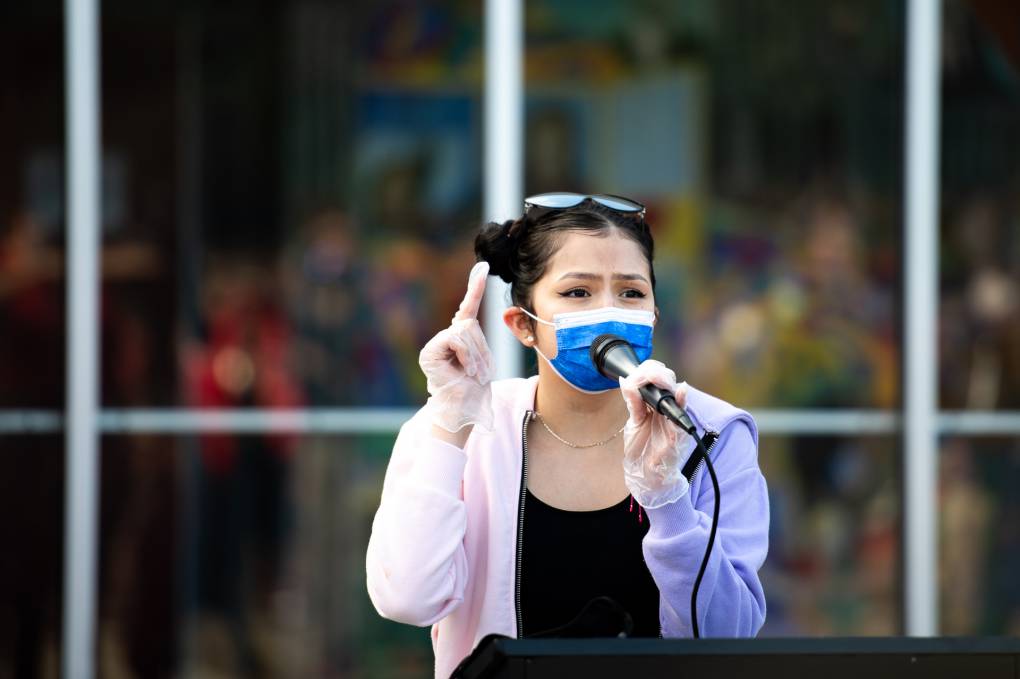
"content": "\u003cp>It has been a turbulent year for the San Francisco school board in ways that its two student delegates could never have foreseen. As both delegates graduate this week, they leave behind a legacy of activism their peers say sets the bar for what it means to be a student leader.\u003c/p>\n\u003cp>Shavonne Hines-Foster, a Lowell High School senior, fought fiercely for Black students and called on administrators to do a better job confronting racism.[pullquote size=\"medium\" align=\"right\" citation=\"Shavonne Hines-Foster, Lowell senior and San Francisco school board delegate\"]'No one who looked like me had been on the seat in the past few years. People put faith in me to lead with strength and compassion.'[/pullquote]\u003c/p>\n\u003cp>Her colleague, Kathya Correa Almanza, is graduating from June Jordan School for Equity. As a student delegate she advocated for transformational education for all students with poise and clarity.\u003c/p>\n\u003cp>That representation has been particularly important during a year when most students have been away from their schools and more isolated. Both students also had to learn how to navigate their roles amid adult debates over the reopening of schools, offensive tweets and lawsuits, said Correa Almanza.\u003c/p>\n\u003cp>\"I expected education to be this place where everyone agrees on what is right because it's for the students,\" Correa Almanza said. \"San Francisco is divided in so many ways, you know, we have different neighborhoods, we have different incomes. But to see how [that] played out was something that surprised me a lot.\"\u003c/p>\n\u003ch3>Students Advocating for Their Communities\u003c/h3>\n\u003cp>Correa Almanza's experience prepared her for this role. She was a high school debater, and over time, began using the power of her words for more than winning debate rounds. Her peers saw her as a leader, and pushed her to run for their student delegate. But she was nervous.\u003c/p>\n\u003cp>[ad fullwidth]\u003c/p>\n\u003cp>\"This is a role where people wouldn't expect to see a young Latina from a low-income household [and] single mother,\" Correa Almanza said. \"People would not expect someone that identifies like me to be in this role.\"\u003c/p>\n\u003cp>She reached out to San Francisco Board of Education President Gabriela López, the youngest woman ever elected to office in San Francisco, to talk about how she was feeling. After that conversation, and winning the election, Correa Almanza remained unfazed even when hundreds of people often tuned in over Zoom for board meetings. She says she understood what she had to do to be a strong leader.\u003c/p>\n\u003cp>When Hines-Foster decided to run, she was thinking about her community.\u003c/p>\n\u003cfigure id=\"attachment_11859101\" class=\"wp-caption alignnone\" style=\"max-width: 800px\">\u003cimg class=\"size-medium wp-image-11859101\" src=\"https://ww2.kqed.org/app/uploads/sites/10/2021/02/005_SanFrancisco_LowellHSRally_02052021-800x533.jpg\" alt=\"Lowell Black Student Union co-president Shavonne Hines-Foster speaks during a rally held at Lowell High School on Feb. 5, 2021, to address recent racist incidents at the school.\" width=\"800\" height=\"533\" srcset=\"https://ww2.kqed.org/app/uploads/sites/10/2021/02/005_SanFrancisco_LowellHSRally_02052021-800x533.jpg 800w, https://ww2.kqed.org/app/uploads/sites/10/2021/02/005_SanFrancisco_LowellHSRally_02052021-1020x679.jpg 1020w, https://ww2.kqed.org/app/uploads/sites/10/2021/02/005_SanFrancisco_LowellHSRally_02052021-160x107.jpg 160w, https://ww2.kqed.org/app/uploads/sites/10/2021/02/005_SanFrancisco_LowellHSRally_02052021-1536x1022.jpg 1536w, https://ww2.kqed.org/app/uploads/sites/10/2021/02/005_SanFrancisco_LowellHSRally_02052021.jpg 1920w\" sizes=\"(max-width: 800px) 100vw, 800px\">\u003cfigcaption class=\"wp-caption-text\">Lowell Black Student Union co-President Shavonne Hines-Foster speaks during a rally held at Lowell High School on Feb. 5, 2021, to address recent racist incidents at the school. \u003ccite>(Beth LaBerge/KQED)\u003c/cite>\u003c/figcaption>\u003c/figure>\n\u003cp>\"No one who looked like me had been on the seat in the past few years,\" Hines-Foster said. \"People put faith in me to lead with strength and compassion.\"\u003c/p>\n\u003cp>She remembers how in elementary school her teacher didn’t have anything planned for Black History Month.\u003c/p>\n\u003cp>\"So she actually told my mom, 'You can do it yourself.' So my mom had to give her own Black history lesson to my first grade class,\" Hines-Foster said.\u003c/p>\n\u003ch3>Finding Ways to Be Heard, in Spite of the Critics\u003c/h3>\n\u003cp>On the school board, Hines-Foster called out racism and inaction. She advocated for a Black studies curriculum, and for victims of sexual assault. But she said speaking out also led to threats online.\u003c/p>\n\u003cp>\"People don't want me to take up space. But I think honestly, I kind of brush it off because these people aren't saying these things with their chests,\" Hines-Foster said.\u003c/p>\n\u003cp>Even if people didn't want to listen, Hines-Foster found ways to be heard. She kept her peers updated through posts and livestreams on Instagram.\u003c/p>\n\u003cp>In February, Correa Almanza and Hines-Foster co-authored a resolution with other board members to end Lowell’s selective admissions policy based on grades and test scores. This year’s enrollment figures show that the policy change has made a difference. A greater percentage of Black and Hispanic students have been accepted into Lowell for the upcoming school year.\u003c/p>\n\u003cp>\"I was like, really, man, I hope these numbers come out good, because if [they don't], I'm probably going to get roasted by my whole school,\" Hines-Foster said. \"Like, 'You took away admissions and it didn't even work!' So I was like, 'Please, please, let something change.' So when the numbers came out, I was really happy.\"\u003c/p>\n\u003cp>Hines-Foster is also proud of her advocacy around bringing a Black studies curriculum to the district. She and Correa Almanza co-sponsored a Black studies resolution that gives every student in the district the chance to participate in Black studies by the school year 2022-2023. They also both began drafting a Title IX resolution to improve the reporting process for students who experience harassment or assault.\u003c/p>\n\u003ch3>Passing Off the Baton to the Next Student Leader\u003c/h3>\n\u003cp>Now that Correa Almanza and Hines-Foster are graduating, they're handing the baton to next year’s student delegates, Joanna Lam and Agnes Liang. Lam will be a senior at Lowell, and Agnes Liang will be a senior at Mission High School.\u003c/p>\n\u003cp>Lam is Cambodian American, the child of refugees and says she has been advocating for other students since kindergarten when she was on the student council.\u003c/p>\n\u003cp>\"I have young cousins who are in elementary school right now, and I want to make this district a place where they can grow up, and make their future overall better,\" Lam said.\u003c/p>\n\u003cp>She does think the student delegates can make a difference, even if their votes are only advisory.\u003c/p>\n\u003cp>\"The influence of student voice is questionable. But if you have people behind you with that voice, it's something much more powerful,\" Lam said.\u003c/p>\n\u003cp>Lam says she plans to continue using social media in creative ways to keep students engaged. On the final day of the student delegate election, Lam went on Instagram to dye her hair pink if more students voted.\u003c/p>\n\u003cp>[ad floatright]\u003c/p>\n\u003cp>She says next year, she’s focused on the reopening of schools in person, and making sure the district adequately supports students' mental health needs. She hopes that some day, student delegates' votes can be counted on the school board, too.\u003c/p>\n\n",
"disqusIdentifier": "11876083 https://ww2.kqed.org/news/?p=11876083",
"disqusUrl": "https://ww2.kqed.org/news/2021/06/01/how-san-franciscos-student-delegates-redefined-what-youth-leadership-looks-like/",
"stats": {
"hasVideo": false,
"hasChartOrMap": false,
"hasAudio": false,
"hasPolis": false,
"wordCount": 1071,
"hasGoogleForm": false,
"hasGallery": false,
"hasHearkenModule": false,
"iframeSrcs": [],
"paragraphCount": 27
},
"modified": 1622621010,
"excerpt": "It has been a turbulent year for the San Francisco school board in ways that its two student delegates could never have foreseen. As both delegates graduate this week, they leave behind a legacy of activism their peers say sets the bar for what it means to be a student leader.",
"headData": {
"twImgId": "",
"twTitle": "",
"ogTitle": "",
"ogImgId": "",
"twDescription": "",
"description": "It has been a turbulent year for the San Francisco school board in ways that its two student delegates could never have foreseen. As both delegates graduate this week, they leave behind a legacy of activism their peers say sets the bar for what it means to be a student leader.",
"title": "How San Francisco's Student Delegates Redefined What Youth Leadership Looks Like | KQED",
"ogDescription": "",
"schema": {
"@context": "https://schema.org",
"@type": "NewsArticle",
"headline": "How San Francisco's Student Delegates Redefined What Youth Leadership Looks Like",
"datePublished": "2021-06-01T13:07:04-07:00",
"dateModified": "2021-06-02T01:03:30-07:00",
"image": "https://cdn.kqed.org/wp-content/uploads/2020/02/KQED-OG-Image@1x.png",
"isAccessibleForFree": "True",
"publisher": {
"@type": "NewsMediaOrganization",
"@id": "https://www.kqed.org/#organization",
"name": "KQED",
"logo": "https://cdn.kqed.org/wp-content/uploads/2020/02/KQED-OG-Image@1x.png",
"url": "https://www.kqed.org",
"sameAs": [
"https://www.facebook.com/KQED",
"https://twitter.com/KQED",
"https://www.instagram.com/kqed/",
"https://www.tiktok.com/@kqedofficial",
"https://www.linkedin.com/company/kqed",
"https://www.youtube.com/channel/UCeC0IOo7i1P_61zVUWbJ4nw"
]
}
}
},
"guestAuthors": [],
"slug": "how-san-franciscos-student-delegates-redefined-what-youth-leadership-looks-like",
"status": "publish",
"path": "/news/11876083/how-san-franciscos-student-delegates-redefined-what-youth-leadership-looks-like",
"audioTrackLength": null,
"parsedContent": [
{
"type": "contentString",
"content": "\u003cdiv class=\"post-body\">\u003cp>\u003cp>It has been a turbulent year for the San Francisco school board in ways that its two student delegates could never have foreseen. As both delegates graduate this week, they leave behind a legacy of activism their peers say sets the bar for what it means to be a student leader.\u003c/p>\n\u003cp>Shavonne Hines-Foster, a Lowell High School senior, fought fiercely for Black students and called on administrators to do a better job confronting racism.\u003c/p>\u003c/div>",
"attributes": {
"named": {},
"numeric": []
}
},
{
"type": "component",
"content": "'No one who looked like me had been on the seat in the past few years. People put faith in me to lead with strength and compassion.'",
"name": "pullquote",
"attributes": {
"named": {
"size": "medium",
"align": "right",
"citation": "Shavonne Hines-Foster, Lowell senior and San Francisco school board delegate",
"label": ""
},
"numeric": []
}
},
{
"type": "contentString",
"content": "\u003cdiv class=\"post-body\">\u003cp>\u003c/p>\n\u003cp>Her colleague, Kathya Correa Almanza, is graduating from June Jordan School for Equity. As a student delegate she advocated for transformational education for all students with poise and clarity.\u003c/p>\n\u003cp>That representation has been particularly important during a year when most students have been away from their schools and more isolated. Both students also had to learn how to navigate their roles amid adult debates over the reopening of schools, offensive tweets and lawsuits, said Correa Almanza.\u003c/p>\n\u003cp>\"I expected education to be this place where everyone agrees on what is right because it's for the students,\" Correa Almanza said. \"San Francisco is divided in so many ways, you know, we have different neighborhoods, we have different incomes. But to see how [that] played out was something that surprised me a lot.\"\u003c/p>\n\u003ch3>Students Advocating for Their Communities\u003c/h3>\n\u003cp>Correa Almanza's experience prepared her for this role. She was a high school debater, and over time, began using the power of her words for more than winning debate rounds. Her peers saw her as a leader, and pushed her to run for their student delegate. But she was nervous.\u003c/p>\n\u003cp>\u003c/p>\u003c/div>",
"attributes": {
"named": {},
"numeric": []
}
},
{
"type": "component",
"content": "",
"name": "ad",
"attributes": {
"named": {
"label": "fullwidth"
},
"numeric": [
"fullwidth"
]
}
},
{
"type": "contentString",
"content": "\u003cdiv class=\"post-body\">\u003cp>\u003c/p>\n\u003cp>\"This is a role where people wouldn't expect to see a young Latina from a low-income household [and] single mother,\" Correa Almanza said. \"People would not expect someone that identifies like me to be in this role.\"\u003c/p>\n\u003cp>She reached out to San Francisco Board of Education President Gabriela López, the youngest woman ever elected to office in San Francisco, to talk about how she was feeling. After that conversation, and winning the election, Correa Almanza remained unfazed even when hundreds of people often tuned in over Zoom for board meetings. She says she understood what she had to do to be a strong leader.\u003c/p>\n\u003cp>When Hines-Foster decided to run, she was thinking about her community.\u003c/p>\n\u003cfigure id=\"attachment_11859101\" class=\"wp-caption alignnone\" style=\"max-width: 800px\">\u003cimg class=\"size-medium wp-image-11859101\" src=\"https://ww2.kqed.org/app/uploads/sites/10/2021/02/005_SanFrancisco_LowellHSRally_02052021-800x533.jpg\" alt=\"Lowell Black Student Union co-president Shavonne Hines-Foster speaks during a rally held at Lowell High School on Feb. 5, 2021, to address recent racist incidents at the school.\" width=\"800\" height=\"533\" srcset=\"https://ww2.kqed.org/app/uploads/sites/10/2021/02/005_SanFrancisco_LowellHSRally_02052021-800x533.jpg 800w, https://ww2.kqed.org/app/uploads/sites/10/2021/02/005_SanFrancisco_LowellHSRally_02052021-1020x679.jpg 1020w, https://ww2.kqed.org/app/uploads/sites/10/2021/02/005_SanFrancisco_LowellHSRally_02052021-160x107.jpg 160w, https://ww2.kqed.org/app/uploads/sites/10/2021/02/005_SanFrancisco_LowellHSRally_02052021-1536x1022.jpg 1536w, https://ww2.kqed.org/app/uploads/sites/10/2021/02/005_SanFrancisco_LowellHSRally_02052021.jpg 1920w\" sizes=\"(max-width: 800px) 100vw, 800px\">\u003cfigcaption class=\"wp-caption-text\">Lowell Black Student Union co-President Shavonne Hines-Foster speaks during a rally held at Lowell High School on Feb. 5, 2021, to address recent racist incidents at the school. \u003ccite>(Beth LaBerge/KQED)\u003c/cite>\u003c/figcaption>\u003c/figure>\n\u003cp>\"No one who looked like me had been on the seat in the past few years,\" Hines-Foster said. \"People put faith in me to lead with strength and compassion.\"\u003c/p>\n\u003cp>She remembers how in elementary school her teacher didn’t have anything planned for Black History Month.\u003c/p>\n\u003cp>\"So she actually told my mom, 'You can do it yourself.' So my mom had to give her own Black history lesson to my first grade class,\" Hines-Foster said.\u003c/p>\n\u003ch3>Finding Ways to Be Heard, in Spite of the Critics\u003c/h3>\n\u003cp>On the school board, Hines-Foster called out racism and inaction. She advocated for a Black studies curriculum, and for victims of sexual assault. But she said speaking out also led to threats online.\u003c/p>\n\u003cp>\"People don't want me to take up space. But I think honestly, I kind of brush it off because these people aren't saying these things with their chests,\" Hines-Foster said.\u003c/p>\n\u003cp>Even if people didn't want to listen, Hines-Foster found ways to be heard. She kept her peers updated through posts and livestreams on Instagram.\u003c/p>\n\u003cp>In February, Correa Almanza and Hines-Foster co-authored a resolution with other board members to end Lowell’s selective admissions policy based on grades and test scores. This year’s enrollment figures show that the policy change has made a difference. A greater percentage of Black and Hispanic students have been accepted into Lowell for the upcoming school year.\u003c/p>\n\u003cp>\"I was like, really, man, I hope these numbers come out good, because if [they don't], I'm probably going to get roasted by my whole school,\" Hines-Foster said. \"Like, 'You took away admissions and it didn't even work!' So I was like, 'Please, please, let something change.' So when the numbers came out, I was really happy.\"\u003c/p>\n\u003cp>Hines-Foster is also proud of her advocacy around bringing a Black studies curriculum to the district. She and Correa Almanza co-sponsored a Black studies resolution that gives every student in the district the chance to participate in Black studies by the school year 2022-2023. They also both began drafting a Title IX resolution to improve the reporting process for students who experience harassment or assault.\u003c/p>\n\u003ch3>Passing Off the Baton to the Next Student Leader\u003c/h3>\n\u003cp>Now that Correa Almanza and Hines-Foster are graduating, they're handing the baton to next year’s student delegates, Joanna Lam and Agnes Liang. Lam will be a senior at Lowell, and Agnes Liang will be a senior at Mission High School.\u003c/p>\n\u003cp>Lam is Cambodian American, the child of refugees and says she has been advocating for other students since kindergarten when she was on the student council.\u003c/p>\n\u003cp>\"I have young cousins who are in elementary school right now, and I want to make this district a place where they can grow up, and make their future overall better,\" Lam said.\u003c/p>\n\u003cp>She does think the student delegates can make a difference, even if their votes are only advisory.\u003c/p>\n\u003cp>\"The influence of student voice is questionable. But if you have people behind you with that voice, it's something much more powerful,\" Lam said.\u003c/p>\n\u003cp>Lam says she plans to continue using social media in creative ways to keep students engaged. On the final day of the student delegate election, Lam went on Instagram to dye her hair pink if more students voted.\u003c/p>\n\u003cp>\u003c/p>\u003c/div>",
"attributes": {
"named": {},
"numeric": []
}
},
{
"type": "component",
"content": "",
"name": "ad",
"attributes": {
"named": {
"label": "floatright"
},
"numeric": [
"floatright"
]
}
},
{
"type": "contentString",
"content": "\u003cdiv class=\"post-body\">\u003cp>\u003c/p>\n\u003cp>She says next year, she’s focused on the reopening of schools in person, and making sure the district adequately supports students' mental health needs. She hopes that some day, student delegates' votes can be counted on the school board, too.\u003c/p>\n\n\u003c/div>\u003c/p>",
"attributes": {
"named": {},
"numeric": []
}
}
],
"link": "/news/11876083/how-san-franciscos-student-delegates-redefined-what-youth-leadership-looks-like",
"authors": [
"11635"
],
"categories": [
"news_18540",
"news_28250",
"news_8"
],
"tags": [
"news_20013",
"news_27967",
"news_38",
"news_98"
],
"featImg": "news_11859102",
"label": "news"
},
"news_11875350": {
"type": "posts",
"id": "news_11875350",
"meta": {
"index": "posts_1716263798",
"site": "news",
"id": "11875350",
"score": null,
"sort": [
1622144730000
]
},
"guestAuthors": [],
"slug": "san-francisco-to-start-accepting-rent-relief-applications-on-friday",
"title": "San Francisco to Start Accepting Rent Relief Applications on Friday",
"publishDate": 1622144730,
"format": "standard",
"headTitle": "San Francisco to Start Accepting Rent Relief Applications on Friday | KQED",
"labelTerm": {
"site": "news"
},
"content": "\u003cp>On Friday, San Francisco will begin accepting applications to its \u003ca href=\"https://sf.gov/renthelp\">rent relief program\u003c/a> for residents struggling with housing insecurity due to the pandemic. The city has over $60 million in federal funds to distribute to renters and landlords who have experienced COVID-related financial hardships. The program is in addition to the state’s rent relief program, which is due to distribute $30 million in aid to San Franciscans.\u003c/p>\n\u003cp>To qualify, residents must have a household income at or below 80% of the city’s median income of $102,450 for individuals (approximately $81,960) and $146,350 for a family of four (approximately $117,080), and must have been eligible for unemployment benefits or experienced household income reduction.\u003c/p>\n\u003cp>The city said the program is designed to reach the most vulnerable tenants, including people who have extremely low incomes or have been homeless.\u003c/p>\n\u003cp>“We need to work together with the city to make this program a success, and reach folks who may be skeptical that the government is there for them,” said Gen Fujioka of the San Francisco Anti-Displacement Coalition earlier this week. “And we need to work together to make sure the system is accountable.”\u003c/p>\n\u003cp>Funds provided by the program will cover unpaid rent for April 2021 and after (\u003ca href=\"https://sf.gov/renthelp\">apply here\u003c/a>). For those needing help with unpaid rent from April 2020 to March 2021, the city encourages people to apply to the state’s Housing Is Key program (\u003ca href=\"https://housing.ca.gov/covid_rr/index.html\">apply here\u003c/a>).\u003c/p>\n\u003cp>In their application, tenants can provide a past-due rent notice, an eviction notice or something that documents an unhealthy or unstable living situation. Those who are part of a sublease agreement can also apply, as long as the landlord can confirm that the applicant lives and rents on the property.\u003c/p>\n\u003cp>According to the program’s \u003ca href=\"https://sf.gov/renthelp\">website\u003c/a>, it may take two to three weeks for an application to be processed. It may then take an additional two to six weeks to receive the aid. \u003c/p>\n\u003cp>Several community-based organizations can help tenants fill out their applications. To connect with one, call 311 or \u003ca href=\"http://sfadc.org/\">contact the San Francisco Anti-Displacement Coalition\u003c/a>.\u003c/p>\n\u003cp>— \u003cem>KQED’s \u003ca href=\"https://www.kqed.org/author/ekelly\">Erika Kelly\u003c/a> and Bay City News\u003c/em>\u003c/p>\n",
"blocks": [],
"excerpt": "The city said the program is designed to reach the most vulnerable tenants, including people who have extremely low incomes or have been homeless.",
"status": "publish",
"parent": 0,
"modified": 1738785459,
"stats": {
"hasAudio": false,
"hasVideo": false,
"hasChartOrMap": false,
"iframeSrcs": [],
"hasGoogleForm": false,
"hasGallery": false,
"hasHearkenModule": false,
"hasPolis": false,
"paragraphCount": 9,
"wordCount": 366
},
"headData": {
"title": "San Francisco to Start Accepting Rent Relief Applications on Friday | KQED",
"description": "The city said the program is designed to reach the most vulnerable tenants, including people who have extremely low incomes or have been homeless.",
"ogTitle": "",
"ogDescription": "",
"ogImgId": "news_11860317",
"twTitle": "",
"twDescription": "",
"twImgId": "news_11860317",
"schema": {
"@context": "https://schema.org",
"@type": "NewsArticle",
"headline": "San Francisco to Start Accepting Rent Relief Applications on Friday",
"datePublished": "2021-05-27T12:45:30-07:00",
"dateModified": "2025-02-05T11:57:39-08:00",
"image": "https://cdn.kqed.org/wp-content/uploads/2020/02/KQED-OG-Image@1x.png",
"isAccessibleForFree": "True",
"publisher": {
"@type": "NewsMediaOrganization",
"@id": "https://www.kqed.org/#organization",
"name": "KQED",
"logo": "https://cdn.kqed.org/wp-content/uploads/2020/02/KQED-OG-Image@1x.png",
"url": "https://www.kqed.org",
"sameAs": [
"https://www.facebook.com/KQED",
"https://twitter.com/KQED",
"https://www.instagram.com/kqed/",
"https://www.tiktok.com/@kqedofficial",
"https://www.linkedin.com/company/kqed",
"https://www.youtube.com/channel/UCeC0IOo7i1P_61zVUWbJ4nw"
]
}
}
},
"sticky": false,
"justInHeadline": "SF to accept rent relief applications starting Friday",
"path": "/news/11875350/san-francisco-to-start-accepting-rent-relief-applications-on-friday",
"redirect": {
"type": "internal",
"url": "/coronavirusliveupdates/news/11875350/san-francisco-to-start-accepting-rent-relief-applications-on-friday"
},
"audioTrackLength": null,
"parsedContent": [
{
"type": "contentString",
"content": "\u003cdiv class=\"post-body\">\u003cp>\u003cp>On Friday, San Francisco will begin accepting applications to its \u003ca href=\"https://sf.gov/renthelp\">rent relief program\u003c/a> for residents struggling with housing insecurity due to the pandemic. The city has over $60 million in federal funds to distribute to renters and landlords who have experienced COVID-related financial hardships. The program is in addition to the state’s rent relief program, which is due to distribute $30 million in aid to San Franciscans.\u003c/p>\n\u003cp>To qualify, residents must have a household income at or below 80% of the city’s median income of $102,450 for individuals (approximately $81,960) and $146,350 for a family of four (approximately $117,080), and must have been eligible for unemployment benefits or experienced household income reduction.\u003c/p>\n\u003cp>The city said the program is designed to reach the most vulnerable tenants, including people who have extremely low incomes or have been homeless.\u003c/p>\n\u003cp>“We need to work together with the city to make this program a success, and reach folks who may be skeptical that the government is there for them,” said Gen Fujioka of the San Francisco Anti-Displacement Coalition earlier this week. “And we need to work together to make sure the system is accountable.”\u003c/p>\n\u003cp>Funds provided by the program will cover unpaid rent for April 2021 and after (\u003ca href=\"https://sf.gov/renthelp\">apply here\u003c/a>). For those needing help with unpaid rent from April 2020 to March 2021, the city encourages people to apply to the state’s Housing Is Key program (\u003ca href=\"https://housing.ca.gov/covid_rr/index.html\">apply here\u003c/a>).\u003c/p>\n\u003cp>In their application, tenants can provide a past-due rent notice, an eviction notice or something that documents an unhealthy or unstable living situation. Those who are part of a sublease agreement can also apply, as long as the landlord can confirm that the applicant lives and rents on the property.\u003c/p>\n\u003cp>According to the program’s \u003ca href=\"https://sf.gov/renthelp\">website\u003c/a>, it may take two to three weeks for an application to be processed. It may then take an additional two to six weeks to receive the aid. \u003c/p>\n\u003cp>Several community-based organizations can help tenants fill out their applications. To connect with one, call 311 or \u003ca href=\"http://sfadc.org/\">contact the San Francisco Anti-Displacement Coalition\u003c/a>.\u003c/p>\n\u003cp>— \u003cem>KQED’s \u003ca href=\"https://www.kqed.org/author/ekelly\">Erika Kelly\u003c/a> and Bay City News\u003c/em>\u003c/p>\n\u003c/div>\u003c/p>",
"attributes": {
"named": {},
"numeric": []
}
}
],
"link": "/coronavirusliveupdates/news/11875350/san-francisco-to-start-accepting-rent-relief-applications-on-friday",
"authors": [
"11708"
],
"categories": [
"news_6266",
"news_27809"
],
"tags": [
"news_1775",
"news_27741",
"news_20967",
"news_38"
],
"featImg": "news_11860317",
"label": "news"
},
"news_11874353": {
"type": "posts",
"id": "news_11874353",
"meta": {
"index": "posts_1716263798",
"site": "news",
"id": "11874353",
"score": null,
"sort": [
1621539743000
]
},
"guestAuthors": [],
"slug": "pro-palestinian-demonstrators-rally-at-san-franciscos-israeli-consulate-demanding-more-than-just-ceasefire",
"title": "Pro-Palestinian Demonstrators Rally at SF's Israeli Consulate in Lead Up to Cease-Fire",
"publishDate": 1621539743,
"format": "standard",
"headTitle": "Pro-Palestinian Demonstrators Rally at SF’s Israeli Consulate in Lead Up to Cease-Fire | KQED",
"labelTerm": {
"site": "news"
},
"content": "\u003cp>Over 1,000 protesters gathered in front of the Israeli Consulate in San Francisco on Tuesday in solidarity with a general strike staged by Palestinians in Gaza, the West Bank and Israel in response to ongoing attacks by the Israeli military.\u003c/p>\n\u003cp>The local action, among \u003ca href=\"https://www.npr.org/2021/05/19/998191383/u-s-scenes-of-protest-over-the-violence-in-gaza-and-israel\">scores of similar demonstrations\u003c/a> across the United States, comes as pressure grew on President Biden to push for a ceasefire between Israel and Hamas, the Palestinian militant group fighting from Gaza.[pullquote align=\"right\" size=\"medium\" citation=\"Leiya Kadah, Bay Area high school student\"]‘My parents have always taught me that in Islam, the least you can do if you see injustice: If you can fight against it, then fight it.’[/pullquote]On Wednesday, Biden purportedly told Israeli Prime Minister Benjamin Netanyahu that he expects “a significant de-escalation today on the path to a ceasefire,” according to a statement from the White House.\u003c/p>\n\u003cp>Israel \u003ca href=\"https://apnews.com/article/gaza-israel-middle-east-israel-palestinian-conflict-caac81bc36fe9be67ac2f7c27000c74b\">unleashed another wave\u003c/a> of airstrikes across Gaza early Thursday, killing at least one Palestinian and wounding several others, while Hamas continued firing rockets into Israel.\u003c/p>\n\u003cp>Later Thursday, the Israeli Cabinet \u003ca href=\"https://www.npr.org/2021/05/20/998644377/israels-cabinet-announces-unilateral-cease-fire-in-gaza-conflict\">said they have voted for a cease-fire plan\u003c/a> after 11 days of fighting. Hamas spokesman Hazem Al Qassem said the militant group is open to a cease-fire if Israel stops its airstrikes on Gaza.\u003c/p>\n\u003cp>Still, many pro-Palestinian demonstrators in the U.S. insist a ceasefire does not go far enough.\u003c/p>\n\u003cp>“We will not stop coming out, resisting and raising our voices for Palestinian liberation until Palestine is free from the river to the sea,” said Wassim Hage, 26, a member of the Bay Area chapter of the \u003ca href=\"http://araborganizing.org/\">Arab Resource and Organizing Center\u003c/a> (AROC), a pro-Palestine group that helped organize Tuesday’s rally.\u003c/p>\n\u003cfigure id=\"attachment_11874461\" class=\"wp-caption alignnone\" style=\"max-width: 1920px\">\u003cimg loading=\"lazy\" decoding=\"async\" class=\"size-full wp-image-11874461\" src=\"https://ww2.kqed.org/app/uploads/sites/10/2021/05/RS49060_004_SanFrancisco_PalestineRally_05182021-qut.jpg\" alt=\"\" width=\"1920\" height=\"1280\" srcset=\"https://cdn.kqed.org/wp-content/uploads/sites/10/2021/05/RS49060_004_SanFrancisco_PalestineRally_05182021-qut.jpg 1920w, https://cdn.kqed.org/wp-content/uploads/sites/10/2021/05/RS49060_004_SanFrancisco_PalestineRally_05182021-qut-800x533.jpg 800w, https://cdn.kqed.org/wp-content/uploads/sites/10/2021/05/RS49060_004_SanFrancisco_PalestineRally_05182021-qut-1020x680.jpg 1020w, https://cdn.kqed.org/wp-content/uploads/sites/10/2021/05/RS49060_004_SanFrancisco_PalestineRally_05182021-qut-160x107.jpg 160w, https://cdn.kqed.org/wp-content/uploads/sites/10/2021/05/RS49060_004_SanFrancisco_PalestineRally_05182021-qut-1536x1024.jpg 1536w\" sizes=\"(max-width: 1920px) 100vw, 1920px\">\u003cfigcaption class=\"wp-caption-text\">Protester Jahmeih AlJahmi holds a sign that reads, ‘From the River to the Sea Palestine will be Free’ during a pro-Palestine rally outside of the Israeli Consulate in San Francisco on May 18, 2021. \u003ccite>(Beth LaBerge/KQED)\u003c/cite>\u003c/figcaption>\u003c/figure>\n\u003cp>Demonstrators filled an intersection in the heart of San Francisco’s Financial District, chanting in English, Arabic and Spanish for a free Palestine. Many hoisted Palestinian flags and \u003ca href=\"https://en.wikipedia.org/wiki/Keffiyeh\">wore keffiyehs\u003c/a>, the colorful fabrics standing out against the grey palette of the city’s skyscrapers.\u003c/p>\n\u003cp>Dozens of San Francisco police officers were deployed in front of the building housing the Israeli Consulate, with a fence blocking the entrance.\u003c/p>\n\u003cp>As of Thursday, at least 230 Palestinians, including 65 children, \u003ca href=\"https://apnews.com/article/gaza-israel-middle-east-israel-palestinian-conflict-caac81bc36fe9be67ac2f7c27000c74b\">had been killed in the now 11-day-old conflict\u003c/a>, according to the Gaza Health Ministry, which does not break the numbers down into fighters and civilians. At least 58,000 Palestinians have fled their homes, as Israeli bombs continue to wreak devastation on the densely populated region.\u003c/p>\n\u003cp>Hamas, meanwhile, has fired thousands of rockets into Israel, killing at least 12 people, including two children.\u003c/p>\n\u003cp>In a statement released during the protest, a representative of the Israeli Consulate said, “Israel remains committed to peace and stability and has made several attempts to de-escalate this crisis only to be met with thousands of Hamas rocket attacks, killing both Israelis and Palestinians.”\u003c/p>\n\u003cp>Despite mounting pressure from the U.S., Netanyahu has maintained that Israel \u003ca href=\"https://apnews.com/article/israel-middle-east-israel-palestinian-conflict-health-coronavirus-pandemic-9b59e6d675531576e819b6b948eba99d\">will continue to bombard Gaza\u003c/a> until it has sufficiently disabled Hamas’ military capability and prevented it from firing more rockets.\u003c/p>\n\u003cp>“It’s critical that there’s a series of actions over the course of weeks and over the course of time, because the violence and ongoing ethnic cleansing of Palestinians is something that is not stopping,” Hage said.\u003c/p>\n\u003cfigure id=\"attachment_11874462\" class=\"wp-caption aligncenter\" style=\"max-width: 1920px\">\u003cimg loading=\"lazy\" decoding=\"async\" class=\"wp-image-11874462 size-full\" src=\"https://ww2.kqed.org/app/uploads/sites/10/2021/05/RS49102_024_SanFrancisco_PalestineRally_05182021-qut.jpg\" alt=\"A line of police stand in front of the Israeli Consulate during a rally in solidarity with Palestine in San Francisco on May 18, 2021.\" width=\"1920\" height=\"1278\" srcset=\"https://cdn.kqed.org/wp-content/uploads/sites/10/2021/05/RS49102_024_SanFrancisco_PalestineRally_05182021-qut.jpg 1920w, https://cdn.kqed.org/wp-content/uploads/sites/10/2021/05/RS49102_024_SanFrancisco_PalestineRally_05182021-qut-800x533.jpg 800w, https://cdn.kqed.org/wp-content/uploads/sites/10/2021/05/RS49102_024_SanFrancisco_PalestineRally_05182021-qut-1020x679.jpg 1020w, https://cdn.kqed.org/wp-content/uploads/sites/10/2021/05/RS49102_024_SanFrancisco_PalestineRally_05182021-qut-160x107.jpg 160w, https://cdn.kqed.org/wp-content/uploads/sites/10/2021/05/RS49102_024_SanFrancisco_PalestineRally_05182021-qut-1536x1022.jpg 1536w\" sizes=\"(max-width: 1920px) 100vw, 1920px\">\u003cfigcaption class=\"wp-caption-text\">A line of police stand in front of the Israeli Consulate during Tuesday’s rally in San Francisco. \u003ccite>(Beth LaBerge/KQED)\u003c/cite>\u003c/figcaption>\u003c/figure>\n\u003cp>The current conflict, the first major flare-up between Palestinians and Israelis since 2014, has also shed renewed light on the vast military aid the U.S. has long funneled to Israel.\u003c/p>\n\u003cp>Several prominent U.S. elected officials have strongly condemned Israel’s disproportionate military response. And \u003ca href=\"https://news.yahoo.com/bernie-sanders-demands-biden-hard-171958106.html\">Sen. Bernie Sanders\u003c/a>, an independent from Vermont, this week urged Biden to take a “hard look” at U.S. military aid to Israel, suggesting that it be conditional on the country’s human rights record.\u003c/p>\n\u003cp>[aside label=\"related coverage\" tag=\"palestine\"]Israel, however, has long been one of America’s strongest allies, prompting Biden to proceed cautiously on the issue, with his administration this week \u003ca href=\"https://www.whitehouse.gov/briefing-room/press-briefings/2021/05/17/press-briefing-by-press-secretary-jen-psaki-may-17-2021/\">reiterating its position\u003c/a> that Israel has the right to defend itself.\u003c/p>\n\u003cp>Since this most recent Israeli-Palestinian conflict erupted on May 10, coalitions of Palestinian advocacy groups in dozens of cities across the U.S. have organized rallies, raised funds for displaced Palestinians and pushed for a boycott of Israeli commerce. Earlier this week, an Israeli-owned shipping company chose not to dock one of its tankers at the Port of Oakland, following pressure from activists in the Bay Area.\u003c/p>\n\u003cp>“This is the result of years of organizing,” said Hage. “It’s a tremendous testament to the organizing that the Palestinian movement around the world has formed.”\u003c/p>\n\u003cp>AROC and other organizations like \u003ca href=\"https://www.instagram.com/palestinianyouthmovement/\">Palestinian Youth Movement\u003c/a> (PYM) have also in recent days produced social media content about the conflict to further awareness among those unfamiliar with the situation.\u003c/p>\n\u003cp>“Palestinians and allies really took to social media full-on to counteract the silence that we’ve seen ever since the Nakba,” said Zeyad Elomari, 27, a member of the Bay Area chapter of PYM, referring to the displacement of about 750,000 Palestinians shortly after the establishment of Israel in 1948.\u003c/p>\n\u003cfigure id=\"attachment_11874463\" class=\"wp-caption aligncenter\" style=\"max-width: 1920px\">\u003cimg loading=\"lazy\" decoding=\"async\" class=\"wp-image-11874463 size-full\" src=\"https://ww2.kqed.org/app/uploads/sites/10/2021/05/RS49099_021_SanFrancisco_PalestineRally_05182021-qut.jpg\" alt=\"Safa Choudhury holds a Palestinian flag during a rally outside of the Israeli Consulate in San Francisco on May 18, 2021.\" width=\"1920\" height=\"1280\" srcset=\"https://cdn.kqed.org/wp-content/uploads/sites/10/2021/05/RS49099_021_SanFrancisco_PalestineRally_05182021-qut.jpg 1920w, https://cdn.kqed.org/wp-content/uploads/sites/10/2021/05/RS49099_021_SanFrancisco_PalestineRally_05182021-qut-800x533.jpg 800w, https://cdn.kqed.org/wp-content/uploads/sites/10/2021/05/RS49099_021_SanFrancisco_PalestineRally_05182021-qut-1020x680.jpg 1020w, https://cdn.kqed.org/wp-content/uploads/sites/10/2021/05/RS49099_021_SanFrancisco_PalestineRally_05182021-qut-160x107.jpg 160w, https://cdn.kqed.org/wp-content/uploads/sites/10/2021/05/RS49099_021_SanFrancisco_PalestineRally_05182021-qut-1536x1024.jpg 1536w\" sizes=\"(max-width: 1920px) 100vw, 1920px\">\u003cfigcaption class=\"wp-caption-text\">Safa Choudhury participates in Tuesday’s rally outside of the Israeli Consulate in San Francisco. Her face is painted with the Palestinian flag over Gaza, the West Bank and Israel. \u003ccite>(Beth LaBerge/KQED)\u003c/cite>\u003c/figcaption>\u003c/figure>\n\u003cp>Elomari says his grandfather was among those displaced from their homes in what is now Israel, and the painful legacy of that lives on in his family.\u003c/p>\n\u003cp>“I was born as a refugee, my grandfather was born as a refugee, and his descendants are refugees because we’re not allowed in our homeland and [to] live there if we wish to do so,” he said.\u003c/p>\n\u003cp>Elomari says that as his parents’ generation grows older, he and his peers have the responsibility to keep marching and organizing all over the world to demand the liberation and well-being of the Palestinian people.\u003c/p>\n\u003cp>“It’s extremely important that we keep our traditions and culture and political identity alive because asserting our existence as Palestinians is the most important act of resistance,” he said.\u003c/p>\n\u003cp>Leiya Kadah, 18, a high school student who also attended Tuesday’s rally in San Francisco, says her drive to support Palestinian organizing is rooted in what her family has taught her about faith and justice.\u003c/p>\n\u003cp>“My parents have always taught me that in Islam, the least you can do if you see injustice: If you can fight against it, then fight it,” she said. “If you can stop it with your words, stop it with your words.”\u003c/p>\n\u003cp>Kadah says she has been attending Palestinian solidarity demonstrations with her family since she was in first grade, and has never grown tired of marching. “The least you can do when you see injustice is feel in your heart that this is something that is not right,” she said.\u003c/p>\n\u003cfigure id=\"attachment_11874460\" class=\"wp-caption alignnone\" style=\"max-width: 1920px\">\u003cimg loading=\"lazy\" decoding=\"async\" class=\"size-full wp-image-11874460\" src=\"https://ww2.kqed.org/app/uploads/sites/10/2021/05/RS49069_013_SanFrancisco_PalestineRally_05182021-qut.jpg\" alt=\"A man holds up his niece on his shoulders at a pro-Palestine rally outside the Israeli consulate in San Francisco.\" width=\"1920\" height=\"1280\" srcset=\"https://cdn.kqed.org/wp-content/uploads/sites/10/2021/05/RS49069_013_SanFrancisco_PalestineRally_05182021-qut.jpg 1920w, https://cdn.kqed.org/wp-content/uploads/sites/10/2021/05/RS49069_013_SanFrancisco_PalestineRally_05182021-qut-800x533.jpg 800w, https://cdn.kqed.org/wp-content/uploads/sites/10/2021/05/RS49069_013_SanFrancisco_PalestineRally_05182021-qut-1020x680.jpg 1020w, https://cdn.kqed.org/wp-content/uploads/sites/10/2021/05/RS49069_013_SanFrancisco_PalestineRally_05182021-qut-160x107.jpg 160w, https://cdn.kqed.org/wp-content/uploads/sites/10/2021/05/RS49069_013_SanFrancisco_PalestineRally_05182021-qut-1536x1024.jpg 1536w\" sizes=\"(max-width: 1920px) 100vw, 1920px\">\u003cfigcaption class=\"wp-caption-text\">Salim Nasser holds his niece Yasmine Twam on his shoulders during a ‘Free Palestine’ rally outside of the Israeli Consulate in San Francisco on May 18, 2021. \u003ccite>(Beth LaBerge/KQED)\u003c/cite>\u003c/figcaption>\u003c/figure>\n\u003cp>Ellen Brotsky, 68, a volunteer with the Bay Area chapter of \u003ca href=\"https://jewishvoiceforpeace.org/\">Jewish Voice for Peace\u003c/a>, who also participated in Tuesday’s rally, has helped organize Palestinian solidarity efforts for decades.\u003c/p>\n\u003cp>As a Jewish person, she says, she feels the responsibility to have conversations with Jews from different generations about the importance of standing in solidarity with other oppressed people, and how doing so can actually further, not diminish, Israel’s security.\u003c/p>\n\u003cp>“Jewish safety comes not from a settler colonial Zionist state of Israel,” she said. “It comes from being in solidarity with everybody who is oppressed by racism, by settler colonialism.”\u003c/p>\n\u003cp>Brotsky says she continues to learn from younger Jewish activists who have had to navigate difficult political conversations with their families on this issue. For her, organizing has become a space in which multiple generations can learn from each other, while expressing care and compassion.\u003c/p>\n\u003cp>“We want to call the Jewish community in. We understand what’s been handed down, the trauma,” she said. “It takes time, it takes patience. It also takes principles. It takes a lot of organizing work.”\u003c/p>\n\u003cp>\u003cem>KQED’s Joe Fitzgerald Rodriguez, Sara Hossaini, NPR’s Merrit Kennedy and The Associated Press contributed to this story.\u003c/em>\u003cbr>\n\u003cem>This story has been updated.\u003c/em>\u003cbr>\n[ad fullwidth]\u003c/p>\n\u003cp>[ad floatright]\u003c/p>\n",
"blocks": [],
"excerpt": "As the Israeli-Palestinian conflict raged on ahead of a new cease-fire agreement announced Thursday, activists in San Francisco and across the country this week demonstrated in solidarity with Palestinians.",
"status": "publish",
"parent": 0,
"modified": 1721129573,
"stats": {
"hasAudio": false,
"hasVideo": false,
"hasChartOrMap": false,
"iframeSrcs": [],
"hasGoogleForm": false,
"hasGallery": false,
"hasHearkenModule": false,
"hasPolis": false,
"paragraphCount": 34,
"wordCount": 1498
},
"headData": {
"title": "Pro-Palestinian Demonstrators Rally at SF's Israeli Consulate in Lead Up to Cease-Fire | KQED",
"description": "As the Israeli-Palestinian conflict raged on ahead of a new cease-fire agreement announced Thursday, activists in San Francisco and across the country this week demonstrated in solidarity with Palestinians.",
"ogTitle": "",
"ogDescription": "",
"ogImgId": "",
"twTitle": "",
"twDescription": "",
"twImgId": "",
"schema": {
"@context": "https://schema.org",
"@type": "NewsArticle",
"headline": "Pro-Palestinian Demonstrators Rally at SF's Israeli Consulate in Lead Up to Cease-Fire",
"datePublished": "2021-05-20T12:42:23-07:00",
"dateModified": "2024-07-16T04:32:53-07:00",
"image": "https://cdn.kqed.org/wp-content/uploads/2020/02/KQED-OG-Image@1x.png",
"isAccessibleForFree": "True",
"publisher": {
"@type": "NewsMediaOrganization",
"@id": "https://www.kqed.org/#organization",
"name": "KQED",
"logo": "https://cdn.kqed.org/wp-content/uploads/2020/02/KQED-OG-Image@1x.png",
"url": "https://www.kqed.org",
"sameAs": [
"https://www.facebook.com/KQED",
"https://twitter.com/KQED",
"https://www.instagram.com/kqed/",
"https://www.tiktok.com/@kqedofficial",
"https://www.linkedin.com/company/kqed",
"https://www.youtube.com/channel/UCeC0IOo7i1P_61zVUWbJ4nw"
]
}
}
},
"sticky": false,
"excludeFromSiteSearch": "Include",
"articleAge": "0",
"path": "/news/11874353/pro-palestinian-demonstrators-rally-at-san-franciscos-israeli-consulate-demanding-more-than-just-ceasefire",
"audioTrackLength": null,
"parsedContent": [
{
"type": "contentString",
"content": "\u003cdiv class=\"post-body\">\u003cp>\u003cp>Over 1,000 protesters gathered in front of the Israeli Consulate in San Francisco on Tuesday in solidarity with a general strike staged by Palestinians in Gaza, the West Bank and Israel in response to ongoing attacks by the Israeli military.\u003c/p>\n\u003cp>The local action, among \u003ca href=\"https://www.npr.org/2021/05/19/998191383/u-s-scenes-of-protest-over-the-violence-in-gaza-and-israel\">scores of similar demonstrations\u003c/a> across the United States, comes as pressure grew on President Biden to push for a ceasefire between Israel and Hamas, the Palestinian militant group fighting from Gaza.\u003c/p>\u003c/div>",
"attributes": {
"named": {},
"numeric": []
}
},
{
"type": "component",
"content": "‘My parents have always taught me that in Islam, the least you can do if you see injustice: If you can fight against it, then fight it.’",
"name": "pullquote",
"attributes": {
"named": {
"align": "right",
"size": "medium",
"citation": "Leiya Kadah, Bay Area high school student",
"label": ""
},
"numeric": []
}
},
{
"type": "contentString",
"content": "\u003cdiv class=\"post-body\">\u003cp>On Wednesday, Biden purportedly told Israeli Prime Minister Benjamin Netanyahu that he expects “a significant de-escalation today on the path to a ceasefire,” according to a statement from the White House.\u003c/p>\n\u003cp>Israel \u003ca href=\"https://apnews.com/article/gaza-israel-middle-east-israel-palestinian-conflict-caac81bc36fe9be67ac2f7c27000c74b\">unleashed another wave\u003c/a> of airstrikes across Gaza early Thursday, killing at least one Palestinian and wounding several others, while Hamas continued firing rockets into Israel.\u003c/p>\n\u003cp>Later Thursday, the Israeli Cabinet \u003ca href=\"https://www.npr.org/2021/05/20/998644377/israels-cabinet-announces-unilateral-cease-fire-in-gaza-conflict\">said they have voted for a cease-fire plan\u003c/a> after 11 days of fighting. Hamas spokesman Hazem Al Qassem said the militant group is open to a cease-fire if Israel stops its airstrikes on Gaza.\u003c/p>\n\u003cp>Still, many pro-Palestinian demonstrators in the U.S. insist a ceasefire does not go far enough.\u003c/p>\n\u003cp>“We will not stop coming out, resisting and raising our voices for Palestinian liberation until Palestine is free from the river to the sea,” said Wassim Hage, 26, a member of the Bay Area chapter of the \u003ca href=\"http://araborganizing.org/\">Arab Resource and Organizing Center\u003c/a> (AROC), a pro-Palestine group that helped organize Tuesday’s rally.\u003c/p>\n\u003cfigure id=\"attachment_11874461\" class=\"wp-caption alignnone\" style=\"max-width: 1920px\">\u003cimg loading=\"lazy\" decoding=\"async\" class=\"size-full wp-image-11874461\" src=\"https://ww2.kqed.org/app/uploads/sites/10/2021/05/RS49060_004_SanFrancisco_PalestineRally_05182021-qut.jpg\" alt=\"\" width=\"1920\" height=\"1280\" srcset=\"https://cdn.kqed.org/wp-content/uploads/sites/10/2021/05/RS49060_004_SanFrancisco_PalestineRally_05182021-qut.jpg 1920w, https://cdn.kqed.org/wp-content/uploads/sites/10/2021/05/RS49060_004_SanFrancisco_PalestineRally_05182021-qut-800x533.jpg 800w, https://cdn.kqed.org/wp-content/uploads/sites/10/2021/05/RS49060_004_SanFrancisco_PalestineRally_05182021-qut-1020x680.jpg 1020w, https://cdn.kqed.org/wp-content/uploads/sites/10/2021/05/RS49060_004_SanFrancisco_PalestineRally_05182021-qut-160x107.jpg 160w, https://cdn.kqed.org/wp-content/uploads/sites/10/2021/05/RS49060_004_SanFrancisco_PalestineRally_05182021-qut-1536x1024.jpg 1536w\" sizes=\"(max-width: 1920px) 100vw, 1920px\">\u003cfigcaption class=\"wp-caption-text\">Protester Jahmeih AlJahmi holds a sign that reads, ‘From the River to the Sea Palestine will be Free’ during a pro-Palestine rally outside of the Israeli Consulate in San Francisco on May 18, 2021. \u003ccite>(Beth LaBerge/KQED)\u003c/cite>\u003c/figcaption>\u003c/figure>\n\u003cp>Demonstrators filled an intersection in the heart of San Francisco’s Financial District, chanting in English, Arabic and Spanish for a free Palestine. Many hoisted Palestinian flags and \u003ca href=\"https://en.wikipedia.org/wiki/Keffiyeh\">wore keffiyehs\u003c/a>, the colorful fabrics standing out against the grey palette of the city’s skyscrapers.\u003c/p>\n\u003cp>Dozens of San Francisco police officers were deployed in front of the building housing the Israeli Consulate, with a fence blocking the entrance.\u003c/p>\n\u003cp>As of Thursday, at least 230 Palestinians, including 65 children, \u003ca href=\"https://apnews.com/article/gaza-israel-middle-east-israel-palestinian-conflict-caac81bc36fe9be67ac2f7c27000c74b\">had been killed in the now 11-day-old conflict\u003c/a>, according to the Gaza Health Ministry, which does not break the numbers down into fighters and civilians. At least 58,000 Palestinians have fled their homes, as Israeli bombs continue to wreak devastation on the densely populated region.\u003c/p>\n\u003cp>Hamas, meanwhile, has fired thousands of rockets into Israel, killing at least 12 people, including two children.\u003c/p>\n\u003cp>In a statement released during the protest, a representative of the Israeli Consulate said, “Israel remains committed to peace and stability and has made several attempts to de-escalate this crisis only to be met with thousands of Hamas rocket attacks, killing both Israelis and Palestinians.”\u003c/p>\n\u003cp>Despite mounting pressure from the U.S., Netanyahu has maintained that Israel \u003ca href=\"https://apnews.com/article/israel-middle-east-israel-palestinian-conflict-health-coronavirus-pandemic-9b59e6d675531576e819b6b948eba99d\">will continue to bombard Gaza\u003c/a> until it has sufficiently disabled Hamas’ military capability and prevented it from firing more rockets.\u003c/p>\n\u003cp>“It’s critical that there’s a series of actions over the course of weeks and over the course of time, because the violence and ongoing ethnic cleansing of Palestinians is something that is not stopping,” Hage said.\u003c/p>\n\u003cfigure id=\"attachment_11874462\" class=\"wp-caption aligncenter\" style=\"max-width: 1920px\">\u003cimg loading=\"lazy\" decoding=\"async\" class=\"wp-image-11874462 size-full\" src=\"https://ww2.kqed.org/app/uploads/sites/10/2021/05/RS49102_024_SanFrancisco_PalestineRally_05182021-qut.jpg\" alt=\"A line of police stand in front of the Israeli Consulate during a rally in solidarity with Palestine in San Francisco on May 18, 2021.\" width=\"1920\" height=\"1278\" srcset=\"https://cdn.kqed.org/wp-content/uploads/sites/10/2021/05/RS49102_024_SanFrancisco_PalestineRally_05182021-qut.jpg 1920w, https://cdn.kqed.org/wp-content/uploads/sites/10/2021/05/RS49102_024_SanFrancisco_PalestineRally_05182021-qut-800x533.jpg 800w, https://cdn.kqed.org/wp-content/uploads/sites/10/2021/05/RS49102_024_SanFrancisco_PalestineRally_05182021-qut-1020x679.jpg 1020w, https://cdn.kqed.org/wp-content/uploads/sites/10/2021/05/RS49102_024_SanFrancisco_PalestineRally_05182021-qut-160x107.jpg 160w, https://cdn.kqed.org/wp-content/uploads/sites/10/2021/05/RS49102_024_SanFrancisco_PalestineRally_05182021-qut-1536x1022.jpg 1536w\" sizes=\"(max-width: 1920px) 100vw, 1920px\">\u003cfigcaption class=\"wp-caption-text\">A line of police stand in front of the Israeli Consulate during Tuesday’s rally in San Francisco. \u003ccite>(Beth LaBerge/KQED)\u003c/cite>\u003c/figcaption>\u003c/figure>\n\u003cp>The current conflict, the first major flare-up between Palestinians and Israelis since 2014, has also shed renewed light on the vast military aid the U.S. has long funneled to Israel.\u003c/p>\n\u003cp>Several prominent U.S. elected officials have strongly condemned Israel’s disproportionate military response. And \u003ca href=\"https://news.yahoo.com/bernie-sanders-demands-biden-hard-171958106.html\">Sen. Bernie Sanders\u003c/a>, an independent from Vermont, this week urged Biden to take a “hard look” at U.S. military aid to Israel, suggesting that it be conditional on the country’s human rights record.\u003c/p>\n\u003cp>\u003c/p>\u003c/div>",
"attributes": {
"named": {},
"numeric": []
}
},
{
"type": "component",
"content": "",
"name": "aside",
"attributes": {
"named": {
"label": "related coverage ",
"tag": "palestine"
},
"numeric": []
}
},
{
"type": "contentString",
"content": "\u003cdiv class=\"post-body\">\u003cp>Israel, however, has long been one of America’s strongest allies, prompting Biden to proceed cautiously on the issue, with his administration this week \u003ca href=\"https://www.whitehouse.gov/briefing-room/press-briefings/2021/05/17/press-briefing-by-press-secretary-jen-psaki-may-17-2021/\">reiterating its position\u003c/a> that Israel has the right to defend itself.\u003c/p>\n\u003cp>Since this most recent Israeli-Palestinian conflict erupted on May 10, coalitions of Palestinian advocacy groups in dozens of cities across the U.S. have organized rallies, raised funds for displaced Palestinians and pushed for a boycott of Israeli commerce. Earlier this week, an Israeli-owned shipping company chose not to dock one of its tankers at the Port of Oakland, following pressure from activists in the Bay Area.\u003c/p>\n\u003cp>“This is the result of years of organizing,” said Hage. “It’s a tremendous testament to the organizing that the Palestinian movement around the world has formed.”\u003c/p>\n\u003cp>AROC and other organizations like \u003ca href=\"https://www.instagram.com/palestinianyouthmovement/\">Palestinian Youth Movement\u003c/a> (PYM) have also in recent days produced social media content about the conflict to further awareness among those unfamiliar with the situation.\u003c/p>\n\u003cp>“Palestinians and allies really took to social media full-on to counteract the silence that we’ve seen ever since the Nakba,” said Zeyad Elomari, 27, a member of the Bay Area chapter of PYM, referring to the displacement of about 750,000 Palestinians shortly after the establishment of Israel in 1948.\u003c/p>\n\u003cfigure id=\"attachment_11874463\" class=\"wp-caption aligncenter\" style=\"max-width: 1920px\">\u003cimg loading=\"lazy\" decoding=\"async\" class=\"wp-image-11874463 size-full\" src=\"https://ww2.kqed.org/app/uploads/sites/10/2021/05/RS49099_021_SanFrancisco_PalestineRally_05182021-qut.jpg\" alt=\"Safa Choudhury holds a Palestinian flag during a rally outside of the Israeli Consulate in San Francisco on May 18, 2021.\" width=\"1920\" height=\"1280\" srcset=\"https://cdn.kqed.org/wp-content/uploads/sites/10/2021/05/RS49099_021_SanFrancisco_PalestineRally_05182021-qut.jpg 1920w, https://cdn.kqed.org/wp-content/uploads/sites/10/2021/05/RS49099_021_SanFrancisco_PalestineRally_05182021-qut-800x533.jpg 800w, https://cdn.kqed.org/wp-content/uploads/sites/10/2021/05/RS49099_021_SanFrancisco_PalestineRally_05182021-qut-1020x680.jpg 1020w, https://cdn.kqed.org/wp-content/uploads/sites/10/2021/05/RS49099_021_SanFrancisco_PalestineRally_05182021-qut-160x107.jpg 160w, https://cdn.kqed.org/wp-content/uploads/sites/10/2021/05/RS49099_021_SanFrancisco_PalestineRally_05182021-qut-1536x1024.jpg 1536w\" sizes=\"(max-width: 1920px) 100vw, 1920px\">\u003cfigcaption class=\"wp-caption-text\">Safa Choudhury participates in Tuesday’s rally outside of the Israeli Consulate in San Francisco. Her face is painted with the Palestinian flag over Gaza, the West Bank and Israel. \u003ccite>(Beth LaBerge/KQED)\u003c/cite>\u003c/figcaption>\u003c/figure>\n\u003cp>Elomari says his grandfather was among those displaced from their homes in what is now Israel, and the painful legacy of that lives on in his family.\u003c/p>\n\u003cp>“I was born as a refugee, my grandfather was born as a refugee, and his descendants are refugees because we’re not allowed in our homeland and [to] live there if we wish to do so,” he said.\u003c/p>\n\u003cp>Elomari says that as his parents’ generation grows older, he and his peers have the responsibility to keep marching and organizing all over the world to demand the liberation and well-being of the Palestinian people.\u003c/p>\n\u003cp>“It’s extremely important that we keep our traditions and culture and political identity alive because asserting our existence as Palestinians is the most important act of resistance,” he said.\u003c/p>\n\u003cp>Leiya Kadah, 18, a high school student who also attended Tuesday’s rally in San Francisco, says her drive to support Palestinian organizing is rooted in what her family has taught her about faith and justice.\u003c/p>\n\u003cp>“My parents have always taught me that in Islam, the least you can do if you see injustice: If you can fight against it, then fight it,” she said. “If you can stop it with your words, stop it with your words.”\u003c/p>\n\u003cp>Kadah says she has been attending Palestinian solidarity demonstrations with her family since she was in first grade, and has never grown tired of marching. “The least you can do when you see injustice is feel in your heart that this is something that is not right,” she said.\u003c/p>\n\u003cfigure id=\"attachment_11874460\" class=\"wp-caption alignnone\" style=\"max-width: 1920px\">\u003cimg loading=\"lazy\" decoding=\"async\" class=\"size-full wp-image-11874460\" src=\"https://ww2.kqed.org/app/uploads/sites/10/2021/05/RS49069_013_SanFrancisco_PalestineRally_05182021-qut.jpg\" alt=\"A man holds up his niece on his shoulders at a pro-Palestine rally outside the Israeli consulate in San Francisco.\" width=\"1920\" height=\"1280\" srcset=\"https://cdn.kqed.org/wp-content/uploads/sites/10/2021/05/RS49069_013_SanFrancisco_PalestineRally_05182021-qut.jpg 1920w, https://cdn.kqed.org/wp-content/uploads/sites/10/2021/05/RS49069_013_SanFrancisco_PalestineRally_05182021-qut-800x533.jpg 800w, https://cdn.kqed.org/wp-content/uploads/sites/10/2021/05/RS49069_013_SanFrancisco_PalestineRally_05182021-qut-1020x680.jpg 1020w, https://cdn.kqed.org/wp-content/uploads/sites/10/2021/05/RS49069_013_SanFrancisco_PalestineRally_05182021-qut-160x107.jpg 160w, https://cdn.kqed.org/wp-content/uploads/sites/10/2021/05/RS49069_013_SanFrancisco_PalestineRally_05182021-qut-1536x1024.jpg 1536w\" sizes=\"(max-width: 1920px) 100vw, 1920px\">\u003cfigcaption class=\"wp-caption-text\">Salim Nasser holds his niece Yasmine Twam on his shoulders during a ‘Free Palestine’ rally outside of the Israeli Consulate in San Francisco on May 18, 2021. \u003ccite>(Beth LaBerge/KQED)\u003c/cite>\u003c/figcaption>\u003c/figure>\n\u003cp>Ellen Brotsky, 68, a volunteer with the Bay Area chapter of \u003ca href=\"https://jewishvoiceforpeace.org/\">Jewish Voice for Peace\u003c/a>, who also participated in Tuesday’s rally, has helped organize Palestinian solidarity efforts for decades.\u003c/p>\n\u003cp>As a Jewish person, she says, she feels the responsibility to have conversations with Jews from different generations about the importance of standing in solidarity with other oppressed people, and how doing so can actually further, not diminish, Israel’s security.\u003c/p>\n\u003cp>“Jewish safety comes not from a settler colonial Zionist state of Israel,” she said. “It comes from being in solidarity with everybody who is oppressed by racism, by settler colonialism.”\u003c/p>\n\u003cp>Brotsky says she continues to learn from younger Jewish activists who have had to navigate difficult political conversations with their families on this issue. For her, organizing has become a space in which multiple generations can learn from each other, while expressing care and compassion.\u003c/p>\n\u003cp>“We want to call the Jewish community in. We understand what’s been handed down, the trauma,” she said. “It takes time, it takes patience. It also takes principles. It takes a lot of organizing work.”\u003c/p>\n\u003cp>\u003cem>KQED’s Joe Fitzgerald Rodriguez, Sara Hossaini, NPR’s Merrit Kennedy and The Associated Press contributed to this story.\u003c/em>\u003cbr>\n\u003cem>This story has been updated.\u003c/em>\u003cbr>\n\u003c/p>\u003c/div>",
"attributes": {
"named": {},
"numeric": []
}
},
{
"type": "component",
"content": "",
"name": "ad",
"attributes": {
"named": {
"label": "fullwidth"
},
"numeric": [
"fullwidth"
]
}
},
{
"type": "contentString",
"content": "\u003cdiv class=\"post-body\">\u003cp>\u003c/p>\n\u003cp>\u003c/p>\u003c/div>",
"attributes": {
"named": {},
"numeric": []
}
},
{
"type": "component",
"content": "",
"name": "ad",
"attributes": {
"named": {
"label": "floatright"
},
"numeric": [
"floatright"
]
}
},
{
"type": "contentString",
"content": "\u003cdiv class=\"post-body\">\u003cp>\u003c/p>\n\u003c/div>\u003c/p>",
"attributes": {
"named": {},
"numeric": []
}
}
],
"link": "/news/11874353/pro-palestinian-demonstrators-rally-at-san-franciscos-israeli-consulate-demanding-more-than-just-ceasefire",
"authors": [
"11708"
],
"categories": [
"news_8",
"news_13"
],
"tags": [
"news_19442",
"news_6631",
"news_717",
"news_29475",
"news_1100",
"news_38"
],
"featImg": "news_11874360",
"label": "news"
},
"news_11873860": {
"type": "posts",
"id": "news_11873860",
"meta": {
"index": "posts_1716263798",
"site": "news",
"id": "11873860",
"score": null,
"sort": [
1621182983000
]
},
"guestAuthors": [],
"slug": "thousands-march-for-free-palestine-in-san-francisco",
"title": "Thousands March for 'Free Palestine' in San Francisco as Airstrikes and Rocket Attacks Continue",
"publishDate": 1621182983,
"format": "standard",
"headTitle": "Thousands March for ‘Free Palestine’ in San Francisco as Airstrikes and Rocket Attacks Continue | KQED",
"labelTerm": {
"site": "news"
},
"content": "\u003cp>Sabreen Imtair rallied in San Francisco for her people’s freedom more than 7,000 miles away.\u003c/p>\n\u003cp>Imtair said she was born in Palestine. Her mother and siblings first lived in the Kalandia refugee camp in East Jerusalem, a place rife with overcrowding, unemployment and “frequent incursions by Israeli Forces,” \u003ca href=\"https://www.unrwa.org/where-we-work/west-bank/kalandia-camp\">according to the United Nations\u003c/a>. Her grandmother has often spoken reverently of caring for the land, like the olive trees her grandfather used to nurture.\u003c/p>\n\u003cp>On Saturday, as Imtair joined several thousand others at a rally and march in the city, violence continued in Israel and Gaza, disproportionally hurting Palestinian lives.\u003c/p>\n\u003cp>“I am worried about them,” Imtair said of her family.\u003c/p>\n\u003cp>The march in the Mission District took place in solidarity \u003ca href=\"https://www.nytimes.com/2021/05/15/world/middleeast/nakba-day.html\">with similar demonstrations around the world\u003c/a>.\u003c/p>\n\u003cp>Like Imtair, many at the demonstration in San Francisco were from across the Bay Area and other parts of the state, but trace roots back to Jerusalem, the West Bank and Gaza. Many of them called on President Biden to reduce aid to Israel because of its military assault.\u003c/p>\n\u003cfigure id=\"attachment_11873866\" class=\"wp-caption alignnone\" style=\"max-width: 1920px\">\u003cimg loading=\"lazy\" decoding=\"async\" class=\"wp-image-11873866 size-full\" src=\"https://ww2.kqed.org/app/uploads/sites/10/2021/05/RS49048_017_SanFrancisco_PalestineRally_05152021-qut.jpg\" alt=\"\" width=\"1920\" height=\"1280\" srcset=\"https://cdn.kqed.org/wp-content/uploads/sites/10/2021/05/RS49048_017_SanFrancisco_PalestineRally_05152021-qut.jpg 1920w, https://cdn.kqed.org/wp-content/uploads/sites/10/2021/05/RS49048_017_SanFrancisco_PalestineRally_05152021-qut-800x533.jpg 800w, https://cdn.kqed.org/wp-content/uploads/sites/10/2021/05/RS49048_017_SanFrancisco_PalestineRally_05152021-qut-1020x680.jpg 1020w, https://cdn.kqed.org/wp-content/uploads/sites/10/2021/05/RS49048_017_SanFrancisco_PalestineRally_05152021-qut-160x107.jpg 160w, https://cdn.kqed.org/wp-content/uploads/sites/10/2021/05/RS49048_017_SanFrancisco_PalestineRally_05152021-qut-1536x1024.jpg 1536w\" sizes=\"(max-width: 1920px) 100vw, 1920px\">\u003cfigcaption class=\"wp-caption-text\">Thousands march in solidarity with Palestinians in San Francisco’s Mission District on Saturday, May 15, 2021. \u003ccite>(Beth LaBerge/KQED)\u003c/cite>\u003c/figcaption>\u003c/figure>\n\u003cp>Beginning with speakers and poetry at 16th and Valencia streets, the swelling crowd later marched down Mission Street, shouting “free, free Palestine!” and waving Palestinian flags, blanketing the street in red, black, white and green.\u003c/p>\n\u003cp>For days, Israeli airstrikes have leveled buildings in Gaza, and Hamas rockets have rained down on Israeli cities. Violence has erupted in mixed communities where Jews and Palestinians live.\u003c/p>\n\u003cp>After close to a week of violence, 188 people in Gaza have been killed, and eight Israelis killed, \u003ca href=\"https://apnews.com/article/israel-west-bank-gaza-middle-east-israel-palestinian-conflict-7974cc0c03897b8b21e5fc2f8c7d8a79\">according to the Associated Press\u003c/a> as of Sunday morning. More than 900 have reportedly been wounded.\u003c/p>\n\u003cp>The rally’s date, May 15, also marked the Nakba, which to Palestinians means disaster or catastrophe, and refers to the displacement of about 750,000 Palestinians, \u003ca href=\"https://www.unrwa.org/palestine-refugees\">according to estimates from the United Nations\u003c/a>, shortly after the establishment of Israel in 1948.\u003c/p>\n\u003cp>https://twitter.com/kentkessinger/status/1393701688112943106\u003c/p>\n\u003cp>\u003cem>Thousands marched in the Free Palestine protest in San Francisco on Saturday, as seen in the citizen video footage above. \u003c/em>\u003c/p>\n\u003cp>Back in San Francisco, Eman Ghaith, a Tracy resident, said she marched to push for the liberation of her people.\u003c/p>\n\u003cp>Ghaith says her family lives in a small village just 10 minutes away from Al-Aqsa Mosque in Jerusalem, \u003ca href=\"https://www.nytimes.com/2021/05/10/world/middleeast/jerusalem-protests-aqsa-palestinians.html\">which saw Israeli police raids\u003c/a> last week that left hundreds of Palestinians wounded. She says her family is under constant police surveillance and it can take two hours for them to cross through barricades to reach the mosque to pray.\u003c/p>\n\u003cfigure id=\"attachment_11873867\" class=\"wp-caption alignnone\" style=\"max-width: 1920px\">\u003cimg loading=\"lazy\" decoding=\"async\" class=\"wp-image-11873867 size-full\" src=\"https://ww2.kqed.org/app/uploads/sites/10/2021/05/RS49049_018_SanFrancisco_PalestineRally_05152021-qut.jpg\" alt=\"\" width=\"1920\" height=\"1280\" srcset=\"https://cdn.kqed.org/wp-content/uploads/sites/10/2021/05/RS49049_018_SanFrancisco_PalestineRally_05152021-qut.jpg 1920w, https://cdn.kqed.org/wp-content/uploads/sites/10/2021/05/RS49049_018_SanFrancisco_PalestineRally_05152021-qut-800x533.jpg 800w, https://cdn.kqed.org/wp-content/uploads/sites/10/2021/05/RS49049_018_SanFrancisco_PalestineRally_05152021-qut-1020x680.jpg 1020w, https://cdn.kqed.org/wp-content/uploads/sites/10/2021/05/RS49049_018_SanFrancisco_PalestineRally_05152021-qut-160x107.jpg 160w, https://cdn.kqed.org/wp-content/uploads/sites/10/2021/05/RS49049_018_SanFrancisco_PalestineRally_05152021-qut-1536x1024.jpg 1536w\" sizes=\"(max-width: 1920px) 100vw, 1920px\">\u003cfigcaption class=\"wp-caption-text\">Thousands march in solidarity with Palestinians in San Francisco’s Mission District on Saturday, May 15, 2021. \u003ccite>(Beth LaBerge/KQED)\u003c/cite>\u003c/figcaption>\u003c/figure>\n\u003cp>Ghaith’s father was pushed from his home in \u003ca href=\"https://www.npr.org/2007/06/04/10619929/six-day-war-shaping-the-modern-middle-east\">the Six-Day War of 1967\u003c/a> and came to the United States, she said. Laws regarding who is allowed to return home — and who is not — after other such battles partly sparked the latest violence, as Palestinians living in areas settled afterward \u003ca href=\"https://www.abc.net.au/news/2021-05-15/palestinian-families-living-in-sheikh-jarrah/100133672\">say they’re victims of discriminatory housing laws that favor Israelis\u003c/a>.\u003c/p>\n\u003cp>Ghaith said just who has power, and who doesn’t, makes a difference.\u003c/p>\n\u003cp>“I don’t like calling it conflict. It’s not a conflict. It’s a colonized apartheid that has been going on since the ’40s,” Ghaith said. “You can’t call that conflict when one person is the oppressing class and one person is an oppressor. And we all know the rest is history.” [ad fullwidth]\u003c/p>\n\u003cp>Mahmoud Shaqqour was also at the rally. He traces his mother’s roots back to Ramallah and his father’s to Nablus, both cities in the West Bank. Shaqqour said his family was displaced to Jordan and he eventually moved to Belmont.\u003c/p>\n\u003cp>While the U.S. has given billions of dollars to Israel for decades \u003ca href=\"https://www.nbcnews.com/think/opinion/israel-bombing-gaza-stop-hamas-rockets-shows-why-its-u-ncna1267381\">to stave off threats from neighboring countries,\u003c/a> Shaqqour says the money also goes toward violence against his former home.\u003c/p>\n\u003cp>“I wish U.S. is more responsible when they are giving aids to Israel,” he said. “I wish they look at fact and see that they used this money to kill children, and women.”\u003c/p>\n\u003cfigure id=\"attachment_11873868\" class=\"wp-caption alignnone\" style=\"max-width: 1920px\">\u003cimg loading=\"lazy\" decoding=\"async\" class=\"wp-image-11873868 size-full\" src=\"https://ww2.kqed.org/app/uploads/sites/10/2021/05/RS49034_002_SanFrancisco_PalestineRally_05152021-qut.jpg\" alt=\"\" width=\"1920\" height=\"1280\" srcset=\"https://cdn.kqed.org/wp-content/uploads/sites/10/2021/05/RS49034_002_SanFrancisco_PalestineRally_05152021-qut.jpg 1920w, https://cdn.kqed.org/wp-content/uploads/sites/10/2021/05/RS49034_002_SanFrancisco_PalestineRally_05152021-qut-800x533.jpg 800w, https://cdn.kqed.org/wp-content/uploads/sites/10/2021/05/RS49034_002_SanFrancisco_PalestineRally_05152021-qut-1020x680.jpg 1020w, https://cdn.kqed.org/wp-content/uploads/sites/10/2021/05/RS49034_002_SanFrancisco_PalestineRally_05152021-qut-160x107.jpg 160w, https://cdn.kqed.org/wp-content/uploads/sites/10/2021/05/RS49034_002_SanFrancisco_PalestineRally_05152021-qut-1536x1024.jpg 1536w\" sizes=\"(max-width: 1920px) 100vw, 1920px\">\u003cfigcaption class=\"wp-caption-text\">Thousands march in solidarity with Palestinians in San Francisco’s Mission District on Saturday, May 15, 2021. \u003ccite>(Beth LaBerge/KQED)\u003c/cite>\u003c/figcaption>\u003c/figure>\n\u003cp>The Israeli consulate in San Francisco calls Hamas, \u003ca href=\"https://apnews.com/article/israel-west-bank-gaza-middle-east-israel-palestinian-conflict-7974cc0c03897b8b21e5fc2f8c7d8a79\">the militant group fighting from Gaza\u003c/a>, a violent terrorist organization responsible for attacking Israel.\u003c/p>\n\u003cp>“As long as we see rockets fired, killing Israeli civilians and targeting the Israeli population, it is very difficult to talk about ceasefire,” said Matan Zamir, deputy consul general of the Israeli Consulate to the Pacific Northwest.\u003c/p>\n\u003cp>“It’s not only our right, I think it’s our duty our citizens,” Zamir said. “It’s our obligation to make sure that we don’t see 1,100 rockets fired at our civilians. I don’t see any other country in the world allowing such a thing to happen.”\u003c/p>\n\u003cp>The United Nations Security Council met Sunday to discuss the ongoing violence.\u003c/p>\n\u003cp>https://twitter.com/UNWebTV/status/1393841630457774080?s=20\u003c/p>\n\u003cp>\u003c/p>\n",
"blocks": [],
"excerpt": "The protesters said they also want President Biden to reduce aid to Israel because of its military assault on Gaza.",
"status": "publish",
"parent": 0,
"modified": 1721129578,
"stats": {
"hasAudio": false,
"hasVideo": false,
"hasChartOrMap": false,
"iframeSrcs": [],
"hasGoogleForm": false,
"hasGallery": false,
"hasHearkenModule": false,
"hasPolis": false,
"paragraphCount": 24,
"wordCount": 894
},
"headData": {
"title": "Thousands March for 'Free Palestine' in San Francisco as Airstrikes and Rocket Attacks Continue | KQED",
"description": "The protesters said they also want President Biden to reduce aid to Israel because of its military assault on Gaza.",
"ogTitle": "",
"ogDescription": "",
"ogImgId": "",
"twTitle": "",
"twDescription": "",
"twImgId": "",
"schema": {
"@context": "https://schema.org",
"@type": "NewsArticle",
"headline": "Thousands March for 'Free Palestine' in San Francisco as Airstrikes and Rocket Attacks Continue",
"datePublished": "2021-05-16T09:36:23-07:00",
"dateModified": "2024-07-16T04:32:58-07:00",
"image": "https://cdn.kqed.org/wp-content/uploads/2020/02/KQED-OG-Image@1x.png",
"isAccessibleForFree": "True",
"publisher": {
"@type": "NewsMediaOrganization",
"@id": "https://www.kqed.org/#organization",
"name": "KQED",
"logo": "https://cdn.kqed.org/wp-content/uploads/2020/02/KQED-OG-Image@1x.png",
"url": "https://www.kqed.org",
"sameAs": [
"https://www.facebook.com/KQED",
"https://twitter.com/KQED",
"https://www.instagram.com/kqed/",
"https://www.tiktok.com/@kqedofficial",
"https://www.linkedin.com/company/kqed",
"https://www.youtube.com/channel/UCeC0IOo7i1P_61zVUWbJ4nw"
]
}
}
},
"sticky": false,
"path": "/news/11873860/thousands-march-for-free-palestine-in-san-francisco",
"audioTrackLength": null,
"parsedContent": [
{
"type": "contentString",
"content": "\u003cdiv class=\"post-body\">\u003cp>\u003cp>Sabreen Imtair rallied in San Francisco for her people’s freedom more than 7,000 miles away.\u003c/p>\n\u003cp>Imtair said she was born in Palestine. Her mother and siblings first lived in the Kalandia refugee camp in East Jerusalem, a place rife with overcrowding, unemployment and “frequent incursions by Israeli Forces,” \u003ca href=\"https://www.unrwa.org/where-we-work/west-bank/kalandia-camp\">according to the United Nations\u003c/a>. Her grandmother has often spoken reverently of caring for the land, like the olive trees her grandfather used to nurture.\u003c/p>\n\u003cp>On Saturday, as Imtair joined several thousand others at a rally and march in the city, violence continued in Israel and Gaza, disproportionally hurting Palestinian lives.\u003c/p>\n\u003cp>“I am worried about them,” Imtair said of her family.\u003c/p>\n\u003cp>The march in the Mission District took place in solidarity \u003ca href=\"https://www.nytimes.com/2021/05/15/world/middleeast/nakba-day.html\">with similar demonstrations around the world\u003c/a>.\u003c/p>\n\u003cp>Like Imtair, many at the demonstration in San Francisco were from across the Bay Area and other parts of the state, but trace roots back to Jerusalem, the West Bank and Gaza. Many of them called on President Biden to reduce aid to Israel because of its military assault.\u003c/p>\n\u003cfigure id=\"attachment_11873866\" class=\"wp-caption alignnone\" style=\"max-width: 1920px\">\u003cimg loading=\"lazy\" decoding=\"async\" class=\"wp-image-11873866 size-full\" src=\"https://ww2.kqed.org/app/uploads/sites/10/2021/05/RS49048_017_SanFrancisco_PalestineRally_05152021-qut.jpg\" alt=\"\" width=\"1920\" height=\"1280\" srcset=\"https://cdn.kqed.org/wp-content/uploads/sites/10/2021/05/RS49048_017_SanFrancisco_PalestineRally_05152021-qut.jpg 1920w, https://cdn.kqed.org/wp-content/uploads/sites/10/2021/05/RS49048_017_SanFrancisco_PalestineRally_05152021-qut-800x533.jpg 800w, https://cdn.kqed.org/wp-content/uploads/sites/10/2021/05/RS49048_017_SanFrancisco_PalestineRally_05152021-qut-1020x680.jpg 1020w, https://cdn.kqed.org/wp-content/uploads/sites/10/2021/05/RS49048_017_SanFrancisco_PalestineRally_05152021-qut-160x107.jpg 160w, https://cdn.kqed.org/wp-content/uploads/sites/10/2021/05/RS49048_017_SanFrancisco_PalestineRally_05152021-qut-1536x1024.jpg 1536w\" sizes=\"(max-width: 1920px) 100vw, 1920px\">\u003cfigcaption class=\"wp-caption-text\">Thousands march in solidarity with Palestinians in San Francisco’s Mission District on Saturday, May 15, 2021. \u003ccite>(Beth LaBerge/KQED)\u003c/cite>\u003c/figcaption>\u003c/figure>\n\u003cp>Beginning with speakers and poetry at 16th and Valencia streets, the swelling crowd later marched down Mission Street, shouting “free, free Palestine!” and waving Palestinian flags, blanketing the street in red, black, white and green.\u003c/p>\n\u003cp>For days, Israeli airstrikes have leveled buildings in Gaza, and Hamas rockets have rained down on Israeli cities. Violence has erupted in mixed communities where Jews and Palestinians live.\u003c/p>\n\u003cp>After close to a week of violence, 188 people in Gaza have been killed, and eight Israelis killed, \u003ca href=\"https://apnews.com/article/israel-west-bank-gaza-middle-east-israel-palestinian-conflict-7974cc0c03897b8b21e5fc2f8c7d8a79\">according to the Associated Press\u003c/a> as of Sunday morning. More than 900 have reportedly been wounded.\u003c/p>\n\u003cp>The rally’s date, May 15, also marked the Nakba, which to Palestinians means disaster or catastrophe, and refers to the displacement of about 750,000 Palestinians, \u003ca href=\"https://www.unrwa.org/palestine-refugees\">according to estimates from the United Nations\u003c/a>, shortly after the establishment of Israel in 1948.\u003c/p>\u003c/p>\u003c/div>",
"attributes": {
"named": {},
"numeric": []
}
},
{
"type": "component",
"content": "",
"name": "singleTwitterStatus",
"attributes": {
"named": {
"id": "1393701688112943106"
},
"numeric": []
}
},
{
"type": "contentString",
"content": "\u003cdiv class=\"post-body\">\u003cp>\n\u003cp>\u003cem>Thousands marched in the Free Palestine protest in San Francisco on Saturday, as seen in the citizen video footage above. \u003c/em>\u003c/p>\n\u003cp>Back in San Francisco, Eman Ghaith, a Tracy resident, said she marched to push for the liberation of her people.\u003c/p>\n\u003cp>Ghaith says her family lives in a small village just 10 minutes away from Al-Aqsa Mosque in Jerusalem, \u003ca href=\"https://www.nytimes.com/2021/05/10/world/middleeast/jerusalem-protests-aqsa-palestinians.html\">which saw Israeli police raids\u003c/a> last week that left hundreds of Palestinians wounded. She says her family is under constant police surveillance and it can take two hours for them to cross through barricades to reach the mosque to pray.\u003c/p>\n\u003cfigure id=\"attachment_11873867\" class=\"wp-caption alignnone\" style=\"max-width: 1920px\">\u003cimg loading=\"lazy\" decoding=\"async\" class=\"wp-image-11873867 size-full\" src=\"https://ww2.kqed.org/app/uploads/sites/10/2021/05/RS49049_018_SanFrancisco_PalestineRally_05152021-qut.jpg\" alt=\"\" width=\"1920\" height=\"1280\" srcset=\"https://cdn.kqed.org/wp-content/uploads/sites/10/2021/05/RS49049_018_SanFrancisco_PalestineRally_05152021-qut.jpg 1920w, https://cdn.kqed.org/wp-content/uploads/sites/10/2021/05/RS49049_018_SanFrancisco_PalestineRally_05152021-qut-800x533.jpg 800w, https://cdn.kqed.org/wp-content/uploads/sites/10/2021/05/RS49049_018_SanFrancisco_PalestineRally_05152021-qut-1020x680.jpg 1020w, https://cdn.kqed.org/wp-content/uploads/sites/10/2021/05/RS49049_018_SanFrancisco_PalestineRally_05152021-qut-160x107.jpg 160w, https://cdn.kqed.org/wp-content/uploads/sites/10/2021/05/RS49049_018_SanFrancisco_PalestineRally_05152021-qut-1536x1024.jpg 1536w\" sizes=\"(max-width: 1920px) 100vw, 1920px\">\u003cfigcaption class=\"wp-caption-text\">Thousands march in solidarity with Palestinians in San Francisco’s Mission District on Saturday, May 15, 2021. \u003ccite>(Beth LaBerge/KQED)\u003c/cite>\u003c/figcaption>\u003c/figure>\n\u003cp>Ghaith’s father was pushed from his home in \u003ca href=\"https://www.npr.org/2007/06/04/10619929/six-day-war-shaping-the-modern-middle-east\">the Six-Day War of 1967\u003c/a> and came to the United States, she said. Laws regarding who is allowed to return home — and who is not — after other such battles partly sparked the latest violence, as Palestinians living in areas settled afterward \u003ca href=\"https://www.abc.net.au/news/2021-05-15/palestinian-families-living-in-sheikh-jarrah/100133672\">say they’re victims of discriminatory housing laws that favor Israelis\u003c/a>.\u003c/p>\n\u003cp>Ghaith said just who has power, and who doesn’t, makes a difference.\u003c/p>\n\u003cp>“I don’t like calling it conflict. It’s not a conflict. It’s a colonized apartheid that has been going on since the ’40s,” Ghaith said. “You can’t call that conflict when one person is the oppressing class and one person is an oppressor. And we all know the rest is history.” \u003c/p>\u003c/div>",
"attributes": {
"named": {},
"numeric": []
}
},
{
"type": "component",
"content": "",
"name": "ad",
"attributes": {
"named": {
"label": "fullwidth"
},
"numeric": [
"fullwidth"
]
}
},
{
"type": "contentString",
"content": "\u003cdiv class=\"post-body\">\u003cp>\u003c/p>\n\u003cp>Mahmoud Shaqqour was also at the rally. He traces his mother’s roots back to Ramallah and his father’s to Nablus, both cities in the West Bank. Shaqqour said his family was displaced to Jordan and he eventually moved to Belmont.\u003c/p>\n\u003cp>While the U.S. has given billions of dollars to Israel for decades \u003ca href=\"https://www.nbcnews.com/think/opinion/israel-bombing-gaza-stop-hamas-rockets-shows-why-its-u-ncna1267381\">to stave off threats from neighboring countries,\u003c/a> Shaqqour says the money also goes toward violence against his former home.\u003c/p>\n\u003cp>“I wish U.S. is more responsible when they are giving aids to Israel,” he said. “I wish they look at fact and see that they used this money to kill children, and women.”\u003c/p>\n\u003cfigure id=\"attachment_11873868\" class=\"wp-caption alignnone\" style=\"max-width: 1920px\">\u003cimg loading=\"lazy\" decoding=\"async\" class=\"wp-image-11873868 size-full\" src=\"https://ww2.kqed.org/app/uploads/sites/10/2021/05/RS49034_002_SanFrancisco_PalestineRally_05152021-qut.jpg\" alt=\"\" width=\"1920\" height=\"1280\" srcset=\"https://cdn.kqed.org/wp-content/uploads/sites/10/2021/05/RS49034_002_SanFrancisco_PalestineRally_05152021-qut.jpg 1920w, https://cdn.kqed.org/wp-content/uploads/sites/10/2021/05/RS49034_002_SanFrancisco_PalestineRally_05152021-qut-800x533.jpg 800w, https://cdn.kqed.org/wp-content/uploads/sites/10/2021/05/RS49034_002_SanFrancisco_PalestineRally_05152021-qut-1020x680.jpg 1020w, https://cdn.kqed.org/wp-content/uploads/sites/10/2021/05/RS49034_002_SanFrancisco_PalestineRally_05152021-qut-160x107.jpg 160w, https://cdn.kqed.org/wp-content/uploads/sites/10/2021/05/RS49034_002_SanFrancisco_PalestineRally_05152021-qut-1536x1024.jpg 1536w\" sizes=\"(max-width: 1920px) 100vw, 1920px\">\u003cfigcaption class=\"wp-caption-text\">Thousands march in solidarity with Palestinians in San Francisco’s Mission District on Saturday, May 15, 2021. \u003ccite>(Beth LaBerge/KQED)\u003c/cite>\u003c/figcaption>\u003c/figure>\n\u003cp>The Israeli consulate in San Francisco calls Hamas, \u003ca href=\"https://apnews.com/article/israel-west-bank-gaza-middle-east-israel-palestinian-conflict-7974cc0c03897b8b21e5fc2f8c7d8a79\">the militant group fighting from Gaza\u003c/a>, a violent terrorist organization responsible for attacking Israel.\u003c/p>\n\u003cp>“As long as we see rockets fired, killing Israeli civilians and targeting the Israeli population, it is very difficult to talk about ceasefire,” said Matan Zamir, deputy consul general of the Israeli Consulate to the Pacific Northwest.\u003c/p>\n\u003cp>“It’s not only our right, I think it’s our duty our citizens,” Zamir said. “It’s our obligation to make sure that we don’t see 1,100 rockets fired at our civilians. I don’t see any other country in the world allowing such a thing to happen.”\u003c/p>\n\u003cp>The United Nations Security Council met Sunday to discuss the ongoing violence.\u003c/p>\u003c/p>\u003c/div>",
"attributes": {
"named": {},
"numeric": []
}
},
{
"type": "component",
"content": "",
"name": "singleTwitterStatus",
"attributes": {
"named": {
"id": "1393841630457774080"
},
"numeric": []
}
},
{
"type": "contentString",
"content": "\u003cdiv class=\"post-body\">\u003cp>\n\u003cp>\u003c/p>\n\u003c/div>\u003c/p>",
"attributes": {
"named": {},
"numeric": []
}
}
],
"link": "/news/11873860/thousands-march-for-free-palestine-in-san-francisco",
"authors": [
"11690",
"3214"
],
"categories": [
"news_28250",
"news_8"
],
"tags": [
"news_27626",
"news_6631",
"news_29475",
"news_38"
],
"featImg": "news_11873864",
"label": "news"
},
"news_11873384": {
"type": "posts",
"id": "news_11873384",
"meta": {
"index": "posts_1716263798",
"site": "news",
"id": "11873384",
"score": null,
"sort": [
1620865970000
]
},
"parent": 0,
"labelTerm": {
"site": "news"
},
"blocks": [],
"publishDate": 1620865970,
"format": "standard",
"disqusTitle": "SFUSD Draws More Criticism Over Plan to Bring High School Seniors Back",
"title": "SFUSD Draws More Criticism Over Plan to Bring High School Seniors Back",
"headTitle": "KQED News",
"content": "\u003cp>Some San Francisco high school seniors are urging the school district to expand its plan to allow only a fraction of them to return to in-person classes for the last three weeks of the school year.\u003c/p>\n\u003cp>Out of some 4,000 seniors set to graduate in June, the San Francisco Unified School District plans to bring back 565 into actual classrooms beginning Friday. Those students will start a hybrid schedule and \"most will participate in at least three days of in-person learning before the school year ends on June 2,\" the district said in a \u003ca href=\"https://www.sfusd.edu/about-sfusd/sfusd-news/current-news-sfusd/more-sfusd-high-school-seniors-returning-school-campuses\" target=\"_blank\" rel=\"noopener noreferrer\">press release \u003c/a>Wednesday.\u003c/p>\n\u003cp>The plan will give students \"the opportunity to connect with peers in person at schools with a focus on end of school year activities related to their well-being, academic support, and preparing for college and careers,\" the district said.\u003c/p>\n\u003cp>However, a slide presentation on the plan shown at Tuesday's Board of Education meeting said students would return for \"at least one day.\" Deputy Superintendent of Instruction Enikia Ford-Morthel said at the meeting that, \"Planning is happening\" at \"about\" three days.\u003c/p>\n\u003cp>[aside label=\"related coverage\" tag=\"sfusd\"]Seniors at eight campuses can come back to their own schools; others will go to \"host sites\" they don't normally attend, according to the district.\u003c/p>\n\u003cp>But some students say they missed a district survey in which they could choose to return.\u003c/p>\n\u003cp>\"I didn’t realize it was mandatory,\" said Francheska Privalova, speaking at Tuesday night's board meeting. \"I don’t understand how I can't have an extension or there’s not something I can do. How am I unable to say goodbye just because I missed a survey deadline?\"\u003c/p>\n\u003cp>Justine Orgel, a senior at Lowell High School, said she only found information about the chance to physically attend school on social media, but never saw the actual survey.\u003c/p>\n\u003cp>District leaders say they won't be able to open in-person school to more seniors because they're still trying to figure out how to accommodate the ones already slated to return.\u003c/p>\n\u003cp>Some parents at Tuesday night's board meeting opined that the district is offering only a token number of in-school days for the sole purpose of qualifying for state funds meant to incentivize reopening. The district's slideshow presentation made reference to the extra money and the criteria for receiving it.\u003c/p>\n\u003cp>The \u003ca href=\"https://www.sfchronicle.com/education/article/S-F-seniors-might-go-back-to-school-for-only-one-16166684.php\" target=\"_blank\" rel=\"noopener noreferrer\">San Francisco Chronicle\u003c/a> put it this way on Wednesday:\u003c/p>\n\u003cblockquote>\u003cp>In what some are calling a blatant money grab, the deal between the district and teachers union will bring seniors back “for at least one day before the end of the school year,” so the city’s public schools could qualify for $12 million in state reopening funds. ...\u003c/p>\n\u003cp>There was no effort until recent weeks to bring back another secondary grade, given that the district had already set a reopening plan prior to the state announcing requirements for the grant funding, said district spokeswoman Gentle Blythe.\u003c/p>\n\u003cp>But with $12 million on the line, district officials and the union scrambled to find a way to get the cash.\u003c/p>\u003c/blockquote>\n\u003cp>Also not impressed with the plan, which was first announced by the San Francisco teachers union, is state Sen. Scott Wiener, a San Francisco Democrat:\u003c/p>\n\u003cp>https://twitter.com/Scott_Wiener/status/1392506634904080388\u003c/p>\n\u003cp>Echoing Wiener's concern was state Assemblymember Phil Ting, another Democrat, who represents a good chunk of the city:\u003c/p>\n\u003cp>https://twitter.com/PhilTing/status/1392170982329053185\u003c/p>\n\u003cp>The school district has yet to reply for a request for comment.\u003c/p>\n",
"disqusIdentifier": "11873384 https://ww2.kqed.org/news/?p=11873384",
"disqusUrl": "https://ww2.kqed.org/news/2021/05/12/a-lot-of-people-are-unhappy-about-sfusd-plan-to-bring-high-school-seniors-back-to-class/",
"stats": {
"hasVideo": false,
"hasChartOrMap": false,
"hasAudio": false,
"hasPolis": false,
"wordCount": 580,
"hasGoogleForm": false,
"hasGallery": false,
"hasHearkenModule": false,
"iframeSrcs": [],
"paragraphCount": 17
},
"modified": 1620867229,
"excerpt": "A number San Francisco high school seniors are urging the San Francisco Unified School District to expand on its plan to allow some of them to return for in-person classes for the remainder of the school year. Some parents and politicians have also expressed dissatisfaction with the plan. ",
"headData": {
"twImgId": "",
"twTitle": "",
"ogTitle": "",
"ogImgId": "",
"twDescription": "",
"description": "A number San Francisco high school seniors are urging the San Francisco Unified School District to expand on its plan to allow some of them to return for in-person classes for the remainder of the school year. Some parents and politicians have also expressed dissatisfaction with the plan. ",
"title": "SFUSD Draws More Criticism Over Plan to Bring High School Seniors Back | KQED",
"ogDescription": "",
"schema": {
"@context": "https://schema.org",
"@type": "NewsArticle",
"headline": "SFUSD Draws More Criticism Over Plan to Bring High School Seniors Back",
"datePublished": "2021-05-12T17:32:50-07:00",
"dateModified": "2021-05-12T17:53:49-07:00",
"image": "https://cdn.kqed.org/wp-content/uploads/2020/02/KQED-OG-Image@1x.png",
"isAccessibleForFree": "True",
"publisher": {
"@type": "NewsMediaOrganization",
"@id": "https://www.kqed.org/#organization",
"name": "KQED",
"logo": "https://cdn.kqed.org/wp-content/uploads/2020/02/KQED-OG-Image@1x.png",
"url": "https://www.kqed.org",
"sameAs": [
"https://www.facebook.com/KQED",
"https://twitter.com/KQED",
"https://www.instagram.com/kqed/",
"https://www.tiktok.com/@kqedofficial",
"https://www.linkedin.com/company/kqed",
"https://www.youtube.com/channel/UCeC0IOo7i1P_61zVUWbJ4nw"
]
}
}
},
"guestAuthors": [],
"slug": "a-lot-of-people-are-unhappy-about-sfusd-plan-to-bring-high-school-seniors-back-to-class",
"status": "publish",
"path": "/news/11873384/a-lot-of-people-are-unhappy-about-sfusd-plan-to-bring-high-school-seniors-back-to-class",
"audioTrackLength": null,
"parsedContent": [
{
"type": "contentString",
"content": "\u003cdiv class=\"post-body\">\u003cp>\u003cp>Some San Francisco high school seniors are urging the school district to expand its plan to allow only a fraction of them to return to in-person classes for the last three weeks of the school year.\u003c/p>\n\u003cp>Out of some 4,000 seniors set to graduate in June, the San Francisco Unified School District plans to bring back 565 into actual classrooms beginning Friday. Those students will start a hybrid schedule and \"most will participate in at least three days of in-person learning before the school year ends on June 2,\" the district said in a \u003ca href=\"https://www.sfusd.edu/about-sfusd/sfusd-news/current-news-sfusd/more-sfusd-high-school-seniors-returning-school-campuses\" target=\"_blank\" rel=\"noopener noreferrer\">press release \u003c/a>Wednesday.\u003c/p>\n\u003cp>The plan will give students \"the opportunity to connect with peers in person at schools with a focus on end of school year activities related to their well-being, academic support, and preparing for college and careers,\" the district said.\u003c/p>\n\u003cp>However, a slide presentation on the plan shown at Tuesday's Board of Education meeting said students would return for \"at least one day.\" Deputy Superintendent of Instruction Enikia Ford-Morthel said at the meeting that, \"Planning is happening\" at \"about\" three days.\u003c/p>\n\u003cp>\u003c/p>\u003c/div>",
"attributes": {
"named": {},
"numeric": []
}
},
{
"type": "component",
"content": "",
"name": "aside",
"attributes": {
"named": {
"label": "related coverage ",
"tag": "sfusd"
},
"numeric": []
}
},
{
"type": "contentString",
"content": "\u003cdiv class=\"post-body\">\u003cp>Seniors at eight campuses can come back to their own schools; others will go to \"host sites\" they don't normally attend, according to the district.\u003c/p>\n\u003cp>But some students say they missed a district survey in which they could choose to return.\u003c/p>\n\u003cp>\"I didn’t realize it was mandatory,\" said Francheska Privalova, speaking at Tuesday night's board meeting. \"I don’t understand how I can't have an extension or there’s not something I can do. How am I unable to say goodbye just because I missed a survey deadline?\"\u003c/p>\n\u003cp>Justine Orgel, a senior at Lowell High School, said she only found information about the chance to physically attend school on social media, but never saw the actual survey.\u003c/p>\n\u003cp>District leaders say they won't be able to open in-person school to more seniors because they're still trying to figure out how to accommodate the ones already slated to return.\u003c/p>\n\u003cp>Some parents at Tuesday night's board meeting opined that the district is offering only a token number of in-school days for the sole purpose of qualifying for state funds meant to incentivize reopening. The district's slideshow presentation made reference to the extra money and the criteria for receiving it.\u003c/p>\n\u003cp>The \u003ca href=\"https://www.sfchronicle.com/education/article/S-F-seniors-might-go-back-to-school-for-only-one-16166684.php\" target=\"_blank\" rel=\"noopener noreferrer\">San Francisco Chronicle\u003c/a> put it this way on Wednesday:\u003c/p>\n\u003cblockquote>\u003cp>In what some are calling a blatant money grab, the deal between the district and teachers union will bring seniors back “for at least one day before the end of the school year,” so the city’s public schools could qualify for $12 million in state reopening funds. ...\u003c/p>\n\u003cp>There was no effort until recent weeks to bring back another secondary grade, given that the district had already set a reopening plan prior to the state announcing requirements for the grant funding, said district spokeswoman Gentle Blythe.\u003c/p>\n\u003cp>But with $12 million on the line, district officials and the union scrambled to find a way to get the cash.\u003c/p>\u003c/blockquote>\n\u003cp>Also not impressed with the plan, which was first announced by the San Francisco teachers union, is state Sen. Scott Wiener, a San Francisco Democrat:\u003c/p>\u003c/p>\u003c/div>",
"attributes": {
"named": {},
"numeric": []
}
},
{
"type": "component",
"content": "",
"name": "singleTwitterStatus",
"attributes": {
"named": {
"id": "1392506634904080388"
},
"numeric": []
}
},
{
"type": "contentString",
"content": "\u003cdiv class=\"post-body\">\u003cp>\n\u003cp>Echoing Wiener's concern was state Assemblymember Phil Ting, another Democrat, who represents a good chunk of the city:\u003c/p>\u003c/p>\u003c/div>",
"attributes": {
"named": {},
"numeric": []
}
},
{
"type": "component",
"content": "",
"name": "singleTwitterStatus",
"attributes": {
"named": {
"id": "1392170982329053185"
},
"numeric": []
}
},
{
"type": "contentString",
"content": "\u003cdiv class=\"post-body\">\u003cp>\n\u003cp>The school district has yet to reply for a request for comment.\u003c/p>\n\u003c/div>\u003c/p>",
"attributes": {
"named": {},
"numeric": []
}
}
],
"link": "/news/11873384/a-lot-of-people-are-unhappy-about-sfusd-plan-to-bring-high-school-seniors-back-to-class",
"authors": [
"231",
"80"
],
"categories": [
"news_18540",
"news_8"
],
"tags": [
"news_27350",
"news_38",
"news_29229",
"news_1290"
],
"featImg": "news_11873453",
"label": "news"
},
"news_11872984": {
"type": "posts",
"id": "news_11872984",
"meta": {
"index": "posts_1716263798",
"site": "news",
"id": "11872984",
"score": null,
"sort": [
1620701593000
]
},
"guestAuthors": [],
"slug": "ccsf-approves-plan-to-avoid-layoffs-sf-mulls-permanent-fund-for-threatened-classes",
"title": "CCSF Approves Plan to Avoid Layoffs — SF Mulls Permanent Fund for Threatened Classes",
"publishDate": 1620701593,
"format": "standard",
"headTitle": "CCSF Approves Plan to Avoid Layoffs — SF Mulls Permanent Fund for Threatened Classes | KQED",
"labelTerm": {
"site": "news"
},
"content": "\u003cp>City College of San Francisco has averted 163 layoffs and hundreds more potential job losses — for now.\u003c/p>\n\u003cp>In a special meeting Monday, CCSF’s board of trustees voted to approve a \u003ca href=\"https://www.kqed.org/news/11872868/ccsf-faculty-may-trade-layoffs-for-across-the-board-salary-cuts\">contract\u003c/a> with its teachers for the 2021-2022 school year that would cut faculty pay across the board.\u003c/p>\n\u003cp>The trustees said they were thankful for teachers’ sacrifice, which will see their pay slashed by as much as 11%. However, the alternative would mean broad cuts to vital classes, administrators had argued, from car mechanic training to English as second language classes used by thousands of new immigrants annually.\u003c/p>\n\u003cp>State funding would likely not rescue the college, board of trustees President Shanell Williams said at the meeting. Instead, state leaders want to see the college change who it focuses on.\u003c/p>\n\u003cp>“I just want to be very candid, we heard very clearly from our federal leaders, our state leaders, that they want to see that structural change at our college,” she said. “They were not really receptive to providing funding in that way.”\u003c/p>\n\u003cp>[ad fullwidth]\u003c/p>\n\u003cp>The contract’s approval also means fewer changes to class schedules and programs, preserving courses \u003ca href=\"https://www.kqed.org/news/11872330/my-heart-dropped-ccsf-students-rally-to-protest-cuts-that-threaten-to-transform-college\">the community rallied for last week to see preserved\u003c/a>.\u003c/p>\n\u003cp>Students were particularly fearful to lose Cantonese-language courses, vital to train the local workforce to communicate with monolingual Chinese communities at a time of rising racist violence and COVID-19 concerns.\u003c/p>\n\u003cp>[aside postID=\"news_11872868\" label=\"CCSF Teachers Threatened With Layoffs\"]\u003c/p>\n\u003cp>Student Lauren Chinn told the trustees that taking Cantonese at City College helped her get Cantonese speakers counted in the census.\u003c/p>\n\u003cp>“Taking Cantonese at City College has been a way for me to reconnect with my roots,” she said.\u003c/p>\n\u003cp>Faculty pay cuts were approved by teachers themselves in a vote earlier Monday afternoon by CCSF members of the American Federation of Teachers Local 2121. Out of 732 faculty who voted, 603 said yes to the pay cuts.\u003c/p>\n\u003cp>Layoff notices were \u003ca href=\"https://www.sfexaminer.com/news/ccsf-community-outraged-over-proposed-cuts-layoffs/\">sent to 163 faculty by college administrators in March\u003c/a> as the school faced a $33 million budget shortfall amid historic declining enrollment. Failing to meet its financial needs may lead to a state takeover of the school, the trustees have warned.\u003c/p>\n\u003cp>The class cuts at CCSF are forcing a fork-in-the-road moment, the union and San Francisco leaders say: Should the college focus its dwindling dollars on younger two-year transfer students who are bound to universities? Or maintain its historic broader mission of serving older and returning students, workforce training and English as second language courses aimed at newcomer immigrants?\u003c/p>\n\u003cp>In some ways, the college’s hand has been guided to the former choice by the state under a funding scheme called the “\u003ca href=\"https://www.cccco.edu/About-Us/Chancellors-Office/Divisions/College-Finance-and-Facilities-Planning/Student-Centered-Funding-Formula\">Student Centered Funding Formula\u003c/a>” first implemented in 2019 that prioritizes funding not only by enrollment, as was the case previously, but also calculations including “student success” as measured by certificates, associate degrees or students transferring to four-year colleges and universities.\u003c/p>\n\u003cp>CCSF was given a reprieve from mandates to meet that formula until 2023 — but the college is now tasked with streamlining classes to ready itself for that date.\u003c/p>\n\u003cp>While the vote Monday saved jobs, for now, the state funding formula is a structural issue the college still needs to solve, trustee Alan Wong told the public.\u003c/p>\n\u003cp>[pullquote size=\"medium\" align=\"right\" citation=\"Lauren Chinn, CCSF student\"]‘Taking Cantonese at City College has been a way for me to reconnect with my roots.’[/pullquote]\u003c/p>\n\u003cp>“This is a one-year deal. And City College will continue to have a structural budget deficit and funding gap,” Wong said. “Immediately after approving this tentative agreement, we must turn our attention to long-term funding.”\u003c/p>\n\u003cp>While state leaders aren’t receptive to funding the vision some locally have for CCSF, San Francisco elected officials are working behind the scenes to find new funding to pay for classes that California government won’t foot the bill for.\u003c/p>\n\u003ch3>SF Supes Support Stepping in for CCSF\u003c/h3>\n\u003cp>San Francisco Supervisors Gordon Mar and Hillary Ronen view the binary of serving younger students and the broader workforce as a false choice. They’re seeking city funding to pay for classes they think buttress the city’s economy and its culture.\u003c/p>\n\u003cp>Mar said the funding will likely come from his previous legislation, the Workforce Education and Recovery Fund.\u003c/p>\n\u003cp>“I’m hopeful my colleagues and Mayor [London] Breed will support a significant expansion of WERF as an investment in City College and economic opportunity for residents and communities impacted by the pandemic,” Mar told KQED in a statement. “I continue to discuss the best way to accomplish this with City College leadership and other City officials and hope to bring a proposal forward in the coming weeks.”\u003c/p>\n\u003cp>The mayor’s office said they are in conversations with the college’s administration to “better understand the long-term health and needs” of City College.\u003c/p>\n\u003cp>Ronen framed her support for City College as sorely needed for San Francisco’s economic recovery from the pandemic.\u003c/p>\n\u003cp>“As the city prepares for a long road to recovery ahead, our city government, our local businesses, and our residents alike will rely on City College’s workforce training and professional development programs more than ever before,” she said in a statement. “It is in the City’s own best interest to preserve these programs in order to fill our most urgent workforce needs and provide thousands of marginally employed San Franciscans with reliable pathways to job opportunities and financial stability.”\u003c/p>\n\u003cp>There seems to be broad support at the Board of Supervisors to aid City College. Supervisors Rafael Mandelman, Aaron Peskin, Dean Preston, Connie Chan and Matt Haney all told KQED they support funding CCSF to maintain classes to some degree, though all mentioned a need to suss out either particular funding sources, or to what degree they’d fund CCSF classes.\u003c/p>\n\u003cp>“We need to get down to brass tacks. What do we need City College to do that the state doesn’t? And how much do we need to pay for that?” Mandelman said.\u003c/p>\n\u003cp>Mandelman said that unlike the state, San Francisco believes City College should be a place for older and returning students, and that maintaining a large number of campuses across San Francisco’s many diverse neighborhoods (another frequent target of state officials’ desire to slash CCSF resources) may also be a need.\u003c/p>\n\u003cp>But, Mandelman said, “Somebody’s gotta pay for it,” and the city needs to “expect more from City College” in terms of managing its resources better.\u003c/p>\n\u003cp>Haney said it’s \u003ca href=\"https://missionlocal.org/2020/06/breaking-state-will-not-retroactively-claw-back-hundreds-of-millions-of-dollars-from-san-francisco-other-counties/\">possible future tax windfalls\u003c/a> could help pay for City College classes San Francisco wants to maintain. A property transfer tax earmarked for City College may need to be better put to use to maintain classes as well, he said. “City College has not received most of that money,” Haney said. “It just goes into the city general fund.”\u003c/p>\n\u003cp>And Peskin said he feels the state needs to change its tune on its priorities for City College.\u003c/p>\n\u003cp>[aside postID=\"news_11872330\" label=\"Students Worry for Cantonese Classes\"]\u003c/p>\n\u003cp>“I’m willing to spend some city money, but the state needs to step up to the plate, too,” he said, specifically calling for San Francisco Assemblymembers Phil Ting and David Chiu, as well as state Sen. Scott Wiener, D-San Francisco, to continue advocacy on behalf of City College.\u003c/p>\n\u003cp>One supervisor who has a \u003cem>conditional\u003c/em> stance on City College is Supervisor Shamann Walton, who wants assurances that a new campus will be built in the southeast side of the city before he’ll commit any funds to CCSF.\u003c/p>\n\u003cp>“I’m not going to support them getting millions of dollars from the city and county of San Francisco if they’re going to rip off the southeast sector,” Walton \u003ca href=\"https://www.sfexaminer.com/news/ccsf-seeks-city-funding-as-cuts-state-takeover-loom/\">told The San Francisco Examiner a week ago\u003c/a>. Walton told KQED his comments stand.\u003c/p>\n\u003cp>Supervisor Myrna Melgar joined Walton in that feeling. She told KQED, of a CCSF funding effort, “I would vote for it if there is a solid plan” for accountability, and also “for promises kept to the Bayview for investments in that campus from the bond approved last year.”\u003c/p>\n\u003cp>That hiccup aside, the number of city leaders indicating support for CCSF may mean San Francisco will put its money where its mouth is and fund the classes its city leaders have said for years its residents need.\u003c/p>\n\u003cp>[ad floatright]\u003c/p>\n\u003cp>\u003cem>KQED’s Erika Kelly contributed to this story. \u003c/em>\u003c/p>\n\n",
"blocks": [],
"excerpt": "In a special meeting Monday, CCSF's board of trustees voted to approve a contract with its teachers for the 2021-2022 school year that would cut faculty pay across the board.",
"status": "publish",
"parent": 0,
"modified": 1721104506,
"stats": {
"hasAudio": false,
"hasVideo": false,
"hasChartOrMap": false,
"iframeSrcs": [],
"hasGoogleForm": false,
"hasGallery": false,
"hasHearkenModule": false,
"hasPolis": false,
"paragraphCount": 40,
"wordCount": 1468
},
"headData": {
"title": "CCSF Approves Plan to Avoid Layoffs — SF Mulls Permanent Fund for Threatened Classes | KQED",
"description": "In a special meeting Monday, CCSF's board of trustees voted to approve a contract with its teachers for the 2021-2022 school year that would cut faculty pay across the board.",
"ogTitle": "",
"ogDescription": "",
"ogImgId": "",
"twTitle": "",
"twDescription": "",
"twImgId": "",
"schema": {
"@context": "https://schema.org",
"@type": "NewsArticle",
"headline": "CCSF Approves Plan to Avoid Layoffs — SF Mulls Permanent Fund for Threatened Classes",
"datePublished": "2021-05-10T19:53:13-07:00",
"dateModified": "2024-07-15T21:35:06-07:00",
"image": "https://cdn.kqed.org/wp-content/uploads/2020/02/KQED-OG-Image@1x.png",
"isAccessibleForFree": "True",
"publisher": {
"@type": "NewsMediaOrganization",
"@id": "https://www.kqed.org/#organization",
"name": "KQED",
"logo": "https://cdn.kqed.org/wp-content/uploads/2020/02/KQED-OG-Image@1x.png",
"url": "https://www.kqed.org",
"sameAs": [
"https://www.facebook.com/KQED",
"https://twitter.com/KQED",
"https://www.instagram.com/kqed/",
"https://www.tiktok.com/@kqedofficial",
"https://www.linkedin.com/company/kqed",
"https://www.youtube.com/channel/UCeC0IOo7i1P_61zVUWbJ4nw"
]
}
}
},
"audioUrl": "https://ww2.kqed.org/app/uploads/sites/10/2021/05/KellyCityCollegeFunding20210511.mp3",
"sticky": false,
"path": "/news/11872984/ccsf-approves-plan-to-avoid-layoffs-sf-mulls-permanent-fund-for-threatened-classes",
"audioTrackLength": null,
"parsedContent": [
{
"type": "contentString",
"content": "\u003cdiv class=\"post-body\">\u003cp>\u003cp>City College of San Francisco has averted 163 layoffs and hundreds more potential job losses — for now.\u003c/p>\n\u003cp>In a special meeting Monday, CCSF’s board of trustees voted to approve a \u003ca href=\"https://www.kqed.org/news/11872868/ccsf-faculty-may-trade-layoffs-for-across-the-board-salary-cuts\">contract\u003c/a> with its teachers for the 2021-2022 school year that would cut faculty pay across the board.\u003c/p>\n\u003cp>The trustees said they were thankful for teachers’ sacrifice, which will see their pay slashed by as much as 11%. However, the alternative would mean broad cuts to vital classes, administrators had argued, from car mechanic training to English as second language classes used by thousands of new immigrants annually.\u003c/p>\n\u003cp>State funding would likely not rescue the college, board of trustees President Shanell Williams said at the meeting. Instead, state leaders want to see the college change who it focuses on.\u003c/p>\n\u003cp>“I just want to be very candid, we heard very clearly from our federal leaders, our state leaders, that they want to see that structural change at our college,” she said. “They were not really receptive to providing funding in that way.”\u003c/p>\n\u003cp>\u003c/p>\u003c/div>",
"attributes": {
"named": {},
"numeric": []
}
},
{
"type": "component",
"content": "",
"name": "ad",
"attributes": {
"named": {
"label": "fullwidth"
},
"numeric": [
"fullwidth"
]
}
},
{
"type": "contentString",
"content": "\u003cdiv class=\"post-body\">\u003cp>\u003c/p>\n\u003cp>The contract’s approval also means fewer changes to class schedules and programs, preserving courses \u003ca href=\"https://www.kqed.org/news/11872330/my-heart-dropped-ccsf-students-rally-to-protest-cuts-that-threaten-to-transform-college\">the community rallied for last week to see preserved\u003c/a>.\u003c/p>\n\u003cp>Students were particularly fearful to lose Cantonese-language courses, vital to train the local workforce to communicate with monolingual Chinese communities at a time of rising racist violence and COVID-19 concerns.\u003c/p>\n\u003cp>\u003c/p>\u003c/div>",
"attributes": {
"named": {},
"numeric": []
}
},
{
"type": "component",
"content": "",
"name": "aside",
"attributes": {
"named": {
"postid": "news_11872868",
"label": "CCSF Teachers Threatened With Layoffs "
},
"numeric": []
}
},
{
"type": "contentString",
"content": "\u003cdiv class=\"post-body\">\u003cp>\u003c/p>\n\u003cp>Student Lauren Chinn told the trustees that taking Cantonese at City College helped her get Cantonese speakers counted in the census.\u003c/p>\n\u003cp>“Taking Cantonese at City College has been a way for me to reconnect with my roots,” she said.\u003c/p>\n\u003cp>Faculty pay cuts were approved by teachers themselves in a vote earlier Monday afternoon by CCSF members of the American Federation of Teachers Local 2121. Out of 732 faculty who voted, 603 said yes to the pay cuts.\u003c/p>\n\u003cp>Layoff notices were \u003ca href=\"https://www.sfexaminer.com/news/ccsf-community-outraged-over-proposed-cuts-layoffs/\">sent to 163 faculty by college administrators in March\u003c/a> as the school faced a $33 million budget shortfall amid historic declining enrollment. Failing to meet its financial needs may lead to a state takeover of the school, the trustees have warned.\u003c/p>\n\u003cp>The class cuts at CCSF are forcing a fork-in-the-road moment, the union and San Francisco leaders say: Should the college focus its dwindling dollars on younger two-year transfer students who are bound to universities? Or maintain its historic broader mission of serving older and returning students, workforce training and English as second language courses aimed at newcomer immigrants?\u003c/p>\n\u003cp>In some ways, the college’s hand has been guided to the former choice by the state under a funding scheme called the “\u003ca href=\"https://www.cccco.edu/About-Us/Chancellors-Office/Divisions/College-Finance-and-Facilities-Planning/Student-Centered-Funding-Formula\">Student Centered Funding Formula\u003c/a>” first implemented in 2019 that prioritizes funding not only by enrollment, as was the case previously, but also calculations including “student success” as measured by certificates, associate degrees or students transferring to four-year colleges and universities.\u003c/p>\n\u003cp>CCSF was given a reprieve from mandates to meet that formula until 2023 — but the college is now tasked with streamlining classes to ready itself for that date.\u003c/p>\n\u003cp>While the vote Monday saved jobs, for now, the state funding formula is a structural issue the college still needs to solve, trustee Alan Wong told the public.\u003c/p>\n\u003cp>\u003c/p>\u003c/div>",
"attributes": {
"named": {},
"numeric": []
}
},
{
"type": "component",
"content": "‘Taking Cantonese at City College has been a way for me to reconnect with my roots.’",
"name": "pullquote",
"attributes": {
"named": {
"size": "medium",
"align": "right",
"citation": "Lauren Chinn, CCSF student",
"label": ""
},
"numeric": []
}
},
{
"type": "contentString",
"content": "\u003cdiv class=\"post-body\">\u003cp>\u003c/p>\n\u003cp>“This is a one-year deal. And City College will continue to have a structural budget deficit and funding gap,” Wong said. “Immediately after approving this tentative agreement, we must turn our attention to long-term funding.”\u003c/p>\n\u003cp>While state leaders aren’t receptive to funding the vision some locally have for CCSF, San Francisco elected officials are working behind the scenes to find new funding to pay for classes that California government won’t foot the bill for.\u003c/p>\n\u003ch3>SF Supes Support Stepping in for CCSF\u003c/h3>\n\u003cp>San Francisco Supervisors Gordon Mar and Hillary Ronen view the binary of serving younger students and the broader workforce as a false choice. They’re seeking city funding to pay for classes they think buttress the city’s economy and its culture.\u003c/p>\n\u003cp>Mar said the funding will likely come from his previous legislation, the Workforce Education and Recovery Fund.\u003c/p>\n\u003cp>“I’m hopeful my colleagues and Mayor [London] Breed will support a significant expansion of WERF as an investment in City College and economic opportunity for residents and communities impacted by the pandemic,” Mar told KQED in a statement. “I continue to discuss the best way to accomplish this with City College leadership and other City officials and hope to bring a proposal forward in the coming weeks.”\u003c/p>\n\u003cp>The mayor’s office said they are in conversations with the college’s administration to “better understand the long-term health and needs” of City College.\u003c/p>\n\u003cp>Ronen framed her support for City College as sorely needed for San Francisco’s economic recovery from the pandemic.\u003c/p>\n\u003cp>“As the city prepares for a long road to recovery ahead, our city government, our local businesses, and our residents alike will rely on City College’s workforce training and professional development programs more than ever before,” she said in a statement. “It is in the City’s own best interest to preserve these programs in order to fill our most urgent workforce needs and provide thousands of marginally employed San Franciscans with reliable pathways to job opportunities and financial stability.”\u003c/p>\n\u003cp>There seems to be broad support at the Board of Supervisors to aid City College. Supervisors Rafael Mandelman, Aaron Peskin, Dean Preston, Connie Chan and Matt Haney all told KQED they support funding CCSF to maintain classes to some degree, though all mentioned a need to suss out either particular funding sources, or to what degree they’d fund CCSF classes.\u003c/p>\n\u003cp>“We need to get down to brass tacks. What do we need City College to do that the state doesn’t? And how much do we need to pay for that?” Mandelman said.\u003c/p>\n\u003cp>Mandelman said that unlike the state, San Francisco believes City College should be a place for older and returning students, and that maintaining a large number of campuses across San Francisco’s many diverse neighborhoods (another frequent target of state officials’ desire to slash CCSF resources) may also be a need.\u003c/p>\n\u003cp>But, Mandelman said, “Somebody’s gotta pay for it,” and the city needs to “expect more from City College” in terms of managing its resources better.\u003c/p>\n\u003cp>Haney said it’s \u003ca href=\"https://missionlocal.org/2020/06/breaking-state-will-not-retroactively-claw-back-hundreds-of-millions-of-dollars-from-san-francisco-other-counties/\">possible future tax windfalls\u003c/a> could help pay for City College classes San Francisco wants to maintain. A property transfer tax earmarked for City College may need to be better put to use to maintain classes as well, he said. “City College has not received most of that money,” Haney said. “It just goes into the city general fund.”\u003c/p>\n\u003cp>And Peskin said he feels the state needs to change its tune on its priorities for City College.\u003c/p>\n\u003cp>\u003c/p>\u003c/div>",
"attributes": {
"named": {},
"numeric": []
}
},
{
"type": "component",
"content": "",
"name": "aside",
"attributes": {
"named": {
"postid": "news_11872330",
"label": "Students Worry for Cantonese Classes "
},
"numeric": []
}
},
{
"type": "contentString",
"content": "\u003cdiv class=\"post-body\">\u003cp>\u003c/p>\n\u003cp>“I’m willing to spend some city money, but the state needs to step up to the plate, too,” he said, specifically calling for San Francisco Assemblymembers Phil Ting and David Chiu, as well as state Sen. Scott Wiener, D-San Francisco, to continue advocacy on behalf of City College.\u003c/p>\n\u003cp>One supervisor who has a \u003cem>conditional\u003c/em> stance on City College is Supervisor Shamann Walton, who wants assurances that a new campus will be built in the southeast side of the city before he’ll commit any funds to CCSF.\u003c/p>\n\u003cp>“I’m not going to support them getting millions of dollars from the city and county of San Francisco if they’re going to rip off the southeast sector,” Walton \u003ca href=\"https://www.sfexaminer.com/news/ccsf-seeks-city-funding-as-cuts-state-takeover-loom/\">told The San Francisco Examiner a week ago\u003c/a>. Walton told KQED his comments stand.\u003c/p>\n\u003cp>Supervisor Myrna Melgar joined Walton in that feeling. She told KQED, of a CCSF funding effort, “I would vote for it if there is a solid plan” for accountability, and also “for promises kept to the Bayview for investments in that campus from the bond approved last year.”\u003c/p>\n\u003cp>That hiccup aside, the number of city leaders indicating support for CCSF may mean San Francisco will put its money where its mouth is and fund the classes its city leaders have said for years its residents need.\u003c/p>\n\u003cp>\u003c/p>\u003c/div>",
"attributes": {
"named": {},
"numeric": []
}
},
{
"type": "component",
"content": "",
"name": "ad",
"attributes": {
"named": {
"label": "floatright"
},
"numeric": [
"floatright"
]
}
},
{
"type": "contentString",
"content": "\u003cdiv class=\"post-body\">\u003cp>\u003c/p>\n\u003cp>\u003cem>KQED’s Erika Kelly contributed to this story. \u003c/em>\u003c/p>\n\n\u003c/div>\u003c/p>",
"attributes": {
"named": {},
"numeric": []
}
}
],
"link": "/news/11872984/ccsf-approves-plan-to-avoid-layoffs-sf-mulls-permanent-fund-for-threatened-classes",
"authors": [
"11690"
],
"categories": [
"news_18540",
"news_8"
],
"tags": [
"news_29437",
"news_2863",
"news_18085",
"news_20013",
"news_27626",
"news_19904",
"news_38",
"news_2044"
],
"featImg": "news_11873075",
"label": "news"
},
"news_11872868": {
"type": "posts",
"id": "news_11872868",
"meta": {
"index": "posts_1716263798",
"site": "news",
"id": "11872868",
"score": null,
"sort": [
1620577114000
]
},
"parent": 0,
"labelTerm": {
"site": "news"
},
"blocks": [],
"publishDate": 1620577114,
"format": "audio",
"disqusTitle": "CCSF Faculty May Trade Layoffs for Across-the-Board Salary Cuts",
"title": "CCSF Faculty May Trade Layoffs for Across-the-Board Salary Cuts",
"headTitle": "KQED News",
"content": "\u003cp>A majority of the threatened layoffs at City College of San Francisco may soon be rescinded, but the deal came with a financial cost since faculty face the prospect of pay cuts across the board.\u003c/p>\n\u003cp>The agreement, announced early Saturday morning, comes after days of bargaining meetings between City College of San Francisco’s faculty union and administration.\u003c/p>\n\u003cp>Union members have until Monday afternoon to approve the deal. If approved, the board of trustees will vote on the proposal later that day.[pullquote size=\"medium\" align=\"right\" citation=\"Alan Wong, City College of San Francisco trustee\"]'This agreement allows the college to continue its mission as a community college by preserving classes that serve all our diverse communities.'[/pullquote]\u003c/p>\n\u003cp>\"This agreement allows the college to continue its mission as a community college by preserving classes that serve all our diverse communities,\" said CCSF trustee Alan Wong in a text message Saturday.\u003c/p>\n\u003cp>The proposed one-year deal means there will be no cuts for full-time faculty, and part-time faculty will mostly be rehired to their positions for the 2021-2022 school year. It also means fewer changes to class schedules and programs, preserving courses the community pushed to be preserved.\u003c/p>\n\u003cp>[ad fullwidth]\u003c/p>\n\u003cp>In exchange, all faculty will take a 4% to 11% salary cut.\u003c/p>\n\u003cp>\"We're very happy that we've reached an agreement, but it actually is quite a painful agreement for our members,\" said Robin Pugh, a full-time instructor at City College. Her salary will be cut by about 10% this next school year.\u003c/p>\n\u003cp>\"This is a very positive thing as painful as it is for our members, but it doesn’t mean that the budget problem is permanently fixed,\" Pugh said.\u003c/p>\n\u003cp>The deal is only temporary.\u003c/p>\n\u003cp>That's why, while the clock keeps ticking over the next year, the American Federation of Teachers Local 2121 and CCSF administration agreed to work together to preserve classes they say are needed to continue serving San Francisco more broadly.\u003c/p>\n\u003cp>Previously, \u003ca href=\"https://www.kqed.org/news/11872330/my-heart-dropped-ccsf-students-rally-to-protest-cuts-that-threaten-to-transform-college\">the union framed the cuts\u003c/a> as a winnowing of the school's mission to a focus only on university transfer students instead of serving a broader community of older and returning students, or people training for new careers.\u003c/p>\n\u003cp>On Thursday evening in San Francisco, a \"Fight Back for CCSF\" rally, organized as an AAPI and Black solidarity action by the student-led \u003ca href=\"https://www.instagram.com/ccsfcollective/\">CCSF Collective\u003c/a>, saw students demand CCSF trustees cancel planned layoffs.\u003c/p>\n\u003cp>Demonstrators also turned the spotlight on the harm that class cuts may have on the city's immigrant communities in a time of rising anti-Asian hate, from Cantonese courses that train workers who help the city's Chinese community, to some English as a Second Language classes considered crucial for new immigrants.\u003c/p>\n\u003cfigure id=\"attachment_11872882\" class=\"wp-caption alignnone\" style=\"max-width: 800px\">\u003cimg class=\"size-medium wp-image-11872882\" src=\"https://ww2.kqed.org/app/uploads/sites/10/2021/05/RS48915_016_SanFrancisco_CCSFRally_05062021-qut-800x533.jpeg\" alt=\"\" width=\"800\" height=\"533\" srcset=\"https://ww2.kqed.org/app/uploads/sites/10/2021/05/RS48915_016_SanFrancisco_CCSFRally_05062021-qut-800x533.jpeg 800w, https://ww2.kqed.org/app/uploads/sites/10/2021/05/RS48915_016_SanFrancisco_CCSFRally_05062021-qut-1020x679.jpeg 1020w, https://ww2.kqed.org/app/uploads/sites/10/2021/05/RS48915_016_SanFrancisco_CCSFRally_05062021-qut-160x107.jpeg 160w, https://ww2.kqed.org/app/uploads/sites/10/2021/05/RS48915_016_SanFrancisco_CCSFRally_05062021-qut-1536x1022.jpeg 1536w, https://ww2.kqed.org/app/uploads/sites/10/2021/05/RS48915_016_SanFrancisco_CCSFRally_05062021-qut.jpeg 1920w\" sizes=\"(max-width: 800px) 100vw, 800px\">\u003cfigcaption class=\"wp-caption-text\">A demonstrator holds a sign reading 'Save Cantonese at CCSF' during a rally outside of Mission High School in San Francisco on May 6, 2021 to demand that the end to layoffs for City College of San Francisco faculty. \u003ccite>(Beth LaBerge/KQED)\u003c/cite>\u003c/figcaption>\u003c/figure>\n\u003cp>\"When I heard that the Cantonese program was going to be defunded permanently, my heart dropped,\" said Julia Quon, a doula and birth worker who was raised in the Sunset District, at Thursday's rally. \"These Cantonese classes were not only a way for me to connect with my heritage, but also to connect with the families that I work with.\" [aside postID=news_11872330]\u003c/p>\n\u003cp>Quon started a \"Save Cantonese at CCSF\" group with her classmates and told KQED earlier this week that it shocked her to learn CCSF may no longer offer Cantonese — especially in light of ongoing attacks against Asians and Asian Americans.\u003c/p>\n\u003cp>\"Cantonese classes are necessary in fighting anti-Asian hate because this language is spoken by so many residents in San Francisco,\" she said. \"If people are able to communicate with these victims and survivors in their own language, it helps give people a voice. Imagine being attacked, and going to the authorities, and every single person there has no idea what you're saying.\"\u003c/p>\n\u003cp>The college is currently facing declining enrollment, with its population peaking at 100,000 students in 2009. But a subsequent threat to the college's accreditation, demographic changes in San Francisco itself and, finally, the pandemic, led to a decline in enrollment by tens of thousands.\u003c/p>\n\u003cp>That declining enrollment prompted a drop in funding. The previously announced faculty layoffs were designed to bring the college in line with a state funding scheme called the \"Student-Centered Funding Formula\" first implemented by state officials in 2019 that prioritizes funding not only by enrollment — as was the case previously — but also on calculations including \"student success\" as measured by certificates, associate degrees or students transferring to four-year colleges and universities. [aside tag=\"college\" label=\"More Related Stories\"]\u003c/p>\n\u003cp>CCSF was given a reprieve from mandates to meet that formula until 2023 — but the college is now tasked with streamlining classes to ready itself for that date. Instead, school leaders may now turn to additional funding to buttress the college.\u003c/p>\n\u003cp>Wong, one of the college's trustees, said he is committed to honoring the tentative agreement to work on fighting for more funding for the college.\u003c/p>\n\u003cp>\"Education is significantly underfunded in California,\" Wong said. \"City College and our stakeholder groups need to work hard as a team to secure more funding from city, state and federal sources.\"\u003c/p>\n\u003cp>The CCSF board of trustees will hold a special meeting to vote on the agreement on Monday.\u003c/p>\n\u003cp>\u003c/p>\n\u003cp>\u003cem>KQED's Emily Hung contributed to this story. \u003c/em>\u003c/p>\n\n",
"disqusIdentifier": "11872868 https://ww2.kqed.org/news/?p=11872868",
"disqusUrl": "https://ww2.kqed.org/news/2021/05/09/ccsf-faculty-may-trade-layoffs-for-across-the-board-salary-cuts/",
"stats": {
"hasVideo": false,
"hasChartOrMap": false,
"hasAudio": false,
"hasPolis": false,
"wordCount": 924,
"hasGoogleForm": false,
"hasGallery": false,
"hasHearkenModule": false,
"iframeSrcs": [],
"paragraphCount": 25
},
"modified": 1620671841,
"excerpt": "A majority of the threatened layoffs at City College of San Francisco may soon be rescinded, but the deal came with a financial cost as faculty face the prospect of pay cuts across the board.",
"headData": {
"twImgId": "",
"twTitle": "",
"ogTitle": "",
"ogImgId": "",
"twDescription": "",
"description": "A majority of the threatened layoffs at City College of San Francisco may soon be rescinded, but the deal came with a financial cost as faculty face the prospect of pay cuts across the board.",
"title": "CCSF Faculty May Trade Layoffs for Across-the-Board Salary Cuts | KQED",
"ogDescription": "",
"schema": {
"@context": "https://schema.org",
"@type": "NewsArticle",
"headline": "CCSF Faculty May Trade Layoffs for Across-the-Board Salary Cuts",
"datePublished": "2021-05-09T09:18:34-07:00",
"dateModified": "2021-05-10T11:37:21-07:00",
"image": "https://cdn.kqed.org/wp-content/uploads/2020/02/KQED-OG-Image@1x.png",
"isAccessibleForFree": "True",
"publisher": {
"@type": "NewsMediaOrganization",
"@id": "https://www.kqed.org/#organization",
"name": "KQED",
"logo": "https://cdn.kqed.org/wp-content/uploads/2020/02/KQED-OG-Image@1x.png",
"url": "https://www.kqed.org",
"sameAs": [
"https://www.facebook.com/KQED",
"https://twitter.com/KQED",
"https://www.instagram.com/kqed/",
"https://www.tiktok.com/@kqedofficial",
"https://www.linkedin.com/company/kqed",
"https://www.youtube.com/channel/UCeC0IOo7i1P_61zVUWbJ4nw"
]
}
}
},
"guestAuthors": [],
"slug": "ccsf-faculty-may-trade-layoffs-for-across-the-board-salary-cuts",
"status": "publish",
"audioUrl": "https://traffic.omny.fm/d/clips/0af137ef-751e-4b19-a055-aaef00d2d578/ffca7e9f-6831-41c5-bcaf-aaef00f5a073/717bb53d-0001-4176-bc58-ad24011e9c6a/audio.mp3",
"path": "/news/11872868/ccsf-faculty-may-trade-layoffs-for-across-the-board-salary-cuts",
"audioDuration": 271000,
"audioTrackLength": null,
"parsedContent": [
{
"type": "contentString",
"content": "\u003cdiv class=\"post-body\">\u003cp>\u003cp>A majority of the threatened layoffs at City College of San Francisco may soon be rescinded, but the deal came with a financial cost since faculty face the prospect of pay cuts across the board.\u003c/p>\n\u003cp>The agreement, announced early Saturday morning, comes after days of bargaining meetings between City College of San Francisco’s faculty union and administration.\u003c/p>\n\u003cp>Union members have until Monday afternoon to approve the deal. If approved, the board of trustees will vote on the proposal later that day.\u003c/p>\u003c/div>",
"attributes": {
"named": {},
"numeric": []
}
},
{
"type": "component",
"content": "'This agreement allows the college to continue its mission as a community college by preserving classes that serve all our diverse communities.'",
"name": "pullquote",
"attributes": {
"named": {
"size": "medium",
"align": "right",
"citation": "Alan Wong, City College of San Francisco trustee",
"label": ""
},
"numeric": []
}
},
{
"type": "contentString",
"content": "\u003cdiv class=\"post-body\">\u003cp>\u003c/p>\n\u003cp>\"This agreement allows the college to continue its mission as a community college by preserving classes that serve all our diverse communities,\" said CCSF trustee Alan Wong in a text message Saturday.\u003c/p>\n\u003cp>The proposed one-year deal means there will be no cuts for full-time faculty, and part-time faculty will mostly be rehired to their positions for the 2021-2022 school year. It also means fewer changes to class schedules and programs, preserving courses the community pushed to be preserved.\u003c/p>\n\u003cp>\u003c/p>\u003c/div>",
"attributes": {
"named": {},
"numeric": []
}
},
{
"type": "component",
"content": "",
"name": "ad",
"attributes": {
"named": {
"label": "fullwidth"
},
"numeric": [
"fullwidth"
]
}
},
{
"type": "contentString",
"content": "\u003cdiv class=\"post-body\">\u003cp>\u003c/p>\n\u003cp>In exchange, all faculty will take a 4% to 11% salary cut.\u003c/p>\n\u003cp>\"We're very happy that we've reached an agreement, but it actually is quite a painful agreement for our members,\" said Robin Pugh, a full-time instructor at City College. Her salary will be cut by about 10% this next school year.\u003c/p>\n\u003cp>\"This is a very positive thing as painful as it is for our members, but it doesn’t mean that the budget problem is permanently fixed,\" Pugh said.\u003c/p>\n\u003cp>The deal is only temporary.\u003c/p>\n\u003cp>That's why, while the clock keeps ticking over the next year, the American Federation of Teachers Local 2121 and CCSF administration agreed to work together to preserve classes they say are needed to continue serving San Francisco more broadly.\u003c/p>\n\u003cp>Previously, \u003ca href=\"https://www.kqed.org/news/11872330/my-heart-dropped-ccsf-students-rally-to-protest-cuts-that-threaten-to-transform-college\">the union framed the cuts\u003c/a> as a winnowing of the school's mission to a focus only on university transfer students instead of serving a broader community of older and returning students, or people training for new careers.\u003c/p>\n\u003cp>On Thursday evening in San Francisco, a \"Fight Back for CCSF\" rally, organized as an AAPI and Black solidarity action by the student-led \u003ca href=\"https://www.instagram.com/ccsfcollective/\">CCSF Collective\u003c/a>, saw students demand CCSF trustees cancel planned layoffs.\u003c/p>\n\u003cp>Demonstrators also turned the spotlight on the harm that class cuts may have on the city's immigrant communities in a time of rising anti-Asian hate, from Cantonese courses that train workers who help the city's Chinese community, to some English as a Second Language classes considered crucial for new immigrants.\u003c/p>\n\u003cfigure id=\"attachment_11872882\" class=\"wp-caption alignnone\" style=\"max-width: 800px\">\u003cimg class=\"size-medium wp-image-11872882\" src=\"https://ww2.kqed.org/app/uploads/sites/10/2021/05/RS48915_016_SanFrancisco_CCSFRally_05062021-qut-800x533.jpeg\" alt=\"\" width=\"800\" height=\"533\" srcset=\"https://ww2.kqed.org/app/uploads/sites/10/2021/05/RS48915_016_SanFrancisco_CCSFRally_05062021-qut-800x533.jpeg 800w, https://ww2.kqed.org/app/uploads/sites/10/2021/05/RS48915_016_SanFrancisco_CCSFRally_05062021-qut-1020x679.jpeg 1020w, https://ww2.kqed.org/app/uploads/sites/10/2021/05/RS48915_016_SanFrancisco_CCSFRally_05062021-qut-160x107.jpeg 160w, https://ww2.kqed.org/app/uploads/sites/10/2021/05/RS48915_016_SanFrancisco_CCSFRally_05062021-qut-1536x1022.jpeg 1536w, https://ww2.kqed.org/app/uploads/sites/10/2021/05/RS48915_016_SanFrancisco_CCSFRally_05062021-qut.jpeg 1920w\" sizes=\"(max-width: 800px) 100vw, 800px\">\u003cfigcaption class=\"wp-caption-text\">A demonstrator holds a sign reading 'Save Cantonese at CCSF' during a rally outside of Mission High School in San Francisco on May 6, 2021 to demand that the end to layoffs for City College of San Francisco faculty. \u003ccite>(Beth LaBerge/KQED)\u003c/cite>\u003c/figcaption>\u003c/figure>\n\u003cp>\"When I heard that the Cantonese program was going to be defunded permanently, my heart dropped,\" said Julia Quon, a doula and birth worker who was raised in the Sunset District, at Thursday's rally. \"These Cantonese classes were not only a way for me to connect with my heritage, but also to connect with the families that I work with.\" \u003c/p>\u003c/div>",
"attributes": {
"named": {},
"numeric": []
}
},
{
"type": "component",
"content": "",
"name": "aside",
"attributes": {
"named": {
"postid": "news_11872330",
"label": ""
},
"numeric": []
}
},
{
"type": "contentString",
"content": "\u003cdiv class=\"post-body\">\u003cp>\u003c/p>\n\u003cp>Quon started a \"Save Cantonese at CCSF\" group with her classmates and told KQED earlier this week that it shocked her to learn CCSF may no longer offer Cantonese — especially in light of ongoing attacks against Asians and Asian Americans.\u003c/p>\n\u003cp>\"Cantonese classes are necessary in fighting anti-Asian hate because this language is spoken by so many residents in San Francisco,\" she said. \"If people are able to communicate with these victims and survivors in their own language, it helps give people a voice. Imagine being attacked, and going to the authorities, and every single person there has no idea what you're saying.\"\u003c/p>\n\u003cp>The college is currently facing declining enrollment, with its population peaking at 100,000 students in 2009. But a subsequent threat to the college's accreditation, demographic changes in San Francisco itself and, finally, the pandemic, led to a decline in enrollment by tens of thousands.\u003c/p>\n\u003cp>That declining enrollment prompted a drop in funding. The previously announced faculty layoffs were designed to bring the college in line with a state funding scheme called the \"Student-Centered Funding Formula\" first implemented by state officials in 2019 that prioritizes funding not only by enrollment — as was the case previously — but also on calculations including \"student success\" as measured by certificates, associate degrees or students transferring to four-year colleges and universities. \u003c/p>\u003c/div>",
"attributes": {
"named": {},
"numeric": []
}
},
{
"type": "component",
"content": "",
"name": "aside",
"attributes": {
"named": {
"tag": "college",
"label": "More Related Stories "
},
"numeric": []
}
},
{
"type": "contentString",
"content": "\u003cdiv class=\"post-body\">\u003cp>\u003c/p>\n\u003cp>CCSF was given a reprieve from mandates to meet that formula until 2023 — but the college is now tasked with streamlining classes to ready itself for that date. Instead, school leaders may now turn to additional funding to buttress the college.\u003c/p>\n\u003cp>Wong, one of the college's trustees, said he is committed to honoring the tentative agreement to work on fighting for more funding for the college.\u003c/p>\n\u003cp>\"Education is significantly underfunded in California,\" Wong said. \"City College and our stakeholder groups need to work hard as a team to secure more funding from city, state and federal sources.\"\u003c/p>\n\u003cp>The CCSF board of trustees will hold a special meeting to vote on the agreement on Monday.\u003c/p>\n\u003cp>\u003c/p>\n\u003cp>\u003cem>KQED's Emily Hung contributed to this story. \u003c/em>\u003c/p>\n\n\u003c/div>\u003c/p>",
"attributes": {
"named": {},
"numeric": []
}
}
],
"link": "/news/11872868/ccsf-faculty-may-trade-layoffs-for-across-the-board-salary-cuts",
"authors": [
"11690"
],
"categories": [
"news_18540",
"news_8"
],
"tags": [
"news_29437",
"news_18085",
"news_20652",
"news_20013",
"news_27626",
"news_38"
],
"featImg": "news_11872880",
"label": "news"
},
"news_11872330": {
"type": "posts",
"id": "news_11872330",
"meta": {
"index": "posts_1716263798",
"site": "news",
"id": "11872330",
"score": null,
"sort": [
1620427752000
]
},
"parent": 0,
"labelTerm": {
"site": "news"
},
"blocks": [],
"publishDate": 1620427752,
"format": "image",
"disqusTitle": "'My Heart Dropped': CCSF Students Rally to Protest Cuts That Threaten to Transform College",
"title": "'My Heart Dropped': CCSF Students Rally to Protest Cuts That Threaten to Transform College",
"headTitle": "KQED News",
"content": "\u003cp>Classes and jobs are on the chopping block at City College of San Francisco, as nearly 200 faculty and staff members may be laid off pending an upcoming vote of the college's Board of Trustees slated for Monday.\u003c/p>\n\u003cp>The school, which faces a $33 million budget shortfall for the upcoming 2021-2022 academic year, \u003ca href=\"https://www.sfexaminer.com/news/ccsf-community-outraged-over-proposed-cuts-layoffs/\">sent preliminary layoff notices to 163 faculty members and 34 administrators\u003c/a> in early March. Monday's vote by the trustees could begin the process of sending finalized layoff notices.\u003c/p>\n\u003cp>College administrators \u003ca href=\"https://www.sfexaminer.com/news/ccsf-seeks-city-funding-as-cuts-state-takeover-loom/\">have said the cuts are necessary to stave off a state takeover\u003c/a> should City College not meet its fiscal responsibilities. In a time of financial uncertainty, they've argued publicly, the college must focus its mission on who it can best serve. According to the American Federation of Teachers 2121, the union that represents CCSF faculty, the cuts could also affect hundreds of additional part-time workers, which would bring total layoffs to between 500 and 600 people.\u003c/p>\n\u003cp>Classes in nearly every subject the school teaches may be affected, from auto repair to astronomy, LGBT studies, photography, aircraft maintenance, health education and more.\u003c/p>\n\u003cp>[pullquote size=\"medium\" align=\"right\" citation=\"Julia Quon, health worker and CCSF student\"]'When I heard that the Cantonese program was going to be defunded permanently, my heart dropped. Cantonese classes are necessary in fighting anti-Asian hate because this language is spoken by so many residents in San Francisco.'[/pullquote]\u003c/p>\n\u003cp>The union framed the cuts as a winnowing of the school's mission to a focus only on university transfer students instead of serving a broader community of older and returning students, or people training for new careers.\u003c/p>\n\u003cp>\"City College is the economic and jobs engine that students of color, low-income, and immigrants need to recover from the COVID-19 pandemic,\" the union wrote in an April 29 \u003ca href=\"https://www.aft2121.org/2021/04/what-will-your-ccsf-legacy-be-an-open-letter-to-the-ccsf-trustees/\">open letter\u003c/a> to CCSF trustees. \"Yet the District plans to rob over 30,000 students every semester of the educational opportunities they need.\"\u003c/p>\n\u003cp>An emergency bargaining session between the union and CCSF is scheduled for Saturday.\u003c/p>\n\u003cp>At a \"Fight Back for CCSF\" rally Thursday evening in San Francisco, which was organized as an AAPI and Black solidarity action by the student-led \u003ca href=\"https://www.instagram.com/ccsfcollective/\">CCSF Collective\u003c/a>, speakers demanded CCSF trustees cancel planned layoffs. They also turned the spotlight on the harm that class cuts may have on the city's immigrant communities in a time of rising anti-Asian hate, from Cantonese courses that train workers who help the city's Chinese community to some English as a Second Language classes considered crucial for new immigrants.\u003c/p>\n\u003cfigure id=\"attachment_11872789\" class=\"wp-caption aligncenter\" style=\"max-width: 1920px\">\u003cimg class=\"size-full wp-image-11872789\" src=\"https://ww2.kqed.org/app/uploads/sites/10/2021/05/RS48914_015_SanFrancisco_CCSFRally_05062021-qut.jpg\" alt=\"\" width=\"1920\" height=\"1278\" srcset=\"https://ww2.kqed.org/app/uploads/sites/10/2021/05/RS48914_015_SanFrancisco_CCSFRally_05062021-qut.jpg 1920w, https://ww2.kqed.org/app/uploads/sites/10/2021/05/RS48914_015_SanFrancisco_CCSFRally_05062021-qut-800x533.jpg 800w, https://ww2.kqed.org/app/uploads/sites/10/2021/05/RS48914_015_SanFrancisco_CCSFRally_05062021-qut-1020x679.jpg 1020w, https://ww2.kqed.org/app/uploads/sites/10/2021/05/RS48914_015_SanFrancisco_CCSFRally_05062021-qut-160x107.jpg 160w, https://ww2.kqed.org/app/uploads/sites/10/2021/05/RS48914_015_SanFrancisco_CCSFRally_05062021-qut-1536x1022.jpg 1536w\" sizes=\"(max-width: 1920px) 100vw, 1920px\">\u003cfigcaption class=\"wp-caption-text\">Julia Quon, who organized a Save Cantonese at CCSF group with her fellow classmates, speaks at a Fight for City College rally outside of Mission High School in San Francisco on May 6, 2021. \u003ccite>(Beth LaBerge/KQED)\u003c/cite>\u003c/figcaption>\u003c/figure>\n\u003cp>\"When I heard that the Cantonese program was going to be defunded permanently, my heart dropped,\" said Julia Quon, a doula and birth worker who was raised in the Sunset District, at Thursday's rally. \"These Cantonese classes were not only a way for me to connect with my heritage, but also to connect with the families that I work with.\"\u003c/p>\n\u003cp>Quon, who started a \"Save Cantonese at CCSF\" group with a group of her classmates, told KQED earlier this week that it shocked her to learn City College may no longer offer Cantonese — especially in light of ongoing attacks against Asians.\u003c/p>\n\u003cp>\"Cantonese classes are necessary in fighting anti-Asian hate because this language is spoken by so many residents in San Francisco,\" she said. \"If people are able to communicate with these victims and survivors in their own language, it helps give people a voice. Imagine being attacked, and going to the authorities, and every single person there has no idea what you're saying.\"\u003c/p>\n\u003cfigure id=\"attachment_11872791\" class=\"wp-caption aligncenter\" style=\"max-width: 1920px\">\u003cimg class=\"size-full wp-image-11872791\" src=\"https://ww2.kqed.org/app/uploads/sites/10/2021/05/RS48910_010_SanFrancisco_CCSFRally_05062021-qut.jpg\" alt=\"\" width=\"1920\" height=\"1278\" srcset=\"https://ww2.kqed.org/app/uploads/sites/10/2021/05/RS48910_010_SanFrancisco_CCSFRally_05062021-qut.jpg 1920w, https://ww2.kqed.org/app/uploads/sites/10/2021/05/RS48910_010_SanFrancisco_CCSFRally_05062021-qut-800x533.jpg 800w, https://ww2.kqed.org/app/uploads/sites/10/2021/05/RS48910_010_SanFrancisco_CCSFRally_05062021-qut-1020x679.jpg 1020w, https://ww2.kqed.org/app/uploads/sites/10/2021/05/RS48910_010_SanFrancisco_CCSFRally_05062021-qut-160x107.jpg 160w, https://ww2.kqed.org/app/uploads/sites/10/2021/05/RS48910_010_SanFrancisco_CCSFRally_05062021-qut-1536x1022.jpg 1536w\" sizes=\"(max-width: 1920px) 100vw, 1920px\">\u003cfigcaption class=\"wp-caption-text\">Uncle Damien Posey, founder of Us 4 Us Bay Area, speaks during a Fight for City College rally outside of Mission High School in San Francisco on May 6, 2021. \u003ccite>(Beth LaBerge/KQED)\u003c/cite>\u003c/figcaption>\u003c/figure>\n\u003cp>Uncle Damien Posey, community organizer and founder of \u003ca href=\"https://www.us4usbayarea.org/\">Us 4 Us Bay Area\u003c/a>, discussed his own personal history as someone who was formerly incarcerated, and described CCSF as being there for him when he needed it most.\u003c/p>\n\u003cp>\"When I came home from doing 10 years, you know who was there for me? City College,\" Posey said at Thursday's rally. \"City College was there for me ... Access to education is absolutely the last thing that should be cut.\"\u003c/p>\n\u003cp>The class cuts at CCSF are designed to bring the college in line with a state funding scheme called the \"\u003ca href=\"https://www.cccco.edu/About-Us/Chancellors-Office/Divisions/College-Finance-and-Facilities-Planning/Student-Centered-Funding-Formula\">Student-Centered Funding Formula\u003c/a>\" first implemented in 2019 that prioritizes funding not only by enrollment, as was the case previously, but also calculations including \"student success\" as measured by certificates, associate degrees or students transferring to four-year colleges and universities.\u003c/p>\n\u003cp>CCSF was given a reprieve from mandates to meet that formula until 2023 — but the college is now tasked with streamlining classes to ready itself for that date.\u003c/p>\n\u003cp>\"The state sees the school as a school that should not have more than 180 full-time faculty, but the school has 555 full-time faculty,\" Dr. Rajen Vurdien, interim chancellor of CCSF, said in a Zoom town hall meeting in March, which AFT 2121 tweeted in a video. \"I have had multiple conversations with the state chancellor, with the department of the treasury, they've all said exactly the same thing: City College will learn to live within its means.\"\u003c/p>\n\u003cp>Left out in that restructuring, opponents argue, are those who explore City College's vast offering of courses, trying to figure out their future careers by sampling a bit of this, and a bit of that, college faculty argue. Noncredit courses that focus on workforce training, which the state's community college system does not broadly offer to the same degree as City College, also face cuts.\u003c/p>\n\u003cfigure id=\"attachment_11872807\" class=\"wp-caption aligncenter\" style=\"max-width: 1920px\">\u003cimg class=\"size-full wp-image-11872807\" src=\"https://ww2.kqed.org/app/uploads/sites/10/2021/05/RS48913_013_SanFrancisco_CCSFRally_05062021-qut.jpg\" alt=\"students hold rally signs\" width=\"1920\" height=\"1278\" srcset=\"https://ww2.kqed.org/app/uploads/sites/10/2021/05/RS48913_013_SanFrancisco_CCSFRally_05062021-qut.jpg 1920w, https://ww2.kqed.org/app/uploads/sites/10/2021/05/RS48913_013_SanFrancisco_CCSFRally_05062021-qut-800x533.jpg 800w, https://ww2.kqed.org/app/uploads/sites/10/2021/05/RS48913_013_SanFrancisco_CCSFRally_05062021-qut-1020x679.jpg 1020w, https://ww2.kqed.org/app/uploads/sites/10/2021/05/RS48913_013_SanFrancisco_CCSFRally_05062021-qut-160x107.jpg 160w, https://ww2.kqed.org/app/uploads/sites/10/2021/05/RS48913_013_SanFrancisco_CCSFRally_05062021-qut-1536x1022.jpg 1536w\" sizes=\"(max-width: 1920px) 100vw, 1920px\">\u003cfigcaption class=\"wp-caption-text\">A demonstrator holds a sign that says, 'Fight for City College' during a rally outside Mission High School in San Francisco on May 6, 2021. \u003ccite>(Beth LaBerge/KQED)\u003c/cite>\u003c/figcaption>\u003c/figure>\n\u003cp>These changes are similar to ones that \u003ca href=\"https://www.nytimes.com/2014/07/15/upshot/city-college-of-san-francisco-survives.html\">accreditors wanted CCSF to make when they threatened the school with closure in 2012\u003c/a>, a threat that very nearly toppled the institution. The City Attorney's Office successfully won against those accreditors in court in 2014, ensuring the college's survival.\u003c/p>\n\u003cp>Since then, however, circumstances may have led the college to commit those same cuts itself.\u003c/p>\n\u003cp>The college has also faced declining enrollment, said Rosie Zepeda, a City College spokesperson. Its population peaked around 2009 at 100,000 students, but a subsequent threat to the college's accreditation, demographic changes in San Francisco itself and, finally, the pandemic, led to a decline in enrollment by tens of thousands, Zepeda said.\u003c/p>\n\u003cp>[ad fullwidth]\u003c/p>\n\u003cp>One of the shrinking groups is the number of San Franciscans who said, in the U.S. Census Bureau's most recent American Community Survey, that they speak English \"less than very well,\" \u003ca href=\"https://www.ccsf.edu/sites/default/files/2020/document/Multi-Year-Budget-and-Enrollment-Plan-Draft-2020-10-25-ADA.pdf\">according to a report by the college in November last year\u003c/a>.\u003c/p>\n\u003cp>\"We've been operating with an overblown schedule which eventually led to over-expenditures in faculty salaries,\" Zepeda said. \"And so given the number of students that we have now, which has been going down so drastically, so greatly impacted by the pandemic ... We have to operate within that headcount.\"\u003c/p>\n\u003cp>The college has tried the \"build it and they will come\" approach, Zepeda said, after San Francisco began offering Free City College. They offered robust classes, but students just weren't taking them.\u003c/p>\n\u003cp>\"That didn't come to fruition at all,\" she said. And now the college may shrink.\u003c/p>\n\u003cp>But the proposed layoffs could reduce the number of ethnic studies and ESL classes being offered.\u003c/p>\n\u003cfigure id=\"attachment_11872809\" class=\"wp-caption aligncenter\" style=\"max-width: 1920px\">\u003cimg class=\"size-full wp-image-11872809\" src=\"https://ww2.kqed.org/app/uploads/sites/10/2021/05/RS48906_006_SanFrancisco_CCSFRally_05062021-qut.jpg\" alt=\"\" width=\"1920\" height=\"1280\" srcset=\"https://ww2.kqed.org/app/uploads/sites/10/2021/05/RS48906_006_SanFrancisco_CCSFRally_05062021-qut.jpg 1920w, https://ww2.kqed.org/app/uploads/sites/10/2021/05/RS48906_006_SanFrancisco_CCSFRally_05062021-qut-800x533.jpg 800w, https://ww2.kqed.org/app/uploads/sites/10/2021/05/RS48906_006_SanFrancisco_CCSFRally_05062021-qut-1020x680.jpg 1020w, https://ww2.kqed.org/app/uploads/sites/10/2021/05/RS48906_006_SanFrancisco_CCSFRally_05062021-qut-160x107.jpg 160w, https://ww2.kqed.org/app/uploads/sites/10/2021/05/RS48906_006_SanFrancisco_CCSFRally_05062021-qut-1536x1024.jpg 1536w\" sizes=\"(max-width: 1920px) 100vw, 1920px\">\u003cfigcaption class=\"wp-caption-text\">A demonstrator holds a 'Fight for City College' sign during a rally outside Mission High School in San Francisco on May 6, 2021. \u003ccite>(Beth LaBerge/KQED)\u003c/cite>\u003c/figcaption>\u003c/figure>\n\u003cp>Faculty like Dr. Lily Ann Villaraza, who is among those who received layoff notices in March, are worried about the long-term impact on certain departments. She chairs the Philippine Studies Department, whose classes, she says, offer more than academic support.\u003c/p>\n\u003cp>“It’s the conversations that we have students who are struggling with their identities, who are trying to find their space,” she said during a May 3 news conference organized by AFT 2121. “I get the privilege of hearing students tell me, you know what, I feel better about who I am and where I’m going.”\u003c/p>\n\u003cp>That sentiment was borne out at Thursday's rally.\u003c/p>\n\u003cp>\"As a Filipino American student at CCSF, the Philippine Studies department has given me an opportunity to rediscover and reconnect with my Filipino roots... And has given me more reason and purpose to serve my community,\" said Joemar Olit, CCSF student and member of Anakbayan SF, a student organization for democracy in the Philippines.\u003c/p>\n\u003cp>\"As a Filipino who was born in America, I did not know much about my Filipino background. Taking the classes offered by the Philippine Studies department has given me a better understanding of who I am. As a Filipino. As a Filipino American.\"\u003c/p>\n\u003cp>Among other concerns is the future of ESL classes, which typically serve as a lifeline for many folks who are starting a new life in the U.S.\u003c/p>\n\u003cp>“The ESL program is critical for immigrants who need our support acquiring language skills,” said Fanny Law, an ESL instructor who also received a layoff notice in March, during the May 3 news conference.\u003c/p>\n\u003cp>Maria Rivera benefited from that program. An immigrant from El Salvador, she said taking English courses at City College’s Mission campus launched her path in higher education.\u003c/p>\n\u003cp>“All the departments that helped me a lot — ESL, Transitional Studies and Latino Services — they were key to my success,” she said during the May 3 news conference. “ESL classes are important because immigrants, we need to speak the language of the city to be able to give back.”\u003c/p>\n\u003cp>Rivera said City College staff guided her as she worked to earn her high school degree and complete the requirements to transfer to a four-year institution. She’s now studying math at UC Berkeley to become a math teacher.\u003c/p>\n\u003cp>“The city needs to fund these classes,” Rivera said, urging city officials and City College trustees against making the proposed cuts. “If you educate parents and the community, the future generations are gonna be educated, and that’s where the future of the city is.”\u003c/p>\n\u003cp>[ad floatright]\u003c/p>\n",
"disqusIdentifier": "11872330 https://ww2.kqed.org/news/?p=11872330",
"disqusUrl": "https://ww2.kqed.org/news/2021/05/07/my-heart-dropped-ccsf-students-rally-to-protest-cuts-that-threaten-to-transform-college/",
"stats": {
"hasVideo": false,
"hasChartOrMap": false,
"hasAudio": false,
"hasPolis": false,
"wordCount": 1778,
"hasGoogleForm": false,
"hasGallery": false,
"hasHearkenModule": false,
"iframeSrcs": [],
"paragraphCount": 39
},
"modified": 1620497209,
"excerpt": "Speakers at Thursday's SF rally demanded City College trustees cancel planned layoffs and warned cuts could harm the city's immigrant communities in a time of rising anti-Asian hate.",
"headData": {
"twImgId": "",
"twTitle": "",
"ogTitle": "",
"ogImgId": "",
"twDescription": "",
"description": "Speakers at Thursday's SF rally demanded City College trustees cancel planned layoffs and warned cuts could harm the city's immigrant communities in a time of rising anti-Asian hate.",
"title": "'My Heart Dropped': CCSF Students Rally to Protest Cuts That Threaten to Transform College | KQED",
"ogDescription": "",
"schema": {
"@context": "https://schema.org",
"@type": "NewsArticle",
"headline": "'My Heart Dropped': CCSF Students Rally to Protest Cuts That Threaten to Transform College",
"datePublished": "2021-05-07T15:49:12-07:00",
"dateModified": "2021-05-08T11:06:49-07:00",
"image": "https://cdn.kqed.org/wp-content/uploads/2020/02/KQED-OG-Image@1x.png",
"isAccessibleForFree": "True",
"publisher": {
"@type": "NewsMediaOrganization",
"@id": "https://www.kqed.org/#organization",
"name": "KQED",
"logo": "https://cdn.kqed.org/wp-content/uploads/2020/02/KQED-OG-Image@1x.png",
"url": "https://www.kqed.org",
"sameAs": [
"https://www.facebook.com/KQED",
"https://twitter.com/KQED",
"https://www.instagram.com/kqed/",
"https://www.tiktok.com/@kqedofficial",
"https://www.linkedin.com/company/kqed",
"https://www.youtube.com/channel/UCeC0IOo7i1P_61zVUWbJ4nw"
]
}
}
},
"guestAuthors": [],
"slug": "my-heart-dropped-ccsf-students-rally-to-protest-cuts-that-threaten-to-transform-college",
"status": "publish",
"path": "/news/11872330/my-heart-dropped-ccsf-students-rally-to-protest-cuts-that-threaten-to-transform-college",
"audioTrackLength": null,
"parsedContent": [
{
"type": "contentString",
"content": "\u003cdiv class=\"post-body\">\u003cp>\u003cp>Classes and jobs are on the chopping block at City College of San Francisco, as nearly 200 faculty and staff members may be laid off pending an upcoming vote of the college's Board of Trustees slated for Monday.\u003c/p>\n\u003cp>The school, which faces a $33 million budget shortfall for the upcoming 2021-2022 academic year, \u003ca href=\"https://www.sfexaminer.com/news/ccsf-community-outraged-over-proposed-cuts-layoffs/\">sent preliminary layoff notices to 163 faculty members and 34 administrators\u003c/a> in early March. Monday's vote by the trustees could begin the process of sending finalized layoff notices.\u003c/p>\n\u003cp>College administrators \u003ca href=\"https://www.sfexaminer.com/news/ccsf-seeks-city-funding-as-cuts-state-takeover-loom/\">have said the cuts are necessary to stave off a state takeover\u003c/a> should City College not meet its fiscal responsibilities. In a time of financial uncertainty, they've argued publicly, the college must focus its mission on who it can best serve. According to the American Federation of Teachers 2121, the union that represents CCSF faculty, the cuts could also affect hundreds of additional part-time workers, which would bring total layoffs to between 500 and 600 people.\u003c/p>\n\u003cp>Classes in nearly every subject the school teaches may be affected, from auto repair to astronomy, LGBT studies, photography, aircraft maintenance, health education and more.\u003c/p>\n\u003cp>\u003c/p>\u003c/div>",
"attributes": {
"named": {},
"numeric": []
}
},
{
"type": "component",
"content": "'When I heard that the Cantonese program was going to be defunded permanently, my heart dropped. Cantonese classes are necessary in fighting anti-Asian hate because this language is spoken by so many residents in San Francisco.'",
"name": "pullquote",
"attributes": {
"named": {
"size": "medium",
"align": "right",
"citation": "Julia Quon, health worker and CCSF student",
"label": ""
},
"numeric": []
}
},
{
"type": "contentString",
"content": "\u003cdiv class=\"post-body\">\u003cp>\u003c/p>\n\u003cp>The union framed the cuts as a winnowing of the school's mission to a focus only on university transfer students instead of serving a broader community of older and returning students, or people training for new careers.\u003c/p>\n\u003cp>\"City College is the economic and jobs engine that students of color, low-income, and immigrants need to recover from the COVID-19 pandemic,\" the union wrote in an April 29 \u003ca href=\"https://www.aft2121.org/2021/04/what-will-your-ccsf-legacy-be-an-open-letter-to-the-ccsf-trustees/\">open letter\u003c/a> to CCSF trustees. \"Yet the District plans to rob over 30,000 students every semester of the educational opportunities they need.\"\u003c/p>\n\u003cp>An emergency bargaining session between the union and CCSF is scheduled for Saturday.\u003c/p>\n\u003cp>At a \"Fight Back for CCSF\" rally Thursday evening in San Francisco, which was organized as an AAPI and Black solidarity action by the student-led \u003ca href=\"https://www.instagram.com/ccsfcollective/\">CCSF Collective\u003c/a>, speakers demanded CCSF trustees cancel planned layoffs. They also turned the spotlight on the harm that class cuts may have on the city's immigrant communities in a time of rising anti-Asian hate, from Cantonese courses that train workers who help the city's Chinese community to some English as a Second Language classes considered crucial for new immigrants.\u003c/p>\n\u003cfigure id=\"attachment_11872789\" class=\"wp-caption aligncenter\" style=\"max-width: 1920px\">\u003cimg class=\"size-full wp-image-11872789\" src=\"https://ww2.kqed.org/app/uploads/sites/10/2021/05/RS48914_015_SanFrancisco_CCSFRally_05062021-qut.jpg\" alt=\"\" width=\"1920\" height=\"1278\" srcset=\"https://ww2.kqed.org/app/uploads/sites/10/2021/05/RS48914_015_SanFrancisco_CCSFRally_05062021-qut.jpg 1920w, https://ww2.kqed.org/app/uploads/sites/10/2021/05/RS48914_015_SanFrancisco_CCSFRally_05062021-qut-800x533.jpg 800w, https://ww2.kqed.org/app/uploads/sites/10/2021/05/RS48914_015_SanFrancisco_CCSFRally_05062021-qut-1020x679.jpg 1020w, https://ww2.kqed.org/app/uploads/sites/10/2021/05/RS48914_015_SanFrancisco_CCSFRally_05062021-qut-160x107.jpg 160w, https://ww2.kqed.org/app/uploads/sites/10/2021/05/RS48914_015_SanFrancisco_CCSFRally_05062021-qut-1536x1022.jpg 1536w\" sizes=\"(max-width: 1920px) 100vw, 1920px\">\u003cfigcaption class=\"wp-caption-text\">Julia Quon, who organized a Save Cantonese at CCSF group with her fellow classmates, speaks at a Fight for City College rally outside of Mission High School in San Francisco on May 6, 2021. \u003ccite>(Beth LaBerge/KQED)\u003c/cite>\u003c/figcaption>\u003c/figure>\n\u003cp>\"When I heard that the Cantonese program was going to be defunded permanently, my heart dropped,\" said Julia Quon, a doula and birth worker who was raised in the Sunset District, at Thursday's rally. \"These Cantonese classes were not only a way for me to connect with my heritage, but also to connect with the families that I work with.\"\u003c/p>\n\u003cp>Quon, who started a \"Save Cantonese at CCSF\" group with a group of her classmates, told KQED earlier this week that it shocked her to learn City College may no longer offer Cantonese — especially in light of ongoing attacks against Asians.\u003c/p>\n\u003cp>\"Cantonese classes are necessary in fighting anti-Asian hate because this language is spoken by so many residents in San Francisco,\" she said. \"If people are able to communicate with these victims and survivors in their own language, it helps give people a voice. Imagine being attacked, and going to the authorities, and every single person there has no idea what you're saying.\"\u003c/p>\n\u003cfigure id=\"attachment_11872791\" class=\"wp-caption aligncenter\" style=\"max-width: 1920px\">\u003cimg class=\"size-full wp-image-11872791\" src=\"https://ww2.kqed.org/app/uploads/sites/10/2021/05/RS48910_010_SanFrancisco_CCSFRally_05062021-qut.jpg\" alt=\"\" width=\"1920\" height=\"1278\" srcset=\"https://ww2.kqed.org/app/uploads/sites/10/2021/05/RS48910_010_SanFrancisco_CCSFRally_05062021-qut.jpg 1920w, https://ww2.kqed.org/app/uploads/sites/10/2021/05/RS48910_010_SanFrancisco_CCSFRally_05062021-qut-800x533.jpg 800w, https://ww2.kqed.org/app/uploads/sites/10/2021/05/RS48910_010_SanFrancisco_CCSFRally_05062021-qut-1020x679.jpg 1020w, https://ww2.kqed.org/app/uploads/sites/10/2021/05/RS48910_010_SanFrancisco_CCSFRally_05062021-qut-160x107.jpg 160w, https://ww2.kqed.org/app/uploads/sites/10/2021/05/RS48910_010_SanFrancisco_CCSFRally_05062021-qut-1536x1022.jpg 1536w\" sizes=\"(max-width: 1920px) 100vw, 1920px\">\u003cfigcaption class=\"wp-caption-text\">Uncle Damien Posey, founder of Us 4 Us Bay Area, speaks during a Fight for City College rally outside of Mission High School in San Francisco on May 6, 2021. \u003ccite>(Beth LaBerge/KQED)\u003c/cite>\u003c/figcaption>\u003c/figure>\n\u003cp>Uncle Damien Posey, community organizer and founder of \u003ca href=\"https://www.us4usbayarea.org/\">Us 4 Us Bay Area\u003c/a>, discussed his own personal history as someone who was formerly incarcerated, and described CCSF as being there for him when he needed it most.\u003c/p>\n\u003cp>\"When I came home from doing 10 years, you know who was there for me? City College,\" Posey said at Thursday's rally. \"City College was there for me ... Access to education is absolutely the last thing that should be cut.\"\u003c/p>\n\u003cp>The class cuts at CCSF are designed to bring the college in line with a state funding scheme called the \"\u003ca href=\"https://www.cccco.edu/About-Us/Chancellors-Office/Divisions/College-Finance-and-Facilities-Planning/Student-Centered-Funding-Formula\">Student-Centered Funding Formula\u003c/a>\" first implemented in 2019 that prioritizes funding not only by enrollment, as was the case previously, but also calculations including \"student success\" as measured by certificates, associate degrees or students transferring to four-year colleges and universities.\u003c/p>\n\u003cp>CCSF was given a reprieve from mandates to meet that formula until 2023 — but the college is now tasked with streamlining classes to ready itself for that date.\u003c/p>\n\u003cp>\"The state sees the school as a school that should not have more than 180 full-time faculty, but the school has 555 full-time faculty,\" Dr. Rajen Vurdien, interim chancellor of CCSF, said in a Zoom town hall meeting in March, which AFT 2121 tweeted in a video. \"I have had multiple conversations with the state chancellor, with the department of the treasury, they've all said exactly the same thing: City College will learn to live within its means.\"\u003c/p>\n\u003cp>Left out in that restructuring, opponents argue, are those who explore City College's vast offering of courses, trying to figure out their future careers by sampling a bit of this, and a bit of that, college faculty argue. Noncredit courses that focus on workforce training, which the state's community college system does not broadly offer to the same degree as City College, also face cuts.\u003c/p>\n\u003cfigure id=\"attachment_11872807\" class=\"wp-caption aligncenter\" style=\"max-width: 1920px\">\u003cimg class=\"size-full wp-image-11872807\" src=\"https://ww2.kqed.org/app/uploads/sites/10/2021/05/RS48913_013_SanFrancisco_CCSFRally_05062021-qut.jpg\" alt=\"students hold rally signs\" width=\"1920\" height=\"1278\" srcset=\"https://ww2.kqed.org/app/uploads/sites/10/2021/05/RS48913_013_SanFrancisco_CCSFRally_05062021-qut.jpg 1920w, https://ww2.kqed.org/app/uploads/sites/10/2021/05/RS48913_013_SanFrancisco_CCSFRally_05062021-qut-800x533.jpg 800w, https://ww2.kqed.org/app/uploads/sites/10/2021/05/RS48913_013_SanFrancisco_CCSFRally_05062021-qut-1020x679.jpg 1020w, https://ww2.kqed.org/app/uploads/sites/10/2021/05/RS48913_013_SanFrancisco_CCSFRally_05062021-qut-160x107.jpg 160w, https://ww2.kqed.org/app/uploads/sites/10/2021/05/RS48913_013_SanFrancisco_CCSFRally_05062021-qut-1536x1022.jpg 1536w\" sizes=\"(max-width: 1920px) 100vw, 1920px\">\u003cfigcaption class=\"wp-caption-text\">A demonstrator holds a sign that says, 'Fight for City College' during a rally outside Mission High School in San Francisco on May 6, 2021. \u003ccite>(Beth LaBerge/KQED)\u003c/cite>\u003c/figcaption>\u003c/figure>\n\u003cp>These changes are similar to ones that \u003ca href=\"https://www.nytimes.com/2014/07/15/upshot/city-college-of-san-francisco-survives.html\">accreditors wanted CCSF to make when they threatened the school with closure in 2012\u003c/a>, a threat that very nearly toppled the institution. The City Attorney's Office successfully won against those accreditors in court in 2014, ensuring the college's survival.\u003c/p>\n\u003cp>Since then, however, circumstances may have led the college to commit those same cuts itself.\u003c/p>\n\u003cp>The college has also faced declining enrollment, said Rosie Zepeda, a City College spokesperson. Its population peaked around 2009 at 100,000 students, but a subsequent threat to the college's accreditation, demographic changes in San Francisco itself and, finally, the pandemic, led to a decline in enrollment by tens of thousands, Zepeda said.\u003c/p>\n\u003cp>\u003c/p>\u003c/div>",
"attributes": {
"named": {},
"numeric": []
}
},
{
"type": "component",
"content": "",
"name": "ad",
"attributes": {
"named": {
"label": "fullwidth"
},
"numeric": [
"fullwidth"
]
}
},
{
"type": "contentString",
"content": "\u003cdiv class=\"post-body\">\u003cp>\u003c/p>\n\u003cp>One of the shrinking groups is the number of San Franciscans who said, in the U.S. Census Bureau's most recent American Community Survey, that they speak English \"less than very well,\" \u003ca href=\"https://www.ccsf.edu/sites/default/files/2020/document/Multi-Year-Budget-and-Enrollment-Plan-Draft-2020-10-25-ADA.pdf\">according to a report by the college in November last year\u003c/a>.\u003c/p>\n\u003cp>\"We've been operating with an overblown schedule which eventually led to over-expenditures in faculty salaries,\" Zepeda said. \"And so given the number of students that we have now, which has been going down so drastically, so greatly impacted by the pandemic ... We have to operate within that headcount.\"\u003c/p>\n\u003cp>The college has tried the \"build it and they will come\" approach, Zepeda said, after San Francisco began offering Free City College. They offered robust classes, but students just weren't taking them.\u003c/p>\n\u003cp>\"That didn't come to fruition at all,\" she said. And now the college may shrink.\u003c/p>\n\u003cp>But the proposed layoffs could reduce the number of ethnic studies and ESL classes being offered.\u003c/p>\n\u003cfigure id=\"attachment_11872809\" class=\"wp-caption aligncenter\" style=\"max-width: 1920px\">\u003cimg class=\"size-full wp-image-11872809\" src=\"https://ww2.kqed.org/app/uploads/sites/10/2021/05/RS48906_006_SanFrancisco_CCSFRally_05062021-qut.jpg\" alt=\"\" width=\"1920\" height=\"1280\" srcset=\"https://ww2.kqed.org/app/uploads/sites/10/2021/05/RS48906_006_SanFrancisco_CCSFRally_05062021-qut.jpg 1920w, https://ww2.kqed.org/app/uploads/sites/10/2021/05/RS48906_006_SanFrancisco_CCSFRally_05062021-qut-800x533.jpg 800w, https://ww2.kqed.org/app/uploads/sites/10/2021/05/RS48906_006_SanFrancisco_CCSFRally_05062021-qut-1020x680.jpg 1020w, https://ww2.kqed.org/app/uploads/sites/10/2021/05/RS48906_006_SanFrancisco_CCSFRally_05062021-qut-160x107.jpg 160w, https://ww2.kqed.org/app/uploads/sites/10/2021/05/RS48906_006_SanFrancisco_CCSFRally_05062021-qut-1536x1024.jpg 1536w\" sizes=\"(max-width: 1920px) 100vw, 1920px\">\u003cfigcaption class=\"wp-caption-text\">A demonstrator holds a 'Fight for City College' sign during a rally outside Mission High School in San Francisco on May 6, 2021. \u003ccite>(Beth LaBerge/KQED)\u003c/cite>\u003c/figcaption>\u003c/figure>\n\u003cp>Faculty like Dr. Lily Ann Villaraza, who is among those who received layoff notices in March, are worried about the long-term impact on certain departments. She chairs the Philippine Studies Department, whose classes, she says, offer more than academic support.\u003c/p>\n\u003cp>“It’s the conversations that we have students who are struggling with their identities, who are trying to find their space,” she said during a May 3 news conference organized by AFT 2121. “I get the privilege of hearing students tell me, you know what, I feel better about who I am and where I’m going.”\u003c/p>\n\u003cp>That sentiment was borne out at Thursday's rally.\u003c/p>\n\u003cp>\"As a Filipino American student at CCSF, the Philippine Studies department has given me an opportunity to rediscover and reconnect with my Filipino roots... And has given me more reason and purpose to serve my community,\" said Joemar Olit, CCSF student and member of Anakbayan SF, a student organization for democracy in the Philippines.\u003c/p>\n\u003cp>\"As a Filipino who was born in America, I did not know much about my Filipino background. Taking the classes offered by the Philippine Studies department has given me a better understanding of who I am. As a Filipino. As a Filipino American.\"\u003c/p>\n\u003cp>Among other concerns is the future of ESL classes, which typically serve as a lifeline for many folks who are starting a new life in the U.S.\u003c/p>\n\u003cp>“The ESL program is critical for immigrants who need our support acquiring language skills,” said Fanny Law, an ESL instructor who also received a layoff notice in March, during the May 3 news conference.\u003c/p>\n\u003cp>Maria Rivera benefited from that program. An immigrant from El Salvador, she said taking English courses at City College’s Mission campus launched her path in higher education.\u003c/p>\n\u003cp>“All the departments that helped me a lot — ESL, Transitional Studies and Latino Services — they were key to my success,” she said during the May 3 news conference. “ESL classes are important because immigrants, we need to speak the language of the city to be able to give back.”\u003c/p>\n\u003cp>Rivera said City College staff guided her as she worked to earn her high school degree and complete the requirements to transfer to a four-year institution. She’s now studying math at UC Berkeley to become a math teacher.\u003c/p>\n\u003cp>“The city needs to fund these classes,” Rivera said, urging city officials and City College trustees against making the proposed cuts. “If you educate parents and the community, the future generations are gonna be educated, and that’s where the future of the city is.”\u003c/p>\n\u003cp>\u003c/p>\u003c/div>",
"attributes": {
"named": {},
"numeric": []
}
},
{
"type": "component",
"content": "",
"name": "ad",
"attributes": {
"named": {
"label": "floatright"
},
"numeric": [
"floatright"
]
}
},
{
"type": "contentString",
"content": "\u003cdiv class=\"post-body\">\u003cp>\u003c/p>\n\u003c/div>\u003c/p>",
"attributes": {
"named": {},
"numeric": []
}
}
],
"link": "/news/11872330/my-heart-dropped-ccsf-students-rally-to-protest-cuts-that-threaten-to-transform-college",
"authors": [
"11690",
"182"
],
"categories": [
"news_18540",
"news_8"
],
"tags": [
"news_29437",
"news_2863",
"news_27504",
"news_20013",
"news_27626",
"news_19904",
"news_29434",
"news_38"
],
"featImg": "news_11872738",
"label": "news"
},
"news_11872664": {
"type": "posts",
"id": "news_11872664",
"meta": {
"index": "posts_1716263798",
"site": "news",
"id": "11872664",
"score": null,
"sort": [
1620352401000
]
},
"parent": 0,
"labelTerm": {
"site": "news"
},
"blocks": [],
"publishDate": 1620352401,
"format": "standard",
"disqusTitle": "SF Man Charged With Attempted Murder in Stabbing of Two Asian Seniors",
"title": "SF Man Charged With Attempted Murder in Stabbing of Two Asian Seniors",
"headTitle": "KQED News",
"content": "\u003cp>San Francisco District Attorney Chesa Boudin on Thursday afternoon announced charges against a man suspected of stabbing two elderly Asian women on Market Street earlier this week.\u003c/p>\n\u003cp>Patrick Thompson, a 54-year-old San Francisco resident, is being charged with two counts of premeditated attempted murder, along with multiple counts of assault with a deadly weapon and elder abuse, the San Francisco DA's office said in a statement Thursday. The charges carry a potential life sentence.\u003c/p>\n\u003cp>Boudin will personally represent the prosecution at the arraignment Friday and ask that Thompson be held in jail until his trial, according to his office.\u003c/p>\n\u003cp>\"The strength and courage of these women is inspiring,\" Boudin said in the statement. \"Their pain was tangible and will serve as a constant reminder of the importance of our work to make San Francisco safer for all.\"\u003c/p>\n\u003cp>[aside label=\"related coverage\" tag=\"anti-asian-attacks\"]\u003c/p>\n\u003cp>The stabbing incident occurred late Tuesday afternoon at a bus stop close to 4th and Stockton Streets, near the Powell Street BART station. San Francisco police found two women, one in her 60s, the other in her 80s, suffering from stab wounds, the San Francisco Police Department said in a statement. One of the victims had a punctured lung and required extensive surgery, the DA said. Both were treated at a local hospital and are reportedly in stable condition.\u003c/p>\n\u003cp>\"What happened is a devastating tragedy, and we will use the full force of our office’s resources to prosecute this case,\" DA spokesperson Rachel Marshall said in the statement, calling it a \"brutal attack.\"\u003c/p>\n\u003cp>The incident is among a growing number of recent anti-Asian attacks that have rattled the region and the nation.\u003c/p>\n\u003cp>Within hours of the stabbing, police arrested Thompson, who officers recognized \"from prior police contacts,\" the SFPD said in a \u003ca href=\"https://www.sanfranciscopolice.org/news/san-francisco-police-make-arrest-tenderloin-stabbing-21-087\" target=\"_blank\" rel=\"noopener noreferrer\">statement\u003c/a>.\u003c/p>\n\u003cp>Officers also obtained surveillance footage of the attack and said in an email to KQED that it showed \"without provocation or warning the suspect began stabbing the victims.\"\u003c/p>\n\u003cp>Police booked Thompson on suspicion of attempted murder and elder abuse. The DA's office said it is now working with police to investigate any evidence of a hate crime.\u003c/p>\n\u003cp>https://twitter.com/chesaboudin/status/1390457675276644352\u003c/p>\n\u003cp>Thompson has been intermittently involved in the city’s criminal justice and mental health systems for several years, the DA's office said. Nearly four years ago, he was arrested and charged with assault with a deadly weapon and battery, according to court records reviewed by \u003ca href=\"https://www.sfchronicle.com/local/article/Suspect-in-S-F-double-stabbing-faced-assault-16154864.php\">the San Francisco Chronicle\u003c/a>. A judge at the time found him incompetent to stand trial and ordered him to receive mental health treatment at a state hospital in Napa.\u003c/p>\n\u003cp>When Thompson returned to San Francisco in 2018, he entered a mental health diversion program in lieu of detention. Thompson’s defense attorney last year sought his exit from the program, which a judge granted, the DA said.\u003c/p>\n\u003cp>Family members of one of the victims, the woman in her mid-80s, whose status was changed on Wednesday from threatening to non-life threatening, have started a \u003ca href=\"https://www.gofundme.com/f/exvd5-help-my-grandma-with-medical-bills?utm_campaign=p_cp_url&utm_medium=os&utm_source=customer\" target=\"_blank\" rel=\"noopener noreferrer\">GoFundMe\u003c/a> account to cover her medical expenses. The campaign has already raised nearly $100,000 as of Thursday evening, almost twice its goal.\u003c/p>\n\u003cp>\"While she was waiting at the bus stop, she was stabbed with a long knife in her right arm and entered into her chest,\" Drew Eng, the victim's grandson, wrote on the GoFundMe page. \"San Francisco is my home and my grandma's home. We need to feel safe where we live and not in constant fear. Please keep her and our family in your thoughts and prayers.\"\u003c/p>\n\u003cp>In March, following a mass shooting in Georgia that killed six Asian women and two others, Mayor London Breed directed the SFPD to \u003ca href=\"https://www.kqed.org/news/11865171/enough-is-enough-asian-american-community-leaders-and-bay-area-officials-react-to-atlanta-shootings\" target=\"_blank\" rel=\"noopener noreferrer\">ramp up foot patrols\u003c/a> in neighborhoods with high concentrations of Asian American residents and businesses.\u003c/p>\n\u003cp>Supervisor Matt Haney, who represents the district where the attack took place, said he supports investigating the incident as a potential hate crime.\u003c/p>\n\u003cp>\"We've seen these types of deliberate, intentional, targeted attacks on Asian people so often that I don't think it's just a coincidence. I think that they're being targeted,\" Haney said.\u003c/p>\n\u003cp>Haney added that such violence has ripple effects across San Francisco.\u003c/p>\n\u003cp>\"This has huge impacts on our city when people are afraid to go outside, they're afraid to go onto public transit — our city can't operate and our city is failing,\" he said.\u003c/p>\n\u003cp>[ad fullwidth]\u003c/p>\n\u003cp>Reports of anti-Asian hate crimes, some loosely linked to the coronavirus pandemic, have spiked in recent months in a number of cities across the country, including San Francisco, where 12 attacks were reported in the first quarter of 2021. That's up from five during the same period the year before, marking a 140% increase, according to the \u003ca href=\"https://www.csusb.edu/sites/default/files/Report%20to%20the%20Nation%20-%20Anti-Asian%20Hate%202020%20Final%20Draft%20-%20As%20of%20Apr%2030%202021%206%20PM%20corrected.pdf\">Center for the Study of Hate and Extremism at Cal State San Bernardino\u003c/a>.\u003c/p>\n\u003cp>In a new report released this week, \u003ca href=\"https://stopaapihate.org/\">Stop AAPI Hate\u003c/a>, a national coalition addressing anti-Asian racism, said there's been a 64% increase in reports of physical assault against members of the Asian American and Pacific Islander community across the nation over the past year. From mid-March 2020 to the end of March 2021, more than 6,000 hate incidents were reported to Stop AAPI Hate and its partner groups.\u003c/p>\n\u003cp>About a third of reported incidents happened in public streets or parks, and a nearly equal share occurred in businesses. \u003c/p>\n\u003cp>\"This report shows that incidents of hate are not abating,\" said Stop AAPI Hate co-founder Cynthia Choi. \"So this is really very disconcerting, and a very challenging time for our community.\"\u003c/p>\n\u003cp>[aside postID=news_11860549 hero='https://ww2.kqed.org/app/uploads/sites/10/2021/02/AAPI-1038x576.jpg']The San Francisco division of the FBI says it is expanding resources to investigate hate crimes and increasing outreach efforts.\u003c/p>\n\u003cp>In separate San Francisco attacks in March, an 83-year-old Vietnamese man was knocked down and broke his neck in the fall and a 77-year-old woman was similarly attacked. Police arrested a man on charges of assault and elder abuse in both cases.\u003c/p>\n\u003cp>Another 83-year-old man who was pushed down in San Francisco in February, broke a hip and spent weeks in the hospital.\u003c/p>\n\u003cp>And in January, an \u003ca href=\"https://abc7news.com/san-francisco-senior-attacked-sf-man-pushed-on-video-day-time-attack-caught-anza-vista-crime/10205928/\">84-year-old man\u003c/a> in San Francisco died after being forcefully pushed to the ground.\u003c/p>\n\u003cp>While pledging to aggressively prosecute the case, Boudin's office on Thursday also called on lawmakers to implement more effective prevention and treatment systems to address the many mental health crises that occur regularly on San Francisco's streets.\u003c/p>\n\u003cp>\"For over 40 years, we have failed to invest resources into treatment, supportive housing and other necessary services for those who are mentally ill and their families. We are all less safe as a result of that legacy,\" Marshall, the DA spokesperson, said in Thursday's statement. \"Public safety demands urgent, new approaches to treating those with mental illness in order to protect everyone.\"\u003c/p>\n\u003cp>\u003cem>This article includes reporting from KQED's Julie Chang and Holly McDede, and from the Associated Press.\u003c/em>\u003c/p>\n\u003cp>[ad floatright]\u003c/p>\n",
"disqusIdentifier": "11872664 https://ww2.kqed.org/news/?p=11872664",
"disqusUrl": "https://ww2.kqed.org/news/2021/05/06/sf-da-charges-man-accused-of-stabbing-two-elderly-asian-women-with-attempted-murder/",
"stats": {
"hasVideo": false,
"hasChartOrMap": false,
"hasAudio": false,
"hasPolis": false,
"wordCount": 1190,
"hasGoogleForm": false,
"hasGallery": false,
"hasHearkenModule": false,
"iframeSrcs": [],
"paragraphCount": 33
},
"modified": 1620409018,
"excerpt": "A San Francisco resident was charged in Tuesday's double stabbing, among a growing number of anti-Asian attacks in the Bay Area and across the nation.",
"headData": {
"twImgId": "",
"twTitle": "",
"ogTitle": "",
"ogImgId": "",
"twDescription": "",
"description": "A San Francisco resident was charged in Tuesday's double stabbing, among a growing number of anti-Asian attacks in the Bay Area and across the nation.",
"title": "SF Man Charged With Attempted Murder in Stabbing of Two Asian Seniors | KQED",
"ogDescription": "",
"schema": {
"@context": "https://schema.org",
"@type": "NewsArticle",
"headline": "SF Man Charged With Attempted Murder in Stabbing of Two Asian Seniors",
"datePublished": "2021-05-06T18:53:21-07:00",
"dateModified": "2021-05-07T10:36:58-07:00",
"image": "https://cdn.kqed.org/wp-content/uploads/2020/02/KQED-OG-Image@1x.png",
"isAccessibleForFree": "True",
"publisher": {
"@type": "NewsMediaOrganization",
"@id": "https://www.kqed.org/#organization",
"name": "KQED",
"logo": "https://cdn.kqed.org/wp-content/uploads/2020/02/KQED-OG-Image@1x.png",
"url": "https://www.kqed.org",
"sameAs": [
"https://www.facebook.com/KQED",
"https://twitter.com/KQED",
"https://www.instagram.com/kqed/",
"https://www.tiktok.com/@kqedofficial",
"https://www.linkedin.com/company/kqed",
"https://www.youtube.com/channel/UCeC0IOo7i1P_61zVUWbJ4nw"
]
}
}
},
"guestAuthors": [],
"slug": "sf-da-charges-man-accused-of-stabbing-two-elderly-asian-women-with-attempted-murder",
"status": "publish",
"path": "/news/11872664/sf-da-charges-man-accused-of-stabbing-two-elderly-asian-women-with-attempted-murder",
"audioTrackLength": null,
"parsedContent": [
{
"type": "contentString",
"content": "\u003cdiv class=\"post-body\">\u003cp>\u003cp>San Francisco District Attorney Chesa Boudin on Thursday afternoon announced charges against a man suspected of stabbing two elderly Asian women on Market Street earlier this week.\u003c/p>\n\u003cp>Patrick Thompson, a 54-year-old San Francisco resident, is being charged with two counts of premeditated attempted murder, along with multiple counts of assault with a deadly weapon and elder abuse, the San Francisco DA's office said in a statement Thursday. The charges carry a potential life sentence.\u003c/p>\n\u003cp>Boudin will personally represent the prosecution at the arraignment Friday and ask that Thompson be held in jail until his trial, according to his office.\u003c/p>\n\u003cp>\"The strength and courage of these women is inspiring,\" Boudin said in the statement. \"Their pain was tangible and will serve as a constant reminder of the importance of our work to make San Francisco safer for all.\"\u003c/p>\n\u003cp>\u003c/p>\u003c/div>",
"attributes": {
"named": {},
"numeric": []
}
},
{
"type": "component",
"content": "",
"name": "aside",
"attributes": {
"named": {
"label": "related coverage ",
"tag": "anti-asian-attacks"
},
"numeric": []
}
},
{
"type": "contentString",
"content": "\u003cdiv class=\"post-body\">\u003cp>\u003c/p>\n\u003cp>The stabbing incident occurred late Tuesday afternoon at a bus stop close to 4th and Stockton Streets, near the Powell Street BART station. San Francisco police found two women, one in her 60s, the other in her 80s, suffering from stab wounds, the San Francisco Police Department said in a statement. One of the victims had a punctured lung and required extensive surgery, the DA said. Both were treated at a local hospital and are reportedly in stable condition.\u003c/p>\n\u003cp>\"What happened is a devastating tragedy, and we will use the full force of our office’s resources to prosecute this case,\" DA spokesperson Rachel Marshall said in the statement, calling it a \"brutal attack.\"\u003c/p>\n\u003cp>The incident is among a growing number of recent anti-Asian attacks that have rattled the region and the nation.\u003c/p>\n\u003cp>Within hours of the stabbing, police arrested Thompson, who officers recognized \"from prior police contacts,\" the SFPD said in a \u003ca href=\"https://www.sanfranciscopolice.org/news/san-francisco-police-make-arrest-tenderloin-stabbing-21-087\" target=\"_blank\" rel=\"noopener noreferrer\">statement\u003c/a>.\u003c/p>\n\u003cp>Officers also obtained surveillance footage of the attack and said in an email to KQED that it showed \"without provocation or warning the suspect began stabbing the victims.\"\u003c/p>\n\u003cp>Police booked Thompson on suspicion of attempted murder and elder abuse. The DA's office said it is now working with police to investigate any evidence of a hate crime.\u003c/p>\u003c/p>\u003c/div>",
"attributes": {
"named": {},
"numeric": []
}
},
{
"type": "component",
"content": "",
"name": "singleTwitterStatus",
"attributes": {
"named": {
"id": "1390457675276644352"
},
"numeric": []
}
},
{
"type": "contentString",
"content": "\u003cdiv class=\"post-body\">\u003cp>\n\u003cp>Thompson has been intermittently involved in the city’s criminal justice and mental health systems for several years, the DA's office said. Nearly four years ago, he was arrested and charged with assault with a deadly weapon and battery, according to court records reviewed by \u003ca href=\"https://www.sfchronicle.com/local/article/Suspect-in-S-F-double-stabbing-faced-assault-16154864.php\">the San Francisco Chronicle\u003c/a>. A judge at the time found him incompetent to stand trial and ordered him to receive mental health treatment at a state hospital in Napa.\u003c/p>\n\u003cp>When Thompson returned to San Francisco in 2018, he entered a mental health diversion program in lieu of detention. Thompson’s defense attorney last year sought his exit from the program, which a judge granted, the DA said.\u003c/p>\n\u003cp>Family members of one of the victims, the woman in her mid-80s, whose status was changed on Wednesday from threatening to non-life threatening, have started a \u003ca href=\"https://www.gofundme.com/f/exvd5-help-my-grandma-with-medical-bills?utm_campaign=p_cp_url&utm_medium=os&utm_source=customer\" target=\"_blank\" rel=\"noopener noreferrer\">GoFundMe\u003c/a> account to cover her medical expenses. The campaign has already raised nearly $100,000 as of Thursday evening, almost twice its goal.\u003c/p>\n\u003cp>\"While she was waiting at the bus stop, she was stabbed with a long knife in her right arm and entered into her chest,\" Drew Eng, the victim's grandson, wrote on the GoFundMe page. \"San Francisco is my home and my grandma's home. We need to feel safe where we live and not in constant fear. Please keep her and our family in your thoughts and prayers.\"\u003c/p>\n\u003cp>In March, following a mass shooting in Georgia that killed six Asian women and two others, Mayor London Breed directed the SFPD to \u003ca href=\"https://www.kqed.org/news/11865171/enough-is-enough-asian-american-community-leaders-and-bay-area-officials-react-to-atlanta-shootings\" target=\"_blank\" rel=\"noopener noreferrer\">ramp up foot patrols\u003c/a> in neighborhoods with high concentrations of Asian American residents and businesses.\u003c/p>\n\u003cp>Supervisor Matt Haney, who represents the district where the attack took place, said he supports investigating the incident as a potential hate crime.\u003c/p>\n\u003cp>\"We've seen these types of deliberate, intentional, targeted attacks on Asian people so often that I don't think it's just a coincidence. I think that they're being targeted,\" Haney said.\u003c/p>\n\u003cp>Haney added that such violence has ripple effects across San Francisco.\u003c/p>\n\u003cp>\"This has huge impacts on our city when people are afraid to go outside, they're afraid to go onto public transit — our city can't operate and our city is failing,\" he said.\u003c/p>\n\u003cp>\u003c/p>\u003c/div>",
"attributes": {
"named": {},
"numeric": []
}
},
{
"type": "component",
"content": "",
"name": "ad",
"attributes": {
"named": {
"label": "fullwidth"
},
"numeric": [
"fullwidth"
]
}
},
{
"type": "contentString",
"content": "\u003cdiv class=\"post-body\">\u003cp>\u003c/p>\n\u003cp>Reports of anti-Asian hate crimes, some loosely linked to the coronavirus pandemic, have spiked in recent months in a number of cities across the country, including San Francisco, where 12 attacks were reported in the first quarter of 2021. That's up from five during the same period the year before, marking a 140% increase, according to the \u003ca href=\"https://www.csusb.edu/sites/default/files/Report%20to%20the%20Nation%20-%20Anti-Asian%20Hate%202020%20Final%20Draft%20-%20As%20of%20Apr%2030%202021%206%20PM%20corrected.pdf\">Center for the Study of Hate and Extremism at Cal State San Bernardino\u003c/a>.\u003c/p>\n\u003cp>In a new report released this week, \u003ca href=\"https://stopaapihate.org/\">Stop AAPI Hate\u003c/a>, a national coalition addressing anti-Asian racism, said there's been a 64% increase in reports of physical assault against members of the Asian American and Pacific Islander community across the nation over the past year. From mid-March 2020 to the end of March 2021, more than 6,000 hate incidents were reported to Stop AAPI Hate and its partner groups.\u003c/p>\n\u003cp>About a third of reported incidents happened in public streets or parks, and a nearly equal share occurred in businesses. \u003c/p>\n\u003cp>\"This report shows that incidents of hate are not abating,\" said Stop AAPI Hate co-founder Cynthia Choi. \"So this is really very disconcerting, and a very challenging time for our community.\"\u003c/p>\n\u003cp>\u003c/p>\u003c/div>",
"attributes": {
"named": {},
"numeric": []
}
},
{
"type": "component",
"content": "",
"name": "aside",
"attributes": {
"named": {
"postid": "news_11860549",
"hero": "https://ww2.kqed.org/app/uploads/sites/10/2021/02/AAPI-1038x576.jpg",
"label": ""
},
"numeric": []
}
},
{
"type": "contentString",
"content": "\u003cdiv class=\"post-body\">\u003cp>The San Francisco division of the FBI says it is expanding resources to investigate hate crimes and increasing outreach efforts.\u003c/p>\n\u003cp>In separate San Francisco attacks in March, an 83-year-old Vietnamese man was knocked down and broke his neck in the fall and a 77-year-old woman was similarly attacked. Police arrested a man on charges of assault and elder abuse in both cases.\u003c/p>\n\u003cp>Another 83-year-old man who was pushed down in San Francisco in February, broke a hip and spent weeks in the hospital.\u003c/p>\n\u003cp>And in January, an \u003ca href=\"https://abc7news.com/san-francisco-senior-attacked-sf-man-pushed-on-video-day-time-attack-caught-anza-vista-crime/10205928/\">84-year-old man\u003c/a> in San Francisco died after being forcefully pushed to the ground.\u003c/p>\n\u003cp>While pledging to aggressively prosecute the case, Boudin's office on Thursday also called on lawmakers to implement more effective prevention and treatment systems to address the many mental health crises that occur regularly on San Francisco's streets.\u003c/p>\n\u003cp>\"For over 40 years, we have failed to invest resources into treatment, supportive housing and other necessary services for those who are mentally ill and their families. We are all less safe as a result of that legacy,\" Marshall, the DA spokesperson, said in Thursday's statement. \"Public safety demands urgent, new approaches to treating those with mental illness in order to protect everyone.\"\u003c/p>\n\u003cp>\u003cem>This article includes reporting from KQED's Julie Chang and Holly McDede, and from the Associated Press.\u003c/em>\u003c/p>\n\u003cp>\u003c/p>\u003c/div>",
"attributes": {
"named": {},
"numeric": []
}
},
{
"type": "component",
"content": "",
"name": "ad",
"attributes": {
"named": {
"label": "floatright"
},
"numeric": [
"floatright"
]
}
},
{
"type": "contentString",
"content": "\u003cdiv class=\"post-body\">\u003cp>\u003c/p>\n\u003c/div>\u003c/p>",
"attributes": {
"named": {},
"numeric": []
}
}
],
"link": "/news/11872664/sf-da-charges-man-accused-of-stabbing-two-elderly-asian-women-with-attempted-murder",
"authors": [
"1263"
],
"categories": [
"news_6188",
"news_8"
],
"tags": [
"news_29276",
"news_29182",
"news_29173",
"news_29272",
"news_24162",
"news_27626",
"news_25468",
"news_38",
"news_29159"
],
"featImg": "news_11872675",
"label": "news"
},
"news_11872266": {
"type": "posts",
"id": "news_11872266",
"meta": {
"index": "posts_1716263798",
"site": "news",
"id": "11872266",
"score": null,
"sort": [
1620231211000
]
},
"guestAuthors": [],
"slug": "san-francisco-approves-task-force-to-study-reparations-for-black-residents",
"title": "San Francisco Approves Task Force to Study Reparations for Black Residents",
"publishDate": 1620231211,
"format": "standard",
"headTitle": "San Francisco Approves Task Force to Study Reparations for Black Residents | KQED",
"labelTerm": {
"site": "news"
},
"content": "\u003cp>San Francisco officials on Tuesday approved a task force that will study financial compensation, community programs and other ways to make reparations to the descendants of slaves, becoming the largest city to take such a step.\u003c/p>\n\u003cp>The Board of Supervisors voted unanimously to appoint the 15-member African American Reparations Advisory Committee, including Black people who have been displaced from San Francisco, have been incarcerated or have experienced homelessness, among other criteria. \u003c/p>\n\u003cp>“The appointments of this reparations advisory committee is an historical event, as I am unaware of any other legislated body in place to prioritize injustices and create a true reparations plan in a package for Black people,” said Board President Shamann Walton, who introduced the proposal.\u003c/p>\n\u003cp>In the next two years, the committee will have to submit a final draft that, according to the legislation, should determine “the scope of and eligibility for a citywide reparations program … to make whole those who have been wronged or who continue to suffer harm from past wrongs.”\u003c/p>\n\u003cp>The committee will seek input from the Black community on ways to improve education, housing, violence prevention, workforce development and other areas. \u003c/p>\n\u003cp>[ad fullwidth]\u003c/p>\n\u003cp>San Francisco once had a thriving Black population. But gentrification and the high cost of living have pushed them out. Black San Franciscans now comprise 5% of the city’s population but 35% of its people experiencing homelessness. The average income for a Black household is $31,000, compared with $110,000 for white families, according to the mayor’s office. \u003c/p>\n\u003cp>[aside label='Related Coverage' tag='reparations']\u003c/p>\n\u003cp>“San Francisco has the opportunity to lead the way in addressing the harm that far too many African Americans families have experienced,” said Sheryl Davis, director of the city’s Human Rights Commission. \u003c/p>\n\u003cp>Since last summer’s reckoning over racial injustice following George Floyd’s death, state lawmakers in California, Maryland, New Jersey, New York and Oregon — where Democrats control the legislatures — introduced or hoped to revive proposals to study the possibility. \u003c/p>\n\u003cp>But their efforts have mostly stalled. California is the only state to approve a commission to study reparations statewide and how they might work.\u003c/p>\n\u003cp>\u003c/p>\n\u003cp>In March, Evanston, Illinois, became one of the first U.S. cities to offer Black residents reparations. In Asheville, North Carolina, the city council voted unanimously last July in favor of reparations for Black residents that would take the form of helping businesses and providing housing and health care. Other local governments, including in Amherst, Massachusetts, Providence, Rhode Island, and Iowa City, Iowa, are considering whether or how to grant some form of reparations.\u003c/p>\n\n",
"blocks": [],
"excerpt": "The Board of Supervisors voted unanimously to appoint the 15-member committee, which includes Black people who have been displaced from San Francisco, have been incarcerated or have experienced homelessness.\r\n",
"status": "publish",
"parent": 0,
"modified": 1721129297,
"stats": {
"hasAudio": false,
"hasVideo": false,
"hasChartOrMap": false,
"iframeSrcs": [],
"hasGoogleForm": false,
"hasGallery": false,
"hasHearkenModule": false,
"hasPolis": false,
"paragraphCount": 13,
"wordCount": 441
},
"headData": {
"title": "San Francisco Approves Task Force to Study Reparations for Black Residents | KQED",
"description": "The Board of Supervisors voted unanimously to appoint the 15-member committee, which includes Black people who have been displaced from San Francisco, have been incarcerated or have experienced homelessness.\r\n",
"ogTitle": "",
"ogDescription": "",
"ogImgId": "",
"twTitle": "",
"twDescription": "",
"twImgId": "",
"schema": {
"@context": "https://schema.org",
"@type": "NewsArticle",
"headline": "San Francisco Approves Task Force to Study Reparations for Black Residents",
"datePublished": "2021-05-05T09:13:31-07:00",
"dateModified": "2024-07-16T04:28:17-07:00",
"image": "https://cdn.kqed.org/wp-content/uploads/2020/02/KQED-OG-Image@1x.png",
"isAccessibleForFree": "True",
"publisher": {
"@type": "NewsMediaOrganization",
"@id": "https://www.kqed.org/#organization",
"name": "KQED",
"logo": "https://cdn.kqed.org/wp-content/uploads/2020/02/KQED-OG-Image@1x.png",
"url": "https://www.kqed.org",
"sameAs": [
"https://www.facebook.com/KQED",
"https://twitter.com/KQED",
"https://www.instagram.com/kqed/",
"https://www.tiktok.com/@kqedofficial",
"https://www.linkedin.com/company/kqed",
"https://www.youtube.com/channel/UCeC0IOo7i1P_61zVUWbJ4nw"
]
}
}
},
"sticky": false,
"nprByline": "Olga R. Rodriguez \u003cbr> The Associated Press",
"path": "/news/11872266/san-francisco-approves-task-force-to-study-reparations-for-black-residents",
"audioTrackLength": null,
"parsedContent": [
{
"type": "contentString",
"content": "\u003cdiv class=\"post-body\">\u003cp>\u003cp>San Francisco officials on Tuesday approved a task force that will study financial compensation, community programs and other ways to make reparations to the descendants of slaves, becoming the largest city to take such a step.\u003c/p>\n\u003cp>The Board of Supervisors voted unanimously to appoint the 15-member African American Reparations Advisory Committee, including Black people who have been displaced from San Francisco, have been incarcerated or have experienced homelessness, among other criteria. \u003c/p>\n\u003cp>“The appointments of this reparations advisory committee is an historical event, as I am unaware of any other legislated body in place to prioritize injustices and create a true reparations plan in a package for Black people,” said Board President Shamann Walton, who introduced the proposal.\u003c/p>\n\u003cp>In the next two years, the committee will have to submit a final draft that, according to the legislation, should determine “the scope of and eligibility for a citywide reparations program … to make whole those who have been wronged or who continue to suffer harm from past wrongs.”\u003c/p>\n\u003cp>The committee will seek input from the Black community on ways to improve education, housing, violence prevention, workforce development and other areas. \u003c/p>\n\u003cp>\u003c/p>\u003c/div>",
"attributes": {
"named": {},
"numeric": []
}
},
{
"type": "component",
"content": "",
"name": "ad",
"attributes": {
"named": {
"label": "fullwidth"
},
"numeric": [
"fullwidth"
]
}
},
{
"type": "contentString",
"content": "\u003cdiv class=\"post-body\">\u003cp>\u003c/p>\n\u003cp>San Francisco once had a thriving Black population. But gentrification and the high cost of living have pushed them out. Black San Franciscans now comprise 5% of the city’s population but 35% of its people experiencing homelessness. The average income for a Black household is $31,000, compared with $110,000 for white families, according to the mayor’s office. \u003c/p>\n\u003cp>\u003c/p>\u003c/div>",
"attributes": {
"named": {},
"numeric": []
}
},
{
"type": "component",
"content": "",
"name": "aside",
"attributes": {
"named": {
"label": "Related Coverage ",
"tag": "reparations"
},
"numeric": []
}
},
{
"type": "contentString",
"content": "\u003cdiv class=\"post-body\">\u003cp>\u003c/p>\n\u003cp>“San Francisco has the opportunity to lead the way in addressing the harm that far too many African Americans families have experienced,” said Sheryl Davis, director of the city’s Human Rights Commission. \u003c/p>\n\u003cp>Since last summer’s reckoning over racial injustice following George Floyd’s death, state lawmakers in California, Maryland, New Jersey, New York and Oregon — where Democrats control the legislatures — introduced or hoped to revive proposals to study the possibility. \u003c/p>\n\u003cp>But their efforts have mostly stalled. California is the only state to approve a commission to study reparations statewide and how they might work.\u003c/p>\n\u003cp>\u003c/p>\n\u003cp>In March, Evanston, Illinois, became one of the first U.S. cities to offer Black residents reparations. In Asheville, North Carolina, the city council voted unanimously last July in favor of reparations for Black residents that would take the form of helping businesses and providing housing and health care. Other local governments, including in Amherst, Massachusetts, Providence, Rhode Island, and Iowa City, Iowa, are considering whether or how to grant some form of reparations.\u003c/p>\n\n\u003c/div>\u003c/p>",
"attributes": {
"named": {},
"numeric": []
}
}
],
"link": "/news/11872266/san-francisco-approves-task-force-to-study-reparations-for-black-residents",
"authors": [
"byline_news_11872266"
],
"categories": [
"news_8",
"news_13"
],
"tags": [
"news_17968",
"news_2923",
"news_38",
"news_28121"
],
"featImg": "news_11872268",
"label": "news"
},
"news_11872169": {
"type": "posts",
"id": "news_11872169",
"meta": {
"index": "posts_1716263798",
"site": "news",
"id": "11872169",
"score": null,
"sort": [
1620163510000
]
},
"guestAuthors": [],
"slug": "san-francisco-to-enter-states-least-restrictive-covid-tier-allowing-all-businesses-to-reopen",
"title": "San Francisco to Enter State's Least-Restrictive COVID Tier, Allowing All Businesses to Reopen",
"publishDate": 1620163510,
"format": "standard",
"headTitle": "San Francisco to Enter State’s Least-Restrictive COVID Tier, Allowing All Businesses to Reopen | KQED",
"labelTerm": {
"site": "news"
},
"content": "\u003cp>Remember that long-lost pleasure of enjoying a drink \u003cem>inside\u003c/em> a bar? In San Francisco, starting Thursday, you can do that again (if you’re old enough). Then, if you’re feeling up to it, enjoy a sweat in a sauna and maybe even a few bounces in the trampoline park.\u003c/p>\n\u003cp>That’s because the city will move into the state’s \u003ca href=\"https://covid19.ca.gov/safer-economy/\">least-restrictive yellow tier\u003c/a> governing COVID reopenings, effective 8 a.m. Thursday. City leaders \u003ca href=\"https://sfmayor.org/article/san-francisco-reopens-and-expands-businesses-and-activities-it-moves-states-yellow-tier\">announced the move\u003c/a> on Tuesday, which will allow the few remaining business sectors that have remained shuttered to reopen, and allow significantly expanded capacity in others.\u003c/p>\n\u003cp>San Francisco and Los Angeles County — which on Tuesday \u003ca href=\"https://laist.com/news/la-county-enters-yellow-tier-the-biggest-reopening-yet\">also announced plans to advance to the least-restrictive tier\u003c/a> — will become the first major urban areas in California to do so, having both met the state’s requirements of low COVID-19 case rates, hospitalizations and other health metrics.\u003c/p>\n\u003cp>“This is an incredible milestone for us to hit as we move forward on our path to recovery, and it is possible because of how well we are doing in our efforts to vaccinate everyone we can in this City and how well the people of San Francisco have done listening to public health officials,” Mayor London Breed said in a statement Tuesday. “The Yellow Tier means that no longer are there any businesses that are required to keep their doors shut in this City, and it means we are continuing to allow more activities to be done safely with more people.”\u003c/p>\n\u003cp>With this change, San Francisco will expand most indoor activities to 50% capacity.\u003c/p>\n\u003cp>[ad fullwidth]\u003c/p>\n\u003cp>Indoor bars that don’t serve food can now reopen at 25% capacity, up to 100 people. Previously, the sale of alcoholic beverages without food was only allowed outdoors.\u003c/p>\n\u003cp>Indoor family entertainment centers, including roller and ice skating rinks, arcades, playgrounds and mini golf can expand to 50% capacity, while saunas, steam rooms and hot tubs can reopen at 25% capacity.\u003c/p>\n\u003cp>Libraries, which \u003ca href=\"https://www.kqed.org/coronavirusliveupdates/arts/13896648/san-francisco-public-library-main-branch-reopens-to-cheers\">just reopened\u003c/a> their doors, can expand to 50% capacity.\u003c/p>\n\u003cp>Outdoor organized community sporting events may resume with capacity limits of 1,500 to 3,000 people depending on the vaccination/testing status of participants, the city said.\u003c/p>\n\u003cp>In alignment with recently announced Centers for Disease Control and Prevention guidelines, the city will also loosen requirements around mask-wearing in outdoor settings with fewer than 300 people, including outdoor dining.\u003c/p>\n\u003cp>Officials also said that fully vaccinated people will not count against capacity limits in spaces like offices, live performance events and receptions, and a greater number of people can participate in events like receptions if everyone is vaccinated.\u003c/p>\n\u003cp>[aside label=\"related coverage\" tag=\"reopening\"]The city will post the revised health order to its \u003ca href=\"https://www.sfdph.org/dph/alerts/coronavirus-healthorders.asp\" target=\"_blank\" rel=\"noopener noreferrer\">website\u003c/a> by the end of the day Wednesday, including \u003ca href=\"https://www.sfdph.org/dph/alerts/coronavirus-health-directives.asp\" target=\"_blank\" rel=\"noopener noreferrer\">final health and safety reopening guidelines\u003c/a>, officials said.\u003c/p>\n\u003cp>COVID-19 cases and hospitalizations have remained consistently low in San Francisco since early March, and dropped further in late April as vaccine eligibility expanded.\u003c/p>\n\u003cp>The city is now averaging 26 new cases per day, the lowest rate since June 2020, before the first “summer surge,” health officials reported. And for the first time in over a year, the total number of people hospitalized with COVID-19 in San Francisco \u003ca href=\"https://data.sfgov.org/stories/s/wmxr-upyn\">has dipped below 20\u003c/a>.\u003c/p>\n\u003cp>That progress, officials said, is the direct result of vaccination efforts in San Francisco, where 72% of residents ages 16 and older have now received at least one dose of the COVID-19 vaccine, almost twice the vaccination rate six weeks ago. Meanwhile, 86% of city’s residents over 65 have received at least one dose of the COVID-19 vaccine and 73% are fully vaccinated, officials said.\u003c/p>\n\u003cp>“It has been really incredible. San Francisco is doing a wonderful job around the vaccinations,” Breed said at a press event Tuesday. “The more people get vaccinated, the more opportunities we have to start to get back to life as we know it.”\u003c/p>\n\u003cp>Still, she implored residents who have not yet received the vaccine to make an appointment immediately, acknowledging the challenge of reaching those who remain hesitant.\u003c/p>\n\u003cp>“But I will tell you, this last bit of wrangling of those who were hesitant about getting the vaccine is going to continue to be our most challenging time,” Breed said. “And so we are working with community organizations to get more creative about getting people comfortable with getting the vaccine.”\u003c/p>\n\u003cp>She added, “The last thing I want to do is get in front of a podium and tell everyone we have to close the city down. So I’m going to do everything I can to proceed with caution to make sure that that does not happen.”\u003c/p>\n\u003cp>Underscoring that point, Dr. Grant Colfax, director of the San Francisco Department of Public Health, cautioned that the city’s “optimism is tempered” by recent rollbacks in Oregon and Washington amid a decline in vaccination rates and emergence of new variants in those states.\u003c/p>\n\u003cp>“We must stay vigilant and get vaccination rates even higher to prevent COVID from spreading in San Francisco,” Colfax said in a statement.\u003c/p>\n\u003cp>A total of seven of the state’s 58 counties are now in the state’s least restrictive yellow tier. A full list of businesses and activities in San Francisco that can reopen or expand capacity is available \u003ca href=\"https://sfmayor.org/article/san-francisco-reopens-and-expands-businesses-and-activities-it-moves-states-yellow-tier\">here\u003c/a>.\u003c/p>\n\u003cp>The news comes as Marin County, which was widely expected to join San Francisco in moving to the yellow tier this week, announced it would not be able to advance yet, having fallen just shy of the state’s requirements.\u003c/p>\n\u003cp>\u003c/p>\n\u003cp>\u003cem>KQED’s Scott Shafer contributed reporting to this story.\u003c/em>\u003c/p>\n\n",
"blocks": [],
"excerpt": "Beginning Thursday, San Francisco can reopen the few remaining business sectors that have remained shuttered, and significantly expand capacity in others.",
"status": "publish",
"parent": 0,
"modified": 1721129288,
"stats": {
"hasAudio": false,
"hasVideo": false,
"hasChartOrMap": false,
"iframeSrcs": [],
"hasGoogleForm": false,
"hasGallery": false,
"hasHearkenModule": false,
"hasPolis": false,
"paragraphCount": 26,
"wordCount": 971
},
"headData": {
"title": "San Francisco to Enter State's Least-Restrictive COVID Tier, Allowing All Businesses to Reopen | KQED",
"description": "Beginning Thursday, San Francisco can reopen the few remaining business sectors that have remained shuttered, and significantly expand capacity in others.",
"ogTitle": "",
"ogDescription": "",
"ogImgId": "",
"twTitle": "",
"twDescription": "",
"twImgId": "",
"schema": {
"@context": "https://schema.org",
"@type": "NewsArticle",
"headline": "San Francisco to Enter State's Least-Restrictive COVID Tier, Allowing All Businesses to Reopen",
"datePublished": "2021-05-04T14:25:10-07:00",
"dateModified": "2024-07-16T04:28:08-07:00",
"image": "https://cdn.kqed.org/wp-content/uploads/2020/02/KQED-OG-Image@1x.png",
"isAccessibleForFree": "True",
"publisher": {
"@type": "NewsMediaOrganization",
"@id": "https://www.kqed.org/#organization",
"name": "KQED",
"logo": "https://cdn.kqed.org/wp-content/uploads/2020/02/KQED-OG-Image@1x.png",
"url": "https://www.kqed.org",
"sameAs": [
"https://www.facebook.com/KQED",
"https://twitter.com/KQED",
"https://www.instagram.com/kqed/",
"https://www.tiktok.com/@kqedofficial",
"https://www.linkedin.com/company/kqed",
"https://www.youtube.com/channel/UCeC0IOo7i1P_61zVUWbJ4nw"
]
}
}
},
"sticky": false,
"path": "/news/11872169/san-francisco-to-enter-states-least-restrictive-covid-tier-allowing-all-businesses-to-reopen",
"audioTrackLength": null,
"parsedContent": [
{
"type": "contentString",
"content": "\u003cdiv class=\"post-body\">\u003cp>\u003cp>Remember that long-lost pleasure of enjoying a drink \u003cem>inside\u003c/em> a bar? In San Francisco, starting Thursday, you can do that again (if you’re old enough). Then, if you’re feeling up to it, enjoy a sweat in a sauna and maybe even a few bounces in the trampoline park.\u003c/p>\n\u003cp>That’s because the city will move into the state’s \u003ca href=\"https://covid19.ca.gov/safer-economy/\">least-restrictive yellow tier\u003c/a> governing COVID reopenings, effective 8 a.m. Thursday. City leaders \u003ca href=\"https://sfmayor.org/article/san-francisco-reopens-and-expands-businesses-and-activities-it-moves-states-yellow-tier\">announced the move\u003c/a> on Tuesday, which will allow the few remaining business sectors that have remained shuttered to reopen, and allow significantly expanded capacity in others.\u003c/p>\n\u003cp>San Francisco and Los Angeles County — which on Tuesday \u003ca href=\"https://laist.com/news/la-county-enters-yellow-tier-the-biggest-reopening-yet\">also announced plans to advance to the least-restrictive tier\u003c/a> — will become the first major urban areas in California to do so, having both met the state’s requirements of low COVID-19 case rates, hospitalizations and other health metrics.\u003c/p>\n\u003cp>“This is an incredible milestone for us to hit as we move forward on our path to recovery, and it is possible because of how well we are doing in our efforts to vaccinate everyone we can in this City and how well the people of San Francisco have done listening to public health officials,” Mayor London Breed said in a statement Tuesday. “The Yellow Tier means that no longer are there any businesses that are required to keep their doors shut in this City, and it means we are continuing to allow more activities to be done safely with more people.”\u003c/p>\n\u003cp>With this change, San Francisco will expand most indoor activities to 50% capacity.\u003c/p>\n\u003cp>\u003c/p>\u003c/div>",
"attributes": {
"named": {},
"numeric": []
}
},
{
"type": "component",
"content": "",
"name": "ad",
"attributes": {
"named": {
"label": "fullwidth"
},
"numeric": [
"fullwidth"
]
}
},
{
"type": "contentString",
"content": "\u003cdiv class=\"post-body\">\u003cp>\u003c/p>\n\u003cp>Indoor bars that don’t serve food can now reopen at 25% capacity, up to 100 people. Previously, the sale of alcoholic beverages without food was only allowed outdoors.\u003c/p>\n\u003cp>Indoor family entertainment centers, including roller and ice skating rinks, arcades, playgrounds and mini golf can expand to 50% capacity, while saunas, steam rooms and hot tubs can reopen at 25% capacity.\u003c/p>\n\u003cp>Libraries, which \u003ca href=\"https://www.kqed.org/coronavirusliveupdates/arts/13896648/san-francisco-public-library-main-branch-reopens-to-cheers\">just reopened\u003c/a> their doors, can expand to 50% capacity.\u003c/p>\n\u003cp>Outdoor organized community sporting events may resume with capacity limits of 1,500 to 3,000 people depending on the vaccination/testing status of participants, the city said.\u003c/p>\n\u003cp>In alignment with recently announced Centers for Disease Control and Prevention guidelines, the city will also loosen requirements around mask-wearing in outdoor settings with fewer than 300 people, including outdoor dining.\u003c/p>\n\u003cp>Officials also said that fully vaccinated people will not count against capacity limits in spaces like offices, live performance events and receptions, and a greater number of people can participate in events like receptions if everyone is vaccinated.\u003c/p>\n\u003cp>\u003c/p>\u003c/div>",
"attributes": {
"named": {},
"numeric": []
}
},
{
"type": "component",
"content": "",
"name": "aside",
"attributes": {
"named": {
"label": "related coverage ",
"tag": "reopening"
},
"numeric": []
}
},
{
"type": "contentString",
"content": "\u003cdiv class=\"post-body\">\u003cp>The city will post the revised health order to its \u003ca href=\"https://www.sfdph.org/dph/alerts/coronavirus-healthorders.asp\" target=\"_blank\" rel=\"noopener noreferrer\">website\u003c/a> by the end of the day Wednesday, including \u003ca href=\"https://www.sfdph.org/dph/alerts/coronavirus-health-directives.asp\" target=\"_blank\" rel=\"noopener noreferrer\">final health and safety reopening guidelines\u003c/a>, officials said.\u003c/p>\n\u003cp>COVID-19 cases and hospitalizations have remained consistently low in San Francisco since early March, and dropped further in late April as vaccine eligibility expanded.\u003c/p>\n\u003cp>The city is now averaging 26 new cases per day, the lowest rate since June 2020, before the first “summer surge,” health officials reported. And for the first time in over a year, the total number of people hospitalized with COVID-19 in San Francisco \u003ca href=\"https://data.sfgov.org/stories/s/wmxr-upyn\">has dipped below 20\u003c/a>.\u003c/p>\n\u003cp>That progress, officials said, is the direct result of vaccination efforts in San Francisco, where 72% of residents ages 16 and older have now received at least one dose of the COVID-19 vaccine, almost twice the vaccination rate six weeks ago. Meanwhile, 86% of city’s residents over 65 have received at least one dose of the COVID-19 vaccine and 73% are fully vaccinated, officials said.\u003c/p>\n\u003cp>“It has been really incredible. San Francisco is doing a wonderful job around the vaccinations,” Breed said at a press event Tuesday. “The more people get vaccinated, the more opportunities we have to start to get back to life as we know it.”\u003c/p>\n\u003cp>Still, she implored residents who have not yet received the vaccine to make an appointment immediately, acknowledging the challenge of reaching those who remain hesitant.\u003c/p>\n\u003cp>“But I will tell you, this last bit of wrangling of those who were hesitant about getting the vaccine is going to continue to be our most challenging time,” Breed said. “And so we are working with community organizations to get more creative about getting people comfortable with getting the vaccine.”\u003c/p>\n\u003cp>She added, “The last thing I want to do is get in front of a podium and tell everyone we have to close the city down. So I’m going to do everything I can to proceed with caution to make sure that that does not happen.”\u003c/p>\n\u003cp>Underscoring that point, Dr. Grant Colfax, director of the San Francisco Department of Public Health, cautioned that the city’s “optimism is tempered” by recent rollbacks in Oregon and Washington amid a decline in vaccination rates and emergence of new variants in those states.\u003c/p>\n\u003cp>“We must stay vigilant and get vaccination rates even higher to prevent COVID from spreading in San Francisco,” Colfax said in a statement.\u003c/p>\n\u003cp>A total of seven of the state’s 58 counties are now in the state’s least restrictive yellow tier. A full list of businesses and activities in San Francisco that can reopen or expand capacity is available \u003ca href=\"https://sfmayor.org/article/san-francisco-reopens-and-expands-businesses-and-activities-it-moves-states-yellow-tier\">here\u003c/a>.\u003c/p>\n\u003cp>The news comes as Marin County, which was widely expected to join San Francisco in moving to the yellow tier this week, announced it would not be able to advance yet, having fallen just shy of the state’s requirements.\u003c/p>\n\u003cp>\u003c/p>\n\u003cp>\u003cem>KQED’s Scott Shafer contributed reporting to this story.\u003c/em>\u003c/p>\n\n\u003c/div>\u003c/p>",
"attributes": {
"named": {},
"numeric": []
}
}
],
"link": "/news/11872169/san-francisco-to-enter-states-least-restrictive-covid-tier-allowing-all-businesses-to-reopen",
"authors": [
"1263"
],
"categories": [
"news_1758",
"news_457",
"news_8"
],
"tags": [
"news_27350",
"news_27504",
"news_27626",
"news_27881",
"news_38"
],
"featImg": "news_11872190",
"label": "news"
},
"news_11871628": {
"type": "posts",
"id": "news_11871628",
"meta": {
"index": "posts_1716263798",
"site": "news",
"id": "11871628",
"score": null,
"sort": [
1620080752000
]
},
"parent": 0,
"labelTerm": {
"site": "news",
"term": 26731
},
"blocks": [],
"publishDate": 1620080752,
"format": "audio",
"disqusTitle": "Teen Rediscovers San Francisco's Enduring Skate Spot: EMB",
"title": "Teen Rediscovers San Francisco's Enduring Skate Spot: EMB",
"headTitle": "The California Report Magazine | KQED News",
"content": "\u003cp>\u003cem>This piece was written and produced by Nate Dolan, a student at El Cerrito High School, for KQED’s \u003ca href=\"https://www.kqed.org/youthtakeover\">Youth Takeover Week\u003c/a>.\u003c/em>\u003c/p>\n\u003cp>I’ve been skateboarding since elementary school. One of the biggest things I’ve missed during the pandemic has been going to one of my favorite skate spots, the EMB at Justin Herman Plaza* in San Francisco.\u003c/p>\n\u003cfigure id=\"attachment_11871661\" class=\"wp-caption alignright\" style=\"max-width: 160px\">\u003cimg class=\"wp-image-11871661 size-thumbnail\" src=\"https://ww2.kqed.org/app/uploads/sites/10/2021/04/Close-up-2-160x162.jpg\" alt=\"\" width=\"160\" height=\"162\" srcset=\"https://ww2.kqed.org/app/uploads/sites/10/2021/04/Close-up-2-160x162.jpg 160w, https://ww2.kqed.org/app/uploads/sites/10/2021/04/Close-up-2-800x808.jpg 800w, https://ww2.kqed.org/app/uploads/sites/10/2021/04/Close-up-2-1020x1030.jpg 1020w, https://ww2.kqed.org/app/uploads/sites/10/2021/04/Close-up-2-1521x1536.jpg 1521w, https://ww2.kqed.org/app/uploads/sites/10/2021/04/Close-up-2-2028x2048.jpg 2028w, https://ww2.kqed.org/app/uploads/sites/10/2021/04/Close-up-2-1920x1939.jpg 1920w\" sizes=\"(max-width: 160px) 100vw, 160px\">\u003cfigcaption class=\"wp-caption-text\">Nate Dolan, a student and skateboarder at El Cerrito High School. \u003ccite>(Courtesy of subject.)\u003c/cite>\u003c/figcaption>\u003c/figure>\n\u003cp>Last year, I took my recorder out to capture the sounds of the Embarcadero skaters. It’s been pretty quiet over there recently, but with the state opening back up, the skateboarding community is bringing it back to life.\u003c/p>\n\u003cp>In 1972, Justin Herman Plaza was built by Don Carter at the East end of the Embarcadero Center in San Francisco. This plaza contains the Vaillancourt Fountain, an ice skating rink in the winter months, and a nice open space for nearby workers to congregate while on breaks. A visitor I spoke with at Justin Herman Plaza said, “You get to be in the middle of the action downtown.”\u003c/p>\n\u003cp>[ad fullwidth]\u003c/p>\n\u003cp>But Justin Herman Plaza is also home to San Francisco's most famous skate spot. “EMB,” as skaters call it, is full of ledges, stair sets and gaps. The spot first gained popularity in the early '90s, and as skateboarding began to grow, people from all over the world came to the Embarcadero to show off their skills.\u003c/p>\n\u003cp>According to another skater visiting the EMB, “It’s a legendary spot to come and skate.\"\u003c/p>\n\u003cfigure id=\"attachment_11871659\" class=\"wp-caption aligncenter\" style=\"max-width: 640px\">\u003cimg class=\"wp-image-11871659 size-large\" src=\"https://ww2.kqed.org/app/uploads/sites/10/2021/04/Manual-1020x765.jpg\" alt=\"\" width=\"640\" height=\"480\" srcset=\"https://ww2.kqed.org/app/uploads/sites/10/2021/04/Manual-1020x765.jpg 1020w, https://ww2.kqed.org/app/uploads/sites/10/2021/04/Manual-800x600.jpg 800w, https://ww2.kqed.org/app/uploads/sites/10/2021/04/Manual-160x120.jpg 160w, https://ww2.kqed.org/app/uploads/sites/10/2021/04/Manual-1536x1152.jpg 1536w, https://ww2.kqed.org/app/uploads/sites/10/2021/04/Manual-2048x1536.jpg 2048w, https://ww2.kqed.org/app/uploads/sites/10/2021/04/Manual-1920x1440.jpg 1920w\" sizes=\"(max-width: 640px) 100vw, 640px\">\u003cfigcaption class=\"wp-caption-text\">Nate performs a 'manual' on his skateboard. \u003ccite>(Courtesy of Nate Dolan)\u003c/cite>\u003c/figcaption>\u003c/figure>\n\u003cp>Through the '90s, EMB remained popular, and new spots in the plaza were discovered. Mark Gonzales, a famous pro skater, created “\u003ca href=\"http://www.xgames.com/action/skateboarding/article/7360682/history-lesson-embarcadero-gonz-gap\">The Gonz Gap\u003c/a>” there.\u003c/p>\n\u003cp>The objective of this trick was to go from the top of one particular wall, ollie off and over a 10-foot gap, and land. There was also the “Hubba Hideout,” a set of six stairs with ledges on either side.\u003c/p>\n\u003cp>These spots were so legendary in the skate world, that they even appeared in Thrasher’s 1999 video game \"Skate and Destroy.\"\u003c/p>\n\u003cp>https://youtu.be/PEbFaOW0EQg\u003c/p>\n\u003cp>Though the skate scene at the plaza has changed since the '90s, you can still find skaters of all ages skating the plaza. Another EMB skater said, “I think it’s just as popular today as it ever has been.”\u003c/p>\n\u003cp>The famous Embarcadero skate spot is a huge part of skateboarding culture, but for skaters, it’s just one part of San Francisco's massive skate scene.\u003c/p>\n\u003cp>\u003cem>*In a November 2017 vote, San Francisco’s Recreation and Park Commission \u003ca href=\"https://www.sfgate.com/politics/article/SF-parks-commission-strips-Justin-Herman-s-name-12363778.php\">voted 4-2 to remove Justin Herman’s name from the plaza\u003c/a>. It is currently known as Embarcadero Plaza.\u003c/em>\u003c/p>\n\u003cp>\u003c/p>\n",
"disqusIdentifier": "11871628 https://ww2.kqed.org/news/?p=11871628",
"disqusUrl": "https://ww2.kqed.org/news/2021/05/03/teen-rediscovers-san-franciscos-enduring-skate-spot-emb/",
"stats": {
"hasVideo": false,
"hasChartOrMap": false,
"hasAudio": false,
"hasPolis": false,
"wordCount": 479,
"hasGoogleForm": false,
"hasGallery": false,
"hasHearkenModule": false,
"iframeSrcs": [],
"paragraphCount": 14
},
"modified": 1620170401,
"excerpt": "The pandemic may have shut down San Francisco's world famous skate scene, but the local skateboarding community is bringing it back to life at EMB, located at the Embarcadero.",
"headData": {
"twImgId": "",
"twTitle": "",
"ogTitle": "",
"ogImgId": "",
"twDescription": "",
"description": "The pandemic may have shut down San Francisco's world famous skate scene, but the local skateboarding community is bringing it back to life at EMB, located at the Embarcadero.",
"title": "Teen Rediscovers San Francisco's Enduring Skate Spot: EMB | KQED",
"ogDescription": "",
"schema": {
"@context": "https://schema.org",
"@type": "NewsArticle",
"headline": "Teen Rediscovers San Francisco's Enduring Skate Spot: EMB",
"datePublished": "2021-05-03T15:25:52-07:00",
"dateModified": "2021-05-04T16:20:01-07:00",
"image": "https://cdn.kqed.org/wp-content/uploads/2020/02/KQED-OG-Image@1x.png",
"isAccessibleForFree": "True",
"publisher": {
"@type": "NewsMediaOrganization",
"@id": "https://www.kqed.org/#organization",
"name": "KQED",
"logo": "https://cdn.kqed.org/wp-content/uploads/2020/02/KQED-OG-Image@1x.png",
"url": "https://www.kqed.org",
"sameAs": [
"https://www.facebook.com/KQED",
"https://twitter.com/KQED",
"https://www.instagram.com/kqed/",
"https://www.tiktok.com/@kqedofficial",
"https://www.linkedin.com/company/kqed",
"https://www.youtube.com/channel/UCeC0IOo7i1P_61zVUWbJ4nw"
]
}
}
},
"guestAuthors": [],
"slug": "teen-rediscovers-san-franciscos-enduring-skate-spot-emb",
"status": "publish",
"audioUrl": "https://www.kqed.org/.stream/anon/radio/tcrmag/2021/05/NateDolanTCRPM.mp3",
"nprByline": "Nate Dolan",
"path": "/news/11871628/teen-rediscovers-san-franciscos-enduring-skate-spot-emb",
"audioTrackLength": null,
"parsedContent": [
{
"type": "contentString",
"content": "\u003cdiv class=\"post-body\">\u003cp>\u003cp>\u003cem>This piece was written and produced by Nate Dolan, a student at El Cerrito High School, for KQED’s \u003ca href=\"https://www.kqed.org/youthtakeover\">Youth Takeover Week\u003c/a>.\u003c/em>\u003c/p>\n\u003cp>I’ve been skateboarding since elementary school. One of the biggest things I’ve missed during the pandemic has been going to one of my favorite skate spots, the EMB at Justin Herman Plaza* in San Francisco.\u003c/p>\n\u003cfigure id=\"attachment_11871661\" class=\"wp-caption alignright\" style=\"max-width: 160px\">\u003cimg class=\"wp-image-11871661 size-thumbnail\" src=\"https://ww2.kqed.org/app/uploads/sites/10/2021/04/Close-up-2-160x162.jpg\" alt=\"\" width=\"160\" height=\"162\" srcset=\"https://ww2.kqed.org/app/uploads/sites/10/2021/04/Close-up-2-160x162.jpg 160w, https://ww2.kqed.org/app/uploads/sites/10/2021/04/Close-up-2-800x808.jpg 800w, https://ww2.kqed.org/app/uploads/sites/10/2021/04/Close-up-2-1020x1030.jpg 1020w, https://ww2.kqed.org/app/uploads/sites/10/2021/04/Close-up-2-1521x1536.jpg 1521w, https://ww2.kqed.org/app/uploads/sites/10/2021/04/Close-up-2-2028x2048.jpg 2028w, https://ww2.kqed.org/app/uploads/sites/10/2021/04/Close-up-2-1920x1939.jpg 1920w\" sizes=\"(max-width: 160px) 100vw, 160px\">\u003cfigcaption class=\"wp-caption-text\">Nate Dolan, a student and skateboarder at El Cerrito High School. \u003ccite>(Courtesy of subject.)\u003c/cite>\u003c/figcaption>\u003c/figure>\n\u003cp>Last year, I took my recorder out to capture the sounds of the Embarcadero skaters. It’s been pretty quiet over there recently, but with the state opening back up, the skateboarding community is bringing it back to life.\u003c/p>\n\u003cp>In 1972, Justin Herman Plaza was built by Don Carter at the East end of the Embarcadero Center in San Francisco. This plaza contains the Vaillancourt Fountain, an ice skating rink in the winter months, and a nice open space for nearby workers to congregate while on breaks. A visitor I spoke with at Justin Herman Plaza said, “You get to be in the middle of the action downtown.”\u003c/p>\n\u003cp>\u003c/p>\u003c/div>",
"attributes": {
"named": {},
"numeric": []
}
},
{
"type": "component",
"content": "",
"name": "ad",
"attributes": {
"named": {
"label": "fullwidth"
},
"numeric": [
"fullwidth"
]
}
},
{
"type": "contentString",
"content": "\u003cdiv class=\"post-body\">\u003cp>\u003c/p>\n\u003cp>But Justin Herman Plaza is also home to San Francisco's most famous skate spot. “EMB,” as skaters call it, is full of ledges, stair sets and gaps. The spot first gained popularity in the early '90s, and as skateboarding began to grow, people from all over the world came to the Embarcadero to show off their skills.\u003c/p>\n\u003cp>According to another skater visiting the EMB, “It’s a legendary spot to come and skate.\"\u003c/p>\n\u003cfigure id=\"attachment_11871659\" class=\"wp-caption aligncenter\" style=\"max-width: 640px\">\u003cimg class=\"wp-image-11871659 size-large\" src=\"https://ww2.kqed.org/app/uploads/sites/10/2021/04/Manual-1020x765.jpg\" alt=\"\" width=\"640\" height=\"480\" srcset=\"https://ww2.kqed.org/app/uploads/sites/10/2021/04/Manual-1020x765.jpg 1020w, https://ww2.kqed.org/app/uploads/sites/10/2021/04/Manual-800x600.jpg 800w, https://ww2.kqed.org/app/uploads/sites/10/2021/04/Manual-160x120.jpg 160w, https://ww2.kqed.org/app/uploads/sites/10/2021/04/Manual-1536x1152.jpg 1536w, https://ww2.kqed.org/app/uploads/sites/10/2021/04/Manual-2048x1536.jpg 2048w, https://ww2.kqed.org/app/uploads/sites/10/2021/04/Manual-1920x1440.jpg 1920w\" sizes=\"(max-width: 640px) 100vw, 640px\">\u003cfigcaption class=\"wp-caption-text\">Nate performs a 'manual' on his skateboard. \u003ccite>(Courtesy of Nate Dolan)\u003c/cite>\u003c/figcaption>\u003c/figure>\n\u003cp>Through the '90s, EMB remained popular, and new spots in the plaza were discovered. Mark Gonzales, a famous pro skater, created “\u003ca href=\"http://www.xgames.com/action/skateboarding/article/7360682/history-lesson-embarcadero-gonz-gap\">The Gonz Gap\u003c/a>” there.\u003c/p>\n\u003cp>The objective of this trick was to go from the top of one particular wall, ollie off and over a 10-foot gap, and land. There was also the “Hubba Hideout,” a set of six stairs with ledges on either side.\u003c/p>\n\u003cp>These spots were so legendary in the skate world, that they even appeared in Thrasher’s 1999 video game \"Skate and Destroy.\"\u003c/p>\u003c/p>\u003cp>\u003cspan class='utils-parseShortcode-shortcodes-__youtubeShortcode__embedYoutube'>\n \u003cspan class='utils-parseShortcode-shortcodes-__youtubeShortcode__embedYoutubeInside'>\n \u003ciframe\n loading='lazy'\n class='utils-parseShortcode-shortcodes-__youtubeShortcode__youtubePlayer'\n type='text/html'\n src='//www.youtube.com/embed/PEbFaOW0EQg'\n title='//www.youtube.com/embed/PEbFaOW0EQg'\n allowfullscreen='true'\n style='border:0;'>\u003c/iframe>\n \u003c/span>\n \u003c/span>\u003c/p>\u003cp>\u003cp>Though the skate scene at the plaza has changed since the '90s, you can still find skaters of all ages skating the plaza. Another EMB skater said, “I think it’s just as popular today as it ever has been.”\u003c/p>\n\u003cp>The famous Embarcadero skate spot is a huge part of skateboarding culture, but for skaters, it’s just one part of San Francisco's massive skate scene.\u003c/p>\n\u003cp>\u003cem>*In a November 2017 vote, San Francisco’s Recreation and Park Commission \u003ca href=\"https://www.sfgate.com/politics/article/SF-parks-commission-strips-Justin-Herman-s-name-12363778.php\">voted 4-2 to remove Justin Herman’s name from the plaza\u003c/a>. It is currently known as Embarcadero Plaza.\u003c/em>\u003c/p>\n\u003cp>\u003c/p>\n\u003c/div>\u003c/p>",
"attributes": {
"named": {},
"numeric": []
}
}
],
"link": "/news/11871628/teen-rediscovers-san-franciscos-enduring-skate-spot-emb",
"authors": [
"byline_news_11871628"
],
"programs": [
"news_26731"
],
"categories": [
"news_25641"
],
"tags": [
"news_2674",
"news_38",
"news_29407",
"news_6131",
"news_6576",
"news_23013"
],
"featImg": "news_11872071",
"label": "news_26731"
}
},
"podcastsReducer": {
"isFetching": false,
"fetchFailed": false,
"hasFetched": false,
"podcasts": {}
},
"radioProgramsReducer": {
"isFetching": false,
"fetchFailed": false,
"hasFetched": false,
"radioPrograms": {}
},
"radioSearchSegmentsReducer": {},
"programsReducer": {
"all-things-considered": {
"id": "all-things-considered",
"title": "All Things Considered",
"info": "Every weekday, \u003cem>All Things Considered\u003c/em> hosts Robert Siegel, Audie Cornish, Ari Shapiro, and Kelly McEvers present the program's trademark mix of news, interviews, commentaries, reviews, and offbeat features. Michel Martin hosts on the weekends.",
"airtime": "MON-FRI 1pm-2pm, 4:30pm-6:30pm\u003cbr />SAT-SUN 5pm-6pm",
"imageSrc": "https://cdn.kqed.org/wp-content/uploads/2024/04/All-Things-Considered-Podcast-Tile-360x360-1.jpg",
"officialWebsiteLink": "https://www.npr.org/programs/all-things-considered/",
"meta": {
"site": "news",
"source": "npr"
},
"link": "/radio/program/all-things-considered"
},
"american-suburb-podcast": {
"id": "american-suburb-podcast",
"title": "American Suburb: The Podcast",
"tagline": "The flip side of gentrification, told through one town",
"info": "Gentrification is changing cities across America, forcing people from neighborhoods they have long called home. Call them the displaced. Now those priced out of the Bay Area are looking for a better life in an unlikely place. American Suburb follows this migration to one California town along the Delta, 45 miles from San Francisco. But is this once sleepy suburb ready for them?",
"imageSrc": "https://cdn.kqed.org/wp-content/uploads/2024/04/American-Suburb-Podcast-Tile-703x703-1.jpg",
"officialWebsiteLink": "/news/series/american-suburb-podcast",
"meta": {
"site": "news",
"source": "kqed",
"order": 19
},
"link": "/news/series/american-suburb-podcast/",
"subscribe": {
"npr": "https://rpb3r.app.goo.gl/RBrW",
"apple": "https://itunes.apple.com/WebObjects/MZStore.woa/wa/viewPodcast?mt=2&id=1287748328",
"tuneIn": "https://tunein.com/radio/American-Suburb-p1086805/",
"rss": "https://ww2.kqed.org/news/series/american-suburb-podcast/feed/podcast",
"google": "https://podcasts.google.com/feed/aHR0cHM6Ly9mZWVkcy5tZWdhcGhvbmUuZm0vS1FJTkMzMDExODgxNjA5"
}
},
"baycurious": {
"id": "baycurious",
"title": "Bay Curious",
"tagline": "Exploring the Bay Area, one question at a time",
"info": "KQED’s new podcast, Bay Curious, gets to the bottom of the mysteries — both profound and peculiar — that give the Bay Area its unique identity. And we’ll do it with your help! You ask the questions. You decide what Bay Curious investigates. And you join us on the journey to find the answers.",
"imageSrc": "https://cdn.kqed.org/wp-content/uploads/2024/04/Bay-Curious-Podcast-Tile-703x703-1.jpg",
"imageAlt": "KQED Bay Curious",
"officialWebsiteLink": "/news/series/baycurious",
"meta": {
"site": "news",
"source": "kqed",
"order": 3
},
"link": "/podcasts/baycurious",
"subscribe": {
"apple": "https://podcasts.apple.com/us/podcast/bay-curious/id1172473406",
"npr": "https://www.npr.org/podcasts/500557090/bay-curious",
"rss": "https://ww2.kqed.org/news/category/bay-curious-podcast/feed/podcast",
"amazon": "https://music.amazon.com/podcasts/9a90d476-aa04-455d-9a4c-0871ed6216d4/bay-curious",
"stitcher": "https://www.stitcher.com/podcast/kqed/bay-curious",
"spotify": "https://open.spotify.com/show/6O76IdmhixfijmhTZLIJ8k"
}
},
"bbc-world-service": {
"id": "bbc-world-service",
"title": "BBC World Service",
"info": "The day's top stories from BBC News compiled twice daily in the week, once at weekends.",
"airtime": "MON-FRI 9pm-10pm, TUE-FRI 1am-2am",
"imageSrc": "https://cdn.kqed.org/wp-content/uploads/2024/04/BBC-World-Service-Podcast-Tile-360x360-1.jpg",
"officialWebsiteLink": "https://www.bbc.co.uk/sounds/play/live:bbc_world_service",
"meta": {
"site": "news",
"source": "BBC World Service"
},
"link": "/radio/program/bbc-world-service",
"subscribe": {
"apple": "https://itunes.apple.com/us/podcast/global-news-podcast/id135067274?mt=2",
"tuneIn": "https://tunein.com/radio/BBC-World-Service-p455581/",
"rss": "https://podcasts.files.bbci.co.uk/p02nq0gn.rss"
}
},
"californiareport": {
"id": "californiareport",
"title": "The California Report",
"tagline": "California, day by day",
"info": "KQED’s statewide radio news program providing daily coverage of issues, trends and public policy decisions.",
"imageSrc": "https://cdn.kqed.org/wp-content/uploads/2024/04/The-California-Report-Podcast-Tile-703x703-1.jpg",
"imageAlt": "KQED The California Report",
"officialWebsiteLink": "/californiareport",
"meta": {
"site": "news",
"source": "kqed",
"order": 8
},
"link": "/californiareport",
"subscribe": {
"apple": "https://podcasts.apple.com/us/podcast/kqeds-the-california-report/id79681292",
"amazon": "https://music.amazon.com/podcasts/26099305-72af-4542-9dde-ac1807fe36d5/kqed-s-the-california-report",
"npr": "https://www.npr.org/podcasts/432285393/the-california-report",
"stitcher": "https://www.stitcher.com/podcast/kqedfm-kqeds-the-california-report-podcast-8838",
"rss": "https://ww2.kqed.org/news/tag/tcram/feed/podcast"
}
},
"californiareportmagazine": {
"id": "californiareportmagazine",
"title": "The California Report Magazine",
"tagline": "Your state, your stories",
"info": "Every week, The California Report Magazine takes you on a road trip for the ears: to visit the places and meet the people who make California unique. The in-depth storytelling podcast from the California Report.",
"airtime": "FRI 4:30pm-5pm, 6:30pm-7pm, 11pm-11:30pm",
"imageSrc": "https://cdn.kqed.org/wp-content/uploads/2024/04/The-California-Report-Magazine-Podcast-Tile-703x703-1.jpg",
"imageAlt": "KQED The California Report Magazine",
"officialWebsiteLink": "/californiareportmagazine",
"meta": {
"site": "news",
"source": "kqed",
"order": 10
},
"link": "/californiareportmagazine",
"subscribe": {
"apple": "https://podcasts.apple.com/us/podcast/the-california-report-magazine/id1314750545",
"google": "https://podcasts.google.com/feed/aHR0cHM6Ly9mZWVkcy5tZWdhcGhvbmUuZm0vS1FJTkM3NjkwNjk1OTAz",
"npr": "https://www.npr.org/podcasts/564733126/the-california-report-magazine",
"stitcher": "https://www.stitcher.com/podcast/kqed/the-california-report-magazine",
"rss": "https://ww2.kqed.org/news/tag/tcrmag/feed/podcast"
}
},
"city-arts": {
"id": "city-arts",
"title": "City Arts & Lectures",
"info": "A one-hour radio program to hear celebrated writers, artists and thinkers address contemporary ideas and values, often discussing the creative process. Please note: tapes or transcripts are not available",
"imageSrc": "https://ww2.kqed.org/radio/wp-content/uploads/sites/50/2018/05/cityartsandlecture-300x300.jpg",
"officialWebsiteLink": "https://www.cityarts.net/",
"airtime": "SUN 1pm-2pm, TUE 10pm, WED 1am",
"meta": {
"site": "news",
"source": "City Arts & Lectures"
},
"link": "https://www.cityarts.net",
"subscribe": {
"tuneIn": "https://tunein.com/radio/City-Arts-and-Lectures-p692/",
"rss": "https://www.cityarts.net/feed/"
}
},
"closealltabs": {
"id": "closealltabs",
"title": "Close All Tabs",
"tagline": "Your irreverent guide to the trends redefining our world",
"info": "Close All Tabs breaks down how digital culture shapes our world through thoughtful insights and irreverent humor.",
"imageSrc": "https://cdn.kqed.org/wp-content/uploads/2025/02/CAT_2_Tile-scaled.jpg",
"imageAlt": "KQED Close All Tabs",
"officialWebsiteLink": "/podcasts/closealltabs",
"meta": {
"site": "news",
"source": "kqed",
"order": 1
},
"link": "/podcasts/closealltabs",
"subscribe": {
"apple": "https://podcasts.apple.com/us/podcast/close-all-tabs/id214663465",
"rss": "https://feeds.megaphone.fm/KQINC6993880386",
"amazon": "https://music.amazon.com/podcasts/92d9d4ac-67a3-4eed-b10a-fb45d45b1ef2/close-all-tabs",
"spotify": "https://open.spotify.com/show/6LAJFHnGK1pYXYzv6SIol6?si=deb0cae19813417c"
}
},
"code-switch-life-kit": {
"id": "code-switch-life-kit",
"title": "Code Switch / Life Kit",
"info": "\u003cem>Code Switch\u003c/em>, which listeners will hear in the first part of the hour, has fearless and much-needed conversations about race. Hosted by journalists of color, the show tackles the subject of race head-on, exploring how it impacts every part of society — from politics and pop culture to history, sports and more.\u003cbr />\u003cbr />\u003cem>Life Kit\u003c/em>, which will be in the second part of the hour, guides you through spaces and feelings no one prepares you for — from finances to mental health, from workplace microaggressions to imposter syndrome, from relationships to parenting. The show features experts with real world experience and shares their knowledge. Because everyone needs a little help being human.\u003cbr />\u003cbr />\u003ca href=\"https://www.npr.org/podcasts/510312/codeswitch\">\u003cem>Code Switch\u003c/em> offical site and podcast\u003c/a>\u003cbr />\u003ca href=\"https://www.npr.org/lifekit\">\u003cem>Life Kit\u003c/em> offical site and podcast\u003c/a>\u003cbr />",
"airtime": "SUN 9pm-10pm",
"imageSrc": "https://cdn.kqed.org/wp-content/uploads/2024/04/Code-Switch-Life-Kit-Podcast-Tile-360x360-1.jpg",
"meta": {
"site": "radio",
"source": "npr"
},
"link": "/radio/program/code-switch-life-kit",
"subscribe": {
"apple": "https://podcasts.apple.com/podcast/1112190608?mt=2&at=11l79Y&ct=nprdirectory",
"google": "https://podcasts.google.com/feed/aHR0cHM6Ly93d3cubnByLm9yZy9yc3MvcG9kY2FzdC5waHA_aWQ9NTEwMzEy",
"spotify": "https://open.spotify.com/show/3bExJ9JQpkwNhoHvaIIuyV",
"rss": "https://feeds.npr.org/510312/podcast.xml"
}
},
"commonwealth-club": {
"id": "commonwealth-club",
"title": "Commonwealth Club of California Podcast",
"info": "The Commonwealth Club of California is the nation's oldest and largest public affairs forum. As a non-partisan forum, The Club brings to the public airwaves diverse viewpoints on important topics. The Club's weekly radio broadcast - the oldest in the U.S., dating back to 1924 - is carried across the nation on public radio stations and is now podcasting. Our website archive features audio of our recent programs, as well as selected speeches from our long and distinguished history. This podcast feed is usually updated twice a week and is always un-edited.",
"airtime": "THU 10pm, FRI 1am",
"imageSrc": "https://cdn.kqed.org/wp-content/uploads/2024/04/Commonwealth-Club-Podcast-Tile-360x360-1.jpg",
"officialWebsiteLink": "https://www.commonwealthclub.org/podcasts",
"meta": {
"site": "news",
"source": "Commonwealth Club of California"
},
"link": "/radio/program/commonwealth-club",
"subscribe": {
"apple": "https://itunes.apple.com/us/podcast/commonwealth-club-of-california-podcast/id976334034?mt=2",
"google": "https://podcasts.google.com/feed/aHR0cDovL3d3dy5jb21tb253ZWFsdGhjbHViLm9yZy9hdWRpby9wb2RjYXN0L3dlZWtseS54bWw",
"tuneIn": "https://tunein.com/radio/Commonwealth-Club-of-California-p1060/"
}
},
"forum": {
"id": "forum",
"title": "Forum",
"tagline": "The conversation starts here",
"info": "KQED’s live call-in program discussing local, state, national and international issues, as well as in-depth interviews.",
"airtime": "MON-FRI 9am-11am, 10pm-11pm",
"imageSrc": "https://cdn.kqed.org/wp-content/uploads/2024/04/Forum-Podcast-Tile-703x703-1.jpg",
"imageAlt": "KQED Forum with Mina Kim and Alexis Madrigal",
"officialWebsiteLink": "/forum",
"meta": {
"site": "news",
"source": "kqed",
"order": 9
},
"link": "/forum",
"subscribe": {
"apple": "https://podcasts.apple.com/us/podcast/kqeds-forum/id73329719",
"google": "https://podcasts.google.com/feed/aHR0cHM6Ly9mZWVkcy5tZWdhcGhvbmUuZm0vS1FJTkM5NTU3MzgxNjMz",
"npr": "https://www.npr.org/podcasts/432307980/forum",
"stitcher": "https://www.stitcher.com/podcast/kqedfm-kqeds-forum-podcast",
"rss": "https://feeds.megaphone.fm/KQINC9557381633"
}
},
"freakonomics-radio": {
"id": "freakonomics-radio",
"title": "Freakonomics Radio",
"info": "Freakonomics Radio is a one-hour award-winning podcast and public-radio project hosted by Stephen Dubner, with co-author Steve Levitt as a regular guest. It is produced in partnership with WNYC.",
"imageSrc": "https://ww2.kqed.org/news/wp-content/uploads/sites/10/2018/05/freakonomicsRadio.png",
"officialWebsiteLink": "http://freakonomics.com/",
"airtime": "SUN 1am-2am, SAT 3pm-4pm",
"meta": {
"site": "radio",
"source": "WNYC"
},
"link": "/radio/program/freakonomics-radio",
"subscribe": {
"npr": "https://rpb3r.app.goo.gl/4s8b",
"apple": "https://itunes.apple.com/us/podcast/freakonomics-radio/id354668519",
"tuneIn": "https://tunein.com/podcasts/WNYC-Podcasts/Freakonomics-Radio-p272293/",
"rss": "https://feeds.feedburner.com/freakonomicsradio"
}
},
"fresh-air": {
"id": "fresh-air",
"title": "Fresh Air",
"info": "Hosted by Terry Gross, \u003cem>Fresh Air from WHYY\u003c/em> is the Peabody Award-winning weekday magazine of contemporary arts and issues. One of public radio's most popular programs, Fresh Air features intimate conversations with today's biggest luminaries.",
"airtime": "MON-FRI 7pm-8pm",
"imageSrc": "https://cdn.kqed.org/wp-content/uploads/2024/04/Fresh-Air-Podcast-Tile-360x360-1.jpg",
"officialWebsiteLink": "https://www.npr.org/programs/fresh-air/",
"meta": {
"site": "radio",
"source": "npr"
},
"link": "/radio/program/fresh-air",
"subscribe": {
"npr": "https://rpb3r.app.goo.gl/4s8b",
"apple": "https://itunes.apple.com/WebObjects/MZStore.woa/wa/viewPodcast?s=143441&mt=2&id=214089682&at=11l79Y&ct=nprdirectory",
"tuneIn": "https://tunein.com/radio/Fresh-Air-p17/",
"rss": "https://feeds.npr.org/381444908/podcast.xml"
}
},
"here-and-now": {
"id": "here-and-now",
"title": "Here & Now",
"info": "A live production of NPR and WBUR Boston, in collaboration with stations across the country, Here & Now reflects the fluid world of news as it's happening in the middle of the day, with timely, in-depth news, interviews and conversation. Hosted by Robin Young, Jeremy Hobson and Tonya Mosley.",
"airtime": "MON-THU 11am-12pm",
"imageSrc": "https://cdn.kqed.org/wp-content/uploads/2024/04/Here-And-Now-Podcast-Tile-360x360-1.jpg",
"officialWebsiteLink": "http://www.wbur.org/hereandnow",
"meta": {
"site": "news",
"source": "npr"
},
"link": "/radio/program/here-and-now",
"subsdcribe": {
"apple": "https://itunes.apple.com/WebObjects/MZStore.woa/wa/viewPodcast?mt=2&id=426698661",
"tuneIn": "https://tunein.com/radio/Here--Now-p211/",
"rss": "https://feeds.npr.org/510051/podcast.xml"
}
},
"hidden-brain": {
"id": "hidden-brain",
"title": "Hidden Brain",
"info": "Shankar Vedantam uses science and storytelling to reveal the unconscious patterns that drive human behavior, shape our choices and direct our relationships.",
"imageSrc": "https://ww2.kqed.org/radio/wp-content/uploads/sites/50/2018/05/hiddenbrain.jpg",
"officialWebsiteLink": "https://www.npr.org/series/423302056/hidden-brain",
"airtime": "SUN 7pm-8pm",
"meta": {
"site": "news",
"source": "NPR"
},
"link": "/radio/program/hidden-brain",
"subscribe": {
"apple": "https://itunes.apple.com/us/podcast/hidden-brain/id1028908750?mt=2",
"tuneIn": "https://tunein.com/podcasts/Science-Podcasts/Hidden-Brain-p787503/",
"rss": "https://feeds.npr.org/510308/podcast.xml"
}
},
"how-i-built-this": {
"id": "how-i-built-this",
"title": "How I Built This with Guy Raz",
"info": "Guy Raz dives into the stories behind some of the world's best known companies. How I Built This weaves a narrative journey about innovators, entrepreneurs and idealists—and the movements they built.",
"imageSrc": "https://ww2.kqed.org/news/wp-content/uploads/sites/10/2018/05/howIBuiltThis.png",
"officialWebsiteLink": "https://www.npr.org/podcasts/510313/how-i-built-this",
"airtime": "SUN 7:30pm-8pm",
"meta": {
"site": "news",
"source": "npr"
},
"link": "/radio/program/how-i-built-this",
"subscribe": {
"npr": "https://rpb3r.app.goo.gl/3zxy",
"apple": "https://itunes.apple.com/us/podcast/how-i-built-this-with-guy-raz/id1150510297?mt=2",
"tuneIn": "https://tunein.com/podcasts/Arts--Culture-Podcasts/How-I-Built-This-p910896/",
"rss": "https://feeds.npr.org/510313/podcast.xml"
}
},
"hyphenacion": {
"id": "hyphenacion",
"title": "Hyphenación",
"tagline": "Where conversation and cultura meet",
"info": "What kind of no sabo word is Hyphenación? For us, it’s about living within a hyphenation. Like being a third-gen Mexican-American from the Texas border now living that Bay Area Chicano life. Like Xorje! Each week we bring together a couple of hyphenated Latinos to talk all about personal life choices: family, careers, relationships, belonging … everything is on the table. ",
"imageSrc": "https://cdn.kqed.org/wp-content/uploads/2025/03/Hyphenacion_FinalAssets_PodcastTile.png",
"imageAlt": "KQED Hyphenación",
"officialWebsiteLink": "/podcasts/hyphenacion",
"meta": {
"site": "news",
"source": "kqed",
"order": 15
},
"link": "/podcasts/hyphenacion",
"subscribe": {
"apple": "https://podcasts.apple.com/us/podcast/hyphenaci%C3%B3n/id1191591838",
"spotify": "https://open.spotify.com/show/2p3Fifq96nw9BPcmFdIq0o?si=39209f7b25774f38",
"youtube": "https://www.youtube.com/c/kqedarts",
"amazon": "https://music.amazon.com/podcasts/6c3dd23c-93fb-4aab-97ba-1725fa6315f1/hyphenaci%C3%B3n",
"rss": "https://feeds.megaphone.fm/KQINC2275451163"
}
},
"jerrybrown": {
"id": "jerrybrown",
"title": "The Political Mind of Jerry Brown",
"tagline": "Lessons from a lifetime in politics",
"info": "The Political Mind of Jerry Brown brings listeners the wisdom of the former Governor, Mayor, and presidential candidate. Scott Shafer interviewed Brown for more than 40 hours, covering the former governor's life and half-century in the political game – and Brown has some lessons he'd like to share. ",
"imageSrc": "https://cdn.kqed.org/wp-content/uploads/2024/04/The-Political-Mind-of-Jerry-Brown-Podcast-Tile-703x703-1.jpg",
"imageAlt": "KQED The Political Mind of Jerry Brown",
"officialWebsiteLink": "/podcasts/jerrybrown",
"meta": {
"site": "news",
"source": "kqed",
"order": 18
},
"link": "/podcasts/jerrybrown",
"subscribe": {
"npr": "https://www.npr.org/podcasts/790253322/the-political-mind-of-jerry-brown",
"apple": "https://itunes.apple.com/us/podcast/id1492194549",
"rss": "https://ww2.kqed.org/news/series/jerrybrown/feed/podcast/",
"tuneIn": "http://tun.in/pjGcK",
"stitcher": "https://www.stitcher.com/podcast/kqed/the-political-mind-of-jerry-brown",
"spotify": "https://open.spotify.com/show/54C1dmuyFyKMFttY6X2j6r?si=K8SgRCoISNK6ZbjpXrX5-w",
"amazon": "https://music.amazon.com/podcasts/44420f75-3b0e-4301-ab3b-16da6b09e543/the-political-mind-of-jerry-brown"
}
},
"latino-usa": {
"id": "latino-usa",
"title": "Latino USA",
"airtime": "MON 1am-2am, SUN 6pm-7pm",
"info": "Latino USA, the radio journal of news and culture, is the only national, English-language radio program produced from a Latino perspective.",
"imageSrc": "https://ww2.kqed.org/radio/wp-content/uploads/sites/50/2018/04/latinoUsa.jpg",
"officialWebsiteLink": "http://latinousa.org/",
"meta": {
"site": "news",
"source": "npr"
},
"link": "/radio/program/latino-usa",
"subscribe": {
"npr": "https://rpb3r.app.goo.gl/xtTd",
"apple": "https://itunes.apple.com/WebObjects/MZStore.woa/wa/viewPodcast?s=143441&mt=2&id=79681317&at=11l79Y&ct=nprdirectory",
"tuneIn": "https://tunein.com/radio/Latino-USA-p621/",
"rss": "https://feeds.npr.org/510016/podcast.xml"
}
},
"marketplace": {
"id": "marketplace",
"title": "Marketplace",
"info": "Our flagship program, helmed by Kai Ryssdal, examines what the day in money delivered, through stories, conversations, newsworthy numbers and more. Updated Monday through Friday at about 3:30 p.m. PT.",
"airtime": "MON-FRI 4pm-4:30pm, MON-WED 6:30pm-7pm",
"imageSrc": "https://cdn.kqed.org/wp-content/uploads/2024/04/Marketplace-Podcast-Tile-360x360-1.jpg",
"officialWebsiteLink": "https://www.marketplace.org/",
"meta": {
"site": "news",
"source": "American Public Media"
},
"link": "/radio/program/marketplace",
"subscribe": {
"apple": "https://itunes.apple.com/WebObjects/MZStore.woa/wa/viewPodcast?s=143441&mt=2&id=201853034&at=11l79Y&ct=nprdirectory",
"tuneIn": "https://tunein.com/radio/APM-Marketplace-p88/",
"rss": "https://feeds.publicradio.org/public_feeds/marketplace-pm/rss/rss"
}
},
"masters-of-scale": {
"id": "masters-of-scale",
"title": "Masters of Scale",
"info": "Masters of Scale is an original podcast in which LinkedIn co-founder and Greylock Partner Reid Hoffman sets out to describe and prove theories that explain how great entrepreneurs take their companies from zero to a gazillion in ingenious fashion.",
"airtime": "Every other Wednesday June 12 through October 16 at 8pm (repeats Thursdays at 2am)",
"imageSrc": "https://cdn.kqed.org/wp-content/uploads/2024/04/Masters-of-Scale-Podcast-Tile-360x360-1.jpg",
"officialWebsiteLink": "https://mastersofscale.com/",
"meta": {
"site": "radio",
"source": "WaitWhat"
},
"link": "/radio/program/masters-of-scale",
"subscribe": {
"apple": "http://mastersofscale.app.link/",
"rss": "https://rss.art19.com/masters-of-scale"
}
},
"mindshift": {
"id": "mindshift",
"title": "MindShift",
"tagline": "A podcast about the future of learning and how we raise our kids",
"info": "The MindShift podcast explores the innovations in education that are shaping how kids learn. Hosts Ki Sung and Katrina Schwartz introduce listeners to educators, researchers, parents and students who are developing effective ways to improve how kids learn. We cover topics like how fed-up administrators are developing surprising tactics to deal with classroom disruptions; how listening to podcasts are helping kids develop reading skills; the consequences of overparenting; and why interdisciplinary learning can engage students on all ends of the traditional achievement spectrum. This podcast is part of the MindShift education site, a division of KQED News. KQED is an NPR/PBS member station based in San Francisco. You can also visit the MindShift website for episodes and supplemental blog posts or tweet us \u003ca href=\"https://twitter.com/MindShiftKQED\">@MindShiftKQED\u003c/a> or visit us at \u003ca href=\"/mindshift\">MindShift.KQED.org\u003c/a>",
"imageSrc": "https://cdn.kqed.org/wp-content/uploads/2024/04/Mindshift-Podcast-Tile-703x703-1.jpg",
"imageAlt": "KQED MindShift: How We Will Learn",
"officialWebsiteLink": "/mindshift/",
"meta": {
"site": "news",
"source": "kqed",
"order": 12
},
"link": "/podcasts/mindshift",
"subscribe": {
"apple": "https://podcasts.apple.com/us/podcast/mindshift-podcast/id1078765985",
"google": "https://podcasts.google.com/feed/aHR0cHM6Ly9mZWVkcy5tZWdhcGhvbmUuZm0vS1FJTkM1NzY0NjAwNDI5",
"npr": "https://www.npr.org/podcasts/464615685/mind-shift-podcast",
"stitcher": "https://www.stitcher.com/podcast/kqed/stories-teachers-share",
"spotify": "https://open.spotify.com/show/0MxSpNYZKNprFLCl7eEtyx"
}
},
"morning-edition": {
"id": "morning-edition",
"title": "Morning Edition",
"info": "\u003cem>Morning Edition\u003c/em> takes listeners around the country and the world with multi-faceted stories and commentaries every weekday. Hosts Steve Inskeep, David Greene and Rachel Martin bring you the latest breaking news and features to prepare you for the day.",
"airtime": "MON-FRI 3am-9am",
"imageSrc": "https://cdn.kqed.org/wp-content/uploads/2024/04/Morning-Edition-Podcast-Tile-360x360-1.jpg",
"officialWebsiteLink": "https://www.npr.org/programs/morning-edition/",
"meta": {
"site": "news",
"source": "npr"
},
"link": "/radio/program/morning-edition"
},
"onourwatch": {
"id": "onourwatch",
"title": "On Our Watch",
"tagline": "Deeply-reported investigative journalism",
"info": "For decades, the process for how police police themselves has been inconsistent – if not opaque. In some states, like California, these proceedings were completely hidden. After a new police transparency law unsealed scores of internal affairs files, our reporters set out to examine these cases and the shadow world of police discipline. On Our Watch brings listeners into the rooms where officers are questioned and witnesses are interrogated to find out who this system is really protecting. Is it the officers, or the public they've sworn to serve?",
"imageSrc": "https://cdn.kqed.org/wp-content/uploads/2024/04/On-Our-Watch-Podcast-Tile-703x703-1.jpg",
"imageAlt": "On Our Watch from NPR and KQED",
"officialWebsiteLink": "/podcasts/onourwatch",
"meta": {
"site": "news",
"source": "kqed",
"order": 11
},
"link": "/podcasts/onourwatch",
"subscribe": {
"apple": "https://podcasts.apple.com/podcast/id1567098962",
"google": "https://podcasts.google.com/feed/aHR0cHM6Ly9mZWVkcy5ucHIub3JnLzUxMDM2MC9wb2RjYXN0LnhtbD9zYz1nb29nbGVwb2RjYXN0cw",
"npr": "https://rpb3r.app.goo.gl/onourwatch",
"spotify": "https://open.spotify.com/show/0OLWoyizopu6tY1XiuX70x",
"tuneIn": "https://tunein.com/radio/On-Our-Watch-p1436229/",
"stitcher": "https://www.stitcher.com/show/on-our-watch",
"rss": "https://feeds.npr.org/510360/podcast.xml"
}
},
"on-the-media": {
"id": "on-the-media",
"title": "On The Media",
"info": "Our weekly podcast explores how the media 'sausage' is made, casts an incisive eye on fluctuations in the marketplace of ideas, and examines threats to the freedom of information and expression in America and abroad. For one hour a week, the show tries to lift the veil from the process of \"making media,\" especially news media, because it's through that lens that we see the world and the world sees us",
"airtime": "SUN 2pm-3pm, MON 12am-1am",
"imageSrc": "https://ww2.kqed.org/radio/wp-content/uploads/sites/50/2018/04/onTheMedia.png",
"officialWebsiteLink": "https://www.wnycstudios.org/shows/otm",
"meta": {
"site": "news",
"source": "wnyc"
},
"link": "/radio/program/on-the-media",
"subscribe": {
"apple": "https://itunes.apple.com/us/podcast/on-the-media/id73330715?mt=2",
"tuneIn": "https://tunein.com/radio/On-the-Media-p69/",
"rss": "http://feeds.wnyc.org/onthemedia"
}
},
"pbs-newshour": {
"id": "pbs-newshour",
"title": "PBS NewsHour",
"info": "Analysis, background reports and updates from the PBS NewsHour putting today's news in context.",
"airtime": "MON-FRI 3pm-4pm",
"imageSrc": "https://cdn.kqed.org/wp-content/uploads/2024/04/PBS-News-Hour-Podcast-Tile-360x360-1.jpg",
"officialWebsiteLink": "https://www.pbs.org/newshour/",
"meta": {
"site": "news",
"source": "pbs"
},
"link": "/radio/program/pbs-newshour",
"subscribe": {
"apple": "https://itunes.apple.com/us/podcast/pbs-newshour-full-show/id394432287?mt=2",
"tuneIn": "https://tunein.com/radio/PBS-NewsHour---Full-Show-p425698/",
"rss": "https://www.pbs.org/newshour/feeds/rss/podcasts/show"
}
},
"perspectives": {
"id": "perspectives",
"title": "Perspectives",
"tagline": "KQED's series of daily listener commentaries since 1991",
"info": "KQED's series of daily listener commentaries since 1991.",
"imageSrc": "https://cdn.kqed.org/wp-content/uploads/2025/01/Perspectives_Tile_Final.jpg",
"imageAlt": "KQED Perspectives",
"officialWebsiteLink": "/perspectives/",
"meta": {
"site": "radio",
"source": "kqed",
"order": 14
},
"link": "/perspectives",
"subscribe": {
"apple": "https://podcasts.apple.com/us/podcast/id73801135",
"npr": "https://www.npr.org/podcasts/432309616/perspectives",
"rss": "https://ww2.kqed.org/perspectives/category/perspectives/feed/",
"google": "https://podcasts.google.com/feed/aHR0cHM6Ly93dzIua3FlZC5vcmcvcGVyc3BlY3RpdmVzL2NhdGVnb3J5L3BlcnNwZWN0aXZlcy9mZWVkLw"
}
},
"planet-money": {
"id": "planet-money",
"title": "Planet Money",
"info": "The economy explained. Imagine you could call up a friend and say, Meet me at the bar and tell me what's going on with the economy. Now imagine that's actually a fun evening.",
"airtime": "SUN 3pm-4pm",
"imageSrc": "https://ww2.kqed.org/radio/wp-content/uploads/sites/50/2018/04/planetmoney.jpg",
"officialWebsiteLink": "https://www.npr.org/sections/money/",
"meta": {
"site": "news",
"source": "npr"
},
"link": "/radio/program/planet-money",
"subscribe": {
"npr": "https://rpb3r.app.goo.gl/M4f5",
"apple": "https://itunes.apple.com/us/podcast/planet-money/id290783428?mt=2",
"tuneIn": "https://tunein.com/podcasts/Business--Economics-Podcasts/Planet-Money-p164680/",
"rss": "https://feeds.npr.org/510289/podcast.xml"
}
},
"politicalbreakdown": {
"id": "politicalbreakdown",
"title": "Political Breakdown",
"tagline": "Politics from a personal perspective",
"info": "Political Breakdown is a new series that explores the political intersection of California and the nation. Each week hosts Scott Shafer and Marisa Lagos are joined with a new special guest to unpack politics -- with personality — and offer an insider’s glimpse at how politics happens.",
"airtime": "THU 6:30pm-7pm",
"imageSrc": "https://cdn.kqed.org/wp-content/uploads/2024/04/Political-Breakdown-2024-Podcast-Tile-703x703-1.jpg",
"imageAlt": "KQED Political Breakdown",
"officialWebsiteLink": "/podcasts/politicalbreakdown",
"meta": {
"site": "radio",
"source": "kqed",
"order": 5
},
"link": "/podcasts/politicalbreakdown",
"subscribe": {
"apple": "https://podcasts.apple.com/us/podcast/political-breakdown/id1327641087",
"amazon": "https://music.amazon.com/podcasts/e0c2d153-ad36-4c8d-901d-f1da6a724824/political-breakdown",
"npr": "https://www.npr.org/podcasts/572155894/political-breakdown",
"stitcher": "https://www.stitcher.com/podcast/kqed/political-breakdown",
"spotify": "https://open.spotify.com/show/07RVyIjIdk2WDuVehvBMoN",
"rss": "https://ww2.kqed.org/news/tag/political-breakdown/feed/podcast"
}
},
"possible": {
"id": "possible",
"title": "Possible",
"info": "Possible is hosted by entrepreneur Reid Hoffman and writer Aria Finger. Together in Possible, Hoffman and Finger lead enlightening discussions about building a brighter collective future. The show features interviews with visionary guests like Trevor Noah, Sam Altman and Janette Sadik-Khan. Possible paints an optimistic portrait of the world we can create through science, policy, business, art and our shared humanity. It asks: What if everything goes right for once? How can we get there? Each episode also includes a short fiction story generated by advanced AI GPT-4, serving as a thought-provoking springboard to speculate how humanity could leverage technology for good.",
"airtime": "SUN 2pm",
"imageSrc": "https://cdn.kqed.org/wp-content/uploads/2024/04/Possible-Podcast-Tile-360x360-1.jpg",
"officialWebsiteLink": "https://www.possible.fm/",
"meta": {
"site": "news",
"source": "Possible"
},
"link": "/radio/program/possible",
"subscribe": {
"apple": "https://podcasts.apple.com/us/podcast/possible/id1677184070",
"spotify": "https://open.spotify.com/show/730YpdUSNlMyPQwNnyjp4k"
}
},
"pri-the-world": {
"id": "pri-the-world",
"title": "PRI's The World: Latest Edition",
"info": "Each weekday, host Marco Werman and his team of producers bring you the world's most interesting stories in an hour of radio that reminds us just how small our planet really is.",
"airtime": "MON-FRI 2pm-3pm",
"imageSrc": "https://cdn.kqed.org/wp-content/uploads/2024/04/The-World-Podcast-Tile-360x360-1.jpg",
"officialWebsiteLink": "https://www.pri.org/programs/the-world",
"meta": {
"site": "news",
"source": "PRI"
},
"link": "/radio/program/pri-the-world",
"subscribe": {
"apple": "https://itunes.apple.com/us/podcast/pris-the-world-latest-edition/id278196007?mt=2",
"tuneIn": "https://tunein.com/podcasts/News--Politics-Podcasts/PRIs-The-World-p24/",
"rss": "http://feeds.feedburner.com/pri/theworld"
}
},
"radiolab": {
"id": "radiolab",
"title": "Radiolab",
"info": "A two-time Peabody Award-winner, Radiolab is an investigation told through sounds and stories, and centered around one big idea. In the Radiolab world, information sounds like music and science and culture collide. Hosted by Jad Abumrad and Robert Krulwich, the show is designed for listeners who demand skepticism, but appreciate wonder. WNYC Studios is the producer of other leading podcasts including Freakonomics Radio, Death, Sex & Money, On the Media and many more.",
"airtime": "SUN 12am-1am, SAT 2pm-3pm",
"imageSrc": "https://ww2.kqed.org/radio/wp-content/uploads/sites/50/2018/04/radiolab1400.png",
"officialWebsiteLink": "https://www.wnycstudios.org/shows/radiolab/",
"meta": {
"site": "science",
"source": "WNYC"
},
"link": "/radio/program/radiolab",
"subscribe": {
"apple": "https://itunes.apple.com/us/podcast/radiolab/id152249110?mt=2",
"tuneIn": "https://tunein.com/radio/RadioLab-p68032/",
"rss": "https://feeds.wnyc.org/radiolab"
}
},
"reveal": {
"id": "reveal",
"title": "Reveal",
"info": "Created by The Center for Investigative Reporting and PRX, Reveal is public radios first one-hour weekly radio show and podcast dedicated to investigative reporting. Credible, fact based and without a partisan agenda, Reveal combines the power and artistry of driveway moment storytelling with data-rich reporting on critically important issues. The result is stories that inform and inspire, arming our listeners with information to right injustices, hold the powerful accountable and improve lives.Reveal is hosted by Al Letson and showcases the award-winning work of CIR and newsrooms large and small across the nation. In a radio and podcast market crowded with choices, Reveal focuses on important and often surprising stories that illuminate the world for our listeners.",
"airtime": "SAT 4pm-5pm",
"imageSrc": "https://ww2.kqed.org/radio/wp-content/uploads/sites/50/2018/04/reveal300px.png",
"officialWebsiteLink": "https://www.revealnews.org/episodes/",
"meta": {
"site": "news",
"source": "npr"
},
"link": "/radio/program/reveal",
"subscribe": {
"apple": "https://itunes.apple.com/us/podcast/reveal/id886009669",
"tuneIn": "https://tunein.com/radio/Reveal-p679597/",
"rss": "http://feeds.revealradio.org/revealpodcast"
}
},
"rightnowish": {
"id": "rightnowish",
"title": "Rightnowish",
"tagline": "Art is where you find it",
"info": "Rightnowish digs into life in the Bay Area right now… ish. Journalist Pendarvis Harshaw takes us to galleries painted on the sides of liquor stores in West Oakland. We'll dance in warehouses in the Bayview, make smoothies with kids in South Berkeley, and listen to classical music in a 1984 Cutlass Supreme in Richmond. Every week, Pen talks to movers and shakers about how the Bay Area shapes what they create, and how they shape the place we call home.",
"imageSrc": "https://cdn.kqed.org/wp-content/uploads/2024/04/Rightnowish-Podcast-Tile-500x500-1.jpg",
"imageAlt": "KQED Rightnowish with Pendarvis Harshaw",
"officialWebsiteLink": "/podcasts/rightnowish",
"meta": {
"site": "arts",
"source": "kqed",
"order": 16
},
"link": "/podcasts/rightnowish",
"subscribe": {
"npr": "https://www.npr.org/podcasts/721590300/rightnowish",
"rss": "https://ww2.kqed.org/arts/programs/rightnowish/feed/podcast",
"apple": "https://podcasts.apple.com/us/podcast/rightnowish/id1482187648",
"stitcher": "https://www.stitcher.com/podcast/kqed/rightnowish",
"google": "https://podcasts.google.com/feed/aHR0cHM6Ly9mZWVkcy5tZWdhcGhvbmUuZm0vS1FJTkMxMjU5MTY3NDc4",
"spotify": "https://open.spotify.com/show/7kEJuafTzTVan7B78ttz1I"
}
},
"science-friday": {
"id": "science-friday",
"title": "Science Friday",
"info": "Science Friday is a weekly science talk show, broadcast live over public radio stations nationwide. Each week, the show focuses on science topics that are in the news and tries to bring an educated, balanced discussion to bear on the scientific issues at hand. Panels of expert guests join host Ira Flatow, a veteran science journalist, to discuss science and to take questions from listeners during the call-in portion of the program.",
"airtime": "FRI 11am-1pm",
"imageSrc": "https://cdn.kqed.org/wp-content/uploads/2024/04/Science-Friday-Podcast-Tile-360x360-1.jpg",
"officialWebsiteLink": "https://www.wnycstudios.org/shows/science-friday",
"meta": {
"site": "news",
"source": "npr"
},
"link": "/radio/program/science-friday",
"subscribe": {
"apple": "https://itunes.apple.com/WebObjects/MZStore.woa/wa/viewPodcast?s=143441&mt=2&id=73329284&at=11l79Y&ct=nprdirectory",
"tuneIn": "https://tunein.com/radio/Science-Friday-p394/",
"rss": "http://feeds.wnyc.org/science-friday"
}
},
"snap-judgment": {
"id": "snap-judgment",
"title": "Snap Judgment",
"tagline": "Real stories with killer beats",
"info": "The Snap Judgment radio show and podcast mixes real stories with killer beats to produce cinematic, dramatic radio. Snap's musical brand of storytelling dares listeners to see the world through the eyes of another. This is storytelling... with a BEAT!! Snap first aired on public radio stations nationwide in July 2010. Today, Snap Judgment airs on over 450 public radio stations and is brought to the airwaves by KQED & PRX.",
"airtime": "SAT 1pm-2pm, 9pm-10pm",
"imageSrc": "https://cdn.kqed.org/wp-content/uploads/2024/05/Snap-Judgment-Podcast-Tile-703x703-1.jpg",
"imageAlt": "KQED Snap Judgment",
"officialWebsiteLink": "https://snapjudgment.org",
"meta": {
"site": "arts",
"source": "kqed",
"order": 4
},
"link": "https://snapjudgment.org",
"subscribe": {
"apple": "https://podcasts.apple.com/us/podcast/snap-judgment/id283657561",
"npr": "https://www.npr.org/podcasts/449018144/snap-judgment",
"stitcher": "https://www.pandora.com/podcast/snap-judgment/PC:241?source=stitcher-sunset",
"spotify": "https://open.spotify.com/show/3Cct7ZWmxHNAtLgBTqjC5v",
"rss": "https://snap.feed.snapjudgment.org/"
}
},
"soldout": {
"id": "soldout",
"title": "SOLD OUT: Rethinking Housing in America",
"tagline": "A new future for housing",
"info": "Sold Out: Rethinking Housing in America",
"imageSrc": "https://cdn.kqed.org/wp-content/uploads/2024/04/Sold-Out-Podcast-Tile-703x703-1.jpg",
"imageAlt": "KQED Sold Out: Rethinking Housing in America",
"officialWebsiteLink": "/podcasts/soldout",
"meta": {
"site": "news",
"source": "kqed",
"order": 13
},
"link": "/podcasts/soldout",
"subscribe": {
"npr": "https://www.npr.org/podcasts/911586047/s-o-l-d-o-u-t-a-new-future-for-housing",
"apple": "https://podcasts.apple.com/us/podcast/introducing-sold-out-rethinking-housing-in-america/id1531354937",
"rss": "https://feeds.megaphone.fm/soldout",
"spotify": "https://open.spotify.com/show/38dTBSk2ISFoPiyYNoKn1X",
"stitcher": "https://www.stitcher.com/podcast/kqed/sold-out-rethinking-housing-in-america",
"tunein": "https://tunein.com/radio/SOLD-OUT-Rethinking-Housing-in-America-p1365871/"
}
},
"spooked": {
"id": "spooked",
"title": "Spooked",
"tagline": "True-life supernatural stories",
"info": "",
"imageSrc": "https://cdn.kqed.org/wp-content/uploads/2024/10/Spooked-Podcast-Tile-703x703-1.jpg",
"imageAlt": "KQED Spooked",
"officialWebsiteLink": "https://spookedpodcast.org/",
"meta": {
"site": "news",
"source": "kqed",
"order": 7
},
"link": "https://spookedpodcast.org/",
"subscribe": {
"apple": "https://podcasts.apple.com/us/podcast/spooked/id1279361017",
"npr": "https://www.npr.org/podcasts/549547848/snap-judgment-presents-spooked",
"spotify": "https://open.spotify.com/show/76571Rfl3m7PLJQZKQIGCT",
"rss": "https://feeds.simplecast.com/TBotaapn"
}
},
"tech-nation": {
"id": "tech-nation",
"title": "Tech Nation Radio Podcast",
"info": "Tech Nation is a weekly public radio program, hosted by Dr. Moira Gunn. Founded in 1993, it has grown from a simple interview show to a multi-faceted production, featuring conversations with noted technology and science leaders, and a weekly science and technology-related commentary.",
"airtime": "FRI 10pm",
"imageSrc": "https://cdn.kqed.org/wp-content/uploads/2024/04/Tech-Nation-Radio-Podcast-Tile-360x360-1.jpg",
"officialWebsiteLink": "http://technation.podomatic.com/",
"meta": {
"site": "science",
"source": "Tech Nation Media"
},
"link": "/radio/program/tech-nation",
"subscribe": {
"rss": "https://technation.podomatic.com/rss2.xml"
}
},
"ted-radio-hour": {
"id": "ted-radio-hour",
"title": "TED Radio Hour",
"info": "The TED Radio Hour is a journey through fascinating ideas, astonishing inventions, fresh approaches to old problems, and new ways to think and create.",
"airtime": "SUN 3pm-4pm, SAT 10pm-11pm",
"imageSrc": "https://ww2.kqed.org/radio/wp-content/uploads/sites/50/2018/04/tedRadioHour.jpg",
"officialWebsiteLink": "https://www.npr.org/programs/ted-radio-hour/?showDate=2018-06-22",
"meta": {
"site": "news",
"source": "npr"
},
"link": "/radio/program/ted-radio-hour",
"subscribe": {
"npr": "https://rpb3r.app.goo.gl/8vsS",
"apple": "https://itunes.apple.com/WebObjects/MZStore.woa/wa/viewPodcast?s=143441&mt=2&id=523121474&at=11l79Y&ct=nprdirectory",
"tuneIn": "https://tunein.com/radio/TED-Radio-Hour-p418021/",
"rss": "https://feeds.npr.org/510298/podcast.xml"
}
},
"thebay": {
"id": "thebay",
"title": "The Bay",
"tagline": "Local news to keep you rooted",
"info": "Host Devin Katayama walks you through the biggest story of the day with reporters and newsmakers.",
"imageSrc": "https://cdn.kqed.org/wp-content/uploads/2024/04/The-Bay-Podcast-Tile-703x703-1.jpg",
"imageAlt": "KQED The Bay",
"officialWebsiteLink": "/podcasts/thebay",
"meta": {
"site": "radio",
"source": "kqed",
"order": 2
},
"link": "/podcasts/thebay",
"subscribe": {
"apple": "https://podcasts.apple.com/us/podcast/the-bay/id1350043452",
"amazon": "https://music.amazon.com/podcasts/d800ea4c-7a2c-42f2-b861-edaf78a5db0b/the-bay",
"npr": "https://www.npr.org/podcasts/586725995/the-bay",
"stitcher": "https://www.stitcher.com/podcast/kqed/the-bay",
"spotify": "https://open.spotify.com/show/4BIKBKIujizLHlIlBNaAqQ",
"rss": "https://feeds.megaphone.fm/KQINC8259786327"
}
},
"thelatest": {
"id": "thelatest",
"title": "The Latest",
"tagline": "Trusted local news in real time",
"info": "",
"imageSrc": "https://cdn.kqed.org/wp-content/uploads/2025/05/The-Latest-2025-Podcast-Tile-703x703-1.jpg",
"imageAlt": "KQED The Latest",
"officialWebsiteLink": "/thelatest",
"meta": {
"site": "news",
"source": "kqed",
"order": 6
},
"link": "/thelatest",
"subscribe": {
"apple": "https://podcasts.apple.com/us/podcast/the-latest-from-kqed/id1197721799",
"npr": "https://www.npr.org/podcasts/1257949365/the-latest-from-k-q-e-d",
"spotify": "https://open.spotify.com/show/5KIIXMgM9GTi5AepwOYvIZ?si=bd3053fec7244dba",
"rss": "https://feeds.megaphone.fm/KQINC9137121918"
}
},
"theleap": {
"id": "theleap",
"title": "The Leap",
"tagline": "What if you closed your eyes, and jumped?",
"info": "Stories about people making dramatic, risky changes, told by award-winning public radio reporter Judy Campbell.",
"imageSrc": "https://cdn.kqed.org/wp-content/uploads/2024/04/The-Leap-Podcast-Tile-703x703-1.jpg",
"imageAlt": "KQED The Leap",
"officialWebsiteLink": "/podcasts/theleap",
"meta": {
"site": "news",
"source": "kqed",
"order": 17
},
"link": "/podcasts/theleap",
"subscribe": {
"apple": "https://podcasts.apple.com/us/podcast/the-leap/id1046668171",
"npr": "https://www.npr.org/podcasts/447248267/the-leap",
"stitcher": "https://www.stitcher.com/podcast/kqed/the-leap",
"spotify": "https://open.spotify.com/show/3sSlVHHzU0ytLwuGs1SD1U",
"rss": "https://ww2.kqed.org/news/programs/the-leap/feed/podcast"
}
},
"the-moth-radio-hour": {
"id": "the-moth-radio-hour",
"title": "The Moth Radio Hour",
"info": "Since its launch in 1997, The Moth has presented thousands of true stories, told live and without notes, to standing-room-only crowds worldwide. Moth storytellers stand alone, under a spotlight, with only a microphone and a roomful of strangers. The storyteller and the audience embark on a high-wire act of shared experience which is both terrifying and exhilarating. Since 2008, The Moth podcast has featured many of our favorite stories told live on Moth stages around the country. For information on all of our programs and live events, visit themoth.org.",
"airtime": "SAT 8pm-9pm and SUN 11am-12pm",
"imageSrc": "https://ww2.kqed.org/radio/wp-content/uploads/sites/50/2018/04/theMoth.jpg",
"officialWebsiteLink": "https://themoth.org/",
"meta": {
"site": "arts",
"source": "prx"
},
"link": "/radio/program/the-moth-radio-hour",
"subscribe": {
"apple": "https://itunes.apple.com/us/podcast/the-moth-podcast/id275699983?mt=2",
"tuneIn": "https://tunein.com/radio/The-Moth-p273888/",
"rss": "http://feeds.themoth.org/themothpodcast"
}
},
"the-new-yorker-radio-hour": {
"id": "the-new-yorker-radio-hour",
"title": "The New Yorker Radio Hour",
"info": "The New Yorker Radio Hour is a weekly program presented by the magazine's editor, David Remnick, and produced by WNYC Studios and The New Yorker. Each episode features a diverse mix of interviews, profiles, storytelling, and an occasional burst of humor inspired by the magazine, and shaped by its writers, artists, and editors. This isn't a radio version of a magazine, but something all its own, reflecting the rich possibilities of audio storytelling and conversation. Theme music for the show was composed and performed by Merrill Garbus of tUnE-YArDs.",
"airtime": "SAT 10am-11am",
"imageSrc": "https://cdn.kqed.org/wp-content/uploads/2024/04/The-New-Yorker-Podcast-Tile-360x360-1.jpg",
"officialWebsiteLink": "https://www.wnycstudios.org/shows/tnyradiohour",
"meta": {
"site": "arts",
"source": "WNYC"
},
"link": "/radio/program/the-new-yorker-radio-hour",
"subscribe": {
"apple": "https://itunes.apple.com/us/podcast/id1050430296",
"tuneIn": "https://tunein.com/podcasts/WNYC-Podcasts/New-Yorker-Radio-Hour-p803804/",
"rss": "https://feeds.feedburner.com/newyorkerradiohour"
}
},
"the-sam-sanders-show": {
"id": "the-sam-sanders-show",
"title": "The Sam Sanders Show",
"info": "One of public radio's most dynamic voices, Sam Sanders helped launch The NPR Politics Podcast and hosted NPR's hit show It's Been A Minute. Now, the award-winning host returns with something brand new, The Sam Sanders Show. Every week, Sam Sanders and friends dig into the culture that shapes our lives: what's driving the biggest trends, how artists really think, and even the memes you can't stop scrolling past. Sam is beloved for his way of unpacking the world and bringing you up close to fresh currents and engaging conversations. The Sam Sanders Show is smart, funny and always a good time.",
"airtime": "FRI 12-1pm AND SAT 11am-12pm",
"imageSrc": "https://cdn.kqed.org/wp-content/uploads/2025/11/The-Sam-Sanders-Show-Podcast-Tile-400x400-1.jpg",
"officialWebsiteLink": "https://www.kcrw.com/shows/the-sam-sanders-show/latest",
"meta": {
"site": "arts",
"source": "KCRW"
},
"link": "https://www.kcrw.com/shows/the-sam-sanders-show/latest",
"subscribe": {
"rss": "https://feed.cdnstream1.com/zjb/feed/download/ac/28/59/ac28594c-e1d0-4231-8728-61865cdc80e8.xml"
}
},
"the-splendid-table": {
"id": "the-splendid-table",
"title": "The Splendid Table",
"info": "\u003cem>The Splendid Table\u003c/em> hosts our nation's conversations about cooking, sustainability and food culture.",
"imageSrc": "https://cdn.kqed.org/wp-content/uploads/2024/04/The-Splendid-Table-Podcast-Tile-360x360-1.jpg",
"officialWebsiteLink": "https://www.splendidtable.org/",
"airtime": "SUN 10-11 pm",
"meta": {
"site": "radio",
"source": "npr"
},
"link": "/radio/program/the-splendid-table"
},
"this-american-life": {
"id": "this-american-life",
"title": "This American Life",
"info": "This American Life is a weekly public radio show, heard by 2.2 million people on more than 500 stations. Another 2.5 million people download the weekly podcast. It is hosted by Ira Glass, produced in collaboration with Chicago Public Media, delivered to stations by PRX The Public Radio Exchange, and has won all of the major broadcasting awards.",
"airtime": "SAT 12pm-1pm, 7pm-8pm",
"imageSrc": "https://ww2.kqed.org/radio/wp-content/uploads/sites/50/2018/04/thisAmericanLife.png",
"officialWebsiteLink": "https://www.thisamericanlife.org/",
"meta": {
"site": "news",
"source": "wbez"
},
"link": "/radio/program/this-american-life",
"subscribe": {
"apple": "https://itunes.apple.com/WebObjects/MZStore.woa/wa/viewPodcast?s=143441&mt=2&id=201671138&at=11l79Y&ct=nprdirectory",
"rss": "https://www.thisamericanlife.org/podcast/rss.xml"
}
},
"tinydeskradio": {
"id": "tinydeskradio",
"title": "Tiny Desk Radio",
"info": "We're bringing the best of Tiny Desk to the airwaves, only on public radio.",
"airtime": "SUN 8pm and SAT 9pm",
"imageSrc": "https://cdn.kqed.org/wp-content/uploads/2025/04/300x300-For-Member-Station-Logo-Tiny-Desk-Radio-@2x.png",
"officialWebsiteLink": "https://www.npr.org/series/g-s1-52030/tiny-desk-radio",
"meta": {
"site": "news",
"source": "npr"
},
"link": "/radio/program/tinydeskradio",
"subscribe": {
"rss": "https://feeds.npr.org/g-s1-52030/rss.xml"
}
},
"wait-wait-dont-tell-me": {
"id": "wait-wait-dont-tell-me",
"title": "Wait Wait... Don't Tell Me!",
"info": "Peter Sagal and Bill Kurtis host the weekly NPR News quiz show alongside some of the best and brightest news and entertainment personalities.",
"airtime": "SUN 10am-11am, SAT 11am-12pm, SAT 6pm-7pm",
"imageSrc": "https://cdn.kqed.org/wp-content/uploads/2024/04/Wait-Wait-Podcast-Tile-300x300-1.jpg",
"officialWebsiteLink": "https://www.npr.org/programs/wait-wait-dont-tell-me/",
"meta": {
"site": "news",
"source": "npr"
},
"link": "/radio/program/wait-wait-dont-tell-me",
"subscribe": {
"npr": "https://rpb3r.app.goo.gl/Xogv",
"apple": "https://itunes.apple.com/WebObjects/MZStore.woa/wa/viewPodcast?s=143441&mt=2&id=121493804&at=11l79Y&ct=nprdirectory",
"tuneIn": "https://tunein.com/radio/Wait-Wait-Dont-Tell-Me-p46/",
"rss": "https://feeds.npr.org/344098539/podcast.xml"
}
},
"weekend-edition-saturday": {
"id": "weekend-edition-saturday",
"title": "Weekend Edition Saturday",
"info": "Weekend Edition Saturday wraps up the week's news and offers a mix of analysis and features on a wide range of topics, including arts, sports, entertainment, and human interest stories. The two-hour program is hosted by NPR's Peabody Award-winning Scott Simon.",
"airtime": "SAT 5am-10am",
"imageSrc": "https://cdn.kqed.org/wp-content/uploads/2024/04/Weekend-Edition-Podcast-Tile-360x360-1.jpg",
"officialWebsiteLink": "https://www.npr.org/programs/weekend-edition-saturday/",
"meta": {
"site": "news",
"source": "npr"
},
"link": "/radio/program/weekend-edition-saturday"
},
"weekend-edition-sunday": {
"id": "weekend-edition-sunday",
"title": "Weekend Edition Sunday",
"info": "Weekend Edition Sunday features interviews with newsmakers, artists, scientists, politicians, musicians, writers, theologians and historians. The program has covered news events from Nelson Mandela's 1990 release from a South African prison to the capture of Saddam Hussein.",
"airtime": "SUN 5am-10am",
"imageSrc": "https://cdn.kqed.org/wp-content/uploads/2024/04/Weekend-Edition-Podcast-Tile-360x360-1.jpg",
"officialWebsiteLink": "https://www.npr.org/programs/weekend-edition-sunday/",
"meta": {
"site": "news",
"source": "npr"
},
"link": "/radio/program/weekend-edition-sunday"
}
},
"racesReducer": {},
"racesGenElectionReducer": {},
"racesGenElection2026Reducer": {},
"radioSchedulesReducer": {},
"listsReducer": {
"posts/news?tag=san-francisco": {
"isFetching": false,
"latestQuery": {
"from": 1524,
"size": 12
},
"vitalsOnly": false,
"totalRequested": 12,
"isLoading": false,
"isLoadingMore": true,
"total": {
"value": 3225,
"relation": "eq"
},
"items": [
"news_11876083",
"news_11875350",
"news_11874353",
"news_11873860",
"news_11873384",
"news_11872984",
"news_11872868",
"news_11872330",
"news_11872664",
"news_11872266",
"news_11872169",
"news_11871628"
],
"complete": true
}
},
"recallGuideReducer": {
"intros": {},
"policy": {},
"candidates": {}
},
"savedArticleReducer": {
"articles": [],
"status": {}
},
"newslettersReducer": {
"isFetching": false,
"fetchFailed": false,
"hasFetched": false,
"newsletters": {},
"isSubscribing": false,
"isUnsubscribing": false,
"subscribedNewsletters": {}
},
"termsReducer": {
"about": {
"name": "About",
"type": "terms",
"id": "about",
"slug": "about",
"link": "/about",
"taxonomy": "site"
},
"arts": {
"name": "Arts & Culture",
"grouping": [
"arts",
"pop",
"trulyca"
],
"description": "KQED Arts provides daily in-depth coverage of the Bay Area's music, art, film, performing arts, literature and arts news, as well as cultural commentary and criticism.",
"type": "terms",
"id": "arts",
"slug": "arts",
"link": "/arts",
"taxonomy": "site"
},
"artschool": {
"name": "Art School",
"parent": "arts",
"type": "terms",
"id": "artschool",
"slug": "artschool",
"link": "/artschool",
"taxonomy": "site"
},
"bayareabites": {
"name": "KQED food",
"grouping": [
"food",
"bayareabites",
"checkplease"
],
"parent": "food",
"type": "terms",
"id": "bayareabites",
"slug": "bayareabites",
"link": "/food",
"taxonomy": "site"
},
"bayareahiphop": {
"name": "Bay Area Hiphop",
"type": "terms",
"id": "bayareahiphop",
"slug": "bayareahiphop",
"link": "/bayareahiphop",
"taxonomy": "site"
},
"campaign21": {
"name": "Campaign 21",
"type": "terms",
"id": "campaign21",
"slug": "campaign21",
"link": "/campaign21",
"taxonomy": "site"
},
"careers": {
"name": "Careers",
"type": "terms",
"id": "careers",
"slug": "careers",
"link": "/careers",
"taxonomy": "site"
},
"checkplease": {
"name": "KQED food",
"grouping": [
"food",
"bayareabites",
"checkplease"
],
"parent": "food",
"type": "terms",
"id": "checkplease",
"slug": "checkplease",
"link": "/food",
"taxonomy": "site"
},
"education": {
"name": "Education",
"grouping": [
"education"
],
"type": "terms",
"id": "education",
"slug": "education",
"link": "/education",
"taxonomy": "site"
},
"elections": {
"name": "Elections",
"type": "terms",
"id": "elections",
"slug": "elections",
"link": "/elections",
"taxonomy": "site"
},
"events": {
"name": "Events",
"type": "terms",
"id": "events",
"slug": "events",
"link": "/events",
"taxonomy": "site"
},
"event": {
"name": "Event",
"alias": "events",
"type": "terms",
"id": "event",
"slug": "event",
"link": "/event",
"taxonomy": "site"
},
"filmschoolshorts": {
"name": "Film School Shorts",
"type": "terms",
"id": "filmschoolshorts",
"slug": "filmschoolshorts",
"link": "/filmschoolshorts",
"taxonomy": "site"
},
"food": {
"name": "KQED food",
"grouping": [
"food",
"bayareabites",
"checkplease"
],
"type": "terms",
"id": "food",
"slug": "food",
"link": "/food",
"taxonomy": "site"
},
"forum": {
"name": "Forum",
"relatedContentQuery": "posts/forum?",
"parent": "news",
"type": "terms",
"id": "forum",
"slug": "forum",
"link": "/forum",
"taxonomy": "site"
},
"futureofyou": {
"name": "Future of You",
"grouping": [
"science",
"futureofyou"
],
"parent": "science",
"type": "terms",
"id": "futureofyou",
"slug": "futureofyou",
"link": "/futureofyou",
"taxonomy": "site"
},
"jpepinheart": {
"name": "KQED food",
"relatedContentQuery": "posts/food,bayareabites,checkplease",
"parent": "food",
"type": "terms",
"id": "jpepinheart",
"slug": "jpepinheart",
"link": "/food",
"taxonomy": "site"
},
"liveblog": {
"name": "Live Blog",
"type": "terms",
"id": "liveblog",
"slug": "liveblog",
"link": "/liveblog",
"taxonomy": "site"
},
"livetv": {
"name": "Live TV",
"parent": "tv",
"type": "terms",
"id": "livetv",
"slug": "livetv",
"link": "/livetv",
"taxonomy": "site"
},
"lowdown": {
"name": "The Lowdown",
"relatedContentQuery": "posts/lowdown?",
"parent": "news",
"type": "terms",
"id": "lowdown",
"slug": "lowdown",
"link": "/lowdown",
"taxonomy": "site"
},
"mindshift": {
"name": "Mindshift",
"parent": "news",
"description": "MindShift explores the future of education by highlighting the innovative – and sometimes counterintuitive – ways educators and parents are helping all children succeed.",
"type": "terms",
"id": "mindshift",
"slug": "mindshift",
"link": "/mindshift",
"taxonomy": "site"
},
"news": {
"name": "News",
"grouping": [
"news",
"forum"
],
"type": "terms",
"id": "news",
"slug": "news",
"link": "/news",
"taxonomy": "site"
},
"newsletters": {
"name": "newsletters",
"type": "terms",
"id": "newsletters",
"slug": "newsletters",
"link": "/newsletters",
"taxonomy": "site"
},
"perspectives": {
"name": "Perspectives",
"parent": "radio",
"type": "terms",
"id": "perspectives",
"slug": "perspectives",
"link": "/perspectives",
"taxonomy": "site"
},
"podcasts": {
"name": "Podcasts",
"type": "terms",
"id": "podcasts",
"slug": "podcasts",
"link": "/podcasts",
"taxonomy": "site"
},
"pop": {
"name": "Pop",
"parent": "arts",
"type": "terms",
"id": "pop",
"slug": "pop",
"link": "/pop",
"taxonomy": "site"
},
"pressroom": {
"name": "Pressroom",
"type": "terms",
"id": "pressroom",
"slug": "pressroom",
"link": "/pressroom",
"taxonomy": "site"
},
"quest": {
"name": "Quest",
"parent": "science",
"type": "terms",
"id": "quest",
"slug": "quest",
"link": "/quest",
"taxonomy": "site"
},
"radio": {
"name": "Radio",
"grouping": [
"forum",
"perspectives"
],
"description": "Listen to KQED Public Radio – home of Forum and The California Report – on 88.5 FM in San Francisco, 89.3 FM in Sacramento, 88.3 FM in Santa Rosa and 88.1 FM in Martinez.",
"type": "terms",
"id": "radio",
"slug": "radio",
"link": "/radio",
"taxonomy": "site"
},
"root": {
"name": "KQED",
"image": "https://ww2.kqed.org/app/uploads/2020/02/KQED-OG-Image@1x.png",
"imageWidth": 1200,
"imageHeight": 630,
"headData": {
"title": "KQED | News, Radio, Podcasts, TV | Public Media for Northern California",
"description": "KQED provides public radio, television, and independent reporting on issues that matter to the Bay Area. We’re the NPR and PBS member station for Northern California."
},
"type": "terms",
"id": "root",
"slug": "root",
"link": "/root",
"taxonomy": "site"
},
"science": {
"name": "Science",
"grouping": [
"science",
"futureofyou"
],
"description": "KQED Science brings you award-winning science and environment coverage from the Bay Area and beyond.",
"type": "terms",
"id": "science",
"slug": "science",
"link": "/science",
"taxonomy": "site"
},
"stateofhealth": {
"name": "State of Health",
"parent": "science",
"type": "terms",
"id": "stateofhealth",
"slug": "stateofhealth",
"link": "/stateofhealth",
"taxonomy": "site"
},
"support": {
"name": "Support",
"type": "terms",
"id": "support",
"slug": "support",
"link": "/support",
"taxonomy": "site"
},
"thedolist": {
"name": "The Do List",
"parent": "arts",
"type": "terms",
"id": "thedolist",
"slug": "thedolist",
"link": "/thedolist",
"taxonomy": "site"
},
"trulyca": {
"name": "Truly CA",
"grouping": [
"arts",
"pop",
"trulyca"
],
"parent": "arts",
"type": "terms",
"id": "trulyca",
"slug": "trulyca",
"link": "/trulyca",
"taxonomy": "site"
},
"tv": {
"name": "TV",
"type": "terms",
"id": "tv",
"slug": "tv",
"link": "/tv",
"taxonomy": "site"
},
"voterguide": {
"name": "Voter Guide",
"parent": "elections",
"alias": "elections",
"type": "terms",
"id": "voterguide",
"slug": "voterguide",
"link": "/voterguide",
"taxonomy": "site"
},
"guiaelectoral": {
"name": "Guia Electoral",
"parent": "elections",
"alias": "elections",
"type": "terms",
"id": "guiaelectoral",
"slug": "guiaelectoral",
"link": "/guiaelectoral",
"taxonomy": "site"
},
"news_tag_san-francisco": {
"isLoading": true
},
"news_38": {
"type": "terms",
"id": "news_38",
"meta": {
"index": "terms_1716263798",
"site": "news",
"id": "38",
"found": true
},
"relationships": {},
"featImg": null,
"name": "San Francisco",
"description": null,
"taxonomy": "tag",
"headData": {
"twImgId": null,
"twTitle": null,
"ogTitle": null,
"ogImgId": null,
"twDescription": null,
"description": null,
"title": "San Francisco Archives | KQED News",
"ogDescription": null
},
"ttid": 58,
"slug": "san-francisco",
"isLoading": false,
"link": "/news/tag/san-francisco"
},
"news_18540": {
"type": "terms",
"id": "news_18540",
"meta": {
"index": "terms_1716263798",
"site": "news",
"id": "18540",
"found": true
},
"relationships": {},
"featImg": null,
"name": "Education",
"description": null,
"taxonomy": "category",
"headData": {
"twImgId": null,
"twTitle": null,
"ogTitle": null,
"ogImgId": null,
"twDescription": null,
"description": null,
"title": "Education Archives | KQED News",
"ogDescription": null
},
"ttid": 2595,
"slug": "education",
"isLoading": false,
"link": "/news/category/education"
},
"news_28250": {
"type": "terms",
"id": "news_28250",
"meta": {
"index": "terms_1716263798",
"site": "news",
"id": "28250",
"found": true
},
"relationships": {},
"featImg": null,
"name": "Local",
"description": null,
"taxonomy": "category",
"headData": {
"twImgId": null,
"twTitle": null,
"ogTitle": null,
"ogImgId": null,
"twDescription": null,
"description": null,
"title": "Local Archives | KQED News",
"ogDescription": null
},
"ttid": 28267,
"slug": "local",
"isLoading": false,
"link": "/news/category/local"
},
"news_8": {
"type": "terms",
"id": "news_8",
"meta": {
"index": "terms_1716263798",
"site": "news",
"id": "8",
"found": true
},
"relationships": {},
"featImg": null,
"name": "News",
"description": null,
"taxonomy": "category",
"headData": {
"twImgId": null,
"twTitle": null,
"ogTitle": null,
"ogImgId": null,
"twDescription": null,
"description": null,
"title": "News Archives | KQED News",
"ogDescription": null
},
"ttid": 8,
"slug": "news",
"isLoading": false,
"link": "/news/category/news"
},
"news_20013": {
"type": "terms",
"id": "news_20013",
"meta": {
"index": "terms_1716263798",
"site": "news",
"id": "20013",
"found": true
},
"relationships": {},
"featImg": null,
"name": "education",
"description": null,
"taxonomy": "tag",
"headData": {
"twImgId": null,
"twTitle": null,
"ogTitle": null,
"ogImgId": null,
"twDescription": null,
"description": null,
"title": "education Archives | KQED News",
"ogDescription": null
},
"ttid": 20030,
"slug": "education",
"isLoading": false,
"link": "/news/tag/education"
},
"news_27967": {
"type": "terms",
"id": "news_27967",
"meta": {
"index": "terms_1716263798",
"site": "news",
"id": "27967",
"found": true
},
"relationships": {},
"featImg": null,
"name": "graduation",
"description": null,
"taxonomy": "tag",
"headData": {
"twImgId": null,
"twTitle": null,
"ogTitle": null,
"ogImgId": null,
"twDescription": null,
"description": null,
"title": "graduation Archives | KQED News",
"ogDescription": null
},
"ttid": 27984,
"slug": "graduation",
"isLoading": false,
"link": "/news/tag/graduation"
},
"news_98": {
"type": "terms",
"id": "news_98",
"meta": {
"index": "terms_1716263798",
"site": "news",
"id": "98",
"found": true
},
"relationships": {},
"featImg": null,
"name": "Youth",
"description": null,
"taxonomy": "tag",
"headData": {
"twImgId": null,
"twTitle": null,
"ogTitle": null,
"ogImgId": null,
"twDescription": null,
"description": null,
"title": "Youth Archives | KQED News",
"ogDescription": null
},
"ttid": 101,
"slug": "youth",
"isLoading": false,
"link": "/news/tag/youth"
},
"news_6266": {
"type": "terms",
"id": "news_6266",
"meta": {
"index": "terms_1716263798",
"site": "news",
"id": "6266",
"found": true
},
"relationships": {},
"featImg": null,
"name": "Housing",
"description": null,
"taxonomy": "category",
"headData": {
"twImgId": null,
"twTitle": null,
"ogTitle": null,
"ogImgId": null,
"twDescription": null,
"description": null,
"title": "Housing Archives | KQED News",
"ogDescription": null
},
"ttid": 6290,
"slug": "housing",
"isLoading": false,
"link": "/news/category/housing"
},
"news_27809": {
"type": "terms",
"id": "news_27809",
"meta": {
"index": "terms_1716263798",
"site": "news",
"id": "27809",
"found": true
},
"relationships": {},
"featImg": null,
"name": "Live Updates",
"description": null,
"taxonomy": "category",
"headData": {
"twImgId": null,
"twTitle": null,
"ogTitle": null,
"ogImgId": null,
"twDescription": null,
"description": null,
"title": "Live Updates Archives | KQED News",
"ogDescription": null
},
"ttid": 27826,
"slug": "live-updates",
"isLoading": false,
"link": "/news/category/live-updates"
},
"news_1775": {
"type": "terms",
"id": "news_1775",
"meta": {
"index": "terms_1716263798",
"site": "news",
"id": "1775",
"found": true
},
"relationships": {},
"featImg": null,
"name": "housing",
"description": null,
"taxonomy": "tag",
"headData": {
"twImgId": null,
"twTitle": null,
"ogTitle": null,
"ogImgId": null,
"twDescription": null,
"description": null,
"title": "housing Archives | KQED News",
"ogDescription": null
},
"ttid": 1790,
"slug": "housing",
"isLoading": false,
"link": "/news/tag/housing"
},
"news_27741": {
"type": "terms",
"id": "news_27741",
"meta": {
"index": "terms_1716263798",
"site": "news",
"id": "27741",
"found": true
},
"relationships": {},
"featImg": null,
"name": "liveupdates",
"description": null,
"taxonomy": "tag",
"headData": {
"twImgId": null,
"twTitle": null,
"ogTitle": null,
"ogImgId": null,
"twDescription": null,
"description": null,
"title": "liveupdates Archives | KQED News",
"ogDescription": null
},
"ttid": 27758,
"slug": "liveupdates",
"isLoading": false,
"link": "/news/tag/liveupdates"
},
"news_20967": {
"type": "terms",
"id": "news_20967",
"meta": {
"index": "terms_1716263798",
"site": "news",
"id": "20967",
"found": true
},
"relationships": {},
"featImg": null,
"name": "Rent",
"description": null,
"taxonomy": "tag",
"headData": {
"twImgId": null,
"twTitle": null,
"ogTitle": null,
"ogImgId": null,
"twDescription": null,
"description": null,
"title": "Rent Archives | KQED News",
"ogDescription": null
},
"ttid": 20984,
"slug": "rent",
"isLoading": false,
"link": "/news/tag/rent"
},
"news_13": {
"type": "terms",
"id": "news_13",
"meta": {
"index": "terms_1716263798",
"site": "news",
"id": "13",
"found": true
},
"relationships": {},
"name": "Politics",
"slug": "politics",
"taxonomy": "category",
"description": null,
"featImg": null,
"headData": {
"title": "Politics | KQED News",
"description": null,
"ogTitle": null,
"ogDescription": null,
"ogImgId": null,
"twTitle": null,
"twDescription": null,
"twImgId": null
},
"ttid": 13,
"isLoading": false,
"link": "/news/category/politics"
},
"news_19442": {
"type": "terms",
"id": "news_19442",
"meta": {
"index": "terms_1716263798",
"site": "news",
"id": "19442",
"found": true
},
"relationships": {},
"featImg": null,
"name": "Bernie Sanders",
"description": null,
"taxonomy": "tag",
"headData": {
"twImgId": null,
"twTitle": null,
"ogTitle": null,
"ogImgId": null,
"twDescription": null,
"description": null,
"title": "Bernie Sanders Archives | KQED News",
"ogDescription": null
},
"ttid": 19459,
"slug": "bernie-sanders",
"isLoading": false,
"link": "/news/tag/bernie-sanders"
},
"news_6631": {
"type": "terms",
"id": "news_6631",
"meta": {
"index": "terms_1716263798",
"site": "news",
"id": "6631",
"found": true
},
"relationships": {},
"featImg": null,
"name": "Gaza",
"description": null,
"taxonomy": "tag",
"headData": {
"twImgId": null,
"twTitle": null,
"ogTitle": null,
"ogImgId": null,
"twDescription": null,
"description": null,
"title": "Gaza Archives | KQED News",
"ogDescription": null
},
"ttid": 6655,
"slug": "gaza",
"isLoading": false,
"link": "/news/tag/gaza"
},
"news_717": {
"type": "terms",
"id": "news_717",
"meta": {
"index": "terms_1716263798",
"site": "news",
"id": "717",
"found": true
},
"relationships": {},
"featImg": null,
"name": "Joe Biden",
"description": null,
"taxonomy": "tag",
"headData": {
"twImgId": null,
"twTitle": null,
"ogTitle": null,
"ogImgId": null,
"twDescription": null,
"description": null,
"title": "Joe Biden Archives | KQED News",
"ogDescription": null
},
"ttid": 726,
"slug": "joe-biden",
"isLoading": false,
"link": "/news/tag/joe-biden"
},
"news_29475": {
"type": "terms",
"id": "news_29475",
"meta": {
"index": "terms_1716263798",
"site": "news",
"id": "29475",
"found": true
},
"relationships": {},
"featImg": null,
"name": "palestine",
"description": null,
"taxonomy": "tag",
"headData": {
"twImgId": null,
"twTitle": null,
"ogTitle": null,
"ogImgId": null,
"twDescription": null,
"description": null,
"title": "palestine Archives | KQED News",
"ogDescription": null
},
"ttid": 29492,
"slug": "palestine",
"isLoading": false,
"link": "/news/tag/palestine"
},
"news_1100": {
"type": "terms",
"id": "news_1100",
"meta": {
"index": "terms_1716263798",
"site": "news",
"id": "1100",
"found": true
},
"relationships": {},
"featImg": null,
"name": "protest",
"description": null,
"taxonomy": "tag",
"headData": {
"twImgId": null,
"twTitle": null,
"ogTitle": null,
"ogImgId": null,
"twDescription": null,
"description": null,
"title": "protest Archives | KQED News",
"ogDescription": null
},
"ttid": 1111,
"slug": "protest",
"isLoading": false,
"link": "/news/tag/protest"
},
"news_27626": {
"type": "terms",
"id": "news_27626",
"meta": {
"index": "terms_1716263798",
"site": "news",
"id": "27626",
"found": true
},
"relationships": {},
"featImg": null,
"name": "featured-news",
"description": null,
"taxonomy": "tag",
"headData": {
"twImgId": null,
"twTitle": null,
"ogTitle": null,
"ogImgId": null,
"twDescription": null,
"description": null,
"title": "featured-news Archives | KQED News",
"ogDescription": null
},
"ttid": 27643,
"slug": "featured-news",
"isLoading": false,
"link": "/news/tag/featured-news"
},
"news_27350": {
"type": "terms",
"id": "news_27350",
"meta": {
"index": "terms_1716263798",
"site": "news",
"id": "27350",
"found": true
},
"relationships": {},
"featImg": null,
"name": "coronavirus",
"description": null,
"taxonomy": "tag",
"headData": {
"twImgId": null,
"twTitle": null,
"ogTitle": null,
"ogImgId": null,
"twDescription": null,
"description": null,
"title": "coronavirus Archives | KQED News",
"ogDescription": null
},
"ttid": 27367,
"slug": "coronavirus",
"isLoading": false,
"link": "/news/tag/coronavirus"
},
"news_29229": {
"type": "terms",
"id": "news_29229",
"meta": {
"index": "terms_1716263798",
"site": "news",
"id": "29229",
"found": true
},
"relationships": {},
"featImg": null,
"name": "school reopenings",
"description": null,
"taxonomy": "tag",
"headData": {
"twImgId": null,
"twTitle": null,
"ogTitle": null,
"ogImgId": null,
"twDescription": null,
"description": null,
"title": "school reopenings Archives | KQED News",
"ogDescription": null
},
"ttid": 29246,
"slug": "school-reopenings",
"isLoading": false,
"link": "/news/tag/school-reopenings"
},
"news_1290": {
"type": "terms",
"id": "news_1290",
"meta": {
"index": "terms_1716263798",
"site": "news",
"id": "1290",
"found": true
},
"relationships": {},
"featImg": null,
"name": "SFUSD",
"description": null,
"taxonomy": "tag",
"headData": {
"twImgId": null,
"twTitle": null,
"ogTitle": null,
"ogImgId": null,
"twDescription": null,
"description": null,
"title": "SFUSD Archives | KQED News",
"ogDescription": null
},
"ttid": 1302,
"slug": "sfusd",
"isLoading": false,
"link": "/news/tag/sfusd"
},
"news_29437": {
"type": "terms",
"id": "news_29437",
"meta": {
"index": "terms_1716263798",
"site": "news",
"id": "29437",
"found": true
},
"relationships": {},
"name": "ccsf",
"slug": "ccsf",
"taxonomy": "tag",
"description": null,
"featImg": null,
"headData": {
"title": "ccsf | KQED News",
"description": null,
"ogTitle": null,
"ogDescription": null,
"ogImgId": null,
"twTitle": null,
"twDescription": null,
"twImgId": null,
"metaRobotsNoIndex": "noindex"
},
"ttid": 29454,
"isLoading": false,
"link": "/news/tag/ccsf"
},
"news_2863": {
"type": "terms",
"id": "news_2863",
"meta": {
"index": "terms_1716263798",
"site": "news",
"id": "2863",
"found": true
},
"relationships": {},
"featImg": null,
"name": "City College of San Francisco",
"description": null,
"taxonomy": "tag",
"headData": {
"twImgId": null,
"twTitle": null,
"ogTitle": null,
"ogImgId": null,
"twDescription": null,
"description": null,
"title": "City College of San Francisco Archives | KQED News",
"ogDescription": null
},
"ttid": 2881,
"slug": "city-college-of-san-francisco",
"isLoading": false,
"link": "/news/tag/city-college-of-san-francisco"
},
"news_18085": {
"type": "terms",
"id": "news_18085",
"meta": {
"index": "terms_1716263798",
"site": "news",
"id": "18085",
"found": true
},
"relationships": {},
"name": "College",
"slug": "college",
"taxonomy": "tag",
"description": null,
"featImg": null,
"headData": {
"title": "College | KQED News",
"description": null,
"ogTitle": null,
"ogDescription": null,
"ogImgId": null,
"twTitle": null,
"twDescription": null,
"twImgId": null
},
"ttid": 18119,
"isLoading": false,
"link": "/news/tag/college"
},
"news_19904": {
"type": "terms",
"id": "news_19904",
"meta": {
"index": "terms_1716263798",
"site": "news",
"id": "19904",
"found": true
},
"relationships": {},
"name": "Labor",
"slug": "labor",
"taxonomy": "tag",
"description": null,
"featImg": null,
"headData": {
"title": "Labor | KQED News",
"description": null,
"ogTitle": null,
"ogDescription": null,
"ogImgId": null,
"twTitle": null,
"twDescription": null,
"twImgId": null
},
"ttid": 19921,
"isLoading": false,
"link": "/news/tag/labor"
},
"news_2044": {
"type": "terms",
"id": "news_2044",
"meta": {
"index": "terms_1716263798",
"site": "news",
"id": "2044",
"found": true
},
"relationships": {},
"featImg": null,
"name": "teachers",
"description": null,
"taxonomy": "tag",
"headData": {
"twImgId": null,
"twTitle": null,
"ogTitle": null,
"ogImgId": null,
"twDescription": null,
"description": null,
"title": "teachers Archives | KQED News",
"ogDescription": null
},
"ttid": 2059,
"slug": "teachers",
"isLoading": false,
"link": "/news/tag/teachers"
},
"news_20652": {
"type": "terms",
"id": "news_20652",
"meta": {
"index": "terms_1716263798",
"site": "news",
"id": "20652",
"found": true
},
"relationships": {},
"featImg": null,
"name": "community college",
"description": null,
"taxonomy": "tag",
"headData": {
"twImgId": null,
"twTitle": null,
"ogTitle": null,
"ogImgId": null,
"twDescription": null,
"description": null,
"title": "community college Archives | KQED News",
"ogDescription": null
},
"ttid": 20669,
"slug": "community-college",
"isLoading": false,
"link": "/news/tag/community-college"
},
"news_27504": {
"type": "terms",
"id": "news_27504",
"meta": {
"index": "terms_1716263798",
"site": "news",
"id": "27504",
"found": true
},
"relationships": {},
"featImg": null,
"name": "covid-19",
"description": null,
"taxonomy": "tag",
"headData": {
"twImgId": null,
"twTitle": null,
"ogTitle": null,
"ogImgId": null,
"twDescription": null,
"description": null,
"title": "covid-19 Archives | KQED News",
"ogDescription": null
},
"ttid": 27521,
"slug": "covid-19",
"isLoading": false,
"link": "/news/tag/covid-19"
},
"news_6188": {
"type": "terms",
"id": "news_6188",
"meta": {
"index": "terms_1716263798",
"site": "news",
"id": "6188",
"found": true
},
"relationships": {},
"featImg": null,
"name": "Law and Justice",
"description": null,
"taxonomy": "category",
"headData": {
"twImgId": null,
"twTitle": null,
"ogTitle": null,
"ogImgId": null,
"twDescription": null,
"description": null,
"title": "Law and Justice Archives | KQED News",
"ogDescription": null
},
"ttid": 6212,
"slug": "law-and-justice",
"isLoading": false,
"link": "/news/category/law-and-justice"
},
"news_29276": {
"type": "terms",
"id": "news_29276",
"meta": {
"index": "terms_1716263798",
"site": "news",
"id": "29276",
"found": true
},
"relationships": {},
"name": "#stopaapihate",
"slug": "stopaapihate",
"taxonomy": "tag",
"description": null,
"featImg": null,
"headData": {
"title": "#stopaapihate | KQED News",
"description": null,
"ogTitle": null,
"ogDescription": null,
"ogImgId": null,
"twTitle": null,
"twDescription": null,
"twImgId": null,
"metaRobotsNoIndex": "index"
},
"ttid": 29293,
"isLoading": false,
"link": "/news/tag/stopaapihate"
},
"news_29182": {
"type": "terms",
"id": "news_29182",
"meta": {
"index": "terms_1716263798",
"site": "news",
"id": "29182",
"found": true
},
"relationships": {},
"featImg": null,
"name": "AAPI",
"description": null,
"taxonomy": "tag",
"headData": {
"twImgId": null,
"twTitle": null,
"ogTitle": null,
"ogImgId": null,
"twDescription": null,
"description": null,
"title": "AAPI Archives | KQED News",
"ogDescription": null
},
"ttid": 29199,
"slug": "aapi",
"isLoading": false,
"link": "/news/tag/aapi"
},
"news_29173": {
"type": "terms",
"id": "news_29173",
"meta": {
"index": "terms_1716263798",
"site": "news",
"id": "29173",
"found": true
},
"relationships": {},
"featImg": null,
"name": "anti-Asian attacks",
"description": null,
"taxonomy": "tag",
"headData": {
"twImgId": null,
"twTitle": null,
"ogTitle": null,
"ogImgId": null,
"twDescription": null,
"description": null,
"title": "anti-Asian attacks Archives | KQED News",
"ogDescription": null
},
"ttid": 29190,
"slug": "anti-asian-attacks",
"isLoading": false,
"link": "/news/tag/anti-asian-attacks"
},
"news_29272": {
"type": "terms",
"id": "news_29272",
"meta": {
"index": "terms_1716263798",
"site": "news",
"id": "29272",
"found": true
},
"relationships": {},
"featImg": null,
"name": "anti-asian violence",
"description": null,
"taxonomy": "tag",
"headData": {
"twImgId": null,
"twTitle": null,
"ogTitle": null,
"ogImgId": null,
"twDescription": null,
"description": null,
"title": "anti-asian violence Archives | KQED News",
"ogDescription": null
},
"ttid": 29289,
"slug": "anti-asian-violence",
"isLoading": false,
"link": "/news/tag/anti-asian-violence"
},
"news_24162": {
"type": "terms",
"id": "news_24162",
"meta": {
"index": "terms_1716263798",
"site": "news",
"id": "24162",
"found": true
},
"relationships": {},
"featImg": null,
"name": "Chesa Boudin",
"description": null,
"taxonomy": "tag",
"headData": {
"twImgId": null,
"twTitle": null,
"ogTitle": null,
"ogImgId": null,
"twDescription": null,
"description": null,
"title": "Chesa Boudin Archives | KQED News",
"ogDescription": null
},
"ttid": 24179,
"slug": "chesa-boudin",
"isLoading": false,
"link": "/news/tag/chesa-boudin"
},
"news_25468": {
"type": "terms",
"id": "news_25468",
"meta": {
"index": "terms_1716263798",
"site": "news",
"id": "25468",
"found": true
},
"relationships": {},
"featImg": null,
"name": "Matt Haney",
"description": null,
"taxonomy": "tag",
"headData": {
"twImgId": null,
"twTitle": null,
"ogTitle": null,
"ogImgId": null,
"twDescription": null,
"description": null,
"title": "Matt Haney Archives | KQED News",
"ogDescription": null
},
"ttid": 25485,
"slug": "matt-haney",
"isLoading": false,
"link": "/news/tag/matt-haney"
},
"news_29159": {
"type": "terms",
"id": "news_29159",
"meta": {
"index": "terms_1716263798",
"site": "news",
"id": "29159",
"found": true
},
"relationships": {},
"featImg": null,
"name": "stop aapi hate",
"description": null,
"taxonomy": "tag",
"headData": {
"twImgId": null,
"twTitle": null,
"ogTitle": null,
"ogImgId": null,
"twDescription": null,
"description": null,
"title": "stop aapi hate Archives | KQED News",
"ogDescription": null
},
"ttid": 29176,
"slug": "stop-aapi-hate",
"isLoading": false,
"link": "/news/tag/stop-aapi-hate"
},
"news_17968": {
"type": "terms",
"id": "news_17968",
"meta": {
"index": "terms_1716263798",
"site": "news",
"id": "17968",
"found": true
},
"relationships": {},
"name": "Politics",
"slug": "politics",
"taxonomy": "tag",
"description": null,
"featImg": null,
"headData": {
"title": "Politics | KQED News",
"description": null,
"ogTitle": null,
"ogDescription": null,
"ogImgId": null,
"twTitle": null,
"twDescription": null,
"twImgId": null
},
"ttid": 18002,
"isLoading": false,
"link": "/news/tag/politics"
},
"news_2923": {
"type": "terms",
"id": "news_2923",
"meta": {
"index": "terms_1716263798",
"site": "news",
"id": "2923",
"found": true
},
"relationships": {},
"featImg": null,
"name": "reparations",
"description": null,
"taxonomy": "tag",
"headData": {
"twImgId": null,
"twTitle": null,
"ogTitle": null,
"ogImgId": null,
"twDescription": null,
"description": null,
"title": "reparations Archives | KQED News",
"ogDescription": null
},
"ttid": 2941,
"slug": "reparations",
"isLoading": false,
"link": "/news/tag/reparations"
},
"news_28121": {
"type": "terms",
"id": "news_28121",
"meta": {
"index": "terms_1716263798",
"site": "news",
"id": "28121",
"found": true
},
"relationships": {},
"name": "Shamann Walton",
"slug": "shamann-walton",
"taxonomy": "tag",
"description": null,
"featImg": null,
"headData": {
"title": "Shamann Walton | KQED News",
"description": null,
"ogTitle": null,
"ogDescription": null,
"ogImgId": null,
"twTitle": null,
"twDescription": null,
"twImgId": null,
"metaRobotsNoIndex": "noindex"
},
"ttid": 28138,
"isLoading": false,
"link": "/news/tag/shamann-walton"
},
"news_1758": {
"type": "terms",
"id": "news_1758",
"meta": {
"index": "terms_1716263798",
"site": "news",
"id": "1758",
"found": true
},
"relationships": {},
"featImg": null,
"name": "Economy",
"description": null,
"taxonomy": "category",
"headData": {
"twImgId": null,
"twTitle": null,
"ogTitle": null,
"ogImgId": null,
"twDescription": null,
"description": "Full coverage of the economy",
"title": "Economy Archives | KQED News",
"ogDescription": null
},
"ttid": 2648,
"slug": "economy",
"isLoading": false,
"link": "/news/category/economy"
},
"news_457": {
"type": "terms",
"id": "news_457",
"meta": {
"index": "terms_1716263798",
"site": "news",
"id": "457",
"found": true
},
"relationships": {},
"featImg": null,
"name": "Health",
"description": null,
"taxonomy": "category",
"headData": {
"twImgId": null,
"twTitle": null,
"ogTitle": null,
"ogImgId": null,
"twDescription": null,
"description": null,
"title": "Health Archives | KQED News",
"ogDescription": null
},
"ttid": 16998,
"slug": "health",
"isLoading": false,
"link": "/news/category/health"
},
"news_27881": {
"type": "terms",
"id": "news_27881",
"meta": {
"index": "terms_1716263798",
"site": "news",
"id": "27881",
"found": true
},
"relationships": {},
"featImg": null,
"name": "reopening",
"description": null,
"taxonomy": "tag",
"headData": {
"twImgId": null,
"twTitle": null,
"ogTitle": null,
"ogImgId": null,
"twDescription": null,
"description": null,
"title": "reopening Archives | KQED News",
"ogDescription": null
},
"ttid": 27898,
"slug": "reopening",
"isLoading": false,
"link": "/news/tag/reopening"
},
"news_26731": {
"type": "terms",
"id": "news_26731",
"meta": {
"index": "terms_1716263798",
"site": "news",
"id": "26731",
"found": true
},
"relationships": {},
"featImg": null,
"name": "The California Report Magazine",
"description": null,
"taxonomy": "program",
"headData": {
"twImgId": null,
"twTitle": null,
"ogTitle": null,
"ogImgId": null,
"twDescription": null,
"description": null,
"title": "The California Report Magazine Archives | KQED News",
"ogDescription": null
},
"ttid": 26748,
"slug": "the-california-report-magazine",
"isLoading": false,
"link": "/news/program/the-california-report-magazine"
},
"news_25641": {
"type": "terms",
"id": "news_25641",
"meta": {
"index": "terms_1716263798",
"site": "news",
"id": "25641",
"found": true
},
"relationships": {},
"featImg": null,
"name": "Youth Takeover",
"description": null,
"taxonomy": "category",
"headData": {
"twImgId": null,
"twTitle": null,
"ogTitle": null,
"ogImgId": null,
"twDescription": null,
"description": null,
"title": "Youth Takeover Archives | KQED News",
"ogDescription": null
},
"ttid": 25658,
"slug": "youth-takeover",
"isLoading": false,
"link": "/news/category/youth-takeover"
},
"news_2674": {
"type": "terms",
"id": "news_2674",
"meta": {
"index": "terms_1716263798",
"site": "news",
"id": "2674",
"found": true
},
"relationships": {},
"featImg": null,
"name": "Embarcadero",
"description": null,
"taxonomy": "tag",
"headData": {
"twImgId": null,
"twTitle": null,
"ogTitle": null,
"ogImgId": null,
"twDescription": null,
"description": null,
"title": "Embarcadero Archives | KQED News",
"ogDescription": null
},
"ttid": 2691,
"slug": "embarcadero",
"isLoading": false,
"link": "/news/tag/embarcadero"
},
"news_6131": {
"type": "terms",
"id": "news_6131",
"meta": {
"index": "terms_1716263798",
"site": "news",
"id": "6131",
"found": true
},
"relationships": {},
"featImg": null,
"name": "skate park",
"description": null,
"taxonomy": "tag",
"headData": {
"twImgId": null,
"twTitle": null,
"ogTitle": null,
"ogImgId": null,
"twDescription": null,
"description": null,
"title": "skate park Archives | KQED News",
"ogDescription": null
},
"ttid": 6155,
"slug": "skate-park",
"isLoading": false,
"link": "/news/tag/skate-park"
},
"news_6576": {
"type": "terms",
"id": "news_6576",
"meta": {
"index": "terms_1716263798",
"site": "news",
"id": "6576",
"found": true
},
"relationships": {},
"featImg": null,
"name": "skateboarding",
"description": null,
"taxonomy": "tag",
"headData": {
"twImgId": null,
"twTitle": null,
"ogTitle": null,
"ogImgId": null,
"twDescription": null,
"description": null,
"title": "skateboarding Archives | KQED News",
"ogDescription": null
},
"ttid": 6600,
"slug": "skateboarding",
"isLoading": false,
"link": "/news/tag/skateboarding"
},
"news_23013": {
"type": "terms",
"id": "news_23013",
"meta": {
"index": "terms_1716263798",
"site": "news",
"id": "23013",
"found": true
},
"relationships": {},
"featImg": null,
"name": "Youth Takeover",
"description": null,
"taxonomy": "tag",
"headData": {
"twImgId": null,
"twTitle": null,
"ogTitle": null,
"ogImgId": null,
"twDescription": null,
"description": null,
"title": "Youth Takeover Archives | KQED News",
"ogDescription": null
},
"ttid": 23030,
"slug": "youth-takeover",
"isLoading": false,
"link": "/news/tag/youth-takeover"
}
},
"userPermissionsReducer": {
"wpLoggedIn": false
},
"eventsReducer": {},
"fssReducer": {},
"tvDailyScheduleReducer": {},
"tvWeeklyScheduleReducer": {},
"tvPrimetimeScheduleReducer": {},
"tvMonthlyScheduleReducer": {},
"userAccountReducer": {
"user": {
"email": null,
"emailStatus": "EMAIL_UNVALIDATED",
"loggedStatus": "LOGGED_OUT",
"loggingChecked": false,
"articles": [],
"firstName": null,
"lastName": null,
"phoneNumber": null,
"fetchingMembership": false,
"membershipError": false,
"memberships": [
{
"id": null,
"startDate": null,
"firstName": null,
"lastName": null,
"familyNumber": null,
"memberNumber": null,
"memberSince": null,
"expirationDate": null,
"pfsEligible": false,
"isSustaining": false,
"membershipLevel": "Prospect",
"membershipStatus": "Non Member",
"lastGiftDate": null,
"renewalDate": null,
"lastDonationAmount": null
}
]
},
"authModal": {
"isOpen": false,
"view": "LANDING_VIEW"
},
"error": null
},
"youthMediaReducer": {},
"checkPleaseReducer": {
"filterData": {
"region": {
"key": "Restaurant Region",
"filters": [
"Any Region"
]
},
"cuisine": {
"key": "Restaurant Cuisine",
"filters": [
"Any Cuisine"
]
}
},
"restaurantDataById": {},
"restaurantIdsSorted": [],
"error": null
},
"userAgentReducer": {
"userAgent": "Mozilla/5.0 AppleWebKit/537.36 (KHTML, like Gecko; compatible; ClaudeBot/1.0; +claudebot@anthropic.com)",
"isBot": true
},
"requestOutcomesReducer": {
"notFound": []
}
}