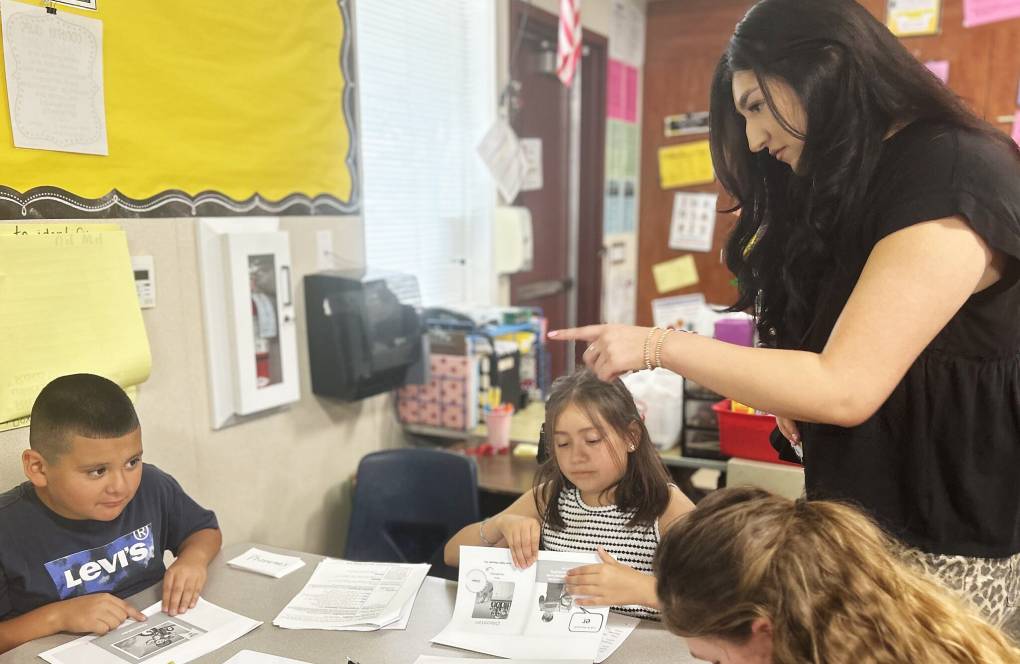
Trump Administration Slashes $400 Million in AmeriCorps Funding
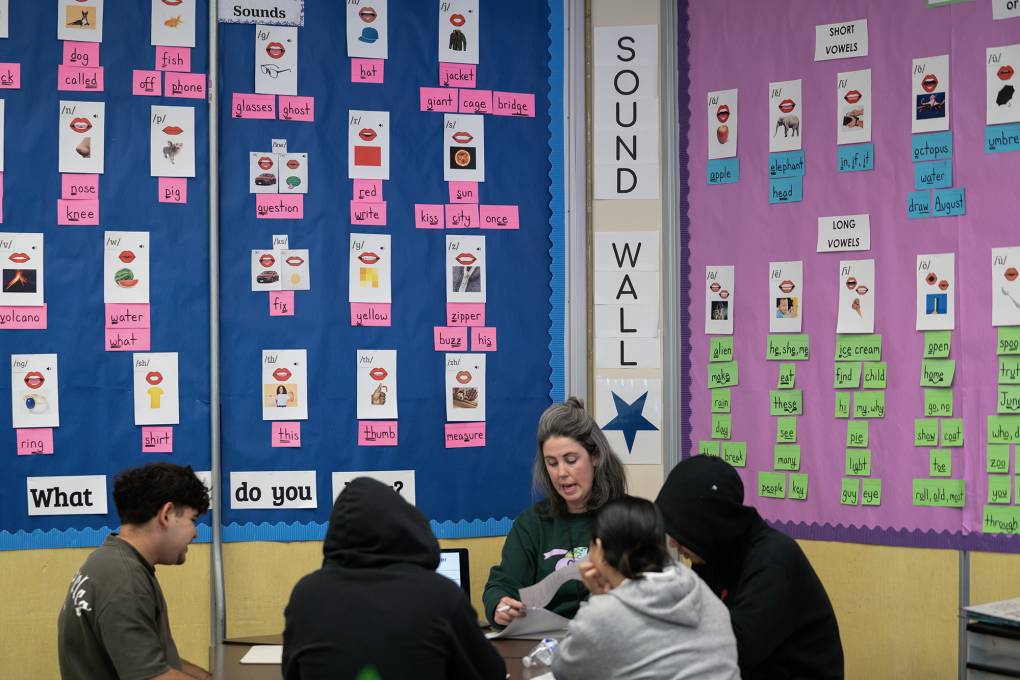
California Legislators Propose Phonics-Based Approach to Improve Third-Grade Reading
California Legislature Halts 'Science of Reading' Mandate, Prompting Calls for Thorough Review
Students’ Reading Struggles Tied to Flawed Assessment. So Why Do Schools Use It?
California’s Lowest-Performing Schools See Reading Success with Funding Boost
Sponsored
Player sponsored by
window.__IS_SSR__=true
window.__INITIAL_STATE__={
"attachmentsReducer": {
"audio_0": {
"type": "attachments",
"id": "audio_0",
"imgSizes": {
"kqedFullSize": {
"file": "https://ww2.kqed.org/news/wp-content/themes/KQED-unified/img/audio_bgs/background0.jpg"
}
}
},
"audio_1": {
"type": "attachments",
"id": "audio_1",
"imgSizes": {
"kqedFullSize": {
"file": "https://ww2.kqed.org/news/wp-content/themes/KQED-unified/img/audio_bgs/background1.jpg"
}
}
},
"audio_2": {
"type": "attachments",
"id": "audio_2",
"imgSizes": {
"kqedFullSize": {
"file": "https://ww2.kqed.org/news/wp-content/themes/KQED-unified/img/audio_bgs/background2.jpg"
}
}
},
"audio_3": {
"type": "attachments",
"id": "audio_3",
"imgSizes": {
"kqedFullSize": {
"file": "https://ww2.kqed.org/news/wp-content/themes/KQED-unified/img/audio_bgs/background3.jpg"
}
}
},
"audio_4": {
"type": "attachments",
"id": "audio_4",
"imgSizes": {
"kqedFullSize": {
"file": "https://ww2.kqed.org/news/wp-content/themes/KQED-unified/img/audio_bgs/background4.jpg"
}
}
},
"placeholder": {
"type": "attachments",
"id": "placeholder",
"imgSizes": {
"thumbnail": {
"file": "https://cdn.kqed.org/wp-content/uploads/2024/12/KQED-Default-Image-816638274-2000x1333-1-160x107.jpg",
"width": 160,
"height": 107,
"mimeType": "image/jpeg"
},
"medium": {
"file": "https://cdn.kqed.org/wp-content/uploads/2024/12/KQED-Default-Image-816638274-2000x1333-1-800x533.jpg",
"width": 800,
"height": 533,
"mimeType": "image/jpeg"
},
"medium_large": {
"file": "https://cdn.kqed.org/wp-content/uploads/2024/12/KQED-Default-Image-816638274-2000x1333-1-768x512.jpg",
"width": 768,
"height": 512,
"mimeType": "image/jpeg"
},
"large": {
"file": "https://cdn.kqed.org/wp-content/uploads/2024/12/KQED-Default-Image-816638274-2000x1333-1-1020x680.jpg",
"width": 1020,
"height": 680,
"mimeType": "image/jpeg"
},
"1536x1536": {
"file": "https://cdn.kqed.org/wp-content/uploads/2024/12/KQED-Default-Image-816638274-2000x1333-1-1536x1024.jpg",
"width": 1536,
"height": 1024,
"mimeType": "image/jpeg"
},
"fd-lrg": {
"file": "https://cdn.kqed.org/wp-content/uploads/2024/12/KQED-Default-Image-816638274-2000x1333-1-1536x1024.jpg",
"width": 1536,
"height": 1024,
"mimeType": "image/jpeg"
},
"fd-med": {
"file": "https://cdn.kqed.org/wp-content/uploads/2024/12/KQED-Default-Image-816638274-2000x1333-1-1020x680.jpg",
"width": 1020,
"height": 680,
"mimeType": "image/jpeg"
},
"fd-sm": {
"file": "https://cdn.kqed.org/wp-content/uploads/2024/12/KQED-Default-Image-816638274-2000x1333-1-800x533.jpg",
"width": 800,
"height": 533,
"mimeType": "image/jpeg"
},
"post-thumbnail": {
"file": "https://cdn.kqed.org/wp-content/uploads/2024/12/KQED-Default-Image-816638274-2000x1333-1-672x372.jpg",
"width": 672,
"height": 372,
"mimeType": "image/jpeg"
},
"twentyfourteen-full-width": {
"file": "https://cdn.kqed.org/wp-content/uploads/2024/12/KQED-Default-Image-816638274-2000x1333-1-1038x576.jpg",
"width": 1038,
"height": 576,
"mimeType": "image/jpeg"
},
"xxsmall": {
"file": "https://cdn.kqed.org/wp-content/uploads/2024/12/KQED-Default-Image-816638274-2000x1333-1-160x107.jpg",
"width": 160,
"height": 107,
"mimeType": "image/jpeg"
},
"xsmall": {
"file": "https://cdn.kqed.org/wp-content/uploads/2024/12/KQED-Default-Image-816638274-2000x1333-1-672x372.jpg",
"width": 672,
"height": 372,
"mimeType": "image/jpeg"
},
"small": {
"file": "https://cdn.kqed.org/wp-content/uploads/2024/12/KQED-Default-Image-816638274-2000x1333-1-672x372.jpg",
"width": 672,
"height": 372,
"mimeType": "image/jpeg"
},
"xlarge": {
"file": "https://cdn.kqed.org/wp-content/uploads/2024/12/KQED-Default-Image-816638274-2000x1333-1-1020x680.jpg",
"width": 1020,
"height": 680,
"mimeType": "image/jpeg"
},
"full-width": {
"file": "https://cdn.kqed.org/wp-content/uploads/2024/12/KQED-Default-Image-816638274-2000x1333-1-1920x1280.jpg",
"width": 1920,
"height": 1280,
"mimeType": "image/jpeg"
},
"guest-author-32": {
"file": "https://cdn.kqed.org/wp-content/uploads/2025/01/KQED-Default-Image-816638274-1333x1333-1-160x160.jpg",
"width": 32,
"height": 32,
"mimeType": "image/jpeg"
},
"guest-author-50": {
"file": "https://cdn.kqed.org/wp-content/uploads/2025/01/KQED-Default-Image-816638274-1333x1333-1-160x160.jpg",
"width": 50,
"height": 50,
"mimeType": "image/jpeg"
},
"guest-author-64": {
"file": "https://cdn.kqed.org/wp-content/uploads/2025/01/KQED-Default-Image-816638274-1333x1333-1-160x160.jpg",
"width": 64,
"height": 64,
"mimeType": "image/jpeg"
},
"guest-author-96": {
"file": "https://cdn.kqed.org/wp-content/uploads/2025/01/KQED-Default-Image-816638274-1333x1333-1-160x160.jpg",
"width": 96,
"height": 96,
"mimeType": "image/jpeg"
},
"guest-author-128": {
"file": "https://cdn.kqed.org/wp-content/uploads/2025/01/KQED-Default-Image-816638274-1333x1333-1-160x160.jpg",
"width": 128,
"height": 128,
"mimeType": "image/jpeg"
},
"detail": {
"file": "https://cdn.kqed.org/wp-content/uploads/2025/01/KQED-Default-Image-816638274-1333x1333-1-160x160.jpg",
"width": 160,
"height": 160,
"mimeType": "image/jpeg"
},
"kqedFullSize": {
"file": "https://cdn.kqed.org/wp-content/uploads/2024/12/KQED-Default-Image-816638274-2000x1333-1.jpg",
"width": 2000,
"height": 1333
}
}
},
"news_12038672": {
"type": "attachments",
"id": "news_12038672",
"meta": {
"index": "attachments_1716263798",
"site": "news",
"id": "12038672",
"found": true
},
"title": "LT_5138-2048x1694-1",
"publishDate": 1746395856,
"status": "inherit",
"parent": 12038670,
"modified": 1746395929,
"caption": "During small group reading instruction, AmeriCorps member Valerie Caballero reminds third graders in Porterville Unified to use their fingers to follow along as they read a passage.",
"credit": "Lasherica Thornton / EdSource",
"altTag": "A woman wearing a sleeveless black shirt, points in the direction of a child who is sitting at a desk next to two other children in a classroom.",
"description": null,
"imgSizes": {
"medium": {
"file": "https://cdn.kqed.org/wp-content/uploads/sites/10/2025/05/LT_5138-2048x1694-1-800x521.jpeg",
"width": 800,
"height": 521,
"mimeType": "image/jpeg"
},
"large": {
"file": "https://cdn.kqed.org/wp-content/uploads/sites/10/2025/05/LT_5138-2048x1694-1-1020x664.jpeg",
"width": 1020,
"height": 664,
"mimeType": "image/jpeg"
},
"thumbnail": {
"file": "https://cdn.kqed.org/wp-content/uploads/sites/10/2025/05/LT_5138-2048x1694-1-160x104.jpeg",
"width": 160,
"height": 104,
"mimeType": "image/jpeg"
},
"1536x1536": {
"file": "https://cdn.kqed.org/wp-content/uploads/sites/10/2025/05/LT_5138-2048x1694-1-1536x1001.jpeg",
"width": 1536,
"height": 1001,
"mimeType": "image/jpeg"
},
"post-thumbnail": {
"file": "https://cdn.kqed.org/wp-content/uploads/sites/10/2025/05/LT_5138-2048x1694-1-672x372.jpeg",
"width": 672,
"height": 372,
"mimeType": "image/jpeg"
},
"twentyfourteen-full-width": {
"file": "https://cdn.kqed.org/wp-content/uploads/sites/10/2025/05/LT_5138-2048x1694-1-1038x576.jpeg",
"width": 1038,
"height": 576,
"mimeType": "image/jpeg"
},
"full-width": {
"file": "https://cdn.kqed.org/wp-content/uploads/sites/10/2025/05/LT_5138-2048x1694-1-1920x1251.jpeg",
"width": 1920,
"height": 1251,
"mimeType": "image/jpeg"
},
"kqedFullSize": {
"file": "https://cdn.kqed.org/wp-content/uploads/sites/10/2025/05/LT_5138-2048x1694-1.jpeg",
"width": 2048,
"height": 1334
}
},
"fetchFailed": false,
"isLoading": false
},
"news_12034685": {
"type": "attachments",
"id": "news_12034685",
"meta": {
"index": "attachments_1716263798",
"site": "news",
"id": "12034685",
"found": true
},
"title": "OaklandInternationalHighSchool",
"publishDate": 1743968869,
"status": "inherit",
"parent": 12034679,
"modified": 1743968940,
"caption": "Teacher Katy Reese, center, works with students in a literacy class at Oakland International High School in Oakland on March 7, 2025. ",
"credit": "Florence Middleton/CalMatters",
"altTag": "A white woman wearing a green sweater sits down at a desk surrounded by four students in a classroom.",
"description": null,
"imgSizes": {
"medium": {
"file": "https://cdn.kqed.org/wp-content/uploads/sites/10/2025/04/030725_Literacy_FM_CM_11-800x534.jpg",
"width": 800,
"height": 534,
"mimeType": "image/jpeg"
},
"large": {
"file": "https://cdn.kqed.org/wp-content/uploads/sites/10/2025/04/030725_Literacy_FM_CM_11-1020x680.jpg",
"width": 1020,
"height": 680,
"mimeType": "image/jpeg"
},
"thumbnail": {
"file": "https://cdn.kqed.org/wp-content/uploads/sites/10/2025/04/030725_Literacy_FM_CM_11-160x107.jpg",
"width": 160,
"height": 107,
"mimeType": "image/jpeg"
},
"1536x1536": {
"file": "https://cdn.kqed.org/wp-content/uploads/sites/10/2025/04/030725_Literacy_FM_CM_11-1536x1025.jpg",
"width": 1536,
"height": 1025,
"mimeType": "image/jpeg"
},
"post-thumbnail": {
"file": "https://cdn.kqed.org/wp-content/uploads/sites/10/2025/04/030725_Literacy_FM_CM_11-672x372.jpg",
"width": 672,
"height": 372,
"mimeType": "image/jpeg"
},
"twentyfourteen-full-width": {
"file": "https://cdn.kqed.org/wp-content/uploads/sites/10/2025/04/030725_Literacy_FM_CM_11-1038x576.jpg",
"width": 1038,
"height": 576,
"mimeType": "image/jpeg"
},
"full-width": {
"file": "https://cdn.kqed.org/wp-content/uploads/sites/10/2025/04/030725_Literacy_FM_CM_11-1920x1281.jpg",
"width": 1920,
"height": 1281,
"mimeType": "image/jpeg"
},
"kqedFullSize": {
"file": "https://cdn.kqed.org/wp-content/uploads/sites/10/2025/04/030725_Literacy_FM_CM_11.jpg",
"width": 2000,
"height": 1334
}
},
"fetchFailed": false,
"isLoading": false
},
"news_11982923": {
"type": "attachments",
"id": "news_11982923",
"meta": {
"index": "attachments_1716263798",
"site": "news",
"id": "11982923",
"found": true
},
"parent": 11982920,
"imgSizes": {
"twentyfourteen-full-width": {
"file": "https://cdn.kqed.org/wp-content/uploads/sites/10/2024/04/Reading-book-2048x1468-1-1038x576.jpg",
"width": 1038,
"mimeType": "image/jpeg",
"height": 576
},
"thumbnail": {
"file": "https://cdn.kqed.org/wp-content/uploads/sites/10/2024/04/Reading-book-2048x1468-1-160x115.jpg",
"width": 160,
"mimeType": "image/jpeg",
"height": 115
},
"post-thumbnail": {
"file": "https://cdn.kqed.org/wp-content/uploads/sites/10/2024/04/Reading-book-2048x1468-1-672x372.jpg",
"width": 672,
"mimeType": "image/jpeg",
"height": 372
},
"kqedFullSize": {
"file": "https://cdn.kqed.org/wp-content/uploads/sites/10/2024/04/Reading-book-2048x1468-1.jpg",
"width": 2048,
"height": 1468
},
"large": {
"file": "https://cdn.kqed.org/wp-content/uploads/sites/10/2024/04/Reading-book-2048x1468-1-1020x731.jpg",
"width": 1020,
"mimeType": "image/jpeg",
"height": 731
},
"1536x1536": {
"file": "https://cdn.kqed.org/wp-content/uploads/sites/10/2024/04/Reading-book-2048x1468-1-1536x1101.jpg",
"width": 1536,
"mimeType": "image/jpeg",
"height": 1101
},
"full-width": {
"file": "https://cdn.kqed.org/wp-content/uploads/sites/10/2024/04/Reading-book-2048x1468-1-1920x1376.jpg",
"width": 1920,
"mimeType": "image/jpeg",
"height": 1376
},
"medium": {
"file": "https://cdn.kqed.org/wp-content/uploads/sites/10/2024/04/Reading-book-2048x1468-1-800x573.jpg",
"width": 800,
"mimeType": "image/jpeg",
"height": 573
}
},
"publishDate": 1713126369,
"modified": 1713126575,
"caption": "An elementary student reads on his own in class.",
"description": null,
"title": "Elementary boy reads alone next to window",
"credit": "Allison Shelley/American Education",
"status": "inherit",
"altTag": "A young boy wearing a white hoodie and black pants reads a book while sitting down.",
"fetchFailed": false,
"isLoading": false
},
"news_11969273": {
"type": "attachments",
"id": "news_11969273",
"meta": {
"index": "attachments_1716263798",
"site": "news",
"id": "11969273",
"found": true
},
"parent": 11969236,
"imgSizes": {
"twentyfourteen-full-width": {
"file": "https://cdn.kqed.org/wp-content/uploads/sites/10/2023/12/11132022_apmreports_soldastory483-1-1038x576.jpg",
"width": 1038,
"mimeType": "image/jpeg",
"height": 576
},
"thumbnail": {
"file": "https://cdn.kqed.org/wp-content/uploads/sites/10/2023/12/11132022_apmreports_soldastory483-1-160x107.jpg",
"width": 160,
"mimeType": "image/jpeg",
"height": 107
},
"post-thumbnail": {
"file": "https://cdn.kqed.org/wp-content/uploads/sites/10/2023/12/11132022_apmreports_soldastory483-1-672x372.jpg",
"width": 672,
"mimeType": "image/jpeg",
"height": 372
},
"kqedFullSize": {
"file": "https://cdn.kqed.org/wp-content/uploads/sites/10/2023/12/11132022_apmreports_soldastory483-1-scaled-e1701975378165.jpg",
"width": 1920,
"height": 1282
},
"2048x2048": {
"file": "https://cdn.kqed.org/wp-content/uploads/sites/10/2023/12/11132022_apmreports_soldastory483-1-2048x1367.jpg",
"width": 2048,
"mimeType": "image/jpeg",
"height": 1367
},
"large": {
"file": "https://cdn.kqed.org/wp-content/uploads/sites/10/2023/12/11132022_apmreports_soldastory483-1-1020x681.jpg",
"width": 1020,
"mimeType": "image/jpeg",
"height": 681
},
"1536x1536": {
"file": "https://cdn.kqed.org/wp-content/uploads/sites/10/2023/12/11132022_apmreports_soldastory483-1-1536x1026.jpg",
"width": 1536,
"mimeType": "image/jpeg",
"height": 1026
},
"full-width": {
"file": "https://cdn.kqed.org/wp-content/uploads/sites/10/2023/12/11132022_apmreports_soldastory483-1-1920x1282.jpg",
"width": 1920,
"mimeType": "image/jpeg",
"height": 1282
},
"medium": {
"file": "https://cdn.kqed.org/wp-content/uploads/sites/10/2023/12/11132022_apmreports_soldastory483-1-800x534.jpg",
"width": 800,
"mimeType": "image/jpeg",
"height": 534
}
},
"publishDate": 1701975344,
"modified": 1702222954,
"caption": "San Francisco mom Havah Kelley has been trying for years to get help for son, who has dyslexia. The boy repeatedly did fine on the Benchmark Assessment System, even though other reading tests showed he lagged years behind his classmates.",
"description": null,
"title": "Sold A Story",
"credit": "Kori Suzuki for APM Reports",
"status": "inherit",
"altTag": "A woman wearing a scarf sits on a curb with her arms crossed.",
"fetchFailed": false,
"isLoading": false
},
"news_11960388": {
"type": "attachments",
"id": "news_11960388",
"meta": {
"index": "attachments_1716263798",
"site": "news",
"id": "11960388",
"found": true
},
"parent": 0,
"imgSizes": {
"twentyfourteen-full-width": {
"file": "https://cdn.kqed.org/wp-content/uploads/sites/10/2023/09/RS68740_230601-MindShift-13-BL-KQED-1038x576.jpg",
"width": 1038,
"mimeType": "image/jpeg",
"height": 576
},
"thumbnail": {
"file": "https://cdn.kqed.org/wp-content/uploads/sites/10/2023/09/RS68740_230601-MindShift-13-BL-KQED-160x107.jpg",
"width": 160,
"mimeType": "image/jpeg",
"height": 107
},
"post-thumbnail": {
"file": "https://cdn.kqed.org/wp-content/uploads/sites/10/2023/09/RS68740_230601-MindShift-13-BL-KQED-672x372.jpg",
"width": 672,
"mimeType": "image/jpeg",
"height": 372
},
"kqedFullSize": {
"file": "https://cdn.kqed.org/wp-content/uploads/sites/10/2023/09/RS68740_230601-MindShift-13-BL-KQED.jpg",
"width": 2000,
"height": 1333
},
"large": {
"file": "https://cdn.kqed.org/wp-content/uploads/sites/10/2023/09/RS68740_230601-MindShift-13-BL-KQED-1020x680.jpg",
"width": 1020,
"mimeType": "image/jpeg",
"height": 680
},
"1536x1536": {
"file": "https://cdn.kqed.org/wp-content/uploads/sites/10/2023/09/RS68740_230601-MindShift-13-BL-KQED-1536x1024.jpg",
"width": 1536,
"mimeType": "image/jpeg",
"height": 1024
},
"full-width": {
"file": "https://cdn.kqed.org/wp-content/uploads/sites/10/2023/09/RS68740_230601-MindShift-13-BL-KQED-1920x1280.jpg",
"width": 1920,
"mimeType": "image/jpeg",
"height": 1280
},
"medium": {
"file": "https://cdn.kqed.org/wp-content/uploads/sites/10/2023/09/RS68740_230601-MindShift-13-BL-KQED-800x533.jpg",
"width": 800,
"mimeType": "image/jpeg",
"height": 533
}
},
"publishDate": 1694127746,
"modified": 1701823542,
"caption": "Students prepare for a temperature mapping activity in the schoolyard at Roosevelt Elementary School in San Leandro on June 1, 2023. Students used an infrared thermometer to record temperatures in locations around the playground and yard, including asphalt and green spaces, as an opportunity to learn about climate change, sustainability and other academic topics through hands-on experience.",
"description": null,
"title": "RS68740_230601-MindShift-13-BL-KQED",
"credit": "Beth LaBerge/KQED",
"status": "inherit",
"altTag": "A group of students sitting at tables in an indoor setting.",
"fetchFailed": false,
"isLoading": false
}
},
"audioPlayerReducer": {
"postId": "stream_live",
"isPaused": true,
"isPlaying": false,
"pfsActive": false,
"pledgeModalIsOpen": true,
"playerDrawerIsOpen": false
},
"authorsReducer": {
"byline_news_12038670": {
"type": "authors",
"id": "byline_news_12038670",
"meta": {
"override": true
},
"slug": "byline_news_12038670",
"name": "\u003ca href=\"https://edsource.org/author/lthornton\">Lasherica Thornton, \u003c/a>EdSource",
"isLoading": false
},
"byline_news_12034679": {
"type": "authors",
"id": "byline_news_12034679",
"meta": {
"override": true
},
"slug": "byline_news_12034679",
"name": "\u003ca href=\"https://calmatters.org/author/carolyn-jones/\">Carolyn Jones, \u003c/a>CalMatters",
"isLoading": false
},
"byline_news_11982920": {
"type": "authors",
"id": "byline_news_11982920",
"meta": {
"override": true
},
"slug": "byline_news_11982920",
"name": "\u003ca href=\"https://edsource.org/author/dlambert\">Diana Lambert\u003c/a>, \u003ca href=\"https://edsource.org/author/jfensterwald\">John Fensterwald\u003c/a> and \u003ca href=\"https://edsource.org/author/zstavely\">Zaidee Stavely\u003c/a>",
"isLoading": false
},
"byline_news_11969236": {
"type": "authors",
"id": "byline_news_11969236",
"meta": {
"override": true
},
"slug": "byline_news_11969236",
"name": "Christopher Peak, APM Reports",
"isLoading": false
},
"byline_news_11969087": {
"type": "authors",
"id": "byline_news_11969087",
"meta": {
"override": true
},
"slug": "byline_news_11969087",
"name": "Cara Nixon and John Fensterwald",
"isLoading": false
}
},
"breakingNewsReducer": {},
"pagesReducer": {},
"postsReducer": {
"stream_live": {
"type": "live",
"id": "stream_live",
"audioUrl": "https://streams.kqed.org/kqedradio",
"title": "Live Stream",
"excerpt": "Live Stream information currently unavailable.",
"link": "/radio",
"featImg": "",
"label": {
"name": "KQED Live",
"link": "/"
}
},
"stream_kqedNewscast": {
"type": "posts",
"id": "stream_kqedNewscast",
"audioUrl": "https://www.kqed.org/.stream/anon/radio/RDnews/newscast.mp3?_=1",
"title": "KQED Newscast",
"featImg": "",
"label": {
"name": "88.5 FM",
"link": "/"
}
},
"news_12038670": {
"type": "posts",
"id": "news_12038670",
"meta": {
"index": "posts_1716263798",
"site": "news",
"id": "12038670",
"score": null,
"sort": [
1746399642000
]
},
"guestAuthors": [],
"slug": "trump-administration-slashes-400-million-in-americorps-funding",
"title": "Trump Administration Slashes $400 Million in AmeriCorps Funding",
"publishDate": 1746399642,
"format": "standard",
"headTitle": "Trump Administration Slashes $400 Million in AmeriCorps Funding | KQED",
"labelTerm": {
"term": 33681,
"site": "news"
},
"content": "\u003cp>Twenty-three-year-old Valerie Caballero worked with seven third graders, guiding numerous activities on decoding words, on Thursday at Roche Elementary in Portersville. With a group of three students, teacher Shelly Noble focused on building reading comprehension. The rest of the class, also in small groups, read independently or completed literacy assignments online, until it was time for the groups to change stations — to go to Caballero or Noble.\u003c/p>\n\u003cp>Caballero is one of 85 community members trained as AmeriCorps volunteers to tutor and support over 2,000 students at 10 elementary schools in Porterville Unified.\u003c/p>\n\u003cp>The AmeriCorps program deployed her and others to third- to fifth-grade classrooms to provide students with additional time for reading and math intervention they wouldn’t get elsewhere.\u003c/p>\n\u003cp>“Families rely on programs like AmeriCorps to give their child one-on-one support and attention that they need,” Caballero said.\u003c/p>\n\u003cp>Fifth grader Jizelle Alvarado, who has benefited from the AmeriCorps program since her third grade year, said volunteer Stephanie Rector has helped her read at a better pace and multiply three-digit numbers. Without hesitation, the fifth grader said she and other students would still be struggling with reading and math if not for Rector’s daily support.\u003c/p>\n\u003cp>[ad fullwidth]\u003c/p>\n\u003cp>Last Friday, the program was one of\u003ca href=\"https://edsource.org/2025/federal-cuts-throw-a-curveball-into-my-young-dodger-fans-tutoring-journey/731835\" target=\"_blank\" rel=\"noreferrer noopener\"> many whose survival became uncertain\u003c/a> because of the reduction of federal AmeriCorps grants by the Department of Government Efficiency, or DOGE, under the Trump administration.\u003c/p>\n\u003cp>\u003ca class=\"external\" href=\"https://www.statecommissions.org/index.php?option=com_content&view=article&id=342:asc-statement-on-the-termination-of-americorps-grants&catid=23:news&Itemid=191\" target=\"_blank\" rel=\"noreferrer noopener\">Nearly $400 million in AmeriCorps funding was cut\u003c/a>, jeopardizing more than 1,000 programs and the jobs of tens of thousands of employees, tutors, mentors and volunteers, the national volunteer service organization reported.\u003c/p>\n\u003cp>California Attorney General Rob Bonta announced this week that the state has “taken action to hold the Trump Administration and DOGE accountable to the law,” according to a statement. \u003ca href=\"https://edsource.org/updates/california-and-other-states-sue-trump-over-gutting-americorps\" target=\"_blank\" rel=\"noreferrer noopener\" data-type=\"link\" data-id=\"https://edsource.org/updates/california-and-other-states-sue-trump-over-gutting-americorps\">Two dozen states, including California, filed a lawsuit Tuesday\u003c/a> against the Trump administration for “dismantling AmeriCorps.”\u003c/p>\n\u003cp>Unless the lawsuit prevails, the AmeriCorps funding cuts — estimated at $60 million for educational, economic, environmental, health and disaster response services in the state — will impact 87 programs and over 5,600 positions, according to Cassandra González-Kester, communications manager for \u003ca class=\"external\" href=\"https://www.californiavolunteers.ca.gov/california-americorps-programs/\" target=\"_blank\" rel=\"noopener\">California Volunteers\u003c/a>, the state service organization that receives most AmeriCorps grant funding and disburses it to schools, nonprofit organizations and other entities to address critical community needs.\u003c/p>\n\u003cp>“These cuts affect service members who responded to the LA fires, the tutors and mentors for our young students, as well as those who care for seniors,” she said. “School districts and nonprofit organizations throughout the state are already feeling these severe impacts.”\u003c/p>\n\u003cp>But the nearly 14,000-student Porterville Unified has decided to use its own funds to continue the program until May 30, the last day of school — something not all schools and organizations can do, so many communities will be left without crucial services.\u003c/p>\n\u003cp>The cuts are hurting the most vulnerable: kids in need of reading and math intervention; students struggling with chronic absenteeism; families experiencing housing instability; and communities recovering from natural disasters. The end of services could exacerbate existing inequalities, especially since the fate of many programs remains uncertain.\u003c/p>\n\u003cp>Thousands of students receiving support through AmeriCorps may have those services upended or interrupted — if they haven’t already — by the Trump administration’s sudden cancellation of the grants.\u003c/p>\n\u003cp>“If we aren’t able to continue this work (beyond this school year), it’s going to leave a huge void, and our students are definitely going to feel the effects of that,” said Tara Warren, director of \u003ca class=\"external\" href=\"https://www.portervilleschools.org/apps/pages/index.jsp?uREC_ID=234351&type=d&pREC_ID=1839936\" target=\"_blank\" rel=\"noreferrer noopener\">Porterville Unified’s AmeriCorps program\u003c/a>.\u003c/p>\n\u003ch2>People supporting their community\u003c/h2>\n\u003cp>AmeriCorps, an independent agency of the U.S. government, supports \u003ca class=\"external\" href=\"https://americorps.gov/serve\" target=\"_blank\" rel=\"noreferrer noopener\">volunteer and service efforts in California and across the country \u003c/a>by providing opportunities for community members to meet local needs and address pressing issues, including academic support and intervention for students, youth mentoring as well as homelessness, food insecurity, health and other key areas in communities.\u003c/p>\n\u003cp>Due to the range of programs that AmeriCorps supports, thousands of families in California alone will lose services if they haven’t already.\u003c/p>\n\u003cp>“We recognize the impact this has across all programs and staff, not just in our state, but nationwide,” said Monica Ramirez, the executive director of First 5 Madera Countty, which operates the \u003ca class=\"external\" href=\"https://first5madera.org/family-resource-centers-frc/\" target=\"_blank\" rel=\"noreferrer noopener\">Madera Family Resource Center\u003c/a> in the Central San Joaquin Valley.\u003c/p>\n\u003cp>The Madera Family Resource Center, a comprehensive hub for families with children aged 0 to 5, is partially funded by federal AmeriCorps money. The center provides weekly playgroups, preschool readiness programs, developmental screenings and resource referrals to support early childhood development. After getting notice of\u003ca class=\"external\" href=\"https://www.yourcentralvalley.com/news/local-news/americorps-program-first-5-madera/\" target=\"_blank\" rel=\"noreferrer noopener\"> the AmeriCorps funding cuts\u003c/a>, which had helped make services possible, the resource center, which extends services to Chowchilla, Eastern Madera County, and the Madera Ranchos, closed its doors this week.\u003c/p>\n\u003cp>Porterville Unified’s Building Communities, Changing Lives program is largely funded by AmeriCorps. AmeriCorps awarded the district more than $1.6 million in federal funds, and the district matched those funds with about $1.2 million this school year. [aside postID=\"mindshift_65092,mindshift_65465\" label=\"Related Stories\"]\u003c/p>\n\u003cp>Most of that funding goes toward\u003ca class=\"external\" href=\"https://americorps.gov/serve/faqs?page=5https://americorps.gov/serve/faqs?page=5\" target=\"_blank\" rel=\"noreferrer noopener\"> living stipends for AmeriCorps members\u003c/a>, community members and college students who may be tutors, mentors or in other roles.\u003c/p>\n\u003cp>Covering the operating costs for 85 AmeriCorps members who provide 35 hours of weekly student intervention and support is approximately $210,000 for May, an expense the district likely won’t be able to foot without the AmeriCorps funds.\u003c/p>\n\u003cp>“I don’t see another way to move forward without the AmeriCorps funding,” Warren said.\u003c/p>\n\u003cp>State agencies, such as California Volunteers, are trying to fill the void for impacted groups, Fresno State College Corps Director Mellissa Jessen-Hiser said. The organization, she said, will fund the college corps members’ continued work at places such as the food bank, Poverello House, a homeless shelter in Fresno, and Fresno Unified schools for the rest of the semester.\u003c/p>\n\u003cp>The federal government has provided more than half the funding for some of California’s AmeriCorps programming, with the agency’s members supporting 17,000 foster youth with education and employment, and tutoring or mentoring 73,833 students in 2023-24, according to California Volunteers.\u003c/p>\n\u003ch2>Volunteers play a ‘vital role’ in student progress\u003c/h2>\n\u003cp>Of the more than 2,000 students to whom Porterville Unified AmeriCorps members provide one-on-one and small-group instruction, tutoring and intervention, 1,657 need academic support, based on this year’s district assessments.\u003c/p>\n\u003cp>Members work with at least 25 students a day over 10 months of the school year; they focus on reading and literacy, helping struggling students get to grade level.\u003c/p>\n\u003cp>“It’s going to create a larger learning gap if they’re not receiving this extra support,” said Caballero, the tutor.\u003c/p>\n\u003cp>Based on midyear data from this school year, 44% of students served by AmeriCorps members have improved by at least one proficiency level on their reading assessment, demonstrating meaningful academic progress, Warren, the program director, reported.\u003c/p>\n\u003cp>And with an extra person in the classroom working alongside them, teachers focus on the academic struggles of students who need it most.\u003c/p>\n\u003cp>Without AmeriCorps, “we will not see the growth in reading and writing that we see because the majority (of the work) will be put on myself,” said Noble, the third grade teacher.\u003c/p>\n\u003cp>The AmeriCorps members also build meaningful connections with students, extending their support beyond academics and making students feel valued, thereby creating an engaging and supportive learning environment.\u003c/p>\n\u003cp>“We’re able to really see the effects of having those members work with those students and the impacts that they’re making,” Warren said.\u003c/p>\n\u003cp>Under the 30-year-old Kern Community Mentoring program, three dozen AmeriCorps members have mentored over 700 high-needs students in the urban and rural communities of Kern County each year, according to Robert Meszaros, communications director with the Kern County Superintendent of Schools that administers the program.\u003c/p>\n\u003cp>By providing encouragement, guidance and support, they address the “whole child,” a philosophy evident in several AmeriCorps programs, specifically those focused on mentorship.\u003c/p>\n\u003cp>Each year, mentors help at least 20 students improve their academics, attendance, behavior and engagement, and \u003ca class=\"external\" href=\"https://news.kern.org/2025/03/finding-purpose-through-service-americorps-mentors-making-an-impact/\" target=\"_blank\" rel=\"noreferrer noopener\">based on data from the program\u003c/a>, more than half of the students improve their attendance and reduce suspensions.\u003c/p>\n\u003cp>With the cuts to AmeriCorps, Meszaros said, it may mean the loss of the program.\u003c/p>\n\u003ch2>Alternative funding, other options\u003c/h2>\n\u003cp>Programs impacted by the federal funding cuts are exploring options to continue serving the community. Some are seeking support from their state representatives, who can advocate on their behalf at the state and possibly national level.\u003c/p>\n\u003cp>“Not sure what the next steps are,” Warren said that Porterville Unified is looking for alternative funding sources, such as state grants.\u003c/p>\n\u003cp>The Kern County Office of Education is doing the same for its AmeriCorps mentoring program.\u003c/p>\n\u003cp>“Ultimately, if that funding can’t be sourced from other resources,” Warren said, “then it goes away, and we’re left with a big void.”\u003c/p>\n\u003cp>While it’s unclear whether the multimillion-dollar cuts will stand, the people working in AmeriCorps programs urged decision-makers to realize the people affected.\u003c/p>\n\u003cp>[ad floatright]\u003c/p>\n\u003cp>In the words of Caballero, the Porterville Unified tutor: “Think about students’ needs.”\u003c/p>\n\n",
"blocks": [],
"excerpt": "Nearly $400 million in AmeriCorps funding was cut by the Trump administration, jeopardizing more than 1,000 programs and the jobs of tens of thousands of employees, tutors, mentors and volunteers. ",
"status": "publish",
"parent": 0,
"modified": 1746397015,
"stats": {
"hasAudio": false,
"hasVideo": false,
"hasChartOrMap": false,
"iframeSrcs": [],
"hasGoogleForm": false,
"hasGallery": false,
"hasHearkenModule": false,
"hasPolis": false,
"paragraphCount": 44,
"wordCount": 1585
},
"headData": {
"title": "Trump Administration Slashes $400 Million in AmeriCorps Funding | KQED",
"description": "Nearly $400 million in AmeriCorps funding was cut by the Trump administration, jeopardizing more than 1,000 programs and the jobs of tens of thousands of employees, tutors, mentors and volunteers. ",
"ogTitle": "",
"ogDescription": "",
"ogImgId": "",
"twTitle": "",
"twDescription": "",
"twImgId": "",
"schema": {
"@context": "https://schema.org",
"@type": "NewsArticle",
"headline": "Trump Administration Slashes $400 Million in AmeriCorps Funding",
"datePublished": "2025-05-04T16:00:42-07:00",
"dateModified": "2025-05-04T15:16:55-07:00",
"image": "https://cdn.kqed.org/wp-content/uploads/2020/02/KQED-OG-Image@1x.png",
"isAccessibleForFree": "True",
"publisher": {
"@type": "NewsMediaOrganization",
"@id": "https://www.kqed.org/#organization",
"name": "KQED",
"logo": "https://cdn.kqed.org/wp-content/uploads/2020/02/KQED-OG-Image@1x.png",
"url": "https://www.kqed.org",
"sameAs": [
"https://www.facebook.com/KQED",
"https://twitter.com/KQED",
"https://www.instagram.com/kqed/",
"https://www.tiktok.com/@kqedofficial",
"https://www.linkedin.com/company/kqed",
"https://www.youtube.com/channel/UCeC0IOo7i1P_61zVUWbJ4nw"
]
}
}
},
"sticky": false,
"nprByline": "\u003ca href=\"https://edsource.org/author/lthornton\">Lasherica Thornton, \u003c/a>EdSource",
"templateType": "standard",
"featuredImageType": "standard",
"excludeFromSiteSearch": "Include",
"showOnAuthorArchivePages": "No",
"articleAge": "0",
"path": "/news/12038670/trump-administration-slashes-400-million-in-americorps-funding",
"audioTrackLength": null,
"parsedContent": [
{
"type": "contentString",
"content": "\u003cdiv class=\"post-body\">\u003cp>\u003cp>Twenty-three-year-old Valerie Caballero worked with seven third graders, guiding numerous activities on decoding words, on Thursday at Roche Elementary in Portersville. With a group of three students, teacher Shelly Noble focused on building reading comprehension. The rest of the class, also in small groups, read independently or completed literacy assignments online, until it was time for the groups to change stations — to go to Caballero or Noble.\u003c/p>\n\u003cp>Caballero is one of 85 community members trained as AmeriCorps volunteers to tutor and support over 2,000 students at 10 elementary schools in Porterville Unified.\u003c/p>\n\u003cp>The AmeriCorps program deployed her and others to third- to fifth-grade classrooms to provide students with additional time for reading and math intervention they wouldn’t get elsewhere.\u003c/p>\n\u003cp>“Families rely on programs like AmeriCorps to give their child one-on-one support and attention that they need,” Caballero said.\u003c/p>\n\u003cp>Fifth grader Jizelle Alvarado, who has benefited from the AmeriCorps program since her third grade year, said volunteer Stephanie Rector has helped her read at a better pace and multiply three-digit numbers. Without hesitation, the fifth grader said she and other students would still be struggling with reading and math if not for Rector’s daily support.\u003c/p>\n\u003cp>\u003c/p>\u003c/div>",
"attributes": {
"named": {},
"numeric": []
}
},
{
"type": "component",
"content": "",
"name": "ad",
"attributes": {
"named": {
"label": "fullwidth"
},
"numeric": [
"fullwidth"
]
}
},
{
"type": "contentString",
"content": "\u003cdiv class=\"post-body\">\u003cp>\u003c/p>\n\u003cp>Last Friday, the program was one of\u003ca href=\"https://edsource.org/2025/federal-cuts-throw-a-curveball-into-my-young-dodger-fans-tutoring-journey/731835\" target=\"_blank\" rel=\"noreferrer noopener\"> many whose survival became uncertain\u003c/a> because of the reduction of federal AmeriCorps grants by the Department of Government Efficiency, or DOGE, under the Trump administration.\u003c/p>\n\u003cp>\u003ca class=\"external\" href=\"https://www.statecommissions.org/index.php?option=com_content&view=article&id=342:asc-statement-on-the-termination-of-americorps-grants&catid=23:news&Itemid=191\" target=\"_blank\" rel=\"noreferrer noopener\">Nearly $400 million in AmeriCorps funding was cut\u003c/a>, jeopardizing more than 1,000 programs and the jobs of tens of thousands of employees, tutors, mentors and volunteers, the national volunteer service organization reported.\u003c/p>\n\u003cp>California Attorney General Rob Bonta announced this week that the state has “taken action to hold the Trump Administration and DOGE accountable to the law,” according to a statement. \u003ca href=\"https://edsource.org/updates/california-and-other-states-sue-trump-over-gutting-americorps\" target=\"_blank\" rel=\"noreferrer noopener\" data-type=\"link\" data-id=\"https://edsource.org/updates/california-and-other-states-sue-trump-over-gutting-americorps\">Two dozen states, including California, filed a lawsuit Tuesday\u003c/a> against the Trump administration for “dismantling AmeriCorps.”\u003c/p>\n\u003cp>Unless the lawsuit prevails, the AmeriCorps funding cuts — estimated at $60 million for educational, economic, environmental, health and disaster response services in the state — will impact 87 programs and over 5,600 positions, according to Cassandra González-Kester, communications manager for \u003ca class=\"external\" href=\"https://www.californiavolunteers.ca.gov/california-americorps-programs/\" target=\"_blank\" rel=\"noopener\">California Volunteers\u003c/a>, the state service organization that receives most AmeriCorps grant funding and disburses it to schools, nonprofit organizations and other entities to address critical community needs.\u003c/p>\n\u003cp>“These cuts affect service members who responded to the LA fires, the tutors and mentors for our young students, as well as those who care for seniors,” she said. “School districts and nonprofit organizations throughout the state are already feeling these severe impacts.”\u003c/p>\n\u003cp>But the nearly 14,000-student Porterville Unified has decided to use its own funds to continue the program until May 30, the last day of school — something not all schools and organizations can do, so many communities will be left without crucial services.\u003c/p>\n\u003cp>The cuts are hurting the most vulnerable: kids in need of reading and math intervention; students struggling with chronic absenteeism; families experiencing housing instability; and communities recovering from natural disasters. The end of services could exacerbate existing inequalities, especially since the fate of many programs remains uncertain.\u003c/p>\n\u003cp>Thousands of students receiving support through AmeriCorps may have those services upended or interrupted — if they haven’t already — by the Trump administration’s sudden cancellation of the grants.\u003c/p>\n\u003cp>“If we aren’t able to continue this work (beyond this school year), it’s going to leave a huge void, and our students are definitely going to feel the effects of that,” said Tara Warren, director of \u003ca class=\"external\" href=\"https://www.portervilleschools.org/apps/pages/index.jsp?uREC_ID=234351&type=d&pREC_ID=1839936\" target=\"_blank\" rel=\"noreferrer noopener\">Porterville Unified’s AmeriCorps program\u003c/a>.\u003c/p>\n\u003ch2>People supporting their community\u003c/h2>\n\u003cp>AmeriCorps, an independent agency of the U.S. government, supports \u003ca class=\"external\" href=\"https://americorps.gov/serve\" target=\"_blank\" rel=\"noreferrer noopener\">volunteer and service efforts in California and across the country \u003c/a>by providing opportunities for community members to meet local needs and address pressing issues, including academic support and intervention for students, youth mentoring as well as homelessness, food insecurity, health and other key areas in communities.\u003c/p>\n\u003cp>Due to the range of programs that AmeriCorps supports, thousands of families in California alone will lose services if they haven’t already.\u003c/p>\n\u003cp>“We recognize the impact this has across all programs and staff, not just in our state, but nationwide,” said Monica Ramirez, the executive director of First 5 Madera Countty, which operates the \u003ca class=\"external\" href=\"https://first5madera.org/family-resource-centers-frc/\" target=\"_blank\" rel=\"noreferrer noopener\">Madera Family Resource Center\u003c/a> in the Central San Joaquin Valley.\u003c/p>\n\u003cp>The Madera Family Resource Center, a comprehensive hub for families with children aged 0 to 5, is partially funded by federal AmeriCorps money. The center provides weekly playgroups, preschool readiness programs, developmental screenings and resource referrals to support early childhood development. After getting notice of\u003ca class=\"external\" href=\"https://www.yourcentralvalley.com/news/local-news/americorps-program-first-5-madera/\" target=\"_blank\" rel=\"noreferrer noopener\"> the AmeriCorps funding cuts\u003c/a>, which had helped make services possible, the resource center, which extends services to Chowchilla, Eastern Madera County, and the Madera Ranchos, closed its doors this week.\u003c/p>\n\u003cp>Porterville Unified’s Building Communities, Changing Lives program is largely funded by AmeriCorps. AmeriCorps awarded the district more than $1.6 million in federal funds, and the district matched those funds with about $1.2 million this school year. \u003c/p>\u003c/div>",
"attributes": {
"named": {},
"numeric": []
}
},
{
"type": "component",
"content": "",
"name": "aside",
"attributes": {
"named": {
"postid": "mindshift_65092,mindshift_65465",
"label": "Related Stories "
},
"numeric": []
}
},
{
"type": "contentString",
"content": "\u003cdiv class=\"post-body\">\u003cp>\u003c/p>\n\u003cp>Most of that funding goes toward\u003ca class=\"external\" href=\"https://americorps.gov/serve/faqs?page=5https://americorps.gov/serve/faqs?page=5\" target=\"_blank\" rel=\"noreferrer noopener\"> living stipends for AmeriCorps members\u003c/a>, community members and college students who may be tutors, mentors or in other roles.\u003c/p>\n\u003cp>Covering the operating costs for 85 AmeriCorps members who provide 35 hours of weekly student intervention and support is approximately $210,000 for May, an expense the district likely won’t be able to foot without the AmeriCorps funds.\u003c/p>\n\u003cp>“I don’t see another way to move forward without the AmeriCorps funding,” Warren said.\u003c/p>\n\u003cp>State agencies, such as California Volunteers, are trying to fill the void for impacted groups, Fresno State College Corps Director Mellissa Jessen-Hiser said. The organization, she said, will fund the college corps members’ continued work at places such as the food bank, Poverello House, a homeless shelter in Fresno, and Fresno Unified schools for the rest of the semester.\u003c/p>\n\u003cp>The federal government has provided more than half the funding for some of California’s AmeriCorps programming, with the agency’s members supporting 17,000 foster youth with education and employment, and tutoring or mentoring 73,833 students in 2023-24, according to California Volunteers.\u003c/p>\n\u003ch2>Volunteers play a ‘vital role’ in student progress\u003c/h2>\n\u003cp>Of the more than 2,000 students to whom Porterville Unified AmeriCorps members provide one-on-one and small-group instruction, tutoring and intervention, 1,657 need academic support, based on this year’s district assessments.\u003c/p>\n\u003cp>Members work with at least 25 students a day over 10 months of the school year; they focus on reading and literacy, helping struggling students get to grade level.\u003c/p>\n\u003cp>“It’s going to create a larger learning gap if they’re not receiving this extra support,” said Caballero, the tutor.\u003c/p>\n\u003cp>Based on midyear data from this school year, 44% of students served by AmeriCorps members have improved by at least one proficiency level on their reading assessment, demonstrating meaningful academic progress, Warren, the program director, reported.\u003c/p>\n\u003cp>And with an extra person in the classroom working alongside them, teachers focus on the academic struggles of students who need it most.\u003c/p>\n\u003cp>Without AmeriCorps, “we will not see the growth in reading and writing that we see because the majority (of the work) will be put on myself,” said Noble, the third grade teacher.\u003c/p>\n\u003cp>The AmeriCorps members also build meaningful connections with students, extending their support beyond academics and making students feel valued, thereby creating an engaging and supportive learning environment.\u003c/p>\n\u003cp>“We’re able to really see the effects of having those members work with those students and the impacts that they’re making,” Warren said.\u003c/p>\n\u003cp>Under the 30-year-old Kern Community Mentoring program, three dozen AmeriCorps members have mentored over 700 high-needs students in the urban and rural communities of Kern County each year, according to Robert Meszaros, communications director with the Kern County Superintendent of Schools that administers the program.\u003c/p>\n\u003cp>By providing encouragement, guidance and support, they address the “whole child,” a philosophy evident in several AmeriCorps programs, specifically those focused on mentorship.\u003c/p>\n\u003cp>Each year, mentors help at least 20 students improve their academics, attendance, behavior and engagement, and \u003ca class=\"external\" href=\"https://news.kern.org/2025/03/finding-purpose-through-service-americorps-mentors-making-an-impact/\" target=\"_blank\" rel=\"noreferrer noopener\">based on data from the program\u003c/a>, more than half of the students improve their attendance and reduce suspensions.\u003c/p>\n\u003cp>With the cuts to AmeriCorps, Meszaros said, it may mean the loss of the program.\u003c/p>\n\u003ch2>Alternative funding, other options\u003c/h2>\n\u003cp>Programs impacted by the federal funding cuts are exploring options to continue serving the community. Some are seeking support from their state representatives, who can advocate on their behalf at the state and possibly national level.\u003c/p>\n\u003cp>“Not sure what the next steps are,” Warren said that Porterville Unified is looking for alternative funding sources, such as state grants.\u003c/p>\n\u003cp>The Kern County Office of Education is doing the same for its AmeriCorps mentoring program.\u003c/p>\n\u003cp>“Ultimately, if that funding can’t be sourced from other resources,” Warren said, “then it goes away, and we’re left with a big void.”\u003c/p>\n\u003cp>While it’s unclear whether the multimillion-dollar cuts will stand, the people working in AmeriCorps programs urged decision-makers to realize the people affected.\u003c/p>\n\u003cp>\u003c/p>\u003c/div>",
"attributes": {
"named": {},
"numeric": []
}
},
{
"type": "component",
"content": "",
"name": "ad",
"attributes": {
"named": {
"label": "floatright"
},
"numeric": [
"floatright"
]
}
},
{
"type": "contentString",
"content": "\u003cdiv class=\"post-body\">\u003cp>\u003c/p>\n\u003cp>In the words of Caballero, the Porterville Unified tutor: “Think about students’ needs.”\u003c/p>\n\n\u003c/div>\u003c/p>",
"attributes": {
"named": {},
"numeric": []
}
}
],
"link": "/news/12038670/trump-administration-slashes-400-million-in-americorps-funding",
"authors": [
"byline_news_12038670"
],
"categories": [
"news_18540",
"news_8"
],
"tags": [
"news_32903",
"news_33603",
"news_2044",
"news_4398"
],
"affiliates": [
"news_33681"
],
"featImg": "news_12038672",
"label": "news_33681"
},
"news_12034679": {
"type": "posts",
"id": "news_12034679",
"meta": {
"index": "posts_1716263798",
"site": "news",
"id": "12034679",
"score": null,
"sort": [
1743973211000
]
},
"guestAuthors": [],
"slug": "californias-proposed-education-bill-aims-to-boost-reading-skills-for-students",
"title": "California Legislators Propose Phonics-Based Approach to Improve Third-Grade Reading",
"publishDate": 1743973211,
"format": "standard",
"headTitle": "California Legislators Propose Phonics-Based Approach to Improve Third-Grade Reading | KQED",
"labelTerm": {
"term": 18481,
"site": "news"
},
"content": "\u003cp>Can you spell \u003cem>deja vu?\u003c/em>\u003c/p>\n\u003cp>The battle over the best way to teach children how to read has re-erupted in the California Legislature, as dueling factions haggle over a bill that would mandate a phonics-based style of reading curriculum.\u003c/p>\n\u003cp>The new bill, \u003ca href=\"https://calmatters.digitaldemocracy.org/bills/ca_202520260ab1121\">AB 1121\u003c/a>, would require all schools to use a method based on the so-called “science of reading,” which emphasizes phonics. Last year, an \u003ca href=\"https://calmatters.digitaldemocracy.org/bills/ca_202320240ab2222\">almost identical bill\u003c/a> died in the Assembly after pushback from the teachers union and English learner advocates, who argued that curriculum isn’t effective with students who aren’t fluent in English, and therefore shouldn’t be required.\u003c/p>\n\u003cp>The stakes are high, as California’s \u003ca href=\"https://calmatters.org/education/k-12-education/2024/10/test-scores/\">reading scores have stagnated\u003c/a> since the pandemic. Nearly 60% of third graders weren’t reading at grade level last year, with some student groups faring even worse. More than 70% of Black and low-income students, for example, failed to meet the state’s reading standard.\u003c/p>\n\u003cp>The bill would build on \u003ca href=\"https://leginfo.legislature.ca.gov/faces/billTextClient.xhtml?bill_id=202120220SB488\">existing legislation\u003c/a> that requires credential programs to teach phonics instruction to teachers-in-training. The proposed legislation would require existing teachers to undergo training in the topic.\u003c/p>\n\u003cp>[ad fullwidth]\u003c/p>\n\u003cp>Assemblywoman Blanca Rubio, a Democrat from West Covina, who sponsored both bills, hopes this year’s version will fare better than its predecessor, even though it only contains minor tweaks from its earlier version.\u003c/p>\n\u003cp>“At this point, it’s personal for me. I’m termed out in four years and I want to get this done,” Rubio said. “Reading is such a foundational skill. We need to create the best opportunities for all kids to read, not just for those who can afford after-school tutors.”\u003c/p>\n\u003ch2>Phonics vs. whole-language\u003c/h2>\n\u003cp>The science of reading refers to \u003ca href=\"https://pmc.ncbi.nlm.nih.gov/articles/PMC8128160/\">research\u003c/a> that shows reading isn’t a natural skill, like learning to speak. It must be explicitly taught, and the best method, primarily, is sounding words out rather than memorizing whole words by sight or trying to guess a word based on its context — an approach known as whole-language or balanced literacy instruction.\u003c/p>\n\u003cp>California schools use about half a dozen reading curricula, and some are more phonics-based than others. Typically, schools use a combination of programs and give teachers some leeway. Proponents of Rubio’s bill say that system makes it hard to track which reading curriculum works and can make it tough for students who switch schools, if the new school is using a different approach to literacy. That’s why the state needs a uniform reading curriculum, they said.\u003c/p>\n\u003cp>The California Reading Coalition, an advocacy group, surveyed 300 districts statewide in 2022 and found that \u003ca href=\"https://www.careads.org/curric-report\">80% were using older curriculum\u003c/a> that didn’t focus sufficiently on phonics. The report highlighted 10 districts that have large numbers of high-needs students but also had high reading scores — including Bonita Unified in Los Angeles County, Clovis Elementary near Fresno and Etiwanda Elementary in San Bernardino County. The districts use a variety of reading programs, but most have an emphasis on phonics.\u003c/p>\n\u003cp>Nearly 40 other states require phonics-based reading instruction.\u003c/p>\n\u003cp>“In other states, we’ve often seen governors and state education heads take the lead in driving these policies,” said Todd Collins, an organizer of the California Reading Coalition and former Palo Alto Unified school board member. “That would make a big difference for California — leadership from the top is crucial for getting good results. … We have a state-level reading crisis. State-level problems call for state-level action.”\u003c/p>\n\u003ch2>Opposition from teachers, English learner advocates\u003c/h2>\n\u003cp>The California Teachers Association, the union that represents 310,000 of the state’s K-12 educators, fought the previous literacy bill, arguing that teachers need flexibility in the classroom. So far the union has not taken a position on the new bill.\u003c/p>\n\u003cp>English learner advocates have fought both bills particularly hard. The California Association of Bilingual Education said the latest bill “fails to address the needs of English learners” and would cost too much money because it requires teachers to undergo training.\u003c/p>\n\u003cfigure id=\"attachment_12034684\" class=\"wp-caption aligncenter\" style=\"max-width: 2000px\">\u003ca href=\"https://cdn.kqed.org/wp-content/uploads/sites/10/2025/04/030725_Literacy_FM_CM_06.jpg\">\u003cimg loading=\"lazy\" decoding=\"async\" src=\"https://cdn.kqed.org/wp-content/uploads/sites/10/2025/04/030725_Literacy_FM_CM_06.jpg\" alt=\"Hands of teenagers place pink and orange sticky notes on a desk.\" width=\"2000\" height=\"1333\" class=\"size-full wp-image-12034684\" srcset=\"https://cdn.kqed.org/wp-content/uploads/sites/10/2025/04/030725_Literacy_FM_CM_06.jpg 2000w, https://cdn.kqed.org/wp-content/uploads/sites/10/2025/04/030725_Literacy_FM_CM_06-800x533.jpg 800w, https://cdn.kqed.org/wp-content/uploads/sites/10/2025/04/030725_Literacy_FM_CM_06-1020x680.jpg 1020w, https://cdn.kqed.org/wp-content/uploads/sites/10/2025/04/030725_Literacy_FM_CM_06-160x107.jpg 160w, https://cdn.kqed.org/wp-content/uploads/sites/10/2025/04/030725_Literacy_FM_CM_06-1536x1024.jpg 1536w, https://cdn.kqed.org/wp-content/uploads/sites/10/2025/04/030725_Literacy_FM_CM_06-1920x1280.jpg 1920w\" sizes=\"auto, (max-width: 2000px) 100vw, 2000px\">\u003c/a>\u003cfigcaption class=\"wp-caption-text\">Students in a literacy class at Oakland International High School in Oakland on March 7, 2025. The school primarily serves students who are newly arrived immigrants and offers foundational literacy and English language development for its multilingual learners. \u003ccite>(Florence Middleton/CalMatters)\u003c/cite>\u003c/figcaption>\u003c/figure>\n\u003cp>They also said that California already has a literacy framework and the state should do a better job of promoting that rather than introducing a new program altogether.\u003c/p>\n\u003cp>Students who aren’t native English speakers need a more flexible approach to reading, the group said. Reading programs that are heavily focused on phonics are too narrow and confusing for students who struggle with English, especially if they can’t understand what they’re reading, they said.\u003c/p>\n\u003cfigure id=\"attachment_12034682\" class=\"wp-caption aligncenter\" style=\"max-width: 2000px\">\u003ca href=\"https://cdn.kqed.org/wp-content/uploads/sites/10/2025/04/030725_Literacy_FM_CM_09.jpg\">\u003cimg loading=\"lazy\" decoding=\"async\" src=\"https://cdn.kqed.org/wp-content/uploads/sites/10/2025/04/030725_Literacy_FM_CM_09.jpg\" alt=\"Several students sit around desks in a classroom looking at a woman wearing glasses.\" width=\"2000\" height=\"1334\" class=\"size-full wp-image-12034682\" srcset=\"https://cdn.kqed.org/wp-content/uploads/sites/10/2025/04/030725_Literacy_FM_CM_09.jpg 2000w, https://cdn.kqed.org/wp-content/uploads/sites/10/2025/04/030725_Literacy_FM_CM_09-800x534.jpg 800w, https://cdn.kqed.org/wp-content/uploads/sites/10/2025/04/030725_Literacy_FM_CM_09-1020x680.jpg 1020w, https://cdn.kqed.org/wp-content/uploads/sites/10/2025/04/030725_Literacy_FM_CM_09-160x107.jpg 160w, https://cdn.kqed.org/wp-content/uploads/sites/10/2025/04/030725_Literacy_FM_CM_09-1536x1025.jpg 1536w, https://cdn.kqed.org/wp-content/uploads/sites/10/2025/04/030725_Literacy_FM_CM_09-1920x1281.jpg 1920w\" sizes=\"auto, (max-width: 2000px) 100vw, 2000px\">\u003c/a>\u003cfigcaption class=\"wp-caption-text\">Marcela Smith, center, an instructional assistant, works with students in a literacy class at Oakland International High School in Oakland on March 7, 2025. \u003ccite>(Florence Middleton/CalMatters)\u003c/cite>\u003c/figcaption>\u003c/figure>\n\u003cp>Martha Hernandez, executive director of the English learner advocacy group Californians Together, said the new bill is a “non-starter” unless it can include a broader approach to reading instruction, not one that focuses primarily on phonics.\u003c/p>\n\u003cfigure id=\"attachment_12034683\" class=\"wp-caption aligncenter\" style=\"max-width: 2000px\">\u003ca href=\"https://cdn.kqed.org/wp-content/uploads/sites/10/2025/04/030725_Literacy_FM_CM_18.jpg\">\u003cimg loading=\"lazy\" decoding=\"async\" src=\"https://cdn.kqed.org/wp-content/uploads/sites/10/2025/04/030725_Literacy_FM_CM_18.jpg\" alt='A classroom board with signs that read \"Present\" and \"Past.\"' width=\"2000\" height=\"1333\" class=\"size-full wp-image-12034683\" srcset=\"https://cdn.kqed.org/wp-content/uploads/sites/10/2025/04/030725_Literacy_FM_CM_18.jpg 2000w, https://cdn.kqed.org/wp-content/uploads/sites/10/2025/04/030725_Literacy_FM_CM_18-800x533.jpg 800w, https://cdn.kqed.org/wp-content/uploads/sites/10/2025/04/030725_Literacy_FM_CM_18-1020x680.jpg 1020w, https://cdn.kqed.org/wp-content/uploads/sites/10/2025/04/030725_Literacy_FM_CM_18-160x107.jpg 160w, https://cdn.kqed.org/wp-content/uploads/sites/10/2025/04/030725_Literacy_FM_CM_18-1536x1024.jpg 1536w, https://cdn.kqed.org/wp-content/uploads/sites/10/2025/04/030725_Literacy_FM_CM_18-1920x1280.jpg 1920w\" sizes=\"auto, (max-width: 2000px) 100vw, 2000px\">\u003c/a>\u003cfigcaption class=\"wp-caption-text\">A literacy classroom at Oakland International High School in Oakland on March 7, 2025. The school primarily serves students who are newly arrived immigrants and offers foundational literacy and English language development for its multilingual learners. \u003ccite>(Florence Middleton/CalMatters)\u003c/cite>\u003c/figcaption>\u003c/figure>\n\u003cp>English learners, she said, need schools to teach phonics hand-in-hand with oral language development and reading comprehension in a way that’s specifically suited to second-language acquisition. Prioritizing phonics gives short shrift to those other skills, she said.\u003c/p>\n\u003cp>“Literacy is multi-dimensional,” Hernandez said. “English learners need a more comprehensive approach.”\u003c/p>\n\u003cp>The bill has not yet been scheduled for a hearing, as both sides continue to work on a compromise.\u003c/p>\n\u003ch2 id=\"h-evidence-of-english-learner-success\" class=\"wp-block-heading\">Evidence of English learner success\u003c/h2>\n\u003cp>Some districts that use phonics-based programs have seen good results with English learners and low-income Latino students generally.\u003c/p>\n\u003cp>At Kings Canyon Joint Unified, for example, English learners scored almost twice as high on reading tests last year as their counterparts statewide, according to the \u003ca href=\"https://caaspp-elpac.ets.org/caaspp/DashViewReportSB?ps=true&lstTestYear=2024&lstTestType=B&lstGroup=4&lstSubGroup=160&lstGrade=13&lstSchoolType=A&lstCounty=00&lstDistrict=00000&lstSchool=0000000&lstFocus=a\">Smarter Balanced assessments\u003c/a>. Almost half of low-income Latino students met the state reading standard, compared to 33% statewide. Kings Canyon, located in Fresno County, uses a curriculum called Wit & Wisdom, which is phonics-based.\u003c/p>\n\u003cp>Last year at Bonita Unified, near Pomona in Los Angeles County, which uses a phonics-based program called Benchmark, English learners scored nearly three times higher than their peers statewide. Almost 60% of low-income Latino students met the state reading standard, nearly double the percentage of their peers statewide.\u003c/p>\n\u003cp>Rubio was an English learner in California schools, and feels strongly that phonics is the most effective way to teach students who aren’t fluent in English. It can help them learn English vocabulary at the same time they’re learning how to decode words, a useful skill in any language.\u003c/p>\n\u003cp>Yolie Flores, president of Families in Schools, an advocacy group that’s cosponsoring Rubio’s bill, was also an English learner in California schools. Literacy was a priority in her family, she said, in part because her father never learned to read. A laborer from Mexico who never attended school past third grade, he “worked his whole life, but couldn’t read a rental application, he couldn’t read basic instructions, he couldn’t read letters from our school,” Flores said. “He always told us, you must learn to read. It was very important to him — he knew that our ability to read would open our world.” [aside postID=\"news_11982920,mindshift_65279,mindshift_65184\" label=\"Related Stories\"]\u003c/p>\n\u003cp>Flores is frustrated by the state’s persistently dismal reading scores for English learners — a situation that she believes could be improved with a phonics-based program.\u003c/p>\n\u003cp>“It is mind-boggling and disappointing and frankly, I find it harmful that (the California Association of Bilingual Education) would oppose something that could help all kids, including bilingual students, succeed in school and life,” said Flores, a former Los Angeles Unified school board member. “There is a vast body of research from the most respected reading scientists in the world telling us one unequivocal truth: there is a specific, evidence-based approach to teaching children to read. I struggle to understand why they are fighting it.”\u003c/p>\n\u003cp>Gov. Gavin Newsom hasn’t taken a position on the bill, but has been a strong supporter of literacy generally. He championed a screening test for dyslexia, which will be given to all kindergarten-through-second-graders starting this fall; approved funding for 2,000 literacy coaches to work in high-needs schools; and fought for transitional kindergarten for all 4-year-olds, which is intended to boost students’ reading skills.\u003c/p>\n\u003cp>Over the past few years, the warring factions of the literacy battle have found common ground, publishing a \u003ca href=\"https://www.thereadingleague.org/wp-content/uploads/2024/04/Joint-Statement-on-the-Science-of-Reading-and-English-Learners_Emergent-Bilinguals-24.pdf\">pair\u003c/a> of \u003ca href=\"https://unbounded.org/resources/narrowing-down-to-find-common-ground/\">papers\u003c/a> that essentially call for a truce. In the papers, both sides agreed that English learners have unique needs when learning how to read, and any formal policy or curriculum should address those needs. They also agreed that both sides should dispense with labels and over-simplifying the various approaches to reading instruction, and look at the issue with more nuance.\u003c/p>\n\u003cp>The truce doesn’t seem to have reached the Legislature, though. So far, English learner groups remain opposed.\u003c/p>\n\u003ch2>‘Unlocking something’\u003c/h2>\n\u003cp>At Oakland International High School, a public school for recent immigrants, nearly all students are English learners and a majority read at a kindergarten level when they enroll. That’s because they’ve had little formal education in their home countries or their schooling has been disrupted, in some cases for years.\u003c/p>\n\u003cfigure id=\"attachment_12034681\" class=\"wp-caption aligncenter\" style=\"max-width: 1333px\">\u003ca href=\"https://cdn.kqed.org/wp-content/uploads/sites/10/2025/04/030725_Literacy_FM_CM_03.jpg\">\u003cimg loading=\"lazy\" decoding=\"async\" src=\"https://cdn.kqed.org/wp-content/uploads/sites/10/2025/04/030725_Literacy_FM_CM_03.jpg\" alt=\"International flags of multiple colors hang in a large room with the reflection of a courtyard in the window.\" width=\"1333\" height=\"2000\" class=\"size-full wp-image-12034681\" srcset=\"https://cdn.kqed.org/wp-content/uploads/sites/10/2025/04/030725_Literacy_FM_CM_03.jpg 1333w, https://cdn.kqed.org/wp-content/uploads/sites/10/2025/04/030725_Literacy_FM_CM_03-800x1200.jpg 800w, https://cdn.kqed.org/wp-content/uploads/sites/10/2025/04/030725_Literacy_FM_CM_03-1020x1530.jpg 1020w, https://cdn.kqed.org/wp-content/uploads/sites/10/2025/04/030725_Literacy_FM_CM_03-160x240.jpg 160w, https://cdn.kqed.org/wp-content/uploads/sites/10/2025/04/030725_Literacy_FM_CM_03-1024x1536.jpg 1024w\" sizes=\"auto, (max-width: 1333px) 100vw, 1333px\">\u003c/a>\u003cfigcaption class=\"wp-caption-text\">International flags hang in the cafeteria as the courtyard is reflected on a window at Oakland International High School in Oakland on March 7, 2025. The school primarily serves students who are newly arrived immigrants and offers foundational literacy and English language development for its multilingual learners. \u003ccite>(Florence Middleton/CalMatters)\u003c/cite>\u003c/figcaption>\u003c/figure>\n\u003cp>But teachers there use a phonics-based approach that’s tailored to English learners, with good results. A student will learn to sound out the word “hop,” for example, while seeing a picture of a person hopping, then spell “hop” and read “hop” in a passage. They learn to connect the sound of a word with its meaning.\u003c/p>\n\u003cp>“When they start to see the patterns and rules, it starts to make sense and they get excited,” said Aly Kronick, a literacy teacher at Oakland International High for the past 10 years. “It’s like they’re unlocking something. They feel successful.”\u003c/p>\n\u003cp>She said the process can be slow, but within two years students go from minimal literacy skills to reading whole passages with high levels of comprehension. Some students have even gone on to four-year colleges. One student went on to become a bilingual teacher. Others have returned to the school after they graduated to lead phonics instruction in the classroom.\u003c/p>\n\u003cp>Rachel Hunt, a parent in Los Angeles Unified who’s a former teacher and school principal, has been a proponent of phonics-based reading instruction. She noticed firsthand the importance of a good reading program when her family moved from Massachusetts to California about eight years ago. Her child, who uses they/them pronouns, was in second grade when the family enrolled them at an elementary school in Los Angeles County that was using a phonics-based curriculum. Although her child was reading at grade level, they struggled with the ability to identify sounds, which affected their spelling skills.\u003c/p>\n\u003cp>“They were so behind in that regard,” Hunt said. “They felt so self-conscious. Other kids would call them ‘stupid.’ They developed a lack of self-esteem which was really damaging.”\u003c/p>\n\u003cp>Her child eventually caught up and is now a sophomore at Eagle Rock High School near Glendale, where they’re an avid reader and doing well.\u003c/p>\n\u003cp>[ad floatright]\u003c/p>\n\u003cp>“If you see that a majority of kids aren’t reading at grade level, and we know that explicit (phonics) instruction works, it seems obvious that this is something we should be mandating,” Hunt said.\u003c/p>\n\n",
"blocks": [],
"excerpt": "Nearly 60% of third graders aren’t reading at grade level. A new bill would require schools to use a phonics-based approach to teach students.",
"status": "publish",
"parent": 0,
"modified": 1743970935,
"stats": {
"hasAudio": false,
"hasVideo": false,
"hasChartOrMap": false,
"iframeSrcs": [],
"hasGoogleForm": false,
"hasGallery": false,
"hasHearkenModule": false,
"hasPolis": false,
"paragraphCount": 40,
"wordCount": 2099
},
"headData": {
"title": "California Legislators Propose Phonics-Based Approach to Improve Third-Grade Reading | KQED",
"description": "Nearly 60% of third graders aren’t reading at grade level. A new bill would require schools to use a phonics-based approach to teach students.",
"ogTitle": "",
"ogDescription": "",
"ogImgId": "",
"twTitle": "",
"twDescription": "",
"twImgId": "",
"schema": {
"@context": "https://schema.org",
"@type": "NewsArticle",
"headline": "California Legislators Propose Phonics-Based Approach to Improve Third-Grade Reading",
"datePublished": "2025-04-06T14:00:11-07:00",
"dateModified": "2025-04-06T13:22:15-07:00",
"image": "https://cdn.kqed.org/wp-content/uploads/2020/02/KQED-OG-Image@1x.png",
"isAccessibleForFree": "True",
"publisher": {
"@type": "NewsMediaOrganization",
"@id": "https://www.kqed.org/#organization",
"name": "KQED",
"logo": "https://cdn.kqed.org/wp-content/uploads/2020/02/KQED-OG-Image@1x.png",
"url": "https://www.kqed.org",
"sameAs": [
"https://www.facebook.com/KQED",
"https://twitter.com/KQED",
"https://www.instagram.com/kqed/",
"https://www.tiktok.com/@kqedofficial",
"https://www.linkedin.com/company/kqed",
"https://www.youtube.com/channel/UCeC0IOo7i1P_61zVUWbJ4nw"
]
}
}
},
"sticky": false,
"nprByline": "\u003ca href=\"https://calmatters.org/author/carolyn-jones/\">Carolyn Jones, \u003c/a>CalMatters",
"templateType": "standard",
"featuredImageType": "standard",
"excludeFromSiteSearch": "Include",
"showOnAuthorArchivePages": "No",
"articleAge": "0",
"path": "/news/12034679/californias-proposed-education-bill-aims-to-boost-reading-skills-for-students",
"audioTrackLength": null,
"parsedContent": [
{
"type": "contentString",
"content": "\u003cdiv class=\"post-body\">\u003cp>\u003cp>Can you spell \u003cem>deja vu?\u003c/em>\u003c/p>\n\u003cp>The battle over the best way to teach children how to read has re-erupted in the California Legislature, as dueling factions haggle over a bill that would mandate a phonics-based style of reading curriculum.\u003c/p>\n\u003cp>The new bill, \u003ca href=\"https://calmatters.digitaldemocracy.org/bills/ca_202520260ab1121\">AB 1121\u003c/a>, would require all schools to use a method based on the so-called “science of reading,” which emphasizes phonics. Last year, an \u003ca href=\"https://calmatters.digitaldemocracy.org/bills/ca_202320240ab2222\">almost identical bill\u003c/a> died in the Assembly after pushback from the teachers union and English learner advocates, who argued that curriculum isn’t effective with students who aren’t fluent in English, and therefore shouldn’t be required.\u003c/p>\n\u003cp>The stakes are high, as California’s \u003ca href=\"https://calmatters.org/education/k-12-education/2024/10/test-scores/\">reading scores have stagnated\u003c/a> since the pandemic. Nearly 60% of third graders weren’t reading at grade level last year, with some student groups faring even worse. More than 70% of Black and low-income students, for example, failed to meet the state’s reading standard.\u003c/p>\n\u003cp>The bill would build on \u003ca href=\"https://leginfo.legislature.ca.gov/faces/billTextClient.xhtml?bill_id=202120220SB488\">existing legislation\u003c/a> that requires credential programs to teach phonics instruction to teachers-in-training. The proposed legislation would require existing teachers to undergo training in the topic.\u003c/p>\n\u003cp>\u003c/p>\u003c/div>",
"attributes": {
"named": {},
"numeric": []
}
},
{
"type": "component",
"content": "",
"name": "ad",
"attributes": {
"named": {
"label": "fullwidth"
},
"numeric": [
"fullwidth"
]
}
},
{
"type": "contentString",
"content": "\u003cdiv class=\"post-body\">\u003cp>\u003c/p>\n\u003cp>Assemblywoman Blanca Rubio, a Democrat from West Covina, who sponsored both bills, hopes this year’s version will fare better than its predecessor, even though it only contains minor tweaks from its earlier version.\u003c/p>\n\u003cp>“At this point, it’s personal for me. I’m termed out in four years and I want to get this done,” Rubio said. “Reading is such a foundational skill. We need to create the best opportunities for all kids to read, not just for those who can afford after-school tutors.”\u003c/p>\n\u003ch2>Phonics vs. whole-language\u003c/h2>\n\u003cp>The science of reading refers to \u003ca href=\"https://pmc.ncbi.nlm.nih.gov/articles/PMC8128160/\">research\u003c/a> that shows reading isn’t a natural skill, like learning to speak. It must be explicitly taught, and the best method, primarily, is sounding words out rather than memorizing whole words by sight or trying to guess a word based on its context — an approach known as whole-language or balanced literacy instruction.\u003c/p>\n\u003cp>California schools use about half a dozen reading curricula, and some are more phonics-based than others. Typically, schools use a combination of programs and give teachers some leeway. Proponents of Rubio’s bill say that system makes it hard to track which reading curriculum works and can make it tough for students who switch schools, if the new school is using a different approach to literacy. That’s why the state needs a uniform reading curriculum, they said.\u003c/p>\n\u003cp>The California Reading Coalition, an advocacy group, surveyed 300 districts statewide in 2022 and found that \u003ca href=\"https://www.careads.org/curric-report\">80% were using older curriculum\u003c/a> that didn’t focus sufficiently on phonics. The report highlighted 10 districts that have large numbers of high-needs students but also had high reading scores — including Bonita Unified in Los Angeles County, Clovis Elementary near Fresno and Etiwanda Elementary in San Bernardino County. The districts use a variety of reading programs, but most have an emphasis on phonics.\u003c/p>\n\u003cp>Nearly 40 other states require phonics-based reading instruction.\u003c/p>\n\u003cp>“In other states, we’ve often seen governors and state education heads take the lead in driving these policies,” said Todd Collins, an organizer of the California Reading Coalition and former Palo Alto Unified school board member. “That would make a big difference for California — leadership from the top is crucial for getting good results. … We have a state-level reading crisis. State-level problems call for state-level action.”\u003c/p>\n\u003ch2>Opposition from teachers, English learner advocates\u003c/h2>\n\u003cp>The California Teachers Association, the union that represents 310,000 of the state’s K-12 educators, fought the previous literacy bill, arguing that teachers need flexibility in the classroom. So far the union has not taken a position on the new bill.\u003c/p>\n\u003cp>English learner advocates have fought both bills particularly hard. The California Association of Bilingual Education said the latest bill “fails to address the needs of English learners” and would cost too much money because it requires teachers to undergo training.\u003c/p>\n\u003cfigure id=\"attachment_12034684\" class=\"wp-caption aligncenter\" style=\"max-width: 2000px\">\u003ca href=\"https://cdn.kqed.org/wp-content/uploads/sites/10/2025/04/030725_Literacy_FM_CM_06.jpg\">\u003cimg loading=\"lazy\" decoding=\"async\" src=\"https://cdn.kqed.org/wp-content/uploads/sites/10/2025/04/030725_Literacy_FM_CM_06.jpg\" alt=\"Hands of teenagers place pink and orange sticky notes on a desk.\" width=\"2000\" height=\"1333\" class=\"size-full wp-image-12034684\" srcset=\"https://cdn.kqed.org/wp-content/uploads/sites/10/2025/04/030725_Literacy_FM_CM_06.jpg 2000w, https://cdn.kqed.org/wp-content/uploads/sites/10/2025/04/030725_Literacy_FM_CM_06-800x533.jpg 800w, https://cdn.kqed.org/wp-content/uploads/sites/10/2025/04/030725_Literacy_FM_CM_06-1020x680.jpg 1020w, https://cdn.kqed.org/wp-content/uploads/sites/10/2025/04/030725_Literacy_FM_CM_06-160x107.jpg 160w, https://cdn.kqed.org/wp-content/uploads/sites/10/2025/04/030725_Literacy_FM_CM_06-1536x1024.jpg 1536w, https://cdn.kqed.org/wp-content/uploads/sites/10/2025/04/030725_Literacy_FM_CM_06-1920x1280.jpg 1920w\" sizes=\"auto, (max-width: 2000px) 100vw, 2000px\">\u003c/a>\u003cfigcaption class=\"wp-caption-text\">Students in a literacy class at Oakland International High School in Oakland on March 7, 2025. The school primarily serves students who are newly arrived immigrants and offers foundational literacy and English language development for its multilingual learners. \u003ccite>(Florence Middleton/CalMatters)\u003c/cite>\u003c/figcaption>\u003c/figure>\n\u003cp>They also said that California already has a literacy framework and the state should do a better job of promoting that rather than introducing a new program altogether.\u003c/p>\n\u003cp>Students who aren’t native English speakers need a more flexible approach to reading, the group said. Reading programs that are heavily focused on phonics are too narrow and confusing for students who struggle with English, especially if they can’t understand what they’re reading, they said.\u003c/p>\n\u003cfigure id=\"attachment_12034682\" class=\"wp-caption aligncenter\" style=\"max-width: 2000px\">\u003ca href=\"https://cdn.kqed.org/wp-content/uploads/sites/10/2025/04/030725_Literacy_FM_CM_09.jpg\">\u003cimg loading=\"lazy\" decoding=\"async\" src=\"https://cdn.kqed.org/wp-content/uploads/sites/10/2025/04/030725_Literacy_FM_CM_09.jpg\" alt=\"Several students sit around desks in a classroom looking at a woman wearing glasses.\" width=\"2000\" height=\"1334\" class=\"size-full wp-image-12034682\" srcset=\"https://cdn.kqed.org/wp-content/uploads/sites/10/2025/04/030725_Literacy_FM_CM_09.jpg 2000w, https://cdn.kqed.org/wp-content/uploads/sites/10/2025/04/030725_Literacy_FM_CM_09-800x534.jpg 800w, https://cdn.kqed.org/wp-content/uploads/sites/10/2025/04/030725_Literacy_FM_CM_09-1020x680.jpg 1020w, https://cdn.kqed.org/wp-content/uploads/sites/10/2025/04/030725_Literacy_FM_CM_09-160x107.jpg 160w, https://cdn.kqed.org/wp-content/uploads/sites/10/2025/04/030725_Literacy_FM_CM_09-1536x1025.jpg 1536w, https://cdn.kqed.org/wp-content/uploads/sites/10/2025/04/030725_Literacy_FM_CM_09-1920x1281.jpg 1920w\" sizes=\"auto, (max-width: 2000px) 100vw, 2000px\">\u003c/a>\u003cfigcaption class=\"wp-caption-text\">Marcela Smith, center, an instructional assistant, works with students in a literacy class at Oakland International High School in Oakland on March 7, 2025. \u003ccite>(Florence Middleton/CalMatters)\u003c/cite>\u003c/figcaption>\u003c/figure>\n\u003cp>Martha Hernandez, executive director of the English learner advocacy group Californians Together, said the new bill is a “non-starter” unless it can include a broader approach to reading instruction, not one that focuses primarily on phonics.\u003c/p>\n\u003cfigure id=\"attachment_12034683\" class=\"wp-caption aligncenter\" style=\"max-width: 2000px\">\u003ca href=\"https://cdn.kqed.org/wp-content/uploads/sites/10/2025/04/030725_Literacy_FM_CM_18.jpg\">\u003cimg loading=\"lazy\" decoding=\"async\" src=\"https://cdn.kqed.org/wp-content/uploads/sites/10/2025/04/030725_Literacy_FM_CM_18.jpg\" alt='A classroom board with signs that read \"Present\" and \"Past.\"' width=\"2000\" height=\"1333\" class=\"size-full wp-image-12034683\" srcset=\"https://cdn.kqed.org/wp-content/uploads/sites/10/2025/04/030725_Literacy_FM_CM_18.jpg 2000w, https://cdn.kqed.org/wp-content/uploads/sites/10/2025/04/030725_Literacy_FM_CM_18-800x533.jpg 800w, https://cdn.kqed.org/wp-content/uploads/sites/10/2025/04/030725_Literacy_FM_CM_18-1020x680.jpg 1020w, https://cdn.kqed.org/wp-content/uploads/sites/10/2025/04/030725_Literacy_FM_CM_18-160x107.jpg 160w, https://cdn.kqed.org/wp-content/uploads/sites/10/2025/04/030725_Literacy_FM_CM_18-1536x1024.jpg 1536w, https://cdn.kqed.org/wp-content/uploads/sites/10/2025/04/030725_Literacy_FM_CM_18-1920x1280.jpg 1920w\" sizes=\"auto, (max-width: 2000px) 100vw, 2000px\">\u003c/a>\u003cfigcaption class=\"wp-caption-text\">A literacy classroom at Oakland International High School in Oakland on March 7, 2025. The school primarily serves students who are newly arrived immigrants and offers foundational literacy and English language development for its multilingual learners. \u003ccite>(Florence Middleton/CalMatters)\u003c/cite>\u003c/figcaption>\u003c/figure>\n\u003cp>English learners, she said, need schools to teach phonics hand-in-hand with oral language development and reading comprehension in a way that’s specifically suited to second-language acquisition. Prioritizing phonics gives short shrift to those other skills, she said.\u003c/p>\n\u003cp>“Literacy is multi-dimensional,” Hernandez said. “English learners need a more comprehensive approach.”\u003c/p>\n\u003cp>The bill has not yet been scheduled for a hearing, as both sides continue to work on a compromise.\u003c/p>\n\u003ch2 id=\"h-evidence-of-english-learner-success\" class=\"wp-block-heading\">Evidence of English learner success\u003c/h2>\n\u003cp>Some districts that use phonics-based programs have seen good results with English learners and low-income Latino students generally.\u003c/p>\n\u003cp>At Kings Canyon Joint Unified, for example, English learners scored almost twice as high on reading tests last year as their counterparts statewide, according to the \u003ca href=\"https://caaspp-elpac.ets.org/caaspp/DashViewReportSB?ps=true&lstTestYear=2024&lstTestType=B&lstGroup=4&lstSubGroup=160&lstGrade=13&lstSchoolType=A&lstCounty=00&lstDistrict=00000&lstSchool=0000000&lstFocus=a\">Smarter Balanced assessments\u003c/a>. Almost half of low-income Latino students met the state reading standard, compared to 33% statewide. Kings Canyon, located in Fresno County, uses a curriculum called Wit & Wisdom, which is phonics-based.\u003c/p>\n\u003cp>Last year at Bonita Unified, near Pomona in Los Angeles County, which uses a phonics-based program called Benchmark, English learners scored nearly three times higher than their peers statewide. Almost 60% of low-income Latino students met the state reading standard, nearly double the percentage of their peers statewide.\u003c/p>\n\u003cp>Rubio was an English learner in California schools, and feels strongly that phonics is the most effective way to teach students who aren’t fluent in English. It can help them learn English vocabulary at the same time they’re learning how to decode words, a useful skill in any language.\u003c/p>\n\u003cp>Yolie Flores, president of Families in Schools, an advocacy group that’s cosponsoring Rubio’s bill, was also an English learner in California schools. Literacy was a priority in her family, she said, in part because her father never learned to read. A laborer from Mexico who never attended school past third grade, he “worked his whole life, but couldn’t read a rental application, he couldn’t read basic instructions, he couldn’t read letters from our school,” Flores said. “He always told us, you must learn to read. It was very important to him — he knew that our ability to read would open our world.” \u003c/p>\u003c/div>",
"attributes": {
"named": {},
"numeric": []
}
},
{
"type": "component",
"content": "",
"name": "aside",
"attributes": {
"named": {
"postid": "news_11982920,mindshift_65279,mindshift_65184",
"label": "Related Stories "
},
"numeric": []
}
},
{
"type": "contentString",
"content": "\u003cdiv class=\"post-body\">\u003cp>\u003c/p>\n\u003cp>Flores is frustrated by the state’s persistently dismal reading scores for English learners — a situation that she believes could be improved with a phonics-based program.\u003c/p>\n\u003cp>“It is mind-boggling and disappointing and frankly, I find it harmful that (the California Association of Bilingual Education) would oppose something that could help all kids, including bilingual students, succeed in school and life,” said Flores, a former Los Angeles Unified school board member. “There is a vast body of research from the most respected reading scientists in the world telling us one unequivocal truth: there is a specific, evidence-based approach to teaching children to read. I struggle to understand why they are fighting it.”\u003c/p>\n\u003cp>Gov. Gavin Newsom hasn’t taken a position on the bill, but has been a strong supporter of literacy generally. He championed a screening test for dyslexia, which will be given to all kindergarten-through-second-graders starting this fall; approved funding for 2,000 literacy coaches to work in high-needs schools; and fought for transitional kindergarten for all 4-year-olds, which is intended to boost students’ reading skills.\u003c/p>\n\u003cp>Over the past few years, the warring factions of the literacy battle have found common ground, publishing a \u003ca href=\"https://www.thereadingleague.org/wp-content/uploads/2024/04/Joint-Statement-on-the-Science-of-Reading-and-English-Learners_Emergent-Bilinguals-24.pdf\">pair\u003c/a> of \u003ca href=\"https://unbounded.org/resources/narrowing-down-to-find-common-ground/\">papers\u003c/a> that essentially call for a truce. In the papers, both sides agreed that English learners have unique needs when learning how to read, and any formal policy or curriculum should address those needs. They also agreed that both sides should dispense with labels and over-simplifying the various approaches to reading instruction, and look at the issue with more nuance.\u003c/p>\n\u003cp>The truce doesn’t seem to have reached the Legislature, though. So far, English learner groups remain opposed.\u003c/p>\n\u003ch2>‘Unlocking something’\u003c/h2>\n\u003cp>At Oakland International High School, a public school for recent immigrants, nearly all students are English learners and a majority read at a kindergarten level when they enroll. That’s because they’ve had little formal education in their home countries or their schooling has been disrupted, in some cases for years.\u003c/p>\n\u003cfigure id=\"attachment_12034681\" class=\"wp-caption aligncenter\" style=\"max-width: 1333px\">\u003ca href=\"https://cdn.kqed.org/wp-content/uploads/sites/10/2025/04/030725_Literacy_FM_CM_03.jpg\">\u003cimg loading=\"lazy\" decoding=\"async\" src=\"https://cdn.kqed.org/wp-content/uploads/sites/10/2025/04/030725_Literacy_FM_CM_03.jpg\" alt=\"International flags of multiple colors hang in a large room with the reflection of a courtyard in the window.\" width=\"1333\" height=\"2000\" class=\"size-full wp-image-12034681\" srcset=\"https://cdn.kqed.org/wp-content/uploads/sites/10/2025/04/030725_Literacy_FM_CM_03.jpg 1333w, https://cdn.kqed.org/wp-content/uploads/sites/10/2025/04/030725_Literacy_FM_CM_03-800x1200.jpg 800w, https://cdn.kqed.org/wp-content/uploads/sites/10/2025/04/030725_Literacy_FM_CM_03-1020x1530.jpg 1020w, https://cdn.kqed.org/wp-content/uploads/sites/10/2025/04/030725_Literacy_FM_CM_03-160x240.jpg 160w, https://cdn.kqed.org/wp-content/uploads/sites/10/2025/04/030725_Literacy_FM_CM_03-1024x1536.jpg 1024w\" sizes=\"auto, (max-width: 1333px) 100vw, 1333px\">\u003c/a>\u003cfigcaption class=\"wp-caption-text\">International flags hang in the cafeteria as the courtyard is reflected on a window at Oakland International High School in Oakland on March 7, 2025. The school primarily serves students who are newly arrived immigrants and offers foundational literacy and English language development for its multilingual learners. \u003ccite>(Florence Middleton/CalMatters)\u003c/cite>\u003c/figcaption>\u003c/figure>\n\u003cp>But teachers there use a phonics-based approach that’s tailored to English learners, with good results. A student will learn to sound out the word “hop,” for example, while seeing a picture of a person hopping, then spell “hop” and read “hop” in a passage. They learn to connect the sound of a word with its meaning.\u003c/p>\n\u003cp>“When they start to see the patterns and rules, it starts to make sense and they get excited,” said Aly Kronick, a literacy teacher at Oakland International High for the past 10 years. “It’s like they’re unlocking something. They feel successful.”\u003c/p>\n\u003cp>She said the process can be slow, but within two years students go from minimal literacy skills to reading whole passages with high levels of comprehension. Some students have even gone on to four-year colleges. One student went on to become a bilingual teacher. Others have returned to the school after they graduated to lead phonics instruction in the classroom.\u003c/p>\n\u003cp>Rachel Hunt, a parent in Los Angeles Unified who’s a former teacher and school principal, has been a proponent of phonics-based reading instruction. She noticed firsthand the importance of a good reading program when her family moved from Massachusetts to California about eight years ago. Her child, who uses they/them pronouns, was in second grade when the family enrolled them at an elementary school in Los Angeles County that was using a phonics-based curriculum. Although her child was reading at grade level, they struggled with the ability to identify sounds, which affected their spelling skills.\u003c/p>\n\u003cp>“They were so behind in that regard,” Hunt said. “They felt so self-conscious. Other kids would call them ‘stupid.’ They developed a lack of self-esteem which was really damaging.”\u003c/p>\n\u003cp>Her child eventually caught up and is now a sophomore at Eagle Rock High School near Glendale, where they’re an avid reader and doing well.\u003c/p>\n\u003cp>\u003c/p>\u003c/div>",
"attributes": {
"named": {},
"numeric": []
}
},
{
"type": "component",
"content": "",
"name": "ad",
"attributes": {
"named": {
"label": "floatright"
},
"numeric": [
"floatright"
]
}
},
{
"type": "contentString",
"content": "\u003cdiv class=\"post-body\">\u003cp>\u003c/p>\n\u003cp>“If you see that a majority of kids aren’t reading at grade level, and we know that explicit (phonics) instruction works, it seems obvious that this is something we should be mandating,” Hunt said.\u003c/p>\n\n\u003c/div>\u003c/p>",
"attributes": {
"named": {},
"numeric": []
}
}
],
"link": "/news/12034679/californias-proposed-education-bill-aims-to-boost-reading-skills-for-students",
"authors": [
"byline_news_12034679"
],
"categories": [
"news_18540",
"news_8"
],
"tags": [
"news_30911",
"news_17766",
"news_33603",
"news_3457"
],
"affiliates": [
"news_18481"
],
"featImg": "news_12034685",
"label": "news_18481"
},
"news_11982920": {
"type": "posts",
"id": "news_11982920",
"meta": {
"index": "posts_1716263798",
"site": "news",
"id": "11982920",
"score": null,
"sort": [
1713126849000
]
},
"parent": 0,
"labelTerm": {},
"blocks": [],
"publishDate": 1713126849,
"format": "standard",
"title": "California Legislature Halts 'Science of Reading' Mandate, Prompting Calls for Thorough Review",
"headTitle": "California Legislature Halts ‘Science of Reading’ Mandate, Prompting Calls for Thorough Review | KQED",
"content": "\u003cp>A bill that would have required California teachers to use the “science of reading,” which spotlights phonics, to teach children to read has died without a hearing.\u003c/p>\n\u003cp>\u003ca class=\"external\" href=\"https://legiscan.com/CA/bill/AB2222/2023\" target=\"_blank\" rel=\"noopener\">Assembly Bill 2222\u003c/a>, authored by Assemblymember Blanca Rubio (D-Baldwin Park) will not advance in the Legislature this year, according to Assembly Speaker Robert Rivas, who described the state’s student reading and literacy rates as “a serious problem,” adding that the bill should receive a “methodical” review by all key groups before there is a “costly overhaul” of how reading is taught in California.[pullquote size=\"medium\" align=\"right\" citation=\"Martha Hernandez, executive director, Californians Together\"]‘We know that addressing equity and literacy outcomes is a high priority for California and that our state is not yet where it needs to be with literacy outcomes for all students.’[/pullquote]\u003c/p>\n\u003cp>“I want the Legislature to study this problem closely, so we can be sure stakeholders are engaged and, most importantly, that all students benefit, especially our diverse learners,” Rivas said in a statement to EdSource, referring to English learners.\u003c/p>\n\u003cp>The bill, which had the support of the California State PTA, state NAACP and more than 50 other organizations, hit a snag two weeks ago when the California Teachers Association — the state’s largest teachers union — sent a letter stating its opposition to the bill to Assembly Education Committee Chairman Al Muratsuchi.\u003c/p>\n\u003cp>The\u003ca class=\"external\" href=\"https://edsource.org/wp-content/uploads/2024/04/EarllyLit-AB2222-CTA-no-032824.pdf\" target=\"_blank\" rel=\"noopener\"> union claimed\u003c/a> that the proposed legislation would duplicate and potentially undermine current literacy initiatives, would not meet the needs of English learner students and would cut teachers out of decisions, especially on curriculum.\u003c/p>\n\u003cp>[ad fullwidth]\u003c/p>\n\u003cp>Rubio, who could not be reached late Thursday\u003cstrong>,\u003c/strong> told EdSource last week that Muratsuchi asked her to work with the teachers union on a compromise.\u003c/p>\n\u003cp>Marshall Tuck, CEO of EdVoice, an advocacy nonprofit co-sponsoring the bill, said he was surprised the bill didn’t get a hearing considering the importance of the issue.[aside postID=\"news_11982196,news_11969236,news_11972684\" label=\"Related Stories\"]\u003c/p>\n\u003cp>“We understand it’s a tough budget year, but we also believe that the most important priority for the education budget is helping our kids learn how to read,” he said.\u003c/p>\n\u003cp>But he called the move to table the bill a “bump in the road.”\u003c/p>\n\u003cp>“When we launched with Assemblymember Rubio and the sponsors behind this, we knew it might be a multi-year effort,” he said. “So you get up tomorrow and keep it moving forward.”\u003c/p>\n\u003cp>Advocates say that it is imperative that California mandates this change in reading instruction. In 2023, just 43% of California third-graders met the academic standards on the state’s standardized test in 2023. Only 27.2% of Black students, 32% of Latino students and 35% of low-income children were reading at grade level, compared with 57.5% of white, 69% of Asian and 66% of non-low-income students.\u003c/p>\n\u003cp>“The California NAACP was right; this is a civil rights issue,” said Kareem Weaver, a member of the Oakland NAACP Education Committee and co-founder of the literacy advocacy group FULCRUM. “And you don’t play politics with civil rights. The misinformation and ideological posturing on AB 2222 effectively leveraged the politics of fear. We have to do better, for kids’ sake, and can’t give up.”\u003c/p>\n\u003ch2>What is the science of reading?\u003c/h2>\n\u003cp>The science of reading refers to research-based teaching strategies that reflect how the brain learns to read. While it includes phonics-based instruction, which teaches children to decode words by sounding them out, it also includes four other pillars of literacy instruction: phonemic awareness, identifying distinct units of sounds, vocabulary, comprehension and fluency. It is based on research on how the \u003ca href=\"https://edsource.org/2023/why-theres-more-to-the-science-of-reading-than-phonics/695976\">brain connects \u003c/a>letters with sounds when learning to read.\u003c/p>\n\u003cp>The legislation would have gone against the state policy of local control that gives school districts authority to select curriculum and teaching methods as long as they meet state academic standards. Currently, the state encourages, but does not mandate, districts to incorporate instruction in the science of reading in the early grades.\u003c/p>\n\u003cp>Along with mandating the science of reading approach to instruction, AB 2222 would have required that all TK to fifth-grade teachers, literacy coaches and specialists take a 30-hour-minimum course in reading instruction by 2028. School districts and charter schools would purchase textbooks from an approved list endorsed by the State Board of Education.\u003c/p>\n\u003ch2>English learner advocates opposed bill\u003c/h2>\n\u003cp>It appears lawmakers heard the pleas of advocates for English learners who opposed the bill.\u003c/p>\n\u003cp>“We know that addressing equity and literacy outcomes is a high priority for California and that our state is not yet where it needs to be with literacy outcomes for all students,” said Martha Hernandez, executive director of Californians Together, one of the organizations that opposed the bill. “AB 2222 is not the prescription that is needed for our multilingual, diverse state.”\u003c/p>\n\u003cp>She said she is willing to work with lawmakers for a literacy plan based on reading research but that “centrally addresses” the needs of English learners.\u003c/p>\n\u003cp>California’s proposed legislation to adopt the science of reading approach to early literacy would have been in sync with other states that have passed similar legislation. States nationwide are rejecting balanced literacy as failing to effectively teach children how to read since it de-emphasizes explicit instruction in phonics and instead trains children to use pictures to identify words on sight, also known as three-cueing.\u003c/p>\n\u003cp>Muratsuchi had until the end of the day Thursday to put the bill on the calendar for the April 17 meeting of the Assembly Education Committee. It would then have had to be heard by the Assembly Higher Education Committee before the April 26 deadline for legislators to get bills with notable fiscal impacts to the Appropriations Committee. Now, the bill will have to be reintroduced next year to get a hearing.\u003c/p>\n\u003cp>“It’s really too bad. Lots of kids are not being well-served now. But on the other hand, I hope this will be an opportunity to regroup and present a more robust version of the bill,” said Claude Goldenberg, a Stanford University professor emeritus of education who supported the bill.\u003c/p>\n\u003cp>Goldenberg said a future version of the bill should include a “more comprehensive definition” of the “science of reading” and should make clear that this includes research on teaching reading to all students, including English learners.\u003c/p>\n\u003cp>“English learners, for example, would benefit if teachers knew and used research that is part of the science of reading and applies whether they’re learning in their home language or in English. Same for children with limited literacy opportunities outside of school and children having difficulty learning to read,” Goldenberg said.\u003c/p>\n\u003ch2>‘Backroom politics’\u003c/h2>\n\u003cp>Lori DePole, co-state director of Decoding Dyslexia CA, one of the supporters of the bill, expressed frustration Thursday evening over the decision to table it.\u003c/p>\n\u003cp>“It is shameful that when more than half of CA kids aren’t reading at grade level that our legislators are okay with the status quo, and they have killed this literacy legislation without even allowing it to be heard,” she said in a statement.\u003c/p>\n\u003cp>“… CA kids’ futures are too important to allow backroom politics to silence this issue. We will no longer accept lip service in addressing our literacy crisis. It is time for action, and we aren’t going away.”\u003c/p>\n\u003cp>Advocates for students with dyslexia support the phonics-based teaching methods as especially effective for children with a learning disability.\u003c/p>\n\u003cp>Muratsuchi said he supports the science of reading. “However, we need to make sure that we do this right by serving the needs of all California students, including our English learners,” he said in a statement to EdSource. “California is the most language-diverse state in the country, and we need to develop a literacy instruction strategy that works for all of our students.\u003c/p>\n\u003cp>“I thank Speaker Robert Rivas for his decision to pursue a more deliberative process involving all education stakeholders before enacting a costly overhaul of how reading is taught statewide,” he said.\u003c/p>\n\u003cp>[ad floatright]\u003c/p>\n\u003cp>\u003cem>EdSource reporter Karen D’Souza contributed to this report.\u003c/em>\u003c/p>\n\n",
"stats": {
"hasVideo": false,
"hasChartOrMap": false,
"hasAudio": false,
"hasPolis": false,
"wordCount": 1415,
"hasGoogleForm": false,
"hasGallery": false,
"hasHearkenModule": false,
"iframeSrcs": [],
"paragraphCount": 32
},
"modified": 1713209199,
"excerpt": "A bill that would have required California teachers to teach children to read using the 'science of reading,' which spotlights phonics, has died without a hearing.",
"headData": {
"twImgId": "",
"twTitle": "",
"ogTitle": "",
"ogImgId": "",
"twDescription": "",
"description": "A bill that would have required California teachers to teach children to read using the 'science of reading,' which spotlights phonics, has died without a hearing.",
"title": "California Legislature Halts 'Science of Reading' Mandate, Prompting Calls for Thorough Review | KQED",
"ogDescription": "",
"schema": {
"@context": "https://schema.org",
"@type": "NewsArticle",
"headline": "California Legislature Halts 'Science of Reading' Mandate, Prompting Calls for Thorough Review",
"datePublished": "2024-04-14T13:34:09-07:00",
"dateModified": "2024-04-15T12:26:39-07:00",
"image": "https://cdn.kqed.org/wp-content/uploads/2020/02/KQED-OG-Image@1x.png",
"isAccessibleForFree": "True",
"publisher": {
"@type": "NewsMediaOrganization",
"@id": "https://www.kqed.org/#organization",
"name": "KQED",
"logo": "https://cdn.kqed.org/wp-content/uploads/2020/02/KQED-OG-Image@1x.png",
"url": "https://www.kqed.org",
"sameAs": [
"https://www.facebook.com/KQED",
"https://twitter.com/KQED",
"https://www.instagram.com/kqed/",
"https://www.tiktok.com/@kqedofficial",
"https://www.linkedin.com/company/kqed",
"https://www.youtube.com/channel/UCeC0IOo7i1P_61zVUWbJ4nw"
]
}
}
},
"guestAuthors": [],
"slug": "california-legislature-halts-science-of-reading-mandate-prompting-calls-for-thorough-review",
"status": "publish",
"sourceUrl": "https://edsource.org/",
"nprByline": "\u003ca href=\"https://edsource.org/author/dlambert\">Diana Lambert\u003c/a>, \u003ca href=\"https://edsource.org/author/jfensterwald\">John Fensterwald\u003c/a> and \u003ca href=\"https://edsource.org/author/zstavely\">Zaidee Stavely\u003c/a>",
"excludeFromSiteSearch": "Include",
"sticky": false,
"source": "EdSource",
"showOnAuthorArchivePages": "No",
"articleAge": "0",
"path": "/news/11982920/california-legislature-halts-science-of-reading-mandate-prompting-calls-for-thorough-review",
"audioTrackLength": null,
"parsedContent": [
{
"type": "contentString",
"content": "\u003cdiv class=\"post-body\">\u003cp>\u003cp>A bill that would have required California teachers to use the “science of reading,” which spotlights phonics, to teach children to read has died without a hearing.\u003c/p>\n\u003cp>\u003ca class=\"external\" href=\"https://legiscan.com/CA/bill/AB2222/2023\" target=\"_blank\" rel=\"noopener\">Assembly Bill 2222\u003c/a>, authored by Assemblymember Blanca Rubio (D-Baldwin Park) will not advance in the Legislature this year, according to Assembly Speaker Robert Rivas, who described the state’s student reading and literacy rates as “a serious problem,” adding that the bill should receive a “methodical” review by all key groups before there is a “costly overhaul” of how reading is taught in California.\u003c/p>\u003c/div>",
"attributes": {
"named": {},
"numeric": []
}
},
{
"type": "component",
"content": "‘We know that addressing equity and literacy outcomes is a high priority for California and that our state is not yet where it needs to be with literacy outcomes for all students.’",
"name": "pullquote",
"attributes": {
"named": {
"size": "medium",
"align": "right",
"citation": "Martha Hernandez, executive director, Californians Together",
"label": ""
},
"numeric": []
}
},
{
"type": "contentString",
"content": "\u003cdiv class=\"post-body\">\u003cp>\u003c/p>\n\u003cp>“I want the Legislature to study this problem closely, so we can be sure stakeholders are engaged and, most importantly, that all students benefit, especially our diverse learners,” Rivas said in a statement to EdSource, referring to English learners.\u003c/p>\n\u003cp>The bill, which had the support of the California State PTA, state NAACP and more than 50 other organizations, hit a snag two weeks ago when the California Teachers Association — the state’s largest teachers union — sent a letter stating its opposition to the bill to Assembly Education Committee Chairman Al Muratsuchi.\u003c/p>\n\u003cp>The\u003ca class=\"external\" href=\"https://edsource.org/wp-content/uploads/2024/04/EarllyLit-AB2222-CTA-no-032824.pdf\" target=\"_blank\" rel=\"noopener\"> union claimed\u003c/a> that the proposed legislation would duplicate and potentially undermine current literacy initiatives, would not meet the needs of English learner students and would cut teachers out of decisions, especially on curriculum.\u003c/p>\n\u003cp>\u003c/p>\u003c/div>",
"attributes": {
"named": {},
"numeric": []
}
},
{
"type": "component",
"content": "",
"name": "ad",
"attributes": {
"named": {
"label": "fullwidth"
},
"numeric": [
"fullwidth"
]
}
},
{
"type": "contentString",
"content": "\u003cdiv class=\"post-body\">\u003cp>\u003c/p>\n\u003cp>Rubio, who could not be reached late Thursday\u003cstrong>,\u003c/strong> told EdSource last week that Muratsuchi asked her to work with the teachers union on a compromise.\u003c/p>\n\u003cp>Marshall Tuck, CEO of EdVoice, an advocacy nonprofit co-sponsoring the bill, said he was surprised the bill didn’t get a hearing considering the importance of the issue.\u003c/p>\u003c/div>",
"attributes": {
"named": {},
"numeric": []
}
},
{
"type": "component",
"content": "",
"name": "aside",
"attributes": {
"named": {
"postid": "news_11982196,news_11969236,news_11972684",
"label": "Related Stories "
},
"numeric": []
}
},
{
"type": "contentString",
"content": "\u003cdiv class=\"post-body\">\u003cp>\u003c/p>\n\u003cp>“We understand it’s a tough budget year, but we also believe that the most important priority for the education budget is helping our kids learn how to read,” he said.\u003c/p>\n\u003cp>But he called the move to table the bill a “bump in the road.”\u003c/p>\n\u003cp>“When we launched with Assemblymember Rubio and the sponsors behind this, we knew it might be a multi-year effort,” he said. “So you get up tomorrow and keep it moving forward.”\u003c/p>\n\u003cp>Advocates say that it is imperative that California mandates this change in reading instruction. In 2023, just 43% of California third-graders met the academic standards on the state’s standardized test in 2023. Only 27.2% of Black students, 32% of Latino students and 35% of low-income children were reading at grade level, compared with 57.5% of white, 69% of Asian and 66% of non-low-income students.\u003c/p>\n\u003cp>“The California NAACP was right; this is a civil rights issue,” said Kareem Weaver, a member of the Oakland NAACP Education Committee and co-founder of the literacy advocacy group FULCRUM. “And you don’t play politics with civil rights. The misinformation and ideological posturing on AB 2222 effectively leveraged the politics of fear. We have to do better, for kids’ sake, and can’t give up.”\u003c/p>\n\u003ch2>What is the science of reading?\u003c/h2>\n\u003cp>The science of reading refers to research-based teaching strategies that reflect how the brain learns to read. While it includes phonics-based instruction, which teaches children to decode words by sounding them out, it also includes four other pillars of literacy instruction: phonemic awareness, identifying distinct units of sounds, vocabulary, comprehension and fluency. It is based on research on how the \u003ca href=\"https://edsource.org/2023/why-theres-more-to-the-science-of-reading-than-phonics/695976\">brain connects \u003c/a>letters with sounds when learning to read.\u003c/p>\n\u003cp>The legislation would have gone against the state policy of local control that gives school districts authority to select curriculum and teaching methods as long as they meet state academic standards. Currently, the state encourages, but does not mandate, districts to incorporate instruction in the science of reading in the early grades.\u003c/p>\n\u003cp>Along with mandating the science of reading approach to instruction, AB 2222 would have required that all TK to fifth-grade teachers, literacy coaches and specialists take a 30-hour-minimum course in reading instruction by 2028. School districts and charter schools would purchase textbooks from an approved list endorsed by the State Board of Education.\u003c/p>\n\u003ch2>English learner advocates opposed bill\u003c/h2>\n\u003cp>It appears lawmakers heard the pleas of advocates for English learners who opposed the bill.\u003c/p>\n\u003cp>“We know that addressing equity and literacy outcomes is a high priority for California and that our state is not yet where it needs to be with literacy outcomes for all students,” said Martha Hernandez, executive director of Californians Together, one of the organizations that opposed the bill. “AB 2222 is not the prescription that is needed for our multilingual, diverse state.”\u003c/p>\n\u003cp>She said she is willing to work with lawmakers for a literacy plan based on reading research but that “centrally addresses” the needs of English learners.\u003c/p>\n\u003cp>California’s proposed legislation to adopt the science of reading approach to early literacy would have been in sync with other states that have passed similar legislation. States nationwide are rejecting balanced literacy as failing to effectively teach children how to read since it de-emphasizes explicit instruction in phonics and instead trains children to use pictures to identify words on sight, also known as three-cueing.\u003c/p>\n\u003cp>Muratsuchi had until the end of the day Thursday to put the bill on the calendar for the April 17 meeting of the Assembly Education Committee. It would then have had to be heard by the Assembly Higher Education Committee before the April 26 deadline for legislators to get bills with notable fiscal impacts to the Appropriations Committee. Now, the bill will have to be reintroduced next year to get a hearing.\u003c/p>\n\u003cp>“It’s really too bad. Lots of kids are not being well-served now. But on the other hand, I hope this will be an opportunity to regroup and present a more robust version of the bill,” said Claude Goldenberg, a Stanford University professor emeritus of education who supported the bill.\u003c/p>\n\u003cp>Goldenberg said a future version of the bill should include a “more comprehensive definition” of the “science of reading” and should make clear that this includes research on teaching reading to all students, including English learners.\u003c/p>\n\u003cp>“English learners, for example, would benefit if teachers knew and used research that is part of the science of reading and applies whether they’re learning in their home language or in English. Same for children with limited literacy opportunities outside of school and children having difficulty learning to read,” Goldenberg said.\u003c/p>\n\u003ch2>‘Backroom politics’\u003c/h2>\n\u003cp>Lori DePole, co-state director of Decoding Dyslexia CA, one of the supporters of the bill, expressed frustration Thursday evening over the decision to table it.\u003c/p>\n\u003cp>“It is shameful that when more than half of CA kids aren’t reading at grade level that our legislators are okay with the status quo, and they have killed this literacy legislation without even allowing it to be heard,” she said in a statement.\u003c/p>\n\u003cp>“… CA kids’ futures are too important to allow backroom politics to silence this issue. We will no longer accept lip service in addressing our literacy crisis. It is time for action, and we aren’t going away.”\u003c/p>\n\u003cp>Advocates for students with dyslexia support the phonics-based teaching methods as especially effective for children with a learning disability.\u003c/p>\n\u003cp>Muratsuchi said he supports the science of reading. “However, we need to make sure that we do this right by serving the needs of all California students, including our English learners,” he said in a statement to EdSource. “California is the most language-diverse state in the country, and we need to develop a literacy instruction strategy that works for all of our students.\u003c/p>\n\u003cp>“I thank Speaker Robert Rivas for his decision to pursue a more deliberative process involving all education stakeholders before enacting a costly overhaul of how reading is taught statewide,” he said.\u003c/p>\n\u003cp>\u003c/p>\u003c/div>",
"attributes": {
"named": {},
"numeric": []
}
},
{
"type": "component",
"content": "",
"name": "ad",
"attributes": {
"named": {
"label": "floatright"
},
"numeric": [
"floatright"
]
}
},
{
"type": "contentString",
"content": "\u003cdiv class=\"post-body\">\u003cp>\u003c/p>\n\u003cp>\u003cem>EdSource reporter Karen D’Souza contributed to this report.\u003c/em>\u003c/p>\n\n\u003c/div>\u003c/p>",
"attributes": {
"named": {},
"numeric": []
}
}
],
"link": "/news/11982920/california-legislature-halts-science-of-reading-mandate-prompting-calls-for-thorough-review",
"authors": [
"byline_news_11982920"
],
"categories": [
"news_18540",
"news_8"
],
"tags": [
"news_32584",
"news_2960",
"news_33603"
],
"affiliates": [
"news_33681"
],
"featImg": "news_11982923",
"label": "source_news_11982920"
},
"news_11969236": {
"type": "posts",
"id": "news_11969236",
"meta": {
"index": "posts_1716263798",
"site": "news",
"id": "11969236",
"score": null,
"sort": [
1702296016000
]
},
"parent": 0,
"labelTerm": {
"site": "news"
},
"blocks": [],
"publishDate": 1702296016,
"format": "audio",
"title": "Students’ Reading Struggles Tied to Flawed Assessment. So Why Do Schools Use It?",
"headTitle": "Students’ Reading Struggles Tied to Flawed Assessment. So Why Do Schools Use It? | KQED",
"content": "\u003cp>The first thing Havah Kelley noticed was her son’s trouble with the alphabet. The San Francisco mom reviewed letters with him for hours at a time, reciting their names and tracing their shapes. But Kelley’s son couldn’t write most of them on his own. He reversed them or scrawled incoherent shapes. Halfway through his kindergarten year, his teacher said he still couldn’t recognize some letters on sight.\u003c/p>\n\u003cp>But that teacher told Kelley not to fret. She said she’d given the boy San Francisco Unified School District’s go-to reading test: \u003ca href=\"https://www.fountasandpinnell.com/bas/\">the Benchmark Assessment System\u003c/a>. His reading level on the test had landed within \u003ca href=\"https://www.fountasandpinnell.com/Authenticated/ResourceDocuments/FP_GradeLevelExpectations_2016_REV_3-2-17.pdf\">the appropriate range\u003c/a> for his age. The teacher said he probably just needed time to catch on.\u003c/p>\n\u003cp>Kelley, a single parent living in Bayview, knew something wasn’t right. That year, in 2017, she asked the school to test her son for a learning disability. She said they gave her the runaround; their reading test, after all, showed her son was doing fine.\u003c/p>\n\u003cp>Near the end of first grade, the school finally agreed to do a more comprehensive evaluation. The results showed her son was so far behind his peers in reading and writing that he fit \u003ca href=\"https://dyslexiahelp.umich.edu/dyslexics/learn-about-dyslexia/what-is-dyslexia/clues-to-dyslexia\">the profile for dyslexia\u003c/a>. The Benchmark Assessment System had been — and would continue to be — wrong about how well he could read.\u003c/p>\n\u003cp>The Benchmark Assessment System (BAS) is one of the most \u003ca href=\"https://www.rand.org/pubs/research_reports/RRA134-19.html\">popular\u003c/a> measures of early reading ability in American elementary schools. Teachers should use it as a checkup to see how students progress throughout the year. But, researchers who’ve studied it said the BAS is too often wrong to be useful. It is also more expensive for the schools and more time-consuming for the teachers to administer, according to an analysis comparing it to other tests. One professor who analyzed the BAS said it was worse at identifying struggling readers than any assessment he had ever seen. That means struggling readers might be less likely to get the help they need before they fall \u003ca href=\"https://www.shankerinstitute.org/blog/early-reading-screening-diagnosis-and-prevention\">even further behind\u003c/a> their classmates.\u003c/p>\n\u003cp>[ad fullwidth]\u003c/p>\n\u003cp>“The more research I do, the more I realize it’s problematic,” Kelley said. “The assessment itself is faulty. And my son’s story is proof of that.”\u003c/p>\n\u003cp>(Kelley requested that her son not be identified so she could candidly discuss his academic performance and medical history while maintaining his privacy.)\u003c/p>\n\u003cp>For six years, Kelley has been fighting to get her son, now 13, a proper education in how to read. And she has tried to convince the district to drop the test that missed his reading difficulties.\u003c/p>\n\u003cp>This spring, after years of defending the BAS, San Francisco Unified finally conceded the test is too frequently inaccurate. It’s joining other schools around the country — including Fort Worth in Texas, Baltimore County in Maryland and Nashua in New Hampshire — in dropping the BAS as their district-wide assessment.\u003c/p>\n\u003cp>At a March school board meeting, San Francisco’s top administrators presented \u003ca href=\"https://go.boarddocs.com/ca/sfusd/Board.nsf/files/CPS5CY0FA7B1/%24file/SFUSD%20Monitoring%203_2023%20Board%20Workshop.pdf\">internal data\u003c/a> showing the test did a poor job predicting how kindergarteners and first graders eventually scored on the state’s standardized test. Superintendent Matt Wayne said he’s looking for a replacement — one that “ensures that children are literate.”\u003c/p>\n\u003cp>However, the studies showing the problems with the BAS had been available for the better part of a decade. And \u003ca href=\"https://www.apmreports.org/episode/2018/09/10/hard-words-why-american-kids-arent-being-taught-to-read\">a key tenet\u003c/a> of the theory of teaching reading that underpins part of the test had been undermined by \u003ca href=\"https://www.ncbi.nlm.nih.gov/pmc/articles/PMC8128160/\">scientific evidence\u003c/a> decades earlier.\u003c/p>\n\u003cp>Heinemann, the company that publishes the BAS, declined to answer questions for this article — or for “\u003ca href=\"https://features.apmreports.org/sold-a-story/\">Sold a Story\u003c/a>,” a podcast I co-reported that explored problems with a number of its educational products. A company spokesperson wrote in an email that “there is not confidence that when we provide information, it will be correctly and fairly represented.” An attorney representing Heinemann also sent APM Reports a letter questioning the validity of research that identified problems with the BAS.\u003c/p>\n\u003cp>[aside postID=mindshift_59364 hero='https://ww2.kqed.org/app/uploads/sites/23/2022/05/gettyimages-159231967_slide-2099eb9502fb0724929e5662e1c85ddc01db3591-1020x680.jpg']\u003c/p>\n\u003cp>Kelley said students like her son shouldn’t be going to middle school stumbling through text. Researchers have figured out how teachers can \u003ca href=\"https://pubmed.ncbi.nlm.nih.gov/16583795/\">overcome most children’s reading difficulties\u003c/a>, but they need good assessments to catch them early.\u003c/p>\n\u003cp>“How can you fix something if you don’t know how broken it is?” she asked.\u003c/p>\n\u003ch2>\u003cb>Test misses most struggling readers, studies show\u003c/b>\u003c/h2>\n\u003cp>The Benchmark Assessment System was created by two of America’s most influential authorities on teaching reading: Irene Fountas, a professor at Lesley University in Massachusetts, and Gay Su Pinnell, a retired professor at The Ohio State University. Their books are among the \u003ca href=\"https://epe.brightspotcdn.com/1b/80/706eba6246599174b0199ac1f3b5/ed-week-reading-instruction-survey-report-final-1.24.20.pdf\">most assigned\u003c/a> in teacher-prep programs, and school districts widely use their curricular materials.\u003c/p>\n\u003cp>In the 1990s, Fountas and Pinnell began creating a system to help teachers find “just right books” for each student. It was a Goldilocks-type search for a text that was not too easy and not too hard. They wrote that matching a student to the right book would allow the student to focus on the story’s meaning.\u003c/p>\n\u003cp>Fountas and Pinnell released the BAS with their publisher, Heinemann, in 2007. The test attempts to identify children’s reading abilities by judging how well they progress through a set of stories rated at increasingly difficult reading levels. Those “leveled books” are supposed to represent each point in developing skilled reading, from Level A to Level Z.\u003c/p>\n\u003cp>To administer the Benchmark Assessment System, a teacher has a child read a series of those books out loud. The process takes about 20 to 30 minutes for each student, and it can take even longer in the upper grades. Fountas and Pinnell recommend getting a substitute to fill in for one or two days, so the teacher has enough time to get through the entire class.\u003c/p>\n\u003cp>Fountas and Pinnell’s products have made Heinemann \u003ca href=\"https://www.apmreports.org/story/2022/11/10/heinemann-sales-by-school-district\">tens of millions of dollars in revenue\u003c/a> annually, a review of business filings shows. In 2012, Heinemann brought in around $123 million in sales, about half of which came from Fountas and Pinnell’s products, according to \u003ca href=\"https://www.annualreports.com/HostedData/AnnualReportArchive/h/NASDAQ_HMHC_2012.pdf\">a financial report\u003c/a> from its parent company. Heinemann broke sales records every year after that — until the pandemic snapped its growth streak in 2020.\u003c/p>\n\u003cp>[aside postID=mindshift_57026]\u003c/p>\n\u003cp>The assessment is used in about one in six American elementary schools, according to \u003ca href=\"https://www.rand.org/pubs/research_reports/RRA134-19.html\">recent surveys\u003c/a> of educators. San Francisco has used the BAS for nearly a decade. In 2020, it paid more than $175,000 for the newest edition of the assessment. And at least 60 other school districts in California, including Long Beach, Palo Alto and Santa Monica-Malibu, purchased the BAS in the past three years, according to GovSpend, a government contracting database.\u003c/p>\n\u003cp>Across the country, teachers organize reading groups around the BAS’s findings. Major publishers of children’s literature, including \u003ca href=\"https://www.penguinrandomhouse.com/series/SR6/step-into-reading/\">Penguin Random House\u003c/a>, \u003ca href=\"https://www.simonandschuster.net/c/reading-levels\">Simon & Schuster\u003c/a> and \u003ca href=\"https://www.candlewick.com/readinglevels/CWPReadingLevels.pdf\">Candlewick Press\u003c/a>, have all marketed books compatible with the BAS’s level system.\u003c/p>\n\u003cp>Fountas and Pinnell have released only \u003ca href=\"http://fp.pub/community/resourcelibrary/id/127\">one study\u003c/a> to support the Benchmark Assessment System’s accuracy. But even their own study casts doubt on the reliability of the test. The study showed that a student reading two books rated at the same level would often get different results on the assessment. Only 43% of students in kindergarten through second grade scored at the same level on both books.\u003c/p>\n\u003cp>Independent research comparing the BAS to other assessments has found even bigger problems.\u003c/p>\n\u003cp>Matthew Burns, a University of Florida special education professor who conducted \u003ca href=\"https://onlinelibrary.wiley.com/doi/abs/10.1002/pits.21839\">the first peer-reviewed study of the BAS\u003c/a>, said that until he decided to try, the test had never been independently validated to see how closely its results aligned with other early reading assessments.\u003c/p>\n\u003cp>One of his studies showed that the BAS could distinguish between proficient and struggling readers only about half the time; the odds were slightly better than chance.\u003c/p>\n\u003cp>“So I could buy this test, train all my teachers to give it, take about 30 minutes per kid,” Burns said. “Or really just have a teacher flip a coin for every kid, and they’ll get it right just as often.”\u003c/p>\n\u003cp>And when it came to identifying the readers who were furthest behind, Burns said, the BAS performed even worse. It missed most of the struggling readers, students like Kelley’s son who needed intensive help. It caught only 31% of those students. Burns called that level of accuracy “shocking,” saying it was “quite literally the lowest I’ve ever seen.”\u003c/p>\n\u003cp>In that case, Burns said, “flipping a coin would actually be better.”\u003c/p>\n\u003cp>(A \u003ca href=\"https://journals.sagepub.com/doi/abs/10.1177/07342829221139520\">subsequent study\u003c/a> by another team of researchers showed a higher 73% accuracy rate for third graders taking the BAS, but that study still found the test caught only 46% of struggling readers.)\u003c/p>\n\u003cdiv dir=\"ltr\">\n\u003cdiv dir=\"ltr\">\n\u003cdiv>Burns has found that other tests, which are available online for free and take as little as three minutes to administer, were more accurate than the BAS, which can cost close to $500 per classroom and is far more time-consuming.\u003c/div>\n\u003c/div>\n\u003c/div>\n\u003cp>[aside postID=mindshift_59602]\u003c/p>\n\u003cp>Another recent \u003ca href=\"https://journals.sagepub.com/doi/10.1177/07419325231190809\">study found\u003c/a> that the BAS had the least accurate results and by far the highest price tag among three commonly used assessments. The BAS took so long to administer that, accounting for staff time, it cost double or triple what the other tests did. The researchers recommended against using it to identify struggling readers.\u003c/p>\n\u003cp>The problem, Burns hypothesized, is that the leveled books themselves aren’t a good measure of students’ reading abilities.\u003c/p>\n\u003cp>In \u003ca href=\"https://pubmed.ncbi.nlm.nih.gov/26563597/\">another study\u003c/a>, Burns asked second and third-graders to read aloud from two books, both at their designated level. As the children read, he took a simple measure of the number of words they read correctly per minute. He said he expected the scores to match up closely. But just as Fountas and Pinnell noted in their own study almost a decade earlier, he found that students’ reading of the two books was, at best, only moderately correlated.\u003c/p>\n\u003cp>“There’s not a lot of consistency,” Burns explained. “They read those two books with a very different level of skill. That means there’s something else other than the supposed reading level contributing to how well they read these books.” He inferred that a child’s \u003ca href=\"https://journals.sagepub.com/doi/abs/10.1080/17470210802034603\">vocabulary\u003c/a> and \u003ca href=\"https://www.tandfonline.com/doi/full/10.1080/02702711.2021.1888348\">background knowledge\u003c/a> about a topic matter far more. For instance, a kid who’s obsessed with sharks might be able to read a story set in an aquarium well above their expected reading level.\u003c/p>\n\u003cp>Likewise, it can be difficult for a test to distinguish between a student struggling to read words and one struggling to understand an unfamiliar subject with all its new vocabulary. It would be like asking a literature professor to summarize a car repair manual; it probably wouldn’t indicate much about their overall reading ability.\u003c/p>\n\u003cp>Fountas and Pinnell each declined multiple interview requests.\u003c/p>\n\u003cp>John Cuti, a New York attorney representing their publisher, Heinemann, wrote in a letter that this article appears to “double down” on “misstatements and mischaracterizations.” Cuti also dismissed Burns’ research.\u003c/p>\n\u003cp>“That eight-year-old study is limited and flawed in several important ways and is not a reliable indicator of the effectiveness of BAS,” he wrote. He did not elaborate on the alleged flaws.\u003c/p>\n\u003cp>[aside postID=mindshift_52796 hero='https://ww2.kqed.org/app/uploads/sites/23/2019/01/tough-texts_slide-e89b3a6ace4acd4500190b416cb1f372890bcdb1-1180x787.jpg']\u003c/p>\n\u003cp>Burns released his research in 2015 — when Kelley’s son was still in preschool — and he believed it would prompt districts to take another look at their assessments. He says it was naïve now to think a study could be more persuasive than a publishing company’s sales team. “It’s almost unfair,” he said, “the level of marketing.”\u003c/p>\n\u003cp>At one major reading conference, educational publishers filled up an exhibition hall with booths of products for sale, Burns said. Under a huge “Fountas & Pinnell” banner that took up half the wall, Heinemann had posted teacher testimonials with “incredible anecdotes” of students succeeding with their products, he recalled.\u003c/p>\n\u003cp>“You can’t help but buy into the enthusiasm and the excitement. So, when one study comes out, three studies, four studies — whatever comes out — that says it doesn’t really work, it’s too late,” Burns continued. “You’re already bought in.”\u003c/p>\n\u003ch2>\u003cb>Dyslexia undetected\u003c/b>\u003c/h2>\n\u003cp>Kelley didn’t know anything about reading assessments when she first dropped her son off for kindergarten. She just wanted to find a good school for him — needed to, really. A car accident left Kelley, a social services coordinator, unable to work. She and her son have been surviving on her disability payments since then. Kelley often wished she could give more to her son, but she reassured herself that being at home would give her time to help with her son’s schooling.\u003c/p>\n\u003cp>“I kind of made this promise to him that I would love him double to compensate,” she said. “And I would make sure that I was actively involved in his education. So even though we don’t have a lot, he could have that opportunity to thrive.”\u003c/p>\n\u003cp>[aside postID=mindshift_54743 hero='https://ww2.kqed.org/app/uploads/sites/23/2019/11/Dyslexia-featured-image-1020x624.jpg']\u003c/p>\n\u003cp>Every two weeks, they went to the library together and picked out as many books as they could carry, she said. Kelley signed him up for his own library card to double their maximum checkout to 60 books. She bought books wherever she could find them — at garage sales and thrift stores — and filled bookcases in their apartment.\u003c/p>\n\u003cp>In kindergarten, Kelley asked the teacher what kind of books her son should be reading at home. She wanted something to match the BAS level she’d heard so much about. The kindergarten teacher said to let her son pick out the books.\u003c/p>\n\u003cp>The boy always seemed to gravitate to the books he’d had since he was 3 years old, which he’d practically memorized. When Kelley asked him to try the new library books, he’d look at the pictures to guess what the sentences said. Kelley tried to help him sound out the words, but he’d get upset. He was adamant that she was wrong: He wasn’t supposed to read that way, she recalled him saying.\u003c/p>\n\u003cp>Kelley said her son’s writing was the biggest giveaway. When she went in for first-grade parent-teacher conferences, she opened his writer’s notebook. “I flipped through his notebooks, and I saw a date and nothing: no writing, no input, zero. And I looked around the classroom and I saw other kids had, like, little paragraphs or little sentences. And he had nothing,” she said. “Blank.”\u003c/p>\n\u003cp>That was when Kelley convinced the school to give her son a full assessment. He was found to be dyslexic. But by the end of that school year, the BAS once again said he was close to where he should be. Kelley didn’t buy it. She kept thinking to herself: “I’m losing time, I’m losing time.”\u003c/p>\n\u003ch2>\u003cb>A debunked theory\u003c/b>\u003c/h2>\n\u003cp>It’s no surprise that Kelley’s son used pictures to figure out what the words on the page said. That’s one strategy Fountas and Pinnell encourage students to use. Other popular curricula teach similar strategies, even though \u003ca href=\"https://psycnet.apa.org/record/1992-10801-001\">research\u003c/a> dating \u003ca href=\"https://www.jstor.org/stable/747348\">back to the 1970s\u003c/a> has shown that the approach is ineffective and \u003ca href=\"https://psycnet.apa.org/record/2006-06910-002\">potentially harmful\u003c/a> to children’s progress in reading.\u003c/p>\n\u003cp>The books used to score the BAS often reward those problematic strategies. Especially at the lower levels, the books use \u003ca href=\"https://psycnet.apa.org/record/2014-22306-002\">repetitive sentence patterns\u003c/a> accompanied by illustrations that make guessing words easy so a student can “read” them even if they can’t sound out the words in the sentences.\u003c/p>\n\u003cp>As a child reads for the BAS, the teacher notes every word the child misses and decides which of three sources of information — sometimes called \u003ca href=\"https://www.nifdi.org/docman/dr-kerry-hempenstall-s-referenced-documents/303-miscue-analysis/file.html\">cues\u003c/a> — might have thrown them off: Did the incorrect word make sense in the story context? Did it fit grammatically? Did it match any letters? The results are meant to reveal a pattern, hinting at students’ strategies as they make their way through text.\u003c/p>\n\u003cp>https://www.youtube.com/watch?v=3RsitD6m0vU\u003c/p>\n\u003cp>At \u003ca href=\"https://youtu.be/3RsitD6m0vU?si=KZzu9-kk4zJclDxr\">a November 2021 forum\u003c/a>, Lisa Levin, an administrator at San Francisco Unified, told parents that teachers in the district used the BAS to understand “what readers are doing at the point of difficulty” — which cues they are using to decipher words, and which ones are throwing them off.\u003c/p>\n\u003cp>If a student is relying too heavily on the pictures, a teacher would want to draw their attention to the letters, she said. Conversely, if a student is relying too much on phonics, “like all they’re doing is sounding it out, so their fluency kind of is chunky and not fluid,” they might tell a very young reader to look at the picture, she said.\u003c/p>\n\u003cp>Levin gave the example of a 5-year-old who comes across the word “umbrella.” Rather than “having to pause and stop and trying to sound out those long words,” they should just look at the picture, she said.\u003c/p>\n\u003cp>However, decades of research by cognitive scientists have shown that encouraging students to use those clues to read can be detrimental to their progress in reading and, therefore, to their entire education.\u003c/p>\n\u003cp>“That’s not the way that we want kids to read words,” said Mark Seidenberg, a cognitive scientist at the University of Wisconsin who has conducted extensive research on how the brain processes language. “The idea that the child should be using all types of information all the time to read words is fundamentally wrong.”\u003c/p>\n\u003cp>Seidenberg said Fountas and Pinnell have it “backwards.” Their materials prompt students to use patterns, pictures and context. They give students “strategies for dealing with their failures,” rather than teaching them to read, he said. And the BAS measures how well they use all those flawed strategies.\u003c/p>\n\u003cp>Rebecca Fedorko, a special education teacher who worked with children like Kelley’s son in San Francisco schools, told administrators at the 2021 forum that Fountas and Pinnell’s materials only made her job harder. She said she had to undo the bad habits their system taught struggling readers to rely on.\u003c/p>\n\u003cdiv dir=\"ltr\">\n\u003cdiv>\n\u003cp>“It teaches them to guess about words, instead of focusing on sounding them out,” said Fedorko, who has since left to work in another school. “I spend roughly one to two months at the beginning of every year trying to get my students to stop doing this. It directly contradicts what we’re doing in special education.”\u003c/p>\n\u003c/div>\n\u003c/div>\n\u003cp>After \u003ca href=\"https://www.apmreports.org/story/2021/11/19/fountas-pinnell-disproven-childrens-reading-theory\">resisting that kind of criticism\u003c/a> for years, Fountas and Pinnell now appear to be working on revisions to the BAS and \u003ca href=\"https://fpblog.fountasandpinnell.com/question-do-we-really-need-better-phonics-instruction-answer-yes-and\">their curriculum\u003c/a>. Last year, their publisher offered teachers $25 Amazon gift cards to review a proposed test version that de-emphasizes the use of cues, according to an email one participant shared with APM Reports.\u003c/p>\n\u003cfigure id=\"attachment_11969382\" class=\"wp-caption alignnone\" style=\"max-width: 2560px\">\u003cimg loading=\"lazy\" decoding=\"async\" class=\"size-full wp-image-11969382\" src=\"https://cdn.kqed.org/wp-content/uploads/sites/10/2023/12/11132022_apmreports_soldastory312-scaled.jpg\" alt=\"\" width=\"2560\" height=\"1709\" srcset=\"https://cdn.kqed.org/wp-content/uploads/sites/10/2023/12/11132022_apmreports_soldastory312-scaled.jpg 2560w, https://cdn.kqed.org/wp-content/uploads/sites/10/2023/12/11132022_apmreports_soldastory312-800x534.jpg 800w, https://cdn.kqed.org/wp-content/uploads/sites/10/2023/12/11132022_apmreports_soldastory312-1020x681.jpg 1020w, https://cdn.kqed.org/wp-content/uploads/sites/10/2023/12/11132022_apmreports_soldastory312-160x107.jpg 160w, https://cdn.kqed.org/wp-content/uploads/sites/10/2023/12/11132022_apmreports_soldastory312-1536x1026.jpg 1536w, https://cdn.kqed.org/wp-content/uploads/sites/10/2023/12/11132022_apmreports_soldastory312-2048x1367.jpg 2048w, https://cdn.kqed.org/wp-content/uploads/sites/10/2023/12/11132022_apmreports_soldastory312-1920x1282.jpg 1920w\" sizes=\"(max-width: 2560px) 100vw, 2560px\">\u003cfigcaption class=\"wp-caption-text\">Havah Kelley (Kori Suzuki for APM Reports)\u003c/figcaption>\u003c/figure>\n\u003ch2>\u003cb>‘The damage has been done’\u003c/b>\u003c/h2>\n\u003cp>During the summer after her son was diagnosed with dyslexia, Kelley got him a scholarship to Lindamood-Bell, a tutoring company specializing in intensive reading instruction. And for the first time, she saw that there was another way to do it, one that seemed much more effective than the one his school had used.\u003c/p>\n\u003cp>The Lindamood-Bell tutors helped her son break spoken words into individual sounds and showed how those sounds matched up with letters. It was so different from what the teachers in San Francisco schools had done, she remembered thinking. Kelley said her son had “one lightning-bolt moment after another” with the lessons.\u003c/p>\n\u003cp>But when the school year began, teachers still pushed him to use pictures and context to figure out words — not to rely on sounding them out. Kelley could see the toll it was taking on her son. He knew he was behind, and he was frustrated. He’d complain of terrible headaches. When it was time to read, he’d sometimes go to the nurse with a stomachache. “There’s only so much he can take,” Kelley said.\u003c/p>\n\u003cp>As Kelley’s son progressed through second, third and fourth grades, he kept moving up the BAS’ levels. His scores were so high at one point that the principal suggested they discontinue special education services.\u003c/p>\n\u003cp>In fifth grade, when her son received a full reevaluation of his learning disability, as required under federal special education law, the results showed he’d made little progress on some reading measures compared to his peers. On others, he’d even slid backward. The evaluator said that, in some respects, Kelley’s son was still effectively reading at a first-grade level.\u003c/p>\n\u003cp>Kelley said getting such inaccurate information from the BAS has been disorienting. The school had told her all along that he was meeting his goals based on Fountas and Pinnell’s measures. But every outside assessment had given her different results, nearly “the complete opposite of what I’d been hearing,” she said. In early 2022, halfway through fifth grade, Kelley transferred her son to a specialized school for children with disabilities.\u003c/p>\n\u003cp>About half of San Francisco’s third graders aren’t where they should be in reading. On \u003ca href=\"https://caaspp.edsource.org/sbac/san-francisco-unified-38684780000000\">last year’s state test\u003c/a>, 49% scored below grade-level standards. And there are stark disparities by race and ethnicity. Only 23% of Black third graders and 24% of Hispanic third graders met the standard in reading.\u003c/p>\n\u003cp>A spokesperson for San Francisco Unified declined APM Reports’ repeated requests to make district officials available for an interview.\u003c/p>\n\u003cp>Officials at San Francisco Unified are only now acknowledging that the BAS distorted their view of students’ early reading abilities. They’ve read the research parent advocates sent them showing there are likely other children in the district, like Kelley’s son, that the test missed.\u003c/p>\n\u003cp>“Can a student succeed on [the Benchmark Assessment System] and not be literate?” Superintendent Wayne asked rhetorically at the March school board meeting. “That’s the thing: Yes.”\u003c/p>\n\u003cp>Wayne said he doesn’t want teachers to feel that they can’t sit with children and listen to them read aloud. However, he said the district needs an early reading test to accurately measure foundational skills such as sounding out words. “And that’s the piece that’s missing,” Wayne said.\u003c/p>\n\u003cp>Kelley is now collaborating with the district. She’s been meeting with administrators as they select a new \u003ca href=\"https://www.sfusd.edu/about-sfusd/sfusd-news/press-releases/2022-12-08-new-pk-5-language-arts-core-curriculum-horizon-sfusd\">language arts curriculum\u003c/a> and accompanying assessments. She says she’s advocating for San Francisco’s other struggling readers. But she says the changes are coming too late for her family.\u003c/p>\n\u003cp>Her son is now in seventh grade and still struggles with reading, “just throwing out words” when he’s stuck.\u003c/p>\n\u003cp>“The damage has been done, and it’s not an easy fix. It’s going to take a lot of time to get him just to that baseline,” Kelley said. “And I still don’t know if we’re going to be OK.”\u003c/p>\n\u003cp>\u003ci>Additional reporting by Emily Hanford and Will Callan.\u003cbr>\n\u003c/i>\u003cem>\u003cbr>\nThis story was co-published with \u003cspan id=\"0.6844325388612327\" class=\"highlight\">APM\u003c/span> Reports. Its podcast \u003ca href=\"https://features.apmreports.org/sold-a-story/\">Sold a Story\u003c/a> investigates how teaching kids to read went so wrong.\u003c/em>\u003ci>\u003cbr>\n\u003c/i>\u003c/p>\n\u003cp>[ad floatright]\u003c/p>\n\u003cp>\u003ci> \u003c/i>\u003c/p>\n\n",
"stats": {
"hasVideo": true,
"hasChartOrMap": false,
"hasAudio": false,
"hasPolis": false,
"wordCount": 4084,
"hasGoogleForm": false,
"hasGallery": false,
"hasHearkenModule": false,
"iframeSrcs": [],
"paragraphCount": 81
},
"modified": 1702501200,
"excerpt": "“Flipping a coin would actually be better” for identifying struggling readers, one researcher said of the test used in dozens of California school districts — including, until recently, San Francisco’s. ",
"headData": {
"twImgId": "",
"twTitle": "",
"ogTitle": "",
"ogImgId": "",
"twDescription": "",
"description": "“Flipping a coin would actually be better” for identifying struggling readers, one researcher said of the test used in dozens of California school districts — including, until recently, San Francisco’s. ",
"title": "Students’ Reading Struggles Tied to Flawed Assessment. So Why Do Schools Use It? | KQED",
"ogDescription": "",
"schema": {
"@context": "https://schema.org",
"@type": "NewsArticle",
"headline": "Students’ Reading Struggles Tied to Flawed Assessment. So Why Do Schools Use It?",
"datePublished": "2023-12-11T04:00:16-08:00",
"dateModified": "2023-12-13T13:00:00-08:00",
"image": "https://cdn.kqed.org/wp-content/uploads/2020/02/KQED-OG-Image@1x.png",
"isAccessibleForFree": "True",
"publisher": {
"@type": "NewsMediaOrganization",
"@id": "https://www.kqed.org/#organization",
"name": "KQED",
"logo": "https://cdn.kqed.org/wp-content/uploads/2020/02/KQED-OG-Image@1x.png",
"url": "https://www.kqed.org",
"sameAs": [
"https://www.facebook.com/KQED",
"https://twitter.com/KQED",
"https://www.instagram.com/kqed/",
"https://www.tiktok.com/@kqedofficial",
"https://www.linkedin.com/company/kqed",
"https://www.youtube.com/channel/UCeC0IOo7i1P_61zVUWbJ4nw"
]
}
}
},
"guestAuthors": [],
"slug": "apm-reports",
"status": "publish",
"audioUrl": "https://traffic.omny.fm/d/clips/0af137ef-751e-4b19-a055-aaef00d2d578/ffca7e9f-6831-4[…]f-aaef00f5a073/93fb812c-ca1a-48af-b9dc-b0d50116edd4/audio.mp3",
"nprByline": "Christopher Peak, APM Reports",
"excludeFromSiteSearch": "Include",
"sticky": false,
"showOnAuthorArchivePages": "No",
"articleAge": "0",
"path": "/news/11969236/apm-reports",
"audioTrackLength": null,
"parsedContent": [
{
"type": "contentString",
"content": "\u003cdiv class=\"post-body\">\u003cp>\u003cp>The first thing Havah Kelley noticed was her son’s trouble with the alphabet. The San Francisco mom reviewed letters with him for hours at a time, reciting their names and tracing their shapes. But Kelley’s son couldn’t write most of them on his own. He reversed them or scrawled incoherent shapes. Halfway through his kindergarten year, his teacher said he still couldn’t recognize some letters on sight.\u003c/p>\n\u003cp>But that teacher told Kelley not to fret. She said she’d given the boy San Francisco Unified School District’s go-to reading test: \u003ca href=\"https://www.fountasandpinnell.com/bas/\">the Benchmark Assessment System\u003c/a>. His reading level on the test had landed within \u003ca href=\"https://www.fountasandpinnell.com/Authenticated/ResourceDocuments/FP_GradeLevelExpectations_2016_REV_3-2-17.pdf\">the appropriate range\u003c/a> for his age. The teacher said he probably just needed time to catch on.\u003c/p>\n\u003cp>Kelley, a single parent living in Bayview, knew something wasn’t right. That year, in 2017, she asked the school to test her son for a learning disability. She said they gave her the runaround; their reading test, after all, showed her son was doing fine.\u003c/p>\n\u003cp>Near the end of first grade, the school finally agreed to do a more comprehensive evaluation. The results showed her son was so far behind his peers in reading and writing that he fit \u003ca href=\"https://dyslexiahelp.umich.edu/dyslexics/learn-about-dyslexia/what-is-dyslexia/clues-to-dyslexia\">the profile for dyslexia\u003c/a>. The Benchmark Assessment System had been — and would continue to be — wrong about how well he could read.\u003c/p>\n\u003cp>The Benchmark Assessment System (BAS) is one of the most \u003ca href=\"https://www.rand.org/pubs/research_reports/RRA134-19.html\">popular\u003c/a> measures of early reading ability in American elementary schools. Teachers should use it as a checkup to see how students progress throughout the year. But, researchers who’ve studied it said the BAS is too often wrong to be useful. It is also more expensive for the schools and more time-consuming for the teachers to administer, according to an analysis comparing it to other tests. One professor who analyzed the BAS said it was worse at identifying struggling readers than any assessment he had ever seen. That means struggling readers might be less likely to get the help they need before they fall \u003ca href=\"https://www.shankerinstitute.org/blog/early-reading-screening-diagnosis-and-prevention\">even further behind\u003c/a> their classmates.\u003c/p>\n\u003cp>\u003c/p>\u003c/div>",
"attributes": {
"named": {},
"numeric": []
}
},
{
"type": "component",
"content": "",
"name": "ad",
"attributes": {
"named": {
"label": "fullwidth"
},
"numeric": [
"fullwidth"
]
}
},
{
"type": "contentString",
"content": "\u003cdiv class=\"post-body\">\u003cp>\u003c/p>\n\u003cp>“The more research I do, the more I realize it’s problematic,” Kelley said. “The assessment itself is faulty. And my son’s story is proof of that.”\u003c/p>\n\u003cp>(Kelley requested that her son not be identified so she could candidly discuss his academic performance and medical history while maintaining his privacy.)\u003c/p>\n\u003cp>For six years, Kelley has been fighting to get her son, now 13, a proper education in how to read. And she has tried to convince the district to drop the test that missed his reading difficulties.\u003c/p>\n\u003cp>This spring, after years of defending the BAS, San Francisco Unified finally conceded the test is too frequently inaccurate. It’s joining other schools around the country — including Fort Worth in Texas, Baltimore County in Maryland and Nashua in New Hampshire — in dropping the BAS as their district-wide assessment.\u003c/p>\n\u003cp>At a March school board meeting, San Francisco’s top administrators presented \u003ca href=\"https://go.boarddocs.com/ca/sfusd/Board.nsf/files/CPS5CY0FA7B1/%24file/SFUSD%20Monitoring%203_2023%20Board%20Workshop.pdf\">internal data\u003c/a> showing the test did a poor job predicting how kindergarteners and first graders eventually scored on the state’s standardized test. Superintendent Matt Wayne said he’s looking for a replacement — one that “ensures that children are literate.”\u003c/p>\n\u003cp>However, the studies showing the problems with the BAS had been available for the better part of a decade. And \u003ca href=\"https://www.apmreports.org/episode/2018/09/10/hard-words-why-american-kids-arent-being-taught-to-read\">a key tenet\u003c/a> of the theory of teaching reading that underpins part of the test had been undermined by \u003ca href=\"https://www.ncbi.nlm.nih.gov/pmc/articles/PMC8128160/\">scientific evidence\u003c/a> decades earlier.\u003c/p>\n\u003cp>Heinemann, the company that publishes the BAS, declined to answer questions for this article — or for “\u003ca href=\"https://features.apmreports.org/sold-a-story/\">Sold a Story\u003c/a>,” a podcast I co-reported that explored problems with a number of its educational products. A company spokesperson wrote in an email that “there is not confidence that when we provide information, it will be correctly and fairly represented.” An attorney representing Heinemann also sent APM Reports a letter questioning the validity of research that identified problems with the BAS.\u003c/p>\n\u003cp>\u003c/p>\u003c/div>",
"attributes": {
"named": {},
"numeric": []
}
},
{
"type": "component",
"content": "",
"name": "aside",
"attributes": {
"named": {
"postid": "mindshift_59364",
"hero": "https://ww2.kqed.org/app/uploads/sites/23/2022/05/gettyimages-159231967_slide-2099eb9502fb0724929e5662e1c85ddc01db3591-1020x680.jpg",
"label": ""
},
"numeric": []
}
},
{
"type": "contentString",
"content": "\u003cdiv class=\"post-body\">\u003cp>\u003c/p>\n\u003cp>Kelley said students like her son shouldn’t be going to middle school stumbling through text. Researchers have figured out how teachers can \u003ca href=\"https://pubmed.ncbi.nlm.nih.gov/16583795/\">overcome most children’s reading difficulties\u003c/a>, but they need good assessments to catch them early.\u003c/p>\n\u003cp>“How can you fix something if you don’t know how broken it is?” she asked.\u003c/p>\n\u003ch2>\u003cb>Test misses most struggling readers, studies show\u003c/b>\u003c/h2>\n\u003cp>The Benchmark Assessment System was created by two of America’s most influential authorities on teaching reading: Irene Fountas, a professor at Lesley University in Massachusetts, and Gay Su Pinnell, a retired professor at The Ohio State University. Their books are among the \u003ca href=\"https://epe.brightspotcdn.com/1b/80/706eba6246599174b0199ac1f3b5/ed-week-reading-instruction-survey-report-final-1.24.20.pdf\">most assigned\u003c/a> in teacher-prep programs, and school districts widely use their curricular materials.\u003c/p>\n\u003cp>In the 1990s, Fountas and Pinnell began creating a system to help teachers find “just right books” for each student. It was a Goldilocks-type search for a text that was not too easy and not too hard. They wrote that matching a student to the right book would allow the student to focus on the story’s meaning.\u003c/p>\n\u003cp>Fountas and Pinnell released the BAS with their publisher, Heinemann, in 2007. The test attempts to identify children’s reading abilities by judging how well they progress through a set of stories rated at increasingly difficult reading levels. Those “leveled books” are supposed to represent each point in developing skilled reading, from Level A to Level Z.\u003c/p>\n\u003cp>To administer the Benchmark Assessment System, a teacher has a child read a series of those books out loud. The process takes about 20 to 30 minutes for each student, and it can take even longer in the upper grades. Fountas and Pinnell recommend getting a substitute to fill in for one or two days, so the teacher has enough time to get through the entire class.\u003c/p>\n\u003cp>Fountas and Pinnell’s products have made Heinemann \u003ca href=\"https://www.apmreports.org/story/2022/11/10/heinemann-sales-by-school-district\">tens of millions of dollars in revenue\u003c/a> annually, a review of business filings shows. In 2012, Heinemann brought in around $123 million in sales, about half of which came from Fountas and Pinnell’s products, according to \u003ca href=\"https://www.annualreports.com/HostedData/AnnualReportArchive/h/NASDAQ_HMHC_2012.pdf\">a financial report\u003c/a> from its parent company. Heinemann broke sales records every year after that — until the pandemic snapped its growth streak in 2020.\u003c/p>\n\u003cp>\u003c/p>\u003c/div>",
"attributes": {
"named": {},
"numeric": []
}
},
{
"type": "component",
"content": "",
"name": "aside",
"attributes": {
"named": {
"postid": "mindshift_57026",
"label": ""
},
"numeric": []
}
},
{
"type": "contentString",
"content": "\u003cdiv class=\"post-body\">\u003cp>\u003c/p>\n\u003cp>The assessment is used in about one in six American elementary schools, according to \u003ca href=\"https://www.rand.org/pubs/research_reports/RRA134-19.html\">recent surveys\u003c/a> of educators. San Francisco has used the BAS for nearly a decade. In 2020, it paid more than $175,000 for the newest edition of the assessment. And at least 60 other school districts in California, including Long Beach, Palo Alto and Santa Monica-Malibu, purchased the BAS in the past three years, according to GovSpend, a government contracting database.\u003c/p>\n\u003cp>Across the country, teachers organize reading groups around the BAS’s findings. Major publishers of children’s literature, including \u003ca href=\"https://www.penguinrandomhouse.com/series/SR6/step-into-reading/\">Penguin Random House\u003c/a>, \u003ca href=\"https://www.simonandschuster.net/c/reading-levels\">Simon & Schuster\u003c/a> and \u003ca href=\"https://www.candlewick.com/readinglevels/CWPReadingLevels.pdf\">Candlewick Press\u003c/a>, have all marketed books compatible with the BAS’s level system.\u003c/p>\n\u003cp>Fountas and Pinnell have released only \u003ca href=\"http://fp.pub/community/resourcelibrary/id/127\">one study\u003c/a> to support the Benchmark Assessment System’s accuracy. But even their own study casts doubt on the reliability of the test. The study showed that a student reading two books rated at the same level would often get different results on the assessment. Only 43% of students in kindergarten through second grade scored at the same level on both books.\u003c/p>\n\u003cp>Independent research comparing the BAS to other assessments has found even bigger problems.\u003c/p>\n\u003cp>Matthew Burns, a University of Florida special education professor who conducted \u003ca href=\"https://onlinelibrary.wiley.com/doi/abs/10.1002/pits.21839\">the first peer-reviewed study of the BAS\u003c/a>, said that until he decided to try, the test had never been independently validated to see how closely its results aligned with other early reading assessments.\u003c/p>\n\u003cp>One of his studies showed that the BAS could distinguish between proficient and struggling readers only about half the time; the odds were slightly better than chance.\u003c/p>\n\u003cp>“So I could buy this test, train all my teachers to give it, take about 30 minutes per kid,” Burns said. “Or really just have a teacher flip a coin for every kid, and they’ll get it right just as often.”\u003c/p>\n\u003cp>And when it came to identifying the readers who were furthest behind, Burns said, the BAS performed even worse. It missed most of the struggling readers, students like Kelley’s son who needed intensive help. It caught only 31% of those students. Burns called that level of accuracy “shocking,” saying it was “quite literally the lowest I’ve ever seen.”\u003c/p>\n\u003cp>In that case, Burns said, “flipping a coin would actually be better.”\u003c/p>\n\u003cp>(A \u003ca href=\"https://journals.sagepub.com/doi/abs/10.1177/07342829221139520\">subsequent study\u003c/a> by another team of researchers showed a higher 73% accuracy rate for third graders taking the BAS, but that study still found the test caught only 46% of struggling readers.)\u003c/p>\n\u003cdiv dir=\"ltr\">\n\u003cdiv dir=\"ltr\">\n\u003cdiv>Burns has found that other tests, which are available online for free and take as little as three minutes to administer, were more accurate than the BAS, which can cost close to $500 per classroom and is far more time-consuming.\u003c/div>\n\u003c/div>\n\u003c/div>\n\u003cp>\u003c/p>\u003c/div>",
"attributes": {
"named": {},
"numeric": []
}
},
{
"type": "component",
"content": "",
"name": "aside",
"attributes": {
"named": {
"postid": "mindshift_59602",
"label": ""
},
"numeric": []
}
},
{
"type": "contentString",
"content": "\u003cdiv class=\"post-body\">\u003cp>\u003c/p>\n\u003cp>Another recent \u003ca href=\"https://journals.sagepub.com/doi/10.1177/07419325231190809\">study found\u003c/a> that the BAS had the least accurate results and by far the highest price tag among three commonly used assessments. The BAS took so long to administer that, accounting for staff time, it cost double or triple what the other tests did. The researchers recommended against using it to identify struggling readers.\u003c/p>\n\u003cp>The problem, Burns hypothesized, is that the leveled books themselves aren’t a good measure of students’ reading abilities.\u003c/p>\n\u003cp>In \u003ca href=\"https://pubmed.ncbi.nlm.nih.gov/26563597/\">another study\u003c/a>, Burns asked second and third-graders to read aloud from two books, both at their designated level. As the children read, he took a simple measure of the number of words they read correctly per minute. He said he expected the scores to match up closely. But just as Fountas and Pinnell noted in their own study almost a decade earlier, he found that students’ reading of the two books was, at best, only moderately correlated.\u003c/p>\n\u003cp>“There’s not a lot of consistency,” Burns explained. “They read those two books with a very different level of skill. That means there’s something else other than the supposed reading level contributing to how well they read these books.” He inferred that a child’s \u003ca href=\"https://journals.sagepub.com/doi/abs/10.1080/17470210802034603\">vocabulary\u003c/a> and \u003ca href=\"https://www.tandfonline.com/doi/full/10.1080/02702711.2021.1888348\">background knowledge\u003c/a> about a topic matter far more. For instance, a kid who’s obsessed with sharks might be able to read a story set in an aquarium well above their expected reading level.\u003c/p>\n\u003cp>Likewise, it can be difficult for a test to distinguish between a student struggling to read words and one struggling to understand an unfamiliar subject with all its new vocabulary. It would be like asking a literature professor to summarize a car repair manual; it probably wouldn’t indicate much about their overall reading ability.\u003c/p>\n\u003cp>Fountas and Pinnell each declined multiple interview requests.\u003c/p>\n\u003cp>John Cuti, a New York attorney representing their publisher, Heinemann, wrote in a letter that this article appears to “double down” on “misstatements and mischaracterizations.” Cuti also dismissed Burns’ research.\u003c/p>\n\u003cp>“That eight-year-old study is limited and flawed in several important ways and is not a reliable indicator of the effectiveness of BAS,” he wrote. He did not elaborate on the alleged flaws.\u003c/p>\n\u003cp>\u003c/p>\u003c/div>",
"attributes": {
"named": {},
"numeric": []
}
},
{
"type": "component",
"content": "",
"name": "aside",
"attributes": {
"named": {
"postid": "mindshift_52796",
"hero": "https://ww2.kqed.org/app/uploads/sites/23/2019/01/tough-texts_slide-e89b3a6ace4acd4500190b416cb1f372890bcdb1-1180x787.jpg",
"label": ""
},
"numeric": []
}
},
{
"type": "contentString",
"content": "\u003cdiv class=\"post-body\">\u003cp>\u003c/p>\n\u003cp>Burns released his research in 2015 — when Kelley’s son was still in preschool — and he believed it would prompt districts to take another look at their assessments. He says it was naïve now to think a study could be more persuasive than a publishing company’s sales team. “It’s almost unfair,” he said, “the level of marketing.”\u003c/p>\n\u003cp>At one major reading conference, educational publishers filled up an exhibition hall with booths of products for sale, Burns said. Under a huge “Fountas & Pinnell” banner that took up half the wall, Heinemann had posted teacher testimonials with “incredible anecdotes” of students succeeding with their products, he recalled.\u003c/p>\n\u003cp>“You can’t help but buy into the enthusiasm and the excitement. So, when one study comes out, three studies, four studies — whatever comes out — that says it doesn’t really work, it’s too late,” Burns continued. “You’re already bought in.”\u003c/p>\n\u003ch2>\u003cb>Dyslexia undetected\u003c/b>\u003c/h2>\n\u003cp>Kelley didn’t know anything about reading assessments when she first dropped her son off for kindergarten. She just wanted to find a good school for him — needed to, really. A car accident left Kelley, a social services coordinator, unable to work. She and her son have been surviving on her disability payments since then. Kelley often wished she could give more to her son, but she reassured herself that being at home would give her time to help with her son’s schooling.\u003c/p>\n\u003cp>“I kind of made this promise to him that I would love him double to compensate,” she said. “And I would make sure that I was actively involved in his education. So even though we don’t have a lot, he could have that opportunity to thrive.”\u003c/p>\n\u003cp>\u003c/p>\u003c/div>",
"attributes": {
"named": {},
"numeric": []
}
},
{
"type": "component",
"content": "",
"name": "aside",
"attributes": {
"named": {
"postid": "mindshift_54743",
"hero": "https://ww2.kqed.org/app/uploads/sites/23/2019/11/Dyslexia-featured-image-1020x624.jpg",
"label": ""
},
"numeric": []
}
},
{
"type": "contentString",
"content": "\u003cdiv class=\"post-body\">\u003cp>\u003c/p>\n\u003cp>Every two weeks, they went to the library together and picked out as many books as they could carry, she said. Kelley signed him up for his own library card to double their maximum checkout to 60 books. She bought books wherever she could find them — at garage sales and thrift stores — and filled bookcases in their apartment.\u003c/p>\n\u003cp>In kindergarten, Kelley asked the teacher what kind of books her son should be reading at home. She wanted something to match the BAS level she’d heard so much about. The kindergarten teacher said to let her son pick out the books.\u003c/p>\n\u003cp>The boy always seemed to gravitate to the books he’d had since he was 3 years old, which he’d practically memorized. When Kelley asked him to try the new library books, he’d look at the pictures to guess what the sentences said. Kelley tried to help him sound out the words, but he’d get upset. He was adamant that she was wrong: He wasn’t supposed to read that way, she recalled him saying.\u003c/p>\n\u003cp>Kelley said her son’s writing was the biggest giveaway. When she went in for first-grade parent-teacher conferences, she opened his writer’s notebook. “I flipped through his notebooks, and I saw a date and nothing: no writing, no input, zero. And I looked around the classroom and I saw other kids had, like, little paragraphs or little sentences. And he had nothing,” she said. “Blank.”\u003c/p>\n\u003cp>That was when Kelley convinced the school to give her son a full assessment. He was found to be dyslexic. But by the end of that school year, the BAS once again said he was close to where he should be. Kelley didn’t buy it. She kept thinking to herself: “I’m losing time, I’m losing time.”\u003c/p>\n\u003ch2>\u003cb>A debunked theory\u003c/b>\u003c/h2>\n\u003cp>It’s no surprise that Kelley’s son used pictures to figure out what the words on the page said. That’s one strategy Fountas and Pinnell encourage students to use. Other popular curricula teach similar strategies, even though \u003ca href=\"https://psycnet.apa.org/record/1992-10801-001\">research\u003c/a> dating \u003ca href=\"https://www.jstor.org/stable/747348\">back to the 1970s\u003c/a> has shown that the approach is ineffective and \u003ca href=\"https://psycnet.apa.org/record/2006-06910-002\">potentially harmful\u003c/a> to children’s progress in reading.\u003c/p>\n\u003cp>The books used to score the BAS often reward those problematic strategies. Especially at the lower levels, the books use \u003ca href=\"https://psycnet.apa.org/record/2014-22306-002\">repetitive sentence patterns\u003c/a> accompanied by illustrations that make guessing words easy so a student can “read” them even if they can’t sound out the words in the sentences.\u003c/p>\n\u003cp>As a child reads for the BAS, the teacher notes every word the child misses and decides which of three sources of information — sometimes called \u003ca href=\"https://www.nifdi.org/docman/dr-kerry-hempenstall-s-referenced-documents/303-miscue-analysis/file.html\">cues\u003c/a> — might have thrown them off: Did the incorrect word make sense in the story context? Did it fit grammatically? Did it match any letters? The results are meant to reveal a pattern, hinting at students’ strategies as they make their way through text.\u003c/p>\u003c/p>\u003cp>\u003cspan class='utils-parseShortcode-shortcodes-__youtubeShortcode__embedYoutube'>\n \u003cspan class='utils-parseShortcode-shortcodes-__youtubeShortcode__embedYoutubeInside'>\n \u003ciframe\n loading='lazy'\n class='utils-parseShortcode-shortcodes-__youtubeShortcode__youtubePlayer'\n type='text/html'\n src='//www.youtube.com/embed/3RsitD6m0vU'\n title='//www.youtube.com/embed/3RsitD6m0vU'\n allowfullscreen='true'\n style='border:0;'>\u003c/iframe>\n \u003c/span>\n \u003c/span>\u003c/p>\u003cp>\u003cp>At \u003ca href=\"https://youtu.be/3RsitD6m0vU?si=KZzu9-kk4zJclDxr\">a November 2021 forum\u003c/a>, Lisa Levin, an administrator at San Francisco Unified, told parents that teachers in the district used the BAS to understand “what readers are doing at the point of difficulty” — which cues they are using to decipher words, and which ones are throwing them off.\u003c/p>\n\u003cp>If a student is relying too heavily on the pictures, a teacher would want to draw their attention to the letters, she said. Conversely, if a student is relying too much on phonics, “like all they’re doing is sounding it out, so their fluency kind of is chunky and not fluid,” they might tell a very young reader to look at the picture, she said.\u003c/p>\n\u003cp>Levin gave the example of a 5-year-old who comes across the word “umbrella.” Rather than “having to pause and stop and trying to sound out those long words,” they should just look at the picture, she said.\u003c/p>\n\u003cp>However, decades of research by cognitive scientists have shown that encouraging students to use those clues to read can be detrimental to their progress in reading and, therefore, to their entire education.\u003c/p>\n\u003cp>“That’s not the way that we want kids to read words,” said Mark Seidenberg, a cognitive scientist at the University of Wisconsin who has conducted extensive research on how the brain processes language. “The idea that the child should be using all types of information all the time to read words is fundamentally wrong.”\u003c/p>\n\u003cp>Seidenberg said Fountas and Pinnell have it “backwards.” Their materials prompt students to use patterns, pictures and context. They give students “strategies for dealing with their failures,” rather than teaching them to read, he said. And the BAS measures how well they use all those flawed strategies.\u003c/p>\n\u003cp>Rebecca Fedorko, a special education teacher who worked with children like Kelley’s son in San Francisco schools, told administrators at the 2021 forum that Fountas and Pinnell’s materials only made her job harder. She said she had to undo the bad habits their system taught struggling readers to rely on.\u003c/p>\n\u003cdiv dir=\"ltr\">\n\u003cdiv>\n\u003cp>“It teaches them to guess about words, instead of focusing on sounding them out,” said Fedorko, who has since left to work in another school. “I spend roughly one to two months at the beginning of every year trying to get my students to stop doing this. It directly contradicts what we’re doing in special education.”\u003c/p>\n\u003c/div>\n\u003c/div>\n\u003cp>After \u003ca href=\"https://www.apmreports.org/story/2021/11/19/fountas-pinnell-disproven-childrens-reading-theory\">resisting that kind of criticism\u003c/a> for years, Fountas and Pinnell now appear to be working on revisions to the BAS and \u003ca href=\"https://fpblog.fountasandpinnell.com/question-do-we-really-need-better-phonics-instruction-answer-yes-and\">their curriculum\u003c/a>. Last year, their publisher offered teachers $25 Amazon gift cards to review a proposed test version that de-emphasizes the use of cues, according to an email one participant shared with APM Reports.\u003c/p>\n\u003cfigure id=\"attachment_11969382\" class=\"wp-caption alignnone\" style=\"max-width: 2560px\">\u003cimg loading=\"lazy\" decoding=\"async\" class=\"size-full wp-image-11969382\" src=\"https://cdn.kqed.org/wp-content/uploads/sites/10/2023/12/11132022_apmreports_soldastory312-scaled.jpg\" alt=\"\" width=\"2560\" height=\"1709\" srcset=\"https://cdn.kqed.org/wp-content/uploads/sites/10/2023/12/11132022_apmreports_soldastory312-scaled.jpg 2560w, https://cdn.kqed.org/wp-content/uploads/sites/10/2023/12/11132022_apmreports_soldastory312-800x534.jpg 800w, https://cdn.kqed.org/wp-content/uploads/sites/10/2023/12/11132022_apmreports_soldastory312-1020x681.jpg 1020w, https://cdn.kqed.org/wp-content/uploads/sites/10/2023/12/11132022_apmreports_soldastory312-160x107.jpg 160w, https://cdn.kqed.org/wp-content/uploads/sites/10/2023/12/11132022_apmreports_soldastory312-1536x1026.jpg 1536w, https://cdn.kqed.org/wp-content/uploads/sites/10/2023/12/11132022_apmreports_soldastory312-2048x1367.jpg 2048w, https://cdn.kqed.org/wp-content/uploads/sites/10/2023/12/11132022_apmreports_soldastory312-1920x1282.jpg 1920w\" sizes=\"(max-width: 2560px) 100vw, 2560px\">\u003cfigcaption class=\"wp-caption-text\">Havah Kelley (Kori Suzuki for APM Reports)\u003c/figcaption>\u003c/figure>\n\u003ch2>\u003cb>‘The damage has been done’\u003c/b>\u003c/h2>\n\u003cp>During the summer after her son was diagnosed with dyslexia, Kelley got him a scholarship to Lindamood-Bell, a tutoring company specializing in intensive reading instruction. And for the first time, she saw that there was another way to do it, one that seemed much more effective than the one his school had used.\u003c/p>\n\u003cp>The Lindamood-Bell tutors helped her son break spoken words into individual sounds and showed how those sounds matched up with letters. It was so different from what the teachers in San Francisco schools had done, she remembered thinking. Kelley said her son had “one lightning-bolt moment after another” with the lessons.\u003c/p>\n\u003cp>But when the school year began, teachers still pushed him to use pictures and context to figure out words — not to rely on sounding them out. Kelley could see the toll it was taking on her son. He knew he was behind, and he was frustrated. He’d complain of terrible headaches. When it was time to read, he’d sometimes go to the nurse with a stomachache. “There’s only so much he can take,” Kelley said.\u003c/p>\n\u003cp>As Kelley’s son progressed through second, third and fourth grades, he kept moving up the BAS’ levels. His scores were so high at one point that the principal suggested they discontinue special education services.\u003c/p>\n\u003cp>In fifth grade, when her son received a full reevaluation of his learning disability, as required under federal special education law, the results showed he’d made little progress on some reading measures compared to his peers. On others, he’d even slid backward. The evaluator said that, in some respects, Kelley’s son was still effectively reading at a first-grade level.\u003c/p>\n\u003cp>Kelley said getting such inaccurate information from the BAS has been disorienting. The school had told her all along that he was meeting his goals based on Fountas and Pinnell’s measures. But every outside assessment had given her different results, nearly “the complete opposite of what I’d been hearing,” she said. In early 2022, halfway through fifth grade, Kelley transferred her son to a specialized school for children with disabilities.\u003c/p>\n\u003cp>About half of San Francisco’s third graders aren’t where they should be in reading. On \u003ca href=\"https://caaspp.edsource.org/sbac/san-francisco-unified-38684780000000\">last year’s state test\u003c/a>, 49% scored below grade-level standards. And there are stark disparities by race and ethnicity. Only 23% of Black third graders and 24% of Hispanic third graders met the standard in reading.\u003c/p>\n\u003cp>A spokesperson for San Francisco Unified declined APM Reports’ repeated requests to make district officials available for an interview.\u003c/p>\n\u003cp>Officials at San Francisco Unified are only now acknowledging that the BAS distorted their view of students’ early reading abilities. They’ve read the research parent advocates sent them showing there are likely other children in the district, like Kelley’s son, that the test missed.\u003c/p>\n\u003cp>“Can a student succeed on [the Benchmark Assessment System] and not be literate?” Superintendent Wayne asked rhetorically at the March school board meeting. “That’s the thing: Yes.”\u003c/p>\n\u003cp>Wayne said he doesn’t want teachers to feel that they can’t sit with children and listen to them read aloud. However, he said the district needs an early reading test to accurately measure foundational skills such as sounding out words. “And that’s the piece that’s missing,” Wayne said.\u003c/p>\n\u003cp>Kelley is now collaborating with the district. She’s been meeting with administrators as they select a new \u003ca href=\"https://www.sfusd.edu/about-sfusd/sfusd-news/press-releases/2022-12-08-new-pk-5-language-arts-core-curriculum-horizon-sfusd\">language arts curriculum\u003c/a> and accompanying assessments. She says she’s advocating for San Francisco’s other struggling readers. But she says the changes are coming too late for her family.\u003c/p>\n\u003cp>Her son is now in seventh grade and still struggles with reading, “just throwing out words” when he’s stuck.\u003c/p>\n\u003cp>“The damage has been done, and it’s not an easy fix. It’s going to take a lot of time to get him just to that baseline,” Kelley said. “And I still don’t know if we’re going to be OK.”\u003c/p>\n\u003cp>\u003ci>Additional reporting by Emily Hanford and Will Callan.\u003cbr>\n\u003c/i>\u003cem>\u003cbr>\nThis story was co-published with \u003cspan id=\"0.6844325388612327\" class=\"highlight\">APM\u003c/span> Reports. Its podcast \u003ca href=\"https://features.apmreports.org/sold-a-story/\">Sold a Story\u003c/a> investigates how teaching kids to read went so wrong.\u003c/em>\u003ci>\u003cbr>\n\u003c/i>\u003c/p>\n\u003cp>\u003c/p>\u003c/div>",
"attributes": {
"named": {},
"numeric": []
}
},
{
"type": "component",
"content": "",
"name": "ad",
"attributes": {
"named": {
"label": "floatright"
},
"numeric": [
"floatright"
]
}
},
{
"type": "contentString",
"content": "\u003cdiv class=\"post-body\">\u003cp>\u003c/p>\n\u003cp>\u003ci> \u003c/i>\u003c/p>\n\n\u003c/div>\u003c/p>",
"attributes": {
"named": {},
"numeric": []
}
}
],
"link": "/news/11969236/apm-reports",
"authors": [
"byline_news_11969236"
],
"categories": [
"news_18540",
"news_8"
],
"tags": [
"news_18500",
"news_33603"
],
"featImg": "news_11969273",
"label": "news"
},
"news_11969087": {
"type": "posts",
"id": "news_11969087",
"meta": {
"index": "posts_1716263798",
"site": "news",
"id": "11969087",
"score": null,
"sort": [
1701876636000
]
},
"parent": 0,
"labelTerm": {},
"blocks": [],
"publishDate": 1701876636,
"format": "standard",
"title": "California’s Lowest-Performing Schools See Reading Success with Funding Boost",
"headTitle": "California’s Lowest-Performing Schools See Reading Success with Funding Boost | KQED",
"content": "\u003cp>Research by Stanford University found that 75 of the lowest-performing California elementary schools that received funding from an out-of-court settlement made significant progress on third-grade state Smarter Balanced tests this year.\u003c/p>\n\u003cp>The results indicate that the $50 million the schools received for effective reading instruction in the primary grades carried over to third grade after two years of funding.\u003c/p>\n\u003cp>“The fact that we were able to budge third-grade comprehension assessments with a grant that was focused on TK, kindergarten, first grade, second grade, with a light touch on third grade, is amazing,” said Margaret Goldberg, literacy coach at Nystrom Elementary in West Contra Costa Unified, one of the schools that received the Early Literacy Support Block Grants, or \u003ca class=\"external\" href=\"https://www.cde.ca.gov/pd/ps/elsbgrant.asp\" target=\"_blank\" rel=\"noopener\">ELSBs\u003c/a>.\u003c/p>\n\u003cp>[pullquote size=\"medium\" align=\"right\" citation=\"Sarah Novicoff, a doctoral candidate in educational policy, Stanford University\"]‘This is a story about how schools that get money tend to do better — money does matter in schools, and this is another piece of evidence into that bucket.’[/pullquote]The 75 schools had the lowest scores in the state in 2019 on the third-grade Smarter Balanced test. They received the money, averaging $1,144 per year for the 15,541 K-three students, under the settlement in the lawsuit, \u003ca href=\"https://edsource.org/2020/lawsuit-settlement-results-in-50-million-for-reading-programs-in-california-schools/624049\">Ella T. v. the State of California\u003c/a>, brought by the public interest law firm Public Counsel. It argued that the state violated the students’ constitutional right to an education by failing to teach them how to read adequately.\u003c/p>\n\u003cp>Eligible schools were chosen from various districts, including Los Angeles Unified, San Francisco Unified, West Contra Costa Unified and others. The funding promoted the literacy instruction known as the “science of reading,” which includes explicit phonics instruction in kindergarten and first grade, along with the development of vocabulary, oral language, comprehension and writing.\u003c/p>\n\u003cp>[ad fullwidth]\u003c/p>\n\u003cp>Schools had the flexibility to choose to fund literacy coaches and bilingual reading specialists, new curriculum and instructional materials, expanded access to libraries and literacy training for parents. Schools were encouraged to participate in professional development in the science of reading and seek guidance on their literacy plans from the Sacramento County Office of Education, which oversaw the grants.\u003c/p>\n\u003cp>[aside postID=\"news_11965181,mindshift_62794,mindshift_61475\" label=\"Related Stories\"]Released Monday, the study concluded that the block grants “generated significant (and cost-effective) improvements in English language arts achievement in its first two years of implementation as well as smaller, spillover improvements in math achievement,” wrote researchers Thomas Dee, a professor at Stanford’s Graduate School of Education, and Sarah Novicoff, a Stanford doctoral candidate in educational policy.\u003c/p>\n\u003cp>Students in the funded schools were scoring at the bottom of the scale in 2019, and despite significant progress, few had achieved reading at grade level in 2023. Dee and Novicoff credited the early education grant for increasing third graders’ achievement by 0.14 standard deviation, the equivalent of a 25% increase in a year of learning, compared with demographically similar students who did not receive the funding. Researchers also found a similar gain by comparing the scores of third graders in the schools with the grants with third-grade scores of fifth graders from the same schools who had not benefited from the funding.\u003c/p>\n\u003cp>The Smarter Balanced reports results in four performance bands: standard not met, standard nearly met, standard met and standard exceeded. The schools with the grants succeeded in raising scores by 6 percentage points from the lowest category to standard nearly met, significantly reducing the number of students requiring intensive help. Still, after two years of funding, only 13.5% of students are proficient in reading, having met or exceeded standard. That’s 3 percentage points higher than in 2018 and 1 percentage point above pre-pandemic 2019. Schools with similar students who are not receiving the grants remain below where they were before COVID-19, according to the research.\u003c/p>\n\u003cp>Dee and Novicoff were unable to analyze why some schools performed better than others, which could be useful in shaping the state’s policy on early literacy. Unlike some states with comprehensive literacy plans, California does not collect any assessment data that school districts collect from TK to second grade. And, under the rules that the state negotiated in the settlement, participating schools were not required to submit their assessment data to the California Department of Education; most voluntarily did in the second year, but many did not in the first year. It’s also unclear how many schools adhered to their literacy plans or focused on less effective or ineffective strategies for improvement.\u003c/p>\n\u003cp>Researchers used the only complete set of state-level data to which they had access — third-grade reading comprehension assessments. Those scores may have understated the progress in reading that many schools made on district assessments in the first and second grades.\u003c/p>\n\u003cp>Public Counsel filed the \u003ca href=\"https://edsource.org/2020/lawsuit-settlement-results-in-50-million-for-reading-programs-in-california-schools/624049\">Ella T. v. the State of California\u003c/a> lawsuit in 2017, and the settlement went into effect during the height of the pandemic. Dee said the program’s early success during COVID-19, amid teacher shortages and extremely high chronic absences, made the results even more striking.\u003c/p>\n\u003cp>The third graders who took the Smarter Balanced test in 2023 “were the hardest hit by the pandemic. They were in kindergarten when it was interrupted by COVID,” Goldberg said. “They attended first grade remotely. In second grade, in schools like mine, which chose to adopt new curriculum, their teachers had never taught the curriculum before\u003cem>.” \u003c/em>\u003c/p>\n\u003cp>Dee noted the academic gains from the grant were relatively large compared with the cost, making the program quite cost-effective — an effect size that is 13 times higher than general, untargeted spending.\u003c/p>\n\u003cp>Goldberg said the grant was efficient “because early intervention is cheaper and it’s more effective than waiting until third grade or later grades to provide reading support.”\u003c/p>\n\u003cp>The grant funding ends in June 2024. Dee said whether schools can sustain improved scores without specific funding support is an open question. Novicoff mentioned that the grant schools may be able to continue receiving support for literacy coaches and reading specialists if they receive funding from the new \u003ca class=\"external\" href=\"https://www.cde.ca.gov/fg/aa/ca/literacycoaches.asp\" target=\"_blank\" rel=\"noopener\">Literacy Coach and Reading Specialist Grant program\u003c/a>.\u003c/p>\n\u003cp>Instead of being based on performance, the literacy coach grants are awarded to schools with high \u003ca class=\"external\" href=\"https://www.cde.ca.gov/ds/ad/calpadsfiles.asp\" target=\"_blank\" rel=\"noopener\">unduplicated pupil\u003c/a> percentages, or the number of students who are eligible for free or reduced meals, are English language learners or are foster youth. Schools eligible for an early literacy grant may also qualify for a literacy coach grant.\u003c/p>\n\u003cp>Dee said design and implementation are key if the state hopes to continue or scale this success. This means paying close attention to school-based literacy action plans, oversight and resources with some flexibility.\u003c/p>\n\u003cp>[ad floatright]\u003c/p>\n\u003cp>“This is a story about how schools that get money tend to do better — money does matter in schools, and this is another piece of evidence into that bucket,” Novicoff said, “but it also shows that what we can do with the money and how you structure that funding really does matter.”\u003c/p>\n\n",
"stats": {
"hasVideo": false,
"hasChartOrMap": false,
"hasAudio": false,
"hasPolis": false,
"wordCount": 1196,
"hasGoogleForm": false,
"hasGallery": false,
"hasHearkenModule": false,
"iframeSrcs": [],
"paragraphCount": 21
},
"modified": 1701886699,
"excerpt": "Grants from a lawsuit settlement promote the science of reading.",
"headData": {
"twImgId": "",
"twTitle": "",
"ogTitle": "",
"ogImgId": "",
"twDescription": "",
"description": "Grants from a lawsuit settlement promote the science of reading.",
"title": "California’s Lowest-Performing Schools See Reading Success with Funding Boost | KQED",
"ogDescription": "",
"schema": {
"@context": "https://schema.org",
"@type": "NewsArticle",
"headline": "California’s Lowest-Performing Schools See Reading Success with Funding Boost",
"datePublished": "2023-12-06T07:30:36-08:00",
"dateModified": "2023-12-06T10:18:19-08:00",
"image": "https://cdn.kqed.org/wp-content/uploads/2020/02/KQED-OG-Image@1x.png",
"isAccessibleForFree": "True",
"publisher": {
"@type": "NewsMediaOrganization",
"@id": "https://www.kqed.org/#organization",
"name": "KQED",
"logo": "https://cdn.kqed.org/wp-content/uploads/2020/02/KQED-OG-Image@1x.png",
"url": "https://www.kqed.org",
"sameAs": [
"https://www.facebook.com/KQED",
"https://twitter.com/KQED",
"https://www.instagram.com/kqed/",
"https://www.tiktok.com/@kqedofficial",
"https://www.linkedin.com/company/kqed",
"https://www.youtube.com/channel/UCeC0IOo7i1P_61zVUWbJ4nw"
]
}
}
},
"guestAuthors": [],
"slug": "early-literacy-funding-raises-reading-scores-of-californias-lowest-performing-schools",
"status": "publish",
"sourceUrl": "https://edsource.org/",
"nprByline": "Cara Nixon and John Fensterwald",
"excludeFromSiteSearch": "Include",
"sticky": false,
"source": "EdSource",
"showOnAuthorArchivePages": "No",
"articleAge": "0",
"path": "/news/11969087/early-literacy-funding-raises-reading-scores-of-californias-lowest-performing-schools",
"audioTrackLength": null,
"parsedContent": [
{
"type": "contentString",
"content": "\u003cdiv class=\"post-body\">\u003cp>\u003cp>Research by Stanford University found that 75 of the lowest-performing California elementary schools that received funding from an out-of-court settlement made significant progress on third-grade state Smarter Balanced tests this year.\u003c/p>\n\u003cp>The results indicate that the $50 million the schools received for effective reading instruction in the primary grades carried over to third grade after two years of funding.\u003c/p>\n\u003cp>“The fact that we were able to budge third-grade comprehension assessments with a grant that was focused on TK, kindergarten, first grade, second grade, with a light touch on third grade, is amazing,” said Margaret Goldberg, literacy coach at Nystrom Elementary in West Contra Costa Unified, one of the schools that received the Early Literacy Support Block Grants, or \u003ca class=\"external\" href=\"https://www.cde.ca.gov/pd/ps/elsbgrant.asp\" target=\"_blank\" rel=\"noopener\">ELSBs\u003c/a>.\u003c/p>\n\u003cp>\u003c/p>\u003c/div>",
"attributes": {
"named": {},
"numeric": []
}
},
{
"type": "component",
"content": "‘This is a story about how schools that get money tend to do better — money does matter in schools, and this is another piece of evidence into that bucket.’",
"name": "pullquote",
"attributes": {
"named": {
"size": "medium",
"align": "right",
"citation": "Sarah Novicoff, a doctoral candidate in educational policy, Stanford University",
"label": ""
},
"numeric": []
}
},
{
"type": "contentString",
"content": "\u003cdiv class=\"post-body\">\u003cp>The 75 schools had the lowest scores in the state in 2019 on the third-grade Smarter Balanced test. They received the money, averaging $1,144 per year for the 15,541 K-three students, under the settlement in the lawsuit, \u003ca href=\"https://edsource.org/2020/lawsuit-settlement-results-in-50-million-for-reading-programs-in-california-schools/624049\">Ella T. v. the State of California\u003c/a>, brought by the public interest law firm Public Counsel. It argued that the state violated the students’ constitutional right to an education by failing to teach them how to read adequately.\u003c/p>\n\u003cp>Eligible schools were chosen from various districts, including Los Angeles Unified, San Francisco Unified, West Contra Costa Unified and others. The funding promoted the literacy instruction known as the “science of reading,” which includes explicit phonics instruction in kindergarten and first grade, along with the development of vocabulary, oral language, comprehension and writing.\u003c/p>\n\u003cp>\u003c/p>\u003c/div>",
"attributes": {
"named": {},
"numeric": []
}
},
{
"type": "component",
"content": "",
"name": "ad",
"attributes": {
"named": {
"label": "fullwidth"
},
"numeric": [
"fullwidth"
]
}
},
{
"type": "contentString",
"content": "\u003cdiv class=\"post-body\">\u003cp>\u003c/p>\n\u003cp>Schools had the flexibility to choose to fund literacy coaches and bilingual reading specialists, new curriculum and instructional materials, expanded access to libraries and literacy training for parents. Schools were encouraged to participate in professional development in the science of reading and seek guidance on their literacy plans from the Sacramento County Office of Education, which oversaw the grants.\u003c/p>\n\u003cp>\u003c/p>\u003c/div>",
"attributes": {
"named": {},
"numeric": []
}
},
{
"type": "component",
"content": "",
"name": "aside",
"attributes": {
"named": {
"postid": "news_11965181,mindshift_62794,mindshift_61475",
"label": "Related Stories "
},
"numeric": []
}
},
{
"type": "contentString",
"content": "\u003cdiv class=\"post-body\">\u003cp>Released Monday, the study concluded that the block grants “generated significant (and cost-effective) improvements in English language arts achievement in its first two years of implementation as well as smaller, spillover improvements in math achievement,” wrote researchers Thomas Dee, a professor at Stanford’s Graduate School of Education, and Sarah Novicoff, a Stanford doctoral candidate in educational policy.\u003c/p>\n\u003cp>Students in the funded schools were scoring at the bottom of the scale in 2019, and despite significant progress, few had achieved reading at grade level in 2023. Dee and Novicoff credited the early education grant for increasing third graders’ achievement by 0.14 standard deviation, the equivalent of a 25% increase in a year of learning, compared with demographically similar students who did not receive the funding. Researchers also found a similar gain by comparing the scores of third graders in the schools with the grants with third-grade scores of fifth graders from the same schools who had not benefited from the funding.\u003c/p>\n\u003cp>The Smarter Balanced reports results in four performance bands: standard not met, standard nearly met, standard met and standard exceeded. The schools with the grants succeeded in raising scores by 6 percentage points from the lowest category to standard nearly met, significantly reducing the number of students requiring intensive help. Still, after two years of funding, only 13.5% of students are proficient in reading, having met or exceeded standard. That’s 3 percentage points higher than in 2018 and 1 percentage point above pre-pandemic 2019. Schools with similar students who are not receiving the grants remain below where they were before COVID-19, according to the research.\u003c/p>\n\u003cp>Dee and Novicoff were unable to analyze why some schools performed better than others, which could be useful in shaping the state’s policy on early literacy. Unlike some states with comprehensive literacy plans, California does not collect any assessment data that school districts collect from TK to second grade. And, under the rules that the state negotiated in the settlement, participating schools were not required to submit their assessment data to the California Department of Education; most voluntarily did in the second year, but many did not in the first year. It’s also unclear how many schools adhered to their literacy plans or focused on less effective or ineffective strategies for improvement.\u003c/p>\n\u003cp>Researchers used the only complete set of state-level data to which they had access — third-grade reading comprehension assessments. Those scores may have understated the progress in reading that many schools made on district assessments in the first and second grades.\u003c/p>\n\u003cp>Public Counsel filed the \u003ca href=\"https://edsource.org/2020/lawsuit-settlement-results-in-50-million-for-reading-programs-in-california-schools/624049\">Ella T. v. the State of California\u003c/a> lawsuit in 2017, and the settlement went into effect during the height of the pandemic. Dee said the program’s early success during COVID-19, amid teacher shortages and extremely high chronic absences, made the results even more striking.\u003c/p>\n\u003cp>The third graders who took the Smarter Balanced test in 2023 “were the hardest hit by the pandemic. They were in kindergarten when it was interrupted by COVID,” Goldberg said. “They attended first grade remotely. In second grade, in schools like mine, which chose to adopt new curriculum, their teachers had never taught the curriculum before\u003cem>.” \u003c/em>\u003c/p>\n\u003cp>Dee noted the academic gains from the grant were relatively large compared with the cost, making the program quite cost-effective — an effect size that is 13 times higher than general, untargeted spending.\u003c/p>\n\u003cp>Goldberg said the grant was efficient “because early intervention is cheaper and it’s more effective than waiting until third grade or later grades to provide reading support.”\u003c/p>\n\u003cp>The grant funding ends in June 2024. Dee said whether schools can sustain improved scores without specific funding support is an open question. Novicoff mentioned that the grant schools may be able to continue receiving support for literacy coaches and reading specialists if they receive funding from the new \u003ca class=\"external\" href=\"https://www.cde.ca.gov/fg/aa/ca/literacycoaches.asp\" target=\"_blank\" rel=\"noopener\">Literacy Coach and Reading Specialist Grant program\u003c/a>.\u003c/p>\n\u003cp>Instead of being based on performance, the literacy coach grants are awarded to schools with high \u003ca class=\"external\" href=\"https://www.cde.ca.gov/ds/ad/calpadsfiles.asp\" target=\"_blank\" rel=\"noopener\">unduplicated pupil\u003c/a> percentages, or the number of students who are eligible for free or reduced meals, are English language learners or are foster youth. Schools eligible for an early literacy grant may also qualify for a literacy coach grant.\u003c/p>\n\u003cp>Dee said design and implementation are key if the state hopes to continue or scale this success. This means paying close attention to school-based literacy action plans, oversight and resources with some flexibility.\u003c/p>\n\u003cp>\u003c/p>\u003c/div>",
"attributes": {
"named": {},
"numeric": []
}
},
{
"type": "component",
"content": "",
"name": "ad",
"attributes": {
"named": {
"label": "floatright"
},
"numeric": [
"floatright"
]
}
},
{
"type": "contentString",
"content": "\u003cdiv class=\"post-body\">\u003cp>\u003c/p>\n\u003cp>“This is a story about how schools that get money tend to do better — money does matter in schools, and this is another piece of evidence into that bucket,” Novicoff said, “but it also shows that what we can do with the money and how you structure that funding really does matter.”\u003c/p>\n\n\u003c/div>\u003c/p>",
"attributes": {
"named": {},
"numeric": []
}
}
],
"link": "/news/11969087/early-literacy-funding-raises-reading-scores-of-californias-lowest-performing-schools",
"authors": [
"byline_news_11969087"
],
"categories": [
"news_18540",
"news_8"
],
"tags": [
"news_31933",
"news_32584",
"news_30911",
"news_33603",
"news_33604",
"news_33605"
],
"featImg": "news_11960388",
"label": "source_news_11969087"
}
},
"programsReducer": {
"all-things-considered": {
"id": "all-things-considered",
"title": "All Things Considered",
"info": "Every weekday, \u003cem>All Things Considered\u003c/em> hosts Robert Siegel, Audie Cornish, Ari Shapiro, and Kelly McEvers present the program's trademark mix of news, interviews, commentaries, reviews, and offbeat features. Michel Martin hosts on the weekends.",
"airtime": "MON-FRI 1pm-2pm, 4:30pm-6:30pm\u003cbr />SAT-SUN 5pm-6pm",
"imageSrc": "https://cdn.kqed.org/wp-content/uploads/2024/04/All-Things-Considered-Podcast-Tile-360x360-1.jpg",
"officialWebsiteLink": "https://www.npr.org/programs/all-things-considered/",
"meta": {
"site": "news",
"source": "npr"
},
"link": "/radio/program/all-things-considered"
},
"american-suburb-podcast": {
"id": "american-suburb-podcast",
"title": "American Suburb: The Podcast",
"tagline": "The flip side of gentrification, told through one town",
"info": "Gentrification is changing cities across America, forcing people from neighborhoods they have long called home. Call them the displaced. Now those priced out of the Bay Area are looking for a better life in an unlikely place. American Suburb follows this migration to one California town along the Delta, 45 miles from San Francisco. But is this once sleepy suburb ready for them?",
"imageSrc": "https://cdn.kqed.org/wp-content/uploads/2024/04/American-Suburb-Podcast-Tile-703x703-1.jpg",
"officialWebsiteLink": "/news/series/american-suburb-podcast",
"meta": {
"site": "news",
"source": "kqed",
"order": 19
},
"link": "/news/series/american-suburb-podcast/",
"subscribe": {
"npr": "https://rpb3r.app.goo.gl/RBrW",
"apple": "https://itunes.apple.com/WebObjects/MZStore.woa/wa/viewPodcast?mt=2&id=1287748328",
"tuneIn": "https://tunein.com/radio/American-Suburb-p1086805/",
"rss": "https://ww2.kqed.org/news/series/american-suburb-podcast/feed/podcast",
"google": "https://podcasts.google.com/feed/aHR0cHM6Ly9mZWVkcy5tZWdhcGhvbmUuZm0vS1FJTkMzMDExODgxNjA5"
}
},
"baycurious": {
"id": "baycurious",
"title": "Bay Curious",
"tagline": "Exploring the Bay Area, one question at a time",
"info": "KQED’s new podcast, Bay Curious, gets to the bottom of the mysteries — both profound and peculiar — that give the Bay Area its unique identity. And we’ll do it with your help! You ask the questions. You decide what Bay Curious investigates. And you join us on the journey to find the answers.",
"imageSrc": "https://cdn.kqed.org/wp-content/uploads/2024/04/Bay-Curious-Podcast-Tile-703x703-1.jpg",
"imageAlt": "\"KQED Bay Curious",
"officialWebsiteLink": "/news/series/baycurious",
"meta": {
"site": "news",
"source": "kqed",
"order": 3
},
"link": "/podcasts/baycurious",
"subscribe": {
"apple": "https://podcasts.apple.com/us/podcast/bay-curious/id1172473406",
"npr": "https://www.npr.org/podcasts/500557090/bay-curious",
"rss": "https://ww2.kqed.org/news/category/bay-curious-podcast/feed/podcast",
"google": "https://podcasts.google.com/feed/aHR0cHM6Ly93dzIua3FlZC5vcmcvbmV3cy9jYXRlZ29yeS9iYXktY3VyaW91cy1wb2RjYXN0L2ZlZWQvcG9kY2FzdA",
"stitcher": "https://www.stitcher.com/podcast/kqed/bay-curious",
"spotify": "https://open.spotify.com/show/6O76IdmhixfijmhTZLIJ8k"
}
},
"bbc-world-service": {
"id": "bbc-world-service",
"title": "BBC World Service",
"info": "The day's top stories from BBC News compiled twice daily in the week, once at weekends.",
"airtime": "MON-FRI 9pm-10pm, TUE-FRI 1am-2am",
"imageSrc": "https://cdn.kqed.org/wp-content/uploads/2024/04/BBC-World-Service-Podcast-Tile-360x360-1.jpg",
"officialWebsiteLink": "https://www.bbc.co.uk/sounds/play/live:bbc_world_service",
"meta": {
"site": "news",
"source": "BBC World Service"
},
"link": "/radio/program/bbc-world-service",
"subscribe": {
"apple": "https://itunes.apple.com/us/podcast/global-news-podcast/id135067274?mt=2",
"tuneIn": "https://tunein.com/radio/BBC-World-Service-p455581/",
"rss": "https://podcasts.files.bbci.co.uk/p02nq0gn.rss"
}
},
"californiareport": {
"id": "californiareport",
"title": "The California Report",
"tagline": "California, day by day",
"info": "KQED’s statewide radio news program providing daily coverage of issues, trends and public policy decisions.",
"imageSrc": "https://cdn.kqed.org/wp-content/uploads/2024/04/The-California-Report-Podcast-Tile-703x703-1.jpg",
"imageAlt": "KQED The California Report",
"officialWebsiteLink": "/californiareport",
"meta": {
"site": "news",
"source": "kqed",
"order": 8
},
"link": "/californiareport",
"subscribe": {
"apple": "https://podcasts.apple.com/us/podcast/kqeds-the-california-report/id79681292",
"google": "https://podcasts.google.com/feed/aHR0cHM6Ly9mZWVkcy5tZWdhcGhvbmUuZm0vS1FJTkM1MDAyODE4NTgz",
"npr": "https://www.npr.org/podcasts/432285393/the-california-report",
"stitcher": "https://www.stitcher.com/podcast/kqedfm-kqeds-the-california-report-podcast-8838",
"rss": "https://ww2.kqed.org/news/tag/tcram/feed/podcast"
}
},
"californiareportmagazine": {
"id": "californiareportmagazine",
"title": "The California Report Magazine",
"tagline": "Your state, your stories",
"info": "Every week, The California Report Magazine takes you on a road trip for the ears: to visit the places and meet the people who make California unique. The in-depth storytelling podcast from the California Report.",
"airtime": "FRI 4:30pm-5pm, 6:30pm-7pm, 11pm-11:30pm",
"imageSrc": "https://cdn.kqed.org/wp-content/uploads/2024/04/The-California-Report-Magazine-Podcast-Tile-703x703-1.jpg",
"imageAlt": "KQED The California Report Magazine",
"officialWebsiteLink": "/californiareportmagazine",
"meta": {
"site": "news",
"source": "kqed",
"order": 10
},
"link": "/californiareportmagazine",
"subscribe": {
"apple": "https://podcasts.apple.com/us/podcast/the-california-report-magazine/id1314750545",
"google": "https://podcasts.google.com/feed/aHR0cHM6Ly9mZWVkcy5tZWdhcGhvbmUuZm0vS1FJTkM3NjkwNjk1OTAz",
"npr": "https://www.npr.org/podcasts/564733126/the-california-report-magazine",
"stitcher": "https://www.stitcher.com/podcast/kqed/the-california-report-magazine",
"rss": "https://ww2.kqed.org/news/tag/tcrmag/feed/podcast"
}
},
"city-arts": {
"id": "city-arts",
"title": "City Arts & Lectures",
"info": "A one-hour radio program to hear celebrated writers, artists and thinkers address contemporary ideas and values, often discussing the creative process. Please note: tapes or transcripts are not available",
"imageSrc": "https://ww2.kqed.org/radio/wp-content/uploads/sites/50/2018/05/cityartsandlecture-300x300.jpg",
"officialWebsiteLink": "https://www.cityarts.net/",
"airtime": "SUN 1pm-2pm, TUE 10pm, WED 1am",
"meta": {
"site": "news",
"source": "City Arts & Lectures"
},
"link": "https://www.cityarts.net",
"subscribe": {
"tuneIn": "https://tunein.com/radio/City-Arts-and-Lectures-p692/",
"rss": "https://www.cityarts.net/feed/"
}
},
"closealltabs": {
"id": "closealltabs",
"title": "Close All Tabs",
"tagline": "Your irreverent guide to the trends redefining our world",
"info": "Close All Tabs breaks down how digital culture shapes our world through thoughtful insights and irreverent humor.",
"imageSrc": "https://cdn.kqed.org/wp-content/uploads/2025/02/CAT_2_Tile-scaled.jpg",
"imageAlt": "\"KQED Close All Tabs",
"officialWebsiteLink": "/podcasts/closealltabs",
"meta": {
"site": "news",
"source": "kqed",
"order": 1
},
"link": "/podcasts/closealltabs",
"subscribe": {
"apple": "https://podcasts.apple.com/us/podcast/close-all-tabs/id214663465",
"rss": "https://feeds.megaphone.fm/KQINC6993880386",
"amazon": "https://music.amazon.com/podcasts/92d9d4ac-67a3-4eed-b10a-fb45d45b1ef2/close-all-tabs",
"spotify": "https://open.spotify.com/show/6LAJFHnGK1pYXYzv6SIol6?si=deb0cae19813417c"
}
},
"code-switch-life-kit": {
"id": "code-switch-life-kit",
"title": "Code Switch / Life Kit",
"info": "\u003cem>Code Switch\u003c/em>, which listeners will hear in the first part of the hour, has fearless and much-needed conversations about race. Hosted by journalists of color, the show tackles the subject of race head-on, exploring how it impacts every part of society — from politics and pop culture to history, sports and more.\u003cbr />\u003cbr />\u003cem>Life Kit\u003c/em>, which will be in the second part of the hour, guides you through spaces and feelings no one prepares you for — from finances to mental health, from workplace microaggressions to imposter syndrome, from relationships to parenting. The show features experts with real world experience and shares their knowledge. Because everyone needs a little help being human.\u003cbr />\u003cbr />\u003ca href=\"https://www.npr.org/podcasts/510312/codeswitch\">\u003cem>Code Switch\u003c/em> offical site and podcast\u003c/a>\u003cbr />\u003ca href=\"https://www.npr.org/lifekit\">\u003cem>Life Kit\u003c/em> offical site and podcast\u003c/a>\u003cbr />",
"airtime": "SUN 9pm-10pm",
"imageSrc": "https://cdn.kqed.org/wp-content/uploads/2024/04/Code-Switch-Life-Kit-Podcast-Tile-360x360-1.jpg",
"meta": {
"site": "radio",
"source": "npr"
},
"link": "/radio/program/code-switch-life-kit",
"subscribe": {
"apple": "https://podcasts.apple.com/podcast/1112190608?mt=2&at=11l79Y&ct=nprdirectory",
"google": "https://podcasts.google.com/feed/aHR0cHM6Ly93d3cubnByLm9yZy9yc3MvcG9kY2FzdC5waHA_aWQ9NTEwMzEy",
"spotify": "https://open.spotify.com/show/3bExJ9JQpkwNhoHvaIIuyV",
"rss": "https://feeds.npr.org/510312/podcast.xml"
}
},
"commonwealth-club": {
"id": "commonwealth-club",
"title": "Commonwealth Club of California Podcast",
"info": "The Commonwealth Club of California is the nation's oldest and largest public affairs forum. As a non-partisan forum, The Club brings to the public airwaves diverse viewpoints on important topics. The Club's weekly radio broadcast - the oldest in the U.S., dating back to 1924 - is carried across the nation on public radio stations and is now podcasting. Our website archive features audio of our recent programs, as well as selected speeches from our long and distinguished history. This podcast feed is usually updated twice a week and is always un-edited.",
"airtime": "THU 10pm, FRI 1am",
"imageSrc": "https://cdn.kqed.org/wp-content/uploads/2024/04/Commonwealth-Club-Podcast-Tile-360x360-1.jpg",
"officialWebsiteLink": "https://www.commonwealthclub.org/podcasts",
"meta": {
"site": "news",
"source": "Commonwealth Club of California"
},
"link": "/radio/program/commonwealth-club",
"subscribe": {
"apple": "https://itunes.apple.com/us/podcast/commonwealth-club-of-california-podcast/id976334034?mt=2",
"google": "https://podcasts.google.com/feed/aHR0cDovL3d3dy5jb21tb253ZWFsdGhjbHViLm9yZy9hdWRpby9wb2RjYXN0L3dlZWtseS54bWw",
"tuneIn": "https://tunein.com/radio/Commonwealth-Club-of-California-p1060/"
}
},
"forum": {
"id": "forum",
"title": "Forum",
"tagline": "The conversation starts here",
"info": "KQED’s live call-in program discussing local, state, national and international issues, as well as in-depth interviews.",
"airtime": "MON-FRI 9am-11am, 10pm-11pm",
"imageSrc": "https://cdn.kqed.org/wp-content/uploads/2024/04/Forum-Podcast-Tile-703x703-1.jpg",
"imageAlt": "KQED Forum with Mina Kim and Alexis Madrigal",
"officialWebsiteLink": "/forum",
"meta": {
"site": "news",
"source": "kqed",
"order": 9
},
"link": "/forum",
"subscribe": {
"apple": "https://podcasts.apple.com/us/podcast/kqeds-forum/id73329719",
"google": "https://podcasts.google.com/feed/aHR0cHM6Ly9mZWVkcy5tZWdhcGhvbmUuZm0vS1FJTkM5NTU3MzgxNjMz",
"npr": "https://www.npr.org/podcasts/432307980/forum",
"stitcher": "https://www.stitcher.com/podcast/kqedfm-kqeds-forum-podcast",
"rss": "https://feeds.megaphone.fm/KQINC9557381633"
}
},
"freakonomics-radio": {
"id": "freakonomics-radio",
"title": "Freakonomics Radio",
"info": "Freakonomics Radio is a one-hour award-winning podcast and public-radio project hosted by Stephen Dubner, with co-author Steve Levitt as a regular guest. It is produced in partnership with WNYC.",
"imageSrc": "https://ww2.kqed.org/news/wp-content/uploads/sites/10/2018/05/freakonomicsRadio.png",
"officialWebsiteLink": "http://freakonomics.com/",
"airtime": "SUN 1am-2am, SAT 3pm-4pm",
"meta": {
"site": "radio",
"source": "WNYC"
},
"link": "/radio/program/freakonomics-radio",
"subscribe": {
"npr": "https://rpb3r.app.goo.gl/4s8b",
"apple": "https://itunes.apple.com/us/podcast/freakonomics-radio/id354668519",
"tuneIn": "https://tunein.com/podcasts/WNYC-Podcasts/Freakonomics-Radio-p272293/",
"rss": "https://feeds.feedburner.com/freakonomicsradio"
}
},
"fresh-air": {
"id": "fresh-air",
"title": "Fresh Air",
"info": "Hosted by Terry Gross, \u003cem>Fresh Air from WHYY\u003c/em> is the Peabody Award-winning weekday magazine of contemporary arts and issues. One of public radio's most popular programs, Fresh Air features intimate conversations with today's biggest luminaries.",
"airtime": "MON-FRI 7pm-8pm",
"imageSrc": "https://cdn.kqed.org/wp-content/uploads/2024/04/Fresh-Air-Podcast-Tile-360x360-1.jpg",
"officialWebsiteLink": "https://www.npr.org/programs/fresh-air/",
"meta": {
"site": "radio",
"source": "npr"
},
"link": "/radio/program/fresh-air",
"subscribe": {
"npr": "https://rpb3r.app.goo.gl/4s8b",
"apple": "https://itunes.apple.com/WebObjects/MZStore.woa/wa/viewPodcast?s=143441&mt=2&id=214089682&at=11l79Y&ct=nprdirectory",
"tuneIn": "https://tunein.com/radio/Fresh-Air-p17/",
"rss": "https://feeds.npr.org/381444908/podcast.xml"
}
},
"here-and-now": {
"id": "here-and-now",
"title": "Here & Now",
"info": "A live production of NPR and WBUR Boston, in collaboration with stations across the country, Here & Now reflects the fluid world of news as it's happening in the middle of the day, with timely, in-depth news, interviews and conversation. Hosted by Robin Young, Jeremy Hobson and Tonya Mosley.",
"airtime": "MON-THU 11am-12pm",
"imageSrc": "https://cdn.kqed.org/wp-content/uploads/2024/04/Here-And-Now-Podcast-Tile-360x360-1.jpg",
"officialWebsiteLink": "http://www.wbur.org/hereandnow",
"meta": {
"site": "news",
"source": "npr"
},
"link": "/radio/program/here-and-now",
"subsdcribe": {
"apple": "https://itunes.apple.com/WebObjects/MZStore.woa/wa/viewPodcast?mt=2&id=426698661",
"tuneIn": "https://tunein.com/radio/Here--Now-p211/",
"rss": "https://feeds.npr.org/510051/podcast.xml"
}
},
"hidden-brain": {
"id": "hidden-brain",
"title": "Hidden Brain",
"info": "Shankar Vedantam uses science and storytelling to reveal the unconscious patterns that drive human behavior, shape our choices and direct our relationships.",
"imageSrc": "https://ww2.kqed.org/radio/wp-content/uploads/sites/50/2018/05/hiddenbrain.jpg",
"officialWebsiteLink": "https://www.npr.org/series/423302056/hidden-brain",
"airtime": "SUN 7pm-8pm",
"meta": {
"site": "news",
"source": "NPR"
},
"link": "/radio/program/hidden-brain",
"subscribe": {
"apple": "https://itunes.apple.com/us/podcast/hidden-brain/id1028908750?mt=2",
"tuneIn": "https://tunein.com/podcasts/Science-Podcasts/Hidden-Brain-p787503/",
"rss": "https://feeds.npr.org/510308/podcast.xml"
}
},
"how-i-built-this": {
"id": "how-i-built-this",
"title": "How I Built This with Guy Raz",
"info": "Guy Raz dives into the stories behind some of the world's best known companies. How I Built This weaves a narrative journey about innovators, entrepreneurs and idealists—and the movements they built.",
"imageSrc": "https://ww2.kqed.org/news/wp-content/uploads/sites/10/2018/05/howIBuiltThis.png",
"officialWebsiteLink": "https://www.npr.org/podcasts/510313/how-i-built-this",
"airtime": "SUN 7:30pm-8pm",
"meta": {
"site": "news",
"source": "npr"
},
"link": "/radio/program/how-i-built-this",
"subscribe": {
"npr": "https://rpb3r.app.goo.gl/3zxy",
"apple": "https://itunes.apple.com/us/podcast/how-i-built-this-with-guy-raz/id1150510297?mt=2",
"tuneIn": "https://tunein.com/podcasts/Arts--Culture-Podcasts/How-I-Built-This-p910896/",
"rss": "https://feeds.npr.org/510313/podcast.xml"
}
},
"hyphenacion": {
"id": "hyphenacion",
"title": "Hyphenación",
"tagline": "Where conversation and cultura meet",
"info": "What kind of no sabo word is Hyphenación? For us, it’s about living within a hyphenation. Like being a third-gen Mexican-American from the Texas border now living that Bay Area Chicano life. Like Xorje! Each week we bring together a couple of hyphenated Latinos to talk all about personal life choices: family, careers, relationships, belonging … everything is on the table. ",
"imageSrc": "https://cdn.kqed.org/wp-content/uploads/2025/03/Hyphenacion_FinalAssets_PodcastTile.png",
"imageAlt": "KQED Hyphenación",
"officialWebsiteLink": "/podcasts/hyphenacion",
"meta": {
"site": "news",
"source": "kqed",
"order": 15
},
"link": "/podcasts/hyphenacion",
"subscribe": {
"apple": "https://podcasts.apple.com/us/podcast/hyphenaci%C3%B3n/id1191591838",
"spotify": "https://open.spotify.com/show/2p3Fifq96nw9BPcmFdIq0o?si=39209f7b25774f38",
"youtube": "https://www.youtube.com/c/kqedarts",
"amazon": "https://music.amazon.com/podcasts/6c3dd23c-93fb-4aab-97ba-1725fa6315f1/hyphenaci%C3%B3n",
"rss": "https://feeds.megaphone.fm/KQINC2275451163"
}
},
"jerrybrown": {
"id": "jerrybrown",
"title": "The Political Mind of Jerry Brown",
"tagline": "Lessons from a lifetime in politics",
"info": "The Political Mind of Jerry Brown brings listeners the wisdom of the former Governor, Mayor, and presidential candidate. Scott Shafer interviewed Brown for more than 40 hours, covering the former governor's life and half-century in the political game – and Brown has some lessons he'd like to share. ",
"imageSrc": "https://cdn.kqed.org/wp-content/uploads/2024/04/The-Political-Mind-of-Jerry-Brown-Podcast-Tile-703x703-1.jpg",
"imageAlt": "KQED The Political Mind of Jerry Brown",
"officialWebsiteLink": "/podcasts/jerrybrown",
"meta": {
"site": "news",
"source": "kqed",
"order": 18
},
"link": "/podcasts/jerrybrown",
"subscribe": {
"npr": "https://www.npr.org/podcasts/790253322/the-political-mind-of-jerry-brown",
"apple": "https://itunes.apple.com/us/podcast/id1492194549",
"rss": "https://ww2.kqed.org/news/series/jerrybrown/feed/podcast/",
"tuneIn": "http://tun.in/pjGcK",
"stitcher": "https://www.stitcher.com/podcast/kqed/the-political-mind-of-jerry-brown",
"spotify": "https://open.spotify.com/show/54C1dmuyFyKMFttY6X2j6r?si=K8SgRCoISNK6ZbjpXrX5-w",
"google": "https://podcasts.google.com/feed/aHR0cHM6Ly93dzIua3FlZC5vcmcvbmV3cy9zZXJpZXMvamVycnlicm93bi9mZWVkL3BvZGNhc3Qv"
}
},
"latino-usa": {
"id": "latino-usa",
"title": "Latino USA",
"airtime": "MON 1am-2am, SUN 6pm-7pm",
"info": "Latino USA, the radio journal of news and culture, is the only national, English-language radio program produced from a Latino perspective.",
"imageSrc": "https://ww2.kqed.org/radio/wp-content/uploads/sites/50/2018/04/latinoUsa.jpg",
"officialWebsiteLink": "http://latinousa.org/",
"meta": {
"site": "news",
"source": "npr"
},
"link": "/radio/program/latino-usa",
"subscribe": {
"npr": "https://rpb3r.app.goo.gl/xtTd",
"apple": "https://itunes.apple.com/WebObjects/MZStore.woa/wa/viewPodcast?s=143441&mt=2&id=79681317&at=11l79Y&ct=nprdirectory",
"tuneIn": "https://tunein.com/radio/Latino-USA-p621/",
"rss": "https://feeds.npr.org/510016/podcast.xml"
}
},
"marketplace": {
"id": "marketplace",
"title": "Marketplace",
"info": "Our flagship program, helmed by Kai Ryssdal, examines what the day in money delivered, through stories, conversations, newsworthy numbers and more. Updated Monday through Friday at about 3:30 p.m. PT.",
"airtime": "MON-FRI 4pm-4:30pm, MON-WED 6:30pm-7pm",
"imageSrc": "https://cdn.kqed.org/wp-content/uploads/2024/04/Marketplace-Podcast-Tile-360x360-1.jpg",
"officialWebsiteLink": "https://www.marketplace.org/",
"meta": {
"site": "news",
"source": "American Public Media"
},
"link": "/radio/program/marketplace",
"subscribe": {
"apple": "https://itunes.apple.com/WebObjects/MZStore.woa/wa/viewPodcast?s=143441&mt=2&id=201853034&at=11l79Y&ct=nprdirectory",
"tuneIn": "https://tunein.com/radio/APM-Marketplace-p88/",
"rss": "https://feeds.publicradio.org/public_feeds/marketplace-pm/rss/rss"
}
},
"masters-of-scale": {
"id": "masters-of-scale",
"title": "Masters of Scale",
"info": "Masters of Scale is an original podcast in which LinkedIn co-founder and Greylock Partner Reid Hoffman sets out to describe and prove theories that explain how great entrepreneurs take their companies from zero to a gazillion in ingenious fashion.",
"airtime": "Every other Wednesday June 12 through October 16 at 8pm (repeats Thursdays at 2am)",
"imageSrc": "https://cdn.kqed.org/wp-content/uploads/2024/04/Masters-of-Scale-Podcast-Tile-360x360-1.jpg",
"officialWebsiteLink": "https://mastersofscale.com/",
"meta": {
"site": "radio",
"source": "WaitWhat"
},
"link": "/radio/program/masters-of-scale",
"subscribe": {
"apple": "http://mastersofscale.app.link/",
"rss": "https://rss.art19.com/masters-of-scale"
}
},
"mindshift": {
"id": "mindshift",
"title": "MindShift",
"tagline": "A podcast about the future of learning and how we raise our kids",
"info": "The MindShift podcast explores the innovations in education that are shaping how kids learn. Hosts Ki Sung and Katrina Schwartz introduce listeners to educators, researchers, parents and students who are developing effective ways to improve how kids learn. We cover topics like how fed-up administrators are developing surprising tactics to deal with classroom disruptions; how listening to podcasts are helping kids develop reading skills; the consequences of overparenting; and why interdisciplinary learning can engage students on all ends of the traditional achievement spectrum. This podcast is part of the MindShift education site, a division of KQED News. KQED is an NPR/PBS member station based in San Francisco. You can also visit the MindShift website for episodes and supplemental blog posts or tweet us \u003ca href=\"https://twitter.com/MindShiftKQED\">@MindShiftKQED\u003c/a> or visit us at \u003ca href=\"/mindshift\">MindShift.KQED.org\u003c/a>",
"imageSrc": "https://cdn.kqed.org/wp-content/uploads/2024/04/Mindshift-Podcast-Tile-703x703-1.jpg",
"imageAlt": "KQED MindShift: How We Will Learn",
"officialWebsiteLink": "/mindshift/",
"meta": {
"site": "news",
"source": "kqed",
"order": 12
},
"link": "/podcasts/mindshift",
"subscribe": {
"apple": "https://podcasts.apple.com/us/podcast/mindshift-podcast/id1078765985",
"google": "https://podcasts.google.com/feed/aHR0cHM6Ly9mZWVkcy5tZWdhcGhvbmUuZm0vS1FJTkM1NzY0NjAwNDI5",
"npr": "https://www.npr.org/podcasts/464615685/mind-shift-podcast",
"stitcher": "https://www.stitcher.com/podcast/kqed/stories-teachers-share",
"spotify": "https://open.spotify.com/show/0MxSpNYZKNprFLCl7eEtyx"
}
},
"morning-edition": {
"id": "morning-edition",
"title": "Morning Edition",
"info": "\u003cem>Morning Edition\u003c/em> takes listeners around the country and the world with multi-faceted stories and commentaries every weekday. Hosts Steve Inskeep, David Greene and Rachel Martin bring you the latest breaking news and features to prepare you for the day.",
"airtime": "MON-FRI 3am-9am",
"imageSrc": "https://cdn.kqed.org/wp-content/uploads/2024/04/Morning-Edition-Podcast-Tile-360x360-1.jpg",
"officialWebsiteLink": "https://www.npr.org/programs/morning-edition/",
"meta": {
"site": "news",
"source": "npr"
},
"link": "/radio/program/morning-edition"
},
"onourwatch": {
"id": "onourwatch",
"title": "On Our Watch",
"tagline": "Deeply-reported investigative journalism",
"info": "For decades, the process for how police police themselves has been inconsistent – if not opaque. In some states, like California, these proceedings were completely hidden. After a new police transparency law unsealed scores of internal affairs files, our reporters set out to examine these cases and the shadow world of police discipline. On Our Watch brings listeners into the rooms where officers are questioned and witnesses are interrogated to find out who this system is really protecting. Is it the officers, or the public they've sworn to serve?",
"imageSrc": "https://cdn.kqed.org/wp-content/uploads/2024/04/On-Our-Watch-Podcast-Tile-703x703-1.jpg",
"imageAlt": "On Our Watch from NPR and KQED",
"officialWebsiteLink": "/podcasts/onourwatch",
"meta": {
"site": "news",
"source": "kqed",
"order": 11
},
"link": "/podcasts/onourwatch",
"subscribe": {
"apple": "https://podcasts.apple.com/podcast/id1567098962",
"google": "https://podcasts.google.com/feed/aHR0cHM6Ly9mZWVkcy5ucHIub3JnLzUxMDM2MC9wb2RjYXN0LnhtbD9zYz1nb29nbGVwb2RjYXN0cw",
"npr": "https://rpb3r.app.goo.gl/onourwatch",
"spotify": "https://open.spotify.com/show/0OLWoyizopu6tY1XiuX70x",
"tuneIn": "https://tunein.com/radio/On-Our-Watch-p1436229/",
"stitcher": "https://www.stitcher.com/show/on-our-watch",
"rss": "https://feeds.npr.org/510360/podcast.xml"
}
},
"on-the-media": {
"id": "on-the-media",
"title": "On The Media",
"info": "Our weekly podcast explores how the media 'sausage' is made, casts an incisive eye on fluctuations in the marketplace of ideas, and examines threats to the freedom of information and expression in America and abroad. For one hour a week, the show tries to lift the veil from the process of \"making media,\" especially news media, because it's through that lens that we see the world and the world sees us",
"airtime": "SUN 2pm-3pm, MON 12am-1am",
"imageSrc": "https://ww2.kqed.org/radio/wp-content/uploads/sites/50/2018/04/onTheMedia.png",
"officialWebsiteLink": "https://www.wnycstudios.org/shows/otm",
"meta": {
"site": "news",
"source": "wnyc"
},
"link": "/radio/program/on-the-media",
"subscribe": {
"apple": "https://itunes.apple.com/us/podcast/on-the-media/id73330715?mt=2",
"tuneIn": "https://tunein.com/radio/On-the-Media-p69/",
"rss": "http://feeds.wnyc.org/onthemedia"
}
},
"pbs-newshour": {
"id": "pbs-newshour",
"title": "PBS NewsHour",
"info": "Analysis, background reports and updates from the PBS NewsHour putting today's news in context.",
"airtime": "MON-FRI 3pm-4pm",
"imageSrc": "https://cdn.kqed.org/wp-content/uploads/2024/04/PBS-News-Hour-Podcast-Tile-360x360-1.jpg",
"officialWebsiteLink": "https://www.pbs.org/newshour/",
"meta": {
"site": "news",
"source": "pbs"
},
"link": "/radio/program/pbs-newshour",
"subscribe": {
"apple": "https://itunes.apple.com/us/podcast/pbs-newshour-full-show/id394432287?mt=2",
"tuneIn": "https://tunein.com/radio/PBS-NewsHour---Full-Show-p425698/",
"rss": "https://www.pbs.org/newshour/feeds/rss/podcasts/show"
}
},
"perspectives": {
"id": "perspectives",
"title": "Perspectives",
"tagline": "KQED's series of daily listener commentaries since 1991",
"info": "KQED's series of daily listener commentaries since 1991.",
"imageSrc": "https://cdn.kqed.org/wp-content/uploads/2025/01/Perspectives_Tile_Final.jpg",
"officialWebsiteLink": "/perspectives/",
"meta": {
"site": "radio",
"source": "kqed",
"order": 14
},
"link": "/perspectives",
"subscribe": {
"apple": "https://podcasts.apple.com/us/podcast/id73801135",
"npr": "https://www.npr.org/podcasts/432309616/perspectives",
"rss": "https://ww2.kqed.org/perspectives/category/perspectives/feed/",
"google": "https://podcasts.google.com/feed/aHR0cHM6Ly93dzIua3FlZC5vcmcvcGVyc3BlY3RpdmVzL2NhdGVnb3J5L3BlcnNwZWN0aXZlcy9mZWVkLw"
}
},
"planet-money": {
"id": "planet-money",
"title": "Planet Money",
"info": "The economy explained. Imagine you could call up a friend and say, Meet me at the bar and tell me what's going on with the economy. Now imagine that's actually a fun evening.",
"airtime": "SUN 3pm-4pm",
"imageSrc": "https://ww2.kqed.org/radio/wp-content/uploads/sites/50/2018/04/planetmoney.jpg",
"officialWebsiteLink": "https://www.npr.org/sections/money/",
"meta": {
"site": "news",
"source": "npr"
},
"link": "/radio/program/planet-money",
"subscribe": {
"npr": "https://rpb3r.app.goo.gl/M4f5",
"apple": "https://itunes.apple.com/us/podcast/planet-money/id290783428?mt=2",
"tuneIn": "https://tunein.com/podcasts/Business--Economics-Podcasts/Planet-Money-p164680/",
"rss": "https://feeds.npr.org/510289/podcast.xml"
}
},
"politicalbreakdown": {
"id": "politicalbreakdown",
"title": "Political Breakdown",
"tagline": "Politics from a personal perspective",
"info": "Political Breakdown is a new series that explores the political intersection of California and the nation. Each week hosts Scott Shafer and Marisa Lagos are joined with a new special guest to unpack politics -- with personality — and offer an insider’s glimpse at how politics happens.",
"airtime": "THU 6:30pm-7pm",
"imageSrc": "https://cdn.kqed.org/wp-content/uploads/2024/04/Political-Breakdown-2024-Podcast-Tile-703x703-1.jpg",
"imageAlt": "KQED Political Breakdown",
"officialWebsiteLink": "/podcasts/politicalbreakdown",
"meta": {
"site": "radio",
"source": "kqed",
"order": 5
},
"link": "/podcasts/politicalbreakdown",
"subscribe": {
"apple": "https://podcasts.apple.com/us/podcast/political-breakdown/id1327641087",
"google": "https://podcasts.google.com/feed/aHR0cHM6Ly9mZWVkcy5tZWdhcGhvbmUuZm0vS1FJTkM5Nzk2MzI2MTEx",
"npr": "https://www.npr.org/podcasts/572155894/political-breakdown",
"stitcher": "https://www.stitcher.com/podcast/kqed/political-breakdown",
"spotify": "https://open.spotify.com/show/07RVyIjIdk2WDuVehvBMoN",
"rss": "https://ww2.kqed.org/news/tag/political-breakdown/feed/podcast"
}
},
"possible": {
"id": "possible",
"title": "Possible",
"info": "Possible is hosted by entrepreneur Reid Hoffman and writer Aria Finger. Together in Possible, Hoffman and Finger lead enlightening discussions about building a brighter collective future. The show features interviews with visionary guests like Trevor Noah, Sam Altman and Janette Sadik-Khan. Possible paints an optimistic portrait of the world we can create through science, policy, business, art and our shared humanity. It asks: What if everything goes right for once? How can we get there? Each episode also includes a short fiction story generated by advanced AI GPT-4, serving as a thought-provoking springboard to speculate how humanity could leverage technology for good.",
"airtime": "SUN 2pm",
"imageSrc": "https://cdn.kqed.org/wp-content/uploads/2024/04/Possible-Podcast-Tile-360x360-1.jpg",
"officialWebsiteLink": "https://www.possible.fm/",
"meta": {
"site": "news",
"source": "Possible"
},
"link": "/radio/program/possible",
"subscribe": {
"apple": "https://podcasts.apple.com/us/podcast/possible/id1677184070",
"spotify": "https://open.spotify.com/show/730YpdUSNlMyPQwNnyjp4k"
}
},
"pri-the-world": {
"id": "pri-the-world",
"title": "PRI's The World: Latest Edition",
"info": "Each weekday, host Marco Werman and his team of producers bring you the world's most interesting stories in an hour of radio that reminds us just how small our planet really is.",
"airtime": "MON-FRI 2pm-3pm",
"imageSrc": "https://cdn.kqed.org/wp-content/uploads/2024/04/The-World-Podcast-Tile-360x360-1.jpg",
"officialWebsiteLink": "https://www.pri.org/programs/the-world",
"meta": {
"site": "news",
"source": "PRI"
},
"link": "/radio/program/pri-the-world",
"subscribe": {
"apple": "https://itunes.apple.com/us/podcast/pris-the-world-latest-edition/id278196007?mt=2",
"tuneIn": "https://tunein.com/podcasts/News--Politics-Podcasts/PRIs-The-World-p24/",
"rss": "http://feeds.feedburner.com/pri/theworld"
}
},
"radiolab": {
"id": "radiolab",
"title": "Radiolab",
"info": "A two-time Peabody Award-winner, Radiolab is an investigation told through sounds and stories, and centered around one big idea. In the Radiolab world, information sounds like music and science and culture collide. Hosted by Jad Abumrad and Robert Krulwich, the show is designed for listeners who demand skepticism, but appreciate wonder. WNYC Studios is the producer of other leading podcasts including Freakonomics Radio, Death, Sex & Money, On the Media and many more.",
"airtime": "SUN 12am-1am, SAT 2pm-3pm",
"imageSrc": "https://ww2.kqed.org/radio/wp-content/uploads/sites/50/2018/04/radiolab1400.png",
"officialWebsiteLink": "https://www.wnycstudios.org/shows/radiolab/",
"meta": {
"site": "science",
"source": "WNYC"
},
"link": "/radio/program/radiolab",
"subscribe": {
"apple": "https://itunes.apple.com/us/podcast/radiolab/id152249110?mt=2",
"tuneIn": "https://tunein.com/radio/RadioLab-p68032/",
"rss": "https://feeds.wnyc.org/radiolab"
}
},
"reveal": {
"id": "reveal",
"title": "Reveal",
"info": "Created by The Center for Investigative Reporting and PRX, Reveal is public radios first one-hour weekly radio show and podcast dedicated to investigative reporting. Credible, fact based and without a partisan agenda, Reveal combines the power and artistry of driveway moment storytelling with data-rich reporting on critically important issues. The result is stories that inform and inspire, arming our listeners with information to right injustices, hold the powerful accountable and improve lives.Reveal is hosted by Al Letson and showcases the award-winning work of CIR and newsrooms large and small across the nation. In a radio and podcast market crowded with choices, Reveal focuses on important and often surprising stories that illuminate the world for our listeners.",
"airtime": "SAT 4pm-5pm",
"imageSrc": "https://ww2.kqed.org/radio/wp-content/uploads/sites/50/2018/04/reveal300px.png",
"officialWebsiteLink": "https://www.revealnews.org/episodes/",
"meta": {
"site": "news",
"source": "npr"
},
"link": "/radio/program/reveal",
"subscribe": {
"apple": "https://itunes.apple.com/us/podcast/reveal/id886009669",
"tuneIn": "https://tunein.com/radio/Reveal-p679597/",
"rss": "http://feeds.revealradio.org/revealpodcast"
}
},
"rightnowish": {
"id": "rightnowish",
"title": "Rightnowish",
"tagline": "Art is where you find it",
"info": "Rightnowish digs into life in the Bay Area right now… ish. Journalist Pendarvis Harshaw takes us to galleries painted on the sides of liquor stores in West Oakland. We'll dance in warehouses in the Bayview, make smoothies with kids in South Berkeley, and listen to classical music in a 1984 Cutlass Supreme in Richmond. Every week, Pen talks to movers and shakers about how the Bay Area shapes what they create, and how they shape the place we call home.",
"imageSrc": "https://cdn.kqed.org/wp-content/uploads/2024/04/Rightnowish-Podcast-Tile-500x500-1.jpg",
"imageAlt": "KQED Rightnowish with Pendarvis Harshaw",
"officialWebsiteLink": "/podcasts/rightnowish",
"meta": {
"site": "arts",
"source": "kqed",
"order": 16
},
"link": "/podcasts/rightnowish",
"subscribe": {
"npr": "https://www.npr.org/podcasts/721590300/rightnowish",
"rss": "https://ww2.kqed.org/arts/programs/rightnowish/feed/podcast",
"apple": "https://podcasts.apple.com/us/podcast/rightnowish/id1482187648",
"stitcher": "https://www.stitcher.com/podcast/kqed/rightnowish",
"google": "https://podcasts.google.com/feed/aHR0cHM6Ly9mZWVkcy5tZWdhcGhvbmUuZm0vS1FJTkMxMjU5MTY3NDc4",
"spotify": "https://open.spotify.com/show/7kEJuafTzTVan7B78ttz1I"
}
},
"science-friday": {
"id": "science-friday",
"title": "Science Friday",
"info": "Science Friday is a weekly science talk show, broadcast live over public radio stations nationwide. Each week, the show focuses on science topics that are in the news and tries to bring an educated, balanced discussion to bear on the scientific issues at hand. Panels of expert guests join host Ira Flatow, a veteran science journalist, to discuss science and to take questions from listeners during the call-in portion of the program.",
"airtime": "FRI 11am-1pm",
"imageSrc": "https://cdn.kqed.org/wp-content/uploads/2024/04/Science-Friday-Podcast-Tile-360x360-1.jpg",
"officialWebsiteLink": "https://www.wnycstudios.org/shows/science-friday",
"meta": {
"site": "news",
"source": "npr"
},
"link": "/radio/program/science-friday",
"subscribe": {
"apple": "https://itunes.apple.com/WebObjects/MZStore.woa/wa/viewPodcast?s=143441&mt=2&id=73329284&at=11l79Y&ct=nprdirectory",
"tuneIn": "https://tunein.com/radio/Science-Friday-p394/",
"rss": "http://feeds.wnyc.org/science-friday"
}
},
"snap-judgment": {
"id": "snap-judgment",
"title": "Snap Judgment",
"tagline": "Real stories with killer beats",
"info": "The Snap Judgment radio show and podcast mixes real stories with killer beats to produce cinematic, dramatic radio. Snap's musical brand of storytelling dares listeners to see the world through the eyes of another. This is storytelling... with a BEAT!! Snap first aired on public radio stations nationwide in July 2010. Today, Snap Judgment airs on over 450 public radio stations and is brought to the airwaves by KQED & PRX.",
"airtime": "SAT 1pm-2pm, 9pm-10pm",
"imageSrc": "https://cdn.kqed.org/wp-content/uploads/2024/05/Snap-Judgment-Podcast-Tile-703x703-1.jpg",
"officialWebsiteLink": "https://snapjudgment.org",
"meta": {
"site": "arts",
"source": "kqed",
"order": 4
},
"link": "https://snapjudgment.org",
"subscribe": {
"apple": "https://podcasts.apple.com/us/podcast/snap-judgment/id283657561",
"npr": "https://www.npr.org/podcasts/449018144/snap-judgment",
"stitcher": "https://www.pandora.com/podcast/snap-judgment/PC:241?source=stitcher-sunset",
"spotify": "https://open.spotify.com/show/3Cct7ZWmxHNAtLgBTqjC5v",
"rss": "https://snap.feed.snapjudgment.org/"
}
},
"soldout": {
"id": "soldout",
"title": "SOLD OUT: Rethinking Housing in America",
"tagline": "A new future for housing",
"info": "Sold Out: Rethinking Housing in America",
"imageSrc": "https://cdn.kqed.org/wp-content/uploads/2024/04/Sold-Out-Podcast-Tile-703x703-1.jpg",
"imageAlt": "KQED Sold Out: Rethinking Housing in America",
"officialWebsiteLink": "/podcasts/soldout",
"meta": {
"site": "news",
"source": "kqed",
"order": 13
},
"link": "/podcasts/soldout",
"subscribe": {
"npr": "https://www.npr.org/podcasts/911586047/s-o-l-d-o-u-t-a-new-future-for-housing",
"apple": "https://podcasts.apple.com/us/podcast/introducing-sold-out-rethinking-housing-in-america/id1531354937",
"rss": "https://feeds.megaphone.fm/soldout",
"spotify": "https://open.spotify.com/show/38dTBSk2ISFoPiyYNoKn1X",
"stitcher": "https://www.stitcher.com/podcast/kqed/sold-out-rethinking-housing-in-america",
"tunein": "https://tunein.com/radio/SOLD-OUT-Rethinking-Housing-in-America-p1365871/",
"google": "https://podcasts.google.com/feed/aHR0cHM6Ly9mZWVkcy5tZWdhcGhvbmUuZm0vc29sZG91dA"
}
},
"spooked": {
"id": "spooked",
"title": "Spooked",
"tagline": "True-life supernatural stories",
"info": "",
"imageSrc": "https://cdn.kqed.org/wp-content/uploads/2024/10/Spooked-Podcast-Tile-703x703-1.jpg",
"imageAlt": "",
"officialWebsiteLink": "https://spookedpodcast.org/",
"meta": {
"site": "news",
"source": "kqed",
"order": 7
},
"link": "https://spookedpodcast.org/",
"subscribe": {
"apple": "https://podcasts.apple.com/us/podcast/spooked/id1279361017",
"npr": "https://www.npr.org/podcasts/549547848/snap-judgment-presents-spooked",
"spotify": "https://open.spotify.com/show/76571Rfl3m7PLJQZKQIGCT",
"rss": "https://feeds.simplecast.com/TBotaapn"
}
},
"tech-nation": {
"id": "tech-nation",
"title": "Tech Nation Radio Podcast",
"info": "Tech Nation is a weekly public radio program, hosted by Dr. Moira Gunn. Founded in 1993, it has grown from a simple interview show to a multi-faceted production, featuring conversations with noted technology and science leaders, and a weekly science and technology-related commentary.",
"airtime": "FRI 10pm",
"imageSrc": "https://cdn.kqed.org/wp-content/uploads/2024/04/Tech-Nation-Radio-Podcast-Tile-360x360-1.jpg",
"officialWebsiteLink": "http://technation.podomatic.com/",
"meta": {
"site": "science",
"source": "Tech Nation Media"
},
"link": "/radio/program/tech-nation",
"subscribe": {
"rss": "https://technation.podomatic.com/rss2.xml"
}
},
"ted-radio-hour": {
"id": "ted-radio-hour",
"title": "TED Radio Hour",
"info": "The TED Radio Hour is a journey through fascinating ideas, astonishing inventions, fresh approaches to old problems, and new ways to think and create.",
"airtime": "SUN 3pm-4pm, SAT 10pm-11pm",
"imageSrc": "https://ww2.kqed.org/radio/wp-content/uploads/sites/50/2018/04/tedRadioHour.jpg",
"officialWebsiteLink": "https://www.npr.org/programs/ted-radio-hour/?showDate=2018-06-22",
"meta": {
"site": "news",
"source": "npr"
},
"link": "/radio/program/ted-radio-hour",
"subscribe": {
"npr": "https://rpb3r.app.goo.gl/8vsS",
"apple": "https://itunes.apple.com/WebObjects/MZStore.woa/wa/viewPodcast?s=143441&mt=2&id=523121474&at=11l79Y&ct=nprdirectory",
"tuneIn": "https://tunein.com/radio/TED-Radio-Hour-p418021/",
"rss": "https://feeds.npr.org/510298/podcast.xml"
}
},
"thebay": {
"id": "thebay",
"title": "The Bay",
"tagline": "Local news to keep you rooted",
"info": "Host Devin Katayama walks you through the biggest story of the day with reporters and newsmakers.",
"imageSrc": "https://cdn.kqed.org/wp-content/uploads/2024/04/The-Bay-Podcast-Tile-703x703-1.jpg",
"imageAlt": "KQED The Bay",
"officialWebsiteLink": "/podcasts/thebay",
"meta": {
"site": "radio",
"source": "kqed",
"order": 2
},
"link": "/podcasts/thebay",
"subscribe": {
"apple": "https://podcasts.apple.com/us/podcast/the-bay/id1350043452",
"google": "https://podcasts.google.com/feed/aHR0cHM6Ly9mZWVkcy5tZWdhcGhvbmUuZm0vS1FJTkM4MjU5Nzg2MzI3",
"npr": "https://www.npr.org/podcasts/586725995/the-bay",
"stitcher": "https://www.stitcher.com/podcast/kqed/the-bay",
"spotify": "https://open.spotify.com/show/4BIKBKIujizLHlIlBNaAqQ",
"rss": "https://feeds.megaphone.fm/KQINC8259786327"
}
},
"thelatest": {
"id": "thelatest",
"title": "The Latest",
"tagline": "Trusted local news in real time",
"info": "",
"imageSrc": "https://cdn.kqed.org/wp-content/uploads/2025/05/The-Latest-2025-Podcast-Tile-703x703-1.jpg",
"imageAlt": "KQED The Latest",
"officialWebsiteLink": "/thelatest",
"meta": {
"site": "news",
"source": "kqed",
"order": 6
},
"link": "/thelatest",
"subscribe": {
"apple": "https://podcasts.apple.com/us/podcast/the-latest-from-kqed/id1197721799",
"npr": "https://www.npr.org/podcasts/1257949365/the-latest-from-k-q-e-d",
"spotify": "https://open.spotify.com/show/5KIIXMgM9GTi5AepwOYvIZ?si=bd3053fec7244dba",
"rss": "https://feeds.megaphone.fm/KQINC9137121918"
}
},
"theleap": {
"id": "theleap",
"title": "The Leap",
"tagline": "What if you closed your eyes, and jumped?",
"info": "Stories about people making dramatic, risky changes, told by award-winning public radio reporter Judy Campbell.",
"imageSrc": "https://cdn.kqed.org/wp-content/uploads/2024/04/The-Leap-Podcast-Tile-703x703-1.jpg",
"imageAlt": "KQED The Leap",
"officialWebsiteLink": "/podcasts/theleap",
"meta": {
"site": "news",
"source": "kqed",
"order": 17
},
"link": "/podcasts/theleap",
"subscribe": {
"apple": "https://podcasts.apple.com/us/podcast/the-leap/id1046668171",
"google": "https://podcasts.google.com/feed/aHR0cHM6Ly9mZWVkcy5tZWdhcGhvbmUuZm0vS1FJTkM0NTcwODQ2MjY2",
"npr": "https://www.npr.org/podcasts/447248267/the-leap",
"stitcher": "https://www.stitcher.com/podcast/kqed/the-leap",
"spotify": "https://open.spotify.com/show/3sSlVHHzU0ytLwuGs1SD1U",
"rss": "https://ww2.kqed.org/news/programs/the-leap/feed/podcast"
}
},
"the-moth-radio-hour": {
"id": "the-moth-radio-hour",
"title": "The Moth Radio Hour",
"info": "Since its launch in 1997, The Moth has presented thousands of true stories, told live and without notes, to standing-room-only crowds worldwide. Moth storytellers stand alone, under a spotlight, with only a microphone and a roomful of strangers. The storyteller and the audience embark on a high-wire act of shared experience which is both terrifying and exhilarating. Since 2008, The Moth podcast has featured many of our favorite stories told live on Moth stages around the country. For information on all of our programs and live events, visit themoth.org.",
"airtime": "SAT 8pm-9pm and SUN 11am-12pm",
"imageSrc": "https://ww2.kqed.org/radio/wp-content/uploads/sites/50/2018/04/theMoth.jpg",
"officialWebsiteLink": "https://themoth.org/",
"meta": {
"site": "arts",
"source": "prx"
},
"link": "/radio/program/the-moth-radio-hour",
"subscribe": {
"apple": "https://itunes.apple.com/us/podcast/the-moth-podcast/id275699983?mt=2",
"tuneIn": "https://tunein.com/radio/The-Moth-p273888/",
"rss": "http://feeds.themoth.org/themothpodcast"
}
},
"the-new-yorker-radio-hour": {
"id": "the-new-yorker-radio-hour",
"title": "The New Yorker Radio Hour",
"info": "The New Yorker Radio Hour is a weekly program presented by the magazine's editor, David Remnick, and produced by WNYC Studios and The New Yorker. Each episode features a diverse mix of interviews, profiles, storytelling, and an occasional burst of humor inspired by the magazine, and shaped by its writers, artists, and editors. This isn't a radio version of a magazine, but something all its own, reflecting the rich possibilities of audio storytelling and conversation. Theme music for the show was composed and performed by Merrill Garbus of tUnE-YArDs.",
"airtime": "SAT 10am-11am",
"imageSrc": "https://cdn.kqed.org/wp-content/uploads/2024/04/The-New-Yorker-Podcast-Tile-360x360-1.jpg",
"officialWebsiteLink": "https://www.wnycstudios.org/shows/tnyradiohour",
"meta": {
"site": "arts",
"source": "WNYC"
},
"link": "/radio/program/the-new-yorker-radio-hour",
"subscribe": {
"apple": "https://itunes.apple.com/us/podcast/id1050430296",
"tuneIn": "https://tunein.com/podcasts/WNYC-Podcasts/New-Yorker-Radio-Hour-p803804/",
"rss": "https://feeds.feedburner.com/newyorkerradiohour"
}
},
"the-sam-sanders-show": {
"id": "the-sam-sanders-show",
"title": "The Sam Sanders Show",
"info": "One of public radio's most dynamic voices, Sam Sanders helped launch The NPR Politics Podcast and hosted NPR's hit show It's Been A Minute. Now, the award-winning host returns with something brand new, The Sam Sanders Show. Every week, Sam Sanders and friends dig into the culture that shapes our lives: what's driving the biggest trends, how artists really think, and even the memes you can't stop scrolling past. Sam is beloved for his way of unpacking the world and bringing you up close to fresh currents and engaging conversations. The Sam Sanders Show is smart, funny and always a good time.",
"airtime": "FRI 12-1pm AND SAT 11am-12pm",
"imageSrc": "https://cdn.kqed.org/wp-content/uploads/2025/11/The-Sam-Sanders-Show-Podcast-Tile-400x400-1.jpg",
"officialWebsiteLink": "https://www.kcrw.com/shows/the-sam-sanders-show/latest",
"meta": {
"site": "arts",
"source": "KCRW"
},
"link": "https://www.kcrw.com/shows/the-sam-sanders-show/latest",
"subscribe": {
"rss": "https://feed.cdnstream1.com/zjb/feed/download/ac/28/59/ac28594c-e1d0-4231-8728-61865cdc80e8.xml"
}
},
"the-splendid-table": {
"id": "the-splendid-table",
"title": "The Splendid Table",
"info": "\u003cem>The Splendid Table\u003c/em> hosts our nation's conversations about cooking, sustainability and food culture.",
"imageSrc": "https://cdn.kqed.org/wp-content/uploads/2024/04/The-Splendid-Table-Podcast-Tile-360x360-1.jpg",
"officialWebsiteLink": "https://www.splendidtable.org/",
"airtime": "SUN 10-11 pm",
"meta": {
"site": "radio",
"source": "npr"
},
"link": "/radio/program/the-splendid-table"
},
"this-american-life": {
"id": "this-american-life",
"title": "This American Life",
"info": "This American Life is a weekly public radio show, heard by 2.2 million people on more than 500 stations. Another 2.5 million people download the weekly podcast. It is hosted by Ira Glass, produced in collaboration with Chicago Public Media, delivered to stations by PRX The Public Radio Exchange, and has won all of the major broadcasting awards.",
"airtime": "SAT 12pm-1pm, 7pm-8pm",
"imageSrc": "https://ww2.kqed.org/radio/wp-content/uploads/sites/50/2018/04/thisAmericanLife.png",
"officialWebsiteLink": "https://www.thisamericanlife.org/",
"meta": {
"site": "news",
"source": "wbez"
},
"link": "/radio/program/this-american-life",
"subscribe": {
"apple": "https://itunes.apple.com/WebObjects/MZStore.woa/wa/viewPodcast?s=143441&mt=2&id=201671138&at=11l79Y&ct=nprdirectory",
"rss": "https://www.thisamericanlife.org/podcast/rss.xml"
}
},
"tinydeskradio": {
"id": "tinydeskradio",
"title": "Tiny Desk Radio",
"info": "We're bringing the best of Tiny Desk to the airwaves, only on public radio.",
"airtime": "SUN 8pm and SAT 9pm",
"imageSrc": "https://cdn.kqed.org/wp-content/uploads/2025/04/300x300-For-Member-Station-Logo-Tiny-Desk-Radio-@2x.png",
"officialWebsiteLink": "https://www.npr.org/series/g-s1-52030/tiny-desk-radio",
"meta": {
"site": "news",
"source": "npr"
},
"link": "/radio/program/tinydeskradio",
"subscribe": {
"rss": "https://feeds.npr.org/g-s1-52030/rss.xml"
}
},
"wait-wait-dont-tell-me": {
"id": "wait-wait-dont-tell-me",
"title": "Wait Wait... Don't Tell Me!",
"info": "Peter Sagal and Bill Kurtis host the weekly NPR News quiz show alongside some of the best and brightest news and entertainment personalities.",
"airtime": "SUN 10am-11am, SAT 11am-12pm, SAT 6pm-7pm",
"imageSrc": "https://cdn.kqed.org/wp-content/uploads/2024/04/Wait-Wait-Podcast-Tile-300x300-1.jpg",
"officialWebsiteLink": "https://www.npr.org/programs/wait-wait-dont-tell-me/",
"meta": {
"site": "news",
"source": "npr"
},
"link": "/radio/program/wait-wait-dont-tell-me",
"subscribe": {
"npr": "https://rpb3r.app.goo.gl/Xogv",
"apple": "https://itunes.apple.com/WebObjects/MZStore.woa/wa/viewPodcast?s=143441&mt=2&id=121493804&at=11l79Y&ct=nprdirectory",
"tuneIn": "https://tunein.com/radio/Wait-Wait-Dont-Tell-Me-p46/",
"rss": "https://feeds.npr.org/344098539/podcast.xml"
}
},
"weekend-edition-saturday": {
"id": "weekend-edition-saturday",
"title": "Weekend Edition Saturday",
"info": "Weekend Edition Saturday wraps up the week's news and offers a mix of analysis and features on a wide range of topics, including arts, sports, entertainment, and human interest stories. The two-hour program is hosted by NPR's Peabody Award-winning Scott Simon.",
"airtime": "SAT 5am-10am",
"imageSrc": "https://cdn.kqed.org/wp-content/uploads/2024/04/Weekend-Edition-Podcast-Tile-360x360-1.jpg",
"officialWebsiteLink": "https://www.npr.org/programs/weekend-edition-saturday/",
"meta": {
"site": "news",
"source": "npr"
},
"link": "/radio/program/weekend-edition-saturday"
},
"weekend-edition-sunday": {
"id": "weekend-edition-sunday",
"title": "Weekend Edition Sunday",
"info": "Weekend Edition Sunday features interviews with newsmakers, artists, scientists, politicians, musicians, writers, theologians and historians. The program has covered news events from Nelson Mandela's 1990 release from a South African prison to the capture of Saddam Hussein.",
"airtime": "SUN 5am-10am",
"imageSrc": "https://cdn.kqed.org/wp-content/uploads/2024/04/Weekend-Edition-Podcast-Tile-360x360-1.jpg",
"officialWebsiteLink": "https://www.npr.org/programs/weekend-edition-sunday/",
"meta": {
"site": "news",
"source": "npr"
},
"link": "/radio/program/weekend-edition-sunday"
}
},
"racesReducer": {},
"racesGenElectionReducer": {},
"radioSchedulesReducer": {},
"listsReducer": {
"posts/news?tag=reading-comprehension": {
"isFetching": false,
"latestQuery": {
"from": 0,
"postsToRender": 9
},
"tag": null,
"vitalsOnly": true,
"totalRequested": 5,
"isLoading": false,
"isLoadingMore": true,
"total": {
"value": 5,
"relation": "eq"
},
"items": [
"news_12038670",
"news_12034679",
"news_11982920",
"news_11969236",
"news_11969087"
]
}
},
"recallGuideReducer": {
"intros": {},
"policy": {},
"candidates": {}
},
"savedArticleReducer": {
"articles": [],
"status": {}
},
"pfsSessionReducer": {},
"subscriptionsReducer": {},
"termsReducer": {
"about": {
"name": "About",
"type": "terms",
"id": "about",
"slug": "about",
"link": "/about",
"taxonomy": "site"
},
"arts": {
"name": "Arts & Culture",
"grouping": [
"arts",
"pop",
"trulyca"
],
"description": "KQED Arts provides daily in-depth coverage of the Bay Area's music, art, film, performing arts, literature and arts news, as well as cultural commentary and criticism.",
"type": "terms",
"id": "arts",
"slug": "arts",
"link": "/arts",
"taxonomy": "site"
},
"artschool": {
"name": "Art School",
"parent": "arts",
"type": "terms",
"id": "artschool",
"slug": "artschool",
"link": "/artschool",
"taxonomy": "site"
},
"bayareabites": {
"name": "KQED food",
"grouping": [
"food",
"bayareabites",
"checkplease"
],
"parent": "food",
"type": "terms",
"id": "bayareabites",
"slug": "bayareabites",
"link": "/food",
"taxonomy": "site"
},
"bayareahiphop": {
"name": "Bay Area Hiphop",
"type": "terms",
"id": "bayareahiphop",
"slug": "bayareahiphop",
"link": "/bayareahiphop",
"taxonomy": "site"
},
"campaign21": {
"name": "Campaign 21",
"type": "terms",
"id": "campaign21",
"slug": "campaign21",
"link": "/campaign21",
"taxonomy": "site"
},
"checkplease": {
"name": "KQED food",
"grouping": [
"food",
"bayareabites",
"checkplease"
],
"parent": "food",
"type": "terms",
"id": "checkplease",
"slug": "checkplease",
"link": "/food",
"taxonomy": "site"
},
"education": {
"name": "Education",
"grouping": [
"education"
],
"type": "terms",
"id": "education",
"slug": "education",
"link": "/education",
"taxonomy": "site"
},
"elections": {
"name": "Elections",
"type": "terms",
"id": "elections",
"slug": "elections",
"link": "/elections",
"taxonomy": "site"
},
"events": {
"name": "Events",
"type": "terms",
"id": "events",
"slug": "events",
"link": "/events",
"taxonomy": "site"
},
"event": {
"name": "Event",
"alias": "events",
"type": "terms",
"id": "event",
"slug": "event",
"link": "/event",
"taxonomy": "site"
},
"filmschoolshorts": {
"name": "Film School Shorts",
"type": "terms",
"id": "filmschoolshorts",
"slug": "filmschoolshorts",
"link": "/filmschoolshorts",
"taxonomy": "site"
},
"food": {
"name": "KQED food",
"grouping": [
"food",
"bayareabites",
"checkplease"
],
"type": "terms",
"id": "food",
"slug": "food",
"link": "/food",
"taxonomy": "site"
},
"forum": {
"name": "Forum",
"relatedContentQuery": "posts/forum?",
"parent": "news",
"type": "terms",
"id": "forum",
"slug": "forum",
"link": "/forum",
"taxonomy": "site"
},
"futureofyou": {
"name": "Future of You",
"grouping": [
"science",
"futureofyou"
],
"parent": "science",
"type": "terms",
"id": "futureofyou",
"slug": "futureofyou",
"link": "/futureofyou",
"taxonomy": "site"
},
"jpepinheart": {
"name": "KQED food",
"relatedContentQuery": "posts/food,bayareabites,checkplease",
"parent": "food",
"type": "terms",
"id": "jpepinheart",
"slug": "jpepinheart",
"link": "/food",
"taxonomy": "site"
},
"liveblog": {
"name": "Live Blog",
"type": "terms",
"id": "liveblog",
"slug": "liveblog",
"link": "/liveblog",
"taxonomy": "site"
},
"livetv": {
"name": "Live TV",
"parent": "tv",
"type": "terms",
"id": "livetv",
"slug": "livetv",
"link": "/livetv",
"taxonomy": "site"
},
"lowdown": {
"name": "The Lowdown",
"relatedContentQuery": "posts/lowdown?",
"parent": "news",
"type": "terms",
"id": "lowdown",
"slug": "lowdown",
"link": "/lowdown",
"taxonomy": "site"
},
"mindshift": {
"name": "Mindshift",
"parent": "news",
"description": "MindShift explores the future of education by highlighting the innovative – and sometimes counterintuitive – ways educators and parents are helping all children succeed.",
"type": "terms",
"id": "mindshift",
"slug": "mindshift",
"link": "/mindshift",
"taxonomy": "site"
},
"news": {
"name": "News",
"grouping": [
"news",
"forum"
],
"type": "terms",
"id": "news",
"slug": "news",
"link": "/news",
"taxonomy": "site"
},
"perspectives": {
"name": "Perspectives",
"parent": "radio",
"type": "terms",
"id": "perspectives",
"slug": "perspectives",
"link": "/perspectives",
"taxonomy": "site"
},
"podcasts": {
"name": "Podcasts",
"type": "terms",
"id": "podcasts",
"slug": "podcasts",
"link": "/podcasts",
"taxonomy": "site"
},
"pop": {
"name": "Pop",
"parent": "arts",
"type": "terms",
"id": "pop",
"slug": "pop",
"link": "/pop",
"taxonomy": "site"
},
"pressroom": {
"name": "Pressroom",
"type": "terms",
"id": "pressroom",
"slug": "pressroom",
"link": "/pressroom",
"taxonomy": "site"
},
"quest": {
"name": "Quest",
"parent": "science",
"type": "terms",
"id": "quest",
"slug": "quest",
"link": "/quest",
"taxonomy": "site"
},
"radio": {
"name": "Radio",
"grouping": [
"forum",
"perspectives"
],
"description": "Listen to KQED Public Radio – home of Forum and The California Report – on 88.5 FM in San Francisco, 89.3 FM in Sacramento, 88.3 FM in Santa Rosa and 88.1 FM in Martinez.",
"type": "terms",
"id": "radio",
"slug": "radio",
"link": "/radio",
"taxonomy": "site"
},
"root": {
"name": "KQED",
"image": "https://ww2.kqed.org/app/uploads/2020/02/KQED-OG-Image@1x.png",
"imageWidth": 1200,
"imageHeight": 630,
"headData": {
"title": "KQED | News, Radio, Podcasts, TV | Public Media for Northern California",
"description": "KQED provides public radio, television, and independent reporting on issues that matter to the Bay Area. We’re the NPR and PBS member station for Northern California."
},
"type": "terms",
"id": "root",
"slug": "root",
"link": "/root",
"taxonomy": "site"
},
"science": {
"name": "Science",
"grouping": [
"science",
"futureofyou"
],
"description": "KQED Science brings you award-winning science and environment coverage from the Bay Area and beyond.",
"type": "terms",
"id": "science",
"slug": "science",
"link": "/science",
"taxonomy": "site"
},
"stateofhealth": {
"name": "State of Health",
"parent": "science",
"type": "terms",
"id": "stateofhealth",
"slug": "stateofhealth",
"link": "/stateofhealth",
"taxonomy": "site"
},
"support": {
"name": "Support",
"type": "terms",
"id": "support",
"slug": "support",
"link": "/support",
"taxonomy": "site"
},
"thedolist": {
"name": "The Do List",
"parent": "arts",
"type": "terms",
"id": "thedolist",
"slug": "thedolist",
"link": "/thedolist",
"taxonomy": "site"
},
"trulyca": {
"name": "Truly CA",
"grouping": [
"arts",
"pop",
"trulyca"
],
"parent": "arts",
"type": "terms",
"id": "trulyca",
"slug": "trulyca",
"link": "/trulyca",
"taxonomy": "site"
},
"tv": {
"name": "TV",
"type": "terms",
"id": "tv",
"slug": "tv",
"link": "/tv",
"taxonomy": "site"
},
"voterguide": {
"name": "Voter Guide",
"parent": "elections",
"alias": "elections",
"type": "terms",
"id": "voterguide",
"slug": "voterguide",
"link": "/voterguide",
"taxonomy": "site"
},
"guiaelectoral": {
"name": "Guia Electoral",
"parent": "elections",
"alias": "elections",
"type": "terms",
"id": "guiaelectoral",
"slug": "guiaelectoral",
"link": "/guiaelectoral",
"taxonomy": "site"
},
"news_33603": {
"type": "terms",
"id": "news_33603",
"meta": {
"index": "terms_1716263798",
"site": "news",
"id": "33603",
"found": true
},
"relationships": {},
"featImg": null,
"name": "reading comprehension",
"description": null,
"taxonomy": "tag",
"headData": {
"twImgId": null,
"twTitle": null,
"ogTitle": null,
"ogImgId": null,
"twDescription": null,
"description": null,
"title": "reading comprehension Archives | KQED News",
"ogDescription": null,
"imageData": {
"ogImageSize": {
"file": "https://cdn.kqed.org/wp-content/uploads/2020/02/KQED-OG-Image@1x.png",
"width": 1200,
"height": 630
},
"twImageSize": {
"file": "https://cdn.kqed.org/wp-content/uploads/2020/02/KQED-OG-Image@1x.png"
},
"twitterCard": "summary_large_image"
}
},
"ttid": 33620,
"slug": "reading-comprehension",
"isLoading": false,
"link": "/news/tag/reading-comprehension"
},
"source_news_11982920": {
"type": "terms",
"id": "source_news_11982920",
"meta": {
"override": true
},
"name": "EdSource",
"link": "https://edsource.org/",
"isLoading": false
},
"source_news_11969087": {
"type": "terms",
"id": "source_news_11969087",
"meta": {
"override": true
},
"name": "EdSource",
"link": "https://edsource.org/",
"isLoading": false
},
"news_18540": {
"type": "terms",
"id": "news_18540",
"meta": {
"index": "terms_1716263798",
"site": "news",
"id": "18540",
"found": true
},
"relationships": {},
"featImg": null,
"name": "Education",
"description": null,
"taxonomy": "category",
"headData": {
"twImgId": null,
"twTitle": null,
"ogTitle": null,
"ogImgId": null,
"twDescription": null,
"description": null,
"title": "Education Archives | KQED News",
"ogDescription": null
},
"ttid": 2595,
"slug": "education",
"isLoading": false,
"link": "/news/category/education"
},
"news_8": {
"type": "terms",
"id": "news_8",
"meta": {
"index": "terms_1716263798",
"site": "news",
"id": "8",
"found": true
},
"relationships": {},
"featImg": null,
"name": "News",
"description": null,
"taxonomy": "category",
"headData": {
"twImgId": null,
"twTitle": null,
"ogTitle": null,
"ogImgId": null,
"twDescription": null,
"description": null,
"title": "News Archives | KQED News",
"ogDescription": null
},
"ttid": 8,
"slug": "news",
"isLoading": false,
"link": "/news/category/news"
},
"news_32903": {
"type": "terms",
"id": "news_32903",
"meta": {
"index": "terms_1716263798",
"site": "news",
"id": "32903",
"found": true
},
"relationships": {},
"featImg": null,
"name": "mathematics",
"description": null,
"taxonomy": "tag",
"headData": {
"twImgId": null,
"twTitle": null,
"ogTitle": null,
"ogImgId": null,
"twDescription": null,
"description": null,
"title": "mathematics Archives | KQED News",
"ogDescription": null
},
"ttid": 32920,
"slug": "mathematics",
"isLoading": false,
"link": "/news/tag/mathematics"
},
"news_2044": {
"type": "terms",
"id": "news_2044",
"meta": {
"index": "terms_1716263798",
"site": "news",
"id": "2044",
"found": true
},
"relationships": {},
"featImg": null,
"name": "teachers",
"description": null,
"taxonomy": "tag",
"headData": {
"twImgId": null,
"twTitle": null,
"ogTitle": null,
"ogImgId": null,
"twDescription": null,
"description": null,
"title": "teachers Archives | KQED News",
"ogDescription": null
},
"ttid": 2059,
"slug": "teachers",
"isLoading": false,
"link": "/news/tag/teachers"
},
"news_4398": {
"type": "terms",
"id": "news_4398",
"meta": {
"index": "terms_1716263798",
"site": "news",
"id": "4398",
"found": true
},
"relationships": {},
"featImg": null,
"name": "Teaching",
"description": null,
"taxonomy": "tag",
"headData": {
"twImgId": null,
"twTitle": null,
"ogTitle": null,
"ogImgId": null,
"twDescription": null,
"description": null,
"title": "Teaching Archives | KQED News",
"ogDescription": null
},
"ttid": 4417,
"slug": "teaching",
"isLoading": false,
"link": "/news/tag/teaching"
},
"news_33681": {
"type": "terms",
"id": "news_33681",
"meta": {
"index": "terms_1716263798",
"site": "news",
"id": "33681",
"found": true
},
"relationships": {},
"featImg": null,
"name": "EdSource",
"description": null,
"taxonomy": "affiliate",
"headData": {
"twImgId": null,
"twTitle": null,
"ogTitle": null,
"ogImgId": null,
"twDescription": null,
"description": null,
"title": "EdSource Archives | KQED News",
"ogDescription": null
},
"ttid": 33698,
"slug": "edsource",
"isLoading": false,
"link": "/news/affiliate/edsource"
},
"news_33738": {
"type": "terms",
"id": "news_33738",
"meta": {
"index": "terms_1716263798",
"site": "news",
"id": "33738",
"found": true
},
"relationships": {},
"featImg": null,
"name": "California",
"description": null,
"taxonomy": "interest",
"headData": {
"twImgId": null,
"twTitle": null,
"ogTitle": null,
"ogImgId": null,
"twDescription": null,
"description": null,
"title": "California Archives | KQED News",
"ogDescription": null
},
"ttid": 33755,
"slug": "california",
"isLoading": false,
"link": "/news/interest/california"
},
"news_33746": {
"type": "terms",
"id": "news_33746",
"meta": {
"index": "terms_1716263798",
"site": "news",
"id": "33746",
"found": true
},
"relationships": {},
"featImg": null,
"name": "Education",
"description": null,
"taxonomy": "interest",
"headData": {
"twImgId": null,
"twTitle": null,
"ogTitle": null,
"ogImgId": null,
"twDescription": null,
"description": null,
"title": "Education Archives | KQED News",
"ogDescription": null
},
"ttid": 33763,
"slug": "education",
"isLoading": false,
"link": "/news/interest/education"
},
"news_30911": {
"type": "terms",
"id": "news_30911",
"meta": {
"index": "terms_1716263798",
"site": "news",
"id": "30911",
"found": true
},
"relationships": {},
"featImg": null,
"name": "california schools",
"description": null,
"taxonomy": "tag",
"headData": {
"twImgId": null,
"twTitle": null,
"ogTitle": null,
"ogImgId": null,
"twDescription": null,
"description": null,
"title": "california schools Archives | KQED News",
"ogDescription": null
},
"ttid": 30928,
"slug": "california-schools",
"isLoading": false,
"link": "/news/tag/california-schools"
},
"news_17766": {
"type": "terms",
"id": "news_17766",
"meta": {
"index": "terms_1716263798",
"site": "news",
"id": "17766",
"found": true
},
"relationships": {},
"featImg": null,
"name": "English learners",
"description": null,
"taxonomy": "tag",
"headData": {
"twImgId": null,
"twTitle": null,
"ogTitle": null,
"ogImgId": null,
"twDescription": null,
"description": null,
"title": "English learners Archives | KQED News",
"ogDescription": null
},
"ttid": 17800,
"slug": "english-learners",
"isLoading": false,
"link": "/news/tag/english-learners"
},
"news_3457": {
"type": "terms",
"id": "news_3457",
"meta": {
"index": "terms_1716263798",
"site": "news",
"id": "3457",
"found": true
},
"relationships": {},
"name": "Students",
"slug": "students",
"taxonomy": "tag",
"description": null,
"featImg": null,
"headData": {
"title": "Students | KQED News",
"description": null,
"ogTitle": null,
"ogDescription": null,
"ogImgId": null,
"twTitle": null,
"twDescription": null,
"twImgId": null
},
"ttid": 3475,
"isLoading": false,
"link": "/news/tag/students"
},
"news_18481": {
"type": "terms",
"id": "news_18481",
"meta": {
"index": "terms_1716263798",
"site": "news",
"id": "18481",
"found": true
},
"relationships": {},
"featImg": null,
"name": "CALmatters",
"description": null,
"taxonomy": "affiliate",
"headData": {
"twImgId": null,
"twTitle": null,
"ogTitle": null,
"ogImgId": null,
"twDescription": null,
"description": null,
"title": "CALmatters Archives | KQED Arts",
"ogDescription": null
},
"ttid": 18515,
"slug": "calmatters",
"isLoading": false,
"link": "/news/affiliate/calmatters"
},
"news_32584": {
"type": "terms",
"id": "news_32584",
"meta": {
"index": "terms_1716263798",
"site": "news",
"id": "32584",
"found": true
},
"relationships": {},
"featImg": null,
"name": "California literacy",
"description": null,
"taxonomy": "tag",
"headData": {
"twImgId": null,
"twTitle": null,
"ogTitle": null,
"ogImgId": null,
"twDescription": null,
"description": null,
"title": "California literacy Archives | KQED News",
"ogDescription": null
},
"ttid": 32601,
"slug": "california-literacy",
"isLoading": false,
"link": "/news/tag/california-literacy"
},
"news_2960": {
"type": "terms",
"id": "news_2960",
"meta": {
"index": "terms_1716263798",
"site": "news",
"id": "2960",
"found": true
},
"relationships": {},
"featImg": null,
"name": "legislation",
"description": null,
"taxonomy": "tag",
"headData": {
"twImgId": null,
"twTitle": null,
"ogTitle": null,
"ogImgId": null,
"twDescription": null,
"description": null,
"title": "legislation Archives | KQED News",
"ogDescription": null
},
"ttid": 2978,
"slug": "legislation",
"isLoading": false,
"link": "/news/tag/legislation"
},
"news_18500": {
"type": "terms",
"id": "news_18500",
"meta": {
"index": "terms_1716263798",
"site": "news",
"id": "18500",
"found": true
},
"relationships": {},
"featImg": null,
"name": "reading",
"description": null,
"taxonomy": "tag",
"headData": {
"twImgId": null,
"twTitle": null,
"ogTitle": null,
"ogImgId": null,
"twDescription": null,
"description": null,
"title": "reading Archives | KQED News",
"ogDescription": null
},
"ttid": 18534,
"slug": "reading",
"isLoading": false,
"link": "/news/tag/reading"
},
"news_31933": {
"type": "terms",
"id": "news_31933",
"meta": {
"index": "terms_1716263798",
"site": "news",
"id": "31933",
"found": true
},
"relationships": {},
"featImg": null,
"name": "California education",
"description": null,
"taxonomy": "tag",
"headData": {
"twImgId": null,
"twTitle": null,
"ogTitle": null,
"ogImgId": null,
"twDescription": null,
"description": null,
"title": "California education Archives | KQED News",
"ogDescription": null
},
"ttid": 31950,
"slug": "california-education",
"isLoading": false,
"link": "/news/tag/california-education"
}
},
"userAgentReducer": {
"userAgent": "Mozilla/5.0 AppleWebKit/537.36 (KHTML, like Gecko; compatible; ClaudeBot/1.0; +claudebot@anthropic.com)",
"isBot": true
},
"userPermissionsReducer": {
"wpLoggedIn": false
},
"localStorageReducer": {},
"browserHistoryReducer": [],
"eventsReducer": {},
"fssReducer": {},
"tvDailyScheduleReducer": {},
"tvWeeklyScheduleReducer": {},
"tvPrimetimeScheduleReducer": {},
"tvMonthlyScheduleReducer": {},
"userAccountReducer": {
"user": {
"email": null,
"emailStatus": "EMAIL_UNVALIDATED",
"loggedStatus": "LOGGED_OUT",
"loggingChecked": false,
"articles": [],
"firstName": null,
"lastName": null,
"phoneNumber": null,
"fetchingMembership": false,
"membershipError": false,
"memberships": [
{
"id": null,
"startDate": null,
"firstName": null,
"lastName": null,
"familyNumber": null,
"memberNumber": null,
"memberSince": null,
"expirationDate": null,
"pfsEligible": false,
"isSustaining": false,
"membershipLevel": "Prospect",
"membershipStatus": "Non Member",
"lastGiftDate": null,
"renewalDate": null,
"lastDonationAmount": null
}
]
},
"authModal": {
"isOpen": false,
"view": "LANDING_VIEW"
},
"error": null
},
"youthMediaReducer": {},
"checkPleaseReducer": {
"filterData": {},
"restaurantData": []
},
"location": {
"pathname": "/news/tag/reading-comprehension",
"previousPathname": "/"
}
}