The Tech Employees Who Want to Sever Silicon Valley’s Deep Ties With Israel
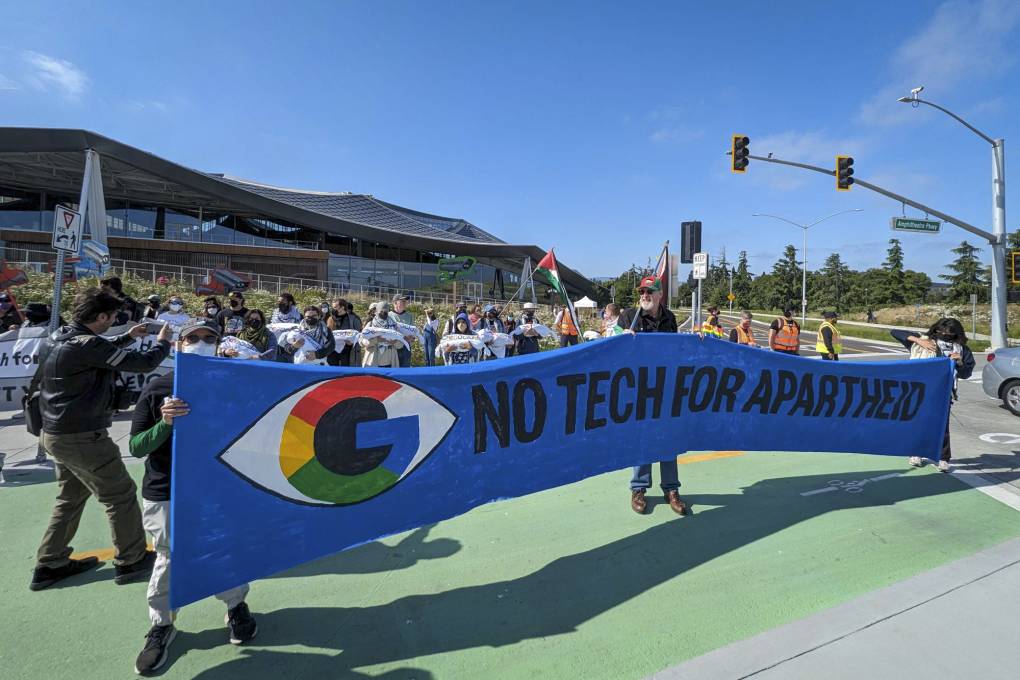
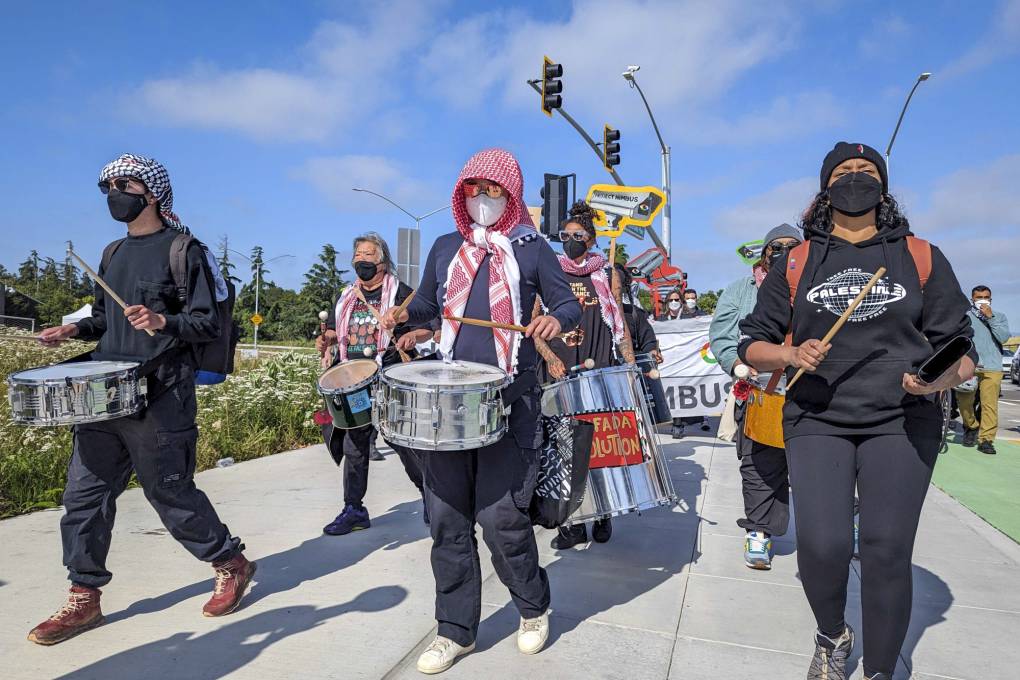
Demonstrators Rally Outside Google Conference, Call for End to Israel Contracts
Protesting 'Project Nimbus': What Rights Do Google Employees Have?
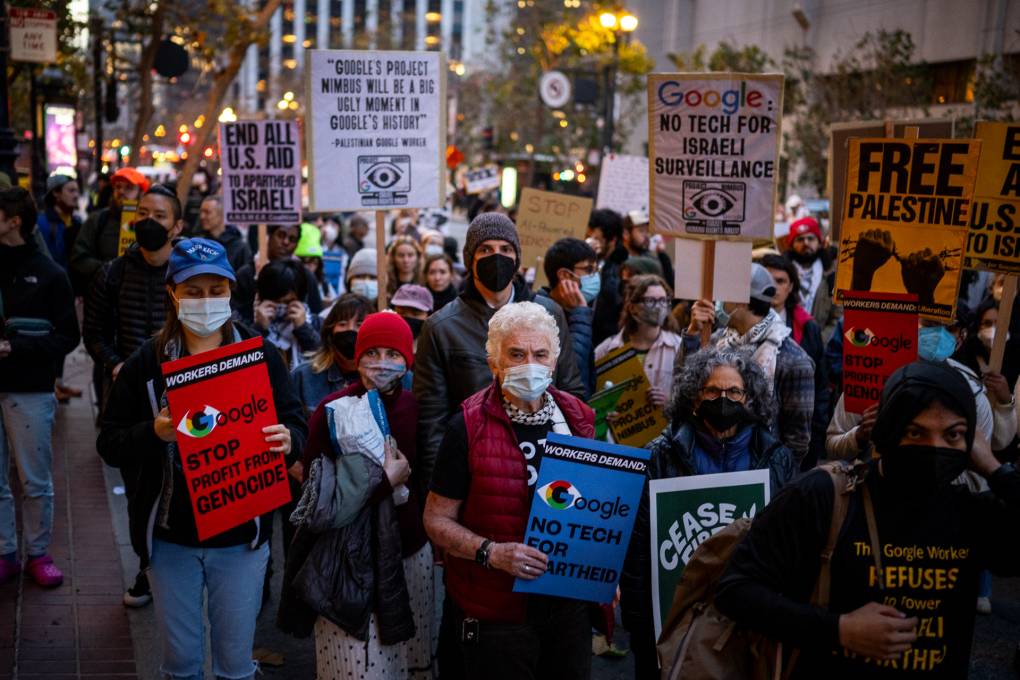
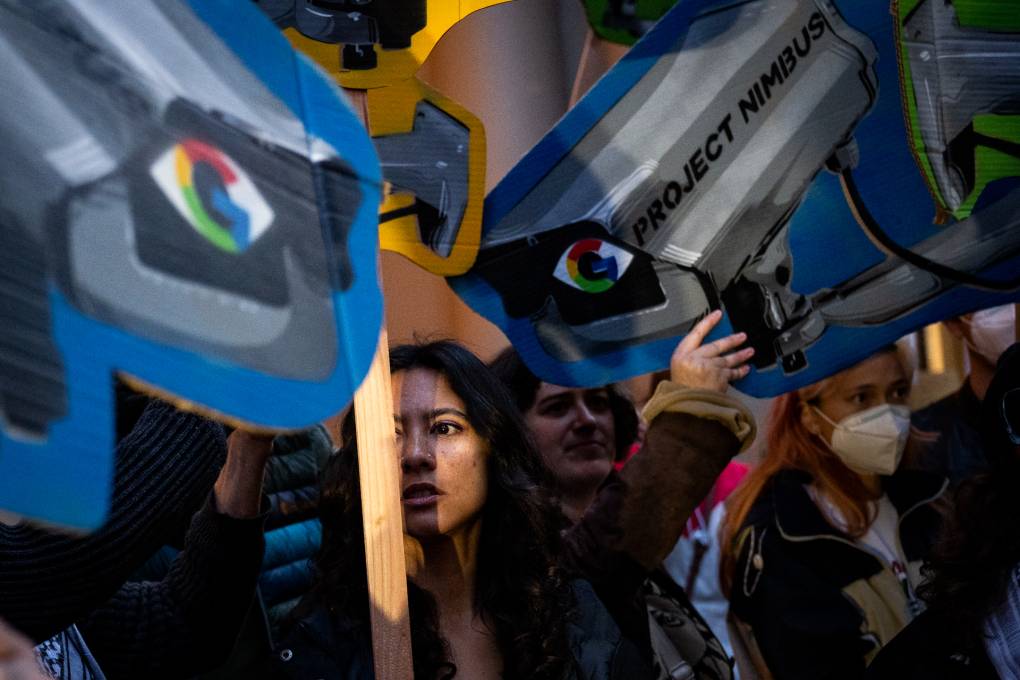
Protesters Outside Google in San Francisco Call for Immediate End to 'Project Nimbus'
Sponsored
Player sponsored by
window.__IS_SSR__=true
window.__INITIAL_STATE__={
"attachmentsReducer": {
"audio_0": {
"type": "attachments",
"id": "audio_0",
"imgSizes": {
"kqedFullSize": {
"file": "https://ww2.kqed.org/news/wp-content/themes/KQED-unified/img/audio_bgs/background0.jpg"
}
}
},
"audio_1": {
"type": "attachments",
"id": "audio_1",
"imgSizes": {
"kqedFullSize": {
"file": "https://ww2.kqed.org/news/wp-content/themes/KQED-unified/img/audio_bgs/background1.jpg"
}
}
},
"audio_2": {
"type": "attachments",
"id": "audio_2",
"imgSizes": {
"kqedFullSize": {
"file": "https://ww2.kqed.org/news/wp-content/themes/KQED-unified/img/audio_bgs/background2.jpg"
}
}
},
"audio_3": {
"type": "attachments",
"id": "audio_3",
"imgSizes": {
"kqedFullSize": {
"file": "https://ww2.kqed.org/news/wp-content/themes/KQED-unified/img/audio_bgs/background3.jpg"
}
}
},
"audio_4": {
"type": "attachments",
"id": "audio_4",
"imgSizes": {
"kqedFullSize": {
"file": "https://ww2.kqed.org/news/wp-content/themes/KQED-unified/img/audio_bgs/background4.jpg"
}
}
},
"placeholder": {
"type": "attachments",
"id": "placeholder",
"imgSizes": {
"thumbnail": {
"file": "https://cdn.kqed.org/wp-content/uploads/2024/12/KQED-Default-Image-816638274-2000x1333-1-160x107.jpg",
"width": 160,
"height": 107,
"mimeType": "image/jpeg"
},
"medium": {
"file": "https://cdn.kqed.org/wp-content/uploads/2024/12/KQED-Default-Image-816638274-2000x1333-1-800x533.jpg",
"width": 800,
"height": 533,
"mimeType": "image/jpeg"
},
"medium_large": {
"file": "https://cdn.kqed.org/wp-content/uploads/2024/12/KQED-Default-Image-816638274-2000x1333-1-768x512.jpg",
"width": 768,
"height": 512,
"mimeType": "image/jpeg"
},
"large": {
"file": "https://cdn.kqed.org/wp-content/uploads/2024/12/KQED-Default-Image-816638274-2000x1333-1-1020x680.jpg",
"width": 1020,
"height": 680,
"mimeType": "image/jpeg"
},
"1536x1536": {
"file": "https://cdn.kqed.org/wp-content/uploads/2024/12/KQED-Default-Image-816638274-2000x1333-1-1536x1024.jpg",
"width": 1536,
"height": 1024,
"mimeType": "image/jpeg"
},
"fd-lrg": {
"file": "https://cdn.kqed.org/wp-content/uploads/2024/12/KQED-Default-Image-816638274-2000x1333-1-1536x1024.jpg",
"width": 1536,
"height": 1024,
"mimeType": "image/jpeg"
},
"fd-med": {
"file": "https://cdn.kqed.org/wp-content/uploads/2024/12/KQED-Default-Image-816638274-2000x1333-1-1020x680.jpg",
"width": 1020,
"height": 680,
"mimeType": "image/jpeg"
},
"fd-sm": {
"file": "https://cdn.kqed.org/wp-content/uploads/2024/12/KQED-Default-Image-816638274-2000x1333-1-800x533.jpg",
"width": 800,
"height": 533,
"mimeType": "image/jpeg"
},
"post-thumbnail": {
"file": "https://cdn.kqed.org/wp-content/uploads/2024/12/KQED-Default-Image-816638274-2000x1333-1-672x372.jpg",
"width": 672,
"height": 372,
"mimeType": "image/jpeg"
},
"twentyfourteen-full-width": {
"file": "https://cdn.kqed.org/wp-content/uploads/2024/12/KQED-Default-Image-816638274-2000x1333-1-1038x576.jpg",
"width": 1038,
"height": 576,
"mimeType": "image/jpeg"
},
"xxsmall": {
"file": "https://cdn.kqed.org/wp-content/uploads/2024/12/KQED-Default-Image-816638274-2000x1333-1-160x107.jpg",
"width": 160,
"height": 107,
"mimeType": "image/jpeg"
},
"xsmall": {
"file": "https://cdn.kqed.org/wp-content/uploads/2024/12/KQED-Default-Image-816638274-2000x1333-1-672x372.jpg",
"width": 672,
"height": 372,
"mimeType": "image/jpeg"
},
"small": {
"file": "https://cdn.kqed.org/wp-content/uploads/2024/12/KQED-Default-Image-816638274-2000x1333-1-672x372.jpg",
"width": 672,
"height": 372,
"mimeType": "image/jpeg"
},
"xlarge": {
"file": "https://cdn.kqed.org/wp-content/uploads/2024/12/KQED-Default-Image-816638274-2000x1333-1-1020x680.jpg",
"width": 1020,
"height": 680,
"mimeType": "image/jpeg"
},
"full-width": {
"file": "https://cdn.kqed.org/wp-content/uploads/2024/12/KQED-Default-Image-816638274-2000x1333-1-1920x1280.jpg",
"width": 1920,
"height": 1280,
"mimeType": "image/jpeg"
},
"guest-author-32": {
"file": "https://cdn.kqed.org/wp-content/uploads/2025/01/KQED-Default-Image-816638274-1333x1333-1-160x160.jpg",
"width": 32,
"height": 32,
"mimeType": "image/jpeg"
},
"guest-author-50": {
"file": "https://cdn.kqed.org/wp-content/uploads/2025/01/KQED-Default-Image-816638274-1333x1333-1-160x160.jpg",
"width": 50,
"height": 50,
"mimeType": "image/jpeg"
},
"guest-author-64": {
"file": "https://cdn.kqed.org/wp-content/uploads/2025/01/KQED-Default-Image-816638274-1333x1333-1-160x160.jpg",
"width": 64,
"height": 64,
"mimeType": "image/jpeg"
},
"guest-author-96": {
"file": "https://cdn.kqed.org/wp-content/uploads/2025/01/KQED-Default-Image-816638274-1333x1333-1-160x160.jpg",
"width": 96,
"height": 96,
"mimeType": "image/jpeg"
},
"guest-author-128": {
"file": "https://cdn.kqed.org/wp-content/uploads/2025/01/KQED-Default-Image-816638274-1333x1333-1-160x160.jpg",
"width": 128,
"height": 128,
"mimeType": "image/jpeg"
},
"detail": {
"file": "https://cdn.kqed.org/wp-content/uploads/2025/01/KQED-Default-Image-816638274-1333x1333-1-160x160.jpg",
"width": 160,
"height": 160,
"mimeType": "image/jpeg"
},
"kqedFullSize": {
"file": "https://cdn.kqed.org/wp-content/uploads/2024/12/KQED-Default-Image-816638274-2000x1333-1.jpg",
"width": 2000,
"height": 1333
}
}
},
"news_11986144": {
"type": "attachments",
"id": "news_11986144",
"meta": {
"index": "attachments_1716263798",
"site": "news",
"id": "11986144",
"found": true
},
"parent": 11986136,
"imgSizes": {
"twentyfourteen-full-width": {
"file": "https://cdn.kqed.org/wp-content/uploads/sites/10/2024/05/240514-Google-Protest-JG-03-1038x576.jpg",
"width": 1038,
"mimeType": "image/jpeg",
"height": 576
},
"thumbnail": {
"file": "https://cdn.kqed.org/wp-content/uploads/sites/10/2024/05/240514-Google-Protest-JG-03-160x107.jpg",
"width": 160,
"mimeType": "image/jpeg",
"height": 107
},
"post-thumbnail": {
"file": "https://cdn.kqed.org/wp-content/uploads/sites/10/2024/05/240514-Google-Protest-JG-03-672x372.jpg",
"width": 672,
"mimeType": "image/jpeg",
"height": 372
},
"kqedFullSize": {
"file": "https://cdn.kqed.org/wp-content/uploads/sites/10/2024/05/240514-Google-Protest-JG-03.jpg",
"width": 2000,
"height": 1333
},
"large": {
"file": "https://cdn.kqed.org/wp-content/uploads/sites/10/2024/05/240514-Google-Protest-JG-03-1020x680.jpg",
"width": 1020,
"mimeType": "image/jpeg",
"height": 680
},
"1536x1536": {
"file": "https://cdn.kqed.org/wp-content/uploads/sites/10/2024/05/240514-Google-Protest-JG-03-1536x1024.jpg",
"width": 1536,
"mimeType": "image/jpeg",
"height": 1024
},
"full-width": {
"file": "https://cdn.kqed.org/wp-content/uploads/sites/10/2024/05/240514-Google-Protest-JG-03-1920x1280.jpg",
"width": 1920,
"mimeType": "image/jpeg",
"height": 1280
},
"medium": {
"file": "https://cdn.kqed.org/wp-content/uploads/sites/10/2024/05/240514-Google-Protest-JG-03-800x533.jpg",
"width": 800,
"mimeType": "image/jpeg",
"height": 533
}
},
"publishDate": 1715716903,
"modified": 1715718241,
"caption": "People hold up a banner that reads \"No Tech for Apartheid\" during a protest outside of Google's Gradient Canopy building in Mountain View on May 14, 2024.",
"description": null,
"title": "240514-Google Protest-JG-03",
"credit": "Joseph Geha/KQED",
"status": "inherit",
"altTag": "Several people hold up a blue banner with a Google icon over an eye that reads \"No Tech for Apartheid.\"",
"fetchFailed": false,
"isLoading": false
},
"news_11986142": {
"type": "attachments",
"id": "news_11986142",
"meta": {
"index": "attachments_1716263798",
"site": "news",
"id": "11986142",
"found": true
},
"parent": 0,
"imgSizes": {
"twentyfourteen-full-width": {
"file": "https://cdn.kqed.org/wp-content/uploads/sites/10/2024/05/240514-Google-Protest-JG-01-1038x576.jpg",
"width": 1038,
"mimeType": "image/jpeg",
"height": 576
},
"thumbnail": {
"file": "https://cdn.kqed.org/wp-content/uploads/sites/10/2024/05/240514-Google-Protest-JG-01-160x107.jpg",
"width": 160,
"mimeType": "image/jpeg",
"height": 107
},
"post-thumbnail": {
"file": "https://cdn.kqed.org/wp-content/uploads/sites/10/2024/05/240514-Google-Protest-JG-01-672x372.jpg",
"width": 672,
"mimeType": "image/jpeg",
"height": 372
},
"kqedFullSize": {
"file": "https://cdn.kqed.org/wp-content/uploads/sites/10/2024/05/240514-Google-Protest-JG-01.jpg",
"width": 2000,
"height": 1333
},
"large": {
"file": "https://cdn.kqed.org/wp-content/uploads/sites/10/2024/05/240514-Google-Protest-JG-01-1020x680.jpg",
"width": 1020,
"mimeType": "image/jpeg",
"height": 680
},
"1536x1536": {
"file": "https://cdn.kqed.org/wp-content/uploads/sites/10/2024/05/240514-Google-Protest-JG-01-1536x1024.jpg",
"width": 1536,
"mimeType": "image/jpeg",
"height": 1024
},
"full-width": {
"file": "https://cdn.kqed.org/wp-content/uploads/sites/10/2024/05/240514-Google-Protest-JG-01-1920x1280.jpg",
"width": 1920,
"mimeType": "image/jpeg",
"height": 1280
},
"medium": {
"file": "https://cdn.kqed.org/wp-content/uploads/sites/10/2024/05/240514-Google-Protest-JG-01-800x533.jpg",
"width": 800,
"mimeType": "image/jpeg",
"height": 533
}
},
"publishDate": 1715716895,
"modified": 1715718181,
"caption": "People play drums and chant during a protest outside of Google's offices in Mountain View on May 14, 2024.",
"description": null,
"title": "240514-Google Protest-JG-01",
"credit": "Joseph Geha/KQED",
"status": "inherit",
"altTag": "A group of people wearing masks and holding drums walk down the street.",
"fetchFailed": false,
"isLoading": false
},
"news_11969956": {
"type": "attachments",
"id": "news_11969956",
"meta": {
"index": "attachments_1716263798",
"site": "news",
"id": "11969956",
"found": true
},
"parent": 11969898,
"imgSizes": {
"twentyfourteen-full-width": {
"file": "https://cdn.kqed.org/wp-content/uploads/sites/10/2023/12/231214-GazaGoogleProtest-13-BL-1038x576.jpg",
"width": 1038,
"mimeType": "image/jpeg",
"height": 576
},
"thumbnail": {
"file": "https://cdn.kqed.org/wp-content/uploads/sites/10/2023/12/231214-GazaGoogleProtest-13-BL-160x107.jpg",
"width": 160,
"mimeType": "image/jpeg",
"height": 107
},
"post-thumbnail": {
"file": "https://cdn.kqed.org/wp-content/uploads/sites/10/2023/12/231214-GazaGoogleProtest-13-BL-672x372.jpg",
"width": 672,
"mimeType": "image/jpeg",
"height": 372
},
"kqedFullSize": {
"file": "https://cdn.kqed.org/wp-content/uploads/sites/10/2023/12/231214-GazaGoogleProtest-13-BL.jpg",
"width": 1920,
"height": 1280
},
"large": {
"file": "https://cdn.kqed.org/wp-content/uploads/sites/10/2023/12/231214-GazaGoogleProtest-13-BL-1020x680.jpg",
"width": 1020,
"mimeType": "image/jpeg",
"height": 680
},
"1536x1536": {
"file": "https://cdn.kqed.org/wp-content/uploads/sites/10/2023/12/231214-GazaGoogleProtest-13-BL-1536x1024.jpg",
"width": 1536,
"mimeType": "image/jpeg",
"height": 1024
},
"medium": {
"file": "https://cdn.kqed.org/wp-content/uploads/sites/10/2023/12/231214-GazaGoogleProtest-13-BL-800x533.jpg",
"width": 800,
"mimeType": "image/jpeg",
"height": 533
}
},
"publishDate": 1702608994,
"modified": 1702609700,
"caption": "Demonstrators gather outside Google offices in downtown San Francisco on Dec. 14, 2023.",
"description": null,
"title": "231214-GazaGoogleProtest-13-BL",
"credit": "Beth LaBerge/KQED",
"status": "inherit",
"altTag": "Protesters holding signs.",
"fetchFailed": false,
"isLoading": false
},
"news_11969960": {
"type": "attachments",
"id": "news_11969960",
"meta": {
"index": "attachments_1716263798",
"site": "news",
"id": "11969960",
"found": true
},
"parent": 0,
"imgSizes": {
"twentyfourteen-full-width": {
"file": "https://cdn.kqed.org/wp-content/uploads/sites/10/2023/12/231214-GazaGoogleProtest-30-BL-1038x576.jpg",
"width": 1038,
"mimeType": "image/jpeg",
"height": 576
},
"thumbnail": {
"file": "https://cdn.kqed.org/wp-content/uploads/sites/10/2023/12/231214-GazaGoogleProtest-30-BL-160x107.jpg",
"width": 160,
"mimeType": "image/jpeg",
"height": 107
},
"post-thumbnail": {
"file": "https://cdn.kqed.org/wp-content/uploads/sites/10/2023/12/231214-GazaGoogleProtest-30-BL-672x372.jpg",
"width": 672,
"mimeType": "image/jpeg",
"height": 372
},
"kqedFullSize": {
"file": "https://cdn.kqed.org/wp-content/uploads/sites/10/2023/12/231214-GazaGoogleProtest-30-BL.jpg",
"width": 1920,
"height": 1280
},
"large": {
"file": "https://cdn.kqed.org/wp-content/uploads/sites/10/2023/12/231214-GazaGoogleProtest-30-BL-1020x680.jpg",
"width": 1020,
"mimeType": "image/jpeg",
"height": 680
},
"1536x1536": {
"file": "https://cdn.kqed.org/wp-content/uploads/sites/10/2023/12/231214-GazaGoogleProtest-30-BL-1536x1024.jpg",
"width": 1536,
"mimeType": "image/jpeg",
"height": 1024
},
"medium": {
"file": "https://cdn.kqed.org/wp-content/uploads/sites/10/2023/12/231214-GazaGoogleProtest-30-BL-800x533.jpg",
"width": 800,
"mimeType": "image/jpeg",
"height": 533
}
},
"publishDate": 1702609504,
"modified": 1702673090,
"caption": "Demonstrators gather outside Google offices in downtown San Francisco on Dec. 14, 2023, to call for an immediate end to 'Project Nimbus,' Google's billion-dollar cloud computing project with the Israeli government.",
"description": null,
"title": "231214-GazaGoogleProtest-30-BL",
"credit": "Beth LaBerge/KQED",
"status": "inherit",
"altTag": "Protesters with flags and banners.",
"fetchFailed": false,
"isLoading": false
}
},
"audioPlayerReducer": {
"postId": "stream_live",
"isPaused": true,
"isPlaying": false,
"pfsActive": false,
"pledgeModalIsOpen": true,
"playerDrawerIsOpen": false
},
"authorsReducer": {
"rachael-myrow": {
"type": "authors",
"id": "251",
"meta": {
"index": "authors_1716337520",
"id": "251",
"found": true
},
"name": "Rachael Myrow",
"firstName": "Rachael",
"lastName": "Myrow",
"slug": "rachael-myrow",
"email": "rmyrow@kqed.org",
"display_author_email": false,
"staff_mastheads": [
"news"
],
"title": "Senior Editor of KQED's Silicon Valley News Desk",
"bio": "Rachael Myrow is Senior Editor of KQED's Silicon Valley News Desk, reporting on topics like \u003ca href=\"https://www.kqed.org/news/12023367/what-big-tech-sees-in-donald-trump\">what Big Tech sees in President Trump\u003c/a>, \u003ca href=\"https://www.kqed.org/news/12020857/california-lawmaker-ready-revive-fight-regulating-ai\">California's many, many AI bills\u003c/a>, and the \u003ca href=\"https://www.kqed.org/news/12017713/lost-sounds-of-san-francisco\">lost sounds of San Francisco\u003c/a>. You can hear her work on \u003ca href=\"https://www.npr.org/search?query=Rachael%20Myrow&page=1\">NPR\u003c/a>, \u003ca href=\"https://theworld.org/people/rachael-myrow\">The World\u003c/a>, WBUR's \u003ca href=\"https://www.wbur.org/search?q=Rachael%20Myrow\">\u003ci>Here & Now\u003c/i>\u003c/a> and the BBC. \u003c/i>She also guest hosts for KQED's \u003ci>\u003ca href=\"https://www.kqed.org/forum/tag/rachael-myrow\">Forum\u003c/a>\u003c/i>. Over the years, she's talked with Kamau Bell, David Byrne, Kamala Harris, Tony Kushner, Armistead Maupin, Van Dyke Parks, Arnold Schwarzenegger and Tommie Smith, among others.\r\n\r\nBefore all this, she hosted \u003cem>The California Report\u003c/em> for 7+ years.\r\n\r\nAwards? Sure: Peabody, Edward R. Murrow, Regional Edward R. Murrow, RTNDA, Northern California RTNDA, SPJ Northern California Chapter, LA Press Club, Golden Mic. Prior to joining KQED, Rachael worked in Los Angeles at KPCC and Marketplace. She holds degrees in English and journalism from UC Berkeley (where she got her start in public radio on KALX-FM).\r\n\r\nOutside of the studio, you'll find Rachael hiking Bay Area trails and whipping up Instagram-ready meals in her kitchen. More recently, she's taken up native-forward gardening.",
"avatar": "https://secure.gravatar.com/avatar/87bf8cb5874e045cdff430523a6d48b1?s=600&d=blank&r=g",
"twitter": "rachaelmyrow",
"facebook": null,
"instagram": null,
"linkedin": "https://www.linkedin.com/in/rachaelmyrow/",
"sites": [
{
"site": "arts",
"roles": [
"administrator"
]
},
{
"site": "news",
"roles": [
"edit_others_posts",
"editor"
]
},
{
"site": "futureofyou",
"roles": [
"editor"
]
},
{
"site": "bayareabites",
"roles": [
"editor"
]
},
{
"site": "stateofhealth",
"roles": [
"editor"
]
},
{
"site": "science",
"roles": [
"editor"
]
},
{
"site": "food",
"roles": [
"editor"
]
},
{
"site": "forum",
"roles": [
"editor"
]
},
{
"site": "liveblog",
"roles": [
"author"
]
}
],
"headData": {
"title": "Rachael Myrow | KQED",
"description": "Senior Editor of KQED's Silicon Valley News Desk",
"ogImgSrc": "https://secure.gravatar.com/avatar/87bf8cb5874e045cdff430523a6d48b1?s=600&d=blank&r=g",
"twImgSrc": "https://secure.gravatar.com/avatar/87bf8cb5874e045cdff430523a6d48b1?s=600&d=blank&r=g"
},
"isLoading": false,
"link": "/author/rachael-myrow"
},
"ecruzguevarra": {
"type": "authors",
"id": "8654",
"meta": {
"index": "authors_1716337520",
"id": "8654",
"found": true
},
"name": "Ericka Cruz Guevarra",
"firstName": "Ericka",
"lastName": "Cruz Guevarra",
"slug": "ecruzguevarra",
"email": "ecruzguevarra@kqed.org",
"display_author_email": true,
"staff_mastheads": [
"news"
],
"title": "Producer, The Bay Podcast",
"bio": "Ericka Cruz Guevarra is host of \u003ca href=\"https://www.kqed.org/podcasts/thebay\">\u003cem>The Bay\u003c/em>\u003c/a> podcast at KQED. Before host, she was the show’s producer. Her work in that capacity includes a three-part reported series on policing in Vallejo, which won a 2020 excellence in journalism award from the Society of Professional Journalists. Ericka has worked as a breaking news reporter at Oregon Public Broadcasting, helped produce the Code Switch podcast, and was KQED’s inaugural Raul Ramirez Diversity Fund intern. She’s also an alumna of NPR’s Next Generation Radio program. Send her an email if you have strong feelings about whether Fairfield and Suisun City are the Bay. Ericka is represented by SAG-AFTRA.",
"avatar": "https://secure.gravatar.com/avatar/25e5ab8d3d53fad2dcc7bb2b5c506b1a?s=600&d=blank&r=g",
"twitter": "NotoriousECG",
"facebook": null,
"instagram": null,
"linkedin": null,
"sites": [
{
"site": "arts",
"roles": [
"subscriber"
]
},
{
"site": "news",
"roles": [
"editor",
"manage_categories"
]
},
{
"site": "futureofyou",
"roles": [
"subscriber"
]
},
{
"site": "stateofhealth",
"roles": [
"subscriber"
]
},
{
"site": "science",
"roles": [
"editor"
]
},
{
"site": "forum",
"roles": [
"subscriber"
]
}
],
"headData": {
"title": "Ericka Cruz Guevarra | KQED",
"description": "Producer, The Bay Podcast",
"ogImgSrc": "https://secure.gravatar.com/avatar/25e5ab8d3d53fad2dcc7bb2b5c506b1a?s=600&d=blank&r=g",
"twImgSrc": "https://secure.gravatar.com/avatar/25e5ab8d3d53fad2dcc7bb2b5c506b1a?s=600&d=blank&r=g"
},
"isLoading": false,
"link": "/author/ecruzguevarra"
},
"amontecillo": {
"type": "authors",
"id": "11649",
"meta": {
"index": "authors_1716337520",
"id": "11649",
"found": true
},
"name": "Alan Montecillo",
"firstName": "Alan",
"lastName": "Montecillo",
"slug": "amontecillo",
"email": "amontecillo@kqed.org",
"display_author_email": false,
"staff_mastheads": [
"news"
],
"title": "KQED Contributor",
"bio": "Alan Montecillo is the senior editor of \u003cem>\u003ca href=\"http://kqed.org/thebay\">The Bay\u003c/a>, \u003c/em> KQED's local news podcast. Before moving to the Bay Area, he worked as a senior talk show producer for WILL in Champaign-Urbana, Illinois and at Oregon Public Broadcasting in Portland, Oregon. He has won journalism awards from the Society of Professional Journalists Northern California, the Public Media Journalists Association, The Signal Awards, and has also received a regional Edward R. Murrow award. Alan is a Filipino American from Hong Kong and a graduate of Reed College.",
"avatar": "https://secure.gravatar.com/avatar/d5e4e7a76481969ccba76f4e2b5ccabc?s=600&d=blank&r=g",
"twitter": "alanmontecillo",
"facebook": null,
"instagram": null,
"linkedin": null,
"sites": [
{
"site": "",
"roles": [
"editor"
]
},
{
"site": "news",
"roles": [
"editor",
"manage_categories"
]
}
],
"headData": {
"title": "Alan Montecillo | KQED",
"description": "KQED Contributor",
"ogImgSrc": "https://secure.gravatar.com/avatar/d5e4e7a76481969ccba76f4e2b5ccabc?s=600&d=blank&r=g",
"twImgSrc": "https://secure.gravatar.com/avatar/d5e4e7a76481969ccba76f4e2b5ccabc?s=600&d=blank&r=g"
},
"isLoading": false,
"link": "/author/amontecillo"
},
"mesquinca": {
"type": "authors",
"id": "11802",
"meta": {
"index": "authors_1716337520",
"id": "11802",
"found": true
},
"name": "Maria Esquinca",
"firstName": "Maria",
"lastName": "Esquinca",
"slug": "mesquinca",
"email": "mesquinca@kqed.org",
"display_author_email": false,
"staff_mastheads": [],
"title": "Producer, The Bay",
"bio": "María Esquinca is a producer of The Bay. Before that, she was a New York Women’s Foundation IGNITE Fellow at Latino USA. She worked at Radio Bilingue where she covered the San Joaquin Valley. Maria has interned at WLRN, News 21, The New York Times Student Journalism Institute and at Crain’s Detroit Business as a Dow Jones News Fund Business Reporting Intern. She is an MFA graduate from the University of Miami. In 2017, she graduated from the Walter Cronkite School of Journalism and Mass Communication with a Master of Mass Communication. A fronteriza, she was born in Ciudad Juárez, Chihuahua, Mexico and grew up in El Paso, Texas.",
"avatar": "https://secure.gravatar.com/avatar/77cedba18aae91da775038ba06dcd8d0?s=600&d=blank&r=g",
"twitter": "@m_esquinca",
"facebook": null,
"instagram": null,
"linkedin": null,
"sites": [
{
"site": "news",
"roles": []
}
],
"headData": {
"title": "Maria Esquinca | KQED",
"description": "Producer, The Bay",
"ogImgSrc": "https://secure.gravatar.com/avatar/77cedba18aae91da775038ba06dcd8d0?s=600&d=blank&r=g",
"twImgSrc": "https://secure.gravatar.com/avatar/77cedba18aae91da775038ba06dcd8d0?s=600&d=blank&r=g"
},
"isLoading": false,
"link": "/author/mesquinca"
},
"jgeha": {
"type": "authors",
"id": "11906",
"meta": {
"index": "authors_1716337520",
"id": "11906",
"found": true
},
"name": "Joseph Geha",
"firstName": "Joseph",
"lastName": "Geha",
"slug": "jgeha",
"email": "jgeha@kqed.org",
"display_author_email": false,
"staff_mastheads": [
"news",
"science"
],
"title": "KQED Contributor",
"bio": null,
"avatar": "https://secure.gravatar.com/avatar/06334764312afacae9c3d6cd48fd9fd7?s=600&d=blank&r=g",
"twitter": null,
"facebook": null,
"instagram": null,
"linkedin": null,
"sites": [
{
"site": "news",
"roles": [
"editor"
]
},
{
"site": "liveblog",
"roles": [
"author"
]
}
],
"headData": {
"title": "Joseph Geha | KQED",
"description": "KQED Contributor",
"ogImgSrc": "https://secure.gravatar.com/avatar/06334764312afacae9c3d6cd48fd9fd7?s=600&d=blank&r=g",
"twImgSrc": "https://secure.gravatar.com/avatar/06334764312afacae9c3d6cd48fd9fd7?s=600&d=blank&r=g"
},
"isLoading": false,
"link": "/author/jgeha"
}
},
"breakingNewsReducer": {},
"pagesReducer": {},
"postsReducer": {
"stream_live": {
"type": "live",
"id": "stream_live",
"audioUrl": "https://streams.kqed.org/kqedradio",
"title": "Live Stream",
"excerpt": "Live Stream information currently unavailable.",
"link": "/radio",
"featImg": "",
"label": {
"name": "KQED Live",
"link": "/"
}
},
"stream_kqedNewscast": {
"type": "posts",
"id": "stream_kqedNewscast",
"audioUrl": "https://www.kqed.org/.stream/anon/radio/RDnews/newscast.mp3?_=1",
"title": "KQED Newscast",
"featImg": "",
"label": {
"name": "88.5 FM",
"link": "/"
}
},
"news_11986743": {
"type": "posts",
"id": "news_11986743",
"meta": {
"index": "posts_1716263798",
"site": "news",
"id": "11986743",
"score": null,
"sort": [
1716199247000
]
},
"guestAuthors": [],
"slug": "the-tech-employees-who-want-to-sever-silicon-valleys-deep-ties-with-israel",
"title": "The Tech Employees Who Want to Sever Silicon Valley’s Deep Ties With Israel",
"publishDate": 1716199247,
"format": "audio",
"headTitle": "The Tech Employees Who Want to Sever Silicon Valley’s Deep Ties With Israel | KQED",
"labelTerm": {},
"content": "\u003cp class=\"p1\">\u003ca href=\"#episode-transcript\">\u003ci>View the full episode transcript.\u003c/i>\u003c/a>\u003c/p>\n\u003cp>Last week, protesters blocked the entrance of Google’s largest development conference in Mountain View to protest the tech giant’s ties with the Israeli government.\u003c/p>\n\u003cp>At issue is Project Nimbus, Google and Amazon’s $1.2 billion cloud computing contract with the Israeli government, including the Israeli Defense Ministry. But as KQED’s Rachael Myrow explains, Silicon Valley’s ties to Israel \u003ca href=\"https://www.kqed.org/news/11985580/divestment-from-israeli-tech-is-a-tall-order-for-silicon-valley-heres-why\" target=\"_blank\" rel=\"noopener noreferrer\">run much deeper\u003c/a> — which makes divesting a tall order.\u003c/p>\n\u003cp> \u003c/p>\n\u003cp>\u003c!-- iframe plugin v.4.3 wordpress.org/plugins/iframe/ -->\u003cbr>\n\u003ciframe loading=\"lazy\" frameborder=\"0\" height=\"200\" scrolling=\"no\" src=\"https://playlist.megaphone.fm/?e=KQINC2740176826\" width=\"100%\" class=\"iframe-class\">\u003c/iframe>\u003c/p>\n\u003ch2 id=\"episode-transcript\">Episode Transcript\u003c/h2>\n\u003cp>\u003ci>This is a computer-generated transcript. While our team has reviewed it, there may be errors.\u003c/i>\u003c/p>\n\u003cp>[ad fullwidth]\u003c/p>\n\u003cp>\u003cstrong>Ericka Cruz Guevarra: \u003c/strong>I’m Ericka Cruz Guevarra and welcome to the Bay. Local news to keep you rooted. Last week, protesters blocked the entrance of Google’s largest developer conference in Mountain View, demanding the company divest from contracts with the Israeli government as it continues its siege on Gaza.\u003c/p>\n\u003cp>\u003cstrong>Ericka Cruz Guevarra: \u003c/strong>At issue is Google and Amazon’s Project Nimbus, the tech giant’s cloud computing contract that services the Israeli Ministry of Defense. Protesters included current and former Google employees under the name No Tech for apartheid.\u003c/p>\n\u003cp>\u003cstrong>Hasan Ibraheem: \u003c/strong>We are Google workers inside Google who have had enough of this. We do not want this contract to exist, and we do not want our labor to go towards aiding a genocide.\u003c/p>\n\u003cp>\u003cstrong>Ericka Cruz Guevarra: \u003c/strong>Today, we’ll look into the deep ties between Israel and Silicon Valley and the tech workers hoping to sever them.\u003c/p>\n\u003cp>\u003cstrong>Rachael Myrow: \u003c/strong>The ties run broad and deep, and they have since the 1970s. Across a wide range of technologies.\u003c/p>\n\u003cp>\u003cstrong>Ericka Cruz Guevarra: \u003c/strong>Rachael Myrow is senior editor of KQED Silicon Valley desk. How have you seen tech workers in Silicon Valley begin to organize against the tech industries ties to Israel?\u003c/p>\n\u003cp>\u003cstrong>Rachael Myrow: \u003c/strong>Well, it started on internal slack channels inside affinity groups that were in many cases, already issuing complaints to company management of feeling unheard or less seen than their Jewish or Israeli counterparts, or even retaliated against.\u003c/p>\n\u003cp>\u003cstrong>Rachael Myrow: \u003c/strong>But of course, the organizing took off after Israel invaded Gaza on October 27th. And that’s when you started to see groups like No Tech for apartheid making a bigger noise.\u003c/p>\n\u003cp>\u003cstrong>Ericka Cruz Guevarra: \u003c/strong>And I know you spoke to someone who began organizing with no tech for apartheid. Can you introduce me to Hasan Ibraheem? Who is he and how long has he been working in tech?\u003c/p>\n\u003cp>\u003cstrong>Rachael Myrow: \u003c/strong>The first thing you should know about Hasan is that he’s 23 years old. So, by his own admission, not that long out of college, his first job out of college at Google.\u003c/p>\n\u003cp>\u003cstrong>Hasan Ibraheem: \u003c/strong>I worked on sort of like ads infrastructure. I do mainly like backend server work.\u003c/p>\n\u003cp>\u003cstrong>Rachael Myrow: \u003c/strong>He’s there about a year and a half before this whole thing began with Israel and Gaza. So Hasan starts to get involved, with no tech for apartheid as the situation in Gaza escalates.\u003c/p>\n\u003cp>\u003cstrong>Hasan Ibraheem: \u003c/strong>We don’t expect that any one of our actions is going to cause these companies to suddenly pull out of the deals that they have with Israel, but we hope that with each action that we do, we inspire more tech workers to speak out.\u003c/p>\n\u003cp>\u003cstrong>Ericka Cruz Guevarra: \u003c/strong>And what kinds of actions was he organizing exactly or helping to organize?\u003c/p>\n\u003cp>\u003cstrong>Rachael Myrow: \u003c/strong>Well, we know about him because he was involved in one of the sit ins that no tech for apartheid, staged recently in three different cities Sunnyvale, Seattle and New York. So he was involved in the New York sit in.\u003c/p>\n\u003cp>\u003cstrong>Rachael Myrow: \u003c/strong>Calling for an end to Project Nimbus, which is this $1.2 billion cloud services contract with the Israeli government, including the Ministry of Defense. So, the Israeli Finance Ministry described Project Nimbus as intended to provide the government, the defense establishment and others with an all encompassing cloud solution.\u003c/p>\n\u003cp>\u003cstrong>Rachael Myrow: \u003c/strong>There’s some highly disturbing reporting about the way that the Israeli Ministry of Defense is using artificial intelligence software to choose bombing targets in Gaza, which I should say has not been directly tied to Google or Amazon software per se, or Project Nimbus per se. But for the people in no tech for a part time, the smell of smoke suggests there could be fire somewhere in there.\u003c/p>\n\u003cp>\u003cstrong>Hasan Ibraheem: \u003c/strong>So the original contract was made in 2021. It was between Google, Amazon and Israel, and at the time no one could see the actual contract, but no one had the contract in hand to be like, yes, this contract is between the Israeli military and Google and Amazon until time magazine actually had a hold of it.\u003c/p>\n\u003cp>\u003cstrong>Rachael Myrow: \u003c/strong>No tech for apartheid is insisting that Amazon and Google here again, quote, stop doing business with Israeli apartheid and powering the genocide of Palestinians in Gaza and following in the footsteps of those who fought to divest from apartheid South Africa.\u003c/p>\n\u003cp>\u003cstrong>Rachael Myrow: \u003c/strong>And one. It’s our responsibility to rise up in support of Palestinian freedom. The Amazon and Google execs who signed this contract can still choose to be on the right side of history.\u003c/p>\n\u003cp>\u003cstrong>Hasan Ibraheem: \u003c/strong>Google workers inside Google who have had enough of this. We do not want this contract to exist, and we do not want our labor to go towards aiding a genocide.\u003c/p>\n\u003cp>\u003cstrong>Ericka Cruz Guevarra: \u003c/strong>Well, Rachel, you reported on this story about why some of these demands by tech workers, these demands to divest from military contracts like this with Israel, why? That is such a tall order. Why is it a tall order?\u003c/p>\n\u003cp>\u003cstrong>Rachael Myrow: \u003c/strong>To be frank about it. Money.\u003c/p>\n\u003cp>\u003cstrong>Guy Horowitz: \u003c/strong>And that’s because of what’s going on in Israel, not despite of what’s going on in Israel.\u003c/p>\n\u003cp>\u003cstrong>Rachael Myrow: \u003c/strong>So Guy Horowitz is Israeli. He’s been living in Palo Alto for the past six years, but he’s been a venture capitalist for the last 20.\u003c/p>\n\u003cp>\u003cstrong>Guy Horowitz: \u003c/strong>The essence of Silicon Valley, combining talent with technology and money. I think that’s the very basis of the Israeli Startup nation ethos.\u003c/p>\n\u003cp>\u003cstrong>Rachael Myrow: \u003c/strong>The two economies are joined at the hip by just about any business metric you can think of. How many Silicon Valley giants have purchased Israeli startups, how many Israeli startups have offices or even headquarters here? How many Israelis work here in the Bay area? How many Israelis are employed by Silicon Valley companies in Israel?\u003c/p>\n\u003cp>\u003cstrong>Guy Horowitz: \u003c/strong>So Israel wouldn’t be startup nation without Silicon Valley. But at the same token, it’s hard. To imagine Silicon Valley without Israel.\u003c/p>\n\u003cp>\u003cstrong>Ericka Cruz Guevarra: \u003c/strong>What are some examples, Rachel, of the investments. Silicon Valley has in Israel right now?\u003c/p>\n\u003cp>\u003cstrong>Rachael Myrow: \u003c/strong>So you have a ways, the satellite navigation software company that Google bought that for $1.3 billion in 2013. Nvidia, based in Santa Clara, California, bought Mellanox for about $7 billion roughly in 2019. And they recently announced plans to buy two more Israeli companies focused on AI. Intel, which is Israel’s largest private employer.\u003c/p>\n\u003cp>\u003cstrong>Rachael Myrow: \u003c/strong>I mean, just sit with that fact for a moment. Largest private employer in Israel. That’s Intel, which is based over here. So, they bought, Mobileye, the autonomous driving company, for $15 billion in 2017. They’ve they’ve got, plans for a major semiconductor manufacturing facility in Israel, according to the United States Israel Business Alliance.\u003c/p>\n\u003cp>\u003cstrong>Rachael Myrow: \u003c/strong>California now serves as the global or U.S. headquarters for 35 Israeli founded unicorns. That’s Silicon Valley parlance for privately held companies valued at $1 billion or more. And those are just the big startups. There are hundreds of smaller startups as well.\u003c/p>\n\u003cp>\u003cstrong>Ericka Cruz Guevarra: \u003c/strong>I mean, how long has this relationship been going on?\u003c/p>\n\u003cp>\u003cstrong>Rachael Myrow: \u003c/strong>Some economists say things really heated up in the 1990s. But most agree this really dates back to the 1970s, when U.S. companies, in particular, began to notice Israel’s tech and science universities.\u003c/p>\n\u003cp>\u003cstrong>Guy Horowitz: \u003c/strong>It became evident that Israel was developing for its own needs, technologies that were relevant for Silicon Valley and that came from military sources as well as from the research institutions that were kind of working, in tandem with them.\u003c/p>\n\u003cp>\u003cstrong>Rachael Myrow: \u003c/strong>Technion, Tel Aviv University, the Hebrew University of Jerusalem, the Ben-Gurion University of the Negev. And they started to notice some intriguing developments in things like agtech and biotech.\u003c/p>\n\u003cp>\u003cstrong>Rachael Myrow: \u003c/strong>The Intel 8088, the chip which Intel credits with launching it into the fortune 500. The list is long. And, you know, he acknowledges or even both says, as many Israeli investors do, that it’s all deeply tied with, Israel’s military culture.\u003c/p>\n\u003cp>\u003cstrong>Guy Horowitz: \u003c/strong>The deeper Israelis engage in conflict, then unfortunately, Israel has been in conflict for the past 76 years even more. The more value would be driven for. Israel on the economic side and for Silicon Valley as a counterpart.\u003c/p>\n\u003cp>\u003cstrong>Ericka Cruz Guevarra: \u003c/strong>I mean, that said, this actually isn’t the first time that tech and Google employees have lobbied against military related contracts, right?\u003c/p>\n\u003cp>\u003cstrong>Rachael Myrow: \u003c/strong>I’m glad that you brought that up because that is the case. They’ve been successful in the past, right? Google employees have successfully lobbied to cancel military related contracts like Project Maven with the Pentagon and Project Dragonfly, which was a proposed version of Google search that would have allowed the Chinese government to censor and monitor users within China.\u003c/p>\n\u003cp>\u003cstrong>Rachael Myrow: \u003c/strong>So those are those are two examples where employees internally pressured the leadership to take a different direction. But but I think I should add something from my reporting, Ericka, which is that when it comes to company contracts, labor law, U.S. labor law firmly comes down on the side of the company.\u003c/p>\n\u003cp>\u003cstrong>Rachael Myrow: \u003c/strong>The leadership has the legal right to decide the direction a company takes, with or without the approval of individual employees. So labor attorneys I talked to said, you know, if you don’t like it, you can attempt to pressure the company or leave.\u003c/p>\n\u003cp>\u003cstrong>Ericka Cruz Guevarra: \u003c/strong>Yeah. I think you’re you’re kind of heading towards where I want to go next, Rachel, which is to the Google employees behind no tech for a part. I mean, you know, we have seen universities recently hired to the demands by student protesters to divest from Israel. But I guess, is it realistic to think that tech would do that\u003c/p>\n\u003cp>\u003cstrong>Rachael Myrow: \u003c/strong>After the reporting for this story? I would argue it’s unlikely.\u003c/p>\n\u003cp>\u003cstrong>Guy Horowitz: \u003c/strong>So in a nutshell, I think it’s going to be a nonproductive effort, maybe even counterproductive effort.\u003c/p>\n\u003cp>\u003cstrong>Rachael Myrow: \u003c/strong>Guy and other people like him that I’ve talked to, they don’t seem to be worried about divestment, at least from tech in the slightest. Ericka. And I don’t mean to suggest that these guys are the kind of people who don’t worry. They definitely worry about a lot of things, but not divestment.\u003c/p>\n\u003cp>\u003cstrong>Guy Horowitz: \u003c/strong>So whoever is saying divestment is a way to make Israel, reconsider its political or geopolitical stance on Palestine or whatever. But hey, the deeper the conflict is and the longer it goes would actually make Israel a more lucrative place to do business with for the next 20, 30 years.\u003c/p>\n\u003cp>\u003cstrong>Ericka Cruz Guevarra: \u003c/strong>At the end of the day, Rachel, we are talking about private companies for whom profit is king. How does Hasan respond to this? Why protest anyway?\u003c/p>\n\u003cp>\u003cstrong>Rachael Myrow: \u003c/strong>I think for Hasan, this is this is a moral issue. He sees a direct line from what’s happening right now in Gaza to write the corporate balance sheets of of Silicon Valley.\u003c/p>\n\u003cp>\u003cstrong>Hasan Ibraheem: \u003c/strong>I would not be disappointed to stop working for a company that has an active, contract with the Israeli military.\u003c/p>\n\u003cp>\u003cstrong>Rachael Myrow: \u003c/strong>I think he feels powerfully, you know, not not in a egocentric or a naive way, that he’s in a very special position as somebody who works in tech. To call out what’s upsetting him.\u003c/p>\n\u003cp>\u003cstrong>Hasan Ibraheem: \u003c/strong>We will continue to make noise about this. We will continue to make our voices heard. We will continue to educate our colleagues about what’s going on. And we’ll. Yeah, we’ll continue standing up for Palestine.\u003c/p>\n\u003cp>\u003cstrong>Ericka Cruz Guevarra: \u003c/strong>What happened to Hasan and others who took part in those actions against Google that we were just talking about?\u003c/p>\n\u003cp>\u003cstrong>Rachael Myrow: \u003c/strong>You know, in Hasan’s case, he says he and the fellow protesters in New York were about seven hours into their sit in when they were informed they’d been put on administrative leave, and then their badge access was taken away. Their corporate device is taken away.\u003c/p>\n\u003cp>\u003cstrong>Hasan Ibraheem: \u003c/strong>9:30 p.m. almost ten hours in, the police arrived. So then the very calmly arrested us and escorted out of the building.\u003c/p>\n\u003cp>\u003cstrong>Rachael Myrow: \u003c/strong>About 24 hours later, he gets an email telling him he was terminated immediately.\u003c/p>\n\u003cp>\u003cstrong>Hasan Ibraheem: \u003c/strong>And then the following Monday was when the rest of the 50 people were also fired.\u003c/p>\n\u003cp>\u003cstrong>Ericka Cruz Guevarra: \u003c/strong>So what’s next for him, Rachel? I mean, has this experience changed the way that he feels about being in the tech industry?\u003c/p>\n\u003cp>\u003cstrong>Rachael Myrow: \u003c/strong>Well, you know, he’s, he’s been spending a little time, regrouping with family. But he’s he’s back in it, back in, you know, the protests. He’s participating. He’s energized for the fight ahead.\u003c/p>\n\u003cp>\u003cstrong>Hasan Ibraheem: \u003c/strong>I’m going to continue on doing that. Going to look at what opportunities there are in terms of my next job, because obviously I’m gonna need a job at some point. But I’m going to be a lot more conscious when it comes to actually choosing what company I work for.\u003c/p>\n\u003cp>\u003cstrong>Rachael Myrow: \u003c/strong>I’ll tell you, I, I think I don’t want to speak for Hasan, but I think he recognizes that his problems with Google and its corporate sensibilities extend to other big tech companies. So he told me he might work for maybe a smaller tech firm, without these, you know, multinational contracts or or a nonprofit maybe that needs a software engineer. He’s got options.\u003c/p>\n\u003cp>\u003cstrong>Hasan Ibraheem: \u003c/strong>I want to make sure that my labor is actually going towards something I support.\u003c/p>\n\u003cp>\u003cstrong>Rachael Myrow: \u003c/strong>We’re at a kind of an inflection moment. You know, it is a world where we’re asking, what kind of world do we want to live in, and how do we use or not use technology to help us get there?\u003c/p>\n\u003cp>\u003cstrong>Ericka Cruz Guevarra: \u003c/strong>Rachel, thank you so much.\u003c/p>\n\u003cp>\u003cstrong>Rachael Myrow: \u003c/strong>Thank you.\u003c/p>\n\u003cp>\u003cstrong>Ericka Cruz Guevarra: \u003c/strong>That was Rachael Myrow, senior editor of KQED Silicon Valley desk. This 35 minute conversation with Rachael was cut down and edited by me. Maria Esquinca is our producer. She scored this episode and added all the tape. Our senior editor is Alan Montecillo.\u003c/p>\n\u003cp>[ad floatright]\u003c/p>\n\u003cp>\u003cstrong>Ericka Cruz Guevarra: \u003c/strong>Thanks as well to KQED reporter Joseph Geha for the protest tape you heard at the top of this episode. Music courtesy of the Audio Network. We are a production of listener supported KQED in San Francisco. I’m Ericka Cruz Guevarra. Thanks for listening. Talk to you next time.\u003c/p>\n\n",
"blocks": [],
"excerpt": "At issue is Google and Amazon’s cloud computing service known as Project Nimbus, which services the Israeli Defense Ministry",
"status": "publish",
"parent": 0,
"modified": 1740178970,
"stats": {
"hasAudio": true,
"hasVideo": false,
"hasChartOrMap": false,
"iframeSrcs": [],
"hasGoogleForm": false,
"hasGallery": false,
"hasHearkenModule": false,
"hasPolis": false,
"paragraphCount": 73,
"wordCount": 2660
},
"headData": {
"title": "The Tech Employees Who Want to Sever Silicon Valley’s Deep Ties With Israel | KQED",
"description": "At issue is Google and Amazon’s cloud computing service known as Project Nimbus, which services the Israeli Defense Ministry",
"ogTitle": "",
"ogDescription": "",
"ogImgId": "",
"twTitle": "",
"twDescription": "",
"twImgId": "",
"schema": {
"@context": "https://schema.org",
"@type": "NewsArticle",
"headline": "The Tech Employees Who Want to Sever Silicon Valley’s Deep Ties With Israel",
"datePublished": "2024-05-20T03:00:47-07:00",
"dateModified": "2025-02-21T15:02:50-08:00",
"image": "https://cdn.kqed.org/wp-content/uploads/2020/02/KQED-OG-Image@1x.png",
"isAccessibleForFree": "True",
"publisher": {
"@type": "NewsMediaOrganization",
"@id": "https://www.kqed.org/#organization",
"name": "KQED",
"logo": "https://cdn.kqed.org/wp-content/uploads/2020/02/KQED-OG-Image@1x.png",
"url": "https://www.kqed.org",
"sameAs": [
"https://www.facebook.com/KQED",
"https://twitter.com/KQED",
"https://www.instagram.com/kqed/",
"https://www.tiktok.com/@kqedofficial",
"https://www.linkedin.com/company/kqed",
"https://www.youtube.com/channel/UCeC0IOo7i1P_61zVUWbJ4nw"
]
}
}
},
"source": "The Bay",
"sourceUrl": "https://www.kqed.org/podcasts/thebay",
"audioUrl": "https://www.podtrac.com/pts/redirect.mp3/chrt.fm/track/G6C7C3/traffic.megaphone.fm/KQINC2740176826.mp3?updated=1715974346",
"sticky": false,
"nprStoryId": "kqed-11986743",
"excludeFromSiteSearch": "Include",
"articleAge": "0",
"path": "/news/11986743/the-tech-employees-who-want-to-sever-silicon-valleys-deep-ties-with-israel",
"audioTrackLength": null,
"parsedContent": [
{
"type": "contentString",
"content": "\u003cdiv class=\"post-body\">\u003cp>\u003cp class=\"p1\">\u003ca href=\"#episode-transcript\">\u003ci>View the full episode transcript.\u003c/i>\u003c/a>\u003c/p>\n\u003cp>Last week, protesters blocked the entrance of Google’s largest development conference in Mountain View to protest the tech giant’s ties with the Israeli government.\u003c/p>\n\u003cp>At issue is Project Nimbus, Google and Amazon’s $1.2 billion cloud computing contract with the Israeli government, including the Israeli Defense Ministry. But as KQED’s Rachael Myrow explains, Silicon Valley’s ties to Israel \u003ca href=\"https://www.kqed.org/news/11985580/divestment-from-israeli-tech-is-a-tall-order-for-silicon-valley-heres-why\" target=\"_blank\" rel=\"noopener noreferrer\">run much deeper\u003c/a> — which makes divesting a tall order.\u003c/p>\n\u003cp> \u003c/p>\n\u003cp>\u003c!-- iframe plugin v.4.3 wordpress.org/plugins/iframe/ -->\u003cbr>\n\u003ciframe loading=\"lazy\" frameborder=\"0\" height=\"200\" scrolling=\"no\" src=\"https://playlist.megaphone.fm/?e=KQINC2740176826\" width=\"100%\" class=\"iframe-class\">\u003c/iframe>\u003c/p>\n\u003ch2 id=\"episode-transcript\">Episode Transcript\u003c/h2>\n\u003cp>\u003ci>This is a computer-generated transcript. While our team has reviewed it, there may be errors.\u003c/i>\u003c/p>\n\u003cp>\u003c/p>\u003c/div>",
"attributes": {
"named": {},
"numeric": []
}
},
{
"type": "component",
"content": "",
"name": "ad",
"attributes": {
"named": {
"label": "fullwidth"
},
"numeric": [
"fullwidth"
]
}
},
{
"type": "contentString",
"content": "\u003cdiv class=\"post-body\">\u003cp>\u003c/p>\n\u003cp>\u003cstrong>Ericka Cruz Guevarra: \u003c/strong>I’m Ericka Cruz Guevarra and welcome to the Bay. Local news to keep you rooted. Last week, protesters blocked the entrance of Google’s largest developer conference in Mountain View, demanding the company divest from contracts with the Israeli government as it continues its siege on Gaza.\u003c/p>\n\u003cp>\u003cstrong>Ericka Cruz Guevarra: \u003c/strong>At issue is Google and Amazon’s Project Nimbus, the tech giant’s cloud computing contract that services the Israeli Ministry of Defense. Protesters included current and former Google employees under the name No Tech for apartheid.\u003c/p>\n\u003cp>\u003cstrong>Hasan Ibraheem: \u003c/strong>We are Google workers inside Google who have had enough of this. We do not want this contract to exist, and we do not want our labor to go towards aiding a genocide.\u003c/p>\n\u003cp>\u003cstrong>Ericka Cruz Guevarra: \u003c/strong>Today, we’ll look into the deep ties between Israel and Silicon Valley and the tech workers hoping to sever them.\u003c/p>\n\u003cp>\u003cstrong>Rachael Myrow: \u003c/strong>The ties run broad and deep, and they have since the 1970s. Across a wide range of technologies.\u003c/p>\n\u003cp>\u003cstrong>Ericka Cruz Guevarra: \u003c/strong>Rachael Myrow is senior editor of KQED Silicon Valley desk. How have you seen tech workers in Silicon Valley begin to organize against the tech industries ties to Israel?\u003c/p>\n\u003cp>\u003cstrong>Rachael Myrow: \u003c/strong>Well, it started on internal slack channels inside affinity groups that were in many cases, already issuing complaints to company management of feeling unheard or less seen than their Jewish or Israeli counterparts, or even retaliated against.\u003c/p>\n\u003cp>\u003cstrong>Rachael Myrow: \u003c/strong>But of course, the organizing took off after Israel invaded Gaza on October 27th. And that’s when you started to see groups like No Tech for apartheid making a bigger noise.\u003c/p>\n\u003cp>\u003cstrong>Ericka Cruz Guevarra: \u003c/strong>And I know you spoke to someone who began organizing with no tech for apartheid. Can you introduce me to Hasan Ibraheem? Who is he and how long has he been working in tech?\u003c/p>\n\u003cp>\u003cstrong>Rachael Myrow: \u003c/strong>The first thing you should know about Hasan is that he’s 23 years old. So, by his own admission, not that long out of college, his first job out of college at Google.\u003c/p>\n\u003cp>\u003cstrong>Hasan Ibraheem: \u003c/strong>I worked on sort of like ads infrastructure. I do mainly like backend server work.\u003c/p>\n\u003cp>\u003cstrong>Rachael Myrow: \u003c/strong>He’s there about a year and a half before this whole thing began with Israel and Gaza. So Hasan starts to get involved, with no tech for apartheid as the situation in Gaza escalates.\u003c/p>\n\u003cp>\u003cstrong>Hasan Ibraheem: \u003c/strong>We don’t expect that any one of our actions is going to cause these companies to suddenly pull out of the deals that they have with Israel, but we hope that with each action that we do, we inspire more tech workers to speak out.\u003c/p>\n\u003cp>\u003cstrong>Ericka Cruz Guevarra: \u003c/strong>And what kinds of actions was he organizing exactly or helping to organize?\u003c/p>\n\u003cp>\u003cstrong>Rachael Myrow: \u003c/strong>Well, we know about him because he was involved in one of the sit ins that no tech for apartheid, staged recently in three different cities Sunnyvale, Seattle and New York. So he was involved in the New York sit in.\u003c/p>\n\u003cp>\u003cstrong>Rachael Myrow: \u003c/strong>Calling for an end to Project Nimbus, which is this $1.2 billion cloud services contract with the Israeli government, including the Ministry of Defense. So, the Israeli Finance Ministry described Project Nimbus as intended to provide the government, the defense establishment and others with an all encompassing cloud solution.\u003c/p>\n\u003cp>\u003cstrong>Rachael Myrow: \u003c/strong>There’s some highly disturbing reporting about the way that the Israeli Ministry of Defense is using artificial intelligence software to choose bombing targets in Gaza, which I should say has not been directly tied to Google or Amazon software per se, or Project Nimbus per se. But for the people in no tech for a part time, the smell of smoke suggests there could be fire somewhere in there.\u003c/p>\n\u003cp>\u003cstrong>Hasan Ibraheem: \u003c/strong>So the original contract was made in 2021. It was between Google, Amazon and Israel, and at the time no one could see the actual contract, but no one had the contract in hand to be like, yes, this contract is between the Israeli military and Google and Amazon until time magazine actually had a hold of it.\u003c/p>\n\u003cp>\u003cstrong>Rachael Myrow: \u003c/strong>No tech for apartheid is insisting that Amazon and Google here again, quote, stop doing business with Israeli apartheid and powering the genocide of Palestinians in Gaza and following in the footsteps of those who fought to divest from apartheid South Africa.\u003c/p>\n\u003cp>\u003cstrong>Rachael Myrow: \u003c/strong>And one. It’s our responsibility to rise up in support of Palestinian freedom. The Amazon and Google execs who signed this contract can still choose to be on the right side of history.\u003c/p>\n\u003cp>\u003cstrong>Hasan Ibraheem: \u003c/strong>Google workers inside Google who have had enough of this. We do not want this contract to exist, and we do not want our labor to go towards aiding a genocide.\u003c/p>\n\u003cp>\u003cstrong>Ericka Cruz Guevarra: \u003c/strong>Well, Rachel, you reported on this story about why some of these demands by tech workers, these demands to divest from military contracts like this with Israel, why? That is such a tall order. Why is it a tall order?\u003c/p>\n\u003cp>\u003cstrong>Rachael Myrow: \u003c/strong>To be frank about it. Money.\u003c/p>\n\u003cp>\u003cstrong>Guy Horowitz: \u003c/strong>And that’s because of what’s going on in Israel, not despite of what’s going on in Israel.\u003c/p>\n\u003cp>\u003cstrong>Rachael Myrow: \u003c/strong>So Guy Horowitz is Israeli. He’s been living in Palo Alto for the past six years, but he’s been a venture capitalist for the last 20.\u003c/p>\n\u003cp>\u003cstrong>Guy Horowitz: \u003c/strong>The essence of Silicon Valley, combining talent with technology and money. I think that’s the very basis of the Israeli Startup nation ethos.\u003c/p>\n\u003cp>\u003cstrong>Rachael Myrow: \u003c/strong>The two economies are joined at the hip by just about any business metric you can think of. How many Silicon Valley giants have purchased Israeli startups, how many Israeli startups have offices or even headquarters here? How many Israelis work here in the Bay area? How many Israelis are employed by Silicon Valley companies in Israel?\u003c/p>\n\u003cp>\u003cstrong>Guy Horowitz: \u003c/strong>So Israel wouldn’t be startup nation without Silicon Valley. But at the same token, it’s hard. To imagine Silicon Valley without Israel.\u003c/p>\n\u003cp>\u003cstrong>Ericka Cruz Guevarra: \u003c/strong>What are some examples, Rachel, of the investments. Silicon Valley has in Israel right now?\u003c/p>\n\u003cp>\u003cstrong>Rachael Myrow: \u003c/strong>So you have a ways, the satellite navigation software company that Google bought that for $1.3 billion in 2013. Nvidia, based in Santa Clara, California, bought Mellanox for about $7 billion roughly in 2019. And they recently announced plans to buy two more Israeli companies focused on AI. Intel, which is Israel’s largest private employer.\u003c/p>\n\u003cp>\u003cstrong>Rachael Myrow: \u003c/strong>I mean, just sit with that fact for a moment. Largest private employer in Israel. That’s Intel, which is based over here. So, they bought, Mobileye, the autonomous driving company, for $15 billion in 2017. They’ve they’ve got, plans for a major semiconductor manufacturing facility in Israel, according to the United States Israel Business Alliance.\u003c/p>\n\u003cp>\u003cstrong>Rachael Myrow: \u003c/strong>California now serves as the global or U.S. headquarters for 35 Israeli founded unicorns. That’s Silicon Valley parlance for privately held companies valued at $1 billion or more. And those are just the big startups. There are hundreds of smaller startups as well.\u003c/p>\n\u003cp>\u003cstrong>Ericka Cruz Guevarra: \u003c/strong>I mean, how long has this relationship been going on?\u003c/p>\n\u003cp>\u003cstrong>Rachael Myrow: \u003c/strong>Some economists say things really heated up in the 1990s. But most agree this really dates back to the 1970s, when U.S. companies, in particular, began to notice Israel’s tech and science universities.\u003c/p>\n\u003cp>\u003cstrong>Guy Horowitz: \u003c/strong>It became evident that Israel was developing for its own needs, technologies that were relevant for Silicon Valley and that came from military sources as well as from the research institutions that were kind of working, in tandem with them.\u003c/p>\n\u003cp>\u003cstrong>Rachael Myrow: \u003c/strong>Technion, Tel Aviv University, the Hebrew University of Jerusalem, the Ben-Gurion University of the Negev. And they started to notice some intriguing developments in things like agtech and biotech.\u003c/p>\n\u003cp>\u003cstrong>Rachael Myrow: \u003c/strong>The Intel 8088, the chip which Intel credits with launching it into the fortune 500. The list is long. And, you know, he acknowledges or even both says, as many Israeli investors do, that it’s all deeply tied with, Israel’s military culture.\u003c/p>\n\u003cp>\u003cstrong>Guy Horowitz: \u003c/strong>The deeper Israelis engage in conflict, then unfortunately, Israel has been in conflict for the past 76 years even more. The more value would be driven for. Israel on the economic side and for Silicon Valley as a counterpart.\u003c/p>\n\u003cp>\u003cstrong>Ericka Cruz Guevarra: \u003c/strong>I mean, that said, this actually isn’t the first time that tech and Google employees have lobbied against military related contracts, right?\u003c/p>\n\u003cp>\u003cstrong>Rachael Myrow: \u003c/strong>I’m glad that you brought that up because that is the case. They’ve been successful in the past, right? Google employees have successfully lobbied to cancel military related contracts like Project Maven with the Pentagon and Project Dragonfly, which was a proposed version of Google search that would have allowed the Chinese government to censor and monitor users within China.\u003c/p>\n\u003cp>\u003cstrong>Rachael Myrow: \u003c/strong>So those are those are two examples where employees internally pressured the leadership to take a different direction. But but I think I should add something from my reporting, Ericka, which is that when it comes to company contracts, labor law, U.S. labor law firmly comes down on the side of the company.\u003c/p>\n\u003cp>\u003cstrong>Rachael Myrow: \u003c/strong>The leadership has the legal right to decide the direction a company takes, with or without the approval of individual employees. So labor attorneys I talked to said, you know, if you don’t like it, you can attempt to pressure the company or leave.\u003c/p>\n\u003cp>\u003cstrong>Ericka Cruz Guevarra: \u003c/strong>Yeah. I think you’re you’re kind of heading towards where I want to go next, Rachel, which is to the Google employees behind no tech for a part. I mean, you know, we have seen universities recently hired to the demands by student protesters to divest from Israel. But I guess, is it realistic to think that tech would do that\u003c/p>\n\u003cp>\u003cstrong>Rachael Myrow: \u003c/strong>After the reporting for this story? I would argue it’s unlikely.\u003c/p>\n\u003cp>\u003cstrong>Guy Horowitz: \u003c/strong>So in a nutshell, I think it’s going to be a nonproductive effort, maybe even counterproductive effort.\u003c/p>\n\u003cp>\u003cstrong>Rachael Myrow: \u003c/strong>Guy and other people like him that I’ve talked to, they don’t seem to be worried about divestment, at least from tech in the slightest. Ericka. And I don’t mean to suggest that these guys are the kind of people who don’t worry. They definitely worry about a lot of things, but not divestment.\u003c/p>\n\u003cp>\u003cstrong>Guy Horowitz: \u003c/strong>So whoever is saying divestment is a way to make Israel, reconsider its political or geopolitical stance on Palestine or whatever. But hey, the deeper the conflict is and the longer it goes would actually make Israel a more lucrative place to do business with for the next 20, 30 years.\u003c/p>\n\u003cp>\u003cstrong>Ericka Cruz Guevarra: \u003c/strong>At the end of the day, Rachel, we are talking about private companies for whom profit is king. How does Hasan respond to this? Why protest anyway?\u003c/p>\n\u003cp>\u003cstrong>Rachael Myrow: \u003c/strong>I think for Hasan, this is this is a moral issue. He sees a direct line from what’s happening right now in Gaza to write the corporate balance sheets of of Silicon Valley.\u003c/p>\n\u003cp>\u003cstrong>Hasan Ibraheem: \u003c/strong>I would not be disappointed to stop working for a company that has an active, contract with the Israeli military.\u003c/p>\n\u003cp>\u003cstrong>Rachael Myrow: \u003c/strong>I think he feels powerfully, you know, not not in a egocentric or a naive way, that he’s in a very special position as somebody who works in tech. To call out what’s upsetting him.\u003c/p>\n\u003cp>\u003cstrong>Hasan Ibraheem: \u003c/strong>We will continue to make noise about this. We will continue to make our voices heard. We will continue to educate our colleagues about what’s going on. And we’ll. Yeah, we’ll continue standing up for Palestine.\u003c/p>\n\u003cp>\u003cstrong>Ericka Cruz Guevarra: \u003c/strong>What happened to Hasan and others who took part in those actions against Google that we were just talking about?\u003c/p>\n\u003cp>\u003cstrong>Rachael Myrow: \u003c/strong>You know, in Hasan’s case, he says he and the fellow protesters in New York were about seven hours into their sit in when they were informed they’d been put on administrative leave, and then their badge access was taken away. Their corporate device is taken away.\u003c/p>\n\u003cp>\u003cstrong>Hasan Ibraheem: \u003c/strong>9:30 p.m. almost ten hours in, the police arrived. So then the very calmly arrested us and escorted out of the building.\u003c/p>\n\u003cp>\u003cstrong>Rachael Myrow: \u003c/strong>About 24 hours later, he gets an email telling him he was terminated immediately.\u003c/p>\n\u003cp>\u003cstrong>Hasan Ibraheem: \u003c/strong>And then the following Monday was when the rest of the 50 people were also fired.\u003c/p>\n\u003cp>\u003cstrong>Ericka Cruz Guevarra: \u003c/strong>So what’s next for him, Rachel? I mean, has this experience changed the way that he feels about being in the tech industry?\u003c/p>\n\u003cp>\u003cstrong>Rachael Myrow: \u003c/strong>Well, you know, he’s, he’s been spending a little time, regrouping with family. But he’s he’s back in it, back in, you know, the protests. He’s participating. He’s energized for the fight ahead.\u003c/p>\n\u003cp>\u003cstrong>Hasan Ibraheem: \u003c/strong>I’m going to continue on doing that. Going to look at what opportunities there are in terms of my next job, because obviously I’m gonna need a job at some point. But I’m going to be a lot more conscious when it comes to actually choosing what company I work for.\u003c/p>\n\u003cp>\u003cstrong>Rachael Myrow: \u003c/strong>I’ll tell you, I, I think I don’t want to speak for Hasan, but I think he recognizes that his problems with Google and its corporate sensibilities extend to other big tech companies. So he told me he might work for maybe a smaller tech firm, without these, you know, multinational contracts or or a nonprofit maybe that needs a software engineer. He’s got options.\u003c/p>\n\u003cp>\u003cstrong>Hasan Ibraheem: \u003c/strong>I want to make sure that my labor is actually going towards something I support.\u003c/p>\n\u003cp>\u003cstrong>Rachael Myrow: \u003c/strong>We’re at a kind of an inflection moment. You know, it is a world where we’re asking, what kind of world do we want to live in, and how do we use or not use technology to help us get there?\u003c/p>\n\u003cp>\u003cstrong>Ericka Cruz Guevarra: \u003c/strong>Rachel, thank you so much.\u003c/p>\n\u003cp>\u003cstrong>Rachael Myrow: \u003c/strong>Thank you.\u003c/p>\n\u003cp>\u003cstrong>Ericka Cruz Guevarra: \u003c/strong>That was Rachael Myrow, senior editor of KQED Silicon Valley desk. This 35 minute conversation with Rachael was cut down and edited by me. Maria Esquinca is our producer. She scored this episode and added all the tape. Our senior editor is Alan Montecillo.\u003c/p>\n\u003cp>\u003c/p>\u003c/div>",
"attributes": {
"named": {},
"numeric": []
}
},
{
"type": "component",
"content": "",
"name": "ad",
"attributes": {
"named": {
"label": "floatright"
},
"numeric": [
"floatright"
]
}
},
{
"type": "contentString",
"content": "\u003cdiv class=\"post-body\">\u003cp>\u003c/p>\n\u003cp>\u003cstrong>Ericka Cruz Guevarra: \u003c/strong>Thanks as well to KQED reporter Joseph Geha for the protest tape you heard at the top of this episode. Music courtesy of the Audio Network. We are a production of listener supported KQED in San Francisco. I’m Ericka Cruz Guevarra. Thanks for listening. Talk to you next time.\u003c/p>\n\n\u003c/div>\u003c/p>",
"attributes": {
"named": {},
"numeric": []
}
}
],
"link": "/news/11986743/the-tech-employees-who-want-to-sever-silicon-valleys-deep-ties-with-israel",
"authors": [
"8654",
"251",
"11802",
"11649"
],
"programs": [
"news_28779"
],
"categories": [
"news_8",
"news_33520",
"news_248"
],
"tags": [
"news_93",
"news_33812",
"news_33641",
"news_29475",
"news_33646",
"news_1631",
"news_22598"
],
"featImg": "news_11986144",
"label": "source_news_11986743"
},
"news_11986136": {
"type": "posts",
"id": "news_11986136",
"meta": {
"index": "posts_1716263798",
"site": "news",
"id": "11986136",
"score": null,
"sort": [
1715719548000
]
},
"guestAuthors": [],
"slug": "demonstrators-rally-outside-google-conference-call-for-end-to-israel-contracts",
"title": "Demonstrators Rally Outside Google Conference, Call for End to Israel Contracts",
"publishDate": 1715719548,
"format": "standard",
"headTitle": "Demonstrators Rally Outside Google Conference, Call for End to Israel Contracts | KQED",
"labelTerm": {
"site": "news"
},
"content": "\u003cp>Hundreds of protesters demonstrated Tuesday morning outside Google’s annual developer conference in Mountain View to demand the tech giant end its contracts with Israel in light of that nation’s deadly bombardment of Gaza.\u003c/p>\n\u003cp>Some of the protesters blockaded one of the main entrances to the conference, held at the Shoreline Amphitheater, with their bodies while holding a banner that read “Stop Fueling Genocide,” while others held signs that read “Google Cloud Rains Blood.”\u003c/p>\n\u003cp>[aside postID=\"news_11969898,news_11971467,news_11983466\" label=\"Related Stories\"]The groups represented several local organizations, including the No Tech for Genocide Coalition, International Jewish Anti-Zionist Network, Bay Area Palestine Solidarity and the Arab Resource Organizing Center. Protesters played drums and chanted phrases including “Free Palestine” and “We want justice, you say how. End the siege on Gaza now.” The attendees of the conference were redirected to another entrance down the street as the protest continued.\u003c/p>\n\u003cp>At the center of the protest is \u003ca href=\"https://www.kqed.org/news/11969898/protesters-outside-google-in-san-francisco-call-for-immediate-end-to-project-nimbus\">Project Nimbus\u003c/a>, a $1.2 billion cloud computing and artificial intelligence contract between Google, Amazon and Israel, which Google has previously claimed is not supporting Israel’s weapons or intelligence operations.\u003c/p>\n\u003cp>However, protesters point to recent \u003ca href=\"https://time.com/6966102/google-contract-israel-defense-ministry-gaza-war/\">media reports\u003c/a> indicating Israel’s military does make wide use of Google’s technologies and that the company has sought to extend its contracts with Israel.\u003c/p>\n\u003cp>[ad fullwidth]\u003c/p>\n\u003cp>Roni Zeiger of Mountain View is a doctor and tech worker who came out to protest against his former employer. Zeiger worked at Google from 2006 to 2012 on projects that aimed to use the company’s technology to improve public health, a goal he said he still supports.\u003c/p>\n\u003cp>“But what’s happening today is exactly the opposite of that. Google’s technologies, along with Amazon’s, as part of Project Nimbus, are being used to actively harm people in Palestine, and I don’t think that’s okay,” Zeiger said.\u003c/p>\n\u003cp>The demonstrations are the latest in a string of actions demanding Google and other tech companies \u003ca href=\"https://www.kqed.org/news/11985580/divestment-from-israeli-tech-is-a-tall-order-for-silicon-valley-heres-why\">end ties with Israel altogether\u003c/a>. In April, \u003ca href=\"https://www.theverge.com/2024/4/30/24145680/google-workers-fired-project-nimbus-protest-nlrb-complaint\">the company fired about 50 employees\u003c/a> who were said to be involved in sit-ins that violated its internal policies and disrupted operations at offices in New York and Sunnyvale.\u003c/p>\n\u003cp>Zeiger said he also felt motivated to demonstrate in recognition of Google employees fired after taking part in those protests.\u003c/p>\n\u003cfigure id=\"attachment_11986144\" class=\"wp-caption aligncenter\" style=\"max-width: 2000px\">\u003ca href=\"https://cdn.kqed.org/wp-content/uploads/sites/10/2024/05/240514-Google-Protest-JG-03.jpg\">\u003cimg loading=\"lazy\" decoding=\"async\" class=\"size-full wp-image-11986144\" src=\"https://cdn.kqed.org/wp-content/uploads/sites/10/2024/05/240514-Google-Protest-JG-03.jpg\" alt='Several people hold up a blue banner with a Google icon over an eye that reads \"No Tech for Apartheid.\" ' width=\"2000\" height=\"1333\" srcset=\"https://cdn.kqed.org/wp-content/uploads/sites/10/2024/05/240514-Google-Protest-JG-03.jpg 2000w, https://cdn.kqed.org/wp-content/uploads/sites/10/2024/05/240514-Google-Protest-JG-03-800x533.jpg 800w, https://cdn.kqed.org/wp-content/uploads/sites/10/2024/05/240514-Google-Protest-JG-03-1020x680.jpg 1020w, https://cdn.kqed.org/wp-content/uploads/sites/10/2024/05/240514-Google-Protest-JG-03-160x107.jpg 160w, https://cdn.kqed.org/wp-content/uploads/sites/10/2024/05/240514-Google-Protest-JG-03-1536x1024.jpg 1536w, https://cdn.kqed.org/wp-content/uploads/sites/10/2024/05/240514-Google-Protest-JG-03-1920x1280.jpg 1920w\" sizes=\"(max-width: 2000px) 100vw, 2000px\">\u003c/a>\u003cfigcaption class=\"wp-caption-text\">People hold up a banner that reads “No Tech for Apartheid” during a protest outside Google’s Gradient Canopy building in Mountain View on May 14, 2024. \u003ccite>(Joseph Geha/KQED)\u003c/cite>\u003c/figcaption>\u003c/figure>\n\u003cp>“We have a responsibility for each other and all the things that we’re inventing together to make sure that we are using them for good,” he said.\u003c/p>\n\u003cp>Google and Amazon did not immediately respond to a request for comment.\u003c/p>\n\u003cp>Ariel Koren, a former Google employee who worked in marketing, and who participated in Tuesday’s protest, said she was ousted after speaking out against Project Nimbus in 2022. She said the company told her the role she was being moved to Brazil and gave her less than a month to go or be terminated.\u003c/p>\n\u003cp>“When I was ousted from the company, they were trying to be subtle about it,” Koren said. “Now they are so desperate that they are not even trying to be sneaky. And the reason they’re doing that is because they are realizing that the chilling effect that they’re trying to create across the industry and across their workforce is not working.”\u003c/p>\n\u003cp>Wassim Hage, a spokesperson for the Arab Resource Organizing Center, said actions like Tuesday’s demonstrations fit into the larger context of organized labor, working people, and students around the country pushing back against militarization and what he called Israeli apartheid.\u003c/p>\n\u003cp>\u003c/p>\n\u003cp>“The mass popular support from people of all walks of life for all these folks taking action at their institutions, at their places of work, I think it has tremendous possibility to make big impacts over the course of years,” he said.\u003c/p>\n\n",
"blocks": [],
"excerpt": "Hundreds of protesters demonstrated outside Google’s annual developer conference to demand the tech giant end its contracts with Israel in light of the ongoing bombardment of Gaza and Palestinians.",
"status": "publish",
"parent": 0,
"modified": 1729027213,
"stats": {
"hasAudio": false,
"hasVideo": false,
"hasChartOrMap": false,
"iframeSrcs": [],
"hasGoogleForm": false,
"hasGallery": false,
"hasHearkenModule": false,
"hasPolis": false,
"paragraphCount": 17,
"wordCount": 693
},
"headData": {
"title": "Demonstrators Rally Outside Google Conference, Call for End to Israel Contracts | KQED",
"description": "Hundreds of protesters demonstrated outside Google’s annual developer conference to demand the tech giant end its contracts with Israel in light of the ongoing bombardment of Gaza and Palestinians.",
"ogTitle": "",
"ogDescription": "",
"ogImgId": "",
"twTitle": "",
"twDescription": "",
"twImgId": "",
"schema": {
"@context": "https://schema.org",
"@type": "NewsArticle",
"headline": "Demonstrators Rally Outside Google Conference, Call for End to Israel Contracts",
"datePublished": "2024-05-14T13:45:48-07:00",
"dateModified": "2024-10-15T14:20:13-07:00",
"image": "https://cdn.kqed.org/wp-content/uploads/2020/02/KQED-OG-Image@1x.png",
"isAccessibleForFree": "True",
"publisher": {
"@type": "NewsMediaOrganization",
"@id": "https://www.kqed.org/#organization",
"name": "KQED",
"logo": "https://cdn.kqed.org/wp-content/uploads/2020/02/KQED-OG-Image@1x.png",
"url": "https://www.kqed.org",
"sameAs": [
"https://www.facebook.com/KQED",
"https://twitter.com/KQED",
"https://www.instagram.com/kqed/",
"https://www.tiktok.com/@kqedofficial",
"https://www.linkedin.com/company/kqed",
"https://www.youtube.com/channel/UCeC0IOo7i1P_61zVUWbJ4nw"
]
}
}
},
"sticky": false,
"nprStoryId": "kqed-11986136",
"excludeFromSiteSearch": "Include",
"articleAge": "0",
"path": "/news/11986136/demonstrators-rally-outside-google-conference-call-for-end-to-israel-contracts",
"audioTrackLength": null,
"parsedContent": [
{
"type": "contentString",
"content": "\u003cdiv class=\"post-body\">\u003cp>\u003cp>Hundreds of protesters demonstrated Tuesday morning outside Google’s annual developer conference in Mountain View to demand the tech giant end its contracts with Israel in light of that nation’s deadly bombardment of Gaza.\u003c/p>\n\u003cp>Some of the protesters blockaded one of the main entrances to the conference, held at the Shoreline Amphitheater, with their bodies while holding a banner that read “Stop Fueling Genocide,” while others held signs that read “Google Cloud Rains Blood.”\u003c/p>\n\u003cp>\u003c/p>\u003c/div>",
"attributes": {
"named": {},
"numeric": []
}
},
{
"type": "component",
"content": "",
"name": "aside",
"attributes": {
"named": {
"postid": "news_11969898,news_11971467,news_11983466",
"label": "Related Stories "
},
"numeric": []
}
},
{
"type": "contentString",
"content": "\u003cdiv class=\"post-body\">\u003cp>The groups represented several local organizations, including the No Tech for Genocide Coalition, International Jewish Anti-Zionist Network, Bay Area Palestine Solidarity and the Arab Resource Organizing Center. Protesters played drums and chanted phrases including “Free Palestine” and “We want justice, you say how. End the siege on Gaza now.” The attendees of the conference were redirected to another entrance down the street as the protest continued.\u003c/p>\n\u003cp>At the center of the protest is \u003ca href=\"https://www.kqed.org/news/11969898/protesters-outside-google-in-san-francisco-call-for-immediate-end-to-project-nimbus\">Project Nimbus\u003c/a>, a $1.2 billion cloud computing and artificial intelligence contract between Google, Amazon and Israel, which Google has previously claimed is not supporting Israel’s weapons or intelligence operations.\u003c/p>\n\u003cp>However, protesters point to recent \u003ca href=\"https://time.com/6966102/google-contract-israel-defense-ministry-gaza-war/\">media reports\u003c/a> indicating Israel’s military does make wide use of Google’s technologies and that the company has sought to extend its contracts with Israel.\u003c/p>\n\u003cp>\u003c/p>\u003c/div>",
"attributes": {
"named": {},
"numeric": []
}
},
{
"type": "component",
"content": "",
"name": "ad",
"attributes": {
"named": {
"label": "fullwidth"
},
"numeric": [
"fullwidth"
]
}
},
{
"type": "contentString",
"content": "\u003cdiv class=\"post-body\">\u003cp>\u003c/p>\n\u003cp>Roni Zeiger of Mountain View is a doctor and tech worker who came out to protest against his former employer. Zeiger worked at Google from 2006 to 2012 on projects that aimed to use the company’s technology to improve public health, a goal he said he still supports.\u003c/p>\n\u003cp>“But what’s happening today is exactly the opposite of that. Google’s technologies, along with Amazon’s, as part of Project Nimbus, are being used to actively harm people in Palestine, and I don’t think that’s okay,” Zeiger said.\u003c/p>\n\u003cp>The demonstrations are the latest in a string of actions demanding Google and other tech companies \u003ca href=\"https://www.kqed.org/news/11985580/divestment-from-israeli-tech-is-a-tall-order-for-silicon-valley-heres-why\">end ties with Israel altogether\u003c/a>. In April, \u003ca href=\"https://www.theverge.com/2024/4/30/24145680/google-workers-fired-project-nimbus-protest-nlrb-complaint\">the company fired about 50 employees\u003c/a> who were said to be involved in sit-ins that violated its internal policies and disrupted operations at offices in New York and Sunnyvale.\u003c/p>\n\u003cp>Zeiger said he also felt motivated to demonstrate in recognition of Google employees fired after taking part in those protests.\u003c/p>\n\u003cfigure id=\"attachment_11986144\" class=\"wp-caption aligncenter\" style=\"max-width: 2000px\">\u003ca href=\"https://cdn.kqed.org/wp-content/uploads/sites/10/2024/05/240514-Google-Protest-JG-03.jpg\">\u003cimg loading=\"lazy\" decoding=\"async\" class=\"size-full wp-image-11986144\" src=\"https://cdn.kqed.org/wp-content/uploads/sites/10/2024/05/240514-Google-Protest-JG-03.jpg\" alt='Several people hold up a blue banner with a Google icon over an eye that reads \"No Tech for Apartheid.\" ' width=\"2000\" height=\"1333\" srcset=\"https://cdn.kqed.org/wp-content/uploads/sites/10/2024/05/240514-Google-Protest-JG-03.jpg 2000w, https://cdn.kqed.org/wp-content/uploads/sites/10/2024/05/240514-Google-Protest-JG-03-800x533.jpg 800w, https://cdn.kqed.org/wp-content/uploads/sites/10/2024/05/240514-Google-Protest-JG-03-1020x680.jpg 1020w, https://cdn.kqed.org/wp-content/uploads/sites/10/2024/05/240514-Google-Protest-JG-03-160x107.jpg 160w, https://cdn.kqed.org/wp-content/uploads/sites/10/2024/05/240514-Google-Protest-JG-03-1536x1024.jpg 1536w, https://cdn.kqed.org/wp-content/uploads/sites/10/2024/05/240514-Google-Protest-JG-03-1920x1280.jpg 1920w\" sizes=\"(max-width: 2000px) 100vw, 2000px\">\u003c/a>\u003cfigcaption class=\"wp-caption-text\">People hold up a banner that reads “No Tech for Apartheid” during a protest outside Google’s Gradient Canopy building in Mountain View on May 14, 2024. \u003ccite>(Joseph Geha/KQED)\u003c/cite>\u003c/figcaption>\u003c/figure>\n\u003cp>“We have a responsibility for each other and all the things that we’re inventing together to make sure that we are using them for good,” he said.\u003c/p>\n\u003cp>Google and Amazon did not immediately respond to a request for comment.\u003c/p>\n\u003cp>Ariel Koren, a former Google employee who worked in marketing, and who participated in Tuesday’s protest, said she was ousted after speaking out against Project Nimbus in 2022. She said the company told her the role she was being moved to Brazil and gave her less than a month to go or be terminated.\u003c/p>\n\u003cp>“When I was ousted from the company, they were trying to be subtle about it,” Koren said. “Now they are so desperate that they are not even trying to be sneaky. And the reason they’re doing that is because they are realizing that the chilling effect that they’re trying to create across the industry and across their workforce is not working.”\u003c/p>\n\u003cp>Wassim Hage, a spokesperson for the Arab Resource Organizing Center, said actions like Tuesday’s demonstrations fit into the larger context of organized labor, working people, and students around the country pushing back against militarization and what he called Israeli apartheid.\u003c/p>\n\u003cp>\u003c/p>\n\u003cp>“The mass popular support from people of all walks of life for all these folks taking action at their institutions, at their places of work, I think it has tremendous possibility to make big impacts over the course of years,” he said.\u003c/p>\n\n\u003c/div>\u003c/p>",
"attributes": {
"named": {},
"numeric": []
}
}
],
"link": "/news/11986136/demonstrators-rally-outside-google-conference-call-for-end-to-israel-contracts",
"authors": [
"11906"
],
"categories": [
"news_8",
"news_248"
],
"tags": [
"news_6631",
"news_93",
"news_1741",
"news_33646",
"news_745",
"news_21285",
"news_1631"
],
"featImg": "news_11986142",
"label": "news"
},
"news_11971467": {
"type": "posts",
"id": "news_11971467",
"meta": {
"index": "posts_1716263798",
"site": "news",
"id": "11971467",
"score": null,
"sort": [
1704382222000
]
},
"guestAuthors": [],
"slug": "protesting-project-nimbus-what-rights-do-silicon-valley-employees-have",
"title": "Protesting 'Project Nimbus': What Rights Do Google Employees Have?",
"publishDate": 1704382222,
"format": "standard",
"headTitle": "Protesting ‘Project Nimbus’: What Rights Do Google Employees Have? | KQED",
"labelTerm": {
"site": "news"
},
"content": "\u003cp>At a \u003ca href=\"https://www.kqed.org/news/11969898/protesters-outside-google-in-san-francisco-call-for-immediate-end-to-project-nimbus\">protest outside Google offices\u003c/a> in San Francisco last month, protesters called for Google to cancel a seven-year, $1.2 billion contract with \u003ca href=\"https://www.gov.il/en/departments/news/press_01082023_b\">Amazon\u003c/a> and the Israeli government and military called “Project Nimbus.”\u003c/p>\n\u003cp>At the time, a Google spokesperson stated the Nimbus contract is “not directed at highly sensitive or classified military workloads relevant to weapons or intelligence services.” When asked in November about it in an \u003ca href=\"https://www.youtube.com/watch?v=9s4PKv2SQzU\">interview with Bloomberg\u003c/a>, CEO Sundar Pichai said, “Project Nimbus was an RFP [request for proposal] from Israel’s Ministry of Finance,” although the Israeli agency itself \u003ca href=\"https://www.gov.il/en/departments/news/press_01082023_b\">describes the project\u003c/a> as “led by the Accountant General of the Ministry of Finance through the Government Procurement Administration together with the Israel National Digital Agency, the Israel National Cyber Directorate, the Ministry of Defense, the Israel Defense Force (IDF) and other partners in the government.”\u003c/p>\n\u003cp>https://www.youtube.com/watch?v=9s4PKv2SQzU\u003c/p>\n\u003cp> \u003c/p>\n\u003cp>“I view us as a partner to like-minded governments that share democratic values around the world,” Pichai said. “Be it skilling and educating their workforce, be it bringing more access to knowledge and information, and helping them build out their digital infrastructure, including AI. I think that’s the role. We don’t see it in a geopolitical context.”\u003c/p>\n\u003cp>Google also told KQED that the people organizing to kill Project Nimbus “largely don’t work at Google.” Most of the protesters that evening in December were not Google employees, but a few were, like software engineer Valerie Kuan.\u003c/p>\n\u003cp>[pullquote align=\"right\" size=\"medium\" citation=\"Catherine Fisk, professor of labor and employment law, UC Berkeley\"]‘You don’t have a right, unless you’ve negotiated a contract to give you that right, to go to work for Google and then decide that you won’t do certain kinds of work.’[/pullquote]“These are not projects that I’ve personally worked on, but this is an issue that affects all Google workers. Because Google is looking to exploit all of their workers’ labor to profit off of war and profit off of Israeli genocide against the Palestinian people,” Kuan said.\u003c/p>\n\u003cp>She’s not alone. The campaign \u003ca href=\"https://www.notechforapartheid.com\">No Tech For Apartheid\u003c/a>, which organized the December protest, boasts on its website that more than 1,100 Google and Amazon workers have signed its petition demanding both companies stop doing business with Israel.\u003c/p>\n\u003cp>In an email to KQED Wednesday, a spokesperson for Amazon said “We respect our employees’ rights to express themselves without fear of retaliation, intimidation, or harassment.”\u003c/p>\n\u003cp>Are Googlers speaking out on record against their employer at risk of losing their jobs? “It’s especially complicated in California because there is a wide range of laws that might apply,” said Catherine Fisk, a professor of labor and employment law at UC Berkeley.\u003c/p>\n\u003cp>Fisk added most companies read the \u003ca href=\"https://leginfo.legislature.ca.gov/faces/codes_displaySection.xhtml?lawCode=LAB§ionNum=1101\">California Labor Code\u003c/a> as giving employees the right to be free from retaliation for their political activities and affiliations. “Saying, ‘American tech companies should not be contracting with the Israeli government.’ That is almost certainly protected by statute in California for private sector employees and by statute, and by the Constitution, for government employees. Because they’re not speaking as employees. They’re speaking as citizens. They’re speaking on a matter of public concern,” Fisk said.\u003c/p>\n\u003cp>That said, she noted there are not a lot of legal decisions parsing the language, and “the decisions are somewhat mixed.”\u003c/p>\n\u003cp>[ad fullwidth]\u003c/p>\n\u003cp>“If the boss is taking a strong political position, that may not constitute the kind of targeted harassment that would be actionable,” Fisk said, even if the political position is deeply offensive — and employees who feel offended are afraid to voice their disagreement or distress, lest they be fired or demoted.\u003c/p>\n\u003cp>In a similar vein, “You don’t have a right, unless you’ve negotiated a contract to give you that right, to go to work for Google and then decide that you won’t do certain kinds of work,” Fisk said. “Google might decide, for the sake of attracting top talent, that they will allow workers to refuse to work on projects that are inconsistent with their values, but that’s a contractual arrangement. That’s company policy. It’s not mandated by law.”\u003c/p>\n\u003ch2>\u003cstrong>What about criticizing a company’s line of business? \u003c/strong>\u003c/h2>\n\u003cp>A Google spokesperson wrote KQED, “We prohibit retaliation in the workplace and \u003ca href=\"https://services.google.com/fh/files/blogs/policy_workplace_concerns.pdf\">publicly share\u003c/a> our very clear policy.” Since Project Nimbus was announced two years ago, at least one Google marketing manager quit, claiming she was \u003ca href=\"https://medium.com/@arielkoren/googles-complicity-in-israeli-apartheid-how-google-weaponizes-diversity-to-silence-palestinians-cb41b24ac423\">retaliated against\u003c/a>, a claim denied by Google and \u003ca href=\"https://www.nlrb.gov/case/20-CA-286745\">federal labor regulators\u003c/a>. Fisk said U.S. law gives a wide berth to private employers.\u003c/p>\n\u003cp>As part of Google’s \u003ca href=\"https://about.google/community-guidelines/\">community guidelines\u003c/a>, the company counsels employees, “While sharing information and ideas with colleagues helps build community, disrupting the workday to have a raging debate over politics or the latest news story does not. Our primary responsibility is to do the work we’ve each been hired to do, not to spend working time on debates about non-work topics.”\u003c/p>\n\u003cp>[aside postID=news_11969898 hero='https://cdn.kqed.org/wp-content/uploads/sites/10/2023/12/231214-GazaGoogleProtest-30-BL-1020x680.jpg']Fisk adds that many people who find themselves at odds with their bosses’ political opinions, or contracts, are likely to be counseled to look for another job if they feel morally uncomfortable.\u003c/p>\n\u003cp>She added, “Google might be able to say, ‘Criticizing the company, accusing us of being immoral while you are on the payroll: not protected. You can take a political stance — drones are bad, the war in the Middle East is unjust, call for a cease-fire — but what you can’t do is accuse us of immoral conduct.’”\u003c/p>\n\u003cp>That said, Fisk notes that, despite recent restructurings and layoffs that have roiled Silicon Valley of late, software engineers arguably have more labor market power than most U.S. employees.\u003c/p>\n\u003cp>Valerie Kuan said as much at that protest back in December. “In 2018, there was Project Maven, which was a contract with the U.S. Department of Defense to provide them with advanced AI capabilities that would increase how deadly U.S. drone strikes would be. But thankfully, back then, Google workers also organized around this and managed to get it canceled,” Kuan said.\u003c/p>\n\u003cp>That’s true for \u003ca href=\"https://www.wsj.com/video/palmer-luckey-on-google-pulling-out-of-the-militarys-ai-project-maven/92864DF1-3CCB-4B32-A159-B060A867493A\">Project Maven\u003c/a> and, before that, Project Dragonfly, which was to be a\u003ca href=\"https://theintercept.com/2018/12/17/google-china-censored-search-engine-2/\"> Chinese government-friendly version of Google Search\u003c/a>. Although, as CEO Sundar Pichai noted, Google continues to work with the \u003ca href=\"https://cloud.google.com/blog/topics/inside-google-cloud/update-on-google-clouds-work-with-the-us-government\">U.S. government\u003c/a> and others around the world. Will Googlers prevail against Project Nimbus? That remains to be seen.\u003c/p>\n\u003cp>[ad floatright]\u003c/p>\n",
"blocks": [],
"excerpt": "In a time of passionate disagreement over the Israel Hamas war, what legal rights do Silicon Valley employees have to protest against their employers publicly?",
"status": "publish",
"parent": 0,
"modified": 1729027291,
"stats": {
"hasAudio": false,
"hasVideo": true,
"hasChartOrMap": false,
"iframeSrcs": [],
"hasGoogleForm": false,
"hasGallery": false,
"hasHearkenModule": false,
"hasPolis": false,
"paragraphCount": 21,
"wordCount": 1169
},
"headData": {
"title": "Protesting 'Project Nimbus': What Rights Do Google Employees Have? | KQED",
"description": "In a time of passionate disagreement over the Israel Hamas war, what legal rights do Silicon Valley employees have to protest against their employers publicly?",
"ogTitle": "",
"ogDescription": "",
"ogImgId": "",
"twTitle": "",
"twDescription": "",
"twImgId": "",
"schema": {
"@context": "https://schema.org",
"@type": "NewsArticle",
"headline": "Protesting 'Project Nimbus': What Rights Do Google Employees Have?",
"datePublished": "2024-01-04T07:30:22-08:00",
"dateModified": "2024-10-15T14:21:31-07:00",
"image": "https://cdn.kqed.org/wp-content/uploads/2020/02/KQED-OG-Image@1x.png",
"isAccessibleForFree": "True",
"publisher": {
"@type": "NewsMediaOrganization",
"@id": "https://www.kqed.org/#organization",
"name": "KQED",
"logo": "https://cdn.kqed.org/wp-content/uploads/2020/02/KQED-OG-Image@1x.png",
"url": "https://www.kqed.org",
"sameAs": [
"https://www.facebook.com/KQED",
"https://twitter.com/KQED",
"https://www.instagram.com/kqed/",
"https://www.tiktok.com/@kqedofficial",
"https://www.linkedin.com/company/kqed",
"https://www.youtube.com/channel/UCeC0IOo7i1P_61zVUWbJ4nw"
]
}
}
},
"audioUrl": "https://traffic.omny.fm/d/clips/0af137ef-751e-4b19-a055-aaef00d2d578/ffca7e9f-6831-4[…]f-aaef00f5a073/1233e3b8-5c76-4055-8390-b0ed01176043/audio.mp3",
"sticky": false,
"excludeFromSiteSearch": "Include",
"articleAge": "0",
"path": "/news/11971467/protesting-project-nimbus-what-rights-do-silicon-valley-employees-have",
"audioTrackLength": null,
"parsedContent": [
{
"type": "contentString",
"content": "\u003cdiv class=\"post-body\">\u003cp>\u003cp>At a \u003ca href=\"https://www.kqed.org/news/11969898/protesters-outside-google-in-san-francisco-call-for-immediate-end-to-project-nimbus\">protest outside Google offices\u003c/a> in San Francisco last month, protesters called for Google to cancel a seven-year, $1.2 billion contract with \u003ca href=\"https://www.gov.il/en/departments/news/press_01082023_b\">Amazon\u003c/a> and the Israeli government and military called “Project Nimbus.”\u003c/p>\n\u003cp>At the time, a Google spokesperson stated the Nimbus contract is “not directed at highly sensitive or classified military workloads relevant to weapons or intelligence services.” When asked in November about it in an \u003ca href=\"https://www.youtube.com/watch?v=9s4PKv2SQzU\">interview with Bloomberg\u003c/a>, CEO Sundar Pichai said, “Project Nimbus was an RFP [request for proposal] from Israel’s Ministry of Finance,” although the Israeli agency itself \u003ca href=\"https://www.gov.il/en/departments/news/press_01082023_b\">describes the project\u003c/a> as “led by the Accountant General of the Ministry of Finance through the Government Procurement Administration together with the Israel National Digital Agency, the Israel National Cyber Directorate, the Ministry of Defense, the Israel Defense Force (IDF) and other partners in the government.”\u003c/p>\u003c/p>\u003cp>\u003cspan class='utils-parseShortcode-shortcodes-__youtubeShortcode__embedYoutube'>\n \u003cspan class='utils-parseShortcode-shortcodes-__youtubeShortcode__embedYoutubeInside'>\n \u003ciframe\n loading='lazy'\n class='utils-parseShortcode-shortcodes-__youtubeShortcode__youtubePlayer'\n type='text/html'\n src='//www.youtube.com/embed/9s4PKv2SQzU'\n title='//www.youtube.com/embed/9s4PKv2SQzU'\n allowfullscreen='true'\n style='border:0;'>\u003c/iframe>\n \u003c/span>\n \u003c/span>\u003c/p>\u003cp>\u003cp> \u003c/p>\n\u003cp>“I view us as a partner to like-minded governments that share democratic values around the world,” Pichai said. “Be it skilling and educating their workforce, be it bringing more access to knowledge and information, and helping them build out their digital infrastructure, including AI. I think that’s the role. We don’t see it in a geopolitical context.”\u003c/p>\n\u003cp>Google also told KQED that the people organizing to kill Project Nimbus “largely don’t work at Google.” Most of the protesters that evening in December were not Google employees, but a few were, like software engineer Valerie Kuan.\u003c/p>\n\u003cp>\u003c/p>\u003c/div>",
"attributes": {
"named": {},
"numeric": []
}
},
{
"type": "component",
"content": "‘You don’t have a right, unless you’ve negotiated a contract to give you that right, to go to work for Google and then decide that you won’t do certain kinds of work.’",
"name": "pullquote",
"attributes": {
"named": {
"align": "right",
"size": "medium",
"citation": "Catherine Fisk, professor of labor and employment law, UC Berkeley",
"label": ""
},
"numeric": []
}
},
{
"type": "contentString",
"content": "\u003cdiv class=\"post-body\">\u003cp>“These are not projects that I’ve personally worked on, but this is an issue that affects all Google workers. Because Google is looking to exploit all of their workers’ labor to profit off of war and profit off of Israeli genocide against the Palestinian people,” Kuan said.\u003c/p>\n\u003cp>She’s not alone. The campaign \u003ca href=\"https://www.notechforapartheid.com\">No Tech For Apartheid\u003c/a>, which organized the December protest, boasts on its website that more than 1,100 Google and Amazon workers have signed its petition demanding both companies stop doing business with Israel.\u003c/p>\n\u003cp>In an email to KQED Wednesday, a spokesperson for Amazon said “We respect our employees’ rights to express themselves without fear of retaliation, intimidation, or harassment.”\u003c/p>\n\u003cp>Are Googlers speaking out on record against their employer at risk of losing their jobs? “It’s especially complicated in California because there is a wide range of laws that might apply,” said Catherine Fisk, a professor of labor and employment law at UC Berkeley.\u003c/p>\n\u003cp>Fisk added most companies read the \u003ca href=\"https://leginfo.legislature.ca.gov/faces/codes_displaySection.xhtml?lawCode=LAB§ionNum=1101\">California Labor Code\u003c/a> as giving employees the right to be free from retaliation for their political activities and affiliations. “Saying, ‘American tech companies should not be contracting with the Israeli government.’ That is almost certainly protected by statute in California for private sector employees and by statute, and by the Constitution, for government employees. Because they’re not speaking as employees. They’re speaking as citizens. They’re speaking on a matter of public concern,” Fisk said.\u003c/p>\n\u003cp>That said, she noted there are not a lot of legal decisions parsing the language, and “the decisions are somewhat mixed.”\u003c/p>\n\u003cp>\u003c/p>\u003c/div>",
"attributes": {
"named": {},
"numeric": []
}
},
{
"type": "component",
"content": "",
"name": "ad",
"attributes": {
"named": {
"label": "fullwidth"
},
"numeric": [
"fullwidth"
]
}
},
{
"type": "contentString",
"content": "\u003cdiv class=\"post-body\">\u003cp>\u003c/p>\n\u003cp>“If the boss is taking a strong political position, that may not constitute the kind of targeted harassment that would be actionable,” Fisk said, even if the political position is deeply offensive — and employees who feel offended are afraid to voice their disagreement or distress, lest they be fired or demoted.\u003c/p>\n\u003cp>In a similar vein, “You don’t have a right, unless you’ve negotiated a contract to give you that right, to go to work for Google and then decide that you won’t do certain kinds of work,” Fisk said. “Google might decide, for the sake of attracting top talent, that they will allow workers to refuse to work on projects that are inconsistent with their values, but that’s a contractual arrangement. That’s company policy. It’s not mandated by law.”\u003c/p>\n\u003ch2>\u003cstrong>What about criticizing a company’s line of business? \u003c/strong>\u003c/h2>\n\u003cp>A Google spokesperson wrote KQED, “We prohibit retaliation in the workplace and \u003ca href=\"https://services.google.com/fh/files/blogs/policy_workplace_concerns.pdf\">publicly share\u003c/a> our very clear policy.” Since Project Nimbus was announced two years ago, at least one Google marketing manager quit, claiming she was \u003ca href=\"https://medium.com/@arielkoren/googles-complicity-in-israeli-apartheid-how-google-weaponizes-diversity-to-silence-palestinians-cb41b24ac423\">retaliated against\u003c/a>, a claim denied by Google and \u003ca href=\"https://www.nlrb.gov/case/20-CA-286745\">federal labor regulators\u003c/a>. Fisk said U.S. law gives a wide berth to private employers.\u003c/p>\n\u003cp>As part of Google’s \u003ca href=\"https://about.google/community-guidelines/\">community guidelines\u003c/a>, the company counsels employees, “While sharing information and ideas with colleagues helps build community, disrupting the workday to have a raging debate over politics or the latest news story does not. Our primary responsibility is to do the work we’ve each been hired to do, not to spend working time on debates about non-work topics.”\u003c/p>\n\u003cp>\u003c/p>\u003c/div>",
"attributes": {
"named": {},
"numeric": []
}
},
{
"type": "component",
"content": "",
"name": "aside",
"attributes": {
"named": {
"postid": "news_11969898",
"hero": "https://cdn.kqed.org/wp-content/uploads/sites/10/2023/12/231214-GazaGoogleProtest-30-BL-1020x680.jpg",
"label": ""
},
"numeric": []
}
},
{
"type": "contentString",
"content": "\u003cdiv class=\"post-body\">\u003cp>Fisk adds that many people who find themselves at odds with their bosses’ political opinions, or contracts, are likely to be counseled to look for another job if they feel morally uncomfortable.\u003c/p>\n\u003cp>She added, “Google might be able to say, ‘Criticizing the company, accusing us of being immoral while you are on the payroll: not protected. You can take a political stance — drones are bad, the war in the Middle East is unjust, call for a cease-fire — but what you can’t do is accuse us of immoral conduct.’”\u003c/p>\n\u003cp>That said, Fisk notes that, despite recent restructurings and layoffs that have roiled Silicon Valley of late, software engineers arguably have more labor market power than most U.S. employees.\u003c/p>\n\u003cp>Valerie Kuan said as much at that protest back in December. “In 2018, there was Project Maven, which was a contract with the U.S. Department of Defense to provide them with advanced AI capabilities that would increase how deadly U.S. drone strikes would be. But thankfully, back then, Google workers also organized around this and managed to get it canceled,” Kuan said.\u003c/p>\n\u003cp>That’s true for \u003ca href=\"https://www.wsj.com/video/palmer-luckey-on-google-pulling-out-of-the-militarys-ai-project-maven/92864DF1-3CCB-4B32-A159-B060A867493A\">Project Maven\u003c/a> and, before that, Project Dragonfly, which was to be a\u003ca href=\"https://theintercept.com/2018/12/17/google-china-censored-search-engine-2/\"> Chinese government-friendly version of Google Search\u003c/a>. Although, as CEO Sundar Pichai noted, Google continues to work with the \u003ca href=\"https://cloud.google.com/blog/topics/inside-google-cloud/update-on-google-clouds-work-with-the-us-government\">U.S. government\u003c/a> and others around the world. Will Googlers prevail against Project Nimbus? That remains to be seen.\u003c/p>\n\u003cp>\u003c/p>\u003c/div>",
"attributes": {
"named": {},
"numeric": []
}
},
{
"type": "component",
"content": "",
"name": "ad",
"attributes": {
"named": {
"label": "floatright"
},
"numeric": [
"floatright"
]
}
},
{
"type": "contentString",
"content": "\u003cdiv class=\"post-body\">\u003cp>\u003c/p>\n\u003c/div>\u003c/p>",
"attributes": {
"named": {},
"numeric": []
}
}
],
"link": "/news/11971467/protesting-project-nimbus-what-rights-do-silicon-valley-employees-have",
"authors": [
"251"
],
"categories": [
"news_8",
"news_248"
],
"tags": [
"news_27626",
"news_93",
"news_33646",
"news_1631"
],
"featImg": "news_11969956",
"label": "news"
},
"news_11969898": {
"type": "posts",
"id": "news_11969898",
"meta": {
"index": "posts_1716263798",
"site": "news",
"id": "11969898",
"score": null,
"sort": [
1702610957000
]
},
"parent": 0,
"labelTerm": {
"site": "news"
},
"blocks": [],
"publishDate": 1702610957,
"format": "standard",
"title": "Protesters Outside Google in San Francisco Call for Immediate End to 'Project Nimbus'",
"headTitle": "Protesters Outside Google in San Francisco Call for Immediate End to ‘Project Nimbus’ | KQED",
"content": "\u003cp>Pro-Palestinian Google employees protested outside Google offices in San Francisco on Thursday to demand the tech giant cancel a $1.2 billion contract — called “Project Nimbus” — with the Israeli government and military.\u003c/p>\n\u003cp>An estimated 500 protesters chanted “Google, Google you can’t hide, we charge you with genocide,” reflecting growing outrage over the contract during Israel’s ongoing bombardment of Gaza. The Israeli Finance Ministry described the Project Nimbus contract as “intended to provide the government, the defense establishment and others with an all-encompassing cloud solution.”\u003c/p>\n\u003cfigure id=\"attachment_11969956\" class=\"wp-caption alignnone\" style=\"max-width: 1920px\">\u003cimg loading=\"lazy\" decoding=\"async\" class=\"size-full wp-image-11969956\" src=\"https://cdn.kqed.org/wp-content/uploads/sites/10/2023/12/231214-GazaGoogleProtest-13-BL.jpg\" alt=\"Protesters holding signs.\" width=\"1920\" height=\"1280\" srcset=\"https://cdn.kqed.org/wp-content/uploads/sites/10/2023/12/231214-GazaGoogleProtest-13-BL.jpg 1920w, https://cdn.kqed.org/wp-content/uploads/sites/10/2023/12/231214-GazaGoogleProtest-13-BL-800x533.jpg 800w, https://cdn.kqed.org/wp-content/uploads/sites/10/2023/12/231214-GazaGoogleProtest-13-BL-1020x680.jpg 1020w, https://cdn.kqed.org/wp-content/uploads/sites/10/2023/12/231214-GazaGoogleProtest-13-BL-160x107.jpg 160w, https://cdn.kqed.org/wp-content/uploads/sites/10/2023/12/231214-GazaGoogleProtest-13-BL-1536x1024.jpg 1536w\" sizes=\"(max-width: 1920px) 100vw, 1920px\">\u003cfigcaption class=\"wp-caption-text\">Demonstrators gather outside Google offices in downtown San Francisco on Dec. 14, 2023. \u003ccite>(Beth LaBerge/KQED)\u003c/cite>\u003c/figcaption>\u003c/figure>\n\u003cp>Valerie Kuan, a software engineer at Google who was at the protest, said she doesn’t work on Project Nimbus “but this is an issue that affects all Google workers.”\u003c/p>\n\u003cp>“Google is looking to exploit all of their workers’ labor to profit off of war and profit off of Israeli genocide against the Palestinian people,” said Kuan, who has worked at Google for a little more than a year. “There are many ways to run a profitable company without supporting genocide.”\u003c/p>\n\u003cfigure id=\"attachment_11969954\" class=\"wp-caption alignnone\" style=\"max-width: 1920px\">\u003cimg loading=\"lazy\" decoding=\"async\" class=\"size-full wp-image-11969954\" src=\"https://cdn.kqed.org/wp-content/uploads/sites/10/2023/12/231214-GazaGoogleProtest-03-BL.jpg\" alt=\"An young woman with Palestinian garb speaks to protesters through a loud speaker.\" width=\"1920\" height=\"1280\" srcset=\"https://cdn.kqed.org/wp-content/uploads/sites/10/2023/12/231214-GazaGoogleProtest-03-BL.jpg 1920w, https://cdn.kqed.org/wp-content/uploads/sites/10/2023/12/231214-GazaGoogleProtest-03-BL-800x533.jpg 800w, https://cdn.kqed.org/wp-content/uploads/sites/10/2023/12/231214-GazaGoogleProtest-03-BL-1020x680.jpg 1020w, https://cdn.kqed.org/wp-content/uploads/sites/10/2023/12/231214-GazaGoogleProtest-03-BL-160x107.jpg 160w, https://cdn.kqed.org/wp-content/uploads/sites/10/2023/12/231214-GazaGoogleProtest-03-BL-1536x1024.jpg 1536w\" sizes=\"(max-width: 1920px) 100vw, 1920px\">\u003cfigcaption class=\"wp-caption-text\">A demonstrator speaks outside Google offices in downtown San Francisco on Dec. 14, 2023. \u003ccite>(Beth LaBerge/KQED)\u003c/cite>\u003c/figcaption>\u003c/figure>\n\u003cp>A recent\u003ca href=\"https://www.972mag.com/mass-assassination-factory-israel-calculated-bombing-gaza/\"> investigation by +972 Magazine\u003c/a>, an Israeli-Palestinian journalism publication, revealed that the Israeli military is using artificial intelligence to target and assassinate Palestinians in Gaza. The reporting does not identify the source of the technology, but Google workers with the \u003ca href=\"https://www.notechforapartheid.com\">No Tech For Apartheid\u003c/a> campaign claim their company and its Project Nimbus partner, Amazon, are complicit in the Israeli siege.\u003c/p>\n\u003cp>[pullquote align=\"right\" size=\"medium\" citation=\"Khaled Allen, software engineer, Google\"]‘I have a lot of faith in Google as a company. In general, it is a force for good in the world. Because I believe that, that’s why I’m here.’[/pullquote]Protester Khaled Allen, a Google software engineer of part-Palestinian descent, said he hasn’t been very politically active but that he feels “called to do so now.”\u003c/p>\n\u003cp>“I feel very connected to the issue because of my background,” said Allen, who has been at Google for two years. “I have a lot of faith in Google as a company. In general, it is a force for good in the world. Because I believe that, that’s why I’m here.”\u003c/p>\n\u003cp>As the protest grew Thursday night, a dozen protesters lay down on the sidewalk and covered themselves with white sheets bearing the Google logo. \u003ca href=\"https://www.wsj.com/world/middle-east/israel-hamas-press-on-despite-rising-deaths-tolls-on-both-sides-afe9787f\">More than 18,600 people in Gaza\u003c/a> have been killed in the war, most of them women and children, according to Gaza health officials.\u003c/p>\n\u003cfigure id=\"attachment_11969953\" class=\"wp-caption alignnone\" style=\"max-width: 1920px\">\u003cimg loading=\"lazy\" decoding=\"async\" class=\"size-full wp-image-11969953\" src=\"https://cdn.kqed.org/wp-content/uploads/sites/10/2023/12/231214-GazaGoogleProtest-02-BL.jpg\" alt=\"\" width=\"1920\" height=\"1280\" srcset=\"https://cdn.kqed.org/wp-content/uploads/sites/10/2023/12/231214-GazaGoogleProtest-02-BL.jpg 1920w, https://cdn.kqed.org/wp-content/uploads/sites/10/2023/12/231214-GazaGoogleProtest-02-BL-800x533.jpg 800w, https://cdn.kqed.org/wp-content/uploads/sites/10/2023/12/231214-GazaGoogleProtest-02-BL-1020x680.jpg 1020w, https://cdn.kqed.org/wp-content/uploads/sites/10/2023/12/231214-GazaGoogleProtest-02-BL-160x107.jpg 160w, https://cdn.kqed.org/wp-content/uploads/sites/10/2023/12/231214-GazaGoogleProtest-02-BL-1536x1024.jpg 1536w\" sizes=\"(max-width: 1920px) 100vw, 1920px\">\u003cfigcaption class=\"wp-caption-text\">Demonstrators gather outside Google offices in downtown San Francisco. \u003ccite>(Beth LaBerge/KQED)\u003c/cite>\u003c/figcaption>\u003c/figure>\n\u003cp>In a 2021 anonymous open letter to Google and Amazon published in\u003ca href=\"https://www.theguardian.com/commentisfree/2021/oct/12/google-amazon-workers-condemn-project-nimbus-israeli-military-contract\">\u003cem> The Guardian\u003c/em>\u003c/a>, employees described watching their companies “aggressively pursue contracts with institutions like the US Department of Defense, Immigration and Customs Enforcement (ICE), and state and local police departments. These contracts are part of a disturbing pattern of militarization, lack of transparency and avoidance of oversight.”\u003c/p>\n\u003cp>“We cannot look the other way, as the products we build are used to deny Palestinians their basic rights, force Palestinians out of their homes and attack Palestinians in the Gaza Strip — actions that have prompted war crime investigations by the\u003ca href=\"https://www.icc-cpi.int/Pages/item.aspx?name=210303-prosecutor-statement-investigation-palestine\"> international criminal court\u003c/a>,” the letter said.\u003c/p>\n\u003cfigure id=\"attachment_11969959\" class=\"wp-caption alignnone\" style=\"max-width: 1920px\">\u003cimg loading=\"lazy\" decoding=\"async\" class=\"size-full wp-image-11969959\" src=\"https://cdn.kqed.org/wp-content/uploads/sites/10/2023/12/231214-GazaGoogleProtest-12-BL.jpg\" alt=\"\" width=\"1920\" height=\"1280\" srcset=\"https://cdn.kqed.org/wp-content/uploads/sites/10/2023/12/231214-GazaGoogleProtest-12-BL.jpg 1920w, https://cdn.kqed.org/wp-content/uploads/sites/10/2023/12/231214-GazaGoogleProtest-12-BL-800x533.jpg 800w, https://cdn.kqed.org/wp-content/uploads/sites/10/2023/12/231214-GazaGoogleProtest-12-BL-1020x680.jpg 1020w, https://cdn.kqed.org/wp-content/uploads/sites/10/2023/12/231214-GazaGoogleProtest-12-BL-160x107.jpg 160w, https://cdn.kqed.org/wp-content/uploads/sites/10/2023/12/231214-GazaGoogleProtest-12-BL-1536x1024.jpg 1536w\" sizes=\"(max-width: 1920px) 100vw, 1920px\">\u003cfigcaption class=\"wp-caption-text\">Demonstrators gather outside Google offices in downtown San Francisco. \u003ccite>(Beth LaBerge/KQED)\u003c/cite>\u003c/figcaption>\u003c/figure>\n\u003cp>Google did not respond to KQED’s request for comment for this story, but in an email to the \u003cem>San Francisco Chronicle\u003c/em>, it wrote that Project Nimbus was not a military program, adding that the protest “is part of a longstanding campaign by a group of organizations and people who largely don’t work at Google.”\u003c/p>\n\u003cp>“We have been very clear that the Nimbus contract is for workloads running on our commercial platform by Israeli government ministries such as finance, healthcare, transportation, and education,” the statement added. “Our work is not directed at highly sensitive or classified military workloads relevant to weapons or intelligence services.”\u003c/p>\n\u003cfigure id=\"attachment_11969957\" class=\"wp-caption alignnone\" style=\"max-width: 1920px\">\u003cimg loading=\"lazy\" decoding=\"async\" class=\"size-full wp-image-11969957\" src=\"https://cdn.kqed.org/wp-content/uploads/sites/10/2023/12/231214-GazaGoogleProtest-16-BL.jpg\" alt=\"\" width=\"1920\" height=\"1280\" srcset=\"https://cdn.kqed.org/wp-content/uploads/sites/10/2023/12/231214-GazaGoogleProtest-16-BL.jpg 1920w, https://cdn.kqed.org/wp-content/uploads/sites/10/2023/12/231214-GazaGoogleProtest-16-BL-800x533.jpg 800w, https://cdn.kqed.org/wp-content/uploads/sites/10/2023/12/231214-GazaGoogleProtest-16-BL-1020x680.jpg 1020w, https://cdn.kqed.org/wp-content/uploads/sites/10/2023/12/231214-GazaGoogleProtest-16-BL-160x107.jpg 160w, https://cdn.kqed.org/wp-content/uploads/sites/10/2023/12/231214-GazaGoogleProtest-16-BL-1536x1024.jpg 1536w\" sizes=\"(max-width: 1920px) 100vw, 1920px\">\u003cfigcaption class=\"wp-caption-text\">Demonstrators gather outside Google offices in downtown San Francisco. \u003ccite>(Beth LaBerge/KQED)\u003c/cite>\u003c/figcaption>\u003c/figure>\n\u003cp>Last year, a group of Palestinian Google employees and their allied colleagues spoke out anonymously in a public video about the anti-Palestinian bias they said they witnessed at the company. One Palestinian Google employee said she felt like she was making her living “off the oppression of my family back home.” Another Palestinian Google employee said, “Google’s Project Nimbus will be a big ugly moment in Google’s history and a shameful and embarrassing engagement.”\u003c/p>\n\u003cp>https://www.youtube.com/watch?v=2GI-ePG0rTA\u003c/p>\n\u003cp>Another group of workers recently published an\u003ca href=\"https://medium.com/@notechforapartheid/googleopenletter-868f0c4477db\"> open letter\u003c/a> addressed to Google leadership accusing the company of a double standard that allows for “freedom of expression for Israeli Googlers versus Arab, Muslim and Palestinian Googlers.” The unsigned letter was attributed to “Muslim, Palestinian and Arab Google employees joined by anti-Zionist Jewish colleagues.”\u003c/p>\n\u003cp>In another\u003ca href=\"https://docs.google.com/document/u/1/d/e/2PACX-1vQt-eWcx-7rZxWTlx0dngRvhn_goqMdl8bPhqvucPiEenbd6KNpLGe-I_QLPLg1_K37Yrkp86ks4RXl/pub\"> unsigned open letter\u003c/a>, published in mid-October, a group of Google employees demanded the company cancel its Project Nimbus contract “and immediately cease doing business with the Israeli apartheid government and military.” The letter goes on to demand that Google leadership “issue a public condemnation of the ongoing genocide in the strongest possible terms.”\u003c/p>\n\u003cp>[ad fullwidth]\u003c/p>\n\u003cp>\u003c/p>\n",
"stats": {
"hasVideo": true,
"hasChartOrMap": false,
"hasAudio": false,
"hasPolis": false,
"wordCount": 937,
"hasGoogleForm": false,
"hasGallery": false,
"hasHearkenModule": false,
"iframeSrcs": [],
"paragraphCount": 17
},
"modified": 1702673930,
"excerpt": "Around 500 people marched and chanted outside Google offices in San Francisco in an effort to get the Silicon Valley giant to stop 'being complicit' in the mass civilian casualties in Gaza following Hamas' Oct. 7 attack on Israel.",
"headData": {
"twImgId": "",
"twTitle": "",
"ogTitle": "",
"ogImgId": "",
"twDescription": "",
"description": "Around 500 people marched and chanted outside Google offices in San Francisco in an effort to get the Silicon Valley giant to stop 'being complicit' in the mass civilian casualties in Gaza following Hamas' Oct. 7 attack on Israel.",
"title": "Protesters Outside Google in San Francisco Call for Immediate End to 'Project Nimbus' | KQED",
"ogDescription": "",
"schema": {
"@context": "https://schema.org",
"@type": "NewsArticle",
"headline": "Protesters Outside Google in San Francisco Call for Immediate End to 'Project Nimbus'",
"datePublished": "2023-12-14T19:29:17-08:00",
"dateModified": "2023-12-15T12:58:50-08:00",
"image": "https://cdn.kqed.org/wp-content/uploads/2020/02/KQED-OG-Image@1x.png",
"isAccessibleForFree": "True",
"publisher": {
"@type": "NewsMediaOrganization",
"@id": "https://www.kqed.org/#organization",
"name": "KQED",
"logo": "https://cdn.kqed.org/wp-content/uploads/2020/02/KQED-OG-Image@1x.png",
"url": "https://www.kqed.org",
"sameAs": [
"https://www.facebook.com/KQED",
"https://twitter.com/KQED",
"https://www.instagram.com/kqed/",
"https://www.tiktok.com/@kqedofficial",
"https://www.linkedin.com/company/kqed",
"https://www.youtube.com/channel/UCeC0IOo7i1P_61zVUWbJ4nw"
]
}
}
},
"guestAuthors": [],
"slug": "protesters-outside-google-in-san-francisco-call-for-immediate-end-to-project-nimbus",
"status": "publish",
"excludeFromSiteSearch": "Include",
"sticky": false,
"articleAge": "0",
"path": "/news/11969898/protesters-outside-google-in-san-francisco-call-for-immediate-end-to-project-nimbus",
"audioTrackLength": null,
"parsedContent": [
{
"type": "contentString",
"content": "\u003cdiv class=\"post-body\">\u003cp>\u003cp>Pro-Palestinian Google employees protested outside Google offices in San Francisco on Thursday to demand the tech giant cancel a $1.2 billion contract — called “Project Nimbus” — with the Israeli government and military.\u003c/p>\n\u003cp>An estimated 500 protesters chanted “Google, Google you can’t hide, we charge you with genocide,” reflecting growing outrage over the contract during Israel’s ongoing bombardment of Gaza. The Israeli Finance Ministry described the Project Nimbus contract as “intended to provide the government, the defense establishment and others with an all-encompassing cloud solution.”\u003c/p>\n\u003cfigure id=\"attachment_11969956\" class=\"wp-caption alignnone\" style=\"max-width: 1920px\">\u003cimg loading=\"lazy\" decoding=\"async\" class=\"size-full wp-image-11969956\" src=\"https://cdn.kqed.org/wp-content/uploads/sites/10/2023/12/231214-GazaGoogleProtest-13-BL.jpg\" alt=\"Protesters holding signs.\" width=\"1920\" height=\"1280\" srcset=\"https://cdn.kqed.org/wp-content/uploads/sites/10/2023/12/231214-GazaGoogleProtest-13-BL.jpg 1920w, https://cdn.kqed.org/wp-content/uploads/sites/10/2023/12/231214-GazaGoogleProtest-13-BL-800x533.jpg 800w, https://cdn.kqed.org/wp-content/uploads/sites/10/2023/12/231214-GazaGoogleProtest-13-BL-1020x680.jpg 1020w, https://cdn.kqed.org/wp-content/uploads/sites/10/2023/12/231214-GazaGoogleProtest-13-BL-160x107.jpg 160w, https://cdn.kqed.org/wp-content/uploads/sites/10/2023/12/231214-GazaGoogleProtest-13-BL-1536x1024.jpg 1536w\" sizes=\"(max-width: 1920px) 100vw, 1920px\">\u003cfigcaption class=\"wp-caption-text\">Demonstrators gather outside Google offices in downtown San Francisco on Dec. 14, 2023. \u003ccite>(Beth LaBerge/KQED)\u003c/cite>\u003c/figcaption>\u003c/figure>\n\u003cp>Valerie Kuan, a software engineer at Google who was at the protest, said she doesn’t work on Project Nimbus “but this is an issue that affects all Google workers.”\u003c/p>\n\u003cp>“Google is looking to exploit all of their workers’ labor to profit off of war and profit off of Israeli genocide against the Palestinian people,” said Kuan, who has worked at Google for a little more than a year. “There are many ways to run a profitable company without supporting genocide.”\u003c/p>\n\u003cfigure id=\"attachment_11969954\" class=\"wp-caption alignnone\" style=\"max-width: 1920px\">\u003cimg loading=\"lazy\" decoding=\"async\" class=\"size-full wp-image-11969954\" src=\"https://cdn.kqed.org/wp-content/uploads/sites/10/2023/12/231214-GazaGoogleProtest-03-BL.jpg\" alt=\"An young woman with Palestinian garb speaks to protesters through a loud speaker.\" width=\"1920\" height=\"1280\" srcset=\"https://cdn.kqed.org/wp-content/uploads/sites/10/2023/12/231214-GazaGoogleProtest-03-BL.jpg 1920w, https://cdn.kqed.org/wp-content/uploads/sites/10/2023/12/231214-GazaGoogleProtest-03-BL-800x533.jpg 800w, https://cdn.kqed.org/wp-content/uploads/sites/10/2023/12/231214-GazaGoogleProtest-03-BL-1020x680.jpg 1020w, https://cdn.kqed.org/wp-content/uploads/sites/10/2023/12/231214-GazaGoogleProtest-03-BL-160x107.jpg 160w, https://cdn.kqed.org/wp-content/uploads/sites/10/2023/12/231214-GazaGoogleProtest-03-BL-1536x1024.jpg 1536w\" sizes=\"(max-width: 1920px) 100vw, 1920px\">\u003cfigcaption class=\"wp-caption-text\">A demonstrator speaks outside Google offices in downtown San Francisco on Dec. 14, 2023. \u003ccite>(Beth LaBerge/KQED)\u003c/cite>\u003c/figcaption>\u003c/figure>\n\u003cp>A recent\u003ca href=\"https://www.972mag.com/mass-assassination-factory-israel-calculated-bombing-gaza/\"> investigation by +972 Magazine\u003c/a>, an Israeli-Palestinian journalism publication, revealed that the Israeli military is using artificial intelligence to target and assassinate Palestinians in Gaza. The reporting does not identify the source of the technology, but Google workers with the \u003ca href=\"https://www.notechforapartheid.com\">No Tech For Apartheid\u003c/a> campaign claim their company and its Project Nimbus partner, Amazon, are complicit in the Israeli siege.\u003c/p>\n\u003cp>\u003c/p>\u003c/div>",
"attributes": {
"named": {},
"numeric": []
}
},
{
"type": "component",
"content": "‘I have a lot of faith in Google as a company. In general, it is a force for good in the world. Because I believe that, that’s why I’m here.’",
"name": "pullquote",
"attributes": {
"named": {
"align": "right",
"size": "medium",
"citation": "Khaled Allen, software engineer, Google",
"label": ""
},
"numeric": []
}
},
{
"type": "contentString",
"content": "\u003cdiv class=\"post-body\">\u003cp>Protester Khaled Allen, a Google software engineer of part-Palestinian descent, said he hasn’t been very politically active but that he feels “called to do so now.”\u003c/p>\n\u003cp>“I feel very connected to the issue because of my background,” said Allen, who has been at Google for two years. “I have a lot of faith in Google as a company. In general, it is a force for good in the world. Because I believe that, that’s why I’m here.”\u003c/p>\n\u003cp>As the protest grew Thursday night, a dozen protesters lay down on the sidewalk and covered themselves with white sheets bearing the Google logo. \u003ca href=\"https://www.wsj.com/world/middle-east/israel-hamas-press-on-despite-rising-deaths-tolls-on-both-sides-afe9787f\">More than 18,600 people in Gaza\u003c/a> have been killed in the war, most of them women and children, according to Gaza health officials.\u003c/p>\n\u003cfigure id=\"attachment_11969953\" class=\"wp-caption alignnone\" style=\"max-width: 1920px\">\u003cimg loading=\"lazy\" decoding=\"async\" class=\"size-full wp-image-11969953\" src=\"https://cdn.kqed.org/wp-content/uploads/sites/10/2023/12/231214-GazaGoogleProtest-02-BL.jpg\" alt=\"\" width=\"1920\" height=\"1280\" srcset=\"https://cdn.kqed.org/wp-content/uploads/sites/10/2023/12/231214-GazaGoogleProtest-02-BL.jpg 1920w, https://cdn.kqed.org/wp-content/uploads/sites/10/2023/12/231214-GazaGoogleProtest-02-BL-800x533.jpg 800w, https://cdn.kqed.org/wp-content/uploads/sites/10/2023/12/231214-GazaGoogleProtest-02-BL-1020x680.jpg 1020w, https://cdn.kqed.org/wp-content/uploads/sites/10/2023/12/231214-GazaGoogleProtest-02-BL-160x107.jpg 160w, https://cdn.kqed.org/wp-content/uploads/sites/10/2023/12/231214-GazaGoogleProtest-02-BL-1536x1024.jpg 1536w\" sizes=\"(max-width: 1920px) 100vw, 1920px\">\u003cfigcaption class=\"wp-caption-text\">Demonstrators gather outside Google offices in downtown San Francisco. \u003ccite>(Beth LaBerge/KQED)\u003c/cite>\u003c/figcaption>\u003c/figure>\n\u003cp>In a 2021 anonymous open letter to Google and Amazon published in\u003ca href=\"https://www.theguardian.com/commentisfree/2021/oct/12/google-amazon-workers-condemn-project-nimbus-israeli-military-contract\">\u003cem> The Guardian\u003c/em>\u003c/a>, employees described watching their companies “aggressively pursue contracts with institutions like the US Department of Defense, Immigration and Customs Enforcement (ICE), and state and local police departments. These contracts are part of a disturbing pattern of militarization, lack of transparency and avoidance of oversight.”\u003c/p>\n\u003cp>“We cannot look the other way, as the products we build are used to deny Palestinians their basic rights, force Palestinians out of their homes and attack Palestinians in the Gaza Strip — actions that have prompted war crime investigations by the\u003ca href=\"https://www.icc-cpi.int/Pages/item.aspx?name=210303-prosecutor-statement-investigation-palestine\"> international criminal court\u003c/a>,” the letter said.\u003c/p>\n\u003cfigure id=\"attachment_11969959\" class=\"wp-caption alignnone\" style=\"max-width: 1920px\">\u003cimg loading=\"lazy\" decoding=\"async\" class=\"size-full wp-image-11969959\" src=\"https://cdn.kqed.org/wp-content/uploads/sites/10/2023/12/231214-GazaGoogleProtest-12-BL.jpg\" alt=\"\" width=\"1920\" height=\"1280\" srcset=\"https://cdn.kqed.org/wp-content/uploads/sites/10/2023/12/231214-GazaGoogleProtest-12-BL.jpg 1920w, https://cdn.kqed.org/wp-content/uploads/sites/10/2023/12/231214-GazaGoogleProtest-12-BL-800x533.jpg 800w, https://cdn.kqed.org/wp-content/uploads/sites/10/2023/12/231214-GazaGoogleProtest-12-BL-1020x680.jpg 1020w, https://cdn.kqed.org/wp-content/uploads/sites/10/2023/12/231214-GazaGoogleProtest-12-BL-160x107.jpg 160w, https://cdn.kqed.org/wp-content/uploads/sites/10/2023/12/231214-GazaGoogleProtest-12-BL-1536x1024.jpg 1536w\" sizes=\"(max-width: 1920px) 100vw, 1920px\">\u003cfigcaption class=\"wp-caption-text\">Demonstrators gather outside Google offices in downtown San Francisco. \u003ccite>(Beth LaBerge/KQED)\u003c/cite>\u003c/figcaption>\u003c/figure>\n\u003cp>Google did not respond to KQED’s request for comment for this story, but in an email to the \u003cem>San Francisco Chronicle\u003c/em>, it wrote that Project Nimbus was not a military program, adding that the protest “is part of a longstanding campaign by a group of organizations and people who largely don’t work at Google.”\u003c/p>\n\u003cp>“We have been very clear that the Nimbus contract is for workloads running on our commercial platform by Israeli government ministries such as finance, healthcare, transportation, and education,” the statement added. “Our work is not directed at highly sensitive or classified military workloads relevant to weapons or intelligence services.”\u003c/p>\n\u003cfigure id=\"attachment_11969957\" class=\"wp-caption alignnone\" style=\"max-width: 1920px\">\u003cimg loading=\"lazy\" decoding=\"async\" class=\"size-full wp-image-11969957\" src=\"https://cdn.kqed.org/wp-content/uploads/sites/10/2023/12/231214-GazaGoogleProtest-16-BL.jpg\" alt=\"\" width=\"1920\" height=\"1280\" srcset=\"https://cdn.kqed.org/wp-content/uploads/sites/10/2023/12/231214-GazaGoogleProtest-16-BL.jpg 1920w, https://cdn.kqed.org/wp-content/uploads/sites/10/2023/12/231214-GazaGoogleProtest-16-BL-800x533.jpg 800w, https://cdn.kqed.org/wp-content/uploads/sites/10/2023/12/231214-GazaGoogleProtest-16-BL-1020x680.jpg 1020w, https://cdn.kqed.org/wp-content/uploads/sites/10/2023/12/231214-GazaGoogleProtest-16-BL-160x107.jpg 160w, https://cdn.kqed.org/wp-content/uploads/sites/10/2023/12/231214-GazaGoogleProtest-16-BL-1536x1024.jpg 1536w\" sizes=\"(max-width: 1920px) 100vw, 1920px\">\u003cfigcaption class=\"wp-caption-text\">Demonstrators gather outside Google offices in downtown San Francisco. \u003ccite>(Beth LaBerge/KQED)\u003c/cite>\u003c/figcaption>\u003c/figure>\n\u003cp>Last year, a group of Palestinian Google employees and their allied colleagues spoke out anonymously in a public video about the anti-Palestinian bias they said they witnessed at the company. One Palestinian Google employee said she felt like she was making her living “off the oppression of my family back home.” Another Palestinian Google employee said, “Google’s Project Nimbus will be a big ugly moment in Google’s history and a shameful and embarrassing engagement.”\u003c/p>\u003c/p>\u003cp>\u003cspan class='utils-parseShortcode-shortcodes-__youtubeShortcode__embedYoutube'>\n \u003cspan class='utils-parseShortcode-shortcodes-__youtubeShortcode__embedYoutubeInside'>\n \u003ciframe\n loading='lazy'\n class='utils-parseShortcode-shortcodes-__youtubeShortcode__youtubePlayer'\n type='text/html'\n src='//www.youtube.com/embed/2GI-ePG0rTA'\n title='//www.youtube.com/embed/2GI-ePG0rTA'\n allowfullscreen='true'\n style='border:0;'>\u003c/iframe>\n \u003c/span>\n \u003c/span>\u003c/p>\u003cp>\u003cp>Another group of workers recently published an\u003ca href=\"https://medium.com/@notechforapartheid/googleopenletter-868f0c4477db\"> open letter\u003c/a> addressed to Google leadership accusing the company of a double standard that allows for “freedom of expression for Israeli Googlers versus Arab, Muslim and Palestinian Googlers.” The unsigned letter was attributed to “Muslim, Palestinian and Arab Google employees joined by anti-Zionist Jewish colleagues.”\u003c/p>\n\u003cp>In another\u003ca href=\"https://docs.google.com/document/u/1/d/e/2PACX-1vQt-eWcx-7rZxWTlx0dngRvhn_goqMdl8bPhqvucPiEenbd6KNpLGe-I_QLPLg1_K37Yrkp86ks4RXl/pub\"> unsigned open letter\u003c/a>, published in mid-October, a group of Google employees demanded the company cancel its Project Nimbus contract “and immediately cease doing business with the Israeli apartheid government and military.” The letter goes on to demand that Google leadership “issue a public condemnation of the ongoing genocide in the strongest possible terms.”\u003c/p>\n\u003cp>\u003c/p>\u003c/div>",
"attributes": {
"named": {},
"numeric": []
}
},
{
"type": "component",
"content": "",
"name": "ad",
"attributes": {
"named": {
"label": "fullwidth"
},
"numeric": [
"fullwidth"
]
}
},
{
"type": "contentString",
"content": "\u003cdiv class=\"post-body\">\u003cp>\u003c/p>\n\u003cp>\u003c/p>\n\u003c/div>\u003c/p>",
"attributes": {
"named": {},
"numeric": []
}
}
],
"link": "/news/11969898/protesters-outside-google-in-san-francisco-call-for-immediate-end-to-project-nimbus",
"authors": [
"251"
],
"categories": [
"news_8",
"news_248"
],
"tags": [
"news_25184",
"news_2114",
"news_27626",
"news_93",
"news_33647",
"news_33646"
],
"featImg": "news_11969960",
"label": "news"
}
},
"programsReducer": {
"all-things-considered": {
"id": "all-things-considered",
"title": "All Things Considered",
"info": "Every weekday, \u003cem>All Things Considered\u003c/em> hosts Robert Siegel, Audie Cornish, Ari Shapiro, and Kelly McEvers present the program's trademark mix of news, interviews, commentaries, reviews, and offbeat features. Michel Martin hosts on the weekends.",
"airtime": "MON-FRI 1pm-2pm, 4:30pm-6:30pm\u003cbr />SAT-SUN 5pm-6pm",
"imageSrc": "https://cdn.kqed.org/wp-content/uploads/2024/04/All-Things-Considered-Podcast-Tile-360x360-1.jpg",
"officialWebsiteLink": "https://www.npr.org/programs/all-things-considered/",
"meta": {
"site": "news",
"source": "npr"
},
"link": "/radio/program/all-things-considered"
},
"american-suburb-podcast": {
"id": "american-suburb-podcast",
"title": "American Suburb: The Podcast",
"tagline": "The flip side of gentrification, told through one town",
"info": "Gentrification is changing cities across America, forcing people from neighborhoods they have long called home. Call them the displaced. Now those priced out of the Bay Area are looking for a better life in an unlikely place. American Suburb follows this migration to one California town along the Delta, 45 miles from San Francisco. But is this once sleepy suburb ready for them?",
"imageSrc": "https://cdn.kqed.org/wp-content/uploads/2024/04/American-Suburb-Podcast-Tile-703x703-1.jpg",
"officialWebsiteLink": "/news/series/american-suburb-podcast",
"meta": {
"site": "news",
"source": "kqed",
"order": 19
},
"link": "/news/series/american-suburb-podcast/",
"subscribe": {
"npr": "https://rpb3r.app.goo.gl/RBrW",
"apple": "https://itunes.apple.com/WebObjects/MZStore.woa/wa/viewPodcast?mt=2&id=1287748328",
"tuneIn": "https://tunein.com/radio/American-Suburb-p1086805/",
"rss": "https://ww2.kqed.org/news/series/american-suburb-podcast/feed/podcast",
"google": "https://podcasts.google.com/feed/aHR0cHM6Ly9mZWVkcy5tZWdhcGhvbmUuZm0vS1FJTkMzMDExODgxNjA5"
}
},
"baycurious": {
"id": "baycurious",
"title": "Bay Curious",
"tagline": "Exploring the Bay Area, one question at a time",
"info": "KQED’s new podcast, Bay Curious, gets to the bottom of the mysteries — both profound and peculiar — that give the Bay Area its unique identity. And we’ll do it with your help! You ask the questions. You decide what Bay Curious investigates. And you join us on the journey to find the answers.",
"imageSrc": "https://cdn.kqed.org/wp-content/uploads/2024/04/Bay-Curious-Podcast-Tile-703x703-1.jpg",
"imageAlt": "\"KQED Bay Curious",
"officialWebsiteLink": "/news/series/baycurious",
"meta": {
"site": "news",
"source": "kqed",
"order": 3
},
"link": "/podcasts/baycurious",
"subscribe": {
"apple": "https://podcasts.apple.com/us/podcast/bay-curious/id1172473406",
"npr": "https://www.npr.org/podcasts/500557090/bay-curious",
"rss": "https://ww2.kqed.org/news/category/bay-curious-podcast/feed/podcast",
"google": "https://podcasts.google.com/feed/aHR0cHM6Ly93dzIua3FlZC5vcmcvbmV3cy9jYXRlZ29yeS9iYXktY3VyaW91cy1wb2RjYXN0L2ZlZWQvcG9kY2FzdA",
"stitcher": "https://www.stitcher.com/podcast/kqed/bay-curious",
"spotify": "https://open.spotify.com/show/6O76IdmhixfijmhTZLIJ8k"
}
},
"bbc-world-service": {
"id": "bbc-world-service",
"title": "BBC World Service",
"info": "The day's top stories from BBC News compiled twice daily in the week, once at weekends.",
"airtime": "MON-FRI 9pm-10pm, TUE-FRI 1am-2am",
"imageSrc": "https://cdn.kqed.org/wp-content/uploads/2024/04/BBC-World-Service-Podcast-Tile-360x360-1.jpg",
"officialWebsiteLink": "https://www.bbc.co.uk/sounds/play/live:bbc_world_service",
"meta": {
"site": "news",
"source": "BBC World Service"
},
"link": "/radio/program/bbc-world-service",
"subscribe": {
"apple": "https://itunes.apple.com/us/podcast/global-news-podcast/id135067274?mt=2",
"tuneIn": "https://tunein.com/radio/BBC-World-Service-p455581/",
"rss": "https://podcasts.files.bbci.co.uk/p02nq0gn.rss"
}
},
"californiareport": {
"id": "californiareport",
"title": "The California Report",
"tagline": "California, day by day",
"info": "KQED’s statewide radio news program providing daily coverage of issues, trends and public policy decisions.",
"imageSrc": "https://cdn.kqed.org/wp-content/uploads/2024/04/The-California-Report-Podcast-Tile-703x703-1.jpg",
"imageAlt": "KQED The California Report",
"officialWebsiteLink": "/californiareport",
"meta": {
"site": "news",
"source": "kqed",
"order": 8
},
"link": "/californiareport",
"subscribe": {
"apple": "https://podcasts.apple.com/us/podcast/kqeds-the-california-report/id79681292",
"google": "https://podcasts.google.com/feed/aHR0cHM6Ly9mZWVkcy5tZWdhcGhvbmUuZm0vS1FJTkM1MDAyODE4NTgz",
"npr": "https://www.npr.org/podcasts/432285393/the-california-report",
"stitcher": "https://www.stitcher.com/podcast/kqedfm-kqeds-the-california-report-podcast-8838",
"rss": "https://ww2.kqed.org/news/tag/tcram/feed/podcast"
}
},
"californiareportmagazine": {
"id": "californiareportmagazine",
"title": "The California Report Magazine",
"tagline": "Your state, your stories",
"info": "Every week, The California Report Magazine takes you on a road trip for the ears: to visit the places and meet the people who make California unique. The in-depth storytelling podcast from the California Report.",
"airtime": "FRI 4:30pm-5pm, 6:30pm-7pm, 11pm-11:30pm",
"imageSrc": "https://cdn.kqed.org/wp-content/uploads/2024/04/The-California-Report-Magazine-Podcast-Tile-703x703-1.jpg",
"imageAlt": "KQED The California Report Magazine",
"officialWebsiteLink": "/californiareportmagazine",
"meta": {
"site": "news",
"source": "kqed",
"order": 10
},
"link": "/californiareportmagazine",
"subscribe": {
"apple": "https://podcasts.apple.com/us/podcast/the-california-report-magazine/id1314750545",
"google": "https://podcasts.google.com/feed/aHR0cHM6Ly9mZWVkcy5tZWdhcGhvbmUuZm0vS1FJTkM3NjkwNjk1OTAz",
"npr": "https://www.npr.org/podcasts/564733126/the-california-report-magazine",
"stitcher": "https://www.stitcher.com/podcast/kqed/the-california-report-magazine",
"rss": "https://ww2.kqed.org/news/tag/tcrmag/feed/podcast"
}
},
"city-arts": {
"id": "city-arts",
"title": "City Arts & Lectures",
"info": "A one-hour radio program to hear celebrated writers, artists and thinkers address contemporary ideas and values, often discussing the creative process. Please note: tapes or transcripts are not available",
"imageSrc": "https://ww2.kqed.org/radio/wp-content/uploads/sites/50/2018/05/cityartsandlecture-300x300.jpg",
"officialWebsiteLink": "https://www.cityarts.net/",
"airtime": "SUN 1pm-2pm, TUE 10pm, WED 1am",
"meta": {
"site": "news",
"source": "City Arts & Lectures"
},
"link": "https://www.cityarts.net",
"subscribe": {
"tuneIn": "https://tunein.com/radio/City-Arts-and-Lectures-p692/",
"rss": "https://www.cityarts.net/feed/"
}
},
"closealltabs": {
"id": "closealltabs",
"title": "Close All Tabs",
"tagline": "Your irreverent guide to the trends redefining our world",
"info": "Close All Tabs breaks down how digital culture shapes our world through thoughtful insights and irreverent humor.",
"imageSrc": "https://cdn.kqed.org/wp-content/uploads/2025/02/CAT_2_Tile-scaled.jpg",
"imageAlt": "\"KQED Close All Tabs",
"officialWebsiteLink": "/podcasts/closealltabs",
"meta": {
"site": "news",
"source": "kqed",
"order": 1
},
"link": "/podcasts/closealltabs",
"subscribe": {
"apple": "https://podcasts.apple.com/us/podcast/close-all-tabs/id214663465",
"rss": "https://feeds.megaphone.fm/KQINC6993880386",
"amazon": "https://music.amazon.com/podcasts/92d9d4ac-67a3-4eed-b10a-fb45d45b1ef2/close-all-tabs",
"spotify": "https://open.spotify.com/show/6LAJFHnGK1pYXYzv6SIol6?si=deb0cae19813417c"
}
},
"code-switch-life-kit": {
"id": "code-switch-life-kit",
"title": "Code Switch / Life Kit",
"info": "\u003cem>Code Switch\u003c/em>, which listeners will hear in the first part of the hour, has fearless and much-needed conversations about race. Hosted by journalists of color, the show tackles the subject of race head-on, exploring how it impacts every part of society — from politics and pop culture to history, sports and more.\u003cbr />\u003cbr />\u003cem>Life Kit\u003c/em>, which will be in the second part of the hour, guides you through spaces and feelings no one prepares you for — from finances to mental health, from workplace microaggressions to imposter syndrome, from relationships to parenting. The show features experts with real world experience and shares their knowledge. Because everyone needs a little help being human.\u003cbr />\u003cbr />\u003ca href=\"https://www.npr.org/podcasts/510312/codeswitch\">\u003cem>Code Switch\u003c/em> offical site and podcast\u003c/a>\u003cbr />\u003ca href=\"https://www.npr.org/lifekit\">\u003cem>Life Kit\u003c/em> offical site and podcast\u003c/a>\u003cbr />",
"airtime": "SUN 9pm-10pm",
"imageSrc": "https://cdn.kqed.org/wp-content/uploads/2024/04/Code-Switch-Life-Kit-Podcast-Tile-360x360-1.jpg",
"meta": {
"site": "radio",
"source": "npr"
},
"link": "/radio/program/code-switch-life-kit",
"subscribe": {
"apple": "https://podcasts.apple.com/podcast/1112190608?mt=2&at=11l79Y&ct=nprdirectory",
"google": "https://podcasts.google.com/feed/aHR0cHM6Ly93d3cubnByLm9yZy9yc3MvcG9kY2FzdC5waHA_aWQ9NTEwMzEy",
"spotify": "https://open.spotify.com/show/3bExJ9JQpkwNhoHvaIIuyV",
"rss": "https://feeds.npr.org/510312/podcast.xml"
}
},
"commonwealth-club": {
"id": "commonwealth-club",
"title": "Commonwealth Club of California Podcast",
"info": "The Commonwealth Club of California is the nation's oldest and largest public affairs forum. As a non-partisan forum, The Club brings to the public airwaves diverse viewpoints on important topics. The Club's weekly radio broadcast - the oldest in the U.S., dating back to 1924 - is carried across the nation on public radio stations and is now podcasting. Our website archive features audio of our recent programs, as well as selected speeches from our long and distinguished history. This podcast feed is usually updated twice a week and is always un-edited.",
"airtime": "THU 10pm, FRI 1am",
"imageSrc": "https://cdn.kqed.org/wp-content/uploads/2024/04/Commonwealth-Club-Podcast-Tile-360x360-1.jpg",
"officialWebsiteLink": "https://www.commonwealthclub.org/podcasts",
"meta": {
"site": "news",
"source": "Commonwealth Club of California"
},
"link": "/radio/program/commonwealth-club",
"subscribe": {
"apple": "https://itunes.apple.com/us/podcast/commonwealth-club-of-california-podcast/id976334034?mt=2",
"google": "https://podcasts.google.com/feed/aHR0cDovL3d3dy5jb21tb253ZWFsdGhjbHViLm9yZy9hdWRpby9wb2RjYXN0L3dlZWtseS54bWw",
"tuneIn": "https://tunein.com/radio/Commonwealth-Club-of-California-p1060/"
}
},
"forum": {
"id": "forum",
"title": "Forum",
"tagline": "The conversation starts here",
"info": "KQED’s live call-in program discussing local, state, national and international issues, as well as in-depth interviews.",
"airtime": "MON-FRI 9am-11am, 10pm-11pm",
"imageSrc": "https://cdn.kqed.org/wp-content/uploads/2024/04/Forum-Podcast-Tile-703x703-1.jpg",
"imageAlt": "KQED Forum with Mina Kim and Alexis Madrigal",
"officialWebsiteLink": "/forum",
"meta": {
"site": "news",
"source": "kqed",
"order": 9
},
"link": "/forum",
"subscribe": {
"apple": "https://podcasts.apple.com/us/podcast/kqeds-forum/id73329719",
"google": "https://podcasts.google.com/feed/aHR0cHM6Ly9mZWVkcy5tZWdhcGhvbmUuZm0vS1FJTkM5NTU3MzgxNjMz",
"npr": "https://www.npr.org/podcasts/432307980/forum",
"stitcher": "https://www.stitcher.com/podcast/kqedfm-kqeds-forum-podcast",
"rss": "https://feeds.megaphone.fm/KQINC9557381633"
}
},
"freakonomics-radio": {
"id": "freakonomics-radio",
"title": "Freakonomics Radio",
"info": "Freakonomics Radio is a one-hour award-winning podcast and public-radio project hosted by Stephen Dubner, with co-author Steve Levitt as a regular guest. It is produced in partnership with WNYC.",
"imageSrc": "https://ww2.kqed.org/news/wp-content/uploads/sites/10/2018/05/freakonomicsRadio.png",
"officialWebsiteLink": "http://freakonomics.com/",
"airtime": "SUN 1am-2am, SAT 3pm-4pm",
"meta": {
"site": "radio",
"source": "WNYC"
},
"link": "/radio/program/freakonomics-radio",
"subscribe": {
"npr": "https://rpb3r.app.goo.gl/4s8b",
"apple": "https://itunes.apple.com/us/podcast/freakonomics-radio/id354668519",
"tuneIn": "https://tunein.com/podcasts/WNYC-Podcasts/Freakonomics-Radio-p272293/",
"rss": "https://feeds.feedburner.com/freakonomicsradio"
}
},
"fresh-air": {
"id": "fresh-air",
"title": "Fresh Air",
"info": "Hosted by Terry Gross, \u003cem>Fresh Air from WHYY\u003c/em> is the Peabody Award-winning weekday magazine of contemporary arts and issues. One of public radio's most popular programs, Fresh Air features intimate conversations with today's biggest luminaries.",
"airtime": "MON-FRI 7pm-8pm",
"imageSrc": "https://cdn.kqed.org/wp-content/uploads/2024/04/Fresh-Air-Podcast-Tile-360x360-1.jpg",
"officialWebsiteLink": "https://www.npr.org/programs/fresh-air/",
"meta": {
"site": "radio",
"source": "npr"
},
"link": "/radio/program/fresh-air",
"subscribe": {
"npr": "https://rpb3r.app.goo.gl/4s8b",
"apple": "https://itunes.apple.com/WebObjects/MZStore.woa/wa/viewPodcast?s=143441&mt=2&id=214089682&at=11l79Y&ct=nprdirectory",
"tuneIn": "https://tunein.com/radio/Fresh-Air-p17/",
"rss": "https://feeds.npr.org/381444908/podcast.xml"
}
},
"here-and-now": {
"id": "here-and-now",
"title": "Here & Now",
"info": "A live production of NPR and WBUR Boston, in collaboration with stations across the country, Here & Now reflects the fluid world of news as it's happening in the middle of the day, with timely, in-depth news, interviews and conversation. Hosted by Robin Young, Jeremy Hobson and Tonya Mosley.",
"airtime": "MON-THU 11am-12pm",
"imageSrc": "https://cdn.kqed.org/wp-content/uploads/2024/04/Here-And-Now-Podcast-Tile-360x360-1.jpg",
"officialWebsiteLink": "http://www.wbur.org/hereandnow",
"meta": {
"site": "news",
"source": "npr"
},
"link": "/radio/program/here-and-now",
"subsdcribe": {
"apple": "https://itunes.apple.com/WebObjects/MZStore.woa/wa/viewPodcast?mt=2&id=426698661",
"tuneIn": "https://tunein.com/radio/Here--Now-p211/",
"rss": "https://feeds.npr.org/510051/podcast.xml"
}
},
"hidden-brain": {
"id": "hidden-brain",
"title": "Hidden Brain",
"info": "Shankar Vedantam uses science and storytelling to reveal the unconscious patterns that drive human behavior, shape our choices and direct our relationships.",
"imageSrc": "https://ww2.kqed.org/radio/wp-content/uploads/sites/50/2018/05/hiddenbrain.jpg",
"officialWebsiteLink": "https://www.npr.org/series/423302056/hidden-brain",
"airtime": "SUN 7pm-8pm",
"meta": {
"site": "news",
"source": "NPR"
},
"link": "/radio/program/hidden-brain",
"subscribe": {
"apple": "https://itunes.apple.com/us/podcast/hidden-brain/id1028908750?mt=2",
"tuneIn": "https://tunein.com/podcasts/Science-Podcasts/Hidden-Brain-p787503/",
"rss": "https://feeds.npr.org/510308/podcast.xml"
}
},
"how-i-built-this": {
"id": "how-i-built-this",
"title": "How I Built This with Guy Raz",
"info": "Guy Raz dives into the stories behind some of the world's best known companies. How I Built This weaves a narrative journey about innovators, entrepreneurs and idealists—and the movements they built.",
"imageSrc": "https://ww2.kqed.org/news/wp-content/uploads/sites/10/2018/05/howIBuiltThis.png",
"officialWebsiteLink": "https://www.npr.org/podcasts/510313/how-i-built-this",
"airtime": "SUN 7:30pm-8pm",
"meta": {
"site": "news",
"source": "npr"
},
"link": "/radio/program/how-i-built-this",
"subscribe": {
"npr": "https://rpb3r.app.goo.gl/3zxy",
"apple": "https://itunes.apple.com/us/podcast/how-i-built-this-with-guy-raz/id1150510297?mt=2",
"tuneIn": "https://tunein.com/podcasts/Arts--Culture-Podcasts/How-I-Built-This-p910896/",
"rss": "https://feeds.npr.org/510313/podcast.xml"
}
},
"hyphenacion": {
"id": "hyphenacion",
"title": "Hyphenación",
"tagline": "Where conversation and cultura meet",
"info": "What kind of no sabo word is Hyphenación? For us, it’s about living within a hyphenation. Like being a third-gen Mexican-American from the Texas border now living that Bay Area Chicano life. Like Xorje! Each week we bring together a couple of hyphenated Latinos to talk all about personal life choices: family, careers, relationships, belonging … everything is on the table. ",
"imageSrc": "https://cdn.kqed.org/wp-content/uploads/2025/03/Hyphenacion_FinalAssets_PodcastTile.png",
"imageAlt": "KQED Hyphenación",
"officialWebsiteLink": "/podcasts/hyphenacion",
"meta": {
"site": "news",
"source": "kqed",
"order": 15
},
"link": "/podcasts/hyphenacion",
"subscribe": {
"apple": "https://podcasts.apple.com/us/podcast/hyphenaci%C3%B3n/id1191591838",
"spotify": "https://open.spotify.com/show/2p3Fifq96nw9BPcmFdIq0o?si=39209f7b25774f38",
"youtube": "https://www.youtube.com/c/kqedarts",
"amazon": "https://music.amazon.com/podcasts/6c3dd23c-93fb-4aab-97ba-1725fa6315f1/hyphenaci%C3%B3n",
"rss": "https://feeds.megaphone.fm/KQINC2275451163"
}
},
"jerrybrown": {
"id": "jerrybrown",
"title": "The Political Mind of Jerry Brown",
"tagline": "Lessons from a lifetime in politics",
"info": "The Political Mind of Jerry Brown brings listeners the wisdom of the former Governor, Mayor, and presidential candidate. Scott Shafer interviewed Brown for more than 40 hours, covering the former governor's life and half-century in the political game – and Brown has some lessons he'd like to share. ",
"imageSrc": "https://cdn.kqed.org/wp-content/uploads/2024/04/The-Political-Mind-of-Jerry-Brown-Podcast-Tile-703x703-1.jpg",
"imageAlt": "KQED The Political Mind of Jerry Brown",
"officialWebsiteLink": "/podcasts/jerrybrown",
"meta": {
"site": "news",
"source": "kqed",
"order": 18
},
"link": "/podcasts/jerrybrown",
"subscribe": {
"npr": "https://www.npr.org/podcasts/790253322/the-political-mind-of-jerry-brown",
"apple": "https://itunes.apple.com/us/podcast/id1492194549",
"rss": "https://ww2.kqed.org/news/series/jerrybrown/feed/podcast/",
"tuneIn": "http://tun.in/pjGcK",
"stitcher": "https://www.stitcher.com/podcast/kqed/the-political-mind-of-jerry-brown",
"spotify": "https://open.spotify.com/show/54C1dmuyFyKMFttY6X2j6r?si=K8SgRCoISNK6ZbjpXrX5-w",
"google": "https://podcasts.google.com/feed/aHR0cHM6Ly93dzIua3FlZC5vcmcvbmV3cy9zZXJpZXMvamVycnlicm93bi9mZWVkL3BvZGNhc3Qv"
}
},
"latino-usa": {
"id": "latino-usa",
"title": "Latino USA",
"airtime": "MON 1am-2am, SUN 6pm-7pm",
"info": "Latino USA, the radio journal of news and culture, is the only national, English-language radio program produced from a Latino perspective.",
"imageSrc": "https://ww2.kqed.org/radio/wp-content/uploads/sites/50/2018/04/latinoUsa.jpg",
"officialWebsiteLink": "http://latinousa.org/",
"meta": {
"site": "news",
"source": "npr"
},
"link": "/radio/program/latino-usa",
"subscribe": {
"npr": "https://rpb3r.app.goo.gl/xtTd",
"apple": "https://itunes.apple.com/WebObjects/MZStore.woa/wa/viewPodcast?s=143441&mt=2&id=79681317&at=11l79Y&ct=nprdirectory",
"tuneIn": "https://tunein.com/radio/Latino-USA-p621/",
"rss": "https://feeds.npr.org/510016/podcast.xml"
}
},
"marketplace": {
"id": "marketplace",
"title": "Marketplace",
"info": "Our flagship program, helmed by Kai Ryssdal, examines what the day in money delivered, through stories, conversations, newsworthy numbers and more. Updated Monday through Friday at about 3:30 p.m. PT.",
"airtime": "MON-FRI 4pm-4:30pm, MON-WED 6:30pm-7pm",
"imageSrc": "https://cdn.kqed.org/wp-content/uploads/2024/04/Marketplace-Podcast-Tile-360x360-1.jpg",
"officialWebsiteLink": "https://www.marketplace.org/",
"meta": {
"site": "news",
"source": "American Public Media"
},
"link": "/radio/program/marketplace",
"subscribe": {
"apple": "https://itunes.apple.com/WebObjects/MZStore.woa/wa/viewPodcast?s=143441&mt=2&id=201853034&at=11l79Y&ct=nprdirectory",
"tuneIn": "https://tunein.com/radio/APM-Marketplace-p88/",
"rss": "https://feeds.publicradio.org/public_feeds/marketplace-pm/rss/rss"
}
},
"masters-of-scale": {
"id": "masters-of-scale",
"title": "Masters of Scale",
"info": "Masters of Scale is an original podcast in which LinkedIn co-founder and Greylock Partner Reid Hoffman sets out to describe and prove theories that explain how great entrepreneurs take their companies from zero to a gazillion in ingenious fashion.",
"airtime": "Every other Wednesday June 12 through October 16 at 8pm (repeats Thursdays at 2am)",
"imageSrc": "https://cdn.kqed.org/wp-content/uploads/2024/04/Masters-of-Scale-Podcast-Tile-360x360-1.jpg",
"officialWebsiteLink": "https://mastersofscale.com/",
"meta": {
"site": "radio",
"source": "WaitWhat"
},
"link": "/radio/program/masters-of-scale",
"subscribe": {
"apple": "http://mastersofscale.app.link/",
"rss": "https://rss.art19.com/masters-of-scale"
}
},
"mindshift": {
"id": "mindshift",
"title": "MindShift",
"tagline": "A podcast about the future of learning and how we raise our kids",
"info": "The MindShift podcast explores the innovations in education that are shaping how kids learn. Hosts Ki Sung and Katrina Schwartz introduce listeners to educators, researchers, parents and students who are developing effective ways to improve how kids learn. We cover topics like how fed-up administrators are developing surprising tactics to deal with classroom disruptions; how listening to podcasts are helping kids develop reading skills; the consequences of overparenting; and why interdisciplinary learning can engage students on all ends of the traditional achievement spectrum. This podcast is part of the MindShift education site, a division of KQED News. KQED is an NPR/PBS member station based in San Francisco. You can also visit the MindShift website for episodes and supplemental blog posts or tweet us \u003ca href=\"https://twitter.com/MindShiftKQED\">@MindShiftKQED\u003c/a> or visit us at \u003ca href=\"/mindshift\">MindShift.KQED.org\u003c/a>",
"imageSrc": "https://cdn.kqed.org/wp-content/uploads/2024/04/Mindshift-Podcast-Tile-703x703-1.jpg",
"imageAlt": "KQED MindShift: How We Will Learn",
"officialWebsiteLink": "/mindshift/",
"meta": {
"site": "news",
"source": "kqed",
"order": 12
},
"link": "/podcasts/mindshift",
"subscribe": {
"apple": "https://podcasts.apple.com/us/podcast/mindshift-podcast/id1078765985",
"google": "https://podcasts.google.com/feed/aHR0cHM6Ly9mZWVkcy5tZWdhcGhvbmUuZm0vS1FJTkM1NzY0NjAwNDI5",
"npr": "https://www.npr.org/podcasts/464615685/mind-shift-podcast",
"stitcher": "https://www.stitcher.com/podcast/kqed/stories-teachers-share",
"spotify": "https://open.spotify.com/show/0MxSpNYZKNprFLCl7eEtyx"
}
},
"morning-edition": {
"id": "morning-edition",
"title": "Morning Edition",
"info": "\u003cem>Morning Edition\u003c/em> takes listeners around the country and the world with multi-faceted stories and commentaries every weekday. Hosts Steve Inskeep, David Greene and Rachel Martin bring you the latest breaking news and features to prepare you for the day.",
"airtime": "MON-FRI 3am-9am",
"imageSrc": "https://cdn.kqed.org/wp-content/uploads/2024/04/Morning-Edition-Podcast-Tile-360x360-1.jpg",
"officialWebsiteLink": "https://www.npr.org/programs/morning-edition/",
"meta": {
"site": "news",
"source": "npr"
},
"link": "/radio/program/morning-edition"
},
"onourwatch": {
"id": "onourwatch",
"title": "On Our Watch",
"tagline": "Deeply-reported investigative journalism",
"info": "For decades, the process for how police police themselves has been inconsistent – if not opaque. In some states, like California, these proceedings were completely hidden. After a new police transparency law unsealed scores of internal affairs files, our reporters set out to examine these cases and the shadow world of police discipline. On Our Watch brings listeners into the rooms where officers are questioned and witnesses are interrogated to find out who this system is really protecting. Is it the officers, or the public they've sworn to serve?",
"imageSrc": "https://cdn.kqed.org/wp-content/uploads/2024/04/On-Our-Watch-Podcast-Tile-703x703-1.jpg",
"imageAlt": "On Our Watch from NPR and KQED",
"officialWebsiteLink": "/podcasts/onourwatch",
"meta": {
"site": "news",
"source": "kqed",
"order": 11
},
"link": "/podcasts/onourwatch",
"subscribe": {
"apple": "https://podcasts.apple.com/podcast/id1567098962",
"google": "https://podcasts.google.com/feed/aHR0cHM6Ly9mZWVkcy5ucHIub3JnLzUxMDM2MC9wb2RjYXN0LnhtbD9zYz1nb29nbGVwb2RjYXN0cw",
"npr": "https://rpb3r.app.goo.gl/onourwatch",
"spotify": "https://open.spotify.com/show/0OLWoyizopu6tY1XiuX70x",
"tuneIn": "https://tunein.com/radio/On-Our-Watch-p1436229/",
"stitcher": "https://www.stitcher.com/show/on-our-watch",
"rss": "https://feeds.npr.org/510360/podcast.xml"
}
},
"on-the-media": {
"id": "on-the-media",
"title": "On The Media",
"info": "Our weekly podcast explores how the media 'sausage' is made, casts an incisive eye on fluctuations in the marketplace of ideas, and examines threats to the freedom of information and expression in America and abroad. For one hour a week, the show tries to lift the veil from the process of \"making media,\" especially news media, because it's through that lens that we see the world and the world sees us",
"airtime": "SUN 2pm-3pm, MON 12am-1am",
"imageSrc": "https://ww2.kqed.org/radio/wp-content/uploads/sites/50/2018/04/onTheMedia.png",
"officialWebsiteLink": "https://www.wnycstudios.org/shows/otm",
"meta": {
"site": "news",
"source": "wnyc"
},
"link": "/radio/program/on-the-media",
"subscribe": {
"apple": "https://itunes.apple.com/us/podcast/on-the-media/id73330715?mt=2",
"tuneIn": "https://tunein.com/radio/On-the-Media-p69/",
"rss": "http://feeds.wnyc.org/onthemedia"
}
},
"pbs-newshour": {
"id": "pbs-newshour",
"title": "PBS NewsHour",
"info": "Analysis, background reports and updates from the PBS NewsHour putting today's news in context.",
"airtime": "MON-FRI 3pm-4pm",
"imageSrc": "https://cdn.kqed.org/wp-content/uploads/2024/04/PBS-News-Hour-Podcast-Tile-360x360-1.jpg",
"officialWebsiteLink": "https://www.pbs.org/newshour/",
"meta": {
"site": "news",
"source": "pbs"
},
"link": "/radio/program/pbs-newshour",
"subscribe": {
"apple": "https://itunes.apple.com/us/podcast/pbs-newshour-full-show/id394432287?mt=2",
"tuneIn": "https://tunein.com/radio/PBS-NewsHour---Full-Show-p425698/",
"rss": "https://www.pbs.org/newshour/feeds/rss/podcasts/show"
}
},
"perspectives": {
"id": "perspectives",
"title": "Perspectives",
"tagline": "KQED's series of daily listener commentaries since 1991",
"info": "KQED's series of daily listener commentaries since 1991.",
"imageSrc": "https://cdn.kqed.org/wp-content/uploads/2025/01/Perspectives_Tile_Final.jpg",
"officialWebsiteLink": "/perspectives/",
"meta": {
"site": "radio",
"source": "kqed",
"order": 14
},
"link": "/perspectives",
"subscribe": {
"apple": "https://podcasts.apple.com/us/podcast/id73801135",
"npr": "https://www.npr.org/podcasts/432309616/perspectives",
"rss": "https://ww2.kqed.org/perspectives/category/perspectives/feed/",
"google": "https://podcasts.google.com/feed/aHR0cHM6Ly93dzIua3FlZC5vcmcvcGVyc3BlY3RpdmVzL2NhdGVnb3J5L3BlcnNwZWN0aXZlcy9mZWVkLw"
}
},
"planet-money": {
"id": "planet-money",
"title": "Planet Money",
"info": "The economy explained. Imagine you could call up a friend and say, Meet me at the bar and tell me what's going on with the economy. Now imagine that's actually a fun evening.",
"airtime": "SUN 3pm-4pm",
"imageSrc": "https://ww2.kqed.org/radio/wp-content/uploads/sites/50/2018/04/planetmoney.jpg",
"officialWebsiteLink": "https://www.npr.org/sections/money/",
"meta": {
"site": "news",
"source": "npr"
},
"link": "/radio/program/planet-money",
"subscribe": {
"npr": "https://rpb3r.app.goo.gl/M4f5",
"apple": "https://itunes.apple.com/us/podcast/planet-money/id290783428?mt=2",
"tuneIn": "https://tunein.com/podcasts/Business--Economics-Podcasts/Planet-Money-p164680/",
"rss": "https://feeds.npr.org/510289/podcast.xml"
}
},
"politicalbreakdown": {
"id": "politicalbreakdown",
"title": "Political Breakdown",
"tagline": "Politics from a personal perspective",
"info": "Political Breakdown is a new series that explores the political intersection of California and the nation. Each week hosts Scott Shafer and Marisa Lagos are joined with a new special guest to unpack politics -- with personality — and offer an insider’s glimpse at how politics happens.",
"airtime": "THU 6:30pm-7pm",
"imageSrc": "https://cdn.kqed.org/wp-content/uploads/2024/04/Political-Breakdown-2024-Podcast-Tile-703x703-1.jpg",
"imageAlt": "KQED Political Breakdown",
"officialWebsiteLink": "/podcasts/politicalbreakdown",
"meta": {
"site": "radio",
"source": "kqed",
"order": 5
},
"link": "/podcasts/politicalbreakdown",
"subscribe": {
"apple": "https://podcasts.apple.com/us/podcast/political-breakdown/id1327641087",
"google": "https://podcasts.google.com/feed/aHR0cHM6Ly9mZWVkcy5tZWdhcGhvbmUuZm0vS1FJTkM5Nzk2MzI2MTEx",
"npr": "https://www.npr.org/podcasts/572155894/political-breakdown",
"stitcher": "https://www.stitcher.com/podcast/kqed/political-breakdown",
"spotify": "https://open.spotify.com/show/07RVyIjIdk2WDuVehvBMoN",
"rss": "https://ww2.kqed.org/news/tag/political-breakdown/feed/podcast"
}
},
"possible": {
"id": "possible",
"title": "Possible",
"info": "Possible is hosted by entrepreneur Reid Hoffman and writer Aria Finger. Together in Possible, Hoffman and Finger lead enlightening discussions about building a brighter collective future. The show features interviews with visionary guests like Trevor Noah, Sam Altman and Janette Sadik-Khan. Possible paints an optimistic portrait of the world we can create through science, policy, business, art and our shared humanity. It asks: What if everything goes right for once? How can we get there? Each episode also includes a short fiction story generated by advanced AI GPT-4, serving as a thought-provoking springboard to speculate how humanity could leverage technology for good.",
"airtime": "SUN 2pm",
"imageSrc": "https://cdn.kqed.org/wp-content/uploads/2024/04/Possible-Podcast-Tile-360x360-1.jpg",
"officialWebsiteLink": "https://www.possible.fm/",
"meta": {
"site": "news",
"source": "Possible"
},
"link": "/radio/program/possible",
"subscribe": {
"apple": "https://podcasts.apple.com/us/podcast/possible/id1677184070",
"spotify": "https://open.spotify.com/show/730YpdUSNlMyPQwNnyjp4k"
}
},
"pri-the-world": {
"id": "pri-the-world",
"title": "PRI's The World: Latest Edition",
"info": "Each weekday, host Marco Werman and his team of producers bring you the world's most interesting stories in an hour of radio that reminds us just how small our planet really is.",
"airtime": "MON-FRI 2pm-3pm",
"imageSrc": "https://cdn.kqed.org/wp-content/uploads/2024/04/The-World-Podcast-Tile-360x360-1.jpg",
"officialWebsiteLink": "https://www.pri.org/programs/the-world",
"meta": {
"site": "news",
"source": "PRI"
},
"link": "/radio/program/pri-the-world",
"subscribe": {
"apple": "https://itunes.apple.com/us/podcast/pris-the-world-latest-edition/id278196007?mt=2",
"tuneIn": "https://tunein.com/podcasts/News--Politics-Podcasts/PRIs-The-World-p24/",
"rss": "http://feeds.feedburner.com/pri/theworld"
}
},
"radiolab": {
"id": "radiolab",
"title": "Radiolab",
"info": "A two-time Peabody Award-winner, Radiolab is an investigation told through sounds and stories, and centered around one big idea. In the Radiolab world, information sounds like music and science and culture collide. Hosted by Jad Abumrad and Robert Krulwich, the show is designed for listeners who demand skepticism, but appreciate wonder. WNYC Studios is the producer of other leading podcasts including Freakonomics Radio, Death, Sex & Money, On the Media and many more.",
"airtime": "SUN 12am-1am, SAT 2pm-3pm",
"imageSrc": "https://ww2.kqed.org/radio/wp-content/uploads/sites/50/2018/04/radiolab1400.png",
"officialWebsiteLink": "https://www.wnycstudios.org/shows/radiolab/",
"meta": {
"site": "science",
"source": "WNYC"
},
"link": "/radio/program/radiolab",
"subscribe": {
"apple": "https://itunes.apple.com/us/podcast/radiolab/id152249110?mt=2",
"tuneIn": "https://tunein.com/radio/RadioLab-p68032/",
"rss": "https://feeds.wnyc.org/radiolab"
}
},
"reveal": {
"id": "reveal",
"title": "Reveal",
"info": "Created by The Center for Investigative Reporting and PRX, Reveal is public radios first one-hour weekly radio show and podcast dedicated to investigative reporting. Credible, fact based and without a partisan agenda, Reveal combines the power and artistry of driveway moment storytelling with data-rich reporting on critically important issues. The result is stories that inform and inspire, arming our listeners with information to right injustices, hold the powerful accountable and improve lives.Reveal is hosted by Al Letson and showcases the award-winning work of CIR and newsrooms large and small across the nation. In a radio and podcast market crowded with choices, Reveal focuses on important and often surprising stories that illuminate the world for our listeners.",
"airtime": "SAT 4pm-5pm",
"imageSrc": "https://ww2.kqed.org/radio/wp-content/uploads/sites/50/2018/04/reveal300px.png",
"officialWebsiteLink": "https://www.revealnews.org/episodes/",
"meta": {
"site": "news",
"source": "npr"
},
"link": "/radio/program/reveal",
"subscribe": {
"apple": "https://itunes.apple.com/us/podcast/reveal/id886009669",
"tuneIn": "https://tunein.com/radio/Reveal-p679597/",
"rss": "http://feeds.revealradio.org/revealpodcast"
}
},
"rightnowish": {
"id": "rightnowish",
"title": "Rightnowish",
"tagline": "Art is where you find it",
"info": "Rightnowish digs into life in the Bay Area right now… ish. Journalist Pendarvis Harshaw takes us to galleries painted on the sides of liquor stores in West Oakland. We'll dance in warehouses in the Bayview, make smoothies with kids in South Berkeley, and listen to classical music in a 1984 Cutlass Supreme in Richmond. Every week, Pen talks to movers and shakers about how the Bay Area shapes what they create, and how they shape the place we call home.",
"imageSrc": "https://cdn.kqed.org/wp-content/uploads/2024/04/Rightnowish-Podcast-Tile-500x500-1.jpg",
"imageAlt": "KQED Rightnowish with Pendarvis Harshaw",
"officialWebsiteLink": "/podcasts/rightnowish",
"meta": {
"site": "arts",
"source": "kqed",
"order": 16
},
"link": "/podcasts/rightnowish",
"subscribe": {
"npr": "https://www.npr.org/podcasts/721590300/rightnowish",
"rss": "https://ww2.kqed.org/arts/programs/rightnowish/feed/podcast",
"apple": "https://podcasts.apple.com/us/podcast/rightnowish/id1482187648",
"stitcher": "https://www.stitcher.com/podcast/kqed/rightnowish",
"google": "https://podcasts.google.com/feed/aHR0cHM6Ly9mZWVkcy5tZWdhcGhvbmUuZm0vS1FJTkMxMjU5MTY3NDc4",
"spotify": "https://open.spotify.com/show/7kEJuafTzTVan7B78ttz1I"
}
},
"science-friday": {
"id": "science-friday",
"title": "Science Friday",
"info": "Science Friday is a weekly science talk show, broadcast live over public radio stations nationwide. Each week, the show focuses on science topics that are in the news and tries to bring an educated, balanced discussion to bear on the scientific issues at hand. Panels of expert guests join host Ira Flatow, a veteran science journalist, to discuss science and to take questions from listeners during the call-in portion of the program.",
"airtime": "FRI 11am-1pm",
"imageSrc": "https://cdn.kqed.org/wp-content/uploads/2024/04/Science-Friday-Podcast-Tile-360x360-1.jpg",
"officialWebsiteLink": "https://www.wnycstudios.org/shows/science-friday",
"meta": {
"site": "news",
"source": "npr"
},
"link": "/radio/program/science-friday",
"subscribe": {
"apple": "https://itunes.apple.com/WebObjects/MZStore.woa/wa/viewPodcast?s=143441&mt=2&id=73329284&at=11l79Y&ct=nprdirectory",
"tuneIn": "https://tunein.com/radio/Science-Friday-p394/",
"rss": "http://feeds.wnyc.org/science-friday"
}
},
"snap-judgment": {
"id": "snap-judgment",
"title": "Snap Judgment",
"tagline": "Real stories with killer beats",
"info": "The Snap Judgment radio show and podcast mixes real stories with killer beats to produce cinematic, dramatic radio. Snap's musical brand of storytelling dares listeners to see the world through the eyes of another. This is storytelling... with a BEAT!! Snap first aired on public radio stations nationwide in July 2010. Today, Snap Judgment airs on over 450 public radio stations and is brought to the airwaves by KQED & PRX.",
"airtime": "SAT 1pm-2pm, 9pm-10pm",
"imageSrc": "https://cdn.kqed.org/wp-content/uploads/2024/05/Snap-Judgment-Podcast-Tile-703x703-1.jpg",
"officialWebsiteLink": "https://snapjudgment.org",
"meta": {
"site": "arts",
"source": "kqed",
"order": 4
},
"link": "https://snapjudgment.org",
"subscribe": {
"apple": "https://podcasts.apple.com/us/podcast/snap-judgment/id283657561",
"npr": "https://www.npr.org/podcasts/449018144/snap-judgment",
"stitcher": "https://www.pandora.com/podcast/snap-judgment/PC:241?source=stitcher-sunset",
"spotify": "https://open.spotify.com/show/3Cct7ZWmxHNAtLgBTqjC5v",
"rss": "https://snap.feed.snapjudgment.org/"
}
},
"soldout": {
"id": "soldout",
"title": "SOLD OUT: Rethinking Housing in America",
"tagline": "A new future for housing",
"info": "Sold Out: Rethinking Housing in America",
"imageSrc": "https://cdn.kqed.org/wp-content/uploads/2024/04/Sold-Out-Podcast-Tile-703x703-1.jpg",
"imageAlt": "KQED Sold Out: Rethinking Housing in America",
"officialWebsiteLink": "/podcasts/soldout",
"meta": {
"site": "news",
"source": "kqed",
"order": 13
},
"link": "/podcasts/soldout",
"subscribe": {
"npr": "https://www.npr.org/podcasts/911586047/s-o-l-d-o-u-t-a-new-future-for-housing",
"apple": "https://podcasts.apple.com/us/podcast/introducing-sold-out-rethinking-housing-in-america/id1531354937",
"rss": "https://feeds.megaphone.fm/soldout",
"spotify": "https://open.spotify.com/show/38dTBSk2ISFoPiyYNoKn1X",
"stitcher": "https://www.stitcher.com/podcast/kqed/sold-out-rethinking-housing-in-america",
"tunein": "https://tunein.com/radio/SOLD-OUT-Rethinking-Housing-in-America-p1365871/",
"google": "https://podcasts.google.com/feed/aHR0cHM6Ly9mZWVkcy5tZWdhcGhvbmUuZm0vc29sZG91dA"
}
},
"spooked": {
"id": "spooked",
"title": "Spooked",
"tagline": "True-life supernatural stories",
"info": "",
"imageSrc": "https://cdn.kqed.org/wp-content/uploads/2024/10/Spooked-Podcast-Tile-703x703-1.jpg",
"imageAlt": "",
"officialWebsiteLink": "https://spookedpodcast.org/",
"meta": {
"site": "news",
"source": "kqed",
"order": 7
},
"link": "https://spookedpodcast.org/",
"subscribe": {
"apple": "https://podcasts.apple.com/us/podcast/spooked/id1279361017",
"npr": "https://www.npr.org/podcasts/549547848/snap-judgment-presents-spooked",
"spotify": "https://open.spotify.com/show/76571Rfl3m7PLJQZKQIGCT",
"rss": "https://feeds.simplecast.com/TBotaapn"
}
},
"tech-nation": {
"id": "tech-nation",
"title": "Tech Nation Radio Podcast",
"info": "Tech Nation is a weekly public radio program, hosted by Dr. Moira Gunn. Founded in 1993, it has grown from a simple interview show to a multi-faceted production, featuring conversations with noted technology and science leaders, and a weekly science and technology-related commentary.",
"airtime": "FRI 10pm",
"imageSrc": "https://cdn.kqed.org/wp-content/uploads/2024/04/Tech-Nation-Radio-Podcast-Tile-360x360-1.jpg",
"officialWebsiteLink": "http://technation.podomatic.com/",
"meta": {
"site": "science",
"source": "Tech Nation Media"
},
"link": "/radio/program/tech-nation",
"subscribe": {
"rss": "https://technation.podomatic.com/rss2.xml"
}
},
"ted-radio-hour": {
"id": "ted-radio-hour",
"title": "TED Radio Hour",
"info": "The TED Radio Hour is a journey through fascinating ideas, astonishing inventions, fresh approaches to old problems, and new ways to think and create.",
"airtime": "SUN 3pm-4pm, SAT 10pm-11pm",
"imageSrc": "https://ww2.kqed.org/radio/wp-content/uploads/sites/50/2018/04/tedRadioHour.jpg",
"officialWebsiteLink": "https://www.npr.org/programs/ted-radio-hour/?showDate=2018-06-22",
"meta": {
"site": "news",
"source": "npr"
},
"link": "/radio/program/ted-radio-hour",
"subscribe": {
"npr": "https://rpb3r.app.goo.gl/8vsS",
"apple": "https://itunes.apple.com/WebObjects/MZStore.woa/wa/viewPodcast?s=143441&mt=2&id=523121474&at=11l79Y&ct=nprdirectory",
"tuneIn": "https://tunein.com/radio/TED-Radio-Hour-p418021/",
"rss": "https://feeds.npr.org/510298/podcast.xml"
}
},
"thebay": {
"id": "thebay",
"title": "The Bay",
"tagline": "Local news to keep you rooted",
"info": "Host Devin Katayama walks you through the biggest story of the day with reporters and newsmakers.",
"imageSrc": "https://cdn.kqed.org/wp-content/uploads/2024/04/The-Bay-Podcast-Tile-703x703-1.jpg",
"imageAlt": "KQED The Bay",
"officialWebsiteLink": "/podcasts/thebay",
"meta": {
"site": "radio",
"source": "kqed",
"order": 2
},
"link": "/podcasts/thebay",
"subscribe": {
"apple": "https://podcasts.apple.com/us/podcast/the-bay/id1350043452",
"google": "https://podcasts.google.com/feed/aHR0cHM6Ly9mZWVkcy5tZWdhcGhvbmUuZm0vS1FJTkM4MjU5Nzg2MzI3",
"npr": "https://www.npr.org/podcasts/586725995/the-bay",
"stitcher": "https://www.stitcher.com/podcast/kqed/the-bay",
"spotify": "https://open.spotify.com/show/4BIKBKIujizLHlIlBNaAqQ",
"rss": "https://feeds.megaphone.fm/KQINC8259786327"
}
},
"thelatest": {
"id": "thelatest",
"title": "The Latest",
"tagline": "Trusted local news in real time",
"info": "",
"imageSrc": "https://cdn.kqed.org/wp-content/uploads/2025/05/The-Latest-2025-Podcast-Tile-703x703-1.jpg",
"imageAlt": "KQED The Latest",
"officialWebsiteLink": "/thelatest",
"meta": {
"site": "news",
"source": "kqed",
"order": 6
},
"link": "/thelatest",
"subscribe": {
"apple": "https://podcasts.apple.com/us/podcast/the-latest-from-kqed/id1197721799",
"npr": "https://www.npr.org/podcasts/1257949365/the-latest-from-k-q-e-d",
"spotify": "https://open.spotify.com/show/5KIIXMgM9GTi5AepwOYvIZ?si=bd3053fec7244dba",
"rss": "https://feeds.megaphone.fm/KQINC9137121918"
}
},
"theleap": {
"id": "theleap",
"title": "The Leap",
"tagline": "What if you closed your eyes, and jumped?",
"info": "Stories about people making dramatic, risky changes, told by award-winning public radio reporter Judy Campbell.",
"imageSrc": "https://cdn.kqed.org/wp-content/uploads/2024/04/The-Leap-Podcast-Tile-703x703-1.jpg",
"imageAlt": "KQED The Leap",
"officialWebsiteLink": "/podcasts/theleap",
"meta": {
"site": "news",
"source": "kqed",
"order": 17
},
"link": "/podcasts/theleap",
"subscribe": {
"apple": "https://podcasts.apple.com/us/podcast/the-leap/id1046668171",
"google": "https://podcasts.google.com/feed/aHR0cHM6Ly9mZWVkcy5tZWdhcGhvbmUuZm0vS1FJTkM0NTcwODQ2MjY2",
"npr": "https://www.npr.org/podcasts/447248267/the-leap",
"stitcher": "https://www.stitcher.com/podcast/kqed/the-leap",
"spotify": "https://open.spotify.com/show/3sSlVHHzU0ytLwuGs1SD1U",
"rss": "https://ww2.kqed.org/news/programs/the-leap/feed/podcast"
}
},
"the-moth-radio-hour": {
"id": "the-moth-radio-hour",
"title": "The Moth Radio Hour",
"info": "Since its launch in 1997, The Moth has presented thousands of true stories, told live and without notes, to standing-room-only crowds worldwide. Moth storytellers stand alone, under a spotlight, with only a microphone and a roomful of strangers. The storyteller and the audience embark on a high-wire act of shared experience which is both terrifying and exhilarating. Since 2008, The Moth podcast has featured many of our favorite stories told live on Moth stages around the country. For information on all of our programs and live events, visit themoth.org.",
"airtime": "SAT 8pm-9pm and SUN 11am-12pm",
"imageSrc": "https://ww2.kqed.org/radio/wp-content/uploads/sites/50/2018/04/theMoth.jpg",
"officialWebsiteLink": "https://themoth.org/",
"meta": {
"site": "arts",
"source": "prx"
},
"link": "/radio/program/the-moth-radio-hour",
"subscribe": {
"apple": "https://itunes.apple.com/us/podcast/the-moth-podcast/id275699983?mt=2",
"tuneIn": "https://tunein.com/radio/The-Moth-p273888/",
"rss": "http://feeds.themoth.org/themothpodcast"
}
},
"the-new-yorker-radio-hour": {
"id": "the-new-yorker-radio-hour",
"title": "The New Yorker Radio Hour",
"info": "The New Yorker Radio Hour is a weekly program presented by the magazine's editor, David Remnick, and produced by WNYC Studios and The New Yorker. Each episode features a diverse mix of interviews, profiles, storytelling, and an occasional burst of humor inspired by the magazine, and shaped by its writers, artists, and editors. This isn't a radio version of a magazine, but something all its own, reflecting the rich possibilities of audio storytelling and conversation. Theme music for the show was composed and performed by Merrill Garbus of tUnE-YArDs.",
"airtime": "SAT 10am-11am",
"imageSrc": "https://cdn.kqed.org/wp-content/uploads/2024/04/The-New-Yorker-Podcast-Tile-360x360-1.jpg",
"officialWebsiteLink": "https://www.wnycstudios.org/shows/tnyradiohour",
"meta": {
"site": "arts",
"source": "WNYC"
},
"link": "/radio/program/the-new-yorker-radio-hour",
"subscribe": {
"apple": "https://itunes.apple.com/us/podcast/id1050430296",
"tuneIn": "https://tunein.com/podcasts/WNYC-Podcasts/New-Yorker-Radio-Hour-p803804/",
"rss": "https://feeds.feedburner.com/newyorkerradiohour"
}
},
"the-sam-sanders-show": {
"id": "the-sam-sanders-show",
"title": "The Sam Sanders Show",
"info": "One of public radio's most dynamic voices, Sam Sanders helped launch The NPR Politics Podcast and hosted NPR's hit show It's Been A Minute. Now, the award-winning host returns with something brand new, The Sam Sanders Show. Every week, Sam Sanders and friends dig into the culture that shapes our lives: what's driving the biggest trends, how artists really think, and even the memes you can't stop scrolling past. Sam is beloved for his way of unpacking the world and bringing you up close to fresh currents and engaging conversations. The Sam Sanders Show is smart, funny and always a good time.",
"airtime": "FRI 12-1pm AND SAT 11am-12pm",
"imageSrc": "https://cdn.kqed.org/wp-content/uploads/2025/11/The-Sam-Sanders-Show-Podcast-Tile-400x400-1.jpg",
"officialWebsiteLink": "https://www.kcrw.com/shows/the-sam-sanders-show/latest",
"meta": {
"site": "arts",
"source": "KCRW"
},
"link": "https://www.kcrw.com/shows/the-sam-sanders-show/latest",
"subscribe": {
"rss": "https://feed.cdnstream1.com/zjb/feed/download/ac/28/59/ac28594c-e1d0-4231-8728-61865cdc80e8.xml"
}
},
"the-splendid-table": {
"id": "the-splendid-table",
"title": "The Splendid Table",
"info": "\u003cem>The Splendid Table\u003c/em> hosts our nation's conversations about cooking, sustainability and food culture.",
"imageSrc": "https://cdn.kqed.org/wp-content/uploads/2024/04/The-Splendid-Table-Podcast-Tile-360x360-1.jpg",
"officialWebsiteLink": "https://www.splendidtable.org/",
"airtime": "SUN 10-11 pm",
"meta": {
"site": "radio",
"source": "npr"
},
"link": "/radio/program/the-splendid-table"
},
"this-american-life": {
"id": "this-american-life",
"title": "This American Life",
"info": "This American Life is a weekly public radio show, heard by 2.2 million people on more than 500 stations. Another 2.5 million people download the weekly podcast. It is hosted by Ira Glass, produced in collaboration with Chicago Public Media, delivered to stations by PRX The Public Radio Exchange, and has won all of the major broadcasting awards.",
"airtime": "SAT 12pm-1pm, 7pm-8pm",
"imageSrc": "https://ww2.kqed.org/radio/wp-content/uploads/sites/50/2018/04/thisAmericanLife.png",
"officialWebsiteLink": "https://www.thisamericanlife.org/",
"meta": {
"site": "news",
"source": "wbez"
},
"link": "/radio/program/this-american-life",
"subscribe": {
"apple": "https://itunes.apple.com/WebObjects/MZStore.woa/wa/viewPodcast?s=143441&mt=2&id=201671138&at=11l79Y&ct=nprdirectory",
"rss": "https://www.thisamericanlife.org/podcast/rss.xml"
}
},
"tinydeskradio": {
"id": "tinydeskradio",
"title": "Tiny Desk Radio",
"info": "We're bringing the best of Tiny Desk to the airwaves, only on public radio.",
"airtime": "SUN 8pm and SAT 9pm",
"imageSrc": "https://cdn.kqed.org/wp-content/uploads/2025/04/300x300-For-Member-Station-Logo-Tiny-Desk-Radio-@2x.png",
"officialWebsiteLink": "https://www.npr.org/series/g-s1-52030/tiny-desk-radio",
"meta": {
"site": "news",
"source": "npr"
},
"link": "/radio/program/tinydeskradio",
"subscribe": {
"rss": "https://feeds.npr.org/g-s1-52030/rss.xml"
}
},
"wait-wait-dont-tell-me": {
"id": "wait-wait-dont-tell-me",
"title": "Wait Wait... Don't Tell Me!",
"info": "Peter Sagal and Bill Kurtis host the weekly NPR News quiz show alongside some of the best and brightest news and entertainment personalities.",
"airtime": "SUN 10am-11am, SAT 11am-12pm, SAT 6pm-7pm",
"imageSrc": "https://cdn.kqed.org/wp-content/uploads/2024/04/Wait-Wait-Podcast-Tile-300x300-1.jpg",
"officialWebsiteLink": "https://www.npr.org/programs/wait-wait-dont-tell-me/",
"meta": {
"site": "news",
"source": "npr"
},
"link": "/radio/program/wait-wait-dont-tell-me",
"subscribe": {
"npr": "https://rpb3r.app.goo.gl/Xogv",
"apple": "https://itunes.apple.com/WebObjects/MZStore.woa/wa/viewPodcast?s=143441&mt=2&id=121493804&at=11l79Y&ct=nprdirectory",
"tuneIn": "https://tunein.com/radio/Wait-Wait-Dont-Tell-Me-p46/",
"rss": "https://feeds.npr.org/344098539/podcast.xml"
}
},
"weekend-edition-saturday": {
"id": "weekend-edition-saturday",
"title": "Weekend Edition Saturday",
"info": "Weekend Edition Saturday wraps up the week's news and offers a mix of analysis and features on a wide range of topics, including arts, sports, entertainment, and human interest stories. The two-hour program is hosted by NPR's Peabody Award-winning Scott Simon.",
"airtime": "SAT 5am-10am",
"imageSrc": "https://cdn.kqed.org/wp-content/uploads/2024/04/Weekend-Edition-Podcast-Tile-360x360-1.jpg",
"officialWebsiteLink": "https://www.npr.org/programs/weekend-edition-saturday/",
"meta": {
"site": "news",
"source": "npr"
},
"link": "/radio/program/weekend-edition-saturday"
},
"weekend-edition-sunday": {
"id": "weekend-edition-sunday",
"title": "Weekend Edition Sunday",
"info": "Weekend Edition Sunday features interviews with newsmakers, artists, scientists, politicians, musicians, writers, theologians and historians. The program has covered news events from Nelson Mandela's 1990 release from a South African prison to the capture of Saddam Hussein.",
"airtime": "SUN 5am-10am",
"imageSrc": "https://cdn.kqed.org/wp-content/uploads/2024/04/Weekend-Edition-Podcast-Tile-360x360-1.jpg",
"officialWebsiteLink": "https://www.npr.org/programs/weekend-edition-sunday/",
"meta": {
"site": "news",
"source": "npr"
},
"link": "/radio/program/weekend-edition-sunday"
}
},
"racesReducer": {},
"racesGenElectionReducer": {},
"radioSchedulesReducer": {},
"listsReducer": {
"posts/news?tag=project-nimbus": {
"isFetching": false,
"latestQuery": {
"from": 0,
"postsToRender": 9
},
"tag": null,
"vitalsOnly": true,
"totalRequested": 4,
"isLoading": false,
"isLoadingMore": true,
"total": {
"value": 4,
"relation": "eq"
},
"items": [
"news_11986743",
"news_11986136",
"news_11971467",
"news_11969898"
]
}
},
"recallGuideReducer": {
"intros": {},
"policy": {},
"candidates": {}
},
"savedArticleReducer": {
"articles": [],
"status": {}
},
"pfsSessionReducer": {},
"subscriptionsReducer": {},
"termsReducer": {
"about": {
"name": "About",
"type": "terms",
"id": "about",
"slug": "about",
"link": "/about",
"taxonomy": "site"
},
"arts": {
"name": "Arts & Culture",
"grouping": [
"arts",
"pop",
"trulyca"
],
"description": "KQED Arts provides daily in-depth coverage of the Bay Area's music, art, film, performing arts, literature and arts news, as well as cultural commentary and criticism.",
"type": "terms",
"id": "arts",
"slug": "arts",
"link": "/arts",
"taxonomy": "site"
},
"artschool": {
"name": "Art School",
"parent": "arts",
"type": "terms",
"id": "artschool",
"slug": "artschool",
"link": "/artschool",
"taxonomy": "site"
},
"bayareabites": {
"name": "KQED food",
"grouping": [
"food",
"bayareabites",
"checkplease"
],
"parent": "food",
"type": "terms",
"id": "bayareabites",
"slug": "bayareabites",
"link": "/food",
"taxonomy": "site"
},
"bayareahiphop": {
"name": "Bay Area Hiphop",
"type": "terms",
"id": "bayareahiphop",
"slug": "bayareahiphop",
"link": "/bayareahiphop",
"taxonomy": "site"
},
"campaign21": {
"name": "Campaign 21",
"type": "terms",
"id": "campaign21",
"slug": "campaign21",
"link": "/campaign21",
"taxonomy": "site"
},
"checkplease": {
"name": "KQED food",
"grouping": [
"food",
"bayareabites",
"checkplease"
],
"parent": "food",
"type": "terms",
"id": "checkplease",
"slug": "checkplease",
"link": "/food",
"taxonomy": "site"
},
"education": {
"name": "Education",
"grouping": [
"education"
],
"type": "terms",
"id": "education",
"slug": "education",
"link": "/education",
"taxonomy": "site"
},
"elections": {
"name": "Elections",
"type": "terms",
"id": "elections",
"slug": "elections",
"link": "/elections",
"taxonomy": "site"
},
"events": {
"name": "Events",
"type": "terms",
"id": "events",
"slug": "events",
"link": "/events",
"taxonomy": "site"
},
"event": {
"name": "Event",
"alias": "events",
"type": "terms",
"id": "event",
"slug": "event",
"link": "/event",
"taxonomy": "site"
},
"filmschoolshorts": {
"name": "Film School Shorts",
"type": "terms",
"id": "filmschoolshorts",
"slug": "filmschoolshorts",
"link": "/filmschoolshorts",
"taxonomy": "site"
},
"food": {
"name": "KQED food",
"grouping": [
"food",
"bayareabites",
"checkplease"
],
"type": "terms",
"id": "food",
"slug": "food",
"link": "/food",
"taxonomy": "site"
},
"forum": {
"name": "Forum",
"relatedContentQuery": "posts/forum?",
"parent": "news",
"type": "terms",
"id": "forum",
"slug": "forum",
"link": "/forum",
"taxonomy": "site"
},
"futureofyou": {
"name": "Future of You",
"grouping": [
"science",
"futureofyou"
],
"parent": "science",
"type": "terms",
"id": "futureofyou",
"slug": "futureofyou",
"link": "/futureofyou",
"taxonomy": "site"
},
"jpepinheart": {
"name": "KQED food",
"relatedContentQuery": "posts/food,bayareabites,checkplease",
"parent": "food",
"type": "terms",
"id": "jpepinheart",
"slug": "jpepinheart",
"link": "/food",
"taxonomy": "site"
},
"liveblog": {
"name": "Live Blog",
"type": "terms",
"id": "liveblog",
"slug": "liveblog",
"link": "/liveblog",
"taxonomy": "site"
},
"livetv": {
"name": "Live TV",
"parent": "tv",
"type": "terms",
"id": "livetv",
"slug": "livetv",
"link": "/livetv",
"taxonomy": "site"
},
"lowdown": {
"name": "The Lowdown",
"relatedContentQuery": "posts/lowdown?",
"parent": "news",
"type": "terms",
"id": "lowdown",
"slug": "lowdown",
"link": "/lowdown",
"taxonomy": "site"
},
"mindshift": {
"name": "Mindshift",
"parent": "news",
"description": "MindShift explores the future of education by highlighting the innovative – and sometimes counterintuitive – ways educators and parents are helping all children succeed.",
"type": "terms",
"id": "mindshift",
"slug": "mindshift",
"link": "/mindshift",
"taxonomy": "site"
},
"news": {
"name": "News",
"grouping": [
"news",
"forum"
],
"type": "terms",
"id": "news",
"slug": "news",
"link": "/news",
"taxonomy": "site"
},
"perspectives": {
"name": "Perspectives",
"parent": "radio",
"type": "terms",
"id": "perspectives",
"slug": "perspectives",
"link": "/perspectives",
"taxonomy": "site"
},
"podcasts": {
"name": "Podcasts",
"type": "terms",
"id": "podcasts",
"slug": "podcasts",
"link": "/podcasts",
"taxonomy": "site"
},
"pop": {
"name": "Pop",
"parent": "arts",
"type": "terms",
"id": "pop",
"slug": "pop",
"link": "/pop",
"taxonomy": "site"
},
"pressroom": {
"name": "Pressroom",
"type": "terms",
"id": "pressroom",
"slug": "pressroom",
"link": "/pressroom",
"taxonomy": "site"
},
"quest": {
"name": "Quest",
"parent": "science",
"type": "terms",
"id": "quest",
"slug": "quest",
"link": "/quest",
"taxonomy": "site"
},
"radio": {
"name": "Radio",
"grouping": [
"forum",
"perspectives"
],
"description": "Listen to KQED Public Radio – home of Forum and The California Report – on 88.5 FM in San Francisco, 89.3 FM in Sacramento, 88.3 FM in Santa Rosa and 88.1 FM in Martinez.",
"type": "terms",
"id": "radio",
"slug": "radio",
"link": "/radio",
"taxonomy": "site"
},
"root": {
"name": "KQED",
"image": "https://ww2.kqed.org/app/uploads/2020/02/KQED-OG-Image@1x.png",
"imageWidth": 1200,
"imageHeight": 630,
"headData": {
"title": "KQED | News, Radio, Podcasts, TV | Public Media for Northern California",
"description": "KQED provides public radio, television, and independent reporting on issues that matter to the Bay Area. We’re the NPR and PBS member station for Northern California."
},
"type": "terms",
"id": "root",
"slug": "root",
"link": "/root",
"taxonomy": "site"
},
"science": {
"name": "Science",
"grouping": [
"science",
"futureofyou"
],
"description": "KQED Science brings you award-winning science and environment coverage from the Bay Area and beyond.",
"type": "terms",
"id": "science",
"slug": "science",
"link": "/science",
"taxonomy": "site"
},
"stateofhealth": {
"name": "State of Health",
"parent": "science",
"type": "terms",
"id": "stateofhealth",
"slug": "stateofhealth",
"link": "/stateofhealth",
"taxonomy": "site"
},
"support": {
"name": "Support",
"type": "terms",
"id": "support",
"slug": "support",
"link": "/support",
"taxonomy": "site"
},
"thedolist": {
"name": "The Do List",
"parent": "arts",
"type": "terms",
"id": "thedolist",
"slug": "thedolist",
"link": "/thedolist",
"taxonomy": "site"
},
"trulyca": {
"name": "Truly CA",
"grouping": [
"arts",
"pop",
"trulyca"
],
"parent": "arts",
"type": "terms",
"id": "trulyca",
"slug": "trulyca",
"link": "/trulyca",
"taxonomy": "site"
},
"tv": {
"name": "TV",
"type": "terms",
"id": "tv",
"slug": "tv",
"link": "/tv",
"taxonomy": "site"
},
"voterguide": {
"name": "Voter Guide",
"parent": "elections",
"alias": "elections",
"type": "terms",
"id": "voterguide",
"slug": "voterguide",
"link": "/voterguide",
"taxonomy": "site"
},
"guiaelectoral": {
"name": "Guia Electoral",
"parent": "elections",
"alias": "elections",
"type": "terms",
"id": "guiaelectoral",
"slug": "guiaelectoral",
"link": "/guiaelectoral",
"taxonomy": "site"
},
"news_33646": {
"type": "terms",
"id": "news_33646",
"meta": {
"index": "terms_1716263798",
"site": "news",
"id": "33646",
"found": true
},
"relationships": {},
"name": "Project Nimbus",
"slug": "project-nimbus",
"taxonomy": "tag",
"description": null,
"featImg": null,
"headData": {
"title": "Project Nimbus | KQED News",
"description": null,
"ogTitle": null,
"ogDescription": null,
"ogImgId": null,
"twTitle": null,
"twDescription": null,
"twImgId": null,
"metaRobotsNoIndex": "noindex",
"imageData": {
"ogImageSize": {
"file": "https://cdn.kqed.org/wp-content/uploads/2020/02/KQED-OG-Image@1x.png",
"width": 1200,
"height": 630
},
"twImageSize": {
"file": "https://cdn.kqed.org/wp-content/uploads/2020/02/KQED-OG-Image@1x.png"
},
"twitterCard": "summary_large_image"
}
},
"ttid": 33663,
"isLoading": false,
"link": "/news/tag/project-nimbus"
},
"source_news_11986743": {
"type": "terms",
"id": "source_news_11986743",
"meta": {
"override": true
},
"name": "The Bay",
"link": "https://www.kqed.org/podcasts/thebay",
"isLoading": false
},
"news_28779": {
"type": "terms",
"id": "news_28779",
"meta": {
"index": "terms_1716263798",
"site": "news",
"id": "28779",
"found": true
},
"relationships": {},
"featImg": null,
"name": "The Bay",
"description": null,
"taxonomy": "program",
"headData": {
"twImgId": null,
"twTitle": null,
"ogTitle": null,
"ogImgId": null,
"twDescription": null,
"description": "The Bay is a daily news and culture program from KQED that covers the latest headlines, trends, and stories that matter to the Bay Area.",
"title": "The Bay Area Archives | KQED",
"ogDescription": null
},
"ttid": 28796,
"slug": "the-bay",
"isLoading": false,
"link": "/news/program/the-bay"
},
"news_8": {
"type": "terms",
"id": "news_8",
"meta": {
"index": "terms_1716263798",
"site": "news",
"id": "8",
"found": true
},
"relationships": {},
"featImg": null,
"name": "News",
"description": null,
"taxonomy": "category",
"headData": {
"twImgId": null,
"twTitle": null,
"ogTitle": null,
"ogImgId": null,
"twDescription": null,
"description": null,
"title": "News Archives | KQED News",
"ogDescription": null
},
"ttid": 8,
"slug": "news",
"isLoading": false,
"link": "/news/category/news"
},
"news_33520": {
"type": "terms",
"id": "news_33520",
"meta": {
"index": "terms_1716263798",
"site": "news",
"id": "33520",
"found": true
},
"relationships": {},
"featImg": null,
"name": "Podcast",
"description": null,
"taxonomy": "category",
"headData": {
"twImgId": null,
"twTitle": null,
"ogTitle": null,
"ogImgId": null,
"twDescription": null,
"description": null,
"title": "Podcast Archives | KQED News",
"ogDescription": null
},
"ttid": 33537,
"slug": "podcast",
"isLoading": false,
"link": "/news/category/podcast"
},
"news_248": {
"type": "terms",
"id": "news_248",
"meta": {
"index": "terms_1716263798",
"site": "news",
"id": "248",
"found": true
},
"relationships": {},
"featImg": null,
"name": "Technology",
"description": null,
"taxonomy": "category",
"headData": {
"twImgId": null,
"twTitle": null,
"ogTitle": null,
"ogImgId": null,
"twDescription": null,
"description": null,
"title": "Technology Archives | KQED News",
"ogDescription": null
},
"ttid": 256,
"slug": "technology",
"isLoading": false,
"link": "/news/category/technology"
},
"news_93": {
"type": "terms",
"id": "news_93",
"meta": {
"index": "terms_1716263798",
"site": "news",
"id": "93",
"found": true
},
"relationships": {},
"featImg": null,
"name": "Google",
"description": null,
"taxonomy": "tag",
"headData": {
"twImgId": null,
"twTitle": null,
"ogTitle": null,
"ogImgId": null,
"twDescription": null,
"description": null,
"title": "Google Archives | KQED News",
"ogDescription": null
},
"ttid": 96,
"slug": "google",
"isLoading": false,
"link": "/news/tag/google"
},
"news_33812": {
"type": "terms",
"id": "news_33812",
"meta": {
"index": "terms_1716263798",
"site": "news",
"id": "33812",
"found": true
},
"relationships": {},
"featImg": null,
"name": "Interests",
"description": null,
"taxonomy": "tag",
"headData": {
"twImgId": null,
"twTitle": null,
"ogTitle": null,
"ogImgId": null,
"twDescription": null,
"description": null,
"title": "Interests Archives | KQED News",
"ogDescription": null
},
"ttid": 33829,
"slug": "interests",
"isLoading": false,
"link": "/news/tag/interests"
},
"news_33641": {
"type": "terms",
"id": "news_33641",
"meta": {
"index": "terms_1716263798",
"site": "news",
"id": "33641",
"found": true
},
"relationships": {},
"featImg": null,
"name": "Israel-gaza",
"description": null,
"taxonomy": "tag",
"headData": {
"twImgId": null,
"twTitle": null,
"ogTitle": null,
"ogImgId": null,
"twDescription": null,
"description": null,
"title": "Israel-gaza Archives | KQED News",
"ogDescription": null
},
"ttid": 33658,
"slug": "israel-gaza",
"isLoading": false,
"link": "/news/tag/israel-gaza"
},
"news_29475": {
"type": "terms",
"id": "news_29475",
"meta": {
"index": "terms_1716263798",
"site": "news",
"id": "29475",
"found": true
},
"relationships": {},
"featImg": null,
"name": "palestine",
"description": null,
"taxonomy": "tag",
"headData": {
"twImgId": null,
"twTitle": null,
"ogTitle": null,
"ogImgId": null,
"twDescription": null,
"description": null,
"title": "palestine Archives | KQED News",
"ogDescription": null
},
"ttid": 29492,
"slug": "palestine",
"isLoading": false,
"link": "/news/tag/palestine"
},
"news_1631": {
"type": "terms",
"id": "news_1631",
"meta": {
"index": "terms_1716263798",
"site": "news",
"id": "1631",
"found": true
},
"relationships": {},
"name": "Technology",
"slug": "technology",
"taxonomy": "tag",
"description": null,
"featImg": null,
"headData": {
"title": "Technology | KQED News",
"description": null,
"ogTitle": null,
"ogDescription": null,
"ogImgId": null,
"twTitle": null,
"twDescription": null,
"twImgId": null
},
"ttid": 1643,
"isLoading": false,
"link": "/news/tag/technology"
},
"news_22598": {
"type": "terms",
"id": "news_22598",
"meta": {
"index": "terms_1716263798",
"site": "news",
"id": "22598",
"found": true
},
"relationships": {},
"featImg": null,
"name": "The Bay",
"description": "\u003cimg class=\"alignnone size-medium wp-image-11638190\" src=\"https://ww2.kqed.org/news/wp-content/uploads/sites/10/2018/02/TheBay_1200x6301.png\" alt=\"\" />\r\n\u003cbr/>\r\n\r\nEvery good story starts local. So that’s where we start. \u003ci>The Bay\u003c/i> is storytelling for daily news. KQED host Devin Katayama talks with reporters to help us make sense of what’s happening in the Bay Area. One story. One conversation. One idea.\r\n\r\n\u003cstrong>Subscribe to The Bay:\u003c/strong>\r\n\r\n\u003ca href=\"https://itunes.apple.com/us/podcast/the-bay/id1350043452?mt=2\">\u003cimg src=\"https://ww2.kqed.org/news/wp-content/uploads/sites/10/2018/01/Listen_on_Apple_Podcasts_sRGB_US-e1515635079510.png\" />\u003c/a>",
"taxonomy": "tag",
"headData": {
"twImgId": null,
"twTitle": null,
"ogTitle": null,
"ogImgId": null,
"twDescription": null,
"description": "Every good story starts local. So that’s where we start. The Bay is storytelling for daily news. KQED host Devin Katayama talks with reporters to help us make sense of what’s happening in the Bay Area. One story. One conversation. One idea. Subscribe to The Bay:",
"title": "The Bay Archives | KQED News",
"ogDescription": null
},
"ttid": 22615,
"slug": "the-bay",
"isLoading": false,
"link": "/news/tag/the-bay"
},
"news_6631": {
"type": "terms",
"id": "news_6631",
"meta": {
"index": "terms_1716263798",
"site": "news",
"id": "6631",
"found": true
},
"relationships": {},
"featImg": null,
"name": "Gaza",
"description": null,
"taxonomy": "tag",
"headData": {
"twImgId": null,
"twTitle": null,
"ogTitle": null,
"ogImgId": null,
"twDescription": null,
"description": null,
"title": "Gaza Archives | KQED News",
"ogDescription": null
},
"ttid": 6655,
"slug": "gaza",
"isLoading": false,
"link": "/news/tag/gaza"
},
"news_1741": {
"type": "terms",
"id": "news_1741",
"meta": {
"index": "terms_1716263798",
"site": "news",
"id": "1741",
"found": true
},
"relationships": {},
"featImg": null,
"name": "Israel",
"description": null,
"taxonomy": "tag",
"headData": {
"twImgId": null,
"twTitle": null,
"ogTitle": null,
"ogImgId": null,
"twDescription": null,
"description": null,
"title": "Israel Archives | KQED News",
"ogDescription": null
},
"ttid": 1753,
"slug": "israel",
"isLoading": false,
"link": "/news/tag/israel"
},
"news_745": {
"type": "terms",
"id": "news_745",
"meta": {
"index": "terms_1716263798",
"site": "news",
"id": "745",
"found": true
},
"relationships": {},
"featImg": null,
"name": "protests",
"description": null,
"taxonomy": "tag",
"headData": {
"twImgId": null,
"twTitle": null,
"ogTitle": null,
"ogImgId": null,
"twDescription": null,
"description": null,
"title": "protests Archives | KQED News",
"ogDescription": null
},
"ttid": 754,
"slug": "protests",
"isLoading": false,
"link": "/news/tag/protests"
},
"news_21285": {
"type": "terms",
"id": "news_21285",
"meta": {
"index": "terms_1716263798",
"site": "news",
"id": "21285",
"found": true
},
"relationships": {},
"featImg": null,
"name": "South Bay",
"description": null,
"taxonomy": "tag",
"headData": {
"twImgId": null,
"twTitle": null,
"ogTitle": null,
"ogImgId": null,
"twDescription": null,
"description": null,
"title": "South Bay Archives | KQED News",
"ogDescription": null
},
"ttid": 21302,
"slug": "south-bay",
"isLoading": false,
"link": "/news/tag/south-bay"
},
"news_27626": {
"type": "terms",
"id": "news_27626",
"meta": {
"index": "terms_1716263798",
"site": "news",
"id": "27626",
"found": true
},
"relationships": {},
"featImg": null,
"name": "featured-news",
"description": null,
"taxonomy": "tag",
"headData": {
"twImgId": null,
"twTitle": null,
"ogTitle": null,
"ogImgId": null,
"twDescription": null,
"description": null,
"title": "featured-news Archives | KQED News",
"ogDescription": null
},
"ttid": 27643,
"slug": "featured-news",
"isLoading": false,
"link": "/news/tag/featured-news"
},
"news_25184": {
"type": "terms",
"id": "news_25184",
"meta": {
"index": "terms_1716263798",
"site": "news",
"id": "25184",
"found": true
},
"relationships": {},
"featImg": null,
"name": "AI",
"description": null,
"taxonomy": "tag",
"headData": {
"twImgId": null,
"twTitle": null,
"ogTitle": null,
"ogImgId": null,
"twDescription": null,
"description": null,
"title": "AI Archives | KQED News",
"ogDescription": null
},
"ttid": 25201,
"slug": "ai",
"isLoading": false,
"link": "/news/tag/ai"
},
"news_33647": {
"type": "terms",
"id": "news_33647",
"meta": {
"index": "terms_1716263798",
"site": "news",
"id": "33647",
"found": true
},
"relationships": {},
"featImg": null,
"name": "pro-palestinian protest",
"description": null,
"taxonomy": "tag",
"headData": {
"twImgId": null,
"twTitle": null,
"ogTitle": null,
"ogImgId": null,
"twDescription": null,
"description": null,
"title": "pro-palestinian protest Archives | KQED News",
"ogDescription": null
},
"ttid": 33664,
"slug": "pro-palestinian-protest",
"isLoading": false,
"link": "/news/tag/pro-palestinian-protest"
}
},
"userAgentReducer": {
"userAgent": "Mozilla/5.0 AppleWebKit/537.36 (KHTML, like Gecko; compatible; ClaudeBot/1.0; +claudebot@anthropic.com)",
"isBot": true
},
"userPermissionsReducer": {
"wpLoggedIn": false
},
"localStorageReducer": {},
"browserHistoryReducer": [],
"eventsReducer": {},
"fssReducer": {},
"tvDailyScheduleReducer": {},
"tvWeeklyScheduleReducer": {},
"tvPrimetimeScheduleReducer": {},
"tvMonthlyScheduleReducer": {},
"userAccountReducer": {
"user": {
"email": null,
"emailStatus": "EMAIL_UNVALIDATED",
"loggedStatus": "LOGGED_OUT",
"loggingChecked": false,
"articles": [],
"firstName": null,
"lastName": null,
"phoneNumber": null,
"fetchingMembership": false,
"membershipError": false,
"memberships": [
{
"id": null,
"startDate": null,
"firstName": null,
"lastName": null,
"familyNumber": null,
"memberNumber": null,
"memberSince": null,
"expirationDate": null,
"pfsEligible": false,
"isSustaining": false,
"membershipLevel": "Prospect",
"membershipStatus": "Non Member",
"lastGiftDate": null,
"renewalDate": null,
"lastDonationAmount": null
}
]
},
"authModal": {
"isOpen": false,
"view": "LANDING_VIEW"
},
"error": null
},
"youthMediaReducer": {},
"checkPleaseReducer": {
"filterData": {},
"restaurantData": []
},
"location": {
"pathname": "/news/tag/project-nimbus",
"previousPathname": "/"
}
}