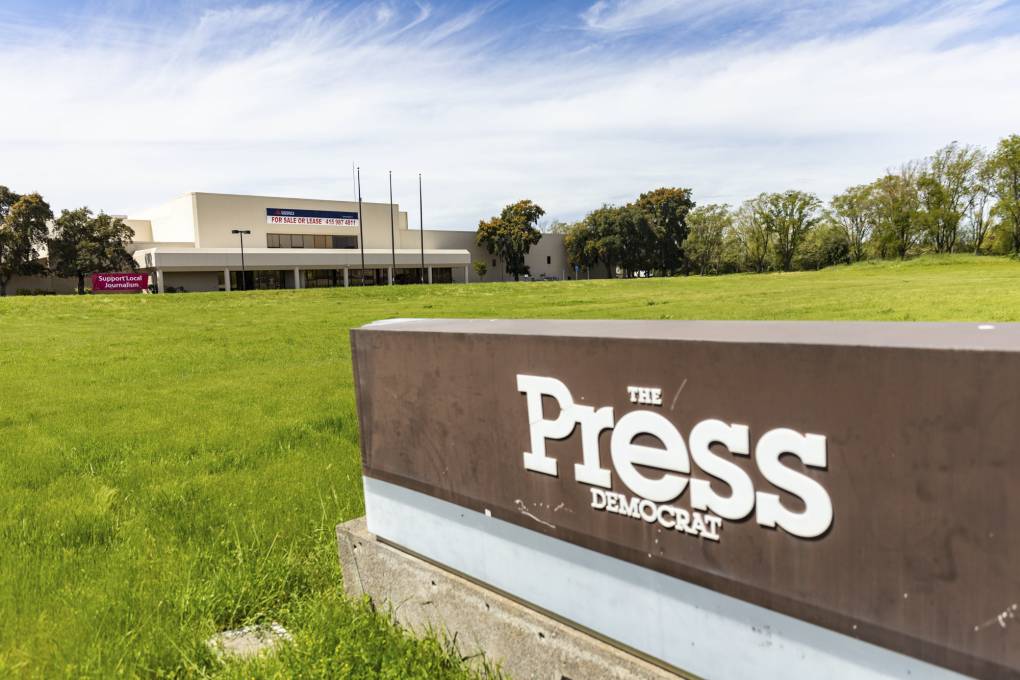
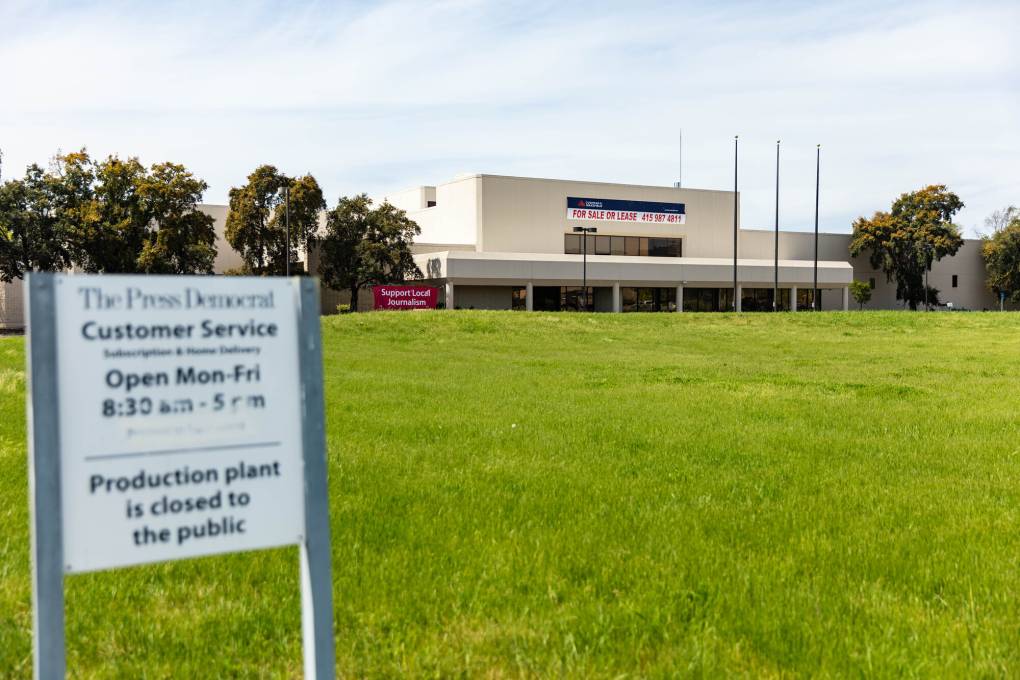
window.__IS_SSR__=true
window.__INITIAL_STATE__={
"attachmentsReducer": {
"audio_0": {
"type": "attachments",
"id": "audio_0",
"imgSizes": {
"kqedFullSize": {
"file": "https://ww2.kqed.org/news/wp-content/themes/KQED-unified/img/audio_bgs/background0.jpg"
}
}
},
"audio_1": {
"type": "attachments",
"id": "audio_1",
"imgSizes": {
"kqedFullSize": {
"file": "https://ww2.kqed.org/news/wp-content/themes/KQED-unified/img/audio_bgs/background1.jpg"
}
}
},
"audio_2": {
"type": "attachments",
"id": "audio_2",
"imgSizes": {
"kqedFullSize": {
"file": "https://ww2.kqed.org/news/wp-content/themes/KQED-unified/img/audio_bgs/background2.jpg"
}
}
},
"audio_3": {
"type": "attachments",
"id": "audio_3",
"imgSizes": {
"kqedFullSize": {
"file": "https://ww2.kqed.org/news/wp-content/themes/KQED-unified/img/audio_bgs/background3.jpg"
}
}
},
"audio_4": {
"type": "attachments",
"id": "audio_4",
"imgSizes": {
"kqedFullSize": {
"file": "https://ww2.kqed.org/news/wp-content/themes/KQED-unified/img/audio_bgs/background4.jpg"
}
}
},
"placeholder": {
"type": "attachments",
"id": "placeholder",
"imgSizes": {
"thumbnail": {
"file": "https://cdn.kqed.org/wp-content/uploads/2024/12/KQED-Default-Image-816638274-2000x1333-1-160x107.jpg",
"width": 160,
"height": 107,
"mimeType": "image/jpeg"
},
"medium": {
"file": "https://cdn.kqed.org/wp-content/uploads/2024/12/KQED-Default-Image-816638274-2000x1333-1-800x533.jpg",
"width": 800,
"height": 533,
"mimeType": "image/jpeg"
},
"medium_large": {
"file": "https://cdn.kqed.org/wp-content/uploads/2024/12/KQED-Default-Image-816638274-2000x1333-1-768x512.jpg",
"width": 768,
"height": 512,
"mimeType": "image/jpeg"
},
"large": {
"file": "https://cdn.kqed.org/wp-content/uploads/2024/12/KQED-Default-Image-816638274-2000x1333-1-1020x680.jpg",
"width": 1020,
"height": 680,
"mimeType": "image/jpeg"
},
"1536x1536": {
"file": "https://cdn.kqed.org/wp-content/uploads/2024/12/KQED-Default-Image-816638274-2000x1333-1-1536x1024.jpg",
"width": 1536,
"height": 1024,
"mimeType": "image/jpeg"
},
"fd-lrg": {
"file": "https://cdn.kqed.org/wp-content/uploads/2024/12/KQED-Default-Image-816638274-2000x1333-1-1536x1024.jpg",
"width": 1536,
"height": 1024,
"mimeType": "image/jpeg"
},
"fd-med": {
"file": "https://cdn.kqed.org/wp-content/uploads/2024/12/KQED-Default-Image-816638274-2000x1333-1-1020x680.jpg",
"width": 1020,
"height": 680,
"mimeType": "image/jpeg"
},
"fd-sm": {
"file": "https://cdn.kqed.org/wp-content/uploads/2024/12/KQED-Default-Image-816638274-2000x1333-1-800x533.jpg",
"width": 800,
"height": 533,
"mimeType": "image/jpeg"
},
"post-thumbnail": {
"file": "https://cdn.kqed.org/wp-content/uploads/2024/12/KQED-Default-Image-816638274-2000x1333-1-672x372.jpg",
"width": 672,
"height": 372,
"mimeType": "image/jpeg"
},
"twentyfourteen-full-width": {
"file": "https://cdn.kqed.org/wp-content/uploads/2024/12/KQED-Default-Image-816638274-2000x1333-1-1038x576.jpg",
"width": 1038,
"height": 576,
"mimeType": "image/jpeg"
},
"xxsmall": {
"file": "https://cdn.kqed.org/wp-content/uploads/2024/12/KQED-Default-Image-816638274-2000x1333-1-160x107.jpg",
"width": 160,
"height": 107,
"mimeType": "image/jpeg"
},
"xsmall": {
"file": "https://cdn.kqed.org/wp-content/uploads/2024/12/KQED-Default-Image-816638274-2000x1333-1-672x372.jpg",
"width": 672,
"height": 372,
"mimeType": "image/jpeg"
},
"small": {
"file": "https://cdn.kqed.org/wp-content/uploads/2024/12/KQED-Default-Image-816638274-2000x1333-1-672x372.jpg",
"width": 672,
"height": 372,
"mimeType": "image/jpeg"
},
"xlarge": {
"file": "https://cdn.kqed.org/wp-content/uploads/2024/12/KQED-Default-Image-816638274-2000x1333-1-1020x680.jpg",
"width": 1020,
"height": 680,
"mimeType": "image/jpeg"
},
"full-width": {
"file": "https://cdn.kqed.org/wp-content/uploads/2024/12/KQED-Default-Image-816638274-2000x1333-1-1920x1280.jpg",
"width": 1920,
"height": 1280,
"mimeType": "image/jpeg"
},
"guest-author-32": {
"file": "https://cdn.kqed.org/wp-content/uploads/2025/01/KQED-Default-Image-816638274-1333x1333-1-160x160.jpg",
"width": 32,
"height": 32,
"mimeType": "image/jpeg"
},
"guest-author-50": {
"file": "https://cdn.kqed.org/wp-content/uploads/2025/01/KQED-Default-Image-816638274-1333x1333-1-160x160.jpg",
"width": 50,
"height": 50,
"mimeType": "image/jpeg"
},
"guest-author-64": {
"file": "https://cdn.kqed.org/wp-content/uploads/2025/01/KQED-Default-Image-816638274-1333x1333-1-160x160.jpg",
"width": 64,
"height": 64,
"mimeType": "image/jpeg"
},
"guest-author-96": {
"file": "https://cdn.kqed.org/wp-content/uploads/2025/01/KQED-Default-Image-816638274-1333x1333-1-160x160.jpg",
"width": 96,
"height": 96,
"mimeType": "image/jpeg"
},
"guest-author-128": {
"file": "https://cdn.kqed.org/wp-content/uploads/2025/01/KQED-Default-Image-816638274-1333x1333-1-160x160.jpg",
"width": 128,
"height": 128,
"mimeType": "image/jpeg"
},
"detail": {
"file": "https://cdn.kqed.org/wp-content/uploads/2025/01/KQED-Default-Image-816638274-1333x1333-1-160x160.jpg",
"width": 160,
"height": 160,
"mimeType": "image/jpeg"
},
"kqedFullSize": {
"file": "https://cdn.kqed.org/wp-content/uploads/2024/12/KQED-Default-Image-816638274-2000x1333-1.jpg",
"width": 2000,
"height": 1333
}
}
},
"news_12076745": {
"type": "attachments",
"id": "news_12076745",
"meta": {
"index": "attachments_1716263798",
"site": "news",
"id": "12076745",
"found": true
},
"title": "The CBS Bay Area television studio in San Francisco on March 17, 2026.",
"publishDate": 1773771883,
"status": "inherit",
"parent": 0,
"modified": 1773771903,
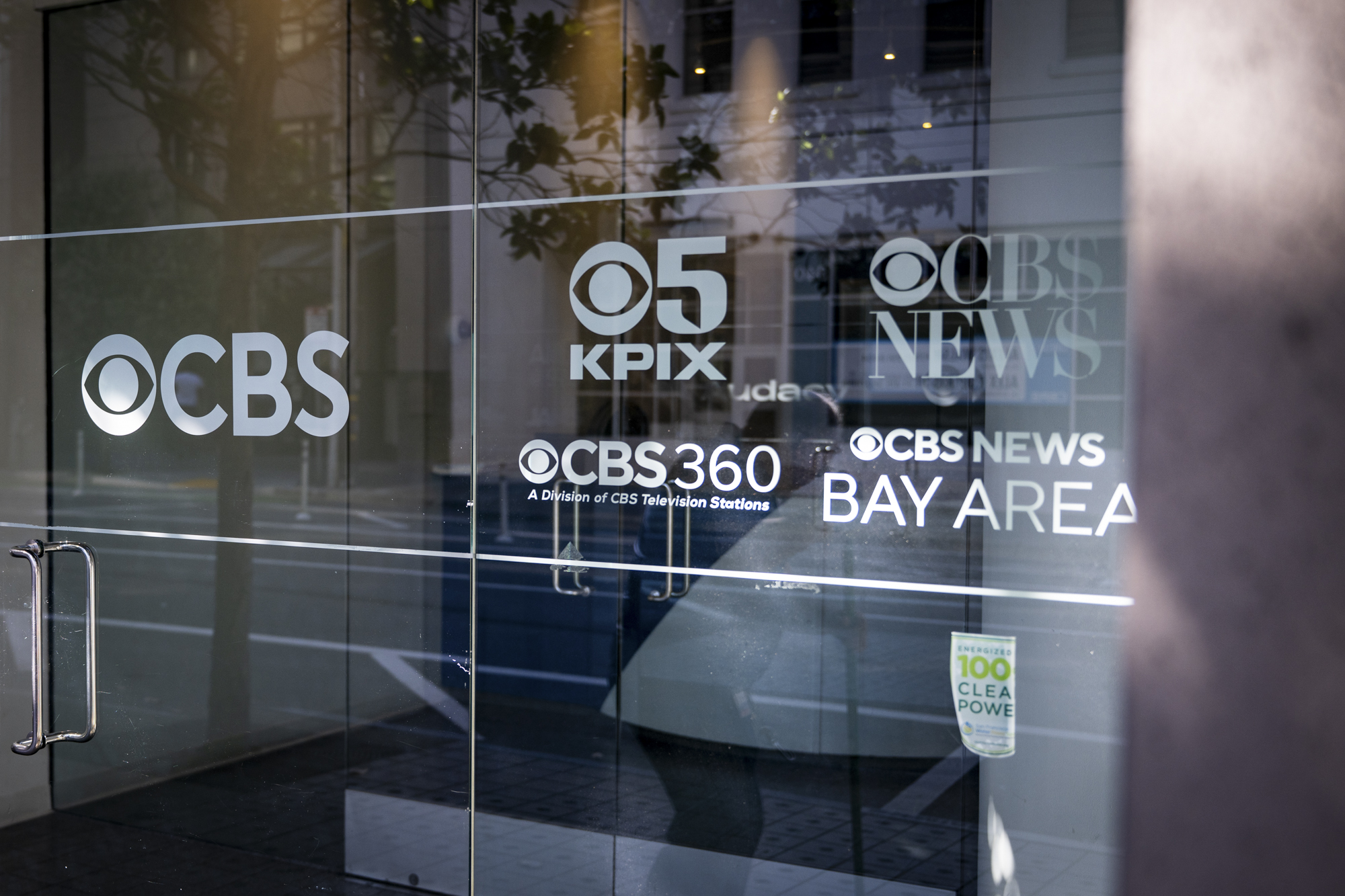
"caption": "The CBS Bay Area television studio in San Francisco on March 17, 2026. Union representatives said CBS’s owner, Paramount, spent billions to acquire Warner Bros. Discovery, “but still hasn’t guaranteed fair wages and basic job protections for the workers who make their streaming news operation run.” ",
"credit": "Beth LaBerge/KQED",
"altTag": null,
"description": null,
"imgSizes": {
"thumbnail": {
"file": "https://cdn.kqed.org/wp-content/uploads/sites/10/2026/03/260317-CBSSTRIKE-01-BL-KQED-160x107.jpg",
"width": 160,
"height": 107,
"mimeType": "image/jpeg"
},
"1536x1536": {
"file": "https://cdn.kqed.org/wp-content/uploads/sites/10/2026/03/260317-CBSSTRIKE-01-BL-KQED-1536x1024.jpg",
"width": 1536,
"height": 1024,
"mimeType": "image/jpeg"
},
"post-thumbnail": {
"file": "https://cdn.kqed.org/wp-content/uploads/sites/10/2026/03/260317-CBSSTRIKE-01-BL-KQED-672x372.jpg",
"width": 672,
"height": 372,
"mimeType": "image/jpeg"
},
"twentyfourteen-full-width": {
"file": "https://cdn.kqed.org/wp-content/uploads/sites/10/2026/03/260317-CBSSTRIKE-01-BL-KQED-1038x576.jpg",
"width": 1038,
"height": 576,
"mimeType": "image/jpeg"
},
"npr-cds-wide": {
"file": "https://cdn.kqed.org/wp-content/uploads/sites/10/2026/03/260317-CBSSTRIKE-01-BL-KQED-1200x675.jpg",
"width": 1200,
"height": 675,
"mimeType": "image/jpeg"
},
"kqedFullSize": {
"file": "https://cdn.kqed.org/wp-content/uploads/sites/10/2026/03/260317-CBSSTRIKE-01-BL-KQED.jpg",
"width": 2000,
"height": 1333
}
},
"fetchFailed": false,
"isLoading": false
},
"news_12068750": {
"type": "attachments",
"id": "news_12068750",
"meta": {
"index": "attachments_1716263798",
"site": "news",
"id": "12068750",
"found": true
},
"title": null,
"publishDate": 1767720770,
"status": "inherit",
"parent": 12068745,
"modified": 1767720791,
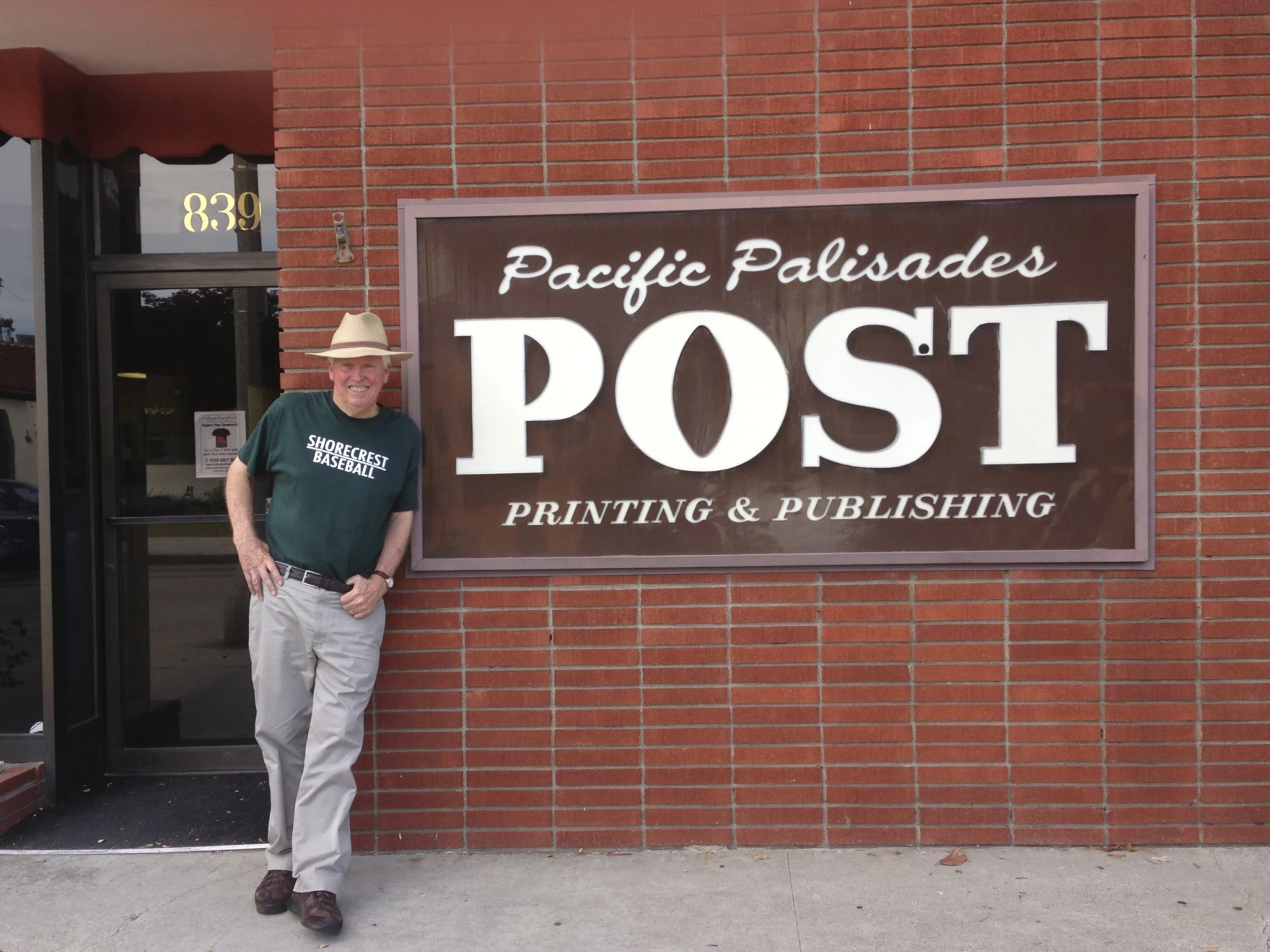
"caption": "Former Pali-Post editor Bill Bruns stands in front of the old \"Pacific Palisades Post\" building on Via de la Paz. The building held the newsroom as well as the paper's printing press.\n",
"credit": "Bill Bruns/LAist",
"altTag": null,
"description": null,
"imgSizes": {
"thumbnail": {
"file": "https://cdn.kqed.org/wp-content/uploads/sites/10/2026/01/PPftimahge-160x120.jpeg",
"width": 160,
"height": 120,
"mimeType": "image/jpeg"
},
"1536x1536": {
"file": "https://cdn.kqed.org/wp-content/uploads/sites/10/2026/01/PPftimahge-1536x1152.jpeg",
"width": 1536,
"height": 1152,
"mimeType": "image/jpeg"
},
"post-thumbnail": {
"file": "https://cdn.kqed.org/wp-content/uploads/sites/10/2026/01/PPftimahge-672x372.jpeg",
"width": 672,
"height": 372,
"mimeType": "image/jpeg"
},
"twentyfourteen-full-width": {
"file": "https://cdn.kqed.org/wp-content/uploads/sites/10/2026/01/PPftimahge-1038x576.jpeg",
"width": 1038,
"height": 576,
"mimeType": "image/jpeg"
},
"npr-cds-wide": {
"file": "https://cdn.kqed.org/wp-content/uploads/sites/10/2026/01/PPftimahge-1200x675.jpeg",
"width": 1200,
"height": 675,
"mimeType": "image/jpeg"
},
"kqedFullSize": {
"file": "https://cdn.kqed.org/wp-content/uploads/sites/10/2026/01/PPftimahge.jpeg",
"width": 1760,
"height": 1320
}
},
"fetchFailed": false,
"isLoading": false
},
"news_11987511": {
"type": "attachments",
"id": "news_11987511",
"meta": {
"index": "attachments_1716263798",
"site": "news",
"id": "11987511",
"found": true
},
"title": "240522-KQEDheadquarters-10-BL_qut",
"publishDate": 1716487818,
"status": "inherit",
"parent": 11987509,
"modified": 1716487863,
"caption": "A KQED sign in the lobby of the organization's headquarters in San Francisco.",
"credit": "Beth LaBerge/KQED",
"altTag": null,
"description": null,
"imgSizes": {
"medium": {
"file": "https://cdn.kqed.org/wp-content/uploads/sites/10/2024/05/240522-KQEDheadquarters-10-BL_qut-800x533.jpg",
"width": 800,
"height": 533,
"mimeType": "image/jpeg"
},
"large": {
"file": "https://cdn.kqed.org/wp-content/uploads/sites/10/2024/05/240522-KQEDheadquarters-10-BL_qut-1020x680.jpg",
"width": 1020,
"height": 680,
"mimeType": "image/jpeg"
},
"thumbnail": {
"file": "https://cdn.kqed.org/wp-content/uploads/sites/10/2024/05/240522-KQEDheadquarters-10-BL_qut-160x107.jpg",
"width": 160,
"height": 107,
"mimeType": "image/jpeg"
},
"1536x1536": {
"file": "https://cdn.kqed.org/wp-content/uploads/sites/10/2024/05/240522-KQEDheadquarters-10-BL_qut-1536x1024.jpg",
"width": 1536,
"height": 1024,
"mimeType": "image/jpeg"
},
"post-thumbnail": {
"file": "https://cdn.kqed.org/wp-content/uploads/sites/10/2024/05/240522-KQEDheadquarters-10-BL_qut-672x372.jpg",
"width": 672,
"height": 372,
"mimeType": "image/jpeg"
},
"twentyfourteen-full-width": {
"file": "https://cdn.kqed.org/wp-content/uploads/sites/10/2024/05/240522-KQEDheadquarters-10-BL_qut-1038x576.jpg",
"width": 1038,
"height": 576,
"mimeType": "image/jpeg"
},
"kqedFullSize": {
"file": "https://cdn.kqed.org/wp-content/uploads/sites/10/2024/05/240522-KQEDheadquarters-10-BL_qut.jpg",
"width": 1920,
"height": 1280
}
},
"fetchFailed": false,
"isLoading": false
},
"news_12048133": {
"type": "attachments",
"id": "news_12048133",
"meta": {
"index": "attachments_1716263798",
"site": "news",
"id": "12048133",
"found": true
},
"title": "240522-KQEDheadquarters-12-BL_qed",
"publishDate": 1752605240,
"status": "inherit",
"parent": 12048122,
"modified": 1752605252,
"caption": "A KQED sign in the entrance way to the organization's headquarters in San Francisco on May 22, 2024.",
"credit": "Beth LaBerge/KQED",
"altTag": null,
"description": null,
"imgSizes": {
"thumbnail": {
"file": "https://cdn.kqed.org/wp-content/uploads/sites/10/2025/07/240522-KQEDheadquarters-12-BL_qed-160x107.jpg",
"width": 160,
"height": 107,
"mimeType": "image/jpeg"
},
"1536x1536": {
"file": "https://cdn.kqed.org/wp-content/uploads/sites/10/2025/07/240522-KQEDheadquarters-12-BL_qed-1536x1024.jpg",
"width": 1536,
"height": 1024,
"mimeType": "image/jpeg"
},
"post-thumbnail": {
"file": "https://cdn.kqed.org/wp-content/uploads/sites/10/2025/07/240522-KQEDheadquarters-12-BL_qed-672x372.jpg",
"width": 672,
"height": 372,
"mimeType": "image/jpeg"
},
"twentyfourteen-full-width": {
"file": "https://cdn.kqed.org/wp-content/uploads/sites/10/2025/07/240522-KQEDheadquarters-12-BL_qed-1038x576.jpg",
"width": 1038,
"height": 576,
"mimeType": "image/jpeg"
},
"kqedFullSize": {
"file": "https://cdn.kqed.org/wp-content/uploads/sites/10/2025/07/240522-KQEDheadquarters-12-BL_qed.jpg",
"width": 1999,
"height": 1333
}
},
"fetchFailed": false,
"isLoading": false
},
"news_12043749": {
"type": "attachments",
"id": "news_12043749",
"meta": {
"index": "attachments_1716263798",
"site": "news",
"id": "12043749",
"found": true
},
"title": "LAProtestCM1",
"publishDate": 1749660653,
"status": "inherit",
"parent": 12043745,
"modified": 1749660679,
"caption": "Members of the press take cover as police officers clear the area outside of a federal building as protests continue in Los Angeles on June 9, 2025.",
"credit": "David McNew/Getty Images",
"altTag": null,
"description": null,
"imgSizes": {
"thumbnail": {
"file": "https://cdn.kqed.org/wp-content/uploads/sites/10/2025/06/LAProtestCM1-160x107.jpg",
"width": 160,
"height": 107,
"mimeType": "image/jpeg"
},
"1536x1536": {
"file": "https://cdn.kqed.org/wp-content/uploads/sites/10/2025/06/LAProtestCM1-1536x1025.jpg",
"width": 1536,
"height": 1025,
"mimeType": "image/jpeg"
},
"post-thumbnail": {
"file": "https://cdn.kqed.org/wp-content/uploads/sites/10/2025/06/LAProtestCM1-672x372.jpg",
"width": 672,
"height": 372,
"mimeType": "image/jpeg"
},
"twentyfourteen-full-width": {
"file": "https://cdn.kqed.org/wp-content/uploads/sites/10/2025/06/LAProtestCM1-1038x576.jpg",
"width": 1038,
"height": 576,
"mimeType": "image/jpeg"
},
"kqedFullSize": {
"file": "https://cdn.kqed.org/wp-content/uploads/sites/10/2025/06/LAProtestCM1.jpg",
"width": 1999,
"height": 1334
}
},
"fetchFailed": false,
"isLoading": false
},
"news_12035731": {
"type": "attachments",
"id": "news_12035731",
"meta": {
"index": "attachments_1716263798",
"site": "news",
"id": "12035731",
"found": true
},
"title": "20240411_PRESSDEMOCRATFILE_GC-3-KQED",
"publishDate": 1744406823,
"status": "inherit",
"parent": 0,
"modified": 1744406883,
"caption": "The Press Democrat’s former printing facility in Rohnert Park on April 11, 2025.",
"credit": "Gina Castro/KQED",
"altTag": null,
"description": null,
"imgSizes": {
"medium": {
"file": "https://cdn.kqed.org/wp-content/uploads/sites/10/2025/04/20240411_PRESSDEMOCRATFILE_GC-3-KQED-800x533.jpg",
"width": 800,
"height": 533,
"mimeType": "image/jpeg"
},
"large": {
"file": "https://cdn.kqed.org/wp-content/uploads/sites/10/2025/04/20240411_PRESSDEMOCRATFILE_GC-3-KQED-1020x680.jpg",
"width": 1020,
"height": 680,
"mimeType": "image/jpeg"
},
"thumbnail": {
"file": "https://cdn.kqed.org/wp-content/uploads/sites/10/2025/04/20240411_PRESSDEMOCRATFILE_GC-3-KQED-160x107.jpg",
"width": 160,
"height": 107,
"mimeType": "image/jpeg"
},
"1536x1536": {
"file": "https://cdn.kqed.org/wp-content/uploads/sites/10/2025/04/20240411_PRESSDEMOCRATFILE_GC-3-KQED-1536x1024.jpg",
"width": 1536,
"height": 1024,
"mimeType": "image/jpeg"
},
"post-thumbnail": {
"file": "https://cdn.kqed.org/wp-content/uploads/sites/10/2025/04/20240411_PRESSDEMOCRATFILE_GC-3-KQED-672x372.jpg",
"width": 672,
"height": 372,
"mimeType": "image/jpeg"
},
"twentyfourteen-full-width": {
"file": "https://cdn.kqed.org/wp-content/uploads/sites/10/2025/04/20240411_PRESSDEMOCRATFILE_GC-3-KQED-1038x576.jpg",
"width": 1038,
"height": 576,
"mimeType": "image/jpeg"
},
"full-width": {
"file": "https://cdn.kqed.org/wp-content/uploads/sites/10/2025/04/20240411_PRESSDEMOCRATFILE_GC-3-KQED-1920x1280.jpg",
"width": 1920,
"height": 1280,
"mimeType": "image/jpeg"
},
"kqedFullSize": {
"file": "https://cdn.kqed.org/wp-content/uploads/sites/10/2025/04/20240411_PRESSDEMOCRATFILE_GC-3-KQED.jpg",
"width": 2000,
"height": 1333
}
},
"fetchFailed": false,
"isLoading": false
},
"news_12038622": {
"type": "attachments",
"id": "news_12038622",
"meta": {
"index": "attachments_1716263798",
"site": "news",
"id": "12038622",
"found": true
},
"title": "20240411_PressDemocratFile_GC-4_qed",
"publishDate": 1746224391,
"status": "inherit",
"parent": 12038583,
"modified": 1746224407,
"caption": "The Press Democrat’s former printing facility in Rohnert Park on April 11, 2025.",
"credit": "Gina Castro/KQED",
"altTag": null,
"description": null,
"imgSizes": {
"medium": {
"file": "https://cdn.kqed.org/wp-content/uploads/sites/10/2025/05/20240411_PressDemocratFile_GC-4_qed-800x533.jpg",
"width": 800,
"height": 533,
"mimeType": "image/jpeg"
},
"large": {
"file": "https://cdn.kqed.org/wp-content/uploads/sites/10/2025/05/20240411_PressDemocratFile_GC-4_qed-1020x680.jpg",
"width": 1020,
"height": 680,
"mimeType": "image/jpeg"
},
"thumbnail": {
"file": "https://cdn.kqed.org/wp-content/uploads/sites/10/2025/05/20240411_PressDemocratFile_GC-4_qed-160x107.jpg",
"width": 160,
"height": 107,
"mimeType": "image/jpeg"
},
"1536x1536": {
"file": "https://cdn.kqed.org/wp-content/uploads/sites/10/2025/05/20240411_PressDemocratFile_GC-4_qed-1536x1024.jpg",
"width": 1536,
"height": 1024,
"mimeType": "image/jpeg"
},
"post-thumbnail": {
"file": "https://cdn.kqed.org/wp-content/uploads/sites/10/2025/05/20240411_PressDemocratFile_GC-4_qed-672x372.jpg",
"width": 672,
"height": 372,
"mimeType": "image/jpeg"
},
"twentyfourteen-full-width": {
"file": "https://cdn.kqed.org/wp-content/uploads/sites/10/2025/05/20240411_PressDemocratFile_GC-4_qed-1038x576.jpg",
"width": 1038,
"height": 576,
"mimeType": "image/jpeg"
},
"full-width": {
"file": "https://cdn.kqed.org/wp-content/uploads/sites/10/2025/05/20240411_PressDemocratFile_GC-4_qed-1920x1280.jpg",
"width": 1920,
"height": 1280,
"mimeType": "image/jpeg"
},
"kqedFullSize": {
"file": "https://cdn.kqed.org/wp-content/uploads/sites/10/2025/05/20240411_PressDemocratFile_GC-4_qed.jpg",
"width": 2000,
"height": 1333
}
},
"fetchFailed": false,
"isLoading": false
}
},
"audioPlayerReducer": {
"postId": "stream_live",
"isPaused": true,
"isPlaying": false,
"pfsActive": false,
"pledgeModalIsOpen": true,
"playerDrawerIsOpen": false
},
"authorsReducer": {
"byline_news_12068745": {
"type": "authors",
"id": "byline_news_12068745",
"meta": {
"override": true
},
"slug": "byline_news_12068745",
"name": "Dañiel Andres Martinez, LAist",
"isLoading": false
},
"byline_news_12043745": {
"type": "authors",
"id": "byline_news_12043745",
"meta": {
"override": true
},
"slug": "byline_news_12043745",
"name": "John D'Anna, CalMatters",
"isLoading": false
},
"gmeline": {
"type": "authors",
"id": "185",
"meta": {
"index": "authors_1716337520",
"id": "185",
"found": true
},
"name": "Gabe Meline",
"firstName": "Gabe",
"lastName": "Meline",
"slug": "gmeline",
"email": "gmeline@kqed.org",
"display_author_email": true,
"staff_mastheads": [
"arts"
],
"title": "Senior Editor, KQED Arts & Culture",
"bio": "Gabe Meline entered journalism at age 15 making photocopied zines, and has since earned awards from the Edward R. Murrow Awards, the Society for Professional Journalists, the Online Journalism Awards, the Association of Alternative Newsweeklies and the California Newspaper Publishers Association. Prior to KQED, he was the editor of the \u003cem>North Bay Bohemian\u003c/em> and a touring musician. He lives with his wife and daughter in his hometown of Santa Rosa, CA.",
"avatar": "https://secure.gravatar.com/avatar/80e9715844c5fc3f07edac5b08973b76?s=600&d=blank&r=g",
"twitter": null,
"facebook": null,
"instagram": null,
"linkedin": null,
"sites": [
{
"site": "",
"roles": [
"editor"
]
},
{
"site": "arts",
"roles": [
"administrator"
]
},
{
"site": "artschool",
"roles": [
"editor"
]
},
{
"site": "news",
"roles": [
"author"
]
},
{
"site": "pop",
"roles": [
"editor"
]
},
{
"site": "bayareabites",
"roles": [
"editor"
]
},
{
"site": "food",
"roles": [
"editor"
]
},
{
"site": "liveblog",
"roles": [
"editor"
]
},
{
"site": "hiphop",
"roles": [
"editor"
]
}
],
"headData": {
"title": "Gabe Meline | KQED",
"description": "Senior Editor, KQED Arts & Culture",
"ogImgSrc": "https://secure.gravatar.com/avatar/80e9715844c5fc3f07edac5b08973b76?s=600&d=blank&r=g",
"twImgSrc": "https://secure.gravatar.com/avatar/80e9715844c5fc3f07edac5b08973b76?s=600&d=blank&r=g"
},
"isLoading": false,
"link": "/author/gmeline"
},
"ecruzguevarra": {
"type": "authors",
"id": "8654",
"meta": {
"index": "authors_1716337520",
"id": "8654",
"found": true
},
"name": "Ericka Cruz Guevarra",
"firstName": "Ericka",
"lastName": "Cruz Guevarra",
"slug": "ecruzguevarra",
"email": "ecruzguevarra@kqed.org",
"display_author_email": true,
"staff_mastheads": [
"news"
],
"title": "Producer, The Bay Podcast",
"bio": "Ericka Cruz Guevarra is host of \u003ca href=\"https://www.kqed.org/podcasts/thebay\">\u003cem>The Bay\u003c/em>\u003c/a> podcast at KQED. Before host, she was the show’s producer. Her work in that capacity includes a three-part reported series on policing in Vallejo, which won a 2020 excellence in journalism award from the Society of Professional Journalists. Ericka has worked as a breaking news reporter at Oregon Public Broadcasting, helped produce the Code Switch podcast, and was KQED’s inaugural Raul Ramirez Diversity Fund intern. She’s also an alumna of NPR’s Next Generation Radio program. Send her an email if you have strong feelings about whether Fairfield and Suisun City are the Bay. Ericka is represented by SAG-AFTRA.",
"avatar": "https://secure.gravatar.com/avatar/25e5ab8d3d53fad2dcc7bb2b5c506b1a?s=600&d=blank&r=g",
"twitter": "NotoriousECG",
"facebook": null,
"instagram": null,
"linkedin": null,
"sites": [
{
"site": "arts",
"roles": [
"subscriber"
]
},
{
"site": "news",
"roles": [
"editor",
"manage_categories"
]
},
{
"site": "futureofyou",
"roles": [
"subscriber"
]
},
{
"site": "stateofhealth",
"roles": [
"subscriber"
]
},
{
"site": "science",
"roles": [
"editor"
]
},
{
"site": "forum",
"roles": [
"subscriber"
]
}
],
"headData": {
"title": "Ericka Cruz Guevarra | KQED",
"description": "Producer, The Bay Podcast",
"ogImgSrc": "https://secure.gravatar.com/avatar/25e5ab8d3d53fad2dcc7bb2b5c506b1a?s=600&d=blank&r=g",
"twImgSrc": "https://secure.gravatar.com/avatar/25e5ab8d3d53fad2dcc7bb2b5c506b1a?s=600&d=blank&r=g"
},
"isLoading": false,
"link": "/author/ecruzguevarra"
},
"vrancano": {
"type": "authors",
"id": "11276",
"meta": {
"index": "authors_1716337520",
"id": "11276",
"found": true
},
"name": "Vanessa Rancaño",
"firstName": "Vanessa",
"lastName": "Rancaño",
"slug": "vrancano",
"email": "vrancano@kqed.org",
"display_author_email": false,
"staff_mastheads": [
"news"
],
"title": "Reporter, Housing",
"bio": "Vanessa Rancaño reports on housing and homelessness for KQED. She’s also covered education for the station and reported from the Central Valley. Her work has aired across public radio, from flagship national news shows to longform narrative podcasts. Before taking up a mic, she worked as a freelance print journalist. She’s been recognized with a number of national and regional awards. Vanessa grew up in California's Central Valley. She's a former NPR Kroc Fellow, and a graduate of the UC Berkeley Graduate School of Journalism.",
"avatar": "https://secure.gravatar.com/avatar/f6c0fc5d391c78710bcfc723f0636ef6?s=600&d=blank&r=g",
"twitter": "vanessarancano",
"facebook": null,
"instagram": null,
"linkedin": null,
"sites": [
{
"site": "arts",
"roles": [
"editor"
]
},
{
"site": "news",
"roles": [
"editor"
]
}
],
"headData": {
"title": "Vanessa Rancaño | KQED",
"description": "Reporter, Housing",
"ogImgSrc": "https://secure.gravatar.com/avatar/f6c0fc5d391c78710bcfc723f0636ef6?s=600&d=blank&r=g",
"twImgSrc": "https://secure.gravatar.com/avatar/f6c0fc5d391c78710bcfc723f0636ef6?s=600&d=blank&r=g"
},
"isLoading": false,
"link": "/author/vrancano"
},
"amontecillo": {
"type": "authors",
"id": "11649",
"meta": {
"index": "authors_1716337520",
"id": "11649",
"found": true
},
"name": "Alan Montecillo",
"firstName": "Alan",
"lastName": "Montecillo",
"slug": "amontecillo",
"email": "amontecillo@kqed.org",
"display_author_email": false,
"staff_mastheads": [
"news"
],
"title": "KQED Contributor",
"bio": "Alan Montecillo is the senior editor of \u003cem>\u003ca href=\"http://kqed.org/thebay\">The Bay\u003c/a>, \u003c/em> KQED's local news podcast. Before moving to the Bay Area, he worked as a senior talk show producer for WILL in Champaign-Urbana, Illinois and at Oregon Public Broadcasting in Portland, Oregon. He has won journalism awards from the Society of Professional Journalists Northern California, the Public Media Journalists Association, The Signal Awards, and has also received a regional Edward R. Murrow award. Alan is a Filipino American from Hong Kong and a graduate of Reed College.",
"avatar": "https://secure.gravatar.com/avatar/d5e4e7a76481969ccba76f4e2b5ccabc?s=600&d=blank&r=g",
"twitter": "alanmontecillo",
"facebook": null,
"instagram": null,
"linkedin": null,
"sites": [
{
"site": "",
"roles": [
"editor"
]
},
{
"site": "news",
"roles": [
"editor",
"manage_categories"
]
}
],
"headData": {
"title": "Alan Montecillo | KQED",
"description": "KQED Contributor",
"ogImgSrc": "https://secure.gravatar.com/avatar/d5e4e7a76481969ccba76f4e2b5ccabc?s=600&d=blank&r=g",
"twImgSrc": "https://secure.gravatar.com/avatar/d5e4e7a76481969ccba76f4e2b5ccabc?s=600&d=blank&r=g"
},
"isLoading": false,
"link": "/author/amontecillo"
},
"ebaldassari": {
"type": "authors",
"id": "11652",
"meta": {
"index": "authors_1716337520",
"id": "11652",
"found": true
},
"name": "Erin Baldassari",
"firstName": "Erin",
"lastName": "Baldassari",
"slug": "ebaldassari",
"email": "ebaldassari@KQED.org",
"display_author_email": true,
"staff_mastheads": [
"news"
],
"title": "Staff Writer",
"bio": "Erin Baldassari covers housing for KQED. She's a former print journalist and most recently worked as the transportation reporter for the \u003cem>Mercury News\u003c/em> and \u003cem>East Bay Times. \u003c/em>There, she focused on how the Bay Area’s housing shortage has changed the way people move around the region. She also served on the \u003cem>East Bay Times\u003c/em>’ 2017 Pulitzer Prize-winning team for coverage of the Ghost Ship Fire in Oakland. Prior to that, Erin worked as a breaking news and general assignment reporter for a variety of outlets in the Bay Area and the greater Boston area. A Tufts University alumna, Erin grew up in the foothills of the Sierra Nevada mountains and in Sonoma County. She is a life-long KQED listener.",
"avatar": "https://secure.gravatar.com/avatar/660ce35d088ca54ad606d7e941abc652?s=600&d=mm&r=g",
"twitter": "e_baldi",
"facebook": null,
"instagram": null,
"linkedin": null,
"sites": [
{
"site": "news",
"roles": [
"edit_others_posts",
"editor"
]
},
{
"site": "science",
"roles": [
"editor"
]
},
{
"site": "liveblog",
"roles": [
"editor"
]
}
],
"headData": {
"title": "Erin Baldassari | KQED",
"description": "Staff Writer",
"ogImgSrc": "https://secure.gravatar.com/avatar/660ce35d088ca54ad606d7e941abc652?s=600&d=mm&r=g",
"twImgSrc": "https://secure.gravatar.com/avatar/660ce35d088ca54ad606d7e941abc652?s=600&d=mm&r=g"
},
"isLoading": false,
"link": "/author/ebaldassari"
},
"abandlamudi": {
"type": "authors",
"id": "11672",
"meta": {
"index": "authors_1716337520",
"id": "11672",
"found": true
},
"name": "Adhiti Bandlamudi",
"firstName": "Adhiti",
"lastName": "Bandlamudi",
"slug": "abandlamudi",
"email": "abandlamudi@kqed.org",
"display_author_email": false,
"staff_mastheads": [
"news"
],
"title": "KQED Housing Reporter",
"bio": "Adhiti Bandlamudi reports for KQED's Housing desk. She focuses on how housing gets built across the Bay Area. Before joining KQED in 2020, she reported for WUNC in Durham, North Carolina, WABE in Atlanta, Georgia and Capital Public Radio in Sacramento. In 2017, she was awarded a Kroc Fellowship at NPR where she reported on everything from sprinkles to the Golden State Killer's arrest. When she's not reporting, she's baking new recipes in her kitchen or watching movies with friends and family. She's originally from Georgia and has strong opinions about Great British Bake Off.",
"avatar": "https://secure.gravatar.com/avatar/868129c8b257bb99a3500e2c86a65400?s=600&d=mm&r=g",
"twitter": "oddity_adhiti",
"facebook": null,
"instagram": null,
"linkedin": null,
"sites": [
{
"site": "arts",
"roles": [
"author"
]
},
{
"site": "news",
"roles": [
"editor"
]
},
{
"site": "liveblog",
"roles": [
"author"
]
}
],
"headData": {
"title": "Adhiti Bandlamudi | KQED",
"description": "KQED Housing Reporter",
"ogImgSrc": "https://secure.gravatar.com/avatar/868129c8b257bb99a3500e2c86a65400?s=600&d=mm&r=g",
"twImgSrc": "https://secure.gravatar.com/avatar/868129c8b257bb99a3500e2c86a65400?s=600&d=mm&r=g"
},
"isLoading": false,
"link": "/author/abandlamudi"
},
"jessicakariisa": {
"type": "authors",
"id": "11831",
"meta": {
"index": "authors_1716337520",
"id": "11831",
"found": true
},
"name": "Jessica Kariisa",
"firstName": "Jessica",
"lastName": "Kariisa",
"slug": "jessicakariisa",
"email": "jkariisa@kqed.org",
"display_author_email": false,
"staff_mastheads": [
"news"
],
"title": "Producer, The Bay",
"bio": "Jessica Kariisa is the producer of The Bay. She first joined KQED as an intern for The California Report Magazine, after which she became an on-call producer. She reported a Bay Curious episode on the use of rap lyrics in criminal trials which won a Society of Professional Journalists award in 2023 for Excellence in Features Journalism and the 2023 Signal Award for Best Conversation Starter. She’s worked on podcasts for Snap Judgment and American Public Media. Before embarking on her audio career, she was a music journalist.\r\n\r\nJessica Kariisa is represented by SAG-AFTRA.",
"avatar": "https://secure.gravatar.com/avatar/4afd355fd24f5515aeab77fd6c72b671?s=600&d=blank&r=g",
"twitter": null,
"facebook": null,
"instagram": null,
"linkedin": null,
"sites": [
{
"site": "arts",
"roles": [
"author"
]
},
{
"site": "news",
"roles": [
"editor",
"manage_categories"
]
}
],
"headData": {
"title": "Jessica Kariisa | KQED",
"description": "Producer, The Bay",
"ogImgSrc": "https://secure.gravatar.com/avatar/4afd355fd24f5515aeab77fd6c72b671?s=600&d=blank&r=g",
"twImgSrc": "https://secure.gravatar.com/avatar/4afd355fd24f5515aeab77fd6c72b671?s=600&d=blank&r=g"
},
"isLoading": false,
"link": "/author/jessicakariisa"
},
"kdebenedetti": {
"type": "authors",
"id": "11913",
"meta": {
"index": "authors_1716337520",
"id": "11913",
"found": true
},
"name": "Katie DeBenedetti",
"firstName": "Katie",
"lastName": "DeBenedetti",
"slug": "kdebenedetti",
"email": "kdebenedetti@kqed.org",
"display_author_email": false,
"staff_mastheads": [
"news",
"science"
],
"title": "KQED Contributor",
"bio": "Katie DeBenedetti is a digital reporter covering daily news for the Express Desk. Prior to joining KQED as a culture reporting intern in January 2024, she covered education and city government for the Napa Valley Register.",
"avatar": "https://secure.gravatar.com/avatar/6e31073cb8f7e4214ab03f42771d0f45?s=600&d=blank&r=g",
"twitter": null,
"facebook": null,
"instagram": null,
"linkedin": null,
"sites": [
{
"site": "news",
"roles": [
"author"
]
},
{
"site": "science",
"roles": [
"author"
]
},
{
"site": "liveblog",
"roles": [
"author"
]
}
],
"headData": {
"title": "Katie DeBenedetti | KQED",
"description": "KQED Contributor",
"ogImgSrc": "https://secure.gravatar.com/avatar/6e31073cb8f7e4214ab03f42771d0f45?s=600&d=blank&r=g",
"twImgSrc": "https://secure.gravatar.com/avatar/6e31073cb8f7e4214ab03f42771d0f45?s=600&d=blank&r=g"
},
"isLoading": false,
"link": "/author/kdebenedetti"
},
"rcooke": {
"type": "authors",
"id": "11921",
"meta": {
"index": "authors_1716337520",
"id": "11921",
"found": true
},
"name": "Riley Cooke",
"firstName": "Riley",
"lastName": "Cooke",
"slug": "rcooke",
"email": "rcooke@kqed.org",
"display_author_email": true,
"staff_mastheads": [
"news"
],
"title": "KQED Contributor",
"bio": "Riley is a senior at UC Berkeley, where she studies political science and journalism. Her work has appeared in SFGate, NBC Bay Area, Local News Matters and more. She enjoys reporting on politics, housing and homelessness — and using as many em dashes as her editors will allow.",
"avatar": "https://secure.gravatar.com/avatar/792f98c126cc5e270a8a96f77f7224ea?s=600&d=blank&r=g",
"twitter": "rrileycooke",
"facebook": null,
"instagram": null,
"linkedin": null,
"sites": [
{
"site": "arts",
"roles": [
"author"
]
},
{
"site": "news",
"roles": [
"author"
]
}
],
"headData": {
"title": "Riley Cooke | KQED",
"description": "KQED Contributor",
"ogImgSrc": "https://secure.gravatar.com/avatar/792f98c126cc5e270a8a96f77f7224ea?s=600&d=blank&r=g",
"twImgSrc": "https://secure.gravatar.com/avatar/792f98c126cc5e270a8a96f77f7224ea?s=600&d=blank&r=g"
},
"isLoading": false,
"link": "/author/rcooke"
}
},
"breakingNewsReducer": {},
"pagesReducer": {},
"postsReducer": {
"stream_live": {
"type": "live",
"id": "stream_live",
"audioUrl": "https://streams.kqed.org/kqedradio",
"title": "Live Stream",
"excerpt": "Live Stream information currently unavailable.",
"link": "/radio",
"featImg": "",
"label": {
"name": "KQED Live",
"link": "/"
}
},
"stream_kqedNewscast": {
"type": "posts",
"id": "stream_kqedNewscast",
"audioUrl": "https://www.kqed.org/.stream/anon/radio/RDnews/newscast.mp3?_=1",
"title": "KQED Newscast",
"featImg": "",
"label": {
"name": "88.5 FM",
"link": "/"
}
},
"news_12076712": {
"type": "posts",
"id": "news_12076712",
"meta": {
"index": "posts_1716263798",
"site": "news",
"id": "12076712",
"score": null,
"sort": [
1773783460000
]
},
"guestAuthors": [],
"slug": "san-francisco-cbs-workers-hold-24-hour-walk-out-for-higher-pay-more-respect",
"title": "San Francisco CBS Workers Hold 24-Hour Walkout for Higher Pay, More ‘Respect’",
"publishDate": 1773783460,
"format": "standard",
"headTitle": "San Francisco CBS Workers Hold 24-Hour Walkout for Higher Pay, More ‘Respect’ | KQED",
"labelTerm": {
"site": "news"
},
"content": "\u003cp>CBS News employees in \u003ca href=\"https://www.kqed.org/news/tag/san-francisco\">San Francisco\u003c/a> joined dozens of colleagues in New York in a 24-hour walkout on Tuesday, after contract negotiations stalled last week.\u003c/p>\n\u003cp>Workers for streaming service CBS News 24/7, represented by the Writers Guild of America East, are demanding wage increases, “respect and a sustainable work-life balance.” The walkout comes amid rising tensions at the Paramount-owned broadcast company following its recent bid to acquire Warner Bros. Discovery, and the appointment of controversial political commentator Bari Weiss as CBS News’ editor-in-chief last fall.\u003c/p>\n\u003cp>“Paramount has billions to spend acquiring Warner Bros. Discovery, but still hasn’t guaranteed fair wages and basic job protections for the workers who make their streaming news operation run,” said Beth Godvik, WGAE’s Vice President of Broadcast/Cable/Streaming News. “Our members are walking out today to show management they stand united in their demand for a fair contract — and the WGAE is with them every step of the way.”\u003c/p>\n\u003cp>[ad fullwidth]\u003c/p>\n\u003cp>The union represents about 60 workers, including 10 in San Francisco.\u003c/p>\n\u003cp>During initial contract negotiations, which began last month, the company proposed a 1.5% raise for each of the next three years. Producer Justin Lape, a member of the union’s bargaining committee, likened that offer to a slap in the face, saying WGAE’s previous contract, which expired March 9, included 3% annual raises.\u003c/p>\n\u003cp>Through negotiations, CBS has come up to match the wage hikes in the former contract, he said, but the union has asked for higher.\u003c/p>\n\u003cfigure id=\"attachment_12076783\" class=\"wp-caption aligncenter\" style=\"max-width: 2000px\">\u003cimg loading=\"lazy\" decoding=\"async\" class=\"size-full wp-image-12076783\" src=\"https://cdn.kqed.org/wp-content/uploads/sites/10/2026/03/CBS-Walk-Out-KQED.jpg\" alt=\"\" width=\"2000\" height=\"1500\" srcset=\"https://cdn.kqed.org/wp-content/uploads/sites/10/2026/03/CBS-Walk-Out-KQED.jpg 2000w, https://cdn.kqed.org/wp-content/uploads/sites/10/2026/03/CBS-Walk-Out-KQED-160x120.jpg 160w, https://cdn.kqed.org/wp-content/uploads/sites/10/2026/03/CBS-Walk-Out-KQED-1536x1152.jpg 1536w\" sizes=\"auto, (max-width: 2000px) 100vw, 2000px\">\u003cfigcaption class=\"wp-caption-text\">Union representatives said CBS’s owner, Paramount, spent billions to acquire Warner Bros. Discovery, “but still hasn’t guaranteed fair wages and basic job protections for the workers who make their streaming news operation run.” \u003ccite>(Katie DeBenedetti/KQED)\u003c/cite>\u003c/figcaption>\u003c/figure>\n\u003cp>“We’re constantly doing stories that show the rising cost of living,” said Lape, who is a member of the union’s bargaining team. “Three percent a year just can’t match that. There has to be some other at least language within that contract to meet the needs of just traveling to work, coming back from work, the cost of food.\u003c/p>\n\u003cp>“It’s just meeting something that doesn’t pinch our pockets as much,” he continued.\u003c/p>\n\u003cp>A CBS spokesperson said the company was negotiating in good faith and hopes to “reach a fair resolution quickly.”\u003c/p>\n\u003cp>While Lape said the walkout was not “personal” and centered around pay issues, it comes as CBS undergoes major structural and leadership changes.[aside postID=news_12076608 hero='https://cdn.kqed.org/wp-content/uploads/sites/10/2026/03/Billboard-AI-Illustration_6.jpg']In August, CBS’s parent company, Paramount, was acquired by Skydance Media, owned by David Ellison and primarily funded by Larry Ellison, a longtime ally of President Donald Trump. In October, CBS announced that Weiss — a vocal critic of mainstream news who founded right-leaning online publication \u003cem>The Free Press, \u003c/em>known for its “anti-woke” perspectives — had been named editor in chief.\u003c/p>\n\u003cp>Since her takeover, CBS News has undergone \u003ca href=\"https://www.latimes.com/entertainment-arts/business/story/2025-10-29/paramount-1000-layoffs-skydance-david-ellison\">layoffs\u003c/a> and has seen \u003ca href=\"https://www.washingtonpost.com/business/2025/11/07/bari-weiss-cbs-news-remake/\">departures\u003c/a> of multiple high-profile journalists, as concerns rise about editorial interference within the company.\u003c/p>\n\u003cp>In July, just a week before the FCC approved Skydance’s $8 billion deal to purchase Paramount, CBS late-night host Stephen Colbert, who’s often criticized Trump, announced that his show had been canceled. In December, amid Paramount Skydance’s push to merge with Warner Bros. Discovery, CBS sparked more controversy after it pulled a \u003cem>60 Minutes \u003c/em>segment hours before it was supposed to air. The segment on the Terrorism Confinement Center, or CECOT, a prison in El Salvador where the Trump administration has deported hundreds of people, was apparently cut after Weiss expressed \u003ca href=\"https://www.nytimes.com/2025/12/21/business/60-minutes-trump-bari-weiss.html\">concerns\u003c/a> that the piece didn’t include an interview with a White House representative.\u003c/p>\n\u003cp>“Members are fighting to protect their livelihoods during a period of uncertainty in broadcast news,” WGAE said in a statement. “Layoffs, editorial interference and political pressure have all become existential threats following the Paramount Skydance merger, and those same concerns have escalated with a possible merger of Paramount Skydance and Warner Bros. Discovery.”\u003c/p>\n\u003cp>Lape said he was confident that the union and company would be able to come to a deal.\u003c/p>\n\u003cp>“We’re trying to meet them in the middle. I think we’re slowly getting there,” he told KQED. “We love what we do. Especially with as much as is constantly happening and changing in the world with breaking news, there’s a lot of pressure on that. We just want to reach a fair contract for both sides.”\u003c/p>\n\u003cp>\u003c/p>\n",
"blocks": [],
"excerpt": "Union representatives said CBS’s owner, Paramount, spent billions to acquire Warner Bros. Discovery, “but still hasn’t guaranteed fair wages and basic job protections for the workers who make their streaming news operation run.”",
"status": "publish",
"parent": 0,
"modified": 1773786900,
"stats": {
"hasAudio": false,
"hasVideo": false,
"hasChartOrMap": false,
"iframeSrcs": [],
"hasGoogleForm": false,
"hasGallery": false,
"hasHearkenModule": false,
"hasPolis": false,
"paragraphCount": 17,
"wordCount": 808
},
"headData": {
"title": "San Francisco CBS Workers Hold 24-Hour Walkout for Higher Pay, More ‘Respect’ | KQED",
"description": "Union representatives said CBS’s owner, Paramount, spent billions to acquire Warner Bros. Discovery, “but still hasn’t guaranteed fair wages and basic job protections for the workers who make their streaming news operation run.”",
"ogTitle": "",
"ogDescription": "",
"ogImgId": "",
"twTitle": "",
"twDescription": "",
"twImgId": "",
"schema": {
"@context": "https://schema.org",
"@type": "NewsArticle",
"headline": "San Francisco CBS Workers Hold 24-Hour Walkout for Higher Pay, More ‘Respect’",
"datePublished": "2026-03-17T14:37:40-07:00",
"dateModified": "2026-03-17T15:35:00-07:00",
"image": "https://cdn.kqed.org/wp-content/uploads/2020/02/KQED-OG-Image@1x.png",
"isAccessibleForFree": "True",
"publisher": {
"@type": "NewsMediaOrganization",
"@id": "https://www.kqed.org/#organization",
"name": "KQED",
"logo": "https://cdn.kqed.org/wp-content/uploads/2020/02/KQED-OG-Image@1x.png",
"url": "https://www.kqed.org",
"sameAs": [
"https://www.facebook.com/KQED",
"https://twitter.com/KQED",
"https://www.instagram.com/kqed/",
"https://www.tiktok.com/@kqedofficial",
"https://www.linkedin.com/company/kqed",
"https://www.youtube.com/channel/UCeC0IOo7i1P_61zVUWbJ4nw"
]
}
}
},
"primaryCategory": {
"termId": 34551,
"slug": "labor",
"name": "Labor"
},
"sticky": false,
"nprStoryId": "kqed-12076712",
"templateType": "standard",
"featuredImageType": "standard",
"excludeFromSiteSearch": "Include",
"articleAge": "0",
"path": "/news/12076712/san-francisco-cbs-workers-hold-24-hour-walk-out-for-higher-pay-more-respect",
"audioTrackLength": null,
"parsedContent": [
{
"type": "contentString",
"content": "\u003cdiv class=\"post-body\">\u003cp>\u003cp>CBS News employees in \u003ca href=\"https://www.kqed.org/news/tag/san-francisco\">San Francisco\u003c/a> joined dozens of colleagues in New York in a 24-hour walkout on Tuesday, after contract negotiations stalled last week.\u003c/p>\n\u003cp>Workers for streaming service CBS News 24/7, represented by the Writers Guild of America East, are demanding wage increases, “respect and a sustainable work-life balance.” The walkout comes amid rising tensions at the Paramount-owned broadcast company following its recent bid to acquire Warner Bros. Discovery, and the appointment of controversial political commentator Bari Weiss as CBS News’ editor-in-chief last fall.\u003c/p>\n\u003cp>“Paramount has billions to spend acquiring Warner Bros. Discovery, but still hasn’t guaranteed fair wages and basic job protections for the workers who make their streaming news operation run,” said Beth Godvik, WGAE’s Vice President of Broadcast/Cable/Streaming News. “Our members are walking out today to show management they stand united in their demand for a fair contract — and the WGAE is with them every step of the way.”\u003c/p>\n\u003cp>\u003c/p>\u003c/div>",
"attributes": {
"named": {},
"numeric": []
}
},
{
"type": "component",
"content": "",
"name": "ad",
"attributes": {
"named": {
"label": "fullwidth"
},
"numeric": [
"fullwidth"
]
}
},
{
"type": "contentString",
"content": "\u003cdiv class=\"post-body\">\u003cp>\u003c/p>\n\u003cp>The union represents about 60 workers, including 10 in San Francisco.\u003c/p>\n\u003cp>During initial contract negotiations, which began last month, the company proposed a 1.5% raise for each of the next three years. Producer Justin Lape, a member of the union’s bargaining committee, likened that offer to a slap in the face, saying WGAE’s previous contract, which expired March 9, included 3% annual raises.\u003c/p>\n\u003cp>Through negotiations, CBS has come up to match the wage hikes in the former contract, he said, but the union has asked for higher.\u003c/p>\n\u003cfigure id=\"attachment_12076783\" class=\"wp-caption aligncenter\" style=\"max-width: 2000px\">\u003cimg loading=\"lazy\" decoding=\"async\" class=\"size-full wp-image-12076783\" src=\"https://cdn.kqed.org/wp-content/uploads/sites/10/2026/03/CBS-Walk-Out-KQED.jpg\" alt=\"\" width=\"2000\" height=\"1500\" srcset=\"https://cdn.kqed.org/wp-content/uploads/sites/10/2026/03/CBS-Walk-Out-KQED.jpg 2000w, https://cdn.kqed.org/wp-content/uploads/sites/10/2026/03/CBS-Walk-Out-KQED-160x120.jpg 160w, https://cdn.kqed.org/wp-content/uploads/sites/10/2026/03/CBS-Walk-Out-KQED-1536x1152.jpg 1536w\" sizes=\"auto, (max-width: 2000px) 100vw, 2000px\">\u003cfigcaption class=\"wp-caption-text\">Union representatives said CBS’s owner, Paramount, spent billions to acquire Warner Bros. Discovery, “but still hasn’t guaranteed fair wages and basic job protections for the workers who make their streaming news operation run.” \u003ccite>(Katie DeBenedetti/KQED)\u003c/cite>\u003c/figcaption>\u003c/figure>\n\u003cp>“We’re constantly doing stories that show the rising cost of living,” said Lape, who is a member of the union’s bargaining team. “Three percent a year just can’t match that. There has to be some other at least language within that contract to meet the needs of just traveling to work, coming back from work, the cost of food.\u003c/p>\n\u003cp>“It’s just meeting something that doesn’t pinch our pockets as much,” he continued.\u003c/p>\n\u003cp>A CBS spokesperson said the company was negotiating in good faith and hopes to “reach a fair resolution quickly.”\u003c/p>\n\u003cp>While Lape said the walkout was not “personal” and centered around pay issues, it comes as CBS undergoes major structural and leadership changes.\u003c/p>\u003c/div>",
"attributes": {
"named": {},
"numeric": []
}
},
{
"type": "component",
"content": "",
"name": "aside",
"attributes": {
"named": {
"postid": "news_12076608",
"hero": "https://cdn.kqed.org/wp-content/uploads/sites/10/2026/03/Billboard-AI-Illustration_6.jpg",
"label": ""
},
"numeric": []
}
},
{
"type": "contentString",
"content": "\u003cdiv class=\"post-body\">\u003cp>In August, CBS’s parent company, Paramount, was acquired by Skydance Media, owned by David Ellison and primarily funded by Larry Ellison, a longtime ally of President Donald Trump. In October, CBS announced that Weiss — a vocal critic of mainstream news who founded right-leaning online publication \u003cem>The Free Press, \u003c/em>known for its “anti-woke” perspectives — had been named editor in chief.\u003c/p>\n\u003cp>Since her takeover, CBS News has undergone \u003ca href=\"https://www.latimes.com/entertainment-arts/business/story/2025-10-29/paramount-1000-layoffs-skydance-david-ellison\">layoffs\u003c/a> and has seen \u003ca href=\"https://www.washingtonpost.com/business/2025/11/07/bari-weiss-cbs-news-remake/\">departures\u003c/a> of multiple high-profile journalists, as concerns rise about editorial interference within the company.\u003c/p>\n\u003cp>In July, just a week before the FCC approved Skydance’s $8 billion deal to purchase Paramount, CBS late-night host Stephen Colbert, who’s often criticized Trump, announced that his show had been canceled. In December, amid Paramount Skydance’s push to merge with Warner Bros. Discovery, CBS sparked more controversy after it pulled a \u003cem>60 Minutes \u003c/em>segment hours before it was supposed to air. The segment on the Terrorism Confinement Center, or CECOT, a prison in El Salvador where the Trump administration has deported hundreds of people, was apparently cut after Weiss expressed \u003ca href=\"https://www.nytimes.com/2025/12/21/business/60-minutes-trump-bari-weiss.html\">concerns\u003c/a> that the piece didn’t include an interview with a White House representative.\u003c/p>\n\u003cp>“Members are fighting to protect their livelihoods during a period of uncertainty in broadcast news,” WGAE said in a statement. “Layoffs, editorial interference and political pressure have all become existential threats following the Paramount Skydance merger, and those same concerns have escalated with a possible merger of Paramount Skydance and Warner Bros. Discovery.”\u003c/p>\n\u003cp>Lape said he was confident that the union and company would be able to come to a deal.\u003c/p>\n\u003cp>“We’re trying to meet them in the middle. I think we’re slowly getting there,” he told KQED. “We love what we do. Especially with as much as is constantly happening and changing in the world with breaking news, there’s a lot of pressure on that. We just want to reach a fair contract for both sides.”\u003c/p>\n\u003cp>\u003c/p>\n\u003c/div>\u003c/p>",
"attributes": {
"named": {},
"numeric": []
}
}
],
"link": "/news/12076712/san-francisco-cbs-workers-hold-24-hour-walk-out-for-higher-pay-more-respect",
"authors": [
"11913"
],
"categories": [
"news_34551",
"news_28250",
"news_8",
"news_13"
],
"tags": [
"news_1386",
"news_32885",
"news_19904",
"news_24590",
"news_20482",
"news_205",
"news_17968",
"news_38"
],
"featImg": "news_12076745",
"label": "news"
},
"news_12068745": {
"type": "posts",
"id": "news_12068745",
"meta": {
"index": "posts_1716263798",
"site": "news",
"id": "12068745",
"score": null,
"sort": [
1767726034000
]
},
"guestAuthors": [],
"slug": "the-story-ends-for-a-nearly-century-old-community-paper-in-the-pacific-palisades",
"title": "The Story Ends for a Nearly Century-Old Community Paper in the Pacific Palisades",
"publishDate": 1767726034,
"format": "standard",
"headTitle": "The Story Ends for a Nearly Century-Old Community Paper in the Pacific Palisades | KQED",
"labelTerm": {
"term": 24117,
"site": "news"
},
"content": "\u003cp>The Palisadian-Post, the community paper that’s been covering the Pacific Palisades for nearly 100 years, printed its final issue on Christmas Day.\u003c/p>\n\u003cp>After January’s fires, subscriptions basically fell to zero, as did advertisers, according to a \u003ca href=\"https://www.palipost.com/a-note-of-grief-and-of-hope/\">memo\u003c/a> announcing the paper’s closure from owner Alan Smolinisky.\u003c/p>\n\u003cp>But its end brings with it nearly a century of memories.\u003cbr>\n[ad fullwidth]\u003c/p>\n\u003ch2>The Post remembered\u003c/h2>\n\u003cp>The seaside community of Pacific Palisades was founded by members of the Methodist church in 1922. Six years later, the first issue of what would become the Pali-Post was published to document town life.\u003c/p>\n\u003cp>“ A little 12-point, 12-page tabloid, they called the Palisadian” said\u003cstrong> \u003c/strong>Bill Bruns, a former editor of the Palisadian-Post from 1993 to 2013, and member of the Pacific Palisades Historical Society. Before he was editor, Bruns was a loyal reader of the paper.\u003c/p>\n\u003cfigure id=\"attachment_12068749\" class=\"wp-caption aligncenter\" style=\"max-width: 1920px\">\u003ca href=\"https://cdn.kqed.org/wp-content/uploads/sites/10/2026/01/2nd-photo.jpeg\">\u003cimg loading=\"lazy\" decoding=\"async\" class=\"size-full wp-image-12068749\" src=\"https://cdn.kqed.org/wp-content/uploads/sites/10/2026/01/2nd-photo.jpeg\" alt=\"\" width=\"1920\" height=\"1280\" srcset=\"https://cdn.kqed.org/wp-content/uploads/sites/10/2026/01/2nd-photo.jpeg 1920w, https://cdn.kqed.org/wp-content/uploads/sites/10/2026/01/2nd-photo-160x107.jpeg 160w, https://cdn.kqed.org/wp-content/uploads/sites/10/2026/01/2nd-photo-1536x1024.jpeg 1536w\" sizes=\"auto, (max-width: 1920px) 100vw, 1920px\">\u003c/a>\u003cfigcaption class=\"wp-caption-text\">Bill Bruns (back right) poses for a picture with the rest of the “Palisadian-Post” staff in 2013. \u003ccite>(Bill Bruns/LAist)\u003c/cite>\u003c/figcaption>\u003c/figure>\n\u003cp>In 1934, the paper was purchased by Clifford Clearwater, one of the first settlers of the Palisades. Bruns said Clearwater had been an ambulance driver in World War I, and was the Palisades’s original postal carrier where he would deliver mail by horseback.\u003c/p>\n\u003cp>He wasn’t trained as a journalist, but his life experiences gave him the confidence to keep publishing the paper, serving as its photographer and editor until his death in 1956.\u003c/p>\n\u003cp>“He had a friend who had a little plane and he would take Cliff up and Cliff would shoot these great aerial pictures of the town growing, hanging out of this little plane,” Bruns said.\u003c/p>\n\u003cp>Over the years, Clearwater took about 3,000 aerial photos of the community as it developed and grew. All of those pictures survived the Palisades Fire and are stored at the Santa Monica Library for the public to see.\u003c/p>\n\u003cp>In 1950, a rival paper — the Pacific Palisades Post — came on the scene and by the end of the next decade, the two papers would merge to become the Pali-Post that most people think of today.\u003c/p>\n\u003ch2>A ‘heyday’ for community news\u003c/h2>\n\u003cp>The paper changed hands again in 1981 and a little over a decade later, Bruns began as editor.\u003c/p>\n\u003cp>With an average of about 30 pages to fill every week, he said what readers appreciated most was the focus on local news. Reporters went in person to cover stories and were often seen at local meetings, sports events and businesses.[aside postID=news_12068252 hero='https://cdn.kqed.org/wp-content/uploads/sites/10/2025/12/IMG_3022-2000x1500.jpg']“So they knew that they were getting firsthand coverage of what was happening in the town,” Bruns said.\u003c/p>\n\u003cp>Readers like Sue Kohl who lived in the Palisades for 32 years, respected the breadth of its coverage.\u003c/p>\n\u003cp>The Post covered school sports her children participated in. She said it featured plenty of advertisements from neighborhood businesses, including her own real estate agency. She especially liked the small town bulletin feel of the paper.\u003c/p>\n\u003cp>“They talked about local issues. They talked about local residents, whether they were famous or not famous,” Kohl said.\u003c/p>\n\u003cp>One of her favorite sections to read was the “Two Cents” column, stray thoughts and opinions from Palisadians. She also appreciated the in-depth obituaries.\u003c/p>\n\u003cp>Bruns said the obit section was always appreciated by the families since the paper didn’t charge for them.\u003c/p>\n\u003cp>“ Because we didn’t charge, people would write nice obituaries because they weren’t worried about the cost and they would give us a picture and we ran those,” Bruns said.\u003c/p>\n\u003cfigure id=\"attachment_12068751\" class=\"wp-caption aligncenter\" style=\"max-width: 1920px\">\u003ca href=\"https://cdn.kqed.org/wp-content/uploads/sites/10/2026/01/newsroom.jpeg\">\u003cimg loading=\"lazy\" decoding=\"async\" class=\"size-full wp-image-12068751\" src=\"https://cdn.kqed.org/wp-content/uploads/sites/10/2026/01/newsroom.jpeg\" alt=\"\" width=\"1920\" height=\"1280\" srcset=\"https://cdn.kqed.org/wp-content/uploads/sites/10/2026/01/newsroom.jpeg 1920w, https://cdn.kqed.org/wp-content/uploads/sites/10/2026/01/newsroom-160x107.jpeg 160w, https://cdn.kqed.org/wp-content/uploads/sites/10/2026/01/newsroom-1536x1024.jpeg 1536w\" sizes=\"auto, (max-width: 1920px) 100vw, 1920px\">\u003c/a>\u003cfigcaption class=\"wp-caption-text\">The old “Pacific-Palisades Post” newsroom from Bruns’ time as editor. After 2013, it was converted into a real estate office by the new owner, which was subsequently lost to the fire. \u003ccite>(Courtesy of Patricia Williams/ Bill Bruns)\u003c/cite>\u003c/figcaption>\u003c/figure>\n\u003cp>The paper was known for its responsiveness to the community. The staff took pitches from readers, Bruns said, and put the spotlight on Palisadians themselves.\u003c/p>\n\u003cp>There was a “golden couples” column for anybody married for 50 years or more; a “young Palisadians” column for enterprising youngsters and a “people on the move” column for the movers and shakers.\u003c/p>\n\u003cp>The paper also announced the first birth in the community each year.\u003c/p>\n\u003cp>“It was kind of a cool thing to be the first baby in the Palisades. They gave them prizes like baby gifts and things. Very local, community driven, small town emphasis,” Kohl said.\u003c/p>\n\u003ch2>More than a paper\u003c/h2>\n\u003cp>That small town emphasis remained a constant.\u003cstrong> \u003c/strong>Gabriella Bock was a reporter at the Pali-Post from 2016 to 2018. She said it her first real newsroom experience.\u003c/p>\n\u003cp>“ We were a small, tight-knit news team of myself, a sports reporter and one other staff reporter,” Bock said. “So I was able to be taken under their wing and learn a lot in a short period of time.”[aside postID=news_12068653 hero='https://cdn.kqed.org/wp-content/uploads/sites/10/2026/01/IMG_6335.jpg']But the paper was more than just a place to work. When Bock got married, her fellow reporters wrote a marriage announcement in the paper. When she was pregnant, they threw her a baby shower.\u003c/p>\n\u003cp>When she heard about the paper closing its doors, she said it was heartbreaking. To Bock it’s not about being nostalgic or sentimental about a former workplace. She sees the giant hole the disappearance of another local newsroom can leave people with.\u003c/p>\n\u003cp>“It’s how people learn what’s happening on their block, in their schools, in their city, and when that disappears, people oftentimes will lose a reason to stay engaged at all,” said Bock.\u003c/p>\n\u003cp>Bruns echoes Bock’s sentiment. He saw the paper as a unifier of the community in his two-decade tenure.\u003c/p>\n\u003cp>“It just made people feel more like they really liked their town, and the Palisades Post was a crucial element in that whole spirit of community,” Bruns said.\u003c/p>\n\u003cp>Kohl, whose home is more than halfway rebuilt, hopes that the spirit will return one day.\u003c/p>\n\u003cp>Last time she drove through her old neighborhood of The Alphabet Streets she saw several homes in the process of coming back up.\u003c/p>\n\u003cp>“I have faith that we will all come back, and I hope that the newspaper finds that as well,” said Kohl.\u003c/p>\n\u003cp>[ad floatright]\u003c/p>\n",
"blocks": [],
"excerpt": "After last January's devastating wildfires in Los Angeles, subscriptions and advertisers basically fell to zero, according to a memo announcing the Pali-Post's closure. \r\n",
"status": "publish",
"parent": 0,
"modified": 1767721325,
"stats": {
"hasAudio": false,
"hasVideo": false,
"hasChartOrMap": false,
"iframeSrcs": [],
"hasGoogleForm": false,
"hasGallery": false,
"hasHearkenModule": false,
"hasPolis": false,
"paragraphCount": 32,
"wordCount": 1110
},
"headData": {
"title": "The Story Ends for a Nearly Century-Old Community Paper in the Pacific Palisades | KQED",
"description": "After last January's devastating wildfires in Los Angeles, subscriptions and advertisers basically fell to zero, according to a memo announcing the Pali-Post's closure. \r\n",
"ogTitle": "",
"ogDescription": "",
"ogImgId": "",
"twTitle": "",
"twDescription": "",
"twImgId": "",
"schema": {
"@context": "https://schema.org",
"@type": "NewsArticle",
"headline": "The Story Ends for a Nearly Century-Old Community Paper in the Pacific Palisades",
"datePublished": "2026-01-06T11:00:34-08:00",
"dateModified": "2026-01-06T09:42:05-08:00",
"image": "https://cdn.kqed.org/wp-content/uploads/2020/02/KQED-OG-Image@1x.png",
"isAccessibleForFree": "True",
"publisher": {
"@type": "NewsMediaOrganization",
"@id": "https://www.kqed.org/#organization",
"name": "KQED",
"logo": "https://cdn.kqed.org/wp-content/uploads/2020/02/KQED-OG-Image@1x.png",
"url": "https://www.kqed.org",
"sameAs": [
"https://www.facebook.com/KQED",
"https://twitter.com/KQED",
"https://www.instagram.com/kqed/",
"https://www.tiktok.com/@kqedofficial",
"https://www.linkedin.com/company/kqed",
"https://www.youtube.com/channel/UCeC0IOo7i1P_61zVUWbJ4nw"
]
}
}
},
"primaryCategory": {
"termId": 8,
"slug": "news",
"name": "News"
},
"sticky": false,
"nprByline": "Dañiel Andres Martinez, LAist",
"nprStoryId": "kqed-12059123",
"templateType": "standard",
"featuredImageType": "standard",
"excludeFromSiteSearch": "Include",
"showOnAuthorArchivePages": "No",
"articleAge": "0",
"path": "/news/12068745/the-story-ends-for-a-nearly-century-old-community-paper-in-the-pacific-palisades",
"audioTrackLength": null,
"parsedContent": [
{
"type": "contentString",
"content": "\u003cdiv class=\"post-body\">\u003cp>\u003cp>The Palisadian-Post, the community paper that’s been covering the Pacific Palisades for nearly 100 years, printed its final issue on Christmas Day.\u003c/p>\n\u003cp>After January’s fires, subscriptions basically fell to zero, as did advertisers, according to a \u003ca href=\"https://www.palipost.com/a-note-of-grief-and-of-hope/\">memo\u003c/a> announcing the paper’s closure from owner Alan Smolinisky.\u003c/p>\n\u003cp>But its end brings with it nearly a century of memories.\u003cbr>\n\u003c/p>\u003c/div>",
"attributes": {
"named": {},
"numeric": []
}
},
{
"type": "component",
"content": "",
"name": "ad",
"attributes": {
"named": {
"label": "fullwidth"
},
"numeric": [
"fullwidth"
]
}
},
{
"type": "contentString",
"content": "\u003cdiv class=\"post-body\">\u003cp>\u003c/p>\n\u003ch2>The Post remembered\u003c/h2>\n\u003cp>The seaside community of Pacific Palisades was founded by members of the Methodist church in 1922. Six years later, the first issue of what would become the Pali-Post was published to document town life.\u003c/p>\n\u003cp>“ A little 12-point, 12-page tabloid, they called the Palisadian” said\u003cstrong> \u003c/strong>Bill Bruns, a former editor of the Palisadian-Post from 1993 to 2013, and member of the Pacific Palisades Historical Society. Before he was editor, Bruns was a loyal reader of the paper.\u003c/p>\n\u003cfigure id=\"attachment_12068749\" class=\"wp-caption aligncenter\" style=\"max-width: 1920px\">\u003ca href=\"https://cdn.kqed.org/wp-content/uploads/sites/10/2026/01/2nd-photo.jpeg\">\u003cimg loading=\"lazy\" decoding=\"async\" class=\"size-full wp-image-12068749\" src=\"https://cdn.kqed.org/wp-content/uploads/sites/10/2026/01/2nd-photo.jpeg\" alt=\"\" width=\"1920\" height=\"1280\" srcset=\"https://cdn.kqed.org/wp-content/uploads/sites/10/2026/01/2nd-photo.jpeg 1920w, https://cdn.kqed.org/wp-content/uploads/sites/10/2026/01/2nd-photo-160x107.jpeg 160w, https://cdn.kqed.org/wp-content/uploads/sites/10/2026/01/2nd-photo-1536x1024.jpeg 1536w\" sizes=\"auto, (max-width: 1920px) 100vw, 1920px\">\u003c/a>\u003cfigcaption class=\"wp-caption-text\">Bill Bruns (back right) poses for a picture with the rest of the “Palisadian-Post” staff in 2013. \u003ccite>(Bill Bruns/LAist)\u003c/cite>\u003c/figcaption>\u003c/figure>\n\u003cp>In 1934, the paper was purchased by Clifford Clearwater, one of the first settlers of the Palisades. Bruns said Clearwater had been an ambulance driver in World War I, and was the Palisades’s original postal carrier where he would deliver mail by horseback.\u003c/p>\n\u003cp>He wasn’t trained as a journalist, but his life experiences gave him the confidence to keep publishing the paper, serving as its photographer and editor until his death in 1956.\u003c/p>\n\u003cp>“He had a friend who had a little plane and he would take Cliff up and Cliff would shoot these great aerial pictures of the town growing, hanging out of this little plane,” Bruns said.\u003c/p>\n\u003cp>Over the years, Clearwater took about 3,000 aerial photos of the community as it developed and grew. All of those pictures survived the Palisades Fire and are stored at the Santa Monica Library for the public to see.\u003c/p>\n\u003cp>In 1950, a rival paper — the Pacific Palisades Post — came on the scene and by the end of the next decade, the two papers would merge to become the Pali-Post that most people think of today.\u003c/p>\n\u003ch2>A ‘heyday’ for community news\u003c/h2>\n\u003cp>The paper changed hands again in 1981 and a little over a decade later, Bruns began as editor.\u003c/p>\n\u003cp>With an average of about 30 pages to fill every week, he said what readers appreciated most was the focus on local news. Reporters went in person to cover stories and were often seen at local meetings, sports events and businesses.\u003c/p>\u003c/div>",
"attributes": {
"named": {},
"numeric": []
}
},
{
"type": "component",
"content": "",
"name": "aside",
"attributes": {
"named": {
"postid": "news_12068252",
"hero": "https://cdn.kqed.org/wp-content/uploads/sites/10/2025/12/IMG_3022-2000x1500.jpg",
"label": ""
},
"numeric": []
}
},
{
"type": "contentString",
"content": "\u003cdiv class=\"post-body\">\u003cp>“So they knew that they were getting firsthand coverage of what was happening in the town,” Bruns said.\u003c/p>\n\u003cp>Readers like Sue Kohl who lived in the Palisades for 32 years, respected the breadth of its coverage.\u003c/p>\n\u003cp>The Post covered school sports her children participated in. She said it featured plenty of advertisements from neighborhood businesses, including her own real estate agency. She especially liked the small town bulletin feel of the paper.\u003c/p>\n\u003cp>“They talked about local issues. They talked about local residents, whether they were famous or not famous,” Kohl said.\u003c/p>\n\u003cp>One of her favorite sections to read was the “Two Cents” column, stray thoughts and opinions from Palisadians. She also appreciated the in-depth obituaries.\u003c/p>\n\u003cp>Bruns said the obit section was always appreciated by the families since the paper didn’t charge for them.\u003c/p>\n\u003cp>“ Because we didn’t charge, people would write nice obituaries because they weren’t worried about the cost and they would give us a picture and we ran those,” Bruns said.\u003c/p>\n\u003cfigure id=\"attachment_12068751\" class=\"wp-caption aligncenter\" style=\"max-width: 1920px\">\u003ca href=\"https://cdn.kqed.org/wp-content/uploads/sites/10/2026/01/newsroom.jpeg\">\u003cimg loading=\"lazy\" decoding=\"async\" class=\"size-full wp-image-12068751\" src=\"https://cdn.kqed.org/wp-content/uploads/sites/10/2026/01/newsroom.jpeg\" alt=\"\" width=\"1920\" height=\"1280\" srcset=\"https://cdn.kqed.org/wp-content/uploads/sites/10/2026/01/newsroom.jpeg 1920w, https://cdn.kqed.org/wp-content/uploads/sites/10/2026/01/newsroom-160x107.jpeg 160w, https://cdn.kqed.org/wp-content/uploads/sites/10/2026/01/newsroom-1536x1024.jpeg 1536w\" sizes=\"auto, (max-width: 1920px) 100vw, 1920px\">\u003c/a>\u003cfigcaption class=\"wp-caption-text\">The old “Pacific-Palisades Post” newsroom from Bruns’ time as editor. After 2013, it was converted into a real estate office by the new owner, which was subsequently lost to the fire. \u003ccite>(Courtesy of Patricia Williams/ Bill Bruns)\u003c/cite>\u003c/figcaption>\u003c/figure>\n\u003cp>The paper was known for its responsiveness to the community. The staff took pitches from readers, Bruns said, and put the spotlight on Palisadians themselves.\u003c/p>\n\u003cp>There was a “golden couples” column for anybody married for 50 years or more; a “young Palisadians” column for enterprising youngsters and a “people on the move” column for the movers and shakers.\u003c/p>\n\u003cp>The paper also announced the first birth in the community each year.\u003c/p>\n\u003cp>“It was kind of a cool thing to be the first baby in the Palisades. They gave them prizes like baby gifts and things. Very local, community driven, small town emphasis,” Kohl said.\u003c/p>\n\u003ch2>More than a paper\u003c/h2>\n\u003cp>That small town emphasis remained a constant.\u003cstrong> \u003c/strong>Gabriella Bock was a reporter at the Pali-Post from 2016 to 2018. She said it her first real newsroom experience.\u003c/p>\n\u003cp>“ We were a small, tight-knit news team of myself, a sports reporter and one other staff reporter,” Bock said. “So I was able to be taken under their wing and learn a lot in a short period of time.”\u003c/p>\u003c/div>",
"attributes": {
"named": {},
"numeric": []
}
},
{
"type": "component",
"content": "",
"name": "aside",
"attributes": {
"named": {
"postid": "news_12068653",
"hero": "https://cdn.kqed.org/wp-content/uploads/sites/10/2026/01/IMG_6335.jpg",
"label": ""
},
"numeric": []
}
},
{
"type": "contentString",
"content": "\u003cdiv class=\"post-body\">\u003cp>But the paper was more than just a place to work. When Bock got married, her fellow reporters wrote a marriage announcement in the paper. When she was pregnant, they threw her a baby shower.\u003c/p>\n\u003cp>When she heard about the paper closing its doors, she said it was heartbreaking. To Bock it’s not about being nostalgic or sentimental about a former workplace. She sees the giant hole the disappearance of another local newsroom can leave people with.\u003c/p>\n\u003cp>“It’s how people learn what’s happening on their block, in their schools, in their city, and when that disappears, people oftentimes will lose a reason to stay engaged at all,” said Bock.\u003c/p>\n\u003cp>Bruns echoes Bock’s sentiment. He saw the paper as a unifier of the community in his two-decade tenure.\u003c/p>\n\u003cp>“It just made people feel more like they really liked their town, and the Palisades Post was a crucial element in that whole spirit of community,” Bruns said.\u003c/p>\n\u003cp>Kohl, whose home is more than halfway rebuilt, hopes that the spirit will return one day.\u003c/p>\n\u003cp>Last time she drove through her old neighborhood of The Alphabet Streets she saw several homes in the process of coming back up.\u003c/p>\n\u003cp>“I have faith that we will all come back, and I hope that the newspaper finds that as well,” said Kohl.\u003c/p>\n\u003cp>\u003c/p>\u003c/div>",
"attributes": {
"named": {},
"numeric": []
}
},
{
"type": "component",
"content": "",
"name": "ad",
"attributes": {
"named": {
"label": "floatright"
},
"numeric": [
"floatright"
]
}
},
{
"type": "contentString",
"content": "\u003cdiv class=\"post-body\">\u003cp>\u003c/p>\n\u003c/div>\u003c/p>",
"attributes": {
"named": {},
"numeric": []
}
}
],
"link": "/news/12068745/the-story-ends-for-a-nearly-century-old-community-paper-in-the-pacific-palisades",
"authors": [
"byline_news_12068745"
],
"categories": [
"news_31795",
"news_34165",
"news_1758",
"news_19906",
"news_8"
],
"tags": [
"news_18538",
"news_19204",
"news_255",
"news_21238",
"news_205",
"news_17996",
"news_34879",
"news_4463"
],
"affiliates": [
"news_24117"
],
"featImg": "news_12068750",
"label": "news_24117"
},
"news_12048660": {
"type": "posts",
"id": "news_12048660",
"meta": {
"index": "posts_1716263798",
"site": "news",
"id": "12048660",
"score": null,
"sort": [
1752878527000
]
},
"guestAuthors": [],
"slug": "no-one-in-public-media-is-safe-kqed-layoffs-underscore-peril-of-federal-defunding",
"title": "‘No One in Public Media Is Safe’: KQED Layoffs Underscore Peril of Federal Defunding",
"publishDate": 1752878527,
"format": "standard",
"headTitle": "‘No One in Public Media Is Safe’: KQED Layoffs Underscore Peril of Federal Defunding | KQED",
"labelTerm": {
"site": "news"
},
"content": "\u003cp>On the heels of \u003ca href=\"https://www.kqed.org/news/12048122/kqed-to-slash-workforce-by-15-cutting-dozens-of-jobs-in-latest-round-of-layoffs\">major layoffs at KQED\u003c/a>, Congress moved to claw back over a billion dollars in federal funding for public media, heightening financial uncertainty for some 1,500 radio and television stations across the country, including one of the system’s biggest.\u003c/p>\n\u003cp>While the dominant narrative around the Corporation for Public Broadcasting cuts has centered on the existential danger for small, rural stations, KQED’s precarious situation suggests the consequences could ripple far wider.\u003c/p>\n\u003cp>“This [layoffs] announcement makes it clear that no one in public media is safe,” said Rodney Benson, a media professor at New York University. “The threat to public media funding affects even the largest and strongest outlets.”\u003c/p>\n\u003cp>[ad fullwidth]\u003c/p>\n\u003cp>KQED \u003ca href=\"https://radioinsight.com/headlines/303978/june-2025-5-29-6-25-nielsen-audio-ppm-ratings-day-1-kqed-fm-sets-new-high-rock-rises-in-los-angeles/\">posted record-high radio ratings\u003c/a> last month and has grown its digital and podcast audiences, but that hasn’t translated to financial stability. Earlier this week, the organization announced it would slash 15% of its staff, citing lower-than-expected revenue growth and economic volatility.\u003c/p>\n\u003cp>The loss of federal dollars will only deepen those challenges.\u003c/p>\n\u003cp>“This is the most difficult, distressing moment in the nearly 60-year history of public broadcasting, in the 71-year history of KQED,” the organization’s President and CEO, Michael Isip, said \u003ca href=\"https://www.kqed.org/forum/2010101910637/congress-votes-to-defund-public-media\">Friday morning on the program Forum\u003c/a>.\u003c/p>\n\u003cfigure id=\"attachment_11987158\" class=\"wp-caption aligncenter\" style=\"max-width: 1500px\">\u003cimg loading=\"lazy\" decoding=\"async\" class=\"size-full wp-image-11987158\" src=\"https://cdn.kqed.org/wp-content/uploads/sites/10/2024/05/kqed-hq-1.jpg\" alt=\"\" width=\"1500\" height=\"999\" srcset=\"https://cdn.kqed.org/wp-content/uploads/sites/10/2024/05/kqed-hq-1.jpg 1500w, https://cdn.kqed.org/wp-content/uploads/sites/10/2024/05/kqed-hq-1-800x533.jpg 800w, https://cdn.kqed.org/wp-content/uploads/sites/10/2024/05/kqed-hq-1-1020x679.jpg 1020w, https://cdn.kqed.org/wp-content/uploads/sites/10/2024/05/kqed-hq-1-160x107.jpg 160w\" sizes=\"auto, (max-width: 1500px) 100vw, 1500px\">\u003cfigcaption class=\"wp-caption-text\">An exterior view of KQED’s headquarters in San Francisco. \u003ccite>(Courtesy of Jason O'Rear)\u003c/cite>\u003c/figcaption>\u003c/figure>\n\u003cp>The rescissions package that the House sent to President Donald Trump’s desk late Thursday guts $1.1 billion in federal funding for public media that Congress previously approved, zeroing out that money for the next two years. CPB distributes the federal money to NPR, PBS and its member stations, which were expecting their next payments in the fall. Those will no longer come.\u003c/p>\n\u003cp>“The immediate response to this particular round of cuts will be that we are likely to see many stations … go dark,” NPR CEO Katherine Maher said Friday on Morning Edition. “These are stations that serve rural communities. They are stations that receive, in the case of Alaska, up to 70% of their budget in federal funds. And we’re talking small budgets. We’re talking $500,000, $600,000.”\u003c/p>\n\u003cp>KQED, meanwhile, receives close to $8 million a year in CPB funding, representing about 7% to 8% of its \u003ca href=\"https://www.kqed.org/community-report#financials\">annual revenue\u003c/a>. Like many large stations in major markets across the country, KQED’s budget includes significant revenue from donors and corporate sponsors, lessening its dependence on federal funding.[aside postID=news_12048122 hero='https://cdn.kqed.org/wp-content/uploads/sites/10/2025/07/240522-KQEDheadquarters-12-BL_qed.jpg']“We’re going to move forward, we have no choice but to,” Isip said. “We have a responsibility. Our community expects it from us, and we’ll find a way to preserve independent, noncommercial, public media.”\u003c/p>\n\u003cp>But how the station will do that isn’t yet clear. Isip said KQED would tap reserves to cover fiscal years 2026 and 2027 and seek out new revenue sources.\u003c/p>\n\u003cp>“There are going to be communities who are losing local news and information, so what can KQED do to fill those gaps around the state?” Isip said, noting that the outlet remains one of the largest nonprofit newsrooms in the country. “We have the privilege and the resources to be able to think about how we can support the rest of the state.”\u003c/p>\n\u003cp>That mission could draw in new philanthropic support, Isip said, and there is still a chance that Congress restores some funding in its upcoming regular budget process for next year.\u003c/p>\n\u003cp>Still, station leaders have not ruled out the possibility of further cuts in a future without federal funding.\u003c/p>\n\u003cp>While conservative legislators have targeted public media funding for decades, the scale of the current campaign is unprecedented, said Mike Janssen, an editor at the industry publication \u003cem>Current\u003c/em>. “The number of attacks and the different directions they’re coming from all at once is what’s different,” he said.\u003c/p>\n\u003cfigure id=\"attachment_11987160\" class=\"wp-caption aligncenter\" style=\"max-width: 1500px\">\u003cimg loading=\"lazy\" decoding=\"async\" class=\"size-full wp-image-11987160\" src=\"https://cdn.kqed.org/wp-content/uploads/sites/10/2024/05/kqed-hq-3.jpg\" alt=\"\" width=\"1500\" height=\"1102\" srcset=\"https://cdn.kqed.org/wp-content/uploads/sites/10/2024/05/kqed-hq-3.jpg 1500w, https://cdn.kqed.org/wp-content/uploads/sites/10/2024/05/kqed-hq-3-800x588.jpg 800w, https://cdn.kqed.org/wp-content/uploads/sites/10/2024/05/kqed-hq-3-1020x749.jpg 1020w, https://cdn.kqed.org/wp-content/uploads/sites/10/2024/05/kqed-hq-3-160x118.jpg 160w\" sizes=\"auto, (max-width: 1500px) 100vw, 1500px\">\u003cfigcaption class=\"wp-caption-text\">The interior of KQED’s newsroom at its San Francisco headquarters. \u003ccite>(Courtesy of Jason O'Rear)\u003c/cite>\u003c/figcaption>\u003c/figure>\n\u003cp>The political push to defund public media includes not just the CPB rescission and \u003ca href=\"https://cpb.org/pressroom/CPB-Statement-Response-President-Trump-s-Proposed-Rescissions-Package-and-Budget\">elimination of funding in Trump’s proposed 2026 budget\u003c/a>, but also an executive order he signed in May to cut federal funding for NPR and PBS. The Department of Education also \u003ca href=\"https://cpb.org/pressroom/CPB-Statement-US-Department-Education-Terminating-Ready-Learn-Grant\">ended its Ready to Learn grant\u003c/a>, which has funded educational TV programs, and the FCC opened an investigation into underwriting practices at public stations, including KQED.\u003c/p>\n\u003cp>These challenges arrive as public media organizations are already navigating a turbulent landscape of declining radio and TV audiences, weakening underwriting revenue from corporate sponsors, and a podcast market that has proved difficult to monetize.\u003c/p>\n\u003cp>“It’s a perfect storm,” said Janssen, who’s covered public media for more than two decades. “Traditional funding models are kind of falling apart, and there’s this big need to expand on digital platforms for new audiences, and those two things just aren’t a good combination.”[aside postID=news_12038576 hero='https://cdn.kqed.org/wp-content/uploads/sites/10/2025/05/GettyImages-2206434879-1020x680.jpg']He pointed to other large public media outlets like \u003ca href=\"https://current.org/2024/07/laist-cuts-28-positions-with-buyouts-layoffs/\">LAist in Los Angeles\u003c/a> and \u003ca href=\"https://current.org/2025/06/gbh-layoffs-hit-45-staffers-less-than-a-month-after-world-cuts/\">WGBH in Boston\u003c/a> that have made similar investments in innovation and also faced cuts. Since March 2023, \u003cem>Current\u003c/em> has tracked roughly 654 layoffs in public media and 73 buyout offers accepted.\u003c/p>\n\u003cp>Janssen and other experts are hard pressed to point to a model that’s working. Optimism about partnerships between local newspapers and public media stations has tempered after Chicago Public Media’s acquisition of the \u003cem>Chicago Sun-Times\u003c/em> failed \u003ca href=\"https://current.org/2025/03/chicago-public-media-avoids-layoffs-as-35-employees-accept-buyouts/\">to fend off reductions there\u003c/a>.\u003c/p>\n\u003cp>“You have to keep growing audience, but how do you do that in a lean way where you can also absorb the shock of what’s going on with underwriting and audience?” Janssen said. “It’s a very hard line to walk.”\u003c/p>\n\u003cp>Nik Usher, associate professor of communication studies at the University of San Diego, said medium-sized outlets like KQED are in a particularly difficult situation. They’re too small to compete with major national outlets, but big enough to pour resources into making their own programs, rather than relying primarily on content made by NPR or other national producers.\u003c/p>\n\u003cp>This “Goldilocks problem,” Usher said, means they’re “not too big and not too small. Just the right size to be screwed by the way that the attention economy works right now.”\u003c/p>\n\u003cfigure id=\"attachment_11987159\" class=\"wp-caption aligncenter\" style=\"max-width: 1500px\">\u003cimg loading=\"lazy\" decoding=\"async\" class=\"size-full wp-image-11987159\" src=\"https://cdn.kqed.org/wp-content/uploads/sites/10/2024/05/kqed-hq-2.jpg\" alt=\"\" width=\"1500\" height=\"1000\" srcset=\"https://cdn.kqed.org/wp-content/uploads/sites/10/2024/05/kqed-hq-2.jpg 1500w, https://cdn.kqed.org/wp-content/uploads/sites/10/2024/05/kqed-hq-2-800x533.jpg 800w, https://cdn.kqed.org/wp-content/uploads/sites/10/2024/05/kqed-hq-2-1020x680.jpg 1020w, https://cdn.kqed.org/wp-content/uploads/sites/10/2024/05/kqed-hq-2-160x107.jpg 160w\" sizes=\"auto, (max-width: 1500px) 100vw, 1500px\">\u003cfigcaption class=\"wp-caption-text\">The interior of KQED’s lobby at its headquarters in San Francisco. \u003ccite>(Courtesy of Jason O'Rear)\u003c/cite>\u003c/figcaption>\u003c/figure>\n\u003cp>While these stations may get a relatively small portion of their overall funding from the federal government, losing it could hurt other revenue sources, such as shows that outlets like KQED produce and sell to other stations.\u003c/p>\n\u003cp>“Cuts make it harder to do good work, and then that good work is less compelling and fewer people want to purchase it to rebroadcast,” Usher said. “It’s kind of got a potential to spiral.”\u003c/p>\n\u003cp>Victor Pickard, a media policy scholar at the University of Pennsylvania’s Annenberg School for Communication, said the crisis at KQED underscores a larger reckoning with the country’s anemic support for public media.\u003c/p>\n\u003cp>“We’ve always impoverished our public media,” he said. “It’s a bit of a misnomer to call it public; it’s much more of a hybrid dependent on private capital.”\u003c/p>\n\u003cp>In most Western European countries, public media is \u003ca href=\"https://www.internetvoices.org/sites/default/files/resources/public-media-and-political-independence.pdf\">funded at about $100 per capita\u003c/a> annually, according to a report from NYU’s Benson and a colleague. \u003ca href=\"https://cpb.org/sites/default/files/reports/revenue/2020PublicBroadcastingRevenue.pdf\">In the United States, it receives\u003c/a> about $1.50 per capita in federal funding each year, and around $3 per capita in total public support, including state and local dollars. With private funding from corporations, foundations and individual donors factored in, the figure is still under $10 per capita.\u003c/p>\n\u003cfigure id=\"attachment_11987200\" class=\"wp-caption aligncenter\" style=\"max-width: 1000px\">\u003cimg loading=\"lazy\" decoding=\"async\" class=\"size-full wp-image-11987200\" src=\"https://cdn.kqed.org/wp-content/uploads/sites/10/2024/05/KQED_Expansion_web_3_1000x600.jpg.png\" alt=\"\" width=\"1000\" height=\"600\" srcset=\"https://cdn.kqed.org/wp-content/uploads/sites/10/2024/05/KQED_Expansion_web_3_1000x600.jpg.png 1000w, https://cdn.kqed.org/wp-content/uploads/sites/10/2024/05/KQED_Expansion_web_3_1000x600.jpg-800x480.png 800w, https://cdn.kqed.org/wp-content/uploads/sites/10/2024/05/KQED_Expansion_web_3_1000x600.jpg-160x96.png 160w\" sizes=\"auto, (max-width: 1000px) 100vw, 1000px\">\u003cfigcaption class=\"wp-caption-text\">KQED’s renovated headquarters in San Francisco. \u003ccite>(Courtesy Jason O'Rear)\u003c/cite>\u003c/figcaption>\u003c/figure>\n\u003cp>As a result of public media’s shaky government funding, Pickard said it now faces many of the same financial pressures as commercial outlets — shrinking ad revenue, market-driven content decisions, and the need to chase audiences with deep pockets. But that’s exactly what public media was meant to resist: a system that only serves those who can pay.\u003c/p>\n\u003cp>“If we are going to guarantee that all members of society have access to a baseline level of news and information — not just wealthy audiences but everyone, not just people who live in cities, but people living in the hinterlands as well — then we need a public media system,” he said.[aside postID=news_12038583 hero='https://cdn.kqed.org/wp-content/uploads/sites/10/2025/05/20240411_PressDemocratFile_GC-4_qed-1020x680.jpg']As stations look to make up for the loss of federal support, they’ll also find private funding sources facing their own challenges. Corporate sponsors are likely to be tested by economic uncertainty and the FCC’s investigation into underwriting practices. And foundations are seeing heightened demand for grants as wider government support for nonprofits evaporates.\u003c/p>\n\u003cp>“We just think that these are signals that it’s going to be more challenging moving forward,” KQED’s Isip said.\u003c/p>\n\u003cp>State-level funding, meanwhile, doesn’t come close to replacing the hole left by CPB cuts. According to a \u003ca href=\"https://current.org/state-funding-guide/\">tracker compiled by \u003cem>Current\u003c/em>\u003c/a>, 36 states provide some level of direct funding to broadcasters, but in most of those states, funding remained flat or decreased between the last two budget cycles.\u003c/p>\n\u003cp>California does not directly fund public broadcasters as part of its state budget. In May, officials announced a partnership between the state and private donors, including Google, to distribute money for local news coverage, but it’s not clear whether public media stations will be eligible.\u003c/p>\n\u003cp>While Benson cautioned that public media shouldn’t abandon hope for federal funding, for now, he said the path forward is paved with private dollars.\u003c/p>\n\u003cp>“The future is public media that is more fully in the nonprofit model,” he said in an email. “If anyone can make it work, stations like KQED can, but I would imagine that at least in the near term, budgets will be tight and these will not be the last layoffs.”\u003c/p>\n\u003cp>\u003cem>This story was reported and written by KQED reporter \u003ca href=\"https://www.kqed.org/author/vrancano\">Vanessa Rancaño\u003c/a> and edited by KQED senior editor \u003ca href=\"https://www.kqed.org/author/jservantez\">Jared Servantez\u003c/a>, who contributed additional reporting. Under KQED’s standard practices for reporting on itself, no member of KQED management or its news executives reviewed this story before it was posted publicly.\u003c/em>\u003c/p>\n\u003cp>[ad floatright]\u003c/p>\n",
"blocks": [],
"excerpt": "The Bay Area station is cutting 15% of its staff and bracing for the loss of federal support — a sign, experts say, of deeper problems in U.S. public media’s fragile funding model.",
"status": "publish",
"parent": 0,
"modified": 1752880278,
"stats": {
"hasAudio": false,
"hasVideo": false,
"hasChartOrMap": false,
"iframeSrcs": [],
"hasGoogleForm": false,
"hasGallery": false,
"hasHearkenModule": false,
"hasPolis": false,
"paragraphCount": 36,
"wordCount": 1833
},
"headData": {
"title": "‘No One in Public Media Is Safe’: KQED Layoffs Underscore Peril of Federal Defunding | KQED",
"description": "The Bay Area station is cutting 15% of its staff and bracing for the loss of federal support — a sign, experts say, of deeper problems in U.S. public media’s fragile funding model.",
"ogTitle": "",
"ogDescription": "",
"ogImgId": "",
"twTitle": "",
"twDescription": "",
"twImgId": "",
"schema": {
"@context": "https://schema.org",
"@type": "NewsArticle",
"headline": "‘No One in Public Media Is Safe’: KQED Layoffs Underscore Peril of Federal Defunding",
"datePublished": "2025-07-18T15:42:07-07:00",
"dateModified": "2025-07-18T16:11:18-07:00",
"image": "https://cdn.kqed.org/wp-content/uploads/2020/02/KQED-OG-Image@1x.png",
"isAccessibleForFree": "True",
"publisher": {
"@type": "NewsMediaOrganization",
"@id": "https://www.kqed.org/#organization",
"name": "KQED",
"logo": "https://cdn.kqed.org/wp-content/uploads/2020/02/KQED-OG-Image@1x.png",
"url": "https://www.kqed.org",
"sameAs": [
"https://www.facebook.com/KQED",
"https://twitter.com/KQED",
"https://www.instagram.com/kqed/",
"https://www.tiktok.com/@kqedofficial",
"https://www.linkedin.com/company/kqed",
"https://www.youtube.com/channel/UCeC0IOo7i1P_61zVUWbJ4nw"
]
}
}
},
"primaryCategory": {
"termId": 8,
"slug": "news",
"name": "News"
},
"sticky": false,
"nprStoryId": "kqed-12048660",
"templateType": "standard",
"featuredImageType": "standard",
"excludeFromSiteSearch": "Include",
"articleAge": "0",
"path": "/news/12048660/no-one-in-public-media-is-safe-kqed-layoffs-underscore-peril-of-federal-defunding",
"audioTrackLength": null,
"parsedContent": [
{
"type": "contentString",
"content": "\u003cdiv class=\"post-body\">\u003cp>\u003cp>On the heels of \u003ca href=\"https://www.kqed.org/news/12048122/kqed-to-slash-workforce-by-15-cutting-dozens-of-jobs-in-latest-round-of-layoffs\">major layoffs at KQED\u003c/a>, Congress moved to claw back over a billion dollars in federal funding for public media, heightening financial uncertainty for some 1,500 radio and television stations across the country, including one of the system’s biggest.\u003c/p>\n\u003cp>While the dominant narrative around the Corporation for Public Broadcasting cuts has centered on the existential danger for small, rural stations, KQED’s precarious situation suggests the consequences could ripple far wider.\u003c/p>\n\u003cp>“This [layoffs] announcement makes it clear that no one in public media is safe,” said Rodney Benson, a media professor at New York University. “The threat to public media funding affects even the largest and strongest outlets.”\u003c/p>\n\u003cp>\u003c/p>\u003c/div>",
"attributes": {
"named": {},
"numeric": []
}
},
{
"type": "component",
"content": "",
"name": "ad",
"attributes": {
"named": {
"label": "fullwidth"
},
"numeric": [
"fullwidth"
]
}
},
{
"type": "contentString",
"content": "\u003cdiv class=\"post-body\">\u003cp>\u003c/p>\n\u003cp>KQED \u003ca href=\"https://radioinsight.com/headlines/303978/june-2025-5-29-6-25-nielsen-audio-ppm-ratings-day-1-kqed-fm-sets-new-high-rock-rises-in-los-angeles/\">posted record-high radio ratings\u003c/a> last month and has grown its digital and podcast audiences, but that hasn’t translated to financial stability. Earlier this week, the organization announced it would slash 15% of its staff, citing lower-than-expected revenue growth and economic volatility.\u003c/p>\n\u003cp>The loss of federal dollars will only deepen those challenges.\u003c/p>\n\u003cp>“This is the most difficult, distressing moment in the nearly 60-year history of public broadcasting, in the 71-year history of KQED,” the organization’s President and CEO, Michael Isip, said \u003ca href=\"https://www.kqed.org/forum/2010101910637/congress-votes-to-defund-public-media\">Friday morning on the program Forum\u003c/a>.\u003c/p>\n\u003cfigure id=\"attachment_11987158\" class=\"wp-caption aligncenter\" style=\"max-width: 1500px\">\u003cimg loading=\"lazy\" decoding=\"async\" class=\"size-full wp-image-11987158\" src=\"https://cdn.kqed.org/wp-content/uploads/sites/10/2024/05/kqed-hq-1.jpg\" alt=\"\" width=\"1500\" height=\"999\" srcset=\"https://cdn.kqed.org/wp-content/uploads/sites/10/2024/05/kqed-hq-1.jpg 1500w, https://cdn.kqed.org/wp-content/uploads/sites/10/2024/05/kqed-hq-1-800x533.jpg 800w, https://cdn.kqed.org/wp-content/uploads/sites/10/2024/05/kqed-hq-1-1020x679.jpg 1020w, https://cdn.kqed.org/wp-content/uploads/sites/10/2024/05/kqed-hq-1-160x107.jpg 160w\" sizes=\"auto, (max-width: 1500px) 100vw, 1500px\">\u003cfigcaption class=\"wp-caption-text\">An exterior view of KQED’s headquarters in San Francisco. \u003ccite>(Courtesy of Jason O'Rear)\u003c/cite>\u003c/figcaption>\u003c/figure>\n\u003cp>The rescissions package that the House sent to President Donald Trump’s desk late Thursday guts $1.1 billion in federal funding for public media that Congress previously approved, zeroing out that money for the next two years. CPB distributes the federal money to NPR, PBS and its member stations, which were expecting their next payments in the fall. Those will no longer come.\u003c/p>\n\u003cp>“The immediate response to this particular round of cuts will be that we are likely to see many stations … go dark,” NPR CEO Katherine Maher said Friday on Morning Edition. “These are stations that serve rural communities. They are stations that receive, in the case of Alaska, up to 70% of their budget in federal funds. And we’re talking small budgets. We’re talking $500,000, $600,000.”\u003c/p>\n\u003cp>KQED, meanwhile, receives close to $8 million a year in CPB funding, representing about 7% to 8% of its \u003ca href=\"https://www.kqed.org/community-report#financials\">annual revenue\u003c/a>. Like many large stations in major markets across the country, KQED’s budget includes significant revenue from donors and corporate sponsors, lessening its dependence on federal funding.\u003c/p>\u003c/div>",
"attributes": {
"named": {},
"numeric": []
}
},
{
"type": "component",
"content": "",
"name": "aside",
"attributes": {
"named": {
"postid": "news_12048122",
"hero": "https://cdn.kqed.org/wp-content/uploads/sites/10/2025/07/240522-KQEDheadquarters-12-BL_qed.jpg",
"label": ""
},
"numeric": []
}
},
{
"type": "contentString",
"content": "\u003cdiv class=\"post-body\">\u003cp>“We’re going to move forward, we have no choice but to,” Isip said. “We have a responsibility. Our community expects it from us, and we’ll find a way to preserve independent, noncommercial, public media.”\u003c/p>\n\u003cp>But how the station will do that isn’t yet clear. Isip said KQED would tap reserves to cover fiscal years 2026 and 2027 and seek out new revenue sources.\u003c/p>\n\u003cp>“There are going to be communities who are losing local news and information, so what can KQED do to fill those gaps around the state?” Isip said, noting that the outlet remains one of the largest nonprofit newsrooms in the country. “We have the privilege and the resources to be able to think about how we can support the rest of the state.”\u003c/p>\n\u003cp>That mission could draw in new philanthropic support, Isip said, and there is still a chance that Congress restores some funding in its upcoming regular budget process for next year.\u003c/p>\n\u003cp>Still, station leaders have not ruled out the possibility of further cuts in a future without federal funding.\u003c/p>\n\u003cp>While conservative legislators have targeted public media funding for decades, the scale of the current campaign is unprecedented, said Mike Janssen, an editor at the industry publication \u003cem>Current\u003c/em>. “The number of attacks and the different directions they’re coming from all at once is what’s different,” he said.\u003c/p>\n\u003cfigure id=\"attachment_11987160\" class=\"wp-caption aligncenter\" style=\"max-width: 1500px\">\u003cimg loading=\"lazy\" decoding=\"async\" class=\"size-full wp-image-11987160\" src=\"https://cdn.kqed.org/wp-content/uploads/sites/10/2024/05/kqed-hq-3.jpg\" alt=\"\" width=\"1500\" height=\"1102\" srcset=\"https://cdn.kqed.org/wp-content/uploads/sites/10/2024/05/kqed-hq-3.jpg 1500w, https://cdn.kqed.org/wp-content/uploads/sites/10/2024/05/kqed-hq-3-800x588.jpg 800w, https://cdn.kqed.org/wp-content/uploads/sites/10/2024/05/kqed-hq-3-1020x749.jpg 1020w, https://cdn.kqed.org/wp-content/uploads/sites/10/2024/05/kqed-hq-3-160x118.jpg 160w\" sizes=\"auto, (max-width: 1500px) 100vw, 1500px\">\u003cfigcaption class=\"wp-caption-text\">The interior of KQED’s newsroom at its San Francisco headquarters. \u003ccite>(Courtesy of Jason O'Rear)\u003c/cite>\u003c/figcaption>\u003c/figure>\n\u003cp>The political push to defund public media includes not just the CPB rescission and \u003ca href=\"https://cpb.org/pressroom/CPB-Statement-Response-President-Trump-s-Proposed-Rescissions-Package-and-Budget\">elimination of funding in Trump’s proposed 2026 budget\u003c/a>, but also an executive order he signed in May to cut federal funding for NPR and PBS. The Department of Education also \u003ca href=\"https://cpb.org/pressroom/CPB-Statement-US-Department-Education-Terminating-Ready-Learn-Grant\">ended its Ready to Learn grant\u003c/a>, which has funded educational TV programs, and the FCC opened an investigation into underwriting practices at public stations, including KQED.\u003c/p>\n\u003cp>These challenges arrive as public media organizations are already navigating a turbulent landscape of declining radio and TV audiences, weakening underwriting revenue from corporate sponsors, and a podcast market that has proved difficult to monetize.\u003c/p>\n\u003cp>“It’s a perfect storm,” said Janssen, who’s covered public media for more than two decades. “Traditional funding models are kind of falling apart, and there’s this big need to expand on digital platforms for new audiences, and those two things just aren’t a good combination.”\u003c/p>\u003c/div>",
"attributes": {
"named": {},
"numeric": []
}
},
{
"type": "component",
"content": "",
"name": "aside",
"attributes": {
"named": {
"postid": "news_12038576",
"hero": "https://cdn.kqed.org/wp-content/uploads/sites/10/2025/05/GettyImages-2206434879-1020x680.jpg",
"label": ""
},
"numeric": []
}
},
{
"type": "contentString",
"content": "\u003cdiv class=\"post-body\">\u003cp>He pointed to other large public media outlets like \u003ca href=\"https://current.org/2024/07/laist-cuts-28-positions-with-buyouts-layoffs/\">LAist in Los Angeles\u003c/a> and \u003ca href=\"https://current.org/2025/06/gbh-layoffs-hit-45-staffers-less-than-a-month-after-world-cuts/\">WGBH in Boston\u003c/a> that have made similar investments in innovation and also faced cuts. Since March 2023, \u003cem>Current\u003c/em> has tracked roughly 654 layoffs in public media and 73 buyout offers accepted.\u003c/p>\n\u003cp>Janssen and other experts are hard pressed to point to a model that’s working. Optimism about partnerships between local newspapers and public media stations has tempered after Chicago Public Media’s acquisition of the \u003cem>Chicago Sun-Times\u003c/em> failed \u003ca href=\"https://current.org/2025/03/chicago-public-media-avoids-layoffs-as-35-employees-accept-buyouts/\">to fend off reductions there\u003c/a>.\u003c/p>\n\u003cp>“You have to keep growing audience, but how do you do that in a lean way where you can also absorb the shock of what’s going on with underwriting and audience?” Janssen said. “It’s a very hard line to walk.”\u003c/p>\n\u003cp>Nik Usher, associate professor of communication studies at the University of San Diego, said medium-sized outlets like KQED are in a particularly difficult situation. They’re too small to compete with major national outlets, but big enough to pour resources into making their own programs, rather than relying primarily on content made by NPR or other national producers.\u003c/p>\n\u003cp>This “Goldilocks problem,” Usher said, means they’re “not too big and not too small. Just the right size to be screwed by the way that the attention economy works right now.”\u003c/p>\n\u003cfigure id=\"attachment_11987159\" class=\"wp-caption aligncenter\" style=\"max-width: 1500px\">\u003cimg loading=\"lazy\" decoding=\"async\" class=\"size-full wp-image-11987159\" src=\"https://cdn.kqed.org/wp-content/uploads/sites/10/2024/05/kqed-hq-2.jpg\" alt=\"\" width=\"1500\" height=\"1000\" srcset=\"https://cdn.kqed.org/wp-content/uploads/sites/10/2024/05/kqed-hq-2.jpg 1500w, https://cdn.kqed.org/wp-content/uploads/sites/10/2024/05/kqed-hq-2-800x533.jpg 800w, https://cdn.kqed.org/wp-content/uploads/sites/10/2024/05/kqed-hq-2-1020x680.jpg 1020w, https://cdn.kqed.org/wp-content/uploads/sites/10/2024/05/kqed-hq-2-160x107.jpg 160w\" sizes=\"auto, (max-width: 1500px) 100vw, 1500px\">\u003cfigcaption class=\"wp-caption-text\">The interior of KQED’s lobby at its headquarters in San Francisco. \u003ccite>(Courtesy of Jason O'Rear)\u003c/cite>\u003c/figcaption>\u003c/figure>\n\u003cp>While these stations may get a relatively small portion of their overall funding from the federal government, losing it could hurt other revenue sources, such as shows that outlets like KQED produce and sell to other stations.\u003c/p>\n\u003cp>“Cuts make it harder to do good work, and then that good work is less compelling and fewer people want to purchase it to rebroadcast,” Usher said. “It’s kind of got a potential to spiral.”\u003c/p>\n\u003cp>Victor Pickard, a media policy scholar at the University of Pennsylvania’s Annenberg School for Communication, said the crisis at KQED underscores a larger reckoning with the country’s anemic support for public media.\u003c/p>\n\u003cp>“We’ve always impoverished our public media,” he said. “It’s a bit of a misnomer to call it public; it’s much more of a hybrid dependent on private capital.”\u003c/p>\n\u003cp>In most Western European countries, public media is \u003ca href=\"https://www.internetvoices.org/sites/default/files/resources/public-media-and-political-independence.pdf\">funded at about $100 per capita\u003c/a> annually, according to a report from NYU’s Benson and a colleague. \u003ca href=\"https://cpb.org/sites/default/files/reports/revenue/2020PublicBroadcastingRevenue.pdf\">In the United States, it receives\u003c/a> about $1.50 per capita in federal funding each year, and around $3 per capita in total public support, including state and local dollars. With private funding from corporations, foundations and individual donors factored in, the figure is still under $10 per capita.\u003c/p>\n\u003cfigure id=\"attachment_11987200\" class=\"wp-caption aligncenter\" style=\"max-width: 1000px\">\u003cimg loading=\"lazy\" decoding=\"async\" class=\"size-full wp-image-11987200\" src=\"https://cdn.kqed.org/wp-content/uploads/sites/10/2024/05/KQED_Expansion_web_3_1000x600.jpg.png\" alt=\"\" width=\"1000\" height=\"600\" srcset=\"https://cdn.kqed.org/wp-content/uploads/sites/10/2024/05/KQED_Expansion_web_3_1000x600.jpg.png 1000w, https://cdn.kqed.org/wp-content/uploads/sites/10/2024/05/KQED_Expansion_web_3_1000x600.jpg-800x480.png 800w, https://cdn.kqed.org/wp-content/uploads/sites/10/2024/05/KQED_Expansion_web_3_1000x600.jpg-160x96.png 160w\" sizes=\"auto, (max-width: 1000px) 100vw, 1000px\">\u003cfigcaption class=\"wp-caption-text\">KQED’s renovated headquarters in San Francisco. \u003ccite>(Courtesy Jason O'Rear)\u003c/cite>\u003c/figcaption>\u003c/figure>\n\u003cp>As a result of public media’s shaky government funding, Pickard said it now faces many of the same financial pressures as commercial outlets — shrinking ad revenue, market-driven content decisions, and the need to chase audiences with deep pockets. But that’s exactly what public media was meant to resist: a system that only serves those who can pay.\u003c/p>\n\u003cp>“If we are going to guarantee that all members of society have access to a baseline level of news and information — not just wealthy audiences but everyone, not just people who live in cities, but people living in the hinterlands as well — then we need a public media system,” he said.\u003c/p>\u003c/div>",
"attributes": {
"named": {},
"numeric": []
}
},
{
"type": "component",
"content": "",
"name": "aside",
"attributes": {
"named": {
"postid": "news_12038583",
"hero": "https://cdn.kqed.org/wp-content/uploads/sites/10/2025/05/20240411_PressDemocratFile_GC-4_qed-1020x680.jpg",
"label": ""
},
"numeric": []
}
},
{
"type": "contentString",
"content": "\u003cdiv class=\"post-body\">\u003cp>As stations look to make up for the loss of federal support, they’ll also find private funding sources facing their own challenges. Corporate sponsors are likely to be tested by economic uncertainty and the FCC’s investigation into underwriting practices. And foundations are seeing heightened demand for grants as wider government support for nonprofits evaporates.\u003c/p>\n\u003cp>“We just think that these are signals that it’s going to be more challenging moving forward,” KQED’s Isip said.\u003c/p>\n\u003cp>State-level funding, meanwhile, doesn’t come close to replacing the hole left by CPB cuts. According to a \u003ca href=\"https://current.org/state-funding-guide/\">tracker compiled by \u003cem>Current\u003c/em>\u003c/a>, 36 states provide some level of direct funding to broadcasters, but in most of those states, funding remained flat or decreased between the last two budget cycles.\u003c/p>\n\u003cp>California does not directly fund public broadcasters as part of its state budget. In May, officials announced a partnership between the state and private donors, including Google, to distribute money for local news coverage, but it’s not clear whether public media stations will be eligible.\u003c/p>\n\u003cp>While Benson cautioned that public media shouldn’t abandon hope for federal funding, for now, he said the path forward is paved with private dollars.\u003c/p>\n\u003cp>“The future is public media that is more fully in the nonprofit model,” he said in an email. “If anyone can make it work, stations like KQED can, but I would imagine that at least in the near term, budgets will be tight and these will not be the last layoffs.”\u003c/p>\n\u003cp>\u003cem>This story was reported and written by KQED reporter \u003ca href=\"https://www.kqed.org/author/vrancano\">Vanessa Rancaño\u003c/a> and edited by KQED senior editor \u003ca href=\"https://www.kqed.org/author/jservantez\">Jared Servantez\u003c/a>, who contributed additional reporting. Under KQED’s standard practices for reporting on itself, no member of KQED management or its news executives reviewed this story before it was posted publicly.\u003c/em>\u003c/p>\n\u003cp>\u003c/p>\u003c/div>",
"attributes": {
"named": {},
"numeric": []
}
},
{
"type": "component",
"content": "",
"name": "ad",
"attributes": {
"named": {
"label": "floatright"
},
"numeric": [
"floatright"
]
}
},
{
"type": "contentString",
"content": "\u003cdiv class=\"post-body\">\u003cp>\u003c/p>\n\u003c/div>\u003c/p>",
"attributes": {
"named": {},
"numeric": []
}
}
],
"link": "/news/12048660/no-one-in-public-media-is-safe-kqed-layoffs-underscore-peril-of-federal-defunding",
"authors": [
"11276"
],
"categories": [
"news_31795",
"news_34551",
"news_8",
"news_13"
],
"tags": [
"news_18538",
"news_1323",
"news_27626",
"news_9",
"news_19904",
"news_205",
"news_3424",
"news_1401",
"news_38"
],
"featImg": "news_11987511",
"label": "news"
},
"news_12048122": {
"type": "posts",
"id": "news_12048122",
"meta": {
"index": "posts_1716263798",
"site": "news",
"id": "12048122",
"score": null,
"sort": [
1752621279000
]
},
"guestAuthors": [],
"slug": "kqed-to-slash-workforce-by-15-cutting-dozens-of-jobs-in-latest-round-of-layoffs",
"title": "KQED to Slash Workforce by 15%, Cutting Dozens of Jobs in Latest Round of Layoffs",
"publishDate": 1752621279,
"format": "standard",
"headTitle": "KQED to Slash Workforce by 15%, Cutting Dozens of Jobs in Latest Round of Layoffs | KQED",
"labelTerm": {
"site": "news"
},
"content": "\u003cp>\u003cem>Updated at 6:15 p.m.\u003c/em>\u003c/p>\n\u003cp>KQED announced Tuesday it’s laying off 45 people and losing 12 more who took voluntary departure offers, marking a 15% reduction in staff as the organization faces a significant budget shortfall and \u003ca href=\"https://www.kqed.org/news/12048108/will-congress-cut-funds-to-npr-pbs-and-foreign-aid-this-week\">mounting financial uncertainty\u003c/a>.\u003c/p>\n\u003cp>It’s the third round of layoffs in five years for one of the most-listened-to public radio stations in the country and comes as federal funding for public media is under threat.\u003c/p>\n\u003cp>The cuts impact every level of the organization, from top executives to custodial staff, but content-producing departments account for nearly three-quarters of them. KQED is disbanding its digital video team and slashing its education department, which produces media literacy curriculum, as part of a plan to sharpen its focus on local news and community events.\u003c/p>\n\u003cp>“In these uncertain times, the prudent, responsible thing to do is address what we have control over and to stabilize the organization so we can better navigate whatever challenges and uncertainty comes our way,” President and CEO Michael Isip said.\u003c/p>\n\u003cp>[ad fullwidth]\u003c/p>\n\u003cp>KQED is operating at a $12 million deficit in the current fiscal year. The reductions are expected to bring down the shortfall by about 90% going into next year, Isip said.\u003c/p>\n\u003cp>In addition to paring back its staff, the nonprofit said it will stop contributing to employees’ retirement accounts and freeze salary increases beginning this fall. The current plan is to restart both next year.\u003c/p>\n\u003cp>Leaders with the unions representing many of KQED’s workers said the company will have to negotiate before freezing pay for union members.\u003c/p>\n\u003cp>A spokesperson for the Screen Actors Guild-American Federation of Television and Radio Artists (SAG-AFTRA), which represents radio, digital news and podcast employees, said in a statement that the union is “committed to protecting the rights of our members in accordance with our collective bargaining agreements and ensuring that those impacted are treated fairly and equitably.”\u003c/p>\n\u003cfigure id=\"attachment_11987511\" class=\"wp-caption aligncenter\" style=\"max-width: 1920px\">\u003cimg loading=\"lazy\" decoding=\"async\" class=\"size-full wp-image-11987511\" src=\"https://cdn.kqed.org/wp-content/uploads/sites/10/2024/05/240522-KQEDheadquarters-10-BL_qut.jpg\" alt=\"\" width=\"1920\" height=\"1280\" srcset=\"https://cdn.kqed.org/wp-content/uploads/sites/10/2024/05/240522-KQEDheadquarters-10-BL_qut.jpg 1920w, https://cdn.kqed.org/wp-content/uploads/sites/10/2024/05/240522-KQEDheadquarters-10-BL_qut-800x533.jpg 800w, https://cdn.kqed.org/wp-content/uploads/sites/10/2024/05/240522-KQEDheadquarters-10-BL_qut-1020x680.jpg 1020w, https://cdn.kqed.org/wp-content/uploads/sites/10/2024/05/240522-KQEDheadquarters-10-BL_qut-160x107.jpg 160w, https://cdn.kqed.org/wp-content/uploads/sites/10/2024/05/240522-KQEDheadquarters-10-BL_qut-1536x1024.jpg 1536w\" sizes=\"auto, (max-width: 1920px) 100vw, 1920px\">\u003cfigcaption class=\"wp-caption-text\">A KQED sign in the lobby of the organization’s headquarters in San Francisco. \u003ccite>(Beth LaBerge/KQED)\u003c/cite>\u003c/figcaption>\u003c/figure>\n\u003cp>The cuts whittle KQED’s workforce to 312, down from 369 full-time employees. An additional 10 vacant positions will go unfilled.\u003c/p>\n\u003cp>Four senior leaders are among those leaving the company, including Chief Operations and Administrative Officer Maria Miller and Chief Diversity, Equity & Inclusion Officer Eric Abrams. Isip said they were “mutual agreements that this was a good time for them to transition,” and he added that Abrams’ departure was not a response to pressure from the Trump administration to roll back DEI initiatives.\u003c/p>\n\u003cp>Petrice Gaskin, KQED’s director of mid-level giving who worked with Abrams as co-chair of the organization’s DEI council, lamented the optics of losing him in this climate. “At the same time, we acknowledge that this is a tough time period for everyone,” she said, “we’re really fighting for survival here.”\u003c/p>\n\u003cp>She credited Abrams with building a healthier culture at KQED, in part by making space to navigate difficult conversations. “KQED as a whole, people want to be nice and kind, but sometimes being nice gets in the way of addressing difficult topics that have to be unpacked that aren’t nice,” she said.\u003c/p>\n\u003ch2>‘Devastating’ cuts to some teams\u003c/h2>\n\u003cp>KQED’s education department is among those hardest hit; it’s losing eight of its 13 regular members. “It’s pretty devastating. The folks who we are losing … every single one of them has contributed to the success of our work in pretty significant ways,” said Michelle Parker, executive director of education.\u003c/p>\n\u003cp>The cuts mean listeners won’t hear as many young voices on the airwaves, and staff won’t see clusters of teens around the studio each year during \u003ca href=\"https://www.kqed.org/youthtakeover\">Youth Takeover\u003c/a> week, as the station is ending the eight-year-old tradition of giving swaths of airtime over to local youth once a year. The department will still help young people produce and publish media through the Youth Media Challenge showcase.\u003c/p>\n\u003cp>“We are still committed to youth voice, and we will still continue to do it in the best ways we can with the resources we have for as long as we are allowed to do that,” Parker said.[aside postID=news_11987176 hero='https://cdn.kqed.org/wp-content/uploads/sites/10/2024/05/KQED_Expansion_web_3_1000x600.jpg.png']The small remaining team will provide fewer educator workshops and less curriculum development than in the past, but it will keep professional development courses for K–12 teachers available through the \u003ca href=\"https://teach.kqed.org/\">KQED Teach platform\u003c/a>.\u003c/p>\n\u003cp>In dissolving its digital video team, the organization is focusing its online video offerings on expanding the audiences of existing shows and podcasts.\u003c/p>\n\u003cp>“We are really rethinking digital video,” Editor in Chief Ethan Toven-Lindsey said. “In terms of our local and news growth, it made sense for [the team] to be disbanded and to not have this separate, standalone unit, but to be integrated into different units.”\u003c/p>\n\u003cp>The station’s call-in radio show, Forum, already \u003ca href=\"https://video.kqed.org/show/kqedforum/\">produces videos\u003c/a> that stream on KQED’s website and YouTube, while its Political Breakdown podcast team is considering making its own video content. “That’s the map,” Toven-Lindsey said.\u003c/p>\n\u003cp>The digital video team’s work had centered on the often \u003ca href=\"https://www.kqed.org/pressroom/11550/kqed-receives-seven-northern-california-emmy-awards\">Emmy-lauded\u003c/a> Deep Look and other resource-intensive programs. Now, just two members of the 13-person team will remain at KQED, with one of them reporting to newsroom leadership. A scaled-back version of Deep Look will live on.\u003c/p>\n\u003cp>Separate from the reductions, Chief Content Officer \u003ca href=\"https://wpln.org/post/nashville-public-radio-names-holly-kernan-of-kqed-as-president-and-ceo/\">Holly Kernan left last month to become CEO of Nashville Public Radio\u003c/a>. Rather than replace her, Isip named Toven-Lindsey editor in chief, a new position.\u003c/p>\n\u003cp>“It’s an indication that KQED’s future sustainability, our future strategy, our future growth — the backbone is local news,” Toven-Lindsey said.\u003c/p>\n\u003cp>Six of the staff cuts will come from the newsroom, including four layoffs and two people who took voluntary departure offers.\u003c/p>\n\u003cp>Sarah Augusta, who took the buyout offer after six years with KQED’s fundraising team, said she “decided to make a total right angle career switch” and open an independent bookstore in Martinez this fall.\u003c/p>\n\u003cp>While she said her team, which works with some of the organization’s largest donors, at times felt under-resourced, she added that “this place also attracts some of the most fascinating, interesting, creative people I’ve ever worked with.”\u003c/p>\n\u003ch2>A volatile financial picture\u003c/h2>\n\u003cp>The station has been running a board-approved deficit since 2022. Based on revenue projections at the time, leadership expected to get back in the black by fiscal year 2027, according to a KQED spokesperson. The timeline banked on revenue growth of 2.4% a year, but it’s only grown 1.3%.\u003c/p>\n\u003cp>Board chair Jennifer Cabalquinto said the broader economic situation has thrown those projections out the window. “The volatility is very real, and that’s really impacted the revenue sources,” she said, noting that the threat of losing federal funding compounds the picture. “It’s a double whammy.”\u003c/p>\n\u003cp>The Trump administration is working on multiple fronts to gut federal support for public media. \u003ca href=\"https://www.npr.org/2025/07/15/g-s1-77572/npr-pbs-funding-rescission-congress\">The Senate faces a Friday deadline\u003c/a> to decide whether to claw back $1.1 billion appropriated for the Corporation for Public Broadcasting, a move already approved by the House of Representatives.\u003c/p>\n\u003cp>Last year, \u003ca href=\"https://www.kqed.org/community-report#financials\">KQED received $7.6 million from CPB\u003c/a>. If that’s pulled, Cabalquinto said the organization would likely rely on cash reserves in the short term.\u003c/p>\n\u003cp>Meanwhile, NPR and PBS are suing Trump to block \u003ca href=\"https://www.whitehouse.gov/presidential-actions/2025/05/ending-taxpayer-subsidization-of-biased-media/\">an executive order\u003c/a> that aims to cut off their federal funding, and the Federal Communications Commission is investigating the underwriting practices of local member stations — a move that Isip said has had “a chilling effect” among some corporate sponsors.\u003c/p>\n\u003cp>KQED’s financial troubles stem from the organization’s growth in recent years, driven by multimillion-dollar investments, and sluggish revenue growth can no longer support its size. But they are also indicative of the existential challenges bearing down on the nation’s public media system and news industry writ large.\u003c/p>\n\u003cp>New economic headwinds are contributing to a longstanding struggle to find financial footing in a digital environment.\u003c/p>\n\u003cp>“It wasn’t just one thing that’s causing this deficit, it’s multiple investments in growing our service,” Isip said.\u003c/p>\n\u003cp>Between 2013 and 2018, the nonprofit added 60 employees, mostly focused on digital services, according to Isip. During that period, the education department nearly tripled in size, he said, and the station added journalists, building among the largest nonprofit newsrooms in the country.\u003c/p>\n\u003cp>“We had to do that,” Isip said. “Broadcast audiences are declining. If we didn’t expand into new areas, that would threaten our future and our relevancy to our audiences moving forward.”\u003c/p>\n\u003cp>The growth was made possible in part by $45 million in one-time money from \u003ca href=\"https://www.kqed.org/campaign21\">a fundraising campaign\u003c/a> that also bankrolled a \u003ca href=\"https://www.kqed.org/pressroom/11576/kqed-plan-for-opening\">$94 million building renovation\u003c/a>, and station leaders were betting that expanding services would boost the station’s audience, bringing an uptick in ongoing revenue to follow.\u003c/p>\n\u003cp>“That has been the case,” Isip said. “But our financial support has not grown at the same rate as our expense growth.”\u003c/p>\n\u003cp>Carrie Biggs-Adams, president of NABET Local 51, which represents the company’s radio and television engineers, among many other employees, voiced concerns about leaders’ management of KQED’s assets.\u003c/p>\n\u003cp>“It’s just stunning to have this happen in a place that had so much money a few years ago,” she said. Four NABET members are being laid off, according to Biggs-Adams.\u003c/p>\n\u003cp>Over the past eight years, KQED’s revenue has grown by 3.2%, while expenses have risen 4.7%, Isip said.\u003c/p>\n\u003cp>He blamed a number of factors, including the effects of the COVID-19 pandemic. While individual donations from community members are strong — the May pledge drive brought in an annualized total of about $1.9 million, and the February drive brought in $2.3 million, the biggest since 2018 — corporate sponsorship and underwriting have “softened,” Isip said. Funding from foundations and grants is about flat, he added.\u003c/p>\n\u003cp>Last year, \u003ca href=\"https://www.kqed.org/news/11987509/kqed-cuts-34-positions-amid-budget-shortfall\">the company eliminated 34 positions\u003c/a> amid other cuts, with leadership again citing rising costs and flagging expenses. In 2020, it \u003ca href=\"https://www.kqed.org/news/11832855/kqed-announces-layoffs-blames-coronavirus-pandemic-for-budget-shortfall\">laid off 20 employees\u003c/a>.\u003c/p>\n\u003cp>\u003cem>This story was reported and written by KQED reporter Vanessa Rancaño and edited by KQED’s Jared Servantez. Under KQED’s standard practices for reporting on itself, no member of KQED management or its news executives reviewed this story before it was posted publicly.\u003c/em>\u003c/p>\n\u003cp>[ad floatright]\u003c/p>\n",
"blocks": [],
"excerpt": "The Bay Area media nonprofit is laying off staff for the third time in five years. It comes as the Trump administration aims to cut off federal funding for public media. ",
"status": "publish",
"parent": 0,
"modified": 1752628852,
"stats": {
"hasAudio": false,
"hasVideo": false,
"hasChartOrMap": false,
"iframeSrcs": [],
"hasGoogleForm": false,
"hasGallery": false,
"hasHearkenModule": false,
"hasPolis": false,
"paragraphCount": 45,
"wordCount": 1841
},
"headData": {
"title": "KQED to Slash Workforce by 15%, Cutting Dozens of Jobs in Latest Round of Layoffs | KQED",
"description": "The Bay Area media nonprofit is laying off staff for the third time in five years. It comes as the Trump administration aims to cut off federal funding for public media. ",
"ogTitle": "",
"ogDescription": "",
"ogImgId": "",
"twTitle": "",
"twDescription": "",
"twImgId": "",
"schema": {
"@context": "https://schema.org",
"@type": "NewsArticle",
"headline": "KQED to Slash Workforce by 15%, Cutting Dozens of Jobs in Latest Round of Layoffs",
"datePublished": "2025-07-15T16:14:39-07:00",
"dateModified": "2025-07-15T18:20:52-07:00",
"image": "https://cdn.kqed.org/wp-content/uploads/2020/02/KQED-OG-Image@1x.png",
"isAccessibleForFree": "True",
"publisher": {
"@type": "NewsMediaOrganization",
"@id": "https://www.kqed.org/#organization",
"name": "KQED",
"logo": "https://cdn.kqed.org/wp-content/uploads/2020/02/KQED-OG-Image@1x.png",
"url": "https://www.kqed.org",
"sameAs": [
"https://www.facebook.com/KQED",
"https://twitter.com/KQED",
"https://www.instagram.com/kqed/",
"https://www.tiktok.com/@kqedofficial",
"https://www.linkedin.com/company/kqed",
"https://www.youtube.com/channel/UCeC0IOo7i1P_61zVUWbJ4nw"
]
}
}
},
"primaryCategory": {
"termId": 8,
"slug": "news",
"name": "News"
},
"sticky": false,
"nprStoryId": "kqed-12048122",
"templateType": "standard",
"featuredImageType": "standard",
"excludeFromSiteSearch": "Include",
"articleAge": "0",
"path": "/news/12048122/kqed-to-slash-workforce-by-15-cutting-dozens-of-jobs-in-latest-round-of-layoffs",
"audioTrackLength": null,
"parsedContent": [
{
"type": "contentString",
"content": "\u003cdiv class=\"post-body\">\u003cp>\u003cp>\u003cem>Updated at 6:15 p.m.\u003c/em>\u003c/p>\n\u003cp>KQED announced Tuesday it’s laying off 45 people and losing 12 more who took voluntary departure offers, marking a 15% reduction in staff as the organization faces a significant budget shortfall and \u003ca href=\"https://www.kqed.org/news/12048108/will-congress-cut-funds-to-npr-pbs-and-foreign-aid-this-week\">mounting financial uncertainty\u003c/a>.\u003c/p>\n\u003cp>It’s the third round of layoffs in five years for one of the most-listened-to public radio stations in the country and comes as federal funding for public media is under threat.\u003c/p>\n\u003cp>The cuts impact every level of the organization, from top executives to custodial staff, but content-producing departments account for nearly three-quarters of them. KQED is disbanding its digital video team and slashing its education department, which produces media literacy curriculum, as part of a plan to sharpen its focus on local news and community events.\u003c/p>\n\u003cp>“In these uncertain times, the prudent, responsible thing to do is address what we have control over and to stabilize the organization so we can better navigate whatever challenges and uncertainty comes our way,” President and CEO Michael Isip said.\u003c/p>\n\u003cp>\u003c/p>\u003c/div>",
"attributes": {
"named": {},
"numeric": []
}
},
{
"type": "component",
"content": "",
"name": "ad",
"attributes": {
"named": {
"label": "fullwidth"
},
"numeric": [
"fullwidth"
]
}
},
{
"type": "contentString",
"content": "\u003cdiv class=\"post-body\">\u003cp>\u003c/p>\n\u003cp>KQED is operating at a $12 million deficit in the current fiscal year. The reductions are expected to bring down the shortfall by about 90% going into next year, Isip said.\u003c/p>\n\u003cp>In addition to paring back its staff, the nonprofit said it will stop contributing to employees’ retirement accounts and freeze salary increases beginning this fall. The current plan is to restart both next year.\u003c/p>\n\u003cp>Leaders with the unions representing many of KQED’s workers said the company will have to negotiate before freezing pay for union members.\u003c/p>\n\u003cp>A spokesperson for the Screen Actors Guild-American Federation of Television and Radio Artists (SAG-AFTRA), which represents radio, digital news and podcast employees, said in a statement that the union is “committed to protecting the rights of our members in accordance with our collective bargaining agreements and ensuring that those impacted are treated fairly and equitably.”\u003c/p>\n\u003cfigure id=\"attachment_11987511\" class=\"wp-caption aligncenter\" style=\"max-width: 1920px\">\u003cimg loading=\"lazy\" decoding=\"async\" class=\"size-full wp-image-11987511\" src=\"https://cdn.kqed.org/wp-content/uploads/sites/10/2024/05/240522-KQEDheadquarters-10-BL_qut.jpg\" alt=\"\" width=\"1920\" height=\"1280\" srcset=\"https://cdn.kqed.org/wp-content/uploads/sites/10/2024/05/240522-KQEDheadquarters-10-BL_qut.jpg 1920w, https://cdn.kqed.org/wp-content/uploads/sites/10/2024/05/240522-KQEDheadquarters-10-BL_qut-800x533.jpg 800w, https://cdn.kqed.org/wp-content/uploads/sites/10/2024/05/240522-KQEDheadquarters-10-BL_qut-1020x680.jpg 1020w, https://cdn.kqed.org/wp-content/uploads/sites/10/2024/05/240522-KQEDheadquarters-10-BL_qut-160x107.jpg 160w, https://cdn.kqed.org/wp-content/uploads/sites/10/2024/05/240522-KQEDheadquarters-10-BL_qut-1536x1024.jpg 1536w\" sizes=\"auto, (max-width: 1920px) 100vw, 1920px\">\u003cfigcaption class=\"wp-caption-text\">A KQED sign in the lobby of the organization’s headquarters in San Francisco. \u003ccite>(Beth LaBerge/KQED)\u003c/cite>\u003c/figcaption>\u003c/figure>\n\u003cp>The cuts whittle KQED’s workforce to 312, down from 369 full-time employees. An additional 10 vacant positions will go unfilled.\u003c/p>\n\u003cp>Four senior leaders are among those leaving the company, including Chief Operations and Administrative Officer Maria Miller and Chief Diversity, Equity & Inclusion Officer Eric Abrams. Isip said they were “mutual agreements that this was a good time for them to transition,” and he added that Abrams’ departure was not a response to pressure from the Trump administration to roll back DEI initiatives.\u003c/p>\n\u003cp>Petrice Gaskin, KQED’s director of mid-level giving who worked with Abrams as co-chair of the organization’s DEI council, lamented the optics of losing him in this climate. “At the same time, we acknowledge that this is a tough time period for everyone,” she said, “we’re really fighting for survival here.”\u003c/p>\n\u003cp>She credited Abrams with building a healthier culture at KQED, in part by making space to navigate difficult conversations. “KQED as a whole, people want to be nice and kind, but sometimes being nice gets in the way of addressing difficult topics that have to be unpacked that aren’t nice,” she said.\u003c/p>\n\u003ch2>‘Devastating’ cuts to some teams\u003c/h2>\n\u003cp>KQED’s education department is among those hardest hit; it’s losing eight of its 13 regular members. “It’s pretty devastating. The folks who we are losing … every single one of them has contributed to the success of our work in pretty significant ways,” said Michelle Parker, executive director of education.\u003c/p>\n\u003cp>The cuts mean listeners won’t hear as many young voices on the airwaves, and staff won’t see clusters of teens around the studio each year during \u003ca href=\"https://www.kqed.org/youthtakeover\">Youth Takeover\u003c/a> week, as the station is ending the eight-year-old tradition of giving swaths of airtime over to local youth once a year. The department will still help young people produce and publish media through the Youth Media Challenge showcase.\u003c/p>\n\u003cp>“We are still committed to youth voice, and we will still continue to do it in the best ways we can with the resources we have for as long as we are allowed to do that,” Parker said.\u003c/p>\u003c/div>",
"attributes": {
"named": {},
"numeric": []
}
},
{
"type": "component",
"content": "",
"name": "aside",
"attributes": {
"named": {
"postid": "news_11987176",
"hero": "https://cdn.kqed.org/wp-content/uploads/sites/10/2024/05/KQED_Expansion_web_3_1000x600.jpg.png",
"label": ""
},
"numeric": []
}
},
{
"type": "contentString",
"content": "\u003cdiv class=\"post-body\">\u003cp>The small remaining team will provide fewer educator workshops and less curriculum development than in the past, but it will keep professional development courses for K–12 teachers available through the \u003ca href=\"https://teach.kqed.org/\">KQED Teach platform\u003c/a>.\u003c/p>\n\u003cp>In dissolving its digital video team, the organization is focusing its online video offerings on expanding the audiences of existing shows and podcasts.\u003c/p>\n\u003cp>“We are really rethinking digital video,” Editor in Chief Ethan Toven-Lindsey said. “In terms of our local and news growth, it made sense for [the team] to be disbanded and to not have this separate, standalone unit, but to be integrated into different units.”\u003c/p>\n\u003cp>The station’s call-in radio show, Forum, already \u003ca href=\"https://video.kqed.org/show/kqedforum/\">produces videos\u003c/a> that stream on KQED’s website and YouTube, while its Political Breakdown podcast team is considering making its own video content. “That’s the map,” Toven-Lindsey said.\u003c/p>\n\u003cp>The digital video team’s work had centered on the often \u003ca href=\"https://www.kqed.org/pressroom/11550/kqed-receives-seven-northern-california-emmy-awards\">Emmy-lauded\u003c/a> Deep Look and other resource-intensive programs. Now, just two members of the 13-person team will remain at KQED, with one of them reporting to newsroom leadership. A scaled-back version of Deep Look will live on.\u003c/p>\n\u003cp>Separate from the reductions, Chief Content Officer \u003ca href=\"https://wpln.org/post/nashville-public-radio-names-holly-kernan-of-kqed-as-president-and-ceo/\">Holly Kernan left last month to become CEO of Nashville Public Radio\u003c/a>. Rather than replace her, Isip named Toven-Lindsey editor in chief, a new position.\u003c/p>\n\u003cp>“It’s an indication that KQED’s future sustainability, our future strategy, our future growth — the backbone is local news,” Toven-Lindsey said.\u003c/p>\n\u003cp>Six of the staff cuts will come from the newsroom, including four layoffs and two people who took voluntary departure offers.\u003c/p>\n\u003cp>Sarah Augusta, who took the buyout offer after six years with KQED’s fundraising team, said she “decided to make a total right angle career switch” and open an independent bookstore in Martinez this fall.\u003c/p>\n\u003cp>While she said her team, which works with some of the organization’s largest donors, at times felt under-resourced, she added that “this place also attracts some of the most fascinating, interesting, creative people I’ve ever worked with.”\u003c/p>\n\u003ch2>A volatile financial picture\u003c/h2>\n\u003cp>The station has been running a board-approved deficit since 2022. Based on revenue projections at the time, leadership expected to get back in the black by fiscal year 2027, according to a KQED spokesperson. The timeline banked on revenue growth of 2.4% a year, but it’s only grown 1.3%.\u003c/p>\n\u003cp>Board chair Jennifer Cabalquinto said the broader economic situation has thrown those projections out the window. “The volatility is very real, and that’s really impacted the revenue sources,” she said, noting that the threat of losing federal funding compounds the picture. “It’s a double whammy.”\u003c/p>\n\u003cp>The Trump administration is working on multiple fronts to gut federal support for public media. \u003ca href=\"https://www.npr.org/2025/07/15/g-s1-77572/npr-pbs-funding-rescission-congress\">The Senate faces a Friday deadline\u003c/a> to decide whether to claw back $1.1 billion appropriated for the Corporation for Public Broadcasting, a move already approved by the House of Representatives.\u003c/p>\n\u003cp>Last year, \u003ca href=\"https://www.kqed.org/community-report#financials\">KQED received $7.6 million from CPB\u003c/a>. If that’s pulled, Cabalquinto said the organization would likely rely on cash reserves in the short term.\u003c/p>\n\u003cp>Meanwhile, NPR and PBS are suing Trump to block \u003ca href=\"https://www.whitehouse.gov/presidential-actions/2025/05/ending-taxpayer-subsidization-of-biased-media/\">an executive order\u003c/a> that aims to cut off their federal funding, and the Federal Communications Commission is investigating the underwriting practices of local member stations — a move that Isip said has had “a chilling effect” among some corporate sponsors.\u003c/p>\n\u003cp>KQED’s financial troubles stem from the organization’s growth in recent years, driven by multimillion-dollar investments, and sluggish revenue growth can no longer support its size. But they are also indicative of the existential challenges bearing down on the nation’s public media system and news industry writ large.\u003c/p>\n\u003cp>New economic headwinds are contributing to a longstanding struggle to find financial footing in a digital environment.\u003c/p>\n\u003cp>“It wasn’t just one thing that’s causing this deficit, it’s multiple investments in growing our service,” Isip said.\u003c/p>\n\u003cp>Between 2013 and 2018, the nonprofit added 60 employees, mostly focused on digital services, according to Isip. During that period, the education department nearly tripled in size, he said, and the station added journalists, building among the largest nonprofit newsrooms in the country.\u003c/p>\n\u003cp>“We had to do that,” Isip said. “Broadcast audiences are declining. If we didn’t expand into new areas, that would threaten our future and our relevancy to our audiences moving forward.”\u003c/p>\n\u003cp>The growth was made possible in part by $45 million in one-time money from \u003ca href=\"https://www.kqed.org/campaign21\">a fundraising campaign\u003c/a> that also bankrolled a \u003ca href=\"https://www.kqed.org/pressroom/11576/kqed-plan-for-opening\">$94 million building renovation\u003c/a>, and station leaders were betting that expanding services would boost the station’s audience, bringing an uptick in ongoing revenue to follow.\u003c/p>\n\u003cp>“That has been the case,” Isip said. “But our financial support has not grown at the same rate as our expense growth.”\u003c/p>\n\u003cp>Carrie Biggs-Adams, president of NABET Local 51, which represents the company’s radio and television engineers, among many other employees, voiced concerns about leaders’ management of KQED’s assets.\u003c/p>\n\u003cp>“It’s just stunning to have this happen in a place that had so much money a few years ago,” she said. Four NABET members are being laid off, according to Biggs-Adams.\u003c/p>\n\u003cp>Over the past eight years, KQED’s revenue has grown by 3.2%, while expenses have risen 4.7%, Isip said.\u003c/p>\n\u003cp>He blamed a number of factors, including the effects of the COVID-19 pandemic. While individual donations from community members are strong — the May pledge drive brought in an annualized total of about $1.9 million, and the February drive brought in $2.3 million, the biggest since 2018 — corporate sponsorship and underwriting have “softened,” Isip said. Funding from foundations and grants is about flat, he added.\u003c/p>\n\u003cp>Last year, \u003ca href=\"https://www.kqed.org/news/11987509/kqed-cuts-34-positions-amid-budget-shortfall\">the company eliminated 34 positions\u003c/a> amid other cuts, with leadership again citing rising costs and flagging expenses. In 2020, it \u003ca href=\"https://www.kqed.org/news/11832855/kqed-announces-layoffs-blames-coronavirus-pandemic-for-budget-shortfall\">laid off 20 employees\u003c/a>.\u003c/p>\n\u003cp>\u003cem>This story was reported and written by KQED reporter Vanessa Rancaño and edited by KQED’s Jared Servantez. Under KQED’s standard practices for reporting on itself, no member of KQED management or its news executives reviewed this story before it was posted publicly.\u003c/em>\u003c/p>\n\u003cp>\u003c/p>\u003c/div>",
"attributes": {
"named": {},
"numeric": []
}
},
{
"type": "component",
"content": "",
"name": "ad",
"attributes": {
"named": {
"label": "floatright"
},
"numeric": [
"floatright"
]
}
},
{
"type": "contentString",
"content": "\u003cdiv class=\"post-body\">\u003cp>\u003c/p>\n\u003c/div>\u003c/p>",
"attributes": {
"named": {},
"numeric": []
}
}
],
"link": "/news/12048122/kqed-to-slash-workforce-by-15-cutting-dozens-of-jobs-in-latest-round-of-layoffs",
"authors": [
"11276"
],
"categories": [
"news_31795",
"news_34551",
"news_28250",
"news_8"
],
"tags": [
"news_1386",
"news_3854",
"news_34186",
"news_18538",
"news_1323",
"news_27626",
"news_2670",
"news_9",
"news_19904",
"news_352",
"news_205",
"news_3424",
"news_18542",
"news_1400",
"news_1401",
"news_38"
],
"featImg": "news_12048133",
"label": "news"
},
"news_12043745": {
"type": "posts",
"id": "news_12043745",
"meta": {
"index": "posts_1716263798",
"site": "news",
"id": "12043745",
"score": null,
"sort": [
1749664806000
]
},
"guestAuthors": [],
"slug": "why-reporter-ruben-salazars-death-55-years-ago-still-resonates-ice-protests",
"title": "Why Reporter Ruben Salazar’s Death 55 Years Ago Still Resonates in LA Protests",
"publishDate": 1749664806,
"format": "standard",
"headTitle": "Why Reporter Ruben Salazar’s Death 55 Years Ago Still Resonates in LA Protests | KQED",
"labelTerm": {},
"content": "\u003cp>\u003c!-- Creative Commons Attribution-NonCommercial-NoDerivatives https://creativecommons.org/licenses/by-nc-nd/4.0/ -->\u003c/p>\n\u003cp>\u003cem>This story was originally published by \u003ca href=\"https://calmatters.org/\">CalMatters\u003c/a>. \u003ca href=\"https://calmatters.org/subscribe-to-calmatters/\">Sign up\u003c/a> for their newsletters.\u003c/em>\u003c/p>\n\u003cp>The specter of law enforcement firing “less-lethal” rounds into crowds of protesters and striking journalists on the streets of \u003ca href=\"https://www.kqed.org/news/tag/los-angeles\">Los Angeles\u003c/a> is a haunting echo of the death of journalist \u003ca href=\"https://library.sonoma.edu/research/research-guides/regional-research/notable-north-bay-people/ruben-salazar-1928-1970\">Ruben Salazar while covering a protest more than 50 years ago\u003c/a>.\u003c/p>\n\u003cp>In four days of protests over ICE immigration arrests in the Los Angeles Area, nearly a dozen journalists, including CalMatters investigative reporter Sergio Olmos, were struck by projectiles fired by law enforcement officers, according to data compiled by \u003ca href=\"https://lapressclub.org/about/board/adam-rose-2/\">Adam Rose, chair of the press rights committee \u003c/a>of the Los Angeles Press Club.\u003c/p>\n\u003cp>Most sustained minor bruises, but one, British journalist Nick Stern, was hit in the leg with a projectile, apparently fired by a Los Angeles County Sheriff’s deputy, while covering Friday night’s disturbance in the community of Paramount.\u003c/p>\n\u003cp>[ad fullwidth]\u003c/p>\n\u003cp>The impact left a 2-inch hole in his leg and required emergency surgery to remove a 40mm projectile, according to media reports.\u003c/p>\n\u003cp>“It hurt so much that I thought they might be firing live rounds,” \u003ca href=\"https://www.theguardian.com/us-news/2025/jun/08/la-protests-photographer-hit-by-non-lethal-rounds\">he told \u003cem>The Guardian\u003c/em>.\u003c/a> “I’ve been with non-lethal rounds before. They hurt like hell but generally don’t break the skin. But the blood made me think it was a live round.”\u003c/p>\n\u003cp>Another journalist, Lauren Tomasi of News9 Australia, was struck by a rubber bullet fired by a Los Angeles Police Department officer while she was broadcasting live during Sunday’s protest outside the Metropolitan Detention Center in Downtown Los Angeles.\u003c/p>\n\u003cfigure id=\"attachment_12043754\" class=\"wp-caption aligncenter\" style=\"max-width: 2250px\">\u003cimg loading=\"lazy\" decoding=\"async\" class=\"size-full wp-image-12043754\" src=\"https://cdn.kqed.org/wp-content/uploads/sites/10/2025/06/LAProtestScreengrab01.jpg\" alt=\"\" width=\"2250\" height=\"2000\" srcset=\"https://cdn.kqed.org/wp-content/uploads/sites/10/2025/06/LAProtestScreengrab01.jpg 2250w, https://cdn.kqed.org/wp-content/uploads/sites/10/2025/06/LAProtestScreengrab01-2000x1778.jpg 2000w, https://cdn.kqed.org/wp-content/uploads/sites/10/2025/06/LAProtestScreengrab01-160x142.jpg 160w, https://cdn.kqed.org/wp-content/uploads/sites/10/2025/06/LAProtestScreengrab01-1536x1365.jpg 1536w, https://cdn.kqed.org/wp-content/uploads/sites/10/2025/06/LAProtestScreengrab01-2048x1820.jpg 2048w\" sizes=\"auto, (max-width: 2250px) 100vw, 2250px\">\u003cfigcaption class=\"wp-caption-text\">U.S correspondent Lauren Tomasi of 9News in Australia is hit by a projectile fired by LAPD during a live broadcast in downtown Los Angeles on June 8, 2025. \u003ccite>(Screenshot/9News)\u003c/cite>\u003c/figcaption>\u003c/figure>\n\u003cp>The Los Angeles Sheriff’s Department told CalMatters in a statement that the department is reviewing footage of Stern’s injury and “it is not clear at this time whether our department was involved.”\u003c/p>\n\u003cp>The statement said the department is committed to ensuring members of the media “can perform their duties safely while covering events, including protests, civil disobedience and public gatherings.”\u003c/p>\n\u003cp>The statement added that the Tomasi incident “involved another law enforcement agency and not the Sheriff’s Department.”\u003c/p>\n\u003cp>\u003ca href=\"https://x.com/9NewsAUS/status/1931885297203347706?ref_src=twsrc%5Etfw%7Ctwcamp%5Etweetembed%7Ctwterm%5E1931885297203347706%7Ctwgr%5E5bb6c7a309df0e8abb6908bca8945f2a5808eb17%7Ctwcon%5Es1_&ref_url=https%3A%2F%2Fwww.theguardian.com%2Fmedia%2F2025%2Fjun%2F09%2Faustralian-reporter-shot-with-rubber-bullet-while-covering-anti-ice-protests-in-los-angeles\">A video posted on X by News9 Australia\u003c/a> shows a uniformed LAPD officer taking aim and firing in the direction of Tomasi and her crew.\u003c/p>\n\u003cp>When asked for comment, an LAPD spokesperson directed CalMatters to \u003ca href=\"https://x.com/LAPDPIO/status/1932200228951892284/photo/1\">a news release posted\u003c/a> on the agency’s X account. It states that police fired more than 600 rounds of “less-than-lethal munitions” Saturday and Sunday while arresting 29 people.\u003c/p>\n\u003cp>The release states that the department will continue to review body-worn footage from the incidents, but makes no mention of the Tomasi case or other journalists who were struck.\u003c/p>\n\u003cp>News9 reported that the LAPD has launched a formal investigation into the Tomasi incident.\u003c/p>\n\u003cp>A subsequent release by the LAPD states that its Professional Standards Bureau “will be investigating allegations of excessive force,” but does not mention Tomasi or other media.\u003c/p>\n\u003ch2>A history of problems\u003c/h2>\n\u003cp>The hazards journalists face covering the news are not new. Throughout the years, dozens of journalists have been injured by police while covering disturbances in and around Los Angeles.\u003c/p>\n\u003cp>Rose, the LA Press Club’s journalists’ rights advocate, said he started compiling data on incidents after the violence during the 2020 LA George Floyd protests to try to determine whether there has been a pattern involving police encounters in which journalists are injured.\u003c/p>\n\u003cfigure id=\"attachment_11987039\" class=\"wp-caption aligncenter\" style=\"max-width: 2000px\">\u003cimg loading=\"lazy\" decoding=\"async\" class=\"size-full wp-image-11987039\" src=\"https://cdn.kqed.org/wp-content/uploads/sites/10/2024/05/200529-GeorgeFloyd-04-BL.jpg\" alt=\"\" width=\"2000\" height=\"1333\" srcset=\"https://cdn.kqed.org/wp-content/uploads/sites/10/2024/05/200529-GeorgeFloyd-04-BL.jpg 2000w, https://cdn.kqed.org/wp-content/uploads/sites/10/2024/05/200529-GeorgeFloyd-04-BL-800x533.jpg 800w, https://cdn.kqed.org/wp-content/uploads/sites/10/2024/05/200529-GeorgeFloyd-04-BL-1020x680.jpg 1020w, https://cdn.kqed.org/wp-content/uploads/sites/10/2024/05/200529-GeorgeFloyd-04-BL-160x107.jpg 160w, https://cdn.kqed.org/wp-content/uploads/sites/10/2024/05/200529-GeorgeFloyd-04-BL-1536x1024.jpg 1536w, https://cdn.kqed.org/wp-content/uploads/sites/10/2024/05/200529-GeorgeFloyd-04-BL-1920x1280.jpg 1920w\" sizes=\"auto, (max-width: 2000px) 100vw, 2000px\">\u003cfigcaption class=\"wp-caption-text\">A demonstrator outside Oakland police headquarters on May 29 2020, carries a sign with the words, “I can’t breathe” spoken by George Floyd, the man murdered on May 25, 2020, by police in Minneapolis. \u003ccite>(Beth LaBerge/KQED)\u003c/cite>\u003c/figcaption>\u003c/figure>\n\u003cp>He said he believes a pattern does exist.\u003c/p>\n\u003cp>“There has been a long history of problematic dynamics between police and the press in Los Angeles,” he said, especially during incidents of unrest in which police “appear to clearly target journalists.”\u003c/p>\n\u003cp>He cited the 2007 “Mayday Melee,” in which LAPD officers tried to clear protesters at an immigration rally in MacArthur Park. More than 40 people were injured, including nine journalists, and the city paid out $13 million to settle excessive force claims.\u003c/p>\n\u003cp>Six years earlier, LAPD agreed to pay $60,000 to settle a case involving seven reporters who were injured by police covering disturbances surrounding the 2000 Democratic National Convention.[aside postID=news_12043548 hero='https://cdn.kqed.org/wp-content/uploads/sites/10/2025/06/AP25160742848163-2000x1333.jpg']“The [LAPD] culture is really concerning,” Rose said. “Police and the press are both a type of first responder and there should be a level of professionalism and respect. When you culturally target journalists, the rights of the press are chilled and the ability of the public to be informed is harmed.”\u003c/p>\n\u003cp>Rose noted that \u003ca href=\"https://law.justia.com/codes/california/code-pen/part-4/title-4-7/section-13652/#:~:text=(6)%20Officers%20shall%20minimize%20the,to%20extract%20individuals%20in%20distress.\">California Penal Code Section 13652\u003c/a> was amended in 2021 to require that officers “minimize the possible incidental impact of their use of kinetic energy projectiles and chemical agents on bystanders, medical personnel, journalists, or other unintended targets.”\u003c/p>\n\u003cp>Olmos, the CalMatters journalist who was struck, \u003ca href=\"https://x.com/MrOlmos/status/1932266657139024094\">reported on X \u003c/a>that he saw officers aiming less-lethal munitions at close range, “including at eye level.”\u003c/p>\n\u003cp>When asked for a response, an LAPD spokesman directed CalMatters to submit questions in writing via email but not to expect an immediate reply.\u003c/p>\n\u003cp>Rose said it is somewhat difficult to draw a straight line between more recent episodes and the death of Salzar, but there are enough similarities that after 55 years, his case still rings as a cautionary tale.\u003c/p>\n\u003cp>“He was killed by a tear-gas canister fired through an open door, which indicates a sort of recklessness, and that recklessness certainly continues,” he said.\u003c/p>\n\u003cp>Rose noted that on Friday, freelance journalist Sean Becker-Carmitchel was struck in the head by a tear-gas round and that “had it been two inches lower, he would have lost an eye.”\u003c/p>\n\u003ch2>‘The loss of a hero’\u003c/h2>\n\u003cp>Salazar was a columnist for the \u003cem>Los Angeles Times\u003c/em> as well as the news director of a Spanish-language radio station.\u003c/p>\n\u003cp>On Aug. 29, 1970, he was covering a march in East Los Angeles by Latinos against the Vietnam War. As the protest grew more heated, sheriff’s deputies tried to disperse the crowds with tear gas.\u003c/p>\n\u003cp>Salazar ducked into a bar called The Silver Dollar. A short time later, a deputy fired a 10-inch tear gas projectile through the curtained door of the establishment, striking Salazar in the head and killing him. The death was ultimately ruled accidental.\u003c/p>\n\u003cfigure id=\"attachment_11643081\" class=\"wp-caption aligncenter\" style=\"max-width: 1920px\">\u003cimg loading=\"lazy\" decoding=\"async\" class=\"size-full wp-image-11643081\" src=\"https://cdn.kqed.org/wp-content/uploads/sites/10/2018/01/LATimes.jpg\" alt=\"The Los Angeles Times building in downtown L.A.\" width=\"1920\" height=\"1254\" srcset=\"https://cdn.kqed.org/wp-content/uploads/sites/10/2018/01/LATimes.jpg 1920w, https://cdn.kqed.org/wp-content/uploads/sites/10/2018/01/LATimes-160x105.jpg 160w, https://cdn.kqed.org/wp-content/uploads/sites/10/2018/01/LATimes-800x523.jpg 800w, https://cdn.kqed.org/wp-content/uploads/sites/10/2018/01/LATimes-1020x666.jpg 1020w, https://cdn.kqed.org/wp-content/uploads/sites/10/2018/01/LATimes-1180x771.jpg 1180w, https://cdn.kqed.org/wp-content/uploads/sites/10/2018/01/LATimes-960x627.jpg 960w, https://cdn.kqed.org/wp-content/uploads/sites/10/2018/01/LATimes-240x157.jpg 240w, https://cdn.kqed.org/wp-content/uploads/sites/10/2018/01/LATimes-375x245.jpg 375w, https://cdn.kqed.org/wp-content/uploads/sites/10/2018/01/LATimes-520x340.jpg 520w\" sizes=\"auto, (max-width: 1920px) 100vw, 1920px\">\u003cfigcaption class=\"wp-caption-text\">The Los Angeles Times building in downtown L.A. \u003ccite>(Mae Ryan/KPCC)\u003c/cite>\u003c/figcaption>\u003c/figure>\n\u003cp>Retired journalist Frank Sotomayor joined the \u003cem>Times\u003c/em> in 1970, shortly after Salazar’s death. He had become an admirer of Salazar’s after relatives began sending him copies of his columns while he was stationed in Tokyo with the Army.\u003c/p>\n\u003cp>Those columns led him to apply at the \u003cem>Times\u003c/em>.\u003c/p>\n\u003cp>“The day I got out of the Army was the day he was killed,” Sotomayor told CalMatters.\u003c/p>\n\u003cp>“He was one of the few Latinos in journalism at the time … for the people who knew him, they were just stunned … that anything like this would happen.”[aside postID=news_12043445 hero='https://cdn.kqed.org/wp-content/uploads/sites/10/2025/06/250609-SF-IMMIGRATION-PROTESTS-MD-17-KQED-1.jpg']“To me, it was the loss of a hero that I’d always wanted to meet and never had the opportunity.”\u003c/p>\n\u003cp>Sotomayor, who helped lead a \u003cem>Times\u003c/em> project on the Latino community and culture that won the 1984 Pulitzer Prize for public service and later worked on a 20th anniversary retrospective about Salazar’s death, noted that there are still questions surrounding the case.\u003c/p>\n\u003cp>“There’s still people who believe Ruben was killed on purpose,” he said. “I’ve never made my mind up whether it was on purpose or an accident, as the Sheriff’s Office called it. Why someone would fire a projectile of that type into a business … it seems like it’s beyond a coincidence.”\u003c/p>\n\u003cp>Sotomayor noted that the type of tear-gas canister that struck Salazar would not fit the description of a non-lethal projectile today.\u003c/p>\n\u003cp>But that doesn’t discount the danger journalists face in trying to cover their communities.\u003c/p>\n\u003cp>Last year was the deadliest year for journalists on record, with at least 124 killed in the line of duty, \u003ca href=\"https://cpj.org/special-reports/2024-is-deadliest-year-for-journalists-in-cpj-history-almost-70-percent-killed-by-israel/#:~:text=All%20of%20the%202024%20killings,See%20our%20methodology%20here.\">according to the Committee to Protect Journalists. \u003c/a>Most died while covering conflicts in Gaza, Ukraine and other parts of the world.\u003c/p>\n\u003cp>\u003cem>This article was \u003ca href=\"https://calmatters.org/justice/2025/06/ruben-salazars-death-journalists-protests/\">originally published on CalMatters\u003c/a> and was republished under the \u003ca href=\"https://creativecommons.org/licenses/by-nc-nd/4.0/\">Creative Commons Attribution-NonCommercial-NoDerivatives\u003c/a> license.\u003c/em>\u003c/p>\n\u003cp>[ad floatright]\u003c/p>\n",
"blocks": [],
"excerpt": "Ruben Salazar died 55 years ago while covering a protest in LA. His case illustrates the dangers journalists face today as police fire “less lethal munitions” into crowds.",
"status": "publish",
"parent": 0,
"modified": 1749662379,
"stats": {
"hasAudio": false,
"hasVideo": false,
"hasChartOrMap": false,
"iframeSrcs": [],
"hasGoogleForm": false,
"hasGallery": false,
"hasHearkenModule": false,
"hasPolis": false,
"paragraphCount": 43,
"wordCount": 1512
},
"headData": {
"title": "Why Reporter Ruben Salazar’s Death 55 Years Ago Still Resonates in LA Protests | KQED",
"description": "Ruben Salazar died 55 years ago while covering a protest in LA. His case illustrates the dangers journalists face today as police fire “less lethal munitions” into crowds.",
"ogTitle": "",
"ogDescription": "",
"ogImgId": "",
"twTitle": "",
"twDescription": "",
"twImgId": "",
"schema": {
"@context": "https://schema.org",
"@type": "NewsArticle",
"headline": "Why Reporter Ruben Salazar’s Death 55 Years Ago Still Resonates in LA Protests",
"datePublished": "2025-06-11T11:00:06-07:00",
"dateModified": "2025-06-11T10:19:39-07:00",
"image": "https://cdn.kqed.org/wp-content/uploads/2020/02/KQED-OG-Image@1x.png",
"isAccessibleForFree": "True",
"publisher": {
"@type": "NewsMediaOrganization",
"@id": "https://www.kqed.org/#organization",
"name": "KQED",
"logo": "https://cdn.kqed.org/wp-content/uploads/2020/02/KQED-OG-Image@1x.png",
"url": "https://www.kqed.org",
"sameAs": [
"https://www.facebook.com/KQED",
"https://twitter.com/KQED",
"https://www.instagram.com/kqed/",
"https://www.tiktok.com/@kqedofficial",
"https://www.linkedin.com/company/kqed",
"https://www.youtube.com/channel/UCeC0IOo7i1P_61zVUWbJ4nw"
]
}
}
},
"source": "CalMatters",
"sourceUrl": "https://calmatters.org/",
"sticky": false,
"nprByline": "John D'Anna, CalMatters",
"templateType": "standard",
"featuredImageType": "standard",
"excludeFromSiteSearch": "Include",
"showOnAuthorArchivePages": "No",
"articleAge": "0",
"path": "/news/12043745/why-reporter-ruben-salazars-death-55-years-ago-still-resonates-ice-protests",
"audioTrackLength": null,
"parsedContent": [
{
"type": "contentString",
"content": "\u003cdiv class=\"post-body\">\u003cp>\u003cp>\u003c!-- Creative Commons Attribution-NonCommercial-NoDerivatives https://creativecommons.org/licenses/by-nc-nd/4.0/ -->\u003c/p>\n\u003cp>\u003cem>This story was originally published by \u003ca href=\"https://calmatters.org/\">CalMatters\u003c/a>. \u003ca href=\"https://calmatters.org/subscribe-to-calmatters/\">Sign up\u003c/a> for their newsletters.\u003c/em>\u003c/p>\n\u003cp>The specter of law enforcement firing “less-lethal” rounds into crowds of protesters and striking journalists on the streets of \u003ca href=\"https://www.kqed.org/news/tag/los-angeles\">Los Angeles\u003c/a> is a haunting echo of the death of journalist \u003ca href=\"https://library.sonoma.edu/research/research-guides/regional-research/notable-north-bay-people/ruben-salazar-1928-1970\">Ruben Salazar while covering a protest more than 50 years ago\u003c/a>.\u003c/p>\n\u003cp>In four days of protests over ICE immigration arrests in the Los Angeles Area, nearly a dozen journalists, including CalMatters investigative reporter Sergio Olmos, were struck by projectiles fired by law enforcement officers, according to data compiled by \u003ca href=\"https://lapressclub.org/about/board/adam-rose-2/\">Adam Rose, chair of the press rights committee \u003c/a>of the Los Angeles Press Club.\u003c/p>\n\u003cp>Most sustained minor bruises, but one, British journalist Nick Stern, was hit in the leg with a projectile, apparently fired by a Los Angeles County Sheriff’s deputy, while covering Friday night’s disturbance in the community of Paramount.\u003c/p>\n\u003cp>\u003c/p>\u003c/div>",
"attributes": {
"named": {},
"numeric": []
}
},
{
"type": "component",
"content": "",
"name": "ad",
"attributes": {
"named": {
"label": "fullwidth"
},
"numeric": [
"fullwidth"
]
}
},
{
"type": "contentString",
"content": "\u003cdiv class=\"post-body\">\u003cp>\u003c/p>\n\u003cp>The impact left a 2-inch hole in his leg and required emergency surgery to remove a 40mm projectile, according to media reports.\u003c/p>\n\u003cp>“It hurt so much that I thought they might be firing live rounds,” \u003ca href=\"https://www.theguardian.com/us-news/2025/jun/08/la-protests-photographer-hit-by-non-lethal-rounds\">he told \u003cem>The Guardian\u003c/em>.\u003c/a> “I’ve been with non-lethal rounds before. They hurt like hell but generally don’t break the skin. But the blood made me think it was a live round.”\u003c/p>\n\u003cp>Another journalist, Lauren Tomasi of News9 Australia, was struck by a rubber bullet fired by a Los Angeles Police Department officer while she was broadcasting live during Sunday’s protest outside the Metropolitan Detention Center in Downtown Los Angeles.\u003c/p>\n\u003cfigure id=\"attachment_12043754\" class=\"wp-caption aligncenter\" style=\"max-width: 2250px\">\u003cimg loading=\"lazy\" decoding=\"async\" class=\"size-full wp-image-12043754\" src=\"https://cdn.kqed.org/wp-content/uploads/sites/10/2025/06/LAProtestScreengrab01.jpg\" alt=\"\" width=\"2250\" height=\"2000\" srcset=\"https://cdn.kqed.org/wp-content/uploads/sites/10/2025/06/LAProtestScreengrab01.jpg 2250w, https://cdn.kqed.org/wp-content/uploads/sites/10/2025/06/LAProtestScreengrab01-2000x1778.jpg 2000w, https://cdn.kqed.org/wp-content/uploads/sites/10/2025/06/LAProtestScreengrab01-160x142.jpg 160w, https://cdn.kqed.org/wp-content/uploads/sites/10/2025/06/LAProtestScreengrab01-1536x1365.jpg 1536w, https://cdn.kqed.org/wp-content/uploads/sites/10/2025/06/LAProtestScreengrab01-2048x1820.jpg 2048w\" sizes=\"auto, (max-width: 2250px) 100vw, 2250px\">\u003cfigcaption class=\"wp-caption-text\">U.S correspondent Lauren Tomasi of 9News in Australia is hit by a projectile fired by LAPD during a live broadcast in downtown Los Angeles on June 8, 2025. \u003ccite>(Screenshot/9News)\u003c/cite>\u003c/figcaption>\u003c/figure>\n\u003cp>The Los Angeles Sheriff’s Department told CalMatters in a statement that the department is reviewing footage of Stern’s injury and “it is not clear at this time whether our department was involved.”\u003c/p>\n\u003cp>The statement said the department is committed to ensuring members of the media “can perform their duties safely while covering events, including protests, civil disobedience and public gatherings.”\u003c/p>\n\u003cp>The statement added that the Tomasi incident “involved another law enforcement agency and not the Sheriff’s Department.”\u003c/p>\n\u003cp>\u003ca href=\"https://x.com/9NewsAUS/status/1931885297203347706?ref_src=twsrc%5Etfw%7Ctwcamp%5Etweetembed%7Ctwterm%5E1931885297203347706%7Ctwgr%5E5bb6c7a309df0e8abb6908bca8945f2a5808eb17%7Ctwcon%5Es1_&ref_url=https%3A%2F%2Fwww.theguardian.com%2Fmedia%2F2025%2Fjun%2F09%2Faustralian-reporter-shot-with-rubber-bullet-while-covering-anti-ice-protests-in-los-angeles\">A video posted on X by News9 Australia\u003c/a> shows a uniformed LAPD officer taking aim and firing in the direction of Tomasi and her crew.\u003c/p>\n\u003cp>When asked for comment, an LAPD spokesperson directed CalMatters to \u003ca href=\"https://x.com/LAPDPIO/status/1932200228951892284/photo/1\">a news release posted\u003c/a> on the agency’s X account. It states that police fired more than 600 rounds of “less-than-lethal munitions” Saturday and Sunday while arresting 29 people.\u003c/p>\n\u003cp>The release states that the department will continue to review body-worn footage from the incidents, but makes no mention of the Tomasi case or other journalists who were struck.\u003c/p>\n\u003cp>News9 reported that the LAPD has launched a formal investigation into the Tomasi incident.\u003c/p>\n\u003cp>A subsequent release by the LAPD states that its Professional Standards Bureau “will be investigating allegations of excessive force,” but does not mention Tomasi or other media.\u003c/p>\n\u003ch2>A history of problems\u003c/h2>\n\u003cp>The hazards journalists face covering the news are not new. Throughout the years, dozens of journalists have been injured by police while covering disturbances in and around Los Angeles.\u003c/p>\n\u003cp>Rose, the LA Press Club’s journalists’ rights advocate, said he started compiling data on incidents after the violence during the 2020 LA George Floyd protests to try to determine whether there has been a pattern involving police encounters in which journalists are injured.\u003c/p>\n\u003cfigure id=\"attachment_11987039\" class=\"wp-caption aligncenter\" style=\"max-width: 2000px\">\u003cimg loading=\"lazy\" decoding=\"async\" class=\"size-full wp-image-11987039\" src=\"https://cdn.kqed.org/wp-content/uploads/sites/10/2024/05/200529-GeorgeFloyd-04-BL.jpg\" alt=\"\" width=\"2000\" height=\"1333\" srcset=\"https://cdn.kqed.org/wp-content/uploads/sites/10/2024/05/200529-GeorgeFloyd-04-BL.jpg 2000w, https://cdn.kqed.org/wp-content/uploads/sites/10/2024/05/200529-GeorgeFloyd-04-BL-800x533.jpg 800w, https://cdn.kqed.org/wp-content/uploads/sites/10/2024/05/200529-GeorgeFloyd-04-BL-1020x680.jpg 1020w, https://cdn.kqed.org/wp-content/uploads/sites/10/2024/05/200529-GeorgeFloyd-04-BL-160x107.jpg 160w, https://cdn.kqed.org/wp-content/uploads/sites/10/2024/05/200529-GeorgeFloyd-04-BL-1536x1024.jpg 1536w, https://cdn.kqed.org/wp-content/uploads/sites/10/2024/05/200529-GeorgeFloyd-04-BL-1920x1280.jpg 1920w\" sizes=\"auto, (max-width: 2000px) 100vw, 2000px\">\u003cfigcaption class=\"wp-caption-text\">A demonstrator outside Oakland police headquarters on May 29 2020, carries a sign with the words, “I can’t breathe” spoken by George Floyd, the man murdered on May 25, 2020, by police in Minneapolis. \u003ccite>(Beth LaBerge/KQED)\u003c/cite>\u003c/figcaption>\u003c/figure>\n\u003cp>He said he believes a pattern does exist.\u003c/p>\n\u003cp>“There has been a long history of problematic dynamics between police and the press in Los Angeles,” he said, especially during incidents of unrest in which police “appear to clearly target journalists.”\u003c/p>\n\u003cp>He cited the 2007 “Mayday Melee,” in which LAPD officers tried to clear protesters at an immigration rally in MacArthur Park. More than 40 people were injured, including nine journalists, and the city paid out $13 million to settle excessive force claims.\u003c/p>\n\u003cp>Six years earlier, LAPD agreed to pay $60,000 to settle a case involving seven reporters who were injured by police covering disturbances surrounding the 2000 Democratic National Convention.\u003c/p>\u003c/div>",
"attributes": {
"named": {},
"numeric": []
}
},
{
"type": "component",
"content": "",
"name": "aside",
"attributes": {
"named": {
"postid": "news_12043548",
"hero": "https://cdn.kqed.org/wp-content/uploads/sites/10/2025/06/AP25160742848163-2000x1333.jpg",
"label": ""
},
"numeric": []
}
},
{
"type": "contentString",
"content": "\u003cdiv class=\"post-body\">\u003cp>“The [LAPD] culture is really concerning,” Rose said. “Police and the press are both a type of first responder and there should be a level of professionalism and respect. When you culturally target journalists, the rights of the press are chilled and the ability of the public to be informed is harmed.”\u003c/p>\n\u003cp>Rose noted that \u003ca href=\"https://law.justia.com/codes/california/code-pen/part-4/title-4-7/section-13652/#:~:text=(6)%20Officers%20shall%20minimize%20the,to%20extract%20individuals%20in%20distress.\">California Penal Code Section 13652\u003c/a> was amended in 2021 to require that officers “minimize the possible incidental impact of their use of kinetic energy projectiles and chemical agents on bystanders, medical personnel, journalists, or other unintended targets.”\u003c/p>\n\u003cp>Olmos, the CalMatters journalist who was struck, \u003ca href=\"https://x.com/MrOlmos/status/1932266657139024094\">reported on X \u003c/a>that he saw officers aiming less-lethal munitions at close range, “including at eye level.”\u003c/p>\n\u003cp>When asked for a response, an LAPD spokesman directed CalMatters to submit questions in writing via email but not to expect an immediate reply.\u003c/p>\n\u003cp>Rose said it is somewhat difficult to draw a straight line between more recent episodes and the death of Salzar, but there are enough similarities that after 55 years, his case still rings as a cautionary tale.\u003c/p>\n\u003cp>“He was killed by a tear-gas canister fired through an open door, which indicates a sort of recklessness, and that recklessness certainly continues,” he said.\u003c/p>\n\u003cp>Rose noted that on Friday, freelance journalist Sean Becker-Carmitchel was struck in the head by a tear-gas round and that “had it been two inches lower, he would have lost an eye.”\u003c/p>\n\u003ch2>‘The loss of a hero’\u003c/h2>\n\u003cp>Salazar was a columnist for the \u003cem>Los Angeles Times\u003c/em> as well as the news director of a Spanish-language radio station.\u003c/p>\n\u003cp>On Aug. 29, 1970, he was covering a march in East Los Angeles by Latinos against the Vietnam War. As the protest grew more heated, sheriff’s deputies tried to disperse the crowds with tear gas.\u003c/p>\n\u003cp>Salazar ducked into a bar called The Silver Dollar. A short time later, a deputy fired a 10-inch tear gas projectile through the curtained door of the establishment, striking Salazar in the head and killing him. The death was ultimately ruled accidental.\u003c/p>\n\u003cfigure id=\"attachment_11643081\" class=\"wp-caption aligncenter\" style=\"max-width: 1920px\">\u003cimg loading=\"lazy\" decoding=\"async\" class=\"size-full wp-image-11643081\" src=\"https://cdn.kqed.org/wp-content/uploads/sites/10/2018/01/LATimes.jpg\" alt=\"The Los Angeles Times building in downtown L.A.\" width=\"1920\" height=\"1254\" srcset=\"https://cdn.kqed.org/wp-content/uploads/sites/10/2018/01/LATimes.jpg 1920w, https://cdn.kqed.org/wp-content/uploads/sites/10/2018/01/LATimes-160x105.jpg 160w, https://cdn.kqed.org/wp-content/uploads/sites/10/2018/01/LATimes-800x523.jpg 800w, https://cdn.kqed.org/wp-content/uploads/sites/10/2018/01/LATimes-1020x666.jpg 1020w, https://cdn.kqed.org/wp-content/uploads/sites/10/2018/01/LATimes-1180x771.jpg 1180w, https://cdn.kqed.org/wp-content/uploads/sites/10/2018/01/LATimes-960x627.jpg 960w, https://cdn.kqed.org/wp-content/uploads/sites/10/2018/01/LATimes-240x157.jpg 240w, https://cdn.kqed.org/wp-content/uploads/sites/10/2018/01/LATimes-375x245.jpg 375w, https://cdn.kqed.org/wp-content/uploads/sites/10/2018/01/LATimes-520x340.jpg 520w\" sizes=\"auto, (max-width: 1920px) 100vw, 1920px\">\u003cfigcaption class=\"wp-caption-text\">The Los Angeles Times building in downtown L.A. \u003ccite>(Mae Ryan/KPCC)\u003c/cite>\u003c/figcaption>\u003c/figure>\n\u003cp>Retired journalist Frank Sotomayor joined the \u003cem>Times\u003c/em> in 1970, shortly after Salazar’s death. He had become an admirer of Salazar’s after relatives began sending him copies of his columns while he was stationed in Tokyo with the Army.\u003c/p>\n\u003cp>Those columns led him to apply at the \u003cem>Times\u003c/em>.\u003c/p>\n\u003cp>“The day I got out of the Army was the day he was killed,” Sotomayor told CalMatters.\u003c/p>\n\u003cp>“He was one of the few Latinos in journalism at the time … for the people who knew him, they were just stunned … that anything like this would happen.”\u003c/p>\u003c/div>",
"attributes": {
"named": {},
"numeric": []
}
},
{
"type": "component",
"content": "",
"name": "aside",
"attributes": {
"named": {
"postid": "news_12043445",
"hero": "https://cdn.kqed.org/wp-content/uploads/sites/10/2025/06/250609-SF-IMMIGRATION-PROTESTS-MD-17-KQED-1.jpg",
"label": ""
},
"numeric": []
}
},
{
"type": "contentString",
"content": "\u003cdiv class=\"post-body\">\u003cp>“To me, it was the loss of a hero that I’d always wanted to meet and never had the opportunity.”\u003c/p>\n\u003cp>Sotomayor, who helped lead a \u003cem>Times\u003c/em> project on the Latino community and culture that won the 1984 Pulitzer Prize for public service and later worked on a 20th anniversary retrospective about Salazar’s death, noted that there are still questions surrounding the case.\u003c/p>\n\u003cp>“There’s still people who believe Ruben was killed on purpose,” he said. “I’ve never made my mind up whether it was on purpose or an accident, as the Sheriff’s Office called it. Why someone would fire a projectile of that type into a business … it seems like it’s beyond a coincidence.”\u003c/p>\n\u003cp>Sotomayor noted that the type of tear-gas canister that struck Salazar would not fit the description of a non-lethal projectile today.\u003c/p>\n\u003cp>But that doesn’t discount the danger journalists face in trying to cover their communities.\u003c/p>\n\u003cp>Last year was the deadliest year for journalists on record, with at least 124 killed in the line of duty, \u003ca href=\"https://cpj.org/special-reports/2024-is-deadliest-year-for-journalists-in-cpj-history-almost-70-percent-killed-by-israel/#:~:text=All%20of%20the%202024%20killings,See%20our%20methodology%20here.\">according to the Committee to Protect Journalists. \u003c/a>Most died while covering conflicts in Gaza, Ukraine and other parts of the world.\u003c/p>\n\u003cp>\u003cem>This article was \u003ca href=\"https://calmatters.org/justice/2025/06/ruben-salazars-death-journalists-protests/\">originally published on CalMatters\u003c/a> and was republished under the \u003ca href=\"https://creativecommons.org/licenses/by-nc-nd/4.0/\">Creative Commons Attribution-NonCommercial-NoDerivatives\u003c/a> license.\u003c/em>\u003c/p>\n\u003cp>\u003c/p>\u003c/div>",
"attributes": {
"named": {},
"numeric": []
}
},
{
"type": "component",
"content": "",
"name": "ad",
"attributes": {
"named": {
"label": "floatright"
},
"numeric": [
"floatright"
]
}
},
{
"type": "contentString",
"content": "\u003cdiv class=\"post-body\">\u003cp>\u003c/p>\n\u003c/div>\u003c/p>",
"attributes": {
"named": {},
"numeric": []
}
}
],
"link": "/news/12043745/why-reporter-ruben-salazars-death-55-years-ago-still-resonates-ice-protests",
"authors": [
"byline_news_12043745"
],
"categories": [
"news_31795",
"news_1169",
"news_8",
"news_13"
],
"tags": [
"news_18538",
"news_20098",
"news_4750",
"news_1323",
"news_23960",
"news_23959",
"news_16",
"news_20202",
"news_4",
"news_21708",
"news_205",
"news_3260",
"news_17968",
"news_20529"
],
"affiliates": [
"news_18481"
],
"featImg": "news_12043749",
"label": "source_news_12043745"
},
"news_12039596": {
"type": "posts",
"id": "news_12039596",
"meta": {
"index": "posts_1716263798",
"site": "news",
"id": "12039596",
"score": null,
"sort": [
1747044005000
]
},
"guestAuthors": [],
"slug": "press-democrat-alden-sale-thebay",
"title": "A New York Investment Firm Just Bought Sonoma County's Local Newspaper",
"publishDate": 1747044005,
"format": "audio",
"headTitle": "A New York Investment Firm Just Bought Sonoma County’s Local Newspaper | KQED",
"labelTerm": {},
"content": "\u003cp>\u003cspan style=\"font-weight: 400\">The Press Democrat, the longtime local newspaper of Santa Rosa and Sonoma County, has been sold to MediaNews Group, a newspaper publisher owned by Alden Global Capital, an investment firm based in Manhattan. \u003c/span>\u003c/p>\n\u003cp>\u003cspan style=\"font-weight: 400\">The sale has raised alarms among North Bay journalists and residents, who fear that the company will continue its pattern of buying newspapers and then slashing staff. KQED’s Gabe Meline joins us to discuss the sale and its potential impact on the local media landscape in the North Bay. \u003c/span>\u003c/p>\n\u003cp>\u003cem>Correction: The description of Alden Global Capital has been updated.\u003c/em>\u003c/p>\n\u003cp>\u003c!-- iframe plugin v.4.3 wordpress.org/plugins/iframe/ -->\u003cbr>\n\u003ciframe loading=\"lazy\" frameborder=\"0\" height=\"200\" scrolling=\"no\" src=\"https://playlist.megaphone.fm?e=KQINC5460423302&light=true\" width=\"100%\" class=\"iframe-class\">\u003c/iframe>\u003c/p>\n\u003cp>\u003cspan style=\"font-weight: 400\">\u003cstrong>Links\u003c/strong>:\u003cbr>\n\u003c/span>\u003c/p>\n\u003cul>\n\u003cli style=\"font-weight: 400\">\u003ca href=\"https://www.kqed.org/news/12038583/santa-rosas-press-democrat-was-just-sold-locals-are-concerned-for-the-papers-future\">\u003cspan style=\"font-weight: 400\">Santa Rosa’s Press Democrat Was Just Sold. Locals Are Concerned For the Paper’s Future\u003c/span>\u003c/a>\u003c/li>\n\u003c/ul>\n\u003cp>\u003cem>This is a computer-generated transcript. While our team has reviewed it, there may be errors.\u003c/em>\u003c/p>\n\u003cp>[ad fullwidth]\u003c/p>\n\u003cp>\u003cstrong>Ericka Cruz Guevarra \u003c/strong>[00:01:24] Well, Gabe, you live in the North Bay in Santa Rosa. I mean, how would you characterize the role that the press democrat plays in the local news ecosystem out there?\u003c/p>\n\u003cp>\u003cstrong>Gabe Meline \u003c/strong>[00:01:37] I mean, it’s invaluable. The PD is certainly the longest-running and it’s just been especially invested in the local community. It reflects what’s happening in the community, but sort of also creates its own community itself, you know. Its comment section can be a real town square of, you know, local concerns. And, you just the paper of record. Like, you know, there’s the saying that newspapers are the first draft of history. I believe that to be true, and the PD’s archives are the story of Santa Rosa.\u003c/p>\n\u003cp>\u003cstrong>Ericka Cruz Guevarra \u003c/strong>[00:02:26] For people who maybe aren’t familiar, what areas of the North Bay does the press democrat really cover?\u003c/p>\n\u003cp>\u003cstrong>Gabe Meline \u003c/strong>[00:02:34] It’s headquartered in Santa Rosa, but it covers all of Sonoma County. It has expanded into Napa County recently. It also covers a lot of what’s referred to as the North Coast, you know, up into Mendocino County. It was started in 1897 by Ernest Finley, and it’s been in the same family for years, the Finleys and then the Persons owned it up until 1985. Then it was bought by the New York Times, and the New York Times had it until 2012 when they sold it to this company called Halifax, which, you know, really all they did was put it up for sale and tell reporters that they couldn’t wear jeans to work. And then less than a year later, it was bought by Sonoma Media Investments, which is a local ownership group. It was seen when they bought this as like a return to local ownership. Saving the paper from corporate overlords, it was a real feel-good story.\u003c/p>\n\u003cp>\u003cstrong>Ericka Cruz Guevarra \u003c/strong>[00:03:38] Which brings us to now and why we’re talking about the paper today, which is because there are some big changes coming to it. I mean, what happened, Gabe? Tell me about the announcement.\u003c/p>\n\u003cp>\u003cstrong>Gabe Meline \u003c/strong>[00:03:54] The Press Democrat has been sold to Alden Global Capital. Their model is, you know, to buy distressed, troubled companies, sell them for parts, guide them into bankruptcy if need be, with the goal being profit at any cost and not long-term sustainability. Least of all, not journalism.\u003c/p>\n\u003cp>\u003cstrong>Ericka Cruz Guevarra \u003c/strong>[00:04:19] I mean, my mind kind of goes to, okay, another local paper maybe not doing so well. I mean do we know anything about why it was sold?\u003c/p>\n\u003cp>\u003cstrong>Gabe Meline \u003c/strong>[00:04:32] The PD has been healthy as for why Sonoma Media Investments sold it. One part of that ownership group, Doug Bosco said to the SF standard that, you know, that the investor group is getting older and that they had been discussing a possible sale and, you know, selling it to another company.\u003c/p>\n\u003cp>\u003cstrong>Ericka Cruz Guevarra \u003c/strong>[00:04:53] Was this a surprise or did people at the paper see this coming?\u003c/p>\n\u003cp>\u003cstrong>Gabe Meline \u003c/strong>[00:04:57] The people that I talked to were completely shocked. I mean, I was completely shocked\u003c/p>\n\u003cp>\u003cstrong>Hunter Paniagua \u003c/strong>[00:05:01] Pretty disappointed all around, to be quite frank.\u003c/p>\n\u003cp>\u003cstrong>Gabe Meline \u003c/strong>[00:05:04] KQED also spoke to Hunter Paniagua, the staff rep for the union representing the Press Democrat’s editorial staff.\u003c/p>\n\u003cp>\u003cstrong>Hunter Paniagua \u003c/strong>[00:05:12] Both disappointed in the way that the SMI owners went about doing business with Media News Group to complete that sale, doing so without notifying us at all.\u003c/p>\n\u003cp>\u003cstrong>Gabe Meline \u003c/strong>[00:05:24] Another big shock to the newsroom is that it had been reported and everyone was expecting that the press democrat would be sold to Hearst, which also owns the Chronicle and more than 20 other papers around the country. And Alden was really held up as this boogeyman, like this doomsday scenario. You don’t want to be sold Alden, you don’t wanna be sold the Alden. And then they did it anyway.\u003c/p>\n\u003cp>\u003cstrong>Hunter Paniagua \u003c/strong>[00:05:49] And so not only are we disappointed in that part of it, but also just concerned about what it means to lose local ownership and it being handed over to a group that has the reputation that Media News Group does and Alden Global Capital that runs them.\u003c/p>\n\u003cp>\u003cstrong>Ericka Cruz Guevarra \u003c/strong>[00:06:08] Coming up, we’ll hear more about Alden Global Capital and what this sale could mean for readers. Stay with us.\u003c/p>\n\u003cp>\u003cstrong>Ericka Cruz Guevarra \u003c/strong>[00:06:22] So it sounds like one of the bigger surprises here is who the newspaper was sold to. What do we know about Alden Global Capital MediaNews Group? Who are they?\u003c/p>\n\u003cp>\u003cstrong>Gabe Meline \u003c/strong>[00:06:35] Alden Global Capital, nobody really knows who Alden Global Capital is. The co-founders are Randall Smith and Heath Freeman. They don’t give any interviews, you know, barely any photos of them exist online. In 2011, they started buying up newspapers nationwide and they now own or manage more than 300 other publications around the country. In the Bay Area, their media news group owns the San Jose Mercury News. East Bay Times, formerly the Oakland Tribune and the Marin Independent Journal, and they are notorious for just routing out newspapers. The Oakland Tribune, which was renamed the East Bay Times by Alden Global Capital, they won a Pulitzer in 2017 for their coverage of the Ghost Ship Fire and a week later they laid off 20 people.\u003c/p>\n\u003cp>\u003cstrong>Ericka Cruz Guevarra \u003c/strong>[00:07:30] I mean, what has been the reaction from reporters and journalists in the Press Democrat newsroom?\u003c/p>\n\u003cp>\u003cstrong>Gabe Meline \u003c/strong>[00:07:38] I would say a mixture of sadness and anger.\u003c/p>\n\u003cp>\u003cstrong>Phil Barber \u003c/strong>[00:07:43] Well, we’re stunned collectively as a newsroom.\u003c/p>\n\u003cp>\u003cstrong>Gabe Meline \u003c/strong>[00:07:46] KQED also talked to a Press Democrat reporter, Phil Barber, who commented on just what a complete surprise this sale was.\u003c/p>\n\u003cp>\u003cstrong>Phil Barber \u003c/strong>[00:07:54] We were not told or notified about this at all from our current management. We found out when everybody got an email from the news media group.\u003c/p>\n\u003cp>\u003cstrong>Gabe Meline \u003c/strong>[00:08:06] The newsroom also learned about this by email, and the email went to a lot of reporters’ junk inboxes. So a lot people just thought it was a joke until a meeting happened to be called later that day.\u003c/p>\n\u003cp>\u003cstrong>Phil Barber \u003c/strong>[00:08:19] We were sort of blindsided by it and we have a lot of questions and a lot of uncertainty. Let’s be honest, Alden has a well-established track record of flashing jobs, flashing positions, and roles that are executed in newsrooms. So we’re very worried about that.\u003c/p>\n\u003cp>\u003cstrong>Ericka Cruz Guevarra \u003c/strong>[00:08:53] And I mean, has media news groups said anything about what this change is gonna mean for the paper?\u003c/p>\n\u003cp>\u003cstrong>Gabe Meline \u003c/strong>[00:08:59] You know, contacted by KQED, Media NewsGroup said that they were “honored to bring a newspaper of such high quality as the Press Democrat into their company. We appreciate the importance of local news and information to the communities where we publish, and we’re proud to expand our commitment to Northern California and the North Bay.” Someone from MediaNews group visited the Press Democrat and sort of said all the right things. And you know, we’re not out for clicks. We’re out for subscribers. But the reality is, the staff has a contract through August 2026, and then after that, all bets are off. MediaNews Group can implement these changes or any reduction in staffing or cuts, you know, as much as that contract will allow over the next year and change. But, you know after that who knows?\u003c/p>\n\u003cp>\u003cstrong>Ericka Cruz Guevarra \u003c/strong>[00:09:54] I just have to imagine that part of the concern for journalists here is what this is going to mean for readers and people who rely on the Press Democrat for news.\u003c/p>\n\u003cp>\u003cstrong>Gabe Meline \u003c/strong>[00:10:10] You know, Alden’s model, via media newsgroup, their model is shared resources, shared content, share, share, which is, you know, code word for do more with less. There are certain, like, administrative functions at the PD that are gonna be gone. I assume the HR department will be gone, you now, these employees that know the staff intimately well. Um, the copy desk, uh, you know, will probably shift to a shared model and the copy, those are the people that know the difference between Sebastopol road and Sebastopol Avenue. Like, you, they’re the taxi drivers of this community. They, they know how to get things right and they save reporters a lot of headache. As for reporters and especially as for enterprise reporters, investigative reporters with smaller staff, you can do less of it. And there’s just so much to cover up here.\u003c/p>\n\u003cp>\u003cstrong>Ericka Cruz Guevarra \u003c/strong>[00:11:08] I mean, as someone who lives out there, Gabe, what big questions and concerns, I guess, do you have about this sale moving forward?\u003c/p>\n\u003cp>[ad floatright]\u003c/p>\n\u003cp>\u003cstrong>Gabe Meline \u003c/strong>[00:11:19] Any community which has seen their local newspaper slim down or contract, which is to say like every community in America, is that much more prone to corruption among elected officials, unfair treatment of marginalized people, backroom deals, just an uninformed population. What newspapers do and what the PD has done so well is that they connect the dots of the complicated ways that your community works. And they explain it to you clearly and they tell you when it’s being done poorly or wrong. I was the editor of the local Alt Weekly up here for about five years, and it was my job to criticize the Press Democrat. They made it hard, you know, but the reason that we criticize the press Democrat is because they’re important, is because we want to hold them to a high standard, is because they are necessary for the health of our city.\u003c/p>\n\n",
"blocks": [],
"excerpt": "North Bay journalists fear that the company will continue its pattern of buying newspapers and then slashing staff.",
"status": "publish",
"parent": 0,
"modified": 1747084794,
"stats": {
"hasAudio": true,
"hasVideo": false,
"hasChartOrMap": false,
"iframeSrcs": [],
"hasGoogleForm": false,
"hasGallery": false,
"hasHearkenModule": false,
"hasPolis": false,
"paragraphCount": 39,
"wordCount": 1878
},
"headData": {
"title": "A New York Investment Firm Just Bought Sonoma County's Local Newspaper | KQED",
"description": "North Bay journalists fear that the company will continue its pattern of buying newspapers and then slashing staff.",
"ogTitle": "",
"ogDescription": "",
"ogImgId": "",
"twTitle": "",
"twDescription": "",
"twImgId": "",
"schema": {
"@context": "https://schema.org",
"@type": "NewsArticle",
"headline": "A New York Investment Firm Just Bought Sonoma County's Local Newspaper",
"datePublished": "2025-05-12T03:00:05-07:00",
"dateModified": "2025-05-12T14:19:54-07:00",
"image": "https://cdn.kqed.org/wp-content/uploads/2020/02/KQED-OG-Image@1x.png",
"isAccessibleForFree": "True",
"publisher": {
"@type": "NewsMediaOrganization",
"@id": "https://www.kqed.org/#organization",
"name": "KQED",
"logo": "https://cdn.kqed.org/wp-content/uploads/2020/02/KQED-OG-Image@1x.png",
"url": "https://www.kqed.org",
"sameAs": [
"https://www.facebook.com/KQED",
"https://twitter.com/KQED",
"https://www.instagram.com/kqed/",
"https://www.tiktok.com/@kqedofficial",
"https://www.linkedin.com/company/kqed",
"https://www.youtube.com/channel/UCeC0IOo7i1P_61zVUWbJ4nw"
]
}
}
},
"source": "The Bay",
"sourceUrl": "https://www.kqed.org/podcasts/thebay",
"audioUrl": "https://www.podtrac.com/pts/redirect.mp3/chrt.fm/track/G6C7C3/traffic.megaphone.fm/KQINC5460423302.mp3?updated=1746831162",
"sticky": false,
"WpOldSlug": "a-new-york-hedge-fund-just-bought-santa-rosas-local-newspaper",
"nprStoryId": "kqed-12039596",
"templateType": "standard",
"featuredImageType": "standard",
"excludeFromSiteSearch": "Include",
"articleAge": "0",
"path": "/news/12039596/press-democrat-alden-sale-thebay",
"audioTrackLength": null,
"parsedContent": [
{
"type": "contentString",
"content": "\u003cdiv class=\"post-body\">\u003cp>\u003cp>\u003cspan style=\"font-weight: 400\">The Press Democrat, the longtime local newspaper of Santa Rosa and Sonoma County, has been sold to MediaNews Group, a newspaper publisher owned by Alden Global Capital, an investment firm based in Manhattan. \u003c/span>\u003c/p>\n\u003cp>\u003cspan style=\"font-weight: 400\">The sale has raised alarms among North Bay journalists and residents, who fear that the company will continue its pattern of buying newspapers and then slashing staff. KQED’s Gabe Meline joins us to discuss the sale and its potential impact on the local media landscape in the North Bay. \u003c/span>\u003c/p>\n\u003cp>\u003cem>Correction: The description of Alden Global Capital has been updated.\u003c/em>\u003c/p>\n\u003cp>\u003c!-- iframe plugin v.4.3 wordpress.org/plugins/iframe/ -->\u003cbr>\n\u003ciframe loading=\"lazy\" frameborder=\"0\" height=\"200\" scrolling=\"no\" src=\"https://playlist.megaphone.fm?e=KQINC5460423302&light=true\" width=\"100%\" class=\"iframe-class\">\u003c/iframe>\u003c/p>\n\u003cp>\u003cspan style=\"font-weight: 400\">\u003cstrong>Links\u003c/strong>:\u003cbr>\n\u003c/span>\u003c/p>\n\u003cul>\n\u003cli style=\"font-weight: 400\">\u003ca href=\"https://www.kqed.org/news/12038583/santa-rosas-press-democrat-was-just-sold-locals-are-concerned-for-the-papers-future\">\u003cspan style=\"font-weight: 400\">Santa Rosa’s Press Democrat Was Just Sold. Locals Are Concerned For the Paper’s Future\u003c/span>\u003c/a>\u003c/li>\n\u003c/ul>\n\u003cp>\u003cem>This is a computer-generated transcript. While our team has reviewed it, there may be errors.\u003c/em>\u003c/p>\n\u003cp>\u003c/p>\u003c/div>",
"attributes": {
"named": {},
"numeric": []
}
},
{
"type": "component",
"content": "",
"name": "ad",
"attributes": {
"named": {
"label": "fullwidth"
},
"numeric": [
"fullwidth"
]
}
},
{
"type": "contentString",
"content": "\u003cdiv class=\"post-body\">\u003cp>\u003c/p>\n\u003cp>\u003cstrong>Ericka Cruz Guevarra \u003c/strong>[00:01:24] Well, Gabe, you live in the North Bay in Santa Rosa. I mean, how would you characterize the role that the press democrat plays in the local news ecosystem out there?\u003c/p>\n\u003cp>\u003cstrong>Gabe Meline \u003c/strong>[00:01:37] I mean, it’s invaluable. The PD is certainly the longest-running and it’s just been especially invested in the local community. It reflects what’s happening in the community, but sort of also creates its own community itself, you know. Its comment section can be a real town square of, you know, local concerns. And, you just the paper of record. Like, you know, there’s the saying that newspapers are the first draft of history. I believe that to be true, and the PD’s archives are the story of Santa Rosa.\u003c/p>\n\u003cp>\u003cstrong>Ericka Cruz Guevarra \u003c/strong>[00:02:26] For people who maybe aren’t familiar, what areas of the North Bay does the press democrat really cover?\u003c/p>\n\u003cp>\u003cstrong>Gabe Meline \u003c/strong>[00:02:34] It’s headquartered in Santa Rosa, but it covers all of Sonoma County. It has expanded into Napa County recently. It also covers a lot of what’s referred to as the North Coast, you know, up into Mendocino County. It was started in 1897 by Ernest Finley, and it’s been in the same family for years, the Finleys and then the Persons owned it up until 1985. Then it was bought by the New York Times, and the New York Times had it until 2012 when they sold it to this company called Halifax, which, you know, really all they did was put it up for sale and tell reporters that they couldn’t wear jeans to work. And then less than a year later, it was bought by Sonoma Media Investments, which is a local ownership group. It was seen when they bought this as like a return to local ownership. Saving the paper from corporate overlords, it was a real feel-good story.\u003c/p>\n\u003cp>\u003cstrong>Ericka Cruz Guevarra \u003c/strong>[00:03:38] Which brings us to now and why we’re talking about the paper today, which is because there are some big changes coming to it. I mean, what happened, Gabe? Tell me about the announcement.\u003c/p>\n\u003cp>\u003cstrong>Gabe Meline \u003c/strong>[00:03:54] The Press Democrat has been sold to Alden Global Capital. Their model is, you know, to buy distressed, troubled companies, sell them for parts, guide them into bankruptcy if need be, with the goal being profit at any cost and not long-term sustainability. Least of all, not journalism.\u003c/p>\n\u003cp>\u003cstrong>Ericka Cruz Guevarra \u003c/strong>[00:04:19] I mean, my mind kind of goes to, okay, another local paper maybe not doing so well. I mean do we know anything about why it was sold?\u003c/p>\n\u003cp>\u003cstrong>Gabe Meline \u003c/strong>[00:04:32] The PD has been healthy as for why Sonoma Media Investments sold it. One part of that ownership group, Doug Bosco said to the SF standard that, you know, that the investor group is getting older and that they had been discussing a possible sale and, you know, selling it to another company.\u003c/p>\n\u003cp>\u003cstrong>Ericka Cruz Guevarra \u003c/strong>[00:04:53] Was this a surprise or did people at the paper see this coming?\u003c/p>\n\u003cp>\u003cstrong>Gabe Meline \u003c/strong>[00:04:57] The people that I talked to were completely shocked. I mean, I was completely shocked\u003c/p>\n\u003cp>\u003cstrong>Hunter Paniagua \u003c/strong>[00:05:01] Pretty disappointed all around, to be quite frank.\u003c/p>\n\u003cp>\u003cstrong>Gabe Meline \u003c/strong>[00:05:04] KQED also spoke to Hunter Paniagua, the staff rep for the union representing the Press Democrat’s editorial staff.\u003c/p>\n\u003cp>\u003cstrong>Hunter Paniagua \u003c/strong>[00:05:12] Both disappointed in the way that the SMI owners went about doing business with Media News Group to complete that sale, doing so without notifying us at all.\u003c/p>\n\u003cp>\u003cstrong>Gabe Meline \u003c/strong>[00:05:24] Another big shock to the newsroom is that it had been reported and everyone was expecting that the press democrat would be sold to Hearst, which also owns the Chronicle and more than 20 other papers around the country. And Alden was really held up as this boogeyman, like this doomsday scenario. You don’t want to be sold Alden, you don’t wanna be sold the Alden. And then they did it anyway.\u003c/p>\n\u003cp>\u003cstrong>Hunter Paniagua \u003c/strong>[00:05:49] And so not only are we disappointed in that part of it, but also just concerned about what it means to lose local ownership and it being handed over to a group that has the reputation that Media News Group does and Alden Global Capital that runs them.\u003c/p>\n\u003cp>\u003cstrong>Ericka Cruz Guevarra \u003c/strong>[00:06:08] Coming up, we’ll hear more about Alden Global Capital and what this sale could mean for readers. Stay with us.\u003c/p>\n\u003cp>\u003cstrong>Ericka Cruz Guevarra \u003c/strong>[00:06:22] So it sounds like one of the bigger surprises here is who the newspaper was sold to. What do we know about Alden Global Capital MediaNews Group? Who are they?\u003c/p>\n\u003cp>\u003cstrong>Gabe Meline \u003c/strong>[00:06:35] Alden Global Capital, nobody really knows who Alden Global Capital is. The co-founders are Randall Smith and Heath Freeman. They don’t give any interviews, you know, barely any photos of them exist online. In 2011, they started buying up newspapers nationwide and they now own or manage more than 300 other publications around the country. In the Bay Area, their media news group owns the San Jose Mercury News. East Bay Times, formerly the Oakland Tribune and the Marin Independent Journal, and they are notorious for just routing out newspapers. The Oakland Tribune, which was renamed the East Bay Times by Alden Global Capital, they won a Pulitzer in 2017 for their coverage of the Ghost Ship Fire and a week later they laid off 20 people.\u003c/p>\n\u003cp>\u003cstrong>Ericka Cruz Guevarra \u003c/strong>[00:07:30] I mean, what has been the reaction from reporters and journalists in the Press Democrat newsroom?\u003c/p>\n\u003cp>\u003cstrong>Gabe Meline \u003c/strong>[00:07:38] I would say a mixture of sadness and anger.\u003c/p>\n\u003cp>\u003cstrong>Phil Barber \u003c/strong>[00:07:43] Well, we’re stunned collectively as a newsroom.\u003c/p>\n\u003cp>\u003cstrong>Gabe Meline \u003c/strong>[00:07:46] KQED also talked to a Press Democrat reporter, Phil Barber, who commented on just what a complete surprise this sale was.\u003c/p>\n\u003cp>\u003cstrong>Phil Barber \u003c/strong>[00:07:54] We were not told or notified about this at all from our current management. We found out when everybody got an email from the news media group.\u003c/p>\n\u003cp>\u003cstrong>Gabe Meline \u003c/strong>[00:08:06] The newsroom also learned about this by email, and the email went to a lot of reporters’ junk inboxes. So a lot people just thought it was a joke until a meeting happened to be called later that day.\u003c/p>\n\u003cp>\u003cstrong>Phil Barber \u003c/strong>[00:08:19] We were sort of blindsided by it and we have a lot of questions and a lot of uncertainty. Let’s be honest, Alden has a well-established track record of flashing jobs, flashing positions, and roles that are executed in newsrooms. So we’re very worried about that.\u003c/p>\n\u003cp>\u003cstrong>Ericka Cruz Guevarra \u003c/strong>[00:08:53] And I mean, has media news groups said anything about what this change is gonna mean for the paper?\u003c/p>\n\u003cp>\u003cstrong>Gabe Meline \u003c/strong>[00:08:59] You know, contacted by KQED, Media NewsGroup said that they were “honored to bring a newspaper of such high quality as the Press Democrat into their company. We appreciate the importance of local news and information to the communities where we publish, and we’re proud to expand our commitment to Northern California and the North Bay.” Someone from MediaNews group visited the Press Democrat and sort of said all the right things. And you know, we’re not out for clicks. We’re out for subscribers. But the reality is, the staff has a contract through August 2026, and then after that, all bets are off. MediaNews Group can implement these changes or any reduction in staffing or cuts, you know, as much as that contract will allow over the next year and change. But, you know after that who knows?\u003c/p>\n\u003cp>\u003cstrong>Ericka Cruz Guevarra \u003c/strong>[00:09:54] I just have to imagine that part of the concern for journalists here is what this is going to mean for readers and people who rely on the Press Democrat for news.\u003c/p>\n\u003cp>\u003cstrong>Gabe Meline \u003c/strong>[00:10:10] You know, Alden’s model, via media newsgroup, their model is shared resources, shared content, share, share, which is, you know, code word for do more with less. There are certain, like, administrative functions at the PD that are gonna be gone. I assume the HR department will be gone, you now, these employees that know the staff intimately well. Um, the copy desk, uh, you know, will probably shift to a shared model and the copy, those are the people that know the difference between Sebastopol road and Sebastopol Avenue. Like, you, they’re the taxi drivers of this community. They, they know how to get things right and they save reporters a lot of headache. As for reporters and especially as for enterprise reporters, investigative reporters with smaller staff, you can do less of it. And there’s just so much to cover up here.\u003c/p>\n\u003cp>\u003cstrong>Ericka Cruz Guevarra \u003c/strong>[00:11:08] I mean, as someone who lives out there, Gabe, what big questions and concerns, I guess, do you have about this sale moving forward?\u003c/p>\n\u003cp>\u003c/p>\u003c/div>",
"attributes": {
"named": {},
"numeric": []
}
},
{
"type": "component",
"content": "",
"name": "ad",
"attributes": {
"named": {
"label": "floatright"
},
"numeric": [
"floatright"
]
}
},
{
"type": "contentString",
"content": "\u003cdiv class=\"post-body\">\u003cp>\u003c/p>\n\u003cp>\u003cstrong>Gabe Meline \u003c/strong>[00:11:19] Any community which has seen their local newspaper slim down or contract, which is to say like every community in America, is that much more prone to corruption among elected officials, unfair treatment of marginalized people, backroom deals, just an uninformed population. What newspapers do and what the PD has done so well is that they connect the dots of the complicated ways that your community works. And they explain it to you clearly and they tell you when it’s being done poorly or wrong. I was the editor of the local Alt Weekly up here for about five years, and it was my job to criticize the Press Democrat. They made it hard, you know, but the reason that we criticize the press Democrat is because they’re important, is because we want to hold them to a high standard, is because they are necessary for the health of our city.\u003c/p>\n\n\u003c/div>\u003c/p>",
"attributes": {
"named": {},
"numeric": []
}
}
],
"link": "/news/12039596/press-democrat-alden-sale-thebay",
"authors": [
"8654",
"185",
"11831",
"11649"
],
"categories": [
"news_8"
],
"tags": [
"news_33812",
"news_2670",
"news_205",
"news_6615",
"news_35431",
"news_474",
"news_21766",
"news_4981",
"news_22598"
],
"featImg": "news_12035731",
"label": "source_news_12039596"
},
"news_12038583": {
"type": "posts",
"id": "news_12038583",
"meta": {
"index": "posts_1716263798",
"site": "news",
"id": "12038583",
"score": null,
"sort": [
1746223220000
]
},
"guestAuthors": [],
"slug": "santa-rosas-press-democrat-was-just-sold-locals-are-concerned-for-the-papers-future",
"title": "Santa Rosa’s Press Democrat Was Just Sold. Locals Are Concerned For the Paper’s Future",
"publishDate": 1746223220,
"format": "standard",
"headTitle": "Santa Rosa’s Press Democrat Was Just Sold. Locals Are Concerned For the Paper’s Future | KQED",
"labelTerm": {
"site": "news"
},
"content": "\u003cp>North Bay journalists and elected officials are concerned for the future of Santa Rosa’s\u003cem> Press Democrat\u003c/em> after it was \u003ca href=\"https://www.kqed.org/news/12038462/santa-rosa-press-democrat-sold-to-nations-largest-private-newspaper-group\">sold to the nation’s largest private newspaper operator\u003c/a> this week.\u003c/p>\n\u003cp>The newspaper’s ownership picture had been in flux for weeks amid negotiations to sell to \u003ca href=\"https://www.kqed.org/news/12035646/press-democrat-union-waives-contract-leaving-newspapers-sale-imminent\">media conglomerate Hearst\u003c/a>, but instead, MediaNews Group swooped in and bought the paper, the company announced Thursday.\u003c/p>\n\u003cp>MediaNews Group, a subsidiary of investment firm Alden Global Capital, owns more than 100 newspapers across the country, including \u003cem>The Mercury News\u003c/em>, \u003cem>East Bay Times\u003c/em>, \u003cem>The Orange County Register\u003c/em> and the \u003cem>Boston Herald\u003c/em>, but it has earned a reputation among journalists for buying distressed papers and gutting staff.\u003c/p>\n\u003cp>[ad fullwidth]\u003c/p>\n\u003cp>This week’s deal was for all of Sonoma Media Investments (SMI), a locally based ownership group that also included the \u003cem>Petaluma Argus-Courier\u003c/em> and the \u003cem>Sonoma Index-Tribune\u003c/em>.\u003c/p>\n\u003cp>Hunter Paniagua, a staff representative with the Pacific Media Workers Guild, the union representing the \u003cem>Press Democrat’s \u003c/em>editorial staff, said he was disappointed in the lack of transparency around the sale. Employees learned about the change in ownership through an email sent on Thursday.\u003c/p>\n\u003cp>“[We’re] disappointed in the way that the SMI owners went about doing business with MediaNews Group to complete that sale, doing so without notifying us at all after we had spent months talking with them about the potential sale to Hearst,” he said. “Not only are we disappointed in that part of it, but also just concerned about what it means to lose local ownership.”\u003c/p>\n\u003cp>The \u003cem>Press Democrat\u003c/em> has been owned locally since 2012. As more local papers like it are sold to media conglomerates, elected leaders want to put in some guardrails to protect local ownership.[aside postID=news_12035646 hero='https://cdn.kqed.org/wp-content/uploads/sites/10/2025/04/20240411_PRESSDEMOCRATFILE_GC-3-KQED-1020x680.jpg']This year, Assemblymember Alex Lee (D–Milpitas) introduced a bill known as the Keep News Independent Act, which aims to increase transparency around the sale of newspapers. \u003ca href=\"https://leginfo.legislature.ca.gov/faces/billNavClient.xhtml?bill_id=202520260AB611\">AB 611 \u003c/a>would require local media outlets to provide at least 120 days’ notice to staff and subscribers before a transaction is made.\u003c/p>\n\u003cp>“Local media outlets are embedded in our communities, reporting on local issues that matter most to people,” Lee said in a statement to KQED. “The notice will give newsroom staff and local communities the opportunity and time to approach the owners with alternatives to keep the outlet independently owned.”\u003c/p>\n\u003cp>The Santa Rosa paper earned a Pulitzer Prize in 2018 for its coverage of the Sonoma County wildfires. It previously won a Pulitzer for photography in 1997.\u003c/p>\n\u003cp>Sonoma County Supervisor Chris Coursey, a former \u003cem>Press Democrat\u003c/em> staffer, said a newspaper’s quality depends on its access to resources. He said he has seen the newspaper shrink in its size and scope over the years as people move away from traditional media and toward internet publications.\u003c/p>\n\u003cp>“When the current owners bought the paper … it was seen as a good thing because local ownership generally means better local interest in the paper, better respect for the news, for local news,” he said. “Unfortunately, the reputation of Alden is that they don’t have a good reputation for building up newsrooms — in fact, the reputation is the opposite.”\u003c/p>\n\u003cp>\u003cem>Press Democrat\u003c/em> reporter Phil Barber \u003ca href=\"https://www.kqed.org/news/12038462/santa-rosa-press-democrat-sold-to-nations-largest-private-newspaper-group\">told KQED\u003c/a> that while his newsroom was “stunned” by the sale, staffers were told all jobs at the newspaper were secure and that they would be allowed to maintain current union contracts. The union’s current contract is valid through next August.\u003c/p>\n\u003cp>In the meantime, Coursey said he hopes that MediaNews Group’s reputation will not dictate how it treats future employees, but that he and other readers will remain alert.\u003c/p>\n\u003cp>“People expect good local coverage from the \u003cem>Press Democrat\u003c/em>,” he said. “I think we can all be hopeful, but we’re all going to be watching very closely.”\u003c/p>\n\u003cp>\u003c/p>\n",
"blocks": [],
"excerpt": "The nation’s largest newspaper operator acquired the North Bay publication this week, but its reputation for cutting staff at other news outlets has employees and local officials worried. ",
"status": "publish",
"parent": 0,
"modified": 1746226543,
"stats": {
"hasAudio": false,
"hasVideo": false,
"hasChartOrMap": false,
"iframeSrcs": [],
"hasGoogleForm": false,
"hasGallery": false,
"hasHearkenModule": false,
"hasPolis": false,
"paragraphCount": 16,
"wordCount": 677
},
"headData": {
"title": "Santa Rosa’s Press Democrat Was Just Sold. Locals Are Concerned For the Paper’s Future | KQED",
"description": "The nation’s largest newspaper operator acquired the North Bay publication this week, but its reputation for cutting staff at other news outlets has employees and local officials worried. ",
"ogTitle": "",
"ogDescription": "",
"ogImgId": "",
"twTitle": "",
"twDescription": "",
"twImgId": "",
"schema": {
"@context": "https://schema.org",
"@type": "NewsArticle",
"headline": "Santa Rosa’s Press Democrat Was Just Sold. Locals Are Concerned For the Paper’s Future",
"datePublished": "2025-05-02T15:00:20-07:00",
"dateModified": "2025-05-02T15:55:43-07:00",
"image": "https://cdn.kqed.org/wp-content/uploads/2020/02/KQED-OG-Image@1x.png",
"isAccessibleForFree": "True",
"publisher": {
"@type": "NewsMediaOrganization",
"@id": "https://www.kqed.org/#organization",
"name": "KQED",
"logo": "https://cdn.kqed.org/wp-content/uploads/2020/02/KQED-OG-Image@1x.png",
"url": "https://www.kqed.org",
"sameAs": [
"https://www.facebook.com/KQED",
"https://twitter.com/KQED",
"https://www.instagram.com/kqed/",
"https://www.tiktok.com/@kqedofficial",
"https://www.linkedin.com/company/kqed",
"https://www.youtube.com/channel/UCeC0IOo7i1P_61zVUWbJ4nw"
]
}
}
},
"sticky": false,
"nprStoryId": "kqed-12038583",
"templateType": "standard",
"featuredImageType": "standard",
"excludeFromSiteSearch": "Include",
"articleAge": "0",
"path": "/news/12038583/santa-rosas-press-democrat-was-just-sold-locals-are-concerned-for-the-papers-future",
"audioTrackLength": null,
"parsedContent": [
{
"type": "contentString",
"content": "\u003cdiv class=\"post-body\">\u003cp>\u003cp>North Bay journalists and elected officials are concerned for the future of Santa Rosa’s\u003cem> Press Democrat\u003c/em> after it was \u003ca href=\"https://www.kqed.org/news/12038462/santa-rosa-press-democrat-sold-to-nations-largest-private-newspaper-group\">sold to the nation’s largest private newspaper operator\u003c/a> this week.\u003c/p>\n\u003cp>The newspaper’s ownership picture had been in flux for weeks amid negotiations to sell to \u003ca href=\"https://www.kqed.org/news/12035646/press-democrat-union-waives-contract-leaving-newspapers-sale-imminent\">media conglomerate Hearst\u003c/a>, but instead, MediaNews Group swooped in and bought the paper, the company announced Thursday.\u003c/p>\n\u003cp>MediaNews Group, a subsidiary of investment firm Alden Global Capital, owns more than 100 newspapers across the country, including \u003cem>The Mercury News\u003c/em>, \u003cem>East Bay Times\u003c/em>, \u003cem>The Orange County Register\u003c/em> and the \u003cem>Boston Herald\u003c/em>, but it has earned a reputation among journalists for buying distressed papers and gutting staff.\u003c/p>\n\u003cp>\u003c/p>\u003c/div>",
"attributes": {
"named": {},
"numeric": []
}
},
{
"type": "component",
"content": "",
"name": "ad",
"attributes": {
"named": {
"label": "fullwidth"
},
"numeric": [
"fullwidth"
]
}
},
{
"type": "contentString",
"content": "\u003cdiv class=\"post-body\">\u003cp>\u003c/p>\n\u003cp>This week’s deal was for all of Sonoma Media Investments (SMI), a locally based ownership group that also included the \u003cem>Petaluma Argus-Courier\u003c/em> and the \u003cem>Sonoma Index-Tribune\u003c/em>.\u003c/p>\n\u003cp>Hunter Paniagua, a staff representative with the Pacific Media Workers Guild, the union representing the \u003cem>Press Democrat’s \u003c/em>editorial staff, said he was disappointed in the lack of transparency around the sale. Employees learned about the change in ownership through an email sent on Thursday.\u003c/p>\n\u003cp>“[We’re] disappointed in the way that the SMI owners went about doing business with MediaNews Group to complete that sale, doing so without notifying us at all after we had spent months talking with them about the potential sale to Hearst,” he said. “Not only are we disappointed in that part of it, but also just concerned about what it means to lose local ownership.”\u003c/p>\n\u003cp>The \u003cem>Press Democrat\u003c/em> has been owned locally since 2012. As more local papers like it are sold to media conglomerates, elected leaders want to put in some guardrails to protect local ownership.\u003c/p>\u003c/div>",
"attributes": {
"named": {},
"numeric": []
}
},
{
"type": "component",
"content": "",
"name": "aside",
"attributes": {
"named": {
"postid": "news_12035646",
"hero": "https://cdn.kqed.org/wp-content/uploads/sites/10/2025/04/20240411_PRESSDEMOCRATFILE_GC-3-KQED-1020x680.jpg",
"label": ""
},
"numeric": []
}
},
{
"type": "contentString",
"content": "\u003cdiv class=\"post-body\">\u003cp>This year, Assemblymember Alex Lee (D–Milpitas) introduced a bill known as the Keep News Independent Act, which aims to increase transparency around the sale of newspapers. \u003ca href=\"https://leginfo.legislature.ca.gov/faces/billNavClient.xhtml?bill_id=202520260AB611\">AB 611 \u003c/a>would require local media outlets to provide at least 120 days’ notice to staff and subscribers before a transaction is made.\u003c/p>\n\u003cp>“Local media outlets are embedded in our communities, reporting on local issues that matter most to people,” Lee said in a statement to KQED. “The notice will give newsroom staff and local communities the opportunity and time to approach the owners with alternatives to keep the outlet independently owned.”\u003c/p>\n\u003cp>The Santa Rosa paper earned a Pulitzer Prize in 2018 for its coverage of the Sonoma County wildfires. It previously won a Pulitzer for photography in 1997.\u003c/p>\n\u003cp>Sonoma County Supervisor Chris Coursey, a former \u003cem>Press Democrat\u003c/em> staffer, said a newspaper’s quality depends on its access to resources. He said he has seen the newspaper shrink in its size and scope over the years as people move away from traditional media and toward internet publications.\u003c/p>\n\u003cp>“When the current owners bought the paper … it was seen as a good thing because local ownership generally means better local interest in the paper, better respect for the news, for local news,” he said. “Unfortunately, the reputation of Alden is that they don’t have a good reputation for building up newsrooms — in fact, the reputation is the opposite.”\u003c/p>\n\u003cp>\u003cem>Press Democrat\u003c/em> reporter Phil Barber \u003ca href=\"https://www.kqed.org/news/12038462/santa-rosa-press-democrat-sold-to-nations-largest-private-newspaper-group\">told KQED\u003c/a> that while his newsroom was “stunned” by the sale, staffers were told all jobs at the newspaper were secure and that they would be allowed to maintain current union contracts. The union’s current contract is valid through next August.\u003c/p>\n\u003cp>In the meantime, Coursey said he hopes that MediaNews Group’s reputation will not dictate how it treats future employees, but that he and other readers will remain alert.\u003c/p>\n\u003cp>“People expect good local coverage from the \u003cem>Press Democrat\u003c/em>,” he said. “I think we can all be hopeful, but we’re all going to be watching very closely.”\u003c/p>\n\u003cp>\u003c/p>\n\u003c/div>\u003c/p>",
"attributes": {
"named": {},
"numeric": []
}
}
],
"link": "/news/12038583/santa-rosas-press-democrat-was-just-sold-locals-are-concerned-for-the-papers-future",
"authors": [
"11672"
],
"categories": [
"news_28250",
"news_8"
],
"tags": [
"news_35019",
"news_2670",
"news_205",
"news_1401",
"news_474"
],
"featImg": "news_12038622",
"label": "news"
},
"news_12035646": {
"type": "posts",
"id": "news_12035646",
"meta": {
"index": "posts_1716263798",
"site": "news",
"id": "12035646",
"score": null,
"sort": [
1744412426000
]
},
"guestAuthors": [],
"slug": "press-democrat-union-waives-contract-leaving-newspapers-sale-imminent",
"title": "Press Democrat Union Waives Contract, Leaving Newspaper’s Sale Imminent",
"publishDate": 1744412426,
"format": "standard",
"headTitle": "Press Democrat Union Waives Contract, Leaving Newspaper’s Sale Imminent | KQED",
"labelTerm": {
"site": "news"
},
"content": "\u003cp>The union representing editorial staffers at the \u003ca href=\"https://www.kqed.org/news/tag/santa-rosa\">Santa Rosa\u003c/a> Press Democrat voted Friday to waive their current contract in the newspaper’s sale to media conglomerate Hearst, clearing the last major hurdle in a deal that would take the paper back out of local ownership.\u003c/p>\n\u003cp>By voting to approve the memorandum of understanding, union members agreed to waive their current contract — which would otherwise last through August 2026 — as soon as the sale is finalized, reporter Phil Barber said, adding that members were stuck between two less-than-ideal options.\u003c/p>\n\u003cp>“We were put in a very difficult position by our current and future owners, and we wound up with a couple of very imperfect outcomes,” Barber said.\u003c/p>\n\u003cp>[ad fullwidth]\u003c/p>\n\u003cp>The agreement also stipulates that union members cannot file a legal injunction to block the deal with Hearst Corporation, which owns the San Francisco Chronicle and many other outlets across the country. Barber said the union was considering doing so in earlier negotiations.\u003c/p>\n\u003cp>Although the outcome of Friday’s vote was decisive, Barber described uncertainty and frustration among union members. Journalists also feel that the current ownership under Sonoma Media Investments did not sufficiently fight to ensure the union’s contract would be recognized under Hearst.\u003c/p>\n\u003cfigure id=\"attachment_12035730\" class=\"wp-caption aligncenter\" style=\"max-width: 2000px\">\u003cimg loading=\"lazy\" decoding=\"async\" class=\"size-full wp-image-12035730\" src=\"https://cdn.kqed.org/wp-content/uploads/sites/10/2025/04/20240411_PRESSDEMOCRATFILE_GC-1-KQED.jpg\" alt=\"\" width=\"2000\" height=\"1333\" srcset=\"https://cdn.kqed.org/wp-content/uploads/sites/10/2025/04/20240411_PRESSDEMOCRATFILE_GC-1-KQED.jpg 2000w, https://cdn.kqed.org/wp-content/uploads/sites/10/2025/04/20240411_PRESSDEMOCRATFILE_GC-1-KQED-800x533.jpg 800w, https://cdn.kqed.org/wp-content/uploads/sites/10/2025/04/20240411_PRESSDEMOCRATFILE_GC-1-KQED-1020x680.jpg 1020w, https://cdn.kqed.org/wp-content/uploads/sites/10/2025/04/20240411_PRESSDEMOCRATFILE_GC-1-KQED-160x107.jpg 160w, https://cdn.kqed.org/wp-content/uploads/sites/10/2025/04/20240411_PRESSDEMOCRATFILE_GC-1-KQED-1536x1024.jpg 1536w, https://cdn.kqed.org/wp-content/uploads/sites/10/2025/04/20240411_PRESSDEMOCRATFILE_GC-1-KQED-1920x1280.jpg 1920w\" sizes=\"auto, (max-width: 2000px) 100vw, 2000px\">\u003cfigcaption class=\"wp-caption-text\">The Press Democrat’s former printing facility in Rohnert Park on April 11, 2025. \u003ccite>(Gina Castro/KQED)\u003c/cite>\u003c/figcaption>\u003c/figure>\n\u003cp>Union members were told by leadership at the Press Democrat that if they rejected the memorandum of understanding, Hearst would pull out of the deal, forcing the owners to consider other bids that would be less sympathetic to the union’s demands.\u003c/p>\n\u003cp>Among them was Alden Global Capital, a hedge fund that has earned a sour reputation among journalists for buying distressed newspapers and gutting their ranks. A group of Santa Rosa business leaders also put in an offer to buy the Press Democrat. That group includes the publisher of NorthBay biz, a magazine covering Sonoma, Napa and Marin counties.\u003c/p>\n\u003cp>Barber said it’s unclear whether Hearst would have actually pulled out of the deal or whether it was simply a negotiation tactic to move the sale through with fewer roadblocks from the union.[aside postID=news_12035299 hero='https://cdn.kqed.org/wp-content/uploads/sites/10/2018/05/17306665486_9d1bff4693_k-1180x787.jpg']“We don’t know if it was a tangible threat, or if it was a bluff, or somewhere in between the two,” Barber said. “We were put in the position of being the adults in the room and making the logical decision that wasn’t going to blow up the Press Democrat and our other publications, and in the end, we may not have had much real choice but to sign this agreement.”\u003c/p>\n\u003cp>Forty-five newsroom employees at the Press Democrat are represented by the Pacific Media Workers Guild, which also oversees units at the Chronicle. An acquisition by Hearst would include not just the Press Democrat but also other outlets under Sonoma Media Investments, such as the Petaluma Argus-Courier and Sonoma Index-Tribune.\u003c/p>\n\u003cp>Sonoma Media Investments also made concessions as part of the memorandum of understanding, according to a guild representative, which includes a payout to all union members and a requirement that Hearst offer employment to everyone at their current salaries.\u003c/p>\n\u003cp>The Press Democrat has been under local ownership since 2012, when real estate developer Darius Anderson and several business partners \u003ca href=\"https://www.kqed.org/news/79576/santa-rosa-press-democrat-sold\">purchased it from newspaper chain Halifax Media Group,\u003c/a> which had owned it for less than a year after buying it from the New York Times Company. The potential acquisition by Hearst, first reported by the San Francisco Standard in February, could be in the low eight figures.\u003c/p>\n\u003cfigure id=\"attachment_12035732\" class=\"wp-caption aligncenter\" style=\"max-width: 2000px\">\u003cimg loading=\"lazy\" decoding=\"async\" class=\"size-full wp-image-12035732\" src=\"https://cdn.kqed.org/wp-content/uploads/sites/10/2025/04/20240411_PRESSDEMOCRATFILE_GC-4-KQED.jpg\" alt=\"\" width=\"2000\" height=\"1333\" srcset=\"https://cdn.kqed.org/wp-content/uploads/sites/10/2025/04/20240411_PRESSDEMOCRATFILE_GC-4-KQED.jpg 2000w, https://cdn.kqed.org/wp-content/uploads/sites/10/2025/04/20240411_PRESSDEMOCRATFILE_GC-4-KQED-800x533.jpg 800w, https://cdn.kqed.org/wp-content/uploads/sites/10/2025/04/20240411_PRESSDEMOCRATFILE_GC-4-KQED-1020x680.jpg 1020w, https://cdn.kqed.org/wp-content/uploads/sites/10/2025/04/20240411_PRESSDEMOCRATFILE_GC-4-KQED-160x107.jpg 160w, https://cdn.kqed.org/wp-content/uploads/sites/10/2025/04/20240411_PRESSDEMOCRATFILE_GC-4-KQED-1536x1024.jpg 1536w, https://cdn.kqed.org/wp-content/uploads/sites/10/2025/04/20240411_PRESSDEMOCRATFILE_GC-4-KQED-1920x1280.jpg 1920w\" sizes=\"auto, (max-width: 2000px) 100vw, 2000px\">\u003cfigcaption class=\"wp-caption-text\">The Press Democrat’s former printing facility in Rohnert Park on April 11, 2025. \u003ccite>(Gina Castro/KQED)\u003c/cite>\u003c/figcaption>\u003c/figure>\n\u003cp>Anderson and Hearst did not immediately respond to requests for comment.\u003c/p>\n\u003cp>Barber said it’s not the first time the union has made sacrifices for the sake of a smooth transfer of ownership. When Sonoma Media Investments initially purchased the Press Democrat, union members took wage cuts and gave up their pensions to secure a new local owner.\u003c/p>\n\u003cp>Now, Barber said it’s “disappointing” that the owners did not fight harder to secure protections for them.\u003c/p>\n\u003cp>Union members are concerned that ownership by a large media conglomerate would alienate community members in the North Bay, who they say trust the Press Democrat in large part because of its historic local ownership.[aside postID=news_12034860 hero='https://cdn.kqed.org/wp-content/uploads/sites/10/2023/03/RS16535_IMG_0443.JPG-1020x680.jpg']“Our community has felt that their needs were really being looked after because we had local ownership,” Barber said. “We’re all sacrificing something as we lose local ownership. It’s also sort of the reality of today’s newspaper world.”\u003c/p>\n\u003cp>Hearst also recently acquired the Austin American-Statesman in Texas, where part of the deal included not recognizing the union’s existing contract. Barber said journalists at the Press Democrat were in conversation with reporters in Austin to learn more about what may be in store for them under Hearst ownership.\u003c/p>\n\u003cp>Union members at the American-Statesman are currently in contract negotiations with Hearst.\u003c/p>\n\u003cp>While the corporation does not have to recognize the Press Democrat’s current contract, it will still be obligated to recognize the union itself. Barber said the union hopes Hearst will bargain in good faith when it comes to negotiating a new contract.\u003c/p>\n\u003cp>“In the end, our members voted to make yet another sacrifice in order to preserve strong, local journalism in our community,” the union said in a statement. “We look forward to working with Hearst to negotiate a fair contract that provides our local journalists with the wages and working conditions we need to continue our excellent work and to serve our readers.”\u003c/p>\n\u003cp>\u003c/p>\n",
"blocks": [],
"excerpt": "The vote by union journalists in the North Bay clears the last major hurdle in a sale to San Francisco Chronicle owner, Hearst. Union members say their options were less than ideal.",
"status": "publish",
"parent": 0,
"modified": 1744414761,
"stats": {
"hasAudio": false,
"hasVideo": false,
"hasChartOrMap": false,
"iframeSrcs": [],
"hasGoogleForm": false,
"hasGallery": false,
"hasHearkenModule": false,
"hasPolis": false,
"paragraphCount": 21,
"wordCount": 996
},
"headData": {
"title": "Press Democrat Union Waives Contract, Leaving Newspaper’s Sale Imminent | KQED",
"description": "The vote by union journalists in the North Bay clears the last major hurdle in a sale to San Francisco Chronicle owner, Hearst. Union members say their options were less than ideal.",
"ogTitle": "",
"ogDescription": "",
"ogImgId": "",
"twTitle": "",
"twDescription": "",
"twImgId": "",
"schema": {
"@context": "https://schema.org",
"@type": "NewsArticle",
"headline": "Press Democrat Union Waives Contract, Leaving Newspaper’s Sale Imminent",
"datePublished": "2025-04-11T16:00:26-07:00",
"dateModified": "2025-04-11T16:39:21-07:00",
"image": "https://cdn.kqed.org/wp-content/uploads/2020/02/KQED-OG-Image@1x.png",
"isAccessibleForFree": "True",
"publisher": {
"@type": "NewsMediaOrganization",
"@id": "https://www.kqed.org/#organization",
"name": "KQED",
"logo": "https://cdn.kqed.org/wp-content/uploads/2020/02/KQED-OG-Image@1x.png",
"url": "https://www.kqed.org",
"sameAs": [
"https://www.facebook.com/KQED",
"https://twitter.com/KQED",
"https://www.instagram.com/kqed/",
"https://www.tiktok.com/@kqedofficial",
"https://www.linkedin.com/company/kqed",
"https://www.youtube.com/channel/UCeC0IOo7i1P_61zVUWbJ4nw"
]
}
}
},
"sticky": false,
"nprStoryId": "kqed-12035646",
"templateType": "standard",
"featuredImageType": "standard",
"excludeFromSiteSearch": "Include",
"articleAge": "0",
"path": "/news/12035646/press-democrat-union-waives-contract-leaving-newspapers-sale-imminent",
"audioTrackLength": null,
"parsedContent": [
{
"type": "contentString",
"content": "\u003cdiv class=\"post-body\">\u003cp>\u003cp>The union representing editorial staffers at the \u003ca href=\"https://www.kqed.org/news/tag/santa-rosa\">Santa Rosa\u003c/a> Press Democrat voted Friday to waive their current contract in the newspaper’s sale to media conglomerate Hearst, clearing the last major hurdle in a deal that would take the paper back out of local ownership.\u003c/p>\n\u003cp>By voting to approve the memorandum of understanding, union members agreed to waive their current contract — which would otherwise last through August 2026 — as soon as the sale is finalized, reporter Phil Barber said, adding that members were stuck between two less-than-ideal options.\u003c/p>\n\u003cp>“We were put in a very difficult position by our current and future owners, and we wound up with a couple of very imperfect outcomes,” Barber said.\u003c/p>\n\u003cp>\u003c/p>\u003c/div>",
"attributes": {
"named": {},
"numeric": []
}
},
{
"type": "component",
"content": "",
"name": "ad",
"attributes": {
"named": {
"label": "fullwidth"
},
"numeric": [
"fullwidth"
]
}
},
{
"type": "contentString",
"content": "\u003cdiv class=\"post-body\">\u003cp>\u003c/p>\n\u003cp>The agreement also stipulates that union members cannot file a legal injunction to block the deal with Hearst Corporation, which owns the San Francisco Chronicle and many other outlets across the country. Barber said the union was considering doing so in earlier negotiations.\u003c/p>\n\u003cp>Although the outcome of Friday’s vote was decisive, Barber described uncertainty and frustration among union members. Journalists also feel that the current ownership under Sonoma Media Investments did not sufficiently fight to ensure the union’s contract would be recognized under Hearst.\u003c/p>\n\u003cfigure id=\"attachment_12035730\" class=\"wp-caption aligncenter\" style=\"max-width: 2000px\">\u003cimg loading=\"lazy\" decoding=\"async\" class=\"size-full wp-image-12035730\" src=\"https://cdn.kqed.org/wp-content/uploads/sites/10/2025/04/20240411_PRESSDEMOCRATFILE_GC-1-KQED.jpg\" alt=\"\" width=\"2000\" height=\"1333\" srcset=\"https://cdn.kqed.org/wp-content/uploads/sites/10/2025/04/20240411_PRESSDEMOCRATFILE_GC-1-KQED.jpg 2000w, https://cdn.kqed.org/wp-content/uploads/sites/10/2025/04/20240411_PRESSDEMOCRATFILE_GC-1-KQED-800x533.jpg 800w, https://cdn.kqed.org/wp-content/uploads/sites/10/2025/04/20240411_PRESSDEMOCRATFILE_GC-1-KQED-1020x680.jpg 1020w, https://cdn.kqed.org/wp-content/uploads/sites/10/2025/04/20240411_PRESSDEMOCRATFILE_GC-1-KQED-160x107.jpg 160w, https://cdn.kqed.org/wp-content/uploads/sites/10/2025/04/20240411_PRESSDEMOCRATFILE_GC-1-KQED-1536x1024.jpg 1536w, https://cdn.kqed.org/wp-content/uploads/sites/10/2025/04/20240411_PRESSDEMOCRATFILE_GC-1-KQED-1920x1280.jpg 1920w\" sizes=\"auto, (max-width: 2000px) 100vw, 2000px\">\u003cfigcaption class=\"wp-caption-text\">The Press Democrat’s former printing facility in Rohnert Park on April 11, 2025. \u003ccite>(Gina Castro/KQED)\u003c/cite>\u003c/figcaption>\u003c/figure>\n\u003cp>Union members were told by leadership at the Press Democrat that if they rejected the memorandum of understanding, Hearst would pull out of the deal, forcing the owners to consider other bids that would be less sympathetic to the union’s demands.\u003c/p>\n\u003cp>Among them was Alden Global Capital, a hedge fund that has earned a sour reputation among journalists for buying distressed newspapers and gutting their ranks. A group of Santa Rosa business leaders also put in an offer to buy the Press Democrat. That group includes the publisher of NorthBay biz, a magazine covering Sonoma, Napa and Marin counties.\u003c/p>\n\u003cp>Barber said it’s unclear whether Hearst would have actually pulled out of the deal or whether it was simply a negotiation tactic to move the sale through with fewer roadblocks from the union.\u003c/p>\u003c/div>",
"attributes": {
"named": {},
"numeric": []
}
},
{
"type": "component",
"content": "",
"name": "aside",
"attributes": {
"named": {
"postid": "news_12035299",
"hero": "https://cdn.kqed.org/wp-content/uploads/sites/10/2018/05/17306665486_9d1bff4693_k-1180x787.jpg",
"label": ""
},
"numeric": []
}
},
{
"type": "contentString",
"content": "\u003cdiv class=\"post-body\">\u003cp>“We don’t know if it was a tangible threat, or if it was a bluff, or somewhere in between the two,” Barber said. “We were put in the position of being the adults in the room and making the logical decision that wasn’t going to blow up the Press Democrat and our other publications, and in the end, we may not have had much real choice but to sign this agreement.”\u003c/p>\n\u003cp>Forty-five newsroom employees at the Press Democrat are represented by the Pacific Media Workers Guild, which also oversees units at the Chronicle. An acquisition by Hearst would include not just the Press Democrat but also other outlets under Sonoma Media Investments, such as the Petaluma Argus-Courier and Sonoma Index-Tribune.\u003c/p>\n\u003cp>Sonoma Media Investments also made concessions as part of the memorandum of understanding, according to a guild representative, which includes a payout to all union members and a requirement that Hearst offer employment to everyone at their current salaries.\u003c/p>\n\u003cp>The Press Democrat has been under local ownership since 2012, when real estate developer Darius Anderson and several business partners \u003ca href=\"https://www.kqed.org/news/79576/santa-rosa-press-democrat-sold\">purchased it from newspaper chain Halifax Media Group,\u003c/a> which had owned it for less than a year after buying it from the New York Times Company. The potential acquisition by Hearst, first reported by the San Francisco Standard in February, could be in the low eight figures.\u003c/p>\n\u003cfigure id=\"attachment_12035732\" class=\"wp-caption aligncenter\" style=\"max-width: 2000px\">\u003cimg loading=\"lazy\" decoding=\"async\" class=\"size-full wp-image-12035732\" src=\"https://cdn.kqed.org/wp-content/uploads/sites/10/2025/04/20240411_PRESSDEMOCRATFILE_GC-4-KQED.jpg\" alt=\"\" width=\"2000\" height=\"1333\" srcset=\"https://cdn.kqed.org/wp-content/uploads/sites/10/2025/04/20240411_PRESSDEMOCRATFILE_GC-4-KQED.jpg 2000w, https://cdn.kqed.org/wp-content/uploads/sites/10/2025/04/20240411_PRESSDEMOCRATFILE_GC-4-KQED-800x533.jpg 800w, https://cdn.kqed.org/wp-content/uploads/sites/10/2025/04/20240411_PRESSDEMOCRATFILE_GC-4-KQED-1020x680.jpg 1020w, https://cdn.kqed.org/wp-content/uploads/sites/10/2025/04/20240411_PRESSDEMOCRATFILE_GC-4-KQED-160x107.jpg 160w, https://cdn.kqed.org/wp-content/uploads/sites/10/2025/04/20240411_PRESSDEMOCRATFILE_GC-4-KQED-1536x1024.jpg 1536w, https://cdn.kqed.org/wp-content/uploads/sites/10/2025/04/20240411_PRESSDEMOCRATFILE_GC-4-KQED-1920x1280.jpg 1920w\" sizes=\"auto, (max-width: 2000px) 100vw, 2000px\">\u003cfigcaption class=\"wp-caption-text\">The Press Democrat’s former printing facility in Rohnert Park on April 11, 2025. \u003ccite>(Gina Castro/KQED)\u003c/cite>\u003c/figcaption>\u003c/figure>\n\u003cp>Anderson and Hearst did not immediately respond to requests for comment.\u003c/p>\n\u003cp>Barber said it’s not the first time the union has made sacrifices for the sake of a smooth transfer of ownership. When Sonoma Media Investments initially purchased the Press Democrat, union members took wage cuts and gave up their pensions to secure a new local owner.\u003c/p>\n\u003cp>Now, Barber said it’s “disappointing” that the owners did not fight harder to secure protections for them.\u003c/p>\n\u003cp>Union members are concerned that ownership by a large media conglomerate would alienate community members in the North Bay, who they say trust the Press Democrat in large part because of its historic local ownership.\u003c/p>\u003c/div>",
"attributes": {
"named": {},
"numeric": []
}
},
{
"type": "component",
"content": "",
"name": "aside",
"attributes": {
"named": {
"postid": "news_12034860",
"hero": "https://cdn.kqed.org/wp-content/uploads/sites/10/2023/03/RS16535_IMG_0443.JPG-1020x680.jpg",
"label": ""
},
"numeric": []
}
},
{
"type": "contentString",
"content": "\u003cdiv class=\"post-body\">\u003cp>“Our community has felt that their needs were really being looked after because we had local ownership,” Barber said. “We’re all sacrificing something as we lose local ownership. It’s also sort of the reality of today’s newspaper world.”\u003c/p>\n\u003cp>Hearst also recently acquired the Austin American-Statesman in Texas, where part of the deal included not recognizing the union’s existing contract. Barber said journalists at the Press Democrat were in conversation with reporters in Austin to learn more about what may be in store for them under Hearst ownership.\u003c/p>\n\u003cp>Union members at the American-Statesman are currently in contract negotiations with Hearst.\u003c/p>\n\u003cp>While the corporation does not have to recognize the Press Democrat’s current contract, it will still be obligated to recognize the union itself. Barber said the union hopes Hearst will bargain in good faith when it comes to negotiating a new contract.\u003c/p>\n\u003cp>“In the end, our members voted to make yet another sacrifice in order to preserve strong, local journalism in our community,” the union said in a statement. “We look forward to working with Hearst to negotiate a fair contract that provides our local journalists with the wages and working conditions we need to continue our excellent work and to serve our readers.”\u003c/p>\n\u003cp>\u003c/p>\n\u003c/div>\u003c/p>",
"attributes": {
"named": {},
"numeric": []
}
}
],
"link": "/news/12035646/press-democrat-union-waives-contract-leaving-newspapers-sale-imminent",
"authors": [
"11921"
],
"categories": [
"news_31795",
"news_34551",
"news_8"
],
"tags": [
"news_1386",
"news_35019",
"news_205",
"news_2520",
"news_6565",
"news_1401",
"news_1258",
"news_21766",
"news_4981",
"news_5669"
],
"featImg": "news_12035731",
"label": "news"
},
"news_11987509": {
"type": "posts",
"id": "news_11987509",
"meta": {
"index": "posts_1716263798",
"site": "news",
"id": "11987509",
"score": null,
"sort": [
1716493705000
]
},
"guestAuthors": [],
"slug": "kqed-cuts-34-positions-amid-budget-shortfall",
"title": "KQED Cuts 34 Positions Amid Budget Shortfall",
"publishDate": 1716493705,
"format": "standard",
"headTitle": "KQED Cuts 34 Positions Amid Budget Shortfall | KQED",
"labelTerm": {
"site": "news"
},
"content": "\u003cp>\u003cem>Updated, 2:25 p.m. Thursday\u003c/em>\u003c/p>\n\u003cp>KQED, one of the nation’s largest public media organizations, announced Thursday it’s laying off 19 people as part of an 8% overall reduction in staff.\u003c/p>\n\u003cp>President and CEO Michael Isip said the company is eliminating 34 positions. In addition to the employees being laid off, 11 accepted an early retirement or voluntary departure offer and four vacant positions will not be filled.\u003c/p>\n\u003cp>Isip also said KQED would sunset its arts and culture podcast, \u003ca href=\"https://www.kqed.org/podcasts/rightnowish\">\u003cem>Rightnowish\u003c/em>\u003c/a>. Other budget reductions include eliminating on-air television pledge drives beginning in October.\u003c/p>\n\u003cp>The staff cuts were organization-wide, Isip said, impacting television and radio broadcasting operations, membership, live events, audience intelligence, corporate sponsorship development, human resources, digital video and podcasts.\u003c/p>\n\u003cp>[ad fullwidth]\u003c/p>\n\u003cp>“Our top objective was to protect our public service,” Isip said. “Then we looked at the impact on operations, and then we wanted to minimize the scale of any layoffs that we needed to make for staff.”\u003c/p>\n\u003cp>Altogether, Isip said the budget reductions are expected to save the company $4.5 million in annual expenses. KQED is running an $8 million deficit in fiscal year 2024, which ends September 30.\u003c/p>\n\u003cp>The station’s most recent on-air pledge drive generated $500,000 more than its $1.1 million target. However, Isip said that alone wasn’t sufficient to reverse the trajectory of sustained expenses outpacing projected revenues.\u003c/p>\n\u003cp>The budget cuts would enable the media outlet to “rightsize” its deficit, Isip said. He said the company anticipates reaching a balanced budget by fiscal 2027.\u003c/p>\n\u003cp>“Really, what we’re focused on is the next couple of years,” he said. “We found permanent savings. … and based on our revenue projections, the deficit should continue to decrease over the next three years.”\u003c/p>\n\u003cp>Among the many cuts announced was a decision to shift KQED’s television master control to a centralized hub service called CentralCast.\u003c/p>\n\u003cp>The union representing KQED master control employees who face layoffs, the National Association of Broadcast Employees and Technicians, is challenging that move as a violation of its contract.\u003c/p>\n\u003cp>“The transfer of this work done by our engineering members for well over six decades would decimate our engineering bargaining unit,” Carrie Biggs-Adams, president of NABET Local 51, \u003ca href=\"https://files.constantcontact.com/3ab100a1201/0cd39cfa-f46f-4dc0-9724-b466932037dc.pdf\">wrote in a letter (PDF)\u003c/a> to KQED management earlier this week.\u003c/p>\n\u003cp>Molly Lacob, KQED’s deputy general counsel, said the company is “aware of their challenge, and we look forward to working with them on a resolution.”\u003c/p>\n\u003cp>Representatives for the other employee union at KQED — the Screen Actors Guild-American Federation of Television and Radio Artists — did not return a request for comment.\u003c/p>\n\u003cp>[aside postID=news_11987176,news_11832855 label='Related Coverage']Peter Cavagnaro, a KQED spokesperson, said nine of the employees to be laid off have worked for the organization for fewer than six years. The other 10 had worked for the company for seven or more years.\u003c/p>\n\u003cp>\u003ca href=\"https://www.kqed.org/author/jrodriguez\">Joe Fitzgerald Rodriguez\u003c/a>, a politics reporter at KQED and board president of the Society of Professional Journalists’ Northern California chapter, confirmed Wednesday that he was one of the 11 employees who accepted a buyout, which he said was an opportunity to reflect on his 12-year tenure in journalism.\u003c/p>\n\u003cp>“Different people have different levels of stamina for [the job],” he said. “The pace has gotten me to the point where I just needed a little time to rest, and that might mean a month or two. That might mean a year. Who knows?”\u003c/p>\n\u003cp>Fitzgerald Rodriguez first became engaged in journalism in middle school when he was named co-editor of the school paper, the Penguin Press. His father had recently died, and he said he was struggling in school.\u003c/p>\n\u003cp>“But seeing a purpose behind learning, seeing a purpose behind writing, seeing a purpose behind meeting people in your community really gave me a purpose in school,” Fitzgerald Rodriguez said.\u003c/p>\n\u003cp>\u003cem>Rightnowish\u003c/em> host \u003ca href=\"https://www.kqed.org/author/ogpenn\">Pendarvis Harshaw\u003c/a> said he will continue to work for KQED within its arts department. At least one other member of the show’s three-person team will be laid off. The show’s last episode will be on July 18.\u003c/p>\n\u003cp>The podcast has won several awards, including the 2021 Black Podcast Award for \u003ca href=\"https://blackpodawards.com/our-nominees-and-winners/category-winners/our-best-filmtv-podcast-award-winners/\">Best Film and Television Podcast and\u003c/a> the 2020 Black Podcast Award for \u003ca href=\"https://blackpodawards.com/our-nominees-and-winners/category-winners/our-best-culture-podcast-award-winners/#:~:text=2020%20Winner%20Best%20Culture%20Podcast,the%20place%20we%20call%20home.\">Best Culture Podcast\u003c/a>, and in 2023, it was \u003ca href=\"https://www.linkedin.com/posts/kqed_kqed-is-proud-to-announce-that-two-of-our-activity-7113219820174643200-HQ1q/?trk=public_profile_like_view\">named a finalist\u003c/a> in the 2nd Annual Signal Awards’ Individual Episodes category.\u003c/p>\n\u003cp>Harshaw began the show in 2019, transforming what was then a photo series on Twitter into a radio show, which later morphed into a podcast. Last fall, he and the team launched a special series, \u003ca href=\"https://www.kqed.org/arts/13934874/hyphy-kids-got-trauma\">\u003cem>Hyphy Kids Got Trauma\u003c/em>\u003c/a>, an introspective examination of a Bay Area youth culture that swelled into a national hip-hop phenomenon.\u003c/p>\n\u003cp>He said it prompted people to interact with KQED, and by extension, public media, in ways they hadn’t previously.\u003c/p>\n\u003cp>“People really engaged with me and said that they felt seen and heard about the pain that they experienced during the hyphy movement,” Harshaw said. “We talk about diversifying public media. That is part of it.”\u003c/p>\n\u003cp>[aside postID=arts_13934874]But Harshaw said the deep reporting that went into the series wasn’t always possible to sustain with a weekly show.\u003c/p>\n\u003cp>“It’s not easy to convince people — young folks of color, young Black folks — to listen to your public media station,” Harshaw said. “It’s difficult to bring people into a place where they feel like they’ve been told not to go for so long.”\u003c/p>\n\u003cp>Jen Chien, KQED’s director of podcasts, said the show’s audience numbers have seen “an overall downward trend.” The decision to end it is “not a judgment on the quality of the show, or of the capacity or talents of the team that makes it.”\u003c/p>\n\u003cp>“It’s about making strategic decisions during a time of financial distress,” she said.\u003c/p>\n\u003cp>When asked whether canceling \u003cem>Rightnowish\u003c/em> reflected a retreat from KQED’s commitment to representing diverse voices, Isip defended the decision. He pointed to the company’s \u003ca href=\"https://www.kqed.org/pressroom/12194/kqed-acquires-the-snap-judgment-and-spooked-podcasts\">$1.9 million acquisition last year\u003c/a> of \u003ca href=\"https://snapjudgment.org/\">\u003cem>Snap Judgment\u003c/em>\u003c/a>, which produces the podcasts \u003cem>Snap Judgment\u003c/em> and \u003cem>Spooked\u003c/em>, as evidence.\u003c/p>\n\u003cp>“The reality is, we’re investing in productions that will drive audience and growth,” Isip said, “and [Rightnowish] wasn’t hitting our goals.”\u003c/p>\n\u003cp>In an effort to drive digital growth, Isip said the company recently launched the KQED Studios Fund, a $10 million initiative to grow podcasts and online video production that will focus on “stories and programs rooted in the Bay Area.”\u003c/p>\n\u003cp>As KQED looks for ways to monetize its digital content, Isip said the local news outlet is entering “uncharted territory.”\u003c/p>\n\u003cp>“We’re still serving our broadcast audiences, which gives us some financial stability, and that gives us a time to experiment and expand into these digital platforms,” Isip said. “It’s not an all-or-nothing proposition for us.”\u003c/p>\n\u003cp>Other budget cuts include automating overnight radio master control, reducing the maximum amount of paid time off employees can build up and shrinking daytime security staffing by one officer. The company will also not renew its leases for its satellite office and signage in downtown San José, a decision Isip said would not impact the outlet’s South Bay news coverage.\u003c/p>\n\u003cp>The budget reductions come as the station has completed a major \u003ca href=\"https://www.kqed.org/campaign21/463/c21-new-horizons\">$140 million expansion, which \u003c/a>included a \u003ca href=\"https://www.kqed.org/pressroom/11576/kqed-plan-for-opening\">$94 million renovation of its headquarters\u003c/a> in San Francisco and a $45 million investment in its programming and services.\u003c/p>\n\u003cp>It’s the second round of layoffs within four years. The public media nonprofit \u003ca href=\"https://www.kqed.org/news/11832855/kqed-announces-layoffs-blames-coronavirus-pandemic-for-budget-shortfall\">laid off 20 employees in 2020\u003c/a> amid a decline in corporate sponsorship.\u003c/p>\n\u003cp>KQED’s staff cuts announced Thursday were the latest to hit public media outlets across the country. On Wednesday, GBH in Boston \u003ca href=\"https://www.wgbh.org/news/local/2024-05-22/gbh-cuts-staff-and-programming\">announced it would lay off 31 employees\u003c/a>. That follows similar news from \u003ca href=\"https://www.wbez.org/stories/chicago-public-media-lays-off-14-staffers/451b3f28-338c-45bc-98c2-742a7106ecf2\">WBEZ in Chicago\u003c/a>, \u003ca href=\"https://current.org/2024/03/american-public-media-restructures-apm-studios-eliminates-positions/\">American Public Media\u003c/a>, \u003ca href=\"https://www.wbur.org/news/2024/04/24/wbur-cuts-buyouts-layoffs-jobs-boston-media\">WBUR\u003c/a> in Boston, \u003ca href=\"https://www.latimes.com/entertainment-arts/business/story/2024-05-09/laist-layoffs-buyouts-scpr\">KPCC\u003c/a> and \u003ca href=\"https://www.latimes.com/entertainment-arts/story/2024-01-10/kcrw-greater-la-podcast-ending-steve-chiotakis-buyouts-staffing\">KCRW\u003c/a> in Southern California and \u003ca href=\"https://www.cpr.org/2024/03/11/colorado-public-radios-ceo-explains-why-the-company-is-laying-off-15-people/\">Colorado Public Radio\u003c/a>, among \u003ca href=\"https://www.washingtonpost.com/style/media/2024/02/23/wamu-layoffs-dcist-shutdown/\">others\u003c/a>.\u003c/p>\n\u003cp>[ad floatright]\u003c/p>\n\u003cp>\u003cem>This story was reported and written by KQED senior editor Erin Baldassari and edited by KQED’s Dan Brekke. Under KQED’s standard practices for reporting on itself, no member of KQED management or its news executives reviewed this story before it was posted publicly.\u003c/em>\u003c/p>\n\n",
"blocks": [],
"excerpt": "Out of more than 370 employees, KQED is eliminating 30 positions, and four vacant positions will remain unfilled. In total, the reductions represent 8% of staff.",
"status": "publish",
"parent": 0,
"modified": 1716512062,
"stats": {
"hasAudio": false,
"hasVideo": false,
"hasChartOrMap": false,
"iframeSrcs": [],
"hasGoogleForm": false,
"hasGallery": false,
"hasHearkenModule": false,
"hasPolis": false,
"paragraphCount": 41,
"wordCount": 1442
},
"headData": {
"title": "KQED Cuts 34 Positions Amid Budget Shortfall | KQED",
"description": "Out of more than 370 employees, KQED is eliminating 30 positions, and four vacant positions will remain unfilled. In total, the reductions represent 8% of staff.",
"ogTitle": "",
"ogDescription": "",
"ogImgId": "",
"twTitle": "",
"twDescription": "",
"twImgId": "",
"schema": {
"@context": "https://schema.org",
"@type": "NewsArticle",
"headline": "KQED Cuts 34 Positions Amid Budget Shortfall",
"datePublished": "2024-05-23T12:48:25-07:00",
"dateModified": "2024-05-23T17:54:22-07:00",
"image": "https://cdn.kqed.org/wp-content/uploads/2020/02/KQED-OG-Image@1x.png",
"isAccessibleForFree": "True",
"publisher": {
"@type": "NewsMediaOrganization",
"@id": "https://www.kqed.org/#organization",
"name": "KQED",
"logo": "https://cdn.kqed.org/wp-content/uploads/2020/02/KQED-OG-Image@1x.png",
"url": "https://www.kqed.org",
"sameAs": [
"https://www.facebook.com/KQED",
"https://twitter.com/KQED",
"https://www.instagram.com/kqed/",
"https://www.tiktok.com/@kqedofficial",
"https://www.linkedin.com/company/kqed",
"https://www.youtube.com/channel/UCeC0IOo7i1P_61zVUWbJ4nw"
]
}
}
},
"sticky": false,
"nprStoryId": "kqed-11987509",
"excludeFromSiteSearch": "Include",
"articleAge": "0",
"path": "/news/11987509/kqed-cuts-34-positions-amid-budget-shortfall",
"audioTrackLength": null,
"parsedContent": [
{
"type": "contentString",
"content": "\u003cdiv class=\"post-body\">\u003cp>\u003cp>\u003cem>Updated, 2:25 p.m. Thursday\u003c/em>\u003c/p>\n\u003cp>KQED, one of the nation’s largest public media organizations, announced Thursday it’s laying off 19 people as part of an 8% overall reduction in staff.\u003c/p>\n\u003cp>President and CEO Michael Isip said the company is eliminating 34 positions. In addition to the employees being laid off, 11 accepted an early retirement or voluntary departure offer and four vacant positions will not be filled.\u003c/p>\n\u003cp>Isip also said KQED would sunset its arts and culture podcast, \u003ca href=\"https://www.kqed.org/podcasts/rightnowish\">\u003cem>Rightnowish\u003c/em>\u003c/a>. Other budget reductions include eliminating on-air television pledge drives beginning in October.\u003c/p>\n\u003cp>The staff cuts were organization-wide, Isip said, impacting television and radio broadcasting operations, membership, live events, audience intelligence, corporate sponsorship development, human resources, digital video and podcasts.\u003c/p>\n\u003cp>\u003c/p>\u003c/div>",
"attributes": {
"named": {},
"numeric": []
}
},
{
"type": "component",
"content": "",
"name": "ad",
"attributes": {
"named": {
"label": "fullwidth"
},
"numeric": [
"fullwidth"
]
}
},
{
"type": "contentString",
"content": "\u003cdiv class=\"post-body\">\u003cp>\u003c/p>\n\u003cp>“Our top objective was to protect our public service,” Isip said. “Then we looked at the impact on operations, and then we wanted to minimize the scale of any layoffs that we needed to make for staff.”\u003c/p>\n\u003cp>Altogether, Isip said the budget reductions are expected to save the company $4.5 million in annual expenses. KQED is running an $8 million deficit in fiscal year 2024, which ends September 30.\u003c/p>\n\u003cp>The station’s most recent on-air pledge drive generated $500,000 more than its $1.1 million target. However, Isip said that alone wasn’t sufficient to reverse the trajectory of sustained expenses outpacing projected revenues.\u003c/p>\n\u003cp>The budget cuts would enable the media outlet to “rightsize” its deficit, Isip said. He said the company anticipates reaching a balanced budget by fiscal 2027.\u003c/p>\n\u003cp>“Really, what we’re focused on is the next couple of years,” he said. “We found permanent savings. … and based on our revenue projections, the deficit should continue to decrease over the next three years.”\u003c/p>\n\u003cp>Among the many cuts announced was a decision to shift KQED’s television master control to a centralized hub service called CentralCast.\u003c/p>\n\u003cp>The union representing KQED master control employees who face layoffs, the National Association of Broadcast Employees and Technicians, is challenging that move as a violation of its contract.\u003c/p>\n\u003cp>“The transfer of this work done by our engineering members for well over six decades would decimate our engineering bargaining unit,” Carrie Biggs-Adams, president of NABET Local 51, \u003ca href=\"https://files.constantcontact.com/3ab100a1201/0cd39cfa-f46f-4dc0-9724-b466932037dc.pdf\">wrote in a letter (PDF)\u003c/a> to KQED management earlier this week.\u003c/p>\n\u003cp>Molly Lacob, KQED’s deputy general counsel, said the company is “aware of their challenge, and we look forward to working with them on a resolution.”\u003c/p>\n\u003cp>Representatives for the other employee union at KQED — the Screen Actors Guild-American Federation of Television and Radio Artists — did not return a request for comment.\u003c/p>\n\u003cp>\u003c/p>\u003c/div>",
"attributes": {
"named": {},
"numeric": []
}
},
{
"type": "component",
"content": "",
"name": "aside",
"attributes": {
"named": {
"postid": "news_11987176,news_11832855",
"label": "Related Coverage "
},
"numeric": []
}
},
{
"type": "contentString",
"content": "\u003cdiv class=\"post-body\">\u003cp>Peter Cavagnaro, a KQED spokesperson, said nine of the employees to be laid off have worked for the organization for fewer than six years. The other 10 had worked for the company for seven or more years.\u003c/p>\n\u003cp>\u003ca href=\"https://www.kqed.org/author/jrodriguez\">Joe Fitzgerald Rodriguez\u003c/a>, a politics reporter at KQED and board president of the Society of Professional Journalists’ Northern California chapter, confirmed Wednesday that he was one of the 11 employees who accepted a buyout, which he said was an opportunity to reflect on his 12-year tenure in journalism.\u003c/p>\n\u003cp>“Different people have different levels of stamina for [the job],” he said. “The pace has gotten me to the point where I just needed a little time to rest, and that might mean a month or two. That might mean a year. Who knows?”\u003c/p>\n\u003cp>Fitzgerald Rodriguez first became engaged in journalism in middle school when he was named co-editor of the school paper, the Penguin Press. His father had recently died, and he said he was struggling in school.\u003c/p>\n\u003cp>“But seeing a purpose behind learning, seeing a purpose behind writing, seeing a purpose behind meeting people in your community really gave me a purpose in school,” Fitzgerald Rodriguez said.\u003c/p>\n\u003cp>\u003cem>Rightnowish\u003c/em> host \u003ca href=\"https://www.kqed.org/author/ogpenn\">Pendarvis Harshaw\u003c/a> said he will continue to work for KQED within its arts department. At least one other member of the show’s three-person team will be laid off. The show’s last episode will be on July 18.\u003c/p>\n\u003cp>The podcast has won several awards, including the 2021 Black Podcast Award for \u003ca href=\"https://blackpodawards.com/our-nominees-and-winners/category-winners/our-best-filmtv-podcast-award-winners/\">Best Film and Television Podcast and\u003c/a> the 2020 Black Podcast Award for \u003ca href=\"https://blackpodawards.com/our-nominees-and-winners/category-winners/our-best-culture-podcast-award-winners/#:~:text=2020%20Winner%20Best%20Culture%20Podcast,the%20place%20we%20call%20home.\">Best Culture Podcast\u003c/a>, and in 2023, it was \u003ca href=\"https://www.linkedin.com/posts/kqed_kqed-is-proud-to-announce-that-two-of-our-activity-7113219820174643200-HQ1q/?trk=public_profile_like_view\">named a finalist\u003c/a> in the 2nd Annual Signal Awards’ Individual Episodes category.\u003c/p>\n\u003cp>Harshaw began the show in 2019, transforming what was then a photo series on Twitter into a radio show, which later morphed into a podcast. Last fall, he and the team launched a special series, \u003ca href=\"https://www.kqed.org/arts/13934874/hyphy-kids-got-trauma\">\u003cem>Hyphy Kids Got Trauma\u003c/em>\u003c/a>, an introspective examination of a Bay Area youth culture that swelled into a national hip-hop phenomenon.\u003c/p>\n\u003cp>He said it prompted people to interact with KQED, and by extension, public media, in ways they hadn’t previously.\u003c/p>\n\u003cp>“People really engaged with me and said that they felt seen and heard about the pain that they experienced during the hyphy movement,” Harshaw said. “We talk about diversifying public media. That is part of it.”\u003c/p>\n\u003cp>\u003c/p>\u003c/div>",
"attributes": {
"named": {},
"numeric": []
}
},
{
"type": "component",
"content": "",
"name": "aside",
"attributes": {
"named": {
"postid": "arts_13934874",
"label": ""
},
"numeric": []
}
},
{
"type": "contentString",
"content": "\u003cdiv class=\"post-body\">\u003cp>But Harshaw said the deep reporting that went into the series wasn’t always possible to sustain with a weekly show.\u003c/p>\n\u003cp>“It’s not easy to convince people — young folks of color, young Black folks — to listen to your public media station,” Harshaw said. “It’s difficult to bring people into a place where they feel like they’ve been told not to go for so long.”\u003c/p>\n\u003cp>Jen Chien, KQED’s director of podcasts, said the show’s audience numbers have seen “an overall downward trend.” The decision to end it is “not a judgment on the quality of the show, or of the capacity or talents of the team that makes it.”\u003c/p>\n\u003cp>“It’s about making strategic decisions during a time of financial distress,” she said.\u003c/p>\n\u003cp>When asked whether canceling \u003cem>Rightnowish\u003c/em> reflected a retreat from KQED’s commitment to representing diverse voices, Isip defended the decision. He pointed to the company’s \u003ca href=\"https://www.kqed.org/pressroom/12194/kqed-acquires-the-snap-judgment-and-spooked-podcasts\">$1.9 million acquisition last year\u003c/a> of \u003ca href=\"https://snapjudgment.org/\">\u003cem>Snap Judgment\u003c/em>\u003c/a>, which produces the podcasts \u003cem>Snap Judgment\u003c/em> and \u003cem>Spooked\u003c/em>, as evidence.\u003c/p>\n\u003cp>“The reality is, we’re investing in productions that will drive audience and growth,” Isip said, “and [Rightnowish] wasn’t hitting our goals.”\u003c/p>\n\u003cp>In an effort to drive digital growth, Isip said the company recently launched the KQED Studios Fund, a $10 million initiative to grow podcasts and online video production that will focus on “stories and programs rooted in the Bay Area.”\u003c/p>\n\u003cp>As KQED looks for ways to monetize its digital content, Isip said the local news outlet is entering “uncharted territory.”\u003c/p>\n\u003cp>“We’re still serving our broadcast audiences, which gives us some financial stability, and that gives us a time to experiment and expand into these digital platforms,” Isip said. “It’s not an all-or-nothing proposition for us.”\u003c/p>\n\u003cp>Other budget cuts include automating overnight radio master control, reducing the maximum amount of paid time off employees can build up and shrinking daytime security staffing by one officer. The company will also not renew its leases for its satellite office and signage in downtown San José, a decision Isip said would not impact the outlet’s South Bay news coverage.\u003c/p>\n\u003cp>The budget reductions come as the station has completed a major \u003ca href=\"https://www.kqed.org/campaign21/463/c21-new-horizons\">$140 million expansion, which \u003c/a>included a \u003ca href=\"https://www.kqed.org/pressroom/11576/kqed-plan-for-opening\">$94 million renovation of its headquarters\u003c/a> in San Francisco and a $45 million investment in its programming and services.\u003c/p>\n\u003cp>It’s the second round of layoffs within four years. The public media nonprofit \u003ca href=\"https://www.kqed.org/news/11832855/kqed-announces-layoffs-blames-coronavirus-pandemic-for-budget-shortfall\">laid off 20 employees in 2020\u003c/a> amid a decline in corporate sponsorship.\u003c/p>\n\u003cp>KQED’s staff cuts announced Thursday were the latest to hit public media outlets across the country. On Wednesday, GBH in Boston \u003ca href=\"https://www.wgbh.org/news/local/2024-05-22/gbh-cuts-staff-and-programming\">announced it would lay off 31 employees\u003c/a>. That follows similar news from \u003ca href=\"https://www.wbez.org/stories/chicago-public-media-lays-off-14-staffers/451b3f28-338c-45bc-98c2-742a7106ecf2\">WBEZ in Chicago\u003c/a>, \u003ca href=\"https://current.org/2024/03/american-public-media-restructures-apm-studios-eliminates-positions/\">American Public Media\u003c/a>, \u003ca href=\"https://www.wbur.org/news/2024/04/24/wbur-cuts-buyouts-layoffs-jobs-boston-media\">WBUR\u003c/a> in Boston, \u003ca href=\"https://www.latimes.com/entertainment-arts/business/story/2024-05-09/laist-layoffs-buyouts-scpr\">KPCC\u003c/a> and \u003ca href=\"https://www.latimes.com/entertainment-arts/story/2024-01-10/kcrw-greater-la-podcast-ending-steve-chiotakis-buyouts-staffing\">KCRW\u003c/a> in Southern California and \u003ca href=\"https://www.cpr.org/2024/03/11/colorado-public-radios-ceo-explains-why-the-company-is-laying-off-15-people/\">Colorado Public Radio\u003c/a>, among \u003ca href=\"https://www.washingtonpost.com/style/media/2024/02/23/wamu-layoffs-dcist-shutdown/\">others\u003c/a>.\u003c/p>\n\u003cp>\u003c/p>\u003c/div>",
"attributes": {
"named": {},
"numeric": []
}
},
{
"type": "component",
"content": "",
"name": "ad",
"attributes": {
"named": {
"label": "floatright"
},
"numeric": [
"floatright"
]
}
},
{
"type": "contentString",
"content": "\u003cdiv class=\"post-body\">\u003cp>\u003c/p>\n\u003cp>\u003cem>This story was reported and written by KQED senior editor Erin Baldassari and edited by KQED’s Dan Brekke. Under KQED’s standard practices for reporting on itself, no member of KQED management or its news executives reviewed this story before it was posted publicly.\u003c/em>\u003c/p>\n\n\u003c/div>\u003c/p>",
"attributes": {
"named": {},
"numeric": []
}
}
],
"link": "/news/11987509/kqed-cuts-34-positions-amid-budget-shortfall",
"authors": [
"11652"
],
"categories": [
"news_28250",
"news_8"
],
"tags": [
"news_27626",
"news_9",
"news_19904",
"news_352",
"news_205"
],
"featImg": "news_11987511",
"label": "news"
}
},
"programsReducer": {
"all-things-considered": {
"id": "all-things-considered",
"title": "All Things Considered",
"info": "Every weekday, \u003cem>All Things Considered\u003c/em> hosts Robert Siegel, Audie Cornish, Ari Shapiro, and Kelly McEvers present the program's trademark mix of news, interviews, commentaries, reviews, and offbeat features. Michel Martin hosts on the weekends.",
"airtime": "MON-FRI 1pm-2pm, 4:30pm-6:30pm\u003cbr />SAT-SUN 5pm-6pm",
"imageSrc": "https://cdn.kqed.org/wp-content/uploads/2024/04/All-Things-Considered-Podcast-Tile-360x360-1.jpg",
"officialWebsiteLink": "https://www.npr.org/programs/all-things-considered/",
"meta": {
"site": "news",
"source": "npr"
},
"link": "/radio/program/all-things-considered"
},
"american-suburb-podcast": {
"id": "american-suburb-podcast",
"title": "American Suburb: The Podcast",
"tagline": "The flip side of gentrification, told through one town",
"info": "Gentrification is changing cities across America, forcing people from neighborhoods they have long called home. Call them the displaced. Now those priced out of the Bay Area are looking for a better life in an unlikely place. American Suburb follows this migration to one California town along the Delta, 45 miles from San Francisco. But is this once sleepy suburb ready for them?",
"imageSrc": "https://cdn.kqed.org/wp-content/uploads/2024/04/American-Suburb-Podcast-Tile-703x703-1.jpg",
"officialWebsiteLink": "/news/series/american-suburb-podcast",
"meta": {
"site": "news",
"source": "kqed",
"order": 19
},
"link": "/news/series/american-suburb-podcast/",
"subscribe": {
"npr": "https://rpb3r.app.goo.gl/RBrW",
"apple": "https://itunes.apple.com/WebObjects/MZStore.woa/wa/viewPodcast?mt=2&id=1287748328",
"tuneIn": "https://tunein.com/radio/American-Suburb-p1086805/",
"rss": "https://ww2.kqed.org/news/series/american-suburb-podcast/feed/podcast",
"google": "https://podcasts.google.com/feed/aHR0cHM6Ly9mZWVkcy5tZWdhcGhvbmUuZm0vS1FJTkMzMDExODgxNjA5"
}
},
"baycurious": {
"id": "baycurious",
"title": "Bay Curious",
"tagline": "Exploring the Bay Area, one question at a time",
"info": "KQED’s new podcast, Bay Curious, gets to the bottom of the mysteries — both profound and peculiar — that give the Bay Area its unique identity. And we’ll do it with your help! You ask the questions. You decide what Bay Curious investigates. And you join us on the journey to find the answers.",
"imageSrc": "https://cdn.kqed.org/wp-content/uploads/2024/04/Bay-Curious-Podcast-Tile-703x703-1.jpg",
"imageAlt": "\"KQED Bay Curious",
"officialWebsiteLink": "/news/series/baycurious",
"meta": {
"site": "news",
"source": "kqed",
"order": 3
},
"link": "/podcasts/baycurious",
"subscribe": {
"apple": "https://podcasts.apple.com/us/podcast/bay-curious/id1172473406",
"npr": "https://www.npr.org/podcasts/500557090/bay-curious",
"rss": "https://ww2.kqed.org/news/category/bay-curious-podcast/feed/podcast",
"google": "https://podcasts.google.com/feed/aHR0cHM6Ly93dzIua3FlZC5vcmcvbmV3cy9jYXRlZ29yeS9iYXktY3VyaW91cy1wb2RjYXN0L2ZlZWQvcG9kY2FzdA",
"stitcher": "https://www.stitcher.com/podcast/kqed/bay-curious",
"spotify": "https://open.spotify.com/show/6O76IdmhixfijmhTZLIJ8k"
}
},
"bbc-world-service": {
"id": "bbc-world-service",
"title": "BBC World Service",
"info": "The day's top stories from BBC News compiled twice daily in the week, once at weekends.",
"airtime": "MON-FRI 9pm-10pm, TUE-FRI 1am-2am",
"imageSrc": "https://cdn.kqed.org/wp-content/uploads/2024/04/BBC-World-Service-Podcast-Tile-360x360-1.jpg",
"officialWebsiteLink": "https://www.bbc.co.uk/sounds/play/live:bbc_world_service",
"meta": {
"site": "news",
"source": "BBC World Service"
},
"link": "/radio/program/bbc-world-service",
"subscribe": {
"apple": "https://itunes.apple.com/us/podcast/global-news-podcast/id135067274?mt=2",
"tuneIn": "https://tunein.com/radio/BBC-World-Service-p455581/",
"rss": "https://podcasts.files.bbci.co.uk/p02nq0gn.rss"
}
},
"californiareport": {
"id": "californiareport",
"title": "The California Report",
"tagline": "California, day by day",
"info": "KQED’s statewide radio news program providing daily coverage of issues, trends and public policy decisions.",
"imageSrc": "https://cdn.kqed.org/wp-content/uploads/2024/04/The-California-Report-Podcast-Tile-703x703-1.jpg",
"imageAlt": "KQED The California Report",
"officialWebsiteLink": "/californiareport",
"meta": {
"site": "news",
"source": "kqed",
"order": 8
},
"link": "/californiareport",
"subscribe": {
"apple": "https://podcasts.apple.com/us/podcast/kqeds-the-california-report/id79681292",
"google": "https://podcasts.google.com/feed/aHR0cHM6Ly9mZWVkcy5tZWdhcGhvbmUuZm0vS1FJTkM1MDAyODE4NTgz",
"npr": "https://www.npr.org/podcasts/432285393/the-california-report",
"stitcher": "https://www.stitcher.com/podcast/kqedfm-kqeds-the-california-report-podcast-8838",
"rss": "https://ww2.kqed.org/news/tag/tcram/feed/podcast"
}
},
"californiareportmagazine": {
"id": "californiareportmagazine",
"title": "The California Report Magazine",
"tagline": "Your state, your stories",
"info": "Every week, The California Report Magazine takes you on a road trip for the ears: to visit the places and meet the people who make California unique. The in-depth storytelling podcast from the California Report.",
"airtime": "FRI 4:30pm-5pm, 6:30pm-7pm, 11pm-11:30pm",
"imageSrc": "https://cdn.kqed.org/wp-content/uploads/2024/04/The-California-Report-Magazine-Podcast-Tile-703x703-1.jpg",
"imageAlt": "KQED The California Report Magazine",
"officialWebsiteLink": "/californiareportmagazine",
"meta": {
"site": "news",
"source": "kqed",
"order": 10
},
"link": "/californiareportmagazine",
"subscribe": {
"apple": "https://podcasts.apple.com/us/podcast/the-california-report-magazine/id1314750545",
"google": "https://podcasts.google.com/feed/aHR0cHM6Ly9mZWVkcy5tZWdhcGhvbmUuZm0vS1FJTkM3NjkwNjk1OTAz",
"npr": "https://www.npr.org/podcasts/564733126/the-california-report-magazine",
"stitcher": "https://www.stitcher.com/podcast/kqed/the-california-report-magazine",
"rss": "https://ww2.kqed.org/news/tag/tcrmag/feed/podcast"
}
},
"city-arts": {
"id": "city-arts",
"title": "City Arts & Lectures",
"info": "A one-hour radio program to hear celebrated writers, artists and thinkers address contemporary ideas and values, often discussing the creative process. Please note: tapes or transcripts are not available",
"imageSrc": "https://ww2.kqed.org/radio/wp-content/uploads/sites/50/2018/05/cityartsandlecture-300x300.jpg",
"officialWebsiteLink": "https://www.cityarts.net/",
"airtime": "SUN 1pm-2pm, TUE 10pm, WED 1am",
"meta": {
"site": "news",
"source": "City Arts & Lectures"
},
"link": "https://www.cityarts.net",
"subscribe": {
"tuneIn": "https://tunein.com/radio/City-Arts-and-Lectures-p692/",
"rss": "https://www.cityarts.net/feed/"
}
},
"closealltabs": {
"id": "closealltabs",
"title": "Close All Tabs",
"tagline": "Your irreverent guide to the trends redefining our world",
"info": "Close All Tabs breaks down how digital culture shapes our world through thoughtful insights and irreverent humor.",
"imageSrc": "https://cdn.kqed.org/wp-content/uploads/2025/02/CAT_2_Tile-scaled.jpg",
"imageAlt": "\"KQED Close All Tabs",
"officialWebsiteLink": "/podcasts/closealltabs",
"meta": {
"site": "news",
"source": "kqed",
"order": 1
},
"link": "/podcasts/closealltabs",
"subscribe": {
"apple": "https://podcasts.apple.com/us/podcast/close-all-tabs/id214663465",
"rss": "https://feeds.megaphone.fm/KQINC6993880386",
"amazon": "https://music.amazon.com/podcasts/92d9d4ac-67a3-4eed-b10a-fb45d45b1ef2/close-all-tabs",
"spotify": "https://open.spotify.com/show/6LAJFHnGK1pYXYzv6SIol6?si=deb0cae19813417c"
}
},
"code-switch-life-kit": {
"id": "code-switch-life-kit",
"title": "Code Switch / Life Kit",
"info": "\u003cem>Code Switch\u003c/em>, which listeners will hear in the first part of the hour, has fearless and much-needed conversations about race. Hosted by journalists of color, the show tackles the subject of race head-on, exploring how it impacts every part of society — from politics and pop culture to history, sports and more.\u003cbr />\u003cbr />\u003cem>Life Kit\u003c/em>, which will be in the second part of the hour, guides you through spaces and feelings no one prepares you for — from finances to mental health, from workplace microaggressions to imposter syndrome, from relationships to parenting. The show features experts with real world experience and shares their knowledge. Because everyone needs a little help being human.\u003cbr />\u003cbr />\u003ca href=\"https://www.npr.org/podcasts/510312/codeswitch\">\u003cem>Code Switch\u003c/em> offical site and podcast\u003c/a>\u003cbr />\u003ca href=\"https://www.npr.org/lifekit\">\u003cem>Life Kit\u003c/em> offical site and podcast\u003c/a>\u003cbr />",
"airtime": "SUN 9pm-10pm",
"imageSrc": "https://cdn.kqed.org/wp-content/uploads/2024/04/Code-Switch-Life-Kit-Podcast-Tile-360x360-1.jpg",
"meta": {
"site": "radio",
"source": "npr"
},
"link": "/radio/program/code-switch-life-kit",
"subscribe": {
"apple": "https://podcasts.apple.com/podcast/1112190608?mt=2&at=11l79Y&ct=nprdirectory",
"google": "https://podcasts.google.com/feed/aHR0cHM6Ly93d3cubnByLm9yZy9yc3MvcG9kY2FzdC5waHA_aWQ9NTEwMzEy",
"spotify": "https://open.spotify.com/show/3bExJ9JQpkwNhoHvaIIuyV",
"rss": "https://feeds.npr.org/510312/podcast.xml"
}
},
"commonwealth-club": {
"id": "commonwealth-club",
"title": "Commonwealth Club of California Podcast",
"info": "The Commonwealth Club of California is the nation's oldest and largest public affairs forum. As a non-partisan forum, The Club brings to the public airwaves diverse viewpoints on important topics. The Club's weekly radio broadcast - the oldest in the U.S., dating back to 1924 - is carried across the nation on public radio stations and is now podcasting. Our website archive features audio of our recent programs, as well as selected speeches from our long and distinguished history. This podcast feed is usually updated twice a week and is always un-edited.",
"airtime": "THU 10pm, FRI 1am",
"imageSrc": "https://cdn.kqed.org/wp-content/uploads/2024/04/Commonwealth-Club-Podcast-Tile-360x360-1.jpg",
"officialWebsiteLink": "https://www.commonwealthclub.org/podcasts",
"meta": {
"site": "news",
"source": "Commonwealth Club of California"
},
"link": "/radio/program/commonwealth-club",
"subscribe": {
"apple": "https://itunes.apple.com/us/podcast/commonwealth-club-of-california-podcast/id976334034?mt=2",
"google": "https://podcasts.google.com/feed/aHR0cDovL3d3dy5jb21tb253ZWFsdGhjbHViLm9yZy9hdWRpby9wb2RjYXN0L3dlZWtseS54bWw",
"tuneIn": "https://tunein.com/radio/Commonwealth-Club-of-California-p1060/"
}
},
"forum": {
"id": "forum",
"title": "Forum",
"tagline": "The conversation starts here",
"info": "KQED’s live call-in program discussing local, state, national and international issues, as well as in-depth interviews.",
"airtime": "MON-FRI 9am-11am, 10pm-11pm",
"imageSrc": "https://cdn.kqed.org/wp-content/uploads/2024/04/Forum-Podcast-Tile-703x703-1.jpg",
"imageAlt": "KQED Forum with Mina Kim and Alexis Madrigal",
"officialWebsiteLink": "/forum",
"meta": {
"site": "news",
"source": "kqed",
"order": 9
},
"link": "/forum",
"subscribe": {
"apple": "https://podcasts.apple.com/us/podcast/kqeds-forum/id73329719",
"google": "https://podcasts.google.com/feed/aHR0cHM6Ly9mZWVkcy5tZWdhcGhvbmUuZm0vS1FJTkM5NTU3MzgxNjMz",
"npr": "https://www.npr.org/podcasts/432307980/forum",
"stitcher": "https://www.stitcher.com/podcast/kqedfm-kqeds-forum-podcast",
"rss": "https://feeds.megaphone.fm/KQINC9557381633"
}
},
"freakonomics-radio": {
"id": "freakonomics-radio",
"title": "Freakonomics Radio",
"info": "Freakonomics Radio is a one-hour award-winning podcast and public-radio project hosted by Stephen Dubner, with co-author Steve Levitt as a regular guest. It is produced in partnership with WNYC.",
"imageSrc": "https://ww2.kqed.org/news/wp-content/uploads/sites/10/2018/05/freakonomicsRadio.png",
"officialWebsiteLink": "http://freakonomics.com/",
"airtime": "SUN 1am-2am, SAT 3pm-4pm",
"meta": {
"site": "radio",
"source": "WNYC"
},
"link": "/radio/program/freakonomics-radio",
"subscribe": {
"npr": "https://rpb3r.app.goo.gl/4s8b",
"apple": "https://itunes.apple.com/us/podcast/freakonomics-radio/id354668519",
"tuneIn": "https://tunein.com/podcasts/WNYC-Podcasts/Freakonomics-Radio-p272293/",
"rss": "https://feeds.feedburner.com/freakonomicsradio"
}
},
"fresh-air": {
"id": "fresh-air",
"title": "Fresh Air",
"info": "Hosted by Terry Gross, \u003cem>Fresh Air from WHYY\u003c/em> is the Peabody Award-winning weekday magazine of contemporary arts and issues. One of public radio's most popular programs, Fresh Air features intimate conversations with today's biggest luminaries.",
"airtime": "MON-FRI 7pm-8pm",
"imageSrc": "https://cdn.kqed.org/wp-content/uploads/2024/04/Fresh-Air-Podcast-Tile-360x360-1.jpg",
"officialWebsiteLink": "https://www.npr.org/programs/fresh-air/",
"meta": {
"site": "radio",
"source": "npr"
},
"link": "/radio/program/fresh-air",
"subscribe": {
"npr": "https://rpb3r.app.goo.gl/4s8b",
"apple": "https://itunes.apple.com/WebObjects/MZStore.woa/wa/viewPodcast?s=143441&mt=2&id=214089682&at=11l79Y&ct=nprdirectory",
"tuneIn": "https://tunein.com/radio/Fresh-Air-p17/",
"rss": "https://feeds.npr.org/381444908/podcast.xml"
}
},
"here-and-now": {
"id": "here-and-now",
"title": "Here & Now",
"info": "A live production of NPR and WBUR Boston, in collaboration with stations across the country, Here & Now reflects the fluid world of news as it's happening in the middle of the day, with timely, in-depth news, interviews and conversation. Hosted by Robin Young, Jeremy Hobson and Tonya Mosley.",
"airtime": "MON-THU 11am-12pm",
"imageSrc": "https://cdn.kqed.org/wp-content/uploads/2024/04/Here-And-Now-Podcast-Tile-360x360-1.jpg",
"officialWebsiteLink": "http://www.wbur.org/hereandnow",
"meta": {
"site": "news",
"source": "npr"
},
"link": "/radio/program/here-and-now",
"subsdcribe": {
"apple": "https://itunes.apple.com/WebObjects/MZStore.woa/wa/viewPodcast?mt=2&id=426698661",
"tuneIn": "https://tunein.com/radio/Here--Now-p211/",
"rss": "https://feeds.npr.org/510051/podcast.xml"
}
},
"hidden-brain": {
"id": "hidden-brain",
"title": "Hidden Brain",
"info": "Shankar Vedantam uses science and storytelling to reveal the unconscious patterns that drive human behavior, shape our choices and direct our relationships.",
"imageSrc": "https://ww2.kqed.org/radio/wp-content/uploads/sites/50/2018/05/hiddenbrain.jpg",
"officialWebsiteLink": "https://www.npr.org/series/423302056/hidden-brain",
"airtime": "SUN 7pm-8pm",
"meta": {
"site": "news",
"source": "NPR"
},
"link": "/radio/program/hidden-brain",
"subscribe": {
"apple": "https://itunes.apple.com/us/podcast/hidden-brain/id1028908750?mt=2",
"tuneIn": "https://tunein.com/podcasts/Science-Podcasts/Hidden-Brain-p787503/",
"rss": "https://feeds.npr.org/510308/podcast.xml"
}
},
"how-i-built-this": {
"id": "how-i-built-this",
"title": "How I Built This with Guy Raz",
"info": "Guy Raz dives into the stories behind some of the world's best known companies. How I Built This weaves a narrative journey about innovators, entrepreneurs and idealists—and the movements they built.",
"imageSrc": "https://ww2.kqed.org/news/wp-content/uploads/sites/10/2018/05/howIBuiltThis.png",
"officialWebsiteLink": "https://www.npr.org/podcasts/510313/how-i-built-this",
"airtime": "SUN 7:30pm-8pm",
"meta": {
"site": "news",
"source": "npr"
},
"link": "/radio/program/how-i-built-this",
"subscribe": {
"npr": "https://rpb3r.app.goo.gl/3zxy",
"apple": "https://itunes.apple.com/us/podcast/how-i-built-this-with-guy-raz/id1150510297?mt=2",
"tuneIn": "https://tunein.com/podcasts/Arts--Culture-Podcasts/How-I-Built-This-p910896/",
"rss": "https://feeds.npr.org/510313/podcast.xml"
}
},
"hyphenacion": {
"id": "hyphenacion",
"title": "Hyphenación",
"tagline": "Where conversation and cultura meet",
"info": "What kind of no sabo word is Hyphenación? For us, it’s about living within a hyphenation. Like being a third-gen Mexican-American from the Texas border now living that Bay Area Chicano life. Like Xorje! Each week we bring together a couple of hyphenated Latinos to talk all about personal life choices: family, careers, relationships, belonging … everything is on the table. ",
"imageSrc": "https://cdn.kqed.org/wp-content/uploads/2025/03/Hyphenacion_FinalAssets_PodcastTile.png",
"imageAlt": "KQED Hyphenación",
"officialWebsiteLink": "/podcasts/hyphenacion",
"meta": {
"site": "news",
"source": "kqed",
"order": 15
},
"link": "/podcasts/hyphenacion",
"subscribe": {
"apple": "https://podcasts.apple.com/us/podcast/hyphenaci%C3%B3n/id1191591838",
"spotify": "https://open.spotify.com/show/2p3Fifq96nw9BPcmFdIq0o?si=39209f7b25774f38",
"youtube": "https://www.youtube.com/c/kqedarts",
"amazon": "https://music.amazon.com/podcasts/6c3dd23c-93fb-4aab-97ba-1725fa6315f1/hyphenaci%C3%B3n",
"rss": "https://feeds.megaphone.fm/KQINC2275451163"
}
},
"jerrybrown": {
"id": "jerrybrown",
"title": "The Political Mind of Jerry Brown",
"tagline": "Lessons from a lifetime in politics",
"info": "The Political Mind of Jerry Brown brings listeners the wisdom of the former Governor, Mayor, and presidential candidate. Scott Shafer interviewed Brown for more than 40 hours, covering the former governor's life and half-century in the political game – and Brown has some lessons he'd like to share. ",
"imageSrc": "https://cdn.kqed.org/wp-content/uploads/2024/04/The-Political-Mind-of-Jerry-Brown-Podcast-Tile-703x703-1.jpg",
"imageAlt": "KQED The Political Mind of Jerry Brown",
"officialWebsiteLink": "/podcasts/jerrybrown",
"meta": {
"site": "news",
"source": "kqed",
"order": 18
},
"link": "/podcasts/jerrybrown",
"subscribe": {
"npr": "https://www.npr.org/podcasts/790253322/the-political-mind-of-jerry-brown",
"apple": "https://itunes.apple.com/us/podcast/id1492194549",
"rss": "https://ww2.kqed.org/news/series/jerrybrown/feed/podcast/",
"tuneIn": "http://tun.in/pjGcK",
"stitcher": "https://www.stitcher.com/podcast/kqed/the-political-mind-of-jerry-brown",
"spotify": "https://open.spotify.com/show/54C1dmuyFyKMFttY6X2j6r?si=K8SgRCoISNK6ZbjpXrX5-w",
"google": "https://podcasts.google.com/feed/aHR0cHM6Ly93dzIua3FlZC5vcmcvbmV3cy9zZXJpZXMvamVycnlicm93bi9mZWVkL3BvZGNhc3Qv"
}
},
"latino-usa": {
"id": "latino-usa",
"title": "Latino USA",
"airtime": "MON 1am-2am, SUN 6pm-7pm",
"info": "Latino USA, the radio journal of news and culture, is the only national, English-language radio program produced from a Latino perspective.",
"imageSrc": "https://ww2.kqed.org/radio/wp-content/uploads/sites/50/2018/04/latinoUsa.jpg",
"officialWebsiteLink": "http://latinousa.org/",
"meta": {
"site": "news",
"source": "npr"
},
"link": "/radio/program/latino-usa",
"subscribe": {
"npr": "https://rpb3r.app.goo.gl/xtTd",
"apple": "https://itunes.apple.com/WebObjects/MZStore.woa/wa/viewPodcast?s=143441&mt=2&id=79681317&at=11l79Y&ct=nprdirectory",
"tuneIn": "https://tunein.com/radio/Latino-USA-p621/",
"rss": "https://feeds.npr.org/510016/podcast.xml"
}
},
"marketplace": {
"id": "marketplace",
"title": "Marketplace",
"info": "Our flagship program, helmed by Kai Ryssdal, examines what the day in money delivered, through stories, conversations, newsworthy numbers and more. Updated Monday through Friday at about 3:30 p.m. PT.",
"airtime": "MON-FRI 4pm-4:30pm, MON-WED 6:30pm-7pm",
"imageSrc": "https://cdn.kqed.org/wp-content/uploads/2024/04/Marketplace-Podcast-Tile-360x360-1.jpg",
"officialWebsiteLink": "https://www.marketplace.org/",
"meta": {
"site": "news",
"source": "American Public Media"
},
"link": "/radio/program/marketplace",
"subscribe": {
"apple": "https://itunes.apple.com/WebObjects/MZStore.woa/wa/viewPodcast?s=143441&mt=2&id=201853034&at=11l79Y&ct=nprdirectory",
"tuneIn": "https://tunein.com/radio/APM-Marketplace-p88/",
"rss": "https://feeds.publicradio.org/public_feeds/marketplace-pm/rss/rss"
}
},
"masters-of-scale": {
"id": "masters-of-scale",
"title": "Masters of Scale",
"info": "Masters of Scale is an original podcast in which LinkedIn co-founder and Greylock Partner Reid Hoffman sets out to describe and prove theories that explain how great entrepreneurs take their companies from zero to a gazillion in ingenious fashion.",
"airtime": "Every other Wednesday June 12 through October 16 at 8pm (repeats Thursdays at 2am)",
"imageSrc": "https://cdn.kqed.org/wp-content/uploads/2024/04/Masters-of-Scale-Podcast-Tile-360x360-1.jpg",
"officialWebsiteLink": "https://mastersofscale.com/",
"meta": {
"site": "radio",
"source": "WaitWhat"
},
"link": "/radio/program/masters-of-scale",
"subscribe": {
"apple": "http://mastersofscale.app.link/",
"rss": "https://rss.art19.com/masters-of-scale"
}
},
"mindshift": {
"id": "mindshift",
"title": "MindShift",
"tagline": "A podcast about the future of learning and how we raise our kids",
"info": "The MindShift podcast explores the innovations in education that are shaping how kids learn. Hosts Ki Sung and Katrina Schwartz introduce listeners to educators, researchers, parents and students who are developing effective ways to improve how kids learn. We cover topics like how fed-up administrators are developing surprising tactics to deal with classroom disruptions; how listening to podcasts are helping kids develop reading skills; the consequences of overparenting; and why interdisciplinary learning can engage students on all ends of the traditional achievement spectrum. This podcast is part of the MindShift education site, a division of KQED News. KQED is an NPR/PBS member station based in San Francisco. You can also visit the MindShift website for episodes and supplemental blog posts or tweet us \u003ca href=\"https://twitter.com/MindShiftKQED\">@MindShiftKQED\u003c/a> or visit us at \u003ca href=\"/mindshift\">MindShift.KQED.org\u003c/a>",
"imageSrc": "https://cdn.kqed.org/wp-content/uploads/2024/04/Mindshift-Podcast-Tile-703x703-1.jpg",
"imageAlt": "KQED MindShift: How We Will Learn",
"officialWebsiteLink": "/mindshift/",
"meta": {
"site": "news",
"source": "kqed",
"order": 12
},
"link": "/podcasts/mindshift",
"subscribe": {
"apple": "https://podcasts.apple.com/us/podcast/mindshift-podcast/id1078765985",
"google": "https://podcasts.google.com/feed/aHR0cHM6Ly9mZWVkcy5tZWdhcGhvbmUuZm0vS1FJTkM1NzY0NjAwNDI5",
"npr": "https://www.npr.org/podcasts/464615685/mind-shift-podcast",
"stitcher": "https://www.stitcher.com/podcast/kqed/stories-teachers-share",
"spotify": "https://open.spotify.com/show/0MxSpNYZKNprFLCl7eEtyx"
}
},
"morning-edition": {
"id": "morning-edition",
"title": "Morning Edition",
"info": "\u003cem>Morning Edition\u003c/em> takes listeners around the country and the world with multi-faceted stories and commentaries every weekday. Hosts Steve Inskeep, David Greene and Rachel Martin bring you the latest breaking news and features to prepare you for the day.",
"airtime": "MON-FRI 3am-9am",
"imageSrc": "https://cdn.kqed.org/wp-content/uploads/2024/04/Morning-Edition-Podcast-Tile-360x360-1.jpg",
"officialWebsiteLink": "https://www.npr.org/programs/morning-edition/",
"meta": {
"site": "news",
"source": "npr"
},
"link": "/radio/program/morning-edition"
},
"onourwatch": {
"id": "onourwatch",
"title": "On Our Watch",
"tagline": "Deeply-reported investigative journalism",
"info": "For decades, the process for how police police themselves has been inconsistent – if not opaque. In some states, like California, these proceedings were completely hidden. After a new police transparency law unsealed scores of internal affairs files, our reporters set out to examine these cases and the shadow world of police discipline. On Our Watch brings listeners into the rooms where officers are questioned and witnesses are interrogated to find out who this system is really protecting. Is it the officers, or the public they've sworn to serve?",
"imageSrc": "https://cdn.kqed.org/wp-content/uploads/2024/04/On-Our-Watch-Podcast-Tile-703x703-1.jpg",
"imageAlt": "On Our Watch from NPR and KQED",
"officialWebsiteLink": "/podcasts/onourwatch",
"meta": {
"site": "news",
"source": "kqed",
"order": 11
},
"link": "/podcasts/onourwatch",
"subscribe": {
"apple": "https://podcasts.apple.com/podcast/id1567098962",
"google": "https://podcasts.google.com/feed/aHR0cHM6Ly9mZWVkcy5ucHIub3JnLzUxMDM2MC9wb2RjYXN0LnhtbD9zYz1nb29nbGVwb2RjYXN0cw",
"npr": "https://rpb3r.app.goo.gl/onourwatch",
"spotify": "https://open.spotify.com/show/0OLWoyizopu6tY1XiuX70x",
"tuneIn": "https://tunein.com/radio/On-Our-Watch-p1436229/",
"stitcher": "https://www.stitcher.com/show/on-our-watch",
"rss": "https://feeds.npr.org/510360/podcast.xml"
}
},
"on-the-media": {
"id": "on-the-media",
"title": "On The Media",
"info": "Our weekly podcast explores how the media 'sausage' is made, casts an incisive eye on fluctuations in the marketplace of ideas, and examines threats to the freedom of information and expression in America and abroad. For one hour a week, the show tries to lift the veil from the process of \"making media,\" especially news media, because it's through that lens that we see the world and the world sees us",
"airtime": "SUN 2pm-3pm, MON 12am-1am",
"imageSrc": "https://ww2.kqed.org/radio/wp-content/uploads/sites/50/2018/04/onTheMedia.png",
"officialWebsiteLink": "https://www.wnycstudios.org/shows/otm",
"meta": {
"site": "news",
"source": "wnyc"
},
"link": "/radio/program/on-the-media",
"subscribe": {
"apple": "https://itunes.apple.com/us/podcast/on-the-media/id73330715?mt=2",
"tuneIn": "https://tunein.com/radio/On-the-Media-p69/",
"rss": "http://feeds.wnyc.org/onthemedia"
}
},
"pbs-newshour": {
"id": "pbs-newshour",
"title": "PBS NewsHour",
"info": "Analysis, background reports and updates from the PBS NewsHour putting today's news in context.",
"airtime": "MON-FRI 3pm-4pm",
"imageSrc": "https://cdn.kqed.org/wp-content/uploads/2024/04/PBS-News-Hour-Podcast-Tile-360x360-1.jpg",
"officialWebsiteLink": "https://www.pbs.org/newshour/",
"meta": {
"site": "news",
"source": "pbs"
},
"link": "/radio/program/pbs-newshour",
"subscribe": {
"apple": "https://itunes.apple.com/us/podcast/pbs-newshour-full-show/id394432287?mt=2",
"tuneIn": "https://tunein.com/radio/PBS-NewsHour---Full-Show-p425698/",
"rss": "https://www.pbs.org/newshour/feeds/rss/podcasts/show"
}
},
"perspectives": {
"id": "perspectives",
"title": "Perspectives",
"tagline": "KQED's series of daily listener commentaries since 1991",
"info": "KQED's series of daily listener commentaries since 1991.",
"imageSrc": "https://cdn.kqed.org/wp-content/uploads/2025/01/Perspectives_Tile_Final.jpg",
"officialWebsiteLink": "/perspectives/",
"meta": {
"site": "radio",
"source": "kqed",
"order": 14
},
"link": "/perspectives",
"subscribe": {
"apple": "https://podcasts.apple.com/us/podcast/id73801135",
"npr": "https://www.npr.org/podcasts/432309616/perspectives",
"rss": "https://ww2.kqed.org/perspectives/category/perspectives/feed/",
"google": "https://podcasts.google.com/feed/aHR0cHM6Ly93dzIua3FlZC5vcmcvcGVyc3BlY3RpdmVzL2NhdGVnb3J5L3BlcnNwZWN0aXZlcy9mZWVkLw"
}
},
"planet-money": {
"id": "planet-money",
"title": "Planet Money",
"info": "The economy explained. Imagine you could call up a friend and say, Meet me at the bar and tell me what's going on with the economy. Now imagine that's actually a fun evening.",
"airtime": "SUN 3pm-4pm",
"imageSrc": "https://ww2.kqed.org/radio/wp-content/uploads/sites/50/2018/04/planetmoney.jpg",
"officialWebsiteLink": "https://www.npr.org/sections/money/",
"meta": {
"site": "news",
"source": "npr"
},
"link": "/radio/program/planet-money",
"subscribe": {
"npr": "https://rpb3r.app.goo.gl/M4f5",
"apple": "https://itunes.apple.com/us/podcast/planet-money/id290783428?mt=2",
"tuneIn": "https://tunein.com/podcasts/Business--Economics-Podcasts/Planet-Money-p164680/",
"rss": "https://feeds.npr.org/510289/podcast.xml"
}
},
"politicalbreakdown": {
"id": "politicalbreakdown",
"title": "Political Breakdown",
"tagline": "Politics from a personal perspective",
"info": "Political Breakdown is a new series that explores the political intersection of California and the nation. Each week hosts Scott Shafer and Marisa Lagos are joined with a new special guest to unpack politics -- with personality — and offer an insider’s glimpse at how politics happens.",
"airtime": "THU 6:30pm-7pm",
"imageSrc": "https://cdn.kqed.org/wp-content/uploads/2024/04/Political-Breakdown-2024-Podcast-Tile-703x703-1.jpg",
"imageAlt": "KQED Political Breakdown",
"officialWebsiteLink": "/podcasts/politicalbreakdown",
"meta": {
"site": "radio",
"source": "kqed",
"order": 5
},
"link": "/podcasts/politicalbreakdown",
"subscribe": {
"apple": "https://podcasts.apple.com/us/podcast/political-breakdown/id1327641087",
"google": "https://podcasts.google.com/feed/aHR0cHM6Ly9mZWVkcy5tZWdhcGhvbmUuZm0vS1FJTkM5Nzk2MzI2MTEx",
"npr": "https://www.npr.org/podcasts/572155894/political-breakdown",
"stitcher": "https://www.stitcher.com/podcast/kqed/political-breakdown",
"spotify": "https://open.spotify.com/show/07RVyIjIdk2WDuVehvBMoN",
"rss": "https://ww2.kqed.org/news/tag/political-breakdown/feed/podcast"
}
},
"possible": {
"id": "possible",
"title": "Possible",
"info": "Possible is hosted by entrepreneur Reid Hoffman and writer Aria Finger. Together in Possible, Hoffman and Finger lead enlightening discussions about building a brighter collective future. The show features interviews with visionary guests like Trevor Noah, Sam Altman and Janette Sadik-Khan. Possible paints an optimistic portrait of the world we can create through science, policy, business, art and our shared humanity. It asks: What if everything goes right for once? How can we get there? Each episode also includes a short fiction story generated by advanced AI GPT-4, serving as a thought-provoking springboard to speculate how humanity could leverage technology for good.",
"airtime": "SUN 2pm",
"imageSrc": "https://cdn.kqed.org/wp-content/uploads/2024/04/Possible-Podcast-Tile-360x360-1.jpg",
"officialWebsiteLink": "https://www.possible.fm/",
"meta": {
"site": "news",
"source": "Possible"
},
"link": "/radio/program/possible",
"subscribe": {
"apple": "https://podcasts.apple.com/us/podcast/possible/id1677184070",
"spotify": "https://open.spotify.com/show/730YpdUSNlMyPQwNnyjp4k"
}
},
"pri-the-world": {
"id": "pri-the-world",
"title": "PRI's The World: Latest Edition",
"info": "Each weekday, host Marco Werman and his team of producers bring you the world's most interesting stories in an hour of radio that reminds us just how small our planet really is.",
"airtime": "MON-FRI 2pm-3pm",
"imageSrc": "https://cdn.kqed.org/wp-content/uploads/2024/04/The-World-Podcast-Tile-360x360-1.jpg",
"officialWebsiteLink": "https://www.pri.org/programs/the-world",
"meta": {
"site": "news",
"source": "PRI"
},
"link": "/radio/program/pri-the-world",
"subscribe": {
"apple": "https://itunes.apple.com/us/podcast/pris-the-world-latest-edition/id278196007?mt=2",
"tuneIn": "https://tunein.com/podcasts/News--Politics-Podcasts/PRIs-The-World-p24/",
"rss": "http://feeds.feedburner.com/pri/theworld"
}
},
"radiolab": {
"id": "radiolab",
"title": "Radiolab",
"info": "A two-time Peabody Award-winner, Radiolab is an investigation told through sounds and stories, and centered around one big idea. In the Radiolab world, information sounds like music and science and culture collide. Hosted by Jad Abumrad and Robert Krulwich, the show is designed for listeners who demand skepticism, but appreciate wonder. WNYC Studios is the producer of other leading podcasts including Freakonomics Radio, Death, Sex & Money, On the Media and many more.",
"airtime": "SUN 12am-1am, SAT 2pm-3pm",
"imageSrc": "https://ww2.kqed.org/radio/wp-content/uploads/sites/50/2018/04/radiolab1400.png",
"officialWebsiteLink": "https://www.wnycstudios.org/shows/radiolab/",
"meta": {
"site": "science",
"source": "WNYC"
},
"link": "/radio/program/radiolab",
"subscribe": {
"apple": "https://itunes.apple.com/us/podcast/radiolab/id152249110?mt=2",
"tuneIn": "https://tunein.com/radio/RadioLab-p68032/",
"rss": "https://feeds.wnyc.org/radiolab"
}
},
"reveal": {
"id": "reveal",
"title": "Reveal",
"info": "Created by The Center for Investigative Reporting and PRX, Reveal is public radios first one-hour weekly radio show and podcast dedicated to investigative reporting. Credible, fact based and without a partisan agenda, Reveal combines the power and artistry of driveway moment storytelling with data-rich reporting on critically important issues. The result is stories that inform and inspire, arming our listeners with information to right injustices, hold the powerful accountable and improve lives.Reveal is hosted by Al Letson and showcases the award-winning work of CIR and newsrooms large and small across the nation. In a radio and podcast market crowded with choices, Reveal focuses on important and often surprising stories that illuminate the world for our listeners.",
"airtime": "SAT 4pm-5pm",
"imageSrc": "https://ww2.kqed.org/radio/wp-content/uploads/sites/50/2018/04/reveal300px.png",
"officialWebsiteLink": "https://www.revealnews.org/episodes/",
"meta": {
"site": "news",
"source": "npr"
},
"link": "/radio/program/reveal",
"subscribe": {
"apple": "https://itunes.apple.com/us/podcast/reveal/id886009669",
"tuneIn": "https://tunein.com/radio/Reveal-p679597/",
"rss": "http://feeds.revealradio.org/revealpodcast"
}
},
"rightnowish": {
"id": "rightnowish",
"title": "Rightnowish",
"tagline": "Art is where you find it",
"info": "Rightnowish digs into life in the Bay Area right now… ish. Journalist Pendarvis Harshaw takes us to galleries painted on the sides of liquor stores in West Oakland. We'll dance in warehouses in the Bayview, make smoothies with kids in South Berkeley, and listen to classical music in a 1984 Cutlass Supreme in Richmond. Every week, Pen talks to movers and shakers about how the Bay Area shapes what they create, and how they shape the place we call home.",
"imageSrc": "https://cdn.kqed.org/wp-content/uploads/2024/04/Rightnowish-Podcast-Tile-500x500-1.jpg",
"imageAlt": "KQED Rightnowish with Pendarvis Harshaw",
"officialWebsiteLink": "/podcasts/rightnowish",
"meta": {
"site": "arts",
"source": "kqed",
"order": 16
},
"link": "/podcasts/rightnowish",
"subscribe": {
"npr": "https://www.npr.org/podcasts/721590300/rightnowish",
"rss": "https://ww2.kqed.org/arts/programs/rightnowish/feed/podcast",
"apple": "https://podcasts.apple.com/us/podcast/rightnowish/id1482187648",
"stitcher": "https://www.stitcher.com/podcast/kqed/rightnowish",
"google": "https://podcasts.google.com/feed/aHR0cHM6Ly9mZWVkcy5tZWdhcGhvbmUuZm0vS1FJTkMxMjU5MTY3NDc4",
"spotify": "https://open.spotify.com/show/7kEJuafTzTVan7B78ttz1I"
}
},
"science-friday": {
"id": "science-friday",
"title": "Science Friday",
"info": "Science Friday is a weekly science talk show, broadcast live over public radio stations nationwide. Each week, the show focuses on science topics that are in the news and tries to bring an educated, balanced discussion to bear on the scientific issues at hand. Panels of expert guests join host Ira Flatow, a veteran science journalist, to discuss science and to take questions from listeners during the call-in portion of the program.",
"airtime": "FRI 11am-1pm",
"imageSrc": "https://cdn.kqed.org/wp-content/uploads/2024/04/Science-Friday-Podcast-Tile-360x360-1.jpg",
"officialWebsiteLink": "https://www.wnycstudios.org/shows/science-friday",
"meta": {
"site": "news",
"source": "npr"
},
"link": "/radio/program/science-friday",
"subscribe": {
"apple": "https://itunes.apple.com/WebObjects/MZStore.woa/wa/viewPodcast?s=143441&mt=2&id=73329284&at=11l79Y&ct=nprdirectory",
"tuneIn": "https://tunein.com/radio/Science-Friday-p394/",
"rss": "http://feeds.wnyc.org/science-friday"
}
},
"snap-judgment": {
"id": "snap-judgment",
"title": "Snap Judgment",
"tagline": "Real stories with killer beats",
"info": "The Snap Judgment radio show and podcast mixes real stories with killer beats to produce cinematic, dramatic radio. Snap's musical brand of storytelling dares listeners to see the world through the eyes of another. This is storytelling... with a BEAT!! Snap first aired on public radio stations nationwide in July 2010. Today, Snap Judgment airs on over 450 public radio stations and is brought to the airwaves by KQED & PRX.",
"airtime": "SAT 1pm-2pm, 9pm-10pm",
"imageSrc": "https://cdn.kqed.org/wp-content/uploads/2024/05/Snap-Judgment-Podcast-Tile-703x703-1.jpg",
"officialWebsiteLink": "https://snapjudgment.org",
"meta": {
"site": "arts",
"source": "kqed",
"order": 4
},
"link": "https://snapjudgment.org",
"subscribe": {
"apple": "https://podcasts.apple.com/us/podcast/snap-judgment/id283657561",
"npr": "https://www.npr.org/podcasts/449018144/snap-judgment",
"stitcher": "https://www.pandora.com/podcast/snap-judgment/PC:241?source=stitcher-sunset",
"spotify": "https://open.spotify.com/show/3Cct7ZWmxHNAtLgBTqjC5v",
"rss": "https://snap.feed.snapjudgment.org/"
}
},
"soldout": {
"id": "soldout",
"title": "SOLD OUT: Rethinking Housing in America",
"tagline": "A new future for housing",
"info": "Sold Out: Rethinking Housing in America",
"imageSrc": "https://cdn.kqed.org/wp-content/uploads/2024/04/Sold-Out-Podcast-Tile-703x703-1.jpg",
"imageAlt": "KQED Sold Out: Rethinking Housing in America",
"officialWebsiteLink": "/podcasts/soldout",
"meta": {
"site": "news",
"source": "kqed",
"order": 13
},
"link": "/podcasts/soldout",
"subscribe": {
"npr": "https://www.npr.org/podcasts/911586047/s-o-l-d-o-u-t-a-new-future-for-housing",
"apple": "https://podcasts.apple.com/us/podcast/introducing-sold-out-rethinking-housing-in-america/id1531354937",
"rss": "https://feeds.megaphone.fm/soldout",
"spotify": "https://open.spotify.com/show/38dTBSk2ISFoPiyYNoKn1X",
"stitcher": "https://www.stitcher.com/podcast/kqed/sold-out-rethinking-housing-in-america",
"tunein": "https://tunein.com/radio/SOLD-OUT-Rethinking-Housing-in-America-p1365871/",
"google": "https://podcasts.google.com/feed/aHR0cHM6Ly9mZWVkcy5tZWdhcGhvbmUuZm0vc29sZG91dA"
}
},
"spooked": {
"id": "spooked",
"title": "Spooked",
"tagline": "True-life supernatural stories",
"info": "",
"imageSrc": "https://cdn.kqed.org/wp-content/uploads/2024/10/Spooked-Podcast-Tile-703x703-1.jpg",
"imageAlt": "",
"officialWebsiteLink": "https://spookedpodcast.org/",
"meta": {
"site": "news",
"source": "kqed",
"order": 7
},
"link": "https://spookedpodcast.org/",
"subscribe": {
"apple": "https://podcasts.apple.com/us/podcast/spooked/id1279361017",
"npr": "https://www.npr.org/podcasts/549547848/snap-judgment-presents-spooked",
"spotify": "https://open.spotify.com/show/76571Rfl3m7PLJQZKQIGCT",
"rss": "https://feeds.simplecast.com/TBotaapn"
}
},
"tech-nation": {
"id": "tech-nation",
"title": "Tech Nation Radio Podcast",
"info": "Tech Nation is a weekly public radio program, hosted by Dr. Moira Gunn. Founded in 1993, it has grown from a simple interview show to a multi-faceted production, featuring conversations with noted technology and science leaders, and a weekly science and technology-related commentary.",
"airtime": "FRI 10pm",
"imageSrc": "https://cdn.kqed.org/wp-content/uploads/2024/04/Tech-Nation-Radio-Podcast-Tile-360x360-1.jpg",
"officialWebsiteLink": "http://technation.podomatic.com/",
"meta": {
"site": "science",
"source": "Tech Nation Media"
},
"link": "/radio/program/tech-nation",
"subscribe": {
"rss": "https://technation.podomatic.com/rss2.xml"
}
},
"ted-radio-hour": {
"id": "ted-radio-hour",
"title": "TED Radio Hour",
"info": "The TED Radio Hour is a journey through fascinating ideas, astonishing inventions, fresh approaches to old problems, and new ways to think and create.",
"airtime": "SUN 3pm-4pm, SAT 10pm-11pm",
"imageSrc": "https://ww2.kqed.org/radio/wp-content/uploads/sites/50/2018/04/tedRadioHour.jpg",
"officialWebsiteLink": "https://www.npr.org/programs/ted-radio-hour/?showDate=2018-06-22",
"meta": {
"site": "news",
"source": "npr"
},
"link": "/radio/program/ted-radio-hour",
"subscribe": {
"npr": "https://rpb3r.app.goo.gl/8vsS",
"apple": "https://itunes.apple.com/WebObjects/MZStore.woa/wa/viewPodcast?s=143441&mt=2&id=523121474&at=11l79Y&ct=nprdirectory",
"tuneIn": "https://tunein.com/radio/TED-Radio-Hour-p418021/",
"rss": "https://feeds.npr.org/510298/podcast.xml"
}
},
"thebay": {
"id": "thebay",
"title": "The Bay",
"tagline": "Local news to keep you rooted",
"info": "Host Devin Katayama walks you through the biggest story of the day with reporters and newsmakers.",
"imageSrc": "https://cdn.kqed.org/wp-content/uploads/2024/04/The-Bay-Podcast-Tile-703x703-1.jpg",
"imageAlt": "KQED The Bay",
"officialWebsiteLink": "/podcasts/thebay",
"meta": {
"site": "radio",
"source": "kqed",
"order": 2
},
"link": "/podcasts/thebay",
"subscribe": {
"apple": "https://podcasts.apple.com/us/podcast/the-bay/id1350043452",
"google": "https://podcasts.google.com/feed/aHR0cHM6Ly9mZWVkcy5tZWdhcGhvbmUuZm0vS1FJTkM4MjU5Nzg2MzI3",
"npr": "https://www.npr.org/podcasts/586725995/the-bay",
"stitcher": "https://www.stitcher.com/podcast/kqed/the-bay",
"spotify": "https://open.spotify.com/show/4BIKBKIujizLHlIlBNaAqQ",
"rss": "https://feeds.megaphone.fm/KQINC8259786327"
}
},
"thelatest": {
"id": "thelatest",
"title": "The Latest",
"tagline": "Trusted local news in real time",
"info": "",
"imageSrc": "https://cdn.kqed.org/wp-content/uploads/2025/05/The-Latest-2025-Podcast-Tile-703x703-1.jpg",
"imageAlt": "KQED The Latest",
"officialWebsiteLink": "/thelatest",
"meta": {
"site": "news",
"source": "kqed",
"order": 6
},
"link": "/thelatest",
"subscribe": {
"apple": "https://podcasts.apple.com/us/podcast/the-latest-from-kqed/id1197721799",
"npr": "https://www.npr.org/podcasts/1257949365/the-latest-from-k-q-e-d",
"spotify": "https://open.spotify.com/show/5KIIXMgM9GTi5AepwOYvIZ?si=bd3053fec7244dba",
"rss": "https://feeds.megaphone.fm/KQINC9137121918"
}
},
"theleap": {
"id": "theleap",
"title": "The Leap",
"tagline": "What if you closed your eyes, and jumped?",
"info": "Stories about people making dramatic, risky changes, told by award-winning public radio reporter Judy Campbell.",
"imageSrc": "https://cdn.kqed.org/wp-content/uploads/2024/04/The-Leap-Podcast-Tile-703x703-1.jpg",
"imageAlt": "KQED The Leap",
"officialWebsiteLink": "/podcasts/theleap",
"meta": {
"site": "news",
"source": "kqed",
"order": 17
},
"link": "/podcasts/theleap",
"subscribe": {
"apple": "https://podcasts.apple.com/us/podcast/the-leap/id1046668171",
"google": "https://podcasts.google.com/feed/aHR0cHM6Ly9mZWVkcy5tZWdhcGhvbmUuZm0vS1FJTkM0NTcwODQ2MjY2",
"npr": "https://www.npr.org/podcasts/447248267/the-leap",
"stitcher": "https://www.stitcher.com/podcast/kqed/the-leap",
"spotify": "https://open.spotify.com/show/3sSlVHHzU0ytLwuGs1SD1U",
"rss": "https://ww2.kqed.org/news/programs/the-leap/feed/podcast"
}
},
"the-moth-radio-hour": {
"id": "the-moth-radio-hour",
"title": "The Moth Radio Hour",
"info": "Since its launch in 1997, The Moth has presented thousands of true stories, told live and without notes, to standing-room-only crowds worldwide. Moth storytellers stand alone, under a spotlight, with only a microphone and a roomful of strangers. The storyteller and the audience embark on a high-wire act of shared experience which is both terrifying and exhilarating. Since 2008, The Moth podcast has featured many of our favorite stories told live on Moth stages around the country. For information on all of our programs and live events, visit themoth.org.",
"airtime": "SAT 8pm-9pm and SUN 11am-12pm",
"imageSrc": "https://ww2.kqed.org/radio/wp-content/uploads/sites/50/2018/04/theMoth.jpg",
"officialWebsiteLink": "https://themoth.org/",
"meta": {
"site": "arts",
"source": "prx"
},
"link": "/radio/program/the-moth-radio-hour",
"subscribe": {
"apple": "https://itunes.apple.com/us/podcast/the-moth-podcast/id275699983?mt=2",
"tuneIn": "https://tunein.com/radio/The-Moth-p273888/",
"rss": "http://feeds.themoth.org/themothpodcast"
}
},
"the-new-yorker-radio-hour": {
"id": "the-new-yorker-radio-hour",
"title": "The New Yorker Radio Hour",
"info": "The New Yorker Radio Hour is a weekly program presented by the magazine's editor, David Remnick, and produced by WNYC Studios and The New Yorker. Each episode features a diverse mix of interviews, profiles, storytelling, and an occasional burst of humor inspired by the magazine, and shaped by its writers, artists, and editors. This isn't a radio version of a magazine, but something all its own, reflecting the rich possibilities of audio storytelling and conversation. Theme music for the show was composed and performed by Merrill Garbus of tUnE-YArDs.",
"airtime": "SAT 10am-11am",
"imageSrc": "https://cdn.kqed.org/wp-content/uploads/2024/04/The-New-Yorker-Podcast-Tile-360x360-1.jpg",
"officialWebsiteLink": "https://www.wnycstudios.org/shows/tnyradiohour",
"meta": {
"site": "arts",
"source": "WNYC"
},
"link": "/radio/program/the-new-yorker-radio-hour",
"subscribe": {
"apple": "https://itunes.apple.com/us/podcast/id1050430296",
"tuneIn": "https://tunein.com/podcasts/WNYC-Podcasts/New-Yorker-Radio-Hour-p803804/",
"rss": "https://feeds.feedburner.com/newyorkerradiohour"
}
},
"the-sam-sanders-show": {
"id": "the-sam-sanders-show",
"title": "The Sam Sanders Show",
"info": "One of public radio's most dynamic voices, Sam Sanders helped launch The NPR Politics Podcast and hosted NPR's hit show It's Been A Minute. Now, the award-winning host returns with something brand new, The Sam Sanders Show. Every week, Sam Sanders and friends dig into the culture that shapes our lives: what's driving the biggest trends, how artists really think, and even the memes you can't stop scrolling past. Sam is beloved for his way of unpacking the world and bringing you up close to fresh currents and engaging conversations. The Sam Sanders Show is smart, funny and always a good time.",
"airtime": "FRI 12-1pm AND SAT 11am-12pm",
"imageSrc": "https://cdn.kqed.org/wp-content/uploads/2025/11/The-Sam-Sanders-Show-Podcast-Tile-400x400-1.jpg",
"officialWebsiteLink": "https://www.kcrw.com/shows/the-sam-sanders-show/latest",
"meta": {
"site": "arts",
"source": "KCRW"
},
"link": "https://www.kcrw.com/shows/the-sam-sanders-show/latest",
"subscribe": {
"rss": "https://feed.cdnstream1.com/zjb/feed/download/ac/28/59/ac28594c-e1d0-4231-8728-61865cdc80e8.xml"
}
},
"the-splendid-table": {
"id": "the-splendid-table",
"title": "The Splendid Table",
"info": "\u003cem>The Splendid Table\u003c/em> hosts our nation's conversations about cooking, sustainability and food culture.",
"imageSrc": "https://cdn.kqed.org/wp-content/uploads/2024/04/The-Splendid-Table-Podcast-Tile-360x360-1.jpg",
"officialWebsiteLink": "https://www.splendidtable.org/",
"airtime": "SUN 10-11 pm",
"meta": {
"site": "radio",
"source": "npr"
},
"link": "/radio/program/the-splendid-table"
},
"this-american-life": {
"id": "this-american-life",
"title": "This American Life",
"info": "This American Life is a weekly public radio show, heard by 2.2 million people on more than 500 stations. Another 2.5 million people download the weekly podcast. It is hosted by Ira Glass, produced in collaboration with Chicago Public Media, delivered to stations by PRX The Public Radio Exchange, and has won all of the major broadcasting awards.",
"airtime": "SAT 12pm-1pm, 7pm-8pm",
"imageSrc": "https://ww2.kqed.org/radio/wp-content/uploads/sites/50/2018/04/thisAmericanLife.png",
"officialWebsiteLink": "https://www.thisamericanlife.org/",
"meta": {
"site": "news",
"source": "wbez"
},
"link": "/radio/program/this-american-life",
"subscribe": {
"apple": "https://itunes.apple.com/WebObjects/MZStore.woa/wa/viewPodcast?s=143441&mt=2&id=201671138&at=11l79Y&ct=nprdirectory",
"rss": "https://www.thisamericanlife.org/podcast/rss.xml"
}
},
"tinydeskradio": {
"id": "tinydeskradio",
"title": "Tiny Desk Radio",
"info": "We're bringing the best of Tiny Desk to the airwaves, only on public radio.",
"airtime": "SUN 8pm and SAT 9pm",
"imageSrc": "https://cdn.kqed.org/wp-content/uploads/2025/04/300x300-For-Member-Station-Logo-Tiny-Desk-Radio-@2x.png",
"officialWebsiteLink": "https://www.npr.org/series/g-s1-52030/tiny-desk-radio",
"meta": {
"site": "news",
"source": "npr"
},
"link": "/radio/program/tinydeskradio",
"subscribe": {
"rss": "https://feeds.npr.org/g-s1-52030/rss.xml"
}
},
"wait-wait-dont-tell-me": {
"id": "wait-wait-dont-tell-me",
"title": "Wait Wait... Don't Tell Me!",
"info": "Peter Sagal and Bill Kurtis host the weekly NPR News quiz show alongside some of the best and brightest news and entertainment personalities.",
"airtime": "SUN 10am-11am, SAT 11am-12pm, SAT 6pm-7pm",
"imageSrc": "https://cdn.kqed.org/wp-content/uploads/2024/04/Wait-Wait-Podcast-Tile-300x300-1.jpg",
"officialWebsiteLink": "https://www.npr.org/programs/wait-wait-dont-tell-me/",
"meta": {
"site": "news",
"source": "npr"
},
"link": "/radio/program/wait-wait-dont-tell-me",
"subscribe": {
"npr": "https://rpb3r.app.goo.gl/Xogv",
"apple": "https://itunes.apple.com/WebObjects/MZStore.woa/wa/viewPodcast?s=143441&mt=2&id=121493804&at=11l79Y&ct=nprdirectory",
"tuneIn": "https://tunein.com/radio/Wait-Wait-Dont-Tell-Me-p46/",
"rss": "https://feeds.npr.org/344098539/podcast.xml"
}
},
"weekend-edition-saturday": {
"id": "weekend-edition-saturday",
"title": "Weekend Edition Saturday",
"info": "Weekend Edition Saturday wraps up the week's news and offers a mix of analysis and features on a wide range of topics, including arts, sports, entertainment, and human interest stories. The two-hour program is hosted by NPR's Peabody Award-winning Scott Simon.",
"airtime": "SAT 5am-10am",
"imageSrc": "https://cdn.kqed.org/wp-content/uploads/2024/04/Weekend-Edition-Podcast-Tile-360x360-1.jpg",
"officialWebsiteLink": "https://www.npr.org/programs/weekend-edition-saturday/",
"meta": {
"site": "news",
"source": "npr"
},
"link": "/radio/program/weekend-edition-saturday"
},
"weekend-edition-sunday": {
"id": "weekend-edition-sunday",
"title": "Weekend Edition Sunday",
"info": "Weekend Edition Sunday features interviews with newsmakers, artists, scientists, politicians, musicians, writers, theologians and historians. The program has covered news events from Nelson Mandela's 1990 release from a South African prison to the capture of Saddam Hussein.",
"airtime": "SUN 5am-10am",
"imageSrc": "https://cdn.kqed.org/wp-content/uploads/2024/04/Weekend-Edition-Podcast-Tile-360x360-1.jpg",
"officialWebsiteLink": "https://www.npr.org/programs/weekend-edition-sunday/",
"meta": {
"site": "news",
"source": "npr"
},
"link": "/radio/program/weekend-edition-sunday"
}
},
"racesReducer": {},
"racesGenElectionReducer": {},
"radioSchedulesReducer": {},
"listsReducer": {
"posts/news?tag=media": {
"isFetching": false,
"latestQuery": {
"from": 0,
"postsToRender": 9
},
"tag": null,
"vitalsOnly": true,
"totalRequested": 9,
"isLoading": false,
"isLoadingMore": true,
"total": {
"value": 305,
"relation": "eq"
},
"items": [
"news_12076712",
"news_12068745",
"news_12048660",
"news_12048122",
"news_12043745",
"news_12039596",
"news_12038583",
"news_12035646",
"news_11987509"
]
}
},
"recallGuideReducer": {
"intros": {},
"policy": {},
"candidates": {}
},
"savedArticleReducer": {
"articles": [],
"status": {}
},
"pfsSessionReducer": {},
"subscriptionsReducer": {},
"termsReducer": {
"about": {
"name": "About",
"type": "terms",
"id": "about",
"slug": "about",
"link": "/about",
"taxonomy": "site"
},
"arts": {
"name": "Arts & Culture",
"grouping": [
"arts",
"pop",
"trulyca"
],
"description": "KQED Arts provides daily in-depth coverage of the Bay Area's music, art, film, performing arts, literature and arts news, as well as cultural commentary and criticism.",
"type": "terms",
"id": "arts",
"slug": "arts",
"link": "/arts",
"taxonomy": "site"
},
"artschool": {
"name": "Art School",
"parent": "arts",
"type": "terms",
"id": "artschool",
"slug": "artschool",
"link": "/artschool",
"taxonomy": "site"
},
"bayareabites": {
"name": "KQED food",
"grouping": [
"food",
"bayareabites",
"checkplease"
],
"parent": "food",
"type": "terms",
"id": "bayareabites",
"slug": "bayareabites",
"link": "/food",
"taxonomy": "site"
},
"bayareahiphop": {
"name": "Bay Area Hiphop",
"type": "terms",
"id": "bayareahiphop",
"slug": "bayareahiphop",
"link": "/bayareahiphop",
"taxonomy": "site"
},
"campaign21": {
"name": "Campaign 21",
"type": "terms",
"id": "campaign21",
"slug": "campaign21",
"link": "/campaign21",
"taxonomy": "site"
},
"checkplease": {
"name": "KQED food",
"grouping": [
"food",
"bayareabites",
"checkplease"
],
"parent": "food",
"type": "terms",
"id": "checkplease",
"slug": "checkplease",
"link": "/food",
"taxonomy": "site"
},
"education": {
"name": "Education",
"grouping": [
"education"
],
"type": "terms",
"id": "education",
"slug": "education",
"link": "/education",
"taxonomy": "site"
},
"elections": {
"name": "Elections",
"type": "terms",
"id": "elections",
"slug": "elections",
"link": "/elections",
"taxonomy": "site"
},
"events": {
"name": "Events",
"type": "terms",
"id": "events",
"slug": "events",
"link": "/events",
"taxonomy": "site"
},
"event": {
"name": "Event",
"alias": "events",
"type": "terms",
"id": "event",
"slug": "event",
"link": "/event",
"taxonomy": "site"
},
"filmschoolshorts": {
"name": "Film School Shorts",
"type": "terms",
"id": "filmschoolshorts",
"slug": "filmschoolshorts",
"link": "/filmschoolshorts",
"taxonomy": "site"
},
"food": {
"name": "KQED food",
"grouping": [
"food",
"bayareabites",
"checkplease"
],
"type": "terms",
"id": "food",
"slug": "food",
"link": "/food",
"taxonomy": "site"
},
"forum": {
"name": "Forum",
"relatedContentQuery": "posts/forum?",
"parent": "news",
"type": "terms",
"id": "forum",
"slug": "forum",
"link": "/forum",
"taxonomy": "site"
},
"futureofyou": {
"name": "Future of You",
"grouping": [
"science",
"futureofyou"
],
"parent": "science",
"type": "terms",
"id": "futureofyou",
"slug": "futureofyou",
"link": "/futureofyou",
"taxonomy": "site"
},
"jpepinheart": {
"name": "KQED food",
"relatedContentQuery": "posts/food,bayareabites,checkplease",
"parent": "food",
"type": "terms",
"id": "jpepinheart",
"slug": "jpepinheart",
"link": "/food",
"taxonomy": "site"
},
"liveblog": {
"name": "Live Blog",
"type": "terms",
"id": "liveblog",
"slug": "liveblog",
"link": "/liveblog",
"taxonomy": "site"
},
"livetv": {
"name": "Live TV",
"parent": "tv",
"type": "terms",
"id": "livetv",
"slug": "livetv",
"link": "/livetv",
"taxonomy": "site"
},
"lowdown": {
"name": "The Lowdown",
"relatedContentQuery": "posts/lowdown?",
"parent": "news",
"type": "terms",
"id": "lowdown",
"slug": "lowdown",
"link": "/lowdown",
"taxonomy": "site"
},
"mindshift": {
"name": "Mindshift",
"parent": "news",
"description": "MindShift explores the future of education by highlighting the innovative – and sometimes counterintuitive – ways educators and parents are helping all children succeed.",
"type": "terms",
"id": "mindshift",
"slug": "mindshift",
"link": "/mindshift",
"taxonomy": "site"
},
"news": {
"name": "News",
"grouping": [
"news",
"forum"
],
"type": "terms",
"id": "news",
"slug": "news",
"link": "/news",
"taxonomy": "site"
},
"perspectives": {
"name": "Perspectives",
"parent": "radio",
"type": "terms",
"id": "perspectives",
"slug": "perspectives",
"link": "/perspectives",
"taxonomy": "site"
},
"podcasts": {
"name": "Podcasts",
"type": "terms",
"id": "podcasts",
"slug": "podcasts",
"link": "/podcasts",
"taxonomy": "site"
},
"pop": {
"name": "Pop",
"parent": "arts",
"type": "terms",
"id": "pop",
"slug": "pop",
"link": "/pop",
"taxonomy": "site"
},
"pressroom": {
"name": "Pressroom",
"type": "terms",
"id": "pressroom",
"slug": "pressroom",
"link": "/pressroom",
"taxonomy": "site"
},
"quest": {
"name": "Quest",
"parent": "science",
"type": "terms",
"id": "quest",
"slug": "quest",
"link": "/quest",
"taxonomy": "site"
},
"radio": {
"name": "Radio",
"grouping": [
"forum",
"perspectives"
],
"description": "Listen to KQED Public Radio – home of Forum and The California Report – on 88.5 FM in San Francisco, 89.3 FM in Sacramento, 88.3 FM in Santa Rosa and 88.1 FM in Martinez.",
"type": "terms",
"id": "radio",
"slug": "radio",
"link": "/radio",
"taxonomy": "site"
},
"root": {
"name": "KQED",
"image": "https://ww2.kqed.org/app/uploads/2020/02/KQED-OG-Image@1x.png",
"imageWidth": 1200,
"imageHeight": 630,
"headData": {
"title": "KQED | News, Radio, Podcasts, TV | Public Media for Northern California",
"description": "KQED provides public radio, television, and independent reporting on issues that matter to the Bay Area. We’re the NPR and PBS member station for Northern California."
},
"type": "terms",
"id": "root",
"slug": "root",
"link": "/root",
"taxonomy": "site"
},
"science": {
"name": "Science",
"grouping": [
"science",
"futureofyou"
],
"description": "KQED Science brings you award-winning science and environment coverage from the Bay Area and beyond.",
"type": "terms",
"id": "science",
"slug": "science",
"link": "/science",
"taxonomy": "site"
},
"stateofhealth": {
"name": "State of Health",
"parent": "science",
"type": "terms",
"id": "stateofhealth",
"slug": "stateofhealth",
"link": "/stateofhealth",
"taxonomy": "site"
},
"support": {
"name": "Support",
"type": "terms",
"id": "support",
"slug": "support",
"link": "/support",
"taxonomy": "site"
},
"thedolist": {
"name": "The Do List",
"parent": "arts",
"type": "terms",
"id": "thedolist",
"slug": "thedolist",
"link": "/thedolist",
"taxonomy": "site"
},
"trulyca": {
"name": "Truly CA",
"grouping": [
"arts",
"pop",
"trulyca"
],
"parent": "arts",
"type": "terms",
"id": "trulyca",
"slug": "trulyca",
"link": "/trulyca",
"taxonomy": "site"
},
"tv": {
"name": "TV",
"type": "terms",
"id": "tv",
"slug": "tv",
"link": "/tv",
"taxonomy": "site"
},
"voterguide": {
"name": "Voter Guide",
"parent": "elections",
"alias": "elections",
"type": "terms",
"id": "voterguide",
"slug": "voterguide",
"link": "/voterguide",
"taxonomy": "site"
},
"guiaelectoral": {
"name": "Guia Electoral",
"parent": "elections",
"alias": "elections",
"type": "terms",
"id": "guiaelectoral",
"slug": "guiaelectoral",
"link": "/guiaelectoral",
"taxonomy": "site"
},
"news_205": {
"type": "terms",
"id": "news_205",
"meta": {
"index": "terms_1716263798",
"site": "news",
"id": "205",
"found": true
},
"relationships": {},
"featImg": null,
"name": "Media",
"description": null,
"taxonomy": "tag",
"headData": {
"twImgId": null,
"twTitle": null,
"ogTitle": null,
"ogImgId": null,
"twDescription": null,
"description": null,
"title": "Media Archives | KQED News",
"ogDescription": null,
"imageData": {
"ogImageSize": {
"file": "https://cdn.kqed.org/wp-content/uploads/2020/02/KQED-OG-Image@1x.png",
"width": 1200,
"height": 630
},
"twImageSize": {
"file": "https://cdn.kqed.org/wp-content/uploads/2020/02/KQED-OG-Image@1x.png"
},
"twitterCard": "summary_large_image"
}
},
"ttid": 213,
"slug": "media",
"isLoading": false,
"link": "/news/tag/media"
},
"source_news_12043745": {
"type": "terms",
"id": "source_news_12043745",
"meta": {
"override": true
},
"name": "CalMatters",
"link": "https://calmatters.org/",
"isLoading": false
},
"source_news_12039596": {
"type": "terms",
"id": "source_news_12039596",
"meta": {
"override": true
},
"name": "The Bay",
"link": "https://www.kqed.org/podcasts/thebay",
"isLoading": false
},
"news_34551": {
"type": "terms",
"id": "news_34551",
"meta": {
"index": "terms_1716263798",
"site": "news",
"id": "34551",
"found": true
},
"relationships": {},
"name": "Labor",
"slug": "labor",
"taxonomy": "category",
"description": "We examine worker safety, workplace regulation, employment trends and union organizing.",
"featImg": null,
"headData": {
"title": "Labor | KQED News",
"description": "We examine worker safety, workplace regulation, employment trends and union organizing.",
"ogTitle": null,
"ogDescription": null,
"ogImgId": null,
"twTitle": null,
"twDescription": null,
"twImgId": null
},
"ttid": 34568,
"isLoading": false,
"link": "/news/category/labor"
},
"news_28250": {
"type": "terms",
"id": "news_28250",
"meta": {
"index": "terms_1716263798",
"site": "news",
"id": "28250",
"found": true
},
"relationships": {},
"featImg": null,
"name": "Local",
"description": null,
"taxonomy": "category",
"headData": {
"twImgId": null,
"twTitle": null,
"ogTitle": null,
"ogImgId": null,
"twDescription": null,
"description": null,
"title": "Local Archives | KQED News",
"ogDescription": null
},
"ttid": 28267,
"slug": "local",
"isLoading": false,
"link": "/news/category/local"
},
"news_8": {
"type": "terms",
"id": "news_8",
"meta": {
"index": "terms_1716263798",
"site": "news",
"id": "8",
"found": true
},
"relationships": {},
"featImg": null,
"name": "News",
"description": null,
"taxonomy": "category",
"headData": {
"twImgId": null,
"twTitle": null,
"ogTitle": null,
"ogImgId": null,
"twDescription": null,
"description": null,
"title": "News Archives | KQED News",
"ogDescription": null
},
"ttid": 8,
"slug": "news",
"isLoading": false,
"link": "/news/category/news"
},
"news_13": {
"type": "terms",
"id": "news_13",
"meta": {
"index": "terms_1716263798",
"site": "news",
"id": "13",
"found": true
},
"relationships": {},
"name": "Politics",
"slug": "politics",
"taxonomy": "category",
"description": null,
"featImg": null,
"headData": {
"title": "Politics | KQED News",
"description": null,
"ogTitle": null,
"ogDescription": null,
"ogImgId": null,
"twTitle": null,
"twDescription": null,
"twImgId": null
},
"ttid": 13,
"isLoading": false,
"link": "/news/category/politics"
},
"news_1386": {
"type": "terms",
"id": "news_1386",
"meta": {
"index": "terms_1716263798",
"site": "news",
"id": "1386",
"found": true
},
"relationships": {},
"featImg": null,
"name": "Bay Area",
"description": null,
"taxonomy": "tag",
"headData": {
"twImgId": null,
"twTitle": null,
"ogTitle": null,
"ogImgId": null,
"twDescription": null,
"description": null,
"title": "Bay Area Archives | KQED News",
"ogDescription": null
},
"ttid": 1398,
"slug": "bay-area",
"isLoading": false,
"link": "/news/tag/bay-area"
},
"news_32885": {
"type": "terms",
"id": "news_32885",
"meta": {
"index": "terms_1716263798",
"site": "news",
"id": "32885",
"found": true
},
"relationships": {},
"featImg": null,
"name": "higher wages",
"description": null,
"taxonomy": "tag",
"headData": {
"twImgId": null,
"twTitle": null,
"ogTitle": null,
"ogImgId": null,
"twDescription": null,
"description": null,
"title": "higher wages Archives | KQED News",
"ogDescription": null
},
"ttid": 32902,
"slug": "higher-wages",
"isLoading": false,
"link": "/news/tag/higher-wages"
},
"news_19904": {
"type": "terms",
"id": "news_19904",
"meta": {
"index": "terms_1716263798",
"site": "news",
"id": "19904",
"found": true
},
"relationships": {},
"name": "Labor",
"slug": "labor",
"taxonomy": "tag",
"description": null,
"featImg": null,
"headData": {
"title": "Labor | KQED News",
"description": null,
"ogTitle": null,
"ogDescription": null,
"ogImgId": null,
"twTitle": null,
"twDescription": null,
"twImgId": null
},
"ttid": 19921,
"isLoading": false,
"link": "/news/tag/labor"
},
"news_24590": {
"type": "terms",
"id": "news_24590",
"meta": {
"index": "terms_1716263798",
"site": "news",
"id": "24590",
"found": true
},
"relationships": {},
"featImg": null,
"name": "labor strikes",
"description": null,
"taxonomy": "tag",
"headData": {
"twImgId": null,
"twTitle": null,
"ogTitle": null,
"ogImgId": null,
"twDescription": null,
"description": null,
"title": "labor strikes Archives | KQED News",
"ogDescription": null
},
"ttid": 24607,
"slug": "labor-strikes",
"isLoading": false,
"link": "/news/tag/labor-strikes"
},
"news_20482": {
"type": "terms",
"id": "news_20482",
"meta": {
"index": "terms_1716263798",
"site": "news",
"id": "20482",
"found": true
},
"relationships": {},
"featImg": null,
"name": "labor unions",
"description": null,
"taxonomy": "tag",
"headData": {
"twImgId": null,
"twTitle": null,
"ogTitle": null,
"ogImgId": null,
"twDescription": null,
"description": null,
"title": "labor unions Archives | KQED News",
"ogDescription": null
},
"ttid": 20499,
"slug": "labor-unions",
"isLoading": false,
"link": "/news/tag/labor-unions"
},
"news_17968": {
"type": "terms",
"id": "news_17968",
"meta": {
"index": "terms_1716263798",
"site": "news",
"id": "17968",
"found": true
},
"relationships": {},
"name": "Politics",
"slug": "politics",
"taxonomy": "tag",
"description": null,
"featImg": null,
"headData": {
"title": "Politics | KQED News",
"description": null,
"ogTitle": null,
"ogDescription": null,
"ogImgId": null,
"twTitle": null,
"twDescription": null,
"twImgId": null
},
"ttid": 18002,
"isLoading": false,
"link": "/news/tag/politics"
},
"news_38": {
"type": "terms",
"id": "news_38",
"meta": {
"index": "terms_1716263798",
"site": "news",
"id": "38",
"found": true
},
"relationships": {},
"featImg": null,
"name": "San Francisco",
"description": null,
"taxonomy": "tag",
"headData": {
"twImgId": null,
"twTitle": null,
"ogTitle": null,
"ogImgId": null,
"twDescription": null,
"description": null,
"title": "San Francisco Archives | KQED News",
"ogDescription": null
},
"ttid": 58,
"slug": "san-francisco",
"isLoading": false,
"link": "/news/tag/san-francisco"
},
"news_33734": {
"type": "terms",
"id": "news_33734",
"meta": {
"index": "terms_1716263798",
"site": "news",
"id": "33734",
"found": true
},
"relationships": {},
"featImg": null,
"name": "Local Politics",
"description": null,
"taxonomy": "interest",
"headData": {
"twImgId": null,
"twTitle": null,
"ogTitle": null,
"ogImgId": null,
"twDescription": null,
"description": null,
"title": "Local Politics Archives | KQED News",
"ogDescription": null
},
"ttid": 33751,
"slug": "local-politics",
"isLoading": false,
"link": "/news/interest/local-politics"
},
"news_33733": {
"type": "terms",
"id": "news_33733",
"meta": {
"index": "terms_1716263798",
"site": "news",
"id": "33733",
"found": true
},
"relationships": {},
"featImg": null,
"name": "News",
"description": null,
"taxonomy": "interest",
"headData": {
"twImgId": null,
"twTitle": null,
"ogTitle": null,
"ogImgId": null,
"twDescription": null,
"description": null,
"title": "News Archives | KQED News",
"ogDescription": null
},
"ttid": 33750,
"slug": "news",
"isLoading": false,
"link": "/news/interest/news"
},
"news_33729": {
"type": "terms",
"id": "news_33729",
"meta": {
"index": "terms_1716263798",
"site": "news",
"id": "33729",
"found": true
},
"relationships": {},
"featImg": null,
"name": "San Francisco",
"description": null,
"taxonomy": "interest",
"headData": {
"twImgId": null,
"twTitle": null,
"ogTitle": null,
"ogImgId": null,
"twDescription": null,
"description": null,
"title": "San Francisco Archives | KQED News",
"ogDescription": null
},
"ttid": 33746,
"slug": "san-francisco",
"isLoading": false,
"link": "/news/interest/san-francisco"
},
"news_31795": {
"type": "terms",
"id": "news_31795",
"meta": {
"index": "terms_1716263798",
"site": "news",
"id": "31795",
"found": true
},
"relationships": {},
"featImg": null,
"name": "California",
"description": null,
"taxonomy": "category",
"headData": {
"twImgId": null,
"twTitle": null,
"ogTitle": null,
"ogImgId": null,
"twDescription": null,
"description": null,
"title": "California Archives | KQED News",
"ogDescription": null
},
"ttid": 31812,
"slug": "california",
"isLoading": false,
"link": "/news/category/california"
},
"news_34165": {
"type": "terms",
"id": "news_34165",
"meta": {
"index": "terms_1716263798",
"site": "news",
"id": "34165",
"found": true
},
"relationships": {},
"name": "Climate",
"slug": "climate",
"taxonomy": "category",
"description": null,
"featImg": null,
"headData": {
"title": "Climate Archives | KQED News",
"description": null,
"ogTitle": null,
"ogDescription": null,
"ogImgId": null,
"twTitle": null,
"twDescription": null,
"twImgId": null
},
"ttid": 34182,
"isLoading": false,
"link": "/news/category/climate"
},
"news_1758": {
"type": "terms",
"id": "news_1758",
"meta": {
"index": "terms_1716263798",
"site": "news",
"id": "1758",
"found": true
},
"relationships": {},
"featImg": null,
"name": "Economy",
"description": null,
"taxonomy": "category",
"headData": {
"twImgId": null,
"twTitle": null,
"ogTitle": null,
"ogImgId": null,
"twDescription": null,
"description": "Full coverage of the economy",
"title": "Economy Archives | KQED News",
"ogDescription": null
},
"ttid": 2648,
"slug": "economy",
"isLoading": false,
"link": "/news/category/economy"
},
"news_19906": {
"type": "terms",
"id": "news_19906",
"meta": {
"index": "terms_1716263798",
"site": "news",
"id": "19906",
"found": true
},
"relationships": {},
"featImg": null,
"name": "Environment",
"description": null,
"taxonomy": "category",
"headData": {
"twImgId": null,
"twTitle": null,
"ogTitle": null,
"ogImgId": null,
"twDescription": null,
"description": null,
"title": "Environment Archives | KQED News",
"ogDescription": null
},
"ttid": 19923,
"slug": "environment",
"isLoading": false,
"link": "/news/category/environment"
},
"news_18538": {
"type": "terms",
"id": "news_18538",
"meta": {
"index": "terms_1716263798",
"site": "news",
"id": "18538",
"found": true
},
"relationships": {},
"featImg": null,
"name": "California",
"description": null,
"taxonomy": "tag",
"headData": {
"twImgId": null,
"twTitle": null,
"ogTitle": null,
"ogImgId": null,
"twDescription": null,
"description": null,
"title": "California Archives | KQED News",
"ogDescription": null
},
"ttid": 31,
"slug": "california",
"isLoading": false,
"link": "/news/tag/california"
},
"news_19204": {
"type": "terms",
"id": "news_19204",
"meta": {
"index": "terms_1716263798",
"site": "news",
"id": "19204",
"found": true
},
"relationships": {},
"featImg": null,
"name": "climate",
"description": null,
"taxonomy": "tag",
"headData": {
"twImgId": null,
"twTitle": null,
"ogTitle": null,
"ogImgId": null,
"twDescription": null,
"description": null,
"title": "climate Archives | KQED News",
"ogDescription": null
},
"ttid": 19221,
"slug": "climate",
"isLoading": false,
"link": "/news/tag/climate"
},
"news_255": {
"type": "terms",
"id": "news_255",
"meta": {
"index": "terms_1716263798",
"site": "news",
"id": "255",
"found": true
},
"relationships": {},
"featImg": null,
"name": "climate change",
"description": null,
"taxonomy": "tag",
"headData": {
"twImgId": null,
"twTitle": null,
"ogTitle": null,
"ogImgId": null,
"twDescription": null,
"description": null,
"title": "climate change Archives | KQED News",
"ogDescription": null
},
"ttid": 263,
"slug": "climate-change",
"isLoading": false,
"link": "/news/tag/climate-change"
},
"news_21238": {
"type": "terms",
"id": "news_21238",
"meta": {
"index": "terms_1716263798",
"site": "news",
"id": "21238",
"found": true
},
"relationships": {},
"featImg": null,
"name": "Los Angeles County",
"description": null,
"taxonomy": "tag",
"headData": {
"twImgId": null,
"twTitle": null,
"ogTitle": null,
"ogImgId": null,
"twDescription": null,
"description": null,
"title": "Los Angeles County Archives | KQED News",
"ogDescription": null
},
"ttid": 21255,
"slug": "los-angeles-county",
"isLoading": false,
"link": "/news/tag/los-angeles-county"
},
"news_17996": {
"type": "terms",
"id": "news_17996",
"meta": {
"index": "terms_1716263798",
"site": "news",
"id": "17996",
"found": true
},
"relationships": {},
"featImg": null,
"name": "News",
"description": null,
"taxonomy": "tag",
"headData": {
"twImgId": null,
"twTitle": null,
"ogTitle": null,
"ogImgId": null,
"twDescription": null,
"description": null,
"title": "News Archives | KQED News",
"ogDescription": null
},
"ttid": 18030,
"slug": "news",
"isLoading": false,
"link": "/news/tag/news"
},
"news_34879": {
"type": "terms",
"id": "news_34879",
"meta": {
"index": "terms_1716263798",
"site": "news",
"id": "34879",
"found": true
},
"relationships": {},
"name": "Palisades Fire",
"slug": "palisades-fire",
"taxonomy": "tag",
"description": null,
"featImg": null,
"headData": {
"title": "Palisades Fire | KQED News",
"description": null,
"ogTitle": null,
"ogDescription": null,
"ogImgId": null,
"twTitle": null,
"twDescription": null,
"twImgId": null
},
"ttid": 34896,
"isLoading": false,
"link": "/news/tag/palisades-fire"
},
"news_4463": {
"type": "terms",
"id": "news_4463",
"meta": {
"index": "terms_1716263798",
"site": "news",
"id": "4463",
"found": true
},
"relationships": {},
"featImg": null,
"name": "wildfires",
"description": null,
"taxonomy": "tag",
"headData": {
"twImgId": null,
"twTitle": null,
"ogTitle": null,
"ogImgId": null,
"twDescription": null,
"description": null,
"title": "wildfires Archives | KQED News",
"ogDescription": null
},
"ttid": 4482,
"slug": "wildfires",
"isLoading": false,
"link": "/news/tag/wildfires"
},
"news_24117": {
"type": "terms",
"id": "news_24117",
"meta": {
"index": "terms_1716263798",
"site": "news",
"id": "24117",
"found": true
},
"relationships": {},
"featImg": null,
"name": "LAist",
"description": null,
"taxonomy": "affiliate",
"headData": {
"twImgId": null,
"twTitle": null,
"ogTitle": null,
"ogImgId": null,
"twDescription": null,
"description": null,
"title": "LAist Archives | KQED Arts",
"ogDescription": null
},
"ttid": 24134,
"slug": "laist",
"isLoading": false,
"link": "/news/affiliate/laist"
},
"news_33738": {
"type": "terms",
"id": "news_33738",
"meta": {
"index": "terms_1716263798",
"site": "news",
"id": "33738",
"found": true
},
"relationships": {},
"featImg": null,
"name": "California",
"description": null,
"taxonomy": "interest",
"headData": {
"twImgId": null,
"twTitle": null,
"ogTitle": null,
"ogImgId": null,
"twDescription": null,
"description": null,
"title": "California Archives | KQED News",
"ogDescription": null
},
"ttid": 33755,
"slug": "california",
"isLoading": false,
"link": "/news/interest/california"
},
"news_33750": {
"type": "terms",
"id": "news_33750",
"meta": {
"index": "terms_1716263798",
"site": "news",
"id": "33750",
"found": true
},
"relationships": {},
"featImg": null,
"name": "Climate",
"description": null,
"taxonomy": "interest",
"headData": {
"twImgId": null,
"twTitle": null,
"ogTitle": null,
"ogImgId": null,
"twDescription": null,
"description": null,
"title": "Climate Archives | KQED News",
"ogDescription": null
},
"ttid": 33767,
"slug": "climate",
"isLoading": false,
"link": "/news/interest/climate"
},
"news_1323": {
"type": "terms",
"id": "news_1323",
"meta": {
"index": "terms_1716263798",
"site": "news",
"id": "1323",
"found": true
},
"relationships": {},
"featImg": null,
"name": "Donald Trump",
"description": null,
"taxonomy": "tag",
"headData": {
"twImgId": null,
"twTitle": null,
"ogTitle": null,
"ogImgId": null,
"twDescription": null,
"description": null,
"title": "Donald Trump Archives | KQED News",
"ogDescription": null
},
"ttid": 1335,
"slug": "donald-trump",
"isLoading": false,
"link": "/news/tag/donald-trump"
},
"news_27626": {
"type": "terms",
"id": "news_27626",
"meta": {
"index": "terms_1716263798",
"site": "news",
"id": "27626",
"found": true
},
"relationships": {},
"featImg": null,
"name": "featured-news",
"description": null,
"taxonomy": "tag",
"headData": {
"twImgId": null,
"twTitle": null,
"ogTitle": null,
"ogImgId": null,
"twDescription": null,
"description": null,
"title": "featured-news Archives | KQED News",
"ogDescription": null
},
"ttid": 27643,
"slug": "featured-news",
"isLoading": false,
"link": "/news/tag/featured-news"
},
"news_9": {
"type": "terms",
"id": "news_9",
"meta": {
"index": "terms_1716263798",
"site": "news",
"id": "9",
"found": true
},
"relationships": {},
"featImg": null,
"name": "KQED",
"description": null,
"taxonomy": "tag",
"headData": {
"twImgId": null,
"twTitle": null,
"ogTitle": null,
"ogImgId": null,
"twDescription": null,
"description": null,
"title": "KQED Archives | KQED News",
"ogDescription": null
},
"ttid": 150,
"slug": "kqed",
"isLoading": false,
"link": "/news/tag/kqed"
},
"news_3424": {
"type": "terms",
"id": "news_3424",
"meta": {
"index": "terms_1716263798",
"site": "news",
"id": "3424",
"found": true
},
"relationships": {},
"featImg": null,
"name": "nonprofits",
"description": null,
"taxonomy": "tag",
"headData": {
"twImgId": null,
"twTitle": null,
"ogTitle": null,
"ogImgId": null,
"twDescription": null,
"description": null,
"title": "nonprofits Archives | KQED News",
"ogDescription": null
},
"ttid": 3442,
"slug": "nonprofits",
"isLoading": false,
"link": "/news/tag/nonprofits"
},
"news_1401": {
"type": "terms",
"id": "news_1401",
"meta": {
"index": "terms_1716263798",
"site": "news",
"id": "1401",
"found": true
},
"relationships": {},
"featImg": null,
"name": "public media",
"description": null,
"taxonomy": "tag",
"headData": {
"twImgId": null,
"twTitle": null,
"ogTitle": null,
"ogImgId": null,
"twDescription": null,
"description": null,
"title": "public media Archives | KQED News",
"ogDescription": null
},
"ttid": 1413,
"slug": "public-media",
"isLoading": false,
"link": "/news/tag/public-media"
},
"news_3854": {
"type": "terms",
"id": "news_3854",
"meta": {
"index": "terms_1716263798",
"site": "news",
"id": "3854",
"found": true
},
"relationships": {},
"featImg": null,
"name": "budget cuts",
"description": null,
"taxonomy": "tag",
"headData": {
"twImgId": null,
"twTitle": null,
"ogTitle": null,
"ogImgId": null,
"twDescription": null,
"description": null,
"title": "budget cuts Archives | KQED News",
"ogDescription": null
},
"ttid": 3873,
"slug": "budget-cuts",
"isLoading": false,
"link": "/news/tag/budget-cuts"
},
"news_34186": {
"type": "terms",
"id": "news_34186",
"meta": {
"index": "terms_1716263798",
"site": "news",
"id": "34186",
"found": true
},
"relationships": {},
"name": "budget deficit",
"slug": "budget-deficit",
"taxonomy": "tag",
"description": null,
"featImg": null,
"headData": {
"title": "budget deficit Archives | KQED News",
"description": null,
"ogTitle": null,
"ogDescription": null,
"ogImgId": null,
"twTitle": null,
"twDescription": null,
"twImgId": null
},
"ttid": 34203,
"isLoading": false,
"link": "/news/tag/budget-deficit"
},
"news_2670": {
"type": "terms",
"id": "news_2670",
"meta": {
"index": "terms_1716263798",
"site": "news",
"id": "2670",
"found": true
},
"relationships": {},
"featImg": null,
"name": "journalism",
"description": null,
"taxonomy": "tag",
"headData": {
"twImgId": null,
"twTitle": null,
"ogTitle": null,
"ogImgId": null,
"twDescription": null,
"description": null,
"title": "journalism Archives | KQED News",
"ogDescription": null
},
"ttid": 2687,
"slug": "journalism",
"isLoading": false,
"link": "/news/tag/journalism"
},
"news_352": {
"type": "terms",
"id": "news_352",
"meta": {
"index": "terms_1716263798",
"site": "news",
"id": "352",
"found": true
},
"relationships": {},
"featImg": null,
"name": "layoffs",
"description": null,
"taxonomy": "tag",
"headData": {
"twImgId": null,
"twTitle": null,
"ogTitle": null,
"ogImgId": null,
"twDescription": null,
"description": null,
"title": "layoffs Archives | KQED News",
"ogDescription": null
},
"ttid": 360,
"slug": "layoffs",
"isLoading": false,
"link": "/news/tag/layoffs"
},
"news_18542": {
"type": "terms",
"id": "news_18542",
"meta": {
"index": "terms_1716263798",
"site": "news",
"id": "18542",
"found": true
},
"relationships": {},
"featImg": null,
"name": "NPR",
"description": null,
"taxonomy": "tag",
"headData": {
"twImgId": null,
"twTitle": null,
"ogTitle": null,
"ogImgId": null,
"twDescription": null,
"description": null,
"title": "NPR Archives | KQED News",
"ogDescription": null
},
"ttid": 261,
"slug": "npr",
"isLoading": false,
"link": "/news/tag/npr"
},
"news_1400": {
"type": "terms",
"id": "news_1400",
"meta": {
"index": "terms_1716263798",
"site": "news",
"id": "1400",
"found": true
},
"relationships": {},
"featImg": null,
"name": "pbs",
"description": null,
"taxonomy": "tag",
"headData": {
"twImgId": null,
"twTitle": null,
"ogTitle": null,
"ogImgId": null,
"twDescription": null,
"description": null,
"title": "pbs Archives | KQED News",
"ogDescription": null
},
"ttid": 1412,
"slug": "pbs",
"isLoading": false,
"link": "/news/tag/pbs"
},
"news_1169": {
"type": "terms",
"id": "news_1169",
"meta": {
"index": "terms_1716263798",
"site": "news",
"id": "1169",
"found": true
},
"relationships": {},
"featImg": null,
"name": "Immigration",
"description": null,
"taxonomy": "category",
"headData": {
"twImgId": null,
"twTitle": null,
"ogTitle": null,
"ogImgId": null,
"twDescription": null,
"description": null,
"title": "Immigration Archives | KQED News",
"ogDescription": null
},
"ttid": 1180,
"slug": "immigration",
"isLoading": false,
"link": "/news/category/immigration"
},
"news_20098": {
"type": "terms",
"id": "news_20098",
"meta": {
"index": "terms_1716263798",
"site": "news",
"id": "20098",
"found": true
},
"relationships": {},
"featImg": null,
"name": "California National Guard",
"description": null,
"taxonomy": "tag",
"headData": {
"twImgId": null,
"twTitle": null,
"ogTitle": null,
"ogImgId": null,
"twDescription": null,
"description": null,
"title": "California National Guard Archives | KQED News",
"ogDescription": null
},
"ttid": 20115,
"slug": "california-national-guard",
"isLoading": false,
"link": "/news/tag/california-national-guard"
},
"news_4750": {
"type": "terms",
"id": "news_4750",
"meta": {
"index": "terms_1716263798",
"site": "news",
"id": "4750",
"found": true
},
"relationships": {},
"featImg": null,
"name": "civil rights",
"description": null,
"taxonomy": "tag",
"headData": {
"twImgId": null,
"twTitle": null,
"ogTitle": null,
"ogImgId": null,
"twDescription": null,
"description": null,
"title": "civil rights Archives | KQED News",
"ogDescription": null
},
"ttid": 4769,
"slug": "civil-rights",
"isLoading": false,
"link": "/news/tag/civil-rights"
},
"news_23960": {
"type": "terms",
"id": "news_23960",
"meta": {
"index": "terms_1716263798",
"site": "news",
"id": "23960",
"found": true
},
"relationships": {},
"featImg": null,
"name": "First Amendment",
"description": null,
"taxonomy": "tag",
"headData": {
"twImgId": null,
"twTitle": null,
"ogTitle": null,
"ogImgId": null,
"twDescription": null,
"description": null,
"title": "First Amendment Archives | KQED News",
"ogDescription": null
},
"ttid": 23977,
"slug": "first-amendment",
"isLoading": false,
"link": "/news/tag/first-amendment"
},
"news_23959": {
"type": "terms",
"id": "news_23959",
"meta": {
"index": "terms_1716263798",
"site": "news",
"id": "23959",
"found": true
},
"relationships": {},
"featImg": null,
"name": "freedom of the press",
"description": null,
"taxonomy": "tag",
"headData": {
"twImgId": null,
"twTitle": null,
"ogTitle": null,
"ogImgId": null,
"twDescription": null,
"description": null,
"title": "freedom of the press Archives | KQED News",
"ogDescription": null
},
"ttid": 23976,
"slug": "freedom-of-the-press",
"isLoading": false,
"link": "/news/tag/freedom-of-the-press"
},
"news_16": {
"type": "terms",
"id": "news_16",
"meta": {
"index": "terms_1716263798",
"site": "news",
"id": "16",
"found": true
},
"relationships": {},
"featImg": null,
"name": "Gavin Newsom",
"description": null,
"taxonomy": "tag",
"headData": {
"twImgId": null,
"twTitle": null,
"ogTitle": null,
"ogImgId": null,
"twDescription": null,
"description": null,
"title": "Gavin Newsom Archives | KQED News",
"ogDescription": null
},
"ttid": 16,
"slug": "gavin-newsom",
"isLoading": false,
"link": "/news/tag/gavin-newsom"
},
"news_20202": {
"type": "terms",
"id": "news_20202",
"meta": {
"index": "terms_1716263798",
"site": "news",
"id": "20202",
"found": true
},
"relationships": {},
"featImg": null,
"name": "immigration",
"description": null,
"taxonomy": "tag",
"headData": {
"twImgId": null,
"twTitle": null,
"ogTitle": null,
"ogImgId": null,
"twDescription": null,
"description": null,
"title": "immigration Archives | KQED News",
"ogDescription": null
},
"ttid": 20219,
"slug": "immigration",
"isLoading": false,
"link": "/news/tag/immigration"
},
"news_4": {
"type": "terms",
"id": "news_4",
"meta": {
"index": "terms_1716263798",
"site": "news",
"id": "4",
"found": true
},
"relationships": {},
"featImg": null,
"name": "los angeles",
"description": null,
"taxonomy": "tag",
"headData": {
"twImgId": null,
"twTitle": null,
"ogTitle": null,
"ogImgId": null,
"twDescription": null,
"description": null,
"title": "los angeles Archives | KQED News",
"ogDescription": null
},
"ttid": 4,
"slug": "los-angeles",
"isLoading": false,
"link": "/news/tag/los-angeles"
},
"news_21708": {
"type": "terms",
"id": "news_21708",
"meta": {
"index": "terms_1716263798",
"site": "news",
"id": "21708",
"found": true
},
"relationships": {},
"featImg": null,
"name": "Marines",
"description": null,
"taxonomy": "tag",
"headData": {
"twImgId": null,
"twTitle": null,
"ogTitle": null,
"ogImgId": null,
"twDescription": null,
"description": null,
"title": "Marines Archives | KQED News",
"ogDescription": null
},
"ttid": 21725,
"slug": "marines",
"isLoading": false,
"link": "/news/tag/marines"
},
"news_3260": {
"type": "terms",
"id": "news_3260",
"meta": {
"index": "terms_1716263798",
"site": "news",
"id": "3260",
"found": true
},
"relationships": {},
"featImg": null,
"name": "media access",
"description": null,
"taxonomy": "tag",
"headData": {
"twImgId": null,
"twTitle": null,
"ogTitle": null,
"ogImgId": null,
"twDescription": null,
"description": null,
"title": "media access Archives | KQED News",
"ogDescription": null
},
"ttid": 3278,
"slug": "media-access",
"isLoading": false,
"link": "/news/tag/media-access"
},
"news_20529": {
"type": "terms",
"id": "news_20529",
"meta": {
"index": "terms_1716263798",
"site": "news",
"id": "20529",
"found": true
},
"relationships": {},
"featImg": null,
"name": "U.S. Immigration and Customs Enforcement",
"description": null,
"taxonomy": "tag",
"headData": {
"twImgId": null,
"twTitle": null,
"ogTitle": null,
"ogImgId": null,
"twDescription": null,
"description": null,
"title": "U.S. Immigration and Customs Enforcement Archives | KQED News",
"ogDescription": null
},
"ttid": 20546,
"slug": "u-s-immigration-and-customs-enforcement",
"isLoading": false,
"link": "/news/tag/u-s-immigration-and-customs-enforcement"
},
"news_18481": {
"type": "terms",
"id": "news_18481",
"meta": {
"index": "terms_1716263798",
"site": "news",
"id": "18481",
"found": true
},
"relationships": {},
"featImg": null,
"name": "CALmatters",
"description": null,
"taxonomy": "affiliate",
"headData": {
"twImgId": null,
"twTitle": null,
"ogTitle": null,
"ogImgId": null,
"twDescription": null,
"description": null,
"title": "CALmatters Archives | KQED Arts",
"ogDescription": null
},
"ttid": 18515,
"slug": "calmatters",
"isLoading": false,
"link": "/news/affiliate/calmatters"
},
"news_33748": {
"type": "terms",
"id": "news_33748",
"meta": {
"index": "terms_1716263798",
"site": "news",
"id": "33748",
"found": true
},
"relationships": {},
"featImg": null,
"name": "Immigration",
"description": null,
"taxonomy": "interest",
"headData": {
"twImgId": null,
"twTitle": null,
"ogTitle": null,
"ogImgId": null,
"twDescription": null,
"description": null,
"title": "Immigration Archives | KQED News",
"ogDescription": null
},
"ttid": 33765,
"slug": "immigration",
"isLoading": false,
"link": "/news/interest/immigration"
},
"news_33812": {
"type": "terms",
"id": "news_33812",
"meta": {
"index": "terms_1716263798",
"site": "news",
"id": "33812",
"found": true
},
"relationships": {},
"featImg": null,
"name": "Interests",
"description": null,
"taxonomy": "tag",
"headData": {
"twImgId": null,
"twTitle": null,
"ogTitle": null,
"ogImgId": null,
"twDescription": null,
"description": null,
"title": "Interests Archives | KQED News",
"ogDescription": null
},
"ttid": 33829,
"slug": "interests",
"isLoading": false,
"link": "/news/tag/interests"
},
"news_6615": {
"type": "terms",
"id": "news_6615",
"meta": {
"index": "terms_1716263798",
"site": "news",
"id": "6615",
"found": true
},
"relationships": {},
"featImg": null,
"name": "North Bay",
"description": null,
"taxonomy": "tag",
"headData": {
"twImgId": null,
"twTitle": null,
"ogTitle": null,
"ogImgId": null,
"twDescription": null,
"description": null,
"title": "North Bay Archives | KQED News",
"ogDescription": null
},
"ttid": 6639,
"slug": "north-bay",
"isLoading": false,
"link": "/news/tag/north-bay"
},
"news_35431": {
"type": "terms",
"id": "news_35431",
"meta": {
"index": "terms_1716263798",
"site": "news",
"id": "35431",
"found": true
},
"relationships": {},
"name": "press democrat",
"slug": "press-democrat",
"taxonomy": "tag",
"description": null,
"featImg": null,
"headData": {
"title": "press democrat | KQED News",
"description": null,
"ogTitle": null,
"ogDescription": null,
"ogImgId": null,
"twTitle": null,
"twDescription": null,
"twImgId": null
},
"ttid": 35448,
"isLoading": false,
"link": "/news/tag/press-democrat"
},
"news_474": {
"type": "terms",
"id": "news_474",
"meta": {
"index": "terms_1716263798",
"site": "news",
"id": "474",
"found": true
},
"relationships": {},
"featImg": null,
"name": "Santa Rosa",
"description": null,
"taxonomy": "tag",
"headData": {
"twImgId": null,
"twTitle": null,
"ogTitle": null,
"ogImgId": null,
"twDescription": null,
"description": null,
"title": "Santa Rosa Archives | KQED News",
"ogDescription": null
},
"ttid": 483,
"slug": "santa-rosa",
"isLoading": false,
"link": "/news/tag/santa-rosa"
},
"news_21766": {
"type": "terms",
"id": "news_21766",
"meta": {
"index": "terms_1716263798",
"site": "news",
"id": "21766",
"found": true
},
"relationships": {},
"featImg": null,
"name": "Sonoma",
"description": null,
"taxonomy": "tag",
"headData": {
"twImgId": null,
"twTitle": null,
"ogTitle": null,
"ogImgId": null,
"twDescription": null,
"description": null,
"title": "Sonoma Archives | KQED News",
"ogDescription": null
},
"ttid": 21783,
"slug": "sonoma",
"isLoading": false,
"link": "/news/tag/sonoma"
},
"news_4981": {
"type": "terms",
"id": "news_4981",
"meta": {
"index": "terms_1716263798",
"site": "news",
"id": "4981",
"found": true
},
"relationships": {},
"featImg": null,
"name": "Sonoma County",
"description": null,
"taxonomy": "tag",
"headData": {
"twImgId": null,
"twTitle": null,
"ogTitle": null,
"ogImgId": null,
"twDescription": null,
"description": null,
"title": "Sonoma County Archives | KQED News",
"ogDescription": null
},
"ttid": 5000,
"slug": "sonoma-county",
"isLoading": false,
"link": "/news/tag/sonoma-county"
},
"news_22598": {
"type": "terms",
"id": "news_22598",
"meta": {
"index": "terms_1716263798",
"site": "news",
"id": "22598",
"found": true
},
"relationships": {},
"featImg": null,
"name": "The Bay",
"description": "\u003cimg class=\"alignnone size-medium wp-image-11638190\" src=\"https://ww2.kqed.org/news/wp-content/uploads/sites/10/2018/02/TheBay_1200x6301.png\" alt=\"\" />\r\n\u003cbr/>\r\n\r\nEvery good story starts local. So that’s where we start. \u003ci>The Bay\u003c/i> is storytelling for daily news. KQED host Devin Katayama talks with reporters to help us make sense of what’s happening in the Bay Area. One story. One conversation. One idea.\r\n\r\n\u003cstrong>Subscribe to The Bay:\u003c/strong>\r\n\r\n\u003ca href=\"https://itunes.apple.com/us/podcast/the-bay/id1350043452?mt=2\">\u003cimg src=\"https://ww2.kqed.org/news/wp-content/uploads/sites/10/2018/01/Listen_on_Apple_Podcasts_sRGB_US-e1515635079510.png\" />\u003c/a>",
"taxonomy": "tag",
"headData": {
"twImgId": null,
"twTitle": null,
"ogTitle": null,
"ogImgId": null,
"twDescription": null,
"description": "Every good story starts local. So that’s where we start. The Bay is storytelling for daily news. KQED host Devin Katayama talks with reporters to help us make sense of what’s happening in the Bay Area. One story. One conversation. One idea. Subscribe to The Bay:",
"title": "The Bay Archives | KQED News",
"ogDescription": null
},
"ttid": 22615,
"slug": "the-bay",
"isLoading": false,
"link": "/news/tag/the-bay"
},
"news_35019": {
"type": "terms",
"id": "news_35019",
"meta": {
"index": "terms_1716263798",
"site": "news",
"id": "35019",
"found": true
},
"relationships": {},
"name": "Bay Area news",
"slug": "bay-area-news",
"taxonomy": "tag",
"description": null,
"featImg": null,
"headData": {
"title": "Bay Area news | KQED News",
"description": null,
"ogTitle": null,
"ogDescription": null,
"ogImgId": null,
"twTitle": null,
"twDescription": null,
"twImgId": null
},
"ttid": 35036,
"isLoading": false,
"link": "/news/tag/bay-area-news"
},
"news_33743": {
"type": "terms",
"id": "news_33743",
"meta": {
"index": "terms_1716263798",
"site": "news",
"id": "33743",
"found": true
},
"relationships": {},
"featImg": null,
"name": "North Bay",
"description": null,
"taxonomy": "interest",
"headData": {
"twImgId": null,
"twTitle": null,
"ogTitle": null,
"ogImgId": null,
"twDescription": null,
"description": null,
"title": "North Bay Archives | KQED News",
"ogDescription": null
},
"ttid": 33760,
"slug": "north-bay",
"isLoading": false,
"link": "/news/interest/north-bay"
},
"news_2520": {
"type": "terms",
"id": "news_2520",
"meta": {
"index": "terms_1716263798",
"site": "news",
"id": "2520",
"found": true
},
"relationships": {},
"featImg": null,
"name": "Napa",
"description": null,
"taxonomy": "tag",
"headData": {
"twImgId": null,
"twTitle": null,
"ogTitle": null,
"ogImgId": null,
"twDescription": null,
"description": null,
"title": "Napa Archives | KQED News",
"ogDescription": null
},
"ttid": 2535,
"slug": "napa",
"isLoading": false,
"link": "/news/tag/napa"
},
"news_6565": {
"type": "terms",
"id": "news_6565",
"meta": {
"index": "terms_1716263798",
"site": "news",
"id": "6565",
"found": true
},
"relationships": {},
"featImg": null,
"name": "Napa County",
"description": null,
"taxonomy": "tag",
"headData": {
"twImgId": null,
"twTitle": null,
"ogTitle": null,
"ogImgId": null,
"twDescription": null,
"description": null,
"title": "Napa County Archives | KQED News",
"ogDescription": null
},
"ttid": 6589,
"slug": "napa-county",
"isLoading": false,
"link": "/news/tag/napa-county"
},
"news_1258": {
"type": "terms",
"id": "news_1258",
"meta": {
"index": "terms_1716263798",
"site": "news",
"id": "1258",
"found": true
},
"relationships": {},
"featImg": null,
"name": "San Francisco Chronicle",
"description": null,
"taxonomy": "tag",
"headData": {
"twImgId": null,
"twTitle": null,
"ogTitle": null,
"ogImgId": null,
"twDescription": null,
"description": null,
"title": "San Francisco Chronicle Archives | KQED News",
"ogDescription": null
},
"ttid": 1270,
"slug": "san-francisco-chronicle",
"isLoading": false,
"link": "/news/tag/san-francisco-chronicle"
},
"news_5669": {
"type": "terms",
"id": "news_5669",
"meta": {
"index": "terms_1716263798",
"site": "news",
"id": "5669",
"found": true
},
"relationships": {},
"featImg": null,
"name": "William Randolph Hearst",
"description": null,
"taxonomy": "tag",
"headData": {
"twImgId": null,
"twTitle": null,
"ogTitle": null,
"ogImgId": null,
"twDescription": null,
"description": null,
"title": "William Randolph Hearst Archives | KQED News",
"ogDescription": null
},
"ttid": 5693,
"slug": "william-randolph-hearst",
"isLoading": false,
"link": "/news/tag/william-randolph-hearst"
}
},
"userAgentReducer": {
"userAgent": "Mozilla/5.0 AppleWebKit/537.36 (KHTML, like Gecko; compatible; ClaudeBot/1.0; +claudebot@anthropic.com)",
"isBot": true
},
"userPermissionsReducer": {
"wpLoggedIn": false
},
"localStorageReducer": {},
"browserHistoryReducer": [],
"eventsReducer": {},
"fssReducer": {},
"tvDailyScheduleReducer": {},
"tvWeeklyScheduleReducer": {},
"tvPrimetimeScheduleReducer": {},
"tvMonthlyScheduleReducer": {},
"userAccountReducer": {
"user": {
"email": null,
"emailStatus": "EMAIL_UNVALIDATED",
"loggedStatus": "LOGGED_OUT",
"loggingChecked": false,
"articles": [],
"firstName": null,
"lastName": null,
"phoneNumber": null,
"fetchingMembership": false,
"membershipError": false,
"memberships": [
{
"id": null,
"startDate": null,
"firstName": null,
"lastName": null,
"familyNumber": null,
"memberNumber": null,
"memberSince": null,
"expirationDate": null,
"pfsEligible": false,
"isSustaining": false,
"membershipLevel": "Prospect",
"membershipStatus": "Non Member",
"lastGiftDate": null,
"renewalDate": null,
"lastDonationAmount": null
}
]
},
"authModal": {
"isOpen": false,
"view": "LANDING_VIEW"
},
"error": null
},
"youthMediaReducer": {},
"checkPleaseReducer": {
"filterData": {
"region": {
"key": "Restaurant Region",
"filters": [
"Any Region"
]
},
"cuisine": {
"key": "Restaurant Cuisine",
"filters": [
"Any Cuisine"
]
}
},
"restaurantDataById": {},
"restaurantIdsSorted": [],
"error": null
},
"location": {
"pathname": "/news/tag/media",
"previousPathname": "/"
}
}