window.__IS_SSR__=true
window.__INITIAL_STATE__={
"attachmentsReducer": {
"audio_0": {
"type": "attachments",
"id": "audio_0",
"imgSizes": {
"kqedFullSize": {
"file": "https://ww2.kqed.org/news/wp-content/themes/KQED-unified/img/audio_bgs/background0.jpg"
}
}
},
"audio_1": {
"type": "attachments",
"id": "audio_1",
"imgSizes": {
"kqedFullSize": {
"file": "https://ww2.kqed.org/news/wp-content/themes/KQED-unified/img/audio_bgs/background1.jpg"
}
}
},
"audio_2": {
"type": "attachments",
"id": "audio_2",
"imgSizes": {
"kqedFullSize": {
"file": "https://ww2.kqed.org/news/wp-content/themes/KQED-unified/img/audio_bgs/background2.jpg"
}
}
},
"audio_3": {
"type": "attachments",
"id": "audio_3",
"imgSizes": {
"kqedFullSize": {
"file": "https://ww2.kqed.org/news/wp-content/themes/KQED-unified/img/audio_bgs/background3.jpg"
}
}
},
"audio_4": {
"type": "attachments",
"id": "audio_4",
"imgSizes": {
"kqedFullSize": {
"file": "https://ww2.kqed.org/news/wp-content/themes/KQED-unified/img/audio_bgs/background4.jpg"
}
}
},
"placeholder": {
"type": "attachments",
"id": "placeholder",
"imgSizes": {
"thumbnail": {
"file": "https://cdn.kqed.org/wp-content/uploads/2024/12/KQED-Default-Image-816638274-2000x1333-1-160x107.jpg",
"width": 160,
"height": 107,
"mimeType": "image/jpeg"
},
"medium": {
"file": "https://cdn.kqed.org/wp-content/uploads/2024/12/KQED-Default-Image-816638274-2000x1333-1-800x533.jpg",
"width": 800,
"height": 533,
"mimeType": "image/jpeg"
},
"medium_large": {
"file": "https://cdn.kqed.org/wp-content/uploads/2024/12/KQED-Default-Image-816638274-2000x1333-1-768x512.jpg",
"width": 768,
"height": 512,
"mimeType": "image/jpeg"
},
"large": {
"file": "https://cdn.kqed.org/wp-content/uploads/2024/12/KQED-Default-Image-816638274-2000x1333-1-1020x680.jpg",
"width": 1020,
"height": 680,
"mimeType": "image/jpeg"
},
"1536x1536": {
"file": "https://cdn.kqed.org/wp-content/uploads/2024/12/KQED-Default-Image-816638274-2000x1333-1-1536x1024.jpg",
"width": 1536,
"height": 1024,
"mimeType": "image/jpeg"
},
"fd-lrg": {
"file": "https://cdn.kqed.org/wp-content/uploads/2024/12/KQED-Default-Image-816638274-2000x1333-1-1536x1024.jpg",
"width": 1536,
"height": 1024,
"mimeType": "image/jpeg"
},
"fd-med": {
"file": "https://cdn.kqed.org/wp-content/uploads/2024/12/KQED-Default-Image-816638274-2000x1333-1-1020x680.jpg",
"width": 1020,
"height": 680,
"mimeType": "image/jpeg"
},
"fd-sm": {
"file": "https://cdn.kqed.org/wp-content/uploads/2024/12/KQED-Default-Image-816638274-2000x1333-1-800x533.jpg",
"width": 800,
"height": 533,
"mimeType": "image/jpeg"
},
"post-thumbnail": {
"file": "https://cdn.kqed.org/wp-content/uploads/2024/12/KQED-Default-Image-816638274-2000x1333-1-672x372.jpg",
"width": 672,
"height": 372,
"mimeType": "image/jpeg"
},
"twentyfourteen-full-width": {
"file": "https://cdn.kqed.org/wp-content/uploads/2024/12/KQED-Default-Image-816638274-2000x1333-1-1038x576.jpg",
"width": 1038,
"height": 576,
"mimeType": "image/jpeg"
},
"xxsmall": {
"file": "https://cdn.kqed.org/wp-content/uploads/2024/12/KQED-Default-Image-816638274-2000x1333-1-160x107.jpg",
"width": 160,
"height": 107,
"mimeType": "image/jpeg"
},
"xsmall": {
"file": "https://cdn.kqed.org/wp-content/uploads/2024/12/KQED-Default-Image-816638274-2000x1333-1-672x372.jpg",
"width": 672,
"height": 372,
"mimeType": "image/jpeg"
},
"small": {
"file": "https://cdn.kqed.org/wp-content/uploads/2024/12/KQED-Default-Image-816638274-2000x1333-1-672x372.jpg",
"width": 672,
"height": 372,
"mimeType": "image/jpeg"
},
"xlarge": {
"file": "https://cdn.kqed.org/wp-content/uploads/2024/12/KQED-Default-Image-816638274-2000x1333-1-1020x680.jpg",
"width": 1020,
"height": 680,
"mimeType": "image/jpeg"
},
"full-width": {
"file": "https://cdn.kqed.org/wp-content/uploads/2024/12/KQED-Default-Image-816638274-2000x1333-1-1920x1280.jpg",
"width": 1920,
"height": 1280,
"mimeType": "image/jpeg"
},
"guest-author-32": {
"file": "https://cdn.kqed.org/wp-content/uploads/2025/01/KQED-Default-Image-816638274-1333x1333-1-160x160.jpg",
"width": 32,
"height": 32,
"mimeType": "image/jpeg"
},
"guest-author-50": {
"file": "https://cdn.kqed.org/wp-content/uploads/2025/01/KQED-Default-Image-816638274-1333x1333-1-160x160.jpg",
"width": 50,
"height": 50,
"mimeType": "image/jpeg"
},
"guest-author-64": {
"file": "https://cdn.kqed.org/wp-content/uploads/2025/01/KQED-Default-Image-816638274-1333x1333-1-160x160.jpg",
"width": 64,
"height": 64,
"mimeType": "image/jpeg"
},
"guest-author-96": {
"file": "https://cdn.kqed.org/wp-content/uploads/2025/01/KQED-Default-Image-816638274-1333x1333-1-160x160.jpg",
"width": 96,
"height": 96,
"mimeType": "image/jpeg"
},
"guest-author-128": {
"file": "https://cdn.kqed.org/wp-content/uploads/2025/01/KQED-Default-Image-816638274-1333x1333-1-160x160.jpg",
"width": 128,
"height": 128,
"mimeType": "image/jpeg"
},
"detail": {
"file": "https://cdn.kqed.org/wp-content/uploads/2025/01/KQED-Default-Image-816638274-1333x1333-1-160x160.jpg",
"width": 160,
"height": 160,
"mimeType": "image/jpeg"
},
"kqedFullSize": {
"file": "https://cdn.kqed.org/wp-content/uploads/2024/12/KQED-Default-Image-816638274-2000x1333-1.jpg",
"width": 2000,
"height": 1333
}
}
},
"news_12037905": {
"type": "attachments",
"id": "news_12037905",
"meta": {
"index": "attachments_1716263798",
"site": "news",
"id": "12037905",
"found": true
},
"title": "Santa Clara County Superior Court in San Jose on March 24, 2025.",
"publishDate": 1745862778,
"status": "inherit",
"parent": 12060893,
"modified": 1761091215,
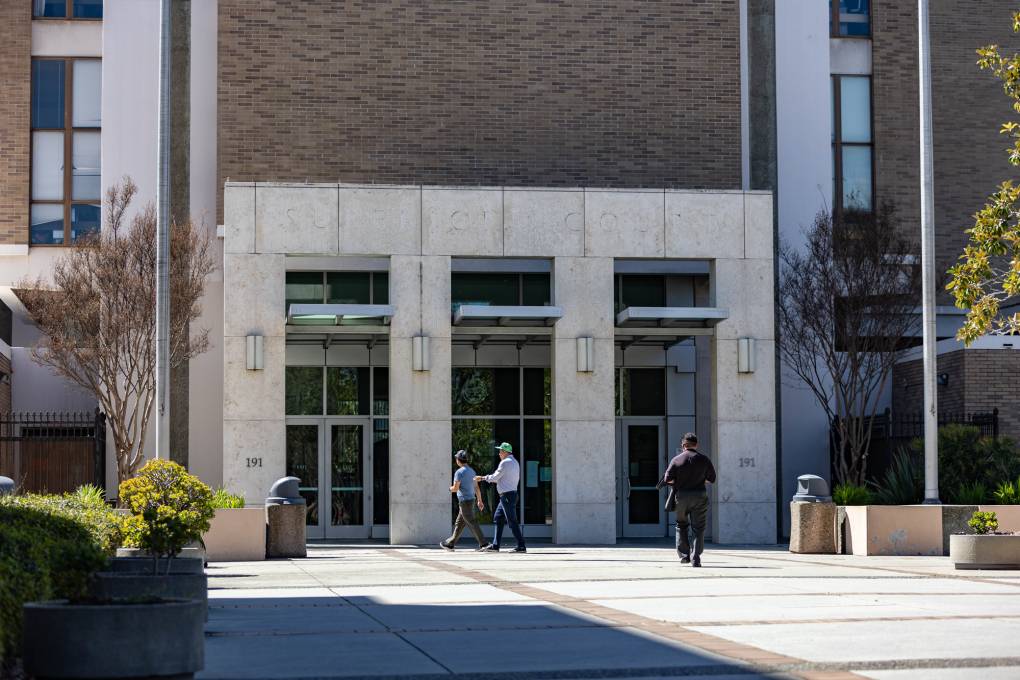
"caption": "Santa Clara County Superior Court in San José on March 24, 2025. Two San José parents were convicted of murder in the fentanyl overdose death of their 18-month-old child, Winter Rayo.\r\n",
"credit": "Gina Castro/KQED",
"altTag": null,
"description": null,
"imgSizes": {
"medium": {
"file": "https://cdn.kqed.org/wp-content/uploads/sites/10/2025/04/20240324_SANTACLARASUPERIORCOURT_GC-2-KQED-800x533.jpg",
"width": 800,
"height": 533,
"mimeType": "image/jpeg"
},
"large": {
"file": "https://cdn.kqed.org/wp-content/uploads/sites/10/2025/04/20240324_SANTACLARASUPERIORCOURT_GC-2-KQED-1020x680.jpg",
"width": 1020,
"height": 680,
"mimeType": "image/jpeg"
},
"thumbnail": {
"file": "https://cdn.kqed.org/wp-content/uploads/sites/10/2025/04/20240324_SANTACLARASUPERIORCOURT_GC-2-KQED-160x107.jpg",
"width": 160,
"height": 107,
"mimeType": "image/jpeg"
},
"1536x1536": {
"file": "https://cdn.kqed.org/wp-content/uploads/sites/10/2025/04/20240324_SANTACLARASUPERIORCOURT_GC-2-KQED-1536x1024.jpg",
"width": 1536,
"height": 1024,
"mimeType": "image/jpeg"
},
"post-thumbnail": {
"file": "https://cdn.kqed.org/wp-content/uploads/sites/10/2025/04/20240324_SANTACLARASUPERIORCOURT_GC-2-KQED-672x372.jpg",
"width": 672,
"height": 372,
"mimeType": "image/jpeg"
},
"twentyfourteen-full-width": {
"file": "https://cdn.kqed.org/wp-content/uploads/sites/10/2025/04/20240324_SANTACLARASUPERIORCOURT_GC-2-KQED-1038x576.jpg",
"width": 1038,
"height": 576,
"mimeType": "image/jpeg"
},
"full-width": {
"file": "https://cdn.kqed.org/wp-content/uploads/sites/10/2025/04/20240324_SANTACLARASUPERIORCOURT_GC-2-KQED-1920x1280.jpg",
"width": 1920,
"height": 1280,
"mimeType": "image/jpeg"
},
"kqedFullSize": {
"file": "https://cdn.kqed.org/wp-content/uploads/sites/10/2025/04/20240324_SANTACLARASUPERIORCOURT_GC-2-KQED.jpg",
"width": 2000,
"height": 1333
}
},
"isLoading": false,
"fetchFailed": false
},
"news_11969941": {
"type": "attachments",
"id": "news_11969941",
"meta": {
"index": "attachments_1716263798",
"site": "news",
"id": "11969941",
"found": true
},
"parent": 0,
"imgSizes": {
"twentyfourteen-full-width": {
"file": "https://cdn.kqed.org/wp-content/uploads/sites/10/2023/12/231214-SF-OVERDOSE-GETTY-SS-KQED-1038x576.jpg",
"width": 1038,
"mimeType": "image/jpeg",
"height": 576
},
"thumbnail": {
"file": "https://cdn.kqed.org/wp-content/uploads/sites/10/2023/12/231214-SF-OVERDOSE-GETTY-SS-KQED-160x107.jpg",
"width": 160,
"mimeType": "image/jpeg",
"height": 107
},
"post-thumbnail": {
"file": "https://cdn.kqed.org/wp-content/uploads/sites/10/2023/12/231214-SF-OVERDOSE-GETTY-SS-KQED-672x372.jpg",
"width": 672,
"mimeType": "image/jpeg",
"height": 372
},
"kqedFullSize": {
"file": "https://cdn.kqed.org/wp-content/uploads/sites/10/2023/12/231214-SF-OVERDOSE-GETTY-SS-KQED.jpg",
"width": 2000,
"height": 1334
},
"large": {
"file": "https://cdn.kqed.org/wp-content/uploads/sites/10/2023/12/231214-SF-OVERDOSE-GETTY-SS-KQED-1020x680.jpg",
"width": 1020,
"mimeType": "image/jpeg",
"height": 680
},
"1536x1536": {
"file": "https://cdn.kqed.org/wp-content/uploads/sites/10/2023/12/231214-SF-OVERDOSE-GETTY-SS-KQED-1536x1025.jpg",
"width": 1536,
"mimeType": "image/jpeg",
"height": 1025
},
"full-width": {
"file": "https://cdn.kqed.org/wp-content/uploads/sites/10/2023/12/231214-SF-OVERDOSE-GETTY-SS-KQED-1920x1281.jpg",
"width": 1920,
"mimeType": "image/jpeg",
"height": 1281
},
"medium": {
"file": "https://cdn.kqed.org/wp-content/uploads/sites/10/2023/12/231214-SF-OVERDOSE-GETTY-SS-KQED-800x534.jpg",
"width": 800,
"mimeType": "image/jpeg",
"height": 534
}
},
"publishDate": 1702603508,
"modified": 1710287802,
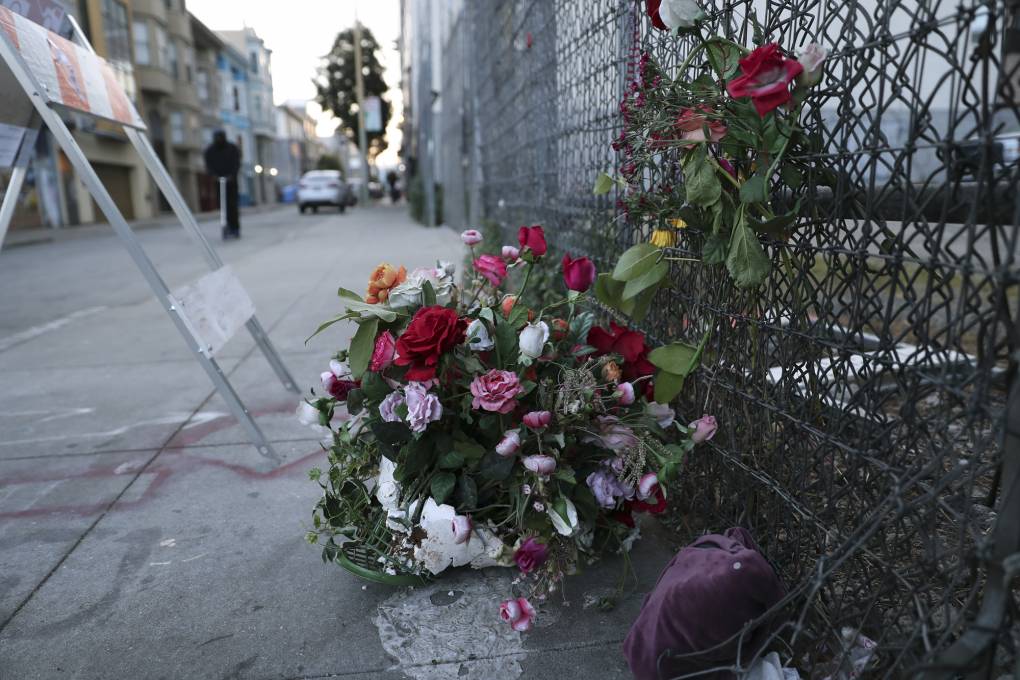
"caption": "Flowers lay on the sidewalk where a 16-year-old girl died from a possible overdose in the SoMa neighborhood of San Francisco on Feb. 20, 2022.",
"description": null,
"title": "teendeath0220",
"credit": "Scott Strazzante/San Francisco Chronicle via Getty Images",
"status": "inherit",
"altTag": "A bouquet of flowers lays on the sidewalk beside a chainlink fence in an urban setting.",
"isLoading": false,
"fetchFailed": false
},
"news_11959782": {
"type": "attachments",
"id": "news_11959782",
"meta": {
"index": "attachments_1716263798",
"site": "news",
"id": "11959782",
"found": true
},
"title": "230831-SAFE USE POP UP-MD-06-KQED",
"publishDate": 1693512334,
"status": "inherit",
"parent": 11959803,
"modified": 1760486443,
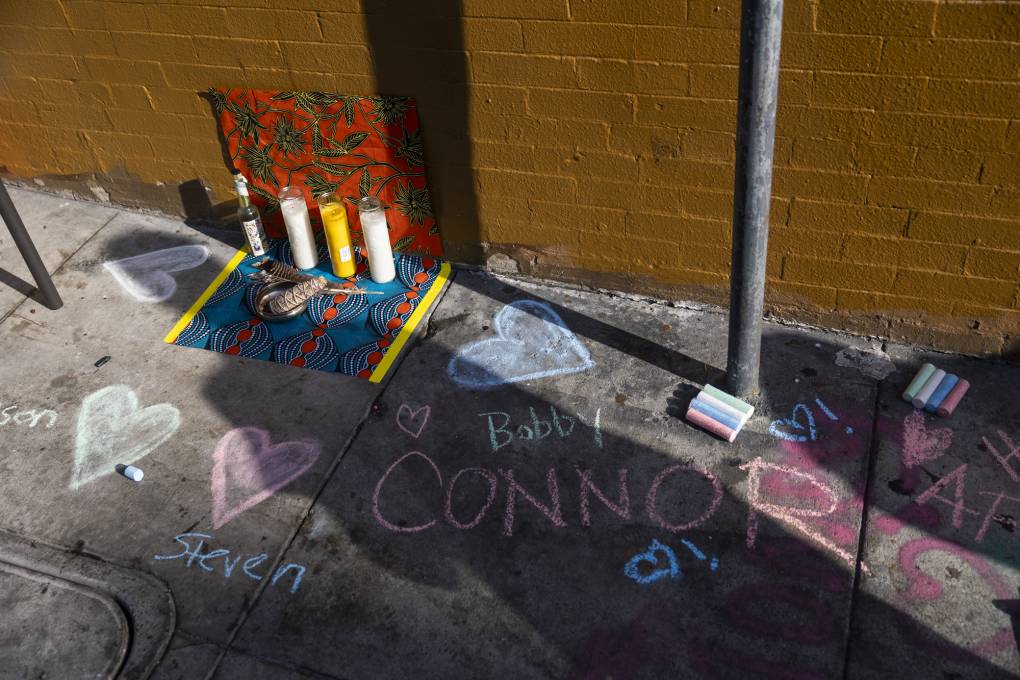
"caption": "A memorial to deceased loved ones at a safe drug consumption site created by volunteers with Concerned Public Response in San Francisco on Aug. 31, 2023.",
"credit": "Martin do Nascimento/KQED",
"altTag": "A sidewalk covered with people's names and drawings of hearts.",
"description": null,
"imgSizes": {
"medium": {
"file": "https://cdn.kqed.org/wp-content/uploads/sites/10/2023/08/230831-SAFE-USE-POP-UP-MD-06-KQED-800x533.jpg",
"width": 800,
"height": 533,
"mimeType": "image/jpeg"
},
"large": {
"file": "https://cdn.kqed.org/wp-content/uploads/sites/10/2023/08/230831-SAFE-USE-POP-UP-MD-06-KQED-1020x680.jpg",
"width": 1020,
"height": 680,
"mimeType": "image/jpeg"
},
"thumbnail": {
"file": "https://cdn.kqed.org/wp-content/uploads/sites/10/2023/08/230831-SAFE-USE-POP-UP-MD-06-KQED-160x107.jpg",
"width": 160,
"height": 107,
"mimeType": "image/jpeg"
},
"1536x1536": {
"file": "https://cdn.kqed.org/wp-content/uploads/sites/10/2023/08/230831-SAFE-USE-POP-UP-MD-06-KQED-1536x1024.jpg",
"width": 1536,
"height": 1024,
"mimeType": "image/jpeg"
},
"post-thumbnail": {
"file": "https://cdn.kqed.org/wp-content/uploads/sites/10/2023/08/230831-SAFE-USE-POP-UP-MD-06-KQED-672x372.jpg",
"width": 672,
"height": 372,
"mimeType": "image/jpeg"
},
"twentyfourteen-full-width": {
"file": "https://cdn.kqed.org/wp-content/uploads/sites/10/2023/08/230831-SAFE-USE-POP-UP-MD-06-KQED-1038x576.jpg",
"width": 1038,
"height": 576,
"mimeType": "image/jpeg"
},
"full-width": {
"file": "https://cdn.kqed.org/wp-content/uploads/sites/10/2023/08/230831-SAFE-USE-POP-UP-MD-06-KQED-1920x1280.jpg",
"width": 1920,
"height": 1280,
"mimeType": "image/jpeg"
},
"kqedFullSize": {
"file": "https://cdn.kqed.org/wp-content/uploads/sites/10/2023/08/230831-SAFE-USE-POP-UP-MD-06-KQED.jpg",
"width": 2000,
"height": 1333
}
},
"isLoading": false,
"fetchFailed": false
},
"news_12044917": {
"type": "attachments",
"id": "news_12044917",
"meta": {
"index": "attachments_1716263798",
"site": "news",
"id": "12044917",
"found": true
},
"title": "Used needles are collected and exchanged for clean ones by the Tenderloin AIDS Resource Center in S",
"publishDate": 1750270116,
"status": "inherit",
"parent": 0,
"modified": 1750270134,
"caption": "Used needles are collected and exchanged for clean ones by the Tenderloin AIDS Resource Center in San Francisco. San Francisco has aggressively reduced the number of drug overdose deaths. ",
"credit": "Bryan Chan/Los Angeles Times via Getty Images",
"altTag": null,
"description": null,
"imgSizes": {
"thumbnail": {
"file": "https://cdn.kqed.org/wp-content/uploads/sites/10/2025/06/GETTYIMAGES-564026777-KQED-160x107.jpg",
"width": 160,
"height": 107,
"mimeType": "image/jpeg"
},
"1536x1536": {
"file": "https://cdn.kqed.org/wp-content/uploads/sites/10/2025/06/GETTYIMAGES-564026777-KQED-1536x1024.jpg",
"width": 1536,
"height": 1024,
"mimeType": "image/jpeg"
},
"post-thumbnail": {
"file": "https://cdn.kqed.org/wp-content/uploads/sites/10/2025/06/GETTYIMAGES-564026777-KQED-672x372.jpg",
"width": 672,
"height": 372,
"mimeType": "image/jpeg"
},
"twentyfourteen-full-width": {
"file": "https://cdn.kqed.org/wp-content/uploads/sites/10/2025/06/GETTYIMAGES-564026777-KQED-1038x576.jpg",
"width": 1038,
"height": 576,
"mimeType": "image/jpeg"
},
"kqedFullSize": {
"file": "https://cdn.kqed.org/wp-content/uploads/sites/10/2025/06/GETTYIMAGES-564026777-KQED.jpg",
"width": 2000,
"height": 1333
}
},
"isLoading": false,
"fetchFailed": false
},
"news_11986529": {
"type": "attachments",
"id": "news_11986529",
"meta": {
"index": "attachments_1716263798",
"site": "news",
"id": "11986529",
"found": true
},
"parent": 11986508,
"imgSizes": {
"twentyfourteen-full-width": {
"file": "https://cdn.kqed.org/wp-content/uploads/sites/10/2024/05/023_KQED_OBICBuprenorphineClinic_03292023_qut-1038x576.jpg",
"width": 1038,
"mimeType": "image/jpeg",
"height": 576
},
"thumbnail": {
"file": "https://cdn.kqed.org/wp-content/uploads/sites/10/2024/05/023_KQED_OBICBuprenorphineClinic_03292023_qut-160x107.jpg",
"width": 160,
"mimeType": "image/jpeg",
"height": 107
},
"post-thumbnail": {
"file": "https://cdn.kqed.org/wp-content/uploads/sites/10/2024/05/023_KQED_OBICBuprenorphineClinic_03292023_qut-672x372.jpg",
"width": 672,
"mimeType": "image/jpeg",
"height": 372
},
"kqedFullSize": {
"file": "https://cdn.kqed.org/wp-content/uploads/sites/10/2024/05/023_KQED_OBICBuprenorphineClinic_03292023_qut.jpg",
"width": 1920,
"height": 1280
},
"large": {
"file": "https://cdn.kqed.org/wp-content/uploads/sites/10/2024/05/023_KQED_OBICBuprenorphineClinic_03292023_qut-1020x680.jpg",
"width": 1020,
"mimeType": "image/jpeg",
"height": 680
},
"1536x1536": {
"file": "https://cdn.kqed.org/wp-content/uploads/sites/10/2024/05/023_KQED_OBICBuprenorphineClinic_03292023_qut-1536x1024.jpg",
"width": 1536,
"mimeType": "image/jpeg",
"height": 1024
},
"medium": {
"file": "https://cdn.kqed.org/wp-content/uploads/sites/10/2024/05/023_KQED_OBICBuprenorphineClinic_03292023_qut-800x533.jpg",
"width": 800,
"mimeType": "image/jpeg",
"height": 533
}
},
"publishDate": 1715882613,
"modified": 1715882636,
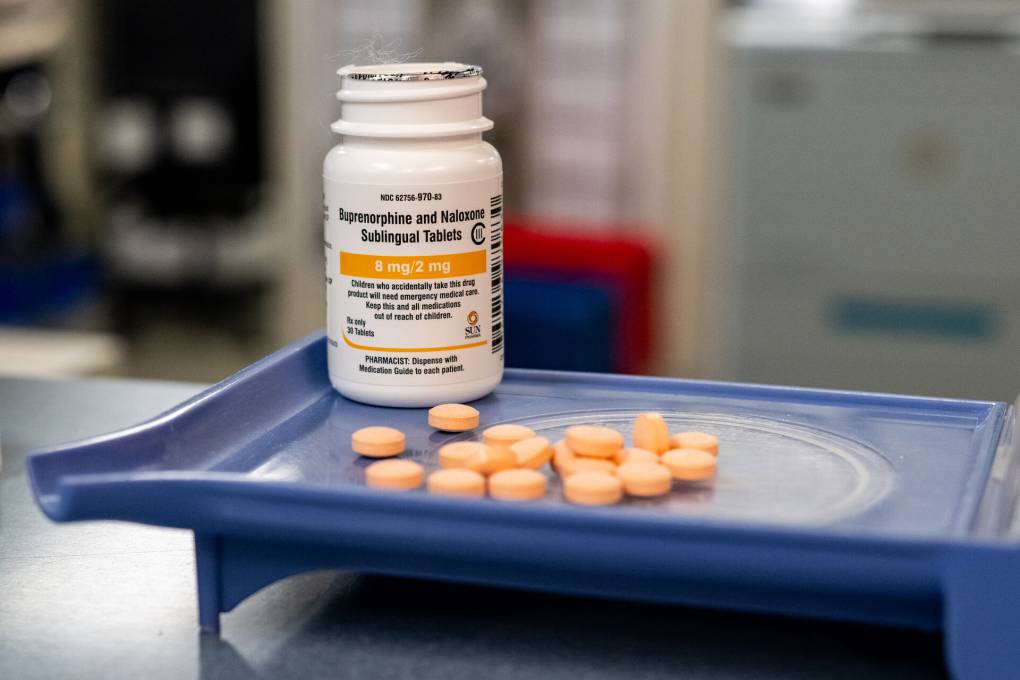
"caption": "Buprenorphine and Naloxone tablets at the Community Behavior Health Services pharmacy in San Francisco on March 29, 2023.",
"description": null,
"title": "023_KQED_OBICBuprenorphineClinic_03292023_qut",
"credit": "Beth LaBerge/KQED",
"status": "inherit",
"altTag": null,
"isLoading": false,
"fetchFailed": false
},
"news_12024503": {
"type": "attachments",
"id": "news_12024503",
"meta": {
"index": "attachments_1716263798",
"site": "news",
"id": "12024503",
"found": true
},
"title": "240903-OverdoseResponse-56-BL_qed",
"publishDate": 1738115144,
"status": "inherit",
"parent": 12024454,
"modified": 1742321872,
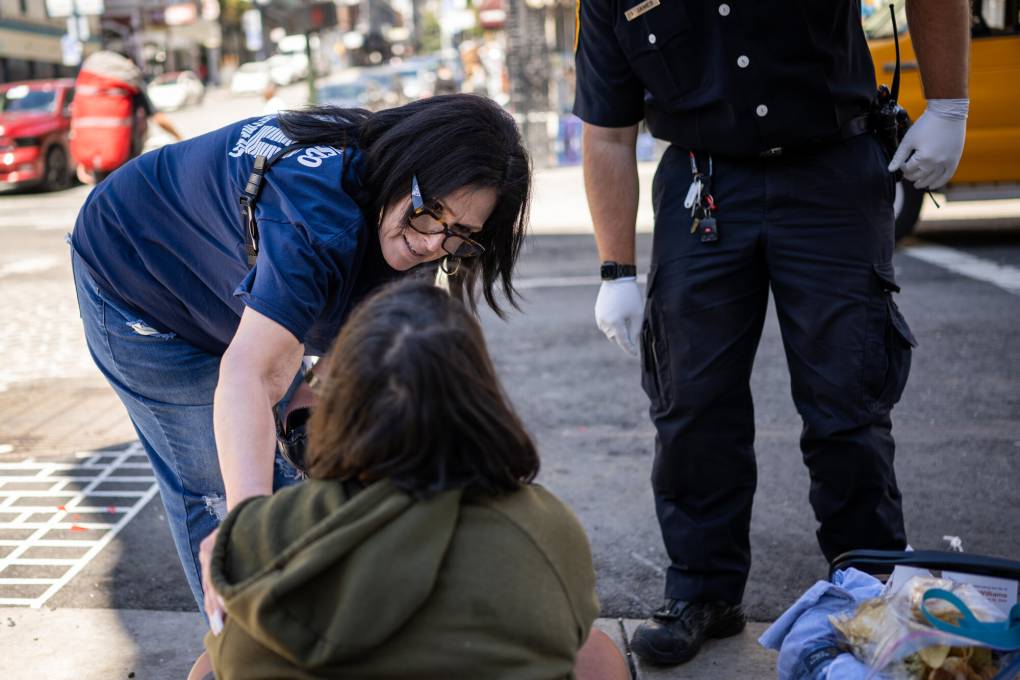
"caption": "Paramedic Isaac James (left) and counselor Chantel Hernandez-Coleman, members of the Street Overdose Response Team, speak with two people sitting on the street in the South of Market neighborhood in San Francisco on Sept. 3, 2024.",
"credit": "Beth LaBerge/KQED",
"altTag": null,
"description": null,
"imgSizes": {
"medium": {
"file": "https://cdn.kqed.org/wp-content/uploads/sites/10/2025/01/240903-OverdoseResponse-56-BL_qed-800x533.jpg",
"width": 800,
"height": 533,
"mimeType": "image/jpeg"
},
"large": {
"file": "https://cdn.kqed.org/wp-content/uploads/sites/10/2025/01/240903-OverdoseResponse-56-BL_qed-1020x680.jpg",
"width": 1020,
"height": 680,
"mimeType": "image/jpeg"
},
"thumbnail": {
"file": "https://cdn.kqed.org/wp-content/uploads/sites/10/2025/01/240903-OverdoseResponse-56-BL_qed-160x107.jpg",
"width": 160,
"height": 107,
"mimeType": "image/jpeg"
},
"1536x1536": {
"file": "https://cdn.kqed.org/wp-content/uploads/sites/10/2025/01/240903-OverdoseResponse-56-BL_qed-1536x1024.jpg",
"width": 1536,
"height": 1024,
"mimeType": "image/jpeg"
},
"post-thumbnail": {
"file": "https://cdn.kqed.org/wp-content/uploads/sites/10/2025/01/240903-OverdoseResponse-56-BL_qed-672x372.jpg",
"width": 672,
"height": 372,
"mimeType": "image/jpeg"
},
"twentyfourteen-full-width": {
"file": "https://cdn.kqed.org/wp-content/uploads/sites/10/2025/01/240903-OverdoseResponse-56-BL_qed-1038x576.jpg",
"width": 1038,
"height": 576,
"mimeType": "image/jpeg"
},
"full-width": {
"file": "https://cdn.kqed.org/wp-content/uploads/sites/10/2025/01/240903-OverdoseResponse-56-BL_qed-1920x1280.jpg",
"width": 1920,
"height": 1280,
"mimeType": "image/jpeg"
},
"kqedFullSize": {
"file": "https://cdn.kqed.org/wp-content/uploads/sites/10/2025/01/240903-OverdoseResponse-56-BL_qed.jpg",
"width": 2000,
"height": 1333
}
},
"isLoading": false,
"fetchFailed": false
},
"news_12032245": {
"type": "attachments",
"id": "news_12032245",
"meta": {
"index": "attachments_1716263798",
"site": "news",
"id": "12032245",
"found": true
},
"title": "240903-OverdoseResponse-42-BL_qed",
"publishDate": 1742493644,
"status": "inherit",
"parent": 12032239,
"modified": 1742493658,
"caption": "Counselor Chantel Hernandez-Coleman (left) and paramedic Isaac James, members of the Street Overdose Response Team, speak with a woman sitting in the Tenderloin in San Francisco on Sept. 3, 2024.",
"credit": "Beth LaBerge/KQED",
"altTag": null,
"description": null,
"imgSizes": {
"medium": {
"file": "https://cdn.kqed.org/wp-content/uploads/sites/10/2025/03/240903-OverdoseResponse-42-BL_qed-800x533.jpg",
"width": 800,
"height": 533,
"mimeType": "image/jpeg"
},
"large": {
"file": "https://cdn.kqed.org/wp-content/uploads/sites/10/2025/03/240903-OverdoseResponse-42-BL_qed-1020x680.jpg",
"width": 1020,
"height": 680,
"mimeType": "image/jpeg"
},
"thumbnail": {
"file": "https://cdn.kqed.org/wp-content/uploads/sites/10/2025/03/240903-OverdoseResponse-42-BL_qed-160x107.jpg",
"width": 160,
"height": 107,
"mimeType": "image/jpeg"
},
"1536x1536": {
"file": "https://cdn.kqed.org/wp-content/uploads/sites/10/2025/03/240903-OverdoseResponse-42-BL_qed-1536x1024.jpg",
"width": 1536,
"height": 1024,
"mimeType": "image/jpeg"
},
"post-thumbnail": {
"file": "https://cdn.kqed.org/wp-content/uploads/sites/10/2025/03/240903-OverdoseResponse-42-BL_qed-672x372.jpg",
"width": 672,
"height": 372,
"mimeType": "image/jpeg"
},
"twentyfourteen-full-width": {
"file": "https://cdn.kqed.org/wp-content/uploads/sites/10/2025/03/240903-OverdoseResponse-42-BL_qed-1038x576.jpg",
"width": 1038,
"height": 576,
"mimeType": "image/jpeg"
},
"full-width": {
"file": "https://cdn.kqed.org/wp-content/uploads/sites/10/2025/03/240903-OverdoseResponse-42-BL_qed-1920x1280.jpg",
"width": 1920,
"height": 1280,
"mimeType": "image/jpeg"
},
"kqedFullSize": {
"file": "https://cdn.kqed.org/wp-content/uploads/sites/10/2025/03/240903-OverdoseResponse-42-BL_qed.jpg",
"width": 2000,
"height": 1333
}
},
"isLoading": false,
"fetchFailed": false
},
"news_12014173": {
"type": "attachments",
"id": "news_12014173",
"meta": {
"index": "attachments_1716263798",
"site": "news",
"id": "12014173",
"found": true
},
"title": "240903-OverdoseResponse-48-BL_qed (1)",
"publishDate": 1731461458,
"status": "inherit",
"parent": 12014134,
"modified": 1731461532,
"caption": "Counselor Chantel Hernandez-Coleman, member of the Street Overdose Response Team, gets supplies from her van after speaking with two people sitting on the street in the South of Market neighborhood in San Francisco on Sept. 3, 2024.",
"credit": "Beth LaBerge/KQED",
"altTag": "A middle-aged woman stands in front of a red van labeled 'Street Overdose Response Team'",
"description": null,
"imgSizes": {
"medium": {
"file": "https://cdn.kqed.org/wp-content/uploads/sites/10/2024/11/240903-OverdoseResponse-48-BL_qed-1-800x533.jpg",
"width": 800,
"height": 533,
"mimeType": "image/jpeg"
},
"large": {
"file": "https://cdn.kqed.org/wp-content/uploads/sites/10/2024/11/240903-OverdoseResponse-48-BL_qed-1-1020x680.jpg",
"width": 1020,
"height": 680,
"mimeType": "image/jpeg"
},
"thumbnail": {
"file": "https://cdn.kqed.org/wp-content/uploads/sites/10/2024/11/240903-OverdoseResponse-48-BL_qed-1-160x107.jpg",
"width": 160,
"height": 107,
"mimeType": "image/jpeg"
},
"1536x1536": {
"file": "https://cdn.kqed.org/wp-content/uploads/sites/10/2024/11/240903-OverdoseResponse-48-BL_qed-1-1536x1024.jpg",
"width": 1536,
"height": 1024,
"mimeType": "image/jpeg"
},
"post-thumbnail": {
"file": "https://cdn.kqed.org/wp-content/uploads/sites/10/2024/11/240903-OverdoseResponse-48-BL_qed-1-672x372.jpg",
"width": 672,
"height": 372,
"mimeType": "image/jpeg"
},
"twentyfourteen-full-width": {
"file": "https://cdn.kqed.org/wp-content/uploads/sites/10/2024/11/240903-OverdoseResponse-48-BL_qed-1-1038x576.jpg",
"width": 1038,
"height": 576,
"mimeType": "image/jpeg"
},
"full-width": {
"file": "https://cdn.kqed.org/wp-content/uploads/sites/10/2024/11/240903-OverdoseResponse-48-BL_qed-1-1920x1280.jpg",
"width": 1920,
"height": 1280,
"mimeType": "image/jpeg"
},
"kqedFullSize": {
"file": "https://cdn.kqed.org/wp-content/uploads/sites/10/2024/11/240903-OverdoseResponse-48-BL_qed-1.jpg",
"width": 1999,
"height": 1333
}
},
"isLoading": false,
"fetchFailed": false
},
"news_12000164": {
"type": "attachments",
"id": "news_12000164",
"meta": {
"index": "attachments_1716263798",
"site": "news",
"id": "12000164",
"found": true
},
"title": "021_SanFrancisco_StFrancisER_08262021_qed",
"publishDate": 1723661533,
"status": "inherit",
"parent": 12000161,
"modified": 1723661548,
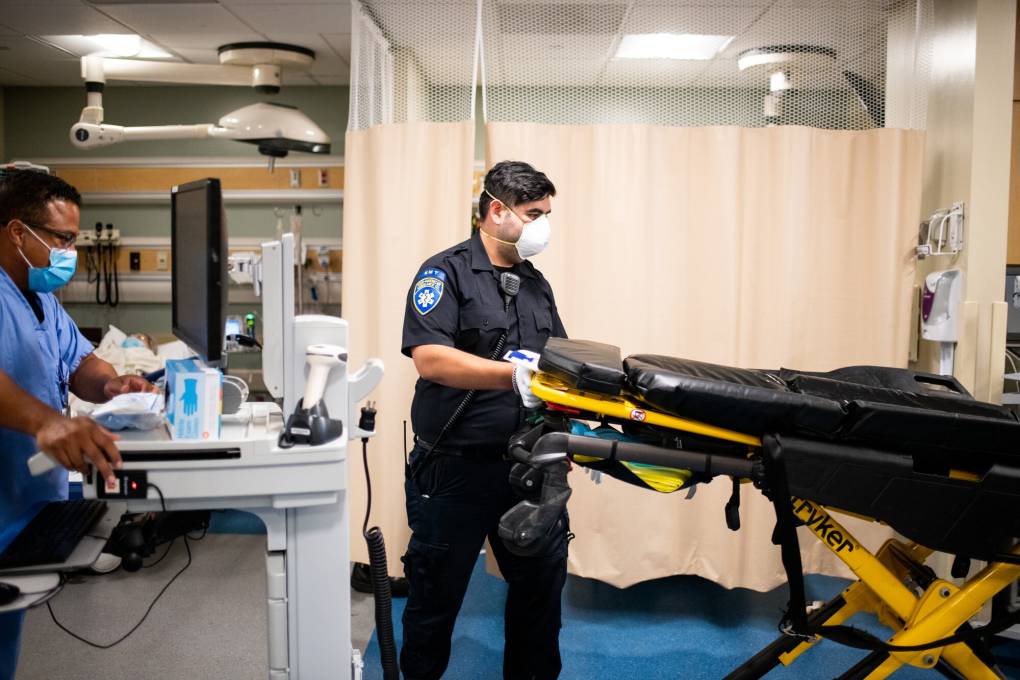
"caption": "An EMT wheels out a stretcher after bringing in a patient to Saint Francis Emergency Department in San Francisco on Aug. 26, 2021.",
"credit": "Beth LaBerge/KQED",
"altTag": null,
"description": null,
"imgSizes": {
"medium": {
"file": "https://cdn.kqed.org/wp-content/uploads/sites/10/2024/08/021_SanFrancisco_StFrancisER_08262021_qed-800x533.jpg",
"width": 800,
"height": 533,
"mimeType": "image/jpeg"
},
"large": {
"file": "https://cdn.kqed.org/wp-content/uploads/sites/10/2024/08/021_SanFrancisco_StFrancisER_08262021_qed-1020x680.jpg",
"width": 1020,
"height": 680,
"mimeType": "image/jpeg"
},
"thumbnail": {
"file": "https://cdn.kqed.org/wp-content/uploads/sites/10/2024/08/021_SanFrancisco_StFrancisER_08262021_qed-160x107.jpg",
"width": 160,
"height": 107,
"mimeType": "image/jpeg"
},
"1536x1536": {
"file": "https://cdn.kqed.org/wp-content/uploads/sites/10/2024/08/021_SanFrancisco_StFrancisER_08262021_qed-1536x1024.jpg",
"width": 1536,
"height": 1024,
"mimeType": "image/jpeg"
},
"post-thumbnail": {
"file": "https://cdn.kqed.org/wp-content/uploads/sites/10/2024/08/021_SanFrancisco_StFrancisER_08262021_qed-672x372.jpg",
"width": 672,
"height": 372,
"mimeType": "image/jpeg"
},
"twentyfourteen-full-width": {
"file": "https://cdn.kqed.org/wp-content/uploads/sites/10/2024/08/021_SanFrancisco_StFrancisER_08262021_qed-1038x576.jpg",
"width": 1038,
"height": 576,
"mimeType": "image/jpeg"
},
"full-width": {
"file": "https://cdn.kqed.org/wp-content/uploads/sites/10/2024/08/021_SanFrancisco_StFrancisER_08262021_qed-1920x1280.jpg",
"width": 1920,
"height": 1280,
"mimeType": "image/jpeg"
},
"kqedFullSize": {
"file": "https://cdn.kqed.org/wp-content/uploads/sites/10/2024/08/021_SanFrancisco_StFrancisER_08262021_qed.jpg",
"width": 2000,
"height": 1333
}
},
"isLoading": false,
"fetchFailed": false
},
"news_11952545": {
"type": "attachments",
"id": "news_11952545",
"meta": {
"index": "attachments_1716263798",
"site": "news",
"id": "11952545",
"found": true
},
"title": "RS66141_016_KQED_SheriffPressConference_06082023-KQED",
"publishDate": 1686251655,
"status": "inherit",
"parent": 0,
"modified": 1717610445,
"caption": "San Francisco sheriff's deputies listen to a news conference in San Francisco's Civic Center on June 8, 2023, where Sheriff Paul Miyamoto (not pictured) announced the activation of a six-month plan focused on areas of the Tenderloin and SoMa neighborhoods to reduce open-air drug dealing and drug use.",
"credit": "Beth LaBerge/KQED",
"altTag": "A group of half a dozen law enforcement officers stand in front of squad cars parked in an open area in front of an ornate columned building.",
"description": null,
"imgSizes": {
"medium": {
"file": "https://cdn.kqed.org/wp-content/uploads/sites/10/2023/06/RS66141_016_KQED_SheriffPressConference_06082023-KQED-800x533.jpg",
"width": 800,
"height": 533,
"mimeType": "image/jpeg"
},
"large": {
"file": "https://cdn.kqed.org/wp-content/uploads/sites/10/2023/06/RS66141_016_KQED_SheriffPressConference_06082023-KQED-1020x680.jpg",
"width": 1020,
"height": 680,
"mimeType": "image/jpeg"
},
"thumbnail": {
"file": "https://cdn.kqed.org/wp-content/uploads/sites/10/2023/06/RS66141_016_KQED_SheriffPressConference_06082023-KQED-160x107.jpg",
"width": 160,
"height": 107,
"mimeType": "image/jpeg"
},
"1536x1536": {
"file": "https://cdn.kqed.org/wp-content/uploads/sites/10/2023/06/RS66141_016_KQED_SheriffPressConference_06082023-KQED-1536x1024.jpg",
"width": 1536,
"height": 1024,
"mimeType": "image/jpeg"
},
"post-thumbnail": {
"file": "https://cdn.kqed.org/wp-content/uploads/sites/10/2023/06/RS66141_016_KQED_SheriffPressConference_06082023-KQED-672x372.jpg",
"width": 672,
"height": 372,
"mimeType": "image/jpeg"
},
"twentyfourteen-full-width": {
"file": "https://cdn.kqed.org/wp-content/uploads/sites/10/2023/06/RS66141_016_KQED_SheriffPressConference_06082023-KQED-1038x576.jpg",
"width": 1038,
"height": 576,
"mimeType": "image/jpeg"
},
"kqedFullSize": {
"file": "https://cdn.kqed.org/wp-content/uploads/sites/10/2023/06/RS66141_016_KQED_SheriffPressConference_06082023-KQED.jpg",
"width": 1920,
"height": 1280
}
},
"isLoading": false,
"fetchFailed": false
},
"news_11987969": {
"type": "attachments",
"id": "news_11987969",
"meta": {
"index": "attachments_1716263798",
"site": "news",
"id": "11987969",
"found": true
},
"title": "US-HEALTH-DRUGS",
"publishDate": 1716934481,
"status": "inherit",
"parent": 11987962,
"modified": 1716937786,
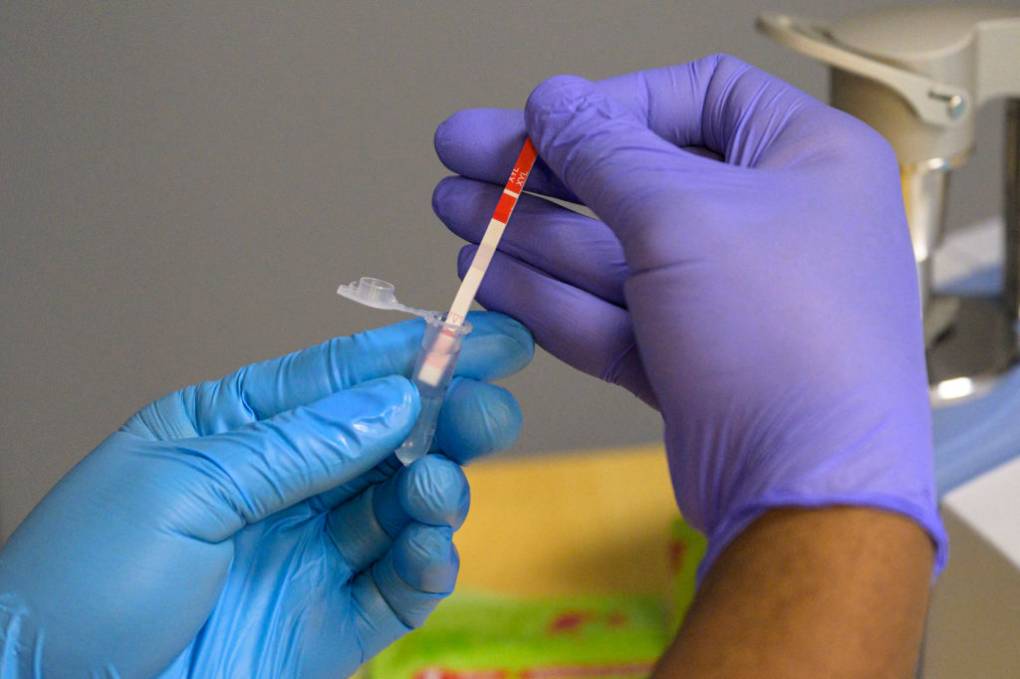
"caption": "Leonardo Dominguez Gomez, field researcher with the New York City Department of Health, tests a heroin sample for xylazine at St. Ann's Corner of Harm Reduction in New York City on May 25, 2023. The tranquilizer, approved for veterinary use by the U.S. Food and Drug Administration (FDA), has infiltrated the illegal drugs market in the U.S., with producers increasingly using it to augment fentanyl. Overdose deaths where tranq was detected have soared in recent years, and in April, the White House designated the drug an \"emerging threat.\"",
"credit": "Angela Weiss/AFP via Getty Images",
"altTag": "Two gloved hands (blue and purple) hold a test strip into a sample container.",
"description": null,
"imgSizes": {
"medium": {
"file": "https://cdn.kqed.org/wp-content/uploads/sites/10/2024/05/GettyImages-1258771727-800x533.jpg",
"width": 800,
"height": 533,
"mimeType": "image/jpeg"
},
"large": {
"file": "https://cdn.kqed.org/wp-content/uploads/sites/10/2024/05/GettyImages-1258771727-1020x679.jpg",
"width": 1020,
"height": 679,
"mimeType": "image/jpeg"
},
"thumbnail": {
"file": "https://cdn.kqed.org/wp-content/uploads/sites/10/2024/05/GettyImages-1258771727-160x107.jpg",
"width": 160,
"height": 107,
"mimeType": "image/jpeg"
},
"post-thumbnail": {
"file": "https://cdn.kqed.org/wp-content/uploads/sites/10/2024/05/GettyImages-1258771727-672x372.jpg",
"width": 672,
"height": 372,
"mimeType": "image/jpeg"
},
"twentyfourteen-full-width": {
"file": "https://cdn.kqed.org/wp-content/uploads/sites/10/2024/05/GettyImages-1258771727-1024x576.jpg",
"width": 1024,
"height": 576,
"mimeType": "image/jpeg"
},
"kqedFullSize": {
"file": "https://cdn.kqed.org/wp-content/uploads/sites/10/2024/05/GettyImages-1258771727.jpg",
"width": 1024,
"height": 682
}
},
"isLoading": false,
"fetchFailed": false
}
},
"audioPlayerReducer": {
"postId": "stream_live",
"isPaused": true,
"isPlaying": false,
"pfsActive": false,
"pledgeModalIsOpen": true,
"playerDrawerIsOpen": false,
"liveAudioPlayStartedAt": 0,
"liveAudioPlayContext": ""
},
"authorsReducer": {
"shotchkiss": {
"type": "authors",
"id": "61",
"meta": {
"index": "authors_1716337520",
"id": "61",
"found": true
},
"name": "Sarah Hotchkiss",
"firstName": "Sarah",
"lastName": "Hotchkiss",
"slug": "shotchkiss",
"email": "shotchkiss@kqed.org",
"display_author_email": true,
"staff_mastheads": [
"arts"
],
"title": "Senior Editor",
"bio": "Sarah Hotchkiss is a San Francisco \u003ca href=\"http://www.sarahhotchkiss.com\">artist\u003c/a> and arts writer. In 2019, she received the Dorothea & Leo Rabkin Foundation grant for visual art journalism and in 2020 she received a Society of Professional Journalists, Northern California award for excellence in arts and culture reporting.",
"avatar": "https://secure.gravatar.com/avatar/bc662df144b3d27fd8b1b6f1c2a420d34e91e53154d411bb7ad353cc8b6cea8d?s=600&d=blank&r=g",
"twitter": null,
"bluesky": null,
"facebook": null,
"instagram": null,
"linkedin": null,
"sites": [
{
"site": "",
"roles": [
"editor"
]
},
{
"site": "arts",
"roles": [
"Contributor",
"administrator"
]
},
{
"site": "artschool",
"roles": [
"administrator"
]
},
{
"site": "news",
"roles": [
"editor"
]
},
{
"site": "pop",
"roles": [
"administrator"
]
},
{
"site": "bayareabites",
"roles": [
"editor"
]
},
{
"site": "spark",
"roles": [
"editor"
]
},
{
"site": "checkplease",
"roles": [
"editor"
]
}
],
"headData": {
"title": "Sarah Hotchkiss | KQED",
"description": "Senior Editor",
"ogImgSrc": "https://secure.gravatar.com/avatar/bc662df144b3d27fd8b1b6f1c2a420d34e91e53154d411bb7ad353cc8b6cea8d?s=600&d=blank&r=g",
"twImgSrc": "https://secure.gravatar.com/avatar/bc662df144b3d27fd8b1b6f1c2a420d34e91e53154d411bb7ad353cc8b6cea8d?s=600&d=blank&r=g"
},
"isLoading": false,
"link": "/author/shotchkiss"
},
"matthewgreen": {
"type": "authors",
"id": "1263",
"meta": {
"index": "authors_1716337520",
"id": "1263",
"found": true
},
"name": "Matthew Green",
"firstName": "Matthew",
"lastName": "Green",
"slug": "matthewgreen",
"email": "mgreen@kqed.org",
"display_author_email": false,
"staff_mastheads": [],
"title": "KQED Editor/Reporter",
"bio": "Matthew Green is a digital media producer for KQED News. He previously produced \u003ca href=\"http://www.kqed.org/lowdown\">The Lowdown\u003c/a>, KQED’s multimedia news education blog. Matthew's written for numerous Bay Area publications, including the Oakland Tribune and San Francisco Chronicle. He also taught journalism classes at Fremont High School in East Oakland.\r\n\r\nEmail: mgreen@kqed.org; Twitter: @MGreenKQED",
"avatar": "https://secure.gravatar.com/avatar/3bf498d1267ca02c8494f33d8cfc575e?s=600&d=blank&r=g",
"twitter": "MGreenKQED",
"facebook": null,
"instagram": null,
"linkedin": null,
"sites": [
{
"site": "news",
"roles": []
},
{
"site": "lowdown",
"roles": []
},
{
"site": "science",
"roles": []
},
{
"site": "education",
"roles": []
},
{
"site": "quest",
"roles": []
},
{
"site": "liveblog",
"roles": []
}
],
"headData": {
"title": "Matthew Green | KQED",
"description": "KQED Editor/Reporter",
"ogImgSrc": "https://secure.gravatar.com/avatar/3bf498d1267ca02c8494f33d8cfc575e?s=600&d=blank&r=g",
"twImgSrc": "https://secure.gravatar.com/avatar/3bf498d1267ca02c8494f33d8cfc575e?s=600&d=blank&r=g"
},
"isLoading": false,
"link": "/author/matthewgreen"
},
"jlara": {
"type": "authors",
"id": "11761",
"meta": {
"index": "authors_1716337520",
"id": "11761",
"found": true
},
"name": "Juan Carlos Lara",
"firstName": "Juan Carlos",
"lastName": "Lara",
"slug": "jlara",
"email": "jlara@kqed.org",
"display_author_email": false,
"staff_mastheads": [],
"title": "KQED Contributor",
"bio": null,
"avatar": "https://secure.gravatar.com/avatar/19e2052b9b05657c5ff2af2121846e9c?s=600&d=blank&r=g",
"twitter": null,
"facebook": null,
"instagram": null,
"linkedin": null,
"sites": [
{
"site": "arts",
"roles": [
"editor"
]
},
{
"site": "news",
"roles": [
"editor"
]
},
{
"site": "forum",
"roles": [
"editor"
]
},
{
"site": "liveblog",
"roles": [
"contributor"
]
}
],
"headData": {
"title": "Juan Carlos Lara | KQED",
"description": "KQED Contributor",
"ogImgSrc": "https://secure.gravatar.com/avatar/19e2052b9b05657c5ff2af2121846e9c?s=600&d=blank&r=g",
"twImgSrc": "https://secure.gravatar.com/avatar/19e2052b9b05657c5ff2af2121846e9c?s=600&d=blank&r=g"
},
"isLoading": false,
"link": "/author/jlara"
},
"sjohnson": {
"type": "authors",
"id": "11840",
"meta": {
"index": "authors_1716337520",
"id": "11840",
"found": true
},
"name": "Sydney Johnson",
"firstName": "Sydney",
"lastName": "Johnson",
"slug": "sjohnson",
"email": "sjohnson@kqed.org",
"display_author_email": false,
"staff_mastheads": [
"news"
],
"title": "KQED Reporter",
"bio": "Sydney Johnson is a general assignment reporter at KQED. She previously reported on public health and city government at the San Francisco Examiner, and before that, she covered statewide education policy for EdSource. Her reporting has won multiple local, state and national awards. Sydney is a graduate of the University of California, Berkeley and lives in San Francisco.",
"avatar": "https://secure.gravatar.com/avatar/97855f2719b72ad6190b7c535fe642c8?s=600&d=blank&r=g",
"twitter": "sydneyfjohnson",
"facebook": null,
"instagram": null,
"linkedin": null,
"sites": [
{
"site": "news",
"roles": [
"editor"
]
}
],
"headData": {
"title": "Sydney Johnson | KQED",
"description": "KQED Reporter",
"ogImgSrc": "https://secure.gravatar.com/avatar/97855f2719b72ad6190b7c535fe642c8?s=600&d=blank&r=g",
"twImgSrc": "https://secure.gravatar.com/avatar/97855f2719b72ad6190b7c535fe642c8?s=600&d=blank&r=g"
},
"isLoading": false,
"link": "/author/sjohnson"
},
"jgeha": {
"type": "authors",
"id": "11906",
"meta": {
"index": "authors_1716337520",
"id": "11906",
"found": true
},
"name": "Joseph Geha",
"firstName": "Joseph",
"lastName": "Geha",
"slug": "jgeha",
"email": "jgeha@kqed.org",
"display_author_email": false,
"staff_mastheads": [
"news",
"science"
],
"title": "KQED Contributor",
"bio": null,
"avatar": "https://secure.gravatar.com/avatar/ea84d2b6dd93d6369d453edf19dd583f117cd1759d2d9c9c92f9de77017354fe?s=600&d=blank&r=g",
"twitter": null,
"bluesky": null,
"facebook": null,
"instagram": null,
"linkedin": null,
"sites": [
{
"site": "news",
"roles": [
"editor"
]
},
{
"site": "liveblog",
"roles": [
"author"
]
}
],
"headData": {
"title": "Joseph Geha | KQED",
"description": "KQED Contributor",
"ogImgSrc": "https://secure.gravatar.com/avatar/ea84d2b6dd93d6369d453edf19dd583f117cd1759d2d9c9c92f9de77017354fe?s=600&d=blank&r=g",
"twImgSrc": "https://secure.gravatar.com/avatar/ea84d2b6dd93d6369d453edf19dd583f117cd1759d2d9c9c92f9de77017354fe?s=600&d=blank&r=g"
},
"isLoading": false,
"link": "/author/jgeha"
},
"kdebenedetti": {
"type": "authors",
"id": "11913",
"meta": {
"index": "authors_1716337520",
"id": "11913",
"found": true
},
"name": "Katie DeBenedetti",
"firstName": "Katie",
"lastName": "DeBenedetti",
"slug": "kdebenedetti",
"email": "kdebenedetti@kqed.org",
"display_author_email": false,
"staff_mastheads": [
"news",
"science"
],
"title": "KQED Contributor",
"bio": "Katie DeBenedetti is a digital reporter covering daily news for the Express Desk. Prior to joining KQED as a culture reporting intern in January 2024, she covered education and city government for the Napa Valley Register.",
"avatar": "https://secure.gravatar.com/avatar/6e31073cb8f7e4214ab03f42771d0f45?s=600&d=blank&r=g",
"twitter": null,
"facebook": null,
"instagram": null,
"linkedin": null,
"sites": [
{
"site": "news",
"roles": [
"author"
]
},
{
"site": "science",
"roles": [
"author"
]
},
{
"site": "liveblog",
"roles": [
"author"
]
}
],
"headData": {
"title": "Katie DeBenedetti | KQED",
"description": "KQED Contributor",
"ogImgSrc": "https://secure.gravatar.com/avatar/6e31073cb8f7e4214ab03f42771d0f45?s=600&d=blank&r=g",
"twImgSrc": "https://secure.gravatar.com/avatar/6e31073cb8f7e4214ab03f42771d0f45?s=600&d=blank&r=g"
},
"isLoading": false,
"link": "/author/kdebenedetti"
},
"slim": {
"type": "authors",
"id": "11920",
"meta": {
"index": "authors_1716337520",
"id": "11920",
"found": true
},
"name": "Samantha Lim",
"firstName": "Samantha",
"lastName": "Lim",
"slug": "slim",
"email": "slim@KQED.org",
"display_author_email": false,
"staff_mastheads": [],
"title": "KQED Contributor",
"bio": null,
"avatar": "https://secure.gravatar.com/avatar/82e592e6c15fe1a04d385e8ad0fb0b4e?s=600&d=blank&r=g",
"twitter": null,
"facebook": null,
"instagram": null,
"linkedin": null,
"sites": [
{
"site": "news",
"roles": []
}
],
"headData": {
"title": "Samantha Lim | KQED",
"description": "KQED Contributor",
"ogImgSrc": "https://secure.gravatar.com/avatar/82e592e6c15fe1a04d385e8ad0fb0b4e?s=600&d=blank&r=g",
"twImgSrc": "https://secure.gravatar.com/avatar/82e592e6c15fe1a04d385e8ad0fb0b4e?s=600&d=blank&r=g"
},
"isLoading": false,
"link": "/author/slim"
},
"gzada": {
"type": "authors",
"id": "11929",
"meta": {
"index": "authors_1716337520",
"id": "11929",
"found": true
},
"name": "Gilare Zada",
"firstName": "Gilare",
"lastName": "Zada",
"slug": "gzada",
"email": "gzada@kqed.org",
"display_author_email": true,
"staff_mastheads": [
"news"
],
"title": null,
"bio": "Gilare Zada is a Kurdish-American from San Diego, CA. Storytelling, fitness, and binge reading are some of her passions outside of news reporting. Her work has appeared in Mission Local, the Peninsula Press, the San Francisco Press Club, and more. She also writes as a class correspondent for the Stanford Magazine - go Card!",
"avatar": "https://secure.gravatar.com/avatar/33a75f2b947669a488a805edec3fbf3838c1cedaedda710e983770633b4d6a75?s=600&d=blank&r=g",
"twitter": null,
"bluesky": null,
"facebook": null,
"instagram": null,
"linkedin": null,
"sites": [
{
"site": "",
"roles": [
"editor"
]
},
{
"site": "arts",
"roles": [
"editor"
]
},
{
"site": "news",
"roles": [
"administrator"
]
},
{
"site": "science",
"roles": [
"editor"
]
}
],
"headData": {
"title": "Gilare Zada | KQED",
"description": null,
"ogImgSrc": "https://secure.gravatar.com/avatar/33a75f2b947669a488a805edec3fbf3838c1cedaedda710e983770633b4d6a75?s=600&d=blank&r=g",
"twImgSrc": "https://secure.gravatar.com/avatar/33a75f2b947669a488a805edec3fbf3838c1cedaedda710e983770633b4d6a75?s=600&d=blank&r=g"
},
"isLoading": false,
"link": "/author/gzada"
}
},
"pagesReducer": {
"news_tag_drug-overdoses": {
"type": "terms",
"id": "news_30249",
"meta": {
"index": "terms_1716263798",
"site": "news",
"id": "30249",
"score": 10.404648
},
"featImg": null,
"name": "drug overdoses",
"description": null,
"taxonomy": "tag",
"headData": {
"twImgId": null,
"twTitle": null,
"ogTitle": null,
"ogImgId": null,
"twDescription": null,
"description": null,
"title": "drug overdoses Archives | KQED News",
"ogDescription": null
},
"ttid": 30266,
"slug": "drug-overdoses",
"isLoading": false,
"title": "drug overdoses",
"pageMeta": {
"site": "news",
"WpPageTemplate": "page-topic-editorial",
"currentPage": 1
},
"blocks": [
{
"blockName": "kqed/post-list",
"attrs": {
"layout": "cardArticle2",
"query": "posts/news?tag=drug-overdoses",
"seeMore": false,
"paginated": true,
"page": 1
}
},
{
"blockName": "kqed/ad"
}
]
}
},
"pfsSessionReducer": {},
"postsReducer": {
"stream_live": {
"type": "live",
"id": "stream_live",
"audioUrl": "https://streams.kqed.org/kqedradio",
"title": "Live Stream",
"excerpt": "Live Stream information currently unavailable.",
"link": "/radio",
"featImg": "",
"label": {
"name": "KQED Live",
"link": "/"
}
},
"stream_kqedNewscast": {
"type": "posts",
"id": "stream_kqedNewscast",
"audioUrl": "https://www.kqed.org/.stream/anon/radio/RDnews/newscast.mp3?_=1",
"title": "KQED Newscast",
"featImg": "",
"label": {
"name": "88.5 FM",
"link": "/"
}
},
"news_12083028": {
"type": "posts",
"id": "news_12083028",
"meta": {
"index": "posts_1716263798",
"site": "news",
"id": "12083028",
"score": null,
"sort": [
1778284323000
]
},
"guestAuthors": [],
"slug": "san-jose-parents-convicted-of-murder-in-babys-fentanyl-overdose",
"title": "San José Parents Convicted of Murder in Baby’s Fentanyl Overdose",
"publishDate": 1778284323,
"format": "standard",
"headTitle": "San José Parents Convicted of Murder in Baby’s Fentanyl Overdose | KQED",
"labelTerm": {
"site": "news"
},
"content": "\u003cp>In a first-of-its-kind verdict in \u003ca href=\"https://www.kqed.org/news/tag/santa-clara-county\">Santa Clara County\u003c/a>, a jury has convicted two San José parents of murder in the fentanyl overdose death of their 18-month-old daughter, Winter Rayo.\u003c/p>\n\u003cp>Derek Vaughn Rayo and Kelly Gene Richardson were both found guilty of second-degree murder, as well as of multiple child endangerment felonies and enhancements in a San José courtroom Friday afternoon.\u003c/p>\n\u003cp>The couple was the first parents in the county to ever be charged, and now convicted, with murdering their own child with drugs, according to the Santa Clara County District Attorney’s office.\u003c/p>\n\u003cp>[ad fullwidth]\u003c/p>\n\u003cp>Rayo and Richardson were charged in connection with the Aug. 12, 2023, death of Winter. Authorities said that the couple waited more than 11 hours before calling 911 to report her death, and that the baby had 25 times the lethal amount of fentanyl in her bloodstream at the time.\u003c/p>\n\u003cp>The couple could face up to life sentences.\u003c/p>\n\u003cp>“Fentanyl kills,” District Attorney Jeff Rosen said in a statement Friday evening. “In this case, the powerful opioid was left around this toddler like a loaded gun. The criminal recklessness of these two defendants killed their own child. I thank the jury for giving that child’s tragically short life some meaning.”\u003c/p>\n\u003cp>The DA’s office also charged Phillip Ortega of Gilroy and Paige Vitale of San José with murder, on allegations they provided Winter’s parents with “a steady supply of opioids” and shared the drugs with them, and that the home where Winter lived was littered with drugs and paraphernalia.[aside postID=news_12080041 hero='https://cdn.kqed.org/wp-content/uploads/sites/10/2026/04/BrookeJenkinsAltmanGetty1.jpg']A judge in 2024 dismissed the murder charge against Vitale, who was ultimately charged with felony drug possession and misdemeanor child endangerment, according to \u003ca href=\"https://www.mercurynews.com/2024/09/09/baby-fentanyl-death-judge-upholds-murder-changes-for-two-in-unprecedented-murder-case/\">The Mercury News\u003c/a>.\u003c/p>\n\u003cp>Ortega’s murder case is still pending, officials said. Ortega is also charged with murder due to his alleged role as a drug dealer in the fentanyl overdose death of another baby, Phoenix Castro, who also died in 2023 in a home with drug-addicted parents.\u003c/p>\n\u003cp>Castro’s mother later died, and her father, David Anthony Castro, is also charged with murder.\u003c/p>\n\u003cp>\u003c/p>\n",
"blocks": [],
"excerpt": "Two San José parents were convicted of murder in the fentanyl overdose death of their 18-month-old child, Winter Rayo.\r\n",
"status": "publish",
"parent": 0,
"modified": 1778286775,
"stats": {
"hasAudio": false,
"hasVideo": false,
"hasChartOrMap": false,
"iframeSrcs": [],
"hasGoogleForm": false,
"hasGallery": false,
"hasHearkenModule": false,
"hasPolis": false,
"paragraphCount": 11,
"wordCount": 382
},
"headData": {
"title": "San José Parents Convicted of Murder in Baby’s Fentanyl Overdose | KQED",
"description": "Two San José parents were convicted of murder in the fentanyl overdose death of their 18-month-old child, Winter Rayo.\r\n",
"ogTitle": "",
"ogDescription": "",
"ogImgId": "",
"twTitle": "",
"twDescription": "",
"twImgId": "",
"schema": {
"@context": "https://schema.org",
"@type": "NewsArticle",
"headline": "San José Parents Convicted of Murder in Baby’s Fentanyl Overdose",
"datePublished": "2026-05-08T16:52:03-07:00",
"dateModified": "2026-05-08T17:32:55-07:00",
"image": "https://cdn.kqed.org/wp-content/uploads/2020/02/KQED-OG-Image@1x.png",
"isAccessibleForFree": "True",
"publisher": {
"@type": "NewsMediaOrganization",
"@id": "https://www.kqed.org/#organization",
"name": "KQED",
"logo": "https://cdn.kqed.org/wp-content/uploads/2020/02/KQED-OG-Image@1x.png",
"url": "https://www.kqed.org",
"sameAs": [
"https://www.facebook.com/KQED",
"https://twitter.com/KQED",
"https://www.instagram.com/kqed/",
"https://www.tiktok.com/@kqedofficial",
"https://www.linkedin.com/company/kqed",
"https://www.youtube.com/channel/UCeC0IOo7i1P_61zVUWbJ4nw"
]
}
}
},
"primaryCategory": {
"termId": 34167,
"slug": "criminal-justice",
"name": "Criminal Justice"
},
"sticky": false,
"nprStoryId": "kqed-12083028",
"templateType": "standard",
"featuredImageType": "standard",
"excludeFromSiteSearch": "Include",
"articleAge": "0",
"path": "/news/12083028/san-jose-parents-convicted-of-murder-in-babys-fentanyl-overdose",
"audioTrackLength": null,
"parsedContent": [
{
"type": "contentString",
"content": "\u003cdiv class=\"post-body\">\u003cp>\u003cp>In a first-of-its-kind verdict in \u003ca href=\"https://www.kqed.org/news/tag/santa-clara-county\">Santa Clara County\u003c/a>, a jury has convicted two San José parents of murder in the fentanyl overdose death of their 18-month-old daughter, Winter Rayo.\u003c/p>\n\u003cp>Derek Vaughn Rayo and Kelly Gene Richardson were both found guilty of second-degree murder, as well as of multiple child endangerment felonies and enhancements in a San José courtroom Friday afternoon.\u003c/p>\n\u003cp>The couple was the first parents in the county to ever be charged, and now convicted, with murdering their own child with drugs, according to the Santa Clara County District Attorney’s office.\u003c/p>\n\u003cp>\u003c/p>\u003c/div>",
"attributes": {
"named": {},
"numeric": []
}
},
{
"type": "component",
"content": "",
"name": "ad",
"attributes": {
"named": {
"label": "fullwidth"
},
"numeric": [
"fullwidth"
]
}
},
{
"type": "contentString",
"content": "\u003cdiv class=\"post-body\">\u003cp>\u003c/p>\n\u003cp>Rayo and Richardson were charged in connection with the Aug. 12, 2023, death of Winter. Authorities said that the couple waited more than 11 hours before calling 911 to report her death, and that the baby had 25 times the lethal amount of fentanyl in her bloodstream at the time.\u003c/p>\n\u003cp>The couple could face up to life sentences.\u003c/p>\n\u003cp>“Fentanyl kills,” District Attorney Jeff Rosen said in a statement Friday evening. “In this case, the powerful opioid was left around this toddler like a loaded gun. The criminal recklessness of these two defendants killed their own child. I thank the jury for giving that child’s tragically short life some meaning.”\u003c/p>\n\u003cp>The DA’s office also charged Phillip Ortega of Gilroy and Paige Vitale of San José with murder, on allegations they provided Winter’s parents with “a steady supply of opioids” and shared the drugs with them, and that the home where Winter lived was littered with drugs and paraphernalia.\u003c/p>\u003c/div>",
"attributes": {
"named": {},
"numeric": []
}
},
{
"type": "component",
"content": "",
"name": "aside",
"attributes": {
"named": {
"postid": "news_12080041",
"hero": "https://cdn.kqed.org/wp-content/uploads/sites/10/2026/04/BrookeJenkinsAltmanGetty1.jpg",
"label": ""
},
"numeric": []
}
},
{
"type": "contentString",
"content": "\u003cdiv class=\"post-body\">\u003cp>A judge in 2024 dismissed the murder charge against Vitale, who was ultimately charged with felony drug possession and misdemeanor child endangerment, according to \u003ca href=\"https://www.mercurynews.com/2024/09/09/baby-fentanyl-death-judge-upholds-murder-changes-for-two-in-unprecedented-murder-case/\">The Mercury News\u003c/a>.\u003c/p>\n\u003cp>Ortega’s murder case is still pending, officials said. Ortega is also charged with murder due to his alleged role as a drug dealer in the fentanyl overdose death of another baby, Phoenix Castro, who also died in 2023 in a home with drug-addicted parents.\u003c/p>\n\u003cp>Castro’s mother later died, and her father, David Anthony Castro, is also charged with murder.\u003c/p>\n\u003cp>\u003c/p>\n\u003c/div>\u003c/p>",
"attributes": {
"named": {},
"numeric": []
}
}
],
"link": "/news/12083028/san-jose-parents-convicted-of-murder-in-babys-fentanyl-overdose",
"authors": [
"11906"
],
"categories": [
"news_34167",
"news_8"
],
"tags": [
"news_5559",
"news_17626",
"news_17725",
"news_22434",
"news_30249",
"news_23051",
"news_29524",
"news_18541",
"news_21285"
],
"featImg": "news_12037905",
"label": "news"
},
"news_12081330": {
"type": "posts",
"id": "news_12081330",
"meta": {
"index": "posts_1716263798",
"site": "news",
"id": "12081330",
"score": null,
"sort": [
1777072141000
]
},
"guestAuthors": [],
"slug": "while-sf-sees-fewer-fatal-overdoses-death-rate-is-still-among-the-countrys-worst",
"title": "While SF Sees Fewer Fatal Overdoses, Death Rate Is Still Among the Country’s Worst",
"publishDate": 1777072141,
"format": "standard",
"headTitle": "While SF Sees Fewer Fatal Overdoses, Death Rate Is Still Among the Country’s Worst | KQED",
"labelTerm": {
"site": "news"
},
"content": "\u003cp>San Francisco’s number of fatal \u003ca href=\"https://www.kqed.org/news/tag/drug-overdoses\">drug overdoses\u003c/a> in March continued a trend of year-over-year declines, public health officials said Friday, even as recent federal data shows the city’s death rate leads most U.S. metropolitan areas.\u003c/p>\n\u003cp>Last month, 49 people died of accidental drug overdoses in San Francisco, according to the latest figures, bringing the total in the first three months of the year to 148.\u003c/p>\n\u003cp>A majority of those who died in March were 55 or older, and about half of the deaths occurred in the ZIP codes covering the Mission District and the Tenderloin/Civic Center area.\u003c/p>\n\u003cp>[ad fullwidth]\u003c/p>\n\u003cp>The figures represent declines compared to the last few years, both for the month of March and for the year-to-date total, according to Department of Public Health data.\u003c/p>\n\u003cp>“As I always say, I’m certainly pleased that the trajectory on the numbers are moving in the right direction, but every single one of those 49 overdose deaths is unacceptable, it’s preventable,” Public Health Director Daniel Tsai said Friday. “And whilst we have made progress, these numbers are still far too high, and we have much more to do together.”\u003c/p>\n\u003cp>Tsai also disclosed Friday that one person suffered a fatal overdose this month involving a new synthetic opioid called cychlorphine that city officials have, to his knowledge, never encountered before.\u003c/p>\n\u003cfigure id=\"attachment_12000177\" class=\"wp-caption aligncenter\" style=\"max-width: 2000px\">\u003cimg loading=\"lazy\" decoding=\"async\" class=\"size-full wp-image-12000177\" src=\"https://cdn.kqed.org/wp-content/uploads/sites/10/2024/08/230831-SAFE-USE-POP-UP-MD-05_qed.jpg\" alt=\"\" width=\"2000\" height=\"1333\" srcset=\"https://cdn.kqed.org/wp-content/uploads/sites/10/2024/08/230831-SAFE-USE-POP-UP-MD-05_qed.jpg 2000w, https://cdn.kqed.org/wp-content/uploads/sites/10/2024/08/230831-SAFE-USE-POP-UP-MD-05_qed-800x533.jpg 800w, https://cdn.kqed.org/wp-content/uploads/sites/10/2024/08/230831-SAFE-USE-POP-UP-MD-05_qed-1020x680.jpg 1020w, https://cdn.kqed.org/wp-content/uploads/sites/10/2024/08/230831-SAFE-USE-POP-UP-MD-05_qed-160x107.jpg 160w, https://cdn.kqed.org/wp-content/uploads/sites/10/2024/08/230831-SAFE-USE-POP-UP-MD-05_qed-1536x1024.jpg 1536w, https://cdn.kqed.org/wp-content/uploads/sites/10/2024/08/230831-SAFE-USE-POP-UP-MD-05_qed-1920x1280.jpg 1920w\" sizes=\"auto, (max-width: 2000px) 100vw, 2000px\">\u003cfigcaption class=\"wp-caption-text\">Boxes of Narcan, the overdose prevention drug, at a safe drug use pop-up site created by volunteers with Concerned Public Response in San Francisco on Aug. 31, 2023. \u003ccite>(Martin do Nascimento/KQED)\u003c/cite>\u003c/figcaption>\u003c/figure>\n\u003cp>Public health officials said the drug started emerging mostly in Europe two years ago and appeared in Canada last year.\u003c/p>\n\u003cp>“It’s more potent than fentanyl. And importantly, it’s not detected on the available fentanyl test strips that are out there, so it is very important to really try to avoid counterfeit pills altogether,” addiction medicine specialist Dr. Phillip Coffin said.\u003c/p>\n\u003cp>Coffin added that naloxone, also known under the brand name Narcan, is still effective in reversing overdose from this new synthetic opioid, just as it is with fentanyl.\u003c/p>\n\u003cp>While the city’s overdose deaths are on the decline after a spike in 2023, when nearly 100 of every 100,000 residents died of an overdose, San Francisco still holds one of the highest death rates of any metropolis in the country, according to federal data.[aside postID=news_12033622 hero='https://cdn.kqed.org/wp-content/uploads/sites/10/2025/01/240903-OverdoseResponse-56-BL_qed-1020x680.jpg']“We had probably the worst drug problem almost any city had seen in 2023,” Stanford psychiatry professor and drug policy expert Keith Humphreys said. “Since that time, we’re down about a third, which was certainly excellent, but a third from such a high amount is still horrifying.”\u003c/p>\n\u003cp>Humphreys attributed part of the decline to a “disruption in the federal supply throughout North America, beginning in the middle of 2023, probably due to interdiction in China.”\u003c/p>\n\u003cp>And while numbers dropped significantly in 2024 following that disruption, the decline in 2025 was much smaller. The city continued making progress, but that progress appeared to slow.\u003c/p>\n\u003cp>Humphreys said the persistent drug use in San Francisco points to entrenched drug markets that, although disrupted, could reorganize and bounce back.\u003c/p>\n\u003cp>“If that happens, that’s going to be very hard, not just for San Francisco, but for the entire country,” Humphreys said.\u003c/p>\n\u003cp>The Stanford professor also argued that Mayor Daniel Lurie’s shift toward emphasizing recovery and somewhat leaning away from harm reduction has been a factor in recent progress.\u003c/p>\n\u003cp>“As important as overdose prevention is, we should aspire to more than keeping people alive for the next 24 hours,” Humphreys said. “Trying to get new treatment beds online, trying new service models \u003ca href=\"https://www.kqed.org/news/12073638/san-francisco-moves-ahead-with-sobering-center-despite-legal-risk-memo\">like the Reset Center\u003c/a>. That has been good.”\u003c/p>\n\u003cfigure id=\"attachment_11995962\" class=\"wp-caption aligncenter\" style=\"max-width: 2000px\">\u003cimg loading=\"lazy\" decoding=\"async\" class=\"size-full wp-image-11995962\" src=\"https://cdn.kqed.org/wp-content/uploads/sites/10/2024/07/SFOverdoseDeathDecline.jpg\" alt=\"\" width=\"2000\" height=\"1333\" srcset=\"https://cdn.kqed.org/wp-content/uploads/sites/10/2024/07/SFOverdoseDeathDecline.jpg 2000w, https://cdn.kqed.org/wp-content/uploads/sites/10/2024/07/SFOverdoseDeathDecline-800x533.jpg 800w, https://cdn.kqed.org/wp-content/uploads/sites/10/2024/07/SFOverdoseDeathDecline-1020x680.jpg 1020w, https://cdn.kqed.org/wp-content/uploads/sites/10/2024/07/SFOverdoseDeathDecline-160x107.jpg 160w, https://cdn.kqed.org/wp-content/uploads/sites/10/2024/07/SFOverdoseDeathDecline-1536x1024.jpg 1536w, https://cdn.kqed.org/wp-content/uploads/sites/10/2024/07/SFOverdoseDeathDecline-1920x1280.jpg 1920w\" sizes=\"auto, (max-width: 2000px) 100vw, 2000px\">\u003cfigcaption class=\"wp-caption-text\">A harm reduction program representative speaks with people on a popular alleyway in the Tenderloin neighborhood to hand out Narcan, fentanyl detection packets and tinfoil to those who need them as a part of drug addiction outreach in San Francisco. \u003ccite>(Nick Otto/Washington Post via Getty Images)\u003c/cite>\u003c/figcaption>\u003c/figure>\n\u003cp>While San Francisco works to continue bringing down overdose death rates, the mayor’s office is also moving to cut spending within the Department of Public Health by $40 million over the next two years, partially in response to declines in funding from the Trump administration.\u003c/p>\n\u003cp>According to a memo filed with the city’s Health Commission, the department intends to reach that goal by eliminating over 120 full-time positions and cutting contracts with service providers, including peer counseling and harm reduction services.\u003c/p>\n\u003cp>In the same memo, Public Health Department officials note that Lurie’s office “also asked that harm reduction services that have negative collateral impacts on our communities be reevaluated.”\u003c/p>\n\u003cp>Records show the majority of people working in positions slated for elimination are being redeployed elsewhere in the department, with less than 10 staff members being laid off. Roughly 60% of eliminated positions are currently vacant.\u003c/p>\n\u003cp>“Those are very, very difficult discussions and they’re not things that I otherwise would have wanted to do at all, but for the enormity of the budget challenge and the hole that the Trump Medicaid cuts and some of the state Medicaid cuts have really put the city in,” Tsai said.\u003c/p>\n\u003cp>\u003c/p>\n",
"blocks": [],
"excerpt": "San Francisco recorded 49 deaths by accidental drug overdose last month, bringing the year’s total so far to 148. Both figures represent declines compared to recent years.",
"status": "publish",
"parent": 0,
"modified": 1777075554,
"stats": {
"hasAudio": false,
"hasVideo": false,
"hasChartOrMap": false,
"iframeSrcs": [],
"hasGoogleForm": false,
"hasGallery": false,
"hasHearkenModule": false,
"hasPolis": false,
"paragraphCount": 23,
"wordCount": 920
},
"headData": {
"title": "While SF Sees Fewer Fatal Overdoses, Death Rate Is Still Among the Country’s Worst | KQED",
"description": "San Francisco recorded 49 deaths by accidental drug overdose last month, bringing the year’s total so far to 148. Both figures represent declines compared to recent years.",
"ogTitle": "",
"ogDescription": "",
"ogImgId": "",
"twTitle": "",
"twDescription": "",
"twImgId": "",
"schema": {
"@context": "https://schema.org",
"@type": "NewsArticle",
"headline": "While SF Sees Fewer Fatal Overdoses, Death Rate Is Still Among the Country’s Worst",
"datePublished": "2026-04-24T16:09:01-07:00",
"dateModified": "2026-04-24T17:05:54-07:00",
"image": "https://cdn.kqed.org/wp-content/uploads/2020/02/KQED-OG-Image@1x.png",
"isAccessibleForFree": "True",
"publisher": {
"@type": "NewsMediaOrganization",
"@id": "https://www.kqed.org/#organization",
"name": "KQED",
"logo": "https://cdn.kqed.org/wp-content/uploads/2020/02/KQED-OG-Image@1x.png",
"url": "https://www.kqed.org",
"sameAs": [
"https://www.facebook.com/KQED",
"https://twitter.com/KQED",
"https://www.instagram.com/kqed/",
"https://www.tiktok.com/@kqedofficial",
"https://www.linkedin.com/company/kqed",
"https://www.youtube.com/channel/UCeC0IOo7i1P_61zVUWbJ4nw"
]
}
}
},
"primaryCategory": {
"termId": 28250,
"slug": "local",
"name": "Local"
},
"sticky": false,
"nprStoryId": "kqed-12081330",
"templateType": "standard",
"featuredImageType": "standard",
"excludeFromSiteSearch": "Include",
"articleAge": "0",
"path": "/news/12081330/while-sf-sees-fewer-fatal-overdoses-death-rate-is-still-among-the-countrys-worst",
"audioTrackLength": null,
"parsedContent": [
{
"type": "contentString",
"content": "\u003cdiv class=\"post-body\">\u003cp>\u003cp>San Francisco’s number of fatal \u003ca href=\"https://www.kqed.org/news/tag/drug-overdoses\">drug overdoses\u003c/a> in March continued a trend of year-over-year declines, public health officials said Friday, even as recent federal data shows the city’s death rate leads most U.S. metropolitan areas.\u003c/p>\n\u003cp>Last month, 49 people died of accidental drug overdoses in San Francisco, according to the latest figures, bringing the total in the first three months of the year to 148.\u003c/p>\n\u003cp>A majority of those who died in March were 55 or older, and about half of the deaths occurred in the ZIP codes covering the Mission District and the Tenderloin/Civic Center area.\u003c/p>\n\u003cp>\u003c/p>\u003c/div>",
"attributes": {
"named": {},
"numeric": []
}
},
{
"type": "component",
"content": "",
"name": "ad",
"attributes": {
"named": {
"label": "fullwidth"
},
"numeric": [
"fullwidth"
]
}
},
{
"type": "contentString",
"content": "\u003cdiv class=\"post-body\">\u003cp>\u003c/p>\n\u003cp>The figures represent declines compared to the last few years, both for the month of March and for the year-to-date total, according to Department of Public Health data.\u003c/p>\n\u003cp>“As I always say, I’m certainly pleased that the trajectory on the numbers are moving in the right direction, but every single one of those 49 overdose deaths is unacceptable, it’s preventable,” Public Health Director Daniel Tsai said Friday. “And whilst we have made progress, these numbers are still far too high, and we have much more to do together.”\u003c/p>\n\u003cp>Tsai also disclosed Friday that one person suffered a fatal overdose this month involving a new synthetic opioid called cychlorphine that city officials have, to his knowledge, never encountered before.\u003c/p>\n\u003cfigure id=\"attachment_12000177\" class=\"wp-caption aligncenter\" style=\"max-width: 2000px\">\u003cimg loading=\"lazy\" decoding=\"async\" class=\"size-full wp-image-12000177\" src=\"https://cdn.kqed.org/wp-content/uploads/sites/10/2024/08/230831-SAFE-USE-POP-UP-MD-05_qed.jpg\" alt=\"\" width=\"2000\" height=\"1333\" srcset=\"https://cdn.kqed.org/wp-content/uploads/sites/10/2024/08/230831-SAFE-USE-POP-UP-MD-05_qed.jpg 2000w, https://cdn.kqed.org/wp-content/uploads/sites/10/2024/08/230831-SAFE-USE-POP-UP-MD-05_qed-800x533.jpg 800w, https://cdn.kqed.org/wp-content/uploads/sites/10/2024/08/230831-SAFE-USE-POP-UP-MD-05_qed-1020x680.jpg 1020w, https://cdn.kqed.org/wp-content/uploads/sites/10/2024/08/230831-SAFE-USE-POP-UP-MD-05_qed-160x107.jpg 160w, https://cdn.kqed.org/wp-content/uploads/sites/10/2024/08/230831-SAFE-USE-POP-UP-MD-05_qed-1536x1024.jpg 1536w, https://cdn.kqed.org/wp-content/uploads/sites/10/2024/08/230831-SAFE-USE-POP-UP-MD-05_qed-1920x1280.jpg 1920w\" sizes=\"auto, (max-width: 2000px) 100vw, 2000px\">\u003cfigcaption class=\"wp-caption-text\">Boxes of Narcan, the overdose prevention drug, at a safe drug use pop-up site created by volunteers with Concerned Public Response in San Francisco on Aug. 31, 2023. \u003ccite>(Martin do Nascimento/KQED)\u003c/cite>\u003c/figcaption>\u003c/figure>\n\u003cp>Public health officials said the drug started emerging mostly in Europe two years ago and appeared in Canada last year.\u003c/p>\n\u003cp>“It’s more potent than fentanyl. And importantly, it’s not detected on the available fentanyl test strips that are out there, so it is very important to really try to avoid counterfeit pills altogether,” addiction medicine specialist Dr. Phillip Coffin said.\u003c/p>\n\u003cp>Coffin added that naloxone, also known under the brand name Narcan, is still effective in reversing overdose from this new synthetic opioid, just as it is with fentanyl.\u003c/p>\n\u003cp>While the city’s overdose deaths are on the decline after a spike in 2023, when nearly 100 of every 100,000 residents died of an overdose, San Francisco still holds one of the highest death rates of any metropolis in the country, according to federal data.\u003c/p>\u003c/div>",
"attributes": {
"named": {},
"numeric": []
}
},
{
"type": "component",
"content": "",
"name": "aside",
"attributes": {
"named": {
"postid": "news_12033622",
"hero": "https://cdn.kqed.org/wp-content/uploads/sites/10/2025/01/240903-OverdoseResponse-56-BL_qed-1020x680.jpg",
"label": ""
},
"numeric": []
}
},
{
"type": "contentString",
"content": "\u003cdiv class=\"post-body\">\u003cp>“We had probably the worst drug problem almost any city had seen in 2023,” Stanford psychiatry professor and drug policy expert Keith Humphreys said. “Since that time, we’re down about a third, which was certainly excellent, but a third from such a high amount is still horrifying.”\u003c/p>\n\u003cp>Humphreys attributed part of the decline to a “disruption in the federal supply throughout North America, beginning in the middle of 2023, probably due to interdiction in China.”\u003c/p>\n\u003cp>And while numbers dropped significantly in 2024 following that disruption, the decline in 2025 was much smaller. The city continued making progress, but that progress appeared to slow.\u003c/p>\n\u003cp>Humphreys said the persistent drug use in San Francisco points to entrenched drug markets that, although disrupted, could reorganize and bounce back.\u003c/p>\n\u003cp>“If that happens, that’s going to be very hard, not just for San Francisco, but for the entire country,” Humphreys said.\u003c/p>\n\u003cp>The Stanford professor also argued that Mayor Daniel Lurie’s shift toward emphasizing recovery and somewhat leaning away from harm reduction has been a factor in recent progress.\u003c/p>\n\u003cp>“As important as overdose prevention is, we should aspire to more than keeping people alive for the next 24 hours,” Humphreys said. “Trying to get new treatment beds online, trying new service models \u003ca href=\"https://www.kqed.org/news/12073638/san-francisco-moves-ahead-with-sobering-center-despite-legal-risk-memo\">like the Reset Center\u003c/a>. That has been good.”\u003c/p>\n\u003cfigure id=\"attachment_11995962\" class=\"wp-caption aligncenter\" style=\"max-width: 2000px\">\u003cimg loading=\"lazy\" decoding=\"async\" class=\"size-full wp-image-11995962\" src=\"https://cdn.kqed.org/wp-content/uploads/sites/10/2024/07/SFOverdoseDeathDecline.jpg\" alt=\"\" width=\"2000\" height=\"1333\" srcset=\"https://cdn.kqed.org/wp-content/uploads/sites/10/2024/07/SFOverdoseDeathDecline.jpg 2000w, https://cdn.kqed.org/wp-content/uploads/sites/10/2024/07/SFOverdoseDeathDecline-800x533.jpg 800w, https://cdn.kqed.org/wp-content/uploads/sites/10/2024/07/SFOverdoseDeathDecline-1020x680.jpg 1020w, https://cdn.kqed.org/wp-content/uploads/sites/10/2024/07/SFOverdoseDeathDecline-160x107.jpg 160w, https://cdn.kqed.org/wp-content/uploads/sites/10/2024/07/SFOverdoseDeathDecline-1536x1024.jpg 1536w, https://cdn.kqed.org/wp-content/uploads/sites/10/2024/07/SFOverdoseDeathDecline-1920x1280.jpg 1920w\" sizes=\"auto, (max-width: 2000px) 100vw, 2000px\">\u003cfigcaption class=\"wp-caption-text\">A harm reduction program representative speaks with people on a popular alleyway in the Tenderloin neighborhood to hand out Narcan, fentanyl detection packets and tinfoil to those who need them as a part of drug addiction outreach in San Francisco. \u003ccite>(Nick Otto/Washington Post via Getty Images)\u003c/cite>\u003c/figcaption>\u003c/figure>\n\u003cp>While San Francisco works to continue bringing down overdose death rates, the mayor’s office is also moving to cut spending within the Department of Public Health by $40 million over the next two years, partially in response to declines in funding from the Trump administration.\u003c/p>\n\u003cp>According to a memo filed with the city’s Health Commission, the department intends to reach that goal by eliminating over 120 full-time positions and cutting contracts with service providers, including peer counseling and harm reduction services.\u003c/p>\n\u003cp>In the same memo, Public Health Department officials note that Lurie’s office “also asked that harm reduction services that have negative collateral impacts on our communities be reevaluated.”\u003c/p>\n\u003cp>Records show the majority of people working in positions slated for elimination are being redeployed elsewhere in the department, with less than 10 staff members being laid off. Roughly 60% of eliminated positions are currently vacant.\u003c/p>\n\u003cp>“Those are very, very difficult discussions and they’re not things that I otherwise would have wanted to do at all, but for the enormity of the budget challenge and the hole that the Trump Medicaid cuts and some of the state Medicaid cuts have really put the city in,” Tsai said.\u003c/p>\n\u003cp>\u003c/p>\n\u003c/div>\u003c/p>",
"attributes": {
"named": {},
"numeric": []
}
}
],
"link": "/news/12081330/while-sf-sees-fewer-fatal-overdoses-death-rate-is-still-among-the-countrys-worst",
"authors": [
"11761"
],
"categories": [
"news_457",
"news_28250",
"news_8"
],
"tags": [
"news_34055",
"news_25968",
"news_30249",
"news_29524",
"news_18543",
"news_19960",
"news_22456",
"news_38"
],
"featImg": "news_11969941",
"label": "news"
},
"news_12059914": {
"type": "posts",
"id": "news_12059914",
"meta": {
"index": "posts_1716263798",
"site": "news",
"id": "12059914",
"score": null,
"sort": [
1760485722000
]
},
"guestAuthors": [],
"slug": "after-nearly-500-drug-overdose-deaths-in-sf-this-year-a-promising-drop",
"title": "After Nearly 500 Drug Overdose Deaths in SF This Year, a Promising Drop",
"publishDate": 1760485722,
"format": "standard",
"headTitle": "After Nearly 500 Drug Overdose Deaths in SF This Year, a Promising Drop | KQED",
"labelTerm": {
"site": "news"
},
"content": "\u003cp>Accidental overdose deaths in \u003ca href=\"https://www.kqed.org/news/tag/san-francisco\">San Francisco\u003c/a> have dropped to the lowest number so far this year.\u003c/p>\n\u003cp>According to the Department of Public Health, which puts out \u003ca href=\"https://media.api.sf.gov/documents/2025_10_OCME_Overdose_Report.pdf\">a monthly report\u003c/a> from the Office of the Chief Medical Examiner, 38 people died from accidental drug overdoses in September.\u003c/p>\n\u003cp>That’s 10 fewer deaths than the city recorded in August. It’s also the second-lowest number since the OCME started tracking overdose deaths in 2020.\u003c/p>\n\u003cp>[ad fullwidth]\u003c/p>\n\u003cp>“That’s still 38 too many people that have died of an overdose of a public health crisis and epidemic,” said Daniel Tsai, director of San Francisco’s Department of Public Health, at a press briefing on Tuesday. “But I want to say I am encouraged, I know we’re making real progress, and I and others here are not yet satisfied about where we are and the work that we continue to have to do.”\u003c/p>\n\u003cp>Tsai, who has been in the role since February, said the city’s newly integrated neighborhood street teams are helping. This initiative, announced by Mayor Daniel Lurie in March, consolidated outreach teams across multiple city departments that were often working toward the same goals, while siloed from each other.\u003c/p>\n\u003cfigure id=\"attachment_11958586\" class=\"wp-caption aligncenter\" style=\"max-width: 2000px\">\u003cimg loading=\"lazy\" decoding=\"async\" class=\"size-full wp-image-11958586\" src=\"https://cdn.kqed.org/wp-content/uploads/sites/10/2023/08/230818-NARCAN-AP-MR-KQED.jpg\" alt='A hand with painted finger nails holds a small white object with the words \"NARCAN NASAL SPRAY\" written on it.' width=\"2000\" height=\"1333\" srcset=\"https://cdn.kqed.org/wp-content/uploads/sites/10/2023/08/230818-NARCAN-AP-MR-KQED.jpg 2000w, https://cdn.kqed.org/wp-content/uploads/sites/10/2023/08/230818-NARCAN-AP-MR-KQED-800x533.jpg 800w, https://cdn.kqed.org/wp-content/uploads/sites/10/2023/08/230818-NARCAN-AP-MR-KQED-1020x680.jpg 1020w, https://cdn.kqed.org/wp-content/uploads/sites/10/2023/08/230818-NARCAN-AP-MR-KQED-160x107.jpg 160w, https://cdn.kqed.org/wp-content/uploads/sites/10/2023/08/230818-NARCAN-AP-MR-KQED-1536x1024.jpg 1536w, https://cdn.kqed.org/wp-content/uploads/sites/10/2023/08/230818-NARCAN-AP-MR-KQED-1920x1280.jpg 1920w\" sizes=\"auto, (max-width: 2000px) 100vw, 2000px\">\u003cfigcaption class=\"wp-caption-text\">The overdose-reversal drug Narcan. \u003ccite>(Matt Rourke/AP Photo)\u003c/cite>\u003c/figcaption>\u003c/figure>\n\u003cp>“We are seeing a new level of collaboration between departments that’s actually allowing us to help get folks who many departments are engaging with many, many, many times quickly into services, into shelter, into care,” Tsai said.\u003c/p>\n\u003cp>The September numbers bring the total number of accidental overdose deaths in 2025 to 497 people, a slight improvement on 2024. At this time last year, the city had reported 508 overdose deaths.\u003c/p>\n\u003cp>Over 75% of the accidental overdose deaths in 2025 have involved fentanyl.\u003c/p>\n\u003cp>\u003c!-- iframe plugin v.4.3 wordpress.org/plugins/iframe/ -->\u003cbr>\n\u003ciframe loading=\"lazy\" title=\"San Francisco monthly drug overdose deaths in 2024 and 2025\" aria-label=\"Column Chart\" id=\"datawrapper-chart-ofGMP\" src=\"https://datawrapper.dwcdn.net/ofGMP/5/\" scrolling=\"no\" frameborder=\"0\" style=\"border: none;\" width=\"1106\" height=\"440\" data-external=\"1\" class=\"iframe-class\">\u003c/iframe>\u003c/p>\n\u003cp>Addressing the city’s fentanyl crisis has been a major priority for Lurie since his term began. The Board of Supervisors passed Lurie’s \u003ca href=\"https://www.kqed.org/news/12025495/luries-fentanyl-response-clears-san-francisco-board-of-supervisors\">fentanyl state of emergency ordinance\u003c/a> in January, allowing him to move faster when hiring and contracting services aimed at overdoses and homelessness.\u003c/p>\n\u003cp>The city was able to open a \u003ca href=\"https://www.kqed.org/news/12038376/tenderloin-welcomes-mental-health-clinic-demands-broader-city-action-on-homelessness\">drop-in mental health stabilization center\u003c/a> at 822 Geary St. faster than usual because of that ordinance. Up to 16 clients can stay at the center for as many as 23 hours. Tsai cited the stabilization center as a key touchpoint in the effort to lower overdose numbers.\u003c/p>\n\u003cp>“Once we can get somebody plugged into treatment,” he said, “we want to be able to help get them into the next place in their journey.”\u003c/p>\n\u003cp>\u003c/p>\n",
"blocks": [],
"excerpt": "City public health officials reported a drop in deaths in September, citing the work of newly integrated street teams.\r\n",
"status": "publish",
"parent": 0,
"modified": 1760721272,
"stats": {
"hasAudio": false,
"hasVideo": false,
"hasChartOrMap": true,
"iframeSrcs": [
"https://datawrapper.dwcdn.net/ofGMP/5/"
],
"hasGoogleForm": false,
"hasGallery": false,
"hasHearkenModule": false,
"hasPolis": false,
"paragraphCount": 14,
"wordCount": 438
},
"headData": {
"title": "After Nearly 500 Drug Overdose Deaths in SF This Year, a Promising Drop | KQED",
"description": "City public health officials reported a drop in deaths in September, citing the work of newly integrated street teams.\r\n",
"ogTitle": "",
"ogDescription": "",
"ogImgId": "",
"twTitle": "",
"twDescription": "",
"twImgId": "",
"schema": {
"@context": "https://schema.org",
"@type": "NewsArticle",
"headline": "After Nearly 500 Drug Overdose Deaths in SF This Year, a Promising Drop",
"datePublished": "2025-10-14T16:48:42-07:00",
"dateModified": "2025-10-17T10:14:32-07:00",
"image": "https://cdn.kqed.org/wp-content/uploads/2020/02/KQED-OG-Image@1x.png",
"isAccessibleForFree": "True",
"publisher": {
"@type": "NewsMediaOrganization",
"@id": "https://www.kqed.org/#organization",
"name": "KQED",
"logo": "https://cdn.kqed.org/wp-content/uploads/2020/02/KQED-OG-Image@1x.png",
"url": "https://www.kqed.org",
"sameAs": [
"https://www.facebook.com/KQED",
"https://twitter.com/KQED",
"https://www.instagram.com/kqed/",
"https://www.tiktok.com/@kqedofficial",
"https://www.linkedin.com/company/kqed",
"https://www.youtube.com/channel/UCeC0IOo7i1P_61zVUWbJ4nw"
]
}
}
},
"primaryCategory": {
"termId": 457,
"slug": "health",
"name": "Health"
},
"sticky": false,
"nprStoryId": "kqed-12059914",
"templateType": "standard",
"featuredImageType": "standard",
"excludeFromSiteSearch": "Include",
"articleAge": "0",
"path": "/news/12059914/after-nearly-500-drug-overdose-deaths-in-sf-this-year-a-promising-drop",
"audioTrackLength": null,
"parsedContent": [
{
"type": "contentString",
"content": "\u003cdiv class=\"post-body\">\u003cp>\u003cp>Accidental overdose deaths in \u003ca href=\"https://www.kqed.org/news/tag/san-francisco\">San Francisco\u003c/a> have dropped to the lowest number so far this year.\u003c/p>\n\u003cp>According to the Department of Public Health, which puts out \u003ca href=\"https://media.api.sf.gov/documents/2025_10_OCME_Overdose_Report.pdf\">a monthly report\u003c/a> from the Office of the Chief Medical Examiner, 38 people died from accidental drug overdoses in September.\u003c/p>\n\u003cp>That’s 10 fewer deaths than the city recorded in August. It’s also the second-lowest number since the OCME started tracking overdose deaths in 2020.\u003c/p>\n\u003cp>\u003c/p>\u003c/div>",
"attributes": {
"named": {},
"numeric": []
}
},
{
"type": "component",
"content": "",
"name": "ad",
"attributes": {
"named": {
"label": "fullwidth"
},
"numeric": [
"fullwidth"
]
}
},
{
"type": "contentString",
"content": "\u003cdiv class=\"post-body\">\u003cp>\u003c/p>\n\u003cp>“That’s still 38 too many people that have died of an overdose of a public health crisis and epidemic,” said Daniel Tsai, director of San Francisco’s Department of Public Health, at a press briefing on Tuesday. “But I want to say I am encouraged, I know we’re making real progress, and I and others here are not yet satisfied about where we are and the work that we continue to have to do.”\u003c/p>\n\u003cp>Tsai, who has been in the role since February, said the city’s newly integrated neighborhood street teams are helping. This initiative, announced by Mayor Daniel Lurie in March, consolidated outreach teams across multiple city departments that were often working toward the same goals, while siloed from each other.\u003c/p>\n\u003cfigure id=\"attachment_11958586\" class=\"wp-caption aligncenter\" style=\"max-width: 2000px\">\u003cimg loading=\"lazy\" decoding=\"async\" class=\"size-full wp-image-11958586\" src=\"https://cdn.kqed.org/wp-content/uploads/sites/10/2023/08/230818-NARCAN-AP-MR-KQED.jpg\" alt='A hand with painted finger nails holds a small white object with the words \"NARCAN NASAL SPRAY\" written on it.' width=\"2000\" height=\"1333\" srcset=\"https://cdn.kqed.org/wp-content/uploads/sites/10/2023/08/230818-NARCAN-AP-MR-KQED.jpg 2000w, https://cdn.kqed.org/wp-content/uploads/sites/10/2023/08/230818-NARCAN-AP-MR-KQED-800x533.jpg 800w, https://cdn.kqed.org/wp-content/uploads/sites/10/2023/08/230818-NARCAN-AP-MR-KQED-1020x680.jpg 1020w, https://cdn.kqed.org/wp-content/uploads/sites/10/2023/08/230818-NARCAN-AP-MR-KQED-160x107.jpg 160w, https://cdn.kqed.org/wp-content/uploads/sites/10/2023/08/230818-NARCAN-AP-MR-KQED-1536x1024.jpg 1536w, https://cdn.kqed.org/wp-content/uploads/sites/10/2023/08/230818-NARCAN-AP-MR-KQED-1920x1280.jpg 1920w\" sizes=\"auto, (max-width: 2000px) 100vw, 2000px\">\u003cfigcaption class=\"wp-caption-text\">The overdose-reversal drug Narcan. \u003ccite>(Matt Rourke/AP Photo)\u003c/cite>\u003c/figcaption>\u003c/figure>\n\u003cp>“We are seeing a new level of collaboration between departments that’s actually allowing us to help get folks who many departments are engaging with many, many, many times quickly into services, into shelter, into care,” Tsai said.\u003c/p>\n\u003cp>The September numbers bring the total number of accidental overdose deaths in 2025 to 497 people, a slight improvement on 2024. At this time last year, the city had reported 508 overdose deaths.\u003c/p>\n\u003cp>Over 75% of the accidental overdose deaths in 2025 have involved fentanyl.\u003c/p>\n\u003cp>\u003c!-- iframe plugin v.4.3 wordpress.org/plugins/iframe/ -->\u003cbr>\n\u003ciframe loading=\"lazy\" title=\"San Francisco monthly drug overdose deaths in 2024 and 2025\" aria-label=\"Column Chart\" id=\"datawrapper-chart-ofGMP\" src=\"https://datawrapper.dwcdn.net/ofGMP/5/\" scrolling=\"no\" frameborder=\"0\" style=\"border: none;\" width=\"1106\" height=\"440\" data-external=\"1\" class=\"iframe-class\">\u003c/iframe>\u003c/p>\n\u003cp>Addressing the city’s fentanyl crisis has been a major priority for Lurie since his term began. The Board of Supervisors passed Lurie’s \u003ca href=\"https://www.kqed.org/news/12025495/luries-fentanyl-response-clears-san-francisco-board-of-supervisors\">fentanyl state of emergency ordinance\u003c/a> in January, allowing him to move faster when hiring and contracting services aimed at overdoses and homelessness.\u003c/p>\n\u003cp>The city was able to open a \u003ca href=\"https://www.kqed.org/news/12038376/tenderloin-welcomes-mental-health-clinic-demands-broader-city-action-on-homelessness\">drop-in mental health stabilization center\u003c/a> at 822 Geary St. faster than usual because of that ordinance. Up to 16 clients can stay at the center for as many as 23 hours. Tsai cited the stabilization center as a key touchpoint in the effort to lower overdose numbers.\u003c/p>\n\u003cp>“Once we can get somebody plugged into treatment,” he said, “we want to be able to help get them into the next place in their journey.”\u003c/p>\n\u003cp>\u003c/p>\n\u003c/div>\u003c/p>",
"attributes": {
"named": {},
"numeric": []
}
}
],
"link": "/news/12059914/after-nearly-500-drug-overdose-deaths-in-sf-this-year-a-promising-drop",
"authors": [
"61"
],
"categories": [
"news_457",
"news_28250",
"news_8"
],
"tags": [
"news_1386",
"news_30249",
"news_27626",
"news_18543",
"news_29747",
"news_19960",
"news_22456",
"news_38"
],
"featImg": "news_11959782",
"label": "news"
},
"news_12044896": {
"type": "posts",
"id": "news_12044896",
"meta": {
"index": "posts_1716263798",
"site": "news",
"id": "12044896",
"score": null,
"sort": [
1750289530000
]
},
"guestAuthors": [],
"slug": "health-officials-urge-caution-as-sonoma-county-sees-surge-in-suspected-overdose-deaths",
"title": "Health Officials Urge Caution as Sonoma County Sees Surge in Suspected Overdose Deaths",
"publishDate": 1750289530,
"format": "standard",
"headTitle": "Health Officials Urge Caution as Sonoma County Sees Surge in Suspected Overdose Deaths | KQED",
"labelTerm": {
"site": "news"
},
"content": "\u003cp>\u003ca href=\"https://www.kqed.org/news/tag/sonoma-county\">Sonoma County\u003c/a> health officials are concerned that drug-related fatalities may be on the rise after a dozen people died of suspected overdoses this month.\u003c/p>\n\u003cp>Service providers in the county who offer drug addiction treatment are being urged to spread the word and warn clients of possible dangers in the local drug supply, according to an email sent to organizations by the Department of Health Services.\u003c/p>\n\u003cp>“We’re getting overdose deaths that we’d typically see in a month in two weeks,” said Will Gayowski, a section manager for Sonoma County’s substance use and community recovery division. “If we’re doing outreach and there’s something potentially dangerous out in the community, we need to get the word out and have our providers be aware.”\u003c/p>\n\u003cp>[ad fullwidth]\u003c/p>\n\u003cp>The 12 overdose victims were men ranging in age from 19 to 59 years old, the county announced. No other information has been released to the public, and there is not enough data to determine whether the uptick in deaths is temporary or the start of a trend, according to Gayowski.\u003c/p>\n\u003cp>It’s possible that the numbers will go down to normal levels in the near future, he said.\u003c/p>\n\u003cp>After fatal overdoses spiked during the COVID-19 pandemic, Sonoma County began experiencing a gradual decline, Gayowski said. In 2020 and 2021, the county recorded overdose deaths in the low 140s and 160s. In 2022 and 2023, those numbers dropped to 123 and 135, though they still exceed pre-pandemic levels.\u003c/p>\n\u003cp>Jenny Mercado, an epidemiologist with the county’s Department of Health Services, said the number of overdose deaths this year has been about average. While no one can say for certain whether that will be the case over the next few months, there’s no reason to think otherwise, she said.[aside postID=news_12033622 hero='https://cdn.kqed.org/wp-content/uploads/sites/10/2025/01/240903-OverdoseResponse-56-BL_qed-1020x680.jpg']“Just be aware of what you are doing,” Mercado said. “The numbers suggest that drugs right now are really lethal. Make sure you know what you’re getting into.”\u003c/p>\n\u003cp>Epidemiologists are still trying to determine what caused the recent spike. Some experts speculate it could be a result of multiple factors, including increased drug potency and fentanyl contamination.\u003c/p>\n\u003cp>Keanan Joyner, an assistant professor of psychology at UC Berkeley, said a large number of overdoses are also caused by mixing opioids with alcohol and other drugs. He urged public health officials to think about preventative measures, including more support systems for people who do consume substances.\u003c/p>\n\u003cp>“It’s not necessarily supporting drug use. It is not saying that it’s a good thing to do, but it is saying we don’t want people to overdose,” Joyner said. “We need more robust testing of drug supplies and a lot more funding dedicated towards supporting health and safety.”\u003c/p>\n\u003cp>According to Gayowski, there are several things that people can do to stay safe. For those who are struggling with addiction, following harm reduction strategies such as using test strips or having a sober buddy can be instrumental for staying safe, he added.\u003c/p>\n\u003cp>In Sonoma County, residents have access to free \u003ca href=\"https://sonomacounty.ca.gov/new-health-to-go-public-health-vending-machines-provide-free-essential-resources-when-theyre-needed#:~:text=Sonoma%20County%20residents%20can%20now,Go%20public%20health%20vending%20machines.\">vending machines\u003c/a> stocked with critical health supplies such as Narcan and fentanyl test strips. They are located at the Russian River Health and Wellness Center, Santa Rosa Junior College and Sonoma County Public Health Offices.\u003c/p>\n\u003cp>Timing is also everything, Gayowski said.\u003c/p>\n\u003cp>“If there’s an event where someone did overdose … call emergency responders right away,” he said. “Get someone out there. It’s precious seconds.”\u003c/p>\n\u003cp>\u003c/p>\n",
"blocks": [],
"excerpt": "The 12 overdose victims were men and ranged in age from 19 to 59 years old, according to Sonoma County health officials.",
"status": "publish",
"parent": 0,
"modified": 1750290362,
"stats": {
"hasAudio": false,
"hasVideo": false,
"hasChartOrMap": false,
"iframeSrcs": [],
"hasGoogleForm": false,
"hasGallery": false,
"hasHearkenModule": false,
"hasPolis": false,
"paragraphCount": 16,
"wordCount": 623
},
"headData": {
"title": "Health Officials Urge Caution as Sonoma County Sees Surge in Suspected Overdose Deaths | KQED",
"description": "The 12 overdose victims were men and ranged in age from 19 to 59 years old, according to Sonoma County health officials.",
"ogTitle": "",
"ogDescription": "",
"ogImgId": "",
"twTitle": "",
"twDescription": "",
"twImgId": "",
"schema": {
"@context": "https://schema.org",
"@type": "NewsArticle",
"headline": "Health Officials Urge Caution as Sonoma County Sees Surge in Suspected Overdose Deaths",
"datePublished": "2025-06-18T16:32:10-07:00",
"dateModified": "2025-06-18T16:46:02-07:00",
"image": "https://cdn.kqed.org/wp-content/uploads/2020/02/KQED-OG-Image@1x.png",
"isAccessibleForFree": "True",
"publisher": {
"@type": "NewsMediaOrganization",
"@id": "https://www.kqed.org/#organization",
"name": "KQED",
"logo": "https://cdn.kqed.org/wp-content/uploads/2020/02/KQED-OG-Image@1x.png",
"url": "https://www.kqed.org",
"sameAs": [
"https://www.facebook.com/KQED",
"https://twitter.com/KQED",
"https://www.instagram.com/kqed/",
"https://www.tiktok.com/@kqedofficial",
"https://www.linkedin.com/company/kqed",
"https://www.youtube.com/channel/UCeC0IOo7i1P_61zVUWbJ4nw"
]
}
}
},
"sticky": false,
"nprStoryId": "kqed-12044896",
"templateType": "standard",
"featuredImageType": "standard",
"excludeFromSiteSearch": "Include",
"articleAge": "0",
"path": "/news/12044896/health-officials-urge-caution-as-sonoma-county-sees-surge-in-suspected-overdose-deaths",
"audioTrackLength": null,
"parsedContent": [
{
"type": "contentString",
"content": "\u003cdiv class=\"post-body\">\u003cp>\u003cp>\u003ca href=\"https://www.kqed.org/news/tag/sonoma-county\">Sonoma County\u003c/a> health officials are concerned that drug-related fatalities may be on the rise after a dozen people died of suspected overdoses this month.\u003c/p>\n\u003cp>Service providers in the county who offer drug addiction treatment are being urged to spread the word and warn clients of possible dangers in the local drug supply, according to an email sent to organizations by the Department of Health Services.\u003c/p>\n\u003cp>“We’re getting overdose deaths that we’d typically see in a month in two weeks,” said Will Gayowski, a section manager for Sonoma County’s substance use and community recovery division. “If we’re doing outreach and there’s something potentially dangerous out in the community, we need to get the word out and have our providers be aware.”\u003c/p>\n\u003cp>\u003c/p>\u003c/div>",
"attributes": {
"named": {},
"numeric": []
}
},
{
"type": "component",
"content": "",
"name": "ad",
"attributes": {
"named": {
"label": "fullwidth"
},
"numeric": [
"fullwidth"
]
}
},
{
"type": "contentString",
"content": "\u003cdiv class=\"post-body\">\u003cp>\u003c/p>\n\u003cp>The 12 overdose victims were men ranging in age from 19 to 59 years old, the county announced. No other information has been released to the public, and there is not enough data to determine whether the uptick in deaths is temporary or the start of a trend, according to Gayowski.\u003c/p>\n\u003cp>It’s possible that the numbers will go down to normal levels in the near future, he said.\u003c/p>\n\u003cp>After fatal overdoses spiked during the COVID-19 pandemic, Sonoma County began experiencing a gradual decline, Gayowski said. In 2020 and 2021, the county recorded overdose deaths in the low 140s and 160s. In 2022 and 2023, those numbers dropped to 123 and 135, though they still exceed pre-pandemic levels.\u003c/p>\n\u003cp>Jenny Mercado, an epidemiologist with the county’s Department of Health Services, said the number of overdose deaths this year has been about average. While no one can say for certain whether that will be the case over the next few months, there’s no reason to think otherwise, she said.\u003c/p>\u003c/div>",
"attributes": {
"named": {},
"numeric": []
}
},
{
"type": "component",
"content": "",
"name": "aside",
"attributes": {
"named": {
"postid": "news_12033622",
"hero": "https://cdn.kqed.org/wp-content/uploads/sites/10/2025/01/240903-OverdoseResponse-56-BL_qed-1020x680.jpg",
"label": ""
},
"numeric": []
}
},
{
"type": "contentString",
"content": "\u003cdiv class=\"post-body\">\u003cp>“Just be aware of what you are doing,” Mercado said. “The numbers suggest that drugs right now are really lethal. Make sure you know what you’re getting into.”\u003c/p>\n\u003cp>Epidemiologists are still trying to determine what caused the recent spike. Some experts speculate it could be a result of multiple factors, including increased drug potency and fentanyl contamination.\u003c/p>\n\u003cp>Keanan Joyner, an assistant professor of psychology at UC Berkeley, said a large number of overdoses are also caused by mixing opioids with alcohol and other drugs. He urged public health officials to think about preventative measures, including more support systems for people who do consume substances.\u003c/p>\n\u003cp>“It’s not necessarily supporting drug use. It is not saying that it’s a good thing to do, but it is saying we don’t want people to overdose,” Joyner said. “We need more robust testing of drug supplies and a lot more funding dedicated towards supporting health and safety.”\u003c/p>\n\u003cp>According to Gayowski, there are several things that people can do to stay safe. For those who are struggling with addiction, following harm reduction strategies such as using test strips or having a sober buddy can be instrumental for staying safe, he added.\u003c/p>\n\u003cp>In Sonoma County, residents have access to free \u003ca href=\"https://sonomacounty.ca.gov/new-health-to-go-public-health-vending-machines-provide-free-essential-resources-when-theyre-needed#:~:text=Sonoma%20County%20residents%20can%20now,Go%20public%20health%20vending%20machines.\">vending machines\u003c/a> stocked with critical health supplies such as Narcan and fentanyl test strips. They are located at the Russian River Health and Wellness Center, Santa Rosa Junior College and Sonoma County Public Health Offices.\u003c/p>\n\u003cp>Timing is also everything, Gayowski said.\u003c/p>\n\u003cp>“If there’s an event where someone did overdose … call emergency responders right away,” he said. “Get someone out there. It’s precious seconds.”\u003c/p>\n\u003cp>\u003c/p>\n\u003c/div>\u003c/p>",
"attributes": {
"named": {},
"numeric": []
}
}
],
"link": "/news/12044896/health-officials-urge-caution-as-sonoma-county-sees-surge-in-suspected-overdose-deaths",
"authors": [
"11920"
],
"categories": [
"news_31795",
"news_457",
"news_28250",
"news_8"
],
"tags": [
"news_18538",
"news_30249",
"news_18543",
"news_19960",
"news_21766",
"news_4981"
],
"featImg": "news_12044917",
"label": "news"
},
"news_12035625": {
"type": "posts",
"id": "news_12035625",
"meta": {
"index": "posts_1716263798",
"site": "news",
"id": "12035625",
"score": null,
"sort": [
1744406950000
]
},
"guestAuthors": [],
"slug": "sf-records-1st-death-involving-animal-sedative-linked-to-overdose-outbreaks-in-east",
"title": "SF Records First Death Involving Animal Sedative Linked to Overdose Outbreaks in East",
"publishDate": 1744406950,
"format": "standard",
"headTitle": "SF Records First Death Involving Animal Sedative Linked to Overdose Outbreaks in East | KQED",
"labelTerm": {
"site": "news"
},
"content": "\u003cp>San Francisco reported its first death this year involving the \u003ca href=\"https://www.kqed.org/news/11987962/animal-sedative-linked-to-us-overdoses-spurs-call-for-more-sf-drug-monitoring\">powerful veterinary sedative\u003c/a> medetomidine, which has been linked to a wave of fatal overdoses on the East Coast.\u003c/p>\n\u003cp>The victim, Jessica Monique Sheridan, 46, died in February, according to the San Francisco Office of the Chief Medical Examiner. The city health department confirmed that Sheridan’s toxicology report showed medetomidine in her system.\u003c/p>\n\u003cp>Other \u003ca href=\"https://www.sfchronicle.com/sf/article/sf-records-first-fatal-overdose-involving-new-drug-20267834.php\">news outlets\u003c/a> reported that Sheridan was found with a mix of drugs in her system, including fentanyl, medetomidine and benzodiazepines, which the Office of the Chief Medical Examiner did not confirm.\u003c/p>\n\u003cp>[ad fullwidth]\u003c/p>\n\u003cp>Among street drugs, medetomidine is most commonly detected as an adulterant in fentanyl mixtures. The synthetic depressant was first detected in California in 2023 and has been linked to several overdose outbreaks in states such as Pennsylvania and Illinois, according to a Center for Forensic Science Research & Education advisory.\u003c/p>\n\u003cp>When East Coast states began reporting an increased number of overdoses involving medetomidine last year, San Francisco Supervisor Matt Dorsey called on city public health officials to include the drug in the list of substances they test for during overdose and wastewater investigations.\u003c/p>\n\u003cp>The Department of Public Health said in a statement that it is tracking the presence of medetomidine in the city and preparing health and outreach workers to respond accordingly, but that it is not widespread. The overdose crisis is driven largely by fentanyl, which has been found in more than 70% of local overdose victims, the agency said.\u003c/p>\n\u003cp>Medetomidine is not the only novel synthetic drug to find its way to the West Coast. Xylazine, another veterinary sedative known as “tranq,” was involved in 62 overdose deaths in San Francisco last year. Fentanyl accounted for 83 deaths.\u003c/p>\n\u003cp>[aside postID=news_12032239 hero='https://cdn.kqed.org/wp-content/uploads/sites/10/2025/03/240903-OverdoseResponse-42-BL_qed-1020x680.jpg']\u003c/p>\n\u003cp>According to a \u003ca href=\"https://pmc.ncbi.nlm.nih.gov/articles/PMC11587509/\">study\u003c/a> published in the journal ACS Chemical Neuroscience, medetomidine is over 100 times more potent than xylazine. Improper use of the drug is associated with severe blood pressure instability, including hypotension and central nervous system depression.\u003c/p>\n\u003cp>It’s too soon to say whether medetomidine will supplant other drugs in the illicit market even as its presence increases, said Keith Humphreys, a Stanford University professor and addiction policy researcher.\u003c/p>\n\u003cp>Both medetomidine and xylazine are earmarked for veterinary use and therefore face less rigorous regulation processes than substances made for humans, which could explain why they’re becoming more common in the recreational drug supply, Humphreys said.\u003c/p>\n\u003cp>What’s more important is making sure the public knows what the drug is and what its effects are, he continued.\u003c/p>\n\u003cp>Naloxone cannot be used to treat overdoses involving medetomidine. While there are reversal agents that can be used to reverse the drug’s sedative effects, they are not as common because they’re marketed for animals, Humphreys said.\u003c/p>\n\u003cp>San Francisco recorded \u003ca href=\"https://www.kqed.org/news/12031847/sf-sees-decline-in-overdose-deaths-but-fentanyl-remains-a-major-threat\">118 accidental drug overdose deaths\u003c/a> in the first two months of 2025, according to preliminary data from the Office of the Chief Medical Examiner. The number of fatal overdoses this year — 57 in January and 61 in February — marks a significant uptick after four months of declines, with October seeing a low of 37.\u003c/p>\n\u003cp>Mayor Daniel Lurie and other city officials are pushing for more aggressive responses to the city’s unprecedented drug crisis.\u003c/p>\n\u003cp>Earlier this year, the Board of Supervisors passed Lurie’s ordinance titled \u003ca href=\"https://www.kqed.org/news/12024579/luries-sf-fentanyl-emergency-ordinance-sails-through-its-first-test\">“Fentanyl State of Emergency,”\u003c/a> which gives the mayor’s office and other city agencies the authority to pursue city contracts and private donations to combat fentanyl use without supervisors’ approval.\u003c/p>\n\u003cp>Lurie also ordered the Public Health Department last month to scale back harm reduction programs that provide people with safe smoking supplies in public spaces, instructing health officials to move distribution indoors.\u003c/p>\n\u003cp>Humphreys said city officials need to consider more preventive measures when it comes to addressing drug abuse.\u003c/p>\n\u003cp>“If we continue to approach this problem by sort of waiting till people are engaged in really dangerous behavior and then throwing a lot of resources at them, we’ll never come to the end of this,” Humphreys said. “We need to have fewer people entering into that cycle of harm and risk because we can’t really control these markets and make them safe.”\u003c/p>\n\u003cp>\u003cem>KQED’s Gilare Zada contributed to this report.\u003c/em>\u003c/p>\n\u003cp>\u003c/p>\n",
"blocks": [],
"excerpt": "San Francisco officials confirmed that a woman who died in February had medetomidine in her system. Public health officials are tracking the drug’s presence in the city.",
"status": "publish",
"parent": 0,
"modified": 1744408394,
"stats": {
"hasAudio": false,
"hasVideo": false,
"hasChartOrMap": false,
"iframeSrcs": [],
"hasGoogleForm": false,
"hasGallery": false,
"hasHearkenModule": false,
"hasPolis": false,
"paragraphCount": 22,
"wordCount": 739
},
"headData": {
"title": "SF Records First Death Involving Animal Sedative Linked to Overdose Outbreaks in East | KQED",
"description": "San Francisco officials confirmed that a woman who died in February had medetomidine in her system. Public health officials are tracking the drug’s presence in the city.",
"ogTitle": "",
"ogDescription": "",
"ogImgId": "",
"twTitle": "",
"twDescription": "",
"twImgId": "",
"schema": {
"@context": "https://schema.org",
"@type": "NewsArticle",
"headline": "SF Records First Death Involving Animal Sedative Linked to Overdose Outbreaks in East",
"datePublished": "2025-04-11T14:29:10-07:00",
"dateModified": "2025-04-11T14:53:14-07:00",
"image": "https://cdn.kqed.org/wp-content/uploads/2020/02/KQED-OG-Image@1x.png",
"isAccessibleForFree": "True",
"publisher": {
"@type": "NewsMediaOrganization",
"@id": "https://www.kqed.org/#organization",
"name": "KQED",
"logo": "https://cdn.kqed.org/wp-content/uploads/2020/02/KQED-OG-Image@1x.png",
"url": "https://www.kqed.org",
"sameAs": [
"https://www.facebook.com/KQED",
"https://twitter.com/KQED",
"https://www.instagram.com/kqed/",
"https://www.tiktok.com/@kqedofficial",
"https://www.linkedin.com/company/kqed",
"https://www.youtube.com/channel/UCeC0IOo7i1P_61zVUWbJ4nw"
]
}
}
},
"sticky": false,
"nprStoryId": "kqed-12035625",
"templateType": "standard",
"featuredImageType": "standard",
"excludeFromSiteSearch": "Include",
"articleAge": "0",
"path": "/news/12035625/sf-records-1st-death-involving-animal-sedative-linked-to-overdose-outbreaks-in-east",
"audioTrackLength": null,
"parsedContent": [
{
"type": "contentString",
"content": "\u003cdiv class=\"post-body\">\u003cp>\u003cp>San Francisco reported its first death this year involving the \u003ca href=\"https://www.kqed.org/news/11987962/animal-sedative-linked-to-us-overdoses-spurs-call-for-more-sf-drug-monitoring\">powerful veterinary sedative\u003c/a> medetomidine, which has been linked to a wave of fatal overdoses on the East Coast.\u003c/p>\n\u003cp>The victim, Jessica Monique Sheridan, 46, died in February, according to the San Francisco Office of the Chief Medical Examiner. The city health department confirmed that Sheridan’s toxicology report showed medetomidine in her system.\u003c/p>\n\u003cp>Other \u003ca href=\"https://www.sfchronicle.com/sf/article/sf-records-first-fatal-overdose-involving-new-drug-20267834.php\">news outlets\u003c/a> reported that Sheridan was found with a mix of drugs in her system, including fentanyl, medetomidine and benzodiazepines, which the Office of the Chief Medical Examiner did not confirm.\u003c/p>\n\u003cp>\u003c/p>\u003c/div>",
"attributes": {
"named": {},
"numeric": []
}
},
{
"type": "component",
"content": "",
"name": "ad",
"attributes": {
"named": {
"label": "fullwidth"
},
"numeric": [
"fullwidth"
]
}
},
{
"type": "contentString",
"content": "\u003cdiv class=\"post-body\">\u003cp>\u003c/p>\n\u003cp>Among street drugs, medetomidine is most commonly detected as an adulterant in fentanyl mixtures. The synthetic depressant was first detected in California in 2023 and has been linked to several overdose outbreaks in states such as Pennsylvania and Illinois, according to a Center for Forensic Science Research & Education advisory.\u003c/p>\n\u003cp>When East Coast states began reporting an increased number of overdoses involving medetomidine last year, San Francisco Supervisor Matt Dorsey called on city public health officials to include the drug in the list of substances they test for during overdose and wastewater investigations.\u003c/p>\n\u003cp>The Department of Public Health said in a statement that it is tracking the presence of medetomidine in the city and preparing health and outreach workers to respond accordingly, but that it is not widespread. The overdose crisis is driven largely by fentanyl, which has been found in more than 70% of local overdose victims, the agency said.\u003c/p>\n\u003cp>Medetomidine is not the only novel synthetic drug to find its way to the West Coast. Xylazine, another veterinary sedative known as “tranq,” was involved in 62 overdose deaths in San Francisco last year. Fentanyl accounted for 83 deaths.\u003c/p>\n\u003cp>\u003c/p>\u003c/div>",
"attributes": {
"named": {},
"numeric": []
}
},
{
"type": "component",
"content": "",
"name": "aside",
"attributes": {
"named": {
"postid": "news_12032239",
"hero": "https://cdn.kqed.org/wp-content/uploads/sites/10/2025/03/240903-OverdoseResponse-42-BL_qed-1020x680.jpg",
"label": ""
},
"numeric": []
}
},
{
"type": "contentString",
"content": "\u003cdiv class=\"post-body\">\u003cp>\u003c/p>\n\u003cp>According to a \u003ca href=\"https://pmc.ncbi.nlm.nih.gov/articles/PMC11587509/\">study\u003c/a> published in the journal ACS Chemical Neuroscience, medetomidine is over 100 times more potent than xylazine. Improper use of the drug is associated with severe blood pressure instability, including hypotension and central nervous system depression.\u003c/p>\n\u003cp>It’s too soon to say whether medetomidine will supplant other drugs in the illicit market even as its presence increases, said Keith Humphreys, a Stanford University professor and addiction policy researcher.\u003c/p>\n\u003cp>Both medetomidine and xylazine are earmarked for veterinary use and therefore face less rigorous regulation processes than substances made for humans, which could explain why they’re becoming more common in the recreational drug supply, Humphreys said.\u003c/p>\n\u003cp>What’s more important is making sure the public knows what the drug is and what its effects are, he continued.\u003c/p>\n\u003cp>Naloxone cannot be used to treat overdoses involving medetomidine. While there are reversal agents that can be used to reverse the drug’s sedative effects, they are not as common because they’re marketed for animals, Humphreys said.\u003c/p>\n\u003cp>San Francisco recorded \u003ca href=\"https://www.kqed.org/news/12031847/sf-sees-decline-in-overdose-deaths-but-fentanyl-remains-a-major-threat\">118 accidental drug overdose deaths\u003c/a> in the first two months of 2025, according to preliminary data from the Office of the Chief Medical Examiner. The number of fatal overdoses this year — 57 in January and 61 in February — marks a significant uptick after four months of declines, with October seeing a low of 37.\u003c/p>\n\u003cp>Mayor Daniel Lurie and other city officials are pushing for more aggressive responses to the city’s unprecedented drug crisis.\u003c/p>\n\u003cp>Earlier this year, the Board of Supervisors passed Lurie’s ordinance titled \u003ca href=\"https://www.kqed.org/news/12024579/luries-sf-fentanyl-emergency-ordinance-sails-through-its-first-test\">“Fentanyl State of Emergency,”\u003c/a> which gives the mayor’s office and other city agencies the authority to pursue city contracts and private donations to combat fentanyl use without supervisors’ approval.\u003c/p>\n\u003cp>Lurie also ordered the Public Health Department last month to scale back harm reduction programs that provide people with safe smoking supplies in public spaces, instructing health officials to move distribution indoors.\u003c/p>\n\u003cp>Humphreys said city officials need to consider more preventive measures when it comes to addressing drug abuse.\u003c/p>\n\u003cp>“If we continue to approach this problem by sort of waiting till people are engaged in really dangerous behavior and then throwing a lot of resources at them, we’ll never come to the end of this,” Humphreys said. “We need to have fewer people entering into that cycle of harm and risk because we can’t really control these markets and make them safe.”\u003c/p>\n\u003cp>\u003cem>KQED’s Gilare Zada contributed to this report.\u003c/em>\u003c/p>\n\u003cp>\u003c/p>\n\u003c/div>\u003c/p>",
"attributes": {
"named": {},
"numeric": []
}
}
],
"link": "/news/12035625/sf-records-1st-death-involving-animal-sedative-linked-to-overdose-outbreaks-in-east",
"authors": [
"11920"
],
"categories": [
"news_31795",
"news_457",
"news_8"
],
"tags": [
"news_18538",
"news_25703",
"news_30249",
"news_2587",
"news_29747",
"news_19960",
"news_38"
],
"featImg": "news_11986529",
"label": "news"
},
"news_12033622": {
"type": "posts",
"id": "news_12033622",
"meta": {
"index": "posts_1716263798",
"site": "news",
"id": "12033622",
"score": null,
"sort": [
1743199433000
]
},
"guestAuthors": [],
"slug": "sf-is-moving-away-from-harm-reduction-in-its-drug-crackdown-doctors-are-concerned",
"title": "SF Is Moving Away From Harm Reduction in Its Drug Crackdown. Doctors Are Concerned",
"publishDate": 1743199433,
"format": "standard",
"headTitle": "SF Is Moving Away From Harm Reduction in Its Drug Crackdown. Doctors Are Concerned | KQED",
"labelTerm": {
"site": "news"
},
"content": "\u003cp>As San Francisco \u003ca href=\"https://www.kqed.org/news/12032239/overdoses-climb-lurie-orders-scaling-back-harm-reduction-programs\">scales back some harm reduction programs\u003c/a> amid the city’s crackdown on open-air drug markets, UCSF doctors are raising concerns and emphasizing the integral role that such public health strategies play in keeping drug users safe.\u003c/p>\n\u003cp>Harm reduction, which aims to mitigate the risks of death and long-term damage associated with drug use, has spurred increasingly polarized debate between coalitions that support and oppose the strategy. However, doctors and policy experts say increasing collaboration is the best way to ensure public health for the whole city.\u003c/p>\n\u003cp>“Harm reduction and treatment are like part and parcel of each other,” Dr. Ayesha Appa, an assistant professor of medicine at UCSF, said during a town hall on Thursday hosted by the Treatment on Demand Coalition.\u003c/p>\n\u003cp>[ad fullwidth]\u003c/p>\n\u003cp>She said that for one of her patients, “having relationships with people who are offering safer-use supplies allowed him to feel valued and then think, ‘I’m worth something. I can do this,’” and get on methadone, a medication used to treat opioid addiction.\u003c/p>\n\u003cp>November’s election results, though, show a city growing more concerned with getting drugs and drug users off the streets and out of public view.\u003c/p>\n\u003cfigure id=\"attachment_11995962\" class=\"wp-caption aligncenter\" style=\"max-width: 2000px\">\u003ca href=\"https://cdn.kqed.org/wp-content/uploads/sites/10/2024/07/SFOverdoseDeathDecline.jpg\">\u003cimg loading=\"lazy\" decoding=\"async\" class=\"size-full wp-image-11995962\" src=\"https://cdn.kqed.org/wp-content/uploads/sites/10/2024/07/SFOverdoseDeathDecline.jpg\" alt=\"\" width=\"2000\" height=\"1333\" srcset=\"https://cdn.kqed.org/wp-content/uploads/sites/10/2024/07/SFOverdoseDeathDecline.jpg 2000w, https://cdn.kqed.org/wp-content/uploads/sites/10/2024/07/SFOverdoseDeathDecline-800x533.jpg 800w, https://cdn.kqed.org/wp-content/uploads/sites/10/2024/07/SFOverdoseDeathDecline-1020x680.jpg 1020w, https://cdn.kqed.org/wp-content/uploads/sites/10/2024/07/SFOverdoseDeathDecline-160x107.jpg 160w, https://cdn.kqed.org/wp-content/uploads/sites/10/2024/07/SFOverdoseDeathDecline-1536x1024.jpg 1536w, https://cdn.kqed.org/wp-content/uploads/sites/10/2024/07/SFOverdoseDeathDecline-1920x1280.jpg 1920w\" sizes=\"auto, (max-width: 2000px) 100vw, 2000px\">\u003c/a>\u003cfigcaption class=\"wp-caption-text\">A harm reduction program representative speaks with people on a popular alleyway in the Tenderloin neighborhood to hand out Narcan, fentanyl detection packets and tinfoil to those who need them as a part of drug addiction outreach in San Francisco. \u003ccite>(Nick Otto/Washington Post via Getty Images)\u003c/cite>\u003c/figcaption>\u003c/figure>\n\u003cp>New \u003ca href=\"https://www.kqed.org/news/tag/daniel-lurie\">Mayor Daniel Lurie\u003c/a> campaigned on public safety, saying the city needed to crack down on open-air drug markets. He and other candidates running against incumbent London Breed \u003ca href=\"https://www.kqed.org/news/12008970/its-maddening-addiction-experts-cry-foul-at-mayoral-candidates-push-for-drug-arrests\">criticized\u003c/a> some of her efforts focused on harm reduction, including the shuttered Tenderloin Center, which was the city’s first publicly run overdose prevention site.\u003c/p>\n\u003cp>In Breed’s latter years as mayor, she \u003ca href=\"https://www.kqed.org/news/11996234/sf-mayor-says-very-aggressive-encampment-sweeps-will-start-in-august\">moved away\u003c/a> from a harm-reduction approach to the drug crisis, which progressive politicians had embraced. And in District 5, which includes the Tenderloin, voters \u003ca href=\"https://www.kqed.org/news/12013950/dean-preston-concedes-sf-district-5-race-to-bilal-mahmood-blasts-right-wing-pressure-groups\">ousted their progressive supervisor\u003c/a> in favor of a more moderate leader.\u003c/p>\n\u003cp>“You have a city that moved in a pragmatic direction – a lot of people are clearly unhappy with a number of things in the city, but a big part of what they’re unhappy about is drugs, homelessness, disorder, crime,” said Keith Humphreys, a drug policy expert and professor of psychiatry at Stanford University.\u003c/p>\n\u003cp>Activists and nonprofits who have advocated for harsher crackdowns on public drug use — and criticized the city for making it too “easy” for people to use drugs — \u003ca href=\"https://www.kqed.org/news/12024579/luries-sf-fentanyl-emergency-ordinance-sails-through-its-first-test\">joined Lurie\u003c/a> during his first month in office to introduce his “\u003ca href=\"https://www.kqed.org/news/12020848/now-sf-mayor-lurie-unveils-emergency-plans-drug-homelessness-crises\">Fentanyl State of Emergency Ordinance\u003c/a>.”\u003c/p>\n\u003cp>“We’ve seen people suffering in the name of compassion and body autonomy, and it has to end,” said Gina McDonald, the co-founder of Mothers Against Drug Addiction and Deaths, who hosted the rally. “We believe that this fentanyl state of emergency ordinance is a state of emergency. It’s a five-alarm fire that needs to be mitigated.”\u003c/p>\n\u003cp>[aside postID=news_12032239 hero='https://cdn.kqed.org/wp-content/uploads/sites/10/2025/03/240903-OverdoseResponse-42-BL_qed-1020x680.jpg']\u003c/p>\n\u003cp>The legislation gained wide approval from the Board of Supervisors, with only a single vote against it.\u003c/p>\n\u003cp>In March, Lurie released more details on how he plans to use his expanded powers under the ordinance, which includes increasing treatment availability, clearing open-air drug markets and “reassess[ing] policies for distribution of fentanyl smoking supplies” — a service \u003ca href=\"https://www.kqed.org/news/11997957/heres-why-some-san-francisco-nonprofits-give-foil-and-pipes-to-drug-users\">provided by some city-funded nonprofits\u003c/a> that had drawn controversy.\u003c/p>\n\u003cp>He’s also worked with law enforcement to set up a mobile police command unit at the 16th Street BART station in the Mission, and \u003ca href=\"https://www.kqed.org/news/12028996/san-francisco-police-arrest-84-people-in-overnight-drug-market-raid-at-city-park\">overnight police raids\u003c/a> at prominent drug markets have increased.\u003c/p>\n\u003cp>Meanwhile, Supervisor Matt Dorsey introduced the “Recovery First Ordinance” at the end of February, which would make entirely stopping illicit drug use and attaining long-term treatment “the primary objective of the city’s drug policy.” In a \u003ca href=\"https://x.com/mattdorsey/status/1905468937963536639\">post on the social media platform X\u003c/a> on Friday criticizing the UCSF doctors, Dorsey wrote that abstinence-only approaches to ending drug use include medication-assisted treatments.\u003c/p>\n\u003cp>The push toward recovery-focused drug policy has been \u003ca href=\"https://www.kqed.org/news/12032239/overdoses-climb-lurie-orders-scaling-back-harm-reduction-programs\">unpopular with harm reduction advocates\u003c/a>, who say reducing efforts to give out safer smoking supplies like foil and pipes is “misguided.”\u003c/p>\n\u003cp>A recent study from independent scientific research organization RTI International found that increased drug seizures by law enforcement also increased opioid overdose mortality. But Humphreys said what it fails to account for is the public health of non-drug users.\u003c/p>\n\u003cfigure id=\"attachment_11998115\" class=\"wp-caption aligncenter\" style=\"max-width: 2000px\">\u003ca href=\"https://cdn.kqed.org/wp-content/uploads/sites/10/2024/07/001_KQED_SOMABuprenorphineDelivery_03232023_qed.jpg\">\u003cimg loading=\"lazy\" decoding=\"async\" class=\"size-full wp-image-11998115\" src=\"https://cdn.kqed.org/wp-content/uploads/sites/10/2024/07/001_KQED_SOMABuprenorphineDelivery_03232023_qed.jpg\" alt=\"\" width=\"2000\" height=\"1333\" srcset=\"https://cdn.kqed.org/wp-content/uploads/sites/10/2024/07/001_KQED_SOMABuprenorphineDelivery_03232023_qed.jpg 2000w, https://cdn.kqed.org/wp-content/uploads/sites/10/2024/07/001_KQED_SOMABuprenorphineDelivery_03232023_qed-800x533.jpg 800w, https://cdn.kqed.org/wp-content/uploads/sites/10/2024/07/001_KQED_SOMABuprenorphineDelivery_03232023_qed-1020x680.jpg 1020w, https://cdn.kqed.org/wp-content/uploads/sites/10/2024/07/001_KQED_SOMABuprenorphineDelivery_03232023_qed-160x107.jpg 160w, https://cdn.kqed.org/wp-content/uploads/sites/10/2024/07/001_KQED_SOMABuprenorphineDelivery_03232023_qed-1536x1024.jpg 1536w, https://cdn.kqed.org/wp-content/uploads/sites/10/2024/07/001_KQED_SOMABuprenorphineDelivery_03232023_qed-1920x1280.jpg 1920w\" sizes=\"auto, (max-width: 2000px) 100vw, 2000px\">\u003c/a>\u003cfigcaption class=\"wp-caption-text\">A psychiatric clinical pharmacist with the San Francisco Department of Public Health packs a backpack with harm reduction supplies before making deliveries to SROs and Permanent Supportive Housing in San Francisco on March 23, 2023. \u003ccite>(Beth LaBerge/KQED)\u003c/cite>\u003c/figcaption>\u003c/figure>\n\u003cp>“The purpose of taking drug dealers off the street is not to change the overdose rate,” he told KQED. “The purpose is to make neighborhoods safe for families and get drug dealers off the streets.”\u003c/p>\n\u003cp>He said an integrated public health approach — which the city \u003ca href=\"https://www.sfchronicle.com/sf/article/sf-drug-dealing-tenderloin-emergency-center-18132343.php\">has been working on for years\u003c/a> but continues to need more of — would combine a nighttime bust by police with onsite harm reduction services, for example.\u003c/p>\n\u003cp>“In Europe, in cities that have closed down open-air things, the police and the public health people work side by side,” he told KQED. “Police will say we’re closing down this open-air drug corner and the dealers are ours and the users are yours.”\u003c/p>\n\u003cp>“They will arrest the people … but then drive the methadone vans saying, ‘Who wants treatment, who needs clean needles right here?’ They use it as an opportunity to engage people into care because your dealer’s gone, but you know you could get to treatment right this second.”\u003c/p>\n\u003cp>[aside postID=news_12033114 hero='https://cdn.kqed.org/wp-content/uploads/sites/10/2025/03/005_KQED_CarFreeMarketSt_01222020_8366_qed-1020x680.jpg']\u003c/p>\n\u003cp>The four UCSF doctors who spoke about the importance of harm reduction on Thursday stressed the importance of linking harm reduction and treatment services by offering them in the same spaces and making the on-ramp to treatment less intimidating for drug users.\u003c/p>\n\u003cp>They said that reducing the distribution of safer drug supplies and medications that treat opioid addiction will make people less safe.\u003c/p>\n\u003cp>“I live in the city, I have kids … so that allows me to understand people who say, ‘Why the hell are you handing out opioids to people with opioid use disorder …handing out supplies to people that help them use drugs?’” said Dr. Scott Steiger, a professor in the departments of Medicine and Psychiatry and Behavioral Sciences at UCSF. “I could wave a magic wand and stop all of that, but we can’t.\u003c/p>\n\u003cp>“This particular city has done this before and is very good at figuring out ways to be more inclusive, to bring people back into the larger community who are otherwise stigmatized or outsiders.”\u003c/p>\n\u003cp>[ad floatright]\u003c/p>\n",
"blocks": [],
"excerpt": "As San Francisco scales back some harm reduction programs and stages police raids of open-air drug markets, a group of UCSF doctors says such public health strategies are vital.",
"status": "publish",
"parent": 0,
"modified": 1743200601,
"stats": {
"hasAudio": false,
"hasVideo": false,
"hasChartOrMap": false,
"iframeSrcs": [],
"hasGoogleForm": false,
"hasGallery": false,
"hasHearkenModule": false,
"hasPolis": false,
"paragraphCount": 28,
"wordCount": 1219
},
"headData": {
"title": "SF Is Moving Away From Harm Reduction in Its Drug Crackdown. Doctors Are Concerned | KQED",
"description": "As San Francisco scales back some harm reduction programs and stages police raids of open-air drug markets, a group of UCSF doctors says such public health strategies are vital.",
"ogTitle": "",
"ogDescription": "",
"ogImgId": "",
"twTitle": "",
"twDescription": "",
"twImgId": "",
"schema": {
"@context": "https://schema.org",
"@type": "NewsArticle",
"headline": "SF Is Moving Away From Harm Reduction in Its Drug Crackdown. Doctors Are Concerned",
"datePublished": "2025-03-28T15:03:53-07:00",
"dateModified": "2025-03-28T15:23:21-07:00",
"image": "https://cdn.kqed.org/wp-content/uploads/2020/02/KQED-OG-Image@1x.png",
"isAccessibleForFree": "True",
"publisher": {
"@type": "NewsMediaOrganization",
"@id": "https://www.kqed.org/#organization",
"name": "KQED",
"logo": "https://cdn.kqed.org/wp-content/uploads/2020/02/KQED-OG-Image@1x.png",
"url": "https://www.kqed.org",
"sameAs": [
"https://www.facebook.com/KQED",
"https://twitter.com/KQED",
"https://www.instagram.com/kqed/",
"https://www.tiktok.com/@kqedofficial",
"https://www.linkedin.com/company/kqed",
"https://www.youtube.com/channel/UCeC0IOo7i1P_61zVUWbJ4nw"
]
}
}
},
"sticky": false,
"nprStoryId": "kqed-12033622",
"templateType": "standard",
"featuredImageType": "standard",
"excludeFromSiteSearch": "Include",
"articleAge": "0",
"path": "/news/12033622/sf-is-moving-away-from-harm-reduction-in-its-drug-crackdown-doctors-are-concerned",
"audioTrackLength": null,
"parsedContent": [
{
"type": "contentString",
"content": "\u003cdiv class=\"post-body\">\u003cp>\u003cp>As San Francisco \u003ca href=\"https://www.kqed.org/news/12032239/overdoses-climb-lurie-orders-scaling-back-harm-reduction-programs\">scales back some harm reduction programs\u003c/a> amid the city’s crackdown on open-air drug markets, UCSF doctors are raising concerns and emphasizing the integral role that such public health strategies play in keeping drug users safe.\u003c/p>\n\u003cp>Harm reduction, which aims to mitigate the risks of death and long-term damage associated with drug use, has spurred increasingly polarized debate between coalitions that support and oppose the strategy. However, doctors and policy experts say increasing collaboration is the best way to ensure public health for the whole city.\u003c/p>\n\u003cp>“Harm reduction and treatment are like part and parcel of each other,” Dr. Ayesha Appa, an assistant professor of medicine at UCSF, said during a town hall on Thursday hosted by the Treatment on Demand Coalition.\u003c/p>\n\u003cp>\u003c/p>\u003c/div>",
"attributes": {
"named": {},
"numeric": []
}
},
{
"type": "component",
"content": "",
"name": "ad",
"attributes": {
"named": {
"label": "fullwidth"
},
"numeric": [
"fullwidth"
]
}
},
{
"type": "contentString",
"content": "\u003cdiv class=\"post-body\">\u003cp>\u003c/p>\n\u003cp>She said that for one of her patients, “having relationships with people who are offering safer-use supplies allowed him to feel valued and then think, ‘I’m worth something. I can do this,’” and get on methadone, a medication used to treat opioid addiction.\u003c/p>\n\u003cp>November’s election results, though, show a city growing more concerned with getting drugs and drug users off the streets and out of public view.\u003c/p>\n\u003cfigure id=\"attachment_11995962\" class=\"wp-caption aligncenter\" style=\"max-width: 2000px\">\u003ca href=\"https://cdn.kqed.org/wp-content/uploads/sites/10/2024/07/SFOverdoseDeathDecline.jpg\">\u003cimg loading=\"lazy\" decoding=\"async\" class=\"size-full wp-image-11995962\" src=\"https://cdn.kqed.org/wp-content/uploads/sites/10/2024/07/SFOverdoseDeathDecline.jpg\" alt=\"\" width=\"2000\" height=\"1333\" srcset=\"https://cdn.kqed.org/wp-content/uploads/sites/10/2024/07/SFOverdoseDeathDecline.jpg 2000w, https://cdn.kqed.org/wp-content/uploads/sites/10/2024/07/SFOverdoseDeathDecline-800x533.jpg 800w, https://cdn.kqed.org/wp-content/uploads/sites/10/2024/07/SFOverdoseDeathDecline-1020x680.jpg 1020w, https://cdn.kqed.org/wp-content/uploads/sites/10/2024/07/SFOverdoseDeathDecline-160x107.jpg 160w, https://cdn.kqed.org/wp-content/uploads/sites/10/2024/07/SFOverdoseDeathDecline-1536x1024.jpg 1536w, https://cdn.kqed.org/wp-content/uploads/sites/10/2024/07/SFOverdoseDeathDecline-1920x1280.jpg 1920w\" sizes=\"auto, (max-width: 2000px) 100vw, 2000px\">\u003c/a>\u003cfigcaption class=\"wp-caption-text\">A harm reduction program representative speaks with people on a popular alleyway in the Tenderloin neighborhood to hand out Narcan, fentanyl detection packets and tinfoil to those who need them as a part of drug addiction outreach in San Francisco. \u003ccite>(Nick Otto/Washington Post via Getty Images)\u003c/cite>\u003c/figcaption>\u003c/figure>\n\u003cp>New \u003ca href=\"https://www.kqed.org/news/tag/daniel-lurie\">Mayor Daniel Lurie\u003c/a> campaigned on public safety, saying the city needed to crack down on open-air drug markets. He and other candidates running against incumbent London Breed \u003ca href=\"https://www.kqed.org/news/12008970/its-maddening-addiction-experts-cry-foul-at-mayoral-candidates-push-for-drug-arrests\">criticized\u003c/a> some of her efforts focused on harm reduction, including the shuttered Tenderloin Center, which was the city’s first publicly run overdose prevention site.\u003c/p>\n\u003cp>In Breed’s latter years as mayor, she \u003ca href=\"https://www.kqed.org/news/11996234/sf-mayor-says-very-aggressive-encampment-sweeps-will-start-in-august\">moved away\u003c/a> from a harm-reduction approach to the drug crisis, which progressive politicians had embraced. And in District 5, which includes the Tenderloin, voters \u003ca href=\"https://www.kqed.org/news/12013950/dean-preston-concedes-sf-district-5-race-to-bilal-mahmood-blasts-right-wing-pressure-groups\">ousted their progressive supervisor\u003c/a> in favor of a more moderate leader.\u003c/p>\n\u003cp>“You have a city that moved in a pragmatic direction – a lot of people are clearly unhappy with a number of things in the city, but a big part of what they’re unhappy about is drugs, homelessness, disorder, crime,” said Keith Humphreys, a drug policy expert and professor of psychiatry at Stanford University.\u003c/p>\n\u003cp>Activists and nonprofits who have advocated for harsher crackdowns on public drug use — and criticized the city for making it too “easy” for people to use drugs — \u003ca href=\"https://www.kqed.org/news/12024579/luries-sf-fentanyl-emergency-ordinance-sails-through-its-first-test\">joined Lurie\u003c/a> during his first month in office to introduce his “\u003ca href=\"https://www.kqed.org/news/12020848/now-sf-mayor-lurie-unveils-emergency-plans-drug-homelessness-crises\">Fentanyl State of Emergency Ordinance\u003c/a>.”\u003c/p>\n\u003cp>“We’ve seen people suffering in the name of compassion and body autonomy, and it has to end,” said Gina McDonald, the co-founder of Mothers Against Drug Addiction and Deaths, who hosted the rally. “We believe that this fentanyl state of emergency ordinance is a state of emergency. It’s a five-alarm fire that needs to be mitigated.”\u003c/p>\n\u003cp>\u003c/p>\u003c/div>",
"attributes": {
"named": {},
"numeric": []
}
},
{
"type": "component",
"content": "",
"name": "aside",
"attributes": {
"named": {
"postid": "news_12032239",
"hero": "https://cdn.kqed.org/wp-content/uploads/sites/10/2025/03/240903-OverdoseResponse-42-BL_qed-1020x680.jpg",
"label": ""
},
"numeric": []
}
},
{
"type": "contentString",
"content": "\u003cdiv class=\"post-body\">\u003cp>\u003c/p>\n\u003cp>The legislation gained wide approval from the Board of Supervisors, with only a single vote against it.\u003c/p>\n\u003cp>In March, Lurie released more details on how he plans to use his expanded powers under the ordinance, which includes increasing treatment availability, clearing open-air drug markets and “reassess[ing] policies for distribution of fentanyl smoking supplies” — a service \u003ca href=\"https://www.kqed.org/news/11997957/heres-why-some-san-francisco-nonprofits-give-foil-and-pipes-to-drug-users\">provided by some city-funded nonprofits\u003c/a> that had drawn controversy.\u003c/p>\n\u003cp>He’s also worked with law enforcement to set up a mobile police command unit at the 16th Street BART station in the Mission, and \u003ca href=\"https://www.kqed.org/news/12028996/san-francisco-police-arrest-84-people-in-overnight-drug-market-raid-at-city-park\">overnight police raids\u003c/a> at prominent drug markets have increased.\u003c/p>\n\u003cp>Meanwhile, Supervisor Matt Dorsey introduced the “Recovery First Ordinance” at the end of February, which would make entirely stopping illicit drug use and attaining long-term treatment “the primary objective of the city’s drug policy.” In a \u003ca href=\"https://x.com/mattdorsey/status/1905468937963536639\">post on the social media platform X\u003c/a> on Friday criticizing the UCSF doctors, Dorsey wrote that abstinence-only approaches to ending drug use include medication-assisted treatments.\u003c/p>\n\u003cp>The push toward recovery-focused drug policy has been \u003ca href=\"https://www.kqed.org/news/12032239/overdoses-climb-lurie-orders-scaling-back-harm-reduction-programs\">unpopular with harm reduction advocates\u003c/a>, who say reducing efforts to give out safer smoking supplies like foil and pipes is “misguided.”\u003c/p>\n\u003cp>A recent study from independent scientific research organization RTI International found that increased drug seizures by law enforcement also increased opioid overdose mortality. But Humphreys said what it fails to account for is the public health of non-drug users.\u003c/p>\n\u003cfigure id=\"attachment_11998115\" class=\"wp-caption aligncenter\" style=\"max-width: 2000px\">\u003ca href=\"https://cdn.kqed.org/wp-content/uploads/sites/10/2024/07/001_KQED_SOMABuprenorphineDelivery_03232023_qed.jpg\">\u003cimg loading=\"lazy\" decoding=\"async\" class=\"size-full wp-image-11998115\" src=\"https://cdn.kqed.org/wp-content/uploads/sites/10/2024/07/001_KQED_SOMABuprenorphineDelivery_03232023_qed.jpg\" alt=\"\" width=\"2000\" height=\"1333\" srcset=\"https://cdn.kqed.org/wp-content/uploads/sites/10/2024/07/001_KQED_SOMABuprenorphineDelivery_03232023_qed.jpg 2000w, https://cdn.kqed.org/wp-content/uploads/sites/10/2024/07/001_KQED_SOMABuprenorphineDelivery_03232023_qed-800x533.jpg 800w, https://cdn.kqed.org/wp-content/uploads/sites/10/2024/07/001_KQED_SOMABuprenorphineDelivery_03232023_qed-1020x680.jpg 1020w, https://cdn.kqed.org/wp-content/uploads/sites/10/2024/07/001_KQED_SOMABuprenorphineDelivery_03232023_qed-160x107.jpg 160w, https://cdn.kqed.org/wp-content/uploads/sites/10/2024/07/001_KQED_SOMABuprenorphineDelivery_03232023_qed-1536x1024.jpg 1536w, https://cdn.kqed.org/wp-content/uploads/sites/10/2024/07/001_KQED_SOMABuprenorphineDelivery_03232023_qed-1920x1280.jpg 1920w\" sizes=\"auto, (max-width: 2000px) 100vw, 2000px\">\u003c/a>\u003cfigcaption class=\"wp-caption-text\">A psychiatric clinical pharmacist with the San Francisco Department of Public Health packs a backpack with harm reduction supplies before making deliveries to SROs and Permanent Supportive Housing in San Francisco on March 23, 2023. \u003ccite>(Beth LaBerge/KQED)\u003c/cite>\u003c/figcaption>\u003c/figure>\n\u003cp>“The purpose of taking drug dealers off the street is not to change the overdose rate,” he told KQED. “The purpose is to make neighborhoods safe for families and get drug dealers off the streets.”\u003c/p>\n\u003cp>He said an integrated public health approach — which the city \u003ca href=\"https://www.sfchronicle.com/sf/article/sf-drug-dealing-tenderloin-emergency-center-18132343.php\">has been working on for years\u003c/a> but continues to need more of — would combine a nighttime bust by police with onsite harm reduction services, for example.\u003c/p>\n\u003cp>“In Europe, in cities that have closed down open-air things, the police and the public health people work side by side,” he told KQED. “Police will say we’re closing down this open-air drug corner and the dealers are ours and the users are yours.”\u003c/p>\n\u003cp>“They will arrest the people … but then drive the methadone vans saying, ‘Who wants treatment, who needs clean needles right here?’ They use it as an opportunity to engage people into care because your dealer’s gone, but you know you could get to treatment right this second.”\u003c/p>\n\u003cp>\u003c/p>\u003c/div>",
"attributes": {
"named": {},
"numeric": []
}
},
{
"type": "component",
"content": "",
"name": "aside",
"attributes": {
"named": {
"postid": "news_12033114",
"hero": "https://cdn.kqed.org/wp-content/uploads/sites/10/2025/03/005_KQED_CarFreeMarketSt_01222020_8366_qed-1020x680.jpg",
"label": ""
},
"numeric": []
}
},
{
"type": "contentString",
"content": "\u003cdiv class=\"post-body\">\u003cp>\u003c/p>\n\u003cp>The four UCSF doctors who spoke about the importance of harm reduction on Thursday stressed the importance of linking harm reduction and treatment services by offering them in the same spaces and making the on-ramp to treatment less intimidating for drug users.\u003c/p>\n\u003cp>They said that reducing the distribution of safer drug supplies and medications that treat opioid addiction will make people less safe.\u003c/p>\n\u003cp>“I live in the city, I have kids … so that allows me to understand people who say, ‘Why the hell are you handing out opioids to people with opioid use disorder …handing out supplies to people that help them use drugs?’” said Dr. Scott Steiger, a professor in the departments of Medicine and Psychiatry and Behavioral Sciences at UCSF. “I could wave a magic wand and stop all of that, but we can’t.\u003c/p>\n\u003cp>“This particular city has done this before and is very good at figuring out ways to be more inclusive, to bring people back into the larger community who are otherwise stigmatized or outsiders.”\u003c/p>\n\u003cp>\u003c/p>\u003c/div>",
"attributes": {
"named": {},
"numeric": []
}
},
{
"type": "component",
"content": "",
"name": "ad",
"attributes": {
"named": {
"label": "floatright"
},
"numeric": [
"floatright"
]
}
},
{
"type": "contentString",
"content": "\u003cdiv class=\"post-body\">\u003cp>\u003c/p>\n\u003c/div>\u003c/p>",
"attributes": {
"named": {},
"numeric": []
}
}
],
"link": "/news/12033622/sf-is-moving-away-from-harm-reduction-in-its-drug-crackdown-doctors-are-concerned",
"authors": [
"11913"
],
"categories": [
"news_31795",
"news_457",
"news_8"
],
"tags": [
"news_34055",
"news_25968",
"news_30249",
"news_22774",
"news_29747",
"news_19960",
"news_38",
"news_545"
],
"featImg": "news_12024503",
"label": "news"
},
"news_12032239": {
"type": "posts",
"id": "news_12032239",
"meta": {
"index": "posts_1716263798",
"site": "news",
"id": "12032239",
"score": null,
"sort": [
1742554824000
]
},
"guestAuthors": [],
"slug": "overdoses-climb-lurie-orders-scaling-back-harm-reduction-programs",
"title": "As Overdoses Climb, Lurie Orders Scaling Back Harm Reduction Programs",
"publishDate": 1742554824,
"format": "standard",
"headTitle": "As Overdoses Climb, Lurie Orders Scaling Back Harm Reduction Programs | KQED",
"labelTerm": {
"site": "news"
},
"content": "\u003cp>\u003ca href=\"https://www.kqed.org/news/tag/daniel-lurie\">Mayor Daniel Lurie\u003c/a> planted a flag in the overdose debate by ordering the San Francisco Public Health Department to scale back some harm reduction programs as part of efforts to address the city’s drug crisis.\u003c/p>\n\u003cp>Lurie’s latest move, following the announcement of an upcoming behavioral health facility at 822 Geary for people experiencing a mental health or drug crisis, comes amid nighttime law enforcement raids targeting entrenched drug markets and a \u003ca href=\"https://media.api.sf.gov/documents/2025_03_OCME_Overdose_Report.pdf\">steady rise in overdose rates\u003c/a> since October 2024, according to data from the Office of the Chief Medical Examiner.\u003c/p>\n\u003cp>The city is specifically planning to cut back on publicly-funded programs that hand out safe smoking supplies, such as pipes, foil and straws, according to Department of Public Health Director Daniel Tsai, who announced the \u003ca href=\"https://www.kqed.org/news/12031847/sf-sees-decline-in-overdose-deaths-but-fentanyl-remains-a-major-threat\">most recent overdose data\u003c/a> at a press conference earlier this week. Clean needle exchanges and Narcan distribution will remain, he said.\u003c/p>\n\u003cp>[ad fullwidth]\u003c/p>\n\u003cp>Lurie’s directive has sparked controversy among health experts and harm reduction advocates, who say programs that offer supplies for safer smoking are proven to reduce overdoses and infections associated with drug use and can connect users to treatment.\u003c/p>\n\u003cp>“This idea that if you make smoking supplies disappear, people are going to stop using — it’s a smokescreen and really misguided,” said Laura Guzman, executive director of the National Harm Reduction Coalition.\u003c/p>\n\u003cp>San Francisco contracts with the DOPE project, a program of NHRC, to distribute Narcan and other harm reduction supplies across the city.\u003c/p>\n\u003cfigure id=\"attachment_12000177\" class=\"wp-caption aligncenter\" style=\"max-width: 2000px\">\u003cimg loading=\"lazy\" decoding=\"async\" class=\"size-full wp-image-12000177\" src=\"https://cdn.kqed.org/wp-content/uploads/sites/10/2024/08/230831-SAFE-USE-POP-UP-MD-05_qed.jpg\" alt=\"\" width=\"2000\" height=\"1333\" srcset=\"https://cdn.kqed.org/wp-content/uploads/sites/10/2024/08/230831-SAFE-USE-POP-UP-MD-05_qed.jpg 2000w, https://cdn.kqed.org/wp-content/uploads/sites/10/2024/08/230831-SAFE-USE-POP-UP-MD-05_qed-800x533.jpg 800w, https://cdn.kqed.org/wp-content/uploads/sites/10/2024/08/230831-SAFE-USE-POP-UP-MD-05_qed-1020x680.jpg 1020w, https://cdn.kqed.org/wp-content/uploads/sites/10/2024/08/230831-SAFE-USE-POP-UP-MD-05_qed-160x107.jpg 160w, https://cdn.kqed.org/wp-content/uploads/sites/10/2024/08/230831-SAFE-USE-POP-UP-MD-05_qed-1536x1024.jpg 1536w, https://cdn.kqed.org/wp-content/uploads/sites/10/2024/08/230831-SAFE-USE-POP-UP-MD-05_qed-1920x1280.jpg 1920w\" sizes=\"auto, (max-width: 2000px) 100vw, 2000px\">\u003cfigcaption class=\"wp-caption-text\">Boxes of Narcan, the overdose prevention drug, at a safe drug use pop-up site created by volunteers with Concerned Public Response in San Francisco on Aug. 31, 2023. \u003ccite>(Martin do Nascimento/KQED)\u003c/cite>\u003c/figcaption>\u003c/figure>\n\u003cp>“These directives, unfortunately, are just responding to political perspectives,” Guzman continued.\u003c/p>\n\u003cp>Fentanyl, an opioid about 50 times more potent than heroin, is the most common drug currently associated with overdose deaths in the city. The majority of fentanyl users in San Francisco and across California consume fentanyl by smoking, which is far less likely to lead to an overdose than injecting.\u003c/p>\n\u003cp>A recent study found that fentanyl injection users were 40% more likely to experience a non-fatal overdose and 253% more likely to have bacterial or viral infections caused by needle use. While both methods can lead to an accidental overdose, addiction experts say that the shift to smoking fentanyl has likely kept overdose rates from being even higher.\u003c/p>\n\u003cp>Vladimir Andreyev, who used heroin for several years before turning to smoking fentanyl, has lived on San Francisco’s streets for more than a decade. Craving shelter after a rainy weekend, Andreyev recently stopped by a \u003ca href=\"https://www.kqed.org/news/12026575/a-new-triage-center-opened-in-san-francisco-but-questions-remain\">pop-up triage center\u003c/a> on Sixth Street because he heard he might be able to find a shelter bed.[aside postID=news_12026575 hero='https://cdn.kqed.org/wp-content/uploads/sites/10/2025/02/20250211_SFPOLICETRIAGE_GC-26-KQED-1020x680.jpg']“The only good thing about fentanyl was it helped me get off needles. The needle… that’s really depressing,” Andreyev, 42, told KQED while waiting for a ride to a shelter that a social worker at the center found for him.\u003c/p>\n\u003cp>Guzman said new fentanyl users tend to smoke.\u003c/p>\n\u003cp>“Smoking supplies, in particular, engage communities that are not already engaged in needle exchange programs,” she said. “So that directive goes contrary to all evidence.”\u003c/p>\n\u003cp>Lurie’s administration is doubling down on law enforcement to disrupt outdoor drug markets.\u003c/p>\n\u003cp>“We are actively dismantling the illegal drug markets as part of our ongoing commitment to public safety. San Franciscans deserve safe and clean streets,” he \u003ca href=\"https://x.com/DanielLurie/status/1902799634722087069\">posted on social media platform X\u003c/a> on Thursday, after police arrested nearly 40 people for being near an outdoor drug market at Market and Van Ness streets.\u003c/p>\n\u003cp>It’s the third overnight raid the city has carried out in recent weeks. Police surveillance has also increased on Sixth Street and near the 16th Street BART station. Some residents and officials have applauded the crackdown for at least temporarily clearing chaotic public areas.\u003c/p>\n\u003cp>“If you drive by there now, things are definitely better,” Supervisor Stephen Sherrill said at a recent press conference, referring to an overnight drug market raid that led to dozens of arrests at Jefferson Square Park. “Residents are rightfully hesitant to declare victory, and I don’t think anybody here is ready to declare victory at all.”\u003c/p>\n\u003cfigure id=\"attachment_12029042\" class=\"wp-caption aligncenter\" style=\"max-width: 2000px\">\u003cimg loading=\"lazy\" decoding=\"async\" class=\"size-full wp-image-12029042\" src=\"https://cdn.kqed.org/wp-content/uploads/sites/10/2025/02/123_1-scaled-e1740692245681.jpg\" alt=\"\" width=\"2000\" height=\"900\">\u003cfigcaption class=\"wp-caption-text\">Police officers carried out a sweeping drug market raid on the evening of Feb. 26, 2025, in Jefferson Square Park. \u003ccite>(Courtesy Sebastian Luke)\u003c/cite>\u003c/figcaption>\u003c/figure>\n\u003cp>Police and supervisors have said that the actions have pushed dangerous activity to other areas, and they are developing longer-term deterrence strategies.\u003c/p>\n\u003cp>Andreyev, who sleeps outside near Sixth Street, has noticed the changes.\u003c/p>\n\u003cp>“It’s cleaned up a lot. I’ve had a lot of friends get arrested,” he said. “You just have to be careful and follow the rules [if you] don’t want to end up in jail.”\u003c/p>\n\u003cp>Overdose rates fluctuate, and no specific intervention can be easily attributed to increases or decreases on a month-to-month basis.\u003c/p>\n\u003cp>A spokesperson for the Department of Public Health told KQED that what matters is that overdose deaths “are preventable, and we must have a quick, accessible and effective treatment and sustainable recovery” to drive rates down “and make our communities healthier.”\u003c/p>\n\u003cp>Multiple health experts said they are concerned that winding down some harm reduction programs while increasing enforcement could lead to a sustained increase in overdose rates.\u003c/p>\n\u003cp>A \u003ca href=\"https://jamanetwork.com/journals/jamanetworkopen/fullarticle/2831697?resultClick=1\">study\u003c/a> released this week by RTI International, a nonpartisan research organization, found that overdose risk was significantly higher in the days shortly after police seized drugs in San Francisco. The study looked at time and location data for both police drug enforcement actions and overdose deaths from January 2020 to September 2023.\u003c/p>\n\u003cp>That increased risk can be due to a variety of factors, including, as the study points out, if a drug user looks for a new supply after a drug bust, they could accidentally consume something more potent than their tolerance is used to.\u003c/p>\n\u003cp>“These findings suggest that the enforcement of drug distribution laws to increase public safety for residents in San Francisco may be having an unintended negative consequence of increasing opioid overdose mortality,” the study concluded.\u003c/p>\n\u003cp>[ad floatright]\u003c/p>\n",
"blocks": [],
"excerpt": "San Francisco officials are leaning into law enforcement to target outdoor drug markets despite concerns from harm reduction advocates.",
"status": "publish",
"parent": 0,
"modified": 1742518708,
"stats": {
"hasAudio": false,
"hasVideo": false,
"hasChartOrMap": false,
"iframeSrcs": [],
"hasGoogleForm": false,
"hasGallery": false,
"hasHearkenModule": false,
"hasPolis": false,
"paragraphCount": 27,
"wordCount": 1069
},
"headData": {
"title": "As Overdoses Climb, Lurie Orders Scaling Back Harm Reduction Programs | KQED",
"description": "San Francisco officials are leaning into law enforcement to target outdoor drug markets despite concerns from harm reduction advocates.",
"ogTitle": "",
"ogDescription": "",
"ogImgId": "",
"twTitle": "",
"twDescription": "",
"twImgId": "",
"schema": {
"@context": "https://schema.org",
"@type": "NewsArticle",
"headline": "As Overdoses Climb, Lurie Orders Scaling Back Harm Reduction Programs",
"datePublished": "2025-03-21T04:00:24-07:00",
"dateModified": "2025-03-20T17:58:28-07:00",
"image": "https://cdn.kqed.org/wp-content/uploads/2020/02/KQED-OG-Image@1x.png",
"isAccessibleForFree": "True",
"publisher": {
"@type": "NewsMediaOrganization",
"@id": "https://www.kqed.org/#organization",
"name": "KQED",
"logo": "https://cdn.kqed.org/wp-content/uploads/2020/02/KQED-OG-Image@1x.png",
"url": "https://www.kqed.org",
"sameAs": [
"https://www.facebook.com/KQED",
"https://twitter.com/KQED",
"https://www.instagram.com/kqed/",
"https://www.tiktok.com/@kqedofficial",
"https://www.linkedin.com/company/kqed",
"https://www.youtube.com/channel/UCeC0IOo7i1P_61zVUWbJ4nw"
]
}
}
},
"sticky": false,
"templateType": "standard",
"featuredImageType": "standard",
"excludeFromSiteSearch": "Include",
"articleAge": "0",
"path": "/news/12032239/overdoses-climb-lurie-orders-scaling-back-harm-reduction-programs",
"audioTrackLength": null,
"parsedContent": [
{
"type": "contentString",
"content": "\u003cdiv class=\"post-body\">\u003cp>\u003cp>\u003ca href=\"https://www.kqed.org/news/tag/daniel-lurie\">Mayor Daniel Lurie\u003c/a> planted a flag in the overdose debate by ordering the San Francisco Public Health Department to scale back some harm reduction programs as part of efforts to address the city’s drug crisis.\u003c/p>\n\u003cp>Lurie’s latest move, following the announcement of an upcoming behavioral health facility at 822 Geary for people experiencing a mental health or drug crisis, comes amid nighttime law enforcement raids targeting entrenched drug markets and a \u003ca href=\"https://media.api.sf.gov/documents/2025_03_OCME_Overdose_Report.pdf\">steady rise in overdose rates\u003c/a> since October 2024, according to data from the Office of the Chief Medical Examiner.\u003c/p>\n\u003cp>The city is specifically planning to cut back on publicly-funded programs that hand out safe smoking supplies, such as pipes, foil and straws, according to Department of Public Health Director Daniel Tsai, who announced the \u003ca href=\"https://www.kqed.org/news/12031847/sf-sees-decline-in-overdose-deaths-but-fentanyl-remains-a-major-threat\">most recent overdose data\u003c/a> at a press conference earlier this week. Clean needle exchanges and Narcan distribution will remain, he said.\u003c/p>\n\u003cp>\u003c/p>\u003c/div>",
"attributes": {
"named": {},
"numeric": []
}
},
{
"type": "component",
"content": "",
"name": "ad",
"attributes": {
"named": {
"label": "fullwidth"
},
"numeric": [
"fullwidth"
]
}
},
{
"type": "contentString",
"content": "\u003cdiv class=\"post-body\">\u003cp>\u003c/p>\n\u003cp>Lurie’s directive has sparked controversy among health experts and harm reduction advocates, who say programs that offer supplies for safer smoking are proven to reduce overdoses and infections associated with drug use and can connect users to treatment.\u003c/p>\n\u003cp>“This idea that if you make smoking supplies disappear, people are going to stop using — it’s a smokescreen and really misguided,” said Laura Guzman, executive director of the National Harm Reduction Coalition.\u003c/p>\n\u003cp>San Francisco contracts with the DOPE project, a program of NHRC, to distribute Narcan and other harm reduction supplies across the city.\u003c/p>\n\u003cfigure id=\"attachment_12000177\" class=\"wp-caption aligncenter\" style=\"max-width: 2000px\">\u003cimg loading=\"lazy\" decoding=\"async\" class=\"size-full wp-image-12000177\" src=\"https://cdn.kqed.org/wp-content/uploads/sites/10/2024/08/230831-SAFE-USE-POP-UP-MD-05_qed.jpg\" alt=\"\" width=\"2000\" height=\"1333\" srcset=\"https://cdn.kqed.org/wp-content/uploads/sites/10/2024/08/230831-SAFE-USE-POP-UP-MD-05_qed.jpg 2000w, https://cdn.kqed.org/wp-content/uploads/sites/10/2024/08/230831-SAFE-USE-POP-UP-MD-05_qed-800x533.jpg 800w, https://cdn.kqed.org/wp-content/uploads/sites/10/2024/08/230831-SAFE-USE-POP-UP-MD-05_qed-1020x680.jpg 1020w, https://cdn.kqed.org/wp-content/uploads/sites/10/2024/08/230831-SAFE-USE-POP-UP-MD-05_qed-160x107.jpg 160w, https://cdn.kqed.org/wp-content/uploads/sites/10/2024/08/230831-SAFE-USE-POP-UP-MD-05_qed-1536x1024.jpg 1536w, https://cdn.kqed.org/wp-content/uploads/sites/10/2024/08/230831-SAFE-USE-POP-UP-MD-05_qed-1920x1280.jpg 1920w\" sizes=\"auto, (max-width: 2000px) 100vw, 2000px\">\u003cfigcaption class=\"wp-caption-text\">Boxes of Narcan, the overdose prevention drug, at a safe drug use pop-up site created by volunteers with Concerned Public Response in San Francisco on Aug. 31, 2023. \u003ccite>(Martin do Nascimento/KQED)\u003c/cite>\u003c/figcaption>\u003c/figure>\n\u003cp>“These directives, unfortunately, are just responding to political perspectives,” Guzman continued.\u003c/p>\n\u003cp>Fentanyl, an opioid about 50 times more potent than heroin, is the most common drug currently associated with overdose deaths in the city. The majority of fentanyl users in San Francisco and across California consume fentanyl by smoking, which is far less likely to lead to an overdose than injecting.\u003c/p>\n\u003cp>A recent study found that fentanyl injection users were 40% more likely to experience a non-fatal overdose and 253% more likely to have bacterial or viral infections caused by needle use. While both methods can lead to an accidental overdose, addiction experts say that the shift to smoking fentanyl has likely kept overdose rates from being even higher.\u003c/p>\n\u003cp>Vladimir Andreyev, who used heroin for several years before turning to smoking fentanyl, has lived on San Francisco’s streets for more than a decade. Craving shelter after a rainy weekend, Andreyev recently stopped by a \u003ca href=\"https://www.kqed.org/news/12026575/a-new-triage-center-opened-in-san-francisco-but-questions-remain\">pop-up triage center\u003c/a> on Sixth Street because he heard he might be able to find a shelter bed.\u003c/p>\u003c/div>",
"attributes": {
"named": {},
"numeric": []
}
},
{
"type": "component",
"content": "",
"name": "aside",
"attributes": {
"named": {
"postid": "news_12026575",
"hero": "https://cdn.kqed.org/wp-content/uploads/sites/10/2025/02/20250211_SFPOLICETRIAGE_GC-26-KQED-1020x680.jpg",
"label": ""
},
"numeric": []
}
},
{
"type": "contentString",
"content": "\u003cdiv class=\"post-body\">\u003cp>“The only good thing about fentanyl was it helped me get off needles. The needle… that’s really depressing,” Andreyev, 42, told KQED while waiting for a ride to a shelter that a social worker at the center found for him.\u003c/p>\n\u003cp>Guzman said new fentanyl users tend to smoke.\u003c/p>\n\u003cp>“Smoking supplies, in particular, engage communities that are not already engaged in needle exchange programs,” she said. “So that directive goes contrary to all evidence.”\u003c/p>\n\u003cp>Lurie’s administration is doubling down on law enforcement to disrupt outdoor drug markets.\u003c/p>\n\u003cp>“We are actively dismantling the illegal drug markets as part of our ongoing commitment to public safety. San Franciscans deserve safe and clean streets,” he \u003ca href=\"https://x.com/DanielLurie/status/1902799634722087069\">posted on social media platform X\u003c/a> on Thursday, after police arrested nearly 40 people for being near an outdoor drug market at Market and Van Ness streets.\u003c/p>\n\u003cp>It’s the third overnight raid the city has carried out in recent weeks. Police surveillance has also increased on Sixth Street and near the 16th Street BART station. Some residents and officials have applauded the crackdown for at least temporarily clearing chaotic public areas.\u003c/p>\n\u003cp>“If you drive by there now, things are definitely better,” Supervisor Stephen Sherrill said at a recent press conference, referring to an overnight drug market raid that led to dozens of arrests at Jefferson Square Park. “Residents are rightfully hesitant to declare victory, and I don’t think anybody here is ready to declare victory at all.”\u003c/p>\n\u003cfigure id=\"attachment_12029042\" class=\"wp-caption aligncenter\" style=\"max-width: 2000px\">\u003cimg loading=\"lazy\" decoding=\"async\" class=\"size-full wp-image-12029042\" src=\"https://cdn.kqed.org/wp-content/uploads/sites/10/2025/02/123_1-scaled-e1740692245681.jpg\" alt=\"\" width=\"2000\" height=\"900\">\u003cfigcaption class=\"wp-caption-text\">Police officers carried out a sweeping drug market raid on the evening of Feb. 26, 2025, in Jefferson Square Park. \u003ccite>(Courtesy Sebastian Luke)\u003c/cite>\u003c/figcaption>\u003c/figure>\n\u003cp>Police and supervisors have said that the actions have pushed dangerous activity to other areas, and they are developing longer-term deterrence strategies.\u003c/p>\n\u003cp>Andreyev, who sleeps outside near Sixth Street, has noticed the changes.\u003c/p>\n\u003cp>“It’s cleaned up a lot. I’ve had a lot of friends get arrested,” he said. “You just have to be careful and follow the rules [if you] don’t want to end up in jail.”\u003c/p>\n\u003cp>Overdose rates fluctuate, and no specific intervention can be easily attributed to increases or decreases on a month-to-month basis.\u003c/p>\n\u003cp>A spokesperson for the Department of Public Health told KQED that what matters is that overdose deaths “are preventable, and we must have a quick, accessible and effective treatment and sustainable recovery” to drive rates down “and make our communities healthier.”\u003c/p>\n\u003cp>Multiple health experts said they are concerned that winding down some harm reduction programs while increasing enforcement could lead to a sustained increase in overdose rates.\u003c/p>\n\u003cp>A \u003ca href=\"https://jamanetwork.com/journals/jamanetworkopen/fullarticle/2831697?resultClick=1\">study\u003c/a> released this week by RTI International, a nonpartisan research organization, found that overdose risk was significantly higher in the days shortly after police seized drugs in San Francisco. The study looked at time and location data for both police drug enforcement actions and overdose deaths from January 2020 to September 2023.\u003c/p>\n\u003cp>That increased risk can be due to a variety of factors, including, as the study points out, if a drug user looks for a new supply after a drug bust, they could accidentally consume something more potent than their tolerance is used to.\u003c/p>\n\u003cp>“These findings suggest that the enforcement of drug distribution laws to increase public safety for residents in San Francisco may be having an unintended negative consequence of increasing opioid overdose mortality,” the study concluded.\u003c/p>\n\u003cp>\u003c/p>\u003c/div>",
"attributes": {
"named": {},
"numeric": []
}
},
{
"type": "component",
"content": "",
"name": "ad",
"attributes": {
"named": {
"label": "floatright"
},
"numeric": [
"floatright"
]
}
},
{
"type": "contentString",
"content": "\u003cdiv class=\"post-body\">\u003cp>\u003c/p>\n\u003c/div>\u003c/p>",
"attributes": {
"named": {},
"numeric": []
}
}
],
"link": "/news/12032239/overdoses-climb-lurie-orders-scaling-back-harm-reduction-programs",
"authors": [
"11840"
],
"categories": [
"news_31795",
"news_457",
"news_8"
],
"tags": [
"news_34055",
"news_25968",
"news_30249",
"news_27626",
"news_22774",
"news_29747",
"news_19960",
"news_38",
"news_545"
],
"featImg": "news_12032245",
"label": "news"
},
"news_12031847": {
"type": "posts",
"id": "news_12031847",
"meta": {
"index": "posts_1716263798",
"site": "news",
"id": "12031847",
"score": null,
"sort": [
1742398258000
]
},
"guestAuthors": [],
"slug": "sf-sees-decline-in-overdose-deaths-but-fentanyl-remains-a-major-threat",
"title": "SF Overdose Deaths Keep Climbing in Recent Months as Fentanyl Remains a Major Threat",
"publishDate": 1742398258,
"format": "standard",
"headTitle": "SF Overdose Deaths Keep Climbing in Recent Months as Fentanyl Remains a Major Threat | KQED",
"labelTerm": {
"site": "news"
},
"content": "\u003cp>\u003cem>Updated 1:20 p.m. Wednesday\u003c/em>\u003c/p>\n\u003cp>\u003ca href=\"https://www.kqed.org/news/tag/san-francisco\">San Francisco\u003c/a> recorded 118 accidental drug overdose deaths in the first two months of 2025, a nearly 12% decrease compared to deaths during the same period last year, but a steady increase over recent months, according to preliminary data released by city health officials on Tuesday.\u003c/p>\n\u003cp>The tally — 61 deaths in February and 57 in January — marks a notable uptick over the last four months, after falling to a low of 37 in October. \u003c/p>\n\u003cp>“It’s unacceptable. It’s preventable. And we as a department are going to be doing everything possible to tackle this epidemic,” said Daniel Tsai, director of San Francisco’s Department of Public Health, who \u003ca href=\"https://www.kqed.org/news/12022674/san-francisco-director-of-public-health-dr-grant-colfax-resigns\">replaced Dr. Grant Colfax\u003c/a> just over two weeks ago.\u003c/p>\n\u003cp>[ad fullwidth]\u003c/p>\n\u003cp>Fatal overdoses in the city \u003ca href=\"https://www.kqed.org/news/11972898/2023-was-san-franciscos-deadliest-year-for-drug-overdoses-new-data-confirms\">reached a record high in 2023\u003c/a>, with 810 deaths reported. Fatalities fell last year to 635, an almost \u003ca href=\"https://media.api.sf.gov/documents/2024_OCME_Overdose_Report.pdf\">22% decrease\u003c/a>.\u003c/p>\n\u003cp>Nearly 75% of the overdose deaths recorded so far this year were fentanyl-related, according to the Office of the Chief Medical Examiner’s \u003ca href=\"https://media.api.sf.gov/documents/2025_03_OCME_Overdose_Report.pdf\">latest report\u003c/a>. Three out of every four people who died were identified as male.\u003c/p>\n\u003cp>\u003c!-- iframe plugin v.4.3 wordpress.org/plugins/iframe/ -->\u003cbr>\n\u003ciframe loading=\"lazy\" title=\"SF monthly drug overdose deaths in 2024 and 2025\" aria-label=\"Column Chart\" id=\"datawrapper-chart-mpdeC\" src=\"https://datawrapper.dwcdn.net/mpdeC/2/\" scrolling=\"no\" frameborder=\"0\" style=\"border: none;\" width=\"800\" height=\"469\" data-external=\"1\" class=\"iframe-class\">\u003c/iframe>\u003c/p>\n\u003cp>The latest snapshot was delivered a day after Mayor Daniel Lurie \u003ca href=\"https://www.kqed.org/news/12031581/first-look-sf-mayor-luries-yearlong-plan-homelessness-response\">signed an executive order\u003c/a> outlining immediate and long-term plans to address the city’s drug and homelessness response.\u003c/p>\n\u003cp>The executive order builds on \u003ca href=\"https://www.kqed.org/news/12024579/luries-sf-fentanyl-emergency-ordinance-sails-through-its-first-test\">a fentanyl ordinance\u003c/a> approved by city supervisors last month, granting the mayor expanded authority to quickly hire homelessness and drug treatment service providers. Lurie’s push sidesteps the board’s oversight of roughly $1 billion in contracts and lease agreements, according to the city’s Budget and Legislative Analyst.\u003c/p>\n\u003cp>The new directive also reassesses the city’s policies on distributing fentanyl smoking supplies — particularly foil, pipes and straws — in public spaces.[aside postID=news_12022674 hero='https://cdn.kqed.org/wp-content/uploads/sites/10/2022/01/GettyImages-1307622423-scaled-e1737076380340.jpg']\u003c/p>\n\u003cp>“We will be working through that policy rapidly, on the ground with our clinical folks, with our providers, with our communities and stakeholders over the next very short period of time,” Tsai said during a press briefing, underscoring the department’s support for sterile syringe access as an effective strategy to reduce disease transmission.\u003c/p>\n\u003cp>On Tuesday, Tsai outlined his department’s multi-pronged approach to addressing the overdose crisis. The plan includes increasing the availability of treatment beds citywide, streamlining the process to quickly connect people to treatment when they’re ready and expanding resources to help them complete treatment. Tsai said the strategy also focuses on moving people off the streets and into supportive housing, where they can continue receiving critical services.\u003c/p>\n\u003cp>“The mayor’s directive to us is to build a more responsive behavioral health treatment system,” Tsai said, noting that it’s critical to identify what is currently working and what’s not. “That can help as many people as possible be off the streets, the conditions in the streets and into effective treatment and sustained recovery.\u003c/p>\n\u003cp>“That’s our true north.”\u003c/p>\n\u003cp>\u003c/p>\n",
"blocks": [],
"excerpt": "Fatal overdoses in San Francisco ticked up in February but are down 12% compared to the number of deaths during the first two months of 2024. ",
"status": "publish",
"parent": 0,
"modified": 1742417936,
"stats": {
"hasAudio": false,
"hasVideo": false,
"hasChartOrMap": true,
"iframeSrcs": [
"https://datawrapper.dwcdn.net/mpdeC/2/"
],
"hasGoogleForm": false,
"hasGallery": false,
"hasHearkenModule": false,
"hasPolis": false,
"paragraphCount": 16,
"wordCount": 529
},
"headData": {
"title": "SF Overdose Deaths Keep Climbing in Recent Months as Fentanyl Remains a Major Threat | KQED",
"description": "Fatal overdoses in San Francisco ticked up in February but are down 12% compared to the number of deaths during the first two months of 2024. ",
"ogTitle": "",
"ogDescription": "",
"ogImgId": "",
"twTitle": "",
"twDescription": "",
"twImgId": "",
"schema": {
"@context": "https://schema.org",
"@type": "NewsArticle",
"headline": "SF Overdose Deaths Keep Climbing in Recent Months as Fentanyl Remains a Major Threat",
"datePublished": "2025-03-19T08:30:58-07:00",
"dateModified": "2025-03-19T13:58:56-07:00",
"image": "https://cdn.kqed.org/wp-content/uploads/2020/02/KQED-OG-Image@1x.png",
"isAccessibleForFree": "True",
"publisher": {
"@type": "NewsMediaOrganization",
"@id": "https://www.kqed.org/#organization",
"name": "KQED",
"logo": "https://cdn.kqed.org/wp-content/uploads/2020/02/KQED-OG-Image@1x.png",
"url": "https://www.kqed.org",
"sameAs": [
"https://www.facebook.com/KQED",
"https://twitter.com/KQED",
"https://www.instagram.com/kqed/",
"https://www.tiktok.com/@kqedofficial",
"https://www.linkedin.com/company/kqed",
"https://www.youtube.com/channel/UCeC0IOo7i1P_61zVUWbJ4nw"
]
}
}
},
"sticky": false,
"nprStoryId": "kqed-12031847",
"templateType": "standard",
"featuredImageType": "standard",
"excludeFromSiteSearch": "Include",
"articleAge": "0",
"path": "/news/12031847/sf-sees-decline-in-overdose-deaths-but-fentanyl-remains-a-major-threat",
"audioTrackLength": null,
"parsedContent": [
{
"type": "contentString",
"content": "\u003cdiv class=\"post-body\">\u003cp>\u003cp>\u003cem>Updated 1:20 p.m. Wednesday\u003c/em>\u003c/p>\n\u003cp>\u003ca href=\"https://www.kqed.org/news/tag/san-francisco\">San Francisco\u003c/a> recorded 118 accidental drug overdose deaths in the first two months of 2025, a nearly 12% decrease compared to deaths during the same period last year, but a steady increase over recent months, according to preliminary data released by city health officials on Tuesday.\u003c/p>\n\u003cp>The tally — 61 deaths in February and 57 in January — marks a notable uptick over the last four months, after falling to a low of 37 in October. \u003c/p>\n\u003cp>“It’s unacceptable. It’s preventable. And we as a department are going to be doing everything possible to tackle this epidemic,” said Daniel Tsai, director of San Francisco’s Department of Public Health, who \u003ca href=\"https://www.kqed.org/news/12022674/san-francisco-director-of-public-health-dr-grant-colfax-resigns\">replaced Dr. Grant Colfax\u003c/a> just over two weeks ago.\u003c/p>\n\u003cp>\u003c/p>\u003c/div>",
"attributes": {
"named": {},
"numeric": []
}
},
{
"type": "component",
"content": "",
"name": "ad",
"attributes": {
"named": {
"label": "fullwidth"
},
"numeric": [
"fullwidth"
]
}
},
{
"type": "contentString",
"content": "\u003cdiv class=\"post-body\">\u003cp>\u003c/p>\n\u003cp>Fatal overdoses in the city \u003ca href=\"https://www.kqed.org/news/11972898/2023-was-san-franciscos-deadliest-year-for-drug-overdoses-new-data-confirms\">reached a record high in 2023\u003c/a>, with 810 deaths reported. Fatalities fell last year to 635, an almost \u003ca href=\"https://media.api.sf.gov/documents/2024_OCME_Overdose_Report.pdf\">22% decrease\u003c/a>.\u003c/p>\n\u003cp>Nearly 75% of the overdose deaths recorded so far this year were fentanyl-related, according to the Office of the Chief Medical Examiner’s \u003ca href=\"https://media.api.sf.gov/documents/2025_03_OCME_Overdose_Report.pdf\">latest report\u003c/a>. Three out of every four people who died were identified as male.\u003c/p>\n\u003cp>\u003c!-- iframe plugin v.4.3 wordpress.org/plugins/iframe/ -->\u003cbr>\n\u003ciframe loading=\"lazy\" title=\"SF monthly drug overdose deaths in 2024 and 2025\" aria-label=\"Column Chart\" id=\"datawrapper-chart-mpdeC\" src=\"https://datawrapper.dwcdn.net/mpdeC/2/\" scrolling=\"no\" frameborder=\"0\" style=\"border: none;\" width=\"800\" height=\"469\" data-external=\"1\" class=\"iframe-class\">\u003c/iframe>\u003c/p>\n\u003cp>The latest snapshot was delivered a day after Mayor Daniel Lurie \u003ca href=\"https://www.kqed.org/news/12031581/first-look-sf-mayor-luries-yearlong-plan-homelessness-response\">signed an executive order\u003c/a> outlining immediate and long-term plans to address the city’s drug and homelessness response.\u003c/p>\n\u003cp>The executive order builds on \u003ca href=\"https://www.kqed.org/news/12024579/luries-sf-fentanyl-emergency-ordinance-sails-through-its-first-test\">a fentanyl ordinance\u003c/a> approved by city supervisors last month, granting the mayor expanded authority to quickly hire homelessness and drug treatment service providers. Lurie’s push sidesteps the board’s oversight of roughly $1 billion in contracts and lease agreements, according to the city’s Budget and Legislative Analyst.\u003c/p>\n\u003cp>The new directive also reassesses the city’s policies on distributing fentanyl smoking supplies — particularly foil, pipes and straws — in public spaces.\u003c/p>\u003c/div>",
"attributes": {
"named": {},
"numeric": []
}
},
{
"type": "component",
"content": "",
"name": "aside",
"attributes": {
"named": {
"postid": "news_12022674",
"hero": "https://cdn.kqed.org/wp-content/uploads/sites/10/2022/01/GettyImages-1307622423-scaled-e1737076380340.jpg",
"label": ""
},
"numeric": []
}
},
{
"type": "contentString",
"content": "\u003cdiv class=\"post-body\">\u003cp>\u003c/p>\n\u003cp>“We will be working through that policy rapidly, on the ground with our clinical folks, with our providers, with our communities and stakeholders over the next very short period of time,” Tsai said during a press briefing, underscoring the department’s support for sterile syringe access as an effective strategy to reduce disease transmission.\u003c/p>\n\u003cp>On Tuesday, Tsai outlined his department’s multi-pronged approach to addressing the overdose crisis. The plan includes increasing the availability of treatment beds citywide, streamlining the process to quickly connect people to treatment when they’re ready and expanding resources to help them complete treatment. Tsai said the strategy also focuses on moving people off the streets and into supportive housing, where they can continue receiving critical services.\u003c/p>\n\u003cp>“The mayor’s directive to us is to build a more responsive behavioral health treatment system,” Tsai said, noting that it’s critical to identify what is currently working and what’s not. “That can help as many people as possible be off the streets, the conditions in the streets and into effective treatment and sustained recovery.\u003c/p>\n\u003cp>“That’s our true north.”\u003c/p>\n\u003cp>\u003c/p>\n\u003c/div>\u003c/p>",
"attributes": {
"named": {},
"numeric": []
}
}
],
"link": "/news/12031847/sf-sees-decline-in-overdose-deaths-but-fentanyl-remains-a-major-threat",
"authors": [
"1263"
],
"categories": [
"news_31795",
"news_457",
"news_8"
],
"tags": [
"news_25968",
"news_30249",
"news_22774",
"news_29747",
"news_38"
],
"featImg": "news_12024503",
"label": "news"
},
"news_12014134": {
"type": "posts",
"id": "news_12014134",
"meta": {
"index": "posts_1716263798",
"site": "news",
"id": "12014134",
"score": null,
"sort": [
1731461544000
]
},
"guestAuthors": [],
"slug": "sf-launches-media-campaign-to-promote-addiction-treatment-and-recovery-services",
"title": "SF Officials Launch Media Campaign Promoting Addiction Treatment and Recovery Services",
"publishDate": 1731461544,
"format": "standard",
"headTitle": "SF Officials Launch Media Campaign Promoting Addiction Treatment and Recovery Services | KQED",
"labelTerm": {
"site": "news"
},
"content": "\u003cp>San Francisco health officials on Tuesday launched a new media campaign to promote its ongoing drug treatment and recovery services as part of a larger effort to reduce overdose deaths and substance-use disorders.\u003c/p>\n\u003cp>The initiative, dubbed Living Proof, features videos and ads highlighting the stories of San Franciscans who have been in recovery for years after long struggles with substance abuse.\u003c/p>\n\u003cp>They serve as “living proof” that treatment can work, SF Department of Public Health Director Dr. Grant Colfax said at a press conference on Tuesday.\u003c/p>\n\u003cp>Campaign media will be displayed on billboards, Muni buses and social media platforms, as well as in Lyft rideshare vehicles. A heavy concentration of ads will be placed in the Tenderloin and South of Market neighborhoods, which have some of the city’s highest overdose rates, officials said.\u003c/p>\n\u003cp>Dominique McDowell is among the residents featured in the new campaign. Born and raised in the Bayview District, he began using crack cocaine at the age of 15. After eventually seeking addiction treatment, it took him about 14 years to get sober, he said.\u003c/p>\n\u003cp>[ad fullwidth]\u003c/p>\n\u003cp>“Since I’ve been in recovery, I could write a novel about the good things that happened to me,” said McDowell, who enrolled in City College of San Francisco and became the \u003ca href=\"https://www.linkedin.com/in/dominique-mcdowell-cas1-rlps-316b8641/\">director of addiction and recovery services\u003c/a> at Marin City Health and Wellness Center. “I finished college. I’ve held great jobs. It’s never too late to recover from addiction.”\u003c/p>\n\u003cp>The city \u003ca href=\"https://www.sf.gov/sites/default/files/2024-10/2024%2010_OCME%20Overdose%20Report.pdf\">reported 504 overdose deaths between January through September of this year\u003c/a>, 70% of them from fentanyl, a synthetic opioid that’s about 50 times stronger than heroin.\u003c/p>\n\u003cp>[aside label=\"more on the overdose crisis\" tag=\"overdose-crisis\"]“The purpose of this campaign is to educate people that treatment and support services are possible in San Francisco to help people with fentanyl addiction and other substance-use disorders,” Colfax said.\u003c/p>\n\u003cp>He noted that overdose deaths in San Francisco have been slowly declining – down by about 20% this year to date – as the city has expanded access to treatment programs.\u003c/p>\n\u003cp>The announcement follows the department’s recent efforts to promote life-saving opioid drug-treatment medications, such as \u003ca href=\"https://www.kqed.org/news/12000161/san-francisco-overdose-deaths-fall-to-lowest-level-since-pre-pandemic\">buprenorphine and methadone\u003c/a>.\u003c/p>\n\u003cp>Health officials on Tuesday also announced the launch of a separate initiative: a new, on-demand treatment program, open daily, aimed at connecting people suffering from substance-use disorders with medical professionals who can immediately prescribe buprenorphine.\u003c/p>\n\u003cp>Treatment options will be accessible in hospitals and 14 primary care clinics throughout the city, along with in permanent supportive housing programs, shelters and in jails.\u003c/p>\n\u003cp>The Living Proof ads will also highlight SFDPH’s Behavioral Health Access Line, a 24/7 call center to access the city’s substance use and mental health services.\u003c/p>\n\u003cp>“There are people in our community who don’t know where to go for help,” said Dr. Hillary Kunins, the department’s director of Behavioral Health Services. “So our goal with the Living Proof campaign is to give people the information, the hope and the direction.”\u003c/p>\n\u003cp>Supervisor Matt Dorsey on Tuesday described his own journey to sobriety after prolonged struggles with addiction. He said the campaign’s focus on real San Francisco residents in long-term recovery is paramount.\u003c/p>\n\u003cp>“It is something that I carry with me,” he said, noting the importance of “giving the recovery community a seat at the table.”\u003c/p>\n\u003cp>Juliana Gurrola Nuño and her partner Michael Alvarez, also featured in the media campaign, both struggled for years with serious opioid addictions and now help guide others to recovery.\u003c/p>\n\u003cp>\u003c/p>\n\u003cp>“Four years ago, we would have never imagined having a beautiful daughter or a nice home to live in,” said Alvarez, who is now a community health worker. “We want people who are using fentanyl or any other substance to know that there are a lot of opportunities to recover from drug addiction.”\u003c/p>\n\n",
"blocks": [],
"excerpt": "The new 'Living Proof' campaign features nine San Franciscans who are in recovery after participating in the city's drug treatment programs — part of the public health department's larger effort to reduce the number of fentanyl overdose deaths and further support recovery efforts.",
"status": "publish",
"parent": 0,
"modified": 1731463768,
"stats": {
"hasAudio": false,
"hasVideo": false,
"hasChartOrMap": false,
"iframeSrcs": [],
"hasGoogleForm": false,
"hasGallery": false,
"hasHearkenModule": false,
"hasPolis": false,
"paragraphCount": 20,
"wordCount": 675
},
"headData": {
"title": "SF Officials Launch Media Campaign Promoting Addiction Treatment and Recovery Services | KQED",
"description": "The new 'Living Proof' campaign features nine San Franciscans who are in recovery after participating in the city's drug treatment programs — part of the public health department's larger effort to reduce the number of fentanyl overdose deaths and further support recovery efforts.",
"ogTitle": "",
"ogDescription": "",
"ogImgId": "",
"twTitle": "",
"twDescription": "",
"twImgId": "",
"schema": {
"@context": "https://schema.org",
"@type": "NewsArticle",
"headline": "SF Officials Launch Media Campaign Promoting Addiction Treatment and Recovery Services",
"datePublished": "2024-11-12T17:32:24-08:00",
"dateModified": "2024-11-12T18:09:28-08:00",
"image": "https://cdn.kqed.org/wp-content/uploads/2020/02/KQED-OG-Image@1x.png",
"isAccessibleForFree": "True",
"publisher": {
"@type": "NewsMediaOrganization",
"@id": "https://www.kqed.org/#organization",
"name": "KQED",
"logo": "https://cdn.kqed.org/wp-content/uploads/2020/02/KQED-OG-Image@1x.png",
"url": "https://www.kqed.org",
"sameAs": [
"https://www.facebook.com/KQED",
"https://twitter.com/KQED",
"https://www.instagram.com/kqed/",
"https://www.tiktok.com/@kqedofficial",
"https://www.linkedin.com/company/kqed",
"https://www.youtube.com/channel/UCeC0IOo7i1P_61zVUWbJ4nw"
]
}
}
},
"sticky": false,
"nprStoryId": "kqed-12014134",
"excludeFromSiteSearch": "Include",
"articleAge": "0",
"path": "/news/12014134/sf-launches-media-campaign-to-promote-addiction-treatment-and-recovery-services",
"audioTrackLength": null,
"parsedContent": [
{
"type": "contentString",
"content": "\u003cdiv class=\"post-body\">\u003cp>\u003cp>San Francisco health officials on Tuesday launched a new media campaign to promote its ongoing drug treatment and recovery services as part of a larger effort to reduce overdose deaths and substance-use disorders.\u003c/p>\n\u003cp>The initiative, dubbed Living Proof, features videos and ads highlighting the stories of San Franciscans who have been in recovery for years after long struggles with substance abuse.\u003c/p>\n\u003cp>They serve as “living proof” that treatment can work, SF Department of Public Health Director Dr. Grant Colfax said at a press conference on Tuesday.\u003c/p>\n\u003cp>Campaign media will be displayed on billboards, Muni buses and social media platforms, as well as in Lyft rideshare vehicles. A heavy concentration of ads will be placed in the Tenderloin and South of Market neighborhoods, which have some of the city’s highest overdose rates, officials said.\u003c/p>\n\u003cp>Dominique McDowell is among the residents featured in the new campaign. Born and raised in the Bayview District, he began using crack cocaine at the age of 15. After eventually seeking addiction treatment, it took him about 14 years to get sober, he said.\u003c/p>\n\u003cp>\u003c/p>\u003c/div>",
"attributes": {
"named": {},
"numeric": []
}
},
{
"type": "component",
"content": "",
"name": "ad",
"attributes": {
"named": {
"label": "fullwidth"
},
"numeric": [
"fullwidth"
]
}
},
{
"type": "contentString",
"content": "\u003cdiv class=\"post-body\">\u003cp>\u003c/p>\n\u003cp>“Since I’ve been in recovery, I could write a novel about the good things that happened to me,” said McDowell, who enrolled in City College of San Francisco and became the \u003ca href=\"https://www.linkedin.com/in/dominique-mcdowell-cas1-rlps-316b8641/\">director of addiction and recovery services\u003c/a> at Marin City Health and Wellness Center. “I finished college. I’ve held great jobs. It’s never too late to recover from addiction.”\u003c/p>\n\u003cp>The city \u003ca href=\"https://www.sf.gov/sites/default/files/2024-10/2024%2010_OCME%20Overdose%20Report.pdf\">reported 504 overdose deaths between January through September of this year\u003c/a>, 70% of them from fentanyl, a synthetic opioid that’s about 50 times stronger than heroin.\u003c/p>\n\u003cp>\u003c/p>\u003c/div>",
"attributes": {
"named": {},
"numeric": []
}
},
{
"type": "component",
"content": "",
"name": "aside",
"attributes": {
"named": {
"label": "more on the overdose crisis ",
"tag": "overdose-crisis"
},
"numeric": []
}
},
{
"type": "contentString",
"content": "\u003cdiv class=\"post-body\">\u003cp>“The purpose of this campaign is to educate people that treatment and support services are possible in San Francisco to help people with fentanyl addiction and other substance-use disorders,” Colfax said.\u003c/p>\n\u003cp>He noted that overdose deaths in San Francisco have been slowly declining – down by about 20% this year to date – as the city has expanded access to treatment programs.\u003c/p>\n\u003cp>The announcement follows the department’s recent efforts to promote life-saving opioid drug-treatment medications, such as \u003ca href=\"https://www.kqed.org/news/12000161/san-francisco-overdose-deaths-fall-to-lowest-level-since-pre-pandemic\">buprenorphine and methadone\u003c/a>.\u003c/p>\n\u003cp>Health officials on Tuesday also announced the launch of a separate initiative: a new, on-demand treatment program, open daily, aimed at connecting people suffering from substance-use disorders with medical professionals who can immediately prescribe buprenorphine.\u003c/p>\n\u003cp>Treatment options will be accessible in hospitals and 14 primary care clinics throughout the city, along with in permanent supportive housing programs, shelters and in jails.\u003c/p>\n\u003cp>The Living Proof ads will also highlight SFDPH’s Behavioral Health Access Line, a 24/7 call center to access the city’s substance use and mental health services.\u003c/p>\n\u003cp>“There are people in our community who don’t know where to go for help,” said Dr. Hillary Kunins, the department’s director of Behavioral Health Services. “So our goal with the Living Proof campaign is to give people the information, the hope and the direction.”\u003c/p>\n\u003cp>Supervisor Matt Dorsey on Tuesday described his own journey to sobriety after prolonged struggles with addiction. He said the campaign’s focus on real San Francisco residents in long-term recovery is paramount.\u003c/p>\n\u003cp>“It is something that I carry with me,” he said, noting the importance of “giving the recovery community a seat at the table.”\u003c/p>\n\u003cp>Juliana Gurrola Nuño and her partner Michael Alvarez, also featured in the media campaign, both struggled for years with serious opioid addictions and now help guide others to recovery.\u003c/p>\n\u003cp>\u003c/p>\n\u003cp>“Four years ago, we would have never imagined having a beautiful daughter or a nice home to live in,” said Alvarez, who is now a community health worker. “We want people who are using fentanyl or any other substance to know that there are a lot of opportunities to recover from drug addiction.”\u003c/p>\n\n\u003c/div>\u003c/p>",
"attributes": {
"named": {},
"numeric": []
}
}
],
"link": "/news/12014134/sf-launches-media-campaign-to-promote-addiction-treatment-and-recovery-services",
"authors": [
"11929"
],
"categories": [
"news_8"
],
"tags": [
"news_25968",
"news_30249",
"news_23051",
"news_33046",
"news_38",
"news_33251"
],
"featImg": "news_12014173",
"label": "news"
},
"news_12000161": {
"type": "posts",
"id": "news_12000161",
"meta": {
"index": "posts_1716263798",
"site": "news",
"id": "12000161",
"score": null,
"sort": [
1723663212000
]
},
"guestAuthors": [],
"slug": "san-francisco-overdose-deaths-fall-to-lowest-level-since-pre-pandemic",
"title": "San Francisco Overdose Deaths Fall to Lowest Level Since Pre-Pandemic",
"publishDate": 1723663212,
"format": "standard",
"headTitle": "San Francisco Overdose Deaths Fall to Lowest Level Since Pre-Pandemic | KQED",
"labelTerm": {
"site": "news"
},
"content": "\u003cp>San Francisco’s \u003ca href=\"https://www.kqed.org/news/tag/overdose-deaths\">overdose deaths\u003c/a> last month reached a four-year low, falling to a level not seen since before the COVID-19 pandemic, according to preliminary data released Wednesday by the medical examiner’s office.\u003c/p>\n\u003cp>The city reported 39 deaths from accidental overdose in July, the first time the figure has dipped below 40 since January 2020. That represents a 50% year-over-year reduction from last July, when 79 overdoses were reported.\u003c/p>\n\u003cp>The decline continues a trend seen in the first half of the year, offering some hope after 2023 marked the \u003ca href=\"https://www.kqed.org/news/11972898/2023-was-san-franciscos-deadliest-year-for-drug-overdoses-new-data-confirms\">deadliest year on record for overdoses in San Francisco\u003c/a>, with 810. Through June, the city was still on track to get close to last year’s total, but after July, the annual figure is on pace to be 706 — lower than in 2023 and 2020, the year with the second-highest total.\u003c/p>\n\u003cp>July was the fourth consecutive month with a year-over-year decline in overdose deaths after June’s total marked the lowest monthly figure since 2022.\u003c/p>\n\u003cp>[ad fullwidth]\u003c/p>\n\u003cp>This year to date, overdose deaths are 15% lower than they were during the same period last year.\u003c/p>\n\u003cp>Policy expert Keith Humphreys told KQED last month that the trend was\u003ca href=\"https://www.kqed.org/news/11995842/san-francisco-overdose-deaths-are-at-nearly-2-year-low-whats-behind-the-decline\"> likely due to factors reflected in the national decline\u003c/a> of overdose deaths — like fading heroin use and the waning COVID-19 pandemic, which he said likely accelerated some overdose deaths that otherwise could have occurred years later.\u003c/p>\n\u003cp>While health officials called the drop in deaths a “hopeful sign,” they said wider access to overdose-preventing medications is still needed.\u003c/p>\n\u003cfigure id=\"attachment_12000177\" class=\"wp-caption aligncenter\" style=\"max-width: 2000px\">\u003cimg loading=\"lazy\" decoding=\"async\" class=\"size-full wp-image-12000177\" src=\"https://cdn.kqed.org/wp-content/uploads/sites/10/2024/08/230831-SAFE-USE-POP-UP-MD-05_qed.jpg\" alt=\"\" width=\"2000\" height=\"1333\" srcset=\"https://cdn.kqed.org/wp-content/uploads/sites/10/2024/08/230831-SAFE-USE-POP-UP-MD-05_qed.jpg 2000w, https://cdn.kqed.org/wp-content/uploads/sites/10/2024/08/230831-SAFE-USE-POP-UP-MD-05_qed-800x533.jpg 800w, https://cdn.kqed.org/wp-content/uploads/sites/10/2024/08/230831-SAFE-USE-POP-UP-MD-05_qed-1020x680.jpg 1020w, https://cdn.kqed.org/wp-content/uploads/sites/10/2024/08/230831-SAFE-USE-POP-UP-MD-05_qed-160x107.jpg 160w, https://cdn.kqed.org/wp-content/uploads/sites/10/2024/08/230831-SAFE-USE-POP-UP-MD-05_qed-1536x1024.jpg 1536w, https://cdn.kqed.org/wp-content/uploads/sites/10/2024/08/230831-SAFE-USE-POP-UP-MD-05_qed-1920x1280.jpg 1920w\" sizes=\"auto, (max-width: 2000px) 100vw, 2000px\">\u003cfigcaption class=\"wp-caption-text\">Boxes of Narcan, the overdose prevention drug, at a safe drug use pop-up site created by volunteers with Concerned Public Response in San Francisco on Aug. 31, 2023. \u003ccite>(Martin do Nascimento/KQED)\u003c/cite>\u003c/figcaption>\u003c/figure>\n\u003cp>“California needs to make more regulatory changes around methadone access in order to make a greater impact locally,” Dr. Grant Colfax, the director of the San Francisco Department of Public Health, said during a press conference on Wednesday. “We must continue to break down the outdated and cumbersome and, frankly, sometimes ridiculous bureaucratic barriers that make treatment hard to access and to maintain.”\u003c/p>\n\u003cp>He said that methadone and buprenorphine, synthetic opioids used to treat opioid use disorder, reduce the risk of death by up to 50% in some cases and reduce cravings and withdrawal symptoms. Currently, more than 2,500 people are in methadone treatment through the Department of Public Health.\u003c/p>\n\u003cp>\u003cspan style=\"font-weight: 400\">[aside postID=news_11997957 hero='https://ww2.kqed.org/app/uploads/sites/10/2023/08/230831-SAFE-USE-POP-UP-MD-04-KQED-1020x680.jpg']\u003c/span>\u003c/p>\n\u003cp>Dr. Hillary Kunins, the city’s director of behavioral health, said that methadone is the most regulated medication in the country.\u003c/p>\n\u003cp>“The stigma and barriers caused by this overregulation prevent people from entering and staying in treatment,” she said. “Can you imagine requiring a person who has heart disease to be physically present at a special cardiac clinic every day to take their medication? That’s what new methadone patients need to do to get their daily medication.”\u003c/p>\n\u003cp>In California, methadone can only be dispensed from a licensed opioid treatment program or methadone clinic.\u003c/p>\n\u003cp>New federal policy changes make the treatments more accessible. Patients can initiate methadone treatment via telehealth and receive up to three days’ worth of methadone from a hospital at a time. They can also be prescribed methadone by a nurse practitioner or physician’s assistant and get the treatments from a hospital or other health clinic.\u003c/p>\n\u003cp>Assembly Bill 2115, written by Assemblymember Matt Haney (D-San Francisco), would align California with the federal regulations.\u003c/p>\n\u003cp>“The state must adopt the federal rules before people wanting to start methadone treatment can benefit,” Kunins said. “We implore our California state legislators to pass AB 2115. Making methadone more accessible in California will save lives.”\u003c/p>\n\u003cp>\u003cem>KQED’s Gilare Zada contributed to this report.\u003c/em>\u003c/p>\n\u003cp>\u003c/p>\n",
"blocks": [],
"excerpt": "The city reported 39 deaths from accidental overdose in July, the first time the figure has dipped below 40 since January 2020, offering some hope amid the opioid crisis.",
"status": "publish",
"parent": 0,
"modified": 1738095849,
"stats": {
"hasAudio": false,
"hasVideo": false,
"hasChartOrMap": false,
"iframeSrcs": [],
"hasGoogleForm": false,
"hasGallery": false,
"hasHearkenModule": false,
"hasPolis": false,
"paragraphCount": 19,
"wordCount": 669
},
"headData": {
"title": "San Francisco Overdose Deaths Fall to Lowest Level Since Pre-Pandemic | KQED",
"description": "The city reported 39 deaths from accidental overdose in July, the first time the figure has dipped below 40 since January 2020, offering some hope amid the opioid crisis.",
"ogTitle": "",
"ogDescription": "",
"ogImgId": "",
"twTitle": "",
"twDescription": "",
"twImgId": "",
"schema": {
"@context": "https://schema.org",
"@type": "NewsArticle",
"headline": "San Francisco Overdose Deaths Fall to Lowest Level Since Pre-Pandemic",
"datePublished": "2024-08-14T12:20:12-07:00",
"dateModified": "2025-01-28T12:24:09-08:00",
"image": "https://cdn.kqed.org/wp-content/uploads/2020/02/KQED-OG-Image@1x.png",
"isAccessibleForFree": "True",
"publisher": {
"@type": "NewsMediaOrganization",
"@id": "https://www.kqed.org/#organization",
"name": "KQED",
"logo": "https://cdn.kqed.org/wp-content/uploads/2020/02/KQED-OG-Image@1x.png",
"url": "https://www.kqed.org",
"sameAs": [
"https://www.facebook.com/KQED",
"https://twitter.com/KQED",
"https://www.instagram.com/kqed/",
"https://www.tiktok.com/@kqedofficial",
"https://www.linkedin.com/company/kqed",
"https://www.youtube.com/channel/UCeC0IOo7i1P_61zVUWbJ4nw"
]
}
}
},
"sticky": false,
"nprStoryId": "kqed-12000161",
"excludeFromSiteSearch": "Include",
"articleAge": "0",
"path": "/news/12000161/san-francisco-overdose-deaths-fall-to-lowest-level-since-pre-pandemic",
"audioTrackLength": null,
"parsedContent": [
{
"type": "contentString",
"content": "\u003cdiv class=\"post-body\">\u003cp>\u003cp>San Francisco’s \u003ca href=\"https://www.kqed.org/news/tag/overdose-deaths\">overdose deaths\u003c/a> last month reached a four-year low, falling to a level not seen since before the COVID-19 pandemic, according to preliminary data released Wednesday by the medical examiner’s office.\u003c/p>\n\u003cp>The city reported 39 deaths from accidental overdose in July, the first time the figure has dipped below 40 since January 2020. That represents a 50% year-over-year reduction from last July, when 79 overdoses were reported.\u003c/p>\n\u003cp>The decline continues a trend seen in the first half of the year, offering some hope after 2023 marked the \u003ca href=\"https://www.kqed.org/news/11972898/2023-was-san-franciscos-deadliest-year-for-drug-overdoses-new-data-confirms\">deadliest year on record for overdoses in San Francisco\u003c/a>, with 810. Through June, the city was still on track to get close to last year’s total, but after July, the annual figure is on pace to be 706 — lower than in 2023 and 2020, the year with the second-highest total.\u003c/p>\n\u003cp>July was the fourth consecutive month with a year-over-year decline in overdose deaths after June’s total marked the lowest monthly figure since 2022.\u003c/p>\n\u003cp>\u003c/p>\u003c/div>",
"attributes": {
"named": {},
"numeric": []
}
},
{
"type": "component",
"content": "",
"name": "ad",
"attributes": {
"named": {
"label": "fullwidth"
},
"numeric": [
"fullwidth"
]
}
},
{
"type": "contentString",
"content": "\u003cdiv class=\"post-body\">\u003cp>\u003c/p>\n\u003cp>This year to date, overdose deaths are 15% lower than they were during the same period last year.\u003c/p>\n\u003cp>Policy expert Keith Humphreys told KQED last month that the trend was\u003ca href=\"https://www.kqed.org/news/11995842/san-francisco-overdose-deaths-are-at-nearly-2-year-low-whats-behind-the-decline\"> likely due to factors reflected in the national decline\u003c/a> of overdose deaths — like fading heroin use and the waning COVID-19 pandemic, which he said likely accelerated some overdose deaths that otherwise could have occurred years later.\u003c/p>\n\u003cp>While health officials called the drop in deaths a “hopeful sign,” they said wider access to overdose-preventing medications is still needed.\u003c/p>\n\u003cfigure id=\"attachment_12000177\" class=\"wp-caption aligncenter\" style=\"max-width: 2000px\">\u003cimg loading=\"lazy\" decoding=\"async\" class=\"size-full wp-image-12000177\" src=\"https://cdn.kqed.org/wp-content/uploads/sites/10/2024/08/230831-SAFE-USE-POP-UP-MD-05_qed.jpg\" alt=\"\" width=\"2000\" height=\"1333\" srcset=\"https://cdn.kqed.org/wp-content/uploads/sites/10/2024/08/230831-SAFE-USE-POP-UP-MD-05_qed.jpg 2000w, https://cdn.kqed.org/wp-content/uploads/sites/10/2024/08/230831-SAFE-USE-POP-UP-MD-05_qed-800x533.jpg 800w, https://cdn.kqed.org/wp-content/uploads/sites/10/2024/08/230831-SAFE-USE-POP-UP-MD-05_qed-1020x680.jpg 1020w, https://cdn.kqed.org/wp-content/uploads/sites/10/2024/08/230831-SAFE-USE-POP-UP-MD-05_qed-160x107.jpg 160w, https://cdn.kqed.org/wp-content/uploads/sites/10/2024/08/230831-SAFE-USE-POP-UP-MD-05_qed-1536x1024.jpg 1536w, https://cdn.kqed.org/wp-content/uploads/sites/10/2024/08/230831-SAFE-USE-POP-UP-MD-05_qed-1920x1280.jpg 1920w\" sizes=\"auto, (max-width: 2000px) 100vw, 2000px\">\u003cfigcaption class=\"wp-caption-text\">Boxes of Narcan, the overdose prevention drug, at a safe drug use pop-up site created by volunteers with Concerned Public Response in San Francisco on Aug. 31, 2023. \u003ccite>(Martin do Nascimento/KQED)\u003c/cite>\u003c/figcaption>\u003c/figure>\n\u003cp>“California needs to make more regulatory changes around methadone access in order to make a greater impact locally,” Dr. Grant Colfax, the director of the San Francisco Department of Public Health, said during a press conference on Wednesday. “We must continue to break down the outdated and cumbersome and, frankly, sometimes ridiculous bureaucratic barriers that make treatment hard to access and to maintain.”\u003c/p>\n\u003cp>He said that methadone and buprenorphine, synthetic opioids used to treat opioid use disorder, reduce the risk of death by up to 50% in some cases and reduce cravings and withdrawal symptoms. Currently, more than 2,500 people are in methadone treatment through the Department of Public Health.\u003c/p>\n\u003cp>\u003cspan style=\"font-weight: 400\">\u003c/p>\u003c/div>",
"attributes": {
"named": {},
"numeric": []
}
},
{
"type": "component",
"content": "",
"name": "aside",
"attributes": {
"named": {
"postid": "news_11997957",
"hero": "https://ww2.kqed.org/app/uploads/sites/10/2023/08/230831-SAFE-USE-POP-UP-MD-04-KQED-1020x680.jpg",
"label": ""
},
"numeric": []
}
},
{
"type": "contentString",
"content": "\u003cdiv class=\"post-body\">\u003cp>\u003c/span>\u003c/p>\n\u003cp>Dr. Hillary Kunins, the city’s director of behavioral health, said that methadone is the most regulated medication in the country.\u003c/p>\n\u003cp>“The stigma and barriers caused by this overregulation prevent people from entering and staying in treatment,” she said. “Can you imagine requiring a person who has heart disease to be physically present at a special cardiac clinic every day to take their medication? That’s what new methadone patients need to do to get their daily medication.”\u003c/p>\n\u003cp>In California, methadone can only be dispensed from a licensed opioid treatment program or methadone clinic.\u003c/p>\n\u003cp>New federal policy changes make the treatments more accessible. Patients can initiate methadone treatment via telehealth and receive up to three days’ worth of methadone from a hospital at a time. They can also be prescribed methadone by a nurse practitioner or physician’s assistant and get the treatments from a hospital or other health clinic.\u003c/p>\n\u003cp>Assembly Bill 2115, written by Assemblymember Matt Haney (D-San Francisco), would align California with the federal regulations.\u003c/p>\n\u003cp>“The state must adopt the federal rules before people wanting to start methadone treatment can benefit,” Kunins said. “We implore our California state legislators to pass AB 2115. Making methadone more accessible in California will save lives.”\u003c/p>\n\u003cp>\u003cem>KQED’s Gilare Zada contributed to this report.\u003c/em>\u003c/p>\n\u003cp>\u003c/p>\n\u003c/div>\u003c/p>",
"attributes": {
"named": {},
"numeric": []
}
}
],
"link": "/news/12000161/san-francisco-overdose-deaths-fall-to-lowest-level-since-pre-pandemic",
"authors": [
"11913"
],
"categories": [
"news_457",
"news_8"
],
"tags": [
"news_25968",
"news_30249",
"news_27626",
"news_18543",
"news_22774",
"news_29747",
"news_19960",
"news_38"
],
"featImg": "news_12000164",
"label": "news"
},
"news_11989112": {
"type": "posts",
"id": "news_11989112",
"meta": {
"index": "posts_1716263798",
"site": "news",
"id": "11989112",
"score": null,
"sort": [
1717611726000
]
},
"guestAuthors": [],
"slug": "can-san-francisco-arrest-its-way-out-of-tenderloins-drug-crisis",
"title": "Can San Francisco Arrest Its Way Out of Tenderloin’s Drug Crisis?",
"publishDate": 1717611726,
"format": "standard",
"headTitle": "Can San Francisco Arrest Its Way Out of Tenderloin’s Drug Crisis? | KQED",
"labelTerm": {
"site": "news"
},
"content": "\u003cp>One year into San Francisco’s push to dismantle open-air drug markets, authorities are touting thousands of arrests by the law enforcement campaign; last week alone, police announced they had arrested 10 people in a single-day operation in the Tenderloin, as well as the arrests days earlier of two brothers suspected of trafficking drugs in the area and carrying 6 kilograms of fentanyl, among other substances.\u003c/p>\n\u003cp>Still, with people dying of overdoses near a record pace and neighbors’ complaints of a pervasive drug trade, some policy experts have questioned whether San Francisco is taking the right approach to the crisis.\u003c/p>\n\u003cp>Mayor London Breed launched the Drug Market Agency Coordination Center, a centralized hub for local, state and federal law enforcement agencies to disrupt drug dealing and public drug use in the Tenderloin and South of Market neighborhoods, in May 2023. Last week, on its first anniversary, Breed’s office released a \u003ca href=\"https://www.sanfranciscopolice.org/drug-market-agency-coordination-center\">public data dashboard\u003c/a> showing that in the first year of the crackdown, law enforcement officials made more than 3,000 arrests and seized nearly 200 kilos of narcotics.\u003c/p>\n\u003cp>Of those arrests, 1,008 people were suspected of dealing drugs, 1,284 were suspected of using drugs, and 858 people had outstanding warrants. The top two drugs seized by weight were fentanyl, at more than 89 kilos, and methamphetamine, at 48 kilos. In a \u003ca href=\"https://www.sf.gov/news/san-francisco-dmacc-marks-one-year-milestone-200-kilos-narcotics-seized-and-3000-arrests\">statement announcing the first-year data\u003c/a>, city officials called those “significant results.”\u003c/p>\n\u003cp>“The partnerships we put in place are getting fentanyl out of our neighborhoods, and with new technology being deployed and more officers joining our ranks, our efforts will only grow stronger over the coming year,” Breed said in a statement.\u003c/p>\n\u003cp>[ad fullwidth]\u003c/p>\n\u003cp>Some residents and policy experts, however, said the coordination center has had little effect on the neighborhoods’ struggle to curtail drug dealing.\u003c/p>\n\u003cp>Randy Shaw, co-founder of the Tenderloin Housing Clinic, said that while arrests and seizures have been centralized around United Nations Plaza, the area’s drug market is still pervasive.\u003c/p>\n\u003cp>“At a place like 7th and Market, which I’ve written about a lot and which has gotten a lot of attention on social media, there’s still 50 drug dealers and drug users out there every night,” Shaw said. “Why is that still happening?”\u003c/p>\n\u003cp>In the two and a half years since Breed declared a state of emergency in the Tenderloin related to the fentanyl crisis, San Francisco has recorded its highest number of overdose deaths in one year, \u003ca href=\"https://www.kqed.org/news/11972898/2023-was-san-franciscos-deadliest-year-for-drug-overdoses-new-data-confirms\">totaling 810 in 2023\u003c/a>. This year, the city is on track to \u003ca href=\"https://www.sf.gov/sites/default/files/2024-05/2024%2005_OCME%20Overdose%20Report.pdf\">surpass 770 overdose deaths\u003c/a>.\u003c/p>\n\u003cp>Despite the city’s efforts, the crisis on the streets of the Tenderloin remains, Shaw said.\u003c/p>\n\u003cp>“We created an emergency coordination center, and a year later, the activities that exist there remain higher than any other neighborhood would tolerate and would be allowed to continue,” he said.\u003c/p>\n\u003cfigure id=\"attachment_11982333\" class=\"wp-caption alignnone\" style=\"max-width: 1920px\">\u003cimg loading=\"lazy\" decoding=\"async\" class=\"size-full wp-image-11982333\" src=\"https://cdn.kqed.org/wp-content/uploads/sites/10/2024/04/240405-District5BOSRedistricting-006-BL_qut.jpg\" alt=\"Two men sitting on the sidewalk while another man on the left wearing a neon yellow and orange jacket stands near parked cars on the street.\" width=\"1920\" height=\"1280\" srcset=\"https://cdn.kqed.org/wp-content/uploads/sites/10/2024/04/240405-District5BOSRedistricting-006-BL_qut.jpg 1920w, https://cdn.kqed.org/wp-content/uploads/sites/10/2024/04/240405-District5BOSRedistricting-006-BL_qut-800x533.jpg 800w, https://cdn.kqed.org/wp-content/uploads/sites/10/2024/04/240405-District5BOSRedistricting-006-BL_qut-1020x680.jpg 1020w, https://cdn.kqed.org/wp-content/uploads/sites/10/2024/04/240405-District5BOSRedistricting-006-BL_qut-160x107.jpg 160w, https://cdn.kqed.org/wp-content/uploads/sites/10/2024/04/240405-District5BOSRedistricting-006-BL_qut-1536x1024.jpg 1536w\" sizes=\"(max-width: 1920px) 100vw, 1920px\">\u003cfigcaption class=\"wp-caption-text\">People sit on the sidewalk in the Tenderloin neighborhood, a part of the 5th Supervisorial District, in San Francisco on April 5, 2024. \u003ccite>(Beth LaBerge/KQED)\u003c/cite>\u003c/figcaption>\u003c/figure>\n\u003cp>Keith Humphreys, a drug policy expert and professor of psychology at Stanford University, said he believes this is because San Francisco’s efforts are too focused on arresting drug dealers and users, which isn’t necessarily aligned with residents’ goals.\u003c/p>\n\u003cp>“You can arrest individual dealers forever, but your goal, I think, is to suppress the open-air market, and that is not done by individual arrests,” Humphreys told KQED.\u003c/p>\n\u003cp>According to Humphreys, data shows that closing drug markets takes collaboration not only among law enforcement agencies but with social service providers and prosecutors as well.\u003c/p>\n\u003cp>The coordination center works with city agencies, including the Department of Public Health and the Department of Homelessness and Supportive Housing, to connect people with treatment and shelter options, city officials said in a statement. However, in contrast to the arrests dashboard, no data was available on the number of people who used those resources, and the mayor’s office did not respond to a request for the information at the time of publication.\u003c/p>\n\u003cp>[aside postID=science_1993048,news_11987962,news_11982329,news_11972898 label='related coverage']Another point that could work against the city’s efforts is the discrepancy between the numbers of arrests and convictions in the data, Humphreys said.\u003c/p>\n\u003cp>“If you don’t have [convictions], the arrests are counterproductive because if they don’t result in convictions, it teaches people being arrested is no big deal,” he said.\u003c/p>\n\u003cp>As of May 25, the San Francisco District Attorney’s Office said it had been presented with 394 felony narcotics cases this year and filed 344 of them. Officers with the Drug Market Agency Coordination Center have made 1,159 narcotics arrests since January, \u003ca href=\"https://www.sanfranciscopolice.org/drug-market-agency-coordination-center\">according to SFPD data\u003c/a>.\u003c/p>\n\u003cp>As officials tout the number of arrests and the amount of drugs confiscated, Humphreys said the city should track other metrics instead.\u003c/p>\n\u003cp>\u003c/p>\n\u003cp>“What I would like to see on their dashboard is, ‘How many sidewalks can you walk down without seeing a dealer or users?’ You can assess that very easily,” Humphreys said. “I think if they looked at that, my suspicion would be that while the arrests went up, that number stayed the same. When you gather that data, you think, ‘We need to think of a different strategy.’”\u003c/p>\n\n",
"blocks": [],
"excerpt": "Authorities are touting over 3,000 arrests in the first year of a law enforcement campaign against open-air drug markets, but some policy experts have questioned whether that’s the right approach.",
"status": "publish",
"parent": 0,
"modified": 1726004366,
"stats": {
"hasAudio": false,
"hasVideo": false,
"hasChartOrMap": false,
"iframeSrcs": [],
"hasGoogleForm": false,
"hasGallery": false,
"hasHearkenModule": false,
"hasPolis": false,
"paragraphCount": 22,
"wordCount": 909
},
"headData": {
"title": "Can San Francisco Arrest Its Way Out of Tenderloin’s Drug Crisis? | KQED",
"description": "Authorities are touting over 3,000 arrests in the first year of a law enforcement campaign against open-air drug markets, but some policy experts have questioned whether that’s the right approach.",
"ogTitle": "",
"ogDescription": "",
"ogImgId": "",
"twTitle": "",
"twDescription": "",
"twImgId": "",
"schema": {
"@context": "https://schema.org",
"@type": "NewsArticle",
"headline": "Can San Francisco Arrest Its Way Out of Tenderloin’s Drug Crisis?",
"datePublished": "2024-06-05T11:22:06-07:00",
"dateModified": "2024-09-10T14:39:26-07:00",
"image": "https://cdn.kqed.org/wp-content/uploads/2020/02/KQED-OG-Image@1x.png",
"isAccessibleForFree": "True",
"publisher": {
"@type": "NewsMediaOrganization",
"@id": "https://www.kqed.org/#organization",
"name": "KQED",
"logo": "https://cdn.kqed.org/wp-content/uploads/2020/02/KQED-OG-Image@1x.png",
"url": "https://www.kqed.org",
"sameAs": [
"https://www.facebook.com/KQED",
"https://twitter.com/KQED",
"https://www.instagram.com/kqed/",
"https://www.tiktok.com/@kqedofficial",
"https://www.linkedin.com/company/kqed",
"https://www.youtube.com/channel/UCeC0IOo7i1P_61zVUWbJ4nw"
]
}
}
},
"sticky": false,
"nprStoryId": "kqed-11989112",
"excludeFromSiteSearch": "Include",
"showOnAuthorArchivePages": "No",
"articleAge": "0",
"path": "/news/11989112/can-san-francisco-arrest-its-way-out-of-tenderloins-drug-crisis",
"audioTrackLength": null,
"parsedContent": [
{
"type": "contentString",
"content": "\u003cdiv class=\"post-body\">\u003cp>\u003cp>One year into San Francisco’s push to dismantle open-air drug markets, authorities are touting thousands of arrests by the law enforcement campaign; last week alone, police announced they had arrested 10 people in a single-day operation in the Tenderloin, as well as the arrests days earlier of two brothers suspected of trafficking drugs in the area and carrying 6 kilograms of fentanyl, among other substances.\u003c/p>\n\u003cp>Still, with people dying of overdoses near a record pace and neighbors’ complaints of a pervasive drug trade, some policy experts have questioned whether San Francisco is taking the right approach to the crisis.\u003c/p>\n\u003cp>Mayor London Breed launched the Drug Market Agency Coordination Center, a centralized hub for local, state and federal law enforcement agencies to disrupt drug dealing and public drug use in the Tenderloin and South of Market neighborhoods, in May 2023. Last week, on its first anniversary, Breed’s office released a \u003ca href=\"https://www.sanfranciscopolice.org/drug-market-agency-coordination-center\">public data dashboard\u003c/a> showing that in the first year of the crackdown, law enforcement officials made more than 3,000 arrests and seized nearly 200 kilos of narcotics.\u003c/p>\n\u003cp>Of those arrests, 1,008 people were suspected of dealing drugs, 1,284 were suspected of using drugs, and 858 people had outstanding warrants. The top two drugs seized by weight were fentanyl, at more than 89 kilos, and methamphetamine, at 48 kilos. In a \u003ca href=\"https://www.sf.gov/news/san-francisco-dmacc-marks-one-year-milestone-200-kilos-narcotics-seized-and-3000-arrests\">statement announcing the first-year data\u003c/a>, city officials called those “significant results.”\u003c/p>\n\u003cp>“The partnerships we put in place are getting fentanyl out of our neighborhoods, and with new technology being deployed and more officers joining our ranks, our efforts will only grow stronger over the coming year,” Breed said in a statement.\u003c/p>\n\u003cp>\u003c/p>\u003c/div>",
"attributes": {
"named": {},
"numeric": []
}
},
{
"type": "component",
"content": "",
"name": "ad",
"attributes": {
"named": {
"label": "fullwidth"
},
"numeric": [
"fullwidth"
]
}
},
{
"type": "contentString",
"content": "\u003cdiv class=\"post-body\">\u003cp>\u003c/p>\n\u003cp>Some residents and policy experts, however, said the coordination center has had little effect on the neighborhoods’ struggle to curtail drug dealing.\u003c/p>\n\u003cp>Randy Shaw, co-founder of the Tenderloin Housing Clinic, said that while arrests and seizures have been centralized around United Nations Plaza, the area’s drug market is still pervasive.\u003c/p>\n\u003cp>“At a place like 7th and Market, which I’ve written about a lot and which has gotten a lot of attention on social media, there’s still 50 drug dealers and drug users out there every night,” Shaw said. “Why is that still happening?”\u003c/p>\n\u003cp>In the two and a half years since Breed declared a state of emergency in the Tenderloin related to the fentanyl crisis, San Francisco has recorded its highest number of overdose deaths in one year, \u003ca href=\"https://www.kqed.org/news/11972898/2023-was-san-franciscos-deadliest-year-for-drug-overdoses-new-data-confirms\">totaling 810 in 2023\u003c/a>. This year, the city is on track to \u003ca href=\"https://www.sf.gov/sites/default/files/2024-05/2024%2005_OCME%20Overdose%20Report.pdf\">surpass 770 overdose deaths\u003c/a>.\u003c/p>\n\u003cp>Despite the city’s efforts, the crisis on the streets of the Tenderloin remains, Shaw said.\u003c/p>\n\u003cp>“We created an emergency coordination center, and a year later, the activities that exist there remain higher than any other neighborhood would tolerate and would be allowed to continue,” he said.\u003c/p>\n\u003cfigure id=\"attachment_11982333\" class=\"wp-caption alignnone\" style=\"max-width: 1920px\">\u003cimg loading=\"lazy\" decoding=\"async\" class=\"size-full wp-image-11982333\" src=\"https://cdn.kqed.org/wp-content/uploads/sites/10/2024/04/240405-District5BOSRedistricting-006-BL_qut.jpg\" alt=\"Two men sitting on the sidewalk while another man on the left wearing a neon yellow and orange jacket stands near parked cars on the street.\" width=\"1920\" height=\"1280\" srcset=\"https://cdn.kqed.org/wp-content/uploads/sites/10/2024/04/240405-District5BOSRedistricting-006-BL_qut.jpg 1920w, https://cdn.kqed.org/wp-content/uploads/sites/10/2024/04/240405-District5BOSRedistricting-006-BL_qut-800x533.jpg 800w, https://cdn.kqed.org/wp-content/uploads/sites/10/2024/04/240405-District5BOSRedistricting-006-BL_qut-1020x680.jpg 1020w, https://cdn.kqed.org/wp-content/uploads/sites/10/2024/04/240405-District5BOSRedistricting-006-BL_qut-160x107.jpg 160w, https://cdn.kqed.org/wp-content/uploads/sites/10/2024/04/240405-District5BOSRedistricting-006-BL_qut-1536x1024.jpg 1536w\" sizes=\"(max-width: 1920px) 100vw, 1920px\">\u003cfigcaption class=\"wp-caption-text\">People sit on the sidewalk in the Tenderloin neighborhood, a part of the 5th Supervisorial District, in San Francisco on April 5, 2024. \u003ccite>(Beth LaBerge/KQED)\u003c/cite>\u003c/figcaption>\u003c/figure>\n\u003cp>Keith Humphreys, a drug policy expert and professor of psychology at Stanford University, said he believes this is because San Francisco’s efforts are too focused on arresting drug dealers and users, which isn’t necessarily aligned with residents’ goals.\u003c/p>\n\u003cp>“You can arrest individual dealers forever, but your goal, I think, is to suppress the open-air market, and that is not done by individual arrests,” Humphreys told KQED.\u003c/p>\n\u003cp>According to Humphreys, data shows that closing drug markets takes collaboration not only among law enforcement agencies but with social service providers and prosecutors as well.\u003c/p>\n\u003cp>The coordination center works with city agencies, including the Department of Public Health and the Department of Homelessness and Supportive Housing, to connect people with treatment and shelter options, city officials said in a statement. However, in contrast to the arrests dashboard, no data was available on the number of people who used those resources, and the mayor’s office did not respond to a request for the information at the time of publication.\u003c/p>\n\u003cp>\u003c/p>\u003c/div>",
"attributes": {
"named": {},
"numeric": []
}
},
{
"type": "component",
"content": "",
"name": "aside",
"attributes": {
"named": {
"postid": "science_1993048,news_11987962,news_11982329,news_11972898",
"label": "related coverage "
},
"numeric": []
}
},
{
"type": "contentString",
"content": "\u003cdiv class=\"post-body\">\u003cp>Another point that could work against the city’s efforts is the discrepancy between the numbers of arrests and convictions in the data, Humphreys said.\u003c/p>\n\u003cp>“If you don’t have [convictions], the arrests are counterproductive because if they don’t result in convictions, it teaches people being arrested is no big deal,” he said.\u003c/p>\n\u003cp>As of May 25, the San Francisco District Attorney’s Office said it had been presented with 394 felony narcotics cases this year and filed 344 of them. Officers with the Drug Market Agency Coordination Center have made 1,159 narcotics arrests since January, \u003ca href=\"https://www.sanfranciscopolice.org/drug-market-agency-coordination-center\">according to SFPD data\u003c/a>.\u003c/p>\n\u003cp>As officials tout the number of arrests and the amount of drugs confiscated, Humphreys said the city should track other metrics instead.\u003c/p>\n\u003cp>\u003c/p>\n\u003cp>“What I would like to see on their dashboard is, ‘How many sidewalks can you walk down without seeing a dealer or users?’ You can assess that very easily,” Humphreys said. “I think if they looked at that, my suspicion would be that while the arrests went up, that number stayed the same. When you gather that data, you think, ‘We need to think of a different strategy.’”\u003c/p>\n\n\u003c/div>\u003c/p>",
"attributes": {
"named": {},
"numeric": []
}
}
],
"link": "/news/11989112/can-san-francisco-arrest-its-way-out-of-tenderloins-drug-crisis",
"authors": [
"11913"
],
"categories": [
"news_457",
"news_6188",
"news_8"
],
"tags": [
"news_30249",
"news_2587",
"news_27626",
"news_23051",
"news_33045",
"news_18543",
"news_6931",
"news_24982",
"news_33046",
"news_29747",
"news_38",
"news_6544",
"news_3181"
],
"featImg": "news_11952545",
"label": "news"
},
"news_11987962": {
"type": "posts",
"id": "news_11987962",
"meta": {
"index": "posts_1716263798",
"site": "news",
"id": "11987962",
"score": null,
"sort": [
1716935428000
]
},
"guestAuthors": [],
"slug": "animal-sedative-linked-to-us-overdoses-spurs-call-for-more-sf-drug-monitoring",
"title": "Animal Sedative Linked to US Overdoses Spurs Call for More SF Drug Monitoring",
"publishDate": 1716935428,
"format": "standard",
"headTitle": "Animal Sedative Linked to US Overdoses Spurs Call for More SF Drug Monitoring | KQED",
"labelTerm": {
"site": "news"
},
"content": "\u003cp>As reports of overdoses involving a sedative often used by veterinarians \u003ca href=\"https://www.npr.org/2024/05/24/nx-s1-4974959/a-new-wave-of-overdoses-is-triggered-by-a-tranquilizer-used-on-animals\">rise on the East Coast\u003c/a>, one San Francisco leader is urging the city to more closely monitor the local drug supply for its presence.\u003c/p>\n\u003cp>Medetomidine, a synthetic depressant, is showing up more often in recreational drug markets around the U.S., according to an \u003ca href=\"https://www.cfsre.org/images/content/reports/public_alerts/Public_Alert_Medetomidine_052024.pdf\">advisory\u003c/a> this month from the Center for Forensic Science Research & Education and its early warning program, NPS Discovery. Among street drugs, it is most commonly detected as an adulterant in fentanyl.\u003c/p>\n\u003cp>San Francisco Supervisor Matt Dorsey said the city should include medetomidine alongside the list of substances that it already tests for when investigating overdose deaths or in the wastewater supply.\u003c/p>\n\u003cp>“Is San Francisco’s illicit drug supply being monitored for medetomidine currently, whether in street-level drug seizures, decedent toxicology panels, or elsewhere?” Dorsey wrote in a letter of inquiry to the Board of Supervisors clerk on Tuesday.\u003c/p>\n\u003cp>In California, medetomidine remains at relatively low levels in illicit drug supplies, where it was first detected in 2023, according to the Center for Forensic Science Research & Education advisory.\u003c/p>\n\u003cp>[ad fullwidth]\u003c/p>\n\u003cp>But past increases in synthetic drugs — including fentanyl and xylazine, another veterinary sedative commonly known as “tranq” — hit East Coast cities harder before moving west. Recently, emergency medicine doctors in Philadelphia noted an uptick in overdoses involving medetomidine, including 160 hospitalizations over four days, according to NPS Discovery data.[aside postID=\"news_11969903,news_11972898,news_11941201,news_11975973\" label=\"Related Stories\"]\u003c/p>\n\u003cp>“SFDPH is aware that novel synthetic drugs, including medetomidine, have been identified in drug markets in North America,” a spokesperson for the city’s Department of Public Health said in an email. “We will continue to collaborate with city departments and our nonprofit partners in monitoring for novel synthetic drugs so we may prepare supportive care options, including treatment, and quickly respond in the event they become prevalent.”\u003c/p>\n\u003cp>About a year ago, Dorsey submitted a similar letter asking about the city’s practices for monitoring xylazine and other adulterants found mixed with opioids that were showing up more frequently in the drug supply elsewhere around the country.\u003c/p>\n\u003cp>“As with my prior inquiry, my purpose is to ascertain how I may knowledgeably champion work I consider essential to protect the life and health of San Franciscans struggling with addiction,” Dorsey wrote in the inquiry letter, “and to sustain the indications of progress we’re beginning to see in the deadly drug overdose crisis facing San Francisco.”\u003c/p>\n\u003cp>Each month, San Francisco’s Office of the Chief Medical Examiner reports the presence of a variety of substances, including fentanyl, heroin, methamphetamine, cocaine, xylazine, bromazolam, and fluoro fentanyl in recent overdoses. In November 2023, local health officials also started \u003ca href=\"https://www.kqed.org/news/11980119/san-francisco-gets-new-glimpse-into-illicit-drug-use-with-wastewater-testing\">testing wastewater\u003c/a> for fentanyl, cocaine and methamphetamine, as well as all three substances in their metabolized form, to measure drug use and supply trends in the city.\u003c/p>\n\u003cp>The concern over medetomidine comes as U.S. \u003ca href=\"https://www.cdc.gov/nchs/pressroom/nchs_press_releases/2024/20240515.htm\">overdose deaths dipped 3%\u003c/a> in 2023 compared to 2022 — the first nationwide decline since 2018, according to data released this month from the Centers for Disease Control and Prevention.\u003c/p>\n\u003cp>But in San Francisco, the highest year for overdose deaths on record came in 2023, according to city data, and 258 people have died of overdose in the city this year alone.\u003c/p>\n\u003cp>Fentanyl, an opioid about 50 times stronger than heroin, was involved in the majority of those overdose deaths. Only 12 of this year’s overdose deaths in San Francisco involved xylazine, according to the chief medical examiner.\u003c/p>\n\u003cp>“We know the majority of overdose deaths are related to fentanyl, and when we get obsessed with every new scary drug politicians point out, we are missing the point,” said Laura Guzman, executive director of the National Harm Reduction Coalition. “We need to dedicate resources where there is the most need.”\u003c/p>\n\u003cp>As synthetic drugs have become more common around the U.S., research suggests efforts to suppress plant-based drugs like heroin and cocaine can lead to the development of cheaper and more potent drugs, which people may seek out on their own or could get cut into the supply chain.\u003c/p>\n\u003cp>“Without serious, sustained efforts to address the direct and root causes of non-medical opioid use, intensive supply suppression efforts that brought us fentanyl will continue to push the market towards deadlier alternatives,” reads \u003ca href=\"https://www.sciencedirect.com/science/article/abs/pii/S0955395917301548?via%3Dihub\">a 2017 report\u003c/a> in the International Journal of Drug Policy.\u003c/p>\n\u003cp>A common concern with sedatives like xylazine and medetomidine is that they do not respond to medications like Narcan that can reverse the effects of an opioid overdose. However, because the sedatives are often used in combination with other drugs like fentanyl, many health experts advise to still use Narcan when an opioid may be present during an overdose.\u003c/p>\n\u003cp>\u003c/p>\n\u003cp>“The drug supply continues to be very unsettling and scary because we keep criminalizing new synthetics that will keep appearing, and we don’t have a safe supply,” Guzman said. “The drug supply is so tainted and reinforces itself with new synthetics, and that’s why drug checking is critical.”\u003c/p>\n\n",
"blocks": [],
"excerpt": "Recent reports found that medetomidine, a synthetic sedative often used by veterinarians, is “rapidly proliferating” in drug markets around the U.S. ",
"status": "publish",
"parent": 0,
"modified": 1738095878,
"stats": {
"hasAudio": false,
"hasVideo": false,
"hasChartOrMap": false,
"iframeSrcs": [],
"hasGoogleForm": false,
"hasGallery": false,
"hasHearkenModule": false,
"hasPolis": false,
"paragraphCount": 20,
"wordCount": 870
},
"headData": {
"title": "Animal Sedative Linked to US Overdoses Spurs Call for More SF Drug Monitoring | KQED",
"description": "Recent reports found that medetomidine, a synthetic sedative often used by veterinarians, is “rapidly proliferating” in drug markets around the U.S. ",
"ogTitle": "",
"ogDescription": "",
"ogImgId": "",
"twTitle": "",
"twDescription": "",
"twImgId": "",
"schema": {
"@context": "https://schema.org",
"@type": "NewsArticle",
"headline": "Animal Sedative Linked to US Overdoses Spurs Call for More SF Drug Monitoring",
"datePublished": "2024-05-28T15:30:28-07:00",
"dateModified": "2025-01-28T12:24:38-08:00",
"image": "https://cdn.kqed.org/wp-content/uploads/2020/02/KQED-OG-Image@1x.png",
"isAccessibleForFree": "True",
"publisher": {
"@type": "NewsMediaOrganization",
"@id": "https://www.kqed.org/#organization",
"name": "KQED",
"logo": "https://cdn.kqed.org/wp-content/uploads/2020/02/KQED-OG-Image@1x.png",
"url": "https://www.kqed.org",
"sameAs": [
"https://www.facebook.com/KQED",
"https://twitter.com/KQED",
"https://www.instagram.com/kqed/",
"https://www.tiktok.com/@kqedofficial",
"https://www.linkedin.com/company/kqed",
"https://www.youtube.com/channel/UCeC0IOo7i1P_61zVUWbJ4nw"
]
}
}
},
"sticky": false,
"nprStoryId": "kqed-11987962",
"excludeFromSiteSearch": "Include",
"articleAge": "0",
"path": "/news/11987962/animal-sedative-linked-to-us-overdoses-spurs-call-for-more-sf-drug-monitoring",
"audioTrackLength": null,
"parsedContent": [
{
"type": "contentString",
"content": "\u003cdiv class=\"post-body\">\u003cp>\u003cp>As reports of overdoses involving a sedative often used by veterinarians \u003ca href=\"https://www.npr.org/2024/05/24/nx-s1-4974959/a-new-wave-of-overdoses-is-triggered-by-a-tranquilizer-used-on-animals\">rise on the East Coast\u003c/a>, one San Francisco leader is urging the city to more closely monitor the local drug supply for its presence.\u003c/p>\n\u003cp>Medetomidine, a synthetic depressant, is showing up more often in recreational drug markets around the U.S., according to an \u003ca href=\"https://www.cfsre.org/images/content/reports/public_alerts/Public_Alert_Medetomidine_052024.pdf\">advisory\u003c/a> this month from the Center for Forensic Science Research & Education and its early warning program, NPS Discovery. Among street drugs, it is most commonly detected as an adulterant in fentanyl.\u003c/p>\n\u003cp>San Francisco Supervisor Matt Dorsey said the city should include medetomidine alongside the list of substances that it already tests for when investigating overdose deaths or in the wastewater supply.\u003c/p>\n\u003cp>“Is San Francisco’s illicit drug supply being monitored for medetomidine currently, whether in street-level drug seizures, decedent toxicology panels, or elsewhere?” Dorsey wrote in a letter of inquiry to the Board of Supervisors clerk on Tuesday.\u003c/p>\n\u003cp>In California, medetomidine remains at relatively low levels in illicit drug supplies, where it was first detected in 2023, according to the Center for Forensic Science Research & Education advisory.\u003c/p>\n\u003cp>\u003c/p>\u003c/div>",
"attributes": {
"named": {},
"numeric": []
}
},
{
"type": "component",
"content": "",
"name": "ad",
"attributes": {
"named": {
"label": "fullwidth"
},
"numeric": [
"fullwidth"
]
}
},
{
"type": "contentString",
"content": "\u003cdiv class=\"post-body\">\u003cp>\u003c/p>\n\u003cp>But past increases in synthetic drugs — including fentanyl and xylazine, another veterinary sedative commonly known as “tranq” — hit East Coast cities harder before moving west. Recently, emergency medicine doctors in Philadelphia noted an uptick in overdoses involving medetomidine, including 160 hospitalizations over four days, according to NPS Discovery data.\u003c/p>\u003c/div>",
"attributes": {
"named": {},
"numeric": []
}
},
{
"type": "component",
"content": "",
"name": "aside",
"attributes": {
"named": {
"postid": "news_11969903,news_11972898,news_11941201,news_11975973",
"label": "Related Stories "
},
"numeric": []
}
},
{
"type": "contentString",
"content": "\u003cdiv class=\"post-body\">\u003cp>\u003c/p>\n\u003cp>“SFDPH is aware that novel synthetic drugs, including medetomidine, have been identified in drug markets in North America,” a spokesperson for the city’s Department of Public Health said in an email. “We will continue to collaborate with city departments and our nonprofit partners in monitoring for novel synthetic drugs so we may prepare supportive care options, including treatment, and quickly respond in the event they become prevalent.”\u003c/p>\n\u003cp>About a year ago, Dorsey submitted a similar letter asking about the city’s practices for monitoring xylazine and other adulterants found mixed with opioids that were showing up more frequently in the drug supply elsewhere around the country.\u003c/p>\n\u003cp>“As with my prior inquiry, my purpose is to ascertain how I may knowledgeably champion work I consider essential to protect the life and health of San Franciscans struggling with addiction,” Dorsey wrote in the inquiry letter, “and to sustain the indications of progress we’re beginning to see in the deadly drug overdose crisis facing San Francisco.”\u003c/p>\n\u003cp>Each month, San Francisco’s Office of the Chief Medical Examiner reports the presence of a variety of substances, including fentanyl, heroin, methamphetamine, cocaine, xylazine, bromazolam, and fluoro fentanyl in recent overdoses. In November 2023, local health officials also started \u003ca href=\"https://www.kqed.org/news/11980119/san-francisco-gets-new-glimpse-into-illicit-drug-use-with-wastewater-testing\">testing wastewater\u003c/a> for fentanyl, cocaine and methamphetamine, as well as all three substances in their metabolized form, to measure drug use and supply trends in the city.\u003c/p>\n\u003cp>The concern over medetomidine comes as U.S. \u003ca href=\"https://www.cdc.gov/nchs/pressroom/nchs_press_releases/2024/20240515.htm\">overdose deaths dipped 3%\u003c/a> in 2023 compared to 2022 — the first nationwide decline since 2018, according to data released this month from the Centers for Disease Control and Prevention.\u003c/p>\n\u003cp>But in San Francisco, the highest year for overdose deaths on record came in 2023, according to city data, and 258 people have died of overdose in the city this year alone.\u003c/p>\n\u003cp>Fentanyl, an opioid about 50 times stronger than heroin, was involved in the majority of those overdose deaths. Only 12 of this year’s overdose deaths in San Francisco involved xylazine, according to the chief medical examiner.\u003c/p>\n\u003cp>“We know the majority of overdose deaths are related to fentanyl, and when we get obsessed with every new scary drug politicians point out, we are missing the point,” said Laura Guzman, executive director of the National Harm Reduction Coalition. “We need to dedicate resources where there is the most need.”\u003c/p>\n\u003cp>As synthetic drugs have become more common around the U.S., research suggests efforts to suppress plant-based drugs like heroin and cocaine can lead to the development of cheaper and more potent drugs, which people may seek out on their own or could get cut into the supply chain.\u003c/p>\n\u003cp>“Without serious, sustained efforts to address the direct and root causes of non-medical opioid use, intensive supply suppression efforts that brought us fentanyl will continue to push the market towards deadlier alternatives,” reads \u003ca href=\"https://www.sciencedirect.com/science/article/abs/pii/S0955395917301548?via%3Dihub\">a 2017 report\u003c/a> in the International Journal of Drug Policy.\u003c/p>\n\u003cp>A common concern with sedatives like xylazine and medetomidine is that they do not respond to medications like Narcan that can reverse the effects of an opioid overdose. However, because the sedatives are often used in combination with other drugs like fentanyl, many health experts advise to still use Narcan when an opioid may be present during an overdose.\u003c/p>\n\u003cp>\u003c/p>\n\u003cp>“The drug supply continues to be very unsettling and scary because we keep criminalizing new synthetics that will keep appearing, and we don’t have a safe supply,” Guzman said. “The drug supply is so tainted and reinforces itself with new synthetics, and that’s why drug checking is critical.”\u003c/p>\n\n\u003c/div>\u003c/p>",
"attributes": {
"named": {},
"numeric": []
}
}
],
"link": "/news/11987962/animal-sedative-linked-to-us-overdoses-spurs-call-for-more-sf-drug-monitoring",
"authors": [
"11840"
],
"categories": [
"news_8"
],
"tags": [
"news_25968",
"news_30249",
"news_27626",
"news_23051",
"news_22774"
],
"featImg": "news_11987969",
"label": "news"
}
},
"podcastsReducer": {
"isFetching": false,
"fetchFailed": false,
"hasFetched": false,
"podcasts": {}
},
"radioProgramsReducer": {
"isFetching": false,
"fetchFailed": false,
"hasFetched": false,
"radioPrograms": {}
},
"radioSearchSegmentsReducer": {},
"programsReducer": {
"all-things-considered": {
"id": "all-things-considered",
"title": "All Things Considered",
"info": "Every weekday, \u003cem>All Things Considered\u003c/em> hosts Robert Siegel, Audie Cornish, Ari Shapiro, and Kelly McEvers present the program's trademark mix of news, interviews, commentaries, reviews, and offbeat features. Michel Martin hosts on the weekends.",
"airtime": "MON-FRI 1pm-2pm, 4:30pm-6:30pm\u003cbr />SAT-SUN 5pm-6pm",
"imageSrc": "https://cdn.kqed.org/wp-content/uploads/2024/04/All-Things-Considered-Podcast-Tile-360x360-1.jpg",
"officialWebsiteLink": "https://www.npr.org/programs/all-things-considered/",
"meta": {
"site": "news",
"source": "npr"
},
"link": "/radio/program/all-things-considered"
},
"american-suburb-podcast": {
"id": "american-suburb-podcast",
"title": "American Suburb: The Podcast",
"tagline": "The flip side of gentrification, told through one town",
"info": "Gentrification is changing cities across America, forcing people from neighborhoods they have long called home. Call them the displaced. Now those priced out of the Bay Area are looking for a better life in an unlikely place. American Suburb follows this migration to one California town along the Delta, 45 miles from San Francisco. But is this once sleepy suburb ready for them?",
"imageSrc": "https://cdn.kqed.org/wp-content/uploads/2024/04/American-Suburb-Podcast-Tile-703x703-1.jpg",
"officialWebsiteLink": "/news/series/american-suburb-podcast",
"meta": {
"site": "news",
"source": "kqed",
"order": 19
},
"link": "/news/series/american-suburb-podcast/",
"subscribe": {
"npr": "https://rpb3r.app.goo.gl/RBrW",
"apple": "https://itunes.apple.com/WebObjects/MZStore.woa/wa/viewPodcast?mt=2&id=1287748328",
"tuneIn": "https://tunein.com/radio/American-Suburb-p1086805/",
"rss": "https://ww2.kqed.org/news/series/american-suburb-podcast/feed/podcast",
"google": "https://podcasts.google.com/feed/aHR0cHM6Ly9mZWVkcy5tZWdhcGhvbmUuZm0vS1FJTkMzMDExODgxNjA5"
}
},
"baycurious": {
"id": "baycurious",
"title": "Bay Curious",
"tagline": "Exploring the Bay Area, one question at a time",
"info": "KQED’s new podcast, Bay Curious, gets to the bottom of the mysteries — both profound and peculiar — that give the Bay Area its unique identity. And we’ll do it with your help! You ask the questions. You decide what Bay Curious investigates. And you join us on the journey to find the answers.",
"imageSrc": "https://cdn.kqed.org/wp-content/uploads/2024/04/Bay-Curious-Podcast-Tile-703x703-1.jpg",
"imageAlt": "KQED Bay Curious",
"officialWebsiteLink": "/news/series/baycurious",
"meta": {
"site": "news",
"source": "kqed",
"order": 3
},
"link": "/podcasts/baycurious",
"subscribe": {
"apple": "https://podcasts.apple.com/us/podcast/bay-curious/id1172473406",
"npr": "https://www.npr.org/podcasts/500557090/bay-curious",
"rss": "https://ww2.kqed.org/news/category/bay-curious-podcast/feed/podcast",
"amazon": "https://music.amazon.com/podcasts/9a90d476-aa04-455d-9a4c-0871ed6216d4/bay-curious",
"stitcher": "https://www.stitcher.com/podcast/kqed/bay-curious",
"spotify": "https://open.spotify.com/show/6O76IdmhixfijmhTZLIJ8k"
}
},
"bbc-world-service": {
"id": "bbc-world-service",
"title": "BBC World Service",
"info": "The day's top stories from BBC News compiled twice daily in the week, once at weekends.",
"airtime": "MON-FRI 9pm-10pm, TUE-FRI 1am-2am",
"imageSrc": "https://cdn.kqed.org/wp-content/uploads/2024/04/BBC-World-Service-Podcast-Tile-360x360-1.jpg",
"officialWebsiteLink": "https://www.bbc.co.uk/sounds/play/live:bbc_world_service",
"meta": {
"site": "news",
"source": "BBC World Service"
},
"link": "/radio/program/bbc-world-service",
"subscribe": {
"apple": "https://itunes.apple.com/us/podcast/global-news-podcast/id135067274?mt=2",
"tuneIn": "https://tunein.com/radio/BBC-World-Service-p455581/",
"rss": "https://podcasts.files.bbci.co.uk/p02nq0gn.rss"
}
},
"californiareport": {
"id": "californiareport",
"title": "The California Report",
"tagline": "California, day by day",
"info": "KQED’s statewide radio news program providing daily coverage of issues, trends and public policy decisions.",
"imageSrc": "https://cdn.kqed.org/wp-content/uploads/2024/04/The-California-Report-Podcast-Tile-703x703-1.jpg",
"imageAlt": "KQED The California Report",
"officialWebsiteLink": "/californiareport",
"meta": {
"site": "news",
"source": "kqed",
"order": 8
},
"link": "/californiareport",
"subscribe": {
"apple": "https://podcasts.apple.com/us/podcast/kqeds-the-california-report/id79681292",
"amazon": "https://music.amazon.com/podcasts/26099305-72af-4542-9dde-ac1807fe36d5/kqed-s-the-california-report",
"npr": "https://www.npr.org/podcasts/432285393/the-california-report",
"stitcher": "https://www.stitcher.com/podcast/kqedfm-kqeds-the-california-report-podcast-8838",
"rss": "https://ww2.kqed.org/news/tag/tcram/feed/podcast"
}
},
"californiareportmagazine": {
"id": "californiareportmagazine",
"title": "The California Report Magazine",
"tagline": "Your state, your stories",
"info": "Every week, The California Report Magazine takes you on a road trip for the ears: to visit the places and meet the people who make California unique. The in-depth storytelling podcast from the California Report.",
"airtime": "FRI 4:30pm-5pm, 6:30pm-7pm, 11pm-11:30pm",
"imageSrc": "https://cdn.kqed.org/wp-content/uploads/2024/04/The-California-Report-Magazine-Podcast-Tile-703x703-1.jpg",
"imageAlt": "KQED The California Report Magazine",
"officialWebsiteLink": "/californiareportmagazine",
"meta": {
"site": "news",
"source": "kqed",
"order": 10
},
"link": "/californiareportmagazine",
"subscribe": {
"apple": "https://podcasts.apple.com/us/podcast/the-california-report-magazine/id1314750545",
"google": "https://podcasts.google.com/feed/aHR0cHM6Ly9mZWVkcy5tZWdhcGhvbmUuZm0vS1FJTkM3NjkwNjk1OTAz",
"npr": "https://www.npr.org/podcasts/564733126/the-california-report-magazine",
"stitcher": "https://www.stitcher.com/podcast/kqed/the-california-report-magazine",
"rss": "https://ww2.kqed.org/news/tag/tcrmag/feed/podcast"
}
},
"city-arts": {
"id": "city-arts",
"title": "City Arts & Lectures",
"info": "A one-hour radio program to hear celebrated writers, artists and thinkers address contemporary ideas and values, often discussing the creative process. Please note: tapes or transcripts are not available",
"imageSrc": "https://ww2.kqed.org/radio/wp-content/uploads/sites/50/2018/05/cityartsandlecture-300x300.jpg",
"officialWebsiteLink": "https://www.cityarts.net/",
"airtime": "SUN 1pm-2pm, TUE 10pm, WED 1am",
"meta": {
"site": "news",
"source": "City Arts & Lectures"
},
"link": "https://www.cityarts.net",
"subscribe": {
"tuneIn": "https://tunein.com/radio/City-Arts-and-Lectures-p692/",
"rss": "https://www.cityarts.net/feed/"
}
},
"closealltabs": {
"id": "closealltabs",
"title": "Close All Tabs",
"tagline": "Your irreverent guide to the trends redefining our world",
"info": "Close All Tabs breaks down how digital culture shapes our world through thoughtful insights and irreverent humor.",
"imageSrc": "https://cdn.kqed.org/wp-content/uploads/2025/02/CAT_2_Tile-scaled.jpg",
"imageAlt": "KQED Close All Tabs",
"officialWebsiteLink": "/podcasts/closealltabs",
"meta": {
"site": "news",
"source": "kqed",
"order": 1
},
"link": "/podcasts/closealltabs",
"subscribe": {
"apple": "https://podcasts.apple.com/us/podcast/close-all-tabs/id214663465",
"rss": "https://feeds.megaphone.fm/KQINC6993880386",
"amazon": "https://music.amazon.com/podcasts/92d9d4ac-67a3-4eed-b10a-fb45d45b1ef2/close-all-tabs",
"spotify": "https://open.spotify.com/show/6LAJFHnGK1pYXYzv6SIol6?si=deb0cae19813417c"
}
},
"code-switch-life-kit": {
"id": "code-switch-life-kit",
"title": "Code Switch / Life Kit",
"info": "\u003cem>Code Switch\u003c/em>, which listeners will hear in the first part of the hour, has fearless and much-needed conversations about race. Hosted by journalists of color, the show tackles the subject of race head-on, exploring how it impacts every part of society — from politics and pop culture to history, sports and more.\u003cbr />\u003cbr />\u003cem>Life Kit\u003c/em>, which will be in the second part of the hour, guides you through spaces and feelings no one prepares you for — from finances to mental health, from workplace microaggressions to imposter syndrome, from relationships to parenting. The show features experts with real world experience and shares their knowledge. Because everyone needs a little help being human.\u003cbr />\u003cbr />\u003ca href=\"https://www.npr.org/podcasts/510312/codeswitch\">\u003cem>Code Switch\u003c/em> offical site and podcast\u003c/a>\u003cbr />\u003ca href=\"https://www.npr.org/lifekit\">\u003cem>Life Kit\u003c/em> offical site and podcast\u003c/a>\u003cbr />",
"airtime": "SUN 9pm-10pm",
"imageSrc": "https://cdn.kqed.org/wp-content/uploads/2024/04/Code-Switch-Life-Kit-Podcast-Tile-360x360-1.jpg",
"meta": {
"site": "radio",
"source": "npr"
},
"link": "/radio/program/code-switch-life-kit",
"subscribe": {
"apple": "https://podcasts.apple.com/podcast/1112190608?mt=2&at=11l79Y&ct=nprdirectory",
"google": "https://podcasts.google.com/feed/aHR0cHM6Ly93d3cubnByLm9yZy9yc3MvcG9kY2FzdC5waHA_aWQ9NTEwMzEy",
"spotify": "https://open.spotify.com/show/3bExJ9JQpkwNhoHvaIIuyV",
"rss": "https://feeds.npr.org/510312/podcast.xml"
}
},
"commonwealth-club": {
"id": "commonwealth-club",
"title": "Commonwealth Club of California Podcast",
"info": "The Commonwealth Club of California is the nation's oldest and largest public affairs forum. As a non-partisan forum, The Club brings to the public airwaves diverse viewpoints on important topics. The Club's weekly radio broadcast - the oldest in the U.S., dating back to 1924 - is carried across the nation on public radio stations and is now podcasting. Our website archive features audio of our recent programs, as well as selected speeches from our long and distinguished history. This podcast feed is usually updated twice a week and is always un-edited.",
"airtime": "THU 10pm, FRI 1am",
"imageSrc": "https://cdn.kqed.org/wp-content/uploads/2024/04/Commonwealth-Club-Podcast-Tile-360x360-1.jpg",
"officialWebsiteLink": "https://www.commonwealthclub.org/podcasts",
"meta": {
"site": "news",
"source": "Commonwealth Club of California"
},
"link": "/radio/program/commonwealth-club",
"subscribe": {
"apple": "https://itunes.apple.com/us/podcast/commonwealth-club-of-california-podcast/id976334034?mt=2",
"google": "https://podcasts.google.com/feed/aHR0cDovL3d3dy5jb21tb253ZWFsdGhjbHViLm9yZy9hdWRpby9wb2RjYXN0L3dlZWtseS54bWw",
"tuneIn": "https://tunein.com/radio/Commonwealth-Club-of-California-p1060/"
}
},
"forum": {
"id": "forum",
"title": "Forum",
"tagline": "The conversation starts here",
"info": "KQED’s live call-in program discussing local, state, national and international issues, as well as in-depth interviews.",
"airtime": "MON-FRI 9am-11am, 10pm-11pm",
"imageSrc": "https://cdn.kqed.org/wp-content/uploads/2024/04/Forum-Podcast-Tile-703x703-1.jpg",
"imageAlt": "KQED Forum with Mina Kim and Alexis Madrigal",
"officialWebsiteLink": "/forum",
"meta": {
"site": "news",
"source": "kqed",
"order": 9
},
"link": "/forum",
"subscribe": {
"apple": "https://podcasts.apple.com/us/podcast/kqeds-forum/id73329719",
"google": "https://podcasts.google.com/feed/aHR0cHM6Ly9mZWVkcy5tZWdhcGhvbmUuZm0vS1FJTkM5NTU3MzgxNjMz",
"npr": "https://www.npr.org/podcasts/432307980/forum",
"stitcher": "https://www.stitcher.com/podcast/kqedfm-kqeds-forum-podcast",
"rss": "https://feeds.megaphone.fm/KQINC9557381633"
}
},
"freakonomics-radio": {
"id": "freakonomics-radio",
"title": "Freakonomics Radio",
"info": "Freakonomics Radio is a one-hour award-winning podcast and public-radio project hosted by Stephen Dubner, with co-author Steve Levitt as a regular guest. It is produced in partnership with WNYC.",
"imageSrc": "https://ww2.kqed.org/news/wp-content/uploads/sites/10/2018/05/freakonomicsRadio.png",
"officialWebsiteLink": "http://freakonomics.com/",
"airtime": "SUN 1am-2am, SAT 3pm-4pm",
"meta": {
"site": "radio",
"source": "WNYC"
},
"link": "/radio/program/freakonomics-radio",
"subscribe": {
"npr": "https://rpb3r.app.goo.gl/4s8b",
"apple": "https://itunes.apple.com/us/podcast/freakonomics-radio/id354668519",
"tuneIn": "https://tunein.com/podcasts/WNYC-Podcasts/Freakonomics-Radio-p272293/",
"rss": "https://feeds.feedburner.com/freakonomicsradio"
}
},
"fresh-air": {
"id": "fresh-air",
"title": "Fresh Air",
"info": "Hosted by Terry Gross, \u003cem>Fresh Air from WHYY\u003c/em> is the Peabody Award-winning weekday magazine of contemporary arts and issues. One of public radio's most popular programs, Fresh Air features intimate conversations with today's biggest luminaries.",
"airtime": "MON-FRI 7pm-8pm",
"imageSrc": "https://cdn.kqed.org/wp-content/uploads/2024/04/Fresh-Air-Podcast-Tile-360x360-1.jpg",
"officialWebsiteLink": "https://www.npr.org/programs/fresh-air/",
"meta": {
"site": "radio",
"source": "npr"
},
"link": "/radio/program/fresh-air",
"subscribe": {
"npr": "https://rpb3r.app.goo.gl/4s8b",
"apple": "https://itunes.apple.com/WebObjects/MZStore.woa/wa/viewPodcast?s=143441&mt=2&id=214089682&at=11l79Y&ct=nprdirectory",
"tuneIn": "https://tunein.com/radio/Fresh-Air-p17/",
"rss": "https://feeds.npr.org/381444908/podcast.xml"
}
},
"here-and-now": {
"id": "here-and-now",
"title": "Here & Now",
"info": "A live production of NPR and WBUR Boston, in collaboration with stations across the country, Here & Now reflects the fluid world of news as it's happening in the middle of the day, with timely, in-depth news, interviews and conversation. Hosted by Robin Young, Jeremy Hobson and Tonya Mosley.",
"airtime": "MON-THU 11am-12pm",
"imageSrc": "https://cdn.kqed.org/wp-content/uploads/2024/04/Here-And-Now-Podcast-Tile-360x360-1.jpg",
"officialWebsiteLink": "http://www.wbur.org/hereandnow",
"meta": {
"site": "news",
"source": "npr"
},
"link": "/radio/program/here-and-now",
"subsdcribe": {
"apple": "https://itunes.apple.com/WebObjects/MZStore.woa/wa/viewPodcast?mt=2&id=426698661",
"tuneIn": "https://tunein.com/radio/Here--Now-p211/",
"rss": "https://feeds.npr.org/510051/podcast.xml"
}
},
"hidden-brain": {
"id": "hidden-brain",
"title": "Hidden Brain",
"info": "Shankar Vedantam uses science and storytelling to reveal the unconscious patterns that drive human behavior, shape our choices and direct our relationships.",
"imageSrc": "https://ww2.kqed.org/radio/wp-content/uploads/sites/50/2018/05/hiddenbrain.jpg",
"officialWebsiteLink": "https://www.npr.org/series/423302056/hidden-brain",
"airtime": "SUN 7pm-8pm",
"meta": {
"site": "news",
"source": "NPR"
},
"link": "/radio/program/hidden-brain",
"subscribe": {
"apple": "https://itunes.apple.com/us/podcast/hidden-brain/id1028908750?mt=2",
"tuneIn": "https://tunein.com/podcasts/Science-Podcasts/Hidden-Brain-p787503/",
"rss": "https://feeds.npr.org/510308/podcast.xml"
}
},
"how-i-built-this": {
"id": "how-i-built-this",
"title": "How I Built This with Guy Raz",
"info": "Guy Raz dives into the stories behind some of the world's best known companies. How I Built This weaves a narrative journey about innovators, entrepreneurs and idealists—and the movements they built.",
"imageSrc": "https://ww2.kqed.org/news/wp-content/uploads/sites/10/2018/05/howIBuiltThis.png",
"officialWebsiteLink": "https://www.npr.org/podcasts/510313/how-i-built-this",
"airtime": "SUN 7:30pm-8pm",
"meta": {
"site": "news",
"source": "npr"
},
"link": "/radio/program/how-i-built-this",
"subscribe": {
"npr": "https://rpb3r.app.goo.gl/3zxy",
"apple": "https://itunes.apple.com/us/podcast/how-i-built-this-with-guy-raz/id1150510297?mt=2",
"tuneIn": "https://tunein.com/podcasts/Arts--Culture-Podcasts/How-I-Built-This-p910896/",
"rss": "https://feeds.npr.org/510313/podcast.xml"
}
},
"hyphenacion": {
"id": "hyphenacion",
"title": "Hyphenación",
"tagline": "Where conversation and cultura meet",
"info": "What kind of no sabo word is Hyphenación? For us, it’s about living within a hyphenation. Like being a third-gen Mexican-American from the Texas border now living that Bay Area Chicano life. Like Xorje! Each week we bring together a couple of hyphenated Latinos to talk all about personal life choices: family, careers, relationships, belonging … everything is on the table. ",
"imageSrc": "https://cdn.kqed.org/wp-content/uploads/2025/03/Hyphenacion_FinalAssets_PodcastTile.png",
"imageAlt": "KQED Hyphenación",
"officialWebsiteLink": "/podcasts/hyphenacion",
"meta": {
"site": "news",
"source": "kqed",
"order": 15
},
"link": "/podcasts/hyphenacion",
"subscribe": {
"apple": "https://podcasts.apple.com/us/podcast/hyphenaci%C3%B3n/id1191591838",
"spotify": "https://open.spotify.com/show/2p3Fifq96nw9BPcmFdIq0o?si=39209f7b25774f38",
"youtube": "https://www.youtube.com/c/kqedarts",
"amazon": "https://music.amazon.com/podcasts/6c3dd23c-93fb-4aab-97ba-1725fa6315f1/hyphenaci%C3%B3n",
"rss": "https://feeds.megaphone.fm/KQINC2275451163"
}
},
"jerrybrown": {
"id": "jerrybrown",
"title": "The Political Mind of Jerry Brown",
"tagline": "Lessons from a lifetime in politics",
"info": "The Political Mind of Jerry Brown brings listeners the wisdom of the former Governor, Mayor, and presidential candidate. Scott Shafer interviewed Brown for more than 40 hours, covering the former governor's life and half-century in the political game – and Brown has some lessons he'd like to share. ",
"imageSrc": "https://cdn.kqed.org/wp-content/uploads/2024/04/The-Political-Mind-of-Jerry-Brown-Podcast-Tile-703x703-1.jpg",
"imageAlt": "KQED The Political Mind of Jerry Brown",
"officialWebsiteLink": "/podcasts/jerrybrown",
"meta": {
"site": "news",
"source": "kqed",
"order": 18
},
"link": "/podcasts/jerrybrown",
"subscribe": {
"npr": "https://www.npr.org/podcasts/790253322/the-political-mind-of-jerry-brown",
"apple": "https://itunes.apple.com/us/podcast/id1492194549",
"rss": "https://ww2.kqed.org/news/series/jerrybrown/feed/podcast/",
"tuneIn": "http://tun.in/pjGcK",
"stitcher": "https://www.stitcher.com/podcast/kqed/the-political-mind-of-jerry-brown",
"spotify": "https://open.spotify.com/show/54C1dmuyFyKMFttY6X2j6r?si=K8SgRCoISNK6ZbjpXrX5-w",
"amazon": "https://music.amazon.com/podcasts/44420f75-3b0e-4301-ab3b-16da6b09e543/the-political-mind-of-jerry-brown"
}
},
"latino-usa": {
"id": "latino-usa",
"title": "Latino USA",
"airtime": "MON 1am-2am, SUN 6pm-7pm",
"info": "Latino USA, the radio journal of news and culture, is the only national, English-language radio program produced from a Latino perspective.",
"imageSrc": "https://ww2.kqed.org/radio/wp-content/uploads/sites/50/2018/04/latinoUsa.jpg",
"officialWebsiteLink": "http://latinousa.org/",
"meta": {
"site": "news",
"source": "npr"
},
"link": "/radio/program/latino-usa",
"subscribe": {
"npr": "https://rpb3r.app.goo.gl/xtTd",
"apple": "https://itunes.apple.com/WebObjects/MZStore.woa/wa/viewPodcast?s=143441&mt=2&id=79681317&at=11l79Y&ct=nprdirectory",
"tuneIn": "https://tunein.com/radio/Latino-USA-p621/",
"rss": "https://feeds.npr.org/510016/podcast.xml"
}
},
"marketplace": {
"id": "marketplace",
"title": "Marketplace",
"info": "Our flagship program, helmed by Kai Ryssdal, examines what the day in money delivered, through stories, conversations, newsworthy numbers and more. Updated Monday through Friday at about 3:30 p.m. PT.",
"airtime": "MON-FRI 4pm-4:30pm, MON-WED 6:30pm-7pm",
"imageSrc": "https://cdn.kqed.org/wp-content/uploads/2024/04/Marketplace-Podcast-Tile-360x360-1.jpg",
"officialWebsiteLink": "https://www.marketplace.org/",
"meta": {
"site": "news",
"source": "American Public Media"
},
"link": "/radio/program/marketplace",
"subscribe": {
"apple": "https://itunes.apple.com/WebObjects/MZStore.woa/wa/viewPodcast?s=143441&mt=2&id=201853034&at=11l79Y&ct=nprdirectory",
"tuneIn": "https://tunein.com/radio/APM-Marketplace-p88/",
"rss": "https://feeds.publicradio.org/public_feeds/marketplace-pm/rss/rss"
}
},
"masters-of-scale": {
"id": "masters-of-scale",
"title": "Masters of Scale",
"info": "Masters of Scale is an original podcast in which LinkedIn co-founder and Greylock Partner Reid Hoffman sets out to describe and prove theories that explain how great entrepreneurs take their companies from zero to a gazillion in ingenious fashion.",
"airtime": "Every other Wednesday June 12 through October 16 at 8pm (repeats Thursdays at 2am)",
"imageSrc": "https://cdn.kqed.org/wp-content/uploads/2024/04/Masters-of-Scale-Podcast-Tile-360x360-1.jpg",
"officialWebsiteLink": "https://mastersofscale.com/",
"meta": {
"site": "radio",
"source": "WaitWhat"
},
"link": "/radio/program/masters-of-scale",
"subscribe": {
"apple": "http://mastersofscale.app.link/",
"rss": "https://rss.art19.com/masters-of-scale"
}
},
"mindshift": {
"id": "mindshift",
"title": "MindShift",
"tagline": "A podcast about the future of learning and how we raise our kids",
"info": "The MindShift podcast explores the innovations in education that are shaping how kids learn. Hosts Ki Sung and Katrina Schwartz introduce listeners to educators, researchers, parents and students who are developing effective ways to improve how kids learn. We cover topics like how fed-up administrators are developing surprising tactics to deal with classroom disruptions; how listening to podcasts are helping kids develop reading skills; the consequences of overparenting; and why interdisciplinary learning can engage students on all ends of the traditional achievement spectrum. This podcast is part of the MindShift education site, a division of KQED News. KQED is an NPR/PBS member station based in San Francisco. You can also visit the MindShift website for episodes and supplemental blog posts or tweet us \u003ca href=\"https://twitter.com/MindShiftKQED\">@MindShiftKQED\u003c/a> or visit us at \u003ca href=\"/mindshift\">MindShift.KQED.org\u003c/a>",
"imageSrc": "https://cdn.kqed.org/wp-content/uploads/2024/04/Mindshift-Podcast-Tile-703x703-1.jpg",
"imageAlt": "KQED MindShift: How We Will Learn",
"officialWebsiteLink": "/mindshift/",
"meta": {
"site": "news",
"source": "kqed",
"order": 12
},
"link": "/podcasts/mindshift",
"subscribe": {
"apple": "https://podcasts.apple.com/us/podcast/mindshift-podcast/id1078765985",
"google": "https://podcasts.google.com/feed/aHR0cHM6Ly9mZWVkcy5tZWdhcGhvbmUuZm0vS1FJTkM1NzY0NjAwNDI5",
"npr": "https://www.npr.org/podcasts/464615685/mind-shift-podcast",
"stitcher": "https://www.stitcher.com/podcast/kqed/stories-teachers-share",
"spotify": "https://open.spotify.com/show/0MxSpNYZKNprFLCl7eEtyx"
}
},
"morning-edition": {
"id": "morning-edition",
"title": "Morning Edition",
"info": "\u003cem>Morning Edition\u003c/em> takes listeners around the country and the world with multi-faceted stories and commentaries every weekday. Hosts Steve Inskeep, David Greene and Rachel Martin bring you the latest breaking news and features to prepare you for the day.",
"airtime": "MON-FRI 3am-9am",
"imageSrc": "https://cdn.kqed.org/wp-content/uploads/2024/04/Morning-Edition-Podcast-Tile-360x360-1.jpg",
"officialWebsiteLink": "https://www.npr.org/programs/morning-edition/",
"meta": {
"site": "news",
"source": "npr"
},
"link": "/radio/program/morning-edition"
},
"onourwatch": {
"id": "onourwatch",
"title": "On Our Watch",
"tagline": "Deeply-reported investigative journalism",
"info": "For decades, the process for how police police themselves has been inconsistent – if not opaque. In some states, like California, these proceedings were completely hidden. After a new police transparency law unsealed scores of internal affairs files, our reporters set out to examine these cases and the shadow world of police discipline. On Our Watch brings listeners into the rooms where officers are questioned and witnesses are interrogated to find out who this system is really protecting. Is it the officers, or the public they've sworn to serve?",
"imageSrc": "https://cdn.kqed.org/wp-content/uploads/2024/04/On-Our-Watch-Podcast-Tile-703x703-1.jpg",
"imageAlt": "On Our Watch from NPR and KQED",
"officialWebsiteLink": "/podcasts/onourwatch",
"meta": {
"site": "news",
"source": "kqed",
"order": 11
},
"link": "/podcasts/onourwatch",
"subscribe": {
"apple": "https://podcasts.apple.com/podcast/id1567098962",
"google": "https://podcasts.google.com/feed/aHR0cHM6Ly9mZWVkcy5ucHIub3JnLzUxMDM2MC9wb2RjYXN0LnhtbD9zYz1nb29nbGVwb2RjYXN0cw",
"npr": "https://rpb3r.app.goo.gl/onourwatch",
"spotify": "https://open.spotify.com/show/0OLWoyizopu6tY1XiuX70x",
"tuneIn": "https://tunein.com/radio/On-Our-Watch-p1436229/",
"stitcher": "https://www.stitcher.com/show/on-our-watch",
"rss": "https://feeds.npr.org/510360/podcast.xml"
}
},
"on-the-media": {
"id": "on-the-media",
"title": "On The Media",
"info": "Our weekly podcast explores how the media 'sausage' is made, casts an incisive eye on fluctuations in the marketplace of ideas, and examines threats to the freedom of information and expression in America and abroad. For one hour a week, the show tries to lift the veil from the process of \"making media,\" especially news media, because it's through that lens that we see the world and the world sees us",
"airtime": "SUN 2pm-3pm, MON 12am-1am",
"imageSrc": "https://ww2.kqed.org/radio/wp-content/uploads/sites/50/2018/04/onTheMedia.png",
"officialWebsiteLink": "https://www.wnycstudios.org/shows/otm",
"meta": {
"site": "news",
"source": "wnyc"
},
"link": "/radio/program/on-the-media",
"subscribe": {
"apple": "https://itunes.apple.com/us/podcast/on-the-media/id73330715?mt=2",
"tuneIn": "https://tunein.com/radio/On-the-Media-p69/",
"rss": "http://feeds.wnyc.org/onthemedia"
}
},
"pbs-newshour": {
"id": "pbs-newshour",
"title": "PBS NewsHour",
"info": "Analysis, background reports and updates from the PBS NewsHour putting today's news in context.",
"airtime": "MON-FRI 3pm-4pm",
"imageSrc": "https://cdn.kqed.org/wp-content/uploads/2024/04/PBS-News-Hour-Podcast-Tile-360x360-1.jpg",
"officialWebsiteLink": "https://www.pbs.org/newshour/",
"meta": {
"site": "news",
"source": "pbs"
},
"link": "/radio/program/pbs-newshour",
"subscribe": {
"apple": "https://itunes.apple.com/us/podcast/pbs-newshour-full-show/id394432287?mt=2",
"tuneIn": "https://tunein.com/radio/PBS-NewsHour---Full-Show-p425698/",
"rss": "https://www.pbs.org/newshour/feeds/rss/podcasts/show"
}
},
"perspectives": {
"id": "perspectives",
"title": "Perspectives",
"tagline": "KQED's series of daily listener commentaries since 1991",
"info": "KQED's series of daily listener commentaries since 1991.",
"imageSrc": "https://cdn.kqed.org/wp-content/uploads/2025/01/Perspectives_Tile_Final.jpg",
"imageAlt": "KQED Perspectives",
"officialWebsiteLink": "/perspectives/",
"meta": {
"site": "radio",
"source": "kqed",
"order": 14
},
"link": "/perspectives",
"subscribe": {
"apple": "https://podcasts.apple.com/us/podcast/id73801135",
"npr": "https://www.npr.org/podcasts/432309616/perspectives",
"rss": "https://ww2.kqed.org/perspectives/category/perspectives/feed/",
"google": "https://podcasts.google.com/feed/aHR0cHM6Ly93dzIua3FlZC5vcmcvcGVyc3BlY3RpdmVzL2NhdGVnb3J5L3BlcnNwZWN0aXZlcy9mZWVkLw"
}
},
"planet-money": {
"id": "planet-money",
"title": "Planet Money",
"info": "The economy explained. Imagine you could call up a friend and say, Meet me at the bar and tell me what's going on with the economy. Now imagine that's actually a fun evening.",
"airtime": "SUN 3pm-4pm",
"imageSrc": "https://ww2.kqed.org/radio/wp-content/uploads/sites/50/2018/04/planetmoney.jpg",
"officialWebsiteLink": "https://www.npr.org/sections/money/",
"meta": {
"site": "news",
"source": "npr"
},
"link": "/radio/program/planet-money",
"subscribe": {
"npr": "https://rpb3r.app.goo.gl/M4f5",
"apple": "https://itunes.apple.com/us/podcast/planet-money/id290783428?mt=2",
"tuneIn": "https://tunein.com/podcasts/Business--Economics-Podcasts/Planet-Money-p164680/",
"rss": "https://feeds.npr.org/510289/podcast.xml"
}
},
"politicalbreakdown": {
"id": "politicalbreakdown",
"title": "Political Breakdown",
"tagline": "Politics from a personal perspective",
"info": "Political Breakdown is a new series that explores the political intersection of California and the nation. Each week hosts Scott Shafer and Marisa Lagos are joined with a new special guest to unpack politics -- with personality — and offer an insider’s glimpse at how politics happens.",
"airtime": "THU 6:30pm-7pm",
"imageSrc": "https://cdn.kqed.org/wp-content/uploads/2024/04/Political-Breakdown-2024-Podcast-Tile-703x703-1.jpg",
"imageAlt": "KQED Political Breakdown",
"officialWebsiteLink": "/podcasts/politicalbreakdown",
"meta": {
"site": "radio",
"source": "kqed",
"order": 5
},
"link": "/podcasts/politicalbreakdown",
"subscribe": {
"apple": "https://podcasts.apple.com/us/podcast/political-breakdown/id1327641087",
"amazon": "https://music.amazon.com/podcasts/e0c2d153-ad36-4c8d-901d-f1da6a724824/political-breakdown",
"npr": "https://www.npr.org/podcasts/572155894/political-breakdown",
"stitcher": "https://www.stitcher.com/podcast/kqed/political-breakdown",
"spotify": "https://open.spotify.com/show/07RVyIjIdk2WDuVehvBMoN",
"rss": "https://ww2.kqed.org/news/tag/political-breakdown/feed/podcast"
}
},
"possible": {
"id": "possible",
"title": "Possible",
"info": "Possible is hosted by entrepreneur Reid Hoffman and writer Aria Finger. Together in Possible, Hoffman and Finger lead enlightening discussions about building a brighter collective future. The show features interviews with visionary guests like Trevor Noah, Sam Altman and Janette Sadik-Khan. Possible paints an optimistic portrait of the world we can create through science, policy, business, art and our shared humanity. It asks: What if everything goes right for once? How can we get there? Each episode also includes a short fiction story generated by advanced AI GPT-4, serving as a thought-provoking springboard to speculate how humanity could leverage technology for good.",
"airtime": "SUN 2pm",
"imageSrc": "https://cdn.kqed.org/wp-content/uploads/2024/04/Possible-Podcast-Tile-360x360-1.jpg",
"officialWebsiteLink": "https://www.possible.fm/",
"meta": {
"site": "news",
"source": "Possible"
},
"link": "/radio/program/possible",
"subscribe": {
"apple": "https://podcasts.apple.com/us/podcast/possible/id1677184070",
"spotify": "https://open.spotify.com/show/730YpdUSNlMyPQwNnyjp4k"
}
},
"pri-the-world": {
"id": "pri-the-world",
"title": "PRI's The World: Latest Edition",
"info": "Each weekday, host Marco Werman and his team of producers bring you the world's most interesting stories in an hour of radio that reminds us just how small our planet really is.",
"airtime": "MON-FRI 2pm-3pm",
"imageSrc": "https://cdn.kqed.org/wp-content/uploads/2024/04/The-World-Podcast-Tile-360x360-1.jpg",
"officialWebsiteLink": "https://www.pri.org/programs/the-world",
"meta": {
"site": "news",
"source": "PRI"
},
"link": "/radio/program/pri-the-world",
"subscribe": {
"apple": "https://itunes.apple.com/us/podcast/pris-the-world-latest-edition/id278196007?mt=2",
"tuneIn": "https://tunein.com/podcasts/News--Politics-Podcasts/PRIs-The-World-p24/",
"rss": "http://feeds.feedburner.com/pri/theworld"
}
},
"radiolab": {
"id": "radiolab",
"title": "Radiolab",
"info": "A two-time Peabody Award-winner, Radiolab is an investigation told through sounds and stories, and centered around one big idea. In the Radiolab world, information sounds like music and science and culture collide. Hosted by Jad Abumrad and Robert Krulwich, the show is designed for listeners who demand skepticism, but appreciate wonder. WNYC Studios is the producer of other leading podcasts including Freakonomics Radio, Death, Sex & Money, On the Media and many more.",
"airtime": "SUN 12am-1am, SAT 2pm-3pm",
"imageSrc": "https://ww2.kqed.org/radio/wp-content/uploads/sites/50/2018/04/radiolab1400.png",
"officialWebsiteLink": "https://www.wnycstudios.org/shows/radiolab/",
"meta": {
"site": "science",
"source": "WNYC"
},
"link": "/radio/program/radiolab",
"subscribe": {
"apple": "https://itunes.apple.com/us/podcast/radiolab/id152249110?mt=2",
"tuneIn": "https://tunein.com/radio/RadioLab-p68032/",
"rss": "https://feeds.wnyc.org/radiolab"
}
},
"reveal": {
"id": "reveal",
"title": "Reveal",
"info": "Created by The Center for Investigative Reporting and PRX, Reveal is public radios first one-hour weekly radio show and podcast dedicated to investigative reporting. Credible, fact based and without a partisan agenda, Reveal combines the power and artistry of driveway moment storytelling with data-rich reporting on critically important issues. The result is stories that inform and inspire, arming our listeners with information to right injustices, hold the powerful accountable and improve lives.Reveal is hosted by Al Letson and showcases the award-winning work of CIR and newsrooms large and small across the nation. In a radio and podcast market crowded with choices, Reveal focuses on important and often surprising stories that illuminate the world for our listeners.",
"airtime": "SAT 4pm-5pm",
"imageSrc": "https://ww2.kqed.org/radio/wp-content/uploads/sites/50/2018/04/reveal300px.png",
"officialWebsiteLink": "https://www.revealnews.org/episodes/",
"meta": {
"site": "news",
"source": "npr"
},
"link": "/radio/program/reveal",
"subscribe": {
"apple": "https://itunes.apple.com/us/podcast/reveal/id886009669",
"tuneIn": "https://tunein.com/radio/Reveal-p679597/",
"rss": "http://feeds.revealradio.org/revealpodcast"
}
},
"rightnowish": {
"id": "rightnowish",
"title": "Rightnowish",
"tagline": "Art is where you find it",
"info": "Rightnowish digs into life in the Bay Area right now… ish. Journalist Pendarvis Harshaw takes us to galleries painted on the sides of liquor stores in West Oakland. We'll dance in warehouses in the Bayview, make smoothies with kids in South Berkeley, and listen to classical music in a 1984 Cutlass Supreme in Richmond. Every week, Pen talks to movers and shakers about how the Bay Area shapes what they create, and how they shape the place we call home.",
"imageSrc": "https://cdn.kqed.org/wp-content/uploads/2024/04/Rightnowish-Podcast-Tile-500x500-1.jpg",
"imageAlt": "KQED Rightnowish with Pendarvis Harshaw",
"officialWebsiteLink": "/podcasts/rightnowish",
"meta": {
"site": "arts",
"source": "kqed",
"order": 16
},
"link": "/podcasts/rightnowish",
"subscribe": {
"npr": "https://www.npr.org/podcasts/721590300/rightnowish",
"rss": "https://ww2.kqed.org/arts/programs/rightnowish/feed/podcast",
"apple": "https://podcasts.apple.com/us/podcast/rightnowish/id1482187648",
"stitcher": "https://www.stitcher.com/podcast/kqed/rightnowish",
"google": "https://podcasts.google.com/feed/aHR0cHM6Ly9mZWVkcy5tZWdhcGhvbmUuZm0vS1FJTkMxMjU5MTY3NDc4",
"spotify": "https://open.spotify.com/show/7kEJuafTzTVan7B78ttz1I"
}
},
"science-friday": {
"id": "science-friday",
"title": "Science Friday",
"info": "Science Friday is a weekly science talk show, broadcast live over public radio stations nationwide. Each week, the show focuses on science topics that are in the news and tries to bring an educated, balanced discussion to bear on the scientific issues at hand. Panels of expert guests join host Ira Flatow, a veteran science journalist, to discuss science and to take questions from listeners during the call-in portion of the program.",
"airtime": "FRI 11am-1pm",
"imageSrc": "https://cdn.kqed.org/wp-content/uploads/2024/04/Science-Friday-Podcast-Tile-360x360-1.jpg",
"officialWebsiteLink": "https://www.wnycstudios.org/shows/science-friday",
"meta": {
"site": "news",
"source": "npr"
},
"link": "/radio/program/science-friday",
"subscribe": {
"apple": "https://itunes.apple.com/WebObjects/MZStore.woa/wa/viewPodcast?s=143441&mt=2&id=73329284&at=11l79Y&ct=nprdirectory",
"tuneIn": "https://tunein.com/radio/Science-Friday-p394/",
"rss": "http://feeds.wnyc.org/science-friday"
}
},
"snap-judgment": {
"id": "snap-judgment",
"title": "Snap Judgment",
"tagline": "Real stories with killer beats",
"info": "The Snap Judgment radio show and podcast mixes real stories with killer beats to produce cinematic, dramatic radio. Snap's musical brand of storytelling dares listeners to see the world through the eyes of another. This is storytelling... with a BEAT!! Snap first aired on public radio stations nationwide in July 2010. Today, Snap Judgment airs on over 450 public radio stations and is brought to the airwaves by KQED & PRX.",
"airtime": "SAT 1pm-2pm, 9pm-10pm",
"imageSrc": "https://cdn.kqed.org/wp-content/uploads/2024/05/Snap-Judgment-Podcast-Tile-703x703-1.jpg",
"imageAlt": "KQED Snap Judgment",
"officialWebsiteLink": "https://snapjudgment.org",
"meta": {
"site": "arts",
"source": "kqed",
"order": 4
},
"link": "https://snapjudgment.org",
"subscribe": {
"apple": "https://podcasts.apple.com/us/podcast/snap-judgment/id283657561",
"npr": "https://www.npr.org/podcasts/449018144/snap-judgment",
"stitcher": "https://www.pandora.com/podcast/snap-judgment/PC:241?source=stitcher-sunset",
"spotify": "https://open.spotify.com/show/3Cct7ZWmxHNAtLgBTqjC5v",
"rss": "https://snap.feed.snapjudgment.org/"
}
},
"soldout": {
"id": "soldout",
"title": "SOLD OUT: Rethinking Housing in America",
"tagline": "A new future for housing",
"info": "Sold Out: Rethinking Housing in America",
"imageSrc": "https://cdn.kqed.org/wp-content/uploads/2024/04/Sold-Out-Podcast-Tile-703x703-1.jpg",
"imageAlt": "KQED Sold Out: Rethinking Housing in America",
"officialWebsiteLink": "/podcasts/soldout",
"meta": {
"site": "news",
"source": "kqed",
"order": 13
},
"link": "/podcasts/soldout",
"subscribe": {
"npr": "https://www.npr.org/podcasts/911586047/s-o-l-d-o-u-t-a-new-future-for-housing",
"apple": "https://podcasts.apple.com/us/podcast/introducing-sold-out-rethinking-housing-in-america/id1531354937",
"rss": "https://feeds.megaphone.fm/soldout",
"spotify": "https://open.spotify.com/show/38dTBSk2ISFoPiyYNoKn1X",
"stitcher": "https://www.stitcher.com/podcast/kqed/sold-out-rethinking-housing-in-america",
"tunein": "https://tunein.com/radio/SOLD-OUT-Rethinking-Housing-in-America-p1365871/"
}
},
"spooked": {
"id": "spooked",
"title": "Spooked",
"tagline": "True-life supernatural stories",
"info": "",
"imageSrc": "https://cdn.kqed.org/wp-content/uploads/2024/10/Spooked-Podcast-Tile-703x703-1.jpg",
"imageAlt": "KQED Spooked",
"officialWebsiteLink": "https://spookedpodcast.org/",
"meta": {
"site": "news",
"source": "kqed",
"order": 7
},
"link": "https://spookedpodcast.org/",
"subscribe": {
"apple": "https://podcasts.apple.com/us/podcast/spooked/id1279361017",
"npr": "https://www.npr.org/podcasts/549547848/snap-judgment-presents-spooked",
"spotify": "https://open.spotify.com/show/76571Rfl3m7PLJQZKQIGCT",
"rss": "https://feeds.simplecast.com/TBotaapn"
}
},
"tech-nation": {
"id": "tech-nation",
"title": "Tech Nation Radio Podcast",
"info": "Tech Nation is a weekly public radio program, hosted by Dr. Moira Gunn. Founded in 1993, it has grown from a simple interview show to a multi-faceted production, featuring conversations with noted technology and science leaders, and a weekly science and technology-related commentary.",
"airtime": "FRI 10pm",
"imageSrc": "https://cdn.kqed.org/wp-content/uploads/2024/04/Tech-Nation-Radio-Podcast-Tile-360x360-1.jpg",
"officialWebsiteLink": "http://technation.podomatic.com/",
"meta": {
"site": "science",
"source": "Tech Nation Media"
},
"link": "/radio/program/tech-nation",
"subscribe": {
"rss": "https://technation.podomatic.com/rss2.xml"
}
},
"ted-radio-hour": {
"id": "ted-radio-hour",
"title": "TED Radio Hour",
"info": "The TED Radio Hour is a journey through fascinating ideas, astonishing inventions, fresh approaches to old problems, and new ways to think and create.",
"airtime": "SUN 3pm-4pm, SAT 10pm-11pm",
"imageSrc": "https://ww2.kqed.org/radio/wp-content/uploads/sites/50/2018/04/tedRadioHour.jpg",
"officialWebsiteLink": "https://www.npr.org/programs/ted-radio-hour/?showDate=2018-06-22",
"meta": {
"site": "news",
"source": "npr"
},
"link": "/radio/program/ted-radio-hour",
"subscribe": {
"npr": "https://rpb3r.app.goo.gl/8vsS",
"apple": "https://itunes.apple.com/WebObjects/MZStore.woa/wa/viewPodcast?s=143441&mt=2&id=523121474&at=11l79Y&ct=nprdirectory",
"tuneIn": "https://tunein.com/radio/TED-Radio-Hour-p418021/",
"rss": "https://feeds.npr.org/510298/podcast.xml"
}
},
"thebay": {
"id": "thebay",
"title": "The Bay",
"tagline": "Local news to keep you rooted",
"info": "Host Devin Katayama walks you through the biggest story of the day with reporters and newsmakers.",
"imageSrc": "https://cdn.kqed.org/wp-content/uploads/2024/04/The-Bay-Podcast-Tile-703x703-1.jpg",
"imageAlt": "KQED The Bay",
"officialWebsiteLink": "/podcasts/thebay",
"meta": {
"site": "radio",
"source": "kqed",
"order": 2
},
"link": "/podcasts/thebay",
"subscribe": {
"apple": "https://podcasts.apple.com/us/podcast/the-bay/id1350043452",
"amazon": "https://music.amazon.com/podcasts/d800ea4c-7a2c-42f2-b861-edaf78a5db0b/the-bay",
"npr": "https://www.npr.org/podcasts/586725995/the-bay",
"stitcher": "https://www.stitcher.com/podcast/kqed/the-bay",
"spotify": "https://open.spotify.com/show/4BIKBKIujizLHlIlBNaAqQ",
"rss": "https://feeds.megaphone.fm/KQINC8259786327"
}
},
"thelatest": {
"id": "thelatest",
"title": "The Latest",
"tagline": "Trusted local news in real time",
"info": "",
"imageSrc": "https://cdn.kqed.org/wp-content/uploads/2025/05/The-Latest-2025-Podcast-Tile-703x703-1.jpg",
"imageAlt": "KQED The Latest",
"officialWebsiteLink": "/thelatest",
"meta": {
"site": "news",
"source": "kqed",
"order": 6
},
"link": "/thelatest",
"subscribe": {
"apple": "https://podcasts.apple.com/us/podcast/the-latest-from-kqed/id1197721799",
"npr": "https://www.npr.org/podcasts/1257949365/the-latest-from-k-q-e-d",
"spotify": "https://open.spotify.com/show/5KIIXMgM9GTi5AepwOYvIZ?si=bd3053fec7244dba",
"rss": "https://feeds.megaphone.fm/KQINC9137121918"
}
},
"theleap": {
"id": "theleap",
"title": "The Leap",
"tagline": "What if you closed your eyes, and jumped?",
"info": "Stories about people making dramatic, risky changes, told by award-winning public radio reporter Judy Campbell.",
"imageSrc": "https://cdn.kqed.org/wp-content/uploads/2024/04/The-Leap-Podcast-Tile-703x703-1.jpg",
"imageAlt": "KQED The Leap",
"officialWebsiteLink": "/podcasts/theleap",
"meta": {
"site": "news",
"source": "kqed",
"order": 17
},
"link": "/podcasts/theleap",
"subscribe": {
"apple": "https://podcasts.apple.com/us/podcast/the-leap/id1046668171",
"npr": "https://www.npr.org/podcasts/447248267/the-leap",
"stitcher": "https://www.stitcher.com/podcast/kqed/the-leap",
"spotify": "https://open.spotify.com/show/3sSlVHHzU0ytLwuGs1SD1U",
"rss": "https://ww2.kqed.org/news/programs/the-leap/feed/podcast"
}
},
"the-moth-radio-hour": {
"id": "the-moth-radio-hour",
"title": "The Moth Radio Hour",
"info": "Since its launch in 1997, The Moth has presented thousands of true stories, told live and without notes, to standing-room-only crowds worldwide. Moth storytellers stand alone, under a spotlight, with only a microphone and a roomful of strangers. The storyteller and the audience embark on a high-wire act of shared experience which is both terrifying and exhilarating. Since 2008, The Moth podcast has featured many of our favorite stories told live on Moth stages around the country. For information on all of our programs and live events, visit themoth.org.",
"airtime": "SAT 8pm-9pm and SUN 11am-12pm",
"imageSrc": "https://ww2.kqed.org/radio/wp-content/uploads/sites/50/2018/04/theMoth.jpg",
"officialWebsiteLink": "https://themoth.org/",
"meta": {
"site": "arts",
"source": "prx"
},
"link": "/radio/program/the-moth-radio-hour",
"subscribe": {
"apple": "https://itunes.apple.com/us/podcast/the-moth-podcast/id275699983?mt=2",
"tuneIn": "https://tunein.com/radio/The-Moth-p273888/",
"rss": "http://feeds.themoth.org/themothpodcast"
}
},
"the-new-yorker-radio-hour": {
"id": "the-new-yorker-radio-hour",
"title": "The New Yorker Radio Hour",
"info": "The New Yorker Radio Hour is a weekly program presented by the magazine's editor, David Remnick, and produced by WNYC Studios and The New Yorker. Each episode features a diverse mix of interviews, profiles, storytelling, and an occasional burst of humor inspired by the magazine, and shaped by its writers, artists, and editors. This isn't a radio version of a magazine, but something all its own, reflecting the rich possibilities of audio storytelling and conversation. Theme music for the show was composed and performed by Merrill Garbus of tUnE-YArDs.",
"airtime": "SAT 10am-11am",
"imageSrc": "https://cdn.kqed.org/wp-content/uploads/2024/04/The-New-Yorker-Podcast-Tile-360x360-1.jpg",
"officialWebsiteLink": "https://www.wnycstudios.org/shows/tnyradiohour",
"meta": {
"site": "arts",
"source": "WNYC"
},
"link": "/radio/program/the-new-yorker-radio-hour",
"subscribe": {
"apple": "https://itunes.apple.com/us/podcast/id1050430296",
"tuneIn": "https://tunein.com/podcasts/WNYC-Podcasts/New-Yorker-Radio-Hour-p803804/",
"rss": "https://feeds.feedburner.com/newyorkerradiohour"
}
},
"the-sam-sanders-show": {
"id": "the-sam-sanders-show",
"title": "The Sam Sanders Show",
"info": "One of public radio's most dynamic voices, Sam Sanders helped launch The NPR Politics Podcast and hosted NPR's hit show It's Been A Minute. Now, the award-winning host returns with something brand new, The Sam Sanders Show. Every week, Sam Sanders and friends dig into the culture that shapes our lives: what's driving the biggest trends, how artists really think, and even the memes you can't stop scrolling past. Sam is beloved for his way of unpacking the world and bringing you up close to fresh currents and engaging conversations. The Sam Sanders Show is smart, funny and always a good time.",
"airtime": "FRI 12-1pm AND SAT 11am-12pm",
"imageSrc": "https://cdn.kqed.org/wp-content/uploads/2025/11/The-Sam-Sanders-Show-Podcast-Tile-400x400-1.jpg",
"officialWebsiteLink": "https://www.kcrw.com/shows/the-sam-sanders-show/latest",
"meta": {
"site": "arts",
"source": "KCRW"
},
"link": "https://www.kcrw.com/shows/the-sam-sanders-show/latest",
"subscribe": {
"rss": "https://feed.cdnstream1.com/zjb/feed/download/ac/28/59/ac28594c-e1d0-4231-8728-61865cdc80e8.xml"
}
},
"the-splendid-table": {
"id": "the-splendid-table",
"title": "The Splendid Table",
"info": "\u003cem>The Splendid Table\u003c/em> hosts our nation's conversations about cooking, sustainability and food culture.",
"imageSrc": "https://cdn.kqed.org/wp-content/uploads/2024/04/The-Splendid-Table-Podcast-Tile-360x360-1.jpg",
"officialWebsiteLink": "https://www.splendidtable.org/",
"airtime": "SUN 10-11 pm",
"meta": {
"site": "radio",
"source": "npr"
},
"link": "/radio/program/the-splendid-table"
},
"this-american-life": {
"id": "this-american-life",
"title": "This American Life",
"info": "This American Life is a weekly public radio show, heard by 2.2 million people on more than 500 stations. Another 2.5 million people download the weekly podcast. It is hosted by Ira Glass, produced in collaboration with Chicago Public Media, delivered to stations by PRX The Public Radio Exchange, and has won all of the major broadcasting awards.",
"airtime": "SAT 12pm-1pm, 7pm-8pm",
"imageSrc": "https://ww2.kqed.org/radio/wp-content/uploads/sites/50/2018/04/thisAmericanLife.png",
"officialWebsiteLink": "https://www.thisamericanlife.org/",
"meta": {
"site": "news",
"source": "wbez"
},
"link": "/radio/program/this-american-life",
"subscribe": {
"apple": "https://itunes.apple.com/WebObjects/MZStore.woa/wa/viewPodcast?s=143441&mt=2&id=201671138&at=11l79Y&ct=nprdirectory",
"rss": "https://www.thisamericanlife.org/podcast/rss.xml"
}
},
"tinydeskradio": {
"id": "tinydeskradio",
"title": "Tiny Desk Radio",
"info": "We're bringing the best of Tiny Desk to the airwaves, only on public radio.",
"airtime": "SUN 8pm and SAT 9pm",
"imageSrc": "https://cdn.kqed.org/wp-content/uploads/2025/04/300x300-For-Member-Station-Logo-Tiny-Desk-Radio-@2x.png",
"officialWebsiteLink": "https://www.npr.org/series/g-s1-52030/tiny-desk-radio",
"meta": {
"site": "news",
"source": "npr"
},
"link": "/radio/program/tinydeskradio",
"subscribe": {
"rss": "https://feeds.npr.org/g-s1-52030/rss.xml"
}
},
"wait-wait-dont-tell-me": {
"id": "wait-wait-dont-tell-me",
"title": "Wait Wait... Don't Tell Me!",
"info": "Peter Sagal and Bill Kurtis host the weekly NPR News quiz show alongside some of the best and brightest news and entertainment personalities.",
"airtime": "SUN 10am-11am, SAT 11am-12pm, SAT 6pm-7pm",
"imageSrc": "https://cdn.kqed.org/wp-content/uploads/2024/04/Wait-Wait-Podcast-Tile-300x300-1.jpg",
"officialWebsiteLink": "https://www.npr.org/programs/wait-wait-dont-tell-me/",
"meta": {
"site": "news",
"source": "npr"
},
"link": "/radio/program/wait-wait-dont-tell-me",
"subscribe": {
"npr": "https://rpb3r.app.goo.gl/Xogv",
"apple": "https://itunes.apple.com/WebObjects/MZStore.woa/wa/viewPodcast?s=143441&mt=2&id=121493804&at=11l79Y&ct=nprdirectory",
"tuneIn": "https://tunein.com/radio/Wait-Wait-Dont-Tell-Me-p46/",
"rss": "https://feeds.npr.org/344098539/podcast.xml"
}
},
"weekend-edition-saturday": {
"id": "weekend-edition-saturday",
"title": "Weekend Edition Saturday",
"info": "Weekend Edition Saturday wraps up the week's news and offers a mix of analysis and features on a wide range of topics, including arts, sports, entertainment, and human interest stories. The two-hour program is hosted by NPR's Peabody Award-winning Scott Simon.",
"airtime": "SAT 5am-10am",
"imageSrc": "https://cdn.kqed.org/wp-content/uploads/2024/04/Weekend-Edition-Podcast-Tile-360x360-1.jpg",
"officialWebsiteLink": "https://www.npr.org/programs/weekend-edition-saturday/",
"meta": {
"site": "news",
"source": "npr"
},
"link": "/radio/program/weekend-edition-saturday"
},
"weekend-edition-sunday": {
"id": "weekend-edition-sunday",
"title": "Weekend Edition Sunday",
"info": "Weekend Edition Sunday features interviews with newsmakers, artists, scientists, politicians, musicians, writers, theologians and historians. The program has covered news events from Nelson Mandela's 1990 release from a South African prison to the capture of Saddam Hussein.",
"airtime": "SUN 5am-10am",
"imageSrc": "https://cdn.kqed.org/wp-content/uploads/2024/04/Weekend-Edition-Podcast-Tile-360x360-1.jpg",
"officialWebsiteLink": "https://www.npr.org/programs/weekend-edition-sunday/",
"meta": {
"site": "news",
"source": "npr"
},
"link": "/radio/program/weekend-edition-sunday"
}
},
"racesReducer": {},
"racesGenElectionReducer": {},
"racesGenElection2026Reducer": {},
"racesGenElection2026PresidentialReducer": {},
"radioSchedulesReducer": {},
"listsReducer": {
"posts/news?tag=drug-overdoses": {
"isFetching": false,
"latestQuery": {
"from": 0,
"size": 12
},
"vitalsOnly": false,
"totalRequested": 12,
"isLoading": false,
"isLoadingMore": true,
"total": {
"value": 23,
"relation": "eq"
},
"items": [
"news_12083028",
"news_12081330",
"news_12059914",
"news_12044896",
"news_12035625",
"news_12033622",
"news_12032239",
"news_12031847",
"news_12014134",
"news_12000161",
"news_11989112",
"news_11987962"
],
"complete": true
}
},
"recallGuideReducer": {
"intros": {},
"policy": {},
"candidates": {}
},
"savedArticleReducer": {
"articles": [],
"status": {}
},
"newslettersReducer": {
"isFetching": false,
"fetchFailed": false,
"hasFetched": false,
"newsletters": {},
"isSubscribing": false,
"isUnsubscribing": false,
"subscribedNewsletters": {}
},
"termsReducer": {
"about": {
"name": "About",
"type": "terms",
"id": "about",
"slug": "about",
"link": "/about",
"taxonomy": "site"
},
"arts": {
"name": "Arts & Culture",
"grouping": [
"arts",
"pop",
"trulyca"
],
"description": "KQED Arts provides daily in-depth coverage of the Bay Area's music, art, film, performing arts, literature and arts news, as well as cultural commentary and criticism.",
"type": "terms",
"id": "arts",
"slug": "arts",
"link": "/arts",
"taxonomy": "site"
},
"artschool": {
"name": "Art School",
"parent": "arts",
"type": "terms",
"id": "artschool",
"slug": "artschool",
"link": "/artschool",
"taxonomy": "site"
},
"bayareabites": {
"name": "KQED food",
"grouping": [
"food",
"bayareabites",
"checkplease"
],
"parent": "food",
"type": "terms",
"id": "bayareabites",
"slug": "bayareabites",
"link": "/food",
"taxonomy": "site"
},
"bayareahiphop": {
"name": "Bay Area Hiphop",
"type": "terms",
"id": "bayareahiphop",
"slug": "bayareahiphop",
"link": "/bayareahiphop",
"taxonomy": "site"
},
"campaign21": {
"name": "Campaign 21",
"type": "terms",
"id": "campaign21",
"slug": "campaign21",
"link": "/campaign21",
"taxonomy": "site"
},
"careers": {
"name": "Careers",
"type": "terms",
"id": "careers",
"slug": "careers",
"link": "/careers",
"taxonomy": "site"
},
"checkplease": {
"name": "KQED food",
"grouping": [
"food",
"bayareabites",
"checkplease"
],
"parent": "food",
"type": "terms",
"id": "checkplease",
"slug": "checkplease",
"link": "/food",
"taxonomy": "site"
},
"education": {
"name": "Education",
"grouping": [
"education"
],
"type": "terms",
"id": "education",
"slug": "education",
"link": "/education",
"taxonomy": "site"
},
"elections": {
"name": "Elections",
"type": "terms",
"id": "elections",
"slug": "elections",
"link": "/elections",
"taxonomy": "site"
},
"events": {
"name": "Events",
"type": "terms",
"id": "events",
"slug": "events",
"link": "/events",
"taxonomy": "site"
},
"event": {
"name": "Event",
"alias": "events",
"type": "terms",
"id": "event",
"slug": "event",
"link": "/event",
"taxonomy": "site"
},
"filmschoolshorts": {
"name": "Film School Shorts",
"type": "terms",
"id": "filmschoolshorts",
"slug": "filmschoolshorts",
"link": "/filmschoolshorts",
"taxonomy": "site"
},
"food": {
"name": "KQED food",
"grouping": [
"food",
"bayareabites",
"checkplease"
],
"type": "terms",
"id": "food",
"slug": "food",
"link": "/food",
"taxonomy": "site"
},
"forum": {
"name": "Forum",
"relatedContentQuery": "posts/forum?",
"parent": "news",
"type": "terms",
"id": "forum",
"slug": "forum",
"link": "/forum",
"taxonomy": "site"
},
"futureofyou": {
"name": "Future of You",
"grouping": [
"science",
"futureofyou"
],
"parent": "science",
"type": "terms",
"id": "futureofyou",
"slug": "futureofyou",
"link": "/futureofyou",
"taxonomy": "site"
},
"jpepinheart": {
"name": "KQED food",
"relatedContentQuery": "posts/food,bayareabites,checkplease",
"parent": "food",
"type": "terms",
"id": "jpepinheart",
"slug": "jpepinheart",
"link": "/food",
"taxonomy": "site"
},
"liveblog": {
"name": "Live Blog",
"type": "terms",
"id": "liveblog",
"slug": "liveblog",
"link": "/liveblog",
"taxonomy": "site"
},
"livetv": {
"name": "Live TV",
"parent": "tv",
"type": "terms",
"id": "livetv",
"slug": "livetv",
"link": "/livetv",
"taxonomy": "site"
},
"lowdown": {
"name": "The Lowdown",
"relatedContentQuery": "posts/lowdown?",
"parent": "news",
"type": "terms",
"id": "lowdown",
"slug": "lowdown",
"link": "/lowdown",
"taxonomy": "site"
},
"mindshift": {
"name": "Mindshift",
"parent": "news",
"description": "MindShift explores the future of education by highlighting the innovative – and sometimes counterintuitive – ways educators and parents are helping all children succeed.",
"type": "terms",
"id": "mindshift",
"slug": "mindshift",
"link": "/mindshift",
"taxonomy": "site"
},
"news": {
"name": "News",
"grouping": [
"news",
"forum"
],
"type": "terms",
"id": "news",
"slug": "news",
"link": "/news",
"taxonomy": "site"
},
"newsletters": {
"name": "newsletters",
"type": "terms",
"id": "newsletters",
"slug": "newsletters",
"link": "/newsletters",
"taxonomy": "site"
},
"perspectives": {
"name": "Perspectives",
"parent": "radio",
"type": "terms",
"id": "perspectives",
"slug": "perspectives",
"link": "/perspectives",
"taxonomy": "site"
},
"podcasts": {
"name": "Podcasts",
"type": "terms",
"id": "podcasts",
"slug": "podcasts",
"link": "/podcasts",
"taxonomy": "site"
},
"pop": {
"name": "Pop",
"parent": "arts",
"type": "terms",
"id": "pop",
"slug": "pop",
"link": "/pop",
"taxonomy": "site"
},
"pressroom": {
"name": "Pressroom",
"type": "terms",
"id": "pressroom",
"slug": "pressroom",
"link": "/pressroom",
"taxonomy": "site"
},
"quest": {
"name": "Quest",
"parent": "science",
"type": "terms",
"id": "quest",
"slug": "quest",
"link": "/quest",
"taxonomy": "site"
},
"radio": {
"name": "Radio",
"grouping": [
"forum",
"perspectives"
],
"description": "Listen to KQED Public Radio – home of Forum and The California Report – on 88.5 FM in San Francisco, 89.3 FM in Sacramento, 88.3 FM in Santa Rosa and 88.1 FM in Martinez.",
"type": "terms",
"id": "radio",
"slug": "radio",
"link": "/radio",
"taxonomy": "site"
},
"root": {
"name": "KQED",
"image": "https://ww2.kqed.org/app/uploads/2020/02/KQED-OG-Image@1x.png",
"imageWidth": 1200,
"imageHeight": 630,
"headData": {
"title": "KQED | News, Radio, Podcasts, TV | Public Media for Northern California",
"description": "KQED provides public radio, television, and independent reporting on issues that matter to the Bay Area. We’re the NPR and PBS member station for Northern California."
},
"type": "terms",
"id": "root",
"slug": "root",
"link": "/root",
"taxonomy": "site"
},
"science": {
"name": "Science",
"grouping": [
"science",
"futureofyou"
],
"description": "KQED Science brings you award-winning science and environment coverage from the Bay Area and beyond.",
"type": "terms",
"id": "science",
"slug": "science",
"link": "/science",
"taxonomy": "site"
},
"stateofhealth": {
"name": "State of Health",
"parent": "science",
"type": "terms",
"id": "stateofhealth",
"slug": "stateofhealth",
"link": "/stateofhealth",
"taxonomy": "site"
},
"support": {
"name": "Support",
"type": "terms",
"id": "support",
"slug": "support",
"link": "/support",
"taxonomy": "site"
},
"thedolist": {
"name": "The Do List",
"parent": "arts",
"type": "terms",
"id": "thedolist",
"slug": "thedolist",
"link": "/thedolist",
"taxonomy": "site"
},
"trulyca": {
"name": "Truly CA",
"grouping": [
"arts",
"pop",
"trulyca"
],
"parent": "arts",
"type": "terms",
"id": "trulyca",
"slug": "trulyca",
"link": "/trulyca",
"taxonomy": "site"
},
"tv": {
"name": "TV",
"type": "terms",
"id": "tv",
"slug": "tv",
"link": "/tv",
"taxonomy": "site"
},
"voterguide": {
"name": "Voter Guide",
"parent": "elections",
"alias": "elections",
"type": "terms",
"id": "voterguide",
"slug": "voterguide",
"link": "/voterguide",
"taxonomy": "site"
},
"guiaelectoral": {
"name": "Guia Electoral",
"parent": "elections",
"alias": "elections",
"type": "terms",
"id": "guiaelectoral",
"slug": "guiaelectoral",
"link": "/guiaelectoral",
"taxonomy": "site"
},
"news_tag_drug-overdoses": {
"isLoading": true
},
"news_30249": {
"type": "terms",
"id": "news_30249",
"meta": {
"index": "terms_1716263798",
"site": "news",
"id": "30249",
"found": true
},
"relationships": {},
"featImg": null,
"name": "drug overdoses",
"description": null,
"taxonomy": "tag",
"headData": {
"twImgId": null,
"twTitle": null,
"ogTitle": null,
"ogImgId": null,
"twDescription": null,
"description": null,
"title": "drug overdoses Archives | KQED News",
"ogDescription": null
},
"ttid": 30266,
"slug": "drug-overdoses",
"isLoading": false,
"link": "/news/tag/drug-overdoses"
},
"news_34167": {
"type": "terms",
"id": "news_34167",
"meta": {
"index": "terms_1716263798",
"site": "news",
"id": "34167",
"found": true
},
"relationships": {},
"name": "Criminal Justice",
"slug": "criminal-justice",
"taxonomy": "category",
"description": null,
"featImg": null,
"headData": {
"title": "Criminal Justice Archives | KQED News",
"description": null,
"ogTitle": null,
"ogDescription": null,
"ogImgId": null,
"twTitle": null,
"twDescription": null,
"twImgId": null
},
"ttid": 34184,
"isLoading": false,
"link": "/news/category/criminal-justice"
},
"news_8": {
"type": "terms",
"id": "news_8",
"meta": {
"index": "terms_1716263798",
"site": "news",
"id": "8",
"found": true
},
"relationships": {},
"featImg": null,
"name": "News",
"description": null,
"taxonomy": "category",
"headData": {
"twImgId": null,
"twTitle": null,
"ogTitle": null,
"ogImgId": null,
"twDescription": null,
"description": null,
"title": "News Archives | KQED News",
"ogDescription": null
},
"ttid": 8,
"slug": "news",
"isLoading": false,
"link": "/news/category/news"
},
"news_5559": {
"type": "terms",
"id": "news_5559",
"meta": {
"index": "terms_1716263798",
"site": "news",
"id": "5559",
"found": true
},
"relationships": {},
"featImg": null,
"name": "child abuse",
"description": null,
"taxonomy": "tag",
"headData": {
"twImgId": null,
"twTitle": null,
"ogTitle": null,
"ogImgId": null,
"twDescription": null,
"description": null,
"title": "child abuse Archives | KQED News",
"ogDescription": null
},
"ttid": 5582,
"slug": "child-abuse",
"isLoading": false,
"link": "/news/tag/child-abuse"
},
"news_17626": {
"type": "terms",
"id": "news_17626",
"meta": {
"index": "terms_1716263798",
"site": "news",
"id": "17626",
"found": true
},
"relationships": {},
"featImg": null,
"name": "crime",
"description": null,
"taxonomy": "tag",
"headData": {
"twImgId": null,
"twTitle": null,
"ogTitle": null,
"ogImgId": null,
"twDescription": null,
"description": null,
"title": "crime Archives | KQED News",
"ogDescription": null
},
"ttid": 17660,
"slug": "crime",
"isLoading": false,
"link": "/news/tag/crime"
},
"news_17725": {
"type": "terms",
"id": "news_17725",
"meta": {
"index": "terms_1716263798",
"site": "news",
"id": "17725",
"found": true
},
"relationships": {},
"featImg": null,
"name": "criminal justice",
"description": null,
"taxonomy": "tag",
"headData": {
"twImgId": null,
"twTitle": null,
"ogTitle": null,
"ogImgId": null,
"twDescription": null,
"description": null,
"title": "criminal justice Archives | KQED News",
"ogDescription": null
},
"ttid": 17759,
"slug": "criminal-justice",
"isLoading": false,
"link": "/news/tag/criminal-justice"
},
"news_22434": {
"type": "terms",
"id": "news_22434",
"meta": {
"index": "terms_1716263798",
"site": "news",
"id": "22434",
"found": true
},
"relationships": {},
"featImg": null,
"name": "death",
"description": null,
"taxonomy": "tag",
"headData": {
"twImgId": null,
"twTitle": null,
"ogTitle": null,
"ogImgId": null,
"twDescription": null,
"description": null,
"title": "death Archives | KQED News",
"ogDescription": null
},
"ttid": 22451,
"slug": "death",
"isLoading": false,
"link": "/news/tag/death"
},
"news_23051": {
"type": "terms",
"id": "news_23051",
"meta": {
"index": "terms_1716263798",
"site": "news",
"id": "23051",
"found": true
},
"relationships": {},
"featImg": null,
"name": "fentanyl",
"description": null,
"taxonomy": "tag",
"headData": {
"twImgId": null,
"twTitle": null,
"ogTitle": null,
"ogImgId": null,
"twDescription": null,
"description": null,
"title": "fentanyl Archives | KQED News",
"ogDescription": null
},
"ttid": 23068,
"slug": "fentanyl",
"isLoading": false,
"link": "/news/tag/fentanyl"
},
"news_29524": {
"type": "terms",
"id": "news_29524",
"meta": {
"index": "terms_1716263798",
"site": "news",
"id": "29524",
"found": true
},
"relationships": {},
"featImg": null,
"name": "Fentanyl overdoses",
"description": null,
"taxonomy": "tag",
"headData": {
"twImgId": null,
"twTitle": null,
"ogTitle": null,
"ogImgId": null,
"twDescription": null,
"description": null,
"title": "Fentanyl overdoses Archives | KQED News",
"ogDescription": null
},
"ttid": 29541,
"slug": "fentanyl-overdoses",
"isLoading": false,
"link": "/news/tag/fentanyl-overdoses"
},
"news_18541": {
"type": "terms",
"id": "news_18541",
"meta": {
"index": "terms_1716263798",
"site": "news",
"id": "18541",
"found": true
},
"relationships": {},
"featImg": null,
"name": "San Jose",
"description": null,
"taxonomy": "tag",
"headData": {
"twImgId": null,
"twTitle": null,
"ogTitle": null,
"ogImgId": null,
"twDescription": null,
"description": null,
"title": "San Jose Archives | KQED News",
"ogDescription": null
},
"ttid": 91,
"slug": "san-jose",
"isLoading": false,
"link": "/news/tag/san-jose"
},
"news_21285": {
"type": "terms",
"id": "news_21285",
"meta": {
"index": "terms_1716263798",
"site": "news",
"id": "21285",
"found": true
},
"relationships": {},
"featImg": null,
"name": "South Bay",
"description": null,
"taxonomy": "tag",
"headData": {
"twImgId": null,
"twTitle": null,
"ogTitle": null,
"ogImgId": null,
"twDescription": null,
"description": null,
"title": "South Bay Archives | KQED News",
"ogDescription": null
},
"ttid": 21302,
"slug": "south-bay",
"isLoading": false,
"link": "/news/tag/south-bay"
},
"news_33745": {
"type": "terms",
"id": "news_33745",
"meta": {
"index": "terms_1716263798",
"site": "news",
"id": "33745",
"found": true
},
"relationships": {},
"featImg": null,
"name": "Criminal Justice",
"description": null,
"taxonomy": "interest",
"headData": {
"twImgId": null,
"twTitle": null,
"ogTitle": null,
"ogImgId": null,
"twDescription": null,
"description": null,
"title": "Criminal Justice Archives | KQED News",
"ogDescription": null
},
"ttid": 33762,
"slug": "criminal-justice",
"isLoading": false,
"link": "/news/interest/criminal-justice"
},
"news_33733": {
"type": "terms",
"id": "news_33733",
"meta": {
"index": "terms_1716263798",
"site": "news",
"id": "33733",
"found": true
},
"relationships": {},
"featImg": null,
"name": "News",
"description": null,
"taxonomy": "interest",
"headData": {
"twImgId": null,
"twTitle": null,
"ogTitle": null,
"ogImgId": null,
"twDescription": null,
"description": null,
"title": "News Archives | KQED News",
"ogDescription": null
},
"ttid": 33750,
"slug": "news",
"isLoading": false,
"link": "/news/interest/news"
},
"news_33731": {
"type": "terms",
"id": "news_33731",
"meta": {
"index": "terms_1716263798",
"site": "news",
"id": "33731",
"found": true
},
"relationships": {},
"featImg": null,
"name": "South Bay",
"description": null,
"taxonomy": "interest",
"headData": {
"twImgId": null,
"twTitle": null,
"ogTitle": null,
"ogImgId": null,
"twDescription": null,
"description": null,
"title": "South Bay Archives | KQED News",
"ogDescription": null
},
"ttid": 33748,
"slug": "south-bay",
"isLoading": false,
"link": "/news/interest/south-bay"
},
"news_457": {
"type": "terms",
"id": "news_457",
"meta": {
"index": "terms_1716263798",
"site": "news",
"id": "457",
"found": true
},
"relationships": {},
"featImg": null,
"name": "Health",
"description": null,
"taxonomy": "category",
"headData": {
"twImgId": null,
"twTitle": null,
"ogTitle": null,
"ogImgId": null,
"twDescription": null,
"description": null,
"title": "Health Archives | KQED News",
"ogDescription": null
},
"ttid": 16998,
"slug": "health",
"isLoading": false,
"link": "/news/category/health"
},
"news_28250": {
"type": "terms",
"id": "news_28250",
"meta": {
"index": "terms_1716263798",
"site": "news",
"id": "28250",
"found": true
},
"relationships": {},
"featImg": null,
"name": "Local",
"description": null,
"taxonomy": "category",
"headData": {
"twImgId": null,
"twTitle": null,
"ogTitle": null,
"ogImgId": null,
"twDescription": null,
"description": null,
"title": "Local Archives | KQED News",
"ogDescription": null
},
"ttid": 28267,
"slug": "local",
"isLoading": false,
"link": "/news/category/local"
},
"news_34055": {
"type": "terms",
"id": "news_34055",
"meta": {
"index": "terms_1716263798",
"site": "news",
"id": "34055",
"found": true
},
"relationships": {},
"name": "Daniel Lurie",
"slug": "daniel-lurie",
"taxonomy": "tag",
"description": null,
"featImg": null,
"headData": {
"title": "Daniel Lurie | KQED News",
"description": null,
"ogTitle": null,
"ogDescription": null,
"ogImgId": null,
"twTitle": null,
"twDescription": null,
"twImgId": null
},
"ttid": 34072,
"isLoading": false,
"link": "/news/tag/daniel-lurie"
},
"news_25968": {
"type": "terms",
"id": "news_25968",
"meta": {
"index": "terms_1716263798",
"site": "news",
"id": "25968",
"found": true
},
"relationships": {},
"featImg": null,
"name": "drug addiction",
"description": null,
"taxonomy": "tag",
"headData": {
"twImgId": null,
"twTitle": null,
"ogTitle": null,
"ogImgId": null,
"twDescription": null,
"description": null,
"title": "drug addiction Archives | KQED News",
"ogDescription": null
},
"ttid": 25985,
"slug": "drug-addiction",
"isLoading": false,
"link": "/news/tag/drug-addiction"
},
"news_18543": {
"type": "terms",
"id": "news_18543",
"meta": {
"index": "terms_1716263798",
"site": "news",
"id": "18543",
"found": true
},
"relationships": {},
"featImg": null,
"name": "Health",
"description": null,
"taxonomy": "tag",
"headData": {
"twImgId": null,
"twTitle": null,
"ogTitle": null,
"ogImgId": null,
"twDescription": null,
"description": null,
"title": "Health Archives | KQED News",
"ogDescription": null
},
"ttid": 466,
"slug": "health",
"isLoading": false,
"link": "/news/tag/health"
},
"news_19960": {
"type": "terms",
"id": "news_19960",
"meta": {
"index": "terms_1716263798",
"site": "news",
"id": "19960",
"found": true
},
"relationships": {},
"featImg": null,
"name": "public health",
"description": null,
"taxonomy": "tag",
"headData": {
"twImgId": null,
"twTitle": null,
"ogTitle": null,
"ogImgId": null,
"twDescription": null,
"description": null,
"title": "public health Archives | KQED News",
"ogDescription": null
},
"ttid": 19977,
"slug": "public-health",
"isLoading": false,
"link": "/news/tag/public-health"
},
"news_22456": {
"type": "terms",
"id": "news_22456",
"meta": {
"index": "terms_1716263798",
"site": "news",
"id": "22456",
"found": true
},
"relationships": {},
"featImg": null,
"name": "public safety",
"description": null,
"taxonomy": "tag",
"headData": {
"twImgId": null,
"twTitle": null,
"ogTitle": null,
"ogImgId": null,
"twDescription": null,
"description": null,
"title": "public safety Archives | KQED News",
"ogDescription": null
},
"ttid": 22473,
"slug": "public-safety",
"isLoading": false,
"link": "/news/tag/public-safety"
},
"news_38": {
"type": "terms",
"id": "news_38",
"meta": {
"index": "terms_1716263798",
"site": "news",
"id": "38",
"found": true
},
"relationships": {},
"featImg": null,
"name": "San Francisco",
"description": null,
"taxonomy": "tag",
"headData": {
"twImgId": null,
"twTitle": null,
"ogTitle": null,
"ogImgId": null,
"twDescription": null,
"description": null,
"title": "San Francisco Archives | KQED News",
"ogDescription": null
},
"ttid": 58,
"slug": "san-francisco",
"isLoading": false,
"link": "/news/tag/san-francisco"
},
"news_33747": {
"type": "terms",
"id": "news_33747",
"meta": {
"index": "terms_1716263798",
"site": "news",
"id": "33747",
"found": true
},
"relationships": {},
"featImg": null,
"name": "Health",
"description": null,
"taxonomy": "interest",
"headData": {
"twImgId": null,
"twTitle": null,
"ogTitle": null,
"ogImgId": null,
"twDescription": null,
"description": null,
"title": "Health Archives | KQED News",
"ogDescription": null
},
"ttid": 33764,
"slug": "health",
"isLoading": false,
"link": "/news/interest/health"
},
"news_33729": {
"type": "terms",
"id": "news_33729",
"meta": {
"index": "terms_1716263798",
"site": "news",
"id": "33729",
"found": true
},
"relationships": {},
"featImg": null,
"name": "San Francisco",
"description": null,
"taxonomy": "interest",
"headData": {
"twImgId": null,
"twTitle": null,
"ogTitle": null,
"ogImgId": null,
"twDescription": null,
"description": null,
"title": "San Francisco Archives | KQED News",
"ogDescription": null
},
"ttid": 33746,
"slug": "san-francisco",
"isLoading": false,
"link": "/news/interest/san-francisco"
},
"news_1386": {
"type": "terms",
"id": "news_1386",
"meta": {
"index": "terms_1716263798",
"site": "news",
"id": "1386",
"found": true
},
"relationships": {},
"featImg": null,
"name": "Bay Area",
"description": null,
"taxonomy": "tag",
"headData": {
"twImgId": null,
"twTitle": null,
"ogTitle": null,
"ogImgId": null,
"twDescription": null,
"description": null,
"title": "Bay Area Archives | KQED News",
"ogDescription": null
},
"ttid": 1398,
"slug": "bay-area",
"isLoading": false,
"link": "/news/tag/bay-area"
},
"news_27626": {
"type": "terms",
"id": "news_27626",
"meta": {
"index": "terms_1716263798",
"site": "news",
"id": "27626",
"found": true
},
"relationships": {},
"featImg": null,
"name": "featured-news",
"description": null,
"taxonomy": "tag",
"headData": {
"twImgId": null,
"twTitle": null,
"ogTitle": null,
"ogImgId": null,
"twDescription": null,
"description": null,
"title": "featured-news Archives | KQED News",
"ogDescription": null
},
"ttid": 27643,
"slug": "featured-news",
"isLoading": false,
"link": "/news/tag/featured-news"
},
"news_29747": {
"type": "terms",
"id": "news_29747",
"meta": {
"index": "terms_1716263798",
"site": "news",
"id": "29747",
"found": true
},
"relationships": {},
"featImg": null,
"name": "overdose deaths",
"description": null,
"taxonomy": "tag",
"headData": {
"twImgId": null,
"twTitle": null,
"ogTitle": null,
"ogImgId": null,
"twDescription": null,
"description": null,
"title": "overdose deaths Archives | KQED News",
"ogDescription": null
},
"ttid": 29764,
"slug": "overdose-deaths",
"isLoading": false,
"link": "/news/tag/overdose-deaths"
},
"news_31795": {
"type": "terms",
"id": "news_31795",
"meta": {
"index": "terms_1716263798",
"site": "news",
"id": "31795",
"found": true
},
"relationships": {},
"featImg": null,
"name": "California",
"description": null,
"taxonomy": "category",
"headData": {
"twImgId": null,
"twTitle": null,
"ogTitle": null,
"ogImgId": null,
"twDescription": null,
"description": null,
"title": "California Archives | KQED News",
"ogDescription": null
},
"ttid": 31812,
"slug": "california",
"isLoading": false,
"link": "/news/category/california"
},
"news_18538": {
"type": "terms",
"id": "news_18538",
"meta": {
"index": "terms_1716263798",
"site": "news",
"id": "18538",
"found": true
},
"relationships": {},
"featImg": null,
"name": "California",
"description": null,
"taxonomy": "tag",
"headData": {
"twImgId": null,
"twTitle": null,
"ogTitle": null,
"ogImgId": null,
"twDescription": null,
"description": null,
"title": "California Archives | KQED News",
"ogDescription": null
},
"ttid": 31,
"slug": "california",
"isLoading": false,
"link": "/news/tag/california"
},
"news_21766": {
"type": "terms",
"id": "news_21766",
"meta": {
"index": "terms_1716263798",
"site": "news",
"id": "21766",
"found": true
},
"relationships": {},
"featImg": null,
"name": "Sonoma",
"description": null,
"taxonomy": "tag",
"headData": {
"twImgId": null,
"twTitle": null,
"ogTitle": null,
"ogImgId": null,
"twDescription": null,
"description": null,
"title": "Sonoma Archives | KQED News",
"ogDescription": null
},
"ttid": 21783,
"slug": "sonoma",
"isLoading": false,
"link": "/news/tag/sonoma"
},
"news_4981": {
"type": "terms",
"id": "news_4981",
"meta": {
"index": "terms_1716263798",
"site": "news",
"id": "4981",
"found": true
},
"relationships": {},
"featImg": null,
"name": "Sonoma County",
"description": null,
"taxonomy": "tag",
"headData": {
"twImgId": null,
"twTitle": null,
"ogTitle": null,
"ogImgId": null,
"twDescription": null,
"description": null,
"title": "Sonoma County Archives | KQED News",
"ogDescription": null
},
"ttid": 5000,
"slug": "sonoma-county",
"isLoading": false,
"link": "/news/tag/sonoma-county"
},
"news_33738": {
"type": "terms",
"id": "news_33738",
"meta": {
"index": "terms_1716263798",
"site": "news",
"id": "33738",
"found": true
},
"relationships": {},
"featImg": null,
"name": "California",
"description": null,
"taxonomy": "interest",
"headData": {
"twImgId": null,
"twTitle": null,
"ogTitle": null,
"ogImgId": null,
"twDescription": null,
"description": null,
"title": "California Archives | KQED News",
"ogDescription": null
},
"ttid": 33755,
"slug": "california",
"isLoading": false,
"link": "/news/interest/california"
},
"news_25703": {
"type": "terms",
"id": "news_25703",
"meta": {
"index": "terms_1716263798",
"site": "news",
"id": "25703",
"found": true
},
"relationships": {},
"featImg": null,
"name": "drug abuse",
"description": null,
"taxonomy": "tag",
"headData": {
"twImgId": null,
"twTitle": null,
"ogTitle": null,
"ogImgId": null,
"twDescription": null,
"description": null,
"title": "drug abuse Archives | KQED News",
"ogDescription": null
},
"ttid": 25720,
"slug": "drug-abuse",
"isLoading": false,
"link": "/news/tag/drug-abuse"
},
"news_2587": {
"type": "terms",
"id": "news_2587",
"meta": {
"index": "terms_1716263798",
"site": "news",
"id": "2587",
"found": true
},
"relationships": {},
"featImg": null,
"name": "drugs",
"description": null,
"taxonomy": "tag",
"headData": {
"twImgId": null,
"twTitle": null,
"ogTitle": null,
"ogImgId": null,
"twDescription": null,
"description": null,
"title": "drugs Archives | KQED News",
"ogDescription": null
},
"ttid": 2603,
"slug": "drugs",
"isLoading": false,
"link": "/news/tag/drugs"
},
"news_22774": {
"type": "terms",
"id": "news_22774",
"meta": {
"index": "terms_1716263798",
"site": "news",
"id": "22774",
"found": true
},
"relationships": {},
"featImg": null,
"name": "opioids",
"description": null,
"taxonomy": "tag",
"headData": {
"twImgId": null,
"twTitle": null,
"ogTitle": null,
"ogImgId": null,
"twDescription": null,
"description": null,
"title": "opioids Archives | KQED News",
"ogDescription": null
},
"ttid": 22791,
"slug": "opioids",
"isLoading": false,
"link": "/news/tag/opioids"
},
"news_545": {
"type": "terms",
"id": "news_545",
"meta": {
"index": "terms_1716263798",
"site": "news",
"id": "545",
"found": true
},
"relationships": {},
"featImg": null,
"name": "San Francisco Police Department",
"description": null,
"taxonomy": "tag",
"headData": {
"twImgId": null,
"twTitle": null,
"ogTitle": null,
"ogImgId": null,
"twDescription": null,
"description": null,
"title": "San Francisco Police Department Archives | KQED News",
"ogDescription": null
},
"ttid": 554,
"slug": "san-francisco-police-department",
"isLoading": false,
"link": "/news/tag/san-francisco-police-department"
},
"news_33046": {
"type": "terms",
"id": "news_33046",
"meta": {
"index": "terms_1716263798",
"site": "news",
"id": "33046",
"found": true
},
"relationships": {},
"featImg": null,
"name": "overdose crisis",
"description": null,
"taxonomy": "tag",
"headData": {
"twImgId": null,
"twTitle": null,
"ogTitle": null,
"ogImgId": null,
"twDescription": null,
"description": null,
"title": "overdose crisis Archives | KQED News",
"ogDescription": null
},
"ttid": 33063,
"slug": "overdose-crisis",
"isLoading": false,
"link": "/news/tag/overdose-crisis"
},
"news_33251": {
"type": "terms",
"id": "news_33251",
"meta": {
"index": "terms_1716263798",
"site": "news",
"id": "33251",
"found": true
},
"relationships": {},
"featImg": null,
"name": "san francisco drug use",
"description": null,
"taxonomy": "tag",
"headData": {
"twImgId": null,
"twTitle": null,
"ogTitle": null,
"ogImgId": null,
"twDescription": null,
"description": null,
"title": "san francisco drug use Archives | KQED News",
"ogDescription": null
},
"ttid": 33268,
"slug": "san-francisco-drug-use",
"isLoading": false,
"link": "/news/tag/san-francisco-drug-use"
},
"news_6188": {
"type": "terms",
"id": "news_6188",
"meta": {
"index": "terms_1716263798",
"site": "news",
"id": "6188",
"found": true
},
"relationships": {},
"featImg": null,
"name": "Law and Justice",
"description": null,
"taxonomy": "category",
"headData": {
"twImgId": null,
"twTitle": null,
"ogTitle": null,
"ogImgId": null,
"twDescription": null,
"description": null,
"title": "Law and Justice Archives | KQED News",
"ogDescription": null
},
"ttid": 6212,
"slug": "law-and-justice",
"isLoading": false,
"link": "/news/category/law-and-justice"
},
"news_33045": {
"type": "terms",
"id": "news_33045",
"meta": {
"index": "terms_1716263798",
"site": "news",
"id": "33045",
"found": true
},
"relationships": {},
"featImg": null,
"name": "fentanyl crisis",
"description": null,
"taxonomy": "tag",
"headData": {
"twImgId": null,
"twTitle": null,
"ogTitle": null,
"ogImgId": null,
"twDescription": null,
"description": null,
"title": "fentanyl crisis Archives | KQED News",
"ogDescription": null
},
"ttid": 33062,
"slug": "fentanyl-crisis",
"isLoading": false,
"link": "/news/tag/fentanyl-crisis"
},
"news_6931": {
"type": "terms",
"id": "news_6931",
"meta": {
"index": "terms_1716263798",
"site": "news",
"id": "6931",
"found": true
},
"relationships": {},
"featImg": null,
"name": "London Breed",
"description": null,
"taxonomy": "tag",
"headData": {
"twImgId": null,
"twTitle": null,
"ogTitle": null,
"ogImgId": null,
"twDescription": null,
"description": null,
"title": "London Breed Archives | KQED News",
"ogDescription": null
},
"ttid": 6955,
"slug": "london-breed",
"isLoading": false,
"link": "/news/tag/london-breed"
},
"news_24982": {
"type": "terms",
"id": "news_24982",
"meta": {
"index": "terms_1716263798",
"site": "news",
"id": "24982",
"found": true
},
"relationships": {},
"featImg": null,
"name": "methamphetamine",
"description": null,
"taxonomy": "tag",
"headData": {
"twImgId": null,
"twTitle": null,
"ogTitle": null,
"ogImgId": null,
"twDescription": null,
"description": null,
"title": "methamphetamine Archives | KQED News",
"ogDescription": null
},
"ttid": 24999,
"slug": "methamphetamine",
"isLoading": false,
"link": "/news/tag/methamphetamine"
},
"news_6544": {
"type": "terms",
"id": "news_6544",
"meta": {
"index": "terms_1716263798",
"site": "news",
"id": "6544",
"found": true
},
"relationships": {},
"featImg": null,
"name": "SOMA",
"description": null,
"taxonomy": "tag",
"headData": {
"twImgId": null,
"twTitle": null,
"ogTitle": null,
"ogImgId": null,
"twDescription": null,
"description": null,
"title": "SOMA Archives | KQED News",
"ogDescription": null
},
"ttid": 6568,
"slug": "soma",
"isLoading": false,
"link": "/news/tag/soma"
},
"news_3181": {
"type": "terms",
"id": "news_3181",
"meta": {
"index": "terms_1716263798",
"site": "news",
"id": "3181",
"found": true
},
"relationships": {},
"featImg": null,
"name": "Tenderloin",
"description": null,
"taxonomy": "tag",
"headData": {
"twImgId": null,
"twTitle": null,
"ogTitle": null,
"ogImgId": null,
"twDescription": null,
"description": null,
"title": "Tenderloin Archives | KQED News",
"ogDescription": null
},
"ttid": 3199,
"slug": "tenderloin",
"isLoading": false,
"link": "/news/tag/tenderloin"
}
},
"userPermissionsReducer": {
"wpLoggedIn": false
},
"eventsReducer": {},
"fssReducer": {},
"tvDailyScheduleReducer": {},
"tvWeeklyScheduleReducer": {},
"tvPrimetimeScheduleReducer": {},
"tvMonthlyScheduleReducer": {},
"userAccountReducer": {
"user": {
"email": null,
"emailStatus": "EMAIL_UNVALIDATED",
"loggedStatus": "LOGGED_OUT",
"loggingChecked": false,
"articles": [],
"firstName": null,
"lastName": null,
"phoneNumber": null,
"fetchingMembership": false,
"membershipError": false,
"memberships": [
{
"id": null,
"startDate": null,
"firstName": null,
"lastName": null,
"familyNumber": null,
"memberNumber": null,
"memberSince": null,
"expirationDate": null,
"pfsEligible": false,
"isSustaining": false,
"membershipLevel": "Prospect",
"membershipStatus": "Non Member",
"lastGiftDate": null,
"renewalDate": null,
"lastDonationAmount": null
}
]
},
"authModal": {
"isOpen": false,
"view": "LANDING_VIEW"
},
"error": null
},
"youthMediaReducer": {},
"checkPleaseReducer": {
"filterData": {
"region": {
"key": "Restaurant Region",
"filters": [
"Any Region"
]
},
"cuisine": {
"key": "Restaurant Cuisine",
"filters": [
"Any Cuisine"
]
}
},
"restaurantDataById": {},
"restaurantIdsSorted": [],
"error": null
},
"userAgentReducer": {
"userAgent": "Mozilla/5.0 AppleWebKit/537.36 (KHTML, like Gecko; compatible; ClaudeBot/1.0; +claudebot@anthropic.com)",
"isBot": true
},
"requestOutcomesReducer": {
"notFound": []
}
}