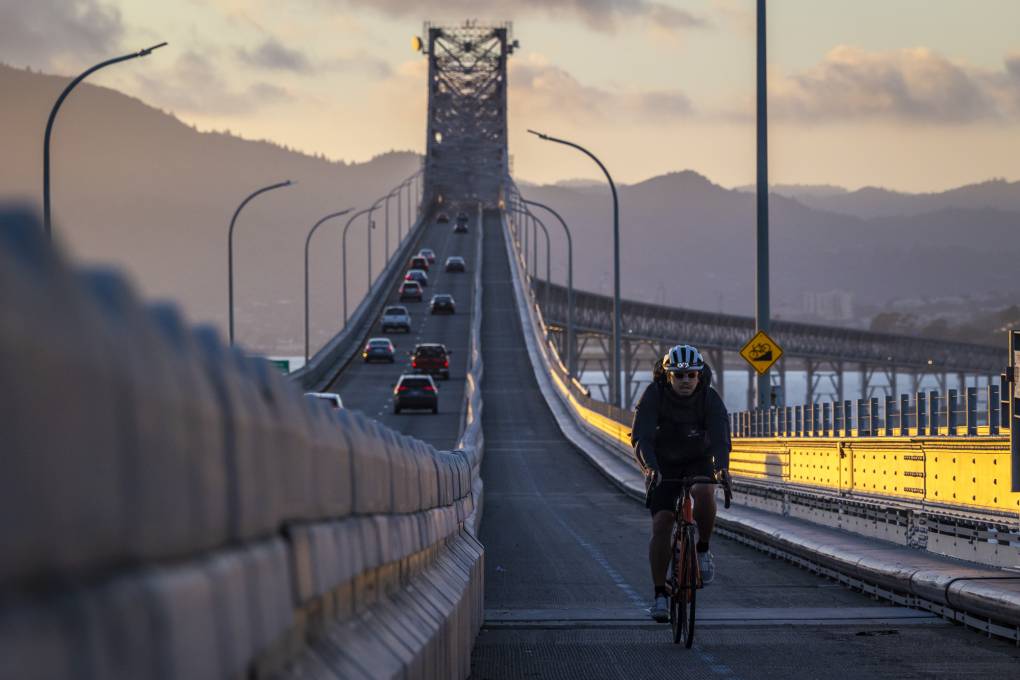
The Fate of the Richmond-San Rafael Bridge Bike Lane
The Ongoing Saga of the Richmond-San Rafael Bridge Bike Lane
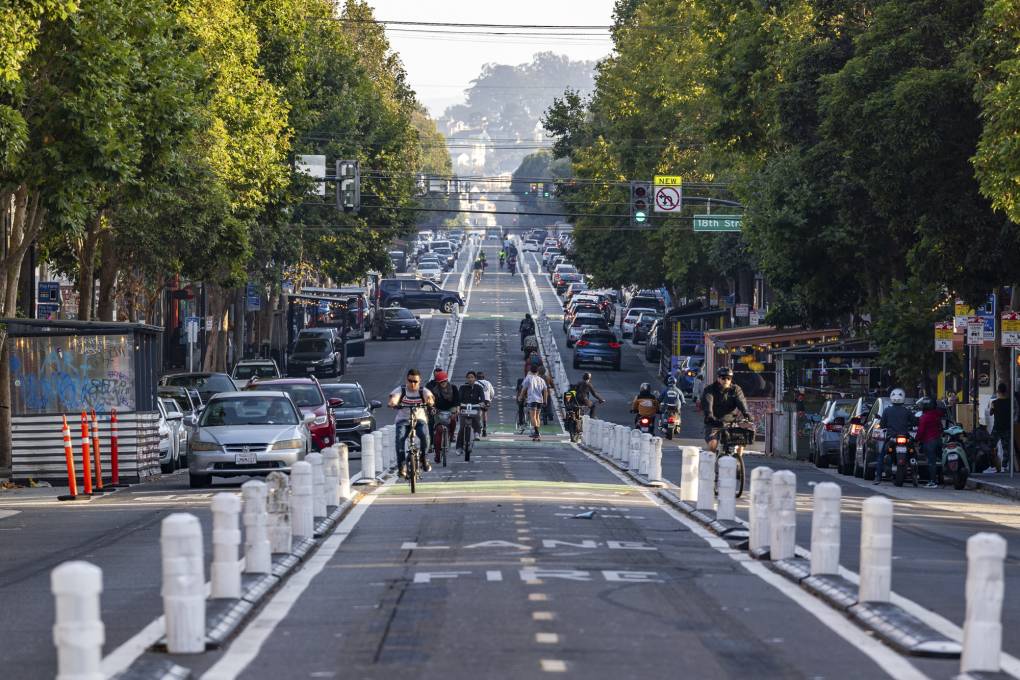
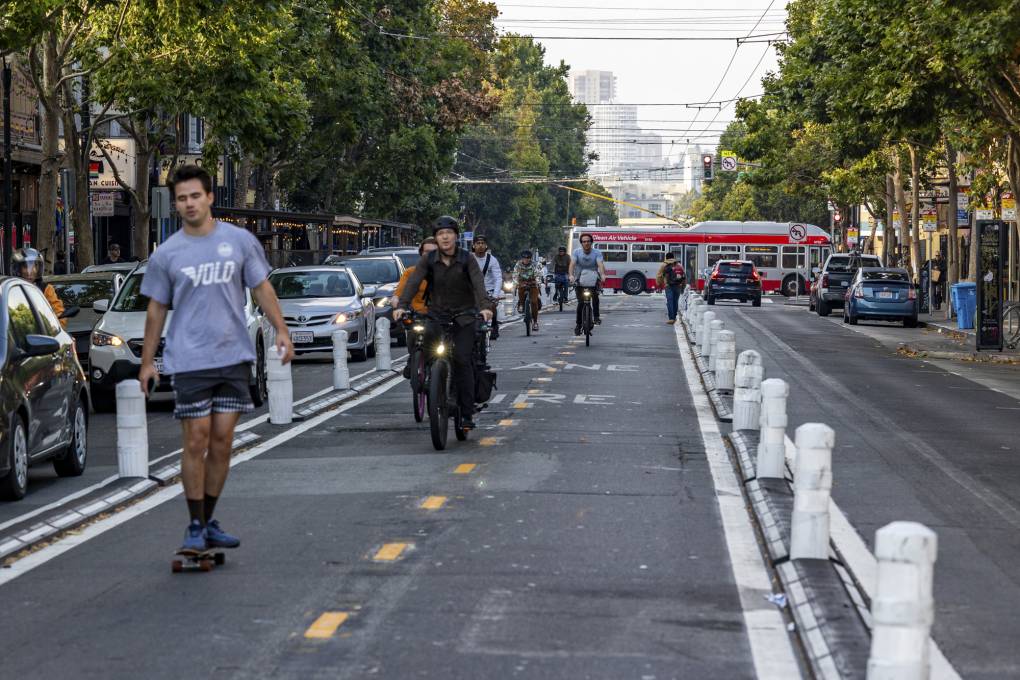
SF’s Controversial Valencia Street Center Bike Lane Will Be Removed
The Future of San Francisco's Valencia Street — and What Oakland's Telegraph Avenue Tells Us About It
SF’s New Valencia Street Bike Lane Will Have to Go Around, And Between, Parklets
SFMTA Cites Improved Road Safety With Valencia Street Bike Lane, but Some Disagree
SF Officials Say Cycling Is Up on Valencia Street, Not Down, Since Installation of Bikeway
Cyclists and Businesses Reflect on 2 Months With the Valencia Street Bikeway
Player sponsored by
window.__IS_SSR__=true
window.__INITIAL_STATE__={
"attachmentsReducer": {
"audio_0": {
"type": "attachments",
"id": "audio_0",
"imgSizes": {
"kqedFullSize": {
"file": "https://ww2.kqed.org/news/wp-content/themes/KQED-unified/img/audio_bgs/background0.jpg"
}
}
},
"audio_1": {
"type": "attachments",
"id": "audio_1",
"imgSizes": {
"kqedFullSize": {
"file": "https://ww2.kqed.org/news/wp-content/themes/KQED-unified/img/audio_bgs/background1.jpg"
}
}
},
"audio_2": {
"type": "attachments",
"id": "audio_2",
"imgSizes": {
"kqedFullSize": {
"file": "https://ww2.kqed.org/news/wp-content/themes/KQED-unified/img/audio_bgs/background2.jpg"
}
}
},
"audio_3": {
"type": "attachments",
"id": "audio_3",
"imgSizes": {
"kqedFullSize": {
"file": "https://ww2.kqed.org/news/wp-content/themes/KQED-unified/img/audio_bgs/background3.jpg"
}
}
},
"audio_4": {
"type": "attachments",
"id": "audio_4",
"imgSizes": {
"kqedFullSize": {
"file": "https://ww2.kqed.org/news/wp-content/themes/KQED-unified/img/audio_bgs/background4.jpg"
}
}
},
"placeholder": {
"type": "attachments",
"id": "placeholder",
"imgSizes": {
"thumbnail": {
"file": "https://cdn.kqed.org/wp-content/uploads/2024/12/KQED-Default-Image-816638274-2000x1333-1-160x107.jpg",
"width": 160,
"height": 107,
"mimeType": "image/jpeg"
},
"medium": {
"file": "https://cdn.kqed.org/wp-content/uploads/2024/12/KQED-Default-Image-816638274-2000x1333-1-800x533.jpg",
"width": 800,
"height": 533,
"mimeType": "image/jpeg"
},
"medium_large": {
"file": "https://cdn.kqed.org/wp-content/uploads/2024/12/KQED-Default-Image-816638274-2000x1333-1-768x512.jpg",
"width": 768,
"height": 512,
"mimeType": "image/jpeg"
},
"large": {
"file": "https://cdn.kqed.org/wp-content/uploads/2024/12/KQED-Default-Image-816638274-2000x1333-1-1020x680.jpg",
"width": 1020,
"height": 680,
"mimeType": "image/jpeg"
},
"1536x1536": {
"file": "https://cdn.kqed.org/wp-content/uploads/2024/12/KQED-Default-Image-816638274-2000x1333-1-1536x1024.jpg",
"width": 1536,
"height": 1024,
"mimeType": "image/jpeg"
},
"fd-lrg": {
"file": "https://cdn.kqed.org/wp-content/uploads/2024/12/KQED-Default-Image-816638274-2000x1333-1-1536x1024.jpg",
"width": 1536,
"height": 1024,
"mimeType": "image/jpeg"
},
"fd-med": {
"file": "https://cdn.kqed.org/wp-content/uploads/2024/12/KQED-Default-Image-816638274-2000x1333-1-1020x680.jpg",
"width": 1020,
"height": 680,
"mimeType": "image/jpeg"
},
"fd-sm": {
"file": "https://cdn.kqed.org/wp-content/uploads/2024/12/KQED-Default-Image-816638274-2000x1333-1-800x533.jpg",
"width": 800,
"height": 533,
"mimeType": "image/jpeg"
},
"post-thumbnail": {
"file": "https://cdn.kqed.org/wp-content/uploads/2024/12/KQED-Default-Image-816638274-2000x1333-1-672x372.jpg",
"width": 672,
"height": 372,
"mimeType": "image/jpeg"
},
"twentyfourteen-full-width": {
"file": "https://cdn.kqed.org/wp-content/uploads/2024/12/KQED-Default-Image-816638274-2000x1333-1-1038x576.jpg",
"width": 1038,
"height": 576,
"mimeType": "image/jpeg"
},
"xxsmall": {
"file": "https://cdn.kqed.org/wp-content/uploads/2024/12/KQED-Default-Image-816638274-2000x1333-1-160x107.jpg",
"width": 160,
"height": 107,
"mimeType": "image/jpeg"
},
"xsmall": {
"file": "https://cdn.kqed.org/wp-content/uploads/2024/12/KQED-Default-Image-816638274-2000x1333-1-672x372.jpg",
"width": 672,
"height": 372,
"mimeType": "image/jpeg"
},
"small": {
"file": "https://cdn.kqed.org/wp-content/uploads/2024/12/KQED-Default-Image-816638274-2000x1333-1-672x372.jpg",
"width": 672,
"height": 372,
"mimeType": "image/jpeg"
},
"xlarge": {
"file": "https://cdn.kqed.org/wp-content/uploads/2024/12/KQED-Default-Image-816638274-2000x1333-1-1020x680.jpg",
"width": 1020,
"height": 680,
"mimeType": "image/jpeg"
},
"full-width": {
"file": "https://cdn.kqed.org/wp-content/uploads/2024/12/KQED-Default-Image-816638274-2000x1333-1-1920x1280.jpg",
"width": 1920,
"height": 1280,
"mimeType": "image/jpeg"
},
"guest-author-32": {
"file": "https://cdn.kqed.org/wp-content/uploads/2025/01/KQED-Default-Image-816638274-1333x1333-1-160x160.jpg",
"width": 32,
"height": 32,
"mimeType": "image/jpeg"
},
"guest-author-50": {
"file": "https://cdn.kqed.org/wp-content/uploads/2025/01/KQED-Default-Image-816638274-1333x1333-1-160x160.jpg",
"width": 50,
"height": 50,
"mimeType": "image/jpeg"
},
"guest-author-64": {
"file": "https://cdn.kqed.org/wp-content/uploads/2025/01/KQED-Default-Image-816638274-1333x1333-1-160x160.jpg",
"width": 64,
"height": 64,
"mimeType": "image/jpeg"
},
"guest-author-96": {
"file": "https://cdn.kqed.org/wp-content/uploads/2025/01/KQED-Default-Image-816638274-1333x1333-1-160x160.jpg",
"width": 96,
"height": 96,
"mimeType": "image/jpeg"
},
"guest-author-128": {
"file": "https://cdn.kqed.org/wp-content/uploads/2025/01/KQED-Default-Image-816638274-1333x1333-1-160x160.jpg",
"width": 128,
"height": 128,
"mimeType": "image/jpeg"
},
"detail": {
"file": "https://cdn.kqed.org/wp-content/uploads/2025/01/KQED-Default-Image-816638274-1333x1333-1-160x160.jpg",
"width": 160,
"height": 160,
"mimeType": "image/jpeg"
},
"kqedFullSize": {
"file": "https://cdn.kqed.org/wp-content/uploads/2024/12/KQED-Default-Image-816638274-2000x1333-1.jpg",
"width": 2000,
"height": 1333
}
}
},
"news_11971762": {
"type": "attachments",
"id": "news_11971762",
"meta": {
"index": "attachments_1716263798",
"site": "news",
"id": "11971762",
"found": true
},
"parent": 0,
"imgSizes": {
"twentyfourteen-full-width": {
"file": "https://cdn.kqed.org/wp-content/uploads/sites/10/2024/01/240103-RSR-BIKE-LANE-MD-01-KQED-1038x576.jpg",
"width": 1038,
"mimeType": "image/jpeg",
"height": 576
},
"thumbnail": {
"file": "https://cdn.kqed.org/wp-content/uploads/sites/10/2024/01/240103-RSR-BIKE-LANE-MD-01-KQED-160x107.jpg",
"width": 160,
"mimeType": "image/jpeg",
"height": 107
},
"post-thumbnail": {
"file": "https://cdn.kqed.org/wp-content/uploads/sites/10/2024/01/240103-RSR-BIKE-LANE-MD-01-KQED-672x372.jpg",
"width": 672,
"mimeType": "image/jpeg",
"height": 372
},
"kqedFullSize": {
"file": "https://cdn.kqed.org/wp-content/uploads/sites/10/2024/01/240103-RSR-BIKE-LANE-MD-01-KQED.jpg",
"width": 2000,
"height": 1333
},
"large": {
"file": "https://cdn.kqed.org/wp-content/uploads/sites/10/2024/01/240103-RSR-BIKE-LANE-MD-01-KQED-1020x680.jpg",
"width": 1020,
"mimeType": "image/jpeg",
"height": 680
},
"1536x1536": {
"file": "https://cdn.kqed.org/wp-content/uploads/sites/10/2024/01/240103-RSR-BIKE-LANE-MD-01-KQED-1536x1024.jpg",
"width": 1536,
"mimeType": "image/jpeg",
"height": 1024
},
"full-width": {
"file": "https://cdn.kqed.org/wp-content/uploads/sites/10/2024/01/240103-RSR-BIKE-LANE-MD-01-KQED-1920x1280.jpg",
"width": 1920,
"mimeType": "image/jpeg",
"height": 1280
},
"medium": {
"file": "https://cdn.kqed.org/wp-content/uploads/sites/10/2024/01/240103-RSR-BIKE-LANE-MD-01-KQED-800x533.jpg",
"width": 800,
"mimeType": "image/jpeg",
"height": 533
}
},
"publishDate": 1704475561,
"modified": 1704475719,
"caption": "A biker uses the bike lane on the upper deck of the Richmond-San Rafael Bridge on Jan 3, 2024.",
"description": null,
"title": "240103-RSR BIKE LANE-MD-01-KQED",
"credit": "Martin do Nascimento/KQED",
"status": "inherit",
"altTag": "A person bikes across a large bridge on which cars are also driving.",
"isLoading": false,
"fetchFailed": false
},
"news_12017830": {
"type": "attachments",
"id": "news_12017830",
"meta": {
"index": "attachments_1716263798",
"site": "news",
"id": "12017830",
"found": true
},
"title": "20241211_RichmondBridgeBike_GC-14",
"publishDate": 1733963589,
"status": "inherit",
"parent": 0,
"modified": 1742600769,
"caption": "Cyclists ride on the Richmond-San Rafael Bridge Trail, a roughly 6-mile bicycle and pedestrian path, located on the upper deck of the bridge, on Dec. 11, 2024.",
"credit": "Gina Castro/KQED",
"altTag": null,
"description": null,
"imgSizes": {
"medium": {
"file": "https://cdn.kqed.org/wp-content/uploads/sites/10/2024/12/20241211_RichmondBridgeBike_GC-14-800x533.jpg",
"width": 800,
"height": 533,
"mimeType": "image/jpeg"
},
"large": {
"file": "https://cdn.kqed.org/wp-content/uploads/sites/10/2024/12/20241211_RichmondBridgeBike_GC-14-1020x679.jpg",
"width": 1020,
"height": 679,
"mimeType": "image/jpeg"
},
"thumbnail": {
"file": "https://cdn.kqed.org/wp-content/uploads/sites/10/2024/12/20241211_RichmondBridgeBike_GC-14-160x107.jpg",
"width": 160,
"height": 107,
"mimeType": "image/jpeg"
},
"1536x1536": {
"file": "https://cdn.kqed.org/wp-content/uploads/sites/10/2024/12/20241211_RichmondBridgeBike_GC-14-1536x1023.jpg",
"width": 1536,
"height": 1023,
"mimeType": "image/jpeg"
},
"post-thumbnail": {
"file": "https://cdn.kqed.org/wp-content/uploads/sites/10/2024/12/20241211_RichmondBridgeBike_GC-14-672x372.jpg",
"width": 672,
"height": 372,
"mimeType": "image/jpeg"
},
"twentyfourteen-full-width": {
"file": "https://cdn.kqed.org/wp-content/uploads/sites/10/2024/12/20241211_RichmondBridgeBike_GC-14-1038x576.jpg",
"width": 1038,
"height": 576,
"mimeType": "image/jpeg"
},
"full-width": {
"file": "https://cdn.kqed.org/wp-content/uploads/sites/10/2024/12/20241211_RichmondBridgeBike_GC-14-1920x1279.jpg",
"width": 1920,
"height": 1279,
"mimeType": "image/jpeg"
},
"kqedFullSize": {
"file": "https://cdn.kqed.org/wp-content/uploads/sites/10/2024/12/20241211_RichmondBridgeBike_GC-14.jpg",
"width": 2000,
"height": 1332
}
},
"isLoading": false,
"fetchFailed": false
},
"news_12014768": {
"type": "attachments",
"id": "news_12014768",
"meta": {
"index": "attachments_1716263798",
"site": "news",
"id": "12014768",
"found": true
},
"title": "230922-ValenciaBikeway-003-BL_qed",
"publishDate": 1731717499,
"status": "inherit",
"parent": 12014765,
"modified": 1731717511,
"caption": "A bicyclist rides on the Valencia Street bike lane in San Francisco's Mission District on Sept. 22, 2023.",
"credit": "Beth LaBerge/KQED",
"altTag": null,
"description": null,
"imgSizes": {
"medium": {
"file": "https://cdn.kqed.org/wp-content/uploads/sites/10/2024/11/230922-ValenciaBikeway-003-BL_qed-800x533.jpg",
"width": 800,
"height": 533,
"mimeType": "image/jpeg"
},
"large": {
"file": "https://cdn.kqed.org/wp-content/uploads/sites/10/2024/11/230922-ValenciaBikeway-003-BL_qed-1020x680.jpg",
"width": 1020,
"height": 680,
"mimeType": "image/jpeg"
},
"thumbnail": {
"file": "https://cdn.kqed.org/wp-content/uploads/sites/10/2024/11/230922-ValenciaBikeway-003-BL_qed-160x107.jpg",
"width": 160,
"height": 107,
"mimeType": "image/jpeg"
},
"1536x1536": {
"file": "https://cdn.kqed.org/wp-content/uploads/sites/10/2024/11/230922-ValenciaBikeway-003-BL_qed-1536x1024.jpg",
"width": 1536,
"height": 1024,
"mimeType": "image/jpeg"
},
"post-thumbnail": {
"file": "https://cdn.kqed.org/wp-content/uploads/sites/10/2024/11/230922-ValenciaBikeway-003-BL_qed-672x372.jpg",
"width": 672,
"height": 372,
"mimeType": "image/jpeg"
},
"twentyfourteen-full-width": {
"file": "https://cdn.kqed.org/wp-content/uploads/sites/10/2024/11/230922-ValenciaBikeway-003-BL_qed-1038x576.jpg",
"width": 1038,
"height": 576,
"mimeType": "image/jpeg"
},
"full-width": {
"file": "https://cdn.kqed.org/wp-content/uploads/sites/10/2024/11/230922-ValenciaBikeway-003-BL_qed-1920x1280.jpg",
"width": 1920,
"height": 1280,
"mimeType": "image/jpeg"
},
"kqedFullSize": {
"file": "https://cdn.kqed.org/wp-content/uploads/sites/10/2024/11/230922-ValenciaBikeway-003-BL_qed.jpg",
"width": 2000,
"height": 1333
}
},
"isLoading": false,
"fetchFailed": false
},
"news_12005179": {
"type": "attachments",
"id": "news_12005179",
"meta": {
"index": "attachments_1716263798",
"site": "news",
"id": "12005179",
"found": true
},
"title": "240823-ValenciaTelegraphBikeLanes-05-BL_qed",
"publishDate": 1726677421,
"status": "inherit",
"parent": 12005173,
"modified": 1726677802,
"caption": "Bicycle lanes on Valencia Street switch to center running lanes at 15th Street going south in San Francisco on Aug. 23, 2024.",
"credit": "Beth LaBerge/KQED",
"altTag": "An aerial view of street in a city.",
"description": null,
"imgSizes": {
"medium": {
"file": "https://cdn.kqed.org/wp-content/uploads/sites/10/2024/09/240823-ValenciaTelegraphBikeLanes-05-BL_qed-800x533.jpg",
"width": 800,
"height": 533,
"mimeType": "image/jpeg"
},
"large": {
"file": "https://cdn.kqed.org/wp-content/uploads/sites/10/2024/09/240823-ValenciaTelegraphBikeLanes-05-BL_qed-1020x680.jpg",
"width": 1020,
"height": 680,
"mimeType": "image/jpeg"
},
"thumbnail": {
"file": "https://cdn.kqed.org/wp-content/uploads/sites/10/2024/09/240823-ValenciaTelegraphBikeLanes-05-BL_qed-160x107.jpg",
"width": 160,
"height": 107,
"mimeType": "image/jpeg"
},
"1536x1536": {
"file": "https://cdn.kqed.org/wp-content/uploads/sites/10/2024/09/240823-ValenciaTelegraphBikeLanes-05-BL_qed-1536x1024.jpg",
"width": 1536,
"height": 1024,
"mimeType": "image/jpeg"
},
"post-thumbnail": {
"file": "https://cdn.kqed.org/wp-content/uploads/sites/10/2024/09/240823-ValenciaTelegraphBikeLanes-05-BL_qed-672x372.jpg",
"width": 672,
"height": 372,
"mimeType": "image/jpeg"
},
"twentyfourteen-full-width": {
"file": "https://cdn.kqed.org/wp-content/uploads/sites/10/2024/09/240823-ValenciaTelegraphBikeLanes-05-BL_qed-1038x576.jpg",
"width": 1038,
"height": 576,
"mimeType": "image/jpeg"
},
"full-width": {
"file": "https://cdn.kqed.org/wp-content/uploads/sites/10/2024/09/240823-ValenciaTelegraphBikeLanes-05-BL_qed-1920x1280.jpg",
"width": 1920,
"height": 1280,
"mimeType": "image/jpeg"
},
"kqedFullSize": {
"file": "https://cdn.kqed.org/wp-content/uploads/sites/10/2024/09/240823-ValenciaTelegraphBikeLanes-05-BL_qed.jpg",
"width": 2000,
"height": 1333
}
},
"isLoading": false,
"fetchFailed": false
},
"news_12001835": {
"type": "attachments",
"id": "news_12001835",
"meta": {
"index": "attachments_1716263798",
"site": "news",
"id": "12001835",
"found": true
},
"title": "240823-VALENCIATELEGRAPHBIKELANES-24-BL-KQED",
"publishDate": 1724690591,
"status": "inherit",
"parent": 0,
"modified": 1724690703,
"caption": "A bicyclist rides on the Valencia Street bike lane in front of Four Barrel Coffee in San Francisco's Mission District on Aug. 23, 2024.",
"credit": "Beth LaBerge/KQED",
"altTag": null,
"description": null,
"imgSizes": {
"medium": {
"file": "https://cdn.kqed.org/wp-content/uploads/sites/10/2024/08/240823-VALENCIATELEGRAPHBIKELANES-24-BL-KQED-800x533.jpg",
"width": 800,
"height": 533,
"mimeType": "image/jpeg"
},
"large": {
"file": "https://cdn.kqed.org/wp-content/uploads/sites/10/2024/08/240823-VALENCIATELEGRAPHBIKELANES-24-BL-KQED-1020x680.jpg",
"width": 1020,
"height": 680,
"mimeType": "image/jpeg"
},
"thumbnail": {
"file": "https://cdn.kqed.org/wp-content/uploads/sites/10/2024/08/240823-VALENCIATELEGRAPHBIKELANES-24-BL-KQED-160x107.jpg",
"width": 160,
"height": 107,
"mimeType": "image/jpeg"
},
"1536x1536": {
"file": "https://cdn.kqed.org/wp-content/uploads/sites/10/2024/08/240823-VALENCIATELEGRAPHBIKELANES-24-BL-KQED-1536x1024.jpg",
"width": 1536,
"height": 1024,
"mimeType": "image/jpeg"
},
"post-thumbnail": {
"file": "https://cdn.kqed.org/wp-content/uploads/sites/10/2024/08/240823-VALENCIATELEGRAPHBIKELANES-24-BL-KQED-672x372.jpg",
"width": 672,
"height": 372,
"mimeType": "image/jpeg"
},
"twentyfourteen-full-width": {
"file": "https://cdn.kqed.org/wp-content/uploads/sites/10/2024/08/240823-VALENCIATELEGRAPHBIKELANES-24-BL-KQED-1038x576.jpg",
"width": 1038,
"height": 576,
"mimeType": "image/jpeg"
},
"full-width": {
"file": "https://cdn.kqed.org/wp-content/uploads/sites/10/2024/08/240823-VALENCIATELEGRAPHBIKELANES-24-BL-KQED-1920x1280.jpg",
"width": 1920,
"height": 1280,
"mimeType": "image/jpeg"
},
"kqedFullSize": {
"file": "https://cdn.kqed.org/wp-content/uploads/sites/10/2024/08/240823-VALENCIATELEGRAPHBIKELANES-24-BL-KQED.jpg",
"width": 2000,
"height": 1333
}
},
"isLoading": false,
"fetchFailed": false
},
"news_11962331": {
"type": "attachments",
"id": "news_11962331",
"meta": {
"index": "attachments_1716263798",
"site": "news",
"id": "11962331",
"found": true
},
"parent": 11970450,
"imgSizes": {
"twentyfourteen-full-width": {
"file": "https://cdn.kqed.org/wp-content/uploads/sites/10/2023/09/230921-ValenciaBikeway-015-BL-KQED-1038x576.jpg",
"width": 1038,
"mimeType": "image/jpeg",
"height": 576
},
"thumbnail": {
"file": "https://cdn.kqed.org/wp-content/uploads/sites/10/2023/09/230921-ValenciaBikeway-015-BL-KQED-160x107.jpg",
"width": 160,
"mimeType": "image/jpeg",
"height": 107
},
"post-thumbnail": {
"file": "https://cdn.kqed.org/wp-content/uploads/sites/10/2023/09/230921-ValenciaBikeway-015-BL-KQED-672x372.jpg",
"width": 672,
"mimeType": "image/jpeg",
"height": 372
},
"kqedFullSize": {
"file": "https://cdn.kqed.org/wp-content/uploads/sites/10/2023/09/230921-ValenciaBikeway-015-BL-KQED.jpg",
"width": 2000,
"height": 1333
},
"large": {
"file": "https://cdn.kqed.org/wp-content/uploads/sites/10/2023/09/230921-ValenciaBikeway-015-BL-KQED-1020x680.jpg",
"width": 1020,
"mimeType": "image/jpeg",
"height": 680
},
"1536x1536": {
"file": "https://cdn.kqed.org/wp-content/uploads/sites/10/2023/09/230921-ValenciaBikeway-015-BL-KQED-1536x1024.jpg",
"width": 1536,
"mimeType": "image/jpeg",
"height": 1024
},
"full-width": {
"file": "https://cdn.kqed.org/wp-content/uploads/sites/10/2023/09/230921-ValenciaBikeway-015-BL-KQED-1920x1280.jpg",
"width": 1920,
"mimeType": "image/jpeg",
"height": 1280
},
"medium": {
"file": "https://cdn.kqed.org/wp-content/uploads/sites/10/2023/09/230921-ValenciaBikeway-015-BL-KQED-800x533.jpg",
"width": 800,
"mimeType": "image/jpeg",
"height": 533
}
},
"publishDate": 1695666424,
"modified": 1703026547,
"caption": "Bicyclists ride on the Valencia Street bike lane in San Francisco's Mission District on Sept. 21, 2023.",
"description": null,
"title": "230921-ValenciaBikeway-015-BL-KQED",
"credit": "Beth LaBerge/KQED",
"status": "inherit",
"altTag": "People on bikes and skateboards ride down a bike path in the middle of a city street.",
"isLoading": false,
"fetchFailed": false
},
"news_11962330": {
"type": "attachments",
"id": "news_11962330",
"meta": {
"index": "attachments_1716263798",
"site": "news",
"id": "11962330",
"found": true
},
"parent": 11962992,
"imgSizes": {
"twentyfourteen-full-width": {
"file": "https://ww2.kqed.org/app/uploads/sites/10/2023/09/230921-ValenciaBikeway-014-BL-KQED-1038x576.jpg",
"width": 1038,
"mimeType": "image/jpeg",
"height": 576
},
"thumbnail": {
"file": "https://ww2.kqed.org/app/uploads/sites/10/2023/09/230921-ValenciaBikeway-014-BL-KQED-160x107.jpg",
"width": 160,
"mimeType": "image/jpeg",
"height": 107
},
"post-thumbnail": {
"file": "https://ww2.kqed.org/app/uploads/sites/10/2023/09/230921-ValenciaBikeway-014-BL-KQED-672x372.jpg",
"width": 672,
"mimeType": "image/jpeg",
"height": 372
},
"kqedFullSize": {
"file": "https://ww2.kqed.org/app/uploads/sites/10/2023/09/230921-ValenciaBikeway-014-BL-KQED.jpg",
"width": 2000,
"height": 1333
},
"large": {
"file": "https://ww2.kqed.org/app/uploads/sites/10/2023/09/230921-ValenciaBikeway-014-BL-KQED-1020x680.jpg",
"width": 1020,
"mimeType": "image/jpeg",
"height": 680
},
"1536x1536": {
"file": "https://ww2.kqed.org/app/uploads/sites/10/2023/09/230921-ValenciaBikeway-014-BL-KQED-1536x1024.jpg",
"width": 1536,
"mimeType": "image/jpeg",
"height": 1024
},
"full-width": {
"file": "https://ww2.kqed.org/app/uploads/sites/10/2023/09/230921-ValenciaBikeway-014-BL-KQED-1920x1280.jpg",
"width": 1920,
"mimeType": "image/jpeg",
"height": 1280
},
"medium": {
"file": "https://ww2.kqed.org/app/uploads/sites/10/2023/09/230921-ValenciaBikeway-014-BL-KQED-800x533.jpg",
"width": 800,
"mimeType": "image/jpeg",
"height": 533
}
},
"publishDate": 1695666416,
"modified": 1696095652,
"caption": "Bicyclists ride on the Valencia Street bike lane in San Francisco's Mission District on Sept. 21, 2023.",
"description": null,
"title": "230921-ValenciaBikeway-014-BL-KQED",
"credit": "Beth LaBerge/KQED",
"status": "inherit",
"altTag": "People on bikes and skateboards ride down a bike path in the middle of a city street.",
"isLoading": false,
"fetchFailed": false
}
},
"audioPlayerReducer": {
"postId": "stream_live",
"isPaused": true,
"isPlaying": false,
"pfsActive": false,
"pledgeModalIsOpen": true,
"playerDrawerIsOpen": false,
"liveAudioPlayStartedAt": 0,
"liveAudioPlayContext": ""
},
"authorsReducer": {
"ecruzguevarra": {
"type": "authors",
"id": "8654",
"meta": {
"index": "authors_1716337520",
"id": "8654",
"found": true
},
"name": "Ericka Cruz Guevarra",
"firstName": "Ericka",
"lastName": "Cruz Guevarra",
"slug": "ecruzguevarra",
"email": "ecruzguevarra@kqed.org",
"display_author_email": true,
"staff_mastheads": [
"news"
],
"title": "Producer, The Bay Podcast",
"bio": "Ericka Cruz Guevarra is host of \u003ca href=\"https://www.kqed.org/podcasts/thebay\">\u003cem>The Bay\u003c/em>\u003c/a> podcast at KQED. Before host, she was the show’s producer. Her work in that capacity includes a three-part reported series on policing in Vallejo, which won a 2020 excellence in journalism award from the Society of Professional Journalists. Ericka has worked as a breaking news reporter at Oregon Public Broadcasting, helped produce the Code Switch podcast, and was KQED’s inaugural Raul Ramirez Diversity Fund intern. She’s also an alumna of NPR’s Next Generation Radio program. Send her an email if you have strong feelings about whether Fairfield and Suisun City are the Bay. Ericka is represented by SAG-AFTRA.",
"avatar": "https://secure.gravatar.com/avatar/accefc1de4bafc7e234b69bcb9b6f6536c130fd84709bc3069ef11a78787e1bb?s=600&d=blank&r=g",
"twitter": "NotoriousECG",
"bluesky": null,
"facebook": null,
"instagram": null,
"linkedin": null,
"sites": [
{
"site": "arts",
"roles": [
"subscriber"
]
},
{
"site": "news",
"roles": [
"editor",
"manage_categories"
]
},
{
"site": "futureofyou",
"roles": [
"subscriber"
]
},
{
"site": "stateofhealth",
"roles": [
"subscriber"
]
},
{
"site": "science",
"roles": [
"editor"
]
},
{
"site": "forum",
"roles": [
"subscriber"
]
}
],
"headData": {
"title": "Ericka Cruz Guevarra | KQED",
"description": "Producer, The Bay Podcast",
"ogImgSrc": "https://secure.gravatar.com/avatar/accefc1de4bafc7e234b69bcb9b6f6536c130fd84709bc3069ef11a78787e1bb?s=600&d=blank&r=g",
"twImgSrc": "https://secure.gravatar.com/avatar/accefc1de4bafc7e234b69bcb9b6f6536c130fd84709bc3069ef11a78787e1bb?s=600&d=blank&r=g"
},
"isLoading": false,
"link": "/author/ecruzguevarra"
},
"amontecillo": {
"type": "authors",
"id": "11649",
"meta": {
"index": "authors_1716337520",
"id": "11649",
"found": true
},
"name": "Alan Montecillo",
"firstName": "Alan",
"lastName": "Montecillo",
"slug": "amontecillo",
"email": "amontecillo@kqed.org",
"display_author_email": false,
"staff_mastheads": [
"news"
],
"title": "KQED Contributor",
"bio": "Alan Montecillo is the senior editor of \u003cem>\u003ca href=\"http://kqed.org/thebay\">The Bay\u003c/a>, \u003c/em> KQED's local news podcast. Before moving to the Bay Area, he worked as a senior talk show producer for WILL in Champaign-Urbana, Illinois and at Oregon Public Broadcasting in Portland, Oregon. He has won journalism awards from the Society of Professional Journalists Northern California, the Public Media Journalists Association, The Signal Awards, and has also received a regional Edward R. Murrow award. Alan is a Filipino American from Hong Kong and a graduate of Reed College.",
"avatar": "https://secure.gravatar.com/avatar/268f53a2066899ea9efdd8a5900218b17c822d9862cbc9326cccec53ef41d349?s=600&d=blank&r=g",
"twitter": "alanmontecillo",
"bluesky": null,
"facebook": null,
"instagram": null,
"linkedin": null,
"sites": [
{
"site": "",
"roles": [
"editor"
]
},
{
"site": "news",
"roles": [
"editor",
"manage_categories"
]
}
],
"headData": {
"title": "Alan Montecillo | KQED",
"description": "KQED Contributor",
"ogImgSrc": "https://secure.gravatar.com/avatar/268f53a2066899ea9efdd8a5900218b17c822d9862cbc9326cccec53ef41d349?s=600&d=blank&r=g",
"twImgSrc": "https://secure.gravatar.com/avatar/268f53a2066899ea9efdd8a5900218b17c822d9862cbc9326cccec53ef41d349?s=600&d=blank&r=g"
},
"isLoading": false,
"link": "/author/amontecillo"
},
"adahlstromeckman": {
"type": "authors",
"id": "11785",
"meta": {
"index": "authors_1716337520",
"id": "11785",
"found": true
},
"name": "Azul Dahlstrom-Eckman",
"firstName": "Azul",
"lastName": "Dahlstrom-Eckman",
"slug": "adahlstromeckman",
"email": "adahlstrom-eckman@kqed.org",
"display_author_email": true,
"staff_mastheads": [],
"title": "Reporter",
"bio": "Azul is a reporter for KQED focusing on transportation and features. He joined KQED in 2021 as an alumna of KALW's Audio Academy radio journalism training program.",
"avatar": "https://secure.gravatar.com/avatar/9cb750298435add7815a777f55bf1f46845c1386bb8452555c60a7b820b5aba3?s=600&d=blank&r=g",
"twitter": "@zuliemann",
"bluesky": "@azul415.bsky.social",
"facebook": null,
"instagram": null,
"linkedin": null,
"sites": [
{
"site": "arts",
"roles": [
"editor"
]
},
{
"site": "news",
"roles": [
"editor"
]
},
{
"site": "science",
"roles": [
"editor"
]
},
{
"site": "liveblog",
"roles": [
"author"
]
}
],
"headData": {
"title": "Azul Dahlstrom-Eckman | KQED",
"description": "Reporter",
"ogImgSrc": "https://secure.gravatar.com/avatar/9cb750298435add7815a777f55bf1f46845c1386bb8452555c60a7b820b5aba3?s=600&d=blank&r=g",
"twImgSrc": "https://secure.gravatar.com/avatar/9cb750298435add7815a777f55bf1f46845c1386bb8452555c60a7b820b5aba3?s=600&d=blank&r=g"
},
"isLoading": false,
"link": "/author/adahlstromeckman"
},
"jessicakariisa": {
"type": "authors",
"id": "11831",
"meta": {
"index": "authors_1716337520",
"id": "11831",
"found": true
},
"name": "Jessica Kariisa",
"firstName": "Jessica",
"lastName": "Kariisa",
"slug": "jessicakariisa",
"email": "jkariisa@kqed.org",
"display_author_email": false,
"staff_mastheads": [],
"title": "Producer, The Bay",
"bio": "Jessica Kariisa is the producer of The Bay. She first joined KQED as an intern for The California Report Magazine, after which she became an on-call producer. She reported a Bay Curious episode on the use of rap lyrics in criminal trials which won a Society of Professional Journalists award in 2023 for Excellence in Features Journalism and the 2023 Signal Award for Best Conversation Starter. She’s worked on podcasts for Snap Judgment and American Public Media. Before embarking on her audio career, she was a music journalist.\r\n\r\nJessica Kariisa is represented by SAG-AFTRA.",
"avatar": "https://secure.gravatar.com/avatar/522e97b28ac0b3d411621c0fde8f3419c7b71ea2c5c262c57c4bb600963f328c?s=600&d=blank&r=g",
"twitter": null,
"bluesky": null,
"facebook": null,
"instagram": null,
"linkedin": null,
"sites": [
{
"site": "arts",
"roles": [
"author"
]
},
{
"site": "news",
"roles": [
"editor",
"manage_categories"
]
}
],
"headData": {
"title": "Jessica Kariisa | KQED",
"description": "Producer, The Bay",
"ogImgSrc": "https://secure.gravatar.com/avatar/522e97b28ac0b3d411621c0fde8f3419c7b71ea2c5c262c57c4bb600963f328c?s=600&d=blank&r=g",
"twImgSrc": "https://secure.gravatar.com/avatar/522e97b28ac0b3d411621c0fde8f3419c7b71ea2c5c262c57c4bb600963f328c?s=600&d=blank&r=g"
},
"isLoading": false,
"link": "/author/jessicakariisa"
},
"bkrans": {
"type": "authors",
"id": "11923",
"meta": {
"index": "authors_1716337520",
"id": "11923",
"found": true
},
"name": "Brian Krans",
"firstName": "Brian",
"lastName": "Krans",
"slug": "bkrans",
"email": "bkrans@kqed.org",
"display_author_email": false,
"staff_mastheads": [
"news"
],
"title": "KQED Contributing Reporter",
"bio": "Brian Krans is an award-winning local news and investigative reporter who has been proudly working as a general assignment reporter for KQED since August 2023. He lives in Richmond, where he also reports on air pollution for Richmondside. He is also a founding member of the Vallejo Sun.",
"avatar": "https://secure.gravatar.com/avatar/71fa91f931774612559f7640390b53d9c2840ff72b20f195a25239aab2d9fbb9?s=600&d=blank&r=g",
"twitter": "citizenkrans",
"bluesky": null,
"facebook": null,
"instagram": null,
"linkedin": null,
"sites": [
{
"site": "news",
"roles": [
"editor"
]
}
],
"headData": {
"title": "Brian Krans | KQED",
"description": "KQED Contributing Reporter",
"ogImgSrc": "https://secure.gravatar.com/avatar/71fa91f931774612559f7640390b53d9c2840ff72b20f195a25239aab2d9fbb9?s=600&d=blank&r=g",
"twImgSrc": "https://secure.gravatar.com/avatar/71fa91f931774612559f7640390b53d9c2840ff72b20f195a25239aab2d9fbb9?s=600&d=blank&r=g"
},
"isLoading": false,
"link": "/author/bkrans"
}
},
"pagesReducer": {
"news_tag_bike-lanes": {
"type": "terms",
"id": "news_33270",
"meta": {
"index": "terms_1716263798",
"site": "news",
"id": "33270",
"score": 10.404648
},
"featImg": null,
"name": "bike lanes",
"description": null,
"taxonomy": "tag",
"headData": {
"twImgId": null,
"twTitle": null,
"ogTitle": null,
"ogImgId": null,
"twDescription": null,
"description": null,
"title": "bike lanes Archives | KQED News",
"ogDescription": null
},
"ttid": 33287,
"slug": "bike-lanes",
"isLoading": false,
"title": "bike lanes",
"pageMeta": {
"site": "news",
"WpPageTemplate": "page-topic-editorial",
"currentPage": 1
},
"blocks": [
{
"blockName": "kqed/post-list",
"attrs": {
"layout": "cardArticle2",
"query": "posts/news?tag=bike-lanes",
"seeMore": false,
"paginated": true,
"page": 1
}
},
{
"blockName": "kqed/ad"
}
]
}
},
"pfsSessionReducer": {},
"postsReducer": {
"stream_live": {
"type": "live",
"id": "stream_live",
"audioUrl": "https://streams.kqed.org/kqedradio",
"title": "Live Stream",
"excerpt": "Live Stream information currently unavailable.",
"link": "/radio",
"featImg": "",
"label": {
"name": "KQED Live",
"link": "/"
}
},
"stream_kqedNewscast": {
"type": "posts",
"id": "stream_kqedNewscast",
"audioUrl": "https://www.kqed.org/.stream/anon/radio/RDnews/newscast.mp3?_=1",
"title": "KQED Newscast",
"featImg": "",
"label": {
"name": "88.5 FM",
"link": "/"
}
},
"news_12039931": {
"type": "posts",
"id": "news_12039931",
"meta": {
"index": "posts_1716263798",
"site": "news",
"id": "12039931",
"score": null,
"sort": [
1747216856000
]
},
"guestAuthors": [],
"slug": "the-fate-of-the-richmond-san-rafael-bridge-bike-lane",
"title": "The Fate of the Richmond-San Rafael Bridge Bike Lane",
"publishDate": 1747216856,
"format": "audio",
"headTitle": "The Fate of the Richmond-San Rafael Bridge Bike Lane | KQED",
"labelTerm": {},
"content": "\u003cp>\u003cspan style=\"font-weight: 400\">Since 2019, a bike lane on the Richmond-San Rafael Bridge added more options for cyclists. Now, the fate of the bike lane is a hot button issue as officials decide whether to limit access to weekends only, or keep the lane open seven days a week. Richmondside reporter Joel Umanzor joins us to talk about what’s next for the bridge, and the strong opinions on both sides of the bike lane. \u003c/span>\u003c/p>\n\u003cp>\u003c!-- iframe plugin v.4.3 wordpress.org/plugins/iframe/ -->\u003cbr>\n\u003ciframe loading=\"lazy\" frameborder=\"0\" height=\"200\" scrolling=\"no\" src=\"https://playlist.megaphone.fm?e=KQINC2818777974\" width=\"100%\" class=\"iframe-class\">\u003c/iframe>\u003c/p>\n\u003cp>\u003cstrong>Links:\u003c/strong>\u003c/p>\n\u003cul>\n\u003cli style=\"font-weight: 400\">\u003ca href=\"https://richmondside.org/2025/03/28/richmond-san-rafael-bridge-bike-lane-vote-delayed-again/\">\u003cspan style=\"font-weight: 400\">Cyclists cheer as Richmond-San Rafael bridge bike lane vote is delayed again\u003c/span>\u003c/a>\u003c/li>\n\u003c/ul>\n\u003cp>\u003cem>This is a computer-generated transcript. While our team has reviewed it, there may be errors.\u003c/em>\u003c/p>\n\u003cp>\u003cb>Ericka Cruz Guevarra: \u003c/b>\u003cem>[00:01:49] \u003c/em>Joel, how would you describe the role that the Richmond-San Rafael Bridge plays for people living in Richmond?\u003c/p>\n\u003cp>[ad fullwidth]\u003c/p>\n\u003cp>\u003cb>Joel Umanzor: \u003c/b>\u003cem>[00:01:57] \u003c/em>I would say it’s definitely like a gateway to work. A lot of folks that work on the other side of the bridge in Marin County.\u003c/p>\n\u003cp>\u003cb>Ericka Cruz Guevarra: \u003c/b>\u003cem>[00:02:03] \u003c/em>Joelle Umanzor is a city reporter for Richmond side.\u003c/p>\n\u003cp>\u003cb>Joel Umanzor: \u003c/b>\u003cem>[00:02:08] \u003c/em>It’s a pretty narrow stretch, and it goes pretty long, from Richmond all the way into San Rafael. It’s definitely one of those stretches that is highly used by not just people in Richmond, I think, but the greater East Bay that needs to get over to Marin County. It’s also one of these places where encroaching up on the bridge, traffic can tend to be congested and spill over into Richmond, whether that be on the Castro exit or the Garrard exit.\u003c/p>\n\u003cp>\u003cb>Ericka Cruz Guevarra: \u003c/b>\u003cem>[00:02:35] \u003c/em>In 2019, I know a bike path opened on this bridge that’s, as we’ve been describing, is already very sort of narrow. Take us back to when this decision was made. What exactly changed on the bridge and why?\u003c/p>\n\u003cp>\u003cb>Joel Umanzor: \u003c/b>\u003cem>[00:02:52] \u003c/em>So in 2019, the California Metropolitan Transit Commission, as well as the Bay Area Toll Authority and Marin County and Contra Costa County all developed this pilot that would open that bike lane on the Richmond-San Rafael Bridge. They were looking to kind of expand accessibility for folks using alternate modes of transportation, non-cars. It was fairly popular around COVID during the time we were all staying at home, stay at home orders, people wanted to get out a little bit more. There’s been a lot of advocates, whether that be local nonprofits, like Rich City Rides, that have promoted a lot more bicycle usage. Richmond Track, which is the folks who advocate for more bike lanes or improved safety for pedestrians and bicyclists. A lot of these organizations, as well as some local municipalities, were in favor of having this bike trail, in an area that is not necessarily known for its accessibility.\u003c/p>\n\u003cp>\u003cb>Ericka Cruz Guevarra: \u003c/b>\u003cem>[00:04:04] \u003c/em>This all happened in 2019, the bike lane, but we’re talking about it now because there’s still a really big decision to make, it sounds like, about what to do with this bike lane. Tell us about that.\u003c/p>\n\u003cp>\u003cb>Joel Umanzor: \u003c/b>\u003cem>[00:04:17] \u003c/em>Initially when they introduced this, it was a pilot program. It’s on the clock now. It was proposed on the agenda for the Bay Conservation Development Commission, the BCDC, to review and kind of vote on whether this pilot is going to continue or not. The debate currently right now on the bike lane is whether or not to keep it 24-7, as is, to reduce it to just the weekends and keeping the emergency lane open during rush hours and the normal traffic from Monday through Thursday. Or to just scrap it entirely, which is what some of the anti bike lane folks are hoping to do.\u003c/p>\n\u003cp>\u003cb>Ericka Cruz Guevarra: \u003c/b>\u003cem>[00:05:00] \u003c/em>Who is making this decision?\u003c/p>\n\u003cp>\u003cb>Joel Umanzor: \u003c/b>\u003cem>[00:05:02] \u003c/em>This commission, the BCDC, is kind of comprised of a lot of different municipalities, elected officials. I know we have a couple council members from Richmond that are on that commission. There’s also those in Marin County who are part of that as well. And so I guess when we say who’s making these decisions, this commission is, but it’s a lot different people and it’s a fairly big group. They had this workshop in January to kind of talk about this. And there were just, it was like a four hour meeting and folks were really kind of invested into like how this directly impacts their communities. They had a lot of comments in regards to folks either being really for the bike lane or folks who are more concerned with how cars might be hindered by having this bike lane open 24/7.\u003c/p>\n\u003cp>\u003cb>Ericka Cruz Guevarra: \u003c/b>\u003cem>[00:06:16] \u003c/em>Who’s arguing to limit the bike lane?\u003c/p>\n\u003cp>\u003cb>Joel Umanzor: \u003c/b>\u003cem>[00:06:18] \u003c/em>There’s a lot of folks in Marin County who are either part of the Bay Area Council, which is like a group of business owners, and then you have folks that work on the other side who might be like, why are we having this lane here when, you know, the traffic is so bad?\u003c/p>\n\u003cp>\u003cb>Public Commenter: \u003c/b>\u003cem>[00:06:31] \u003c/em>Our climate change issues are not gonna be solved by a hundred bicycles a day replacing cars. And the need for heavy freight capacity on this bridge is not going away. Open the third lane to full-time traffic.\u003c/p>\n\u003cp>\u003cb>Joel Umanzor: \u003c/b>\u003cem>[00:06:44] \u003c/em>For the folks who are anti-bike lane, their biggest concern is traffic and the impacts to traffic getting on the Richmond, from the Richmond side to Moraine.\u003c/p>\n\u003cp>\u003cb>Public Commenter: \u003c/b>\u003cem>[00:06:51] \u003c/em>It is an equity issue when minority communities, most of whom make less than the Bay Area median income, concerns in trying to get to work are put on the back burner in favor of the recreational habits of a small group of those earning twice the Bay area median income.\u003c/p>\n\u003cp>\u003cb>Ericka Cruz Guevarra: \u003c/b>\u003cem>[00:07:07] \u003c/em>There are other people who really like having the option of being able to bike across the bridge. I mean, who is arguing to keep it open seven days a week?\u003c/p>\n\u003cp>\u003cb>Joel Umanzor: \u003c/b>\u003cem>[00:07:16] \u003c/em>Like I mentioned before, I think there’s a strong coalition of different folks, whether that be those involved in these nonprofit organizations that advocate for alternative modes of transportation, or just like folks that just want to have those kind of options.\u003c/p>\n\u003cp>\u003cb>Public Commenter: \u003c/b>\u003cem>[00:07:32] \u003c/em>[With the] fire’s still raging in LA, this is a heck of a time to go backwards on active transportation. The path has not had a fair chance.\u003c/p>\n\u003cp>\u003cb>Joel Umanzor: \u003c/b>\u003cem>[00:07:41] \u003c/em>Folks mentioned in Richmond that some of these areas that now have access to the bridge are some of the lower income areas, more marginalized communities. With those increased options, it does make it so that folks can know a lot more of their city.\u003c/p>\n\u003cp>\u003cb>Public Commenter: \u003c/b>\u003cem>[00:07:55] \u003c/em>So if you create better bike infrastructure, you’ll get more bike users who will then use the bridge more. Folks who are driving are typically upset with traffic. It’s always true. There never is never going to be enough traffic reduction unless there’s nobody on the streets and we’re like kind of like Detroit. So be careful trying to fix congestion at all means over the health and safety of all others. Thank you very much.\u003c/p>\n\u003cp>\u003cb>Ericka Cruz Guevarra: \u003c/b>\u003cem>[00:08:24] \u003c/em>I mean, the goal of the pilot program was to sort of answer these questions a little bit to kind of figure out if the bike lane helps or not, and if people are actually using it, right? Like, what do we know about what this bike lane accomplished in the five years that it was operating seven days a week?\u003c/p>\n\u003cp>\u003cb>Joel Umanzor: \u003c/b>\u003cem>[00:08:46] \u003c/em>That there was more usage of it, like I said, during those initial COVID days. It accomplished a lot of getting people connected to the greater cycling community, whether that be on the Marin side or on the Contra Costa side. West Contra Costa has a pretty large bicycling community, but I also think that within Richmond itself, that influence is kind of growing over time. And so I would say that it’s definitely helped foster a lot more alternative transportation awareness, you know, speaking from the Richmond side of things.\u003c/p>\n\u003cp>\u003cb>Ericka Cruz Guevarra: \u003c/b>\u003cem>[00:09:18] \u003c/em>So it sounds like it made biking more of a reasonable alternative. But then, I mean, you alluded to some of the arguments on the other side of the lane increasing traffic or increasing emissions. What do we know about that?\u003c/p>\n\u003cp>\u003cb>Joel Umanzor: \u003c/b>\u003cem>[00:09:35] \u003c/em>You know, on the bridge itself, incidents of like a collision or side-swiping or people, you know, getting into a minor collision doesn’t necessarily happen as often as folks might think it does with the bike lane. So that also is a factor when this commission is kind of reviewing how much the bike lane is affecting like, let’s say, emergency services to get to like an accident.\u003c/p>\n\u003cp>\u003cb>Ericka Cruz Guevarra: \u003c/b>\u003cem>[00:10:00] \u003c/em>A study by UC Berkeley researchers hired to analyze the bike path’s effect on traffic found that compared to average conditions between 2015 and 2018, the bike lane has not had a major impact on congestion. Peak times across the bridge have increased by just less than one minute. The study also found that the bike lanes hasn’t had a big impact on vehicle emissions. Safety or traffic accidents. Still, people against the bike lane point out that there are way more people who use cars than bikes to cross the bridge overall. And the fate of the third lane remains an open question.\u003c/p>\n\u003cp>\u003cb>Ericka Cruz Guevarra: \u003c/b>\u003cem>[00:10:52] \u003c/em>Well, where do things stand now, Joel? I mean, what’s the timeline here? When can we expect a decision to be made on the bike lane?\u003c/p>\n\u003cp>\u003cb>Joel Umanzor: \u003c/b>\u003cem>[00:11:00] \u003c/em>We’re waiting till July to see if this item is going to be put back on the agenda. We’re on the road to getting there but it definitely is one of those things that we’re a little further away than one might think. I don’t see a situation where, you know, in my opinion this thing is scrapped entirely. I think there’s a large enough contingent of folks that are really pushing for it that if we do see anything adjusted it’ll probably just be adjusted, you know for scheduling-wise, not for if it exists or not.\u003c/p>\n\u003cp>\u003cb>Ericka Cruz Guevarra: \u003c/b>\u003cem>[00:11:29] \u003c/em>And I mean, this is a very specific question that we’re asking. I mean do we keep the bike lane on the bridge or not? But it also feels like just a slice of this larger kind of debate that we are having in the Bay Area as you’ve kind of alluded to earlier. I mean what do you think makes this a Bay Area story or what do think there is to learn from this about life in the bay area right now?\u003c/p>\n\u003cp>\u003cb>Joel Umanzor: \u003c/b>\u003cem>[00:11:54] \u003c/em>I think it just shows the ever-evolving, I guess, struggle between folks that are really trying to get away from car dependency. You know, Richmond is an interesting place in that we have Chevron right there. So there’s an understanding of how oil dependency has kind of shaped policies in the city. We have this kind of debate in the Bay Area about alternative modes of transportation, not being a car-centric culture. But at the end of the day, I think it just kind of boils down to that car versus non-car debate that we’ve seen in the bay area, not just in Richmond and San failed by I think in the greater in the Greater Bay Area.\u003c/p>\n\u003cp>\u003cb>Ericka Cruz Guevarra: \u003c/b>\u003cem>[00:12:36] \u003c/em>Joelle, thank you so much for sharing your reporting with us on the show. I appreciate it.\u003c/p>\n\u003cp>\u003cb>Joel Umanzor: \u003c/b>\u003cem>[00:12:40] \u003c/em>Yeah, for sure. Thank you for having me.\u003c/p>\n\u003cp>[ad floatright]\u003c/p>\n\u003cp>\u003cem>Some members of the KQED podcast team are represented by The Screen Actors Guild, American Federation of Television and Radio Artists. San Francisco Northern California Local.\u003c/em>\u003c/p>\n\n",
"blocks": [],
"excerpt": "Joel Umanzor joins us to talk about what’s next for the bridge, and the strong opinions on both sides of the bike lane.",
"status": "publish",
"parent": 0,
"modified": 1747243583,
"stats": {
"hasAudio": true,
"hasVideo": false,
"hasChartOrMap": false,
"iframeSrcs": [],
"hasGoogleForm": false,
"hasGallery": false,
"hasHearkenModule": false,
"hasPolis": false,
"paragraphCount": 38,
"wordCount": 2130
},
"headData": {
"title": "The Fate of the Richmond-San Rafael Bridge Bike Lane | KQED",
"description": "Joel Umanzor joins us to talk about what’s next for the bridge, and the strong opinions on both sides of the bike lane.",
"ogTitle": "",
"ogDescription": "",
"ogImgId": "",
"twTitle": "",
"twDescription": "",
"twImgId": "",
"schema": {
"@context": "https://schema.org",
"@type": "NewsArticle",
"headline": "The Fate of the Richmond-San Rafael Bridge Bike Lane",
"datePublished": "2025-05-14T03:00:56-07:00",
"dateModified": "2025-05-14T10:26:23-07:00",
"image": "https://cdn.kqed.org/wp-content/uploads/2020/02/KQED-OG-Image@1x.png",
"isAccessibleForFree": "True",
"publisher": {
"@type": "NewsMediaOrganization",
"@id": "https://www.kqed.org/#organization",
"name": "KQED",
"logo": "https://cdn.kqed.org/wp-content/uploads/2020/02/KQED-OG-Image@1x.png",
"url": "https://www.kqed.org",
"sameAs": [
"https://www.facebook.com/KQED",
"https://twitter.com/KQED",
"https://www.instagram.com/kqed/",
"https://www.tiktok.com/@kqedofficial",
"https://www.linkedin.com/company/kqed",
"https://www.youtube.com/channel/UCeC0IOo7i1P_61zVUWbJ4nw"
]
}
}
},
"source": "The Bay",
"sourceUrl": "https://www.kqed.org/podcasts/thebay",
"audioUrl": "https://www.podtrac.com/pts/redirect.mp3/chrt.fm/track/G6C7C3/traffic.megaphone.fm/KQINC2818777974.mp3?updated=1747166174",
"sticky": false,
"nprStoryId": "kqed-12039931",
"templateType": "standard",
"featuredImageType": "standard",
"excludeFromSiteSearch": "Include",
"articleAge": "0",
"path": "/news/12039931/the-fate-of-the-richmond-san-rafael-bridge-bike-lane",
"audioTrackLength": null,
"parsedContent": [
{
"type": "contentString",
"content": "\u003cdiv class=\"post-body\">\u003cp>\u003cp>\u003cspan style=\"font-weight: 400\">Since 2019, a bike lane on the Richmond-San Rafael Bridge added more options for cyclists. Now, the fate of the bike lane is a hot button issue as officials decide whether to limit access to weekends only, or keep the lane open seven days a week. Richmondside reporter Joel Umanzor joins us to talk about what’s next for the bridge, and the strong opinions on both sides of the bike lane. \u003c/span>\u003c/p>\n\u003cp>\u003c!-- iframe plugin v.4.3 wordpress.org/plugins/iframe/ -->\u003cbr>\n\u003ciframe loading=\"lazy\" frameborder=\"0\" height=\"200\" scrolling=\"no\" src=\"https://playlist.megaphone.fm?e=KQINC2818777974\" width=\"100%\" class=\"iframe-class\">\u003c/iframe>\u003c/p>\n\u003cp>\u003cstrong>Links:\u003c/strong>\u003c/p>\n\u003cul>\n\u003cli style=\"font-weight: 400\">\u003ca href=\"https://richmondside.org/2025/03/28/richmond-san-rafael-bridge-bike-lane-vote-delayed-again/\">\u003cspan style=\"font-weight: 400\">Cyclists cheer as Richmond-San Rafael bridge bike lane vote is delayed again\u003c/span>\u003c/a>\u003c/li>\n\u003c/ul>\n\u003cp>\u003cem>This is a computer-generated transcript. While our team has reviewed it, there may be errors.\u003c/em>\u003c/p>\n\u003cp>\u003cb>Ericka Cruz Guevarra: \u003c/b>\u003cem>[00:01:49] \u003c/em>Joel, how would you describe the role that the Richmond-San Rafael Bridge plays for people living in Richmond?\u003c/p>\n\u003cp>\u003c/p>\u003c/div>",
"attributes": {
"named": {},
"numeric": []
}
},
{
"type": "component",
"content": "",
"name": "ad",
"attributes": {
"named": {
"label": "fullwidth"
},
"numeric": [
"fullwidth"
]
}
},
{
"type": "contentString",
"content": "\u003cdiv class=\"post-body\">\u003cp>\u003c/p>\n\u003cp>\u003cb>Joel Umanzor: \u003c/b>\u003cem>[00:01:57] \u003c/em>I would say it’s definitely like a gateway to work. A lot of folks that work on the other side of the bridge in Marin County.\u003c/p>\n\u003cp>\u003cb>Ericka Cruz Guevarra: \u003c/b>\u003cem>[00:02:03] \u003c/em>Joelle Umanzor is a city reporter for Richmond side.\u003c/p>\n\u003cp>\u003cb>Joel Umanzor: \u003c/b>\u003cem>[00:02:08] \u003c/em>It’s a pretty narrow stretch, and it goes pretty long, from Richmond all the way into San Rafael. It’s definitely one of those stretches that is highly used by not just people in Richmond, I think, but the greater East Bay that needs to get over to Marin County. It’s also one of these places where encroaching up on the bridge, traffic can tend to be congested and spill over into Richmond, whether that be on the Castro exit or the Garrard exit.\u003c/p>\n\u003cp>\u003cb>Ericka Cruz Guevarra: \u003c/b>\u003cem>[00:02:35] \u003c/em>In 2019, I know a bike path opened on this bridge that’s, as we’ve been describing, is already very sort of narrow. Take us back to when this decision was made. What exactly changed on the bridge and why?\u003c/p>\n\u003cp>\u003cb>Joel Umanzor: \u003c/b>\u003cem>[00:02:52] \u003c/em>So in 2019, the California Metropolitan Transit Commission, as well as the Bay Area Toll Authority and Marin County and Contra Costa County all developed this pilot that would open that bike lane on the Richmond-San Rafael Bridge. They were looking to kind of expand accessibility for folks using alternate modes of transportation, non-cars. It was fairly popular around COVID during the time we were all staying at home, stay at home orders, people wanted to get out a little bit more. There’s been a lot of advocates, whether that be local nonprofits, like Rich City Rides, that have promoted a lot more bicycle usage. Richmond Track, which is the folks who advocate for more bike lanes or improved safety for pedestrians and bicyclists. A lot of these organizations, as well as some local municipalities, were in favor of having this bike trail, in an area that is not necessarily known for its accessibility.\u003c/p>\n\u003cp>\u003cb>Ericka Cruz Guevarra: \u003c/b>\u003cem>[00:04:04] \u003c/em>This all happened in 2019, the bike lane, but we’re talking about it now because there’s still a really big decision to make, it sounds like, about what to do with this bike lane. Tell us about that.\u003c/p>\n\u003cp>\u003cb>Joel Umanzor: \u003c/b>\u003cem>[00:04:17] \u003c/em>Initially when they introduced this, it was a pilot program. It’s on the clock now. It was proposed on the agenda for the Bay Conservation Development Commission, the BCDC, to review and kind of vote on whether this pilot is going to continue or not. The debate currently right now on the bike lane is whether or not to keep it 24-7, as is, to reduce it to just the weekends and keeping the emergency lane open during rush hours and the normal traffic from Monday through Thursday. Or to just scrap it entirely, which is what some of the anti bike lane folks are hoping to do.\u003c/p>\n\u003cp>\u003cb>Ericka Cruz Guevarra: \u003c/b>\u003cem>[00:05:00] \u003c/em>Who is making this decision?\u003c/p>\n\u003cp>\u003cb>Joel Umanzor: \u003c/b>\u003cem>[00:05:02] \u003c/em>This commission, the BCDC, is kind of comprised of a lot of different municipalities, elected officials. I know we have a couple council members from Richmond that are on that commission. There’s also those in Marin County who are part of that as well. And so I guess when we say who’s making these decisions, this commission is, but it’s a lot different people and it’s a fairly big group. They had this workshop in January to kind of talk about this. And there were just, it was like a four hour meeting and folks were really kind of invested into like how this directly impacts their communities. They had a lot of comments in regards to folks either being really for the bike lane or folks who are more concerned with how cars might be hindered by having this bike lane open 24/7.\u003c/p>\n\u003cp>\u003cb>Ericka Cruz Guevarra: \u003c/b>\u003cem>[00:06:16] \u003c/em>Who’s arguing to limit the bike lane?\u003c/p>\n\u003cp>\u003cb>Joel Umanzor: \u003c/b>\u003cem>[00:06:18] \u003c/em>There’s a lot of folks in Marin County who are either part of the Bay Area Council, which is like a group of business owners, and then you have folks that work on the other side who might be like, why are we having this lane here when, you know, the traffic is so bad?\u003c/p>\n\u003cp>\u003cb>Public Commenter: \u003c/b>\u003cem>[00:06:31] \u003c/em>Our climate change issues are not gonna be solved by a hundred bicycles a day replacing cars. And the need for heavy freight capacity on this bridge is not going away. Open the third lane to full-time traffic.\u003c/p>\n\u003cp>\u003cb>Joel Umanzor: \u003c/b>\u003cem>[00:06:44] \u003c/em>For the folks who are anti-bike lane, their biggest concern is traffic and the impacts to traffic getting on the Richmond, from the Richmond side to Moraine.\u003c/p>\n\u003cp>\u003cb>Public Commenter: \u003c/b>\u003cem>[00:06:51] \u003c/em>It is an equity issue when minority communities, most of whom make less than the Bay Area median income, concerns in trying to get to work are put on the back burner in favor of the recreational habits of a small group of those earning twice the Bay area median income.\u003c/p>\n\u003cp>\u003cb>Ericka Cruz Guevarra: \u003c/b>\u003cem>[00:07:07] \u003c/em>There are other people who really like having the option of being able to bike across the bridge. I mean, who is arguing to keep it open seven days a week?\u003c/p>\n\u003cp>\u003cb>Joel Umanzor: \u003c/b>\u003cem>[00:07:16] \u003c/em>Like I mentioned before, I think there’s a strong coalition of different folks, whether that be those involved in these nonprofit organizations that advocate for alternative modes of transportation, or just like folks that just want to have those kind of options.\u003c/p>\n\u003cp>\u003cb>Public Commenter: \u003c/b>\u003cem>[00:07:32] \u003c/em>[With the] fire’s still raging in LA, this is a heck of a time to go backwards on active transportation. The path has not had a fair chance.\u003c/p>\n\u003cp>\u003cb>Joel Umanzor: \u003c/b>\u003cem>[00:07:41] \u003c/em>Folks mentioned in Richmond that some of these areas that now have access to the bridge are some of the lower income areas, more marginalized communities. With those increased options, it does make it so that folks can know a lot more of their city.\u003c/p>\n\u003cp>\u003cb>Public Commenter: \u003c/b>\u003cem>[00:07:55] \u003c/em>So if you create better bike infrastructure, you’ll get more bike users who will then use the bridge more. Folks who are driving are typically upset with traffic. It’s always true. There never is never going to be enough traffic reduction unless there’s nobody on the streets and we’re like kind of like Detroit. So be careful trying to fix congestion at all means over the health and safety of all others. Thank you very much.\u003c/p>\n\u003cp>\u003cb>Ericka Cruz Guevarra: \u003c/b>\u003cem>[00:08:24] \u003c/em>I mean, the goal of the pilot program was to sort of answer these questions a little bit to kind of figure out if the bike lane helps or not, and if people are actually using it, right? Like, what do we know about what this bike lane accomplished in the five years that it was operating seven days a week?\u003c/p>\n\u003cp>\u003cb>Joel Umanzor: \u003c/b>\u003cem>[00:08:46] \u003c/em>That there was more usage of it, like I said, during those initial COVID days. It accomplished a lot of getting people connected to the greater cycling community, whether that be on the Marin side or on the Contra Costa side. West Contra Costa has a pretty large bicycling community, but I also think that within Richmond itself, that influence is kind of growing over time. And so I would say that it’s definitely helped foster a lot more alternative transportation awareness, you know, speaking from the Richmond side of things.\u003c/p>\n\u003cp>\u003cb>Ericka Cruz Guevarra: \u003c/b>\u003cem>[00:09:18] \u003c/em>So it sounds like it made biking more of a reasonable alternative. But then, I mean, you alluded to some of the arguments on the other side of the lane increasing traffic or increasing emissions. What do we know about that?\u003c/p>\n\u003cp>\u003cb>Joel Umanzor: \u003c/b>\u003cem>[00:09:35] \u003c/em>You know, on the bridge itself, incidents of like a collision or side-swiping or people, you know, getting into a minor collision doesn’t necessarily happen as often as folks might think it does with the bike lane. So that also is a factor when this commission is kind of reviewing how much the bike lane is affecting like, let’s say, emergency services to get to like an accident.\u003c/p>\n\u003cp>\u003cb>Ericka Cruz Guevarra: \u003c/b>\u003cem>[00:10:00] \u003c/em>A study by UC Berkeley researchers hired to analyze the bike path’s effect on traffic found that compared to average conditions between 2015 and 2018, the bike lane has not had a major impact on congestion. Peak times across the bridge have increased by just less than one minute. The study also found that the bike lanes hasn’t had a big impact on vehicle emissions. Safety or traffic accidents. Still, people against the bike lane point out that there are way more people who use cars than bikes to cross the bridge overall. And the fate of the third lane remains an open question.\u003c/p>\n\u003cp>\u003cb>Ericka Cruz Guevarra: \u003c/b>\u003cem>[00:10:52] \u003c/em>Well, where do things stand now, Joel? I mean, what’s the timeline here? When can we expect a decision to be made on the bike lane?\u003c/p>\n\u003cp>\u003cb>Joel Umanzor: \u003c/b>\u003cem>[00:11:00] \u003c/em>We’re waiting till July to see if this item is going to be put back on the agenda. We’re on the road to getting there but it definitely is one of those things that we’re a little further away than one might think. I don’t see a situation where, you know, in my opinion this thing is scrapped entirely. I think there’s a large enough contingent of folks that are really pushing for it that if we do see anything adjusted it’ll probably just be adjusted, you know for scheduling-wise, not for if it exists or not.\u003c/p>\n\u003cp>\u003cb>Ericka Cruz Guevarra: \u003c/b>\u003cem>[00:11:29] \u003c/em>And I mean, this is a very specific question that we’re asking. I mean do we keep the bike lane on the bridge or not? But it also feels like just a slice of this larger kind of debate that we are having in the Bay Area as you’ve kind of alluded to earlier. I mean what do you think makes this a Bay Area story or what do think there is to learn from this about life in the bay area right now?\u003c/p>\n\u003cp>\u003cb>Joel Umanzor: \u003c/b>\u003cem>[00:11:54] \u003c/em>I think it just shows the ever-evolving, I guess, struggle between folks that are really trying to get away from car dependency. You know, Richmond is an interesting place in that we have Chevron right there. So there’s an understanding of how oil dependency has kind of shaped policies in the city. We have this kind of debate in the Bay Area about alternative modes of transportation, not being a car-centric culture. But at the end of the day, I think it just kind of boils down to that car versus non-car debate that we’ve seen in the bay area, not just in Richmond and San failed by I think in the greater in the Greater Bay Area.\u003c/p>\n\u003cp>\u003cb>Ericka Cruz Guevarra: \u003c/b>\u003cem>[00:12:36] \u003c/em>Joelle, thank you so much for sharing your reporting with us on the show. I appreciate it.\u003c/p>\n\u003cp>\u003cb>Joel Umanzor: \u003c/b>\u003cem>[00:12:40] \u003c/em>Yeah, for sure. Thank you for having me.\u003c/p>\n\u003cp>\u003c/p>\u003c/div>",
"attributes": {
"named": {},
"numeric": []
}
},
{
"type": "component",
"content": "",
"name": "ad",
"attributes": {
"named": {
"label": "floatright"
},
"numeric": [
"floatright"
]
}
},
{
"type": "contentString",
"content": "\u003cdiv class=\"post-body\">\u003cp>\u003c/p>\n\u003cp>\u003cem>Some members of the KQED podcast team are represented by The Screen Actors Guild, American Federation of Television and Radio Artists. San Francisco Northern California Local.\u003c/em>\u003c/p>\n\n\u003c/div>\u003c/p>",
"attributes": {
"named": {},
"numeric": []
}
}
],
"link": "/news/12039931/the-fate-of-the-richmond-san-rafael-bridge-bike-lane",
"authors": [
"8654",
"11649",
"11831"
],
"categories": [
"news_8"
],
"tags": [
"news_33270",
"news_6505",
"news_579",
"news_20477",
"news_22598"
],
"featImg": "news_11971762",
"label": "source_news_12039931"
},
"news_12017869": {
"type": "posts",
"id": "news_12017869",
"meta": {
"index": "posts_1716263798",
"site": "news",
"id": "12017869",
"score": null,
"sort": [
1734091201000
]
},
"guestAuthors": [],
"slug": "will-the-richmond-san-rafael-bridge-bike-lane-stay-its-still-uncertain",
"title": "The Ongoing Saga of the Richmond-San Rafael Bridge Bike Lane",
"publishDate": 1734091201,
"format": "standard",
"headTitle": "The Ongoing Saga of the Richmond-San Rafael Bridge Bike Lane | KQED",
"labelTerm": {
"site": "news"
},
"content": "\u003cp>\u003cem>\u003cstrong>Updated at 12 p.m.\u003c/strong>\u003c/em>\u003c/p>\n\u003cp>The fate of the 10-foot wide, barrier-separated bike and pedestrian path on the upper deck of the Richmond-San Rafael Bridge remains uncertain, as both advocates and critics of the lane eagerly await a decision.\u003c/p>\n\u003cp>The \u003ca href=\"https://mtc.ca.gov/\">Metropolitan Transportation Committee\u003c/a> (MTC) has asked the \u003ca href=\"https://bcdc.ca.gov/\">San Francisco Bay Conservation and Development Commission\u003c/a> (BCDC) for approval to move the barriers over to the side of the bridge from Monday to Thursday, making the lane available in case of crashes or breakdowns. The barriers would be pushed back to where they have been for the last five years for Fridays, weekends and holidays.\u003c/p>\n\u003cp>Many people were expecting the BCDC to vote on the application at its \u003ca href=\"https://marin.granicus.com/ViewPublisherRSS.php?view_id=3&frameborder=0&mode=vpodcast\">November or December meetings\u003c/a>, but Rylan Gervase, a BCDC spokesperson, said this week that the hearing date has yet to be determined and “most likely it will be early next year.”\u003c/p>\n\u003cp>[ad fullwidth]\u003c/p>\n\u003cp>In the meantime, five bodies have voted unanimously on resolutions against the proposal: the city councils of Albany, Berkeley and Richmond; the San Francisco Bay Trail Project Board of Directors; and the West Contra Costa Transportation Advisory Committee.\u003c/p>\n\u003cp>Letters to Marin County’s Board of Supervisors were overwhelmingly in favor of keeping the bike lane open 24/7 as a crucial part of the \u003ca href=\"https://mtc.ca.gov/operations/regional-trails-parks/san-francisco-bay-trail\">San Francisco Bay Trail\u003c/a>, and a \u003ca href=\"https://secure.everyaction.com/2A3aX75jUkSrTH6pp2-zog2\">petition advocating for the bike lane\u003c/a> has gained nearly 3,100 signatures.\u003c/p>\n\u003cp>John Grubb, chief operating officer of the Bay Area Council — a coalition of major businesses that \u003ca href=\"https://web.archive.org/web/20130920040053/http:/www.bayareacouncil.org/bay_area_history.php\">lobbied for creation\u003c/a> of the BCDC and MTC and construction of the Richmond-San Rafael Bridge — said the bike lane pilot was to see if bikers would use the lane for their commutes. “We would argue they haven’t,” he said.\u003c/p>\n\u003cp>The pilot started in November 2019, just months before pandemic-related shutdowns had fewer people commuting to work and moving around less in general. Five years later, people who want the third lane back open to vehicle traffic say there aren’t enough people using the bike lane to justify it being largely unused during the morning commute.\u003c/p>\n\u003cp>\u003ca href=\"https://marin.granicus.com/MetaViewer.php?view_id=33&clip_id=12399&meta_id=1348353\">MTC numbers show\u003c/a> that, on average, 140 cyclists per day make trips on the bridge on weekdays and 360 on weekends and holidays. A 2021 survey found that 85% of path users did so for exercise or recreation, while fewer than 5% were using it to commute to work. Nearly 32% said they used the path less than once a month.\u003c/p>\n\u003cp>On a recent weekday afternoon, a handful of people were seen using the bike path on the Richmond side. One of them was Bob Finkelstein, who had ridden over from Albany for one of his near-weekly recreational rides across the bridge to San Quentin and back. “This is a great place to ride,” he said.\u003c/p>\n\u003cp>Finkelstein said while he understands why some people would want to close the bike lane if it’s not being used more, he said reducing its availability isn’t a good idea.\u003c/p>\n\u003cp>“It sends the wrong message,” he said. “They have to leave it open as much as they can to provide alternatives to gas-powered vehicles.”\u003c/p>\n\u003cfigure id=\"attachment_12017831\" class=\"wp-caption aligncenter\" style=\"max-width: 2000px\">\u003cimg loading=\"lazy\" decoding=\"async\" class=\"size-full wp-image-12017831\" src=\"https://cdn.kqed.org/wp-content/uploads/sites/10/2024/12/20241211_RichmondBridgeBike_GC-19.jpg\" alt=\"\" width=\"2000\" height=\"1332\" srcset=\"https://cdn.kqed.org/wp-content/uploads/sites/10/2024/12/20241211_RichmondBridgeBike_GC-19.jpg 2000w, https://cdn.kqed.org/wp-content/uploads/sites/10/2024/12/20241211_RichmondBridgeBike_GC-19-800x533.jpg 800w, https://cdn.kqed.org/wp-content/uploads/sites/10/2024/12/20241211_RichmondBridgeBike_GC-19-1020x679.jpg 1020w, https://cdn.kqed.org/wp-content/uploads/sites/10/2024/12/20241211_RichmondBridgeBike_GC-19-160x107.jpg 160w, https://cdn.kqed.org/wp-content/uploads/sites/10/2024/12/20241211_RichmondBridgeBike_GC-19-1536x1023.jpg 1536w, https://cdn.kqed.org/wp-content/uploads/sites/10/2024/12/20241211_RichmondBridgeBike_GC-19-1920x1279.jpg 1920w\" sizes=\"auto, (max-width: 2000px) 100vw, 2000px\">\u003cfigcaption class=\"wp-caption-text\">A cyclist rides on the Richmond-San Rafael Bridge Trail on Dec. 11, 2024. \u003ccite>(Gina Castro/KQED)\u003c/cite>\u003c/figcaption>\u003c/figure>\n\u003cp>The bridge’s peak bicycle traffic day was Nov. 16 this year, when more than a thousand people biked to celebrate the \u003ca href=\"https://richmondside.org/2024/11/19/richmond-bridge-bike-access-at-risk/\">five-year anniversary\u003c/a> of when the lane was first opened to pedestrians and cyclists.\u003c/p>\n\u003cp>Dani Lanis, advocacy manager for \u003ca href=\"https://bikeeastbay.org/\">Bike East Bay\u003c/a>, said the bike lane is a justice issue, as people who live in places like Richmond and work in Marin County have fewer options to get across the bridge other than a car because the wait for public transit can sometimes be an hour.\u003c/p>\n\u003cp>“This is a matter of justice that disproportionately impacts low-income communities,” he said. “Closure of the Richmond-San Rafael Bridge trail would cost individuals who currently rely on the trail to drive for more trips, and if they don’t have access to a car, they would be left with no other options.”\u003c/p>\n\u003cp>Grubb, however, said getting the third lane back open during heavy commute times is also a justice issue, as data shows that the majority of the thousands of drivers that travel westbound on the Richmond-San Rafael Bridge in the morning are people of color, making less than the Bay Area median income at blue-collar jobs. They’re the ones stuck when a crash or disabled vehicle grinds traffic to a halt while opening the third lane on the lower deck, he said, has alleviated such congestion on the evening commute.\u003c/p>\n\u003cp>“The Richmond side is saying, ‘What about us?’” Grubb said. “You know, ‘Where’s the justice for us? Why do we get stuck with this huge morning backup that’s getting much worse, but Marin doesn’t have to deal with these things anymore, and we, in fact, got stuck with the bike lane?’”\u003c/p>\n\u003cp>Mark Shotwell, CEO of the Ritter Center, which serves the homeless population in Marin County, \u003ca href=\"https://marin.granicus.com/MetaViewer.php?view_id=33&clip_id=12399&meta_id=1348356\">wrote to county leaders\u003c/a> in support of opening the third lane for emergencies because the vast majority of his employees commute to work, which can take up to two hours or more if there’s an accident on the bridge.[aside label=\"Related Stories\" postID=\"news_11971935,news_11971747,news_11941576,news_11985510\"]“This unpredictability of commute time leads to our employees needing to leave for work at least an hour earlier to give them a chance if an accident happens to still be on time to work,” Shotwell wrote.\u003c/p>\n\u003cp>But merely opening up another lane doesn’t mean traffic congestion will disappear.\u003c/p>\n\u003cp>A report by UC Berkeley’s California Partners for Advanced Transportation Technology (PATH) \u003ca href=\"https://mtc.ca.gov/sites/default/files/meetings/attachments/6005/4a_ATTACHMENT_B_Phase_II_Pilot_Study_Final_Report.pdf\">released in May\u003c/a> found that while the bike lane reduced the bridge’s capacity, average peak travel times to the end of the bridge all days of the week have remained about the same as before the bike lane was installed.\u003c/p>\n\u003cp>Overall, researchers found that the bike lane has added less than a minute to westbound travel time but has made peak weekday travel less predictable, mainly due to the barrier preventing disabled vehicles from pulling out of traffic.\u003c/p>\n\u003cp>Lanis said \u003ca href=\"https://www.ucdavis.edu/magazine/does-widening-highways-ease-traffic-congestion\">research has shown\u003c/a> that when lanes are added to highways to ease congestion, the usual result is more traffic and increased congestion.\u003c/p>\n\u003cp>Another issue is where the traffic from the third lane would go on the west end of the bridge, as a 2020 study by the Transportation Authority of Marin estimated it could cost up to $90 million to reconfigure traffic to address the new bottleneck. However, one MTC report said that to address traffic congestion to U.S. 101 in both directions could cost as much as $310 million.\u003c/p>\n\u003cp>Instead, Lanis would prefer authorities look at serious investments in public transit, such as ferries and trains, as well as more affordable housing in Marin County.\u003c/p>\n\u003cp>“The controversy around the pathway is a red herring,” he said. “The only way you decrease congestion is by taking people out of cars.”\u003c/p>\n\u003cp>\u003cem>Correction: An earlier version of this story misstated which regional boards voted in favor of restricting the bike lane to three days a week and holidays. \u003c/em>\u003c/p>\n\u003cp>[ad floatright]\u003c/p>\n",
"blocks": [],
"excerpt": "For months, advocates have been waiting for a vote for what’s next with the bike lane on the upper deck of the bridge, but nothing is moving forward.",
"status": "publish",
"parent": 0,
"modified": 1734375789,
"stats": {
"hasAudio": false,
"hasVideo": false,
"hasChartOrMap": false,
"iframeSrcs": [],
"hasGoogleForm": false,
"hasGallery": false,
"hasHearkenModule": false,
"hasPolis": false,
"paragraphCount": 28,
"wordCount": 1251
},
"headData": {
"title": "The Ongoing Saga of the Richmond-San Rafael Bridge Bike Lane | KQED",
"description": "For months, advocates have been waiting for a vote for what’s next with the bike lane on the upper deck of the bridge, but nothing is moving forward.",
"ogTitle": "",
"ogDescription": "",
"ogImgId": "",
"twTitle": "",
"twDescription": "",
"twImgId": "",
"schema": {
"@context": "https://schema.org",
"@type": "NewsArticle",
"headline": "The Ongoing Saga of the Richmond-San Rafael Bridge Bike Lane",
"datePublished": "2024-12-13T04:00:01-08:00",
"dateModified": "2024-12-16T11:03:09-08:00",
"image": "https://cdn.kqed.org/wp-content/uploads/2020/02/KQED-OG-Image@1x.png",
"isAccessibleForFree": "True",
"publisher": {
"@type": "NewsMediaOrganization",
"@id": "https://www.kqed.org/#organization",
"name": "KQED",
"logo": "https://cdn.kqed.org/wp-content/uploads/2020/02/KQED-OG-Image@1x.png",
"url": "https://www.kqed.org",
"sameAs": [
"https://www.facebook.com/KQED",
"https://twitter.com/KQED",
"https://www.instagram.com/kqed/",
"https://www.tiktok.com/@kqedofficial",
"https://www.linkedin.com/company/kqed",
"https://www.youtube.com/channel/UCeC0IOo7i1P_61zVUWbJ4nw"
]
}
}
},
"sticky": false,
"nprStoryId": "kqed-12017869",
"excludeFromSiteSearch": "Include",
"articleAge": "0",
"path": "/news/12017869/will-the-richmond-san-rafael-bridge-bike-lane-stay-its-still-uncertain",
"audioTrackLength": null,
"parsedContent": [
{
"type": "contentString",
"content": "\u003cdiv class=\"post-body\">\u003cp>\u003cp>\u003cem>\u003cstrong>Updated at 12 p.m.\u003c/strong>\u003c/em>\u003c/p>\n\u003cp>The fate of the 10-foot wide, barrier-separated bike and pedestrian path on the upper deck of the Richmond-San Rafael Bridge remains uncertain, as both advocates and critics of the lane eagerly await a decision.\u003c/p>\n\u003cp>The \u003ca href=\"https://mtc.ca.gov/\">Metropolitan Transportation Committee\u003c/a> (MTC) has asked the \u003ca href=\"https://bcdc.ca.gov/\">San Francisco Bay Conservation and Development Commission\u003c/a> (BCDC) for approval to move the barriers over to the side of the bridge from Monday to Thursday, making the lane available in case of crashes or breakdowns. The barriers would be pushed back to where they have been for the last five years for Fridays, weekends and holidays.\u003c/p>\n\u003cp>Many people were expecting the BCDC to vote on the application at its \u003ca href=\"https://marin.granicus.com/ViewPublisherRSS.php?view_id=3&frameborder=0&mode=vpodcast\">November or December meetings\u003c/a>, but Rylan Gervase, a BCDC spokesperson, said this week that the hearing date has yet to be determined and “most likely it will be early next year.”\u003c/p>\n\u003cp>\u003c/p>\u003c/div>",
"attributes": {
"named": {},
"numeric": []
}
},
{
"type": "component",
"content": "",
"name": "ad",
"attributes": {
"named": {
"label": "fullwidth"
},
"numeric": [
"fullwidth"
]
}
},
{
"type": "contentString",
"content": "\u003cdiv class=\"post-body\">\u003cp>\u003c/p>\n\u003cp>In the meantime, five bodies have voted unanimously on resolutions against the proposal: the city councils of Albany, Berkeley and Richmond; the San Francisco Bay Trail Project Board of Directors; and the West Contra Costa Transportation Advisory Committee.\u003c/p>\n\u003cp>Letters to Marin County’s Board of Supervisors were overwhelmingly in favor of keeping the bike lane open 24/7 as a crucial part of the \u003ca href=\"https://mtc.ca.gov/operations/regional-trails-parks/san-francisco-bay-trail\">San Francisco Bay Trail\u003c/a>, and a \u003ca href=\"https://secure.everyaction.com/2A3aX75jUkSrTH6pp2-zog2\">petition advocating for the bike lane\u003c/a> has gained nearly 3,100 signatures.\u003c/p>\n\u003cp>John Grubb, chief operating officer of the Bay Area Council — a coalition of major businesses that \u003ca href=\"https://web.archive.org/web/20130920040053/http:/www.bayareacouncil.org/bay_area_history.php\">lobbied for creation\u003c/a> of the BCDC and MTC and construction of the Richmond-San Rafael Bridge — said the bike lane pilot was to see if bikers would use the lane for their commutes. “We would argue they haven’t,” he said.\u003c/p>\n\u003cp>The pilot started in November 2019, just months before pandemic-related shutdowns had fewer people commuting to work and moving around less in general. Five years later, people who want the third lane back open to vehicle traffic say there aren’t enough people using the bike lane to justify it being largely unused during the morning commute.\u003c/p>\n\u003cp>\u003ca href=\"https://marin.granicus.com/MetaViewer.php?view_id=33&clip_id=12399&meta_id=1348353\">MTC numbers show\u003c/a> that, on average, 140 cyclists per day make trips on the bridge on weekdays and 360 on weekends and holidays. A 2021 survey found that 85% of path users did so for exercise or recreation, while fewer than 5% were using it to commute to work. Nearly 32% said they used the path less than once a month.\u003c/p>\n\u003cp>On a recent weekday afternoon, a handful of people were seen using the bike path on the Richmond side. One of them was Bob Finkelstein, who had ridden over from Albany for one of his near-weekly recreational rides across the bridge to San Quentin and back. “This is a great place to ride,” he said.\u003c/p>\n\u003cp>Finkelstein said while he understands why some people would want to close the bike lane if it’s not being used more, he said reducing its availability isn’t a good idea.\u003c/p>\n\u003cp>“It sends the wrong message,” he said. “They have to leave it open as much as they can to provide alternatives to gas-powered vehicles.”\u003c/p>\n\u003cfigure id=\"attachment_12017831\" class=\"wp-caption aligncenter\" style=\"max-width: 2000px\">\u003cimg loading=\"lazy\" decoding=\"async\" class=\"size-full wp-image-12017831\" src=\"https://cdn.kqed.org/wp-content/uploads/sites/10/2024/12/20241211_RichmondBridgeBike_GC-19.jpg\" alt=\"\" width=\"2000\" height=\"1332\" srcset=\"https://cdn.kqed.org/wp-content/uploads/sites/10/2024/12/20241211_RichmondBridgeBike_GC-19.jpg 2000w, https://cdn.kqed.org/wp-content/uploads/sites/10/2024/12/20241211_RichmondBridgeBike_GC-19-800x533.jpg 800w, https://cdn.kqed.org/wp-content/uploads/sites/10/2024/12/20241211_RichmondBridgeBike_GC-19-1020x679.jpg 1020w, https://cdn.kqed.org/wp-content/uploads/sites/10/2024/12/20241211_RichmondBridgeBike_GC-19-160x107.jpg 160w, https://cdn.kqed.org/wp-content/uploads/sites/10/2024/12/20241211_RichmondBridgeBike_GC-19-1536x1023.jpg 1536w, https://cdn.kqed.org/wp-content/uploads/sites/10/2024/12/20241211_RichmondBridgeBike_GC-19-1920x1279.jpg 1920w\" sizes=\"auto, (max-width: 2000px) 100vw, 2000px\">\u003cfigcaption class=\"wp-caption-text\">A cyclist rides on the Richmond-San Rafael Bridge Trail on Dec. 11, 2024. \u003ccite>(Gina Castro/KQED)\u003c/cite>\u003c/figcaption>\u003c/figure>\n\u003cp>The bridge’s peak bicycle traffic day was Nov. 16 this year, when more than a thousand people biked to celebrate the \u003ca href=\"https://richmondside.org/2024/11/19/richmond-bridge-bike-access-at-risk/\">five-year anniversary\u003c/a> of when the lane was first opened to pedestrians and cyclists.\u003c/p>\n\u003cp>Dani Lanis, advocacy manager for \u003ca href=\"https://bikeeastbay.org/\">Bike East Bay\u003c/a>, said the bike lane is a justice issue, as people who live in places like Richmond and work in Marin County have fewer options to get across the bridge other than a car because the wait for public transit can sometimes be an hour.\u003c/p>\n\u003cp>“This is a matter of justice that disproportionately impacts low-income communities,” he said. “Closure of the Richmond-San Rafael Bridge trail would cost individuals who currently rely on the trail to drive for more trips, and if they don’t have access to a car, they would be left with no other options.”\u003c/p>\n\u003cp>Grubb, however, said getting the third lane back open during heavy commute times is also a justice issue, as data shows that the majority of the thousands of drivers that travel westbound on the Richmond-San Rafael Bridge in the morning are people of color, making less than the Bay Area median income at blue-collar jobs. They’re the ones stuck when a crash or disabled vehicle grinds traffic to a halt while opening the third lane on the lower deck, he said, has alleviated such congestion on the evening commute.\u003c/p>\n\u003cp>“The Richmond side is saying, ‘What about us?’” Grubb said. “You know, ‘Where’s the justice for us? Why do we get stuck with this huge morning backup that’s getting much worse, but Marin doesn’t have to deal with these things anymore, and we, in fact, got stuck with the bike lane?’”\u003c/p>\n\u003cp>Mark Shotwell, CEO of the Ritter Center, which serves the homeless population in Marin County, \u003ca href=\"https://marin.granicus.com/MetaViewer.php?view_id=33&clip_id=12399&meta_id=1348356\">wrote to county leaders\u003c/a> in support of opening the third lane for emergencies because the vast majority of his employees commute to work, which can take up to two hours or more if there’s an accident on the bridge.\u003c/p>\u003c/div>",
"attributes": {
"named": {},
"numeric": []
}
},
{
"type": "component",
"content": "",
"name": "aside",
"attributes": {
"named": {
"label": "Related Stories ",
"postid": "news_11971935,news_11971747,news_11941576,news_11985510"
},
"numeric": []
}
},
{
"type": "contentString",
"content": "\u003cdiv class=\"post-body\">\u003cp>“This unpredictability of commute time leads to our employees needing to leave for work at least an hour earlier to give them a chance if an accident happens to still be on time to work,” Shotwell wrote.\u003c/p>\n\u003cp>But merely opening up another lane doesn’t mean traffic congestion will disappear.\u003c/p>\n\u003cp>A report by UC Berkeley’s California Partners for Advanced Transportation Technology (PATH) \u003ca href=\"https://mtc.ca.gov/sites/default/files/meetings/attachments/6005/4a_ATTACHMENT_B_Phase_II_Pilot_Study_Final_Report.pdf\">released in May\u003c/a> found that while the bike lane reduced the bridge’s capacity, average peak travel times to the end of the bridge all days of the week have remained about the same as before the bike lane was installed.\u003c/p>\n\u003cp>Overall, researchers found that the bike lane has added less than a minute to westbound travel time but has made peak weekday travel less predictable, mainly due to the barrier preventing disabled vehicles from pulling out of traffic.\u003c/p>\n\u003cp>Lanis said \u003ca href=\"https://www.ucdavis.edu/magazine/does-widening-highways-ease-traffic-congestion\">research has shown\u003c/a> that when lanes are added to highways to ease congestion, the usual result is more traffic and increased congestion.\u003c/p>\n\u003cp>Another issue is where the traffic from the third lane would go on the west end of the bridge, as a 2020 study by the Transportation Authority of Marin estimated it could cost up to $90 million to reconfigure traffic to address the new bottleneck. However, one MTC report said that to address traffic congestion to U.S. 101 in both directions could cost as much as $310 million.\u003c/p>\n\u003cp>Instead, Lanis would prefer authorities look at serious investments in public transit, such as ferries and trains, as well as more affordable housing in Marin County.\u003c/p>\n\u003cp>“The controversy around the pathway is a red herring,” he said. “The only way you decrease congestion is by taking people out of cars.”\u003c/p>\n\u003cp>\u003cem>Correction: An earlier version of this story misstated which regional boards voted in favor of restricting the bike lane to three days a week and holidays. \u003c/em>\u003c/p>\n\u003cp>\u003c/p>\u003c/div>",
"attributes": {
"named": {},
"numeric": []
}
},
{
"type": "component",
"content": "",
"name": "ad",
"attributes": {
"named": {
"label": "floatright"
},
"numeric": [
"floatright"
]
}
},
{
"type": "contentString",
"content": "\u003cdiv class=\"post-body\">\u003cp>\u003c/p>\n\u003c/div>\u003c/p>",
"attributes": {
"named": {},
"numeric": []
}
}
],
"link": "/news/12017869/will-the-richmond-san-rafael-bridge-bike-lane-stay-its-still-uncertain",
"authors": [
"11923"
],
"categories": [
"news_8",
"news_1397"
],
"tags": [
"news_2851",
"news_33270",
"news_18555",
"news_27626",
"news_20477"
],
"featImg": "news_12017830",
"label": "news"
},
"news_12014765": {
"type": "posts",
"id": "news_12014765",
"meta": {
"index": "posts_1716263798",
"site": "news",
"id": "12014765",
"score": null,
"sort": [
1732104058000
]
},
"guestAuthors": [],
"slug": "sfs-controversial-valencia-street-center-bike-lane-poised-for-redesign",
"title": "SF’s Controversial Valencia Street Center Bike Lane Will Be Removed",
"publishDate": 1732104058,
"format": "standard",
"headTitle": "SF’s Controversial Valencia Street Center Bike Lane Will Be Removed | KQED",
"labelTerm": {
"site": "news"
},
"content": "\u003cp>\u003cem>Updated at 4 a.m. Nov. 20\u003c/em>\u003c/p>\n\u003cp>The center-running bike lane pilot on San Francisco’s \u003ca href=\"https://www.kqed.org/news/tag/valencia-street\">Valencia Street\u003c/a> reached the end of the road, as the city’s Municipal Transportation Agency board voted unanimously to replace it with a side-running protected bike lane.\u003c/p>\n\u003cp>The Tuesday evening vote sets in motion \u003ca href=\"https://www.kqed.org/news/12005173/the-future-of-san-franciscos-valencia-street-and-what-oaklands-telegraph-ave-tells-us-about-it\">another round of dramatic changes\u003c/a> for one of San Francisco’s most popular corridors — a major bicycle route and a hub for nightlife dense with independent restaurants and businesses.\u003c/p>\n\u003cp>While the center bike lane, which rolled out last year, drew criticism from merchants as well as some cyclists, many of the dozens of San Franciscans who showed up for public comment at Tuesday’s meeting tried to persuade the board to keep it.\u003c/p>\n\u003cp>“I noticed that the moment I turned onto the Valencia Street center bike lane, the intensity of biking through city traffic subsided and I was able to ride with peace and safety, even calmly bringing my friends and loved ones along without worry,” Dylan Harris said.\u003c/p>\n\u003cp>[ad fullwidth]\u003c/p>\n\u003cp>Others commenters implored the SFMTA Board to make the change.\u003c/p>\n\u003cp>“The center lane brings cyclists through the neighborhood past small businesses, whereas protected side lanes mean it’s easy to see a small business and stop,” said Zach Lipton, a volunteer with the neighborhood group Friends of Valencia.\u003c/p>\n\u003cp>The side-running design calls for a bike lane that mostly runs alongside the sidewalk, with parking spots for cars placed farther out towards the street. This is what’s known as a “protected” bike lane, because parked cars separate people moving down the bike lane from traffic.\u003c/p>\n\u003cp>When the bike lane encounters one of the 21 curbside parklets located on the 8-block section between 15th and 23rd streets, it will \u003ca href=\"https://www.kqed.org/news/12003826/sfs-new-valencia-street-bike-lane-will-have-to-go-around-and-between-parklets\">curve around those parklets\u003c/a>, something SFMTA staff describe as “slaloming.” Three additional parklets will be “floated” away from the sidewalk, allowing the bike lane to continue in a straight line, but forcing people entering and exiting those parklets to cross the bike lane.\u003c/p>\n\u003cp>Left turns will continue to be banned on the section of Valencia under this plan, which also proposes a new prohibition on making a right turn at a red light, and adding posts and speed bumps around the edges of intersections to help protect pedestrians.\u003c/p>\n\u003cp>Despite the decision to scrap it, SFMTA maintains that the \u003ca href=\"https://westernite.org/western-district-awards/transportation-project-of-the-year/\">award-winning pilot\u003c/a> achieved its goals. A newly released 12-month evaluation of the pilot shows a reduction in vehicles double parking in the bike lane and a downward trend in traffic collisions, although the agency said collisions “are not drastically lower than pre-implementation conditions.” However, daily vehicle volume is down 14% from before the pilot, and pedestrian volume is down 8%.\u003c/p>\n\u003cfigure id=\"attachment_12001833\" class=\"wp-caption aligncenter\" style=\"max-width: 2000px\">\u003cimg loading=\"lazy\" decoding=\"async\" class=\"size-full wp-image-12001833\" src=\"https://cdn.kqed.org/wp-content/uploads/sites/10/2024/08/240823-VALENCIATELEGRAPHBIKELANES-11-BL-KQED.jpg\" alt=\"\" width=\"2000\" height=\"1333\" srcset=\"https://cdn.kqed.org/wp-content/uploads/sites/10/2024/08/240823-VALENCIATELEGRAPHBIKELANES-11-BL-KQED.jpg 2000w, https://cdn.kqed.org/wp-content/uploads/sites/10/2024/08/240823-VALENCIATELEGRAPHBIKELANES-11-BL-KQED-800x533.jpg 800w, https://cdn.kqed.org/wp-content/uploads/sites/10/2024/08/240823-VALENCIATELEGRAPHBIKELANES-11-BL-KQED-1020x680.jpg 1020w, https://cdn.kqed.org/wp-content/uploads/sites/10/2024/08/240823-VALENCIATELEGRAPHBIKELANES-11-BL-KQED-160x107.jpg 160w, https://cdn.kqed.org/wp-content/uploads/sites/10/2024/08/240823-VALENCIATELEGRAPHBIKELANES-11-BL-KQED-1536x1024.jpg 1536w, https://cdn.kqed.org/wp-content/uploads/sites/10/2024/08/240823-VALENCIATELEGRAPHBIKELANES-11-BL-KQED-1920x1280.jpg 1920w\" sizes=\"(max-width: 2000px) 100vw, 2000px\">\u003cfigcaption class=\"wp-caption-text\">Bicyclists ride on the Valencia Street center bike lane in San Francisco’s Mission District on Aug. 23, 2024. \u003ccite>(Beth LaBerge/KQED)\u003c/cite>\u003c/figcaption>\u003c/figure>\n\u003cp>Steve Heminger, an SFMTA board member, asked SFMTA’s Paul Stanis why staff was recommending the change when data indicated that the project was achieving its goals.\u003c/p>\n\u003cp>“Data tells one side of the story. There’s this whole non-data component, and that’s how people experience the street,” said Stanis, who gave examples of how the current design can cause backups when cars double park, or be startling to cyclists when cars illegally enter the center-running lane. “That doesn’t necessarily show up in any of our evaluation data.”\u003c/p>\n\u003cp>Last week, the Valencia Corridor Merchants Association said in a press release that it believes that the side-running bike lane could be an improvement, but the group found the new design equally problematic and said it could not endorse it.\u003c/p>\n\u003cp>“Our concerns are that all left-hand turns are still eliminated, nearly half of parking/loading spaces will be lost making it difficult and frustrating for customers to park, and pedestrians, deliveries, and cyclists will collide with each other in the lane,” reads the press release. “Inconsistency in how the SFMTA has treated Parklets and Shared Spaces not only reduces customer parking, but makes the experience unpredictable and confusing.”\u003c/p>\n\u003cp>SFMTA says the side-running design will remove 37% of the parking spaces in the current road design. That’s on top of 71 metered parking spots that were lost when \u003ca href=\"https://www.kqed.org/news/11962992/cyclists-and-businesses-reflect-on-2-months-with-the-valencia-street-bikeway\">the center-running design was installed\u003c/a>.\u003c/p>\n\u003cp>The San Francisco Bicycle Coalition supported the SFMTA’s move to begin designing a side-running protected bike lane in June, but wrote in a \u003ca href=\"https://sfbike.org/news/new-design-on-valencia-forces-compromise-for-everyone/?j=4723956&sfmc_sub=164117404&l=502_HTML&u=147234977&mid=7208971&jb=8004\">blog post\u003c/a> last week that it has “serious concerns” about SFMTA’s plans to have three floating parklets in the new design.\u003c/p>\n\u003cp>“Floating parklets introduce potentially dangerous conflicts between people biking and staff and customers who use the parklets. The mix of curbside and floating parklets is unpredictable and confusing, making the design less safe for everyone,” said SF Bicycle Coalition advocacy director Claire Amable at the meeting.\u003c/p>\n\u003cp>Floating parklets exist on a section of Telegraph Avenue in Oakland’s Temescal neighborhood, something SFMTA staff say they have \u003ca href=\"https://www.kqed.org/news/12003826/sfs-new-valencia-street-bike-lane-will-have-to-go-around-and-between-parklets\">studied\u003c/a> and point to as an example of success with floating parklets.[aside postID=news_12005173 hero='https://cdn.kqed.org/wp-content/uploads/sites/10/2024/08/240823-VALENCIATELEGRAPHBIKELANES-14-BL-KQED.jpg']\u003c/p>\n\u003cp>In August 2023, SFMTA began the Mid-Valencia pilot, which moved the traditional bike lane that ran alongside parked cars on either side of the street and placed it in the center of the road. The pilot also prohibited vehicles from making left and U-turns.\u003c/p>\n\u003cp>At the time, SFMTA leaders said the changes were meant to improve traffic safety on the corridor, improve access for businesses and promote the free movement of people and goods.\u003c/p>\n\u003cp>The bike lane split both the road and the community in two. Almost immediately, merchant groups on the street blamed the lane for a drop in sales, and some cyclists said the design was unsafe and unintuitive.\u003c/p>\n\u003cp>Unlike the center-running bike lane pilot, the side-running lane will be a permanent installation, with estimated costs of just over $1.2 million for design and construction. That doesn’t include an additional $900,000 that a staff report says is necessary to fund repaving of the center of the roadway, planters, landscaping and parklet reimbursement assistance for merchants, for which funding has not been identified.\u003c/p>\n\u003cp>Construction could begin as soon as January.\u003c/p>\n\u003cp>SFMTA Board Vice Chair Stephanie Cajina framed the center-running bike lane as an “experiment” and “learning moment” for the agency.\u003c/p>\n\u003cp>“We have to be very careful about experimenting in commercial corridors, specifically, and that requires a certain level of care that perhaps we did not perceive when we initially approved this particular item,” Cajina said.\u003c/p>\n\u003cp>Citing positive SFMTA data about the impacts of the project, and the positive public comment at the meeting, Cajina told SFMTA staff she hoped they would feel a “sense of agency” to implement another center-running bike lane on another corridor in the city in the future.\u003c/p>\n\u003cp>[ad floatright]\u003c/p>\n",
"blocks": [],
"excerpt": "The San Francisco pilot program will be removed after transit officials voted to replace it with a side-running bike lane. Construction could begin as soon as January.",
"status": "publish",
"parent": 0,
"modified": 1732076969,
"stats": {
"hasAudio": false,
"hasVideo": false,
"hasChartOrMap": false,
"iframeSrcs": [],
"hasGoogleForm": false,
"hasGallery": false,
"hasHearkenModule": false,
"hasPolis": false,
"paragraphCount": 29,
"wordCount": 1202
},
"headData": {
"title": "SF’s Controversial Valencia Street Center Bike Lane Will Be Removed | KQED",
"description": "The San Francisco pilot program will be removed after transit officials voted to replace it with a side-running bike lane. Construction could begin as soon as January.",
"ogTitle": "",
"ogDescription": "",
"ogImgId": "",
"twTitle": "",
"twDescription": "",
"twImgId": "",
"schema": {
"@context": "https://schema.org",
"@type": "NewsArticle",
"headline": "SF’s Controversial Valencia Street Center Bike Lane Will Be Removed",
"datePublished": "2024-11-20T04:00:58-08:00",
"dateModified": "2024-11-19T20:29:29-08:00",
"image": "https://cdn.kqed.org/wp-content/uploads/2020/02/KQED-OG-Image@1x.png",
"isAccessibleForFree": "True",
"publisher": {
"@type": "NewsMediaOrganization",
"@id": "https://www.kqed.org/#organization",
"name": "KQED",
"logo": "https://cdn.kqed.org/wp-content/uploads/2020/02/KQED-OG-Image@1x.png",
"url": "https://www.kqed.org",
"sameAs": [
"https://www.facebook.com/KQED",
"https://twitter.com/KQED",
"https://www.instagram.com/kqed/",
"https://www.tiktok.com/@kqedofficial",
"https://www.linkedin.com/company/kqed",
"https://www.youtube.com/channel/UCeC0IOo7i1P_61zVUWbJ4nw"
]
}
}
},
"sticky": false,
"nprStoryId": "kqed-12014765",
"excludeFromSiteSearch": "Include",
"articleAge": "0",
"path": "/news/12014765/sfs-controversial-valencia-street-center-bike-lane-poised-for-redesign",
"audioTrackLength": null,
"parsedContent": [
{
"type": "contentString",
"content": "\u003cdiv class=\"post-body\">\u003cp>\u003cp>\u003cem>Updated at 4 a.m. Nov. 20\u003c/em>\u003c/p>\n\u003cp>The center-running bike lane pilot on San Francisco’s \u003ca href=\"https://www.kqed.org/news/tag/valencia-street\">Valencia Street\u003c/a> reached the end of the road, as the city’s Municipal Transportation Agency board voted unanimously to replace it with a side-running protected bike lane.\u003c/p>\n\u003cp>The Tuesday evening vote sets in motion \u003ca href=\"https://www.kqed.org/news/12005173/the-future-of-san-franciscos-valencia-street-and-what-oaklands-telegraph-ave-tells-us-about-it\">another round of dramatic changes\u003c/a> for one of San Francisco’s most popular corridors — a major bicycle route and a hub for nightlife dense with independent restaurants and businesses.\u003c/p>\n\u003cp>While the center bike lane, which rolled out last year, drew criticism from merchants as well as some cyclists, many of the dozens of San Franciscans who showed up for public comment at Tuesday’s meeting tried to persuade the board to keep it.\u003c/p>\n\u003cp>“I noticed that the moment I turned onto the Valencia Street center bike lane, the intensity of biking through city traffic subsided and I was able to ride with peace and safety, even calmly bringing my friends and loved ones along without worry,” Dylan Harris said.\u003c/p>\n\u003cp>\u003c/p>\u003c/div>",
"attributes": {
"named": {},
"numeric": []
}
},
{
"type": "component",
"content": "",
"name": "ad",
"attributes": {
"named": {
"label": "fullwidth"
},
"numeric": [
"fullwidth"
]
}
},
{
"type": "contentString",
"content": "\u003cdiv class=\"post-body\">\u003cp>\u003c/p>\n\u003cp>Others commenters implored the SFMTA Board to make the change.\u003c/p>\n\u003cp>“The center lane brings cyclists through the neighborhood past small businesses, whereas protected side lanes mean it’s easy to see a small business and stop,” said Zach Lipton, a volunteer with the neighborhood group Friends of Valencia.\u003c/p>\n\u003cp>The side-running design calls for a bike lane that mostly runs alongside the sidewalk, with parking spots for cars placed farther out towards the street. This is what’s known as a “protected” bike lane, because parked cars separate people moving down the bike lane from traffic.\u003c/p>\n\u003cp>When the bike lane encounters one of the 21 curbside parklets located on the 8-block section between 15th and 23rd streets, it will \u003ca href=\"https://www.kqed.org/news/12003826/sfs-new-valencia-street-bike-lane-will-have-to-go-around-and-between-parklets\">curve around those parklets\u003c/a>, something SFMTA staff describe as “slaloming.” Three additional parklets will be “floated” away from the sidewalk, allowing the bike lane to continue in a straight line, but forcing people entering and exiting those parklets to cross the bike lane.\u003c/p>\n\u003cp>Left turns will continue to be banned on the section of Valencia under this plan, which also proposes a new prohibition on making a right turn at a red light, and adding posts and speed bumps around the edges of intersections to help protect pedestrians.\u003c/p>\n\u003cp>Despite the decision to scrap it, SFMTA maintains that the \u003ca href=\"https://westernite.org/western-district-awards/transportation-project-of-the-year/\">award-winning pilot\u003c/a> achieved its goals. A newly released 12-month evaluation of the pilot shows a reduction in vehicles double parking in the bike lane and a downward trend in traffic collisions, although the agency said collisions “are not drastically lower than pre-implementation conditions.” However, daily vehicle volume is down 14% from before the pilot, and pedestrian volume is down 8%.\u003c/p>\n\u003cfigure id=\"attachment_12001833\" class=\"wp-caption aligncenter\" style=\"max-width: 2000px\">\u003cimg loading=\"lazy\" decoding=\"async\" class=\"size-full wp-image-12001833\" src=\"https://cdn.kqed.org/wp-content/uploads/sites/10/2024/08/240823-VALENCIATELEGRAPHBIKELANES-11-BL-KQED.jpg\" alt=\"\" width=\"2000\" height=\"1333\" srcset=\"https://cdn.kqed.org/wp-content/uploads/sites/10/2024/08/240823-VALENCIATELEGRAPHBIKELANES-11-BL-KQED.jpg 2000w, https://cdn.kqed.org/wp-content/uploads/sites/10/2024/08/240823-VALENCIATELEGRAPHBIKELANES-11-BL-KQED-800x533.jpg 800w, https://cdn.kqed.org/wp-content/uploads/sites/10/2024/08/240823-VALENCIATELEGRAPHBIKELANES-11-BL-KQED-1020x680.jpg 1020w, https://cdn.kqed.org/wp-content/uploads/sites/10/2024/08/240823-VALENCIATELEGRAPHBIKELANES-11-BL-KQED-160x107.jpg 160w, https://cdn.kqed.org/wp-content/uploads/sites/10/2024/08/240823-VALENCIATELEGRAPHBIKELANES-11-BL-KQED-1536x1024.jpg 1536w, https://cdn.kqed.org/wp-content/uploads/sites/10/2024/08/240823-VALENCIATELEGRAPHBIKELANES-11-BL-KQED-1920x1280.jpg 1920w\" sizes=\"(max-width: 2000px) 100vw, 2000px\">\u003cfigcaption class=\"wp-caption-text\">Bicyclists ride on the Valencia Street center bike lane in San Francisco’s Mission District on Aug. 23, 2024. \u003ccite>(Beth LaBerge/KQED)\u003c/cite>\u003c/figcaption>\u003c/figure>\n\u003cp>Steve Heminger, an SFMTA board member, asked SFMTA’s Paul Stanis why staff was recommending the change when data indicated that the project was achieving its goals.\u003c/p>\n\u003cp>“Data tells one side of the story. There’s this whole non-data component, and that’s how people experience the street,” said Stanis, who gave examples of how the current design can cause backups when cars double park, or be startling to cyclists when cars illegally enter the center-running lane. “That doesn’t necessarily show up in any of our evaluation data.”\u003c/p>\n\u003cp>Last week, the Valencia Corridor Merchants Association said in a press release that it believes that the side-running bike lane could be an improvement, but the group found the new design equally problematic and said it could not endorse it.\u003c/p>\n\u003cp>“Our concerns are that all left-hand turns are still eliminated, nearly half of parking/loading spaces will be lost making it difficult and frustrating for customers to park, and pedestrians, deliveries, and cyclists will collide with each other in the lane,” reads the press release. “Inconsistency in how the SFMTA has treated Parklets and Shared Spaces not only reduces customer parking, but makes the experience unpredictable and confusing.”\u003c/p>\n\u003cp>SFMTA says the side-running design will remove 37% of the parking spaces in the current road design. That’s on top of 71 metered parking spots that were lost when \u003ca href=\"https://www.kqed.org/news/11962992/cyclists-and-businesses-reflect-on-2-months-with-the-valencia-street-bikeway\">the center-running design was installed\u003c/a>.\u003c/p>\n\u003cp>The San Francisco Bicycle Coalition supported the SFMTA’s move to begin designing a side-running protected bike lane in June, but wrote in a \u003ca href=\"https://sfbike.org/news/new-design-on-valencia-forces-compromise-for-everyone/?j=4723956&sfmc_sub=164117404&l=502_HTML&u=147234977&mid=7208971&jb=8004\">blog post\u003c/a> last week that it has “serious concerns” about SFMTA’s plans to have three floating parklets in the new design.\u003c/p>\n\u003cp>“Floating parklets introduce potentially dangerous conflicts between people biking and staff and customers who use the parklets. The mix of curbside and floating parklets is unpredictable and confusing, making the design less safe for everyone,” said SF Bicycle Coalition advocacy director Claire Amable at the meeting.\u003c/p>\n\u003cp>Floating parklets exist on a section of Telegraph Avenue in Oakland’s Temescal neighborhood, something SFMTA staff say they have \u003ca href=\"https://www.kqed.org/news/12003826/sfs-new-valencia-street-bike-lane-will-have-to-go-around-and-between-parklets\">studied\u003c/a> and point to as an example of success with floating parklets.\u003c/p>\u003c/div>",
"attributes": {
"named": {},
"numeric": []
}
},
{
"type": "component",
"content": "",
"name": "aside",
"attributes": {
"named": {
"postid": "news_12005173",
"hero": "https://cdn.kqed.org/wp-content/uploads/sites/10/2024/08/240823-VALENCIATELEGRAPHBIKELANES-14-BL-KQED.jpg",
"label": ""
},
"numeric": []
}
},
{
"type": "contentString",
"content": "\u003cdiv class=\"post-body\">\u003cp>\u003c/p>\n\u003cp>In August 2023, SFMTA began the Mid-Valencia pilot, which moved the traditional bike lane that ran alongside parked cars on either side of the street and placed it in the center of the road. The pilot also prohibited vehicles from making left and U-turns.\u003c/p>\n\u003cp>At the time, SFMTA leaders said the changes were meant to improve traffic safety on the corridor, improve access for businesses and promote the free movement of people and goods.\u003c/p>\n\u003cp>The bike lane split both the road and the community in two. Almost immediately, merchant groups on the street blamed the lane for a drop in sales, and some cyclists said the design was unsafe and unintuitive.\u003c/p>\n\u003cp>Unlike the center-running bike lane pilot, the side-running lane will be a permanent installation, with estimated costs of just over $1.2 million for design and construction. That doesn’t include an additional $900,000 that a staff report says is necessary to fund repaving of the center of the roadway, planters, landscaping and parklet reimbursement assistance for merchants, for which funding has not been identified.\u003c/p>\n\u003cp>Construction could begin as soon as January.\u003c/p>\n\u003cp>SFMTA Board Vice Chair Stephanie Cajina framed the center-running bike lane as an “experiment” and “learning moment” for the agency.\u003c/p>\n\u003cp>“We have to be very careful about experimenting in commercial corridors, specifically, and that requires a certain level of care that perhaps we did not perceive when we initially approved this particular item,” Cajina said.\u003c/p>\n\u003cp>Citing positive SFMTA data about the impacts of the project, and the positive public comment at the meeting, Cajina told SFMTA staff she hoped they would feel a “sense of agency” to implement another center-running bike lane on another corridor in the city in the future.\u003c/p>\n\u003cp>\u003c/p>\u003c/div>",
"attributes": {
"named": {},
"numeric": []
}
},
{
"type": "component",
"content": "",
"name": "ad",
"attributes": {
"named": {
"label": "floatright"
},
"numeric": [
"floatright"
]
}
},
{
"type": "contentString",
"content": "\u003cdiv class=\"post-body\">\u003cp>\u003c/p>\n\u003c/div>\u003c/p>",
"attributes": {
"named": {},
"numeric": []
}
}
],
"link": "/news/12014765/sfs-controversial-valencia-street-center-bike-lane-poised-for-redesign",
"authors": [
"11785"
],
"categories": [
"news_28250",
"news_8",
"news_1397"
],
"tags": [
"news_578",
"news_33270",
"news_18956",
"news_27626",
"news_22456",
"news_38",
"news_4096",
"news_1334",
"news_20517",
"news_33269"
],
"featImg": "news_12014768",
"label": "news"
},
"news_12005173": {
"type": "posts",
"id": "news_12005173",
"meta": {
"index": "posts_1716263798",
"site": "news",
"id": "12005173",
"score": null,
"sort": [
1726686031000
]
},
"guestAuthors": [],
"slug": "the-future-of-san-franciscos-valencia-street-and-what-oaklands-telegraph-ave-tells-us-about-it",
"title": "The Future of San Francisco's Valencia Street — and What Oakland's Telegraph Avenue Tells Us About It",
"publishDate": 1726686031,
"format": "standard",
"headTitle": "The Future of San Francisco’s Valencia Street — and What Oakland’s Telegraph Avenue Tells Us About It | KQED",
"labelTerm": {
"site": "news"
},
"content": "\u003cp>An eight-block stretch of San Francisco’s Valencia Street, one of the city’s busiest roads and part of its high-injury network, \u003ca href=\"https://www.kqed.org/news/12003826/sfs-new-valencia-street-bike-lane-will-have-to-go-around-and-between-parklets\">is headed for another redesign\u003c/a> — this time, drawing inspiration from Telegraph Avenue, one of Oakland’s main thoroughfares.\u003c/p>\n\u003cp>The plan, drafted by the San Francisco Municipal Transportation Agency, is focused on big changes to the bike lane on Valencia. Since August 2023, its current set-up, a two-way bike lane down the middle of the road, has led to sustained controversy from many cyclists and business owners. They’ve argued the current design is unsafe and has led to reduced sales — partly due to a significant drop in metered parking and a ban on left turns.\u003c/p>\n\u003cp>On Sept. 23 and 25, SFMTA will hold open houses to present the redesign to the public. In November, the agency is expected to vote to scrap the center-running bike lane for one that hugs the sidewalks. If approved, construction could begin in January. According to SFMTA, the estimated price tag is $1 million and would be a permanent installation.\u003c/p>\n\u003cp>The redesign would move the location of some businesses’ parklets and modify the bike lane to move around and, in some cases, between those parklets and the sidewalk.\u003c/p>\n\u003cp>“There’s been a lot of back and forth with parklet owners this year,” said Paul Stanis, the SFMTA Valencia Bikeway project manager.\u003c/p>\n\u003cp>[ad fullwidth]\u003c/p>\n\u003cp>This is a big question because if the agency moves the bike lane directly next to the sidewalk, that means those parklets will be in the way of the new bike lane.\u003c/p>\n\u003cp>In discussions with business owners over the summer, SFMTA offered three choices — leave their parklets curbside, which means the bike lane will need to go around them. Move their parklets slightly away from the sidewalk, something SFMTA calls “floating,” which allows the bike lane to continue in a straight path or get rid of their parklets altogether.\u003c/p>\n\u003cp>Stanis said of the 26 merchants with parklets on this section of Valencia, 21 have decided to keep theirs curbside, three have decided to float theirs, and two decided to get rid of theirs altogether.\u003c/p>\n\u003cfigure id=\"attachment_12005177\" class=\"wp-caption aligncenter\" style=\"max-width: 2000px\">\u003ca href=\"https://cdn.kqed.org/wp-content/uploads/sites/10/2024/09/240820-ValenciaTelegraphBikeLane-13-BL_qed-1.jpg\">\u003cimg loading=\"lazy\" decoding=\"async\" class=\"size-full wp-image-12005177\" src=\"https://cdn.kqed.org/wp-content/uploads/sites/10/2024/09/240820-ValenciaTelegraphBikeLane-13-BL_qed-1.jpg\" alt=\"A man wearing a hat and black shirt rides a bicycle in a bike lane next to a parklet.\" width=\"2000\" height=\"1333\" srcset=\"https://cdn.kqed.org/wp-content/uploads/sites/10/2024/09/240820-ValenciaTelegraphBikeLane-13-BL_qed-1.jpg 2000w, https://cdn.kqed.org/wp-content/uploads/sites/10/2024/09/240820-ValenciaTelegraphBikeLane-13-BL_qed-1-800x533.jpg 800w, https://cdn.kqed.org/wp-content/uploads/sites/10/2024/09/240820-ValenciaTelegraphBikeLane-13-BL_qed-1-1020x680.jpg 1020w, https://cdn.kqed.org/wp-content/uploads/sites/10/2024/09/240820-ValenciaTelegraphBikeLane-13-BL_qed-1-160x107.jpg 160w, https://cdn.kqed.org/wp-content/uploads/sites/10/2024/09/240820-ValenciaTelegraphBikeLane-13-BL_qed-1-1536x1024.jpg 1536w, https://cdn.kqed.org/wp-content/uploads/sites/10/2024/09/240820-ValenciaTelegraphBikeLane-13-BL_qed-1-1920x1280.jpg 1920w\" sizes=\"(max-width: 2000px) 100vw, 2000px\">\u003c/a>\u003cfigcaption class=\"wp-caption-text\">A cyclist rides past a floating parklet on Telegraph Avenue in Oakland’s Temescal neighborhood on August 20th, 2024. This kind of design requires people to cross a bike lane in order to enter or exit a parklet. \u003ccite>(Beth LaBerge/KQED)\u003c/cite>\u003c/figcaption>\u003c/figure>\n\u003cp>Alexandra Gerteis, the owner of Etcetera Wine Bar, is among the few who chose to move her parklet slightly away from the sidewalk. She said when merchants leave their parklets curbside, the space the bike lane needs to move around will eat up valuable parking and loading zones.\u003c/p>\n\u003cp>“We wish that SFMTA or the city would have made things differently, but now they’re trying to fix it, and they’ve been really trying to help and listening to what we had to say,” Gerteis said.\u003c/p>\n\u003cp>Now, with the decision to float her parklet, Gerteis, and her employees anticipate a new challenge — having to walk across the bike lane in order to serve clients at their popular parklet. William Lucas, the chef at Etcetera, is worried about potential collisions with cyclists and people on scooters.\u003c/p>\n\u003cp>“We’re going to have to worry about getting food and drink to our folks in the parklet there, dodging everybody else,” he said. “It’s like Frogger. It’s not going to be good,”\u003c/p>\n\u003cp>In response to these concerns, SFMTA has been studying other streets that use floating parklets, like Oakland’s Telegraph Avenue — to understand the risks associated with the design.\u003c/p>\n\u003cp>“I think what you see in Oakland is a good example and a good start, but we’re taking it even further and building on some of the things that they’ve implemented on Telegraph,” Stanis said.\u003c/p>\n\u003cp>Telegraph Avenue, which runs through Oakland’s Temescal neighborhood, resembles Valencia Street in San Francisco’s Mission District. Both are bustling residential and commercial districts, both are close to BART stations, and both have well-traveled bike routes.\u003c/p>\n\u003cp>In the summer of 2021, the City of Oakland converted the 0.8-mile section of the street from 52nd Street to MacArthur Boulevard from a traditional four-lane road with a bike lane to a three-lane road with a side-running protected bike lane, where the bike lane runs alongside the sidewalk and parked cars and parklets are placed further out, next to moving traffic.\u003c/p>\n\u003cfigure id=\"attachment_12005176\" class=\"wp-caption aligncenter\" style=\"max-width: 1999px\">\u003ca href=\"https://cdn.kqed.org/wp-content/uploads/sites/10/2024/09/240820-ValenciaTelegraphBikeLane-02-BL_qed.jpg\">\u003cimg loading=\"lazy\" decoding=\"async\" class=\"size-full wp-image-12005176\" src=\"https://cdn.kqed.org/wp-content/uploads/sites/10/2024/09/240820-ValenciaTelegraphBikeLane-02-BL_qed.jpg\" alt=\"An aerial view of a bike lane, picnic tables and a street with people walking and cars driving.\" width=\"1999\" height=\"1333\" srcset=\"https://cdn.kqed.org/wp-content/uploads/sites/10/2024/09/240820-ValenciaTelegraphBikeLane-02-BL_qed.jpg 1999w, https://cdn.kqed.org/wp-content/uploads/sites/10/2024/09/240820-ValenciaTelegraphBikeLane-02-BL_qed-800x533.jpg 800w, https://cdn.kqed.org/wp-content/uploads/sites/10/2024/09/240820-ValenciaTelegraphBikeLane-02-BL_qed-1020x680.jpg 1020w, https://cdn.kqed.org/wp-content/uploads/sites/10/2024/09/240820-ValenciaTelegraphBikeLane-02-BL_qed-160x107.jpg 160w, https://cdn.kqed.org/wp-content/uploads/sites/10/2024/09/240820-ValenciaTelegraphBikeLane-02-BL_qed-1536x1024.jpg 1536w, https://cdn.kqed.org/wp-content/uploads/sites/10/2024/09/240820-ValenciaTelegraphBikeLane-02-BL_qed-1920x1280.jpg 1920w\" sizes=\"(max-width: 1999px) 100vw, 1999px\">\u003c/a>\u003cfigcaption class=\"wp-caption-text\">A bike lane runs between a parklet and the sidewalk on Telegraph Avenue in the Temescal neighborhood of Oakland on Aug. 20, 2024. \u003ccite>(Beth LaBerge/KQED)\u003c/cite>\u003c/figcaption>\u003c/figure>\n\u003cp>Josh Rowan, director of the Oakland Department of Transportation, said the agency chose this design primarily to increase traffic safety. Telegraph is on the city’s high-injury network.\u003c/p>\n\u003cp>“So it really started with how to protect the bike lanes and how to protect the sidewalks, and the best protection is actually a row of parked cars,” he said.\u003c/p>\n\u003cp>Rowan said this design has helped insulate pedestrians and cyclists from vehicle collisions partly because if cyclists are “doored” by someone opening their car door, they are pushed towards the sidewalk instead of moving traffic.\u003c/p>\n\u003cp>“The data that’s really most meaningful in this is to see the reduction in the crash rate within the corridor, which is pretty typical when you take a four-lane section, reduce it down to three,” he added. “There’s no such a thing as a fast, safe street.”\u003c/p>\n\u003cp>[aside postID=\"news_12003826,news_11991651,news_11976185\" label=\"Related Stories\"]\u003c/p>\n\u003cp>This design has some trade-offs. In interviews with KQED, several people who live and work near the street said this design can bring an increased risk of pedestrian-cyclist collisions.\u003c/p>\n\u003cp>Through a public records request, KQED found there have been four reports of fatal traffic collisions on this section of Telegraph Avenue over the past ten years — all of which predate these changes to the road.\u003c/p>\n\u003cp>Jules Starkey has been a brewer at Roses’ Taproom on Telegraph for five years. He bikes and skates to get to work and said the new design took some getting used to. Three years later, he calls the design “pretty functional, pretty OK” but admits there’s still room for improvement.\u003c/p>\n\u003cp>“I, a lot of times, end up in the road anyways, just because it feels safer because people pulling out of driveways stick out in the bike lane and people getting out of their cars just kind of hang out in the bike lane,” Starkey said.\u003c/p>\n\u003cp>Starkey said Roses’ Taproom’s parklet regularly fills up with patrons on warm summer evenings. He said he recently saw a crash between an electric scooter rider and a pedestrian who was walking in the bike lane, while Roses’ parklet has been spared from any crashes.\u003c/p>\n\u003cfigure id=\"attachment_12005178\" class=\"wp-caption aligncenter\" style=\"max-width: 2000px\">\u003ca href=\"https://cdn.kqed.org/wp-content/uploads/sites/10/2024/09/240820-ValenciaTelegraphBikeLane-16-BL_qed.jpg\">\u003cimg loading=\"lazy\" decoding=\"async\" class=\"size-full wp-image-12005178\" src=\"https://cdn.kqed.org/wp-content/uploads/sites/10/2024/09/240820-ValenciaTelegraphBikeLane-16-BL_qed.jpg\" alt='A man wearing a hat and backpack rides a bicycle in a bike lane with a yellow sign in the foreground that reads \"Caution Watch for Pedestrians and Cyclists.\"' width=\"2000\" height=\"1333\" srcset=\"https://cdn.kqed.org/wp-content/uploads/sites/10/2024/09/240820-ValenciaTelegraphBikeLane-16-BL_qed.jpg 2000w, https://cdn.kqed.org/wp-content/uploads/sites/10/2024/09/240820-ValenciaTelegraphBikeLane-16-BL_qed-800x533.jpg 800w, https://cdn.kqed.org/wp-content/uploads/sites/10/2024/09/240820-ValenciaTelegraphBikeLane-16-BL_qed-1020x680.jpg 1020w, https://cdn.kqed.org/wp-content/uploads/sites/10/2024/09/240820-ValenciaTelegraphBikeLane-16-BL_qed-160x107.jpg 160w, https://cdn.kqed.org/wp-content/uploads/sites/10/2024/09/240820-ValenciaTelegraphBikeLane-16-BL_qed-1536x1024.jpg 1536w, https://cdn.kqed.org/wp-content/uploads/sites/10/2024/09/240820-ValenciaTelegraphBikeLane-16-BL_qed-1920x1280.jpg 1920w\" sizes=\"(max-width: 2000px) 100vw, 2000px\">\u003c/a>\u003cfigcaption class=\"wp-caption-text\">A bicyclist rides in a bike lane on Telegraph Avenue in the Temescal neighborhood of Oakland on Aug. 20, 2024. \u003ccite>(Beth LaBerge/KQED)\u003c/cite>\u003c/figcaption>\u003c/figure>\n\u003cp>Others see a street design that includes floating parklets and parking spaces as flat-out dangerous.\u003c/p>\n\u003cp>“It creates a whole new set of circumstances where bikes and cars and people have to interact,” said Ron Kriss, a cyclist who lives in the Rockridge neighborhood. “When you first get there, it’s not intuitive that you need to be really careful that there are people in places they don’t normally go.”\u003c/p>\n\u003cp>Kriss said he avoids cycling and driving on Telegraph Avenue altogether.\u003c/p>\n\u003cp>Still, the planned facelift for Valencia will be an improvement over the current set-up, the center-running bike, according to Marcel Moran, a faculty fellow who studies bike lane design at the Center for Urban Science and Progress at New York University.\u003c/p>\n\u003cp>“I don’t foresee problems on the Valencia corridor if there’s a variety of floated and non-floated parklets,” he said.\u003c/p>\n\u003cp>He agrees that SFMTA can draw from examples set by other cities, such as New York City and Paris, which employ different kinds of preventative designs, like ramps and signage, to reduce the risk of conflict around floating parklets.\u003c/p>\n\u003cfigure id=\"attachment_12005180\" class=\"wp-caption aligncenter\" style=\"max-width: 1999px\">\u003ca href=\"https://cdn.kqed.org/wp-content/uploads/sites/10/2024/09/240823-ValenciaTelegraphBikeLanes-24-BL_qed.jpg\">\u003cimg loading=\"lazy\" decoding=\"async\" class=\"size-full wp-image-12005180\" src=\"https://cdn.kqed.org/wp-content/uploads/sites/10/2024/09/240823-ValenciaTelegraphBikeLanes-24-BL_qed.jpg\" alt=\"A man wearing a bicycle helmet and gear rides a bike in a bike lane past people seated in parklets on the street.\" width=\"1999\" height=\"1333\" srcset=\"https://cdn.kqed.org/wp-content/uploads/sites/10/2024/09/240823-ValenciaTelegraphBikeLanes-24-BL_qed.jpg 1999w, https://cdn.kqed.org/wp-content/uploads/sites/10/2024/09/240823-ValenciaTelegraphBikeLanes-24-BL_qed-800x533.jpg 800w, https://cdn.kqed.org/wp-content/uploads/sites/10/2024/09/240823-ValenciaTelegraphBikeLanes-24-BL_qed-1020x680.jpg 1020w, https://cdn.kqed.org/wp-content/uploads/sites/10/2024/09/240823-ValenciaTelegraphBikeLanes-24-BL_qed-160x107.jpg 160w, https://cdn.kqed.org/wp-content/uploads/sites/10/2024/09/240823-ValenciaTelegraphBikeLanes-24-BL_qed-1536x1024.jpg 1536w, https://cdn.kqed.org/wp-content/uploads/sites/10/2024/09/240823-ValenciaTelegraphBikeLanes-24-BL_qed-1920x1280.jpg 1920w\" sizes=\"(max-width: 1999px) 100vw, 1999px\">\u003c/a>\u003cfigcaption class=\"wp-caption-text\">A cyclist rides around a curbside parklet outside of Four Barrel Coffee on Valencia Street in San Francisco’s Mission District on Aug. 23, 2024. \u003ccite>(Beth LaBerge/KQED)\u003c/cite>\u003c/figcaption>\u003c/figure>\n\u003cp>As for the 21 parklets that will remain curbside on the street, Moran pointed out an example of this kind of street design in another part of Valencia, where the bike lane goes around a curbside parklet outside a coffee shop.\u003c/p>\n\u003cp>[ad floatright]\u003c/p>\n\u003cp>“It’s not an unreasonable type of maneuver for a cyclist. It’s very visible, and it doesn’t create an undue burden,” Moran said.\u003c/p>\n\n",
"blocks": [],
"excerpt": "San Francisco transit officials want to revamp a controversial bike lane. An Oakland thoroughfare offers clues as to how it will go.",
"status": "publish",
"parent": 0,
"modified": 1726695721,
"stats": {
"hasAudio": false,
"hasVideo": false,
"hasChartOrMap": false,
"iframeSrcs": [],
"hasGoogleForm": false,
"hasGallery": false,
"hasHearkenModule": false,
"hasPolis": false,
"paragraphCount": 36,
"wordCount": 1505
},
"headData": {
"title": "The Future of San Francisco's Valencia Street — and What Oakland's Telegraph Avenue Tells Us About It | KQED",
"description": "San Francisco transit officials want to revamp a controversial bike lane. An Oakland thoroughfare offers clues as to how it will go.",
"ogTitle": "",
"ogDescription": "",
"ogImgId": "",
"twTitle": "",
"twDescription": "",
"twImgId": "",
"schema": {
"@context": "https://schema.org",
"@type": "NewsArticle",
"headline": "The Future of San Francisco's Valencia Street — and What Oakland's Telegraph Avenue Tells Us About It",
"datePublished": "2024-09-18T12:00:31-07:00",
"dateModified": "2024-09-18T14:42:01-07:00",
"image": "https://cdn.kqed.org/wp-content/uploads/2020/02/KQED-OG-Image@1x.png",
"isAccessibleForFree": "True",
"publisher": {
"@type": "NewsMediaOrganization",
"@id": "https://www.kqed.org/#organization",
"name": "KQED",
"logo": "https://cdn.kqed.org/wp-content/uploads/2020/02/KQED-OG-Image@1x.png",
"url": "https://www.kqed.org",
"sameAs": [
"https://www.facebook.com/KQED",
"https://twitter.com/KQED",
"https://www.instagram.com/kqed/",
"https://www.tiktok.com/@kqedofficial",
"https://www.linkedin.com/company/kqed",
"https://www.youtube.com/channel/UCeC0IOo7i1P_61zVUWbJ4nw"
]
}
}
},
"audioUrl": "https://traffic.omny.fm/d/clips/0af137ef-751e-4b19-a055-aaef00d2d578/ffca7e9f-6831-41c5-bcaf-aaef00f5a073/dc9c0774-705d-4db6-a14f-b1ed0107acb0/audio.mp3",
"sticky": false,
"nprStoryId": "kqed-12005173",
"excludeFromSiteSearch": "Include",
"articleAge": "0",
"path": "/news/12005173/the-future-of-san-franciscos-valencia-street-and-what-oaklands-telegraph-ave-tells-us-about-it",
"audioTrackLength": null,
"parsedContent": [
{
"type": "contentString",
"content": "\u003cdiv class=\"post-body\">\u003cp>\u003cp>An eight-block stretch of San Francisco’s Valencia Street, one of the city’s busiest roads and part of its high-injury network, \u003ca href=\"https://www.kqed.org/news/12003826/sfs-new-valencia-street-bike-lane-will-have-to-go-around-and-between-parklets\">is headed for another redesign\u003c/a> — this time, drawing inspiration from Telegraph Avenue, one of Oakland’s main thoroughfares.\u003c/p>\n\u003cp>The plan, drafted by the San Francisco Municipal Transportation Agency, is focused on big changes to the bike lane on Valencia. Since August 2023, its current set-up, a two-way bike lane down the middle of the road, has led to sustained controversy from many cyclists and business owners. They’ve argued the current design is unsafe and has led to reduced sales — partly due to a significant drop in metered parking and a ban on left turns.\u003c/p>\n\u003cp>On Sept. 23 and 25, SFMTA will hold open houses to present the redesign to the public. In November, the agency is expected to vote to scrap the center-running bike lane for one that hugs the sidewalks. If approved, construction could begin in January. According to SFMTA, the estimated price tag is $1 million and would be a permanent installation.\u003c/p>\n\u003cp>The redesign would move the location of some businesses’ parklets and modify the bike lane to move around and, in some cases, between those parklets and the sidewalk.\u003c/p>\n\u003cp>“There’s been a lot of back and forth with parklet owners this year,” said Paul Stanis, the SFMTA Valencia Bikeway project manager.\u003c/p>\n\u003cp>\u003c/p>\u003c/div>",
"attributes": {
"named": {},
"numeric": []
}
},
{
"type": "component",
"content": "",
"name": "ad",
"attributes": {
"named": {
"label": "fullwidth"
},
"numeric": [
"fullwidth"
]
}
},
{
"type": "contentString",
"content": "\u003cdiv class=\"post-body\">\u003cp>\u003c/p>\n\u003cp>This is a big question because if the agency moves the bike lane directly next to the sidewalk, that means those parklets will be in the way of the new bike lane.\u003c/p>\n\u003cp>In discussions with business owners over the summer, SFMTA offered three choices — leave their parklets curbside, which means the bike lane will need to go around them. Move their parklets slightly away from the sidewalk, something SFMTA calls “floating,” which allows the bike lane to continue in a straight path or get rid of their parklets altogether.\u003c/p>\n\u003cp>Stanis said of the 26 merchants with parklets on this section of Valencia, 21 have decided to keep theirs curbside, three have decided to float theirs, and two decided to get rid of theirs altogether.\u003c/p>\n\u003cfigure id=\"attachment_12005177\" class=\"wp-caption aligncenter\" style=\"max-width: 2000px\">\u003ca href=\"https://cdn.kqed.org/wp-content/uploads/sites/10/2024/09/240820-ValenciaTelegraphBikeLane-13-BL_qed-1.jpg\">\u003cimg loading=\"lazy\" decoding=\"async\" class=\"size-full wp-image-12005177\" src=\"https://cdn.kqed.org/wp-content/uploads/sites/10/2024/09/240820-ValenciaTelegraphBikeLane-13-BL_qed-1.jpg\" alt=\"A man wearing a hat and black shirt rides a bicycle in a bike lane next to a parklet.\" width=\"2000\" height=\"1333\" srcset=\"https://cdn.kqed.org/wp-content/uploads/sites/10/2024/09/240820-ValenciaTelegraphBikeLane-13-BL_qed-1.jpg 2000w, https://cdn.kqed.org/wp-content/uploads/sites/10/2024/09/240820-ValenciaTelegraphBikeLane-13-BL_qed-1-800x533.jpg 800w, https://cdn.kqed.org/wp-content/uploads/sites/10/2024/09/240820-ValenciaTelegraphBikeLane-13-BL_qed-1-1020x680.jpg 1020w, https://cdn.kqed.org/wp-content/uploads/sites/10/2024/09/240820-ValenciaTelegraphBikeLane-13-BL_qed-1-160x107.jpg 160w, https://cdn.kqed.org/wp-content/uploads/sites/10/2024/09/240820-ValenciaTelegraphBikeLane-13-BL_qed-1-1536x1024.jpg 1536w, https://cdn.kqed.org/wp-content/uploads/sites/10/2024/09/240820-ValenciaTelegraphBikeLane-13-BL_qed-1-1920x1280.jpg 1920w\" sizes=\"(max-width: 2000px) 100vw, 2000px\">\u003c/a>\u003cfigcaption class=\"wp-caption-text\">A cyclist rides past a floating parklet on Telegraph Avenue in Oakland’s Temescal neighborhood on August 20th, 2024. This kind of design requires people to cross a bike lane in order to enter or exit a parklet. \u003ccite>(Beth LaBerge/KQED)\u003c/cite>\u003c/figcaption>\u003c/figure>\n\u003cp>Alexandra Gerteis, the owner of Etcetera Wine Bar, is among the few who chose to move her parklet slightly away from the sidewalk. She said when merchants leave their parklets curbside, the space the bike lane needs to move around will eat up valuable parking and loading zones.\u003c/p>\n\u003cp>“We wish that SFMTA or the city would have made things differently, but now they’re trying to fix it, and they’ve been really trying to help and listening to what we had to say,” Gerteis said.\u003c/p>\n\u003cp>Now, with the decision to float her parklet, Gerteis, and her employees anticipate a new challenge — having to walk across the bike lane in order to serve clients at their popular parklet. William Lucas, the chef at Etcetera, is worried about potential collisions with cyclists and people on scooters.\u003c/p>\n\u003cp>“We’re going to have to worry about getting food and drink to our folks in the parklet there, dodging everybody else,” he said. “It’s like Frogger. It’s not going to be good,”\u003c/p>\n\u003cp>In response to these concerns, SFMTA has been studying other streets that use floating parklets, like Oakland’s Telegraph Avenue — to understand the risks associated with the design.\u003c/p>\n\u003cp>“I think what you see in Oakland is a good example and a good start, but we’re taking it even further and building on some of the things that they’ve implemented on Telegraph,” Stanis said.\u003c/p>\n\u003cp>Telegraph Avenue, which runs through Oakland’s Temescal neighborhood, resembles Valencia Street in San Francisco’s Mission District. Both are bustling residential and commercial districts, both are close to BART stations, and both have well-traveled bike routes.\u003c/p>\n\u003cp>In the summer of 2021, the City of Oakland converted the 0.8-mile section of the street from 52nd Street to MacArthur Boulevard from a traditional four-lane road with a bike lane to a three-lane road with a side-running protected bike lane, where the bike lane runs alongside the sidewalk and parked cars and parklets are placed further out, next to moving traffic.\u003c/p>\n\u003cfigure id=\"attachment_12005176\" class=\"wp-caption aligncenter\" style=\"max-width: 1999px\">\u003ca href=\"https://cdn.kqed.org/wp-content/uploads/sites/10/2024/09/240820-ValenciaTelegraphBikeLane-02-BL_qed.jpg\">\u003cimg loading=\"lazy\" decoding=\"async\" class=\"size-full wp-image-12005176\" src=\"https://cdn.kqed.org/wp-content/uploads/sites/10/2024/09/240820-ValenciaTelegraphBikeLane-02-BL_qed.jpg\" alt=\"An aerial view of a bike lane, picnic tables and a street with people walking and cars driving.\" width=\"1999\" height=\"1333\" srcset=\"https://cdn.kqed.org/wp-content/uploads/sites/10/2024/09/240820-ValenciaTelegraphBikeLane-02-BL_qed.jpg 1999w, https://cdn.kqed.org/wp-content/uploads/sites/10/2024/09/240820-ValenciaTelegraphBikeLane-02-BL_qed-800x533.jpg 800w, https://cdn.kqed.org/wp-content/uploads/sites/10/2024/09/240820-ValenciaTelegraphBikeLane-02-BL_qed-1020x680.jpg 1020w, https://cdn.kqed.org/wp-content/uploads/sites/10/2024/09/240820-ValenciaTelegraphBikeLane-02-BL_qed-160x107.jpg 160w, https://cdn.kqed.org/wp-content/uploads/sites/10/2024/09/240820-ValenciaTelegraphBikeLane-02-BL_qed-1536x1024.jpg 1536w, https://cdn.kqed.org/wp-content/uploads/sites/10/2024/09/240820-ValenciaTelegraphBikeLane-02-BL_qed-1920x1280.jpg 1920w\" sizes=\"(max-width: 1999px) 100vw, 1999px\">\u003c/a>\u003cfigcaption class=\"wp-caption-text\">A bike lane runs between a parklet and the sidewalk on Telegraph Avenue in the Temescal neighborhood of Oakland on Aug. 20, 2024. \u003ccite>(Beth LaBerge/KQED)\u003c/cite>\u003c/figcaption>\u003c/figure>\n\u003cp>Josh Rowan, director of the Oakland Department of Transportation, said the agency chose this design primarily to increase traffic safety. Telegraph is on the city’s high-injury network.\u003c/p>\n\u003cp>“So it really started with how to protect the bike lanes and how to protect the sidewalks, and the best protection is actually a row of parked cars,” he said.\u003c/p>\n\u003cp>Rowan said this design has helped insulate pedestrians and cyclists from vehicle collisions partly because if cyclists are “doored” by someone opening their car door, they are pushed towards the sidewalk instead of moving traffic.\u003c/p>\n\u003cp>“The data that’s really most meaningful in this is to see the reduction in the crash rate within the corridor, which is pretty typical when you take a four-lane section, reduce it down to three,” he added. “There’s no such a thing as a fast, safe street.”\u003c/p>\n\u003cp>\u003c/p>\u003c/div>",
"attributes": {
"named": {},
"numeric": []
}
},
{
"type": "component",
"content": "",
"name": "aside",
"attributes": {
"named": {
"postid": "news_12003826,news_11991651,news_11976185",
"label": "Related Stories "
},
"numeric": []
}
},
{
"type": "contentString",
"content": "\u003cdiv class=\"post-body\">\u003cp>\u003c/p>\n\u003cp>This design has some trade-offs. In interviews with KQED, several people who live and work near the street said this design can bring an increased risk of pedestrian-cyclist collisions.\u003c/p>\n\u003cp>Through a public records request, KQED found there have been four reports of fatal traffic collisions on this section of Telegraph Avenue over the past ten years — all of which predate these changes to the road.\u003c/p>\n\u003cp>Jules Starkey has been a brewer at Roses’ Taproom on Telegraph for five years. He bikes and skates to get to work and said the new design took some getting used to. Three years later, he calls the design “pretty functional, pretty OK” but admits there’s still room for improvement.\u003c/p>\n\u003cp>“I, a lot of times, end up in the road anyways, just because it feels safer because people pulling out of driveways stick out in the bike lane and people getting out of their cars just kind of hang out in the bike lane,” Starkey said.\u003c/p>\n\u003cp>Starkey said Roses’ Taproom’s parklet regularly fills up with patrons on warm summer evenings. He said he recently saw a crash between an electric scooter rider and a pedestrian who was walking in the bike lane, while Roses’ parklet has been spared from any crashes.\u003c/p>\n\u003cfigure id=\"attachment_12005178\" class=\"wp-caption aligncenter\" style=\"max-width: 2000px\">\u003ca href=\"https://cdn.kqed.org/wp-content/uploads/sites/10/2024/09/240820-ValenciaTelegraphBikeLane-16-BL_qed.jpg\">\u003cimg loading=\"lazy\" decoding=\"async\" class=\"size-full wp-image-12005178\" src=\"https://cdn.kqed.org/wp-content/uploads/sites/10/2024/09/240820-ValenciaTelegraphBikeLane-16-BL_qed.jpg\" alt='A man wearing a hat and backpack rides a bicycle in a bike lane with a yellow sign in the foreground that reads \"Caution Watch for Pedestrians and Cyclists.\"' width=\"2000\" height=\"1333\" srcset=\"https://cdn.kqed.org/wp-content/uploads/sites/10/2024/09/240820-ValenciaTelegraphBikeLane-16-BL_qed.jpg 2000w, https://cdn.kqed.org/wp-content/uploads/sites/10/2024/09/240820-ValenciaTelegraphBikeLane-16-BL_qed-800x533.jpg 800w, https://cdn.kqed.org/wp-content/uploads/sites/10/2024/09/240820-ValenciaTelegraphBikeLane-16-BL_qed-1020x680.jpg 1020w, https://cdn.kqed.org/wp-content/uploads/sites/10/2024/09/240820-ValenciaTelegraphBikeLane-16-BL_qed-160x107.jpg 160w, https://cdn.kqed.org/wp-content/uploads/sites/10/2024/09/240820-ValenciaTelegraphBikeLane-16-BL_qed-1536x1024.jpg 1536w, https://cdn.kqed.org/wp-content/uploads/sites/10/2024/09/240820-ValenciaTelegraphBikeLane-16-BL_qed-1920x1280.jpg 1920w\" sizes=\"(max-width: 2000px) 100vw, 2000px\">\u003c/a>\u003cfigcaption class=\"wp-caption-text\">A bicyclist rides in a bike lane on Telegraph Avenue in the Temescal neighborhood of Oakland on Aug. 20, 2024. \u003ccite>(Beth LaBerge/KQED)\u003c/cite>\u003c/figcaption>\u003c/figure>\n\u003cp>Others see a street design that includes floating parklets and parking spaces as flat-out dangerous.\u003c/p>\n\u003cp>“It creates a whole new set of circumstances where bikes and cars and people have to interact,” said Ron Kriss, a cyclist who lives in the Rockridge neighborhood. “When you first get there, it’s not intuitive that you need to be really careful that there are people in places they don’t normally go.”\u003c/p>\n\u003cp>Kriss said he avoids cycling and driving on Telegraph Avenue altogether.\u003c/p>\n\u003cp>Still, the planned facelift for Valencia will be an improvement over the current set-up, the center-running bike, according to Marcel Moran, a faculty fellow who studies bike lane design at the Center for Urban Science and Progress at New York University.\u003c/p>\n\u003cp>“I don’t foresee problems on the Valencia corridor if there’s a variety of floated and non-floated parklets,” he said.\u003c/p>\n\u003cp>He agrees that SFMTA can draw from examples set by other cities, such as New York City and Paris, which employ different kinds of preventative designs, like ramps and signage, to reduce the risk of conflict around floating parklets.\u003c/p>\n\u003cfigure id=\"attachment_12005180\" class=\"wp-caption aligncenter\" style=\"max-width: 1999px\">\u003ca href=\"https://cdn.kqed.org/wp-content/uploads/sites/10/2024/09/240823-ValenciaTelegraphBikeLanes-24-BL_qed.jpg\">\u003cimg loading=\"lazy\" decoding=\"async\" class=\"size-full wp-image-12005180\" src=\"https://cdn.kqed.org/wp-content/uploads/sites/10/2024/09/240823-ValenciaTelegraphBikeLanes-24-BL_qed.jpg\" alt=\"A man wearing a bicycle helmet and gear rides a bike in a bike lane past people seated in parklets on the street.\" width=\"1999\" height=\"1333\" srcset=\"https://cdn.kqed.org/wp-content/uploads/sites/10/2024/09/240823-ValenciaTelegraphBikeLanes-24-BL_qed.jpg 1999w, https://cdn.kqed.org/wp-content/uploads/sites/10/2024/09/240823-ValenciaTelegraphBikeLanes-24-BL_qed-800x533.jpg 800w, https://cdn.kqed.org/wp-content/uploads/sites/10/2024/09/240823-ValenciaTelegraphBikeLanes-24-BL_qed-1020x680.jpg 1020w, https://cdn.kqed.org/wp-content/uploads/sites/10/2024/09/240823-ValenciaTelegraphBikeLanes-24-BL_qed-160x107.jpg 160w, https://cdn.kqed.org/wp-content/uploads/sites/10/2024/09/240823-ValenciaTelegraphBikeLanes-24-BL_qed-1536x1024.jpg 1536w, https://cdn.kqed.org/wp-content/uploads/sites/10/2024/09/240823-ValenciaTelegraphBikeLanes-24-BL_qed-1920x1280.jpg 1920w\" sizes=\"(max-width: 1999px) 100vw, 1999px\">\u003c/a>\u003cfigcaption class=\"wp-caption-text\">A cyclist rides around a curbside parklet outside of Four Barrel Coffee on Valencia Street in San Francisco’s Mission District on Aug. 23, 2024. \u003ccite>(Beth LaBerge/KQED)\u003c/cite>\u003c/figcaption>\u003c/figure>\n\u003cp>As for the 21 parklets that will remain curbside on the street, Moran pointed out an example of this kind of street design in another part of Valencia, where the bike lane goes around a curbside parklet outside a coffee shop.\u003c/p>\n\u003cp>\u003c/p>\u003c/div>",
"attributes": {
"named": {},
"numeric": []
}
},
{
"type": "component",
"content": "",
"name": "ad",
"attributes": {
"named": {
"label": "floatright"
},
"numeric": [
"floatright"
]
}
},
{
"type": "contentString",
"content": "\u003cdiv class=\"post-body\">\u003cp>\u003c/p>\n\u003cp>“It’s not an unreasonable type of maneuver for a cyclist. It’s very visible, and it doesn’t create an undue burden,” Moran said.\u003c/p>\n\n\u003c/div>\u003c/p>",
"attributes": {
"named": {},
"numeric": []
}
}
],
"link": "/news/12005173/the-future-of-san-franciscos-valencia-street-and-what-oaklands-telegraph-ave-tells-us-about-it",
"authors": [
"11785"
],
"categories": [
"news_8",
"news_1397"
],
"tags": [
"news_578",
"news_33270",
"news_27626",
"news_3691",
"news_38",
"news_4096",
"news_92",
"news_5042",
"news_20517",
"news_33269"
],
"featImg": "news_12005179",
"label": "news"
},
"news_12003826": {
"type": "posts",
"id": "news_12003826",
"meta": {
"index": "posts_1716263798",
"site": "news",
"id": "12003826",
"score": null,
"sort": [
1725995698000
]
},
"guestAuthors": [],
"slug": "sfs-new-valencia-street-bike-lane-will-have-to-go-around-and-between-parklets",
"title": "SF’s New Valencia Street Bike Lane Will Have to Go Around, And Between, Parklets",
"publishDate": 1725995698,
"format": "standard",
"headTitle": "SF’s New Valencia Street Bike Lane Will Have to Go Around, And Between, Parklets | KQED",
"labelTerm": {
"site": "news"
},
"content": "\u003cp>It’s often said that progress isn’t a straight line.\u003c/p>\n\u003cp>Judging by a briefing Monday by the San Francisco Municipal Transportation Agency, neither is the proposed redesigned bike lane on \u003ca href=\"https://www.kqed.org/news/tag/valencia-street\">Valencia Street\u003c/a>.\u003c/p>\n\u003cp>As part of SFMTA’s decision in June to end a \u003ca href=\"https://www.kqed.org/news/11976185/sfmta-cites-improved-road-safety-with-valencia-street-bike-lane-but-some-disagree\">controversial center-running bikeway pilot\u003c/a> and instead move forward with a protected, side-running bike lane, the agency gave Valencia Street merchants the option to keep their parklets curbside, move them slightly away from the sidewalk or remove them completely.\u003c/p>\n\u003cp>[ad fullwidth]\u003c/p>\n\u003cp>At Monday’s briefing, officials confirmed the final tally: Of the 26 merchants with parklets on Valencia between 15th and 23rd streets, 21 have chosen to keep their parklets curbside, three have chosen “floating” parklets, and two have chosen to get rid of theirs altogether.\u003c/p>\n\u003cp>This means the future side-running bike lane on Valencia, which SFMTA hopes to break ground on in January, will be anything but straight.\u003c/p>\n\u003cp>The proposed lane will mostly run adjacent to the sidewalk, but when it encounters one of the 21 curbside parklets, it will curve around that parklet, something SFMTA staff call “slaloming.”\u003c/p>\n\u003cp>[aside postID=news_11976185 hero='https://cdn.kqed.org/wp-content/uploads/sites/10/2023/09/230921-ValenciaBikeway-015-BL-KQED-1020x680.jpg']\u003c/p>\n\u003cp>When the bike lane passes a floating parklet, it will thread a path between that parklet and the sidewalk.\u003c/p>\n\u003cp>The curbside parklet design is safer for people entering and exiting the parklet because it connects with the sidewalk. A floating parklet design, on the other hand, allows cyclists to ride in a straight line but can increase the likelihood of pedestrian-cyclist collisions as people cross the bike lane to enter and exit the parklet.\u003c/p>\n\u003cp>Marcel Moran, a faculty fellow at the Center for Urban Science and Progress at New York University, said he doesn’t foresee problems on the Valencia corridor if there is a combination of floating and non-floating parklets.\u003c/p>\n\u003cp>He pointed out the bike lane already “slaloms” around a curbside parklet at Four Barrel Coffee near 15th Street.\u003c/p>\n\u003cp>“It’s not an unreasonable type of maneuver for a cyclist. It’s very visible, and it doesn’t create an undue burden,” Moran said.\u003c/p>\n\u003cfigure id=\"attachment_12003835\" class=\"wp-caption aligncenter\" style=\"max-width: 2000px\">\u003cimg loading=\"lazy\" decoding=\"async\" class=\"size-full wp-image-12003835\" src=\"https://cdn.kqed.org/wp-content/uploads/sites/10/2024/09/240823-ValenciaTelegraphBikeLanes-23-BL_qed.jpg\" alt=\"\" width=\"2000\" height=\"1333\" srcset=\"https://cdn.kqed.org/wp-content/uploads/sites/10/2024/09/240823-ValenciaTelegraphBikeLanes-23-BL_qed.jpg 2000w, https://cdn.kqed.org/wp-content/uploads/sites/10/2024/09/240823-ValenciaTelegraphBikeLanes-23-BL_qed-800x533.jpg 800w, https://cdn.kqed.org/wp-content/uploads/sites/10/2024/09/240823-ValenciaTelegraphBikeLanes-23-BL_qed-1020x680.jpg 1020w, https://cdn.kqed.org/wp-content/uploads/sites/10/2024/09/240823-ValenciaTelegraphBikeLanes-23-BL_qed-160x107.jpg 160w, https://cdn.kqed.org/wp-content/uploads/sites/10/2024/09/240823-ValenciaTelegraphBikeLanes-23-BL_qed-1536x1024.jpg 1536w, https://cdn.kqed.org/wp-content/uploads/sites/10/2024/09/240823-ValenciaTelegraphBikeLanes-23-BL_qed-1920x1280.jpg 1920w\" sizes=\"(max-width: 2000px) 100vw, 2000px\">\u003cfigcaption class=\"wp-caption-text\">The Valencia Street bike lane near Four Barrel Coffee in San Francisco’s Mission District on Aug. 23, 2024. \u003ccite>(Beth LaBerge/KQED)\u003c/cite>\u003c/figcaption>\u003c/figure>\n\u003cp>In instances where parklets are floated, Moran said San Francisco can learn from design elements used by city planners in Oakland, New York City and Paris to reduce the chance of pedestrian-cyclist conflicts, including speed bumps and signage.\u003c/p>\n\u003cp>\u003ca href=\"https://www.kqed.org/news/11962992/cyclists-and-businesses-reflect-on-2-months-with-the-valencia-street-bikeway\">After all the upheaval\u003c/a> over the center-running bike lane pilot, which spurred mixed feelings from cyclists and complaints over the loss of parking from businesses, SFMTA staff have prioritized letting merchants choose what happens next with their parklets.\u003c/p>\n\u003cp>“There’s been a lot of back and forth with parklet owners this year,” project manager Paul Stanis said.\u003c/p>\n\u003cp>Stanis told KQED that, unlike the center-running bikeway, the side-running bike lane would not be a pilot.\u003c/p>\n\u003cp>“This will be the permanent condition once it is fully installed next year,” Stanis said.\u003c/p>\n\u003cfigure id=\"attachment_12003836\" class=\"wp-caption aligncenter\" style=\"max-width: 2000px\">\u003cimg loading=\"lazy\" decoding=\"async\" class=\"size-full wp-image-12003836\" src=\"https://cdn.kqed.org/wp-content/uploads/sites/10/2024/09/240820-ValenciaTelegraphBikeLane-13-BL_qed.jpg\" alt=\"\" width=\"2000\" height=\"1333\" srcset=\"https://cdn.kqed.org/wp-content/uploads/sites/10/2024/09/240820-ValenciaTelegraphBikeLane-13-BL_qed.jpg 2000w, https://cdn.kqed.org/wp-content/uploads/sites/10/2024/09/240820-ValenciaTelegraphBikeLane-13-BL_qed-800x533.jpg 800w, https://cdn.kqed.org/wp-content/uploads/sites/10/2024/09/240820-ValenciaTelegraphBikeLane-13-BL_qed-1020x680.jpg 1020w, https://cdn.kqed.org/wp-content/uploads/sites/10/2024/09/240820-ValenciaTelegraphBikeLane-13-BL_qed-160x107.jpg 160w, https://cdn.kqed.org/wp-content/uploads/sites/10/2024/09/240820-ValenciaTelegraphBikeLane-13-BL_qed-1536x1024.jpg 1536w, https://cdn.kqed.org/wp-content/uploads/sites/10/2024/09/240820-ValenciaTelegraphBikeLane-13-BL_qed-1920x1280.jpg 1920w\" sizes=\"(max-width: 2000px) 100vw, 2000px\">\u003cfigcaption class=\"wp-caption-text\">A bicyclist rides in a bike lane next to a parklet on Telegraph Avenue in the Temescal neighborhood of Oakland on Aug. 20, 2024. \u003ccite>(Beth LaBerge/KQED)\u003c/cite>\u003c/figcaption>\u003c/figure>\n\u003cp>Moran called the proposed design a “reasonable compromise.”\u003c/p>\n\u003cp>“Valencia Street can handle a mix of floating and non-floating parklets, as long as we’re very careful about the potential conflict zones, which are still going to be an improvement over a center-running bike lane,” he said.\u003c/p>\n\u003cp>The SFMTA board is expected to vote on whether to move forward with the proposal in November.\u003c/p>\n\u003cp>SFMTA plans to share the final design with the community later this month at walking tours and open house events.\u003c/p>\n\u003cp>\u003c/p>\n",
"blocks": [],
"excerpt": "San Francisco’s controversial center-running bikeway pilot is set to end, but since there will be a mix of curbside and ‘floating’ parklets, the new side-running bike lane won’t be straight.",
"status": "publish",
"parent": 0,
"modified": 1725996907,
"stats": {
"hasAudio": false,
"hasVideo": false,
"hasChartOrMap": false,
"iframeSrcs": [],
"hasGoogleForm": false,
"hasGallery": false,
"hasHearkenModule": false,
"hasPolis": false,
"paragraphCount": 23,
"wordCount": 657
},
"headData": {
"title": "SF’s New Valencia Street Bike Lane Will Have to Go Around, And Between, Parklets | KQED",
"description": "San Francisco’s controversial center-running bikeway pilot is set to end, but since there will be a mix of curbside and ‘floating’ parklets, the new side-running bike lane won’t be straight.",
"ogTitle": "",
"ogDescription": "",
"ogImgId": "",
"twTitle": "",
"twDescription": "",
"twImgId": "",
"schema": {
"@context": "https://schema.org",
"@type": "NewsArticle",
"headline": "SF’s New Valencia Street Bike Lane Will Have to Go Around, And Between, Parklets",
"datePublished": "2024-09-10T12:14:58-07:00",
"dateModified": "2024-09-10T12:35:07-07:00",
"image": "https://cdn.kqed.org/wp-content/uploads/2020/02/KQED-OG-Image@1x.png",
"isAccessibleForFree": "True",
"publisher": {
"@type": "NewsMediaOrganization",
"@id": "https://www.kqed.org/#organization",
"name": "KQED",
"logo": "https://cdn.kqed.org/wp-content/uploads/2020/02/KQED-OG-Image@1x.png",
"url": "https://www.kqed.org",
"sameAs": [
"https://www.facebook.com/KQED",
"https://twitter.com/KQED",
"https://www.instagram.com/kqed/",
"https://www.tiktok.com/@kqedofficial",
"https://www.linkedin.com/company/kqed",
"https://www.youtube.com/channel/UCeC0IOo7i1P_61zVUWbJ4nw"
]
}
}
},
"sticky": false,
"nprStoryId": "kqed-12003826",
"excludeFromSiteSearch": "Include",
"articleAge": "0",
"path": "/news/12003826/sfs-new-valencia-street-bike-lane-will-have-to-go-around-and-between-parklets",
"audioTrackLength": null,
"parsedContent": [
{
"type": "contentString",
"content": "\u003cdiv class=\"post-body\">\u003cp>\u003cp>It’s often said that progress isn’t a straight line.\u003c/p>\n\u003cp>Judging by a briefing Monday by the San Francisco Municipal Transportation Agency, neither is the proposed redesigned bike lane on \u003ca href=\"https://www.kqed.org/news/tag/valencia-street\">Valencia Street\u003c/a>.\u003c/p>\n\u003cp>As part of SFMTA’s decision in June to end a \u003ca href=\"https://www.kqed.org/news/11976185/sfmta-cites-improved-road-safety-with-valencia-street-bike-lane-but-some-disagree\">controversial center-running bikeway pilot\u003c/a> and instead move forward with a protected, side-running bike lane, the agency gave Valencia Street merchants the option to keep their parklets curbside, move them slightly away from the sidewalk or remove them completely.\u003c/p>\n\u003cp>\u003c/p>\u003c/div>",
"attributes": {
"named": {},
"numeric": []
}
},
{
"type": "component",
"content": "",
"name": "ad",
"attributes": {
"named": {
"label": "fullwidth"
},
"numeric": [
"fullwidth"
]
}
},
{
"type": "contentString",
"content": "\u003cdiv class=\"post-body\">\u003cp>\u003c/p>\n\u003cp>At Monday’s briefing, officials confirmed the final tally: Of the 26 merchants with parklets on Valencia between 15th and 23rd streets, 21 have chosen to keep their parklets curbside, three have chosen “floating” parklets, and two have chosen to get rid of theirs altogether.\u003c/p>\n\u003cp>This means the future side-running bike lane on Valencia, which SFMTA hopes to break ground on in January, will be anything but straight.\u003c/p>\n\u003cp>The proposed lane will mostly run adjacent to the sidewalk, but when it encounters one of the 21 curbside parklets, it will curve around that parklet, something SFMTA staff call “slaloming.”\u003c/p>\n\u003cp>\u003c/p>\u003c/div>",
"attributes": {
"named": {},
"numeric": []
}
},
{
"type": "component",
"content": "",
"name": "aside",
"attributes": {
"named": {
"postid": "news_11976185",
"hero": "https://cdn.kqed.org/wp-content/uploads/sites/10/2023/09/230921-ValenciaBikeway-015-BL-KQED-1020x680.jpg",
"label": ""
},
"numeric": []
}
},
{
"type": "contentString",
"content": "\u003cdiv class=\"post-body\">\u003cp>\u003c/p>\n\u003cp>When the bike lane passes a floating parklet, it will thread a path between that parklet and the sidewalk.\u003c/p>\n\u003cp>The curbside parklet design is safer for people entering and exiting the parklet because it connects with the sidewalk. A floating parklet design, on the other hand, allows cyclists to ride in a straight line but can increase the likelihood of pedestrian-cyclist collisions as people cross the bike lane to enter and exit the parklet.\u003c/p>\n\u003cp>Marcel Moran, a faculty fellow at the Center for Urban Science and Progress at New York University, said he doesn’t foresee problems on the Valencia corridor if there is a combination of floating and non-floating parklets.\u003c/p>\n\u003cp>He pointed out the bike lane already “slaloms” around a curbside parklet at Four Barrel Coffee near 15th Street.\u003c/p>\n\u003cp>“It’s not an unreasonable type of maneuver for a cyclist. It’s very visible, and it doesn’t create an undue burden,” Moran said.\u003c/p>\n\u003cfigure id=\"attachment_12003835\" class=\"wp-caption aligncenter\" style=\"max-width: 2000px\">\u003cimg loading=\"lazy\" decoding=\"async\" class=\"size-full wp-image-12003835\" src=\"https://cdn.kqed.org/wp-content/uploads/sites/10/2024/09/240823-ValenciaTelegraphBikeLanes-23-BL_qed.jpg\" alt=\"\" width=\"2000\" height=\"1333\" srcset=\"https://cdn.kqed.org/wp-content/uploads/sites/10/2024/09/240823-ValenciaTelegraphBikeLanes-23-BL_qed.jpg 2000w, https://cdn.kqed.org/wp-content/uploads/sites/10/2024/09/240823-ValenciaTelegraphBikeLanes-23-BL_qed-800x533.jpg 800w, https://cdn.kqed.org/wp-content/uploads/sites/10/2024/09/240823-ValenciaTelegraphBikeLanes-23-BL_qed-1020x680.jpg 1020w, https://cdn.kqed.org/wp-content/uploads/sites/10/2024/09/240823-ValenciaTelegraphBikeLanes-23-BL_qed-160x107.jpg 160w, https://cdn.kqed.org/wp-content/uploads/sites/10/2024/09/240823-ValenciaTelegraphBikeLanes-23-BL_qed-1536x1024.jpg 1536w, https://cdn.kqed.org/wp-content/uploads/sites/10/2024/09/240823-ValenciaTelegraphBikeLanes-23-BL_qed-1920x1280.jpg 1920w\" sizes=\"(max-width: 2000px) 100vw, 2000px\">\u003cfigcaption class=\"wp-caption-text\">The Valencia Street bike lane near Four Barrel Coffee in San Francisco’s Mission District on Aug. 23, 2024. \u003ccite>(Beth LaBerge/KQED)\u003c/cite>\u003c/figcaption>\u003c/figure>\n\u003cp>In instances where parklets are floated, Moran said San Francisco can learn from design elements used by city planners in Oakland, New York City and Paris to reduce the chance of pedestrian-cyclist conflicts, including speed bumps and signage.\u003c/p>\n\u003cp>\u003ca href=\"https://www.kqed.org/news/11962992/cyclists-and-businesses-reflect-on-2-months-with-the-valencia-street-bikeway\">After all the upheaval\u003c/a> over the center-running bike lane pilot, which spurred mixed feelings from cyclists and complaints over the loss of parking from businesses, SFMTA staff have prioritized letting merchants choose what happens next with their parklets.\u003c/p>\n\u003cp>“There’s been a lot of back and forth with parklet owners this year,” project manager Paul Stanis said.\u003c/p>\n\u003cp>Stanis told KQED that, unlike the center-running bikeway, the side-running bike lane would not be a pilot.\u003c/p>\n\u003cp>“This will be the permanent condition once it is fully installed next year,” Stanis said.\u003c/p>\n\u003cfigure id=\"attachment_12003836\" class=\"wp-caption aligncenter\" style=\"max-width: 2000px\">\u003cimg loading=\"lazy\" decoding=\"async\" class=\"size-full wp-image-12003836\" src=\"https://cdn.kqed.org/wp-content/uploads/sites/10/2024/09/240820-ValenciaTelegraphBikeLane-13-BL_qed.jpg\" alt=\"\" width=\"2000\" height=\"1333\" srcset=\"https://cdn.kqed.org/wp-content/uploads/sites/10/2024/09/240820-ValenciaTelegraphBikeLane-13-BL_qed.jpg 2000w, https://cdn.kqed.org/wp-content/uploads/sites/10/2024/09/240820-ValenciaTelegraphBikeLane-13-BL_qed-800x533.jpg 800w, https://cdn.kqed.org/wp-content/uploads/sites/10/2024/09/240820-ValenciaTelegraphBikeLane-13-BL_qed-1020x680.jpg 1020w, https://cdn.kqed.org/wp-content/uploads/sites/10/2024/09/240820-ValenciaTelegraphBikeLane-13-BL_qed-160x107.jpg 160w, https://cdn.kqed.org/wp-content/uploads/sites/10/2024/09/240820-ValenciaTelegraphBikeLane-13-BL_qed-1536x1024.jpg 1536w, https://cdn.kqed.org/wp-content/uploads/sites/10/2024/09/240820-ValenciaTelegraphBikeLane-13-BL_qed-1920x1280.jpg 1920w\" sizes=\"(max-width: 2000px) 100vw, 2000px\">\u003cfigcaption class=\"wp-caption-text\">A bicyclist rides in a bike lane next to a parklet on Telegraph Avenue in the Temescal neighborhood of Oakland on Aug. 20, 2024. \u003ccite>(Beth LaBerge/KQED)\u003c/cite>\u003c/figcaption>\u003c/figure>\n\u003cp>Moran called the proposed design a “reasonable compromise.”\u003c/p>\n\u003cp>“Valencia Street can handle a mix of floating and non-floating parklets, as long as we’re very careful about the potential conflict zones, which are still going to be an improvement over a center-running bike lane,” he said.\u003c/p>\n\u003cp>The SFMTA board is expected to vote on whether to move forward with the proposal in November.\u003c/p>\n\u003cp>SFMTA plans to share the final design with the community later this month at walking tours and open house events.\u003c/p>\n\u003cp>\u003c/p>\n\u003c/div>\u003c/p>",
"attributes": {
"named": {},
"numeric": []
}
}
],
"link": "/news/12003826/sfs-new-valencia-street-bike-lane-will-have-to-go-around-and-between-parklets",
"authors": [
"11785"
],
"categories": [
"news_8",
"news_1397"
],
"tags": [
"news_33270",
"news_27626",
"news_3691",
"news_38",
"news_4096",
"news_27734",
"news_20517",
"news_33269"
],
"featImg": "news_12001835",
"label": "news"
},
"news_11976185": {
"type": "posts",
"id": "news_11976185",
"meta": {
"index": "posts_1716263798",
"site": "news",
"id": "11976185",
"score": null,
"sort": [
1708120831000
]
},
"parent": 0,
"labelTerm": {
"site": "news"
},
"blocks": [],
"publishDate": 1708120831,
"format": "standard",
"title": "SFMTA Cites Improved Road Safety With Valencia Street Bike Lane, but Some Disagree",
"headTitle": "SFMTA Cites Improved Road Safety With Valencia Street Bike Lane, but Some Disagree | KQED",
"content": "\u003cp>The center-running bike lane in the business and nightlife hub of Valencia Street in San Francisco — which has drawn heavy criticism from many business owners in the area and avid cyclists — has shown to improve road safety, according to an initial progress report from the San Francisco Municipal Transportation Agency.\u003c/p>\n\u003cp>“We basically eliminated the conflicts between double-parking motorists and bikes. We provided safe spaces for cyclists, and we significantly reduced the types of collisions that we had been seeing pre-COVID,” said Jeffrey Tumlin, SFMTA director, during a media roundtable Thursday.\u003c/p>\n\u003cp>[pullquote align=\"right\" size=\"medium\" citation=\"Jeffrey Tumlin, director, SFMTA\"]‘We basically eliminated the conflicts between double-parking motorists and bikes. We provided safe spaces for cyclists, and we significantly reduced the types of collisions that we had been seeing pre-COVID.’[/pullquote]The \u003ca href=\"https://protect-us.mimecast.com/s/SJv-CJ6PLruKlZWlSGvLXR?domain=sfmta.com\">agency’s report\u003c/a> analyzes the first three months of traffic data on Valencia Street since the center-running bike lane \u003ca href=\"https://www.kqed.org/news/11962992/cyclists-and-businesses-reflect-on-2-months-with-the-valencia-street-bikeway\">launched as part of a pilot\u003c/a>, which began in August 2023. This project also changed traffic and parking rules on the corridor from 15th to 23rd streets.\u003c/p>\n\u003cp>SFMTA embarked on the pilot to address safety concerns on the corridor. Valencia Street is on the city’s \u003ca href=\"https://sfgov.maps.arcgis.com/apps/webappviewer/index.html?id=b2743a3fc0b14dd9814cf6668fc34773\">high-injury network\u003c/a> for serious traffic injuries and deaths, and before the mid-Valencia pilot, the former side-running bike lane was often used as a de facto loading zone for double-parked drivers working for app-based delivery and ride-hailing services. Since drivers often blocked the bike lanes, cyclists were forced to swerve into traffic, causing an average of two collisions a month, according to the agency.\u003c/p>\n\u003cp>The strategy of converting the bike lane has led to a 77% reduction in double parking in the pilot area over the first three months, according to the latest SFMTA report.\u003c/p>\n\u003cp>But Tumlin also acknowledged that the pilot has created new issues. According to SFMTA’s report, there were 20 collisions in the pilot area from August through December, and drivers making illegal left or U-turns caused seven of those collisions. To make the center-running bikeway feasible, left-turn restrictions had to be put in place throughout the pilot area.\u003c/p>\n\u003cp>[ad fullwidth]\u003c/p>\n\u003cp>“So we’re working right now on design changes, as well as partnering with the San Francisco Police Department in order to reduce the amount of illegal turning movements by motorists in the corridor that have created some early concern for us in the data,” Tumlin said.\u003c/p>\n\u003cp>While some commuters have said they feel safer with the bike lane’s current configuration, many cyclists have voiced strong opposition.\u003c/p>\n\u003cp>[aside label=\"Related Stories\" postID=\"news_11971747,news_11962992,news_11941576\"]“SFMTA should take immediate action to replace the center bikeway with curbside protected bike lanes in order to help local businesses, reduce car traffic, and make Valencia more appealing for people to visit.” said Luke Bornheimer, a sustainable transportation advocate who has called the center-running bike lanes design “dangerous” and “unintuitive.”\u003c/p>\n\u003cp>Some small business owners along the hub of Valencia Street have also organized against the bike lane. They say the pilot’s conversion of general parking spaces to a new kind of dual-use loading zone has decreased would-be customers visiting their shops. Many businesses on the corridor now sports signs in their front windows reading: “This bike lane is killing small businesses and our vibrant community.”\u003c/p>\n\u003cp>“If the goal was to systematically destroy the livelihood of the Valencia corridor, then it has been a complete success for the SFMTA,” said Kevin Ortiz, co-president of the San Francisco Latinx Democratic Club. “Any new design must be carefully vetted with community and business stakeholders, not in the top-down approach SFMTA usually approaches these ‘pilot’ projects with.”\u003c/p>\n\u003cp>From the beginning, SFMTA officials have been adamant that they would rip up the pilot project and implement a new design if the current pilot was not working. Tumlin said the agency is currently in conversations with merchants and other stakeholders on the corridor to figure out potential next steps.\u003c/p>\n\u003cp>[pullquote align=\"right\" size=\"medium\" citation=\"Kevin Ortiz, co-president, San Francisco Latinx Democratic Club\"]‘If the goal was to systematically destroy the livelihood of the Valencia corridor, then it has been a complete success for the SFMTA.’[/pullquote]“We’re getting the sense that there is a lot of interest in pivoting to a side-running protected bike lane,” Tumlin said.\u003c/p>\n\u003cp>This could mean a change to the current center-running bike lane that would preserve restaurant parklets — mirroring a design on Telegraph Avenue in Oakland and in Manhattan. In this kind of design, the bike lane hugs the sidewalk on one side, and parklets and parking for cars are on the other side, thereby protecting cyclists from moving traffic.\u003c/p>\n\u003cp>However, any significant change to the street would require an SFMTA Board of Directors vote and around seven months of planning and construction. For now, the agency is asking the public to be patient with the new design.\u003c/p>\n\u003cp>SFMTA staff will present their findings Tuesday to its Board of Directors, and there will be public comment.\u003c/p>\n\u003cp>\u003c/p>\n",
"stats": {
"hasVideo": false,
"hasChartOrMap": false,
"hasAudio": false,
"hasPolis": false,
"wordCount": 883,
"hasGoogleForm": false,
"hasGallery": false,
"hasHearkenModule": false,
"iframeSrcs": [],
"paragraphCount": 18
},
"modified": 1708127854,
"excerpt": "According to the first 3 months of data by San Francisco transit officials, the pilot Valencia Bikeway Improvement Project in San Francisco has shown to achieve the agency’s goals.",
"headData": {
"twImgId": "",
"twTitle": "",
"ogTitle": "",
"ogImgId": "",
"twDescription": "",
"description": "According to the first 3 months of data by San Francisco transit officials, the pilot Valencia Bikeway Improvement Project in San Francisco has shown to achieve the agency’s goals.",
"title": "SFMTA Cites Improved Road Safety With Valencia Street Bike Lane, but Some Disagree | KQED",
"ogDescription": "",
"schema": {
"@context": "https://schema.org",
"@type": "NewsArticle",
"headline": "SFMTA Cites Improved Road Safety With Valencia Street Bike Lane, but Some Disagree",
"datePublished": "2024-02-16T14:00:31-08:00",
"dateModified": "2024-02-16T15:57:34-08:00",
"image": "https://cdn.kqed.org/wp-content/uploads/2020/02/KQED-OG-Image@1x.png",
"isAccessibleForFree": "True",
"publisher": {
"@type": "NewsMediaOrganization",
"@id": "https://www.kqed.org/#organization",
"name": "KQED",
"logo": "https://cdn.kqed.org/wp-content/uploads/2020/02/KQED-OG-Image@1x.png",
"url": "https://www.kqed.org",
"sameAs": [
"https://www.facebook.com/KQED",
"https://twitter.com/KQED",
"https://www.instagram.com/kqed/",
"https://www.tiktok.com/@kqedofficial",
"https://www.linkedin.com/company/kqed",
"https://www.youtube.com/channel/UCeC0IOo7i1P_61zVUWbJ4nw"
]
}
}
},
"guestAuthors": [],
"slug": "sfmta-cites-improved-road-safety-with-valencia-street-bike-lane-but-some-disagree",
"status": "publish",
"excludeFromSiteSearch": "Include",
"sticky": false,
"articleAge": "0",
"path": "/news/11976185/sfmta-cites-improved-road-safety-with-valencia-street-bike-lane-but-some-disagree",
"audioTrackLength": null,
"parsedContent": [
{
"type": "contentString",
"content": "\u003cdiv class=\"post-body\">\u003cp>\u003cp>The center-running bike lane in the business and nightlife hub of Valencia Street in San Francisco — which has drawn heavy criticism from many business owners in the area and avid cyclists — has shown to improve road safety, according to an initial progress report from the San Francisco Municipal Transportation Agency.\u003c/p>\n\u003cp>“We basically eliminated the conflicts between double-parking motorists and bikes. We provided safe spaces for cyclists, and we significantly reduced the types of collisions that we had been seeing pre-COVID,” said Jeffrey Tumlin, SFMTA director, during a media roundtable Thursday.\u003c/p>\n\u003cp>\u003c/p>\u003c/div>",
"attributes": {
"named": {},
"numeric": []
}
},
{
"type": "component",
"content": "‘We basically eliminated the conflicts between double-parking motorists and bikes. We provided safe spaces for cyclists, and we significantly reduced the types of collisions that we had been seeing pre-COVID.’",
"name": "pullquote",
"attributes": {
"named": {
"align": "right",
"size": "medium",
"citation": "Jeffrey Tumlin, director, SFMTA",
"label": ""
},
"numeric": []
}
},
{
"type": "contentString",
"content": "\u003cdiv class=\"post-body\">\u003cp>The \u003ca href=\"https://protect-us.mimecast.com/s/SJv-CJ6PLruKlZWlSGvLXR?domain=sfmta.com\">agency’s report\u003c/a> analyzes the first three months of traffic data on Valencia Street since the center-running bike lane \u003ca href=\"https://www.kqed.org/news/11962992/cyclists-and-businesses-reflect-on-2-months-with-the-valencia-street-bikeway\">launched as part of a pilot\u003c/a>, which began in August 2023. This project also changed traffic and parking rules on the corridor from 15th to 23rd streets.\u003c/p>\n\u003cp>SFMTA embarked on the pilot to address safety concerns on the corridor. Valencia Street is on the city’s \u003ca href=\"https://sfgov.maps.arcgis.com/apps/webappviewer/index.html?id=b2743a3fc0b14dd9814cf6668fc34773\">high-injury network\u003c/a> for serious traffic injuries and deaths, and before the mid-Valencia pilot, the former side-running bike lane was often used as a de facto loading zone for double-parked drivers working for app-based delivery and ride-hailing services. Since drivers often blocked the bike lanes, cyclists were forced to swerve into traffic, causing an average of two collisions a month, according to the agency.\u003c/p>\n\u003cp>The strategy of converting the bike lane has led to a 77% reduction in double parking in the pilot area over the first three months, according to the latest SFMTA report.\u003c/p>\n\u003cp>But Tumlin also acknowledged that the pilot has created new issues. According to SFMTA’s report, there were 20 collisions in the pilot area from August through December, and drivers making illegal left or U-turns caused seven of those collisions. To make the center-running bikeway feasible, left-turn restrictions had to be put in place throughout the pilot area.\u003c/p>\n\u003cp>\u003c/p>\u003c/div>",
"attributes": {
"named": {},
"numeric": []
}
},
{
"type": "component",
"content": "",
"name": "ad",
"attributes": {
"named": {
"label": "fullwidth"
},
"numeric": [
"fullwidth"
]
}
},
{
"type": "contentString",
"content": "\u003cdiv class=\"post-body\">\u003cp>\u003c/p>\n\u003cp>“So we’re working right now on design changes, as well as partnering with the San Francisco Police Department in order to reduce the amount of illegal turning movements by motorists in the corridor that have created some early concern for us in the data,” Tumlin said.\u003c/p>\n\u003cp>While some commuters have said they feel safer with the bike lane’s current configuration, many cyclists have voiced strong opposition.\u003c/p>\n\u003cp>\u003c/p>\u003c/div>",
"attributes": {
"named": {},
"numeric": []
}
},
{
"type": "component",
"content": "",
"name": "aside",
"attributes": {
"named": {
"label": "Related Stories ",
"postid": "news_11971747,news_11962992,news_11941576"
},
"numeric": []
}
},
{
"type": "contentString",
"content": "\u003cdiv class=\"post-body\">\u003cp>“SFMTA should take immediate action to replace the center bikeway with curbside protected bike lanes in order to help local businesses, reduce car traffic, and make Valencia more appealing for people to visit.” said Luke Bornheimer, a sustainable transportation advocate who has called the center-running bike lanes design “dangerous” and “unintuitive.”\u003c/p>\n\u003cp>Some small business owners along the hub of Valencia Street have also organized against the bike lane. They say the pilot’s conversion of general parking spaces to a new kind of dual-use loading zone has decreased would-be customers visiting their shops. Many businesses on the corridor now sports signs in their front windows reading: “This bike lane is killing small businesses and our vibrant community.”\u003c/p>\n\u003cp>“If the goal was to systematically destroy the livelihood of the Valencia corridor, then it has been a complete success for the SFMTA,” said Kevin Ortiz, co-president of the San Francisco Latinx Democratic Club. “Any new design must be carefully vetted with community and business stakeholders, not in the top-down approach SFMTA usually approaches these ‘pilot’ projects with.”\u003c/p>\n\u003cp>From the beginning, SFMTA officials have been adamant that they would rip up the pilot project and implement a new design if the current pilot was not working. Tumlin said the agency is currently in conversations with merchants and other stakeholders on the corridor to figure out potential next steps.\u003c/p>\n\u003cp>\u003c/p>\u003c/div>",
"attributes": {
"named": {},
"numeric": []
}
},
{
"type": "component",
"content": "‘If the goal was to systematically destroy the livelihood of the Valencia corridor, then it has been a complete success for the SFMTA.’",
"name": "pullquote",
"attributes": {
"named": {
"align": "right",
"size": "medium",
"citation": "Kevin Ortiz, co-president, San Francisco Latinx Democratic Club",
"label": ""
},
"numeric": []
}
},
{
"type": "contentString",
"content": "\u003cdiv class=\"post-body\">\u003cp>“We’re getting the sense that there is a lot of interest in pivoting to a side-running protected bike lane,” Tumlin said.\u003c/p>\n\u003cp>This could mean a change to the current center-running bike lane that would preserve restaurant parklets — mirroring a design on Telegraph Avenue in Oakland and in Manhattan. In this kind of design, the bike lane hugs the sidewalk on one side, and parklets and parking for cars are on the other side, thereby protecting cyclists from moving traffic.\u003c/p>\n\u003cp>However, any significant change to the street would require an SFMTA Board of Directors vote and around seven months of planning and construction. For now, the agency is asking the public to be patient with the new design.\u003c/p>\n\u003cp>SFMTA staff will present their findings Tuesday to its Board of Directors, and there will be public comment.\u003c/p>\n\u003cp>\u003c/p>\n\u003c/div>\u003c/p>",
"attributes": {
"named": {},
"numeric": []
}
}
],
"link": "/news/11976185/sfmta-cites-improved-road-safety-with-valencia-street-bike-lane-but-some-disagree",
"authors": [
"11785"
],
"categories": [
"news_8",
"news_1397"
],
"tags": [
"news_2851",
"news_33270",
"news_27626",
"news_1334",
"news_33269"
],
"featImg": "news_11962331",
"label": "news"
},
"news_11971747": {
"type": "posts",
"id": "news_11971747",
"meta": {
"index": "posts_1716263798",
"site": "news",
"id": "11971747",
"score": null,
"sort": [
1704481374000
]
},
"parent": 0,
"labelTerm": {
"site": "news"
},
"blocks": [],
"publishDate": 1704481374,
"format": "standard",
"title": "SF Officials Say Cycling Is Up on Valencia Street, Not Down, Since Installation of Bikeway",
"headTitle": "SF Officials Say Cycling Is Up on Valencia Street, Not Down, Since Installation of Bikeway | KQED",
"content": "\u003cp>San Francisco transportation officials say a recently released draft report showing a sharp drop in cyclists, drivers and pedestrians along Valencia Street since the installation of a controversial bike lane last summer doesn’t accurately represent the current state of traffic on the corridor.\u003c/p>\n\u003cp>The \u003ca href=\"https://www.documentcloud.org/documents/24254002-sfmta-draft-report-mid-valencia-pilot-1-month\" target=\"_blank\" rel=\"noopener\">draft report\u003c/a> from the city’s Municipal Transportation Agency, released via a public records request on Wednesday, was the first snapshot of data showing how the Mid-Valencia Pilot has changed use of the corridor. The pilot installed a center-running bike lane and changed driving and parking restrictions on the street.\u003c/p>\n\u003cp>The data in the draft report measures vehicle, bicycle and pedestrian traffic at certain intersections on the corridor for a single month last September and compares it to conditions nearly a year earlier, in October 2022.\u003c/p>\n\u003cp>[aside label=\"Related Stories\" postID=\"news_11962992,news_11941576,news_11755352\"]The report shows that bike traffic along Valencia Street declined by as much as 53% in September compared to the previous October. It also shows a significant drop in daily motor vehicle volume, as much as a 42% decline, especially in the northern portion of the corridor. Peak pedestrian volumes also declined as much as 42% in some locations, with an overall 18% decline.\u003c/p>\n\u003cp>In \u003ca href=\"https://www.sfmta.com/project-updates/valencia-bikeway-improvements-january-2024-project-update\" target=\"_blank\" rel=\"noopener\">a press release\u003c/a> Thursday, SFMTA said the draft report “only accounts for a small portion of our evaluation period during which cyclists were returning to Valencia Street after the pilot construction period.”\u003c/p>\n\u003cp>The agency says it is finalizing a three-month evaluation report and added that it estimates average daily bike volume is about 3% higher than before the pilot began. The agency says the September drop in drivers, cyclists and pedestrians seen in the draft report was due to cyclists slowly returning to the street after the bike lane was completed. Construction began in mid-April, but the center-running bikeway didn’t open until Aug. 1.\u003c/p>\n\u003cp>When the draft report was first released Wednesday, opponents of the Mid-Valencia Pilot say the decline in bike traffic shows the pilot is failing to achieve its goals.\u003c/p>\n\u003cp>The data was reportedly obtained through an anonymous public records request and released by Luke Bornheimer, an independent safe streets advocate and a leading critic of the bike lane.\u003c/p>\n\u003cp>“This unprecedented decrease in people biking on Valencia Street should be a wake-up call to Mayor Breed and the SFMTA Board of Directors,” Bornheimer says in a press release.\u003c/p>\n\u003cp>Improving traffic safety was also a major priority of the pilot. Valencia Street is on the city’s high-injury network. Three pedestrians have been struck and killed on Valencia Street since 2020. One, 80-year-old Jian Huang of San Francisco, was struck and killed last September by a driver who was turning left onto Valencia.\u003c/p>\n\u003cp>Some aspects of the draft report show the pilot was achieving some of the SFMTA’s goals.\u003c/p>\n\u003cp>The report shows a steep decrease in vehicles double-parking and loading in the bike lane, one of the project’s major goals. Before the pilot, people working for ride-hailing apps and app-based delivery services would often double-park in the existing bike lane, forcing cyclists to make a dangerous merge into the vehicle lane. In instituting the pilot, SFMTA says it’s tried to walk a line between improving traffic safety and preserving business access.\u003c/p>\n\u003cp>But a growing chorus of business owners on Valencia Street have complained that the pilot has led to a steep drop in sales.\u003c/p>\n\u003cp>The live music venue Amado’s, which had been in operation for eight years at 21st and Valencia, closed in November and blamed the pilot for an 80% drop in revenue. As part of the pilot, SFMTA eliminated 71 metered parking spots and converted them into loading zones.\u003c/p>\n\u003cp>“It became completely untenable for artists, staff trying to find parking, and mainly, any kind of customer that would like to come and enjoy our venue,” says Amado’s owner, David Quinby, in an interview.\u003c/p>\n\u003cp>[ad fullwidth]\u003c/p>\n\u003cp>Since the start of the pilot, SFMTA says it has responded to complaints like these from businesses by converting seven loading zone spaces per block back to general parking.\u003c/p>\n\u003cp>The agency says it is exploring an alternative design to the center-running bikeway pilot that would relocate the bike lane to the side of the street, between the sidewalk and parked cars.\u003c/p>\n\u003cp>But to business owners like Quinby — the small slice of data in the draft report proves that the current street configuration is a failed experiment.\u003c/p>\n\u003cp>“The public is actively avoiding Valencia Street, which is killing our community,” Quinby says.\u003c/p>\n\u003cp>\u003c/p>\n",
"stats": {
"hasVideo": false,
"hasChartOrMap": false,
"hasAudio": false,
"hasPolis": false,
"wordCount": 781,
"hasGoogleForm": false,
"hasGallery": false,
"hasHearkenModule": false,
"iframeSrcs": [],
"paragraphCount": 21
},
"modified": 1705430962,
"excerpt": "City transportation officials say they're still studying the impact of a center-running bikeway that merchants and some street-safety advocated have criticized. ",
"headData": {
"twImgId": "",
"twTitle": "",
"ogTitle": "",
"ogImgId": "",
"twDescription": "",
"description": "City transportation officials say they're still studying the impact of a center-running bikeway that merchants and some street-safety advocated have criticized. ",
"title": "SF Officials Say Cycling Is Up on Valencia Street, Not Down, Since Installation of Bikeway | KQED",
"ogDescription": "",
"schema": {
"@context": "https://schema.org",
"@type": "NewsArticle",
"headline": "SF Officials Say Cycling Is Up on Valencia Street, Not Down, Since Installation of Bikeway",
"datePublished": "2024-01-05T11:02:54-08:00",
"dateModified": "2024-01-16T10:49:22-08:00",
"image": "https://cdn.kqed.org/wp-content/uploads/2020/02/KQED-OG-Image@1x.png",
"isAccessibleForFree": "True",
"publisher": {
"@type": "NewsMediaOrganization",
"@id": "https://www.kqed.org/#organization",
"name": "KQED",
"logo": "https://cdn.kqed.org/wp-content/uploads/2020/02/KQED-OG-Image@1x.png",
"url": "https://www.kqed.org",
"sameAs": [
"https://www.facebook.com/KQED",
"https://twitter.com/KQED",
"https://www.instagram.com/kqed/",
"https://www.tiktok.com/@kqedofficial",
"https://www.linkedin.com/company/kqed",
"https://www.youtube.com/channel/UCeC0IOo7i1P_61zVUWbJ4nw"
]
}
}
},
"guestAuthors": [],
"slug": "sf-officials-say-cycling-is-up-on-valencia-street-not-down-since-installation-of-bikeway",
"status": "publish",
"audioUrl": "https://traffic.omny.fm/d/clips/0af137ef-751e-4b19-a055-aaef00d2d578/ffca7e9f-6831-41c5-bcaf-aaef00f5a073/e4cf31a3-9ddd-4fb4-b5cc-b0f501159064/audio.mp3",
"excludeFromSiteSearch": "Include",
"sticky": false,
"articleAge": "0",
"path": "/news/11971747/sf-officials-say-cycling-is-up-on-valencia-street-not-down-since-installation-of-bikeway",
"audioTrackLength": null,
"parsedContent": [
{
"type": "contentString",
"content": "\u003cdiv class=\"post-body\">\u003cp>\u003cp>San Francisco transportation officials say a recently released draft report showing a sharp drop in cyclists, drivers and pedestrians along Valencia Street since the installation of a controversial bike lane last summer doesn’t accurately represent the current state of traffic on the corridor.\u003c/p>\n\u003cp>The \u003ca href=\"https://www.documentcloud.org/documents/24254002-sfmta-draft-report-mid-valencia-pilot-1-month\" target=\"_blank\" rel=\"noopener\">draft report\u003c/a> from the city’s Municipal Transportation Agency, released via a public records request on Wednesday, was the first snapshot of data showing how the Mid-Valencia Pilot has changed use of the corridor. The pilot installed a center-running bike lane and changed driving and parking restrictions on the street.\u003c/p>\n\u003cp>The data in the draft report measures vehicle, bicycle and pedestrian traffic at certain intersections on the corridor for a single month last September and compares it to conditions nearly a year earlier, in October 2022.\u003c/p>\n\u003cp>\u003c/p>\u003c/div>",
"attributes": {
"named": {},
"numeric": []
}
},
{
"type": "component",
"content": "",
"name": "aside",
"attributes": {
"named": {
"label": "Related Stories ",
"postid": "news_11962992,news_11941576,news_11755352"
},
"numeric": []
}
},
{
"type": "contentString",
"content": "\u003cdiv class=\"post-body\">\u003cp>The report shows that bike traffic along Valencia Street declined by as much as 53% in September compared to the previous October. It also shows a significant drop in daily motor vehicle volume, as much as a 42% decline, especially in the northern portion of the corridor. Peak pedestrian volumes also declined as much as 42% in some locations, with an overall 18% decline.\u003c/p>\n\u003cp>In \u003ca href=\"https://www.sfmta.com/project-updates/valencia-bikeway-improvements-january-2024-project-update\" target=\"_blank\" rel=\"noopener\">a press release\u003c/a> Thursday, SFMTA said the draft report “only accounts for a small portion of our evaluation period during which cyclists were returning to Valencia Street after the pilot construction period.”\u003c/p>\n\u003cp>The agency says it is finalizing a three-month evaluation report and added that it estimates average daily bike volume is about 3% higher than before the pilot began. The agency says the September drop in drivers, cyclists and pedestrians seen in the draft report was due to cyclists slowly returning to the street after the bike lane was completed. Construction began in mid-April, but the center-running bikeway didn’t open until Aug. 1.\u003c/p>\n\u003cp>When the draft report was first released Wednesday, opponents of the Mid-Valencia Pilot say the decline in bike traffic shows the pilot is failing to achieve its goals.\u003c/p>\n\u003cp>The data was reportedly obtained through an anonymous public records request and released by Luke Bornheimer, an independent safe streets advocate and a leading critic of the bike lane.\u003c/p>\n\u003cp>“This unprecedented decrease in people biking on Valencia Street should be a wake-up call to Mayor Breed and the SFMTA Board of Directors,” Bornheimer says in a press release.\u003c/p>\n\u003cp>Improving traffic safety was also a major priority of the pilot. Valencia Street is on the city’s high-injury network. Three pedestrians have been struck and killed on Valencia Street since 2020. One, 80-year-old Jian Huang of San Francisco, was struck and killed last September by a driver who was turning left onto Valencia.\u003c/p>\n\u003cp>Some aspects of the draft report show the pilot was achieving some of the SFMTA’s goals.\u003c/p>\n\u003cp>The report shows a steep decrease in vehicles double-parking and loading in the bike lane, one of the project’s major goals. Before the pilot, people working for ride-hailing apps and app-based delivery services would often double-park in the existing bike lane, forcing cyclists to make a dangerous merge into the vehicle lane. In instituting the pilot, SFMTA says it’s tried to walk a line between improving traffic safety and preserving business access.\u003c/p>\n\u003cp>But a growing chorus of business owners on Valencia Street have complained that the pilot has led to a steep drop in sales.\u003c/p>\n\u003cp>The live music venue Amado’s, which had been in operation for eight years at 21st and Valencia, closed in November and blamed the pilot for an 80% drop in revenue. As part of the pilot, SFMTA eliminated 71 metered parking spots and converted them into loading zones.\u003c/p>\n\u003cp>“It became completely untenable for artists, staff trying to find parking, and mainly, any kind of customer that would like to come and enjoy our venue,” says Amado’s owner, David Quinby, in an interview.\u003c/p>\n\u003cp>\u003c/p>\u003c/div>",
"attributes": {
"named": {},
"numeric": []
}
},
{
"type": "component",
"content": "",
"name": "ad",
"attributes": {
"named": {
"label": "fullwidth"
},
"numeric": [
"fullwidth"
]
}
},
{
"type": "contentString",
"content": "\u003cdiv class=\"post-body\">\u003cp>\u003c/p>\n\u003cp>Since the start of the pilot, SFMTA says it has responded to complaints like these from businesses by converting seven loading zone spaces per block back to general parking.\u003c/p>\n\u003cp>The agency says it is exploring an alternative design to the center-running bikeway pilot that would relocate the bike lane to the side of the street, between the sidewalk and parked cars.\u003c/p>\n\u003cp>But to business owners like Quinby — the small slice of data in the draft report proves that the current street configuration is a failed experiment.\u003c/p>\n\u003cp>“The public is actively avoiding Valencia Street, which is killing our community,” Quinby says.\u003c/p>\n\u003cp>\u003c/p>\n\u003c/div>\u003c/p>",
"attributes": {
"named": {},
"numeric": []
}
}
],
"link": "/news/11971747/sf-officials-say-cycling-is-up-on-valencia-street-not-down-since-installation-of-bikeway",
"authors": [
"11785"
],
"categories": [
"news_8",
"news_1397"
],
"tags": [
"news_578",
"news_33270",
"news_18555",
"news_38",
"news_1334"
],
"featImg": "news_11962330",
"label": "news"
},
"news_11962992": {
"type": "posts",
"id": "news_11962992",
"meta": {
"index": "posts_1716263798",
"site": "news",
"id": "11962992",
"score": null,
"sort": [
1696269684000
]
},
"parent": 0,
"labelTerm": {
"site": "news"
},
"blocks": [],
"publishDate": 1696269684,
"format": "standard",
"title": "Cyclists and Businesses Reflect on 2 Months With the Valencia Street Bikeway ",
"headTitle": "Cyclists and Businesses Reflect on 2 Months With the Valencia Street Bikeway | KQED",
"content": "\u003cp>Avid cyclists like Laurel Matthews, who ride often through the heart of Valencia Street in San Francisco’s Mission District, have gotten used to pedaling away on the usual bike lanes that run along parked cars.\u003c/p>\n\u003cp>“In the old configuration, cars would just pull in front of you,” Matthews said. “I like that cars at least do not pull into the lane yet.”\u003c/p>\n\u003cp>Since Aug. 1, a center-running bikeway has been in effect along Valencia Street from 15th to 23rd streets. Two-way bicycle traffic happens in the middle of the street. Both plastic bollards and a rubber curb, which border either side of the lane, provide some protection from cars.\u003c/p>\n\u003cp>The change is a result of the Mid-Valencia Pilot, which was approved in April by the San Francisco Municipal Transportation Agency. SFMTA authorized the construction of the new bikeway, aiming to make the street safer and easier for businesses to work with delivery and ride-hailing apps, according to Tom Maguire, director of the Streets Division for SFMTA. (The pilot is set to last one year through August 2024.)\u003c/p>\n\u003cfigure id=\"attachment_11962332\" class=\"wp-caption alignnone\" style=\"max-width: 2000px\">\u003cimg decoding=\"async\" loading=\"lazy\" class=\"size-full wp-image-11962332\" src=\"https://ww2.kqed.org/app/uploads/sites/10/2023/09/230921-ValenciaBikeway-017-BL-KQED.jpg\" alt=\"A parking sign and a number of businesses on a city street.\" width=\"2000\" height=\"1333\" srcset=\"https://ww2.kqed.org/app/uploads/sites/10/2023/09/230921-ValenciaBikeway-017-BL-KQED.jpg 2000w, https://ww2.kqed.org/app/uploads/sites/10/2023/09/230921-ValenciaBikeway-017-BL-KQED-800x533.jpg 800w, https://ww2.kqed.org/app/uploads/sites/10/2023/09/230921-ValenciaBikeway-017-BL-KQED-1020x680.jpg 1020w, https://ww2.kqed.org/app/uploads/sites/10/2023/09/230921-ValenciaBikeway-017-BL-KQED-160x107.jpg 160w, https://ww2.kqed.org/app/uploads/sites/10/2023/09/230921-ValenciaBikeway-017-BL-KQED-1536x1024.jpg 1536w, https://ww2.kqed.org/app/uploads/sites/10/2023/09/230921-ValenciaBikeway-017-BL-KQED-1920x1280.jpg 1920w\" sizes=\"(max-width: 2000px) 100vw, 2000px\">\u003cfigcaption class=\"wp-caption-text\">A sign provides parking restrictions for Valencia Street near Nizario’s Pizza in San Francisco’s Mission District on Sept. 21, 2023. \u003ccite>(Beth LaBerge/KQED)\u003c/cite>\u003c/figcaption>\u003c/figure>\n\u003cp>“We’re trying to adapt the street to the very unique conditions that the merchants and the residents on Valencia are facing right now,” he said.\u003c/p>\n\u003cp>In addition to the new bikeway, the Mid-Valencia Pilot changed many metered parking spots to loading zones and prohibited left turns from 15th to 23rd streets.\u003c/p>\n\u003ch2>\u003cstrong>Safety first\u003c/strong>\u003c/h2>\n\u003cp>Valencia Street — both a popular bike route connecting the northern and southern parts of the city and a nightlife hub — is one of the city’s target areas for improving traffic injuries and deaths.\u003c/p>\n\u003cp>According to a May 2023 SFMTA \u003ca href=\"https://www.visionzerosf.org/wp-content/uploads/2023/05/San-Francisco-Collisions-Report-2017_2022.pdf\">report (PDF)\u003c/a>, two Valencia Street intersections had a combined 22 bicycle-involved injury collisions from 2017–2022 — among the highest reported injuries of any intersections in the city.\u003c/p>\n\u003cp>[aside postID=news_11941576 hero='https://ww2.kqed.org/app/uploads/sites/10/2023/02/GettyImages-1321285046-1020x633.jpg']Pedestrian safety is also a concern. On Sept. 20, 80-year-old Jian Huang of San Francisco was hit and killed by a driver making a left turn onto Valencia at 18th Street — marking the second pedestrian death on Valencia Street this year.\u003c/p>\n\u003cp>Following this latest tragedy, transportation advocacy groups like Walk SF want to see a ban on left turns onto Valencia, building off the pilot’s prohibition on certain left turns.\u003c/p>\n\u003cp>“If we look at every single fatality that’s happened on Valencia Street since 2014, it’s all been cars turning left,” said Jodie Medeiros, executive director of Walk SF. “This is a known problem and we need to do everything to end that problem.”\u003c/p>\n\u003cp>SFMTA plans to put out a status report on the pilot this fall. Maguire said that document will give further details, such as how vehicle, bicycle and pedestrian traffic has changed, and how businesses have been affected.\u003c/p>\n\u003cp>According to Maguire, if the pilot does not meet its goals, the city would rip up the project and go back to the drawing board.\u003c/p>\n\u003ch2>\u003cstrong>Cycling up\u003c/strong>\u003c/h2>\n\u003cp>Cyclists have mixed feelings about riding on the new center bikeway.\u003c/p>\n\u003cp>“I’ve heard from a lot of people who say they’ve either stopped biking on Valencia and started using an alternative bike route, or they just stopped biking period.” said Luke Bornheimer, a sustainable transportation advocate, who has strongly opposed the bikeway since the early planning stages.\u003c/p>\n\u003cfigure id=\"attachment_11962330\" class=\"wp-caption alignnone\" style=\"max-width: 2000px\">\u003cimg decoding=\"async\" loading=\"lazy\" class=\"size-full wp-image-11962330\" src=\"https://ww2.kqed.org/app/uploads/sites/10/2023/09/230921-ValenciaBikeway-014-BL-KQED.jpg\" alt=\"People on bikes and skateboards ride down a bike path in the middle of a city street.\" width=\"2000\" height=\"1333\" srcset=\"https://ww2.kqed.org/app/uploads/sites/10/2023/09/230921-ValenciaBikeway-014-BL-KQED.jpg 2000w, https://ww2.kqed.org/app/uploads/sites/10/2023/09/230921-ValenciaBikeway-014-BL-KQED-800x533.jpg 800w, https://ww2.kqed.org/app/uploads/sites/10/2023/09/230921-ValenciaBikeway-014-BL-KQED-1020x680.jpg 1020w, https://ww2.kqed.org/app/uploads/sites/10/2023/09/230921-ValenciaBikeway-014-BL-KQED-160x107.jpg 160w, https://ww2.kqed.org/app/uploads/sites/10/2023/09/230921-ValenciaBikeway-014-BL-KQED-1536x1024.jpg 1536w, https://ww2.kqed.org/app/uploads/sites/10/2023/09/230921-ValenciaBikeway-014-BL-KQED-1920x1280.jpg 1920w\" sizes=\"(max-width: 2000px) 100vw, 2000px\">\u003cfigcaption class=\"wp-caption-text\">Bicyclists ride on the Valencia Street bike lane in San Francisco’s Mission District on Sept. 21, 2023. \u003ccite>(Beth LaBerge/KQED)\u003c/cite>\u003c/figcaption>\u003c/figure>\n\u003cp>He says the speed bumps and posts, which border the bikeway, are not enough to protect cyclists from drivers who might illegally turn through the bikeway — and that the two-way design is unintuitive and could cause crashes.\u003c/p>\n\u003cp>Some cyclists like Kate Blumberg, who has commuted by bicycle for 28 years, are happy about the new lane.\u003c/p>\n\u003cp>“The Valencia bike lanes make me feel like king of the world,” she said. “It makes bikes seem like the clear priority on the street.”\u003c/p>\n\u003cp>Before the new bikeway, floods of app-based rideshare and delivery workers would double-park in the old bike lane while they grabbed a burrito or dropped off their passengers, forcing cyclists to merge into traffic.\u003c/p>\n\u003ch2>\u003cstrong>Business woes\u003c/strong>\u003c/h2>\n\u003cp>Yaser Awadalla, owner of Nizario’s Pizza on Valencia Street, says while things appear safer for cyclists, he’s noticed a downturn in sales since the new bikeway was installed (contributing to the overall slump caused by the COVID pandemic).\u003c/p>\n\u003cp>“There’s a lot less stop-and-go than before,” Awadalla said. “We used to depend on that a lot for pizza-by-the-slice. For the sake of the business, yeah, I would like it to go back to the way it was.”\u003c/p>\n\u003cfigure id=\"attachment_11962672\" class=\"wp-caption alignnone\" style=\"max-width: 2000px\">\u003cimg decoding=\"async\" loading=\"lazy\" class=\"size-full wp-image-11962672\" src=\"https://ww2.kqed.org/app/uploads/sites/10/2023/09/230927-ValenciaBikeway-004-BL-KQED.jpg\" alt=\"A person stands in front of a storefront with their arms crossed.\" width=\"2000\" height=\"1333\" srcset=\"https://ww2.kqed.org/app/uploads/sites/10/2023/09/230927-ValenciaBikeway-004-BL-KQED.jpg 2000w, https://ww2.kqed.org/app/uploads/sites/10/2023/09/230927-ValenciaBikeway-004-BL-KQED-800x533.jpg 800w, https://ww2.kqed.org/app/uploads/sites/10/2023/09/230927-ValenciaBikeway-004-BL-KQED-1020x680.jpg 1020w, https://ww2.kqed.org/app/uploads/sites/10/2023/09/230927-ValenciaBikeway-004-BL-KQED-160x107.jpg 160w, https://ww2.kqed.org/app/uploads/sites/10/2023/09/230927-ValenciaBikeway-004-BL-KQED-1536x1024.jpg 1536w, https://ww2.kqed.org/app/uploads/sites/10/2023/09/230927-ValenciaBikeway-004-BL-KQED-1920x1280.jpg 1920w\" sizes=\"(max-width: 2000px) 100vw, 2000px\">\u003cfigcaption class=\"wp-caption-text\">Yaser Awadalla stands outside Nizario’s Pizza, a pizza shop he owns, on Valencia Street in San Francisco on Sept. 27, 2023. \u003ccite>(Beth LaBerge/KQED)\u003c/cite>\u003c/figcaption>\u003c/figure>\n\u003cp>Next door, at Taqueria La Cumbre, cashier Duvan Duran says sales are down, too. He blames the loss of metered spots.\u003c/p>\n\u003cp>As part of the pilot, the city took away 71 metered spots and replaced many with a new type of dual-use loading zone. From 8 a.m. to 6 p.m., those spots are for commercial loading, but from 6–10 p.m., it can be used for 5-minute loading by anyone. This zone is partly intended to accommodate app-based deliveries and ride hailing, according to SFMTA.\u003c/p>\n\u003cp>“The construction workers don’t come in their trucks to eat. The painters don’t come in a group and eat. People now have five minutes to park and eat. I don’t think that’s enough time,” Duran said.\u003c/p>\n\u003cp>He wants the city to extend the amount of time people can park and reduce the amount people need to pay.\u003c/p>\n\u003cp>“Look at today. I mean, the weather is nice. There’s a lot of restaurants over here, but there’s nobody here, because it’s hard to find parking,” said Miguel Ramirez, owner of Los Amigos restaurant, which was empty when he spoke with me on a recent sunny afternoon.\u003c/p>\n\u003cfigure id=\"attachment_11962329\" class=\"wp-caption alignnone\" style=\"max-width: 2000px\">\u003cimg decoding=\"async\" loading=\"lazy\" class=\"size-full wp-image-11962329\" src=\"https://ww2.kqed.org/app/uploads/sites/10/2023/09/230921-ValenciaBikeway-006-BL-KQED.jpg\" alt=\"A person wearing a hat stands behind a bar.\" width=\"2000\" height=\"1333\" srcset=\"https://ww2.kqed.org/app/uploads/sites/10/2023/09/230921-ValenciaBikeway-006-BL-KQED.jpg 2000w, https://ww2.kqed.org/app/uploads/sites/10/2023/09/230921-ValenciaBikeway-006-BL-KQED-800x533.jpg 800w, https://ww2.kqed.org/app/uploads/sites/10/2023/09/230921-ValenciaBikeway-006-BL-KQED-1020x680.jpg 1020w, https://ww2.kqed.org/app/uploads/sites/10/2023/09/230921-ValenciaBikeway-006-BL-KQED-160x107.jpg 160w, https://ww2.kqed.org/app/uploads/sites/10/2023/09/230921-ValenciaBikeway-006-BL-KQED-1536x1024.jpg 1536w, https://ww2.kqed.org/app/uploads/sites/10/2023/09/230921-ValenciaBikeway-006-BL-KQED-1920x1280.jpg 1920w\" sizes=\"(max-width: 2000px) 100vw, 2000px\">\u003cfigcaption class=\"wp-caption-text\">Miguel Ramírez, an employee at Los Amigos restaurant, looks out the window of the restaurant on Valencia Street in San Francisco’s Mission District on Sept. 21, 2023. \u003ccite>(Beth LaBerge/KQED)\u003c/cite>\u003c/figcaption>\u003c/figure>\n\u003cp>Ramirez said he welcomes the new center bikeway — but not at the cost of dealing with the new loading zones. This fall, he and fellow restaurant owners plan to ask the city to remove the new bikeway at a future SFMTA meeting. But he doubted that the city would go through with this approach.\u003c/p>\n\u003cp>“It will be hard because they already spent the money, and they already put the lane in the middle,” Ramirez said.\u003c/p>\n\u003cp>[ad fullwidth]\u003c/p>\n\u003cp>[ad floatright]\u003c/p>\n",
"stats": {
"hasVideo": false,
"hasChartOrMap": false,
"hasAudio": false,
"hasPolis": false,
"wordCount": 1211,
"hasGoogleForm": false,
"hasGallery": false,
"hasHearkenModule": false,
"iframeSrcs": [],
"paragraphCount": 30
},
"modified": 1696274598,
"excerpt": "Since Aug. 1, a center-running bikeway has been in effect along Valencia Street from 15th to 23rd streets. But it's been an adjustment process for bicyclists and drivers, businesses and residents alike.",
"headData": {
"twImgId": "",
"twTitle": "",
"ogTitle": "",
"ogImgId": "",
"twDescription": "",
"description": "Since Aug. 1, a center-running bikeway has been in effect along Valencia Street from 15th to 23rd streets. But it's been an adjustment process for bicyclists and drivers, businesses and residents alike.",
"title": "Cyclists and Businesses Reflect on 2 Months With the Valencia Street Bikeway | KQED",
"ogDescription": "",
"schema": {
"@context": "https://schema.org",
"@type": "NewsArticle",
"headline": "Cyclists and Businesses Reflect on 2 Months With the Valencia Street Bikeway ",
"datePublished": "2023-10-02T11:01:24-07:00",
"dateModified": "2023-10-02T12:23:18-07:00",
"image": "https://cdn.kqed.org/wp-content/uploads/2020/02/KQED-OG-Image@1x.png",
"isAccessibleForFree": "True",
"publisher": {
"@type": "NewsMediaOrganization",
"@id": "https://www.kqed.org/#organization",
"name": "KQED",
"logo": "https://cdn.kqed.org/wp-content/uploads/2020/02/KQED-OG-Image@1x.png",
"url": "https://www.kqed.org",
"sameAs": [
"https://www.facebook.com/KQED",
"https://twitter.com/KQED",
"https://www.instagram.com/kqed/",
"https://www.tiktok.com/@kqedofficial",
"https://www.linkedin.com/company/kqed",
"https://www.youtube.com/channel/UCeC0IOo7i1P_61zVUWbJ4nw"
]
}
}
},
"guestAuthors": [],
"slug": "cyclists-and-businesses-reflect-on-2-months-with-the-valencia-street-bikeway",
"status": "publish",
"audioUrl": "https://traffic.omny.fm/d/clips/0af137ef-751e-4b19-a055-aaef00d2d578/ffca7e9f-6831-41c5-bcaf-aaef00f5a073/55b8855f-b828-45c2-b4bb-b0840105c964/audio.mp3",
"excludeFromSiteSearch": "Include",
"articleAge": "0",
"path": "/news/11962992/cyclists-and-businesses-reflect-on-2-months-with-the-valencia-street-bikeway",
"audioTrackLength": null,
"parsedContent": [
{
"type": "contentString",
"content": "\u003cdiv class=\"post-body\">\u003cp>\u003cp>Avid cyclists like Laurel Matthews, who ride often through the heart of Valencia Street in San Francisco’s Mission District, have gotten used to pedaling away on the usual bike lanes that run along parked cars.\u003c/p>\n\u003cp>“In the old configuration, cars would just pull in front of you,” Matthews said. “I like that cars at least do not pull into the lane yet.”\u003c/p>\n\u003cp>Since Aug. 1, a center-running bikeway has been in effect along Valencia Street from 15th to 23rd streets. Two-way bicycle traffic happens in the middle of the street. Both plastic bollards and a rubber curb, which border either side of the lane, provide some protection from cars.\u003c/p>\n\u003cp>The change is a result of the Mid-Valencia Pilot, which was approved in April by the San Francisco Municipal Transportation Agency. SFMTA authorized the construction of the new bikeway, aiming to make the street safer and easier for businesses to work with delivery and ride-hailing apps, according to Tom Maguire, director of the Streets Division for SFMTA. (The pilot is set to last one year through August 2024.)\u003c/p>\n\u003cfigure id=\"attachment_11962332\" class=\"wp-caption alignnone\" style=\"max-width: 2000px\">\u003cimg decoding=\"async\" loading=\"lazy\" class=\"size-full wp-image-11962332\" src=\"https://ww2.kqed.org/app/uploads/sites/10/2023/09/230921-ValenciaBikeway-017-BL-KQED.jpg\" alt=\"A parking sign and a number of businesses on a city street.\" width=\"2000\" height=\"1333\" srcset=\"https://ww2.kqed.org/app/uploads/sites/10/2023/09/230921-ValenciaBikeway-017-BL-KQED.jpg 2000w, https://ww2.kqed.org/app/uploads/sites/10/2023/09/230921-ValenciaBikeway-017-BL-KQED-800x533.jpg 800w, https://ww2.kqed.org/app/uploads/sites/10/2023/09/230921-ValenciaBikeway-017-BL-KQED-1020x680.jpg 1020w, https://ww2.kqed.org/app/uploads/sites/10/2023/09/230921-ValenciaBikeway-017-BL-KQED-160x107.jpg 160w, https://ww2.kqed.org/app/uploads/sites/10/2023/09/230921-ValenciaBikeway-017-BL-KQED-1536x1024.jpg 1536w, https://ww2.kqed.org/app/uploads/sites/10/2023/09/230921-ValenciaBikeway-017-BL-KQED-1920x1280.jpg 1920w\" sizes=\"(max-width: 2000px) 100vw, 2000px\">\u003cfigcaption class=\"wp-caption-text\">A sign provides parking restrictions for Valencia Street near Nizario’s Pizza in San Francisco’s Mission District on Sept. 21, 2023. \u003ccite>(Beth LaBerge/KQED)\u003c/cite>\u003c/figcaption>\u003c/figure>\n\u003cp>“We’re trying to adapt the street to the very unique conditions that the merchants and the residents on Valencia are facing right now,” he said.\u003c/p>\n\u003cp>In addition to the new bikeway, the Mid-Valencia Pilot changed many metered parking spots to loading zones and prohibited left turns from 15th to 23rd streets.\u003c/p>\n\u003ch2>\u003cstrong>Safety first\u003c/strong>\u003c/h2>\n\u003cp>Valencia Street — both a popular bike route connecting the northern and southern parts of the city and a nightlife hub — is one of the city’s target areas for improving traffic injuries and deaths.\u003c/p>\n\u003cp>According to a May 2023 SFMTA \u003ca href=\"https://www.visionzerosf.org/wp-content/uploads/2023/05/San-Francisco-Collisions-Report-2017_2022.pdf\">report (PDF)\u003c/a>, two Valencia Street intersections had a combined 22 bicycle-involved injury collisions from 2017–2022 — among the highest reported injuries of any intersections in the city.\u003c/p>\n\u003cp>\u003c/p>\u003c/div>",
"attributes": {
"named": {},
"numeric": []
}
},
{
"type": "component",
"content": "",
"name": "aside",
"attributes": {
"named": {
"postid": "news_11941576",
"hero": "https://ww2.kqed.org/app/uploads/sites/10/2023/02/GettyImages-1321285046-1020x633.jpg",
"label": ""
},
"numeric": []
}
},
{
"type": "contentString",
"content": "\u003cdiv class=\"post-body\">\u003cp>Pedestrian safety is also a concern. On Sept. 20, 80-year-old Jian Huang of San Francisco was hit and killed by a driver making a left turn onto Valencia at 18th Street — marking the second pedestrian death on Valencia Street this year.\u003c/p>\n\u003cp>Following this latest tragedy, transportation advocacy groups like Walk SF want to see a ban on left turns onto Valencia, building off the pilot’s prohibition on certain left turns.\u003c/p>\n\u003cp>“If we look at every single fatality that’s happened on Valencia Street since 2014, it’s all been cars turning left,” said Jodie Medeiros, executive director of Walk SF. “This is a known problem and we need to do everything to end that problem.”\u003c/p>\n\u003cp>SFMTA plans to put out a status report on the pilot this fall. Maguire said that document will give further details, such as how vehicle, bicycle and pedestrian traffic has changed, and how businesses have been affected.\u003c/p>\n\u003cp>According to Maguire, if the pilot does not meet its goals, the city would rip up the project and go back to the drawing board.\u003c/p>\n\u003ch2>\u003cstrong>Cycling up\u003c/strong>\u003c/h2>\n\u003cp>Cyclists have mixed feelings about riding on the new center bikeway.\u003c/p>\n\u003cp>“I’ve heard from a lot of people who say they’ve either stopped biking on Valencia and started using an alternative bike route, or they just stopped biking period.” said Luke Bornheimer, a sustainable transportation advocate, who has strongly opposed the bikeway since the early planning stages.\u003c/p>\n\u003cfigure id=\"attachment_11962330\" class=\"wp-caption alignnone\" style=\"max-width: 2000px\">\u003cimg decoding=\"async\" loading=\"lazy\" class=\"size-full wp-image-11962330\" src=\"https://ww2.kqed.org/app/uploads/sites/10/2023/09/230921-ValenciaBikeway-014-BL-KQED.jpg\" alt=\"People on bikes and skateboards ride down a bike path in the middle of a city street.\" width=\"2000\" height=\"1333\" srcset=\"https://ww2.kqed.org/app/uploads/sites/10/2023/09/230921-ValenciaBikeway-014-BL-KQED.jpg 2000w, https://ww2.kqed.org/app/uploads/sites/10/2023/09/230921-ValenciaBikeway-014-BL-KQED-800x533.jpg 800w, https://ww2.kqed.org/app/uploads/sites/10/2023/09/230921-ValenciaBikeway-014-BL-KQED-1020x680.jpg 1020w, https://ww2.kqed.org/app/uploads/sites/10/2023/09/230921-ValenciaBikeway-014-BL-KQED-160x107.jpg 160w, https://ww2.kqed.org/app/uploads/sites/10/2023/09/230921-ValenciaBikeway-014-BL-KQED-1536x1024.jpg 1536w, https://ww2.kqed.org/app/uploads/sites/10/2023/09/230921-ValenciaBikeway-014-BL-KQED-1920x1280.jpg 1920w\" sizes=\"(max-width: 2000px) 100vw, 2000px\">\u003cfigcaption class=\"wp-caption-text\">Bicyclists ride on the Valencia Street bike lane in San Francisco’s Mission District on Sept. 21, 2023. \u003ccite>(Beth LaBerge/KQED)\u003c/cite>\u003c/figcaption>\u003c/figure>\n\u003cp>He says the speed bumps and posts, which border the bikeway, are not enough to protect cyclists from drivers who might illegally turn through the bikeway — and that the two-way design is unintuitive and could cause crashes.\u003c/p>\n\u003cp>Some cyclists like Kate Blumberg, who has commuted by bicycle for 28 years, are happy about the new lane.\u003c/p>\n\u003cp>“The Valencia bike lanes make me feel like king of the world,” she said. “It makes bikes seem like the clear priority on the street.”\u003c/p>\n\u003cp>Before the new bikeway, floods of app-based rideshare and delivery workers would double-park in the old bike lane while they grabbed a burrito or dropped off their passengers, forcing cyclists to merge into traffic.\u003c/p>\n\u003ch2>\u003cstrong>Business woes\u003c/strong>\u003c/h2>\n\u003cp>Yaser Awadalla, owner of Nizario’s Pizza on Valencia Street, says while things appear safer for cyclists, he’s noticed a downturn in sales since the new bikeway was installed (contributing to the overall slump caused by the COVID pandemic).\u003c/p>\n\u003cp>“There’s a lot less stop-and-go than before,” Awadalla said. “We used to depend on that a lot for pizza-by-the-slice. For the sake of the business, yeah, I would like it to go back to the way it was.”\u003c/p>\n\u003cfigure id=\"attachment_11962672\" class=\"wp-caption alignnone\" style=\"max-width: 2000px\">\u003cimg decoding=\"async\" loading=\"lazy\" class=\"size-full wp-image-11962672\" src=\"https://ww2.kqed.org/app/uploads/sites/10/2023/09/230927-ValenciaBikeway-004-BL-KQED.jpg\" alt=\"A person stands in front of a storefront with their arms crossed.\" width=\"2000\" height=\"1333\" srcset=\"https://ww2.kqed.org/app/uploads/sites/10/2023/09/230927-ValenciaBikeway-004-BL-KQED.jpg 2000w, https://ww2.kqed.org/app/uploads/sites/10/2023/09/230927-ValenciaBikeway-004-BL-KQED-800x533.jpg 800w, https://ww2.kqed.org/app/uploads/sites/10/2023/09/230927-ValenciaBikeway-004-BL-KQED-1020x680.jpg 1020w, https://ww2.kqed.org/app/uploads/sites/10/2023/09/230927-ValenciaBikeway-004-BL-KQED-160x107.jpg 160w, https://ww2.kqed.org/app/uploads/sites/10/2023/09/230927-ValenciaBikeway-004-BL-KQED-1536x1024.jpg 1536w, https://ww2.kqed.org/app/uploads/sites/10/2023/09/230927-ValenciaBikeway-004-BL-KQED-1920x1280.jpg 1920w\" sizes=\"(max-width: 2000px) 100vw, 2000px\">\u003cfigcaption class=\"wp-caption-text\">Yaser Awadalla stands outside Nizario’s Pizza, a pizza shop he owns, on Valencia Street in San Francisco on Sept. 27, 2023. \u003ccite>(Beth LaBerge/KQED)\u003c/cite>\u003c/figcaption>\u003c/figure>\n\u003cp>Next door, at Taqueria La Cumbre, cashier Duvan Duran says sales are down, too. He blames the loss of metered spots.\u003c/p>\n\u003cp>As part of the pilot, the city took away 71 metered spots and replaced many with a new type of dual-use loading zone. From 8 a.m. to 6 p.m., those spots are for commercial loading, but from 6–10 p.m., it can be used for 5-minute loading by anyone. This zone is partly intended to accommodate app-based deliveries and ride hailing, according to SFMTA.\u003c/p>\n\u003cp>“The construction workers don’t come in their trucks to eat. The painters don’t come in a group and eat. People now have five minutes to park and eat. I don’t think that’s enough time,” Duran said.\u003c/p>\n\u003cp>He wants the city to extend the amount of time people can park and reduce the amount people need to pay.\u003c/p>\n\u003cp>“Look at today. I mean, the weather is nice. There’s a lot of restaurants over here, but there’s nobody here, because it’s hard to find parking,” said Miguel Ramirez, owner of Los Amigos restaurant, which was empty when he spoke with me on a recent sunny afternoon.\u003c/p>\n\u003cfigure id=\"attachment_11962329\" class=\"wp-caption alignnone\" style=\"max-width: 2000px\">\u003cimg decoding=\"async\" loading=\"lazy\" class=\"size-full wp-image-11962329\" src=\"https://ww2.kqed.org/app/uploads/sites/10/2023/09/230921-ValenciaBikeway-006-BL-KQED.jpg\" alt=\"A person wearing a hat stands behind a bar.\" width=\"2000\" height=\"1333\" srcset=\"https://ww2.kqed.org/app/uploads/sites/10/2023/09/230921-ValenciaBikeway-006-BL-KQED.jpg 2000w, https://ww2.kqed.org/app/uploads/sites/10/2023/09/230921-ValenciaBikeway-006-BL-KQED-800x533.jpg 800w, https://ww2.kqed.org/app/uploads/sites/10/2023/09/230921-ValenciaBikeway-006-BL-KQED-1020x680.jpg 1020w, https://ww2.kqed.org/app/uploads/sites/10/2023/09/230921-ValenciaBikeway-006-BL-KQED-160x107.jpg 160w, https://ww2.kqed.org/app/uploads/sites/10/2023/09/230921-ValenciaBikeway-006-BL-KQED-1536x1024.jpg 1536w, https://ww2.kqed.org/app/uploads/sites/10/2023/09/230921-ValenciaBikeway-006-BL-KQED-1920x1280.jpg 1920w\" sizes=\"(max-width: 2000px) 100vw, 2000px\">\u003cfigcaption class=\"wp-caption-text\">Miguel Ramírez, an employee at Los Amigos restaurant, looks out the window of the restaurant on Valencia Street in San Francisco’s Mission District on Sept. 21, 2023. \u003ccite>(Beth LaBerge/KQED)\u003c/cite>\u003c/figcaption>\u003c/figure>\n\u003cp>Ramirez said he welcomes the new center bikeway — but not at the cost of dealing with the new loading zones. This fall, he and fellow restaurant owners plan to ask the city to remove the new bikeway at a future SFMTA meeting. But he doubted that the city would go through with this approach.\u003c/p>\n\u003cp>“It will be hard because they already spent the money, and they already put the lane in the middle,” Ramirez said.\u003c/p>\n\u003cp>\u003c/p>\u003c/div>",
"attributes": {
"named": {},
"numeric": []
}
},
{
"type": "component",
"content": "",
"name": "ad",
"attributes": {
"named": {
"label": "fullwidth"
},
"numeric": [
"fullwidth"
]
}
},
{
"type": "contentString",
"content": "\u003cdiv class=\"post-body\">\u003cp>\u003c/p>\n\u003cp>\u003c/p>\u003c/div>",
"attributes": {
"named": {},
"numeric": []
}
},
{
"type": "component",
"content": "",
"name": "ad",
"attributes": {
"named": {
"label": "floatright"
},
"numeric": [
"floatright"
]
}
},
{
"type": "contentString",
"content": "\u003cdiv class=\"post-body\">\u003cp>\u003c/p>\n\u003c/div>\u003c/p>",
"attributes": {
"named": {},
"numeric": []
}
}
],
"link": "/news/11962992/cyclists-and-businesses-reflect-on-2-months-with-the-valencia-street-bikeway",
"authors": [
"11785"
],
"categories": [
"news_8",
"news_1397"
],
"tags": [
"news_578",
"news_33270",
"news_33271",
"news_18555",
"news_27626",
"news_38",
"news_20517",
"news_33269"
],
"featImg": "news_11962331",
"label": "news"
}
},
"podcastsReducer": {
"isFetching": false,
"fetchFailed": false,
"hasFetched": false,
"podcasts": {}
},
"radioProgramsReducer": {
"isFetching": false,
"fetchFailed": false,
"hasFetched": false,
"radioPrograms": {}
},
"radioSearchSegmentsReducer": {},
"programsReducer": {
"all-things-considered": {
"id": "all-things-considered",
"title": "All Things Considered",
"info": "Every weekday, \u003cem>All Things Considered\u003c/em> hosts Robert Siegel, Audie Cornish, Ari Shapiro, and Kelly McEvers present the program's trademark mix of news, interviews, commentaries, reviews, and offbeat features. Michel Martin hosts on the weekends.",
"airtime": "MON-FRI 1pm-2pm, 4:30pm-6:30pm\u003cbr />SAT-SUN 5pm-6pm",
"imageSrc": "https://cdn.kqed.org/wp-content/uploads/2024/04/All-Things-Considered-Podcast-Tile-360x360-1.jpg",
"officialWebsiteLink": "https://www.npr.org/programs/all-things-considered/",
"meta": {
"site": "news",
"source": "npr"
},
"link": "/radio/program/all-things-considered"
},
"american-suburb-podcast": {
"id": "american-suburb-podcast",
"title": "American Suburb: The Podcast",
"tagline": "The flip side of gentrification, told through one town",
"info": "Gentrification is changing cities across America, forcing people from neighborhoods they have long called home. Call them the displaced. Now those priced out of the Bay Area are looking for a better life in an unlikely place. American Suburb follows this migration to one California town along the Delta, 45 miles from San Francisco. But is this once sleepy suburb ready for them?",
"imageSrc": "https://cdn.kqed.org/wp-content/uploads/2024/04/American-Suburb-Podcast-Tile-703x703-1.jpg",
"officialWebsiteLink": "/news/series/american-suburb-podcast",
"meta": {
"site": "news",
"source": "kqed",
"order": 19
},
"link": "/news/series/american-suburb-podcast/",
"subscribe": {
"npr": "https://rpb3r.app.goo.gl/RBrW",
"apple": "https://itunes.apple.com/WebObjects/MZStore.woa/wa/viewPodcast?mt=2&id=1287748328",
"tuneIn": "https://tunein.com/radio/American-Suburb-p1086805/",
"rss": "https://ww2.kqed.org/news/series/american-suburb-podcast/feed/podcast",
"google": "https://podcasts.google.com/feed/aHR0cHM6Ly9mZWVkcy5tZWdhcGhvbmUuZm0vS1FJTkMzMDExODgxNjA5"
}
},
"baycurious": {
"id": "baycurious",
"title": "Bay Curious",
"tagline": "Exploring the Bay Area, one question at a time",
"info": "KQED’s new podcast, Bay Curious, gets to the bottom of the mysteries — both profound and peculiar — that give the Bay Area its unique identity. And we’ll do it with your help! You ask the questions. You decide what Bay Curious investigates. And you join us on the journey to find the answers.",
"imageSrc": "https://cdn.kqed.org/wp-content/uploads/2024/04/Bay-Curious-Podcast-Tile-703x703-1.jpg",
"imageAlt": "KQED Bay Curious",
"officialWebsiteLink": "/news/series/baycurious",
"meta": {
"site": "news",
"source": "kqed",
"order": 3
},
"link": "/podcasts/baycurious",
"subscribe": {
"apple": "https://podcasts.apple.com/us/podcast/bay-curious/id1172473406",
"npr": "https://www.npr.org/podcasts/500557090/bay-curious",
"rss": "https://ww2.kqed.org/news/category/bay-curious-podcast/feed/podcast",
"amazon": "https://music.amazon.com/podcasts/9a90d476-aa04-455d-9a4c-0871ed6216d4/bay-curious",
"stitcher": "https://www.stitcher.com/podcast/kqed/bay-curious",
"spotify": "https://open.spotify.com/show/6O76IdmhixfijmhTZLIJ8k"
}
},
"bbc-world-service": {
"id": "bbc-world-service",
"title": "BBC World Service",
"info": "The day's top stories from BBC News compiled twice daily in the week, once at weekends.",
"airtime": "MON-FRI 9pm-10pm, TUE-FRI 1am-2am",
"imageSrc": "https://cdn.kqed.org/wp-content/uploads/2024/04/BBC-World-Service-Podcast-Tile-360x360-1.jpg",
"officialWebsiteLink": "https://www.bbc.co.uk/sounds/play/live:bbc_world_service",
"meta": {
"site": "news",
"source": "BBC World Service"
},
"link": "/radio/program/bbc-world-service",
"subscribe": {
"apple": "https://itunes.apple.com/us/podcast/global-news-podcast/id135067274?mt=2",
"tuneIn": "https://tunein.com/radio/BBC-World-Service-p455581/",
"rss": "https://podcasts.files.bbci.co.uk/p02nq0gn.rss"
}
},
"californiareport": {
"id": "californiareport",
"title": "The California Report",
"tagline": "California, day by day",
"info": "KQED’s statewide radio news program providing daily coverage of issues, trends and public policy decisions.",
"imageSrc": "https://cdn.kqed.org/wp-content/uploads/2024/04/The-California-Report-Podcast-Tile-703x703-1.jpg",
"imageAlt": "KQED The California Report",
"officialWebsiteLink": "/californiareport",
"meta": {
"site": "news",
"source": "kqed",
"order": 8
},
"link": "/californiareport",
"subscribe": {
"apple": "https://podcasts.apple.com/us/podcast/kqeds-the-california-report/id79681292",
"amazon": "https://music.amazon.com/podcasts/26099305-72af-4542-9dde-ac1807fe36d5/kqed-s-the-california-report",
"npr": "https://www.npr.org/podcasts/432285393/the-california-report",
"stitcher": "https://www.stitcher.com/podcast/kqedfm-kqeds-the-california-report-podcast-8838",
"rss": "https://ww2.kqed.org/news/tag/tcram/feed/podcast"
}
},
"californiareportmagazine": {
"id": "californiareportmagazine",
"title": "The California Report Magazine",
"tagline": "Your state, your stories",
"info": "Every week, The California Report Magazine takes you on a road trip for the ears: to visit the places and meet the people who make California unique. The in-depth storytelling podcast from the California Report.",
"airtime": "FRI 4:30pm-5pm, 6:30pm-7pm, 11pm-11:30pm",
"imageSrc": "https://cdn.kqed.org/wp-content/uploads/2024/04/The-California-Report-Magazine-Podcast-Tile-703x703-1.jpg",
"imageAlt": "KQED The California Report Magazine",
"officialWebsiteLink": "/californiareportmagazine",
"meta": {
"site": "news",
"source": "kqed",
"order": 10
},
"link": "/californiareportmagazine",
"subscribe": {
"apple": "https://podcasts.apple.com/us/podcast/the-california-report-magazine/id1314750545",
"google": "https://podcasts.google.com/feed/aHR0cHM6Ly9mZWVkcy5tZWdhcGhvbmUuZm0vS1FJTkM3NjkwNjk1OTAz",
"npr": "https://www.npr.org/podcasts/564733126/the-california-report-magazine",
"stitcher": "https://www.stitcher.com/podcast/kqed/the-california-report-magazine",
"rss": "https://ww2.kqed.org/news/tag/tcrmag/feed/podcast"
}
},
"city-arts": {
"id": "city-arts",
"title": "City Arts & Lectures",
"info": "A one-hour radio program to hear celebrated writers, artists and thinkers address contemporary ideas and values, often discussing the creative process. Please note: tapes or transcripts are not available",
"imageSrc": "https://ww2.kqed.org/radio/wp-content/uploads/sites/50/2018/05/cityartsandlecture-300x300.jpg",
"officialWebsiteLink": "https://www.cityarts.net/",
"airtime": "SUN 1pm-2pm, TUE 10pm, WED 1am",
"meta": {
"site": "news",
"source": "City Arts & Lectures"
},
"link": "https://www.cityarts.net",
"subscribe": {
"tuneIn": "https://tunein.com/radio/City-Arts-and-Lectures-p692/",
"rss": "https://www.cityarts.net/feed/"
}
},
"closealltabs": {
"id": "closealltabs",
"title": "Close All Tabs",
"tagline": "Your irreverent guide to the trends redefining our world",
"info": "Close All Tabs breaks down how digital culture shapes our world through thoughtful insights and irreverent humor.",
"imageSrc": "https://cdn.kqed.org/wp-content/uploads/2025/02/CAT_2_Tile-scaled.jpg",
"imageAlt": "KQED Close All Tabs",
"officialWebsiteLink": "/podcasts/closealltabs",
"meta": {
"site": "news",
"source": "kqed",
"order": 1
},
"link": "/podcasts/closealltabs",
"subscribe": {
"apple": "https://podcasts.apple.com/us/podcast/close-all-tabs/id214663465",
"rss": "https://feeds.megaphone.fm/KQINC6993880386",
"amazon": "https://music.amazon.com/podcasts/92d9d4ac-67a3-4eed-b10a-fb45d45b1ef2/close-all-tabs",
"spotify": "https://open.spotify.com/show/6LAJFHnGK1pYXYzv6SIol6?si=deb0cae19813417c"
}
},
"code-switch-life-kit": {
"id": "code-switch-life-kit",
"title": "Code Switch / Life Kit",
"info": "\u003cem>Code Switch\u003c/em>, which listeners will hear in the first part of the hour, has fearless and much-needed conversations about race. Hosted by journalists of color, the show tackles the subject of race head-on, exploring how it impacts every part of society — from politics and pop culture to history, sports and more.\u003cbr />\u003cbr />\u003cem>Life Kit\u003c/em>, which will be in the second part of the hour, guides you through spaces and feelings no one prepares you for — from finances to mental health, from workplace microaggressions to imposter syndrome, from relationships to parenting. The show features experts with real world experience and shares their knowledge. Because everyone needs a little help being human.\u003cbr />\u003cbr />\u003ca href=\"https://www.npr.org/podcasts/510312/codeswitch\">\u003cem>Code Switch\u003c/em> offical site and podcast\u003c/a>\u003cbr />\u003ca href=\"https://www.npr.org/lifekit\">\u003cem>Life Kit\u003c/em> offical site and podcast\u003c/a>\u003cbr />",
"airtime": "SUN 9pm-10pm",
"imageSrc": "https://cdn.kqed.org/wp-content/uploads/2024/04/Code-Switch-Life-Kit-Podcast-Tile-360x360-1.jpg",
"meta": {
"site": "radio",
"source": "npr"
},
"link": "/radio/program/code-switch-life-kit",
"subscribe": {
"apple": "https://podcasts.apple.com/podcast/1112190608?mt=2&at=11l79Y&ct=nprdirectory",
"google": "https://podcasts.google.com/feed/aHR0cHM6Ly93d3cubnByLm9yZy9yc3MvcG9kY2FzdC5waHA_aWQ9NTEwMzEy",
"spotify": "https://open.spotify.com/show/3bExJ9JQpkwNhoHvaIIuyV",
"rss": "https://feeds.npr.org/510312/podcast.xml"
}
},
"commonwealth-club": {
"id": "commonwealth-club",
"title": "Commonwealth Club of California Podcast",
"info": "The Commonwealth Club of California is the nation's oldest and largest public affairs forum. As a non-partisan forum, The Club brings to the public airwaves diverse viewpoints on important topics. The Club's weekly radio broadcast - the oldest in the U.S., dating back to 1924 - is carried across the nation on public radio stations and is now podcasting. Our website archive features audio of our recent programs, as well as selected speeches from our long and distinguished history. This podcast feed is usually updated twice a week and is always un-edited.",
"airtime": "THU 10pm, FRI 1am",
"imageSrc": "https://cdn.kqed.org/wp-content/uploads/2024/04/Commonwealth-Club-Podcast-Tile-360x360-1.jpg",
"officialWebsiteLink": "https://www.commonwealthclub.org/podcasts",
"meta": {
"site": "news",
"source": "Commonwealth Club of California"
},
"link": "/radio/program/commonwealth-club",
"subscribe": {
"apple": "https://itunes.apple.com/us/podcast/commonwealth-club-of-california-podcast/id976334034?mt=2",
"google": "https://podcasts.google.com/feed/aHR0cDovL3d3dy5jb21tb253ZWFsdGhjbHViLm9yZy9hdWRpby9wb2RjYXN0L3dlZWtseS54bWw",
"tuneIn": "https://tunein.com/radio/Commonwealth-Club-of-California-p1060/"
}
},
"forum": {
"id": "forum",
"title": "Forum",
"tagline": "The conversation starts here",
"info": "KQED’s live call-in program discussing local, state, national and international issues, as well as in-depth interviews.",
"airtime": "MON-FRI 9am-11am, 10pm-11pm",
"imageSrc": "https://cdn.kqed.org/wp-content/uploads/2024/04/Forum-Podcast-Tile-703x703-1.jpg",
"imageAlt": "KQED Forum with Mina Kim and Alexis Madrigal",
"officialWebsiteLink": "/forum",
"meta": {
"site": "news",
"source": "kqed",
"order": 9
},
"link": "/forum",
"subscribe": {
"apple": "https://podcasts.apple.com/us/podcast/kqeds-forum/id73329719",
"google": "https://podcasts.google.com/feed/aHR0cHM6Ly9mZWVkcy5tZWdhcGhvbmUuZm0vS1FJTkM5NTU3MzgxNjMz",
"npr": "https://www.npr.org/podcasts/432307980/forum",
"stitcher": "https://www.stitcher.com/podcast/kqedfm-kqeds-forum-podcast",
"rss": "https://feeds.megaphone.fm/KQINC9557381633"
}
},
"freakonomics-radio": {
"id": "freakonomics-radio",
"title": "Freakonomics Radio",
"info": "Freakonomics Radio is a one-hour award-winning podcast and public-radio project hosted by Stephen Dubner, with co-author Steve Levitt as a regular guest. It is produced in partnership with WNYC.",
"imageSrc": "https://ww2.kqed.org/news/wp-content/uploads/sites/10/2018/05/freakonomicsRadio.png",
"officialWebsiteLink": "http://freakonomics.com/",
"airtime": "SUN 1am-2am, SAT 3pm-4pm",
"meta": {
"site": "radio",
"source": "WNYC"
},
"link": "/radio/program/freakonomics-radio",
"subscribe": {
"npr": "https://rpb3r.app.goo.gl/4s8b",
"apple": "https://itunes.apple.com/us/podcast/freakonomics-radio/id354668519",
"tuneIn": "https://tunein.com/podcasts/WNYC-Podcasts/Freakonomics-Radio-p272293/",
"rss": "https://feeds.feedburner.com/freakonomicsradio"
}
},
"fresh-air": {
"id": "fresh-air",
"title": "Fresh Air",
"info": "Hosted by Terry Gross, \u003cem>Fresh Air from WHYY\u003c/em> is the Peabody Award-winning weekday magazine of contemporary arts and issues. One of public radio's most popular programs, Fresh Air features intimate conversations with today's biggest luminaries.",
"airtime": "MON-FRI 7pm-8pm",
"imageSrc": "https://cdn.kqed.org/wp-content/uploads/2024/04/Fresh-Air-Podcast-Tile-360x360-1.jpg",
"officialWebsiteLink": "https://www.npr.org/programs/fresh-air/",
"meta": {
"site": "radio",
"source": "npr"
},
"link": "/radio/program/fresh-air",
"subscribe": {
"npr": "https://rpb3r.app.goo.gl/4s8b",
"apple": "https://itunes.apple.com/WebObjects/MZStore.woa/wa/viewPodcast?s=143441&mt=2&id=214089682&at=11l79Y&ct=nprdirectory",
"tuneIn": "https://tunein.com/radio/Fresh-Air-p17/",
"rss": "https://feeds.npr.org/381444908/podcast.xml"
}
},
"here-and-now": {
"id": "here-and-now",
"title": "Here & Now",
"info": "A live production of NPR and WBUR Boston, in collaboration with stations across the country, Here & Now reflects the fluid world of news as it's happening in the middle of the day, with timely, in-depth news, interviews and conversation. Hosted by Robin Young, Jeremy Hobson and Tonya Mosley.",
"airtime": "MON-THU 11am-12pm",
"imageSrc": "https://cdn.kqed.org/wp-content/uploads/2024/04/Here-And-Now-Podcast-Tile-360x360-1.jpg",
"officialWebsiteLink": "http://www.wbur.org/hereandnow",
"meta": {
"site": "news",
"source": "npr"
},
"link": "/radio/program/here-and-now",
"subsdcribe": {
"apple": "https://itunes.apple.com/WebObjects/MZStore.woa/wa/viewPodcast?mt=2&id=426698661",
"tuneIn": "https://tunein.com/radio/Here--Now-p211/",
"rss": "https://feeds.npr.org/510051/podcast.xml"
}
},
"hidden-brain": {
"id": "hidden-brain",
"title": "Hidden Brain",
"info": "Shankar Vedantam uses science and storytelling to reveal the unconscious patterns that drive human behavior, shape our choices and direct our relationships.",
"imageSrc": "https://ww2.kqed.org/radio/wp-content/uploads/sites/50/2018/05/hiddenbrain.jpg",
"officialWebsiteLink": "https://www.npr.org/series/423302056/hidden-brain",
"airtime": "SUN 7pm-8pm",
"meta": {
"site": "news",
"source": "NPR"
},
"link": "/radio/program/hidden-brain",
"subscribe": {
"apple": "https://itunes.apple.com/us/podcast/hidden-brain/id1028908750?mt=2",
"tuneIn": "https://tunein.com/podcasts/Science-Podcasts/Hidden-Brain-p787503/",
"rss": "https://feeds.npr.org/510308/podcast.xml"
}
},
"how-i-built-this": {
"id": "how-i-built-this",
"title": "How I Built This with Guy Raz",
"info": "Guy Raz dives into the stories behind some of the world's best known companies. How I Built This weaves a narrative journey about innovators, entrepreneurs and idealists—and the movements they built.",
"imageSrc": "https://ww2.kqed.org/news/wp-content/uploads/sites/10/2018/05/howIBuiltThis.png",
"officialWebsiteLink": "https://www.npr.org/podcasts/510313/how-i-built-this",
"airtime": "SUN 7:30pm-8pm",
"meta": {
"site": "news",
"source": "npr"
},
"link": "/radio/program/how-i-built-this",
"subscribe": {
"npr": "https://rpb3r.app.goo.gl/3zxy",
"apple": "https://itunes.apple.com/us/podcast/how-i-built-this-with-guy-raz/id1150510297?mt=2",
"tuneIn": "https://tunein.com/podcasts/Arts--Culture-Podcasts/How-I-Built-This-p910896/",
"rss": "https://feeds.npr.org/510313/podcast.xml"
}
},
"hyphenacion": {
"id": "hyphenacion",
"title": "Hyphenación",
"tagline": "Where conversation and cultura meet",
"info": "What kind of no sabo word is Hyphenación? For us, it’s about living within a hyphenation. Like being a third-gen Mexican-American from the Texas border now living that Bay Area Chicano life. Like Xorje! Each week we bring together a couple of hyphenated Latinos to talk all about personal life choices: family, careers, relationships, belonging … everything is on the table. ",
"imageSrc": "https://cdn.kqed.org/wp-content/uploads/2025/03/Hyphenacion_FinalAssets_PodcastTile.png",
"imageAlt": "KQED Hyphenación",
"officialWebsiteLink": "/podcasts/hyphenacion",
"meta": {
"site": "news",
"source": "kqed",
"order": 15
},
"link": "/podcasts/hyphenacion",
"subscribe": {
"apple": "https://podcasts.apple.com/us/podcast/hyphenaci%C3%B3n/id1191591838",
"spotify": "https://open.spotify.com/show/2p3Fifq96nw9BPcmFdIq0o?si=39209f7b25774f38",
"youtube": "https://www.youtube.com/c/kqedarts",
"amazon": "https://music.amazon.com/podcasts/6c3dd23c-93fb-4aab-97ba-1725fa6315f1/hyphenaci%C3%B3n",
"rss": "https://feeds.megaphone.fm/KQINC2275451163"
}
},
"jerrybrown": {
"id": "jerrybrown",
"title": "The Political Mind of Jerry Brown",
"tagline": "Lessons from a lifetime in politics",
"info": "The Political Mind of Jerry Brown brings listeners the wisdom of the former Governor, Mayor, and presidential candidate. Scott Shafer interviewed Brown for more than 40 hours, covering the former governor's life and half-century in the political game – and Brown has some lessons he'd like to share. ",
"imageSrc": "https://cdn.kqed.org/wp-content/uploads/2024/04/The-Political-Mind-of-Jerry-Brown-Podcast-Tile-703x703-1.jpg",
"imageAlt": "KQED The Political Mind of Jerry Brown",
"officialWebsiteLink": "/podcasts/jerrybrown",
"meta": {
"site": "news",
"source": "kqed",
"order": 18
},
"link": "/podcasts/jerrybrown",
"subscribe": {
"npr": "https://www.npr.org/podcasts/790253322/the-political-mind-of-jerry-brown",
"apple": "https://itunes.apple.com/us/podcast/id1492194549",
"rss": "https://ww2.kqed.org/news/series/jerrybrown/feed/podcast/",
"tuneIn": "http://tun.in/pjGcK",
"stitcher": "https://www.stitcher.com/podcast/kqed/the-political-mind-of-jerry-brown",
"spotify": "https://open.spotify.com/show/54C1dmuyFyKMFttY6X2j6r?si=K8SgRCoISNK6ZbjpXrX5-w",
"amazon": "https://music.amazon.com/podcasts/44420f75-3b0e-4301-ab3b-16da6b09e543/the-political-mind-of-jerry-brown"
}
},
"latino-usa": {
"id": "latino-usa",
"title": "Latino USA",
"airtime": "MON 1am-2am, SUN 6pm-7pm",
"info": "Latino USA, the radio journal of news and culture, is the only national, English-language radio program produced from a Latino perspective.",
"imageSrc": "https://ww2.kqed.org/radio/wp-content/uploads/sites/50/2018/04/latinoUsa.jpg",
"officialWebsiteLink": "http://latinousa.org/",
"meta": {
"site": "news",
"source": "npr"
},
"link": "/radio/program/latino-usa",
"subscribe": {
"npr": "https://rpb3r.app.goo.gl/xtTd",
"apple": "https://itunes.apple.com/WebObjects/MZStore.woa/wa/viewPodcast?s=143441&mt=2&id=79681317&at=11l79Y&ct=nprdirectory",
"tuneIn": "https://tunein.com/radio/Latino-USA-p621/",
"rss": "https://feeds.npr.org/510016/podcast.xml"
}
},
"marketplace": {
"id": "marketplace",
"title": "Marketplace",
"info": "Our flagship program, helmed by Kai Ryssdal, examines what the day in money delivered, through stories, conversations, newsworthy numbers and more. Updated Monday through Friday at about 3:30 p.m. PT.",
"airtime": "MON-FRI 4pm-4:30pm, MON-WED 6:30pm-7pm",
"imageSrc": "https://cdn.kqed.org/wp-content/uploads/2024/04/Marketplace-Podcast-Tile-360x360-1.jpg",
"officialWebsiteLink": "https://www.marketplace.org/",
"meta": {
"site": "news",
"source": "American Public Media"
},
"link": "/radio/program/marketplace",
"subscribe": {
"apple": "https://itunes.apple.com/WebObjects/MZStore.woa/wa/viewPodcast?s=143441&mt=2&id=201853034&at=11l79Y&ct=nprdirectory",
"tuneIn": "https://tunein.com/radio/APM-Marketplace-p88/",
"rss": "https://feeds.publicradio.org/public_feeds/marketplace-pm/rss/rss"
}
},
"masters-of-scale": {
"id": "masters-of-scale",
"title": "Masters of Scale",
"info": "Masters of Scale is an original podcast in which LinkedIn co-founder and Greylock Partner Reid Hoffman sets out to describe and prove theories that explain how great entrepreneurs take their companies from zero to a gazillion in ingenious fashion.",
"airtime": "Every other Wednesday June 12 through October 16 at 8pm (repeats Thursdays at 2am)",
"imageSrc": "https://cdn.kqed.org/wp-content/uploads/2024/04/Masters-of-Scale-Podcast-Tile-360x360-1.jpg",
"officialWebsiteLink": "https://mastersofscale.com/",
"meta": {
"site": "radio",
"source": "WaitWhat"
},
"link": "/radio/program/masters-of-scale",
"subscribe": {
"apple": "http://mastersofscale.app.link/",
"rss": "https://rss.art19.com/masters-of-scale"
}
},
"mindshift": {
"id": "mindshift",
"title": "MindShift",
"tagline": "A podcast about the future of learning and how we raise our kids",
"info": "The MindShift podcast explores the innovations in education that are shaping how kids learn. Hosts Ki Sung and Katrina Schwartz introduce listeners to educators, researchers, parents and students who are developing effective ways to improve how kids learn. We cover topics like how fed-up administrators are developing surprising tactics to deal with classroom disruptions; how listening to podcasts are helping kids develop reading skills; the consequences of overparenting; and why interdisciplinary learning can engage students on all ends of the traditional achievement spectrum. This podcast is part of the MindShift education site, a division of KQED News. KQED is an NPR/PBS member station based in San Francisco. You can also visit the MindShift website for episodes and supplemental blog posts or tweet us \u003ca href=\"https://twitter.com/MindShiftKQED\">@MindShiftKQED\u003c/a> or visit us at \u003ca href=\"/mindshift\">MindShift.KQED.org\u003c/a>",
"imageSrc": "https://cdn.kqed.org/wp-content/uploads/2024/04/Mindshift-Podcast-Tile-703x703-1.jpg",
"imageAlt": "KQED MindShift: How We Will Learn",
"officialWebsiteLink": "/mindshift/",
"meta": {
"site": "news",
"source": "kqed",
"order": 12
},
"link": "/podcasts/mindshift",
"subscribe": {
"apple": "https://podcasts.apple.com/us/podcast/mindshift-podcast/id1078765985",
"google": "https://podcasts.google.com/feed/aHR0cHM6Ly9mZWVkcy5tZWdhcGhvbmUuZm0vS1FJTkM1NzY0NjAwNDI5",
"npr": "https://www.npr.org/podcasts/464615685/mind-shift-podcast",
"stitcher": "https://www.stitcher.com/podcast/kqed/stories-teachers-share",
"spotify": "https://open.spotify.com/show/0MxSpNYZKNprFLCl7eEtyx"
}
},
"morning-edition": {
"id": "morning-edition",
"title": "Morning Edition",
"info": "\u003cem>Morning Edition\u003c/em> takes listeners around the country and the world with multi-faceted stories and commentaries every weekday. Hosts Steve Inskeep, David Greene and Rachel Martin bring you the latest breaking news and features to prepare you for the day.",
"airtime": "MON-FRI 3am-9am",
"imageSrc": "https://cdn.kqed.org/wp-content/uploads/2024/04/Morning-Edition-Podcast-Tile-360x360-1.jpg",
"officialWebsiteLink": "https://www.npr.org/programs/morning-edition/",
"meta": {
"site": "news",
"source": "npr"
},
"link": "/radio/program/morning-edition"
},
"onourwatch": {
"id": "onourwatch",
"title": "On Our Watch",
"tagline": "Deeply-reported investigative journalism",
"info": "For decades, the process for how police police themselves has been inconsistent – if not opaque. In some states, like California, these proceedings were completely hidden. After a new police transparency law unsealed scores of internal affairs files, our reporters set out to examine these cases and the shadow world of police discipline. On Our Watch brings listeners into the rooms where officers are questioned and witnesses are interrogated to find out who this system is really protecting. Is it the officers, or the public they've sworn to serve?",
"imageSrc": "https://cdn.kqed.org/wp-content/uploads/2024/04/On-Our-Watch-Podcast-Tile-703x703-1.jpg",
"imageAlt": "On Our Watch from NPR and KQED",
"officialWebsiteLink": "/podcasts/onourwatch",
"meta": {
"site": "news",
"source": "kqed",
"order": 11
},
"link": "/podcasts/onourwatch",
"subscribe": {
"apple": "https://podcasts.apple.com/podcast/id1567098962",
"google": "https://podcasts.google.com/feed/aHR0cHM6Ly9mZWVkcy5ucHIub3JnLzUxMDM2MC9wb2RjYXN0LnhtbD9zYz1nb29nbGVwb2RjYXN0cw",
"npr": "https://rpb3r.app.goo.gl/onourwatch",
"spotify": "https://open.spotify.com/show/0OLWoyizopu6tY1XiuX70x",
"tuneIn": "https://tunein.com/radio/On-Our-Watch-p1436229/",
"stitcher": "https://www.stitcher.com/show/on-our-watch",
"rss": "https://feeds.npr.org/510360/podcast.xml"
}
},
"on-the-media": {
"id": "on-the-media",
"title": "On The Media",
"info": "Our weekly podcast explores how the media 'sausage' is made, casts an incisive eye on fluctuations in the marketplace of ideas, and examines threats to the freedom of information and expression in America and abroad. For one hour a week, the show tries to lift the veil from the process of \"making media,\" especially news media, because it's through that lens that we see the world and the world sees us",
"airtime": "SUN 2pm-3pm, MON 12am-1am",
"imageSrc": "https://ww2.kqed.org/radio/wp-content/uploads/sites/50/2018/04/onTheMedia.png",
"officialWebsiteLink": "https://www.wnycstudios.org/shows/otm",
"meta": {
"site": "news",
"source": "wnyc"
},
"link": "/radio/program/on-the-media",
"subscribe": {
"apple": "https://itunes.apple.com/us/podcast/on-the-media/id73330715?mt=2",
"tuneIn": "https://tunein.com/radio/On-the-Media-p69/",
"rss": "http://feeds.wnyc.org/onthemedia"
}
},
"pbs-newshour": {
"id": "pbs-newshour",
"title": "PBS NewsHour",
"info": "Analysis, background reports and updates from the PBS NewsHour putting today's news in context.",
"airtime": "MON-FRI 3pm-4pm",
"imageSrc": "https://cdn.kqed.org/wp-content/uploads/2024/04/PBS-News-Hour-Podcast-Tile-360x360-1.jpg",
"officialWebsiteLink": "https://www.pbs.org/newshour/",
"meta": {
"site": "news",
"source": "pbs"
},
"link": "/radio/program/pbs-newshour",
"subscribe": {
"apple": "https://itunes.apple.com/us/podcast/pbs-newshour-full-show/id394432287?mt=2",
"tuneIn": "https://tunein.com/radio/PBS-NewsHour---Full-Show-p425698/",
"rss": "https://www.pbs.org/newshour/feeds/rss/podcasts/show"
}
},
"perspectives": {
"id": "perspectives",
"title": "Perspectives",
"tagline": "KQED's series of daily listener commentaries since 1991",
"info": "KQED's series of daily listener commentaries since 1991.",
"imageSrc": "https://cdn.kqed.org/wp-content/uploads/2025/01/Perspectives_Tile_Final.jpg",
"imageAlt": "KQED Perspectives",
"officialWebsiteLink": "/perspectives/",
"meta": {
"site": "radio",
"source": "kqed",
"order": 14
},
"link": "/perspectives",
"subscribe": {
"apple": "https://podcasts.apple.com/us/podcast/id73801135",
"npr": "https://www.npr.org/podcasts/432309616/perspectives",
"rss": "https://ww2.kqed.org/perspectives/category/perspectives/feed/",
"google": "https://podcasts.google.com/feed/aHR0cHM6Ly93dzIua3FlZC5vcmcvcGVyc3BlY3RpdmVzL2NhdGVnb3J5L3BlcnNwZWN0aXZlcy9mZWVkLw"
}
},
"planet-money": {
"id": "planet-money",
"title": "Planet Money",
"info": "The economy explained. Imagine you could call up a friend and say, Meet me at the bar and tell me what's going on with the economy. Now imagine that's actually a fun evening.",
"airtime": "SUN 3pm-4pm",
"imageSrc": "https://ww2.kqed.org/radio/wp-content/uploads/sites/50/2018/04/planetmoney.jpg",
"officialWebsiteLink": "https://www.npr.org/sections/money/",
"meta": {
"site": "news",
"source": "npr"
},
"link": "/radio/program/planet-money",
"subscribe": {
"npr": "https://rpb3r.app.goo.gl/M4f5",
"apple": "https://itunes.apple.com/us/podcast/planet-money/id290783428?mt=2",
"tuneIn": "https://tunein.com/podcasts/Business--Economics-Podcasts/Planet-Money-p164680/",
"rss": "https://feeds.npr.org/510289/podcast.xml"
}
},
"politicalbreakdown": {
"id": "politicalbreakdown",
"title": "Political Breakdown",
"tagline": "Politics from a personal perspective",
"info": "Political Breakdown is a new series that explores the political intersection of California and the nation. Each week hosts Scott Shafer and Marisa Lagos are joined with a new special guest to unpack politics -- with personality — and offer an insider’s glimpse at how politics happens.",
"airtime": "THU 6:30pm-7pm",
"imageSrc": "https://cdn.kqed.org/wp-content/uploads/2024/04/Political-Breakdown-2024-Podcast-Tile-703x703-1.jpg",
"imageAlt": "KQED Political Breakdown",
"officialWebsiteLink": "/podcasts/politicalbreakdown",
"meta": {
"site": "radio",
"source": "kqed",
"order": 5
},
"link": "/podcasts/politicalbreakdown",
"subscribe": {
"apple": "https://podcasts.apple.com/us/podcast/political-breakdown/id1327641087",
"amazon": "https://music.amazon.com/podcasts/e0c2d153-ad36-4c8d-901d-f1da6a724824/political-breakdown",
"npr": "https://www.npr.org/podcasts/572155894/political-breakdown",
"stitcher": "https://www.stitcher.com/podcast/kqed/political-breakdown",
"spotify": "https://open.spotify.com/show/07RVyIjIdk2WDuVehvBMoN",
"rss": "https://ww2.kqed.org/news/tag/political-breakdown/feed/podcast"
}
},
"possible": {
"id": "possible",
"title": "Possible",
"info": "Possible is hosted by entrepreneur Reid Hoffman and writer Aria Finger. Together in Possible, Hoffman and Finger lead enlightening discussions about building a brighter collective future. The show features interviews with visionary guests like Trevor Noah, Sam Altman and Janette Sadik-Khan. Possible paints an optimistic portrait of the world we can create through science, policy, business, art and our shared humanity. It asks: What if everything goes right for once? How can we get there? Each episode also includes a short fiction story generated by advanced AI GPT-4, serving as a thought-provoking springboard to speculate how humanity could leverage technology for good.",
"airtime": "SUN 2pm",
"imageSrc": "https://cdn.kqed.org/wp-content/uploads/2024/04/Possible-Podcast-Tile-360x360-1.jpg",
"officialWebsiteLink": "https://www.possible.fm/",
"meta": {
"site": "news",
"source": "Possible"
},
"link": "/radio/program/possible",
"subscribe": {
"apple": "https://podcasts.apple.com/us/podcast/possible/id1677184070",
"spotify": "https://open.spotify.com/show/730YpdUSNlMyPQwNnyjp4k"
}
},
"pri-the-world": {
"id": "pri-the-world",
"title": "PRI's The World: Latest Edition",
"info": "Each weekday, host Marco Werman and his team of producers bring you the world's most interesting stories in an hour of radio that reminds us just how small our planet really is.",
"airtime": "MON-FRI 2pm-3pm",
"imageSrc": "https://cdn.kqed.org/wp-content/uploads/2024/04/The-World-Podcast-Tile-360x360-1.jpg",
"officialWebsiteLink": "https://www.pri.org/programs/the-world",
"meta": {
"site": "news",
"source": "PRI"
},
"link": "/radio/program/pri-the-world",
"subscribe": {
"apple": "https://itunes.apple.com/us/podcast/pris-the-world-latest-edition/id278196007?mt=2",
"tuneIn": "https://tunein.com/podcasts/News--Politics-Podcasts/PRIs-The-World-p24/",
"rss": "http://feeds.feedburner.com/pri/theworld"
}
},
"radiolab": {
"id": "radiolab",
"title": "Radiolab",
"info": "A two-time Peabody Award-winner, Radiolab is an investigation told through sounds and stories, and centered around one big idea. In the Radiolab world, information sounds like music and science and culture collide. Hosted by Jad Abumrad and Robert Krulwich, the show is designed for listeners who demand skepticism, but appreciate wonder. WNYC Studios is the producer of other leading podcasts including Freakonomics Radio, Death, Sex & Money, On the Media and many more.",
"airtime": "SUN 12am-1am, SAT 2pm-3pm",
"imageSrc": "https://ww2.kqed.org/radio/wp-content/uploads/sites/50/2018/04/radiolab1400.png",
"officialWebsiteLink": "https://www.wnycstudios.org/shows/radiolab/",
"meta": {
"site": "science",
"source": "WNYC"
},
"link": "/radio/program/radiolab",
"subscribe": {
"apple": "https://itunes.apple.com/us/podcast/radiolab/id152249110?mt=2",
"tuneIn": "https://tunein.com/radio/RadioLab-p68032/",
"rss": "https://feeds.wnyc.org/radiolab"
}
},
"reveal": {
"id": "reveal",
"title": "Reveal",
"info": "Created by The Center for Investigative Reporting and PRX, Reveal is public radios first one-hour weekly radio show and podcast dedicated to investigative reporting. Credible, fact based and without a partisan agenda, Reveal combines the power and artistry of driveway moment storytelling with data-rich reporting on critically important issues. The result is stories that inform and inspire, arming our listeners with information to right injustices, hold the powerful accountable and improve lives.Reveal is hosted by Al Letson and showcases the award-winning work of CIR and newsrooms large and small across the nation. In a radio and podcast market crowded with choices, Reveal focuses on important and often surprising stories that illuminate the world for our listeners.",
"airtime": "SAT 4pm-5pm",
"imageSrc": "https://ww2.kqed.org/radio/wp-content/uploads/sites/50/2018/04/reveal300px.png",
"officialWebsiteLink": "https://www.revealnews.org/episodes/",
"meta": {
"site": "news",
"source": "npr"
},
"link": "/radio/program/reveal",
"subscribe": {
"apple": "https://itunes.apple.com/us/podcast/reveal/id886009669",
"tuneIn": "https://tunein.com/radio/Reveal-p679597/",
"rss": "http://feeds.revealradio.org/revealpodcast"
}
},
"rightnowish": {
"id": "rightnowish",
"title": "Rightnowish",
"tagline": "Art is where you find it",
"info": "Rightnowish digs into life in the Bay Area right now… ish. Journalist Pendarvis Harshaw takes us to galleries painted on the sides of liquor stores in West Oakland. We'll dance in warehouses in the Bayview, make smoothies with kids in South Berkeley, and listen to classical music in a 1984 Cutlass Supreme in Richmond. Every week, Pen talks to movers and shakers about how the Bay Area shapes what they create, and how they shape the place we call home.",
"imageSrc": "https://cdn.kqed.org/wp-content/uploads/2024/04/Rightnowish-Podcast-Tile-500x500-1.jpg",
"imageAlt": "KQED Rightnowish with Pendarvis Harshaw",
"officialWebsiteLink": "/podcasts/rightnowish",
"meta": {
"site": "arts",
"source": "kqed",
"order": 16
},
"link": "/podcasts/rightnowish",
"subscribe": {
"npr": "https://www.npr.org/podcasts/721590300/rightnowish",
"rss": "https://ww2.kqed.org/arts/programs/rightnowish/feed/podcast",
"apple": "https://podcasts.apple.com/us/podcast/rightnowish/id1482187648",
"stitcher": "https://www.stitcher.com/podcast/kqed/rightnowish",
"google": "https://podcasts.google.com/feed/aHR0cHM6Ly9mZWVkcy5tZWdhcGhvbmUuZm0vS1FJTkMxMjU5MTY3NDc4",
"spotify": "https://open.spotify.com/show/7kEJuafTzTVan7B78ttz1I"
}
},
"science-friday": {
"id": "science-friday",
"title": "Science Friday",
"info": "Science Friday is a weekly science talk show, broadcast live over public radio stations nationwide. Each week, the show focuses on science topics that are in the news and tries to bring an educated, balanced discussion to bear on the scientific issues at hand. Panels of expert guests join host Ira Flatow, a veteran science journalist, to discuss science and to take questions from listeners during the call-in portion of the program.",
"airtime": "FRI 11am-1pm",
"imageSrc": "https://cdn.kqed.org/wp-content/uploads/2024/04/Science-Friday-Podcast-Tile-360x360-1.jpg",
"officialWebsiteLink": "https://www.wnycstudios.org/shows/science-friday",
"meta": {
"site": "news",
"source": "npr"
},
"link": "/radio/program/science-friday",
"subscribe": {
"apple": "https://itunes.apple.com/WebObjects/MZStore.woa/wa/viewPodcast?s=143441&mt=2&id=73329284&at=11l79Y&ct=nprdirectory",
"tuneIn": "https://tunein.com/radio/Science-Friday-p394/",
"rss": "http://feeds.wnyc.org/science-friday"
}
},
"snap-judgment": {
"id": "snap-judgment",
"title": "Snap Judgment",
"tagline": "Real stories with killer beats",
"info": "The Snap Judgment radio show and podcast mixes real stories with killer beats to produce cinematic, dramatic radio. Snap's musical brand of storytelling dares listeners to see the world through the eyes of another. This is storytelling... with a BEAT!! Snap first aired on public radio stations nationwide in July 2010. Today, Snap Judgment airs on over 450 public radio stations and is brought to the airwaves by KQED & PRX.",
"airtime": "SAT 1pm-2pm, 9pm-10pm",
"imageSrc": "https://cdn.kqed.org/wp-content/uploads/2024/05/Snap-Judgment-Podcast-Tile-703x703-1.jpg",
"imageAlt": "KQED Snap Judgment",
"officialWebsiteLink": "https://snapjudgment.org",
"meta": {
"site": "arts",
"source": "kqed",
"order": 4
},
"link": "https://snapjudgment.org",
"subscribe": {
"apple": "https://podcasts.apple.com/us/podcast/snap-judgment/id283657561",
"npr": "https://www.npr.org/podcasts/449018144/snap-judgment",
"stitcher": "https://www.pandora.com/podcast/snap-judgment/PC:241?source=stitcher-sunset",
"spotify": "https://open.spotify.com/show/3Cct7ZWmxHNAtLgBTqjC5v",
"rss": "https://snap.feed.snapjudgment.org/"
}
},
"soldout": {
"id": "soldout",
"title": "SOLD OUT: Rethinking Housing in America",
"tagline": "A new future for housing",
"info": "Sold Out: Rethinking Housing in America",
"imageSrc": "https://cdn.kqed.org/wp-content/uploads/2024/04/Sold-Out-Podcast-Tile-703x703-1.jpg",
"imageAlt": "KQED Sold Out: Rethinking Housing in America",
"officialWebsiteLink": "/podcasts/soldout",
"meta": {
"site": "news",
"source": "kqed",
"order": 13
},
"link": "/podcasts/soldout",
"subscribe": {
"npr": "https://www.npr.org/podcasts/911586047/s-o-l-d-o-u-t-a-new-future-for-housing",
"apple": "https://podcasts.apple.com/us/podcast/introducing-sold-out-rethinking-housing-in-america/id1531354937",
"rss": "https://feeds.megaphone.fm/soldout",
"spotify": "https://open.spotify.com/show/38dTBSk2ISFoPiyYNoKn1X",
"stitcher": "https://www.stitcher.com/podcast/kqed/sold-out-rethinking-housing-in-america",
"tunein": "https://tunein.com/radio/SOLD-OUT-Rethinking-Housing-in-America-p1365871/"
}
},
"spooked": {
"id": "spooked",
"title": "Spooked",
"tagline": "True-life supernatural stories",
"info": "",
"imageSrc": "https://cdn.kqed.org/wp-content/uploads/2024/10/Spooked-Podcast-Tile-703x703-1.jpg",
"imageAlt": "KQED Spooked",
"officialWebsiteLink": "https://spookedpodcast.org/",
"meta": {
"site": "news",
"source": "kqed",
"order": 7
},
"link": "https://spookedpodcast.org/",
"subscribe": {
"apple": "https://podcasts.apple.com/us/podcast/spooked/id1279361017",
"npr": "https://www.npr.org/podcasts/549547848/snap-judgment-presents-spooked",
"spotify": "https://open.spotify.com/show/76571Rfl3m7PLJQZKQIGCT",
"rss": "https://feeds.simplecast.com/TBotaapn"
}
},
"tech-nation": {
"id": "tech-nation",
"title": "Tech Nation Radio Podcast",
"info": "Tech Nation is a weekly public radio program, hosted by Dr. Moira Gunn. Founded in 1993, it has grown from a simple interview show to a multi-faceted production, featuring conversations with noted technology and science leaders, and a weekly science and technology-related commentary.",
"airtime": "FRI 10pm",
"imageSrc": "https://cdn.kqed.org/wp-content/uploads/2024/04/Tech-Nation-Radio-Podcast-Tile-360x360-1.jpg",
"officialWebsiteLink": "http://technation.podomatic.com/",
"meta": {
"site": "science",
"source": "Tech Nation Media"
},
"link": "/radio/program/tech-nation",
"subscribe": {
"rss": "https://technation.podomatic.com/rss2.xml"
}
},
"ted-radio-hour": {
"id": "ted-radio-hour",
"title": "TED Radio Hour",
"info": "The TED Radio Hour is a journey through fascinating ideas, astonishing inventions, fresh approaches to old problems, and new ways to think and create.",
"airtime": "SUN 3pm-4pm, SAT 10pm-11pm",
"imageSrc": "https://ww2.kqed.org/radio/wp-content/uploads/sites/50/2018/04/tedRadioHour.jpg",
"officialWebsiteLink": "https://www.npr.org/programs/ted-radio-hour/?showDate=2018-06-22",
"meta": {
"site": "news",
"source": "npr"
},
"link": "/radio/program/ted-radio-hour",
"subscribe": {
"npr": "https://rpb3r.app.goo.gl/8vsS",
"apple": "https://itunes.apple.com/WebObjects/MZStore.woa/wa/viewPodcast?s=143441&mt=2&id=523121474&at=11l79Y&ct=nprdirectory",
"tuneIn": "https://tunein.com/radio/TED-Radio-Hour-p418021/",
"rss": "https://feeds.npr.org/510298/podcast.xml"
}
},
"thebay": {
"id": "thebay",
"title": "The Bay",
"tagline": "Local news to keep you rooted",
"info": "Host Devin Katayama walks you through the biggest story of the day with reporters and newsmakers.",
"imageSrc": "https://cdn.kqed.org/wp-content/uploads/2024/04/The-Bay-Podcast-Tile-703x703-1.jpg",
"imageAlt": "KQED The Bay",
"officialWebsiteLink": "/podcasts/thebay",
"meta": {
"site": "radio",
"source": "kqed",
"order": 2
},
"link": "/podcasts/thebay",
"subscribe": {
"apple": "https://podcasts.apple.com/us/podcast/the-bay/id1350043452",
"amazon": "https://music.amazon.com/podcasts/d800ea4c-7a2c-42f2-b861-edaf78a5db0b/the-bay",
"npr": "https://www.npr.org/podcasts/586725995/the-bay",
"stitcher": "https://www.stitcher.com/podcast/kqed/the-bay",
"spotify": "https://open.spotify.com/show/4BIKBKIujizLHlIlBNaAqQ",
"rss": "https://feeds.megaphone.fm/KQINC8259786327"
}
},
"thelatest": {
"id": "thelatest",
"title": "The Latest",
"tagline": "Trusted local news in real time",
"info": "",
"imageSrc": "https://cdn.kqed.org/wp-content/uploads/2025/05/The-Latest-2025-Podcast-Tile-703x703-1.jpg",
"imageAlt": "KQED The Latest",
"officialWebsiteLink": "/thelatest",
"meta": {
"site": "news",
"source": "kqed",
"order": 6
},
"link": "/thelatest",
"subscribe": {
"apple": "https://podcasts.apple.com/us/podcast/the-latest-from-kqed/id1197721799",
"npr": "https://www.npr.org/podcasts/1257949365/the-latest-from-k-q-e-d",
"spotify": "https://open.spotify.com/show/5KIIXMgM9GTi5AepwOYvIZ?si=bd3053fec7244dba",
"rss": "https://feeds.megaphone.fm/KQINC9137121918"
}
},
"theleap": {
"id": "theleap",
"title": "The Leap",
"tagline": "What if you closed your eyes, and jumped?",
"info": "Stories about people making dramatic, risky changes, told by award-winning public radio reporter Judy Campbell.",
"imageSrc": "https://cdn.kqed.org/wp-content/uploads/2024/04/The-Leap-Podcast-Tile-703x703-1.jpg",
"imageAlt": "KQED The Leap",
"officialWebsiteLink": "/podcasts/theleap",
"meta": {
"site": "news",
"source": "kqed",
"order": 17
},
"link": "/podcasts/theleap",
"subscribe": {
"apple": "https://podcasts.apple.com/us/podcast/the-leap/id1046668171",
"npr": "https://www.npr.org/podcasts/447248267/the-leap",
"stitcher": "https://www.stitcher.com/podcast/kqed/the-leap",
"spotify": "https://open.spotify.com/show/3sSlVHHzU0ytLwuGs1SD1U",
"rss": "https://ww2.kqed.org/news/programs/the-leap/feed/podcast"
}
},
"the-moth-radio-hour": {
"id": "the-moth-radio-hour",
"title": "The Moth Radio Hour",
"info": "Since its launch in 1997, The Moth has presented thousands of true stories, told live and without notes, to standing-room-only crowds worldwide. Moth storytellers stand alone, under a spotlight, with only a microphone and a roomful of strangers. The storyteller and the audience embark on a high-wire act of shared experience which is both terrifying and exhilarating. Since 2008, The Moth podcast has featured many of our favorite stories told live on Moth stages around the country. For information on all of our programs and live events, visit themoth.org.",
"airtime": "SAT 8pm-9pm and SUN 11am-12pm",
"imageSrc": "https://ww2.kqed.org/radio/wp-content/uploads/sites/50/2018/04/theMoth.jpg",
"officialWebsiteLink": "https://themoth.org/",
"meta": {
"site": "arts",
"source": "prx"
},
"link": "/radio/program/the-moth-radio-hour",
"subscribe": {
"apple": "https://itunes.apple.com/us/podcast/the-moth-podcast/id275699983?mt=2",
"tuneIn": "https://tunein.com/radio/The-Moth-p273888/",
"rss": "http://feeds.themoth.org/themothpodcast"
}
},
"the-new-yorker-radio-hour": {
"id": "the-new-yorker-radio-hour",
"title": "The New Yorker Radio Hour",
"info": "The New Yorker Radio Hour is a weekly program presented by the magazine's editor, David Remnick, and produced by WNYC Studios and The New Yorker. Each episode features a diverse mix of interviews, profiles, storytelling, and an occasional burst of humor inspired by the magazine, and shaped by its writers, artists, and editors. This isn't a radio version of a magazine, but something all its own, reflecting the rich possibilities of audio storytelling and conversation. Theme music for the show was composed and performed by Merrill Garbus of tUnE-YArDs.",
"airtime": "SAT 10am-11am",
"imageSrc": "https://cdn.kqed.org/wp-content/uploads/2024/04/The-New-Yorker-Podcast-Tile-360x360-1.jpg",
"officialWebsiteLink": "https://www.wnycstudios.org/shows/tnyradiohour",
"meta": {
"site": "arts",
"source": "WNYC"
},
"link": "/radio/program/the-new-yorker-radio-hour",
"subscribe": {
"apple": "https://itunes.apple.com/us/podcast/id1050430296",
"tuneIn": "https://tunein.com/podcasts/WNYC-Podcasts/New-Yorker-Radio-Hour-p803804/",
"rss": "https://feeds.feedburner.com/newyorkerradiohour"
}
},
"the-sam-sanders-show": {
"id": "the-sam-sanders-show",
"title": "The Sam Sanders Show",
"info": "One of public radio's most dynamic voices, Sam Sanders helped launch The NPR Politics Podcast and hosted NPR's hit show It's Been A Minute. Now, the award-winning host returns with something brand new, The Sam Sanders Show. Every week, Sam Sanders and friends dig into the culture that shapes our lives: what's driving the biggest trends, how artists really think, and even the memes you can't stop scrolling past. Sam is beloved for his way of unpacking the world and bringing you up close to fresh currents and engaging conversations. The Sam Sanders Show is smart, funny and always a good time.",
"airtime": "FRI 12-1pm AND SAT 11am-12pm",
"imageSrc": "https://cdn.kqed.org/wp-content/uploads/2025/11/The-Sam-Sanders-Show-Podcast-Tile-400x400-1.jpg",
"officialWebsiteLink": "https://www.kcrw.com/shows/the-sam-sanders-show/latest",
"meta": {
"site": "arts",
"source": "KCRW"
},
"link": "https://www.kcrw.com/shows/the-sam-sanders-show/latest",
"subscribe": {
"rss": "https://feed.cdnstream1.com/zjb/feed/download/ac/28/59/ac28594c-e1d0-4231-8728-61865cdc80e8.xml"
}
},
"the-splendid-table": {
"id": "the-splendid-table",
"title": "The Splendid Table",
"info": "\u003cem>The Splendid Table\u003c/em> hosts our nation's conversations about cooking, sustainability and food culture.",
"imageSrc": "https://cdn.kqed.org/wp-content/uploads/2024/04/The-Splendid-Table-Podcast-Tile-360x360-1.jpg",
"officialWebsiteLink": "https://www.splendidtable.org/",
"airtime": "SUN 10-11 pm",
"meta": {
"site": "radio",
"source": "npr"
},
"link": "/radio/program/the-splendid-table"
},
"this-american-life": {
"id": "this-american-life",
"title": "This American Life",
"info": "This American Life is a weekly public radio show, heard by 2.2 million people on more than 500 stations. Another 2.5 million people download the weekly podcast. It is hosted by Ira Glass, produced in collaboration with Chicago Public Media, delivered to stations by PRX The Public Radio Exchange, and has won all of the major broadcasting awards.",
"airtime": "SAT 12pm-1pm, 7pm-8pm",
"imageSrc": "https://ww2.kqed.org/radio/wp-content/uploads/sites/50/2018/04/thisAmericanLife.png",
"officialWebsiteLink": "https://www.thisamericanlife.org/",
"meta": {
"site": "news",
"source": "wbez"
},
"link": "/radio/program/this-american-life",
"subscribe": {
"apple": "https://itunes.apple.com/WebObjects/MZStore.woa/wa/viewPodcast?s=143441&mt=2&id=201671138&at=11l79Y&ct=nprdirectory",
"rss": "https://www.thisamericanlife.org/podcast/rss.xml"
}
},
"tinydeskradio": {
"id": "tinydeskradio",
"title": "Tiny Desk Radio",
"info": "We're bringing the best of Tiny Desk to the airwaves, only on public radio.",
"airtime": "SUN 8pm and SAT 9pm",
"imageSrc": "https://cdn.kqed.org/wp-content/uploads/2025/04/300x300-For-Member-Station-Logo-Tiny-Desk-Radio-@2x.png",
"officialWebsiteLink": "https://www.npr.org/series/g-s1-52030/tiny-desk-radio",
"meta": {
"site": "news",
"source": "npr"
},
"link": "/radio/program/tinydeskradio",
"subscribe": {
"rss": "https://feeds.npr.org/g-s1-52030/rss.xml"
}
},
"wait-wait-dont-tell-me": {
"id": "wait-wait-dont-tell-me",
"title": "Wait Wait... Don't Tell Me!",
"info": "Peter Sagal and Bill Kurtis host the weekly NPR News quiz show alongside some of the best and brightest news and entertainment personalities.",
"airtime": "SUN 10am-11am, SAT 11am-12pm, SAT 6pm-7pm",
"imageSrc": "https://cdn.kqed.org/wp-content/uploads/2024/04/Wait-Wait-Podcast-Tile-300x300-1.jpg",
"officialWebsiteLink": "https://www.npr.org/programs/wait-wait-dont-tell-me/",
"meta": {
"site": "news",
"source": "npr"
},
"link": "/radio/program/wait-wait-dont-tell-me",
"subscribe": {
"npr": "https://rpb3r.app.goo.gl/Xogv",
"apple": "https://itunes.apple.com/WebObjects/MZStore.woa/wa/viewPodcast?s=143441&mt=2&id=121493804&at=11l79Y&ct=nprdirectory",
"tuneIn": "https://tunein.com/radio/Wait-Wait-Dont-Tell-Me-p46/",
"rss": "https://feeds.npr.org/344098539/podcast.xml"
}
},
"weekend-edition-saturday": {
"id": "weekend-edition-saturday",
"title": "Weekend Edition Saturday",
"info": "Weekend Edition Saturday wraps up the week's news and offers a mix of analysis and features on a wide range of topics, including arts, sports, entertainment, and human interest stories. The two-hour program is hosted by NPR's Peabody Award-winning Scott Simon.",
"airtime": "SAT 5am-10am",
"imageSrc": "https://cdn.kqed.org/wp-content/uploads/2024/04/Weekend-Edition-Podcast-Tile-360x360-1.jpg",
"officialWebsiteLink": "https://www.npr.org/programs/weekend-edition-saturday/",
"meta": {
"site": "news",
"source": "npr"
},
"link": "/radio/program/weekend-edition-saturday"
},
"weekend-edition-sunday": {
"id": "weekend-edition-sunday",
"title": "Weekend Edition Sunday",
"info": "Weekend Edition Sunday features interviews with newsmakers, artists, scientists, politicians, musicians, writers, theologians and historians. The program has covered news events from Nelson Mandela's 1990 release from a South African prison to the capture of Saddam Hussein.",
"airtime": "SUN 5am-10am",
"imageSrc": "https://cdn.kqed.org/wp-content/uploads/2024/04/Weekend-Edition-Podcast-Tile-360x360-1.jpg",
"officialWebsiteLink": "https://www.npr.org/programs/weekend-edition-sunday/",
"meta": {
"site": "news",
"source": "npr"
},
"link": "/radio/program/weekend-edition-sunday"
}
},
"racesReducer": {},
"racesGenElectionReducer": {},
"racesGenElection2026Reducer": {},
"racesGenElection2026PresidentialReducer": {},
"radioSchedulesReducer": {},
"listsReducer": {
"posts/news?tag=bike-lanes": {
"isFetching": false,
"latestQuery": {
"from": 0,
"size": 12
},
"vitalsOnly": false,
"totalRequested": 8,
"isLoading": false,
"isLoadingMore": true,
"total": {
"value": 8,
"relation": "eq"
},
"items": [
"news_12039931",
"news_12017869",
"news_12014765",
"news_12005173",
"news_12003826",
"news_11976185",
"news_11971747",
"news_11962992"
],
"complete": true
}
},
"recallGuideReducer": {
"intros": {},
"policy": {},
"candidates": {}
},
"savedArticleReducer": {
"articles": [],
"status": {}
},
"newslettersReducer": {
"isFetching": false,
"fetchFailed": false,
"hasFetched": false,
"newsletters": {},
"isSubscribing": false,
"isUnsubscribing": false,
"subscribedNewsletters": {}
},
"termsReducer": {
"about": {
"name": "About",
"type": "terms",
"id": "about",
"slug": "about",
"link": "/about",
"taxonomy": "site"
},
"arts": {
"name": "Arts & Culture",
"grouping": [
"arts",
"pop",
"trulyca"
],
"description": "KQED Arts provides daily in-depth coverage of the Bay Area's music, art, film, performing arts, literature and arts news, as well as cultural commentary and criticism.",
"type": "terms",
"id": "arts",
"slug": "arts",
"link": "/arts",
"taxonomy": "site"
},
"artschool": {
"name": "Art School",
"parent": "arts",
"type": "terms",
"id": "artschool",
"slug": "artschool",
"link": "/artschool",
"taxonomy": "site"
},
"bayareabites": {
"name": "KQED food",
"grouping": [
"food",
"bayareabites",
"checkplease"
],
"parent": "food",
"type": "terms",
"id": "bayareabites",
"slug": "bayareabites",
"link": "/food",
"taxonomy": "site"
},
"bayareahiphop": {
"name": "Bay Area Hiphop",
"type": "terms",
"id": "bayareahiphop",
"slug": "bayareahiphop",
"link": "/bayareahiphop",
"taxonomy": "site"
},
"campaign21": {
"name": "Campaign 21",
"type": "terms",
"id": "campaign21",
"slug": "campaign21",
"link": "/campaign21",
"taxonomy": "site"
},
"careers": {
"name": "Careers",
"type": "terms",
"id": "careers",
"slug": "careers",
"link": "/careers",
"taxonomy": "site"
},
"checkplease": {
"name": "KQED food",
"grouping": [
"food",
"bayareabites",
"checkplease"
],
"parent": "food",
"type": "terms",
"id": "checkplease",
"slug": "checkplease",
"link": "/food",
"taxonomy": "site"
},
"education": {
"name": "Education",
"grouping": [
"education"
],
"type": "terms",
"id": "education",
"slug": "education",
"link": "/education",
"taxonomy": "site"
},
"elections": {
"name": "Elections",
"type": "terms",
"id": "elections",
"slug": "elections",
"link": "/elections",
"taxonomy": "site"
},
"events": {
"name": "Events",
"type": "terms",
"id": "events",
"slug": "events",
"link": "/events",
"taxonomy": "site"
},
"event": {
"name": "Event",
"alias": "events",
"type": "terms",
"id": "event",
"slug": "event",
"link": "/event",
"taxonomy": "site"
},
"filmschoolshorts": {
"name": "Film School Shorts",
"type": "terms",
"id": "filmschoolshorts",
"slug": "filmschoolshorts",
"link": "/filmschoolshorts",
"taxonomy": "site"
},
"food": {
"name": "KQED food",
"grouping": [
"food",
"bayareabites",
"checkplease"
],
"type": "terms",
"id": "food",
"slug": "food",
"link": "/food",
"taxonomy": "site"
},
"forum": {
"name": "Forum",
"relatedContentQuery": "posts/forum?",
"parent": "news",
"type": "terms",
"id": "forum",
"slug": "forum",
"link": "/forum",
"taxonomy": "site"
},
"futureofyou": {
"name": "Future of You",
"grouping": [
"science",
"futureofyou"
],
"parent": "science",
"type": "terms",
"id": "futureofyou",
"slug": "futureofyou",
"link": "/futureofyou",
"taxonomy": "site"
},
"jpepinheart": {
"name": "KQED food",
"relatedContentQuery": "posts/food,bayareabites,checkplease",
"parent": "food",
"type": "terms",
"id": "jpepinheart",
"slug": "jpepinheart",
"link": "/food",
"taxonomy": "site"
},
"liveblog": {
"name": "Live Blog",
"type": "terms",
"id": "liveblog",
"slug": "liveblog",
"link": "/liveblog",
"taxonomy": "site"
},
"livetv": {
"name": "Live TV",
"parent": "tv",
"type": "terms",
"id": "livetv",
"slug": "livetv",
"link": "/livetv",
"taxonomy": "site"
},
"lowdown": {
"name": "The Lowdown",
"relatedContentQuery": "posts/lowdown?",
"parent": "news",
"type": "terms",
"id": "lowdown",
"slug": "lowdown",
"link": "/lowdown",
"taxonomy": "site"
},
"mindshift": {
"name": "Mindshift",
"parent": "news",
"description": "MindShift explores the future of education by highlighting the innovative – and sometimes counterintuitive – ways educators and parents are helping all children succeed.",
"type": "terms",
"id": "mindshift",
"slug": "mindshift",
"link": "/mindshift",
"taxonomy": "site"
},
"news": {
"name": "News",
"grouping": [
"news",
"forum"
],
"type": "terms",
"id": "news",
"slug": "news",
"link": "/news",
"taxonomy": "site"
},
"newsletters": {
"name": "newsletters",
"type": "terms",
"id": "newsletters",
"slug": "newsletters",
"link": "/newsletters",
"taxonomy": "site"
},
"perspectives": {
"name": "Perspectives",
"parent": "radio",
"type": "terms",
"id": "perspectives",
"slug": "perspectives",
"link": "/perspectives",
"taxonomy": "site"
},
"podcasts": {
"name": "Podcasts",
"type": "terms",
"id": "podcasts",
"slug": "podcasts",
"link": "/podcasts",
"taxonomy": "site"
},
"pop": {
"name": "Pop",
"parent": "arts",
"type": "terms",
"id": "pop",
"slug": "pop",
"link": "/pop",
"taxonomy": "site"
},
"pressroom": {
"name": "Pressroom",
"type": "terms",
"id": "pressroom",
"slug": "pressroom",
"link": "/pressroom",
"taxonomy": "site"
},
"quest": {
"name": "Quest",
"parent": "science",
"type": "terms",
"id": "quest",
"slug": "quest",
"link": "/quest",
"taxonomy": "site"
},
"radio": {
"name": "Radio",
"grouping": [
"forum",
"perspectives"
],
"description": "Listen to KQED Public Radio – home of Forum and The California Report – on 88.5 FM in San Francisco, 89.3 FM in Sacramento, 88.3 FM in Santa Rosa and 88.1 FM in Martinez.",
"type": "terms",
"id": "radio",
"slug": "radio",
"link": "/radio",
"taxonomy": "site"
},
"root": {
"name": "KQED",
"image": "https://ww2.kqed.org/app/uploads/2020/02/KQED-OG-Image@1x.png",
"imageWidth": 1200,
"imageHeight": 630,
"headData": {
"title": "KQED | News, Radio, Podcasts, TV | Public Media for Northern California",
"description": "KQED provides public radio, television, and independent reporting on issues that matter to the Bay Area. We’re the NPR and PBS member station for Northern California."
},
"type": "terms",
"id": "root",
"slug": "root",
"link": "/root",
"taxonomy": "site"
},
"science": {
"name": "Science",
"grouping": [
"science",
"futureofyou"
],
"description": "KQED Science brings you award-winning science and environment coverage from the Bay Area and beyond.",
"type": "terms",
"id": "science",
"slug": "science",
"link": "/science",
"taxonomy": "site"
},
"stateofhealth": {
"name": "State of Health",
"parent": "science",
"type": "terms",
"id": "stateofhealth",
"slug": "stateofhealth",
"link": "/stateofhealth",
"taxonomy": "site"
},
"support": {
"name": "Support",
"type": "terms",
"id": "support",
"slug": "support",
"link": "/support",
"taxonomy": "site"
},
"thedolist": {
"name": "The Do List",
"parent": "arts",
"type": "terms",
"id": "thedolist",
"slug": "thedolist",
"link": "/thedolist",
"taxonomy": "site"
},
"trulyca": {
"name": "Truly CA",
"grouping": [
"arts",
"pop",
"trulyca"
],
"parent": "arts",
"type": "terms",
"id": "trulyca",
"slug": "trulyca",
"link": "/trulyca",
"taxonomy": "site"
},
"tv": {
"name": "TV",
"type": "terms",
"id": "tv",
"slug": "tv",
"link": "/tv",
"taxonomy": "site"
},
"voterguide": {
"name": "Voter Guide",
"parent": "elections",
"alias": "elections",
"type": "terms",
"id": "voterguide",
"slug": "voterguide",
"link": "/voterguide",
"taxonomy": "site"
},
"guiaelectoral": {
"name": "Guia Electoral",
"parent": "elections",
"alias": "elections",
"type": "terms",
"id": "guiaelectoral",
"slug": "guiaelectoral",
"link": "/guiaelectoral",
"taxonomy": "site"
},
"news_tag_bike-lanes": {
"isLoading": true
},
"news_33270": {
"type": "terms",
"id": "news_33270",
"meta": {
"index": "terms_1716263798",
"site": "news",
"id": "33270",
"found": true
},
"relationships": {},
"featImg": null,
"name": "bike lanes",
"description": null,
"taxonomy": "tag",
"headData": {
"twImgId": null,
"twTitle": null,
"ogTitle": null,
"ogImgId": null,
"twDescription": null,
"description": null,
"title": "bike lanes Archives | KQED News",
"ogDescription": null
},
"ttid": 33287,
"slug": "bike-lanes",
"isLoading": false,
"link": "/news/tag/bike-lanes"
},
"source_news_12039931": {
"type": "terms",
"id": "source_news_12039931",
"meta": {
"override": true
},
"name": "The Bay",
"link": "https://www.kqed.org/podcasts/thebay",
"isLoading": false
},
"news_8": {
"type": "terms",
"id": "news_8",
"meta": {
"index": "terms_1716263798",
"site": "news",
"id": "8",
"found": true
},
"relationships": {},
"featImg": null,
"name": "News",
"description": null,
"taxonomy": "category",
"headData": {
"twImgId": null,
"twTitle": null,
"ogTitle": null,
"ogImgId": null,
"twDescription": null,
"description": null,
"title": "News Archives | KQED News",
"ogDescription": null
},
"ttid": 8,
"slug": "news",
"isLoading": false,
"link": "/news/category/news"
},
"news_6505": {
"type": "terms",
"id": "news_6505",
"meta": {
"index": "terms_1716263798",
"site": "news",
"id": "6505",
"found": true
},
"relationships": {},
"featImg": null,
"name": "Marin",
"description": null,
"taxonomy": "tag",
"headData": {
"twImgId": null,
"twTitle": null,
"ogTitle": null,
"ogImgId": null,
"twDescription": null,
"description": null,
"title": "Marin Archives | KQED News",
"ogDescription": null
},
"ttid": 6529,
"slug": "marin",
"isLoading": false,
"link": "/news/tag/marin"
},
"news_579": {
"type": "terms",
"id": "news_579",
"meta": {
"index": "terms_1716263798",
"site": "news",
"id": "579",
"found": true
},
"relationships": {},
"featImg": null,
"name": "Richmond",
"description": null,
"taxonomy": "tag",
"headData": {
"twImgId": null,
"twTitle": null,
"ogTitle": null,
"ogImgId": null,
"twDescription": null,
"description": null,
"title": "Richmond Archives | KQED News",
"ogDescription": null
},
"ttid": 2717,
"slug": "richmond",
"isLoading": false,
"link": "/news/tag/richmond"
},
"news_20477": {
"type": "terms",
"id": "news_20477",
"meta": {
"index": "terms_1716263798",
"site": "news",
"id": "20477",
"found": true
},
"relationships": {},
"featImg": null,
"name": "Richmond-San Rafael Bridge",
"description": null,
"taxonomy": "tag",
"headData": {
"twImgId": null,
"twTitle": null,
"ogTitle": null,
"ogImgId": null,
"twDescription": null,
"description": null,
"title": "Richmond-San Rafael Bridge Archives | KQED News",
"ogDescription": null
},
"ttid": 20494,
"slug": "richmond-san-rafael-bridge",
"isLoading": false,
"link": "/news/tag/richmond-san-rafael-bridge"
},
"news_22598": {
"type": "terms",
"id": "news_22598",
"meta": {
"index": "terms_1716263798",
"site": "news",
"id": "22598",
"found": true
},
"relationships": {},
"featImg": null,
"name": "The Bay",
"description": "\u003cimg class=\"alignnone size-medium wp-image-11638190\" src=\"https://ww2.kqed.org/news/wp-content/uploads/sites/10/2018/02/TheBay_1200x6301.png\" alt=\"\" />\r\n\u003cbr/>\r\n\r\nEvery good story starts local. So that’s where we start. \u003ci>The Bay\u003c/i> is storytelling for daily news. KQED host Devin Katayama talks with reporters to help us make sense of what’s happening in the Bay Area. One story. One conversation. One idea.\r\n\r\n\u003cstrong>Subscribe to The Bay:\u003c/strong>\r\n\r\n\u003ca href=\"https://itunes.apple.com/us/podcast/the-bay/id1350043452?mt=2\">\u003cimg src=\"https://ww2.kqed.org/news/wp-content/uploads/sites/10/2018/01/Listen_on_Apple_Podcasts_sRGB_US-e1515635079510.png\" />\u003c/a>",
"taxonomy": "tag",
"headData": {
"twImgId": null,
"twTitle": null,
"ogTitle": null,
"ogImgId": null,
"twDescription": null,
"description": "Every good story starts local. So that’s where we start. The Bay is storytelling for daily news. KQED host Devin Katayama talks with reporters to help us make sense of what’s happening in the Bay Area. One story. One conversation. One idea. Subscribe to The Bay:",
"title": "The Bay Archives | KQED News",
"ogDescription": null
},
"ttid": 22615,
"slug": "the-bay",
"isLoading": false,
"link": "/news/tag/the-bay"
},
"news_1397": {
"type": "terms",
"id": "news_1397",
"meta": {
"index": "terms_1716263798",
"site": "news",
"id": "1397",
"found": true
},
"relationships": {},
"featImg": null,
"name": "Transportation",
"description": null,
"taxonomy": "category",
"headData": {
"twImgId": null,
"twTitle": null,
"ogTitle": null,
"ogImgId": null,
"twDescription": null,
"description": null,
"title": "Transportation Archives | KQED News",
"ogDescription": null
},
"ttid": 1409,
"slug": "transportation",
"isLoading": false,
"link": "/news/category/transportation"
},
"news_2851": {
"type": "terms",
"id": "news_2851",
"meta": {
"index": "terms_1716263798",
"site": "news",
"id": "2851",
"found": true
},
"relationships": {},
"featImg": null,
"name": "bicycling",
"description": null,
"taxonomy": "tag",
"headData": {
"twImgId": null,
"twTitle": null,
"ogTitle": null,
"ogImgId": null,
"twDescription": null,
"description": null,
"title": "bicycling Archives | KQED News",
"ogDescription": null
},
"ttid": 2869,
"slug": "bicycling",
"isLoading": false,
"link": "/news/tag/bicycling"
},
"news_18555": {
"type": "terms",
"id": "news_18555",
"meta": {
"index": "terms_1716263798",
"site": "news",
"id": "18555",
"found": true
},
"relationships": {},
"featImg": null,
"name": "cycling",
"description": null,
"taxonomy": "tag",
"headData": {
"twImgId": null,
"twTitle": null,
"ogTitle": null,
"ogImgId": null,
"twDescription": null,
"description": null,
"title": "cycling Archives | KQED News",
"ogDescription": null
},
"ttid": 18572,
"slug": "cycling",
"isLoading": false,
"link": "/news/tag/cycling"
},
"news_27626": {
"type": "terms",
"id": "news_27626",
"meta": {
"index": "terms_1716263798",
"site": "news",
"id": "27626",
"found": true
},
"relationships": {},
"featImg": null,
"name": "featured-news",
"description": null,
"taxonomy": "tag",
"headData": {
"twImgId": null,
"twTitle": null,
"ogTitle": null,
"ogImgId": null,
"twDescription": null,
"description": null,
"title": "featured-news Archives | KQED News",
"ogDescription": null
},
"ttid": 27643,
"slug": "featured-news",
"isLoading": false,
"link": "/news/tag/featured-news"
},
"news_33733": {
"type": "terms",
"id": "news_33733",
"meta": {
"index": "terms_1716263798",
"site": "news",
"id": "33733",
"found": true
},
"relationships": {},
"featImg": null,
"name": "News",
"description": null,
"taxonomy": "interest",
"headData": {
"twImgId": null,
"twTitle": null,
"ogTitle": null,
"ogImgId": null,
"twDescription": null,
"description": null,
"title": "News Archives | KQED News",
"ogDescription": null
},
"ttid": 33750,
"slug": "news",
"isLoading": false,
"link": "/news/interest/news"
},
"news_33743": {
"type": "terms",
"id": "news_33743",
"meta": {
"index": "terms_1716263798",
"site": "news",
"id": "33743",
"found": true
},
"relationships": {},
"featImg": null,
"name": "North Bay",
"description": null,
"taxonomy": "interest",
"headData": {
"twImgId": null,
"twTitle": null,
"ogTitle": null,
"ogImgId": null,
"twDescription": null,
"description": null,
"title": "North Bay Archives | KQED News",
"ogDescription": null
},
"ttid": 33760,
"slug": "north-bay",
"isLoading": false,
"link": "/news/interest/north-bay"
},
"news_28250": {
"type": "terms",
"id": "news_28250",
"meta": {
"index": "terms_1716263798",
"site": "news",
"id": "28250",
"found": true
},
"relationships": {},
"featImg": null,
"name": "Local",
"description": null,
"taxonomy": "category",
"headData": {
"twImgId": null,
"twTitle": null,
"ogTitle": null,
"ogImgId": null,
"twDescription": null,
"description": null,
"title": "Local Archives | KQED News",
"ogDescription": null
},
"ttid": 28267,
"slug": "local",
"isLoading": false,
"link": "/news/category/local"
},
"news_578": {
"type": "terms",
"id": "news_578",
"meta": {
"index": "terms_1716263798",
"site": "news",
"id": "578",
"found": true
},
"relationships": {},
"featImg": null,
"name": "bicycles",
"description": null,
"taxonomy": "tag",
"headData": {
"twImgId": null,
"twTitle": null,
"ogTitle": null,
"ogImgId": null,
"twDescription": null,
"description": null,
"title": "bicycles Archives | KQED News",
"ogDescription": null
},
"ttid": 587,
"slug": "bicycles",
"isLoading": false,
"link": "/news/tag/bicycles"
},
"news_18956": {
"type": "terms",
"id": "news_18956",
"meta": {
"index": "terms_1716263798",
"site": "news",
"id": "18956",
"found": true
},
"relationships": {},
"featImg": null,
"name": "bike safety",
"description": null,
"taxonomy": "tag",
"headData": {
"twImgId": null,
"twTitle": null,
"ogTitle": null,
"ogImgId": null,
"twDescription": null,
"description": null,
"title": "bike safety Archives | KQED News",
"ogDescription": null
},
"ttid": 18973,
"slug": "bike-safety",
"isLoading": false,
"link": "/news/tag/bike-safety"
},
"news_22456": {
"type": "terms",
"id": "news_22456",
"meta": {
"index": "terms_1716263798",
"site": "news",
"id": "22456",
"found": true
},
"relationships": {},
"featImg": null,
"name": "public safety",
"description": null,
"taxonomy": "tag",
"headData": {
"twImgId": null,
"twTitle": null,
"ogTitle": null,
"ogImgId": null,
"twDescription": null,
"description": null,
"title": "public safety Archives | KQED News",
"ogDescription": null
},
"ttid": 22473,
"slug": "public-safety",
"isLoading": false,
"link": "/news/tag/public-safety"
},
"news_38": {
"type": "terms",
"id": "news_38",
"meta": {
"index": "terms_1716263798",
"site": "news",
"id": "38",
"found": true
},
"relationships": {},
"featImg": null,
"name": "San Francisco",
"description": null,
"taxonomy": "tag",
"headData": {
"twImgId": null,
"twTitle": null,
"ogTitle": null,
"ogImgId": null,
"twDescription": null,
"description": null,
"title": "San Francisco Archives | KQED News",
"ogDescription": null
},
"ttid": 58,
"slug": "san-francisco",
"isLoading": false,
"link": "/news/tag/san-francisco"
},
"news_4096": {
"type": "terms",
"id": "news_4096",
"meta": {
"index": "terms_1716263798",
"site": "news",
"id": "4096",
"found": true
},
"relationships": {},
"featImg": null,
"name": "San Francisco Municipal Transportation Agency",
"description": null,
"taxonomy": "tag",
"headData": {
"twImgId": null,
"twTitle": null,
"ogTitle": null,
"ogImgId": null,
"twDescription": null,
"description": null,
"title": "San Francisco Municipal Transportation Agency Archives | KQED News",
"ogDescription": null
},
"ttid": 4115,
"slug": "san-francisco-municipal-transportation-agency",
"isLoading": false,
"link": "/news/tag/san-francisco-municipal-transportation-agency"
},
"news_1334": {
"type": "terms",
"id": "news_1334",
"meta": {
"index": "terms_1716263798",
"site": "news",
"id": "1334",
"found": true
},
"relationships": {},
"featImg": null,
"name": "SFMTA",
"description": null,
"taxonomy": "tag",
"headData": {
"twImgId": null,
"twTitle": null,
"ogTitle": null,
"ogImgId": null,
"twDescription": null,
"description": null,
"title": "SFMTA Archives | KQED News",
"ogDescription": null
},
"ttid": 1346,
"slug": "sfmta",
"isLoading": false,
"link": "/news/tag/sfmta"
},
"news_20517": {
"type": "terms",
"id": "news_20517",
"meta": {
"index": "terms_1716263798",
"site": "news",
"id": "20517",
"found": true
},
"relationships": {},
"featImg": null,
"name": "transportation",
"description": null,
"taxonomy": "tag",
"headData": {
"twImgId": null,
"twTitle": null,
"ogTitle": null,
"ogImgId": null,
"twDescription": null,
"description": null,
"title": "transportation Archives | KQED News",
"ogDescription": null
},
"ttid": 20534,
"slug": "transportation",
"isLoading": false,
"link": "/news/tag/transportation"
},
"news_33269": {
"type": "terms",
"id": "news_33269",
"meta": {
"index": "terms_1716263798",
"site": "news",
"id": "33269",
"found": true
},
"relationships": {},
"featImg": null,
"name": "Valencia Street",
"description": null,
"taxonomy": "tag",
"headData": {
"twImgId": null,
"twTitle": null,
"ogTitle": null,
"ogImgId": null,
"twDescription": null,
"description": null,
"title": "Valencia Street Archives | KQED News",
"ogDescription": null
},
"ttid": 33286,
"slug": "valencia-street",
"isLoading": false,
"link": "/news/tag/valencia-street"
},
"news_33747": {
"type": "terms",
"id": "news_33747",
"meta": {
"index": "terms_1716263798",
"site": "news",
"id": "33747",
"found": true
},
"relationships": {},
"featImg": null,
"name": "Health",
"description": null,
"taxonomy": "interest",
"headData": {
"twImgId": null,
"twTitle": null,
"ogTitle": null,
"ogImgId": null,
"twDescription": null,
"description": null,
"title": "Health Archives | KQED News",
"ogDescription": null
},
"ttid": 33764,
"slug": "health",
"isLoading": false,
"link": "/news/interest/health"
},
"news_33729": {
"type": "terms",
"id": "news_33729",
"meta": {
"index": "terms_1716263798",
"site": "news",
"id": "33729",
"found": true
},
"relationships": {},
"featImg": null,
"name": "San Francisco",
"description": null,
"taxonomy": "interest",
"headData": {
"twImgId": null,
"twTitle": null,
"ogTitle": null,
"ogImgId": null,
"twDescription": null,
"description": null,
"title": "San Francisco Archives | KQED News",
"ogDescription": null
},
"ttid": 33746,
"slug": "san-francisco",
"isLoading": false,
"link": "/news/interest/san-francisco"
},
"news_3691": {
"type": "terms",
"id": "news_3691",
"meta": {
"index": "terms_1716263798",
"site": "news",
"id": "3691",
"found": true
},
"relationships": {},
"featImg": null,
"name": "parklets",
"description": null,
"taxonomy": "tag",
"headData": {
"twImgId": null,
"twTitle": null,
"ogTitle": null,
"ogImgId": null,
"twDescription": null,
"description": null,
"title": "parklets Archives | KQED News",
"ogDescription": null
},
"ttid": 3709,
"slug": "parklets",
"isLoading": false,
"link": "/news/tag/parklets"
},
"news_92": {
"type": "terms",
"id": "news_92",
"meta": {
"index": "terms_1716263798",
"site": "news",
"id": "92",
"found": true
},
"relationships": {},
"featImg": null,
"name": "traffic",
"description": null,
"taxonomy": "tag",
"headData": {
"twImgId": null,
"twTitle": null,
"ogTitle": null,
"ogImgId": null,
"twDescription": null,
"description": null,
"title": "traffic Archives | KQED News",
"ogDescription": null
},
"ttid": 95,
"slug": "traffic",
"isLoading": false,
"link": "/news/tag/traffic"
},
"news_5042": {
"type": "terms",
"id": "news_5042",
"meta": {
"index": "terms_1716263798",
"site": "news",
"id": "5042",
"found": true
},
"relationships": {},
"name": "transit safety",
"slug": "transit-safety",
"taxonomy": "tag",
"description": null,
"featImg": null,
"headData": {
"title": "transit safety | KQED News",
"description": null,
"ogTitle": null,
"ogDescription": null,
"ogImgId": null,
"twTitle": null,
"twDescription": null,
"twImgId": null,
"metaRobotsNoIndex": "noindex"
},
"ttid": 5062,
"isLoading": false,
"link": "/news/tag/transit-safety"
},
"news_33730": {
"type": "terms",
"id": "news_33730",
"meta": {
"index": "terms_1716263798",
"site": "news",
"id": "33730",
"found": true
},
"relationships": {},
"featImg": null,
"name": "Oakland",
"description": null,
"taxonomy": "interest",
"headData": {
"twImgId": null,
"twTitle": null,
"ogTitle": null,
"ogImgId": null,
"twDescription": null,
"description": null,
"title": "Oakland Archives | KQED News",
"ogDescription": null
},
"ttid": 33747,
"slug": "oakland",
"isLoading": false,
"link": "/news/interest/oakland"
},
"news_27734": {
"type": "terms",
"id": "news_27734",
"meta": {
"index": "terms_1716263798",
"site": "news",
"id": "27734",
"found": true
},
"relationships": {},
"featImg": null,
"name": "small businesses",
"description": null,
"taxonomy": "tag",
"headData": {
"twImgId": null,
"twTitle": null,
"ogTitle": null,
"ogImgId": null,
"twDescription": null,
"description": null,
"title": "small businesses Archives | KQED News",
"ogDescription": null
},
"ttid": 27751,
"slug": "small-businesses",
"isLoading": false,
"link": "/news/tag/small-businesses"
}
},
"userPermissionsReducer": {
"wpLoggedIn": false
},
"eventsReducer": {},
"fssReducer": {},
"tvDailyScheduleReducer": {},
"tvWeeklyScheduleReducer": {},
"tvPrimetimeScheduleReducer": {},
"tvMonthlyScheduleReducer": {},
"userAccountReducer": {
"user": {
"email": null,
"emailStatus": "EMAIL_UNVALIDATED",
"loggedStatus": "LOGGED_OUT",
"loggingChecked": false,
"articles": [],
"firstName": null,
"lastName": null,
"phoneNumber": null,
"fetchingMembership": false,
"membershipError": false,
"memberships": [
{
"id": null,
"startDate": null,
"firstName": null,
"lastName": null,
"familyNumber": null,
"memberNumber": null,
"memberSince": null,
"expirationDate": null,
"pfsEligible": false,
"isSustaining": false,
"membershipLevel": "Prospect",
"membershipStatus": "Non Member",
"lastGiftDate": null,
"renewalDate": null,
"lastDonationAmount": null
}
]
},
"authModal": {
"isOpen": false,
"view": "LANDING_VIEW"
},
"error": null
},
"youthMediaReducer": {},
"checkPleaseReducer": {
"filterData": {
"region": {
"key": "Restaurant Region",
"filters": [
"Any Region"
]
},
"cuisine": {
"key": "Restaurant Cuisine",
"filters": [
"Any Cuisine"
]
}
},
"restaurantDataById": {},
"restaurantIdsSorted": [],
"error": null
},
"userAgentReducer": {
"userAgent": "Mozilla/5.0 AppleWebKit/537.36 (KHTML, like Gecko; compatible; ClaudeBot/1.0; +claudebot@anthropic.com)",
"isBot": true
},
"requestOutcomesReducer": {
"notFound": []
}
}