upper waypoint

Stonecutters Who Can't Work Struggle Through Workers' Compensation Process

Save ArticleSave Article
Failed to save article

Please try again

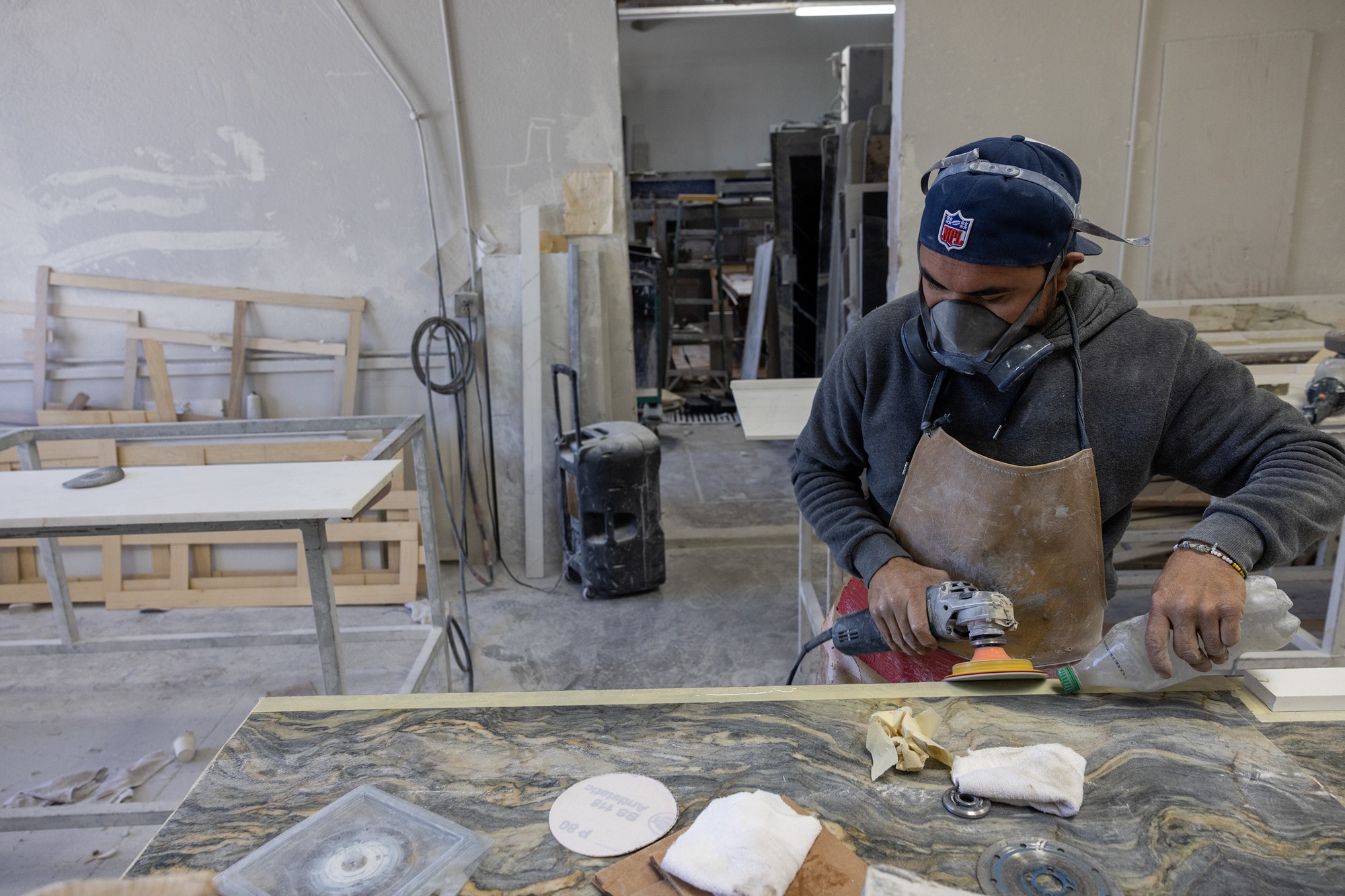
A stone countertop fabricator wears a mask to help protect against airborne particles which can contribute to silicosis at a shop on Tuesday, Oct. 31, 2023, in Sun Valley, California. (Brian van der Brug/Los Angeles Times via Getty Images)

Here are the morning’s top stories on Thursday, May 14, 2026

  • Hundreds of Californians who make countertops are getting sick with an often deadly, job-related lung disease. Those who can no longer work because of it are often left struggling to make ends meet, even after pursuing benefits that are supposed to help them long term. 
  • State lawmakers have a new report on how California can better avoid – or recover  from – wildfires and other natural disasters.

As silicosis cases increase, stonecutters struggle to get workers’ compensation

In recent years, silicosis cases have surged in California’s countertop fabrication industry. It’s an aggressive and often fatal lung disease. At least 31 stoneworkers have died from silicosis since 2019, and more than 550 in the state are confirmed to have the disease.

Those who can no longer work because of it are often left struggling to make ends meet, even after pursuing benefits that are supposed to help them long term. Former stoneworker Eleazar Resendiz Cortes has seen six of his co-workers suffer from silicosis. Two of the men needed oxygen machines to breathe and later underwent lung transplants. At 38, he said he fears a similar fate. Doctors have diagnosed Resendiz Cortes with silicosis. He can no longer work and has no income to support his family. The Bakersfield resident pursued worker’s compensation benefits, which are supposed to cover medical care and other expenses. But after two years, he still hasn’t been paid, and he’s struggling.

One insurer, AmTrust North America, denied his claim, arguing it wasn’t supported by substantial medical and other evidence. Another, Omaha National, is investigating but said it can’t comment on the specifics of the case. “These delays by the insurance company just make my clients worse,” said L.A. attorney Barry Rodich, who represents Resendiz Cortes and about 80 other sick stoneworkers. He said insurers have an economic incentive to delay claims that can be very expensive. He’s settled some silicosis claims for more than $1 million.

In California, all employers with at least one employee are required to have workers’ compensation insurance. A worker who gets hurt or sick on the job is supposed to file a claim with the employers’ insurer. But stoneworkers in the countertop fabrication industry often have multiple employers during their career. “When there’s multiple employers, the employers are going to point the fingers at each other,” said Yvonne Lang, who has represented insurers on silicosis claims. “And if the employers are pointing the fingers at each other, the carriers are going to point the fingers at each other.” She said insurance companies are looking to weed out fraudulent claims, and need proof that an illness came from working for an employer they insure.

Medical and occupational safety experts warn that current regulations won’t protect hundreds of relatively young workers from contracting the incurable illness. They say the state must act urgently to phase out hazardous engineered stone from fabrication shops. State workplace regulators could advance a proposal to ban the fabrication of artificial stone at their meeting next week.

California must move faster on wildfire risk, experts warn

Fire risk experts cautioned California lawmakers this week that the state needs to change course to both survive and bounce back from wildfires and other natural catastrophes.

At the state Capitol on Tuesday, Nancy Watkins, an actuary at financial adviser Milliman who specializes in fire risk and insurance, counseled lawmakers that the state needs to stop “nibbling around the edges.” “Nobody is going to save California from our decisions,” she said. “The state has to really step in and be more strategic about how to make things happen faster.”

In a statement on Wednesday, state Sen. Steve Padilla, D-San Diego, and Sen. Josh Becker, D-Menlo Park, said they would study the report’s findings and develop a plan to help strengthen recovery efforts and protect residents from rising energy and insurance costs. “This work is essential,” Becker said. “We must advance reforms that protect access to insurance, lower costs, support wildfire resilience, and provide fair outcomes for those impacted — while ensuring our utilities are both accountable for safety and financially stable enough to attract low-cost capital on behalf of ratepayers.”

Wildfires over the past decade have driven up home insurance rates and made coverage harder to obtain in many parts of California. In response, the state has invested heavily in firefighting capacity, early fire-detection technology and vegetation management. But Watkins told legislators those efforts alone are not enough. “The buildup of wildfire risk is a state and a local issue. It’s arising from climate change, it also arises from decades of decisions that we’ve made on land use, building, fire suppression, and decades of regulatory decisions,” Watkins said.

Watkins said the state should focus more heavily on making communities less vulnerable to wildfire by making them less ready to burn, rather than relying primarily on detecting and extinguishing fires quickly.

lower waypoint
next waypoint
Player sponsored by