upper waypoint

Teaching First Responders About Human Remains Recovery After Wildfires

Save ArticleSave Article
Failed to save article

Please try again

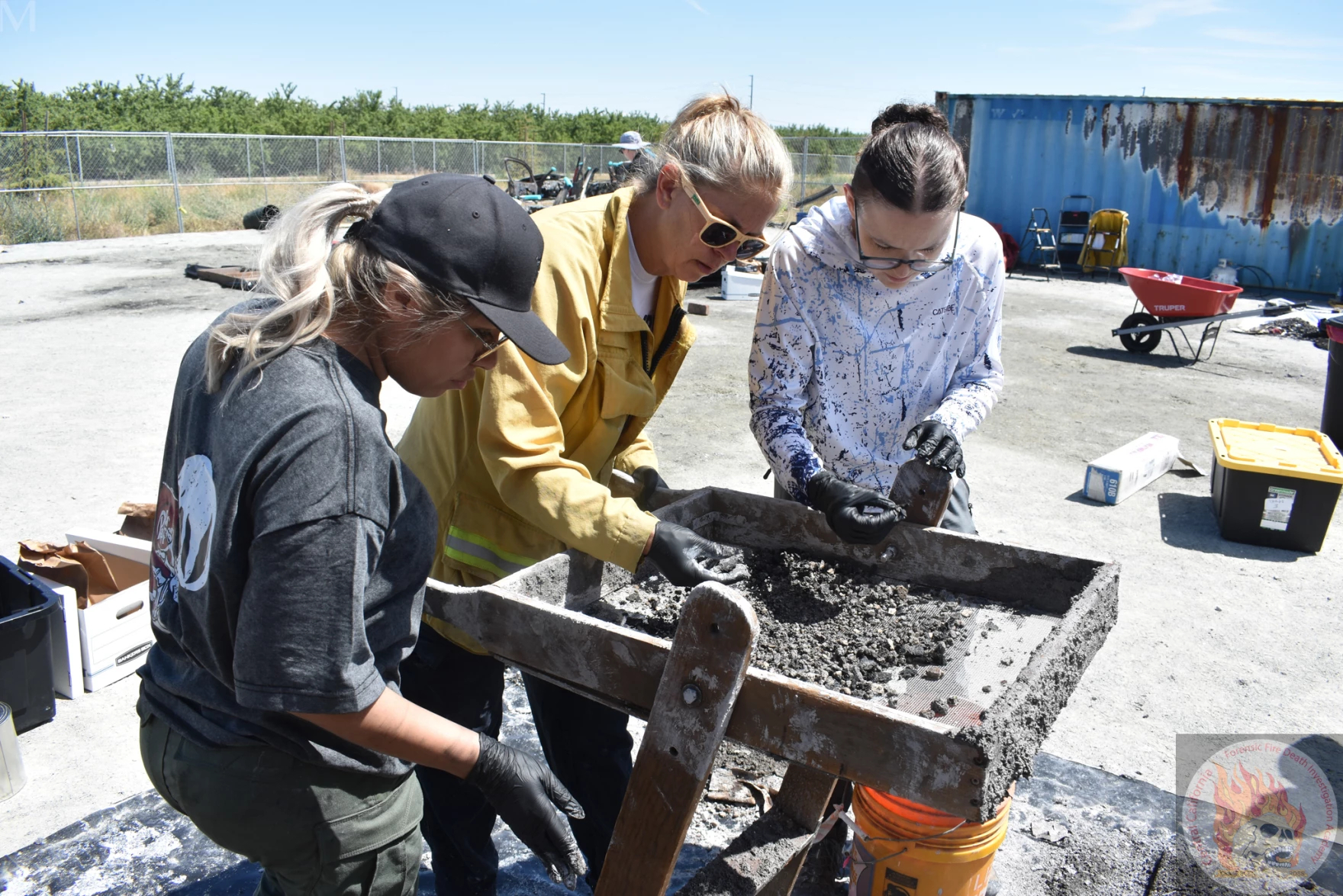
From left, Torres, Herrick and Aponte-Guante search through debris from a structure fire scenario. No human remains are pictured in this photo. (Photo courtesy of Central California Forensic Fire Death Investigation Academy)

Here are the morning’s top stories on Thursday, May 7, 2026

  • As wildfires become more destructive in California, the need for forensic investigations is increasing. Specifically – the need for finding and identifying bodies after a wildfire. A recent intensive academy at Fresno City College addressed this need by training working professionals. 
  • Advocates are criticizing the state’s tracking of evictions, saying California has failed to accurately count them for decades, and drumming up support for a bill that would more closely monitor it. 
  • Humboldt County Supervisors are looking at creating a civilian oversight committee for the sheriff’s office. They’re trying to get ahead of a possible citizen initiative.

New Fresno-based training teaches first responders to find human remains after wildfires

On a recent morning, Fresno County Deputy Coroner Bianca Torres was kneeling at the base of a burned up car. Nearby was a grisly sight: a skeleton found in the driver’s seat – but not the whole skeleton. “Because that person was seated there in the driver’s seat, we know that we’re missing pieces,” she said – specifically, missing bones. She was looking for bone fragments with a team of professionals including a firefighter, an arson investigator, a forensic anthropologist and a homicide detective.

Normally, not all of them would have been doing this work, but they were enrolled in a training – and this scene was staged as part of the inaugural Central California Forensic Fire Death Investigation Academy. The intensive, weeklong course took place mid-April at Fresno City College.

As wildfires become more destructive in California, the need for forensic investigations afterward is increasing — specifically, the need for identifying bodies. The academy teaches first responders how to assist and recover human remains after fatal wildfire mass disasters. So as Torres swept and sifted through debris, others were pulling out pieces of the car’s carpet. It was a team effort, because they learned every piece found during an investigation is crucial. “Body preservation, bone preservation, that’s very important to us, the medical examiner and the anthropologists,” Torres said.

The five-day academy consisted of three days of lectures that taught attendees how a body burns and how to recover remains without accidentally damaging critical evidence. The last two days, students were set into groups to study a fire scenario and recover the remains within it. Some scenarios simulated houses, while others revolved around cars. Chelsey Juarez, a forensic anthropologist and a professor at Fresno State, led the academy. She said wildfires are becoming increasingly fatal. “As someone who responds to fire, the best time to prepare is right now,” she said.

In the last ten years, at least 180 people have died from fires in California, including the Camp and Palisades fires that wiped out parts of Butte and Los Angeles counties. So, Juarez said, if fires at that scale continue, more people might be pulled into investigating wildfire deaths – and she wants them to have a chance to learn before the next big wildfire occurs.

New report shows gaps in eviction data reporting across the state

Advocates are criticizing the state’s tracking of evictions, saying California has failed to accurately count them for decades.

A report by Strategic Actions for a Just Economy covers data on eviction case outcomes in the state dating back to 2010. Its author, Kyle Nelson, said that while evictions are believed to drive homelessness in California, lawmakers are trying to prevent it without complete data. “This invites two questions: why are lawmakers crafting eviction prevention policies without fully understanding eviction data? And how do they know if these policy interventions are working?”

Now, advocates are drumming up support for a bill that would more closely monitor eviction data. SB 1160 would require local courts to provide California’s Judicial Council with information on eviction filings, aggregated by zip code, and require the Council to make that data public. State Senator Maria Elena Durazo supports the legislation. “Essentially we’re navigating homelessness prevention without a map. So this bill shines light on the eviction process by using eviction data from the courts,” Durazo said.

The report shows the counties with the most eviction filings report the least amount of data. It also shows multiple counties file more evictions now than they did prior to the pandemic.

Humboldt County takes first step toward sheriff oversight panel

Humboldt County supervisors are considering creating a civilian oversight committee for the sheriff’s office.

Supervisors said they trust current Sheriff William Honsal but argued that now is the time to establish oversight, before any incident could undermine that trust. Supervisor Steve Madrone introduced the idea last month, saying some community members remain skeptical of the department because complaints are investigated internally.

“This is the avenue forward to improve that trust,” Madrone said. “I believe that as we improve that trust, it increases the number of people that want to become deputies. Because for them, morale goes up because they’re more trusted in the community by verifiable actions that involves people outside of law enforcement.”

Honsal pushed back, telling supervisors that existing oversight is sufficient. “Why fix something that’s not broken?” he said. “I’ve yet to hear why, other than you have a small group of people that want to see this because of a potential future incident.”

An example ordinance would create a citizen-led committee to review complaints and make recommendations. The group would not have authority over daily operations or personnel decisions. Supervisors said they want to establish the committee themselves, rather than through a ballot measure.

lower waypoint
next waypoint
Player sponsored by