upper waypoint

Advocates Question Safety Concerns Surrounding E-Bikes

Save ArticleSave Article
Failed to save article

Please try again

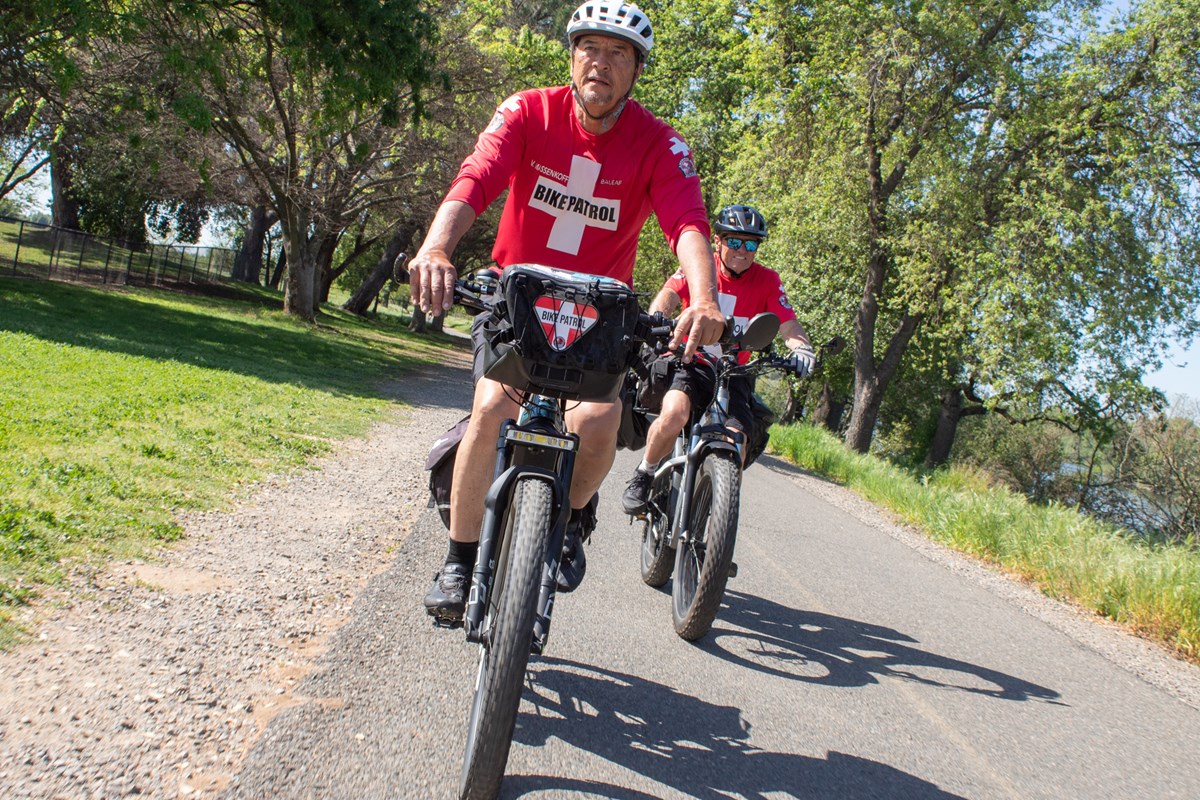
American River Bike Patrol members Vic Massenkoff (left) and Christopher Warren Tuesday, March 17, 2026, along the American River Parkway in Rancho Cordova. (Gerardo Zavala/CapRadio)

Here are the morning’s top stories on Thursday, April 30, 2026

  • California lawmakers are considering new rules for electric bikes as safety concerns grow on roads and trails. But experts say much of the data behind those concerns is misleading. 
  • New research from UC Santa Cruz shows climate change is a bigger threat to California’s native trees than previously thought. 
  • To the north of the Imperial Valley, another battleground is emerging in the debate over AI data centers. Residents are pushing back against a large data center campus in the city of Coachella.

Why e-bike advocates say California’s crackdown may not solve the biggest safety risks

Two cyclists speed past members of the American River Bike Patrol blasting music from portable speakers.

“Never too late for a helmet,” Vic Massenkoff with the patrol yells as they pass by. It’s clear to Massenkoff the riders are on electric motorcycles which are illegal on the trail. But the patrol is a volunteer group, not an enforcement agency, so warnings and polite suggestions are often the only tools available along Sacramento’s American River Parkway.

Lately, members say they’ve been seeing more of these higher-powered devices, often referred to as “e-motos.” “They go so fast that we can’t talk to them,” said John Poimroo, director for the patrol. “We’ll wave, ‘Hey, slow down,’ and they’re just off.”  The speed limit on the trail is 15 mph, which even legal e-bikes can easily exceed. California allows Class 1 and Class 2 e-bikes to assist riders up to 20 mph, while Class 3 bikes can assist up to 28 mph.

But electric motorcycles — often referred to as e-motos — can go much faster. Some exceed the state’s limits as sold while others can be modified to do so. Many of them are referred to as e-bikes despite not meeting the state’s definition. Marketing for these e-motos tends to focus on youth. That distinction is central to a growing debate at the California Capitol, where lawmakers are considering several bills to improve e-bike safety.

Marc Piazza is the commander for the Sacramento Regional Park Rangers. He said legal e-bikes haven’t been much of an issue on the trail. “It’s not the e-bikes, it’s the e-motorcycles,” he said. “Totally different classification.” Much of the available injury data relies on law enforcement and hospital reporting that does not clearly distinguish between legal e-bikes and more powerful devices. That’s concerning for Asha Weinsteing Agrawal, education director for the Mineta Transportation Institute at San Jose State University. She recently led a state-commissioned study on e-bike safety. “None of these people are digging into whether this was a legal or illegal e-bike or what class of legal e-bike it might have been,” she said. “Like the general public, they hear the word e-bike and that’s enough. They write it down and they go on.”

That means some injuries and crashes attributed to e-bikes may have involved devices that are not legal e-bikes at all. “The e-motos are absolutely a key safety concern, there is no doubt about that,” Weinsteing Agrawal said. “What unfortunately we don’t have enough data to really know is, ‘Are the legal e-bikes a safety concern?”

Climate change puts native trees at risk

New research from UC Santa Cruz shows climate change is a greater threat to California’s native trees than previously thought.

The study estimates in the next 30 years some species may lose as much as half of their habitat.  Lead author Blair McLaughlin said the rising temperatures and droughts that come with climate change increase water stress.  ”It can also lead to higher vulnerability to pests and disease,” she said. “And it can also lead to more frequent and severe wildfires.”

In some places, this could create what’s called “zombie forests,” where hardier adult trees remain but can’t produce seedlings. Joshua trees, certain oaks and madrones are a few of the vulnerable species.

McLaughlin said maintaining groundwater levels and careful planning can help prevent loss.  ” For example, that would be to do things like make sure that we aren’t putting new developments in the limited areas that are likely to support these threatened species into the future,” she said. She adds addressing climate change and supporting ecosystem stewards like indigenous tribes and ranching communities is vital.

Coachella residents call for data center moratorium as debate expands across Southern California

An hour’s drive north of the Imperial Valley, a new battleground is emerging in California’s debate over data centers and artificial intelligence.

The Coachella Valley, known for its famed music festival and date palm farms, is now the planned site for a massive 240-acre technology campus that includes a large data center project. The campus would be built in the city of Coachella, a small, largely working-class city where 97% of residents identify as Latino. It would be a key part of the city’s ongoing efforts to create its own energy utility.

In a statement earlier this month, city officials said they haven’t approved the project yet and that it will need an environmental impact report.

Residents of Coachella and elsewhere in the valley are pushing back against the project, raising fears about energy and water needs, noise and air pollution. At a City Council meeting last week, Coachella resident Stephanie Ambriz called on city officials to institute a moratorium on data center development. “We have made it abundantly clear that we don’t want or need this project,” Ambriz said. “You can build a utility without data centers.”

The debate in the Coachella Valley comes after months of fiery opposition from residents against a massive data center project in the Imperial Valley, south of the Salton Sea. The two developments fit into an emerging trend of data centers being proposed in rural communities. Earlier this month, an analysis by the Pew Research Center found that the vast majority of existing data centers are in urban centers. But more than two thirds of planned data centers are coming to rural areas.

lower waypoint
next waypoint
Player sponsored by