upper waypoint

Candidates Look to Distinguish Themselves at Chaotic Governor's Debate

Save ArticleSave Article
Failed to save article

Please try again

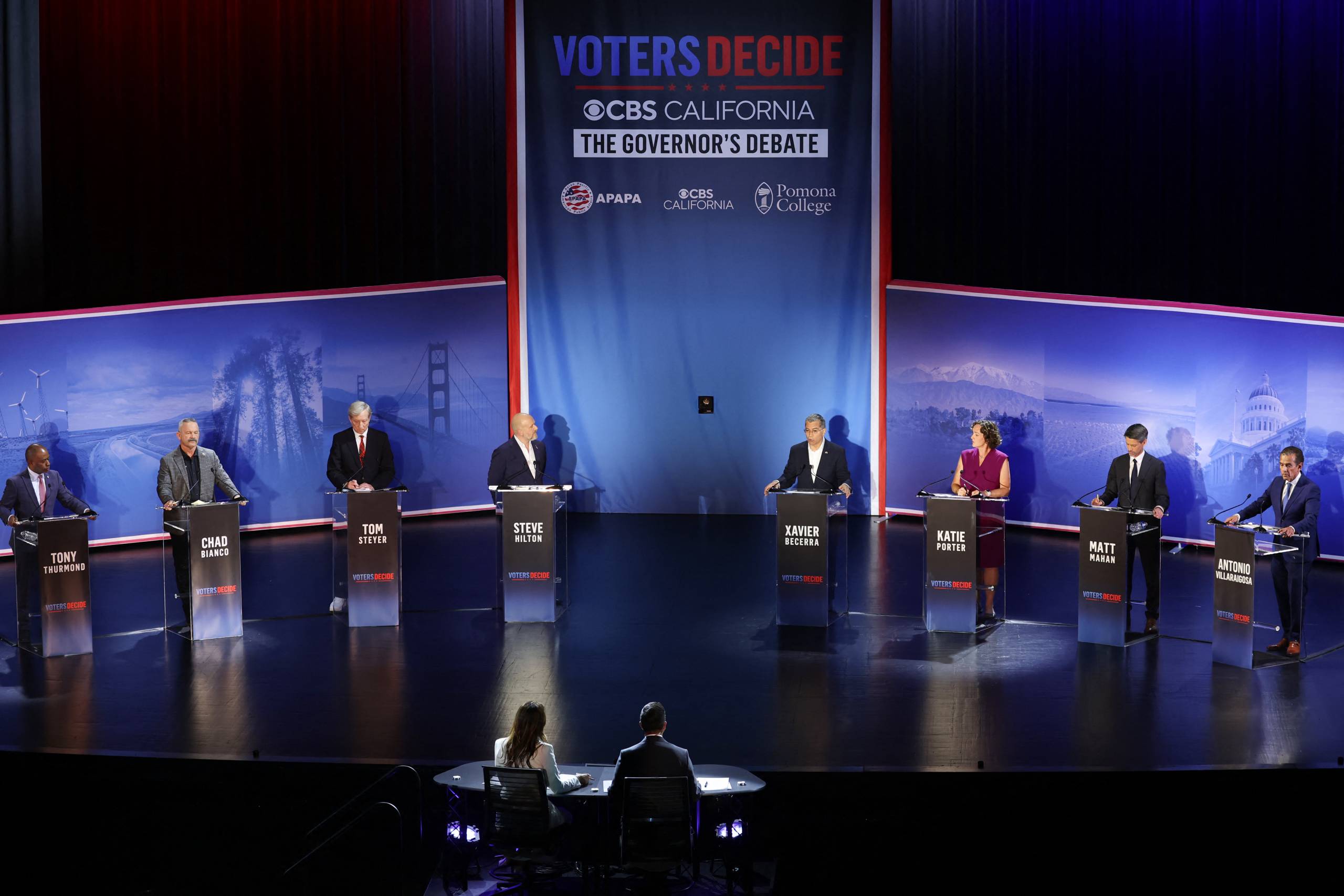
(L/R) Democratic candidate Tony Thurmond, Republican candidate Chad Bianco, Democratic candidate Tom Steyer, Republican candidate Steve Hilton, Democratic candidate Xavier Becerra, Democratic candidate Katie Porter, Democratic candidate Matt Mahan and Democratic candidate Antonio Villaraigosa participate in a California gubernatorial debate at Bridges Auditorium on the campus of Pomona College in Claremont, California, on April 28, 2026. The eight candidates for California governor are participating in the second televised debate, ahead of the June 2, 2026 primary elections.  (Photo by Patrick T. Fallon / AFP via Getty Images)

Here are the morning’s top stories on Wednesday, April 29, 2026

Candidates target Steyer, Becerra in free-wheeling California governor debate

Six leading Democratic candidates for governor were seeking a breakout moment Tuesday night in a race that has been dominated by its lack of certainty, with two Republican candidates frequently in the lead.

None of them appeared to find one in a chaotic, combative and often hard-to-follow CBS debate at Pomona College, prompting former Orange County Rep. Katie Porter to declare at one point that “this is worse than my teenagers at dinner.”

With less than a week before ballots are mailed to voters, though, the targets were clear: Billionaire Tom Steyer, who has led fellow Democrats in polling and has already spent at least $132 million of his own money on the race; and Xavier Becerra, the former U.S. Health and Human Services secretary who has had a sudden surge in momentum since former Rep. Eric Swalwell dropped out amid allegations of sexual assault.

Porter, once a rising national progressive star, got in a dig at Steyer, who has consolidated support among many of the party’s most left-wing activists, criticizing the fortune he made in part by investing in fossil fuels when he tried to tout his climate-friendly credentials and policy of “making polluters pay.” Steyer has said that he subsequently divested from those investments and devoted himself to addressing climate change. Becerra, meanwhile, was criticized by moderate Democratic San Jose Mayor Matt Mahan for his mixed record as former President Joe Biden’s health secretary and for bristling when pressed for policy specifics. At one point, Becerra argued with one of the five debate moderators over the legality of his proposal to call a state of emergency to freeze home insurance rates.

But the Democrats largely failed to differentiate themselves as they tackled questions on the cost of living, health care, education, housing and energy, struggling to promote new policies to address the crushing cost of living. They were careful not to attack the liberal policies of Gov. Gavin Newsom, who has declined to endorse any of them. The two leading Republican candidates, Steve Hilton and Chad Bianco, rarely clashed, instead taking aiming at Newsom and Democrats in Sacramento.

‘A betrayal:’ California to share data on immigrant drivers nationally

California is preparing to share with an outside organization detailed information about driver’s license holders, including immigrants who do not have legal authorization to live in the U.S.

That breaks a promise the state made a decade ago when it began issuing licenses to unauthorized immigrants, advocates say, and it means more than 1 million people may face higher risk of deportation.

But if state officials don’t turn over the data, the Department of Homeland Security may refuse to accept California licenses and IDs at airports, the advocates believe, following a briefing with the California Department of Motor Vehicles and the office of Gov. Gavin Newsom earlier this month. State authorities confirmed they plan to share the data to comply with the Real ID Act of 2005, which set requirements for accepting state identification in federal facilities like airports. Representatives from four advocacy groups who participated in the briefing told CalMatters the shared information will show whether a person has a Social Security number, meaning it could be used to identify people in the country without authorization.

The state plans to provide the information to the American Association of Motor Vehicle Administrators, a nonprofit organization whose governing board is made up of DMV officials from across the country. The information given to the association will go into the group’s State-to-State Verification system and its platform, known as SPEXS, which allows DMVs and contractors that work with them to verify if someone has more than one license issued in their name. Sharing that data allows agencies that issue driver’s licenses to verify that a person doesn’t have duplicate licenses in multiple states.

Marina reactivates desalination plant

The city of Marina in Monterey County is reactivating a 30-year-old desalination plant. Remleh Scherzinger, General Manager of the Marina Coast Water District, said this will boost water supply. “We need to diversify our water portfolio so that we can rely less on the groundwater basin and we can help it become more sustainable,” he said.

The plant is expected to serve roughly a thousand homes along the Monterey Peninsula.

The project is in its first phase, which involves preparing an existing intake well at the Marina State Beach.  ”We’re gonna pipe it all the way back up to the plant, and then re-inject the water into the dunes,” Scherzinger said.

The $13 million project will provide an additional 300 acre-feet of water and is expected to be operational by the end of this year.

lower waypoint
next waypoint
Player sponsored by