upper waypoint

Countertop Fabricator Spends Big to Better Protect Workers

Save ArticleSave Article
Failed to save article

Please try again

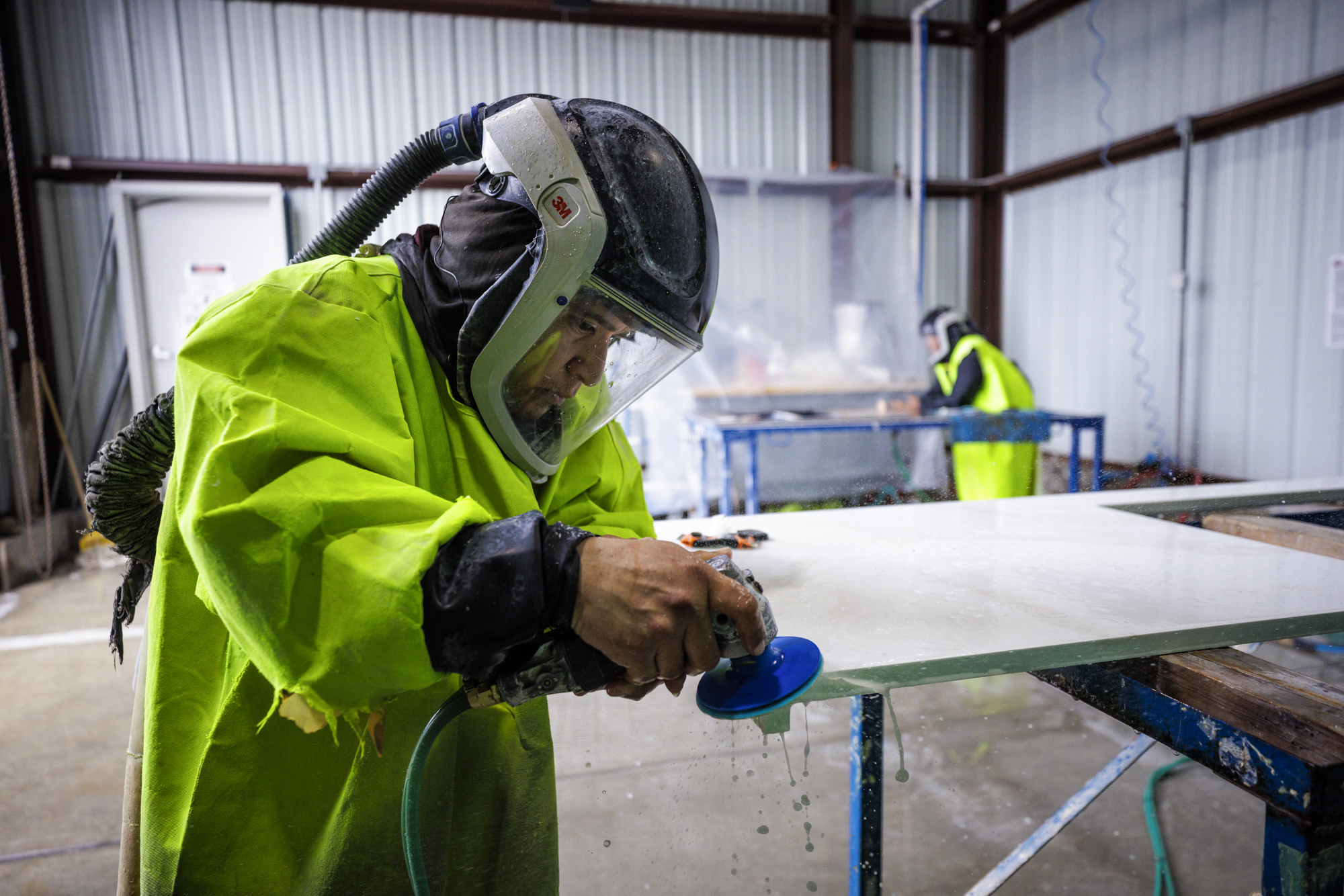
Javier Suares polishes a countertop while wearing a powered air purifying respirator at Scolari Marble & Granite in Vallejo on March 31, 2026. (Martin do Nascimento/KQED)

Here are the morning’s top stories on Tuesday, April 7, 2026

  • For countertop fabricators trying to follow California’s safety rules, “doing the right thing” can cost hundreds of thousands of dollars. 
  • A $10 billion bet on the future of Artificial Intelligence is facing a wall of local resistance in the Imperial Valley.  County supervisors will decide the fate of a massive data center complex that has already sparked shouting matches, environmental protests, and a last minute scramble in the courts.

As some in stonecutting industry follow workplace rules, others sidestep them

Two years ago, California approved the nation’s strictest rules to try to protect stonecutters. But the sophisticated measures, which prohibit the dry cutting of engineered stone to suppress dust and require employers to provide workers with respirators that can cost more than $1,000 each, are unfeasible for most fabrication businesses, according to employers and workplace regulators. About 95% of countertop fabrication shops that Cal/OSHA inspectors have visited were not following the required protections.

Artificial stone is linked to an aggressive form of silicosis among workers who have inhaled toxic silica dust generated when cutting and shaping slabs of the material, also known as engineered stone or quartz.

When Gino Scolari started his business making kitchen and bathroom countertops four decades ago, customers wanted natural stones like granite or marble. Then, over the last 10 years, more people wanted artificial stone or quartz.

At Scolari’s fabrication shop in Vallejo, most of the work is done by expensive automated machines, including saws that spray water as they cut sink and faucet holes on the slabs to keep the dust down. “I don’t think you can get any more stringent on our protocols right now,” he said.

When workers polish the stone, they wear powered air-purified respirators. All to comply with Cal/OSHA regulations, which is an ongoing expense for Scolari, over a million dollars by his best estimate. But occupational doctors say growing evidence shows the crystalline silica particles produced by quartz are so toxic, you’d need a space suit to handle the material safely.

Scolari said he wishes state regulators would just enforce the rules on the books. As things stand now, Scolari complains, some of his small-scale competitors just cut artificial stone in front of someone’s house without protections and make $2,000 a day.

Imperial County supervisors to hold key vote on controversial data center project

The Imperial County Board of Supervisors will hold a crucial vote Tuesday that will determine whether construction can begin on a massive data center complex that supporters say would generate new revenue and some jobs — and opponents fear could strain the rural county’s power grid, water supply and air quality.

The vote will take place despite a last-minute attempt to halt it by the city of Imperial, which borders the planned project site. Last week, the city asked an Imperial County Superior Court judge to issue a temporary restraining order that would block county officials from holding the scheduled vote. The judge, Louie Brooks Anderholt, declined to intervene.

The supervisors will be weighing whether to join together several parcels of land for the proposed data center complex. The developer, Huntington Beach-based Imperial Valley Computer Manufacturing (IVCM), is seeking to build a 950,000-square-foot computing warehouse, along with a giant battery system and a bank of backup generators.

IVCM said the project would create a burst of construction work, some long-term jobs and millions in future tax revenue. But the company is facing fierce opposition from a large group of county residents calling themselves Not in My Backyard Imperial, who worry about the potential environmental impacts of the facility. “This community will remember who stood with the people and who stood with the developer,” warned Francisco Leal, an Imperial resident and one of the main organizers of NIMBY Imperial, at a county meeting last week. “It will respond accordingly through public process, public record and at the ballot box.”

lower waypoint
next waypoint
Player sponsored by