Sponsor MessageBecome a KQED sponsor
upper waypoint

Muslim Community in Monterey County Celebrates Ramadan

Save ArticleSave Article
Failed to save article

Please try again

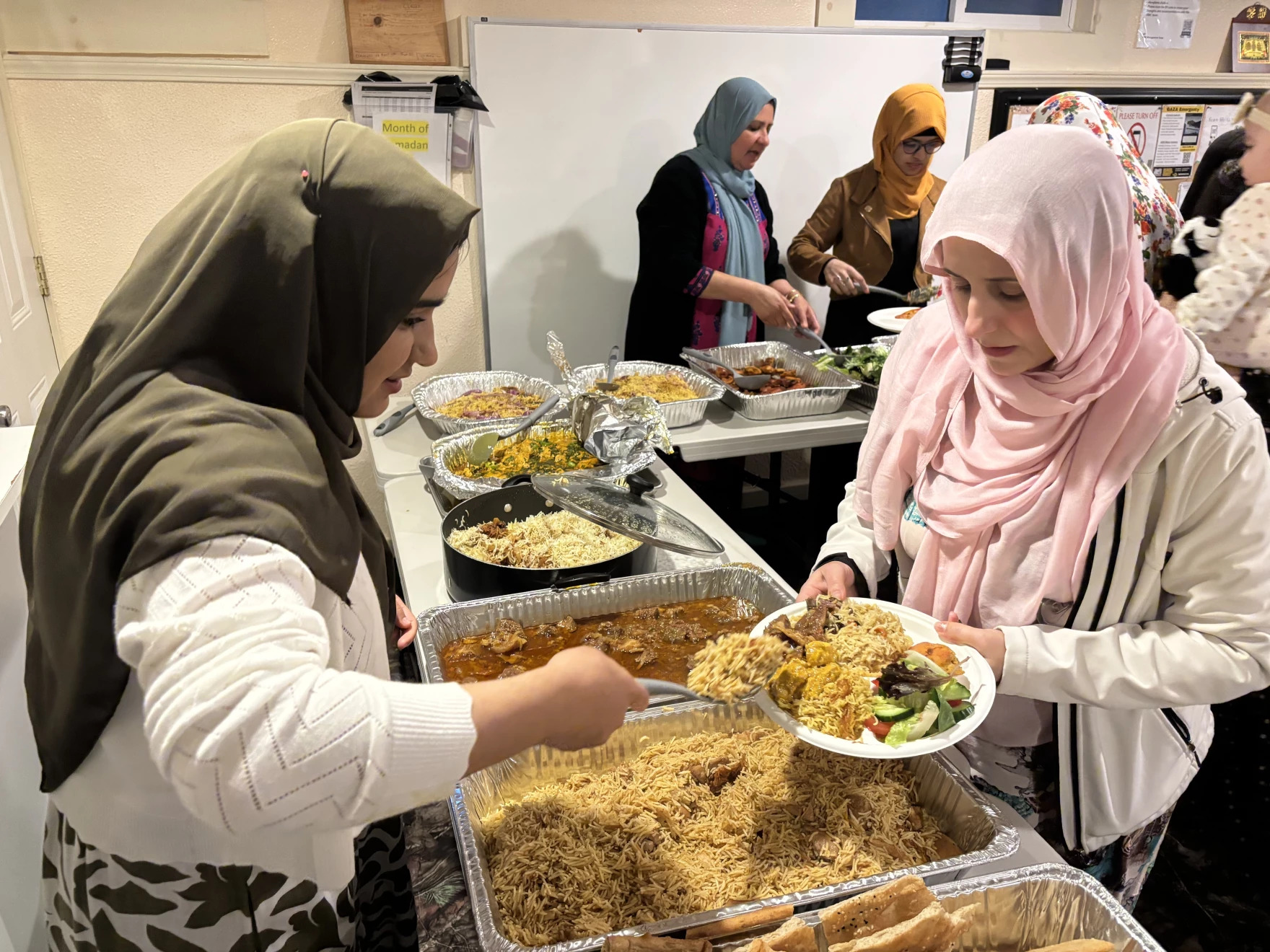
The local Afghan community prepared the food for iftar at the Islamic Society of Monterey County in Seaside on Friday, Feb. 20. 2026 (Ngozi Cole/KAZU)

Here are the morning’s top stories on Friday, March 13, 2026

  • It’s the holy month of Ramadan, when Muslims around the world dedicate 30 days to prayer and reflection by fasting from sunrise to sunset. That includes in the Monterey County community of Seaside.
  • State Superintendent of Public Instruction Tony Thurmond says he’s imploring the Trump administration to return a 6-year-old deaf boy and his family who were deported to Colombia, so the boy can return to the California School for the Deaf in Fremont.
  • The Trump administration is suing California over its vehicle-emission standards. The lawsuit, filed Thursday by the Justice and Transportation departments, accuses California of imposing an “illegal electric-vehicle mandate.”

Monterey County mosque hosts iftar meal during Ramadan

It’s the holy month of Ramadan, when Muslims around the world dedicate 30 days to prayer and reflection by fasting from sunrise to sunset.

At the Islamic Society of Monterey County in Seaside, worshippers gather on Fridays and Saturdays for a communal iftar, a meal Muslims eat at sunset to break their daily fast. The men and women pray and eat in separate rooms. In the women’s room, on a Friday evening, mothers calmly asked their excited children to quiet down for prayer. After the prayer, worshippers broke the fast with a light snack of dates and samosas. Pebble Beach resident Seynabou Seck said going twelve hours without food is always a chance for self-reflection. “ I feel like there’s almost a cleansing aspect,” Seck said. “It’s not just not eating and not drinking, but I haven’t been watching reality TV, which is usually my guilty pleasure.”

And, it’s not only spiritual. The communal gathering this evening also brings a bit of nostalgia for Seck, who is from Senegal. At home, she says, “it’s very community-driven. We eat and gather often.” After the snacks, worshippers stand in line to get their iftar dinner. Every Friday and Saturday, various groups like Indonesians and Moroccans take turns to cook a feast for the worshippers. Tonight, it was the Afghan community’s turn.

As people settle to eat, high school student Tana Haddid shared what breaking the fast with others means for her. ”Something that I really appreciate is how all of our cultures mix really well. We have a lot of Afghans, Persians, Arabs, Moroccans, Egyptians, people from all walks of life and different ages,” Haddid said. “But we can all come together and share the fact that we are all Muslim, and share each other’s culture and experiences.”

Sponsored

As the night went on, dishes were emptied and bellies were filled. The kids started to doze off as their parents wrapped up the evening meal and conversations. The next day, Muslims will begin the fast again, as they continue this 30-day period of faith and reflection. “Ramadan is about focusing more on what matters. Not only food and such, but of time, of energy, of focus,” Seck said.

Advocates call on Trump administration to bring deaf boy, family back to Bay Area

State Superintendent of Public Instruction Tony Thurmond met virtually Thursday with a Hayward family that was deported to Colombia last week.

Lesly Rodriguez Gutierrez, 28, was at the U.S. Immigration and Customs Enforcement office at 478 Tehama St. in San Francisco on March 3 for what she believed was a “routine check-in.” Officials said they needed to renew photos of her children, ages 4 and 6, on file, according to Nikolas De Bremaeker, an attorney with Centro Legal De La Raza. But  the family was detained after ICE officials took photos and fingerprints of the children. Rodriguez Gutierrez migrated to the U.S. from Colombia four years ago and had no criminal record, according to De Bremaeker.

Her 6-year-old son, Joseph Londoño Rodriguez,  is deaf and was deported without the necessary medical hearing devices. He attends the California School for the Deaf in Fremont. He was able to communicate with a teacher at the school in a Zoom call. When asked how he was feeling, Joseph said, “I want to go back to school.”

Thurmond said he has written to Homeland Security leadership, that the boy needs to be in the Bay Area for his education, and medical treatment. “In speaking with his family, Joseph made it very clear what he wants. He talked with one of his teachers, which lifted his spirits, but his situation is concerning. Joseph does not understand Spanish, his family’s home language, and he received instruction in ASL and English at CSDF,” Thurmond said. “Without access to further ASL-English instruction or his Deaf community, Joseph is at risk of language deprivation, which can have serious impacts on a child’s development and health.”

Trump administration sues CA over the state’s nation-leading vehicle-emission rules

The Trump administration ramped up a battle with California over the state’s nation-leading vehicle-emission standards Thursday, suing air regulators over rules aimed at curbing pollution from cars.

President Donald Trump has long fought California’s efforts to curb tailpipe emissions and spur electric vehicle adoption, and last summer he blocked the state’s first-in-the-nation ban on the sale of new gas-powered cars by 2035. After Trump blocked the electric vehicle mandates, the state quickly sued over the move. The California Air Resources Board then said previously adopted standards tackling emissions from cars that pose climate and public health risks would remain in effect even if the state’s more ambitious rules remained blocked.

But the federal government said in its lawsuit that the state didn’t have the authority to enforce even its less stringent standards. “Oppressive, expensive electric vehicle mandates drive up costs for American consumers and violate federal law,” Attorney General Pam Bondi said in a statement.

California, which has some of the nation’s worst air pollution, has for decades been able to seek approval from the U.S. Environmental Protection Agency to adopt stricter emissions standards than the federal government. Other states can sign on to adopt California’s rules. During President Trump’s first term, his administration revoked that authority. The federal government reinstated California’s waiver authority in 2022 under Democratic President Joe Biden.

lower waypoint
next waypoint
Player sponsored by