Sponsor MessageBecome a KQED sponsor
upper waypoint

Families Struggling To Find ICE Detainees Who Are Hospitalized

Save ArticleSave Article
Failed to save article

Please try again

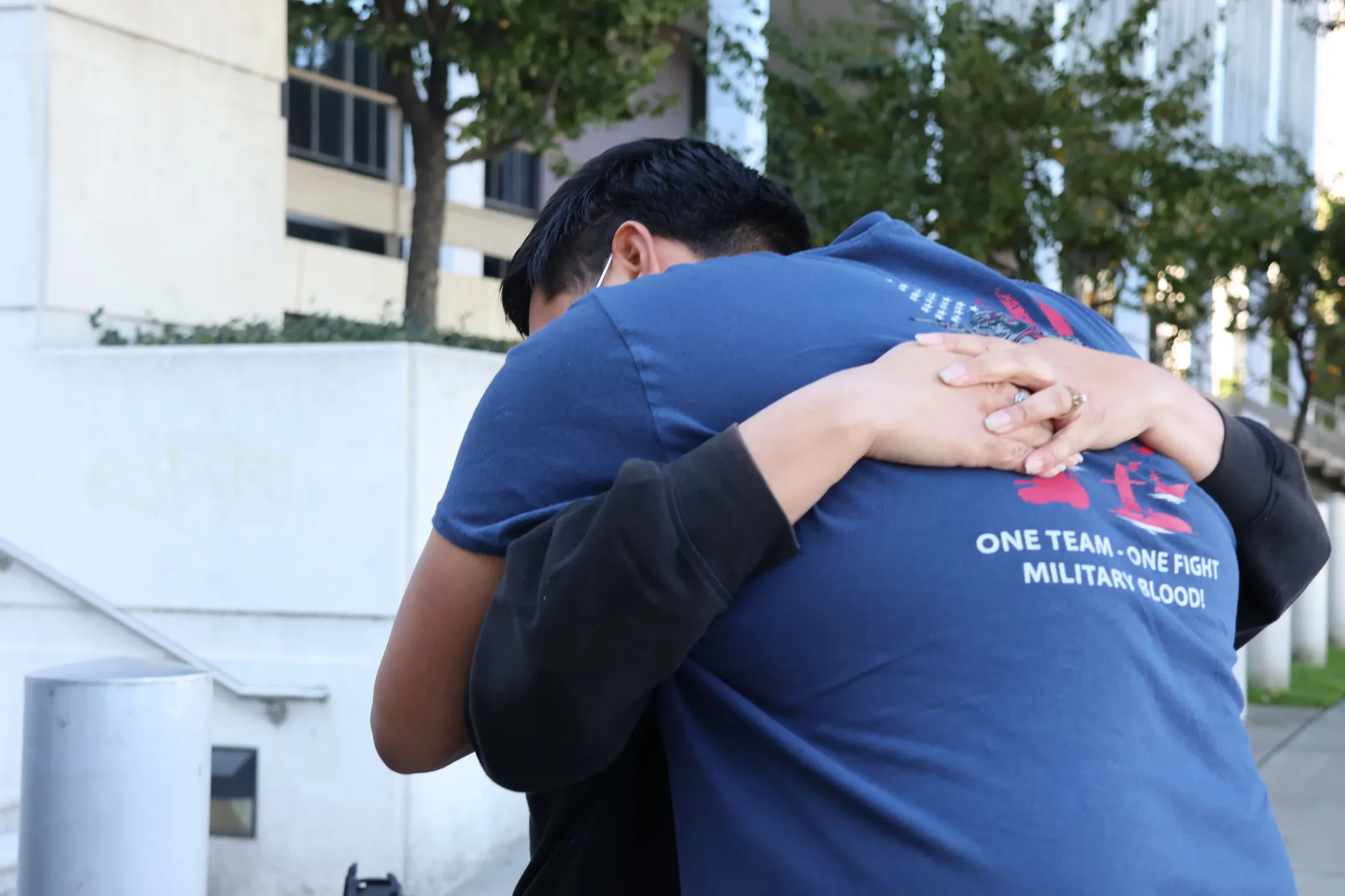
Julio Peña Jr. hugs his stepmother, Lydia Romero, outside an immigration detention facility in downtown Los Angeles as they try to get information about his father, Julio Cesar Peña, who was detained by ICE in December. (Photo courtesy of Immigrant Defenders Law Center/KFF Health News )

Here are the morning’s top stories on Tuesday, February 10, 2026

  • As federal immigration enforcement efforts continue across California, families of detainees are struggling with a new problem. Many can’t find loved ones who’ve been hospitalized after being detained by Immigration and Customs Enforcement.
  • A federal judge blocked a California state law barring federal officers from wearing masks on Monday. But the ruling also handed the state a partial victory.
  • Public health officials are urging Californians to get vaccinated for measles, as cases have risen in multiple counties.

Attorneys, Relatives Struggle To Find Hospitalized ICE Detainees

Lydia Romero strained to hear her husband’s feeble voice through the phone. A week earlier, immigration agents had grabbed Julio César Peña from his front yard in Glendale, California. Now, he was in a hospital after suffering a ministroke. He was shackled to the bed by his hand and foot, he told Romero, and agents were in the room, listening to the call. He was scared he would die and wanted his wife there. “What hospital are you at?” Romero asked. “I can’t tell you,” he replied.

Viridiana Chabolla, Peña’s attorney, couldn’t get an answer to that question, either. Peña’s deportation officer and the medical contractor at the Adelanto ICE Processing Center refused to tell her. Exasperated, she tried calling a nearby hospital, Providence St. Mary Medical Center. “They said even if they had a person in ICE custody under their care, they wouldn’t be able to confirm whether he’s there or not, that only ICE can give me the information,” Chabolla said. The hospital confirmed this policy to KFF Health News.

Family members and attorneys for patients hospitalized after being detained by federal immigration officials said they are facing extreme difficulty trying to locate patients, get information about their well-being, and provide them emotional and legal support. They say many hospitals refuse to provide information or allow contact with these patients. Instead, hospitals allow immigration officers to call the shots on how much — if any — contact is allowed, which can deprive patients of their constitutional right to seek legal advice and leave them vulnerable to abuse, attorneys said. Hospitals say they are trying to protect the safety and privacy of patients, staff, and law enforcement officials, even while hospital employees in Los AngelesMinneapolis, and Portland, Ore., cities where Immigration and Customs Enforcement has conducted immigration raids, say it’s made their jobs difficult. Hospitals have used what are sometimes called blackout procedures, which can include registering a patient under a pseudonym, removing their name from the hospital directory, or prohibiting staff from even confirming that a patient is in the hospital.

Some Democratic-led states, including California, Colorado, and Maryland, have enacted legislation that seeks to protect patients from immigration enforcement in hospitals. However, those policies do not address protections for people already in ICE custody.

Sponsored

According to ICE’s guidelines, people in custody should be given access to a telephone, visits from family and friends, and private consultation with legal counsel. The agency can make administrative decisions, including about visitation, when a patient is in the hospital, but should defer to hospital policies on contacting next of kin when a patient is seriously ill, the guidelines state. Asked in detail about hospital practices related to patients in immigration custody and whether there are best practices that hospitals should follow, Ben Teicher, a spokesperson for the American Hospital Association, declined to comment. David Simon, a spokesperson for the California Hospital Association, said that “there are times when hospitals will — at the request of law enforcement — maintain confidentiality of patients’ names and other identifying characteristics.”

After US Judge Blocks California’s ICE Mask Ban, Scott Wiener Says He Will Make It Enforceable

A federal court blocked enforcement of a California law barring federal and local officers from wearing masks, while finding that the state’s ban is not inherently unconstitutional — a ruling the law’s Democratic author framed as a win. U.S. District Court Judge Christina Snyder ruled in her preliminary injunction that by excluding California law enforcement agents from its ban on masking, SB 627 likely violates a federal doctrine that prohibits state laws from discriminating against the federal government.

In response, state Sen. Scott Wiener — who wrote the original bill — immediately announced new legislation to add state law enforcement officers to the masking ban. Wiener removed state officers from SB 627 at the request of Gov. Gavin Newsom last year, but said he believes the politics have changed as public backlash has grown to President Donald Trump’s deportation push. “This court ruling is a huge win, because the federal court ruled that California has the power to ban federal agents, including ICE, from wearing masks and that we simply have to add state police back into the law to make it enforceable,” Wiener said.

The Trump administration sued over the masking ban in November, and also took aim at another bill, SB 805, requiring law enforcement agents to visibly display their agency and a name or badge number. In a win for California, Snyder on Monday ruled that the state can enforce the identification provision.

The 30-page ruling from Snyder, appointed by former President Bill Clinton, comes as public outrage grows over how U.S. Immigration and Customs Enforcement and Border Patrol agents conduct themselves — anger that has spread in the wake of the killings of two American citizens by federal agents in Minneapolis.

Public Health Officials Warn About Rise In Measles Cases

Public health officials are urging Californians to get vaccinated for measles, as cases have risen in multiple counties. That includes an outbreak of eight related cases in Shasta County, the state’s first measles outbreak since 2020. The Department of Public Health says all of those infected in Shasta County were either unvaccinated, or had an unknown history of vaccination.

Health officials in Orange County are also working with Disneyland after two measles cases were reported there late last month.

As of February 9, 2026, a total of 17 measles cases have been reported statewide. Elsewhere in the United States, one of the largest outbreaks in over 30 years is happening in South Carolina with 920 associated cases. “As a pediatrician and parent, I encourage families to make sure everyone gets up to date on their MMR vaccine, if they haven’t already,” said Dr. Erica Pan, CDPH Director and State Public Health Officer in a statement. “CDPH continues to coordinate with, and support, local health departments in their responses to stop measles from spreading further in our communities. The United States is experiencing the highest numbers of measles cases, outbreaks, hospitalizations and deaths in more than 30 years, driven by populations with low vaccination rates. We all need to work together to share the medical evidence, benefits, and safety of vaccines to provide families the information they need to protect children and our communities.”

lower waypoint
next waypoint
Player sponsored by