Sponsor MessageBecome a KQED sponsor
upper waypoint

Community Seafood Program Helps Feed The Hungry In Monterey

Save ArticleSave Article
Failed to save article

Please try again

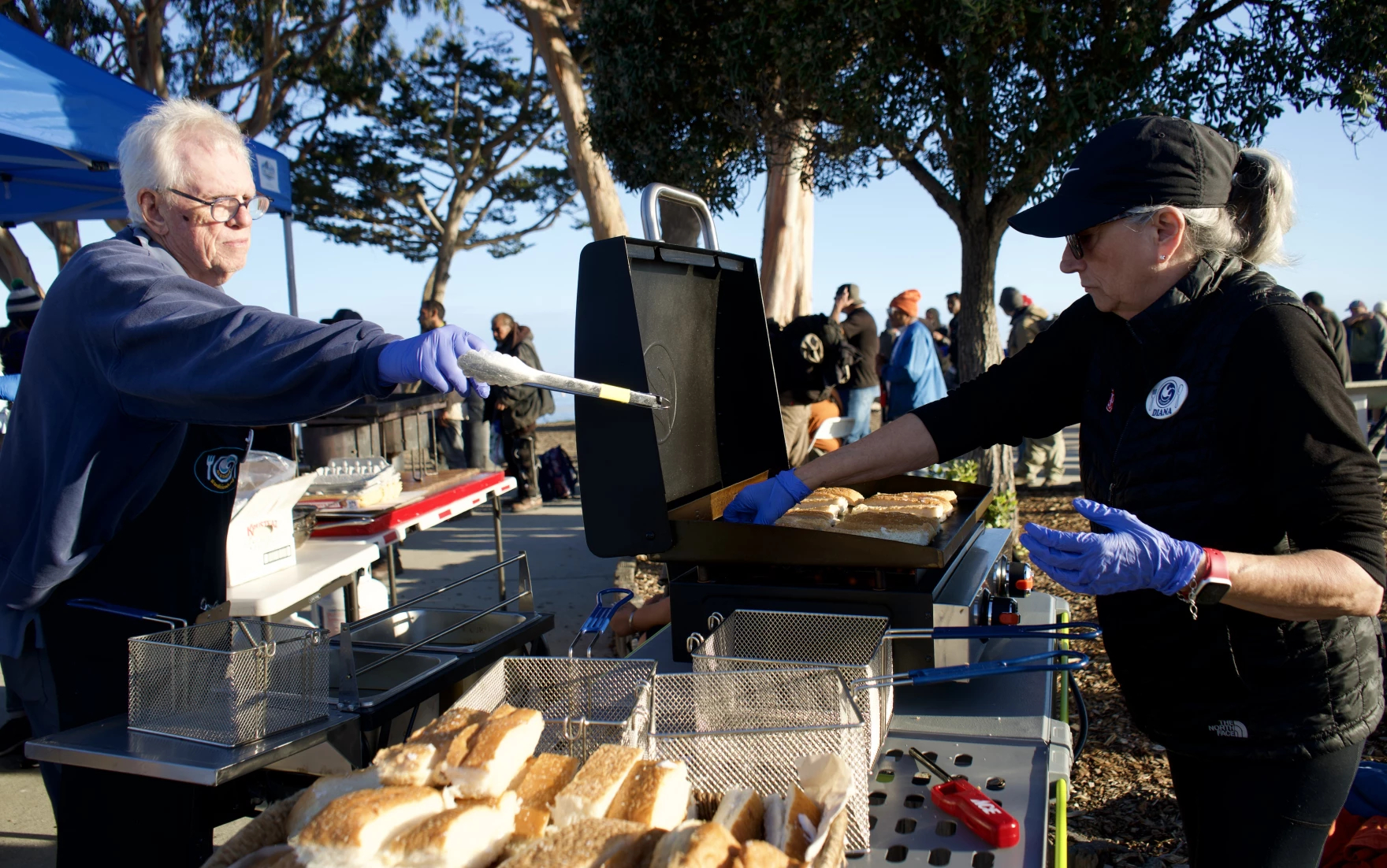
Half of the food Al & Friends serves at their weekly Sunday meals is donated. The nutritious, restaurant-quality meals are dished out near Del Monte Beach at Window on the Bay in Monterey. (Katie Brown/KAZU)

Here are the morning’s top stories on Monday, December 15, 2025…

  • Santa Cruz and Monterey counties largest food banks report a third of residents can’t consistently afford healthy food. And in this rich fishing region, some of the freshest catch is helping fill those empty bellies. 
  • Doctors are petitioning California to prohibit the use of a popular countertop material linked to the death of dozens of stoneworkers.

Community Seafood Program Fills Bellies With Local Catch

To help fill empty bellies among the region’s food insecure population, the Monterey Bay Fisheries Trust started the Community Seafood Program five years ago. It buys seafood from local fishing boats and donates the fresh fish to local food relief organizations.

The need is great. The Food Bank of Monterey County reports 34% of residents can’t consistently afford food and Second Harvest Food Bank of Santa Cruz County found food insecurity affects one in three residents.

This year the Fisheries Trust will spend $40,000 on local seafood, which translates to 25,000 meals. Al & Friends is one organization that receives donations thanks to the program. Sea Harvest, a family-run fishing business based out of Moss Landing, delivers to Al & Friends every couple months. Third-generation Monterey Bay fisherman Walter Deyerle helps operate Sea Harvest. After boats hit Sea Harvest’s dock in Moss Landing, cranes lift the catch off in bins and the fish are weighed and separated by species. Then, the seafood is either trucked off for delivery, or forklifted into the processing plant on site and sold in local markets. ”Everything comes off the boat, it’s processed, [then] either frozen, sold that day, or held for the next day for a sale,” said Deyerle. “But nothing sits around out here. Everything moves.”

He usually hand-delivers the week’s catch to Al Siekert, the founder of Al & Friends. Siekert cooks out of the community kitchen at Chautauqua Hall in Pacific Grove. “The only rule we have is a closed mouth don’t get fed,” said Siekert. With his team of 100-plus volunteers, he consistently churns out restaurant-quality meals for food insecure folks every Sunday morning.

Sponsored

They serve the food at Window on the Bay Park just past Monterey’s Municipal Wharf. Luis Vasquez is one of the regulars. “I love this place,” said Vasquez, who is a seasonal farmworker and, like the majority of people eating with Al & Friends, lacks access to nutritious food. “ Everything’s free—clothes, food—what we need, everything’s here.”

Siekert started serving meals to roughly 20 people 12 years ago. Now, some weeks 150 people take a plate. At 82, he says he’s still applying a lesson he learned at a young age. “It was engrained in me at a very early age that people shared what they had,” he said.

California Doctors Urge Ban On Engineered Stone

California has the nation’s strictest rules to protect stoneworkers from breathing in toxic silica dust that’s released when cutting artificial stone to make countertops. But experts said that’s not enough to prevent hundreds more workers from contracting silicosis, an incurable lung disease. Dr. Robert Blick is with the Western Occupational & Environmental Medical Association. “As long as this dangerous material remains available and is purchased and used in California, it’s inevitable that people will continue to be exposed and die,” Blick said.

As silicosis cases surge in California’s countertop fabrication industry, medical and occupational safety experts warn that current regulations won’t protect hundreds of relatively young workers from contracting the incurable illness. The state must act urgently to phase out hazardous engineered stone from fabrication shops, as Australia did, they say, to stem a growing health crisis. Australia banned the use, supply and manufacture of engineered stone benchtops in July 2024, forcing major manufacturers to switch to silica-free alternatives in that market, though they still sell their higher-silica products in the U.S. The companies maintain that their products are safe if fabrication shops follow protocols.

Between 1,000 to 1,500 stoneworkers in California could develop silicosis within the next decade, leading to roughly 285 deaths, according to California’s Division of Occupational Safety and Health, or Cal/OSHA. The state is home to about 5,000 countertop fabrication workers, predominantly Latino immigrants.

lower waypoint
next waypoint
Player sponsored by