Sponsor MessageBecome a KQED sponsor
upper waypoint

Research Confirms Heavy Metals In Elkhorn Slough After Battery Plant Fire

Save ArticleSave Article
Failed to save article

Please try again

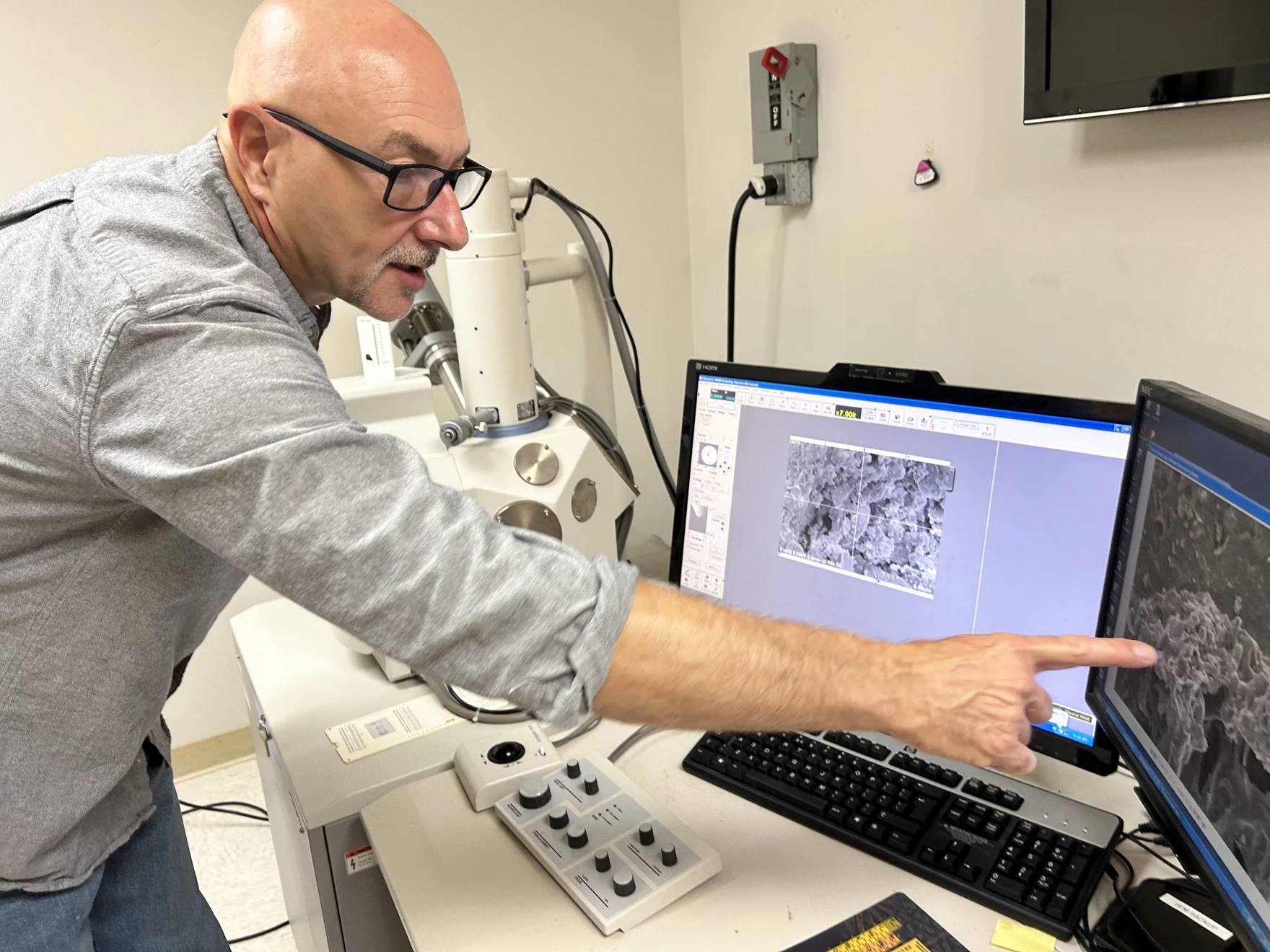
Ivano Aiello points to an image taken by a scanning electron microscope that shows nanoparticles of heavy metals from the January battery fire on a leaf from Elkhorn Slough. (Elena Neale-Sacks/KAZU )

Here are the morning’s top stories on Wednesday, December 3, 2025…

  • Nearly a year after a lithium-ion battery fire in Moss Landing,  we’re learning the extent of the damage to nearby Elkhorn Slough, a protected marine estuary.
  • California Attorney General Rob Bonta is joining six other state attorneys general in calling out buy-now-pay-later lenders, amid concerns that they’re putting consumers at financial risk.

Scientists Trace Heavy Metals Spread By January’s Huge Battery Fire Near Monterey

After a thermal runaway set the world’s largest battery storage facility on fire last winter near Monterey, Ivano Aiello and his colleagues at San José State University had some detective work to do.

The fire, which broke out at the Vistra Energy Storage Facility in Moss Landing on Jan. 16, burned for days, producing a plume of black smoke that was visible for miles. “There was obvious debris related to the fire pretty much all over the place, so it was evidence that something came out from the smoke plume,” said Aiello, a professor and chair at Moss Landing Marine Laboratories.

To understand exactly what the fire spread, Aiello and his colleagues began to investigate. Their results, published in the journal Scientific Reports, were released Monday. When the fire broke out, they had already been collecting soil samples from nearby Elkhorn Slough, a sanctuary for endangered wildlife, so they had baseline data for comparison. After the fire, they tested for nickel, manganese and cobalt — the primary elements used in lithium-ion batteries.

Using a powerful electron microscope, they saw tiny beads of those metals in the soil. “That was pretty much a smoking gun,” Aiello said. Concentrations of the metals were between 10 and 1,000 times greater than they had been before the fire. They also found that the correlation of nickel to cobalt followed a strict 2:1 ratio — the same proportion used in manufacturing the batteries at the Vistra facility.

Sponsored

Preliminary test results from another team of San José State scientists give some indication that the metals, which can be toxic above certain concentrations, have entered the food chain in the nearby estuary. But the concern is not only for the local wildlife, which includes the southern sea otter, a threatened species still struggling back from the brink of extinction. Many agricultural fields are also close to the Moss Landing battery plant. And, there’s another piece of detective work still to be done. Aiello and his colleagues calculated that the heavy metals they found in the soil amounted to less than 2% of the metals contained in the burned batteries. “Where is the other 98%?” Aiello said. “Some of it might have gone straight to the ocean, but some of it might have traveled elsewhere because those particles are very, very tiny.”

Buy-Now-Pay-Later Lenders Called Out By State Attorney General

California Attorney General Rob Bonta has joined a coalition of state attorneys general to question whether buy-now-pay-later lenders are putting consumers at financial risk.

In a letter sent this week, Bonta and other state leaders asked companies to disclose how they handle billing, late fees, and disputed charges. That’s after the Consumer Financial Protection Bureau withdrew a ruling earlier this year that would have granted consumers using these services the same protections as credit card users.

“Buy Now, Pay Later promises all you can want today without needing all the money upfront. This holiday shopping season, in the face of rising prices and other economic challenges, consumers may be tempted to turn to these loans to afford gifts, without meaningful underwriting, or fully understanding that they can turn into serious debt and mounting fees.” said Bonta. “Today, we ask Buy Now, Pay Later lenders for full transparency, and we’re warning California consumers about the risk of these loans.”

A recent report found that nearly one in four borrowers using buy-now-pay-later services fall behind on payments.


lower waypoint
next waypoint
Player sponsored by