Here are the morning’s top stories on Friday, November 7, 2025…
- A federal judge ordered the Trump administration to restore full funding for SNAP benefits by Friday. The Justice Department is appealing. Meanwhile, Governor Newsom’s office says some people are starting to receive their benefits, but it’s unclear how many. The uncertainty is leaving many college students to wonder how they’ll afford their next meal.
- Overwhelming support of Proposition 50 in California is renewing efforts to split the state in half.
CalFresh Delays Leave California College Students Struggling To Afford Food
A Rhode Island federal judge has ordered the Trump administration to find enough money to restore full funding for SNAP benefits by Friday. In failing to fully fund the food assistance program that covers 42 million low-income Americans, U.S. District Court Judge John McConnell Jr. said the government “failed to consider the harms individuals who rely on those benefits would suffer.” He also said President Trump showed “intent to defy a court order” when he posted on Truth Social this week that SNAP benefits would not restart until after the federal shutdown was over, a comment that was walked back by the White House. The Trump administration is appealing the decision, asking for an emergency stay in the case.
Some Californians who rely on CalFresh — the state’s version of SNAP — are beginning to see their full benefits restored on their EBT cards. That’s according to Governor Gavin Newsom’s office. But it’s unclear how many of California’s 5.5 million SNAP recipients have had their benefits restored.
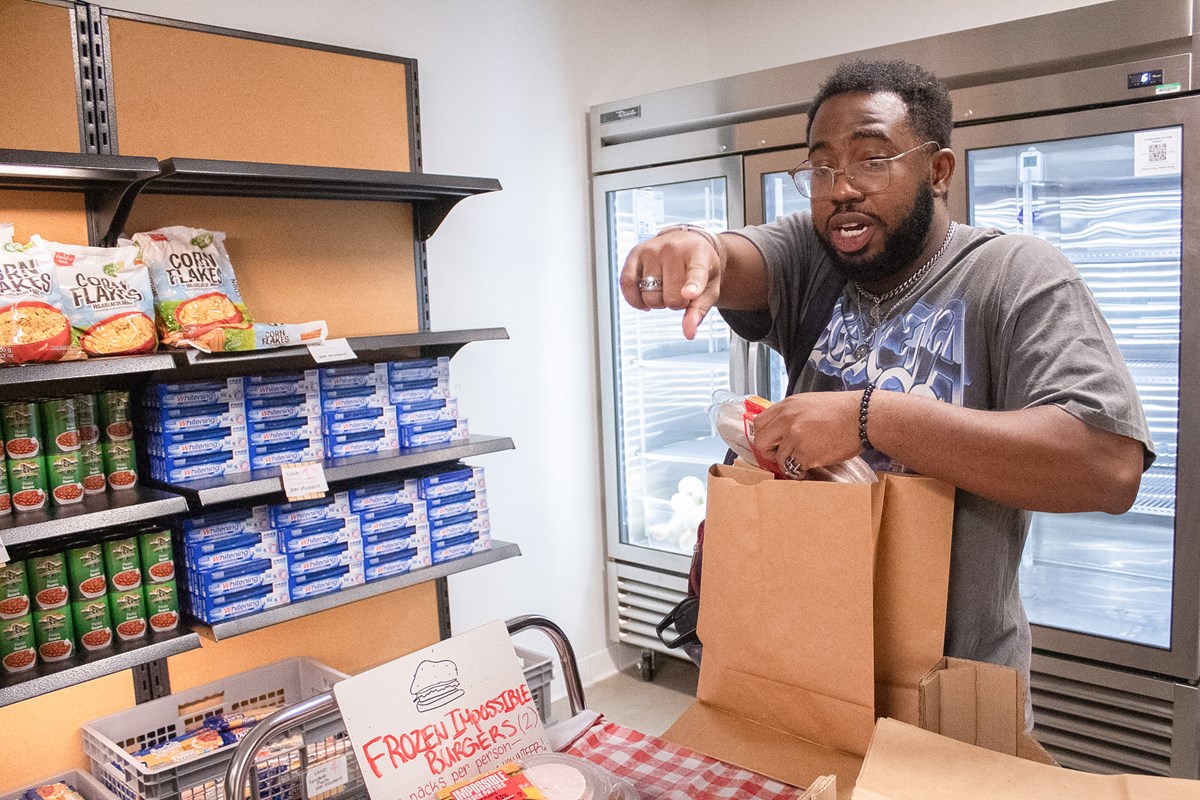
For many college students who rely on CalFresh, all this uncertainty has left them wondering how they’ll afford their next meal. At Sacramento State’s ASI Food Pantry last week, transfer student Tylor Williams was picking up groceries — produce, a few cans of tuna and Impossible Burgers. “You can get unlimited produce here so that’d be clutch,” Williams said. “I went on Facebook Marketplace and found a $5 juicer. I wasn’t even a juicer before, but now I know why people be juicing.” Williams said this semester has been difficult. He recently moved to Sacramento from Los Angeles and has been relying on CalFresh for the past two months. “Covering these first two payments for housing — it definitely drained the account practically to zero,” he said. “So the benefits were really helpful, especially for the price of eggs, mayo, bread, oil, butter — like basic things.”
Jane Nguyen, coordinator for the pantry, said demand is rising. Nearly 700 students visited the pantry in a single week earlier this semester, a record for the school. “We’re trying our best to keep volume, variety and balance for our students,” Nguyen said. That means making sure shelves are stocked with high-protein foods like tuna and culturally relevant items. She said the biggest factor driving demand is the rising cost of living. “If students are already spending the funds that they’re using on their rent, they’re not going to be able to afford a meal,” she added. “And that’s what we’re hoping our resource is able to fulfill — that gap for students.”
Prop 50 Victory Fuels ‘Two-State Solution’ For California
Shasta County supervisors voted 3-2 on Thursday to back a state assembly resolution seeking to divide California’s coastal and inland counties into separate states.