Sponsor MessageBecome a KQED sponsor
upper waypoint

Immigrant Advocates Vow To Continue Fight Despite Supreme Court Ruling

Save ArticleSave Article
Failed to save article

Please try again

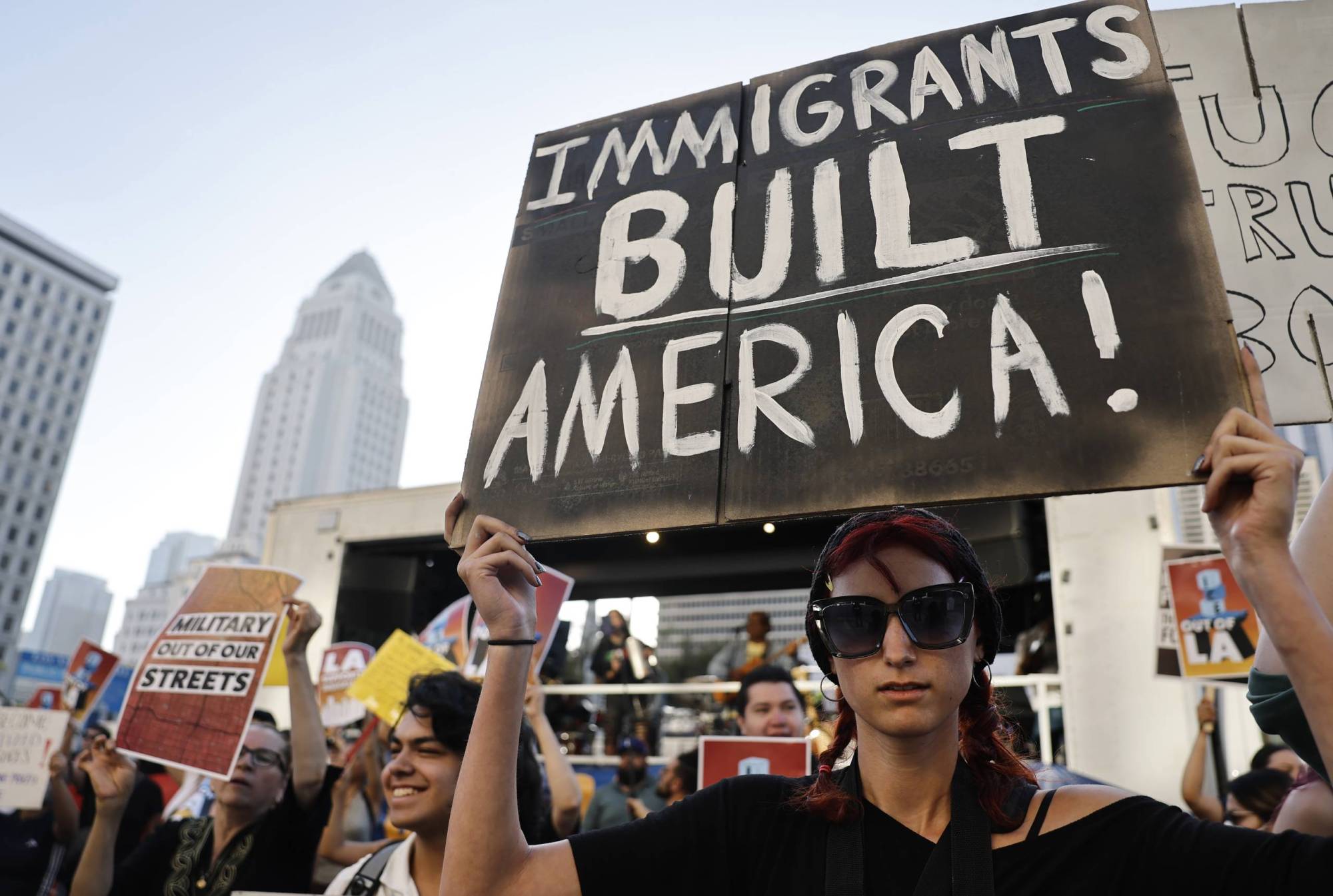
A protester carries a sign reading "Immigrants Built America!" as anti-ICE demonstrators protest outside a federal building on June 19, 2025, in Los Angeles, California.  (Mario Tama/Getty Images)

Here are the morning’s top stories on Tuesday, September 9, 2025…

  • Immigrant communities across Southern California are once again on edge after the US Supreme Court ruled that the Trump administration’s roving immigration sweeps can continue.
  • In the Bay Area, business owners have been following these harrowing workplace immigration raids in Southern California. That’s left many wondering what to do if ICE shows up at their place of business.

Supreme Court Allows Immigration Agents To Resume ‘Roving Patrols’ In LA 

The U.S. Supreme Court has granted the Trump administration’s emergency request to lift a temporary restraining order barring federal immigration officials from conducting “roving patrols” and profiling people based on their appearance in Los Angeles and Southern California.

The case is likely to have an enormous impact, not just for Los Angeles but across the country, several experts told CalMatters. It means immigration agents can legally resume aggressive street sweeps that began in early June in Los Angeles, the epicenter for President Donald Trump’s mass deportation campaign.

The Supreme Court, by a 6-3 majority, agreed with the Trump administration that federal immigration officers can briefly detain and interrogate individuals about whether they are lawfully in the United States and that they can rely on a “totality of circumstances” standard for reasonable suspicion. That means everything the officer knew and observed at the time of the stop.

The U.S. Supreme Court took the case through its emergency docket, also known as the shadow docket, which is used for cases that are handled speedily with limited briefing and typically no oral argument. Justices do not have to publish an opinion when they act from the emergency docket. Justice Brett Kavanaugh, nonetheless, wrote a concurring opinion explaining his reasoning in lifting restrictions on Los Angeles immigration sweeps. “Here, those circumstances include: that there is an extremely high number and percentage of illegal immigrants in the Los Angeles area; that those individuals tend to gather in certain locations to seek daily work; that those individuals often work in certain kinds of jobs, such as day labor, landscaping, agriculture, and construction, that do not require paperwork and are therefore especially attractive to illegal immigrants; and that many of those illegally in the Los Angeles area come from Mexico or Central America and do not speak much English,” he wrote. “To be clear, ethnicity alone cannot furnish reasonable suspicion; under this Court’s case law regarding immigration stops, however, it can be a ‘relevant factor’ when considered with other salient factors.”

Sponsored

The three justices appointed by Democratic presidents dissented from the majority, stressing that they objected to the court lifting limitations on immigration sweeps without oral argument and through the emergency docket, which the Trump administration used extensively this year.

Bay Area Businesses Owners Prepare For Possibility Of Immigration Action

When the Trump administration increased immigration enforcement across much of Los Angeles this summer, many businesses and employees were on alert, concerned about possible actions in their workplace.

In the Bay Area, some business owners are preparing for this possibility in their own way. At Taqueria La Gran Chiquita in Oakland, tables and chairs have been moved aside to make way for couches, a projector and a big standing fan. Stacks of flyers and handouts, including a preparedness checklist, greet local merchants as they walk in. The trainer on this day is Marisa Almor with East Bay Sanctuary Covenant. The nonprofit has been educating more than a hundred business owners and managers in recent months, about their legal rights at the workplace if Immigration and Customs Enforcement arrives.

Almor advises the merchants to plan ahead on how to respond. Who will talk to the agents? Who will document what happens during the exchange? And there are helpful legal tips, too. Employees — regardless of their immigration status — have the right to remain silent and request a lawyer, she said. Almor said business owners — especially in predominantly Latino neighborhoods— need to know which areas of their stores or offices are considered public versus private. That’s because employers don’t have to allow ICE into private areas unless they present a valid judicial warrant.

Erick Olivares, who hosted the training at his taqueria, said afterwards that he feels more confident now. “With all this information that I got, I got more ideas, the things that I can do, is first of all for me — prepare my business,” he said. Olivares said he doesn’t want to interfere with ICE, but will stand up for the rights of his mostly Latino employees — and customers — to prevent any abuses. He’s a proud naturalized U.S. citizen who first arrived in Oakland’s Fruitvale neighborhood as an undocumented teen. “Now that I have the opportunity to protect my people, that’s what I want to do,” Olivares said. “I want to help my community.”

lower waypoint
next waypoint
Player sponsored by