Sponsor MessageBecome a KQED sponsor
upper waypoint

California's Aging Farm Labor Work Force Leaves Questions About The Future Of Agriculture

Save ArticleSave Article
Failed to save article

Please try again

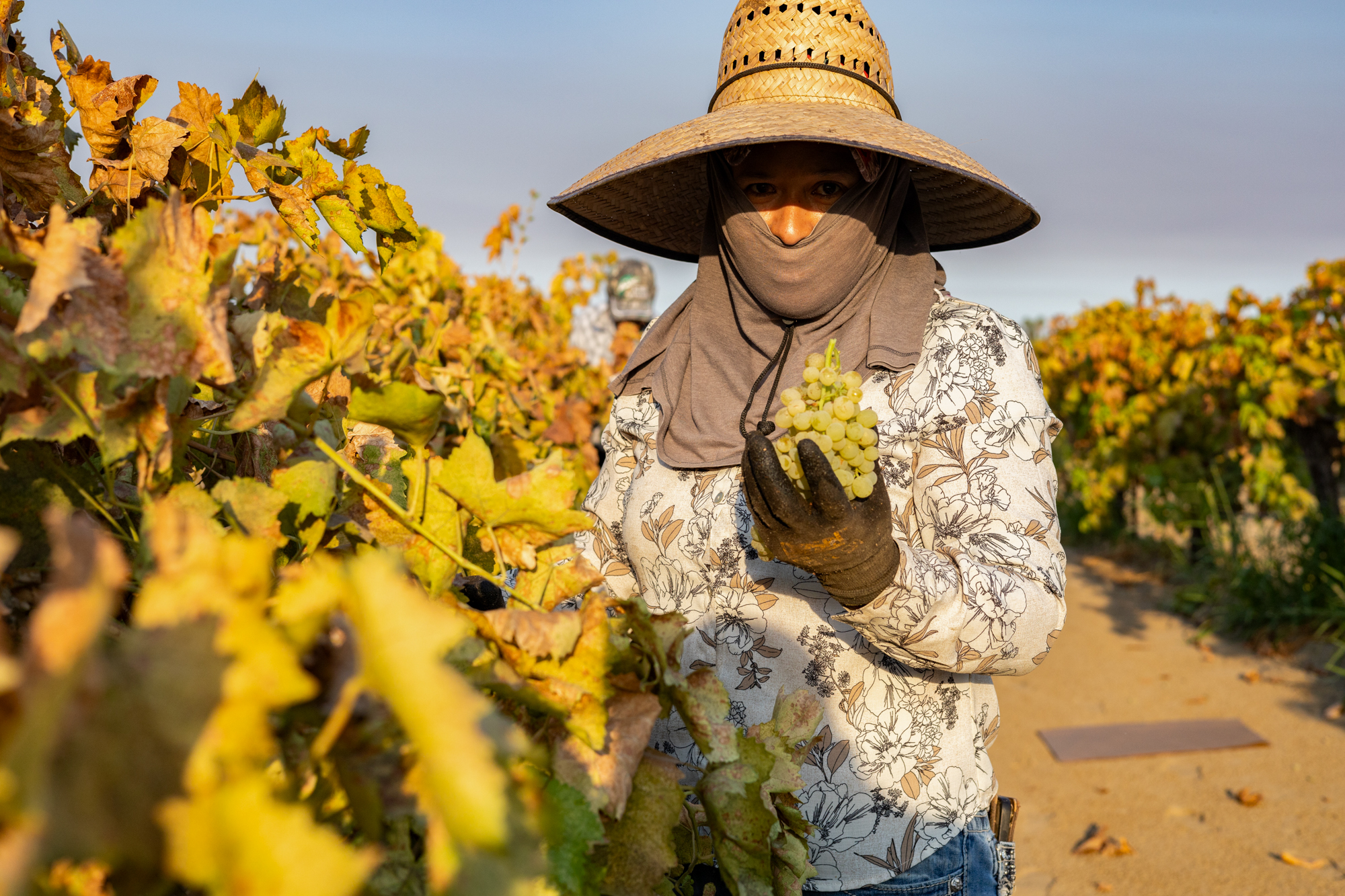
Carmen, a field supervisor, picks grapes at a field in Fresno on Sept. 3, 2025. (Gina Castro for KQED)

Here are the morning’s top stories on Monday, September 8, 2025…

‘Without People, We Are Nothing’: California’s Farm Workforce Is Growing Older

It’s a cool morning in the small farm town of Caruthers in Fresno County. The sun hasn’t risen yet, but Carmen, a mayordoma, or crew supervisor, hops out of her truck and begins prepping the tools her workers will need to harvest grapes: knives, containers, sheets of parchment paper. She’s expecting at least six people to show up. 

That’s already a fraction of the crews she used to lead. After two decades in the fields herself, Carmen has spent the last four years as a supervisor. And lately, finding help is harder than ever. “Young people don’t want to work in the fields anymore,” she said in Spanish. “And those who used to work here don’t have the strength.” This morning, just three workers show up — all of them over 40.

Carmen, 35, knows the work is tough and the Central Valley heat can be unforgiving. Like many parents who work in the field, she’s brought her kids to the fields so they can gain an appreciation for the work. But there’s the contradiction. Even as she pushes her own children toward college, she knows that’s part of the reason her crews keep shrinking. What feels like a triumph for her family only deepens the challenge she faces each day as a supervisor.

Her experience reflects a larger shift: California’s farm labor force is aging, and few younger workers are stepping in to replace them. Meanwhile, the workforce is also under strain from the Trump Administration’s immigration policies.

Sponsored

In 1979, the average California farmworker was 30 years old. Today it’s 40, with many still laboring well into their 60s and 70s, according to Edward Flores, faculty director of the UC Merced Community and Labor Center, who has studied these changes. Beginning in the 1970s, the U.S. experienced one of the largest migration waves in modern history: hundreds of thousands of young men and women came from Mexico to California, filling farm jobs that fueled the state’s agricultural boom. In 1969, the largest group of farmworkers was between 16 and 25. By the 1990s, it had shifted to 25 to 34, and the average age has only continued to rise. “If their parents have chronic health issues, struggle to make ends meet, and tell their kids to get an education instead, many children listen,” Flores said.

John Burton, Architect Of California Democratic Machine, Dies At 92

John Burton, who with his late brother Phillip created the vaunted “Burton machine” that dominated San Francisco and California politics for decades, died Sunday. He was 92 and had been in declining health for years.

During a decades-long career in Sacramento and Washington, D.C., Burton was known for his blunt, plain-spoken style — often laced with trademark obscenities — as he fought for labor unions and the working class. “That’s what Democrats do,” Burton told members of the California Democratic Party as he stepped down as chair in 2017. “There’s a lot of people out there that if we don’t fight for them, nobody’s going to fight for them because they don’t have any power.”

Rep. Nancy Pelosi, a protegé of Burton, once said of his salty tongue: “His language is authentic, his purpose is sincere and his effectiveness is undeniable.” “It’s amazing to think about the Bay Area, to think about California politics, to think of aspects of this country that have been profoundly improved because of the Burton family,” then-Lt. Gov. Gavin Newsom said in a 2017 video tribute. “John Burton will go down as the guy who gave life and structure and success to the California Democratic Party,” added then-Gov. Jerry Brown.

Burton was born in Cincinnati, Ohio, during the Great Depression, but grew up in San Francisco with his brothers Phillip and Bob Burton. Boosted by his powerful older brother Phil, Burton was elected to the California Assembly in 1964, the same year as Brown, his friend and longtime political ally, headed to the Assembly. His brother Phil also won a seat representing San Francisco in Congress that year.

As John climbed the ladder in California, Phil Burton became a powerhouse in Washington, D.C., mastering the art of reapportionment — using oddly drawn or gerrymandered districts to help elect Democrats. The “Burton machine” united organized labor, Black churches, Asian Americans and the gay community, cementing decades of political dominance. In 1974, amid the Watergate scandal, Burton was elected to represent San Francisco and part of Marin County in Congress. He served until 1982, when he stepped down to address his cocaine addiction. After overcoming addiction, Burton returned to the Assembly in 1988. In 1996, Burton won a state Senate seat, rising to become president pro tem until term limits forced him out in 2004.

lower waypoint
next waypoint