Episode Transcript
This is a computer-generated transcript. While our team has reviewed it, there may be errors.
Katrina Schwartz: Seagulls are everywhere we go in the Bay Area, swooping into Giants games at Oracle Park.
Clip from Giant’s game: Hey, the seagulls are here.
Katrina Schwartz: Making it difficult for planes to take off at the San Jose Airport.
News clip: 1118, just hit a bird, emergency returning to San Jose.
Katrina Schwartz: And generally being a nuisance, ask almost anyone who has eaten anything outside, and they’ll have a seagull story.
Alicia Aschauer: One summer day, we were having a picnic, and my dad was grilling, and one seagull just swooped down and took an entire hamburger patty that was cooking on the grill.
Annie Fruit: Classic SF State lunchtime scenario, get an awesome student union burrito. Go outside to eat it. Sit down. Seagull swoops in and takes a huge bite. Absolutely disgusting, burrito ruined.
William Wallis: One afternoon I was sitting in behind the Ferry Building enjoying my lunch. A couple of visitors to our city were walking around enjoying ice cream cones. Out of nowhere, a seagull swooped down and took one of the scoops of ice cream atop one of their cones and flew off with it.
Katrina Schwartz: And of course, there’s the poop.
Charlotte Cheng: I was a first-grade teacher at Audubon Elementary in Foster City. It was right along the bay, so there were tons of seagulls. And for my little kids, they lined up after recess right alongside those handball courts. And when I went to pick up the kids, one of them was just standing in shock, covered in seagull poop.
Katrina Schwartz: Seagulls have been making their presence known in the Bay Area over the last couple decades. And no, it’s not your imagination; there are more of them. That got one Bay Curious listener wondering, are seagulls native to the Bay Area?
Some people think they’re dirty and pests, others find them majestic. Today’s episode is all about the California gull. We’ll take you on an expedition to count gulls, explore how these birds can be both native and invasive at the same time, and learn what ecologists are doing to keep their numbers in check. I’m Katrina Schwartz, and this is Bay Curious.
Sponsor message
Katrina Schwartz: There are many different species of gulls flying around the Bay Area. The most common are the Western and California gulls. While both have always foraged on our shores, the California gulls used to only be seasonal visitors, but recently, they’ve become year-round residents. KQED’s Pauline Bartolone tells us why that’s a problem.
Pauline Bartolone: So, to answer our question-asker, are California gulls native? The answer is yes, native to the state. But when you zoom into the Bay Area, that’s when the answer gets more complex. The gulls have always come to eat on our shores during the winter, but several decades ago, they started breeding here.
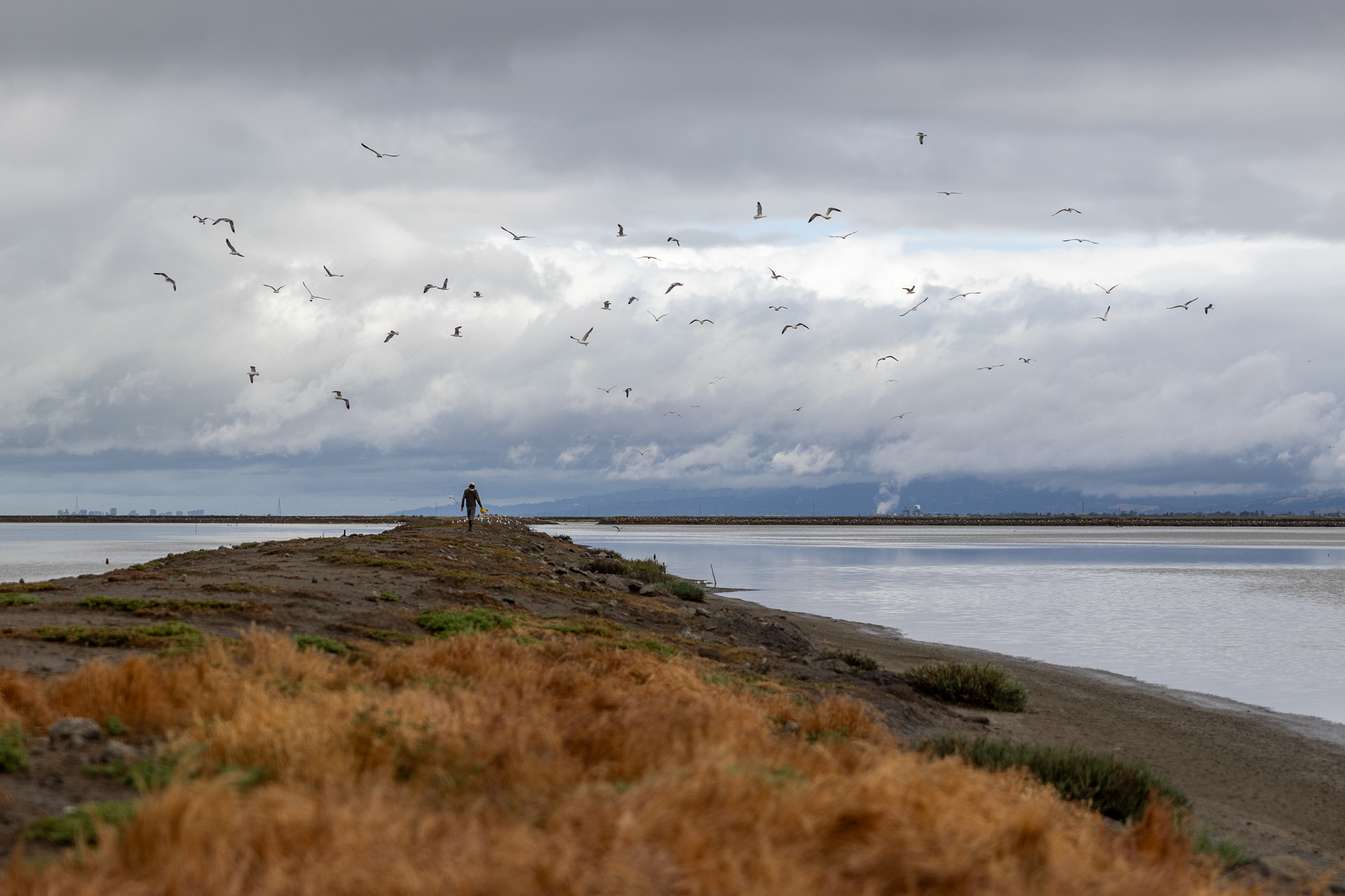
Nathan Van Schmidt: Right now, we are at the salt ponds in Newark, California, next to Coyote Hills Regional Park.
Pauline Bartolone: That’s Nathan van Schmidt of the San Francisco Bay Bird Observatory. His organization has been counting bird nests here in the shallow southernmost tip of the bay for more than 40 years. Before then, these birds never bred on the levees and islands here. Then one day in 1980, they just showed up and laid eggs.
Nathan Van Schmidt: A breeding colony was discovered of just a few dozen of these California gulls out on historic salt pond habitats, and that looked just like their native habitat for breeding. So probably because of that, the birds started breeding there, and over the next few decades, just exploded in size.
Pauline Bartolone: At their peak in 2013, there were more than 50,000 gulls. Nathan’s group tracks their numbers to see if they’re harming other creatures.
On this wet spring morning, the gulls are in dense colonies along the pond’s edges. The birds don’t care that humans created these ponds in the bay to make commercial table salt. The gulls just like the saline water where they can feast on brine shrimp and flies.
Nathan Van Schmidt: These ponds in particular are some of our stinkiest ponds. There’s one or two spots out on this pond where there’s some bubbles that you can see methane coming up, all that good wetland stuff.
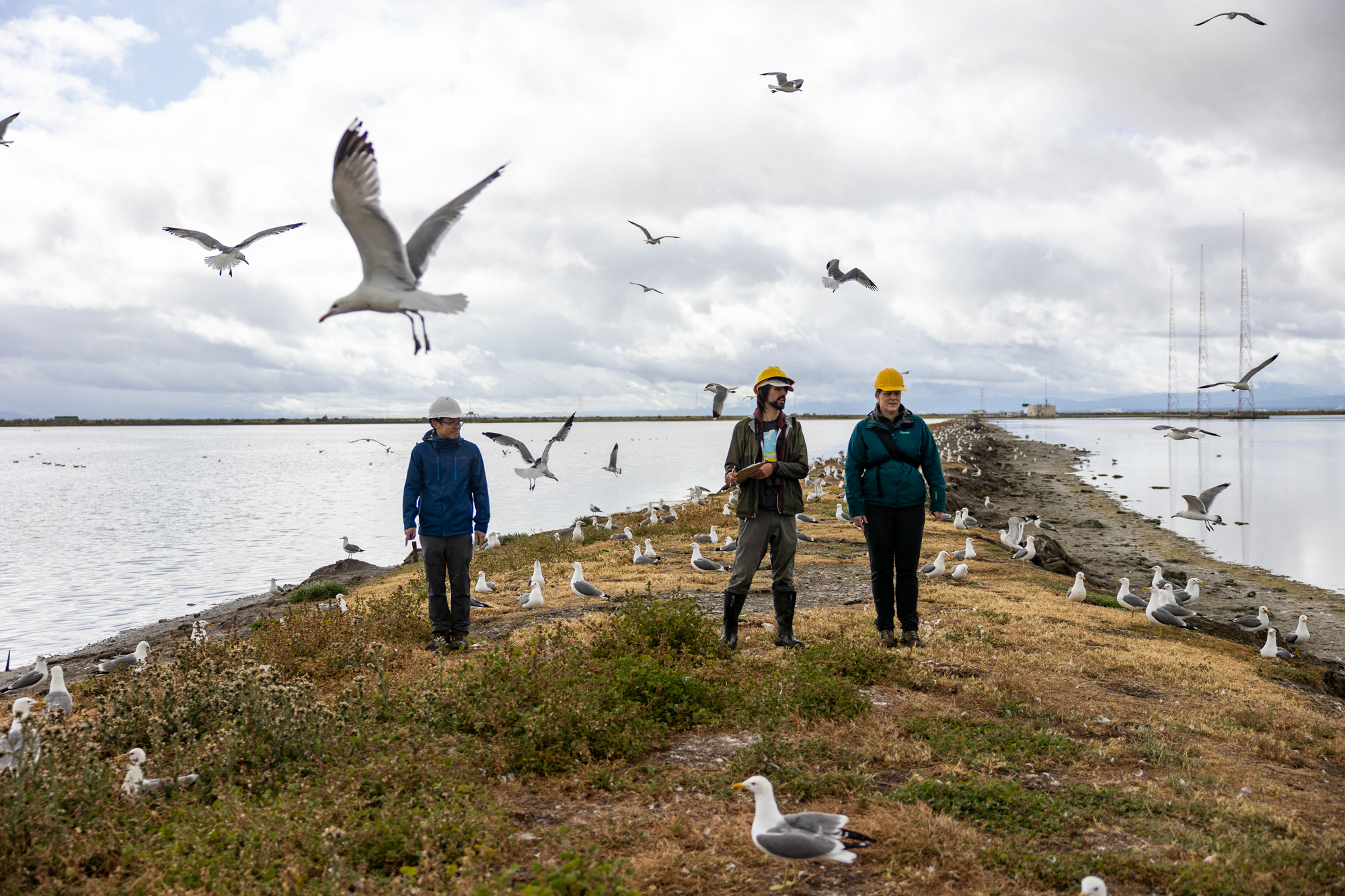
Pauline Bartolone: Nathan, at least six feet tall, stands in knee-high rubber boots with clipboard in hand, he explains to a small circle of volunteers how to help count the gulls.
Nathan Van Schmidt: Here we are going to be tallying the number of nests. So empty nest, one egg, two eggs, three eggs, four eggs.
Pauline Bartolone: The count is not an easy task, especially today. It rained this morning, and volunteers struggled to find steady footing in the mud near the nest sites.
Volunteer: Oh god, I’m really slipped in the mud here.
Nathan Van Schmidt: Who has clickers? Somebody’s gonna need to have two clickers.
Pauline Bartolone: Long-sleeved waterproof jackets and hard hats are a must out here. The gulls attack.
Nathan Van Schmidt: We need hard hats, because the gulls are quite defensive of their colonies, they will be dive bombing us. They will be bombing us with poop. I am pretty sure that is intentional.
Pauline Bartolone: As Nathan walks toward the nests and the levee flanked by his volunteers, the pace of the count picks up.
Volunteers: One egg, one egg, one egg.
Pauline Bartolone: Little nests are scattered all over the ground.
Nathan Van Schmidt: We’ll do 1e, 1d, e for that.
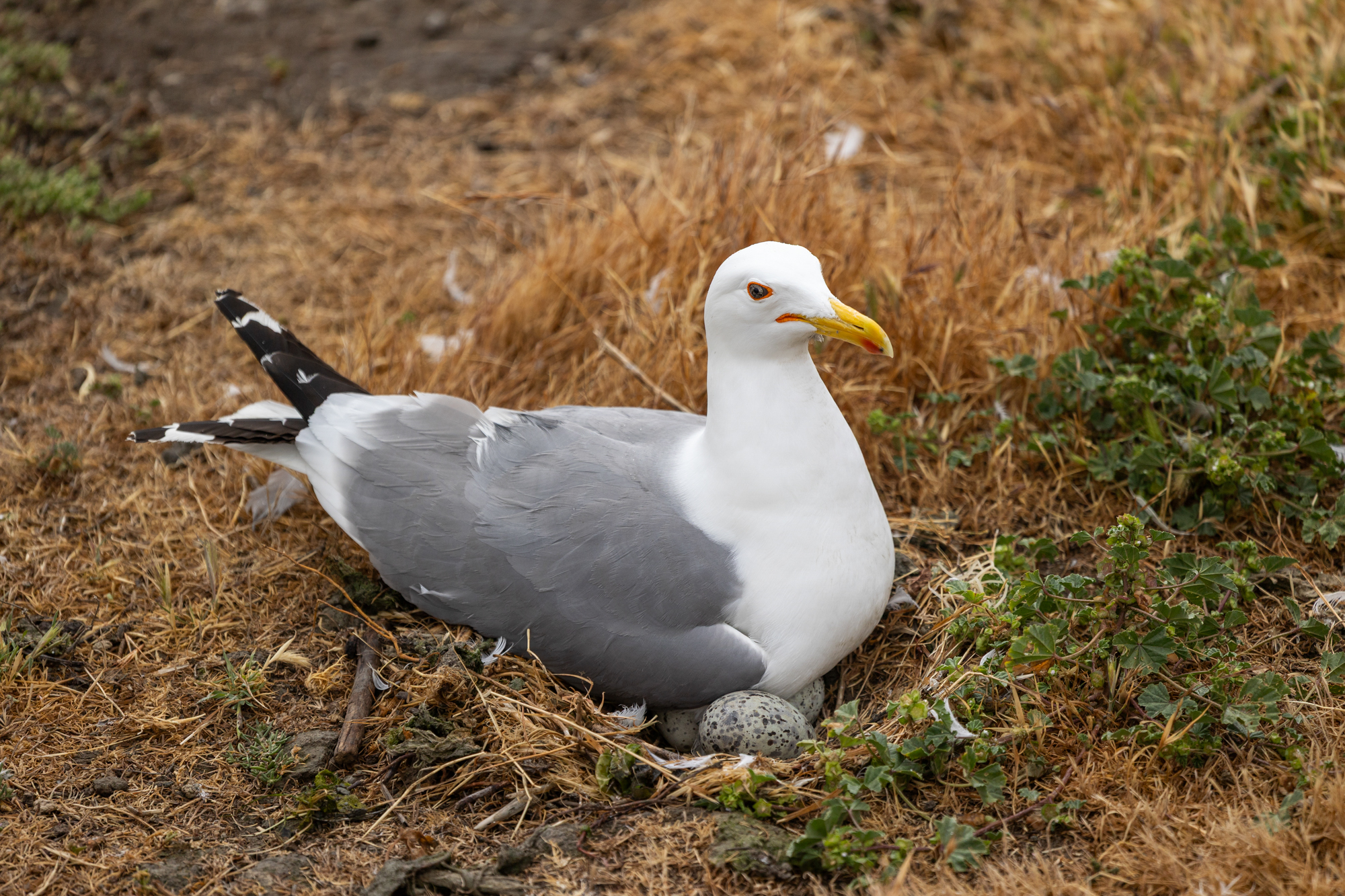
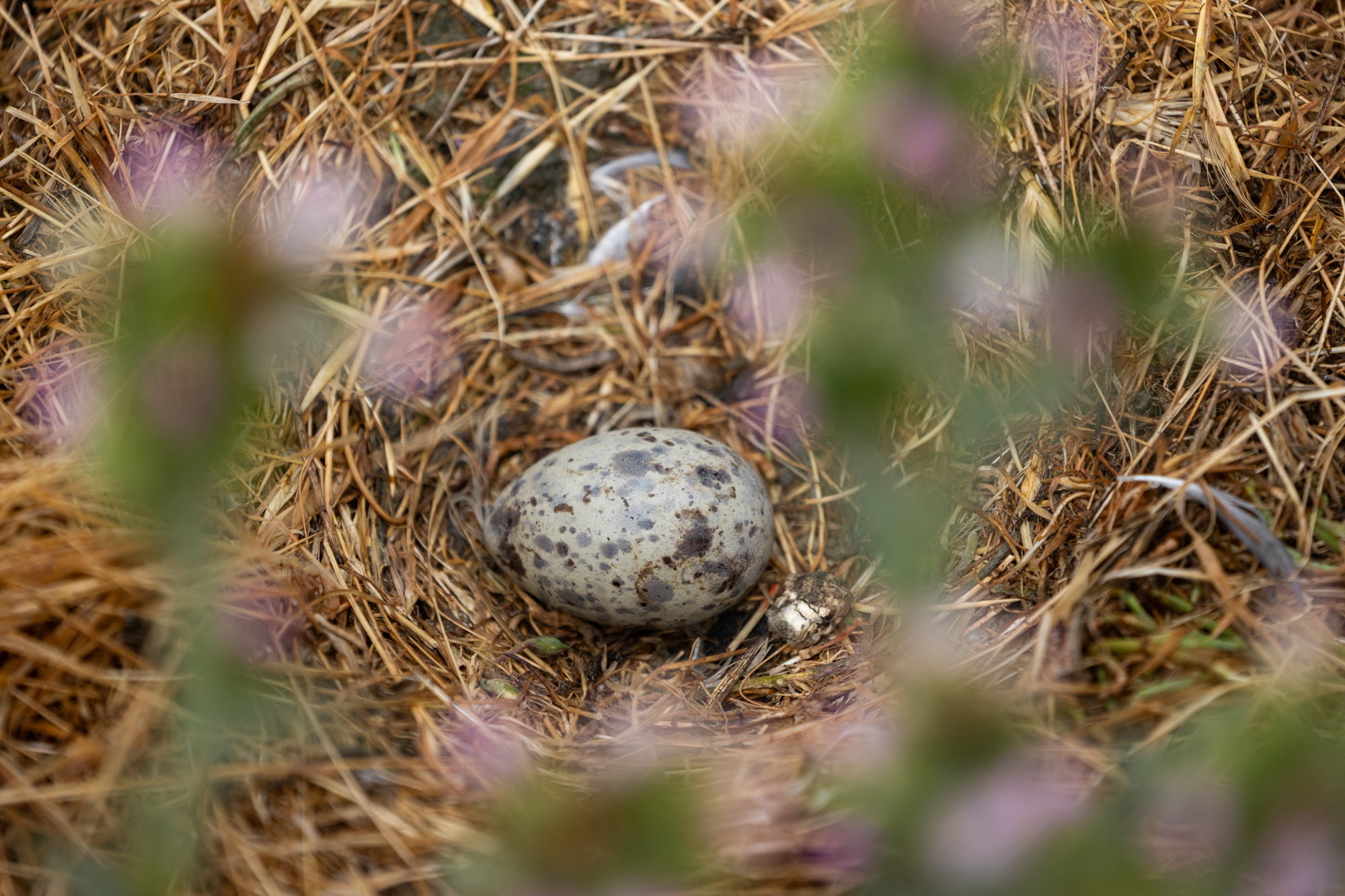
Pauline Bartolone: The eggs are sea foam green with brown speckles. They’re a little bit bigger than a chicken egg.
Nathan Van Schmidt: They’re sizable. They were historically eaten in large numbers by both native people of California and folks during the Gold Rush times.
Pauline Bartolone: It’’s a chaotic scene, walking into a swarm of birds. You have to watch where you step. There are a lot of bird poop splats, white splats everywhere. And beware of those swooping down from above.
Nathan Van Schmidt: That’s the attack call, if you hear it, one of them right now is going for me repeatedly, and it’s a little more ‘ehhh.’
Pauline Bartolone: The gulls also attack each other, protecting their chicks from hungry fellow breeders.
Nathan Van Schmidt: They’re pretty aggressive with each other. We will see them out there chasing each other around, defending their nests from each other. The other birds in the colony are the biggest threat to their nests.
Pauline Bartolone: Scientists are keeping tabs on the gull population because while they breed in the bay, they prey on their neighbors, other native birds.
Nathan Van Schmidt: They are pretty voracious nest predators. There are threatened species like snowy plovers that are breeding in San Francisco Bay, and there are also least terns, American avocets, black-necked stilts. They all like the islands because they’re safe from mammalian predators. But then the avian predators, like the California gulls, can be an issue.
Pauline Bartolone: The gulls have quickly become one of the threatened plovers, biggest predators, destroying as much as a third of their young in some years. The California gulls have only been breeding in San Francisco Bay for 45 years. So, where did they raise their young before?
Bartshe Miller: California gulls are definitely an iconic part of the Mono Basin. I think they’ve been nesting here for centuries and centuries.
Pauline Bartolone: Bartshe Miller lives on the eastern side of the Sierra near the border of Nevada. He’s a scientist with the Mono Lake committee, an organization trying to protect the gigantic saline lake. While scientists in the Bay Area want to keep California numbers down, Bartshe’s group is working full-time to bring their numbers back up.
Bartshe Miller: They’re beautiful birds to look at. They soar all over Mono Lake in the eastern Sierra. And every time they show up each year, it marks the passage of time and the seasons, and it tells us that they’re showing up, getting ready to breed.
Pauline Bartolone: Gulls are migratory, so historically, these birds foraged for food on the coast during the winter and then returned to breed and raise their young on inland saline lakes in the spring and summer. At Mono Lake, gulls found a safe place to make their nests on Negit Island, nesting on the ground there. But for decades, the lake level has been dropping, and one year, a land bridge appeared.
Bartshe Miller: A lot of the surrounding lake bottom was exposed. And by 1979, coyotes made it out to Negit Island and chased the gulls. I mean, they predated on their eggs and chicks, and the gulls abandoned the nests on Negit.
Pauline Bartolone: Water levels at Mono Lake have been dropping for a long time, since at least 1941, when streams flowing to the lake were diverted to serve the city of Los Angeles. With the lake level still nine feet below what they should be, the habitat isn’t the reliable and safe breeding ground the gulls once knew.
Bartshe Miller: But I think there was this point in time where a lot of gulls probably just decided, well, it’s not safe to nest at Mono Lake.
Pauline Bartolone: In 2024, only a few 100 chicks were born at Mono Lake, the worst California gull breeding season on record. But Mono Lake advocates say limiting water diversions to Los Angeles is critical to maintain an important breeding ground for the gulls and to preserve the area’s biodiversity.
Bartshe Miller: There is a strong ecological link to the health of the gulls and the health of the lake’s ecosystem.
Pauline Bartolone: Bartshe says these gulls belong at Mono Lake. They don’t do harm there like they do in the Bay Area.
Bartshe Miller: There’s been this evolutionary circumstances that’s going around here where the gulls aren’t preying on other birds here. There aren’t other birds nesting at Mono Lake that gulls prey on, so this is the place for them to be.
Pauline Bartolone: When it was no longer safe to breed at the traditional spot on Negit Island and Mono Lake, the gulls moved on to San Francisco Bay. When their number peaked a little over a decade ago, wildlife managers decided their threat to local native birds was too great. They started destroying the gulls’ nests and eggs on the levees.
Nathan Van Schmidt: We’re getting really concerned this population were just spiraling out of control and wanting to get them away from these really sensitive species.
Pauline Bartolone: But that was a short-term fix. They needed another strategy to tamp down on the gulls, deprive them of food. There’s a huge landfill right next to the salt ponds in the South Bay, a major reason their population exploded. The Newby Island landfill stretches over hundreds of acres. Basically, it’s a giant smorgasbord for seagulls. So about a decade ago, the dump hired one man whose full-time job is chasing the birds off trash piles. Max Ottersbach is a falconer, and that’s him talking to one of his birds of prey.
Max Ottersbach: I have three falcons, and each one flies one, two hours, and I try to spread that out throughout the day, for 10 hours a day.
Pauline Bartolone: He and his menagerie of raptors and dogs scare away the seagulls.
Max Ottersbach: The falcon goes up, tries to get above them as best he can, or flies towards the flock to disperse the seagulls that are in the air.
Pauline Bartolone: Landfill managers wouldn’t allow us to visit the dump, but we asked Max to record himself with all of his anti-gull props. The falcons are just one of his strategies. He drives around the dump on an ATV with a flag flying 16 feet in the air. Then his dogs chase after the birds.
Max Ottersbach: When the birds see the ATV, and they see the flag, and they see the dogs, they know that the danger is in the area. It’s all a big show to make, to make my presence known to the seagulls that we’re here and ready to rock and roll.
Pauline Bartolone: Max says it can feel overwhelming out there fighting a constant tide of hundreds of birds that descend on trash heaps over and over again.
Max Ottersbach: Seagulls are, are a force of nature. But the good thing is about seagulls is they don’t really act individually; they act in a flock. So if you can get one bird to go, then the chances of the other one going is going to be greater.
Pauline Bartolone: Early on, wildlife managers tried air cannons and even pyrotechnics to scare the gulls. But Max says the primal fear of living creatures is what works best. So after a decade of being chased by his dogs and falcons, the gulls aren’t nesting or resting at the dump anymore.
Max Ottersbach: It’s all about the long game with this project, I feel, you know, these birds are here. They’ve migrated into the bay. And so you know it’s not going to happen overnight. It’s going to take multiple generations of seagulls learning that this just isn’t a place that they can come for a food source anymore.
Pauline Bartolone: Nathan from the Bird Observatory says the falconer’s job may be an odd one, but it’s working. The number of breeding gulls in the South Bay is still in the 10s of 1000s, but there are fewer than the peak of over 50,000. Are the gulls going somewhere else or just making fewer babies? Scientists don’t really know.
Nathan says, California goals are in a weird spot. They’re not thriving at Mono Lake, their native breeding grounds, and they’re harmful to other species here in the Bay Area. There are no clear answers, he says, about the best way to manage these gulls in the future.
Nathan Van Schmidt: It’s the challenge of trying to conserve multiple species on a shrinking set of habitats where human transformation of California has been so dramatic. They’ve all concentrated in this weird anthropogenic habitat in South Bay, and now we have to figure out how to manage that and how to balance these competing needs of all these different species.
Pauline Bartolone: In the short term, there have been biodiversity wins in the Bay Area. The threatened snowy plovers, which decades ago suddenly fell prey to new gull neighbors, are slowly making a comeback.
Katrina Schwartz: That was KQED reporter Pauline Bartolone. Thanks to Alicia Aschauer, Annie Fruit, William Wallis and Charlotte Cheng for sharing the seagull stories you heard at the top of the episode.
If you’ve been enjoying Bay Curious, please consider leaving us a review in your favorite podcast app or tell a friend about the show. Both are great ways for new people to find out about us, and thank you so much for doing it.
Bay Curious is produced in San Francisco at member-supported KQED.
Our show is made by Gabriela Glueck, Christopher Beale and me, Katrina Schwartz. With extra support from Maha Sanad, Katie Sprenger, Jen Chien and everyone on team KQED.
Some members of the KQED podcast team are represented by the Screen Actors Guild, American Federation of Television and Radio Artists San Francisco, Northern California Local.
Have a great week.