This story contains a correction.
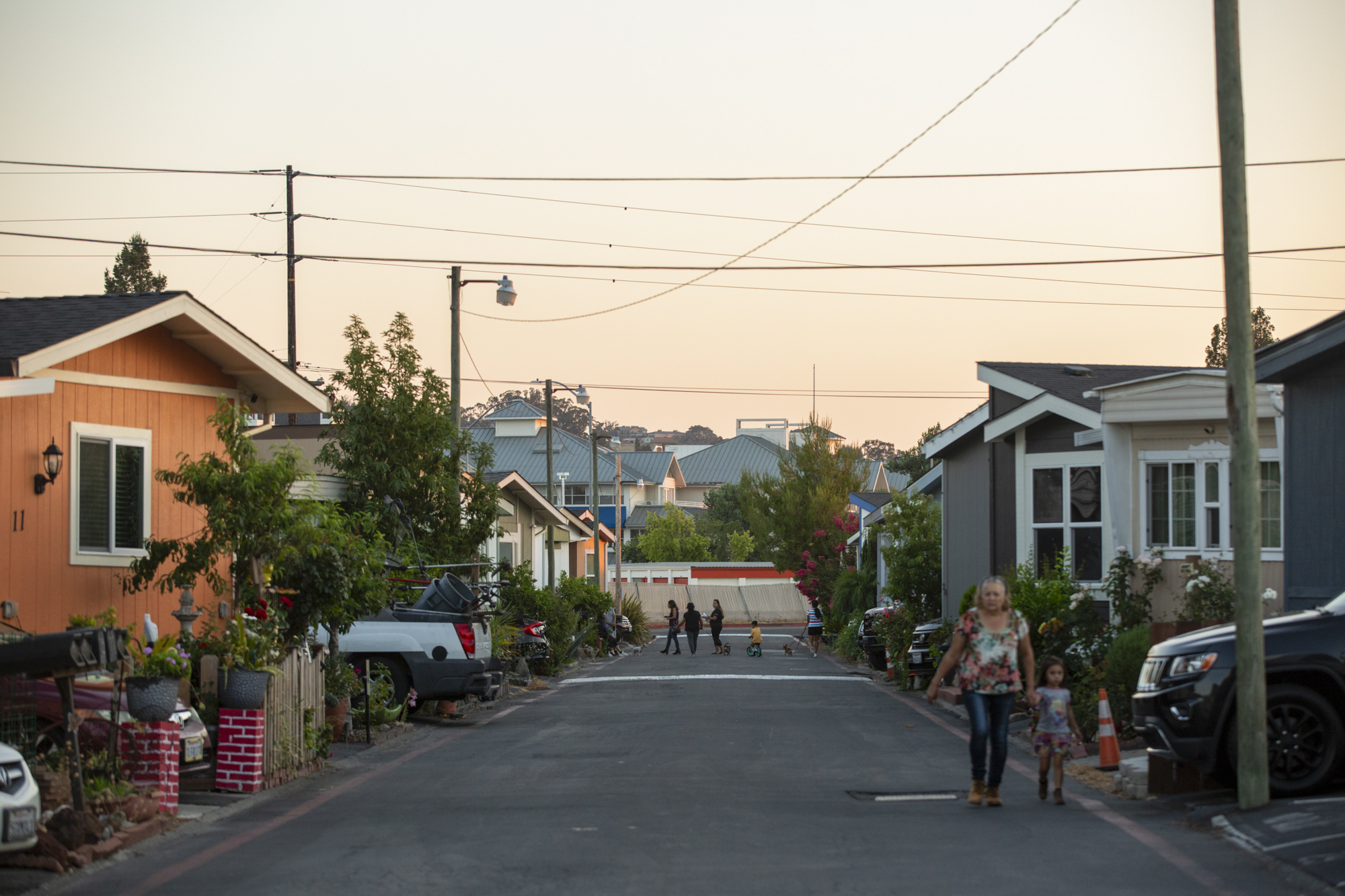
Christopher Brown has called Littlewoods Mobile Villa home for 27 years. His favorite parts about the Great Lakes single-wide mobile home are that it was designed to last, made of durable materials like steel – and that he owns it.
But what Brown and the other residents at Littlewoods don’t own is the land underneath their homes. Tenants pay to rent space in the 78-unit park. For Brown, that’s about $600 a month.
Affordability has kept many tenants of Littlewoods feeling secure. However, after Brown received a potential closure letter from the park’s owners in July, a month after Petaluma’s city council began discussing whether to adopt rent control, that sense of stability was shaken.
“I went to my room, I sat down, I read [the letter] and I read it again. I was just blown away,” said Brown. “I read it a third time. My mind wasn’t wrapping around it. In that moment, I just felt broken.”
The letter specifically mentioned that property owners are unsure if they can continue running the park with measures taken by local and state governments. Littlewoods Villa is owned by the Ubaldi Family, which also owns Carriage Court in Santa Rosa. The park is managed by Harmony Communities.
Brown is a former delivery truck driver who spent most of his life transporting grapes from Sonoma County wineries, until a bad back injury a few years ago. Now he’s on disability and relies on a fixed income. The rent at the park has allowed him to stay at Littlewoods Villa, in the two-bedroom, metallic mobile home he shares with his roommate Donna Dillard and their two little dogs, Sergei and Becky Woo Woo.

Tenants of Littlewoods Villa in Petaluma remain in limbo. The fate of the place they call home has been put in jeopardy by the potential closure notice, a move they say is retaliatory after Petaluma adopted stronger rent control laws surrounding mobile home parks on July 17.
Brown and other park residents are now worried that if the owners decide to close Littlewoods Villa, they could be left homeless.
In light of potentially losing their housing, residents decided to take action and began organizing under the name Neighbors United.
“We talk about how we’re going to get the word out into the community, how we’re going to continue to organize our get-togethers, our meetings, and what actions we’re going to take,” said Brown.
The last beacon of affordable home ownership
Mobile home parks are often the last affordable housing options for home ownership, especially for tenants who are older, lower-income or live on a fixed income, like social security or disability.
The high cost of housing, especially in an increasingly expensive Bay Area, has trickled down to mobile home communities. In 2018, the average home price in Petaluma was a little under $700,000. This year, the median home price is $935,000. Meanwhile, corporate owners have eyed mobile home parks as lucrative investments, driving up rents for tenants.
“When you have a corporation running a park, their number one interest is profit, and that’s going to cause problems for the residents,” said Margaret DeMatteo, a housing policy attorney for Legal Aid of Sonoma County.
She has concerns about the national trend of corporation management companies buying mobile home parks to increase profit. DeMatteo pushed for expanding tenant protections to include mobile park homes by advocating for tenants at city council, and participating in tenant rights workshops to help educate residents on their protections under state and local law.
According to California’s 2023 Mobile Home Residency Law (PDF), rent control regulations are left up to each city to decide.
DeMatteo said the new rent control rules are similar to ones adopted in nearby Santa Rosa, Windsor, and Rohnert Park, but Petaluma was the first place she saw owners threaten to close their parks in response. Since then, owners of parks in Petaluma and Cloverdale have taken similar actions.
“They are a way to strong-arm homeowners into paying a rent increase of up to 150%,” Dematteo said. “If you want us to stay open, you have to voluntarily pay more space rent.”
Residents fight for their park
The news of potential closure disrupted what would have been a normal summer of barbeques at Haley Gonzalez’s grandparents’ mobile home. The 11-year-old attends Miwok Valley Elementary, which conveniently shares a chain link fence with the park. Her entire family lives at Littlewoods and relocation for a mobile home is expensive. It can cost anywhere from $3,000 to $14,000 depending on the mobile home’s size and the destination distance.
She and her mother Claudia Gonzalez have been attending tenant meetings since they got the notice. Usually around 80 people show up, sometimes over 100.
“I just want to fight for my park,” said Haley. “My friends and family live here, and I just want to be with them.”
Martin Contreras has also lived at the park his whole life and after graduating from Sonoma State earlier this year, he began teaching band class for fifth and sixth graders at Miwok Elementary.