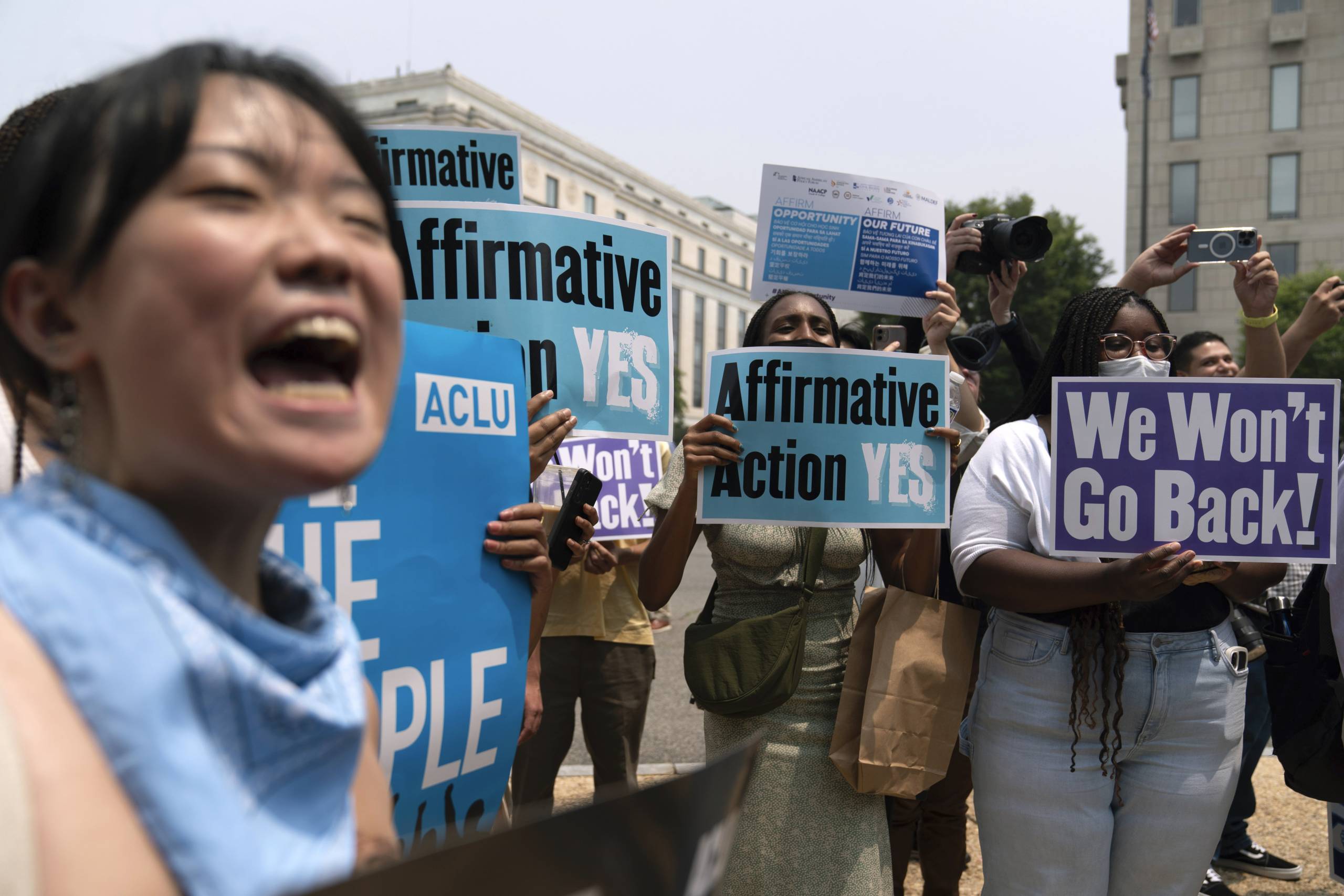
A U.S. Supreme Court ruling (PDF) barring colleges from considering race in admissions effectively outlaws affirmative action at California’s private universities, broadly expanding a ban that had previously only applied to the state’s public campuses.
In Thursday’s 6-3 decision, the court’s conservative majority invalidated race-conscious admissions policies at Harvard University and the University of North Carolina, the nation’s oldest private and public colleges, respectively, finding them in violation of the Constitution’s guarantee of equal protection. The historic ruling overturns a spate of cases reaching back nearly half a century and will force the nation’s private and public universities to dramatically alter how they select their students.
Writing for the court’s majority, Chief Justice John Roberts said that for too long universities have “concluded, wrongly, that the touchstone of an individual’s identity is not challenges bested, skills built, or lessons learned but the color of their skin. Our constitutional history does not tolerate that choice.”
“The entire point of the Equal Protection Clause is that treating someone differently because of their skin color is not like treating them differently because they are from a city or from a suburb, or because they play the violin poorly or well,” Roberts said.
The decision, bringing a long-sought conservative goal to fruition, comes nearly 30 years after California voters passed Proposition 209, which prohibited the state’s public universities — including those in the University of California and California State University systems — from considering race and gender in admissions and hiring decisions. But that law did not apply to the state’s private colleges, including University of San Francisco, Stanford and Santa Clara universities, who until now have continued to consider race as a factor in admissions.
Leaders of numerous private colleges across California were quick to denounce the court’s decision, calling it a major setback to efforts aimed at diversifying campuses and to expand opportunities for underrepresented student populations.
“The ruling is quite disturbing and really quite challenging to us,” said Rev. Paul Fitzgerald, president of the University of San Francisco. “We’ve spent decades building out an academic program to welcome a student population that looks like the future of our nation. To be told now that we cannot use race as a particular factor is going to cause us to think very hard to figure out a way to continue our mission.”
Fitzgerald noted his school has worked to draw communities that are historically underrepresented on college campuses, including outreach at high schools that serve primarily Black, Latino or Indigenous students.
The court’s ruling was the culmination of a lawsuit first brought against Harvard in 2014 when a group called Students for Fair Admissions argued the university’s consideration of race in admission decisions unfairly discriminated against Asian students. The group made a similar argument in its subsequent suit against the University of North Carolina.
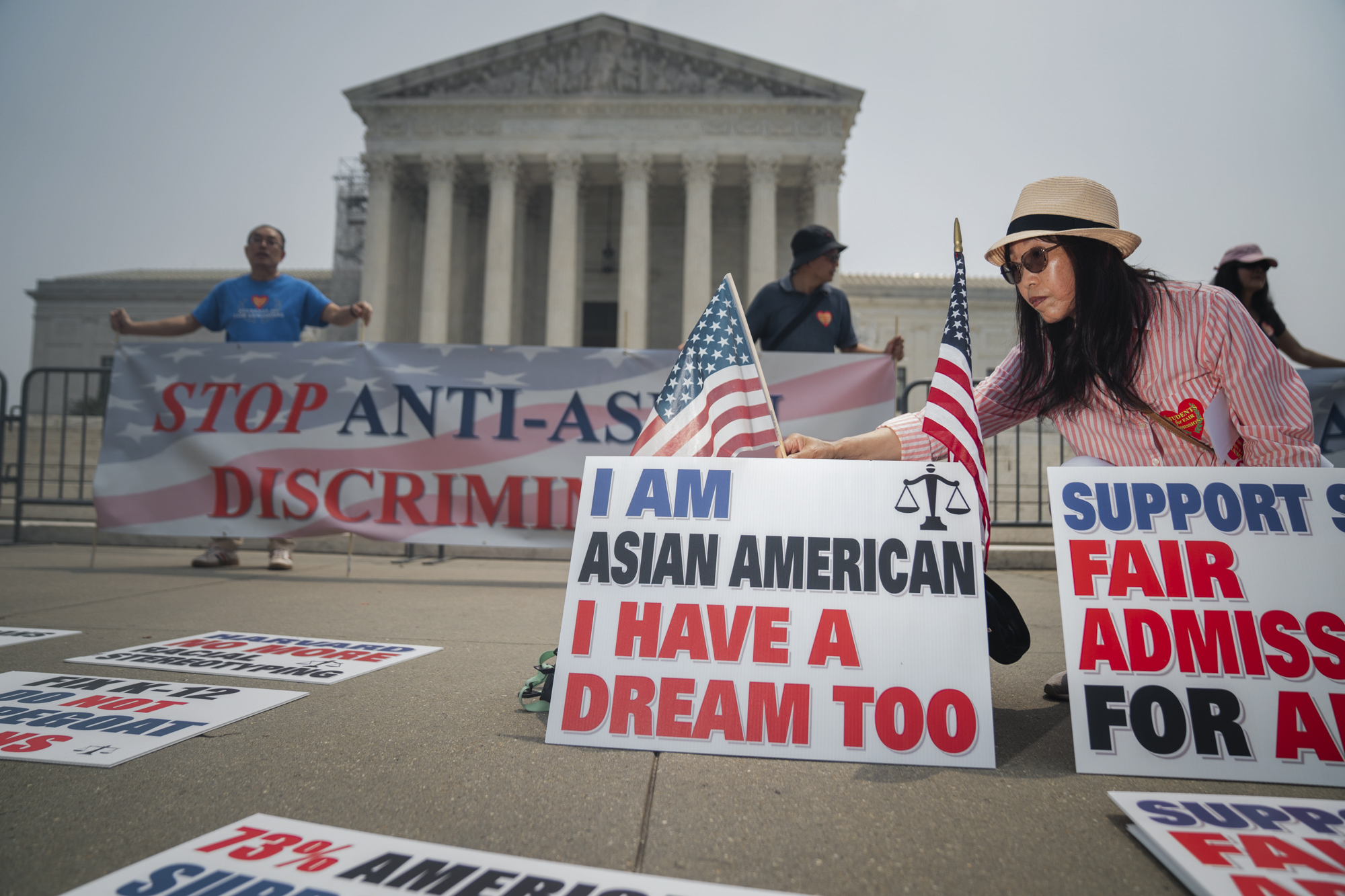
Stanford threw its support behind the school’s affirmative action policies, and last August submitted an amicus brief to the Supreme Court outlining how race is just one element the university considers when reviewing applications.
“These factors, among numerous others and viewed in the context of the entire application, may sometimes shed light on the critical questions of a candidate’s ability to deal with adversity and make the most of the opportunities that the University offers,” Stanford’s brief (PDF) reads.
In an email to students and faculty on Thursday, Stanford President Marc Tessier-Lavigne said he was “deeply disappointed” by the court’s decision, arguing it would hinder his school’s efforts to build a more diverse student body.
“The ability to consider race as one part of a holistic review of each applicant has helped to foster a campus environment at Stanford that is diverse in many ways, where people of varied backgrounds and experiences are able to learn from one another and contribute to the creation of knowledge,” he wrote.
Supporters of affirmative action bans, which have already been enacted to some degree in nine states — including California — say the practice is racially discriminatory and does little to increase economic mobility for the lowest-income students.
But until now, the high court has consistently preserved race-conscious admission practices, upholding affirmative action in two separate challenges over the last 20 years.
That departure was underscored in Justice Ketanji Brown Jackson’s biting dissent.
“With let-them-eat-cake obliviousness, today, the majority pulls the ripcord and announces ‘colorblindness for all’ by legal fiat,” she wrote. “But deeming race irrelevant in law does not make it so in life.”
Since banning affirmative action in 1996, the University of California has spent more than $500 million on programs aimed at recruiting and graduating lower-income students and students who are first in their family to attend college.