A small homeless encampment in Houston, Texas on May 5, 2023. (Jordan Vonderhaar/CalMatters)
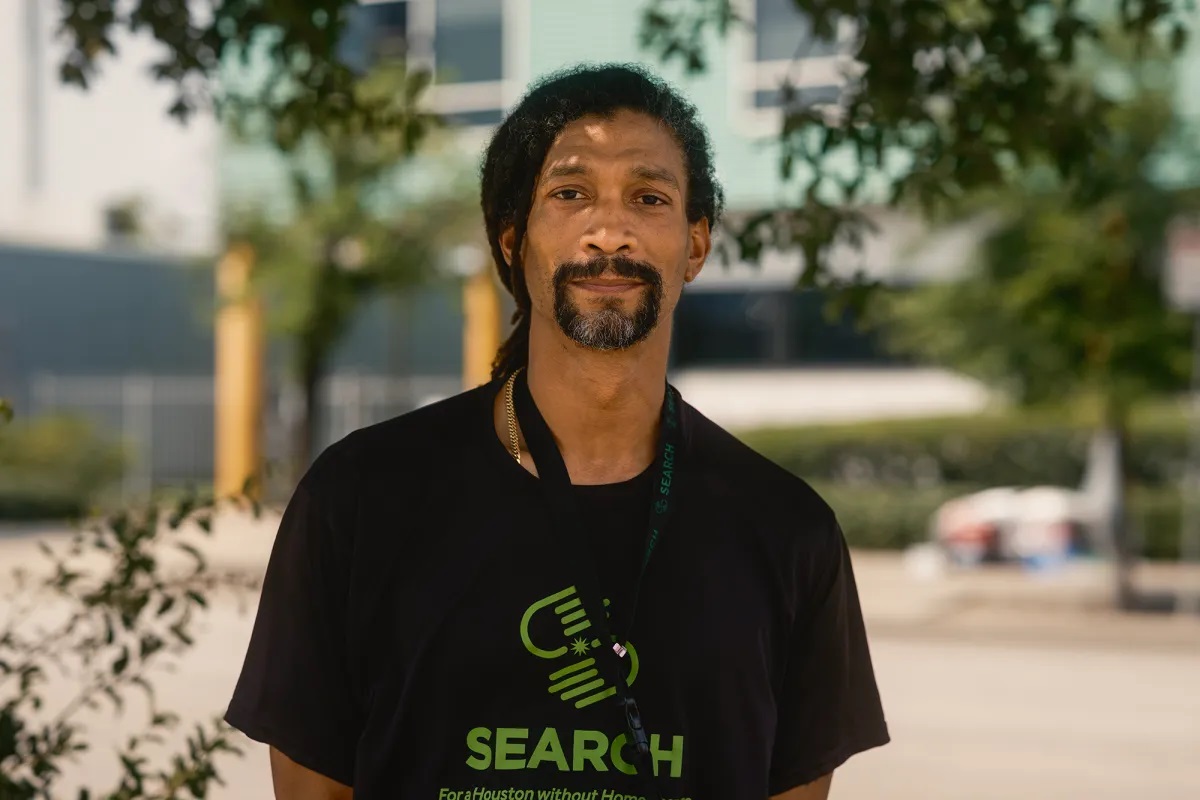
LaVoy Darden is looking for someone.
Making the rounds through Houston’s homeless encampments as an outreach specialist for a local nonprofit group, he offers snacks, builds trust, and puts people on a waitlist for affordable housing. On good days he gets to tell them they’re moving into a home.
But first, he has to find them. Today it’s a scorching 93 degrees, and there aren’t as many people out and about as usual. He spends hours combing the streets of Houston in his van — stopping along the way to update other clients on their housing searches — before he spots her.
He leans out the driver’s-side window and yells. “Hey! You move in Monday!”
Sending someone from the street into permanent housing is the ultimate goal for Darden and legions of other outreach workers like him all over America. But it seems to happen more often in Houston, where the unhoused population shrank by more than half over the past decade. Compare that to California’s major cities, where the population surged by double-digits, and in some cases triple-digits.
It’s not just Houston. Texas as a whole last year recorded a 28% drop in homelessness since 2012, while California’s unhoused population grew by 43% over the same period. In Texas, 81 people are unhoused for every 100,000 residents. In California, the rate is more than five times worse.
LaVoy Darden with Search Homeless Services drives through his service area looking for clients in Houston, Texas on May 5, 2023. (Jordan Vonderhaar/CalMatters)
And that’s despite the fact that Texas spends far fewer state dollars on homelessness. Last year, not counting federal money, Texas put $19.7 million into its three main homelessness programs — equal to about $806 per unhoused person. California, on the other hand, poured $1.85 billion into its three main programs — or $10,786 for every unhoused person.
Why is Texas doing so much better on homelessness? Right-leaning observers are quick to blame the discrepancy on California’s too-progressive policies. Liberals may distrust the statistics coming out of Texas. But the reality is more nuanced — as California leaders are realizing, while their cities and nonprofits send delegation after delegation to Texas.
With homelessness causing major tension in many California cities, and local and state efforts to get people off the streets continuing to fall short, Golden State leaders are desperate for new solutions. So desperate, that they’re going to a state whose deep-red policies California Democrats are better known for scorning than emulating.
San José’s homelessness response team visited Houston earlier this year. City and county representatives from the Los Angeles area went last fall. They came away jealous of some of the advantages Houston has over California cities — such as the lower housing costs that make it easier for the Texas metropolis to find or build homes for people.
But the Californians also were impressed by the way the city coordinates with the county and other local organizations, prioritizes funding for permanent housing instead of temporary shelters and finds places for people before clearing encampments.
“What those folks are doing — really focusing on housing folks — is working,” said Alex Visotzky, senior California policy fellow for the National Alliance to End Homelessness.
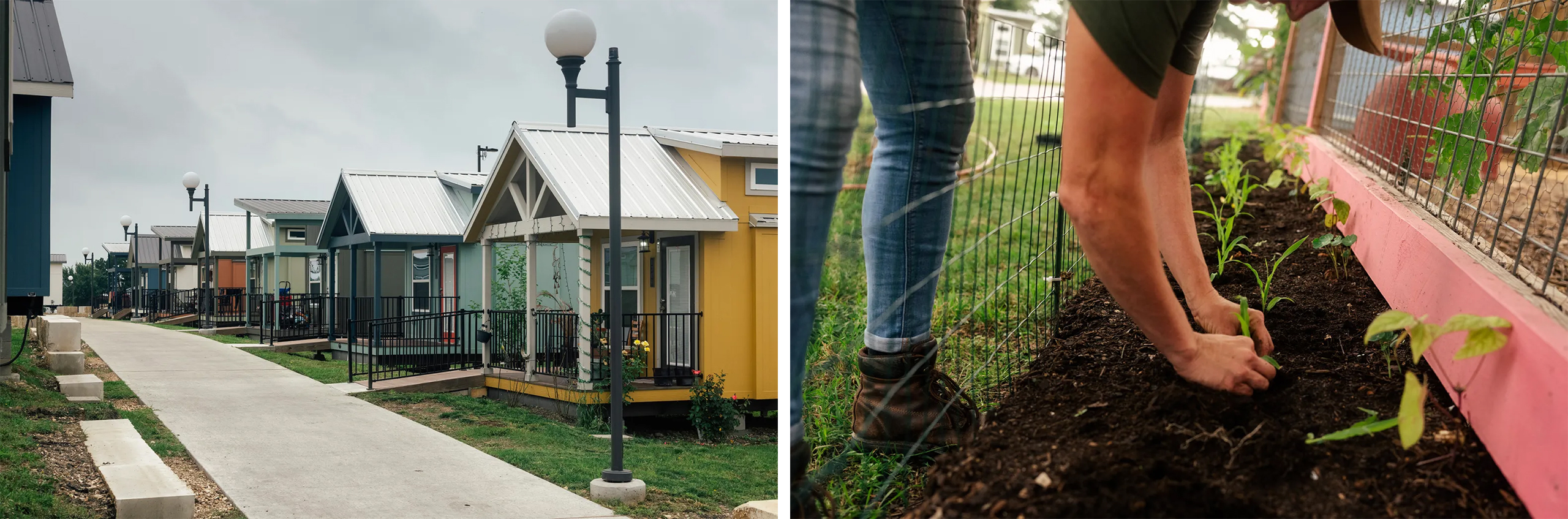
In April, two city council members from the East Bay city of Richmond headed to Austin to tour a 51-acre tiny home community that provides permanent housing for 350-and-counting unhoused residents. Elected officials from Sacramento trekked to San Antonio to see a 1,600-person shelter that offers everything from dental care to counseling — serving nearly the city’s entire unhoused population in one place.
Left: Tiny homes used as residences at Community First! Village in Austin, Texas on May 12, 2023. Right: An employee plants sunflowers at Community First! Village in Austin, Texas on May 12, 2023. (Jordan Vonderhaar/CalMatters)
Many experts agree California can learn something from these homeless solutions. But unless the Golden State fixes its housing affordability crisis decades in the making, copying the Lone Star State will get us only so far, said Eric Tars, legal director of the National Homelessness Law Center.
“Elected officials in California are desperate for quick-fix solutions,” he said. “They want a silver bullet to be able to solve homelessness for them. And so when they see results like what’s happening in Houston … they say, ‘that’s great, we want that.’”
California Democrats often at odds with Texas GOP
Texas may seem like an unlikely place for California to find inspiration on anything — especially social services. After all, the Republican-led state is completely out of sync with California’s liberal majorities on everything from guns to abortion to LGBTQ rights — feeding an ongoing public feud between Gov. Gavin Newsom and his Texas counterpart, Gov. Greg Abbott.
Adding to the animosity, the California Legislature and some Golden State cities don’t even allow publicly funded travel to Texas. Some Californians who have made the trip have had to seek exemptions by arguing the travel is in their jurisdiction’s best interest.
“When best practices are happening somewhere, don’t worry about what state they’re in,” said state Sen. Dave Cortese, a Silicon Valley Democrat. “I have no problem looking them right in the eye and saying, ‘I don’t like where you’re going in terms of reproductive rights. I don’t like where you’re going in terms of your stubbornness on mass shootings and gun safety. But I do like what you’re doing on the housing front and I’d like to replicate some of that.’”
The three Texas cities getting the most attention from California — Houston, Austin and San Antonio — are blue islands in a red state. Houston, a bustling metropolis of 2.3 million people, is Texas’ largest city. Austin, the state’s capital and a mecca for artists, students and foodies, is famously quirky — and urges everyone to “keep Austin weird.” San Antonio lures tourists with the historic Alamo mission and picturesque, restaurant-lined river walk.
He and others in California argue what the Golden State is doing so far isn’t working, even though Newsom poured nearly $21 billion into housing and homelessness since he took office and vowed the issue is a top priority.
“I don’t want to see any more people die in the streets and call that compassion,” Newsom said last year.
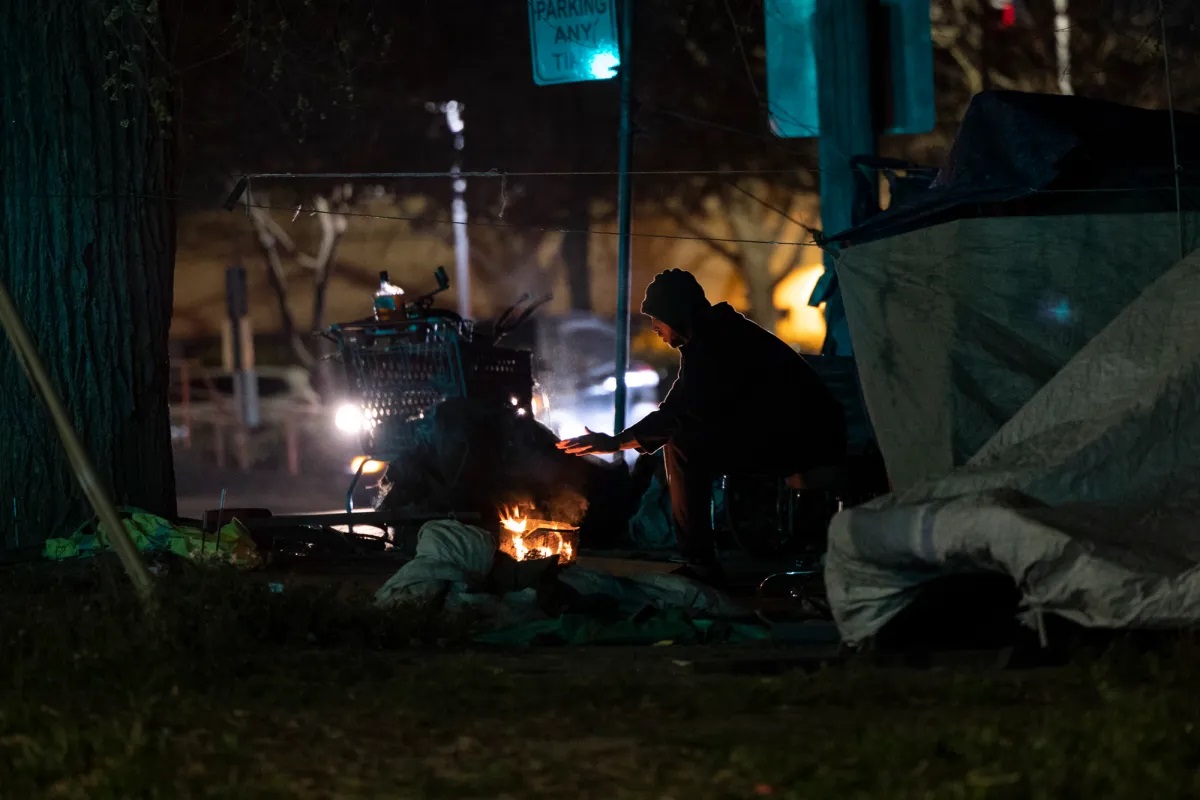
Muhammad, who declined to provide his last name, warms his hand at a fire near his tent in Sacramento. (Miguel Gutierrez Jr./CalMatters)
His administration is well aware of the buzz around the Texas programs. Hafsa Kaka, the governor’s new senior adviser on homelessness, said Newsom’s policies compare well against the Texas sites.
Houston, Austin and San Antonio employ the same “housing first” approach that California has used for years, she said.
“While Austin built 350 small homes, we are putting 1,200 across the state, including 500 in Los Angeles,” she said in an emailed statement sent on behalf of Newsom’s office. “California continues to make unprecedented investments into housing and homelessness which includes shelter and wrap-around supportive services, cleaning up encampments, and creating more housing. The state has invested more to increase housing supply than ever before in our history while holding local governments accountable.”
But the difference in outcomes in Texas versus California is unmistakable. The Houston area’s unhoused population dropped 57% between 2012 and last year, dipping to 3,124, according to the federally mandated point-in-time count. A New York Times article published last year highlighted the “remarkable progress,” catapulting the city that was already known in wonky homeless policy circles into the national limelight — and catching California’s attention.
Los Angeles County’s unhoused population increased 106% over the same period. Sacramento County’s jumped a whopping 230%.
Experts agree the point-in-time counts supplying those numbers — which generally rely on volunteers and outreach workers tallying every unhoused person they see over one night — miss portions of the unhoused community. But the counts can be a useful tool to measure the change in a city’s unhoused population.
Cheaper rent, more housing
One reason more people find housing in Texas: costs. The median rent for a one-bedroom home in the state was $1,233 in early June, according to Zillow. In California, it was $2,200 — making it harder for people to get and stay housed here.
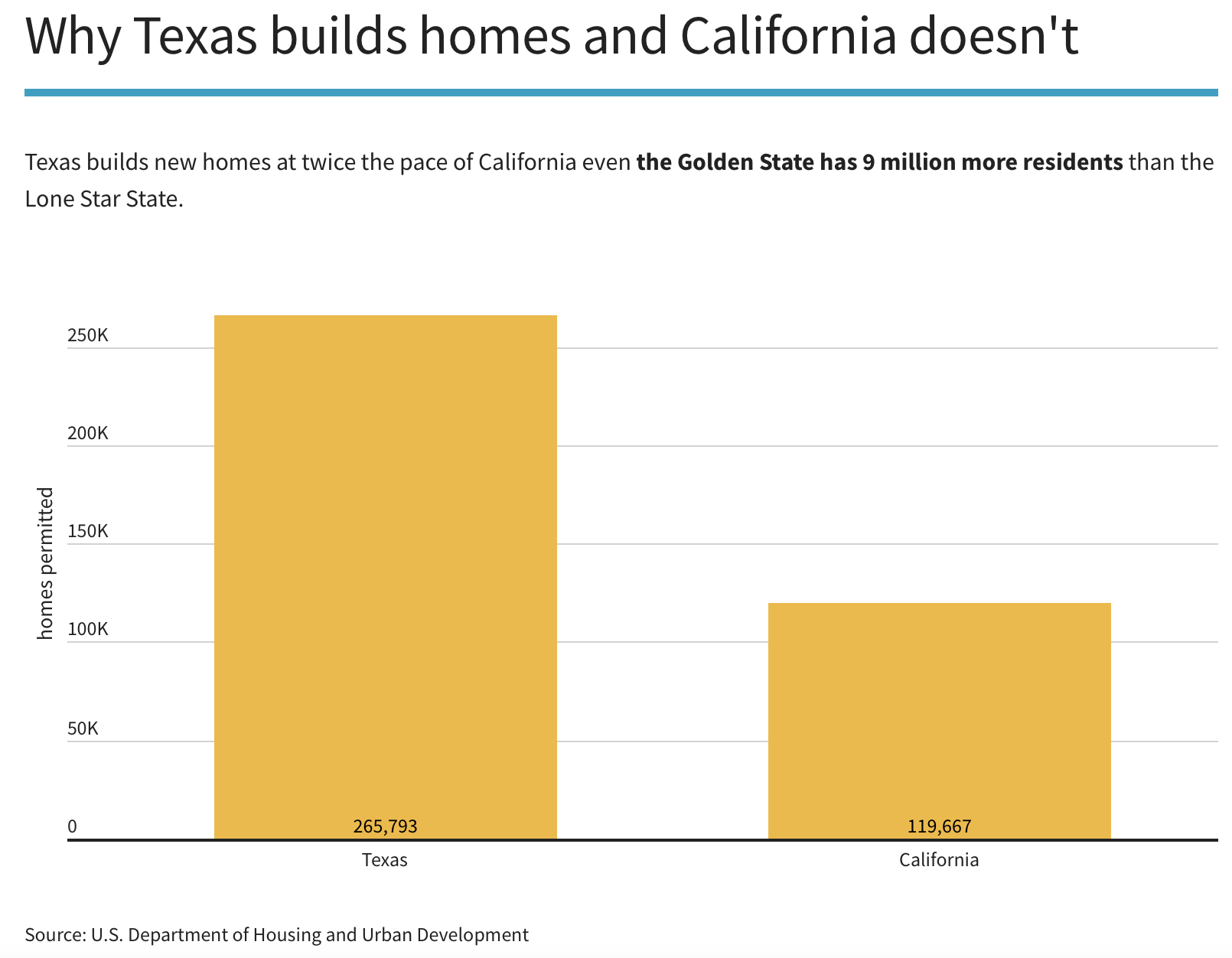
Land and construction costs are cheaper in Texas, too, and the Lone Star State has fewer regulations that restrict construction. The city of Houston, for example, has no zoning — coupled with a strong mayor who can push projects through — making it easier to build and harder to block housing.
That means even when a California city is doing everything right, it’s still not going to be as successful as its Texas counterpart in reducing homelessness, said Jennifer Loving, CEO of nonprofit Destination: Home in Santa Clara County, who visited Houston in March.
“We do all the same stuff,” she said. “And the major difference is how much housing they have, how quickly it’s getting built.”
But despite its lower housing costs and dramatic drop in homelessness, Houston hasn’t managed to get everyone off the street.
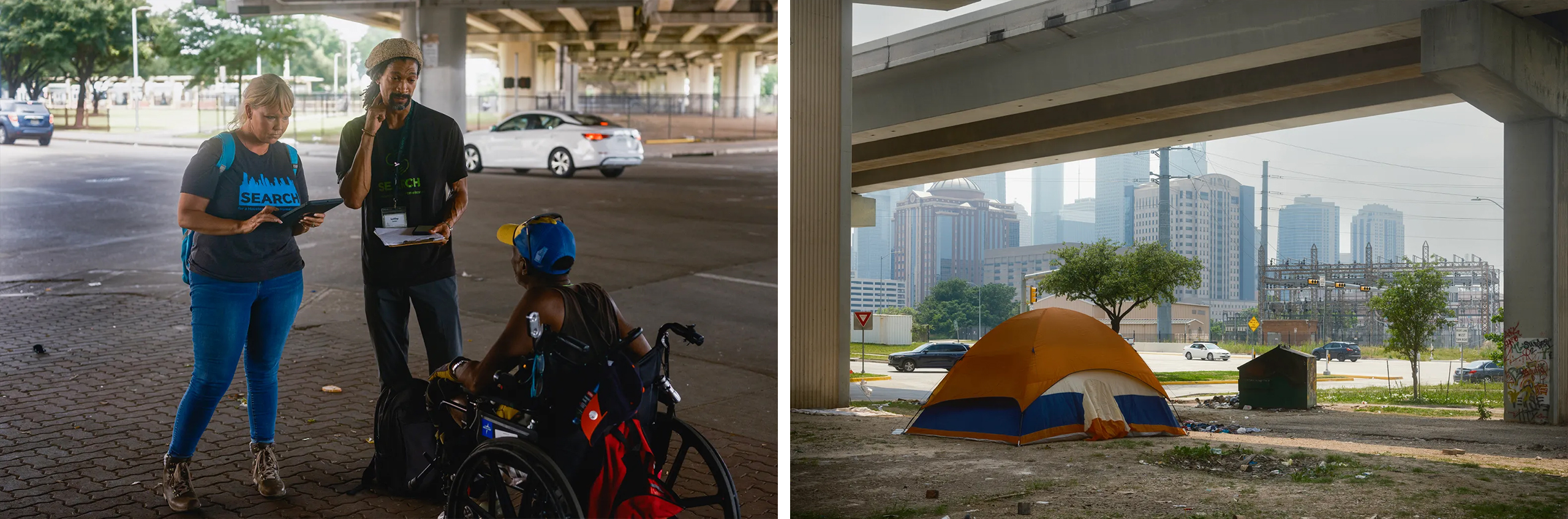
As Darden, the outreach worker, continues his rounds, he ends up under the Highway Spur 527 overpass, where seven tents are arranged on a dirt lot amid a few dining room chairs and other scattered furniture.
Several of the people Darden speaks to at the camp already are housed or in the process of getting housing.
Left: Allison Hillman, left, and LaVoy Darden, right, with Search Homeless Services speak with a client about potential future housing in Houston, Texas on May 5, 2023. Right: A homeless encampment under Interstate Highway 69 in downtown Houston on May 5, 2023. (Jordan Vonderhaar/CalMatters)
One of them is 71-year-old Albert Mack, who has been homeless in Houston off-and-on for 15 years, alternating time on the street with housing placements that didn’t pan out. He left his last apartment because the neighborhood was too dangerous, he said. Now, he’s once again on his way to living indoors — he’s just waiting for a copy of his birth certificate from his home state of Alabama. He’s excited. This time, Mack said, he’s going to stay housed.
“I can take me a shower every day,” he said. “I can be inside. I don’t have to worry about nobody bothering me.”
More permanent housing, and collaboration
When people like Mack get housed, it’s not only because rent is cheaper. Texas cities are doing other things differently than California, and Houston is a good example.
Texas’ largest city pours its homeless funding — including COVID emergency dollars — into long-term housing instead of shelters that offer a temporary fix. Most of that housing is in privately-owned apartments, where vouchers help formerly homeless people pay the rent.
California, on the other hand, divides its resources between temporary and permanent homeless solutions. The state funneled COVID funds into short-term hotels that as of last year had given 50,000 people — almost 30% of the state’s unhoused population — brief respites from the street. Newsom’s administration later used COVID and general funds to turn nearly 13,000 hotel rooms, apartments and other units into longer-term homeless housing.
And in Texas’ largest city, government agencies have a reputation for working together. Houston collaborates with Harris County and local nonprofits on a shared plan.
In Los Angeles County, by contrast, four different local government groups apply separately for limited homelessness funding from the state.
“I think that what we haven’t done is come together with a single plan,” said Cheri Todoroff, executive director of Los Angeles County’s Homeless Initiative, who went to Houston in September. “And that’s really what we were looking to learn from Houston.”
LA County is working on creating a collaborative leadership commission, mirroring Houston’s, that would include elected officials, businesses, nonprofits and other leaders.
Strict homeless enforcement in Texas
Other parts of Texas’ approach to homelessness are more punitive than practices favored by California cities and state officials.
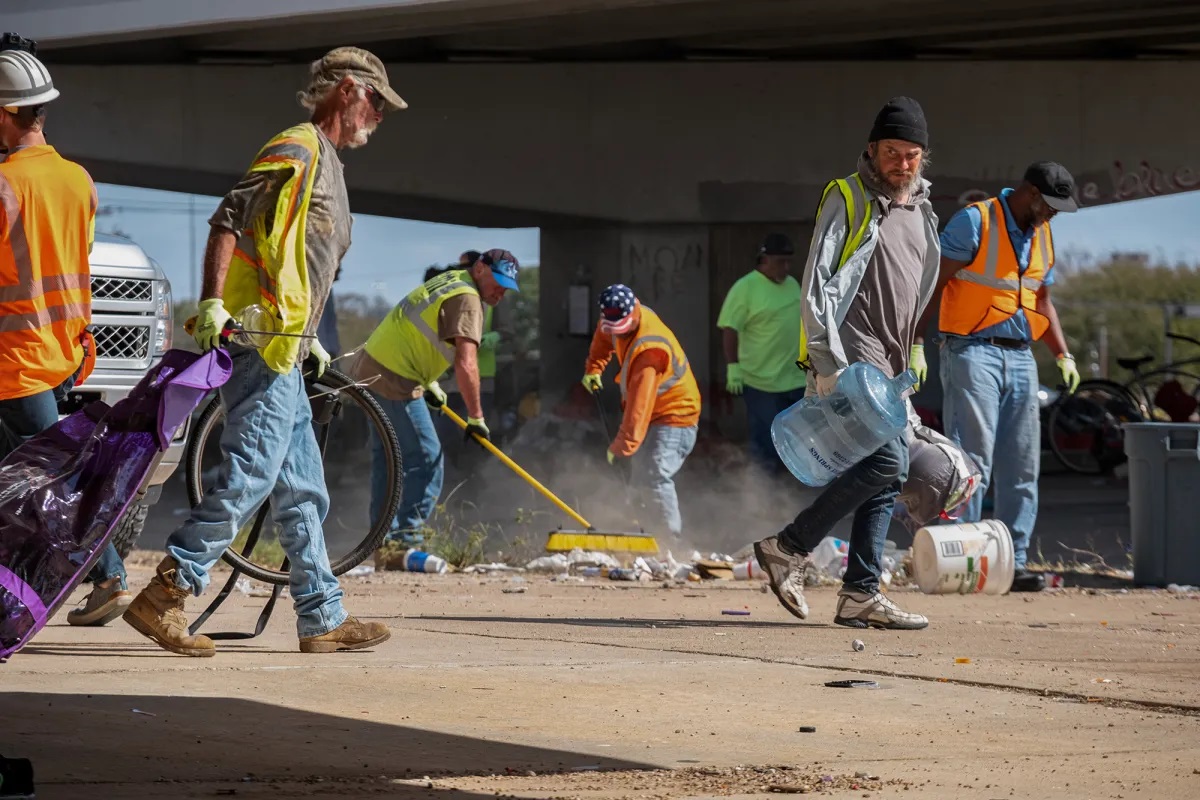
Individual cities in Texas also have their own local camping bans. In Austin, for example, police sometimes force unhoused residents to move out of encampments, even if they have nowhere else to go, and cite them if they don’t comply.
Temporary Workers, contracted by the Texas Department of Transportation, remove trash and personal belongings from a homeless encampment under US Route 290 at Westgate Boulevard in Austin, Texas on Nov. 4, 2019. (Jordan Vonderhaar/CalMatters)
Texas Gov. Abbott cultivates a hard-line stance against homelessness — leading a charge to clear encampments on state property, publicly attacking Austin’s Democratic leaders for being too soft on homelessness and pushing for the state’s camping ban. “No one has a right to urinate & defecate wherever they want,” he tweeted before the camping ban passed.
Seeming to take a page out of Texas’ book, California cities also are growing increasingly punitive. For instance, San Diego recently approved a controversial encampment ban, and other cities have taken similar steps. But a major difference: Due to the 2018 federal court ruling Martin v. Boise, California cities cannot clear camps or unilaterally ban encampments unless they have shelter beds to offer. Texas, in a different federal district, is not subject to that ruling.
Other aspects of Houston’s approach also might not translate well in California. Because Houston prioritizes long-term housing — the city and its county partners have moved more than 28,000 people into permanent housing since 2012 — it neglects the type of short-term shelters that quickly get someone off the street.
Five days a week, 60-year-old Rachel Gonzales goes to The Beacon day center to eat breakfast and lunch, shower and do her laundry. At night, when the center is closed, she heads across the street to sleep on the sidewalk — without even a tent to protect her from the elements.
Beacon staff are trained to connect clients to permanent housing, and last year, about two-thirds of those who signed up gained a place to live. But the process can take months.
Gonzales has been waiting since November.
“I don’t think it’s gonna be anytime soon,” she said. “You gotta think day by day. You can’t think about tomorrow, because if you think about tomorrow, think about a week from now, you’ll actually go crazy.”
Encampments still visible in Houston
Houston’s lack of shelter beds and long wait times for housing allowed homeless encampments to proliferate, frustrating local residents — as they have in California. In 2018, the city began a push to “decommission” homeless camps. Now, former homeless camps dot the landscape — grassy strips by the side of the road or patches of dirt under overpasses that used to hold dozens of tents, but now are empty and circled by chain-link fences.
How homeless camps are removed is one of the most contentious issues of the homelessness debate in California. Though the Boise ruling prevents cities in the Golden State from clearing camps without offering the occupants shelter, activists say many people aren’t given options that work for them. Some people may not be willing to give up a beloved pet in exchange for a bed in an animal-free shelter, for example, while others may have mental health conditions that make it hard to sleep in a crowded room. As a result, they instead scatter throughout the streets, losing contact with their caseworkers.
In Houston, when it’s time to clear a camp, outreach workers spend a month or more getting to know the occupants and figuring out what they need. Anyone they can’t immediately house generally is offered a spot in the city’s 100-bed navigation center, which opened in January.
The navigation center is a big step up from traditional shelters where dozens of people sleep together, occupants have to leave early each morning, and residents often see no discernible path to long-term housing. At the navigation center, people sleep four to a room, can bring pets, and during the day can relax in a comfy living room with TVs, a pool table and snacks. Entire encampments move into the center at once, allowing people to maintain close friendships forged on the streets.
“They make you realize you somebody again,” said 51-year-old Terry Hardison, who has been unhoused off and on since 1999. He was living under a bridge before coming to the navigation center. On a recent Saturday afternoon, he sat on the couch in the center’s common room, watching “G.I. Joe” on the TV with friends.
More on Californias Unhoused Community
But with only 100 beds, the navigation center can’t come close to accommodating everyone. People Darden meets on the street constantly ask how they can get in. He has to tell them the hard truth: Most often, they can’t.
For those lucky enough to get a spot, there’s one big way the navigation center differs from a regular shelter: It gets people into permanent housing.
Of the 57 occupants who moved through the navigation center since it opened, as of early May, 91% went into permanent housing — and it generally takes just 30 days. Navigation center clients are bumped up to the top of Houston’s housing waitlist.
California also has navigation centers, but they haven’t been nearly as successful because there’s often no direct path from there into long-term housing. San Francisco’s largest center, for example, reported just 8% of the people who left its program ended up in permanent housing last year.
LaVoy Darden with Search Homeless Services in Houston, Texas on May 5, 2023. (Jordan Vonderhaar/CalMatters)
For other people, housing success stories play out outside the walls of the navigation center. Back in Darden’s outreach van, he’s making someone’s day.
The woman on the side of the road hears Darden yell, telling her she’s moving into her new apartment Monday. She’d been referred for a placement before and never followed through. But this time, after one of her friends recently died on the street, Darden believes she’s ready to end her homelessness.
The woman stops what she’s doing and breaks into a happy dance. The dream of a permanent place to call home — something that seems so impossible for so many people living in tents and cars from Texas to California — is finally hers.
Darden grins. “Whew, I feel a lot better now,” he says, steering the outreach van back toward his office.
“It feels great. Just to see the look on their face.”
lower waypointnext waypoint
Player sponsored by
window.__IS_SSR__=true
window.__INITIAL_STATE__={
"attachmentsReducer": {
"audio_0": {
"type": "attachments",
"id": "audio_0",
"imgSizes": {
"kqedFullSize": {
"file": "https://ww2.kqed.org/news/wp-content/themes/KQED-unified/img/audio_bgs/background0.jpg"
}
}
},
"audio_1": {
"type": "attachments",
"id": "audio_1",
"imgSizes": {
"kqedFullSize": {
"file": "https://ww2.kqed.org/news/wp-content/themes/KQED-unified/img/audio_bgs/background1.jpg"
}
}
},
"audio_2": {
"type": "attachments",
"id": "audio_2",
"imgSizes": {
"kqedFullSize": {
"file": "https://ww2.kqed.org/news/wp-content/themes/KQED-unified/img/audio_bgs/background2.jpg"
}
}
},
"audio_3": {
"type": "attachments",
"id": "audio_3",
"imgSizes": {
"kqedFullSize": {
"file": "https://ww2.kqed.org/news/wp-content/themes/KQED-unified/img/audio_bgs/background3.jpg"
}
}
},
"audio_4": {
"type": "attachments",
"id": "audio_4",
"imgSizes": {
"kqedFullSize": {
"file": "https://ww2.kqed.org/news/wp-content/themes/KQED-unified/img/audio_bgs/background4.jpg"
}
}
},
"placeholder": {
"type": "attachments",
"id": "placeholder",
"imgSizes": {
"thumbnail": {
"file": "https://cdn.kqed.org/wp-content/uploads/2024/12/KQED-Default-Image-816638274-2000x1333-1-160x107.jpg",
"width": 160,
"height": 107,
"mimeType": "image/jpeg"
},
"medium": {
"file": "https://cdn.kqed.org/wp-content/uploads/2024/12/KQED-Default-Image-816638274-2000x1333-1-800x533.jpg",
"width": 800,
"height": 533,
"mimeType": "image/jpeg"
},
"medium_large": {
"file": "https://cdn.kqed.org/wp-content/uploads/2024/12/KQED-Default-Image-816638274-2000x1333-1-768x512.jpg",
"width": 768,
"height": 512,
"mimeType": "image/jpeg"
},
"large": {
"file": "https://cdn.kqed.org/wp-content/uploads/2024/12/KQED-Default-Image-816638274-2000x1333-1-1020x680.jpg",
"width": 1020,
"height": 680,
"mimeType": "image/jpeg"
},
"1536x1536": {
"file": "https://cdn.kqed.org/wp-content/uploads/2024/12/KQED-Default-Image-816638274-2000x1333-1-1536x1024.jpg",
"width": 1536,
"height": 1024,
"mimeType": "image/jpeg"
},
"fd-lrg": {
"file": "https://cdn.kqed.org/wp-content/uploads/2024/12/KQED-Default-Image-816638274-2000x1333-1-1536x1024.jpg",
"width": 1536,
"height": 1024,
"mimeType": "image/jpeg"
},
"fd-med": {
"file": "https://cdn.kqed.org/wp-content/uploads/2024/12/KQED-Default-Image-816638274-2000x1333-1-1020x680.jpg",
"width": 1020,
"height": 680,
"mimeType": "image/jpeg"
},
"fd-sm": {
"file": "https://cdn.kqed.org/wp-content/uploads/2024/12/KQED-Default-Image-816638274-2000x1333-1-800x533.jpg",
"width": 800,
"height": 533,
"mimeType": "image/jpeg"
},
"post-thumbnail": {
"file": "https://cdn.kqed.org/wp-content/uploads/2024/12/KQED-Default-Image-816638274-2000x1333-1-672x372.jpg",
"width": 672,
"height": 372,
"mimeType": "image/jpeg"
},
"twentyfourteen-full-width": {
"file": "https://cdn.kqed.org/wp-content/uploads/2024/12/KQED-Default-Image-816638274-2000x1333-1-1038x576.jpg",
"width": 1038,
"height": 576,
"mimeType": "image/jpeg"
},
"xxsmall": {
"file": "https://cdn.kqed.org/wp-content/uploads/2024/12/KQED-Default-Image-816638274-2000x1333-1-160x107.jpg",
"width": 160,
"height": 107,
"mimeType": "image/jpeg"
},
"xsmall": {
"file": "https://cdn.kqed.org/wp-content/uploads/2024/12/KQED-Default-Image-816638274-2000x1333-1-672x372.jpg",
"width": 672,
"height": 372,
"mimeType": "image/jpeg"
},
"small": {
"file": "https://cdn.kqed.org/wp-content/uploads/2024/12/KQED-Default-Image-816638274-2000x1333-1-672x372.jpg",
"width": 672,
"height": 372,
"mimeType": "image/jpeg"
},
"xlarge": {
"file": "https://cdn.kqed.org/wp-content/uploads/2024/12/KQED-Default-Image-816638274-2000x1333-1-1020x680.jpg",
"width": 1020,
"height": 680,
"mimeType": "image/jpeg"
},
"full-width": {
"file": "https://cdn.kqed.org/wp-content/uploads/2024/12/KQED-Default-Image-816638274-2000x1333-1-1920x1280.jpg",
"width": 1920,
"height": 1280,
"mimeType": "image/jpeg"
},
"guest-author-32": {
"file": "https://cdn.kqed.org/wp-content/uploads/2025/01/KQED-Default-Image-816638274-1333x1333-1-160x160.jpg",
"width": 32,
"height": 32,
"mimeType": "image/jpeg"
},
"guest-author-50": {
"file": "https://cdn.kqed.org/wp-content/uploads/2025/01/KQED-Default-Image-816638274-1333x1333-1-160x160.jpg",
"width": 50,
"height": 50,
"mimeType": "image/jpeg"
},
"guest-author-64": {
"file": "https://cdn.kqed.org/wp-content/uploads/2025/01/KQED-Default-Image-816638274-1333x1333-1-160x160.jpg",
"width": 64,
"height": 64,
"mimeType": "image/jpeg"
},
"guest-author-96": {
"file": "https://cdn.kqed.org/wp-content/uploads/2025/01/KQED-Default-Image-816638274-1333x1333-1-160x160.jpg",
"width": 96,
"height": 96,
"mimeType": "image/jpeg"
},
"guest-author-128": {
"file": "https://cdn.kqed.org/wp-content/uploads/2025/01/KQED-Default-Image-816638274-1333x1333-1-160x160.jpg",
"width": 128,
"height": 128,
"mimeType": "image/jpeg"
},
"detail": {
"file": "https://cdn.kqed.org/wp-content/uploads/2025/01/KQED-Default-Image-816638274-1333x1333-1-160x160.jpg",
"width": 160,
"height": 160,
"mimeType": "image/jpeg"
},
"kqedFullSize": {
"file": "https://cdn.kqed.org/wp-content/uploads/2024/12/KQED-Default-Image-816638274-2000x1333-1.jpg",
"width": 2000,
"height": 1333
}
}
},
"news_11954468": {
"type": "attachments",
"id": "news_11954468",
"meta": {
"index": "attachments_1716263798",
"site": "news",
"id": "11954468",
"found": true
},
"parent": 0,
"imgSizes": {
"twentyfourteen-full-width": {
"file": "https://ww2.kqed.org/app/uploads/sites/10/2023/06/CalMattersTexas02-1038x576.jpg",
"width": 1038,
"mimeType": "image/jpeg",
"height": 576
},
"thumbnail": {
"file": "https://ww2.kqed.org/app/uploads/sites/10/2023/06/CalMattersTexas02-160x107.jpg",
"width": 160,
"mimeType": "image/jpeg",
"height": 107
},
"post-thumbnail": {
"file": "https://ww2.kqed.org/app/uploads/sites/10/2023/06/CalMattersTexas02-672x372.jpg",
"width": 672,
"mimeType": "image/jpeg",
"height": 372
},
"kqedFullSize": {
"file": "https://ww2.kqed.org/app/uploads/sites/10/2023/06/CalMattersTexas02.jpg",
"width": 1920,
"height": 1279
},
"large": {
"file": "https://ww2.kqed.org/app/uploads/sites/10/2023/06/CalMattersTexas02-1020x679.jpg",
"width": 1020,
"mimeType": "image/jpeg",
"height": 679
},
"1536x1536": {
"file": "https://ww2.kqed.org/app/uploads/sites/10/2023/06/CalMattersTexas02-1536x1023.jpg",
"width": 1536,
"mimeType": "image/jpeg",
"height": 1023
},
"medium": {
"file": "https://ww2.kqed.org/app/uploads/sites/10/2023/06/CalMattersTexas02-800x533.jpg",
"width": 800,
"mimeType": "image/jpeg",
"height": 533
}
},
"publishDate": 1687996491,
"modified": 1687996652,
"caption": "A small homeless encampment in Houston, Texas on May 5, 2023.",
"description": null,
"title": "CalMattersTexas02",
"credit": "Jordan Vonderhaar/CalMatters",
"status": "inherit",
"altTag": "A man sits on a milk crate outside of his small, blue tent. A barbed-wire fence surrounds a building in the background. He appears to have set up a small camp under an overpass. A few trees are pictured in the background as well. The sky is gray. Trash is littered around his area.",
"isLoading": false,
"fetchFailed": false
}
},
"audioPlayerReducer": {
"postId": "stream_live",
"isPaused": true,
"isPlaying": false,
"pfsActive": false,
"pledgeModalIsOpen": true,
"playerDrawerIsOpen": false,
"liveAudioPlayStartedAt": 0,
"liveAudioPlayContext": ""
},
"authorsReducer": {
"byline_news_11954379": {
"type": "authors",
"id": "byline_news_11954379",
"meta": {
"override": true
},
"slug": "byline_news_11954379",
"name": "\u003ca href=\"https://calmatters.org/author/marisa-kendall/\">Marisa Kendall\u003c/a>",
"isLoading": false
}
},
"pagesReducer": {},
"pfsSessionReducer": {},
"postsReducer": {
"stream_live": {
"type": "live",
"id": "stream_live",
"audioUrl": "https://streams.kqed.org/kqedradio",
"title": "Live Stream",
"excerpt": "Live Stream information currently unavailable.",
"link": "/radio",
"featImg": "",
"label": {
"name": "KQED Live",
"link": "/"
}
},
"stream_kqedNewscast": {
"type": "posts",
"id": "stream_kqedNewscast",
"audioUrl": "https://www.kqed.org/.stream/anon/radio/RDnews/newscast.mp3?_=1",
"title": "KQED Newscast",
"featImg": "",
"label": {
"name": "88.5 FM",
"link": "/"
}
},
"news_11954379": {
"type": "posts",
"id": "news_11954379",
"meta": {
"index": "posts_1716263798",
"site": "news",
"id": "11954379",
"found": true
},
"articlePosition": 0,
"guestAuthors": [],
"slug": "what-california-can-learn-from-texas-shrinking-unhoused-population",
"title": "What California Can Learn From Texas' Shrinking Unhoused Population",
"publishDate": 1688070698,
"format": "standard",
"headTitle": "What California Can Learn From Texas’ Shrinking Unhoused Population | KQED",
"labelTerm": {},
"content": "\u003cp>\u003cem>LaVoy Darden is looking for someone. \u003c/em>\u003c/p>\n\u003cp>\u003cem>Making the rounds through Houston’s homeless encampments as an outreach specialist for a local nonprofit group, he offers snacks, builds trust, and puts people on a waitlist for affordable housing. On good days he gets to tell them they’re moving into a home. \u003c/em>\u003c/p>\n\u003cp>\u003cem>But first, he has to find them. Today it’s a scorching 93 degrees, and there aren’t as many people out and about as usual. He spends hours combing the streets of Houston in his van — stopping along the way to update other clients on their housing searches — before he spots her.\u003c/em>\u003c/p>\n\u003cp>\u003cem>He leans out the driver’s-side window and yells. “Hey! You move in Monday!” \u003c/em>\u003c/p>\n\u003cp>[ad fullwidth]\u003c/p>\n\u003cp>Sending someone from the street into permanent housing is the ultimate goal for Darden and legions of other outreach workers like him all over America. But it seems to happen more often in Houston, where the unhoused population shrank by more than half over the past decade. Compare that to California’s major cities, where the population surged by double-digits, and in some cases triple-digits.\u003c/p>\n\u003cp>It’s not just Houston. Texas as a whole last year recorded a 28% drop in homelessness since 2012, while California’s unhoused population grew by 43% over the same period. In Texas, 81 people are unhoused for every 100,000 residents. In California, the rate is more than five times worse.\u003c/p>\n\u003cfigure id=\"attachment_11954467\" class=\"wp-caption aligncenter\" style=\"max-width: 1200px\">\u003cimg loading=\"lazy\" decoding=\"async\" class=\"size-full wp-image-11954467\" src=\"https://ww2.kqed.org/app/uploads/sites/10/2023/06/CalMattersTexas01.jpg\" alt=\"A man with long dreadlocks and a tan hat sits inside his vehicle as he writes on a piece of paper that's attached to a clipboard. A parking lot of cars is seen in the background, along with trees. The key is in the vehicle's ignition.\" width=\"1200\" height=\"800\" srcset=\"https://cdn.kqed.org/wp-content/uploads/sites/10/2023/06/CalMattersTexas01.jpg 1200w, https://cdn.kqed.org/wp-content/uploads/sites/10/2023/06/CalMattersTexas01-800x533.jpg 800w, https://cdn.kqed.org/wp-content/uploads/sites/10/2023/06/CalMattersTexas01-1020x680.jpg 1020w, https://cdn.kqed.org/wp-content/uploads/sites/10/2023/06/CalMattersTexas01-160x107.jpg 160w\" sizes=\"auto, (max-width: 1200px) 100vw, 1200px\">\u003cfigcaption class=\"wp-caption-text\">LaVoy Darden with Search Homeless Services drives through his service area looking for clients in Houston, Texas on May 5, 2023. \u003ccite>(Jordan Vonderhaar/CalMatters)\u003c/cite>\u003c/figcaption>\u003c/figure>\n\u003cp>And that’s despite the fact that Texas spends far fewer state dollars on homelessness. Last year, not counting federal money, Texas put $19.7 million into its three main homelessness programs — equal to about $806 per unhoused person. California, on the other hand, poured $1.85 billion into its three main programs — or $10,786 for every unhoused person.[aside postID=news_11949978 hero='https://ww2.kqed.org/app/uploads/sites/10/2023/05/001_KQED_WoodStreet_JessicaFountaine_01052023-1020x680.jpg']How do residents view homelessness in each state? The difference is stark: Homelessness is \u003ca href=\"https://poll.qu.edu/poll-release?releaseid=3868\">the No. 1 issue on California voters’ minds\u003c/a>, according to a recent Quinnipiac University poll. In a 2020 poll of Texas residents, \u003ca href=\"https://www.texaslyceum.org/assets/docs/Poll/2020/2020%20Lyceum%20Day%201%20Executive_Summary.pdf\">it didn’t even crack the top 10 (PDF)\u003c/a>.\u003c/p>\n\u003cp>Why is \u003ca href=\"https://calmatters.org/housing/2023/06/california-homeless-texas-comparison/\">Texas doing so much better\u003c/a> on homelessness? Right-leaning observers are quick to blame the discrepancy on California’s too-progressive policies. Liberals may distrust the statistics coming out of Texas. But the reality is more nuanced — as California leaders are realizing, while their cities and nonprofits send delegation after delegation to Texas.\u003c/p>\n\u003cp>With homelessness causing major tension in many California cities, and local and state efforts to get people off the streets continuing to fall short, Golden State leaders are desperate for new solutions. So desperate, that they’re going to a state whose deep-red policies California Democrats are better known for scorning than emulating.\u003c/p>\n\u003cp>\u003c!-- iframe plugin v.4.3 wordpress.org/plugins/iframe/ -->\u003cbr>\n\u003ciframe loading=\"lazy\" src=\"https://datawrapper.dwcdn.net/bRrVN/1/\" width=\"800\" height=\"800\" scrolling=\"yes\" class=\"iframe-class\" frameborder=\"0\">\u003c/iframe>\u003c/p>\n\u003cp>San José’s homelessness response team visited Houston earlier this year. City and county representatives from the Los Angeles area went last fall. They came away jealous of some of the advantages Houston has over California cities — such as the lower housing costs that make it easier for the Texas metropolis to find or build homes for people.\u003c/p>\n\u003cp>But the Californians also were impressed by the way the city coordinates with the county and other local organizations, prioritizes funding for permanent housing instead of temporary shelters and finds places for people before clearing encampments.\u003c/p>\n\u003cp>“What those folks are doing — really focusing on housing folks — is working,” said Alex Visotzky, senior California policy fellow for the National Alliance to End Homelessness.\u003c/p>\n\u003cp>In April, two city council members from the East Bay city of Richmond headed to \u003ca href=\"https://calmatters.org/housing/2023/06/austin-tiny-homes-california/\">Austin to tour a 51-acre tiny home community\u003c/a> that provides permanent housing for 350-and-counting unhoused residents. Elected officials from Sacramento trekked to \u003ca href=\"https://calmatters.org/housing/2023/06/texas-homeless-shelter/\">San Antonio to see a 1,600-person shelter\u003c/a> that offers everything from dental care to counseling — serving nearly the city’s entire unhoused population in one place.\u003c/p>\n\u003cfigure id=\"attachment_11954518\" class=\"wp-caption aligncenter\" style=\"max-width: 2560px\">\u003cimg loading=\"lazy\" decoding=\"async\" class=\"size-full wp-image-11954518\" src=\"https://ww2.kqed.org/app/uploads/sites/10/2023/06/230629-CM-TEXAS-COMBO-1-JV-KQED.jpg\" alt=\"Left: Tiny homes used as residences at Community First! Village in Austin, Texas on May 12, 2023. Right: An employee plants sunflowers at Community First! Village in Austin, Texas on May 12, 2023.\" width=\"2560\" height=\"847\" srcset=\"https://cdn.kqed.org/wp-content/uploads/sites/10/2023/06/230629-CM-TEXAS-COMBO-1-JV-KQED.jpg 2560w, https://cdn.kqed.org/wp-content/uploads/sites/10/2023/06/230629-CM-TEXAS-COMBO-1-JV-KQED-800x265.jpg 800w, https://cdn.kqed.org/wp-content/uploads/sites/10/2023/06/230629-CM-TEXAS-COMBO-1-JV-KQED-1020x337.jpg 1020w, https://cdn.kqed.org/wp-content/uploads/sites/10/2023/06/230629-CM-TEXAS-COMBO-1-JV-KQED-160x53.jpg 160w, https://cdn.kqed.org/wp-content/uploads/sites/10/2023/06/230629-CM-TEXAS-COMBO-1-JV-KQED-1536x508.jpg 1536w, https://cdn.kqed.org/wp-content/uploads/sites/10/2023/06/230629-CM-TEXAS-COMBO-1-JV-KQED-2048x678.jpg 2048w, https://cdn.kqed.org/wp-content/uploads/sites/10/2023/06/230629-CM-TEXAS-COMBO-1-JV-KQED-1920x635.jpg 1920w\" sizes=\"auto, (max-width: 2560px) 100vw, 2560px\">\u003cfigcaption class=\"wp-caption-text\">Left: Tiny homes used as residences at Community First! Village in Austin, Texas on May 12, 2023. Right: An employee plants sunflowers at Community First! Village in Austin, Texas on May 12, 2023. \u003ccite>(Jordan Vonderhaar/CalMatters)\u003c/cite>\u003c/figcaption>\u003c/figure>\n\u003cp>Many experts agree California can learn something from these homeless solutions. But unless the Golden State fixes its housing affordability crisis decades in the making, copying the Lone Star State will get us only so far, said Eric Tars, legal director of the National Homelessness Law Center.\u003c/p>\n\u003cp>“Elected officials in California are desperate for quick-fix solutions,” he said. “They want a silver bullet to be able to solve homelessness for them. And so when they see results like what’s happening in Houston … they say, ‘that’s great, we want that.’”\u003c/p>\n\u003ch2>California Democrats often at odds with Texas GOP\u003c/h2>\n\u003cp>Texas may seem like an unlikely place for California to find inspiration on anything — especially social services. After all, the Republican-led state is completely out of sync with California’s liberal majorities on everything from guns to abortion to LGBTQ rights — feeding an ongoing public feud between Gov. Gavin Newsom and his Texas counterpart, Gov. Greg Abbott.\u003c/p>\n\u003cp>Adding to the animosity, the California Legislature and some Golden State cities don’t even allow publicly funded travel to Texas. Some Californians who have made the trip have had to seek exemptions by arguing the travel is in their jurisdiction’s best interest.[pullquote size=\"medium\" align=\"right\" citation=\"California Gov. Gavin Newsom\"]‘I don’t want to see any more people die in the streets and call that compassion.’[/pullquote]“When best practices are happening somewhere, don’t worry about what state they’re in,” said state \u003ca href=\"https://calmatters.org/legislator-tracker/dave-cortese-1956/\">Sen. Dave Cortese\u003c/a>, a Silicon Valley Democrat. “I have no problem looking them right in the eye and saying, ‘I don’t like where you’re going in terms of reproductive rights. I don’t like where you’re going in terms of your stubbornness on mass shootings and gun safety. But I do like what you’re doing on the housing front and I’d like to replicate some of that.’”\u003c/p>\n\u003cp>Attitudes toward homelessness also differ widely between the two states. Earlier this year, \u003ca href=\"https://www.ppic.org/publication/ppic-statewide-survey-californians-and-their-government-february-2023/\">70% of Californians said homelessness is a “big problem”\u003c/a> in their part of the state, according to a Public Policy Institute of California poll. That’s \u003ca href=\"https://www.ppic.org/blog/californians-see-a-rise-in-homelessness-in-their-communities/\">up from 63% in 2019\u003c/a>. By contrast, just \u003ca href=\"https://www.texaslyceum.org/assets/docs/Poll/2020/2020%20Lyceum%20Day%201%20Executive_Summary.pdf\">3% of Texans polled in 2020 said homelessness was the most important issue facing their state (PDF)\u003c/a>, according to the nonprofit Texas Lyceum.[aside postID=news_11926519 hero='https://ww2.kqed.org/app/uploads/sites/10/2022/09/RS57341_027_KQED_WoodStreetEncampment_07192022-qut-1-1020x680.jpg']The three Texas cities getting the most attention from California — Houston, Austin and San Antonio — are blue islands in a red state. Houston, a bustling metropolis of 2.3 million people, is Texas’ largest city. Austin, the state’s capital and a mecca for artists, students and foodies, is famously quirky — and urges everyone to “keep Austin weird.” San Antonio lures tourists with the historic Alamo mission and picturesque, restaurant-lined river walk.\u003c/p>\n\u003cp>Cortese, who \u003ca href=\"https://calmatters.org/housing/homelessness/2023/04/california-homeless-spending-audit/\">recently called for an audit of California’s homelessness spending\u003c/a>, tried to bring a version of the Austin tiny home village to Santa Clara County while serving as a county supervisor several years ago, but the idea never got off the ground.\u003c/p>\n\u003cp>He and others in California argue what the Golden State is doing so far isn’t working, even though Newsom poured nearly $21 billion into housing and homelessness since he took office and vowed the issue is a top priority.\u003c/p>\n\u003cp>“I don’t want to see any more people die in the streets and call that compassion,” \u003ca href=\"https://calmatters.org/politics/2022/01/california-homelessness-camps-newsom/\">Newsom said last year\u003c/a>.\u003c/p>\n\u003cfigure id=\"attachment_11954471\" class=\"wp-caption aligncenter\" style=\"max-width: 1200px\">\u003cimg loading=\"lazy\" decoding=\"async\" class=\"size-full wp-image-11954471\" src=\"https://ww2.kqed.org/app/uploads/sites/10/2023/06/CalMattersTexas05.jpg\" alt=\"A man is seen outside of his makeshift tent, with a shopping cart full of his belongings, warming his hands by a small fire. It's nighttime. A "No Parking Anytime" sign in the background.\" width=\"1200\" height=\"800\" srcset=\"https://cdn.kqed.org/wp-content/uploads/sites/10/2023/06/CalMattersTexas05.jpg 1200w, https://cdn.kqed.org/wp-content/uploads/sites/10/2023/06/CalMattersTexas05-800x533.jpg 800w, https://cdn.kqed.org/wp-content/uploads/sites/10/2023/06/CalMattersTexas05-1020x680.jpg 1020w, https://cdn.kqed.org/wp-content/uploads/sites/10/2023/06/CalMattersTexas05-160x107.jpg 160w\" sizes=\"auto, (max-width: 1200px) 100vw, 1200px\">\u003cfigcaption class=\"wp-caption-text\">Muhammad, who declined to provide his last name, warms his hand at a fire near his tent in Sacramento. \u003ccite>(Miguel Gutierrez Jr./CalMatters)\u003c/cite>\u003c/figcaption>\u003c/figure>\n\u003cp>His administration is well aware of the buzz around the Texas programs. Hafsa Kaka, the governor’s new senior adviser on homelessness, said Newsom’s policies compare well against the Texas sites.[pullquote size=\"medium\" align=\"right\" citation=\"Hafsa Kaka, Gov. Gavin Newsom’s senior adviser on homelessness\"]‘California continues to make unprecedented investments into housing and homelessness which includes shelter and wrap-around supportive services, cleaning up encampments, and creating more housing.’[/pullquote]Houston, Austin and San Antonio employ the same “housing first” approach that California has used for years, she said.\u003c/p>\n\u003cp>“While Austin built 350 small homes, we are putting 1,200 across the state, including 500 in Los Angeles,” she said in an emailed statement sent on behalf of Newsom’s office. “California continues to make unprecedented investments into housing and homelessness which includes shelter and wrap-around supportive services, cleaning up encampments, and creating more housing. The state has invested more to increase housing supply than ever before in our history while holding local governments accountable.”\u003c/p>\n\u003cp>But the difference in outcomes in Texas versus California is unmistakable. The Houston area’s unhoused population dropped 57% between 2012 and last year, dipping to 3,124, according to the federally mandated point-in-time count. \u003ca href=\"https://www.nytimes.com/2022/06/14/headway/houston-homeless-people.html\">A New York Times article\u003c/a> published last year highlighted the “remarkable progress,” catapulting the city that was already known in wonky homeless policy circles into the national limelight — and catching California’s attention.\u003c/p>\n\u003cp>Los Angeles County’s unhoused population increased 106% over the same period. Sacramento County’s jumped a whopping 230%.\u003c/p>\n\u003cp>\u003c!-- iframe plugin v.4.3 wordpress.org/plugins/iframe/ -->\u003cbr>\n\u003ciframe loading=\"lazy\" src=\"https://datawrapper.dwcdn.net/2vIpF/10/\" width=\"800\" height=\"800\" scrolling=\"yes\" class=\"iframe-class\" frameborder=\"0\">\u003c/iframe>\u003c/p>\n\u003cp>Experts agree the point-in-time counts supplying those numbers — which generally rely on volunteers and outreach workers tallying every unhoused person they see over one night — miss portions of the unhoused community. But the counts can be a useful tool to measure the change in a city’s unhoused population.\u003c/p>\n\u003ch2>Cheaper rent, more housing\u003c/h2>\n\u003cp>One reason more people find housing in Texas: costs. The median rent for a one-bedroom home in the state was $1,233 in early June, according to Zillow. In California, it was $2,200 — making it harder for people to get and stay housed here.\u003c/p>\n\u003cp>Land and construction costs are cheaper in Texas, too, and the Lone Star State has fewer regulations that restrict construction. The city of Houston, for example, has no zoning — coupled with a strong mayor who can push projects through — making it easier to build and harder to block housing.\u003c/p>\n\u003cp>\u003ca href=\"https://ww2.kqed.org/app/uploads/sites/10/2023/06/Screenshot-2023-06-29-at-11.58.06-AM.png\">\u003cimg loading=\"lazy\" decoding=\"async\" class=\"aligncenter size-medium wp-image-11954580\" src=\"https://ww2.kqed.org/app/uploads/sites/10/2023/06/Screenshot-2023-06-29-at-11.58.06-AM-800x622.png\" alt=\"\" width=\"800\" height=\"622\" srcset=\"https://cdn.kqed.org/wp-content/uploads/sites/10/2023/06/Screenshot-2023-06-29-at-11.58.06-AM-800x622.png 800w, https://cdn.kqed.org/wp-content/uploads/sites/10/2023/06/Screenshot-2023-06-29-at-11.58.06-AM-1020x793.png 1020w, https://cdn.kqed.org/wp-content/uploads/sites/10/2023/06/Screenshot-2023-06-29-at-11.58.06-AM-160x124.png 160w, https://cdn.kqed.org/wp-content/uploads/sites/10/2023/06/Screenshot-2023-06-29-at-11.58.06-AM-1536x1194.png 1536w, https://cdn.kqed.org/wp-content/uploads/sites/10/2023/06/Screenshot-2023-06-29-at-11.58.06-AM.png 1610w\" sizes=\"auto, (max-width: 800px) 100vw, 800px\">\u003c/a>\u003c/p>\n\u003cp>Last year, \u003ca href=\"https://socds.huduser.gov/permits/output_annual.odb\">Texas permitted more than twice as many\u003c/a> new homes \u003ca href=\"https://socds.huduser.gov/permits/output_annual.odb\">as California\u003c/a>, even though California has about 9 million more residents.\u003c/p>\n\u003cp>That means even when a California city is doing everything right, it’s still not going to be as successful as its Texas counterpart in reducing homelessness, said Jennifer Loving, CEO of nonprofit Destination: Home in Santa Clara County, who visited Houston in March.\u003c/p>\n\u003cp>“We do all the same stuff,” she said. “And the major difference is how much housing they have, how quickly it’s getting built.”\u003c/p>\n\u003cp>\u003c!-- iframe plugin v.4.3 wordpress.org/plugins/iframe/ -->\u003cbr>\n\u003ciframe loading=\"lazy\" src=\"https://e.infogram.com/4cd4fb85-56dc-4fd9-bc53-a1a394daf2c8?parent_url=https%3A%2F%2Fcalmatters.org%2Fhousing%2F2023%2F06%2Fcalifornia-houston-homeless-solutions%2F&src=embed#async_embed\" width=\"800\" height=\"700\" scrolling=\"yes\" class=\"iframe-class\" frameborder=\"0\">\u003c/iframe>\u003c/p>\n\u003cp>But despite its lower housing costs and dramatic drop in homelessness, Houston hasn’t managed to get everyone off the street.\u003c/p>\n\u003cp>\u003cem>As Darden, the outreach worker, continues his rounds, he ends up under the Highway Spur 527 overpass, where seven tents are arranged on a dirt lot amid a few dining room chairs and other scattered furniture. \u003c/em>\u003c/p>\n\u003cp>\u003cem>Several of the people Darden speaks to at the camp already are housed or in the process of getting housing.\u003c/em>\u003c/p>\n\u003cfigure id=\"attachment_11954519\" class=\"wp-caption aligncenter\" style=\"max-width: 2560px\">\u003cimg loading=\"lazy\" decoding=\"async\" class=\"size-full wp-image-11954519\" src=\"https://ww2.kqed.org/app/uploads/sites/10/2023/06/230629-CM-TEXAS-COMBO-2-JV-KQED.jpg\" alt=\"Left: Allison Hillman, left, and LaVoy Darden, right, with Search Homeless Services speak with a client about potential future housing in Houston, Texas on May 5, 2023. Right: A homeless encampment under Interstate Highway 69 in downtown Houston on May 5, 2023.\" width=\"2560\" height=\"847\" srcset=\"https://cdn.kqed.org/wp-content/uploads/sites/10/2023/06/230629-CM-TEXAS-COMBO-2-JV-KQED.jpg 2560w, https://cdn.kqed.org/wp-content/uploads/sites/10/2023/06/230629-CM-TEXAS-COMBO-2-JV-KQED-800x265.jpg 800w, https://cdn.kqed.org/wp-content/uploads/sites/10/2023/06/230629-CM-TEXAS-COMBO-2-JV-KQED-1020x337.jpg 1020w, https://cdn.kqed.org/wp-content/uploads/sites/10/2023/06/230629-CM-TEXAS-COMBO-2-JV-KQED-160x53.jpg 160w, https://cdn.kqed.org/wp-content/uploads/sites/10/2023/06/230629-CM-TEXAS-COMBO-2-JV-KQED-1536x508.jpg 1536w, https://cdn.kqed.org/wp-content/uploads/sites/10/2023/06/230629-CM-TEXAS-COMBO-2-JV-KQED-2048x678.jpg 2048w, https://cdn.kqed.org/wp-content/uploads/sites/10/2023/06/230629-CM-TEXAS-COMBO-2-JV-KQED-1920x635.jpg 1920w\" sizes=\"auto, (max-width: 2560px) 100vw, 2560px\">\u003cfigcaption class=\"wp-caption-text\">Left: Allison Hillman, left, and LaVoy Darden, right, with Search Homeless Services speak with a client about potential future housing in Houston, Texas on May 5, 2023. Right: A homeless encampment under Interstate Highway 69 in downtown Houston on May 5, 2023. \u003ccite>(Jordan Vonderhaar/CalMatters)\u003c/cite>\u003c/figcaption>\u003c/figure>\n\u003cp>\u003cem>One of them is 71-year-old Albert Mack, who has been homeless in Houston off-and-on for 15 years, alternating time on the street with housing placements that didn’t pan out. He left his last apartment because the neighborhood was too dangerous, he said. Now, he’s once again on his way to living indoors — he’s just waiting for a copy of his birth certificate from his home state of Alabama. He’s excited. This time, Mack said, he’s going to stay housed.\u003c/em>\u003c/p>\n\u003cp>\u003cem>“I can take me a shower every day,” he said. “I can be inside. I don’t have to worry about nobody bothering me.”\u003c/em>\u003c/p>\n\u003ch2>More permanent housing, and collaboration\u003c/h2>\n\u003cp>When people like Mack get housed, it’s not only because rent is cheaper. Texas cities are doing other things differently than California, and Houston is a good example.\u003c/p>\n\u003cp>Texas’ largest city pours its homeless funding — including COVID emergency dollars — into long-term housing instead of shelters that offer a temporary fix. Most of that housing is in privately-owned apartments, where vouchers help formerly homeless people pay the rent.\u003c/p>\n\u003cp>California, on the other hand, divides its resources between temporary and permanent homeless solutions. The state funneled COVID funds into short-term hotels that as of last year had given 50,000 people — almost 30% of the state’s unhoused population — brief respites from the street. Newsom’s administration later used COVID and general funds to turn nearly 13,000 hotel rooms, apartments and other units into longer-term homeless housing.\u003c/p>\n\u003cp>\u003c!-- iframe plugin v.4.3 wordpress.org/plugins/iframe/ -->\u003cbr>\n\u003ciframe loading=\"lazy\" src=\"https://e.infogram.com/d528338b-0ce5-422e-b71e-2db4f5079124?parent_url=https%3A%2F%2Fcalmatters.org%2Fhousing%2F2023%2F06%2Fcalifornia-houston-homeless-solutions%2F&src=embed#async_embed\" width=\"800\" height=\"850\" scrolling=\"yes\" class=\"iframe-class\" frameborder=\"0\">\u003c/iframe>\u003c/p>\n\u003cp>And in Texas’ largest city, government agencies have a reputation for working together. Houston collaborates with Harris County and local nonprofits on a shared plan.\u003c/p>\n\u003cp>In Los Angeles County, by contrast, four different local government groups apply separately for limited homelessness funding from the state.\u003c/p>\n\u003cp>“I think that what we haven’t done is come together with a single plan,” said Cheri Todoroff, executive director of Los Angeles County’s Homeless Initiative, who went to Houston in September. “And that’s really what we were looking to learn from Houston.”\u003c/p>\n\u003cp>LA County is working on creating a collaborative leadership commission, mirroring Houston’s, that would include elected officials, businesses, nonprofits and other leaders.\u003c/p>\n\u003ch2>Strict homeless enforcement in Texas\u003c/h2>\n\u003cp>Other parts of Texas’ approach to homelessness are more punitive than practices favored by California cities and state officials.\u003c/p>\n\u003cp>The red state passed a law \u003ca href=\"https://www.texastribune.org/2021/05/20/texas-homeless-camps-ban-legislature/\">banning encampments throughout Texas\u003c/a> in 2021, obligating cities to clear camps and empowering law enforcement to cite and fine campers. California Republicans \u003ca href=\"https://calmatters.org/housing/2023/04/california-homeless-city-laws/\">proposed two similar bills this year\u003c/a>, but got no traction.\u003c/p>\n\u003cp>Individual cities in Texas also have their own local camping bans. In Austin, for example, police sometimes force unhoused residents to move out of encampments, even if they have nowhere else to go, and cite them if they don’t comply.\u003c/p>\n\u003cfigure id=\"attachment_11954474\" class=\"wp-caption aligncenter\" style=\"max-width: 1200px\">\u003cimg loading=\"lazy\" decoding=\"async\" class=\"size-full wp-image-11954474\" src=\"https://ww2.kqed.org/app/uploads/sites/10/2023/06/CalMattersTexas08.jpg\" alt=\"City workers in yellow and orange reflective vests work out in the hot Houston heat cleaning up an encampment. A man is pictured using a push-broom in the background.\" width=\"1200\" height=\"800\" srcset=\"https://cdn.kqed.org/wp-content/uploads/sites/10/2023/06/CalMattersTexas08.jpg 1200w, https://cdn.kqed.org/wp-content/uploads/sites/10/2023/06/CalMattersTexas08-800x533.jpg 800w, https://cdn.kqed.org/wp-content/uploads/sites/10/2023/06/CalMattersTexas08-1020x680.jpg 1020w, https://cdn.kqed.org/wp-content/uploads/sites/10/2023/06/CalMattersTexas08-160x107.jpg 160w\" sizes=\"auto, (max-width: 1200px) 100vw, 1200px\">\u003cfigcaption class=\"wp-caption-text\">Temporary Workers, contracted by the Texas Department of Transportation, remove trash and personal belongings from a homeless encampment under US Route 290 at Westgate Boulevard in Austin, Texas on Nov. 4, 2019. \u003ccite>(Jordan Vonderhaar/CalMatters)\u003c/cite>\u003c/figcaption>\u003c/figure>\n\u003cp>Texas Gov. Abbott cultivates a hard-line stance against homelessness — leading a charge to clear encampments on state property, publicly attacking Austin’s Democratic leaders for being too soft on homelessness and pushing for the state’s camping ban. “No one has a right to urinate & defecate wherever they want,” he tweeted before the camping ban passed.\u003c/p>\n\u003cp>Seeming to take a page out of Texas’ book, California cities also are growing increasingly punitive. For instance, San Diego recently \u003ca href=\"https://voiceofsandiego.org/2023/06/14/san-diego-city-council-approves-crack-down-on-homeless-camps/\">approved a controversial encampment ban\u003c/a>, and \u003ca href=\"https://calmatters.org/housing/2023/04/california-homeless-city-laws/\">other cities have taken similar steps\u003c/a>. But a major difference: Due to the \u003ca href=\"https://law.justia.com/cases/federal/appellate-courts/ca9/15-35845/15-35845-2018-09-04.html\">2018 federal court ruling Martin v. Boise\u003c/a>, California cities cannot clear camps or unilaterally ban encampments unless they have shelter beds to offer. Texas, in a different federal district, is not subject to that ruling.\u003c/p>\n\u003cp>Other aspects of Houston’s approach also might not translate well in California. Because Houston prioritizes long-term housing — the city and its county partners have moved more than 28,000 people into permanent housing since 2012 — it neglects the type of short-term shelters that quickly get someone off the street.\u003c/p>\n\u003cp>Five days a week, 60-year-old Rachel Gonzales goes to The Beacon day center to eat breakfast and lunch, shower and do her laundry. At night, when the center is closed, she heads across the street to sleep on the sidewalk — without even a tent to protect her from the elements.\u003c/p>\n\u003cp>Beacon staff are trained to connect clients to permanent housing, and last year, about two-thirds of those who signed up gained a place to live. But the process can take months.\u003c/p>\n\u003cp>Gonzales has been waiting since November.\u003c/p>\n\u003cp>“I don’t think it’s gonna be anytime soon,” she said. “You gotta think day by day. You can’t think about tomorrow, because if you think about tomorrow, think about a week from now, you’ll actually go crazy.”\u003c/p>\n\u003ch2>Encampments still visible in Houston\u003c/h2>\n\u003cp>Houston’s lack of shelter beds and long wait times for housing allowed homeless encampments to proliferate, frustrating local residents — as they have in California. In 2018, the city began a push to “decommission” homeless camps. Now, former homeless camps dot the landscape — grassy strips by the side of the road or patches of dirt under overpasses that used to hold dozens of tents, but now are empty and circled by chain-link fences.[pullquote size=\"medium\" align=\"right\" citation=\"Terry Hardison, Houston navigation center resident\"]‘They make you realize you somebody again.’[/pullquote]How homeless camps are removed is one of the most contentious issues of the homelessness debate in California. Though the Boise ruling prevents cities in the Golden State from clearing camps without offering the occupants shelter, activists say many people aren’t given options that work for them. Some people may not be willing to give up a beloved pet in exchange for a bed in an animal-free shelter, for example, while others may have mental health conditions that make it hard to sleep in a crowded room. As a result, they instead scatter throughout the streets, losing contact with their caseworkers.\u003c/p>\n\u003cp>In Houston, when it’s time to clear a camp, outreach workers spend a month or more getting to know the occupants and figuring out what they need. Anyone they can’t immediately house generally is offered a spot in the city’s 100-bed navigation center, which opened in January.\u003c/p>\n\u003cp>The navigation center is a big step up from traditional shelters where dozens of people sleep together, occupants have to leave early each morning, and residents often see no discernible path to long-term housing. At the navigation center, people sleep four to a room, can bring pets, and during the day can relax in a comfy living room with TVs, a pool table and snacks. Entire encampments move into the center at once, allowing people to maintain close friendships forged on the streets.\u003c/p>\n\u003cp>“They make you realize you somebody again,” said 51-year-old Terry Hardison, who has been unhoused off and on since 1999. He was living under a bridge before coming to the navigation center. On a recent Saturday afternoon, he sat on the couch in the center’s common room, watching “G.I. Joe” on the TV with friends.[aside label='More on California’s Unhoused Community' tag='wood-street']But with only 100 beds, the navigation center can’t come close to accommodating everyone. People Darden meets on the street constantly ask how they can get in. He has to tell them the hard truth: Most often, they can’t.\u003c/p>\n\u003cp>For those lucky enough to get a spot, there’s one big way the navigation center differs from a regular shelter: It gets people into permanent housing.\u003c/p>\n\u003cp>Of the 57 occupants who moved through the navigation center since it opened, as of early May, 91% went into permanent housing — and it generally takes just 30 days. Navigation center clients are bumped up to the top of Houston’s housing waitlist.\u003c/p>\n\u003cp>California also has navigation centers, but they haven’t been nearly as successful because there’s often no direct path from there into long-term housing. San Francisco’s largest center, for example, reported just 8% of the people who left its program ended up in permanent housing last year.\u003c/p>\n\u003cfigure id=\"attachment_11954475\" class=\"wp-caption aligncenter\" style=\"max-width: 1200px\">\u003cimg loading=\"lazy\" decoding=\"async\" class=\"size-full wp-image-11954475\" src=\"https://ww2.kqed.org/app/uploads/sites/10/2023/06/CalMattersTexas09.jpg\" alt='A man with calm expression and a friendly smile poses for a portrait. He has a T-shirt on that reads, \"Search.\"' width=\"1200\" height=\"800\" srcset=\"https://cdn.kqed.org/wp-content/uploads/sites/10/2023/06/CalMattersTexas09.jpg 1200w, https://cdn.kqed.org/wp-content/uploads/sites/10/2023/06/CalMattersTexas09-800x533.jpg 800w, https://cdn.kqed.org/wp-content/uploads/sites/10/2023/06/CalMattersTexas09-1020x680.jpg 1020w, https://cdn.kqed.org/wp-content/uploads/sites/10/2023/06/CalMattersTexas09-160x107.jpg 160w\" sizes=\"auto, (max-width: 1200px) 100vw, 1200px\">\u003cfigcaption class=\"wp-caption-text\">LaVoy Darden with Search Homeless Services in Houston, Texas on May 5, 2023. \u003ccite>(Jordan Vonderhaar/CalMatters)\u003c/cite>\u003c/figcaption>\u003c/figure>\n\u003cp>For other people, housing success stories play out outside the walls of the navigation center. Back in Darden’s outreach van, he’s making someone’s day.\u003c/p>\n\u003cp>\u003cem>The woman on the side of the road hears Darden yell, telling her she’s moving into her new apartment Monday. She’d been referred for a placement before and never followed through. But this time, after one of her friends recently died on the street, Darden believes she’s ready to end her homelessness.\u003c/em>\u003c/p>\n\u003cp>\u003cem>The woman stops what she’s doing and breaks into a happy dance. The dream of a permanent place to call home — something that seems so impossible for so many people living in tents and cars from Texas to California — is finally hers.\u003c/em>\u003c/p>\n\u003cp>\u003cem>Darden grins. “Whew, I feel a lot better now,” he says, steering the outreach van back toward his office.\u003c/em>\u003c/p>\n\u003cp>\u003cem>“It feels great. Just to see the look on their face.”\u003c/em>\u003c/p>\n\u003cp>[ad floatright]\u003c/p>\n",
"blocks": [],
"excerpt": "In Texas, 81 people are homeless for every 100,000 residents. In California, the rate is more than 5 times worse.",
"status": "publish",
"parent": 0,
"modified": 1740528345,
"stats": {
"hasAudio": false,
"hasVideo": false,
"hasChartOrMap": true,
"iframeSrcs": [
"https://datawrapper.dwcdn.net/bRrVN/1/",
"https://datawrapper.dwcdn.net/2vIpF/10/",
"https://e.infogram.com/4cd4fb85-56dc-4fd9-bc53-a1a394daf2c8",
"https://e.infogram.com/d528338b-0ce5-422e-b71e-2db4f5079124"
],
"hasGoogleForm": false,
"hasGallery": false,
"hasHearkenModule": false,
"hasPolis": false,
"paragraphCount": 72,
"wordCount": 3731
},
"headData": {
"title": "What California Can Learn From Texas' Shrinking Unhoused Population | KQED",
"description": "In Texas, 81 people are homeless for every 100,000 residents. In California, the rate is more than 5 times worse.",
"ogTitle": "",
"ogDescription": "",
"ogImgId": "",
"twTitle": "",
"twDescription": "",
"twImgId": "",
"schema": {
"@context": "https://schema.org",
"@type": "NewsArticle",
"headline": "What California Can Learn From Texas' Shrinking Unhoused Population",
"datePublished": "2023-06-29T13:31:38-07:00",
"dateModified": "2025-02-25T16:05:45-08:00",
"image": "https://ww2.kqed.org/app/uploads/sites/10/2023/06/CalMattersTexas02-1020x679.jpg",
"isAccessibleForFree": "True",
"publisher": {
"@type": "NewsMediaOrganization",
"@id": "https://www.kqed.org/#organization",
"name": "KQED",
"logo": "https://cdn.kqed.org/wp-content/uploads/2020/02/KQED-OG-Image@1x.png",
"url": "https://www.kqed.org",
"sameAs": [
"https://www.facebook.com/KQED",
"https://twitter.com/KQED",
"https://www.instagram.com/kqed/",
"https://www.tiktok.com/@kqedofficial",
"https://www.linkedin.com/company/kqed",
"https://www.youtube.com/channel/UCeC0IOo7i1P_61zVUWbJ4nw"
]
}
},
"authorsData": [],
"tagData": []
},
"source": "CalMatters",
"sourceUrl": "https://calmatters.org/",
"sticky": false,
"nprByline": "\u003ca href=\"https://calmatters.org/author/marisa-kendall/\">Marisa Kendall\u003c/a>",
"excludeFromSiteSearch": "Include",
"showOnAuthorArchivePages": "No",
"articleAge": "0",
"path": "/news/11954379/what-california-can-learn-from-texas-shrinking-unhoused-population",
"audioTrackLength": null,
"parsedContent": [
{
"type": "contentString",
"content": "\u003cdiv class=\"post-body\">\u003cp>\u003cp>\u003cem>LaVoy Darden is looking for someone. \u003c/em>\u003c/p>\n\u003cp>\u003cem>Making the rounds through Houston’s homeless encampments as an outreach specialist for a local nonprofit group, he offers snacks, builds trust, and puts people on a waitlist for affordable housing. On good days he gets to tell them they’re moving into a home. \u003c/em>\u003c/p>\n\u003cp>\u003cem>But first, he has to find them. Today it’s a scorching 93 degrees, and there aren’t as many people out and about as usual. He spends hours combing the streets of Houston in his van — stopping along the way to update other clients on their housing searches — before he spots her.\u003c/em>\u003c/p>\n\u003cp>\u003cem>He leans out the driver’s-side window and yells. “Hey! You move in Monday!” \u003c/em>\u003c/p>\n\u003cp>\u003c/p>\u003c/div>",
"attributes": {
"named": {},
"numeric": []
}
},
{
"type": "component",
"content": "",
"name": "ad",
"attributes": {
"named": {
"label": "fullwidth"
},
"numeric": [
"fullwidth"
]
}
},
{
"type": "contentString",
"content": "\u003cdiv class=\"post-body\">\u003cp>\u003c/p>\n\u003cp>Sending someone from the street into permanent housing is the ultimate goal for Darden and legions of other outreach workers like him all over America. But it seems to happen more often in Houston, where the unhoused population shrank by more than half over the past decade. Compare that to California’s major cities, where the population surged by double-digits, and in some cases triple-digits.\u003c/p>\n\u003cp>It’s not just Houston. Texas as a whole last year recorded a 28% drop in homelessness since 2012, while California’s unhoused population grew by 43% over the same period. In Texas, 81 people are unhoused for every 100,000 residents. In California, the rate is more than five times worse.\u003c/p>\n\u003cfigure id=\"attachment_11954467\" class=\"wp-caption aligncenter\" style=\"max-width: 1200px\">\u003cimg loading=\"lazy\" decoding=\"async\" class=\"size-full wp-image-11954467\" src=\"https://ww2.kqed.org/app/uploads/sites/10/2023/06/CalMattersTexas01.jpg\" alt=\"A man with long dreadlocks and a tan hat sits inside his vehicle as he writes on a piece of paper that's attached to a clipboard. A parking lot of cars is seen in the background, along with trees. The key is in the vehicle's ignition.\" width=\"1200\" height=\"800\" srcset=\"https://cdn.kqed.org/wp-content/uploads/sites/10/2023/06/CalMattersTexas01.jpg 1200w, https://cdn.kqed.org/wp-content/uploads/sites/10/2023/06/CalMattersTexas01-800x533.jpg 800w, https://cdn.kqed.org/wp-content/uploads/sites/10/2023/06/CalMattersTexas01-1020x680.jpg 1020w, https://cdn.kqed.org/wp-content/uploads/sites/10/2023/06/CalMattersTexas01-160x107.jpg 160w\" sizes=\"auto, (max-width: 1200px) 100vw, 1200px\">\u003cfigcaption class=\"wp-caption-text\">LaVoy Darden with Search Homeless Services drives through his service area looking for clients in Houston, Texas on May 5, 2023. \u003ccite>(Jordan Vonderhaar/CalMatters)\u003c/cite>\u003c/figcaption>\u003c/figure>\n\u003cp>And that’s despite the fact that Texas spends far fewer state dollars on homelessness. Last year, not counting federal money, Texas put $19.7 million into its three main homelessness programs — equal to about $806 per unhoused person. California, on the other hand, poured $1.85 billion into its three main programs — or $10,786 for every unhoused person.\u003c/p>\u003c/div>",
"attributes": {
"named": {},
"numeric": []
}
},
{
"type": "component",
"content": "",
"name": "aside",
"attributes": {
"named": {
"postid": "news_11949978",
"hero": "https://ww2.kqed.org/app/uploads/sites/10/2023/05/001_KQED_WoodStreet_JessicaFountaine_01052023-1020x680.jpg",
"label": ""
},
"numeric": []
}
},
{
"type": "contentString",
"content": "\u003cdiv class=\"post-body\">\u003cp>How do residents view homelessness in each state? The difference is stark: Homelessness is \u003ca href=\"https://poll.qu.edu/poll-release?releaseid=3868\">the No. 1 issue on California voters’ minds\u003c/a>, according to a recent Quinnipiac University poll. In a 2020 poll of Texas residents, \u003ca href=\"https://www.texaslyceum.org/assets/docs/Poll/2020/2020%20Lyceum%20Day%201%20Executive_Summary.pdf\">it didn’t even crack the top 10 (PDF)\u003c/a>.\u003c/p>\n\u003cp>Why is \u003ca href=\"https://calmatters.org/housing/2023/06/california-homeless-texas-comparison/\">Texas doing so much better\u003c/a> on homelessness? Right-leaning observers are quick to blame the discrepancy on California’s too-progressive policies. Liberals may distrust the statistics coming out of Texas. But the reality is more nuanced — as California leaders are realizing, while their cities and nonprofits send delegation after delegation to Texas.\u003c/p>\n\u003cp>With homelessness causing major tension in many California cities, and local and state efforts to get people off the streets continuing to fall short, Golden State leaders are desperate for new solutions. So desperate, that they’re going to a state whose deep-red policies California Democrats are better known for scorning than emulating.\u003c/p>\n\u003cp>\u003c!-- iframe plugin v.4.3 wordpress.org/plugins/iframe/ -->\u003cbr>\n\u003ciframe loading=\"lazy\" src=\"https://datawrapper.dwcdn.net/bRrVN/1/\" width=\"800\" height=\"800\" scrolling=\"yes\" class=\"iframe-class\" frameborder=\"0\">\u003c/iframe>\u003c/p>\n\u003cp>San José’s homelessness response team visited Houston earlier this year. City and county representatives from the Los Angeles area went last fall. They came away jealous of some of the advantages Houston has over California cities — such as the lower housing costs that make it easier for the Texas metropolis to find or build homes for people.\u003c/p>\n\u003cp>But the Californians also were impressed by the way the city coordinates with the county and other local organizations, prioritizes funding for permanent housing instead of temporary shelters and finds places for people before clearing encampments.\u003c/p>\n\u003cp>“What those folks are doing — really focusing on housing folks — is working,” said Alex Visotzky, senior California policy fellow for the National Alliance to End Homelessness.\u003c/p>\n\u003cp>In April, two city council members from the East Bay city of Richmond headed to \u003ca href=\"https://calmatters.org/housing/2023/06/austin-tiny-homes-california/\">Austin to tour a 51-acre tiny home community\u003c/a> that provides permanent housing for 350-and-counting unhoused residents. Elected officials from Sacramento trekked to \u003ca href=\"https://calmatters.org/housing/2023/06/texas-homeless-shelter/\">San Antonio to see a 1,600-person shelter\u003c/a> that offers everything from dental care to counseling — serving nearly the city’s entire unhoused population in one place.\u003c/p>\n\u003cfigure id=\"attachment_11954518\" class=\"wp-caption aligncenter\" style=\"max-width: 2560px\">\u003cimg loading=\"lazy\" decoding=\"async\" class=\"size-full wp-image-11954518\" src=\"https://ww2.kqed.org/app/uploads/sites/10/2023/06/230629-CM-TEXAS-COMBO-1-JV-KQED.jpg\" alt=\"Left: Tiny homes used as residences at Community First! Village in Austin, Texas on May 12, 2023. Right: An employee plants sunflowers at Community First! Village in Austin, Texas on May 12, 2023.\" width=\"2560\" height=\"847\" srcset=\"https://cdn.kqed.org/wp-content/uploads/sites/10/2023/06/230629-CM-TEXAS-COMBO-1-JV-KQED.jpg 2560w, https://cdn.kqed.org/wp-content/uploads/sites/10/2023/06/230629-CM-TEXAS-COMBO-1-JV-KQED-800x265.jpg 800w, https://cdn.kqed.org/wp-content/uploads/sites/10/2023/06/230629-CM-TEXAS-COMBO-1-JV-KQED-1020x337.jpg 1020w, https://cdn.kqed.org/wp-content/uploads/sites/10/2023/06/230629-CM-TEXAS-COMBO-1-JV-KQED-160x53.jpg 160w, https://cdn.kqed.org/wp-content/uploads/sites/10/2023/06/230629-CM-TEXAS-COMBO-1-JV-KQED-1536x508.jpg 1536w, https://cdn.kqed.org/wp-content/uploads/sites/10/2023/06/230629-CM-TEXAS-COMBO-1-JV-KQED-2048x678.jpg 2048w, https://cdn.kqed.org/wp-content/uploads/sites/10/2023/06/230629-CM-TEXAS-COMBO-1-JV-KQED-1920x635.jpg 1920w\" sizes=\"auto, (max-width: 2560px) 100vw, 2560px\">\u003cfigcaption class=\"wp-caption-text\">Left: Tiny homes used as residences at Community First! Village in Austin, Texas on May 12, 2023. Right: An employee plants sunflowers at Community First! Village in Austin, Texas on May 12, 2023. \u003ccite>(Jordan Vonderhaar/CalMatters)\u003c/cite>\u003c/figcaption>\u003c/figure>\n\u003cp>Many experts agree California can learn something from these homeless solutions. But unless the Golden State fixes its housing affordability crisis decades in the making, copying the Lone Star State will get us only so far, said Eric Tars, legal director of the National Homelessness Law Center.\u003c/p>\n\u003cp>“Elected officials in California are desperate for quick-fix solutions,” he said. “They want a silver bullet to be able to solve homelessness for them. And so when they see results like what’s happening in Houston … they say, ‘that’s great, we want that.’”\u003c/p>\n\u003ch2>California Democrats often at odds with Texas GOP\u003c/h2>\n\u003cp>Texas may seem like an unlikely place for California to find inspiration on anything — especially social services. After all, the Republican-led state is completely out of sync with California’s liberal majorities on everything from guns to abortion to LGBTQ rights — feeding an ongoing public feud between Gov. Gavin Newsom and his Texas counterpart, Gov. Greg Abbott.\u003c/p>\n\u003cp>Adding to the animosity, the California Legislature and some Golden State cities don’t even allow publicly funded travel to Texas. Some Californians who have made the trip have had to seek exemptions by arguing the travel is in their jurisdiction’s best interest.\u003c/p>\u003c/div>",
"attributes": {
"named": {},
"numeric": []
}
},
{
"type": "component",
"content": "‘I don’t want to see any more people die in the streets and call that compassion.’",
"name": "pullquote",
"attributes": {
"named": {
"size": "medium",
"align": "right",
"citation": "California Gov. Gavin Newsom",
"label": ""
},
"numeric": []
}
},
{
"type": "contentString",
"content": "\u003cdiv class=\"post-body\">\u003cp>“When best practices are happening somewhere, don’t worry about what state they’re in,” said state \u003ca href=\"https://calmatters.org/legislator-tracker/dave-cortese-1956/\">Sen. Dave Cortese\u003c/a>, a Silicon Valley Democrat. “I have no problem looking them right in the eye and saying, ‘I don’t like where you’re going in terms of reproductive rights. I don’t like where you’re going in terms of your stubbornness on mass shootings and gun safety. But I do like what you’re doing on the housing front and I’d like to replicate some of that.’”\u003c/p>\n\u003cp>Attitudes toward homelessness also differ widely between the two states. Earlier this year, \u003ca href=\"https://www.ppic.org/publication/ppic-statewide-survey-californians-and-their-government-february-2023/\">70% of Californians said homelessness is a “big problem”\u003c/a> in their part of the state, according to a Public Policy Institute of California poll. That’s \u003ca href=\"https://www.ppic.org/blog/californians-see-a-rise-in-homelessness-in-their-communities/\">up from 63% in 2019\u003c/a>. By contrast, just \u003ca href=\"https://www.texaslyceum.org/assets/docs/Poll/2020/2020%20Lyceum%20Day%201%20Executive_Summary.pdf\">3% of Texans polled in 2020 said homelessness was the most important issue facing their state (PDF)\u003c/a>, according to the nonprofit Texas Lyceum.\u003c/p>\u003c/div>",
"attributes": {
"named": {},
"numeric": []
}
},
{
"type": "component",
"content": "",
"name": "aside",
"attributes": {
"named": {
"postid": "news_11926519",
"hero": "https://ww2.kqed.org/app/uploads/sites/10/2022/09/RS57341_027_KQED_WoodStreetEncampment_07192022-qut-1-1020x680.jpg",
"label": ""
},
"numeric": []
}
},
{
"type": "contentString",
"content": "\u003cdiv class=\"post-body\">\u003cp>The three Texas cities getting the most attention from California — Houston, Austin and San Antonio — are blue islands in a red state. Houston, a bustling metropolis of 2.3 million people, is Texas’ largest city. Austin, the state’s capital and a mecca for artists, students and foodies, is famously quirky — and urges everyone to “keep Austin weird.” San Antonio lures tourists with the historic Alamo mission and picturesque, restaurant-lined river walk.\u003c/p>\n\u003cp>Cortese, who \u003ca href=\"https://calmatters.org/housing/homelessness/2023/04/california-homeless-spending-audit/\">recently called for an audit of California’s homelessness spending\u003c/a>, tried to bring a version of the Austin tiny home village to Santa Clara County while serving as a county supervisor several years ago, but the idea never got off the ground.\u003c/p>\n\u003cp>He and others in California argue what the Golden State is doing so far isn’t working, even though Newsom poured nearly $21 billion into housing and homelessness since he took office and vowed the issue is a top priority.\u003c/p>\n\u003cp>“I don’t want to see any more people die in the streets and call that compassion,” \u003ca href=\"https://calmatters.org/politics/2022/01/california-homelessness-camps-newsom/\">Newsom said last year\u003c/a>.\u003c/p>\n\u003cfigure id=\"attachment_11954471\" class=\"wp-caption aligncenter\" style=\"max-width: 1200px\">\u003cimg loading=\"lazy\" decoding=\"async\" class=\"size-full wp-image-11954471\" src=\"https://ww2.kqed.org/app/uploads/sites/10/2023/06/CalMattersTexas05.jpg\" alt=\"A man is seen outside of his makeshift tent, with a shopping cart full of his belongings, warming his hands by a small fire. It's nighttime. A "No Parking Anytime" sign in the background.\" width=\"1200\" height=\"800\" srcset=\"https://cdn.kqed.org/wp-content/uploads/sites/10/2023/06/CalMattersTexas05.jpg 1200w, https://cdn.kqed.org/wp-content/uploads/sites/10/2023/06/CalMattersTexas05-800x533.jpg 800w, https://cdn.kqed.org/wp-content/uploads/sites/10/2023/06/CalMattersTexas05-1020x680.jpg 1020w, https://cdn.kqed.org/wp-content/uploads/sites/10/2023/06/CalMattersTexas05-160x107.jpg 160w\" sizes=\"auto, (max-width: 1200px) 100vw, 1200px\">\u003cfigcaption class=\"wp-caption-text\">Muhammad, who declined to provide his last name, warms his hand at a fire near his tent in Sacramento. \u003ccite>(Miguel Gutierrez Jr./CalMatters)\u003c/cite>\u003c/figcaption>\u003c/figure>\n\u003cp>His administration is well aware of the buzz around the Texas programs. Hafsa Kaka, the governor’s new senior adviser on homelessness, said Newsom’s policies compare well against the Texas sites.\u003c/p>\u003c/div>",
"attributes": {
"named": {},
"numeric": []
}
},
{
"type": "component",
"content": "‘California continues to make unprecedented investments into housing and homelessness which includes shelter and wrap-around supportive services, cleaning up encampments, and creating more housing.’",
"name": "pullquote",
"attributes": {
"named": {
"size": "medium",
"align": "right",
"citation": "Hafsa Kaka, Gov. Gavin Newsom’s senior adviser on homelessness",
"label": ""
},
"numeric": []
}
},
{
"type": "contentString",
"content": "\u003cdiv class=\"post-body\">\u003cp>Houston, Austin and San Antonio employ the same “housing first” approach that California has used for years, she said.\u003c/p>\n\u003cp>“While Austin built 350 small homes, we are putting 1,200 across the state, including 500 in Los Angeles,” she said in an emailed statement sent on behalf of Newsom’s office. “California continues to make unprecedented investments into housing and homelessness which includes shelter and wrap-around supportive services, cleaning up encampments, and creating more housing. The state has invested more to increase housing supply than ever before in our history while holding local governments accountable.”\u003c/p>\n\u003cp>But the difference in outcomes in Texas versus California is unmistakable. The Houston area’s unhoused population dropped 57% between 2012 and last year, dipping to 3,124, according to the federally mandated point-in-time count. \u003ca href=\"https://www.nytimes.com/2022/06/14/headway/houston-homeless-people.html\">A New York Times article\u003c/a> published last year highlighted the “remarkable progress,” catapulting the city that was already known in wonky homeless policy circles into the national limelight — and catching California’s attention.\u003c/p>\n\u003cp>Los Angeles County’s unhoused population increased 106% over the same period. Sacramento County’s jumped a whopping 230%.\u003c/p>\n\u003cp>\u003c!-- iframe plugin v.4.3 wordpress.org/plugins/iframe/ -->\u003cbr>\n\u003ciframe loading=\"lazy\" src=\"https://datawrapper.dwcdn.net/2vIpF/10/\" width=\"800\" height=\"800\" scrolling=\"yes\" class=\"iframe-class\" frameborder=\"0\">\u003c/iframe>\u003c/p>\n\u003cp>Experts agree the point-in-time counts supplying those numbers — which generally rely on volunteers and outreach workers tallying every unhoused person they see over one night — miss portions of the unhoused community. But the counts can be a useful tool to measure the change in a city’s unhoused population.\u003c/p>\n\u003ch2>Cheaper rent, more housing\u003c/h2>\n\u003cp>One reason more people find housing in Texas: costs. The median rent for a one-bedroom home in the state was $1,233 in early June, according to Zillow. In California, it was $2,200 — making it harder for people to get and stay housed here.\u003c/p>\n\u003cp>Land and construction costs are cheaper in Texas, too, and the Lone Star State has fewer regulations that restrict construction. The city of Houston, for example, has no zoning — coupled with a strong mayor who can push projects through — making it easier to build and harder to block housing.\u003c/p>\n\u003cp>\u003ca href=\"https://ww2.kqed.org/app/uploads/sites/10/2023/06/Screenshot-2023-06-29-at-11.58.06-AM.png\">\u003cimg loading=\"lazy\" decoding=\"async\" class=\"aligncenter size-medium wp-image-11954580\" src=\"https://ww2.kqed.org/app/uploads/sites/10/2023/06/Screenshot-2023-06-29-at-11.58.06-AM-800x622.png\" alt=\"\" width=\"800\" height=\"622\" srcset=\"https://cdn.kqed.org/wp-content/uploads/sites/10/2023/06/Screenshot-2023-06-29-at-11.58.06-AM-800x622.png 800w, https://cdn.kqed.org/wp-content/uploads/sites/10/2023/06/Screenshot-2023-06-29-at-11.58.06-AM-1020x793.png 1020w, https://cdn.kqed.org/wp-content/uploads/sites/10/2023/06/Screenshot-2023-06-29-at-11.58.06-AM-160x124.png 160w, https://cdn.kqed.org/wp-content/uploads/sites/10/2023/06/Screenshot-2023-06-29-at-11.58.06-AM-1536x1194.png 1536w, https://cdn.kqed.org/wp-content/uploads/sites/10/2023/06/Screenshot-2023-06-29-at-11.58.06-AM.png 1610w\" sizes=\"auto, (max-width: 800px) 100vw, 800px\">\u003c/a>\u003c/p>\n\u003cp>Last year, \u003ca href=\"https://socds.huduser.gov/permits/output_annual.odb\">Texas permitted more than twice as many\u003c/a> new homes \u003ca href=\"https://socds.huduser.gov/permits/output_annual.odb\">as California\u003c/a>, even though California has about 9 million more residents.\u003c/p>\n\u003cp>That means even when a California city is doing everything right, it’s still not going to be as successful as its Texas counterpart in reducing homelessness, said Jennifer Loving, CEO of nonprofit Destination: Home in Santa Clara County, who visited Houston in March.\u003c/p>\n\u003cp>“We do all the same stuff,” she said. “And the major difference is how much housing they have, how quickly it’s getting built.”\u003c/p>\n\u003cp>\u003c!-- iframe plugin v.4.3 wordpress.org/plugins/iframe/ -->\u003cbr>\n\u003ciframe loading=\"lazy\" src=\"https://e.infogram.com/4cd4fb85-56dc-4fd9-bc53-a1a394daf2c8?parent_url=https%3A%2F%2Fcalmatters.org%2Fhousing%2F2023%2F06%2Fcalifornia-houston-homeless-solutions%2F&src=embed#async_embed\" width=\"800\" height=\"700\" scrolling=\"yes\" class=\"iframe-class\" frameborder=\"0\">\u003c/iframe>\u003c/p>\n\u003cp>But despite its lower housing costs and dramatic drop in homelessness, Houston hasn’t managed to get everyone off the street.\u003c/p>\n\u003cp>\u003cem>As Darden, the outreach worker, continues his rounds, he ends up under the Highway Spur 527 overpass, where seven tents are arranged on a dirt lot amid a few dining room chairs and other scattered furniture. \u003c/em>\u003c/p>\n\u003cp>\u003cem>Several of the people Darden speaks to at the camp already are housed or in the process of getting housing.\u003c/em>\u003c/p>\n\u003cfigure id=\"attachment_11954519\" class=\"wp-caption aligncenter\" style=\"max-width: 2560px\">\u003cimg loading=\"lazy\" decoding=\"async\" class=\"size-full wp-image-11954519\" src=\"https://ww2.kqed.org/app/uploads/sites/10/2023/06/230629-CM-TEXAS-COMBO-2-JV-KQED.jpg\" alt=\"Left: Allison Hillman, left, and LaVoy Darden, right, with Search Homeless Services speak with a client about potential future housing in Houston, Texas on May 5, 2023. Right: A homeless encampment under Interstate Highway 69 in downtown Houston on May 5, 2023.\" width=\"2560\" height=\"847\" srcset=\"https://cdn.kqed.org/wp-content/uploads/sites/10/2023/06/230629-CM-TEXAS-COMBO-2-JV-KQED.jpg 2560w, https://cdn.kqed.org/wp-content/uploads/sites/10/2023/06/230629-CM-TEXAS-COMBO-2-JV-KQED-800x265.jpg 800w, https://cdn.kqed.org/wp-content/uploads/sites/10/2023/06/230629-CM-TEXAS-COMBO-2-JV-KQED-1020x337.jpg 1020w, https://cdn.kqed.org/wp-content/uploads/sites/10/2023/06/230629-CM-TEXAS-COMBO-2-JV-KQED-160x53.jpg 160w, https://cdn.kqed.org/wp-content/uploads/sites/10/2023/06/230629-CM-TEXAS-COMBO-2-JV-KQED-1536x508.jpg 1536w, https://cdn.kqed.org/wp-content/uploads/sites/10/2023/06/230629-CM-TEXAS-COMBO-2-JV-KQED-2048x678.jpg 2048w, https://cdn.kqed.org/wp-content/uploads/sites/10/2023/06/230629-CM-TEXAS-COMBO-2-JV-KQED-1920x635.jpg 1920w\" sizes=\"auto, (max-width: 2560px) 100vw, 2560px\">\u003cfigcaption class=\"wp-caption-text\">Left: Allison Hillman, left, and LaVoy Darden, right, with Search Homeless Services speak with a client about potential future housing in Houston, Texas on May 5, 2023. Right: A homeless encampment under Interstate Highway 69 in downtown Houston on May 5, 2023. \u003ccite>(Jordan Vonderhaar/CalMatters)\u003c/cite>\u003c/figcaption>\u003c/figure>\n\u003cp>\u003cem>One of them is 71-year-old Albert Mack, who has been homeless in Houston off-and-on for 15 years, alternating time on the street with housing placements that didn’t pan out. He left his last apartment because the neighborhood was too dangerous, he said. Now, he’s once again on his way to living indoors — he’s just waiting for a copy of his birth certificate from his home state of Alabama. He’s excited. This time, Mack said, he’s going to stay housed.\u003c/em>\u003c/p>\n\u003cp>\u003cem>“I can take me a shower every day,” he said. “I can be inside. I don’t have to worry about nobody bothering me.”\u003c/em>\u003c/p>\n\u003ch2>More permanent housing, and collaboration\u003c/h2>\n\u003cp>When people like Mack get housed, it’s not only because rent is cheaper. Texas cities are doing other things differently than California, and Houston is a good example.\u003c/p>\n\u003cp>Texas’ largest city pours its homeless funding — including COVID emergency dollars — into long-term housing instead of shelters that offer a temporary fix. Most of that housing is in privately-owned apartments, where vouchers help formerly homeless people pay the rent.\u003c/p>\n\u003cp>California, on the other hand, divides its resources between temporary and permanent homeless solutions. The state funneled COVID funds into short-term hotels that as of last year had given 50,000 people — almost 30% of the state’s unhoused population — brief respites from the street. Newsom’s administration later used COVID and general funds to turn nearly 13,000 hotel rooms, apartments and other units into longer-term homeless housing.\u003c/p>\n\u003cp>\u003c!-- iframe plugin v.4.3 wordpress.org/plugins/iframe/ -->\u003cbr>\n\u003ciframe loading=\"lazy\" src=\"https://e.infogram.com/d528338b-0ce5-422e-b71e-2db4f5079124?parent_url=https%3A%2F%2Fcalmatters.org%2Fhousing%2F2023%2F06%2Fcalifornia-houston-homeless-solutions%2F&src=embed#async_embed\" width=\"800\" height=\"850\" scrolling=\"yes\" class=\"iframe-class\" frameborder=\"0\">\u003c/iframe>\u003c/p>\n\u003cp>And in Texas’ largest city, government agencies have a reputation for working together. Houston collaborates with Harris County and local nonprofits on a shared plan.\u003c/p>\n\u003cp>In Los Angeles County, by contrast, four different local government groups apply separately for limited homelessness funding from the state.\u003c/p>\n\u003cp>“I think that what we haven’t done is come together with a single plan,” said Cheri Todoroff, executive director of Los Angeles County’s Homeless Initiative, who went to Houston in September. “And that’s really what we were looking to learn from Houston.”\u003c/p>\n\u003cp>LA County is working on creating a collaborative leadership commission, mirroring Houston’s, that would include elected officials, businesses, nonprofits and other leaders.\u003c/p>\n\u003ch2>Strict homeless enforcement in Texas\u003c/h2>\n\u003cp>Other parts of Texas’ approach to homelessness are more punitive than practices favored by California cities and state officials.\u003c/p>\n\u003cp>The red state passed a law \u003ca href=\"https://www.texastribune.org/2021/05/20/texas-homeless-camps-ban-legislature/\">banning encampments throughout Texas\u003c/a> in 2021, obligating cities to clear camps and empowering law enforcement to cite and fine campers. California Republicans \u003ca href=\"https://calmatters.org/housing/2023/04/california-homeless-city-laws/\">proposed two similar bills this year\u003c/a>, but got no traction.\u003c/p>\n\u003cp>Individual cities in Texas also have their own local camping bans. In Austin, for example, police sometimes force unhoused residents to move out of encampments, even if they have nowhere else to go, and cite them if they don’t comply.\u003c/p>\n\u003cfigure id=\"attachment_11954474\" class=\"wp-caption aligncenter\" style=\"max-width: 1200px\">\u003cimg loading=\"lazy\" decoding=\"async\" class=\"size-full wp-image-11954474\" src=\"https://ww2.kqed.org/app/uploads/sites/10/2023/06/CalMattersTexas08.jpg\" alt=\"City workers in yellow and orange reflective vests work out in the hot Houston heat cleaning up an encampment. A man is pictured using a push-broom in the background.\" width=\"1200\" height=\"800\" srcset=\"https://cdn.kqed.org/wp-content/uploads/sites/10/2023/06/CalMattersTexas08.jpg 1200w, https://cdn.kqed.org/wp-content/uploads/sites/10/2023/06/CalMattersTexas08-800x533.jpg 800w, https://cdn.kqed.org/wp-content/uploads/sites/10/2023/06/CalMattersTexas08-1020x680.jpg 1020w, https://cdn.kqed.org/wp-content/uploads/sites/10/2023/06/CalMattersTexas08-160x107.jpg 160w\" sizes=\"auto, (max-width: 1200px) 100vw, 1200px\">\u003cfigcaption class=\"wp-caption-text\">Temporary Workers, contracted by the Texas Department of Transportation, remove trash and personal belongings from a homeless encampment under US Route 290 at Westgate Boulevard in Austin, Texas on Nov. 4, 2019. \u003ccite>(Jordan Vonderhaar/CalMatters)\u003c/cite>\u003c/figcaption>\u003c/figure>\n\u003cp>Texas Gov. Abbott cultivates a hard-line stance against homelessness — leading a charge to clear encampments on state property, publicly attacking Austin’s Democratic leaders for being too soft on homelessness and pushing for the state’s camping ban. “No one has a right to urinate & defecate wherever they want,” he tweeted before the camping ban passed.\u003c/p>\n\u003cp>Seeming to take a page out of Texas’ book, California cities also are growing increasingly punitive. For instance, San Diego recently \u003ca href=\"https://voiceofsandiego.org/2023/06/14/san-diego-city-council-approves-crack-down-on-homeless-camps/\">approved a controversial encampment ban\u003c/a>, and \u003ca href=\"https://calmatters.org/housing/2023/04/california-homeless-city-laws/\">other cities have taken similar steps\u003c/a>. But a major difference: Due to the \u003ca href=\"https://law.justia.com/cases/federal/appellate-courts/ca9/15-35845/15-35845-2018-09-04.html\">2018 federal court ruling Martin v. Boise\u003c/a>, California cities cannot clear camps or unilaterally ban encampments unless they have shelter beds to offer. Texas, in a different federal district, is not subject to that ruling.\u003c/p>\n\u003cp>Other aspects of Houston’s approach also might not translate well in California. Because Houston prioritizes long-term housing — the city and its county partners have moved more than 28,000 people into permanent housing since 2012 — it neglects the type of short-term shelters that quickly get someone off the street.\u003c/p>\n\u003cp>Five days a week, 60-year-old Rachel Gonzales goes to The Beacon day center to eat breakfast and lunch, shower and do her laundry. At night, when the center is closed, she heads across the street to sleep on the sidewalk — without even a tent to protect her from the elements.\u003c/p>\n\u003cp>Beacon staff are trained to connect clients to permanent housing, and last year, about two-thirds of those who signed up gained a place to live. But the process can take months.\u003c/p>\n\u003cp>Gonzales has been waiting since November.\u003c/p>\n\u003cp>“I don’t think it’s gonna be anytime soon,” she said. “You gotta think day by day. You can’t think about tomorrow, because if you think about tomorrow, think about a week from now, you’ll actually go crazy.”\u003c/p>\n\u003ch2>Encampments still visible in Houston\u003c/h2>\n\u003cp>Houston’s lack of shelter beds and long wait times for housing allowed homeless encampments to proliferate, frustrating local residents — as they have in California. In 2018, the city began a push to “decommission” homeless camps. Now, former homeless camps dot the landscape — grassy strips by the side of the road or patches of dirt under overpasses that used to hold dozens of tents, but now are empty and circled by chain-link fences.\u003c/p>\u003c/div>",
"attributes": {
"named": {},
"numeric": []
}
},
{
"type": "component",
"content": "‘They make you realize you somebody again.’",
"name": "pullquote",
"attributes": {
"named": {
"size": "medium",
"align": "right",
"citation": "Terry Hardison, Houston navigation center resident",
"label": ""
},
"numeric": []
}
},
{
"type": "contentString",
"content": "\u003cdiv class=\"post-body\">\u003cp>How homeless camps are removed is one of the most contentious issues of the homelessness debate in California. Though the Boise ruling prevents cities in the Golden State from clearing camps without offering the occupants shelter, activists say many people aren’t given options that work for them. Some people may not be willing to give up a beloved pet in exchange for a bed in an animal-free shelter, for example, while others may have mental health conditions that make it hard to sleep in a crowded room. As a result, they instead scatter throughout the streets, losing contact with their caseworkers.\u003c/p>\n\u003cp>In Houston, when it’s time to clear a camp, outreach workers spend a month or more getting to know the occupants and figuring out what they need. Anyone they can’t immediately house generally is offered a spot in the city’s 100-bed navigation center, which opened in January.\u003c/p>\n\u003cp>The navigation center is a big step up from traditional shelters where dozens of people sleep together, occupants have to leave early each morning, and residents often see no discernible path to long-term housing. At the navigation center, people sleep four to a room, can bring pets, and during the day can relax in a comfy living room with TVs, a pool table and snacks. Entire encampments move into the center at once, allowing people to maintain close friendships forged on the streets.\u003c/p>\n\u003cp>“They make you realize you somebody again,” said 51-year-old Terry Hardison, who has been unhoused off and on since 1999. He was living under a bridge before coming to the navigation center. On a recent Saturday afternoon, he sat on the couch in the center’s common room, watching “G.I. Joe” on the TV with friends.\u003c/p>\u003c/div>",
"attributes": {
"named": {},
"numeric": []
}
},
{
"type": "component",
"content": "",
"name": "aside",
"attributes": {
"named": {
"label": "More on Californias Unhoused Community ",
"tag": "wood-street"
},
"numeric": []
}
},
{
"type": "contentString",
"content": "\u003cdiv class=\"post-body\">\u003cp>But with only 100 beds, the navigation center can’t come close to accommodating everyone. People Darden meets on the street constantly ask how they can get in. He has to tell them the hard truth: Most often, they can’t.\u003c/p>\n\u003cp>For those lucky enough to get a spot, there’s one big way the navigation center differs from a regular shelter: It gets people into permanent housing.\u003c/p>\n\u003cp>Of the 57 occupants who moved through the navigation center since it opened, as of early May, 91% went into permanent housing — and it generally takes just 30 days. Navigation center clients are bumped up to the top of Houston’s housing waitlist.\u003c/p>\n\u003cp>California also has navigation centers, but they haven’t been nearly as successful because there’s often no direct path from there into long-term housing. San Francisco’s largest center, for example, reported just 8% of the people who left its program ended up in permanent housing last year.\u003c/p>\n\u003cfigure id=\"attachment_11954475\" class=\"wp-caption aligncenter\" style=\"max-width: 1200px\">\u003cimg loading=\"lazy\" decoding=\"async\" class=\"size-full wp-image-11954475\" src=\"https://ww2.kqed.org/app/uploads/sites/10/2023/06/CalMattersTexas09.jpg\" alt='A man with calm expression and a friendly smile poses for a portrait. He has a T-shirt on that reads, \"Search.\"' width=\"1200\" height=\"800\" srcset=\"https://cdn.kqed.org/wp-content/uploads/sites/10/2023/06/CalMattersTexas09.jpg 1200w, https://cdn.kqed.org/wp-content/uploads/sites/10/2023/06/CalMattersTexas09-800x533.jpg 800w, https://cdn.kqed.org/wp-content/uploads/sites/10/2023/06/CalMattersTexas09-1020x680.jpg 1020w, https://cdn.kqed.org/wp-content/uploads/sites/10/2023/06/CalMattersTexas09-160x107.jpg 160w\" sizes=\"auto, (max-width: 1200px) 100vw, 1200px\">\u003cfigcaption class=\"wp-caption-text\">LaVoy Darden with Search Homeless Services in Houston, Texas on May 5, 2023. \u003ccite>(Jordan Vonderhaar/CalMatters)\u003c/cite>\u003c/figcaption>\u003c/figure>\n\u003cp>For other people, housing success stories play out outside the walls of the navigation center. Back in Darden’s outreach van, he’s making someone’s day.\u003c/p>\n\u003cp>\u003cem>The woman on the side of the road hears Darden yell, telling her she’s moving into her new apartment Monday. She’d been referred for a placement before and never followed through. But this time, after one of her friends recently died on the street, Darden believes she’s ready to end her homelessness.\u003c/em>\u003c/p>\n\u003cp>\u003cem>The woman stops what she’s doing and breaks into a happy dance. The dream of a permanent place to call home — something that seems so impossible for so many people living in tents and cars from Texas to California — is finally hers.\u003c/em>\u003c/p>\n\u003cp>\u003cem>Darden grins. “Whew, I feel a lot better now,” he says, steering the outreach van back toward his office.\u003c/em>\u003c/p>\n\u003cp>\u003cem>“It feels great. Just to see the look on their face.”\u003c/em>\u003c/p>\n\u003cp>\u003c/p>\u003c/div>",
"attributes": {
"named": {},
"numeric": []
}
},
{
"type": "component",
"content": "",
"name": "ad",
"attributes": {
"named": {
"label": "floatright"
},
"numeric": [
"floatright"
]
}
},
{
"type": "contentString",
"content": "\u003cdiv class=\"post-body\">\u003cp>\u003c/p>\n\u003c/div>\u003c/p>",
"attributes": {
"named": {},
"numeric": []
}
}
],
"link": "/news/11954379/what-california-can-learn-from-texas-shrinking-unhoused-population",
"authors": [
"byline_news_11954379"
],
"categories": [
"news_6266",
"news_8"
],
"tags": [
"news_18538",
"news_16",
"news_21214",
"news_4020",
"news_1775",
"news_21540",
"news_29607"
],
"affiliates": [
"news_18481"
],
"featImg": "news_11954468",
"label": "source_news_11954379",
"isLoading": false,
"hasAllInfo": true
}
},
"podcastsReducer": {
"isFetching": false,
"fetchFailed": false,
"hasFetched": false,
"podcasts": {}
},
"radioProgramsReducer": {
"isFetching": false,
"fetchFailed": false,
"hasFetched": false,
"radioPrograms": {}
},
"radioSearchSegmentsReducer": {},
"programsReducer": {
"all-things-considered": {
"id": "all-things-considered",
"title": "All Things Considered",
"info": "Every weekday, \u003cem>All Things Considered\u003c/em> hosts Robert Siegel, Audie Cornish, Ari Shapiro, and Kelly McEvers present the program's trademark mix of news, interviews, commentaries, reviews, and offbeat features. Michel Martin hosts on the weekends.",
"airtime": "MON-FRI 1pm-2pm, 4:30pm-6:30pm\u003cbr />SAT-SUN 5pm-6pm",
"imageSrc": "https://cdn.kqed.org/wp-content/uploads/2024/04/All-Things-Considered-Podcast-Tile-360x360-1.jpg",
"officialWebsiteLink": "https://www.npr.org/programs/all-things-considered/",
"meta": {
"site": "news",
"source": "npr"
},
"link": "/radio/program/all-things-considered"
},
"american-suburb-podcast": {
"id": "american-suburb-podcast",
"title": "American Suburb: The Podcast",
"tagline": "The flip side of gentrification, told through one town",
"info": "Gentrification is changing cities across America, forcing people from neighborhoods they have long called home. Call them the displaced. Now those priced out of the Bay Area are looking for a better life in an unlikely place. American Suburb follows this migration to one California town along the Delta, 45 miles from San Francisco. But is this once sleepy suburb ready for them?",
"imageSrc": "https://cdn.kqed.org/wp-content/uploads/2024/04/American-Suburb-Podcast-Tile-703x703-1.jpg",
"officialWebsiteLink": "/news/series/american-suburb-podcast",
"meta": {
"site": "news",
"source": "kqed",
"order": 19
},
"link": "/news/series/american-suburb-podcast/",
"subscribe": {
"npr": "https://rpb3r.app.goo.gl/RBrW",
"apple": "https://itunes.apple.com/WebObjects/MZStore.woa/wa/viewPodcast?mt=2&id=1287748328",
"tuneIn": "https://tunein.com/radio/American-Suburb-p1086805/",
"rss": "https://ww2.kqed.org/news/series/american-suburb-podcast/feed/podcast",
"google": "https://podcasts.google.com/feed/aHR0cHM6Ly9mZWVkcy5tZWdhcGhvbmUuZm0vS1FJTkMzMDExODgxNjA5"
}
},
"baycurious": {
"id": "baycurious",
"title": "Bay Curious",
"tagline": "Exploring the Bay Area, one question at a time",
"info": "KQED’s new podcast, Bay Curious, gets to the bottom of the mysteries — both profound and peculiar — that give the Bay Area its unique identity. And we’ll do it with your help! You ask the questions. You decide what Bay Curious investigates. And you join us on the journey to find the answers.",
"imageSrc": "https://cdn.kqed.org/wp-content/uploads/2024/04/Bay-Curious-Podcast-Tile-703x703-1.jpg",
"imageAlt": "KQED Bay Curious",
"officialWebsiteLink": "/news/series/baycurious",
"meta": {
"site": "news",
"source": "kqed",
"order": 3
},
"link": "/podcasts/baycurious",
"subscribe": {
"apple": "https://podcasts.apple.com/us/podcast/bay-curious/id1172473406",
"npr": "https://www.npr.org/podcasts/500557090/bay-curious",
"rss": "https://ww2.kqed.org/news/category/bay-curious-podcast/feed/podcast",
"amazon": "https://music.amazon.com/podcasts/9a90d476-aa04-455d-9a4c-0871ed6216d4/bay-curious",
"stitcher": "https://www.stitcher.com/podcast/kqed/bay-curious",
"spotify": "https://open.spotify.com/show/6O76IdmhixfijmhTZLIJ8k"
}
},
"bbc-world-service": {
"id": "bbc-world-service",
"title": "BBC World Service",
"info": "The day's top stories from BBC News compiled twice daily in the week, once at weekends.",
"airtime": "MON-FRI 9pm-10pm, TUE-FRI 1am-2am",
"imageSrc": "https://cdn.kqed.org/wp-content/uploads/2024/04/BBC-World-Service-Podcast-Tile-360x360-1.jpg",
"officialWebsiteLink": "https://www.bbc.co.uk/sounds/play/live:bbc_world_service",
"meta": {
"site": "news",
"source": "BBC World Service"
},
"link": "/radio/program/bbc-world-service",
"subscribe": {
"apple": "https://itunes.apple.com/us/podcast/global-news-podcast/id135067274?mt=2",
"tuneIn": "https://tunein.com/radio/BBC-World-Service-p455581/",
"rss": "https://podcasts.files.bbci.co.uk/p02nq0gn.rss"
}
},
"californiareport": {
"id": "californiareport",
"title": "The California Report",
"tagline": "California, day by day",
"info": "KQED’s statewide radio news program providing daily coverage of issues, trends and public policy decisions.",
"imageSrc": "https://cdn.kqed.org/wp-content/uploads/2024/04/The-California-Report-Podcast-Tile-703x703-1.jpg",
"imageAlt": "KQED The California Report",
"officialWebsiteLink": "/californiareport",
"meta": {
"site": "news",
"source": "kqed",
"order": 8
},
"link": "/californiareport",
"subscribe": {
"apple": "https://podcasts.apple.com/us/podcast/kqeds-the-california-report/id79681292",
"amazon": "https://music.amazon.com/podcasts/26099305-72af-4542-9dde-ac1807fe36d5/kqed-s-the-california-report",
"npr": "https://www.npr.org/podcasts/432285393/the-california-report",
"stitcher": "https://www.stitcher.com/podcast/kqedfm-kqeds-the-california-report-podcast-8838",
"rss": "https://ww2.kqed.org/news/tag/tcram/feed/podcast"
}
},
"californiareportmagazine": {
"id": "californiareportmagazine",
"title": "The California Report Magazine",
"tagline": "Your state, your stories",
"info": "Every week, The California Report Magazine takes you on a road trip for the ears: to visit the places and meet the people who make California unique. The in-depth storytelling podcast from the California Report.",
"airtime": "FRI 4:30pm-5pm, 6:30pm-7pm, 11pm-11:30pm",
"imageSrc": "https://cdn.kqed.org/wp-content/uploads/2024/04/The-California-Report-Magazine-Podcast-Tile-703x703-1.jpg",
"imageAlt": "KQED The California Report Magazine",
"officialWebsiteLink": "/californiareportmagazine",
"meta": {
"site": "news",
"source": "kqed",
"order": 10
},
"link": "/californiareportmagazine",
"subscribe": {
"apple": "https://podcasts.apple.com/us/podcast/the-california-report-magazine/id1314750545",
"google": "https://podcasts.google.com/feed/aHR0cHM6Ly9mZWVkcy5tZWdhcGhvbmUuZm0vS1FJTkM3NjkwNjk1OTAz",
"npr": "https://www.npr.org/podcasts/564733126/the-california-report-magazine",
"stitcher": "https://www.stitcher.com/podcast/kqed/the-california-report-magazine",
"rss": "https://ww2.kqed.org/news/tag/tcrmag/feed/podcast"
}
},
"city-arts": {
"id": "city-arts",
"title": "City Arts & Lectures",
"info": "A one-hour radio program to hear celebrated writers, artists and thinkers address contemporary ideas and values, often discussing the creative process. Please note: tapes or transcripts are not available",
"imageSrc": "https://ww2.kqed.org/radio/wp-content/uploads/sites/50/2018/05/cityartsandlecture-300x300.jpg",
"officialWebsiteLink": "https://www.cityarts.net/",
"airtime": "SUN 1pm-2pm, TUE 10pm, WED 1am",
"meta": {
"site": "news",
"source": "City Arts & Lectures"
},
"link": "https://www.cityarts.net",
"subscribe": {
"tuneIn": "https://tunein.com/radio/City-Arts-and-Lectures-p692/",
"rss": "https://www.cityarts.net/feed/"
}
},
"closealltabs": {
"id": "closealltabs",
"title": "Close All Tabs",
"tagline": "Your irreverent guide to the trends redefining our world",
"info": "Close All Tabs breaks down how digital culture shapes our world through thoughtful insights and irreverent humor.",
"imageSrc": "https://cdn.kqed.org/wp-content/uploads/2025/02/CAT_2_Tile-scaled.jpg",
"imageAlt": "KQED Close All Tabs",
"officialWebsiteLink": "/podcasts/closealltabs",
"meta": {
"site": "news",
"source": "kqed",
"order": 1
},
"link": "/podcasts/closealltabs",
"subscribe": {
"apple": "https://podcasts.apple.com/us/podcast/close-all-tabs/id214663465",
"rss": "https://feeds.megaphone.fm/KQINC6993880386",
"amazon": "https://music.amazon.com/podcasts/92d9d4ac-67a3-4eed-b10a-fb45d45b1ef2/close-all-tabs",
"spotify": "https://open.spotify.com/show/6LAJFHnGK1pYXYzv6SIol6?si=deb0cae19813417c"
}
},
"code-switch-life-kit": {
"id": "code-switch-life-kit",
"title": "Code Switch / Life Kit",
"info": "\u003cem>Code Switch\u003c/em>, which listeners will hear in the first part of the hour, has fearless and much-needed conversations about race. Hosted by journalists of color, the show tackles the subject of race head-on, exploring how it impacts every part of society — from politics and pop culture to history, sports and more.\u003cbr />\u003cbr />\u003cem>Life Kit\u003c/em>, which will be in the second part of the hour, guides you through spaces and feelings no one prepares you for — from finances to mental health, from workplace microaggressions to imposter syndrome, from relationships to parenting. The show features experts with real world experience and shares their knowledge. Because everyone needs a little help being human.\u003cbr />\u003cbr />\u003ca href=\"https://www.npr.org/podcasts/510312/codeswitch\">\u003cem>Code Switch\u003c/em> offical site and podcast\u003c/a>\u003cbr />\u003ca href=\"https://www.npr.org/lifekit\">\u003cem>Life Kit\u003c/em> offical site and podcast\u003c/a>\u003cbr />",
"airtime": "SUN 9pm-10pm",
"imageSrc": "https://cdn.kqed.org/wp-content/uploads/2024/04/Code-Switch-Life-Kit-Podcast-Tile-360x360-1.jpg",
"meta": {
"site": "radio",
"source": "npr"
},
"link": "/radio/program/code-switch-life-kit",
"subscribe": {
"apple": "https://podcasts.apple.com/podcast/1112190608?mt=2&at=11l79Y&ct=nprdirectory",
"google": "https://podcasts.google.com/feed/aHR0cHM6Ly93d3cubnByLm9yZy9yc3MvcG9kY2FzdC5waHA_aWQ9NTEwMzEy",
"spotify": "https://open.spotify.com/show/3bExJ9JQpkwNhoHvaIIuyV",
"rss": "https://feeds.npr.org/510312/podcast.xml"
}
},
"commonwealth-club": {
"id": "commonwealth-club",
"title": "Commonwealth Club of California Podcast",
"info": "The Commonwealth Club of California is the nation's oldest and largest public affairs forum. As a non-partisan forum, The Club brings to the public airwaves diverse viewpoints on important topics. The Club's weekly radio broadcast - the oldest in the U.S., dating back to 1924 - is carried across the nation on public radio stations and is now podcasting. Our website archive features audio of our recent programs, as well as selected speeches from our long and distinguished history. This podcast feed is usually updated twice a week and is always un-edited.",
"airtime": "THU 10pm, FRI 1am",
"imageSrc": "https://cdn.kqed.org/wp-content/uploads/2024/04/Commonwealth-Club-Podcast-Tile-360x360-1.jpg",
"officialWebsiteLink": "https://www.commonwealthclub.org/podcasts",
"meta": {
"site": "news",
"source": "Commonwealth Club of California"
},
"link": "/radio/program/commonwealth-club",
"subscribe": {
"apple": "https://itunes.apple.com/us/podcast/commonwealth-club-of-california-podcast/id976334034?mt=2",
"google": "https://podcasts.google.com/feed/aHR0cDovL3d3dy5jb21tb253ZWFsdGhjbHViLm9yZy9hdWRpby9wb2RjYXN0L3dlZWtseS54bWw",
"tuneIn": "https://tunein.com/radio/Commonwealth-Club-of-California-p1060/"
}
},
"forum": {
"id": "forum",
"title": "Forum",
"tagline": "The conversation starts here",
"info": "KQED’s live call-in program discussing local, state, national and international issues, as well as in-depth interviews.",
"airtime": "MON-FRI 9am-11am, 10pm-11pm",
"imageSrc": "https://cdn.kqed.org/wp-content/uploads/2024/04/Forum-Podcast-Tile-703x703-1.jpg",
"imageAlt": "KQED Forum with Mina Kim and Alexis Madrigal",
"officialWebsiteLink": "/forum",
"meta": {
"site": "news",
"source": "kqed",
"order": 9
},
"link": "/forum",
"subscribe": {
"apple": "https://podcasts.apple.com/us/podcast/kqeds-forum/id73329719",
"google": "https://podcasts.google.com/feed/aHR0cHM6Ly9mZWVkcy5tZWdhcGhvbmUuZm0vS1FJTkM5NTU3MzgxNjMz",
"npr": "https://www.npr.org/podcasts/432307980/forum",
"stitcher": "https://www.stitcher.com/podcast/kqedfm-kqeds-forum-podcast",
"rss": "https://feeds.megaphone.fm/KQINC9557381633"
}
},
"freakonomics-radio": {
"id": "freakonomics-radio",
"title": "Freakonomics Radio",
"info": "Freakonomics Radio is a one-hour award-winning podcast and public-radio project hosted by Stephen Dubner, with co-author Steve Levitt as a regular guest. It is produced in partnership with WNYC.",
"imageSrc": "https://ww2.kqed.org/news/wp-content/uploads/sites/10/2018/05/freakonomicsRadio.png",
"officialWebsiteLink": "http://freakonomics.com/",
"airtime": "SUN 1am-2am, SAT 3pm-4pm",
"meta": {
"site": "radio",
"source": "WNYC"
},
"link": "/radio/program/freakonomics-radio",
"subscribe": {
"npr": "https://rpb3r.app.goo.gl/4s8b",
"apple": "https://itunes.apple.com/us/podcast/freakonomics-radio/id354668519",
"tuneIn": "https://tunein.com/podcasts/WNYC-Podcasts/Freakonomics-Radio-p272293/",
"rss": "https://feeds.feedburner.com/freakonomicsradio"
}
},
"fresh-air": {
"id": "fresh-air",
"title": "Fresh Air",
"info": "Hosted by Terry Gross, \u003cem>Fresh Air from WHYY\u003c/em> is the Peabody Award-winning weekday magazine of contemporary arts and issues. One of public radio's most popular programs, Fresh Air features intimate conversations with today's biggest luminaries.",
"airtime": "MON-FRI 7pm-8pm",
"imageSrc": "https://cdn.kqed.org/wp-content/uploads/2024/04/Fresh-Air-Podcast-Tile-360x360-1.jpg",
"officialWebsiteLink": "https://www.npr.org/programs/fresh-air/",
"meta": {
"site": "radio",
"source": "npr"
},
"link": "/radio/program/fresh-air",
"subscribe": {
"npr": "https://rpb3r.app.goo.gl/4s8b",
"apple": "https://itunes.apple.com/WebObjects/MZStore.woa/wa/viewPodcast?s=143441&mt=2&id=214089682&at=11l79Y&ct=nprdirectory",
"tuneIn": "https://tunein.com/radio/Fresh-Air-p17/",
"rss": "https://feeds.npr.org/381444908/podcast.xml"
}
},
"here-and-now": {
"id": "here-and-now",
"title": "Here & Now",
"info": "A live production of NPR and WBUR Boston, in collaboration with stations across the country, Here & Now reflects the fluid world of news as it's happening in the middle of the day, with timely, in-depth news, interviews and conversation. Hosted by Robin Young, Jeremy Hobson and Tonya Mosley.",
"airtime": "MON-THU 11am-12pm",
"imageSrc": "https://cdn.kqed.org/wp-content/uploads/2024/04/Here-And-Now-Podcast-Tile-360x360-1.jpg",
"officialWebsiteLink": "http://www.wbur.org/hereandnow",
"meta": {
"site": "news",
"source": "npr"
},
"link": "/radio/program/here-and-now",
"subsdcribe": {
"apple": "https://itunes.apple.com/WebObjects/MZStore.woa/wa/viewPodcast?mt=2&id=426698661",
"tuneIn": "https://tunein.com/radio/Here--Now-p211/",
"rss": "https://feeds.npr.org/510051/podcast.xml"
}
},
"hidden-brain": {
"id": "hidden-brain",
"title": "Hidden Brain",
"info": "Shankar Vedantam uses science and storytelling to reveal the unconscious patterns that drive human behavior, shape our choices and direct our relationships.",
"imageSrc": "https://ww2.kqed.org/radio/wp-content/uploads/sites/50/2018/05/hiddenbrain.jpg",
"officialWebsiteLink": "https://www.npr.org/series/423302056/hidden-brain",
"airtime": "SUN 7pm-8pm",
"meta": {
"site": "news",
"source": "NPR"
},
"link": "/radio/program/hidden-brain",
"subscribe": {
"apple": "https://itunes.apple.com/us/podcast/hidden-brain/id1028908750?mt=2",
"tuneIn": "https://tunein.com/podcasts/Science-Podcasts/Hidden-Brain-p787503/",
"rss": "https://feeds.npr.org/510308/podcast.xml"
}
},
"how-i-built-this": {
"id": "how-i-built-this",
"title": "How I Built This with Guy Raz",
"info": "Guy Raz dives into the stories behind some of the world's best known companies. How I Built This weaves a narrative journey about innovators, entrepreneurs and idealists—and the movements they built.",
"imageSrc": "https://ww2.kqed.org/news/wp-content/uploads/sites/10/2018/05/howIBuiltThis.png",
"officialWebsiteLink": "https://www.npr.org/podcasts/510313/how-i-built-this",
"airtime": "SUN 7:30pm-8pm",
"meta": {
"site": "news",
"source": "npr"
},
"link": "/radio/program/how-i-built-this",
"subscribe": {
"npr": "https://rpb3r.app.goo.gl/3zxy",
"apple": "https://itunes.apple.com/us/podcast/how-i-built-this-with-guy-raz/id1150510297?mt=2",
"tuneIn": "https://tunein.com/podcasts/Arts--Culture-Podcasts/How-I-Built-This-p910896/",
"rss": "https://feeds.npr.org/510313/podcast.xml"
}
},
"hyphenacion": {
"id": "hyphenacion",
"title": "Hyphenación",
"tagline": "Where conversation and cultura meet",
"info": "What kind of no sabo word is Hyphenación? For us, it’s about living within a hyphenation. Like being a third-gen Mexican-American from the Texas border now living that Bay Area Chicano life. Like Xorje! Each week we bring together a couple of hyphenated Latinos to talk all about personal life choices: family, careers, relationships, belonging … everything is on the table. ",
"imageSrc": "https://cdn.kqed.org/wp-content/uploads/2025/03/Hyphenacion_FinalAssets_PodcastTile.png",
"imageAlt": "KQED Hyphenación",
"officialWebsiteLink": "/podcasts/hyphenacion",
"meta": {
"site": "news",
"source": "kqed",
"order": 15
},
"link": "/podcasts/hyphenacion",
"subscribe": {
"apple": "https://podcasts.apple.com/us/podcast/hyphenaci%C3%B3n/id1191591838",
"spotify": "https://open.spotify.com/show/2p3Fifq96nw9BPcmFdIq0o?si=39209f7b25774f38",
"youtube": "https://www.youtube.com/c/kqedarts",
"amazon": "https://music.amazon.com/podcasts/6c3dd23c-93fb-4aab-97ba-1725fa6315f1/hyphenaci%C3%B3n",
"rss": "https://feeds.megaphone.fm/KQINC2275451163"
}
},
"jerrybrown": {
"id": "jerrybrown",
"title": "The Political Mind of Jerry Brown",
"tagline": "Lessons from a lifetime in politics",
"info": "The Political Mind of Jerry Brown brings listeners the wisdom of the former Governor, Mayor, and presidential candidate. Scott Shafer interviewed Brown for more than 40 hours, covering the former governor's life and half-century in the political game – and Brown has some lessons he'd like to share. ",
"imageSrc": "https://cdn.kqed.org/wp-content/uploads/2024/04/The-Political-Mind-of-Jerry-Brown-Podcast-Tile-703x703-1.jpg",
"imageAlt": "KQED The Political Mind of Jerry Brown",
"officialWebsiteLink": "/podcasts/jerrybrown",
"meta": {
"site": "news",
"source": "kqed",
"order": 18
},
"link": "/podcasts/jerrybrown",
"subscribe": {
"npr": "https://www.npr.org/podcasts/790253322/the-political-mind-of-jerry-brown",
"apple": "https://itunes.apple.com/us/podcast/id1492194549",
"rss": "https://ww2.kqed.org/news/series/jerrybrown/feed/podcast/",
"tuneIn": "http://tun.in/pjGcK",
"stitcher": "https://www.stitcher.com/podcast/kqed/the-political-mind-of-jerry-brown",
"spotify": "https://open.spotify.com/show/54C1dmuyFyKMFttY6X2j6r?si=K8SgRCoISNK6ZbjpXrX5-w",
"amazon": "https://music.amazon.com/podcasts/44420f75-3b0e-4301-ab3b-16da6b09e543/the-political-mind-of-jerry-brown"
}
},
"latino-usa": {
"id": "latino-usa",
"title": "Latino USA",
"airtime": "MON 1am-2am, SUN 6pm-7pm",
"info": "Latino USA, the radio journal of news and culture, is the only national, English-language radio program produced from a Latino perspective.",
"imageSrc": "https://ww2.kqed.org/radio/wp-content/uploads/sites/50/2018/04/latinoUsa.jpg",
"officialWebsiteLink": "http://latinousa.org/",
"meta": {
"site": "news",
"source": "npr"
},
"link": "/radio/program/latino-usa",
"subscribe": {
"npr": "https://rpb3r.app.goo.gl/xtTd",
"apple": "https://itunes.apple.com/WebObjects/MZStore.woa/wa/viewPodcast?s=143441&mt=2&id=79681317&at=11l79Y&ct=nprdirectory",
"tuneIn": "https://tunein.com/radio/Latino-USA-p621/",
"rss": "https://feeds.npr.org/510016/podcast.xml"
}
},
"marketplace": {
"id": "marketplace",
"title": "Marketplace",
"info": "Our flagship program, helmed by Kai Ryssdal, examines what the day in money delivered, through stories, conversations, newsworthy numbers and more. Updated Monday through Friday at about 3:30 p.m. PT.",
"airtime": "MON-FRI 4pm-4:30pm, MON-WED 6:30pm-7pm",
"imageSrc": "https://cdn.kqed.org/wp-content/uploads/2024/04/Marketplace-Podcast-Tile-360x360-1.jpg",
"officialWebsiteLink": "https://www.marketplace.org/",
"meta": {
"site": "news",
"source": "American Public Media"
},
"link": "/radio/program/marketplace",
"subscribe": {
"apple": "https://itunes.apple.com/WebObjects/MZStore.woa/wa/viewPodcast?s=143441&mt=2&id=201853034&at=11l79Y&ct=nprdirectory",
"tuneIn": "https://tunein.com/radio/APM-Marketplace-p88/",
"rss": "https://feeds.publicradio.org/public_feeds/marketplace-pm/rss/rss"
}
},
"masters-of-scale": {
"id": "masters-of-scale",
"title": "Masters of Scale",
"info": "Masters of Scale is an original podcast in which LinkedIn co-founder and Greylock Partner Reid Hoffman sets out to describe and prove theories that explain how great entrepreneurs take their companies from zero to a gazillion in ingenious fashion.",
"airtime": "Every other Wednesday June 12 through October 16 at 8pm (repeats Thursdays at 2am)",
"imageSrc": "https://cdn.kqed.org/wp-content/uploads/2024/04/Masters-of-Scale-Podcast-Tile-360x360-1.jpg",
"officialWebsiteLink": "https://mastersofscale.com/",
"meta": {
"site": "radio",
"source": "WaitWhat"
},
"link": "/radio/program/masters-of-scale",
"subscribe": {
"apple": "http://mastersofscale.app.link/",
"rss": "https://rss.art19.com/masters-of-scale"
}
},
"mindshift": {
"id": "mindshift",
"title": "MindShift",
"tagline": "A podcast about the future of learning and how we raise our kids",
"info": "The MindShift podcast explores the innovations in education that are shaping how kids learn. Hosts Ki Sung and Katrina Schwartz introduce listeners to educators, researchers, parents and students who are developing effective ways to improve how kids learn. We cover topics like how fed-up administrators are developing surprising tactics to deal with classroom disruptions; how listening to podcasts are helping kids develop reading skills; the consequences of overparenting; and why interdisciplinary learning can engage students on all ends of the traditional achievement spectrum. This podcast is part of the MindShift education site, a division of KQED News. KQED is an NPR/PBS member station based in San Francisco. You can also visit the MindShift website for episodes and supplemental blog posts or tweet us \u003ca href=\"https://twitter.com/MindShiftKQED\">@MindShiftKQED\u003c/a> or visit us at \u003ca href=\"/mindshift\">MindShift.KQED.org\u003c/a>",
"imageSrc": "https://cdn.kqed.org/wp-content/uploads/2024/04/Mindshift-Podcast-Tile-703x703-1.jpg",
"imageAlt": "KQED MindShift: How We Will Learn",
"officialWebsiteLink": "/mindshift/",
"meta": {
"site": "news",
"source": "kqed",
"order": 12
},
"link": "/podcasts/mindshift",
"subscribe": {
"apple": "https://podcasts.apple.com/us/podcast/mindshift-podcast/id1078765985",
"google": "https://podcasts.google.com/feed/aHR0cHM6Ly9mZWVkcy5tZWdhcGhvbmUuZm0vS1FJTkM1NzY0NjAwNDI5",
"npr": "https://www.npr.org/podcasts/464615685/mind-shift-podcast",
"stitcher": "https://www.stitcher.com/podcast/kqed/stories-teachers-share",
"spotify": "https://open.spotify.com/show/0MxSpNYZKNprFLCl7eEtyx"
}
},
"morning-edition": {
"id": "morning-edition",
"title": "Morning Edition",
"info": "\u003cem>Morning Edition\u003c/em> takes listeners around the country and the world with multi-faceted stories and commentaries every weekday. Hosts Steve Inskeep, David Greene and Rachel Martin bring you the latest breaking news and features to prepare you for the day.",
"airtime": "MON-FRI 3am-9am",
"imageSrc": "https://cdn.kqed.org/wp-content/uploads/2024/04/Morning-Edition-Podcast-Tile-360x360-1.jpg",
"officialWebsiteLink": "https://www.npr.org/programs/morning-edition/",
"meta": {
"site": "news",
"source": "npr"
},
"link": "/radio/program/morning-edition"
},
"onourwatch": {
"id": "onourwatch",
"title": "On Our Watch",
"tagline": "Deeply-reported investigative journalism",
"info": "For decades, the process for how police police themselves has been inconsistent – if not opaque. In some states, like California, these proceedings were completely hidden. After a new police transparency law unsealed scores of internal affairs files, our reporters set out to examine these cases and the shadow world of police discipline. On Our Watch brings listeners into the rooms where officers are questioned and witnesses are interrogated to find out who this system is really protecting. Is it the officers, or the public they've sworn to serve?",
"imageSrc": "https://cdn.kqed.org/wp-content/uploads/2024/04/On-Our-Watch-Podcast-Tile-703x703-1.jpg",
"imageAlt": "On Our Watch from NPR and KQED",
"officialWebsiteLink": "/podcasts/onourwatch",
"meta": {
"site": "news",
"source": "kqed",
"order": 11
},
"link": "/podcasts/onourwatch",
"subscribe": {
"apple": "https://podcasts.apple.com/podcast/id1567098962",
"google": "https://podcasts.google.com/feed/aHR0cHM6Ly9mZWVkcy5ucHIub3JnLzUxMDM2MC9wb2RjYXN0LnhtbD9zYz1nb29nbGVwb2RjYXN0cw",
"npr": "https://rpb3r.app.goo.gl/onourwatch",
"spotify": "https://open.spotify.com/show/0OLWoyizopu6tY1XiuX70x",
"tuneIn": "https://tunein.com/radio/On-Our-Watch-p1436229/",
"stitcher": "https://www.stitcher.com/show/on-our-watch",
"rss": "https://feeds.npr.org/510360/podcast.xml"
}
},
"on-the-media": {
"id": "on-the-media",
"title": "On The Media",
"info": "Our weekly podcast explores how the media 'sausage' is made, casts an incisive eye on fluctuations in the marketplace of ideas, and examines threats to the freedom of information and expression in America and abroad. For one hour a week, the show tries to lift the veil from the process of \"making media,\" especially news media, because it's through that lens that we see the world and the world sees us",
"airtime": "SUN 2pm-3pm, MON 12am-1am",
"imageSrc": "https://ww2.kqed.org/radio/wp-content/uploads/sites/50/2018/04/onTheMedia.png",
"officialWebsiteLink": "https://www.wnycstudios.org/shows/otm",
"meta": {
"site": "news",
"source": "wnyc"
},
"link": "/radio/program/on-the-media",
"subscribe": {
"apple": "https://itunes.apple.com/us/podcast/on-the-media/id73330715?mt=2",
"tuneIn": "https://tunein.com/radio/On-the-Media-p69/",
"rss": "http://feeds.wnyc.org/onthemedia"
}
},
"pbs-newshour": {
"id": "pbs-newshour",
"title": "PBS NewsHour",
"info": "Analysis, background reports and updates from the PBS NewsHour putting today's news in context.",
"airtime": "MON-FRI 3pm-4pm",
"imageSrc": "https://cdn.kqed.org/wp-content/uploads/2024/04/PBS-News-Hour-Podcast-Tile-360x360-1.jpg",
"officialWebsiteLink": "https://www.pbs.org/newshour/",
"meta": {
"site": "news",
"source": "pbs"
},
"link": "/radio/program/pbs-newshour",
"subscribe": {
"apple": "https://itunes.apple.com/us/podcast/pbs-newshour-full-show/id394432287?mt=2",
"tuneIn": "https://tunein.com/radio/PBS-NewsHour---Full-Show-p425698/",
"rss": "https://www.pbs.org/newshour/feeds/rss/podcasts/show"
}
},
"perspectives": {
"id": "perspectives",
"title": "Perspectives",
"tagline": "KQED's series of daily listener commentaries since 1991",
"info": "KQED's series of daily listener commentaries since 1991.",
"imageSrc": "https://cdn.kqed.org/wp-content/uploads/2025/01/Perspectives_Tile_Final.jpg",
"imageAlt": "KQED Perspectives",
"officialWebsiteLink": "/perspectives/",
"meta": {
"site": "radio",
"source": "kqed",
"order": 14
},
"link": "/perspectives",
"subscribe": {
"apple": "https://podcasts.apple.com/us/podcast/id73801135",
"npr": "https://www.npr.org/podcasts/432309616/perspectives",
"rss": "https://ww2.kqed.org/perspectives/category/perspectives/feed/",
"google": "https://podcasts.google.com/feed/aHR0cHM6Ly93dzIua3FlZC5vcmcvcGVyc3BlY3RpdmVzL2NhdGVnb3J5L3BlcnNwZWN0aXZlcy9mZWVkLw"
}
},
"planet-money": {
"id": "planet-money",
"title": "Planet Money",
"info": "The economy explained. Imagine you could call up a friend and say, Meet me at the bar and tell me what's going on with the economy. Now imagine that's actually a fun evening.",
"airtime": "SUN 3pm-4pm",
"imageSrc": "https://ww2.kqed.org/radio/wp-content/uploads/sites/50/2018/04/planetmoney.jpg",
"officialWebsiteLink": "https://www.npr.org/sections/money/",
"meta": {
"site": "news",
"source": "npr"
},
"link": "/radio/program/planet-money",
"subscribe": {
"npr": "https://rpb3r.app.goo.gl/M4f5",
"apple": "https://itunes.apple.com/us/podcast/planet-money/id290783428?mt=2",
"tuneIn": "https://tunein.com/podcasts/Business--Economics-Podcasts/Planet-Money-p164680/",
"rss": "https://feeds.npr.org/510289/podcast.xml"
}
},
"politicalbreakdown": {
"id": "politicalbreakdown",
"title": "Political Breakdown",
"tagline": "Politics from a personal perspective",
"info": "Political Breakdown is a new series that explores the political intersection of California and the nation. Each week hosts Scott Shafer and Marisa Lagos are joined with a new special guest to unpack politics -- with personality — and offer an insider’s glimpse at how politics happens.",
"airtime": "THU 6:30pm-7pm",
"imageSrc": "https://cdn.kqed.org/wp-content/uploads/2024/04/Political-Breakdown-2024-Podcast-Tile-703x703-1.jpg",
"imageAlt": "KQED Political Breakdown",
"officialWebsiteLink": "/podcasts/politicalbreakdown",
"meta": {
"site": "radio",
"source": "kqed",
"order": 5
},
"link": "/podcasts/politicalbreakdown",
"subscribe": {
"apple": "https://podcasts.apple.com/us/podcast/political-breakdown/id1327641087",
"amazon": "https://music.amazon.com/podcasts/e0c2d153-ad36-4c8d-901d-f1da6a724824/political-breakdown",
"npr": "https://www.npr.org/podcasts/572155894/political-breakdown",
"stitcher": "https://www.stitcher.com/podcast/kqed/political-breakdown",
"spotify": "https://open.spotify.com/show/07RVyIjIdk2WDuVehvBMoN",
"rss": "https://ww2.kqed.org/news/tag/political-breakdown/feed/podcast"
}
},
"possible": {
"id": "possible",
"title": "Possible",
"info": "Possible is hosted by entrepreneur Reid Hoffman and writer Aria Finger. Together in Possible, Hoffman and Finger lead enlightening discussions about building a brighter collective future. The show features interviews with visionary guests like Trevor Noah, Sam Altman and Janette Sadik-Khan. Possible paints an optimistic portrait of the world we can create through science, policy, business, art and our shared humanity. It asks: What if everything goes right for once? How can we get there? Each episode also includes a short fiction story generated by advanced AI GPT-4, serving as a thought-provoking springboard to speculate how humanity could leverage technology for good.",
"airtime": "SUN 2pm",
"imageSrc": "https://cdn.kqed.org/wp-content/uploads/2024/04/Possible-Podcast-Tile-360x360-1.jpg",
"officialWebsiteLink": "https://www.possible.fm/",
"meta": {
"site": "news",
"source": "Possible"
},
"link": "/radio/program/possible",
"subscribe": {
"apple": "https://podcasts.apple.com/us/podcast/possible/id1677184070",
"spotify": "https://open.spotify.com/show/730YpdUSNlMyPQwNnyjp4k"
}
},
"pri-the-world": {
"id": "pri-the-world",
"title": "PRI's The World: Latest Edition",
"info": "Each weekday, host Marco Werman and his team of producers bring you the world's most interesting stories in an hour of radio that reminds us just how small our planet really is.",
"airtime": "MON-FRI 2pm-3pm",
"imageSrc": "https://cdn.kqed.org/wp-content/uploads/2024/04/The-World-Podcast-Tile-360x360-1.jpg",
"officialWebsiteLink": "https://www.pri.org/programs/the-world",
"meta": {
"site": "news",
"source": "PRI"
},
"link": "/radio/program/pri-the-world",
"subscribe": {
"apple": "https://itunes.apple.com/us/podcast/pris-the-world-latest-edition/id278196007?mt=2",
"tuneIn": "https://tunein.com/podcasts/News--Politics-Podcasts/PRIs-The-World-p24/",
"rss": "http://feeds.feedburner.com/pri/theworld"
}
},
"radiolab": {
"id": "radiolab",
"title": "Radiolab",
"info": "A two-time Peabody Award-winner, Radiolab is an investigation told through sounds and stories, and centered around one big idea. In the Radiolab world, information sounds like music and science and culture collide. Hosted by Jad Abumrad and Robert Krulwich, the show is designed for listeners who demand skepticism, but appreciate wonder. WNYC Studios is the producer of other leading podcasts including Freakonomics Radio, Death, Sex & Money, On the Media and many more.",
"airtime": "SUN 12am-1am, SAT 2pm-3pm",
"imageSrc": "https://ww2.kqed.org/radio/wp-content/uploads/sites/50/2018/04/radiolab1400.png",
"officialWebsiteLink": "https://www.wnycstudios.org/shows/radiolab/",
"meta": {
"site": "science",
"source": "WNYC"
},
"link": "/radio/program/radiolab",
"subscribe": {
"apple": "https://itunes.apple.com/us/podcast/radiolab/id152249110?mt=2",
"tuneIn": "https://tunein.com/radio/RadioLab-p68032/",
"rss": "https://feeds.wnyc.org/radiolab"
}
},
"reveal": {
"id": "reveal",
"title": "Reveal",
"info": "Created by The Center for Investigative Reporting and PRX, Reveal is public radios first one-hour weekly radio show and podcast dedicated to investigative reporting. Credible, fact based and without a partisan agenda, Reveal combines the power and artistry of driveway moment storytelling with data-rich reporting on critically important issues. The result is stories that inform and inspire, arming our listeners with information to right injustices, hold the powerful accountable and improve lives.Reveal is hosted by Al Letson and showcases the award-winning work of CIR and newsrooms large and small across the nation. In a radio and podcast market crowded with choices, Reveal focuses on important and often surprising stories that illuminate the world for our listeners.",
"airtime": "SAT 4pm-5pm",
"imageSrc": "https://ww2.kqed.org/radio/wp-content/uploads/sites/50/2018/04/reveal300px.png",
"officialWebsiteLink": "https://www.revealnews.org/episodes/",
"meta": {
"site": "news",
"source": "npr"
},
"link": "/radio/program/reveal",
"subscribe": {
"apple": "https://itunes.apple.com/us/podcast/reveal/id886009669",
"tuneIn": "https://tunein.com/radio/Reveal-p679597/",
"rss": "http://feeds.revealradio.org/revealpodcast"
}
},
"rightnowish": {
"id": "rightnowish",
"title": "Rightnowish",
"tagline": "Art is where you find it",
"info": "Rightnowish digs into life in the Bay Area right now… ish. Journalist Pendarvis Harshaw takes us to galleries painted on the sides of liquor stores in West Oakland. We'll dance in warehouses in the Bayview, make smoothies with kids in South Berkeley, and listen to classical music in a 1984 Cutlass Supreme in Richmond. Every week, Pen talks to movers and shakers about how the Bay Area shapes what they create, and how they shape the place we call home.",
"imageSrc": "https://cdn.kqed.org/wp-content/uploads/2024/04/Rightnowish-Podcast-Tile-500x500-1.jpg",
"imageAlt": "KQED Rightnowish with Pendarvis Harshaw",
"officialWebsiteLink": "/podcasts/rightnowish",
"meta": {
"site": "arts",
"source": "kqed",
"order": 16
},
"link": "/podcasts/rightnowish",
"subscribe": {
"npr": "https://www.npr.org/podcasts/721590300/rightnowish",
"rss": "https://ww2.kqed.org/arts/programs/rightnowish/feed/podcast",
"apple": "https://podcasts.apple.com/us/podcast/rightnowish/id1482187648",
"stitcher": "https://www.stitcher.com/podcast/kqed/rightnowish",
"google": "https://podcasts.google.com/feed/aHR0cHM6Ly9mZWVkcy5tZWdhcGhvbmUuZm0vS1FJTkMxMjU5MTY3NDc4",
"spotify": "https://open.spotify.com/show/7kEJuafTzTVan7B78ttz1I"
}
},
"science-friday": {
"id": "science-friday",
"title": "Science Friday",
"info": "Science Friday is a weekly science talk show, broadcast live over public radio stations nationwide. Each week, the show focuses on science topics that are in the news and tries to bring an educated, balanced discussion to bear on the scientific issues at hand. Panels of expert guests join host Ira Flatow, a veteran science journalist, to discuss science and to take questions from listeners during the call-in portion of the program.",
"airtime": "FRI 11am-1pm",
"imageSrc": "https://cdn.kqed.org/wp-content/uploads/2024/04/Science-Friday-Podcast-Tile-360x360-1.jpg",
"officialWebsiteLink": "https://www.wnycstudios.org/shows/science-friday",
"meta": {
"site": "news",
"source": "npr"
},
"link": "/radio/program/science-friday",
"subscribe": {
"apple": "https://itunes.apple.com/WebObjects/MZStore.woa/wa/viewPodcast?s=143441&mt=2&id=73329284&at=11l79Y&ct=nprdirectory",
"tuneIn": "https://tunein.com/radio/Science-Friday-p394/",
"rss": "http://feeds.wnyc.org/science-friday"
}
},
"snap-judgment": {
"id": "snap-judgment",
"title": "Snap Judgment",
"tagline": "Real stories with killer beats",
"info": "The Snap Judgment radio show and podcast mixes real stories with killer beats to produce cinematic, dramatic radio. Snap's musical brand of storytelling dares listeners to see the world through the eyes of another. This is storytelling... with a BEAT!! Snap first aired on public radio stations nationwide in July 2010. Today, Snap Judgment airs on over 450 public radio stations and is brought to the airwaves by KQED & PRX.",
"airtime": "SAT 1pm-2pm, 9pm-10pm",
"imageSrc": "https://cdn.kqed.org/wp-content/uploads/2024/05/Snap-Judgment-Podcast-Tile-703x703-1.jpg",
"imageAlt": "KQED Snap Judgment",
"officialWebsiteLink": "https://snapjudgment.org",
"meta": {
"site": "arts",
"source": "kqed",
"order": 4
},
"link": "https://snapjudgment.org",
"subscribe": {
"apple": "https://podcasts.apple.com/us/podcast/snap-judgment/id283657561",
"npr": "https://www.npr.org/podcasts/449018144/snap-judgment",
"stitcher": "https://www.pandora.com/podcast/snap-judgment/PC:241?source=stitcher-sunset",
"spotify": "https://open.spotify.com/show/3Cct7ZWmxHNAtLgBTqjC5v",
"rss": "https://snap.feed.snapjudgment.org/"
}
},
"soldout": {
"id": "soldout",
"title": "SOLD OUT: Rethinking Housing in America",
"tagline": "A new future for housing",
"info": "Sold Out: Rethinking Housing in America",
"imageSrc": "https://cdn.kqed.org/wp-content/uploads/2024/04/Sold-Out-Podcast-Tile-703x703-1.jpg",
"imageAlt": "KQED Sold Out: Rethinking Housing in America",
"officialWebsiteLink": "/podcasts/soldout",
"meta": {
"site": "news",
"source": "kqed",
"order": 13
},
"link": "/podcasts/soldout",
"subscribe": {
"npr": "https://www.npr.org/podcasts/911586047/s-o-l-d-o-u-t-a-new-future-for-housing",
"apple": "https://podcasts.apple.com/us/podcast/introducing-sold-out-rethinking-housing-in-america/id1531354937",
"rss": "https://feeds.megaphone.fm/soldout",
"spotify": "https://open.spotify.com/show/38dTBSk2ISFoPiyYNoKn1X",
"stitcher": "https://www.stitcher.com/podcast/kqed/sold-out-rethinking-housing-in-america",
"tunein": "https://tunein.com/radio/SOLD-OUT-Rethinking-Housing-in-America-p1365871/"
}
},
"spooked": {
"id": "spooked",
"title": "Spooked",
"tagline": "True-life supernatural stories",
"info": "",
"imageSrc": "https://cdn.kqed.org/wp-content/uploads/2024/10/Spooked-Podcast-Tile-703x703-1.jpg",
"imageAlt": "KQED Spooked",
"officialWebsiteLink": "https://spookedpodcast.org/",
"meta": {
"site": "news",
"source": "kqed",
"order": 7
},
"link": "https://spookedpodcast.org/",
"subscribe": {
"apple": "https://podcasts.apple.com/us/podcast/spooked/id1279361017",
"npr": "https://www.npr.org/podcasts/549547848/snap-judgment-presents-spooked",
"spotify": "https://open.spotify.com/show/76571Rfl3m7PLJQZKQIGCT",
"rss": "https://feeds.simplecast.com/TBotaapn"
}
},
"tech-nation": {
"id": "tech-nation",
"title": "Tech Nation Radio Podcast",
"info": "Tech Nation is a weekly public radio program, hosted by Dr. Moira Gunn. Founded in 1993, it has grown from a simple interview show to a multi-faceted production, featuring conversations with noted technology and science leaders, and a weekly science and technology-related commentary.",
"airtime": "FRI 10pm",
"imageSrc": "https://cdn.kqed.org/wp-content/uploads/2024/04/Tech-Nation-Radio-Podcast-Tile-360x360-1.jpg",
"officialWebsiteLink": "http://technation.podomatic.com/",
"meta": {
"site": "science",
"source": "Tech Nation Media"
},
"link": "/radio/program/tech-nation",
"subscribe": {
"rss": "https://technation.podomatic.com/rss2.xml"
}
},
"ted-radio-hour": {
"id": "ted-radio-hour",
"title": "TED Radio Hour",
"info": "The TED Radio Hour is a journey through fascinating ideas, astonishing inventions, fresh approaches to old problems, and new ways to think and create.",
"airtime": "SUN 3pm-4pm, SAT 10pm-11pm",
"imageSrc": "https://ww2.kqed.org/radio/wp-content/uploads/sites/50/2018/04/tedRadioHour.jpg",
"officialWebsiteLink": "https://www.npr.org/programs/ted-radio-hour/?showDate=2018-06-22",
"meta": {
"site": "news",
"source": "npr"
},
"link": "/radio/program/ted-radio-hour",
"subscribe": {
"npr": "https://rpb3r.app.goo.gl/8vsS",
"apple": "https://itunes.apple.com/WebObjects/MZStore.woa/wa/viewPodcast?s=143441&mt=2&id=523121474&at=11l79Y&ct=nprdirectory",
"tuneIn": "https://tunein.com/radio/TED-Radio-Hour-p418021/",
"rss": "https://feeds.npr.org/510298/podcast.xml"
}
},
"thebay": {
"id": "thebay",
"title": "The Bay",
"tagline": "Local news to keep you rooted",
"info": "Host Devin Katayama walks you through the biggest story of the day with reporters and newsmakers.",
"imageSrc": "https://cdn.kqed.org/wp-content/uploads/2024/04/The-Bay-Podcast-Tile-703x703-1.jpg",
"imageAlt": "KQED The Bay",
"officialWebsiteLink": "/podcasts/thebay",
"meta": {
"site": "radio",
"source": "kqed",
"order": 2
},
"link": "/podcasts/thebay",
"subscribe": {
"apple": "https://podcasts.apple.com/us/podcast/the-bay/id1350043452",
"amazon": "https://music.amazon.com/podcasts/d800ea4c-7a2c-42f2-b861-edaf78a5db0b/the-bay",
"npr": "https://www.npr.org/podcasts/586725995/the-bay",
"stitcher": "https://www.stitcher.com/podcast/kqed/the-bay",
"spotify": "https://open.spotify.com/show/4BIKBKIujizLHlIlBNaAqQ",
"rss": "https://feeds.megaphone.fm/KQINC8259786327"
}
},
"thelatest": {
"id": "thelatest",
"title": "The Latest",
"tagline": "Trusted local news in real time",
"info": "",
"imageSrc": "https://cdn.kqed.org/wp-content/uploads/2025/05/The-Latest-2025-Podcast-Tile-703x703-1.jpg",
"imageAlt": "KQED The Latest",
"officialWebsiteLink": "/thelatest",
"meta": {
"site": "news",
"source": "kqed",
"order": 6
},
"link": "/thelatest",
"subscribe": {
"apple": "https://podcasts.apple.com/us/podcast/the-latest-from-kqed/id1197721799",
"npr": "https://www.npr.org/podcasts/1257949365/the-latest-from-k-q-e-d",
"spotify": "https://open.spotify.com/show/5KIIXMgM9GTi5AepwOYvIZ?si=bd3053fec7244dba",
"rss": "https://feeds.megaphone.fm/KQINC9137121918"
}
},
"theleap": {
"id": "theleap",
"title": "The Leap",
"tagline": "What if you closed your eyes, and jumped?",
"info": "Stories about people making dramatic, risky changes, told by award-winning public radio reporter Judy Campbell.",
"imageSrc": "https://cdn.kqed.org/wp-content/uploads/2024/04/The-Leap-Podcast-Tile-703x703-1.jpg",
"imageAlt": "KQED The Leap",
"officialWebsiteLink": "/podcasts/theleap",
"meta": {
"site": "news",
"source": "kqed",
"order": 17
},
"link": "/podcasts/theleap",
"subscribe": {
"apple": "https://podcasts.apple.com/us/podcast/the-leap/id1046668171",
"npr": "https://www.npr.org/podcasts/447248267/the-leap",
"stitcher": "https://www.stitcher.com/podcast/kqed/the-leap",
"spotify": "https://open.spotify.com/show/3sSlVHHzU0ytLwuGs1SD1U",
"rss": "https://ww2.kqed.org/news/programs/the-leap/feed/podcast"
}
},
"the-moth-radio-hour": {
"id": "the-moth-radio-hour",
"title": "The Moth Radio Hour",
"info": "Since its launch in 1997, The Moth has presented thousands of true stories, told live and without notes, to standing-room-only crowds worldwide. Moth storytellers stand alone, under a spotlight, with only a microphone and a roomful of strangers. The storyteller and the audience embark on a high-wire act of shared experience which is both terrifying and exhilarating. Since 2008, The Moth podcast has featured many of our favorite stories told live on Moth stages around the country. For information on all of our programs and live events, visit themoth.org.",
"airtime": "SAT 8pm-9pm and SUN 11am-12pm",
"imageSrc": "https://ww2.kqed.org/radio/wp-content/uploads/sites/50/2018/04/theMoth.jpg",
"officialWebsiteLink": "https://themoth.org/",
"meta": {
"site": "arts",
"source": "prx"
},
"link": "/radio/program/the-moth-radio-hour",
"subscribe": {
"apple": "https://itunes.apple.com/us/podcast/the-moth-podcast/id275699983?mt=2",
"tuneIn": "https://tunein.com/radio/The-Moth-p273888/",
"rss": "http://feeds.themoth.org/themothpodcast"
}
},
"the-new-yorker-radio-hour": {
"id": "the-new-yorker-radio-hour",
"title": "The New Yorker Radio Hour",
"info": "The New Yorker Radio Hour is a weekly program presented by the magazine's editor, David Remnick, and produced by WNYC Studios and The New Yorker. Each episode features a diverse mix of interviews, profiles, storytelling, and an occasional burst of humor inspired by the magazine, and shaped by its writers, artists, and editors. This isn't a radio version of a magazine, but something all its own, reflecting the rich possibilities of audio storytelling and conversation. Theme music for the show was composed and performed by Merrill Garbus of tUnE-YArDs.",
"airtime": "SAT 10am-11am",
"imageSrc": "https://cdn.kqed.org/wp-content/uploads/2024/04/The-New-Yorker-Podcast-Tile-360x360-1.jpg",
"officialWebsiteLink": "https://www.wnycstudios.org/shows/tnyradiohour",
"meta": {
"site": "arts",
"source": "WNYC"
},
"link": "/radio/program/the-new-yorker-radio-hour",
"subscribe": {
"apple": "https://itunes.apple.com/us/podcast/id1050430296",
"tuneIn": "https://tunein.com/podcasts/WNYC-Podcasts/New-Yorker-Radio-Hour-p803804/",
"rss": "https://feeds.feedburner.com/newyorkerradiohour"
}
},
"the-sam-sanders-show": {
"id": "the-sam-sanders-show",
"title": "The Sam Sanders Show",
"info": "One of public radio's most dynamic voices, Sam Sanders helped launch The NPR Politics Podcast and hosted NPR's hit show It's Been A Minute. Now, the award-winning host returns with something brand new, The Sam Sanders Show. Every week, Sam Sanders and friends dig into the culture that shapes our lives: what's driving the biggest trends, how artists really think, and even the memes you can't stop scrolling past. Sam is beloved for his way of unpacking the world and bringing you up close to fresh currents and engaging conversations. The Sam Sanders Show is smart, funny and always a good time.",
"airtime": "FRI 12-1pm AND SAT 11am-12pm",
"imageSrc": "https://cdn.kqed.org/wp-content/uploads/2025/11/The-Sam-Sanders-Show-Podcast-Tile-400x400-1.jpg",
"officialWebsiteLink": "https://www.kcrw.com/shows/the-sam-sanders-show/latest",
"meta": {
"site": "arts",
"source": "KCRW"
},
"link": "https://www.kcrw.com/shows/the-sam-sanders-show/latest",
"subscribe": {
"rss": "https://feed.cdnstream1.com/zjb/feed/download/ac/28/59/ac28594c-e1d0-4231-8728-61865cdc80e8.xml"
}
},
"the-splendid-table": {
"id": "the-splendid-table",
"title": "The Splendid Table",
"info": "\u003cem>The Splendid Table\u003c/em> hosts our nation's conversations about cooking, sustainability and food culture.",
"imageSrc": "https://cdn.kqed.org/wp-content/uploads/2024/04/The-Splendid-Table-Podcast-Tile-360x360-1.jpg",
"officialWebsiteLink": "https://www.splendidtable.org/",
"airtime": "SUN 10-11 pm",
"meta": {
"site": "radio",
"source": "npr"
},
"link": "/radio/program/the-splendid-table"
},
"this-american-life": {
"id": "this-american-life",
"title": "This American Life",
"info": "This American Life is a weekly public radio show, heard by 2.2 million people on more than 500 stations. Another 2.5 million people download the weekly podcast. It is hosted by Ira Glass, produced in collaboration with Chicago Public Media, delivered to stations by PRX The Public Radio Exchange, and has won all of the major broadcasting awards.",
"airtime": "SAT 12pm-1pm, 7pm-8pm",
"imageSrc": "https://ww2.kqed.org/radio/wp-content/uploads/sites/50/2018/04/thisAmericanLife.png",
"officialWebsiteLink": "https://www.thisamericanlife.org/",
"meta": {
"site": "news",
"source": "wbez"
},
"link": "/radio/program/this-american-life",
"subscribe": {
"apple": "https://itunes.apple.com/WebObjects/MZStore.woa/wa/viewPodcast?s=143441&mt=2&id=201671138&at=11l79Y&ct=nprdirectory",
"rss": "https://www.thisamericanlife.org/podcast/rss.xml"
}
},
"tinydeskradio": {
"id": "tinydeskradio",
"title": "Tiny Desk Radio",
"info": "We're bringing the best of Tiny Desk to the airwaves, only on public radio.",
"airtime": "SUN 8pm and SAT 9pm",
"imageSrc": "https://cdn.kqed.org/wp-content/uploads/2025/04/300x300-For-Member-Station-Logo-Tiny-Desk-Radio-@2x.png",
"officialWebsiteLink": "https://www.npr.org/series/g-s1-52030/tiny-desk-radio",
"meta": {
"site": "news",
"source": "npr"
},
"link": "/radio/program/tinydeskradio",
"subscribe": {
"rss": "https://feeds.npr.org/g-s1-52030/rss.xml"
}
},
"wait-wait-dont-tell-me": {
"id": "wait-wait-dont-tell-me",
"title": "Wait Wait... Don't Tell Me!",
"info": "Peter Sagal and Bill Kurtis host the weekly NPR News quiz show alongside some of the best and brightest news and entertainment personalities.",
"airtime": "SUN 10am-11am, SAT 11am-12pm, SAT 6pm-7pm",
"imageSrc": "https://cdn.kqed.org/wp-content/uploads/2024/04/Wait-Wait-Podcast-Tile-300x300-1.jpg",
"officialWebsiteLink": "https://www.npr.org/programs/wait-wait-dont-tell-me/",
"meta": {
"site": "news",
"source": "npr"
},
"link": "/radio/program/wait-wait-dont-tell-me",
"subscribe": {
"npr": "https://rpb3r.app.goo.gl/Xogv",
"apple": "https://itunes.apple.com/WebObjects/MZStore.woa/wa/viewPodcast?s=143441&mt=2&id=121493804&at=11l79Y&ct=nprdirectory",
"tuneIn": "https://tunein.com/radio/Wait-Wait-Dont-Tell-Me-p46/",
"rss": "https://feeds.npr.org/344098539/podcast.xml"
}
},
"weekend-edition-saturday": {
"id": "weekend-edition-saturday",
"title": "Weekend Edition Saturday",
"info": "Weekend Edition Saturday wraps up the week's news and offers a mix of analysis and features on a wide range of topics, including arts, sports, entertainment, and human interest stories. The two-hour program is hosted by NPR's Peabody Award-winning Scott Simon.",
"airtime": "SAT 5am-10am",
"imageSrc": "https://cdn.kqed.org/wp-content/uploads/2024/04/Weekend-Edition-Podcast-Tile-360x360-1.jpg",
"officialWebsiteLink": "https://www.npr.org/programs/weekend-edition-saturday/",
"meta": {
"site": "news",
"source": "npr"
},
"link": "/radio/program/weekend-edition-saturday"
},
"weekend-edition-sunday": {
"id": "weekend-edition-sunday",
"title": "Weekend Edition Sunday",
"info": "Weekend Edition Sunday features interviews with newsmakers, artists, scientists, politicians, musicians, writers, theologians and historians. The program has covered news events from Nelson Mandela's 1990 release from a South African prison to the capture of Saddam Hussein.",
"airtime": "SUN 5am-10am",
"imageSrc": "https://cdn.kqed.org/wp-content/uploads/2024/04/Weekend-Edition-Podcast-Tile-360x360-1.jpg",
"officialWebsiteLink": "https://www.npr.org/programs/weekend-edition-sunday/",
"meta": {
"site": "news",
"source": "npr"
},
"link": "/radio/program/weekend-edition-sunday"
}
},
"racesReducer": {},
"racesGenElectionReducer": {},
"racesGenElection2026Reducer": {},
"racesGenElection2026PresidentialReducer": {},
"radioSchedulesReducer": {},
"listsReducer": {},
"recallGuideReducer": {
"intros": {},
"policy": {},
"candidates": {}
},
"savedArticleReducer": {
"articles": [],
"status": {}
},
"newslettersReducer": {
"isFetching": false,
"fetchFailed": false,
"hasFetched": false,
"newsletters": {},
"isSubscribing": false,
"isUnsubscribing": false,
"subscribedNewsletters": {}
},
"termsReducer": {
"about": {
"name": "About",
"type": "terms",
"id": "about",
"slug": "about",
"link": "/about",
"taxonomy": "site"
},
"arts": {
"name": "Arts & Culture",
"grouping": [
"arts",
"pop",
"trulyca"
],
"description": "KQED Arts provides daily in-depth coverage of the Bay Area's music, art, film, performing arts, literature and arts news, as well as cultural commentary and criticism.",
"type": "terms",
"id": "arts",
"slug": "arts",
"link": "/arts",
"taxonomy": "site"
},
"artschool": {
"name": "Art School",
"parent": "arts",
"type": "terms",
"id": "artschool",
"slug": "artschool",
"link": "/artschool",
"taxonomy": "site"
},
"bayareabites": {
"name": "KQED food",
"grouping": [
"food",
"bayareabites",
"checkplease"
],
"parent": "food",
"type": "terms",
"id": "bayareabites",
"slug": "bayareabites",
"link": "/food",
"taxonomy": "site"
},
"bayareahiphop": {
"name": "Bay Area Hiphop",
"type": "terms",
"id": "bayareahiphop",
"slug": "bayareahiphop",
"link": "/bayareahiphop",
"taxonomy": "site"
},
"campaign21": {
"name": "Campaign 21",
"type": "terms",
"id": "campaign21",
"slug": "campaign21",
"link": "/campaign21",
"taxonomy": "site"
},
"careers": {
"name": "Careers",
"type": "terms",
"id": "careers",
"slug": "careers",
"link": "/careers",
"taxonomy": "site"
},
"checkplease": {
"name": "KQED food",
"grouping": [
"food",
"bayareabites",
"checkplease"
],
"parent": "food",
"type": "terms",
"id": "checkplease",
"slug": "checkplease",
"link": "/food",
"taxonomy": "site"
},
"education": {
"name": "Education",
"grouping": [
"education"
],
"type": "terms",
"id": "education",
"slug": "education",
"link": "/education",
"taxonomy": "site"
},
"elections": {
"name": "Elections",
"type": "terms",
"id": "elections",
"slug": "elections",
"link": "/elections",
"taxonomy": "site"
},
"events": {
"name": "Events",
"type": "terms",
"id": "events",
"slug": "events",
"link": "/events",
"taxonomy": "site"
},
"event": {
"name": "Event",
"alias": "events",
"type": "terms",
"id": "event",
"slug": "event",
"link": "/event",
"taxonomy": "site"
},
"filmschoolshorts": {
"name": "Film School Shorts",
"type": "terms",
"id": "filmschoolshorts",
"slug": "filmschoolshorts",
"link": "/filmschoolshorts",
"taxonomy": "site"
},
"food": {
"name": "KQED food",
"grouping": [
"food",
"bayareabites",
"checkplease"
],
"type": "terms",
"id": "food",
"slug": "food",
"link": "/food",
"taxonomy": "site"
},
"forum": {
"name": "Forum",
"relatedContentQuery": "posts/forum?",
"parent": "news",
"type": "terms",
"id": "forum",
"slug": "forum",
"link": "/forum",
"taxonomy": "site"
},
"futureofyou": {
"name": "Future of You",
"grouping": [
"science",
"futureofyou"
],
"parent": "science",
"type": "terms",
"id": "futureofyou",
"slug": "futureofyou",
"link": "/futureofyou",
"taxonomy": "site"
},
"jpepinheart": {
"name": "KQED food",
"relatedContentQuery": "posts/food,bayareabites,checkplease",
"parent": "food",
"type": "terms",
"id": "jpepinheart",
"slug": "jpepinheart",
"link": "/food",
"taxonomy": "site"
},
"liveblog": {
"name": "Live Blog",
"type": "terms",
"id": "liveblog",
"slug": "liveblog",
"link": "/liveblog",
"taxonomy": "site"
},
"livetv": {
"name": "Live TV",
"parent": "tv",
"type": "terms",
"id": "livetv",
"slug": "livetv",
"link": "/livetv",
"taxonomy": "site"
},
"lowdown": {
"name": "The Lowdown",
"relatedContentQuery": "posts/lowdown?",
"parent": "news",
"type": "terms",
"id": "lowdown",
"slug": "lowdown",
"link": "/lowdown",
"taxonomy": "site"
},
"mindshift": {
"name": "Mindshift",
"parent": "news",
"description": "MindShift explores the future of education by highlighting the innovative – and sometimes counterintuitive – ways educators and parents are helping all children succeed.",
"type": "terms",
"id": "mindshift",
"slug": "mindshift",
"link": "/mindshift",
"taxonomy": "site"
},
"news": {
"name": "News",
"grouping": [
"news",
"forum"
],
"type": "terms",
"id": "news",
"slug": "news",
"link": "/news",
"taxonomy": "site"
},
"newsletters": {
"name": "newsletters",
"type": "terms",
"id": "newsletters",
"slug": "newsletters",
"link": "/newsletters",
"taxonomy": "site"
},
"perspectives": {
"name": "Perspectives",
"parent": "radio",
"type": "terms",
"id": "perspectives",
"slug": "perspectives",
"link": "/perspectives",
"taxonomy": "site"
},
"podcasts": {
"name": "Podcasts",
"type": "terms",
"id": "podcasts",
"slug": "podcasts",
"link": "/podcasts",
"taxonomy": "site"
},
"pop": {
"name": "Pop",
"parent": "arts",
"type": "terms",
"id": "pop",
"slug": "pop",
"link": "/pop",
"taxonomy": "site"
},
"pressroom": {
"name": "Pressroom",
"type": "terms",
"id": "pressroom",
"slug": "pressroom",
"link": "/pressroom",
"taxonomy": "site"
},
"quest": {
"name": "Quest",
"parent": "science",
"type": "terms",
"id": "quest",
"slug": "quest",
"link": "/quest",
"taxonomy": "site"
},
"radio": {
"name": "Radio",
"grouping": [
"forum",
"perspectives"
],
"description": "Listen to KQED Public Radio – home of Forum and The California Report – on 88.5 FM in San Francisco, 89.3 FM in Sacramento, 88.3 FM in Santa Rosa and 88.1 FM in Martinez.",
"type": "terms",
"id": "radio",
"slug": "radio",
"link": "/radio",
"taxonomy": "site"
},
"root": {
"name": "KQED",
"image": "https://ww2.kqed.org/app/uploads/2020/02/KQED-OG-Image@1x.png",
"imageWidth": 1200,
"imageHeight": 630,
"headData": {
"title": "KQED | News, Radio, Podcasts, TV | Public Media for Northern California",
"description": "KQED provides public radio, television, and independent reporting on issues that matter to the Bay Area. We’re the NPR and PBS member station for Northern California."
},
"type": "terms",
"id": "root",
"slug": "root",
"link": "/root",
"taxonomy": "site"
},
"science": {
"name": "Science",
"grouping": [
"science",
"futureofyou"
],
"description": "KQED Science brings you award-winning science and environment coverage from the Bay Area and beyond.",
"type": "terms",
"id": "science",
"slug": "science",
"link": "/science",
"taxonomy": "site"
},
"stateofhealth": {
"name": "State of Health",
"parent": "science",
"type": "terms",
"id": "stateofhealth",
"slug": "stateofhealth",
"link": "/stateofhealth",
"taxonomy": "site"
},
"support": {
"name": "Support",
"type": "terms",
"id": "support",
"slug": "support",
"link": "/support",
"taxonomy": "site"
},
"thedolist": {
"name": "The Do List",
"parent": "arts",
"type": "terms",
"id": "thedolist",
"slug": "thedolist",
"link": "/thedolist",
"taxonomy": "site"
},
"trulyca": {
"name": "Truly CA",
"grouping": [
"arts",
"pop",
"trulyca"
],
"parent": "arts",
"type": "terms",
"id": "trulyca",
"slug": "trulyca",
"link": "/trulyca",
"taxonomy": "site"
},
"tv": {
"name": "TV",
"type": "terms",
"id": "tv",
"slug": "tv",
"link": "/tv",
"taxonomy": "site"
},
"voterguide": {
"name": "Voter Guide",
"parent": "elections",
"alias": "elections",
"type": "terms",
"id": "voterguide",
"slug": "voterguide",
"link": "/voterguide",
"taxonomy": "site"
},
"guiaelectoral": {
"name": "Guia Electoral",
"parent": "elections",
"alias": "elections",
"type": "terms",
"id": "guiaelectoral",
"slug": "guiaelectoral",
"link": "/guiaelectoral",
"taxonomy": "site"
},
"source_news_11954379": {
"type": "terms",
"id": "source_news_11954379",
"meta": {
"override": true
},
"name": "CalMatters",
"link": "https://calmatters.org/",
"isLoading": false
},
"news_6266": {
"type": "terms",
"id": "news_6266",
"meta": {
"index": "terms_1716263798",
"site": "news",
"id": "6266",
"found": true
},
"relationships": {},
"featImg": null,
"name": "Housing",
"description": null,
"taxonomy": "category",
"headData": {
"twImgId": null,
"twTitle": null,
"ogTitle": null,
"ogImgId": null,
"twDescription": null,
"description": null,
"title": "Housing Archives | KQED News",
"ogDescription": null
},
"ttid": 6290,
"slug": "housing",
"isLoading": false,
"link": "/news/category/housing"
},
"news_8": {
"type": "terms",
"id": "news_8",
"meta": {
"index": "terms_1716263798",
"site": "news",
"id": "8",
"found": true
},
"relationships": {},
"featImg": null,
"name": "News",
"description": null,
"taxonomy": "category",
"headData": {
"twImgId": null,
"twTitle": null,
"ogTitle": null,
"ogImgId": null,
"twDescription": null,
"description": null,
"title": "News Archives | KQED News",
"ogDescription": null
},
"ttid": 8,
"slug": "news",
"isLoading": false,
"link": "/news/category/news"
},
"news_18538": {
"type": "terms",
"id": "news_18538",
"meta": {
"index": "terms_1716263798",
"site": "news",
"id": "18538",
"found": true
},
"relationships": {},
"featImg": null,
"name": "California",
"description": null,
"taxonomy": "tag",
"headData": {
"twImgId": null,
"twTitle": null,
"ogTitle": null,
"ogImgId": null,
"twDescription": null,
"description": null,
"title": "California Archives | KQED News",
"ogDescription": null
},
"ttid": 31,
"slug": "california",
"isLoading": false,
"link": "/news/tag/california"
},
"news_16": {
"type": "terms",
"id": "news_16",
"meta": {
"index": "terms_1716263798",
"site": "news",
"id": "16",
"found": true
},
"relationships": {},
"featImg": null,
"name": "Gavin Newsom",
"description": null,
"taxonomy": "tag",
"headData": {
"twImgId": null,
"twTitle": null,
"ogTitle": null,
"ogImgId": null,
"twDescription": null,
"description": null,
"title": "Gavin Newsom Archives | KQED News",
"ogDescription": null
},
"ttid": 16,
"slug": "gavin-newsom",
"isLoading": false,
"link": "/news/tag/gavin-newsom"
},
"news_21214": {
"type": "terms",
"id": "news_21214",
"meta": {
"index": "terms_1716263798",
"site": "news",
"id": "21214",
"found": true
},
"relationships": {},
"featImg": null,
"name": "homeless encampments",
"description": null,
"taxonomy": "tag",
"headData": {
"twImgId": null,
"twTitle": null,
"ogTitle": null,
"ogImgId": null,
"twDescription": null,
"description": null,
"title": "homeless encampments Archives | KQED News",
"ogDescription": null
},
"ttid": 21231,
"slug": "homeless-encampments",
"isLoading": false,
"link": "/news/tag/homeless-encampments"
},
"news_4020": {
"type": "terms",
"id": "news_4020",
"meta": {
"index": "terms_1716263798",
"site": "news",
"id": "4020",
"found": true
},
"relationships": {},
"name": "Homelessness",
"slug": "homelessness",
"taxonomy": "tag",
"description": null,
"featImg": null,
"headData": {
"title": "Homelessness | KQED News",
"description": null,
"ogTitle": null,
"ogDescription": null,
"ogImgId": null,
"twTitle": null,
"twDescription": null,
"twImgId": null,
"metaRobotsNoIndex": "index"
},
"ttid": 4039,
"isLoading": false,
"link": "/news/tag/homelessness"
},
"news_1775": {
"type": "terms",
"id": "news_1775",
"meta": {
"index": "terms_1716263798",
"site": "news",
"id": "1775",
"found": true
},
"relationships": {},
"featImg": null,
"name": "housing",
"description": null,
"taxonomy": "tag",
"headData": {
"twImgId": null,
"twTitle": null,
"ogTitle": null,
"ogImgId": null,
"twDescription": null,
"description": null,
"title": "housing Archives | KQED News",
"ogDescription": null
},
"ttid": 1790,
"slug": "housing",
"isLoading": false,
"link": "/news/tag/housing"
},
"news_21540": {
"type": "terms",
"id": "news_21540",
"meta": {
"index": "terms_1716263798",
"site": "news",
"id": "21540",
"found": true
},
"relationships": {},
"featImg": null,
"name": "Texas",
"description": null,
"taxonomy": "tag",
"headData": {
"twImgId": null,
"twTitle": null,
"ogTitle": null,
"ogImgId": null,
"twDescription": null,
"description": null,
"title": "Texas Archives | KQED News",
"ogDescription": null
},
"ttid": 21557,
"slug": "texas",
"isLoading": false,
"link": "/news/tag/texas"
},
"news_29607": {
"type": "terms",
"id": "news_29607",
"meta": {
"index": "terms_1716263798",
"site": "news",
"id": "29607",
"found": true
},
"relationships": {},
"featImg": null,
"name": "unhoused",
"description": null,
"taxonomy": "tag",
"headData": {
"twImgId": null,
"twTitle": null,
"ogTitle": null,
"ogImgId": null,
"twDescription": null,
"description": null,
"title": "unhoused Archives | KQED News",
"ogDescription": null
},
"ttid": 29624,
"slug": "unhoused",
"isLoading": false,
"link": "/news/tag/unhoused"
},
"news_18481": {
"type": "terms",
"id": "news_18481",
"meta": {
"index": "terms_1716263798",
"site": "news",
"id": "18481",
"found": true
},
"relationships": {},
"featImg": null,
"name": "CALmatters",
"description": null,
"taxonomy": "affiliate",
"headData": {
"twImgId": null,
"twTitle": null,
"ogTitle": null,
"ogImgId": null,
"twDescription": null,
"description": null,
"title": "CALmatters Archives | KQED Arts",
"ogDescription": null
},
"ttid": 18515,
"slug": "calmatters",
"isLoading": false,
"link": "/news/affiliate/calmatters"
}
},
"userPermissionsReducer": {
"wpLoggedIn": false
},
"eventsReducer": {},
"fssReducer": {},
"tvDailyScheduleReducer": {},
"tvWeeklyScheduleReducer": {},
"tvPrimetimeScheduleReducer": {},
"tvMonthlyScheduleReducer": {},
"userAccountReducer": {
"user": {
"email": null,
"emailStatus": "EMAIL_UNVALIDATED",
"loggedStatus": "LOGGED_OUT",
"loggingChecked": false,
"articles": [],
"firstName": null,
"lastName": null,
"phoneNumber": null,
"fetchingMembership": false,
"membershipError": false,
"memberships": [
{
"id": null,
"startDate": null,
"firstName": null,
"lastName": null,
"familyNumber": null,
"memberNumber": null,
"memberSince": null,
"expirationDate": null,
"pfsEligible": false,
"isSustaining": false,
"membershipLevel": "Prospect",
"membershipStatus": "Non Member",
"lastGiftDate": null,
"renewalDate": null,
"lastDonationAmount": null
}
]
},
"authModal": {
"isOpen": false,
"view": "LANDING_VIEW"
},
"error": null
},
"youthMediaReducer": {},
"checkPleaseReducer": {
"filterData": {
"region": {
"key": "Restaurant Region",
"filters": [
"Any Region"
]
},
"cuisine": {
"key": "Restaurant Cuisine",
"filters": [
"Any Cuisine"
]
}
},
"restaurantDataById": {},
"restaurantIdsSorted": [],
"error": null
},
"userAgentReducer": {
"userAgent": "Mozilla/5.0 AppleWebKit/537.36 (KHTML, like Gecko; compatible; ClaudeBot/1.0; +claudebot@anthropic.com)",
"isBot": true
},
"requestOutcomesReducer": {
"notFound": []
},
"navPromosReducer": {
"isFetching": false,
"fetchFailed": false,
"hasFetched": true,
"promos": {
"news": {
"name": "2026 Voter Guide",
"link": "/voterguide",
"imageURL": "https://cdn.kqed.org/wp-content/uploads/2026/10/Nav-News-Nov2026ElectionCoverage@2x-7bd4aad4.png",
"description": "Get informed in minutes with our Voter Guide for California’s November 3 election."
},
"podcasts-radio": {},
"video-tv": {},
"events": {},
"support": {}
}
}
}