
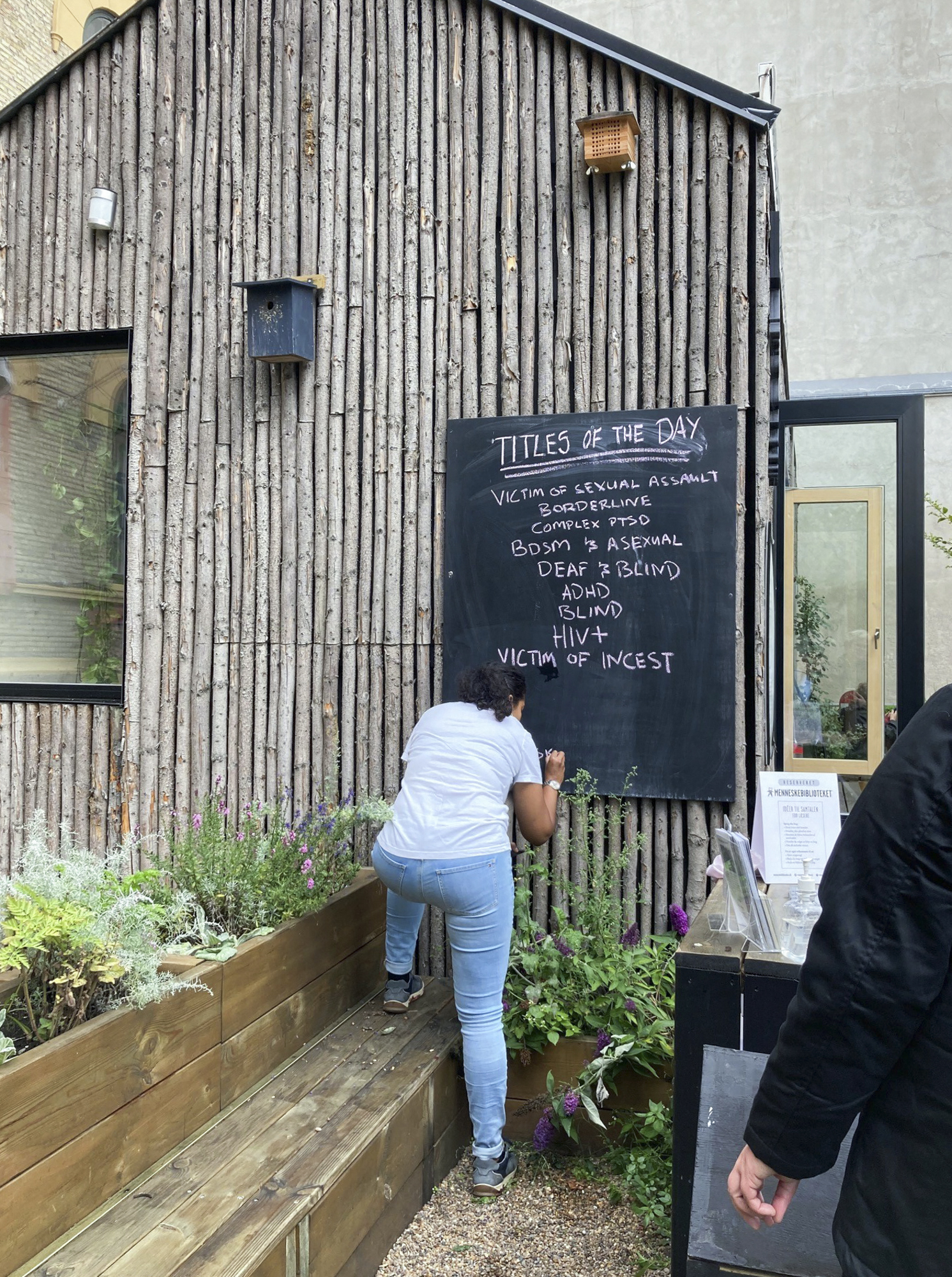
The circulation desk at the Santa Monica Public Library recently boasted some unexpected titles, each written on a sheet of paper: Bipolar, PTSD, Blind and Gay.
Each human “book” represents a lived experience that has been stigmatized or misunderstood, and those people have signed up to have frank conversations with members of the public about it. “Readers” can choose a title that interests them and the pair sit down at a small table in the leafy courtyard of the library. During their 30-minute chat, the reader can ask the book anything about the experience.
The event is part of a regular series hosted by the Los Angeles chapter of the Human Library, an international organization that holds similar events around the world.
Becoming a ‘human book’
Jesse Amend, whose book title is OCD, had been looking for an opportunity to open up to strangers ever since an upsetting experience during a Bible study meeting years earlier. “That kind of environment was always a huge trigger,” she says, “because I was sitting in a room full of people I thought were perfect, and I was the only one that was carrying this mess.”
Sitting in a circle of fellow worshippers one evening, Amend began to feel a sense of panic rising in her chest. When it was her turn to request a prayer, she was unable to speak.
“I started crying and just babbling because I [couldn’t] gather my thoughts,” she said. “I was just broken.”
When the panic attack subsided, Amend said she felt mortified. “It’s extremely raw, showing everyone your insides and all your darkness,” she said.
But afterwards, as everyone was gathering their belongings and leaving the room, a woman approached her.
“She was like, ‘I have a lot of insecurity and anxiety.’ She was trying to say, ‘Me, too! I know what this is and I’ve experienced this,’” Amend recalled. “I think it definitely started to, somewhere in the back of my head, trigger that thought of like … you helped someone by being a hot mess, so maybe this is my deal in life: to be the one that speaks up.”
That moment of vulnerability with a relative stranger stuck with Amend for years. When she heard about the Human Library project, she was excited about the chance to share her experience in a more structured setting. She says it’s freeing to have civil, open conversations with strangers.
Amend, one of about 100 human books in California, says people have different experiences living with obsessive-compulsive disorder, and as a book in the Human Library she’s only expected to share her own experience with the condition.
“It’s not about changing anyone’s mind,” Amend said, noting that the project’s organizers emphasize that no one book represents an entire identity or community. “But everyone walks away with just a little bit more empathy and lightness.”
At the event, Adam Lendermon, a book whose title is Gay, says a lot of people ask similar questions. “I get a lot of questions about how I came out, and how my family responded,” he said.
Lendermon loves that the Human Library is a safe space to ask things that might not be acceptable in other settings.
“I often encourage people to dig deep and ask questions that may feel taboo,” he said. “What’s the most beautiful for me is when a reader will say to me, ‘Oh, I never thought of it that way.’ A light bulb has been turned on for them.”
‘Readers’ react
Inga Grimmett heard about the Santa Monica event through a friend and was interested right away.
“When I sat down, I got nervous,” she said. “I didn’t want to offend by asking the wrong questions.”
Grimmett was impressed by the range of topics offered, but she also had reservations, concerned that the human books were being reduced to labels.
But “those labels and tropes start to fall off once they start telling their story,” she said. “Because within their story, you start to see and pull things that are similar to you.”
Grimmett spoke to a man recovering from addiction — a topic that hit close to home for her. “I never really talked about how to approach [my] family members that were recovering addicts,” she said. “I kind of just kept it to myself. So with him, it was easy, because he was a stranger, and I can just ask.”
Chavonny Tillotson, another reader, spoke to a young woman who has functional neurologic disorder and chronic fatigue syndrome. “It was very triggering for me,” he said, “because I have degenerative bones in my spine, and I did not expect to talk to someone who I identified with so much. She was a different race, a different age, different background, but we had that in common, and it really made me kind of emotional. I hadn’t experienced that kind of conversation with a stranger before.”
Unexpected moments of connection
Those unexpected moments of connection are one of the key goals of the Human Library, a project that originated in Denmark in 2000 and has since inspired events throughout the world.
“Even as a kid, when I saw somebody who was different, I’d be like, ‘Oh, look at this person, or look at this tattoo or look at this!’” said Ronni Abergel, who first came up with the idea. “And my mom would always go, ‘Oh, you can’t do that, you can’t say that.’”
So as an adult, Abergel launched a space where people can ask what they really want to know.
“[It’s] a format where some of the most unpopular groups in our community were volunteering to be on loan and answer questions about their private, personal life,” said Abergel, who still lives in Denmark. “Very personal questions, actually, like [of] the obese person, ‘How did you become so overweight?’”
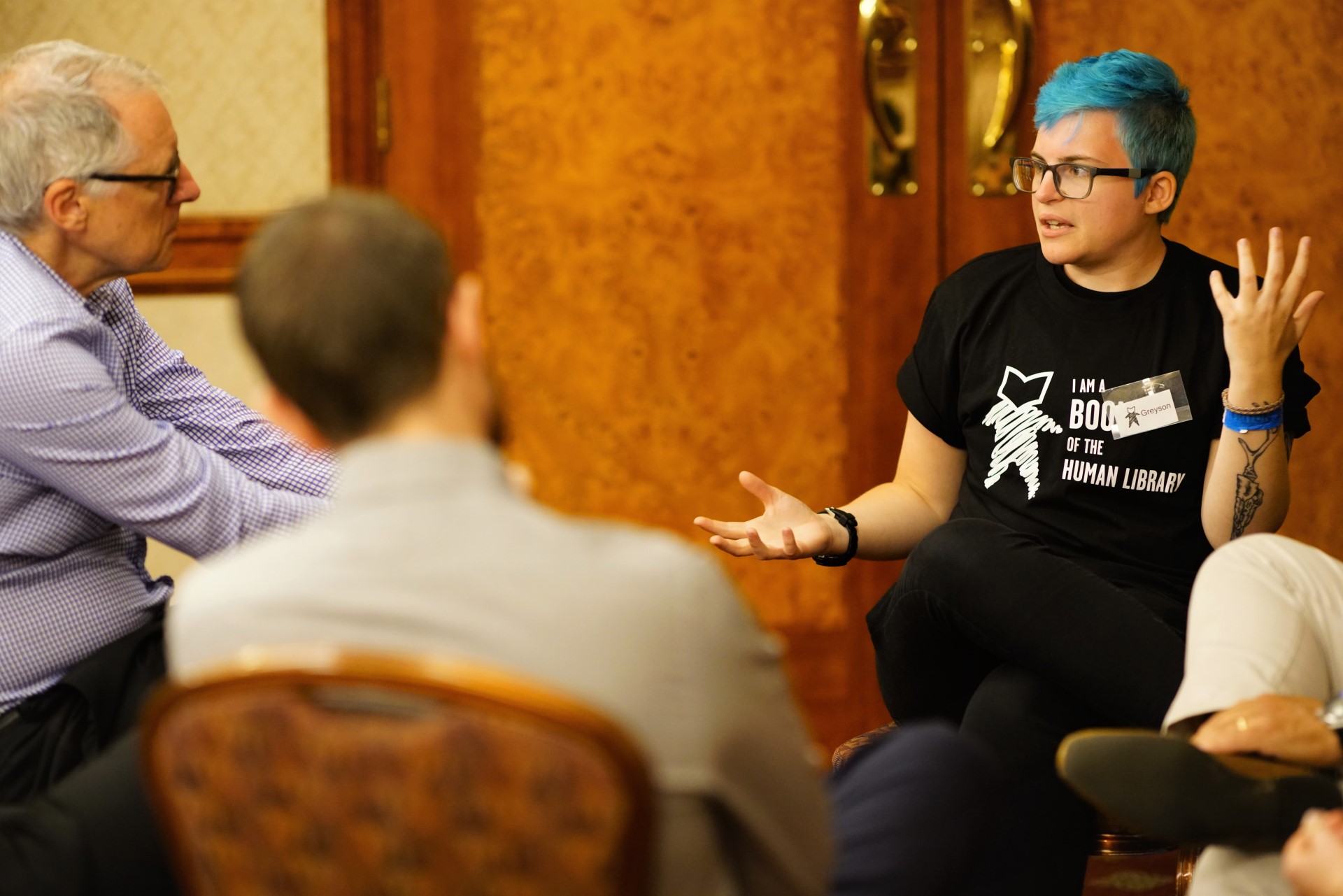
And Abergel found that while participants were interested in hearing about experiences different from their own, many also relished the chance to be heard, “even people in unpopular jobs like police officers or sex workers.”
“It’s so frustrating for some people to sort of be observed, judged, but have no chance to really explain who they are,” he said.
Because the project aspires to facilitate a truly open dialogue, one that inevitably makes participants vulnerable and potentially subject to hostile or offensive behavior, the organization has systems in place to protect its books.