Sponsor MessageBecome a KQED sponsor
upper waypoint

The Transamerica Pyramid: From 'Architectural Butchery' to Icon

Save ArticleSave Article
Failed to save article

Please try again

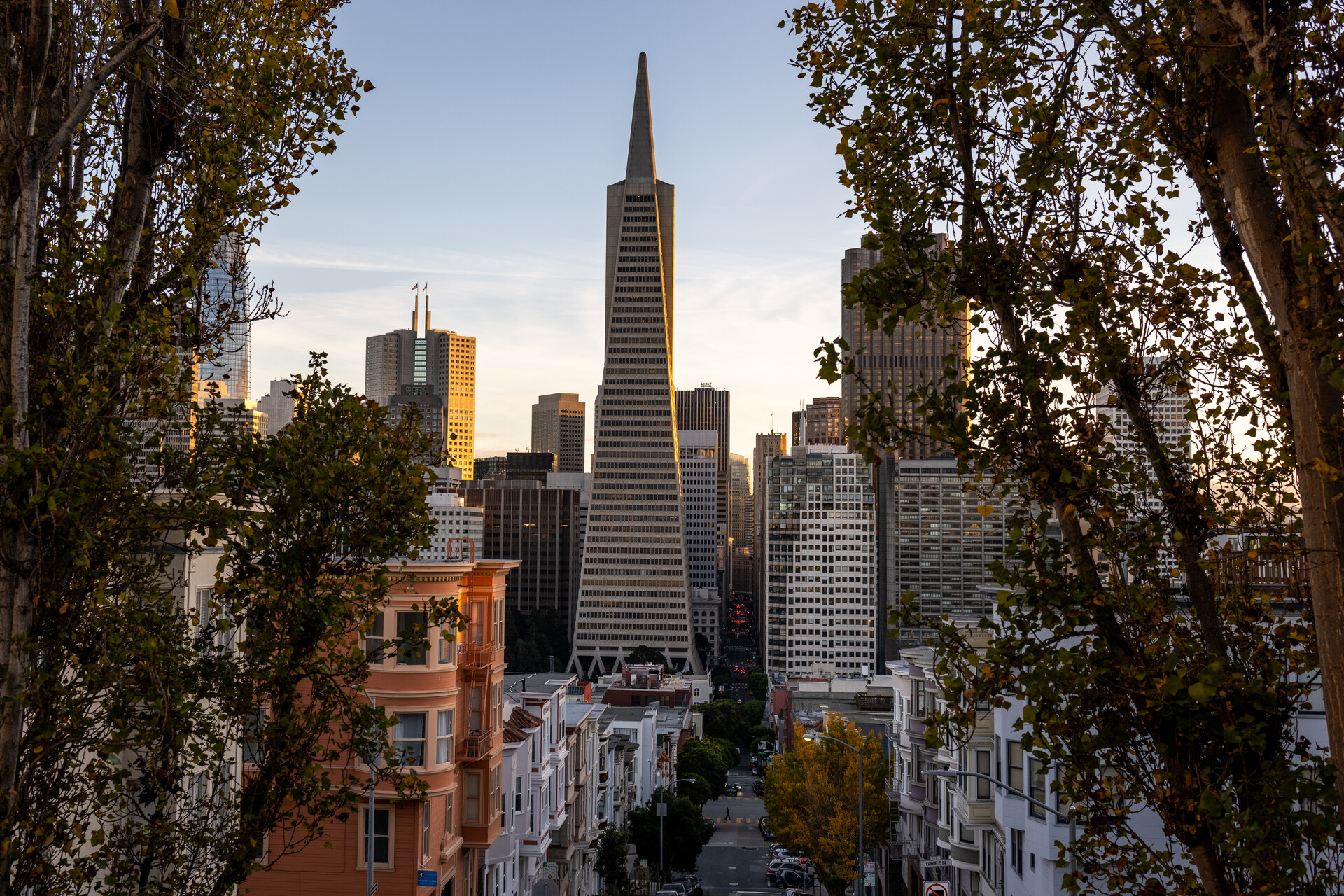
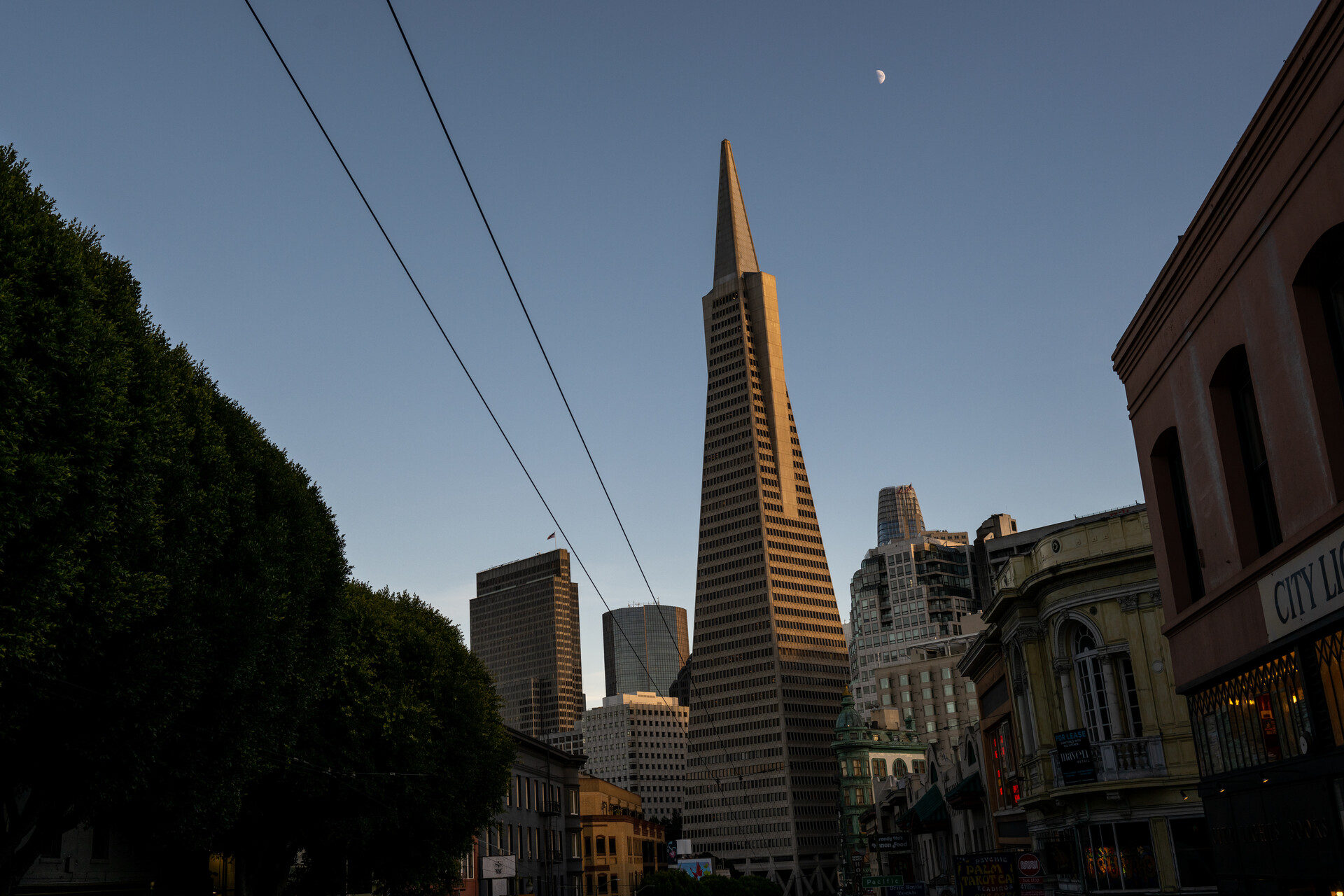
An early-evening shot of a very tall, narrow pyramid-shaped building taken from a low angle, surrounded by other smaller buildings. The low light of a winter sunset is hitting the building from the right, making it a warm gold color.
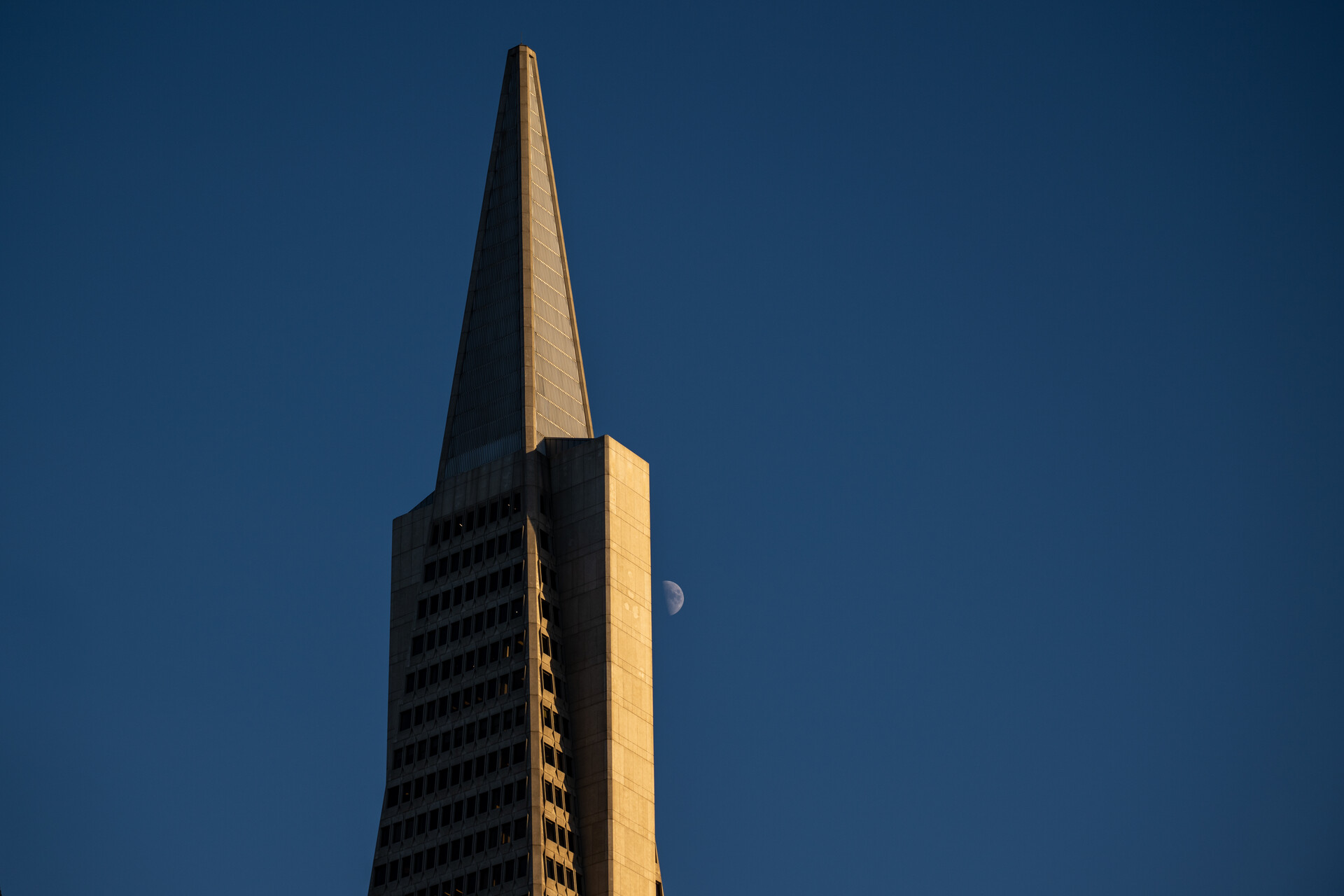
The moon rises near the Transamerica Pyramid in San Francisco on Nov. 30, 2022. (Beth LaBerge/KQED)

View the full episode transcript.

This article originally published December 8, 2022. It has been updated to reflect recent changes to the building.

The Golden Gate Bridge. The Bay Bridge. Sutro Tower. Coit Tower. Perhaps even (whisper it) the Salesforce Tower.

When it comes to instantly recognizable structures, San Francisco suffers no shortage. But if asked to pick their favorite, many people might go for a classic: the Transamerica Pyramid.

The Pyramid — officially known as the Transamerica Pyramid Center — first opened back in 1972, making it more than 50 years old. At over 850 feet high, back then it was the tallest building San Francisco had ever seen. It has over 3,000 windows, an exterior of white quartz, and an illuminated spire at its very top, like the star on top of a Christmas tree.

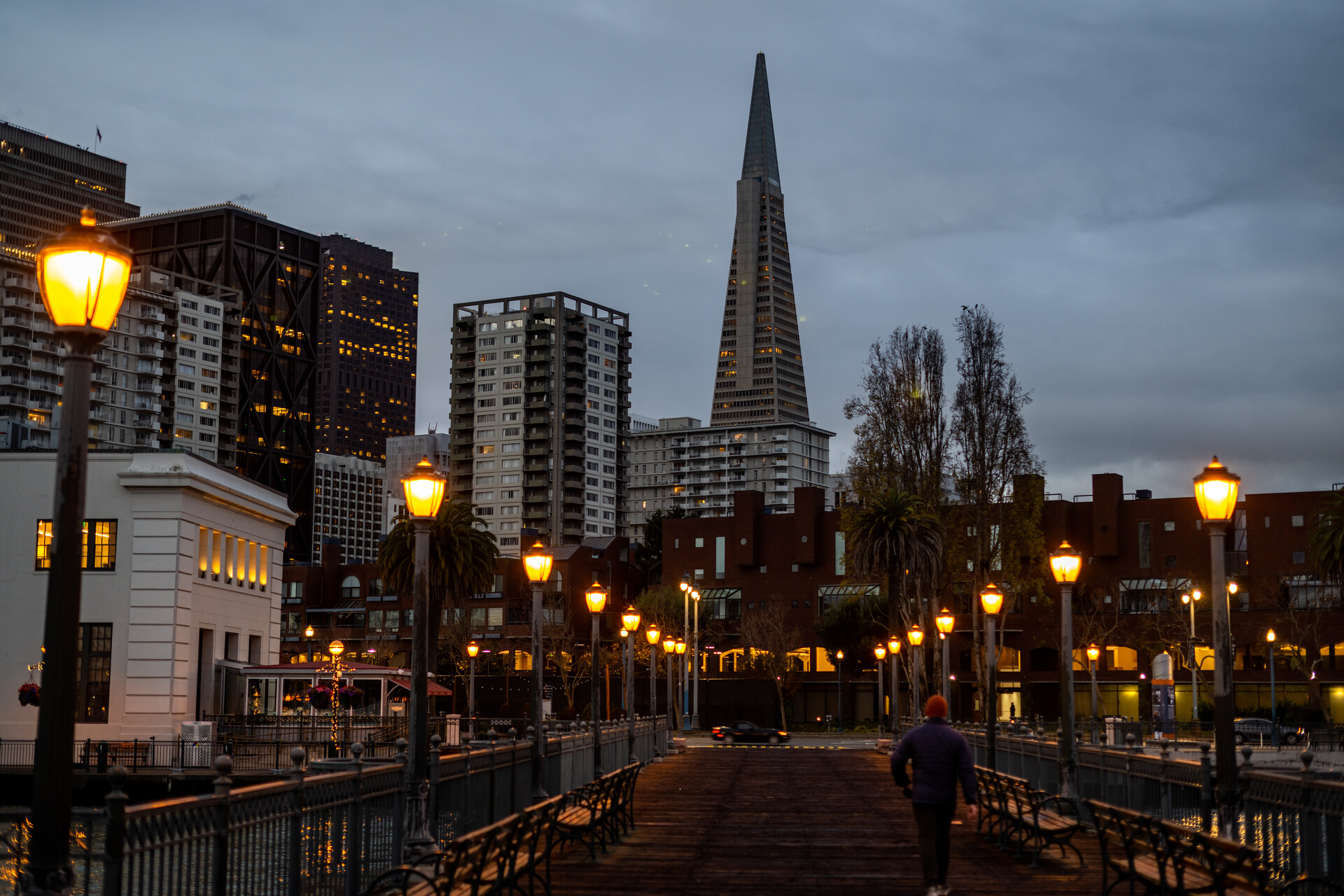
The Transamerica Pyramid as seen from Pier 7 in San Francisco on Dec. 6, 2022. (Beth LaBerge/KQED)

The Pyramid is no longer the tallest building in San Francisco; that honor now goes to the Salesforce Tower, at 1,070 feet. But the story of how it came to be might surprise you.

That’s because what is now an architectural icon was once quite controversial.

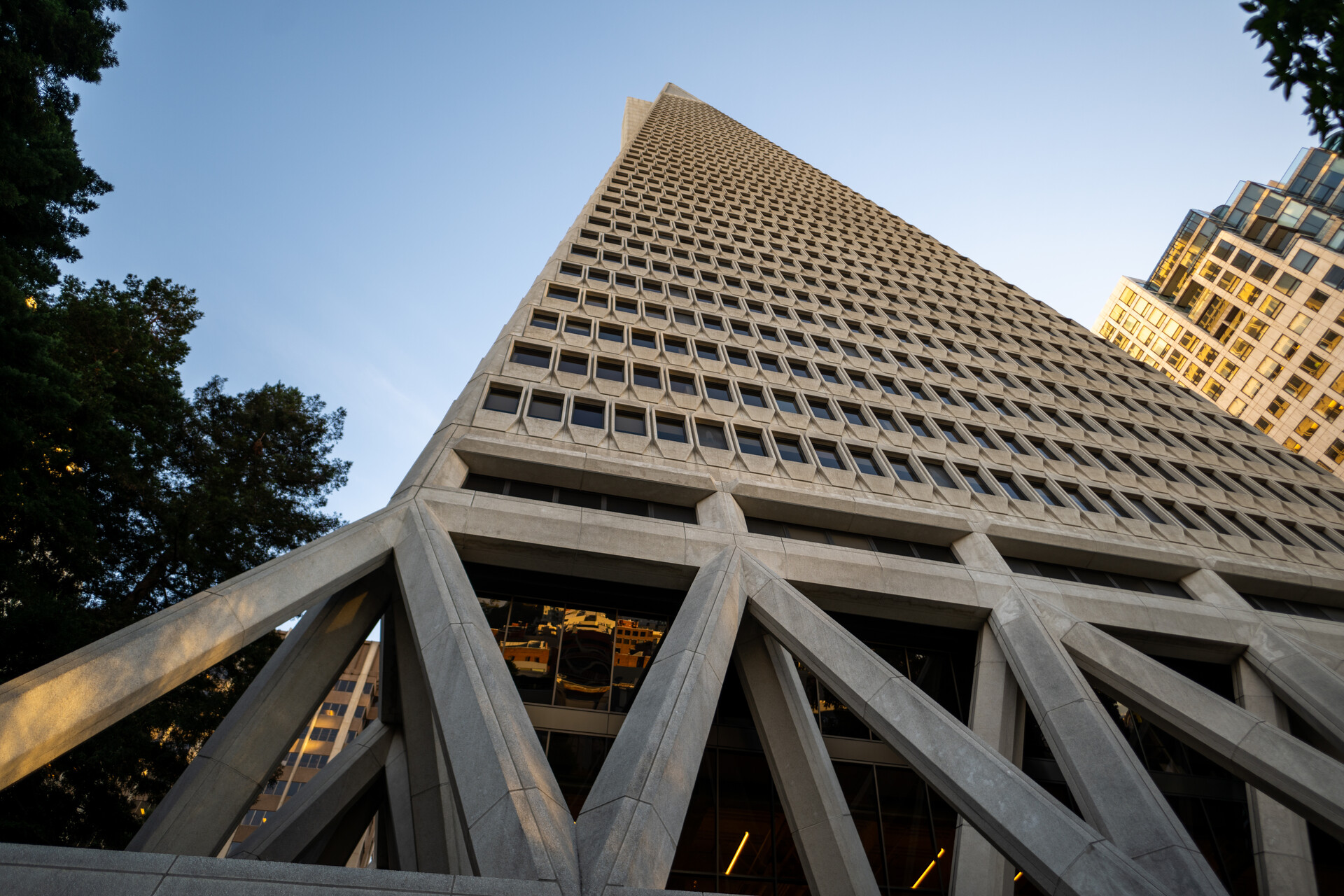
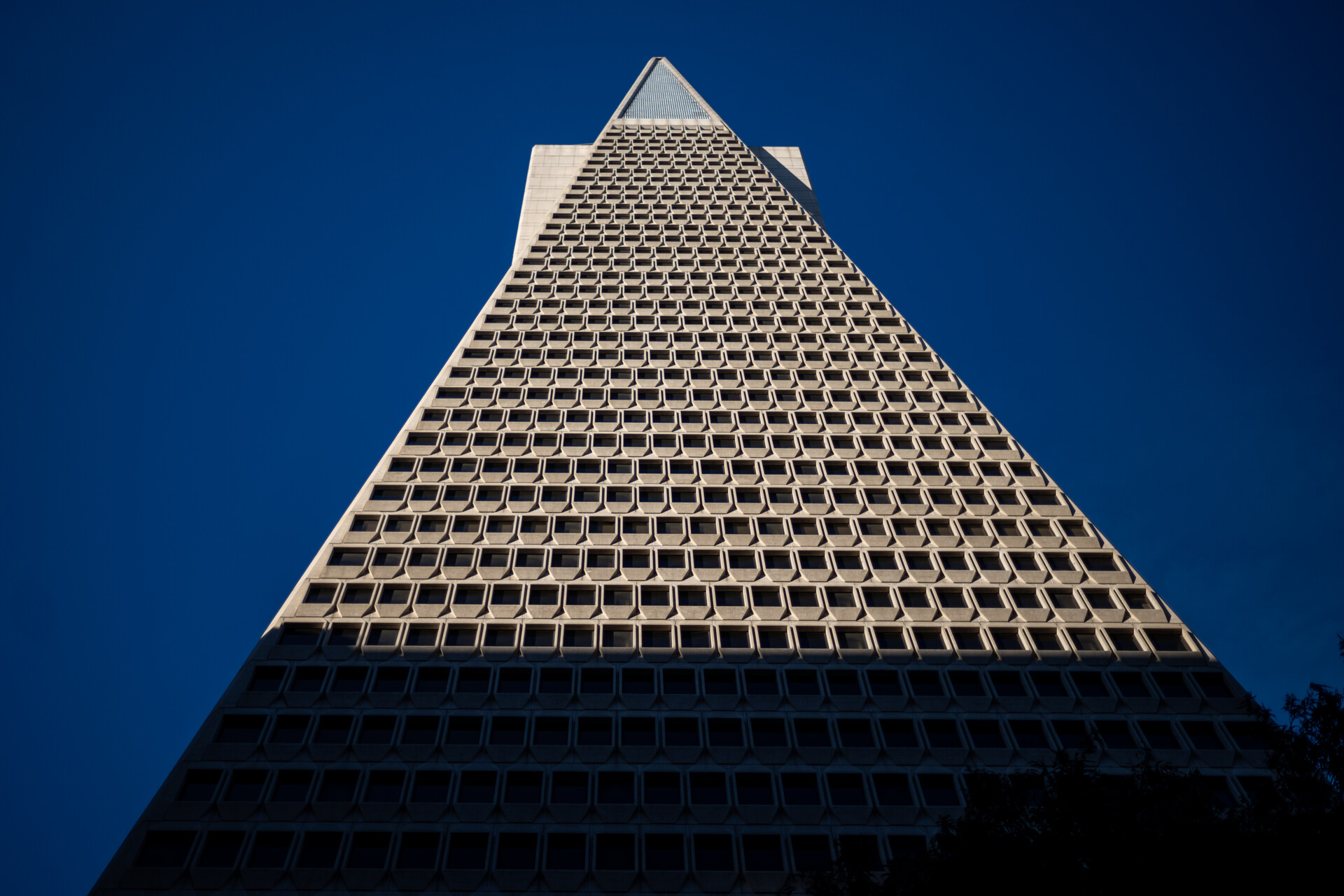
A view from the bottom of the Transamerica Pyramid in San Francisco on Nov. 30, 2022. (Beth LaBerge/KQED)

San Francisco before the Pyramid

Like a pin in a map, the Transamerica Pyramid marks the spot where the communities of Chinatown, North Beach, Telegraph Hill and the Financial District converge. And historically speaking, the Pyramid is built on hallowed ground.

In the first half of the 19th century, this area of San Francisco wasn’t several blocks away from the bay, like it is now. It was the Barbary Coast, right on the water. A whaling ship called the Niantic even ran aground here in 1849 after the crew jumped ship to make their fortunes in the gold fields. Like many ships around this time, instead of being removed or torn down, the Niantic was instead absorbed into the fabric of the city: It was retrofitted into a hotel and ultimately became part of the landfill as the city expanded into the bay.

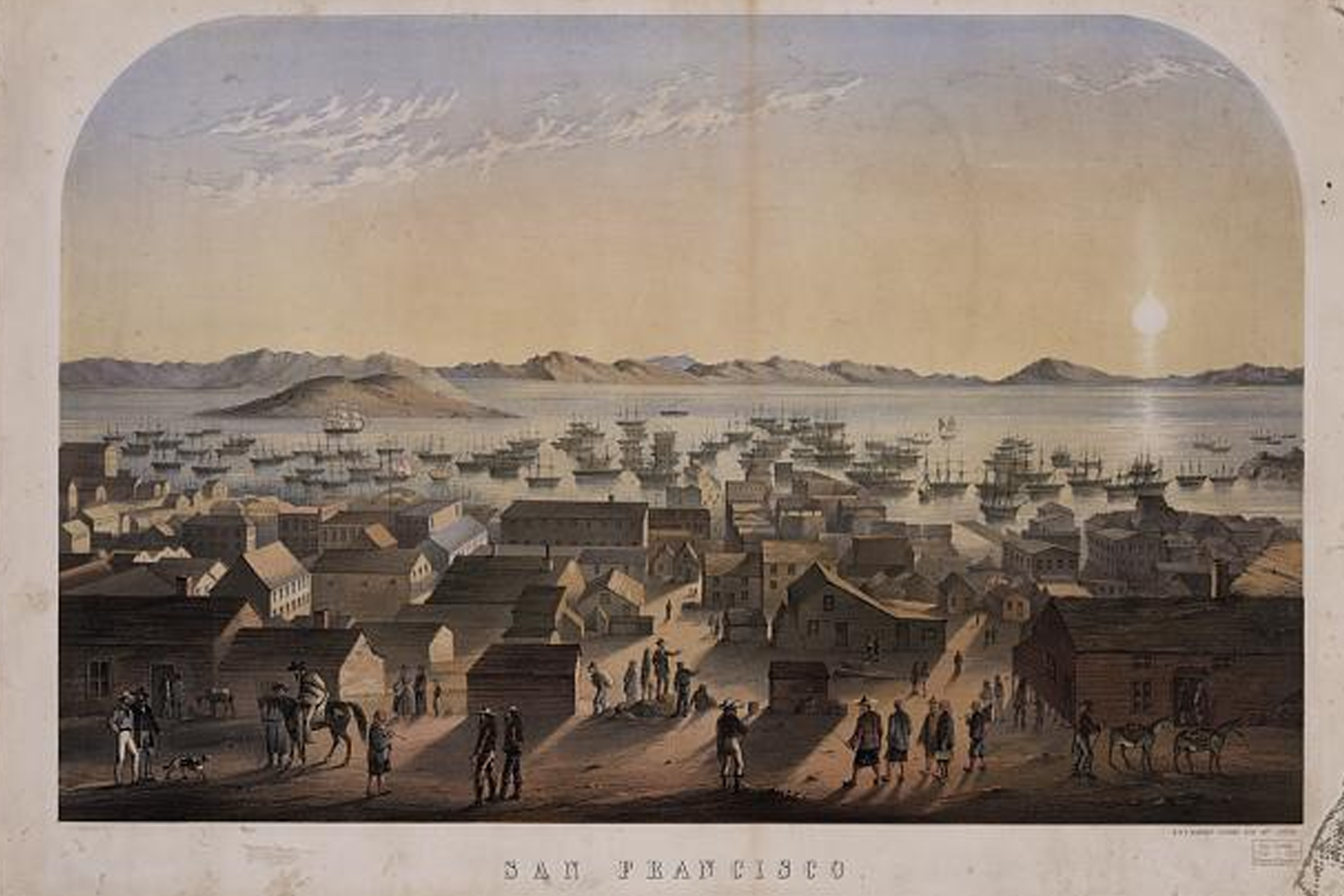
A view of San Francisco looking toward the bay, by Frank Marryat, ca. 1850. (Library of Congress)

Back during the Gold Rush, Montgomery Street was at the center of city life. In 1853, workers constructed a massive building — appropriately known as the Montgomery Block — on the exact spot where the Transamerica Pyramid would later be built. “At the time, it was the tallest building west of the Mississippi at a towering four stories,” said author Hiya Swanhuyser, who is currently writing a book about the history of the building. “[It was] built, famously, on a foundation made up of redwood logs interlaced that were floated across the bay.”

San Franciscans, Swanhuyser says, even called the Montgomery Block “a floating fortress.”

Like so many spaces through San Francisco’s history, the Block — and the people inside it — lived many lives. Originally, the space was built to be law offices and a hangout spot for San Francisco’s high society. But when the city’s business folk started to migrate south to Market Street, artists moved in. The Montgomery Block entered its creative era.

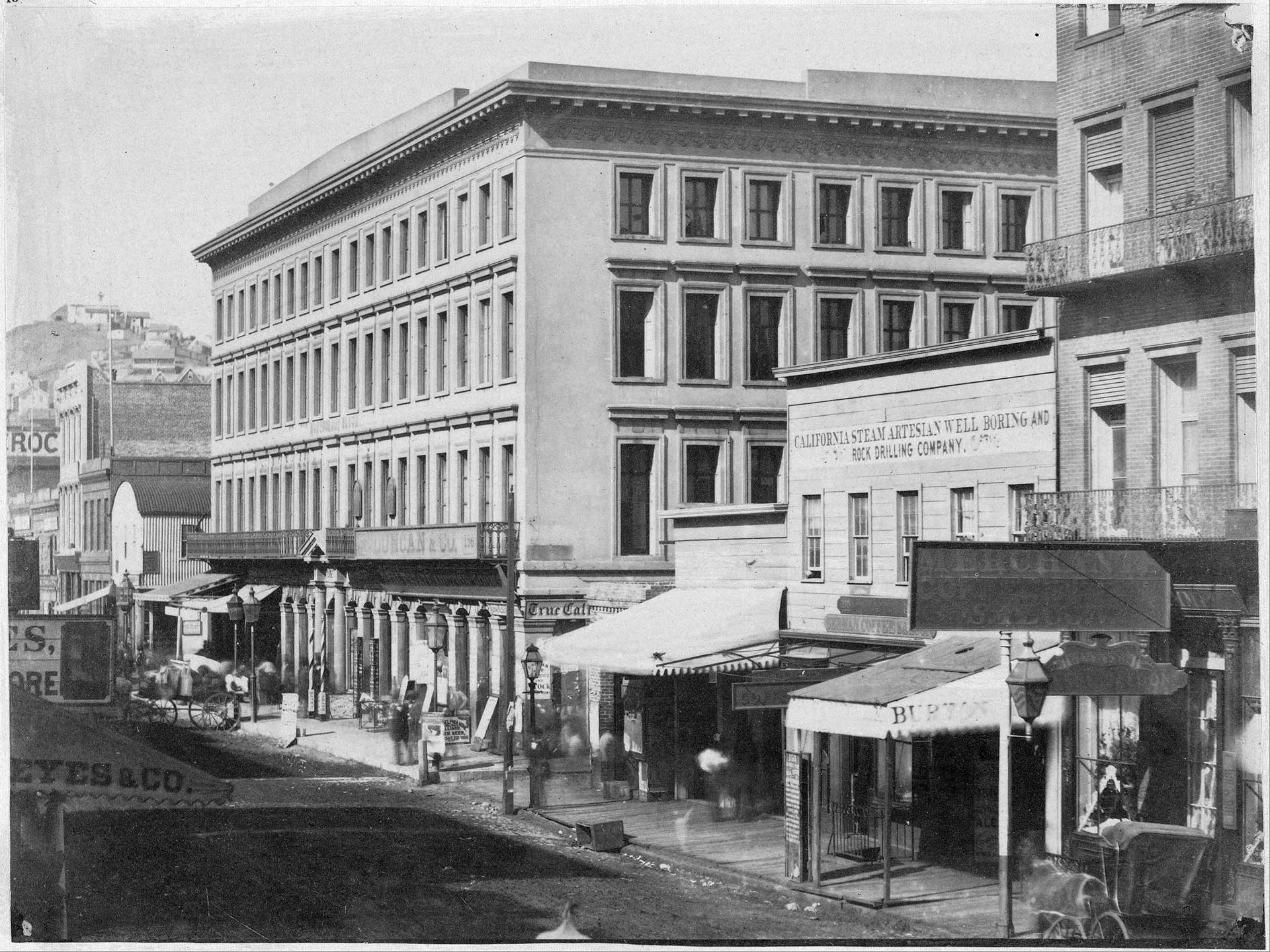
A view of the Montgomery Block in 1856, by photographer G. R. Fardon (1807–1886) (Google Art Project/Wikimedia Commons)

“They were writers and sculptors,” said Swanhuyser, “people who were inventing journalism in the mid-1860s. People like Ambrose Bierce, who, according to some, was America’s first newspaper columnist, and Mark Twain and Bret Harte. And Ina Coolbrith, who was California’s first poet laureate.”

This area of Montgomery Street was known for its bohemian ways, a scene that attracted freethinkers from near and far. Just a block to the north, now-iconic artists Frida Kahlo and Diego Rivera lived and worked here in the 1930s. But the Montgomery Block’s influence was also ideological, says Swanhuyser, a “hotbed of painters and political people”: The massive General Strike of 1934, which shut the city down for four days and brought class struggles to a head, was organized, in part, right here.

The lights went out on the Montgomery Block’s creative chapter in 1959. That year, explained Swanhuyser, “a man named S.E. Onorato bought it and tore it down, claiming he was going to make a parking structure.” But Onorato never got to build his parking garage, and the space remained a single parking lot for almost a decade.

That’s when the Transamerica Corporation — and the Pyramid — came into the picture.

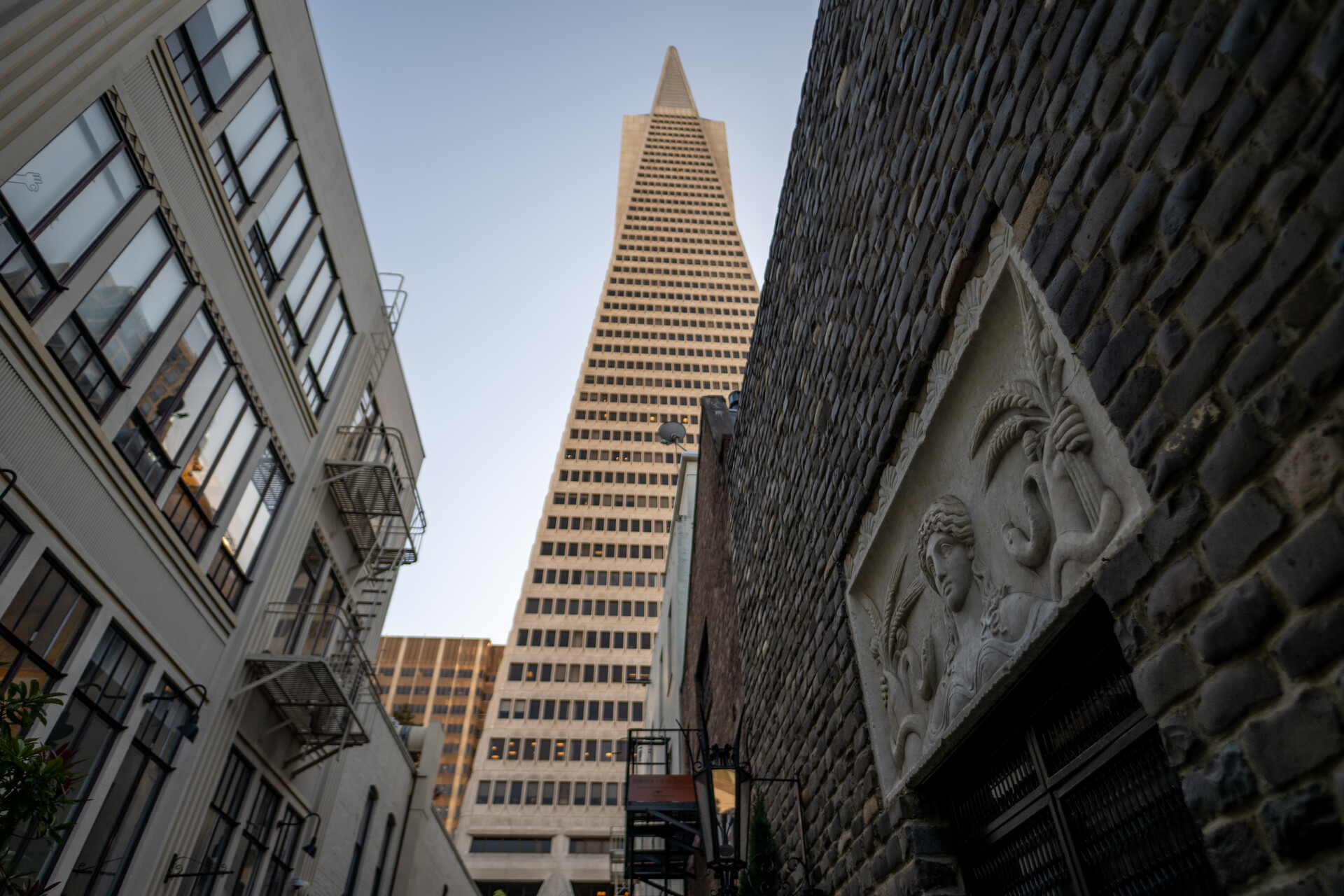
A view from the bottom of the Transamerica Pyramid in San Francisco on Nov. 30, 2022. (Beth LaBerge/KQED)

Path to the Pyramid

Transamerica is now a financial services company, concerned with insurance and investments. Its story starts back in 1904 with the founding of the Bank of Italy in San Francisco — the brainchild of San José’s A.P. Giannini. That bank would become the Bank of America in the 1930s.

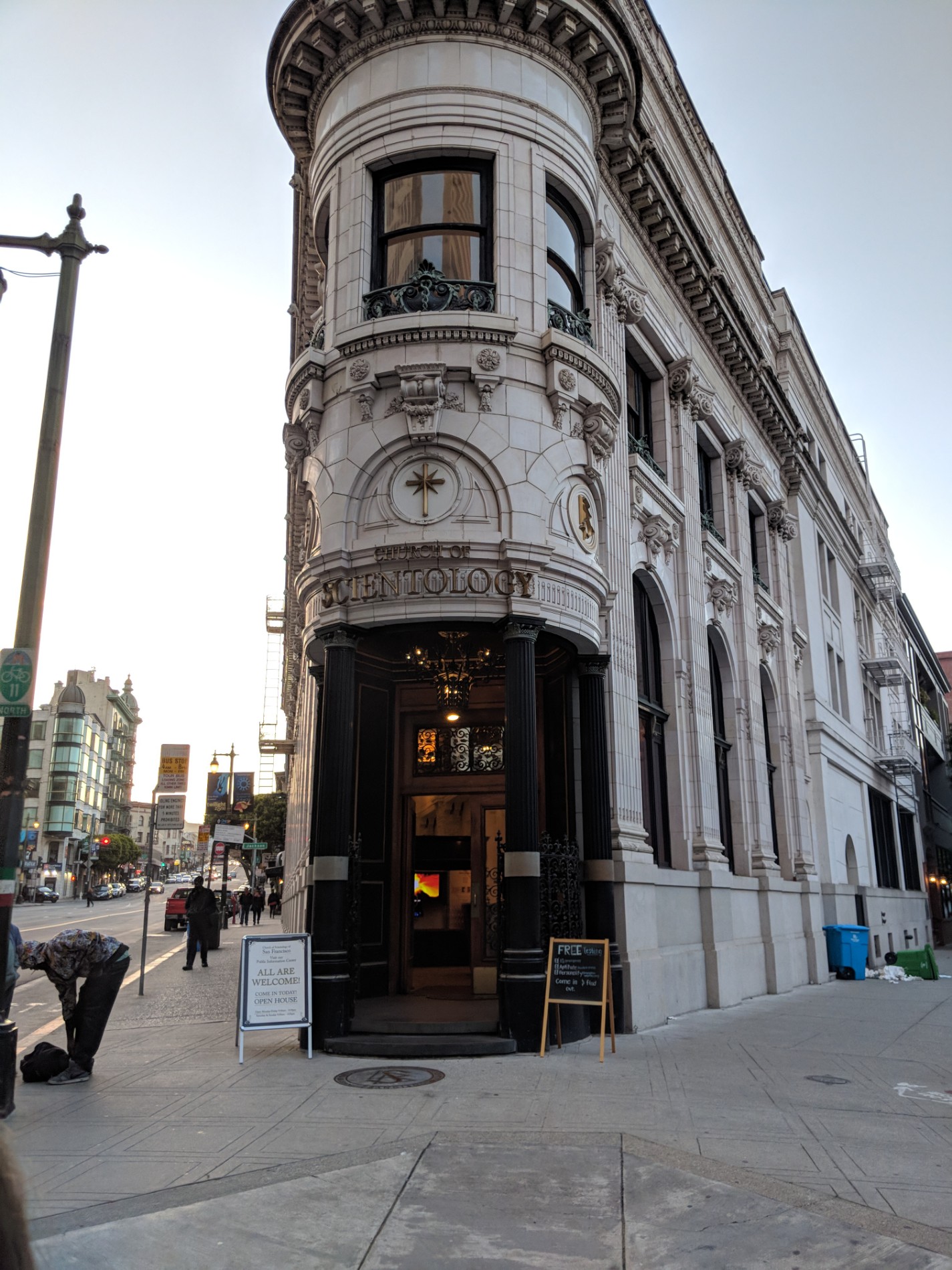
Transamerica began as the holding company for Giannini’s various financial ventures, which had by then become legion. The original “Transamerica Building” is actually still standing — it’s that flatiron-looking building that forms a junction between Montgomery Street and Columbus Avenue, just across the street from where the Pyramid now stretches into the sky.

Now it’s the San Francisco headquarters of the Church of Scientology, but in 1969, it was home to the corporation that wanted a new headquarters. And it turned out Transamerica wanted to build … a pyramid.

The corporation had brought in a Los Angeles architect named William Pereira who had worked as an art director in Hollywood. His brief was, apparently, to create something that allowed sunlight to filter down to ground level.

The moon rises near the Transamerica Pyramid in San Francisco on Nov. 30, 2022. (Beth LaBerge/KQED)

Pereira envisioned a pyramid more than 850 feet tall, with two wing-like columns running up either side to allow for an elevator shaft on one side and a stairwell on the other. Even with its pyramid structure, it would have a capacity of 763,000 square feet.

When the Transamerica Corporation shared the design with the public, the critics hated it. The San Francisco Chronicle’s architecture writer Allan Temko called it “authentic architectural butchery.”

And it wasn’t just local critics. The Washington Post said the Pyramid proposal was “a second-class World’s Fair Space Needle.” Los Angeles Times critic John Pastier called the design “antisocial architecture at its worst,” capturing a broader unease at how Transamerica was trying to smear its corporate vision on San Francisco’s skyline. “Corporations that are far more important to the city have exercised considerably more restraint in their architecture than Transamerica,” wrote Pastier, “which is blatantly attempting to put its ‘brand’ on the city.”

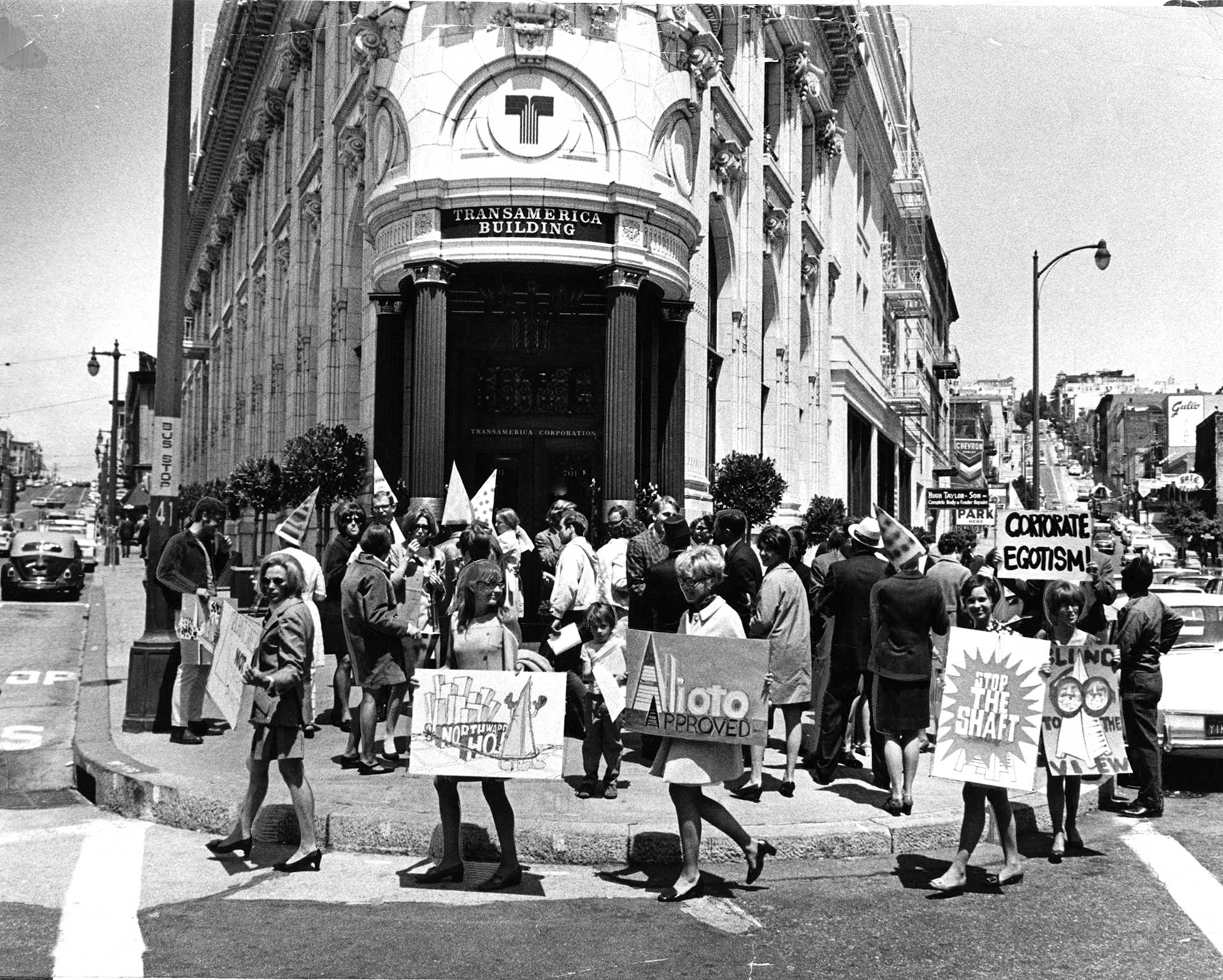
In 1969, San Franciscans protested against the Pyramid plans in the street, carrying signs that bore slogans like “Corporate Egotism” and “Stop the Shaft.” Some protesters even donned pyramid-shaped dunce hats. (You can see more photos from the protests in the San Francisco Chronicle’s archives.)

Protestors at the old Transamerica Building march against the new Transamerica Pyramid, announced in 1969 and built in 1972, on July 23, 1969. (Stan Creighton/San Francisco Chronicle)

Those protesters included Hiya Swanhuyser’s mother. “She was a community-minded hippie and she didn’t think that a neighborhood was the right place for a skyscraper,” Swanhuyser said.

There was even a lawsuit filed by nearby residents. At a City Hall hearing about the proposal, an attorney for the Telegraph Hill Dwellers Association spoke for those residents, in language that echoed the burgeoning environmentalism of the 1960s.

“The curse of this country is the worship of material things,” the residents’ attorney told City Hall. “We’ve polluted our rivers, our harbors, and our lakes, and our air — and we’re now about to pollute the skyline of San Francisco, one of its greatest treasures.”

Sponsored

Yet at that same hearing, San Francisco Mayor Joseph Alioto made his support for the Pyramid — and its design — clear. Alioto urged those assembled to acknowledge the subjectivity of taste, proclaiming that the real issue was whether the Pyramid “is so bad that all reasonable men must agree.”

The design, Alioto said, wasn’t that bad. On the contrary, it would “add considerable interest and beauty to the San Francisco skyline.”

The city’s Planning Commission ultimately signed off. The Pyramid was officially coming to San Francisco.

The Transamerica Pyramid seen from Montgomery Street in San Francisco on Nov. 30, 2022. (Beth LaBerge/KQED)

Darkness and light in a most strange year

Construction on the Transamerica Pyramid started in 1969. And this was no ordinary year.

The Zodiac Killer murdered three of his four confirmed victims in 1969, in Vallejo, at Lake Berryessa and, finally, in San Francisco’s Presidio Heights neighborhood. That same year, Bay Area residents would open their morning papers to see strange symbols — ciphers that someone claiming to be the Zodiac Killer sent to the press.

This was also the summer that Charles Manson’s so-called “family” murdered five people in Los Angeles, co-opting the visual language of the occult in their heinous acts. Then, the very same month construction on the Pyramid began, the Altamont Speedway Free Festival outside Livermore turned from a celebration of the counterculture into violence, mayhem and murder.

This was the backdrop against which San Franciscans were now watching a gigantic, mysterious pyramid start to stretch into the sky: the same ancient symbol that’s loomed large in the worlds of magic, alchemy and superstition for millennia — appearing, that year of all years, between North Beach and Chinatown.

Some may have found it creepy. But Larry Yee, who grew up nearby, remembers it as exciting.

Yee is now president of the historic Chinese Consolidated Benevolent Association (also known as the Chinese Six Companies), and serves on the San Francisco Police Commission. But back in 1969, growing up in Chinatown’s Ping Yuen housing development, Yee was a basketball-obsessed teen running around this part of the city with his friends.

“We challenged ourselves to go into some of these vacant buildings that they developed,” Yee said.

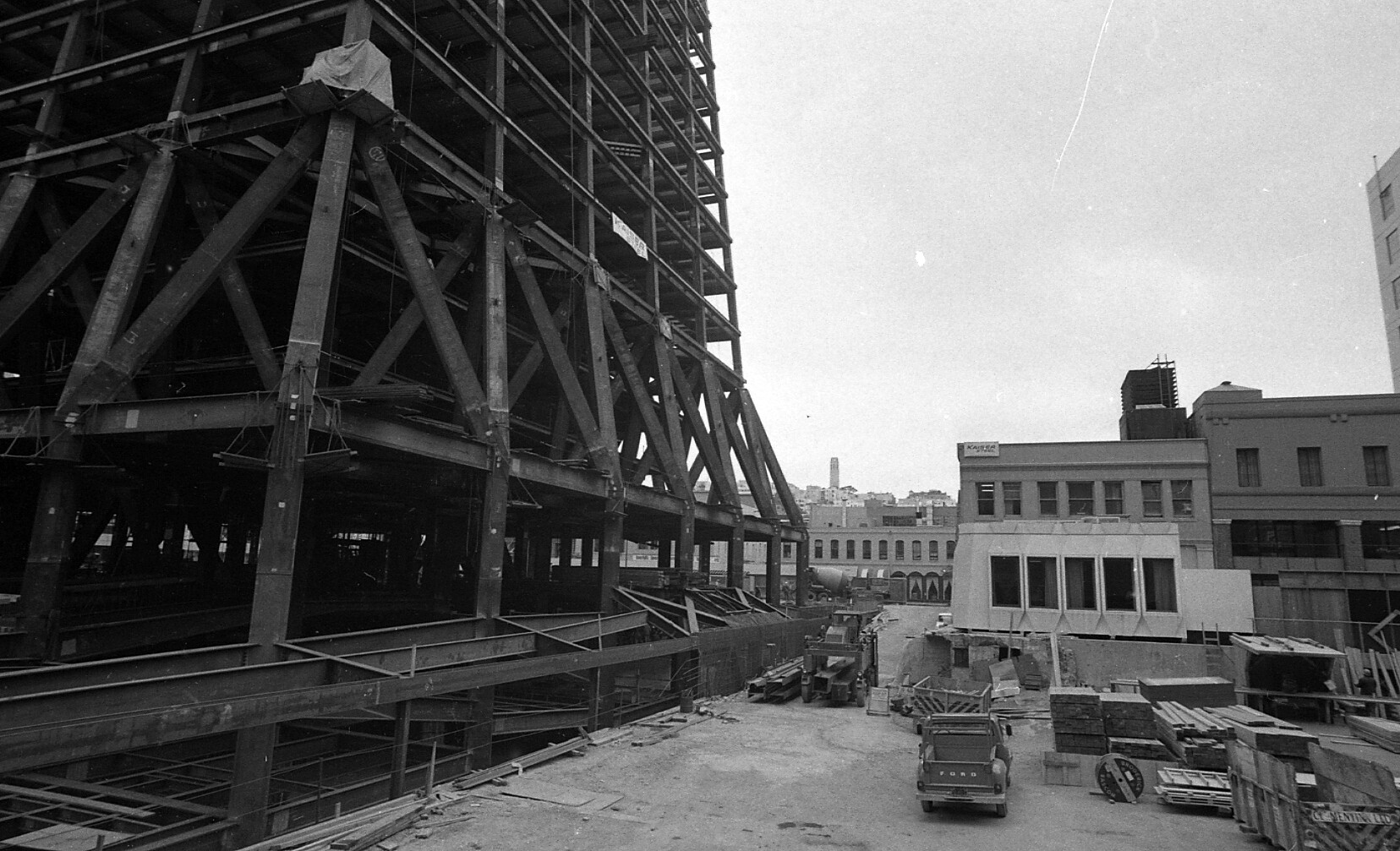
Construction progresses at the Transamerica Pyramid Building, on June 3, 1971. (Joe Rosenthal/San Francisco Chronicle via Getty Images)

Yee recalls how different San Francisco looked before the Pyramid. “Yeah, it was flat!” he said, adding that it was rare to see “buildings like this, that pop up through the skyline.”

He and his friends were getting a front-row seat to the construction of San Francisco’s most talked-about landmark, and one of his most enduring memories is of the constant construction noise. Far louder than the rattle of the California Street cable car that ran nearby, Yee said, was workers “pounding down on the pillars: ‘bom, bom, bom, bom.’”

Initially, he and his friends didn’t even know it was a pyramid being built down the street. They just saw a building being built up, and up … and then up even further, getting narrower. He laughs recalling how he and his friends worried the strange new building “could tip over.”

Yee has still kept his enthusiasm for the Transamerica Pyramid, decades after he watched it being built. He likes what it represents, and its place in the visual fabric of the city — and the neighborhood — he’s always called home.

It is, he says, still “magical.”

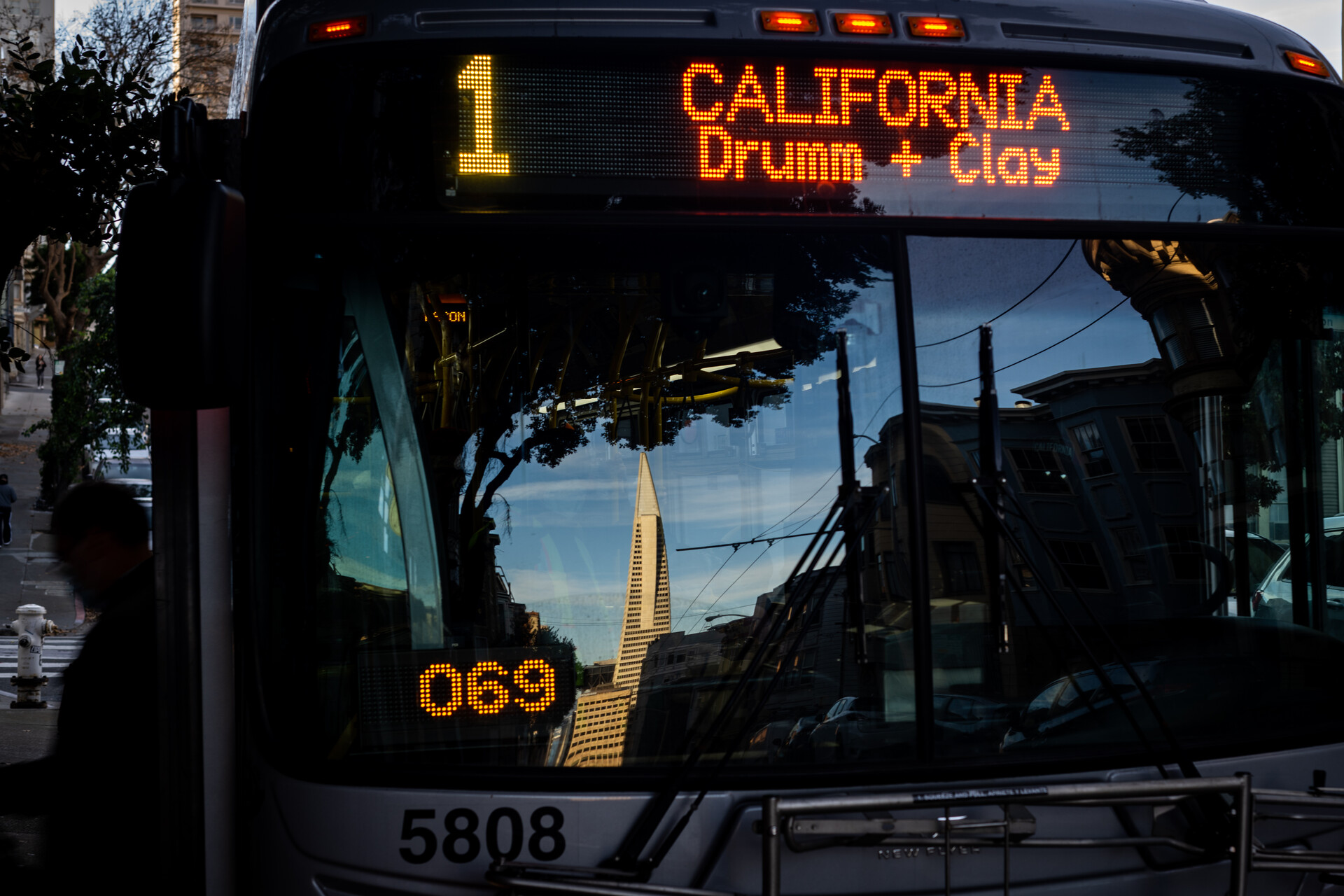
The Transamerica Pyramid can be seen reflected in the front window of a 1 California Muni bus in San Francisco on Nov. 30, 2022. (Beth LaBerge/KQED)

The more things change

San Francisco is a place of relentless change, and the Pyramid’s reputation is no exception. For a building that’s literally built on the site where creative genius flourished — a structure whose design was so fiercely contentious — the Transamerica Pyramid Center is now thoroughly uncontroversial.

“What’s good about the Pyramid overwhelms what’s bad about it,” architect Henrik Bull told The San Francisco Chronicle on the building’s 40th anniversary. Once a loud opponent of the plan, he’d changed his mind. “It’s a wonderful building,” he said. “And what makes it wonderful is everything that we were objecting to.”

The Transamerica Pyramid, a 48-story skyscraper in San Francisco’s Financial District, on Nov. 18, 2022. (Beth LaBerge/KQED)

The Transamerica Pyramid is no longer the headquarters of its namesake — the corporation moved to Maryland — but its offices are still leased to financial services companies. Among insurance, wealth management and private equity, a 21st-century Montgomery Block artist’s haven this is not.

Here’s another thing: For the most public, visible local icon you could imagine, the Transamerica Pyramid is also not very public. First-time tourists might naturally assume that a trip up the Pyramid is one of the City’s must-see attractions — like climbing the Empire State Building in New York City, or Seattle’s Space Needle. But you can’t go inside the Pyramid Center beyond the lobby, let alone climb to the top to see the view, unless you’re visiting one of the offices inside. There used to be an observation deck up there, but it closed in the ’90s.

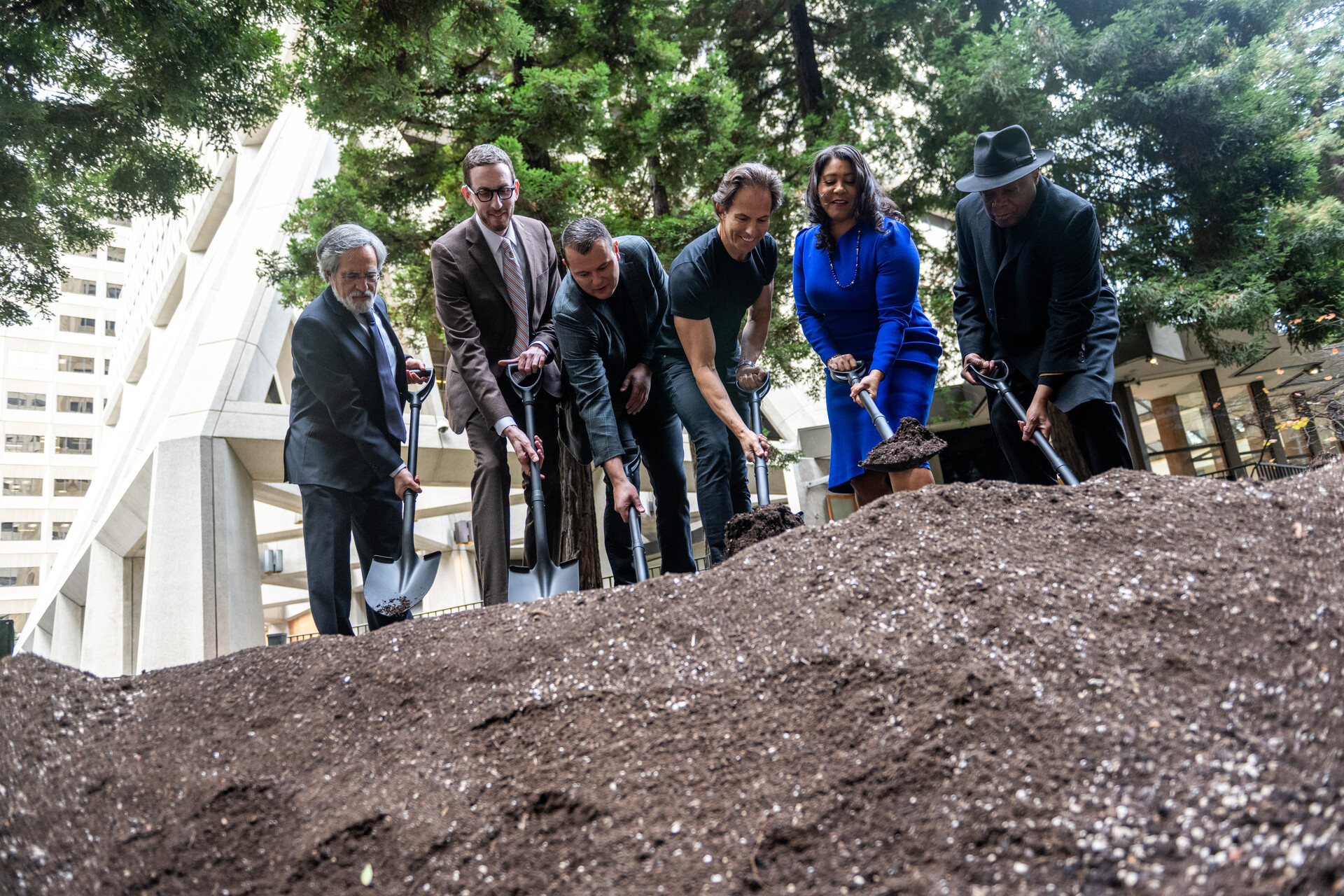
Supervisor Aaron Peskin (from left), state Sen. Scott Wiener, Deutsche Finance America partner Jason Lucas, SHVO Chairman and CEO Michael Shvo, Mayor London Breed and former Mayor Willie Brown break ground at the Transamerica Pyramid during a 50th-anniversary celebration of the building and a groundbreaking ceremony for a $400 million redevelopment of the site in San Francisco on Dec. 6, 2022. (Beth LaBerge/KQED)

The building recently underwent a $400 million-dollar renovation by Norman Foster’s architectural firm. The Pyramid’s owner, Michael Shvo, says he’s in talks to bring three restaurants to the building, which apparently will be open to the public.

But among other interior changes, the renovation will also see a high-end club moving into the Pyramid.

It’ll be private, for members only.

Present meets past

For all this site’s corporate credentials, the ghosts of the original Montgomery Block and this area’s Barbary Coast roots still linger here — if you know where to look.

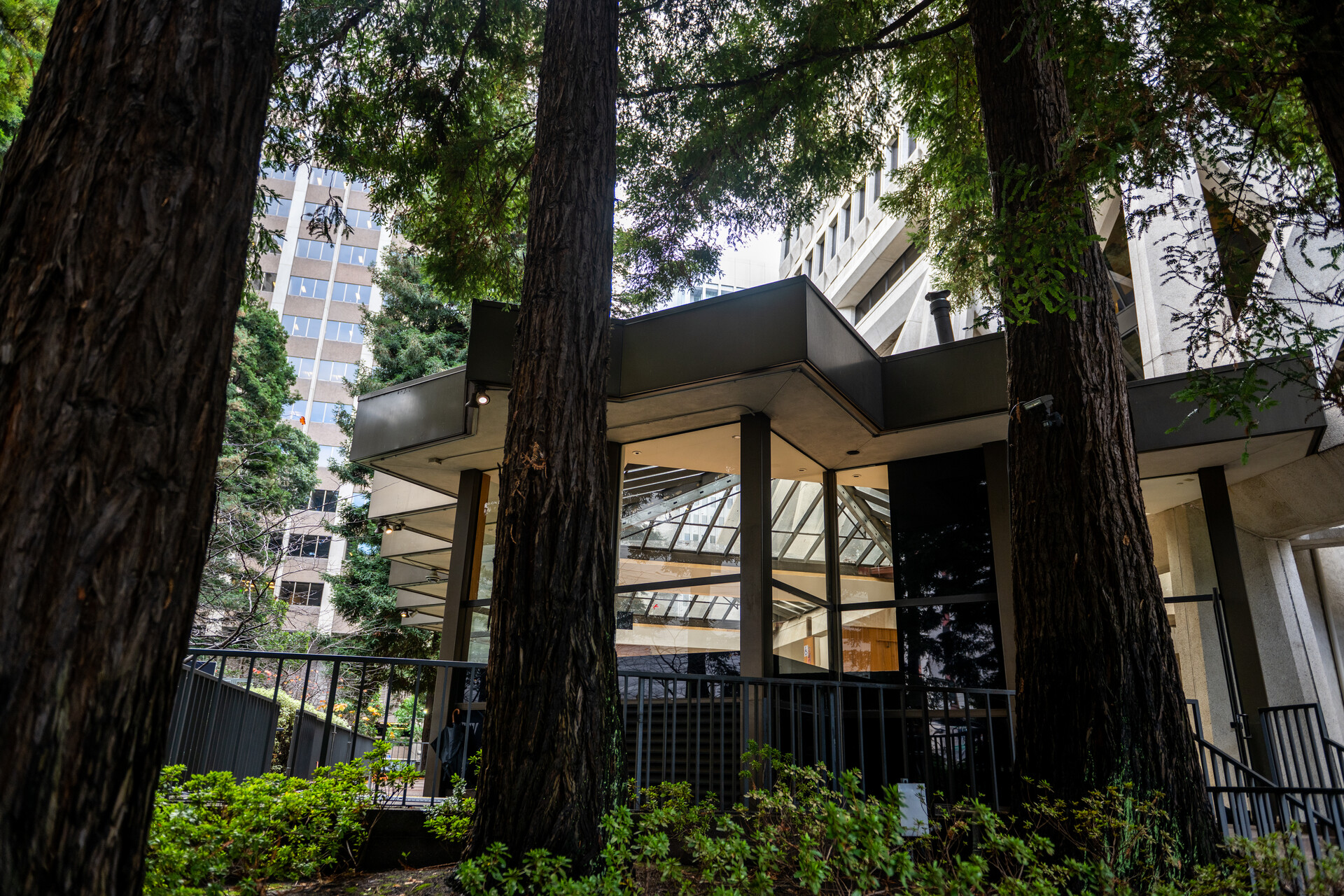
A grove of redwood trees grows at the base of the Transamerica Pyramid in San Francisco on Dec. 6, 2022. (Beth LaBerge/KQED)

Architect Pereira’s design includes a small park at the east side of the Pyramid’s base: the Transamerica Redwood Park, which was planted with 80 redwood trees shipped north from the Santa Cruz Mountains. Next to those redwoods you’ll find Mark Twain Place, named for one of the Montgomery Block’s most iconic figures.

When excavation began in the late ’70s for the plaza complex adjacent to the park, construction workers found none other than the remains of the Niantic, that whaling ship that docked in 1849. The vessel hadn’t been lost to time after all. Instead, it was pushed down over the decades by a city that has been compulsively remaking itself in all directions since European colonizers arrived, buried deep underground. It’s said that champagne bottles were even found resting in the ship’s hull.

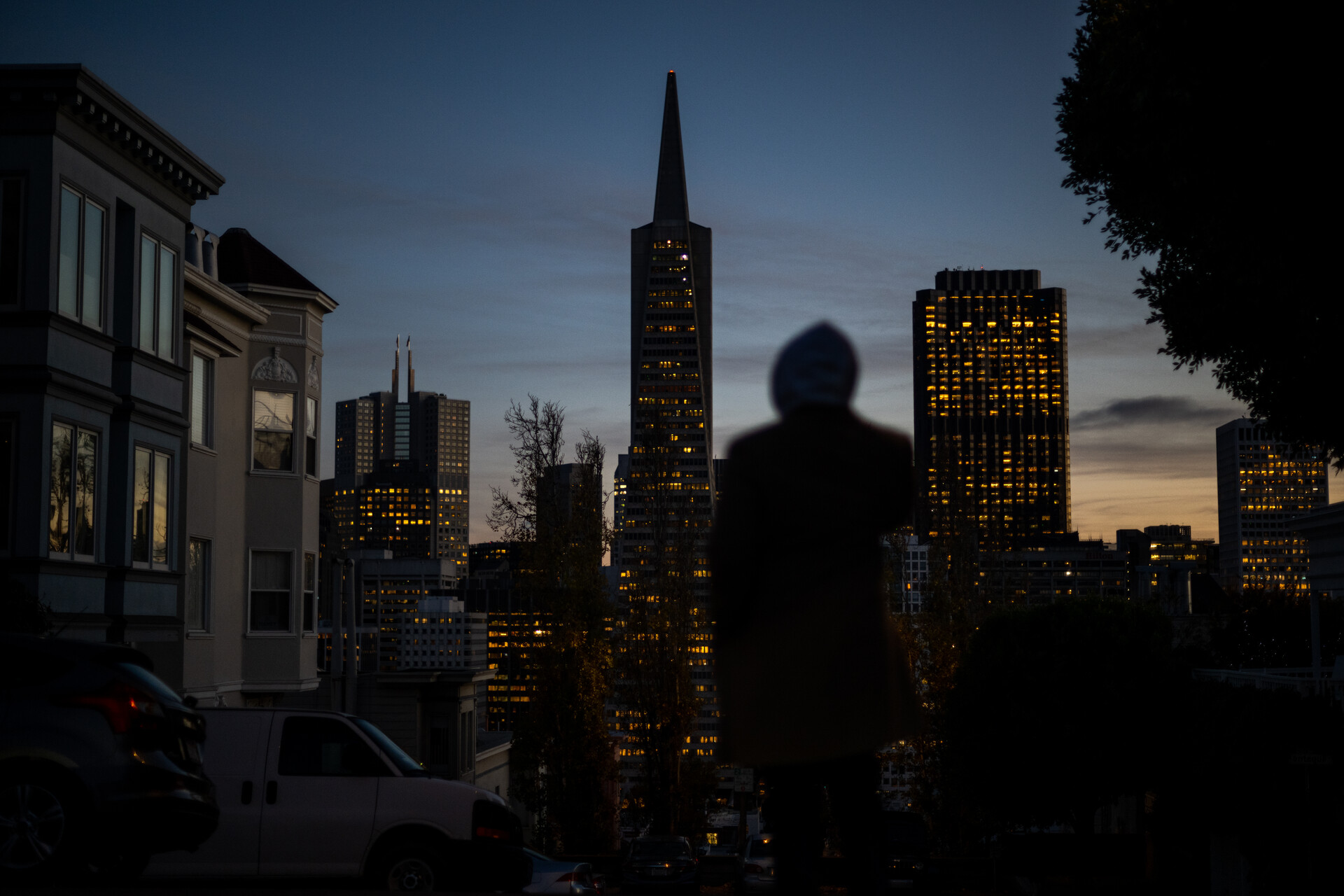
A man stops to look at the view of the Transamerica Pyramid at dusk in San Francisco on Nov. 30, 2022. (Beth LaBerge/KQED)

And just steps away from these markers of our past is the once-hated Pyramid. It may still be a symbol of the city’s money and power. But it’s an icon that’s finally found acceptance here — even affection — nonetheless.

Episode Transcript

This is a computer-generated transcript. While our team has reviewed it, there may be errors.

Katrina Schwartz: The Transamerica Pyramid is one of the most recognizable parts of the San Francisco skyline, and was groundbreaking in many ways when it opened in 1972.

Did you know all of the building’s windows rotate nearly 360 degrees? CBS demonstrated in this news clip.

CBS newsclip: Because of the building’s unique shape, architects designed windows that could be cleaned from the inside. “Yeah but you missed a spot” spritz spritz 3,676 to go…

Katrina Schwartz: The pointed peak of the building is a 212 foot spire, reinforced by aluminum grating. KRON4 climbed to the top to check it out in 1998.

KRON4 newsclip: This is the spire … oh my god…

Katrina Schwartz: The now famous building just got a $400 million dollar makeover and in the process builders uncovered something surprising

News clip: But deep within its steel bones there, construction crews discovered a time capsule.

John Krizek: There was always this tradition of putting time capsules in buildings under construction. I’m John Krizek and I was the public relations manager of Transamerica Corporation from 1968 to 1977.

Katrina Schwartz: John and his friend Bill Bronson, who was the editor of the California Historical Society, planted the capsule back when the Transamerica Pyramid was being built in the early 70s.

John Krizek: I think it was our intent at the time that this was going to be locked up and not looked at for 50 years.

Katrina Schwartz: They put in cassette tapes, photos, maps, recipes, and newspaper articles that would show whoever found the capsule how the spot where the building stands has played an important role in San Francisco history since the Gold Rush.

John Krizek: We needed to save that history. And on top of that, on this sacred site, we come along with this shocking plan for this unusual building, which went through an enormous amount of controversy.

Theme starts

Katrina Schwartz: Today on Bay Curious, we’re digging into the history of the Transamerica Pyramid. It’s one of the most iconic San Francisco buildings and yet there’s a lot I didn’t know about it. We first aired this episode in December of 2022 in honor of the pyramid’s 50th birthday. I’m Katrina Schwartz, filling in for Olivia Allen-Price. Stay with us.

Theme ends

Katrina Schwartz:  The Transamerica Pyramid is iconic now, but you will not be surprised to learn when it was new, people hated it.  KQED reporter Carly Severn takes us back in time to the birth of a legendary landmark.

Carly Severn: Like a pin in a map, the Transamerica Pyramid marks the spot where the communities of Chinatown, North Beach, Telegraph Hill and the Financial District all converge.

And in terms of the city’s history, the site that the Pyramid is built on is hallowed ground.

In 1849, the year the Gold Rush began, this part of San Francisco was right on the water.  So close, that a whaling ship called the Niantic was deliberately run aground right here after the crew abandoned ship to seek their fortunes in this wild, wily town.

The coast didn’t stay “the coast” for long. Landfill was used to rapidly swell the San Francisco streets further out into the Bay – swallowing that shipwreck with it.

But back when this part of Montgomery Street still bordered the bay —  in 1853 — it was a good place to construct a huge building, one that spanned the entire block.

They called it the Montgomery Block. And the history of this building has long fascinated San Francisco writer Hiya Swanhuyser.

Hiya Swanhuyser: It was the tallest building west of the Mississippi. At a towering four stories, it was famously built on a foundation of a so-called raft of redwood logs that had been floated across the Bay.

Carly Severn: Like so many places in  San Francisco, the Montgomery Block, and the people inside it, lived many lives. This space was originally built to be law offices, with a hangout spot for high society, but when the city’s business folk started to migrate to Market Street, the creatives moved in.

Hiya Swanhuyser: They were writers and sculptors, people who were inventing journalism in the mid 1860s. People like Ambrose Bierce, who according to some, was America’s first newspaper columnist.

Dramatic read of Amrose Bierce writing: Corporation: An ingenious device for obtaining profit without individual responsibility.

Hiya Swanhuyser: And Mark Twain and Bret Harte. 

Dramatic read of Bret Harte writing: The only sure thing about luck is that it will change.

Hiya Swanhuyser: And Ina Coolbrith, who was California’s first poet laureate.

Dramatic read of Ina Coolbrith writing: Were I to write what I know, the book would be too sensational to print, but were I to write what I think proper, it would be too dull to read.

Carly Severn: Just a block to the north, now-iconic artists Frida Kahlo and Diego Rivera lived and worked here in the 1930s. It was a scene.

Hiya Swanhuyser: It sort of stayed a scene for most of its life, which ended in 1959 when someone bought it and tore it down to make a parking structure.

Carly Severn: But the garage never materialized. And so the space remained a single parking lot for almost a decade.

Enter  the Transamerica Corporation.

This business actually started in San Francisco back in 1904 as the Bank of Italy, courtesy of a local man called A.P. Giannini. Later, in the thirties, it would become known as Bank of America. Ever heard of it?

Giannini had a lot of financial schemes and he soon needed more than a bank to contain them. That’s when the Transamerica Corporation was born. By 1969 the Corporation was ready to make its mark on San Francisco with a new headquarters.

They brought in a Los Angeles architect named William Pereira to design it. He was told to create something that would still allow light to filter down to street level.

But when the design for the 763 thousand square foot pyramid dropped, the critics hated it.

The San Francisco Chronicle’s architecture writer Allan Temko called it

Dramatic reading of Allan Temko: Authentic architectural butchery.

Carly Severn: And it wasn’t just local critics. The Washington Post said Pereira’s Pyramid proposal was:

Washington Post voice over: A second-class world’s fair space needle.

Pastier voice over: Antisocial architecture at its worst.

Carly Severn: Said Los Angeles Times critic John Pastier. He captured a broader unease about Transamerica trying to smear its corporate vision on the San Francisco skyline:

Pastier voice over: Corporations that are far more important to the city have exercised considerably more restraint in their architecture than Transamerica, which is blatantly attempting to put its ‘brand’ on the city.

Carly Severn: People protested against Pereira’s pyramid design, carrying signs that bore slogans like “Corporate Egotism” and “Stop the Shaft.” They even wore pyramid-shaped dunce hats.

These protesters actually included Hiya Swanhuyser’s own mother:

Hiya Swanhuyser: She was a community minded hippie and she didn’t think that a neighborhood was the right place for a skyscraper.

Carlyn Severn: Neighborhood residents even filed a lawsuit. At a City Hall hearing about the proposal, an attorney for the Telegraph Hill Dwellers Association spoke for those residents, in language that echoed the burgeoning environmentalism of the sixties:

THDA Attorney: The curse of this country is the worship of material things. We’ve polluted our rivers, our harbors, and our lakes, and our air. And we’re now about to pollute the skyline of San Francisco, one of its greatest treasures.

Carlyn Severn: But at that same hearing, San Francisco Mayor Joseph Alioto quoted the classics in support of the pyramid.

Joseph Alioto: We have to recognize that the Latinists used to say ‘De gustibus non est disputandum’ – that there simply is no disputing tastes, and the only question is whether it is so bad that all reasonable men must agree.

Carly Severn: And this pyramid, Alioto said, wasn’t that bad. On the contrary:

Joseph Alioto: It will add considerable interest and beauty to the San Francisco skyline.

Carly Severn: The city’s Planning Commission signed off on the project and the pyramid was officially coming to San Francisco.

Construction on the Transamerica Pyramid started in 1969, a dark year in many ways. This was the year in which three of the four confirmed murders by the Zodiac killer took place – the last one in San Francisco itself.

News clip: School children are nice targets, I shall wipe out a school bus one more and then pick off the kiddies as they come bounding out. That was the threat of the zodiac killer.

Carly Severn: The year that you could open the Chronicle and read the Zodiac’s cryptic letters full of codes and symbols right there at your breakfast table.

News clip: They are weighing advice from astrologers on the theory that the killer who calls himself the Zodiac may be planning his next victim based on astrological signs.

Carly Severn: ‘69 was also the year of the gruesome Manson Family murders in LA, with all their Satanic imagery.

News clip: One officer summed up the murders when he said, “in all my years, I have never seen anything like this before.

Sneak up Rolling Stones set at Altamont Festival

Carly Severn: Of the disastrous Altamont Festival outside Livermore

Rolling Stones: Hey People!

Crowd noise

Carly Severn: A celebration of counterculture that devolved into violence, mayhem and murder.

Rolling Stones: Why Are we fighting? 

Carly Severn: So I can’t help thinking how it would have felt to be living in San Francisco at the start of the 70s, bombarded with so much occult-inflected darkness in your morning paper – and seeing one of the most ancient and mysterious symbols, a pyramid, being summoned in your backyard.

But for many, watching a skyscraper go up was also exciting.

Larry Yee: My name is Larry Yee, born and raised in San Francisco.

Carly Severn: Now, Larry is the president of the historic Chinese Consolidated Benevolent Association, also known as the Chinese Six Companies. He also serves on the San Francisco Police Commission.

But back in 1969, growing up in Chinatown’s Ping Yuen housing development, Larry was a basketball-obsessed teen, running – or often skating – around this part of the city with his friends.

Larry Yee: Play hide and seek — you know, we challenge ourselves and go into some of these vacant buildings that they developed.

Carly Severn: Walking around the base of the Pyramid over 50 years later, with the sound of traffic and tourists echoing off the street corners, Larry says the San Francisco he remembers from childhood, pre-pyramid, looked quite different:

Larry Yee: Yeah. It was flat! You know, there weren’t many buildings like this that pop up through the skyline.

Carly Severn: This part of town was hopping, and full of the kinds of characters that had frequented the Montgomery Block years back. It was home to famous nightclubs like the Hungry I and the Purple Onion comedy cellar, where folks like Lenny Bruce were playing.

Lenny Bruce: Where I’m goin’ kill it.

Carly Severn: But when the Pyramid was being built, all Larry and his friends could get was a sneak peek through the holes in the plywood fencing that hid the rapidly-rising behemoth.

And he still remembers the sheer, constant construction noise.

Larry Yee: You come home from school and you know they’re pounding down on the pillars. Bam, bam, bam, bam.

Carly Severn: Initially, he and his friends didn’t even know it was a pyramid. They just saw a building being built up, and up, and then up even further, getting narrower.

Larry Yee: We had concerns too, how far it’s going to go, whether it could tip over and then once they finished we said “Ah, this is a pyramid.”

Carly Severn: When it was finished, Pereira’s pyramid had over 3,000 windows, an exterior of white quartz, and an illuminated spire at its very top, like the star on top of a Christmas tree.

Subtle, the pyramid is not. But decades on, Larry’s still a fan of this building. He says for him, it represents progress — the meeting of the old and the new. And he’s fond of its place in the visual fabric of the city,  and the neighborhood,  he’s always called home.

Larry Yee: I don’t know. It’s magical.

Carly Severn: And it’s funny. For a building that’s literally built on the site of the Montgomery Block, where creative genius flourished; a building whose design was so fiercely contentious,  the Transamerica Pyramid Center is now thoroughly uncontroversial.

Its silhouette on our skyline has become symbolic of San Francisco. Even several of those early critics changed their minds. Henrik Bull, an architect who originally opposed the pyramid — publicly, and loudly -– told the San Francisco Chronicle on the building’s 40th anniversary that like many others, he’d switched course in the intervening decades:

Henrik Bull voice over: What’s good about the Pyramid overwhelms what’s bad about it. It’s a wonderful building. And what makes it wonderful is everything that we were objecting to.

Carly Severn: What started out as a corporate symbol has stayed, well, corporate. In a Financial District full of office buildings, the pyramid is in many ways just another one of them.

The Transamerica Pyramid isn’t even the Transamerica headquarters any more — those officially moved to Maryland. These offices are primarily leased by financial services companies dealing in wealth management and private equity. There’s even a high-end members club moving in soon. A 21st-century Montgomery Block artist’s haven this is not.

But here’s another thing: For the most visible local icon you could imagine, the Transamerica Pyramid is not very public. Tourists might naturally assume that a trip up the pyramid is one of the City’s must-see attractions — like climbing the Empire State Building or the Space Needle. But you can’t go inside the Pyramid Center, let alone climb to the top to see the view, unless you’re visiting one of the offices inside. There used to be an observation deck up there, but it closed in the nineties.

Still, the ghosts of this site’s previous inhabitants linger here, if you know where to look.

If you go to the Pyramid today, and walk into the small park at its base, you’ll find Mark Twain Place, named after one of the Montgomery Block’s most iconic inhabitants.

And remember that old ship that ran aground here in the Gold Rush, back when all this was bayside? The Niantic?

It wasn’t lost to time after all. Later in the ‘70s, way after the pyramid was built, a construction team working in the park discovered what was left of that ship, right here. Pushed down over the decades by a city that has been remaking itself since Europeans arrived, buried deep underground. It’s said that champagne bottles were even found resting in its hull.

And just steps away from these markers of our past is the once-hated pyramid. A symbol of the city’s money and power, but an accepted icon nonetheless.

Katrina Schwartz: That was KQED’s Carly Severn.

You can go see the items preserved in the time capsule in the lobby of the renovated building. And checkout the redwood park while you’re there.

Bay Curious is produced in San Francisco at member-supported KQED. Our show is made by Gabriela Glueck, Christopher Beale and me, Katrina Schwartz. With extra support from Alana Walker, Maha Sanad, Katie Springer, Jen Chien, Holly Kernan and everyone at KQED.

The Bay Curious team is taking next week off for Juneteenth, but  we’ll be back with a brand new episode on June 26th!

Some members of the KQED podcast team are represented by The Screen Actors Guild, American Federation of Television and Radio Artists. San Francisco Northern California Local.

Thanks for listening! Have a great week.
Sponsored

lower waypoint
next waypoint