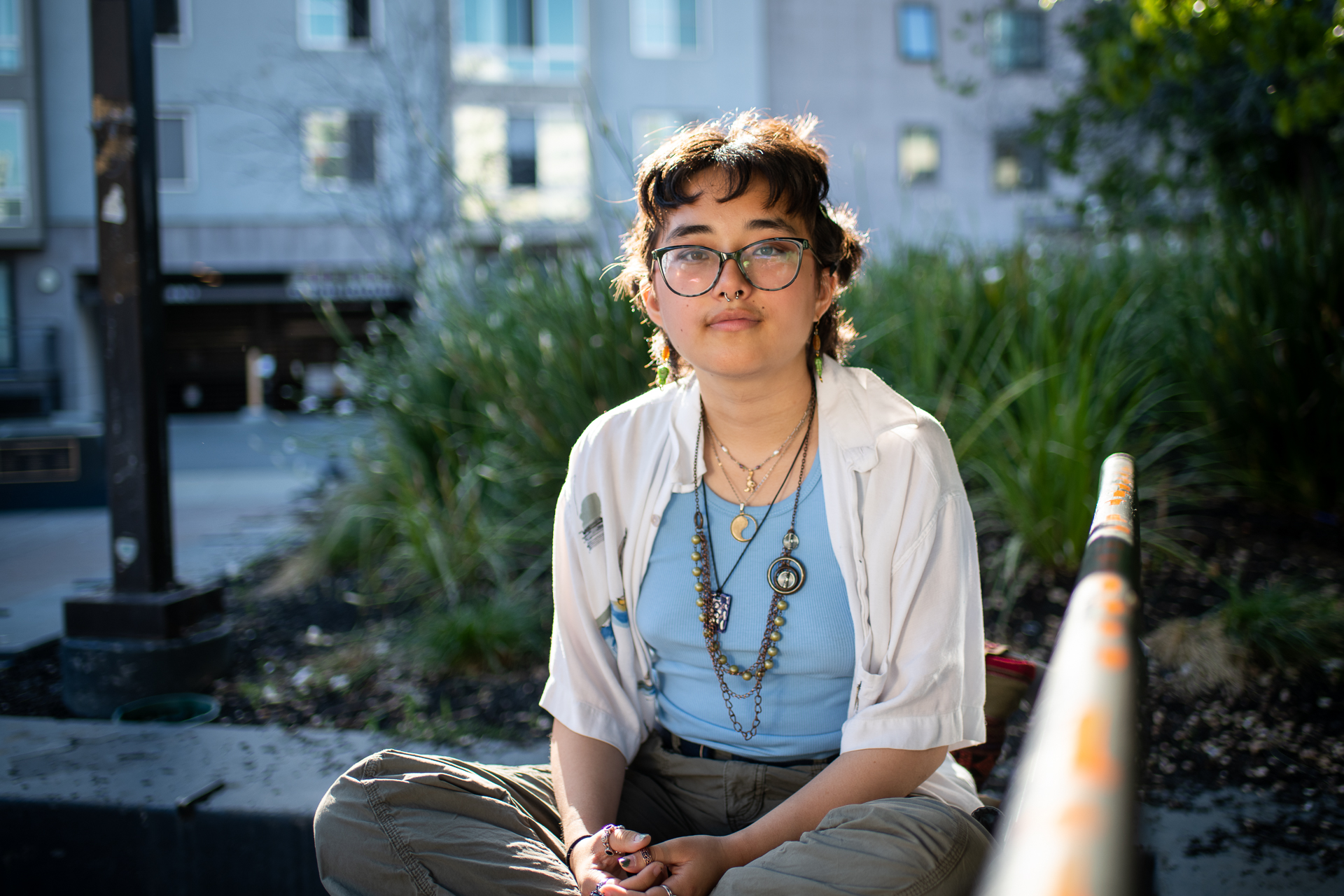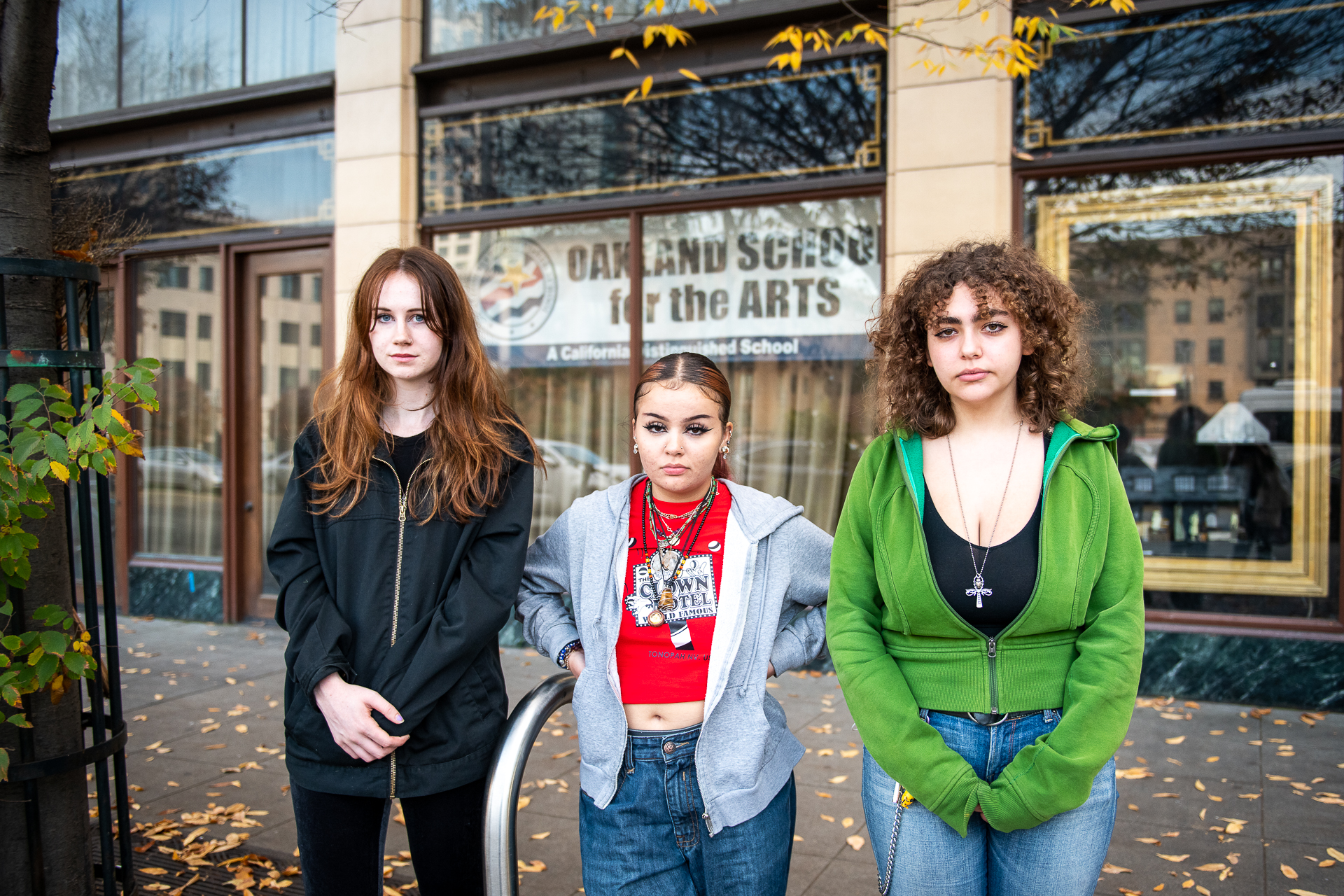
On Sept. 30, 2021, hundreds of students at Oakland School for the Arts walked out of class to protest sexual misconduct both on and off campus. Students marched to nearby Uptown ArtPark, where organizers said they read a list of demands that included calls for the school to hold regular assemblies about consent and improve the sex education curriculum.
Maya McCall, 17, who was a senior at the time, helped plan the protest. In an interview with KQED, she said dozens of students lined up that day in the blazing heat for a chance to share their experiences with harassment or assault. Classmates hugged, wore blue to show solidarity and cheered, “We believe you,” and “You’re not alone.”
“Just so much love and support that you don’t know what to do,” McCall said.
But that feeling didn’t last.
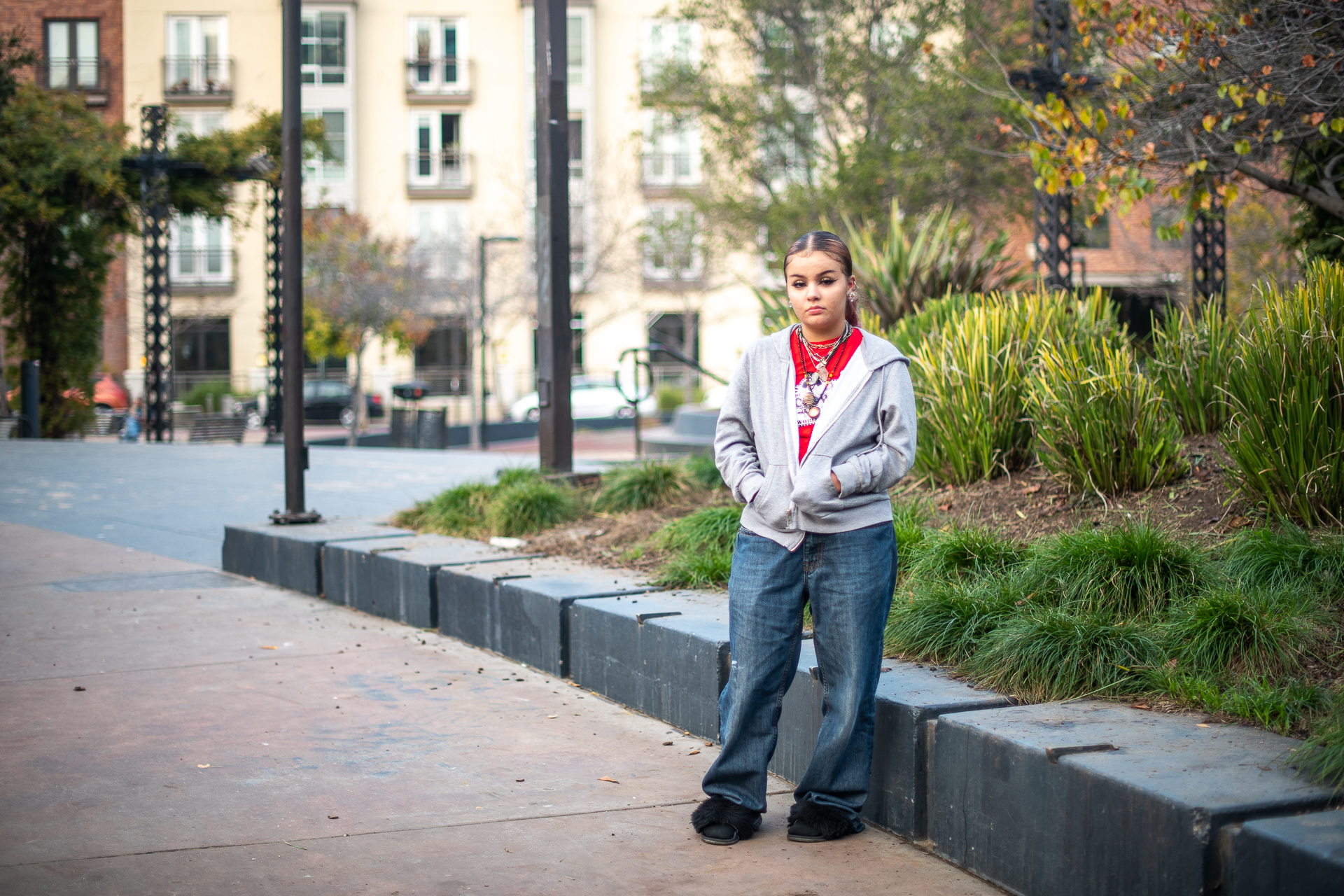
Some of the young people who attended the walkout were allegedly retaliated against by students or their family members, according to accounts by classmates.
Certain boys were allegedly called rapists and bullied by other students, according to several parents.
Lisa Sherman-Colt, the school’s executive director at the time, sent an email to the school community that in response to bullying, “there have been several fights and physical or verbal altercations on campus.”
She said the accusations made against students “almost exclusively [targeted] black heterosexual males.”
Organizers said the response from the school created a false division, and undermined the trust of women of color who had experienced abuse and spoke at the walkout.
Mike Oz, the current executive director of the school, declined to be interviewed, but wrote in a March 20 email, “My leadership team and I are one hundred percent focused on providing the support and services our students, families and faculty need as a result of the walkout.”
The upheaval at OSA is not an isolated event, but part of a national movement by students to get schools to take concerns about sexual harassment and abuse seriously, and to create safe ways for students to report incidents.
Faced with inaction by administrators, students in California and around the country have also tried to protect themselves or their friends. In February, a Fortuna High School student was suspended after she wore a T-shirt with the name of an alleged perpetrator and a text message he reportedly sent defending his behavior. Student activists in San Francisco, Berkeley and Los Gatos have said classmates faced social consequences, were harassed online or were threatened with lawsuits.
In an attempt to understand what led to the September walkout at OSA and the chaotic aftermath, KQED spoke with 24 students and alumni. Almost all of them said the school had failed over the years to respond adequately to sexual harassment or abusive behavior.
The publishing of this reporting, which includes several months of interviews and the review of dozens of records, comes just days after the Bay Area News Group reported that a teacher at Oakland School of the Arts, Jeremy Taylor, had been “arrested and charged with molesting a then-14-year-old girl throughout her freshman year, in 2004.” The alleged crime was reported to police last year, according to police records. But Taylor, who was described as “creepy” by a student, was no longer in “active status” at the school effective Jan. 13, according to a memo obtained by KQED that was sent to OSA families.
In an email to OSA families sent Sunday, Oz wrote that the school was notified of allegations against Taylor by Oakland police on Jan. 3, and Taylor was put on “inactive status” that day and “never returned to teach at OSA.”
A refuge for young artists
The nonprofit charter school was founded in 2002 by then-Oakland Mayor Jerry Brown to promote the study of arts. Middle and high school students study subjects like theater, dance and fashion design.
Zendaya and Angus Cloud, stars on the hit HBO show “Euphoria,” attended the school. So did Leila Mottley, author of “Nightcrawling” and the youngest writer ever selected by Oprah’s Book Club.
While several students and alumni who spoke with KQED described OSA as a refuge for young artists, they also believed the school at times used its reputation as a safe space and progressive art institution to dismiss harassment or abuse. Several said they were not taken seriously when they reported abusive or inappropriate behavior. Others said they did not complain to administrators because they did not expect support.

Imarra Hunter, 23, graduated from OSA in 2017. In a recent interview, she said she loved studying theater in school, but was crushed her junior year after a school security guard sexually harassed her.
Hunter said she was in the hallway getting a drink of water when the guard, Tamaris Usher, asked her why she needed it.
“I said, ‘I need to take some water with my birth control,’” Hunter recalled. “Once he (saw) that I was taking birth control, he then called me a ‘whore.’”
Hunter and her mom reported the incident to Donn Harris, OSA’s executive director at the time of the incident. According to Hunter, Harris said his goal was to save the security guard’s job and offered to station the man in a different part of the school.
In an email to KQED, Harris asserted that the school took the allegations seriously. Records show the school placed Usher on leave the day Hunter reported the incident. A termination notice shared with KQED shows Usher was terminated after nine days and not allowed on campus during the investigation.
Hunter’s mom sued OSA in 2016 for failing to protect students from sexual harassment. The complaint alleged that school administrators knew that the security guard “had previously accosted other female students in a similar manner, but was neither disciplined nor terminated for such behavior.”
The case was settled in 2017. Usher declined to comment.
Hunter, who majors in theater and communication studies in college, says she’s still wary of getting close to male administrators or teachers.
“I would hate for them to feel comfortable enough to say anything degrading,” Hunter said.

When Hunter filed her lawsuit, Susanna De Angelis Nelson, 18, was in middle school at OSA. They said they loved being surrounded by art and artists.
“I was literally in heaven,” De Angelis Nelson said.
But in high school, they saw another side to campus life.
During the 2018-2019 school year, De Angelis Nelson said a student made repeated sexual comments and touched them without consent. After they reported the sexual harassment to the dean, they said the teacher moved the boy’s seat next to them and the harassment got worse.
“I don’t love the fact that (administrators) say their No. 1 priority is for students to be safe, but that’s the exact opposite of what they’re doing,” De Angelis Nelson said.
In the 2019-2020 school year, several students told KQED they learned classmates were sharing nude photos of female students via social media in what was allegedly known as the “Pokemon Traders” group chat.

Students said the school was aware of the group chat. Cassidy Kanner-Gomes, 17, a rising senior at OSA, said because the school did not communicate about the situation with the student body, rumors began to spread. She remembers walking down the hallway and seeing people staring at the girls.
“The least (the school) could’ve done was give the girls support, which I really don’t think they did,” Kanner-Gomes said.
Steven Borg, a spokesperson for OSA, did not respond to questions from KQED about the group chat or how the school handled allegations made by students. But, in a written statement, he said, “Students do not always fully understand the complexities of what has occurred. Equally important they don’t always fully grasp the privacy and due process regulations we are required to follow.”
“As a teaching institution, we are striving to make sure all of our students feel safe and have agency,” he added. “Much of our restorative work has included education and training in the areas of consent, proper use of social media, bullying, cyber bullying, and procedures to report abuse and how these submissions will be handled.”