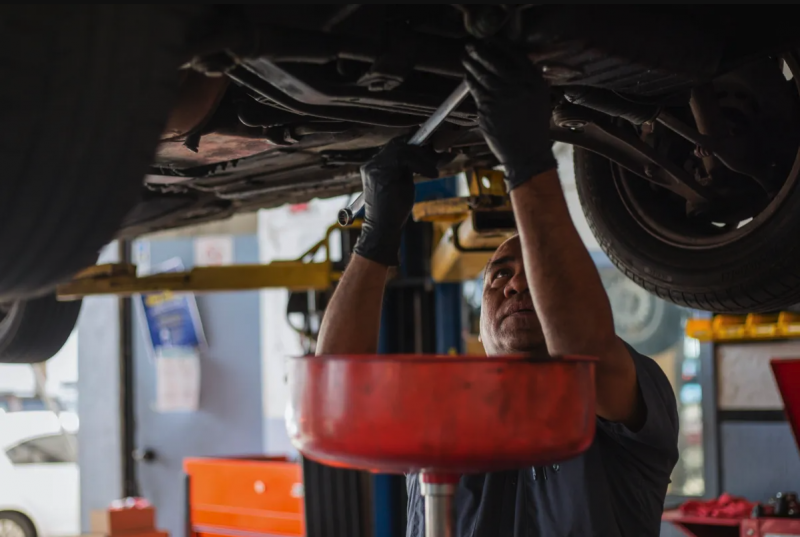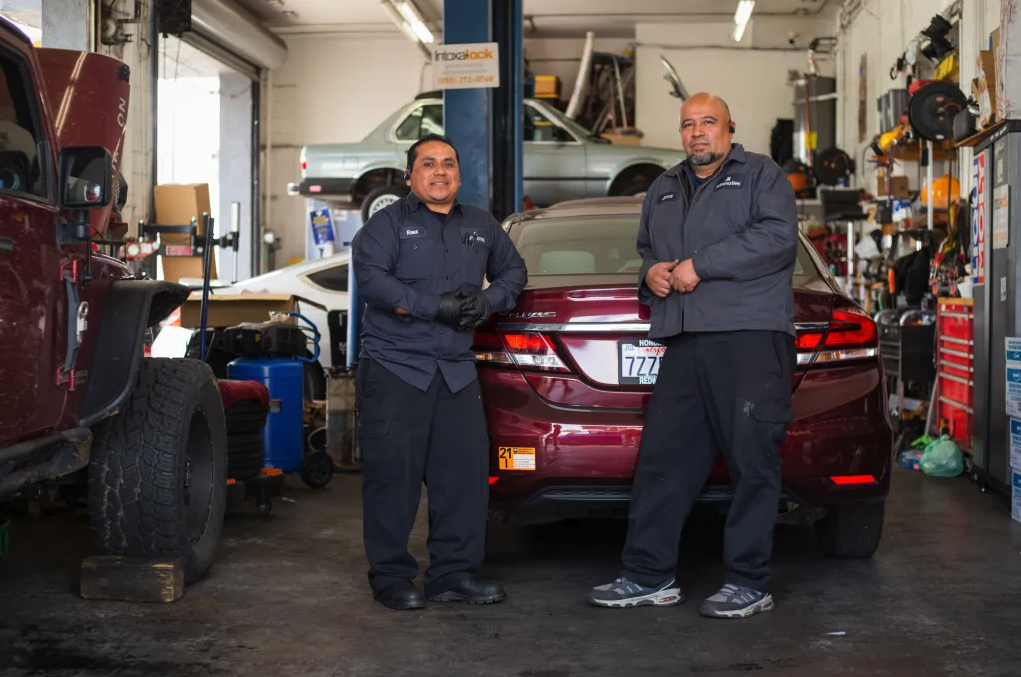
The pungent odor of motor oil and grease wafts through the air at JR Automotive in San Francisco as Jesus Rojas lifts the hood of a 2014 Honda Civic to inspect its engine.
Gasoline-powered vehicles like this one have hundreds of moving parts and other components that keep mechanics like Rojas busy. Rojas, 42, has spent much of his life refining the specialized skills needed to inspect and repair them.
But as California switches to electric vehicles in its battle against climate change and air pollution, these skills will be needed less and less over the next decade. By 2040, the state projects that nearly 32,000 auto mechanic jobs will be lost in California, since electric vehicles need far less maintenance and repair than conventional combustion engines.
"I'm not against electric vehicles," said Rojas, who immigrated to the Bay Area from Mexico as a teenager and opened his own shop 11 years ago. “I’ve always loved cars and I’ll work on them until I can’t anymore. So we have to adjust. We have to get out of our comfort zones.”
In an effort to transform to a carbon-neutral, climate-friendly state, California’s proposal to phase out all new gas-powered cars by 2035 will drive a wide-ranging transition of the workforce.
Throughout the economy, an estimated 64,700 jobs will be lost because of the mandate, according to the California Air Resources Board’s calculations. On the other hand, an estimated 24,900 jobs would be gained in other sectors, so the estimated net loss is 39,800 jobs, a minimal amount across the state’s entire economy, by 2040.
But no single workforce in the state would be hurt more than auto mechanics: California has about 60,910 auto service technicians and mechanics, and more than half of those jobs would be lost over the next two decades if the mandate goes into effect, the air board calculates.
The transition would be phased in over a decade: Beginning with 2026 models, 35% of new cars and light-duty trucks sold in California would be zero-emission, reaching 51% in 2028, 68% in 2030 and 100% in 2035. The board will hold a hearing on June 9 before voting on the proposal in August.
Alex Dirige, 67, an immigrant from Guam who has worked as a mechanic in San Francisco for more than 30 years, worries that the transition to electric cars will threaten the livelihoods of marginalized groups like undocumented immigrants and cause many auto repair workers to leave the industry altogether.
The trade provides a steady and reliable income in California for many workers with no college degree. On average, mechanics across the state earn about $26 an hour or $54,190 a year, according to the U.S. Bureau of Labor Statistics.
“Many mechanics who have started working see that there’s not a long-term future in the auto repair business, with hybrids and electric cars coming out,” Dirige said. “The electric vehicle repair market is just about nonexistent. A lot of them would love to be in the field but they might choose to go into other types of employment.”
Who loses and who gains jobs
California is already suffering the ill effects of climate change — which damages its economy, not just its public health and its environment. About 40% of the state's greenhouse gas emissions come from transportation, the largest of any sector, so state leaders say reducing reliance on gasoline and moving toward electric cars is crucial to averting even more disastrous effects.
Some industries gain jobs while others lose them as the state shifts to zero-emission vehicles.
The retail trade sector, which includes gas station workers and automobile and parts dealers, would lose 38,669 jobs by 2040 or about 2% of the retail workforce. Most of the losses would be at gasoline stations. As the electric vehicle fleet grows, air board officials project gas stations could provide charging to offset the losses.
Some of the loss in the retail sector is due to less expendable income. Electric cars now cost more to purchase, although prices will drop and maintenance will cost far less, saving about $3,200 for the life of a 2026 car and $7,500 for a 2035 car, according to the air board.
Another 20,831 jobs in state and local government would be eliminated because of the decrease in gas tax revenue.
But the transition to electric cars also will create thousands of jobs. Southern California Edison, Pacific Gas & Electric and other power industry companies would benefit most, with the creation of about 5,600 jobs by 2040 as car owners spend more on electricity to power their vehicles. Insurance carriers will benefit from about 1,700 new jobs, while the construction industry is expected to gain about 3,600.
Since few vehicles are manufactured in California, the state is unlikely to see a surge in manufacturing in response to the mandate. Of the 44 major auto assembly plants in the U.S., most are located in the Midwest and the South, according to a 2021 report from the International Council on Clean Transportation, a nonprofit research organization.
A 'slow-moving' change
Mechanics who work on internal combustion engines would still have plenty of work: The rule would not ban sales of used cars, and it wouldn’t force the state’s residents to stop driving the roughly 29 million gas-powered cars that are already on the road. Californians also could keep importing new or used vehicles from out of state.
That means Californians will still own a lot of gas-powered cars past 2035, softening the blow for car mechanics and industries dependent on fossil fuels, said James Sallee, an economist and research associate at the Energy Institute at University of California, Berkeley’s Haas School of Business.
Sallee said the changes wouldn’t occur fast enough to trigger a sharp economic slowdown within the auto repair industry.
“It’s when there’s quick and rapid changes that we think the most harm is done to workers because they can’t relocate freely and quickly,” Sallee said. “So it’s important people have in perspective that it is a slow-moving process, not a dramatic and super-fast shift away from demand for gasoline stations or oil changes. It’s going to be something that takes place over a longer time period.”
Electric cars have fewer fluids, such as engine oil, and fewer moving parts than a conventional car. Brake systems also last longer because of regenerative braking, which converts energy from the brake pads into electricity to recharge the battery, according to the U.S. Department of Energy. They also don’t have mufflers, radiators and exhaust systems.