“When kids struggle, they immediately say ‘I don’t have a math brain,’” Boaler said. “That changes how the brain operates.”
Delaying Algebra 1 until 9th grade, however, would require other high school math classes like Geometry, Algebra 2 and Pre-Calculus to be compressed so that students can reach AP Calculus by 12th grade.
Jitomirskaya said that waiting until high school for Algebra 1 would result in accelerated pre-calculus courses that would be too difficult for most students.
Norm Matloff, a computer science professor at UC Davis and a critic of the framework, said compressed mathematics classes are “dangerous” because they inevitably leave out parts of the curriculum.
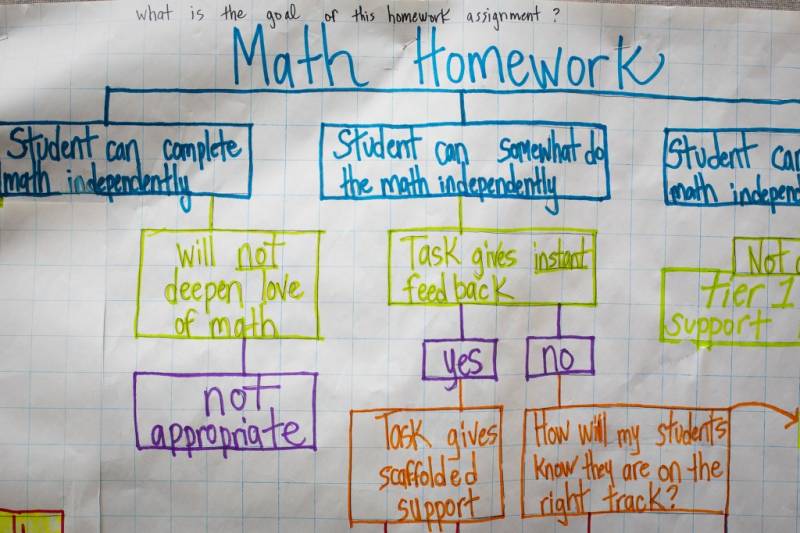
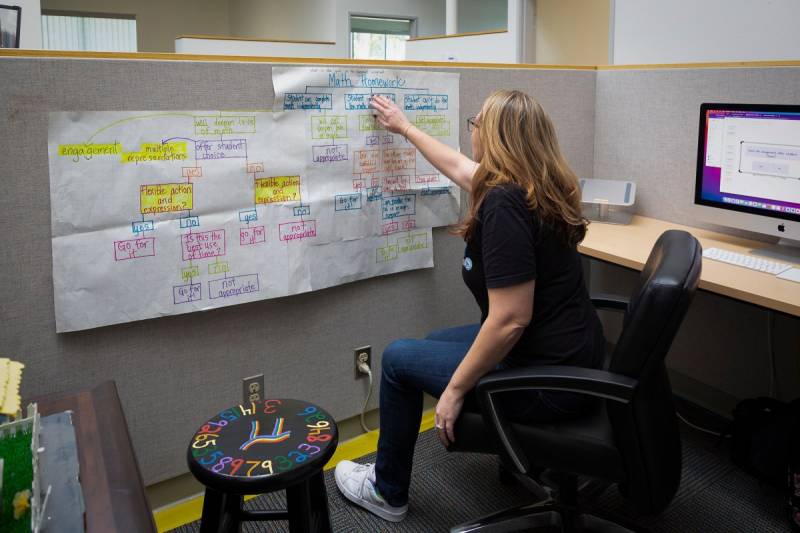
For Boaler and her co-authors, integrating traditionally separate math classes goes hand-in-hand with open-ended inquiry. For example, instead of assigning repetitive problem sets, teachers would use collaborative projects such as calculating the living wage in the students’ communities. Open-ended assignments like this don’t necessarily have a single right answer.
Some education experts and math professors say the framework’s emphasis on open-ended assignments just leads to confusion, especially for struggling and historically marginalized students.
The calculus calculus
The framework also creates a new high school data science course as an alternative to calculus. The authors say this course will result in a more diverse student body pursuing careers in science, technology, engineering or mathematics. But some experts say calculus is vital to prepare students for a STEM career.
“If you want a job in data science that isn’t replaceable by a computer in the next couple of years, you need to take calculus,” said Jitomirskaya, the UC Irvine math professor. “They want a data science course that is completely dumbed down.”
State data indicate that not only do relatively few students take calculus in high school, but the number of students enrolling in the most advanced calculus classes — dropped in the past four years to a mere 3.4%.
The framework’s authors counter that taking calculus in high school shouldn’t be necessary to enter a STEM field in college and beyond, especially because calculus can be a barrier to entry for Black and Latino students.
“Derivatives and integrals aren’t important to get into college. The college credit and the AP exam are more important,” Ford said. “Many of us at the college level would prefer students to come to us more ready to take Calculus 1.”
The University of California and Cal State systems have taken steps to de-emphasize calculus as an admissions requirement.
Rose, the UC Berkeley student, said she didn’t come to appreciate the beauty of calculus until she reached college. She said her classmates who came to college without having taken AP Calculus sometimes scored higher than she did in their university-level calculus courses.
Is it ‘woke’ math?
Other critics lambaste the new framework as “woke math” that “de-mathematizes math” with “social justice lessons” and “left-wing ideology.”
An open letter signed by over a thousand STEM experts condemned the framework for suggesting that teachers highlight the “contributions that historically marginalized people have made to mathematics,” “take a justice-oriented perspective at any grade level,” and use inclusive gender pronouns.
A Wall Street Journal editorial that helped spark national interest in California’s math curriculum and conservative publications like the National Review have objected to the framework’s occasional citation of “A Pathway to Equitable Math Instruction,” a manual that aims to show math teachers how they can use their class to combat white supremacy. The manual asserts that current math pedagogy in the U.S. reinforces white supremacy in a variety of ways, but its critics say numbers are numbers, so how can there be racism in math?
The authors removed references to the manual shortly thereafter.
Critics have also attacked recommended assignments that try to apply math concepts to social science topics.
But Brian Lindamann, one of the authors of the framework, said divisions between the two fields are often “artificial.”
“For example, something like understanding how cost-of-living works — that’s both mathematics and social justice,” he said. “The intersectionalities of many of these disciplines are the very things that propel society as a whole. Why not have an economics teacher and a math teacher teach a class together?”
She noted that an earlier draft of the framework included sample lessons on calculating a school cafeteria’s food waste — but that many of her students would have found the entire exercise alienating because they lack food security at home.
Bigger, structural problems
The framework committee met several times over eight months. Pariso describes the meetings as an “intense” collaboration between math teachers, school district administrators and math education experts.
The authors, five professors from across the state, wrote an 800-page draft that generated both praise and criticism.
After absorbing blowback in hours of public testimony, the California State Board of Education delayed the approval process by two months.
Whatever impact a new framework has, California public schools still face systemic challenges.
Aris Biegler, a Los Angeles math teacher who helped design the framework, said smaller classes are key: “If a kid isn’t comfortable multiplying six times four, I can sort of reinforce them without shaming them.”
But amid an ongoing teacher shortage, teaching is less appealing for those graduating college with STEM degrees.
“I have students who are very passionate about teaching… But they would prefer the higher paying STEM jobs,” Jitomirskaya said.
Still, not all districts will fully implement the new framework’s recommendations — even so, Pariso said it’s a step in the right direction.