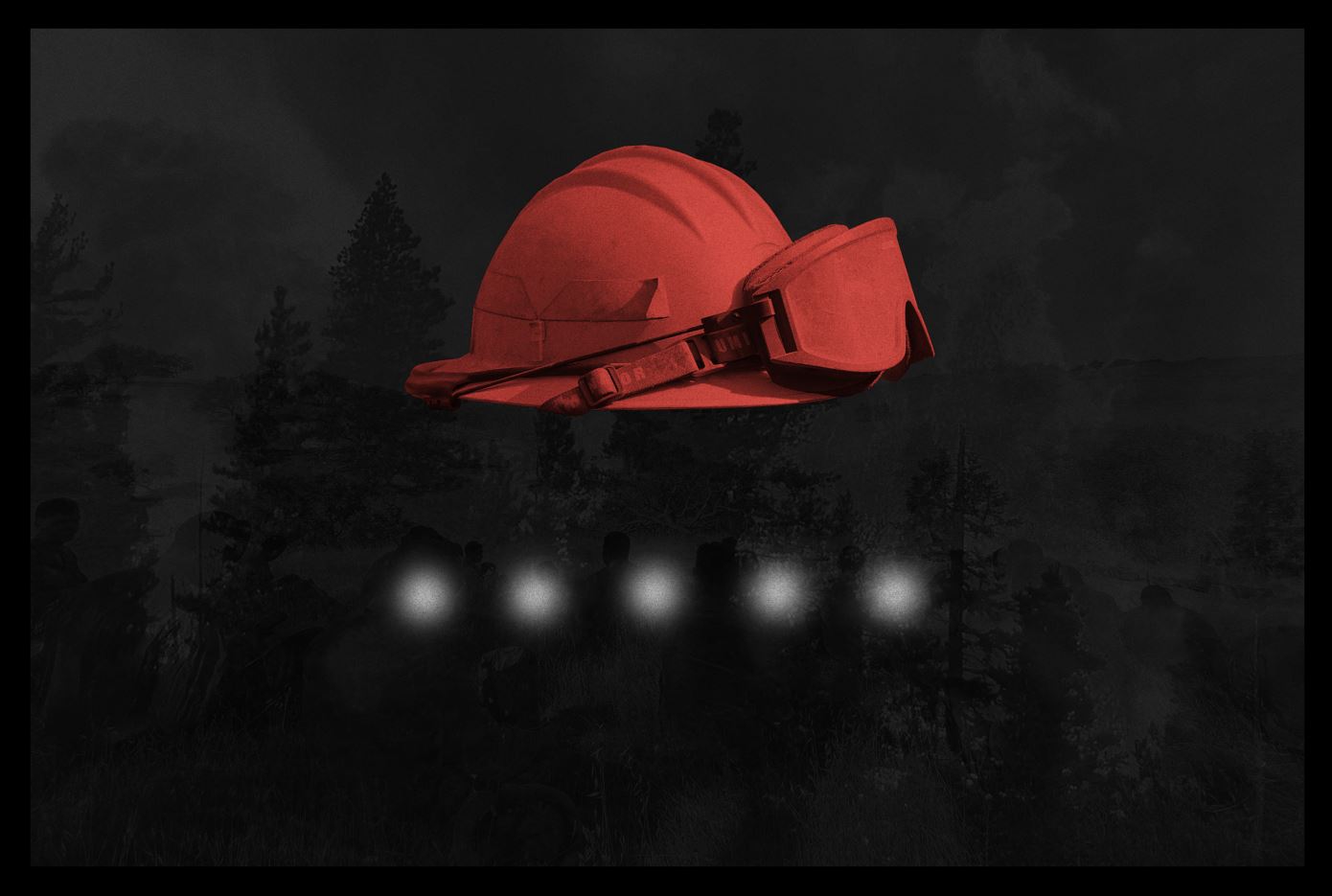
Over the last year and a half, almost four dozen Cal Fire firefighters
have suffered from heat illness during training, and since 2003, five have died. (Illustration by Alborz Kamalizad / Photography courtesy of Cal Fire)
Even as he lay dying on the side of a Southern California mountain — his lips blue, the color gone from his face — wildland firefighter Yaroslav Katkov wanted to push on.
“We’re getting to the top. We’re finishing,” his captain recalled Katkov saying after collapsing atop a ridge during a training hike in hot weather, according to state records.
Katkov’s speech was garbled. He tried to stand, but couldn’t find his footing. His body temperature was reaching dangerous levels. He was suffering from heat illness.
What happened on that sun-soaked July day in 2019 is one thread in a larger story about firefighter training in an era of intensifying heat.
During the past 18 months, more than 150 firefighters were sickened by heat exposure while working for the California Department of Forestry and Fire Protection, known as Cal Fire.
More than a quarter of heat-related incidents — the largest category — involve firefighters who fell ill during routine training exercises, Columbia Journalism Investigations, KPCC and LAist found. Like Katkov, nearly all of these firefighters worked part time.
Interviews with current and former Cal Fire employees, medical personnel and wildland firefighting experts reveal multiple issues involving workplace safety during Cal Fire training activities. This is true especially for those who don’t work year-round, such as seasonal and incarcerated firefighters. (Illustration by Alborz Kamalizad / Photography courtesy of Cal Fire)
The incidents, documented in Cal Fire’s workplace-injury logs, were specifically classified as heat related and occurred between Jan. 1, 2020, and Aug. 3, 2021. CJI and LAist were unable to ascertain how typical the case numbers are. Cal Fire refused to say whether they were unusual or in line with annual totals for heat illnesses among workers over the past decade. The department declined to provide data that could put the numbers into a broader context.
CJI and LAist compiled less comprehensive data from internal Cal Fire reports on employee training injuries dating back to 2001, in addition to other state records. These documents show at least 14 other incidents that bear what some experts say are hallmarks of heat-related illness. In five of these incidents, the firefighters died.
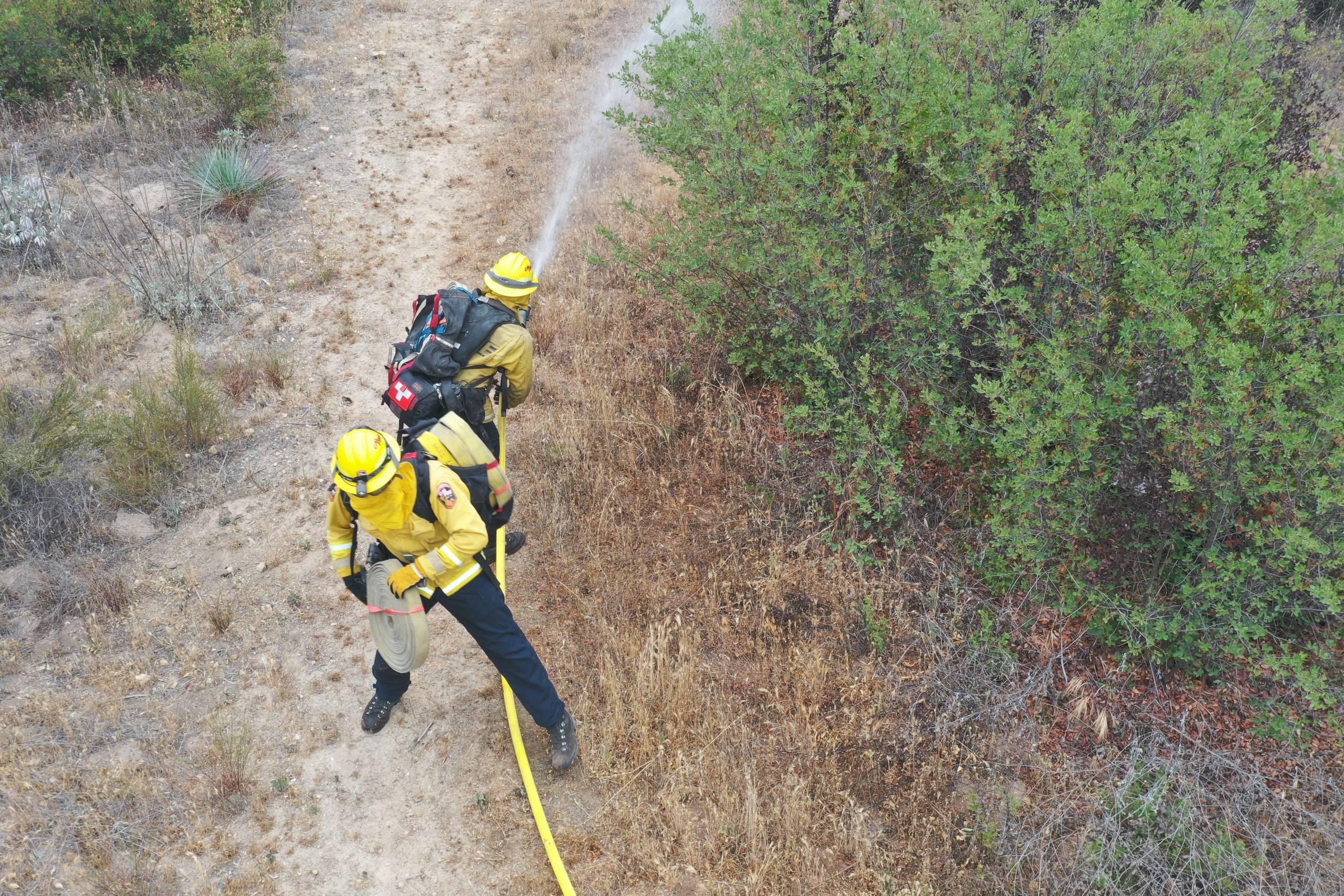
All the firefighters succumbed to injuries not on the fire line in some remote California wilderness, but during required training. Many were decked out in full wildland gear — wearing long-sleeve jackets, pants and helmets while carrying heavy tools — and doing activities meant to simulate wildfire fighting — taking short hikes into the woods, for instance, or laying hoses up a mountainside.
All but one of the deaths occurred in temperatures ranging from 70 to 87 degrees. Four of the victims were incarcerated, participating in a state program meant to bolster firefighting forces that dates back to WWII.
Public health experts and federal workplace regulators agree that heat-related illnesses and deaths are 100% preventable.
Interviews with current and former Cal Fire employees, medical personnel and wildland firefighting experts, a review of hundreds of pages of government records detailing firefighter injuries and deaths and an analysis of worker heat death cases reveal multiple issues involving workplace safety during Cal Fire training activities. This is true especially for those who don’t work year-round, such as seasonal and incarcerated firefighters. Combined, they make up about half of the agency’s nearly 10,000-strong firefighting force.
Katkov’s death was exceptional in just how many institutional failures occurred during his hike, records show. But many of the other cases of heat-related injuries and deaths indicate the same underlying problems — a punitive culture that can endanger firefighters’ health, a lackluster physical screening process and an ineffective plan for building up firefighters’ tolerance for heat.
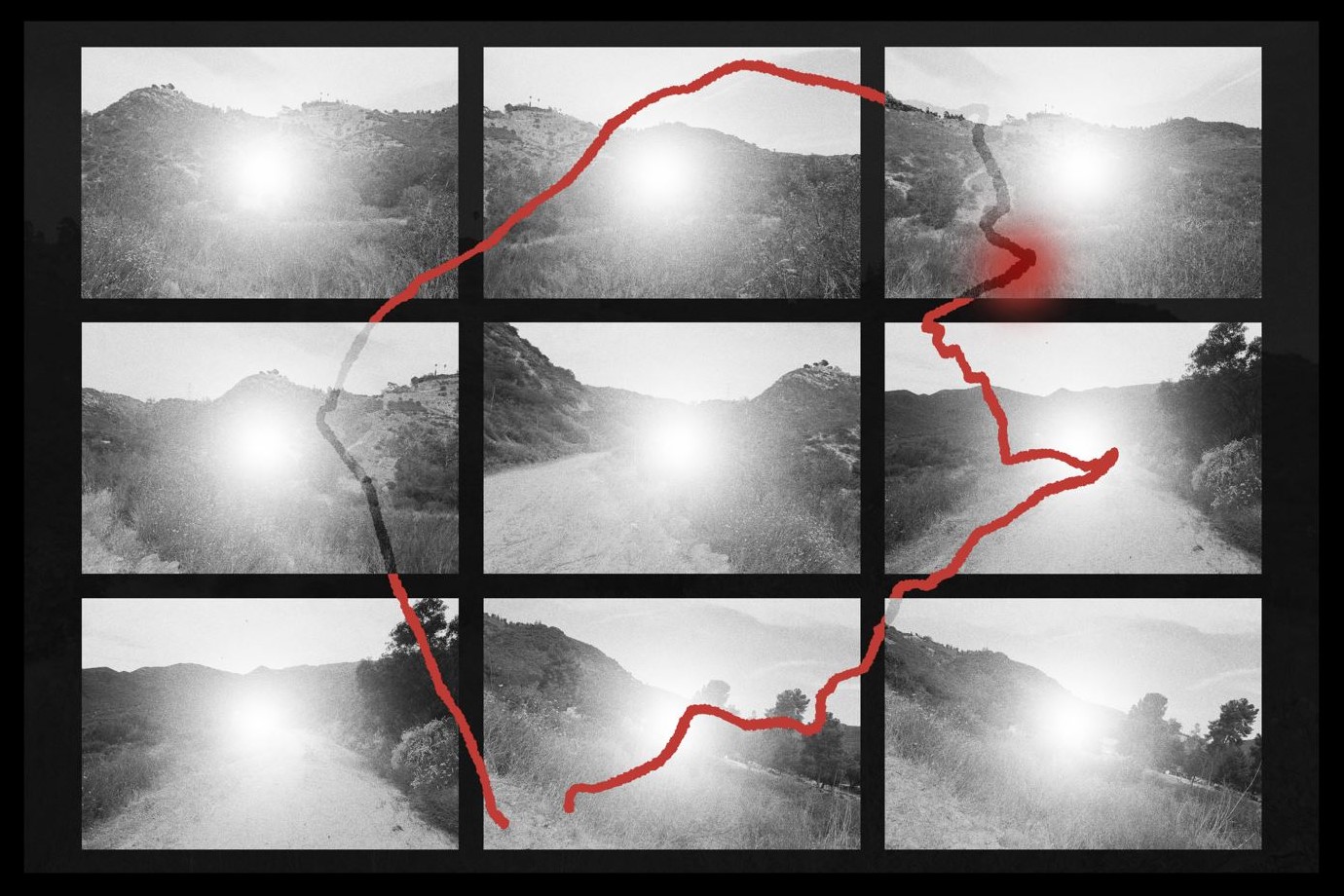
Yaroslav Katkov collapsed on his second lap of the 1.45 mile Lippe Hike in Fallbrook, California, a mountain town ringed by ranches just outside of Temecula. According to documents related to the hike, Katkov’s captain ignored signs from Katkov of potential illness. (Illustration by Alborz Kamalizad / Photography courtesy of Cal Fire)
Warning signs
On the day of Katkov’s hike, Cal Fire officials later found that his captain, Joe Ekblad, had missed opportunities to act on several telltale signs of heat illness. Not until Katkov collapsed at the top of that ridge did Ekblad begin emergency procedures.
The captain later explained he believed that they could cool Katkov down if they moved fast enough. They stripped off his jacket and drenched him in water. But it didn’t work. Katkov took several deep “gulpy breaths,” according to documents obtained from the state’s Division of Occupational Safety and Health, known as Cal/OSHA. Still, Ekblad delayed calling for emergency help because he thought Katkov “would snap back out of it,” the records show.
Katkov died of hyperthermia at a hospital the next day. Cal Fire demoted Ekblad. The department found he had “failed to identify a crew member … in physical and/mental distress.” Ekblad didn’t respond to requests for comment. Records show he told investigators that Katkov was a willing participant in the exercises.
Cal Fire didn’t respond to several requests to interview the department’s head of safety. In a statement, it said it “vigorously rejects the notion that a punitive culture exists in relation to the fitness, safety, or wellbeing of our workforce.”
The department says it trains all its firefighters — seasonal, incarcerated or otherwise — on the dangers associated with wildland firefighting, “including methods to prevent, recognize and respond to symptoms of heat related illnesses.” It described its efforts to combat heat-related injuries and deaths as “a partnership” with individual firefighters.
“Each must do his/her part year-round to ensure that they are preparing for the upcoming fire season,” the department wrote.
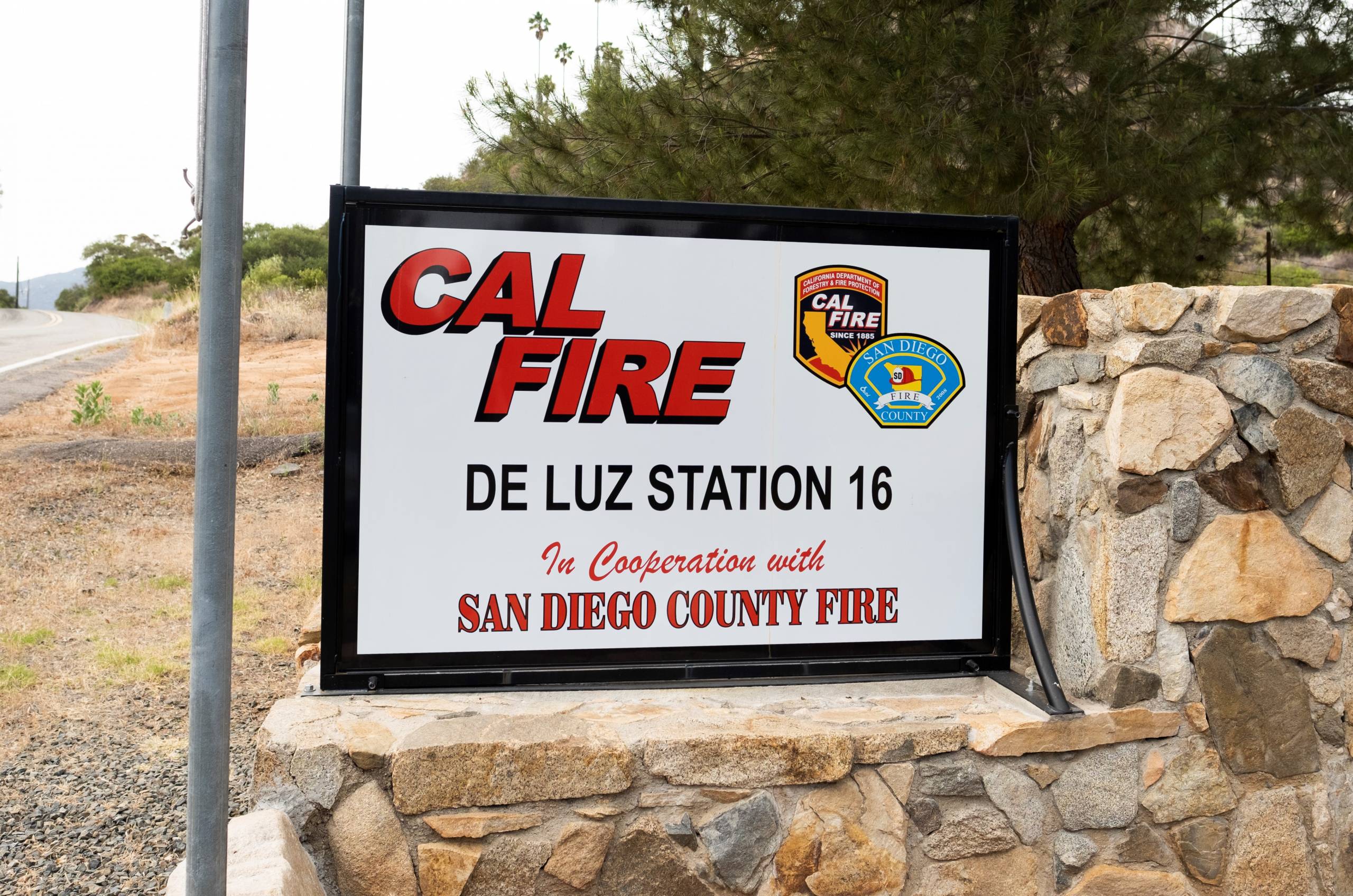
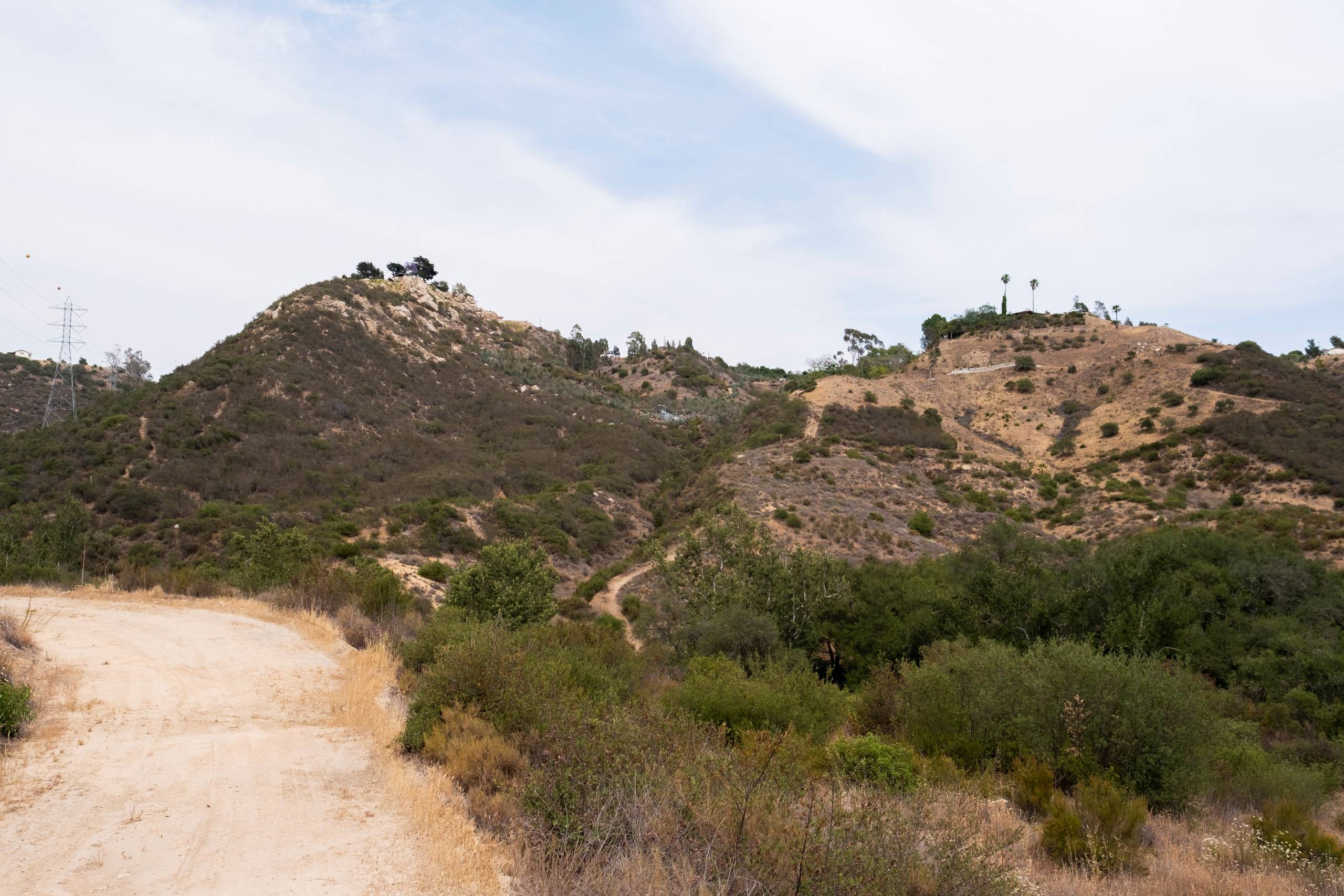
On July 28, 2019, Katkov embarked on a training exercise called the Lippe Hike, a 1.45-mile loop at Cal Fire’s Station 16 in Fallbrook, California, a mountain town ringed by ranches just outside of Temecula.
Gavin Bledsoe, one of the station’s other fire captains, later told Cal/OSHA investigators that “he had concerns with Joe pushing Yaro hard,” and that Ekblad had pushed other firefighters without giving them enough time for breaks in the past.
The Lippe Hike winds through the hills just behind Cal Fire Station 16 in northern San Diego County. (Jacob Margolis/LAist)
According to documents related to Ekblad’s demotion, the hike that preceded Katkov’s death had never been timed before that morning, and Bledsoe believed the standard for finishing it was set “specifically with Yaro in mind.”
“Joe has been pushing really hard to get Yaro to quit or up to his standards,” Bledsoe told Cal/OSHA investigators about the rookie firefighter who regularly hiked the area.
Bledsoe didn’t respond to multiple phone calls and text messages seeking comment.
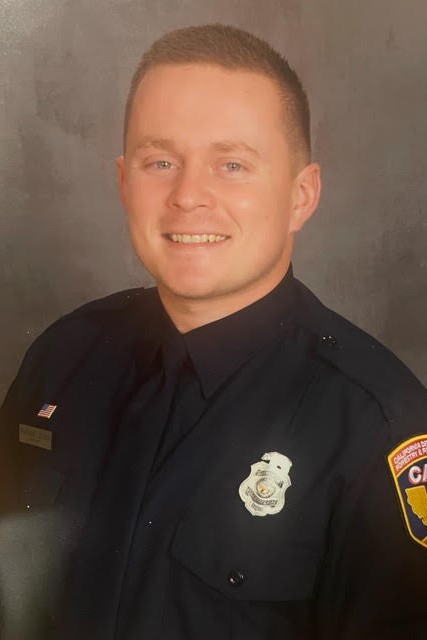
Cal Fire firefighter Yaroslav Katkov. Katkov died of hyperthermia at a hospital the day after embarking on a training exercise called the Lippe Hike. (Courtesy of Ashley Vallario)
A quarter-mile into the hike, seasonal firefighter Matthew Guerrero told investigators, Katkov was breathing heavily. At one point, as the hike wound from mountains alongside a road, Katkov was slow to move out of oncoming traffic.
Ekblad wrote in his notebook, “Road Hazard – Cognitive Question.” This was an early sign of heat illness that Ekblad ignored, Cal Fire documents show.
The trio completed the hike in about 40 minutes — 10 minutes slower than the time Ekblad had set for the station that morning.
“We’re gonna do it again. The first hike was unacceptable,” Ekblad said, according to the Cal/OSHA investigation.
Ekblad later told the agency’s investigators that doing the hike twice wasn’t standard practice. Cal Fire concluded that it was “clearly unnecessary” given the signs of distress Katkov had exhibited.
The trio rested for 20 minutes, drank some water and set off to do the hike again. By then, the temperature had climbed to nearly 88 degrees — five degrees hotter than the 40-year average for the area.
On the steep, often-shadeless path, Katkov told Ekblad he was exhausted — another symptom of heat illness that Ekblad should have recognized, Cal Fire documents said. Rather than seek emergency care, however, the captain encouraged both firefighters to press on, and they pushed up the hill. Guerrero helped steady Katkov’s balance, but Katkov stumbled and had to pause at least 20 times.
Atop the 650-foot ridge, Katkov fell forward and sat down. Ekblad told him to take off some of his wildland gear, and Guerrero tried to shade him with a jacket. They poured water on him, but his eyes rolled back. He eventually passed out.
Nearly an hour after starting the hike a second time, Ekblad called for help. Katkov began to shake uncontrollably. It took another hour for an air ambulance to get to the remote location and transport Katkov to Temecula Valley Hospital. He died the next day.
Cal/OSHA inspectors found that Cal Fire:
Hadn’t provided enough water or shade on the hike.
Failed to monitor Katkov for preexisting sensitivities to heat.
Didn’t prepare Katkov for the intensity of the job, as required under Cal Fire’s heat-illness prevention plan.
Didn’t initiate an emergency medical response until it was too late.
Cal/OSHA fined the department $80,875 — almost five times the average Cal/OSHA fine of $17,000 for all types of cases.
A ‘toughness mentality’
Ashley Vallario, Katkov’s longtime girlfriend, said she was shocked after reading the investigation. It was clear that Cal Fire hadn’t done everything it should have done to protect Katkov, she said. Its safeguards against workplace heat appear to have failed.
“They told me that everything that could have been done was done, and that there was no waste of time,” Vallario said. “I believed them.”
Cal Fire didn’t respond to written questions about Katkov’s death.
Yaroslav Katkov worked at Cal Fire De Luz Station 16 located in the hills just outside of Temecula.
Rank matters at Cal Fire. Impressing superiors can help a seasonal firefighter move on to a coveted full-time spot. But a tough paramilitary culture often pushes Cal Fire employees to their physical limits, even in hot temperatures.
In many cases, that culture has contributed to serious heat-related injuries.
In 2013, for instance, a Cal Fire firefighter was at a “rehire” training session in Riverside, meant for seasonal employees about to rejoin their crews. He and the other trainees were forced to do “extra rigorous” exercises after someone had arrived late, according to a Cal/OSHA investigation.
While the group practiced a simulated fire attack, the firefighter complained about feeling ill and asked his supervisor if he could take off his jacket.
The instructor said no and told the firefighter to sit down in the sun, the records show.
About 10 minutes later, a colleague reported that the firefighter did “not look good.” His legs cramped, and he was gasping for breath — both symptoms of heat illness.
The firefighter was hospitalized for two days, and Cal/OSHA fined the department $18,560 for violating California’s heat standard by failing to allow the employee to take an adequate rest break.
In a similar case in 2017, another Cal Fire firefighter was working in full wildland gear while moving a hose for a training exercise, according to Cal/OSHA records. After a break, a new instructor took over another round of the activity.
The firefighter later told Cal/OSHA that the work was more strenuous the second time, and that the instructor had “pushed the employee to do more.” The firefighter struggled to finish the task. He was so confused that he couldn’t answer questions, Cal/OSHA records show. An altered mental state is a red flag for heat illness, medical experts say.
The instructor mocked the firefighter and suggested he “go to Orange County since their training is easier,” the inspector wrote.
As in the earlier case, the firefighter spent two days in the hospital. Cal Fire was fined another $2,430 for failing to educate employees about heat’s threats and not providing ready access to water and shade.
Cal Fire Battalion Chief Jon Heggie, who leads several fire stations based in San Diego, including Katkov’s former station, said the department is working to root out the “toughness” mentality that has pervaded its ranks. Some heat-related incidents “have been an unfortunate wake-up call that maybe that culture needs to change,” he said.
But that may be difficult. Robert Salgado, a former Cal/OSHA inspector and wildland firefighter, notes that Cal Fire’s do-or-die attitude is one of the “very deep-rooted cultural practices in the fire service” that is passed from department to department.
“We don’t want the smartest guy … we don’t want the most trained guy,” Salgado said. “We just want a guy who can throw on a pack and hike hills.”
Cal Fire union president Tim Edwards of Local 2881 recalls a recent incident in which supervisors pushed firefighters in training activities beyond their limits.
“I’ll admit it, we had problems in San Diego in the last four months,” he said, explaining that one supervisor was warned about the way he was treating firefighters after a union member filed a complaint.
The supervisor was pushing firefighters to hike “when they weren’t feeling good,” Edwards said, “making them hike thinking if he pushed them a little bit further, it would help them.”
Cal Fire, for its part, acknowledges that the department spoke with the supervisor but said he was not reprimanded. It describes the incident as an example of how the department and the union can work together to address potential health issues before they get worse.
Sponsored
‘Don’t blame the firefighters’
Another problem, insiders say, is that Cal Fire doesn’t have a physical fitness standard that makes clear what kind of shape seasonal and incarcerated firefighters must be in when they return to duty after months off.
Without such a standard, firefighters may not realize they’re not fit enough until they’re on training hikes or in the field on hot days. At that point, it’s up to individual supervisors to say whether it’s a problem for any firefighter, and what that firefighter needs to do to improve. And that can make for trouble when those supervisors push their employees too hard, especially on hot days, to reach whatever level they deem correct, insiders say.
Edwards, of Cal Fire Local 2881, notes that the union has “been pushing for years to have a minimal physical fitness standard.”
He said the union wants seasonal firefighters to have their fitness tested over a week, with intense physical exercise and step-by-step goals to measure their progress. If they fail to pass those tests, he said, they could be set on a remedial path or let go.
Edwards blames the California Department of Corrections and Rehabilitation for issues involving incarcerated firefighters. He argues that Cal Fire has little control over these abilities when they arrive at fire camps, even though the 11 heat-related incidents involving incarcerated people identified by CJI and LAist occurred during official Cal Fire trainings.
The Corrections Department said Cal Fire has always trained incarcerated firefighters.
Currently, when a firefighter falls behind on fitness requirements, Cal Fire’s system leaves it up to individual stations to determine how that firefighter will move forward.
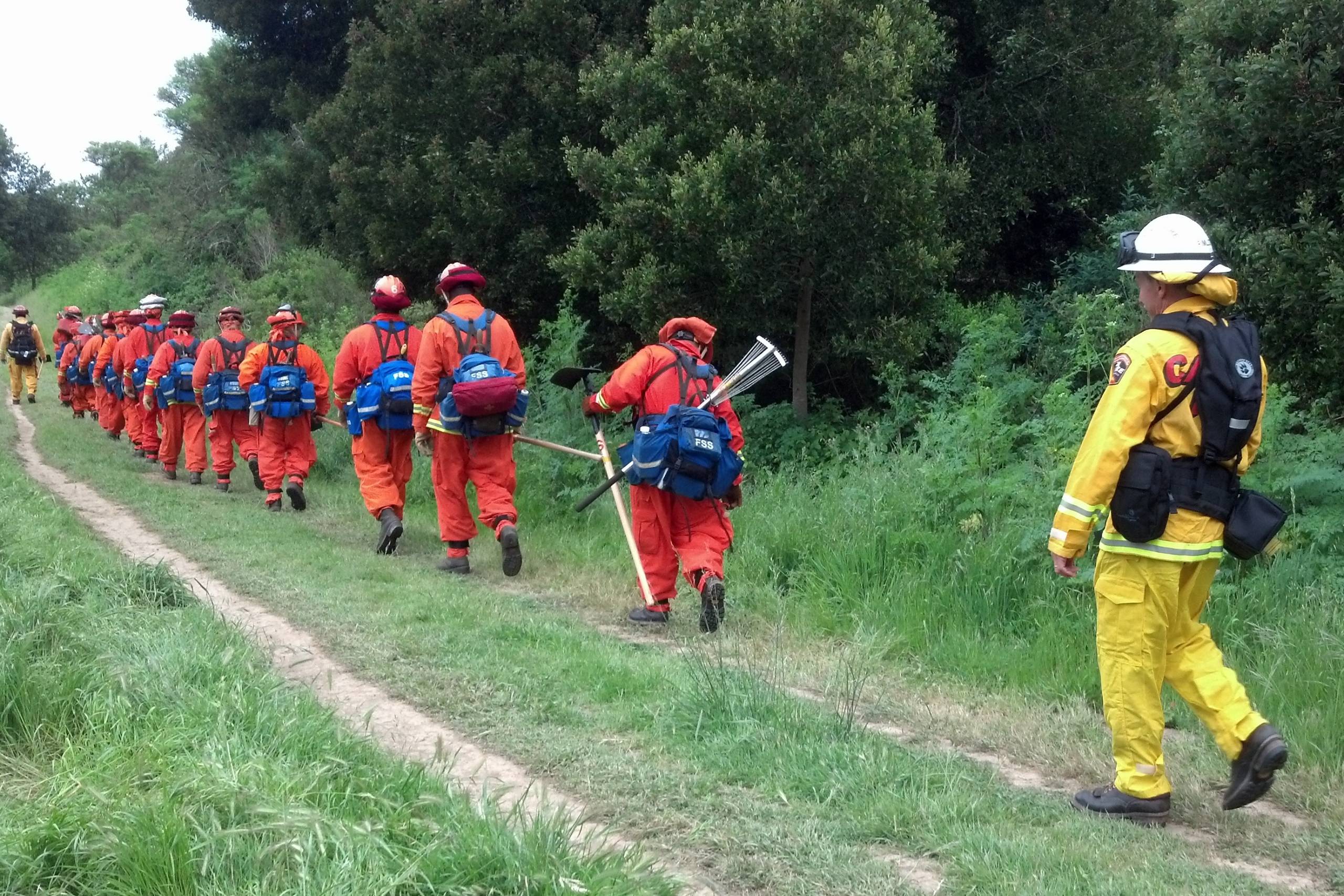
Incarcerated firefighters on a training hike with Cal Fire. Incarcerated individuals make up a big chunk of California’s firefighters during wildfire season, but some firefighter union officials point out that incarcerated firefighters don’t receive enough physical training from the California Department of Corrections and Rehabilitation before they join a crew. (Courtesy of Cal Fire)
When firefighters are assigned to a crew for the season, they are allotted an hour each day for personal training, and given access to wellness coordinators and workout gear. Supervisors are required to sign off on each firefighter’s monthly progress as part of a “Physical Fitness Documentation Log.”
In more than half of heat-illness cases examined by CJI and LAist, the firefighters didn’t have a fitness plan.
In interviews with a Cal/OSHA investigator, some of Katkov’s former colleagues raised concerns about his physical fitness.
But Cal/OSHA found that Ekblad had not created a fitness plan or any documentation to measure Katkov’s progress, records show.
In its statement, Cal Fire said it has no control over its firefighters’ “fitness efforts, caffeine intake, eating habits, water intake, sun exposure, alcohol consumption, or other factors that may impact their ability to perform their job functions” when they are off-duty.
It can take weeks or months for firefighters to safely build up their fitness, and experts say it’s not something that can be forced with strenuous exercise in a short period.
“Just as a runner cannot expect to run a marathon without months of preparation, a firefighter cannot show up for the beginning of fire season … without preparing their body for the tasks ahead,” Cal Fire said in its statement.
Brent Ruby, a University of Montana professor who has studied the physical demands of wildland firefighting, said ad hoc training is not the ideal way to train because there’s “a tendency to try to push” new or young recruits. As these firefighters press on, he said, the strain on their body builds up.
“They hike faster, they produce more heat,” Ruby said, “but the environment is still bearing down on them and pushing back on them.”
Dr. Thomas Ferguson, a consultant who says he reviews 8,000 medical files for Cal Fire each year, has seen how firefighters who are pushed too hard can get blamed for not meeting physical expectations.
Ferguson told Cal/OSHA investigators that seasonal firefighters like Katkov are most vulnerable to heat illness. According to Cal/OSHA’s investigative file on Katkov’s death, Ferguson urged the department to adopt a fitness standard for seasonal and incarcerated firefighters partly for this reason.
“Don’t blame the firefighters,” he said in a recent interview. “We’ve got to educate the supervisors to recognize that they need to pay attention to this.”
Firefighters with Cal Fire San Diego practice a progressive hose lay during training. (Courtesy of Cal Fire)
Identifying the hidden risks
Even before starting the job, Cal Fire’s health screening processes may miss conditions that could jeopardize firefighters’ lives, experts say.
Seasonal and incarcerated firefighters get little more than a basic physical, which experts say doesn’t always screen for potentially problematic health conditions. That has had dire consequences on the ground.
Since 2001, eight firefighters with underlying health problems have died during training — five of them likely from heat exposure, experts say. All of them were incarcerated except for Katkov. Four died from cardiovascular issues, such as heart attacks.
While not all of those cases were directly tied to heat, researchers say high temperatures often play a hidden role in injuries and deaths, especially in workers who have underlying or preexisting health conditions, such as heart or kidney disease.
Cal Fire said its screening policy requires “an annual medical evaluation for all applicants and employees who are required to be medically cleared.” Tests intended to check for preexisting conditions, such as cardiovascular disease, metabolic disorders and some cancers, are voluntary.
In a recent interview with CJI and LAist, Ferguson said Cal Fire has a hard time keeping up with the basic screenings for thousands of seasonal and incarcerated firefighters each year. “It’s an operational issue for them,” he said.
The union’s Edwards goes further. “When the State of California is hiring a temporary employee, and this is just the sad truth of it, they’re not going to want to invest a whole lot of time and money,” he said. “We don’t agree with that.”
It’s not until age 40 that full-time Cal Fire employees are required to take heart and blood tests, according to the union. Seasonal firefighters are offered the opportunity, but it’s not mandatory.
Heart issues, which could be caught by more extensive tests, are among the preexisting conditions exacerbated by heat. When a firefighter dies, heat can be overlooked as the primary factor, creating a pattern of uneven enforcement, records show.
In April 2015, Raymond Araujo, a 37-year-old incarcerated man assigned to work in the Bautista Conservation Camp, set off on a training hike in Banning, California, about 30 miles from Palm Springs.
According to Cal/OSHA records, Araujo covered two miles of steep terrain. The temperature reached 81 degrees — 10 degrees hotter for the area for that time of year. He stumbled during the exercise. His colleagues tried to carry him to the finish but eventually he lost his vision and fell to his knees. About an hour after the hike began, paramedics declared him dead, according to the records.
A Cal/OSHA investigation named heat as a contributing factor in Araujo’s death, but the Riverside County coroner determined the cause was “hypertensive cardiovascular disease,” according to an autopsy report. Cal/OSHA’s medical unit, noting the preexisting condition, concluded that “it did not appear likely that a heat illness or other work-related illness or injury played any role in Araujo’s sudden death,” records show. The agency closed the case without issuing any citations for violating the state’s heat standard.
Garrett Brown, a Cal/OSHA inspector from 1994 to 2014, investigated more than 100 work sites for heat issues. He reviewed the Araujo case at our request and said it was impossible to know why the agency chose not to address the heat standard violations. Despite that decision, Brown said the incident resembled many heat cases he had handled, in which workers suffered heart or kidney failure because of hot temperatures, and likely should’ve been handled as possible heat standard violations.
A Cal/OSHA spokesperson defended the agency’s handling of Araujo’s death. “Cal/OSHA Enforcement relied on the Medical Unit’s opinion,” the spokesperson, Frank Polizzi, wrote in a statement.
Ferguson isn’t the only one who’s raised concerns about Cal Fire’s health-screening process. During the Cal/OSHA investigation into Katkov’s death, Tammy Stout, manager of the Cal Fire medical unit, was blunt in her assessment of the process, explaining that she had received medical clearance even though she believed she was physically incapable of doing a firefighter’s job.
Cal Fire Captain Cesar Nerey put it simply. “You could get a better physical playing high school football than the one required by Cal Fire,” he told the Cal/OSHA investigator.
A gap in existing heat protections
There’s another concerning factor in how Cal Fire brings new firefighters onto the job: a lack of a department-wide regimented acclimatization plan that would ease employees into the heat. Instead, as with fitness training, Cal Fire leaves it up to individual stations to craft their own.
Here’s why that matters. Acclimatization — building up a tolerance for heat — is a crucial part of training firefighters to operate in extreme conditions.
Easing firefighters into the work in hot temperatures is widely viewed as one of the best ways to prevent heat illnesses and deaths. It should happen during a new or newly returned firefighter’s two weeks of training, health experts say.
For nearly 25 years, since the death of a California firefighter from heat exposure while constructing a fire line in 1997, a federal agency has recommended the state follow specific protocols for acclimatization of firefighters.
The protocols, from the National Institute for Occupational Safety and Health (NIOSH), call for:
New employees working in heat no more than 20% of their first shift, with a daily increase of the same percentage until fully acclimated.
Experienced firefighters returning from an extended break working in heat more than 50% of the first day, with a gradual increase over the course of a week.
Cal Fire said that it is considering those recommendations, but it “may not be achievable in all situations.”
The department said following them “could cause issues in protecting the people and resources of California,” since firefighters often are thrust into emergency situations when a fire erupts and may come from areas across the state and be used to different climates. Cal Fire did not address non-emergency training scenarios.
Some heat-related incidents have occurred early in a firefighter’s tenure and during training. Of all the incidents identified by CJI and LAist, records show at least 14 employees were sickened by heat at the Cal Fire training academy during their first weeks. Dozens more suffered from heat illnesses on the job.
Over a two-month period in the summer of 2014, three firefighters were hospitalized after they had trained in the heat. Two of these incidents occurred in the same week.
Cal/OSHA considers an acclimatization plan the pinnacle of heat awareness — indeed, it is one of the four pillars of heat safety in the state’s standard. Yet the agency leaves the details on how to acclimate employees up to individual employers.
In a written statement, Cal/OSHA said “the acclimatization period, when employees are introduced to high heat, is the most critical in terms of illness prevention.” The agency rarely cites employers for failing to acclimatize their employees, as compared to other heat-related violations, having done so only 68 times since 2015, as of July 2021.
What can prevent a tragedy
While heat continues to be an issue during Cal Fire training activities, a responsive supervisor can make the difference between life and death.
Nearly a year after Katkov’s death, yet another firefighter came close to dying on a training hike in Mariposa, 150 miles east of San José. The firefighter had suffered leg cramps and vomited on the same trail just two weeks earlier, according to Cal Fire documents. A physician cleared him for work, but people with prior injuries can be more susceptible to heat stress, experts say.
On a hike in July 2020, the temperature reached 87 degrees. According to Cal Fire records, the captain, who said he’d been aware of the firefighter’s medical issues, watched his progress during the 60-minute exercise.
When the firefighter gasped for breath, the captain implored him to slow down. When his legs cramped, a colleague helped him down a hill. The captain called an ambulance, and the crew gave him oxygen.
Airlifted to a trauma center, the firefigher was treated for heat stroke and a heat-related condition known as rhabdomyolysis, which causes muscle tissue to break down and leak toxins into the blood.
Yaroslav Katkov with his longtime partner, Ashley Vallario. Vallario considered filing a lawsuit after Katkov’s death but later decided against it. (Courtesy of Ashley Vallario)
Ashley Vallario, Yaroslav Katkov’s partner, who considered filing a lawsuit but decided against it, still can’t understand why Katkov wasn’t given the same level of care.
Katkov was selfless, she said, someone who would help others even to his detriment.
Early in their relationship, Vallario remembers Katkov taking her on a date to pick up trash on the beach. Initially, that gave her pause, but she’s come to realize it was Katkov’s way of giving back. “It definitely made me, like, a better person,” Vallario said.
Since Katkov’s death, she has pushed Cal Fire to demand more of its leaders.
“You’re supposed to have faith that those people would keep them safe,” she said. “It shows what kind of leadership that they’re willing to allow.”
Brian Edwards reported this story as a fellow for Columbia Journalism Investigations, an investigative reporting unit at the Columbia Journalism School in New York, along with Jacob Margolis, a science reporter at KPCC and LAist, and a member of The California Newsroom.
This story was supported by the Fund for Investigative Journalism.
Sponsored
Sponsored
lower waypoint
Stay on top of what’s happening in the Bay Area
Subscribe to News Daily for essential Bay Area news stories, sent to your inbox every weekday.
To learn more about how we use your information, please read our privacy policy.
window.__IS_SSR__=true
window.__INITIAL_STATE__={
"attachmentsReducer": {
"audio_0": {
"type": "attachments",
"id": "audio_0",
"imgSizes": {
"kqedFullSize": {
"file": "https://ww2.kqed.org/news/wp-content/themes/KQED-unified/img/audio_bgs/background0.jpg"
}
}
},
"audio_1": {
"type": "attachments",
"id": "audio_1",
"imgSizes": {
"kqedFullSize": {
"file": "https://ww2.kqed.org/news/wp-content/themes/KQED-unified/img/audio_bgs/background1.jpg"
}
}
},
"audio_2": {
"type": "attachments",
"id": "audio_2",
"imgSizes": {
"kqedFullSize": {
"file": "https://ww2.kqed.org/news/wp-content/themes/KQED-unified/img/audio_bgs/background2.jpg"
}
}
},
"audio_3": {
"type": "attachments",
"id": "audio_3",
"imgSizes": {
"kqedFullSize": {
"file": "https://ww2.kqed.org/news/wp-content/themes/KQED-unified/img/audio_bgs/background3.jpg"
}
}
},
"audio_4": {
"type": "attachments",
"id": "audio_4",
"imgSizes": {
"kqedFullSize": {
"file": "https://ww2.kqed.org/news/wp-content/themes/KQED-unified/img/audio_bgs/background4.jpg"
}
}
},
"placeholder": {
"type": "attachments",
"id": "placeholder",
"imgSizes": {
"thumbnail": {
"file": "https://cdn.kqed.org/wp-content/uploads/2024/12/KQED-Default-Image-816638274-2000x1333-1-160x107.jpg",
"width": 160,
"height": 107,
"mimeType": "image/jpeg"
},
"medium": {
"file": "https://cdn.kqed.org/wp-content/uploads/2024/12/KQED-Default-Image-816638274-2000x1333-1-800x533.jpg",
"width": 800,
"height": 533,
"mimeType": "image/jpeg"
},
"medium_large": {
"file": "https://cdn.kqed.org/wp-content/uploads/2024/12/KQED-Default-Image-816638274-2000x1333-1-768x512.jpg",
"width": 768,
"height": 512,
"mimeType": "image/jpeg"
},
"large": {
"file": "https://cdn.kqed.org/wp-content/uploads/2024/12/KQED-Default-Image-816638274-2000x1333-1-1020x680.jpg",
"width": 1020,
"height": 680,
"mimeType": "image/jpeg"
},
"1536x1536": {
"file": "https://cdn.kqed.org/wp-content/uploads/2024/12/KQED-Default-Image-816638274-2000x1333-1-1536x1024.jpg",
"width": 1536,
"height": 1024,
"mimeType": "image/jpeg"
},
"fd-lrg": {
"file": "https://cdn.kqed.org/wp-content/uploads/2024/12/KQED-Default-Image-816638274-2000x1333-1-1536x1024.jpg",
"width": 1536,
"height": 1024,
"mimeType": "image/jpeg"
},
"fd-med": {
"file": "https://cdn.kqed.org/wp-content/uploads/2024/12/KQED-Default-Image-816638274-2000x1333-1-1020x680.jpg",
"width": 1020,
"height": 680,
"mimeType": "image/jpeg"
},
"fd-sm": {
"file": "https://cdn.kqed.org/wp-content/uploads/2024/12/KQED-Default-Image-816638274-2000x1333-1-800x533.jpg",
"width": 800,
"height": 533,
"mimeType": "image/jpeg"
},
"post-thumbnail": {
"file": "https://cdn.kqed.org/wp-content/uploads/2024/12/KQED-Default-Image-816638274-2000x1333-1-672x372.jpg",
"width": 672,
"height": 372,
"mimeType": "image/jpeg"
},
"twentyfourteen-full-width": {
"file": "https://cdn.kqed.org/wp-content/uploads/2024/12/KQED-Default-Image-816638274-2000x1333-1-1038x576.jpg",
"width": 1038,
"height": 576,
"mimeType": "image/jpeg"
},
"xxsmall": {
"file": "https://cdn.kqed.org/wp-content/uploads/2024/12/KQED-Default-Image-816638274-2000x1333-1-160x107.jpg",
"width": 160,
"height": 107,
"mimeType": "image/jpeg"
},
"xsmall": {
"file": "https://cdn.kqed.org/wp-content/uploads/2024/12/KQED-Default-Image-816638274-2000x1333-1-672x372.jpg",
"width": 672,
"height": 372,
"mimeType": "image/jpeg"
},
"small": {
"file": "https://cdn.kqed.org/wp-content/uploads/2024/12/KQED-Default-Image-816638274-2000x1333-1-672x372.jpg",
"width": 672,
"height": 372,
"mimeType": "image/jpeg"
},
"xlarge": {
"file": "https://cdn.kqed.org/wp-content/uploads/2024/12/KQED-Default-Image-816638274-2000x1333-1-1020x680.jpg",
"width": 1020,
"height": 680,
"mimeType": "image/jpeg"
},
"full-width": {
"file": "https://cdn.kqed.org/wp-content/uploads/2024/12/KQED-Default-Image-816638274-2000x1333-1-1920x1280.jpg",
"width": 1920,
"height": 1280,
"mimeType": "image/jpeg"
},
"guest-author-32": {
"file": "https://cdn.kqed.org/wp-content/uploads/2025/01/KQED-Default-Image-816638274-1333x1333-1-160x160.jpg",
"width": 32,
"height": 32,
"mimeType": "image/jpeg"
},
"guest-author-50": {
"file": "https://cdn.kqed.org/wp-content/uploads/2025/01/KQED-Default-Image-816638274-1333x1333-1-160x160.jpg",
"width": 50,
"height": 50,
"mimeType": "image/jpeg"
},
"guest-author-64": {
"file": "https://cdn.kqed.org/wp-content/uploads/2025/01/KQED-Default-Image-816638274-1333x1333-1-160x160.jpg",
"width": 64,
"height": 64,
"mimeType": "image/jpeg"
},
"guest-author-96": {
"file": "https://cdn.kqed.org/wp-content/uploads/2025/01/KQED-Default-Image-816638274-1333x1333-1-160x160.jpg",
"width": 96,
"height": 96,
"mimeType": "image/jpeg"
},
"guest-author-128": {
"file": "https://cdn.kqed.org/wp-content/uploads/2025/01/KQED-Default-Image-816638274-1333x1333-1-160x160.jpg",
"width": 128,
"height": 128,
"mimeType": "image/jpeg"
},
"detail": {
"file": "https://cdn.kqed.org/wp-content/uploads/2025/01/KQED-Default-Image-816638274-1333x1333-1-160x160.jpg",
"width": 160,
"height": 160,
"mimeType": "image/jpeg"
},
"kqedFullSize": {
"file": "https://cdn.kqed.org/wp-content/uploads/2024/12/KQED-Default-Image-816638274-2000x1333-1.jpg",
"width": 2000,
"height": 1333
}
}
},
"news_11889298": {
"type": "attachments",
"id": "news_11889298",
"meta": {
"index": "attachments_1716263798",
"site": "news",
"id": "11889298",
"found": true
},
"parent": 11889263,
"imgSizes": {
"twentyfourteen-full-width": {
"file": "https://ww2.kqed.org/app/uploads/sites/10/2021/09/Firefighter-Cover-1038x576.jpg",
"width": 1038,
"mimeType": "image/jpeg",
"height": 576
},
"thumbnail": {
"file": "https://ww2.kqed.org/app/uploads/sites/10/2021/09/Firefighter-Cover-160x107.jpg",
"width": 160,
"mimeType": "image/jpeg",
"height": 107
},
"post-thumbnail": {
"file": "https://ww2.kqed.org/app/uploads/sites/10/2021/09/Firefighter-Cover-672x372.jpg",
"width": 672,
"mimeType": "image/jpeg",
"height": 372
},
"kqedFullSize": {
"file": "https://ww2.kqed.org/app/uploads/sites/10/2021/09/Firefighter-Cover.jpg",
"width": 1396,
"height": 931
},
"large": {
"file": "https://ww2.kqed.org/app/uploads/sites/10/2021/09/Firefighter-Cover-1020x680.jpg",
"width": 1020,
"mimeType": "image/jpeg",
"height": 680
},
"medium": {
"file": "https://ww2.kqed.org/app/uploads/sites/10/2021/09/Firefighter-Cover-800x534.jpg",
"width": 800,
"mimeType": "image/jpeg",
"height": 534
}
},
"publishDate": 1632260245,
"modified": 1632345893,
"caption": "Over the last year and a half, almost four dozen Cal Fire firefighters\nhave suffered from heat illness during training, and since 2003, five have died.",
"description": "Over the last year and a half, almost four dozen Cal Fire firefighters\nhave suffered from heat illness during training, and since 2003, five have died.",
"title": "Firefighter Cover",
"credit": "Illustration by Alborz Kamalizad / Photography courtesy of Cal Fire",
"status": "inherit",
"altTag": "A black-and-white photo of a group of firefighters lying on the grass, overlaid with a graphic of a dotted red line.",
"fetchFailed": false,
"isLoading": false
}
},
"audioPlayerReducer": {
"postId": "stream_live",
"isPaused": true,
"isPlaying": false,
"pfsActive": false,
"pledgeModalIsOpen": true,
"playerDrawerIsOpen": false
},
"authorsReducer": {
"byline_news_11889263": {
"type": "authors",
"id": "byline_news_11889263",
"meta": {
"override": true
},
"slug": "byline_news_11889263",
"name": "Brian Edwards and Jacob Margolis",
"isLoading": false
}
},
"breakingNewsReducer": {},
"pagesReducer": {},
"postsReducer": {
"stream_live": {
"type": "live",
"id": "stream_live",
"audioUrl": "https://streams.kqed.org/kqedradio",
"title": "Live Stream",
"excerpt": "Live Stream information currently unavailable.",
"link": "/radio",
"featImg": "",
"label": {
"name": "KQED Live",
"link": "/"
}
},
"stream_kqedNewscast": {
"type": "posts",
"id": "stream_kqedNewscast",
"audioUrl": "https://www.kqed.org/.stream/anon/radio/RDnews/newscast.mp3?_=1",
"title": "KQED Newscast",
"featImg": "",
"label": {
"name": "88.5 FM",
"link": "/"
}
},
"news_11889263": {
"type": "posts",
"id": "news_11889263",
"meta": {
"index": "posts_1716263798",
"site": "news",
"id": "11889263",
"found": true
},
"guestAuthors": [],
"slug": "california-firefighters-keep-getting-injured-during-training-and-some-have-died",
"title": "California's Firefighters Keep Getting Injured While Training. Some Have Died",
"publishDate": 1632319232,
"format": "standard",
"headTitle": "California’s Firefighters Keep Getting Injured While Training. Some Have Died | KQED",
"labelTerm": {},
"content": "\u003cp>Even as he lay dying on the side of a Southern California mountain — his lips blue, the color gone from his face — wildland firefighter Yaroslav Katkov wanted to push on.\u003c/p>\n\u003cp>“We’re getting to the top. We’re finishing,” his captain recalled Katkov saying after collapsing atop a ridge during a training hike in hot weather, according to state records.\u003c/p>\n\u003cp>Katkov’s speech was garbled. He tried to stand, but couldn’t find his footing. His body temperature was reaching dangerous levels. He was suffering from heat illness.\u003c/p>\n\u003cp>What happened on that sun-soaked July day in 2019 is one thread in a larger story about firefighter training in an era of intensifying heat.\u003c/p>\n\u003cp>During the past 18 months, more than 150 firefighters were sickened by heat exposure while working for the California Department of Forestry and Fire Protection, known as Cal Fire.\u003c/p>\n\u003cp>More than a quarter of heat-related incidents — the largest category — involve firefighters who fell ill during routine training exercises, Columbia Journalism Investigations, KPCC and LAist found. Like Katkov, nearly all of these firefighters worked part time.\u003c/p>\n\u003cfigure id=\"attachment_11889335\" class=\"wp-caption alignnone\" style=\"max-width: 1390px\">\u003cimg loading=\"lazy\" decoding=\"async\" class=\"wp-image-11889335 size-full\" src=\"https://ww2.kqed.org/app/uploads/sites/10/2021/09/firefighter-hat-illustration.jpg\" alt=\"An illustration of a red firefighter helmet and goggles above five blurry white dots, on a black background.\" width=\"1390\" height=\"935\" srcset=\"https://cdn.kqed.org/wp-content/uploads/sites/10/2021/09/firefighter-hat-illustration.jpg 1390w, https://cdn.kqed.org/wp-content/uploads/sites/10/2021/09/firefighter-hat-illustration-800x538.jpg 800w, https://cdn.kqed.org/wp-content/uploads/sites/10/2021/09/firefighter-hat-illustration-1020x686.jpg 1020w, https://cdn.kqed.org/wp-content/uploads/sites/10/2021/09/firefighter-hat-illustration-160x108.jpg 160w\" sizes=\"(max-width: 1390px) 100vw, 1390px\">\u003cfigcaption class=\"wp-caption-text\">Interviews with current and former Cal Fire employees, medical personnel and wildland firefighting experts reveal multiple issues involving workplace safety during Cal Fire training activities. This is true especially for those who don’t work year-round, such as seasonal and incarcerated firefighters. \u003ccite>(Illustration by Alborz Kamalizad / Photography courtesy of Cal Fire)\u003c/cite>\u003c/figcaption>\u003c/figure>\n\u003cp>The incidents, documented in Cal Fire’s workplace-injury logs, were specifically classified as heat related and occurred between Jan. 1, 2020, and Aug. 3, 2021. CJI and LAist were unable to ascertain how typical the case numbers are. Cal Fire refused to say whether they were unusual or in line with annual totals for heat illnesses among workers over the past decade. The department declined to provide data that could put the numbers into a broader context.\u003c/p>\n\u003cp>CJI and LAist compiled less comprehensive data from internal Cal Fire reports on employee training injuries dating back to 2001, in addition to other state records. These documents show at least 14 other incidents that bear what some experts say are hallmarks of heat-related illness. In five of these incidents, the firefighters died.\u003c/p>\n\u003cp>[pullquote size='large' align='right']Over the past 18 months, more than 150 firefighters were sickened by heat exposure while working for Cal Fire.[/pullquote]\u003c/p>\n\u003cp>All the firefighters succumbed to injuries not on the fire line in some remote California wilderness, but during required training. Many were decked out in full wildland gear — wearing long-sleeve jackets, pants and helmets while carrying heavy tools — and doing activities meant to simulate wildfire fighting — taking short hikes into the woods, for instance, or laying hoses up a mountainside.\u003c/p>\n\u003cp>All but one of the deaths occurred in temperatures ranging from 70 to 87 degrees. Four of the victims were incarcerated, participating in a state program meant to bolster firefighting forces that dates back to WWII.\u003c/p>\n\u003cp>Public health experts and federal workplace regulators agree that heat-related illnesses and deaths are 100% preventable.\u003c/p>\n\u003cp>Interviews with current and former Cal Fire employees, medical personnel and wildland firefighting experts, a review of hundreds of pages of government records detailing firefighter injuries and deaths and an analysis of worker heat death cases reveal multiple issues involving workplace safety during Cal Fire training activities. This is true especially for those who don’t work year-round, such as seasonal and incarcerated firefighters. Combined, they make up about half of the agency’s nearly 10,000-strong firefighting force.\u003c/p>\n\u003cp>Katkov’s death was exceptional in just how many institutional failures occurred during his hike, records show. But many of the other cases of heat-related injuries and deaths indicate the same underlying problems — a punitive culture that can endanger firefighters’ health, a lackluster physical screening process and an ineffective plan for building up firefighters’ tolerance for heat.\u003c/p>\n\u003cfigure id=\"attachment_11889384\" class=\"wp-caption alignnone\" style=\"max-width: 1380px\">\u003cimg loading=\"lazy\" decoding=\"async\" class=\"wp-image-11889384 size-full\" src=\"https://ww2.kqed.org/app/uploads/sites/10/2021/09/Warning-signs-illustration.jpg\" alt=\"An illustration composed of nine black-and-white squares that include images of the Lippe Hike, overlaid with a red outline of the trail.\" width=\"1380\" height=\"920\" srcset=\"https://cdn.kqed.org/wp-content/uploads/sites/10/2021/09/Warning-signs-illustration.jpg 1380w, https://cdn.kqed.org/wp-content/uploads/sites/10/2021/09/Warning-signs-illustration-800x533.jpg 800w, https://cdn.kqed.org/wp-content/uploads/sites/10/2021/09/Warning-signs-illustration-1020x680.jpg 1020w, https://cdn.kqed.org/wp-content/uploads/sites/10/2021/09/Warning-signs-illustration-160x107.jpg 160w\" sizes=\"(max-width: 1380px) 100vw, 1380px\">\u003cfigcaption class=\"wp-caption-text\">Yaroslav Katkov collapsed on his second lap of the 1.45 mile Lippe Hike in Fallbrook, California, a mountain town ringed by ranches just outside of Temecula. According to documents related to the hike, Katkov’s captain ignored signs from Katkov of potential illness. \u003ccite>(Illustration by Alborz Kamalizad / Photography courtesy of Cal Fire)\u003c/cite>\u003c/figcaption>\u003c/figure>\n\u003ch3>Warning signs\u003c/h3>\n\u003cp>On the day of Katkov’s hike, Cal Fire officials later found that his captain, Joe Ekblad, had missed opportunities to act on several telltale signs of heat illness. Not until Katkov collapsed at the top of that ridge did Ekblad begin emergency procedures.\u003c/p>\n\u003cp>The captain later explained he believed that they could cool Katkov down if they moved fast enough. They stripped off his jacket and drenched him in water. But it didn’t work. Katkov took several deep “gulpy breaths,” according to documents obtained from the state’s Division of Occupational Safety and Health, known as Cal/OSHA. Still, Ekblad delayed calling for emergency help because he thought Katkov “would snap back out of it,” the records show.\u003c/p>\n\u003cp>[pullquote align=\"right\" size=\"medium\" citation=\"Statement from Cal Fire\"]‘[Cal Fire] vigorously rejects the notion that a punitive culture exists in relation to the fitness, safety, or wellbeing of our workforce.’[/pullquote]Katkov died of hyperthermia at a hospital the next day. Cal Fire demoted Ekblad. The department found he had “failed to identify a crew member … in physical and/mental distress.” Ekblad didn’t respond to requests for comment. Records show he told investigators that Katkov was a willing participant in the exercises.\u003c/p>\n\u003cp>Cal Fire didn’t respond to several requests to interview the department’s head of safety. In a statement, it said it “vigorously rejects the notion that a punitive culture exists in relation to the fitness, safety, or wellbeing of our workforce.”\u003c/p>\n\u003cp>The department says it trains all its firefighters — seasonal, incarcerated or otherwise — on the dangers associated with wildland firefighting, “including methods to prevent, recognize and respond to symptoms of heat related illnesses.” It described its efforts to combat heat-related injuries and deaths as “a partnership” with individual firefighters.\u003c/p>\n\u003cp>“Each must do his/her part year-round to ensure that they are preparing for the upcoming fire season,” the department wrote.\u003c/p>\n\u003cp>On July 28, 2019, Katkov embarked on a training exercise called the Lippe Hike, a 1.45-mile loop at Cal Fire’s Station 16 in Fallbrook, California, a mountain town ringed by ranches just outside of Temecula.\u003c/p>\n\u003cp>Gavin Bledsoe, one of the station’s other fire captains, later told Cal/OSHA investigators that “he had concerns with Joe pushing Yaro hard,” and that Ekblad had pushed other firefighters without giving them enough time for breaks in the past.\u003c/p>\n\u003cfigure id=\"attachment_11889386\" class=\"wp-caption alignnone\" style=\"max-width: 2560px\">\u003cimg loading=\"lazy\" decoding=\"async\" class=\"wp-image-11889386 size-full\" src=\"https://ww2.kqed.org/app/uploads/sites/10/2021/09/Lippe-Hike-scaled.jpg\" alt=\"A view from Lippe Hike: several hills and a light cloudy sky.\" width=\"2560\" height=\"1707\" srcset=\"https://cdn.kqed.org/wp-content/uploads/sites/10/2021/09/Lippe-Hike-scaled.jpg 2560w, https://cdn.kqed.org/wp-content/uploads/sites/10/2021/09/Lippe-Hike-800x533.jpg 800w, https://cdn.kqed.org/wp-content/uploads/sites/10/2021/09/Lippe-Hike-1020x680.jpg 1020w, https://cdn.kqed.org/wp-content/uploads/sites/10/2021/09/Lippe-Hike-160x107.jpg 160w, https://cdn.kqed.org/wp-content/uploads/sites/10/2021/09/Lippe-Hike-1536x1024.jpg 1536w, https://cdn.kqed.org/wp-content/uploads/sites/10/2021/09/Lippe-Hike-2048x1365.jpg 2048w, https://cdn.kqed.org/wp-content/uploads/sites/10/2021/09/Lippe-Hike-1920x1280.jpg 1920w\" sizes=\"(max-width: 2560px) 100vw, 2560px\">\u003cfigcaption class=\"wp-caption-text\">The Lippe Hike winds through the hills just behind Cal Fire Station 16 in northern San Diego County. \u003ccite>(Jacob Margolis/LAist)\u003c/cite>\u003c/figcaption>\u003c/figure>\n\u003cp>According to documents related to Ekblad’s demotion, the hike that preceded Katkov’s death had never been timed before that morning, and Bledsoe believed the standard for finishing it was set “specifically with Yaro in mind.”\u003c/p>\n\u003cp>“Joe has been pushing really hard to get Yaro to quit or up to his standards,” Bledsoe told Cal/OSHA investigators about the rookie firefighter who regularly hiked the area.\u003c/p>\n\u003cp>Bledsoe didn’t respond to multiple phone calls and text messages seeking comment.\u003c/p>\n\u003cfigure id=\"attachment_11889397\" class=\"wp-caption alignright\" style=\"max-width: 427px\">\u003cimg loading=\"lazy\" decoding=\"async\" class=\"wp-image-11889397 size-full\" src=\"https://ww2.kqed.org/app/uploads/sites/10/2021/09/Yaro-1.jpeg\" alt=\"A studio portrait of a man in a Cal Fire uniform smiling at the camera.\" width=\"427\" height=\"640\" srcset=\"https://cdn.kqed.org/wp-content/uploads/sites/10/2021/09/Yaro-1.jpeg 427w, https://cdn.kqed.org/wp-content/uploads/sites/10/2021/09/Yaro-1-160x240.jpeg 160w\" sizes=\"(max-width: 427px) 100vw, 427px\">\u003cfigcaption class=\"wp-caption-text\">Cal Fire firefighter Yaroslav Katkov. Katkov died of hyperthermia at a hospital the day after embarking on a training exercise called the Lippe Hike. \u003ccite>(Courtesy of Ashley Vallario)\u003c/cite>\u003c/figcaption>\u003c/figure>\n\u003cp>A quarter-mile into the hike, seasonal firefighter Matthew Guerrero told investigators, Katkov was breathing heavily. At one point, as the hike wound from mountains alongside a road, Katkov was slow to move out of oncoming traffic.\u003c/p>\n\u003cp>Ekblad wrote in his notebook, “Road Hazard – Cognitive Question.” This was an early sign of heat illness that Ekblad ignored, Cal Fire documents show.\u003c/p>\n\u003cp>The trio completed the hike in about 40 minutes — 10 minutes slower than the time Ekblad had set for the station that morning.\u003c/p>\n\u003cp>“We’re gonna do it again. The first hike was unacceptable,” Ekblad said, according to the Cal/OSHA investigation.\u003c/p>\n\u003cp>Ekblad later told the agency’s investigators that doing the hike twice wasn’t standard practice. Cal Fire concluded that it was “clearly unnecessary” given the signs of distress Katkov had exhibited.\u003c/p>\n\u003cp>The trio rested for 20 minutes, drank some water and set off to do the hike again. By then, the temperature had climbed to nearly 88 degrees — five degrees hotter than the 40-year average for the area.\u003c/p>\n\u003cp>On the steep, often-shadeless path, Katkov told Ekblad he was exhausted — another symptom of heat illness that Ekblad should have recognized, Cal Fire documents said. Rather than seek emergency care, however, the captain encouraged both firefighters to press on, and they pushed up the hill. Guerrero helped steady Katkov’s balance, but Katkov stumbled and had to pause at least 20 times.\u003c/p>\n\u003cp>Atop the 650-foot ridge, Katkov fell forward and sat down. Ekblad told him to take off some of his wildland gear, and Guerrero tried to shade him with a jacket. They poured water on him, but his eyes rolled back. He eventually passed out.\u003c/p>\n\u003cp>Nearly an hour after starting the hike a second time, Ekblad called for help. Katkov began to shake uncontrollably. It took another hour for an air ambulance to get to the remote location and transport Katkov to Temecula Valley Hospital. He died the next day.\u003c/p>\n\u003cp>Cal/OSHA inspectors found that Cal Fire:\u003c/p>\n\u003cul>\n\u003cli>Hadn’t provided enough water or shade on the hike.\u003c/li>\n\u003cli>Failed to monitor Katkov for preexisting sensitivities to heat.\u003c/li>\n\u003cli>Didn’t prepare Katkov for the intensity of the job, as required under Cal Fire’s heat-illness prevention plan.\u003c/li>\n\u003cli>Didn’t initiate an emergency medical response until it was too late.\u003c/li>\n\u003c/ul>\n\u003cp>Cal/OSHA fined the department $80,875 — almost five times the average Cal/OSHA fine of $17,000 for all types of cases.\u003c/p>\n\u003ch3>A ‘toughness mentality’\u003c/h3>\n\u003cp>Ashley Vallario, Katkov’s longtime girlfriend, said she was shocked after reading the investigation. It was clear that Cal Fire hadn’t done everything it should have done to protect Katkov, she said. Its safeguards against workplace heat appear to have failed.\u003c/p>\n\u003cp>“They told me that everything that could have been done was done, and that there was no waste of time,” Vallario said. “I believed them.”\u003c/p>\n\u003cp>Cal Fire didn’t respond to written questions about Katkov’s death.\u003c/p>\n\u003cfigure id=\"attachment_11889399\" class=\"wp-caption alignnone\" style=\"max-width: 2560px\">\u003cimg loading=\"lazy\" decoding=\"async\" class=\"size-full wp-image-11889399\" src=\"https://ww2.kqed.org/app/uploads/sites/10/2021/09/Cal-Fire-Station-Sign-scaled.jpg\" alt=\"A sign that reads, 'Cal Fire De Luz Station 16' next to a country road.\" width=\"2560\" height=\"1696\" srcset=\"https://cdn.kqed.org/wp-content/uploads/sites/10/2021/09/Cal-Fire-Station-Sign-scaled.jpg 2560w, https://cdn.kqed.org/wp-content/uploads/sites/10/2021/09/Cal-Fire-Station-Sign-800x530.jpg 800w, https://cdn.kqed.org/wp-content/uploads/sites/10/2021/09/Cal-Fire-Station-Sign-1020x676.jpg 1020w, https://cdn.kqed.org/wp-content/uploads/sites/10/2021/09/Cal-Fire-Station-Sign-160x106.jpg 160w, https://cdn.kqed.org/wp-content/uploads/sites/10/2021/09/Cal-Fire-Station-Sign-1536x1018.jpg 1536w, https://cdn.kqed.org/wp-content/uploads/sites/10/2021/09/Cal-Fire-Station-Sign-2048x1357.jpg 2048w, https://cdn.kqed.org/wp-content/uploads/sites/10/2021/09/Cal-Fire-Station-Sign-1920x1272.jpg 1920w\" sizes=\"(max-width: 2560px) 100vw, 2560px\">\u003cfigcaption class=\"wp-caption-text\">Yaroslav Katkov worked at Cal Fire De Luz Station 16 located in the hills just outside of Temecula.\u003c/figcaption>\u003c/figure>\n\u003cp>Rank matters at Cal Fire. Impressing superiors can help a seasonal firefighter move on to a coveted full-time spot. But a tough paramilitary culture often pushes Cal Fire employees to their physical limits, even in hot temperatures.\u003c/p>\n\u003cp>In many cases, that culture has contributed to serious heat-related injuries.\u003c/p>\n\u003cp>In 2013, for instance, a Cal Fire firefighter was at a “rehire” training session in Riverside, meant for seasonal employees about to rejoin their crews. He and the other trainees were forced to do “extra rigorous” exercises after someone had arrived late, according to a Cal/OSHA investigation.\u003c/p>\n\u003cp>While the group practiced a simulated fire attack, the firefighter complained about feeling ill and asked his supervisor if he could take off his jacket.\u003c/p>\n\u003cp>The instructor said no and told the firefighter to sit down in the sun, the records show.\u003c/p>\n\u003cp>[aside postID=\"news_11886628\" hero=\"https://ww2.kqed.org/app/uploads/sites/10/2021/08/RS50596_019_SanFrancisco_HeatWaveImpacts_08062021-qut-1020x680.jpg\"]About 10 minutes later, a colleague reported that the firefighter did “not look good.” His legs cramped, and he was gasping for breath — both symptoms of heat illness.\u003c/p>\n\u003cp>The firefighter was hospitalized for two days, and Cal/OSHA fined the department $18,560 for violating California’s heat standard by failing to allow the employee to take an adequate rest break.\u003c/p>\n\u003cp>In a similar case in 2017, another Cal Fire firefighter was working in full wildland gear while moving a hose for a training exercise, according to Cal/OSHA records. After a break, a new instructor took over another round of the activity.\u003c/p>\n\u003cp>The firefighter later told Cal/OSHA that the work was more strenuous the second time, and that the instructor had “pushed the employee to do more.” The firefighter struggled to finish the task. He was so confused that he couldn’t answer questions, Cal/OSHA records show. An altered mental state is a red flag for heat illness, medical experts say.\u003c/p>\n\u003cp>The instructor mocked the firefighter and suggested he “go to Orange County since their training is easier,” the inspector wrote.\u003c/p>\n\u003cp>As in the earlier case, the firefighter spent two days in the hospital. Cal Fire was fined another $2,430 for failing to educate employees about heat’s threats and not providing ready access to water and shade.\u003c/p>\n\u003cp>[pullquote align=\"right\" size=\"medium\" citation=\"Robert Salgado, Former Cal/OSHA inspector and wildland firefighter\"]‘We don’t want the smartest guy … we just want a guy who can throw on a pack and hike hills.’[/pullquote]Cal Fire Battalion Chief Jon Heggie, who leads several fire stations based in San Diego, including Katkov’s former station, said the department is working to root out the “toughness” mentality that has pervaded its ranks. Some heat-related incidents “have been an unfortunate wake-up call that maybe that culture needs to change,” he said.\u003c/p>\n\u003cp>But that may be difficult. Robert Salgado, a former Cal/OSHA inspector and wildland firefighter, notes that Cal Fire’s do-or-die attitude is one of the “very deep-rooted cultural practices in the fire service” that is passed from department to department.\u003c/p>\n\u003cp>“We don’t want the smartest guy … we don’t want the most trained guy,” Salgado said. “We just want a guy who can throw on a pack and hike hills.”\u003c/p>\n\u003cp>Cal Fire union president Tim Edwards of Local 2881 recalls a recent incident in which supervisors pushed firefighters in training activities beyond their limits.\u003c/p>\n\u003cp>“I’ll admit it, we had problems in San Diego in the last four months,” he said, explaining that one supervisor was warned about the way he was treating firefighters after a union member filed a complaint.\u003c/p>\n\u003cp>The supervisor was pushing firefighters to hike “when they weren’t feeling good,” Edwards said, “making them hike thinking if he pushed them a little bit further, it would help them.”\u003c/p>\n\u003cp>Cal Fire, for its part, acknowledges that the department spoke with the supervisor but said he was not reprimanded. It describes the incident as an example of how the department and the union can work together to address potential health issues before they get worse.\u003cbr>\n[ad fullwidth]\u003c/p>\n\u003ch3>‘Don’t blame the firefighters’\u003c/h3>\n\u003cp>Another problem, insiders say, is that Cal Fire doesn’t have a physical fitness standard that makes clear what kind of shape seasonal and incarcerated firefighters must be in when they return to duty after months off.\u003c/p>\n\u003cp>[aside postID=\"news_11836399\" hero=\"https://ww2.kqed.org/app/uploads/sites/10/2020/09/44642_transform-1.jpg\"]Without such a standard, firefighters may not realize they’re not fit enough until they’re on training hikes or in the field on hot days. At that point, it’s up to individual supervisors to say whether it’s a problem for any firefighter, and what that firefighter needs to do to improve. And that can make for trouble when those supervisors push their employees too hard, especially on hot days, to reach whatever level they deem correct, insiders say.\u003c/p>\n\u003cp>Edwards, of Cal Fire Local 2881, notes that the union has “been pushing for years to have a minimal physical fitness standard.”\u003c/p>\n\u003cp>He said the union wants seasonal firefighters to have their fitness tested over a week, with intense physical exercise and step-by-step goals to measure their progress. If they fail to pass those tests, he said, they could be set on a remedial path or let go.\u003c/p>\n\u003cp>Edwards blames the California Department of Corrections and Rehabilitation for issues involving incarcerated firefighters. He argues that Cal Fire has little control over these abilities when they arrive at fire camps, even though the 11 heat-related incidents involving incarcerated people identified by CJI and LAist occurred during official Cal Fire trainings.\u003c/p>\n\u003cp>The Corrections Department said Cal Fire has always trained incarcerated firefighters.\u003c/p>\n\u003cp>Currently, when a firefighter falls behind on fitness requirements, Cal Fire’s system leaves it up to individual stations to determine how that firefighter will move forward.\u003c/p>\n\u003cfigure id=\"attachment_11889391\" class=\"wp-caption alignnone\" style=\"max-width: 2560px\">\u003cimg loading=\"lazy\" decoding=\"async\" class=\"wp-image-11889391 size-full\" src=\"https://ww2.kqed.org/app/uploads/sites/10/2021/09/Incarcerated-Hike-scaled.jpg\" alt=\"A line of firefighters wearing bright orange uniforms and carrying equipment walk alongside a forest in front of a firefighter wearing a traditional yellow uniform.\" width=\"2560\" height=\"1707\" srcset=\"https://cdn.kqed.org/wp-content/uploads/sites/10/2021/09/Incarcerated-Hike-scaled.jpg 2560w, https://cdn.kqed.org/wp-content/uploads/sites/10/2021/09/Incarcerated-Hike-800x533.jpg 800w, https://cdn.kqed.org/wp-content/uploads/sites/10/2021/09/Incarcerated-Hike-1020x680.jpg 1020w, https://cdn.kqed.org/wp-content/uploads/sites/10/2021/09/Incarcerated-Hike-160x107.jpg 160w, https://cdn.kqed.org/wp-content/uploads/sites/10/2021/09/Incarcerated-Hike-1536x1024.jpg 1536w, https://cdn.kqed.org/wp-content/uploads/sites/10/2021/09/Incarcerated-Hike-2048x1365.jpg 2048w, https://cdn.kqed.org/wp-content/uploads/sites/10/2021/09/Incarcerated-Hike-1920x1280.jpg 1920w\" sizes=\"(max-width: 2560px) 100vw, 2560px\">\u003cfigcaption class=\"wp-caption-text\">Incarcerated firefighters on a training hike with Cal Fire. Incarcerated individuals make up a big chunk of California’s firefighters during wildfire season, but some firefighter union officials point out that incarcerated firefighters don’t receive enough physical training from the California Department of Corrections and Rehabilitation before they join a crew. \u003ccite>(Courtesy of Cal Fire)\u003c/cite>\u003c/figcaption>\u003c/figure>\n\u003cp>When firefighters are assigned to a crew for the season, they are allotted an hour each day for personal training, and given access to wellness coordinators and workout gear. Supervisors are required to sign off on each firefighter’s monthly progress as part of a “Physical Fitness Documentation Log.”\u003c/p>\n\u003cp>In more than half of heat-illness cases examined by CJI and LAist, the firefighters didn’t have a fitness plan.\u003c/p>\n\u003cp>In interviews with a Cal/OSHA investigator, some of Katkov’s former colleagues raised concerns about his physical fitness.\u003c/p>\n\u003cp>[pullquote align=\"right\" size=\"medium\" citation=\"Statement from Cal Fire\"]‘Just as a runner cannot expect to run a marathon without months of preparation, a firefighter cannot show up for the beginning of fire season … without preparing their body for the tasks ahead.’[/pullquote]But Cal/OSHA found that Ekblad had not created a fitness plan or any documentation to measure Katkov’s progress, records show.\u003c/p>\n\u003cp>In its statement, Cal Fire said it has no control over its firefighters’ “fitness efforts, caffeine intake, eating habits, water intake, sun exposure, alcohol consumption, or other factors that may impact their ability to perform their job functions” when they are off-duty.\u003c/p>\n\u003cp>It can take weeks or months for firefighters to safely build up their fitness, and experts say it’s not something that can be forced with strenuous exercise in a short period.\u003c/p>\n\u003cp>“Just as a runner cannot expect to run a marathon without months of preparation, a firefighter cannot show up for the beginning of fire season … without preparing their body for the tasks ahead,” Cal Fire said in its statement.\u003c/p>\n\u003cp>Brent Ruby, a University of Montana professor who has studied the physical demands of wildland firefighting, said ad hoc training is not the ideal way to train because there’s “a tendency to try to push” new or young recruits. As these firefighters press on, he said, the strain on their body builds up.\u003c/p>\n\u003cp>“They hike faster, they produce more heat,” Ruby said, “but the environment is still bearing down on them and pushing back on them.”\u003c/p>\n\u003cp>[pullquote align=\"right\" size=\"medium\" citation=\"Dr. Thomas Ferguson, Consultant for Cal Fire\"]‘We’ve got to educate the supervisors to recognize that they need to pay attention to this.’[/pullquote]Dr. Thomas Ferguson, a consultant who says he reviews 8,000 medical files for Cal Fire each year, has seen how firefighters who are pushed too hard can get blamed for not meeting physical expectations.\u003c/p>\n\u003cp>Ferguson told Cal/OSHA investigators that seasonal firefighters like Katkov are most vulnerable to heat illness. According to Cal/OSHA’s investigative file on Katkov’s death, Ferguson urged the department to adopt a fitness standard for seasonal and incarcerated firefighters partly for this reason.\u003c/p>\n\u003cp>“Don’t blame the firefighters,” he said in a recent interview. “We’ve got to educate the supervisors to recognize that they need to pay attention to this.”\u003c/p>\n\u003cfigure id=\"attachment_11889395\" class=\"wp-caption alignnone\" style=\"max-width: 2560px\">\u003cimg loading=\"lazy\" decoding=\"async\" class=\"size-full wp-image-11889395\" src=\"https://ww2.kqed.org/app/uploads/sites/10/2021/09/Progressive-Hoselay-scaled.jpg\" alt=\"Two firefighters seem to be pulling a long hose through the forest.\" width=\"2560\" height=\"1707\" srcset=\"https://cdn.kqed.org/wp-content/uploads/sites/10/2021/09/Progressive-Hoselay-scaled.jpg 2560w, https://cdn.kqed.org/wp-content/uploads/sites/10/2021/09/Progressive-Hoselay-800x533.jpg 800w, https://cdn.kqed.org/wp-content/uploads/sites/10/2021/09/Progressive-Hoselay-1020x680.jpg 1020w, https://cdn.kqed.org/wp-content/uploads/sites/10/2021/09/Progressive-Hoselay-160x107.jpg 160w, https://cdn.kqed.org/wp-content/uploads/sites/10/2021/09/Progressive-Hoselay-1536x1024.jpg 1536w, https://cdn.kqed.org/wp-content/uploads/sites/10/2021/09/Progressive-Hoselay-2048x1365.jpg 2048w, https://cdn.kqed.org/wp-content/uploads/sites/10/2021/09/Progressive-Hoselay-1920x1280.jpg 1920w\" sizes=\"(max-width: 2560px) 100vw, 2560px\">\u003cfigcaption class=\"wp-caption-text\">Firefighters with Cal Fire San Diego practice a progressive hose lay during training. \u003ccite>(Courtesy of Cal Fire)\u003c/cite>\u003c/figcaption>\u003c/figure>\n\u003ch3>Identifying the hidden risks\u003c/h3>\n\u003cp>Even before starting the job, Cal Fire’s health screening processes may miss conditions that could jeopardize firefighters’ lives, experts say.\u003c/p>\n\u003cp>Seasonal and incarcerated firefighters get little more than a basic physical, which experts say doesn’t always screen for potentially problematic health conditions. That has had dire consequences on the ground.\u003c/p>\n\u003cp>Since 2001, eight firefighters with underlying health problems have died during training — five of them likely from heat exposure, experts say. All of them were incarcerated except for Katkov. Four died from cardiovascular issues, such as heart attacks.\u003c/p>\n\u003cp>While not all of those cases were directly tied to heat, researchers say high temperatures often play a hidden role in injuries and deaths, especially in workers who have underlying or preexisting health conditions, such as heart or kidney disease.\u003c/p>\n\u003cp>Cal Fire said its screening policy requires “an annual medical evaluation for all applicants and employees who are required to be medically cleared.” Tests intended to check for preexisting conditions, such as cardiovascular disease, metabolic disorders and some cancers, are voluntary.\u003c/p>\n\u003cp>In a recent interview with CJI and LAist, Ferguson said Cal Fire has a hard time keeping up with the basic screenings for thousands of seasonal and incarcerated firefighters each year. “It’s an operational issue for them,” he said.\u003c/p>\n\u003cp>The union’s Edwards goes further. “When the State of California is hiring a temporary employee, and this is just the sad truth of it, they’re not going to want to invest a whole lot of time and money,” he said. “We don’t agree with that.”\u003c/p>\n\u003cp>It’s not until age 40 that full-time Cal Fire employees are required to take heart and blood tests, according to the union. Seasonal firefighters are offered the opportunity, but it’s not mandatory.\u003c/p>\n\u003cp>Heart issues, which could be caught by more extensive tests, are among the preexisting conditions exacerbated by heat. When a firefighter dies, heat can be overlooked as the primary factor, creating a pattern of uneven enforcement, records show.\u003c/p>\n\u003cp>[pullquote size='large' align='right']It’s not until age 40 that full-time Cal Fire employees are required to take heart and blood tests.[/pullquote]\u003c/p>\n\u003cp>In April 2015, Raymond Araujo, a 37-year-old incarcerated man assigned to work in the Bautista Conservation Camp, set off on a training hike in Banning, California, about 30 miles from Palm Springs.\u003c/p>\n\u003cp>According to Cal/OSHA records, Araujo covered two miles of steep terrain. The temperature reached 81 degrees — 10 degrees hotter for the area for that time of year. He stumbled during the exercise. His colleagues tried to carry him to the finish but eventually he lost his vision and fell to his knees. About an hour after the hike began, paramedics declared him dead, according to the records.\u003c/p>\n\u003cp>[aside postID=\"news_11889336\" hero=\"https://ww2.kqed.org/app/uploads/sites/10/2021/09/RS50579_002_SanFrancisco_HeatWaveImpacts_08062021-qut-1-1020x680.jpg\"]A Cal/OSHA investigation named heat as a contributing factor in Araujo’s death, but the Riverside County coroner determined the cause was “hypertensive cardiovascular disease,” according to an autopsy report. Cal/OSHA’s medical unit, noting the preexisting condition, concluded that “it did not appear likely that a heat illness or other work-related illness or injury played any role in Araujo’s sudden death,” records show. The agency closed the case without issuing any citations for violating the state’s heat standard.\u003c/p>\n\u003cp>Garrett Brown, a Cal/OSHA inspector from 1994 to 2014, investigated more than 100 work sites for heat issues. He reviewed the Araujo case at our request and said it was impossible to know why the agency chose not to address the heat standard violations. Despite that decision, Brown said the incident resembled many heat cases he had handled, in which workers suffered heart or kidney failure because of hot temperatures, and likely should’ve been handled as possible heat standard violations.\u003c/p>\n\u003cp>A Cal/OSHA spokesperson defended the agency’s handling of Araujo’s death. “Cal/OSHA Enforcement relied on the Medical Unit’s opinion,” the spokesperson, Frank Polizzi, wrote in a statement.\u003c/p>\n\u003cp>Ferguson isn’t the only one who’s raised concerns about Cal Fire’s health-screening process. During the Cal/OSHA investigation into Katkov’s death, Tammy Stout, manager of the Cal Fire medical unit, was blunt in her assessment of the process, explaining that she had received medical clearance even though she believed she was physically incapable of doing a firefighter’s job.\u003c/p>\n\u003cp>Cal Fire Captain Cesar Nerey put it simply. “You could get a better physical playing high school football than the one required by Cal Fire,” he told the Cal/OSHA investigator.\u003c/p>\n\u003ch3>A gap in existing heat protections\u003c/h3>\n\u003cp>There’s another concerning factor in how Cal Fire brings new firefighters onto the job: a lack of a department-wide regimented acclimatization plan that would ease employees into the heat. Instead, as with fitness training, Cal Fire leaves it up to individual stations to craft their own.\u003c/p>\n\u003cp>[aside postID=\"news_11886402\" hero=\"https://ww2.kqed.org/app/uploads/sites/10/2021/08/DSCF1773-1020x680.jpg\"]Here’s why that matters. Acclimatization — building up a tolerance for heat — is a crucial part of training firefighters to operate in extreme conditions.\u003c/p>\n\u003cp>Easing firefighters into the work in hot temperatures is widely viewed as one of the best ways to prevent heat illnesses and deaths. It should happen during a new or newly returned firefighter’s two weeks of training, health experts say.\u003c/p>\n\u003cp>For nearly 25 years, since the death of a California firefighter from heat exposure while constructing a fire line in 1997, a federal agency has recommended the state follow specific protocols for acclimatization of firefighters.\u003c/p>\n\u003cp>The protocols, from the National Institute for Occupational Safety and Health (NIOSH), call for:\u003c/p>\n\u003cul>\n\u003cli>New employees working in heat no more than 20% of their first shift, with a daily increase of the same percentage until fully acclimated.\u003c/li>\n\u003cli>Experienced firefighters returning from an extended break working in heat more than 50% of the first day, with a gradual increase over the course of a week.\u003c/li>\n\u003c/ul>\n\u003cp>Cal Fire said that it is considering those recommendations, but it “may not be achievable in all situations.”\u003c/p>\n\u003cp>The department said following them “could cause issues in protecting the people and resources of California,” since firefighters often are thrust into emergency situations when a fire erupts and may come from areas across the state and be used to different climates. Cal Fire did not address non-emergency training scenarios.\u003c/p>\n\u003cp>[aside postID=\"science_1976705\" hero=\"https://ww2.kqed.org/app/uploads/sites/35/2021/09/MexicanCrew-Casimiro-1020x765.jpg\"]Some heat-related incidents have occurred early in a firefighter’s tenure and during training. Of all the incidents identified by CJI and LAist, records show at least 14 employees were sickened by heat at the Cal Fire training academy during their first weeks. Dozens more suffered from heat illnesses on the job.\u003c/p>\n\u003cp>Over a two-month period in the summer of 2014, three firefighters were hospitalized after they had trained in the heat. Two of these incidents occurred in the same week.\u003c/p>\n\u003cp>Cal/OSHA considers an acclimatization plan the pinnacle of heat awareness — indeed, it is one of the four pillars of heat safety in the state’s standard. Yet the agency leaves the details on how to acclimate employees up to individual employers.\u003c/p>\n\u003cp>In a written statement, Cal/OSHA said “the acclimatization period, when employees are introduced to high heat, is the most critical in terms of illness prevention.” The agency rarely cites employers for failing to acclimatize their employees, as compared to other heat-related violations, having done so only 68 times since 2015, as of July 2021.\u003c/p>\n\u003ch3>What can prevent a tragedy\u003c/h3>\n\u003cp>While heat continues to be an issue during Cal Fire training activities, a responsive supervisor can make the difference between life and death.\u003c/p>\n\u003cp>Nearly a year after Katkov’s death, yet another firefighter came close to dying on a training hike in Mariposa, 150 miles east of San José. The firefighter had suffered leg cramps and vomited on the same trail just two weeks earlier, according to Cal Fire documents. A physician cleared him for work, but people with prior injuries can be more susceptible to heat stress, experts say.\u003c/p>\n\u003cp>On a hike in July 2020, the temperature reached 87 degrees. According to Cal Fire records, the captain, who said he’d been aware of the firefighter’s medical issues, watched his progress during the 60-minute exercise.\u003c/p>\n\u003cp>When the firefighter gasped for breath, the captain implored him to slow down. When his legs cramped, a colleague helped him down a hill. The captain called an ambulance, and the crew gave him oxygen.\u003c/p>\n\u003cp>Airlifted to a trauma center, the firefigher was treated for heat stroke and a heat-related condition known as rhabdomyolysis, which causes muscle tissue to break down and leak toxins into the blood.\u003c/p>\n\u003cfigure id=\"attachment_11889393\" class=\"wp-caption alignright\" style=\"max-width: 623px\">\u003cimg loading=\"lazy\" decoding=\"async\" class=\"wp-image-11889393 size-full\" src=\"https://ww2.kqed.org/app/uploads/sites/10/2021/09/Yaro-5.jpeg\" alt=\"A smiling couple in formal dress sit together at a table at a party.\" width=\"623\" height=\"415\" srcset=\"https://cdn.kqed.org/wp-content/uploads/sites/10/2021/09/Yaro-5.jpeg 623w, https://cdn.kqed.org/wp-content/uploads/sites/10/2021/09/Yaro-5-160x107.jpeg 160w\" sizes=\"(max-width: 623px) 100vw, 623px\">\u003cfigcaption class=\"wp-caption-text\">Yaroslav Katkov with his longtime partner, Ashley Vallario. Vallario considered filing a lawsuit after Katkov’s death but later decided against it. \u003ccite>(Courtesy of Ashley Vallario)\u003c/cite>\u003c/figcaption>\u003c/figure>\n\u003cp>Ashley Vallario, Yaroslav Katkov’s partner, who considered filing a lawsuit but decided against it, still can’t understand why Katkov wasn’t given the same level of care.\u003c/p>\n\u003cp>Katkov was selfless, she said, someone who would help others even to his detriment.\u003c/p>\n\u003cp>Early in their relationship, Vallario remembers Katkov taking her on a date to pick up trash on the beach. Initially, that gave her pause, but she’s come to realize it was Katkov’s way of giving back. “It definitely made me, like, a better person,” Vallario said.\u003c/p>\n\u003cp>Since Katkov’s death, she has pushed Cal Fire to demand more of its leaders.\u003c/p>\n\u003cp>“You’re supposed to have faith that those people would keep them safe,” she said. “It shows what kind of leadership that they’re willing to allow.”\u003c/p>\n\u003chr>\n\u003cp>\u003cem>Brian Edwards reported this story as a fellow for Columbia Journalism Investigations, an investigative reporting unit at the Columbia Journalism School in New York, along with Jacob Margolis, a science reporter at KPCC and LAist, and a member of The California Newsroom.\u003c/em>\u003c/p>\n\u003cp>This story was supported by the Fund for Investigative Journalism.\u003cbr>\n[ad fullwidth]\u003c/p>\n\u003cp>[ad floatright]\u003c/p>\n",
"blocks": [],
"excerpt": "Extensive interviews with current and former members of Cal Fire and reviews of hundreds of government records reveal multiple issues involving workplace safety that put at risk those who fight California's wildfires.",
"status": "publish",
"parent": 0,
"modified": 1722632073,
"stats": {
"hasAudio": false,
"hasVideo": false,
"hasChartOrMap": false,
"iframeSrcs": [],
"hasGoogleForm": false,
"hasGallery": false,
"hasHearkenModule": false,
"hasPolis": false,
"paragraphCount": 117,
"wordCount": 5219
},
"headData": {
"title": "California's Firefighters Keep Getting Injured While Training. Some Have Died | KQED",
"description": "Extensive interviews with current and former members of Cal Fire and reviews of hundreds of government records reveal multiple issues involving workplace safety that put at risk those who fight California's wildfires.",
"ogTitle": "California Firefighters Keep Getting Injured During Training and Some Have Lost Their Lives",
"ogDescription": "",
"ogImgId": "",
"twTitle": "California Firefighters Keep Getting Injured During Training and Some Have Lost Their Lives",
"twDescription": "",
"twImgId": "",
"schema": {
"@context": "https://schema.org",
"@type": "NewsArticle",
"headline": "California's Firefighters Keep Getting Injured While Training. Some Have Died",
"datePublished": "2021-09-22T07:00:32-07:00",
"dateModified": "2024-08-02T13:54:33-07:00",
"image": "https://ww2.kqed.org/app/uploads/sites/10/2021/09/Firefighter-Cover-1020x680.jpg",
"isAccessibleForFree": "True",
"publisher": {
"@type": "NewsMediaOrganization",
"@id": "https://www.kqed.org/#organization",
"name": "KQED",
"logo": "https://cdn.kqed.org/wp-content/uploads/2020/02/KQED-OG-Image@1x.png",
"url": "https://www.kqed.org",
"sameAs": [
"https://www.facebook.com/KQED",
"https://twitter.com/KQED",
"https://www.instagram.com/kqed/",
"https://www.tiktok.com/@kqedofficial",
"https://www.linkedin.com/company/kqed",
"https://www.youtube.com/channel/UCeC0IOo7i1P_61zVUWbJ4nw"
]
}
},
"authorsData": [
{
"type": "authors",
"id": "byline_news_11889263",
"meta": {
"override": true
},
"slug": "byline_news_11889263",
"name": "Brian Edwards and Jacob Margolis",
"isLoading": false
}
],
"imageData": {
"ogImageSize": {
"file": "https://ww2.kqed.org/app/uploads/sites/10/2021/09/Firefighter-Cover-1020x680.jpg",
"width": 1020,
"mimeType": "image/jpeg",
"height": 680
},
"ogImageWidth": "1020",
"ogImageHeight": "680",
"twitterImageUrl": "https://ww2.kqed.org/app/uploads/sites/10/2021/09/Firefighter-Cover-1020x680.jpg",
"twImageSize": {
"file": "https://ww2.kqed.org/app/uploads/sites/10/2021/09/Firefighter-Cover-1020x680.jpg",
"width": 1020,
"mimeType": "image/jpeg",
"height": 680
},
"twitterCard": "summary_large_image"
},
"tagData": {
"tags": [
"Cal Fire",
"Cal-OSHA",
"CalOSHA",
"Fire",
"firefighter safety",
"firefighters",
"Inmate firefighters",
"Labor",
"wildfires",
"workplace safety"
]
}
},
"source": "The California Newsroom",
"sticky": false,
"nprByline": "Brian Edwards and Jacob Margolis",
"path": "/news/11889263/california-firefighters-keep-getting-injured-during-training-and-some-have-died",
"audioTrackLength": null,
"parsedContent": [
{
"type": "contentString",
"content": "\u003cdiv class=\"post-body\">\u003cp>\u003cp>Even as he lay dying on the side of a Southern California mountain — his lips blue, the color gone from his face — wildland firefighter Yaroslav Katkov wanted to push on.\u003c/p>\n\u003cp>“We’re getting to the top. We’re finishing,” his captain recalled Katkov saying after collapsing atop a ridge during a training hike in hot weather, according to state records.\u003c/p>\n\u003cp>Katkov’s speech was garbled. He tried to stand, but couldn’t find his footing. His body temperature was reaching dangerous levels. He was suffering from heat illness.\u003c/p>\n\u003cp>What happened on that sun-soaked July day in 2019 is one thread in a larger story about firefighter training in an era of intensifying heat.\u003c/p>\n\u003cp>During the past 18 months, more than 150 firefighters were sickened by heat exposure while working for the California Department of Forestry and Fire Protection, known as Cal Fire.\u003c/p>\n\u003cp>More than a quarter of heat-related incidents — the largest category — involve firefighters who fell ill during routine training exercises, Columbia Journalism Investigations, KPCC and LAist found. Like Katkov, nearly all of these firefighters worked part time.\u003c/p>\n\u003cfigure id=\"attachment_11889335\" class=\"wp-caption alignnone\" style=\"max-width: 1390px\">\u003cimg loading=\"lazy\" decoding=\"async\" class=\"wp-image-11889335 size-full\" src=\"https://ww2.kqed.org/app/uploads/sites/10/2021/09/firefighter-hat-illustration.jpg\" alt=\"An illustration of a red firefighter helmet and goggles above five blurry white dots, on a black background.\" width=\"1390\" height=\"935\" srcset=\"https://cdn.kqed.org/wp-content/uploads/sites/10/2021/09/firefighter-hat-illustration.jpg 1390w, https://cdn.kqed.org/wp-content/uploads/sites/10/2021/09/firefighter-hat-illustration-800x538.jpg 800w, https://cdn.kqed.org/wp-content/uploads/sites/10/2021/09/firefighter-hat-illustration-1020x686.jpg 1020w, https://cdn.kqed.org/wp-content/uploads/sites/10/2021/09/firefighter-hat-illustration-160x108.jpg 160w\" sizes=\"(max-width: 1390px) 100vw, 1390px\">\u003cfigcaption class=\"wp-caption-text\">Interviews with current and former Cal Fire employees, medical personnel and wildland firefighting experts reveal multiple issues involving workplace safety during Cal Fire training activities. This is true especially for those who don’t work year-round, such as seasonal and incarcerated firefighters. \u003ccite>(Illustration by Alborz Kamalizad / Photography courtesy of Cal Fire)\u003c/cite>\u003c/figcaption>\u003c/figure>\n\u003cp>The incidents, documented in Cal Fire’s workplace-injury logs, were specifically classified as heat related and occurred between Jan. 1, 2020, and Aug. 3, 2021. CJI and LAist were unable to ascertain how typical the case numbers are. Cal Fire refused to say whether they were unusual or in line with annual totals for heat illnesses among workers over the past decade. The department declined to provide data that could put the numbers into a broader context.\u003c/p>\n\u003cp>CJI and LAist compiled less comprehensive data from internal Cal Fire reports on employee training injuries dating back to 2001, in addition to other state records. These documents show at least 14 other incidents that bear what some experts say are hallmarks of heat-related illness. In five of these incidents, the firefighters died.\u003c/p>\n\u003cp>\u003c/p>\u003c/div>",
"attributes": {
"named": {},
"numeric": []
}
},
{
"type": "component",
"content": "Over the past 18 months, more than 150 firefighters were sickened by heat exposure while working for Cal Fire.",
"name": "pullquote",
"attributes": {
"named": {
"size": "large",
"align": "right",
"label": ""
},
"numeric": []
}
},
{
"type": "contentString",
"content": "\u003cdiv class=\"post-body\">\u003cp>\u003c/p>\n\u003cp>All the firefighters succumbed to injuries not on the fire line in some remote California wilderness, but during required training. Many were decked out in full wildland gear — wearing long-sleeve jackets, pants and helmets while carrying heavy tools — and doing activities meant to simulate wildfire fighting — taking short hikes into the woods, for instance, or laying hoses up a mountainside.\u003c/p>\n\u003cp>All but one of the deaths occurred in temperatures ranging from 70 to 87 degrees. Four of the victims were incarcerated, participating in a state program meant to bolster firefighting forces that dates back to WWII.\u003c/p>\n\u003cp>Public health experts and federal workplace regulators agree that heat-related illnesses and deaths are 100% preventable.\u003c/p>\n\u003cp>Interviews with current and former Cal Fire employees, medical personnel and wildland firefighting experts, a review of hundreds of pages of government records detailing firefighter injuries and deaths and an analysis of worker heat death cases reveal multiple issues involving workplace safety during Cal Fire training activities. This is true especially for those who don’t work year-round, such as seasonal and incarcerated firefighters. Combined, they make up about half of the agency’s nearly 10,000-strong firefighting force.\u003c/p>\n\u003cp>Katkov’s death was exceptional in just how many institutional failures occurred during his hike, records show. But many of the other cases of heat-related injuries and deaths indicate the same underlying problems — a punitive culture that can endanger firefighters’ health, a lackluster physical screening process and an ineffective plan for building up firefighters’ tolerance for heat.\u003c/p>\n\u003cfigure id=\"attachment_11889384\" class=\"wp-caption alignnone\" style=\"max-width: 1380px\">\u003cimg loading=\"lazy\" decoding=\"async\" class=\"wp-image-11889384 size-full\" src=\"https://ww2.kqed.org/app/uploads/sites/10/2021/09/Warning-signs-illustration.jpg\" alt=\"An illustration composed of nine black-and-white squares that include images of the Lippe Hike, overlaid with a red outline of the trail.\" width=\"1380\" height=\"920\" srcset=\"https://cdn.kqed.org/wp-content/uploads/sites/10/2021/09/Warning-signs-illustration.jpg 1380w, https://cdn.kqed.org/wp-content/uploads/sites/10/2021/09/Warning-signs-illustration-800x533.jpg 800w, https://cdn.kqed.org/wp-content/uploads/sites/10/2021/09/Warning-signs-illustration-1020x680.jpg 1020w, https://cdn.kqed.org/wp-content/uploads/sites/10/2021/09/Warning-signs-illustration-160x107.jpg 160w\" sizes=\"(max-width: 1380px) 100vw, 1380px\">\u003cfigcaption class=\"wp-caption-text\">Yaroslav Katkov collapsed on his second lap of the 1.45 mile Lippe Hike in Fallbrook, California, a mountain town ringed by ranches just outside of Temecula. According to documents related to the hike, Katkov’s captain ignored signs from Katkov of potential illness. \u003ccite>(Illustration by Alborz Kamalizad / Photography courtesy of Cal Fire)\u003c/cite>\u003c/figcaption>\u003c/figure>\n\u003ch3>Warning signs\u003c/h3>\n\u003cp>On the day of Katkov’s hike, Cal Fire officials later found that his captain, Joe Ekblad, had missed opportunities to act on several telltale signs of heat illness. Not until Katkov collapsed at the top of that ridge did Ekblad begin emergency procedures.\u003c/p>\n\u003cp>The captain later explained he believed that they could cool Katkov down if they moved fast enough. They stripped off his jacket and drenched him in water. But it didn’t work. Katkov took several deep “gulpy breaths,” according to documents obtained from the state’s Division of Occupational Safety and Health, known as Cal/OSHA. Still, Ekblad delayed calling for emergency help because he thought Katkov “would snap back out of it,” the records show.\u003c/p>\n\u003cp>\u003c/p>\u003c/div>",
"attributes": {
"named": {},
"numeric": []
}
},
{
"type": "component",
"content": "‘[Cal Fire] vigorously rejects the notion that a punitive culture exists in relation to the fitness, safety, or wellbeing of our workforce.’",
"name": "pullquote",
"attributes": {
"named": {
"align": "right",
"size": "medium",
"citation": "Statement from Cal Fire",
"label": ""
},
"numeric": []
}
},
{
"type": "contentString",
"content": "\u003cdiv class=\"post-body\">\u003cp>Katkov died of hyperthermia at a hospital the next day. Cal Fire demoted Ekblad. The department found he had “failed to identify a crew member … in physical and/mental distress.” Ekblad didn’t respond to requests for comment. Records show he told investigators that Katkov was a willing participant in the exercises.\u003c/p>\n\u003cp>Cal Fire didn’t respond to several requests to interview the department’s head of safety. In a statement, it said it “vigorously rejects the notion that a punitive culture exists in relation to the fitness, safety, or wellbeing of our workforce.”\u003c/p>\n\u003cp>The department says it trains all its firefighters — seasonal, incarcerated or otherwise — on the dangers associated with wildland firefighting, “including methods to prevent, recognize and respond to symptoms of heat related illnesses.” It described its efforts to combat heat-related injuries and deaths as “a partnership” with individual firefighters.\u003c/p>\n\u003cp>“Each must do his/her part year-round to ensure that they are preparing for the upcoming fire season,” the department wrote.\u003c/p>\n\u003cp>On July 28, 2019, Katkov embarked on a training exercise called the Lippe Hike, a 1.45-mile loop at Cal Fire’s Station 16 in Fallbrook, California, a mountain town ringed by ranches just outside of Temecula.\u003c/p>\n\u003cp>Gavin Bledsoe, one of the station’s other fire captains, later told Cal/OSHA investigators that “he had concerns with Joe pushing Yaro hard,” and that Ekblad had pushed other firefighters without giving them enough time for breaks in the past.\u003c/p>\n\u003cfigure id=\"attachment_11889386\" class=\"wp-caption alignnone\" style=\"max-width: 2560px\">\u003cimg loading=\"lazy\" decoding=\"async\" class=\"wp-image-11889386 size-full\" src=\"https://ww2.kqed.org/app/uploads/sites/10/2021/09/Lippe-Hike-scaled.jpg\" alt=\"A view from Lippe Hike: several hills and a light cloudy sky.\" width=\"2560\" height=\"1707\" srcset=\"https://cdn.kqed.org/wp-content/uploads/sites/10/2021/09/Lippe-Hike-scaled.jpg 2560w, https://cdn.kqed.org/wp-content/uploads/sites/10/2021/09/Lippe-Hike-800x533.jpg 800w, https://cdn.kqed.org/wp-content/uploads/sites/10/2021/09/Lippe-Hike-1020x680.jpg 1020w, https://cdn.kqed.org/wp-content/uploads/sites/10/2021/09/Lippe-Hike-160x107.jpg 160w, https://cdn.kqed.org/wp-content/uploads/sites/10/2021/09/Lippe-Hike-1536x1024.jpg 1536w, https://cdn.kqed.org/wp-content/uploads/sites/10/2021/09/Lippe-Hike-2048x1365.jpg 2048w, https://cdn.kqed.org/wp-content/uploads/sites/10/2021/09/Lippe-Hike-1920x1280.jpg 1920w\" sizes=\"(max-width: 2560px) 100vw, 2560px\">\u003cfigcaption class=\"wp-caption-text\">The Lippe Hike winds through the hills just behind Cal Fire Station 16 in northern San Diego County. \u003ccite>(Jacob Margolis/LAist)\u003c/cite>\u003c/figcaption>\u003c/figure>\n\u003cp>According to documents related to Ekblad’s demotion, the hike that preceded Katkov’s death had never been timed before that morning, and Bledsoe believed the standard for finishing it was set “specifically with Yaro in mind.”\u003c/p>\n\u003cp>“Joe has been pushing really hard to get Yaro to quit or up to his standards,” Bledsoe told Cal/OSHA investigators about the rookie firefighter who regularly hiked the area.\u003c/p>\n\u003cp>Bledsoe didn’t respond to multiple phone calls and text messages seeking comment.\u003c/p>\n\u003cfigure id=\"attachment_11889397\" class=\"wp-caption alignright\" style=\"max-width: 427px\">\u003cimg loading=\"lazy\" decoding=\"async\" class=\"wp-image-11889397 size-full\" src=\"https://ww2.kqed.org/app/uploads/sites/10/2021/09/Yaro-1.jpeg\" alt=\"A studio portrait of a man in a Cal Fire uniform smiling at the camera.\" width=\"427\" height=\"640\" srcset=\"https://cdn.kqed.org/wp-content/uploads/sites/10/2021/09/Yaro-1.jpeg 427w, https://cdn.kqed.org/wp-content/uploads/sites/10/2021/09/Yaro-1-160x240.jpeg 160w\" sizes=\"(max-width: 427px) 100vw, 427px\">\u003cfigcaption class=\"wp-caption-text\">Cal Fire firefighter Yaroslav Katkov. Katkov died of hyperthermia at a hospital the day after embarking on a training exercise called the Lippe Hike. \u003ccite>(Courtesy of Ashley Vallario)\u003c/cite>\u003c/figcaption>\u003c/figure>\n\u003cp>A quarter-mile into the hike, seasonal firefighter Matthew Guerrero told investigators, Katkov was breathing heavily. At one point, as the hike wound from mountains alongside a road, Katkov was slow to move out of oncoming traffic.\u003c/p>\n\u003cp>Ekblad wrote in his notebook, “Road Hazard – Cognitive Question.” This was an early sign of heat illness that Ekblad ignored, Cal Fire documents show.\u003c/p>\n\u003cp>The trio completed the hike in about 40 minutes — 10 minutes slower than the time Ekblad had set for the station that morning.\u003c/p>\n\u003cp>“We’re gonna do it again. The first hike was unacceptable,” Ekblad said, according to the Cal/OSHA investigation.\u003c/p>\n\u003cp>Ekblad later told the agency’s investigators that doing the hike twice wasn’t standard practice. Cal Fire concluded that it was “clearly unnecessary” given the signs of distress Katkov had exhibited.\u003c/p>\n\u003cp>The trio rested for 20 minutes, drank some water and set off to do the hike again. By then, the temperature had climbed to nearly 88 degrees — five degrees hotter than the 40-year average for the area.\u003c/p>\n\u003cp>On the steep, often-shadeless path, Katkov told Ekblad he was exhausted — another symptom of heat illness that Ekblad should have recognized, Cal Fire documents said. Rather than seek emergency care, however, the captain encouraged both firefighters to press on, and they pushed up the hill. Guerrero helped steady Katkov’s balance, but Katkov stumbled and had to pause at least 20 times.\u003c/p>\n\u003cp>Atop the 650-foot ridge, Katkov fell forward and sat down. Ekblad told him to take off some of his wildland gear, and Guerrero tried to shade him with a jacket. They poured water on him, but his eyes rolled back. He eventually passed out.\u003c/p>\n\u003cp>Nearly an hour after starting the hike a second time, Ekblad called for help. Katkov began to shake uncontrollably. It took another hour for an air ambulance to get to the remote location and transport Katkov to Temecula Valley Hospital. He died the next day.\u003c/p>\n\u003cp>Cal/OSHA inspectors found that Cal Fire:\u003c/p>\n\u003cul>\n\u003cli>Hadn’t provided enough water or shade on the hike.\u003c/li>\n\u003cli>Failed to monitor Katkov for preexisting sensitivities to heat.\u003c/li>\n\u003cli>Didn’t prepare Katkov for the intensity of the job, as required under Cal Fire’s heat-illness prevention plan.\u003c/li>\n\u003cli>Didn’t initiate an emergency medical response until it was too late.\u003c/li>\n\u003c/ul>\n\u003cp>Cal/OSHA fined the department $80,875 — almost five times the average Cal/OSHA fine of $17,000 for all types of cases.\u003c/p>\n\u003ch3>A ‘toughness mentality’\u003c/h3>\n\u003cp>Ashley Vallario, Katkov’s longtime girlfriend, said she was shocked after reading the investigation. It was clear that Cal Fire hadn’t done everything it should have done to protect Katkov, she said. Its safeguards against workplace heat appear to have failed.\u003c/p>\n\u003cp>“They told me that everything that could have been done was done, and that there was no waste of time,” Vallario said. “I believed them.”\u003c/p>\n\u003cp>Cal Fire didn’t respond to written questions about Katkov’s death.\u003c/p>\n\u003cfigure id=\"attachment_11889399\" class=\"wp-caption alignnone\" style=\"max-width: 2560px\">\u003cimg loading=\"lazy\" decoding=\"async\" class=\"size-full wp-image-11889399\" src=\"https://ww2.kqed.org/app/uploads/sites/10/2021/09/Cal-Fire-Station-Sign-scaled.jpg\" alt=\"A sign that reads, 'Cal Fire De Luz Station 16' next to a country road.\" width=\"2560\" height=\"1696\" srcset=\"https://cdn.kqed.org/wp-content/uploads/sites/10/2021/09/Cal-Fire-Station-Sign-scaled.jpg 2560w, https://cdn.kqed.org/wp-content/uploads/sites/10/2021/09/Cal-Fire-Station-Sign-800x530.jpg 800w, https://cdn.kqed.org/wp-content/uploads/sites/10/2021/09/Cal-Fire-Station-Sign-1020x676.jpg 1020w, https://cdn.kqed.org/wp-content/uploads/sites/10/2021/09/Cal-Fire-Station-Sign-160x106.jpg 160w, https://cdn.kqed.org/wp-content/uploads/sites/10/2021/09/Cal-Fire-Station-Sign-1536x1018.jpg 1536w, https://cdn.kqed.org/wp-content/uploads/sites/10/2021/09/Cal-Fire-Station-Sign-2048x1357.jpg 2048w, https://cdn.kqed.org/wp-content/uploads/sites/10/2021/09/Cal-Fire-Station-Sign-1920x1272.jpg 1920w\" sizes=\"(max-width: 2560px) 100vw, 2560px\">\u003cfigcaption class=\"wp-caption-text\">Yaroslav Katkov worked at Cal Fire De Luz Station 16 located in the hills just outside of Temecula.\u003c/figcaption>\u003c/figure>\n\u003cp>Rank matters at Cal Fire. Impressing superiors can help a seasonal firefighter move on to a coveted full-time spot. But a tough paramilitary culture often pushes Cal Fire employees to their physical limits, even in hot temperatures.\u003c/p>\n\u003cp>In many cases, that culture has contributed to serious heat-related injuries.\u003c/p>\n\u003cp>In 2013, for instance, a Cal Fire firefighter was at a “rehire” training session in Riverside, meant for seasonal employees about to rejoin their crews. He and the other trainees were forced to do “extra rigorous” exercises after someone had arrived late, according to a Cal/OSHA investigation.\u003c/p>\n\u003cp>While the group practiced a simulated fire attack, the firefighter complained about feeling ill and asked his supervisor if he could take off his jacket.\u003c/p>\n\u003cp>The instructor said no and told the firefighter to sit down in the sun, the records show.\u003c/p>\n\u003cp>\u003c/p>\u003c/div>",
"attributes": {
"named": {},
"numeric": []
}
},
{
"type": "component",
"content": "",
"name": "aside",
"attributes": {
"named": {
"postid": "news_11886628",
"hero": "https://ww2.kqed.org/app/uploads/sites/10/2021/08/RS50596_019_SanFrancisco_HeatWaveImpacts_08062021-qut-1020x680.jpg",
"label": ""
},
"numeric": []
}
},
{
"type": "contentString",
"content": "\u003cdiv class=\"post-body\">\u003cp>About 10 minutes later, a colleague reported that the firefighter did “not look good.” His legs cramped, and he was gasping for breath — both symptoms of heat illness.\u003c/p>\n\u003cp>The firefighter was hospitalized for two days, and Cal/OSHA fined the department $18,560 for violating California’s heat standard by failing to allow the employee to take an adequate rest break.\u003c/p>\n\u003cp>In a similar case in 2017, another Cal Fire firefighter was working in full wildland gear while moving a hose for a training exercise, according to Cal/OSHA records. After a break, a new instructor took over another round of the activity.\u003c/p>\n\u003cp>The firefighter later told Cal/OSHA that the work was more strenuous the second time, and that the instructor had “pushed the employee to do more.” The firefighter struggled to finish the task. He was so confused that he couldn’t answer questions, Cal/OSHA records show. An altered mental state is a red flag for heat illness, medical experts say.\u003c/p>\n\u003cp>The instructor mocked the firefighter and suggested he “go to Orange County since their training is easier,” the inspector wrote.\u003c/p>\n\u003cp>As in the earlier case, the firefighter spent two days in the hospital. Cal Fire was fined another $2,430 for failing to educate employees about heat’s threats and not providing ready access to water and shade.\u003c/p>\n\u003cp>\u003c/p>\u003c/div>",
"attributes": {
"named": {},
"numeric": []
}
},
{
"type": "component",
"content": "‘We don’t want the smartest guy … we just want a guy who can throw on a pack and hike hills.’",
"name": "pullquote",
"attributes": {
"named": {
"align": "right",
"size": "medium",
"citation": "Robert Salgado, Former Cal/OSHA inspector and wildland firefighter",
"label": ""
},
"numeric": []
}
},
{
"type": "contentString",
"content": "\u003cdiv class=\"post-body\">\u003cp>Cal Fire Battalion Chief Jon Heggie, who leads several fire stations based in San Diego, including Katkov’s former station, said the department is working to root out the “toughness” mentality that has pervaded its ranks. Some heat-related incidents “have been an unfortunate wake-up call that maybe that culture needs to change,” he said.\u003c/p>\n\u003cp>But that may be difficult. Robert Salgado, a former Cal/OSHA inspector and wildland firefighter, notes that Cal Fire’s do-or-die attitude is one of the “very deep-rooted cultural practices in the fire service” that is passed from department to department.\u003c/p>\n\u003cp>“We don’t want the smartest guy … we don’t want the most trained guy,” Salgado said. “We just want a guy who can throw on a pack and hike hills.”\u003c/p>\n\u003cp>Cal Fire union president Tim Edwards of Local 2881 recalls a recent incident in which supervisors pushed firefighters in training activities beyond their limits.\u003c/p>\n\u003cp>“I’ll admit it, we had problems in San Diego in the last four months,” he said, explaining that one supervisor was warned about the way he was treating firefighters after a union member filed a complaint.\u003c/p>\n\u003cp>The supervisor was pushing firefighters to hike “when they weren’t feeling good,” Edwards said, “making them hike thinking if he pushed them a little bit further, it would help them.”\u003c/p>\n\u003cp>Cal Fire, for its part, acknowledges that the department spoke with the supervisor but said he was not reprimanded. It describes the incident as an example of how the department and the union can work together to address potential health issues before they get worse.\u003cbr>\n\u003c/p>\u003c/div>",
"attributes": {
"named": {},
"numeric": []
}
},
{
"type": "component",
"content": "",
"name": "ad",
"attributes": {
"named": {
"label": "fullwidth"
},
"numeric": [
"fullwidth"
]
}
},
{
"type": "contentString",
"content": "\u003cdiv class=\"post-body\">\u003cp>\u003c/p>\n\u003ch3>‘Don’t blame the firefighters’\u003c/h3>\n\u003cp>Another problem, insiders say, is that Cal Fire doesn’t have a physical fitness standard that makes clear what kind of shape seasonal and incarcerated firefighters must be in when they return to duty after months off.\u003c/p>\n\u003cp>\u003c/p>\u003c/div>",
"attributes": {
"named": {},
"numeric": []
}
},
{
"type": "component",
"content": "",
"name": "aside",
"attributes": {
"named": {
"postid": "news_11836399",
"hero": "https://ww2.kqed.org/app/uploads/sites/10/2020/09/44642_transform-1.jpg",
"label": ""
},
"numeric": []
}
},
{
"type": "contentString",
"content": "\u003cdiv class=\"post-body\">\u003cp>Without such a standard, firefighters may not realize they’re not fit enough until they’re on training hikes or in the field on hot days. At that point, it’s up to individual supervisors to say whether it’s a problem for any firefighter, and what that firefighter needs to do to improve. And that can make for trouble when those supervisors push their employees too hard, especially on hot days, to reach whatever level they deem correct, insiders say.\u003c/p>\n\u003cp>Edwards, of Cal Fire Local 2881, notes that the union has “been pushing for years to have a minimal physical fitness standard.”\u003c/p>\n\u003cp>He said the union wants seasonal firefighters to have their fitness tested over a week, with intense physical exercise and step-by-step goals to measure their progress. If they fail to pass those tests, he said, they could be set on a remedial path or let go.\u003c/p>\n\u003cp>Edwards blames the California Department of Corrections and Rehabilitation for issues involving incarcerated firefighters. He argues that Cal Fire has little control over these abilities when they arrive at fire camps, even though the 11 heat-related incidents involving incarcerated people identified by CJI and LAist occurred during official Cal Fire trainings.\u003c/p>\n\u003cp>The Corrections Department said Cal Fire has always trained incarcerated firefighters.\u003c/p>\n\u003cp>Currently, when a firefighter falls behind on fitness requirements, Cal Fire’s system leaves it up to individual stations to determine how that firefighter will move forward.\u003c/p>\n\u003cfigure id=\"attachment_11889391\" class=\"wp-caption alignnone\" style=\"max-width: 2560px\">\u003cimg loading=\"lazy\" decoding=\"async\" class=\"wp-image-11889391 size-full\" src=\"https://ww2.kqed.org/app/uploads/sites/10/2021/09/Incarcerated-Hike-scaled.jpg\" alt=\"A line of firefighters wearing bright orange uniforms and carrying equipment walk alongside a forest in front of a firefighter wearing a traditional yellow uniform.\" width=\"2560\" height=\"1707\" srcset=\"https://cdn.kqed.org/wp-content/uploads/sites/10/2021/09/Incarcerated-Hike-scaled.jpg 2560w, https://cdn.kqed.org/wp-content/uploads/sites/10/2021/09/Incarcerated-Hike-800x533.jpg 800w, https://cdn.kqed.org/wp-content/uploads/sites/10/2021/09/Incarcerated-Hike-1020x680.jpg 1020w, https://cdn.kqed.org/wp-content/uploads/sites/10/2021/09/Incarcerated-Hike-160x107.jpg 160w, https://cdn.kqed.org/wp-content/uploads/sites/10/2021/09/Incarcerated-Hike-1536x1024.jpg 1536w, https://cdn.kqed.org/wp-content/uploads/sites/10/2021/09/Incarcerated-Hike-2048x1365.jpg 2048w, https://cdn.kqed.org/wp-content/uploads/sites/10/2021/09/Incarcerated-Hike-1920x1280.jpg 1920w\" sizes=\"(max-width: 2560px) 100vw, 2560px\">\u003cfigcaption class=\"wp-caption-text\">Incarcerated firefighters on a training hike with Cal Fire. Incarcerated individuals make up a big chunk of California’s firefighters during wildfire season, but some firefighter union officials point out that incarcerated firefighters don’t receive enough physical training from the California Department of Corrections and Rehabilitation before they join a crew. \u003ccite>(Courtesy of Cal Fire)\u003c/cite>\u003c/figcaption>\u003c/figure>\n\u003cp>When firefighters are assigned to a crew for the season, they are allotted an hour each day for personal training, and given access to wellness coordinators and workout gear. Supervisors are required to sign off on each firefighter’s monthly progress as part of a “Physical Fitness Documentation Log.”\u003c/p>\n\u003cp>In more than half of heat-illness cases examined by CJI and LAist, the firefighters didn’t have a fitness plan.\u003c/p>\n\u003cp>In interviews with a Cal/OSHA investigator, some of Katkov’s former colleagues raised concerns about his physical fitness.\u003c/p>\n\u003cp>\u003c/p>\u003c/div>",
"attributes": {
"named": {},
"numeric": []
}
},
{
"type": "component",
"content": "‘Just as a runner cannot expect to run a marathon without months of preparation, a firefighter cannot show up for the beginning of fire season … without preparing their body for the tasks ahead.’",
"name": "pullquote",
"attributes": {
"named": {
"align": "right",
"size": "medium",
"citation": "Statement from Cal Fire",
"label": ""
},
"numeric": []
}
},
{
"type": "contentString",
"content": "\u003cdiv class=\"post-body\">\u003cp>But Cal/OSHA found that Ekblad had not created a fitness plan or any documentation to measure Katkov’s progress, records show.\u003c/p>\n\u003cp>In its statement, Cal Fire said it has no control over its firefighters’ “fitness efforts, caffeine intake, eating habits, water intake, sun exposure, alcohol consumption, or other factors that may impact their ability to perform their job functions” when they are off-duty.\u003c/p>\n\u003cp>It can take weeks or months for firefighters to safely build up their fitness, and experts say it’s not something that can be forced with strenuous exercise in a short period.\u003c/p>\n\u003cp>“Just as a runner cannot expect to run a marathon without months of preparation, a firefighter cannot show up for the beginning of fire season … without preparing their body for the tasks ahead,” Cal Fire said in its statement.\u003c/p>\n\u003cp>Brent Ruby, a University of Montana professor who has studied the physical demands of wildland firefighting, said ad hoc training is not the ideal way to train because there’s “a tendency to try to push” new or young recruits. As these firefighters press on, he said, the strain on their body builds up.\u003c/p>\n\u003cp>“They hike faster, they produce more heat,” Ruby said, “but the environment is still bearing down on them and pushing back on them.”\u003c/p>\n\u003cp>\u003c/p>\u003c/div>",
"attributes": {
"named": {},
"numeric": []
}
},
{
"type": "component",
"content": "‘We’ve got to educate the supervisors to recognize that they need to pay attention to this.’",
"name": "pullquote",
"attributes": {
"named": {
"align": "right",
"size": "medium",
"citation": "Dr. Thomas Ferguson, Consultant for Cal Fire",
"label": ""
},
"numeric": []
}
},
{
"type": "contentString",
"content": "\u003cdiv class=\"post-body\">\u003cp>Dr. Thomas Ferguson, a consultant who says he reviews 8,000 medical files for Cal Fire each year, has seen how firefighters who are pushed too hard can get blamed for not meeting physical expectations.\u003c/p>\n\u003cp>Ferguson told Cal/OSHA investigators that seasonal firefighters like Katkov are most vulnerable to heat illness. According to Cal/OSHA’s investigative file on Katkov’s death, Ferguson urged the department to adopt a fitness standard for seasonal and incarcerated firefighters partly for this reason.\u003c/p>\n\u003cp>“Don’t blame the firefighters,” he said in a recent interview. “We’ve got to educate the supervisors to recognize that they need to pay attention to this.”\u003c/p>\n\u003cfigure id=\"attachment_11889395\" class=\"wp-caption alignnone\" style=\"max-width: 2560px\">\u003cimg loading=\"lazy\" decoding=\"async\" class=\"size-full wp-image-11889395\" src=\"https://ww2.kqed.org/app/uploads/sites/10/2021/09/Progressive-Hoselay-scaled.jpg\" alt=\"Two firefighters seem to be pulling a long hose through the forest.\" width=\"2560\" height=\"1707\" srcset=\"https://cdn.kqed.org/wp-content/uploads/sites/10/2021/09/Progressive-Hoselay-scaled.jpg 2560w, https://cdn.kqed.org/wp-content/uploads/sites/10/2021/09/Progressive-Hoselay-800x533.jpg 800w, https://cdn.kqed.org/wp-content/uploads/sites/10/2021/09/Progressive-Hoselay-1020x680.jpg 1020w, https://cdn.kqed.org/wp-content/uploads/sites/10/2021/09/Progressive-Hoselay-160x107.jpg 160w, https://cdn.kqed.org/wp-content/uploads/sites/10/2021/09/Progressive-Hoselay-1536x1024.jpg 1536w, https://cdn.kqed.org/wp-content/uploads/sites/10/2021/09/Progressive-Hoselay-2048x1365.jpg 2048w, https://cdn.kqed.org/wp-content/uploads/sites/10/2021/09/Progressive-Hoselay-1920x1280.jpg 1920w\" sizes=\"(max-width: 2560px) 100vw, 2560px\">\u003cfigcaption class=\"wp-caption-text\">Firefighters with Cal Fire San Diego practice a progressive hose lay during training. \u003ccite>(Courtesy of Cal Fire)\u003c/cite>\u003c/figcaption>\u003c/figure>\n\u003ch3>Identifying the hidden risks\u003c/h3>\n\u003cp>Even before starting the job, Cal Fire’s health screening processes may miss conditions that could jeopardize firefighters’ lives, experts say.\u003c/p>\n\u003cp>Seasonal and incarcerated firefighters get little more than a basic physical, which experts say doesn’t always screen for potentially problematic health conditions. That has had dire consequences on the ground.\u003c/p>\n\u003cp>Since 2001, eight firefighters with underlying health problems have died during training — five of them likely from heat exposure, experts say. All of them were incarcerated except for Katkov. Four died from cardiovascular issues, such as heart attacks.\u003c/p>\n\u003cp>While not all of those cases were directly tied to heat, researchers say high temperatures often play a hidden role in injuries and deaths, especially in workers who have underlying or preexisting health conditions, such as heart or kidney disease.\u003c/p>\n\u003cp>Cal Fire said its screening policy requires “an annual medical evaluation for all applicants and employees who are required to be medically cleared.” Tests intended to check for preexisting conditions, such as cardiovascular disease, metabolic disorders and some cancers, are voluntary.\u003c/p>\n\u003cp>In a recent interview with CJI and LAist, Ferguson said Cal Fire has a hard time keeping up with the basic screenings for thousands of seasonal and incarcerated firefighters each year. “It’s an operational issue for them,” he said.\u003c/p>\n\u003cp>The union’s Edwards goes further. “When the State of California is hiring a temporary employee, and this is just the sad truth of it, they’re not going to want to invest a whole lot of time and money,” he said. “We don’t agree with that.”\u003c/p>\n\u003cp>It’s not until age 40 that full-time Cal Fire employees are required to take heart and blood tests, according to the union. Seasonal firefighters are offered the opportunity, but it’s not mandatory.\u003c/p>\n\u003cp>Heart issues, which could be caught by more extensive tests, are among the preexisting conditions exacerbated by heat. When a firefighter dies, heat can be overlooked as the primary factor, creating a pattern of uneven enforcement, records show.\u003c/p>\n\u003cp>\u003c/p>\u003c/div>",
"attributes": {
"named": {},
"numeric": []
}
},
{
"type": "component",
"content": "It’s not until age 40 that full-time Cal Fire employees are required to take heart and blood tests.",
"name": "pullquote",
"attributes": {
"named": {
"size": "large",
"align": "right",
"label": ""
},
"numeric": []
}
},
{
"type": "contentString",
"content": "\u003cdiv class=\"post-body\">\u003cp>\u003c/p>\n\u003cp>In April 2015, Raymond Araujo, a 37-year-old incarcerated man assigned to work in the Bautista Conservation Camp, set off on a training hike in Banning, California, about 30 miles from Palm Springs.\u003c/p>\n\u003cp>According to Cal/OSHA records, Araujo covered two miles of steep terrain. The temperature reached 81 degrees — 10 degrees hotter for the area for that time of year. He stumbled during the exercise. His colleagues tried to carry him to the finish but eventually he lost his vision and fell to his knees. About an hour after the hike began, paramedics declared him dead, according to the records.\u003c/p>\n\u003cp>\u003c/p>\u003c/div>",
"attributes": {
"named": {},
"numeric": []
}
},
{
"type": "component",
"content": "",
"name": "aside",
"attributes": {
"named": {
"postid": "news_11889336",
"hero": "https://ww2.kqed.org/app/uploads/sites/10/2021/09/RS50579_002_SanFrancisco_HeatWaveImpacts_08062021-qut-1-1020x680.jpg",
"label": ""
},
"numeric": []
}
},
{
"type": "contentString",
"content": "\u003cdiv class=\"post-body\">\u003cp>A Cal/OSHA investigation named heat as a contributing factor in Araujo’s death, but the Riverside County coroner determined the cause was “hypertensive cardiovascular disease,” according to an autopsy report. Cal/OSHA’s medical unit, noting the preexisting condition, concluded that “it did not appear likely that a heat illness or other work-related illness or injury played any role in Araujo’s sudden death,” records show. The agency closed the case without issuing any citations for violating the state’s heat standard.\u003c/p>\n\u003cp>Garrett Brown, a Cal/OSHA inspector from 1994 to 2014, investigated more than 100 work sites for heat issues. He reviewed the Araujo case at our request and said it was impossible to know why the agency chose not to address the heat standard violations. Despite that decision, Brown said the incident resembled many heat cases he had handled, in which workers suffered heart or kidney failure because of hot temperatures, and likely should’ve been handled as possible heat standard violations.\u003c/p>\n\u003cp>A Cal/OSHA spokesperson defended the agency’s handling of Araujo’s death. “Cal/OSHA Enforcement relied on the Medical Unit’s opinion,” the spokesperson, Frank Polizzi, wrote in a statement.\u003c/p>\n\u003cp>Ferguson isn’t the only one who’s raised concerns about Cal Fire’s health-screening process. During the Cal/OSHA investigation into Katkov’s death, Tammy Stout, manager of the Cal Fire medical unit, was blunt in her assessment of the process, explaining that she had received medical clearance even though she believed she was physically incapable of doing a firefighter’s job.\u003c/p>\n\u003cp>Cal Fire Captain Cesar Nerey put it simply. “You could get a better physical playing high school football than the one required by Cal Fire,” he told the Cal/OSHA investigator.\u003c/p>\n\u003ch3>A gap in existing heat protections\u003c/h3>\n\u003cp>There’s another concerning factor in how Cal Fire brings new firefighters onto the job: a lack of a department-wide regimented acclimatization plan that would ease employees into the heat. Instead, as with fitness training, Cal Fire leaves it up to individual stations to craft their own.\u003c/p>\n\u003cp>\u003c/p>\u003c/div>",
"attributes": {
"named": {},
"numeric": []
}
},
{
"type": "component",
"content": "",
"name": "aside",
"attributes": {
"named": {
"postid": "news_11886402",
"hero": "https://ww2.kqed.org/app/uploads/sites/10/2021/08/DSCF1773-1020x680.jpg",
"label": ""
},
"numeric": []
}
},
{
"type": "contentString",
"content": "\u003cdiv class=\"post-body\">\u003cp>Here’s why that matters. Acclimatization — building up a tolerance for heat — is a crucial part of training firefighters to operate in extreme conditions.\u003c/p>\n\u003cp>Easing firefighters into the work in hot temperatures is widely viewed as one of the best ways to prevent heat illnesses and deaths. It should happen during a new or newly returned firefighter’s two weeks of training, health experts say.\u003c/p>\n\u003cp>For nearly 25 years, since the death of a California firefighter from heat exposure while constructing a fire line in 1997, a federal agency has recommended the state follow specific protocols for acclimatization of firefighters.\u003c/p>\n\u003cp>The protocols, from the National Institute for Occupational Safety and Health (NIOSH), call for:\u003c/p>\n\u003cul>\n\u003cli>New employees working in heat no more than 20% of their first shift, with a daily increase of the same percentage until fully acclimated.\u003c/li>\n\u003cli>Experienced firefighters returning from an extended break working in heat more than 50% of the first day, with a gradual increase over the course of a week.\u003c/li>\n\u003c/ul>\n\u003cp>Cal Fire said that it is considering those recommendations, but it “may not be achievable in all situations.”\u003c/p>\n\u003cp>The department said following them “could cause issues in protecting the people and resources of California,” since firefighters often are thrust into emergency situations when a fire erupts and may come from areas across the state and be used to different climates. Cal Fire did not address non-emergency training scenarios.\u003c/p>\n\u003cp>\u003c/p>\u003c/div>",
"attributes": {
"named": {},
"numeric": []
}
},
{
"type": "component",
"content": "",
"name": "aside",
"attributes": {
"named": {
"postid": "science_1976705",
"hero": "https://ww2.kqed.org/app/uploads/sites/35/2021/09/MexicanCrew-Casimiro-1020x765.jpg",
"label": ""
},
"numeric": []
}
},
{
"type": "contentString",
"content": "\u003cdiv class=\"post-body\">\u003cp>Some heat-related incidents have occurred early in a firefighter’s tenure and during training. Of all the incidents identified by CJI and LAist, records show at least 14 employees were sickened by heat at the Cal Fire training academy during their first weeks. Dozens more suffered from heat illnesses on the job.\u003c/p>\n\u003cp>Over a two-month period in the summer of 2014, three firefighters were hospitalized after they had trained in the heat. Two of these incidents occurred in the same week.\u003c/p>\n\u003cp>Cal/OSHA considers an acclimatization plan the pinnacle of heat awareness — indeed, it is one of the four pillars of heat safety in the state’s standard. Yet the agency leaves the details on how to acclimate employees up to individual employers.\u003c/p>\n\u003cp>In a written statement, Cal/OSHA said “the acclimatization period, when employees are introduced to high heat, is the most critical in terms of illness prevention.” The agency rarely cites employers for failing to acclimatize their employees, as compared to other heat-related violations, having done so only 68 times since 2015, as of July 2021.\u003c/p>\n\u003ch3>What can prevent a tragedy\u003c/h3>\n\u003cp>While heat continues to be an issue during Cal Fire training activities, a responsive supervisor can make the difference between life and death.\u003c/p>\n\u003cp>Nearly a year after Katkov’s death, yet another firefighter came close to dying on a training hike in Mariposa, 150 miles east of San José. The firefighter had suffered leg cramps and vomited on the same trail just two weeks earlier, according to Cal Fire documents. A physician cleared him for work, but people with prior injuries can be more susceptible to heat stress, experts say.\u003c/p>\n\u003cp>On a hike in July 2020, the temperature reached 87 degrees. According to Cal Fire records, the captain, who said he’d been aware of the firefighter’s medical issues, watched his progress during the 60-minute exercise.\u003c/p>\n\u003cp>When the firefighter gasped for breath, the captain implored him to slow down. When his legs cramped, a colleague helped him down a hill. The captain called an ambulance, and the crew gave him oxygen.\u003c/p>\n\u003cp>Airlifted to a trauma center, the firefigher was treated for heat stroke and a heat-related condition known as rhabdomyolysis, which causes muscle tissue to break down and leak toxins into the blood.\u003c/p>\n\u003cfigure id=\"attachment_11889393\" class=\"wp-caption alignright\" style=\"max-width: 623px\">\u003cimg loading=\"lazy\" decoding=\"async\" class=\"wp-image-11889393 size-full\" src=\"https://ww2.kqed.org/app/uploads/sites/10/2021/09/Yaro-5.jpeg\" alt=\"A smiling couple in formal dress sit together at a table at a party.\" width=\"623\" height=\"415\" srcset=\"https://cdn.kqed.org/wp-content/uploads/sites/10/2021/09/Yaro-5.jpeg 623w, https://cdn.kqed.org/wp-content/uploads/sites/10/2021/09/Yaro-5-160x107.jpeg 160w\" sizes=\"(max-width: 623px) 100vw, 623px\">\u003cfigcaption class=\"wp-caption-text\">Yaroslav Katkov with his longtime partner, Ashley Vallario. Vallario considered filing a lawsuit after Katkov’s death but later decided against it. \u003ccite>(Courtesy of Ashley Vallario)\u003c/cite>\u003c/figcaption>\u003c/figure>\n\u003cp>Ashley Vallario, Yaroslav Katkov’s partner, who considered filing a lawsuit but decided against it, still can’t understand why Katkov wasn’t given the same level of care.\u003c/p>\n\u003cp>Katkov was selfless, she said, someone who would help others even to his detriment.\u003c/p>\n\u003cp>Early in their relationship, Vallario remembers Katkov taking her on a date to pick up trash on the beach. Initially, that gave her pause, but she’s come to realize it was Katkov’s way of giving back. “It definitely made me, like, a better person,” Vallario said.\u003c/p>\n\u003cp>Since Katkov’s death, she has pushed Cal Fire to demand more of its leaders.\u003c/p>\n\u003cp>“You’re supposed to have faith that those people would keep them safe,” she said. “It shows what kind of leadership that they’re willing to allow.”\u003c/p>\n\u003chr>\n\u003cp>\u003cem>Brian Edwards reported this story as a fellow for Columbia Journalism Investigations, an investigative reporting unit at the Columbia Journalism School in New York, along with Jacob Margolis, a science reporter at KPCC and LAist, and a member of The California Newsroom.\u003c/em>\u003c/p>\n\u003cp>This story was supported by the Fund for Investigative Journalism.\u003cbr>\n\u003c/p>\u003c/div>",
"attributes": {
"named": {},
"numeric": []
}
},
{
"type": "component",
"content": "",
"name": "ad",
"attributes": {
"named": {
"label": "fullwidth"
},
"numeric": [
"fullwidth"
]
}
},
{
"type": "contentString",
"content": "\u003cdiv class=\"post-body\">\u003cp>\u003c/p>\n\u003cp>\u003c/p>\u003c/div>",
"attributes": {
"named": {},
"numeric": []
}
},
{
"type": "component",
"content": "",
"name": "ad",
"attributes": {
"named": {
"label": "floatright"
},
"numeric": [
"floatright"
]
}
},
{
"type": "contentString",
"content": "\u003cdiv class=\"post-body\">\u003cp>\u003c/p>\n\u003c/div>\u003c/p>",
"attributes": {
"named": {},
"numeric": []
}
}
],
"link": "/news/11889263/california-firefighters-keep-getting-injured-during-training-and-some-have-died",
"authors": [
"byline_news_11889263"
],
"categories": [
"news_19906",
"news_8"
],
"tags": [
"news_6383",
"news_6145",
"news_5043",
"news_212",
"news_23831",
"news_18512",
"news_21241",
"news_19904",
"news_4463",
"news_23063"
],
"affiliates": [
"news_7055",
"news_24117"
],
"featImg": "news_11889298",
"label": "source_news_11889263",
"isLoading": false,
"hasAllInfo": true
}
},
"programsReducer": {
"possible": {
"id": "possible",
"title": "Possible",
"info": "Possible is hosted by entrepreneur Reid Hoffman and writer Aria Finger. Together in Possible, Hoffman and Finger lead enlightening discussions about building a brighter collective future. The show features interviews with visionary guests like Trevor Noah, Sam Altman and Janette Sadik-Khan. Possible paints an optimistic portrait of the world we can create through science, policy, business, art and our shared humanity. It asks: What if everything goes right for once? How can we get there? Each episode also includes a short fiction story generated by advanced AI GPT-4, serving as a thought-provoking springboard to speculate how humanity could leverage technology for good.",
"airtime": "SUN 2pm",
"imageSrc": "https://cdn.kqed.org/wp-content/uploads/2024/04/Possible-Podcast-Tile-360x360-1.jpg",
"officialWebsiteLink": "https://www.possible.fm/",
"meta": {
"site": "news",
"source": "Possible"
},
"link": "/radio/program/possible",
"subscribe": {
"apple": "https://podcasts.apple.com/us/podcast/possible/id1677184070",
"spotify": "https://open.spotify.com/show/730YpdUSNlMyPQwNnyjp4k"
}
},
"1a": {
"id": "1a",
"title": "1A",
"info": "1A is home to the national conversation. 1A brings on great guests and frames the best debate in ways that make you think, share and engage.",
"airtime": "MON-THU 11pm-12am",
"imageSrc": "https://ww2.kqed.org/radio/wp-content/uploads/sites/50/2018/04/1a.jpg",
"officialWebsiteLink": "https://the1a.org/",
"meta": {
"site": "news",
"source": "npr"
},
"link": "/radio/program/1a",
"subscribe": {
"npr": "https://rpb3r.app.goo.gl/RBrW",
"apple": "https://itunes.apple.com/WebObjects/MZStore.woa/wa/viewPodcast?s=143441&mt=2&id=1188724250&at=11l79Y&ct=nprdirectory",
"tuneIn": "https://tunein.com/radio/1A-p947376/",
"rss": "https://feeds.npr.org/510316/podcast.xml"
}
},
"all-things-considered": {
"id": "all-things-considered",
"title": "All Things Considered",
"info": "Every weekday, \u003cem>All Things Considered\u003c/em> hosts Robert Siegel, Audie Cornish, Ari Shapiro, and Kelly McEvers present the program's trademark mix of news, interviews, commentaries, reviews, and offbeat features. Michel Martin hosts on the weekends.",
"airtime": "MON-FRI 1pm-2pm, 4:30pm-6:30pm\u003cbr />SAT-SUN 5pm-6pm",
"imageSrc": "https://cdn.kqed.org/wp-content/uploads/2024/04/All-Things-Considered-Podcast-Tile-360x360-1.jpg",
"officialWebsiteLink": "https://www.npr.org/programs/all-things-considered/",
"meta": {
"site": "news",
"source": "npr"
},
"link": "/radio/program/all-things-considered"
},
"american-suburb-podcast": {
"id": "american-suburb-podcast",
"title": "American Suburb: The Podcast",
"tagline": "The flip side of gentrification, told through one town",
"info": "Gentrification is changing cities across America, forcing people from neighborhoods they have long called home. Call them the displaced. Now those priced out of the Bay Area are looking for a better life in an unlikely place. American Suburb follows this migration to one California town along the Delta, 45 miles from San Francisco. But is this once sleepy suburb ready for them?",
"imageSrc": "https://cdn.kqed.org/wp-content/uploads/2024/04/American-Suburb-Podcast-Tile-703x703-1.jpg",
"officialWebsiteLink": "/news/series/american-suburb-podcast",
"meta": {
"site": "news",
"source": "kqed",
"order": 19
},
"link": "/news/series/american-suburb-podcast/",
"subscribe": {
"npr": "https://rpb3r.app.goo.gl/RBrW",
"apple": "https://itunes.apple.com/WebObjects/MZStore.woa/wa/viewPodcast?mt=2&id=1287748328",
"tuneIn": "https://tunein.com/radio/American-Suburb-p1086805/",
"rss": "https://ww2.kqed.org/news/series/american-suburb-podcast/feed/podcast",
"google": "https://podcasts.google.com/feed/aHR0cHM6Ly9mZWVkcy5tZWdhcGhvbmUuZm0vS1FJTkMzMDExODgxNjA5"
}
},
"baycurious": {
"id": "baycurious",
"title": "Bay Curious",
"tagline": "Exploring the Bay Area, one question at a time",
"info": "KQED’s new podcast, Bay Curious, gets to the bottom of the mysteries — both profound and peculiar — that give the Bay Area its unique identity. And we’ll do it with your help! You ask the questions. You decide what Bay Curious investigates. And you join us on the journey to find the answers.",
"imageSrc": "https://cdn.kqed.org/wp-content/uploads/2024/04/Bay-Curious-Podcast-Tile-703x703-1.jpg",
"imageAlt": "\"KQED Bay Curious",
"officialWebsiteLink": "/news/series/baycurious",
"meta": {
"site": "news",
"source": "kqed",
"order": 4
},
"link": "/podcasts/baycurious",
"subscribe": {
"apple": "https://podcasts.apple.com/us/podcast/bay-curious/id1172473406",
"npr": "https://www.npr.org/podcasts/500557090/bay-curious",
"rss": "https://ww2.kqed.org/news/category/bay-curious-podcast/feed/podcast",
"google": "https://podcasts.google.com/feed/aHR0cHM6Ly93dzIua3FlZC5vcmcvbmV3cy9jYXRlZ29yeS9iYXktY3VyaW91cy1wb2RjYXN0L2ZlZWQvcG9kY2FzdA",
"stitcher": "https://www.stitcher.com/podcast/kqed/bay-curious",
"spotify": "https://open.spotify.com/show/6O76IdmhixfijmhTZLIJ8k"
}
},
"bbc-world-service": {
"id": "bbc-world-service",
"title": "BBC World Service",
"info": "The day's top stories from BBC News compiled twice daily in the week, once at weekends.",
"airtime": "MON-FRI 9pm-10pm, TUE-FRI 1am-2am",
"imageSrc": "https://cdn.kqed.org/wp-content/uploads/2024/04/BBC-World-Service-Podcast-Tile-360x360-1.jpg",
"officialWebsiteLink": "https://www.bbc.co.uk/sounds/play/live:bbc_world_service",
"meta": {
"site": "news",
"source": "BBC World Service"
},
"link": "/radio/program/bbc-world-service",
"subscribe": {
"apple": "https://itunes.apple.com/us/podcast/global-news-podcast/id135067274?mt=2",
"tuneIn": "https://tunein.com/radio/BBC-World-Service-p455581/",
"rss": "https://podcasts.files.bbci.co.uk/p02nq0gn.rss"
}
},
"code-switch-life-kit": {
"id": "code-switch-life-kit",
"title": "Code Switch / Life Kit",
"info": "\u003cem>Code Switch\u003c/em>, which listeners will hear in the first part of the hour, has fearless and much-needed conversations about race. Hosted by journalists of color, the show tackles the subject of race head-on, exploring how it impacts every part of society — from politics and pop culture to history, sports and more.\u003cbr />\u003cbr />\u003cem>Life Kit\u003c/em>, which will be in the second part of the hour, guides you through spaces and feelings no one prepares you for — from finances to mental health, from workplace microaggressions to imposter syndrome, from relationships to parenting. The show features experts with real world experience and shares their knowledge. Because everyone needs a little help being human.\u003cbr />\u003cbr />\u003ca href=\"https://www.npr.org/podcasts/510312/codeswitch\">\u003cem>Code Switch\u003c/em> offical site and podcast\u003c/a>\u003cbr />\u003ca href=\"https://www.npr.org/lifekit\">\u003cem>Life Kit\u003c/em> offical site and podcast\u003c/a>\u003cbr />",
"airtime": "SUN 9pm-10pm",
"imageSrc": "https://cdn.kqed.org/wp-content/uploads/2024/04/Code-Switch-Life-Kit-Podcast-Tile-360x360-1.jpg",
"meta": {
"site": "radio",
"source": "npr"
},
"link": "/radio/program/code-switch-life-kit",
"subscribe": {
"apple": "https://podcasts.apple.com/podcast/1112190608?mt=2&at=11l79Y&ct=nprdirectory",
"google": "https://podcasts.google.com/feed/aHR0cHM6Ly93d3cubnByLm9yZy9yc3MvcG9kY2FzdC5waHA_aWQ9NTEwMzEy",
"spotify": "https://open.spotify.com/show/3bExJ9JQpkwNhoHvaIIuyV",
"rss": "https://feeds.npr.org/510312/podcast.xml"
}
},
"commonwealth-club": {
"id": "commonwealth-club",
"title": "Commonwealth Club of California Podcast",
"info": "The Commonwealth Club of California is the nation's oldest and largest public affairs forum. As a non-partisan forum, The Club brings to the public airwaves diverse viewpoints on important topics. The Club's weekly radio broadcast - the oldest in the U.S., dating back to 1924 - is carried across the nation on public radio stations and is now podcasting. Our website archive features audio of our recent programs, as well as selected speeches from our long and distinguished history. This podcast feed is usually updated twice a week and is always un-edited.",
"airtime": "THU 10pm, FRI 1am",
"imageSrc": "https://cdn.kqed.org/wp-content/uploads/2024/04/Commonwealth-Club-Podcast-Tile-360x360-1.jpg",
"officialWebsiteLink": "https://www.commonwealthclub.org/podcasts",
"meta": {
"site": "news",
"source": "Commonwealth Club of California"
},
"link": "/radio/program/commonwealth-club",
"subscribe": {
"apple": "https://itunes.apple.com/us/podcast/commonwealth-club-of-california-podcast/id976334034?mt=2",
"google": "https://podcasts.google.com/feed/aHR0cDovL3d3dy5jb21tb253ZWFsdGhjbHViLm9yZy9hdWRpby9wb2RjYXN0L3dlZWtseS54bWw",
"tuneIn": "https://tunein.com/radio/Commonwealth-Club-of-California-p1060/"
}
},
"forum": {
"id": "forum",
"title": "Forum",
"tagline": "The conversation starts here",
"info": "KQED’s live call-in program discussing local, state, national and international issues, as well as in-depth interviews.",
"airtime": "MON-FRI 9am-11am, 10pm-11pm",
"imageSrc": "https://cdn.kqed.org/wp-content/uploads/2024/04/Forum-Podcast-Tile-703x703-1.jpg",
"imageAlt": "KQED Forum with Mina Kim and Alexis Madrigal",
"officialWebsiteLink": "/forum",
"meta": {
"site": "news",
"source": "kqed",
"order": 10
},
"link": "/forum",
"subscribe": {
"apple": "https://podcasts.apple.com/us/podcast/kqeds-forum/id73329719",
"google": "https://podcasts.google.com/feed/aHR0cHM6Ly9mZWVkcy5tZWdhcGhvbmUuZm0vS1FJTkM5NTU3MzgxNjMz",
"npr": "https://www.npr.org/podcasts/432307980/forum",
"stitcher": "https://www.stitcher.com/podcast/kqedfm-kqeds-forum-podcast",
"rss": "https://feeds.megaphone.fm/KQINC9557381633"
}
},
"freakonomics-radio": {
"id": "freakonomics-radio",
"title": "Freakonomics Radio",
"info": "Freakonomics Radio is a one-hour award-winning podcast and public-radio project hosted by Stephen Dubner, with co-author Steve Levitt as a regular guest. It is produced in partnership with WNYC.",
"imageSrc": "https://ww2.kqed.org/news/wp-content/uploads/sites/10/2018/05/freakonomicsRadio.png",
"officialWebsiteLink": "http://freakonomics.com/",
"airtime": "SUN 1am-2am, SAT 3pm-4pm",
"meta": {
"site": "radio",
"source": "WNYC"
},
"link": "/radio/program/freakonomics-radio",
"subscribe": {
"npr": "https://rpb3r.app.goo.gl/4s8b",
"apple": "https://itunes.apple.com/us/podcast/freakonomics-radio/id354668519",
"tuneIn": "https://tunein.com/podcasts/WNYC-Podcasts/Freakonomics-Radio-p272293/",
"rss": "https://feeds.feedburner.com/freakonomicsradio"
}
},
"fresh-air": {
"id": "fresh-air",
"title": "Fresh Air",
"info": "Hosted by Terry Gross, \u003cem>Fresh Air from WHYY\u003c/em> is the Peabody Award-winning weekday magazine of contemporary arts and issues. One of public radio's most popular programs, Fresh Air features intimate conversations with today's biggest luminaries.",
"airtime": "MON-FRI 7pm-8pm",
"imageSrc": "https://cdn.kqed.org/wp-content/uploads/2024/04/Fresh-Air-Podcast-Tile-360x360-1.jpg",
"officialWebsiteLink": "https://www.npr.org/programs/fresh-air/",
"meta": {
"site": "radio",
"source": "npr"
},
"link": "/radio/program/fresh-air",
"subscribe": {
"npr": "https://rpb3r.app.goo.gl/4s8b",
"apple": "https://itunes.apple.com/WebObjects/MZStore.woa/wa/viewPodcast?s=143441&mt=2&id=214089682&at=11l79Y&ct=nprdirectory",
"tuneIn": "https://tunein.com/radio/Fresh-Air-p17/",
"rss": "https://feeds.npr.org/381444908/podcast.xml"
}
},
"here-and-now": {
"id": "here-and-now",
"title": "Here & Now",
"info": "A live production of NPR and WBUR Boston, in collaboration with stations across the country, Here & Now reflects the fluid world of news as it's happening in the middle of the day, with timely, in-depth news, interviews and conversation. Hosted by Robin Young, Jeremy Hobson and Tonya Mosley.",
"airtime": "MON-THU 11am-12pm",
"imageSrc": "https://cdn.kqed.org/wp-content/uploads/2024/04/Here-And-Now-Podcast-Tile-360x360-1.jpg",
"officialWebsiteLink": "http://www.wbur.org/hereandnow",
"meta": {
"site": "news",
"source": "npr"
},
"link": "/radio/program/here-and-now",
"subsdcribe": {
"apple": "https://itunes.apple.com/WebObjects/MZStore.woa/wa/viewPodcast?mt=2&id=426698661",
"tuneIn": "https://tunein.com/radio/Here--Now-p211/",
"rss": "https://feeds.npr.org/510051/podcast.xml"
}
},
"how-i-built-this": {
"id": "how-i-built-this",
"title": "How I Built This with Guy Raz",
"info": "Guy Raz dives into the stories behind some of the world's best known companies. How I Built This weaves a narrative journey about innovators, entrepreneurs and idealists—and the movements they built.",
"imageSrc": "https://ww2.kqed.org/news/wp-content/uploads/sites/10/2018/05/howIBuiltThis.png",
"officialWebsiteLink": "https://www.npr.org/podcasts/510313/how-i-built-this",
"airtime": "SUN 7:30pm-8pm",
"meta": {
"site": "news",
"source": "npr"
},
"link": "/radio/program/how-i-built-this",
"subscribe": {
"npr": "https://rpb3r.app.goo.gl/3zxy",
"apple": "https://itunes.apple.com/us/podcast/how-i-built-this-with-guy-raz/id1150510297?mt=2",
"tuneIn": "https://tunein.com/podcasts/Arts--Culture-Podcasts/How-I-Built-This-p910896/",
"rss": "https://feeds.npr.org/510313/podcast.xml"
}
},
"inside-europe": {
"id": "inside-europe",
"title": "Inside Europe",
"info": "Inside Europe, a one-hour weekly news magazine hosted by Helen Seeney and Keith Walker, explores the topical issues shaping the continent. No other part of the globe has experienced such dynamic political and social change in recent years.",
"airtime": "SAT 3am-4am",
"imageSrc": "https://cdn.kqed.org/wp-content/uploads/2024/04/Inside-Europe-Podcast-Tile-300x300-1.jpg",
"meta": {
"site": "news",
"source": "Deutsche Welle"
},
"link": "/radio/program/inside-europe",
"subscribe": {
"apple": "https://itunes.apple.com/us/podcast/inside-europe/id80106806?mt=2",
"tuneIn": "https://tunein.com/radio/Inside-Europe-p731/",
"rss": "https://partner.dw.com/xml/podcast_inside-europe"
}
},
"latino-usa": {
"id": "latino-usa",
"title": "Latino USA",
"airtime": "MON 1am-2am, SUN 6pm-7pm",
"info": "Latino USA, the radio journal of news and culture, is the only national, English-language radio program produced from a Latino perspective.",
"imageSrc": "https://ww2.kqed.org/radio/wp-content/uploads/sites/50/2018/04/latinoUsa.jpg",
"officialWebsiteLink": "http://latinousa.org/",
"meta": {
"site": "news",
"source": "npr"
},
"link": "/radio/program/latino-usa",
"subscribe": {
"npr": "https://rpb3r.app.goo.gl/xtTd",
"apple": "https://itunes.apple.com/WebObjects/MZStore.woa/wa/viewPodcast?s=143441&mt=2&id=79681317&at=11l79Y&ct=nprdirectory",
"tuneIn": "https://tunein.com/radio/Latino-USA-p621/",
"rss": "https://feeds.npr.org/510016/podcast.xml"
}
},
"live-from-here-highlights": {
"id": "live-from-here-highlights",
"title": "Live from Here Highlights",
"info": "Chris Thile steps to the mic as the host of Live from Here (formerly A Prairie Home Companion), a live public radio variety show. Download Chris’s Song of the Week plus other highlights from the broadcast. Produced by American Public Media.",
"airtime": "SAT 6pm-8pm, SUN 11am-1pm",
"imageSrc": "https://cdn.kqed.org/wp-content/uploads/2024/04/Live-From-Here-Podcast-Tile-360x360-1.jpg",
"officialWebsiteLink": "https://www.livefromhere.org/",
"meta": {
"site": "arts",
"source": "american public media"
},
"link": "/radio/program/live-from-here-highlights",
"subscribe": {
"apple": "https://itunes.apple.com/us/podcast/id1167173941",
"tuneIn": "https://tunein.com/radio/Live-from-Here-Highlights-p921744/",
"rss": "https://feeds.publicradio.org/public_feeds/a-prairie-home-companion-highlights/rss/rss"
}
},
"marketplace": {
"id": "marketplace",
"title": "Marketplace",
"info": "Our flagship program, helmed by Kai Ryssdal, examines what the day in money delivered, through stories, conversations, newsworthy numbers and more. Updated Monday through Friday at about 3:30 p.m. PT.",
"airtime": "MON-FRI 4pm-4:30pm, MON-WED 6:30pm-7pm",
"imageSrc": "https://cdn.kqed.org/wp-content/uploads/2024/04/Marketplace-Podcast-Tile-360x360-1.jpg",
"officialWebsiteLink": "https://www.marketplace.org/",
"meta": {
"site": "news",
"source": "American Public Media"
},
"link": "/radio/program/marketplace",
"subscribe": {
"apple": "https://itunes.apple.com/WebObjects/MZStore.woa/wa/viewPodcast?s=143441&mt=2&id=201853034&at=11l79Y&ct=nprdirectory",
"tuneIn": "https://tunein.com/radio/APM-Marketplace-p88/",
"rss": "https://feeds.publicradio.org/public_feeds/marketplace-pm/rss/rss"
}
},
"mindshift": {
"id": "mindshift",
"title": "MindShift",
"tagline": "A podcast about the future of learning and how we raise our kids",
"info": "The MindShift podcast explores the innovations in education that are shaping how kids learn. Hosts Ki Sung and Katrina Schwartz introduce listeners to educators, researchers, parents and students who are developing effective ways to improve how kids learn. We cover topics like how fed-up administrators are developing surprising tactics to deal with classroom disruptions; how listening to podcasts are helping kids develop reading skills; the consequences of overparenting; and why interdisciplinary learning can engage students on all ends of the traditional achievement spectrum. This podcast is part of the MindShift education site, a division of KQED News. KQED is an NPR/PBS member station based in San Francisco. You can also visit the MindShift website for episodes and supplemental blog posts or tweet us \u003ca href=\"https://twitter.com/MindShiftKQED\">@MindShiftKQED\u003c/a> or visit us at \u003ca href=\"/mindshift\">MindShift.KQED.org\u003c/a>",
"imageSrc": "https://cdn.kqed.org/wp-content/uploads/2024/04/Mindshift-Podcast-Tile-703x703-1.jpg",
"imageAlt": "KQED MindShift: How We Will Learn",
"officialWebsiteLink": "/mindshift/",
"meta": {
"site": "news",
"source": "kqed",
"order": 13
},
"link": "/podcasts/mindshift",
"subscribe": {
"apple": "https://podcasts.apple.com/us/podcast/mindshift-podcast/id1078765985",
"google": "https://podcasts.google.com/feed/aHR0cHM6Ly9mZWVkcy5tZWdhcGhvbmUuZm0vS1FJTkM1NzY0NjAwNDI5",
"npr": "https://www.npr.org/podcasts/464615685/mind-shift-podcast",
"stitcher": "https://www.stitcher.com/podcast/kqed/stories-teachers-share",
"spotify": "https://open.spotify.com/show/0MxSpNYZKNprFLCl7eEtyx"
}
},
"morning-edition": {
"id": "morning-edition",
"title": "Morning Edition",
"info": "\u003cem>Morning Edition\u003c/em> takes listeners around the country and the world with multi-faceted stories and commentaries every weekday. Hosts Steve Inskeep, David Greene and Rachel Martin bring you the latest breaking news and features to prepare you for the day.",
"airtime": "MON-FRI 3am-9am",
"imageSrc": "https://cdn.kqed.org/wp-content/uploads/2024/04/Morning-Edition-Podcast-Tile-360x360-1.jpg",
"officialWebsiteLink": "https://www.npr.org/programs/morning-edition/",
"meta": {
"site": "news",
"source": "npr"
},
"link": "/radio/program/morning-edition"
},
"onourwatch": {
"id": "onourwatch",
"title": "On Our Watch",
"tagline": "Deeply-reported investigative journalism",
"info": "For decades, the process for how police police themselves has been inconsistent – if not opaque. In some states, like California, these proceedings were completely hidden. After a new police transparency law unsealed scores of internal affairs files, our reporters set out to examine these cases and the shadow world of police discipline. On Our Watch brings listeners into the rooms where officers are questioned and witnesses are interrogated to find out who this system is really protecting. Is it the officers, or the public they've sworn to serve?",
"imageSrc": "https://cdn.kqed.org/wp-content/uploads/2024/04/On-Our-Watch-Podcast-Tile-703x703-1.jpg",
"imageAlt": "On Our Watch from NPR and KQED",
"officialWebsiteLink": "/podcasts/onourwatch",
"meta": {
"site": "news",
"source": "kqed",
"order": 12
},
"link": "/podcasts/onourwatch",
"subscribe": {
"apple": "https://podcasts.apple.com/podcast/id1567098962",
"google": "https://podcasts.google.com/feed/aHR0cHM6Ly9mZWVkcy5ucHIub3JnLzUxMDM2MC9wb2RjYXN0LnhtbD9zYz1nb29nbGVwb2RjYXN0cw",
"npr": "https://rpb3r.app.goo.gl/onourwatch",
"spotify": "https://open.spotify.com/show/0OLWoyizopu6tY1XiuX70x",
"tuneIn": "https://tunein.com/radio/On-Our-Watch-p1436229/",
"stitcher": "https://www.stitcher.com/show/on-our-watch",
"rss": "https://feeds.npr.org/510360/podcast.xml"
}
},
"on-the-media": {
"id": "on-the-media",
"title": "On The Media",
"info": "Our weekly podcast explores how the media 'sausage' is made, casts an incisive eye on fluctuations in the marketplace of ideas, and examines threats to the freedom of information and expression in America and abroad. For one hour a week, the show tries to lift the veil from the process of \"making media,\" especially news media, because it's through that lens that we see the world and the world sees us",
"airtime": "SUN 2pm-3pm, MON 12am-1am",
"imageSrc": "https://ww2.kqed.org/radio/wp-content/uploads/sites/50/2018/04/onTheMedia.png",
"officialWebsiteLink": "https://www.wnycstudios.org/shows/otm",
"meta": {
"site": "news",
"source": "wnyc"
},
"link": "/radio/program/on-the-media",
"subscribe": {
"apple": "https://itunes.apple.com/us/podcast/on-the-media/id73330715?mt=2",
"tuneIn": "https://tunein.com/radio/On-the-Media-p69/",
"rss": "http://feeds.wnyc.org/onthemedia"
}
},
"our-body-politic": {
"id": "our-body-politic",
"title": "Our Body Politic",
"info": "Presented by KQED, KCRW and KPCC, and created and hosted by award-winning journalist Farai Chideya, Our Body Politic is unapologetically centered on reporting on not just how women of color experience the major political events of today, but how they’re impacting those very issues.",
"airtime": "SAT 6pm-7pm, SUN 1am-2am",
"imageSrc": "https://cdn.kqed.org/wp-content/uploads/2024/04/Our-Body-Politic-Podcast-Tile-360x360-1.jpg",
"officialWebsiteLink": "https://our-body-politic.simplecast.com/",
"meta": {
"site": "news",
"source": "kcrw"
},
"link": "/radio/program/our-body-politic",
"subscribe": {
"apple": "https://podcasts.apple.com/us/podcast/our-body-politic/id1533069868",
"google": "https://podcasts.google.com/feed/aHR0cHM6Ly9mZWVkcy5zaW1wbGVjYXN0LmNvbS9feGFQaHMxcw",
"spotify": "https://open.spotify.com/show/4ApAiLT1kV153TttWAmqmc",
"rss": "https://feeds.simplecast.com/_xaPhs1s",
"tuneIn": "https://tunein.com/podcasts/News--Politics-Podcasts/Our-Body-Politic-p1369211/"
}
},
"pbs-newshour": {
"id": "pbs-newshour",
"title": "PBS NewsHour",
"info": "Analysis, background reports and updates from the PBS NewsHour putting today's news in context.",
"airtime": "MON-FRI 3pm-4pm",
"imageSrc": "https://cdn.kqed.org/wp-content/uploads/2024/04/PBS-News-Hour-Podcast-Tile-360x360-1.jpg",
"officialWebsiteLink": "https://www.pbs.org/newshour/",
"meta": {
"site": "news",
"source": "pbs"
},
"link": "/radio/program/pbs-newshour",
"subscribe": {
"apple": "https://itunes.apple.com/us/podcast/pbs-newshour-full-show/id394432287?mt=2",
"tuneIn": "https://tunein.com/radio/PBS-NewsHour---Full-Show-p425698/",
"rss": "https://www.pbs.org/newshour/feeds/rss/podcasts/show"
}
},
"perspectives": {
"id": "perspectives",
"title": "Perspectives",
"tagline": "KQED's series of daily listener commentaries since 1991",
"info": "KQED's series of daily listener commentaries since 1991.",
"imageSrc": "https://cdn.kqed.org/wp-content/uploads/2025/01/Perspectives_Tile_Final.jpg",
"officialWebsiteLink": "/perspectives/",
"meta": {
"site": "radio",
"source": "kqed",
"order": 15
},
"link": "/perspectives",
"subscribe": {
"apple": "https://podcasts.apple.com/us/podcast/id73801135",
"npr": "https://www.npr.org/podcasts/432309616/perspectives",
"rss": "https://ww2.kqed.org/perspectives/category/perspectives/feed/",
"google": "https://podcasts.google.com/feed/aHR0cHM6Ly93dzIua3FlZC5vcmcvcGVyc3BlY3RpdmVzL2NhdGVnb3J5L3BlcnNwZWN0aXZlcy9mZWVkLw"
}
},
"planet-money": {
"id": "planet-money",
"title": "Planet Money",
"info": "The economy explained. Imagine you could call up a friend and say, Meet me at the bar and tell me what's going on with the economy. Now imagine that's actually a fun evening.",
"airtime": "SUN 3pm-4pm",
"imageSrc": "https://ww2.kqed.org/radio/wp-content/uploads/sites/50/2018/04/planetmoney.jpg",
"officialWebsiteLink": "https://www.npr.org/sections/money/",
"meta": {
"site": "news",
"source": "npr"
},
"link": "/radio/program/planet-money",
"subscribe": {
"npr": "https://rpb3r.app.goo.gl/M4f5",
"apple": "https://itunes.apple.com/us/podcast/planet-money/id290783428?mt=2",
"tuneIn": "https://tunein.com/podcasts/Business--Economics-Podcasts/Planet-Money-p164680/",
"rss": "https://feeds.npr.org/510289/podcast.xml"
}
},
"politicalbreakdown": {
"id": "politicalbreakdown",
"title": "Political Breakdown",
"tagline": "Politics from a personal perspective",
"info": "Political Breakdown is a new series that explores the political intersection of California and the nation. Each week hosts Scott Shafer and Marisa Lagos are joined with a new special guest to unpack politics -- with personality — and offer an insider’s glimpse at how politics happens.",
"airtime": "THU 6:30pm-7pm",
"imageSrc": "https://cdn.kqed.org/wp-content/uploads/2024/04/Political-Breakdown-2024-Podcast-Tile-703x703-1.jpg",
"imageAlt": "KQED Political Breakdown",
"officialWebsiteLink": "/podcasts/politicalbreakdown",
"meta": {
"site": "radio",
"source": "kqed",
"order": 6
},
"link": "/podcasts/politicalbreakdown",
"subscribe": {
"apple": "https://podcasts.apple.com/us/podcast/political-breakdown/id1327641087",
"google": "https://podcasts.google.com/feed/aHR0cHM6Ly9mZWVkcy5tZWdhcGhvbmUuZm0vS1FJTkM5Nzk2MzI2MTEx",
"npr": "https://www.npr.org/podcasts/572155894/political-breakdown",
"stitcher": "https://www.stitcher.com/podcast/kqed/political-breakdown",
"spotify": "https://open.spotify.com/show/07RVyIjIdk2WDuVehvBMoN",
"rss": "https://ww2.kqed.org/news/tag/political-breakdown/feed/podcast"
}
},
"pri-the-world": {
"id": "pri-the-world",
"title": "PRI's The World: Latest Edition",
"info": "Each weekday, host Marco Werman and his team of producers bring you the world's most interesting stories in an hour of radio that reminds us just how small our planet really is.",
"airtime": "MON-FRI 2pm-3pm",
"imageSrc": "https://cdn.kqed.org/wp-content/uploads/2024/04/The-World-Podcast-Tile-360x360-1.jpg",
"officialWebsiteLink": "https://www.pri.org/programs/the-world",
"meta": {
"site": "news",
"source": "PRI"
},
"link": "/radio/program/pri-the-world",
"subscribe": {
"apple": "https://itunes.apple.com/us/podcast/pris-the-world-latest-edition/id278196007?mt=2",
"tuneIn": "https://tunein.com/podcasts/News--Politics-Podcasts/PRIs-The-World-p24/",
"rss": "http://feeds.feedburner.com/pri/theworld"
}
},
"radiolab": {
"id": "radiolab",
"title": "Radiolab",
"info": "A two-time Peabody Award-winner, Radiolab is an investigation told through sounds and stories, and centered around one big idea. In the Radiolab world, information sounds like music and science and culture collide. Hosted by Jad Abumrad and Robert Krulwich, the show is designed for listeners who demand skepticism, but appreciate wonder. WNYC Studios is the producer of other leading podcasts including Freakonomics Radio, Death, Sex & Money, On the Media and many more.",
"airtime": "SUN 12am-1am, SAT 2pm-3pm",
"imageSrc": "https://ww2.kqed.org/radio/wp-content/uploads/sites/50/2018/04/radiolab1400.png",
"officialWebsiteLink": "https://www.wnycstudios.org/shows/radiolab/",
"meta": {
"site": "science",
"source": "WNYC"
},
"link": "/radio/program/radiolab",
"subscribe": {
"apple": "https://itunes.apple.com/us/podcast/radiolab/id152249110?mt=2",
"tuneIn": "https://tunein.com/radio/RadioLab-p68032/",
"rss": "https://feeds.wnyc.org/radiolab"
}
},
"reveal": {
"id": "reveal",
"title": "Reveal",
"info": "Created by The Center for Investigative Reporting and PRX, Reveal is public radios first one-hour weekly radio show and podcast dedicated to investigative reporting. Credible, fact based and without a partisan agenda, Reveal combines the power and artistry of driveway moment storytelling with data-rich reporting on critically important issues. The result is stories that inform and inspire, arming our listeners with information to right injustices, hold the powerful accountable and improve lives.Reveal is hosted by Al Letson and showcases the award-winning work of CIR and newsrooms large and small across the nation. In a radio and podcast market crowded with choices, Reveal focuses on important and often surprising stories that illuminate the world for our listeners.",
"airtime": "SAT 4pm-5pm",
"imageSrc": "https://ww2.kqed.org/radio/wp-content/uploads/sites/50/2018/04/reveal300px.png",
"officialWebsiteLink": "https://www.revealnews.org/episodes/",
"meta": {
"site": "news",
"source": "npr"
},
"link": "/radio/program/reveal",
"subscribe": {
"apple": "https://itunes.apple.com/us/podcast/reveal/id886009669",
"tuneIn": "https://tunein.com/radio/Reveal-p679597/",
"rss": "http://feeds.revealradio.org/revealpodcast"
}
},
"says-you": {
"id": "says-you",
"title": "Says You!",
"info": "Public radio's game show of bluff and bluster, words and whimsy. The warmest, wittiest cocktail party - it's spirited and civil, brainy and boisterous, peppered with musical interludes. Fast paced and playful, it's the most fun you can have with language without getting your mouth washed out with soap. Our motto: It's not important to know the answers, it's important to like the answers!",
"airtime": "SUN 4pm-5pm",
"imageSrc": "https://cdn.kqed.org/wp-content/uploads/2024/04/Says-You-Podcast-Tile-360x360-1.jpg",
"officialWebsiteLink": "http://www.saysyouradio.com/",
"meta": {
"site": "comedy",
"source": "Pipit and Finch"
},
"link": "/radio/program/says-you",
"subscribe": {
"apple": "https://itunes.apple.com/us/podcast/says-you!/id1050199826",
"tuneIn": "https://tunein.com/radio/Says-You-p480/",
"rss": "https://saysyou.libsyn.com/rss"
}
},
"science-friday": {
"id": "science-friday",
"title": "Science Friday",
"info": "Science Friday is a weekly science talk show, broadcast live over public radio stations nationwide. Each week, the show focuses on science topics that are in the news and tries to bring an educated, balanced discussion to bear on the scientific issues at hand. Panels of expert guests join host Ira Flatow, a veteran science journalist, to discuss science and to take questions from listeners during the call-in portion of the program.",
"airtime": "FRI 11am-1pm",
"imageSrc": "https://cdn.kqed.org/wp-content/uploads/2024/04/Science-Friday-Podcast-Tile-360x360-1.jpg",
"officialWebsiteLink": "https://www.wnycstudios.org/shows/science-friday",
"meta": {
"site": "news",
"source": "npr"
},
"link": "/radio/program/science-friday",
"subscribe": {
"apple": "https://itunes.apple.com/WebObjects/MZStore.woa/wa/viewPodcast?s=143441&mt=2&id=73329284&at=11l79Y&ct=nprdirectory",
"tuneIn": "https://tunein.com/radio/Science-Friday-p394/",
"rss": "http://feeds.wnyc.org/science-friday"
}
},
"selected-shorts": {
"id": "selected-shorts",
"title": "Selected Shorts",
"info": "Spellbinding short stories by established and emerging writers take on a new life when they are performed by stars of the stage and screen.",
"airtime": "SAT 8pm-9pm",
"imageSrc": "https://cdn.kqed.org/wp-content/uploads/2024/04/Selected-Shorts-Podcast-Tile-360x360-1.jpg",
"officialWebsiteLink": "https://www.pri.org/programs/selected-shorts",
"meta": {
"site": "arts",
"source": "pri"
},
"link": "/radio/program/selected-shorts",
"subscribe": {
"apple": "https://itunes.apple.com/WebObjects/MZStore.woa/wa/viewPodcast?s=143441&mt=2&id=253191824&at=11l79Y&ct=nprdirectory",
"tuneIn": "https://tunein.com/radio/Selected-Shorts-p31792/",
"rss": "https://feeds.megaphone.fm/selectedshorts"
}
},
"snap-judgment": {
"id": "snap-judgment",
"title": "Snap Judgment",
"tagline": "Real stories with killer beats",
"info": "The Snap Judgment radio show and podcast mixes real stories with killer beats to produce cinematic, dramatic radio. Snap's musical brand of storytelling dares listeners to see the world through the eyes of another. This is storytelling... with a BEAT!! Snap first aired on public radio stations nationwide in July 2010. Today, Snap Judgment airs on over 450 public radio stations and is brought to the airwaves by KQED & PRX.",
"airtime": "SAT 1pm-2pm, 9pm-10pm",
"imageSrc": "https://cdn.kqed.org/wp-content/uploads/2024/05/Snap-Judgment-Podcast-Tile-703x703-1.jpg",
"officialWebsiteLink": "https://snapjudgment.org",
"meta": {
"site": "arts",
"source": "kqed",
"order": 5
},
"link": "https://snapjudgment.org",
"subscribe": {
"apple": "https://podcasts.apple.com/us/podcast/snap-judgment/id283657561",
"npr": "https://www.npr.org/podcasts/449018144/snap-judgment",
"stitcher": "https://www.pandora.com/podcast/snap-judgment/PC:241?source=stitcher-sunset",
"spotify": "https://open.spotify.com/show/3Cct7ZWmxHNAtLgBTqjC5v",
"rss": "https://snap.feed.snapjudgment.org/"
}
},
"soldout": {
"id": "soldout",
"title": "SOLD OUT: Rethinking Housing in America",
"tagline": "A new future for housing",
"info": "Sold Out: Rethinking Housing in America",
"imageSrc": "https://cdn.kqed.org/wp-content/uploads/2024/04/Sold-Out-Podcast-Tile-703x703-1.jpg",
"imageAlt": "KQED Sold Out: Rethinking Housing in America",
"officialWebsiteLink": "/podcasts/soldout",
"meta": {
"site": "news",
"source": "kqed",
"order": 14
},
"link": "/podcasts/soldout",
"subscribe": {
"npr": "https://www.npr.org/podcasts/911586047/s-o-l-d-o-u-t-a-new-future-for-housing",
"apple": "https://podcasts.apple.com/us/podcast/introducing-sold-out-rethinking-housing-in-america/id1531354937",
"rss": "https://feeds.megaphone.fm/soldout",
"spotify": "https://open.spotify.com/show/38dTBSk2ISFoPiyYNoKn1X",
"stitcher": "https://www.stitcher.com/podcast/kqed/sold-out-rethinking-housing-in-america",
"tunein": "https://tunein.com/radio/SOLD-OUT-Rethinking-Housing-in-America-p1365871/",
"google": "https://podcasts.google.com/feed/aHR0cHM6Ly9mZWVkcy5tZWdhcGhvbmUuZm0vc29sZG91dA"
}
},
"spooked": {
"id": "spooked",
"title": "Spooked",
"tagline": "True-life supernatural stories",
"info": "",
"imageSrc": "https://cdn.kqed.org/wp-content/uploads/2024/10/Spooked-Podcast-Tile-703x703-1.jpg",
"imageAlt": "",
"officialWebsiteLink": "https://spookedpodcast.org/",
"meta": {
"site": "news",
"source": "kqed",
"order": 8
},
"link": "https://spookedpodcast.org/",
"subscribe": {
"apple": "https://podcasts.apple.com/us/podcast/spooked/id1279361017",
"npr": "https://www.npr.org/podcasts/549547848/snap-judgment-presents-spooked",
"spotify": "https://open.spotify.com/show/76571Rfl3m7PLJQZKQIGCT",
"rss": "https://feeds.simplecast.com/TBotaapn"
}
},
"ted-radio-hour": {
"id": "ted-radio-hour",
"title": "TED Radio Hour",
"info": "The TED Radio Hour is a journey through fascinating ideas, astonishing inventions, fresh approaches to old problems, and new ways to think and create.",
"airtime": "SUN 3pm-4pm, SAT 10pm-11pm",
"imageSrc": "https://ww2.kqed.org/radio/wp-content/uploads/sites/50/2018/04/tedRadioHour.jpg",
"officialWebsiteLink": "https://www.npr.org/programs/ted-radio-hour/?showDate=2018-06-22",
"meta": {
"site": "news",
"source": "npr"
},
"link": "/radio/program/ted-radio-hour",
"subscribe": {
"npr": "https://rpb3r.app.goo.gl/8vsS",
"apple": "https://itunes.apple.com/WebObjects/MZStore.woa/wa/viewPodcast?s=143441&mt=2&id=523121474&at=11l79Y&ct=nprdirectory",
"tuneIn": "https://tunein.com/radio/TED-Radio-Hour-p418021/",
"rss": "https://feeds.npr.org/510298/podcast.xml"
}
},
"tech-nation": {
"id": "tech-nation",
"title": "Tech Nation Radio Podcast",
"info": "Tech Nation is a weekly public radio program, hosted by Dr. Moira Gunn. Founded in 1993, it has grown from a simple interview show to a multi-faceted production, featuring conversations with noted technology and science leaders, and a weekly science and technology-related commentary.",
"airtime": "FRI 10pm",
"imageSrc": "https://cdn.kqed.org/wp-content/uploads/2024/04/Tech-Nation-Radio-Podcast-Tile-360x360-1.jpg",
"officialWebsiteLink": "http://technation.podomatic.com/",
"meta": {
"site": "science",
"source": "Tech Nation Media"
},
"link": "/radio/program/tech-nation",
"subscribe": {
"rss": "https://technation.podomatic.com/rss2.xml"
}
},
"thebay": {
"id": "thebay",
"title": "The Bay",
"tagline": "Local news to keep you rooted",
"info": "Host Devin Katayama walks you through the biggest story of the day with reporters and newsmakers.",
"imageSrc": "https://cdn.kqed.org/wp-content/uploads/2024/04/The-Bay-Podcast-Tile-703x703-1.jpg",
"imageAlt": "KQED The Bay",
"officialWebsiteLink": "/podcasts/thebay",
"meta": {
"site": "radio",
"source": "kqed",
"order": 3
},
"link": "/podcasts/thebay",
"subscribe": {
"apple": "https://podcasts.apple.com/us/podcast/the-bay/id1350043452",
"google": "https://podcasts.google.com/feed/aHR0cHM6Ly9mZWVkcy5tZWdhcGhvbmUuZm0vS1FJTkM4MjU5Nzg2MzI3",
"npr": "https://www.npr.org/podcasts/586725995/the-bay",
"stitcher": "https://www.stitcher.com/podcast/kqed/the-bay",
"spotify": "https://open.spotify.com/show/4BIKBKIujizLHlIlBNaAqQ",
"rss": "https://feeds.megaphone.fm/KQINC8259786327"
}
},
"californiareport": {
"id": "californiareport",
"title": "The California Report",
"tagline": "California, day by day",
"info": "KQED’s statewide radio news program providing daily coverage of issues, trends and public policy decisions.",
"imageSrc": "https://cdn.kqed.org/wp-content/uploads/2024/04/The-California-Report-Podcast-Tile-703x703-1.jpg",
"imageAlt": "KQED The California Report",
"officialWebsiteLink": "/californiareport",
"meta": {
"site": "news",
"source": "kqed",
"order": 9
},
"link": "/californiareport",
"subscribe": {
"apple": "https://podcasts.apple.com/us/podcast/kqeds-the-california-report/id79681292",
"google": "https://podcasts.google.com/feed/aHR0cHM6Ly9mZWVkcy5tZWdhcGhvbmUuZm0vS1FJTkM1MDAyODE4NTgz",
"npr": "https://www.npr.org/podcasts/432285393/the-california-report",
"stitcher": "https://www.stitcher.com/podcast/kqedfm-kqeds-the-california-report-podcast-8838",
"rss": "https://ww2.kqed.org/news/tag/tcram/feed/podcast"
}
},
"californiareportmagazine": {
"id": "californiareportmagazine",
"title": "The California Report Magazine",
"tagline": "Your state, your stories",
"info": "Every week, The California Report Magazine takes you on a road trip for the ears: to visit the places and meet the people who make California unique. The in-depth storytelling podcast from the California Report.",
"airtime": "FRI 4:30pm-5pm, 6:30pm-7pm, 11pm-11:30pm",
"imageSrc": "https://cdn.kqed.org/wp-content/uploads/2024/04/The-California-Report-Magazine-Podcast-Tile-703x703-1.jpg",
"imageAlt": "KQED The California Report Magazine",
"officialWebsiteLink": "/californiareportmagazine",
"meta": {
"site": "news",
"source": "kqed",
"order": 11
},
"link": "/californiareportmagazine",
"subscribe": {
"apple": "https://podcasts.apple.com/us/podcast/the-california-report-magazine/id1314750545",
"google": "https://podcasts.google.com/feed/aHR0cHM6Ly9mZWVkcy5tZWdhcGhvbmUuZm0vS1FJTkM3NjkwNjk1OTAz",
"npr": "https://www.npr.org/podcasts/564733126/the-california-report-magazine",
"stitcher": "https://www.stitcher.com/podcast/kqed/the-california-report-magazine",
"rss": "https://ww2.kqed.org/news/tag/tcrmag/feed/podcast"
}
},
"closealltabs": {
"id": "closealltabs",
"title": "Close All Tabs",
"tagline": "Your irreverent guide to the trends redefining our world",
"info": "Close All Tabs breaks down how digital culture shapes our world through thoughtful insights and irreverent humor.",
"imageSrc": "https://cdn.kqed.org/wp-content/uploads/2025/02/CAT_2_Tile-scaled.jpg",
"imageAlt": "\"KQED Close All Tabs",
"officialWebsiteLink": "/podcasts/closealltabs",
"meta": {
"site": "news",
"source": "kqed",
"order": 2
},
"link": "/podcasts/closealltabs",
"subscribe": {
"apple": "https://podcasts.apple.com/us/podcast/close-all-tabs/id214663465",
"rss": "https://feeds.megaphone.fm/KQINC6993880386",
"amazon": "https://music.amazon.com/podcasts/92d9d4ac-67a3-4eed-b10a-fb45d45b1ef2/close-all-tabs",
"spotify": "https://open.spotify.com/show/6LAJFHnGK1pYXYzv6SIol6?si=deb0cae19813417c"
}
},
"thelatest": {
"id": "thelatest",
"title": "The Latest",
"tagline": "Trusted local news in real time",
"info": "",
"imageSrc": "https://cdn.kqed.org/wp-content/uploads/2025/05/The-Latest-2025-Podcast-Tile-703x703-1.jpg",
"imageAlt": "KQED The Latest",
"officialWebsiteLink": "/thelatest",
"meta": {
"site": "news",
"source": "kqed",
"order": 7
},
"link": "/thelatest",
"subscribe": {
"apple": "https://podcasts.apple.com/us/podcast/the-latest-from-kqed/id1197721799",
"npr": "https://www.npr.org/podcasts/1257949365/the-latest-from-k-q-e-d",
"spotify": "https://open.spotify.com/show/5KIIXMgM9GTi5AepwOYvIZ?si=bd3053fec7244dba",
"rss": "https://feeds.megaphone.fm/KQINC9137121918"
}
},
"theleap": {
"id": "theleap",
"title": "The Leap",
"tagline": "What if you closed your eyes, and jumped?",
"info": "Stories about people making dramatic, risky changes, told by award-winning public radio reporter Judy Campbell.",
"imageSrc": "https://cdn.kqed.org/wp-content/uploads/2024/04/The-Leap-Podcast-Tile-703x703-1.jpg",
"imageAlt": "KQED The Leap",
"officialWebsiteLink": "/podcasts/theleap",
"meta": {
"site": "news",
"source": "kqed",
"order": 17
},
"link": "/podcasts/theleap",
"subscribe": {
"apple": "https://podcasts.apple.com/us/podcast/the-leap/id1046668171",
"google": "https://podcasts.google.com/feed/aHR0cHM6Ly9mZWVkcy5tZWdhcGhvbmUuZm0vS1FJTkM0NTcwODQ2MjY2",
"npr": "https://www.npr.org/podcasts/447248267/the-leap",
"stitcher": "https://www.stitcher.com/podcast/kqed/the-leap",
"spotify": "https://open.spotify.com/show/3sSlVHHzU0ytLwuGs1SD1U",
"rss": "https://ww2.kqed.org/news/programs/the-leap/feed/podcast"
}
},
"masters-of-scale": {
"id": "masters-of-scale",
"title": "Masters of Scale",
"info": "Masters of Scale is an original podcast in which LinkedIn co-founder and Greylock Partner Reid Hoffman sets out to describe and prove theories that explain how great entrepreneurs take their companies from zero to a gazillion in ingenious fashion.",
"airtime": "Every other Wednesday June 12 through October 16 at 8pm (repeats Thursdays at 2am)",
"imageSrc": "https://cdn.kqed.org/wp-content/uploads/2024/04/Masters-of-Scale-Podcast-Tile-360x360-1.jpg",
"officialWebsiteLink": "https://mastersofscale.com/",
"meta": {
"site": "radio",
"source": "WaitWhat"
},
"link": "/radio/program/masters-of-scale",
"subscribe": {
"apple": "http://mastersofscale.app.link/",
"rss": "https://rss.art19.com/masters-of-scale"
}
},
"the-moth-radio-hour": {
"id": "the-moth-radio-hour",
"title": "The Moth Radio Hour",
"info": "Since its launch in 1997, The Moth has presented thousands of true stories, told live and without notes, to standing-room-only crowds worldwide. Moth storytellers stand alone, under a spotlight, with only a microphone and a roomful of strangers. The storyteller and the audience embark on a high-wire act of shared experience which is both terrifying and exhilarating. Since 2008, The Moth podcast has featured many of our favorite stories told live on Moth stages around the country. For information on all of our programs and live events, visit themoth.org.",
"airtime": "SAT 8pm-9pm and SUN 11am-12pm",
"imageSrc": "https://ww2.kqed.org/radio/wp-content/uploads/sites/50/2018/04/theMoth.jpg",
"officialWebsiteLink": "https://themoth.org/",
"meta": {
"site": "arts",
"source": "prx"
},
"link": "/radio/program/the-moth-radio-hour",
"subscribe": {
"apple": "https://itunes.apple.com/us/podcast/the-moth-podcast/id275699983?mt=2",
"tuneIn": "https://tunein.com/radio/The-Moth-p273888/",
"rss": "http://feeds.themoth.org/themothpodcast"
}
},
"the-new-yorker-radio-hour": {
"id": "the-new-yorker-radio-hour",
"title": "The New Yorker Radio Hour",
"info": "The New Yorker Radio Hour is a weekly program presented by the magazine's editor, David Remnick, and produced by WNYC Studios and The New Yorker. Each episode features a diverse mix of interviews, profiles, storytelling, and an occasional burst of humor inspired by the magazine, and shaped by its writers, artists, and editors. This isn't a radio version of a magazine, but something all its own, reflecting the rich possibilities of audio storytelling and conversation. Theme music for the show was composed and performed by Merrill Garbus of tUnE-YArDs.",
"airtime": "SAT 10am-11am",
"imageSrc": "https://cdn.kqed.org/wp-content/uploads/2024/04/The-New-Yorker-Podcast-Tile-360x360-1.jpg",
"officialWebsiteLink": "https://www.wnycstudios.org/shows/tnyradiohour",
"meta": {
"site": "arts",
"source": "WNYC"
},
"link": "/radio/program/the-new-yorker-radio-hour",
"subscribe": {
"apple": "https://itunes.apple.com/us/podcast/id1050430296",
"tuneIn": "https://tunein.com/podcasts/WNYC-Podcasts/New-Yorker-Radio-Hour-p803804/",
"rss": "https://feeds.feedburner.com/newyorkerradiohour"
}
},
"the-takeaway": {
"id": "the-takeaway",
"title": "The Takeaway",
"info": "The Takeaway is produced in partnership with its national audience. It delivers perspective and analysis to help us better understand the day’s news. Be a part of the American conversation on-air and online.",
"airtime": "MON-THU 12pm-1pm",
"imageSrc": "https://cdn.kqed.org/wp-content/uploads/2024/04/The-Takeaway-Podcast-Tile-360x360-1.jpg",
"officialWebsiteLink": "https://www.wnycstudios.org/shows/takeaway",
"meta": {
"site": "news",
"source": "WNYC"
},
"link": "/radio/program/the-takeaway",
"subscribe": {
"apple": "https://itunes.apple.com/us/podcast/the-takeaway/id363143310?mt=2",
"tuneIn": "http://tunein.com/radio/The-Takeaway-p150731/",
"rss": "https://feeds.feedburner.com/takeawaypodcast"
}
},
"this-american-life": {
"id": "this-american-life",
"title": "This American Life",
"info": "This American Life is a weekly public radio show, heard by 2.2 million people on more than 500 stations. Another 2.5 million people download the weekly podcast. It is hosted by Ira Glass, produced in collaboration with Chicago Public Media, delivered to stations by PRX The Public Radio Exchange, and has won all of the major broadcasting awards.",
"airtime": "SAT 12pm-1pm, 7pm-8pm",
"imageSrc": "https://ww2.kqed.org/radio/wp-content/uploads/sites/50/2018/04/thisAmericanLife.png",
"officialWebsiteLink": "https://www.thisamericanlife.org/",
"meta": {
"site": "news",
"source": "wbez"
},
"link": "/radio/program/this-american-life",
"subscribe": {
"apple": "https://itunes.apple.com/WebObjects/MZStore.woa/wa/viewPodcast?s=143441&mt=2&id=201671138&at=11l79Y&ct=nprdirectory",
"rss": "https://www.thisamericanlife.org/podcast/rss.xml"
}
},
"truthbetold": {
"id": "truthbetold",
"title": "Truth Be Told",
"tagline": "Advice by and for people of color",
"info": "We’re the friend you call after a long day, the one who gets it. Through wisdom from some of the greatest thinkers of our time, host Tonya Mosley explores what it means to grow and thrive as a Black person in America, while discovering new ways of being that serve as a portal to more love, more healing, and more joy.",
"airtime": "",
"imageSrc": "https://cdn.kqed.org/wp-content/uploads/2024/04/Truth-Be-Told-Podcast-Tile-360x360-1.jpg",
"imageAlt": "KQED Truth Be Told with Tonya Mosley",
"officialWebsiteLink": "https://www.kqed.ord/podcasts/truthbetold",
"meta": {
"site": "news",
"source": "npr"
},
"link": "/podcasts/truthbetold",
"subscribe": {
"apple": "https://podcasts.apple.com/us/podcast/truth-be-told/id1462216572",
"google": "https://podcasts.google.com/feed/aHR0cHM6Ly93dzIua3FlZC5vcmcvbmV3cy9jYXRlZ29yeS90cnV0aC1iZS10b2xkLXBvZGNhc3QvZmVlZA",
"npr": "https://www.npr.org/podcasts/719210818/truth-be-told",
"stitcher": "https://www.stitcher.com/s?fid=398170&refid=stpr",
"spotify": "https://open.spotify.com/show/587DhwTBxke6uvfwDfaV5N"
}
},
"wait-wait-dont-tell-me": {
"id": "wait-wait-dont-tell-me",
"title": "Wait Wait... Don't Tell Me!",
"info": "Peter Sagal and Bill Kurtis host the weekly NPR News quiz show alongside some of the best and brightest news and entertainment personalities.",
"airtime": "SUN 10am-11am, SAT 11am-12pm, SAT 6pm-7pm",
"imageSrc": "https://cdn.kqed.org/wp-content/uploads/2024/04/Wait-Wait-Podcast-Tile-300x300-1.jpg",
"officialWebsiteLink": "https://www.npr.org/programs/wait-wait-dont-tell-me/",
"meta": {
"site": "news",
"source": "npr"
},
"link": "/radio/program/wait-wait-dont-tell-me",
"subscribe": {
"npr": "https://rpb3r.app.goo.gl/Xogv",
"apple": "https://itunes.apple.com/WebObjects/MZStore.woa/wa/viewPodcast?s=143441&mt=2&id=121493804&at=11l79Y&ct=nprdirectory",
"tuneIn": "https://tunein.com/radio/Wait-Wait-Dont-Tell-Me-p46/",
"rss": "https://feeds.npr.org/344098539/podcast.xml"
}
},
"washington-week": {
"id": "washington-week",
"title": "Washington Week",
"info": "For 50 years, Washington Week has been the most intelligent and up to date conversation about the most important news stories of the week. Washington Week is the longest-running news and public affairs program on PBS and features journalists -- not pundits -- lending insight and perspective to the week's important news stories.",
"airtime": "SAT 1:30am-2am",
"imageSrc": "https://ww2.kqed.org/radio/wp-content/uploads/sites/50/2018/04/washington-week.jpg",
"officialWebsiteLink": "http://www.pbs.org/weta/washingtonweek/",
"meta": {
"site": "news",
"source": "pbs"
},
"link": "/radio/program/washington-week",
"subscribe": {
"apple": "https://itunes.apple.com/us/podcast/washington-week-audio-pbs/id83324702?mt=2",
"tuneIn": "https://tunein.com/podcasts/Current-Affairs/Washington-Week-p693/",
"rss": "http://feeds.pbs.org/pbs/weta/washingtonweek-audio"
}
},
"weekend-edition-saturday": {
"id": "weekend-edition-saturday",
"title": "Weekend Edition Saturday",
"info": "Weekend Edition Saturday wraps up the week's news and offers a mix of analysis and features on a wide range of topics, including arts, sports, entertainment, and human interest stories. The two-hour program is hosted by NPR's Peabody Award-winning Scott Simon.",
"airtime": "SAT 5am-10am",
"imageSrc": "https://cdn.kqed.org/wp-content/uploads/2024/04/Weekend-Edition-Podcast-Tile-360x360-1.jpg",
"officialWebsiteLink": "https://www.npr.org/programs/weekend-edition-saturday/",
"meta": {
"site": "news",
"source": "npr"
},
"link": "/radio/program/weekend-edition-saturday"
},
"weekend-edition-sunday": {
"id": "weekend-edition-sunday",
"title": "Weekend Edition Sunday",
"info": "Weekend Edition Sunday features interviews with newsmakers, artists, scientists, politicians, musicians, writers, theologians and historians. The program has covered news events from Nelson Mandela's 1990 release from a South African prison to the capture of Saddam Hussein.",
"airtime": "SUN 5am-10am",
"imageSrc": "https://cdn.kqed.org/wp-content/uploads/2024/04/Weekend-Edition-Podcast-Tile-360x360-1.jpg",
"officialWebsiteLink": "https://www.npr.org/programs/weekend-edition-sunday/",
"meta": {
"site": "news",
"source": "npr"
},
"link": "/radio/program/weekend-edition-sunday"
},
"world-affairs": {
"id": "world-affairs",
"title": "World Affairs",
"info": "The world as we knew it is undergoing a rapid transformation…so what's next? Welcome to WorldAffairs, your guide to a changing world. We give you the context you need to navigate across borders and ideologies. Through sound-rich stories and in-depth interviews, we break down what it means to be a global citizen on a hot, crowded planet. Our hosts, Ray Suarez, Teresa Cotsirilos and Philip Yun help you make sense of an uncertain world, one story at a time.",
"airtime": "MON 10pm, TUE 1am, SAT 3am",
"imageSrc": "https://cdn.kqed.org/wp-content/uploads/2024/04/World-Affairs-Podcast-Tile-360x360-1.jpg",
"officialWebsiteLink": "https://www.worldaffairs.org/",
"meta": {
"site": "news",
"source": "World Affairs"
},
"link": "/radio/program/world-affairs",
"subscribe": {
"apple": "https://itunes.apple.com/us/podcast/world-affairs/id101215657?mt=2",
"tuneIn": "https://tunein.com/radio/WorldAffairs-p1665/",
"rss": "https://worldaffairs.libsyn.com/rss"
}
},
"on-shifting-ground": {
"id": "on-shifting-ground",
"title": "On Shifting Ground with Ray Suarez",
"info": "Geopolitical turmoil. A warming planet. Authoritarians on the rise. We live in a chaotic world that’s rapidly shifting around us. “On Shifting Ground with Ray Suarez” explores international fault lines and how they impact us all. Each week, NPR veteran Ray Suarez hosts conversations with journalists, leaders and policy experts to help us read between the headlines – and give us hope for human resilience.",
"airtime": "MON 10pm, TUE 1am, SAT 3am",
"imageSrc": "https://ww2.kqed.org/app/uploads/2022/12/onshiftingground-600x600-1.png",
"officialWebsiteLink": "https://worldaffairs.org/radio-podcast/",
"meta": {
"site": "news",
"source": "On Shifting Ground"
},
"link": "/radio/program/on-shifting-ground",
"subscribe": {
"apple": "https://podcasts.apple.com/ie/podcast/on-shifting-ground/id101215657",
"rss": "https://feeds.libsyn.com/36668/rss"
}
},
"hidden-brain": {
"id": "hidden-brain",
"title": "Hidden Brain",
"info": "Shankar Vedantam uses science and storytelling to reveal the unconscious patterns that drive human behavior, shape our choices and direct our relationships.",
"imageSrc": "https://ww2.kqed.org/radio/wp-content/uploads/sites/50/2018/05/hiddenbrain.jpg",
"officialWebsiteLink": "https://www.npr.org/series/423302056/hidden-brain",
"airtime": "SUN 7pm-8pm",
"meta": {
"site": "news",
"source": "NPR"
},
"link": "/radio/program/hidden-brain",
"subscribe": {
"apple": "https://itunes.apple.com/us/podcast/hidden-brain/id1028908750?mt=2",
"tuneIn": "https://tunein.com/podcasts/Science-Podcasts/Hidden-Brain-p787503/",
"rss": "https://feeds.npr.org/510308/podcast.xml"
}
},
"hyphenacion": {
"id": "hyphenacion",
"title": "Hyphenación",
"tagline": "Where conversation and cultura meet",
"info": "What kind of no sabo word is Hyphenación? For us, it’s about living within a hyphenation. Like being a third-gen Mexican-American from the Texas border now living that Bay Area Chicano life. Like Xorje! Each week we bring together a couple of hyphenated Latinos to talk all about personal life choices: family, careers, relationships, belonging … everything is on the table. ",
"imageSrc": "https://cdn.kqed.org/wp-content/uploads/2025/03/Hyphenacion_FinalAssets_PodcastTile.png",
"imageAlt": "KQED Hyphenación",
"officialWebsiteLink": "/podcasts/hyphenacion",
"meta": {
"site": "news",
"source": "kqed",
"order": 1
},
"link": "/podcasts/hyphenacion",
"subscribe": {
"apple": "https://podcasts.apple.com/us/podcast/hyphenaci%C3%B3n/id1191591838",
"spotify": "https://open.spotify.com/show/2p3Fifq96nw9BPcmFdIq0o?si=39209f7b25774f38",
"youtube": "https://www.youtube.com/c/kqedarts",
"amazon": "https://music.amazon.com/podcasts/6c3dd23c-93fb-4aab-97ba-1725fa6315f1/hyphenaci%C3%B3n",
"rss": "https://feeds.megaphone.fm/KQINC2275451163"
}
},
"city-arts": {
"id": "city-arts",
"title": "City Arts & Lectures",
"info": "A one-hour radio program to hear celebrated writers, artists and thinkers address contemporary ideas and values, often discussing the creative process. Please note: tapes or transcripts are not available",
"imageSrc": "https://ww2.kqed.org/radio/wp-content/uploads/sites/50/2018/05/cityartsandlecture-300x300.jpg",
"officialWebsiteLink": "https://www.cityarts.net/",
"airtime": "SUN 1pm-2pm, TUE 10pm, WED 1am",
"meta": {
"site": "news",
"source": "City Arts & Lectures"
},
"link": "https://www.cityarts.net",
"subscribe": {
"tuneIn": "https://tunein.com/radio/City-Arts-and-Lectures-p692/",
"rss": "https://www.cityarts.net/feed/"
}
},
"white-lies": {
"id": "white-lies",
"title": "White Lies",
"info": "In 1965, Rev. James Reeb was murdered in Selma, Alabama. Three men were tried and acquitted, but no one was ever held to account. Fifty years later, two journalists from Alabama return to the city where it happened, expose the lies that kept the murder from being solved and uncover a story about guilt and memory that says as much about America today as it does about the past.",
"imageSrc": "https://cdn.kqed.org/wp-content/uploads/2024/04/White-Lies-Podcast-Tile-360x360-1.jpg",
"officialWebsiteLink": "https://www.npr.org/podcasts/510343/white-lies",
"meta": {
"site": "news",
"source": "npr"
},
"link": "/radio/program/white-lies",
"subscribe": {
"npr": "https://rpb3r.app.goo.gl/whitelies",
"apple": "https://podcasts.apple.com/podcast/id1462650519?mt=2&at=11l79Y&ct=nprdirectory",
"google": "https://podcasts.google.com/feed/aHR0cHM6Ly9mZWVkcy5ucHIub3JnLzUxMDM0My9wb2RjYXN0LnhtbA",
"spotify": "https://open.spotify.com/show/12yZ2j8vxqhc0QZyRES3ft?si=LfWYEK6URA63hueKVxRLAw",
"rss": "https://feeds.npr.org/510343/podcast.xml"
}
},
"rightnowish": {
"id": "rightnowish",
"title": "Rightnowish",
"tagline": "Art is where you find it",
"info": "Rightnowish digs into life in the Bay Area right now… ish. Journalist Pendarvis Harshaw takes us to galleries painted on the sides of liquor stores in West Oakland. We'll dance in warehouses in the Bayview, make smoothies with kids in South Berkeley, and listen to classical music in a 1984 Cutlass Supreme in Richmond. Every week, Pen talks to movers and shakers about how the Bay Area shapes what they create, and how they shape the place we call home.",
"imageSrc": "https://cdn.kqed.org/wp-content/uploads/2024/04/Rightnowish-Podcast-Tile-500x500-1.jpg",
"imageAlt": "KQED Rightnowish with Pendarvis Harshaw",
"officialWebsiteLink": "/podcasts/rightnowish",
"meta": {
"site": "arts",
"source": "kqed",
"order": 16
},
"link": "/podcasts/rightnowish",
"subscribe": {
"npr": "https://www.npr.org/podcasts/721590300/rightnowish",
"rss": "https://ww2.kqed.org/arts/programs/rightnowish/feed/podcast",
"apple": "https://podcasts.apple.com/us/podcast/rightnowish/id1482187648",
"stitcher": "https://www.stitcher.com/podcast/kqed/rightnowish",
"google": "https://podcasts.google.com/feed/aHR0cHM6Ly9mZWVkcy5tZWdhcGhvbmUuZm0vS1FJTkMxMjU5MTY3NDc4",
"spotify": "https://open.spotify.com/show/7kEJuafTzTVan7B78ttz1I"
}
},
"jerrybrown": {
"id": "jerrybrown",
"title": "The Political Mind of Jerry Brown",
"tagline": "Lessons from a lifetime in politics",
"info": "The Political Mind of Jerry Brown brings listeners the wisdom of the former Governor, Mayor, and presidential candidate. Scott Shafer interviewed Brown for more than 40 hours, covering the former governor's life and half-century in the political game and Brown has some lessons he'd like to share. ",
"imageSrc": "https://cdn.kqed.org/wp-content/uploads/2024/04/The-Political-Mind-of-Jerry-Brown-Podcast-Tile-703x703-1.jpg",
"imageAlt": "KQED The Political Mind of Jerry Brown",
"officialWebsiteLink": "/podcasts/jerrybrown",
"meta": {
"site": "news",
"source": "kqed",
"order": 18
},
"link": "/podcasts/jerrybrown",
"subscribe": {
"npr": "https://www.npr.org/podcasts/790253322/the-political-mind-of-jerry-brown",
"apple": "https://itunes.apple.com/us/podcast/id1492194549",
"rss": "https://ww2.kqed.org/news/series/jerrybrown/feed/podcast/",
"tuneIn": "http://tun.in/pjGcK",
"stitcher": "https://www.stitcher.com/podcast/kqed/the-political-mind-of-jerry-brown",
"spotify": "https://open.spotify.com/show/54C1dmuyFyKMFttY6X2j6r?si=K8SgRCoISNK6ZbjpXrX5-w",
"google": "https://podcasts.google.com/feed/aHR0cHM6Ly93dzIua3FlZC5vcmcvbmV3cy9zZXJpZXMvamVycnlicm93bi9mZWVkL3BvZGNhc3Qv"
}
},
"tinydeskradio": {
"id": "tinydeskradio",
"title": "Tiny Desk Radio",
"info": "We're bringing the best of Tiny Desk to the airwaves, only on public radio.",
"airtime": "SUN 8pm and SAT 9pm",
"imageSrc": "https://cdn.kqed.org/wp-content/uploads/2025/04/300x300-For-Member-Station-Logo-Tiny-Desk-Radio-@2x.png",
"officialWebsiteLink": "https://www.npr.org/series/g-s1-52030/tiny-desk-radio",
"meta": {
"site": "news",
"source": "npr"
},
"link": "/radio/program/tinydeskradio",
"subscribe": {
"rss": "https://feeds.npr.org/g-s1-52030/rss.xml"
}
},
"the-splendid-table": {
"id": "the-splendid-table",
"title": "The Splendid Table",
"info": "\u003cem>The Splendid Table\u003c/em> hosts our nation's conversations about cooking, sustainability and food culture.",
"imageSrc": "https://cdn.kqed.org/wp-content/uploads/2024/04/The-Splendid-Table-Podcast-Tile-360x360-1.jpg",
"officialWebsiteLink": "https://www.splendidtable.org/",
"airtime": "SUN 10-11 pm",
"meta": {
"site": "radio",
"source": "npr"
},
"link": "/radio/program/the-splendid-table"
}
},
"racesReducer": {},
"racesGenElectionReducer": {},
"radioSchedulesReducer": {},
"listsReducer": {},
"recallGuideReducer": {
"intros": {},
"policy": {},
"candidates": {}
},
"savedArticleReducer": {
"articles": [],
"status": {}
},
"pfsSessionReducer": {},
"subscriptionsReducer": {},
"termsReducer": {
"about": {
"name": "About",
"type": "terms",
"id": "about",
"slug": "about",
"link": "/about",
"taxonomy": "site"
},
"arts": {
"name": "Arts & Culture",
"grouping": [
"arts",
"pop",
"trulyca"
],
"description": "KQED Arts provides daily in-depth coverage of the Bay Area's music, art, film, performing arts, literature and arts news, as well as cultural commentary and criticism.",
"type": "terms",
"id": "arts",
"slug": "arts",
"link": "/arts",
"taxonomy": "site"
},
"artschool": {
"name": "Art School",
"parent": "arts",
"type": "terms",
"id": "artschool",
"slug": "artschool",
"link": "/artschool",
"taxonomy": "site"
},
"bayareabites": {
"name": "KQED food",
"grouping": [
"food",
"bayareabites",
"checkplease"
],
"parent": "food",
"type": "terms",
"id": "bayareabites",
"slug": "bayareabites",
"link": "/food",
"taxonomy": "site"
},
"bayareahiphop": {
"name": "Bay Area Hiphop",
"type": "terms",
"id": "bayareahiphop",
"slug": "bayareahiphop",
"link": "/bayareahiphop",
"taxonomy": "site"
},
"campaign21": {
"name": "Campaign 21",
"type": "terms",
"id": "campaign21",
"slug": "campaign21",
"link": "/campaign21",
"taxonomy": "site"
},
"checkplease": {
"name": "KQED food",
"grouping": [
"food",
"bayareabites",
"checkplease"
],
"parent": "food",
"type": "terms",
"id": "checkplease",
"slug": "checkplease",
"link": "/food",
"taxonomy": "site"
},
"education": {
"name": "Education",
"grouping": [
"education"
],
"type": "terms",
"id": "education",
"slug": "education",
"link": "/education",
"taxonomy": "site"
},
"elections": {
"name": "Elections",
"type": "terms",
"id": "elections",
"slug": "elections",
"link": "/elections",
"taxonomy": "site"
},
"events": {
"name": "Events",
"type": "terms",
"id": "events",
"slug": "events",
"link": "/events",
"taxonomy": "site"
},
"event": {
"name": "Event",
"alias": "events",
"type": "terms",
"id": "event",
"slug": "event",
"link": "/event",
"taxonomy": "site"
},
"filmschoolshorts": {
"name": "Film School Shorts",
"type": "terms",
"id": "filmschoolshorts",
"slug": "filmschoolshorts",
"link": "/filmschoolshorts",
"taxonomy": "site"
},
"food": {
"name": "KQED food",
"grouping": [
"food",
"bayareabites",
"checkplease"
],
"type": "terms",
"id": "food",
"slug": "food",
"link": "/food",
"taxonomy": "site"
},
"forum": {
"name": "Forum",
"relatedContentQuery": "posts/forum?",
"parent": "news",
"type": "terms",
"id": "forum",
"slug": "forum",
"link": "/forum",
"taxonomy": "site"
},
"futureofyou": {
"name": "Future of You",
"grouping": [
"science",
"futureofyou"
],
"parent": "science",
"type": "terms",
"id": "futureofyou",
"slug": "futureofyou",
"link": "/futureofyou",
"taxonomy": "site"
},
"jpepinheart": {
"name": "KQED food",
"relatedContentQuery": "posts/food,bayareabites,checkplease",
"parent": "food",
"type": "terms",
"id": "jpepinheart",
"slug": "jpepinheart",
"link": "/food",
"taxonomy": "site"
},
"liveblog": {
"name": "Live Blog",
"type": "terms",
"id": "liveblog",
"slug": "liveblog",
"link": "/liveblog",
"taxonomy": "site"
},
"livetv": {
"name": "Live TV",
"parent": "tv",
"type": "terms",
"id": "livetv",
"slug": "livetv",
"link": "/livetv",
"taxonomy": "site"
},
"lowdown": {
"name": "The Lowdown",
"relatedContentQuery": "posts/lowdown?",
"parent": "news",
"type": "terms",
"id": "lowdown",
"slug": "lowdown",
"link": "/lowdown",
"taxonomy": "site"
},
"mindshift": {
"name": "Mindshift",
"parent": "news",
"description": "MindShift explores the future of education by highlighting the innovative – and sometimes counterintuitive – ways educators and parents are helping all children succeed.",
"type": "terms",
"id": "mindshift",
"slug": "mindshift",
"link": "/mindshift",
"taxonomy": "site"
},
"news": {
"name": "News",
"grouping": [
"news",
"forum"
],
"type": "terms",
"id": "news",
"slug": "news",
"link": "/news",
"taxonomy": "site"
},
"perspectives": {
"name": "Perspectives",
"parent": "radio",
"type": "terms",
"id": "perspectives",
"slug": "perspectives",
"link": "/perspectives",
"taxonomy": "site"
},
"podcasts": {
"name": "Podcasts",
"type": "terms",
"id": "podcasts",
"slug": "podcasts",
"link": "/podcasts",
"taxonomy": "site"
},
"pop": {
"name": "Pop",
"parent": "arts",
"type": "terms",
"id": "pop",
"slug": "pop",
"link": "/pop",
"taxonomy": "site"
},
"pressroom": {
"name": "Pressroom",
"type": "terms",
"id": "pressroom",
"slug": "pressroom",
"link": "/pressroom",
"taxonomy": "site"
},
"quest": {
"name": "Quest",
"parent": "science",
"type": "terms",
"id": "quest",
"slug": "quest",
"link": "/quest",
"taxonomy": "site"
},
"radio": {
"name": "Radio",
"grouping": [
"forum",
"perspectives"
],
"description": "Listen to KQED Public Radio – home of Forum and The California Report – on 88.5 FM in San Francisco, 89.3 FM in Sacramento, 88.3 FM in Santa Rosa and 88.1 FM in Martinez.",
"type": "terms",
"id": "radio",
"slug": "radio",
"link": "/radio",
"taxonomy": "site"
},
"root": {
"name": "KQED",
"image": "https://ww2.kqed.org/app/uploads/2020/02/KQED-OG-Image@1x.png",
"imageWidth": 1200,
"imageHeight": 630,
"headData": {
"title": "KQED | News, Radio, Podcasts, TV | Public Media for Northern California",
"description": "KQED provides public radio, television, and independent reporting on issues that matter to the Bay Area. We’re the NPR and PBS member station for Northern California."
},
"type": "terms",
"id": "root",
"slug": "root",
"link": "/root",
"taxonomy": "site"
},
"science": {
"name": "Science",
"grouping": [
"science",
"futureofyou"
],
"description": "KQED Science brings you award-winning science and environment coverage from the Bay Area and beyond.",
"type": "terms",
"id": "science",
"slug": "science",
"link": "/science",
"taxonomy": "site"
},
"stateofhealth": {
"name": "State of Health",
"parent": "science",
"type": "terms",
"id": "stateofhealth",
"slug": "stateofhealth",
"link": "/stateofhealth",
"taxonomy": "site"
},
"support": {
"name": "Support",
"type": "terms",
"id": "support",
"slug": "support",
"link": "/support",
"taxonomy": "site"
},
"thedolist": {
"name": "The Do List",
"parent": "arts",
"type": "terms",
"id": "thedolist",
"slug": "thedolist",
"link": "/thedolist",
"taxonomy": "site"
},
"trulyca": {
"name": "Truly CA",
"grouping": [
"arts",
"pop",
"trulyca"
],
"parent": "arts",
"type": "terms",
"id": "trulyca",
"slug": "trulyca",
"link": "/trulyca",
"taxonomy": "site"
},
"tv": {
"name": "TV",
"type": "terms",
"id": "tv",
"slug": "tv",
"link": "/tv",
"taxonomy": "site"
},
"voterguide": {
"name": "Voter Guide",
"parent": "elections",
"alias": "elections",
"type": "terms",
"id": "voterguide",
"slug": "voterguide",
"link": "/voterguide",
"taxonomy": "site"
},
"guiaelectoral": {
"name": "Guia Electoral",
"parent": "elections",
"alias": "elections",
"type": "terms",
"id": "guiaelectoral",
"slug": "guiaelectoral",
"link": "/guiaelectoral",
"taxonomy": "site"
},
"source_news_11889263": {
"type": "terms",
"id": "source_news_11889263",
"meta": {
"override": true
},
"name": "The California Newsroom",
"isLoading": false
},
"news_19906": {
"type": "terms",
"id": "news_19906",
"meta": {
"index": "terms_1716263798",
"site": "news",
"id": "19906",
"found": true
},
"relationships": {},
"featImg": null,
"name": "Environment",
"description": null,
"taxonomy": "category",
"headData": {
"twImgId": null,
"twTitle": null,
"ogTitle": null,
"ogImgId": null,
"twDescription": null,
"description": null,
"title": "Environment Archives | KQED News",
"ogDescription": null
},
"ttid": 19923,
"slug": "environment",
"isLoading": false,
"link": "/news/category/environment"
},
"news_8": {
"type": "terms",
"id": "news_8",
"meta": {
"index": "terms_1716263798",
"site": "news",
"id": "8",
"found": true
},
"relationships": {},
"featImg": null,
"name": "News",
"description": null,
"taxonomy": "category",
"headData": {
"twImgId": null,
"twTitle": null,
"ogTitle": null,
"ogImgId": null,
"twDescription": null,
"description": null,
"title": "News Archives | KQED News",
"ogDescription": null
},
"ttid": 8,
"slug": "news",
"isLoading": false,
"link": "/news/category/news"
},
"news_6383": {
"type": "terms",
"id": "news_6383",
"meta": {
"index": "terms_1716263798",
"site": "news",
"id": "6383",
"found": true
},
"relationships": {},
"featImg": null,
"name": "Cal Fire",
"description": null,
"taxonomy": "tag",
"headData": {
"twImgId": null,
"twTitle": null,
"ogTitle": null,
"ogImgId": null,
"twDescription": null,
"description": null,
"title": "Cal Fire Archives | KQED News",
"ogDescription": null
},
"ttid": 6407,
"slug": "cal-fire",
"isLoading": false,
"link": "/news/tag/cal-fire"
},
"news_6145": {
"type": "terms",
"id": "news_6145",
"meta": {
"index": "terms_1716263798",
"site": "news",
"id": "6145",
"found": true
},
"relationships": {},
"featImg": null,
"name": "Cal-OSHA",
"description": null,
"taxonomy": "tag",
"headData": {
"twImgId": null,
"twTitle": null,
"ogTitle": null,
"ogImgId": null,
"twDescription": null,
"description": null,
"title": "Cal-OSHA Archives | KQED News",
"ogDescription": null
},
"ttid": 6169,
"slug": "cal-osha",
"isLoading": false,
"link": "/news/tag/cal-osha"
},
"news_5043": {
"type": "terms",
"id": "news_5043",
"meta": {
"index": "terms_1716263798",
"site": "news",
"id": "5043",
"found": true
},
"relationships": {},
"featImg": null,
"name": "CalOSHA",
"description": null,
"taxonomy": "tag",
"headData": {
"twImgId": null,
"twTitle": null,
"ogTitle": null,
"ogImgId": null,
"twDescription": null,
"description": null,
"title": "CalOSHA Archives | KQED News",
"ogDescription": null
},
"ttid": 5063,
"slug": "calosha",
"isLoading": false,
"link": "/news/tag/calosha"
},
"news_212": {
"type": "terms",
"id": "news_212",
"meta": {
"index": "terms_1716263798",
"site": "news",
"id": "212",
"found": true
},
"relationships": {},
"featImg": null,
"name": "Fire",
"description": null,
"taxonomy": "tag",
"headData": {
"twImgId": null,
"twTitle": null,
"ogTitle": null,
"ogImgId": null,
"twDescription": null,
"description": null,
"title": "Fire Archives | KQED News",
"ogDescription": null
},
"ttid": 220,
"slug": "fire",
"isLoading": false,
"link": "/news/tag/fire"
},
"news_23831": {
"type": "terms",
"id": "news_23831",
"meta": {
"index": "terms_1716263798",
"site": "news",
"id": "23831",
"found": true
},
"relationships": {},
"featImg": null,
"name": "firefighter safety",
"description": null,
"taxonomy": "tag",
"headData": {
"twImgId": null,
"twTitle": null,
"ogTitle": null,
"ogImgId": null,
"twDescription": null,
"description": null,
"title": "firefighter safety Archives | KQED News",
"ogDescription": null
},
"ttid": 23848,
"slug": "firefighter-safety",
"isLoading": false,
"link": "/news/tag/firefighter-safety"
},
"news_18512": {
"type": "terms",
"id": "news_18512",
"meta": {
"index": "terms_1716263798",
"site": "news",
"id": "18512",
"found": true
},
"relationships": {},
"featImg": null,
"name": "firefighters",
"description": null,
"taxonomy": "tag",
"headData": {
"twImgId": null,
"twTitle": null,
"ogTitle": null,
"ogImgId": null,
"twDescription": null,
"description": null,
"title": "firefighters Archives | KQED News",
"ogDescription": null
},
"ttid": 18546,
"slug": "firefighters",
"isLoading": false,
"link": "/news/tag/firefighters"
},
"news_21241": {
"type": "terms",
"id": "news_21241",
"meta": {
"index": "terms_1716263798",
"site": "news",
"id": "21241",
"found": true
},
"relationships": {},
"featImg": null,
"name": "Inmate firefighters",
"description": null,
"taxonomy": "tag",
"headData": {
"twImgId": null,
"twTitle": null,
"ogTitle": null,
"ogImgId": null,
"twDescription": null,
"description": null,
"title": "Inmate firefighters Archives | KQED News",
"ogDescription": null
},
"ttid": 21258,
"slug": "inmate-firefighters",
"isLoading": false,
"link": "/news/tag/inmate-firefighters"
},
"news_19904": {
"type": "terms",
"id": "news_19904",
"meta": {
"index": "terms_1716263798",
"site": "news",
"id": "19904",
"found": true
},
"relationships": {},
"name": "Labor",
"slug": "labor",
"taxonomy": "tag",
"description": null,
"featImg": null,
"headData": {
"title": "Labor | KQED News",
"description": null,
"ogTitle": null,
"ogDescription": null,
"ogImgId": null,
"twTitle": null,
"twDescription": null,
"twImgId": null
},
"ttid": 19921,
"isLoading": false,
"link": "/news/tag/labor"
},
"news_4463": {
"type": "terms",
"id": "news_4463",
"meta": {
"index": "terms_1716263798",
"site": "news",
"id": "4463",
"found": true
},
"relationships": {},
"featImg": null,
"name": "wildfires",
"description": null,
"taxonomy": "tag",
"headData": {
"twImgId": null,
"twTitle": null,
"ogTitle": null,
"ogImgId": null,
"twDescription": null,
"description": null,
"title": "wildfires Archives | KQED News",
"ogDescription": null
},
"ttid": 4482,
"slug": "wildfires",
"isLoading": false,
"link": "/news/tag/wildfires"
},
"news_23063": {
"type": "terms",
"id": "news_23063",
"meta": {
"index": "terms_1716263798",
"site": "news",
"id": "23063",
"found": true
},
"relationships": {},
"featImg": null,
"name": "workplace safety",
"description": null,
"taxonomy": "tag",
"headData": {
"twImgId": null,
"twTitle": null,
"ogTitle": null,
"ogImgId": null,
"twDescription": null,
"description": null,
"title": "workplace safety Archives | KQED News",
"ogDescription": null
},
"ttid": 23080,
"slug": "workplace-safety",
"isLoading": false,
"link": "/news/tag/workplace-safety"
},
"news_7055": {
"type": "terms",
"id": "news_7055",
"meta": {
"index": "terms_1716263798",
"site": "news",
"id": "7055",
"found": true
},
"relationships": {},
"featImg": null,
"name": "KPCC",
"description": null,
"taxonomy": "affiliate",
"headData": {
"twImgId": null,
"twTitle": null,
"ogTitle": null,
"ogImgId": null,
"twDescription": null,
"description": null,
"title": "KPCC Archives | KQED Arts",
"ogDescription": null
},
"ttid": 7082,
"slug": "kpcc",
"isLoading": false,
"link": "/news/affiliate/kpcc"
},
"news_24117": {
"type": "terms",
"id": "news_24117",
"meta": {
"index": "terms_1716263798",
"site": "news",
"id": "24117",
"found": true
},
"relationships": {},
"featImg": null,
"name": "LAist",
"description": null,
"taxonomy": "affiliate",
"headData": {
"twImgId": null,
"twTitle": null,
"ogTitle": null,
"ogImgId": null,
"twDescription": null,
"description": null,
"title": "LAist Archives | KQED Arts",
"ogDescription": null
},
"ttid": 24134,
"slug": "laist",
"isLoading": false,
"link": "/news/affiliate/laist"
}
},
"userAgentReducer": {
"userAgent": "Mozilla/5.0 AppleWebKit/537.36 (KHTML, like Gecko; compatible; ClaudeBot/1.0; +claudebot@anthropic.com)",
"isBot": true
},
"userPermissionsReducer": {
"wpLoggedIn": false
},
"localStorageReducer": {},
"browserHistoryReducer": [],
"eventsReducer": {},
"fssReducer": {},
"tvDailyScheduleReducer": {},
"tvWeeklyScheduleReducer": {},
"tvPrimetimeScheduleReducer": {},
"tvMonthlyScheduleReducer": {},
"userAccountReducer": {
"user": {
"email": null,
"emailStatus": "EMAIL_UNVALIDATED",
"loggedStatus": "LOGGED_OUT",
"loggingChecked": false,
"articles": [],
"firstName": null,
"lastName": null,
"phoneNumber": null,
"fetchingMembership": false,
"membershipError": false,
"memberships": [
{
"id": null,
"startDate": null,
"firstName": null,
"lastName": null,
"familyNumber": null,
"memberNumber": null,
"memberSince": null,
"expirationDate": null,
"pfsEligible": false,
"isSustaining": false,
"membershipLevel": "Prospect",
"membershipStatus": "Non Member",
"lastGiftDate": null,
"renewalDate": null
}
]
},
"authModal": {
"isOpen": false,
"view": "LANDING_VIEW"
},
"error": null
},
"youthMediaReducer": {},
"checkPleaseReducer": {
"filterData": {},
"restaurantData": []
},
"location": {
"pathname": "/news/11889263/california-firefighters-keep-getting-injured-during-training-and-some-have-died",
"previousPathname": "/"
}
}