Updated Wednesday at 2 p.m.
The city of Alameda on Tuesday released body camera footage of an April 19 incident in which an Oakland man died after police officers pinned him to the ground while attempting to handcuff him.
Mario Gonzalez, 26, stopped breathing in Alameda police custody after what police described as a “scuffle” with officers in a small park near the city’s Park Street corridor, according to a statement released by the Alameda Police Department on April 20. Police said Gonzalez “appeared to be under the influence and a suspect in a possible theft,” and experienced a “medical emergency” after officers tried to place his hands behind his back. Gonzalez was transported by Alameda Fire Department personnel to a nearby hospital, where he was pronounced dead.
Gonzalez’s family, who viewed the video footage before it was released publicly, accused the police of murdering Gonzalez by using excessive force and escalating a situation that was entirely avoidable. Gonzalez was healthy and had no known medical conditions, they said.
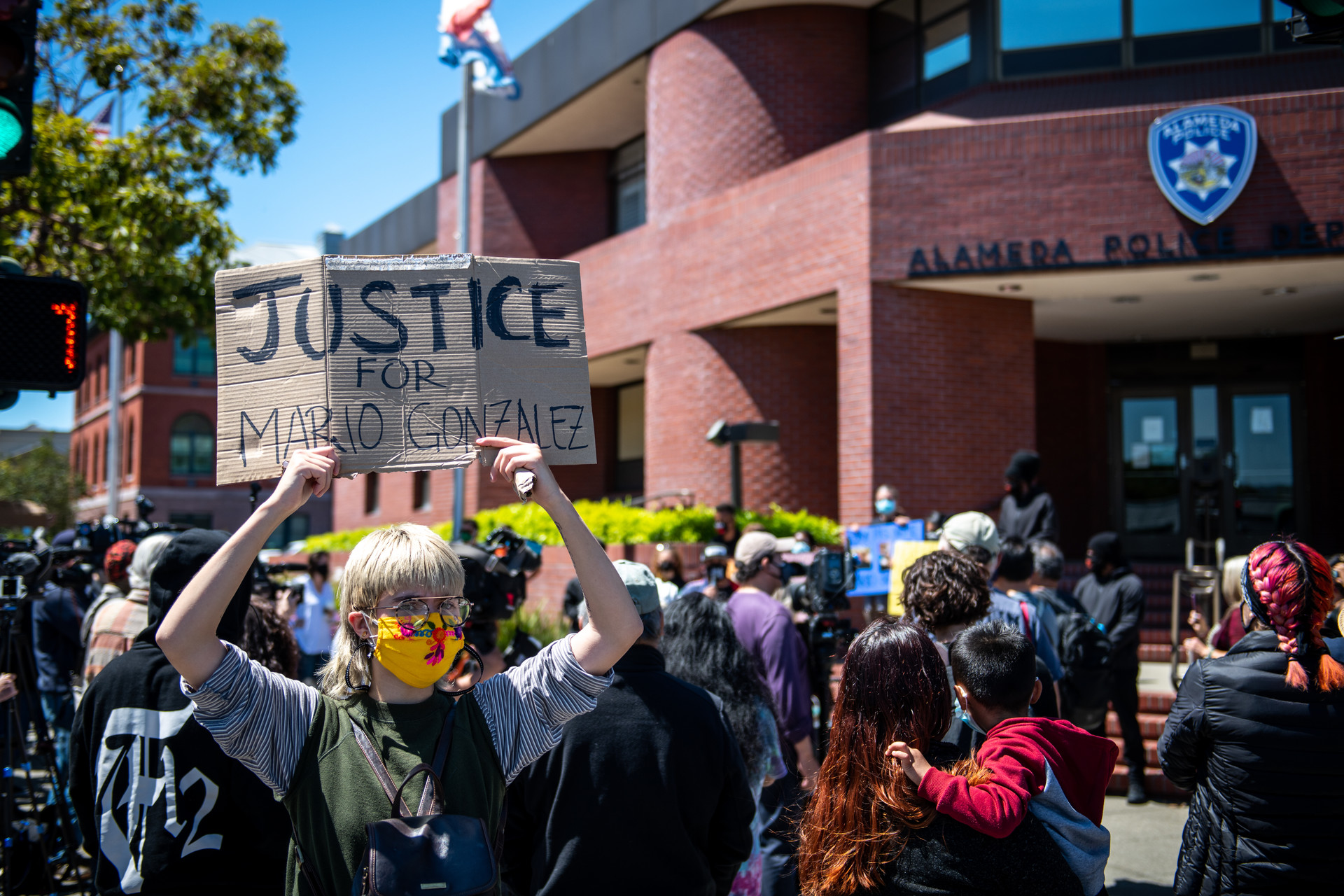
“Yesterday, my family and I saw the footage and we know what really happened. Alameda police officers murdered my brother Mario,” said Gerardo Gonzalez, Mario’s youngest sibling, at a Tuesday press conference and rally outside of the Alameda Police Department, shortly before the video was publicly released.
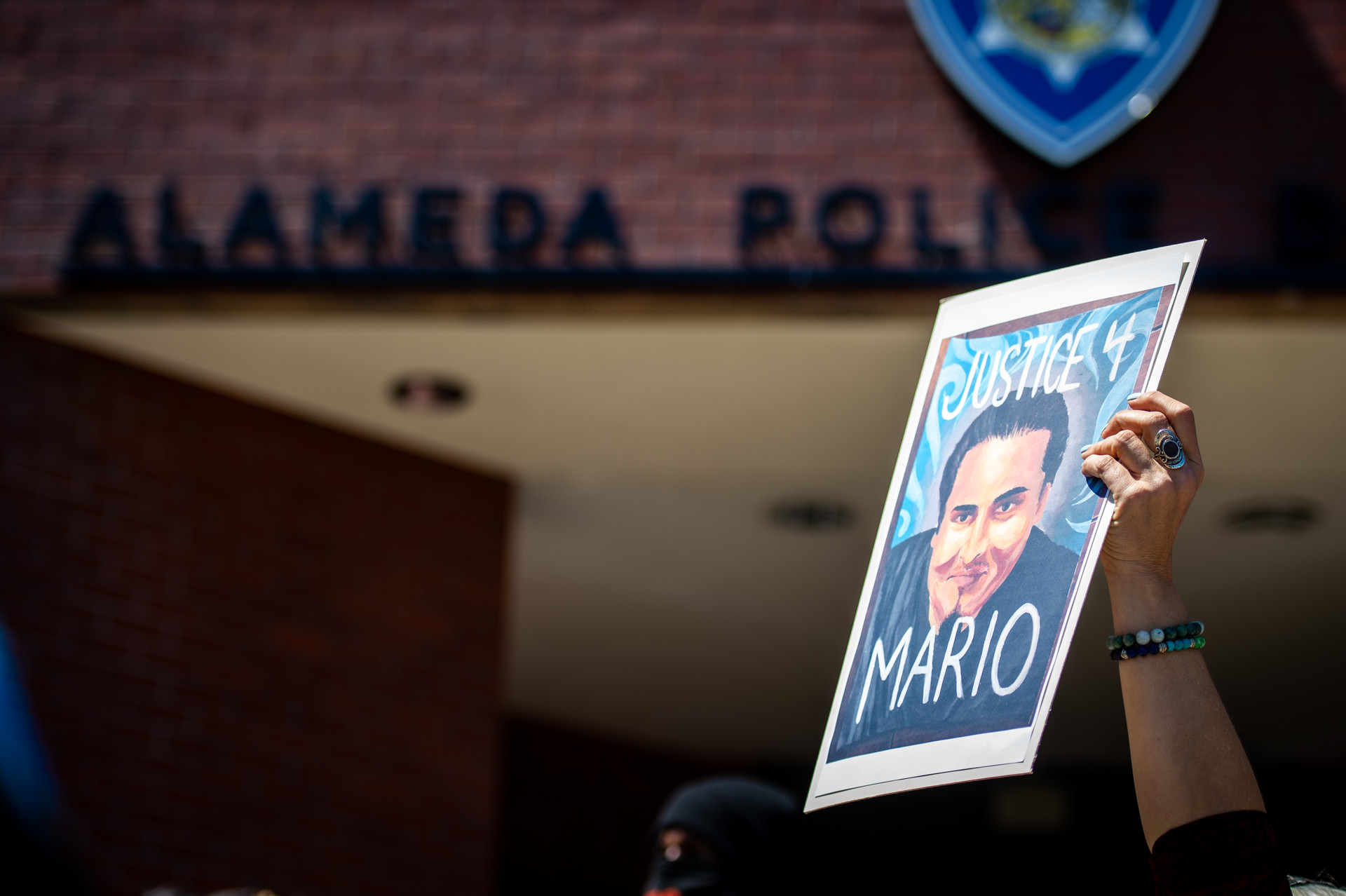
“My mother was heartbroken to see Mario’s last moments,” he told the roughly 50 attendees, many holding “Justice 4 Mario” signs. “It was painful to watch the violence and disregard for his humanity. The police killed my brother in the same manner that they killed George Floyd.”
The three officers directly involved in the incident have been placed on paid administrative leave, per standard procedure. Officer James Fisher has been with the Alameda Police Department since 2010, while the two other officers, Cameron Leahy and Eric McKinley, joined in 2018, according to the department.
“The City of Alameda is committed to full transparency and accountability in the aftermath of Mr. Gonzalez’s death,” the city said in a statement Tuesday, announcing the release of the video. It noted that separate investigations into the incident have been initiated, including criminal investigations by the Alameda County Sheriff’s Department and Alameda County District Attorney’s Office, and an independent outside investigation by a private law firm hired by the city.
Autopsy findings have not yet been released.
“I think I share probably the views of much of the community that you see a video like that and nobody wants to see a young man die,” interim Alameda Police Chief Randy Fenn told KQED on Wednesday. He called Gonzalez’s death “awful.”
“And certainly as a police chief, I don’t want to see something like that during an involvement with the police,” he added. “And like the rest of the community, now we’re looking for answers and trying to figure out what exactly happened.”
Due to its graphic nature, and out of consideration for our communities, KQED is not embedding the video. The full version is available here.
In the nearly hourlong video, which shows footage from two different police body cameras filmed from different angles, two officers are seen approaching Gonzalez, who is standing alone in the small park next to what appear to be two Walgreens shopping baskets.
Officers were responding to separate 911 calls, also included in the video, one from a neighbor who reports a man in his front yard “talking to himself” and “not making any sense.” The caller adds, “He seems like he’s tweaking. But he’s not doing anything wrong, he’s just scaring my wife.” A second 911 caller reports the same man, now in the park nearby, who he says has been there for about 30 minutes and appears to be breaking the security tags off of alcohol bottles.
When the officers arrive, they question Gonzalez about what he’s doing in the park, and ask for his ID. Gonzalez, who is calm but fidgety, mumbles several largely incoherent responses and does not appear to be fully lucid.
When asked if he lives in Alameda, Gonzalez says, “I haven’t gotten a house yet” and briefly puts one hand in his pocket, while standing on a small stump. The officers tell him to take his hands out of his pockets before approaching him. Without telling him he is under arrest, each officer grabs one of Gonzalez’s arms, leads him down from the stump and proceeds to try to put his hands behind his back. When he bends over and resists being handcuffed, one officer says, “Please stop resisting us, OK? Don’t fight us.”
Gonzalez can be heard saying, “It’s not that, there’s something else,” and tells them to stop.
At one point, while the officers are still trying to get Gonzalez’s hands behind his back, one of them says, “I think we talked before, Mario. This is all coming back to me now.”
As Gonzalez continues to resist being handcuffed, the two officers take him to the wood chip-covered ground, adjacent to a driveway, pinning him on his stomach, with at least one officer pressing an elbow and knee into his back and shoulder. They hold his hands behind his back and eventually handcuff him.
While they continue attempting to subdue him, Gonzalez keeps grunting, heaving and briefly shouting, but his voice is now muffled.
At this point, one of the officers requests a “wrap,” presumably referring to a type of full-body restraint device. The officers ask for the device several more times throughout the altercation, but never ultimately use it.
“It’s OK Mario,” one officer says. “We’re going to take care of you, OK?”
Gonzalez shouts several times what sounds like “Thank you.”
One of the officers repeatedly asks Gonzalez when his birthday is, and again requests a wrap, as Gonzalez’s screams grow increasingly loud and seemingly distressed.
“I think you just had too much to drink today, that’s all,” one of the officers says.
The two officers continue pinning Gonzalez to the ground, with at least one of them pressing his elbow and knee into his back.
“Mario, calm down please,” one of the officers says. The other officer tells him to stop kicking, amid the sound of approaching sirens.
Gonzalez remains pinned face down to the ground for a total of roughly five minutes, his protestations becoming increasingly weak.
“Think we can roll him on his side?” one officer asks. The other responds, “I don’t want to lose what I got, man.”
As Gonzalez grows silent and his body goes limp, one officer instructs his partner to not put any weight on his chest. The other officer appears to comply.
About 15 seconds later, when Gonzalez appears to be completely motionless, they roll him on his side.
“He’s going unresponsive,” one of the officers says.
The officers shout Gonzalez’s first name, check for a pulse, roll him fully over, and begin administering CPR, his hands still restrained behind his back. About one minute later, they remove his handcuffs and continue performing CPR, repeatedly shouting for him to wake up, as more officers and EMTs arrive. They are also seen administering at least two doses of Narcan, which is given to counteract opiate overdoses.
“He went from combative to non-responsive almost immediately and then we started compressions,” one of the officers tells an EMT from the Alameda Fire Department, before Gonzalez is lifted into an ambulance and brought to a nearby hospital, where he was pronounced dead.