Opportunity Lost: The 1968 Government Report on White Racism That America Chose to Ignore
Half a century ago, the Kerner Commission examined the root causes of the bloody uprisings that tore through poor, urban communities across the country. Its findings remain strikingly relevant today.
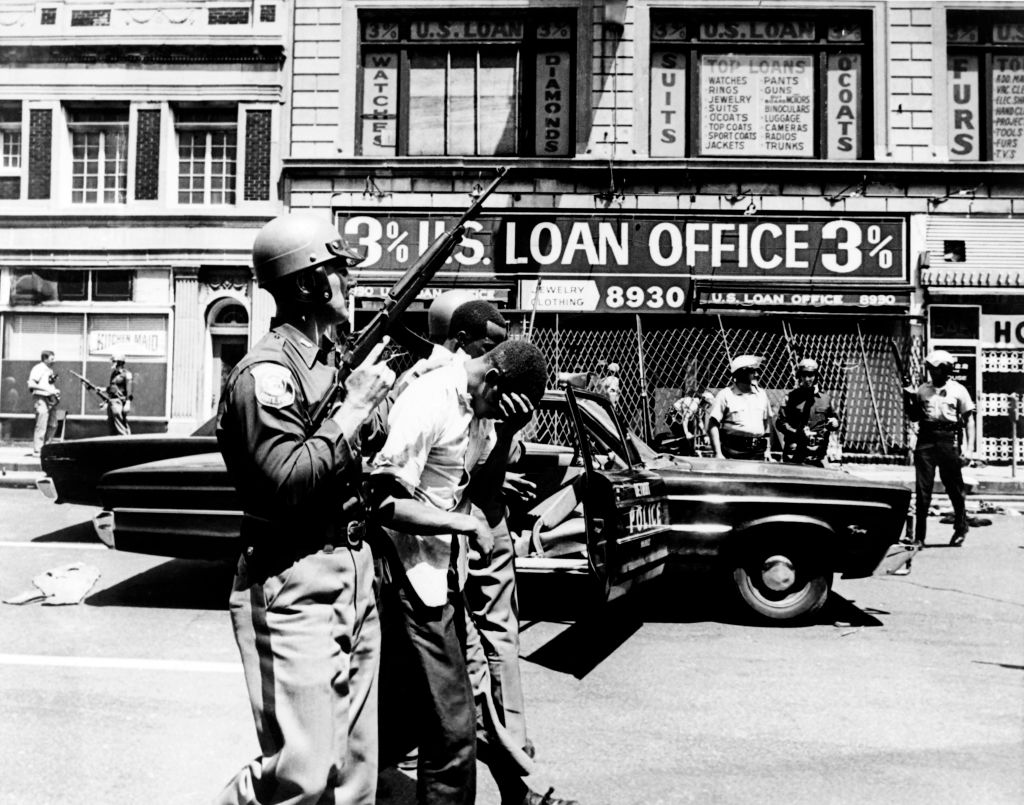
Detroit police arrest black suspects on July 25, 1967, during uprisings that erupted in the city following a police crackdown. (AFP via Getty Images)
It didn’t take long for the rage to spread like wildfire across the nation.
On the evening of Monday, May 25, Minneapolis police arrested George Floyd, a 46-year-old black man, who had been accused of buying cigarettes with a counterfeit $20 bill. Shortly after the first squad car arrived at the scene, Floyd had been pinned face-down to the ground by three police officers as a fourth officer stood by. One of the officers, Derek Chauvin, knelt on Floyd’s neck for nearly nine minutes.
Video footage from bystanders shows Floyd pleading for his life just before losing consciousness: “I can’t breathe, man, please,” he cried. Floyd was loaded into an ambulance and brought to a nearby hospital where he was pronounced dead.
The following night, Minneapolis erupted in furious protests, with hundreds pouring into the streets, demanding justice for Floyd. The demonstrations mushroomed in size and ferocity as the week went on, with many buildings, including a police station, vandalized and set ablaze, prompting the governor to declare a state of emergency and send in National Guard troops to quell the unrest.
By Friday, protests had spread to scores of cities, large and small, across the country — including many in the Bay Area. Racially diverse groups of tens of thousands of demonstrators have since flooded the streets, demanding an end to police brutality and systemic racism.
Floyd’s death follows a long succession of high-profile police killings of unarmed African Americans, especially young men, who are disproportionately targeted by law enforcement and far more likely than anyone else to be brutalized or killed during such encounters. It’s a somber fact black people live with every day, and one other Americans are reminded of in the wake of each notorious incident, from Oscar Grant and Michael Brown to Eric Garner and Laquan McDonald, Tamir Rice and Freddie Gray to Walter Scott and Stephon Clark — the list goes on and on.
And while each of those incidents sparked widespread outrage and activism — including the rise of the Black Lives Matter movement in the wake of Brown’s death in Ferguson — the extensiveness of the reaction to Floyd’s death stands apart.
But we’ve been here before: The massive reach of this moment is eerily reminiscent of a series of urban uprisings that unfolded more than half a century ago.
The ‘Long, Hot Summer’
In 1967, during what was dubbed the “long, hot summer,” more than 150 poor, largely black communities across the country were rocked by violent unrest. Some observers labeled them riots, while others tagged them uprisings and rebellions.
The incidents mainly flared up in East Coast and Midwestern cities, including Milwaukee, Buffalo, Tampa and Cincinnati, resulting in more than 100 deaths, hundreds of millions of dollars in property damage and scores of burned-out neighborhoods, some of which never fully recovered.
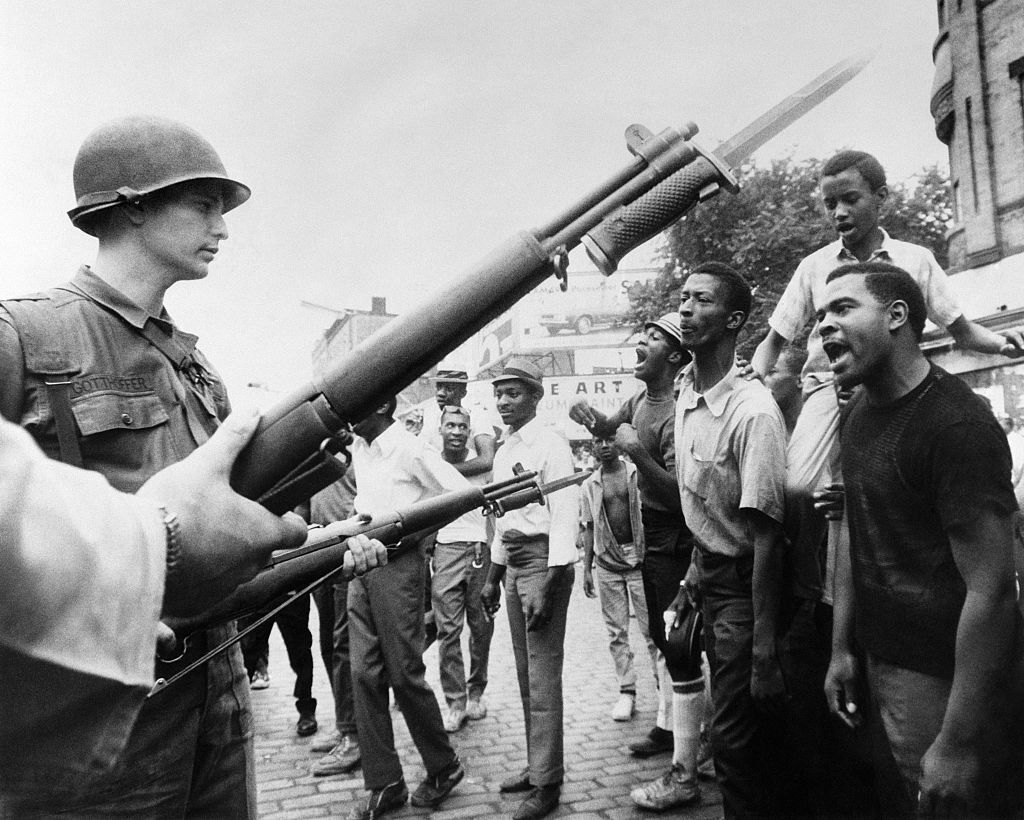
Black demonstrators face armed federal soldiers in Newark on July 17, 1967. (AFP via Getty Images)
The unrest stemmed from a deep-seated anger and hopelessness that had long simmered in many low-income, black and brown communities hobbled by systemic racism, where rates of poverty, police abuse, joblessness and crime were disproportionately high and opportunities for advancement few. Unlike in today’s demonstrations, those involved were almost unilaterally the African American residents hardest hit.
And nearly every local instance of unrest was ignited by a similar spark: the news of an unarmed black man (or men) beaten or killed by white police officers for a seemingly minor infraction.
Two of the most devastating uprisings happened back-to-back that July.
In Newark, New Jersey, two white police officers beat a black cab driver after stopping him for a minor traffic violation. As word of the incident spread, thousands of residents came out to the streets, breaking into and burning businesses and prompting the deployment of several thousand police officers and the National Guard. The violence raged for six days, leaving 26 people dead, scores more injured and tens of millions of dollars in property damage.
Less than a week after the violence in Newark subsided, a police raid on an unlicensed bar in Detroit’s largely black Virginia Park neighborhood sparked an even more devastating explosion. Again, crowds raided shops and set buildings on fire. Panic ensued amid rumors of snipers on rooftops. Roughly 17,000 local and national law enforcement personnel, including Army paratroopers, were sent in to quell the unrest.
Over the course of five days, 43 people were killed and more than 1,000 injured — most victims were black men shot by police and National Guard troops. More than 7,000 arrests were made and an estimated 2,500 stores were looted or burned, leaving large swaths of Detroit’s urban core in ruins.
That summer’s uprisings were not without precedent. Two years earlier, a confrontation between a young black man and a white police officer in the Watts neighborhood of Los Angeles resulted in days of rebellion that left 34 people dead. Violent unrest continued in 1966 in poor sections of major cities like Chicago, Cleveland, New York and San Francisco.
‘What Happened? Why Did It Happen? What Can Be Done to Prevent It Happening Again?’
Immediately after the chaos in Detroit subsided, President Lyndon B. Johnson convened the National Advisory Commission on Civil Disorders. Known as the Kerner Commission after its chair, Illinois Gov. Otto Kerner Jr., the group was tasked with addressing three questions:
What happened? Why did it happen? What can be done to prevent it happening again?
In his televised address announcing the commission, Johnson began, “We have endured a week such as no nation should live through: A time of violence and tragedy.”
He went on to call for “an attack, mounted at every level, upon the conditions that breed despair and breed violence. All of us, I think, know what those conditions are: ignorance, discrimination, slums, poverty, disease, not enough jobs.”
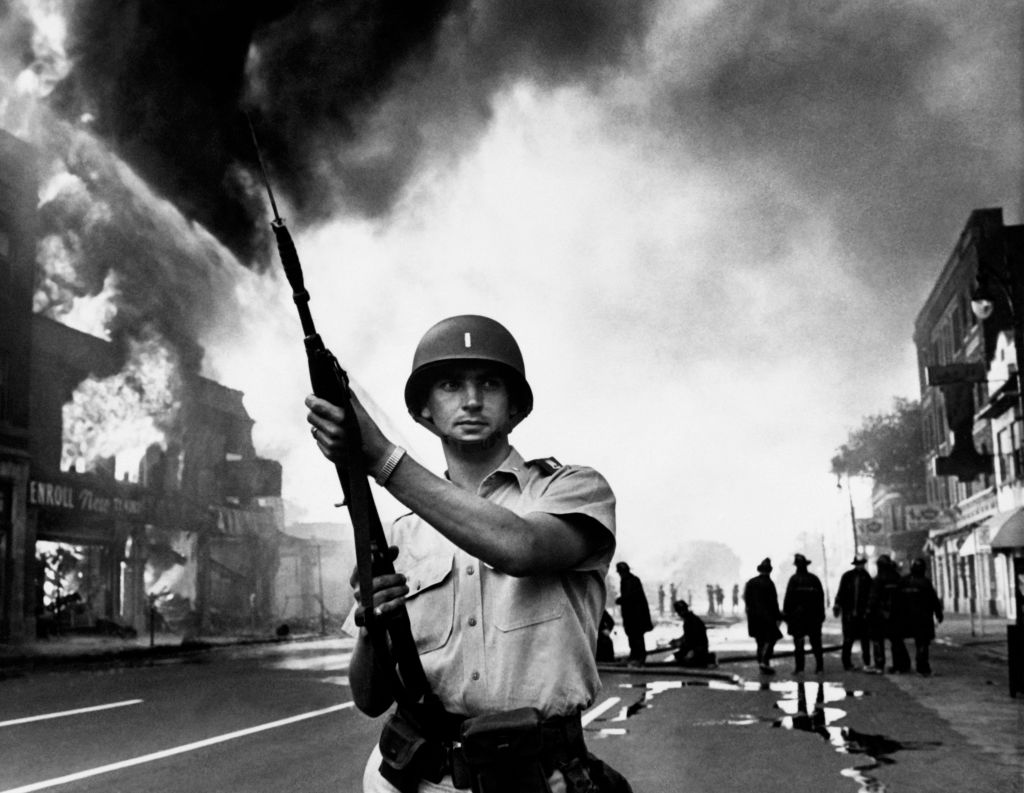
A federal soldier stands guard on a ravaged Detroit street on July 25, 1967. (AFP via Getty Images)
Over the next six months, the commission visited poor urban communities throughout the country, interviewing residents, police officers and local officials. They drew on the research of social scientists and analyzed media coverage of the recent violence.
The 11-member, all-male commission was not politically radical in any sense of the word: It included four members of Congress, the mayor of New York, Atlanta’s police chief and union and industry representatives.
Only two members were black.
Commissioners actually rejected an initial draft of the report — titled “The Harvest of American Racism” — that had been produced by the group of social scientists tasked with synthesizing months of interviews and testimony. That version, which commissioners deemed too radical, and quickly buried, stated that “a truly revolutionary spirit has begun to take hold” in black communities, where residents were unwilling “to compromise or wait any longer” and would rather “risk death than have their people continue in a subordinate status.”
Nevertheless, the final report delivered to Johnson, and later publicly released, was considered groundbreaking — a blunt and sobering assessment of substandard living conditions in many urban black communities.
‘Two Societies … Separate and Unequal’
“This is our basic conclusion,” the report said. “Our nation is moving toward two societies, one black, one white — separate and unequal. White racism is essentially responsible for the explosive mixture which has been accumulating in our cities.”
The report’s direct reference to white racism as a root cause of the uprisings was particularly controversial.
“We used the word racism. And on the commission, we had two or three people say, ‘Should we use that word, racism?’ ” former Oklahoma Sen. Fred Harris, who served on the commission, told Bill Moyers in 2008.
“Our saying racism, I think, was very important to a lot of black people who said, ‘Well, maybe it’s not just me. Maybe I’m not, by myself, at fault here. Maybe there’s something else going on.’ ”
The 1968 report elaborated on the often incendiary relationship between local, predominantly white police forces and the black communities they patrolled:
The police are not merely a “spark” factor. To some Negroes police have come to symbolize white power, white racism and white repression. And the fact is that many police do reflect and express these white attitudes. The atmosphere of hostility and cynicism is reinforced by a widespread belief among Negroes in the existence of police brutality and in a “double standard” of justice and protection — one for Negroes and one for whites.
At the time, some blamed the unrest on “outside agitators,” roving groups of radicals traveling from city to city, intent on sowing chaos and disorder. The commission said it found no evidence of conspiracy or premeditated plans connected to the violence. Although it stopped short of labeling the unrest a rebellion against racial oppression, it said the conflicts were an indication of the deep frustration stemming from a host of social problems afflicting disenfranchised communities of color.
Topping that list: police brutality, unemployment and an inadequate supply of affordable housing. The commission stated, in no uncertain terms, that white America was directly implicated in creating these problems:
What white Americans have never fully understood — but what the Negro can never forget — is that white society is deeply implicated in the ghetto. White institutions created it, white institutions maintain it, and white society condones it.
The commission’s sweeping policy recommendations included:
Creating 2 million new jobs and 6 million new affordable housing units
Revamping the welfare system
Eliminating de facto school segregation
Eliminating “abrasive” police practices and establishing redress mechanisms
Improving news coverage of the problems facing black Americans
Making local government more responsive to inner city communities
The 426-page report, published in March 1968, sold more than 2 million copies and earned a spot on the New York Times’ nonfiction bestseller list, which called it a “stinging indictment of white society.”
And then it all but vanished.
Sidelined
The Johnson administration balked at the report, arguing that the commission hadn’t given the president enough credit for past legislation on civil rights and poverty alleviation. Johnson refused to support further research or so much as meet with the commissioners.
The report stressed that for conditions to improve, “hard choices must be made, and, if necessary, new taxes enacted.”
But there was little political will to do that.
related coverage
Johnson — who at the time was still planning a run for re-election — was threatened by the commission’s findings, worried he would lose support among many white communities who were unwilling to acknowledge the central role systemic racism had played in fueling the unrest.
Also concerned about the political impact of rising rates of crime and disorder, Johnson supported several pieces of tough-on-crime legislation, including the Omnibus Crime Control and Safe Streets Act of 1968, which he signed nearly six months after receiving the Kerner Commission report. The bill allocated roughly $400 million in grants to states to beef up local police forces with new equipment and technical assistance — in part to more effectively suppress future uprisings.
And less than a month after the report’s publication, Martin Luther King Jr. was assassinated in Memphis, sparking more violent unrest in cities throughout the country.
From Kerner to Ferguson to Minneapolis
After the shooting of Michael Brown in Ferguson, Missouri, in 2014 and the unrest that followed, a new commission was formed to study a problem strikingly similar to the one examined nearly 50 years earlier.
Chaired by former Presidents Jimmy Carter and George W. Bush, the group was tasked with identifying the underlying causes of the unrest. Its final report, while much narrower in scope, bears some resemblance to the Kerner Commission’s findings. Its recommendations included:
Reducing the use of force by police officers
Reforming sentencing laws
Improving the health and education of children and young people
Increasing access to affordable housing and public transit
Expanding Medicaid
Like the Kerner report, the Ferguson analysis identified racial and economic inequality as the primary source of the problems that led to the protests. But the language and tone are strikingly different:
“We are not pointing fingers and calling individual people racist,” the report diplomatically states. “We are not even suggesting that institutions or existing systems intend to be racist.”
In 2018, a study co-edited by Kerner Commission member Fred Harris followed up on the status of communities examined in the 1968 report. The findings were grim. The new study found that poverty in many of those places had actually increased, as had school segregation, while the inequality gap between white Americans and black, brown and Native Americans had widened.
The original Kerner Commission may have foreseen this outcome. The report’s conclusion quoted the testimony of psychologist Kenneth Clark. Clark – whose famous doll tests were cited in Brown v. Board of Education – reminded the panel of the many previous commissions assembled to study incidents of racial unrest: Chicago in 1919, Harlem in 1935 and 1943, Los Angeles in 1965.
Testifying before the Kerner Commission, Clark said, was a kind of “Alice in Wonderland” experience: He watched the same images flickering past, sat listening to the same analysis and the same recommendations – and it all culminated, finally, in the same inaction. The commissioners quoted his words:
“It is time now to end the destruction and the violence.”
lower waypointnext waypoint
Player sponsored by
window.__IS_SSR__=true
window.__INITIAL_STATE__={
"attachmentsReducer": {
"audio_0": {
"type": "attachments",
"id": "audio_0",
"imgSizes": {
"kqedFullSize": {
"file": "https://ww2.kqed.org/news/wp-content/themes/KQED-unified/img/audio_bgs/background0.jpg"
}
}
},
"audio_1": {
"type": "attachments",
"id": "audio_1",
"imgSizes": {
"kqedFullSize": {
"file": "https://ww2.kqed.org/news/wp-content/themes/KQED-unified/img/audio_bgs/background1.jpg"
}
}
},
"audio_2": {
"type": "attachments",
"id": "audio_2",
"imgSizes": {
"kqedFullSize": {
"file": "https://ww2.kqed.org/news/wp-content/themes/KQED-unified/img/audio_bgs/background2.jpg"
}
}
},
"audio_3": {
"type": "attachments",
"id": "audio_3",
"imgSizes": {
"kqedFullSize": {
"file": "https://ww2.kqed.org/news/wp-content/themes/KQED-unified/img/audio_bgs/background3.jpg"
}
}
},
"audio_4": {
"type": "attachments",
"id": "audio_4",
"imgSizes": {
"kqedFullSize": {
"file": "https://ww2.kqed.org/news/wp-content/themes/KQED-unified/img/audio_bgs/background4.jpg"
}
}
},
"placeholder": {
"type": "attachments",
"id": "placeholder",
"imgSizes": {
"thumbnail": {
"file": "https://cdn.kqed.org/wp-content/uploads/2024/12/KQED-Default-Image-816638274-2000x1333-1-160x107.jpg",
"width": 160,
"height": 107,
"mimeType": "image/jpeg"
},
"medium": {
"file": "https://cdn.kqed.org/wp-content/uploads/2024/12/KQED-Default-Image-816638274-2000x1333-1-800x533.jpg",
"width": 800,
"height": 533,
"mimeType": "image/jpeg"
},
"medium_large": {
"file": "https://cdn.kqed.org/wp-content/uploads/2024/12/KQED-Default-Image-816638274-2000x1333-1-768x512.jpg",
"width": 768,
"height": 512,
"mimeType": "image/jpeg"
},
"large": {
"file": "https://cdn.kqed.org/wp-content/uploads/2024/12/KQED-Default-Image-816638274-2000x1333-1-1020x680.jpg",
"width": 1020,
"height": 680,
"mimeType": "image/jpeg"
},
"1536x1536": {
"file": "https://cdn.kqed.org/wp-content/uploads/2024/12/KQED-Default-Image-816638274-2000x1333-1-1536x1024.jpg",
"width": 1536,
"height": 1024,
"mimeType": "image/jpeg"
},
"fd-lrg": {
"file": "https://cdn.kqed.org/wp-content/uploads/2024/12/KQED-Default-Image-816638274-2000x1333-1-1536x1024.jpg",
"width": 1536,
"height": 1024,
"mimeType": "image/jpeg"
},
"fd-med": {
"file": "https://cdn.kqed.org/wp-content/uploads/2024/12/KQED-Default-Image-816638274-2000x1333-1-1020x680.jpg",
"width": 1020,
"height": 680,
"mimeType": "image/jpeg"
},
"fd-sm": {
"file": "https://cdn.kqed.org/wp-content/uploads/2024/12/KQED-Default-Image-816638274-2000x1333-1-800x533.jpg",
"width": 800,
"height": 533,
"mimeType": "image/jpeg"
},
"post-thumbnail": {
"file": "https://cdn.kqed.org/wp-content/uploads/2024/12/KQED-Default-Image-816638274-2000x1333-1-672x372.jpg",
"width": 672,
"height": 372,
"mimeType": "image/jpeg"
},
"twentyfourteen-full-width": {
"file": "https://cdn.kqed.org/wp-content/uploads/2024/12/KQED-Default-Image-816638274-2000x1333-1-1038x576.jpg",
"width": 1038,
"height": 576,
"mimeType": "image/jpeg"
},
"xxsmall": {
"file": "https://cdn.kqed.org/wp-content/uploads/2024/12/KQED-Default-Image-816638274-2000x1333-1-160x107.jpg",
"width": 160,
"height": 107,
"mimeType": "image/jpeg"
},
"xsmall": {
"file": "https://cdn.kqed.org/wp-content/uploads/2024/12/KQED-Default-Image-816638274-2000x1333-1-672x372.jpg",
"width": 672,
"height": 372,
"mimeType": "image/jpeg"
},
"small": {
"file": "https://cdn.kqed.org/wp-content/uploads/2024/12/KQED-Default-Image-816638274-2000x1333-1-672x372.jpg",
"width": 672,
"height": 372,
"mimeType": "image/jpeg"
},
"xlarge": {
"file": "https://cdn.kqed.org/wp-content/uploads/2024/12/KQED-Default-Image-816638274-2000x1333-1-1020x680.jpg",
"width": 1020,
"height": 680,
"mimeType": "image/jpeg"
},
"full-width": {
"file": "https://cdn.kqed.org/wp-content/uploads/2024/12/KQED-Default-Image-816638274-2000x1333-1-1920x1280.jpg",
"width": 1920,
"height": 1280,
"mimeType": "image/jpeg"
},
"guest-author-32": {
"file": "https://cdn.kqed.org/wp-content/uploads/2025/01/KQED-Default-Image-816638274-1333x1333-1-160x160.jpg",
"width": 32,
"height": 32,
"mimeType": "image/jpeg"
},
"guest-author-50": {
"file": "https://cdn.kqed.org/wp-content/uploads/2025/01/KQED-Default-Image-816638274-1333x1333-1-160x160.jpg",
"width": 50,
"height": 50,
"mimeType": "image/jpeg"
},
"guest-author-64": {
"file": "https://cdn.kqed.org/wp-content/uploads/2025/01/KQED-Default-Image-816638274-1333x1333-1-160x160.jpg",
"width": 64,
"height": 64,
"mimeType": "image/jpeg"
},
"guest-author-96": {
"file": "https://cdn.kqed.org/wp-content/uploads/2025/01/KQED-Default-Image-816638274-1333x1333-1-160x160.jpg",
"width": 96,
"height": 96,
"mimeType": "image/jpeg"
},
"guest-author-128": {
"file": "https://cdn.kqed.org/wp-content/uploads/2025/01/KQED-Default-Image-816638274-1333x1333-1-160x160.jpg",
"width": 128,
"height": 128,
"mimeType": "image/jpeg"
},
"detail": {
"file": "https://cdn.kqed.org/wp-content/uploads/2025/01/KQED-Default-Image-816638274-1333x1333-1-160x160.jpg",
"width": 160,
"height": 160,
"mimeType": "image/jpeg"
},
"kqedFullSize": {
"file": "https://cdn.kqed.org/wp-content/uploads/2024/12/KQED-Default-Image-816638274-2000x1333-1.jpg",
"width": 2000,
"height": 1333
}
}
},
"news_11822929": {
"type": "attachments",
"id": "news_11822929",
"meta": {
"index": "attachments_1716263798",
"site": "news",
"id": "11822929",
"found": true
},
"parent": 11821827,
"imgSizes": {
"apple_news_ca_landscape_5_5": {
"file": "https://ww2.kqed.org/app/uploads/sites/10/2020/06/GettyImages-460590022-1024x783.jpg",
"width": 1024,
"mimeType": "image/jpeg",
"height": 783
},
"apple_news_ca_square_4_0": {
"file": "https://ww2.kqed.org/app/uploads/sites/10/2020/06/GettyImages-460590022-470x470.jpg",
"width": 470,
"mimeType": "image/jpeg",
"height": 470
},
"twentyfourteen-full-width": {
"file": "https://ww2.kqed.org/app/uploads/sites/10/2020/06/GettyImages-460590022-1024x576.jpg",
"width": 1024,
"mimeType": "image/jpeg",
"height": 576
},
"thumbnail": {
"file": "https://ww2.kqed.org/app/uploads/sites/10/2020/06/GettyImages-460590022-160x126.jpg",
"width": 160,
"mimeType": "image/jpeg",
"height": 126
},
"post-thumbnail": {
"file": "https://ww2.kqed.org/app/uploads/sites/10/2020/06/GettyImages-460590022-672x372.jpg",
"width": 672,
"mimeType": "image/jpeg",
"height": 372
},
"kqedFullSize": {
"file": "https://ww2.kqed.org/app/uploads/sites/10/2020/06/GettyImages-460590022.jpg",
"width": 1024,
"height": 805
},
"apple_news_ca_landscape_4_7": {
"file": "https://ww2.kqed.org/app/uploads/sites/10/2020/06/GettyImages-460590022-632x474.jpg",
"width": 632,
"mimeType": "image/jpeg",
"height": 474
},
"large": {
"file": "https://ww2.kqed.org/app/uploads/sites/10/2020/06/GettyImages-460590022-1020x802.jpg",
"width": 1020,
"mimeType": "image/jpeg",
"height": 802
},
"apple_news_ca_landscape_4_0": {
"file": "https://ww2.kqed.org/app/uploads/sites/10/2020/06/GettyImages-460590022-536x402.jpg",
"width": 536,
"mimeType": "image/jpeg",
"height": 402
},
"medium": {
"file": "https://ww2.kqed.org/app/uploads/sites/10/2020/06/GettyImages-460590022-800x629.jpg",
"width": 800,
"mimeType": "image/jpeg",
"height": 629
},
"apple_news_ca_portrait_4_0": {
"file": "https://ww2.kqed.org/app/uploads/sites/10/2020/06/GettyImages-460590022-354x472.jpg",
"width": 354,
"mimeType": "image/jpeg",
"height": 472
},
"apple_news_ca_portrait_9_7": {
"file": "https://ww2.kqed.org/app/uploads/sites/10/2020/06/GettyImages-460590022-840x805.jpg",
"width": 840,
"mimeType": "image/jpeg",
"height": 805
},
"apple_news_ca_portrait_4_7": {
"file": "https://ww2.kqed.org/app/uploads/sites/10/2020/06/GettyImages-460590022-414x552.jpg",
"width": 414,
"mimeType": "image/jpeg",
"height": 552
},
"apple_news_ca_portrait_5_5": {
"file": "https://ww2.kqed.org/app/uploads/sites/10/2020/06/GettyImages-460590022-687x805.jpg",
"width": 687,
"mimeType": "image/jpeg",
"height": 805
},
"apple_news_ca_square_4_7": {
"file": "https://ww2.kqed.org/app/uploads/sites/10/2020/06/GettyImages-460590022-550x550.jpg",
"width": 550,
"mimeType": "image/jpeg",
"height": 550
},
"apple_news_ca_square_5_5": {
"file": "https://ww2.kqed.org/app/uploads/sites/10/2020/06/GettyImages-460590022-912x805.jpg",
"width": 912,
"mimeType": "image/jpeg",
"height": 805
}
},
"publishDate": 1591303032,
"modified": 1591312770,
"caption": "Detroit police arrest black suspects on July 25, 1967, during uprisings that erupted in the city following a police crackdown.",
"description": "Detroit police arrest black suspects on July 25, 1967, during uprisings that erupted in the city following a police crackdown.",
"title": "US-RACE RIOTS-DETROIT",
"credit": "AFP via Getty Images",
"status": "inherit",
"isLoading": false,
"fetchFailed": false
}
},
"audioPlayerReducer": {
"postId": "stream_live",
"isPaused": true,
"isPlaying": false,
"pfsActive": false,
"pledgeModalIsOpen": true,
"playerDrawerIsOpen": false,
"liveAudioPlayStartedAt": 0,
"liveAudioPlayContext": ""
},
"authorsReducer": {
"byline_news_11821827": {
"type": "authors",
"id": "byline_news_11821827",
"meta": {
"override": true
},
"slug": "byline_news_11821827",
"name": "\u003ca href=\"https://www.kqed.org/author/matthewgreen\">Matthew Green\u003c/a> and \u003ca href=\"http://www.jessengebretson.com/\">Jess Engebretson\u003c/a>",
"isLoading": false
}
},
"pagesReducer": {},
"pfsSessionReducer": {},
"postsReducer": {
"stream_live": {
"type": "live",
"id": "stream_live",
"audioUrl": "https://hls.kqed.org/hls/kqed_app/playlist.m3u8",
"title": "Live Stream",
"excerpt": "Live Stream information currently unavailable.",
"link": "/radio",
"featImg": "",
"label": {
"name": "KQED Live",
"link": "/"
}
},
"stream_kqedNewscast": {
"type": "posts",
"id": "stream_kqedNewscast",
"audioUrl": "https://www.kqed.org/.stream/anon/radio/RDnews/newscast.mp3?_=1",
"title": "KQED Newscast",
"featImg": "",
"label": {
"name": "88.5 FM",
"link": "/"
}
},
"news_11821827": {
"type": "posts",
"id": "news_11821827",
"meta": {
"index": "posts_1716263798",
"site": "news",
"id": "11821827",
"found": true
},
"articlePosition": 0,
"guestAuthors": [],
"slug": "opportunity-lost-the-radical-1968-report-on-white-racism-the-government-chose-to-ignore",
"title": "Opportunity Lost: The 1968 Government Report on White Racism That America Chose to Ignore",
"publishDate": 1591362014,
"format": "standard",
"headTitle": "Opportunity Lost: The 1968 Government Report on White Racism That America Chose to Ignore | KQED",
"labelTerm": {
"site": "news"
},
"content": "\u003cp>It didn’t take long for the rage to spread like wildfire across the nation.\u003c/p>\n\u003cp>On the evening of Monday, May 25, Minneapolis police arrested George Floyd, a 46-year-old black man, who had been accused of buying cigarettes with a counterfeit $20 bill. Shortly after the first squad car arrived at the scene, Floyd had been pinned face-down to the ground by three police officers as a fourth officer stood by. One of the officers, Derek Chauvin, knelt on Floyd’s neck for nearly nine minutes.\u003c/p>\n\u003cp>[pullquote align=\"right\" size=\"medium\" citation=\"Kerner Commission report\"]‘This is our basic conclusion: Our nation is moving toward two societies, one black, one white — separate and unequal. White racism is essentially responsible for the explosive mixture which has been accumulating in our cities.’[/pullquote]\u003c/p>\n\u003cp>\u003ca href=\"https://www.nytimes.com/2020/05/31/us/george-floyd-investigation.html\">Video footage\u003c/a> from bystanders shows Floyd pleading for his life just before losing consciousness: “I can’t breathe, man, please,” he cried. Floyd was loaded into an ambulance and brought to a nearby hospital where he was pronounced dead.\u003c/p>\n\u003cp>The following night, Minneapolis erupted in furious protests, with hundreds pouring into the streets, demanding justice for Floyd. The demonstrations mushroomed in size and ferocity as the week went on, with many buildings, including a police station, vandalized and set ablaze, prompting the governor to declare a state of emergency and send in National Guard troops to quell the unrest.\u003c/p>\n\u003cp>By Friday, protests had spread to scores of cities, large and small, across the country — including many in the Bay Area. Racially diverse groups of tens of thousands of demonstrators have since flooded the streets, demanding an end to police brutality and systemic racism.\u003c/p>\n\u003cp>[ad fullwidth]\u003c/p>\n\u003cp>Floyd’s death follows a long succession of high-profile police killings of unarmed African Americans, especially young men, who are disproportionately targeted by law enforcement and \u003ca href=\"https://www.vox.com/2020/5/31/21276004/anger-police-killing-george-floyd-protests\">far more likely\u003c/a> than anyone else to be brutalized or killed during such encounters. It’s a somber fact black people live with every day, and one other Americans are reminded of in the wake of each notorious incident, from Oscar Grant and Michael Brown to Eric Garner and Laquan McDonald, Tamir Rice and Freddie Gray to Walter Scott and Stephon Clark — the list goes on and on.\u003c/p>\n\u003cp>And while each of those incidents sparked widespread outrage and activism — including the rise of the Black Lives Matter movement in the wake of Brown’s death in Ferguson — the extensiveness of the reaction to Floyd’s death stands apart.\u003c/p>\n\u003cp>But we’ve been here before: The massive reach of this moment is eerily reminiscent of a series of urban uprisings that unfolded more than half a century ago.\u003c/p>\n\u003ch3>The ‘Long, Hot Summer’\u003c/h3>\n\u003cp>In 1967, during what was dubbed the “long, hot summer,” more than 150 poor, largely black communities across the country were rocked by violent unrest. Some observers labeled them riots, while others tagged them uprisings and rebellions.\u003c/p>\n\u003cp>The incidents mainly flared up in East Coast and Midwestern cities, including Milwaukee, Buffalo, Tampa and Cincinnati, resulting in more than 100 deaths, hundreds of millions of dollars in property damage and scores of burned-out neighborhoods, some of which never fully recovered.\u003c/p>\n\u003cfigure id=\"attachment_11823056\" class=\"wp-caption aligncenter\" style=\"max-width: 1024px\">\u003cimg loading=\"lazy\" decoding=\"async\" class=\"wp-image-11823056 size-full\" src=\"https://ww2.kqed.org/app/uploads/sites/10/2020/06/GettyImages-460591480-1.jpg\" alt=\"\" width=\"1024\" height=\"820\" srcset=\"https://cdn.kqed.org/wp-content/uploads/sites/10/2020/06/GettyImages-460591480-1.jpg 1024w, https://cdn.kqed.org/wp-content/uploads/sites/10/2020/06/GettyImages-460591480-1-160x128.jpg 160w, https://cdn.kqed.org/wp-content/uploads/sites/10/2020/06/GettyImages-460591480-1-800x641.jpg 800w, https://cdn.kqed.org/wp-content/uploads/sites/10/2020/06/GettyImages-460591480-1-1020x817.jpg 1020w\" sizes=\"auto, (max-width: 1024px) 100vw, 1024px\">\u003cfigcaption class=\"wp-caption-text\">Black demonstrators face armed federal soldiers in Newark on July 17, 1967. \u003ccite>(AFP via Getty Images)\u003c/cite>\u003c/figcaption>\u003c/figure>\n\u003cp>The unrest stemmed from a deep-seated anger and hopelessness that had long simmered in many low-income, black and brown communities hobbled by systemic racism, where rates of poverty, police abuse, joblessness and crime were disproportionately high and opportunities for advancement few. Unlike in today’s demonstrations, those involved were almost unilaterally the African American residents hardest hit.\u003c/p>\n\u003cp>And nearly every local instance of unrest was ignited by a similar spark: the news of an unarmed black man (or men) beaten or killed by white police officers for a seemingly minor infraction.\u003c/p>\n\u003cp>Two of the most devastating uprisings happened back-to-back that July.\u003c/p>\n\u003cp>In Newark, New Jersey, two white police officers beat a black cab driver after stopping him for a minor traffic violation. As word of the incident spread, thousands of residents came out to the streets, breaking into and burning businesses and prompting the deployment of several thousand police officers and the National Guard. The violence raged for six days, leaving 26 people dead, scores more injured and tens of millions of dollars in property damage.\u003c/p>\n\u003cp>https://youtu.be/2n0e3_vD-xE\u003c/p>\n\u003cp>Less than a week after the violence in Newark subsided, a police raid on an unlicensed bar in Detroit’s largely black Virginia Park neighborhood sparked \u003ca href=\"http://www.mlive.com/news/detroit/index.ssf/2016/03/a_quick_guide_to_the_1967_detr.html\" target=\"_blank\" rel=\"noopener noreferrer\">an even more devastating explosion.\u003c/a> Again, crowds raided shops and set buildings on fire. Panic ensued amid rumors of snipers on rooftops. Roughly 17,000 local and national law enforcement personnel, including Army paratroopers, were sent in to quell the unrest.\u003c/p>\n\u003cp>Over the course of five days, 43 people were killed and more than 1,000 injured — most victims were black men shot by police and National Guard troops. More than 7,000 arrests were made and an estimated 2,500 stores were looted or burned, leaving large swaths of Detroit’s urban core in ruins.\u003c/p>\n\u003cp>https://youtu.be/jevo0U3K9K8\u003c/p>\n\u003cp>That summer’s uprisings were not without precedent. Two years earlier, a confrontation between a young black man and a white police officer in the Watts neighborhood of Los Angeles resulted in \u003ca href=\"https://www.youtube.com/watch?v=SRDvY_anJdc\">days of rebellion\u003c/a> that left 34 people dead. Violent unrest continued in 1966 in poor sections of major cities like Chicago, Cleveland, New York and \u003ca href=\"http://www.foundsf.org/index.php?title=Hunter%27s_Point_riot_by_Fleming\">San Francisco\u003c/a>.\u003c/p>\n\u003ch3>‘What Happened? Why Did It Happen? What Can Be Done to Prevent It Happening Again?’\u003c/h3>\n\u003cp>Immediately after the chaos in Detroit subsided, President Lyndon B. Johnson convened the \u003ca href=\"https://assets.documentcloud.org/documents/1363817/report-of-the-national-advisory-commission-on.pdf\">National Advisory Commission on Civil Disorders\u003c/a>. Known as the Kerner Commission after its chair, Illinois Gov. Otto Kerner Jr., the group was tasked with addressing three questions:\u003c/p>\n\u003cp>What happened? Why did it happen? What can be done to prevent it happening again?\u003c/p>\n\u003cp>In his televised address announcing the commission, Johnson began, “We have endured a week such as no nation should live through: A time of violence and tragedy.”\u003c/p>\n\u003cp>He went on to call for “an attack, mounted at every level, upon the conditions that breed despair and breed violence. All of us, I think, know what those conditions are: ignorance, discrimination, slums, poverty, disease, not enough jobs.”\u003c/p>\n\u003cfigure id=\"attachment_11823057\" class=\"wp-caption aligncenter\" style=\"max-width: 1024px\">\u003cimg loading=\"lazy\" decoding=\"async\" class=\"size-full wp-image-11823057\" src=\"https://ww2.kqed.org/app/uploads/sites/10/2020/06/GettyImages-460589828.jpg\" alt=\"\" width=\"1024\" height=\"793\" srcset=\"https://cdn.kqed.org/wp-content/uploads/sites/10/2020/06/GettyImages-460589828.jpg 1024w, https://cdn.kqed.org/wp-content/uploads/sites/10/2020/06/GettyImages-460589828-160x124.jpg 160w, https://cdn.kqed.org/wp-content/uploads/sites/10/2020/06/GettyImages-460589828-800x620.jpg 800w, https://cdn.kqed.org/wp-content/uploads/sites/10/2020/06/GettyImages-460589828-1020x790.jpg 1020w\" sizes=\"auto, (max-width: 1024px) 100vw, 1024px\">\u003cfigcaption class=\"wp-caption-text\">A federal soldier stands guard on a ravaged Detroit street on July 25, 1967. \u003ccite>(AFP via Getty Images)\u003c/cite>\u003c/figcaption>\u003c/figure>\n\u003cp>Over the next six months, the commission visited poor urban communities throughout the country, interviewing residents, police officers and local officials. They drew on the research of social scientists and analyzed media coverage of the recent violence.\u003c/p>\n\u003cp>The 11-member, all-male commission was not politically radical in any sense of the word: It included four members of Congress, the mayor of New York, Atlanta’s police chief and union and industry representatives.\u003c/p>\n\u003cp>Only two members were black.\u003c/p>\n\u003cp>Commissioners actually rejected an initial draft of the report — titled “\u003ca href=\"https://www.press.umich.edu/9684789/harvest_of_american_racism\">The Harvest of American Racism\u003c/a>” — that had been produced by the group of social scientists tasked with synthesizing months of interviews and testimony. That version, which commissioners deemed too radical, and quickly buried, stated that “a truly revolutionary spirit has begun to take hold” in black communities, where residents were unwilling “to compromise or wait any longer” and would rather “risk death than have their people continue in a subordinate status.”\u003c/p>\n\u003cp>Nevertheless, the final \u003ca href=\"https://belonging.berkeley.edu/1968-kerner-commission-report\">report\u003c/a> delivered to Johnson, and later publicly released, was considered groundbreaking — a blunt and sobering assessment of substandard living conditions in many urban black communities.\u003c/p>\n\u003ch3>‘Two Societies … Separate and Unequal’\u003c/h3>\n\u003cp>“This is our basic conclusion,” the report said. “Our nation is moving toward two societies, one black, one white — separate and unequal. White racism is essentially responsible for the explosive mixture which has been accumulating in our cities.”\u003c/p>\n\u003cp>The report’s direct reference to white racism as a root cause of the uprisings was particularly controversial.\u003c/p>\n\u003cp>“We used the word racism. And on the commission, we had two or three people say, ‘Should we use that word, racism?’ ” former Oklahoma Sen. Fred Harris, who served on the commission, \u003ca href=\"http://www.pbs.org/moyers/journal/03282008/watch.html\">told Bill Moyers\u003c/a> in 2008.\u003c/p>\n\u003cp>“Our saying racism, I think, was very important to a lot of black people who said, ‘Well, maybe it’s not just me. Maybe I’m not, by myself, at fault here. Maybe there’s something else going on.’ ”\u003c/p>\n\u003cp>The 1968 report elaborated on the often incendiary relationship between local, predominantly white police forces and the black communities they patrolled:\u003c/p>\n\u003cblockquote>\u003cp>The police are not merely a “spark” factor. To some Negroes police have come to symbolize white power, white racism and white repression. And the fact is that many police do reflect and express these white attitudes. The atmosphere of hostility and cynicism is reinforced by a widespread belief among Negroes in the existence of police brutality and in a “double standard” of justice and protection — one for Negroes and one for whites.\u003c/p>\u003c/blockquote>\n\u003cp>At the time, some blamed the unrest on “outside agitators,” roving groups of radicals traveling from city to city, intent on sowing chaos and disorder. The commission said it found no evidence of conspiracy or premeditated plans connected to the violence. Although it stopped short of labeling the unrest a rebellion against racial oppression, it said the conflicts were an indication of the deep frustration stemming from a host of social problems afflicting disenfranchised communities of color.\u003c/p>\n\u003cp>Topping that list: police brutality, unemployment and an inadequate supply of affordable housing. The commission stated, in no uncertain terms, that white America was directly implicated in creating these problems:\u003c/p>\n\u003cblockquote>\u003cp>What white Americans have never fully understood — but what the Negro can never forget — is that white society is deeply implicated in the ghetto. White institutions created it, white institutions maintain it, and white society condones it.\u003c/p>\u003c/blockquote>\n\u003cp>The commission’s sweeping policy recommendations included:\u003c/p>\n\u003cul>\n\u003cli>Creating 2 million new jobs and 6 million new affordable housing units\u003c/li>\n\u003cli>Revamping the welfare system\u003c/li>\n\u003cli>Eliminating de facto school segregation\u003c/li>\n\u003cli>Eliminating “abrasive” police practices and establishing redress mechanisms\u003c/li>\n\u003cli>Improving news coverage of the problems facing black Americans\u003c/li>\n\u003cli>Making local government more responsive to inner city communities\u003c/li>\n\u003c/ul>\n\u003cp>The 426-page report, published in March 1968, sold \u003ca href=\"http://www.heritage.org/research/lecture/the-kerner-commission-report\">more than 2 million copies\u003c/a> and earned a spot on the New York Times’ nonfiction \u003ca href=\"https://books.google.com/books?id=4il1AwAAQBAJ&pg=PT453&lpg=PT453&dq=new+york+times+bestseller+list+nonfiction+1968+kerner&source=bl&ots=iUXvd_Hwq1&sig=AdfVX8Yc9xYLAIaoWtD1ckwUjIM&hl=en&sa=X&ved=0CCwQ6AEwA2oVChMIz4rKhI-9yAIVwbgeCh1DWQXU#v=onepage&q&f=false\">bestseller list\u003c/a>, which called it a “stinging indictment of white society.”\u003c/p>\n\u003cp>And then it all but vanished.\u003c/p>\n\u003ch3>Sidelined\u003c/h3>\n\u003cp>The Johnson administration balked at the report, arguing that the commission \u003ca href=\"https://www.bunkhistory.org/resources/2011\">hadn’t given the president enough credit\u003c/a> for past legislation on civil rights and poverty alleviation. Johnson refused to support further research or so much as meet with the commissioners.\u003c/p>\n\u003cp>The report stressed that for conditions to improve, “hard choices must be made, and, if necessary, new taxes enacted.”\u003c/p>\n\u003cp>But there was little political will to do that.\u003c/p>\n\u003cp>[aside label=\"related coverage\" tag=\"george-floyd\"]Johnson — who at the time was still planning a run for re-election — was threatened by the commission’s findings, worried he would lose support among many white communities who were unwilling to acknowledge the central role systemic racism had played in fueling the unrest.\u003c/p>\n\u003cp>Also concerned about the political impact of rising rates of crime and disorder, Johnson supported several pieces of tough-on-crime legislation, including the \u003ca href=\"https://www.justice.gov/crt/omnibus-crime-control-and-safe-streets-act-1968-42-usc-3789d\">Omnibus Crime Control and Safe Streets Act of 1968\u003c/a>, which he signed nearly six months after receiving the Kerner Commission report. The bill allocated roughly $400 million in grants to states to beef up local police forces with new equipment and technical assistance — in part to more effectively suppress future uprisings.\u003c/p>\n\u003cp>And less than a month after the report’s publication, Martin Luther King Jr. was assassinated in Memphis, sparking more violent unrest in cities throughout the country.\u003c/p>\n\u003ch3>From Kerner to Ferguson to Minneapolis\u003c/h3>\n\u003cp>After the \u003ca href=\"https://www.nytimes.com/2019/08/09/us/ferguson-michael-brown.html\">shooting of Michael Brown\u003c/a> in Ferguson, Missouri, in 2014 and the unrest that followed, a new commission was formed to study a problem strikingly similar to the one examined nearly 50 years earlier.\u003c/p>\n\u003cp>Chaired by former Presidents Jimmy Carter and George W. Bush, the group was tasked with identifying the underlying causes of the unrest. Its \u003ca href=\"http://forwardthroughferguson.org/report/executive-summary/\">final report\u003c/a>, while much narrower in scope, bears some resemblance to the Kerner Commission’s findings. Its recommendations included:\u003c/p>\n\u003cul>\n\u003cli>Reducing the use of force by police officers\u003c/li>\n\u003cli>Reforming sentencing laws\u003c/li>\n\u003cli>Improving the health and education of children and young people\u003c/li>\n\u003cli>Increasing access to affordable housing and public transit\u003c/li>\n\u003cli>Expanding Medicaid\u003c/li>\n\u003c/ul>\n\u003cp>Like the Kerner report, the Ferguson analysis identified racial and economic inequality as the primary source of the problems that led to the protests. But the language and tone are strikingly different:\u003c/p>\n\u003cp>“We are not pointing fingers and calling individual people racist,” the report diplomatically states. “We are not even suggesting that institutions or existing systems intend to be racist.”\u003c/p>\n\u003cp>In 2018, a \u003ca href=\"https://www.npr.org/2018/02/27/589351779/report-updates-landmark-1968-racism-study-finds-more-poverty-more-segregation\">study co-edited by Kerner Commission member Fred Harris\u003c/a> followed up on the status of communities examined in the 1968 report. The findings were grim. The new study found that poverty in many of those places had actually increased, as had school segregation, while the inequality gap between white Americans and black, brown and Native Americans had widened.\u003c/p>\n\u003cp>The original Kerner Commission may have foreseen this outcome. The report’s conclusion quoted the testimony of psychologist Kenneth Clark. Clark – whose famous \u003ca href=\"http://www.naacpldf.org/brown-at-60-the-doll-test\">doll tests\u003c/a> were cited in \u003cem>Brown v. Board of Education\u003c/em> – reminded the panel of the many previous commissions assembled to study incidents of racial unrest: Chicago in 1919, Harlem in 1935 and 1943, Los Angeles in 1965.\u003c/p>\n\u003cp>Testifying before the Kerner Commission, Clark said, was a kind of “Alice in Wonderland” experience: He watched the same images flickering past, sat listening to the same analysis and the same recommendations – and it all culminated, finally, in the same inaction. The commissioners quoted his words:\u003c/p>\n\u003cp>“It is time now to end the destruction and the violence.”\u003c/p>\n\u003cp>[ad floatright]\u003c/p>\n",
"blocks": [],
"excerpt": "Half a century ago, the Kerner Commission examined the root causes of the bloody uprisings that tore through poor, urban communities across the country. Its findings remain strikingly relevant today. ",
"status": "publish",
"parent": 0,
"modified": 1755699865,
"stats": {
"hasAudio": false,
"hasVideo": false,
"hasChartOrMap": false,
"iframeSrcs": [],
"hasGoogleForm": false,
"hasGallery": false,
"hasHearkenModule": false,
"hasPolis": false,
"paragraphCount": 55,
"wordCount": 2406
},
"headData": {
"title": "Opportunity Lost: The 1968 Government Report on White Racism That America Chose to Ignore | KQED",
"description": "Half a century ago, the Kerner Commission examined the root causes of the bloody uprisings that tore through poor, urban communities across the country. Its findings remain strikingly relevant today. ",
"ogTitle": "",
"ogDescription": "",
"ogImgId": "",
"twTitle": "",
"twDescription": "",
"twImgId": "",
"schema": {
"@context": "https://schema.org",
"@type": "NewsArticle",
"headline": "Opportunity Lost: The 1968 Government Report on White Racism That America Chose to Ignore",
"datePublished": "2020-06-05T06:00:14-07:00",
"dateModified": "2025-08-20T07:24:25-07:00",
"image": "https://ww2.kqed.org/app/uploads/sites/10/2020/06/GettyImages-460590022-1020x802.jpg",
"isAccessibleForFree": "True",
"publisher": {
"@type": "NewsMediaOrganization",
"@id": "https://www.kqed.org/#organization",
"name": "KQED",
"logo": "https://cdn.kqed.org/wp-content/uploads/2020/02/KQED-OG-Image@1x.png",
"url": "https://www.kqed.org",
"sameAs": [
"https://www.facebook.com/KQED",
"https://twitter.com/KQED",
"https://www.instagram.com/kqed/",
"https://www.tiktok.com/@kqedofficial",
"https://www.linkedin.com/company/kqed",
"https://www.youtube.com/channel/UCeC0IOo7i1P_61zVUWbJ4nw"
]
}
},
"authorsData": [],
"tagData": []
},
"primaryCategory": {
"termId": 8,
"slug": "news",
"name": "News"
},
"sticky": false,
"nprByline": "\u003ca href=\"https://www.kqed.org/author/matthewgreen\">Matthew Green\u003c/a> and \u003ca href=\"http://www.jessengebretson.com/\">Jess Engebretson\u003c/a>",
"path": "/news/11821827/opportunity-lost-the-radical-1968-report-on-white-racism-the-government-chose-to-ignore",
"audioTrackLength": null,
"parsedContent": [
{
"type": "contentString",
"content": "\u003cdiv class=\"post-body\">\u003cp>\u003cp>It didn’t take long for the rage to spread like wildfire across the nation.\u003c/p>\n\u003cp>On the evening of Monday, May 25, Minneapolis police arrested George Floyd, a 46-year-old black man, who had been accused of buying cigarettes with a counterfeit $20 bill. Shortly after the first squad car arrived at the scene, Floyd had been pinned face-down to the ground by three police officers as a fourth officer stood by. One of the officers, Derek Chauvin, knelt on Floyd’s neck for nearly nine minutes.\u003c/p>\n\u003cp>\u003c/p>\u003c/div>",
"attributes": {
"named": {},
"numeric": []
}
},
{
"type": "component",
"content": "‘This is our basic conclusion: Our nation is moving toward two societies, one black, one white — separate and unequal. White racism is essentially responsible for the explosive mixture which has been accumulating in our cities.’",
"name": "pullquote",
"attributes": {
"named": {
"align": "right",
"size": "medium",
"citation": "Kerner Commission report",
"label": ""
},
"numeric": []
}
},
{
"type": "contentString",
"content": "\u003cdiv class=\"post-body\">\u003cp>\u003c/p>\n\u003cp>\u003ca href=\"https://www.nytimes.com/2020/05/31/us/george-floyd-investigation.html\">Video footage\u003c/a> from bystanders shows Floyd pleading for his life just before losing consciousness: “I can’t breathe, man, please,” he cried. Floyd was loaded into an ambulance and brought to a nearby hospital where he was pronounced dead.\u003c/p>\n\u003cp>The following night, Minneapolis erupted in furious protests, with hundreds pouring into the streets, demanding justice for Floyd. The demonstrations mushroomed in size and ferocity as the week went on, with many buildings, including a police station, vandalized and set ablaze, prompting the governor to declare a state of emergency and send in National Guard troops to quell the unrest.\u003c/p>\n\u003cp>By Friday, protests had spread to scores of cities, large and small, across the country — including many in the Bay Area. Racially diverse groups of tens of thousands of demonstrators have since flooded the streets, demanding an end to police brutality and systemic racism.\u003c/p>\n\u003cp>\u003c/p>\u003c/div>",
"attributes": {
"named": {},
"numeric": []
}
},
{
"type": "component",
"content": "",
"name": "ad",
"attributes": {
"named": {
"label": "fullwidth"
},
"numeric": [
"fullwidth"
]
}
},
{
"type": "contentString",
"content": "\u003cdiv class=\"post-body\">\u003cp>\u003c/p>\n\u003cp>Floyd’s death follows a long succession of high-profile police killings of unarmed African Americans, especially young men, who are disproportionately targeted by law enforcement and \u003ca href=\"https://www.vox.com/2020/5/31/21276004/anger-police-killing-george-floyd-protests\">far more likely\u003c/a> than anyone else to be brutalized or killed during such encounters. It’s a somber fact black people live with every day, and one other Americans are reminded of in the wake of each notorious incident, from Oscar Grant and Michael Brown to Eric Garner and Laquan McDonald, Tamir Rice and Freddie Gray to Walter Scott and Stephon Clark — the list goes on and on.\u003c/p>\n\u003cp>And while each of those incidents sparked widespread outrage and activism — including the rise of the Black Lives Matter movement in the wake of Brown’s death in Ferguson — the extensiveness of the reaction to Floyd’s death stands apart.\u003c/p>\n\u003cp>But we’ve been here before: The massive reach of this moment is eerily reminiscent of a series of urban uprisings that unfolded more than half a century ago.\u003c/p>\n\u003ch3>The ‘Long, Hot Summer’\u003c/h3>\n\u003cp>In 1967, during what was dubbed the “long, hot summer,” more than 150 poor, largely black communities across the country were rocked by violent unrest. Some observers labeled them riots, while others tagged them uprisings and rebellions.\u003c/p>\n\u003cp>The incidents mainly flared up in East Coast and Midwestern cities, including Milwaukee, Buffalo, Tampa and Cincinnati, resulting in more than 100 deaths, hundreds of millions of dollars in property damage and scores of burned-out neighborhoods, some of which never fully recovered.\u003c/p>\n\u003cfigure id=\"attachment_11823056\" class=\"wp-caption aligncenter\" style=\"max-width: 1024px\">\u003cimg loading=\"lazy\" decoding=\"async\" class=\"wp-image-11823056 size-full\" src=\"https://ww2.kqed.org/app/uploads/sites/10/2020/06/GettyImages-460591480-1.jpg\" alt=\"\" width=\"1024\" height=\"820\" srcset=\"https://cdn.kqed.org/wp-content/uploads/sites/10/2020/06/GettyImages-460591480-1.jpg 1024w, https://cdn.kqed.org/wp-content/uploads/sites/10/2020/06/GettyImages-460591480-1-160x128.jpg 160w, https://cdn.kqed.org/wp-content/uploads/sites/10/2020/06/GettyImages-460591480-1-800x641.jpg 800w, https://cdn.kqed.org/wp-content/uploads/sites/10/2020/06/GettyImages-460591480-1-1020x817.jpg 1020w\" sizes=\"auto, (max-width: 1024px) 100vw, 1024px\">\u003cfigcaption class=\"wp-caption-text\">Black demonstrators face armed federal soldiers in Newark on July 17, 1967. \u003ccite>(AFP via Getty Images)\u003c/cite>\u003c/figcaption>\u003c/figure>\n\u003cp>The unrest stemmed from a deep-seated anger and hopelessness that had long simmered in many low-income, black and brown communities hobbled by systemic racism, where rates of poverty, police abuse, joblessness and crime were disproportionately high and opportunities for advancement few. Unlike in today’s demonstrations, those involved were almost unilaterally the African American residents hardest hit.\u003c/p>\n\u003cp>And nearly every local instance of unrest was ignited by a similar spark: the news of an unarmed black man (or men) beaten or killed by white police officers for a seemingly minor infraction.\u003c/p>\n\u003cp>Two of the most devastating uprisings happened back-to-back that July.\u003c/p>\n\u003cp>In Newark, New Jersey, two white police officers beat a black cab driver after stopping him for a minor traffic violation. As word of the incident spread, thousands of residents came out to the streets, breaking into and burning businesses and prompting the deployment of several thousand police officers and the National Guard. The violence raged for six days, leaving 26 people dead, scores more injured and tens of millions of dollars in property damage.\u003c/p>\u003c/p>\u003cp>\u003cspan class='utils-parseShortcode-shortcodes-__youtubeShortcode__embedYoutube'>\n \u003cspan class='utils-parseShortcode-shortcodes-__youtubeShortcode__embedYoutubeInside'>\n \u003ciframe\n loading='lazy'\n class='utils-parseShortcode-shortcodes-__youtubeShortcode__youtubePlayer'\n type='text/html'\n src='//www.youtube.com/embed/2n0e3_vD-xE'\n title='//www.youtube.com/embed/2n0e3_vD-xE'\n allowfullscreen='true'\n style='border:0;'>\u003c/iframe>\n \u003c/span>\n \u003c/span>\u003c/p>\u003cp>\u003cp>Less than a week after the violence in Newark subsided, a police raid on an unlicensed bar in Detroit’s largely black Virginia Park neighborhood sparked \u003ca href=\"http://www.mlive.com/news/detroit/index.ssf/2016/03/a_quick_guide_to_the_1967_detr.html\" target=\"_blank\" rel=\"noopener noreferrer\">an even more devastating explosion.\u003c/a> Again, crowds raided shops and set buildings on fire. Panic ensued amid rumors of snipers on rooftops. Roughly 17,000 local and national law enforcement personnel, including Army paratroopers, were sent in to quell the unrest.\u003c/p>\n\u003cp>Over the course of five days, 43 people were killed and more than 1,000 injured — most victims were black men shot by police and National Guard troops. More than 7,000 arrests were made and an estimated 2,500 stores were looted or burned, leaving large swaths of Detroit’s urban core in ruins.\u003c/p>\u003c/p>\u003cp>\u003cspan class='utils-parseShortcode-shortcodes-__youtubeShortcode__embedYoutube'>\n \u003cspan class='utils-parseShortcode-shortcodes-__youtubeShortcode__embedYoutubeInside'>\n \u003ciframe\n loading='lazy'\n class='utils-parseShortcode-shortcodes-__youtubeShortcode__youtubePlayer'\n type='text/html'\n src='//www.youtube.com/embed/jevo0U3K9K8'\n title='//www.youtube.com/embed/jevo0U3K9K8'\n allowfullscreen='true'\n style='border:0;'>\u003c/iframe>\n \u003c/span>\n \u003c/span>\u003c/p>\u003cp>\u003cp>That summer’s uprisings were not without precedent. Two years earlier, a confrontation between a young black man and a white police officer in the Watts neighborhood of Los Angeles resulted in \u003ca href=\"https://www.youtube.com/watch?v=SRDvY_anJdc\">days of rebellion\u003c/a> that left 34 people dead. Violent unrest continued in 1966 in poor sections of major cities like Chicago, Cleveland, New York and \u003ca href=\"http://www.foundsf.org/index.php?title=Hunter%27s_Point_riot_by_Fleming\">San Francisco\u003c/a>.\u003c/p>\n\u003ch3>‘What Happened? Why Did It Happen? What Can Be Done to Prevent It Happening Again?’\u003c/h3>\n\u003cp>Immediately after the chaos in Detroit subsided, President Lyndon B. Johnson convened the \u003ca href=\"https://assets.documentcloud.org/documents/1363817/report-of-the-national-advisory-commission-on.pdf\">National Advisory Commission on Civil Disorders\u003c/a>. Known as the Kerner Commission after its chair, Illinois Gov. Otto Kerner Jr., the group was tasked with addressing three questions:\u003c/p>\n\u003cp>What happened? Why did it happen? What can be done to prevent it happening again?\u003c/p>\n\u003cp>In his televised address announcing the commission, Johnson began, “We have endured a week such as no nation should live through: A time of violence and tragedy.”\u003c/p>\n\u003cp>He went on to call for “an attack, mounted at every level, upon the conditions that breed despair and breed violence. All of us, I think, know what those conditions are: ignorance, discrimination, slums, poverty, disease, not enough jobs.”\u003c/p>\n\u003cfigure id=\"attachment_11823057\" class=\"wp-caption aligncenter\" style=\"max-width: 1024px\">\u003cimg loading=\"lazy\" decoding=\"async\" class=\"size-full wp-image-11823057\" src=\"https://ww2.kqed.org/app/uploads/sites/10/2020/06/GettyImages-460589828.jpg\" alt=\"\" width=\"1024\" height=\"793\" srcset=\"https://cdn.kqed.org/wp-content/uploads/sites/10/2020/06/GettyImages-460589828.jpg 1024w, https://cdn.kqed.org/wp-content/uploads/sites/10/2020/06/GettyImages-460589828-160x124.jpg 160w, https://cdn.kqed.org/wp-content/uploads/sites/10/2020/06/GettyImages-460589828-800x620.jpg 800w, https://cdn.kqed.org/wp-content/uploads/sites/10/2020/06/GettyImages-460589828-1020x790.jpg 1020w\" sizes=\"auto, (max-width: 1024px) 100vw, 1024px\">\u003cfigcaption class=\"wp-caption-text\">A federal soldier stands guard on a ravaged Detroit street on July 25, 1967. \u003ccite>(AFP via Getty Images)\u003c/cite>\u003c/figcaption>\u003c/figure>\n\u003cp>Over the next six months, the commission visited poor urban communities throughout the country, interviewing residents, police officers and local officials. They drew on the research of social scientists and analyzed media coverage of the recent violence.\u003c/p>\n\u003cp>The 11-member, all-male commission was not politically radical in any sense of the word: It included four members of Congress, the mayor of New York, Atlanta’s police chief and union and industry representatives.\u003c/p>\n\u003cp>Only two members were black.\u003c/p>\n\u003cp>Commissioners actually rejected an initial draft of the report — titled “\u003ca href=\"https://www.press.umich.edu/9684789/harvest_of_american_racism\">The Harvest of American Racism\u003c/a>” — that had been produced by the group of social scientists tasked with synthesizing months of interviews and testimony. That version, which commissioners deemed too radical, and quickly buried, stated that “a truly revolutionary spirit has begun to take hold” in black communities, where residents were unwilling “to compromise or wait any longer” and would rather “risk death than have their people continue in a subordinate status.”\u003c/p>\n\u003cp>Nevertheless, the final \u003ca href=\"https://belonging.berkeley.edu/1968-kerner-commission-report\">report\u003c/a> delivered to Johnson, and later publicly released, was considered groundbreaking — a blunt and sobering assessment of substandard living conditions in many urban black communities.\u003c/p>\n\u003ch3>‘Two Societies … Separate and Unequal’\u003c/h3>\n\u003cp>“This is our basic conclusion,” the report said. “Our nation is moving toward two societies, one black, one white — separate and unequal. White racism is essentially responsible for the explosive mixture which has been accumulating in our cities.”\u003c/p>\n\u003cp>The report’s direct reference to white racism as a root cause of the uprisings was particularly controversial.\u003c/p>\n\u003cp>“We used the word racism. And on the commission, we had two or three people say, ‘Should we use that word, racism?’ ” former Oklahoma Sen. Fred Harris, who served on the commission, \u003ca href=\"http://www.pbs.org/moyers/journal/03282008/watch.html\">told Bill Moyers\u003c/a> in 2008.\u003c/p>\n\u003cp>“Our saying racism, I think, was very important to a lot of black people who said, ‘Well, maybe it’s not just me. Maybe I’m not, by myself, at fault here. Maybe there’s something else going on.’ ”\u003c/p>\n\u003cp>The 1968 report elaborated on the often incendiary relationship between local, predominantly white police forces and the black communities they patrolled:\u003c/p>\n\u003cblockquote>\u003cp>The police are not merely a “spark” factor. To some Negroes police have come to symbolize white power, white racism and white repression. And the fact is that many police do reflect and express these white attitudes. The atmosphere of hostility and cynicism is reinforced by a widespread belief among Negroes in the existence of police brutality and in a “double standard” of justice and protection — one for Negroes and one for whites.\u003c/p>\u003c/blockquote>\n\u003cp>At the time, some blamed the unrest on “outside agitators,” roving groups of radicals traveling from city to city, intent on sowing chaos and disorder. The commission said it found no evidence of conspiracy or premeditated plans connected to the violence. Although it stopped short of labeling the unrest a rebellion against racial oppression, it said the conflicts were an indication of the deep frustration stemming from a host of social problems afflicting disenfranchised communities of color.\u003c/p>\n\u003cp>Topping that list: police brutality, unemployment and an inadequate supply of affordable housing. The commission stated, in no uncertain terms, that white America was directly implicated in creating these problems:\u003c/p>\n\u003cblockquote>\u003cp>What white Americans have never fully understood — but what the Negro can never forget — is that white society is deeply implicated in the ghetto. White institutions created it, white institutions maintain it, and white society condones it.\u003c/p>\u003c/blockquote>\n\u003cp>The commission’s sweeping policy recommendations included:\u003c/p>\n\u003cul>\n\u003cli>Creating 2 million new jobs and 6 million new affordable housing units\u003c/li>\n\u003cli>Revamping the welfare system\u003c/li>\n\u003cli>Eliminating de facto school segregation\u003c/li>\n\u003cli>Eliminating “abrasive” police practices and establishing redress mechanisms\u003c/li>\n\u003cli>Improving news coverage of the problems facing black Americans\u003c/li>\n\u003cli>Making local government more responsive to inner city communities\u003c/li>\n\u003c/ul>\n\u003cp>The 426-page report, published in March 1968, sold \u003ca href=\"http://www.heritage.org/research/lecture/the-kerner-commission-report\">more than 2 million copies\u003c/a> and earned a spot on the New York Times’ nonfiction \u003ca href=\"https://books.google.com/books?id=4il1AwAAQBAJ&pg=PT453&lpg=PT453&dq=new+york+times+bestseller+list+nonfiction+1968+kerner&source=bl&ots=iUXvd_Hwq1&sig=AdfVX8Yc9xYLAIaoWtD1ckwUjIM&hl=en&sa=X&ved=0CCwQ6AEwA2oVChMIz4rKhI-9yAIVwbgeCh1DWQXU#v=onepage&q&f=false\">bestseller list\u003c/a>, which called it a “stinging indictment of white society.”\u003c/p>\n\u003cp>And then it all but vanished.\u003c/p>\n\u003ch3>Sidelined\u003c/h3>\n\u003cp>The Johnson administration balked at the report, arguing that the commission \u003ca href=\"https://www.bunkhistory.org/resources/2011\">hadn’t given the president enough credit\u003c/a> for past legislation on civil rights and poverty alleviation. Johnson refused to support further research or so much as meet with the commissioners.\u003c/p>\n\u003cp>The report stressed that for conditions to improve, “hard choices must be made, and, if necessary, new taxes enacted.”\u003c/p>\n\u003cp>But there was little political will to do that.\u003c/p>\n\u003cp>\u003c/p>\u003c/div>",
"attributes": {
"named": {},
"numeric": []
}
},
{
"type": "component",
"content": "",
"name": "aside",
"attributes": {
"named": {
"label": "related coverage ",
"tag": "george-floyd"
},
"numeric": []
}
},
{
"type": "contentString",
"content": "\u003cdiv class=\"post-body\">\u003cp>Johnson — who at the time was still planning a run for re-election — was threatened by the commission’s findings, worried he would lose support among many white communities who were unwilling to acknowledge the central role systemic racism had played in fueling the unrest.\u003c/p>\n\u003cp>Also concerned about the political impact of rising rates of crime and disorder, Johnson supported several pieces of tough-on-crime legislation, including the \u003ca href=\"https://www.justice.gov/crt/omnibus-crime-control-and-safe-streets-act-1968-42-usc-3789d\">Omnibus Crime Control and Safe Streets Act of 1968\u003c/a>, which he signed nearly six months after receiving the Kerner Commission report. The bill allocated roughly $400 million in grants to states to beef up local police forces with new equipment and technical assistance — in part to more effectively suppress future uprisings.\u003c/p>\n\u003cp>And less than a month after the report’s publication, Martin Luther King Jr. was assassinated in Memphis, sparking more violent unrest in cities throughout the country.\u003c/p>\n\u003ch3>From Kerner to Ferguson to Minneapolis\u003c/h3>\n\u003cp>After the \u003ca href=\"https://www.nytimes.com/2019/08/09/us/ferguson-michael-brown.html\">shooting of Michael Brown\u003c/a> in Ferguson, Missouri, in 2014 and the unrest that followed, a new commission was formed to study a problem strikingly similar to the one examined nearly 50 years earlier.\u003c/p>\n\u003cp>Chaired by former Presidents Jimmy Carter and George W. Bush, the group was tasked with identifying the underlying causes of the unrest. Its \u003ca href=\"http://forwardthroughferguson.org/report/executive-summary/\">final report\u003c/a>, while much narrower in scope, bears some resemblance to the Kerner Commission’s findings. Its recommendations included:\u003c/p>\n\u003cul>\n\u003cli>Reducing the use of force by police officers\u003c/li>\n\u003cli>Reforming sentencing laws\u003c/li>\n\u003cli>Improving the health and education of children and young people\u003c/li>\n\u003cli>Increasing access to affordable housing and public transit\u003c/li>\n\u003cli>Expanding Medicaid\u003c/li>\n\u003c/ul>\n\u003cp>Like the Kerner report, the Ferguson analysis identified racial and economic inequality as the primary source of the problems that led to the protests. But the language and tone are strikingly different:\u003c/p>\n\u003cp>“We are not pointing fingers and calling individual people racist,” the report diplomatically states. “We are not even suggesting that institutions or existing systems intend to be racist.”\u003c/p>\n\u003cp>In 2018, a \u003ca href=\"https://www.npr.org/2018/02/27/589351779/report-updates-landmark-1968-racism-study-finds-more-poverty-more-segregation\">study co-edited by Kerner Commission member Fred Harris\u003c/a> followed up on the status of communities examined in the 1968 report. The findings were grim. The new study found that poverty in many of those places had actually increased, as had school segregation, while the inequality gap between white Americans and black, brown and Native Americans had widened.\u003c/p>\n\u003cp>The original Kerner Commission may have foreseen this outcome. The report’s conclusion quoted the testimony of psychologist Kenneth Clark. Clark – whose famous \u003ca href=\"http://www.naacpldf.org/brown-at-60-the-doll-test\">doll tests\u003c/a> were cited in \u003cem>Brown v. Board of Education\u003c/em> – reminded the panel of the many previous commissions assembled to study incidents of racial unrest: Chicago in 1919, Harlem in 1935 and 1943, Los Angeles in 1965.\u003c/p>\n\u003cp>Testifying before the Kerner Commission, Clark said, was a kind of “Alice in Wonderland” experience: He watched the same images flickering past, sat listening to the same analysis and the same recommendations – and it all culminated, finally, in the same inaction. The commissioners quoted his words:\u003c/p>\n\u003cp>“It is time now to end the destruction and the violence.”\u003c/p>\n\u003cp>\u003c/p>\u003c/div>",
"attributes": {
"named": {},
"numeric": []
}
},
{
"type": "component",
"content": "",
"name": "ad",
"attributes": {
"named": {
"label": "floatright"
},
"numeric": [
"floatright"
]
}
},
{
"type": "contentString",
"content": "\u003cdiv class=\"post-body\">\u003cp>\u003c/p>\n\u003c/div>\u003c/p>",
"attributes": {
"named": {},
"numeric": []
}
}
],
"link": "/news/11821827/opportunity-lost-the-radical-1968-report-on-white-racism-the-government-chose-to-ignore",
"authors": [
"byline_news_11821827"
],
"categories": [
"news_6188",
"news_8"
],
"tags": [
"news_28031",
"news_160",
"news_20219",
"news_19216"
],
"featImg": "news_11822929",
"label": "news",
"isLoading": false,
"hasAllInfo": true
}
},
"podcastsReducer": {
"isFetching": false,
"fetchFailed": false,
"hasFetched": false,
"podcasts": {}
},
"radioProgramsReducer": {
"isFetching": false,
"fetchFailed": false,
"hasFetched": false,
"radioPrograms": {}
},
"radioSearchSegmentsReducer": {},
"programsReducer": {
"all-things-considered": {
"id": "all-things-considered",
"title": "All Things Considered",
"info": "Every weekday, \u003cem>All Things Considered\u003c/em> hosts Robert Siegel, Audie Cornish, Ari Shapiro, and Kelly McEvers present the program's trademark mix of news, interviews, commentaries, reviews, and offbeat features. Michel Martin hosts on the weekends.",
"airtime": "MON-FRI 1pm-2pm, 4:30pm-6:30pm\u003cbr />SAT-SUN 5pm-6pm",
"imageSrc": "https://cdn.kqed.org/wp-content/uploads/2024/04/All-Things-Considered-Podcast-Tile-360x360-1.jpg",
"officialWebsiteLink": "https://www.npr.org/programs/all-things-considered/",
"meta": {
"site": "news",
"source": "npr"
},
"link": "/radio/program/all-things-considered"
},
"american-suburb-podcast": {
"id": "american-suburb-podcast",
"title": "American Suburb: The Podcast",
"tagline": "The flip side of gentrification, told through one town",
"info": "Gentrification is changing cities across America, forcing people from neighborhoods they have long called home. Call them the displaced. Now those priced out of the Bay Area are looking for a better life in an unlikely place. American Suburb follows this migration to one California town along the Delta, 45 miles from San Francisco. But is this once sleepy suburb ready for them?",
"imageSrc": "https://cdn.kqed.org/wp-content/uploads/2024/04/American-Suburb-Podcast-Tile-703x703-1.jpg",
"officialWebsiteLink": "/news/series/american-suburb-podcast",
"meta": {
"site": "news",
"source": "kqed",
"order": 19
},
"link": "/news/series/american-suburb-podcast/",
"subscribe": {
"npr": "https://rpb3r.app.goo.gl/RBrW",
"apple": "https://itunes.apple.com/WebObjects/MZStore.woa/wa/viewPodcast?mt=2&id=1287748328",
"tuneIn": "https://tunein.com/radio/American-Suburb-p1086805/",
"rss": "https://ww2.kqed.org/news/series/american-suburb-podcast/feed/podcast",
"google": "https://podcasts.google.com/feed/aHR0cHM6Ly9mZWVkcy5tZWdhcGhvbmUuZm0vS1FJTkMzMDExODgxNjA5"
}
},
"baycurious": {
"id": "baycurious",
"title": "Bay Curious",
"tagline": "Exploring the Bay Area, one question at a time",
"info": "KQED’s new podcast, Bay Curious, gets to the bottom of the mysteries — both profound and peculiar — that give the Bay Area its unique identity. And we’ll do it with your help! You ask the questions. You decide what Bay Curious investigates. And you join us on the journey to find the answers.",
"imageSrc": "https://cdn.kqed.org/wp-content/uploads/2024/04/Bay-Curious-Podcast-Tile-703x703-1.jpg",
"imageAlt": "KQED Bay Curious",
"officialWebsiteLink": "/news/series/baycurious",
"meta": {
"site": "news",
"source": "kqed",
"order": 3
},
"link": "/podcasts/baycurious",
"subscribe": {
"apple": "https://podcasts.apple.com/us/podcast/bay-curious/id1172473406",
"npr": "https://www.npr.org/podcasts/500557090/bay-curious",
"rss": "https://ww2.kqed.org/news/category/bay-curious-podcast/feed/podcast",
"amazon": "https://music.amazon.com/podcasts/9a90d476-aa04-455d-9a4c-0871ed6216d4/bay-curious",
"stitcher": "https://www.stitcher.com/podcast/kqed/bay-curious",
"spotify": "https://open.spotify.com/show/6O76IdmhixfijmhTZLIJ8k"
}
},
"bbc-world-service": {
"id": "bbc-world-service",
"title": "BBC World Service",
"info": "The day's top stories from BBC News compiled twice daily in the week, once at weekends.",
"airtime": "MON-FRI 9pm-10pm, TUE-FRI 1am-2am",
"imageSrc": "https://cdn.kqed.org/wp-content/uploads/2024/04/BBC-World-Service-Podcast-Tile-360x360-1.jpg",
"officialWebsiteLink": "https://www.bbc.co.uk/sounds/play/live:bbc_world_service",
"meta": {
"site": "news",
"source": "BBC World Service"
},
"link": "/radio/program/bbc-world-service",
"subscribe": {
"apple": "https://itunes.apple.com/us/podcast/global-news-podcast/id135067274?mt=2",
"tuneIn": "https://tunein.com/radio/BBC-World-Service-p455581/",
"rss": "https://podcasts.files.bbci.co.uk/p02nq0gn.rss"
}
},
"californiareport": {
"id": "californiareport",
"title": "The California Report",
"tagline": "California, day by day",
"info": "KQED’s statewide radio news program providing daily coverage of issues, trends and public policy decisions.",
"imageSrc": "https://cdn.kqed.org/wp-content/uploads/2024/04/The-California-Report-Podcast-Tile-703x703-1.jpg",
"imageAlt": "KQED The California Report",
"officialWebsiteLink": "/californiareport",
"meta": {
"site": "news",
"source": "kqed",
"order": 8
},
"link": "/californiareport",
"subscribe": {
"apple": "https://podcasts.apple.com/us/podcast/kqeds-the-california-report/id79681292",
"amazon": "https://music.amazon.com/podcasts/26099305-72af-4542-9dde-ac1807fe36d5/kqed-s-the-california-report",
"npr": "https://www.npr.org/podcasts/432285393/the-california-report",
"stitcher": "https://www.stitcher.com/podcast/kqedfm-kqeds-the-california-report-podcast-8838",
"rss": "https://ww2.kqed.org/news/tag/tcram/feed/podcast"
}
},
"californiareportmagazine": {
"id": "californiareportmagazine",
"title": "The California Report Magazine",
"tagline": "Your state, your stories",
"info": "Every week, The California Report Magazine takes you on a road trip for the ears: to visit the places and meet the people who make California unique. The in-depth storytelling podcast from the California Report.",
"airtime": "FRI 4:30pm-5pm, 6:30pm-7pm, 11pm-11:30pm",
"imageSrc": "https://cdn.kqed.org/wp-content/uploads/2024/04/The-California-Report-Magazine-Podcast-Tile-703x703-1.jpg",
"imageAlt": "KQED The California Report Magazine",
"officialWebsiteLink": "/californiareportmagazine",
"meta": {
"site": "news",
"source": "kqed",
"order": 10
},
"link": "/californiareportmagazine",
"subscribe": {
"apple": "https://podcasts.apple.com/us/podcast/the-california-report-magazine/id1314750545",
"google": "https://podcasts.google.com/feed/aHR0cHM6Ly9mZWVkcy5tZWdhcGhvbmUuZm0vS1FJTkM3NjkwNjk1OTAz",
"npr": "https://www.npr.org/podcasts/564733126/the-california-report-magazine",
"stitcher": "https://www.stitcher.com/podcast/kqed/the-california-report-magazine",
"rss": "https://ww2.kqed.org/news/tag/tcrmag/feed/podcast"
}
},
"city-arts": {
"id": "city-arts",
"title": "City Arts & Lectures",
"info": "A one-hour radio program to hear celebrated writers, artists and thinkers address contemporary ideas and values, often discussing the creative process. Please note: tapes or transcripts are not available",
"imageSrc": "https://ww2.kqed.org/radio/wp-content/uploads/sites/50/2018/05/cityartsandlecture-300x300.jpg",
"officialWebsiteLink": "https://www.cityarts.net/",
"airtime": "SUN 1pm-2pm, TUE 10pm, WED 1am",
"meta": {
"site": "news",
"source": "City Arts & Lectures"
},
"link": "https://www.cityarts.net",
"subscribe": {
"tuneIn": "https://tunein.com/radio/City-Arts-and-Lectures-p692/",
"rss": "https://www.cityarts.net/feed/"
}
},
"closealltabs": {
"id": "closealltabs",
"title": "Close All Tabs",
"tagline": "Your irreverent guide to the trends redefining our world",
"info": "Close All Tabs breaks down how digital culture shapes our world through thoughtful insights and irreverent humor.",
"imageSrc": "https://cdn.kqed.org/wp-content/uploads/2025/02/CAT_2_Tile-scaled.jpg",
"imageAlt": "KQED Close All Tabs",
"officialWebsiteLink": "/podcasts/closealltabs",
"meta": {
"site": "news",
"source": "kqed",
"order": 1
},
"link": "/podcasts/closealltabs",
"subscribe": {
"apple": "https://podcasts.apple.com/us/podcast/close-all-tabs/id214663465",
"rss": "https://feeds.megaphone.fm/KQINC6993880386",
"amazon": "https://music.amazon.com/podcasts/92d9d4ac-67a3-4eed-b10a-fb45d45b1ef2/close-all-tabs",
"spotify": "https://open.spotify.com/show/6LAJFHnGK1pYXYzv6SIol6?si=deb0cae19813417c"
}
},
"code-switch-life-kit": {
"id": "code-switch-life-kit",
"title": "Code Switch / Life Kit",
"info": "\u003cem>Code Switch\u003c/em>, which listeners will hear in the first part of the hour, has fearless and much-needed conversations about race. Hosted by journalists of color, the show tackles the subject of race head-on, exploring how it impacts every part of society — from politics and pop culture to history, sports and more.\u003cbr />\u003cbr />\u003cem>Life Kit\u003c/em>, which will be in the second part of the hour, guides you through spaces and feelings no one prepares you for — from finances to mental health, from workplace microaggressions to imposter syndrome, from relationships to parenting. The show features experts with real world experience and shares their knowledge. Because everyone needs a little help being human.\u003cbr />\u003cbr />\u003ca href=\"https://www.npr.org/podcasts/510312/codeswitch\">\u003cem>Code Switch\u003c/em> offical site and podcast\u003c/a>\u003cbr />\u003ca href=\"https://www.npr.org/lifekit\">\u003cem>Life Kit\u003c/em> offical site and podcast\u003c/a>\u003cbr />",
"airtime": "SUN 9pm-10pm",
"imageSrc": "https://cdn.kqed.org/wp-content/uploads/2024/04/Code-Switch-Life-Kit-Podcast-Tile-360x360-1.jpg",
"meta": {
"site": "radio",
"source": "npr"
},
"link": "/radio/program/code-switch-life-kit",
"subscribe": {
"apple": "https://podcasts.apple.com/podcast/1112190608?mt=2&at=11l79Y&ct=nprdirectory",
"google": "https://podcasts.google.com/feed/aHR0cHM6Ly93d3cubnByLm9yZy9yc3MvcG9kY2FzdC5waHA_aWQ9NTEwMzEy",
"spotify": "https://open.spotify.com/show/3bExJ9JQpkwNhoHvaIIuyV",
"rss": "https://feeds.npr.org/510312/podcast.xml"
}
},
"commonwealth-club": {
"id": "commonwealth-club",
"title": "Commonwealth Club of California Podcast",
"info": "The Commonwealth Club of California is the nation's oldest and largest public affairs forum. As a non-partisan forum, The Club brings to the public airwaves diverse viewpoints on important topics. The Club's weekly radio broadcast - the oldest in the U.S., dating back to 1924 - is carried across the nation on public radio stations and is now podcasting. Our website archive features audio of our recent programs, as well as selected speeches from our long and distinguished history. This podcast feed is usually updated twice a week and is always un-edited.",
"airtime": "THU 10pm, FRI 1am",
"imageSrc": "https://cdn.kqed.org/wp-content/uploads/2024/04/Commonwealth-Club-Podcast-Tile-360x360-1.jpg",
"officialWebsiteLink": "https://www.commonwealthclub.org/podcasts",
"meta": {
"site": "news",
"source": "Commonwealth Club of California"
},
"link": "/radio/program/commonwealth-club",
"subscribe": {
"apple": "https://itunes.apple.com/us/podcast/commonwealth-club-of-california-podcast/id976334034?mt=2",
"google": "https://podcasts.google.com/feed/aHR0cDovL3d3dy5jb21tb253ZWFsdGhjbHViLm9yZy9hdWRpby9wb2RjYXN0L3dlZWtseS54bWw",
"tuneIn": "https://tunein.com/radio/Commonwealth-Club-of-California-p1060/"
}
},
"forum": {
"id": "forum",
"title": "Forum",
"tagline": "The conversation starts here",
"info": "KQED’s live call-in program discussing local, state, national and international issues, as well as in-depth interviews.",
"airtime": "MON-FRI 9am-11am, 10pm-11pm",
"imageSrc": "https://cdn.kqed.org/wp-content/uploads/2024/04/Forum-Podcast-Tile-703x703-1.jpg",
"imageAlt": "KQED Forum with Mina Kim and Alexis Madrigal",
"officialWebsiteLink": "/forum",
"meta": {
"site": "news",
"source": "kqed",
"order": 9
},
"link": "/forum",
"subscribe": {
"apple": "https://podcasts.apple.com/us/podcast/kqeds-forum/id73329719",
"google": "https://podcasts.google.com/feed/aHR0cHM6Ly9mZWVkcy5tZWdhcGhvbmUuZm0vS1FJTkM5NTU3MzgxNjMz",
"npr": "https://www.npr.org/podcasts/432307980/forum",
"stitcher": "https://www.stitcher.com/podcast/kqedfm-kqeds-forum-podcast",
"rss": "https://feeds.megaphone.fm/KQINC9557381633"
}
},
"freakonomics-radio": {
"id": "freakonomics-radio",
"title": "Freakonomics Radio",
"info": "Freakonomics Radio is a one-hour award-winning podcast and public-radio project hosted by Stephen Dubner, with co-author Steve Levitt as a regular guest. It is produced in partnership with WNYC.",
"imageSrc": "https://ww2.kqed.org/news/wp-content/uploads/sites/10/2018/05/freakonomicsRadio.png",
"officialWebsiteLink": "http://freakonomics.com/",
"airtime": "SUN 1am-2am, SAT 3pm-4pm",
"meta": {
"site": "radio",
"source": "WNYC"
},
"link": "/radio/program/freakonomics-radio",
"subscribe": {
"npr": "https://rpb3r.app.goo.gl/4s8b",
"apple": "https://itunes.apple.com/us/podcast/freakonomics-radio/id354668519",
"tuneIn": "https://tunein.com/podcasts/WNYC-Podcasts/Freakonomics-Radio-p272293/",
"rss": "https://feeds.feedburner.com/freakonomicsradio"
}
},
"fresh-air": {
"id": "fresh-air",
"title": "Fresh Air",
"info": "Hosted by Terry Gross, \u003cem>Fresh Air from WHYY\u003c/em> is the Peabody Award-winning weekday magazine of contemporary arts and issues. One of public radio's most popular programs, Fresh Air features intimate conversations with today's biggest luminaries.",
"airtime": "MON-FRI 7pm-8pm",
"imageSrc": "https://cdn.kqed.org/wp-content/uploads/2024/04/Fresh-Air-Podcast-Tile-360x360-1.jpg",
"officialWebsiteLink": "https://www.npr.org/programs/fresh-air/",
"meta": {
"site": "radio",
"source": "npr"
},
"link": "/radio/program/fresh-air",
"subscribe": {
"npr": "https://rpb3r.app.goo.gl/4s8b",
"apple": "https://itunes.apple.com/WebObjects/MZStore.woa/wa/viewPodcast?s=143441&mt=2&id=214089682&at=11l79Y&ct=nprdirectory",
"tuneIn": "https://tunein.com/radio/Fresh-Air-p17/",
"rss": "https://feeds.npr.org/381444908/podcast.xml"
}
},
"here-and-now": {
"id": "here-and-now",
"title": "Here & Now",
"info": "A live production of NPR and WBUR Boston, in collaboration with stations across the country, Here & Now reflects the fluid world of news as it's happening in the middle of the day, with timely, in-depth news, interviews and conversation. Hosted by Robin Young, Jeremy Hobson and Tonya Mosley.",
"airtime": "MON-THU 11am-12pm",
"imageSrc": "https://cdn.kqed.org/wp-content/uploads/2024/04/Here-And-Now-Podcast-Tile-360x360-1.jpg",
"officialWebsiteLink": "http://www.wbur.org/hereandnow",
"meta": {
"site": "news",
"source": "npr"
},
"link": "/radio/program/here-and-now",
"subsdcribe": {
"apple": "https://itunes.apple.com/WebObjects/MZStore.woa/wa/viewPodcast?mt=2&id=426698661",
"tuneIn": "https://tunein.com/radio/Here--Now-p211/",
"rss": "https://feeds.npr.org/510051/podcast.xml"
}
},
"hidden-brain": {
"id": "hidden-brain",
"title": "Hidden Brain",
"info": "Shankar Vedantam uses science and storytelling to reveal the unconscious patterns that drive human behavior, shape our choices and direct our relationships.",
"imageSrc": "https://ww2.kqed.org/radio/wp-content/uploads/sites/50/2018/05/hiddenbrain.jpg",
"officialWebsiteLink": "https://www.npr.org/series/423302056/hidden-brain",
"airtime": "SUN 7pm-8pm",
"meta": {
"site": "news",
"source": "NPR"
},
"link": "/radio/program/hidden-brain",
"subscribe": {
"apple": "https://itunes.apple.com/us/podcast/hidden-brain/id1028908750?mt=2",
"tuneIn": "https://tunein.com/podcasts/Science-Podcasts/Hidden-Brain-p787503/",
"rss": "https://feeds.npr.org/510308/podcast.xml"
}
},
"how-i-built-this": {
"id": "how-i-built-this",
"title": "How I Built This with Guy Raz",
"info": "Guy Raz dives into the stories behind some of the world's best known companies. How I Built This weaves a narrative journey about innovators, entrepreneurs and idealists—and the movements they built.",
"imageSrc": "https://ww2.kqed.org/news/wp-content/uploads/sites/10/2018/05/howIBuiltThis.png",
"officialWebsiteLink": "https://www.npr.org/podcasts/510313/how-i-built-this",
"airtime": "SUN 7:30pm-8pm",
"meta": {
"site": "news",
"source": "npr"
},
"link": "/radio/program/how-i-built-this",
"subscribe": {
"npr": "https://rpb3r.app.goo.gl/3zxy",
"apple": "https://itunes.apple.com/us/podcast/how-i-built-this-with-guy-raz/id1150510297?mt=2",
"tuneIn": "https://tunein.com/podcasts/Arts--Culture-Podcasts/How-I-Built-This-p910896/",
"rss": "https://feeds.npr.org/510313/podcast.xml"
}
},
"hyphenacion": {
"id": "hyphenacion",
"title": "Hyphenación",
"tagline": "Where conversation and cultura meet",
"info": "What kind of no sabo word is Hyphenación? For us, it’s about living within a hyphenation. Like being a third-gen Mexican-American from the Texas border now living that Bay Area Chicano life. Like Xorje! Each week we bring together a couple of hyphenated Latinos to talk all about personal life choices: family, careers, relationships, belonging … everything is on the table. ",
"imageSrc": "https://cdn.kqed.org/wp-content/uploads/2025/03/Hyphenacion_FinalAssets_PodcastTile.png",
"imageAlt": "KQED Hyphenación",
"officialWebsiteLink": "/podcasts/hyphenacion",
"meta": {
"site": "news",
"source": "kqed",
"order": 15
},
"link": "/podcasts/hyphenacion",
"subscribe": {
"apple": "https://podcasts.apple.com/us/podcast/hyphenaci%C3%B3n/id1191591838",
"spotify": "https://open.spotify.com/show/2p3Fifq96nw9BPcmFdIq0o?si=39209f7b25774f38",
"youtube": "https://www.youtube.com/c/kqedarts",
"amazon": "https://music.amazon.com/podcasts/6c3dd23c-93fb-4aab-97ba-1725fa6315f1/hyphenaci%C3%B3n",
"rss": "https://feeds.megaphone.fm/KQINC2275451163"
}
},
"jerrybrown": {
"id": "jerrybrown",
"title": "The Political Mind of Jerry Brown",
"tagline": "Lessons from a lifetime in politics",
"info": "The Political Mind of Jerry Brown brings listeners the wisdom of the former Governor, Mayor, and presidential candidate. Scott Shafer interviewed Brown for more than 40 hours, covering the former governor's life and half-century in the political game – and Brown has some lessons he'd like to share. ",
"imageSrc": "https://cdn.kqed.org/wp-content/uploads/2024/04/The-Political-Mind-of-Jerry-Brown-Podcast-Tile-703x703-1.jpg",
"imageAlt": "KQED The Political Mind of Jerry Brown",
"officialWebsiteLink": "/podcasts/jerrybrown",
"meta": {
"site": "news",
"source": "kqed",
"order": 18
},
"link": "/podcasts/jerrybrown",
"subscribe": {
"npr": "https://www.npr.org/podcasts/790253322/the-political-mind-of-jerry-brown",
"apple": "https://itunes.apple.com/us/podcast/id1492194549",
"rss": "https://ww2.kqed.org/news/series/jerrybrown/feed/podcast/",
"tuneIn": "http://tun.in/pjGcK",
"stitcher": "https://www.stitcher.com/podcast/kqed/the-political-mind-of-jerry-brown",
"spotify": "https://open.spotify.com/show/54C1dmuyFyKMFttY6X2j6r?si=K8SgRCoISNK6ZbjpXrX5-w",
"amazon": "https://music.amazon.com/podcasts/44420f75-3b0e-4301-ab3b-16da6b09e543/the-political-mind-of-jerry-brown"
}
},
"latino-usa": {
"id": "latino-usa",
"title": "Latino USA",
"airtime": "MON 1am-2am, SUN 6pm-7pm",
"info": "Latino USA, the radio journal of news and culture, is the only national, English-language radio program produced from a Latino perspective.",
"imageSrc": "https://ww2.kqed.org/radio/wp-content/uploads/sites/50/2018/04/latinoUsa.jpg",
"officialWebsiteLink": "http://latinousa.org/",
"meta": {
"site": "news",
"source": "npr"
},
"link": "/radio/program/latino-usa",
"subscribe": {
"npr": "https://rpb3r.app.goo.gl/xtTd",
"apple": "https://itunes.apple.com/WebObjects/MZStore.woa/wa/viewPodcast?s=143441&mt=2&id=79681317&at=11l79Y&ct=nprdirectory",
"tuneIn": "https://tunein.com/radio/Latino-USA-p621/",
"rss": "https://feeds.npr.org/510016/podcast.xml"
}
},
"marketplace": {
"id": "marketplace",
"title": "Marketplace",
"info": "Our flagship program, helmed by Kai Ryssdal, examines what the day in money delivered, through stories, conversations, newsworthy numbers and more. Updated Monday through Friday at about 3:30 p.m. PT.",
"airtime": "MON-FRI 4pm-4:30pm, MON-WED 6:30pm-7pm",
"imageSrc": "https://cdn.kqed.org/wp-content/uploads/2024/04/Marketplace-Podcast-Tile-360x360-1.jpg",
"officialWebsiteLink": "https://www.marketplace.org/",
"meta": {
"site": "news",
"source": "American Public Media"
},
"link": "/radio/program/marketplace",
"subscribe": {
"apple": "https://itunes.apple.com/WebObjects/MZStore.woa/wa/viewPodcast?s=143441&mt=2&id=201853034&at=11l79Y&ct=nprdirectory",
"tuneIn": "https://tunein.com/radio/APM-Marketplace-p88/",
"rss": "https://feeds.publicradio.org/public_feeds/marketplace-pm/rss/rss"
}
},
"masters-of-scale": {
"id": "masters-of-scale",
"title": "Masters of Scale",
"info": "Masters of Scale is an original podcast in which LinkedIn co-founder and Greylock Partner Reid Hoffman sets out to describe and prove theories that explain how great entrepreneurs take their companies from zero to a gazillion in ingenious fashion.",
"airtime": "Every other Wednesday June 12 through October 16 at 8pm (repeats Thursdays at 2am)",
"imageSrc": "https://cdn.kqed.org/wp-content/uploads/2024/04/Masters-of-Scale-Podcast-Tile-360x360-1.jpg",
"officialWebsiteLink": "https://mastersofscale.com/",
"meta": {
"site": "radio",
"source": "WaitWhat"
},
"link": "/radio/program/masters-of-scale",
"subscribe": {
"apple": "http://mastersofscale.app.link/",
"rss": "https://rss.art19.com/masters-of-scale"
}
},
"mindshift": {
"id": "mindshift",
"title": "MindShift",
"tagline": "A podcast about the future of learning and how we raise our kids",
"info": "The MindShift podcast explores the innovations in education that are shaping how kids learn. Hosts Ki Sung and Katrina Schwartz introduce listeners to educators, researchers, parents and students who are developing effective ways to improve how kids learn. We cover topics like how fed-up administrators are developing surprising tactics to deal with classroom disruptions; how listening to podcasts are helping kids develop reading skills; the consequences of overparenting; and why interdisciplinary learning can engage students on all ends of the traditional achievement spectrum. This podcast is part of the MindShift education site, a division of KQED News. KQED is an NPR/PBS member station based in San Francisco. You can also visit the MindShift website for episodes and supplemental blog posts or tweet us \u003ca href=\"https://twitter.com/MindShiftKQED\">@MindShiftKQED\u003c/a> or visit us at \u003ca href=\"/mindshift\">MindShift.KQED.org\u003c/a>",
"imageSrc": "https://cdn.kqed.org/wp-content/uploads/2024/04/Mindshift-Podcast-Tile-703x703-1.jpg",
"imageAlt": "KQED MindShift: How We Will Learn",
"officialWebsiteLink": "/mindshift/",
"meta": {
"site": "news",
"source": "kqed",
"order": 12
},
"link": "/podcasts/mindshift",
"subscribe": {
"apple": "https://podcasts.apple.com/us/podcast/mindshift-podcast/id1078765985",
"google": "https://podcasts.google.com/feed/aHR0cHM6Ly9mZWVkcy5tZWdhcGhvbmUuZm0vS1FJTkM1NzY0NjAwNDI5",
"npr": "https://www.npr.org/podcasts/464615685/mind-shift-podcast",
"stitcher": "https://www.stitcher.com/podcast/kqed/stories-teachers-share",
"spotify": "https://open.spotify.com/show/0MxSpNYZKNprFLCl7eEtyx"
}
},
"morning-edition": {
"id": "morning-edition",
"title": "Morning Edition",
"info": "\u003cem>Morning Edition\u003c/em> takes listeners around the country and the world with multi-faceted stories and commentaries every weekday. Hosts Steve Inskeep, David Greene and Rachel Martin bring you the latest breaking news and features to prepare you for the day.",
"airtime": "MON-FRI 3am-9am",
"imageSrc": "https://cdn.kqed.org/wp-content/uploads/2024/04/Morning-Edition-Podcast-Tile-360x360-1.jpg",
"officialWebsiteLink": "https://www.npr.org/programs/morning-edition/",
"meta": {
"site": "news",
"source": "npr"
},
"link": "/radio/program/morning-edition"
},
"onourwatch": {
"id": "onourwatch",
"title": "On Our Watch",
"tagline": "Deeply-reported investigative journalism",
"info": "For decades, the process for how police police themselves has been inconsistent – if not opaque. In some states, like California, these proceedings were completely hidden. After a new police transparency law unsealed scores of internal affairs files, our reporters set out to examine these cases and the shadow world of police discipline. On Our Watch brings listeners into the rooms where officers are questioned and witnesses are interrogated to find out who this system is really protecting. Is it the officers, or the public they've sworn to serve?",
"imageSrc": "https://cdn.kqed.org/wp-content/uploads/2024/04/On-Our-Watch-Podcast-Tile-703x703-1.jpg",
"imageAlt": "On Our Watch from NPR and KQED",
"officialWebsiteLink": "/podcasts/onourwatch",
"meta": {
"site": "news",
"source": "kqed",
"order": 11
},
"link": "/podcasts/onourwatch",
"subscribe": {
"apple": "https://podcasts.apple.com/podcast/id1567098962",
"google": "https://podcasts.google.com/feed/aHR0cHM6Ly9mZWVkcy5ucHIub3JnLzUxMDM2MC9wb2RjYXN0LnhtbD9zYz1nb29nbGVwb2RjYXN0cw",
"npr": "https://rpb3r.app.goo.gl/onourwatch",
"spotify": "https://open.spotify.com/show/0OLWoyizopu6tY1XiuX70x",
"tuneIn": "https://tunein.com/radio/On-Our-Watch-p1436229/",
"stitcher": "https://www.stitcher.com/show/on-our-watch",
"rss": "https://feeds.npr.org/510360/podcast.xml"
}
},
"on-the-media": {
"id": "on-the-media",
"title": "On The Media",
"info": "Our weekly podcast explores how the media 'sausage' is made, casts an incisive eye on fluctuations in the marketplace of ideas, and examines threats to the freedom of information and expression in America and abroad. For one hour a week, the show tries to lift the veil from the process of \"making media,\" especially news media, because it's through that lens that we see the world and the world sees us",
"airtime": "SUN 2pm-3pm, MON 12am-1am",
"imageSrc": "https://ww2.kqed.org/radio/wp-content/uploads/sites/50/2018/04/onTheMedia.png",
"officialWebsiteLink": "https://www.wnycstudios.org/shows/otm",
"meta": {
"site": "news",
"source": "wnyc"
},
"link": "/radio/program/on-the-media",
"subscribe": {
"apple": "https://itunes.apple.com/us/podcast/on-the-media/id73330715?mt=2",
"tuneIn": "https://tunein.com/radio/On-the-Media-p69/",
"rss": "http://feeds.wnyc.org/onthemedia"
}
},
"pbs-newshour": {
"id": "pbs-newshour",
"title": "PBS NewsHour",
"info": "Analysis, background reports and updates from the PBS NewsHour putting today's news in context.",
"airtime": "MON-FRI 3pm-4pm",
"imageSrc": "https://cdn.kqed.org/wp-content/uploads/2024/04/PBS-News-Hour-Podcast-Tile-360x360-1.jpg",
"officialWebsiteLink": "https://www.pbs.org/newshour/",
"meta": {
"site": "news",
"source": "pbs"
},
"link": "/radio/program/pbs-newshour",
"subscribe": {
"apple": "https://itunes.apple.com/us/podcast/pbs-newshour-full-show/id394432287?mt=2",
"tuneIn": "https://tunein.com/radio/PBS-NewsHour---Full-Show-p425698/",
"rss": "https://www.pbs.org/newshour/feeds/rss/podcasts/show"
}
},
"perspectives": {
"id": "perspectives",
"title": "Perspectives",
"tagline": "KQED's series of daily listener commentaries since 1991",
"info": "KQED's series of daily listener commentaries since 1991.",
"imageSrc": "https://cdn.kqed.org/wp-content/uploads/2025/01/Perspectives_Tile_Final.jpg",
"imageAlt": "KQED Perspectives",
"officialWebsiteLink": "/perspectives/",
"meta": {
"site": "radio",
"source": "kqed",
"order": 14
},
"link": "/perspectives",
"subscribe": {
"apple": "https://podcasts.apple.com/us/podcast/id73801135",
"npr": "https://www.npr.org/podcasts/432309616/perspectives",
"rss": "https://ww2.kqed.org/perspectives/category/perspectives/feed/",
"google": "https://podcasts.google.com/feed/aHR0cHM6Ly93dzIua3FlZC5vcmcvcGVyc3BlY3RpdmVzL2NhdGVnb3J5L3BlcnNwZWN0aXZlcy9mZWVkLw"
}
},
"planet-money": {
"id": "planet-money",
"title": "Planet Money",
"info": "The economy explained. Imagine you could call up a friend and say, Meet me at the bar and tell me what's going on with the economy. Now imagine that's actually a fun evening.",
"airtime": "SUN 3pm-4pm",
"imageSrc": "https://ww2.kqed.org/radio/wp-content/uploads/sites/50/2018/04/planetmoney.jpg",
"officialWebsiteLink": "https://www.npr.org/sections/money/",
"meta": {
"site": "news",
"source": "npr"
},
"link": "/radio/program/planet-money",
"subscribe": {
"npr": "https://rpb3r.app.goo.gl/M4f5",
"apple": "https://itunes.apple.com/us/podcast/planet-money/id290783428?mt=2",
"tuneIn": "https://tunein.com/podcasts/Business--Economics-Podcasts/Planet-Money-p164680/",
"rss": "https://feeds.npr.org/510289/podcast.xml"
}
},
"politicalbreakdown": {
"id": "politicalbreakdown",
"title": "Political Breakdown",
"tagline": "Politics from a personal perspective",
"info": "Political Breakdown is a new series that explores the political intersection of California and the nation. Each week hosts Scott Shafer and Marisa Lagos are joined with a new special guest to unpack politics -- with personality — and offer an insider’s glimpse at how politics happens.",
"airtime": "THU 6:30pm-7pm",
"imageSrc": "https://cdn.kqed.org/wp-content/uploads/2024/04/Political-Breakdown-2024-Podcast-Tile-703x703-1.jpg",
"imageAlt": "KQED Political Breakdown",
"officialWebsiteLink": "/podcasts/politicalbreakdown",
"meta": {
"site": "radio",
"source": "kqed",
"order": 5
},
"link": "/podcasts/politicalbreakdown",
"subscribe": {
"apple": "https://podcasts.apple.com/us/podcast/political-breakdown/id1327641087",
"amazon": "https://music.amazon.com/podcasts/e0c2d153-ad36-4c8d-901d-f1da6a724824/political-breakdown",
"npr": "https://www.npr.org/podcasts/572155894/political-breakdown",
"stitcher": "https://www.stitcher.com/podcast/kqed/political-breakdown",
"spotify": "https://open.spotify.com/show/07RVyIjIdk2WDuVehvBMoN",
"rss": "https://ww2.kqed.org/news/tag/political-breakdown/feed/podcast"
}
},
"possible": {
"id": "possible",
"title": "Possible",
"info": "Possible is hosted by entrepreneur Reid Hoffman and writer Aria Finger. Together in Possible, Hoffman and Finger lead enlightening discussions about building a brighter collective future. The show features interviews with visionary guests like Trevor Noah, Sam Altman and Janette Sadik-Khan. Possible paints an optimistic portrait of the world we can create through science, policy, business, art and our shared humanity. It asks: What if everything goes right for once? How can we get there? Each episode also includes a short fiction story generated by advanced AI GPT-4, serving as a thought-provoking springboard to speculate how humanity could leverage technology for good.",
"airtime": "SUN 2pm",
"imageSrc": "https://cdn.kqed.org/wp-content/uploads/2024/04/Possible-Podcast-Tile-360x360-1.jpg",
"officialWebsiteLink": "https://www.possible.fm/",
"meta": {
"site": "news",
"source": "Possible"
},
"link": "/radio/program/possible",
"subscribe": {
"apple": "https://podcasts.apple.com/us/podcast/possible/id1677184070",
"spotify": "https://open.spotify.com/show/730YpdUSNlMyPQwNnyjp4k"
}
},
"pri-the-world": {
"id": "pri-the-world",
"title": "PRI's The World: Latest Edition",
"info": "Each weekday, host Marco Werman and his team of producers bring you the world's most interesting stories in an hour of radio that reminds us just how small our planet really is.",
"airtime": "MON-FRI 2pm-3pm",
"imageSrc": "https://cdn.kqed.org/wp-content/uploads/2024/04/The-World-Podcast-Tile-360x360-1.jpg",
"officialWebsiteLink": "https://www.pri.org/programs/the-world",
"meta": {
"site": "news",
"source": "PRI"
},
"link": "/radio/program/pri-the-world",
"subscribe": {
"apple": "https://itunes.apple.com/us/podcast/pris-the-world-latest-edition/id278196007?mt=2",
"tuneIn": "https://tunein.com/podcasts/News--Politics-Podcasts/PRIs-The-World-p24/",
"rss": "http://feeds.feedburner.com/pri/theworld"
}
},
"radiolab": {
"id": "radiolab",
"title": "Radiolab",
"info": "A two-time Peabody Award-winner, Radiolab is an investigation told through sounds and stories, and centered around one big idea. In the Radiolab world, information sounds like music and science and culture collide. Hosted by Jad Abumrad and Robert Krulwich, the show is designed for listeners who demand skepticism, but appreciate wonder. WNYC Studios is the producer of other leading podcasts including Freakonomics Radio, Death, Sex & Money, On the Media and many more.",
"airtime": "SUN 12am-1am, SAT 2pm-3pm",
"imageSrc": "https://ww2.kqed.org/radio/wp-content/uploads/sites/50/2018/04/radiolab1400.png",
"officialWebsiteLink": "https://www.wnycstudios.org/shows/radiolab/",
"meta": {
"site": "science",
"source": "WNYC"
},
"link": "/radio/program/radiolab",
"subscribe": {
"apple": "https://itunes.apple.com/us/podcast/radiolab/id152249110?mt=2",
"tuneIn": "https://tunein.com/radio/RadioLab-p68032/",
"rss": "https://feeds.wnyc.org/radiolab"
}
},
"reveal": {
"id": "reveal",
"title": "Reveal",
"info": "Created by The Center for Investigative Reporting and PRX, Reveal is public radios first one-hour weekly radio show and podcast dedicated to investigative reporting. Credible, fact based and without a partisan agenda, Reveal combines the power and artistry of driveway moment storytelling with data-rich reporting on critically important issues. The result is stories that inform and inspire, arming our listeners with information to right injustices, hold the powerful accountable and improve lives.Reveal is hosted by Al Letson and showcases the award-winning work of CIR and newsrooms large and small across the nation. In a radio and podcast market crowded with choices, Reveal focuses on important and often surprising stories that illuminate the world for our listeners.",
"airtime": "SAT 4pm-5pm",
"imageSrc": "https://ww2.kqed.org/radio/wp-content/uploads/sites/50/2018/04/reveal300px.png",
"officialWebsiteLink": "https://www.revealnews.org/episodes/",
"meta": {
"site": "news",
"source": "npr"
},
"link": "/radio/program/reveal",
"subscribe": {
"apple": "https://itunes.apple.com/us/podcast/reveal/id886009669",
"tuneIn": "https://tunein.com/radio/Reveal-p679597/",
"rss": "http://feeds.revealradio.org/revealpodcast"
}
},
"rightnowish": {
"id": "rightnowish",
"title": "Rightnowish",
"tagline": "Art is where you find it",
"info": "Rightnowish digs into life in the Bay Area right now… ish. Journalist Pendarvis Harshaw takes us to galleries painted on the sides of liquor stores in West Oakland. We'll dance in warehouses in the Bayview, make smoothies with kids in South Berkeley, and listen to classical music in a 1984 Cutlass Supreme in Richmond. Every week, Pen talks to movers and shakers about how the Bay Area shapes what they create, and how they shape the place we call home.",
"imageSrc": "https://cdn.kqed.org/wp-content/uploads/2024/04/Rightnowish-Podcast-Tile-500x500-1.jpg",
"imageAlt": "KQED Rightnowish with Pendarvis Harshaw",
"officialWebsiteLink": "/podcasts/rightnowish",
"meta": {
"site": "arts",
"source": "kqed",
"order": 16
},
"link": "/podcasts/rightnowish",
"subscribe": {
"npr": "https://www.npr.org/podcasts/721590300/rightnowish",
"rss": "https://ww2.kqed.org/arts/programs/rightnowish/feed/podcast",
"apple": "https://podcasts.apple.com/us/podcast/rightnowish/id1482187648",
"stitcher": "https://www.stitcher.com/podcast/kqed/rightnowish",
"google": "https://podcasts.google.com/feed/aHR0cHM6Ly9mZWVkcy5tZWdhcGhvbmUuZm0vS1FJTkMxMjU5MTY3NDc4",
"spotify": "https://open.spotify.com/show/7kEJuafTzTVan7B78ttz1I"
}
},
"science-friday": {
"id": "science-friday",
"title": "Science Friday",
"info": "Science Friday is a weekly science talk show, broadcast live over public radio stations nationwide. Each week, the show focuses on science topics that are in the news and tries to bring an educated, balanced discussion to bear on the scientific issues at hand. Panels of expert guests join host Ira Flatow, a veteran science journalist, to discuss science and to take questions from listeners during the call-in portion of the program.",
"airtime": "FRI 11am-1pm",
"imageSrc": "https://cdn.kqed.org/wp-content/uploads/2024/04/Science-Friday-Podcast-Tile-360x360-1.jpg",
"officialWebsiteLink": "https://www.wnycstudios.org/shows/science-friday",
"meta": {
"site": "news",
"source": "npr"
},
"link": "/radio/program/science-friday",
"subscribe": {
"apple": "https://itunes.apple.com/WebObjects/MZStore.woa/wa/viewPodcast?s=143441&mt=2&id=73329284&at=11l79Y&ct=nprdirectory",
"tuneIn": "https://tunein.com/radio/Science-Friday-p394/",
"rss": "http://feeds.wnyc.org/science-friday"
}
},
"snap-judgment": {
"id": "snap-judgment",
"title": "Snap Judgment",
"tagline": "Real stories with killer beats",
"info": "The Snap Judgment radio show and podcast mixes real stories with killer beats to produce cinematic, dramatic radio. Snap's musical brand of storytelling dares listeners to see the world through the eyes of another. This is storytelling... with a BEAT!! Snap first aired on public radio stations nationwide in July 2010. Today, Snap Judgment airs on over 450 public radio stations and is brought to the airwaves by KQED & PRX.",
"airtime": "SAT 1pm-2pm, 9pm-10pm",
"imageSrc": "https://cdn.kqed.org/wp-content/uploads/2024/05/Snap-Judgment-Podcast-Tile-703x703-1.jpg",
"imageAlt": "KQED Snap Judgment",
"officialWebsiteLink": "https://snapjudgment.org",
"meta": {
"site": "arts",
"source": "kqed",
"order": 4
},
"link": "https://snapjudgment.org",
"subscribe": {
"apple": "https://podcasts.apple.com/us/podcast/snap-judgment/id283657561",
"npr": "https://www.npr.org/podcasts/449018144/snap-judgment",
"stitcher": "https://www.pandora.com/podcast/snap-judgment/PC:241?source=stitcher-sunset",
"spotify": "https://open.spotify.com/show/3Cct7ZWmxHNAtLgBTqjC5v",
"rss": "https://snap.feed.snapjudgment.org/"
}
},
"soldout": {
"id": "soldout",
"title": "SOLD OUT: Rethinking Housing in America",
"tagline": "A new future for housing",
"info": "Sold Out: Rethinking Housing in America",
"imageSrc": "https://cdn.kqed.org/wp-content/uploads/2024/04/Sold-Out-Podcast-Tile-703x703-1.jpg",
"imageAlt": "KQED Sold Out: Rethinking Housing in America",
"officialWebsiteLink": "/podcasts/soldout",
"meta": {
"site": "news",
"source": "kqed",
"order": 13
},
"link": "/podcasts/soldout",
"subscribe": {
"npr": "https://www.npr.org/podcasts/911586047/s-o-l-d-o-u-t-a-new-future-for-housing",
"apple": "https://podcasts.apple.com/us/podcast/introducing-sold-out-rethinking-housing-in-america/id1531354937",
"rss": "https://feeds.megaphone.fm/soldout",
"spotify": "https://open.spotify.com/show/38dTBSk2ISFoPiyYNoKn1X",
"stitcher": "https://www.stitcher.com/podcast/kqed/sold-out-rethinking-housing-in-america",
"tunein": "https://tunein.com/radio/SOLD-OUT-Rethinking-Housing-in-America-p1365871/"
}
},
"spooked": {
"id": "spooked",
"title": "Spooked",
"tagline": "True-life supernatural stories",
"info": "",
"imageSrc": "https://cdn.kqed.org/wp-content/uploads/2024/10/Spooked-Podcast-Tile-703x703-1.jpg",
"imageAlt": "KQED Spooked",
"officialWebsiteLink": "https://spookedpodcast.org/",
"meta": {
"site": "news",
"source": "kqed",
"order": 7
},
"link": "https://spookedpodcast.org/",
"subscribe": {
"apple": "https://podcasts.apple.com/us/podcast/spooked/id1279361017",
"npr": "https://www.npr.org/podcasts/549547848/snap-judgment-presents-spooked",
"spotify": "https://open.spotify.com/show/76571Rfl3m7PLJQZKQIGCT",
"rss": "https://feeds.simplecast.com/TBotaapn"
}
},
"tech-nation": {
"id": "tech-nation",
"title": "Tech Nation Radio Podcast",
"info": "Tech Nation is a weekly public radio program, hosted by Dr. Moira Gunn. Founded in 1993, it has grown from a simple interview show to a multi-faceted production, featuring conversations with noted technology and science leaders, and a weekly science and technology-related commentary.",
"airtime": "FRI 10pm",
"imageSrc": "https://cdn.kqed.org/wp-content/uploads/2024/04/Tech-Nation-Radio-Podcast-Tile-360x360-1.jpg",
"officialWebsiteLink": "http://technation.podomatic.com/",
"meta": {
"site": "science",
"source": "Tech Nation Media"
},
"link": "/radio/program/tech-nation",
"subscribe": {
"rss": "https://technation.podomatic.com/rss2.xml"
}
},
"ted-radio-hour": {
"id": "ted-radio-hour",
"title": "TED Radio Hour",
"info": "The TED Radio Hour is a journey through fascinating ideas, astonishing inventions, fresh approaches to old problems, and new ways to think and create.",
"airtime": "SUN 3pm-4pm, SAT 10pm-11pm",
"imageSrc": "https://ww2.kqed.org/radio/wp-content/uploads/sites/50/2018/04/tedRadioHour.jpg",
"officialWebsiteLink": "https://www.npr.org/programs/ted-radio-hour/?showDate=2018-06-22",
"meta": {
"site": "news",
"source": "npr"
},
"link": "/radio/program/ted-radio-hour",
"subscribe": {
"npr": "https://rpb3r.app.goo.gl/8vsS",
"apple": "https://itunes.apple.com/WebObjects/MZStore.woa/wa/viewPodcast?s=143441&mt=2&id=523121474&at=11l79Y&ct=nprdirectory",
"tuneIn": "https://tunein.com/radio/TED-Radio-Hour-p418021/",
"rss": "https://feeds.npr.org/510298/podcast.xml"
}
},
"thebay": {
"id": "thebay",
"title": "The Bay",
"tagline": "Local news to keep you rooted",
"info": "Host Devin Katayama walks you through the biggest story of the day with reporters and newsmakers.",
"imageSrc": "https://cdn.kqed.org/wp-content/uploads/2024/04/The-Bay-Podcast-Tile-703x703-1.jpg",
"imageAlt": "KQED The Bay",
"officialWebsiteLink": "/podcasts/thebay",
"meta": {
"site": "radio",
"source": "kqed",
"order": 2
},
"link": "/podcasts/thebay",
"subscribe": {
"apple": "https://podcasts.apple.com/us/podcast/the-bay/id1350043452",
"amazon": "https://music.amazon.com/podcasts/d800ea4c-7a2c-42f2-b861-edaf78a5db0b/the-bay",
"npr": "https://www.npr.org/podcasts/586725995/the-bay",
"stitcher": "https://www.stitcher.com/podcast/kqed/the-bay",
"spotify": "https://open.spotify.com/show/4BIKBKIujizLHlIlBNaAqQ",
"rss": "https://feeds.megaphone.fm/KQINC8259786327"
}
},
"thelatest": {
"id": "thelatest",
"title": "The Latest",
"tagline": "Trusted local news in real time",
"info": "",
"imageSrc": "https://cdn.kqed.org/wp-content/uploads/2025/05/The-Latest-2025-Podcast-Tile-703x703-1.jpg",
"imageAlt": "KQED The Latest",
"officialWebsiteLink": "/thelatest",
"meta": {
"site": "news",
"source": "kqed",
"order": 6
},
"link": "/thelatest",
"subscribe": {
"apple": "https://podcasts.apple.com/us/podcast/the-latest-from-kqed/id1197721799",
"npr": "https://www.npr.org/podcasts/1257949365/the-latest-from-k-q-e-d",
"spotify": "https://open.spotify.com/show/5KIIXMgM9GTi5AepwOYvIZ?si=bd3053fec7244dba",
"rss": "https://feeds.megaphone.fm/KQINC9137121918"
}
},
"theleap": {
"id": "theleap",
"title": "The Leap",
"tagline": "What if you closed your eyes, and jumped?",
"info": "Stories about people making dramatic, risky changes, told by award-winning public radio reporter Judy Campbell.",
"imageSrc": "https://cdn.kqed.org/wp-content/uploads/2024/04/The-Leap-Podcast-Tile-703x703-1.jpg",
"imageAlt": "KQED The Leap",
"officialWebsiteLink": "/podcasts/theleap",
"meta": {
"site": "news",
"source": "kqed",
"order": 17
},
"link": "/podcasts/theleap",
"subscribe": {
"apple": "https://podcasts.apple.com/us/podcast/the-leap/id1046668171",
"npr": "https://www.npr.org/podcasts/447248267/the-leap",
"stitcher": "https://www.stitcher.com/podcast/kqed/the-leap",
"spotify": "https://open.spotify.com/show/3sSlVHHzU0ytLwuGs1SD1U",
"rss": "https://ww2.kqed.org/news/programs/the-leap/feed/podcast"
}
},
"the-moth-radio-hour": {
"id": "the-moth-radio-hour",
"title": "The Moth Radio Hour",
"info": "Since its launch in 1997, The Moth has presented thousands of true stories, told live and without notes, to standing-room-only crowds worldwide. Moth storytellers stand alone, under a spotlight, with only a microphone and a roomful of strangers. The storyteller and the audience embark on a high-wire act of shared experience which is both terrifying and exhilarating. Since 2008, The Moth podcast has featured many of our favorite stories told live on Moth stages around the country. For information on all of our programs and live events, visit themoth.org.",
"airtime": "SAT 8pm-9pm and SUN 11am-12pm",
"imageSrc": "https://ww2.kqed.org/radio/wp-content/uploads/sites/50/2018/04/theMoth.jpg",
"officialWebsiteLink": "https://themoth.org/",
"meta": {
"site": "arts",
"source": "prx"
},
"link": "/radio/program/the-moth-radio-hour",
"subscribe": {
"apple": "https://itunes.apple.com/us/podcast/the-moth-podcast/id275699983?mt=2",
"tuneIn": "https://tunein.com/radio/The-Moth-p273888/",
"rss": "http://feeds.themoth.org/themothpodcast"
}
},
"the-new-yorker-radio-hour": {
"id": "the-new-yorker-radio-hour",
"title": "The New Yorker Radio Hour",
"info": "The New Yorker Radio Hour is a weekly program presented by the magazine's editor, David Remnick, and produced by WNYC Studios and The New Yorker. Each episode features a diverse mix of interviews, profiles, storytelling, and an occasional burst of humor inspired by the magazine, and shaped by its writers, artists, and editors. This isn't a radio version of a magazine, but something all its own, reflecting the rich possibilities of audio storytelling and conversation. Theme music for the show was composed and performed by Merrill Garbus of tUnE-YArDs.",
"airtime": "SAT 10am-11am",
"imageSrc": "https://cdn.kqed.org/wp-content/uploads/2024/04/The-New-Yorker-Podcast-Tile-360x360-1.jpg",
"officialWebsiteLink": "https://www.wnycstudios.org/shows/tnyradiohour",
"meta": {
"site": "arts",
"source": "WNYC"
},
"link": "/radio/program/the-new-yorker-radio-hour",
"subscribe": {
"apple": "https://itunes.apple.com/us/podcast/id1050430296",
"tuneIn": "https://tunein.com/podcasts/WNYC-Podcasts/New-Yorker-Radio-Hour-p803804/",
"rss": "https://feeds.feedburner.com/newyorkerradiohour"
}
},
"the-sam-sanders-show": {
"id": "the-sam-sanders-show",
"title": "The Sam Sanders Show",
"info": "One of public radio's most dynamic voices, Sam Sanders helped launch The NPR Politics Podcast and hosted NPR's hit show It's Been A Minute. Now, the award-winning host returns with something brand new, The Sam Sanders Show. Every week, Sam Sanders and friends dig into the culture that shapes our lives: what's driving the biggest trends, how artists really think, and even the memes you can't stop scrolling past. Sam is beloved for his way of unpacking the world and bringing you up close to fresh currents and engaging conversations. The Sam Sanders Show is smart, funny and always a good time.",
"airtime": "FRI 12-1pm AND SAT 11am-12pm",
"imageSrc": "https://cdn.kqed.org/wp-content/uploads/2025/11/The-Sam-Sanders-Show-Podcast-Tile-400x400-1.jpg",
"officialWebsiteLink": "https://www.kcrw.com/shows/the-sam-sanders-show/latest",
"meta": {
"site": "arts",
"source": "KCRW"
},
"link": "https://www.kcrw.com/shows/the-sam-sanders-show/latest",
"subscribe": {
"rss": "https://feed.cdnstream1.com/zjb/feed/download/ac/28/59/ac28594c-e1d0-4231-8728-61865cdc80e8.xml"
}
},
"the-splendid-table": {
"id": "the-splendid-table",
"title": "The Splendid Table",
"info": "\u003cem>The Splendid Table\u003c/em> hosts our nation's conversations about cooking, sustainability and food culture.",
"imageSrc": "https://cdn.kqed.org/wp-content/uploads/2024/04/The-Splendid-Table-Podcast-Tile-360x360-1.jpg",
"officialWebsiteLink": "https://www.splendidtable.org/",
"airtime": "SUN 10-11 pm",
"meta": {
"site": "radio",
"source": "npr"
},
"link": "/radio/program/the-splendid-table"
},
"this-american-life": {
"id": "this-american-life",
"title": "This American Life",
"info": "This American Life is a weekly public radio show, heard by 2.2 million people on more than 500 stations. Another 2.5 million people download the weekly podcast. It is hosted by Ira Glass, produced in collaboration with Chicago Public Media, delivered to stations by PRX The Public Radio Exchange, and has won all of the major broadcasting awards.",
"airtime": "SAT 12pm-1pm, 7pm-8pm",
"imageSrc": "https://ww2.kqed.org/radio/wp-content/uploads/sites/50/2018/04/thisAmericanLife.png",
"officialWebsiteLink": "https://www.thisamericanlife.org/",
"meta": {
"site": "news",
"source": "wbez"
},
"link": "/radio/program/this-american-life",
"subscribe": {
"apple": "https://itunes.apple.com/WebObjects/MZStore.woa/wa/viewPodcast?s=143441&mt=2&id=201671138&at=11l79Y&ct=nprdirectory",
"rss": "https://www.thisamericanlife.org/podcast/rss.xml"
}
},
"tinydeskradio": {
"id": "tinydeskradio",
"title": "Tiny Desk Radio",
"info": "We're bringing the best of Tiny Desk to the airwaves, only on public radio.",
"airtime": "SUN 8pm and SAT 9pm",
"imageSrc": "https://cdn.kqed.org/wp-content/uploads/2025/04/300x300-For-Member-Station-Logo-Tiny-Desk-Radio-@2x.png",
"officialWebsiteLink": "https://www.npr.org/series/g-s1-52030/tiny-desk-radio",
"meta": {
"site": "news",
"source": "npr"
},
"link": "/radio/program/tinydeskradio",
"subscribe": {
"rss": "https://feeds.npr.org/g-s1-52030/rss.xml"
}
},
"wait-wait-dont-tell-me": {
"id": "wait-wait-dont-tell-me",
"title": "Wait Wait... Don't Tell Me!",
"info": "Peter Sagal and Bill Kurtis host the weekly NPR News quiz show alongside some of the best and brightest news and entertainment personalities.",
"airtime": "SUN 10am-11am, SAT 11am-12pm, SAT 6pm-7pm",
"imageSrc": "https://cdn.kqed.org/wp-content/uploads/2024/04/Wait-Wait-Podcast-Tile-300x300-1.jpg",
"officialWebsiteLink": "https://www.npr.org/programs/wait-wait-dont-tell-me/",
"meta": {
"site": "news",
"source": "npr"
},
"link": "/radio/program/wait-wait-dont-tell-me",
"subscribe": {
"npr": "https://rpb3r.app.goo.gl/Xogv",
"apple": "https://itunes.apple.com/WebObjects/MZStore.woa/wa/viewPodcast?s=143441&mt=2&id=121493804&at=11l79Y&ct=nprdirectory",
"tuneIn": "https://tunein.com/radio/Wait-Wait-Dont-Tell-Me-p46/",
"rss": "https://feeds.npr.org/344098539/podcast.xml"
}
},
"weekend-edition-saturday": {
"id": "weekend-edition-saturday",
"title": "Weekend Edition Saturday",
"info": "Weekend Edition Saturday wraps up the week's news and offers a mix of analysis and features on a wide range of topics, including arts, sports, entertainment, and human interest stories. The two-hour program is hosted by NPR's Peabody Award-winning Scott Simon.",
"airtime": "SAT 5am-10am",
"imageSrc": "https://cdn.kqed.org/wp-content/uploads/2024/04/Weekend-Edition-Podcast-Tile-360x360-1.jpg",
"officialWebsiteLink": "https://www.npr.org/programs/weekend-edition-saturday/",
"meta": {
"site": "news",
"source": "npr"
},
"link": "/radio/program/weekend-edition-saturday"
},
"weekend-edition-sunday": {
"id": "weekend-edition-sunday",
"title": "Weekend Edition Sunday",
"info": "Weekend Edition Sunday features interviews with newsmakers, artists, scientists, politicians, musicians, writers, theologians and historians. The program has covered news events from Nelson Mandela's 1990 release from a South African prison to the capture of Saddam Hussein.",
"airtime": "SUN 5am-10am",
"imageSrc": "https://cdn.kqed.org/wp-content/uploads/2024/04/Weekend-Edition-Podcast-Tile-360x360-1.jpg",
"officialWebsiteLink": "https://www.npr.org/programs/weekend-edition-sunday/",
"meta": {
"site": "news",
"source": "npr"
},
"link": "/radio/program/weekend-edition-sunday"
}
},
"racesReducer": {},
"racesGenElectionReducer": {},
"racesGenElection2026Reducer": {},
"racesGenElection2026PresidentialReducer": {},
"radioSchedulesReducer": {},
"listsReducer": {},
"recallGuideReducer": {
"intros": {},
"policy": {},
"candidates": {}
},
"savedArticleReducer": {
"articles": [],
"status": {}
},
"newslettersReducer": {
"isFetching": false,
"fetchFailed": false,
"hasFetched": false,
"newsletters": {},
"isSubscribing": false,
"isUnsubscribing": false,
"subscribedNewsletters": {}
},
"termsReducer": {
"about": {
"name": "About",
"type": "terms",
"id": "about",
"slug": "about",
"link": "/about",
"taxonomy": "site"
},
"arts": {
"name": "Arts & Culture",
"grouping": [
"arts",
"pop",
"trulyca"
],
"description": "KQED Arts provides daily in-depth coverage of the Bay Area's music, art, film, performing arts, literature and arts news, as well as cultural commentary and criticism.",
"type": "terms",
"id": "arts",
"slug": "arts",
"link": "/arts",
"taxonomy": "site"
},
"artschool": {
"name": "Art School",
"parent": "arts",
"type": "terms",
"id": "artschool",
"slug": "artschool",
"link": "/artschool",
"taxonomy": "site"
},
"bayareabites": {
"name": "KQED food",
"grouping": [
"food",
"bayareabites",
"checkplease"
],
"parent": "food",
"type": "terms",
"id": "bayareabites",
"slug": "bayareabites",
"link": "/food",
"taxonomy": "site"
},
"bayareahiphop": {
"name": "Bay Area Hiphop",
"type": "terms",
"id": "bayareahiphop",
"slug": "bayareahiphop",
"link": "/bayareahiphop",
"taxonomy": "site"
},
"campaign21": {
"name": "Campaign 21",
"type": "terms",
"id": "campaign21",
"slug": "campaign21",
"link": "/campaign21",
"taxonomy": "site"
},
"careers": {
"name": "Careers",
"type": "terms",
"id": "careers",
"slug": "careers",
"link": "/careers",
"taxonomy": "site"
},
"checkplease": {
"name": "KQED food",
"grouping": [
"food",
"bayareabites",
"checkplease"
],
"parent": "food",
"type": "terms",
"id": "checkplease",
"slug": "checkplease",
"link": "/food",
"taxonomy": "site"
},
"education": {
"name": "Education",
"grouping": [
"education"
],
"type": "terms",
"id": "education",
"slug": "education",
"link": "/education",
"taxonomy": "site"
},
"elections": {
"name": "Elections",
"type": "terms",
"id": "elections",
"slug": "elections",
"link": "/elections",
"taxonomy": "site"
},
"events": {
"name": "Events",
"type": "terms",
"id": "events",
"slug": "events",
"link": "/events",
"taxonomy": "site"
},
"event": {
"name": "Event",
"alias": "events",
"type": "terms",
"id": "event",
"slug": "event",
"link": "/event",
"taxonomy": "site"
},
"filmschoolshorts": {
"name": "Film School Shorts",
"type": "terms",
"id": "filmschoolshorts",
"slug": "filmschoolshorts",
"link": "/filmschoolshorts",
"taxonomy": "site"
},
"food": {
"name": "KQED food",
"grouping": [
"food",
"bayareabites",
"checkplease"
],
"type": "terms",
"id": "food",
"slug": "food",
"link": "/food",
"taxonomy": "site"
},
"forum": {
"name": "Forum",
"relatedContentQuery": "posts/forum?",
"parent": "news",
"type": "terms",
"id": "forum",
"slug": "forum",
"link": "/forum",
"taxonomy": "site"
},
"futureofyou": {
"name": "Future of You",
"grouping": [
"science",
"futureofyou"
],
"parent": "science",
"type": "terms",
"id": "futureofyou",
"slug": "futureofyou",
"link": "/futureofyou",
"taxonomy": "site"
},
"jpepinheart": {
"name": "KQED food",
"relatedContentQuery": "posts/food,bayareabites,checkplease",
"parent": "food",
"type": "terms",
"id": "jpepinheart",
"slug": "jpepinheart",
"link": "/food",
"taxonomy": "site"
},
"liveblog": {
"name": "Live Blog",
"type": "terms",
"id": "liveblog",
"slug": "liveblog",
"link": "/liveblog",
"taxonomy": "site"
},
"livetv": {
"name": "Live TV",
"parent": "tv",
"type": "terms",
"id": "livetv",
"slug": "livetv",
"link": "/livetv",
"taxonomy": "site"
},
"lowdown": {
"name": "The Lowdown",
"relatedContentQuery": "posts/lowdown?",
"parent": "news",
"type": "terms",
"id": "lowdown",
"slug": "lowdown",
"link": "/lowdown",
"taxonomy": "site"
},
"mindshift": {
"name": "Mindshift",
"parent": "news",
"description": "MindShift explores the future of education by highlighting the innovative – and sometimes counterintuitive – ways educators and parents are helping all children succeed.",
"type": "terms",
"id": "mindshift",
"slug": "mindshift",
"link": "/mindshift",
"taxonomy": "site"
},
"news": {
"name": "News",
"grouping": [
"news",
"forum"
],
"type": "terms",
"id": "news",
"slug": "news",
"link": "/news",
"taxonomy": "site"
},
"newsletters": {
"name": "newsletters",
"type": "terms",
"id": "newsletters",
"slug": "newsletters",
"link": "/newsletters",
"taxonomy": "site"
},
"perspectives": {
"name": "Perspectives",
"parent": "radio",
"type": "terms",
"id": "perspectives",
"slug": "perspectives",
"link": "/perspectives",
"taxonomy": "site"
},
"podcasts": {
"name": "Podcasts",
"type": "terms",
"id": "podcasts",
"slug": "podcasts",
"link": "/podcasts",
"taxonomy": "site"
},
"pop": {
"name": "Pop",
"parent": "arts",
"type": "terms",
"id": "pop",
"slug": "pop",
"link": "/pop",
"taxonomy": "site"
},
"pressroom": {
"name": "Pressroom",
"type": "terms",
"id": "pressroom",
"slug": "pressroom",
"link": "/pressroom",
"taxonomy": "site"
},
"quest": {
"name": "Quest",
"parent": "science",
"type": "terms",
"id": "quest",
"slug": "quest",
"link": "/quest",
"taxonomy": "site"
},
"radio": {
"name": "Radio",
"grouping": [
"forum",
"perspectives"
],
"description": "Listen to KQED Public Radio – home of Forum and The California Report – on 88.5 FM in San Francisco, 89.3 FM in Sacramento, 88.3 FM in Santa Rosa and 88.1 FM in Martinez.",
"type": "terms",
"id": "radio",
"slug": "radio",
"link": "/radio",
"taxonomy": "site"
},
"root": {
"name": "KQED",
"image": "https://ww2.kqed.org/app/uploads/2020/02/KQED-OG-Image@1x.png",
"imageWidth": 1200,
"imageHeight": 630,
"headData": {
"title": "KQED | News, Radio, Podcasts, TV | Public Media for Northern California",
"description": "KQED provides public radio, television, and independent reporting on issues that matter to the Bay Area. We’re the NPR and PBS member station for Northern California."
},
"type": "terms",
"id": "root",
"slug": "root",
"link": "/root",
"taxonomy": "site"
},
"science": {
"name": "Science",
"grouping": [
"science",
"futureofyou"
],
"description": "KQED Science brings you award-winning science and environment coverage from the Bay Area and beyond.",
"type": "terms",
"id": "science",
"slug": "science",
"link": "/science",
"taxonomy": "site"
},
"stateofhealth": {
"name": "State of Health",
"parent": "science",
"type": "terms",
"id": "stateofhealth",
"slug": "stateofhealth",
"link": "/stateofhealth",
"taxonomy": "site"
},
"support": {
"name": "Support",
"type": "terms",
"id": "support",
"slug": "support",
"link": "/support",
"taxonomy": "site"
},
"thedolist": {
"name": "The Do List",
"parent": "arts",
"type": "terms",
"id": "thedolist",
"slug": "thedolist",
"link": "/thedolist",
"taxonomy": "site"
},
"trulyca": {
"name": "Truly CA",
"grouping": [
"arts",
"pop",
"trulyca"
],
"parent": "arts",
"type": "terms",
"id": "trulyca",
"slug": "trulyca",
"link": "/trulyca",
"taxonomy": "site"
},
"tv": {
"name": "TV",
"type": "terms",
"id": "tv",
"slug": "tv",
"link": "/tv",
"taxonomy": "site"
},
"voterguide": {
"name": "Voter Guide",
"parent": "elections",
"alias": "elections",
"type": "terms",
"id": "voterguide",
"slug": "voterguide",
"link": "/voterguide",
"taxonomy": "site"
},
"guiaelectoral": {
"name": "Guia Electoral",
"parent": "elections",
"alias": "elections",
"type": "terms",
"id": "guiaelectoral",
"slug": "guiaelectoral",
"link": "/guiaelectoral",
"taxonomy": "site"
},
"news_6188": {
"type": "terms",
"id": "news_6188",
"meta": {
"index": "terms_1716263798",
"site": "news",
"id": "6188",
"found": true
},
"relationships": {},
"featImg": null,
"name": "Law and Justice",
"description": null,
"taxonomy": "category",
"headData": {
"twImgId": null,
"twTitle": null,
"ogTitle": null,
"ogImgId": null,
"twDescription": null,
"description": null,
"title": "Law and Justice Archives | KQED News",
"ogDescription": null
},
"ttid": 6212,
"slug": "law-and-justice",
"isLoading": false,
"link": "/news/category/law-and-justice"
},
"news_8": {
"type": "terms",
"id": "news_8",
"meta": {
"index": "terms_1716263798",
"site": "news",
"id": "8",
"found": true
},
"relationships": {},
"featImg": null,
"name": "News",
"description": null,
"taxonomy": "category",
"headData": {
"twImgId": null,
"twTitle": null,
"ogTitle": null,
"ogImgId": null,
"twDescription": null,
"description": null,
"title": "News Archives | KQED News",
"ogDescription": null
},
"ttid": 8,
"slug": "news",
"isLoading": false,
"link": "/news/category/news"
},
"news_28031": {
"type": "terms",
"id": "news_28031",
"meta": {
"index": "terms_1716263798",
"site": "news",
"id": "28031",
"found": true
},
"relationships": {},
"featImg": null,
"name": "George Floyd",
"description": null,
"taxonomy": "tag",
"headData": {
"twImgId": null,
"twTitle": null,
"ogTitle": null,
"ogImgId": null,
"twDescription": null,
"description": null,
"title": "George Floyd Archives | KQED News",
"ogDescription": null
},
"ttid": 28048,
"slug": "george-floyd",
"isLoading": false,
"link": "/news/tag/george-floyd"
},
"news_160": {
"type": "terms",
"id": "news_160",
"meta": {
"index": "terms_1716263798",
"site": "news",
"id": "160",
"found": true
},
"relationships": {},
"featImg": null,
"name": "history",
"description": null,
"taxonomy": "tag",
"headData": {
"twImgId": null,
"twTitle": null,
"ogTitle": null,
"ogImgId": null,
"twDescription": null,
"description": null,
"title": "history Archives | KQED News",
"ogDescription": null
},
"ttid": 167,
"slug": "history",
"isLoading": false,
"link": "/news/tag/history"
},
"news_20219": {
"type": "terms",
"id": "news_20219",
"meta": {
"index": "terms_1716263798",
"site": "news",
"id": "20219",
"found": true
},
"relationships": {},
"featImg": null,
"name": "race",
"description": null,
"taxonomy": "tag",
"headData": {
"twImgId": null,
"twTitle": null,
"ogTitle": null,
"ogImgId": null,
"twDescription": null,
"description": null,
"title": "race Archives | KQED News",
"ogDescription": null
},
"ttid": 20236,
"slug": "race",
"isLoading": false,
"link": "/news/tag/race"
},
"news_19216": {
"type": "terms",
"id": "news_19216",
"meta": {
"index": "terms_1716263798",
"site": "news",
"id": "19216",
"found": true
},
"relationships": {},
"featImg": null,
"name": "racism",
"description": null,
"taxonomy": "tag",
"headData": {
"twImgId": null,
"twTitle": null,
"ogTitle": null,
"ogImgId": null,
"twDescription": null,
"description": null,
"title": "racism Archives | KQED News",
"ogDescription": null
},
"ttid": 19233,
"slug": "racism",
"isLoading": false,
"link": "/news/tag/racism"
}
},
"userPermissionsReducer": {
"wpLoggedIn": false
},
"eventsReducer": {},
"fssReducer": {},
"tvDailyScheduleReducer": {},
"tvWeeklyScheduleReducer": {},
"tvPrimetimeScheduleReducer": {},
"tvMonthlyScheduleReducer": {},
"userAccountReducer": {
"user": {
"email": null,
"emailStatus": "EMAIL_UNVALIDATED",
"loggedStatus": "LOGGED_OUT",
"loggingChecked": false,
"articles": [],
"firstName": null,
"lastName": null,
"phoneNumber": null,
"fetchingMembership": false,
"membershipError": false,
"memberships": [
{
"id": null,
"startDate": null,
"firstName": null,
"lastName": null,
"familyNumber": null,
"memberNumber": null,
"memberSince": null,
"expirationDate": null,
"pfsEligible": false,
"isSustaining": false,
"membershipLevel": "Prospect",
"membershipStatus": "Non Member",
"lastGiftDate": null,
"renewalDate": null,
"lastDonationAmount": null
}
]
},
"authModal": {
"isOpen": false,
"view": "LANDING_VIEW"
},
"error": null
},
"youthMediaReducer": {},
"checkPleaseReducer": {
"filterData": {
"region": {
"key": "Restaurant Region",
"filters": [
"Any Region"
]
},
"cuisine": {
"key": "Restaurant Cuisine",
"filters": [
"Any Cuisine"
]
}
},
"restaurantDataById": {},
"restaurantIdsSorted": [],
"error": null
},
"userAgentReducer": {
"userAgent": "Mozilla/5.0 AppleWebKit/537.36 (KHTML, like Gecko; compatible; ClaudeBot/1.0; +claudebot@anthropic.com)",
"isBot": true
},
"requestOutcomesReducer": {
"notFound": []
},
"navPromosReducer": {
"isFetching": false,
"fetchFailed": false,
"hasFetched": true,
"promos": {
"news": {
"name": "2026 Voter Guide",
"link": "/voterguide",
"imageURL": "https://cdn.kqed.org/wp-content/uploads/2026/10/Nav-News-Nov2026ElectionCoverage@2x-7bd4aad4.png",
"description": "Get informed in minutes with our Voter Guide for California’s November 3 election."
},
"podcasts-radio": {},
"video-tv": {},
"events": {},
"support": {}
}
}
}