Many districts across California were getting used to a new normal this week of closed schools and deliveries of lunch and breakfast to students normally fed on campus.
With nearly all districts in California shutdown to stem the spread of the coronavirus, school officials statewide hastily put in place plans to deliver “grab-and-go” meals, with minimal contact between cafeteria staff, volunteers and families in need.
Among the slew of districts that closed down operations this week, many mobilized to distribute packaged food, sometimes offering enough to last for more than one day. Their goal was to help families cope as many parents and guardians lose jobs or see their hours significantly reduced.
Los Angeles Unified, the largest district in the state, delayed distribution to Wednesday to ensure that logistics were in place so family members could pick up food without being in contact with others.
In interviews, parents and school officials said they considered the service a lifeline for many families.
“It’s very comforting because sometimes there isn’t enough food in the house, and here we can take food, take breakfast and milk,” said Christina Resendez, as she collected food with her daughter Emily at the West Oakland Middle School, one of 12 schools in the Oakland Unified School District where “grab-and-go” meals were being served.
“It gives us peace of mind,” added Emily, an eighth grade student at Lazear Charter Academy in Oakland.
As of Tuesday, the school closures affected more than 6 million students in California, about half of whom are eligible for free or reduced lunches, based on their family income. In addition, nearly 200,000 are homeless and nearly 30,000 are foster students.
Oakland Unified Superintendent Kyla Johnson-Trammell said continuing to provide food to students during the closure is critical for the district.
“We already know that many students rely on [school-provided] lunches and breakfasts as part of their sustenance, so really ensuring that we had some structures in place to be able to distribute food felt like an essential part of our planning for school closures for however long we’re in this situation,” she said.
Oakland Unified handed out nearly 25,000 free meals to more than 4,000 families on Monday, district officials said. The meals were supplemented by around 1,400 bags of groceries from the Alameda County Food Bank. On Thursday, the district handed out around 50,000 meals to nearly 11,000 families, officials said.
Many districts, like West Contra Costa and Oakland Unified, replicated the food programs they offer during summers. For districts without summer lunch programs, the challenge has been to set something up that works, while heeding warnings to keep people at least six feet apart and to avoid gatherings of more than 10 people.
The California Department of Education received a special waiver from the U.S. Department of Agriculture last week that allows schools that previously operated summer food service programs to use federal funds to continue serving food during coronavirus-related closures.
Most schools visited by EdSource reporters had free meal pick-up spots at a handful of campuses where adults could either drive up or walk up to get meals for their children. There was no check-in or list checking. Volunteers distributed food for multiple meals for all children in a family.
[Map produced by Stanford University’s Big Local News program]
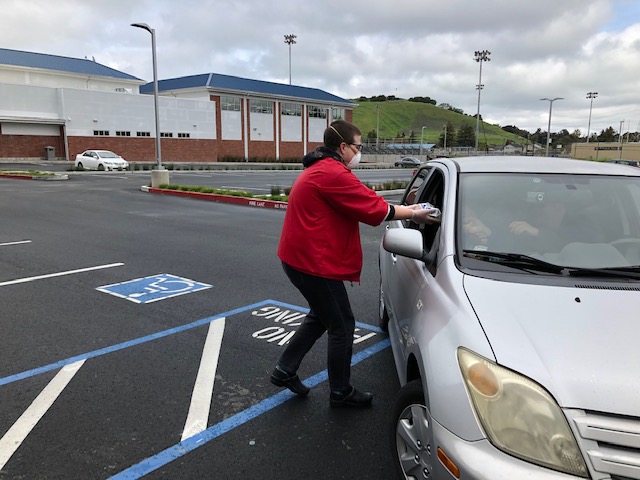
One of the top concerns among school authorities this week was preventing the spread of the coronavirus while parents and children picked up food. At Richmond High School and Pinole Valley High School, both part of West Contra Costa Unified, volunteers wore gloves and face masks while handing out food. Parents were encouraged to stay in their cars while staff handed them food through an open window.
Richmond High School is one of nine schools in the district serving food to families this week. Volunteers — including teachers and district officials — passed out breakfast and lunch to people who either walked or drove up to the school on Monday afternoon. Nadine Ahola, the district’s nutrition supervisor, said the volunteers passed out more than 300 bagged breakfasts and lunches in just an hour.
“We’re talking about thousands of kids who have lost their most stable food during the day, so it’s a super big concern,” said Gabriel Chilcott, principal of Mira Vista Elementary School in Richmond. “Food security is number one: you need your health and your safety before you get to the point of being able to learn.”
Maria Salinas, who picked up breakfast for her two sons Monday at Richmond High School, said it has been tough to get to the grocery store right now since her sons have special needs and are unable to wait in long lines. Being able to walk up to the school and get food for her children was a huge help, she said.
Tom Panas, a member of the West Contra Costa Unified school board, who was wearing gloves and a face mask while helping to distribute food on Monday, said social distancing was top of the mind for the volunteers.
“We’re taking all the precautions we can, but this is our community, right? We need to serve them,” he said.
Both Oakland and West Contra Costa serve thousands of students who qualify for free or reduced breakfast and lunch during the school year. Of the more than 50,000 students enrolled last year in either district-run public schools or charter schools, 73% qualified for free and reduced priced meals. In West Contra Costa, which had close to 32,000 students in district-run public schools, about 70% percent qualified. That compares to about 60 percent of students statewide.
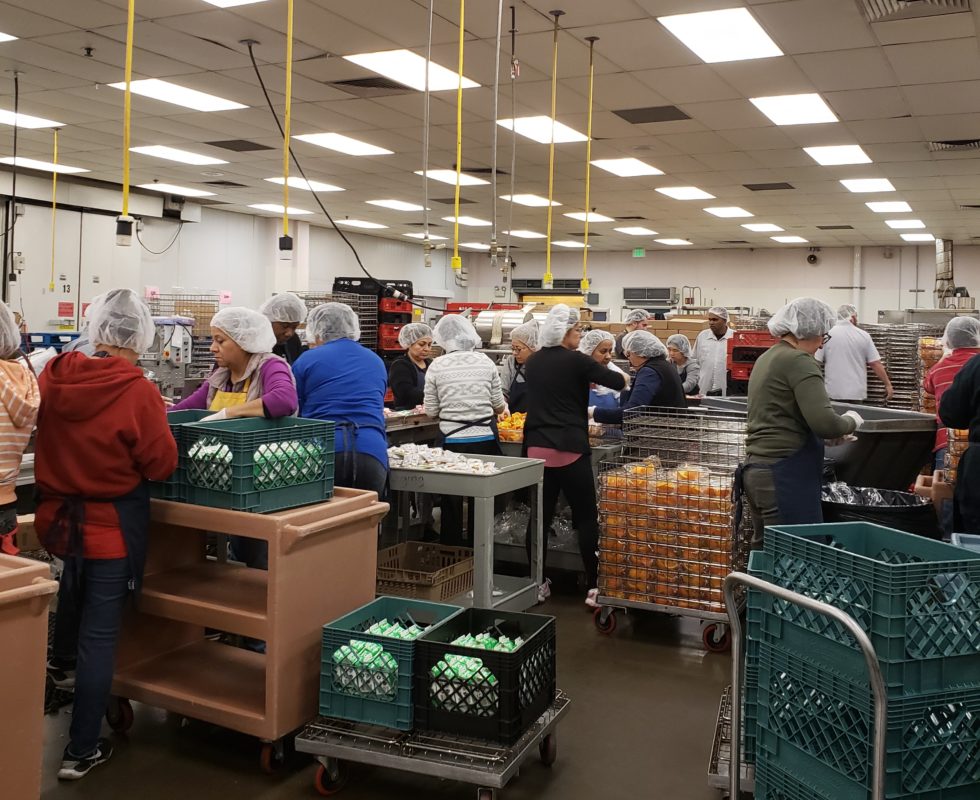
Volunteers distributed the food differently at each site. At West Oakland Middle School, plastic-bagged meals were laid out on a table and administrators told parents to add them to their grocery bags or coolers. At Pinole Valley and Richmond High, people who arrived by car or on foot were offered bagged meals of sandwiches, parfaits, a side of chips and some fruit.
For breakfast, the students in Oakland were offered cereal, juice and fruit, and for lunch they were offered BBQ beef rib sandwiches or a ham and cheese plate with a side of beans, milk and fruit.
At Pinole Valley High School, the breakfast option was cereal with fruit and juice and the lunch options included turkey sandwiches, salads and a fruit parfait for vegetarians.
Since eating at the sites was not allowed, all of the food was served cold.