
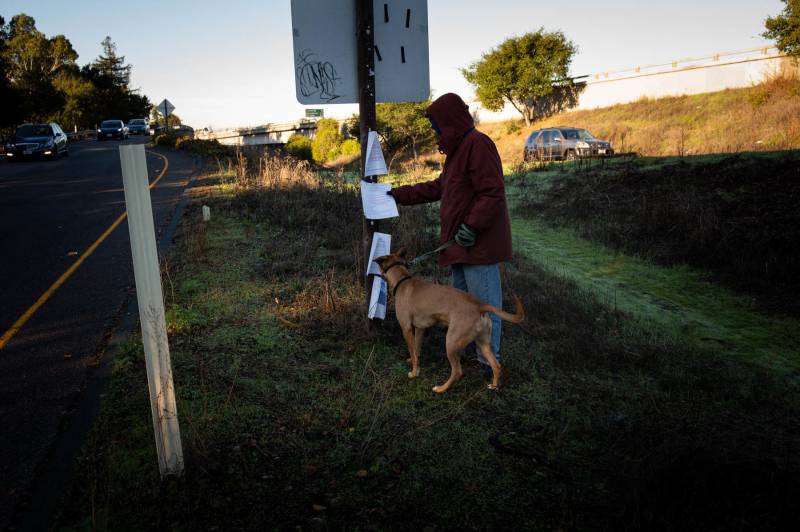
It’s 5 a.m., and the thermostat reads 44 degrees F. Cars round the bend of an off-ramp of state Route 24 in northern Oakland, spraying bands of light across Norm Ciha and his neighbors. They wear headlamps so they can see in the dark as they gather their belongings: tents, clothes, cooking gear, carts piled with blankets, children’s shoes and, in one case, a set of golf clubs.
Shredder, Ciha’s dog, takes a treat, then lets it fall from his mouth. He whines as Ciha walks away with a camping mattress. “I can leave him all day in the tent and he’s fine, but he freaks out every time we have to move,” Ciha says.
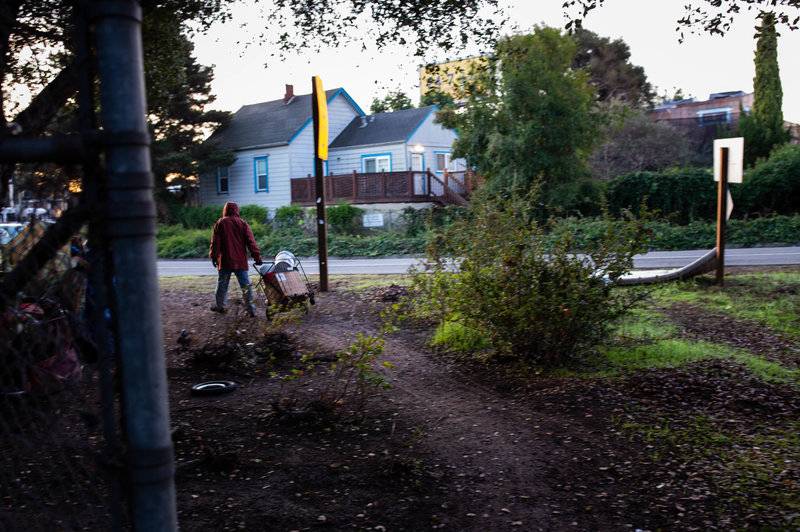
Every other week, the residents of this thin slice of state-owned land just off the freeway pack up their possessions and move to another empty lot nearby; they aren’t quite sure who owns it. They move in anticipation of the routine sweeps of homeless encampments ordered by the California Department of Transportation, which has jurisdiction over the state’s highways and exit ramps.
The highway crews check that the area is clear of people and their belongings, throwing away any items that remain. Once the trucks leave, the residents move back in. Ciha and his neighbors call it “the Caltrans Shuffle.”
Their makeshift neighborhood of tarps and tents is built on one of thousands of public spaces across California where people have set up camp. The state’s homeless population has ballooned in recent years; in 2019, there were more than 150,000 homeless people in California, according to the U.S. Department of Housing and Urban Development, and 72% of them did not have shelter.
A range of health concerns has spread among homeless communities. A few years ago, hepatitis A, spread primarily through feces, infected more than 700 people in California, most of them homeless, according to state officials. Ancient diseases, such as typhus, have resurged. Homeless people are dying in record numbers on the streets of Los Angeles, according to data from the county coroner.
Communities up and down California, increasingly frustrated with the growing number of homeless people living on public property, have tasked police and sanitation workers with dismantling encampments that they say pollute public areas and pose serious risk of fire, violence and disease. The rousting and cleanups have become a daily occurrence around the state, involving an array of state and local agencies.
But the response from officials has prompted a public health crisis all its own, according to interviews with dozens of homeless people and their advocates. Personal possessions, including medicines and necessary medical devices, are routinely thrown away. It’s a quotidian event that Leilani Farha, the United Nations special rapporteur on adequate housing, described as a “cruelty” that she hasn’t seen in other impoverished corners of the world.
Ciha, who is 57, learned the hard way that living on the street means his belongings can be taken in an instant.
In November 2018, when he was camping by an Ikea in nearby Emeryville, the California Highway Patrol and Caltrans employees showed up unannounced. He was out buying a tent when they arrived, and the crew designated his belongings as garbage. His fellow campers protested and grabbed what they could. Ciha returned and asked for time to gather his things. But everything, he says, was just thrown into a trash compactor.
Along with his bedding and clothes, he lost three weeks of an eight-week supply of the medication he’d been prescribed to treat hepatitis C. He’d gotten the medicine through Medi-Cal. Though the drugs were almost certainly purchased at a discount, Ciha’s course of treatment retails for around $40,000.
In 2018, a federal court case involving a camping ban in Boise, Idaho, determined that cities can’t cite people for sleeping on public property when there’s nowhere else to go. It doesn’t, however, determine rules about their possessions. That question has been argued for decades, with multiple courts determining that destroying or confiscating property without notice is a violation of the constitutional right to personal property. Cities rarely, if ever, fight those decisions, which means there’s been no precedent set by a higher court.
Lawsuits in California have made the issue more visible in the state than in other places, even though this is a nationwide problem, says Eric Tars, legal director of the National Law Center on Homelessness & Poverty. Today, many California cities have policies that either prevent seizing belongings or require storage, but public health and safety exceptions often allow for things to be thrown away without notice.
“If cities spent half the energy on trying to provide access to sanitation as they did on trying to find constitutional ways to take people’s belongings, they could address homelessness,” Tars says.
The city of San Francisco contends that it stores people’s belongings when they are seized — a policy that resulted from a settlement of an earlier lawsuit. But advocates for the homeless, including Chris Herring, a doctoral student in sociology at University of California, Berkeley, say that doesn’t always happen.
9(MDAxOTAwOTE4MDEyMTkxMDAzNjczZDljZA004))