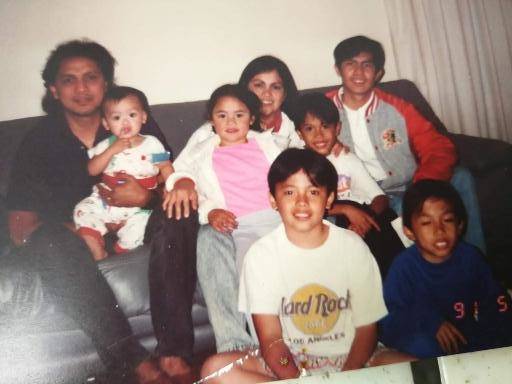
As a teenager, Floyd Hijada eventually came to understand why his dad had given him the nickname “Mr. Earthquake.”
“It confused me at first because the earthquake happened in October, but I was born in July,” said Hijada, the sixth and youngest child in his family. “But I guess, you know, that’s how it works.”
Hijada’s parents worked opposite schedules, he explained, so the two normally spent little time together. But that changed in the days after the Loma Prieta earthquake in 1989, when their routine came to an abrupt halt and the couple found themselves cooped up in their Daly City home without power.
“I already had five kids and we didn’t want any more,” Eleanor Hijada, then 37, told San Francisco Examiner reporter Annie Nakao in July 1990, after giving birth to her son just about nine months after the big quake.
“I was afraid. I rushed home,” Hijada’s mother said, recounting that fateful day. “My husband didn’t go to work. I was so scared. I had to be close to him. … I was very, very close.”
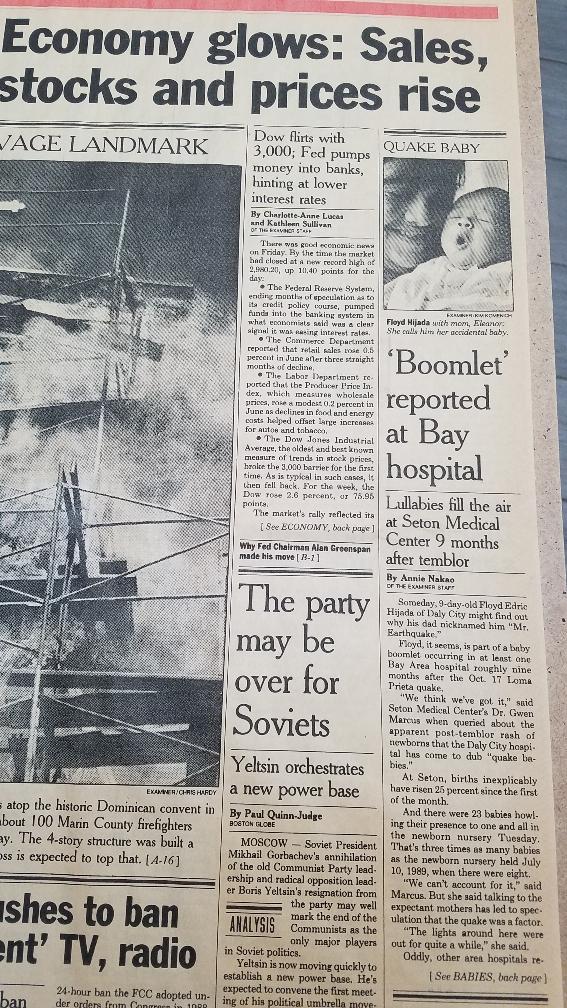
That Examiner article made the front page of the paper, which his parents framed and proudly displayed in the living room.
“I kind of grew up hearing about it,” said Floyd Hijada, who now lives in Concord and works as a graphic designer. “It became like this little discussion piece.”
The article described a “baby boomlet” of sorts that had occurred that July in the maternity ward of Seton Medical Center in Daly City.
Births at Seton had risen 25% since the first of the month, Nakao reported. On July 10, 1990, Hijada was one of 23 babies in the hospital’s newborn nursery, as compared to eight on the same day the previous year.
“We can’t account for it,” Dr. Gwen Marcus, of Seton, told Nakao at the time. But Marcus said talking to the expectant mothers had led to speculation that the temblor was indeed a factor, so much so that the hospital had dubbed the newborns “quake babies.”
Asked if he’d ever gotten a chance to meet any of his nursery companions, Hijada said, “No, man. I wish I did. You know, we’d be like a league of superheroes or something. I know there were a lot more [of them].”
In her story, Nakao acknowledged that the birth spike at Seton may have been an aberration. None of the other local hospitals she contacted at the time reported any unusual increases, although some said it was too soon to tell.
“I can’t say it’s all due to the quake,” Kathy Kohrman, Seton’s spokeswoman at the time, told Nakao. “But when we talk to some of the moms about quake babies, they kind of giggle, look away and turn red.”
It’s been a longstanding but largely unsubstantiated theory that mini baby booms occur after natural disasters or other events that confine people indoors.
Major natural disasters are commonly followed, roughly nine months later, by headlines pronouncing a spike in new humans. Such was the case with Hurricanes Sandy, Irma, Maria and Harvey.The supposed phenomenon has even been linked to government shutdowns in Washington, D.C. — dubbed “furlough fertility” — when federal workers have a lot more time on their hands.