
Just a few months ago, California’s Democratic-controlled legislature seemed poised to pass the nation’s toughest restrictions on for-profit colleges. School owners publicly fretted that they’d have to shut down.
Supporters of the seven-bill package, which sailed through the Assembly, hoped California could help close a gap in oversight as the Trump administration has backed away from policing quality in a sector that relies heavily on public money but has been plagued by fraud and poor outcomes. But as the legislative session draws to a close, nearly all of the bills have died or been significantly weakened, felled by a costly lobbying blitz and the complexity of crafting a state-based solution to a nationwide challenge.
Their demise marks a victory for an industry that has been plagued by scandals and school closures in recent years — and a setback for consumer and veterans groups that supported the legislation.
“The experience we’ve had moving this package forward highlights the role of money and what that buys as far as influence in the Capitol and in state capitols around the country,” said Assemblyman David Chiu, a San Francisco Democrat.
Chiu’s bill would have conditioned the right of career education programs to enroll Californians on proof that their graduates earn enough to pay back their student loans. It’s a version of the so-called “gainful employment” rule created under President Barack Obama and repealed by the Trump administration.
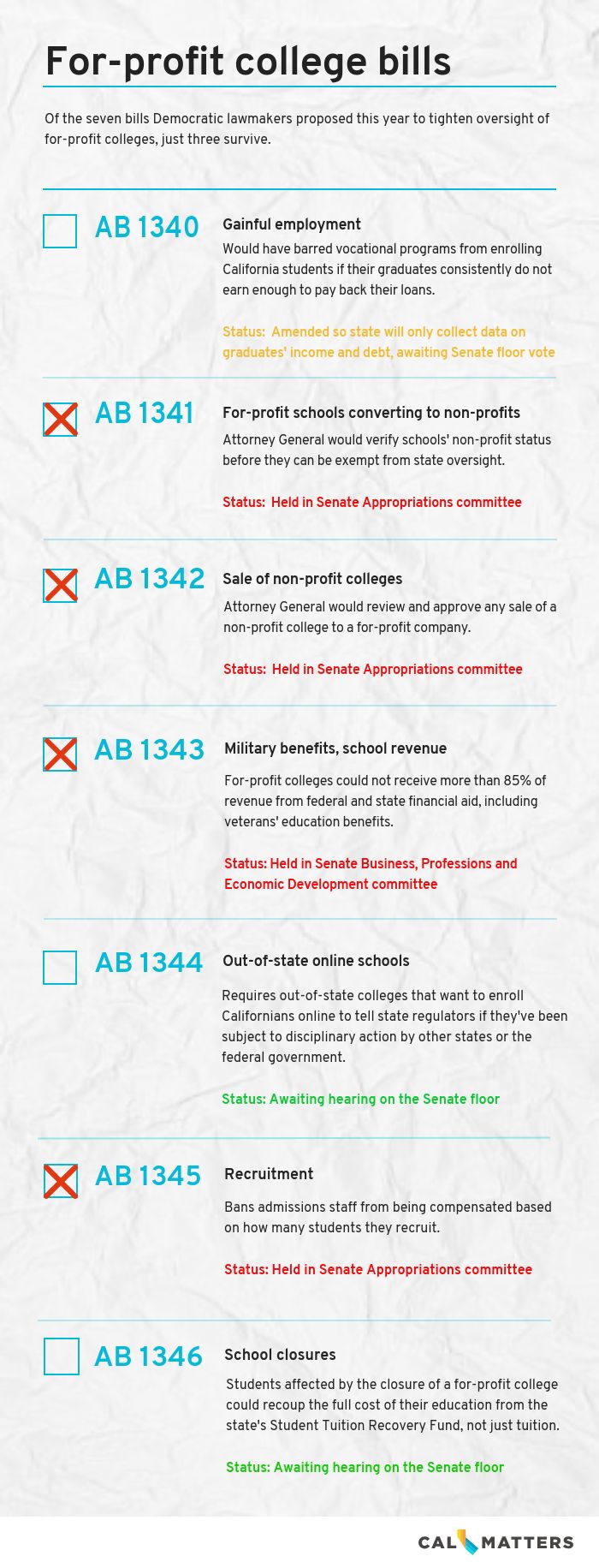
Other bills would have limited how much for-profit schools can rely on federal and state financial aid, prevented admissions staff from earning bonuses based on how many students they recruit and cracked down on colleges that officially convert to non-profit status but turn most of their earnings over to a profit-driven management company. The bills’ authors said they were meant to root out fraud and abuse in the industry, while allowing good schools to thrive.
But many schools saw the legislation as an existential threat and spent heavily to defeat it. For-profit colleges, vocational schools and online education companies poured more than $800,000 into lobbying California legislators in the first six months of 2019.
That’s nearly the same amount of lobbying cash that Pacific Gas & Electric spent defending its role in the state’s wildfire crisis over the same period — and more than four times the money spent by the consumer and veterans groups backing the for-profit college bills.