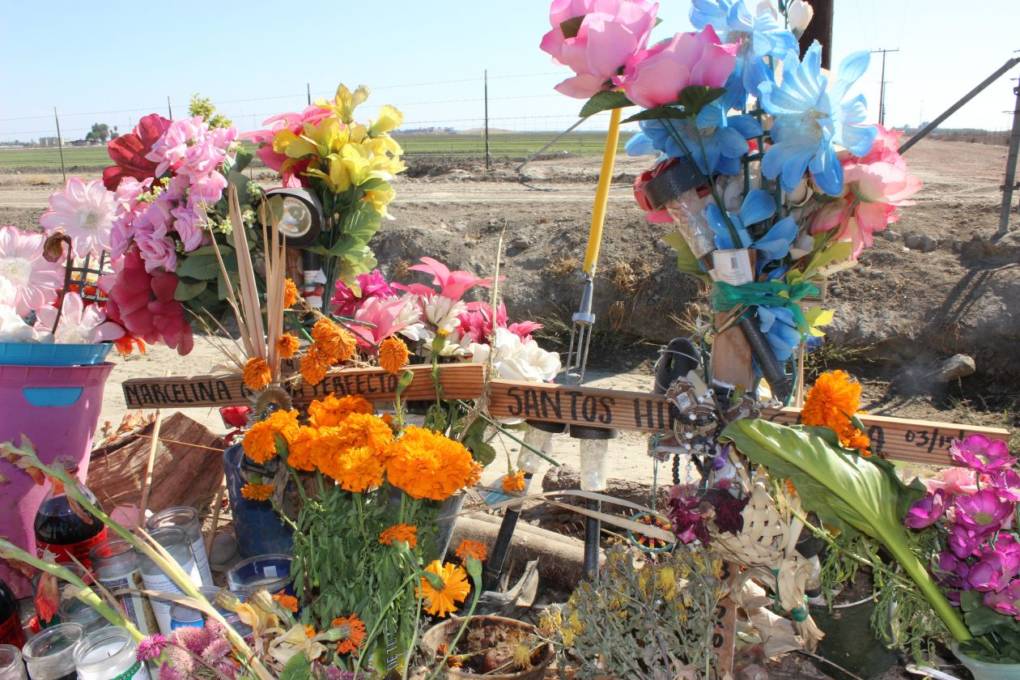
A shrine sits next to a Delano road where Marcelina and Santos Garcia died in a car crash while fleeing U.S. Immigration and Customs Enforcement agents. (Susan Ferriss / Center for Public Integrity)
Tragic Immigrant Deaths Fuel Drive to 'Flip' California GOP Congressional District
In shadow of Cesar Chavez, turnout drive seeks to engage Latinos upset over Trump’s policies.
Susan Ferriss
A
small shrine with fresh marigolds and votive candles marks the spot where immigrants Marcelina and Santos Garcia were killed on March 13. The couple, of Mixtec Indian origin, had emigrated to California’s Central Valley from a rural region in Mexico where family values are strong.
Like so many other immigrants, they built a life in Delano, a city of 53,000 that’s about 140 miles north of Los Angeles. There, they worked in the world’s most productive farm industry, in its vast sea of grape vines, fruit trees and multi-seasonal crops.
But early that March morning, as the Garcias drove through town, U.S. Immigration and Customs Enforcement agents closed in on their SUV.
Attempting to evade agents, the undocumented couple sped down a country road. The vehicle went out of control and crashed into a pole and rolled over, killing the Garcias, who never knew that ICE was looking for Santos’ brother, not for them.
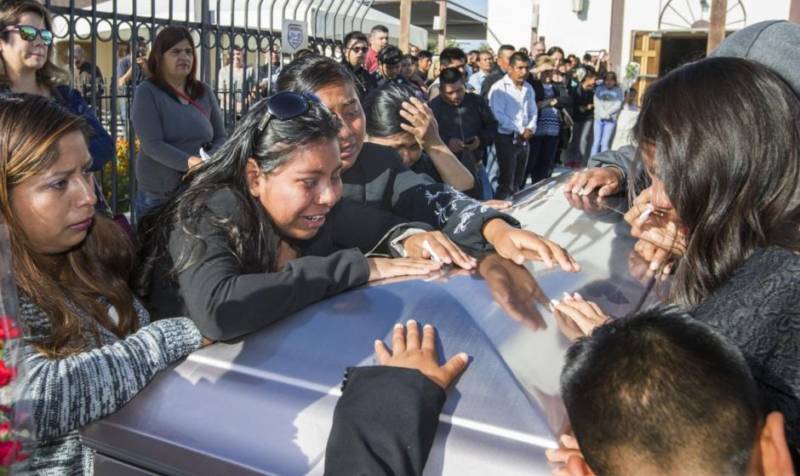
Mourning family bid goodbye to the immigrant couple who died fleeing ICE agents. (The Bakersfield Californian)
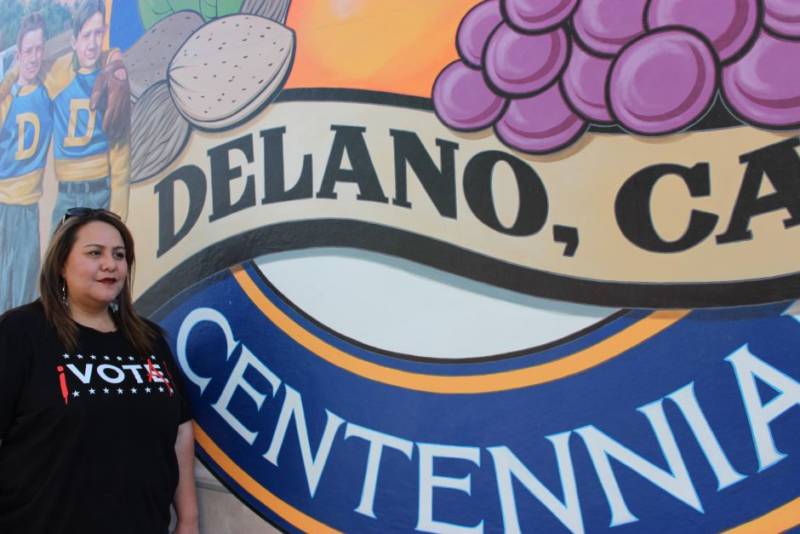
The Garcias’ deaths left their six children, who are not all U.S. citizens, orphaned. And in Delano — where in 1965 the United Farm Workers first carved their place in history — anger and fear about what happened has added urgency and upped the stakes for the midterm election occurring tomorrow.
“This has been huge wake-up call for the Latino community,” said Yazmin Hernandez, 22, a graduate of Fresno State University who helps legal permanent-resident immigrants in Delano apply for citizenship. “As a child of farmworkers,” she said, “I really want to vote.”
But do others agree? Hernandez and a lot of young Latinos like her — many motivated, some less so — could be pivotal to what happens in this grape-growing region with a disappointing history of voter turnout. That history explains why get-out-the-vote campaigns hoping to energize thousands of voters have been sweeping through California’s Central Valley in recent weeks, as labor groups and immigrant rights activists aim to send a message to President Donald J. Trump.
In the eye of the storm: the district’s congressman, U.S. Rep. David Valadao, a Republican who has defied the odds by being elected three times in a district where Democrats hold a registration advantage and Hillary Clinton was victorious just two years ago.
Youth Get Involved
There’s no escaping Delano’s dramatic past. Not far from the roadside shrine commemorating the Garcias, the United Farm Workers’ original adobe headquarters, “Forty Acres,” is now a national historic landmark — something few would have imagined in the late 1960s here in Kern County. A bronze plaque and other markers explain Delano’s place in a chapter of American history that still rankles some conservatives and divides people here even today.
It took a five-year strike and a national boycott campaign for the UFW to obtain its first union contract in 1970 benefiting Mexican-American and Mexican and Filipino immigrant grape laborers. As door-to-door voter turnout campaigns tick up to Election Day, Forty Acres is a reminder that change can take root slowly.
Delano is home to Forty Acres, now a national historic landmark. It’s where Cesar Chavez and farmworkers established a headquarters in the late 1960s to fight for farm labor and civil rights. Chavez fasted in a room at Forty Acres, pictured at left, to demand rights for agricultural workers. (Susan Ferriss / Center for Public Integrity).
For frustrated Democrats, this is a crucial beachhead. Out of the 53 seats allotted to California in the House of Representatives, only 14 districts are held by Republicans in a state that’s been gradually turning deep blue for years now. Delano, 77 percent Latino, sits in one of the GOP pockets: the sprawling 21st Congressional District. The Almanac of American Politics says Valadao has won here against Democratic candidates “who have consistently under-performed initial expectations.”
Stretching more than 150 miles northwest to southeast, the Valley district includes parts of Fresno, Kings, Tulare and Kern counties and a piece of the city of Bakersfield. The district is also home to a smattering of small cities, Naval Air Station Lemoore, a major fighter base, and mile after mile of crops and dairy farms.
Interest in midterm elections is usually tepid compared to presidential races. But it’s the age of Trump, and California is a state where Latinos, mostly Mexican-American, are now the single largest demographic.
Against this backdrop, Democrats hope that more door-to-door contact with “low-propensity” voters and “ticket splitters” will channel that anti-Trump sentiment into victories in at least a few GOP-held districts. If that happens, GOP California could shrink more and contribute to “flipping” the Republican-held U.S. House of Representatives to Democrats. But Valadao has not been alone in bucking the tide; neighboring conservative districts are held by House Majority Leader Kevin McCarthy and rising conservative star Devin Nunes.
Democrats would dearly love to do better here. But even enthusiasts don’t expect turnout miracles.
Statewide, Latinos are only 21 percent of those most likely to vote in elections generally, even though 34 percent of those eligible to vote in California are Latino, according to the Public Policy Institute of California.
But young people, especially, who are scared for their peers’ or their own undocumented parents, say there’s no choice but to hit the streets and persuade those eligible to cast ballots.
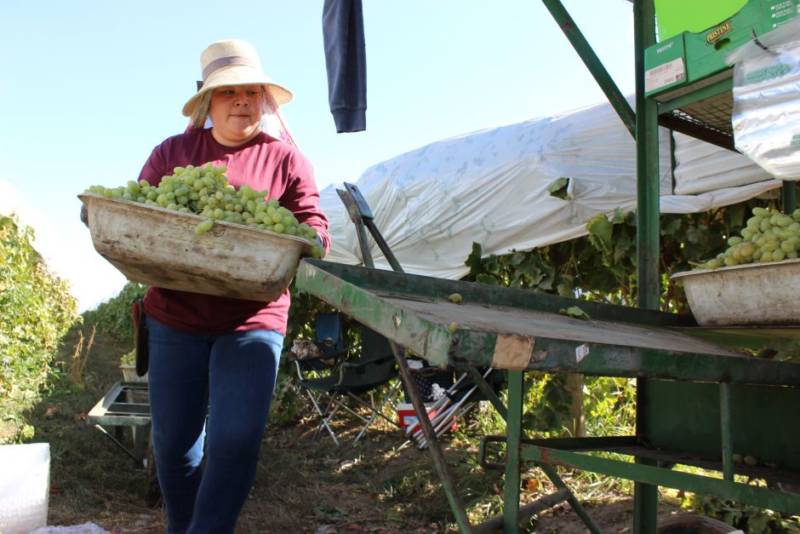
“We share a history as the children of immigrant parents. We don’t know if the next ICE pursuit will be for one our families,” said Bryan Osorio, 22, who grew up in Delano. He explained the personal stakes for so many here during a meeting at Delano’s sole Starbucks. The coffee shop wasn’t far from where workers, swaddled in scarfs to fend off dust, were gleaning the last of this area’s gargantuan crop of table grapes to ship back East.
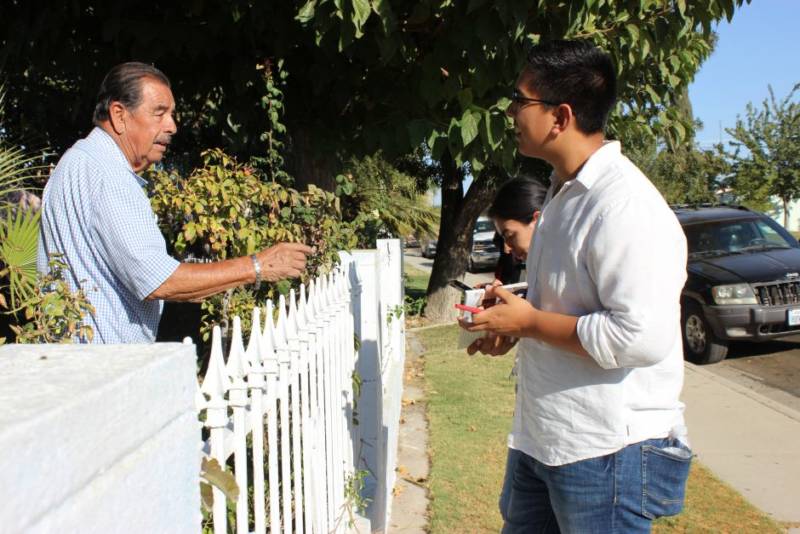
Bryan Osorio, 22, of Delano, talks to an 80-year-old Delano voter. Osorio is a University of California, Berkeley, graduate running for Delano City Council to address drinking water problems and defend immigrant families. (Susan Ferriss / Center for Public Integrity).
After the Garcias died, Delano police examined video and found that ICE agents had pursued the couple with lights flashing, contrary to what ICE agents told officers investigating circumstances of the chase. Police recommended Kern County prosecutors charge ICE agents for providing false information, but prosecutors disagreed that evidence supported that charge. Osorio and fellow students who were home on spring break marched with Delano high school students denouncing Trump’s aggressive deployment of ICE.
Osorio’s immigrant parents aren’t citizens and can’t vote, he said. But he can.
Going back years, Republican politicians and agribusiness companies in California have acknowledged that they depend on immigrant workers, many of whom likely don’t have authentic work documents. As producers of more than half the fruits, vegetables and nuts in the country — and as the biggest dairy producers — California agribusiness interests lobbied Washington for years to legalize the labor force.
That didn’t happen, and then Trump was elected.
Because he’d like a leadership role in vigorously challenging Trump policies, Osorio is now running for Delano City Council. He’s also vowing to address Delano’s poor water quality and stop water rate hikes burdening low-income families here. Armed with research to help him home in on infrequent voters, the recent University of California at Berkeley graduate has been knocking on doors on the West side of Delano, the Latino barrio back when Latinos were a minority and some white-owned establishments barred Mexicans from entry.
Other college students are backing Osorio, and they split up homes chosen as targets. When he’s not campaigning, Osorio’s working as a fellow at the American Civil Liberties Institute.
“I’ve gotten a lot of vulgar comments from older men,” Osorio said of reactions to his campaign. “They said, ‘When I was your age I was chasing girls and partying. But my respect to you.’”
During his canvassing rounds, Osorio secured a verbal pledge of support from an 80-year-old citizen relaxing in his rose garden. A younger man in dusty work clothes shook Osorio’s hand and assured him in a mix of Spanish and English that he’d already voted “all Democrats” and for Osorio.
“Maybe he did,” Osorio said, as his team discussed follow up visits. Not all voters appreciated the students’ visits. As one of Osorio’s friends approached a house, he was met with: “I don’t vote. Go away.”
Split Ticket Voters
It’s easy to see why it’s frustrating to Delano immigrant activists and Democrats that the 21st congressional district remains Republican.
The sunbaked valley has some of the worst air pollution in the country and high rates of health problems like diabetes and asthma. Obamacare was a boon to many low-income residents here.
The district chose Democrat Hillary Clinton over Trump by more than 15 points in 2016, making it one of seven GOP-held Congressional districts where the Democrat prevailed. But even though Democrats in the 21st had an estimated 16-point registration advantage over Republicans, voters returned Valadao to Congress.
Like the more nationally recognizable Nunes, Valadao, 41, comes from dairy-farming roots. A bank seized Valadao’s family farm in June due to $8 million in unpaid loans, a crisis Valadao said exemplifies the travails of farmers he serves.
A mild-mannered man, he recently posed in Arizona with President Trump, along with Nunes and McCarthy of Bakersfield, who hopes to vault from GOP majority leader to Speaker of the House if the GOP retains control.
The photo op on Oct. 19 was all about irrigation water — a massive issue here. It showcased Trump signing a memo accelerating biological reviews of water systems that Central Valley farmers — and workers — hope will divert more water from California rivers bearing endangered species. Trump’s move was met here with strong approval, and there was Valadao by his side.
In addition to its tight bond with agribusiness, the valley is also one of California’s most culturally conservative regions. Evangelical churches are prominent, along with conservative talk radio in English and Spanish. Some local Latino activists suggest that Valadao has benefited at the polls because some voters think he is of Mexican heritage. In reality, Valadao is of Portuguese descent, as is Nunes.
So, what gives Democrats hope for this election?
The president’s lacerating rhetoric about Mexican immigrants has upset a lot of people, so even if they regard Valadao as moderate, Trump has further tarnished the Republican brand in California. About 62 percent of the 21st district’s residents who are eligible to register to vote are Latino.
“These immigrants risk their lives to work here,” said Mexican-American Erica Cruz, 48, a self-employed hairdresser whose husband used to be undocumented. “Latinos are getting picked on. This town thrives on Latinos…Trump is putting us in a terrible position and we’re scared.”
It’s irksome to Cruz because it’s plain to her that the region’s agribusiness industry — America’s farm powerhouse — has benefited from people who shoulder all the risks that come with undocumented immigration. Workers have assumed the burden of paying smugglers thousands of dollars to get them over the border, so they can take back-breaking jobs they obtain by showing fake documents that employers have no obligation to authenticate.
Today, it’s common for there to be no bright line between documented and undocumented in towns like Delano because there are many “mixed status” families, with some members citizens, others legal residents and still others who are undocumented, “sin papales,” without papers.
Immigrant workers are the backbone of agribusiness in California’s 21st Congressional District and other GOP-held districts in the Central Valley. (Susan Ferriss / Center for Public Integrity).
Valadao, whose campaign did not respond to interview requests, has succeeded in part because he’s sensitive to the composition of his district, and he’s tried to walk a difficult line on immigration.
On his Spanish-language website, he calls himself as an “hijo de inmigrantes,” a son of immigrants.
Valadao’s website also says he supports a path to legal status for undocumented people: “This will allow millions of immigrants to come out of the shadows…and raise their families without the constant fear of deportation.” But none of Valadao’s positions have gone anywhere under GOP leadership.
When pressed on immigration, Valadao has pointed out that he signed a petition this year designed to force GOP House leaders to allow lawmakers to vote on a series of complex immigration proposals, among them a path to legal status for Dreamers, undocumented people brought to the United States as children.
The petition failed to lead to any reforms passing.
In Delano, voters seemed either unaware of the byzantine petition process or dismissed it as window dressing to aid GOP legislators looking for Latino votes.
TJ Cox, Valadao’s Democratic rival, told Valadao during a recent debate: “The fact is your party has control of every branch of government … and you can’t pass … an immigration bill.”
Cox, 55, is a Fresno engineer and businessman who’s developed dams — he can talk water — and who’s also founded two nut-processing businesses and a series of health centers in lower-income areas. He’s part Chinese and Filipino, which he’s highlighted in this multicultural region.
But Valadao has attacked Cox for living a few miles outside the 21st district — which is allowed — and for what Cox says was an “honest mistake” in claiming his Fresno home and an East Coast home as his primary address while his wife was studying in Maryland.
The influential Cook Political Report predicts a win for Valadao. It’s moved the 21st district race to “likely Republican,” rather than the more equivocal “lean” or “toss up” designations given to some of California’s other contested districts.
Cox’s campaign, though, sees hope in fresh numbers pollsters might not be capturing.
Since Trump took office in January 2017, campaign workers point out, more than 30,000 additional people have registered to vote in the 21st district, more than 20,000 of them Latinos.
“Latinos know there’s some guy there in the administration that has no respect for them,” Cox told the Center for Public Integrity after his wife, Kathleen Murphy, a pediatric intensive care physician, passed her cell phone over for a chat. On a recent weekend, she was in a Delano park with supporters who fanned out through town as part of a Democratic “blue wave” door-to-door strategy to try to coax voters to come out.
Joining Murphy was Cruz, the Delano hairdresser, who said that rather than just casting a ballot this year, she felt compelled to hold home meetings and to canvass along with other bilingual volunteers. She’s hoping Republican hostility to the Affordable Care Act — and Valadao’s votes to oppose and then repeal it — will also animate voters to choose Cox.
But, she conceded, many people aren’t aware of Valadao’s votes and she’s left explaining them.
“We must fight back,” she said.
Veronica Lopez, 36, a medical technician, is just the type of voter Cruz wants to reach.
In an interview at Starbucks, where she was scrolling through her phone, Lopez said that she had voted for Hillary Clinton. She has health insurance through her job. What’s weighing on her mind these days is college affordability, which has stymied her son’s plans for a four-year college.
She does care about immigration to the extent that she doesn’t want to see families “torn apart.”
“I don’t like people deported for no good reason,” she said. Farms have been losing workers because of ICE enforcement and they need workers, she added.
And as for Trump, she said with a shake of her head, “I’ve never seen a president who talks so badly about people.” Will she vote? She thinks so but wasn’t certain. She didn’t seem that excited about the kinds of races on the ballot this time around.
Political scientist Mark Martinez at California State University at Bakersfield, also in Kern County, said he thinks if TJ Cox were running in a presidential election year, his odds of defeating Valadao would be far greater.
A longtime observer of elections here, Martinez said it’s “Poli Sci 101” why more Central Valley voters don’t come out more at midterms: Just as in other parts of the country, he said, the least advantaged people are the least likely to believe their vote matters.
“We have some of the poorest congressional districts,” he said. Valadao, he added, doesn’t make “any stupid mistakes” in regard to the hot-button issue of immigration.
Sowing Voter Seeds
Another Delano resident, Valerie Gorospe, 40, is a community organizer at Delano’s Center on Race, Poverty and the Environment. She collaborated with a bipartisan voter-registration education campaign this past year called Central Valley Freedom Summer.
The campaign sent college students from the University of California’s Santa Cruz and Merced campuses back to their Valley hometowns to talk to kids about voting, and register 18-year-olds along with kids 16 and older, who can pre-register in California.
Gorospe grew up in an Earlimart, right across from a giant vineyard in the 21st Congressional District.
Gorospe said she can’t understand how agribusiness can continue to vote for politicians who support Trump, who’s portrayed undocumented people as criminals and has pushed for blanket deportation.
“It’s like cutting your arms off,” Gorospe said of Trump-supporting politicians whose districts have so eagerly used immigrant laborers.
Valerie Gorospe, 40, a Delano community organizer, said more young voters are connecting federal policy under Trump with their families’ lives. (Susan Ferriss / Center for Public Integrity).
The Kern County Farm Bureau didn’t respond to a request to talk about Trump, ICE enforcement and the election. The group’s Facebook page has multiple posts about labor shortage concerns and educational sessions on how to respond to audits of employment records ICE carries out to identify potential undocumented employees.
Local chambers of commerce and the U.S. Chamber of Commerce have endorsed Valadao, because of his connections to “ag, energy and water,” as a press release said.
Golespe said she thinks Trump and GOP positions on immigration are going to bring more younger voters to the polls next week.
“I’ve never seen curiosity about voting in this age group like I’ve seen this year,” she said. “They’ve really connected federal policies with what’s happening here.”
Others are trying to share that optimism. Veronica Terriquez, who is a UC Santa Cruz associate professor of sociology, organized the Freedom Summer project. Research, she said, shows that kids are often “socialized” to vote and learn about candidates and issues within their family. The project is trying to address the absence of that socialization in Central Valley homes because so many kids’ parents aren’t citizens and either can’t vote or vote infrequently.
Schools, too, Terriquez said, don’t devote a lot of time encouraging voting. She said some Central Valley school administrators, worried about controversy, were initially hesitant to allow returning college students to talk with younger kids and conduct registration.
“One of the high school students asked if there were concerns if she, a citizen, registered, and her parents were undocumented,” Terriquez added.
During the 2014 midterms, turnout among all Californians eligible to vote was a record low of about 31 percent. But for eligible 18- to 24-year-olds, turnout was even worse at about 8 percent. Turnout for the young demographic in the Central Valley was even lower at less than 7 percent, according to research by the California Civic Engagement Project at the University of Southern California’s Sacramento office.
Mindy Romero, director of the California Civic Engagement Project, said that beyond registration, cultivating turnout “takes deep, multiple contacts,” along with strategies that include “peer to peer” outreach and time spent in communities off the election cycle.
That’s what one nonpartisan group, Faith in the Valley, has been trying to do in five counties, including Kern, where Delano is.
“We’re shooting to speak to between 12,000 and 15,000 voters,” said Carmen Medrano, a regional organizer for the Valley group. “We’re not from a political party, we say. We’re here about issues, like affordable housing, fair rents, making sure immigrant families are protected.”
The United Farm Workers are also active in the district, though they’re focused more on a state Assembly race. On their rounds, canvassers explain the union’s slate choices, which include Valadao’s opponent, TJ Cox. UFW member Nancy Oropeza, who’s working on the effort, said that canvassers have also left potted flowers with voters to remind them — when you water the flower, think about voting.
The UFW assignment was to reach a universe in multiple towns of 16,000, face-to-face, who are Latino and infrequent voters.
“The first thing we’ve been hearing from people we contact is: Trump, Trump. He attacks us,” Oropeza said. “Once they say, yes, they want to vote, you go back to ensure they’ve received their ballot.”
Over at Delano’s Our Lady of Guadalupe Church, another influential institution in town — which has collaborated with the UFW to aid the orphaned Garcia children — Father Miguel Campos said the church doesn’t favor candidates in elections. But the church does believe that elections matter.
“We tell people,” he said, “that it’s a civic and Christian duty to vote.” Tomorrow he’ll find out whether they’re listening.
This story was published in partnership with HuffPost.
lower waypointnext waypoint
Player sponsored by
window.__IS_SSR__=true
window.__INITIAL_STATE__={
"attachmentsReducer": {
"audio_0": {
"type": "attachments",
"id": "audio_0",
"imgSizes": {
"kqedFullSize": {
"file": "https://ww2.kqed.org/news/wp-content/themes/KQED-unified/img/audio_bgs/background0.jpg"
}
}
},
"audio_1": {
"type": "attachments",
"id": "audio_1",
"imgSizes": {
"kqedFullSize": {
"file": "https://ww2.kqed.org/news/wp-content/themes/KQED-unified/img/audio_bgs/background1.jpg"
}
}
},
"audio_2": {
"type": "attachments",
"id": "audio_2",
"imgSizes": {
"kqedFullSize": {
"file": "https://ww2.kqed.org/news/wp-content/themes/KQED-unified/img/audio_bgs/background2.jpg"
}
}
},
"audio_3": {
"type": "attachments",
"id": "audio_3",
"imgSizes": {
"kqedFullSize": {
"file": "https://ww2.kqed.org/news/wp-content/themes/KQED-unified/img/audio_bgs/background3.jpg"
}
}
},
"audio_4": {
"type": "attachments",
"id": "audio_4",
"imgSizes": {
"kqedFullSize": {
"file": "https://ww2.kqed.org/news/wp-content/themes/KQED-unified/img/audio_bgs/background4.jpg"
}
}
},
"placeholder": {
"type": "attachments",
"id": "placeholder",
"imgSizes": {
"thumbnail": {
"file": "https://cdn.kqed.org/wp-content/uploads/2024/12/KQED-Default-Image-816638274-2000x1333-1-160x107.jpg",
"width": 160,
"height": 107,
"mimeType": "image/jpeg"
},
"medium": {
"file": "https://cdn.kqed.org/wp-content/uploads/2024/12/KQED-Default-Image-816638274-2000x1333-1-800x533.jpg",
"width": 800,
"height": 533,
"mimeType": "image/jpeg"
},
"medium_large": {
"file": "https://cdn.kqed.org/wp-content/uploads/2024/12/KQED-Default-Image-816638274-2000x1333-1-768x512.jpg",
"width": 768,
"height": 512,
"mimeType": "image/jpeg"
},
"large": {
"file": "https://cdn.kqed.org/wp-content/uploads/2024/12/KQED-Default-Image-816638274-2000x1333-1-1020x680.jpg",
"width": 1020,
"height": 680,
"mimeType": "image/jpeg"
},
"1536x1536": {
"file": "https://cdn.kqed.org/wp-content/uploads/2024/12/KQED-Default-Image-816638274-2000x1333-1-1536x1024.jpg",
"width": 1536,
"height": 1024,
"mimeType": "image/jpeg"
},
"fd-lrg": {
"file": "https://cdn.kqed.org/wp-content/uploads/2024/12/KQED-Default-Image-816638274-2000x1333-1-1536x1024.jpg",
"width": 1536,
"height": 1024,
"mimeType": "image/jpeg"
},
"fd-med": {
"file": "https://cdn.kqed.org/wp-content/uploads/2024/12/KQED-Default-Image-816638274-2000x1333-1-1020x680.jpg",
"width": 1020,
"height": 680,
"mimeType": "image/jpeg"
},
"fd-sm": {
"file": "https://cdn.kqed.org/wp-content/uploads/2024/12/KQED-Default-Image-816638274-2000x1333-1-800x533.jpg",
"width": 800,
"height": 533,
"mimeType": "image/jpeg"
},
"post-thumbnail": {
"file": "https://cdn.kqed.org/wp-content/uploads/2024/12/KQED-Default-Image-816638274-2000x1333-1-672x372.jpg",
"width": 672,
"height": 372,
"mimeType": "image/jpeg"
},
"twentyfourteen-full-width": {
"file": "https://cdn.kqed.org/wp-content/uploads/2024/12/KQED-Default-Image-816638274-2000x1333-1-1038x576.jpg",
"width": 1038,
"height": 576,
"mimeType": "image/jpeg"
},
"xxsmall": {
"file": "https://cdn.kqed.org/wp-content/uploads/2024/12/KQED-Default-Image-816638274-2000x1333-1-160x107.jpg",
"width": 160,
"height": 107,
"mimeType": "image/jpeg"
},
"xsmall": {
"file": "https://cdn.kqed.org/wp-content/uploads/2024/12/KQED-Default-Image-816638274-2000x1333-1-672x372.jpg",
"width": 672,
"height": 372,
"mimeType": "image/jpeg"
},
"small": {
"file": "https://cdn.kqed.org/wp-content/uploads/2024/12/KQED-Default-Image-816638274-2000x1333-1-672x372.jpg",
"width": 672,
"height": 372,
"mimeType": "image/jpeg"
},
"xlarge": {
"file": "https://cdn.kqed.org/wp-content/uploads/2024/12/KQED-Default-Image-816638274-2000x1333-1-1020x680.jpg",
"width": 1020,
"height": 680,
"mimeType": "image/jpeg"
},
"full-width": {
"file": "https://cdn.kqed.org/wp-content/uploads/2024/12/KQED-Default-Image-816638274-2000x1333-1-1920x1280.jpg",
"width": 1920,
"height": 1280,
"mimeType": "image/jpeg"
},
"guest-author-32": {
"file": "https://cdn.kqed.org/wp-content/uploads/2025/01/KQED-Default-Image-816638274-1333x1333-1-160x160.jpg",
"width": 32,
"height": 32,
"mimeType": "image/jpeg"
},
"guest-author-50": {
"file": "https://cdn.kqed.org/wp-content/uploads/2025/01/KQED-Default-Image-816638274-1333x1333-1-160x160.jpg",
"width": 50,
"height": 50,
"mimeType": "image/jpeg"
},
"guest-author-64": {
"file": "https://cdn.kqed.org/wp-content/uploads/2025/01/KQED-Default-Image-816638274-1333x1333-1-160x160.jpg",
"width": 64,
"height": 64,
"mimeType": "image/jpeg"
},
"guest-author-96": {
"file": "https://cdn.kqed.org/wp-content/uploads/2025/01/KQED-Default-Image-816638274-1333x1333-1-160x160.jpg",
"width": 96,
"height": 96,
"mimeType": "image/jpeg"
},
"guest-author-128": {
"file": "https://cdn.kqed.org/wp-content/uploads/2025/01/KQED-Default-Image-816638274-1333x1333-1-160x160.jpg",
"width": 128,
"height": 128,
"mimeType": "image/jpeg"
},
"detail": {
"file": "https://cdn.kqed.org/wp-content/uploads/2025/01/KQED-Default-Image-816638274-1333x1333-1-160x160.jpg",
"width": 160,
"height": 160,
"mimeType": "image/jpeg"
},
"kqedFullSize": {
"file": "https://cdn.kqed.org/wp-content/uploads/2024/12/KQED-Default-Image-816638274-2000x1333-1.jpg",
"width": 2000,
"height": 1333
}
}
},
"news_11703751": {
"type": "attachments",
"id": "news_11703751",
"meta": {
"index": "attachments_1716263798",
"site": "news",
"id": "11703751",
"found": true
},
"parent": 11703744,
"imgSizes": {
"twentyfourteen-full-width": {
"file": "https://ww2.kqed.org/app/uploads/sites/10/2018/11/trump1-1038x576.jpeg",
"width": 1038,
"mimeType": "image/jpeg",
"height": 576
},
"thumbnail": {
"file": "https://ww2.kqed.org/app/uploads/sites/10/2018/11/trump1-160x107.jpeg",
"width": 160,
"mimeType": "image/jpeg",
"height": 107
},
"post-thumbnail": {
"file": "https://ww2.kqed.org/app/uploads/sites/10/2018/11/trump1-672x372.jpeg",
"width": 672,
"mimeType": "image/jpeg",
"height": 372
},
"kqedFullSize": {
"file": "https://ww2.kqed.org/app/uploads/sites/10/2018/11/trump1.jpeg",
"width": 1260,
"height": 840
},
"large": {
"file": "https://ww2.kqed.org/app/uploads/sites/10/2018/11/trump1-1020x680.jpeg",
"width": 1020,
"mimeType": "image/jpeg",
"height": 680
},
"complete_open_graph": {
"file": "https://ww2.kqed.org/app/uploads/sites/10/2018/11/trump1-1200x800.jpeg",
"width": 1200,
"mimeType": "image/jpeg",
"height": 800
},
"guest-author-50": {
"file": "https://ww2.kqed.org/app/uploads/sites/10/2018/11/trump1-50x50.jpeg",
"width": 50,
"mimeType": "image/jpeg",
"height": 50
},
"guest-author-96": {
"file": "https://ww2.kqed.org/app/uploads/sites/10/2018/11/trump1-96x96.jpeg",
"width": 96,
"mimeType": "image/jpeg",
"height": 96
},
"medium": {
"file": "https://ww2.kqed.org/app/uploads/sites/10/2018/11/trump1-800x533.jpeg",
"width": 800,
"mimeType": "image/jpeg",
"height": 533
},
"guest-author-64": {
"file": "https://ww2.kqed.org/app/uploads/sites/10/2018/11/trump1-64x64.jpeg",
"width": 64,
"mimeType": "image/jpeg",
"height": 64
},
"guest-author-32": {
"file": "https://ww2.kqed.org/app/uploads/sites/10/2018/11/trump1-32x32.jpeg",
"width": 32,
"mimeType": "image/jpeg",
"height": 32
},
"detail": {
"file": "https://ww2.kqed.org/app/uploads/sites/10/2018/11/trump1-150x150.jpeg",
"width": 150,
"mimeType": "image/jpeg",
"height": 150
},
"guest-author-128": {
"file": "https://ww2.kqed.org/app/uploads/sites/10/2018/11/trump1-128x128.jpeg",
"width": 128,
"mimeType": "image/jpeg",
"height": 128
}
},
"publishDate": 1541448326,
"modified": 1541456603,
"caption": "A shrine sits next to a Delano road where Marcelina and Santos Garcia died in a car crash while fleeing U.S. Immigration and Customs Enforcement agents.",
"description": "A shrine sits next to a Delano road where Marcelina and Santos Garcia died in a car crash while fleeing U.S. Immigration and Customs Enforcement agents.",
"title": "trump1",
"credit": "Susan Ferriss / Center for Public Integrity",
"status": "inherit",
"isLoading": false,
"fetchFailed": false
}
},
"audioPlayerReducer": {
"postId": "stream_live",
"isPaused": true,
"isPlaying": false,
"pfsActive": false,
"pledgeModalIsOpen": true,
"playerDrawerIsOpen": false,
"liveAudioPlayStartedAt": 0,
"liveAudioPlayContext": ""
},
"authorsReducer": {
"byline_news_11703744": {
"type": "authors",
"id": "byline_news_11703744",
"meta": {
"override": true
},
"slug": "byline_news_11703744",
"name": "Susan Ferriss",
"isLoading": false
}
},
"pagesReducer": {},
"pfsSessionReducer": {},
"postsReducer": {
"stream_live": {
"type": "live",
"id": "stream_live",
"audioUrl": "https://streams.kqed.org/kqedradio",
"title": "Live Stream",
"excerpt": "Live Stream information currently unavailable.",
"link": "/radio",
"featImg": "",
"label": {
"name": "KQED Live",
"link": "/"
}
},
"stream_kqedNewscast": {
"type": "posts",
"id": "stream_kqedNewscast",
"audioUrl": "https://www.kqed.org/.stream/anon/radio/RDnews/newscast.mp3?_=1",
"title": "KQED Newscast",
"featImg": "",
"label": {
"name": "88.5 FM",
"link": "/"
}
},
"news_11703744": {
"type": "posts",
"id": "news_11703744",
"meta": {
"index": "posts_1716263798",
"site": "news",
"id": "11703744",
"found": true
},
"articlePosition": 0,
"guestAuthors": [],
"slug": "tragic-immigrant-deaths-fuel-drive-to-flip-california-gop-congressional-district",
"title": "Tragic Immigrant Deaths Fuel Drive to 'Flip' California GOP Congressional District",
"publishDate": 1541460144,
"format": "image",
"headTitle": "Tragic Immigrant Deaths Fuel Drive to ‘Flip’ California GOP Congressional District | KQED",
"labelTerm": {},
"content": "\u003cp>[dropcap]A[/dropcap] small shrine with fresh marigolds and votive candles marks the spot where immigrants Marcelina and Santos Garcia \u003ca href=\"https://www.kqed.org/news/11659380/after-immigrant-couple-dies-fleeing-ice-farmworkers-describe-new-community-fears\">were killed on March 13.\u003c/a> The couple, of Mixtec Indian origin, had emigrated to California’s Central Valley from a rural region in Mexico where family values are strong.\u003c/p>\n\u003cp>Like so many other immigrants, they built a life in Delano, a city of 53,000 that’s about 140 miles north of Los Angeles. There, they worked in the world’s most productive farm industry, in its vast sea of grape vines, fruit trees and multi-seasonal crops.\u003c/p>\n\u003cp>But early that March morning, as the Garcias drove through town, U.S. Immigration and Customs Enforcement agents closed in on their SUV.\u003c/p>\n\u003cp>Attempting to evade agents, the undocumented couple sped down a country road. The vehicle went out of control and crashed into a pole and rolled over, killing the Garcias, who never knew that ICE was looking for Santos’ brother, not for them.\u003c/p>\n\u003cfigure id=\"attachment_11703752\" class=\"wp-caption aligncenter\" style=\"max-width: 800px\">\u003cimg loading=\"lazy\" decoding=\"async\" class=\"size-medium wp-image-11703752\" src=\"https://ww2.kqed.org/news/wp-content/uploads/sites/10/2018/11/trump2-800x476.jpg\" alt=\"Mourning family bid goodbye to the immigrant couple who died fleeing ICE agents.\" width=\"800\" height=\"476\" srcset=\"https://cdn.kqed.org/wp-content/uploads/sites/10/2018/11/trump2-800x476.jpg 800w, https://cdn.kqed.org/wp-content/uploads/sites/10/2018/11/trump2-160x95.jpg 160w, https://cdn.kqed.org/wp-content/uploads/sites/10/2018/11/trump2.jpg 940w\" sizes=\"(max-width: 800px) 100vw, 800px\">\u003cfigcaption class=\"wp-caption-text\">Mourning family bid goodbye to the immigrant couple who died fleeing ICE agents. \u003ccite>(The Bakersfield Californian)\u003c/cite>\u003c/figcaption>\u003c/figure>\n\u003cp>The Garcias’ deaths left their six children, who are not all U.S. citizens, orphaned. And in Delano — where in 1965 the United Farm Workers first carved their place in history — anger and fear about what happened has added urgency and upped the stakes for the midterm election occurring tomorrow.\u003c/p>\n\u003cp>[ad fullwidth]\u003c/p>\n\u003cp>“This has been huge wake-up call for the Latino community,” said Yazmin Hernandez, 22, a graduate of Fresno State University who helps legal permanent-resident immigrants in Delano apply for citizenship. “As a child of farmworkers,” she said, “I really want to vote.”\u003c/p>\n\u003cp>But do others agree? Hernandez and a lot of young Latinos like her — many motivated, some less so — could be pivotal to what happens in this grape-growing region with a disappointing history of voter turnout. That history explains why get-out-the-vote campaigns hoping to energize thousands of voters have been sweeping through California’s Central Valley in recent weeks, as labor groups and immigrant rights activists aim to send a message to President Donald J. Trump.\u003c/p>\n\u003cp>In the eye of the storm: the district’s congressman, U.S. Rep. David Valadao, a Republican who has defied the odds by being elected three times in a district where Democrats hold a registration advantage and Hillary Clinton was victorious just two years ago.\u003c/p>\n\u003ch3>Youth Get Involved\u003c/h3>\n\u003cp>There’s no escaping Delano’s dramatic past. Not far from the roadside shrine commemorating the Garcias, the United Farm Workers’ original adobe headquarters, “Forty Acres,” is now a national historic landmark — something few would have imagined in the late 1960s here in Kern County. A bronze plaque and other markers explain Delano’s place in a chapter of American history that still rankles some conservatives and divides people here even today.\u003c/p>\n\u003cp>It took a five-year strike and a national boycott campaign for the UFW to obtain its first union contract in 1970 benefiting Mexican-American and Mexican and Filipino immigrant grape laborers. As door-to-door voter turnout campaigns tick up to Election Day, Forty Acres is a reminder that change can take root slowly.\u003c/p>\n\u003cfigure id=\"attachment_11703753\" class=\"wp-caption alignnone\" style=\"max-width: 800px\">\u003cimg loading=\"lazy\" decoding=\"async\" class=\"size-medium wp-image-11703753\" src=\"https://ww2.kqed.org/news/wp-content/uploads/sites/10/2018/11/trump3-800x300.jpg\" alt=\"\" width=\"800\" height=\"300\" srcset=\"https://cdn.kqed.org/wp-content/uploads/sites/10/2018/11/trump3-800x300.jpg 800w, https://cdn.kqed.org/wp-content/uploads/sites/10/2018/11/trump3-160x60.jpg 160w, https://cdn.kqed.org/wp-content/uploads/sites/10/2018/11/trump3-1020x382.jpg 1020w, https://cdn.kqed.org/wp-content/uploads/sites/10/2018/11/trump3-1200x450.jpg 1200w, https://cdn.kqed.org/wp-content/uploads/sites/10/2018/11/trump3-1180x442.jpg 1180w, https://cdn.kqed.org/wp-content/uploads/sites/10/2018/11/trump3-960x360.jpg 960w, https://cdn.kqed.org/wp-content/uploads/sites/10/2018/11/trump3-240x90.jpg 240w, https://cdn.kqed.org/wp-content/uploads/sites/10/2018/11/trump3-375x140.jpg 375w, https://cdn.kqed.org/wp-content/uploads/sites/10/2018/11/trump3-520x195.jpg 520w, https://cdn.kqed.org/wp-content/uploads/sites/10/2018/11/trump3.jpg 1260w\" sizes=\"(max-width: 800px) 100vw, 800px\">\u003cfigcaption class=\"wp-caption-text\">Delano is home to Forty Acres, now a national historic landmark. It’s where Cesar Chavez and farmworkers established a headquarters in the late 1960s to fight for farm labor and civil rights. Chavez fasted in a room at Forty Acres, pictured at left, to demand rights for agricultural workers. (Susan Ferriss / Center for Public Integrity).\u003c/figcaption>\u003c/figure>\n\u003cp>For frustrated Democrats, this is a crucial beachhead. Out of the 53 seats allotted to California in the House of Representatives, only 14 districts are held by Republicans in a state that’s been gradually turning deep blue for years now. Delano, 77 percent Latino, sits in one of the GOP pockets: the sprawling 21st Congressional District. The Almanac of American Politics says Valadao has won here against Democratic candidates “who have consistently under-performed initial expectations.”\u003c/p>\n\u003cp>Stretching more than 150 miles northwest to southeast, the Valley district includes parts of Fresno, Kings, Tulare and Kern counties and a piece of the city of Bakersfield. The district is also home to a smattering of small cities, Naval Air Station Lemoore, a major fighter base, and mile after mile of crops and dairy farms.\u003c/p>\n\u003cp>Interest in midterm elections is usually tepid compared to presidential races. But it’s the age of Trump, and California is a state where Latinos, mostly Mexican-American, are now the single largest demographic.\u003c/p>\n\u003caside class=\"pullquote alignright\">“As a child of farmworkers, I really want to vote.” \u003ccite>Yazmin Hernandez, 22 \u003c/cite>\u003c/aside>\n\u003cp>Against this backdrop, Democrats hope that more door-to-door contact with “low-propensity” voters and “ticket splitters” will channel that anti-Trump sentiment into victories in at least a few GOP-held districts. If that happens, GOP California could shrink more and contribute to “flipping” the Republican-held U.S. House of Representatives to Democrats. But Valadao has not been alone in bucking the tide; neighboring conservative districts are held by House Majority Leader Kevin McCarthy and\u003ca href=\"https://www.kqed.org/news/11702053/the-nations-most-expensive-congressional-race-is-in-the-central-valley\"> rising conservative star Devin Nunes.\u003c/a>\u003c/p>\n\u003cp>Democrats would dearly love to do better here. But even enthusiasts don’t expect turnout miracles.\u003c/p>\n\u003cp>Statewide, Latinos are only 21 percent of those most likely to vote in elections generally, even though 34 percent of those eligible to vote in California are Latino, according to the Public Policy Institute of California.\u003c/p>\n\u003cp>But young people, especially, who are scared for their peers’ or their own undocumented parents, say there’s no choice but to hit the streets and persuade those eligible to cast ballots.\u003c/p>\n\u003cp>“We share a history as the children of immigrant parents. We don’t know if the next ICE pursuit will be for one our families,” said Bryan Osorio, 22, who grew up in Delano. He explained the personal stakes for so many here during a meeting at Delano’s sole Starbucks. The coffee shop wasn’t far from where workers, swaddled in scarfs to fend off dust, were gleaning the last of this area’s gargantuan crop of table grapes to ship back East.\u003c/p>\n\u003cfigure id=\"attachment_11703756\" class=\"wp-caption aligncenter\" style=\"max-width: 800px\">\u003cimg loading=\"lazy\" decoding=\"async\" class=\"size-medium wp-image-11703756\" src=\"https://ww2.kqed.org/news/wp-content/uploads/sites/10/2018/11/trump4-800x534.jpeg\" alt=\"\" width=\"800\" height=\"534\" srcset=\"https://cdn.kqed.org/wp-content/uploads/sites/10/2018/11/trump4-800x534.jpeg 800w, https://cdn.kqed.org/wp-content/uploads/sites/10/2018/11/trump4-160x107.jpeg 160w, https://cdn.kqed.org/wp-content/uploads/sites/10/2018/11/trump4-240x160.jpeg 240w, https://cdn.kqed.org/wp-content/uploads/sites/10/2018/11/trump4-375x250.jpeg 375w, https://cdn.kqed.org/wp-content/uploads/sites/10/2018/11/trump4-520x347.jpeg 520w, https://cdn.kqed.org/wp-content/uploads/sites/10/2018/11/trump4.jpeg 940w\" sizes=\"(max-width: 800px) 100vw, 800px\">\u003cfigcaption class=\"wp-caption-text\">Bryan Osorio, 22, of Delano, talks to an 80-year-old Delano voter. Osorio is a University of California, Berkeley, graduate running for Delano City Council to address drinking water problems and defend immigrant families. (Susan Ferriss / Center for Public Integrity).\u003c/figcaption>\u003c/figure>\n\u003cp>After the Garcias died, Delano police examined video and found that ICE agents had pursued the couple with lights flashing, contrary to what ICE agents told officers investigating circumstances of the chase. Police recommended Kern County prosecutors charge ICE agents for providing false information, but prosecutors disagreed that evidence supported that charge. Osorio and fellow students who were home on spring break marched with Delano high school students denouncing Trump’s aggressive deployment of ICE.\u003c/p>\n\u003cp>Osorio’s immigrant parents aren’t citizens and can’t vote, he said. But he can.\u003c/p>\n\u003cp>Going back years, Republican politicians and agribusiness companies in California have acknowledged that they depend on immigrant workers, many of whom likely don’t have authentic work documents. As producers of more than half the fruits, vegetables and nuts in the country — and as the biggest dairy producers — California agribusiness interests lobbied Washington for years to legalize the labor force.\u003c/p>\n\u003cp>That didn’t happen, and then Trump was elected.\u003c/p>\n\u003cp>Because he’d like a leadership role in vigorously challenging Trump policies, Osorio is now running for Delano City Council. He’s also vowing to address Delano’s poor water quality and stop water rate hikes burdening low-income families here. Armed with research to help him home in on infrequent voters, the recent University of California at Berkeley graduate has been knocking on doors on the West side of Delano, the Latino barrio back when Latinos were a minority and some white-owned establishments barred Mexicans from entry.\u003c/p>\n\u003caside class=\"alignright\">\n\u003ch3>\u003ca href=\"https://www.kqed.org/news/11702053/the-nations-most-expensive-congressional-race-is-in-the-central-valley\">The Nation’s Most Expensive Congressional Race Is in the Central Valley\u003c/a>\u003c/h3>\n\u003cfigure>\u003ca href=\"https://www.kqed.org/news/11702053/the-nations-most-expensive-congressional-race-is-in-the-central-valley\">\u003cimg decoding=\"async\" src=\"https://ww2.kqed.org/news/wp-content/uploads/sites/10/2018/10/GettyImages-1000649560-1180x787.jpg\" alt=\"\">\u003c/a>\u003c/figure>\n\u003c/aside>\n\u003cp>Other college students are backing Osorio, and they split up homes chosen as targets. When he’s not campaigning, Osorio’s working as a fellow at the American Civil Liberties Institute.\u003c/p>\n\u003cp>“I’ve gotten a lot of vulgar comments from older men,” Osorio said of reactions to his campaign. “They said, ‘When I was your age I was chasing girls and partying. But my respect to you.’”\u003c/p>\n\u003cp>During his canvassing rounds, Osorio secured a verbal pledge of support from an 80-year-old citizen relaxing in his rose garden. A younger man in dusty work clothes shook Osorio’s hand and assured him in a mix of Spanish and English that he’d already voted “all Democrats” and for Osorio.\u003c/p>\n\u003cp>“Maybe he did,” Osorio said, as his team discussed follow up visits. Not all voters appreciated the students’ visits. As one of Osorio’s friends approached a house, he was met with: “I don’t vote. Go away.”\u003c/p>\n\u003ch3>Split Ticket Voters\u003c/h3>\n\u003cp>It’s easy to see why it’s frustrating to Delano immigrant activists and Democrats that the 21st congressional district remains Republican.\u003c/p>\n\u003cp>The sunbaked valley has some of the worst air pollution in the country and high rates of health problems like diabetes and asthma. Obamacare was a boon to many low-income residents here.\u003c/p>\n\u003cp>The district chose Democrat Hillary Clinton over Trump by more than 15 points in 2016, making it one of seven GOP-held Congressional districts where the Democrat prevailed. But even though Democrats in the 21st had an estimated 16-point registration advantage over Republicans, voters returned Valadao to Congress.\u003c/p>\n\u003caside class=\"pullquote alignleft\">“We share a history as the children of immigrant parents. We don’t know if the next ICE pursuit will be for one our families.” \u003ccite>Bryan Osorio, 22 who grew up in Delano\u003c/cite>\u003c/aside>\n\u003cp>Like the more nationally recognizable Nunes, Valadao, 41, comes from dairy-farming roots. A bank seized Valadao’s family farm in June due to $8 million in unpaid loans, a crisis Valadao said exemplifies the travails of farmers he serves.\u003c/p>\n\u003cp>A mild-mannered man, he recently posed in Arizona with President Trump, along with Nunes and McCarthy of Bakersfield, who hopes to vault from GOP majority leader to Speaker of the House if the GOP retains control.\u003c/p>\n\u003cp>The photo op on Oct. 19 was all about irrigation water — a massive issue here. It showcased Trump signing a memo accelerating biological reviews of water systems that Central Valley farmers — and workers — hope will divert more water from California rivers bearing endangered species. Trump’s move was met here with strong approval, and there was Valadao by his side.\u003c/p>\n\u003cp>In addition to its tight bond with agribusiness, the valley is also one of California’s most culturally conservative regions. Evangelical churches are prominent, along with conservative talk radio in English and Spanish. Some local Latino activists suggest that Valadao has benefited at the polls because some voters think he is of Mexican heritage. In reality, Valadao is of Portuguese descent, as is Nunes.\u003c/p>\n\u003cp>So, what gives Democrats hope for this election?\u003c/p>\n\u003cp>The president’s lacerating rhetoric about Mexican immigrants has upset a lot of people, so even if they regard Valadao as moderate, Trump has further tarnished the Republican brand in California. About 62 percent of the 21st district’s residents who are eligible to register to vote are Latino.\u003c/p>\n\u003cp>“These immigrants risk their lives to work here,” said Mexican-American Erica Cruz, 48, a self-employed hairdresser whose husband used to be undocumented. “Latinos are getting picked on. This town thrives on Latinos…Trump is putting us in a terrible position and we’re scared.”\u003c/p>\n\u003cp>It’s irksome to Cruz because it’s plain to her that the region’s agribusiness industry — America’s farm powerhouse — has benefited from people who shoulder all the risks that come with undocumented immigration. Workers have assumed the burden of paying smugglers thousands of dollars to get them over the border, so they can take back-breaking jobs they obtain by showing fake documents that employers have no obligation to authenticate.\u003c/p>\n\u003cp>Today, it’s common for there to be no bright line between documented and undocumented in towns like Delano because there are many “mixed status” families, with some members citizens, others legal residents and still others who are undocumented, “sin papales,” without papers.\u003c/p>\n\u003cfigure id=\"attachment_11703757\" class=\"wp-caption alignnone\" style=\"max-width: 800px\">\u003cimg loading=\"lazy\" decoding=\"async\" class=\"size-medium wp-image-11703757\" src=\"https://ww2.kqed.org/news/wp-content/uploads/sites/10/2018/11/trump5-800x534.jpeg\" alt=\"\" width=\"800\" height=\"534\" srcset=\"https://cdn.kqed.org/wp-content/uploads/sites/10/2018/11/trump5-800x534.jpeg 800w, https://cdn.kqed.org/wp-content/uploads/sites/10/2018/11/trump5-160x107.jpeg 160w, https://cdn.kqed.org/wp-content/uploads/sites/10/2018/11/trump5.jpeg 940w\" sizes=\"(max-width: 800px) 100vw, 800px\">\u003cfigcaption class=\"wp-caption-text\">Immigrant workers are the backbone of agribusiness in California’s 21st Congressional District and other GOP-held districts in the Central Valley. (Susan Ferriss / Center for Public Integrity).\u003c/figcaption>\u003c/figure>\n\u003cp>Valadao, whose campaign did not respond to interview requests, has succeeded in part because he’s sensitive to the composition of his district, and he’s tried to walk a difficult line on immigration.\u003c/p>\n\u003cp>On his Spanish-language website, he calls himself as an “hijo de inmigrantes,” a son of immigrants.\u003c/p>\n\u003cp>Valadao’s website also says he supports a path to legal status for undocumented people: “This will allow millions of immigrants to come out of the shadows…and raise their families without the constant fear of deportation.” But none of Valadao’s positions have gone anywhere under GOP leadership.\u003c/p>\n\u003cp>When pressed on immigration, Valadao has pointed out that he signed a petition this year designed to force GOP House leaders to allow lawmakers to vote on a series of complex immigration proposals, among them a path to legal status for Dreamers, undocumented people brought to the United States as children.\u003c/p>\n\u003cp>The petition failed to lead to any reforms passing.\u003c/p>\n\u003cp>In Delano, voters seemed either unaware of the byzantine petition process or dismissed it as window dressing to aid GOP legislators looking for Latino votes.\u003c/p>\n\u003cp>TJ Cox, Valadao’s Democratic rival, told Valadao during a recent debate: “The fact is your party has control of every branch of government … and you can’t pass … an immigration bill.”\u003c/p>\n\u003cp>Cox, 55, is a Fresno engineer and businessman who’s developed dams — he can talk water — and who’s also founded two nut-processing businesses and a series of health centers in lower-income areas. He’s part Chinese and Filipino, which he’s highlighted in this multicultural region.\u003c/p>\n\u003caside class=\"alignright\">\n\u003ch3>\u003ca href=\"https://www.kqed.org/news/11703637/immigrant-candidates-versus-trump-anti-immigrant-rhetoric\">Immigrant Candidates Versus Trump’s Anti-Immigrant Rhetoric\u003c/a>\u003c/h3>\n\u003cfigure>\u003ca href=\"https://www.kqed.org/news/11703637/immigrant-candidates-versus-trump-anti-immigrant-rhetoric\">\u003cimg decoding=\"async\" src=\"https://ww2.kqed.org/news/wp-content/uploads/sites/10/2018/11/valencia_crowd-qut-1180x885.jpg\" alt=\"\">\u003c/a>\u003c/figure>\n\u003c/aside>\n\u003cp>But Valadao has attacked Cox for living a few miles outside the 21st district — which is allowed — and for what Cox says was an “honest mistake” in claiming his Fresno home and an East Coast home as his primary address while his wife was studying in Maryland.\u003c/p>\n\u003cp>The influential Cook Political Report predicts a win for Valadao. It’s moved the 21st district race to “likely Republican,” rather than the more equivocal “lean” or “toss up” designations given to some of California’s other contested districts.\u003c/p>\n\u003cp>Cox’s campaign, though, sees hope in fresh numbers pollsters might not be capturing.\u003c/p>\n\u003cp>Since Trump took office in January 2017, campaign workers point out, more than 30,000 additional people have registered to vote in the 21st district, more than 20,000 of them Latinos.\u003c/p>\n\u003cp>“Latinos know there’s some guy there in the administration that has no respect for them,” Cox told the Center for Public Integrity after his wife, Kathleen Murphy, a pediatric intensive care physician, passed her cell phone over for a chat. On a recent weekend, she was in a Delano park with supporters who fanned out through town as part of a Democratic “blue wave” door-to-door strategy to try to coax voters to come out.\u003c/p>\n\u003cp>Joining Murphy was Cruz, the Delano hairdresser, who said that rather than just casting a ballot this year, she felt compelled to hold home meetings and to canvass along with other bilingual volunteers. She’s hoping Republican hostility to the Affordable Care Act — and Valadao’s votes to oppose and then repeal it — will also animate voters to choose Cox.\u003c/p>\n\u003cp>But, she conceded, many people aren’t aware of Valadao’s votes and she’s left explaining them.\u003c/p>\n\u003cp>“We must fight back,” she said.\u003c/p>\n\u003cp>Veronica Lopez, 36, a medical technician, is just the type of voter Cruz wants to reach.\u003c/p>\n\u003cp>In an interview at Starbucks, where she was scrolling through her phone, Lopez said that she had voted for Hillary Clinton. She has health insurance through her job. What’s weighing on her mind these days is college affordability, which has stymied her son’s plans for a four-year college.\u003c/p>\n\u003cp>She does care about immigration to the extent that she doesn’t want to see families “torn apart.”\u003c/p>\n\u003cp>“I don’t like people deported for no good reason,” she said. Farms have been losing workers because of ICE enforcement and they need workers, she added.\u003c/p>\n\u003cp>And as for Trump, she said with a shake of her head, “I’ve never seen a president who talks so badly about people.” Will she vote? She thinks so but wasn’t certain. She didn’t seem that excited about the kinds of races on the ballot this time around.\u003c/p>\n\u003cp>Political scientist Mark Martinez at California State University at Bakersfield, also in Kern County, said he thinks if TJ Cox were running in a presidential election year, his odds of defeating Valadao would be far greater.\u003c/p>\n\u003caside class=\"pullquote alignleft\">“Latinos know there’s some guy there in the administration that has no respect for them.” — TJ Cox, David Valadao’s Democratic rival\u003c/aside>\n\u003cp>A longtime observer of elections here, Martinez said it’s “Poli Sci 101” why more Central Valley voters don’t come out more at midterms: Just as in other parts of the country, he said, the least advantaged people are the least likely \u003ca href=\"https://www.kqed.org/news/11697624/why-is-it-so-hard-to-engage-latino-voters-theyre-young-and-historically-neglected\">to believe their vote matters\u003c/a>.\u003c/p>\n\u003cp>“We have some of the poorest congressional districts,” he said. Valadao, he added, doesn’t make “any stupid mistakes” in regard to the hot-button issue of immigration.\u003c/p>\n\u003ch3>Sowing Voter Seeds\u003c/h3>\n\u003cp>Another Delano resident, Valerie Gorospe, 40, is a community organizer at Delano’s Center on Race, Poverty and the Environment. She collaborated with a bipartisan voter-registration education campaign this past year called Central Valley Freedom Summer.\u003c/p>\n\u003cp>The campaign sent college students from the University of California’s Santa Cruz and Merced campuses back to their Valley hometowns to talk to kids about voting, and register 18-year-olds along with kids 16 and older, who can pre-register in California.\u003c/p>\n\u003cp>Gorospe grew up in an Earlimart, right across from a giant vineyard in the 21st Congressional District.\u003c/p>\n\u003cp>Gorospe said she can’t understand how agribusiness can continue to vote for politicians who support Trump, who’s portrayed undocumented people as criminals and has pushed for blanket deportation.\u003c/p>\n\u003cp>“It’s like cutting your arms off,” Gorospe said of Trump-supporting politicians whose districts have so eagerly used immigrant laborers.\u003c/p>\n\u003cfigure id=\"attachment_11703758\" class=\"wp-caption alignnone\" style=\"max-width: 800px\">\u003cimg loading=\"lazy\" decoding=\"async\" class=\"size-medium wp-image-11703758\" src=\"https://ww2.kqed.org/news/wp-content/uploads/sites/10/2018/11/trump6-800x534.jpeg\" alt=\"\" width=\"800\" height=\"534\" srcset=\"https://cdn.kqed.org/wp-content/uploads/sites/10/2018/11/trump6-800x534.jpeg 800w, https://cdn.kqed.org/wp-content/uploads/sites/10/2018/11/trump6-160x107.jpeg 160w, https://cdn.kqed.org/wp-content/uploads/sites/10/2018/11/trump6.jpeg 940w\" sizes=\"(max-width: 800px) 100vw, 800px\">\u003cfigcaption class=\"wp-caption-text\">Valerie Gorospe, 40, a Delano community organizer, said more young voters are connecting federal policy under Trump with their families’ lives. (Susan Ferriss / Center for Public Integrity).\u003c/figcaption>\u003c/figure>\n\u003cp>The Kern County Farm Bureau didn’t respond to a request to talk about Trump, ICE enforcement and the election. The group’s Facebook page has multiple posts about labor shortage concerns and educational sessions on how to respond to audits of employment records ICE carries out to identify potential undocumented employees.\u003c/p>\n\u003cp>Local chambers of commerce and the U.S. Chamber of Commerce have endorsed Valadao, because of his connections to “ag, energy and water,” as a press release said.\u003c/p>\n\u003cp>Golespe said she thinks Trump and GOP positions on immigration are going to bring more younger voters to the polls next week.\u003c/p>\n\u003cp>“I’ve never seen curiosity about voting in this age group like I’ve seen this year,” she said. “They’ve really connected federal policies with what’s happening here.”\u003c/p>\n\u003cp>Others are trying to share that optimism. Veronica Terriquez, who is a UC Santa Cruz associate professor of sociology, organized the Freedom Summer project. Research, she said, shows that kids are often “socialized” to vote and learn about candidates and issues within their family. The project is trying to address the absence of that socialization in Central Valley homes because so many kids’ parents aren’t citizens and either can’t vote or vote infrequently.\u003c/p>\n\u003cp>Schools, too, Terriquez said, don’t devote a lot of time encouraging voting. She said some Central Valley school administrators, worried about controversy, were initially hesitant to allow returning college students to talk with younger kids and conduct registration.\u003c/p>\n\u003cp>“One of the high school students asked if there were concerns if she, a citizen, registered, and her parents were undocumented,” Terriquez added.\u003c/p>\n\u003caside class=\"alignright\">\n\u003ch3>\u003ca href=\"https://www.kqed.org/news/11697624/why-is-it-so-hard-to-engage-latino-voters-theyre-young-and-historically-neglected\">Why Is It So Hard to Engage Latino Voters? They’re Young – and Historically Neglected\u003c/a>\u003c/h3>\n\u003cfigure>\u003ca href=\"https://www.kqed.org/news/11697624/why-is-it-so-hard-to-engage-latino-voters-theyre-young-and-historically-neglected\">\u003cimg decoding=\"async\" src=\"https://ww2.kqed.org/news/wp-content/uploads/sites/10/2018/10/MenaCanvassing-1180x752.jpg\" alt=\"\">\u003c/a>\u003c/figure>\n\u003c/aside>\n\u003cp>During the 2014 midterms, turnout among all Californians eligible to vote was a record low of about 31 percent. But for eligible 18- to 24-year-olds, turnout was even worse at about 8 percent. Turnout for the young demographic in the Central Valley was even lower at less than 7 percent, according to research by the California Civic Engagement Project at the University of Southern California’s Sacramento office.\u003c/p>\n\u003cp>Mindy Romero, director of the California Civic Engagement Project, said that beyond registration, cultivating turnout “takes deep, multiple contacts,” along with strategies that include “peer to peer” outreach and time spent in communities off the election cycle.\u003c/p>\n\u003cp>That’s what one nonpartisan group, Faith in the Valley, has been trying to do in five counties, including Kern, where Delano is.\u003c/p>\n\u003cp>“We’re shooting to speak to between 12,000 and 15,000 voters,” said Carmen Medrano, a regional organizer for the Valley group. “We’re not from a political party, we say. We’re here about issues, like affordable housing, fair rents, making sure immigrant families are protected.”\u003c/p>\n\u003cp>The United Farm Workers are also active in the district, though they’re focused more on a state Assembly race. On their rounds, canvassers explain the union’s slate choices, which include Valadao’s opponent, TJ Cox. UFW member Nancy Oropeza, who’s working on the effort, said that canvassers have also left potted flowers with voters to remind them — when you water the flower, think about voting.\u003c/p>\n\u003caside class=\"pullquote alignright\">“I don’t like people deported for no good reason.” — Veronica Lopez, 36, a medical technician\u003c/aside>\n\u003cp>The UFW assignment was to reach a universe in multiple towns of 16,000, face-to-face, who are Latino and infrequent voters.\u003c/p>\n\u003cp>“The first thing we’ve been hearing from people we contact is: Trump, Trump. He attacks us,” Oropeza said. “Once they say, yes, they want to vote, you go back to ensure they’ve received their ballot.”\u003c/p>\n\u003cp>Over at Delano’s Our Lady of Guadalupe Church, another influential institution in town — which has collaborated with the UFW to aid the orphaned Garcia children — Father Miguel Campos said the church doesn’t favor candidates in elections. But the church does believe that elections matter.\u003c/p>\n\u003cp>“We tell people,” he said, “that it’s a civic and Christian duty to vote.” Tomorrow he’ll find out whether they’re listening.\u003c/p>\n\u003cp>[ad floatright]\u003c/p>\n\u003cp>\u003cem>This story was published in partnership with HuffPost.\u003c/em>\u003c/p>\n\n",
"blocks": [],
"excerpt": "In shadow of Cesar Chavez, turnout drive seeks to engage Latinos upset over Trump’s policies.",
"status": "publish",
"parent": 0,
"modified": 1728427709,
"stats": {
"hasAudio": false,
"hasVideo": false,
"hasChartOrMap": false,
"iframeSrcs": [],
"hasGoogleForm": false,
"hasGallery": false,
"hasHearkenModule": false,
"hasPolis": false,
"paragraphCount": 87,
"wordCount": 4048
},
"headData": {
"title": "Tragic Immigrant Deaths Fuel Drive to 'Flip' California GOP Congressional District | KQED",
"description": "In shadow of Cesar Chavez, turnout drive seeks to engage Latinos upset over Trump’s policies.",
"ogTitle": "",
"ogDescription": "",
"ogImgId": "",
"twTitle": "",
"twDescription": "",
"twImgId": "",
"schema": {
"@context": "https://schema.org",
"@type": "PodcastEpisode",
"datePublished": "2018-11-05T15:22:24-08:00",
"dateModified": "2024-10-08T15:48:29-07:00",
"image": "https://ww2.kqed.org/app/uploads/sites/10/2018/11/trump1-1020x680.jpeg",
"isAccessibleForFree": "True",
"name": "Tragic Immigrant Deaths Fuel Drive to 'Flip' California GOP Congressional District | KQED",
"url": "https://www.kqed.org/news/11703744/tragic-immigrant-deaths-fuel-drive-to-flip-california-gop-congressional-district",
"description": "In shadow of Cesar Chavez, turnout drive seeks to engage Latinos upset over Trump’s policies.",
"associatedMedia": {
"@type": "MediaObject",
"contentUrl": "",
"encodingFormat": "audio/mpeg"
},
"partOfSeries": {
"@type": "PodcastSeries",
"name": "The Center for Public Integrity",
"url": "https://www.kqed.org/californiareport",
"description": "",
"image": "https://ww2.kqed.org/app/uploads/sites/10/2014/10/TCR-2-Logo-Web-Banners-03.png",
"publisher": {
"@type": "NewsMediaOrganization",
"name": "KQED Inc.",
"logo": "https://cdn.kqed.org/wp-content/uploads/2023/04/KQED-logo_Black-01.png",
"url": "https://www.kqed.org",
"sameAs": [
"https://www.facebook.com/KQED",
"https://twitter.com/KQED",
"https://www.instagram.com/kqed/",
"https://www.tiktok.com/@kqedofficial",
"https://www.linkedin.com/company/kqed",
"https://www.youtube.com/channel/UCeC0IOo7i1P_61zVUWbJ4nw"
]
}
}
},
"authorsData": [],
"tagData": []
},
"source": "The Center for Public Integrity",
"sourceUrl": "www.publicintegrity.org",
"sticky": false,
"nprByline": "Susan Ferriss",
"path": "/news/11703744/tragic-immigrant-deaths-fuel-drive-to-flip-california-gop-congressional-district",
"audioTrackLength": null,
"parsedContent": [
{
"type": "contentString",
"content": "\u003cdiv class=\"post-body\">\u003cp>\u003cp>\u003c/p>\u003cp>\u003cspan class=\"utils-parseShortcode-shortcodes-__dropcapShortcode__dropcap\">A\u003c/span>\u003c/p>\u003cp> small shrine with fresh marigolds and votive candles marks the spot where immigrants Marcelina and Santos Garcia \u003ca href=\"https://www.kqed.org/news/11659380/after-immigrant-couple-dies-fleeing-ice-farmworkers-describe-new-community-fears\">were killed on March 13.\u003c/a> The couple, of Mixtec Indian origin, had emigrated to California’s Central Valley from a rural region in Mexico where family values are strong.\u003c/p>\n\u003cp>Like so many other immigrants, they built a life in Delano, a city of 53,000 that’s about 140 miles north of Los Angeles. There, they worked in the world’s most productive farm industry, in its vast sea of grape vines, fruit trees and multi-seasonal crops.\u003c/p>\n\u003cp>But early that March morning, as the Garcias drove through town, U.S. Immigration and Customs Enforcement agents closed in on their SUV.\u003c/p>\n\u003cp>Attempting to evade agents, the undocumented couple sped down a country road. The vehicle went out of control and crashed into a pole and rolled over, killing the Garcias, who never knew that ICE was looking for Santos’ brother, not for them.\u003c/p>\n\u003cfigure id=\"attachment_11703752\" class=\"wp-caption aligncenter\" style=\"max-width: 800px\">\u003cimg loading=\"lazy\" decoding=\"async\" class=\"size-medium wp-image-11703752\" src=\"https://ww2.kqed.org/news/wp-content/uploads/sites/10/2018/11/trump2-800x476.jpg\" alt=\"Mourning family bid goodbye to the immigrant couple who died fleeing ICE agents.\" width=\"800\" height=\"476\" srcset=\"https://cdn.kqed.org/wp-content/uploads/sites/10/2018/11/trump2-800x476.jpg 800w, https://cdn.kqed.org/wp-content/uploads/sites/10/2018/11/trump2-160x95.jpg 160w, https://cdn.kqed.org/wp-content/uploads/sites/10/2018/11/trump2.jpg 940w\" sizes=\"(max-width: 800px) 100vw, 800px\">\u003cfigcaption class=\"wp-caption-text\">Mourning family bid goodbye to the immigrant couple who died fleeing ICE agents. \u003ccite>(The Bakersfield Californian)\u003c/cite>\u003c/figcaption>\u003c/figure>\n\u003cp>The Garcias’ deaths left their six children, who are not all U.S. citizens, orphaned. And in Delano — where in 1965 the United Farm Workers first carved their place in history — anger and fear about what happened has added urgency and upped the stakes for the midterm election occurring tomorrow.\u003c/p>\n\u003cp>\u003c/p>\u003c/div>",
"attributes": {
"named": {},
"numeric": []
}
},
{
"type": "component",
"content": "",
"name": "ad",
"attributes": {
"named": {
"label": "fullwidth"
},
"numeric": [
"fullwidth"
]
}
},
{
"type": "contentString",
"content": "\u003cdiv class=\"post-body\">\u003cp>\u003c/p>\n\u003cp>“This has been huge wake-up call for the Latino community,” said Yazmin Hernandez, 22, a graduate of Fresno State University who helps legal permanent-resident immigrants in Delano apply for citizenship. “As a child of farmworkers,” she said, “I really want to vote.”\u003c/p>\n\u003cp>But do others agree? Hernandez and a lot of young Latinos like her — many motivated, some less so — could be pivotal to what happens in this grape-growing region with a disappointing history of voter turnout. That history explains why get-out-the-vote campaigns hoping to energize thousands of voters have been sweeping through California’s Central Valley in recent weeks, as labor groups and immigrant rights activists aim to send a message to President Donald J. Trump.\u003c/p>\n\u003cp>In the eye of the storm: the district’s congressman, U.S. Rep. David Valadao, a Republican who has defied the odds by being elected three times in a district where Democrats hold a registration advantage and Hillary Clinton was victorious just two years ago.\u003c/p>\n\u003ch3>Youth Get Involved\u003c/h3>\n\u003cp>There’s no escaping Delano’s dramatic past. Not far from the roadside shrine commemorating the Garcias, the United Farm Workers’ original adobe headquarters, “Forty Acres,” is now a national historic landmark — something few would have imagined in the late 1960s here in Kern County. A bronze plaque and other markers explain Delano’s place in a chapter of American history that still rankles some conservatives and divides people here even today.\u003c/p>\n\u003cp>It took a five-year strike and a national boycott campaign for the UFW to obtain its first union contract in 1970 benefiting Mexican-American and Mexican and Filipino immigrant grape laborers. As door-to-door voter turnout campaigns tick up to Election Day, Forty Acres is a reminder that change can take root slowly.\u003c/p>\n\u003cfigure id=\"attachment_11703753\" class=\"wp-caption alignnone\" style=\"max-width: 800px\">\u003cimg loading=\"lazy\" decoding=\"async\" class=\"size-medium wp-image-11703753\" src=\"https://ww2.kqed.org/news/wp-content/uploads/sites/10/2018/11/trump3-800x300.jpg\" alt=\"\" width=\"800\" height=\"300\" srcset=\"https://cdn.kqed.org/wp-content/uploads/sites/10/2018/11/trump3-800x300.jpg 800w, https://cdn.kqed.org/wp-content/uploads/sites/10/2018/11/trump3-160x60.jpg 160w, https://cdn.kqed.org/wp-content/uploads/sites/10/2018/11/trump3-1020x382.jpg 1020w, https://cdn.kqed.org/wp-content/uploads/sites/10/2018/11/trump3-1200x450.jpg 1200w, https://cdn.kqed.org/wp-content/uploads/sites/10/2018/11/trump3-1180x442.jpg 1180w, https://cdn.kqed.org/wp-content/uploads/sites/10/2018/11/trump3-960x360.jpg 960w, https://cdn.kqed.org/wp-content/uploads/sites/10/2018/11/trump3-240x90.jpg 240w, https://cdn.kqed.org/wp-content/uploads/sites/10/2018/11/trump3-375x140.jpg 375w, https://cdn.kqed.org/wp-content/uploads/sites/10/2018/11/trump3-520x195.jpg 520w, https://cdn.kqed.org/wp-content/uploads/sites/10/2018/11/trump3.jpg 1260w\" sizes=\"(max-width: 800px) 100vw, 800px\">\u003cfigcaption class=\"wp-caption-text\">Delano is home to Forty Acres, now a national historic landmark. It’s where Cesar Chavez and farmworkers established a headquarters in the late 1960s to fight for farm labor and civil rights. Chavez fasted in a room at Forty Acres, pictured at left, to demand rights for agricultural workers. (Susan Ferriss / Center for Public Integrity).\u003c/figcaption>\u003c/figure>\n\u003cp>For frustrated Democrats, this is a crucial beachhead. Out of the 53 seats allotted to California in the House of Representatives, only 14 districts are held by Republicans in a state that’s been gradually turning deep blue for years now. Delano, 77 percent Latino, sits in one of the GOP pockets: the sprawling 21st Congressional District. The Almanac of American Politics says Valadao has won here against Democratic candidates “who have consistently under-performed initial expectations.”\u003c/p>\n\u003cp>Stretching more than 150 miles northwest to southeast, the Valley district includes parts of Fresno, Kings, Tulare and Kern counties and a piece of the city of Bakersfield. The district is also home to a smattering of small cities, Naval Air Station Lemoore, a major fighter base, and mile after mile of crops and dairy farms.\u003c/p>\n\u003cp>Interest in midterm elections is usually tepid compared to presidential races. But it’s the age of Trump, and California is a state where Latinos, mostly Mexican-American, are now the single largest demographic.\u003c/p>\n\u003caside class=\"pullquote alignright\">“As a child of farmworkers, I really want to vote.” \u003ccite>Yazmin Hernandez, 22 \u003c/cite>\u003c/aside>\n\u003cp>Against this backdrop, Democrats hope that more door-to-door contact with “low-propensity” voters and “ticket splitters” will channel that anti-Trump sentiment into victories in at least a few GOP-held districts. If that happens, GOP California could shrink more and contribute to “flipping” the Republican-held U.S. House of Representatives to Democrats. But Valadao has not been alone in bucking the tide; neighboring conservative districts are held by House Majority Leader Kevin McCarthy and\u003ca href=\"https://www.kqed.org/news/11702053/the-nations-most-expensive-congressional-race-is-in-the-central-valley\"> rising conservative star Devin Nunes.\u003c/a>\u003c/p>\n\u003cp>Democrats would dearly love to do better here. But even enthusiasts don’t expect turnout miracles.\u003c/p>\n\u003cp>Statewide, Latinos are only 21 percent of those most likely to vote in elections generally, even though 34 percent of those eligible to vote in California are Latino, according to the Public Policy Institute of California.\u003c/p>\n\u003cp>But young people, especially, who are scared for their peers’ or their own undocumented parents, say there’s no choice but to hit the streets and persuade those eligible to cast ballots.\u003c/p>\n\u003cp>“We share a history as the children of immigrant parents. We don’t know if the next ICE pursuit will be for one our families,” said Bryan Osorio, 22, who grew up in Delano. He explained the personal stakes for so many here during a meeting at Delano’s sole Starbucks. The coffee shop wasn’t far from where workers, swaddled in scarfs to fend off dust, were gleaning the last of this area’s gargantuan crop of table grapes to ship back East.\u003c/p>\n\u003cfigure id=\"attachment_11703756\" class=\"wp-caption aligncenter\" style=\"max-width: 800px\">\u003cimg loading=\"lazy\" decoding=\"async\" class=\"size-medium wp-image-11703756\" src=\"https://ww2.kqed.org/news/wp-content/uploads/sites/10/2018/11/trump4-800x534.jpeg\" alt=\"\" width=\"800\" height=\"534\" srcset=\"https://cdn.kqed.org/wp-content/uploads/sites/10/2018/11/trump4-800x534.jpeg 800w, https://cdn.kqed.org/wp-content/uploads/sites/10/2018/11/trump4-160x107.jpeg 160w, https://cdn.kqed.org/wp-content/uploads/sites/10/2018/11/trump4-240x160.jpeg 240w, https://cdn.kqed.org/wp-content/uploads/sites/10/2018/11/trump4-375x250.jpeg 375w, https://cdn.kqed.org/wp-content/uploads/sites/10/2018/11/trump4-520x347.jpeg 520w, https://cdn.kqed.org/wp-content/uploads/sites/10/2018/11/trump4.jpeg 940w\" sizes=\"(max-width: 800px) 100vw, 800px\">\u003cfigcaption class=\"wp-caption-text\">Bryan Osorio, 22, of Delano, talks to an 80-year-old Delano voter. Osorio is a University of California, Berkeley, graduate running for Delano City Council to address drinking water problems and defend immigrant families. (Susan Ferriss / Center for Public Integrity).\u003c/figcaption>\u003c/figure>\n\u003cp>After the Garcias died, Delano police examined video and found that ICE agents had pursued the couple with lights flashing, contrary to what ICE agents told officers investigating circumstances of the chase. Police recommended Kern County prosecutors charge ICE agents for providing false information, but prosecutors disagreed that evidence supported that charge. Osorio and fellow students who were home on spring break marched with Delano high school students denouncing Trump’s aggressive deployment of ICE.\u003c/p>\n\u003cp>Osorio’s immigrant parents aren’t citizens and can’t vote, he said. But he can.\u003c/p>\n\u003cp>Going back years, Republican politicians and agribusiness companies in California have acknowledged that they depend on immigrant workers, many of whom likely don’t have authentic work documents. As producers of more than half the fruits, vegetables and nuts in the country — and as the biggest dairy producers — California agribusiness interests lobbied Washington for years to legalize the labor force.\u003c/p>\n\u003cp>That didn’t happen, and then Trump was elected.\u003c/p>\n\u003cp>Because he’d like a leadership role in vigorously challenging Trump policies, Osorio is now running for Delano City Council. He’s also vowing to address Delano’s poor water quality and stop water rate hikes burdening low-income families here. Armed with research to help him home in on infrequent voters, the recent University of California at Berkeley graduate has been knocking on doors on the West side of Delano, the Latino barrio back when Latinos were a minority and some white-owned establishments barred Mexicans from entry.\u003c/p>\n\u003caside class=\"alignright\">\n\u003ch3>\u003ca href=\"https://www.kqed.org/news/11702053/the-nations-most-expensive-congressional-race-is-in-the-central-valley\">The Nation’s Most Expensive Congressional Race Is in the Central Valley\u003c/a>\u003c/h3>\n\u003cfigure>\u003ca href=\"https://www.kqed.org/news/11702053/the-nations-most-expensive-congressional-race-is-in-the-central-valley\">\u003cimg decoding=\"async\" src=\"https://ww2.kqed.org/news/wp-content/uploads/sites/10/2018/10/GettyImages-1000649560-1180x787.jpg\" alt=\"\">\u003c/a>\u003c/figure>\n\u003c/aside>\n\u003cp>Other college students are backing Osorio, and they split up homes chosen as targets. When he’s not campaigning, Osorio’s working as a fellow at the American Civil Liberties Institute.\u003c/p>\n\u003cp>“I’ve gotten a lot of vulgar comments from older men,” Osorio said of reactions to his campaign. “They said, ‘When I was your age I was chasing girls and partying. But my respect to you.’”\u003c/p>\n\u003cp>During his canvassing rounds, Osorio secured a verbal pledge of support from an 80-year-old citizen relaxing in his rose garden. A younger man in dusty work clothes shook Osorio’s hand and assured him in a mix of Spanish and English that he’d already voted “all Democrats” and for Osorio.\u003c/p>\n\u003cp>“Maybe he did,” Osorio said, as his team discussed follow up visits. Not all voters appreciated the students’ visits. As one of Osorio’s friends approached a house, he was met with: “I don’t vote. Go away.”\u003c/p>\n\u003ch3>Split Ticket Voters\u003c/h3>\n\u003cp>It’s easy to see why it’s frustrating to Delano immigrant activists and Democrats that the 21st congressional district remains Republican.\u003c/p>\n\u003cp>The sunbaked valley has some of the worst air pollution in the country and high rates of health problems like diabetes and asthma. Obamacare was a boon to many low-income residents here.\u003c/p>\n\u003cp>The district chose Democrat Hillary Clinton over Trump by more than 15 points in 2016, making it one of seven GOP-held Congressional districts where the Democrat prevailed. But even though Democrats in the 21st had an estimated 16-point registration advantage over Republicans, voters returned Valadao to Congress.\u003c/p>\n\u003caside class=\"pullquote alignleft\">“We share a history as the children of immigrant parents. We don’t know if the next ICE pursuit will be for one our families.” \u003ccite>Bryan Osorio, 22 who grew up in Delano\u003c/cite>\u003c/aside>\n\u003cp>Like the more nationally recognizable Nunes, Valadao, 41, comes from dairy-farming roots. A bank seized Valadao’s family farm in June due to $8 million in unpaid loans, a crisis Valadao said exemplifies the travails of farmers he serves.\u003c/p>\n\u003cp>A mild-mannered man, he recently posed in Arizona with President Trump, along with Nunes and McCarthy of Bakersfield, who hopes to vault from GOP majority leader to Speaker of the House if the GOP retains control.\u003c/p>\n\u003cp>The photo op on Oct. 19 was all about irrigation water — a massive issue here. It showcased Trump signing a memo accelerating biological reviews of water systems that Central Valley farmers — and workers — hope will divert more water from California rivers bearing endangered species. Trump’s move was met here with strong approval, and there was Valadao by his side.\u003c/p>\n\u003cp>In addition to its tight bond with agribusiness, the valley is also one of California’s most culturally conservative regions. Evangelical churches are prominent, along with conservative talk radio in English and Spanish. Some local Latino activists suggest that Valadao has benefited at the polls because some voters think he is of Mexican heritage. In reality, Valadao is of Portuguese descent, as is Nunes.\u003c/p>\n\u003cp>So, what gives Democrats hope for this election?\u003c/p>\n\u003cp>The president’s lacerating rhetoric about Mexican immigrants has upset a lot of people, so even if they regard Valadao as moderate, Trump has further tarnished the Republican brand in California. About 62 percent of the 21st district’s residents who are eligible to register to vote are Latino.\u003c/p>\n\u003cp>“These immigrants risk their lives to work here,” said Mexican-American Erica Cruz, 48, a self-employed hairdresser whose husband used to be undocumented. “Latinos are getting picked on. This town thrives on Latinos…Trump is putting us in a terrible position and we’re scared.”\u003c/p>\n\u003cp>It’s irksome to Cruz because it’s plain to her that the region’s agribusiness industry — America’s farm powerhouse — has benefited from people who shoulder all the risks that come with undocumented immigration. Workers have assumed the burden of paying smugglers thousands of dollars to get them over the border, so they can take back-breaking jobs they obtain by showing fake documents that employers have no obligation to authenticate.\u003c/p>\n\u003cp>Today, it’s common for there to be no bright line between documented and undocumented in towns like Delano because there are many “mixed status” families, with some members citizens, others legal residents and still others who are undocumented, “sin papales,” without papers.\u003c/p>\n\u003cfigure id=\"attachment_11703757\" class=\"wp-caption alignnone\" style=\"max-width: 800px\">\u003cimg loading=\"lazy\" decoding=\"async\" class=\"size-medium wp-image-11703757\" src=\"https://ww2.kqed.org/news/wp-content/uploads/sites/10/2018/11/trump5-800x534.jpeg\" alt=\"\" width=\"800\" height=\"534\" srcset=\"https://cdn.kqed.org/wp-content/uploads/sites/10/2018/11/trump5-800x534.jpeg 800w, https://cdn.kqed.org/wp-content/uploads/sites/10/2018/11/trump5-160x107.jpeg 160w, https://cdn.kqed.org/wp-content/uploads/sites/10/2018/11/trump5.jpeg 940w\" sizes=\"(max-width: 800px) 100vw, 800px\">\u003cfigcaption class=\"wp-caption-text\">Immigrant workers are the backbone of agribusiness in California’s 21st Congressional District and other GOP-held districts in the Central Valley. (Susan Ferriss / Center for Public Integrity).\u003c/figcaption>\u003c/figure>\n\u003cp>Valadao, whose campaign did not respond to interview requests, has succeeded in part because he’s sensitive to the composition of his district, and he’s tried to walk a difficult line on immigration.\u003c/p>\n\u003cp>On his Spanish-language website, he calls himself as an “hijo de inmigrantes,” a son of immigrants.\u003c/p>\n\u003cp>Valadao’s website also says he supports a path to legal status for undocumented people: “This will allow millions of immigrants to come out of the shadows…and raise their families without the constant fear of deportation.” But none of Valadao’s positions have gone anywhere under GOP leadership.\u003c/p>\n\u003cp>When pressed on immigration, Valadao has pointed out that he signed a petition this year designed to force GOP House leaders to allow lawmakers to vote on a series of complex immigration proposals, among them a path to legal status for Dreamers, undocumented people brought to the United States as children.\u003c/p>\n\u003cp>The petition failed to lead to any reforms passing.\u003c/p>\n\u003cp>In Delano, voters seemed either unaware of the byzantine petition process or dismissed it as window dressing to aid GOP legislators looking for Latino votes.\u003c/p>\n\u003cp>TJ Cox, Valadao’s Democratic rival, told Valadao during a recent debate: “The fact is your party has control of every branch of government … and you can’t pass … an immigration bill.”\u003c/p>\n\u003cp>Cox, 55, is a Fresno engineer and businessman who’s developed dams — he can talk water — and who’s also founded two nut-processing businesses and a series of health centers in lower-income areas. He’s part Chinese and Filipino, which he’s highlighted in this multicultural region.\u003c/p>\n\u003caside class=\"alignright\">\n\u003ch3>\u003ca href=\"https://www.kqed.org/news/11703637/immigrant-candidates-versus-trump-anti-immigrant-rhetoric\">Immigrant Candidates Versus Trump’s Anti-Immigrant Rhetoric\u003c/a>\u003c/h3>\n\u003cfigure>\u003ca href=\"https://www.kqed.org/news/11703637/immigrant-candidates-versus-trump-anti-immigrant-rhetoric\">\u003cimg decoding=\"async\" src=\"https://ww2.kqed.org/news/wp-content/uploads/sites/10/2018/11/valencia_crowd-qut-1180x885.jpg\" alt=\"\">\u003c/a>\u003c/figure>\n\u003c/aside>\n\u003cp>But Valadao has attacked Cox for living a few miles outside the 21st district — which is allowed — and for what Cox says was an “honest mistake” in claiming his Fresno home and an East Coast home as his primary address while his wife was studying in Maryland.\u003c/p>\n\u003cp>The influential Cook Political Report predicts a win for Valadao. It’s moved the 21st district race to “likely Republican,” rather than the more equivocal “lean” or “toss up” designations given to some of California’s other contested districts.\u003c/p>\n\u003cp>Cox’s campaign, though, sees hope in fresh numbers pollsters might not be capturing.\u003c/p>\n\u003cp>Since Trump took office in January 2017, campaign workers point out, more than 30,000 additional people have registered to vote in the 21st district, more than 20,000 of them Latinos.\u003c/p>\n\u003cp>“Latinos know there’s some guy there in the administration that has no respect for them,” Cox told the Center for Public Integrity after his wife, Kathleen Murphy, a pediatric intensive care physician, passed her cell phone over for a chat. On a recent weekend, she was in a Delano park with supporters who fanned out through town as part of a Democratic “blue wave” door-to-door strategy to try to coax voters to come out.\u003c/p>\n\u003cp>Joining Murphy was Cruz, the Delano hairdresser, who said that rather than just casting a ballot this year, she felt compelled to hold home meetings and to canvass along with other bilingual volunteers. She’s hoping Republican hostility to the Affordable Care Act — and Valadao’s votes to oppose and then repeal it — will also animate voters to choose Cox.\u003c/p>\n\u003cp>But, she conceded, many people aren’t aware of Valadao’s votes and she’s left explaining them.\u003c/p>\n\u003cp>“We must fight back,” she said.\u003c/p>\n\u003cp>Veronica Lopez, 36, a medical technician, is just the type of voter Cruz wants to reach.\u003c/p>\n\u003cp>In an interview at Starbucks, where she was scrolling through her phone, Lopez said that she had voted for Hillary Clinton. She has health insurance through her job. What’s weighing on her mind these days is college affordability, which has stymied her son’s plans for a four-year college.\u003c/p>\n\u003cp>She does care about immigration to the extent that she doesn’t want to see families “torn apart.”\u003c/p>\n\u003cp>“I don’t like people deported for no good reason,” she said. Farms have been losing workers because of ICE enforcement and they need workers, she added.\u003c/p>\n\u003cp>And as for Trump, she said with a shake of her head, “I’ve never seen a president who talks so badly about people.” Will she vote? She thinks so but wasn’t certain. She didn’t seem that excited about the kinds of races on the ballot this time around.\u003c/p>\n\u003cp>Political scientist Mark Martinez at California State University at Bakersfield, also in Kern County, said he thinks if TJ Cox were running in a presidential election year, his odds of defeating Valadao would be far greater.\u003c/p>\n\u003caside class=\"pullquote alignleft\">“Latinos know there’s some guy there in the administration that has no respect for them.” — TJ Cox, David Valadao’s Democratic rival\u003c/aside>\n\u003cp>A longtime observer of elections here, Martinez said it’s “Poli Sci 101” why more Central Valley voters don’t come out more at midterms: Just as in other parts of the country, he said, the least advantaged people are the least likely \u003ca href=\"https://www.kqed.org/news/11697624/why-is-it-so-hard-to-engage-latino-voters-theyre-young-and-historically-neglected\">to believe their vote matters\u003c/a>.\u003c/p>\n\u003cp>“We have some of the poorest congressional districts,” he said. Valadao, he added, doesn’t make “any stupid mistakes” in regard to the hot-button issue of immigration.\u003c/p>\n\u003ch3>Sowing Voter Seeds\u003c/h3>\n\u003cp>Another Delano resident, Valerie Gorospe, 40, is a community organizer at Delano’s Center on Race, Poverty and the Environment. She collaborated with a bipartisan voter-registration education campaign this past year called Central Valley Freedom Summer.\u003c/p>\n\u003cp>The campaign sent college students from the University of California’s Santa Cruz and Merced campuses back to their Valley hometowns to talk to kids about voting, and register 18-year-olds along with kids 16 and older, who can pre-register in California.\u003c/p>\n\u003cp>Gorospe grew up in an Earlimart, right across from a giant vineyard in the 21st Congressional District.\u003c/p>\n\u003cp>Gorospe said she can’t understand how agribusiness can continue to vote for politicians who support Trump, who’s portrayed undocumented people as criminals and has pushed for blanket deportation.\u003c/p>\n\u003cp>“It’s like cutting your arms off,” Gorospe said of Trump-supporting politicians whose districts have so eagerly used immigrant laborers.\u003c/p>\n\u003cfigure id=\"attachment_11703758\" class=\"wp-caption alignnone\" style=\"max-width: 800px\">\u003cimg loading=\"lazy\" decoding=\"async\" class=\"size-medium wp-image-11703758\" src=\"https://ww2.kqed.org/news/wp-content/uploads/sites/10/2018/11/trump6-800x534.jpeg\" alt=\"\" width=\"800\" height=\"534\" srcset=\"https://cdn.kqed.org/wp-content/uploads/sites/10/2018/11/trump6-800x534.jpeg 800w, https://cdn.kqed.org/wp-content/uploads/sites/10/2018/11/trump6-160x107.jpeg 160w, https://cdn.kqed.org/wp-content/uploads/sites/10/2018/11/trump6.jpeg 940w\" sizes=\"(max-width: 800px) 100vw, 800px\">\u003cfigcaption class=\"wp-caption-text\">Valerie Gorospe, 40, a Delano community organizer, said more young voters are connecting federal policy under Trump with their families’ lives. (Susan Ferriss / Center for Public Integrity).\u003c/figcaption>\u003c/figure>\n\u003cp>The Kern County Farm Bureau didn’t respond to a request to talk about Trump, ICE enforcement and the election. The group’s Facebook page has multiple posts about labor shortage concerns and educational sessions on how to respond to audits of employment records ICE carries out to identify potential undocumented employees.\u003c/p>\n\u003cp>Local chambers of commerce and the U.S. Chamber of Commerce have endorsed Valadao, because of his connections to “ag, energy and water,” as a press release said.\u003c/p>\n\u003cp>Golespe said she thinks Trump and GOP positions on immigration are going to bring more younger voters to the polls next week.\u003c/p>\n\u003cp>“I’ve never seen curiosity about voting in this age group like I’ve seen this year,” she said. “They’ve really connected federal policies with what’s happening here.”\u003c/p>\n\u003cp>Others are trying to share that optimism. Veronica Terriquez, who is a UC Santa Cruz associate professor of sociology, organized the Freedom Summer project. Research, she said, shows that kids are often “socialized” to vote and learn about candidates and issues within their family. The project is trying to address the absence of that socialization in Central Valley homes because so many kids’ parents aren’t citizens and either can’t vote or vote infrequently.\u003c/p>\n\u003cp>Schools, too, Terriquez said, don’t devote a lot of time encouraging voting. She said some Central Valley school administrators, worried about controversy, were initially hesitant to allow returning college students to talk with younger kids and conduct registration.\u003c/p>\n\u003cp>“One of the high school students asked if there were concerns if she, a citizen, registered, and her parents were undocumented,” Terriquez added.\u003c/p>\n\u003caside class=\"alignright\">\n\u003ch3>\u003ca href=\"https://www.kqed.org/news/11697624/why-is-it-so-hard-to-engage-latino-voters-theyre-young-and-historically-neglected\">Why Is It So Hard to Engage Latino Voters? They’re Young – and Historically Neglected\u003c/a>\u003c/h3>\n\u003cfigure>\u003ca href=\"https://www.kqed.org/news/11697624/why-is-it-so-hard-to-engage-latino-voters-theyre-young-and-historically-neglected\">\u003cimg decoding=\"async\" src=\"https://ww2.kqed.org/news/wp-content/uploads/sites/10/2018/10/MenaCanvassing-1180x752.jpg\" alt=\"\">\u003c/a>\u003c/figure>\n\u003c/aside>\n\u003cp>During the 2014 midterms, turnout among all Californians eligible to vote was a record low of about 31 percent. But for eligible 18- to 24-year-olds, turnout was even worse at about 8 percent. Turnout for the young demographic in the Central Valley was even lower at less than 7 percent, according to research by the California Civic Engagement Project at the University of Southern California’s Sacramento office.\u003c/p>\n\u003cp>Mindy Romero, director of the California Civic Engagement Project, said that beyond registration, cultivating turnout “takes deep, multiple contacts,” along with strategies that include “peer to peer” outreach and time spent in communities off the election cycle.\u003c/p>\n\u003cp>That’s what one nonpartisan group, Faith in the Valley, has been trying to do in five counties, including Kern, where Delano is.\u003c/p>\n\u003cp>“We’re shooting to speak to between 12,000 and 15,000 voters,” said Carmen Medrano, a regional organizer for the Valley group. “We’re not from a political party, we say. We’re here about issues, like affordable housing, fair rents, making sure immigrant families are protected.”\u003c/p>\n\u003cp>The United Farm Workers are also active in the district, though they’re focused more on a state Assembly race. On their rounds, canvassers explain the union’s slate choices, which include Valadao’s opponent, TJ Cox. UFW member Nancy Oropeza, who’s working on the effort, said that canvassers have also left potted flowers with voters to remind them — when you water the flower, think about voting.\u003c/p>\n\u003caside class=\"pullquote alignright\">“I don’t like people deported for no good reason.” — Veronica Lopez, 36, a medical technician\u003c/aside>\n\u003cp>The UFW assignment was to reach a universe in multiple towns of 16,000, face-to-face, who are Latino and infrequent voters.\u003c/p>\n\u003cp>“The first thing we’ve been hearing from people we contact is: Trump, Trump. He attacks us,” Oropeza said. “Once they say, yes, they want to vote, you go back to ensure they’ve received their ballot.”\u003c/p>\n\u003cp>Over at Delano’s Our Lady of Guadalupe Church, another influential institution in town — which has collaborated with the UFW to aid the orphaned Garcia children — Father Miguel Campos said the church doesn’t favor candidates in elections. But the church does believe that elections matter.\u003c/p>\n\u003cp>“We tell people,” he said, “that it’s a civic and Christian duty to vote.” Tomorrow he’ll find out whether they’re listening.\u003c/p>\n\u003cp>\u003c/p>\u003c/div>",
"attributes": {
"named": {},
"numeric": []
}
},
{
"type": "component",
"content": "",
"name": "ad",
"attributes": {
"named": {
"label": "floatright"
},
"numeric": [
"floatright"
]
}
},
{
"type": "contentString",
"content": "\u003cdiv class=\"post-body\">\u003cp>\u003c/p>\n\u003cp>\u003cem>This story was published in partnership with HuffPost.\u003c/em>\u003c/p>\n\n\u003c/div>\u003c/p>",
"attributes": {
"named": {},
"numeric": []
}
}
],
"link": "/news/11703744/tragic-immigrant-deaths-fuel-drive-to-flip-california-gop-congressional-district",
"authors": [
"byline_news_11703744"
],
"programs": [
"news_72"
],
"categories": [
"news_1169",
"news_6188",
"news_8",
"news_33520",
"news_13"
],
"tags": [
"news_20717",
"news_5968",
"news_20597",
"news_1323",
"news_20191",
"news_18269",
"news_23228",
"news_20320",
"news_18142",
"news_20529"
],
"affiliates": [
"news_18975"
],
"featImg": "news_11703751",
"label": "source_news_11703744",
"isLoading": false,
"hasAllInfo": true
}
},
"podcastsReducer": {
"isFetching": false,
"fetchFailed": false,
"hasFetched": false,
"podcasts": {}
},
"radioProgramsReducer": {
"isFetching": false,
"fetchFailed": false,
"hasFetched": false,
"radioPrograms": {}
},
"radioSearchSegmentsReducer": {},
"programsReducer": {
"all-things-considered": {
"id": "all-things-considered",
"title": "All Things Considered",
"info": "Every weekday, \u003cem>All Things Considered\u003c/em> hosts Robert Siegel, Audie Cornish, Ari Shapiro, and Kelly McEvers present the program's trademark mix of news, interviews, commentaries, reviews, and offbeat features. Michel Martin hosts on the weekends.",
"airtime": "MON-FRI 1pm-2pm, 4:30pm-6:30pm\u003cbr />SAT-SUN 5pm-6pm",
"imageSrc": "https://cdn.kqed.org/wp-content/uploads/2024/04/All-Things-Considered-Podcast-Tile-360x360-1.jpg",
"officialWebsiteLink": "https://www.npr.org/programs/all-things-considered/",
"meta": {
"site": "news",
"source": "npr"
},
"link": "/radio/program/all-things-considered"
},
"american-suburb-podcast": {
"id": "american-suburb-podcast",
"title": "American Suburb: The Podcast",
"tagline": "The flip side of gentrification, told through one town",
"info": "Gentrification is changing cities across America, forcing people from neighborhoods they have long called home. Call them the displaced. Now those priced out of the Bay Area are looking for a better life in an unlikely place. American Suburb follows this migration to one California town along the Delta, 45 miles from San Francisco. But is this once sleepy suburb ready for them?",
"imageSrc": "https://cdn.kqed.org/wp-content/uploads/2024/04/American-Suburb-Podcast-Tile-703x703-1.jpg",
"officialWebsiteLink": "/news/series/american-suburb-podcast",
"meta": {
"site": "news",
"source": "kqed",
"order": 19
},
"link": "/news/series/american-suburb-podcast/",
"subscribe": {
"npr": "https://rpb3r.app.goo.gl/RBrW",
"apple": "https://itunes.apple.com/WebObjects/MZStore.woa/wa/viewPodcast?mt=2&id=1287748328",
"tuneIn": "https://tunein.com/radio/American-Suburb-p1086805/",
"rss": "https://ww2.kqed.org/news/series/american-suburb-podcast/feed/podcast",
"google": "https://podcasts.google.com/feed/aHR0cHM6Ly9mZWVkcy5tZWdhcGhvbmUuZm0vS1FJTkMzMDExODgxNjA5"
}
},
"baycurious": {
"id": "baycurious",
"title": "Bay Curious",
"tagline": "Exploring the Bay Area, one question at a time",
"info": "KQED’s new podcast, Bay Curious, gets to the bottom of the mysteries — both profound and peculiar — that give the Bay Area its unique identity. And we’ll do it with your help! You ask the questions. You decide what Bay Curious investigates. And you join us on the journey to find the answers.",
"imageSrc": "https://cdn.kqed.org/wp-content/uploads/2024/04/Bay-Curious-Podcast-Tile-703x703-1.jpg",
"imageAlt": "KQED Bay Curious",
"officialWebsiteLink": "/news/series/baycurious",
"meta": {
"site": "news",
"source": "kqed",
"order": 3
},
"link": "/podcasts/baycurious",
"subscribe": {
"apple": "https://podcasts.apple.com/us/podcast/bay-curious/id1172473406",
"npr": "https://www.npr.org/podcasts/500557090/bay-curious",
"rss": "https://ww2.kqed.org/news/category/bay-curious-podcast/feed/podcast",
"amazon": "https://music.amazon.com/podcasts/9a90d476-aa04-455d-9a4c-0871ed6216d4/bay-curious",
"stitcher": "https://www.stitcher.com/podcast/kqed/bay-curious",
"spotify": "https://open.spotify.com/show/6O76IdmhixfijmhTZLIJ8k"
}
},
"bbc-world-service": {
"id": "bbc-world-service",
"title": "BBC World Service",
"info": "The day's top stories from BBC News compiled twice daily in the week, once at weekends.",
"airtime": "MON-FRI 9pm-10pm, TUE-FRI 1am-2am",
"imageSrc": "https://cdn.kqed.org/wp-content/uploads/2024/04/BBC-World-Service-Podcast-Tile-360x360-1.jpg",
"officialWebsiteLink": "https://www.bbc.co.uk/sounds/play/live:bbc_world_service",
"meta": {
"site": "news",
"source": "BBC World Service"
},
"link": "/radio/program/bbc-world-service",
"subscribe": {
"apple": "https://itunes.apple.com/us/podcast/global-news-podcast/id135067274?mt=2",
"tuneIn": "https://tunein.com/radio/BBC-World-Service-p455581/",
"rss": "https://podcasts.files.bbci.co.uk/p02nq0gn.rss"
}
},
"californiareport": {
"id": "californiareport",
"title": "The California Report",
"tagline": "California, day by day",
"info": "KQED’s statewide radio news program providing daily coverage of issues, trends and public policy decisions.",
"imageSrc": "https://cdn.kqed.org/wp-content/uploads/2024/04/The-California-Report-Podcast-Tile-703x703-1.jpg",
"imageAlt": "KQED The California Report",
"officialWebsiteLink": "/californiareport",
"meta": {
"site": "news",
"source": "kqed",
"order": 8
},
"link": "/californiareport",
"subscribe": {
"apple": "https://podcasts.apple.com/us/podcast/kqeds-the-california-report/id79681292",
"amazon": "https://music.amazon.com/podcasts/26099305-72af-4542-9dde-ac1807fe36d5/kqed-s-the-california-report",
"npr": "https://www.npr.org/podcasts/432285393/the-california-report",
"stitcher": "https://www.stitcher.com/podcast/kqedfm-kqeds-the-california-report-podcast-8838",
"rss": "https://ww2.kqed.org/news/tag/tcram/feed/podcast"
}
},
"californiareportmagazine": {
"id": "californiareportmagazine",
"title": "The California Report Magazine",
"tagline": "Your state, your stories",
"info": "Every week, The California Report Magazine takes you on a road trip for the ears: to visit the places and meet the people who make California unique. The in-depth storytelling podcast from the California Report.",
"airtime": "FRI 4:30pm-5pm, 6:30pm-7pm, 11pm-11:30pm",
"imageSrc": "https://cdn.kqed.org/wp-content/uploads/2024/04/The-California-Report-Magazine-Podcast-Tile-703x703-1.jpg",
"imageAlt": "KQED The California Report Magazine",
"officialWebsiteLink": "/californiareportmagazine",
"meta": {
"site": "news",
"source": "kqed",
"order": 10
},
"link": "/californiareportmagazine",
"subscribe": {
"apple": "https://podcasts.apple.com/us/podcast/the-california-report-magazine/id1314750545",
"google": "https://podcasts.google.com/feed/aHR0cHM6Ly9mZWVkcy5tZWdhcGhvbmUuZm0vS1FJTkM3NjkwNjk1OTAz",
"npr": "https://www.npr.org/podcasts/564733126/the-california-report-magazine",
"stitcher": "https://www.stitcher.com/podcast/kqed/the-california-report-magazine",
"rss": "https://ww2.kqed.org/news/tag/tcrmag/feed/podcast"
}
},
"city-arts": {
"id": "city-arts",
"title": "City Arts & Lectures",
"info": "A one-hour radio program to hear celebrated writers, artists and thinkers address contemporary ideas and values, often discussing the creative process. Please note: tapes or transcripts are not available",
"imageSrc": "https://ww2.kqed.org/radio/wp-content/uploads/sites/50/2018/05/cityartsandlecture-300x300.jpg",
"officialWebsiteLink": "https://www.cityarts.net/",
"airtime": "SUN 1pm-2pm, TUE 10pm, WED 1am",
"meta": {
"site": "news",
"source": "City Arts & Lectures"
},
"link": "https://www.cityarts.net",
"subscribe": {
"tuneIn": "https://tunein.com/radio/City-Arts-and-Lectures-p692/",
"rss": "https://www.cityarts.net/feed/"
}
},
"closealltabs": {
"id": "closealltabs",
"title": "Close All Tabs",
"tagline": "Your irreverent guide to the trends redefining our world",
"info": "Close All Tabs breaks down how digital culture shapes our world through thoughtful insights and irreverent humor.",
"imageSrc": "https://cdn.kqed.org/wp-content/uploads/2025/02/CAT_2_Tile-scaled.jpg",
"imageAlt": "KQED Close All Tabs",
"officialWebsiteLink": "/podcasts/closealltabs",
"meta": {
"site": "news",
"source": "kqed",
"order": 1
},
"link": "/podcasts/closealltabs",
"subscribe": {
"apple": "https://podcasts.apple.com/us/podcast/close-all-tabs/id214663465",
"rss": "https://feeds.megaphone.fm/KQINC6993880386",
"amazon": "https://music.amazon.com/podcasts/92d9d4ac-67a3-4eed-b10a-fb45d45b1ef2/close-all-tabs",
"spotify": "https://open.spotify.com/show/6LAJFHnGK1pYXYzv6SIol6?si=deb0cae19813417c"
}
},
"code-switch-life-kit": {
"id": "code-switch-life-kit",
"title": "Code Switch / Life Kit",
"info": "\u003cem>Code Switch\u003c/em>, which listeners will hear in the first part of the hour, has fearless and much-needed conversations about race. Hosted by journalists of color, the show tackles the subject of race head-on, exploring how it impacts every part of society — from politics and pop culture to history, sports and more.\u003cbr />\u003cbr />\u003cem>Life Kit\u003c/em>, which will be in the second part of the hour, guides you through spaces and feelings no one prepares you for — from finances to mental health, from workplace microaggressions to imposter syndrome, from relationships to parenting. The show features experts with real world experience and shares their knowledge. Because everyone needs a little help being human.\u003cbr />\u003cbr />\u003ca href=\"https://www.npr.org/podcasts/510312/codeswitch\">\u003cem>Code Switch\u003c/em> offical site and podcast\u003c/a>\u003cbr />\u003ca href=\"https://www.npr.org/lifekit\">\u003cem>Life Kit\u003c/em> offical site and podcast\u003c/a>\u003cbr />",
"airtime": "SUN 9pm-10pm",
"imageSrc": "https://cdn.kqed.org/wp-content/uploads/2024/04/Code-Switch-Life-Kit-Podcast-Tile-360x360-1.jpg",
"meta": {
"site": "radio",
"source": "npr"
},
"link": "/radio/program/code-switch-life-kit",
"subscribe": {
"apple": "https://podcasts.apple.com/podcast/1112190608?mt=2&at=11l79Y&ct=nprdirectory",
"google": "https://podcasts.google.com/feed/aHR0cHM6Ly93d3cubnByLm9yZy9yc3MvcG9kY2FzdC5waHA_aWQ9NTEwMzEy",
"spotify": "https://open.spotify.com/show/3bExJ9JQpkwNhoHvaIIuyV",
"rss": "https://feeds.npr.org/510312/podcast.xml"
}
},
"commonwealth-club": {
"id": "commonwealth-club",
"title": "Commonwealth Club of California Podcast",
"info": "The Commonwealth Club of California is the nation's oldest and largest public affairs forum. As a non-partisan forum, The Club brings to the public airwaves diverse viewpoints on important topics. The Club's weekly radio broadcast - the oldest in the U.S., dating back to 1924 - is carried across the nation on public radio stations and is now podcasting. Our website archive features audio of our recent programs, as well as selected speeches from our long and distinguished history. This podcast feed is usually updated twice a week and is always un-edited.",
"airtime": "THU 10pm, FRI 1am",
"imageSrc": "https://cdn.kqed.org/wp-content/uploads/2024/04/Commonwealth-Club-Podcast-Tile-360x360-1.jpg",
"officialWebsiteLink": "https://www.commonwealthclub.org/podcasts",
"meta": {
"site": "news",
"source": "Commonwealth Club of California"
},
"link": "/radio/program/commonwealth-club",
"subscribe": {
"apple": "https://itunes.apple.com/us/podcast/commonwealth-club-of-california-podcast/id976334034?mt=2",
"google": "https://podcasts.google.com/feed/aHR0cDovL3d3dy5jb21tb253ZWFsdGhjbHViLm9yZy9hdWRpby9wb2RjYXN0L3dlZWtseS54bWw",
"tuneIn": "https://tunein.com/radio/Commonwealth-Club-of-California-p1060/"
}
},
"forum": {
"id": "forum",
"title": "Forum",
"tagline": "The conversation starts here",
"info": "KQED’s live call-in program discussing local, state, national and international issues, as well as in-depth interviews.",
"airtime": "MON-FRI 9am-11am, 10pm-11pm",
"imageSrc": "https://cdn.kqed.org/wp-content/uploads/2024/04/Forum-Podcast-Tile-703x703-1.jpg",
"imageAlt": "KQED Forum with Mina Kim and Alexis Madrigal",
"officialWebsiteLink": "/forum",
"meta": {
"site": "news",
"source": "kqed",
"order": 9
},
"link": "/forum",
"subscribe": {
"apple": "https://podcasts.apple.com/us/podcast/kqeds-forum/id73329719",
"google": "https://podcasts.google.com/feed/aHR0cHM6Ly9mZWVkcy5tZWdhcGhvbmUuZm0vS1FJTkM5NTU3MzgxNjMz",
"npr": "https://www.npr.org/podcasts/432307980/forum",
"stitcher": "https://www.stitcher.com/podcast/kqedfm-kqeds-forum-podcast",
"rss": "https://feeds.megaphone.fm/KQINC9557381633"
}
},
"freakonomics-radio": {
"id": "freakonomics-radio",
"title": "Freakonomics Radio",
"info": "Freakonomics Radio is a one-hour award-winning podcast and public-radio project hosted by Stephen Dubner, with co-author Steve Levitt as a regular guest. It is produced in partnership with WNYC.",
"imageSrc": "https://ww2.kqed.org/news/wp-content/uploads/sites/10/2018/05/freakonomicsRadio.png",
"officialWebsiteLink": "http://freakonomics.com/",
"airtime": "SUN 1am-2am, SAT 3pm-4pm",
"meta": {
"site": "radio",
"source": "WNYC"
},
"link": "/radio/program/freakonomics-radio",
"subscribe": {
"npr": "https://rpb3r.app.goo.gl/4s8b",
"apple": "https://itunes.apple.com/us/podcast/freakonomics-radio/id354668519",
"tuneIn": "https://tunein.com/podcasts/WNYC-Podcasts/Freakonomics-Radio-p272293/",
"rss": "https://feeds.feedburner.com/freakonomicsradio"
}
},
"fresh-air": {
"id": "fresh-air",
"title": "Fresh Air",
"info": "Hosted by Terry Gross, \u003cem>Fresh Air from WHYY\u003c/em> is the Peabody Award-winning weekday magazine of contemporary arts and issues. One of public radio's most popular programs, Fresh Air features intimate conversations with today's biggest luminaries.",
"airtime": "MON-FRI 7pm-8pm",
"imageSrc": "https://cdn.kqed.org/wp-content/uploads/2024/04/Fresh-Air-Podcast-Tile-360x360-1.jpg",
"officialWebsiteLink": "https://www.npr.org/programs/fresh-air/",
"meta": {
"site": "radio",
"source": "npr"
},
"link": "/radio/program/fresh-air",
"subscribe": {
"npr": "https://rpb3r.app.goo.gl/4s8b",
"apple": "https://itunes.apple.com/WebObjects/MZStore.woa/wa/viewPodcast?s=143441&mt=2&id=214089682&at=11l79Y&ct=nprdirectory",
"tuneIn": "https://tunein.com/radio/Fresh-Air-p17/",
"rss": "https://feeds.npr.org/381444908/podcast.xml"
}
},
"here-and-now": {
"id": "here-and-now",
"title": "Here & Now",
"info": "A live production of NPR and WBUR Boston, in collaboration with stations across the country, Here & Now reflects the fluid world of news as it's happening in the middle of the day, with timely, in-depth news, interviews and conversation. Hosted by Robin Young, Jeremy Hobson and Tonya Mosley.",
"airtime": "MON-THU 11am-12pm",
"imageSrc": "https://cdn.kqed.org/wp-content/uploads/2024/04/Here-And-Now-Podcast-Tile-360x360-1.jpg",
"officialWebsiteLink": "http://www.wbur.org/hereandnow",
"meta": {
"site": "news",
"source": "npr"
},
"link": "/radio/program/here-and-now",
"subsdcribe": {
"apple": "https://itunes.apple.com/WebObjects/MZStore.woa/wa/viewPodcast?mt=2&id=426698661",
"tuneIn": "https://tunein.com/radio/Here--Now-p211/",
"rss": "https://feeds.npr.org/510051/podcast.xml"
}
},
"hidden-brain": {
"id": "hidden-brain",
"title": "Hidden Brain",
"info": "Shankar Vedantam uses science and storytelling to reveal the unconscious patterns that drive human behavior, shape our choices and direct our relationships.",
"imageSrc": "https://ww2.kqed.org/radio/wp-content/uploads/sites/50/2018/05/hiddenbrain.jpg",
"officialWebsiteLink": "https://www.npr.org/series/423302056/hidden-brain",
"airtime": "SUN 7pm-8pm",
"meta": {
"site": "news",
"source": "NPR"
},
"link": "/radio/program/hidden-brain",
"subscribe": {
"apple": "https://itunes.apple.com/us/podcast/hidden-brain/id1028908750?mt=2",
"tuneIn": "https://tunein.com/podcasts/Science-Podcasts/Hidden-Brain-p787503/",
"rss": "https://feeds.npr.org/510308/podcast.xml"
}
},
"how-i-built-this": {
"id": "how-i-built-this",
"title": "How I Built This with Guy Raz",
"info": "Guy Raz dives into the stories behind some of the world's best known companies. How I Built This weaves a narrative journey about innovators, entrepreneurs and idealists—and the movements they built.",
"imageSrc": "https://ww2.kqed.org/news/wp-content/uploads/sites/10/2018/05/howIBuiltThis.png",
"officialWebsiteLink": "https://www.npr.org/podcasts/510313/how-i-built-this",
"airtime": "SUN 7:30pm-8pm",
"meta": {
"site": "news",
"source": "npr"
},
"link": "/radio/program/how-i-built-this",
"subscribe": {
"npr": "https://rpb3r.app.goo.gl/3zxy",
"apple": "https://itunes.apple.com/us/podcast/how-i-built-this-with-guy-raz/id1150510297?mt=2",
"tuneIn": "https://tunein.com/podcasts/Arts--Culture-Podcasts/How-I-Built-This-p910896/",
"rss": "https://feeds.npr.org/510313/podcast.xml"
}
},
"hyphenacion": {
"id": "hyphenacion",
"title": "Hyphenación",
"tagline": "Where conversation and cultura meet",
"info": "What kind of no sabo word is Hyphenación? For us, it’s about living within a hyphenation. Like being a third-gen Mexican-American from the Texas border now living that Bay Area Chicano life. Like Xorje! Each week we bring together a couple of hyphenated Latinos to talk all about personal life choices: family, careers, relationships, belonging … everything is on the table. ",
"imageSrc": "https://cdn.kqed.org/wp-content/uploads/2025/03/Hyphenacion_FinalAssets_PodcastTile.png",
"imageAlt": "KQED Hyphenación",
"officialWebsiteLink": "/podcasts/hyphenacion",
"meta": {
"site": "news",
"source": "kqed",
"order": 15
},
"link": "/podcasts/hyphenacion",
"subscribe": {
"apple": "https://podcasts.apple.com/us/podcast/hyphenaci%C3%B3n/id1191591838",
"spotify": "https://open.spotify.com/show/2p3Fifq96nw9BPcmFdIq0o?si=39209f7b25774f38",
"youtube": "https://www.youtube.com/c/kqedarts",
"amazon": "https://music.amazon.com/podcasts/6c3dd23c-93fb-4aab-97ba-1725fa6315f1/hyphenaci%C3%B3n",
"rss": "https://feeds.megaphone.fm/KQINC2275451163"
}
},
"jerrybrown": {
"id": "jerrybrown",
"title": "The Political Mind of Jerry Brown",
"tagline": "Lessons from a lifetime in politics",
"info": "The Political Mind of Jerry Brown brings listeners the wisdom of the former Governor, Mayor, and presidential candidate. Scott Shafer interviewed Brown for more than 40 hours, covering the former governor's life and half-century in the political game – and Brown has some lessons he'd like to share. ",
"imageSrc": "https://cdn.kqed.org/wp-content/uploads/2024/04/The-Political-Mind-of-Jerry-Brown-Podcast-Tile-703x703-1.jpg",
"imageAlt": "KQED The Political Mind of Jerry Brown",
"officialWebsiteLink": "/podcasts/jerrybrown",
"meta": {
"site": "news",
"source": "kqed",
"order": 18
},
"link": "/podcasts/jerrybrown",
"subscribe": {
"npr": "https://www.npr.org/podcasts/790253322/the-political-mind-of-jerry-brown",
"apple": "https://itunes.apple.com/us/podcast/id1492194549",
"rss": "https://ww2.kqed.org/news/series/jerrybrown/feed/podcast/",
"tuneIn": "http://tun.in/pjGcK",
"stitcher": "https://www.stitcher.com/podcast/kqed/the-political-mind-of-jerry-brown",
"spotify": "https://open.spotify.com/show/54C1dmuyFyKMFttY6X2j6r?si=K8SgRCoISNK6ZbjpXrX5-w",
"amazon": "https://music.amazon.com/podcasts/44420f75-3b0e-4301-ab3b-16da6b09e543/the-political-mind-of-jerry-brown"
}
},
"latino-usa": {
"id": "latino-usa",
"title": "Latino USA",
"airtime": "MON 1am-2am, SUN 6pm-7pm",
"info": "Latino USA, the radio journal of news and culture, is the only national, English-language radio program produced from a Latino perspective.",
"imageSrc": "https://ww2.kqed.org/radio/wp-content/uploads/sites/50/2018/04/latinoUsa.jpg",
"officialWebsiteLink": "http://latinousa.org/",
"meta": {
"site": "news",
"source": "npr"
},
"link": "/radio/program/latino-usa",
"subscribe": {
"npr": "https://rpb3r.app.goo.gl/xtTd",
"apple": "https://itunes.apple.com/WebObjects/MZStore.woa/wa/viewPodcast?s=143441&mt=2&id=79681317&at=11l79Y&ct=nprdirectory",
"tuneIn": "https://tunein.com/radio/Latino-USA-p621/",
"rss": "https://feeds.npr.org/510016/podcast.xml"
}
},
"marketplace": {
"id": "marketplace",
"title": "Marketplace",
"info": "Our flagship program, helmed by Kai Ryssdal, examines what the day in money delivered, through stories, conversations, newsworthy numbers and more. Updated Monday through Friday at about 3:30 p.m. PT.",
"airtime": "MON-FRI 4pm-4:30pm, MON-WED 6:30pm-7pm",
"imageSrc": "https://cdn.kqed.org/wp-content/uploads/2024/04/Marketplace-Podcast-Tile-360x360-1.jpg",
"officialWebsiteLink": "https://www.marketplace.org/",
"meta": {
"site": "news",
"source": "American Public Media"
},
"link": "/radio/program/marketplace",
"subscribe": {
"apple": "https://itunes.apple.com/WebObjects/MZStore.woa/wa/viewPodcast?s=143441&mt=2&id=201853034&at=11l79Y&ct=nprdirectory",
"tuneIn": "https://tunein.com/radio/APM-Marketplace-p88/",
"rss": "https://feeds.publicradio.org/public_feeds/marketplace-pm/rss/rss"
}
},
"masters-of-scale": {
"id": "masters-of-scale",
"title": "Masters of Scale",
"info": "Masters of Scale is an original podcast in which LinkedIn co-founder and Greylock Partner Reid Hoffman sets out to describe and prove theories that explain how great entrepreneurs take their companies from zero to a gazillion in ingenious fashion.",
"airtime": "Every other Wednesday June 12 through October 16 at 8pm (repeats Thursdays at 2am)",
"imageSrc": "https://cdn.kqed.org/wp-content/uploads/2024/04/Masters-of-Scale-Podcast-Tile-360x360-1.jpg",
"officialWebsiteLink": "https://mastersofscale.com/",
"meta": {
"site": "radio",
"source": "WaitWhat"
},
"link": "/radio/program/masters-of-scale",
"subscribe": {
"apple": "http://mastersofscale.app.link/",
"rss": "https://rss.art19.com/masters-of-scale"
}
},
"mindshift": {
"id": "mindshift",
"title": "MindShift",
"tagline": "A podcast about the future of learning and how we raise our kids",
"info": "The MindShift podcast explores the innovations in education that are shaping how kids learn. Hosts Ki Sung and Katrina Schwartz introduce listeners to educators, researchers, parents and students who are developing effective ways to improve how kids learn. We cover topics like how fed-up administrators are developing surprising tactics to deal with classroom disruptions; how listening to podcasts are helping kids develop reading skills; the consequences of overparenting; and why interdisciplinary learning can engage students on all ends of the traditional achievement spectrum. This podcast is part of the MindShift education site, a division of KQED News. KQED is an NPR/PBS member station based in San Francisco. You can also visit the MindShift website for episodes and supplemental blog posts or tweet us \u003ca href=\"https://twitter.com/MindShiftKQED\">@MindShiftKQED\u003c/a> or visit us at \u003ca href=\"/mindshift\">MindShift.KQED.org\u003c/a>",
"imageSrc": "https://cdn.kqed.org/wp-content/uploads/2024/04/Mindshift-Podcast-Tile-703x703-1.jpg",
"imageAlt": "KQED MindShift: How We Will Learn",
"officialWebsiteLink": "/mindshift/",
"meta": {
"site": "news",
"source": "kqed",
"order": 12
},
"link": "/podcasts/mindshift",
"subscribe": {
"apple": "https://podcasts.apple.com/us/podcast/mindshift-podcast/id1078765985",
"google": "https://podcasts.google.com/feed/aHR0cHM6Ly9mZWVkcy5tZWdhcGhvbmUuZm0vS1FJTkM1NzY0NjAwNDI5",
"npr": "https://www.npr.org/podcasts/464615685/mind-shift-podcast",
"stitcher": "https://www.stitcher.com/podcast/kqed/stories-teachers-share",
"spotify": "https://open.spotify.com/show/0MxSpNYZKNprFLCl7eEtyx"
}
},
"morning-edition": {
"id": "morning-edition",
"title": "Morning Edition",
"info": "\u003cem>Morning Edition\u003c/em> takes listeners around the country and the world with multi-faceted stories and commentaries every weekday. Hosts Steve Inskeep, David Greene and Rachel Martin bring you the latest breaking news and features to prepare you for the day.",
"airtime": "MON-FRI 3am-9am",
"imageSrc": "https://cdn.kqed.org/wp-content/uploads/2024/04/Morning-Edition-Podcast-Tile-360x360-1.jpg",
"officialWebsiteLink": "https://www.npr.org/programs/morning-edition/",
"meta": {
"site": "news",
"source": "npr"
},
"link": "/radio/program/morning-edition"
},
"onourwatch": {
"id": "onourwatch",
"title": "On Our Watch",
"tagline": "Deeply-reported investigative journalism",
"info": "For decades, the process for how police police themselves has been inconsistent – if not opaque. In some states, like California, these proceedings were completely hidden. After a new police transparency law unsealed scores of internal affairs files, our reporters set out to examine these cases and the shadow world of police discipline. On Our Watch brings listeners into the rooms where officers are questioned and witnesses are interrogated to find out who this system is really protecting. Is it the officers, or the public they've sworn to serve?",
"imageSrc": "https://cdn.kqed.org/wp-content/uploads/2024/04/On-Our-Watch-Podcast-Tile-703x703-1.jpg",
"imageAlt": "On Our Watch from NPR and KQED",
"officialWebsiteLink": "/podcasts/onourwatch",
"meta": {
"site": "news",
"source": "kqed",
"order": 11
},
"link": "/podcasts/onourwatch",
"subscribe": {
"apple": "https://podcasts.apple.com/podcast/id1567098962",
"google": "https://podcasts.google.com/feed/aHR0cHM6Ly9mZWVkcy5ucHIub3JnLzUxMDM2MC9wb2RjYXN0LnhtbD9zYz1nb29nbGVwb2RjYXN0cw",
"npr": "https://rpb3r.app.goo.gl/onourwatch",
"spotify": "https://open.spotify.com/show/0OLWoyizopu6tY1XiuX70x",
"tuneIn": "https://tunein.com/radio/On-Our-Watch-p1436229/",
"stitcher": "https://www.stitcher.com/show/on-our-watch",
"rss": "https://feeds.npr.org/510360/podcast.xml"
}
},
"on-the-media": {
"id": "on-the-media",
"title": "On The Media",
"info": "Our weekly podcast explores how the media 'sausage' is made, casts an incisive eye on fluctuations in the marketplace of ideas, and examines threats to the freedom of information and expression in America and abroad. For one hour a week, the show tries to lift the veil from the process of \"making media,\" especially news media, because it's through that lens that we see the world and the world sees us",
"airtime": "SUN 2pm-3pm, MON 12am-1am",
"imageSrc": "https://ww2.kqed.org/radio/wp-content/uploads/sites/50/2018/04/onTheMedia.png",
"officialWebsiteLink": "https://www.wnycstudios.org/shows/otm",
"meta": {
"site": "news",
"source": "wnyc"
},
"link": "/radio/program/on-the-media",
"subscribe": {
"apple": "https://itunes.apple.com/us/podcast/on-the-media/id73330715?mt=2",
"tuneIn": "https://tunein.com/radio/On-the-Media-p69/",
"rss": "http://feeds.wnyc.org/onthemedia"
}
},
"pbs-newshour": {
"id": "pbs-newshour",
"title": "PBS NewsHour",
"info": "Analysis, background reports and updates from the PBS NewsHour putting today's news in context.",
"airtime": "MON-FRI 3pm-4pm",
"imageSrc": "https://cdn.kqed.org/wp-content/uploads/2024/04/PBS-News-Hour-Podcast-Tile-360x360-1.jpg",
"officialWebsiteLink": "https://www.pbs.org/newshour/",
"meta": {
"site": "news",
"source": "pbs"
},
"link": "/radio/program/pbs-newshour",
"subscribe": {
"apple": "https://itunes.apple.com/us/podcast/pbs-newshour-full-show/id394432287?mt=2",
"tuneIn": "https://tunein.com/radio/PBS-NewsHour---Full-Show-p425698/",
"rss": "https://www.pbs.org/newshour/feeds/rss/podcasts/show"
}
},
"perspectives": {
"id": "perspectives",
"title": "Perspectives",
"tagline": "KQED's series of daily listener commentaries since 1991",
"info": "KQED's series of daily listener commentaries since 1991.",
"imageSrc": "https://cdn.kqed.org/wp-content/uploads/2025/01/Perspectives_Tile_Final.jpg",
"imageAlt": "KQED Perspectives",
"officialWebsiteLink": "/perspectives/",
"meta": {
"site": "radio",
"source": "kqed",
"order": 14
},
"link": "/perspectives",
"subscribe": {
"apple": "https://podcasts.apple.com/us/podcast/id73801135",
"npr": "https://www.npr.org/podcasts/432309616/perspectives",
"rss": "https://ww2.kqed.org/perspectives/category/perspectives/feed/",
"google": "https://podcasts.google.com/feed/aHR0cHM6Ly93dzIua3FlZC5vcmcvcGVyc3BlY3RpdmVzL2NhdGVnb3J5L3BlcnNwZWN0aXZlcy9mZWVkLw"
}
},
"planet-money": {
"id": "planet-money",
"title": "Planet Money",
"info": "The economy explained. Imagine you could call up a friend and say, Meet me at the bar and tell me what's going on with the economy. Now imagine that's actually a fun evening.",
"airtime": "SUN 3pm-4pm",
"imageSrc": "https://ww2.kqed.org/radio/wp-content/uploads/sites/50/2018/04/planetmoney.jpg",
"officialWebsiteLink": "https://www.npr.org/sections/money/",
"meta": {
"site": "news",
"source": "npr"
},
"link": "/radio/program/planet-money",
"subscribe": {
"npr": "https://rpb3r.app.goo.gl/M4f5",
"apple": "https://itunes.apple.com/us/podcast/planet-money/id290783428?mt=2",
"tuneIn": "https://tunein.com/podcasts/Business--Economics-Podcasts/Planet-Money-p164680/",
"rss": "https://feeds.npr.org/510289/podcast.xml"
}
},
"politicalbreakdown": {
"id": "politicalbreakdown",
"title": "Political Breakdown",
"tagline": "Politics from a personal perspective",
"info": "Political Breakdown is a new series that explores the political intersection of California and the nation. Each week hosts Scott Shafer and Marisa Lagos are joined with a new special guest to unpack politics -- with personality — and offer an insider’s glimpse at how politics happens.",
"airtime": "THU 6:30pm-7pm",
"imageSrc": "https://cdn.kqed.org/wp-content/uploads/2024/04/Political-Breakdown-2024-Podcast-Tile-703x703-1.jpg",
"imageAlt": "KQED Political Breakdown",
"officialWebsiteLink": "/podcasts/politicalbreakdown",
"meta": {
"site": "radio",
"source": "kqed",
"order": 5
},
"link": "/podcasts/politicalbreakdown",
"subscribe": {
"apple": "https://podcasts.apple.com/us/podcast/political-breakdown/id1327641087",
"amazon": "https://music.amazon.com/podcasts/e0c2d153-ad36-4c8d-901d-f1da6a724824/political-breakdown",
"npr": "https://www.npr.org/podcasts/572155894/political-breakdown",
"stitcher": "https://www.stitcher.com/podcast/kqed/political-breakdown",
"spotify": "https://open.spotify.com/show/07RVyIjIdk2WDuVehvBMoN",
"rss": "https://ww2.kqed.org/news/tag/political-breakdown/feed/podcast"
}
},
"possible": {
"id": "possible",
"title": "Possible",
"info": "Possible is hosted by entrepreneur Reid Hoffman and writer Aria Finger. Together in Possible, Hoffman and Finger lead enlightening discussions about building a brighter collective future. The show features interviews with visionary guests like Trevor Noah, Sam Altman and Janette Sadik-Khan. Possible paints an optimistic portrait of the world we can create through science, policy, business, art and our shared humanity. It asks: What if everything goes right for once? How can we get there? Each episode also includes a short fiction story generated by advanced AI GPT-4, serving as a thought-provoking springboard to speculate how humanity could leverage technology for good.",
"airtime": "SUN 2pm",
"imageSrc": "https://cdn.kqed.org/wp-content/uploads/2024/04/Possible-Podcast-Tile-360x360-1.jpg",
"officialWebsiteLink": "https://www.possible.fm/",
"meta": {
"site": "news",
"source": "Possible"
},
"link": "/radio/program/possible",
"subscribe": {
"apple": "https://podcasts.apple.com/us/podcast/possible/id1677184070",
"spotify": "https://open.spotify.com/show/730YpdUSNlMyPQwNnyjp4k"
}
},
"pri-the-world": {
"id": "pri-the-world",
"title": "PRI's The World: Latest Edition",
"info": "Each weekday, host Marco Werman and his team of producers bring you the world's most interesting stories in an hour of radio that reminds us just how small our planet really is.",
"airtime": "MON-FRI 2pm-3pm",
"imageSrc": "https://cdn.kqed.org/wp-content/uploads/2024/04/The-World-Podcast-Tile-360x360-1.jpg",
"officialWebsiteLink": "https://www.pri.org/programs/the-world",
"meta": {
"site": "news",
"source": "PRI"
},
"link": "/radio/program/pri-the-world",
"subscribe": {
"apple": "https://itunes.apple.com/us/podcast/pris-the-world-latest-edition/id278196007?mt=2",
"tuneIn": "https://tunein.com/podcasts/News--Politics-Podcasts/PRIs-The-World-p24/",
"rss": "http://feeds.feedburner.com/pri/theworld"
}
},
"radiolab": {
"id": "radiolab",
"title": "Radiolab",
"info": "A two-time Peabody Award-winner, Radiolab is an investigation told through sounds and stories, and centered around one big idea. In the Radiolab world, information sounds like music and science and culture collide. Hosted by Jad Abumrad and Robert Krulwich, the show is designed for listeners who demand skepticism, but appreciate wonder. WNYC Studios is the producer of other leading podcasts including Freakonomics Radio, Death, Sex & Money, On the Media and many more.",
"airtime": "SUN 12am-1am, SAT 2pm-3pm",
"imageSrc": "https://ww2.kqed.org/radio/wp-content/uploads/sites/50/2018/04/radiolab1400.png",
"officialWebsiteLink": "https://www.wnycstudios.org/shows/radiolab/",
"meta": {
"site": "science",
"source": "WNYC"
},
"link": "/radio/program/radiolab",
"subscribe": {
"apple": "https://itunes.apple.com/us/podcast/radiolab/id152249110?mt=2",
"tuneIn": "https://tunein.com/radio/RadioLab-p68032/",
"rss": "https://feeds.wnyc.org/radiolab"
}
},
"reveal": {
"id": "reveal",
"title": "Reveal",
"info": "Created by The Center for Investigative Reporting and PRX, Reveal is public radios first one-hour weekly radio show and podcast dedicated to investigative reporting. Credible, fact based and without a partisan agenda, Reveal combines the power and artistry of driveway moment storytelling with data-rich reporting on critically important issues. The result is stories that inform and inspire, arming our listeners with information to right injustices, hold the powerful accountable and improve lives.Reveal is hosted by Al Letson and showcases the award-winning work of CIR and newsrooms large and small across the nation. In a radio and podcast market crowded with choices, Reveal focuses on important and often surprising stories that illuminate the world for our listeners.",
"airtime": "SAT 4pm-5pm",
"imageSrc": "https://ww2.kqed.org/radio/wp-content/uploads/sites/50/2018/04/reveal300px.png",
"officialWebsiteLink": "https://www.revealnews.org/episodes/",
"meta": {
"site": "news",
"source": "npr"
},
"link": "/radio/program/reveal",
"subscribe": {
"apple": "https://itunes.apple.com/us/podcast/reveal/id886009669",
"tuneIn": "https://tunein.com/radio/Reveal-p679597/",
"rss": "http://feeds.revealradio.org/revealpodcast"
}
},
"rightnowish": {
"id": "rightnowish",
"title": "Rightnowish",
"tagline": "Art is where you find it",
"info": "Rightnowish digs into life in the Bay Area right now… ish. Journalist Pendarvis Harshaw takes us to galleries painted on the sides of liquor stores in West Oakland. We'll dance in warehouses in the Bayview, make smoothies with kids in South Berkeley, and listen to classical music in a 1984 Cutlass Supreme in Richmond. Every week, Pen talks to movers and shakers about how the Bay Area shapes what they create, and how they shape the place we call home.",
"imageSrc": "https://cdn.kqed.org/wp-content/uploads/2024/04/Rightnowish-Podcast-Tile-500x500-1.jpg",
"imageAlt": "KQED Rightnowish with Pendarvis Harshaw",
"officialWebsiteLink": "/podcasts/rightnowish",
"meta": {
"site": "arts",
"source": "kqed",
"order": 16
},
"link": "/podcasts/rightnowish",
"subscribe": {
"npr": "https://www.npr.org/podcasts/721590300/rightnowish",
"rss": "https://ww2.kqed.org/arts/programs/rightnowish/feed/podcast",
"apple": "https://podcasts.apple.com/us/podcast/rightnowish/id1482187648",
"stitcher": "https://www.stitcher.com/podcast/kqed/rightnowish",
"google": "https://podcasts.google.com/feed/aHR0cHM6Ly9mZWVkcy5tZWdhcGhvbmUuZm0vS1FJTkMxMjU5MTY3NDc4",
"spotify": "https://open.spotify.com/show/7kEJuafTzTVan7B78ttz1I"
}
},
"science-friday": {
"id": "science-friday",
"title": "Science Friday",
"info": "Science Friday is a weekly science talk show, broadcast live over public radio stations nationwide. Each week, the show focuses on science topics that are in the news and tries to bring an educated, balanced discussion to bear on the scientific issues at hand. Panels of expert guests join host Ira Flatow, a veteran science journalist, to discuss science and to take questions from listeners during the call-in portion of the program.",
"airtime": "FRI 11am-1pm",
"imageSrc": "https://cdn.kqed.org/wp-content/uploads/2024/04/Science-Friday-Podcast-Tile-360x360-1.jpg",
"officialWebsiteLink": "https://www.wnycstudios.org/shows/science-friday",
"meta": {
"site": "news",
"source": "npr"
},
"link": "/radio/program/science-friday",
"subscribe": {
"apple": "https://itunes.apple.com/WebObjects/MZStore.woa/wa/viewPodcast?s=143441&mt=2&id=73329284&at=11l79Y&ct=nprdirectory",
"tuneIn": "https://tunein.com/radio/Science-Friday-p394/",
"rss": "http://feeds.wnyc.org/science-friday"
}
},
"snap-judgment": {
"id": "snap-judgment",
"title": "Snap Judgment",
"tagline": "Real stories with killer beats",
"info": "The Snap Judgment radio show and podcast mixes real stories with killer beats to produce cinematic, dramatic radio. Snap's musical brand of storytelling dares listeners to see the world through the eyes of another. This is storytelling... with a BEAT!! Snap first aired on public radio stations nationwide in July 2010. Today, Snap Judgment airs on over 450 public radio stations and is brought to the airwaves by KQED & PRX.",
"airtime": "SAT 1pm-2pm, 9pm-10pm",
"imageSrc": "https://cdn.kqed.org/wp-content/uploads/2024/05/Snap-Judgment-Podcast-Tile-703x703-1.jpg",
"imageAlt": "KQED Snap Judgment",
"officialWebsiteLink": "https://snapjudgment.org",
"meta": {
"site": "arts",
"source": "kqed",
"order": 4
},
"link": "https://snapjudgment.org",
"subscribe": {
"apple": "https://podcasts.apple.com/us/podcast/snap-judgment/id283657561",
"npr": "https://www.npr.org/podcasts/449018144/snap-judgment",
"stitcher": "https://www.pandora.com/podcast/snap-judgment/PC:241?source=stitcher-sunset",
"spotify": "https://open.spotify.com/show/3Cct7ZWmxHNAtLgBTqjC5v",
"rss": "https://snap.feed.snapjudgment.org/"
}
},
"soldout": {
"id": "soldout",
"title": "SOLD OUT: Rethinking Housing in America",
"tagline": "A new future for housing",
"info": "Sold Out: Rethinking Housing in America",
"imageSrc": "https://cdn.kqed.org/wp-content/uploads/2024/04/Sold-Out-Podcast-Tile-703x703-1.jpg",
"imageAlt": "KQED Sold Out: Rethinking Housing in America",
"officialWebsiteLink": "/podcasts/soldout",
"meta": {
"site": "news",
"source": "kqed",
"order": 13
},
"link": "/podcasts/soldout",
"subscribe": {
"npr": "https://www.npr.org/podcasts/911586047/s-o-l-d-o-u-t-a-new-future-for-housing",
"apple": "https://podcasts.apple.com/us/podcast/introducing-sold-out-rethinking-housing-in-america/id1531354937",
"rss": "https://feeds.megaphone.fm/soldout",
"spotify": "https://open.spotify.com/show/38dTBSk2ISFoPiyYNoKn1X",
"stitcher": "https://www.stitcher.com/podcast/kqed/sold-out-rethinking-housing-in-america",
"tunein": "https://tunein.com/radio/SOLD-OUT-Rethinking-Housing-in-America-p1365871/"
}
},
"spooked": {
"id": "spooked",
"title": "Spooked",
"tagline": "True-life supernatural stories",
"info": "",
"imageSrc": "https://cdn.kqed.org/wp-content/uploads/2024/10/Spooked-Podcast-Tile-703x703-1.jpg",
"imageAlt": "KQED Spooked",
"officialWebsiteLink": "https://spookedpodcast.org/",
"meta": {
"site": "news",
"source": "kqed",
"order": 7
},
"link": "https://spookedpodcast.org/",
"subscribe": {
"apple": "https://podcasts.apple.com/us/podcast/spooked/id1279361017",
"npr": "https://www.npr.org/podcasts/549547848/snap-judgment-presents-spooked",
"spotify": "https://open.spotify.com/show/76571Rfl3m7PLJQZKQIGCT",
"rss": "https://feeds.simplecast.com/TBotaapn"
}
},
"tech-nation": {
"id": "tech-nation",
"title": "Tech Nation Radio Podcast",
"info": "Tech Nation is a weekly public radio program, hosted by Dr. Moira Gunn. Founded in 1993, it has grown from a simple interview show to a multi-faceted production, featuring conversations with noted technology and science leaders, and a weekly science and technology-related commentary.",
"airtime": "FRI 10pm",
"imageSrc": "https://cdn.kqed.org/wp-content/uploads/2024/04/Tech-Nation-Radio-Podcast-Tile-360x360-1.jpg",
"officialWebsiteLink": "http://technation.podomatic.com/",
"meta": {
"site": "science",
"source": "Tech Nation Media"
},
"link": "/radio/program/tech-nation",
"subscribe": {
"rss": "https://technation.podomatic.com/rss2.xml"
}
},
"ted-radio-hour": {
"id": "ted-radio-hour",
"title": "TED Radio Hour",
"info": "The TED Radio Hour is a journey through fascinating ideas, astonishing inventions, fresh approaches to old problems, and new ways to think and create.",
"airtime": "SUN 3pm-4pm, SAT 10pm-11pm",
"imageSrc": "https://ww2.kqed.org/radio/wp-content/uploads/sites/50/2018/04/tedRadioHour.jpg",
"officialWebsiteLink": "https://www.npr.org/programs/ted-radio-hour/?showDate=2018-06-22",
"meta": {
"site": "news",
"source": "npr"
},
"link": "/radio/program/ted-radio-hour",
"subscribe": {
"npr": "https://rpb3r.app.goo.gl/8vsS",
"apple": "https://itunes.apple.com/WebObjects/MZStore.woa/wa/viewPodcast?s=143441&mt=2&id=523121474&at=11l79Y&ct=nprdirectory",
"tuneIn": "https://tunein.com/radio/TED-Radio-Hour-p418021/",
"rss": "https://feeds.npr.org/510298/podcast.xml"
}
},
"thebay": {
"id": "thebay",
"title": "The Bay",
"tagline": "Local news to keep you rooted",
"info": "Host Devin Katayama walks you through the biggest story of the day with reporters and newsmakers.",
"imageSrc": "https://cdn.kqed.org/wp-content/uploads/2024/04/The-Bay-Podcast-Tile-703x703-1.jpg",
"imageAlt": "KQED The Bay",
"officialWebsiteLink": "/podcasts/thebay",
"meta": {
"site": "radio",
"source": "kqed",
"order": 2
},
"link": "/podcasts/thebay",
"subscribe": {
"apple": "https://podcasts.apple.com/us/podcast/the-bay/id1350043452",
"amazon": "https://music.amazon.com/podcasts/d800ea4c-7a2c-42f2-b861-edaf78a5db0b/the-bay",
"npr": "https://www.npr.org/podcasts/586725995/the-bay",
"stitcher": "https://www.stitcher.com/podcast/kqed/the-bay",
"spotify": "https://open.spotify.com/show/4BIKBKIujizLHlIlBNaAqQ",
"rss": "https://feeds.megaphone.fm/KQINC8259786327"
}
},
"thelatest": {
"id": "thelatest",
"title": "The Latest",
"tagline": "Trusted local news in real time",
"info": "",
"imageSrc": "https://cdn.kqed.org/wp-content/uploads/2025/05/The-Latest-2025-Podcast-Tile-703x703-1.jpg",
"imageAlt": "KQED The Latest",
"officialWebsiteLink": "/thelatest",
"meta": {
"site": "news",
"source": "kqed",
"order": 6
},
"link": "/thelatest",
"subscribe": {
"apple": "https://podcasts.apple.com/us/podcast/the-latest-from-kqed/id1197721799",
"npr": "https://www.npr.org/podcasts/1257949365/the-latest-from-k-q-e-d",
"spotify": "https://open.spotify.com/show/5KIIXMgM9GTi5AepwOYvIZ?si=bd3053fec7244dba",
"rss": "https://feeds.megaphone.fm/KQINC9137121918"
}
},
"theleap": {
"id": "theleap",
"title": "The Leap",
"tagline": "What if you closed your eyes, and jumped?",
"info": "Stories about people making dramatic, risky changes, told by award-winning public radio reporter Judy Campbell.",
"imageSrc": "https://cdn.kqed.org/wp-content/uploads/2024/04/The-Leap-Podcast-Tile-703x703-1.jpg",
"imageAlt": "KQED The Leap",
"officialWebsiteLink": "/podcasts/theleap",
"meta": {
"site": "news",
"source": "kqed",
"order": 17
},
"link": "/podcasts/theleap",
"subscribe": {
"apple": "https://podcasts.apple.com/us/podcast/the-leap/id1046668171",
"npr": "https://www.npr.org/podcasts/447248267/the-leap",
"stitcher": "https://www.stitcher.com/podcast/kqed/the-leap",
"spotify": "https://open.spotify.com/show/3sSlVHHzU0ytLwuGs1SD1U",
"rss": "https://ww2.kqed.org/news/programs/the-leap/feed/podcast"
}
},
"the-moth-radio-hour": {
"id": "the-moth-radio-hour",
"title": "The Moth Radio Hour",
"info": "Since its launch in 1997, The Moth has presented thousands of true stories, told live and without notes, to standing-room-only crowds worldwide. Moth storytellers stand alone, under a spotlight, with only a microphone and a roomful of strangers. The storyteller and the audience embark on a high-wire act of shared experience which is both terrifying and exhilarating. Since 2008, The Moth podcast has featured many of our favorite stories told live on Moth stages around the country. For information on all of our programs and live events, visit themoth.org.",
"airtime": "SAT 8pm-9pm and SUN 11am-12pm",
"imageSrc": "https://ww2.kqed.org/radio/wp-content/uploads/sites/50/2018/04/theMoth.jpg",
"officialWebsiteLink": "https://themoth.org/",
"meta": {
"site": "arts",
"source": "prx"
},
"link": "/radio/program/the-moth-radio-hour",
"subscribe": {
"apple": "https://itunes.apple.com/us/podcast/the-moth-podcast/id275699983?mt=2",
"tuneIn": "https://tunein.com/radio/The-Moth-p273888/",
"rss": "http://feeds.themoth.org/themothpodcast"
}
},
"the-new-yorker-radio-hour": {
"id": "the-new-yorker-radio-hour",
"title": "The New Yorker Radio Hour",
"info": "The New Yorker Radio Hour is a weekly program presented by the magazine's editor, David Remnick, and produced by WNYC Studios and The New Yorker. Each episode features a diverse mix of interviews, profiles, storytelling, and an occasional burst of humor inspired by the magazine, and shaped by its writers, artists, and editors. This isn't a radio version of a magazine, but something all its own, reflecting the rich possibilities of audio storytelling and conversation. Theme music for the show was composed and performed by Merrill Garbus of tUnE-YArDs.",
"airtime": "SAT 10am-11am",
"imageSrc": "https://cdn.kqed.org/wp-content/uploads/2024/04/The-New-Yorker-Podcast-Tile-360x360-1.jpg",
"officialWebsiteLink": "https://www.wnycstudios.org/shows/tnyradiohour",
"meta": {
"site": "arts",
"source": "WNYC"
},
"link": "/radio/program/the-new-yorker-radio-hour",
"subscribe": {
"apple": "https://itunes.apple.com/us/podcast/id1050430296",
"tuneIn": "https://tunein.com/podcasts/WNYC-Podcasts/New-Yorker-Radio-Hour-p803804/",
"rss": "https://feeds.feedburner.com/newyorkerradiohour"
}
},
"the-sam-sanders-show": {
"id": "the-sam-sanders-show",
"title": "The Sam Sanders Show",
"info": "One of public radio's most dynamic voices, Sam Sanders helped launch The NPR Politics Podcast and hosted NPR's hit show It's Been A Minute. Now, the award-winning host returns with something brand new, The Sam Sanders Show. Every week, Sam Sanders and friends dig into the culture that shapes our lives: what's driving the biggest trends, how artists really think, and even the memes you can't stop scrolling past. Sam is beloved for his way of unpacking the world and bringing you up close to fresh currents and engaging conversations. The Sam Sanders Show is smart, funny and always a good time.",
"airtime": "FRI 12-1pm AND SAT 11am-12pm",
"imageSrc": "https://cdn.kqed.org/wp-content/uploads/2025/11/The-Sam-Sanders-Show-Podcast-Tile-400x400-1.jpg",
"officialWebsiteLink": "https://www.kcrw.com/shows/the-sam-sanders-show/latest",
"meta": {
"site": "arts",
"source": "KCRW"
},
"link": "https://www.kcrw.com/shows/the-sam-sanders-show/latest",
"subscribe": {
"rss": "https://feed.cdnstream1.com/zjb/feed/download/ac/28/59/ac28594c-e1d0-4231-8728-61865cdc80e8.xml"
}
},
"the-splendid-table": {
"id": "the-splendid-table",
"title": "The Splendid Table",
"info": "\u003cem>The Splendid Table\u003c/em> hosts our nation's conversations about cooking, sustainability and food culture.",
"imageSrc": "https://cdn.kqed.org/wp-content/uploads/2024/04/The-Splendid-Table-Podcast-Tile-360x360-1.jpg",
"officialWebsiteLink": "https://www.splendidtable.org/",
"airtime": "SUN 10-11 pm",
"meta": {
"site": "radio",
"source": "npr"
},
"link": "/radio/program/the-splendid-table"
},
"this-american-life": {
"id": "this-american-life",
"title": "This American Life",
"info": "This American Life is a weekly public radio show, heard by 2.2 million people on more than 500 stations. Another 2.5 million people download the weekly podcast. It is hosted by Ira Glass, produced in collaboration with Chicago Public Media, delivered to stations by PRX The Public Radio Exchange, and has won all of the major broadcasting awards.",
"airtime": "SAT 12pm-1pm, 7pm-8pm",
"imageSrc": "https://ww2.kqed.org/radio/wp-content/uploads/sites/50/2018/04/thisAmericanLife.png",
"officialWebsiteLink": "https://www.thisamericanlife.org/",
"meta": {
"site": "news",
"source": "wbez"
},
"link": "/radio/program/this-american-life",
"subscribe": {
"apple": "https://itunes.apple.com/WebObjects/MZStore.woa/wa/viewPodcast?s=143441&mt=2&id=201671138&at=11l79Y&ct=nprdirectory",
"rss": "https://www.thisamericanlife.org/podcast/rss.xml"
}
},
"tinydeskradio": {
"id": "tinydeskradio",
"title": "Tiny Desk Radio",
"info": "We're bringing the best of Tiny Desk to the airwaves, only on public radio.",
"airtime": "SUN 8pm and SAT 9pm",
"imageSrc": "https://cdn.kqed.org/wp-content/uploads/2025/04/300x300-For-Member-Station-Logo-Tiny-Desk-Radio-@2x.png",
"officialWebsiteLink": "https://www.npr.org/series/g-s1-52030/tiny-desk-radio",
"meta": {
"site": "news",
"source": "npr"
},
"link": "/radio/program/tinydeskradio",
"subscribe": {
"rss": "https://feeds.npr.org/g-s1-52030/rss.xml"
}
},
"wait-wait-dont-tell-me": {
"id": "wait-wait-dont-tell-me",
"title": "Wait Wait... Don't Tell Me!",
"info": "Peter Sagal and Bill Kurtis host the weekly NPR News quiz show alongside some of the best and brightest news and entertainment personalities.",
"airtime": "SUN 10am-11am, SAT 11am-12pm, SAT 6pm-7pm",
"imageSrc": "https://cdn.kqed.org/wp-content/uploads/2024/04/Wait-Wait-Podcast-Tile-300x300-1.jpg",
"officialWebsiteLink": "https://www.npr.org/programs/wait-wait-dont-tell-me/",
"meta": {
"site": "news",
"source": "npr"
},
"link": "/radio/program/wait-wait-dont-tell-me",
"subscribe": {
"npr": "https://rpb3r.app.goo.gl/Xogv",
"apple": "https://itunes.apple.com/WebObjects/MZStore.woa/wa/viewPodcast?s=143441&mt=2&id=121493804&at=11l79Y&ct=nprdirectory",
"tuneIn": "https://tunein.com/radio/Wait-Wait-Dont-Tell-Me-p46/",
"rss": "https://feeds.npr.org/344098539/podcast.xml"
}
},
"weekend-edition-saturday": {
"id": "weekend-edition-saturday",
"title": "Weekend Edition Saturday",
"info": "Weekend Edition Saturday wraps up the week's news and offers a mix of analysis and features on a wide range of topics, including arts, sports, entertainment, and human interest stories. The two-hour program is hosted by NPR's Peabody Award-winning Scott Simon.",
"airtime": "SAT 5am-10am",
"imageSrc": "https://cdn.kqed.org/wp-content/uploads/2024/04/Weekend-Edition-Podcast-Tile-360x360-1.jpg",
"officialWebsiteLink": "https://www.npr.org/programs/weekend-edition-saturday/",
"meta": {
"site": "news",
"source": "npr"
},
"link": "/radio/program/weekend-edition-saturday"
},
"weekend-edition-sunday": {
"id": "weekend-edition-sunday",
"title": "Weekend Edition Sunday",
"info": "Weekend Edition Sunday features interviews with newsmakers, artists, scientists, politicians, musicians, writers, theologians and historians. The program has covered news events from Nelson Mandela's 1990 release from a South African prison to the capture of Saddam Hussein.",
"airtime": "SUN 5am-10am",
"imageSrc": "https://cdn.kqed.org/wp-content/uploads/2024/04/Weekend-Edition-Podcast-Tile-360x360-1.jpg",
"officialWebsiteLink": "https://www.npr.org/programs/weekend-edition-sunday/",
"meta": {
"site": "news",
"source": "npr"
},
"link": "/radio/program/weekend-edition-sunday"
}
},
"racesReducer": {},
"racesGenElectionReducer": {},
"racesGenElection2026Reducer": {},
"racesGenElection2026PresidentialReducer": {},
"radioSchedulesReducer": {},
"listsReducer": {},
"recallGuideReducer": {
"intros": {},
"policy": {},
"candidates": {}
},
"savedArticleReducer": {
"articles": [],
"status": {}
},
"newslettersReducer": {
"isFetching": false,
"fetchFailed": false,
"hasFetched": false,
"newsletters": {},
"isSubscribing": false,
"isUnsubscribing": false,
"subscribedNewsletters": {}
},
"termsReducer": {
"about": {
"name": "About",
"type": "terms",
"id": "about",
"slug": "about",
"link": "/about",
"taxonomy": "site"
},
"arts": {
"name": "Arts & Culture",
"grouping": [
"arts",
"pop",
"trulyca"
],
"description": "KQED Arts provides daily in-depth coverage of the Bay Area's music, art, film, performing arts, literature and arts news, as well as cultural commentary and criticism.",
"type": "terms",
"id": "arts",
"slug": "arts",
"link": "/arts",
"taxonomy": "site"
},
"artschool": {
"name": "Art School",
"parent": "arts",
"type": "terms",
"id": "artschool",
"slug": "artschool",
"link": "/artschool",
"taxonomy": "site"
},
"bayareabites": {
"name": "KQED food",
"grouping": [
"food",
"bayareabites",
"checkplease"
],
"parent": "food",
"type": "terms",
"id": "bayareabites",
"slug": "bayareabites",
"link": "/food",
"taxonomy": "site"
},
"bayareahiphop": {
"name": "Bay Area Hiphop",
"type": "terms",
"id": "bayareahiphop",
"slug": "bayareahiphop",
"link": "/bayareahiphop",
"taxonomy": "site"
},
"campaign21": {
"name": "Campaign 21",
"type": "terms",
"id": "campaign21",
"slug": "campaign21",
"link": "/campaign21",
"taxonomy": "site"
},
"careers": {
"name": "Careers",
"type": "terms",
"id": "careers",
"slug": "careers",
"link": "/careers",
"taxonomy": "site"
},
"checkplease": {
"name": "KQED food",
"grouping": [
"food",
"bayareabites",
"checkplease"
],
"parent": "food",
"type": "terms",
"id": "checkplease",
"slug": "checkplease",
"link": "/food",
"taxonomy": "site"
},
"education": {
"name": "Education",
"grouping": [
"education"
],
"type": "terms",
"id": "education",
"slug": "education",
"link": "/education",
"taxonomy": "site"
},
"elections": {
"name": "Elections",
"type": "terms",
"id": "elections",
"slug": "elections",
"link": "/elections",
"taxonomy": "site"
},
"events": {
"name": "Events",
"type": "terms",
"id": "events",
"slug": "events",
"link": "/events",
"taxonomy": "site"
},
"event": {
"name": "Event",
"alias": "events",
"type": "terms",
"id": "event",
"slug": "event",
"link": "/event",
"taxonomy": "site"
},
"filmschoolshorts": {
"name": "Film School Shorts",
"type": "terms",
"id": "filmschoolshorts",
"slug": "filmschoolshorts",
"link": "/filmschoolshorts",
"taxonomy": "site"
},
"food": {
"name": "KQED food",
"grouping": [
"food",
"bayareabites",
"checkplease"
],
"type": "terms",
"id": "food",
"slug": "food",
"link": "/food",
"taxonomy": "site"
},
"forum": {
"name": "Forum",
"relatedContentQuery": "posts/forum?",
"parent": "news",
"type": "terms",
"id": "forum",
"slug": "forum",
"link": "/forum",
"taxonomy": "site"
},
"futureofyou": {
"name": "Future of You",
"grouping": [
"science",
"futureofyou"
],
"parent": "science",
"type": "terms",
"id": "futureofyou",
"slug": "futureofyou",
"link": "/futureofyou",
"taxonomy": "site"
},
"jpepinheart": {
"name": "KQED food",
"relatedContentQuery": "posts/food,bayareabites,checkplease",
"parent": "food",
"type": "terms",
"id": "jpepinheart",
"slug": "jpepinheart",
"link": "/food",
"taxonomy": "site"
},
"liveblog": {
"name": "Live Blog",
"type": "terms",
"id": "liveblog",
"slug": "liveblog",
"link": "/liveblog",
"taxonomy": "site"
},
"livetv": {
"name": "Live TV",
"parent": "tv",
"type": "terms",
"id": "livetv",
"slug": "livetv",
"link": "/livetv",
"taxonomy": "site"
},
"lowdown": {
"name": "The Lowdown",
"relatedContentQuery": "posts/lowdown?",
"parent": "news",
"type": "terms",
"id": "lowdown",
"slug": "lowdown",
"link": "/lowdown",
"taxonomy": "site"
},
"mindshift": {
"name": "Mindshift",
"parent": "news",
"description": "MindShift explores the future of education by highlighting the innovative – and sometimes counterintuitive – ways educators and parents are helping all children succeed.",
"type": "terms",
"id": "mindshift",
"slug": "mindshift",
"link": "/mindshift",
"taxonomy": "site"
},
"news": {
"name": "News",
"grouping": [
"news",
"forum"
],
"type": "terms",
"id": "news",
"slug": "news",
"link": "/news",
"taxonomy": "site"
},
"newsletters": {
"name": "newsletters",
"type": "terms",
"id": "newsletters",
"slug": "newsletters",
"link": "/newsletters",
"taxonomy": "site"
},
"perspectives": {
"name": "Perspectives",
"parent": "radio",
"type": "terms",
"id": "perspectives",
"slug": "perspectives",
"link": "/perspectives",
"taxonomy": "site"
},
"podcasts": {
"name": "Podcasts",
"type": "terms",
"id": "podcasts",
"slug": "podcasts",
"link": "/podcasts",
"taxonomy": "site"
},
"pop": {
"name": "Pop",
"parent": "arts",
"type": "terms",
"id": "pop",
"slug": "pop",
"link": "/pop",
"taxonomy": "site"
},
"pressroom": {
"name": "Pressroom",
"type": "terms",
"id": "pressroom",
"slug": "pressroom",
"link": "/pressroom",
"taxonomy": "site"
},
"quest": {
"name": "Quest",
"parent": "science",
"type": "terms",
"id": "quest",
"slug": "quest",
"link": "/quest",
"taxonomy": "site"
},
"radio": {
"name": "Radio",
"grouping": [
"forum",
"perspectives"
],
"description": "Listen to KQED Public Radio – home of Forum and The California Report – on 88.5 FM in San Francisco, 89.3 FM in Sacramento, 88.3 FM in Santa Rosa and 88.1 FM in Martinez.",
"type": "terms",
"id": "radio",
"slug": "radio",
"link": "/radio",
"taxonomy": "site"
},
"root": {
"name": "KQED",
"image": "https://ww2.kqed.org/app/uploads/2020/02/KQED-OG-Image@1x.png",
"imageWidth": 1200,
"imageHeight": 630,
"headData": {
"title": "KQED | News, Radio, Podcasts, TV | Public Media for Northern California",
"description": "KQED provides public radio, television, and independent reporting on issues that matter to the Bay Area. We’re the NPR and PBS member station for Northern California."
},
"type": "terms",
"id": "root",
"slug": "root",
"link": "/root",
"taxonomy": "site"
},
"science": {
"name": "Science",
"grouping": [
"science",
"futureofyou"
],
"description": "KQED Science brings you award-winning science and environment coverage from the Bay Area and beyond.",
"type": "terms",
"id": "science",
"slug": "science",
"link": "/science",
"taxonomy": "site"
},
"stateofhealth": {
"name": "State of Health",
"parent": "science",
"type": "terms",
"id": "stateofhealth",
"slug": "stateofhealth",
"link": "/stateofhealth",
"taxonomy": "site"
},
"support": {
"name": "Support",
"type": "terms",
"id": "support",
"slug": "support",
"link": "/support",
"taxonomy": "site"
},
"thedolist": {
"name": "The Do List",
"parent": "arts",
"type": "terms",
"id": "thedolist",
"slug": "thedolist",
"link": "/thedolist",
"taxonomy": "site"
},
"trulyca": {
"name": "Truly CA",
"grouping": [
"arts",
"pop",
"trulyca"
],
"parent": "arts",
"type": "terms",
"id": "trulyca",
"slug": "trulyca",
"link": "/trulyca",
"taxonomy": "site"
},
"tv": {
"name": "TV",
"type": "terms",
"id": "tv",
"slug": "tv",
"link": "/tv",
"taxonomy": "site"
},
"voterguide": {
"name": "Voter Guide",
"parent": "elections",
"alias": "elections",
"type": "terms",
"id": "voterguide",
"slug": "voterguide",
"link": "/voterguide",
"taxonomy": "site"
},
"guiaelectoral": {
"name": "Guia Electoral",
"parent": "elections",
"alias": "elections",
"type": "terms",
"id": "guiaelectoral",
"slug": "guiaelectoral",
"link": "/guiaelectoral",
"taxonomy": "site"
},
"source_news_11703744": {
"type": "terms",
"id": "source_news_11703744",
"meta": {
"override": true
},
"name": "The Center for Public Integrity",
"link": "www.publicintegrity.org",
"isLoading": false
},
"news_72": {
"type": "terms",
"id": "news_72",
"meta": {
"index": "terms_1716263798",
"site": "news",
"id": "72",
"found": true
},
"relationships": {},
"featImg": "https://ww2.kqed.org/app/uploads/sites/10/2014/10/TCR-2-Logo-Web-Banners-03.png",
"name": "The California Report",
"description": null,
"taxonomy": "program",
"headData": {
"twImgId": null,
"twTitle": null,
"ogTitle": null,
"ogImgId": null,
"twDescription": null,
"description": null,
"title": "The California Report Archives | KQED News",
"ogDescription": null
},
"ttid": 6969,
"slug": "the-california-report",
"isLoading": false,
"link": "/news/program/the-california-report"
},
"news_1169": {
"type": "terms",
"id": "news_1169",
"meta": {
"index": "terms_1716263798",
"site": "news",
"id": "1169",
"found": true
},
"relationships": {},
"featImg": null,
"name": "Immigration",
"description": null,
"taxonomy": "category",
"headData": {
"twImgId": null,
"twTitle": null,
"ogTitle": null,
"ogImgId": null,
"twDescription": null,
"description": null,
"title": "Immigration Archives | KQED News",
"ogDescription": null
},
"ttid": 1180,
"slug": "immigration",
"isLoading": false,
"link": "/news/category/immigration"
},
"news_6188": {
"type": "terms",
"id": "news_6188",
"meta": {
"index": "terms_1716263798",
"site": "news",
"id": "6188",
"found": true
},
"relationships": {},
"featImg": null,
"name": "Law and Justice",
"description": null,
"taxonomy": "category",
"headData": {
"twImgId": null,
"twTitle": null,
"ogTitle": null,
"ogImgId": null,
"twDescription": null,
"description": null,
"title": "Law and Justice Archives | KQED News",
"ogDescription": null
},
"ttid": 6212,
"slug": "law-and-justice",
"isLoading": false,
"link": "/news/category/law-and-justice"
},
"news_8": {
"type": "terms",
"id": "news_8",
"meta": {
"index": "terms_1716263798",
"site": "news",
"id": "8",
"found": true
},
"relationships": {},
"featImg": null,
"name": "News",
"description": null,
"taxonomy": "category",
"headData": {
"twImgId": null,
"twTitle": null,
"ogTitle": null,
"ogImgId": null,
"twDescription": null,
"description": null,
"title": "News Archives | KQED News",
"ogDescription": null
},
"ttid": 8,
"slug": "news",
"isLoading": false,
"link": "/news/category/news"
},
"news_33520": {
"type": "terms",
"id": "news_33520",
"meta": {
"index": "terms_1716263798",
"site": "news",
"id": "33520",
"found": true
},
"relationships": {},
"featImg": null,
"name": "Podcast",
"description": null,
"taxonomy": "category",
"headData": {
"twImgId": null,
"twTitle": null,
"ogTitle": null,
"ogImgId": null,
"twDescription": null,
"description": null,
"title": "Podcast Archives | KQED News",
"ogDescription": null
},
"ttid": 33537,
"slug": "podcast",
"isLoading": false,
"link": "/news/category/podcast"
},
"news_13": {
"type": "terms",
"id": "news_13",
"meta": {
"index": "terms_1716263798",
"site": "news",
"id": "13",
"found": true
},
"relationships": {},
"name": "Politics",
"slug": "politics",
"taxonomy": "category",
"description": null,
"featImg": null,
"headData": {
"title": "Politics | KQED News",
"description": null,
"ogTitle": null,
"ogDescription": null,
"ogImgId": null,
"twTitle": null,
"twDescription": null,
"twImgId": null
},
"ttid": 13,
"isLoading": false,
"link": "/news/category/politics"
},
"news_20717": {
"type": "terms",
"id": "news_20717",
"meta": {
"index": "terms_1716263798",
"site": "news",
"id": "20717",
"found": true
},
"relationships": {},
"featImg": null,
"name": "David Valadao",
"description": null,
"taxonomy": "tag",
"headData": {
"twImgId": null,
"twTitle": null,
"ogTitle": null,
"ogImgId": null,
"twDescription": null,
"description": null,
"title": "David Valadao Archives | KQED News",
"ogDescription": null
},
"ttid": 20734,
"slug": "david-valadao",
"isLoading": false,
"link": "/news/tag/david-valadao"
},
"news_5968": {
"type": "terms",
"id": "news_5968",
"meta": {
"index": "terms_1716263798",
"site": "news",
"id": "5968",
"found": true
},
"relationships": {},
"featImg": null,
"name": "Delano",
"description": null,
"taxonomy": "tag",
"headData": {
"twImgId": null,
"twTitle": null,
"ogTitle": null,
"ogImgId": null,
"twDescription": null,
"description": null,
"title": "Delano Archives | KQED News",
"ogDescription": null
},
"ttid": 5992,
"slug": "delano",
"isLoading": false,
"link": "/news/tag/delano"
},
"news_20597": {
"type": "terms",
"id": "news_20597",
"meta": {
"index": "terms_1716263798",
"site": "news",
"id": "20597",
"found": true
},
"relationships": {},
"featImg": null,
"name": "Devin Nunes",
"description": null,
"taxonomy": "tag",
"headData": {
"twImgId": null,
"twTitle": null,
"ogTitle": null,
"ogImgId": null,
"twDescription": null,
"description": null,
"title": "Devin Nunes Archives | KQED News",
"ogDescription": null
},
"ttid": 20614,
"slug": "devin-nunes",
"isLoading": false,
"link": "/news/tag/devin-nunes"
},
"news_1323": {
"type": "terms",
"id": "news_1323",
"meta": {
"index": "terms_1716263798",
"site": "news",
"id": "1323",
"found": true
},
"relationships": {},
"featImg": null,
"name": "Donald Trump",
"description": null,
"taxonomy": "tag",
"headData": {
"twImgId": null,
"twTitle": null,
"ogTitle": null,
"ogImgId": null,
"twDescription": null,
"description": null,
"title": "Donald Trump Archives | KQED News",
"ogDescription": null
},
"ttid": 1335,
"slug": "donald-trump",
"isLoading": false,
"link": "/news/tag/donald-trump"
},
"news_20191": {
"type": "terms",
"id": "news_20191",
"meta": {
"index": "terms_1716263798",
"site": "news",
"id": "20191",
"found": true
},
"relationships": {},
"featImg": null,
"name": "election 2018",
"description": null,
"taxonomy": "tag",
"headData": {
"twImgId": null,
"twTitle": null,
"ogTitle": null,
"ogImgId": null,
"twDescription": null,
"description": null,
"title": "election 2018 Archives | KQED News",
"ogDescription": null
},
"ttid": 20208,
"slug": "election-2018",
"isLoading": false,
"link": "/news/tag/election-2018"
},
"news_18269": {
"type": "terms",
"id": "news_18269",
"meta": {
"index": "terms_1716263798",
"site": "news",
"id": "18269",
"found": true
},
"relationships": {},
"featImg": null,
"name": "farmworkers",
"description": null,
"taxonomy": "tag",
"headData": {
"twImgId": null,
"twTitle": null,
"ogTitle": null,
"ogImgId": null,
"twDescription": null,
"description": null,
"title": "farmworkers Archives | KQED News",
"ogDescription": null
},
"ttid": 18303,
"slug": "farmworkers",
"isLoading": false,
"link": "/news/tag/farmworkers"
},
"news_23228": {
"type": "terms",
"id": "news_23228",
"meta": {
"index": "terms_1716263798",
"site": "news",
"id": "23228",
"found": true
},
"relationships": {},
"featImg": null,
"name": "House 2018",
"description": null,
"taxonomy": "tag",
"headData": {
"twImgId": null,
"twTitle": null,
"ogTitle": null,
"ogImgId": null,
"twDescription": null,
"description": null,
"title": "House 2018 Archives | KQED News",
"ogDescription": null
},
"ttid": 23245,
"slug": "house-2018",
"isLoading": false,
"link": "/news/tag/house-2018"
},
"news_20320": {
"type": "terms",
"id": "news_20320",
"meta": {
"index": "terms_1716263798",
"site": "news",
"id": "20320",
"found": true
},
"relationships": {},
"featImg": null,
"name": "kern county",
"description": null,
"taxonomy": "tag",
"headData": {
"twImgId": null,
"twTitle": null,
"ogTitle": null,
"ogImgId": null,
"twDescription": null,
"description": null,
"title": "kern county Archives | KQED News",
"ogDescription": null
},
"ttid": 20337,
"slug": "kern-county",
"isLoading": false,
"link": "/news/tag/kern-county"
},
"news_18142": {
"type": "terms",
"id": "news_18142",
"meta": {
"index": "terms_1716263798",
"site": "news",
"id": "18142",
"found": true
},
"relationships": {},
"featImg": null,
"name": "Latinos",
"description": null,
"taxonomy": "tag",
"headData": {
"twImgId": null,
"twTitle": null,
"ogTitle": null,
"ogImgId": null,
"twDescription": null,
"description": null,
"title": "Latinos Archives | KQED News",
"ogDescription": null
},
"ttid": 18176,
"slug": "latinos",
"isLoading": false,
"link": "/news/tag/latinos"
},
"news_20529": {
"type": "terms",
"id": "news_20529",
"meta": {
"index": "terms_1716263798",
"site": "news",
"id": "20529",
"found": true
},
"relationships": {},
"featImg": null,
"name": "U.S. Immigration and Customs Enforcement",
"description": null,
"taxonomy": "tag",
"headData": {
"twImgId": null,
"twTitle": null,
"ogTitle": null,
"ogImgId": null,
"twDescription": null,
"description": null,
"title": "U.S. Immigration and Customs Enforcement Archives | KQED News",
"ogDescription": null
},
"ttid": 20546,
"slug": "u-s-immigration-and-customs-enforcement",
"isLoading": false,
"link": "/news/tag/u-s-immigration-and-customs-enforcement"
},
"news_18975": {
"type": "terms",
"id": "news_18975",
"meta": {
"index": "terms_1716263798",
"site": "news",
"id": "18975",
"found": true
},
"relationships": {},
"featImg": null,
"name": "Center for Public Integrity",
"description": null,
"taxonomy": "affiliate",
"headData": {
"twImgId": null,
"twTitle": null,
"ogTitle": null,
"ogImgId": null,
"twDescription": null,
"description": null,
"title": "Center for Public Integrity Archives | KQED Arts",
"ogDescription": null
},
"ttid": 18992,
"slug": "center-for-public-integrity",
"isLoading": false,
"link": "/news/affiliate/center-for-public-integrity"
}
},
"userPermissionsReducer": {
"wpLoggedIn": false
},
"eventsReducer": {},
"fssReducer": {},
"tvDailyScheduleReducer": {},
"tvWeeklyScheduleReducer": {},
"tvPrimetimeScheduleReducer": {},
"tvMonthlyScheduleReducer": {},
"userAccountReducer": {
"user": {
"email": null,
"emailStatus": "EMAIL_UNVALIDATED",
"loggedStatus": "LOGGED_OUT",
"loggingChecked": false,
"articles": [],
"firstName": null,
"lastName": null,
"phoneNumber": null,
"fetchingMembership": false,
"membershipError": false,
"memberships": [
{
"id": null,
"startDate": null,
"firstName": null,
"lastName": null,
"familyNumber": null,
"memberNumber": null,
"memberSince": null,
"expirationDate": null,
"pfsEligible": false,
"isSustaining": false,
"membershipLevel": "Prospect",
"membershipStatus": "Non Member",
"lastGiftDate": null,
"renewalDate": null,
"lastDonationAmount": null
}
]
},
"authModal": {
"isOpen": false,
"view": "LANDING_VIEW"
},
"error": null
},
"youthMediaReducer": {},
"checkPleaseReducer": {
"filterData": {
"region": {
"key": "Restaurant Region",
"filters": [
"Any Region"
]
},
"cuisine": {
"key": "Restaurant Cuisine",
"filters": [
"Any Cuisine"
]
}
},
"restaurantDataById": {},
"restaurantIdsSorted": [],
"error": null
},
"userAgentReducer": {
"userAgent": "Mozilla/5.0 AppleWebKit/537.36 (KHTML, like Gecko; compatible; ClaudeBot/1.0; +claudebot@anthropic.com)",
"isBot": true
},
"requestOutcomesReducer": {
"notFound": []
}
}