A nail-biter of an election is the pièce de résistance in political reporting, a dramatic finish that can leave everyone on the edge of their seats. But 2014's close contests are also a bit of a distraction from the real news: the apparent nadir, in some California communities, of representative democracy.
The real story, though, is not how the incumbent lost ... but how few of his constituents even bothered to vote. And even then, it's part of a larger story, about how several California lawmakers -- now packing their bags for Sacramento or Washington, D.C. -- were chosen by incredibly small slices of the electorate.
The abysmal turnout of California voters in the Nov. 4 elections was widely predicted. The final numbers won't be available for a few more days, but the statewide vote appears to reflect a turnout of about 42 percent, a new record for lowest turnout in a California gubernatorial election.
But a deeper dive into the numbers finds a much lower percentage of votes -- in some cases less than half of that statewide turnout -- cast in several races for the California Legislature and the U.S. House of Representatives.
Sponsored
Let's go back to that Los Angeles race for the state's 39th Assembly District, where freshman incumbent Assemblyman Raul Bocanegra (D-Pacoima) conceded defeat on Monday to fellow Democrat Patty Lopez, a local activist whose campaign was well under the political universe's radar until the votes started to be tallied on Election Night.
"While the vote tally is incredibly close," said a statement from Bocanegra on Monday evening, "it is clear that my opponent will be victorious by the narrowest of margins."
Handful of Voters Decide Race
The real killer, though, was overall turnout. The final tally by Los Angeles County elections officials shows only 45,033 votes were cast in the Bocanegra versus Lopez race. That's only 22 percent of all registered voters in the San Fernando Valley district.
Even worse: Lopez will take the oath of office on Dec. 1 in Sacramento with the backing of just 22,750 voters -- that's slightly less than 5 percent of all the people who live in her Los Angeles County district (using census data compiled during the 2011 redrawing of political districts).
"I think we have to take a long, honest look at our voting process and better understand why so many people are choosing not to participate," said Kim Alexander, president of the nonpartisan California Voter Foundation.
"This is not good for the health of our civil society. It's in everybody's interest to maximize voter participation and give all the people in our state a path to make themselves heard."
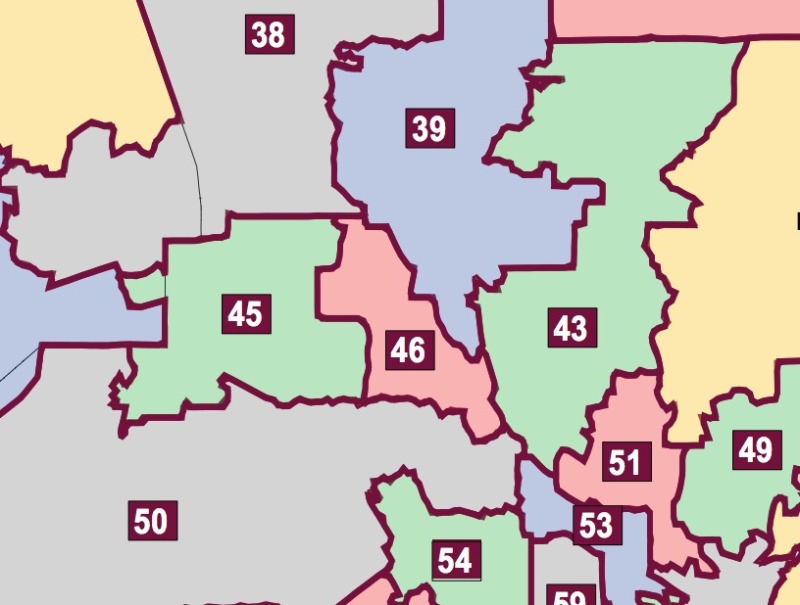
In state Assembly districts around Los Angeles, turnout on Nov. 4 hovered around 20 percent. (Diagram: Citizen's Redistricting Commission)
A district-by-district analysis reveals a high concentration of low turnout races in and around Los Angeles. Eleven of the county's Assembly districts had races where fewer than 27 percent of the registered votes were cast on Election Day. Three races -- for the 53rd, 63rd and 64th Assembly districts -- all saw turnout around 21 percent, even lower than the Bocanegra-Lopez contest in the northern San Fernando Valley.
A few congressional races in the L.A. area fared just as badly. Only 26 percent of registered voters cast a ballot in a race won by incumbent U.S. Rep. Grace Napolitano (D-Norwalk). Her 50,353 votes represent about 8 percent of the constituents in California's 32nd Congressional District. Even fewer voters elected her colleague, U.S. Rep. Lucille Roybal-Allard (D-Los Angeles), to an 11th term on Capitol Hill.
Low Turnout Up North
But lest you think the only dismal voting numbers were in L.A. legislative and congressional districts, let's move the map northward. In another Election Night shocker, veteran U.S. Rep. Jim Costa (D-Fresno) barely held onto his post representing California's 16th Congressional District. Votes cast: about 26 percent of the registered electorate.
Some will argue that the weak turnout reflects races that weren't competitive, or ones where the two candidates weren't well known. But that's not a complete explanation.
Move up to some Northern California races where the candidates were well known, and ones where the competition was fierce this election season, and again ... the data show anemic turnout. In Sacramento, a Democrat versus Democrat race for the 7th Assembly District featured two well-known members of the City Council, Kevin McCarty and Steve Cohn. Only 38 percent of voters in the district cast a ballot in the race, won by McCarty.
And in one of 2014's nastiest, and most costly, state Senate races -- pitting two incumbent assemblymen against each other in the Sacramento region -- there was yet more voter apathy. Millions of dollars in outside spending helped boost the winning campaign of Richard Pan against fellow Democrat Roger Dickinson. Turnout in the hotly contested 6th state Senate district? Forty-one percent ... pretty much the statewide average.
There's at least some hint that the voter apathy was more profound in Democratic-leaning legislative and congressional districts, which lines up with the sense that Republicans cast a disproportionately larger number of votes on Nov. 4.
"Our representative form of government depends on voter participation and engagement," said Dean Logan, registrar of voters in Los Angeles County. "The low turnout in the November election is concerning."
Logan has been leading an effort to try and figure out the secret ingredient to getting more voters to cast ballots, especially young voters. But it won't be easy. And legislative or congressional contests, so-called down-ticket races, are especially hard ones for inspiring turnout. Voters often skip these races, which is counted as an "under vote," a ballot that leaves some races blank.
Sponsored
That may be easier to do in 2016, when a presidential contest will no doubt draw more voters to the polls. Four years ago, 56 percent of voters in the 39th Assembly District cast a ballot, more than double the number that showed up this time as 2012's winner, Raul Bocanegra, is now 2014's loser.
lower waypoint
Stay in touch. Sign up for our daily newsletter.
To learn more about how we use your information, please read our privacy policy.
window.__IS_SSR__=true
window.__INITIAL_STATE__={"attachmentsReducer":{"audio_0":{"type":"attachments","id":"audio_0","imgSizes":{"kqedFullSize":{"file":"https://ww2.kqed.org/news/wp-content/themes/KQED-unified/img/audio_bgs/background0.jpg"}}},"audio_1":{"type":"attachments","id":"audio_1","imgSizes":{"kqedFullSize":{"file":"https://ww2.kqed.org/news/wp-content/themes/KQED-unified/img/audio_bgs/background1.jpg"}}},"audio_2":{"type":"attachments","id":"audio_2","imgSizes":{"kqedFullSize":{"file":"https://ww2.kqed.org/news/wp-content/themes/KQED-unified/img/audio_bgs/background2.jpg"}}},"audio_3":{"type":"attachments","id":"audio_3","imgSizes":{"kqedFullSize":{"file":"https://ww2.kqed.org/news/wp-content/themes/KQED-unified/img/audio_bgs/background3.jpg"}}},"audio_4":{"type":"attachments","id":"audio_4","imgSizes":{"kqedFullSize":{"file":"https://ww2.kqed.org/news/wp-content/themes/KQED-unified/img/audio_bgs/background4.jpg"}}},"placeholder":{"type":"attachments","id":"placeholder","imgSizes":{"thumbnail":{"file":"https://ww2.kqed.org/wp-content/uploads/sites/10/2018/01/GettyImages-896326950-160x96.jpg","width":160,"height":96,"mimeType":"image/jpeg"},"medium":{"file":"https://ww2.kqed.org/wp-content/uploads/sites/10/2018/01/GettyImages-896326950-800x478.jpg","width":800,"height":478,"mimeType":"image/jpeg"},"large":{"file":"https://ww2.kqed.org/wp-content/uploads/sites/10/2018/01/GettyImages-896326950-1020x610.jpg","width":1020,"height":610,"mimeType":"image/jpeg"},"fd-lrg":{"file":"https://ww2.kqed.org/wp-content/uploads/sites/10/2018/01/GettyImages-896326950-1920x1148.jpg","width":1920,"height":1148,"mimeType":"image/jpeg"},"fd-med":{"file":"https://ww2.kqed.org/wp-content/uploads/sites/10/2018/01/GettyImages-896326950-1180x705.jpg","width":1180,"height":705,"mimeType":"image/jpeg"},"fd-sm":{"file":"https://ww2.kqed.org/wp-content/uploads/sites/10/2018/01/GettyImages-896326950-960x574.jpg","width":960,"height":574,"mimeType":"image/jpeg"},"post-thumbnail":{"file":"https://ww2.kqed.org/wp-content/uploads/sites/10/2018/01/GettyImages-896326950-672x372.jpg","width":672,"height":372,"mimeType":"image/jpeg"},"twentyfourteen-full-width":{"file":"https://ww2.kqed.org/wp-content/uploads/sites/10/2018/01/GettyImages-896326950-1038x576.jpg","width":1038,"height":576,"mimeType":"image/jpeg"},"xxsmall":{"file":"https://ww2.kqed.org/wp-content/uploads/sites/10/2018/01/GettyImages-896326950-240x143.jpg","width":240,"height":143,"mimeType":"image/jpeg"},"xsmall":{"file":"https://ww2.kqed.org/wp-content/uploads/sites/10/2018/01/GettyImages-896326950-375x224.jpg","width":375,"height":224,"mimeType":"image/jpeg"},"small":{"file":"https://ww2.kqed.org/wp-content/uploads/sites/10/2018/01/GettyImages-896326950-520x311.jpg","width":520,"height":311,"mimeType":"image/jpeg"},"xlarge":{"file":"https://ww2.kqed.org/wp-content/uploads/sites/10/2018/01/GettyImages-896326950-1180x705.jpg","width":1180,"height":705,"mimeType":"image/jpeg"},"full-width":{"file":"https://ww2.kqed.org/wp-content/uploads/sites/10/2018/01/GettyImages-896326950-1920x1148.jpg","width":1920,"height":1148,"mimeType":"image/jpeg"},"guest-author-32":{"file":"https://ww2.kqed.org/wp-content/uploads/sites/10/2018/01/GettyImages-896326950-32x32.jpg","width":32,"height":32,"mimeType":"image/jpeg"},"guest-author-50":{"file":"https://ww2.kqed.org/wp-content/uploads/sites/10/2018/01/GettyImages-896326950-50x50.jpg","width":50,"height":50,"mimeType":"image/jpeg"},"guest-author-64":{"file":"https://ww2.kqed.org/wp-content/uploads/sites/10/2018/01/GettyImages-896326950-64x64.jpg","width":64,"height":64,"mimeType":"image/jpeg"},"guest-author-96":{"file":"https://ww2.kqed.org/wp-content/uploads/sites/10/2018/01/GettyImages-896326950-96x96.jpg","width":96,"height":96,"mimeType":"image/jpeg"},"guest-author-128":{"file":"https://ww2.kqed.org/wp-content/uploads/sites/10/2018/01/GettyImages-896326950-128x128.jpg","width":128,"height":128,"mimeType":"image/jpeg"},"detail":{"file":"https://ww2.kqed.org/wp-content/uploads/sites/10/2018/01/GettyImages-896326950-150x150.jpg","width":150,"height":150,"mimeType":"image/jpeg"},"kqedFullSize":{"file":"https://ww2.kqed.org/wp-content/uploads/sites/10/2018/01/GettyImages-896326950-e1514998105161.jpg","width":1920,"height":1148}}},"news_11973559":{"type":"attachments","id":"news_11973559","meta":{"index":"attachments_1591205162","site":"news","id":"11973559","found":true},"title":"240124-HEALTCARE GAZA RALLY-MD-02-KQED_1","publishDate":1706129799,"status":"inherit","parent":0,"modified":1706146386,"caption":"Maisa Morrar speaks at a rally of health care workers in front of the L3 Harris office in San Leandro on Jan. 24, 2024.","credit":"Martin do Nascimento/KQED","altTag":"A woman wearing a labcoat talks into a microphone at a rally of health care workers also wearing labcoats holding posters calling for a cease-fire in Gaza.","description":null,"imgSizes":{"medium":{"file":"https://cdn.kqed.org/wp-content/uploads/sites/10/2024/01/240124-HEALTCARE-GAZA-RALLY-MD-02-KQED_1-800x533.jpg","width":800,"height":533,"mimeType":"image/jpeg"},"large":{"file":"https://cdn.kqed.org/wp-content/uploads/sites/10/2024/01/240124-HEALTCARE-GAZA-RALLY-MD-02-KQED_1-1020x680.jpg","width":1020,"height":680,"mimeType":"image/jpeg"},"thumbnail":{"file":"https://cdn.kqed.org/wp-content/uploads/sites/10/2024/01/240124-HEALTCARE-GAZA-RALLY-MD-02-KQED_1-160x107.jpg","width":160,"height":107,"mimeType":"image/jpeg"},"1536x1536":{"file":"https://cdn.kqed.org/wp-content/uploads/sites/10/2024/01/240124-HEALTCARE-GAZA-RALLY-MD-02-KQED_1-1536x1024.jpg","width":1536,"height":1024,"mimeType":"image/jpeg"},"post-thumbnail":{"file":"https://cdn.kqed.org/wp-content/uploads/sites/10/2024/01/240124-HEALTCARE-GAZA-RALLY-MD-02-KQED_1-672x372.jpg","width":672,"height":372,"mimeType":"image/jpeg"},"twentyfourteen-full-width":{"file":"https://cdn.kqed.org/wp-content/uploads/sites/10/2024/01/240124-HEALTCARE-GAZA-RALLY-MD-02-KQED_1-1038x576.jpg","width":1038,"height":576,"mimeType":"image/jpeg"},"full-width":{"file":"https://cdn.kqed.org/wp-content/uploads/sites/10/2024/01/240124-HEALTCARE-GAZA-RALLY-MD-02-KQED_1-1920x1280.jpg","width":1920,"height":1280,"mimeType":"image/jpeg"},"kqedFullSize":{"file":"https://cdn.kqed.org/wp-content/uploads/sites/10/2024/01/240124-HEALTCARE-GAZA-RALLY-MD-02-KQED_1.jpg","width":2000,"height":1333}},"fetchFailed":false,"isLoading":false},"forum_2010101904484":{"type":"attachments","id":"forum_2010101904484","meta":{"index":"attachments_1591205162","site":"forum","id":"2010101904484","found":true},"title":"Mushroom Foraging","publishDate":1706139234,"status":"inherit","parent":2010101904477,"modified":1706139277,"caption":"Mushrooms gathered during a foraging hike led by Martha Browne through the woods of Weir Hill in North Andover, MA are pictured on Aug. 12, 2017.","credit":"Photo by John Tlumacki/The Boston Globe via Getty Images","altTag":null,"description":null,"imgSizes":{"medium":{"file":"https://cdn.kqed.org/wp-content/uploads/sites/43/2024/01/Mushroom-Foraging-800x450.jpg","width":800,"height":450,"mimeType":"image/jpeg"},"large":{"file":"https://cdn.kqed.org/wp-content/uploads/sites/43/2024/01/Mushroom-Foraging-1020x574.jpg","width":1020,"height":574,"mimeType":"image/jpeg"},"thumbnail":{"file":"https://cdn.kqed.org/wp-content/uploads/sites/43/2024/01/Mushroom-Foraging-160x90.jpg","width":160,"height":90,"mimeType":"image/jpeg"},"medium_large":{"file":"https://cdn.kqed.org/wp-content/uploads/sites/43/2024/01/Mushroom-Foraging-768x432.jpg","width":768,"height":432,"mimeType":"image/jpeg"},"1536x1536":{"file":"https://cdn.kqed.org/wp-content/uploads/sites/43/2024/01/Mushroom-Foraging-1536x864.jpg","width":1536,"height":864,"mimeType":"image/jpeg"},"post-thumbnail":{"file":"https://cdn.kqed.org/wp-content/uploads/sites/43/2024/01/Mushroom-Foraging-672x372.jpg","width":672,"height":372,"mimeType":"image/jpeg"},"twentyfourteen-full-width":{"file":"https://cdn.kqed.org/wp-content/uploads/sites/43/2024/01/Mushroom-Foraging-1038x576.jpg","width":1038,"height":576,"mimeType":"image/jpeg"},"kqedFullSize":{"file":"https://cdn.kqed.org/wp-content/uploads/sites/43/2024/01/Mushroom-Foraging.jpg","width":1920,"height":1080}},"fetchFailed":false,"isLoading":false},"news_11963684":{"type":"attachments","id":"news_11963684","meta":{"index":"attachments_1591205162","site":"news","id":"11963684","found":true},"title":"Sea Circus","publishDate":1696611364,"status":"inherit","parent":0,"modified":1706209835,"caption":"Marisa Gregory dances with lit torches as the Secrets of the Sea Circus Festival begins on Forbes Island in Brentwood, Contra Costa County, on Saturday, Sept. 30, 2023.","credit":"Juliana Yamada/KQED","altTag":"A person smiles and twirls flaming batons.","description":null,"imgSizes":{"medium":{"file":"https://cdn.kqed.org/wp-content/uploads/sites/10/2023/10/20230930-Sea-Circus-021-JY-KQED-800x533.jpg","width":800,"height":533,"mimeType":"image/jpeg"},"large":{"file":"https://cdn.kqed.org/wp-content/uploads/sites/10/2023/10/20230930-Sea-Circus-021-JY-KQED-1020x680.jpg","width":1020,"height":680,"mimeType":"image/jpeg"},"thumbnail":{"file":"https://cdn.kqed.org/wp-content/uploads/sites/10/2023/10/20230930-Sea-Circus-021-JY-KQED-160x107.jpg","width":160,"height":107,"mimeType":"image/jpeg"},"1536x1536":{"file":"https://cdn.kqed.org/wp-content/uploads/sites/10/2023/10/20230930-Sea-Circus-021-JY-KQED-1536x1024.jpg","width":1536,"height":1024,"mimeType":"image/jpeg"},"post-thumbnail":{"file":"https://cdn.kqed.org/wp-content/uploads/sites/10/2023/10/20230930-Sea-Circus-021-JY-KQED-672x372.jpg","width":672,"height":372,"mimeType":"image/jpeg"},"twentyfourteen-full-width":{"file":"https://cdn.kqed.org/wp-content/uploads/sites/10/2023/10/20230930-Sea-Circus-021-JY-KQED-1038x576.jpg","width":1038,"height":576,"mimeType":"image/jpeg"},"full-width":{"file":"https://cdn.kqed.org/wp-content/uploads/sites/10/2023/10/20230930-Sea-Circus-021-JY-KQED-1920x1280.jpg","width":1920,"height":1280,"mimeType":"image/jpeg"},"kqedFullSize":{"file":"https://cdn.kqed.org/wp-content/uploads/sites/10/2023/10/20230930-Sea-Circus-021-JY-KQED.jpg","width":2000,"height":1333}},"fetchFailed":false,"isLoading":false},"news_11973744":{"type":"attachments","id":"news_11973744","meta":{"index":"attachments_1591205162","site":"news","id":"11973744","found":true},"title":"240125-SFSUNoVote-60-BL","publishDate":1706224834,"status":"inherit","parent":0,"modified":1706227428,"caption":"Faculty, students and CFA union members form a 'No' in The Quad at San Francisco State University on Jan. 25, 2024, to urge a 'no' vote on the tentative deal that ended this week’s California State University strike.","credit":"Beth LaBerge/KQED","altTag":"People form a human chain spelling the word 'No' on a green lawn.","description":null,"imgSizes":{"medium":{"file":"https://cdn.kqed.org/wp-content/uploads/sites/10/2024/01/240125-SFSUNoVote-60-BL-800x533.jpg","width":800,"height":533,"mimeType":"image/jpeg"},"large":{"file":"https://cdn.kqed.org/wp-content/uploads/sites/10/2024/01/240125-SFSUNoVote-60-BL-1020x680.jpg","width":1020,"height":680,"mimeType":"image/jpeg"},"thumbnail":{"file":"https://cdn.kqed.org/wp-content/uploads/sites/10/2024/01/240125-SFSUNoVote-60-BL-160x107.jpg","width":160,"height":107,"mimeType":"image/jpeg"},"1536x1536":{"file":"https://cdn.kqed.org/wp-content/uploads/sites/10/2024/01/240125-SFSUNoVote-60-BL-1536x1024.jpg","width":1536,"height":1024,"mimeType":"image/jpeg"},"2048x2048":{"file":"https://cdn.kqed.org/wp-content/uploads/sites/10/2024/01/240125-SFSUNoVote-60-BL-2048x1365.jpg","width":2048,"height":1365,"mimeType":"image/jpeg"},"post-thumbnail":{"file":"https://cdn.kqed.org/wp-content/uploads/sites/10/2024/01/240125-SFSUNoVote-60-BL-672x372.jpg","width":672,"height":372,"mimeType":"image/jpeg"},"twentyfourteen-full-width":{"file":"https://cdn.kqed.org/wp-content/uploads/sites/10/2024/01/240125-SFSUNoVote-60-BL-1038x576.jpg","width":1038,"height":576,"mimeType":"image/jpeg"},"full-width":{"file":"https://cdn.kqed.org/wp-content/uploads/sites/10/2024/01/240125-SFSUNoVote-60-BL-1920x1280.jpg","width":1920,"height":1280,"mimeType":"image/jpeg"},"kqedFullSize":{"file":"https://cdn.kqed.org/wp-content/uploads/sites/10/2024/01/240125-SFSUNoVote-60-BL-scaled.jpg","width":2560,"height":1707}},"fetchFailed":false,"isLoading":false},"news_11973567":{"type":"attachments","id":"news_11973567","meta":{"index":"attachments_1591205162","site":"news","id":"11973567","found":true},"title":"Natera_231126_DYSLEXIA_12-2048x1463","publishDate":1706130642,"status":"inherit","parent":11973560,"modified":1706138142,"caption":"Eva Levenson, now a sophomore at Berkeley High School, has struggled with dyslexia since childhood but private phonics-based intervention made a difference. 'I don't understand what's in the way of making a shift when, both in other states and locally, districts are able to help kids now,' she recently told the school board. 'How is it possible we aren't doing it in Berkeley right now?'","credit":"Ximena Natera via Berkeleyside/CatchLight","altTag":"A white woman wearing a black shirt sits in a chair in a home, with her right arm resting on the desk.","description":null,"imgSizes":{"medium":{"file":"https://cdn.kqed.org/wp-content/uploads/sites/10/2024/01/Natera_231126_DYSLEXIA_12-2048x1463-1-800x571.jpg","width":800,"height":571,"mimeType":"image/jpeg"},"large":{"file":"https://cdn.kqed.org/wp-content/uploads/sites/10/2024/01/Natera_231126_DYSLEXIA_12-2048x1463-1-1020x729.jpg","width":1020,"height":729,"mimeType":"image/jpeg"},"thumbnail":{"file":"https://cdn.kqed.org/wp-content/uploads/sites/10/2024/01/Natera_231126_DYSLEXIA_12-2048x1463-1-160x114.jpg","width":160,"height":114,"mimeType":"image/jpeg"},"1536x1536":{"file":"https://cdn.kqed.org/wp-content/uploads/sites/10/2024/01/Natera_231126_DYSLEXIA_12-2048x1463-1-1536x1097.jpg","width":1536,"height":1097,"mimeType":"image/jpeg"},"post-thumbnail":{"file":"https://cdn.kqed.org/wp-content/uploads/sites/10/2024/01/Natera_231126_DYSLEXIA_12-2048x1463-1-672x372.jpg","width":672,"height":372,"mimeType":"image/jpeg"},"twentyfourteen-full-width":{"file":"https://cdn.kqed.org/wp-content/uploads/sites/10/2024/01/Natera_231126_DYSLEXIA_12-2048x1463-1-1038x576.jpg","width":1038,"height":576,"mimeType":"image/jpeg"},"full-width":{"file":"https://cdn.kqed.org/wp-content/uploads/sites/10/2024/01/Natera_231126_DYSLEXIA_12-2048x1463-1-1920x1372.jpg","width":1920,"height":1372,"mimeType":"image/jpeg"},"kqedFullSize":{"file":"https://cdn.kqed.org/wp-content/uploads/sites/10/2024/01/Natera_231126_DYSLEXIA_12-2048x1463-1.jpg","width":2048,"height":1463}},"fetchFailed":false,"isLoading":false},"news_11973516":{"type":"attachments","id":"news_11973516","meta":{"index":"attachments_1591205162","site":"news","id":"11973516","found":true},"title":"030323-FarmLand-LV_CM_02 copy","publishDate":1706122495,"status":"inherit","parent":11973512,"modified":1706122560,"caption":"Farmland is irrigated near Mendota in the San Joaquin Valley on March 3, 2023.","credit":"Larry Valenzuela/CalMatters/CatchLight Local","altTag":"Sprinklers working in an agricultural field.","description":null,"imgSizes":{"medium":{"file":"https://cdn.kqed.org/wp-content/uploads/sites/10/2024/01/030323-FarmLand-LV_CM_02-copy-800x533.jpg","width":800,"height":533,"mimeType":"image/jpeg"},"large":{"file":"https://cdn.kqed.org/wp-content/uploads/sites/10/2024/01/030323-FarmLand-LV_CM_02-copy-1020x680.jpg","width":1020,"height":680,"mimeType":"image/jpeg"},"thumbnail":{"file":"https://cdn.kqed.org/wp-content/uploads/sites/10/2024/01/030323-FarmLand-LV_CM_02-copy-160x107.jpg","width":160,"height":107,"mimeType":"image/jpeg"},"1536x1536":{"file":"https://cdn.kqed.org/wp-content/uploads/sites/10/2024/01/030323-FarmLand-LV_CM_02-copy-1536x1024.jpg","width":1536,"height":1024,"mimeType":"image/jpeg"},"post-thumbnail":{"file":"https://cdn.kqed.org/wp-content/uploads/sites/10/2024/01/030323-FarmLand-LV_CM_02-copy-672x372.jpg","width":672,"height":372,"mimeType":"image/jpeg"},"twentyfourteen-full-width":{"file":"https://cdn.kqed.org/wp-content/uploads/sites/10/2024/01/030323-FarmLand-LV_CM_02-copy-1038x576.jpg","width":1038,"height":576,"mimeType":"image/jpeg"},"full-width":{"file":"https://cdn.kqed.org/wp-content/uploads/sites/10/2024/01/030323-FarmLand-LV_CM_02-copy-1920x1280.jpg","width":1920,"height":1280,"mimeType":"image/jpeg"},"kqedFullSize":{"file":"https://cdn.kqed.org/wp-content/uploads/sites/10/2024/01/030323-FarmLand-LV_CM_02-copy.jpg","width":2000,"height":1333}},"fetchFailed":false,"isLoading":false},"news_11973430":{"type":"attachments","id":"news_11973430","meta":{"index":"attachments_1591205162","site":"news","id":"11973430","found":true},"title":"240122-PORTSMOUTHSQUARE-35-BL-KQED","publishDate":1706042322,"status":"inherit","parent":0,"modified":1706143709,"caption":"People sit near the Goddess of Democracy statue in Portsmouth Square in San Francisco's Chinatown neighborhood on Jan. 22, 2024.","credit":"Beth LaBerge/KQED","altTag":"People sit on a bench with a statue in front of them. Tall buildings surround them in the background.","description":null,"imgSizes":{"medium":{"file":"https://cdn.kqed.org/wp-content/uploads/sites/10/2024/01/240122-PORTSMOUTHSQUARE-35-BL-KQED-800x533.jpg","width":800,"height":533,"mimeType":"image/jpeg"},"large":{"file":"https://cdn.kqed.org/wp-content/uploads/sites/10/2024/01/240122-PORTSMOUTHSQUARE-35-BL-KQED-1020x680.jpg","width":1020,"height":680,"mimeType":"image/jpeg"},"thumbnail":{"file":"https://cdn.kqed.org/wp-content/uploads/sites/10/2024/01/240122-PORTSMOUTHSQUARE-35-BL-KQED-160x107.jpg","width":160,"height":107,"mimeType":"image/jpeg"},"1536x1536":{"file":"https://cdn.kqed.org/wp-content/uploads/sites/10/2024/01/240122-PORTSMOUTHSQUARE-35-BL-KQED-1536x1024.jpg","width":1536,"height":1024,"mimeType":"image/jpeg"},"post-thumbnail":{"file":"https://cdn.kqed.org/wp-content/uploads/sites/10/2024/01/240122-PORTSMOUTHSQUARE-35-BL-KQED-672x372.jpg","width":672,"height":372,"mimeType":"image/jpeg"},"twentyfourteen-full-width":{"file":"https://cdn.kqed.org/wp-content/uploads/sites/10/2024/01/240122-PORTSMOUTHSQUARE-35-BL-KQED-1038x576.jpg","width":1038,"height":576,"mimeType":"image/jpeg"},"full-width":{"file":"https://cdn.kqed.org/wp-content/uploads/sites/10/2024/01/240122-PORTSMOUTHSQUARE-35-BL-KQED-1920x1280.jpg","width":1920,"height":1280,"mimeType":"image/jpeg"},"kqedFullSize":{"file":"https://cdn.kqed.org/wp-content/uploads/sites/10/2024/01/240122-PORTSMOUTHSQUARE-35-BL-KQED.jpg","width":2000,"height":1333}},"fetchFailed":false,"isLoading":false},"news_11973839":{"type":"attachments","id":"news_11973839","meta":{"index":"attachments_1591205162","site":"news","id":"11973839","found":true},"title":"240125-UC REGENTS UNDOCUMENTED WORK-MD-10-KQED-1","publishDate":1706277114,"status":"inherit","parent":0,"modified":1706278142,"caption":"Betzaida, an undocumented student with the Opportunity for All campaign, cries in reaction to the University of California Regents' vote to suspend consideration of a proposal to allow the university to hire undocumented students at the UCSF Mission Bay Conference Center on Jan. 25, 2024. Prior to the vote, Betzaida and other UC students participated in a 3-day hunger strike to urge the Board of Regents to move forward with the proposal. ","credit":"Martin do Nascimento/KQED","altTag":"A young woman with gray tape covering her mouth, crying.","description":null,"imgSizes":{"medium":{"file":"https://cdn.kqed.org/wp-content/uploads/sites/10/2024/01/240125-UC-REGENTS-UNDOCUMENTED-WORK-MD-10-KQED-1-800x533.jpg","width":800,"height":533,"mimeType":"image/jpeg"},"large":{"file":"https://cdn.kqed.org/wp-content/uploads/sites/10/2024/01/240125-UC-REGENTS-UNDOCUMENTED-WORK-MD-10-KQED-1-1020x680.jpg","width":1020,"height":680,"mimeType":"image/jpeg"},"thumbnail":{"file":"https://cdn.kqed.org/wp-content/uploads/sites/10/2024/01/240125-UC-REGENTS-UNDOCUMENTED-WORK-MD-10-KQED-1-160x107.jpg","width":160,"height":107,"mimeType":"image/jpeg"},"1536x1536":{"file":"https://cdn.kqed.org/wp-content/uploads/sites/10/2024/01/240125-UC-REGENTS-UNDOCUMENTED-WORK-MD-10-KQED-1-1536x1024.jpg","width":1536,"height":1024,"mimeType":"image/jpeg"},"post-thumbnail":{"file":"https://cdn.kqed.org/wp-content/uploads/sites/10/2024/01/240125-UC-REGENTS-UNDOCUMENTED-WORK-MD-10-KQED-1-672x372.jpg","width":672,"height":372,"mimeType":"image/jpeg"},"twentyfourteen-full-width":{"file":"https://cdn.kqed.org/wp-content/uploads/sites/10/2024/01/240125-UC-REGENTS-UNDOCUMENTED-WORK-MD-10-KQED-1-1038x576.jpg","width":1038,"height":576,"mimeType":"image/jpeg"},"full-width":{"file":"https://cdn.kqed.org/wp-content/uploads/sites/10/2024/01/240125-UC-REGENTS-UNDOCUMENTED-WORK-MD-10-KQED-1-1920x1280.jpg","width":1920,"height":1280,"mimeType":"image/jpeg"},"kqedFullSize":{"file":"https://cdn.kqed.org/wp-content/uploads/sites/10/2024/01/240125-UC-REGENTS-UNDOCUMENTED-WORK-MD-10-KQED-1.jpg","width":2000,"height":1333}},"fetchFailed":false,"isLoading":false},"forum_2010101904496":{"type":"attachments","id":"forum_2010101904496","meta":{"index":"attachments_1591205162","site":"forum","id":"2010101904496","found":true},"title":"Wastewater","publishDate":1706225609,"status":"inherit","parent":2010101904495,"modified":1706228128,"caption":"California regulators approved new rules last month to enable water suppliers to treat wastewater and redistribute it as drinking water.","credit":"Weiquan Lin via Getty Images","altTag":null,"description":null,"imgSizes":{"medium":{"file":"https://cdn.kqed.org/wp-content/uploads/sites/43/2024/01/Wastewater-800x450.png","width":800,"height":450,"mimeType":"image/png"},"large":{"file":"https://cdn.kqed.org/wp-content/uploads/sites/43/2024/01/Wastewater-1020x574.png","width":1020,"height":574,"mimeType":"image/png"},"thumbnail":{"file":"https://cdn.kqed.org/wp-content/uploads/sites/43/2024/01/Wastewater-160x90.png","width":160,"height":90,"mimeType":"image/png"},"medium_large":{"file":"https://cdn.kqed.org/wp-content/uploads/sites/43/2024/01/Wastewater-768x432.png","width":768,"height":432,"mimeType":"image/png"},"1536x1536":{"file":"https://cdn.kqed.org/wp-content/uploads/sites/43/2024/01/Wastewater-1536x864.png","width":1536,"height":864,"mimeType":"image/png"},"post-thumbnail":{"file":"https://cdn.kqed.org/wp-content/uploads/sites/43/2024/01/Wastewater-672x372.png","width":672,"height":372,"mimeType":"image/png"},"twentyfourteen-full-width":{"file":"https://cdn.kqed.org/wp-content/uploads/sites/43/2024/01/Wastewater-1038x576.png","width":1038,"height":576,"mimeType":"image/png"},"kqedFullSize":{"file":"https://cdn.kqed.org/wp-content/uploads/sites/43/2024/01/Wastewater.png","width":1920,"height":1080}},"fetchFailed":false,"isLoading":false},"news_11968690":{"type":"attachments","id":"news_11968690","meta":{"index":"attachments_1591205162","site":"news","id":"11968690","found":true},"title":"California Gov. Gavin Newsom unveils his 2022-2023 state budget revision during a news conference in Sacramento, Calif., Friday, May 13, 2022.","publishDate":1701365954,"status":"inherit","parent":11968684,"modified":1706056027,"caption":"California Gov. Gavin Newsom unveils his 2022–23 state budget revision during a news conference in Sacramento on Friday, May 13, 2022.","credit":"Rich Pedroncelli/The Associated Press","altTag":"A white man in a business suit stands at a podium with his left hand motioning.","description":"Gov. Gavin Newsom unveils his 2022-2023 state budget revision during a news conference in Sacramento on Friday, May 13, 2022. ","imgSizes":{"medium":{"file":"https://cdn.kqed.org/wp-content/uploads/sites/10/2023/11/ap23267069535462_slide-6db8a0525cf94a8d31854cee86df1b742060f3cc-800x533.jpg","width":800,"height":533,"mimeType":"image/jpeg"},"large":{"file":"https://cdn.kqed.org/wp-content/uploads/sites/10/2023/11/ap23267069535462_slide-6db8a0525cf94a8d31854cee86df1b742060f3cc-1020x680.jpg","width":1020,"height":680,"mimeType":"image/jpeg"},"thumbnail":{"file":"https://cdn.kqed.org/wp-content/uploads/sites/10/2023/11/ap23267069535462_slide-6db8a0525cf94a8d31854cee86df1b742060f3cc-160x107.jpg","width":160,"height":107,"mimeType":"image/jpeg"},"1536x1536":{"file":"https://cdn.kqed.org/wp-content/uploads/sites/10/2023/11/ap23267069535462_slide-6db8a0525cf94a8d31854cee86df1b742060f3cc-1536x1024.jpg","width":1536,"height":1024,"mimeType":"image/jpeg"},"2048x2048":{"file":"https://cdn.kqed.org/wp-content/uploads/sites/10/2023/11/ap23267069535462_slide-6db8a0525cf94a8d31854cee86df1b742060f3cc-2048x1365.jpg","width":2048,"height":1365,"mimeType":"image/jpeg"},"post-thumbnail":{"file":"https://cdn.kqed.org/wp-content/uploads/sites/10/2023/11/ap23267069535462_slide-6db8a0525cf94a8d31854cee86df1b742060f3cc-672x372.jpg","width":672,"height":372,"mimeType":"image/jpeg"},"twentyfourteen-full-width":{"file":"https://cdn.kqed.org/wp-content/uploads/sites/10/2023/11/ap23267069535462_slide-6db8a0525cf94a8d31854cee86df1b742060f3cc-1038x576.jpg","width":1038,"height":576,"mimeType":"image/jpeg"},"full-width":{"file":"https://cdn.kqed.org/wp-content/uploads/sites/10/2023/11/ap23267069535462_slide-6db8a0525cf94a8d31854cee86df1b742060f3cc-1920x1280.jpg","width":1920,"height":1280,"mimeType":"image/jpeg"},"kqedFullSize":{"file":"https://cdn.kqed.org/wp-content/uploads/sites/10/2023/11/ap23267069535462_slide-6db8a0525cf94a8d31854cee86df1b742060f3cc-scaled.jpg","width":2560,"height":1707}},"fetchFailed":false,"isLoading":false},"news_128760":{"type":"attachments","id":"news_128760","meta":{"index":"attachments_1591205162","site":"news","id":"128760","found":true},"title":"I Voted-Election Day","publishDate":1394235743,"status":"inherit","parent":128758,"modified":1394235743,"caption":"(Brendan Smialowski/Getty Images)","credit":null,"description":"(Brendan Smialowski/Getty Images)","imgSizes":{"kqedFullSize":{"file":"https://ww2.kqed.org/app/uploads/sites/10/2014/03/RS3925_votedhands20121102.jpg","width":1536,"height":1025}},"fetchFailed":false,"isLoading":false}},"audioPlayerReducer":{"postId":"stream_live"},"authorsReducer":{"byline_news_11973562":{"type":"authors","id":"byline_news_11973562","meta":{"override":true},"slug":"byline_news_11973562","name":"\u003ca href=\"https://twitter.com/nikaltenberg\">Nik Altenberg\u003c/a>","isLoading":false},"byline_news_11973656":{"type":"authors","id":"byline_news_11973656","meta":{"override":true},"slug":"byline_news_11973656","name":"Jon Kalish","isLoading":false},"byline_news_11973560":{"type":"authors","id":"byline_news_11973560","meta":{"override":true},"slug":"byline_news_11973560","name":"Ally Markovich\u003cbr>Berkeleyside\u003c/br>","isLoading":false},"byline_news_11973512":{"type":"authors","id":"byline_news_11973512","meta":{"override":true},"slug":"byline_news_11973512","name":"\u003ca href=\"https://calmatters.org/author/rachel-becker/\">Rachel Becker\u003c/a>","isLoading":false},"byline_news_11973789":{"type":"authors","id":"byline_news_11973789","meta":{"override":true},"slug":"byline_news_11973789","name":"Madi Bolaños","isLoading":false},"byline_news_11973450":{"type":"authors","id":"byline_news_11973450","meta":{"override":true},"slug":"byline_news_11973450","name":"\u003ca href=\"https://edsource.org/author/jfensterwald\">John Fensterwald\u003c/a>","isLoading":false},"minakim":{"type":"authors","id":"243","meta":{"index":"authors_1591205172","id":"243","found":true},"name":"Mina Kim","firstName":"Mina","lastName":"Kim","slug":"minakim","email":"mkim@kqed.org","display_author_email":false,"staff_mastheads":["news"],"title":"Host, Forum","bio":"Mina Kim is host of the 10 a.m. statewide hour of Forum; a live daily talk show for curious Californians on issues that matter to the state and nation, with a particular emphasis on race and equity.\r\n\r\nBefore joining the Forum team, Mina was KQED’s evening news anchor, and health reporter for The California Report. Her award-winning work has included natural disasters in Napa and gun violence in Oakland. Mina grew up in St. John’s, Newfoundland.","avatar":"https://secure.gravatar.com/avatar/145ce657a2d08cb86d93686beb958982?s=600&d=blank&r=g","twitter":"mkimreporter","facebook":null,"instagram":null,"linkedin":null,"sites":[{"site":"news","roles":["contributor"]},{"site":"stateofhealth","roles":["author"]},{"site":"forum","roles":["editor"]}],"headData":{"title":"Mina Kim | KQED","description":"Host, Forum","ogImgSrc":"https://secure.gravatar.com/avatar/145ce657a2d08cb86d93686beb958982?s=600&d=blank&r=g","twImgSrc":"https://secure.gravatar.com/avatar/145ce657a2d08cb86d93686beb958982?s=600&d=blank&r=g"},"isLoading":false,"link":"/author/minakim"},"jlara":{"type":"authors","id":"11761","meta":{"index":"authors_1591205172","id":"11761","found":true},"name":"Juan Carlos Lara","firstName":"Juan Carlos","lastName":"Lara","slug":"jlara","email":"jlara@kqed.org","display_author_email":false,"staff_mastheads":[],"title":"KQED Contributor","bio":null,"avatar":"https://secure.gravatar.com/avatar/19e2052b9b05657c5ff2af2121846e9c?s=600&d=blank&r=g","twitter":null,"facebook":null,"instagram":null,"linkedin":null,"sites":[{"site":"arts","roles":["editor"]},{"site":"news","roles":["editor"]},{"site":"forum","roles":["editor"]}],"headData":{"title":"Juan Carlos Lara | KQED","description":"KQED Contributor","ogImgSrc":"https://secure.gravatar.com/avatar/19e2052b9b05657c5ff2af2121846e9c?s=600&d=blank&r=g","twImgSrc":"https://secure.gravatar.com/avatar/19e2052b9b05657c5ff2af2121846e9c?s=600&d=blank&r=g"},"isLoading":false,"link":"/author/jlara"},"sjohnson":{"type":"authors","id":"11840","meta":{"index":"authors_1591205172","id":"11840","found":true},"name":"Sydney Johnson","firstName":"Sydney","lastName":"Johnson","slug":"sjohnson","email":"sjohnson@kqed.org","display_author_email":false,"staff_mastheads":["news"],"title":"KQED Reporter","bio":"Sydney Johnson is a general assignment reporter at KQED. She previously reported on public health and city government at the San Francisco Examiner, and before that, she covered statewide education policy for EdSource. Her reporting has won multiple local, state and national awards. Sydney is a graduate of the University of California, Berkeley and lives in San Francisco.","avatar":"https://secure.gravatar.com/avatar/97855f2719b72ad6190b7c535fe642c8?s=600&d=blank&r=g","twitter":"sydneyfjohnson","facebook":null,"instagram":null,"linkedin":null,"sites":[{"site":"news","roles":["editor"]}],"headData":{"title":"Sydney Johnson | KQED","description":"KQED Reporter","ogImgSrc":"https://secure.gravatar.com/avatar/97855f2719b72ad6190b7c535fe642c8?s=600&d=blank&r=g","twImgSrc":"https://secure.gravatar.com/avatar/97855f2719b72ad6190b7c535fe642c8?s=600&d=blank&r=g"},"isLoading":false,"link":"/author/sjohnson"},"jmyers":{"type":"authors","id":"232","meta":{"index":"authors_1591205172","id":"232","found":true},"name":"John Myers","firstName":"John","lastName":"Myers","slug":"jmyers","email":"jmyers@kqed.org","display_author_email":false,"staff_mastheads":[],"title":null,"bio":"John Myers is Senior Editor of KQED's new California Politics and Government Desk. A veteran of almost two decades of political coverage, he was KQED's longest serving statehouse bureau chief and recently was political editor for Sacramento's ABC affiliate, News10 (KXTV). John was moderator of the only 2014 gubernatorial debate, and was named by \u003cem>The Washington Post\u003c/em> to two \"Best Of\" lists: the 2015 list of top state politics reporters and 2014's list of America's most influential statehouse reporters.","avatar":"https://secure.gravatar.com/avatar/c0ac98482caf0b8229a792662b38722a?s=600&d=blank&r=g","twitter":"johnmyers","facebook":null,"instagram":null,"linkedin":null,"sites":[{"site":"news","roles":["subscriber"]}],"headData":{"title":"John Myers | KQED","description":null,"ogImgSrc":"https://secure.gravatar.com/avatar/c0ac98482caf0b8229a792662b38722a?s=600&d=blank&r=g","twImgSrc":"https://secure.gravatar.com/avatar/c0ac98482caf0b8229a792662b38722a?s=600&d=blank&r=g"},"isLoading":false,"link":"/author/jmyers"}},"breakingNewsReducer":{},"campaignFinanceReducer":{},"firebase":{"requesting":{},"requested":{},"timestamps":{},"data":{},"ordered":{},"auth":{"isLoaded":false,"isEmpty":true},"authError":null,"profile":{"isLoaded":false,"isEmpty":true},"listeners":{"byId":{},"allIds":[]},"isInitializing":false,"errors":[]},"navBarReducer":{"navBarId":"news","fullView":true,"showPlayer":false},"navMenuReducer":{"menus":[{"key":"menu1","items":[{"name":"News","link":"/","type":"title"},{"name":"Politics","link":"/politics"},{"name":"Science","link":"/science"},{"name":"Education","link":"/educationnews"},{"name":"Housing","link":"/housing"},{"name":"Immigration","link":"/immigration"},{"name":"Criminal Justice","link":"/criminaljustice"},{"name":"Silicon Valley","link":"/siliconvalley"},{"name":"Forum","link":"/forum"},{"name":"The California Report","link":"/californiareport"}]},{"key":"menu2","items":[{"name":"Arts & Culture","link":"/arts","type":"title"},{"name":"Critics’ Picks","link":"/thedolist"},{"name":"Cultural Commentary","link":"/artscommentary"},{"name":"Food & Drink","link":"/food"},{"name":"Bay Area Hip-Hop","link":"/bayareahiphop"},{"name":"Rebel Girls","link":"/rebelgirls"},{"name":"Arts Video","link":"/artsvideos"}]},{"key":"menu3","items":[{"name":"Podcasts","link":"/podcasts","type":"title"},{"name":"Bay Curious","link":"/podcasts/baycurious"},{"name":"Rightnowish","link":"/podcasts/rightnowish"},{"name":"The Bay","link":"/podcasts/thebay"},{"name":"On Our Watch","link":"/podcasts/onourwatch"},{"name":"Mindshift","link":"/podcasts/mindshift"},{"name":"Consider This","link":"/podcasts/considerthis"},{"name":"Political Breakdown","link":"/podcasts/politicalbreakdown"}]},{"key":"menu4","items":[{"name":"Live Radio","link":"/radio","type":"title"},{"name":"TV","link":"/tv","type":"title"},{"name":"Events","link":"/events","type":"title"},{"name":"For Educators","link":"/education","type":"title"},{"name":"Support KQED","link":"/support","type":"title"},{"name":"About","link":"/about","type":"title"},{"name":"Help Center","link":"https://kqed-helpcenter.kqed.org/s","type":"title"}]}]},"pagesReducer":{},"postsReducer":{"stream_live":{"type":"live","id":"stream_live","audioUrl":"https://streams.kqed.org/kqedradio","title":"Live Stream","excerpt":"Live Stream information currently unavailable.","link":"/radio","featImg":"","label":{"name":"KQED Live","link":"/"}},"stream_kqedNewscast":{"type":"posts","id":"stream_kqedNewscast","audioUrl":"https://www.kqed.org/.stream/anon/radio/RDnews/newscast.mp3?_=1","title":"KQED Newscast","featImg":"","label":{"name":"88.5 FM","link":"/"}},"news_11973562":{"type":"posts","id":"news_11973562","meta":{"index":"posts_1591205157","site":"news","id":"11973562","found":true},"guestAuthors":[],"slug":"bay-area-health-care-workers-protest-arms-sales-to-israel","title":"Bay Area Health Care Workers Protest Arms Sales to Israel","publishDate":1706144405,"format":"standard","headTitle":"Bay Area Health Care Workers Protest Arms Sales to Israel | KQED","labelTerm":{"site":"news"},"content":"\u003cp>Bay Area health care workers rallied outside the San Leandro facility of military contractor L3Harris on Wednesday. About 200 nurses, pediatricians, psychiatrists and other doctors and activists gathered to protest what they call “war profiteering” by the company, which has provided surveillance technologies to Israel for years and whose components are used in missiles, warplanes and tanks.\u003c/p>\n\u003cp>“We are here today in front of L3Harris because we know with certainty that they are complicit in mass civilian casualties,” said Dr. Nida Bajwa, a family medicine doctor at San Francisco General Hospital.\u003c/p>\n\u003cp>Protesters pointed to “joint direct attack munitions,” or JDAMs, which Boeing manufactures with components from L3Harris. In a \u003ca href=\"https://www.amnesty.org/en/latest/news/2023/12/israel-opt-us-made-munitions-killed-43-civilians-in-two-documented-israeli-air-strikes-in-gaza-new-investigation/\">December report from Amnesty International\u003c/a>, these weapons were linked to “two deadly, unlawful air strikes on homes full of civilians” in Gaza on Oct. 10 and Oct. 22 that killed 43 people, including 19 children.\u003c/p>\n\u003cfigure id=\"attachment_11973553\" class=\"wp-caption alignnone\" style=\"max-width: 2000px\">\u003cimg loading=\"lazy\" decoding=\"async\" class=\"size-full wp-image-11973553\" src=\"https://cdn.kqed.org/wp-content/uploads/sites/10/2024/01/240124-HEALTCARE-GAZA-RALLY-MD-06-KQED.jpg\" alt=\"Healthcare workers rally in front of the L3 Harris office in San Leandro on Jan. 24, 2024.\" width=\"2000\" height=\"1333\" srcset=\"https://cdn.kqed.org/wp-content/uploads/sites/10/2024/01/240124-HEALTCARE-GAZA-RALLY-MD-06-KQED.jpg 2000w, https://cdn.kqed.org/wp-content/uploads/sites/10/2024/01/240124-HEALTCARE-GAZA-RALLY-MD-06-KQED-800x533.jpg 800w, https://cdn.kqed.org/wp-content/uploads/sites/10/2024/01/240124-HEALTCARE-GAZA-RALLY-MD-06-KQED-1020x680.jpg 1020w, https://cdn.kqed.org/wp-content/uploads/sites/10/2024/01/240124-HEALTCARE-GAZA-RALLY-MD-06-KQED-160x107.jpg 160w, https://cdn.kqed.org/wp-content/uploads/sites/10/2024/01/240124-HEALTCARE-GAZA-RALLY-MD-06-KQED-1536x1024.jpg 1536w, https://cdn.kqed.org/wp-content/uploads/sites/10/2024/01/240124-HEALTCARE-GAZA-RALLY-MD-06-KQED-1920x1280.jpg 1920w\" sizes=\"(max-width: 2000px) 100vw, 2000px\">\u003cfigcaption class=\"wp-caption-text\">Health care workers rally in front of the L3Harris office in San Leandro on Jan. 24, 2024. \u003ccite>(Martin do Nascimento/KQED)\u003c/cite>\u003c/figcaption>\u003c/figure>\n\u003cp>Joint direct attack munitions are essentially an upgrade that converts unguided “dumb” bombs into precision-guided “smart” bombs. Protesters said this technology is being used to target hospitals and other vital civilian infrastructure in the Gaza Strip.\u003c/p>\n\u003cp>L3Harris did not respond to requests for comment.\u003c/p>\n\u003cp>[pullquote align=\"right\" size=\"medium\" citation=\"Jess Ghannam, clinical professor of psychiatry, UCSF\"]‘We stand against the destruction of any health care facility, any hospital, the killing of any doctor, any nurse. For me, it’s personal because my colleagues, my friends, my peers have been killed in Gaza.’[/pullquote]“We stand against the destruction of any health care facility, any hospital, the killing of any doctor, any nurse,” said Jess Ghannam, a Palestinian American clinical professor of psychiatry at UCSF who has worked in Gaza for decades. “For me, it’s personal because my colleagues, my friends, my peers have been killed in Gaza.”\u003c/p>\n\u003cp>Since Oct. 7, at least 300 health care workers have died as a result of Israeli strikes in Gaza, \u003ca href=\"https://www.ochaopt.org/content/hostilities-gaza-strip-and-israel-reported-impact-day-68\">according to the United Nations\u003c/a>. A shortage of medical supplies has left doctors to perform surgeries and amputations without anesthesia or adequate sanitation.\u003c/p>\n\u003cp>“Mothers in Gaza are being forced to choose between risking their lives going to an already overwhelmed health care system or giving birth in the streets amidst rubble,” said Dr. Saba Ali, a pediatrician at UCSF. “In hospitals, mothers are undergoing cesarean sections without anesthesia, and at times without electricity. Some are being \u003ca href=\"https://news.un.org/en/story/2024/01/1145677\">discharged as early as three hours after giving birth\u003c/a> because health care facilities don’t have enough beds.”\u003c/p>\n\u003cfigure id=\"attachment_11973554\" class=\"wp-caption alignnone\" style=\"max-width: 2000px\">\u003cimg loading=\"lazy\" decoding=\"async\" class=\"size-full wp-image-11973554\" src=\"https://cdn.kqed.org/wp-content/uploads/sites/10/2024/01/240124-HEALTCARE-GAZA-RALLY-MD-07-KQED.jpg\" alt=\"Jess Ghannam speaks at a rally of healthcare workers in front of the L3 Harris office in San Leandro on Jan. 24, 2024.\" width=\"2000\" height=\"1333\" srcset=\"https://cdn.kqed.org/wp-content/uploads/sites/10/2024/01/240124-HEALTCARE-GAZA-RALLY-MD-07-KQED.jpg 2000w, https://cdn.kqed.org/wp-content/uploads/sites/10/2024/01/240124-HEALTCARE-GAZA-RALLY-MD-07-KQED-800x533.jpg 800w, https://cdn.kqed.org/wp-content/uploads/sites/10/2024/01/240124-HEALTCARE-GAZA-RALLY-MD-07-KQED-1020x680.jpg 1020w, https://cdn.kqed.org/wp-content/uploads/sites/10/2024/01/240124-HEALTCARE-GAZA-RALLY-MD-07-KQED-160x107.jpg 160w, https://cdn.kqed.org/wp-content/uploads/sites/10/2024/01/240124-HEALTCARE-GAZA-RALLY-MD-07-KQED-1536x1024.jpg 1536w, https://cdn.kqed.org/wp-content/uploads/sites/10/2024/01/240124-HEALTCARE-GAZA-RALLY-MD-07-KQED-1920x1280.jpg 1920w\" sizes=\"(max-width: 2000px) 100vw, 2000px\">\u003cfigcaption class=\"wp-caption-text\">Jess Ghannam speaks at a rally of health care workers in front of the L3Harris office in San Leandro on Jan. 24, 2024. \u003ccite>(Martin do Nascimento/KQED)\u003c/cite>\u003c/figcaption>\u003c/figure>\n\u003cp>In northern Gaza, seven out of 24 hospitals remain partially functional, and in southern Gaza, seven of 12 hospitals are partially functional, according to the World Health Organization.\u003c/p>\n\u003cp>Outside L3Harris, protesters painted the sidewalk with the words “war profiteer.” A \u003ca href=\"https://www.l3harris.com/sites/default/files/2023-12/LHX_InvestorDay_ExecutivePresentations_Final.pdf\">Dec. 12 report\u003c/a> for L3Harris investors stated that there was “increased demand for missiles driven by Ukraine (and) Israel.”\u003c/p>\n\u003cp>“A 2,000-pound bomb, somehow smart, dropped in the most densely populated area on the planet,” Ghannam said. “L3Harris has blood on its hands, it’s complicit, it’s culpable.”\u003c/p>\n\u003cfigure id=\"attachment_11973555\" class=\"wp-caption alignnone\" style=\"max-width: 2000px\">\u003cimg loading=\"lazy\" decoding=\"async\" class=\"size-full wp-image-11973555\" src=\"https://cdn.kqed.org/wp-content/uploads/sites/10/2024/01/240124-HEALTCARE-GAZA-RALLY-MD-08-KQED.jpg\" alt=\"Rally-goers raise their fists in support of Gaza in front of the L3 Harris office in San Leandro on Jan. 24, 2024.\" width=\"2000\" height=\"1333\" srcset=\"https://cdn.kqed.org/wp-content/uploads/sites/10/2024/01/240124-HEALTCARE-GAZA-RALLY-MD-08-KQED.jpg 2000w, https://cdn.kqed.org/wp-content/uploads/sites/10/2024/01/240124-HEALTCARE-GAZA-RALLY-MD-08-KQED-800x533.jpg 800w, https://cdn.kqed.org/wp-content/uploads/sites/10/2024/01/240124-HEALTCARE-GAZA-RALLY-MD-08-KQED-1020x680.jpg 1020w, https://cdn.kqed.org/wp-content/uploads/sites/10/2024/01/240124-HEALTCARE-GAZA-RALLY-MD-08-KQED-160x107.jpg 160w, https://cdn.kqed.org/wp-content/uploads/sites/10/2024/01/240124-HEALTCARE-GAZA-RALLY-MD-08-KQED-1536x1024.jpg 1536w, https://cdn.kqed.org/wp-content/uploads/sites/10/2024/01/240124-HEALTCARE-GAZA-RALLY-MD-08-KQED-1920x1280.jpg 1920w\" sizes=\"(max-width: 2000px) 100vw, 2000px\">\u003cfigcaption class=\"wp-caption-text\">Rallygoers raise their fists in support of Gaza in front of the L3Harris office in San Leandro on Jan. 24, 2024. \u003ccite>(Martin do Nascimento/KQED)\u003c/cite>\u003c/figcaption>\u003c/figure>\n\u003cp>At the entrance to the facility, protesters hung banners that read “Stop Bombing Hospitals” and “Genocide Manufactured Here.” On a clothesline hung light blue scrubs, each printed with the name of a health care worker who died in Gaza. Between protesters speaking, they played audio clips of doctors in Gaza that described hospital walls shaking from nearby bombardment, airstrikes on hospitals killing patients and doctors and an operating room ceiling collapsing after an explosion.\u003c/p>\n\u003cp>Protest organizers said 200 employees left the facility by early afternoon, and operations were halted for the day.\u003c/p>\n\u003cfigure id=\"attachment_11973556\" class=\"wp-caption alignnone\" style=\"max-width: 2000px\">\u003cimg loading=\"lazy\" decoding=\"async\" class=\"size-full wp-image-11973556\" src=\"https://cdn.kqed.org/wp-content/uploads/sites/10/2024/01/240124-HEALTCARE-GAZA-RALLY-MD-09-KQED.jpg\" alt=\"The names of healthcare workers killed in Gaza are printed on scrubs hung in front of the L3 Harris office in San Leandro on Jan. 24, 2024.\" width=\"2000\" height=\"1333\" srcset=\"https://cdn.kqed.org/wp-content/uploads/sites/10/2024/01/240124-HEALTCARE-GAZA-RALLY-MD-09-KQED.jpg 2000w, https://cdn.kqed.org/wp-content/uploads/sites/10/2024/01/240124-HEALTCARE-GAZA-RALLY-MD-09-KQED-800x533.jpg 800w, https://cdn.kqed.org/wp-content/uploads/sites/10/2024/01/240124-HEALTCARE-GAZA-RALLY-MD-09-KQED-1020x680.jpg 1020w, https://cdn.kqed.org/wp-content/uploads/sites/10/2024/01/240124-HEALTCARE-GAZA-RALLY-MD-09-KQED-160x107.jpg 160w, https://cdn.kqed.org/wp-content/uploads/sites/10/2024/01/240124-HEALTCARE-GAZA-RALLY-MD-09-KQED-1536x1024.jpg 1536w, https://cdn.kqed.org/wp-content/uploads/sites/10/2024/01/240124-HEALTCARE-GAZA-RALLY-MD-09-KQED-1920x1280.jpg 1920w\" sizes=\"(max-width: 2000px) 100vw, 2000px\">\u003cfigcaption class=\"wp-caption-text\">The names of health care workers killed in Gaza are printed on scrubs hung in front of the L3Harris office in San Leandro on Jan. 24, 2024. \u003ccite>(Martin do Nascimento/KQED)\u003c/cite>\u003c/figcaption>\u003c/figure>\n\u003cp>In another protest on Wednesday, nearly 50 students rallied at a meeting of UC regents at the UCSF Mission Bay Campus in San Francisco, calling on the university system to divest from companies they say are profiting from the war in Gaza.\u003c/p>\n\u003cp>[aside label=\"Related Stories\" postID=\"news_11972100,news_11971593,forum_2010101904469\"]Yara Kaadan, political director for Students for Justice in Palestine at UC Davis, said her campus has financial contracts with RTX (formerly Raytheon Technologies), which manufactures and sells weapons and military technology.\u003c/p>\n\u003cp>“We want this academic institution to invest its money in the community and education, not through war or the occupation of anybody in the Global South or the Middle East,” Kaadan said.\u003c/p>\n\u003cp>Kaadan also said the coalition was protesting \u003ca href=\"https://regents.universityofcalifornia.edu/regmeet/jan24/jointacadaudit.pdf\">item J3 on the UC Board of Regents’ agenda\u003c/a>, which she said, “seeks to ban any department or organization under UC jurisdiction from releasing any political statements that quote-unquote, go against UC values.”\u003c/p>\n\u003cp>“I think this is a huge violation of the First Amendment,” Kaadan said. “\u003cb>\u003c/b>People should be allowed to have political discourse within the system and have political agreements that don’t always align with the people who are in charge.”\u003c/p>\n\u003cp>The UC regents did not immediately respond to a request for comment.\u003c/p>\n\u003cp>\u003cem>KQED’s Madi Bolaños contributed reporting to this story.\u003c/em>\u003c/p>\n\u003cp>[ad fullwidth]\u003c/p>\n\u003cp>\u003c/p>\n","blocks":[],"excerpt":"Hundreds of health care workers chanted 'stop bombing hospitals' at the protest in San Leandro outside L3Harris, a defense manufacturer that builds components for precision weapons sold to Israel. ","status":"publish","parent":0,"modified":1706227175,"stats":{"hasAudio":false,"hasVideo":false,"hasChartOrMap":false,"iframeSrcs":[],"hasGoogleForm":false,"hasGallery":false,"hasHearkenModule":false,"hasPolis":false,"paragraphCount":22,"wordCount":964},"headData":{"title":"Bay Area Health Care Workers Protest Arms Sales to Israel | KQED","description":"Hundreds of health care workers chanted 'stop bombing hospitals' at the protest in San Leandro outside L3Harris, a defense manufacturer that builds components for precision weapons sold to Israel. ","ogTitle":"","ogDescription":"","ogImgId":"","twTitle":"","twDescription":"","twImgId":""},"sticky":false,"nprByline":"\u003ca href=\"https://twitter.com/nikaltenberg\">Nik Altenberg\u003c/a>","excludeFromSiteSearch":"Include","showOnAuthorArchivePages":"No","articleAge":"0","audioTrackLength":null,"parsedContent":[{"type":"contentString","content":"\u003cdiv class=\"post-body\">\u003cp>\u003cp>Bay Area health care workers rallied outside the San Leandro facility of military contractor L3Harris on Wednesday. About 200 nurses, pediatricians, psychiatrists and other doctors and activists gathered to protest what they call “war profiteering” by the company, which has provided surveillance technologies to Israel for years and whose components are used in missiles, warplanes and tanks.\u003c/p>\n\u003cp>“We are here today in front of L3Harris because we know with certainty that they are complicit in mass civilian casualties,” said Dr. Nida Bajwa, a family medicine doctor at San Francisco General Hospital.\u003c/p>\n\u003cp>Protesters pointed to “joint direct attack munitions,” or JDAMs, which Boeing manufactures with components from L3Harris. In a \u003ca href=\"https://www.amnesty.org/en/latest/news/2023/12/israel-opt-us-made-munitions-killed-43-civilians-in-two-documented-israeli-air-strikes-in-gaza-new-investigation/\">December report from Amnesty International\u003c/a>, these weapons were linked to “two deadly, unlawful air strikes on homes full of civilians” in Gaza on Oct. 10 and Oct. 22 that killed 43 people, including 19 children.\u003c/p>\n\u003cfigure id=\"attachment_11973553\" class=\"wp-caption alignnone\" style=\"max-width: 2000px\">\u003cimg loading=\"lazy\" decoding=\"async\" class=\"size-full wp-image-11973553\" src=\"https://cdn.kqed.org/wp-content/uploads/sites/10/2024/01/240124-HEALTCARE-GAZA-RALLY-MD-06-KQED.jpg\" alt=\"Healthcare workers rally in front of the L3 Harris office in San Leandro on Jan. 24, 2024.\" width=\"2000\" height=\"1333\" srcset=\"https://cdn.kqed.org/wp-content/uploads/sites/10/2024/01/240124-HEALTCARE-GAZA-RALLY-MD-06-KQED.jpg 2000w, https://cdn.kqed.org/wp-content/uploads/sites/10/2024/01/240124-HEALTCARE-GAZA-RALLY-MD-06-KQED-800x533.jpg 800w, https://cdn.kqed.org/wp-content/uploads/sites/10/2024/01/240124-HEALTCARE-GAZA-RALLY-MD-06-KQED-1020x680.jpg 1020w, https://cdn.kqed.org/wp-content/uploads/sites/10/2024/01/240124-HEALTCARE-GAZA-RALLY-MD-06-KQED-160x107.jpg 160w, https://cdn.kqed.org/wp-content/uploads/sites/10/2024/01/240124-HEALTCARE-GAZA-RALLY-MD-06-KQED-1536x1024.jpg 1536w, https://cdn.kqed.org/wp-content/uploads/sites/10/2024/01/240124-HEALTCARE-GAZA-RALLY-MD-06-KQED-1920x1280.jpg 1920w\" sizes=\"(max-width: 2000px) 100vw, 2000px\">\u003cfigcaption class=\"wp-caption-text\">Health care workers rally in front of the L3Harris office in San Leandro on Jan. 24, 2024. \u003ccite>(Martin do Nascimento/KQED)\u003c/cite>\u003c/figcaption>\u003c/figure>\n\u003cp>Joint direct attack munitions are essentially an upgrade that converts unguided “dumb” bombs into precision-guided “smart” bombs. Protesters said this technology is being used to target hospitals and other vital civilian infrastructure in the Gaza Strip.\u003c/p>\n\u003cp>L3Harris did not respond to requests for comment.\u003c/p>\n\u003cp>\u003c/p>\u003c/div>","attributes":{"named":{},"numeric":[]}},{"type":"component","content":"‘We stand against the destruction of any health care facility, any hospital, the killing of any doctor, any nurse. For me, it’s personal because my colleagues, my friends, my peers have been killed in Gaza.’","name":"pullquote","attributes":{"named":{"align":"right","size":"medium","citation":"Jess Ghannam, clinical professor of psychiatry, UCSF","label":""},"numeric":[]}},{"type":"contentString","content":"\u003cdiv class=\"post-body\">\u003cp>“We stand against the destruction of any health care facility, any hospital, the killing of any doctor, any nurse,” said Jess Ghannam, a Palestinian American clinical professor of psychiatry at UCSF who has worked in Gaza for decades. “For me, it’s personal because my colleagues, my friends, my peers have been killed in Gaza.”\u003c/p>\n\u003cp>Since Oct. 7, at least 300 health care workers have died as a result of Israeli strikes in Gaza, \u003ca href=\"https://www.ochaopt.org/content/hostilities-gaza-strip-and-israel-reported-impact-day-68\">according to the United Nations\u003c/a>. A shortage of medical supplies has left doctors to perform surgeries and amputations without anesthesia or adequate sanitation.\u003c/p>\n\u003cp>“Mothers in Gaza are being forced to choose between risking their lives going to an already overwhelmed health care system or giving birth in the streets amidst rubble,” said Dr. Saba Ali, a pediatrician at UCSF. “In hospitals, mothers are undergoing cesarean sections without anesthesia, and at times without electricity. Some are being \u003ca href=\"https://news.un.org/en/story/2024/01/1145677\">discharged as early as three hours after giving birth\u003c/a> because health care facilities don’t have enough beds.”\u003c/p>\n\u003cfigure id=\"attachment_11973554\" class=\"wp-caption alignnone\" style=\"max-width: 2000px\">\u003cimg loading=\"lazy\" decoding=\"async\" class=\"size-full wp-image-11973554\" src=\"https://cdn.kqed.org/wp-content/uploads/sites/10/2024/01/240124-HEALTCARE-GAZA-RALLY-MD-07-KQED.jpg\" alt=\"Jess Ghannam speaks at a rally of healthcare workers in front of the L3 Harris office in San Leandro on Jan. 24, 2024.\" width=\"2000\" height=\"1333\" srcset=\"https://cdn.kqed.org/wp-content/uploads/sites/10/2024/01/240124-HEALTCARE-GAZA-RALLY-MD-07-KQED.jpg 2000w, https://cdn.kqed.org/wp-content/uploads/sites/10/2024/01/240124-HEALTCARE-GAZA-RALLY-MD-07-KQED-800x533.jpg 800w, https://cdn.kqed.org/wp-content/uploads/sites/10/2024/01/240124-HEALTCARE-GAZA-RALLY-MD-07-KQED-1020x680.jpg 1020w, https://cdn.kqed.org/wp-content/uploads/sites/10/2024/01/240124-HEALTCARE-GAZA-RALLY-MD-07-KQED-160x107.jpg 160w, https://cdn.kqed.org/wp-content/uploads/sites/10/2024/01/240124-HEALTCARE-GAZA-RALLY-MD-07-KQED-1536x1024.jpg 1536w, https://cdn.kqed.org/wp-content/uploads/sites/10/2024/01/240124-HEALTCARE-GAZA-RALLY-MD-07-KQED-1920x1280.jpg 1920w\" sizes=\"(max-width: 2000px) 100vw, 2000px\">\u003cfigcaption class=\"wp-caption-text\">Jess Ghannam speaks at a rally of health care workers in front of the L3Harris office in San Leandro on Jan. 24, 2024. \u003ccite>(Martin do Nascimento/KQED)\u003c/cite>\u003c/figcaption>\u003c/figure>\n\u003cp>In northern Gaza, seven out of 24 hospitals remain partially functional, and in southern Gaza, seven of 12 hospitals are partially functional, according to the World Health Organization.\u003c/p>\n\u003cp>Outside L3Harris, protesters painted the sidewalk with the words “war profiteer.” A \u003ca href=\"https://www.l3harris.com/sites/default/files/2023-12/LHX_InvestorDay_ExecutivePresentations_Final.pdf\">Dec. 12 report\u003c/a> for L3Harris investors stated that there was “increased demand for missiles driven by Ukraine (and) Israel.”\u003c/p>\n\u003cp>“A 2,000-pound bomb, somehow smart, dropped in the most densely populated area on the planet,” Ghannam said. “L3Harris has blood on its hands, it’s complicit, it’s culpable.”\u003c/p>\n\u003cfigure id=\"attachment_11973555\" class=\"wp-caption alignnone\" style=\"max-width: 2000px\">\u003cimg loading=\"lazy\" decoding=\"async\" class=\"size-full wp-image-11973555\" src=\"https://cdn.kqed.org/wp-content/uploads/sites/10/2024/01/240124-HEALTCARE-GAZA-RALLY-MD-08-KQED.jpg\" alt=\"Rally-goers raise their fists in support of Gaza in front of the L3 Harris office in San Leandro on Jan. 24, 2024.\" width=\"2000\" height=\"1333\" srcset=\"https://cdn.kqed.org/wp-content/uploads/sites/10/2024/01/240124-HEALTCARE-GAZA-RALLY-MD-08-KQED.jpg 2000w, https://cdn.kqed.org/wp-content/uploads/sites/10/2024/01/240124-HEALTCARE-GAZA-RALLY-MD-08-KQED-800x533.jpg 800w, https://cdn.kqed.org/wp-content/uploads/sites/10/2024/01/240124-HEALTCARE-GAZA-RALLY-MD-08-KQED-1020x680.jpg 1020w, https://cdn.kqed.org/wp-content/uploads/sites/10/2024/01/240124-HEALTCARE-GAZA-RALLY-MD-08-KQED-160x107.jpg 160w, https://cdn.kqed.org/wp-content/uploads/sites/10/2024/01/240124-HEALTCARE-GAZA-RALLY-MD-08-KQED-1536x1024.jpg 1536w, https://cdn.kqed.org/wp-content/uploads/sites/10/2024/01/240124-HEALTCARE-GAZA-RALLY-MD-08-KQED-1920x1280.jpg 1920w\" sizes=\"(max-width: 2000px) 100vw, 2000px\">\u003cfigcaption class=\"wp-caption-text\">Rallygoers raise their fists in support of Gaza in front of the L3Harris office in San Leandro on Jan. 24, 2024. \u003ccite>(Martin do Nascimento/KQED)\u003c/cite>\u003c/figcaption>\u003c/figure>\n\u003cp>At the entrance to the facility, protesters hung banners that read “Stop Bombing Hospitals” and “Genocide Manufactured Here.” On a clothesline hung light blue scrubs, each printed with the name of a health care worker who died in Gaza. Between protesters speaking, they played audio clips of doctors in Gaza that described hospital walls shaking from nearby bombardment, airstrikes on hospitals killing patients and doctors and an operating room ceiling collapsing after an explosion.\u003c/p>\n\u003cp>Protest organizers said 200 employees left the facility by early afternoon, and operations were halted for the day.\u003c/p>\n\u003cfigure id=\"attachment_11973556\" class=\"wp-caption alignnone\" style=\"max-width: 2000px\">\u003cimg loading=\"lazy\" decoding=\"async\" class=\"size-full wp-image-11973556\" src=\"https://cdn.kqed.org/wp-content/uploads/sites/10/2024/01/240124-HEALTCARE-GAZA-RALLY-MD-09-KQED.jpg\" alt=\"The names of healthcare workers killed in Gaza are printed on scrubs hung in front of the L3 Harris office in San Leandro on Jan. 24, 2024.\" width=\"2000\" height=\"1333\" srcset=\"https://cdn.kqed.org/wp-content/uploads/sites/10/2024/01/240124-HEALTCARE-GAZA-RALLY-MD-09-KQED.jpg 2000w, https://cdn.kqed.org/wp-content/uploads/sites/10/2024/01/240124-HEALTCARE-GAZA-RALLY-MD-09-KQED-800x533.jpg 800w, https://cdn.kqed.org/wp-content/uploads/sites/10/2024/01/240124-HEALTCARE-GAZA-RALLY-MD-09-KQED-1020x680.jpg 1020w, https://cdn.kqed.org/wp-content/uploads/sites/10/2024/01/240124-HEALTCARE-GAZA-RALLY-MD-09-KQED-160x107.jpg 160w, https://cdn.kqed.org/wp-content/uploads/sites/10/2024/01/240124-HEALTCARE-GAZA-RALLY-MD-09-KQED-1536x1024.jpg 1536w, https://cdn.kqed.org/wp-content/uploads/sites/10/2024/01/240124-HEALTCARE-GAZA-RALLY-MD-09-KQED-1920x1280.jpg 1920w\" sizes=\"(max-width: 2000px) 100vw, 2000px\">\u003cfigcaption class=\"wp-caption-text\">The names of health care workers killed in Gaza are printed on scrubs hung in front of the L3Harris office in San Leandro on Jan. 24, 2024. \u003ccite>(Martin do Nascimento/KQED)\u003c/cite>\u003c/figcaption>\u003c/figure>\n\u003cp>In another protest on Wednesday, nearly 50 students rallied at a meeting of UC regents at the UCSF Mission Bay Campus in San Francisco, calling on the university system to divest from companies they say are profiting from the war in Gaza.\u003c/p>\n\u003cp>\u003c/p>\u003c/div>","attributes":{"named":{},"numeric":[]}},{"type":"component","content":"","name":"aside","attributes":{"named":{"label":"Related Stories ","postid":"news_11972100,news_11971593,forum_2010101904469"},"numeric":[]}},{"type":"contentString","content":"\u003cdiv class=\"post-body\">\u003cp>Yara Kaadan, political director for Students for Justice in Palestine at UC Davis, said her campus has financial contracts with RTX (formerly Raytheon Technologies), which manufactures and sells weapons and military technology.\u003c/p>\n\u003cp>“We want this academic institution to invest its money in the community and education, not through war or the occupation of anybody in the Global South or the Middle East,” Kaadan said.\u003c/p>\n\u003cp>Kaadan also said the coalition was protesting \u003ca href=\"https://regents.universityofcalifornia.edu/regmeet/jan24/jointacadaudit.pdf\">item J3 on the UC Board of Regents’ agenda\u003c/a>, which she said, “seeks to ban any department or organization under UC jurisdiction from releasing any political statements that quote-unquote, go against UC values.”\u003c/p>\n\u003cp>“I think this is a huge violation of the First Amendment,” Kaadan said. “\u003cb>\u003c/b>People should be allowed to have political discourse within the system and have political agreements that don’t always align with the people who are in charge.”\u003c/p>\n\u003cp>The UC regents did not immediately respond to a request for comment.\u003c/p>\n\u003cp>\u003cem>KQED’s Madi Bolaños contributed reporting to this story.\u003c/em>\u003c/p>\n\u003cp>\u003c/p>\u003c/div>","attributes":{"named":{},"numeric":[]}},{"type":"component","content":"","name":"ad","attributes":{"named":{"label":"fullwidth"},"numeric":["fullwidth"]}},{"type":"contentString","content":"\u003cdiv class=\"post-body\">\u003cp>\u003c/p>\n\u003cp>\u003c/p>\n\u003c/div>\u003c/p>","attributes":{"named":{},"numeric":[]}}],"link":"/news/11973562/bay-area-health-care-workers-protest-arms-sales-to-israel","authors":["byline_news_11973562"],"categories":["news_8"],"tags":["news_27626","news_6631","news_683","news_18659","news_745"],"featImg":"news_11973559","label":"news"},"forum_2010101904477":{"type":"posts","id":"forum_2010101904477","meta":{"index":"posts_1591205157","site":"forum","id":"2010101904477","found":true},"guestAuthors":[],"slug":"how-to-forage-for-californias-mushrooms","title":"How to Forage for California's Mushrooms","publishDate":1706139328,"format":"audio","headTitle":"How to Forage for California’s Mushrooms | KQED","labelTerm":{"site":"forum"},"content":"\u003cp>As winter rains descend, mushrooms are blooming across California — in oak and conifer forests, along riverbanks and even in your own garden. You can forage for “the winter trio:” yellow-footed chanterelles, black trumpets and hedgehogs. And you may even come across our new state mushroom, the massive (and delicious) California golden chanterelle. We’ll talk about how to identify California’s mushrooms, where to find them and how to forage ethically.\u003c/p>\n\u003cp>[ad fullwidth]\u003c/p>\u003cp>\u003c/p>\n","blocks":[],"excerpt":null,"status":"publish","parent":0,"modified":1706221627,"stats":{"hasAudio":false,"hasVideo":false,"hasChartOrMap":false,"iframeSrcs":[],"hasGoogleForm":false,"hasGallery":false,"hasHearkenModule":false,"hasPolis":false,"paragraphCount":3,"wordCount":79},"headData":{"title":"How to Forage for California's Mushrooms | KQED","description":"As winter rains descend, mushrooms are blooming across California -- in oak and conifer forests, along riverbanks and even in your own garden. You can forage for "the winter trio:" yellow-footed chanterelles, black trumpets and hedgehogs. And you may even come across our new state mushroom, the massive (and delicious) California golden chanterelle. We'll talk about how to identify California's mushrooms, where to find them and how to forage ethically.","ogTitle":"","ogDescription":"","ogImgId":"","twTitle":"","twDescription":"","twImgId":""},"audioUrl":"https://www.podtrac.com/pts/redirect.mp3/pdst.fm/e/chrt.fm/track/G6C7C3/traffic.megaphone.fm/KQINC3863918650.mp3?updated=1706221608","airdate":1706205600,"forumGuests":[{"name":"Jess Starwood","bio":"author, \"Mushroom Wanderland: A Forager's Guide to Finding, Identifying and Using More Than 25 Wild Fungi\"; founder, The Wild Path School"},{"name":"Gordon Walker","bio":"PhD biochemist, mushroom educator and fermentation consultant. He also hosts the podcast Fascinated By Fungi"}],"sticky":false,"excludeFromSiteSearch":"Include","articleAge":"0","audioTrackLength":null,"parsedContent":[{"type":"contentString","content":"\u003cdiv class=\"post-body\">\u003cp>\u003cp>As winter rains descend, mushrooms are blooming across California — in oak and conifer forests, along riverbanks and even in your own garden. You can forage for “the winter trio:” yellow-footed chanterelles, black trumpets and hedgehogs. And you may even come across our new state mushroom, the massive (and delicious) California golden chanterelle. We’ll talk about how to identify California’s mushrooms, where to find them and how to forage ethically.\u003c/p>\n\u003cp>\u003c/p>\u003c/div>","attributes":{"named":{},"numeric":[]}},{"type":"component","content":"","name":"ad","attributes":{"named":{"label":"fullwidth"},"numeric":["fullwidth"]}},{"type":"contentString","content":"\u003cdiv class=\"post-body\">\u003cp>\u003c/p>\u003cp>\u003c/p>\n\u003c/div>\u003c/p>","attributes":{"named":{},"numeric":[]}}],"link":"/forum/2010101904477/how-to-forage-for-californias-mushrooms","authors":["243"],"categories":["forum_165"],"featImg":"forum_2010101904484","label":"forum"},"news_11973656":{"type":"posts","id":"news_11973656","meta":{"index":"posts_1591205157","site":"news","id":"11973656","found":true},"guestAuthors":[],"slug":"bay-area-creatives-find-unexpected-welcome-in-small-town-delta","title":"Bay Area Creatives Find Unexpected Welcome in Small-Town Delta","publishDate":1706270443,"format":"standard","headTitle":"Bay Area Creatives Find Unexpected Welcome in Small-Town Delta | KQED","labelTerm":{"term":26731,"site":"news"},"content":"\u003cp>The small communities tucked into the San Joaquin River Delta are full of contradictions. Located northeast of the San Francisco Bay Area, much of the area is populated by farmers growing crops like wheat, alfalfa and rice. But, visitors might also stumble upon a circus performed on board a huge boat made to look like an island, a community of free spirits living out of tiny homes plopped down in an RV park, even a woman walking a goose on a leash down the street in town. Needless to say, it can be a quirky place.\u003c/p>\n\u003cp>Once primarily known for farming, Delta communities are changing as people priced out of the Bay Area discover this relatively close region that still offers land and freedom. It has become particularly attractive to artists and other creatives looking to live in a place where they’re free to create without the pressures of city regulators and rising rents.\u003c/p>\n\u003cfigure id=\"attachment_11963681\" class=\"wp-caption alignnone\" style=\"max-width: 2000px\">\u003cimg loading=\"lazy\" decoding=\"async\" class=\"size-full wp-image-11963681\" src=\"https://cdn.kqed.org/wp-content/uploads/sites/10/2023/10/20230930-Sea-Circus-001-JY-KQED.jpg\" alt=\"A lighthouse and a number of boats are seen across a stretch of water.\" width=\"2000\" height=\"1333\" srcset=\"https://cdn.kqed.org/wp-content/uploads/sites/10/2023/10/20230930-Sea-Circus-001-JY-KQED.jpg 2000w, https://cdn.kqed.org/wp-content/uploads/sites/10/2023/10/20230930-Sea-Circus-001-JY-KQED-800x533.jpg 800w, https://cdn.kqed.org/wp-content/uploads/sites/10/2023/10/20230930-Sea-Circus-001-JY-KQED-1020x680.jpg 1020w, https://cdn.kqed.org/wp-content/uploads/sites/10/2023/10/20230930-Sea-Circus-001-JY-KQED-160x107.jpg 160w, https://cdn.kqed.org/wp-content/uploads/sites/10/2023/10/20230930-Sea-Circus-001-JY-KQED-1536x1024.jpg 1536w, https://cdn.kqed.org/wp-content/uploads/sites/10/2023/10/20230930-Sea-Circus-001-JY-KQED-1920x1280.jpg 1920w\" sizes=\"(max-width: 2000px) 100vw, 2000px\">\u003cfigcaption class=\"wp-caption-text\">Forbes Island is seen during the Secrets of the Sea Circus Festival in Brentwood, Contra Costa County, on Saturday, Sept. 30, 2023. \u003ccite>(Juliana Yamada/KQED)\u003c/cite>\u003c/figcaption>\u003c/figure>\n\u003cp>“The big question was, ‘Do I stay in the Bay Area, which is getting unsustainably expensive?’” said Michelle Burke, who used to be involved in running American Steel, a sprawling West Oakland artist collective. “My friends are being displaced. They’re losing their workspaces, their art spaces, their homes. It was just unsustainable.”\u003c/p>\n\u003cp>[pullquote align=\"right\" size=\"medium\" citation=\"Michelle Burke, Isleton artist and resident\"]‘The big question was, ‘Do I stay in the Bay Area, which is getting unsustainably expensive? My friends are being displaced. They’re losing their workspaces, their art spaces, their homes. It was just unsustainable.’[/pullquote]In Isleton, where Burke relocated, she’s got enough room on her property for six shipping containers to store materials and DIY projects. She’s one of many who have found the Delta to be a refreshing change.\u003c/p>\n\u003cp>“I took a motorcycle ride out here, and I was just kind of blown away with the vibe,” said Iva Walton, another transplant from Oakland who now owns the \u003ca href=\"https://www.ediblesacramento.com/editorial/drinks-2019/mei-wah-beer-room/\">Mei Wah Beer Room in Isleton\u003c/a>. “When people ask where Isleton is, I say, ‘It’s 50 miles and 50 years away from Oakland.’ I like that it’s sort of a little bit stuck in time.”\u003c/p>\n\u003cp>Walton used to work as a stage designer and tile setter in Oakland and San Francisco before moving to Isleton and opening her bar. Now, she’s serving her second term on the city council.\u003c/p>\n\u003cp>“People were very welcoming and appreciative of me doing a cool business here in town,” Walton said. “They were hungry for it, supportive of it.”\u003c/p>\n\u003cfigure id=\"attachment_11973668\" class=\"wp-caption alignnone\" style=\"max-width: 1920px\">\u003cimg loading=\"lazy\" decoding=\"async\" class=\"size-full wp-image-11973668\" src=\"https://cdn.kqed.org/wp-content/uploads/sites/10/2024/01/20230930-Sea-Circus-039-JY_qut.jpg\" alt=\"Sillouette's of a handful of people in the dusk with glowing orange clouds behind them.\" width=\"1920\" height=\"1280\" srcset=\"https://cdn.kqed.org/wp-content/uploads/sites/10/2024/01/20230930-Sea-Circus-039-JY_qut.jpg 1920w, https://cdn.kqed.org/wp-content/uploads/sites/10/2024/01/20230930-Sea-Circus-039-JY_qut-800x533.jpg 800w, https://cdn.kqed.org/wp-content/uploads/sites/10/2024/01/20230930-Sea-Circus-039-JY_qut-1020x680.jpg 1020w, https://cdn.kqed.org/wp-content/uploads/sites/10/2024/01/20230930-Sea-Circus-039-JY_qut-160x107.jpg 160w, https://cdn.kqed.org/wp-content/uploads/sites/10/2024/01/20230930-Sea-Circus-039-JY_qut-1536x1024.jpg 1536w\" sizes=\"(max-width: 1920px) 100vw, 1920px\">\u003cfigcaption class=\"wp-caption-text\">Attendees gather to watch the Secrets of the Sea Circus Festival on Forbes Island. \u003ccite>(Juliana Yamada/KQED)\u003c/cite>\u003c/figcaption>\u003c/figure>\n\u003cp>She likes that in Isleton, she’s friends with people who have different life experiences and opinions from her.\u003c/p>\n\u003cp>“Moving out here popped my Bay Area bubble,” she explained. “I used to think that Christians and conservatives wanted to kill me for being a big old, queer whatever. Completely not true.”\u003c/p>\n\u003cp>Instead, she’s found that people in the Delta are like her; they want to live and let live.\u003c/p>\n\u003cp>“Some of the people I’m closest to, some of my customers, are Christians and conservatives. There’s been nothing but good treatment.”\u003c/p>\n\u003cfigure id=\"attachment_11963683\" class=\"wp-caption alignnone\" style=\"max-width: 2000px\">\u003cimg loading=\"lazy\" decoding=\"async\" class=\"size-full wp-image-11963683\" src=\"https://cdn.kqed.org/wp-content/uploads/sites/10/2023/10/20230930-Sea-Circus-017-JY-KQED.jpg\" alt=\"Two people hang on ropes from a light tower as people look on.\" width=\"2000\" height=\"1333\" srcset=\"https://cdn.kqed.org/wp-content/uploads/sites/10/2023/10/20230930-Sea-Circus-017-JY-KQED.jpg 2000w, https://cdn.kqed.org/wp-content/uploads/sites/10/2023/10/20230930-Sea-Circus-017-JY-KQED-800x533.jpg 800w, https://cdn.kqed.org/wp-content/uploads/sites/10/2023/10/20230930-Sea-Circus-017-JY-KQED-1020x680.jpg 1020w, https://cdn.kqed.org/wp-content/uploads/sites/10/2023/10/20230930-Sea-Circus-017-JY-KQED-160x107.jpg 160w, https://cdn.kqed.org/wp-content/uploads/sites/10/2023/10/20230930-Sea-Circus-017-JY-KQED-1536x1024.jpg 1536w, https://cdn.kqed.org/wp-content/uploads/sites/10/2023/10/20230930-Sea-Circus-017-JY-KQED-1920x1280.jpg 1920w\" sizes=\"(max-width: 2000px) 100vw, 2000px\">\u003cfigcaption class=\"wp-caption-text\">Audience members watch Roel Seeber (left) and Megan Lowe (right) dance off of the side of a lighthouse during the Secrets of the Sea Circus Festival. \u003ccite>(Juliana Yamada/KQED)\u003c/cite>\u003c/figcaption>\u003c/figure>\n\u003ch2>More space and opportunity\u003c/h2>\n\u003cp>Heidi Petty, a watershed manager for Contra Costa County, moved from Benicia to Oakley in 2015. Petty was able to use the proceeds from the sale of her home to buy a property with two tiny houses on it, an ownership stake in a marina and a 21-acre cattle ranch on Bradford Island.\u003c/p>\n\u003cp>“I think the Delta changed who I [am],” Petty said. It made me realize the things I could do. If you’re willing to try things, the Delta will let you try them. That’s why I like the Delta.”\u003c/p>\n\u003cfigure id=\"attachment_11963682\" class=\"wp-caption alignnone\" style=\"max-width: 2000px\">\u003cimg loading=\"lazy\" decoding=\"async\" class=\"size-full wp-image-11963682\" src=\"https://cdn.kqed.org/wp-content/uploads/sites/10/2023/10/20230930-Sea-Circus-006-JY-KQED.jpg\" alt=\"A person in an ornate hat smiles and looks at the camera.\" width=\"2000\" height=\"1333\" srcset=\"https://cdn.kqed.org/wp-content/uploads/sites/10/2023/10/20230930-Sea-Circus-006-JY-KQED.jpg 2000w, https://cdn.kqed.org/wp-content/uploads/sites/10/2023/10/20230930-Sea-Circus-006-JY-KQED-800x533.jpg 800w, https://cdn.kqed.org/wp-content/uploads/sites/10/2023/10/20230930-Sea-Circus-006-JY-KQED-1020x680.jpg 1020w, https://cdn.kqed.org/wp-content/uploads/sites/10/2023/10/20230930-Sea-Circus-006-JY-KQED-160x107.jpg 160w, https://cdn.kqed.org/wp-content/uploads/sites/10/2023/10/20230930-Sea-Circus-006-JY-KQED-1536x1024.jpg 1536w, https://cdn.kqed.org/wp-content/uploads/sites/10/2023/10/20230930-Sea-Circus-006-JY-KQED-1920x1280.jpg 1920w\" sizes=\"(max-width: 2000px) 100vw, 2000px\">\u003cfigcaption class=\"wp-caption-text\">Heidi Petty poses for a portrait at the Secrets of the Sea Circus Festival on Forbes Island in Brentwood, Contra Costa County, on Saturday, Sept. 30, 2023. Petty’s cattle ranch is off the shore of where the festival takes place, giving attendees a place to camp. \u003ccite>(Juliana Yamada/KQED)\u003c/cite>\u003c/figcaption>\u003c/figure>\n\u003cp>In addition to her work for the county, Petty is now part of several creative endeavors, like \u003cem>Secrets of the Sea\u003c/em>, an “immersive water circus” performed on a 5,000-square-foot barge docked near Petty’s ranch. She and the other owners of the marina have been transforming the barge, known as \u003ca href=\"https://www.atlasobscura.com/places/forbes-island\">Forbes Island\u003c/a>, into a performance venue.\u003c/p>\n\u003cp>\u003ca href=\"https://www.sfgate.com/travel/article/forbes-island-sf-floating-island-returns-18180173.php\">Once a novelty restaurant docked in the San Francisco Bay\u003c/a>, the owners towed the barge up to the Delta. It has palm trees, a 40-foot lighthouse and a full restaurant below deck. \u003cem>Secrets of the Sea \u003c/em>was its inaugural event\u003cem>, \u003c/em>where dancers suspended from the lighthouse by cables twisted and turned, a fire-eater performed on a raft in the river and a burlesque performer strutted her stuff below deck. Petty and her partners expect to stage more shows on the river when they move the barge to their marina on Bethel Island.\u003c/p>\n\u003cfigure id=\"attachment_11973676\" class=\"wp-caption alignnone\" style=\"max-width: 1920px\">\u003cimg loading=\"lazy\" decoding=\"async\" class=\"size-full wp-image-11973676\" src=\"https://cdn.kqed.org/wp-content/uploads/sites/10/2024/01/20230930-Sea-Circus-005-JY_qut.jpg\" alt=\"Three people seated applying makeup surrounded by two small buildings.\" width=\"1920\" height=\"1280\" srcset=\"https://cdn.kqed.org/wp-content/uploads/sites/10/2024/01/20230930-Sea-Circus-005-JY_qut.jpg 1920w, https://cdn.kqed.org/wp-content/uploads/sites/10/2024/01/20230930-Sea-Circus-005-JY_qut-800x533.jpg 800w, https://cdn.kqed.org/wp-content/uploads/sites/10/2024/01/20230930-Sea-Circus-005-JY_qut-1020x680.jpg 1020w, https://cdn.kqed.org/wp-content/uploads/sites/10/2024/01/20230930-Sea-Circus-005-JY_qut-160x107.jpg 160w, https://cdn.kqed.org/wp-content/uploads/sites/10/2024/01/20230930-Sea-Circus-005-JY_qut-1536x1024.jpg 1536w\" sizes=\"(max-width: 1920px) 100vw, 1920px\">\u003cfigcaption class=\"wp-caption-text\">Performers Shannon Gray (left), Sam Malloy (center) and Myles Hochman (right) apply makeup before taking the stage at Secrets of the Sea Circus Festival. \u003ccite>(Juliana Yamada/KQED)\u003c/cite>\u003c/figcaption>\u003c/figure>\n\u003cp>An artist herself, Petty is glad that more creatives are moving to the area. She’s noticed that when her artist friends go to a local bar, they do get noticed by longtime Delta residents because “they dress funny; they’re artists.”\u003c/p>\n\u003cp>[pullquote align=\"right\" size=\"medium\" citation=\"Heidi Petty, watershed manager for Contra Costa County\"]‘But more than anything, the locals are happy to see people clean things up. They just appreciate people who make things better. Anybody who’s willing to work is pretty welcome in the Delta.’[/pullquote]“But more than anything, the locals are happy to see people clean things up,” Petty said. “They just appreciate people who make things better. Anybody who’s willing to work is pretty welcome in the Delta.”\u003c/p>\n\u003cp>One way to irritate folks here, though, is to refer to the Delta as the Bay Area.\u003c/p>\n\u003cp>“We don’t live in the Bay Area; we live in the Delta!” said John Bento, a local architect who grew up in Rio Vista.\u003c/p>\n\u003cp>Bento and other locals gathered at a farmers market in Rio Vista for a meeting organized by the California Delta Chambers & Visitors Bureau.\u003c/p>\n\u003cp>“The Delta is still funky,” said Bill Wells, the group’s executive director. “I think everybody has kind of the attitude of ‘mind your own business’ up here.”\u003c/p>\n\u003cfigure id=\"attachment_11973674\" class=\"wp-caption alignnone\" style=\"max-width: 1920px\">\u003cimg loading=\"lazy\" decoding=\"async\" class=\"size-full wp-image-11973674\" src=\"https://cdn.kqed.org/wp-content/uploads/sites/10/2024/01/20230930-Sea-Circus-046-JY_qut.jpg\" alt=\"A bar with people at night.\" width=\"1920\" height=\"1280\" srcset=\"https://cdn.kqed.org/wp-content/uploads/sites/10/2024/01/20230930-Sea-Circus-046-JY_qut.jpg 1920w, https://cdn.kqed.org/wp-content/uploads/sites/10/2024/01/20230930-Sea-Circus-046-JY_qut-800x533.jpg 800w, https://cdn.kqed.org/wp-content/uploads/sites/10/2024/01/20230930-Sea-Circus-046-JY_qut-1020x680.jpg 1020w, https://cdn.kqed.org/wp-content/uploads/sites/10/2024/01/20230930-Sea-Circus-046-JY_qut-160x107.jpg 160w, https://cdn.kqed.org/wp-content/uploads/sites/10/2024/01/20230930-Sea-Circus-046-JY_qut-1536x1024.jpg 1536w\" sizes=\"(max-width: 1920px) 100vw, 1920px\">\u003cfigcaption class=\"wp-caption-text\">Attendees gather and listen to music after performances conclude at the Secrets of the Sea Circus Festival. \u003ccite>(Juliana Yamada/KQED)\u003c/cite>\u003c/figcaption>\u003c/figure>\n\u003cp>While the newcomers are visible because of their aesthetic and creative projects, it’s not like people are flooding into these rural communities, he said. In fact, according to Wells, the population numbers have largely stayed the same for a hundred years. Still, some locals distrust the new people.\u003c/p>\n\u003cp>“The farmers that I talk to are more concerned about that than anybody else,” Wells said. “I think everybody else enjoys some controlled growth. The farmers are concerned because they have farm equipment, and they claim people are coming and stealing crap out of their farmyards.”\u003c/p>\n\u003cfigure id=\"attachment_11963686\" class=\"wp-caption alignnone\" style=\"max-width: 2000px\">\u003cimg loading=\"lazy\" decoding=\"async\" class=\"size-full wp-image-11963686\" src=\"https://cdn.kqed.org/wp-content/uploads/sites/10/2023/10/20230930-Sea-Circus-029-JY-KQED.jpg\" alt=\"A person kneels and breathes fire at the end of a short jetty.\" width=\"2000\" height=\"1333\" srcset=\"https://cdn.kqed.org/wp-content/uploads/sites/10/2023/10/20230930-Sea-Circus-029-JY-KQED.jpg 2000w, https://cdn.kqed.org/wp-content/uploads/sites/10/2023/10/20230930-Sea-Circus-029-JY-KQED-800x533.jpg 800w, https://cdn.kqed.org/wp-content/uploads/sites/10/2023/10/20230930-Sea-Circus-029-JY-KQED-1020x680.jpg 1020w, https://cdn.kqed.org/wp-content/uploads/sites/10/2023/10/20230930-Sea-Circus-029-JY-KQED-160x107.jpg 160w, https://cdn.kqed.org/wp-content/uploads/sites/10/2023/10/20230930-Sea-Circus-029-JY-KQED-1536x1024.jpg 1536w, https://cdn.kqed.org/wp-content/uploads/sites/10/2023/10/20230930-Sea-Circus-029-JY-KQED-1920x1280.jpg 1920w\" sizes=\"(max-width: 2000px) 100vw, 2000px\">\u003cfigcaption class=\"wp-caption-text\">Ellie (who declined to give last name) breathes fire alongside his partner Ro (who declined to give last name) on a rotating dock during the Secrets of the Sea Circus Festival. \u003ccite>(Juliana Yamada/KQED)\u003c/cite>\u003c/figcaption>\u003c/figure>\n\u003cp>It’s not clear who’s to blame if that’s true, Wells said, but it’s easy to be suspicious of the new people.\u003c/p>\n\u003ch2>Who’s ‘a good fit for the Delta’?\u003c/h2>\n\u003cp>“The people who are in the Delta are just amazing, wonderful people,” said Tim Anderson, \u003ca href=\"https://www.npr.org/2009/08/16/111851629/do-it-yourself-guru-makes-treasures-from-trash\">a well-known figure in the maker community\u003c/a>, who splits his time between Berkeley and a pig farm on Brannan Island along the San Joaquin River. Anderson’s crafty DIY sensibility is on display all over this farm, where he uses a battered sedan as a tractor and old apple crates to fence in his 100 pigs.\u003c/p>\n\u003cfigure id=\"attachment_11973679\" class=\"wp-caption alignnone\" style=\"max-width: 1920px\">\u003cimg loading=\"lazy\" decoding=\"async\" class=\"size-full wp-image-11973679\" src=\"https://cdn.kqed.org/wp-content/uploads/sites/10/2024/01/20230930-Sea-Circus-033-JY_qut.jpg\" alt=\"An acrobatic artist hanging by the arm during a performance.\" width=\"1920\" height=\"1280\" srcset=\"https://cdn.kqed.org/wp-content/uploads/sites/10/2024/01/20230930-Sea-Circus-033-JY_qut.jpg 1920w, https://cdn.kqed.org/wp-content/uploads/sites/10/2024/01/20230930-Sea-Circus-033-JY_qut-800x533.jpg 800w, https://cdn.kqed.org/wp-content/uploads/sites/10/2024/01/20230930-Sea-Circus-033-JY_qut-1020x680.jpg 1020w, https://cdn.kqed.org/wp-content/uploads/sites/10/2024/01/20230930-Sea-Circus-033-JY_qut-160x107.jpg 160w, https://cdn.kqed.org/wp-content/uploads/sites/10/2024/01/20230930-Sea-Circus-033-JY_qut-1536x1024.jpg 1536w\" sizes=\"(max-width: 1920px) 100vw, 1920px\">\u003cfigcaption class=\"wp-caption-text\">Trapeze artist Shannon Gray is lifted out of the water during the Secrets of the Sea Circus Festival. \u003ccite>(Juliana Yamada/KQED)\u003c/cite>\u003c/figcaption>\u003c/figure>\n\u003cp>He acknowledges that the Delta was thriving “without us newcomers.”\u003c/p>\n\u003cp>“There’s something about the obvious flood risk that repels uptight, control freak kind of people,” he said. “The people in the Delta are there to have a good time and not stop people from having hobbies.”\u003c/p>\n\u003cp>[pullquote align=\"right\" size=\"medium\" citation=\"Tim Anderson, resident and pig farmer\"]‘My goal is to have all the high-functioning misfits move out to the Delta because that’s who’s a good fit for the Delta culture.’[/pullquote]Anderson said many of his friends prefer to live in mobile tiny homes. In Oakland, they often ran up against permitting and regulation issues for tiny houses, but out in the Delta, there’s more space and fewer rules. There are 15 tiny houses at a marina down the road from Anderson’s pig farm and more are planned at another marina in Isleton for next year.\u003c/p>\n\u003cp>“My goal is to have all the high-functioning misfits move out to the Delta because that’s who’s a good fit for the Delta culture,” he said while unloading bales of hay from the roof and hood of his car. “We’re plugging into an existing society that is just miraculously compatible.”\u003c/p>\n\u003cfigure id=\"attachment_11973665\" class=\"wp-caption alignnone\" style=\"max-width: 2560px\">\u003cimg loading=\"lazy\" decoding=\"async\" class=\"size-full wp-image-11973665\" src=\"https://cdn.kqed.org/wp-content/uploads/sites/10/2024/01/tim-pigs-1-scaled.jpg\" alt=\"A man with a hat sitting on the trunk of a car surrounded by pigs.\" width=\"2560\" height=\"1920\" srcset=\"https://cdn.kqed.org/wp-content/uploads/sites/10/2024/01/tim-pigs-1-scaled.jpg 2560w, https://cdn.kqed.org/wp-content/uploads/sites/10/2024/01/tim-pigs-1-800x600.jpg 800w, https://cdn.kqed.org/wp-content/uploads/sites/10/2024/01/tim-pigs-1-1020x765.jpg 1020w, https://cdn.kqed.org/wp-content/uploads/sites/10/2024/01/tim-pigs-1-160x120.jpg 160w, https://cdn.kqed.org/wp-content/uploads/sites/10/2024/01/tim-pigs-1-1536x1152.jpg 1536w, https://cdn.kqed.org/wp-content/uploads/sites/10/2024/01/tim-pigs-1-2048x1536.jpg 2048w, https://cdn.kqed.org/wp-content/uploads/sites/10/2024/01/tim-pigs-1-1920x1440.jpg 1920w\" sizes=\"(max-width: 2560px) 100vw, 2560px\">\u003cfigcaption class=\"wp-caption-text\">Tim Anderson, a well-known figure in the maker community, with his pigs on his pig farm on Brannan Island in November 2023. \u003ccite>(John Kalish for KQED)\u003c/cite>\u003c/figcaption>\u003c/figure>\n\u003cp>In early November, a bunch of Anderson’s friends got together in Isleton to carve giant pumpkins grown at a community farm on his property. The largest of the pumpkins was 350 pounds. The carvers fed the pumpkin flesh to his pigs and saved the seeds for eating later. Then, the friends hopped into their hollowed-out pumpkin crafts and paddled around in the San Joaquin River. It might seem wacky, but this type of exuberant, interactive art is an increasingly common sight around here.\u003c/p>\n\u003cp>[ad fullwidth]\u003c/p>\n\u003cp>[ad floatright]\u003c/p>\n","blocks":[],"excerpt":"Artists are moving to San Joaquin Delta towns like Isleton to get away from high rents and regulation. They’re finding a surprisingly welcome culture.","status":"publish","parent":0,"modified":1706291623,"stats":{"hasAudio":false,"hasVideo":false,"hasChartOrMap":false,"iframeSrcs":[],"hasGoogleForm":false,"hasGallery":false,"hasHearkenModule":false,"hasPolis":false,"paragraphCount":32,"wordCount":1837},"headData":{"title":"Bay Area Creatives Find Unexpected Welcome in Small-Town Delta | KQED","description":"Artists are moving to San Joaquin Delta towns like Isleton to get away from high rents and regulation. They’re finding a surprisingly welcome culture.","ogTitle":"","ogDescription":"","ogImgId":"","twTitle":"","twDescription":"","twImgId":""},"audioUrl":"https://traffic.omny.fm/d/clips/0af137ef-751e-4b19-a055-aaef00d2d578/ffca7e9f-6831-41c5-bcaf-aaef00f5a073/89366c5d-149a-47f9-9eb3-b10101815b21/audio.mp3","sticky":false,"nprByline":"Jon Kalish","excludeFromSiteSearch":"Include","showOnAuthorArchivePages":"No","articleAge":"0","audioTrackLength":null,"parsedContent":[{"type":"contentString","content":"\u003cdiv class=\"post-body\">\u003cp>\u003cp>The small communities tucked into the San Joaquin River Delta are full of contradictions. Located northeast of the San Francisco Bay Area, much of the area is populated by farmers growing crops like wheat, alfalfa and rice. But, visitors might also stumble upon a circus performed on board a huge boat made to look like an island, a community of free spirits living out of tiny homes plopped down in an RV park, even a woman walking a goose on a leash down the street in town. Needless to say, it can be a quirky place.\u003c/p>\n\u003cp>Once primarily known for farming, Delta communities are changing as people priced out of the Bay Area discover this relatively close region that still offers land and freedom. It has become particularly attractive to artists and other creatives looking to live in a place where they’re free to create without the pressures of city regulators and rising rents.\u003c/p>\n\u003cfigure id=\"attachment_11963681\" class=\"wp-caption alignnone\" style=\"max-width: 2000px\">\u003cimg loading=\"lazy\" decoding=\"async\" class=\"size-full wp-image-11963681\" src=\"https://cdn.kqed.org/wp-content/uploads/sites/10/2023/10/20230930-Sea-Circus-001-JY-KQED.jpg\" alt=\"A lighthouse and a number of boats are seen across a stretch of water.\" width=\"2000\" height=\"1333\" srcset=\"https://cdn.kqed.org/wp-content/uploads/sites/10/2023/10/20230930-Sea-Circus-001-JY-KQED.jpg 2000w, https://cdn.kqed.org/wp-content/uploads/sites/10/2023/10/20230930-Sea-Circus-001-JY-KQED-800x533.jpg 800w, https://cdn.kqed.org/wp-content/uploads/sites/10/2023/10/20230930-Sea-Circus-001-JY-KQED-1020x680.jpg 1020w, https://cdn.kqed.org/wp-content/uploads/sites/10/2023/10/20230930-Sea-Circus-001-JY-KQED-160x107.jpg 160w, https://cdn.kqed.org/wp-content/uploads/sites/10/2023/10/20230930-Sea-Circus-001-JY-KQED-1536x1024.jpg 1536w, https://cdn.kqed.org/wp-content/uploads/sites/10/2023/10/20230930-Sea-Circus-001-JY-KQED-1920x1280.jpg 1920w\" sizes=\"(max-width: 2000px) 100vw, 2000px\">\u003cfigcaption class=\"wp-caption-text\">Forbes Island is seen during the Secrets of the Sea Circus Festival in Brentwood, Contra Costa County, on Saturday, Sept. 30, 2023. \u003ccite>(Juliana Yamada/KQED)\u003c/cite>\u003c/figcaption>\u003c/figure>\n\u003cp>“The big question was, ‘Do I stay in the Bay Area, which is getting unsustainably expensive?’” said Michelle Burke, who used to be involved in running American Steel, a sprawling West Oakland artist collective. “My friends are being displaced. They’re losing their workspaces, their art spaces, their homes. It was just unsustainable.”\u003c/p>\n\u003cp>\u003c/p>\u003c/div>","attributes":{"named":{},"numeric":[]}},{"type":"component","content":"‘The big question was, ‘Do I stay in the Bay Area, which is getting unsustainably expensive? My friends are being displaced. They’re losing their workspaces, their art spaces, their homes. It was just unsustainable.’","name":"pullquote","attributes":{"named":{"align":"right","size":"medium","citation":"Michelle Burke, Isleton artist and resident","label":""},"numeric":[]}},{"type":"contentString","content":"\u003cdiv class=\"post-body\">\u003cp>In Isleton, where Burke relocated, she’s got enough room on her property for six shipping containers to store materials and DIY projects. She’s one of many who have found the Delta to be a refreshing change.\u003c/p>\n\u003cp>“I took a motorcycle ride out here, and I was just kind of blown away with the vibe,” said Iva Walton, another transplant from Oakland who now owns the \u003ca href=\"https://www.ediblesacramento.com/editorial/drinks-2019/mei-wah-beer-room/\">Mei Wah Beer Room in Isleton\u003c/a>. “When people ask where Isleton is, I say, ‘It’s 50 miles and 50 years away from Oakland.’ I like that it’s sort of a little bit stuck in time.”\u003c/p>\n\u003cp>Walton used to work as a stage designer and tile setter in Oakland and San Francisco before moving to Isleton and opening her bar. Now, she’s serving her second term on the city council.\u003c/p>\n\u003cp>“People were very welcoming and appreciative of me doing a cool business here in town,” Walton said. “They were hungry for it, supportive of it.”\u003c/p>\n\u003cfigure id=\"attachment_11973668\" class=\"wp-caption alignnone\" style=\"max-width: 1920px\">\u003cimg loading=\"lazy\" decoding=\"async\" class=\"size-full wp-image-11973668\" src=\"https://cdn.kqed.org/wp-content/uploads/sites/10/2024/01/20230930-Sea-Circus-039-JY_qut.jpg\" alt=\"Sillouette's of a handful of people in the dusk with glowing orange clouds behind them.\" width=\"1920\" height=\"1280\" srcset=\"https://cdn.kqed.org/wp-content/uploads/sites/10/2024/01/20230930-Sea-Circus-039-JY_qut.jpg 1920w, https://cdn.kqed.org/wp-content/uploads/sites/10/2024/01/20230930-Sea-Circus-039-JY_qut-800x533.jpg 800w, https://cdn.kqed.org/wp-content/uploads/sites/10/2024/01/20230930-Sea-Circus-039-JY_qut-1020x680.jpg 1020w, https://cdn.kqed.org/wp-content/uploads/sites/10/2024/01/20230930-Sea-Circus-039-JY_qut-160x107.jpg 160w, https://cdn.kqed.org/wp-content/uploads/sites/10/2024/01/20230930-Sea-Circus-039-JY_qut-1536x1024.jpg 1536w\" sizes=\"(max-width: 1920px) 100vw, 1920px\">\u003cfigcaption class=\"wp-caption-text\">Attendees gather to watch the Secrets of the Sea Circus Festival on Forbes Island. \u003ccite>(Juliana Yamada/KQED)\u003c/cite>\u003c/figcaption>\u003c/figure>\n\u003cp>She likes that in Isleton, she’s friends with people who have different life experiences and opinions from her.\u003c/p>\n\u003cp>“Moving out here popped my Bay Area bubble,” she explained. “I used to think that Christians and conservatives wanted to kill me for being a big old, queer whatever. Completely not true.”\u003c/p>\n\u003cp>Instead, she’s found that people in the Delta are like her; they want to live and let live.\u003c/p>\n\u003cp>“Some of the people I’m closest to, some of my customers, are Christians and conservatives. There’s been nothing but good treatment.”\u003c/p>\n\u003cfigure id=\"attachment_11963683\" class=\"wp-caption alignnone\" style=\"max-width: 2000px\">\u003cimg loading=\"lazy\" decoding=\"async\" class=\"size-full wp-image-11963683\" src=\"https://cdn.kqed.org/wp-content/uploads/sites/10/2023/10/20230930-Sea-Circus-017-JY-KQED.jpg\" alt=\"Two people hang on ropes from a light tower as people look on.\" width=\"2000\" height=\"1333\" srcset=\"https://cdn.kqed.org/wp-content/uploads/sites/10/2023/10/20230930-Sea-Circus-017-JY-KQED.jpg 2000w, https://cdn.kqed.org/wp-content/uploads/sites/10/2023/10/20230930-Sea-Circus-017-JY-KQED-800x533.jpg 800w, https://cdn.kqed.org/wp-content/uploads/sites/10/2023/10/20230930-Sea-Circus-017-JY-KQED-1020x680.jpg 1020w, https://cdn.kqed.org/wp-content/uploads/sites/10/2023/10/20230930-Sea-Circus-017-JY-KQED-160x107.jpg 160w, https://cdn.kqed.org/wp-content/uploads/sites/10/2023/10/20230930-Sea-Circus-017-JY-KQED-1536x1024.jpg 1536w, https://cdn.kqed.org/wp-content/uploads/sites/10/2023/10/20230930-Sea-Circus-017-JY-KQED-1920x1280.jpg 1920w\" sizes=\"(max-width: 2000px) 100vw, 2000px\">\u003cfigcaption class=\"wp-caption-text\">Audience members watch Roel Seeber (left) and Megan Lowe (right) dance off of the side of a lighthouse during the Secrets of the Sea Circus Festival. \u003ccite>(Juliana Yamada/KQED)\u003c/cite>\u003c/figcaption>\u003c/figure>\n\u003ch2>More space and opportunity\u003c/h2>\n\u003cp>Heidi Petty, a watershed manager for Contra Costa County, moved from Benicia to Oakley in 2015. Petty was able to use the proceeds from the sale of her home to buy a property with two tiny houses on it, an ownership stake in a marina and a 21-acre cattle ranch on Bradford Island.\u003c/p>\n\u003cp>“I think the Delta changed who I [am],” Petty said. It made me realize the things I could do. If you’re willing to try things, the Delta will let you try them. That’s why I like the Delta.”\u003c/p>\n\u003cfigure id=\"attachment_11963682\" class=\"wp-caption alignnone\" style=\"max-width: 2000px\">\u003cimg loading=\"lazy\" decoding=\"async\" class=\"size-full wp-image-11963682\" src=\"https://cdn.kqed.org/wp-content/uploads/sites/10/2023/10/20230930-Sea-Circus-006-JY-KQED.jpg\" alt=\"A person in an ornate hat smiles and looks at the camera.\" width=\"2000\" height=\"1333\" srcset=\"https://cdn.kqed.org/wp-content/uploads/sites/10/2023/10/20230930-Sea-Circus-006-JY-KQED.jpg 2000w, https://cdn.kqed.org/wp-content/uploads/sites/10/2023/10/20230930-Sea-Circus-006-JY-KQED-800x533.jpg 800w, https://cdn.kqed.org/wp-content/uploads/sites/10/2023/10/20230930-Sea-Circus-006-JY-KQED-1020x680.jpg 1020w, https://cdn.kqed.org/wp-content/uploads/sites/10/2023/10/20230930-Sea-Circus-006-JY-KQED-160x107.jpg 160w, https://cdn.kqed.org/wp-content/uploads/sites/10/2023/10/20230930-Sea-Circus-006-JY-KQED-1536x1024.jpg 1536w, https://cdn.kqed.org/wp-content/uploads/sites/10/2023/10/20230930-Sea-Circus-006-JY-KQED-1920x1280.jpg 1920w\" sizes=\"(max-width: 2000px) 100vw, 2000px\">\u003cfigcaption class=\"wp-caption-text\">Heidi Petty poses for a portrait at the Secrets of the Sea Circus Festival on Forbes Island in Brentwood, Contra Costa County, on Saturday, Sept. 30, 2023. Petty’s cattle ranch is off the shore of where the festival takes place, giving attendees a place to camp. \u003ccite>(Juliana Yamada/KQED)\u003c/cite>\u003c/figcaption>\u003c/figure>\n\u003cp>In addition to her work for the county, Petty is now part of several creative endeavors, like \u003cem>Secrets of the Sea\u003c/em>, an “immersive water circus” performed on a 5,000-square-foot barge docked near Petty’s ranch. She and the other owners of the marina have been transforming the barge, known as \u003ca href=\"https://www.atlasobscura.com/places/forbes-island\">Forbes Island\u003c/a>, into a performance venue.\u003c/p>\n\u003cp>\u003ca href=\"https://www.sfgate.com/travel/article/forbes-island-sf-floating-island-returns-18180173.php\">Once a novelty restaurant docked in the San Francisco Bay\u003c/a>, the owners towed the barge up to the Delta. It has palm trees, a 40-foot lighthouse and a full restaurant below deck. \u003cem>Secrets of the Sea \u003c/em>was its inaugural event\u003cem>, \u003c/em>where dancers suspended from the lighthouse by cables twisted and turned, a fire-eater performed on a raft in the river and a burlesque performer strutted her stuff below deck. Petty and her partners expect to stage more shows on the river when they move the barge to their marina on Bethel Island.\u003c/p>\n\u003cfigure id=\"attachment_11973676\" class=\"wp-caption alignnone\" style=\"max-width: 1920px\">\u003cimg loading=\"lazy\" decoding=\"async\" class=\"size-full wp-image-11973676\" src=\"https://cdn.kqed.org/wp-content/uploads/sites/10/2024/01/20230930-Sea-Circus-005-JY_qut.jpg\" alt=\"Three people seated applying makeup surrounded by two small buildings.\" width=\"1920\" height=\"1280\" srcset=\"https://cdn.kqed.org/wp-content/uploads/sites/10/2024/01/20230930-Sea-Circus-005-JY_qut.jpg 1920w, https://cdn.kqed.org/wp-content/uploads/sites/10/2024/01/20230930-Sea-Circus-005-JY_qut-800x533.jpg 800w, https://cdn.kqed.org/wp-content/uploads/sites/10/2024/01/20230930-Sea-Circus-005-JY_qut-1020x680.jpg 1020w, https://cdn.kqed.org/wp-content/uploads/sites/10/2024/01/20230930-Sea-Circus-005-JY_qut-160x107.jpg 160w, https://cdn.kqed.org/wp-content/uploads/sites/10/2024/01/20230930-Sea-Circus-005-JY_qut-1536x1024.jpg 1536w\" sizes=\"(max-width: 1920px) 100vw, 1920px\">\u003cfigcaption class=\"wp-caption-text\">Performers Shannon Gray (left), Sam Malloy (center) and Myles Hochman (right) apply makeup before taking the stage at Secrets of the Sea Circus Festival. \u003ccite>(Juliana Yamada/KQED)\u003c/cite>\u003c/figcaption>\u003c/figure>\n\u003cp>An artist herself, Petty is glad that more creatives are moving to the area. She’s noticed that when her artist friends go to a local bar, they do get noticed by longtime Delta residents because “they dress funny; they’re artists.”\u003c/p>\n\u003cp>\u003c/p>\u003c/div>","attributes":{"named":{},"numeric":[]}},{"type":"component","content":"‘But more than anything, the locals are happy to see people clean things up. They just appreciate people who make things better. Anybody who’s willing to work is pretty welcome in the Delta.’","name":"pullquote","attributes":{"named":{"align":"right","size":"medium","citation":"Heidi Petty, watershed manager for Contra Costa County","label":""},"numeric":[]}},{"type":"contentString","content":"\u003cdiv class=\"post-body\">\u003cp>“But more than anything, the locals are happy to see people clean things up,” Petty said. “They just appreciate people who make things better. Anybody who’s willing to work is pretty welcome in the Delta.”\u003c/p>\n\u003cp>One way to irritate folks here, though, is to refer to the Delta as the Bay Area.\u003c/p>\n\u003cp>“We don’t live in the Bay Area; we live in the Delta!” said John Bento, a local architect who grew up in Rio Vista.\u003c/p>\n\u003cp>Bento and other locals gathered at a farmers market in Rio Vista for a meeting organized by the California Delta Chambers & Visitors Bureau.\u003c/p>\n\u003cp>“The Delta is still funky,” said Bill Wells, the group’s executive director. “I think everybody has kind of the attitude of ‘mind your own business’ up here.”\u003c/p>\n\u003cfigure id=\"attachment_11973674\" class=\"wp-caption alignnone\" style=\"max-width: 1920px\">\u003cimg loading=\"lazy\" decoding=\"async\" class=\"size-full wp-image-11973674\" src=\"https://cdn.kqed.org/wp-content/uploads/sites/10/2024/01/20230930-Sea-Circus-046-JY_qut.jpg\" alt=\"A bar with people at night.\" width=\"1920\" height=\"1280\" srcset=\"https://cdn.kqed.org/wp-content/uploads/sites/10/2024/01/20230930-Sea-Circus-046-JY_qut.jpg 1920w, https://cdn.kqed.org/wp-content/uploads/sites/10/2024/01/20230930-Sea-Circus-046-JY_qut-800x533.jpg 800w, https://cdn.kqed.org/wp-content/uploads/sites/10/2024/01/20230930-Sea-Circus-046-JY_qut-1020x680.jpg 1020w, https://cdn.kqed.org/wp-content/uploads/sites/10/2024/01/20230930-Sea-Circus-046-JY_qut-160x107.jpg 160w, https://cdn.kqed.org/wp-content/uploads/sites/10/2024/01/20230930-Sea-Circus-046-JY_qut-1536x1024.jpg 1536w\" sizes=\"(max-width: 1920px) 100vw, 1920px\">\u003cfigcaption class=\"wp-caption-text\">Attendees gather and listen to music after performances conclude at the Secrets of the Sea Circus Festival. \u003ccite>(Juliana Yamada/KQED)\u003c/cite>\u003c/figcaption>\u003c/figure>\n\u003cp>While the newcomers are visible because of their aesthetic and creative projects, it’s not like people are flooding into these rural communities, he said. In fact, according to Wells, the population numbers have largely stayed the same for a hundred years. Still, some locals distrust the new people.\u003c/p>\n\u003cp>“The farmers that I talk to are more concerned about that than anybody else,” Wells said. “I think everybody else enjoys some controlled growth. The farmers are concerned because they have farm equipment, and they claim people are coming and stealing crap out of their farmyards.”\u003c/p>\n\u003cfigure id=\"attachment_11963686\" class=\"wp-caption alignnone\" style=\"max-width: 2000px\">\u003cimg loading=\"lazy\" decoding=\"async\" class=\"size-full wp-image-11963686\" src=\"https://cdn.kqed.org/wp-content/uploads/sites/10/2023/10/20230930-Sea-Circus-029-JY-KQED.jpg\" alt=\"A person kneels and breathes fire at the end of a short jetty.\" width=\"2000\" height=\"1333\" srcset=\"https://cdn.kqed.org/wp-content/uploads/sites/10/2023/10/20230930-Sea-Circus-029-JY-KQED.jpg 2000w, https://cdn.kqed.org/wp-content/uploads/sites/10/2023/10/20230930-Sea-Circus-029-JY-KQED-800x533.jpg 800w, https://cdn.kqed.org/wp-content/uploads/sites/10/2023/10/20230930-Sea-Circus-029-JY-KQED-1020x680.jpg 1020w, https://cdn.kqed.org/wp-content/uploads/sites/10/2023/10/20230930-Sea-Circus-029-JY-KQED-160x107.jpg 160w, https://cdn.kqed.org/wp-content/uploads/sites/10/2023/10/20230930-Sea-Circus-029-JY-KQED-1536x1024.jpg 1536w, https://cdn.kqed.org/wp-content/uploads/sites/10/2023/10/20230930-Sea-Circus-029-JY-KQED-1920x1280.jpg 1920w\" sizes=\"(max-width: 2000px) 100vw, 2000px\">\u003cfigcaption class=\"wp-caption-text\">Ellie (who declined to give last name) breathes fire alongside his partner Ro (who declined to give last name) on a rotating dock during the Secrets of the Sea Circus Festival. \u003ccite>(Juliana Yamada/KQED)\u003c/cite>\u003c/figcaption>\u003c/figure>\n\u003cp>It’s not clear who’s to blame if that’s true, Wells said, but it’s easy to be suspicious of the new people.\u003c/p>\n\u003ch2>Who’s ‘a good fit for the Delta’?\u003c/h2>\n\u003cp>“The people who are in the Delta are just amazing, wonderful people,” said Tim Anderson, \u003ca href=\"https://www.npr.org/2009/08/16/111851629/do-it-yourself-guru-makes-treasures-from-trash\">a well-known figure in the maker community\u003c/a>, who splits his time between Berkeley and a pig farm on Brannan Island along the San Joaquin River. Anderson’s crafty DIY sensibility is on display all over this farm, where he uses a battered sedan as a tractor and old apple crates to fence in his 100 pigs.\u003c/p>\n\u003cfigure id=\"attachment_11973679\" class=\"wp-caption alignnone\" style=\"max-width: 1920px\">\u003cimg loading=\"lazy\" decoding=\"async\" class=\"size-full wp-image-11973679\" src=\"https://cdn.kqed.org/wp-content/uploads/sites/10/2024/01/20230930-Sea-Circus-033-JY_qut.jpg\" alt=\"An acrobatic artist hanging by the arm during a performance.\" width=\"1920\" height=\"1280\" srcset=\"https://cdn.kqed.org/wp-content/uploads/sites/10/2024/01/20230930-Sea-Circus-033-JY_qut.jpg 1920w, https://cdn.kqed.org/wp-content/uploads/sites/10/2024/01/20230930-Sea-Circus-033-JY_qut-800x533.jpg 800w, https://cdn.kqed.org/wp-content/uploads/sites/10/2024/01/20230930-Sea-Circus-033-JY_qut-1020x680.jpg 1020w, https://cdn.kqed.org/wp-content/uploads/sites/10/2024/01/20230930-Sea-Circus-033-JY_qut-160x107.jpg 160w, https://cdn.kqed.org/wp-content/uploads/sites/10/2024/01/20230930-Sea-Circus-033-JY_qut-1536x1024.jpg 1536w\" sizes=\"(max-width: 1920px) 100vw, 1920px\">\u003cfigcaption class=\"wp-caption-text\">Trapeze artist Shannon Gray is lifted out of the water during the Secrets of the Sea Circus Festival. \u003ccite>(Juliana Yamada/KQED)\u003c/cite>\u003c/figcaption>\u003c/figure>\n\u003cp>He acknowledges that the Delta was thriving “without us newcomers.”\u003c/p>\n\u003cp>“There’s something about the obvious flood risk that repels uptight, control freak kind of people,” he said. “The people in the Delta are there to have a good time and not stop people from having hobbies.”\u003c/p>\n\u003cp>\u003c/p>\u003c/div>","attributes":{"named":{},"numeric":[]}},{"type":"component","content":"‘My goal is to have all the high-functioning misfits move out to the Delta because that’s who’s a good fit for the Delta culture.’","name":"pullquote","attributes":{"named":{"align":"right","size":"medium","citation":"Tim Anderson, resident and pig farmer","label":""},"numeric":[]}},{"type":"contentString","content":"\u003cdiv class=\"post-body\">\u003cp>Anderson said many of his friends prefer to live in mobile tiny homes. In Oakland, they often ran up against permitting and regulation issues for tiny houses, but out in the Delta, there’s more space and fewer rules. There are 15 tiny houses at a marina down the road from Anderson’s pig farm and more are planned at another marina in Isleton for next year.\u003c/p>\n\u003cp>“My goal is to have all the high-functioning misfits move out to the Delta because that’s who’s a good fit for the Delta culture,” he said while unloading bales of hay from the roof and hood of his car. “We’re plugging into an existing society that is just miraculously compatible.”\u003c/p>\n\u003cfigure id=\"attachment_11973665\" class=\"wp-caption alignnone\" style=\"max-width: 2560px\">\u003cimg loading=\"lazy\" decoding=\"async\" class=\"size-full wp-image-11973665\" src=\"https://cdn.kqed.org/wp-content/uploads/sites/10/2024/01/tim-pigs-1-scaled.jpg\" alt=\"A man with a hat sitting on the trunk of a car surrounded by pigs.\" width=\"2560\" height=\"1920\" srcset=\"https://cdn.kqed.org/wp-content/uploads/sites/10/2024/01/tim-pigs-1-scaled.jpg 2560w, https://cdn.kqed.org/wp-content/uploads/sites/10/2024/01/tim-pigs-1-800x600.jpg 800w, https://cdn.kqed.org/wp-content/uploads/sites/10/2024/01/tim-pigs-1-1020x765.jpg 1020w, https://cdn.kqed.org/wp-content/uploads/sites/10/2024/01/tim-pigs-1-160x120.jpg 160w, https://cdn.kqed.org/wp-content/uploads/sites/10/2024/01/tim-pigs-1-1536x1152.jpg 1536w, https://cdn.kqed.org/wp-content/uploads/sites/10/2024/01/tim-pigs-1-2048x1536.jpg 2048w, https://cdn.kqed.org/wp-content/uploads/sites/10/2024/01/tim-pigs-1-1920x1440.jpg 1920w\" sizes=\"(max-width: 2560px) 100vw, 2560px\">\u003cfigcaption class=\"wp-caption-text\">Tim Anderson, a well-known figure in the maker community, with his pigs on his pig farm on Brannan Island in November 2023. \u003ccite>(John Kalish for KQED)\u003c/cite>\u003c/figcaption>\u003c/figure>\n\u003cp>In early November, a bunch of Anderson’s friends got together in Isleton to carve giant pumpkins grown at a community farm on his property. The largest of the pumpkins was 350 pounds. The carvers fed the pumpkin flesh to his pigs and saved the seeds for eating later. Then, the friends hopped into their hollowed-out pumpkin crafts and paddled around in the San Joaquin River. It might seem wacky, but this type of exuberant, interactive art is an increasingly common sight around here.\u003c/p>\n\u003cp>\u003c/p>\u003c/div>","attributes":{"named":{},"numeric":[]}},{"type":"component","content":"","name":"ad","attributes":{"named":{"label":"fullwidth"},"numeric":["fullwidth"]}},{"type":"contentString","content":"\u003cdiv class=\"post-body\">\u003cp>\u003c/p>\n\u003cp>\u003c/p>\u003c/div>","attributes":{"named":{},"numeric":[]}},{"type":"component","content":"","name":"ad","attributes":{"named":{"label":"floatright"},"numeric":["floatright"]}},{"type":"contentString","content":"\u003cdiv class=\"post-body\">\u003cp>\u003c/p>\n\u003c/div>\u003c/p>","attributes":{"named":{},"numeric":[]}}],"link":"/news/11973656/bay-area-creatives-find-unexpected-welcome-in-small-town-delta","authors":["byline_news_11973656"],"programs":["news_72","news_26731"],"categories":["news_29992","news_6266","news_8"],"tags":["news_21334","news_1775","news_2513","news_22018"],"featImg":"news_11963684","label":"news_26731"},"news_11973654":{"type":"posts","id":"news_11973654","meta":{"index":"posts_1591205157","site":"news","id":"11973654","found":true},"guestAuthors":[],"slug":"sfsu-faculty-union-rallies-against-csu-deal-urges-no-vote","title":"SFSU Faculty Union Rallies Against CSU Deal, Urges 'No' Vote","publishDate":1706230845,"format":"standard","headTitle":"SFSU Faculty Union Rallies Against CSU Deal, Urges ‘No’ Vote | KQED","labelTerm":{"site":"news"},"content":"\u003cp>Faculty members at San Francisco State University gathered on campus on Thursday to oppose the \u003ca href=\"https://www.kqed.org/news/11973267/csu-faculty-start-weeklong-strike-across-23-campuses-heres-what-to-know\">tentative agreement\u003c/a> reached by their union’s leadership with California State University. Faculty from other CSU campuses, including CSU East Bay and San José State, also joined the rally in support.\u003c/p>\n\u003cp>[pullquote align=\"right\" size=\"medium\" citation=\"Brad Erickson, CFA chapter president, SFSU\"]‘Whatever the specifics, we were not informed, and we were not in the room, and this was a breach of trust. Extending the contract another year without your input means waiting even longer to bargain for a better deal.’[/pullquote]A rally was planned for Thursday, which was meant to be the fourth day of a systemwide strike across all of the CSU’s 23 campuses.\u003c/p>\n\u003cp>But late Monday night, the California Faculty Association announced that it had reached a deal with the university and that the strike was over. Rather than cancel their planned rally, San Francisco faculty chose to use the opportunity \u003ca href=\"https://twitter.com/CFASF/status/1750275984958582810\">to speak out against the deal’s terms\u003c/a>, which many have called unsatisfactory.\u003c/p>\n\u003cp>“Whatever the specifics, we were not informed, and we were not in the room, and this was a breach of trust,” said Brad Erickson, SF State’s union chapter president. “Extending the contract another year without your input means waiting even longer to bargain for a better deal.”\u003c/p>\n\u003cp>As recently as last Friday, union leaders insisted on pushing for a 12% salary increase. Their most recent official proposal demanded that the increase be retroactive to last October. The union had also previously rejected an offer of a three-year deal with annual 5% raises, the first being retroactive to last July.\u003c/p>\n\u003cfigure id=\"attachment_11973756\" class=\"wp-caption alignnone\" style=\"max-width: 2560px\">\u003cimg loading=\"lazy\" decoding=\"async\" class=\"size-full wp-image-11973756\" src=\"https://cdn.kqed.org/wp-content/uploads/sites/10/2024/01/240125-SFSUNoVote-47-BL-1-scaled.jpg\" alt=\"A person wearing a red t-shirt holds a cardboard sign in one hand and a trumpet in the other while standing on a grassy area in front of a group of people in mostly red attire.\" width=\"2560\" height=\"1707\" srcset=\"https://cdn.kqed.org/wp-content/uploads/sites/10/2024/01/240125-SFSUNoVote-47-BL-1-scaled.jpg 2560w, https://cdn.kqed.org/wp-content/uploads/sites/10/2024/01/240125-SFSUNoVote-47-BL-1-800x533.jpg 800w, https://cdn.kqed.org/wp-content/uploads/sites/10/2024/01/240125-SFSUNoVote-47-BL-1-1020x680.jpg 1020w, https://cdn.kqed.org/wp-content/uploads/sites/10/2024/01/240125-SFSUNoVote-47-BL-1-160x107.jpg 160w, https://cdn.kqed.org/wp-content/uploads/sites/10/2024/01/240125-SFSUNoVote-47-BL-1-1536x1024.jpg 1536w, https://cdn.kqed.org/wp-content/uploads/sites/10/2024/01/240125-SFSUNoVote-47-BL-1-2048x1365.jpg 2048w, https://cdn.kqed.org/wp-content/uploads/sites/10/2024/01/240125-SFSUNoVote-47-BL-1-1920x1280.jpg 1920w\" sizes=\"(max-width: 2560px) 100vw, 2560px\">\u003cfigcaption class=\"wp-caption-text\">Faculty, students and CFA union members form a ‘No’ in The Quad at San Francisco State University on Jan. 25, 2024, to urge a no vote on the tentative deal that ended this week’s California State University strike. \u003ccite>(Beth LaBerge/KQED)\u003c/cite>\u003c/figcaption>\u003c/figure>\n\u003cp>Some faculty members were disappointed when they learned that the union had accepted a deal for a 5% retroactive raise and 5% for the coming year.\u003c/p>\n\u003cp>“A handful of leaders demonstrated a lack of faith in our ability to organize, and this is actually what really hurt a lot of us,” Erickson said. “They say that this is the best deal we could have gotten, but we’ll never know because we didn’t have the option to follow through.”\u003c/p>\n\u003cp>Mark Allan Davis, an associate professor of Africana Studies and member of the contract development and bargaining strategies committee, expressed a similar sentiment.\u003c/p>\n\u003cfigure id=\"attachment_11973741\" class=\"wp-caption alignnone\" style=\"max-width: 2560px\">\u003cimg loading=\"lazy\" decoding=\"async\" class=\"size-full wp-image-11973741\" src=\"https://cdn.kqed.org/wp-content/uploads/sites/10/2024/01/240125-SFSUNoVote-37-BL-scaled.jpg\" alt=\"A person in a red shirt holds a fist in the air surrounded by other people mostly in red clothing.\" width=\"2560\" height=\"1707\" srcset=\"https://cdn.kqed.org/wp-content/uploads/sites/10/2024/01/240125-SFSUNoVote-37-BL-scaled.jpg 2560w, https://cdn.kqed.org/wp-content/uploads/sites/10/2024/01/240125-SFSUNoVote-37-BL-800x533.jpg 800w, https://cdn.kqed.org/wp-content/uploads/sites/10/2024/01/240125-SFSUNoVote-37-BL-1020x680.jpg 1020w, https://cdn.kqed.org/wp-content/uploads/sites/10/2024/01/240125-SFSUNoVote-37-BL-160x107.jpg 160w, https://cdn.kqed.org/wp-content/uploads/sites/10/2024/01/240125-SFSUNoVote-37-BL-1536x1024.jpg 1536w, https://cdn.kqed.org/wp-content/uploads/sites/10/2024/01/240125-SFSUNoVote-37-BL-2048x1365.jpg 2048w, https://cdn.kqed.org/wp-content/uploads/sites/10/2024/01/240125-SFSUNoVote-37-BL-1920x1280.jpg 1920w\" sizes=\"(max-width: 2560px) 100vw, 2560px\">\u003cfigcaption class=\"wp-caption-text\">Tobin Galang, from the Metro College Success Program, cheers during a rally with the San Francisco State University chapter of the California Faculty Association at SFSU in San Francisco on Jan. 25, 2024. \u003ccite>(Beth LaBerge/KQED)\u003c/cite>\u003c/figcaption>\u003c/figure>\n\u003cp>“The biggest disappointment in all of this is that … a few people did not believe that all the work that we were doing, and power that we were generating, and camaraderie and solidarity that was building, it wasn’t believed that it could be successful that whole week,” Davis said.\u003c/p>\n\u003cp>In a written statement, CFA statewide officials said, “Bargaining is an iterative process, and we did not secure everything that we wanted. This has led to disappointment among some of us but also excitement among many. We hope everyone understands that this deal is far beyond what CSU management initially proposed and what they imposed on us earlier this month.”\u003c/p>\n\u003cp>In order for the deal to be ratified, a majority of voting faculty members will need to vote for it. But some faculty are already indicating they plan to vote “no.”\u003c/p>\n\u003cfigure id=\"attachment_11973752\" class=\"wp-caption alignnone\" style=\"max-width: 2560px\">\u003cimg loading=\"lazy\" decoding=\"async\" class=\"size-full wp-image-11973752\" src=\"https://cdn.kqed.org/wp-content/uploads/sites/10/2024/01/240125-SFSUNoVote-25-BL-scaled.jpg\" alt=\"\" width=\"2560\" height=\"1707\" srcset=\"https://cdn.kqed.org/wp-content/uploads/sites/10/2024/01/240125-SFSUNoVote-25-BL-scaled.jpg 2560w, https://cdn.kqed.org/wp-content/uploads/sites/10/2024/01/240125-SFSUNoVote-25-BL-800x533.jpg 800w, https://cdn.kqed.org/wp-content/uploads/sites/10/2024/01/240125-SFSUNoVote-25-BL-1020x680.jpg 1020w, https://cdn.kqed.org/wp-content/uploads/sites/10/2024/01/240125-SFSUNoVote-25-BL-160x107.jpg 160w, https://cdn.kqed.org/wp-content/uploads/sites/10/2024/01/240125-SFSUNoVote-25-BL-1536x1024.jpg 1536w, https://cdn.kqed.org/wp-content/uploads/sites/10/2024/01/240125-SFSUNoVote-25-BL-2048x1365.jpg 2048w, https://cdn.kqed.org/wp-content/uploads/sites/10/2024/01/240125-SFSUNoVote-25-BL-1920x1280.jpg 1920w\" sizes=\"(max-width: 2560px) 100vw, 2560px\">\u003cfigcaption class=\"wp-caption-text\">The San Francisco State University (SFSU) chapter of the California Faculty Association (CFA) holds a rally at SFSU in San Francisco on Jan. 25, 2024. \u003ccite>(Beth LaBerge/KQED)\u003c/cite>\u003c/figcaption>\u003c/figure>\n\u003cp>The San Francisco State union chapter polled 360 of its members and 70% said they plan to vote “no,” while only 3% said they plan to vote “yes.”\u003c/p>\n\u003cp>“If you’re not satisfied with the tentative agreement, help organize the ‘no’ vote. And we’re starting that today,” Erickson said.\u003c/p>\n\u003cp>Online, responses to the news of the deal seemed to be \u003ca href=\"https://www.instagram.com/cfasfstate/\">mostly negative\u003c/a> as well.\u003c/p>\n\u003cp>[aside label=\"Related Stories\" postID=\"news_11973267,news_11973199,news_11972172\"]Aside from the pay, faculty also said they were disappointed that the contract did not include language on course caps for lecturers or increasing the number of mental health counselors.\u003c/p>\n\u003cp>Karla Castillo, a clinical counselor at San Francisco State, said the university has only nine counselors for 23,000 students.\u003c/p>\n\u003cp>“We need more counselors as well as more tenure track counselors for our students now!” Castillo said. “Students can’t wait. Healing can’t wait. The mental health of students who are hurting mentally, emotionally can’t wait.”\u003c/p>\n\u003cp>While the union said the agreement includes language to “move toward” a ratio of one counselor per every 1,500 students, Castillo said that language has “no teeth.”\u003c/p>\n\u003cp>Faculty members ended the rally by standing on a field to form a massive “NO” to signal the union chapter’s intention to vote down the deal.\u003c/p>\n\u003cp>[ad fullwidth]\u003c/p>\n\u003cp>\u003c/p>\n","blocks":[],"excerpt":"The San Francisco State chapter of the CFA held a noon rally on campus urging a 'no' vote on the tentative deal reached with the CSU that ended this week’s strike.","status":"publish","parent":0,"modified":1706233096,"stats":{"hasAudio":false,"hasVideo":false,"hasChartOrMap":false,"iframeSrcs":[],"hasGoogleForm":false,"hasGallery":false,"hasHearkenModule":false,"hasPolis":false,"paragraphCount":21,"wordCount":896},"headData":{"title":"SFSU Faculty Union Rallies Against CSU Deal, Urges 'No' Vote | KQED","description":"The San Francisco State chapter of the CFA held a noon rally on campus urging a 'no' vote on the tentative deal reached with the CSU that ended this week’s strike.","ogTitle":"","ogDescription":"","ogImgId":"","twTitle":"","twDescription":"","twImgId":""},"sticky":false,"excludeFromSiteSearch":"Include","articleAge":"0","audioTrackLength":null,"parsedContent":[{"type":"contentString","content":"\u003cdiv class=\"post-body\">\u003cp>\u003cp>Faculty members at San Francisco State University gathered on campus on Thursday to oppose the \u003ca href=\"https://www.kqed.org/news/11973267/csu-faculty-start-weeklong-strike-across-23-campuses-heres-what-to-know\">tentative agreement\u003c/a> reached by their union’s leadership with California State University. Faculty from other CSU campuses, including CSU East Bay and San José State, also joined the rally in support.\u003c/p>\n\u003cp>\u003c/p>\u003c/div>","attributes":{"named":{},"numeric":[]}},{"type":"component","content":"‘Whatever the specifics, we were not informed, and we were not in the room, and this was a breach of trust. Extending the contract another year without your input means waiting even longer to bargain for a better deal.’","name":"pullquote","attributes":{"named":{"align":"right","size":"medium","citation":"Brad Erickson, CFA chapter president, SFSU","label":""},"numeric":[]}},{"type":"contentString","content":"\u003cdiv class=\"post-body\">\u003cp>A rally was planned for Thursday, which was meant to be the fourth day of a systemwide strike across all of the CSU’s 23 campuses.\u003c/p>\n\u003cp>But late Monday night, the California Faculty Association announced that it had reached a deal with the university and that the strike was over. Rather than cancel their planned rally, San Francisco faculty chose to use the opportunity \u003ca href=\"https://twitter.com/CFASF/status/1750275984958582810\">to speak out against the deal’s terms\u003c/a>, which many have called unsatisfactory.\u003c/p>\n\u003cp>“Whatever the specifics, we were not informed, and we were not in the room, and this was a breach of trust,” said Brad Erickson, SF State’s union chapter president. “Extending the contract another year without your input means waiting even longer to bargain for a better deal.”\u003c/p>\n\u003cp>As recently as last Friday, union leaders insisted on pushing for a 12% salary increase. Their most recent official proposal demanded that the increase be retroactive to last October. The union had also previously rejected an offer of a three-year deal with annual 5% raises, the first being retroactive to last July.\u003c/p>\n\u003cfigure id=\"attachment_11973756\" class=\"wp-caption alignnone\" style=\"max-width: 2560px\">\u003cimg loading=\"lazy\" decoding=\"async\" class=\"size-full wp-image-11973756\" src=\"https://cdn.kqed.org/wp-content/uploads/sites/10/2024/01/240125-SFSUNoVote-47-BL-1-scaled.jpg\" alt=\"A person wearing a red t-shirt holds a cardboard sign in one hand and a trumpet in the other while standing on a grassy area in front of a group of people in mostly red attire.\" width=\"2560\" height=\"1707\" srcset=\"https://cdn.kqed.org/wp-content/uploads/sites/10/2024/01/240125-SFSUNoVote-47-BL-1-scaled.jpg 2560w, https://cdn.kqed.org/wp-content/uploads/sites/10/2024/01/240125-SFSUNoVote-47-BL-1-800x533.jpg 800w, https://cdn.kqed.org/wp-content/uploads/sites/10/2024/01/240125-SFSUNoVote-47-BL-1-1020x680.jpg 1020w, https://cdn.kqed.org/wp-content/uploads/sites/10/2024/01/240125-SFSUNoVote-47-BL-1-160x107.jpg 160w, https://cdn.kqed.org/wp-content/uploads/sites/10/2024/01/240125-SFSUNoVote-47-BL-1-1536x1024.jpg 1536w, https://cdn.kqed.org/wp-content/uploads/sites/10/2024/01/240125-SFSUNoVote-47-BL-1-2048x1365.jpg 2048w, https://cdn.kqed.org/wp-content/uploads/sites/10/2024/01/240125-SFSUNoVote-47-BL-1-1920x1280.jpg 1920w\" sizes=\"(max-width: 2560px) 100vw, 2560px\">\u003cfigcaption class=\"wp-caption-text\">Faculty, students and CFA union members form a ‘No’ in The Quad at San Francisco State University on Jan. 25, 2024, to urge a no vote on the tentative deal that ended this week’s California State University strike. \u003ccite>(Beth LaBerge/KQED)\u003c/cite>\u003c/figcaption>\u003c/figure>\n\u003cp>Some faculty members were disappointed when they learned that the union had accepted a deal for a 5% retroactive raise and 5% for the coming year.\u003c/p>\n\u003cp>“A handful of leaders demonstrated a lack of faith in our ability to organize, and this is actually what really hurt a lot of us,” Erickson said. “They say that this is the best deal we could have gotten, but we’ll never know because we didn’t have the option to follow through.”\u003c/p>\n\u003cp>Mark Allan Davis, an associate professor of Africana Studies and member of the contract development and bargaining strategies committee, expressed a similar sentiment.\u003c/p>\n\u003cfigure id=\"attachment_11973741\" class=\"wp-caption alignnone\" style=\"max-width: 2560px\">\u003cimg loading=\"lazy\" decoding=\"async\" class=\"size-full wp-image-11973741\" src=\"https://cdn.kqed.org/wp-content/uploads/sites/10/2024/01/240125-SFSUNoVote-37-BL-scaled.jpg\" alt=\"A person in a red shirt holds a fist in the air surrounded by other people mostly in red clothing.\" width=\"2560\" height=\"1707\" srcset=\"https://cdn.kqed.org/wp-content/uploads/sites/10/2024/01/240125-SFSUNoVote-37-BL-scaled.jpg 2560w, https://cdn.kqed.org/wp-content/uploads/sites/10/2024/01/240125-SFSUNoVote-37-BL-800x533.jpg 800w, https://cdn.kqed.org/wp-content/uploads/sites/10/2024/01/240125-SFSUNoVote-37-BL-1020x680.jpg 1020w, https://cdn.kqed.org/wp-content/uploads/sites/10/2024/01/240125-SFSUNoVote-37-BL-160x107.jpg 160w, https://cdn.kqed.org/wp-content/uploads/sites/10/2024/01/240125-SFSUNoVote-37-BL-1536x1024.jpg 1536w, https://cdn.kqed.org/wp-content/uploads/sites/10/2024/01/240125-SFSUNoVote-37-BL-2048x1365.jpg 2048w, https://cdn.kqed.org/wp-content/uploads/sites/10/2024/01/240125-SFSUNoVote-37-BL-1920x1280.jpg 1920w\" sizes=\"(max-width: 2560px) 100vw, 2560px\">\u003cfigcaption class=\"wp-caption-text\">Tobin Galang, from the Metro College Success Program, cheers during a rally with the San Francisco State University chapter of the California Faculty Association at SFSU in San Francisco on Jan. 25, 2024. \u003ccite>(Beth LaBerge/KQED)\u003c/cite>\u003c/figcaption>\u003c/figure>\n\u003cp>“The biggest disappointment in all of this is that … a few people did not believe that all the work that we were doing, and power that we were generating, and camaraderie and solidarity that was building, it wasn’t believed that it could be successful that whole week,” Davis said.\u003c/p>\n\u003cp>In a written statement, CFA statewide officials said, “Bargaining is an iterative process, and we did not secure everything that we wanted. This has led to disappointment among some of us but also excitement among many. We hope everyone understands that this deal is far beyond what CSU management initially proposed and what they imposed on us earlier this month.”\u003c/p>\n\u003cp>In order for the deal to be ratified, a majority of voting faculty members will need to vote for it. But some faculty are already indicating they plan to vote “no.”\u003c/p>\n\u003cfigure id=\"attachment_11973752\" class=\"wp-caption alignnone\" style=\"max-width: 2560px\">\u003cimg loading=\"lazy\" decoding=\"async\" class=\"size-full wp-image-11973752\" src=\"https://cdn.kqed.org/wp-content/uploads/sites/10/2024/01/240125-SFSUNoVote-25-BL-scaled.jpg\" alt=\"\" width=\"2560\" height=\"1707\" srcset=\"https://cdn.kqed.org/wp-content/uploads/sites/10/2024/01/240125-SFSUNoVote-25-BL-scaled.jpg 2560w, https://cdn.kqed.org/wp-content/uploads/sites/10/2024/01/240125-SFSUNoVote-25-BL-800x533.jpg 800w, https://cdn.kqed.org/wp-content/uploads/sites/10/2024/01/240125-SFSUNoVote-25-BL-1020x680.jpg 1020w, https://cdn.kqed.org/wp-content/uploads/sites/10/2024/01/240125-SFSUNoVote-25-BL-160x107.jpg 160w, https://cdn.kqed.org/wp-content/uploads/sites/10/2024/01/240125-SFSUNoVote-25-BL-1536x1024.jpg 1536w, https://cdn.kqed.org/wp-content/uploads/sites/10/2024/01/240125-SFSUNoVote-25-BL-2048x1365.jpg 2048w, https://cdn.kqed.org/wp-content/uploads/sites/10/2024/01/240125-SFSUNoVote-25-BL-1920x1280.jpg 1920w\" sizes=\"(max-width: 2560px) 100vw, 2560px\">\u003cfigcaption class=\"wp-caption-text\">The San Francisco State University (SFSU) chapter of the California Faculty Association (CFA) holds a rally at SFSU in San Francisco on Jan. 25, 2024. \u003ccite>(Beth LaBerge/KQED)\u003c/cite>\u003c/figcaption>\u003c/figure>\n\u003cp>The San Francisco State union chapter polled 360 of its members and 70% said they plan to vote “no,” while only 3% said they plan to vote “yes.”\u003c/p>\n\u003cp>“If you’re not satisfied with the tentative agreement, help organize the ‘no’ vote. And we’re starting that today,” Erickson said.\u003c/p>\n\u003cp>Online, responses to the news of the deal seemed to be \u003ca href=\"https://www.instagram.com/cfasfstate/\">mostly negative\u003c/a> as well.\u003c/p>\n\u003cp>\u003c/p>\u003c/div>","attributes":{"named":{},"numeric":[]}},{"type":"component","content":"","name":"aside","attributes":{"named":{"label":"Related Stories ","postid":"news_11973267,news_11973199,news_11972172"},"numeric":[]}},{"type":"contentString","content":"\u003cdiv class=\"post-body\">\u003cp>Aside from the pay, faculty also said they were disappointed that the contract did not include language on course caps for lecturers or increasing the number of mental health counselors.\u003c/p>\n\u003cp>Karla Castillo, a clinical counselor at San Francisco State, said the university has only nine counselors for 23,000 students.\u003c/p>\n\u003cp>“We need more counselors as well as more tenure track counselors for our students now!” Castillo said. “Students can’t wait. Healing can’t wait. The mental health of students who are hurting mentally, emotionally can’t wait.”\u003c/p>\n\u003cp>While the union said the agreement includes language to “move toward” a ratio of one counselor per every 1,500 students, Castillo said that language has “no teeth.”\u003c/p>\n\u003cp>Faculty members ended the rally by standing on a field to form a massive “NO” to signal the union chapter’s intention to vote down the deal.\u003c/p>\n\u003cp>\u003c/p>\u003c/div>","attributes":{"named":{},"numeric":[]}},{"type":"component","content":"","name":"ad","attributes":{"named":{"label":"fullwidth"},"numeric":["fullwidth"]}},{"type":"contentString","content":"\u003cdiv class=\"post-body\">\u003cp>\u003c/p>\n\u003cp>\u003c/p>\n\u003c/div>\u003c/p>","attributes":{"named":{},"numeric":[]}}],"link":"/news/11973654/sfsu-faculty-union-rallies-against-csu-deal-urges-no-vote","authors":["11761"],"categories":["news_18540","news_8"],"tags":["news_221","news_33571","news_27626","news_28765"],"featImg":"news_11973744","label":"news"},"news_11973560":{"type":"posts","id":"news_11973560","meta":{"index":"posts_1591205157","site":"news","id":"11973560","found":true},"guestAuthors":[],"slug":"7-years-after-lawsuit-berkeley-schools-slow-to-adopt-effective-reading-curriculum","title":"7 Years After Lawsuit, Berkeley Schools Slow to Adopt Effective Reading Curriculum","publishDate":1706133658,"format":"standard","headTitle":"7 Years After Lawsuit, Berkeley Schools Slow to Adopt Effective Reading Curriculum | KQED","labelTerm":{},"content":"\u003cp>\u003cem>This story is a collaboration between EdSource and \u003ca class=\"external\" href=\"https://www.berkeleyside.org/\" target=\"_blank\" rel=\"noopener\">Berkeleyside\u003c/a>, a nonprofit online newsroom covering the city of Berkeley. EdSource Reporter John Fensterwald contributed to this report.\u003c/em>\u003c/p>\n\u003cp>How kids are taught to read in Berkeley is slowly starting to shift.\u003c/p>\n\u003cp>Teachers are studying the science of reading. More students are learning phonics, sounding out words by letters and syllables. And the school district is screening every student to flag those who may have dyslexia, a learning disorder that causes difficulty with reading, writing and spelling.\u003c/p>\n\u003cp>But these changes didn’t come easily. They are the result of a federal \u003ca class=\"external\" href=\"https://www.berkeleyside.org/2021/07/30/berkeley-unified-school-district-lawsuit-settlement-agreement-reading-dyslexia-services\" target=\"_blank\" rel=\"noopener\">class-action lawsuit\u003c/a>, \u003ca class=\"external\" href=\"https://www.berkeleyside.org/2017/05/03/lawsuit-says-berkeley-unified-fails-support-students-dyslexia\" target=\"_blank\" rel=\"noopener\">filed in 2017\u003c/a>, by four families of Berkeley students with dyslexia who claimed the district failed to teach them how to read.\u003c/p>\n\u003cp>And though the suit settled in 2021, the district’s method of teaching reading, a balanced literacy curriculum developed by Columbia University Teachers College professor Lucy Calkins called Units of Study, remains in place.\u003c/p>\n\u003cp>[ad fullwidth]\u003c/p>\n\u003cp>Rather than teaching students to sound out letters, the curriculum relies on a method called three-cueing — where students use context clues like pictures to figure out words — that has now been discredited and banned in several states. Some Berkeley teachers still use cueing, while others have dropped the practice.\u003c/p>\n\u003cp>[pullquote size=\"medium\" align=\"right\" citation=\"Angélica Pérez, reading specialist, Thousand Oaks Elementary\"]‘In my 26 years in education and 15 years in the classroom, I wasn’t so aware of the importance of phonemic awareness.’[/pullquote]Berkeley’s reckoning with how it teaches reading comes as California faces \u003ca href=\"https://edsource.org/2023/flat-test-scores-leave-california-far-behind-pre-covid-levels-of-achievement/698895\">dismal reading scores\u003c/a> and amid a push for the state to do more to ensure children are taught to read using evidence-based approaches. Last year, over \u003ca href=\"https://edsource.org/2023/flat-test-scores-leave-california-far-behind-pre-covid-levels-of-achievement/698895\">half of California students and 33% of Berkeley students could not read at grade level\u003c/a>.\u003c/p>\n\u003cp>Now, the wheels are just beginning to turn in a district long devoted to Calkins. Advocates hope that aligning with the science of reading will help close \u003ca class=\"external\" href=\"https://www.berkeleyside.org/2023/08/30/achievement-gap-berkeley-unified-school-districthttps://www.berkeleyside.org/2023/08/30/achievement-gap-berkeley-unified-school-district\" target=\"_blank\" rel=\"noopener\">one of the largest achievement gaps in the country\u003c/a> — last year, 26% of Black students in Berkeley schools met state standards in reading, compared with 83% of white students.\u003c/p>\n\u003cp>“Historically, Berkeley has been — and is — widely known for being a balanced literacy district,” Superintendent Enikia Ford Morthel said during a November \u003ca class=\"external\" href=\"https://www.careads.org/summit-recap\" target=\"_blank\" rel=\"noopener\">panel discussion\u003c/a> referring to the Calkins teaching method.\u003c/p>\n\u003cfigure id=\"attachment_11973563\" class=\"wp-caption aligncenter\" style=\"max-width: 2560px\">\u003ca href=\"https://cdn.kqed.org/wp-content/uploads/sites/10/2024/01/1st-Day-of-Middle-School-10-1-scaled-1.jpg\">\u003cimg loading=\"lazy\" decoding=\"async\" class=\"size-full wp-image-11973563\" src=\"https://cdn.kqed.org/wp-content/uploads/sites/10/2024/01/1st-Day-of-Middle-School-10-1-scaled-1.jpg\" alt=\"A Black woman stands with her hands raised next to a white woman in a classroom.\" width=\"2560\" height=\"1707\" srcset=\"https://cdn.kqed.org/wp-content/uploads/sites/10/2024/01/1st-Day-of-Middle-School-10-1-scaled-1.jpg 2560w, https://cdn.kqed.org/wp-content/uploads/sites/10/2024/01/1st-Day-of-Middle-School-10-1-scaled-1-800x533.jpg 800w, https://cdn.kqed.org/wp-content/uploads/sites/10/2024/01/1st-Day-of-Middle-School-10-1-scaled-1-1020x680.jpg 1020w, https://cdn.kqed.org/wp-content/uploads/sites/10/2024/01/1st-Day-of-Middle-School-10-1-scaled-1-160x107.jpg 160w, https://cdn.kqed.org/wp-content/uploads/sites/10/2024/01/1st-Day-of-Middle-School-10-1-scaled-1-1536x1024.jpg 1536w, https://cdn.kqed.org/wp-content/uploads/sites/10/2024/01/1st-Day-of-Middle-School-10-1-scaled-1-2048x1366.jpg 2048w, https://cdn.kqed.org/wp-content/uploads/sites/10/2024/01/1st-Day-of-Middle-School-10-1-scaled-1-1920x1280.jpg 1920w\" sizes=\"(max-width: 2560px) 100vw, 2560px\">\u003c/a>\u003cfigcaption class=\"wp-caption-text\">Enikia Ford Morthel, Berkeley schools superintendent, right. \u003ccite>(Kelly Sullivan / Berkeleyside)\u003c/cite>\u003c/figcaption>\u003c/figure>\n\u003cp>“What we want to be known for is being a district that is disrupting the narrative, disrupting persistent trends and data and really responding to our students,” she said. “This is not just another initiative. This truly is an imperative.”\u003c/p>\n\u003cp>Some students and parents aren’t yet convinced. Without a firm commitment to adopt a curriculum rooted in the science of reading, they are skeptical that they will see all the changes they believe are long overdue.\u003c/p>\n\u003cp>“At some point, you have to take responsibility,” said Rebecca Levenson, a parent of two children with dyslexia. Levenson wasn’t part of the lawsuit against the district, but she believes “it’s important for parents who see their children suffer to use their voice and power to make a difference for other families that are in that same situation.”\u003c/p>\n\u003cp>[aside postID=\"news_11969087,news_11969236,mindshift_62794\" label=\"Related Stories\"]The Berkeley lawsuit was the second filed in California in 2017 over literacy instruction. In the other suit, the public-interest law firm Public Counsel charged on behalf of students in the lowest-performing schools that California had failed to meet their constitutional right to read. Under \u003ca href=\"https://edsource.org/2020/lawsuit-settlement-results-in-50-million-for-reading-programs-in-california-schools/624049\">a $50 million settlement in 2020\u003c/a>, 75 schools received funding and assistance to improve reading instruction. They were encouraged, but not mandated, to select instruction based on the science of reading.\u003c/p>\n\u003cp>While a district review of its elementary school literacy curriculum found that Units of Study failed to teach foundational literacy skills like phonics and vocabulary, Ford Morthel has stopped short of calling on the district to drop Lucy Calkins. The district is now beginning the process of adopting a new curriculum for the fall of 2025.\u003c/p>\n\u003cp>At a recent school board meeting, George Ellis, the court-appointed monitor, hammered home the importance of changing the Calkins curriculum. Without a “sound, comprehensive” core curriculum, he said, “it doesn’t matter what interventions we’re really providing because we’re just filling up holes all over the place, and we’re never going to get caught up here.”\u003c/p>\n\u003cp>Attorneys and advocates hope the Berkeley lawsuit will spur other school districts to act faster to avoid legal action, accelerating the adoption of the science of reading in California and across the country. But Berkeley’s experience also demonstrates just how many barriers stand in the way of changing reading instruction.\u003c/p>\n\u003ch2>Berkeley’s reading guru\u003c/h2>\n\u003cp>When Lucy Calkins developed her approach in the 1990s, the balanced literacy teaching method was heralded as a new philosophy of education. Rather than teaching from rigid phonics textbooks, teachers introduced students to an entire library of independent books with the goal of teaching kids to love reading.\u003c/p>\n\u003cp>Calkins was the “guru of reading for people in Berkeley,” said Maggie Riddle, a former teacher and principal at Berkeley’s Jefferson Elementary, now called Ruth Acty\u003cstrong>. \u003c/strong>Once Calkins’ approach came to Berkeley, phonics came to be seen as a rote, old-school way of teaching, “dumbing down” instruction. “Berkeley was anti-phonics. One hundred percent,” Riddle said.\u003c/p>\n\u003cp>Berkeley wasn’t alone in this. Balanced literacy once enjoyed nearly universal popularity. “It was being used in every single Bay Area district,” said Deborah Jacobson, a special education attorney who brought the suit, a federal class action, against the Berkeley district seven years ago.\u003c/p>\n\u003cfigure id=\"attachment_11973568\" class=\"wp-caption aligncenter\" style=\"max-width: 2560px\">\u003ca href=\"https://cdn.kqed.org/wp-content/uploads/sites/10/2024/01/Natera_240117_DYSLEXIA_19-scaled-1.jpg\">\u003cimg loading=\"lazy\" decoding=\"async\" class=\"size-full wp-image-11973568\" src=\"https://cdn.kqed.org/wp-content/uploads/sites/10/2024/01/Natera_240117_DYSLEXIA_19-scaled-1.jpg\" alt=\"A white woman wearing a black dress sits and looks to the right.\" width=\"2560\" height=\"1829\" srcset=\"https://cdn.kqed.org/wp-content/uploads/sites/10/2024/01/Natera_240117_DYSLEXIA_19-scaled-1.jpg 2560w, https://cdn.kqed.org/wp-content/uploads/sites/10/2024/01/Natera_240117_DYSLEXIA_19-scaled-1-800x572.jpg 800w, https://cdn.kqed.org/wp-content/uploads/sites/10/2024/01/Natera_240117_DYSLEXIA_19-scaled-1-1020x729.jpg 1020w, https://cdn.kqed.org/wp-content/uploads/sites/10/2024/01/Natera_240117_DYSLEXIA_19-scaled-1-160x114.jpg 160w, https://cdn.kqed.org/wp-content/uploads/sites/10/2024/01/Natera_240117_DYSLEXIA_19-scaled-1-1536x1097.jpg 1536w, https://cdn.kqed.org/wp-content/uploads/sites/10/2024/01/Natera_240117_DYSLEXIA_19-scaled-1-2048x1463.jpg 2048w, https://cdn.kqed.org/wp-content/uploads/sites/10/2024/01/Natera_240117_DYSLEXIA_19-scaled-1-1920x1372.jpg 1920w\" sizes=\"(max-width: 2560px) 100vw, 2560px\">\u003c/a>\u003cfigcaption class=\"wp-caption-text\">Special education attorney Deborah Jacobson photographed at home. Jan. 17, 2024. Jacobson brought up the federal class action lawsuit against the Berkeley school district district in 2017. In 2017, parents sued Berkeley Schools for failing to teach literacy to their students. Six years later, the ‘science of reading’ is finally coming to BUSD amidst a national reckoning over reading instruction. \u003ccite>(Ximena Natera via Berkeleyside/CatchLight)\u003c/cite>\u003c/figcaption>\u003c/figure>\n\u003cp>But the approach has fallen under fire amid a national reckoning over reading instruction, with a consensus growing that balanced literacy goes against what we know about how the brain works \u003ca class=\"external\" href=\"https://www.youtube.com/watch?v=hPhH5qXWOi4&feature=youtu.be&themeRefresh=1\" target=\"_blank\" rel=\"noopener\">when learning to read\u003c/a>.\u003c/p>\n\u003cp>This understanding anchors the \u003ca href=\"https://edsource.org/2022/how-one-california-elementary-school-sees-success-after-overhauling-its-reading-program/668351\">science of reading\u003c/a>, an approach backed by decades of \u003ca class=\"external\" href=\"https://www.nichd.nih.gov/research/supported/nrp\" target=\"_blank\" rel=\"noopener\">exhaustive scientific \u003c/a>research that suggests most children need systematic lessons in phonics, or how to sound out words, as well as other fundamentals, such as building knowledge and vocabulary, to learn to read. Teaching foundational reading skills especially benefits \u003ca href=\"https://edsource.org/2023/english-learner-and-science-of-reading-advocates-sign-on-to-joint-statement/698233\">English learners\u003c/a>. Advocates say reading is a civil right and phonics helps bring social justice to \u003ca class=\"external\" href=\"https://hechingerreport.org/naacp-targets-a-new-civil-rights-issue-reading/\" target=\"_blank\" rel=\"noopener\">Black students.\u003c/a>\u003c/p>\n\u003cp>More than half of states have passed laws requiring schools to \u003ca class=\"external\" href=\"https://www.apmreports.org/story/2023/05/18/legislators-reading-laws-sold-a-story\" target=\"_blank\" rel=\"noopener\">align with research-based methods or favoring phonics\u003c/a>. In September, Columbia University cut ties with the\u003ca class=\"external\" href=\"https://www.edweek.org/teaching-learning/teachers-college-to-dissolve-lucy-calkins-reading-and-writing-project/2023/09\" target=\"_blank\" rel=\"noopener\"> Reading and Writing Project\u003c/a> that Calkins led for decades, citing the need to seek out new perspectives. Calkins herself has revised her curriculum to incorporate more explicit instruction in phonics and phonemic awareness.\u003c/p>\n\u003cp>A decade ago, California adopted a framework for K–12 literacy that encouraged districts to use evidence-based reading instruction, now commonly called the science of reading. But it wasn’t required, and the state didn’t push districts to adopt it.\u003c/p>\n\u003cp>Over the past two years, the state has taken steps toward a literacy plan but continues to leave to districts what curriculum and textbooks to use under a policy of local control. A\u003ca class=\"external\" href=\"https://www.edweek.org/teaching-learning/california-joins-40-states-in-mandating-dyslexia-screening/2023/07\" target=\"_blank\" rel=\"noopener\"> new law passed in the summer will require that all children be screened for dyslexia\u003c/a> and other reading disorders beginning in 2025. And by July 1, California will \u003ca class=\"external\" href=\"https://leginfo.legislature.ca.gov/faces/billTextClient.xhtml?bill_id=202120220SB488\" target=\"_blank\" rel=\"noopener\">require\u003c/a> teacher preparation programs to \u003ca href=\"https://edsource.org/2023/californias-plan-to-change-literacy-instruction-advances/692569\">provide literacy training\u003c/a> based on the science of reading.\u003c/p>\n\u003cp>Still, advocates say these changes don’t go far enough. The \u003ca class=\"external\" href=\"https://drive.google.com/file/d/1hA8IMb9K8RbB3Fk8dAPsTRXeRfMXG5rq/view\" target=\"_blank\" rel=\"noopener\">California Early Literacy Coalition\u003c/a> plans to sponsor legislation that would create a comprehensive state literacy plan, mandating training in the science of reading for all teachers, not just new ones, and requiring the use of textbooks rooted in the approach.\u003c/p>\n\u003ch2>In Berkeley, lawsuit cast a light\u003c/h2>\n\u003cp>When Berkeley Unified was sued in 2017, Riddle said she saw it as an opportunity. She had moved up through the ranks to become head of K–8 schools and led legal negotiations for the district for two years. “Nobody ever wants the district to be sued, but it cast a light on the needs of kids in reading, especially kids with dyslexia,” Riddle said.\u003c/p>\n\u003cp>Not everyone saw it that way. It took five years to reach a settlement agreement, and the district’s core curriculum was a sticking point in negotiations. “The resistance was serious, but the lawsuit was serious, too,” Riddle said. During negotiations, the district implemented Fast Track Phonics to get phonics instruction into classrooms, but advocates criticized the decision as putting a Band-Aid on a broken system, leaving the core Calkins curriculum intact.\u003c/p>\n\u003cp>Berkeley signed the settlement agreement in 2021 but, due to the pandemic, didn’t start working on implementation until the following year, extending the three-year plan until 2025. Initially, Ellis, the court monitor, criticized the school district and its board for failing to embrace the settlement. And in February, Jacobson said the district had \u003ca class=\"external\" href=\"https://www.berkeleyside.org/2023/02/16/berkeley-unified-school-district-literacy-settlement-breached-attorneys-say\" target=\"_blank\" rel=\"noopener\">breached the settlement agreement\u003c/a> by moving too slowly but decided not to file a notice in court after district leaders promised action.\u003c/p>\n\u003cp>In the last year and a half, the district has started taking steps toward the science of reading.\u003c/p>\n\u003cp>Elementary teachers did a book study of “Shifting the Balance,” an introduction to the science of reading practices. The district implemented a universal screening system to flag students who might have dyslexia and started training literacy coaches to implement phonics-based intervention programs like \u003ca class=\"external\" href=\"https://www.ortonacademy.org/resources/what-is-the-orton-gillingham-approach/\" target=\"_blank\" rel=\"noopener\">Orton-Gillingham\u003c/a> and \u003ca class=\"external\" href=\"https://heggerty.org/curriculum/?utm_term=heggerty&utm_campaign=(D)+Branded+-+Search+(CORE)&utm_source=adwords&utm_medium=ppc&hsa_acc=8080130874&hsa_cam=10845962543&hsa_grp=105585801103&hsa_ad=473028550698&hsa_src=g&hsa_tgt=kwd-315916039120&hsa_kw=heggerty&hsa_mt=e&hsa_net=adwords&hsa_ver=3&gclid=CjwKCAiA5L2tBhBTEiwAdSxJX1mS5ejeOZ2dsYKz1Ur4L2K6lvG8gxq1ORYqyfY9BeAHTYzcK-nDhRoCyCYQAvD_BwE\" target=\"_blank\" rel=\"noopener\">Heggerty\u003c/a>. The district also established a new department of curriculum and instruction, hired a districtwide literacy specialist, and began developing a multi-tiered system of support for struggling readers.\u003c/p>\n\u003cp>The district’s new focus has made a huge difference for some teachers, even those with decades of experience.\u003c/p>\n\u003cp>Angélica Pérez, a reading specialist at Thousand Oaks Elementary, said though she has known about phonics for years and even taught it, only recently has she received the systematic training she needed to implement it well with struggling readers.\u003c/p>\n\u003cp>“In my 26 years in education and 15 years in the classroom, I wasn’t so aware of the importance of phonemic awareness,” she said.\u003c/p>\n\u003cp>The changes have won over some of the district’s critics, including Jacobson. “There is a new sense of urgency with the new administration and a new level of commitment,” Jacobson said. “Every year, the light bulb seems to go on more and more.”\u003c/p>\n\u003cfigure id=\"attachment_11973565\" class=\"wp-caption aligncenter\" style=\"max-width: 2560px\">\u003ca href=\"https://cdn.kqed.org/wp-content/uploads/sites/10/2024/01/Natera_230906_DYSLEXIA_05-scaled-1.jpg\">\u003cimg loading=\"lazy\" decoding=\"async\" class=\"size-full wp-image-11973565\" src=\"https://cdn.kqed.org/wp-content/uploads/sites/10/2024/01/Natera_230906_DYSLEXIA_05-scaled-1.jpg\" alt=\"A woman wearing glasses adjusts papers at a desk while seated.\" width=\"2560\" height=\"1709\" srcset=\"https://cdn.kqed.org/wp-content/uploads/sites/10/2024/01/Natera_230906_DYSLEXIA_05-scaled-1.jpg 2560w, https://cdn.kqed.org/wp-content/uploads/sites/10/2024/01/Natera_230906_DYSLEXIA_05-scaled-1-800x534.jpg 800w, https://cdn.kqed.org/wp-content/uploads/sites/10/2024/01/Natera_230906_DYSLEXIA_05-scaled-1-1020x681.jpg 1020w, https://cdn.kqed.org/wp-content/uploads/sites/10/2024/01/Natera_230906_DYSLEXIA_05-scaled-1-160x107.jpg 160w, https://cdn.kqed.org/wp-content/uploads/sites/10/2024/01/Natera_230906_DYSLEXIA_05-scaled-1-1536x1025.jpg 1536w, https://cdn.kqed.org/wp-content/uploads/sites/10/2024/01/Natera_230906_DYSLEXIA_05-scaled-1-2048x1367.jpg 2048w, https://cdn.kqed.org/wp-content/uploads/sites/10/2024/01/Natera_230906_DYSLEXIA_05-scaled-1-1920x1282.jpg 1920w\" sizes=\"(max-width: 2560px) 100vw, 2560px\">\u003c/a>\u003cfigcaption class=\"wp-caption-text\">Angélica Perez’s reading at Thousand Oaks Elementary Schoolroom allows children to explore leisure reading. A longtime reading specialist, Perez uses phonics and phonemics curriculum to help struggling students. Sep 7, 2023. \u003ccite>(Ximena Natera via Berkeleyside/CatchLight)\u003c/cite>\u003c/figcaption>\u003c/figure>\n\u003cp>They have also earned the praise of the teachers’ union president. “There is a systematic plan to make sure our teachers are getting what they need so they can do their jobs best,” said Matt Meyer, president of the Berkeley Federation of Teachers.\u003c/p>\n\u003ch2>Cost to students of the lengthy legal fight\u003c/h2>\n\u003cp>For families whose children struggle with reading, Berkeley’s decadeslong commitment to balanced literacy came at a price. Many students with dyslexia have either missed out on learning or their parents have paid thousands of dollars in private tutoring to catch them up.\u003c/p>\n\u003cp>“After a certain point, the research shows that it becomes unrecoverable,” said Eliza Noh, a Berkeley parent who has a child with dyslexia. “The early years for teaching people how to read are critical.”\u003c/p>\n\u003cp>Levenson’s two children, Eva Levenson and Wen Dolphin, both have dyslexia and attended Berkeley schools 18 years apart. However, Eva received private reading intervention, while Wen did not. The family said their experience shows the difference phonics-based intervention can make.\u003c/p>\n\u003cfigure id=\"attachment_11973566\" class=\"wp-caption aligncenter\" style=\"max-width: 2560px\">\u003ca href=\"https://cdn.kqed.org/wp-content/uploads/sites/10/2024/01/Natera_231126_DYSLEXIA_10-scaled-1.jpg\">\u003cimg loading=\"lazy\" decoding=\"async\" class=\"size-full wp-image-11973566\" src=\"https://cdn.kqed.org/wp-content/uploads/sites/10/2024/01/Natera_231126_DYSLEXIA_10-scaled-1.jpg\" alt=\"Two white women sit next to each other in a home with a dog resting on the woman's lap to the left.\" width=\"2560\" height=\"1709\" srcset=\"https://cdn.kqed.org/wp-content/uploads/sites/10/2024/01/Natera_231126_DYSLEXIA_10-scaled-1.jpg 2560w, https://cdn.kqed.org/wp-content/uploads/sites/10/2024/01/Natera_231126_DYSLEXIA_10-scaled-1-800x534.jpg 800w, https://cdn.kqed.org/wp-content/uploads/sites/10/2024/01/Natera_231126_DYSLEXIA_10-scaled-1-1020x681.jpg 1020w, https://cdn.kqed.org/wp-content/uploads/sites/10/2024/01/Natera_231126_DYSLEXIA_10-scaled-1-160x107.jpg 160w, https://cdn.kqed.org/wp-content/uploads/sites/10/2024/01/Natera_231126_DYSLEXIA_10-scaled-1-1536x1025.jpg 1536w, https://cdn.kqed.org/wp-content/uploads/sites/10/2024/01/Natera_231126_DYSLEXIA_10-scaled-1-2048x1367.jpg 2048w, https://cdn.kqed.org/wp-content/uploads/sites/10/2024/01/Natera_231126_DYSLEXIA_10-scaled-1-1920x1282.jpg 1920w\" sizes=\"(max-width: 2560px) 100vw, 2560px\">\u003c/a>\u003cfigcaption class=\"wp-caption-text\">Rebecca Levenson and her youngest daughter Eva photographed at their West Berkeley home. Levenson’s 2 children, Eva and Wen, who is in his late 20s and lives in Colorado, have struggled with dyslexia throughout their academic careers. \u003ccite>(Ximena Natera via Berkeleyside/CatchLight)\u003c/cite>\u003c/figcaption>\u003c/figure>\n\u003cp>Dolphin dropped out of school at 15, while Eva, now a sophomore at Berkeley High, takes the same challenging classes as her peers. She began writing for The Jacket, Berkeley High’s student newspaper, and in October, penned \u003ca class=\"external\" href=\"https://berkeleyhighjacket.com/2023/news/busd-maintains-use-of-the-lucy-calkins-reading-curriculum/\" target=\"_blank\" rel=\"noopener\">an article about the Calkins curriculum\u003c/a>.\u003c/p>\n\u003cp>“I know that my life trajectory could have been very different if I would have had the support that I needed in those really formative years,” Dolphin told a crowd at a Berkeley school board meeting last year.\u003c/p>\n\u003cp>When Lindsay Nofelt’s son was diagnosed with dyslexia, she shelled out thousands of dollars on a phonics-based intensive reading intervention program. Her son’s reading ability improved quickly, but what took Nofelt longer to piece together was Berkeley’s role in her son’s story.\u003c/p>\n\u003cp>Even after listening to Emily Hanford’s podcast “\u003ca class=\"external\" href=\"https://features.apmreports.org/sold-a-story/\" target=\"_blank\" rel=\"noopener\">Sold a Story\u003c/a>,” which thrust Calkins’ curriculum into the spotlight, she didn’t connect the literacy debate to Berkeley schools.\u003c/p>\n\u003cp>“I thought, if Emily Hanford is writing about this and sounds like it’s not serving the needs of the students, then there’s no way that Berkeley Unified school system would use such a discredited curriculum,” Nofelt said.\u003c/p>\n\u003cfigure id=\"attachment_11973564\" class=\"wp-caption aligncenter\" style=\"max-width: 2560px\">\u003ca href=\"https://cdn.kqed.org/wp-content/uploads/sites/10/2024/01/BUSD_Middle-School_-Willard-Aug-15-22-1-scaled-1.jpg\">\u003cimg loading=\"lazy\" decoding=\"async\" class=\"size-full wp-image-11973564\" src=\"https://cdn.kqed.org/wp-content/uploads/sites/10/2024/01/BUSD_Middle-School_-Willard-Aug-15-22-1-scaled-1.jpg\" alt=\"A group of students sit outside on large amphitheater-style steps in front of an orange building.\" width=\"2560\" height=\"1709\" srcset=\"https://cdn.kqed.org/wp-content/uploads/sites/10/2024/01/BUSD_Middle-School_-Willard-Aug-15-22-1-scaled-1.jpg 2560w, https://cdn.kqed.org/wp-content/uploads/sites/10/2024/01/BUSD_Middle-School_-Willard-Aug-15-22-1-scaled-1-800x534.jpg 800w, https://cdn.kqed.org/wp-content/uploads/sites/10/2024/01/BUSD_Middle-School_-Willard-Aug-15-22-1-scaled-1-1020x681.jpg 1020w, https://cdn.kqed.org/wp-content/uploads/sites/10/2024/01/BUSD_Middle-School_-Willard-Aug-15-22-1-scaled-1-160x107.jpg 160w, https://cdn.kqed.org/wp-content/uploads/sites/10/2024/01/BUSD_Middle-School_-Willard-Aug-15-22-1-scaled-1-1536x1025.jpg 1536w, https://cdn.kqed.org/wp-content/uploads/sites/10/2024/01/BUSD_Middle-School_-Willard-Aug-15-22-1-scaled-1-2048x1367.jpg 2048w, https://cdn.kqed.org/wp-content/uploads/sites/10/2024/01/BUSD_Middle-School_-Willard-Aug-15-22-1-scaled-1-1920x1282.jpg 1920w\" sizes=\"(max-width: 2560px) 100vw, 2560px\">\u003c/a>\u003cfigcaption class=\"wp-caption-text\">Lunchtime at Willard Middle School on Aug. 15, 2022. \u003ccite>(Ximena Natera via Berkeleyside/CatchLight)\u003c/cite>\u003c/figcaption>\u003c/figure>\n\u003cp>But over time, Nofelt realized her son wasn’t the only one in Berkeley struggling with reading. As she learned more about the science of reading and the class-action lawsuit, she realized that the kind of reading instruction Hanford described in her podcast was happening in Berkeley. “When I found out they were one and the same, all of the pieces fell into place,” she said.\u003c/p>\n\u003cp>Two years ago, Nofelt formed \u003ca class=\"external\" href=\"https://www.readingforberkeley.org/\" target=\"_blank\" rel=\"noopener\">Reading for Berkeley\u003c/a> to educate parents about early literacy and give them resources to advocate for their children. It’s now a resource that Nofelt wishes she had when trying to help her son — digestible content designed to help families ask questions about their children’s literacy education and support their reading abilities.\u003c/p>\n\u003cp>Today, students with dyslexia and their parents are watching Berkeley closely, their hope resting on the district’s commitment to the science of reading.\u003c/p>\n\u003cp>At a recent school board meeting in January, Eva Levenson told the Berkeley school board directors and superintendent that she is still waiting to see a plan that addresses the failure of the district’s core curriculum.\u003c/p>\n\u003cp>[ad floatright]\u003c/p>\n\u003cp>“I don’t understand what’s in the way of making a shift when, both in other states and locally, districts are able to help kids now. How is it possible we aren’t doing it in Berkeley right now?”\u003c/p>\n\n","blocks":[],"excerpt":"Berkeley was sued 7 years ago to change how it teaches reading. Though districts nationwide have embraced a phonics-based curriculum, Berkeley has yet to make the switch.","status":"publish","parent":0,"modified":1706138145,"stats":{"hasAudio":false,"hasVideo":false,"hasChartOrMap":false,"iframeSrcs":[],"hasGoogleForm":false,"hasGallery":false,"hasHearkenModule":false,"hasPolis":false,"paragraphCount":50,"wordCount":2590},"headData":{"title":"7 Years After Lawsuit, Berkeley Schools Slow to Adopt Effective Reading Curriculum | KQED","description":"Berkeley was sued 7 years ago to change how it teaches reading. Though districts nationwide have embraced a phonics-based curriculum, Berkeley has yet to make the switch.","ogTitle":"","ogDescription":"","ogImgId":"","twTitle":"","twDescription":"","twImgId":""},"source":"EdSource","sourceUrl":"https://edsource.org","sticky":false,"nprByline":"Ally Markovich\u003cbr>Berkeleyside\u003c/br>","excludeFromSiteSearch":"Include","showOnAuthorArchivePages":"No","articleAge":"0","audioTrackLength":null,"parsedContent":[{"type":"contentString","content":"\u003cdiv class=\"post-body\">\u003cp>\u003cp>\u003cem>This story is a collaboration between EdSource and \u003ca class=\"external\" href=\"https://www.berkeleyside.org/\" target=\"_blank\" rel=\"noopener\">Berkeleyside\u003c/a>, a nonprofit online newsroom covering the city of Berkeley. EdSource Reporter John Fensterwald contributed to this report.\u003c/em>\u003c/p>\n\u003cp>How kids are taught to read in Berkeley is slowly starting to shift.\u003c/p>\n\u003cp>Teachers are studying the science of reading. More students are learning phonics, sounding out words by letters and syllables. And the school district is screening every student to flag those who may have dyslexia, a learning disorder that causes difficulty with reading, writing and spelling.\u003c/p>\n\u003cp>But these changes didn’t come easily. They are the result of a federal \u003ca class=\"external\" href=\"https://www.berkeleyside.org/2021/07/30/berkeley-unified-school-district-lawsuit-settlement-agreement-reading-dyslexia-services\" target=\"_blank\" rel=\"noopener\">class-action lawsuit\u003c/a>, \u003ca class=\"external\" href=\"https://www.berkeleyside.org/2017/05/03/lawsuit-says-berkeley-unified-fails-support-students-dyslexia\" target=\"_blank\" rel=\"noopener\">filed in 2017\u003c/a>, by four families of Berkeley students with dyslexia who claimed the district failed to teach them how to read.\u003c/p>\n\u003cp>And though the suit settled in 2021, the district’s method of teaching reading, a balanced literacy curriculum developed by Columbia University Teachers College professor Lucy Calkins called Units of Study, remains in place.\u003c/p>\n\u003cp>\u003c/p>\u003c/div>","attributes":{"named":{},"numeric":[]}},{"type":"component","content":"","name":"ad","attributes":{"named":{"label":"fullwidth"},"numeric":["fullwidth"]}},{"type":"contentString","content":"\u003cdiv class=\"post-body\">\u003cp>\u003c/p>\n\u003cp>Rather than teaching students to sound out letters, the curriculum relies on a method called three-cueing — where students use context clues like pictures to figure out words — that has now been discredited and banned in several states. Some Berkeley teachers still use cueing, while others have dropped the practice.\u003c/p>\n\u003cp>\u003c/p>\u003c/div>","attributes":{"named":{},"numeric":[]}},{"type":"component","content":"‘In my 26 years in education and 15 years in the classroom, I wasn’t so aware of the importance of phonemic awareness.’","name":"pullquote","attributes":{"named":{"size":"medium","align":"right","citation":"Angélica Pérez, reading specialist, Thousand Oaks Elementary","label":""},"numeric":[]}},{"type":"contentString","content":"\u003cdiv class=\"post-body\">\u003cp>Berkeley’s reckoning with how it teaches reading comes as California faces \u003ca href=\"https://edsource.org/2023/flat-test-scores-leave-california-far-behind-pre-covid-levels-of-achievement/698895\">dismal reading scores\u003c/a> and amid a push for the state to do more to ensure children are taught to read using evidence-based approaches. Last year, over \u003ca href=\"https://edsource.org/2023/flat-test-scores-leave-california-far-behind-pre-covid-levels-of-achievement/698895\">half of California students and 33% of Berkeley students could not read at grade level\u003c/a>.\u003c/p>\n\u003cp>Now, the wheels are just beginning to turn in a district long devoted to Calkins. Advocates hope that aligning with the science of reading will help close \u003ca class=\"external\" href=\"https://www.berkeleyside.org/2023/08/30/achievement-gap-berkeley-unified-school-districthttps://www.berkeleyside.org/2023/08/30/achievement-gap-berkeley-unified-school-district\" target=\"_blank\" rel=\"noopener\">one of the largest achievement gaps in the country\u003c/a> — last year, 26% of Black students in Berkeley schools met state standards in reading, compared with 83% of white students.\u003c/p>\n\u003cp>“Historically, Berkeley has been — and is — widely known for being a balanced literacy district,” Superintendent Enikia Ford Morthel said during a November \u003ca class=\"external\" href=\"https://www.careads.org/summit-recap\" target=\"_blank\" rel=\"noopener\">panel discussion\u003c/a> referring to the Calkins teaching method.\u003c/p>\n\u003cfigure id=\"attachment_11973563\" class=\"wp-caption aligncenter\" style=\"max-width: 2560px\">\u003ca href=\"https://cdn.kqed.org/wp-content/uploads/sites/10/2024/01/1st-Day-of-Middle-School-10-1-scaled-1.jpg\">\u003cimg loading=\"lazy\" decoding=\"async\" class=\"size-full wp-image-11973563\" src=\"https://cdn.kqed.org/wp-content/uploads/sites/10/2024/01/1st-Day-of-Middle-School-10-1-scaled-1.jpg\" alt=\"A Black woman stands with her hands raised next to a white woman in a classroom.\" width=\"2560\" height=\"1707\" srcset=\"https://cdn.kqed.org/wp-content/uploads/sites/10/2024/01/1st-Day-of-Middle-School-10-1-scaled-1.jpg 2560w, https://cdn.kqed.org/wp-content/uploads/sites/10/2024/01/1st-Day-of-Middle-School-10-1-scaled-1-800x533.jpg 800w, https://cdn.kqed.org/wp-content/uploads/sites/10/2024/01/1st-Day-of-Middle-School-10-1-scaled-1-1020x680.jpg 1020w, https://cdn.kqed.org/wp-content/uploads/sites/10/2024/01/1st-Day-of-Middle-School-10-1-scaled-1-160x107.jpg 160w, https://cdn.kqed.org/wp-content/uploads/sites/10/2024/01/1st-Day-of-Middle-School-10-1-scaled-1-1536x1024.jpg 1536w, https://cdn.kqed.org/wp-content/uploads/sites/10/2024/01/1st-Day-of-Middle-School-10-1-scaled-1-2048x1366.jpg 2048w, https://cdn.kqed.org/wp-content/uploads/sites/10/2024/01/1st-Day-of-Middle-School-10-1-scaled-1-1920x1280.jpg 1920w\" sizes=\"(max-width: 2560px) 100vw, 2560px\">\u003c/a>\u003cfigcaption class=\"wp-caption-text\">Enikia Ford Morthel, Berkeley schools superintendent, right. \u003ccite>(Kelly Sullivan / Berkeleyside)\u003c/cite>\u003c/figcaption>\u003c/figure>\n\u003cp>“What we want to be known for is being a district that is disrupting the narrative, disrupting persistent trends and data and really responding to our students,” she said. “This is not just another initiative. This truly is an imperative.”\u003c/p>\n\u003cp>Some students and parents aren’t yet convinced. Without a firm commitment to adopt a curriculum rooted in the science of reading, they are skeptical that they will see all the changes they believe are long overdue.\u003c/p>\n\u003cp>“At some point, you have to take responsibility,” said Rebecca Levenson, a parent of two children with dyslexia. Levenson wasn’t part of the lawsuit against the district, but she believes “it’s important for parents who see their children suffer to use their voice and power to make a difference for other families that are in that same situation.”\u003c/p>\n\u003cp>\u003c/p>\u003c/div>","attributes":{"named":{},"numeric":[]}},{"type":"component","content":"","name":"aside","attributes":{"named":{"postid":"news_11969087,news_11969236,mindshift_62794","label":"Related Stories "},"numeric":[]}},{"type":"contentString","content":"\u003cdiv class=\"post-body\">\u003cp>The Berkeley lawsuit was the second filed in California in 2017 over literacy instruction. In the other suit, the public-interest law firm Public Counsel charged on behalf of students in the lowest-performing schools that California had failed to meet their constitutional right to read. Under \u003ca href=\"https://edsource.org/2020/lawsuit-settlement-results-in-50-million-for-reading-programs-in-california-schools/624049\">a $50 million settlement in 2020\u003c/a>, 75 schools received funding and assistance to improve reading instruction. They were encouraged, but not mandated, to select instruction based on the science of reading.\u003c/p>\n\u003cp>While a district review of its elementary school literacy curriculum found that Units of Study failed to teach foundational literacy skills like phonics and vocabulary, Ford Morthel has stopped short of calling on the district to drop Lucy Calkins. The district is now beginning the process of adopting a new curriculum for the fall of 2025.\u003c/p>\n\u003cp>At a recent school board meeting, George Ellis, the court-appointed monitor, hammered home the importance of changing the Calkins curriculum. Without a “sound, comprehensive” core curriculum, he said, “it doesn’t matter what interventions we’re really providing because we’re just filling up holes all over the place, and we’re never going to get caught up here.”\u003c/p>\n\u003cp>Attorneys and advocates hope the Berkeley lawsuit will spur other school districts to act faster to avoid legal action, accelerating the adoption of the science of reading in California and across the country. But Berkeley’s experience also demonstrates just how many barriers stand in the way of changing reading instruction.\u003c/p>\n\u003ch2>Berkeley’s reading guru\u003c/h2>\n\u003cp>When Lucy Calkins developed her approach in the 1990s, the balanced literacy teaching method was heralded as a new philosophy of education. Rather than teaching from rigid phonics textbooks, teachers introduced students to an entire library of independent books with the goal of teaching kids to love reading.\u003c/p>\n\u003cp>Calkins was the “guru of reading for people in Berkeley,” said Maggie Riddle, a former teacher and principal at Berkeley’s Jefferson Elementary, now called Ruth Acty\u003cstrong>. \u003c/strong>Once Calkins’ approach came to Berkeley, phonics came to be seen as a rote, old-school way of teaching, “dumbing down” instruction. “Berkeley was anti-phonics. One hundred percent,” Riddle said.\u003c/p>\n\u003cp>Berkeley wasn’t alone in this. Balanced literacy once enjoyed nearly universal popularity. “It was being used in every single Bay Area district,” said Deborah Jacobson, a special education attorney who brought the suit, a federal class action, against the Berkeley district seven years ago.\u003c/p>\n\u003cfigure id=\"attachment_11973568\" class=\"wp-caption aligncenter\" style=\"max-width: 2560px\">\u003ca href=\"https://cdn.kqed.org/wp-content/uploads/sites/10/2024/01/Natera_240117_DYSLEXIA_19-scaled-1.jpg\">\u003cimg loading=\"lazy\" decoding=\"async\" class=\"size-full wp-image-11973568\" src=\"https://cdn.kqed.org/wp-content/uploads/sites/10/2024/01/Natera_240117_DYSLEXIA_19-scaled-1.jpg\" alt=\"A white woman wearing a black dress sits and looks to the right.\" width=\"2560\" height=\"1829\" srcset=\"https://cdn.kqed.org/wp-content/uploads/sites/10/2024/01/Natera_240117_DYSLEXIA_19-scaled-1.jpg 2560w, https://cdn.kqed.org/wp-content/uploads/sites/10/2024/01/Natera_240117_DYSLEXIA_19-scaled-1-800x572.jpg 800w, https://cdn.kqed.org/wp-content/uploads/sites/10/2024/01/Natera_240117_DYSLEXIA_19-scaled-1-1020x729.jpg 1020w, https://cdn.kqed.org/wp-content/uploads/sites/10/2024/01/Natera_240117_DYSLEXIA_19-scaled-1-160x114.jpg 160w, https://cdn.kqed.org/wp-content/uploads/sites/10/2024/01/Natera_240117_DYSLEXIA_19-scaled-1-1536x1097.jpg 1536w, https://cdn.kqed.org/wp-content/uploads/sites/10/2024/01/Natera_240117_DYSLEXIA_19-scaled-1-2048x1463.jpg 2048w, https://cdn.kqed.org/wp-content/uploads/sites/10/2024/01/Natera_240117_DYSLEXIA_19-scaled-1-1920x1372.jpg 1920w\" sizes=\"(max-width: 2560px) 100vw, 2560px\">\u003c/a>\u003cfigcaption class=\"wp-caption-text\">Special education attorney Deborah Jacobson photographed at home. Jan. 17, 2024. Jacobson brought up the federal class action lawsuit against the Berkeley school district district in 2017. In 2017, parents sued Berkeley Schools for failing to teach literacy to their students. Six years later, the ‘science of reading’ is finally coming to BUSD amidst a national reckoning over reading instruction. \u003ccite>(Ximena Natera via Berkeleyside/CatchLight)\u003c/cite>\u003c/figcaption>\u003c/figure>\n\u003cp>But the approach has fallen under fire amid a national reckoning over reading instruction, with a consensus growing that balanced literacy goes against what we know about how the brain works \u003ca class=\"external\" href=\"https://www.youtube.com/watch?v=hPhH5qXWOi4&feature=youtu.be&themeRefresh=1\" target=\"_blank\" rel=\"noopener\">when learning to read\u003c/a>.\u003c/p>\n\u003cp>This understanding anchors the \u003ca href=\"https://edsource.org/2022/how-one-california-elementary-school-sees-success-after-overhauling-its-reading-program/668351\">science of reading\u003c/a>, an approach backed by decades of \u003ca class=\"external\" href=\"https://www.nichd.nih.gov/research/supported/nrp\" target=\"_blank\" rel=\"noopener\">exhaustive scientific \u003c/a>research that suggests most children need systematic lessons in phonics, or how to sound out words, as well as other fundamentals, such as building knowledge and vocabulary, to learn to read. Teaching foundational reading skills especially benefits \u003ca href=\"https://edsource.org/2023/english-learner-and-science-of-reading-advocates-sign-on-to-joint-statement/698233\">English learners\u003c/a>. Advocates say reading is a civil right and phonics helps bring social justice to \u003ca class=\"external\" href=\"https://hechingerreport.org/naacp-targets-a-new-civil-rights-issue-reading/\" target=\"_blank\" rel=\"noopener\">Black students.\u003c/a>\u003c/p>\n\u003cp>More than half of states have passed laws requiring schools to \u003ca class=\"external\" href=\"https://www.apmreports.org/story/2023/05/18/legislators-reading-laws-sold-a-story\" target=\"_blank\" rel=\"noopener\">align with research-based methods or favoring phonics\u003c/a>. In September, Columbia University cut ties with the\u003ca class=\"external\" href=\"https://www.edweek.org/teaching-learning/teachers-college-to-dissolve-lucy-calkins-reading-and-writing-project/2023/09\" target=\"_blank\" rel=\"noopener\"> Reading and Writing Project\u003c/a> that Calkins led for decades, citing the need to seek out new perspectives. Calkins herself has revised her curriculum to incorporate more explicit instruction in phonics and phonemic awareness.\u003c/p>\n\u003cp>A decade ago, California adopted a framework for K–12 literacy that encouraged districts to use evidence-based reading instruction, now commonly called the science of reading. But it wasn’t required, and the state didn’t push districts to adopt it.\u003c/p>\n\u003cp>Over the past two years, the state has taken steps toward a literacy plan but continues to leave to districts what curriculum and textbooks to use under a policy of local control. A\u003ca class=\"external\" href=\"https://www.edweek.org/teaching-learning/california-joins-40-states-in-mandating-dyslexia-screening/2023/07\" target=\"_blank\" rel=\"noopener\"> new law passed in the summer will require that all children be screened for dyslexia\u003c/a> and other reading disorders beginning in 2025. And by July 1, California will \u003ca class=\"external\" href=\"https://leginfo.legislature.ca.gov/faces/billTextClient.xhtml?bill_id=202120220SB488\" target=\"_blank\" rel=\"noopener\">require\u003c/a> teacher preparation programs to \u003ca href=\"https://edsource.org/2023/californias-plan-to-change-literacy-instruction-advances/692569\">provide literacy training\u003c/a> based on the science of reading.\u003c/p>\n\u003cp>Still, advocates say these changes don’t go far enough. The \u003ca class=\"external\" href=\"https://drive.google.com/file/d/1hA8IMb9K8RbB3Fk8dAPsTRXeRfMXG5rq/view\" target=\"_blank\" rel=\"noopener\">California Early Literacy Coalition\u003c/a> plans to sponsor legislation that would create a comprehensive state literacy plan, mandating training in the science of reading for all teachers, not just new ones, and requiring the use of textbooks rooted in the approach.\u003c/p>\n\u003ch2>In Berkeley, lawsuit cast a light\u003c/h2>\n\u003cp>When Berkeley Unified was sued in 2017, Riddle said she saw it as an opportunity. She had moved up through the ranks to become head of K–8 schools and led legal negotiations for the district for two years. “Nobody ever wants the district to be sued, but it cast a light on the needs of kids in reading, especially kids with dyslexia,” Riddle said.\u003c/p>\n\u003cp>Not everyone saw it that way. It took five years to reach a settlement agreement, and the district’s core curriculum was a sticking point in negotiations. “The resistance was serious, but the lawsuit was serious, too,” Riddle said. During negotiations, the district implemented Fast Track Phonics to get phonics instruction into classrooms, but advocates criticized the decision as putting a Band-Aid on a broken system, leaving the core Calkins curriculum intact.\u003c/p>\n\u003cp>Berkeley signed the settlement agreement in 2021 but, due to the pandemic, didn’t start working on implementation until the following year, extending the three-year plan until 2025. Initially, Ellis, the court monitor, criticized the school district and its board for failing to embrace the settlement. And in February, Jacobson said the district had \u003ca class=\"external\" href=\"https://www.berkeleyside.org/2023/02/16/berkeley-unified-school-district-literacy-settlement-breached-attorneys-say\" target=\"_blank\" rel=\"noopener\">breached the settlement agreement\u003c/a> by moving too slowly but decided not to file a notice in court after district leaders promised action.\u003c/p>\n\u003cp>In the last year and a half, the district has started taking steps toward the science of reading.\u003c/p>\n\u003cp>Elementary teachers did a book study of “Shifting the Balance,” an introduction to the science of reading practices. The district implemented a universal screening system to flag students who might have dyslexia and started training literacy coaches to implement phonics-based intervention programs like \u003ca class=\"external\" href=\"https://www.ortonacademy.org/resources/what-is-the-orton-gillingham-approach/\" target=\"_blank\" rel=\"noopener\">Orton-Gillingham\u003c/a> and \u003ca class=\"external\" href=\"https://heggerty.org/curriculum/?utm_term=heggerty&utm_campaign=(D)+Branded+-+Search+(CORE)&utm_source=adwords&utm_medium=ppc&hsa_acc=8080130874&hsa_cam=10845962543&hsa_grp=105585801103&hsa_ad=473028550698&hsa_src=g&hsa_tgt=kwd-315916039120&hsa_kw=heggerty&hsa_mt=e&hsa_net=adwords&hsa_ver=3&gclid=CjwKCAiA5L2tBhBTEiwAdSxJX1mS5ejeOZ2dsYKz1Ur4L2K6lvG8gxq1ORYqyfY9BeAHTYzcK-nDhRoCyCYQAvD_BwE\" target=\"_blank\" rel=\"noopener\">Heggerty\u003c/a>. The district also established a new department of curriculum and instruction, hired a districtwide literacy specialist, and began developing a multi-tiered system of support for struggling readers.\u003c/p>\n\u003cp>The district’s new focus has made a huge difference for some teachers, even those with decades of experience.\u003c/p>\n\u003cp>Angélica Pérez, a reading specialist at Thousand Oaks Elementary, said though she has known about phonics for years and even taught it, only recently has she received the systematic training she needed to implement it well with struggling readers.\u003c/p>\n\u003cp>“In my 26 years in education and 15 years in the classroom, I wasn’t so aware of the importance of phonemic awareness,” she said.\u003c/p>\n\u003cp>The changes have won over some of the district’s critics, including Jacobson. “There is a new sense of urgency with the new administration and a new level of commitment,” Jacobson said. “Every year, the light bulb seems to go on more and more.”\u003c/p>\n\u003cfigure id=\"attachment_11973565\" class=\"wp-caption aligncenter\" style=\"max-width: 2560px\">\u003ca href=\"https://cdn.kqed.org/wp-content/uploads/sites/10/2024/01/Natera_230906_DYSLEXIA_05-scaled-1.jpg\">\u003cimg loading=\"lazy\" decoding=\"async\" class=\"size-full wp-image-11973565\" src=\"https://cdn.kqed.org/wp-content/uploads/sites/10/2024/01/Natera_230906_DYSLEXIA_05-scaled-1.jpg\" alt=\"A woman wearing glasses adjusts papers at a desk while seated.\" width=\"2560\" height=\"1709\" srcset=\"https://cdn.kqed.org/wp-content/uploads/sites/10/2024/01/Natera_230906_DYSLEXIA_05-scaled-1.jpg 2560w, https://cdn.kqed.org/wp-content/uploads/sites/10/2024/01/Natera_230906_DYSLEXIA_05-scaled-1-800x534.jpg 800w, https://cdn.kqed.org/wp-content/uploads/sites/10/2024/01/Natera_230906_DYSLEXIA_05-scaled-1-1020x681.jpg 1020w, https://cdn.kqed.org/wp-content/uploads/sites/10/2024/01/Natera_230906_DYSLEXIA_05-scaled-1-160x107.jpg 160w, https://cdn.kqed.org/wp-content/uploads/sites/10/2024/01/Natera_230906_DYSLEXIA_05-scaled-1-1536x1025.jpg 1536w, https://cdn.kqed.org/wp-content/uploads/sites/10/2024/01/Natera_230906_DYSLEXIA_05-scaled-1-2048x1367.jpg 2048w, https://cdn.kqed.org/wp-content/uploads/sites/10/2024/01/Natera_230906_DYSLEXIA_05-scaled-1-1920x1282.jpg 1920w\" sizes=\"(max-width: 2560px) 100vw, 2560px\">\u003c/a>\u003cfigcaption class=\"wp-caption-text\">Angélica Perez’s reading at Thousand Oaks Elementary Schoolroom allows children to explore leisure reading. A longtime reading specialist, Perez uses phonics and phonemics curriculum to help struggling students. Sep 7, 2023. \u003ccite>(Ximena Natera via Berkeleyside/CatchLight)\u003c/cite>\u003c/figcaption>\u003c/figure>\n\u003cp>They have also earned the praise of the teachers’ union president. “There is a systematic plan to make sure our teachers are getting what they need so they can do their jobs best,” said Matt Meyer, president of the Berkeley Federation of Teachers.\u003c/p>\n\u003ch2>Cost to students of the lengthy legal fight\u003c/h2>\n\u003cp>For families whose children struggle with reading, Berkeley’s decadeslong commitment to balanced literacy came at a price. Many students with dyslexia have either missed out on learning or their parents have paid thousands of dollars in private tutoring to catch them up.\u003c/p>\n\u003cp>“After a certain point, the research shows that it becomes unrecoverable,” said Eliza Noh, a Berkeley parent who has a child with dyslexia. “The early years for teaching people how to read are critical.”\u003c/p>\n\u003cp>Levenson’s two children, Eva Levenson and Wen Dolphin, both have dyslexia and attended Berkeley schools 18 years apart. However, Eva received private reading intervention, while Wen did not. The family said their experience shows the difference phonics-based intervention can make.\u003c/p>\n\u003cfigure id=\"attachment_11973566\" class=\"wp-caption aligncenter\" style=\"max-width: 2560px\">\u003ca href=\"https://cdn.kqed.org/wp-content/uploads/sites/10/2024/01/Natera_231126_DYSLEXIA_10-scaled-1.jpg\">\u003cimg loading=\"lazy\" decoding=\"async\" class=\"size-full wp-image-11973566\" src=\"https://cdn.kqed.org/wp-content/uploads/sites/10/2024/01/Natera_231126_DYSLEXIA_10-scaled-1.jpg\" alt=\"Two white women sit next to each other in a home with a dog resting on the woman's lap to the left.\" width=\"2560\" height=\"1709\" srcset=\"https://cdn.kqed.org/wp-content/uploads/sites/10/2024/01/Natera_231126_DYSLEXIA_10-scaled-1.jpg 2560w, https://cdn.kqed.org/wp-content/uploads/sites/10/2024/01/Natera_231126_DYSLEXIA_10-scaled-1-800x534.jpg 800w, https://cdn.kqed.org/wp-content/uploads/sites/10/2024/01/Natera_231126_DYSLEXIA_10-scaled-1-1020x681.jpg 1020w, https://cdn.kqed.org/wp-content/uploads/sites/10/2024/01/Natera_231126_DYSLEXIA_10-scaled-1-160x107.jpg 160w, https://cdn.kqed.org/wp-content/uploads/sites/10/2024/01/Natera_231126_DYSLEXIA_10-scaled-1-1536x1025.jpg 1536w, https://cdn.kqed.org/wp-content/uploads/sites/10/2024/01/Natera_231126_DYSLEXIA_10-scaled-1-2048x1367.jpg 2048w, https://cdn.kqed.org/wp-content/uploads/sites/10/2024/01/Natera_231126_DYSLEXIA_10-scaled-1-1920x1282.jpg 1920w\" sizes=\"(max-width: 2560px) 100vw, 2560px\">\u003c/a>\u003cfigcaption class=\"wp-caption-text\">Rebecca Levenson and her youngest daughter Eva photographed at their West Berkeley home. Levenson’s 2 children, Eva and Wen, who is in his late 20s and lives in Colorado, have struggled with dyslexia throughout their academic careers. \u003ccite>(Ximena Natera via Berkeleyside/CatchLight)\u003c/cite>\u003c/figcaption>\u003c/figure>\n\u003cp>Dolphin dropped out of school at 15, while Eva, now a sophomore at Berkeley High, takes the same challenging classes as her peers. She began writing for The Jacket, Berkeley High’s student newspaper, and in October, penned \u003ca class=\"external\" href=\"https://berkeleyhighjacket.com/2023/news/busd-maintains-use-of-the-lucy-calkins-reading-curriculum/\" target=\"_blank\" rel=\"noopener\">an article about the Calkins curriculum\u003c/a>.\u003c/p>\n\u003cp>“I know that my life trajectory could have been very different if I would have had the support that I needed in those really formative years,” Dolphin told a crowd at a Berkeley school board meeting last year.\u003c/p>\n\u003cp>When Lindsay Nofelt’s son was diagnosed with dyslexia, she shelled out thousands of dollars on a phonics-based intensive reading intervention program. Her son’s reading ability improved quickly, but what took Nofelt longer to piece together was Berkeley’s role in her son’s story.\u003c/p>\n\u003cp>Even after listening to Emily Hanford’s podcast “\u003ca class=\"external\" href=\"https://features.apmreports.org/sold-a-story/\" target=\"_blank\" rel=\"noopener\">Sold a Story\u003c/a>,” which thrust Calkins’ curriculum into the spotlight, she didn’t connect the literacy debate to Berkeley schools.\u003c/p>\n\u003cp>“I thought, if Emily Hanford is writing about this and sounds like it’s not serving the needs of the students, then there’s no way that Berkeley Unified school system would use such a discredited curriculum,” Nofelt said.\u003c/p>\n\u003cfigure id=\"attachment_11973564\" class=\"wp-caption aligncenter\" style=\"max-width: 2560px\">\u003ca href=\"https://cdn.kqed.org/wp-content/uploads/sites/10/2024/01/BUSD_Middle-School_-Willard-Aug-15-22-1-scaled-1.jpg\">\u003cimg loading=\"lazy\" decoding=\"async\" class=\"size-full wp-image-11973564\" src=\"https://cdn.kqed.org/wp-content/uploads/sites/10/2024/01/BUSD_Middle-School_-Willard-Aug-15-22-1-scaled-1.jpg\" alt=\"A group of students sit outside on large amphitheater-style steps in front of an orange building.\" width=\"2560\" height=\"1709\" srcset=\"https://cdn.kqed.org/wp-content/uploads/sites/10/2024/01/BUSD_Middle-School_-Willard-Aug-15-22-1-scaled-1.jpg 2560w, https://cdn.kqed.org/wp-content/uploads/sites/10/2024/01/BUSD_Middle-School_-Willard-Aug-15-22-1-scaled-1-800x534.jpg 800w, https://cdn.kqed.org/wp-content/uploads/sites/10/2024/01/BUSD_Middle-School_-Willard-Aug-15-22-1-scaled-1-1020x681.jpg 1020w, https://cdn.kqed.org/wp-content/uploads/sites/10/2024/01/BUSD_Middle-School_-Willard-Aug-15-22-1-scaled-1-160x107.jpg 160w, https://cdn.kqed.org/wp-content/uploads/sites/10/2024/01/BUSD_Middle-School_-Willard-Aug-15-22-1-scaled-1-1536x1025.jpg 1536w, https://cdn.kqed.org/wp-content/uploads/sites/10/2024/01/BUSD_Middle-School_-Willard-Aug-15-22-1-scaled-1-2048x1367.jpg 2048w, https://cdn.kqed.org/wp-content/uploads/sites/10/2024/01/BUSD_Middle-School_-Willard-Aug-15-22-1-scaled-1-1920x1282.jpg 1920w\" sizes=\"(max-width: 2560px) 100vw, 2560px\">\u003c/a>\u003cfigcaption class=\"wp-caption-text\">Lunchtime at Willard Middle School on Aug. 15, 2022. \u003ccite>(Ximena Natera via Berkeleyside/CatchLight)\u003c/cite>\u003c/figcaption>\u003c/figure>\n\u003cp>But over time, Nofelt realized her son wasn’t the only one in Berkeley struggling with reading. As she learned more about the science of reading and the class-action lawsuit, she realized that the kind of reading instruction Hanford described in her podcast was happening in Berkeley. “When I found out they were one and the same, all of the pieces fell into place,” she said.\u003c/p>\n\u003cp>Two years ago, Nofelt formed \u003ca class=\"external\" href=\"https://www.readingforberkeley.org/\" target=\"_blank\" rel=\"noopener\">Reading for Berkeley\u003c/a> to educate parents about early literacy and give them resources to advocate for their children. It’s now a resource that Nofelt wishes she had when trying to help her son — digestible content designed to help families ask questions about their children’s literacy education and support their reading abilities.\u003c/p>\n\u003cp>Today, students with dyslexia and their parents are watching Berkeley closely, their hope resting on the district’s commitment to the science of reading.\u003c/p>\n\u003cp>At a recent school board meeting in January, Eva Levenson told the Berkeley school board directors and superintendent that she is still waiting to see a plan that addresses the failure of the district’s core curriculum.\u003c/p>\n\u003cp>\u003c/p>\u003c/div>","attributes":{"named":{},"numeric":[]}},{"type":"component","content":"","name":"ad","attributes":{"named":{"label":"floatright"},"numeric":["floatright"]}},{"type":"contentString","content":"\u003cdiv class=\"post-body\">\u003cp>\u003c/p>\n\u003cp>“I don’t understand what’s in the way of making a shift when, both in other states and locally, districts are able to help kids now. How is it possible we aren’t doing it in Berkeley right now?”\u003c/p>\n\n\u003c/div>\u003c/p>","attributes":{"named":{},"numeric":[]}}],"link":"/news/11973560/7-years-after-lawsuit-berkeley-schools-slow-to-adopt-effective-reading-curriculum","authors":["byline_news_11973560"],"categories":["news_8"],"tags":["news_129","news_27626","news_18500","news_2998"],"featImg":"news_11973567","label":"source_news_11973560"},"news_11973512":{"type":"posts","id":"news_11973512","meta":{"index":"posts_1591205157","site":"news","id":"11973512","found":true},"guestAuthors":[],"slug":"alarming-study-reveals-californias-rapidly-declining-groundwater-basins","title":"Alarming Study Reveals California's Rapidly Declining Groundwater Basins","publishDate":1706126439,"format":"standard","headTitle":"Alarming Study Reveals California’s Rapidly Declining Groundwater Basins | KQED","labelTerm":{"term":18481,"site":"news"},"content":"\u003cp>In a sign of the ongoing threats to its precious groundwater stores, half a dozen regions in California rank among the world’s most rapidly declining aquifers, \u003ca href=\"https://www.nature.com/articles/s41586-023-06879-8\">according to research published on Wednesday\u003c/a>.\u003c/p>\n\u003cp>Globally, lack of local water drives migration, poverty, starvation and violence — while in California, it drives \u003ca href=\"https://calmatters.org/environment/2021/08/california-groundwater-dry/\">decades-long regulatory battles\u003c/a> over how to stop over-pumping by growers.\u003c/p>\n\u003cp>Aquifers in Spain, Iran, China and Chile top the list of the 100 most rapidly dropping groundwater levels. \u003ca href=\"https://legal-planet.org/2023/09/18/why-is-there-a-carrot-boycott-in-cuyama-valley/\">California’s Cuyama Valley\u003c/a>, north of Santa Barbara, ranked 34th worldwide. Its underground basin has been dropping almost 5 feet a year, and residents, farmers and even the school district are locked in a court battle with carrot growers who \u003ca href=\"https://legal-planet.org/2023/09/18/why-is-there-a-carrot-boycott-in-cuyama-valley/\">sued them over groundwater rights\u003c/a>.\u003c/p>\n\u003cp>[ad fullwidth]\u003c/p>\n\u003cp>Four other basins in the San Joaquin Valley and one in northeastern San Diego also netted spots in the top 100, with water levels falling up to almost four feet a year, according to the study, which was led by University of California and Swiss researchers and published in the journal \u003cem>Nature\u003c/em>.\u003c/p>\n\u003cp>Only two other basins in the United States made the top 100: Gila Bend near Phoenix and Mill Creek in Idaho.\u003c/p>\n\u003cp>[pullquote align=\"right\" size=\"medium\" citation=\"Scott Jasechko, study co-author and associate professor of hydrology, water resources and groundwater, UC Santa Barbara\"]‘Some of the rates of groundwater level decline occurring in California really are some of the highest in the world. It’s a sobering finding. We’ve got a lot of work to do here in California.’[/pullquote]“Some of the rates of groundwater level decline occurring in California really are some of the highest in the world,” said \u003ca href=\"https://bren.ucsb.edu/people/scott-jasechko\">Scott Jasechko\u003c/a>, a co-author of the study and an associate professor of hydrology, water resources and groundwater at UC Santa Barbara.\u003c/p>\n\u003cp>“It’s a sobering finding,” he said. “We’ve got a lot of work to do here in California.”\u003c/p>\n\u003cp>The research revealed that rapidly declining groundwater basins are virtually nonexistent in places without farming. Heavily farmed regions in drier climates, such as the San Joaquin Valley, Iran and parts of India, are especially hard hit.\u003c/p>\n\u003cp>Plummeting groundwater levels \u003ca href=\"https://calmatters.org/environment/2021/08/california-groundwater-dry/\">can cause drinking water wells to go dry\u003c/a>. Streams \u003ca href=\"https://calmatters.org/environment/2023/12/klamath-basin-tribes-ranchers-water-salmon/\">can dwindle and disappear,\u003c/a> and the \u003ca href=\"https://calmatters.org/environment/2023/10/san-joaquin-valley-groundwater/\">desiccated earth can sink and collapse\u003c/a> — shrinking the storage capacity of aquifers and damaging roads, buildings, levees and other structures above ground.\u003c/p>\n\u003cp>In California, \u003ca href=\"https://mydrywatersupply.water.ca.gov/report/publicpage\">thousands of wells have gone dry\u003c/a> after \u003ca href=\"https://calmatters.org/environment/water/2023/02/california-depleted-groundwater-storms/\">years of drought and overpumping\u003c/a> — spreading from the San Joaquin Valley to the \u003ca href=\"https://calmatters.org/environment/2021/08/california-groundwater-dry/\">Sacramento Valley\u003c/a> during the most recent drought.\u003c/p>\n\u003cp>Land in parts of the San Joaquin Valley has subsided so much that it has damaged the \u003ca href=\"https://water.ca.gov/Programs/Engineering-And-Construction/Subsidence\">California Aqueduct\u003c/a>, which carries river water to Southern California, forced at least \u003ca href=\"https://water.ca.gov/News/News-Releases/2022/Jan-21/Friant-Kern-Canal-Groundbreaking\">$187 million of repairs on the Friant-Kern Canal\u003c/a>, and required \u003ca href=\"https://www.latimes.com/california/story/2023-05-12/newsom-announces-funding-to-raise-corcoran-levee\">millions more to fortify a levee\u003c/a> around the sinking town of Corcoran to protect it from floodwaters.\u003c/p>\n\u003cp>The researchers analyzed more than 170,000 groundwater wells in more than 40 countries\u003cstrong> \u003c/strong>and reported “widespread acceleration in groundwater level deepening,” which they said “highlights an urgent need for more effective measures.”\u003c/p>\n\u003cp>\u003c!-- iframe plugin v.4.3 wordpress.org/plugins/iframe/ -->\u003cbr>\n\u003ciframe loading=\"lazy\" src=\"https://calmatters-map-groundwater-global.netlify.app/\" width=\"800\" height=\"1000\" scrolling=\"yes\" class=\"iframe-class\" frameborder=\"0\">\u003c/iframe>\u003c/p>\n\u003cp>The study provides a global database that backs up observations that have long worried water watchers.\u003c/p>\n\u003cp>“The major contribution is to bring into much sharper focus this global problem of groundwater depletion and over-pumping,” said \u003ca href=\"https://lawr.ucdavis.edu/people/faculty/fogg-graham\">Graham Fogg\u003c/a>, a professor emeritus of hydrogeology at UC Davis who was not involved with the research.\u003c/p>\n\u003cp>“With groundwater, if it’s left unmanaged and unregulated, it’s going to be abused in many, many cases. And if that abuse goes on long enough, some basins will be exhausted of water.”\u003c/p>\n\u003cp>Violence over water is flaring around the globe. Water is a trigger, casualty and weapon in \u003ca href=\"https://pacinst.org/announcement/violence-over-water-increases-globally-according-to-new-data-from-pacific-institute-water-conflict-chronology/\">hundreds of conflicts just over the past two years\u003c/a> — from Russian troops destroying a Ukrainian dam to \u003ca href=\"https://worldwater.org/conflict/list/\">cyberattacks on Israeli water infrastructure\u003c/a> and Israeli military forces seizing or destroying Palestinian water sources. Clashes over water safety and scarcity have led to injuries and deaths around the world.\u003c/p>\n\u003cp>In California, water disputes roil the state, from \u003ca href=\"https://calmatters.org/environment/2023/12/klamath-basin-tribes-ranchers-water-salmon/\">the Scott and Shasta Rivers in the far north\u003c/a> to \u003ca href=\"https://calmatters.org/environment/water/2023/09/california-delta-bay-plan/\">the Bay-Delta\u003c/a> and beyond.\u003c/p>\n\u003ch2>San Joaquin Valley growers are still over-pumping\u003c/h2>\n\u003cp>Ten years ago, alarmed by record declines in groundwater and thousands of dried-up wells, California lawmakers passed a law to stop overpumping. The \u003ca href=\"https://calmatters.org/environment/2021/08/california-groundwater-dry/\">Sustainable Groundwater Management Act\u003c/a> requires local agencies to achieve sustainable groundwater use by 2040 for the most critically overdrafted basins and 2042 for basins considered less depleted.\u003c/p>\n\u003cp>[pullquote align=\"right\" size=\"medium\" citation=\"Graham Fogg, professor emeritus of hydrogeology, UC Davis\"]‘We’ve built a food supply system that relies in large part on irrigated agriculture, which in turn relies in many areas … on pumped groundwater. So that has to change.’[/pullquote]But wells have \u003ca href=\"https://calmatters.org/environment/water/2023/02/california-depleted-groundwater-storms/\">continued to go dry,\u003c/a> and \u003ca href=\"https://data.cnra.ca.gov/dataset/california-s-groundwater-semi-annual-conditions-updates/resource/7a9f6a69-0f43-474c-b9a5-b8b6f3e5ed48\">groundwater depletion continues\u003c/a> with few protections in place. So far, California water officials deemed plans for six San Joaquin Valley basins \u003ca href=\"https://calmatters.org/environment/2023/10/san-joaquin-valley-groundwater/\">inadequate and called for probation hearings\u003c/a>.\u003c/p>\n\u003cp>In addition to the Cuyama Valley, the \u003cem>Nature \u003c/em>paper’s top 100 includes the \u003ca href=\"https://sgma.water.ca.gov/portal/gsa/print/244\">White Wolf Basin in Kern County\u003c/a> (52nd), the \u003ca href=\"https://sgma.water.ca.gov/portal/gsa/print/370\">San Pasqual Valley\u003c/a> in northeastern San Diego (55th), the \u003ca href=\"https://water.ca.gov/-/media/DWR-Website/Web-Pages/Programs/Groundwater-Management/Bulletin-118/Files/2003-Basin-Descriptions/5_022_05_ChowchillaSubbasin.pdf\">Chowchilla Basin (PDF)\u003c/a> straddling Merced and Madera counties (65th), the Northern Kern Basin (69th) and \u003ca href=\"https://water.ca.gov/-/media/DWR-Website/Web-Pages/Programs/Groundwater-Management/Bulletin-118/Files/2003-Basin-Descriptions/5_022_11_KaweahSubbasin.pdf\">the Kaweah Basin (PDF)\u003c/a> in Kings and Tulare counties (93rd).\u003c/p>\n\u003cp>Jasechko and his colleagues set out to understand how groundwater depletion in California compared to other aquifers globally. It took them six years to scour the literature for water level measurements, download it from databases and request it from water managers around the world.\u003c/p>\n\u003cp>For more than 540 aquifers, the researchers had enough data to compare groundwater levels over 40 years. Of those, about a third showed accelerating groundwater declines. Another 21% had increases in the 1980s and 1990s turned to losses over the past 23 years.\u003c/p>\n\u003cp>But Jasechko found some reasons for hope: 20% of aquifers saw groundwater declines slow down in the 21st century. Another 16% pivoted from groundwater decline to recovery, while 13% saw groundwater levels continue to increase.\u003c/p>\n\u003cp>“Long-term groundwater losses are neither universal nor inevitable,” the researchers wrote.\u003c/p>\n\u003cp>[aside label=\"Related Stories\" postID=\"news_11970957,news_11940344,news_11971872\"]Groundwater depletion in parts of Saudi Arabia slowed, for instance — possibly due to policies \u003ca href=\"https://repository.library.georgetown.edu/bitstream/handle/10822/1050168/CIRENDTARGETSOccasionalPaper19Kim_VanDerBeek2018.pdf?sequence=5\">aimed at curbing agricultural use\u003c/a>, including \u003ca href=\"https://apps.fas.usda.gov/newgainapi/api/report/downloadreportbyfilename?filename=Saudi%20Arabian%20Alfalfa%20Hay%20Market%20_Riyadh_Saudi%20Arabia_2-22-2017.pdf\">a phaseout of alfalfa (PDF)\u003c/a> cultivation that \u003ca href=\"https://ageconsearch.umn.edu/record/337173/\">also led to a massive increase in imports from the U.S\u003c/a>. In Bangkok, Thailand, pumping slowed after officials increased fees.\u003c/p>\n\u003cp>And in the Coachella Valley, groundwater levels \u003ca href=\"https://pubs.usgs.gov/publication/70209731\">improved after the water district\u003c/a> introduced a new pricing structure, increased recharge and improved access to the Colorado River and recycled water supplies.\u003c/p>\n\u003cp>But UC Davis’s Fogg said that the research also clarified what he called one of the existential challenges for the nexus between food, energy and water: how reining in groundwater depletion will affect the global food system. About 70% of water worldwide is used for agriculture and irrigation.\u003c/p>\n\u003cp>“We’ve built a food supply system that relies in large part on irrigated agriculture, which in turn relies in many areas … on pumped groundwater,” Fogg said. “So that has to change. That change will likely result in effects on the food supply. So it’s a major challenge to see how civilization can deal with that in the future.”\u003c/p>\n\u003cp>[ad floatright]\u003c/p>\n","blocks":[],"excerpt":"Researchers found that the world’s most rapidly declining basins are in farm regions, especially drier areas like the San Joaquin Valley. Wells are drying out, and land is sinking.","status":"publish","parent":0,"modified":1706129646,"stats":{"hasAudio":false,"hasVideo":false,"hasChartOrMap":true,"iframeSrcs":["https://calmatters-map-groundwater-global.netlify.app/"],"hasGoogleForm":false,"hasGallery":false,"hasHearkenModule":false,"hasPolis":false,"paragraphCount":31,"wordCount":1309},"headData":{"title":"Alarming Study Reveals California's Rapidly Declining Groundwater Basins | KQED","description":"Researchers found that the world’s most rapidly declining basins are in farm regions, especially drier areas like the San Joaquin Valley. Wells are drying out, and land is sinking.","ogTitle":"","ogDescription":"","ogImgId":"","twTitle":"","twDescription":"","twImgId":""},"sticky":false,"nprByline":"\u003ca href=\"https://calmatters.org/author/rachel-becker/\">Rachel Becker\u003c/a>","excludeFromSiteSearch":"Include","showOnAuthorArchivePages":"No","articleAge":"0","audioTrackLength":null,"parsedContent":[{"type":"contentString","content":"\u003cdiv class=\"post-body\">\u003cp>\u003cp>In a sign of the ongoing threats to its precious groundwater stores, half a dozen regions in California rank among the world’s most rapidly declining aquifers, \u003ca href=\"https://www.nature.com/articles/s41586-023-06879-8\">according to research published on Wednesday\u003c/a>.\u003c/p>\n\u003cp>Globally, lack of local water drives migration, poverty, starvation and violence — while in California, it drives \u003ca href=\"https://calmatters.org/environment/2021/08/california-groundwater-dry/\">decades-long regulatory battles\u003c/a> over how to stop over-pumping by growers.\u003c/p>\n\u003cp>Aquifers in Spain, Iran, China and Chile top the list of the 100 most rapidly dropping groundwater levels. \u003ca href=\"https://legal-planet.org/2023/09/18/why-is-there-a-carrot-boycott-in-cuyama-valley/\">California’s Cuyama Valley\u003c/a>, north of Santa Barbara, ranked 34th worldwide. Its underground basin has been dropping almost 5 feet a year, and residents, farmers and even the school district are locked in a court battle with carrot growers who \u003ca href=\"https://legal-planet.org/2023/09/18/why-is-there-a-carrot-boycott-in-cuyama-valley/\">sued them over groundwater rights\u003c/a>.\u003c/p>\n\u003cp>\u003c/p>\u003c/div>","attributes":{"named":{},"numeric":[]}},{"type":"component","content":"","name":"ad","attributes":{"named":{"label":"fullwidth"},"numeric":["fullwidth"]}},{"type":"contentString","content":"\u003cdiv class=\"post-body\">\u003cp>\u003c/p>\n\u003cp>Four other basins in the San Joaquin Valley and one in northeastern San Diego also netted spots in the top 100, with water levels falling up to almost four feet a year, according to the study, which was led by University of California and Swiss researchers and published in the journal \u003cem>Nature\u003c/em>.\u003c/p>\n\u003cp>Only two other basins in the United States made the top 100: Gila Bend near Phoenix and Mill Creek in Idaho.\u003c/p>\n\u003cp>\u003c/p>\u003c/div>","attributes":{"named":{},"numeric":[]}},{"type":"component","content":"‘Some of the rates of groundwater level decline occurring in California really are some of the highest in the world. It’s a sobering finding. We’ve got a lot of work to do here in California.’","name":"pullquote","attributes":{"named":{"align":"right","size":"medium","citation":"Scott Jasechko, study co-author and associate professor of hydrology, water resources and groundwater, UC Santa Barbara","label":""},"numeric":[]}},{"type":"contentString","content":"\u003cdiv class=\"post-body\">\u003cp>“Some of the rates of groundwater level decline occurring in California really are some of the highest in the world,” said \u003ca href=\"https://bren.ucsb.edu/people/scott-jasechko\">Scott Jasechko\u003c/a>, a co-author of the study and an associate professor of hydrology, water resources and groundwater at UC Santa Barbara.\u003c/p>\n\u003cp>“It’s a sobering finding,” he said. “We’ve got a lot of work to do here in California.”\u003c/p>\n\u003cp>The research revealed that rapidly declining groundwater basins are virtually nonexistent in places without farming. Heavily farmed regions in drier climates, such as the San Joaquin Valley, Iran and parts of India, are especially hard hit.\u003c/p>\n\u003cp>Plummeting groundwater levels \u003ca href=\"https://calmatters.org/environment/2021/08/california-groundwater-dry/\">can cause drinking water wells to go dry\u003c/a>. Streams \u003ca href=\"https://calmatters.org/environment/2023/12/klamath-basin-tribes-ranchers-water-salmon/\">can dwindle and disappear,\u003c/a> and the \u003ca href=\"https://calmatters.org/environment/2023/10/san-joaquin-valley-groundwater/\">desiccated earth can sink and collapse\u003c/a> — shrinking the storage capacity of aquifers and damaging roads, buildings, levees and other structures above ground.\u003c/p>\n\u003cp>In California, \u003ca href=\"https://mydrywatersupply.water.ca.gov/report/publicpage\">thousands of wells have gone dry\u003c/a> after \u003ca href=\"https://calmatters.org/environment/water/2023/02/california-depleted-groundwater-storms/\">years of drought and overpumping\u003c/a> — spreading from the San Joaquin Valley to the \u003ca href=\"https://calmatters.org/environment/2021/08/california-groundwater-dry/\">Sacramento Valley\u003c/a> during the most recent drought.\u003c/p>\n\u003cp>Land in parts of the San Joaquin Valley has subsided so much that it has damaged the \u003ca href=\"https://water.ca.gov/Programs/Engineering-And-Construction/Subsidence\">California Aqueduct\u003c/a>, which carries river water to Southern California, forced at least \u003ca href=\"https://water.ca.gov/News/News-Releases/2022/Jan-21/Friant-Kern-Canal-Groundbreaking\">$187 million of repairs on the Friant-Kern Canal\u003c/a>, and required \u003ca href=\"https://www.latimes.com/california/story/2023-05-12/newsom-announces-funding-to-raise-corcoran-levee\">millions more to fortify a levee\u003c/a> around the sinking town of Corcoran to protect it from floodwaters.\u003c/p>\n\u003cp>The researchers analyzed more than 170,000 groundwater wells in more than 40 countries\u003cstrong> \u003c/strong>and reported “widespread acceleration in groundwater level deepening,” which they said “highlights an urgent need for more effective measures.”\u003c/p>\n\u003cp>\u003c!-- iframe plugin v.4.3 wordpress.org/plugins/iframe/ -->\u003cbr>\n\u003ciframe loading=\"lazy\" src=\"https://calmatters-map-groundwater-global.netlify.app/\" width=\"800\" height=\"1000\" scrolling=\"yes\" class=\"iframe-class\" frameborder=\"0\">\u003c/iframe>\u003c/p>\n\u003cp>The study provides a global database that backs up observations that have long worried water watchers.\u003c/p>\n\u003cp>“The major contribution is to bring into much sharper focus this global problem of groundwater depletion and over-pumping,” said \u003ca href=\"https://lawr.ucdavis.edu/people/faculty/fogg-graham\">Graham Fogg\u003c/a>, a professor emeritus of hydrogeology at UC Davis who was not involved with the research.\u003c/p>\n\u003cp>“With groundwater, if it’s left unmanaged and unregulated, it’s going to be abused in many, many cases. And if that abuse goes on long enough, some basins will be exhausted of water.”\u003c/p>\n\u003cp>Violence over water is flaring around the globe. Water is a trigger, casualty and weapon in \u003ca href=\"https://pacinst.org/announcement/violence-over-water-increases-globally-according-to-new-data-from-pacific-institute-water-conflict-chronology/\">hundreds of conflicts just over the past two years\u003c/a> — from Russian troops destroying a Ukrainian dam to \u003ca href=\"https://worldwater.org/conflict/list/\">cyberattacks on Israeli water infrastructure\u003c/a> and Israeli military forces seizing or destroying Palestinian water sources. Clashes over water safety and scarcity have led to injuries and deaths around the world.\u003c/p>\n\u003cp>In California, water disputes roil the state, from \u003ca href=\"https://calmatters.org/environment/2023/12/klamath-basin-tribes-ranchers-water-salmon/\">the Scott and Shasta Rivers in the far north\u003c/a> to \u003ca href=\"https://calmatters.org/environment/water/2023/09/california-delta-bay-plan/\">the Bay-Delta\u003c/a> and beyond.\u003c/p>\n\u003ch2>San Joaquin Valley growers are still over-pumping\u003c/h2>\n\u003cp>Ten years ago, alarmed by record declines in groundwater and thousands of dried-up wells, California lawmakers passed a law to stop overpumping. The \u003ca href=\"https://calmatters.org/environment/2021/08/california-groundwater-dry/\">Sustainable Groundwater Management Act\u003c/a> requires local agencies to achieve sustainable groundwater use by 2040 for the most critically overdrafted basins and 2042 for basins considered less depleted.\u003c/p>\n\u003cp>\u003c/p>\u003c/div>","attributes":{"named":{},"numeric":[]}},{"type":"component","content":"‘We’ve built a food supply system that relies in large part on irrigated agriculture, which in turn relies in many areas … on pumped groundwater. So that has to change.’","name":"pullquote","attributes":{"named":{"align":"right","size":"medium","citation":"Graham Fogg, professor emeritus of hydrogeology, UC Davis","label":""},"numeric":[]}},{"type":"contentString","content":"\u003cdiv class=\"post-body\">\u003cp>But wells have \u003ca href=\"https://calmatters.org/environment/water/2023/02/california-depleted-groundwater-storms/\">continued to go dry,\u003c/a> and \u003ca href=\"https://data.cnra.ca.gov/dataset/california-s-groundwater-semi-annual-conditions-updates/resource/7a9f6a69-0f43-474c-b9a5-b8b6f3e5ed48\">groundwater depletion continues\u003c/a> with few protections in place. So far, California water officials deemed plans for six San Joaquin Valley basins \u003ca href=\"https://calmatters.org/environment/2023/10/san-joaquin-valley-groundwater/\">inadequate and called for probation hearings\u003c/a>.\u003c/p>\n\u003cp>In addition to the Cuyama Valley, the \u003cem>Nature \u003c/em>paper’s top 100 includes the \u003ca href=\"https://sgma.water.ca.gov/portal/gsa/print/244\">White Wolf Basin in Kern County\u003c/a> (52nd), the \u003ca href=\"https://sgma.water.ca.gov/portal/gsa/print/370\">San Pasqual Valley\u003c/a> in northeastern San Diego (55th), the \u003ca href=\"https://water.ca.gov/-/media/DWR-Website/Web-Pages/Programs/Groundwater-Management/Bulletin-118/Files/2003-Basin-Descriptions/5_022_05_ChowchillaSubbasin.pdf\">Chowchilla Basin (PDF)\u003c/a> straddling Merced and Madera counties (65th), the Northern Kern Basin (69th) and \u003ca href=\"https://water.ca.gov/-/media/DWR-Website/Web-Pages/Programs/Groundwater-Management/Bulletin-118/Files/2003-Basin-Descriptions/5_022_11_KaweahSubbasin.pdf\">the Kaweah Basin (PDF)\u003c/a> in Kings and Tulare counties (93rd).\u003c/p>\n\u003cp>Jasechko and his colleagues set out to understand how groundwater depletion in California compared to other aquifers globally. It took them six years to scour the literature for water level measurements, download it from databases and request it from water managers around the world.\u003c/p>\n\u003cp>For more than 540 aquifers, the researchers had enough data to compare groundwater levels over 40 years. Of those, about a third showed accelerating groundwater declines. Another 21% had increases in the 1980s and 1990s turned to losses over the past 23 years.\u003c/p>\n\u003cp>But Jasechko found some reasons for hope: 20% of aquifers saw groundwater declines slow down in the 21st century. Another 16% pivoted from groundwater decline to recovery, while 13% saw groundwater levels continue to increase.\u003c/p>\n\u003cp>“Long-term groundwater losses are neither universal nor inevitable,” the researchers wrote.\u003c/p>\n\u003cp>\u003c/p>\u003c/div>","attributes":{"named":{},"numeric":[]}},{"type":"component","content":"","name":"aside","attributes":{"named":{"label":"Related Stories ","postid":"news_11970957,news_11940344,news_11971872"},"numeric":[]}},{"type":"contentString","content":"\u003cdiv class=\"post-body\">\u003cp>Groundwater depletion in parts of Saudi Arabia slowed, for instance — possibly due to policies \u003ca href=\"https://repository.library.georgetown.edu/bitstream/handle/10822/1050168/CIRENDTARGETSOccasionalPaper19Kim_VanDerBeek2018.pdf?sequence=5\">aimed at curbing agricultural use\u003c/a>, including \u003ca href=\"https://apps.fas.usda.gov/newgainapi/api/report/downloadreportbyfilename?filename=Saudi%20Arabian%20Alfalfa%20Hay%20Market%20_Riyadh_Saudi%20Arabia_2-22-2017.pdf\">a phaseout of alfalfa (PDF)\u003c/a> cultivation that \u003ca href=\"https://ageconsearch.umn.edu/record/337173/\">also led to a massive increase in imports from the U.S\u003c/a>. In Bangkok, Thailand, pumping slowed after officials increased fees.\u003c/p>\n\u003cp>And in the Coachella Valley, groundwater levels \u003ca href=\"https://pubs.usgs.gov/publication/70209731\">improved after the water district\u003c/a> introduced a new pricing structure, increased recharge and improved access to the Colorado River and recycled water supplies.\u003c/p>\n\u003cp>But UC Davis’s Fogg said that the research also clarified what he called one of the existential challenges for the nexus between food, energy and water: how reining in groundwater depletion will affect the global food system. About 70% of water worldwide is used for agriculture and irrigation.\u003c/p>\n\u003cp>“We’ve built a food supply system that relies in large part on irrigated agriculture, which in turn relies in many areas … on pumped groundwater,” Fogg said. “So that has to change. That change will likely result in effects on the food supply. So it’s a major challenge to see how civilization can deal with that in the future.”\u003c/p>\n\u003cp>\u003c/p>\u003c/div>","attributes":{"named":{},"numeric":[]}},{"type":"component","content":"","name":"ad","attributes":{"named":{"label":"floatright"},"numeric":["floatright"]}},{"type":"contentString","content":"\u003cdiv class=\"post-body\">\u003cp>\u003c/p>\n\u003c/div>\u003c/p>","attributes":{"named":{},"numeric":[]}}],"link":"/news/11973512/alarming-study-reveals-californias-rapidly-declining-groundwater-basins","authors":["byline_news_11973512"],"categories":["news_31795","news_19906","news_8","news_356"],"tags":["news_18538","news_27626","news_5892","news_3187","news_483"],"affiliates":["news_18481"],"featImg":"news_11973516","label":"news_18481"},"news_11973503":{"type":"posts","id":"news_11973503","meta":{"index":"posts_1591205157","site":"news","id":"11973503","found":true},"guestAuthors":[],"slug":"sf-chinatown-weighs-in-on-controversial-monuments-in-portsmouth-square","title":"SF Chinatown Weighs in on Controversial Monuments in Portsmouth Square","publishDate":1706196647,"format":"standard","headTitle":"SF Chinatown Weighs in on Controversial Monuments in Portsmouth Square | KQED","labelTerm":{"site":"news"},"content":"\u003cp>Portsmouth Square, a one-block plaza at the heart of San Francisco’s historic Chinatown, is \u003ca href=\"https://sfrecpark.org/1166/Portsmouth-Square\">slated to undergo a major facelift\u003c/a>.[pullquote size=\"medium\" align=\"right\" citation=\"Allison Cummings, senior registrar, San Francisco Arts Commission Civic Art Collection\"]‘We’re in a moment of work, doing deep work with the community to understand what they want and what makes sense for the park.’[/pullquote]The project is nearly a decade in the making. But before breaking ground, the city must decide what to do with nearly a dozen controversial public artworks, monuments and plaques currently at the park.\u003c/p>\n\u003cp>Reconsidering, contextualizing or outright removing public artwork that can represent different things to different people is not a simple process. But it is increasingly necessary, according to community members and the city’s public art curators.\u003c/p>\n\u003cp>“We’re in a moment of work, doing deep work with the community to understand what they want and what makes sense for the park,” said Allison Cummings, senior registrar for the city’s civic art collection. “Things are moving all over the palace in the park, and nothing will be in the same place that it’s in now. What is the story that’s going to be told?”\u003c/p>\n\u003cp>[ad fullwidth]\u003c/p>\n\u003ch2>Protest and public art\u003c/h2>\n\u003cp>Colloquially known as the “living room” of one of the country’s oldest Chinatowns, Portsmouth Square is recognized as the city’s first park — originally called Plaza de Yerba Buena — established while California was still part of Mexico.\u003c/p>\n\u003cp>Since then, it’s become a gathering place and geographic symbol for the Chinatown community. On any given day, it’s bustling with people headed to nearby transit lines, huddled playing cards and those looking for a reprieve from dense housing framing the park.\u003c/p>\n\u003cfigure id=\"attachment_11973429\" class=\"wp-caption aligncenter\" style=\"max-width: 2000px\">\u003cimg loading=\"lazy\" decoding=\"async\" class=\"size-full wp-image-11973429\" src=\"https://cdn.kqed.org/wp-content/uploads/sites/10/2024/01/240122-PORTSMOUTHSQUARE-29-BL-KQED.jpg\" alt=\"People fill Portsmouth Square in San Francisco's Chinatown neighborhood on Jan. 22, 2024.\" width=\"2000\" height=\"1333\" srcset=\"https://cdn.kqed.org/wp-content/uploads/sites/10/2024/01/240122-PORTSMOUTHSQUARE-29-BL-KQED.jpg 2000w, https://cdn.kqed.org/wp-content/uploads/sites/10/2024/01/240122-PORTSMOUTHSQUARE-29-BL-KQED-800x533.jpg 800w, https://cdn.kqed.org/wp-content/uploads/sites/10/2024/01/240122-PORTSMOUTHSQUARE-29-BL-KQED-1020x680.jpg 1020w, https://cdn.kqed.org/wp-content/uploads/sites/10/2024/01/240122-PORTSMOUTHSQUARE-29-BL-KQED-160x107.jpg 160w, https://cdn.kqed.org/wp-content/uploads/sites/10/2024/01/240122-PORTSMOUTHSQUARE-29-BL-KQED-1536x1024.jpg 1536w, https://cdn.kqed.org/wp-content/uploads/sites/10/2024/01/240122-PORTSMOUTHSQUARE-29-BL-KQED-1920x1280.jpg 1920w\" sizes=\"(max-width: 2000px) 100vw, 2000px\">\u003cfigcaption class=\"wp-caption-text\">People fill Portsmouth Square in San Francisco’s Chinatown neighborhood on Jan. 22, 2024. \u003ccite>(Beth LaBerge/KQED)\u003c/cite>\u003c/figcaption>\u003c/figure>\n\u003cp>“This is the birthplace of San Francisco, and it’s the living room for Chinatown. Most of the people you see here live in Chinatown,” Chinatown expert and historian David Lei said. “Generations of Chinese have started out this way, as poor immigrants, and here, you can put a roof over you and your family’s head. The purpose is to allow people to have a chance.”[pullquote size=\"medium\" align=\"right\" citation=\"David Lei, Chinatown expert and historian\"]‘This is the birthplace of San Francisco, and it’s the living room for Chinatown. Most of the people you see here live in Chinatown.’[/pullquote]Reckonings over controversial public art and monuments took off across the Bay Area amid nationwide protests against police brutality in 2020 — after a Minneapolis police officer killed George Floyd. The discussions led to the removal of statues like the one of \u003ca href=\"https://www.mercurynews.com/2021/11/09/example-of-what-systematic-racism-is-controversial-san-jose-statue-will-officially-be-removed/\">Thomas Fallon, a former San José mayor\u003c/a>, who played a role in the U.S. annexation of California.\u003c/p>\n\u003cp>In San Francisco, activists toppled and vandalized multiple statues in 2020 that critics said celebrated racist and colonialist histories. That prompted the city to remove a 12-foot bronze statue of \u003ca href=\"https://www.kqed.org/news/11825103/san-francisco-removes-controversial-christopher-columbus-statue-on-telegraph-hill\">Christopher Columbus\u003c/a> the day before protestors had planned to pull it down. Mayor London Breed then directed the Arts Commission to review its public art collection and refine processes around monuments and memorials.\u003c/p>\n\u003cp>Last year, San Francisco’s Art Commission updated its \u003ca href=\"https://sfartscommission.org/sites/default/files/documents/SF_MMAC_Final_Report_07_2023.pdf\">procedures for reviewing public artwork\u003c/a> that may uphold racist, colonialist or other harmful narratives. Also, in 2023, the city received a \u003ca href=\"https://sfartscommission.org/our-role-impact/press-room/press-release/mayor-london-breed-announces-san-francisco-arts-commission\">$3 million grant\u003c/a> to implement those new recommendations, starting with an equity audit of the current monuments and memorials in the city’s Civic Art Collection later this year and community outreach.\u003c/p>\n\u003ch2>Representation as history\u003c/h2>\n\u003cp>As the Columbus statue now sits in storage and awaits its public review, three pieces at Portsmouth Square are in the very early stages of the updated review process. Those are the Goddess of Democracy monument, a monument to Scottish novelist Robert Louis Stevenson, and a zodiac sculpture on the children’s playground.\u003c/p>\n\u003cp>“There’s arguably no artwork in Portsmouth Square that actually commemorates Asian American history,” said Hoi Leung, curator and deputy director of the Chinese Culture Center. She added that no current artwork at the park is by artists of Asian descent, either.\u003c/p>\n\u003cfigure id=\"attachment_11973426\" class=\"wp-caption aligncenter\" style=\"max-width: 2000px\">\u003cimg loading=\"lazy\" decoding=\"async\" class=\"size-full wp-image-11973426\" src=\"https://cdn.kqed.org/wp-content/uploads/sites/10/2024/01/240122-PORTSMOUTHSQUARE-11-BL-KQED.jpg\" alt=\"Birds fly above a pedestrian bridge connecting a Hilton to Portsmouth Square in San Francisco's Chinatown neighborhood on Jan. 22, 2024.\" width=\"2000\" height=\"1333\" srcset=\"https://cdn.kqed.org/wp-content/uploads/sites/10/2024/01/240122-PORTSMOUTHSQUARE-11-BL-KQED.jpg 2000w, https://cdn.kqed.org/wp-content/uploads/sites/10/2024/01/240122-PORTSMOUTHSQUARE-11-BL-KQED-800x533.jpg 800w, https://cdn.kqed.org/wp-content/uploads/sites/10/2024/01/240122-PORTSMOUTHSQUARE-11-BL-KQED-1020x680.jpg 1020w, https://cdn.kqed.org/wp-content/uploads/sites/10/2024/01/240122-PORTSMOUTHSQUARE-11-BL-KQED-160x107.jpg 160w, https://cdn.kqed.org/wp-content/uploads/sites/10/2024/01/240122-PORTSMOUTHSQUARE-11-BL-KQED-1536x1024.jpg 1536w, https://cdn.kqed.org/wp-content/uploads/sites/10/2024/01/240122-PORTSMOUTHSQUARE-11-BL-KQED-1920x1280.jpg 1920w\" sizes=\"(max-width: 2000px) 100vw, 2000px\">\u003cfigcaption class=\"wp-caption-text\">Birds fly above a pedestrian bridge connecting a Hilton to Portsmouth Square in San Francisco’s Chinatown neighborhood on Jan. 22, 2024. \u003ccite>(Beth LaBerge/KQED)\u003c/cite>\u003c/figcaption>\u003c/figure>\n\u003cp>Over the last year, the Chinese Culture Center of San Francisco, the Chinatown Community Development Center, the Manilatown Heritage Foundation, and other community organizations, gathered residents and historians to discuss what type of art and interpretation they would like to see to increase public education and understanding about the park and its history.\u003c/p>\n\u003cp>San Francisco Arts Commission, Planning Department and Recreation and Parks oversee different elements of the redesign. Their next community feedback meeting is on \u003ca href=\"https://sfrecpark.org/CivicAlerts.aspx?AID=1698\">Jan. 30\u003c/a> at 808 Kearny St. in room 402.[pullquote size=\"medium\" align=\"right\" citation=\"Hoi Leung, curator and deputy director, Chinese Culture Center\"]‘There’s arguably no artwork in Portsmouth Square that actually commemorates Asian American history.’[/pullquote]At the meetings, Leung said, community members shared that monuments in the park today do little to represent the historical or contemporary contributions and lived experiences of Chinese or Asian Americans.\u003c/p>\n\u003cp>The Robert Louis Stevenson monument, for example, felt out of touch with some locals who attended one of the recent feedback meetings. The \u003cem>Treasure Island\u003c/em> author only briefly stayed in the city and had little to do with the Chinatown community directly.\u003c/p>\n\u003cp>“There were a lot of vocal opinions about how we have to remove the school monument because it’s racist, and Robert Louis Stevenson had nothing to do with Chinatown. A lot of those comments,” Leung told KQED.\u003c/p>\n\u003cp>A stone monument honoring the state’s first public schoolhouse that opened at the site of the park in 1848 also exemplifies the frustration some park-goers have. That’s because the school did not allow students of Asian descent to enroll, and many Chinese immigrants in the neighborhood were excluded from any opportunities the school provided.\u003c/p>\n\u003cp>More than a dozen community members said at a feedback session in October that they would like to see the schoolhouse monument removed because it upholds racist narratives by excluding information on how Chinese students were barred from attending the school. Some said they would rather see artwork depicting the story of segregated Chinese schools and more history of the Chinese Exclusion Act.\u003c/p>\n\u003cp>But opinions differ.\u003c/p>\n\u003cp>Lei said he would “make a fuss” if the entire statue were removed.\u003c/p>\n\u003cfigure id=\"attachment_11973432\" class=\"wp-caption aligncenter\" style=\"max-width: 2000px\">\u003cimg loading=\"lazy\" decoding=\"async\" class=\"size-full wp-image-11973432\" src=\"https://cdn.kqed.org/wp-content/uploads/sites/10/2024/01/240122-PORTSMOUTHSQUARE-13-BL-KQED.jpg\" alt=\"Historian David Lei sits on a pedestrian bridge connecting a Hilton to Portsmouth Square in San Francisco's Chinatown neighborhood on Jan. 22, 2024.\" width=\"2000\" height=\"1333\" srcset=\"https://cdn.kqed.org/wp-content/uploads/sites/10/2024/01/240122-PORTSMOUTHSQUARE-13-BL-KQED.jpg 2000w, https://cdn.kqed.org/wp-content/uploads/sites/10/2024/01/240122-PORTSMOUTHSQUARE-13-BL-KQED-800x533.jpg 800w, https://cdn.kqed.org/wp-content/uploads/sites/10/2024/01/240122-PORTSMOUTHSQUARE-13-BL-KQED-1020x680.jpg 1020w, https://cdn.kqed.org/wp-content/uploads/sites/10/2024/01/240122-PORTSMOUTHSQUARE-13-BL-KQED-160x107.jpg 160w, https://cdn.kqed.org/wp-content/uploads/sites/10/2024/01/240122-PORTSMOUTHSQUARE-13-BL-KQED-1536x1024.jpg 1536w, https://cdn.kqed.org/wp-content/uploads/sites/10/2024/01/240122-PORTSMOUTHSQUARE-13-BL-KQED-1920x1280.jpg 1920w\" sizes=\"(max-width: 2000px) 100vw, 2000px\">\u003cfigcaption class=\"wp-caption-text\">Historian David Lei sits on a pedestrian bridge connecting a Hilton to Portsmouth Square in San Francisco’s Chinatown neighborhood on Jan. 22, 2024. \u003ccite>(Beth LaBerge/KQED)\u003c/cite>\u003c/figcaption>\u003c/figure>\n\u003cp>“A lot of people say, ‘Well, there’s a whole history of [Chinese immigrants] not being able to go,’” Lei said. “They only hear part of it, but there is so much to say.”\u003c/p>\n\u003cp>The monument needs more historical context, he said, but removing the piece completely could also overlook some important history about the school, which was founded by William Leidesdorff — an affluent Black and Jewish man and one of the earliest founders of the city — who is also left off the plaque.[pullquote size=\"medium\" align=\"right\" citation=\"Hoi Leung, curator and deputy director, Chinese Culture Center\"]‘This is a museum without walls. We hope that people who care about this come out and add to the pool of endless stories that this park can be a repository for.’[/pullquote]“This is such an important opportunity to actually empower the community’s voice. Whether it’s ‘remove’ or ‘not remove.’ The point is to give agency to the community to have a voice during that process,” said Jenny Leung, executive director of the Chinese Culture Center. “So often, it’s just about removing pieces or putting them right back where they were. But there are ways to make room for these stories.”\u003c/p>\n\u003cp>Hoi Leung added that the feedback meetings are a chance for the community to finally weigh in on what art and interpretation at the park can look like moving forward.\u003c/p>\n\u003cp>“This is a museum without walls,” she said. “We hope that people who care about this come out and add to the pool of endless stories that this park can be a repository for.”\u003c/p>\n\u003ch2>Art for future generations\u003c/h2>\n\u003cp>Pieces in Portsmouth Square won’t be the first civic artwork to undergo the city’s revamped review process. Recently, the Arts Commission approved the removal of the bust of former mayor James Phelan, who advocated for Chinese exclusion. The city plans to replace the piece with a similar bronze bust on a sandstone plinth of Ed Lee, the city’s first Asian American mayor, who died in 2017.\u003c/p>\n\u003cp>Lei, the historian, said Portsmouth Square could integrate technology like QR codes to create more didactic educational experiences and go beyond a physical plaque’s limited word count. That, he said, could be used to tell stories about the historic buildings that flank Portsmouth Square, some of which were the site of former legal offices that handled cases that have shaped the American fabric, like \u003cem>Tape v. Hurley\u003c/em>.\u003c/p>\n\u003cfigure id=\"attachment_11973428\" class=\"wp-caption aligncenter\" style=\"max-width: 2000px\">\u003cimg loading=\"lazy\" decoding=\"async\" class=\"size-full wp-image-11973428\" src=\"https://cdn.kqed.org/wp-content/uploads/sites/10/2024/01/240122-PORTSMOUTHSQUARE-23-BL-KQED.jpg\" alt=\"Historian David Lei points to a school house memorial plaque in Portsmouth Square in San Francisco's Chinatown neighborhood on Jan. 22, 2024.\" width=\"2000\" height=\"1333\" srcset=\"https://cdn.kqed.org/wp-content/uploads/sites/10/2024/01/240122-PORTSMOUTHSQUARE-23-BL-KQED.jpg 2000w, https://cdn.kqed.org/wp-content/uploads/sites/10/2024/01/240122-PORTSMOUTHSQUARE-23-BL-KQED-800x533.jpg 800w, https://cdn.kqed.org/wp-content/uploads/sites/10/2024/01/240122-PORTSMOUTHSQUARE-23-BL-KQED-1020x680.jpg 1020w, https://cdn.kqed.org/wp-content/uploads/sites/10/2024/01/240122-PORTSMOUTHSQUARE-23-BL-KQED-160x107.jpg 160w, https://cdn.kqed.org/wp-content/uploads/sites/10/2024/01/240122-PORTSMOUTHSQUARE-23-BL-KQED-1536x1024.jpg 1536w, https://cdn.kqed.org/wp-content/uploads/sites/10/2024/01/240122-PORTSMOUTHSQUARE-23-BL-KQED-1920x1280.jpg 1920w\" sizes=\"(max-width: 2000px) 100vw, 2000px\">\u003cfigcaption class=\"wp-caption-text\">Historian David Lei points to a school house memorial plaque in Portsmouth Square in San Francisco’s Chinatown neighborhood on Jan. 22, 2024. \u003ccite>(Beth LaBerge/KQED)\u003c/cite>\u003c/figcaption>\u003c/figure>\n\u003cp>Years before the landmark ruling of\u003cem> Brown v. Board of Education\u003c/em>, members of San Francisco’s Chinatown community fought for Mamie Tape, a Chinese American who was barred from attending a San Francisco public school because of her ethnic background. Her family successfully challenged the school’s decision and won in 1885.[aside label='More Stories on Chinatown' tag='chinatown']But new artwork for Portsmouth Square is not only about sharing new narratives; it’s about highlighting contemporary art and activism that’s exploding in the neighborhood today.\u003c/p>\n\u003cp>The site was a center for activism at the height of anti-Asian attacks during the pandemic — and a center for healing across generations.\u003c/p>\n\u003cp>Portsmouth Square’s redevelopment will also coincide with a full renovation of the adjacent brick-and-mortar space run by the Chinatown Media & Arts Collaborative, a multidisciplinary, multiracial art and cultural hub founded in 2017.\u003c/p>\n\u003cp>“We’re thinking about what we want to leave for the next generation as well,” Hoi Leung said. “What’s critical about this moment is that there is a reckoning for needing to reexamine these monuments and commemoration — and Chinatown should fully participate in it.”\u003c/p>\n\u003cp>[ad floatright]\u003c/p>\n","blocks":[],"excerpt":"San Francisco is implementing new processes for replacing and redefining art in public spaces. Several pieces at the historic Portsmouth Square will soon be up for review.","status":"publish","parent":0,"modified":1706209720,"stats":{"hasAudio":false,"hasVideo":false,"hasChartOrMap":false,"iframeSrcs":[],"hasGoogleForm":false,"hasGallery":false,"hasHearkenModule":false,"hasPolis":false,"paragraphCount":30,"wordCount":1838},"headData":{"title":"SF Chinatown Weighs in on Controversial Monuments in Portsmouth Square | KQED","description":"San Francisco is implementing new processes for replacing and redefining art in public spaces. Several pieces at the historic Portsmouth Square will soon be up for review.","ogTitle":"","ogDescription":"","ogImgId":"","twTitle":"","twDescription":"","twImgId":""},"sticky":false,"excludeFromSiteSearch":"Include","articleAge":"0","audioTrackLength":null,"parsedContent":[{"type":"contentString","content":"\u003cdiv class=\"post-body\">\u003cp>\u003cp>Portsmouth Square, a one-block plaza at the heart of San Francisco’s historic Chinatown, is \u003ca href=\"https://sfrecpark.org/1166/Portsmouth-Square\">slated to undergo a major facelift\u003c/a>.\u003c/p>\u003c/div>","attributes":{"named":{},"numeric":[]}},{"type":"component","content":"‘We’re in a moment of work, doing deep work with the community to understand what they want and what makes sense for the park.’","name":"pullquote","attributes":{"named":{"size":"medium","align":"right","citation":"Allison Cummings, senior registrar, San Francisco Arts Commission Civic Art Collection","label":""},"numeric":[]}},{"type":"contentString","content":"\u003cdiv class=\"post-body\">\u003cp>The project is nearly a decade in the making. But before breaking ground, the city must decide what to do with nearly a dozen controversial public artworks, monuments and plaques currently at the park.\u003c/p>\n\u003cp>Reconsidering, contextualizing or outright removing public artwork that can represent different things to different people is not a simple process. But it is increasingly necessary, according to community members and the city’s public art curators.\u003c/p>\n\u003cp>“We’re in a moment of work, doing deep work with the community to understand what they want and what makes sense for the park,” said Allison Cummings, senior registrar for the city’s civic art collection. “Things are moving all over the palace in the park, and nothing will be in the same place that it’s in now. What is the story that’s going to be told?”\u003c/p>\n\u003cp>\u003c/p>\u003c/div>","attributes":{"named":{},"numeric":[]}},{"type":"component","content":"","name":"ad","attributes":{"named":{"label":"fullwidth"},"numeric":["fullwidth"]}},{"type":"contentString","content":"\u003cdiv class=\"post-body\">\u003cp>\u003c/p>\n\u003ch2>Protest and public art\u003c/h2>\n\u003cp>Colloquially known as the “living room” of one of the country’s oldest Chinatowns, Portsmouth Square is recognized as the city’s first park — originally called Plaza de Yerba Buena — established while California was still part of Mexico.\u003c/p>\n\u003cp>Since then, it’s become a gathering place and geographic symbol for the Chinatown community. On any given day, it’s bustling with people headed to nearby transit lines, huddled playing cards and those looking for a reprieve from dense housing framing the park.\u003c/p>\n\u003cfigure id=\"attachment_11973429\" class=\"wp-caption aligncenter\" style=\"max-width: 2000px\">\u003cimg loading=\"lazy\" decoding=\"async\" class=\"size-full wp-image-11973429\" src=\"https://cdn.kqed.org/wp-content/uploads/sites/10/2024/01/240122-PORTSMOUTHSQUARE-29-BL-KQED.jpg\" alt=\"People fill Portsmouth Square in San Francisco's Chinatown neighborhood on Jan. 22, 2024.\" width=\"2000\" height=\"1333\" srcset=\"https://cdn.kqed.org/wp-content/uploads/sites/10/2024/01/240122-PORTSMOUTHSQUARE-29-BL-KQED.jpg 2000w, https://cdn.kqed.org/wp-content/uploads/sites/10/2024/01/240122-PORTSMOUTHSQUARE-29-BL-KQED-800x533.jpg 800w, https://cdn.kqed.org/wp-content/uploads/sites/10/2024/01/240122-PORTSMOUTHSQUARE-29-BL-KQED-1020x680.jpg 1020w, https://cdn.kqed.org/wp-content/uploads/sites/10/2024/01/240122-PORTSMOUTHSQUARE-29-BL-KQED-160x107.jpg 160w, https://cdn.kqed.org/wp-content/uploads/sites/10/2024/01/240122-PORTSMOUTHSQUARE-29-BL-KQED-1536x1024.jpg 1536w, https://cdn.kqed.org/wp-content/uploads/sites/10/2024/01/240122-PORTSMOUTHSQUARE-29-BL-KQED-1920x1280.jpg 1920w\" sizes=\"(max-width: 2000px) 100vw, 2000px\">\u003cfigcaption class=\"wp-caption-text\">People fill Portsmouth Square in San Francisco’s Chinatown neighborhood on Jan. 22, 2024. \u003ccite>(Beth LaBerge/KQED)\u003c/cite>\u003c/figcaption>\u003c/figure>\n\u003cp>“This is the birthplace of San Francisco, and it’s the living room for Chinatown. Most of the people you see here live in Chinatown,” Chinatown expert and historian David Lei said. “Generations of Chinese have started out this way, as poor immigrants, and here, you can put a roof over you and your family’s head. The purpose is to allow people to have a chance.”\u003c/p>\u003c/div>","attributes":{"named":{},"numeric":[]}},{"type":"component","content":"‘This is the birthplace of San Francisco, and it’s the living room for Chinatown. Most of the people you see here live in Chinatown.’","name":"pullquote","attributes":{"named":{"size":"medium","align":"right","citation":"David Lei, Chinatown expert and historian","label":""},"numeric":[]}},{"type":"contentString","content":"\u003cdiv class=\"post-body\">\u003cp>Reckonings over controversial public art and monuments took off across the Bay Area amid nationwide protests against police brutality in 2020 — after a Minneapolis police officer killed George Floyd. The discussions led to the removal of statues like the one of \u003ca href=\"https://www.mercurynews.com/2021/11/09/example-of-what-systematic-racism-is-controversial-san-jose-statue-will-officially-be-removed/\">Thomas Fallon, a former San José mayor\u003c/a>, who played a role in the U.S. annexation of California.\u003c/p>\n\u003cp>In San Francisco, activists toppled and vandalized multiple statues in 2020 that critics said celebrated racist and colonialist histories. That prompted the city to remove a 12-foot bronze statue of \u003ca href=\"https://www.kqed.org/news/11825103/san-francisco-removes-controversial-christopher-columbus-statue-on-telegraph-hill\">Christopher Columbus\u003c/a> the day before protestors had planned to pull it down. Mayor London Breed then directed the Arts Commission to review its public art collection and refine processes around monuments and memorials.\u003c/p>\n\u003cp>Last year, San Francisco’s Art Commission updated its \u003ca href=\"https://sfartscommission.org/sites/default/files/documents/SF_MMAC_Final_Report_07_2023.pdf\">procedures for reviewing public artwork\u003c/a> that may uphold racist, colonialist or other harmful narratives. Also, in 2023, the city received a \u003ca href=\"https://sfartscommission.org/our-role-impact/press-room/press-release/mayor-london-breed-announces-san-francisco-arts-commission\">$3 million grant\u003c/a> to implement those new recommendations, starting with an equity audit of the current monuments and memorials in the city’s Civic Art Collection later this year and community outreach.\u003c/p>\n\u003ch2>Representation as history\u003c/h2>\n\u003cp>As the Columbus statue now sits in storage and awaits its public review, three pieces at Portsmouth Square are in the very early stages of the updated review process. Those are the Goddess of Democracy monument, a monument to Scottish novelist Robert Louis Stevenson, and a zodiac sculpture on the children’s playground.\u003c/p>\n\u003cp>“There’s arguably no artwork in Portsmouth Square that actually commemorates Asian American history,” said Hoi Leung, curator and deputy director of the Chinese Culture Center. She added that no current artwork at the park is by artists of Asian descent, either.\u003c/p>\n\u003cfigure id=\"attachment_11973426\" class=\"wp-caption aligncenter\" style=\"max-width: 2000px\">\u003cimg loading=\"lazy\" decoding=\"async\" class=\"size-full wp-image-11973426\" src=\"https://cdn.kqed.org/wp-content/uploads/sites/10/2024/01/240122-PORTSMOUTHSQUARE-11-BL-KQED.jpg\" alt=\"Birds fly above a pedestrian bridge connecting a Hilton to Portsmouth Square in San Francisco's Chinatown neighborhood on Jan. 22, 2024.\" width=\"2000\" height=\"1333\" srcset=\"https://cdn.kqed.org/wp-content/uploads/sites/10/2024/01/240122-PORTSMOUTHSQUARE-11-BL-KQED.jpg 2000w, https://cdn.kqed.org/wp-content/uploads/sites/10/2024/01/240122-PORTSMOUTHSQUARE-11-BL-KQED-800x533.jpg 800w, https://cdn.kqed.org/wp-content/uploads/sites/10/2024/01/240122-PORTSMOUTHSQUARE-11-BL-KQED-1020x680.jpg 1020w, https://cdn.kqed.org/wp-content/uploads/sites/10/2024/01/240122-PORTSMOUTHSQUARE-11-BL-KQED-160x107.jpg 160w, https://cdn.kqed.org/wp-content/uploads/sites/10/2024/01/240122-PORTSMOUTHSQUARE-11-BL-KQED-1536x1024.jpg 1536w, https://cdn.kqed.org/wp-content/uploads/sites/10/2024/01/240122-PORTSMOUTHSQUARE-11-BL-KQED-1920x1280.jpg 1920w\" sizes=\"(max-width: 2000px) 100vw, 2000px\">\u003cfigcaption class=\"wp-caption-text\">Birds fly above a pedestrian bridge connecting a Hilton to Portsmouth Square in San Francisco’s Chinatown neighborhood on Jan. 22, 2024. \u003ccite>(Beth LaBerge/KQED)\u003c/cite>\u003c/figcaption>\u003c/figure>\n\u003cp>Over the last year, the Chinese Culture Center of San Francisco, the Chinatown Community Development Center, the Manilatown Heritage Foundation, and other community organizations, gathered residents and historians to discuss what type of art and interpretation they would like to see to increase public education and understanding about the park and its history.\u003c/p>\n\u003cp>San Francisco Arts Commission, Planning Department and Recreation and Parks oversee different elements of the redesign. Their next community feedback meeting is on \u003ca href=\"https://sfrecpark.org/CivicAlerts.aspx?AID=1698\">Jan. 30\u003c/a> at 808 Kearny St. in room 402.\u003c/p>\u003c/div>","attributes":{"named":{},"numeric":[]}},{"type":"component","content":"‘There’s arguably no artwork in Portsmouth Square that actually commemorates Asian American history.’","name":"pullquote","attributes":{"named":{"size":"medium","align":"right","citation":"Hoi Leung, curator and deputy director, Chinese Culture Center","label":""},"numeric":[]}},{"type":"contentString","content":"\u003cdiv class=\"post-body\">\u003cp>At the meetings, Leung said, community members shared that monuments in the park today do little to represent the historical or contemporary contributions and lived experiences of Chinese or Asian Americans.\u003c/p>\n\u003cp>The Robert Louis Stevenson monument, for example, felt out of touch with some locals who attended one of the recent feedback meetings. The \u003cem>Treasure Island\u003c/em> author only briefly stayed in the city and had little to do with the Chinatown community directly.\u003c/p>\n\u003cp>“There were a lot of vocal opinions about how we have to remove the school monument because it’s racist, and Robert Louis Stevenson had nothing to do with Chinatown. A lot of those comments,” Leung told KQED.\u003c/p>\n\u003cp>A stone monument honoring the state’s first public schoolhouse that opened at the site of the park in 1848 also exemplifies the frustration some park-goers have. That’s because the school did not allow students of Asian descent to enroll, and many Chinese immigrants in the neighborhood were excluded from any opportunities the school provided.\u003c/p>\n\u003cp>More than a dozen community members said at a feedback session in October that they would like to see the schoolhouse monument removed because it upholds racist narratives by excluding information on how Chinese students were barred from attending the school. Some said they would rather see artwork depicting the story of segregated Chinese schools and more history of the Chinese Exclusion Act.\u003c/p>\n\u003cp>But opinions differ.\u003c/p>\n\u003cp>Lei said he would “make a fuss” if the entire statue were removed.\u003c/p>\n\u003cfigure id=\"attachment_11973432\" class=\"wp-caption aligncenter\" style=\"max-width: 2000px\">\u003cimg loading=\"lazy\" decoding=\"async\" class=\"size-full wp-image-11973432\" src=\"https://cdn.kqed.org/wp-content/uploads/sites/10/2024/01/240122-PORTSMOUTHSQUARE-13-BL-KQED.jpg\" alt=\"Historian David Lei sits on a pedestrian bridge connecting a Hilton to Portsmouth Square in San Francisco's Chinatown neighborhood on Jan. 22, 2024.\" width=\"2000\" height=\"1333\" srcset=\"https://cdn.kqed.org/wp-content/uploads/sites/10/2024/01/240122-PORTSMOUTHSQUARE-13-BL-KQED.jpg 2000w, https://cdn.kqed.org/wp-content/uploads/sites/10/2024/01/240122-PORTSMOUTHSQUARE-13-BL-KQED-800x533.jpg 800w, https://cdn.kqed.org/wp-content/uploads/sites/10/2024/01/240122-PORTSMOUTHSQUARE-13-BL-KQED-1020x680.jpg 1020w, https://cdn.kqed.org/wp-content/uploads/sites/10/2024/01/240122-PORTSMOUTHSQUARE-13-BL-KQED-160x107.jpg 160w, https://cdn.kqed.org/wp-content/uploads/sites/10/2024/01/240122-PORTSMOUTHSQUARE-13-BL-KQED-1536x1024.jpg 1536w, https://cdn.kqed.org/wp-content/uploads/sites/10/2024/01/240122-PORTSMOUTHSQUARE-13-BL-KQED-1920x1280.jpg 1920w\" sizes=\"(max-width: 2000px) 100vw, 2000px\">\u003cfigcaption class=\"wp-caption-text\">Historian David Lei sits on a pedestrian bridge connecting a Hilton to Portsmouth Square in San Francisco’s Chinatown neighborhood on Jan. 22, 2024. \u003ccite>(Beth LaBerge/KQED)\u003c/cite>\u003c/figcaption>\u003c/figure>\n\u003cp>“A lot of people say, ‘Well, there’s a whole history of [Chinese immigrants] not being able to go,’” Lei said. “They only hear part of it, but there is so much to say.”\u003c/p>\n\u003cp>The monument needs more historical context, he said, but removing the piece completely could also overlook some important history about the school, which was founded by William Leidesdorff — an affluent Black and Jewish man and one of the earliest founders of the city — who is also left off the plaque.\u003c/p>\u003c/div>","attributes":{"named":{},"numeric":[]}},{"type":"component","content":"‘This is a museum without walls. We hope that people who care about this come out and add to the pool of endless stories that this park can be a repository for.’","name":"pullquote","attributes":{"named":{"size":"medium","align":"right","citation":"Hoi Leung, curator and deputy director, Chinese Culture Center","label":""},"numeric":[]}},{"type":"contentString","content":"\u003cdiv class=\"post-body\">\u003cp>“This is such an important opportunity to actually empower the community’s voice. Whether it’s ‘remove’ or ‘not remove.’ The point is to give agency to the community to have a voice during that process,” said Jenny Leung, executive director of the Chinese Culture Center. “So often, it’s just about removing pieces or putting them right back where they were. But there are ways to make room for these stories.”\u003c/p>\n\u003cp>Hoi Leung added that the feedback meetings are a chance for the community to finally weigh in on what art and interpretation at the park can look like moving forward.\u003c/p>\n\u003cp>“This is a museum without walls,” she said. “We hope that people who care about this come out and add to the pool of endless stories that this park can be a repository for.”\u003c/p>\n\u003ch2>Art for future generations\u003c/h2>\n\u003cp>Pieces in Portsmouth Square won’t be the first civic artwork to undergo the city’s revamped review process. Recently, the Arts Commission approved the removal of the bust of former mayor James Phelan, who advocated for Chinese exclusion. The city plans to replace the piece with a similar bronze bust on a sandstone plinth of Ed Lee, the city’s first Asian American mayor, who died in 2017.\u003c/p>\n\u003cp>Lei, the historian, said Portsmouth Square could integrate technology like QR codes to create more didactic educational experiences and go beyond a physical plaque’s limited word count. That, he said, could be used to tell stories about the historic buildings that flank Portsmouth Square, some of which were the site of former legal offices that handled cases that have shaped the American fabric, like \u003cem>Tape v. Hurley\u003c/em>.\u003c/p>\n\u003cfigure id=\"attachment_11973428\" class=\"wp-caption aligncenter\" style=\"max-width: 2000px\">\u003cimg loading=\"lazy\" decoding=\"async\" class=\"size-full wp-image-11973428\" src=\"https://cdn.kqed.org/wp-content/uploads/sites/10/2024/01/240122-PORTSMOUTHSQUARE-23-BL-KQED.jpg\" alt=\"Historian David Lei points to a school house memorial plaque in Portsmouth Square in San Francisco's Chinatown neighborhood on Jan. 22, 2024.\" width=\"2000\" height=\"1333\" srcset=\"https://cdn.kqed.org/wp-content/uploads/sites/10/2024/01/240122-PORTSMOUTHSQUARE-23-BL-KQED.jpg 2000w, https://cdn.kqed.org/wp-content/uploads/sites/10/2024/01/240122-PORTSMOUTHSQUARE-23-BL-KQED-800x533.jpg 800w, https://cdn.kqed.org/wp-content/uploads/sites/10/2024/01/240122-PORTSMOUTHSQUARE-23-BL-KQED-1020x680.jpg 1020w, https://cdn.kqed.org/wp-content/uploads/sites/10/2024/01/240122-PORTSMOUTHSQUARE-23-BL-KQED-160x107.jpg 160w, https://cdn.kqed.org/wp-content/uploads/sites/10/2024/01/240122-PORTSMOUTHSQUARE-23-BL-KQED-1536x1024.jpg 1536w, https://cdn.kqed.org/wp-content/uploads/sites/10/2024/01/240122-PORTSMOUTHSQUARE-23-BL-KQED-1920x1280.jpg 1920w\" sizes=\"(max-width: 2000px) 100vw, 2000px\">\u003cfigcaption class=\"wp-caption-text\">Historian David Lei points to a school house memorial plaque in Portsmouth Square in San Francisco’s Chinatown neighborhood on Jan. 22, 2024. \u003ccite>(Beth LaBerge/KQED)\u003c/cite>\u003c/figcaption>\u003c/figure>\n\u003cp>Years before the landmark ruling of\u003cem> Brown v. Board of Education\u003c/em>, members of San Francisco’s Chinatown community fought for Mamie Tape, a Chinese American who was barred from attending a San Francisco public school because of her ethnic background. Her family successfully challenged the school’s decision and won in 1885.\u003c/p>\u003c/div>","attributes":{"named":{},"numeric":[]}},{"type":"component","content":"","name":"aside","attributes":{"named":{"label":"More Stories on Chinatown ","tag":"chinatown"},"numeric":[]}},{"type":"contentString","content":"\u003cdiv class=\"post-body\">\u003cp>But new artwork for Portsmouth Square is not only about sharing new narratives; it’s about highlighting contemporary art and activism that’s exploding in the neighborhood today.\u003c/p>\n\u003cp>The site was a center for activism at the height of anti-Asian attacks during the pandemic — and a center for healing across generations.\u003c/p>\n\u003cp>Portsmouth Square’s redevelopment will also coincide with a full renovation of the adjacent brick-and-mortar space run by the Chinatown Media & Arts Collaborative, a multidisciplinary, multiracial art and cultural hub founded in 2017.\u003c/p>\n\u003cp>“We’re thinking about what we want to leave for the next generation as well,” Hoi Leung said. “What’s critical about this moment is that there is a reckoning for needing to reexamine these monuments and commemoration — and Chinatown should fully participate in it.”\u003c/p>\n\u003cp>\u003c/p>\u003c/div>","attributes":{"named":{},"numeric":[]}},{"type":"component","content":"","name":"ad","attributes":{"named":{"label":"floatright"},"numeric":["floatright"]}},{"type":"contentString","content":"\u003cdiv class=\"post-body\">\u003cp>\u003c/p>\n\u003c/div>\u003c/p>","attributes":{"named":{},"numeric":[]}}],"link":"/news/11973503/sf-chinatown-weighs-in-on-controversial-monuments-in-portsmouth-square","authors":["11840"],"categories":["news_29992","news_8"],"tags":["news_393","news_23114","news_27626","news_6931","news_27959","news_21090","news_19216","news_38","news_30076","news_29608"],"featImg":"news_11973430","label":"news"},"news_11973789":{"type":"posts","id":"news_11973789","meta":{"index":"posts_1591205157","site":"news","id":"11973789","found":true},"guestAuthors":[],"slug":"uc-regents-abandon-plan-to-open-campus-jobs-to-undocumented-students","title":"UC Regents Abandon Plan to Open Campus Jobs to Undocumented Students","publishDate":1706235530,"format":"standard","headTitle":"UC Regents Abandon Plan to Open Campus Jobs to Undocumented Students | KQED","labelTerm":{"site":"news"},"content":"\u003cp>The University of California regents voted Thursday to suspend consideration of a proposal that would have authorized the university to hire undocumented immigrant students who do not qualify for federal work authorization.\u003c/p>\n\u003cp>Instead, the regents offered an alternative plan that would expand educational opportunities modeled after the \u003ca href=\"https://www.californiavolunteers.ca.gov/californiansforall-college-corps/\">California College CORPS\u003c/a> program. The program exchanges tuition remission for volunteer work.\u003c/p>\n\u003cp>“We have concluded that the proposed legal pathway is not viable at this time and, in fact, carries significant risk for the institution and for those we serve,” UC President Michael Drake announced at the regents meeting.\u003c/p>\n\u003cfigure id=\"attachment_11973795\" class=\"wp-caption alignnone\" style=\"max-width: 2000px\">\u003cimg loading=\"lazy\" decoding=\"async\" class=\"size-full wp-image-11973795\" src=\"https://cdn.kqed.org/wp-content/uploads/sites/10/2024/01/240125-UC-REGENTS-UNDOCUMENTED-WORK-MD-06-KQED.jpg\" alt=\"\" width=\"2000\" height=\"1333\" srcset=\"https://cdn.kqed.org/wp-content/uploads/sites/10/2024/01/240125-UC-REGENTS-UNDOCUMENTED-WORK-MD-06-KQED.jpg 2000w, https://cdn.kqed.org/wp-content/uploads/sites/10/2024/01/240125-UC-REGENTS-UNDOCUMENTED-WORK-MD-06-KQED-800x533.jpg 800w, https://cdn.kqed.org/wp-content/uploads/sites/10/2024/01/240125-UC-REGENTS-UNDOCUMENTED-WORK-MD-06-KQED-1020x680.jpg 1020w, https://cdn.kqed.org/wp-content/uploads/sites/10/2024/01/240125-UC-REGENTS-UNDOCUMENTED-WORK-MD-06-KQED-160x107.jpg 160w, https://cdn.kqed.org/wp-content/uploads/sites/10/2024/01/240125-UC-REGENTS-UNDOCUMENTED-WORK-MD-06-KQED-1536x1024.jpg 1536w, https://cdn.kqed.org/wp-content/uploads/sites/10/2024/01/240125-UC-REGENTS-UNDOCUMENTED-WORK-MD-06-KQED-1920x1280.jpg 1920w\" sizes=\"(max-width: 2000px) 100vw, 2000px\">\u003cfigcaption class=\"wp-caption-text\">Students with the Opportunity for All campaign react to the University of California Regents’ vote to suspend consideration of a proposal to allow the university to hire undocumented students on Jan. 25, 2024. \u003ccite>(Martin do Nascimento/KQED)\u003c/cite>\u003c/figcaption>\u003c/figure>\n\u003cp>If it were approved and found in violation of federal law, Drake said the university could be subject to civil fines, criminal penalties or debarment from federal contracting. The board voted to table consideration of the proposal until next year.\u003c/p>\n\u003cp>[pullquote align=\"right\" size=\"medium\" citation=\"Karely Amaya Rios, UCLA graduate student and Opportunity for All lead organizer\"]‘Why do we have the system of separate-but-equal when we have undocumented students struggling and we have in our hands ways to help them?’[/pullquote]Organizers of the campaign for undocumented student employment expressed outrage and sadness at the announcement.\u003c/p>\n\u003cp>“Why do we have the system of separate-but-equal when we have undocumented students struggling, and we have in our hands, ways to help them?” said Karely Amaya Rios, a graduate student of public policy at UCLA and lead organizer for the Opportunity for All campaign, which lobbied the regents to consider the hiring proposal.\u003c/p>\n\u003cp>The proposal relied on a legal\u003ca href=\"https://law.ucla.edu/sites/default/files/PDFs/Center_for_Immigration_Law_and_Policy/Opportunity_for_All_Campaign_Law_Scholar_Sign-On_Letter.pdf\"> theory (PDF) \u003c/a>developed by the UCLA Center for Immigration Law and Policy and backed by 29 prominent legal scholars at other universities across the nation. It suggests that the 1986\u003ca href=\"https://crsreports.congress.gov/product/pdf/LSB/LSB10550\"> Immigration Reform and Control Act,\u003c/a> a federal law that bars employers from hiring undocumented people without legal work authorization, does not apply to employment by state governments. That’s because the U.S. Supreme Court has ruled that “if a federal law does not mention the states explicitly, that federal law does not bind state government entities,” according to UCLA scholars.\u003c/p>\n\u003cfigure id=\"attachment_11973796\" class=\"wp-caption alignnone\" style=\"max-width: 2000px\">\u003cimg loading=\"lazy\" decoding=\"async\" class=\"size-full wp-image-11973796\" src=\"https://ww2.kqed.org/app/uploads/sites/10/2024/01/240125-UC-REGENTS-UNDOCUMENTED-WORK-MD-04-KQED.jpg\" alt=\"\" width=\"2000\" height=\"1333\" srcset=\"https://cdn.kqed.org/wp-content/uploads/sites/10/2024/01/240125-UC-REGENTS-UNDOCUMENTED-WORK-MD-04-KQED.jpg 2000w, https://cdn.kqed.org/wp-content/uploads/sites/10/2024/01/240125-UC-REGENTS-UNDOCUMENTED-WORK-MD-04-KQED-800x533.jpg 800w, https://cdn.kqed.org/wp-content/uploads/sites/10/2024/01/240125-UC-REGENTS-UNDOCUMENTED-WORK-MD-04-KQED-1020x680.jpg 1020w, https://cdn.kqed.org/wp-content/uploads/sites/10/2024/01/240125-UC-REGENTS-UNDOCUMENTED-WORK-MD-04-KQED-160x107.jpg 160w, https://cdn.kqed.org/wp-content/uploads/sites/10/2024/01/240125-UC-REGENTS-UNDOCUMENTED-WORK-MD-04-KQED-1536x1024.jpg 1536w, https://cdn.kqed.org/wp-content/uploads/sites/10/2024/01/240125-UC-REGENTS-UNDOCUMENTED-WORK-MD-04-KQED-1920x1280.jpg 1920w\" sizes=\"(max-width: 2000px) 100vw, 2000px\">\u003cfigcaption class=\"wp-caption-text\">UCLA student Karely Amaya Rios (left) confronts UC Regent Member Ana Matosantos (right) on her vote at the UCSF Mission Bay Conference Center on Jan. 25, 2024. \u003ccite>(Martin do Nascimento/KQED)\u003c/cite>\u003c/figcaption>\u003c/figure>\n\u003cp>Under this legal theory, the University of California could hire undocumented immigrant students for campus jobs, such as graduate researchers and teaching assistants.\u003c/p>\n\u003cp>“The only real [legal] risk the university has is the federal government can sue in court to try to stop the program from running,” said Ahilan Arulanantham, a UCLA Law professor who helped advance the legal theory. “Nobody is going to jail or getting fined.”\u003c/p>\n\u003cp>[ad fullwidth]\u003c/p>\n\u003cp>He argued that the regents have a moral obligation to expand work and education opportunities to all of the students.\u003c/p>\n\u003cp>There are 44,000 undocumented college students in California, including nearly 4,000 enrolled in the UC system.\u003c/p>\n\u003cp>Each year, an additional 14,000 undocumented students graduate high school in the state, but none can apply for the Deferred Action for Childhood Arrivals program, an Obama-era work authorization program for unauthorized immigrants who came to the United States with their parents as children.\u003c/p>\n\u003cfigure id=\"attachment_11973813\" class=\"wp-caption alignnone\" style=\"max-width: 2000px\">\u003cimg loading=\"lazy\" decoding=\"async\" class=\"wp-image-11973813 size-full\" src=\"https://cdn.kqed.org/wp-content/uploads/sites/10/2024/01/240125-UC-REGENTS-UNDOCUMENTED-WORK-MD-11-KQED.jpg\" alt=\"\" width=\"2000\" height=\"1333\" srcset=\"https://cdn.kqed.org/wp-content/uploads/sites/10/2024/01/240125-UC-REGENTS-UNDOCUMENTED-WORK-MD-11-KQED.jpg 2000w, https://cdn.kqed.org/wp-content/uploads/sites/10/2024/01/240125-UC-REGENTS-UNDOCUMENTED-WORK-MD-11-KQED-800x533.jpg 800w, https://cdn.kqed.org/wp-content/uploads/sites/10/2024/01/240125-UC-REGENTS-UNDOCUMENTED-WORK-MD-11-KQED-1020x680.jpg 1020w, https://cdn.kqed.org/wp-content/uploads/sites/10/2024/01/240125-UC-REGENTS-UNDOCUMENTED-WORK-MD-11-KQED-160x107.jpg 160w, https://cdn.kqed.org/wp-content/uploads/sites/10/2024/01/240125-UC-REGENTS-UNDOCUMENTED-WORK-MD-11-KQED-1536x1024.jpg 1536w, https://cdn.kqed.org/wp-content/uploads/sites/10/2024/01/240125-UC-REGENTS-UNDOCUMENTED-WORK-MD-11-KQED-1920x1280.jpg 1920w\" sizes=\"(max-width: 2000px) 100vw, 2000px\">\u003cfigcaption class=\"wp-caption-text\">UC President Michael Drake (center) announces the Board of Regents’ decision to suspend consideration of a proposal to allow the university to hire undocumented students at a UC Board of Regents meeting at the UCSF Mission Bay Conference Center on Jan. 25, 2024. \u003ccite>(Martin do Nascimento/KQED)\u003c/cite>\u003c/figcaption>\u003c/figure>\n\u003cp>Though there are currently \u003ca href=\"https://www.migrationpolicy.org/programs/data-hub/deferred-action-childhood-arrivals-daca-profiles\">545,000 people covered by DACA\u003c/a>, in 2021, a federal judge in Texas ruled the program was unlawful and ordered the Biden Administration to stop accepting new applicants. The administration has appealed.\u003c/p>\n\u003cp>The state of California and the UC system have taken\u003ca href=\"https://www.universityofcalifornia.edu/student-success/undocumented-students#:~:text=Students%20on%20every%20campus%20are,applicable%20state%20and%20federal%20programs.\"> numerous steps\u003c/a> over the years to support undocumented students, offering them in-state tuition, access to financial aid and free legal support. In 2017, the University of California sued the Trump Administration to prevent it from terminating DACA, a case that went all the way to the U.S. Supreme Court.\u003c/p>\n\u003cp>\u003cspan style=\"font-weight: 400\">The student-led Opportunity for All campaign launched in the fall of 2022. It gained widespread support from both students and faculty. \u003c/span>\u003c/p>\n\u003cp>\u003cspan style=\"font-weight: 400\">In a \u003c/span>\u003ca href=\"https://law.ucla.edu/sites/default/files/PDFs/Center_for_Immigration_Law_and_Policy/Opportunity_for_All_Faculty_Support_Letter.pdf\">\u003cspan style=\"font-weight: 400\">letter to the regents\u003c/span>\u003c/a>\u003cspan style=\"font-weight: 400\">, faculty members urged the campus leaders to make good on their 2023 promise to implement a plan that would expand educational opportunities to all UC students regardless of immigration status. Nearly 500 faculty members vowed “to hire undocumented students into educational employment positions for which they are qualified for once given authority to do so by the UC.”\u003c/span>\u003c/p>\n\u003cp>\u003cspan style=\"font-weight: 400\">Last May, the UC Regents\u003c/span>\u003ca href=\"https://regents.universityofcalifornia.edu/regmeet/may23/b2.pdf\">\u003cspan style=\"font-weight: 400\"> created\u003c/span>\u003c/a>\u003cspan style=\"font-weight: 400\"> a working group\u003c/span>\u003cspan style=\"font-weight: 400\"> to consider the proposal and provide a path for implementation to University President Michael Drake. But after months of meetings, including with the leaders and legal scholars of the Opportunity for All campaign, the regents missed their self-imposed November deadline, with Drake citing legal concerns. \u003c/span>\u003c/p>\n\u003cfigure id=\"attachment_11973799\" class=\"wp-caption alignnone\" style=\"max-width: 2000px\">\u003cimg loading=\"lazy\" decoding=\"async\" class=\"size-full wp-image-11973799\" src=\"https://cdn.kqed.org/wp-content/uploads/sites/10/2024/01/240125-UC-REGENTS-UNDOCUMENTED-WORK-MD-05-KQED.jpg\" alt=\"\" width=\"2000\" height=\"1333\" srcset=\"https://cdn.kqed.org/wp-content/uploads/sites/10/2024/01/240125-UC-REGENTS-UNDOCUMENTED-WORK-MD-05-KQED.jpg 2000w, https://cdn.kqed.org/wp-content/uploads/sites/10/2024/01/240125-UC-REGENTS-UNDOCUMENTED-WORK-MD-05-KQED-800x533.jpg 800w, https://cdn.kqed.org/wp-content/uploads/sites/10/2024/01/240125-UC-REGENTS-UNDOCUMENTED-WORK-MD-05-KQED-1020x680.jpg 1020w, https://cdn.kqed.org/wp-content/uploads/sites/10/2024/01/240125-UC-REGENTS-UNDOCUMENTED-WORK-MD-05-KQED-160x107.jpg 160w, https://cdn.kqed.org/wp-content/uploads/sites/10/2024/01/240125-UC-REGENTS-UNDOCUMENTED-WORK-MD-05-KQED-1536x1024.jpg 1536w, https://cdn.kqed.org/wp-content/uploads/sites/10/2024/01/240125-UC-REGENTS-UNDOCUMENTED-WORK-MD-05-KQED-1920x1280.jpg 1920w\" sizes=\"(max-width: 2000px) 100vw, 2000px\">\u003cfigcaption class=\"wp-caption-text\">UC Regent Designate Josiah Beharry (right) consoles a student with the Opportunity for All campaign at a UC Board of Regents meeting at the UCSF Mission Bay Conference Center on Jan. 25, 2024. \u003ccite>(Martin do Nascimento/KQED)\u003c/cite>\u003c/figcaption>\u003c/figure>\n\u003cp>\u003cspan style=\"font-weight: 400\">“The legal considerations are numerous, and after several discussions with the stakeholders involved, we’ve concluded that it is in everyone’s best interest to continue to study the matter further,” Drake said during the November 17th regent meeting. \u003c/span>\u003c/p>\n\u003cp>\u003cspan style=\"font-weight: 400\">Those legal concerns included pressure from the Biden Administration to reject the proposal, according to reports from \u003c/span>\u003ca href=\"https://www.politico.com/news/2024/01/24/biden-undocumented-immigrants-university-of-california-00137449\">\u003cspan style=\"font-weight: 400\">POLITICO.\u003c/span>\u003c/a>\u003cspan style=\"font-weight: 400\"> \u003c/span>\u003c/p>\n\u003cp>\u003cspan style=\"font-weight: 400\">Additional pushback came from \u003c/span>\u003ca href=\"https://cis.org/Oped/Sorry-UC-Federal-Law-Says-You-Cant-Hire-Undocumented-Students\">\u003cspan style=\"font-weight: 400\">Conservative legal scholars\u003c/span>\u003c/a>\u003cspan style=\"font-weight: 400\"> and one \u003c/span>\u003ca href=\"https://www.scribd.com/document/646217319/Issa-letter-on-University-of-California-vote#\">\u003cspan style=\"font-weight: 400\">Republican lawmaker\u003c/span>\u003cspan style=\"font-weight: 400\">, who\u003c/span>\u003c/a>\u003cspan style=\"font-weight: 400\"> argued the university could risk losing federal funding. \u003c/span>\u003c/p>\n\u003cp>\u003cspan style=\"font-weight: 400\">[aside label=\"Related Stories\" postID=\"news_11969685,news_11971102,news_11970802\"]In a statement, UC officials said the university “engages with local, state, and federal partners on numerous issues concerning public education and for maintaining compliance with existing federal law.” \u003c/span>\u003c/p>\n\u003cp>\u003cspan style=\"font-weight: 400\">Student advocates say they believe the university is afraid of being sued by Donald Trump if he were to be reelected president. \u003c/span>\u003c/p>\n\u003cp>\u003cspan style=\"font-weight: 400\">“The UC is hiding behind an election year and is hiding behind the threat of right wing extremism,” said Jeffrey\u003c/span> \u003cspan style=\"font-weight: 400\">Umaña Muñoz an undergraduate student at UCLA and lead organizer of the Opportunity for All campaign. “When they have the power and the authority to stand up against it and sends a strong message, not just here in California, but across the country, that right wing extremism, that xenophobia can be defeated.”\u003c/span>\u003c/p>\n\u003cp>\u003cspan style=\"font-weight: 400\">Umaña Muñoz said he already participates in the California College CORPS. He says it’s not an equitable alternative to employment.\u003c/span>\u003c/p>\n\u003cp>\u003cspan style=\"font-weight: 400\">“It forces students to have to negotiate with financial aid on how much resources they’re eligible for,” said Umaña Muñoz.\u003c/span>\u003c/p>\n\u003cp>\u003cspan style=\"font-weight: 400\">He says the Opportunity for All campaign will continue pushing for employment for all undocumented university students. \u003c/span>\u003cspan style=\"font-weight: 400\"> \u003c/span>\u003c/p>\n\u003cp>[ad floatright]\u003c/p>\n","blocks":[],"excerpt":"Student advocates say they’ll continue pushing for a path for undocumented students without work authorizations to work at the university. ","status":"publish","parent":0,"modified":1706294092,"stats":{"hasAudio":false,"hasVideo":false,"hasChartOrMap":false,"iframeSrcs":[],"hasGoogleForm":false,"hasGallery":false,"hasHearkenModule":false,"hasPolis":false,"paragraphCount":28,"wordCount":1214},"headData":{"title":"UC Regents Abandon Plan to Open Campus Jobs to Undocumented Students | KQED","description":"Student advocates say they’ll continue pushing for a path for undocumented students without work authorizations to work at the university. ","ogTitle":"","ogDescription":"","ogImgId":"","twTitle":"","twDescription":"","twImgId":""},"sticky":false,"nprByline":"Madi Bolaños","excludeFromSiteSearch":"Include","showOnAuthorArchivePages":"No","articleAge":"0","audioTrackLength":null,"parsedContent":[{"type":"contentString","content":"\u003cdiv class=\"post-body\">\u003cp>\u003cp>The University of California regents voted Thursday to suspend consideration of a proposal that would have authorized the university to hire undocumented immigrant students who do not qualify for federal work authorization.\u003c/p>\n\u003cp>Instead, the regents offered an alternative plan that would expand educational opportunities modeled after the \u003ca href=\"https://www.californiavolunteers.ca.gov/californiansforall-college-corps/\">California College CORPS\u003c/a> program. The program exchanges tuition remission for volunteer work.\u003c/p>\n\u003cp>“We have concluded that the proposed legal pathway is not viable at this time and, in fact, carries significant risk for the institution and for those we serve,” UC President Michael Drake announced at the regents meeting.\u003c/p>\n\u003cfigure id=\"attachment_11973795\" class=\"wp-caption alignnone\" style=\"max-width: 2000px\">\u003cimg loading=\"lazy\" decoding=\"async\" class=\"size-full wp-image-11973795\" src=\"https://cdn.kqed.org/wp-content/uploads/sites/10/2024/01/240125-UC-REGENTS-UNDOCUMENTED-WORK-MD-06-KQED.jpg\" alt=\"\" width=\"2000\" height=\"1333\" srcset=\"https://cdn.kqed.org/wp-content/uploads/sites/10/2024/01/240125-UC-REGENTS-UNDOCUMENTED-WORK-MD-06-KQED.jpg 2000w, https://cdn.kqed.org/wp-content/uploads/sites/10/2024/01/240125-UC-REGENTS-UNDOCUMENTED-WORK-MD-06-KQED-800x533.jpg 800w, https://cdn.kqed.org/wp-content/uploads/sites/10/2024/01/240125-UC-REGENTS-UNDOCUMENTED-WORK-MD-06-KQED-1020x680.jpg 1020w, https://cdn.kqed.org/wp-content/uploads/sites/10/2024/01/240125-UC-REGENTS-UNDOCUMENTED-WORK-MD-06-KQED-160x107.jpg 160w, https://cdn.kqed.org/wp-content/uploads/sites/10/2024/01/240125-UC-REGENTS-UNDOCUMENTED-WORK-MD-06-KQED-1536x1024.jpg 1536w, https://cdn.kqed.org/wp-content/uploads/sites/10/2024/01/240125-UC-REGENTS-UNDOCUMENTED-WORK-MD-06-KQED-1920x1280.jpg 1920w\" sizes=\"(max-width: 2000px) 100vw, 2000px\">\u003cfigcaption class=\"wp-caption-text\">Students with the Opportunity for All campaign react to the University of California Regents’ vote to suspend consideration of a proposal to allow the university to hire undocumented students on Jan. 25, 2024. \u003ccite>(Martin do Nascimento/KQED)\u003c/cite>\u003c/figcaption>\u003c/figure>\n\u003cp>If it were approved and found in violation of federal law, Drake said the university could be subject to civil fines, criminal penalties or debarment from federal contracting. The board voted to table consideration of the proposal until next year.\u003c/p>\n\u003cp>\u003c/p>\u003c/div>","attributes":{"named":{},"numeric":[]}},{"type":"component","content":"‘Why do we have the system of separate-but-equal when we have undocumented students struggling and we have in our hands ways to help them?’","name":"pullquote","attributes":{"named":{"align":"right","size":"medium","citation":"Karely Amaya Rios, UCLA graduate student and Opportunity for All lead organizer","label":""},"numeric":[]}},{"type":"contentString","content":"\u003cdiv class=\"post-body\">\u003cp>Organizers of the campaign for undocumented student employment expressed outrage and sadness at the announcement.\u003c/p>\n\u003cp>“Why do we have the system of separate-but-equal when we have undocumented students struggling, and we have in our hands, ways to help them?” said Karely Amaya Rios, a graduate student of public policy at UCLA and lead organizer for the Opportunity for All campaign, which lobbied the regents to consider the hiring proposal.\u003c/p>\n\u003cp>The proposal relied on a legal\u003ca href=\"https://law.ucla.edu/sites/default/files/PDFs/Center_for_Immigration_Law_and_Policy/Opportunity_for_All_Campaign_Law_Scholar_Sign-On_Letter.pdf\"> theory (PDF) \u003c/a>developed by the UCLA Center for Immigration Law and Policy and backed by 29 prominent legal scholars at other universities across the nation. It suggests that the 1986\u003ca href=\"https://crsreports.congress.gov/product/pdf/LSB/LSB10550\"> Immigration Reform and Control Act,\u003c/a> a federal law that bars employers from hiring undocumented people without legal work authorization, does not apply to employment by state governments. That’s because the U.S. Supreme Court has ruled that “if a federal law does not mention the states explicitly, that federal law does not bind state government entities,” according to UCLA scholars.\u003c/p>\n\u003cfigure id=\"attachment_11973796\" class=\"wp-caption alignnone\" style=\"max-width: 2000px\">\u003cimg loading=\"lazy\" decoding=\"async\" class=\"size-full wp-image-11973796\" src=\"https://ww2.kqed.org/app/uploads/sites/10/2024/01/240125-UC-REGENTS-UNDOCUMENTED-WORK-MD-04-KQED.jpg\" alt=\"\" width=\"2000\" height=\"1333\" srcset=\"https://cdn.kqed.org/wp-content/uploads/sites/10/2024/01/240125-UC-REGENTS-UNDOCUMENTED-WORK-MD-04-KQED.jpg 2000w, https://cdn.kqed.org/wp-content/uploads/sites/10/2024/01/240125-UC-REGENTS-UNDOCUMENTED-WORK-MD-04-KQED-800x533.jpg 800w, https://cdn.kqed.org/wp-content/uploads/sites/10/2024/01/240125-UC-REGENTS-UNDOCUMENTED-WORK-MD-04-KQED-1020x680.jpg 1020w, https://cdn.kqed.org/wp-content/uploads/sites/10/2024/01/240125-UC-REGENTS-UNDOCUMENTED-WORK-MD-04-KQED-160x107.jpg 160w, https://cdn.kqed.org/wp-content/uploads/sites/10/2024/01/240125-UC-REGENTS-UNDOCUMENTED-WORK-MD-04-KQED-1536x1024.jpg 1536w, https://cdn.kqed.org/wp-content/uploads/sites/10/2024/01/240125-UC-REGENTS-UNDOCUMENTED-WORK-MD-04-KQED-1920x1280.jpg 1920w\" sizes=\"(max-width: 2000px) 100vw, 2000px\">\u003cfigcaption class=\"wp-caption-text\">UCLA student Karely Amaya Rios (left) confronts UC Regent Member Ana Matosantos (right) on her vote at the UCSF Mission Bay Conference Center on Jan. 25, 2024. \u003ccite>(Martin do Nascimento/KQED)\u003c/cite>\u003c/figcaption>\u003c/figure>\n\u003cp>Under this legal theory, the University of California could hire undocumented immigrant students for campus jobs, such as graduate researchers and teaching assistants.\u003c/p>\n\u003cp>“The only real [legal] risk the university has is the federal government can sue in court to try to stop the program from running,” said Ahilan Arulanantham, a UCLA Law professor who helped advance the legal theory. “Nobody is going to jail or getting fined.”\u003c/p>\n\u003cp>\u003c/p>\u003c/div>","attributes":{"named":{},"numeric":[]}},{"type":"component","content":"","name":"ad","attributes":{"named":{"label":"fullwidth"},"numeric":["fullwidth"]}},{"type":"contentString","content":"\u003cdiv class=\"post-body\">\u003cp>\u003c/p>\n\u003cp>He argued that the regents have a moral obligation to expand work and education opportunities to all of the students.\u003c/p>\n\u003cp>There are 44,000 undocumented college students in California, including nearly 4,000 enrolled in the UC system.\u003c/p>\n\u003cp>Each year, an additional 14,000 undocumented students graduate high school in the state, but none can apply for the Deferred Action for Childhood Arrivals program, an Obama-era work authorization program for unauthorized immigrants who came to the United States with their parents as children.\u003c/p>\n\u003cfigure id=\"attachment_11973813\" class=\"wp-caption alignnone\" style=\"max-width: 2000px\">\u003cimg loading=\"lazy\" decoding=\"async\" class=\"wp-image-11973813 size-full\" src=\"https://cdn.kqed.org/wp-content/uploads/sites/10/2024/01/240125-UC-REGENTS-UNDOCUMENTED-WORK-MD-11-KQED.jpg\" alt=\"\" width=\"2000\" height=\"1333\" srcset=\"https://cdn.kqed.org/wp-content/uploads/sites/10/2024/01/240125-UC-REGENTS-UNDOCUMENTED-WORK-MD-11-KQED.jpg 2000w, https://cdn.kqed.org/wp-content/uploads/sites/10/2024/01/240125-UC-REGENTS-UNDOCUMENTED-WORK-MD-11-KQED-800x533.jpg 800w, https://cdn.kqed.org/wp-content/uploads/sites/10/2024/01/240125-UC-REGENTS-UNDOCUMENTED-WORK-MD-11-KQED-1020x680.jpg 1020w, https://cdn.kqed.org/wp-content/uploads/sites/10/2024/01/240125-UC-REGENTS-UNDOCUMENTED-WORK-MD-11-KQED-160x107.jpg 160w, https://cdn.kqed.org/wp-content/uploads/sites/10/2024/01/240125-UC-REGENTS-UNDOCUMENTED-WORK-MD-11-KQED-1536x1024.jpg 1536w, https://cdn.kqed.org/wp-content/uploads/sites/10/2024/01/240125-UC-REGENTS-UNDOCUMENTED-WORK-MD-11-KQED-1920x1280.jpg 1920w\" sizes=\"(max-width: 2000px) 100vw, 2000px\">\u003cfigcaption class=\"wp-caption-text\">UC President Michael Drake (center) announces the Board of Regents’ decision to suspend consideration of a proposal to allow the university to hire undocumented students at a UC Board of Regents meeting at the UCSF Mission Bay Conference Center on Jan. 25, 2024. \u003ccite>(Martin do Nascimento/KQED)\u003c/cite>\u003c/figcaption>\u003c/figure>\n\u003cp>Though there are currently \u003ca href=\"https://www.migrationpolicy.org/programs/data-hub/deferred-action-childhood-arrivals-daca-profiles\">545,000 people covered by DACA\u003c/a>, in 2021, a federal judge in Texas ruled the program was unlawful and ordered the Biden Administration to stop accepting new applicants. The administration has appealed.\u003c/p>\n\u003cp>The state of California and the UC system have taken\u003ca href=\"https://www.universityofcalifornia.edu/student-success/undocumented-students#:~:text=Students%20on%20every%20campus%20are,applicable%20state%20and%20federal%20programs.\"> numerous steps\u003c/a> over the years to support undocumented students, offering them in-state tuition, access to financial aid and free legal support. In 2017, the University of California sued the Trump Administration to prevent it from terminating DACA, a case that went all the way to the U.S. Supreme Court.\u003c/p>\n\u003cp>\u003cspan style=\"font-weight: 400\">The student-led Opportunity for All campaign launched in the fall of 2022. It gained widespread support from both students and faculty. \u003c/span>\u003c/p>\n\u003cp>\u003cspan style=\"font-weight: 400\">In a \u003c/span>\u003ca href=\"https://law.ucla.edu/sites/default/files/PDFs/Center_for_Immigration_Law_and_Policy/Opportunity_for_All_Faculty_Support_Letter.pdf\">\u003cspan style=\"font-weight: 400\">letter to the regents\u003c/span>\u003c/a>\u003cspan style=\"font-weight: 400\">, faculty members urged the campus leaders to make good on their 2023 promise to implement a plan that would expand educational opportunities to all UC students regardless of immigration status. Nearly 500 faculty members vowed “to hire undocumented students into educational employment positions for which they are qualified for once given authority to do so by the UC.”\u003c/span>\u003c/p>\n\u003cp>\u003cspan style=\"font-weight: 400\">Last May, the UC Regents\u003c/span>\u003ca href=\"https://regents.universityofcalifornia.edu/regmeet/may23/b2.pdf\">\u003cspan style=\"font-weight: 400\"> created\u003c/span>\u003c/a>\u003cspan style=\"font-weight: 400\"> a working group\u003c/span>\u003cspan style=\"font-weight: 400\"> to consider the proposal and provide a path for implementation to University President Michael Drake. But after months of meetings, including with the leaders and legal scholars of the Opportunity for All campaign, the regents missed their self-imposed November deadline, with Drake citing legal concerns. \u003c/span>\u003c/p>\n\u003cfigure id=\"attachment_11973799\" class=\"wp-caption alignnone\" style=\"max-width: 2000px\">\u003cimg loading=\"lazy\" decoding=\"async\" class=\"size-full wp-image-11973799\" src=\"https://cdn.kqed.org/wp-content/uploads/sites/10/2024/01/240125-UC-REGENTS-UNDOCUMENTED-WORK-MD-05-KQED.jpg\" alt=\"\" width=\"2000\" height=\"1333\" srcset=\"https://cdn.kqed.org/wp-content/uploads/sites/10/2024/01/240125-UC-REGENTS-UNDOCUMENTED-WORK-MD-05-KQED.jpg 2000w, https://cdn.kqed.org/wp-content/uploads/sites/10/2024/01/240125-UC-REGENTS-UNDOCUMENTED-WORK-MD-05-KQED-800x533.jpg 800w, https://cdn.kqed.org/wp-content/uploads/sites/10/2024/01/240125-UC-REGENTS-UNDOCUMENTED-WORK-MD-05-KQED-1020x680.jpg 1020w, https://cdn.kqed.org/wp-content/uploads/sites/10/2024/01/240125-UC-REGENTS-UNDOCUMENTED-WORK-MD-05-KQED-160x107.jpg 160w, https://cdn.kqed.org/wp-content/uploads/sites/10/2024/01/240125-UC-REGENTS-UNDOCUMENTED-WORK-MD-05-KQED-1536x1024.jpg 1536w, https://cdn.kqed.org/wp-content/uploads/sites/10/2024/01/240125-UC-REGENTS-UNDOCUMENTED-WORK-MD-05-KQED-1920x1280.jpg 1920w\" sizes=\"(max-width: 2000px) 100vw, 2000px\">\u003cfigcaption class=\"wp-caption-text\">UC Regent Designate Josiah Beharry (right) consoles a student with the Opportunity for All campaign at a UC Board of Regents meeting at the UCSF Mission Bay Conference Center on Jan. 25, 2024. \u003ccite>(Martin do Nascimento/KQED)\u003c/cite>\u003c/figcaption>\u003c/figure>\n\u003cp>\u003cspan style=\"font-weight: 400\">“The legal considerations are numerous, and after several discussions with the stakeholders involved, we’ve concluded that it is in everyone’s best interest to continue to study the matter further,” Drake said during the November 17th regent meeting. \u003c/span>\u003c/p>\n\u003cp>\u003cspan style=\"font-weight: 400\">Those legal concerns included pressure from the Biden Administration to reject the proposal, according to reports from \u003c/span>\u003ca href=\"https://www.politico.com/news/2024/01/24/biden-undocumented-immigrants-university-of-california-00137449\">\u003cspan style=\"font-weight: 400\">POLITICO.\u003c/span>\u003c/a>\u003cspan style=\"font-weight: 400\"> \u003c/span>\u003c/p>\n\u003cp>\u003cspan style=\"font-weight: 400\">Additional pushback came from \u003c/span>\u003ca href=\"https://cis.org/Oped/Sorry-UC-Federal-Law-Says-You-Cant-Hire-Undocumented-Students\">\u003cspan style=\"font-weight: 400\">Conservative legal scholars\u003c/span>\u003c/a>\u003cspan style=\"font-weight: 400\"> and one \u003c/span>\u003ca href=\"https://www.scribd.com/document/646217319/Issa-letter-on-University-of-California-vote#\">\u003cspan style=\"font-weight: 400\">Republican lawmaker\u003c/span>\u003cspan style=\"font-weight: 400\">, who\u003c/span>\u003c/a>\u003cspan style=\"font-weight: 400\"> argued the university could risk losing federal funding. \u003c/span>\u003c/p>\n\u003cp>\u003cspan style=\"font-weight: 400\">\u003c/p>\u003c/div>","attributes":{"named":{},"numeric":[]}},{"type":"component","content":"","name":"aside","attributes":{"named":{"label":"Related Stories ","postid":"news_11969685,news_11971102,news_11970802"},"numeric":[]}},{"type":"contentString","content":"\u003cdiv class=\"post-body\">\u003cp>In a statement, UC officials said the university “engages with local, state, and federal partners on numerous issues concerning public education and for maintaining compliance with existing federal law.” \u003c/span>\u003c/p>\n\u003cp>\u003cspan style=\"font-weight: 400\">Student advocates say they believe the university is afraid of being sued by Donald Trump if he were to be reelected president. \u003c/span>\u003c/p>\n\u003cp>\u003cspan style=\"font-weight: 400\">“The UC is hiding behind an election year and is hiding behind the threat of right wing extremism,” said Jeffrey\u003c/span> \u003cspan style=\"font-weight: 400\">Umaña Muñoz an undergraduate student at UCLA and lead organizer of the Opportunity for All campaign. “When they have the power and the authority to stand up against it and sends a strong message, not just here in California, but across the country, that right wing extremism, that xenophobia can be defeated.”\u003c/span>\u003c/p>\n\u003cp>\u003cspan style=\"font-weight: 400\">Umaña Muñoz said he already participates in the California College CORPS. He says it’s not an equitable alternative to employment.\u003c/span>\u003c/p>\n\u003cp>\u003cspan style=\"font-weight: 400\">“It forces students to have to negotiate with financial aid on how much resources they’re eligible for,” said Umaña Muñoz.\u003c/span>\u003c/p>\n\u003cp>\u003cspan style=\"font-weight: 400\">He says the Opportunity for All campaign will continue pushing for employment for all undocumented university students. \u003c/span>\u003cspan style=\"font-weight: 400\"> \u003c/span>\u003c/p>\n\u003cp>\u003c/p>\u003c/div>","attributes":{"named":{},"numeric":[]}},{"type":"component","content":"","name":"ad","attributes":{"named":{"label":"floatright"},"numeric":["floatright"]}},{"type":"contentString","content":"\u003cdiv class=\"post-body\">\u003cp>\u003c/p>\n\u003c/div>\u003c/p>","attributes":{"named":{},"numeric":[]}}],"link":"/news/11973789/uc-regents-abandon-plan-to-open-campus-jobs-to-undocumented-students","authors":["byline_news_11973789"],"categories":["news_18540","news_1169","news_8"],"tags":["news_20013","news_27626","news_20202","news_244","news_31804","news_33765","news_206"],"featImg":"news_11973839","label":"news"},"forum_2010101904495":{"type":"posts","id":"forum_2010101904495","meta":{"index":"posts_1591205157","site":"forum","id":"2010101904495","found":true},"guestAuthors":[],"slug":"wastewater-to-tap-could-become-reality-for-californians","title":"‘Wastewater to Tap’ Could Become Reality for Californians","publishDate":1706228131,"format":"audio","headTitle":"‘Wastewater to Tap’ Could Become Reality for Californians | KQED","labelTerm":{"site":"forum"},"content":"\u003cp>California regulators approved new rules last month to enable water suppliers to treat wastewater and redistribute it as drinking water. The state says that the new standards, which took years to craft, are the most advanced in the nation for treating wastewater and will add millions of gallons of additional drinking water to state supplies. But hurdles, including stigmas that surround what’s known as “direct potable reuse,” persist. We talk about California’s new approach to wastewater recycling and its potential to address shortages and ensure a consistent water supply in the face of increasing demand and climate challenges.\u003c/p>\n\u003cp>[ad fullwidth]\u003c/p>\u003cp>\u003c/p>\n","blocks":[],"excerpt":null,"status":"publish","parent":0,"modified":1706302993,"stats":{"hasAudio":false,"hasVideo":false,"hasChartOrMap":false,"iframeSrcs":[],"hasGoogleForm":false,"hasGallery":false,"hasHearkenModule":false,"hasPolis":false,"paragraphCount":3,"wordCount":106},"headData":{"title":"‘Wastewater to Tap’ Could Become Reality for Californians | KQED","description":"California regulators approved new rules last month to enable water suppliers to treat wastewater and redistribute it as drinking water. The state says that the new standards, which took years to craft, are the most advanced in the nation for treating wastewater and will add millions of gallons of additional drinking water to state supplies. But hurdles, including stigmas that surround what’s known as “direct potable reuse,” persist. We talk about California’s new approach to wastewater recycling and its potential to address shortages and ensure a consistent water supply in the face of increasing demand and climate challenges.","ogTitle":"","ogDescription":"","ogImgId":"","twTitle":"","twDescription":"","twImgId":""},"audioUrl":"https://www.podtrac.com/pts/redirect.mp3/pdst.fm/e/chrt.fm/track/G6C7C3/traffic.megaphone.fm/KQINC8414950451.mp3?updated=1706303041","airdate":1706292000,"forumGuests":[{"name":"Heather Cooley","bio":"director of research, Pacific Institute"},{"name":"Sean Bothwell","bio":"executive director, California Coastkeeper Alliance"},{"name":"Darrin Polhemus","bio":"deputy director of the division of drinking water, California State Water Resources Control Board"}],"sticky":false,"excludeFromSiteSearch":"Include","articleAge":"0","audioTrackLength":null,"parsedContent":[{"type":"contentString","content":"\u003cdiv class=\"post-body\">\u003cp>\u003cp>California regulators approved new rules last month to enable water suppliers to treat wastewater and redistribute it as drinking water. The state says that the new standards, which took years to craft, are the most advanced in the nation for treating wastewater and will add millions of gallons of additional drinking water to state supplies. But hurdles, including stigmas that surround what’s known as “direct potable reuse,” persist. We talk about California’s new approach to wastewater recycling and its potential to address shortages and ensure a consistent water supply in the face of increasing demand and climate challenges.\u003c/p>\n\u003cp>\u003c/p>\u003c/div>","attributes":{"named":{},"numeric":[]}},{"type":"component","content":"","name":"ad","attributes":{"named":{"label":"fullwidth"},"numeric":["fullwidth"]}},{"type":"contentString","content":"\u003cdiv class=\"post-body\">\u003cp>\u003c/p>\u003cp>\u003c/p>\n\u003c/div>\u003c/p>","attributes":{"named":{},"numeric":[]}}],"link":"/forum/2010101904495/wastewater-to-tap-could-become-reality-for-californians","authors":["243"],"categories":["forum_165"],"featImg":"forum_2010101904496","label":"forum"},"news_11973450":{"type":"posts","id":"news_11973450","meta":{"index":"posts_1591205157","site":"news","id":"11973450","found":true},"guestAuthors":[],"slug":"legislative-analysts-office-raises-doubts-on-newsoms-8-billion-fix-for-schools","title":"Legislative Analyst's Office Raises Doubts on Newsom's $8 Billion Fix for Schools","publishDate":1706097612,"format":"standard","headTitle":"Legislative Analyst’s Office Raises Doubts on Newsom’s $8 Billion Fix for Schools | KQED","labelTerm":{},"content":"\u003cp>Gov. Gavin Newsom buoyed the hopes of school district and community college educators this month when, despite a sizable three-year decline in state revenue, he promised to protect schools and colleges from cuts and to uphold future spending commitments.\u003c/p>\n\u003cp>They might want to hold their applause until after the last act when the Legislature passes the 2024–25 budget in June.\u003c/p>\n\u003cp>[pullquote size=\"medium\" align=\"right\" citation=\"Ken Kapphahn, principal fiscal and policy analyst, Legislative Analyst’s Office\"]‘Many of these solutions involve moving costs to next year. That is one reason we have the state looking at a large deficit, not just this year, but the following year.’[/pullquote]In an \u003ca href=\"https://lao.ca.gov/Publications/Report/4825\">analysis of the state budget\u003c/a>, the nonpartisan Legislative Analyst’s Office (LAO) cautioned that there are questions about how Newsom plans to close $8 billion of a huge revenue shortfall facing schools and community colleges.\u003c/p>\n\u003cp>Beyond meeting this challenge, the LAO also urged legislators to start planning for education spending beyond 2024–25, when flat or declining revenues are expected to raise difficult financial choices. They could pit funding of ongoing expenses against sustaining ambitious programs like summer and after-school programs for low-income students, additional community schools, money for teacher training in early literacy and math, and confronting post-pandemic learning setbacks.\u003c/p>\n\u003cp>“The state faces significant operating deficits in the coming years, which are the result of lower revenue estimates, as well as increased cost pressures,” the analyst said.\u003c/p>\n\u003cp>[ad fullwidth]\u003c/p>\n\u003cp>But the immediate enigma is Newsom’s strategy for the $8 billion.\u003c/p>\n\u003cp>Newsom is projecting that state revenues to run schools and community colleges will be short $14.3 billion over three years: the budget year that ended in 2022–23, the current budget year of 2023–24, and the coming year. That number is calculated as revenue through Proposition 98, the formula that determines the proportion of the state’s general fund that must be spent on schools and community colleges — about 40%.\u003c/p>\n\u003cp>[aside postID=\"news_11969301,news_11972226,news_11936184\" label=\"Related Stories\"]Proposition 98 revenues are sometimes close but never exactly what a governor and the Legislature assume when they approve a budget. Revenues for the past and current years exceed or fall short of what they projected and not what they predict for the year ahead.\u003c/p>\n\u003cp>Budget analysts were particularly handicapped when calculating the 2023–24 budget. They didn’t anticipate the shortfall from 2022–23 and didn’t discover it until fall 2023 because of a six-month delay in the filing deadline for 2022 tax returns.\u003c/p>\n\u003cp>Newsom is proposing to divert $5.7 billion from the Proposition 98 rainy day fund to fill in the current year’s deficit as well as what’s needed to sustain a flat budget, plus a small cost of living increase, for 2024–25. Draining the rainy day fund would require the Legislature’s OK.\u003c/p>\n\u003cp>The remainder — and biggest piece — is the $9 billion revenue shortfall from 2022–23, which would be $8 billion after other automatic adjustments. That shortfall is technically an overpayment beyond the statutory minimum Proposition 98 funding guarantee. It fell dramatically from what the Legislature adopted in June 2022 to $98.3 billion that revenue actually produced. The biggest decline was in income tax receipts on the top 1% of earners.\u003c/p>\n\u003cp>\u003c!-- iframe plugin v.4.3 wordpress.org/plugins/iframe/ -->\u003cbr>\n\u003ciframe loading=\"lazy\" src=\"https://edsource.org/wp-content/uploads/2024/01/prop_98_2024-25_1_22_24.svg\" width=\"800\" height=\"400\" scrolling=\"yes\" class=\"iframe-class\" frameborder=\"0\">\u003c/iframe>\u003c/p>\n\u003cp>School districts have already spent funding from 2022–23, including on staff pay raises that they negotiated with good faith estimates. Newsom and the Legislature could try to deduct that overpayment from the current and 2024–25 budgets, but such a move “would be devastating for students and staff,” Patti Herrera, vice president of the school consulting firm California School Services, told a workshop last week with more than 1,000 school district administrators in Sacramento.\u003c/p>\n\u003cp>As an alternative, Newsom proposes to find reductions from the non-Proposition 98 side of the general fund, which covers higher education, child care, and all other non-education expenses, from prisons to climate change programs.\u003c/p>\n\u003cp>“We are super grateful there will be no attempts to claw back” the money given to school districts in a past year’s budget, Herrera said.\u003c/p>\n\u003cp>Newsom’s challenge is to make districts and community colleges financially whole without increasing the minimum Proposition 98 guarantee. Raising Proposition 98 could create a bigger obligation in the future, including potential deficits after 2024–25 — unless the Legislature raises taxes, a nonstarter in an election year.\u003c/p>\n\u003cp>How Newsom is going to do this is a mystery. The one-sentence reference to it in his budget summary said only, “The Budget proposes statutory changes to address roughly $8 billion of this decrease to avoid impacting existing LEA (school districts) and community college district budgets.”\u003c/p>\n\u003cp>Both the LAO and School Services said it’s their understanding from the Department of Finance that the payments from the general fund to cover the Proposition 98 overpayment would be made over five years, starting in 2025–26.\u003c/p>\n\u003cp>“We have some questions about that proposal. Probably the most pressing one is how is the state going to use revenue that it’s not going to collect for several years to address a funding shortfall that exists right now,” said Ken Kapphahn, the LAO’s principal fiscal and policy analyst for TK–12 education.\u003c/p>\n\u003cp>The questions are legal and political. The proposed statutory language, which may be released in a trailer bill in the coming weeks, will reveal how the state Department of Finance will finesse postponing balancing the 2022–23 budget that’s $8 billion out of kilter. Budget hearings next week in the Capitol may indicate how receptive legislative leaders are to further reducing general fund spending, which also is feeling a financial squeeze.\u003c/p>\n\u003ch2>A search for the extra $8 billion\u003c/h2>\n\u003cp>Additionally, Newsom proposes several billion dollars of accounting maneuvers to book spending in 2024–25 but delay and defer payments for programs and some state salaries until early 2025–26. Included are $500 million in deferred reimbursements to the University of California and California State University for the 5% budget increase that Newsom committed to funding in 2024–25.\u003c/p>\n\u003cp>“Many of these solutions involve moving costs to next year. That is one reason we have the state looking at a large deficit, not just this year, but the following year,” Kapphahn said. “I can’t recall another situation quite like this.”\u003c/p>\n\u003cp>Barring a recession, which neither LAO nor the Newsom administration is forecasting, both Newsom and the administration are projecting general fund deficits averaging about $30 billion annually in the three years after 2024–25. Pushing the $8 billion solution for the 2022–23 Proposition 98 deficit, along with other general fund delays and deferrals into those years, will compound difficult choices, according to the LAO.\u003c/p>\n\u003cp>“Overall, the governor’s budget runs the risk of understating the degree of fiscal pressure facing the state in the future,” the LAO analysis said.\u003c/p>\n\u003cp>The \u003ca href=\"https://www.lao.ca.gov/Publications/Report/4819\">LAO suggested other options\u003c/a> for resolving the 2022–23 deficit. It recommended applying the remaining $3.8 billion from the Proposition 98 reserve fund that Newsom hasn’t touched and looking for reductions in unallocated one-time funding, such as an unused $1 billion for community schools and canceling $500 million for electric school buses.\u003c/p>\n\u003cp>Even with no cuts to Proposition 98 next year, many school districts and charter schools will likely face their own deficits in 2024–25. That’s because the projected cost-of-living adjustment for next year will not be enough to cover the loss of revenue from declining enrollments. The COLA, tied to a federal formula measuring goods and services bought by state and local governments and not consumer products, is currently projected to be 0.76%; it would be the lowest increase in 40 years, with one exception, the year after the Great Recession, in 2009. This would come on the heels of two years of near-record-high COLAs of 6.6% and 8.2%.\u003c/p>\n\u003cp>The analyst’s office projects the COLA may inch up to 1% by June when the budget is set. At that rate, a hypothetical school district with 10,000 students would see declining revenues with an enrollment decline of only about 100 students.\u003c/p>\n\u003cp>Paso Robles Joint Unified School District in San Luis Obispo County, with about 6,000 students, is among those with declining enrollment since the pandemic. As a result, with about 800 full-time employees, the district anticipates a reduction of five full-time staff members in 2024–25 and perhaps 40 layoff notices the following year, said Brad Pawlowski, the assistant superintendent for business services.\u003c/p>\n\u003cp>Pawlowski said he came away encouraged after School Services’ presentation that schools will be spared cuts in the next budget while acknowledging it’s a long time between now and the budget’s adoption.\u003c/p>\n\u003cp>“We have seen a common message between the governor and the Legislature to protect education. And that does make me feel good,” he said. But doing so, he added, “will mean finding other ways to make that up outside of Proposition 98. That’s going to be the real challenge.”\u003c/p>\n\u003cp>[ad floatright]\u003c/p>\n\u003cp>\u003ca href=\"https://edsource.org/2024/newsoms-8-billion-fix-to-spare-cuts-to-schools-community-colleges-may-face-tough-sell/704432\">\u003cem>This story originally appeared in EdSource.\u003c/em>\u003c/a>\u003c/p>\n\n","blocks":[],"excerpt":"Key to not cutting education funding under the proposed budget is finding $8 billion in reductions outside of education in the future.","status":"publish","parent":0,"modified":1706119293,"stats":{"hasAudio":false,"hasVideo":false,"hasChartOrMap":true,"iframeSrcs":["https://edsource.org/wp-content/uploads/2024/01/prop_98_2024-25_1_22_24.svg"],"hasGoogleForm":false,"hasGallery":false,"hasHearkenModule":false,"hasPolis":false,"paragraphCount":33,"wordCount":1590},"headData":{"title":"Legislative Analyst's Office Raises Doubts on Newsom's $8 Billion Fix for Schools | KQED","description":"Key to not cutting education funding under the proposed budget is finding $8 billion in reductions outside of education in the future.","ogTitle":"","ogDescription":"","ogImgId":"","twTitle":"","twDescription":"","twImgId":""},"source":"EdSource","sourceUrl":"https://edsource.org","sticky":false,"nprByline":"\u003ca href=\"https://edsource.org/author/jfensterwald\">John Fensterwald\u003c/a>","excludeFromSiteSearch":"Include","showOnAuthorArchivePages":"No","articleAge":"0","audioTrackLength":null,"parsedContent":[{"type":"contentString","content":"\u003cdiv class=\"post-body\">\u003cp>\u003cp>Gov. Gavin Newsom buoyed the hopes of school district and community college educators this month when, despite a sizable three-year decline in state revenue, he promised to protect schools and colleges from cuts and to uphold future spending commitments.\u003c/p>\n\u003cp>They might want to hold their applause until after the last act when the Legislature passes the 2024–25 budget in June.\u003c/p>\n\u003cp>\u003c/p>\u003c/div>","attributes":{"named":{},"numeric":[]}},{"type":"component","content":"‘Many of these solutions involve moving costs to next year. That is one reason we have the state looking at a large deficit, not just this year, but the following year.’","name":"pullquote","attributes":{"named":{"size":"medium","align":"right","citation":"Ken Kapphahn, principal fiscal and policy analyst, Legislative Analyst’s Office","label":""},"numeric":[]}},{"type":"contentString","content":"\u003cdiv class=\"post-body\">\u003cp>In an \u003ca href=\"https://lao.ca.gov/Publications/Report/4825\">analysis of the state budget\u003c/a>, the nonpartisan Legislative Analyst’s Office (LAO) cautioned that there are questions about how Newsom plans to close $8 billion of a huge revenue shortfall facing schools and community colleges.\u003c/p>\n\u003cp>Beyond meeting this challenge, the LAO also urged legislators to start planning for education spending beyond 2024–25, when flat or declining revenues are expected to raise difficult financial choices. They could pit funding of ongoing expenses against sustaining ambitious programs like summer and after-school programs for low-income students, additional community schools, money for teacher training in early literacy and math, and confronting post-pandemic learning setbacks.\u003c/p>\n\u003cp>“The state faces significant operating deficits in the coming years, which are the result of lower revenue estimates, as well as increased cost pressures,” the analyst said.\u003c/p>\n\u003cp>\u003c/p>\u003c/div>","attributes":{"named":{},"numeric":[]}},{"type":"component","content":"","name":"ad","attributes":{"named":{"label":"fullwidth"},"numeric":["fullwidth"]}},{"type":"contentString","content":"\u003cdiv class=\"post-body\">\u003cp>\u003c/p>\n\u003cp>But the immediate enigma is Newsom’s strategy for the $8 billion.\u003c/p>\n\u003cp>Newsom is projecting that state revenues to run schools and community colleges will be short $14.3 billion over three years: the budget year that ended in 2022–23, the current budget year of 2023–24, and the coming year. That number is calculated as revenue through Proposition 98, the formula that determines the proportion of the state’s general fund that must be spent on schools and community colleges — about 40%.\u003c/p>\n\u003cp>\u003c/p>\u003c/div>","attributes":{"named":{},"numeric":[]}},{"type":"component","content":"","name":"aside","attributes":{"named":{"postid":"news_11969301,news_11972226,news_11936184","label":"Related Stories "},"numeric":[]}},{"type":"contentString","content":"\u003cdiv class=\"post-body\">\u003cp>Proposition 98 revenues are sometimes close but never exactly what a governor and the Legislature assume when they approve a budget. Revenues for the past and current years exceed or fall short of what they projected and not what they predict for the year ahead.\u003c/p>\n\u003cp>Budget analysts were particularly handicapped when calculating the 2023–24 budget. They didn’t anticipate the shortfall from 2022–23 and didn’t discover it until fall 2023 because of a six-month delay in the filing deadline for 2022 tax returns.\u003c/p>\n\u003cp>Newsom is proposing to divert $5.7 billion from the Proposition 98 rainy day fund to fill in the current year’s deficit as well as what’s needed to sustain a flat budget, plus a small cost of living increase, for 2024–25. Draining the rainy day fund would require the Legislature’s OK.\u003c/p>\n\u003cp>The remainder — and biggest piece — is the $9 billion revenue shortfall from 2022–23, which would be $8 billion after other automatic adjustments. That shortfall is technically an overpayment beyond the statutory minimum Proposition 98 funding guarantee. It fell dramatically from what the Legislature adopted in June 2022 to $98.3 billion that revenue actually produced. The biggest decline was in income tax receipts on the top 1% of earners.\u003c/p>\n\u003cp>\u003c!-- iframe plugin v.4.3 wordpress.org/plugins/iframe/ -->\u003cbr>\n\u003ciframe loading=\"lazy\" src=\"https://edsource.org/wp-content/uploads/2024/01/prop_98_2024-25_1_22_24.svg\" width=\"800\" height=\"400\" scrolling=\"yes\" class=\"iframe-class\" frameborder=\"0\">\u003c/iframe>\u003c/p>\n\u003cp>School districts have already spent funding from 2022–23, including on staff pay raises that they negotiated with good faith estimates. Newsom and the Legislature could try to deduct that overpayment from the current and 2024–25 budgets, but such a move “would be devastating for students and staff,” Patti Herrera, vice president of the school consulting firm California School Services, told a workshop last week with more than 1,000 school district administrators in Sacramento.\u003c/p>\n\u003cp>As an alternative, Newsom proposes to find reductions from the non-Proposition 98 side of the general fund, which covers higher education, child care, and all other non-education expenses, from prisons to climate change programs.\u003c/p>\n\u003cp>“We are super grateful there will be no attempts to claw back” the money given to school districts in a past year’s budget, Herrera said.\u003c/p>\n\u003cp>Newsom’s challenge is to make districts and community colleges financially whole without increasing the minimum Proposition 98 guarantee. Raising Proposition 98 could create a bigger obligation in the future, including potential deficits after 2024–25 — unless the Legislature raises taxes, a nonstarter in an election year.\u003c/p>\n\u003cp>How Newsom is going to do this is a mystery. The one-sentence reference to it in his budget summary said only, “The Budget proposes statutory changes to address roughly $8 billion of this decrease to avoid impacting existing LEA (school districts) and community college district budgets.”\u003c/p>\n\u003cp>Both the LAO and School Services said it’s their understanding from the Department of Finance that the payments from the general fund to cover the Proposition 98 overpayment would be made over five years, starting in 2025–26.\u003c/p>\n\u003cp>“We have some questions about that proposal. Probably the most pressing one is how is the state going to use revenue that it’s not going to collect for several years to address a funding shortfall that exists right now,” said Ken Kapphahn, the LAO’s principal fiscal and policy analyst for TK–12 education.\u003c/p>\n\u003cp>The questions are legal and political. The proposed statutory language, which may be released in a trailer bill in the coming weeks, will reveal how the state Department of Finance will finesse postponing balancing the 2022–23 budget that’s $8 billion out of kilter. Budget hearings next week in the Capitol may indicate how receptive legislative leaders are to further reducing general fund spending, which also is feeling a financial squeeze.\u003c/p>\n\u003ch2>A search for the extra $8 billion\u003c/h2>\n\u003cp>Additionally, Newsom proposes several billion dollars of accounting maneuvers to book spending in 2024–25 but delay and defer payments for programs and some state salaries until early 2025–26. Included are $500 million in deferred reimbursements to the University of California and California State University for the 5% budget increase that Newsom committed to funding in 2024–25.\u003c/p>\n\u003cp>“Many of these solutions involve moving costs to next year. That is one reason we have the state looking at a large deficit, not just this year, but the following year,” Kapphahn said. “I can’t recall another situation quite like this.”\u003c/p>\n\u003cp>Barring a recession, which neither LAO nor the Newsom administration is forecasting, both Newsom and the administration are projecting general fund deficits averaging about $30 billion annually in the three years after 2024–25. Pushing the $8 billion solution for the 2022–23 Proposition 98 deficit, along with other general fund delays and deferrals into those years, will compound difficult choices, according to the LAO.\u003c/p>\n\u003cp>“Overall, the governor’s budget runs the risk of understating the degree of fiscal pressure facing the state in the future,” the LAO analysis said.\u003c/p>\n\u003cp>The \u003ca href=\"https://www.lao.ca.gov/Publications/Report/4819\">LAO suggested other options\u003c/a> for resolving the 2022–23 deficit. It recommended applying the remaining $3.8 billion from the Proposition 98 reserve fund that Newsom hasn’t touched and looking for reductions in unallocated one-time funding, such as an unused $1 billion for community schools and canceling $500 million for electric school buses.\u003c/p>\n\u003cp>Even with no cuts to Proposition 98 next year, many school districts and charter schools will likely face their own deficits in 2024–25. That’s because the projected cost-of-living adjustment for next year will not be enough to cover the loss of revenue from declining enrollments. The COLA, tied to a federal formula measuring goods and services bought by state and local governments and not consumer products, is currently projected to be 0.76%; it would be the lowest increase in 40 years, with one exception, the year after the Great Recession, in 2009. This would come on the heels of two years of near-record-high COLAs of 6.6% and 8.2%.\u003c/p>\n\u003cp>The analyst’s office projects the COLA may inch up to 1% by June when the budget is set. At that rate, a hypothetical school district with 10,000 students would see declining revenues with an enrollment decline of only about 100 students.\u003c/p>\n\u003cp>Paso Robles Joint Unified School District in San Luis Obispo County, with about 6,000 students, is among those with declining enrollment since the pandemic. As a result, with about 800 full-time employees, the district anticipates a reduction of five full-time staff members in 2024–25 and perhaps 40 layoff notices the following year, said Brad Pawlowski, the assistant superintendent for business services.\u003c/p>\n\u003cp>Pawlowski said he came away encouraged after School Services’ presentation that schools will be spared cuts in the next budget while acknowledging it’s a long time between now and the budget’s adoption.\u003c/p>\n\u003cp>“We have seen a common message between the governor and the Legislature to protect education. And that does make me feel good,” he said. But doing so, he added, “will mean finding other ways to make that up outside of Proposition 98. That’s going to be the real challenge.”\u003c/p>\n\u003cp>\u003c/p>\u003c/div>","attributes":{"named":{},"numeric":[]}},{"type":"component","content":"","name":"ad","attributes":{"named":{"label":"floatright"},"numeric":["floatright"]}},{"type":"contentString","content":"\u003cdiv class=\"post-body\">\u003cp>\u003c/p>\n\u003cp>\u003ca href=\"https://edsource.org/2024/newsoms-8-billion-fix-to-spare-cuts-to-schools-community-colleges-may-face-tough-sell/704432\">\u003cem>This story originally appeared in EdSource.\u003c/em>\u003c/a>\u003c/p>\n\n\u003c/div>\u003c/p>","attributes":{"named":{},"numeric":[]}}],"link":"/news/11973450/legislative-analysts-office-raises-doubts-on-newsoms-8-billion-fix-for-schools","authors":["byline_news_11973450"],"categories":["news_18540","news_8"],"tags":["news_30911","news_27626","news_70"],"featImg":"news_11968690","label":"source_news_11973450"},"news_10355985":{"type":"posts","id":"news_10355985","meta":{"index":"posts_1591205157","site":"news","id":"10355985","found":true},"guestAuthors":[],"slug":"across-california-many-politicians-picked-by-few-voters","title":"Across California, Many Politicians Picked By Few Voters","publishDate":1417161701,"format":"standard","headTitle":"California Election Watch 2014 | FaultLines | KQED News","labelTerm":{"term":7051,"site":"news"},"content":"\u003cp>A nail-biter of an election is the \u003cem>pièce de résistance\u003c/em> in political reporting, a dramatic finish that can leave everyone on the edge of their seats. But 2014's close contests are also a bit of a distraction from the real news: the apparent nadir, in some California communities, of representative democracy.\u003c/p>\n\u003cp>Case in point: \u003ca href=\"http://vote.sos.ca.gov/returns/state-assembly/district/39/\" target=\"_blank\">the surprise defeat of an incumbent Los Angeles assemblyman by 467 votes\u003c/a>, a stunning upset that now has the political world focused on musings about \u003ca href=\"http://www.sacbee.com/news/politics-government/capitol-alert/article4124459.html\" target=\"_blank\">the order of names on the ballot\u003c/a> or \u003ca href=\"http://www.dailynews.com/government-and-politics/20141112/election-2014-raul-bocanegra-campaign-accuses-patty-lopez-of-using-republican-operative/1\" target=\"_blank\">alleged chicanery on the part of Republicans\u003c/a> seeking to influence a Democrat versus Democrat contest.\u003c/p>\n\u003cp>The real story, though, is not how the incumbent lost ... but how few of his constituents even bothered to vote. And even then, it's part of a larger story, about how several California lawmakers -- now packing their bags for Sacramento or Washington, D.C. -- were chosen by incredibly small slices of the electorate.\u003c/p>\n\u003cp>The abysmal turnout of California voters in the Nov. 4 elections was widely predicted. The final numbers won't be available for a few more days, but the statewide vote appears to reflect \u003ca href=\"http://vote.sos.ca.gov/returns/status/\" target=\"_blank\">a turnout of about 42 percent\u003c/a>, a new record for lowest turnout in a California gubernatorial election.\u003c/p>\n\u003cp>But a deeper dive into the numbers finds a much lower percentage of votes -- in some cases \u003cem>less than half of that statewide turnout \u003c/em>-- cast in several races for the California Legislature and the U.S. House of Representatives.\u003c/p>\n\u003cp>[ad fullwidth]\u003c/p>\n\u003cp>Let's go back to that Los Angeles race for the state's 39th Assembly District, where freshman incumbent Assemblyman Raul Bocanegra (D-Pacoima) conceded defeat on Monday to fellow Democrat Patty Lopez, a local activist whose campaign was well under the political universe's radar until the votes started to be tallied on Election Night.\u003c/p>\n\u003cp>\"While the vote tally is incredibly close,\" said \u003ca href=\"http://www.capitolmr.com/UserFiles/File/20141125/11-24-14%20Vote%20Statement.pdf\" target=\"_blank\">a statement from Bocanegra\u003c/a> on Monday evening, \"it is clear that my opponent will be victorious by the narrowest of margins.\"\u003c/p>\n\u003cp>\u003cstrong>Handful of Voters Decide Race\u003c/strong>\u003c/p>\n\u003cp>The real killer, though, was overall turnout. The final tally by Los Angeles County elections officials shows only 45,033 votes were cast in the Bocanegra versus Lopez race. That's only 22 percent of all registered voters in the San Fernando Valley district.\u003c/p>\n\u003cp>Even worse: Lopez will take the oath of office on Dec. 1 in Sacramento with the backing of just 22,750 voters -- \u003cem>that's slightly less than 5 percent of all the people who live in her Los Angeles County district\u003c/em> (using census data compiled during the 2011 redrawing of political districts).\u003c/p>\n\u003cp>\"I think we have to take a long, honest look at our voting process and better understand why so many people are choosing not to participate,\" said Kim Alexander, president of the nonpartisan California Voter Foundation.\u003c/p>\n\u003cp>\"This is not good for the health of our civil society. It's in everybody's interest to maximize voter participation and give all the people in our state a path to make themselves heard.\"\u003c/p>\n\u003cfigure id=\"attachment_10356044\" class=\"wp-caption aligncenter\" style=\"max-width: 800px\">\u003cimg class=\"size-medium wp-image-10356044\" src=\"http://ww2.kqed.org/news/wp-content/uploads/sites/10/2014/11/AssemblyDistsLA-800x605.jpg\" alt=\"In state Assembly districts around Los Angeles, turnout on Nov. 4 hovered around 20 percent. (Diagram: Citizen's Redistricting Commission)\" width=\"800\" height=\"605\" srcset=\"https://ww2.kqed.org/app/uploads/sites/10/2014/11/AssemblyDistsLA-800x605.jpg 800w, https://ww2.kqed.org/app/uploads/sites/10/2014/11/AssemblyDistsLA-400x302.jpg 400w, https://ww2.kqed.org/app/uploads/sites/10/2014/11/AssemblyDistsLA.jpg 816w\" sizes=\"(max-width: 800px) 100vw, 800px\">\u003cfigcaption class=\"wp-caption-text\">In state Assembly districts around Los Angeles, turnout on Nov. 4 hovered around 20 percent. (Diagram: Citizen's Redistricting Commission)\u003c/figcaption>\u003c/figure>\n\u003cp>A district-by-district analysis reveals a high concentration of low turnout races in and around Los Angeles. Eleven of the county's Assembly districts had races where fewer than 27 percent of the registered votes were cast on Election Day. Three races -- for the 53rd, 63rd and 64th Assembly districts -- all saw turnout around 21 percent, even lower than the Bocanegra-Lopez contest in the northern San Fernando Valley.\u003c/p>\n\u003cp>A few congressional races in the L.A. area fared just as badly. Only 26 percent of registered voters cast a ballot in a race won by incumbent U.S. Rep. Grace Napolitano (D-Norwalk). Her 50,353 votes represent about 8 percent of the constituents in California's 32nd Congressional District. Even fewer voters elected her colleague, U.S. Rep. Lucille Roybal-Allard (D-Los Angeles), to an 11th term on Capitol Hill.\u003c/p>\n\u003cp>\u003cstrong>Low Turnout Up North\u003c/strong>\u003c/p>\n\u003cp>But lest you think the only dismal voting numbers were in L.A. legislative and congressional districts, let's move the map northward. In another Election Night shocker, veteran U.S. Rep. Jim Costa (D-Fresno) barely held onto his post representing California's 16th Congressional District. Votes cast: about 26 percent of the registered electorate.\u003c/p>\n\u003cp>Some will argue that the weak turnout reflects races that weren't competitive, or ones where the two candidates weren't well known. But that's not a complete explanation.\u003c/p>\n\u003cp>Move up to some Northern California races where the candidates were well known, and ones where the competition was fierce this election season, and again ... the data show anemic turnout. In Sacramento, a Democrat versus Democrat race for the 7th Assembly District featured two well-known members of the City Council, Kevin McCarty and Steve Cohn. Only 38 percent of voters in the district cast a ballot in the race, won by McCarty.\u003c/p>\n\u003cp>And in one of 2014's nastiest, and most costly, state Senate races -- pitting two incumbent assemblymen against each other in the Sacramento region -- there was yet more voter apathy. Millions of dollars in outside spending helped boost the winning campaign of Richard Pan against fellow Democrat Roger Dickinson. Turnout in the hotly contested 6th state Senate district? Forty-one percent ... pretty much the statewide average.\u003c/p>\n\u003cp>There's at least some hint that the voter apathy was more profound in Democratic-leaning legislative and congressional districts, which lines up with the sense that Republicans cast a disproportionately larger number of votes on Nov. 4.\u003c/p>\n\u003cp>\"Our representative form of government depends on voter participation and engagement,\" said Dean Logan, registrar of voters in Los Angeles County. \"The low turnout in the November election is concerning.\"\u003c/p>\n\u003cp>Logan has been leading an effort to try and figure out the secret ingredient to \u003ca href=\"http://www.scpr.org/news/2014/10/23/47525/can-this-bureaucrat-get-young-citizens-to-vote/\" target=\"_blank\">getting more voters to cast ballots, especially young voters\u003c/a>. But it won't be easy. And legislative or congressional contests, so-called down-ticket races, are especially hard ones for inspiring turnout. Voters often skip these races, which is counted as an \"under vote,\" a ballot that leaves some races blank.\u003c/p>\n\u003cp>[ad floatright]\u003c/p>\n\u003cp>That may be easier to do in 2016, when a presidential contest will no doubt draw more voters to the polls. Four years ago, 56 percent of voters in the 39th Assembly District cast a ballot, more than double the number that showed up this time as 2012's winner, Raul Bocanegra, is now 2014's loser.\u003c/p>\n\n","blocks":[],"excerpt":"Although overall statewide turnout was abysmal, there was even less Interest in some races.","status":"publish","parent":0,"modified":1432324779,"stats":{"hasAudio":false,"hasVideo":false,"hasChartOrMap":false,"iframeSrcs":[],"hasGoogleForm":false,"hasGallery":false,"hasHearkenModule":false,"hasPolis":false,"paragraphCount":25,"wordCount":1114},"headData":{"title":"Across California, Many Politicians Picked By Few Voters | KQED","description":"Voters stayed home in droves on Nov. 4, especially in low-profile legislative and congressional races.","ogTitle":"","ogDescription":"","ogImgId":"","twTitle":"","twDescription":"","twImgId":"","authorsData":[{"type":"authors","id":"232","meta":{"index":"authors_1591205172","id":"232","found":true},"name":"John Myers","firstName":"John","lastName":"Myers","slug":"jmyers","email":"jmyers@kqed.org","display_author_email":false,"staff_mastheads":[],"title":null,"bio":"John Myers is Senior Editor of KQED's new California Politics and Government Desk. A veteran of almost two decades of political coverage, he was KQED's longest serving statehouse bureau chief and recently was political editor for Sacramento's ABC affiliate, News10 (KXTV). John was moderator of the only 2014 gubernatorial debate, and was named by \u003cem>The Washington Post\u003c/em> to two \"Best Of\" lists: the 2015 list of top state politics reporters and 2014's list of America's most influential statehouse reporters.","avatar":"https://secure.gravatar.com/avatar/c0ac98482caf0b8229a792662b38722a?s=600&d=blank&r=g","twitter":"johnmyers","facebook":null,"instagram":null,"linkedin":null,"sites":[{"site":"news","roles":["subscriber"]}],"headData":{"title":"John Myers | KQED","description":null,"ogImgSrc":"https://secure.gravatar.com/avatar/c0ac98482caf0b8229a792662b38722a?s=600&d=blank&r=g","twImgSrc":"https://secure.gravatar.com/avatar/c0ac98482caf0b8229a792662b38722a?s=600&d=blank&r=g"},"isLoading":false,"link":"/author/jmyers"}],"imageData":{"ogImageSize":{"file":"https://ww2.kqed.org/app/uploads/sites/10/2014/03/RS3925_votedhands20121102.jpg","width":1536,"height":1025},"twImageSize":{"file":"https://ww2.kqed.org/app/uploads/sites/10/2014/03/RS3925_votedhands20121102.jpg","width":1536,"height":1025},"twitterCard":"summary_large_image"},"tagData":{"tags":["California Legislature","Election Watch 2014"]}},"disqusIdentifier":"10355985 http://ww2.kqed.org/news/?p=10355985","disqusUrl":"https://ww2.kqed.org/news/2014/11/28/across-california-many-politicians-picked-by-few-voters/","disqusTitle":"Across California, Many Politicians Picked By Few Voters","customPermalink":"2014/11/28/California-politicians-picked-by-few-voters/","audioTrackLength":null,"parsedContent":[{"type":"contentString","content":"\u003cdiv class=\"post-body\">\u003cp>\u003cp>A nail-biter of an election is the \u003cem>pièce de résistance\u003c/em> in political reporting, a dramatic finish that can leave everyone on the edge of their seats. But 2014's close contests are also a bit of a distraction from the real news: the apparent nadir, in some California communities, of representative democracy.\u003c/p>\n\u003cp>Case in point: \u003ca href=\"http://vote.sos.ca.gov/returns/state-assembly/district/39/\" target=\"_blank\">the surprise defeat of an incumbent Los Angeles assemblyman by 467 votes\u003c/a>, a stunning upset that now has the political world focused on musings about \u003ca href=\"http://www.sacbee.com/news/politics-government/capitol-alert/article4124459.html\" target=\"_blank\">the order of names on the ballot\u003c/a> or \u003ca href=\"http://www.dailynews.com/government-and-politics/20141112/election-2014-raul-bocanegra-campaign-accuses-patty-lopez-of-using-republican-operative/1\" target=\"_blank\">alleged chicanery on the part of Republicans\u003c/a> seeking to influence a Democrat versus Democrat contest.\u003c/p>\n\u003cp>The real story, though, is not how the incumbent lost ... but how few of his constituents even bothered to vote. And even then, it's part of a larger story, about how several California lawmakers -- now packing their bags for Sacramento or Washington, D.C. -- were chosen by incredibly small slices of the electorate.\u003c/p>\n\u003cp>The abysmal turnout of California voters in the Nov. 4 elections was widely predicted. The final numbers won't be available for a few more days, but the statewide vote appears to reflect \u003ca href=\"http://vote.sos.ca.gov/returns/status/\" target=\"_blank\">a turnout of about 42 percent\u003c/a>, a new record for lowest turnout in a California gubernatorial election.\u003c/p>\n\u003cp>But a deeper dive into the numbers finds a much lower percentage of votes -- in some cases \u003cem>less than half of that statewide turnout \u003c/em>-- cast in several races for the California Legislature and the U.S. House of Representatives.\u003c/p>\n\u003cp>\u003c/p>\u003c/div>","attributes":{"named":{},"numeric":[]}},{"type":"component","content":"","name":"ad","attributes":{"named":{"label":"fullwidth"},"numeric":["fullwidth"]}},{"type":"contentString","content":"\u003cdiv class=\"post-body\">\u003cp>\u003c/p>\n\u003cp>Let's go back to that Los Angeles race for the state's 39th Assembly District, where freshman incumbent Assemblyman Raul Bocanegra (D-Pacoima) conceded defeat on Monday to fellow Democrat Patty Lopez, a local activist whose campaign was well under the political universe's radar until the votes started to be tallied on Election Night.\u003c/p>\n\u003cp>\"While the vote tally is incredibly close,\" said \u003ca href=\"http://www.capitolmr.com/UserFiles/File/20141125/11-24-14%20Vote%20Statement.pdf\" target=\"_blank\">a statement from Bocanegra\u003c/a> on Monday evening, \"it is clear that my opponent will be victorious by the narrowest of margins.\"\u003c/p>\n\u003cp>\u003cstrong>Handful of Voters Decide Race\u003c/strong>\u003c/p>\n\u003cp>The real killer, though, was overall turnout. The final tally by Los Angeles County elections officials shows only 45,033 votes were cast in the Bocanegra versus Lopez race. That's only 22 percent of all registered voters in the San Fernando Valley district.\u003c/p>\n\u003cp>Even worse: Lopez will take the oath of office on Dec. 1 in Sacramento with the backing of just 22,750 voters -- \u003cem>that's slightly less than 5 percent of all the people who live in her Los Angeles County district\u003c/em> (using census data compiled during the 2011 redrawing of political districts).\u003c/p>\n\u003cp>\"I think we have to take a long, honest look at our voting process and better understand why so many people are choosing not to participate,\" said Kim Alexander, president of the nonpartisan California Voter Foundation.\u003c/p>\n\u003cp>\"This is not good for the health of our civil society. It's in everybody's interest to maximize voter participation and give all the people in our state a path to make themselves heard.\"\u003c/p>\n\u003cfigure id=\"attachment_10356044\" class=\"wp-caption aligncenter\" style=\"max-width: 800px\">\u003cimg class=\"size-medium wp-image-10356044\" src=\"http://ww2.kqed.org/news/wp-content/uploads/sites/10/2014/11/AssemblyDistsLA-800x605.jpg\" alt=\"In state Assembly districts around Los Angeles, turnout on Nov. 4 hovered around 20 percent. (Diagram: Citizen's Redistricting Commission)\" width=\"800\" height=\"605\" srcset=\"https://ww2.kqed.org/app/uploads/sites/10/2014/11/AssemblyDistsLA-800x605.jpg 800w, https://ww2.kqed.org/app/uploads/sites/10/2014/11/AssemblyDistsLA-400x302.jpg 400w, https://ww2.kqed.org/app/uploads/sites/10/2014/11/AssemblyDistsLA.jpg 816w\" sizes=\"(max-width: 800px) 100vw, 800px\">\u003cfigcaption class=\"wp-caption-text\">In state Assembly districts around Los Angeles, turnout on Nov. 4 hovered around 20 percent. (Diagram: Citizen's Redistricting Commission)\u003c/figcaption>\u003c/figure>\n\u003cp>A district-by-district analysis reveals a high concentration of low turnout races in and around Los Angeles. Eleven of the county's Assembly districts had races where fewer than 27 percent of the registered votes were cast on Election Day. Three races -- for the 53rd, 63rd and 64th Assembly districts -- all saw turnout around 21 percent, even lower than the Bocanegra-Lopez contest in the northern San Fernando Valley.\u003c/p>\n\u003cp>A few congressional races in the L.A. area fared just as badly. Only 26 percent of registered voters cast a ballot in a race won by incumbent U.S. Rep. Grace Napolitano (D-Norwalk). Her 50,353 votes represent about 8 percent of the constituents in California's 32nd Congressional District. Even fewer voters elected her colleague, U.S. Rep. Lucille Roybal-Allard (D-Los Angeles), to an 11th term on Capitol Hill.\u003c/p>\n\u003cp>\u003cstrong>Low Turnout Up North\u003c/strong>\u003c/p>\n\u003cp>But lest you think the only dismal voting numbers were in L.A. legislative and congressional districts, let's move the map northward. In another Election Night shocker, veteran U.S. Rep. Jim Costa (D-Fresno) barely held onto his post representing California's 16th Congressional District. Votes cast: about 26 percent of the registered electorate.\u003c/p>\n\u003cp>Some will argue that the weak turnout reflects races that weren't competitive, or ones where the two candidates weren't well known. But that's not a complete explanation.\u003c/p>\n\u003cp>Move up to some Northern California races where the candidates were well known, and ones where the competition was fierce this election season, and again ... the data show anemic turnout. In Sacramento, a Democrat versus Democrat race for the 7th Assembly District featured two well-known members of the City Council, Kevin McCarty and Steve Cohn. Only 38 percent of voters in the district cast a ballot in the race, won by McCarty.\u003c/p>\n\u003cp>And in one of 2014's nastiest, and most costly, state Senate races -- pitting two incumbent assemblymen against each other in the Sacramento region -- there was yet more voter apathy. Millions of dollars in outside spending helped boost the winning campaign of Richard Pan against fellow Democrat Roger Dickinson. Turnout in the hotly contested 6th state Senate district? Forty-one percent ... pretty much the statewide average.\u003c/p>\n\u003cp>There's at least some hint that the voter apathy was more profound in Democratic-leaning legislative and congressional districts, which lines up with the sense that Republicans cast a disproportionately larger number of votes on Nov. 4.\u003c/p>\n\u003cp>\"Our representative form of government depends on voter participation and engagement,\" said Dean Logan, registrar of voters in Los Angeles County. \"The low turnout in the November election is concerning.\"\u003c/p>\n\u003cp>Logan has been leading an effort to try and figure out the secret ingredient to \u003ca href=\"http://www.scpr.org/news/2014/10/23/47525/can-this-bureaucrat-get-young-citizens-to-vote/\" target=\"_blank\">getting more voters to cast ballots, especially young voters\u003c/a>. But it won't be easy. And legislative or congressional contests, so-called down-ticket races, are especially hard ones for inspiring turnout. Voters often skip these races, which is counted as an \"under vote,\" a ballot that leaves some races blank.\u003c/p>\n\u003cp>\u003c/p>\u003c/div>","attributes":{"named":{},"numeric":[]}},{"type":"component","content":"","name":"ad","attributes":{"named":{"label":"floatright"},"numeric":["floatright"]}},{"type":"contentString","content":"\u003cdiv class=\"post-body\">\u003cp>\u003c/p>\n\u003cp>That may be easier to do in 2016, when a presidential contest will no doubt draw more voters to the polls. Four years ago, 56 percent of voters in the 39th Assembly District cast a ballot, more than double the number that showed up this time as 2012's winner, Raul Bocanegra, is now 2014's loser.\u003c/p>\n\n\u003c/div>\u003c/p>","attributes":{"named":{},"numeric":[]}}],"link":"/news/10355985/across-california-many-politicians-picked-by-few-voters","authors":["232"],"programs":["news_7051"],"series":["news_6304"],"categories":["news_8","news_13"],"tags":["news_2704","news_6310"],"featImg":"news_128760","label":"news_7051","isLoading":false,"hasAllInfo":true}},"programsReducer":{"possible":{"id":"possible","title":"Possible","info":"Possible is hosted by entrepreneur Reid Hoffman and writer Aria Finger. Together in Possible, Hoffman and Finger lead enlightening discussions about building a brighter collective future. The show features interviews with visionary guests like Trevor Noah, Sam Altman and Janette Sadik-Khan. Possible paints an optimistic portrait of the world we can create through science, policy, business, art and our shared humanity. It asks: What if everything goes right for once? How can we get there? Each episode also includes a short fiction story generated by advanced AI GPT-4, serving as a thought-provoking springboard to speculate how humanity could leverage technology for good.","airtime":"SUN 2pm","imageSrc":"https://cdn.kqed.org/wp-content/uploads/2023/08/possible-5gxfizEbKOJ-pbF5ASgxrs_.1400x1400.jpg","officialWebsiteLink":"https://www.possible.fm/","meta":{"site":"news","source":"Possible"},"link":"/radio/program/possible","subscribe":{"apple":"https://podcasts.apple.com/us/podcast/possible/id1677184070","spotify":"https://open.spotify.com/show/730YpdUSNlMyPQwNnyjp4k"}},"1a":{"id":"1a","title":"1A","info":"1A is home to the national conversation. 1A brings on great guests and frames the best debate in ways that make you think, share and engage.","airtime":"MON-THU 11pm-12am","imageSrc":"https://ww2.kqed.org/radio/wp-content/uploads/sites/50/2018/04/1a.jpg","officialWebsiteLink":"https://the1a.org/","meta":{"site":"news","source":"npr"},"link":"/radio/program/1a","subscribe":{"npr":"https://rpb3r.app.goo.gl/RBrW","apple":"https://itunes.apple.com/WebObjects/MZStore.woa/wa/viewPodcast?s=143441&mt=2&id=1188724250&at=11l79Y&ct=nprdirectory","tuneIn":"https://tunein.com/radio/1A-p947376/","rss":"https://feeds.npr.org/510316/podcast.xml"}},"all-things-considered":{"id":"all-things-considered","title":"All Things Considered","info":"Every weekday, \u003cem>All Things Considered\u003c/em> hosts Robert Siegel, Audie Cornish, Ari Shapiro, and Kelly McEvers present the program's trademark mix of news, interviews, commentaries, reviews, and offbeat features. Michel Martin hosts on the weekends.","airtime":"MON-FRI 1pm-2pm, 4:30pm-6:30pm\u003cbr />SAT-SUN 5pm-6pm","imageSrc":"https://cdn.kqed.org/wp-content/uploads/2021/10/ATC_1400.jpg","officialWebsiteLink":"https://www.npr.org/programs/all-things-considered/","meta":{"site":"news","source":"npr"},"link":"/radio/program/all-things-considered"},"american-suburb-podcast":{"id":"american-suburb-podcast","title":"American Suburb: The Podcast","tagline":"The flip side of gentrification, told through one town","info":"Gentrification is changing cities across America, forcing people from neighborhoods they have long called home. Call them the displaced. Now those priced out of the Bay Area are looking for a better life in an unlikely place. American Suburb follows this migration to one California town along the Delta, 45 miles from San Francisco. But is this once sleepy suburb ready for them?","imageSrc":"https://ww2.kqed.org/news/wp-content/uploads/sites/10/powerpress/1440_0018_AmericanSuburb_iTunesTile_01.jpg","officialWebsiteLink":"/news/series/american-suburb-podcast","meta":{"site":"news","source":"kqed","order":"13"},"link":"/news/series/american-suburb-podcast/","subscribe":{"npr":"https://rpb3r.app.goo.gl/RBrW","apple":"https://itunes.apple.com/WebObjects/MZStore.woa/wa/viewPodcast?mt=2&id=1287748328","tuneIn":"https://tunein.com/radio/American-Suburb-p1086805/","rss":"https://ww2.kqed.org/news/series/american-suburb-podcast/feed/podcast","google":"https://podcasts.google.com/feed/aHR0cHM6Ly9mZWVkcy5tZWdhcGhvbmUuZm0vS1FJTkMzMDExODgxNjA5"}},"baycurious":{"id":"baycurious","title":"Bay Curious","tagline":"Exploring the Bay Area, one question at a time","info":"KQED’s new podcast, Bay Curious, gets to the bottom of the mysteries — both profound and peculiar — that give the Bay Area its unique identity. And we’ll do it with your help! You ask the questions. You decide what Bay Curious investigates. And you join us on the journey to find the answers.","imageSrc":"https://ww2.kqed.org/news/wp-content/uploads/sites/10/powerpress/1440_0017_BayCurious_iTunesTile_01.jpg","imageAlt":"\"KQED Bay Curious","officialWebsiteLink":"/news/series/baycurious","meta":{"site":"news","source":"kqed","order":"4"},"link":"/podcasts/baycurious","subscribe":{"apple":"https://podcasts.apple.com/us/podcast/bay-curious/id1172473406","npr":"https://www.npr.org/podcasts/500557090/bay-curious","rss":"https://ww2.kqed.org/news/category/bay-curious-podcast/feed/podcast","google":"https://podcasts.google.com/feed/aHR0cHM6Ly93dzIua3FlZC5vcmcvbmV3cy9jYXRlZ29yeS9iYXktY3VyaW91cy1wb2RjYXN0L2ZlZWQvcG9kY2FzdA","stitcher":"https://www.stitcher.com/podcast/kqed/bay-curious","spotify":"https://open.spotify.com/show/6O76IdmhixfijmhTZLIJ8k"}},"bbc-world-service":{"id":"bbc-world-service","title":"BBC World Service","info":"The day's top stories from BBC News compiled twice daily in the week, once at weekends.","airtime":"MON-FRI 9pm-10pm, TUE-FRI 1am-2am","imageSrc":"https://ww2.kqed.org/app/uploads/2021/10/BBC_1400.jpg","officialWebsiteLink":"https://www.bbc.co.uk/sounds/play/live:bbc_world_service","meta":{"site":"news","source":"BBC World Service"},"link":"/radio/program/bbc-world-service","subscribe":{"apple":"https://itunes.apple.com/us/podcast/global-news-podcast/id135067274?mt=2","tuneIn":"https://tunein.com/radio/BBC-World-Service-p455581/","rss":"https://podcasts.files.bbci.co.uk/p02nq0gn.rss"}},"code-switch-life-kit":{"id":"code-switch-life-kit","title":"Code Switch / Life Kit","info":"\u003cem>Code Switch\u003c/em>, which listeners will hear in the first part of the hour, has fearless and much-needed conversations about race. Hosted by journalists of color, the show tackles the subject of race head-on, exploring how it impacts every part of society — from politics and pop culture to history, sports and more.\u003cbr />\u003cbr />\u003cem>Life Kit\u003c/em>, which will be in the second part of the hour, guides you through spaces and feelings no one prepares you for — from finances to mental health, from workplace microaggressions to imposter syndrome, from relationships to parenting. The show features experts with real world experience and shares their knowledge. Because everyone needs a little help being human.\u003cbr />\u003cbr />\u003ca href=\"https://www.npr.org/podcasts/510312/codeswitch\">\u003cem>Code Switch\u003c/em> offical site and podcast\u003c/a>\u003cbr />\u003ca href=\"https://www.npr.org/lifekit\">\u003cem>Life Kit\u003c/em> offical site and podcast\u003c/a>\u003cbr />","airtime":"SUN 9pm-10pm","imageSrc":"https://cdn.kqed.org/wp-content/uploads/2021/12/CodeSwitchLifeKit_StationGraphics_300x300EmailGraphic.png","meta":{"site":"radio","source":"npr"},"link":"/radio/program/code-switch-life-kit","subscribe":{"apple":"https://podcasts.apple.com/podcast/1112190608?mt=2&at=11l79Y&ct=nprdirectory","google":"https://podcasts.google.com/feed/aHR0cHM6Ly93d3cubnByLm9yZy9yc3MvcG9kY2FzdC5waHA_aWQ9NTEwMzEy","spotify":"https://open.spotify.com/show/3bExJ9JQpkwNhoHvaIIuyV","rss":"https://feeds.npr.org/510312/podcast.xml"}},"commonwealth-club":{"id":"commonwealth-club","title":"Commonwealth Club of California Podcast","info":"The Commonwealth Club of California is the nation's oldest and largest public affairs forum. As a non-partisan forum, The Club brings to the public airwaves diverse viewpoints on important topics. The Club's weekly radio broadcast - the oldest in the U.S., dating back to 1924 - is carried across the nation on public radio stations and is now podcasting. Our website archive features audio of our recent programs, as well as selected speeches from our long and distinguished history. This podcast feed is usually updated twice a week and is always un-edited.","airtime":"THU 10pm, FRI 1am","imageSrc":"https://ww2.kqed.org/radio/wp-content/uploads/sites/50/2019/07/commonwealthclub.jpg","officialWebsiteLink":"https://www.commonwealthclub.org/podcasts","meta":{"site":"news","source":"Commonwealth Club of California"},"link":"/radio/program/commonwealth-club","subscribe":{"apple":"https://itunes.apple.com/us/podcast/commonwealth-club-of-california-podcast/id976334034?mt=2","google":"https://podcasts.google.com/feed/aHR0cDovL3d3dy5jb21tb253ZWFsdGhjbHViLm9yZy9hdWRpby9wb2RjYXN0L3dlZWtseS54bWw","tuneIn":"https://tunein.com/radio/Commonwealth-Club-of-California-p1060/"}},"considerthis":{"id":"considerthis","title":"Consider This","tagline":"Make sense of the day","info":"Make sense of the day. Every weekday afternoon, Consider This helps you consider the major stories of the day in less than 15 minutes, featuring the reporting and storytelling resources of NPR. Plus, KQED’s Bianca Taylor brings you the local KQED news you need to know.","imageSrc":"https://cdn.kqed.org/wp-content/uploads/2022/02/Consider-This_3000_V3-copy-scaled-1.jpg","imageAlt":"Consider This from NPR and KQED","officialWebsiteLink":"/podcasts/considerthis","meta":{"site":"news","source":"kqed","order":"7"},"link":"/podcasts/considerthis","subscribe":{"apple":"https://podcasts.apple.com/podcast/id1503226625?mt=2&at=11l79Y&ct=nprdirectory","npr":"https://rpb3r.app.goo.gl/coronavirusdaily","google":"https://podcasts.google.com/feed/aHR0cHM6Ly9mZWVkcy5ucHIub3JnLzUxMDM1NS9wb2RjYXN0LnhtbA","spotify":"https://open.spotify.com/show/3Z6JdCS2d0eFEpXHKI6WqH"}},"forum":{"id":"forum","title":"Forum","tagline":"The conversation starts here","info":"KQED’s live call-in program discussing local, state, national and international issues, as well as in-depth interviews.","airtime":"MON-FRI 9am-11am, 10pm-11pm","imageSrc":"https://ww2.kqed.org/app/uploads/2022/06/forum-logo-900x900tile-1.gif","imageAlt":"KQED Forum with Mina Kim and Alexis Madrigal","officialWebsiteLink":"/forum","meta":{"site":"news","source":"kqed","order":"8"},"link":"/forum","subscribe":{"apple":"https://podcasts.apple.com/us/podcast/kqeds-forum/id73329719","google":"https://podcasts.google.com/feed/aHR0cHM6Ly9mZWVkcy5tZWdhcGhvbmUuZm0vS1FJTkM5NTU3MzgxNjMz","npr":"https://www.npr.org/podcasts/432307980/forum","stitcher":"https://www.stitcher.com/podcast/kqedfm-kqeds-forum-podcast","rss":"https://feeds.megaphone.fm/KQINC9557381633"}},"freakonomics-radio":{"id":"freakonomics-radio","title":"Freakonomics Radio","info":"Freakonomics Radio is a one-hour award-winning podcast and public-radio project hosted by Stephen Dubner, with co-author Steve Levitt as a regular guest. It is produced in partnership with WNYC.","imageSrc":"https://ww2.kqed.org/news/wp-content/uploads/sites/10/2018/05/freakonomicsRadio.png","officialWebsiteLink":"http://freakonomics.com/","airtime":"SUN 1am-2am, SAT 3pm-4pm","meta":{"site":"radio","source":"WNYC"},"link":"/radio/program/freakonomics-radio","subscribe":{"npr":"https://rpb3r.app.goo.gl/4s8b","apple":"https://itunes.apple.com/us/podcast/freakonomics-radio/id354668519","tuneIn":"https://tunein.com/podcasts/WNYC-Podcasts/Freakonomics-Radio-p272293/","rss":"https://feeds.feedburner.com/freakonomicsradio"}},"fresh-air":{"id":"fresh-air","title":"Fresh Air","info":"Hosted by Terry Gross, \u003cem>Fresh Air from WHYY\u003c/em> is the Peabody Award-winning weekday magazine of contemporary arts and issues. One of public radio's most popular programs, Fresh Air features intimate conversations with today's biggest luminaries.","airtime":"MON-FRI 7pm-8pm","imageSrc":"https://ww2.kqed.org/app/uploads/2021/10/FreshAir_1400.jpg","officialWebsiteLink":"https://www.npr.org/programs/fresh-air/","meta":{"site":"radio","source":"npr"},"link":"/radio/program/fresh-air","subscribe":{"npr":"https://rpb3r.app.goo.gl/4s8b","apple":"https://itunes.apple.com/WebObjects/MZStore.woa/wa/viewPodcast?s=143441&mt=2&id=214089682&at=11l79Y&ct=nprdirectory","tuneIn":"https://tunein.com/radio/Fresh-Air-p17/","rss":"https://feeds.npr.org/381444908/podcast.xml"}},"here-and-now":{"id":"here-and-now","title":"Here & Now","info":"A live production of NPR and WBUR Boston, in collaboration with stations across the country, Here & Now reflects the fluid world of news as it's happening in the middle of the day, with timely, in-depth news, interviews and conversation. Hosted by Robin Young, Jeremy Hobson and Tonya Mosley.","airtime":"MON-THU 11am-12pm","imageSrc":"https://ww2.kqed.org/app/uploads/2021/10/HereNow_1400.jpg","officialWebsiteLink":"http://www.wbur.org/hereandnow","meta":{"site":"news","source":"npr"},"link":"/radio/program/here-and-now","subsdcribe":{"apple":"https://itunes.apple.com/WebObjects/MZStore.woa/wa/viewPodcast?mt=2&id=426698661","tuneIn":"https://tunein.com/radio/Here--Now-p211/","rss":"https://feeds.npr.org/510051/podcast.xml"}},"how-i-built-this":{"id":"how-i-built-this","title":"How I Built This with Guy Raz","info":"Guy Raz dives into the stories behind some of the world's best known companies. How I Built This weaves a narrative journey about innovators, entrepreneurs and idealists—and the movements they built.","imageSrc":"https://ww2.kqed.org/news/wp-content/uploads/sites/10/2018/05/howIBuiltThis.png","officialWebsiteLink":"https://www.npr.org/podcasts/510313/how-i-built-this","airtime":"SUN 7:30pm-8pm","meta":{"site":"news","source":"npr"},"link":"/radio/program/how-i-built-this","subscribe":{"npr":"https://rpb3r.app.goo.gl/3zxy","apple":"https://itunes.apple.com/us/podcast/how-i-built-this-with-guy-raz/id1150510297?mt=2","tuneIn":"https://tunein.com/podcasts/Arts--Culture-Podcasts/How-I-Built-This-p910896/","rss":"https://feeds.npr.org/510313/podcast.xml"}},"inside-europe":{"id":"inside-europe","title":"Inside Europe","info":"Inside Europe, a one-hour weekly news magazine hosted by Helen Seeney and Keith Walker, explores the topical issues shaping the continent. No other part of the globe has experienced such dynamic political and social change in recent years.","airtime":"SAT 3am-4am","imageSrc":"https://ww2.kqed.org/radio/wp-content/uploads/sites/50/2018/04/insideEurope.jpg","meta":{"site":"news","source":"Deutsche Welle"},"link":"/radio/program/inside-europe","subscribe":{"apple":"https://itunes.apple.com/us/podcast/inside-europe/id80106806?mt=2","tuneIn":"https://tunein.com/radio/Inside-Europe-p731/","rss":"https://partner.dw.com/xml/podcast_inside-europe"}},"latino-usa":{"id":"latino-usa","title":"Latino USA","airtime":"MON 1am-2am, SUN 6pm-7pm","info":"Latino USA, the radio journal of news and culture, is the only national, English-language radio program produced from a Latino perspective.","imageSrc":"https://ww2.kqed.org/radio/wp-content/uploads/sites/50/2018/04/latinoUsa.jpg","officialWebsiteLink":"http://latinousa.org/","meta":{"site":"news","source":"npr"},"link":"/radio/program/latino-usa","subscribe":{"npr":"https://rpb3r.app.goo.gl/xtTd","apple":"https://itunes.apple.com/WebObjects/MZStore.woa/wa/viewPodcast?s=143441&mt=2&id=79681317&at=11l79Y&ct=nprdirectory","tuneIn":"https://tunein.com/radio/Latino-USA-p621/","rss":"https://feeds.npr.org/510016/podcast.xml"}},"live-from-here-highlights":{"id":"live-from-here-highlights","title":"Live from Here Highlights","info":"Chris Thile steps to the mic as the host of Live from Here (formerly A Prairie Home Companion), a live public radio variety show. Download Chris’s Song of the Week plus other highlights from the broadcast. Produced by American Public Media.","airtime":"SAT 6pm-8pm, SUN 11am-1pm","imageSrc":"https://ww2.kqed.org/radio/wp-content/uploads/sites/50/2018/04/liveFromHere.png","officialWebsiteLink":"https://www.livefromhere.org/","meta":{"site":"arts","source":"american public media"},"link":"/radio/program/live-from-here-highlights","subscribe":{"apple":"https://itunes.apple.com/us/podcast/id1167173941","tuneIn":"https://tunein.com/radio/Live-from-Here-Highlights-p921744/","rss":"https://feeds.publicradio.org/public_feeds/a-prairie-home-companion-highlights/rss/rss"}},"marketplace":{"id":"marketplace","title":"Marketplace","info":"Our flagship program, helmed by Kai Ryssdal, examines what the day in money delivered, through stories, conversations, newsworthy numbers and more. Updated Monday through Friday at about 3:30 p.m. PT.","airtime":"MON-FRI 4pm-4:30pm, MON-WED 6:30pm-7pm","imageSrc":"https://ww2.kqed.org/app/uploads/2021/10/Marketplace_1400.jpg","officialWebsiteLink":"https://www.marketplace.org/","meta":{"site":"news","source":"American Public Media"},"link":"/radio/program/marketplace","subscribe":{"apple":"https://itunes.apple.com/WebObjects/MZStore.woa/wa/viewPodcast?s=143441&mt=2&id=201853034&at=11l79Y&ct=nprdirectory","tuneIn":"https://tunein.com/radio/APM-Marketplace-p88/","rss":"https://feeds.publicradio.org/public_feeds/marketplace-pm/rss/rss"}},"mindshift":{"id":"mindshift","title":"MindShift","tagline":"A podcast about the future of learning and how we raise our kids","info":"The MindShift podcast explores the innovations in education that are shaping how kids learn. Hosts Ki Sung and Katrina Schwartz introduce listeners to educators, researchers, parents and students who are developing effective ways to improve how kids learn. We cover topics like how fed-up administrators are developing surprising tactics to deal with classroom disruptions; how listening to podcasts are helping kids develop reading skills; the consequences of overparenting; and why interdisciplinary learning can engage students on all ends of the traditional achievement spectrum. This podcast is part of the MindShift education site, a division of KQED News. KQED is an NPR/PBS member station based in San Francisco. You can also visit the MindShift website for episodes and supplemental blog posts or tweet us \u003ca href=\"https://twitter.com/MindShiftKQED\">@MindShiftKQED\u003c/a> or visit us at \u003ca href=\"/mindshift\">MindShift.KQED.org\u003c/a>","imageSrc":"https://cdn.kqed.org/wp-content/uploads/2022/02/mindshift2021-tile-3000x3000-1-scaled-1.jpg","imageAlt":"KQED MindShift: How We Will Learn","officialWebsiteLink":"/mindshift/","meta":{"site":"news","source":"kqed","order":"2"},"link":"/podcasts/mindshift","subscribe":{"apple":"https://podcasts.apple.com/us/podcast/mindshift-podcast/id1078765985","google":"https://podcasts.google.com/feed/aHR0cHM6Ly9mZWVkcy5tZWdhcGhvbmUuZm0vS1FJTkM1NzY0NjAwNDI5","npr":"https://www.npr.org/podcasts/464615685/mind-shift-podcast","stitcher":"https://www.stitcher.com/podcast/kqed/stories-teachers-share","spotify":"https://open.spotify.com/show/0MxSpNYZKNprFLCl7eEtyx"}},"morning-edition":{"id":"morning-edition","title":"Morning Edition","info":"\u003cem>Morning Edition\u003c/em> takes listeners around the country and the world with multi-faceted stories and commentaries every weekday. Hosts Steve Inskeep, David Greene and Rachel Martin bring you the latest breaking news and features to prepare you for the day.","airtime":"MON-FRI 3am-9am","imageSrc":"https://ww2.kqed.org/app/uploads/2021/10/ME_1400.jpg","officialWebsiteLink":"https://www.npr.org/programs/morning-edition/","meta":{"site":"news","source":"npr"},"link":"/radio/program/morning-edition"},"onourwatch":{"id":"onourwatch","title":"On Our Watch","tagline":"Police secrets, unsealed","info":"For decades, the process for how police police themselves has been inconsistent – if not opaque. In some states, like California, these proceedings were completely hidden. After a new police transparency law unsealed scores of internal affairs files, our reporters set out to examine these cases and the shadow world of police discipline. On Our Watch brings listeners into the rooms where officers are questioned and witnesses are interrogated to find out who this system is really protecting. Is it the officers, or the public they've sworn to serve?","imageSrc":"https://cdn.kqed.org/wp-content/uploads/2024/01/OOW_Tile_Final.png","imageAlt":"On Our Watch from NPR and KQED","officialWebsiteLink":"/podcasts/onourwatch","meta":{"site":"news","source":"kqed","order":"1"},"link":"/podcasts/onourwatch","subscribe":{"apple":"https://podcasts.apple.com/podcast/id1567098962","google":"https://podcasts.google.com/feed/aHR0cHM6Ly9mZWVkcy5ucHIub3JnLzUxMDM2MC9wb2RjYXN0LnhtbD9zYz1nb29nbGVwb2RjYXN0cw","npr":"https://rpb3r.app.goo.gl/onourwatch","spotify":"https://open.spotify.com/show/0OLWoyizopu6tY1XiuX70x","tuneIn":"https://tunein.com/radio/On-Our-Watch-p1436229/","stitcher":"https://www.stitcher.com/show/on-our-watch","rss":"https://feeds.npr.org/510360/podcast.xml"}},"on-the-media":{"id":"on-the-media","title":"On The Media","info":"Our weekly podcast explores how the media 'sausage' is made, casts an incisive eye on fluctuations in the marketplace of ideas, and examines threats to the freedom of information and expression in America and abroad. For one hour a week, the show tries to lift the veil from the process of \"making media,\" especially news media, because it's through that lens that we see the world and the world sees us","airtime":"SUN 2pm-3pm, MON 12am-1am","imageSrc":"https://ww2.kqed.org/radio/wp-content/uploads/sites/50/2018/04/onTheMedia.png","officialWebsiteLink":"https://www.wnycstudios.org/shows/otm","meta":{"site":"news","source":"wnyc"},"link":"/radio/program/on-the-media","subscribe":{"apple":"https://itunes.apple.com/us/podcast/on-the-media/id73330715?mt=2","tuneIn":"https://tunein.com/radio/On-the-Media-p69/","rss":"http://feeds.wnyc.org/onthemedia"}},"our-body-politic":{"id":"our-body-politic","title":"Our Body Politic","info":"Presented by KQED, KCRW and KPCC, and created and hosted by award-winning journalist Farai Chideya, Our Body Politic is unapologetically centered on reporting on not just how women of color experience the major political events of today, but how they’re impacting those very issues.","airtime":"SAT 6pm-7pm, SUN 1am-2am","imageSrc":"https://cdn.kqed.org/wp-content/uploads/sites/77/2020/10/Our-Body-Politic_1600.jpg","officialWebsiteLink":"https://our-body-politic.simplecast.com/","meta":{"site":"news","source":"kcrw"},"link":"/radio/program/our-body-politic","subscribe":{"apple":"https://podcasts.apple.com/us/podcast/our-body-politic/id1533069868","google":"https://podcasts.google.com/feed/aHR0cHM6Ly9mZWVkcy5zaW1wbGVjYXN0LmNvbS9feGFQaHMxcw","spotify":"https://open.spotify.com/show/4ApAiLT1kV153TttWAmqmc","rss":"https://feeds.simplecast.com/_xaPhs1s","tuneIn":"https://tunein.com/podcasts/News--Politics-Podcasts/Our-Body-Politic-p1369211/"}},"pbs-newshour":{"id":"pbs-newshour","title":"PBS NewsHour","info":"Analysis, background reports and updates from the PBS NewsHour putting today's news in context.","airtime":"MON-FRI 3pm-4pm","imageSrc":"https://ww2.kqed.org/app/uploads/2021/10/PBS_1400.jpg","officialWebsiteLink":"https://www.pbs.org/newshour/","meta":{"site":"news","source":"pbs"},"link":"/radio/program/pbs-newshour","subscribe":{"apple":"https://itunes.apple.com/us/podcast/pbs-newshour-full-show/id394432287?mt=2","tuneIn":"https://tunein.com/radio/PBS-NewsHour---Full-Show-p425698/","rss":"https://www.pbs.org/newshour/feeds/rss/podcasts/show"}},"perspectives":{"id":"perspectives","title":"Perspectives","tagline":"KQED's series of of daily listener commentaries since 1991","info":"KQED's series of of daily listener commentaries since 1991.","imageSrc":"https://ww2.kqed.org/perspectives/wp-content/uploads/sites/44/powerpress/1440_0010_Perspectives_iTunesTile_01.jpg","officialWebsiteLink":"/perspectives/","meta":{"site":"radio","source":"kqed","order":"15"},"link":"/perspectives","subscribe":{"apple":"https://podcasts.apple.com/us/podcast/id73801135","npr":"https://www.npr.org/podcasts/432309616/perspectives","rss":"https://ww2.kqed.org/perspectives/category/perspectives/feed/","google":"https://podcasts.google.com/feed/aHR0cHM6Ly93dzIua3FlZC5vcmcvcGVyc3BlY3RpdmVzL2NhdGVnb3J5L3BlcnNwZWN0aXZlcy9mZWVkLw"}},"planet-money":{"id":"planet-money","title":"Planet Money","info":"The economy explained. Imagine you could call up a friend and say, Meet me at the bar and tell me what's going on with the economy. Now imagine that's actually a fun evening.","airtime":"SUN 3pm-4pm","imageSrc":"https://ww2.kqed.org/radio/wp-content/uploads/sites/50/2018/04/planetmoney.jpg","officialWebsiteLink":"https://www.npr.org/sections/money/","meta":{"site":"news","source":"npr"},"link":"/radio/program/planet-money","subscribe":{"npr":"https://rpb3r.app.goo.gl/M4f5","apple":"https://itunes.apple.com/us/podcast/planet-money/id290783428?mt=2","tuneIn":"https://tunein.com/podcasts/Business--Economics-Podcasts/Planet-Money-p164680/","rss":"https://feeds.npr.org/510289/podcast.xml"}},"politicalbreakdown":{"id":"politicalbreakdown","title":"Political Breakdown","tagline":"Politics from a personal perspective","info":"Political Breakdown is a new series that explores the political intersection of California and the nation. Each week hosts Scott Shafer and Marisa Lagos are joined with a new special guest to unpack politics -- with personality — and offer an insider’s glimpse at how politics happens.","airtime":"THU 6:30pm-7pm","imageSrc":"https://cdn.kqed.org/wp-content/uploads/2024/01/PB24_Final-scaled.jpg","imageAlt":"KQED Political Breakdown","officialWebsiteLink":"/podcasts/politicalbreakdown","meta":{"site":"radio","source":"kqed","order":"11"},"link":"/podcasts/politicalbreakdown","subscribe":{"apple":"https://podcasts.apple.com/us/podcast/political-breakdown/id1327641087","google":"https://podcasts.google.com/feed/aHR0cHM6Ly9mZWVkcy5tZWdhcGhvbmUuZm0vS1FJTkM5Nzk2MzI2MTEx","npr":"https://www.npr.org/podcasts/572155894/political-breakdown","stitcher":"https://www.stitcher.com/podcast/kqed/political-breakdown","spotify":"https://open.spotify.com/show/07RVyIjIdk2WDuVehvBMoN","rss":"https://ww2.kqed.org/news/tag/political-breakdown/feed/podcast"}},"pri-the-world":{"id":"pri-the-world","title":"PRI's The World: Latest Edition","info":"Each weekday, host Marco Werman and his team of producers bring you the world's most interesting stories in an hour of radio that reminds us just how small our planet really is.","airtime":"MON-FRI 2pm-3pm","imageSrc":"https://ww2.kqed.org/app/uploads/2021/10/TheWorld_1400.jpg","officialWebsiteLink":"https://www.pri.org/programs/the-world","meta":{"site":"news","source":"PRI"},"link":"/radio/program/pri-the-world","subscribe":{"apple":"https://itunes.apple.com/us/podcast/pris-the-world-latest-edition/id278196007?mt=2","tuneIn":"https://tunein.com/podcasts/News--Politics-Podcasts/PRIs-The-World-p24/","rss":"http://feeds.feedburner.com/pri/theworld"}},"radiolab":{"id":"radiolab","title":"Radiolab","info":"A two-time Peabody Award-winner, Radiolab is an investigation told through sounds and stories, and centered around one big idea. In the Radiolab world, information sounds like music and science and culture collide. Hosted by Jad Abumrad and Robert Krulwich, the show is designed for listeners who demand skepticism, but appreciate wonder. WNYC Studios is the producer of other leading podcasts including Freakonomics Radio, Death, Sex & Money, On the Media and many more.","airtime":"SUN 12am-1am, SAT 2pm-3pm","imageSrc":"https://ww2.kqed.org/radio/wp-content/uploads/sites/50/2018/04/radiolab1400.png","officialWebsiteLink":"https://www.wnycstudios.org/shows/radiolab/","meta":{"site":"science","source":"WNYC"},"link":"/radio/program/radiolab","subscribe":{"apple":"https://itunes.apple.com/us/podcast/radiolab/id152249110?mt=2","tuneIn":"https://tunein.com/radio/RadioLab-p68032/","rss":"https://feeds.wnyc.org/radiolab"}},"reveal":{"id":"reveal","title":"Reveal","info":"Created by The Center for Investigative Reporting and PRX, Reveal is public radios first one-hour weekly radio show and podcast dedicated to investigative reporting. Credible, fact based and without a partisan agenda, Reveal combines the power and artistry of driveway moment storytelling with data-rich reporting on critically important issues. The result is stories that inform and inspire, arming our listeners with information to right injustices, hold the powerful accountable and improve lives.Reveal is hosted by Al Letson and showcases the award-winning work of CIR and newsrooms large and small across the nation. In a radio and podcast market crowded with choices, Reveal focuses on important and often surprising stories that illuminate the world for our listeners.","airtime":"SAT 4pm-5pm","imageSrc":"https://ww2.kqed.org/radio/wp-content/uploads/sites/50/2018/04/reveal300px.png","officialWebsiteLink":"https://www.revealnews.org/episodes/","meta":{"site":"news","source":"npr"},"link":"/radio/program/reveal","subscribe":{"apple":"https://itunes.apple.com/us/podcast/reveal/id886009669","tuneIn":"https://tunein.com/radio/Reveal-p679597/","rss":"http://feeds.revealradio.org/revealpodcast"}},"says-you":{"id":"says-you","title":"Says You!","info":"Public radio's game show of bluff and bluster, words and whimsy. The warmest, wittiest cocktail party - it's spirited and civil, brainy and boisterous, peppered with musical interludes. Fast paced and playful, it's the most fun you can have with language without getting your mouth washed out with soap. Our motto: It's not important to know the answers, it's important to like the answers!","airtime":"SUN 4pm-5pm","imageSrc":"https://ww2.kqed.org/radio/wp-content/uploads/sites/50/2018/04/saysYou.jpg","officialWebsiteLink":"http://www.saysyouradio.com/","meta":{"site":"comedy","source":"Pipit and Finch"},"link":"/radio/program/says-you","subscribe":{"apple":"https://itunes.apple.com/us/podcast/says-you!/id1050199826","tuneIn":"https://tunein.com/radio/Says-You-p480/","rss":"https://saysyou.libsyn.com/rss"}},"science-friday":{"id":"science-friday","title":"Science Friday","info":"Science Friday is a weekly science talk show, broadcast live over public radio stations nationwide. Each week, the show focuses on science topics that are in the news and tries to bring an educated, balanced discussion to bear on the scientific issues at hand. Panels of expert guests join host Ira Flatow, a veteran science journalist, to discuss science and to take questions from listeners during the call-in portion of the program.","airtime":"FRI 11am-1pm","imageSrc":"https://ww2.kqed.org/radio/wp-content/uploads/sites/50/2018/04/scienceFriday.jpg","officialWebsiteLink":"https://www.wnycstudios.org/shows/science-friday","meta":{"site":"news","source":"npr"},"link":"/radio/program/science-friday","subscribe":{"apple":"https://itunes.apple.com/WebObjects/MZStore.woa/wa/viewPodcast?s=143441&mt=2&id=73329284&at=11l79Y&ct=nprdirectory","tuneIn":"https://tunein.com/radio/Science-Friday-p394/","rss":"http://feeds.wnyc.org/science-friday"}},"science-podcast":{"id":"science-podcast","title":"KQED Science News","tagline":"From the lab, to your ears","info":"KQED Science explores science and environment news, trends, and events from the Bay Area and beyond.","imageSrc":"https://ww2.kqed.org/science/wp-content/uploads/sites/35/powerpress/1440_0006_SciNews_iTunesTile_01.jpg","officialWebsiteLink":"https://ww2.kqed.org/science/category/science-podcast/","meta":{"site":"science","source":"kqed","order":"17"},"link":"/science/category/science-podcast","subscribe":{"apple":"https://podcasts.apple.com/us/podcast/kqed-science-news/id214663465","google":"https://podcasts.google.com/feed/aHR0cDovL2Jsb2dzLmtxZWQub3JnL3NjaWVuY2UvZmVlZC8","stitcher":"https://www.stitcher.com/podcast/kqed-science-news","rss":"https://ww2.kqed.org/science/category/science-podcast/feed/podcast"}},"selected-shorts":{"id":"selected-shorts","title":"Selected Shorts","info":"Spellbinding short stories by established and emerging writers take on a new life when they are performed by stars of the stage and screen.","airtime":"SAT 8pm-9pm","imageSrc":"https://ww2.kqed.org/radio/wp-content/uploads/sites/50/2018/04/selectedShorts.jpg","officialWebsiteLink":"https://www.pri.org/programs/selected-shorts","meta":{"site":"arts","source":"pri"},"link":"/radio/program/selected-shorts","subscribe":{"apple":"https://itunes.apple.com/WebObjects/MZStore.woa/wa/viewPodcast?s=143441&mt=2&id=253191824&at=11l79Y&ct=nprdirectory","tuneIn":"https://tunein.com/radio/Selected-Shorts-p31792/","rss":"https://feeds.megaphone.fm/selectedshorts"}},"snap-judgment":{"id":"snap-judgment","title":"Snap Judgment","info":"Snap Judgment (Storytelling, with a BEAT) mixes real stories with killer beats to produce cinematic, dramatic, kick-ass radio. Snap’s raw, musical brand of storytelling dares listeners to see the world through the eyes of another. WNYC studios is the producer of leading podcasts including Radiolab, Freakonomics Radio, Note To Self, Here’s The Thing With Alec Baldwin, and more.","airtime":"SAT 1pm-2pm, 9pm-10pm","imageSrc":"https://ww2.kqed.org/radio/wp-content/uploads/sites/50/2018/04/snapJudgement.jpg","officialWebsiteLink":"https://snapjudgment.org","meta":{"site":"arts","source":"WNYC"},"link":"/radio/program/snap-judgment","subscribe":{"apple":"https://itunes.apple.com/WebObjects/MZStore.woa/wa/viewPodcast?s=143441&mt=2&id=283657561&at=11l79Y&ct=nprdirectory","tuneIn":"https://tunein.com/radio/Snap-Judgment-p243817/","rss":"https://feeds.feedburner.com/snapjudgment-wnyc"}},"soldout":{"id":"soldout","title":"SOLD OUT: Rethinking Housing in America","tagline":"A new future for housing","info":"Sold Out: Rethinking Housing in America","imageSrc":"https://cdn.kqed.org/wp-content/uploads/2023/10/Final-Tile-Design.png","imageAlt":"KQED Sold Out: Rethinking Housing in America","officialWebsiteLink":"/podcasts/soldout","meta":{"site":"news","source":"kqed","order":3},"link":"/podcasts/soldout","subscribe":{"npr":"https://www.npr.org/podcasts/911586047/s-o-l-d-o-u-t-a-new-future-for-housing","apple":"https://podcasts.apple.com/us/podcast/introducing-sold-out-rethinking-housing-in-america/id1531354937","rss":"https://feeds.megaphone.fm/soldout","spotify":"https://open.spotify.com/show/38dTBSk2ISFoPiyYNoKn1X","stitcher":"https://www.stitcher.com/podcast/kqed/sold-out-rethinking-housing-in-america","tunein":"https://tunein.com/radio/SOLD-OUT-Rethinking-Housing-in-America-p1365871/","google":"https://podcasts.google.com/feed/aHR0cHM6Ly9mZWVkcy5tZWdhcGhvbmUuZm0vc29sZG91dA"}},"ted-radio-hour":{"id":"ted-radio-hour","title":"TED Radio Hour","info":"The TED Radio Hour is a journey through fascinating ideas, astonishing inventions, fresh approaches to old problems, and new ways to think and create.","airtime":"SUN 3pm-4pm, SAT 10pm-11pm","imageSrc":"https://ww2.kqed.org/radio/wp-content/uploads/sites/50/2018/04/tedRadioHour.jpg","officialWebsiteLink":"https://www.npr.org/programs/ted-radio-hour/?showDate=2018-06-22","meta":{"site":"news","source":"npr"},"link":"/radio/program/ted-radio-hour","subscribe":{"npr":"https://rpb3r.app.goo.gl/8vsS","apple":"https://itunes.apple.com/WebObjects/MZStore.woa/wa/viewPodcast?s=143441&mt=2&id=523121474&at=11l79Y&ct=nprdirectory","tuneIn":"https://tunein.com/radio/TED-Radio-Hour-p418021/","rss":"https://feeds.npr.org/510298/podcast.xml"}},"tech-nation":{"id":"tech-nation","title":"Tech Nation Radio Podcast","info":"Tech Nation is a weekly public radio program, hosted by Dr. Moira Gunn. Founded in 1993, it has grown from a simple interview show to a multi-faceted production, featuring conversations with noted technology and science leaders, and a weekly science and technology-related commentary.","airtime":"FRI 10pm","imageSrc":"https://ww2.kqed.org/radio/wp-content/uploads/sites/50/2018/04/techNation.jpg","officialWebsiteLink":"http://technation.podomatic.com/","meta":{"site":"science","source":"Tech Nation Media"},"link":"/radio/program/tech-nation","subscribe":{"rss":"https://technation.podomatic.com/rss2.xml"}},"thebay":{"id":"thebay","title":"The Bay","tagline":"Local news to keep you rooted","info":"Host Devin Katayama walks you through the biggest story of the day with reporters and newsmakers.","imageSrc":"https://cdn.kqed.org/wp-content/uploads/2022/02/1440_0002_TheBay_iTunesTile_01.jpg","imageAlt":"\"KQED The Bay","officialWebsiteLink":"/podcasts/thebay","meta":{"site":"radio","source":"kqed","order":"6"},"link":"/podcasts/thebay","subscribe":{"apple":"https://podcasts.apple.com/us/podcast/the-bay/id1350043452","google":"https://podcasts.google.com/feed/aHR0cHM6Ly9mZWVkcy5tZWdhcGhvbmUuZm0vS1FJTkM4MjU5Nzg2MzI3","npr":"https://www.npr.org/podcasts/586725995/the-bay","stitcher":"https://www.stitcher.com/podcast/kqed/the-bay","spotify":"https://open.spotify.com/show/4BIKBKIujizLHlIlBNaAqQ","rss":"https://feeds.megaphone.fm/KQINC8259786327"}},"californiareport":{"id":"californiareport","title":"The California Report","tagline":"California, day by day","info":"KQED’s statewide radio news program providing daily coverage of issues, trends and public policy decisions.","imageSrc":"https://cdn.kqed.org/wp-content/uploads/sites/77/2020/12/TCR-scaled.jpg","imageAlt":"KQED The California Report","officialWebsiteLink":"/californiareport","meta":{"site":"news","source":"kqed","order":"9"},"link":"/californiareport","subscribe":{"apple":"https://podcasts.apple.com/us/podcast/kqeds-the-california-report/id79681292","google":"https://podcasts.google.com/feed/aHR0cHM6Ly9mZWVkcy5tZWdhcGhvbmUuZm0vS1FJTkM1MDAyODE4NTgz","npr":"https://www.npr.org/podcasts/432285393/the-california-report","stitcher":"https://www.stitcher.com/podcast/kqedfm-kqeds-the-california-report-podcast-8838","rss":"https://ww2.kqed.org/news/tag/tcram/feed/podcast"}},"californiareportmagazine":{"id":"californiareportmagazine","title":"The California Report Magazine","tagline":"Your state, your stories","info":"Every week, The California Report Magazine takes you on a road trip for the ears: to visit the places and meet the people who make California unique. The in-depth storytelling podcast from the California Report.","airtime":"FRI 4:30pm-5pm, 6:30pm-7pm, 11pm-11:30pm","imageSrc":"https://cdn.kqed.org/wp-content/uploads/sites/77/2020/12/TCRmag-scaled.jpg","officialWebsiteLink":"/californiareportmagazine","meta":{"site":"news","source":"kqed","order":"10"},"link":"/californiareportmagazine","subscribe":{"apple":"https://podcasts.apple.com/us/podcast/the-california-report-magazine/id1314750545","google":"https://podcasts.google.com/feed/aHR0cHM6Ly9mZWVkcy5tZWdhcGhvbmUuZm0vS1FJTkM3NjkwNjk1OTAz","npr":"https://www.npr.org/podcasts/564733126/the-california-report-magazine","stitcher":"https://www.stitcher.com/podcast/kqed/the-california-report-magazine","rss":"https://ww2.kqed.org/news/tag/tcrmag/feed/podcast"}},"theleap":{"id":"theleap","title":"The Leap","tagline":"What if you closed your eyes, and jumped?","info":"Stories about people making dramatic, risky changes, told by award-winning public radio reporter Judy Campbell.","imageSrc":"https://ww2.kqed.org/news/wp-content/uploads/sites/10/powerpress/1440_0000_TheLeap_iTunestile_01.jpg","imageAlt":"KQED The Leap","officialWebsiteLink":"/podcasts/theleap","meta":{"site":"news","source":"kqed","order":"14"},"link":"/podcasts/theleap","subscribe":{"apple":"https://podcasts.apple.com/us/podcast/the-leap/id1046668171","google":"https://podcasts.google.com/feed/aHR0cHM6Ly9mZWVkcy5tZWdhcGhvbmUuZm0vS1FJTkM0NTcwODQ2MjY2","npr":"https://www.npr.org/podcasts/447248267/the-leap","stitcher":"https://www.stitcher.com/podcast/kqed/the-leap","spotify":"https://open.spotify.com/show/3sSlVHHzU0ytLwuGs1SD1U","rss":"https://ww2.kqed.org/news/programs/the-leap/feed/podcast"}},"masters-of-scale":{"id":"masters-of-scale","title":"Masters of Scale","info":"Masters of Scale is an original podcast in which LinkedIn co-founder and Greylock Partner Reid Hoffman sets out to describe and prove theories that explain how great entrepreneurs take their companies from zero to a gazillion in ingenious fashion.","airtime":"Every other Wednesday June 12 through October 16 at 8pm (repeats Thursdays at 2am)","imageSrc":"https://ww2.kqed.org/radio/wp-content/uploads/sites/50/2019/06/mastersofscale.jpeg","officialWebsiteLink":"https://mastersofscale.com/","meta":{"site":"radio","source":"WaitWhat"},"link":"/radio/program/masters-of-scale","subscribe":{"apple":"http://mastersofscale.app.link/","rss":"https://rss.art19.com/masters-of-scale"}},"the-moth-radio-hour":{"id":"the-moth-radio-hour","title":"The Moth Radio Hour","info":"Since its launch in 1997, The Moth has presented thousands of true stories, told live and without notes, to standing-room-only crowds worldwide. Moth storytellers stand alone, under a spotlight, with only a microphone and a roomful of strangers. The storyteller and the audience embark on a high-wire act of shared experience which is both terrifying and exhilarating. Since 2008, The Moth podcast has featured many of our favorite stories told live on Moth stages around the country. For information on all of our programs and live events, visit themoth.org.","airtime":"SAT 8pm-9pm and SUN 11am-12pm","imageSrc":"https://ww2.kqed.org/radio/wp-content/uploads/sites/50/2018/04/theMoth.jpg","officialWebsiteLink":"https://themoth.org/","meta":{"site":"arts","source":"prx"},"link":"/radio/program/the-moth-radio-hour","subscribe":{"apple":"https://itunes.apple.com/us/podcast/the-moth-podcast/id275699983?mt=2","tuneIn":"https://tunein.com/radio/The-Moth-p273888/","rss":"http://feeds.themoth.org/themothpodcast"}},"the-new-yorker-radio-hour":{"id":"the-new-yorker-radio-hour","title":"The New Yorker Radio Hour","info":"The New Yorker Radio Hour is a weekly program presented by the magazine's editor, David Remnick, and produced by WNYC Studios and The New Yorker. Each episode features a diverse mix of interviews, profiles, storytelling, and an occasional burst of humor inspired by the magazine, and shaped by its writers, artists, and editors. This isn't a radio version of a magazine, but something all its own, reflecting the rich possibilities of audio storytelling and conversation. Theme music for the show was composed and performed by Merrill Garbus of tUnE-YArDs.","airtime":"SAT 10am-11am","imageSrc":"https://ww2.kqed.org/radio/wp-content/uploads/sites/50/2018/04/theNewYorker.png","officialWebsiteLink":"https://www.wnycstudios.org/shows/tnyradiohour","meta":{"site":"arts","source":"WNYC"},"link":"/radio/program/the-new-yorker-radio-hour","subscribe":{"apple":"https://itunes.apple.com/us/podcast/id1050430296","tuneIn":"https://tunein.com/podcasts/WNYC-Podcasts/New-Yorker-Radio-Hour-p803804/","rss":"https://feeds.feedburner.com/newyorkerradiohour"}},"the-takeaway":{"id":"the-takeaway","title":"The Takeaway","info":"The Takeaway is produced in partnership with its national audience. It delivers perspective and analysis to help us better understand the day’s news. Be a part of the American conversation on-air and online.","airtime":"MON-THU 12pm-1pm","imageSrc":"https://ww2.kqed.org/app/uploads/2021/10/TheTakeaway_1400.jpg","officialWebsiteLink":"https://www.wnycstudios.org/shows/takeaway","meta":{"site":"news","source":"WNYC"},"link":"/radio/program/the-takeaway","subscribe":{"apple":"https://itunes.apple.com/us/podcast/the-takeaway/id363143310?mt=2","tuneIn":"http://tunein.com/radio/The-Takeaway-p150731/","rss":"https://feeds.feedburner.com/takeawaypodcast"}},"this-american-life":{"id":"this-american-life","title":"This American Life","info":"This American Life is a weekly public radio show, heard by 2.2 million people on more than 500 stations. Another 2.5 million people download the weekly podcast. It is hosted by Ira Glass, produced in collaboration with Chicago Public Media, delivered to stations by PRX The Public Radio Exchange, and has won all of the major broadcasting awards.","airtime":"SAT 12pm-1pm, 7pm-8pm","imageSrc":"https://ww2.kqed.org/radio/wp-content/uploads/sites/50/2018/04/thisAmericanLife.png","officialWebsiteLink":"https://www.thisamericanlife.org/","meta":{"site":"news","source":"wbez"},"link":"/radio/program/this-american-life","subscribe":{"apple":"https://itunes.apple.com/WebObjects/MZStore.woa/wa/viewPodcast?s=143441&mt=2&id=201671138&at=11l79Y&ct=nprdirectory","rss":"https://www.thisamericanlife.org/podcast/rss.xml"}},"truthbetold":{"id":"truthbetold","title":"Truth Be Told","tagline":"Advice by and for people of color","info":"We’re the friend you call after a long day, the one who gets it. Through wisdom from some of the greatest thinkers of our time, host Tonya Mosley explores what it means to grow and thrive as a Black person in America, while discovering new ways of being that serve as a portal to more love, more healing, and more joy.","airtime":"","imageSrc":"https://ww2.kqed.org/app/uploads/sites/10/2020/08/TBT_2020tile_3000x3000-scaled.jpg","imageAlt":"KQED Truth Be Told with Tonya Mosley","officialWebsiteLink":"https://www.kqed.ord/podcasts/truthbetold","meta":{"site":"news","source":"npr","order":"12"},"link":"/podcasts/truthbetold","subscribe":{"apple":"https://podcasts.apple.com/us/podcast/truth-be-told/id1462216572","google":"https://podcasts.google.com/feed/aHR0cHM6Ly93dzIua3FlZC5vcmcvbmV3cy9jYXRlZ29yeS90cnV0aC1iZS10b2xkLXBvZGNhc3QvZmVlZA","npr":"https://www.npr.org/podcasts/719210818/truth-be-told","stitcher":"https://www.stitcher.com/s?fid=398170&refid=stpr","spotify":"https://open.spotify.com/show/587DhwTBxke6uvfwDfaV5N"}},"wait-wait-dont-tell-me":{"id":"wait-wait-dont-tell-me","title":"Wait Wait... Don't Tell Me!","info":"Peter Sagal and Bill Kurtis host the weekly NPR News quiz show alongside some of the best and brightest news and entertainment personalities.","airtime":"SUN 10am-11am, SAT 11am-12pm, SAT 6pm-7pm","imageSrc":"https://ww2.kqed.org/radio/wp-content/uploads/sites/50/2018/04/waitWait.jpg","officialWebsiteLink":"https://www.npr.org/programs/wait-wait-dont-tell-me/","meta":{"site":"news","source":"npr"},"link":"/radio/program/wait-wait-dont-tell-me","subscribe":{"npr":"https://rpb3r.app.goo.gl/Xogv","apple":"https://itunes.apple.com/WebObjects/MZStore.woa/wa/viewPodcast?s=143441&mt=2&id=121493804&at=11l79Y&ct=nprdirectory","tuneIn":"https://tunein.com/radio/Wait-Wait-Dont-Tell-Me-p46/","rss":"https://feeds.npr.org/344098539/podcast.xml"}},"washington-week":{"id":"washington-week","title":"Washington Week","info":"For 50 years, Washington Week has been the most intelligent and up to date conversation about the most important news stories of the week. Washington Week is the longest-running news and public affairs program on PBS and features journalists -- not pundits -- lending insight and perspective to the week's important news stories.","airtime":"SAT 1:30am-2am","imageSrc":"https://ww2.kqed.org/radio/wp-content/uploads/sites/50/2018/04/washington-week.jpg","officialWebsiteLink":"http://www.pbs.org/weta/washingtonweek/","meta":{"site":"news","source":"pbs"},"link":"/radio/program/washington-week","subscribe":{"apple":"https://itunes.apple.com/us/podcast/washington-week-audio-pbs/id83324702?mt=2","tuneIn":"https://tunein.com/podcasts/Current-Affairs/Washington-Week-p693/","rss":"http://feeds.pbs.org/pbs/weta/washingtonweek-audio"}},"weekend-edition-saturday":{"id":"weekend-edition-saturday","title":"Weekend Edition Saturday","info":"Weekend Edition Saturday wraps up the week's news and offers a mix of analysis and features on a wide range of topics, including arts, sports, entertainment, and human interest stories. The two-hour program is hosted by NPR's Peabody Award-winning Scott Simon.","airtime":"SAT 5am-10am","imageSrc":"https://ww2.kqed.org/app/uploads/2021/10/WE_1400.jpg","officialWebsiteLink":"https://www.npr.org/programs/weekend-edition-saturday/","meta":{"site":"news","source":"npr"},"link":"/radio/program/weekend-edition-saturday"},"weekend-edition-sunday":{"id":"weekend-edition-sunday","title":"Weekend Edition Sunday","info":"Weekend Edition Sunday features interviews with newsmakers, artists, scientists, politicians, musicians, writers, theologians and historians. The program has covered news events from Nelson Mandela's 1990 release from a South African prison to the capture of Saddam Hussein.","airtime":"SUN 5am-10am","imageSrc":"https://ww2.kqed.org/app/uploads/2021/10/WE_1400.jpg","officialWebsiteLink":"https://www.npr.org/programs/weekend-edition-sunday/","meta":{"site":"news","source":"npr"},"link":"/radio/program/weekend-edition-sunday"},"world-affairs":{"id":"world-affairs","title":"World Affairs","info":"The world as we knew it is undergoing a rapid transformation…so what's next? Welcome to WorldAffairs, your guide to a changing world. We give you the context you need to navigate across borders and ideologies. Through sound-rich stories and in-depth interviews, we break down what it means to be a global citizen on a hot, crowded planet. Our hosts, Ray Suarez, Teresa Cotsirilos and Philip Yun help you make sense of an uncertain world, one story at a time.","airtime":"MON 10pm, TUE 1am, SAT 3am","imageSrc":"https://cdn.kqed.org/wp-content/uploads/2021/09/worldaffairs-podcastlogo2021-scaled.jpg","officialWebsiteLink":"https://www.worldaffairs.org/","meta":{"site":"news","source":"World Affairs"},"link":"/radio/program/world-affairs","subscribe":{"apple":"https://itunes.apple.com/us/podcast/world-affairs/id101215657?mt=2","tuneIn":"https://tunein.com/radio/WorldAffairs-p1665/","rss":"https://worldaffairs.libsyn.com/rss"}},"on-shifting-ground":{"id":"on-shifting-ground","title":"On Shifting Ground with Ray Suarez","info":"Geopolitical turmoil. A warming planet. Authoritarians on the rise. We live in a chaotic world that’s rapidly shifting around us. “On Shifting Ground with Ray Suarez” explores international fault lines and how they impact us all. Each week, NPR veteran Ray Suarez hosts conversations with journalists, leaders and policy experts to help us read between the headlines – and give us hope for human resilience.","airtime":"MON 10pm, TUE 1am, SAT 3am","imageSrc":"https://ww2.kqed.org/app/uploads/2022/12/onshiftingground-600x600-1.png","officialWebsiteLink":"https://worldaffairs.org/radio-podcast/","meta":{"site":"news","source":"On Shifting Ground"},"link":"/radio/program/on-shifting-ground","subscribe":{"apple":"https://podcasts.apple.com/ie/podcast/on-shifting-ground/id101215657","rss":"https://feeds.libsyn.com/36668/rss"}},"hidden-brain":{"id":"hidden-brain","title":"Hidden Brain","info":"Shankar Vedantam uses science and storytelling to reveal the unconscious patterns that drive human behavior, shape our choices and direct our relationships.","imageSrc":"https://ww2.kqed.org/radio/wp-content/uploads/sites/50/2018/05/hiddenbrain.jpg","officialWebsiteLink":"https://www.npr.org/series/423302056/hidden-brain","airtime":"SUN 7pm-8pm","meta":{"site":"news","source":"NPR"},"link":"/radio/program/hidden-brain","subscribe":{"apple":"https://itunes.apple.com/us/podcast/hidden-brain/id1028908750?mt=2","tuneIn":"https://tunein.com/podcasts/Science-Podcasts/Hidden-Brain-p787503/","rss":"https://feeds.npr.org/510308/podcast.xml"}},"city-arts":{"id":"city-arts","title":"City Arts & Lectures","info":"A one-hour radio program to hear celebrated writers, artists and thinkers address contemporary ideas and values, often discussing the creative process. Please note: tapes or transcripts are not available","imageSrc":"https://ww2.kqed.org/radio/wp-content/uploads/sites/50/2018/05/cityartsandlecture-300x300.jpg","officialWebsiteLink":"https://www.cityarts.net/","airtime":"SUN 1pm-2pm, TUE 10pm, WED 1am","meta":{"site":"news","source":"City Arts & Lectures"},"link":"https://www.cityarts.net","subscribe":{"tuneIn":"https://tunein.com/radio/City-Arts-and-Lectures-p692/","rss":"https://www.cityarts.net/feed/"}},"white-lies":{"id":"white-lies","title":"White Lies","info":"In 1965, Rev. James Reeb was murdered in Selma, Alabama. Three men were tried and acquitted, but no one was ever held to account. Fifty years later, two journalists from Alabama return to the city where it happened, expose the lies that kept the murder from being solved and uncover a story about guilt and memory that says as much about America today as it does about the past.","imageSrc":"https://media.npr.org/assets/img/2019/04/16/white-lies_final_sq-b1391789cfa7562bf3a4cd0c9cdae27fc4fa01b9.jpg?s=800","officialWebsiteLink":"https://www.npr.org/podcasts/510343/white-lies","meta":{"site":"news","source":"npr"},"link":"/radio/program/white-lies","subscribe":{"npr":"https://rpb3r.app.goo.gl/whitelies","apple":"https://podcasts.apple.com/podcast/id1462650519?mt=2&at=11l79Y&ct=nprdirectory","google":"https://podcasts.google.com/feed/aHR0cHM6Ly9mZWVkcy5ucHIub3JnLzUxMDM0My9wb2RjYXN0LnhtbA","spotify":"https://open.spotify.com/show/12yZ2j8vxqhc0QZyRES3ft?si=LfWYEK6URA63hueKVxRLAw","rss":"https://feeds.npr.org/510343/podcast.xml"}},"rightnowish":{"id":"rightnowish","title":"Rightnowish","tagline":"Art is where you find it","info":"Rightnowish digs into life in the Bay Area right now… ish. Journalist Pendarvis Harshaw takes us to galleries painted on the sides of liquor stores in West Oakland. We'll dance in warehouses in the Bayview, make smoothies with kids in South Berkeley, and listen to classical music in a 1984 Cutlass Supreme in Richmond. Every week, Pen talks to movers and shakers about how the Bay Area shapes what they create, and how they shape the place we call home.","imageSrc":"https://cdn.kqed.org/wp-content/uploads/2022/02/Rightnowish_tile2021.jpg","imageAlt":"KQED Rightnowish with Pendarvis Harshaw","officialWebsiteLink":"/podcasts/rightnowish","meta":{"site":"arts","source":"kqed","order":"5"},"link":"/podcasts/rightnowish","subscribe":{"npr":"https://www.npr.org/podcasts/721590300/rightnowish","rss":"https://ww2.kqed.org/arts/programs/rightnowish/feed/podcast","apple":"https://podcasts.apple.com/us/podcast/rightnowish/id1482187648","stitcher":"https://www.stitcher.com/podcast/kqed/rightnowish","google":"https://podcasts.google.com/feed/aHR0cHM6Ly9mZWVkcy5tZWdhcGhvbmUuZm0vS1FJTkMxMjU5MTY3NDc4","spotify":"https://open.spotify.com/show/7kEJuafTzTVan7B78ttz1I"}},"jerrybrown":{"id":"jerrybrown","title":"The Political Mind of Jerry Brown","tagline":"Lessons from a lifetime in politics","info":"The Political Mind of Jerry Brown brings listeners the wisdom of the former Governor, Mayor, and presidential candidate. Scott Shafer interviewed Brown for more than 40 hours, covering the former governor's life and half-century in the political game and Brown has some lessons he'd like to share. ","imageSrc":"https://ww2.kqed.org/app/uploads/sites/10/powerpress/jerrybrownpodcast.jpg","imageAlt":"KQED The Political Mind of Jerry Brown","officialWebsiteLink":"/podcasts/jerrybrown","meta":{"site":"news","source":"kqed","order":"16"},"link":"/podcasts/jerrybrown","subscribe":{"npr":"https://www.npr.org/podcasts/790253322/the-political-mind-of-jerry-brown","apple":"https://itunes.apple.com/us/podcast/id1492194549","rss":"https://ww2.kqed.org/news/series/jerrybrown/feed/podcast/","tuneIn":"http://tun.in/pjGcK","stitcher":"https://www.stitcher.com/podcast/kqed/the-political-mind-of-jerry-brown","spotify":"https://open.spotify.com/show/54C1dmuyFyKMFttY6X2j6r?si=K8SgRCoISNK6ZbjpXrX5-w","google":"https://podcasts.google.com/feed/aHR0cHM6Ly93dzIua3FlZC5vcmcvbmV3cy9zZXJpZXMvamVycnlicm93bi9mZWVkL3BvZGNhc3Qv"}},"the-splendid-table":{"id":"the-splendid-table","title":"The Splendid Table","info":"\u003cem>The Splendid Table\u003c/em> hosts our nation's conversations about cooking, sustainability and food culture.","imageSrc":"https://cdn.kqed.org/wp-content/uploads/sites/10/2022/08/splendidtable-logo.jpeg","officialWebsiteLink":"https://www.splendidtable.org/","airtime":"SUN 10-11 pm","meta":{"site":"radio","source":"npr"},"link":"/radio/program/the-splendid-table"}},"racesReducer":{},"radioSchedulesReducer":{},"listsReducer":{"trending/news,forum?daysPublished=2":{"isFetching":false,"latestQuery":{"from":0,"size":10},"tag":null,"vitalsOnly":true,"totalRequested":10,"isLoading":false,"isLoadingMore":false,"total":10,"items":["news_11973562","forum_2010101904477","news_11973656","news_11973654","news_11973560","news_11973512","news_11973503","news_11973789","forum_2010101904495","news_11973450"]}},"recallGuideReducer":{"intros":{},"policy":{},"candidates":{}},"savedPostsReducer":{},"sessionReducer":{},"siteSettingsReducer":{},"subscriptionsReducer":{},"termsReducer":{"about":{"name":"About","type":"terms","id":"about","slug":"about","link":"/about","taxonomy":"site"},"arts":{"name":"Arts & Culture","grouping":["arts","pop","trulyca"],"description":"KQED Arts provides daily in-depth coverage of the Bay Area's music, art, film, performing arts, literature and arts news, as well as cultural commentary and criticism.","type":"terms","id":"arts","slug":"arts","link":"/arts","taxonomy":"site"},"artschool":{"name":"Art School","parent":"arts","type":"terms","id":"artschool","slug":"artschool","link":"/artschool","taxonomy":"site"},"bayareabites":{"name":"KQED food","grouping":["food","bayareabites","checkplease"],"parent":"food","type":"terms","id":"bayareabites","slug":"bayareabites","link":"/food","taxonomy":"site"},"bayareahiphop":{"name":"Bay Area Hiphop","type":"terms","id":"bayareahiphop","slug":"bayareahiphop","link":"/bayareahiphop","taxonomy":"site"},"campaign21":{"name":"Campaign 21","type":"terms","id":"campaign21","slug":"campaign21","link":"/campaign21","taxonomy":"site"},"checkplease":{"name":"KQED food","grouping":["food","bayareabites","checkplease"],"parent":"food","type":"terms","id":"checkplease","slug":"checkplease","link":"/food","taxonomy":"site"},"education":{"name":"Education","grouping":["education"],"type":"terms","id":"education","slug":"education","link":"/education","taxonomy":"site"},"events":{"name":"Events","type":"terms","id":"events","slug":"events","link":"/events","taxonomy":"site"},"event":{"name":"Event","alias":"events","type":"terms","id":"event","slug":"event","link":"/event","taxonomy":"site"},"filmschoolshorts":{"name":"Film School Shorts","type":"terms","id":"filmschoolshorts","slug":"filmschoolshorts","link":"/filmschoolshorts","taxonomy":"site"},"food":{"name":"KQED food","grouping":["food","bayareabites","checkplease"],"type":"terms","id":"food","slug":"food","link":"/food","taxonomy":"site"},"forum":{"name":"Forum","relatedContentQuery":"posts/forum?","parent":"news","type":"terms","id":"forum","slug":"forum","link":"/forum","taxonomy":"site"},"futureofyou":{"name":"Future of You","grouping":["science","futureofyou"],"parent":"science","type":"terms","id":"futureofyou","slug":"futureofyou","link":"/futureofyou","taxonomy":"site"},"jpepinheart":{"name":"KQED food","relatedContentQuery":"trending/food,bayareabites,checkplease","parent":"food","type":"terms","id":"jpepinheart","slug":"jpepinheart","link":"/food","taxonomy":"site"},"livetv":{"name":"Live TV","parent":"tv","type":"terms","id":"livetv","slug":"livetv","link":"/livetv","taxonomy":"site"},"lowdown":{"name":"The Lowdown","relatedContentQuery":"posts/lowdown?","parent":"news","type":"terms","id":"lowdown","slug":"lowdown","link":"/lowdown","taxonomy":"site"},"mindshift":{"name":"Mindshift","parent":"news","description":"MindShift explores the future of education by highlighting the innovative – and sometimes counterintuitive – ways educators and parents are helping all children succeed.","type":"terms","id":"mindshift","slug":"mindshift","link":"/mindshift","taxonomy":"site"},"news":{"name":"News","grouping":["news","forum"],"type":"terms","id":"news","slug":"news","link":"/news","taxonomy":"site"},"perspectives":{"name":"Perspectives","parent":"radio","type":"terms","id":"perspectives","slug":"perspectives","link":"/perspectives","taxonomy":"site"},"podcasts":{"name":"Podcasts","type":"terms","id":"podcasts","slug":"podcasts","link":"/podcasts","taxonomy":"site"},"pop":{"name":"Pop","parent":"arts","type":"terms","id":"pop","slug":"pop","link":"/pop","taxonomy":"site"},"pressroom":{"name":"Pressroom","type":"terms","id":"pressroom","slug":"pressroom","link":"/pressroom","taxonomy":"site"},"quest":{"name":"Quest","parent":"science","type":"terms","id":"quest","slug":"quest","link":"/quest","taxonomy":"site"},"radio":{"name":"Radio","grouping":["forum","perspectives"],"description":"Listen to KQED Public Radio – home of Forum and The California Report – on 88.5 FM in San Francisco, 89.3 FM in Sacramento, 88.3 FM in Santa Rosa and 88.1 FM in Martinez.","type":"terms","id":"radio","slug":"radio","link":"/radio","taxonomy":"site"},"root":{"name":"KQED","image":"https://ww2.kqed.org/app/uploads/2020/02/KQED-OG-Image@1x.png","imageWidth":1200,"imageHeight":630,"headData":{"title":"KQED | News, Radio, Podcasts, TV | Public Media for Northern California","description":"KQED provides public radio, television, and independent reporting on issues that matter to the Bay Area. We’re the NPR and PBS member station for Northern California."},"type":"terms","id":"root","slug":"root","link":"/root","taxonomy":"site"},"science":{"name":"Science","grouping":["science","futureofyou"],"description":"KQED Science brings you award-winning science and environment coverage from the Bay Area and beyond.","type":"terms","id":"science","slug":"science","link":"/science","taxonomy":"site"},"stateofhealth":{"name":"State of Health","parent":"science","type":"terms","id":"stateofhealth","slug":"stateofhealth","link":"/stateofhealth","taxonomy":"site"},"support":{"name":"Support","type":"terms","id":"support","slug":"support","link":"/support","taxonomy":"site"},"thedolist":{"name":"The Do List","parent":"arts","type":"terms","id":"thedolist","slug":"thedolist","link":"/thedolist","taxonomy":"site"},"trulyca":{"name":"Truly CA","grouping":["arts","pop","trulyca"],"parent":"arts","type":"terms","id":"trulyca","slug":"trulyca","link":"/trulyca","taxonomy":"site"},"tv":{"name":"TV","type":"terms","id":"tv","slug":"tv","link":"/tv","taxonomy":"site"},"source_news_11973560":{"type":"terms","id":"source_news_11973560","meta":{"override":true},"name":"EdSource","link":"https://edsource.org","isLoading":false},"source_news_11973450":{"type":"terms","id":"source_news_11973450","meta":{"override":true},"name":"EdSource","link":"https://edsource.org","isLoading":false},"news_8":{"type":"terms","id":"news_8","meta":{"index":"terms_1591234321","site":"news","id":"8","found":true},"relationships":{},"included":{},"name":"News","slug":"news","taxonomy":"category","description":null,"featImg":null,"headData":{"title":"News Archives | KQED News","description":null,"ogTitle":null,"ogDescription":null,"ogImgId":null,"twTitle":null,"twDescription":null,"twImgId":null},"ttid":8,"isLoading":false,"link":"/news/category/news"},"news_27626":{"type":"terms","id":"news_27626","meta":{"index":"terms_1591234321","site":"news","id":"27626","found":true},"relationships":{},"included":{},"name":"featured-news","slug":"featured-news","taxonomy":"tag","description":null,"featImg":null,"headData":{"title":"featured-news Archives | KQED News","description":null,"ogTitle":null,"ogDescription":null,"ogImgId":null,"twTitle":null,"twDescription":null,"twImgId":null},"ttid":27643,"isLoading":false,"link":"/news/tag/featured-news"},"news_6631":{"type":"terms","id":"news_6631","meta":{"index":"terms_1591234321","site":"news","id":"6631","found":true},"relationships":{},"included":{},"name":"Gaza","slug":"gaza","taxonomy":"tag","description":null,"featImg":null,"headData":{"title":"Gaza Archives | KQED News","description":null,"ogTitle":null,"ogDescription":null,"ogImgId":null,"twTitle":null,"twDescription":null,"twImgId":null},"ttid":6655,"isLoading":false,"link":"/news/tag/gaza"},"news_683":{"type":"terms","id":"news_683","meta":{"index":"terms_1591234321","site":"news","id":"683","found":true},"relationships":{},"included":{},"name":"health care","slug":"health-care","taxonomy":"tag","description":null,"featImg":null,"headData":{"title":"health care Archives | KQED News","description":null,"ogTitle":null,"ogDescription":null,"ogImgId":null,"twTitle":null,"twDescription":null,"twImgId":null},"ttid":692,"isLoading":false,"link":"/news/tag/health-care"},"news_18659":{"type":"terms","id":"news_18659","meta":{"index":"terms_1591234321","site":"news","id":"18659","found":true},"relationships":{},"included":{},"name":"hospitals","slug":"hospitals","taxonomy":"tag","description":null,"featImg":null,"headData":{"title":"hospitals Archives | KQED News","description":null,"ogTitle":null,"ogDescription":null,"ogImgId":null,"twTitle":null,"twDescription":null,"twImgId":null},"ttid":18676,"isLoading":false,"link":"/news/tag/hospitals"},"news_745":{"type":"terms","id":"news_745","meta":{"index":"terms_1591234321","site":"news","id":"745","found":true},"relationships":{},"included":{},"name":"protests","slug":"protests","taxonomy":"tag","description":null,"featImg":null,"headData":{"title":"protests Archives | KQED News","description":null,"ogTitle":null,"ogDescription":null,"ogImgId":null,"twTitle":null,"twDescription":null,"twImgId":null},"ttid":754,"isLoading":false,"link":"/news/tag/protests"},"forum_165":{"type":"terms","id":"forum_165","meta":{"index":"terms_1591234321","site":"forum","id":"165","found":true},"relationships":{},"included":{},"name":"Default","slug":"default","taxonomy":"category","description":null,"featImg":null,"headData":{"title":"Default Archives | KQED Forum","description":null,"ogTitle":null,"ogDescription":null,"ogImgId":null,"twTitle":null,"twDescription":null,"twImgId":null},"ttid":165,"isLoading":false,"link":"/forum/category/default"},"news_72":{"type":"terms","id":"news_72","meta":{"index":"terms_1591234321","site":"news","id":"72","found":true},"relationships":{},"included":{},"name":"The California Report","slug":"the-california-report","taxonomy":"program","description":null,"featImg":"https://ww2.kqed.org/app/uploads/sites/10/2014/10/TCR-2-Logo-Web-Banners-03.png","headData":{"title":"The California Report Archives | KQED News","description":null,"ogTitle":null,"ogDescription":null,"ogImgId":null,"twTitle":null,"twDescription":null,"twImgId":null},"ttid":6969,"isLoading":false,"link":"/news/program/the-california-report"},"news_26731":{"type":"terms","id":"news_26731","meta":{"index":"terms_1591234321","site":"news","id":"26731","found":true},"relationships":{},"included":{},"name":"The California Report Magazine","slug":"the-california-report-magazine","taxonomy":"program","description":null,"featImg":null,"headData":{"title":"The California Report Magazine Archives | KQED News","description":null,"ogTitle":null,"ogDescription":null,"ogImgId":null,"twTitle":null,"twDescription":null,"twImgId":null},"ttid":26748,"isLoading":false,"link":"/news/program/the-california-report-magazine"},"news_29992":{"type":"terms","id":"news_29992","meta":{"index":"terms_1591234321","site":"news","id":"29992","found":true},"relationships":{},"included":{},"name":"Arts","slug":"arts","taxonomy":"category","description":null,"featImg":null,"headData":{"title":"Arts Archives | KQED News","description":null,"ogTitle":null,"ogDescription":null,"ogImgId":null,"twTitle":null,"twDescription":null,"twImgId":null},"ttid":30009,"isLoading":false,"link":"/news/category/arts"},"news_6266":{"type":"terms","id":"news_6266","meta":{"index":"terms_1591234321","site":"news","id":"6266","found":true},"relationships":{},"included":{},"name":"Housing","slug":"housing","taxonomy":"category","description":null,"featImg":null,"headData":{"title":"Housing Archives | KQED News","description":null,"ogTitle":null,"ogDescription":null,"ogImgId":null,"twTitle":null,"twDescription":null,"twImgId":null},"ttid":6290,"isLoading":false,"link":"/news/category/housing"},"news_21334":{"type":"terms","id":"news_21334","meta":{"index":"terms_1591234321","site":"news","id":"21334","found":true},"relationships":{},"included":{},"name":"artists","slug":"artists","taxonomy":"tag","description":null,"featImg":null,"headData":{"title":"artists Archives | KQED News","description":null,"ogTitle":null,"ogDescription":null,"ogImgId":null,"twTitle":null,"twDescription":null,"twImgId":null},"ttid":21351,"isLoading":false,"link":"/news/tag/artists"},"news_1775":{"type":"terms","id":"news_1775","meta":{"index":"terms_1591234321","site":"news","id":"1775","found":true},"relationships":{},"included":{},"name":"housing","slug":"housing","taxonomy":"tag","description":null,"featImg":null,"headData":{"title":"housing Archives | KQED News","description":null,"ogTitle":null,"ogDescription":null,"ogImgId":null,"twTitle":null,"twDescription":null,"twImgId":null},"ttid":1790,"isLoading":false,"link":"/news/tag/housing"},"news_2513":{"type":"terms","id":"news_2513","meta":{"index":"terms_1591234321","site":"news","id":"2513","found":true},"relationships":{},"included":{},"name":"Sacramento-San Joaquin Delta","slug":"sacramento-san-joaquin-delta","taxonomy":"tag","description":null,"featImg":null,"headData":{"title":"Sacramento-San Joaquin Delta Archives | KQED News","description":null,"ogTitle":null,"ogDescription":null,"ogImgId":null,"twTitle":null,"twDescription":null,"twImgId":null},"ttid":2528,"isLoading":false,"link":"/news/tag/sacramento-san-joaquin-delta"},"news_22018":{"type":"terms","id":"news_22018","meta":{"index":"terms_1591234321","site":"news","id":"22018","found":true},"relationships":{},"included":{},"name":"TCRMag","slug":"tcrmag","taxonomy":"tag","description":null,"featImg":null,"headData":{"title":"TCRMag Archives | KQED News","description":null,"ogTitle":null,"ogDescription":null,"ogImgId":null,"twTitle":null,"twDescription":null,"twImgId":null},"ttid":22035,"isLoading":false,"link":"/news/tag/tcrmag"},"news_18540":{"type":"terms","id":"news_18540","meta":{"index":"terms_1591234321","site":"news","id":"18540","found":true},"relationships":{},"included":{},"name":"Education","slug":"education","taxonomy":"category","description":null,"featImg":null,"headData":{"title":"Education Archives | KQED News","description":null,"ogTitle":null,"ogDescription":null,"ogImgId":null,"twTitle":null,"twDescription":null,"twImgId":null},"ttid":2595,"isLoading":false,"link":"/news/category/education"},"news_221":{"type":"terms","id":"news_221","meta":{"index":"terms_1591234321","site":"news","id":"221","found":true},"relationships":{},"included":{},"name":"California State University","slug":"california-state-university","taxonomy":"tag","description":null,"featImg":null,"headData":{"title":"California State University Archives | KQED News","description":null,"ogTitle":null,"ogDescription":null,"ogImgId":null,"twTitle":null,"twDescription":null,"twImgId":null},"ttid":229,"isLoading":false,"link":"/news/tag/california-state-university"},"news_33571":{"type":"terms","id":"news_33571","meta":{"index":"terms_1591234321","site":"news","id":"33571","found":true},"relationships":{},"included":{},"name":"faculty union","slug":"faculty-union","taxonomy":"tag","description":null,"featImg":null,"headData":{"title":"faculty union Archives | KQED News","description":null,"ogTitle":null,"ogDescription":null,"ogImgId":null,"twTitle":null,"twDescription":null,"twImgId":null},"ttid":33588,"isLoading":false,"link":"/news/tag/faculty-union"},"news_28765":{"type":"terms","id":"news_28765","meta":{"index":"terms_1591234321","site":"news","id":"28765","found":true},"relationships":{},"included":{},"name":"rally","slug":"rally","taxonomy":"tag","description":null,"featImg":null,"headData":{"title":"rally Archives | KQED News","description":null,"ogTitle":null,"ogDescription":null,"ogImgId":null,"twTitle":null,"twDescription":null,"twImgId":null},"ttid":28782,"isLoading":false,"link":"/news/tag/rally"},"news_129":{"type":"terms","id":"news_129","meta":{"index":"terms_1591234321","site":"news","id":"129","found":true},"relationships":{},"included":{},"name":"Berkeley","slug":"berkeley","taxonomy":"tag","description":null,"featImg":null,"headData":{"title":"Berkeley Archives | KQED News","description":null,"ogTitle":null,"ogDescription":null,"ogImgId":null,"twTitle":null,"twDescription":null,"twImgId":null},"ttid":133,"isLoading":false,"link":"/news/tag/berkeley"},"news_18500":{"type":"terms","id":"news_18500","meta":{"index":"terms_1591234321","site":"news","id":"18500","found":true},"relationships":{},"included":{},"name":"reading","slug":"reading","taxonomy":"tag","description":null,"featImg":null,"headData":{"title":"reading Archives | KQED News","description":null,"ogTitle":null,"ogDescription":null,"ogImgId":null,"twTitle":null,"twDescription":null,"twImgId":null},"ttid":18534,"isLoading":false,"link":"/news/tag/reading"},"news_2998":{"type":"terms","id":"news_2998","meta":{"index":"terms_1591234321","site":"news","id":"2998","found":true},"relationships":{},"included":{},"name":"schools","slug":"schools","taxonomy":"tag","description":null,"featImg":null,"headData":{"title":"schools Archives | KQED News","description":null,"ogTitle":null,"ogDescription":null,"ogImgId":null,"twTitle":null,"twDescription":null,"twImgId":null},"ttid":3016,"isLoading":false,"link":"/news/tag/schools"},"news_31795":{"type":"terms","id":"news_31795","meta":{"index":"terms_1591234321","site":"news","id":"31795","found":true},"relationships":{},"included":{},"name":"California","slug":"california","taxonomy":"category","description":null,"featImg":null,"headData":{"title":"California Archives | KQED News","description":null,"ogTitle":null,"ogDescription":null,"ogImgId":null,"twTitle":null,"twDescription":null,"twImgId":null},"ttid":31812,"isLoading":false,"link":"/news/category/california"},"news_19906":{"type":"terms","id":"news_19906","meta":{"index":"terms_1591234321","site":"news","id":"19906","found":true},"relationships":{},"included":{},"name":"Environment","slug":"environment","taxonomy":"category","description":null,"featImg":null,"headData":{"title":"Environment Archives | KQED News","description":null,"ogTitle":null,"ogDescription":null,"ogImgId":null,"twTitle":null,"twDescription":null,"twImgId":null},"ttid":19923,"isLoading":false,"link":"/news/category/environment"},"news_356":{"type":"terms","id":"news_356","meta":{"index":"terms_1591234321","site":"news","id":"356","found":true},"relationships":{},"included":{},"name":"Science","slug":"science","taxonomy":"category","description":null,"featImg":null,"headData":{"title":"Science Archives | KQED News","description":null,"ogTitle":null,"ogDescription":null,"ogImgId":null,"twTitle":null,"twDescription":null,"twImgId":null},"ttid":364,"isLoading":false,"link":"/news/category/science"},"news_18538":{"type":"terms","id":"news_18538","meta":{"index":"terms_1591234321","site":"news","id":"18538","found":true},"relationships":{},"included":{},"name":"California","slug":"california","taxonomy":"tag","description":null,"featImg":null,"headData":{"title":"California Archives | KQED News","description":null,"ogTitle":null,"ogDescription":null,"ogImgId":null,"twTitle":null,"twDescription":null,"twImgId":null},"ttid":31,"isLoading":false,"link":"/news/tag/california"},"news_5892":{"type":"terms","id":"news_5892","meta":{"index":"terms_1591234321","site":"news","id":"5892","found":true},"relationships":{},"included":{},"name":"groundwater","slug":"groundwater","taxonomy":"tag","description":null,"featImg":null,"headData":{"title":"groundwater Archives | KQED News","description":null,"ogTitle":null,"ogDescription":null,"ogImgId":null,"twTitle":null,"twDescription":null,"twImgId":null},"ttid":5916,"isLoading":false,"link":"/news/tag/groundwater"},"news_3187":{"type":"terms","id":"news_3187","meta":{"index":"terms_1591234321","site":"news","id":"3187","found":true},"relationships":{},"included":{},"name":"science","slug":"science-2","taxonomy":"tag","description":null,"featImg":null,"headData":{"title":"science Archives | KQED News","description":null,"ogTitle":null,"ogDescription":null,"ogImgId":null,"twTitle":null,"twDescription":null,"twImgId":null},"ttid":3205,"isLoading":false,"link":"/news/tag/science-2"},"news_483":{"type":"terms","id":"news_483","meta":{"index":"terms_1591234321","site":"news","id":"483","found":true},"relationships":{},"included":{},"name":"water","slug":"water-2","taxonomy":"tag","description":null,"featImg":null,"headData":{"title":"water Archives | KQED News","description":null,"ogTitle":null,"ogDescription":null,"ogImgId":null,"twTitle":null,"twDescription":null,"twImgId":null},"ttid":492,"isLoading":false,"link":"/news/tag/water-2"},"news_18481":{"type":"terms","id":"news_18481","meta":{"index":"terms_1591234321","site":"news","id":"18481","found":true},"relationships":{},"included":{},"name":"CALmatters","slug":"calmatters","taxonomy":"affiliate","description":null,"featImg":null,"headData":{"title":"CALmatters Archives | KQED Arts","description":null,"ogTitle":null,"ogDescription":null,"ogImgId":null,"twTitle":null,"twDescription":null,"twImgId":null},"ttid":18515,"isLoading":false,"link":"/news/affiliate/calmatters"},"news_393":{"type":"terms","id":"news_393","meta":{"index":"terms_1591234321","site":"news","id":"393","found":true},"relationships":{},"included":{},"name":"Chinatown","slug":"chinatown","taxonomy":"tag","description":null,"featImg":null,"headData":{"title":"Chinatown Archives | KQED News","description":null,"ogTitle":null,"ogDescription":null,"ogImgId":null,"twTitle":null,"twDescription":null,"twImgId":null},"ttid":401,"isLoading":false,"link":"/news/tag/chinatown"},"news_23114":{"type":"terms","id":"news_23114","meta":{"index":"terms_1591234321","site":"news","id":"23114","found":true},"relationships":{},"included":{},"name":"Chinese Exclusion Act","slug":"chinese-exclusion-act","taxonomy":"tag","description":null,"featImg":null,"headData":{"title":"Chinese Exclusion Act Archives | KQED News","description":null,"ogTitle":null,"ogDescription":null,"ogImgId":null,"twTitle":null,"twDescription":null,"twImgId":null},"ttid":23131,"isLoading":false,"link":"/news/tag/chinese-exclusion-act"},"news_6931":{"type":"terms","id":"news_6931","meta":{"index":"terms_1591234321","site":"news","id":"6931","found":true},"relationships":{},"included":{},"name":"London Breed","slug":"london-breed","taxonomy":"tag","description":null,"featImg":null,"headData":{"title":"London Breed Archives | KQED News","description":null,"ogTitle":null,"ogDescription":null,"ogImgId":null,"twTitle":null,"twDescription":null,"twImgId":null},"ttid":6955,"isLoading":false,"link":"/news/tag/london-breed"},"news_27959":{"type":"terms","id":"news_27959","meta":{"index":"terms_1591234321","site":"news","id":"27959","found":true},"relationships":{},"included":{},"name":"portsmouth square","slug":"portsmouth-square","taxonomy":"tag","description":null,"featImg":null,"headData":{"title":"portsmouth square Archives | KQED News","description":null,"ogTitle":null,"ogDescription":null,"ogImgId":null,"twTitle":null,"twDescription":null,"twImgId":null},"ttid":27976,"isLoading":false,"link":"/news/tag/portsmouth-square"},"news_21090":{"type":"terms","id":"news_21090","meta":{"index":"terms_1591234321","site":"news","id":"21090","found":true},"relationships":{},"included":{},"name":"Public art","slug":"public-art","taxonomy":"tag","description":null,"featImg":null,"headData":{"title":"Public art Archives | KQED News","description":null,"ogTitle":null,"ogDescription":null,"ogImgId":null,"twTitle":null,"twDescription":null,"twImgId":null},"ttid":21107,"isLoading":false,"link":"/news/tag/public-art"},"news_19216":{"type":"terms","id":"news_19216","meta":{"index":"terms_1591234321","site":"news","id":"19216","found":true},"relationships":{},"included":{},"name":"racism","slug":"racism","taxonomy":"tag","description":null,"featImg":null,"headData":{"title":"racism Archives | KQED News","description":null,"ogTitle":null,"ogDescription":null,"ogImgId":null,"twTitle":null,"twDescription":null,"twImgId":null},"ttid":19233,"isLoading":false,"link":"/news/tag/racism"},"news_38":{"type":"terms","id":"news_38","meta":{"index":"terms_1591234321","site":"news","id":"38","found":true},"relationships":{},"included":{},"name":"San Francisco","slug":"san-francisco","taxonomy":"tag","description":null,"featImg":null,"headData":{"title":"San Francisco Archives | KQED News","description":null,"ogTitle":null,"ogDescription":null,"ogImgId":null,"twTitle":null,"twDescription":null,"twImgId":null},"ttid":58,"isLoading":false,"link":"/news/tag/san-francisco"},"news_30076":{"type":"terms","id":"news_30076","meta":{"index":"terms_1591234321","site":"news","id":"30076","found":true},"relationships":{},"included":{},"name":"San Francisco Chinatown","slug":"san-francisco-chinatown","taxonomy":"tag","description":null,"featImg":null,"headData":{"title":"San Francisco Chinatown Archives | KQED News","description":null,"ogTitle":null,"ogDescription":null,"ogImgId":null,"twTitle":null,"twDescription":null,"twImgId":null},"ttid":30093,"isLoading":false,"link":"/news/tag/san-francisco-chinatown"},"news_29608":{"type":"terms","id":"news_29608","meta":{"index":"terms_1591234321","site":"news","id":"29608","found":true},"relationships":{},"included":{},"name":"segregation","slug":"segregation","taxonomy":"tag","description":null,"featImg":null,"headData":{"title":"segregation Archives | KQED News","description":null,"ogTitle":null,"ogDescription":null,"ogImgId":null,"twTitle":null,"twDescription":null,"twImgId":null},"ttid":29625,"isLoading":false,"link":"/news/tag/segregation"},"news_1169":{"type":"terms","id":"news_1169","meta":{"index":"terms_1591234321","site":"news","id":"1169","found":true},"relationships":{},"included":{},"name":"Immigration","slug":"immigration","taxonomy":"category","description":null,"featImg":null,"headData":{"title":"Immigration Archives | KQED News","description":null,"ogTitle":null,"ogDescription":null,"ogImgId":null,"twTitle":null,"twDescription":null,"twImgId":null},"ttid":1180,"isLoading":false,"link":"/news/category/immigration"},"news_20013":{"type":"terms","id":"news_20013","meta":{"index":"terms_1591234321","site":"news","id":"20013","found":true},"relationships":{},"included":{},"name":"education","slug":"education","taxonomy":"tag","description":null,"featImg":null,"headData":{"title":"education Archives | KQED News","description":null,"ogTitle":null,"ogDescription":null,"ogImgId":null,"twTitle":null,"twDescription":null,"twImgId":null},"ttid":20030,"isLoading":false,"link":"/news/tag/education"},"news_20202":{"type":"terms","id":"news_20202","meta":{"index":"terms_1591234321","site":"news","id":"20202","found":true},"relationships":{},"included":{},"name":"immigration","slug":"immigration","taxonomy":"tag","description":null,"featImg":null,"headData":{"title":"immigration Archives | KQED News","description":null,"ogTitle":null,"ogDescription":null,"ogImgId":null,"twTitle":null,"twDescription":null,"twImgId":null},"ttid":20219,"isLoading":false,"link":"/news/tag/immigration"},"news_244":{"type":"terms","id":"news_244","meta":{"index":"terms_1591234321","site":"news","id":"244","found":true},"relationships":{},"included":{},"name":"undocumented immigrants","slug":"undocumented-immigrants","taxonomy":"tag","description":null,"featImg":null,"headData":{"title":"undocumented immigrants Archives | KQED News","description":null,"ogTitle":null,"ogDescription":null,"ogImgId":null,"twTitle":null,"twDescription":null,"twImgId":null},"ttid":252,"isLoading":false,"link":"/news/tag/undocumented-immigrants"},"news_31804":{"type":"terms","id":"news_31804","meta":{"index":"terms_1591234321","site":"news","id":"31804","found":true},"relationships":{},"included":{},"name":"undocumented students","slug":"undocumented-students","taxonomy":"tag","description":null,"featImg":null,"headData":{"title":"undocumented students Archives | KQED News","description":null,"ogTitle":null,"ogDescription":null,"ogImgId":null,"twTitle":null,"twDescription":null,"twImgId":null},"ttid":31821,"isLoading":false,"link":"/news/tag/undocumented-students"},"news_33765":{"type":"terms","id":"news_33765","meta":{"index":"terms_1591234321","site":"news","id":"33765","found":true},"relationships":{},"included":{},"name":"universities","slug":"universities","taxonomy":"tag","description":null,"featImg":null,"headData":{"title":"universities Archives | KQED News","description":null,"ogTitle":null,"ogDescription":null,"ogImgId":null,"twTitle":null,"twDescription":null,"twImgId":null},"ttid":33782,"isLoading":false,"link":"/news/tag/universities"},"news_206":{"type":"terms","id":"news_206","meta":{"index":"terms_1591234321","site":"news","id":"206","found":true},"relationships":{},"included":{},"name":"University of California","slug":"university-of-california","taxonomy":"tag","description":null,"featImg":null,"headData":{"title":"University of California Archives | KQED News","description":null,"ogTitle":null,"ogDescription":null,"ogImgId":null,"twTitle":null,"twDescription":null,"twImgId":null},"ttid":214,"isLoading":false,"link":"/news/tag/university-of-california"},"news_30911":{"type":"terms","id":"news_30911","meta":{"index":"terms_1591234321","site":"news","id":"30911","found":true},"relationships":{},"included":{},"name":"california schools","slug":"california-schools","taxonomy":"tag","description":null,"featImg":null,"headData":{"title":"california schools Archives | KQED News","description":null,"ogTitle":null,"ogDescription":null,"ogImgId":null,"twTitle":null,"twDescription":null,"twImgId":null},"ttid":30928,"isLoading":false,"link":"/news/tag/california-schools"},"news_70":{"type":"terms","id":"news_70","meta":{"index":"terms_1591234321","site":"news","id":"70","found":true},"relationships":{},"included":{},"name":"state budget","slug":"state-budget","taxonomy":"tag","description":null,"featImg":null,"headData":{"title":"state budget Archives | KQED News","description":null,"ogTitle":null,"ogDescription":null,"ogImgId":null,"twTitle":null,"twDescription":null,"twImgId":null},"ttid":71,"isLoading":false,"link":"/news/tag/state-budget"},"news_7051":{"type":"terms","id":"news_7051","meta":{"index":"terms_1591234321","site":"news","id":"7051","found":true},"relationships":{},"included":{},"name":"FaultLines","slug":"faultlines","taxonomy":"program","description":null,"featImg":"https://ww2.kqed.org/app/uploads/sites/10/2014/10/Faultlines-2.png","headData":{"title":"FaultLines Archives | KQED News","description":null,"ogTitle":null,"ogDescription":null,"ogImgId":null,"twTitle":null,"twDescription":null,"twImgId":null},"ttid":7077,"isLoading":false,"link":"/news/program/faultlines"},"news_6304":{"type":"terms","id":"news_6304","meta":{"index":"terms_1591234321","site":"news","id":"6304","found":true},"relationships":{},"included":{},"name":"California Election Watch 2014","slug":"election-watch-2014","taxonomy":"series","description":"\u003cstyle>\r\n.column-left{ float: left; width: 33%; }\r\n.column-right{ float: right; width: 33%; }\r\n.column-center{ display: inline-block; width: 33%; }\r\n.archive-title{display:none;}\r\n@media screen and (max-width: 680px) {\r\n.column-left, .column-right, .column-center { float: none; width: auto; }\r\n}\r\n\u003c/style>\r\n\u003cimg class=\"aligncenter size-medium wp-image-10343791\" src=\"http://u.s.kqed.net/2014/10/14/cewseries.png\" alt=\"\" width=\"500px\" />\r\n\u003cdiv class=\"column-left\">\r\n\u003ch3>Get The Latest\u003c/h3>\r\n\u003cul>\r\n\u003cli>\u003ca href=\"https://twitter.com/kqednews\" target=\"_blank\">Follow @KQEDNews\u003c/a>\u003c/li>\r\n\u003c/ul>\r\n\u003ch3>Propositions\u003c/h3>\r\n\u003cul>\r\n\u003cli>\u003ca href=\"http://ww2.kqed.org/news/tag/proposition-1/\" target=\"_blank\">Prop 1\u003c/a>\u003c/li>\r\n\u003cli>\u003ca href=\"http://ww2.kqed.org/news/tag/proposition-2/\" target=\"_blank\">Prop 2\u003c/a>\u003c/li>\r\n\u003cli>\u003ca href=\"http://ww2.kqed.org/news/tag/proposition-45/\" target=\"_blank\">Prop 45\u003c/a>\u003c/li>\r\n\u003cli>\u003ca href=\"http://ww2.kqed.org/news/tag/proposition-46/\" target=\"_blank\">Prop 46\u003c/a>\u003c/li>\r\n\u003cli>\u003ca href=\"http://ww2.kqed.org/news/tag/proposition-47/\" target=\"_blank\">Prop 47\u003c/a>\u003c/li>\r\n\u003cli>\u003ca href=\"http://ww2.kqed.org/news/tag/proposition-48/\" target=\"_blank\">Prop 48\u003c/a>\u003c/li>\r\n\u003c/ul>\r\n\u003c/div>\r\n\u003cdiv class=\"column-center\">\r\n\u003ch3>Statewide Races\u003c/h3>\r\n\u003cul>\r\n\u003cli>\u003ca href=\"http://ww2.kqed.org/news/tag/governor/\" target=\"_blank\">Governor\u003c/a>\u003c/li>\r\n\u003cli>\u003ca href=\"http://ww2.kqed.org/news/tag/lieutenant-governor/\" target=\"_blank\">Lieutenant Governor\u003c/a>\u003c/li>\r\n\u003cli>\u003ca href=\"http://ww2.kqed.org/news/tag/attorney-general/\" target=\"_blank\">Attorney General\u003c/a>\u003c/li>\r\n\u003cli>\u003ca href=\"http://ww2.kqed.org/news/tag/secretary-of-state\" target=\"_blank\">Secretary of State\u003c/a>\u003c/li>\r\n\u003cli>\u003ca href=\"http://ww2.kqed.org/news/tag/controller\" target=\"_blank\">Controller\u003c/a>\u003c/li>\r\n\u003cli>\u003ca href=\"http://ww2.kqed.org/news/tag/treasurer\" target=\"_blank\">Treasurer\u003c/a>\u003c/li>\r\n\u003cli>\u003ca href=\"http://ww2.kqed.org/news/tag/insurance-commissioner\" target=\"_blank\">Insurance Commissioner\u003c/a>\u003c/li>\r\n\u003cli>\u003ca href=\"http://ww2.kqed.org/news/tag/Superintendent-of-Public-Instruction\" target=\"_blank\">Superintendent of Public Instruction\u003c/a>\u003c/li>\r\n\u003c/ul>\r\n\u003c/div>\r\n\u003cdiv class=\"column-right\">\r\n\u003ch3>Local Measures & Races\u003c/h3>\r\n\u003cul>\r\n\u003cli>\u003ca href=\"http://ww2.kqed.org/news/tag/soda-tax\" target=\"_blank\">Soda Tax\u003c/a>\u003c/li>\r\n\u003cli>\u003ca href=\"http://ww2.kqed.org/news/tag/17th-congressional-district\" target=\"_blank\">Congressional District 17\u003c/a>\u003c/li>\r\n\u003cli>\u003ca href=\"http://ww2.kqed.org/news/tag/district-17\" target=\"_blank\">Assembly District 17\u003c/a>\u003c/li>\r\n\u003cli>\u003ca href=\"http://ww2.kqed.org/news/tag/oakland-mayor\" target=\"_blank\">Oakland Mayoral\u003c/a>\u003c/li>\r\n\u003cli>\u003ca href=\"http://ww2.kqed.org/news/tag/san-jose-mayor\" target=\"_blank\">San Jose Mayoral\u003c/a>\u003c/li>\r\n\u003c/ul>\r\n\u003ch3>Guides\u003c/h3>\r\n\u003cul>\r\n\u003cli>\u003ca href=\"http://ww2.kqed.org/news/2014/10/03/california-watch-2014-election-guide\" target=\"_blank\">KQED Election Guide\u003c/a>\u003c/li>\r\n\u003cbr />\r\n\u003c/ul>\r\n\u003c/div>\r\n\u003ch2>Latest Coverage\u003c/h2>","featImg":null,"headData":{"title":"California Election Watch 2014 Archives | KQED News","description":"Get The Latest Follow @KQEDNews Propositions Prop 1 Prop 2 Prop 45 Prop 46 Prop 47 Prop 48 Statewide Races Governor Lieutenant Governor Attorney General Secretary of State Controller Treasurer Insurance Commissioner Superintendent of Public Instruction Local Measures & Races Soda Tax Congressional District 17 Assembly District 17 Oakland Mayoral San Jose Mayoral Guides KQED Election Guide Latest Coverage","ogTitle":null,"ogDescription":null,"ogImgId":null,"twTitle":null,"twDescription":null,"twImgId":null},"ttid":6328,"isLoading":false,"link":"/news/series/election-watch-2014"},"news_13":{"type":"terms","id":"news_13","meta":{"index":"terms_1591234321","site":"news","id":"13","found":true},"relationships":{},"included":{},"name":"Politics and Government","slug":"politics-and-government","taxonomy":"category","description":null,"featImg":null,"headData":{"title":"Politics and Government Archives | KQED News","description":null,"ogTitle":null,"ogDescription":null,"ogImgId":null,"twTitle":null,"twDescription":null,"twImgId":null},"ttid":13,"isLoading":false,"link":"/news/category/politics-and-government"},"news_2704":{"type":"terms","id":"news_2704","meta":{"index":"terms_1591234321","site":"news","id":"2704","found":true},"relationships":{},"included":{},"name":"California Legislature","slug":"california-legislature","taxonomy":"tag","description":null,"featImg":null,"headData":{"title":"California Legislature Archives | KQED News","description":null,"ogTitle":null,"ogDescription":null,"ogImgId":null,"twTitle":null,"twDescription":null,"twImgId":null},"ttid":2722,"isLoading":false,"link":"/news/tag/california-legislature"},"news_6310":{"type":"terms","id":"news_6310","meta":{"index":"terms_1591234321","site":"news","id":"6310","found":true},"relationships":{},"included":{},"name":"Election Watch 2014","slug":"election-watch-2014-2","taxonomy":"tag","description":null,"featImg":null,"headData":{"title":"Election Watch 2014 Archives | KQED News","description":null,"ogTitle":null,"ogDescription":null,"ogImgId":null,"twTitle":null,"twDescription":null,"twImgId":null},"ttid":6334,"isLoading":false,"link":"/news/tag/election-watch-2014-2"}},"userAgentReducer":{},"userPermissionsReducer":{"wpLoggedIn":false},"localStorageReducer":{},"browserHistoryReducer":[],"eventsReducer":{},"fssReducer":{},"tvDailyScheduleReducer":{},"tvWeeklyScheduleReducer":{},"tvPrimetimeScheduleReducer":{},"tvMonthlyScheduleReducer":{},"userAccountReducer":{"routeTo":"","showDeleteConfirmModal":false,"user":{"userId":"","isFound":false,"firstName":"","lastName":"","phoneNumber":"","email":"","articles":[]}},"voterGuideReducer":{"intros":{},"propositions":{},"measures":{}},"voterGuide2022Reducer":{"intros":{},"races":{}},"youthMediaReducer":{},"checkPleaseReducer":{"filterData":{},"restaurantData":[]},"location":{"pathname":"/news/10355985/across-california-many-politicians-picked-by-few-voters","previousPathname":"/"}}