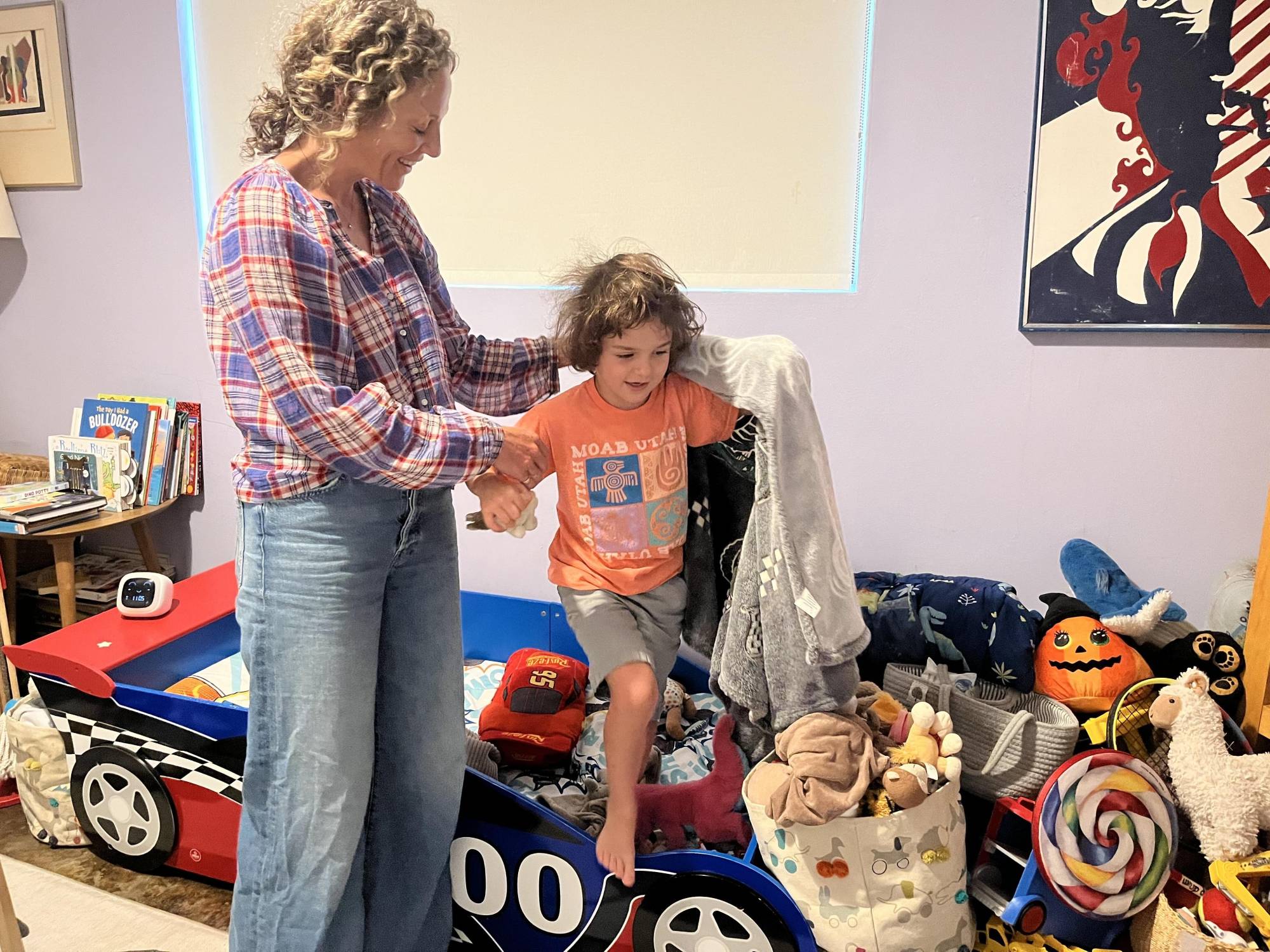
How Prepared are 'COVID Kindergartners' for School?
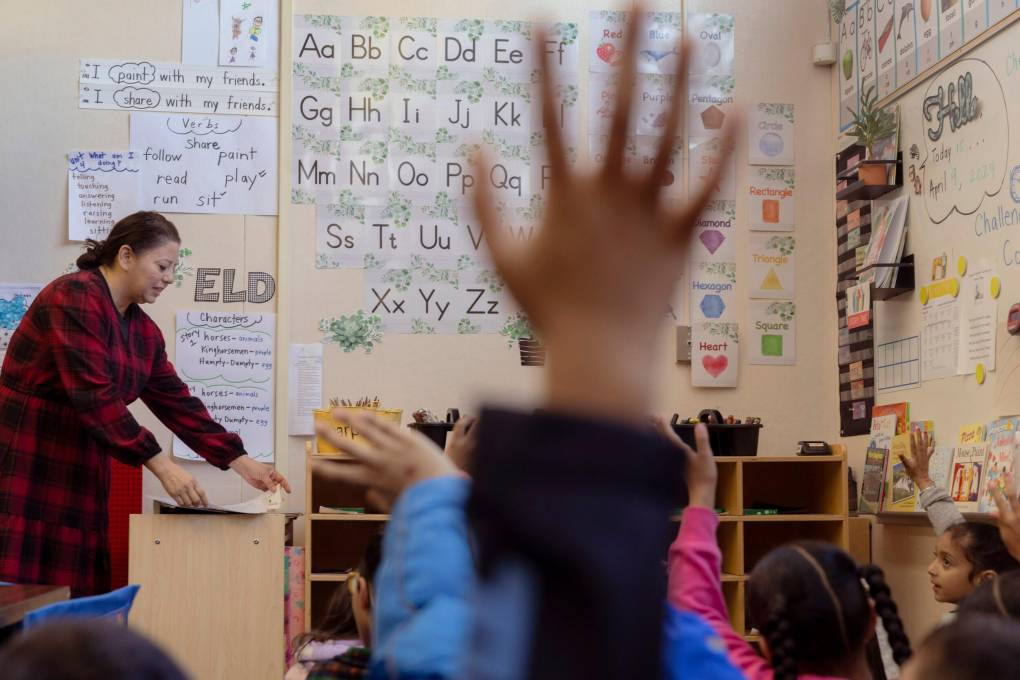
They Weren’t Yet in School When COVID Hit. The Pandemic Still Set Back the Youngest Students.
Kindergartners Are Missing a Lot of School. This District Has a Fix
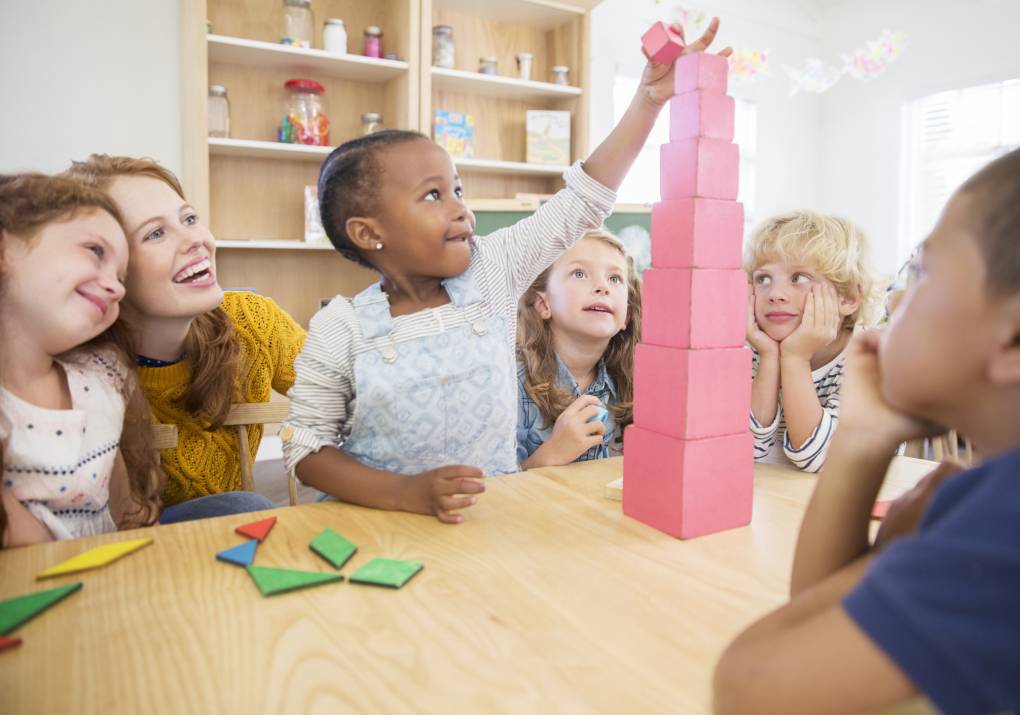
Does Delaying Kindergarten Benefit Children Academically and Socially?
“Short-burst" phonics tutoring shows promise with kindergarteners
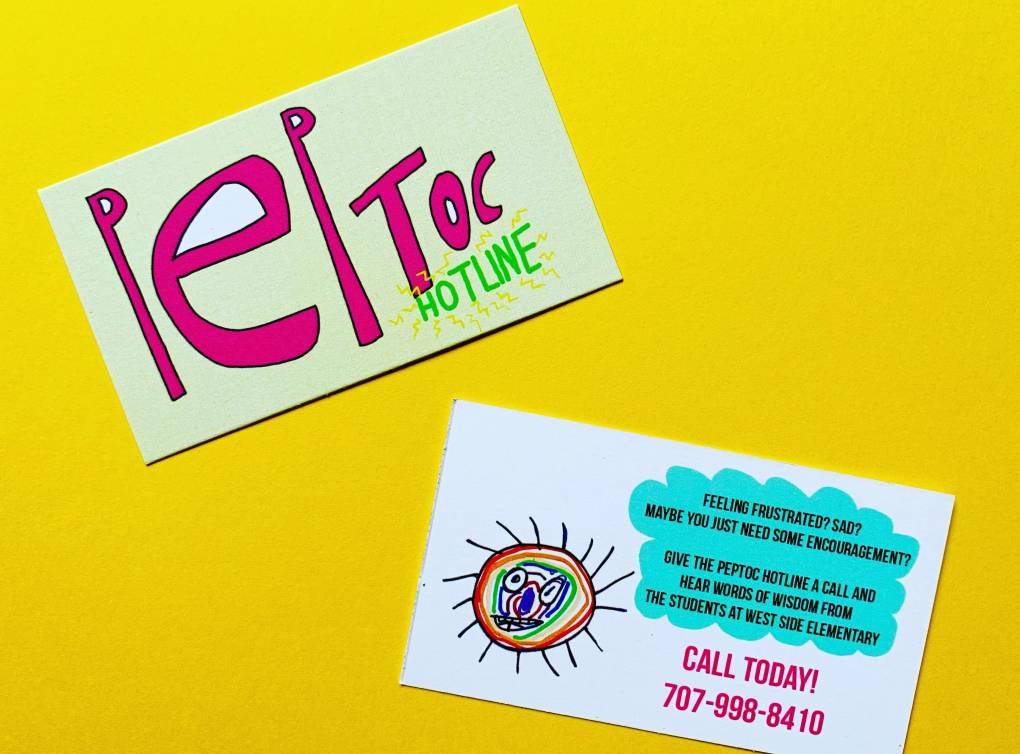
Need a pep talk from kindergartners? A new hotline gives you options for joy
Kindergarten Enrollment Fell Last Year. Now Schools Wonder How Many Kids Are Coming
Lessons in Online Kindergarten: Why Responsive Teaching Matters in Any Setting
When Learning How to Write Starts Virtually, Here’s What’s Helpful to Know
Sponsored
Player sponsored by
window.__IS_SSR__=true
window.__INITIAL_STATE__={
"attachmentsReducer": {
"audio_0": {
"type": "attachments",
"id": "audio_0",
"imgSizes": {
"kqedFullSize": {
"file": "https://ww2.kqed.org/news/wp-content/themes/KQED-unified/img/audio_bgs/background0.jpg"
}
}
},
"audio_1": {
"type": "attachments",
"id": "audio_1",
"imgSizes": {
"kqedFullSize": {
"file": "https://ww2.kqed.org/news/wp-content/themes/KQED-unified/img/audio_bgs/background1.jpg"
}
}
},
"audio_2": {
"type": "attachments",
"id": "audio_2",
"imgSizes": {
"kqedFullSize": {
"file": "https://ww2.kqed.org/news/wp-content/themes/KQED-unified/img/audio_bgs/background2.jpg"
}
}
},
"audio_3": {
"type": "attachments",
"id": "audio_3",
"imgSizes": {
"kqedFullSize": {
"file": "https://ww2.kqed.org/news/wp-content/themes/KQED-unified/img/audio_bgs/background3.jpg"
}
}
},
"audio_4": {
"type": "attachments",
"id": "audio_4",
"imgSizes": {
"kqedFullSize": {
"file": "https://ww2.kqed.org/news/wp-content/themes/KQED-unified/img/audio_bgs/background4.jpg"
}
}
},
"placeholder": {
"type": "attachments",
"id": "placeholder",
"imgSizes": {
"thumbnail": {
"file": "https://cdn.kqed.org/wp-content/uploads/2024/12/KQED-Default-Image-816638274-2000x1333-1-160x107.jpg",
"width": 160,
"height": 107,
"mimeType": "image/jpeg"
},
"medium": {
"file": "https://cdn.kqed.org/wp-content/uploads/2024/12/KQED-Default-Image-816638274-2000x1333-1-800x533.jpg",
"width": 800,
"height": 533,
"mimeType": "image/jpeg"
},
"medium_large": {
"file": "https://cdn.kqed.org/wp-content/uploads/2024/12/KQED-Default-Image-816638274-2000x1333-1-768x512.jpg",
"width": 768,
"height": 512,
"mimeType": "image/jpeg"
},
"large": {
"file": "https://cdn.kqed.org/wp-content/uploads/2024/12/KQED-Default-Image-816638274-2000x1333-1-1020x680.jpg",
"width": 1020,
"height": 680,
"mimeType": "image/jpeg"
},
"1536x1536": {
"file": "https://cdn.kqed.org/wp-content/uploads/2024/12/KQED-Default-Image-816638274-2000x1333-1-1536x1024.jpg",
"width": 1536,
"height": 1024,
"mimeType": "image/jpeg"
},
"fd-lrg": {
"file": "https://cdn.kqed.org/wp-content/uploads/2024/12/KQED-Default-Image-816638274-2000x1333-1-1536x1024.jpg",
"width": 1536,
"height": 1024,
"mimeType": "image/jpeg"
},
"fd-med": {
"file": "https://cdn.kqed.org/wp-content/uploads/2024/12/KQED-Default-Image-816638274-2000x1333-1-1020x680.jpg",
"width": 1020,
"height": 680,
"mimeType": "image/jpeg"
},
"fd-sm": {
"file": "https://cdn.kqed.org/wp-content/uploads/2024/12/KQED-Default-Image-816638274-2000x1333-1-800x533.jpg",
"width": 800,
"height": 533,
"mimeType": "image/jpeg"
},
"post-thumbnail": {
"file": "https://cdn.kqed.org/wp-content/uploads/2024/12/KQED-Default-Image-816638274-2000x1333-1-672x372.jpg",
"width": 672,
"height": 372,
"mimeType": "image/jpeg"
},
"twentyfourteen-full-width": {
"file": "https://cdn.kqed.org/wp-content/uploads/2024/12/KQED-Default-Image-816638274-2000x1333-1-1038x576.jpg",
"width": 1038,
"height": 576,
"mimeType": "image/jpeg"
},
"xxsmall": {
"file": "https://cdn.kqed.org/wp-content/uploads/2024/12/KQED-Default-Image-816638274-2000x1333-1-160x107.jpg",
"width": 160,
"height": 107,
"mimeType": "image/jpeg"
},
"xsmall": {
"file": "https://cdn.kqed.org/wp-content/uploads/2024/12/KQED-Default-Image-816638274-2000x1333-1-672x372.jpg",
"width": 672,
"height": 372,
"mimeType": "image/jpeg"
},
"small": {
"file": "https://cdn.kqed.org/wp-content/uploads/2024/12/KQED-Default-Image-816638274-2000x1333-1-672x372.jpg",
"width": 672,
"height": 372,
"mimeType": "image/jpeg"
},
"xlarge": {
"file": "https://cdn.kqed.org/wp-content/uploads/2024/12/KQED-Default-Image-816638274-2000x1333-1-1020x680.jpg",
"width": 1020,
"height": 680,
"mimeType": "image/jpeg"
},
"full-width": {
"file": "https://cdn.kqed.org/wp-content/uploads/2024/12/KQED-Default-Image-816638274-2000x1333-1-1920x1280.jpg",
"width": 1920,
"height": 1280,
"mimeType": "image/jpeg"
},
"guest-author-32": {
"file": "https://cdn.kqed.org/wp-content/uploads/2025/01/KQED-Default-Image-816638274-1333x1333-1-160x160.jpg",
"width": 32,
"height": 32,
"mimeType": "image/jpeg"
},
"guest-author-50": {
"file": "https://cdn.kqed.org/wp-content/uploads/2025/01/KQED-Default-Image-816638274-1333x1333-1-160x160.jpg",
"width": 50,
"height": 50,
"mimeType": "image/jpeg"
},
"guest-author-64": {
"file": "https://cdn.kqed.org/wp-content/uploads/2025/01/KQED-Default-Image-816638274-1333x1333-1-160x160.jpg",
"width": 64,
"height": 64,
"mimeType": "image/jpeg"
},
"guest-author-96": {
"file": "https://cdn.kqed.org/wp-content/uploads/2025/01/KQED-Default-Image-816638274-1333x1333-1-160x160.jpg",
"width": 96,
"height": 96,
"mimeType": "image/jpeg"
},
"guest-author-128": {
"file": "https://cdn.kqed.org/wp-content/uploads/2025/01/KQED-Default-Image-816638274-1333x1333-1-160x160.jpg",
"width": 128,
"height": 128,
"mimeType": "image/jpeg"
},
"detail": {
"file": "https://cdn.kqed.org/wp-content/uploads/2025/01/KQED-Default-Image-816638274-1333x1333-1-160x160.jpg",
"width": 160,
"height": 160,
"mimeType": "image/jpeg"
},
"kqedFullSize": {
"file": "https://cdn.kqed.org/wp-content/uploads/2024/12/KQED-Default-Image-816638274-2000x1333-1.jpg",
"width": 2000,
"height": 1333
}
}
},
"mindshift_65730": {
"type": "attachments",
"id": "mindshift_65730",
"meta": {
"index": "attachments_1716263798",
"site": "mindshift",
"id": "65730",
"found": true
},
"title": "IMG_0561.jpg",
"publishDate": 1755878050,
"status": "inherit",
"parent": 65729,
"modified": 1755878059,
"caption": "Mollie Sussman and Eli Frankel show off his new race car bed. The 5-year-old is one of 3.6 million children born in the U.S. in 2020 who are starting kindergarten this year.",
"credit": null,
"altTag": null,
"description": null,
"imgSizes": {
"medium": {
"file": "https://cdn.kqed.org/wp-content/uploads/sites/23/2025/08/img-0561-2000x1500.jpeg",
"width": 2000,
"height": 1500,
"mimeType": "image/jpeg"
},
"large": {
"file": "https://cdn.kqed.org/wp-content/uploads/sites/23/2025/08/img-0561-2000x1500.jpeg",
"width": 2000,
"height": 1500,
"mimeType": "image/jpeg"
},
"thumbnail": {
"file": "https://cdn.kqed.org/wp-content/uploads/sites/23/2025/08/img-0561-160x120.jpeg",
"width": 160,
"height": 120,
"mimeType": "image/jpeg"
},
"medium_large": {
"file": "https://cdn.kqed.org/wp-content/uploads/sites/23/2025/08/img-0561-768x576.jpeg",
"width": 768,
"height": 576,
"mimeType": "image/jpeg"
},
"1536x1536": {
"file": "https://cdn.kqed.org/wp-content/uploads/sites/23/2025/08/img-0561-1536x1152.jpeg",
"width": 1536,
"height": 1152,
"mimeType": "image/jpeg"
},
"2048x2048": {
"file": "https://cdn.kqed.org/wp-content/uploads/sites/23/2025/08/img-0561-2048x1536.jpeg",
"width": 2048,
"height": 1536,
"mimeType": "image/jpeg"
},
"post-thumbnail": {
"file": "https://cdn.kqed.org/wp-content/uploads/sites/23/2025/08/img-0561-672x372.jpeg",
"width": 672,
"height": 372,
"mimeType": "image/jpeg"
},
"twentyfourteen-full-width": {
"file": "https://cdn.kqed.org/wp-content/uploads/sites/23/2025/08/img-0561-1038x576.jpeg",
"width": 1038,
"height": 576,
"mimeType": "image/jpeg"
},
"full-width": {
"file": "https://cdn.kqed.org/wp-content/uploads/sites/23/2025/08/img-0561-2000x1500.jpeg",
"width": 2000,
"height": 1500,
"mimeType": "image/jpeg"
},
"kqedFullSize": {
"file": "https://cdn.kqed.org/wp-content/uploads/sites/23/2025/08/img-0561-scaled.jpeg",
"width": 2560,
"height": 1920
}
},
"fetchFailed": false,
"isLoading": false
},
"mindshift_64160": {
"type": "attachments",
"id": "mindshift_64160",
"meta": {
"index": "attachments_1716263798",
"site": "mindshift",
"id": "64160",
"found": true
},
"title": "chalkbeat",
"publishDate": 1720203876,
"status": "inherit",
"parent": 64159,
"modified": 1720203932,
"caption": "A new report finds that schools may need to direct additional support to early elementary schoolers who are struggling to progress in reading and math following pandemic disruptions to their early childhood experiences.",
"credit": "Alex Zimmerman/Chalkbeat",
"altTag": null,
"description": null,
"imgSizes": {
"medium": {
"file": "https://cdn.kqed.org/wp-content/uploads/sites/23/2024/07/chalkbeat-800x533.jpeg",
"width": 800,
"height": 533,
"mimeType": "image/jpeg"
},
"large": {
"file": "https://cdn.kqed.org/wp-content/uploads/sites/23/2024/07/chalkbeat-1020x680.jpeg",
"width": 1020,
"height": 680,
"mimeType": "image/jpeg"
},
"thumbnail": {
"file": "https://cdn.kqed.org/wp-content/uploads/sites/23/2024/07/chalkbeat-160x107.jpeg",
"width": 160,
"height": 107,
"mimeType": "image/jpeg"
},
"medium_large": {
"file": "https://cdn.kqed.org/wp-content/uploads/sites/23/2024/07/chalkbeat-768x512.jpeg",
"width": 768,
"height": 512,
"mimeType": "image/jpeg"
},
"1536x1536": {
"file": "https://cdn.kqed.org/wp-content/uploads/sites/23/2024/07/chalkbeat-1536x1023.jpeg",
"width": 1536,
"height": 1023,
"mimeType": "image/jpeg"
},
"post-thumbnail": {
"file": "https://cdn.kqed.org/wp-content/uploads/sites/23/2024/07/chalkbeat-672x372.jpeg",
"width": 672,
"height": 372,
"mimeType": "image/jpeg"
},
"twentyfourteen-full-width": {
"file": "https://cdn.kqed.org/wp-content/uploads/sites/23/2024/07/chalkbeat-1038x576.jpeg",
"width": 1038,
"height": 576,
"mimeType": "image/jpeg"
},
"kqedFullSize": {
"file": "https://cdn.kqed.org/wp-content/uploads/sites/23/2024/07/chalkbeat.jpeg",
"width": 1600,
"height": 1066
}
},
"fetchFailed": false,
"isLoading": false
},
"mindshift_63996": {
"type": "attachments",
"id": "mindshift_63996",
"meta": {
"index": "attachments_1716263798",
"site": "mindshift",
"id": "63996",
"found": true
},
"title": "20240517_NPR_kindergarten_pg07A.JPG",
"publishDate": 1718374569,
"status": "inherit",
"parent": 63995,
"modified": 1718375221,
"caption": "Selma Herndon Elementary School kindergarten teacher Diana Dickey starts the day each morning by asking students to share how they are feeling. ",
"credit": "Preston Gannaway for NPR",
"altTag": null,
"description": null,
"imgSizes": {
"medium": {
"file": "https://cdn.kqed.org/wp-content/uploads/sites/23/2024/06/20240517-npr-kindergarten-pg07a-800x533.jpeg",
"width": 800,
"height": 533,
"mimeType": "image/jpeg"
},
"large": {
"file": "https://cdn.kqed.org/wp-content/uploads/sites/23/2024/06/20240517-npr-kindergarten-pg07a-1020x680.jpeg",
"width": 1020,
"height": 680,
"mimeType": "image/jpeg"
},
"thumbnail": {
"file": "https://cdn.kqed.org/wp-content/uploads/sites/23/2024/06/20240517-npr-kindergarten-pg07a-160x107.jpeg",
"width": 160,
"height": 107,
"mimeType": "image/jpeg"
},
"medium_large": {
"file": "https://cdn.kqed.org/wp-content/uploads/sites/23/2024/06/20240517-npr-kindergarten-pg07a-768x512.jpeg",
"width": 768,
"height": 512,
"mimeType": "image/jpeg"
},
"1536x1536": {
"file": "https://cdn.kqed.org/wp-content/uploads/sites/23/2024/06/20240517-npr-kindergarten-pg07a-1536x1024.jpeg",
"width": 1536,
"height": 1024,
"mimeType": "image/jpeg"
},
"2048x2048": {
"file": "https://cdn.kqed.org/wp-content/uploads/sites/23/2024/06/20240517-npr-kindergarten-pg07a-2048x1366.jpeg",
"width": 2048,
"height": 1366,
"mimeType": "image/jpeg"
},
"post-thumbnail": {
"file": "https://cdn.kqed.org/wp-content/uploads/sites/23/2024/06/20240517-npr-kindergarten-pg07a-672x372.jpeg",
"width": 672,
"height": 372,
"mimeType": "image/jpeg"
},
"twentyfourteen-full-width": {
"file": "https://cdn.kqed.org/wp-content/uploads/sites/23/2024/06/20240517-npr-kindergarten-pg07a-1038x576.jpeg",
"width": 1038,
"height": 576,
"mimeType": "image/jpeg"
},
"full-width": {
"file": "https://cdn.kqed.org/wp-content/uploads/sites/23/2024/06/20240517-npr-kindergarten-pg07a-1920x1280.jpeg",
"width": 1920,
"height": 1280,
"mimeType": "image/jpeg"
},
"kqedFullSize": {
"file": "https://cdn.kqed.org/wp-content/uploads/sites/23/2024/06/20240517-npr-kindergarten-pg07a.jpeg",
"width": 2500,
"height": 1667
}
},
"fetchFailed": false,
"isLoading": false
},
"mindshift_63999": {
"type": "attachments",
"id": "mindshift_63999",
"meta": {
"index": "attachments_1716263798",
"site": "mindshift",
"id": "63999",
"found": true
},
"title": "kinder5",
"publishDate": 1718374914,
"status": "inherit",
"parent": 63995,
"modified": 1718375068,
"caption": "Students head to class at Selma Herndon Elementary in Livingston, Calif.",
"credit": " Preston Gannaway for NPR",
"altTag": null,
"description": null,
"imgSizes": {
"thumbnail": {
"file": "https://cdn.kqed.org/wp-content/uploads/sites/23/2024/06/kinder5-160x107.jpeg",
"width": 160,
"height": 107,
"mimeType": "image/jpeg"
},
"post-thumbnail": {
"file": "https://cdn.kqed.org/wp-content/uploads/sites/23/2024/06/kinder5-672x372.jpeg",
"width": 672,
"height": 372,
"mimeType": "image/jpeg"
},
"kqedFullSize": {
"file": "https://cdn.kqed.org/wp-content/uploads/sites/23/2024/06/kinder5.jpeg",
"width": 700,
"height": 467
}
},
"fetchFailed": false,
"isLoading": false
},
"mindshift_61682": {
"type": "attachments",
"id": "mindshift_61682",
"meta": {
"index": "attachments_1716263798",
"site": "mindshift",
"id": "61682",
"found": true
},
"parent": 61681,
"imgSizes": {
"twentyfourteen-full-width": {
"file": "https://ww2.kqed.org/app/uploads/sites/23/2023/05/iStock-CaiaimageRobertDaly-1038x576.jpg",
"width": 1038,
"mimeType": "image/jpeg",
"height": 576
},
"thumbnail": {
"file": "https://ww2.kqed.org/app/uploads/sites/23/2023/05/iStock-CaiaimageRobertDaly-160x112.jpg",
"width": 160,
"mimeType": "image/jpeg",
"height": 112
},
"post-thumbnail": {
"file": "https://ww2.kqed.org/app/uploads/sites/23/2023/05/iStock-CaiaimageRobertDaly-672x372.jpg",
"width": 672,
"mimeType": "image/jpeg",
"height": 372
},
"kqedFullSize": {
"file": "https://ww2.kqed.org/app/uploads/sites/23/2023/05/iStock-CaiaimageRobertDaly.jpg",
"width": 2068,
"height": 1449
},
"2048x2048": {
"file": "https://ww2.kqed.org/app/uploads/sites/23/2023/05/iStock-CaiaimageRobertDaly-2048x1435.jpg",
"width": 2048,
"mimeType": "image/jpeg",
"height": 1435
},
"large": {
"file": "https://ww2.kqed.org/app/uploads/sites/23/2023/05/iStock-CaiaimageRobertDaly-1020x715.jpg",
"width": 1020,
"mimeType": "image/jpeg",
"height": 715
},
"1536x1536": {
"file": "https://ww2.kqed.org/app/uploads/sites/23/2023/05/iStock-CaiaimageRobertDaly-1536x1076.jpg",
"width": 1536,
"mimeType": "image/jpeg",
"height": 1076
},
"full-width": {
"file": "https://ww2.kqed.org/app/uploads/sites/23/2023/05/iStock-CaiaimageRobertDaly-1920x1345.jpg",
"width": 1920,
"mimeType": "image/jpeg",
"height": 1345
},
"medium": {
"file": "https://ww2.kqed.org/app/uploads/sites/23/2023/05/iStock-CaiaimageRobertDaly-800x561.jpg",
"width": 800,
"mimeType": "image/jpeg",
"height": 561
},
"medium_large": {
"file": "https://ww2.kqed.org/app/uploads/sites/23/2023/05/iStock-CaiaimageRobertDaly-768x538.jpg",
"width": 768,
"mimeType": "image/jpeg",
"height": 538
}
},
"publishDate": 1684894767,
"modified": 1684894809,
"caption": null,
"description": null,
"title": "Student stacking blocks in class",
"credit": "iStock/Caiaimage RobertDaly",
"status": "inherit",
"altTag": null,
"fetchFailed": false,
"isLoading": false
},
"mindshift_61204": {
"type": "attachments",
"id": "mindshift_61204",
"meta": {
"index": "attachments_1716263798",
"site": "mindshift",
"id": "61204",
"found": true
},
"parent": 61200,
"imgSizes": {
"twentyfourteen-full-width": {
"file": "https://ww2.kqed.org/app/uploads/sites/23/2023/03/yaoinlove-iStock-1038x576.jpg",
"width": 1038,
"mimeType": "image/jpeg",
"height": 576
},
"thumbnail": {
"file": "https://ww2.kqed.org/app/uploads/sites/23/2023/03/yaoinlove-iStock-160x107.jpg",
"width": 160,
"mimeType": "image/jpeg",
"height": 107
},
"post-thumbnail": {
"file": "https://ww2.kqed.org/app/uploads/sites/23/2023/03/yaoinlove-iStock-672x372.jpg",
"width": 672,
"mimeType": "image/jpeg",
"height": 372
},
"kqedFullSize": {
"file": "https://ww2.kqed.org/app/uploads/sites/23/2023/03/yaoinlove-iStock.jpg",
"width": 2121,
"height": 1414
},
"2048x2048": {
"file": "https://ww2.kqed.org/app/uploads/sites/23/2023/03/yaoinlove-iStock-2048x1365.jpg",
"width": 2048,
"mimeType": "image/jpeg",
"height": 1365
},
"large": {
"file": "https://ww2.kqed.org/app/uploads/sites/23/2023/03/yaoinlove-iStock-1020x680.jpg",
"width": 1020,
"mimeType": "image/jpeg",
"height": 680
},
"1536x1536": {
"file": "https://ww2.kqed.org/app/uploads/sites/23/2023/03/yaoinlove-iStock-1536x1024.jpg",
"width": 1536,
"mimeType": "image/jpeg",
"height": 1024
},
"full-width": {
"file": "https://ww2.kqed.org/app/uploads/sites/23/2023/03/yaoinlove-iStock-1920x1280.jpg",
"width": 1920,
"mimeType": "image/jpeg",
"height": 1280
},
"medium": {
"file": "https://ww2.kqed.org/app/uploads/sites/23/2023/03/yaoinlove-iStock-800x533.jpg",
"width": 800,
"mimeType": "image/jpeg",
"height": 533
},
"medium_large": {
"file": "https://ww2.kqed.org/app/uploads/sites/23/2023/03/yaoinlove-iStock-768x512.jpg",
"width": 768,
"mimeType": "image/jpeg",
"height": 512
}
},
"publishDate": 1678504358,
"modified": 1678504514,
"caption": null,
"description": null,
"title": "Asian children learning English with flash cards, Teach young kids English at home, Child at home, kindergarten closed during the Covid-19 health crisis",
"credit": "iStock/yaoinlove",
"status": "inherit",
"altTag": "Asian or Asian American kindergarten boy holding up one flash card with a capital 'A' and lowercase 'a' and a second flash card with a capital 'B' and a lowercase 'b'",
"fetchFailed": false,
"isLoading": false
},
"mindshift_59167": {
"type": "attachments",
"id": "mindshift_59167",
"meta": {
"index": "attachments_1716263798",
"site": "mindshift",
"id": "59167",
"found": true
},
"parent": 59165,
"imgSizes": {
"twentyfourteen-full-width": {
"file": "https://ww2.kqed.org/app/uploads/sites/23/2022/03/peptoc2_custom-1b030e9c11ffb1d76113e67445f4caea195d8077-1038x576.jpg",
"width": 1038,
"mimeType": "image/jpeg",
"height": 576
},
"thumbnail": {
"file": "https://ww2.kqed.org/app/uploads/sites/23/2022/03/peptoc2_custom-1b030e9c11ffb1d76113e67445f4caea195d8077-160x118.jpg",
"width": 160,
"mimeType": "image/jpeg",
"height": 118
},
"post-thumbnail": {
"file": "https://ww2.kqed.org/app/uploads/sites/23/2022/03/peptoc2_custom-1b030e9c11ffb1d76113e67445f4caea195d8077-672x372.jpg",
"width": 672,
"mimeType": "image/jpeg",
"height": 372
},
"kqedFullSize": {
"file": "https://ww2.kqed.org/app/uploads/sites/23/2022/03/peptoc2_custom-1b030e9c11ffb1d76113e67445f4caea195d8077-scaled-e1646641901861.jpg",
"width": 1920,
"height": 1419
},
"2048x2048": {
"file": "https://ww2.kqed.org/app/uploads/sites/23/2022/03/peptoc2_custom-1b030e9c11ffb1d76113e67445f4caea195d8077-2048x1513.jpg",
"width": 2048,
"mimeType": "image/jpeg",
"height": 1513
},
"large": {
"file": "https://ww2.kqed.org/app/uploads/sites/23/2022/03/peptoc2_custom-1b030e9c11ffb1d76113e67445f4caea195d8077-1020x754.jpg",
"width": 1020,
"mimeType": "image/jpeg",
"height": 754
},
"1536x1536": {
"file": "https://ww2.kqed.org/app/uploads/sites/23/2022/03/peptoc2_custom-1b030e9c11ffb1d76113e67445f4caea195d8077-1536x1135.jpg",
"width": 1536,
"mimeType": "image/jpeg",
"height": 1135
},
"full-width": {
"file": "https://ww2.kqed.org/app/uploads/sites/23/2022/03/peptoc2_custom-1b030e9c11ffb1d76113e67445f4caea195d8077-1920x1419.jpg",
"width": 1920,
"mimeType": "image/jpeg",
"height": 1419
},
"medium": {
"file": "https://ww2.kqed.org/app/uploads/sites/23/2022/03/peptoc2_custom-1b030e9c11ffb1d76113e67445f4caea195d8077-800x591.jpg",
"width": 800,
"mimeType": "image/jpeg",
"height": 591
},
"medium_large": {
"file": "https://ww2.kqed.org/app/uploads/sites/23/2022/03/peptoc2_custom-1b030e9c11ffb1d76113e67445f4caea195d8077-768x567.jpg",
"width": 768,
"mimeType": "image/jpeg",
"height": 567
}
},
"publishDate": 1646641824,
"modified": 1646642051,
"caption": "The kids at West Side Elementary in Healdsburg, Calif., handed out Peptoc hotline cards to the public to help spread the word about the project.\n",
"description": null,
"title": "The kids at West Side Elementary in Healdsburg, Calif., handed out Peptoc hotline cards to the public to help spread the word about the project.",
"credit": "Jessica Martin",
"status": "inherit",
"altTag": "Two cards advertising the \"Peptoc\" hotline for folks who need a pep talk",
"fetchFailed": false,
"isLoading": false
},
"mindshift_58203": {
"type": "attachments",
"id": "mindshift_58203",
"meta": {
"index": "attachments_1716263798",
"site": "mindshift",
"id": "58203",
"found": true
},
"parent": 58202,
"imgSizes": {
"twentyfourteen-full-width": {
"file": "https://ww2.kqed.org/app/uploads/sites/23/2021/07/gettyimages-1266889462_slide-2d8f64d3ddda147ac7d6ffe743553dad8e5b92d1-1038x576.jpg",
"width": 1038,
"mimeType": "image/jpeg",
"height": 576
},
"thumbnail": {
"file": "https://ww2.kqed.org/app/uploads/sites/23/2021/07/gettyimages-1266889462_slide-2d8f64d3ddda147ac7d6ffe743553dad8e5b92d1-160x107.jpg",
"width": 160,
"mimeType": "image/jpeg",
"height": 107
},
"post-thumbnail": {
"file": "https://ww2.kqed.org/app/uploads/sites/23/2021/07/gettyimages-1266889462_slide-2d8f64d3ddda147ac7d6ffe743553dad8e5b92d1-672x372.jpg",
"width": 672,
"mimeType": "image/jpeg",
"height": 372
},
"kqedFullSize": {
"file": "https://ww2.kqed.org/app/uploads/sites/23/2021/07/gettyimages-1266889462_slide-2d8f64d3ddda147ac7d6ffe743553dad8e5b92d1-scaled-e1627399679948.jpg",
"width": 1920,
"height": 1280
},
"2048x2048": {
"file": "https://ww2.kqed.org/app/uploads/sites/23/2021/07/gettyimages-1266889462_slide-2d8f64d3ddda147ac7d6ffe743553dad8e5b92d1-2048x1365.jpg",
"width": 2048,
"mimeType": "image/jpeg",
"height": 1365
},
"large": {
"file": "https://ww2.kqed.org/app/uploads/sites/23/2021/07/gettyimages-1266889462_slide-2d8f64d3ddda147ac7d6ffe743553dad8e5b92d1-1020x680.jpg",
"width": 1020,
"mimeType": "image/jpeg",
"height": 680
},
"1536x1536": {
"file": "https://ww2.kqed.org/app/uploads/sites/23/2021/07/gettyimages-1266889462_slide-2d8f64d3ddda147ac7d6ffe743553dad8e5b92d1-1536x1024.jpg",
"width": 1536,
"mimeType": "image/jpeg",
"height": 1024
},
"full-width": {
"file": "https://ww2.kqed.org/app/uploads/sites/23/2021/07/gettyimages-1266889462_slide-2d8f64d3ddda147ac7d6ffe743553dad8e5b92d1-1920x1280.jpg",
"width": 1920,
"mimeType": "image/jpeg",
"height": 1280
},
"medium": {
"file": "https://ww2.kqed.org/app/uploads/sites/23/2021/07/gettyimages-1266889462_slide-2d8f64d3ddda147ac7d6ffe743553dad8e5b92d1-800x533.jpg",
"width": 800,
"mimeType": "image/jpeg",
"height": 533
},
"medium_large": {
"file": "https://ww2.kqed.org/app/uploads/sites/23/2021/07/gettyimages-1266889462_slide-2d8f64d3ddda147ac7d6ffe743553dad8e5b92d1-768x512.jpg",
"width": 768,
"mimeType": "image/jpeg",
"height": 512
}
},
"publishDate": 1627399622,
"modified": 1627399690,
"caption": null,
"description": null,
"title": "A schoolboy wears a protective face mask.",
"credit": "Juanmonino/Getty Images",
"status": "inherit",
"altTag": null,
"fetchFailed": false,
"isLoading": false
},
"mindshift_57901": {
"type": "attachments",
"id": "mindshift_57901",
"meta": {
"index": "attachments_1716263798",
"site": "mindshift",
"id": "57901",
"found": true
},
"parent": 57898,
"imgSizes": {
"twentyfourteen-full-width": {
"file": "https://ww2.kqed.org/app/uploads/sites/23/2021/05/Tayo-Enna013-1038x576.jpg",
"width": 1038,
"mimeType": "image/jpeg",
"height": 576
},
"thumbnail": {
"file": "https://ww2.kqed.org/app/uploads/sites/23/2021/05/Tayo-Enna013-160x90.jpg",
"width": 160,
"mimeType": "image/jpeg",
"height": 90
},
"post-thumbnail": {
"file": "https://ww2.kqed.org/app/uploads/sites/23/2021/05/Tayo-Enna013-672x372.jpg",
"width": 672,
"mimeType": "image/jpeg",
"height": 372
},
"kqedFullSize": {
"file": "https://ww2.kqed.org/app/uploads/sites/23/2021/05/Tayo-Enna013.jpg",
"width": 1280,
"height": 720
},
"large": {
"file": "https://ww2.kqed.org/app/uploads/sites/23/2021/05/Tayo-Enna013-1020x574.jpg",
"width": 1020,
"mimeType": "image/jpeg",
"height": 574
},
"medium": {
"file": "https://ww2.kqed.org/app/uploads/sites/23/2021/05/Tayo-Enna013-800x450.jpg",
"width": 800,
"mimeType": "image/jpeg",
"height": 450
},
"medium_large": {
"file": "https://ww2.kqed.org/app/uploads/sites/23/2021/05/Tayo-Enna013-768x432.jpg",
"width": 768,
"mimeType": "image/jpeg",
"height": 432
}
},
"publishDate": 1621844782,
"modified": 1621844806,
"caption": null,
"description": null,
"title": "Tayo Enna013",
"credit": "Tayo Enna screengrab",
"status": "inherit",
"altTag": null,
"fetchFailed": false,
"isLoading": false
},
"mindshift_57873": {
"type": "attachments",
"id": "mindshift_57873",
"meta": {
"index": "attachments_1716263798",
"site": "mindshift",
"id": "57873",
"found": true
},
"parent": 57780,
"imgSizes": {
"twentyfourteen-full-width": {
"file": "https://ww2.kqed.org/app/uploads/sites/23/2021/05/iStock-909070454-1038x576.jpg",
"width": 1038,
"mimeType": "image/jpeg",
"height": 576
},
"thumbnail": {
"file": "https://ww2.kqed.org/app/uploads/sites/23/2021/05/iStock-909070454-160x107.jpg",
"width": 160,
"mimeType": "image/jpeg",
"height": 107
},
"post-thumbnail": {
"file": "https://ww2.kqed.org/app/uploads/sites/23/2021/05/iStock-909070454-672x372.jpg",
"width": 672,
"mimeType": "image/jpeg",
"height": 372
},
"kqedFullSize": {
"file": "https://ww2.kqed.org/app/uploads/sites/23/2021/05/iStock-909070454-e1621238785785.jpg",
"width": 1920,
"height": 1280
},
"2048x2048": {
"file": "https://ww2.kqed.org/app/uploads/sites/23/2021/05/iStock-909070454-2048x1365.jpg",
"width": 2048,
"mimeType": "image/jpeg",
"height": 1365
},
"large": {
"file": "https://ww2.kqed.org/app/uploads/sites/23/2021/05/iStock-909070454-1020x680.jpg",
"width": 1020,
"mimeType": "image/jpeg",
"height": 680
},
"1536x1536": {
"file": "https://ww2.kqed.org/app/uploads/sites/23/2021/05/iStock-909070454-1536x1024.jpg",
"width": 1536,
"mimeType": "image/jpeg",
"height": 1024
},
"full-width": {
"file": "https://ww2.kqed.org/app/uploads/sites/23/2021/05/iStock-909070454-1920x1280.jpg",
"width": 1920,
"mimeType": "image/jpeg",
"height": 1280
},
"medium": {
"file": "https://ww2.kqed.org/app/uploads/sites/23/2021/05/iStock-909070454-800x533.jpg",
"width": 800,
"mimeType": "image/jpeg",
"height": 533
},
"medium_large": {
"file": "https://ww2.kqed.org/app/uploads/sites/23/2021/05/iStock-909070454-768x512.jpg",
"width": 768,
"mimeType": "image/jpeg",
"height": 512
}
},
"publishDate": 1621238766,
"modified": 1621238796,
"caption": "Tired little kid boy at home making homework at the morning before the school starts. Little child doing excercise, indoors. Elementary school and education",
"description": null,
"title": "Tired kid boy at home making homework writing letters with colorful pens",
"credit": "romrodinka/iStock",
"status": "inherit",
"altTag": null,
"fetchFailed": false,
"isLoading": false
}
},
"audioPlayerReducer": {
"postId": "stream_live",
"isPaused": true,
"isPlaying": false,
"pfsActive": false,
"pledgeModalIsOpen": true,
"playerDrawerIsOpen": false
},
"authorsReducer": {
"byline_mindshift_65729": {
"type": "authors",
"id": "byline_mindshift_65729",
"meta": {
"override": true
},
"slug": "byline_mindshift_65729",
"name": "Vanessa Romo",
"isLoading": false
},
"byline_mindshift_64159": {
"type": "authors",
"id": "byline_mindshift_64159",
"meta": {
"override": true
},
"slug": "byline_mindshift_64159",
"name": "Kalyn Belsha, Chalkbeat",
"isLoading": false
},
"byline_mindshift_63995": {
"type": "authors",
"id": "byline_mindshift_63995",
"meta": {
"override": true
},
"slug": "byline_mindshift_63995",
"name": "Cory Turner",
"isLoading": false
},
"byline_mindshift_61681": {
"type": "authors",
"id": "byline_mindshift_61681",
"meta": {
"override": true
},
"slug": "byline_mindshift_61681",
"name": "Cara Goodwin, \u003ca href=\"https://www.parentingtranslator.com/\" target=\"blank\">The Parenting Translator\u003c/a>",
"isLoading": false
},
"byline_mindshift_61200": {
"type": "authors",
"id": "byline_mindshift_61200",
"meta": {
"override": true
},
"slug": "byline_mindshift_61200",
"name": "Jill Barshay, \u003ca href=\"https://hechingerreport.org/\" target=\"_blank\">The Hechinger Report\u003c/a>",
"isLoading": false
},
"byline_mindshift_59165": {
"type": "authors",
"id": "byline_mindshift_59165",
"meta": {
"override": true
},
"slug": "byline_mindshift_59165",
"name": "Adrian Florida and Hiba Ahmad",
"isLoading": false
},
"byline_mindshift_58202": {
"type": "authors",
"id": "byline_mindshift_58202",
"meta": {
"override": true
},
"slug": "byline_mindshift_58202",
"name": "Clare Lombardo",
"isLoading": false
},
"kdnewhouse": {
"type": "authors",
"id": "11487",
"meta": {
"index": "authors_1716337520",
"id": "11487",
"found": true
},
"name": "Kara Newhouse",
"firstName": "Kara",
"lastName": "Newhouse",
"slug": "kdnewhouse",
"email": "knewhouse@kqed.org",
"display_author_email": false,
"staff_mastheads": [],
"title": "MindShift Editor",
"bio": null,
"avatar": "https://secure.gravatar.com/avatar/3dceed6fb271527113abfa9a8e9df34e?s=600&d=blank&r=g",
"twitter": null,
"facebook": null,
"instagram": null,
"linkedin": null,
"sites": [
{
"site": "",
"roles": [
"editor"
]
},
{
"site": "mindshift",
"roles": []
}
],
"headData": {
"title": "Kara Newhouse | KQED",
"description": "MindShift Editor",
"ogImgSrc": "https://secure.gravatar.com/avatar/3dceed6fb271527113abfa9a8e9df34e?s=600&d=blank&r=g",
"twImgSrc": "https://secure.gravatar.com/avatar/3dceed6fb271527113abfa9a8e9df34e?s=600&d=blank&r=g"
},
"isLoading": false,
"link": "/author/kdnewhouse"
},
"csmith": {
"type": "authors",
"id": "11603",
"meta": {
"index": "authors_1716337520",
"id": "11603",
"found": true
},
"name": "Caroline Smith",
"firstName": "Caroline",
"lastName": "Smith",
"slug": "csmith",
"email": "csmith@kqed.org",
"display_author_email": true,
"staff_mastheads": [
"news"
],
"title": "Producer, Forum",
"bio": "Caroline Smith is a producer for \u003cem>Forum\u003c/em>. Smith joined the team in 2019 as an intern and became an on-call producer later that year. From the Bay Area, Smith graduated with a B.A. in Rhetoric from UC Berkeley and is an alumnus of \u003cem>The Daily Californian.\u003c/em>",
"avatar": "https://secure.gravatar.com/avatar/36b81e5f708f5bf91084149f95da8754?s=600&d=blank&r=g",
"twitter": null,
"facebook": null,
"instagram": null,
"linkedin": null,
"sites": [
{
"site": "arts",
"roles": [
"editor"
]
},
{
"site": "news",
"roles": [
"author"
]
},
{
"site": "mindshift",
"roles": [
"editor"
]
},
{
"site": "forum",
"roles": [
"administrator"
]
},
{
"site": "perspectives",
"roles": [
"editor"
]
}
],
"headData": {
"title": "Caroline Smith | KQED",
"description": "Producer, Forum",
"ogImgSrc": "https://secure.gravatar.com/avatar/36b81e5f708f5bf91084149f95da8754?s=600&d=blank&r=g",
"twImgSrc": "https://secure.gravatar.com/avatar/36b81e5f708f5bf91084149f95da8754?s=600&d=blank&r=g"
},
"isLoading": false,
"link": "/author/csmith"
}
},
"breakingNewsReducer": {},
"pagesReducer": {},
"postsReducer": {
"stream_live": {
"type": "live",
"id": "stream_live",
"audioUrl": "https://streams.kqed.org/kqedradio",
"title": "Live Stream",
"excerpt": "Live Stream information currently unavailable.",
"link": "/radio",
"featImg": "",
"label": {
"name": "KQED Live",
"link": "/"
}
},
"stream_kqedNewscast": {
"type": "posts",
"id": "stream_kqedNewscast",
"audioUrl": "https://www.kqed.org/.stream/anon/radio/RDnews/newscast.mp3?_=1",
"title": "KQED Newscast",
"featImg": "",
"label": {
"name": "88.5 FM",
"link": "/"
}
},
"mindshift_65729": {
"type": "posts",
"id": "mindshift_65729",
"meta": {
"index": "posts_1716263798",
"site": "mindshift",
"id": "65729",
"score": null,
"sort": [
1755878368000
]
},
"guestAuthors": [],
"slug": "how-prepared-are-covid-kindergartners-for-school",
"title": "How Prepared are 'COVID Kindergartners' for School?",
"publishDate": 1755878368,
"format": "standard",
"headTitle": "How Prepared are ‘COVID Kindergartners’ for School? | KQED",
"labelTerm": {
"term": 21847,
"site": "mindshift"
},
"content": "\u003cp>Last Wednesday was a big day for the Sussman and Frankel family. It was the first day of school at California Creative Academy, a charter school in Los Angeles where 5-year-old Eli is newly enrolled in kindergarten.\u003c/p>\n\u003cp>“We were super freaked out,” Mollie Sussman told NPR, referring to herself and her husband, Brad Frankel. “We were really scared and [Eli] was pretty scared” leading up to the milestone, she said.\u003c/p>\n\u003cp>Among her fears was that Eli, an only child, might feel overwhelmed by the transition from a small preschool to a new elementary school with kids up to the eighth grade. She worried that he might cry, that he might have a meltdown, or that he wouldn’t handle the structure of a kindergarten day with no naps.\u003c/p>\n\u003cp>But after participating in a class activity, where they traced outlines of one another’s hands, Sussman and her husband eased out of the classroom with no issues. “He was ready when we left. He did really well and he was super brave.” In fact, she said laughing, the only one in their three-member family who shed a tear that day was her husband.\u003c/p>\n\u003cp>Sussman and Frankel are not alone in their anxiety. Eli is one of more than \u003ca href=\"https://www.cdc.gov/nchs/data/nvsr/nvsr70/nvsr70-17.pdf\" target=\"_blank\" rel=\"noopener\">3.6 million children born in 2020\u003c/a> amid the COVID-19 pandemic who are walking into elementary schools across the country this fall. They’re children who came into a world full of masked adults dousing themselves in hand sanitizer. Many spent the first year of their lives either in isolation in lockdowns or with only a handful of trusted people in their bubbles. And the long-term impact on these “COVID kindergartners” remains unclear.\u003c/p>\n\u003cfigure class=\"wp-block-image size-large\">\u003cimg decoding=\"async\" src=\"https://npr.brightspotcdn.com/dims3/default/strip/false/crop/4800x2860+0+0/resize/1200/quality/75/format/jpeg/?url=http%3A%2F%2Fnpr-brightspot.s3.amazonaws.com%2F4c%2F9c%2Fc7bce52b46e880ddd95664a108f4%2Fgettyimages-1211233711.jpg\" alt=\"A woman stops to view a public art installation aimed at turning boarded-up shopfronts into works of art in Los Angeles on April 28, 2020.\">\u003cfigcaption>A woman stops to view a public art installation aimed at turning boarded-up shopfronts into works of art in Los Angeles on April 28, 2020. \u003ccite> (Frederic J. Brown | AFP via Getty Images)\u003c/cite>\u003c/figcaption>\u003c/figure>\n\u003cp>Research shows that \u003ca href=\"https://jamanetwork.com/journals/jamapediatrics/fullarticle/2812812\" target=\"_blank\" rel=\"noopener\">early childhood experiences can have lasting effects\u003c/a> on development and growth, according to a 2023 study published in the \u003cem>Journal of the American Medical Association Pediatrics (JAMA Pediatrics)\u003c/em>. While nurturing experiences can increase cognitive capabilities and academic achievement, early life disadvantages can lead to a persistent deficit in skills to manage adversity, stress and self-esteem. It follows then, that parents, experts and educators are hypervigilant, tracking how the hardships of the pandemic may manifest in this generation.\u003c/p>\n\u003cp>[ad fullwidth]\u003c/p>\n\u003cp>“Just being in utero during a highly stressful time had some developmental effects on infants,” Dani Dumitriu, a pediatrician and neuroscientist at Columbia University and chair of an ongoing study on pandemic newborns, told NPR. “They weren’t large effects but that was a very worrisome sign given that so many women gave birth during that period.”\u003c/p>\n\u003cp>Dumitriu’s research, \u003ca href=\"https://jamanetwork.com/journals/jamapediatrics/fullarticle/2787479\" target=\"_blank\" rel=\"noopener\">published in 2022\u003c/a>, found that 6-month-old infants born during the early months of the pandemic had slightly lower scores on a screening of their gross motor, fine motor and personal social skills, compared with a historical cohort of infants born before the onset of the COVID-19 pandemic.\u003c/p>\n\u003cp>“We’re talking about things like baby being able to sit up, baby being able to reach for things, maybe engaging in a face-to-face interaction, very basic things,” she said, explaining that mothers filled out a standard developmental \u003ca href=\"https://agesandstages.com/products-pricing/asq3/\" target=\"_blank\" rel=\"noopener\">questionnaire\u003c/a> providing the data for the study.\u003c/p>\n\u003cp>But, Dumitriu said, as they’ve continued to track these children and expanded the study to include more kids born pre-pandemic, they have found that the COVID babies quickly caught up. “The good news is that it looks like that trend really is restricted to the early pandemic phase of 2020 and did not continue past that year.”\u003c/p>\n\u003cp>“A child’s brain is extraordinarily plastic or malleable,” she said. “One of the important things about child development is that what happens at 6 months is not predictive of what happens at 24 months and it’s not predictive of what happens at 5 years.”\u003c/p>\n\u003ch2>Eli’s journey\u003c/h2>\n\u003cp>Sussman said these findings parallel her family’s experience. As working parents, Sussman and her husband enrolled Eli in day care at 11 months. He’s since been enrolled in nursery school and pre-K. He seemed to be meeting all of the established metrics, but at about 2 years old, Sussman realized Eli wasn’t speaking at the level that her mommy apps told her he should be. “There were for sure a number of words you should know by a certain time and he didn’t know them,” she said.\u003c/p>\n\u003cp>A \u003ca href=\"https://www.epicresearch.org/articles/childhood-speech-development-delays-increasing-since-the-start-of-the-pandemic\" target=\"_blank\" rel=\"noopener\">2023 study\u003c/a> published in \u003cem>Epic Research\u003c/em> found that children who turned 2 between October and December 2021 were about 32% more likely to have a speech delay diagnosis than those who turned 2 in 2018. That rate increased dramatically, up to nearly 88%, for children who turned 2 between January and March 2023. Overall, the speech delay diagnoses increased from an average of 9% of children in 2018 to nearly 17% in the first quarter of 2023.\u003c/p>\n\u003cfigure class=\"wp-block-image size-large\">\u003cimg decoding=\"async\" src=\"https://npr.brightspotcdn.com/dims3/default/strip/false/crop/4873x3299+0+0/resize/1200/quality/75/format/jpeg/?url=http%3A%2F%2Fnpr-brightspot.s3.amazonaws.com%2F2c%2Fa0%2F719c556945c486c1f0234ec68556%2Fgettyimages-1275890753.jpg\" alt=\"Masked schoolchildren wait to have their portraits taken for picture day in September 2020 at Rogers International School in Stamford, Conn.\">\u003cfigcaption>Masked schoolchildren wait to have their portraits taken for picture day in September 2020 at Rogers International School in Stamford, Conn. \u003ccite> (John Moore | Getty Images North America)\u003c/cite>\u003c/figcaption>\u003c/figure>\n\u003cp>Sussman immediately sought help and enrolled Eli in speech therapy, where she was relieved to hear that this was a common issue. “The speech therapist said that they had seen an increase in the number of kids coming to speech therapy. Likely because of the lack of exposure to mouths and facial expressions, because it’s a big part of how you learn to talk.”\u003c/p>\n\u003cp>By the time Eli turned 3 “he was so much more verbal and really in a great place,” Sussman said.\u003c/p>\n\u003ch2>Pandemic behaviors and habits that can spell trouble for kindergartners\u003c/h2>\n\u003cp>Other effects of the pandemic and subsequent social-distancing practices have led to lingering, potentially detrimental behaviors in children, which can show up in kindergarten or much later, according to Dumitriu.\u003c/p>\n\u003cp>Among the most important is parental stress, Dumitriu said. “Many studies around the world show there’s a very well-described intergenerational effect of maternal stress during pregnancy on the developing child,” she said.\u003c/p>\n\u003cp>Children also \u003ca href=\"https://scholar.google.com/scholar_lookup?title=Young%20children%E2%80%99s%20screen%20time%20during%20the%20first%20COVID-19%20lockdown%20in%2012%20countries.&author=C%20Bergmann&author=N%20Dimitrova&author=K%20Alaslani&publication_year=2022&journal=Sci%20Rep&volume=12&pages=2015\" target=\"_blank\" rel=\"noopener\">spent more time on screens\u003c/a> during lockdown than they did in a pre-pandemic world and that can make them less ready for school, according to a study published in the journal \u003cem>Nature\u003c/em>. Michelle Yang, a resident physician with Children’s Hospital of Orange County who studied screen time use in kids, said there are many dangers associated with television electronic devices for children ages 2 to 5 years. “Exposing children at this age to two to three hours of screen time showed increased likelihood of behavioral problems, poor vocabulary, and delayed milestones. This is especially true for children with special needs,” she wrote in an \u003ca href=\"https://health.choc.org/the-effects-of-screen-time-on-children-the-latest-research-parents-should-know/\" target=\"_blank\" rel=\"noopener\">article\u003c/a> providing guidelines for parents.\u003c/p>\n\u003cp>School attendance and preschool enrollment levels have also suffered since the pandemic. The U.S. Department of Education’s \u003ca href=\"https://www.ed.gov/teaching-and-administration/supporting-students/chronic-absenteeism#:~:text=The%20Department%20is%20using%20every%20tool%20in,suggests%20that%20children%20who%20are%20chronically%20absent\" target=\"_blank\" rel=\"noopener\">most recent study\u003c/a> on attendance found that the rate of chronic absenteeism — which is when students miss 10% or more of school — averaged 28% across the country during the 2022-2023 school year.\u003c/p>\n\u003cp>The results of the changes in behavior and habits are reflected in test scores, Kristen Huff, head of measurement at Curriculum Associates, a company that provides national grade level testing, told NPR.\u003c/p>\n\u003cp>“Since school returned after the pandemic, even students who were not in school because they were too young to be in kindergarten during the [lockdowns] are coming into kindergarten behind or less prepared rather than their pre-pandemic peers,” Huff said.\u003c/p>\n\u003cp>According to the company’s \u003ca href=\"https://cdn.bfldr.com/LS6J0F7/at/j37vw8rh26mgjtr6sk47pq3r/ca-sosl-executive-summary-2025.pdf\" target=\"_blank\" rel=\"noopener\">2025 State of Student Learning report\u003c/a>, the percentage of 5-year-olds who are arriving kindergarten-ready in reading has declined by 8 points since 2019 — from 89% to 81%. The declines are even greater in math. Only 70% of kindergarten students are testing at expected grade level, compared to the 2019 cohort, which was at 84% in 2019. The disparities are deeper still when broken out by race and income. Since 2023, majority Black and majority Hispanic schools continue to show a steady increase in test scores across most grades, but their test scores remain well below their white counterparts. The same is true for students whose families live on incomes below $50,000 per year versus those living above $75,000 annually.\u003c/p>\n\u003cp>The good news, Huff said, is that students are making strides. But while they’re growing at comparable rates to pre-pandemic, the improvement is not enough to make up for the academic ground that has been lost, she added.\u003c/p>\n\u003cp>“That is why we need to focus on that acceleration in the rate at which they’re learning,” Huff said.\u003c/p>\n\u003cp>Like Dumitriu, Huff focuses on the malleability of children’s brains as well as the expertise of educators. They just need the right resources.\u003c/p>\n\u003cp>[ad floatright]\u003c/p>\n\u003cp>“We know what works,” she said. “We know what is needed in classrooms, in schools and for students and to support teachers. And when those things are in place, these schools — even when they’re in low-income communities — can buck the trend.”\u003c/p>\n\u003cdiv class=\"npr-transcript\">\n\u003cp>\u003cstrong>Transcript:\u003c/strong>\u003c/p>\n\u003cp>LEILA FADEL, HOST:\u003c/p>\n\u003cp>Millions of children born during the COVID pandemic start kindergarten this year. NPR’s Vanessa Romo went to find out – are the nation’s 5-year-olds ready for school?\u003c/p>\n\u003cp>VANESSA ROMO, BYLINE: Last Wednesday was a big day for the Sussman and Frankel family. It was 5-year-old Eli Frankel’s first day of school at California Creative Academy, a charter school in Los Angeles. Mollie Sussman, his mom, told me about the day sitting at her kitchen table while the Hot Wheels-obsessed boy played next to us.\u003c/p>\n\u003cp>MOLLIE SUSSMAN: As parents, every single milestone you go through feels like the biggest deal when you’re in it. And then afterwards, you’re like, oh, like, we got through it. It’s totally fine.\u003c/p>\n\u003cp>ROMO: Yeah.\u003c/p>\n\u003cp>Among her fears was that Eli might feel overwhelmed by the transition from a small preschool to a bigger school. She worried that he wouldn’t be able to handle the structure or just cry. But to her surprise, only her husband teared up.\u003c/p>\n\u003cp>ELI FRANKEL: I was playing a monster truck race (ph).\u003c/p>\n\u003cp>UNIDENTIFIED PERSON: And who’s winning?\u003c/p>\n\u003cp>ROMO: The Sussman and Frankels are not alone in their anxiety. Three-point-six million children were born in 2020 as the coronavirus ushered in one of the most extraordinary periods in modern history. And scientists are still trying to figure out how this generation may be different.\u003c/p>\n\u003cp>DANI DUMITRIU: First of all, I’d say we’re way too early, right? Like, trying to say something about 5-year-olds right now is scientifically impossible because science lags by at least a couple years.\u003c/p>\n\u003cp>ROMO: That’s Dani Dumitriu at Columbia University. She’s the co-chair of an ongoing study on pandemic newborns. One of their first findings, published in 2023, was that 6-month-old infants born during the early months of the pandemic showed slight developmental delays in their motor skills. That was particularly troubling, Dumitriu said, because there’s ample research showing that early childhood experiences can have lasting effects on development and growth. But the good news is that those infants quickly caught up, she said.\u003c/p>\n\u003cp>DUMITRIU: The early child brain is extraordinarily malleable, and any measure that we use in that very early phase is not really predictive. It’s just an indicator of that child in that moment.\u003c/p>\n\u003cp>ROMO: Kristen Huff has been tracking the academic growth of K-through-12 kids since before the pandemic. Huff is head of measurement at Curriculum Associates, which provides national-grade-level testing. Their latest study, which covers the 2023-24 school year, found that…\u003c/p>\n\u003cp>KRISTEN HUFF: Even students who were not in school because they were too young to be in kindergarten during the pandemic are coming into kindergarten less prepared than their pre-pandemic peers.\u003c/p>\n\u003cp>ROMO: According to the report, just 81% of 5-year-olds are arriving kindergarten-ready in reading. That’s down from 89% in 2019. And scores dropped 14 points in math. Still, Huff is optimistic about the future.\u003c/p>\n\u003cp>HUFF: We know what is needed in classrooms and schools and to support teachers. And when those things are in place, these schools, they can buck the trend.\u003c/p>\n\u003cp>ROMO: That’s just going to take a lot of commitment from the grown-ups, she said.\u003c/p>\n\u003cp>Vanessa Romo, NPR News.\u003c/p>\n\u003cp>(SOUNDBITE OF DJ SHADOW, ET AL.’S “SCARS”)\u003c/p>\n\u003c/div>\n\n",
"blocks": [],
"excerpt": "More than 3.6 million children born in 2020 amid the COVID-19 global pandemic are walking into elementary schools across the country this fall.",
"status": "publish",
"parent": 0,
"modified": 1755878368,
"stats": {
"hasAudio": false,
"hasVideo": false,
"hasChartOrMap": false,
"iframeSrcs": [],
"hasGoogleForm": false,
"hasGallery": false,
"hasHearkenModule": false,
"hasPolis": false,
"paragraphCount": 48,
"wordCount": 2176
},
"headData": {
"title": "How Prepared are 'COVID Kindergartners' for School? | KQED",
"description": "More than 3.6 million children born in 2020 amid the COVID-19 global pandemic are walking into elementary schools across the country this fall.",
"ogTitle": "",
"ogDescription": "",
"ogImgId": "",
"twTitle": "",
"twDescription": "",
"twImgId": "",
"schema": {
"@context": "https://schema.org",
"@type": "Article",
"headline": "How Prepared are 'COVID Kindergartners' for School?",
"datePublished": "2025-08-22T08:59:28-07:00",
"dateModified": "2025-08-22T08:59:28-07:00",
"image": "https://cdn.kqed.org/wp-content/uploads/2020/02/KQED-OG-Image@1x.png"
}
},
"primaryCategory": {
"termId": 20729,
"slug": "back-to-school",
"name": "BACK TO SCHOOL"
},
"sticky": false,
"nprByline": "Vanessa Romo",
"nprStoryId": "nx-s1-5506258",
"nprHtmlLink": "https://www.npr.org/2025/08/21/nx-s1-5506258/are-covid-kindergarteners-ready-for-school",
"nprRetrievedStory": "1",
"nprPubDate": "2025-08-21T05:00:00-04:00",
"nprStoryDate": "2025-08-21T05:00:00-04:00",
"nprLastModifiedDate": "2025-08-21T14:08:40.678-04:00",
"nprAudio": "https://ondemand.npr.org/anon.npr-mp3/npr/me/2025/08/20250821_me_are_covid_kindergarteners_ready_for_school.mp3?t=progseg&e=nx-s1-5447788&p=3&seg=6&d=186&size=2985109",
"templateType": "standard",
"featuredImageType": "standard",
"excludeFromSiteSearch": "Include",
"showOnAuthorArchivePages": "No",
"articleAge": "0",
"path": "/mindshift/65729/how-prepared-are-covid-kindergartners-for-school",
"audioUrl": "https://ondemand.npr.org/anon.npr-mp3/npr/me/2025/08/20250821_me_are_covid_kindergarteners_ready_for_school.mp3?t=progseg&e=nx-s1-5447788&p=3&seg=6&d=186&size=2985109",
"audioTrackLength": null,
"parsedContent": [
{
"type": "contentString",
"content": "\u003cdiv class=\"post-body\">\u003cp>\u003cp>Last Wednesday was a big day for the Sussman and Frankel family. It was the first day of school at California Creative Academy, a charter school in Los Angeles where 5-year-old Eli is newly enrolled in kindergarten.\u003c/p>\n\u003cp>“We were super freaked out,” Mollie Sussman told NPR, referring to herself and her husband, Brad Frankel. “We were really scared and [Eli] was pretty scared” leading up to the milestone, she said.\u003c/p>\n\u003cp>Among her fears was that Eli, an only child, might feel overwhelmed by the transition from a small preschool to a new elementary school with kids up to the eighth grade. She worried that he might cry, that he might have a meltdown, or that he wouldn’t handle the structure of a kindergarten day with no naps.\u003c/p>\n\u003cp>But after participating in a class activity, where they traced outlines of one another’s hands, Sussman and her husband eased out of the classroom with no issues. “He was ready when we left. He did really well and he was super brave.” In fact, she said laughing, the only one in their three-member family who shed a tear that day was her husband.\u003c/p>\n\u003cp>Sussman and Frankel are not alone in their anxiety. Eli is one of more than \u003ca href=\"https://www.cdc.gov/nchs/data/nvsr/nvsr70/nvsr70-17.pdf\" target=\"_blank\" rel=\"noopener\">3.6 million children born in 2020\u003c/a> amid the COVID-19 pandemic who are walking into elementary schools across the country this fall. They’re children who came into a world full of masked adults dousing themselves in hand sanitizer. Many spent the first year of their lives either in isolation in lockdowns or with only a handful of trusted people in their bubbles. And the long-term impact on these “COVID kindergartners” remains unclear.\u003c/p>\n\u003cfigure class=\"wp-block-image size-large\">\u003cimg decoding=\"async\" src=\"https://npr.brightspotcdn.com/dims3/default/strip/false/crop/4800x2860+0+0/resize/1200/quality/75/format/jpeg/?url=http%3A%2F%2Fnpr-brightspot.s3.amazonaws.com%2F4c%2F9c%2Fc7bce52b46e880ddd95664a108f4%2Fgettyimages-1211233711.jpg\" alt=\"A woman stops to view a public art installation aimed at turning boarded-up shopfronts into works of art in Los Angeles on April 28, 2020.\">\u003cfigcaption>A woman stops to view a public art installation aimed at turning boarded-up shopfronts into works of art in Los Angeles on April 28, 2020. \u003ccite> (Frederic J. Brown | AFP via Getty Images)\u003c/cite>\u003c/figcaption>\u003c/figure>\n\u003cp>Research shows that \u003ca href=\"https://jamanetwork.com/journals/jamapediatrics/fullarticle/2812812\" target=\"_blank\" rel=\"noopener\">early childhood experiences can have lasting effects\u003c/a> on development and growth, according to a 2023 study published in the \u003cem>Journal of the American Medical Association Pediatrics (JAMA Pediatrics)\u003c/em>. While nurturing experiences can increase cognitive capabilities and academic achievement, early life disadvantages can lead to a persistent deficit in skills to manage adversity, stress and self-esteem. It follows then, that parents, experts and educators are hypervigilant, tracking how the hardships of the pandemic may manifest in this generation.\u003c/p>\n\u003cp>\u003c/p>\u003c/div>",
"attributes": {
"named": {},
"numeric": []
}
},
{
"type": "component",
"content": "",
"name": "ad",
"attributes": {
"named": {
"label": "fullwidth"
},
"numeric": [
"fullwidth"
]
}
},
{
"type": "contentString",
"content": "\u003cdiv class=\"post-body\">\u003cp>\u003c/p>\n\u003cp>“Just being in utero during a highly stressful time had some developmental effects on infants,” Dani Dumitriu, a pediatrician and neuroscientist at Columbia University and chair of an ongoing study on pandemic newborns, told NPR. “They weren’t large effects but that was a very worrisome sign given that so many women gave birth during that period.”\u003c/p>\n\u003cp>Dumitriu’s research, \u003ca href=\"https://jamanetwork.com/journals/jamapediatrics/fullarticle/2787479\" target=\"_blank\" rel=\"noopener\">published in 2022\u003c/a>, found that 6-month-old infants born during the early months of the pandemic had slightly lower scores on a screening of their gross motor, fine motor and personal social skills, compared with a historical cohort of infants born before the onset of the COVID-19 pandemic.\u003c/p>\n\u003cp>“We’re talking about things like baby being able to sit up, baby being able to reach for things, maybe engaging in a face-to-face interaction, very basic things,” she said, explaining that mothers filled out a standard developmental \u003ca href=\"https://agesandstages.com/products-pricing/asq3/\" target=\"_blank\" rel=\"noopener\">questionnaire\u003c/a> providing the data for the study.\u003c/p>\n\u003cp>But, Dumitriu said, as they’ve continued to track these children and expanded the study to include more kids born pre-pandemic, they have found that the COVID babies quickly caught up. “The good news is that it looks like that trend really is restricted to the early pandemic phase of 2020 and did not continue past that year.”\u003c/p>\n\u003cp>“A child’s brain is extraordinarily plastic or malleable,” she said. “One of the important things about child development is that what happens at 6 months is not predictive of what happens at 24 months and it’s not predictive of what happens at 5 years.”\u003c/p>\n\u003ch2>Eli’s journey\u003c/h2>\n\u003cp>Sussman said these findings parallel her family’s experience. As working parents, Sussman and her husband enrolled Eli in day care at 11 months. He’s since been enrolled in nursery school and pre-K. He seemed to be meeting all of the established metrics, but at about 2 years old, Sussman realized Eli wasn’t speaking at the level that her mommy apps told her he should be. “There were for sure a number of words you should know by a certain time and he didn’t know them,” she said.\u003c/p>\n\u003cp>A \u003ca href=\"https://www.epicresearch.org/articles/childhood-speech-development-delays-increasing-since-the-start-of-the-pandemic\" target=\"_blank\" rel=\"noopener\">2023 study\u003c/a> published in \u003cem>Epic Research\u003c/em> found that children who turned 2 between October and December 2021 were about 32% more likely to have a speech delay diagnosis than those who turned 2 in 2018. That rate increased dramatically, up to nearly 88%, for children who turned 2 between January and March 2023. Overall, the speech delay diagnoses increased from an average of 9% of children in 2018 to nearly 17% in the first quarter of 2023.\u003c/p>\n\u003cfigure class=\"wp-block-image size-large\">\u003cimg decoding=\"async\" src=\"https://npr.brightspotcdn.com/dims3/default/strip/false/crop/4873x3299+0+0/resize/1200/quality/75/format/jpeg/?url=http%3A%2F%2Fnpr-brightspot.s3.amazonaws.com%2F2c%2Fa0%2F719c556945c486c1f0234ec68556%2Fgettyimages-1275890753.jpg\" alt=\"Masked schoolchildren wait to have their portraits taken for picture day in September 2020 at Rogers International School in Stamford, Conn.\">\u003cfigcaption>Masked schoolchildren wait to have their portraits taken for picture day in September 2020 at Rogers International School in Stamford, Conn. \u003ccite> (John Moore | Getty Images North America)\u003c/cite>\u003c/figcaption>\u003c/figure>\n\u003cp>Sussman immediately sought help and enrolled Eli in speech therapy, where she was relieved to hear that this was a common issue. “The speech therapist said that they had seen an increase in the number of kids coming to speech therapy. Likely because of the lack of exposure to mouths and facial expressions, because it’s a big part of how you learn to talk.”\u003c/p>\n\u003cp>By the time Eli turned 3 “he was so much more verbal and really in a great place,” Sussman said.\u003c/p>\n\u003ch2>Pandemic behaviors and habits that can spell trouble for kindergartners\u003c/h2>\n\u003cp>Other effects of the pandemic and subsequent social-distancing practices have led to lingering, potentially detrimental behaviors in children, which can show up in kindergarten or much later, according to Dumitriu.\u003c/p>\n\u003cp>Among the most important is parental stress, Dumitriu said. “Many studies around the world show there’s a very well-described intergenerational effect of maternal stress during pregnancy on the developing child,” she said.\u003c/p>\n\u003cp>Children also \u003ca href=\"https://scholar.google.com/scholar_lookup?title=Young%20children%E2%80%99s%20screen%20time%20during%20the%20first%20COVID-19%20lockdown%20in%2012%20countries.&author=C%20Bergmann&author=N%20Dimitrova&author=K%20Alaslani&publication_year=2022&journal=Sci%20Rep&volume=12&pages=2015\" target=\"_blank\" rel=\"noopener\">spent more time on screens\u003c/a> during lockdown than they did in a pre-pandemic world and that can make them less ready for school, according to a study published in the journal \u003cem>Nature\u003c/em>. Michelle Yang, a resident physician with Children’s Hospital of Orange County who studied screen time use in kids, said there are many dangers associated with television electronic devices for children ages 2 to 5 years. “Exposing children at this age to two to three hours of screen time showed increased likelihood of behavioral problems, poor vocabulary, and delayed milestones. This is especially true for children with special needs,” she wrote in an \u003ca href=\"https://health.choc.org/the-effects-of-screen-time-on-children-the-latest-research-parents-should-know/\" target=\"_blank\" rel=\"noopener\">article\u003c/a> providing guidelines for parents.\u003c/p>\n\u003cp>School attendance and preschool enrollment levels have also suffered since the pandemic. The U.S. Department of Education’s \u003ca href=\"https://www.ed.gov/teaching-and-administration/supporting-students/chronic-absenteeism#:~:text=The%20Department%20is%20using%20every%20tool%20in,suggests%20that%20children%20who%20are%20chronically%20absent\" target=\"_blank\" rel=\"noopener\">most recent study\u003c/a> on attendance found that the rate of chronic absenteeism — which is when students miss 10% or more of school — averaged 28% across the country during the 2022-2023 school year.\u003c/p>\n\u003cp>The results of the changes in behavior and habits are reflected in test scores, Kristen Huff, head of measurement at Curriculum Associates, a company that provides national grade level testing, told NPR.\u003c/p>\n\u003cp>“Since school returned after the pandemic, even students who were not in school because they were too young to be in kindergarten during the [lockdowns] are coming into kindergarten behind or less prepared rather than their pre-pandemic peers,” Huff said.\u003c/p>\n\u003cp>According to the company’s \u003ca href=\"https://cdn.bfldr.com/LS6J0F7/at/j37vw8rh26mgjtr6sk47pq3r/ca-sosl-executive-summary-2025.pdf\" target=\"_blank\" rel=\"noopener\">2025 State of Student Learning report\u003c/a>, the percentage of 5-year-olds who are arriving kindergarten-ready in reading has declined by 8 points since 2019 — from 89% to 81%. The declines are even greater in math. Only 70% of kindergarten students are testing at expected grade level, compared to the 2019 cohort, which was at 84% in 2019. The disparities are deeper still when broken out by race and income. Since 2023, majority Black and majority Hispanic schools continue to show a steady increase in test scores across most grades, but their test scores remain well below their white counterparts. The same is true for students whose families live on incomes below $50,000 per year versus those living above $75,000 annually.\u003c/p>\n\u003cp>The good news, Huff said, is that students are making strides. But while they’re growing at comparable rates to pre-pandemic, the improvement is not enough to make up for the academic ground that has been lost, she added.\u003c/p>\n\u003cp>“That is why we need to focus on that acceleration in the rate at which they’re learning,” Huff said.\u003c/p>\n\u003cp>Like Dumitriu, Huff focuses on the malleability of children’s brains as well as the expertise of educators. They just need the right resources.\u003c/p>\n\u003cp>\u003c/p>\u003c/div>",
"attributes": {
"named": {},
"numeric": []
}
},
{
"type": "component",
"content": "",
"name": "ad",
"attributes": {
"named": {
"label": "floatright"
},
"numeric": [
"floatright"
]
}
},
{
"type": "contentString",
"content": "\u003cdiv class=\"post-body\">\u003cp>\u003c/p>\n\u003cp>“We know what works,” she said. “We know what is needed in classrooms, in schools and for students and to support teachers. And when those things are in place, these schools — even when they’re in low-income communities — can buck the trend.”\u003c/p>\n\u003cdiv class=\"npr-transcript\">\n\u003cp>\u003cstrong>Transcript:\u003c/strong>\u003c/p>\n\u003cp>LEILA FADEL, HOST:\u003c/p>\n\u003cp>Millions of children born during the COVID pandemic start kindergarten this year. NPR’s Vanessa Romo went to find out – are the nation’s 5-year-olds ready for school?\u003c/p>\n\u003cp>VANESSA ROMO, BYLINE: Last Wednesday was a big day for the Sussman and Frankel family. It was 5-year-old Eli Frankel’s first day of school at California Creative Academy, a charter school in Los Angeles. Mollie Sussman, his mom, told me about the day sitting at her kitchen table while the Hot Wheels-obsessed boy played next to us.\u003c/p>\n\u003cp>MOLLIE SUSSMAN: As parents, every single milestone you go through feels like the biggest deal when you’re in it. And then afterwards, you’re like, oh, like, we got through it. It’s totally fine.\u003c/p>\n\u003cp>ROMO: Yeah.\u003c/p>\n\u003cp>Among her fears was that Eli might feel overwhelmed by the transition from a small preschool to a bigger school. She worried that he wouldn’t be able to handle the structure or just cry. But to her surprise, only her husband teared up.\u003c/p>\n\u003cp>ELI FRANKEL: I was playing a monster truck race (ph).\u003c/p>\n\u003cp>UNIDENTIFIED PERSON: And who’s winning?\u003c/p>\n\u003cp>ROMO: The Sussman and Frankels are not alone in their anxiety. Three-point-six million children were born in 2020 as the coronavirus ushered in one of the most extraordinary periods in modern history. And scientists are still trying to figure out how this generation may be different.\u003c/p>\n\u003cp>DANI DUMITRIU: First of all, I’d say we’re way too early, right? Like, trying to say something about 5-year-olds right now is scientifically impossible because science lags by at least a couple years.\u003c/p>\n\u003cp>ROMO: That’s Dani Dumitriu at Columbia University. She’s the co-chair of an ongoing study on pandemic newborns. One of their first findings, published in 2023, was that 6-month-old infants born during the early months of the pandemic showed slight developmental delays in their motor skills. That was particularly troubling, Dumitriu said, because there’s ample research showing that early childhood experiences can have lasting effects on development and growth. But the good news is that those infants quickly caught up, she said.\u003c/p>\n\u003cp>DUMITRIU: The early child brain is extraordinarily malleable, and any measure that we use in that very early phase is not really predictive. It’s just an indicator of that child in that moment.\u003c/p>\n\u003cp>ROMO: Kristen Huff has been tracking the academic growth of K-through-12 kids since before the pandemic. Huff is head of measurement at Curriculum Associates, which provides national-grade-level testing. Their latest study, which covers the 2023-24 school year, found that…\u003c/p>\n\u003cp>KRISTEN HUFF: Even students who were not in school because they were too young to be in kindergarten during the pandemic are coming into kindergarten less prepared than their pre-pandemic peers.\u003c/p>\n\u003cp>ROMO: According to the report, just 81% of 5-year-olds are arriving kindergarten-ready in reading. That’s down from 89% in 2019. And scores dropped 14 points in math. Still, Huff is optimistic about the future.\u003c/p>\n\u003cp>HUFF: We know what is needed in classrooms and schools and to support teachers. And when those things are in place, these schools, they can buck the trend.\u003c/p>\n\u003cp>ROMO: That’s just going to take a lot of commitment from the grown-ups, she said.\u003c/p>\n\u003cp>Vanessa Romo, NPR News.\u003c/p>\n\u003cp>(SOUNDBITE OF DJ SHADOW, ET AL.’S “SCARS”)\u003c/p>\n\u003c/div>\n\n\u003c/div>\u003c/p>",
"attributes": {
"named": {},
"numeric": []
}
}
],
"link": "/mindshift/65729/how-prepared-are-covid-kindergartners-for-school",
"authors": [
"byline_mindshift_65729"
],
"programs": [
"mindshift_21847"
],
"categories": [
"mindshift_20729"
],
"tags": [
"mindshift_21343",
"mindshift_20720",
"mindshift_790"
],
"featImg": "mindshift_65730",
"label": "mindshift_21847"
},
"mindshift_64159": {
"type": "posts",
"id": "mindshift_64159",
"meta": {
"index": "posts_1716263798",
"site": "mindshift",
"id": "64159",
"score": null,
"sort": [
1720058451000
]
},
"guestAuthors": [],
"slug": "they-werent-yet-in-school-when-covid-hit-the-pandemic-still-set-back-the-youngest-students",
"title": "They Weren’t Yet in School When COVID Hit. The Pandemic Still Set Back the Youngest Students.",
"publishDate": 1720058451,
"format": "standard",
"headTitle": "They Weren’t Yet in School When COVID Hit. The Pandemic Still Set Back the Youngest Students. | KQED",
"labelTerm": {
"site": "mindshift"
},
"content": "\u003cp>\u003cem>This story was \u003ca href=\"https://www.chalkbeat.org/2024/07/03/pandemic-left-younger-students-struggling-to-make-academic-progress/\" rel=\"canonical\">originally published\u003c/a> by Chalkbeat. Sign up for their newsletters at \u003ca href=\"https://ckbe.at/newsletters\">ckbe.at/newsletters\u003c/a>.\u003c/em>\u003c/p>\n\u003cp>While older children are showing \u003ca href=\"https://www.kqed.org/mindshift/64116/congress-poured-billions-of-dollars-into-schools-did-it-help-students-learn\">encouraging signs of academic recovery\u003c/a>, younger children are not making that same progress, and are sometimes falling even further behind, especially in math.\u003c/p>\n\u003cp>\u003ca href=\"https://cdn.bfldr.com/LS6J0F7/at/4rqc5wtpxqf85mk4pxj6rm7/ca-2024-summer-research-student-growth-technical-report.pdf\">New data released Monday\u003c/a> points to the pandemic’s profound and enduring effects on the nation’s youngest public school children, many of whom were not yet in a formal school setting when COVID hit.\u003c/p>\n\u003cp>“It’s showing that these students — who were either toddlers or maybe in preschool — that their learning was disrupted somehow,” said Kristen Huff, the vice president for research and assessment at Curriculum Associates, which provides math and reading tests to millions of students each year and authored the new report. “It’s striking.”\u003c/p>\n\u003cp>Researchers and other experts have suggested several potential reasons for this trend. One is that the pandemic disrupted early childhood education and \u003ca href=\"https://www.kqed.org/mindshift/57373/why-we-need-to-pay-more-attention-to-the-youngest-children-right-now-and-their-parents\">made it harder for many kids to learn foundational skills\u003c/a> — gaps that can compound over time. Fewer children enrolled in \u003ca href=\"https://www.nprillinois.org/2022-04-26/the-pandemic-erased-a-decade-of-public-preschool-gains\">preschool\u003c/a> and \u003ca href=\"https://www.chalkbeat.org/2020/9/22/21451625/kindergarten-enrollment-decline-coronavirus-pandemic-shift/\">kindergarten\u003c/a>, and many young children struggled with remote learning. \u003ca href=\"https://www.nytimes.com/interactive/2024/07/01/upshot/pandemic-children-school-performance.html\">Increased parental stress and screen time\u003c/a> may also be factors.\u003c/p>\n\u003cp>[ad fullwidth]\u003c/p>\n\u003cp>It’s also possible that schools \u003ca href=\"https://www.kqed.org/mindshift/63826/these-teens-were-missing-too-much-school-heres-what-it-took-to-get-them-back\">targeted more academic support to older children and teens\u003c/a>.\u003c/p>\n\u003cp>“We can see it as a call to action to make sure that we, as an educational community, are prioritizing those early grades,” Huff said. Those are critical years when children learn their letters and numbers and start reading and counting. “These are all the basics for being able to move along that learning trajectory for the rest of your schooling career.”\u003c/p>\n\u003cp>\u003ca href=\"https://www.kqed.org/mindshift/64123/pandemic-aid-to-schools-paid-off-but-we-dont-know-how\">A slew of recent reports\u003c/a> have examined students’ academic progress post-pandemic. \u003ca href=\"https://www.chalkbeat.org/2024/02/05/learning-loss-study-finds-surprising-academic-recovery-growing-inequality/\">Some researchers found\u003c/a> that students in third to eighth grade are making larger-than-usual gains, but that most kids are still behind their pre-pandemic peers. Meanwhile, academic gaps between students from low-income backgrounds and their more affluent peers have widened.\u003c/p>\n\u003cp>The new Curriculum Associates report, which analyzed results from some 4 million students, is unique in that it includes data points for younger children who haven’t yet taken state tests. Researchers looked at how students who entered kindergarten to fourth grade during the 2021-22 school year performed in math and reading over three years, and compared that against kids who started the same grades just prior to the pandemic.\u003c/p>\n\u003cp>Children who began kindergarten in the fall of 2021, for example, scored close to what kindergartners did prior to the pandemic in reading. But over the last few years, they’ve fallen behind their counterparts. Kids who started first grade in the fall of 2021 have been consistently behind children who started first grade prior to the pandemic in reading.\u003c/p>\n\u003cp>In math, meanwhile, students who started kindergarten, first grade, and second grade in the fall of 2021 all started off scoring lower than their counterparts did prior to the pandemic. And they’ve consistently made less progress — putting them “significantly behind” their peers.\u003c/p>\n\u003cp>Younger children made less progress than their pre-pandemic peers regardless of whether they went to schools in cities, suburbs or rural communities. And the students who started off further behind had the most difficulty catching up.\u003c/p>\n\u003cp>Schools may want to consider changing up their academic interventions to focus more on early elementary schoolers, researchers said. It will be especially important to pinpoint exactly which missing skills kids need to master so they can follow along with lessons in their current grade, Huff added. This year, many of the report’s struggling students will be entering third and fourth grade.\u003c/p>\n\u003cp>In Charleston County, South Carolina, where \u003ca href=\"https://screportcards.com/overview/academics/academic-achievement/details/?q=eT0yMDIyJnQ9RCZzaWQ9MTAwMTAwMA\">younger students are outperforming\u003c/a> others \u003ca href=\"https://ed.sc.gov/data/test-scores/state-assessments/sc-ready/2023/state-scores-by-grade-level/?districtCode=9999&districtName=Statewide&schoolCode=999\">in their state\u003c/a>, especially in math, the district is using a few strategies that officials think have helped.\u003c/p>\n\u003cp>The district made \u003ca href=\"https://www.live5news.com/2024/04/24/charleston-co-school-district-working-improve-reading-performance-levels/\">improving reading instruction a top priority\u003c/a>. Officials purchased a new curriculum to better align with the science of reading, gave teachers \u003ca href=\"https://www.edweek.org/teaching-learning/letrs-program-teacher-training\">extensive literacy skills training\u003c/a>, and started providing families more information about their kids’ academic performance.\u003c/p>\n\u003cp>Crucially, said Buffy Roberts, who oversees assessments for Charleston County schools, the district identified groups of kids who were very behind and what it would take to catch them up over several years. Taking a longer view helped teachers break down a big job and ensured kids who needed a lot of help got more support.\u003c/p>\n\u003cp>“We really helped people understand that if our students were already behind, making typical growth is great, but it’s not going to cut it,” Roberts said. “It was really thinking very strategically and being very targeted about what a child needs in order to get out of that, I hate to call it a hole, but it is a hole.”\u003c/p>\n\u003cp>\u003ci>Kalyn Belsha is a senior national education reporter based in Chicago. Contact her at \u003c/i>\u003ca href=\"mailto:kbelsha@chalkbeat.org\">\u003ci>kbelsha@chalkbeat.org\u003c/i>\u003c/a>\u003ci>.\u003c/i>\u003c/p>\n\u003cp>\u003c/p>\n\u003cp>\u003ca href=\"https://www.chalkbeat.org/2024/07/03/pandemic-left-younger-students-struggling-to-make-academic-progress/\" rel=\"canonical\">Chalkbeat\u003c/a> is a nonprofit news site covering educational change in public schools.\u003c/p>\n\n",
"blocks": [],
"excerpt": "A new report finds that early elementary school students are having an especially hard time catching up to their pre-pandemic peers in math and reading. Schools may need to provide them with more intensive support.",
"status": "publish",
"parent": 0,
"modified": 1720206424,
"stats": {
"hasAudio": false,
"hasVideo": false,
"hasChartOrMap": false,
"iframeSrcs": [],
"hasGoogleForm": false,
"hasGallery": false,
"hasHearkenModule": false,
"hasPolis": false,
"paragraphCount": 21,
"wordCount": 847
},
"headData": {
"title": "They Weren’t Yet in School When COVID Hit. The Pandemic Still Set Back the Youngest Students. | KQED",
"description": "A new report finds that early elementary school students are having an especially hard time catching up to their pre-pandemic peers in math and reading.",
"ogTitle": "",
"ogDescription": "",
"ogImgId": "",
"twTitle": "",
"twDescription": "",
"twImgId": "",
"socialDescription": "A new report finds that early elementary school students are having an especially hard time catching up to their pre-pandemic peers in math and reading.",
"schema": {
"@context": "https://schema.org",
"@type": "Article",
"headline": "They Weren’t Yet in School When COVID Hit. The Pandemic Still Set Back the Youngest Students.",
"datePublished": "2024-07-03T19:00:51-07:00",
"dateModified": "2024-07-05T12:07:04-07:00",
"image": "https://cdn.kqed.org/wp-content/uploads/2020/02/KQED-OG-Image@1x.png"
}
},
"sticky": false,
"nprByline": "Kalyn Belsha, Chalkbeat",
"nprStoryId": "kqed-64159",
"excludeFromSiteSearch": "Include",
"showOnAuthorArchivePages": "No",
"articleAge": "0",
"path": "/mindshift/64159/they-werent-yet-in-school-when-covid-hit-the-pandemic-still-set-back-the-youngest-students",
"audioTrackLength": null,
"parsedContent": [
{
"type": "contentString",
"content": "\u003cdiv class=\"post-body\">\u003cp>\u003cp>\u003cem>This story was \u003ca href=\"https://www.chalkbeat.org/2024/07/03/pandemic-left-younger-students-struggling-to-make-academic-progress/\" rel=\"canonical\">originally published\u003c/a> by Chalkbeat. Sign up for their newsletters at \u003ca href=\"https://ckbe.at/newsletters\">ckbe.at/newsletters\u003c/a>.\u003c/em>\u003c/p>\n\u003cp>While older children are showing \u003ca href=\"https://www.kqed.org/mindshift/64116/congress-poured-billions-of-dollars-into-schools-did-it-help-students-learn\">encouraging signs of academic recovery\u003c/a>, younger children are not making that same progress, and are sometimes falling even further behind, especially in math.\u003c/p>\n\u003cp>\u003ca href=\"https://cdn.bfldr.com/LS6J0F7/at/4rqc5wtpxqf85mk4pxj6rm7/ca-2024-summer-research-student-growth-technical-report.pdf\">New data released Monday\u003c/a> points to the pandemic’s profound and enduring effects on the nation’s youngest public school children, many of whom were not yet in a formal school setting when COVID hit.\u003c/p>\n\u003cp>“It’s showing that these students — who were either toddlers or maybe in preschool — that their learning was disrupted somehow,” said Kristen Huff, the vice president for research and assessment at Curriculum Associates, which provides math and reading tests to millions of students each year and authored the new report. “It’s striking.”\u003c/p>\n\u003cp>Researchers and other experts have suggested several potential reasons for this trend. One is that the pandemic disrupted early childhood education and \u003ca href=\"https://www.kqed.org/mindshift/57373/why-we-need-to-pay-more-attention-to-the-youngest-children-right-now-and-their-parents\">made it harder for many kids to learn foundational skills\u003c/a> — gaps that can compound over time. Fewer children enrolled in \u003ca href=\"https://www.nprillinois.org/2022-04-26/the-pandemic-erased-a-decade-of-public-preschool-gains\">preschool\u003c/a> and \u003ca href=\"https://www.chalkbeat.org/2020/9/22/21451625/kindergarten-enrollment-decline-coronavirus-pandemic-shift/\">kindergarten\u003c/a>, and many young children struggled with remote learning. \u003ca href=\"https://www.nytimes.com/interactive/2024/07/01/upshot/pandemic-children-school-performance.html\">Increased parental stress and screen time\u003c/a> may also be factors.\u003c/p>\n\u003cp>\u003c/p>\u003c/div>",
"attributes": {
"named": {},
"numeric": []
}
},
{
"type": "component",
"content": "",
"name": "ad",
"attributes": {
"named": {
"label": "fullwidth"
},
"numeric": [
"fullwidth"
]
}
},
{
"type": "contentString",
"content": "\u003cdiv class=\"post-body\">\u003cp>\u003c/p>\n\u003cp>It’s also possible that schools \u003ca href=\"https://www.kqed.org/mindshift/63826/these-teens-were-missing-too-much-school-heres-what-it-took-to-get-them-back\">targeted more academic support to older children and teens\u003c/a>.\u003c/p>\n\u003cp>“We can see it as a call to action to make sure that we, as an educational community, are prioritizing those early grades,” Huff said. Those are critical years when children learn their letters and numbers and start reading and counting. “These are all the basics for being able to move along that learning trajectory for the rest of your schooling career.”\u003c/p>\n\u003cp>\u003ca href=\"https://www.kqed.org/mindshift/64123/pandemic-aid-to-schools-paid-off-but-we-dont-know-how\">A slew of recent reports\u003c/a> have examined students’ academic progress post-pandemic. \u003ca href=\"https://www.chalkbeat.org/2024/02/05/learning-loss-study-finds-surprising-academic-recovery-growing-inequality/\">Some researchers found\u003c/a> that students in third to eighth grade are making larger-than-usual gains, but that most kids are still behind their pre-pandemic peers. Meanwhile, academic gaps between students from low-income backgrounds and their more affluent peers have widened.\u003c/p>\n\u003cp>The new Curriculum Associates report, which analyzed results from some 4 million students, is unique in that it includes data points for younger children who haven’t yet taken state tests. Researchers looked at how students who entered kindergarten to fourth grade during the 2021-22 school year performed in math and reading over three years, and compared that against kids who started the same grades just prior to the pandemic.\u003c/p>\n\u003cp>Children who began kindergarten in the fall of 2021, for example, scored close to what kindergartners did prior to the pandemic in reading. But over the last few years, they’ve fallen behind their counterparts. Kids who started first grade in the fall of 2021 have been consistently behind children who started first grade prior to the pandemic in reading.\u003c/p>\n\u003cp>In math, meanwhile, students who started kindergarten, first grade, and second grade in the fall of 2021 all started off scoring lower than their counterparts did prior to the pandemic. And they’ve consistently made less progress — putting them “significantly behind” their peers.\u003c/p>\n\u003cp>Younger children made less progress than their pre-pandemic peers regardless of whether they went to schools in cities, suburbs or rural communities. And the students who started off further behind had the most difficulty catching up.\u003c/p>\n\u003cp>Schools may want to consider changing up their academic interventions to focus more on early elementary schoolers, researchers said. It will be especially important to pinpoint exactly which missing skills kids need to master so they can follow along with lessons in their current grade, Huff added. This year, many of the report’s struggling students will be entering third and fourth grade.\u003c/p>\n\u003cp>In Charleston County, South Carolina, where \u003ca href=\"https://screportcards.com/overview/academics/academic-achievement/details/?q=eT0yMDIyJnQ9RCZzaWQ9MTAwMTAwMA\">younger students are outperforming\u003c/a> others \u003ca href=\"https://ed.sc.gov/data/test-scores/state-assessments/sc-ready/2023/state-scores-by-grade-level/?districtCode=9999&districtName=Statewide&schoolCode=999\">in their state\u003c/a>, especially in math, the district is using a few strategies that officials think have helped.\u003c/p>\n\u003cp>The district made \u003ca href=\"https://www.live5news.com/2024/04/24/charleston-co-school-district-working-improve-reading-performance-levels/\">improving reading instruction a top priority\u003c/a>. Officials purchased a new curriculum to better align with the science of reading, gave teachers \u003ca href=\"https://www.edweek.org/teaching-learning/letrs-program-teacher-training\">extensive literacy skills training\u003c/a>, and started providing families more information about their kids’ academic performance.\u003c/p>\n\u003cp>Crucially, said Buffy Roberts, who oversees assessments for Charleston County schools, the district identified groups of kids who were very behind and what it would take to catch them up over several years. Taking a longer view helped teachers break down a big job and ensured kids who needed a lot of help got more support.\u003c/p>\n\u003cp>“We really helped people understand that if our students were already behind, making typical growth is great, but it’s not going to cut it,” Roberts said. “It was really thinking very strategically and being very targeted about what a child needs in order to get out of that, I hate to call it a hole, but it is a hole.”\u003c/p>\n\u003cp>\u003ci>Kalyn Belsha is a senior national education reporter based in Chicago. Contact her at \u003c/i>\u003ca href=\"mailto:kbelsha@chalkbeat.org\">\u003ci>kbelsha@chalkbeat.org\u003c/i>\u003c/a>\u003ci>.\u003c/i>\u003c/p>\n\u003cp>\u003c/p>\n\u003cp>\u003ca href=\"https://www.chalkbeat.org/2024/07/03/pandemic-left-younger-students-struggling-to-make-academic-progress/\" rel=\"canonical\">Chalkbeat\u003c/a> is a nonprofit news site covering educational change in public schools.\u003c/p>\n\n\u003c/div>\u003c/p>",
"attributes": {
"named": {},
"numeric": []
}
}
],
"link": "/mindshift/64159/they-werent-yet-in-school-when-covid-hit-the-pandemic-still-set-back-the-youngest-students",
"authors": [
"byline_mindshift_64159"
],
"categories": [
"mindshift_21345",
"mindshift_21504"
],
"tags": [
"mindshift_21343",
"mindshift_20720",
"mindshift_790",
"mindshift_21539",
"mindshift_392",
"mindshift_550"
],
"featImg": "mindshift_64160",
"label": "mindshift"
},
"mindshift_63995": {
"type": "posts",
"id": "mindshift_63995",
"meta": {
"index": "posts_1716263798",
"site": "mindshift",
"id": "63995",
"score": null,
"sort": [
1718376613000
]
},
"guestAuthors": [],
"slug": "kindergartners-are-missing-a-lot-of-school-this-district-has-a-fix",
"title": "Kindergartners Are Missing a Lot of School. This District Has a Fix",
"publishDate": 1718376613,
"format": "standard",
"headTitle": "Kindergartners Are Missing a Lot of School. This District Has a Fix | KQED",
"labelTerm": {
"site": "mindshift"
},
"content": "\u003cp>In rural Livingston, Calif., where people are vastly outnumbered by sweet potatoes, something remarkable is happening in the public schools.\u003c/p>\n\u003cp>When kindergarten teacher Lupe Fuentes tells her class they have perfect attendance for the day, the roomful of children cheer, “Hip, hip hooray, everybody’s here today!”\u003c/p>\n\u003cp>Nearby, gathered on the learning rug in teacher Diana Dickey’s classroom, the kindergartners aren’t cheering: They’ve just been told one of their classmates is absent. Sick, perhaps – though Dickey isn’t sure yet. A few children seem concerned.\u003c/p>\n\u003cp>Dickey reminds them to keep the absent boy in their hearts. On the whiteboard, she has drawn a large, dry-erase heart. Above it is a gallery of small, magnetized photos – one for every child in the class. Dickey and the class then move the absent boy’s photo \u003cem>inside\u003c/em> the heart.\u003c/p>\n\u003cp>“Boom, boom, pow,” they sing together, to the absent boy. “We miss you, and we wish you well.”\u003c/p>\n\u003cfigure id=\"attachment_64002\" class=\"wp-caption aligncenter\" style=\"max-width: 700px\">\u003cimg loading=\"lazy\" decoding=\"async\" class=\"size-full wp-image-64002\" src=\"https://cdn.kqed.org/wp-content/uploads/sites/23/2024/06/kinder2.jpeg\" alt=\"\" width=\"700\" height=\"467\" srcset=\"https://cdn.kqed.org/wp-content/uploads/sites/23/2024/06/kinder2.jpeg 700w, https://cdn.kqed.org/wp-content/uploads/sites/23/2024/06/kinder2-160x107.jpeg 160w\" sizes=\"(max-width: 700px) 100vw, 700px\">\u003cfigcaption class=\"wp-caption-text\">On the whiteboard, kindergarten teacher Diana Dickey has drawn a large, dry-erase heart. Above it is a gallery of small, magnetized photos – one for every child in the class. When a student is absent, their photo is moved into the heart. \u003ccite>(Preston Gannaway for NPR)\u003c/cite>\u003c/figcaption>\u003c/figure>\n\u003cp>These attendance ceremonies may seem small, but they send a powerful message to every child in class: In Livingston, when you miss school, you’re not just absent – you’re \u003cem>missed\u003c/em>.\u003c/p>\n\u003cp>[ad fullwidth]\u003c/p>\n\u003cp>In many K-12 schools across the country, an alarming number of children have been chronically absent – an old problem that COVID-19 made much, much worse. To be considered chronically absent, a \u003ca href=\"https://www.kqed.org/mindshift/63984/as-chronic-absenteeism-soars-in-schools-most-parents-arent-sure-what-it-is\">student must miss at least 10% of the school year\u003c/a>, usually around 18 school days. According to \u003ca href=\"https://www.npr.org/2024/02/09/1228441120/covid-schools-students-learning\">an analysis by the American Enterprise Institute\u003c/a>, more than 1 in 4 students across the U.S. was chronically absent during the 2022-23 school year.\u003c/p>\n\u003cp>One of the hardest-hit grades might surprise you: kindergarten.\u003c/p>\n\u003cfigure id=\"attachment_64001\" class=\"wp-caption aligncenter\" style=\"max-width: 700px\">\u003cimg loading=\"lazy\" decoding=\"async\" class=\"size-full wp-image-64001\" src=\"https://cdn.kqed.org/wp-content/uploads/sites/23/2024/06/kinder3.jpeg\" alt=\"\" width=\"700\" height=\"467\" srcset=\"https://cdn.kqed.org/wp-content/uploads/sites/23/2024/06/kinder3.jpeg 700w, https://cdn.kqed.org/wp-content/uploads/sites/23/2024/06/kinder3-160x107.jpeg 160w\" sizes=\"(max-width: 700px) 100vw, 700px\">\u003cfigcaption class=\"wp-caption-text\">Kindergarten teacher Lupe Fuentes waits with students for class to start at Selma Herndon Elementary. \u003ccite>(Preston Gannaway for NPR)\u003c/cite>\u003c/figcaption>\u003c/figure>\n\u003cp>In California, for example, more than 1 in 3 kindergartners was chronically absent. But the tiny town of Livingston, in California’s sprawling Central Valley, is an outlier – and a powerful lesson in the ways a district can proactively \u003ca href=\"https://www.kqed.org/mindshift/63142/early-warning-systems-fall-short-in-combating-absenteeism-at-school\">prevent wide-scale absenteeism.\u003c/a>\u003c/p>\n\u003cp>“We were just wowed by what we saw the moment we set foot on Livingston’s campuses,” says Sujie Shin with the California Collaborative for Educational Excellence.\u003c/p>\n\u003cp>Shin reviewed attendance data for all of California’s roughly 1,000 school districts, searching for solutions to the absenteeism crisis. She noticed Livingston’s kindergarten absenteeism rate was much lower – nearly 10 percentage points lower – than the state average. She wondered what they were doing that was so \u003cem>right\u003c/em>?\u003c/p>\n\u003cp>The short answer is: a lot. Here are three things.\u003c/p>\n\u003ch3>1. Teaching young parents that kindergarten attendance matters\u003c/h3>\n\u003cp>During the pandemic, many parents didn’t send their children to preschool or day care, which means they weren’t forming consistent attendance habits until kindergarten.\u003c/p>\n\u003cp>\u003cimg loading=\"lazy\" decoding=\"async\" class=\"aligncenter size-full wp-image-64000\" src=\"https://cdn.kqed.org/wp-content/uploads/sites/23/2024/06/kinder4.jpeg\" alt=\"\" width=\"1300\" height=\"867\" srcset=\"https://cdn.kqed.org/wp-content/uploads/sites/23/2024/06/kinder4.jpeg 1300w, https://cdn.kqed.org/wp-content/uploads/sites/23/2024/06/kinder4-800x534.jpeg 800w, https://cdn.kqed.org/wp-content/uploads/sites/23/2024/06/kinder4-1020x680.jpeg 1020w, https://cdn.kqed.org/wp-content/uploads/sites/23/2024/06/kinder4-160x107.jpeg 160w, https://cdn.kqed.org/wp-content/uploads/sites/23/2024/06/kinder4-768x512.jpeg 768w\" sizes=\"(max-width: 1300px) 100vw, 1300px\">\u003c/p>\n\u003cp>“For many families, especially post-pandemic, this is the first time you’re actually sharing the responsibility of nurturing and raising your child with another human being,” says Hedy Chang, who founded the nonprofit initiative Attendance Works. She’s considered one of the smartest people in the country when it comes to understanding chronic absenteeism.\u003c/p>\n\u003cp>Chang says some kindergarten families simply don’t understand how important it is to be consistent.\u003c/p>\n\u003cp>“Attendance is a lot about laying down the line and saying, ‘Hey, we’re gonna get my kid to school every day. And I’m gonna partner with my teacher so this is both engaging and we have the supports we need,’” Chang says. “When we have that experience in kindergarten, we lay the foundation for our future.”\u003c/p>\n\u003cp>The opposite is also true. Chang warns that poor attendance can have a long-term impact. “Chronic absence in kindergarten is associated with not being as likely to read or count proficiently in third grade.\u003cstrong>”\u003c/strong>\u003c/p>\n\u003cp>Mayte Ramírez, a principal at one of Livingston’s elementary schools, will often \u003ca href=\"https://www.kqed.org/mindshift/63920/building-parent-teacher-relationships-can-be-hard-positive-phone-calls-home-can-help\">pick up the phone and call the families\u003c/a> of absent kindergartners with a warning: Missing one day of kindergarten is like missing three.\u003c/p>\n\u003cp>“The day that they were absent,” Ramírez says, “that’s a whole day.” The second day, they may come back, but they’re so busy catching up, they miss new material. “On the third day, they’re still trying to catch up! So they’re missing three days of instruction. And for littles, that’s huge.”\u003c/p>\n\u003cfigure id=\"attachment_63999\" class=\"wp-caption aligncenter\" style=\"max-width: 700px\">\u003cimg loading=\"lazy\" decoding=\"async\" class=\"size-full wp-image-63999\" src=\"https://cdn.kqed.org/wp-content/uploads/sites/23/2024/06/kinder5.jpeg\" alt=\"\" width=\"700\" height=\"467\" srcset=\"https://cdn.kqed.org/wp-content/uploads/sites/23/2024/06/kinder5.jpeg 700w, https://cdn.kqed.org/wp-content/uploads/sites/23/2024/06/kinder5-160x107.jpeg 160w\" sizes=\"(max-width: 700px) 100vw, 700px\">\u003cfigcaption class=\"wp-caption-text\">Students head to class at Selma Herndon Elementary in Livingston, Calif. \u003ccite>( Preston Gannaway for NPR)\u003c/cite>\u003c/figcaption>\u003c/figure>\n\u003cp>One Livingston mom, Yolanda, says she learned this lesson the hard way. We agreed to only use Yolanda’s first name because it can be hard to talk about absenteeism. She says that two years ago, when her daughter was in kindergarten, Yolanda let her miss a lot of school. Her daughter wasn’t necessarily sick; there were times she simply didn’t want to go. By the time her daughter got to first grade, she struggled with reading and writing.\u003c/p>\n\u003cp>“I realized I shouldn’t have [let her miss class],” Yolanda says. “Now that I have my 5-year-old [son] in kindergarten, I do not let him miss school. He’s only missed one day. So that he doesn’t struggle like his sister.”\u003c/p>\n\u003ch3>2. Helping parents make sense of pandemic health rules\u003c/h3>\n\u003cp>During COVID, families were often told: If your child seems sick, keep them home.\u003c/p>\n\u003cp>Now though, \u003cem>absenteeism \u003c/em>has become an epidemic, and schools are telling families: Unless your child is really sick (fever, vomiting or diarrhea), they should be in class. It’s a big change, says Rafael Bautista, the father of another Livingston kindergartner.\u003c/p>\n\u003cfigure id=\"attachment_64003\" class=\"wp-caption aligncenter\" style=\"max-width: 1300px\">\u003cimg loading=\"lazy\" decoding=\"async\" class=\"size-full wp-image-64003\" src=\"https://cdn.kqed.org/wp-content/uploads/sites/23/2024/06/kinder-extra.jpeg\" alt=\"\" width=\"1300\" height=\"867\" srcset=\"https://cdn.kqed.org/wp-content/uploads/sites/23/2024/06/kinder-extra.jpeg 1300w, https://cdn.kqed.org/wp-content/uploads/sites/23/2024/06/kinder-extra-800x534.jpeg 800w, https://cdn.kqed.org/wp-content/uploads/sites/23/2024/06/kinder-extra-1020x680.jpeg 1020w, https://cdn.kqed.org/wp-content/uploads/sites/23/2024/06/kinder-extra-160x107.jpeg 160w, https://cdn.kqed.org/wp-content/uploads/sites/23/2024/06/kinder-extra-768x512.jpeg 768w\" sizes=\"(max-width: 1300px) 100vw, 1300px\">\u003cfigcaption class=\"wp-caption-text\">Diana Dickey greets students on their way into class. \u003ccite>(Preston Gannaway for NPR)\u003c/cite>\u003c/figcaption>\u003c/figure>\n\u003cp>When one of his kids gets the sniffles, he wonders, “Should I send them to school like that? Or should I just make sure he is fine? You know? And also, I mean, allergies … you don’t know! Our kids get sick very often.”\u003c/p>\n\u003cp>Livingston has a fix for all this confusion. Her name is Lori Morgan, and she’s the district’s top nurse. She gives families her personal cell number and tells them, if in doubt, call her.\u003c/p>\n\u003cp>“I was on vacation [recently],” Morgan says with a smile. “I was on the phone and on email with a dozen parents. Yeah, I’m never really \u003cem>off\u003c/em>.”\u003c/p>\n\u003cp>In Livingston, Nurse Lori, as she’s known, tells families they don’t have to decide if their child is too sick for school. Just meet her or a member of her health staff in the school parking lot.\u003c/p>\n\u003cp>“You don’t even have to get out of the car. Just stay in the car,” Morgan tells families. “We’ll come out and check your child out.”\u003c/p>\n\u003cp>She may take their temperature, ask a few questions. If a child is truly sick, Morgan says, she helps families get a quick doctor’s appointment at the local health clinic. But, she laughs, “99% of the time they’re well enough to stay.” And so she walks them to class.\u003c/p>\n\u003cp>In Livingston schools, \u003ca href=\"https://www.kqed.org/mindshift/63951/3-strategies-for-encouraging-dads-involvement-in-schools\">building relationships with families\u003c/a> isn’t a side project. It’s fundamental. And it isn’t just Morgan. Each school site employs a dedicated parent liaison. And at morning drop-off, kindergarten parents are allowed to enter the closed campus and walk their children to a waiting teacher.\u003c/p>\n\u003cp>“Our families have a close connection to our schools\u003cem>,\u003c/em>” says Superintendent Andres Zamora, who is wrapping up his 15th year in Livingston.\u003c/p>\n\u003ch3>3. Making school a place children want to be\u003c/h3>\n\u003cp>Helping parents see the value of kindergarten and understand post-pandemic health rules can boost attendance, sure. But the most important thing schools can do is make sure kids \u003cem>want\u003c/em> to be there.\u003c/p>\n\u003cp>\u003cem>“\u003c/em>She is excited for school every morning,” says Erika Zurita, whose daughter is in kindergarten in Livingston. “This spring break, she kept asking me, ‘Are we going to school tomorrow? I miss my teacher, my school, my classmates.’ She loves it.”\u003c/p>\n\u003cfigure id=\"attachment_63998\" class=\"wp-caption aligncenter\" style=\"max-width: 1300px\">\u003cimg loading=\"lazy\" decoding=\"async\" class=\"size-full wp-image-63998\" src=\"https://cdn.kqed.org/wp-content/uploads/sites/23/2024/06/kinder6.jpeg\" alt=\"\" width=\"1300\" height=\"867\" srcset=\"https://cdn.kqed.org/wp-content/uploads/sites/23/2024/06/kinder6.jpeg 1300w, https://cdn.kqed.org/wp-content/uploads/sites/23/2024/06/kinder6-800x534.jpeg 800w, https://cdn.kqed.org/wp-content/uploads/sites/23/2024/06/kinder6-1020x680.jpeg 1020w, https://cdn.kqed.org/wp-content/uploads/sites/23/2024/06/kinder6-160x107.jpeg 160w, https://cdn.kqed.org/wp-content/uploads/sites/23/2024/06/kinder6-768x512.jpeg 768w\" sizes=\"(max-width: 1300px) 100vw, 1300px\">\u003cfigcaption class=\"wp-caption-text\">Lupe Fuentes (left) and Yesenia Covarrubias teach a lesson on courage. \u003ccite>(Preston Gannaway for NPR)\u003c/cite>\u003c/figcaption>\u003c/figure>\n\u003cp>How in the world do you do that? Sujie Shin, with the California Collaborative for Educational Excellence, says the research is clear: One of the best predictors of a child’s success in school is how they answer one, simple question.\u003c/p>\n\u003cp>“Is there an adult at school that cares about you? Yes or no? That’s it,” Shin says. “That’s the question that can tell you everything.”\u003c/p>\n\u003cp>And in Livingston, Shin says, it’s clear that teachers and school leaders share “this real intense focus on \u003ca href=\"https://www.kqed.org/mindshift/63861/how-to-build-mutually-respectful-relationships-with-students-from-day-1\">creating and maintaining relationships\u003c/a> every single moment possible.”\u003c/p>\n\u003cp>At her school, Principal Mayte Ramírez waits outside during morning drop-off, the first face many kids see as they emerge from the bus or idling cars. She flits easily between English and Spanish, which puts many families at ease as more than 80% of the district’s children are Hispanic. It’s not uncommon to hear Ramírez call a child “my heart” or “mi corazón.”\u003c/p>\n\u003cp>When an SUV pulls up a few minutes late, Ramírez finds a little boy in the back seat, folded into a ball of anxiety. He does not want to go to school, and his mother isn’t sure what to do. But Principal Ramírez knows him – and the boy knows her. She opens the rear door, leans all the way in and gently extends her hand to the little boy.\u003c/p>\n\u003cp>“Come and help me, my love,” Ramírez says.\u003c/p>\n\u003cp>The little boy unfolds himself, takes his principal’s hand and steps out of the car. Ramírez repays his trust by walking him through the front gates and all the way to his classroom.\u003c/p>\n\u003cp>On the way, she assures him, “You’re gonna have a great day.”\u003c/p>\n\u003cp>\u003cem>Audio stories produced by Lauren Migaki\u003c/em>\u003c/p>\n\u003cp>[ad floatright]\u003c/p>\n\u003cp>Copyright 2024 NPR. To see more, visit https://www.npr.org.\u003c/p>\n\n",
"blocks": [],
"excerpt": "In many places, kindergarteners are as likely to be chronically absent as high school seniors, but one school district in rural California is doing something about it.",
"status": "publish",
"parent": 0,
"modified": 1718376787,
"stats": {
"hasAudio": false,
"hasVideo": false,
"hasChartOrMap": false,
"iframeSrcs": [],
"hasGoogleForm": false,
"hasGallery": false,
"hasHearkenModule": false,
"hasPolis": false,
"paragraphCount": 46,
"wordCount": 1826
},
"headData": {
"title": "Kindergartners Are Missing a Lot of School. This District Has a Fix | KQED",
"description": "In many places, kindergarteners are as likely to be chronically absent as high school seniors. One rural school district is doing something about it.",
"ogTitle": "",
"ogDescription": "",
"ogImgId": "mindshift_63999",
"twTitle": "",
"twDescription": "",
"twImgId": "mindshift_63999",
"socialDescription": "In many places, kindergarteners are as likely to be chronically absent as high school seniors. One rural school district is doing something about it.",
"schema": {
"@context": "https://schema.org",
"@type": "Article",
"headline": "Kindergartners Are Missing a Lot of School. This District Has a Fix",
"datePublished": "2024-06-14T07:50:13-07:00",
"dateModified": "2024-06-14T07:53:07-07:00",
"image": "https://cdn.kqed.org/wp-content/uploads/2020/02/KQED-OG-Image@1x.png"
}
},
"sticky": false,
"nprByline": "Cory Turner",
"nprStoryId": "1247805147",
"nprHtmlLink": "https://www.npr.org/2024/06/14/1247805147/solutions-kindergarten-attendance",
"nprRetrievedStory": "1",
"nprPubDate": "2024-06-14T07:00:00-04:00",
"nprStoryDate": "2024-06-14T07:00:00-04:00",
"nprLastModifiedDate": "2024-06-14T07:00:39.275-04:00",
"nprAudio": "https://ondemand.npr.org/anon.npr-mp3/npr/wesat/2024/05/20240525_wesat_a_california_school_is_addressing_chronic_absenteeism_at_the_root.mp3?size=6534836&d=408373&e=1247805147",
"excludeFromSiteSearch": "Include",
"showOnAuthorArchivePages": "No",
"articleAge": "0",
"path": "/mindshift/63995/kindergartners-are-missing-a-lot-of-school-this-district-has-a-fix",
"audioUrl": "https://ondemand.npr.org/anon.npr-mp3/npr/wesat/2024/05/20240525_wesat_a_california_school_is_addressing_chronic_absenteeism_at_the_root.mp3?size=6534836&d=408373&e=1247805147",
"audioTrackLength": null,
"parsedContent": [
{
"type": "contentString",
"content": "\u003cdiv class=\"post-body\">\u003cp>\u003cp>In rural Livingston, Calif., where people are vastly outnumbered by sweet potatoes, something remarkable is happening in the public schools.\u003c/p>\n\u003cp>When kindergarten teacher Lupe Fuentes tells her class they have perfect attendance for the day, the roomful of children cheer, “Hip, hip hooray, everybody’s here today!”\u003c/p>\n\u003cp>Nearby, gathered on the learning rug in teacher Diana Dickey’s classroom, the kindergartners aren’t cheering: They’ve just been told one of their classmates is absent. Sick, perhaps – though Dickey isn’t sure yet. A few children seem concerned.\u003c/p>\n\u003cp>Dickey reminds them to keep the absent boy in their hearts. On the whiteboard, she has drawn a large, dry-erase heart. Above it is a gallery of small, magnetized photos – one for every child in the class. Dickey and the class then move the absent boy’s photo \u003cem>inside\u003c/em> the heart.\u003c/p>\n\u003cp>“Boom, boom, pow,” they sing together, to the absent boy. “We miss you, and we wish you well.”\u003c/p>\n\u003cfigure id=\"attachment_64002\" class=\"wp-caption aligncenter\" style=\"max-width: 700px\">\u003cimg loading=\"lazy\" decoding=\"async\" class=\"size-full wp-image-64002\" src=\"https://cdn.kqed.org/wp-content/uploads/sites/23/2024/06/kinder2.jpeg\" alt=\"\" width=\"700\" height=\"467\" srcset=\"https://cdn.kqed.org/wp-content/uploads/sites/23/2024/06/kinder2.jpeg 700w, https://cdn.kqed.org/wp-content/uploads/sites/23/2024/06/kinder2-160x107.jpeg 160w\" sizes=\"(max-width: 700px) 100vw, 700px\">\u003cfigcaption class=\"wp-caption-text\">On the whiteboard, kindergarten teacher Diana Dickey has drawn a large, dry-erase heart. Above it is a gallery of small, magnetized photos – one for every child in the class. When a student is absent, their photo is moved into the heart. \u003ccite>(Preston Gannaway for NPR)\u003c/cite>\u003c/figcaption>\u003c/figure>\n\u003cp>These attendance ceremonies may seem small, but they send a powerful message to every child in class: In Livingston, when you miss school, you’re not just absent – you’re \u003cem>missed\u003c/em>.\u003c/p>\n\u003cp>\u003c/p>\u003c/div>",
"attributes": {
"named": {},
"numeric": []
}
},
{
"type": "component",
"content": "",
"name": "ad",
"attributes": {
"named": {
"label": "fullwidth"
},
"numeric": [
"fullwidth"
]
}
},
{
"type": "contentString",
"content": "\u003cdiv class=\"post-body\">\u003cp>\u003c/p>\n\u003cp>In many K-12 schools across the country, an alarming number of children have been chronically absent – an old problem that COVID-19 made much, much worse. To be considered chronically absent, a \u003ca href=\"https://www.kqed.org/mindshift/63984/as-chronic-absenteeism-soars-in-schools-most-parents-arent-sure-what-it-is\">student must miss at least 10% of the school year\u003c/a>, usually around 18 school days. According to \u003ca href=\"https://www.npr.org/2024/02/09/1228441120/covid-schools-students-learning\">an analysis by the American Enterprise Institute\u003c/a>, more than 1 in 4 students across the U.S. was chronically absent during the 2022-23 school year.\u003c/p>\n\u003cp>One of the hardest-hit grades might surprise you: kindergarten.\u003c/p>\n\u003cfigure id=\"attachment_64001\" class=\"wp-caption aligncenter\" style=\"max-width: 700px\">\u003cimg loading=\"lazy\" decoding=\"async\" class=\"size-full wp-image-64001\" src=\"https://cdn.kqed.org/wp-content/uploads/sites/23/2024/06/kinder3.jpeg\" alt=\"\" width=\"700\" height=\"467\" srcset=\"https://cdn.kqed.org/wp-content/uploads/sites/23/2024/06/kinder3.jpeg 700w, https://cdn.kqed.org/wp-content/uploads/sites/23/2024/06/kinder3-160x107.jpeg 160w\" sizes=\"(max-width: 700px) 100vw, 700px\">\u003cfigcaption class=\"wp-caption-text\">Kindergarten teacher Lupe Fuentes waits with students for class to start at Selma Herndon Elementary. \u003ccite>(Preston Gannaway for NPR)\u003c/cite>\u003c/figcaption>\u003c/figure>\n\u003cp>In California, for example, more than 1 in 3 kindergartners was chronically absent. But the tiny town of Livingston, in California’s sprawling Central Valley, is an outlier – and a powerful lesson in the ways a district can proactively \u003ca href=\"https://www.kqed.org/mindshift/63142/early-warning-systems-fall-short-in-combating-absenteeism-at-school\">prevent wide-scale absenteeism.\u003c/a>\u003c/p>\n\u003cp>“We were just wowed by what we saw the moment we set foot on Livingston’s campuses,” says Sujie Shin with the California Collaborative for Educational Excellence.\u003c/p>\n\u003cp>Shin reviewed attendance data for all of California’s roughly 1,000 school districts, searching for solutions to the absenteeism crisis. She noticed Livingston’s kindergarten absenteeism rate was much lower – nearly 10 percentage points lower – than the state average. She wondered what they were doing that was so \u003cem>right\u003c/em>?\u003c/p>\n\u003cp>The short answer is: a lot. Here are three things.\u003c/p>\n\u003ch3>1. Teaching young parents that kindergarten attendance matters\u003c/h3>\n\u003cp>During the pandemic, many parents didn’t send their children to preschool or day care, which means they weren’t forming consistent attendance habits until kindergarten.\u003c/p>\n\u003cp>\u003cimg loading=\"lazy\" decoding=\"async\" class=\"aligncenter size-full wp-image-64000\" src=\"https://cdn.kqed.org/wp-content/uploads/sites/23/2024/06/kinder4.jpeg\" alt=\"\" width=\"1300\" height=\"867\" srcset=\"https://cdn.kqed.org/wp-content/uploads/sites/23/2024/06/kinder4.jpeg 1300w, https://cdn.kqed.org/wp-content/uploads/sites/23/2024/06/kinder4-800x534.jpeg 800w, https://cdn.kqed.org/wp-content/uploads/sites/23/2024/06/kinder4-1020x680.jpeg 1020w, https://cdn.kqed.org/wp-content/uploads/sites/23/2024/06/kinder4-160x107.jpeg 160w, https://cdn.kqed.org/wp-content/uploads/sites/23/2024/06/kinder4-768x512.jpeg 768w\" sizes=\"(max-width: 1300px) 100vw, 1300px\">\u003c/p>\n\u003cp>“For many families, especially post-pandemic, this is the first time you’re actually sharing the responsibility of nurturing and raising your child with another human being,” says Hedy Chang, who founded the nonprofit initiative Attendance Works. She’s considered one of the smartest people in the country when it comes to understanding chronic absenteeism.\u003c/p>\n\u003cp>Chang says some kindergarten families simply don’t understand how important it is to be consistent.\u003c/p>\n\u003cp>“Attendance is a lot about laying down the line and saying, ‘Hey, we’re gonna get my kid to school every day. And I’m gonna partner with my teacher so this is both engaging and we have the supports we need,’” Chang says. “When we have that experience in kindergarten, we lay the foundation for our future.”\u003c/p>\n\u003cp>The opposite is also true. Chang warns that poor attendance can have a long-term impact. “Chronic absence in kindergarten is associated with not being as likely to read or count proficiently in third grade.\u003cstrong>”\u003c/strong>\u003c/p>\n\u003cp>Mayte Ramírez, a principal at one of Livingston’s elementary schools, will often \u003ca href=\"https://www.kqed.org/mindshift/63920/building-parent-teacher-relationships-can-be-hard-positive-phone-calls-home-can-help\">pick up the phone and call the families\u003c/a> of absent kindergartners with a warning: Missing one day of kindergarten is like missing three.\u003c/p>\n\u003cp>“The day that they were absent,” Ramírez says, “that’s a whole day.” The second day, they may come back, but they’re so busy catching up, they miss new material. “On the third day, they’re still trying to catch up! So they’re missing three days of instruction. And for littles, that’s huge.”\u003c/p>\n\u003cfigure id=\"attachment_63999\" class=\"wp-caption aligncenter\" style=\"max-width: 700px\">\u003cimg loading=\"lazy\" decoding=\"async\" class=\"size-full wp-image-63999\" src=\"https://cdn.kqed.org/wp-content/uploads/sites/23/2024/06/kinder5.jpeg\" alt=\"\" width=\"700\" height=\"467\" srcset=\"https://cdn.kqed.org/wp-content/uploads/sites/23/2024/06/kinder5.jpeg 700w, https://cdn.kqed.org/wp-content/uploads/sites/23/2024/06/kinder5-160x107.jpeg 160w\" sizes=\"(max-width: 700px) 100vw, 700px\">\u003cfigcaption class=\"wp-caption-text\">Students head to class at Selma Herndon Elementary in Livingston, Calif. \u003ccite>( Preston Gannaway for NPR)\u003c/cite>\u003c/figcaption>\u003c/figure>\n\u003cp>One Livingston mom, Yolanda, says she learned this lesson the hard way. We agreed to only use Yolanda’s first name because it can be hard to talk about absenteeism. She says that two years ago, when her daughter was in kindergarten, Yolanda let her miss a lot of school. Her daughter wasn’t necessarily sick; there were times she simply didn’t want to go. By the time her daughter got to first grade, she struggled with reading and writing.\u003c/p>\n\u003cp>“I realized I shouldn’t have [let her miss class],” Yolanda says. “Now that I have my 5-year-old [son] in kindergarten, I do not let him miss school. He’s only missed one day. So that he doesn’t struggle like his sister.”\u003c/p>\n\u003ch3>2. Helping parents make sense of pandemic health rules\u003c/h3>\n\u003cp>During COVID, families were often told: If your child seems sick, keep them home.\u003c/p>\n\u003cp>Now though, \u003cem>absenteeism \u003c/em>has become an epidemic, and schools are telling families: Unless your child is really sick (fever, vomiting or diarrhea), they should be in class. It’s a big change, says Rafael Bautista, the father of another Livingston kindergartner.\u003c/p>\n\u003cfigure id=\"attachment_64003\" class=\"wp-caption aligncenter\" style=\"max-width: 1300px\">\u003cimg loading=\"lazy\" decoding=\"async\" class=\"size-full wp-image-64003\" src=\"https://cdn.kqed.org/wp-content/uploads/sites/23/2024/06/kinder-extra.jpeg\" alt=\"\" width=\"1300\" height=\"867\" srcset=\"https://cdn.kqed.org/wp-content/uploads/sites/23/2024/06/kinder-extra.jpeg 1300w, https://cdn.kqed.org/wp-content/uploads/sites/23/2024/06/kinder-extra-800x534.jpeg 800w, https://cdn.kqed.org/wp-content/uploads/sites/23/2024/06/kinder-extra-1020x680.jpeg 1020w, https://cdn.kqed.org/wp-content/uploads/sites/23/2024/06/kinder-extra-160x107.jpeg 160w, https://cdn.kqed.org/wp-content/uploads/sites/23/2024/06/kinder-extra-768x512.jpeg 768w\" sizes=\"(max-width: 1300px) 100vw, 1300px\">\u003cfigcaption class=\"wp-caption-text\">Diana Dickey greets students on their way into class. \u003ccite>(Preston Gannaway for NPR)\u003c/cite>\u003c/figcaption>\u003c/figure>\n\u003cp>When one of his kids gets the sniffles, he wonders, “Should I send them to school like that? Or should I just make sure he is fine? You know? And also, I mean, allergies … you don’t know! Our kids get sick very often.”\u003c/p>\n\u003cp>Livingston has a fix for all this confusion. Her name is Lori Morgan, and she’s the district’s top nurse. She gives families her personal cell number and tells them, if in doubt, call her.\u003c/p>\n\u003cp>“I was on vacation [recently],” Morgan says with a smile. “I was on the phone and on email with a dozen parents. Yeah, I’m never really \u003cem>off\u003c/em>.”\u003c/p>\n\u003cp>In Livingston, Nurse Lori, as she’s known, tells families they don’t have to decide if their child is too sick for school. Just meet her or a member of her health staff in the school parking lot.\u003c/p>\n\u003cp>“You don’t even have to get out of the car. Just stay in the car,” Morgan tells families. “We’ll come out and check your child out.”\u003c/p>\n\u003cp>She may take their temperature, ask a few questions. If a child is truly sick, Morgan says, she helps families get a quick doctor’s appointment at the local health clinic. But, she laughs, “99% of the time they’re well enough to stay.” And so she walks them to class.\u003c/p>\n\u003cp>In Livingston schools, \u003ca href=\"https://www.kqed.org/mindshift/63951/3-strategies-for-encouraging-dads-involvement-in-schools\">building relationships with families\u003c/a> isn’t a side project. It’s fundamental. And it isn’t just Morgan. Each school site employs a dedicated parent liaison. And at morning drop-off, kindergarten parents are allowed to enter the closed campus and walk their children to a waiting teacher.\u003c/p>\n\u003cp>“Our families have a close connection to our schools\u003cem>,\u003c/em>” says Superintendent Andres Zamora, who is wrapping up his 15th year in Livingston.\u003c/p>\n\u003ch3>3. Making school a place children want to be\u003c/h3>\n\u003cp>Helping parents see the value of kindergarten and understand post-pandemic health rules can boost attendance, sure. But the most important thing schools can do is make sure kids \u003cem>want\u003c/em> to be there.\u003c/p>\n\u003cp>\u003cem>“\u003c/em>She is excited for school every morning,” says Erika Zurita, whose daughter is in kindergarten in Livingston. “This spring break, she kept asking me, ‘Are we going to school tomorrow? I miss my teacher, my school, my classmates.’ She loves it.”\u003c/p>\n\u003cfigure id=\"attachment_63998\" class=\"wp-caption aligncenter\" style=\"max-width: 1300px\">\u003cimg loading=\"lazy\" decoding=\"async\" class=\"size-full wp-image-63998\" src=\"https://cdn.kqed.org/wp-content/uploads/sites/23/2024/06/kinder6.jpeg\" alt=\"\" width=\"1300\" height=\"867\" srcset=\"https://cdn.kqed.org/wp-content/uploads/sites/23/2024/06/kinder6.jpeg 1300w, https://cdn.kqed.org/wp-content/uploads/sites/23/2024/06/kinder6-800x534.jpeg 800w, https://cdn.kqed.org/wp-content/uploads/sites/23/2024/06/kinder6-1020x680.jpeg 1020w, https://cdn.kqed.org/wp-content/uploads/sites/23/2024/06/kinder6-160x107.jpeg 160w, https://cdn.kqed.org/wp-content/uploads/sites/23/2024/06/kinder6-768x512.jpeg 768w\" sizes=\"(max-width: 1300px) 100vw, 1300px\">\u003cfigcaption class=\"wp-caption-text\">Lupe Fuentes (left) and Yesenia Covarrubias teach a lesson on courage. \u003ccite>(Preston Gannaway for NPR)\u003c/cite>\u003c/figcaption>\u003c/figure>\n\u003cp>How in the world do you do that? Sujie Shin, with the California Collaborative for Educational Excellence, says the research is clear: One of the best predictors of a child’s success in school is how they answer one, simple question.\u003c/p>\n\u003cp>“Is there an adult at school that cares about you? Yes or no? That’s it,” Shin says. “That’s the question that can tell you everything.”\u003c/p>\n\u003cp>And in Livingston, Shin says, it’s clear that teachers and school leaders share “this real intense focus on \u003ca href=\"https://www.kqed.org/mindshift/63861/how-to-build-mutually-respectful-relationships-with-students-from-day-1\">creating and maintaining relationships\u003c/a> every single moment possible.”\u003c/p>\n\u003cp>At her school, Principal Mayte Ramírez waits outside during morning drop-off, the first face many kids see as they emerge from the bus or idling cars. She flits easily between English and Spanish, which puts many families at ease as more than 80% of the district’s children are Hispanic. It’s not uncommon to hear Ramírez call a child “my heart” or “mi corazón.”\u003c/p>\n\u003cp>When an SUV pulls up a few minutes late, Ramírez finds a little boy in the back seat, folded into a ball of anxiety. He does not want to go to school, and his mother isn’t sure what to do. But Principal Ramírez knows him – and the boy knows her. She opens the rear door, leans all the way in and gently extends her hand to the little boy.\u003c/p>\n\u003cp>“Come and help me, my love,” Ramírez says.\u003c/p>\n\u003cp>The little boy unfolds himself, takes his principal’s hand and steps out of the car. Ramírez repays his trust by walking him through the front gates and all the way to his classroom.\u003c/p>\n\u003cp>On the way, she assures him, “You’re gonna have a great day.”\u003c/p>\n\u003cp>\u003cem>Audio stories produced by Lauren Migaki\u003c/em>\u003c/p>\n\u003cp>\u003c/p>\u003c/div>",
"attributes": {
"named": {},
"numeric": []
}
},
{
"type": "component",
"content": "",
"name": "ad",
"attributes": {
"named": {
"label": "floatright"
},
"numeric": [
"floatright"
]
}
},
{
"type": "contentString",
"content": "\u003cdiv class=\"post-body\">\u003cp>\u003c/p>\n\u003cp>Copyright 2024 NPR. To see more, visit https://www.npr.org.\u003c/p>\n\n\u003c/div>\u003c/p>",
"attributes": {
"named": {},
"numeric": []
}
}
],
"link": "/mindshift/63995/kindergartners-are-missing-a-lot-of-school-this-district-has-a-fix",
"authors": [
"byline_mindshift_63995"
],
"categories": [
"mindshift_21345",
"mindshift_194",
"mindshift_21385",
"mindshift_21579"
],
"tags": [
"mindshift_21146",
"mindshift_790",
"mindshift_21030"
],
"featImg": "mindshift_63996",
"label": "mindshift"
},
"mindshift_61681": {
"type": "posts",
"id": "mindshift_61681",
"meta": {
"index": "posts_1716263798",
"site": "mindshift",
"id": "61681",
"score": null,
"sort": [
1684934999000
]
},
"guestAuthors": [],
"slug": "does-delaying-kindergarten-benefit-children-academically-and-socially",
"title": "Does Delaying Kindergarten Benefit Children Academically and Socially?",
"publishDate": 1684934999,
"format": "standard",
"headTitle": "Does Delaying Kindergarten Benefit Children Academically and Socially? | KQED",
"labelTerm": {
"site": "mindshift"
},
"content": "\u003cp>\u003cem>A version of this post was \u003ca href=\"https://parentingtranslator.substack.com/p/redshirting-should-your-child-delay\" target=\"_blank\" rel=\"noopener\">originally published\u003c/a> by Parenting Translator. Sign up for \u003ca href=\"https://parentingtranslator.substack.com/\" target=\"_blank\" rel=\"noopener\">the newsletter\u003c/a> and follow Parenting Translator \u003ca href=\"https://www.instagram.com/parentingtranslator/\" target=\"_blank\" rel=\"noopener\">on Instagram\u003c/a>.\u003c/em>\u003c/p>\n\u003cp>\u003cspan style=\"font-weight: 400\">“Redshirting” or choosing to delay kindergarten for a year is a popular topic for parents of young children at this time of year. Increased awareness of redshirting may have roots in Malcolm Gladwell’s bestselling book \u003c/span>\u003ci>\u003cspan style=\"font-weight: 400\">Outliers, \u003c/span>\u003c/i>\u003cspan style=\"font-weight: 400\">published in 2008. In the book, Gladwell points to data on the birthdays of Canadian Hockey League players to argue that being relatively older than peers provides an advantage, and he extends this argument to children’s success in school. \u003c/span>\u003c/p>\n\u003cp>\u003cspan style=\"font-weight: 400\">At the same time that ideas from \u003c/span>\u003ci>\u003cspan style=\"font-weight: 400\">Outliers \u003c/span>\u003c/i>\u003cspan style=\"font-weight: 400\">have circulated, kindergarten has become \u003c/span>\u003ca href=\"https://www.chalkbeat.org/2019/1/24/21106584/kindergarten-classes-are-getting-more-academic-new-research-says-the-kids-are-all-right\" target=\"_blank\" rel=\"noopener\">\u003cspan style=\"font-weight: 400\">increasingly academic\u003c/span>\u003c/a>\u003cspan style=\"font-weight: 400\"> and rigorous. For parents of children born near the kindergarten cutoff date, the pressure to redshirt feels intense. My oldest child has a late August birthday, which is right around the cutoff date for her school. However, it seemed like all of the children with summer birthdays (and even April/May birthdays) were waiting an additional year to start kindergarten. Granted, she would have entered kindergarten in 2020, and the possibility of remote learning caused many parents to delay school entry that year. Yet in talking to school administrators and teachers and other parents about this decision, the message I heard over and over again was that the choice was obvious. It seemed that everyone I talked to had wholeheartedly accepted that delaying kindergarten was the best choice for all children. \u003c/span>\u003c/p>\n\u003ch3>\u003cb>The research on redshirting\u003c/b>\u003c/h3>\n\u003cp>\u003cspan style=\"font-weight: 400\">So does research actually find that redshirting will provide an academic and/or social advantage for children? The answer may be more complicated than you think.\u003c/span>\u003c/p>\n\u003cp>\u003cspan style=\"font-weight: 400\">Research on redshirting suggests that it is associated with a \u003c/span>\u003ca href=\"https://www.sciencedirect.com/science/article/pii/S0885200616300795\" target=\"_blank\" rel=\"noopener\">\u003cspan style=\"font-weight: 400\">small academic advantage\u003c/span>\u003c/a>\u003cspan style=\"font-weight: 400\"> (that is, higher academic test scores), and test scores seem to increase \u003c/span>\u003ca href=\"https://www.sciencedirect.com/science/article/pii/S0272775705000117?casa_token=jkdnhUgcJOgAAAAA:id9bg37cBYG50j6qE3c8HNAIEHXj9CBC7byLiWiJRuJtSizu-NdzHu7HV-ZkUwq-2qsdqnZy\" target=\"_blank\" rel=\"noopener\">\u003cspan style=\"font-weight: 400\">at a greater rate in first and second grade.\u003c/span>\u003c/a>\u003cspan style=\"font-weight: 400\"> However, this effect may \u003c/span>\u003ca href=\"https://www.igi-global.com/chapter/early-school-outcomes-for-children-who-delay-kindergarten-entry/262416\" target=\"_blank\" rel=\"noopener\">\u003cspan style=\"font-weight: 400\">begin to fade\u003c/span>\u003c/a>\u003cspan style=\"font-weight: 400\"> as early as the end of first grade. This research is all correlational, meaning we do not know whether it is redshirting that causes these advantages or if it is simply associated with advantages. The parents that choose to redshirt their children are often different from the parents who do not — most notably \u003c/span>\u003ca href=\"https://journals.sagepub.com/doi/10.3102/0162373713482764\" target=\"_blank\" rel=\"noopener\">\u003cspan style=\"font-weight: 400\">they are often the families that can afford to make this choice\u003c/span>\u003c/a>\u003cspan style=\"font-weight: 400\">. \u003c/span>\u003c/p>\n\u003cp>[ad fullwidth]\u003c/p>\n\u003cp>\u003cspan style=\"font-weight: 400\">Some research studies eliminate the problem of parent choice by looking at the impact of age for children within the same grade, such as comparing students with summer birthdays to students in the same grade with fall birthdays. \u003c/span>\u003ca href=\"https://www.tandfonline.com/doi/abs/10.3200/JOER.99.4.212-217\" target=\"_blank\" rel=\"noopener\">\u003cspan style=\"font-weight: 400\">Research\u003c/span>\u003c/a>\u003cspan style=\"font-weight: 400\"> finds that students who are relatively older than other children in their grade score higher on math and science tests and, although these differences decrease over the years, they are still present to some extent in eighth grade. Other research finds that children who are relatively older show \u003c/span>\u003ca href=\"https://www.nber.org/system/files/working_papers/w21610/w21610.pdf\" target=\"_blank\" rel=\"noopener\">\u003cspan style=\"font-weight: 400\">less hyperactivity and inattention\u003c/span>\u003c/a>\u003cspan style=\"font-weight: 400\"> and \u003c/span>\u003ca href=\"http://www2.ne.su.se/paper/wp13_07.pdf\" target=\"_blank\" rel=\"noopener\">\u003cspan style=\"font-weight: 400\">greater educational attainment\u003c/span>\u003c/a>\u003cspan style=\"font-weight: 400\"> (translation: getting farther in school). However, the impact on educational attainment is greatly reduced when schools do not engage in early tracking (translation: sending children to different schools based on academic abilities in elementary school). Research also shows that children who are older than their classmates are \u003c/span>\u003ca href=\"https://psycnet.apa.org/record/2009-04640-022\" target=\"_blank\" rel=\"noopener\">\u003cspan style=\"font-weight: 400\">more likely to be in gifted education and less likely to be in special education\u003c/span>\u003c/a>\u003cspan style=\"font-weight: 400\">. These positive impacts seem to extend to high school and beyond. Children who are older than their classmates are also \u003c/span>\u003ca href=\"https://www.aeaweb.org/articles?id=10.1257/app.20140323\" target=\"_blank\" rel=\"noopener\">\u003cspan style=\"font-weight: 400\">less likely to drop out of high school, less likely to commit a felony\u003c/span>\u003c/a>\u003cspan style=\"font-weight: 400\">, and less likely to experience a \u003c/span>\u003ca href=\"https://www.nber.org/system/files/working_papers/w13969/w13969.pdf\" target=\"_blank\" rel=\"noopener\">\u003cspan style=\"font-weight: 400\">teenage pregnancy\u003c/span>\u003c/a>\u003cspan style=\"font-weight: 400\">. Children that are older than their classmates are also \u003c/span>\u003ca href=\"https://psycnet.apa.org/record/2009-04640-022\" target=\"_blank\" rel=\"noopener\">\u003cspan style=\"font-weight: 400\">more likely to attend a four-year college than younger students\u003c/span>\u003c/a>\u003cspan style=\"font-weight: 400\">.\u003c/span>\u003c/p>\n\u003cp>\u003cspan style=\"font-weight: 400\">Yet, it is important to note that this line of research only involves associations. Further research is needed in order to conclude that redshirting actually causes any of these positive outcomes. \u003c/span>\u003c/p>\n\u003ch3>\u003cb>When might parents want to avoid redshirting? \u003c/b>\u003c/h3>\n\u003cp>\u003cspan style=\"font-weight: 400\">Are there any situations in which parents might want to avoid redshirting? Research suggests that when your child has an identified disability, a suspected disability or even if you are just concerned that they may need some extra help in school, delaying school entry may be associated with \u003c/span>\u003ca href=\"https://www.sciencedirect.com/science/article/pii/S0885200616300795\" target=\"_blank\" rel=\"noopener\">\u003cspan style=\"font-weight: 400\">worse academic performance\u003c/span>\u003c/a>\u003cspan style=\"font-weight: 400\">, because it would delay access to free essential services through the public school system, such as speech therapy and learning support. This short delay may have a big\u003c/span> \u003cspan style=\"font-weight: 400\">impact as \u003c/span>\u003ca href=\"https://srcd.onlinelibrary.wiley.com/doi/abs/10.1111/j.1467-8624.1994.tb00777.x\" target=\"_blank\" rel=\"noopener\">\u003cspan style=\"font-weight: 400\">research\u003c/span>\u003c/a>\u003cspan style=\"font-weight: 400\"> finds that services before age 5 are more effective in improving a child’s long-term outcome than services after age 5. Research also finds a \u003c/span>\u003ca href=\"https://www.sciencedirect.com/science/article/abs/pii/S0361476X15000442\" target=\"_blank\" rel=\"noopener\">\u003cspan style=\"font-weight: 400\">negative impact of redshirting for children with more severe ADHD\u003c/span>\u003c/a>\u003cspan style=\"font-weight: 400\"> and no impact for \u003c/span>\u003ca href=\"https://files.eric.ed.gov/fulltext/EJ865608.pdf\" target=\"_blank\" rel=\"noopener\">\u003cspan style=\"font-weight: 400\">children with learning disabilities\u003c/span>\u003c/a>\u003cspan style=\"font-weight: 400\">.\u003c/span>\u003c/p>\n\u003ch3>\u003cb>Is redshirting more important for boys than girls? \u003c/b>\u003c/h3>\n\u003cp>\u003cspan style=\"font-weight: 400\">In any discussion of redshirting, it is commonly assumed that boys in particular benefit from redshirting. Is there any research to back this up? \u003c/span>\u003ca href=\"https://www.brookings.edu/wp-content/uploads/2016/06/0319_school_disadvantage_isaacs.pdf\" target=\"_blank\" rel=\"noopener\">\u003cspan style=\"font-weight: 400\">Research\u003c/span>\u003c/a>\u003cspan style=\"font-weight: 400\"> does find that girls are more likely to be behaviorally ready for kindergarten than boys. \u003c/span>\u003ca href=\"https://direct.mit.edu/edfp/article/11/3/225/10250/First-in-the-Class-Age-and-the-Education\" target=\"_blank\" rel=\"noopener\">\u003cspan style=\"font-weight: 400\">Research\u003c/span>\u003c/a>\u003cspan style=\"font-weight: 400\"> also suggests that boys may not do as well as girls with having higher-achieving classmates. Not surprisingly, boys are \u003c/span>\u003ca href=\"https://journals.sagepub.com/doi/10.3102/0162373713482764\" target=\"_blank\" rel=\"noopener\">\u003cspan style=\"font-weight: 400\">more likely to be redshirted\u003c/span>\u003c/a>\u003cspan style=\"font-weight: 400\"> than girls.\u003c/span>\u003c/p>\n\u003ch3>\u003cb>Does this research also apply to repeating a grade or holding children back?\u003c/b>\u003c/h3>\n\u003cp>\u003cspan style=\"font-weight: 400\">Interestingly, outcomes for children who repeat a grade or are “held back” are very different from those who are redshirted. \u003c/span>\u003c/p>\n\u003cp>\u003ca href=\"https://nces.ed.gov/programs/digest/d17/tables/dt17_225.90.asp?referer=raceindicators\" target=\"_blank\" rel=\"noopener\">\u003cspan style=\"font-weight: 400\">One million students are held back\u003c/span>\u003c/a>\u003cspan style=\"font-weight: 400\"> each year in the United States. This practice particularly impacts ethnic minorities, \u003c/span>\u003ca href=\"https://nces.ed.gov/programs/raceindicators/indicator_rda.asp\" target=\"_blank\" rel=\"noopener\">\u003cspan style=\"font-weight: 400\">with retention rates of 2.7% for Black students and 1.9% for Hispanic students\u003c/span>\u003c/a>\u003cspan style=\"font-weight: 400\">, compared to 1.7% for white students. \u003c/span>\u003c/p>\n\u003cp>\u003cspan style=\"font-weight: 400\">A \u003c/span>\u003ca href=\"https://www.researchgate.net/publication/279888141_Meta-analysis_of_Grade_Retention_Research_Implications_for_Practice_in_the_21st_Century\" target=\"_blank\" rel=\"noopener\">\u003cspan style=\"font-weight: 400\">large body of research\u003c/span>\u003c/a>\u003cspan style=\"font-weight: 400\"> has indicated that \u003c/span>\u003ca href=\"https://psycnet.apa.org/record/2006-23116-002\" target=\"_blank\" rel=\"noopener\">\u003cspan style=\"font-weight: 400\">holding a child back in school\u003c/span>\u003c/a>\u003cspan style=\"font-weight: 400\"> is associated with \u003c/span>\u003ca href=\"https://www.researchgate.net/publication/233229828_Grade_Retention_of_Students_During_Grades_K-8_Predicts_Reading_Achievement_and_Progress_During_Secondary_Schooling\" target=\"_blank\" rel=\"noopener\">\u003cspan style=\"font-weight: 400\">poorer academic outcomes\u003c/span>\u003c/a>\u003cspan style=\"font-weight: 400\"> and little social-emotional benefit. While some studies have found \u003c/span>\u003ca href=\"https://psycnet.apa.org/record/2010-02314-011\" target=\"_blank\" rel=\"noopener\">\u003cspan style=\"font-weight: 400\">short-term social and academic benefits\u003c/span>\u003c/a>\u003cspan style=\"font-weight: 400\"> of grade retention, \u003c/span>\u003ca href=\"https://www.sciencedirect.com/science/article/abs/pii/S004727271730097X\" target=\"_blank\" rel=\"noopener\">\u003cspan style=\"font-weight: 400\">many of these effects fade after a few years\u003c/span>\u003c/a>\u003cspan style=\"font-weight: 400\">.\u003c/span>\u003c/p>\n\u003cp>\u003ca href=\"https://www.nber.org/papers/w13514\" target=\"_blank\" rel=\"noopener\">\u003cspan style=\"font-weight: 400\">Grade retention is also associated\u003c/span>\u003c/a>\u003cspan style=\"font-weight: 400\"> with \u003c/span>\u003ca href=\"https://psycnet.apa.org/record/2002-13996-008\" target=\"_blank\" rel=\"noopener\">\u003cspan style=\"font-weight: 400\">an increased likelihood of dropping out of high school\u003c/span>\u003c/a>\u003cspan style=\"font-weight: 400\"> and \u003c/span>\u003ca href=\"https://journals.sagepub.com/doi/abs/10.3102/0162373709354334?journalCode=epaa\" target=\"_blank\" rel=\"noopener\">\u003cspan style=\"font-weight: 400\">a decreased likelihood of finishing college\u003c/span>\u003c/a>\u003cspan style=\"font-weight: 400\">. Retained students are also \u003c/span>\u003ca href=\"https://psycnet.apa.org/record/2007-13838-002\" target=\"_blank\" rel=\"noopener\">\u003cspan style=\"font-weight: 400\">more likely to be aggressive in adolescence\u003c/span>\u003c/a>\u003cspan style=\"font-weight: 400\">. \u003c/span>\u003ca href=\"https://journals.sagepub.com/doi/abs/10.3102/0162373709354334?journalCode=epaa\" target=\"_blank\" rel=\"noopener\">\u003cspan style=\"font-weight: 400\">Grade retention after third grade\u003c/span>\u003c/a>\u003cspan style=\"font-weight: 400\"> seems to have a more detrimental effect, perhaps because it has a greater impact on self-esteem as children get older.\u003c/span>\u003c/p>\n\u003cp>\u003cspan style=\"font-weight: 400\">As with the research on redshirting, these studies only found associations between grade retention and these negative impacts, not causation. Regardless, it is important to discuss this research with redshirting because some parents assume that they can push their child ahead to kindergarten and then repeat a later grade if they are struggling. Yet, research suggests that the cons of this approach may outweigh any potential pros. In addition, \u003c/span>\u003ca href=\"https://www.researchgate.net/publication/232540499_Age_Appropriateness_and_Motivation_Engagement_and_Performance_in_High_School_Effects_of_Age_Within_Cohort_Grade_Retention_and_Delayed_School_Entry\" target=\"_blank\" rel=\"noopener\">\u003cspan style=\"font-weight: 400\">redshirting reduces the risk for grade retention\u003c/span>\u003c/a>\u003cspan style=\"font-weight: 400\">, suggesting that this may be another benefit for redshirting. \u003c/span>\u003c/p>\n\u003cp>\u003cspan style=\"font-weight: 400\">Based on this research, most clinicians and educators advise parents to avoid holding children back in a grade unless there is no other option. If your child’s school is pushing for it, present them with the research and see if you can discuss other possible options. \u003c/span>\u003c/p>\n\u003ch3>\u003cb>But is it fair?\u003c/b>\u003c/h3>\n\u003cp>\u003cspan style=\"font-weight: 400\">For most families, delaying kindergarten means paying for full-time child care or delaying a stay-at-home parent from re-entering the workforce for an additional year. This is simply not an option for most families. Redshirting as a practice may also increase the ever-widening gap between students from high-income and low-income families, as only high-income families may be able to afford this option when wanting to give their child an advantage. Yet there is also \u003c/span>\u003ca href=\"https://www.nber.org/papers/w13663\" target=\"_blank\" rel=\"noopener\">\u003cspan style=\"font-weight: 400\">research\u003c/span>\u003c/a>\u003cspan style=\"font-weight: 400\"> showing that having older classmates may actually improve the performance of younger classmates, suggesting that the practice of redshirting is at least not harmful to students who do not make this choice. \u003c/span>\u003c/p>\n\u003ch3>\u003cb>How do you know whether your child is ready for kindergarten? \u003c/b>\u003c/h3>\n\u003cp>\u003cspan style=\"font-weight: 400\">The following may help you to decide whether your child is actually ready for kindergarten: \u003c/span>\u003c/p>\n\u003col>\n\u003cli style=\"font-weight: 400\">\u003cb>Consider not only their academic skills but also their social-emotional and self-regulation skills.\u003c/b> \u003ca href=\"https://ajph.aphapublications.org/doi/full/10.2105/AJPH.2015.302630\" target=\"_blank\" rel=\"noopener\">\u003cspan style=\"font-weight: 400\">Social skills when entering kindergarten\u003c/span>\u003c/a>\u003cspan style=\"font-weight: 400\"> have been found to be related to success as an adult, including the likelihood of graduating college and gaining employment. \u003c/span>\u003ca href=\"https://www.frontiersin.org/articles/10.3389/feduc.2019.00127/full\" target=\"_blank\" rel=\"noopener\">\u003cspan style=\"font-weight: 400\">More advanced self-regulation skills allow children to “catch up”\u003c/span>\u003c/a>\u003cspan style=\"font-weight: 400\"> even if they start behind their peers academically. \u003c/span>\u003ca href=\"https://www.sciencedirect.com/science/article/abs/pii/S0885200614001045\" target=\"_blank\" rel=\"noopener\">\u003cspan style=\"font-weight: 400\">Self-regulation is also associated with improved academic performance \u003c/span>\u003c/a>\u003cspan style=\"font-weight: 400\">.\u003c/span>\u003c/li>\n\u003cli style=\"font-weight: 400\">\u003cb>Consult with your child’s preschool teacher or director if possible.\u003c/b>\u003cspan style=\"font-weight: 400\"> Your child’s teacher should have a good idea of how their skills compare to their peers and whether they have the classroom engagement skills necessary for kindergarten. \u003c/span>\u003c/li>\n\u003cli style=\"font-weight: 400\">\u003cb>Speak with your child’s pediatrician.\u003c/b>\u003cspan style=\"font-weight: 400\"> Your child’s pediatrician can give you their expert opinion as to whether your child is developmentally and physically ready for kindergarten. \u003c/span>\u003c/li>\n\u003cli style=\"font-weight: 400\">\u003cb>Visit both possible classroom settings\u003c/b>\u003cspan style=\"font-weight: 400\">. Gain a better understanding of the expectations that will be placed on your child in kindergarten versus the expectations in preschool. Try to determine which setting best fits your child’s current ability level. \u003c/span>\u003c/li>\n\u003c/ol>\n\u003ch3>\u003cb>Overall translation\u003c/b>\u003c/h3>\n\u003cp>\u003cspan style=\"font-weight: 400\">Delaying kindergarten for a year may provide a small advantage to children. However, if you suspect your child has special needs or a disability, you may want to avoid redshirting and start school as soon as possible to get them the services they need. Once students enter K-12 schooling, parents may want to avoid holding their children back since the negative impacts may outweigh the positive. Parents may also want to consider that redshirting could increase the ever-widening gap between low-income and high-income children. \u003c/span>\u003c/p>\n\u003cp>\u003cspan style=\"font-weight: 400\">Most importantly, parents should consider their own individual child in this decision. Does your child seem to gravitate more to younger or older children? Does your child tend to compare themselves to their peers and get upset when they fall behind? Does your child seem to benefit from older role models around or do they seem to benefit from serving in a “leader” role for younger children? \u003c/span>\u003c/p>\n\u003cp>\u003cspan style=\"font-weight: 400\">Parents may also want to consider the school environment. Is the school more academic or play-based? Do they require children to sit for longer periods of time or are there movement breaks? Is redshirting typical for children around the cutoff date in this school system? Does the school compare children to others or use a tracking system for gifted education? \u003c/span>\u003c/p>\n\u003cp>\u003cspan style=\"font-weight: 400\">Sometimes this choice does not involve any of the academic advantages discussed above. In August, I will give birth to my third child with a summer birthday and currently I am planning to redshirt all three of these children (a choice I feel very privileged to have). What is really driving my decision is not the academic benefits but the opportunity to have another year with my children in my home. Whatever choice parents make they should feel confident in doing what feels right for their individual child and family.\u003c/span>\u003c/p>\n\u003cp>[ad floatright]\u003c/p>\n\u003cp>\u003ci>Cara Goodwin, PhD, is a licensed psychologist, a mother of three and the founder of \u003ca href=\"https://parentingtranslator.substack.com/p/redshirting-should-your-child-delay\" target=\"_blank\" rel=\"noopener\">Parenting Translator\u003c/a>, a nonprofit newsletter that turns scientific research into information that is accurate, relevant and useful for parents.\u003c/i>\u003c/p>\n\n",
"blocks": [],
"excerpt": "The Parenting Translator breaks down the research behind delaying kindergarten and how to know if your child is ready for kindergarten.",
"status": "publish",
"parent": 0,
"modified": 1726577492,
"stats": {
"hasAudio": false,
"hasVideo": false,
"hasChartOrMap": false,
"iframeSrcs": [],
"hasGoogleForm": false,
"hasGallery": false,
"hasHearkenModule": false,
"hasPolis": false,
"paragraphCount": 24,
"wordCount": 1857
},
"headData": {
"title": "Does Delaying Kindergarten Benefit Children Academically and Socially? | KQED",
"description": "The Parenting Translator breaks down the research behind delaying kindergarten and how to know if your child is ready for kindergarten.",
"ogTitle": "",
"ogDescription": "",
"ogImgId": "",
"twTitle": "",
"twDescription": "",
"twImgId": "",
"socialDescription": "The Parenting Translator breaks down the research behind delaying kindergarten and how to know if your child is ready for kindergarten.",
"schema": {
"@context": "https://schema.org",
"@type": "Article",
"headline": "Does Delaying Kindergarten Benefit Children Academically and Socially?",
"datePublished": "2023-05-24T06:29:59-07:00",
"dateModified": "2024-09-17T05:51:32-07:00",
"image": "https://cdn.kqed.org/wp-content/uploads/2020/02/KQED-OG-Image@1x.png"
}
},
"sticky": false,
"nprByline": "Cara Goodwin, \u003ca href=\"https://www.parentingtranslator.com/\" target=\"blank\">The Parenting Translator\u003c/a>",
"excludeFromSiteSearch": "Include",
"showOnAuthorArchivePages": "No",
"articleAge": "0",
"path": "/mindshift/61681/does-delaying-kindergarten-benefit-children-academically-and-socially",
"audioTrackLength": null,
"parsedContent": [
{
"type": "contentString",
"content": "\u003cdiv class=\"post-body\">\u003cp>\u003cp>\u003cem>A version of this post was \u003ca href=\"https://parentingtranslator.substack.com/p/redshirting-should-your-child-delay\" target=\"_blank\" rel=\"noopener\">originally published\u003c/a> by Parenting Translator. Sign up for \u003ca href=\"https://parentingtranslator.substack.com/\" target=\"_blank\" rel=\"noopener\">the newsletter\u003c/a> and follow Parenting Translator \u003ca href=\"https://www.instagram.com/parentingtranslator/\" target=\"_blank\" rel=\"noopener\">on Instagram\u003c/a>.\u003c/em>\u003c/p>\n\u003cp>\u003cspan style=\"font-weight: 400\">“Redshirting” or choosing to delay kindergarten for a year is a popular topic for parents of young children at this time of year. Increased awareness of redshirting may have roots in Malcolm Gladwell’s bestselling book \u003c/span>\u003ci>\u003cspan style=\"font-weight: 400\">Outliers, \u003c/span>\u003c/i>\u003cspan style=\"font-weight: 400\">published in 2008. In the book, Gladwell points to data on the birthdays of Canadian Hockey League players to argue that being relatively older than peers provides an advantage, and he extends this argument to children’s success in school. \u003c/span>\u003c/p>\n\u003cp>\u003cspan style=\"font-weight: 400\">At the same time that ideas from \u003c/span>\u003ci>\u003cspan style=\"font-weight: 400\">Outliers \u003c/span>\u003c/i>\u003cspan style=\"font-weight: 400\">have circulated, kindergarten has become \u003c/span>\u003ca href=\"https://www.chalkbeat.org/2019/1/24/21106584/kindergarten-classes-are-getting-more-academic-new-research-says-the-kids-are-all-right\" target=\"_blank\" rel=\"noopener\">\u003cspan style=\"font-weight: 400\">increasingly academic\u003c/span>\u003c/a>\u003cspan style=\"font-weight: 400\"> and rigorous. For parents of children born near the kindergarten cutoff date, the pressure to redshirt feels intense. My oldest child has a late August birthday, which is right around the cutoff date for her school. However, it seemed like all of the children with summer birthdays (and even April/May birthdays) were waiting an additional year to start kindergarten. Granted, she would have entered kindergarten in 2020, and the possibility of remote learning caused many parents to delay school entry that year. Yet in talking to school administrators and teachers and other parents about this decision, the message I heard over and over again was that the choice was obvious. It seemed that everyone I talked to had wholeheartedly accepted that delaying kindergarten was the best choice for all children. \u003c/span>\u003c/p>\n\u003ch3>\u003cb>The research on redshirting\u003c/b>\u003c/h3>\n\u003cp>\u003cspan style=\"font-weight: 400\">So does research actually find that redshirting will provide an academic and/or social advantage for children? The answer may be more complicated than you think.\u003c/span>\u003c/p>\n\u003cp>\u003cspan style=\"font-weight: 400\">Research on redshirting suggests that it is associated with a \u003c/span>\u003ca href=\"https://www.sciencedirect.com/science/article/pii/S0885200616300795\" target=\"_blank\" rel=\"noopener\">\u003cspan style=\"font-weight: 400\">small academic advantage\u003c/span>\u003c/a>\u003cspan style=\"font-weight: 400\"> (that is, higher academic test scores), and test scores seem to increase \u003c/span>\u003ca href=\"https://www.sciencedirect.com/science/article/pii/S0272775705000117?casa_token=jkdnhUgcJOgAAAAA:id9bg37cBYG50j6qE3c8HNAIEHXj9CBC7byLiWiJRuJtSizu-NdzHu7HV-ZkUwq-2qsdqnZy\" target=\"_blank\" rel=\"noopener\">\u003cspan style=\"font-weight: 400\">at a greater rate in first and second grade.\u003c/span>\u003c/a>\u003cspan style=\"font-weight: 400\"> However, this effect may \u003c/span>\u003ca href=\"https://www.igi-global.com/chapter/early-school-outcomes-for-children-who-delay-kindergarten-entry/262416\" target=\"_blank\" rel=\"noopener\">\u003cspan style=\"font-weight: 400\">begin to fade\u003c/span>\u003c/a>\u003cspan style=\"font-weight: 400\"> as early as the end of first grade. This research is all correlational, meaning we do not know whether it is redshirting that causes these advantages or if it is simply associated with advantages. The parents that choose to redshirt their children are often different from the parents who do not — most notably \u003c/span>\u003ca href=\"https://journals.sagepub.com/doi/10.3102/0162373713482764\" target=\"_blank\" rel=\"noopener\">\u003cspan style=\"font-weight: 400\">they are often the families that can afford to make this choice\u003c/span>\u003c/a>\u003cspan style=\"font-weight: 400\">. \u003c/span>\u003c/p>\n\u003cp>\u003c/p>\u003c/div>",
"attributes": {
"named": {},
"numeric": []
}
},
{
"type": "component",
"content": "",
"name": "ad",
"attributes": {
"named": {
"label": "fullwidth"
},
"numeric": [
"fullwidth"
]
}
},
{
"type": "contentString",
"content": "\u003cdiv class=\"post-body\">\u003cp>\u003c/p>\n\u003cp>\u003cspan style=\"font-weight: 400\">Some research studies eliminate the problem of parent choice by looking at the impact of age for children within the same grade, such as comparing students with summer birthdays to students in the same grade with fall birthdays. \u003c/span>\u003ca href=\"https://www.tandfonline.com/doi/abs/10.3200/JOER.99.4.212-217\" target=\"_blank\" rel=\"noopener\">\u003cspan style=\"font-weight: 400\">Research\u003c/span>\u003c/a>\u003cspan style=\"font-weight: 400\"> finds that students who are relatively older than other children in their grade score higher on math and science tests and, although these differences decrease over the years, they are still present to some extent in eighth grade. Other research finds that children who are relatively older show \u003c/span>\u003ca href=\"https://www.nber.org/system/files/working_papers/w21610/w21610.pdf\" target=\"_blank\" rel=\"noopener\">\u003cspan style=\"font-weight: 400\">less hyperactivity and inattention\u003c/span>\u003c/a>\u003cspan style=\"font-weight: 400\"> and \u003c/span>\u003ca href=\"http://www2.ne.su.se/paper/wp13_07.pdf\" target=\"_blank\" rel=\"noopener\">\u003cspan style=\"font-weight: 400\">greater educational attainment\u003c/span>\u003c/a>\u003cspan style=\"font-weight: 400\"> (translation: getting farther in school). However, the impact on educational attainment is greatly reduced when schools do not engage in early tracking (translation: sending children to different schools based on academic abilities in elementary school). Research also shows that children who are older than their classmates are \u003c/span>\u003ca href=\"https://psycnet.apa.org/record/2009-04640-022\" target=\"_blank\" rel=\"noopener\">\u003cspan style=\"font-weight: 400\">more likely to be in gifted education and less likely to be in special education\u003c/span>\u003c/a>\u003cspan style=\"font-weight: 400\">. These positive impacts seem to extend to high school and beyond. Children who are older than their classmates are also \u003c/span>\u003ca href=\"https://www.aeaweb.org/articles?id=10.1257/app.20140323\" target=\"_blank\" rel=\"noopener\">\u003cspan style=\"font-weight: 400\">less likely to drop out of high school, less likely to commit a felony\u003c/span>\u003c/a>\u003cspan style=\"font-weight: 400\">, and less likely to experience a \u003c/span>\u003ca href=\"https://www.nber.org/system/files/working_papers/w13969/w13969.pdf\" target=\"_blank\" rel=\"noopener\">\u003cspan style=\"font-weight: 400\">teenage pregnancy\u003c/span>\u003c/a>\u003cspan style=\"font-weight: 400\">. Children that are older than their classmates are also \u003c/span>\u003ca href=\"https://psycnet.apa.org/record/2009-04640-022\" target=\"_blank\" rel=\"noopener\">\u003cspan style=\"font-weight: 400\">more likely to attend a four-year college than younger students\u003c/span>\u003c/a>\u003cspan style=\"font-weight: 400\">.\u003c/span>\u003c/p>\n\u003cp>\u003cspan style=\"font-weight: 400\">Yet, it is important to note that this line of research only involves associations. Further research is needed in order to conclude that redshirting actually causes any of these positive outcomes. \u003c/span>\u003c/p>\n\u003ch3>\u003cb>When might parents want to avoid redshirting? \u003c/b>\u003c/h3>\n\u003cp>\u003cspan style=\"font-weight: 400\">Are there any situations in which parents might want to avoid redshirting? Research suggests that when your child has an identified disability, a suspected disability or even if you are just concerned that they may need some extra help in school, delaying school entry may be associated with \u003c/span>\u003ca href=\"https://www.sciencedirect.com/science/article/pii/S0885200616300795\" target=\"_blank\" rel=\"noopener\">\u003cspan style=\"font-weight: 400\">worse academic performance\u003c/span>\u003c/a>\u003cspan style=\"font-weight: 400\">, because it would delay access to free essential services through the public school system, such as speech therapy and learning support. This short delay may have a big\u003c/span> \u003cspan style=\"font-weight: 400\">impact as \u003c/span>\u003ca href=\"https://srcd.onlinelibrary.wiley.com/doi/abs/10.1111/j.1467-8624.1994.tb00777.x\" target=\"_blank\" rel=\"noopener\">\u003cspan style=\"font-weight: 400\">research\u003c/span>\u003c/a>\u003cspan style=\"font-weight: 400\"> finds that services before age 5 are more effective in improving a child’s long-term outcome than services after age 5. Research also finds a \u003c/span>\u003ca href=\"https://www.sciencedirect.com/science/article/abs/pii/S0361476X15000442\" target=\"_blank\" rel=\"noopener\">\u003cspan style=\"font-weight: 400\">negative impact of redshirting for children with more severe ADHD\u003c/span>\u003c/a>\u003cspan style=\"font-weight: 400\"> and no impact for \u003c/span>\u003ca href=\"https://files.eric.ed.gov/fulltext/EJ865608.pdf\" target=\"_blank\" rel=\"noopener\">\u003cspan style=\"font-weight: 400\">children with learning disabilities\u003c/span>\u003c/a>\u003cspan style=\"font-weight: 400\">.\u003c/span>\u003c/p>\n\u003ch3>\u003cb>Is redshirting more important for boys than girls? \u003c/b>\u003c/h3>\n\u003cp>\u003cspan style=\"font-weight: 400\">In any discussion of redshirting, it is commonly assumed that boys in particular benefit from redshirting. Is there any research to back this up? \u003c/span>\u003ca href=\"https://www.brookings.edu/wp-content/uploads/2016/06/0319_school_disadvantage_isaacs.pdf\" target=\"_blank\" rel=\"noopener\">\u003cspan style=\"font-weight: 400\">Research\u003c/span>\u003c/a>\u003cspan style=\"font-weight: 400\"> does find that girls are more likely to be behaviorally ready for kindergarten than boys. \u003c/span>\u003ca href=\"https://direct.mit.edu/edfp/article/11/3/225/10250/First-in-the-Class-Age-and-the-Education\" target=\"_blank\" rel=\"noopener\">\u003cspan style=\"font-weight: 400\">Research\u003c/span>\u003c/a>\u003cspan style=\"font-weight: 400\"> also suggests that boys may not do as well as girls with having higher-achieving classmates. Not surprisingly, boys are \u003c/span>\u003ca href=\"https://journals.sagepub.com/doi/10.3102/0162373713482764\" target=\"_blank\" rel=\"noopener\">\u003cspan style=\"font-weight: 400\">more likely to be redshirted\u003c/span>\u003c/a>\u003cspan style=\"font-weight: 400\"> than girls.\u003c/span>\u003c/p>\n\u003ch3>\u003cb>Does this research also apply to repeating a grade or holding children back?\u003c/b>\u003c/h3>\n\u003cp>\u003cspan style=\"font-weight: 400\">Interestingly, outcomes for children who repeat a grade or are “held back” are very different from those who are redshirted. \u003c/span>\u003c/p>\n\u003cp>\u003ca href=\"https://nces.ed.gov/programs/digest/d17/tables/dt17_225.90.asp?referer=raceindicators\" target=\"_blank\" rel=\"noopener\">\u003cspan style=\"font-weight: 400\">One million students are held back\u003c/span>\u003c/a>\u003cspan style=\"font-weight: 400\"> each year in the United States. This practice particularly impacts ethnic minorities, \u003c/span>\u003ca href=\"https://nces.ed.gov/programs/raceindicators/indicator_rda.asp\" target=\"_blank\" rel=\"noopener\">\u003cspan style=\"font-weight: 400\">with retention rates of 2.7% for Black students and 1.9% for Hispanic students\u003c/span>\u003c/a>\u003cspan style=\"font-weight: 400\">, compared to 1.7% for white students. \u003c/span>\u003c/p>\n\u003cp>\u003cspan style=\"font-weight: 400\">A \u003c/span>\u003ca href=\"https://www.researchgate.net/publication/279888141_Meta-analysis_of_Grade_Retention_Research_Implications_for_Practice_in_the_21st_Century\" target=\"_blank\" rel=\"noopener\">\u003cspan style=\"font-weight: 400\">large body of research\u003c/span>\u003c/a>\u003cspan style=\"font-weight: 400\"> has indicated that \u003c/span>\u003ca href=\"https://psycnet.apa.org/record/2006-23116-002\" target=\"_blank\" rel=\"noopener\">\u003cspan style=\"font-weight: 400\">holding a child back in school\u003c/span>\u003c/a>\u003cspan style=\"font-weight: 400\"> is associated with \u003c/span>\u003ca href=\"https://www.researchgate.net/publication/233229828_Grade_Retention_of_Students_During_Grades_K-8_Predicts_Reading_Achievement_and_Progress_During_Secondary_Schooling\" target=\"_blank\" rel=\"noopener\">\u003cspan style=\"font-weight: 400\">poorer academic outcomes\u003c/span>\u003c/a>\u003cspan style=\"font-weight: 400\"> and little social-emotional benefit. While some studies have found \u003c/span>\u003ca href=\"https://psycnet.apa.org/record/2010-02314-011\" target=\"_blank\" rel=\"noopener\">\u003cspan style=\"font-weight: 400\">short-term social and academic benefits\u003c/span>\u003c/a>\u003cspan style=\"font-weight: 400\"> of grade retention, \u003c/span>\u003ca href=\"https://www.sciencedirect.com/science/article/abs/pii/S004727271730097X\" target=\"_blank\" rel=\"noopener\">\u003cspan style=\"font-weight: 400\">many of these effects fade after a few years\u003c/span>\u003c/a>\u003cspan style=\"font-weight: 400\">.\u003c/span>\u003c/p>\n\u003cp>\u003ca href=\"https://www.nber.org/papers/w13514\" target=\"_blank\" rel=\"noopener\">\u003cspan style=\"font-weight: 400\">Grade retention is also associated\u003c/span>\u003c/a>\u003cspan style=\"font-weight: 400\"> with \u003c/span>\u003ca href=\"https://psycnet.apa.org/record/2002-13996-008\" target=\"_blank\" rel=\"noopener\">\u003cspan style=\"font-weight: 400\">an increased likelihood of dropping out of high school\u003c/span>\u003c/a>\u003cspan style=\"font-weight: 400\"> and \u003c/span>\u003ca href=\"https://journals.sagepub.com/doi/abs/10.3102/0162373709354334?journalCode=epaa\" target=\"_blank\" rel=\"noopener\">\u003cspan style=\"font-weight: 400\">a decreased likelihood of finishing college\u003c/span>\u003c/a>\u003cspan style=\"font-weight: 400\">. Retained students are also \u003c/span>\u003ca href=\"https://psycnet.apa.org/record/2007-13838-002\" target=\"_blank\" rel=\"noopener\">\u003cspan style=\"font-weight: 400\">more likely to be aggressive in adolescence\u003c/span>\u003c/a>\u003cspan style=\"font-weight: 400\">. \u003c/span>\u003ca href=\"https://journals.sagepub.com/doi/abs/10.3102/0162373709354334?journalCode=epaa\" target=\"_blank\" rel=\"noopener\">\u003cspan style=\"font-weight: 400\">Grade retention after third grade\u003c/span>\u003c/a>\u003cspan style=\"font-weight: 400\"> seems to have a more detrimental effect, perhaps because it has a greater impact on self-esteem as children get older.\u003c/span>\u003c/p>\n\u003cp>\u003cspan style=\"font-weight: 400\">As with the research on redshirting, these studies only found associations between grade retention and these negative impacts, not causation. Regardless, it is important to discuss this research with redshirting because some parents assume that they can push their child ahead to kindergarten and then repeat a later grade if they are struggling. Yet, research suggests that the cons of this approach may outweigh any potential pros. In addition, \u003c/span>\u003ca href=\"https://www.researchgate.net/publication/232540499_Age_Appropriateness_and_Motivation_Engagement_and_Performance_in_High_School_Effects_of_Age_Within_Cohort_Grade_Retention_and_Delayed_School_Entry\" target=\"_blank\" rel=\"noopener\">\u003cspan style=\"font-weight: 400\">redshirting reduces the risk for grade retention\u003c/span>\u003c/a>\u003cspan style=\"font-weight: 400\">, suggesting that this may be another benefit for redshirting. \u003c/span>\u003c/p>\n\u003cp>\u003cspan style=\"font-weight: 400\">Based on this research, most clinicians and educators advise parents to avoid holding children back in a grade unless there is no other option. If your child’s school is pushing for it, present them with the research and see if you can discuss other possible options. \u003c/span>\u003c/p>\n\u003ch3>\u003cb>But is it fair?\u003c/b>\u003c/h3>\n\u003cp>\u003cspan style=\"font-weight: 400\">For most families, delaying kindergarten means paying for full-time child care or delaying a stay-at-home parent from re-entering the workforce for an additional year. This is simply not an option for most families. Redshirting as a practice may also increase the ever-widening gap between students from high-income and low-income families, as only high-income families may be able to afford this option when wanting to give their child an advantage. Yet there is also \u003c/span>\u003ca href=\"https://www.nber.org/papers/w13663\" target=\"_blank\" rel=\"noopener\">\u003cspan style=\"font-weight: 400\">research\u003c/span>\u003c/a>\u003cspan style=\"font-weight: 400\"> showing that having older classmates may actually improve the performance of younger classmates, suggesting that the practice of redshirting is at least not harmful to students who do not make this choice. \u003c/span>\u003c/p>\n\u003ch3>\u003cb>How do you know whether your child is ready for kindergarten? \u003c/b>\u003c/h3>\n\u003cp>\u003cspan style=\"font-weight: 400\">The following may help you to decide whether your child is actually ready for kindergarten: \u003c/span>\u003c/p>\n\u003col>\n\u003cli style=\"font-weight: 400\">\u003cb>Consider not only their academic skills but also their social-emotional and self-regulation skills.\u003c/b> \u003ca href=\"https://ajph.aphapublications.org/doi/full/10.2105/AJPH.2015.302630\" target=\"_blank\" rel=\"noopener\">\u003cspan style=\"font-weight: 400\">Social skills when entering kindergarten\u003c/span>\u003c/a>\u003cspan style=\"font-weight: 400\"> have been found to be related to success as an adult, including the likelihood of graduating college and gaining employment. \u003c/span>\u003ca href=\"https://www.frontiersin.org/articles/10.3389/feduc.2019.00127/full\" target=\"_blank\" rel=\"noopener\">\u003cspan style=\"font-weight: 400\">More advanced self-regulation skills allow children to “catch up”\u003c/span>\u003c/a>\u003cspan style=\"font-weight: 400\"> even if they start behind their peers academically. \u003c/span>\u003ca href=\"https://www.sciencedirect.com/science/article/abs/pii/S0885200614001045\" target=\"_blank\" rel=\"noopener\">\u003cspan style=\"font-weight: 400\">Self-regulation is also associated with improved academic performance \u003c/span>\u003c/a>\u003cspan style=\"font-weight: 400\">.\u003c/span>\u003c/li>\n\u003cli style=\"font-weight: 400\">\u003cb>Consult with your child’s preschool teacher or director if possible.\u003c/b>\u003cspan style=\"font-weight: 400\"> Your child’s teacher should have a good idea of how their skills compare to their peers and whether they have the classroom engagement skills necessary for kindergarten. \u003c/span>\u003c/li>\n\u003cli style=\"font-weight: 400\">\u003cb>Speak with your child’s pediatrician.\u003c/b>\u003cspan style=\"font-weight: 400\"> Your child’s pediatrician can give you their expert opinion as to whether your child is developmentally and physically ready for kindergarten. \u003c/span>\u003c/li>\n\u003cli style=\"font-weight: 400\">\u003cb>Visit both possible classroom settings\u003c/b>\u003cspan style=\"font-weight: 400\">. Gain a better understanding of the expectations that will be placed on your child in kindergarten versus the expectations in preschool. Try to determine which setting best fits your child’s current ability level. \u003c/span>\u003c/li>\n\u003c/ol>\n\u003ch3>\u003cb>Overall translation\u003c/b>\u003c/h3>\n\u003cp>\u003cspan style=\"font-weight: 400\">Delaying kindergarten for a year may provide a small advantage to children. However, if you suspect your child has special needs or a disability, you may want to avoid redshirting and start school as soon as possible to get them the services they need. Once students enter K-12 schooling, parents may want to avoid holding their children back since the negative impacts may outweigh the positive. Parents may also want to consider that redshirting could increase the ever-widening gap between low-income and high-income children. \u003c/span>\u003c/p>\n\u003cp>\u003cspan style=\"font-weight: 400\">Most importantly, parents should consider their own individual child in this decision. Does your child seem to gravitate more to younger or older children? Does your child tend to compare themselves to their peers and get upset when they fall behind? Does your child seem to benefit from older role models around or do they seem to benefit from serving in a “leader” role for younger children? \u003c/span>\u003c/p>\n\u003cp>\u003cspan style=\"font-weight: 400\">Parents may also want to consider the school environment. Is the school more academic or play-based? Do they require children to sit for longer periods of time or are there movement breaks? Is redshirting typical for children around the cutoff date in this school system? Does the school compare children to others or use a tracking system for gifted education? \u003c/span>\u003c/p>\n\u003cp>\u003cspan style=\"font-weight: 400\">Sometimes this choice does not involve any of the academic advantages discussed above. In August, I will give birth to my third child with a summer birthday and currently I am planning to redshirt all three of these children (a choice I feel very privileged to have). What is really driving my decision is not the academic benefits but the opportunity to have another year with my children in my home. Whatever choice parents make they should feel confident in doing what feels right for their individual child and family.\u003c/span>\u003c/p>\n\u003cp>\u003c/p>\u003c/div>",
"attributes": {
"named": {},
"numeric": []
}
},
{
"type": "component",
"content": "",
"name": "ad",
"attributes": {
"named": {
"label": "floatright"
},
"numeric": [
"floatright"
]
}
},
{
"type": "contentString",
"content": "\u003cdiv class=\"post-body\">\u003cp>\u003c/p>\n\u003cp>\u003ci>Cara Goodwin, PhD, is a licensed psychologist, a mother of three and the founder of \u003ca href=\"https://parentingtranslator.substack.com/p/redshirting-should-your-child-delay\" target=\"_blank\" rel=\"noopener\">Parenting Translator\u003c/a>, a nonprofit newsletter that turns scientific research into information that is accurate, relevant and useful for parents.\u003c/i>\u003c/p>\n\n\u003c/div>\u003c/p>",
"attributes": {
"named": {},
"numeric": []
}
}
],
"link": "/mindshift/61681/does-delaying-kindergarten-benefit-children-academically-and-socially",
"authors": [
"byline_mindshift_61681"
],
"categories": [
"mindshift_21504",
"mindshift_21385"
],
"tags": [
"mindshift_20720",
"mindshift_21634",
"mindshift_790",
"mindshift_20568",
"mindshift_21706",
"mindshift_290",
"mindshift_21115"
],
"featImg": "mindshift_61682",
"label": "mindshift"
},
"mindshift_61200": {
"type": "posts",
"id": "mindshift_61200",
"meta": {
"index": "posts_1716263798",
"site": "mindshift",
"id": "61200",
"score": null,
"sort": [
1678701653000
]
},
"parent": 0,
"labelTerm": {
"site": "mindshift"
},
"blocks": [],
"publishDate": 1678701653,
"format": "standard",
"title": "“Short-burst\" phonics tutoring shows promise with kindergarteners",
"headTitle": "MindShift | KQED News",
"content": "\u003cp>\u003cspan style=\"font-weight: 400\">Education researchers have been urging schools to invest their $120 billion in federal pandemic recovery funds in tutoring. What researchers have in mind is an extremely intensive type of tutoring, often called “high dosage” tutoring, which takes place daily or almost every day. It has produced remarkable results for students\u003c/span>\u003ca href=\"https://www.nber.org/papers/w27476\" target=\"_blank\" rel=\"noopener\">\u003cspan style=\"font-weight: 400\"> in almost 100 studies\u003c/span>\u003c/a>\u003cspan style=\"font-weight: 400\">, but these programs are difficult for schools to launch and operate. \u003c/span>\u003c/p>\n\u003cp>\u003cspan style=\"font-weight: 400\">They involve hiring and training tutors and coming up with tailored lesson plans for each child. Outside organizations can help provide tutors and lessons, but schools still need to overhaul schedules to make time for tutoring, find physical space where tutors can meet with students, and safely allow a stream of adults to flow in and out of school buildings all day long. Tutoring programs with research evidence behind them are also expensive, at least $1,000 per student. Some exceed $4,000. \u003c/span>\u003c/p>\n\u003cp>\u003cspan style=\"font-weight: 400\">One organization has designed a different tutoring model, which gives very short one-to-one tutoring sessions to young children who are just learning to read. The nonprofit organization, Chapter One (formerly Innovations for Learning), calls it “short-burst” tutoring. It involves far fewer tutors, less disruption to school schedules and no extra space beyond a desk in the back of a classroom. The price tag, paid by school districts, is less than $500 per student. \u003c/span>\u003c/p>\n\u003cp>\u003cspan style=\"font-weight: 400\">The \u003c/span>\u003ca href=\"https://studentsupportaccelerator.org/sites/default/files/Scalable%20Approach%20to%20High-Impact%20Tutoring.pdf\" target=\"_blank\" rel=\"noopener\">\u003cspan style=\"font-weight: 400\">first-year results\u003c/span>\u003c/a>\u003cspan style=\"font-weight: 400\"> of a four-year study of 800 Florida children conducted by a Stanford University research organization are promising. Half the children in 49 kindergarten classrooms were randomly selected to receive Chapter One’s tutoring program during the 2021-22 school year. Almost three-quarters of the students were Black and more than half were low-income – two groups who are \u003c/span>\u003ca href=\"https://www.nber.org/system/files/working_papers/w21509/w21509.pdf\" target=\"_blank\" rel=\"noopener\">\u003cspan style=\"font-weight: 400\">more likely to be held back\u003c/span>\u003c/a>\u003cspan style=\"font-weight: 400\"> in third grade because of reading difficulties. \u003c/span>\u003c/p>\n\u003cp>\u003cspan style=\"font-weight: 400\">To keep younger children on track, the Broward County school district, where the study took place, wanted all kindergarteners to be able to sound out simple three-letter words by the end of the year and be able to distinguish similar words such as hit, hot and hut. After one year of this short burst tutoring, more than double the number of kindergarteners hit this milestone: 68 percent versus 32 percent of the children who didn’t receive the tutoring in the same classrooms. Tutored students also scored much higher on a test of oral reading fluency. \u003c/span>\u003c/p>\n\u003cp>[ad fullwidth]\u003c/p>\n\u003cp>\u003cspan style=\"font-weight: 400\">“These results are big,” said Susanna Loeb, a Stanford professor of education who was a member of the research team and heads the National Student Support Accelerator, a Stanford research organization that studies tutoring and released \u003c/span>\u003cspan style=\"font-weight: 400\">this study\u003c/span>\u003cspan style=\"font-weight: 400\"> in February 2023. “What’s so exciting about this study is it shows that you can get a lot of the benefits of high impact tutoring – relationship-based, individualized instruction with really strong instructional materials – at a cost that is doable for most districts in the long run.”\u003c/span>\u003c/p>\n\u003cp>\u003cspan style=\"font-weight: 400\">Loeb said the reading gains in this study were at least as large as what has been produced by more expensive tutoring programs. But it remains to be seen whether these short-term benefits will endure, and whether kids without tutoring will eventually catch up. Researchers especially want to learn if these tutored children will become proficient readers at the end of third grade, a crucial marker in academic development. By one measure, \u003c/span>\u003ca href=\"https://amplify.com/wp-content/uploads/2022/12/mCLASS_MOY_Report_2023-FINAL.pdf\" target=\"_blank\" rel=\"noopener\">\u003cspan style=\"font-weight: 400\">a third of U.S. third graders are currently far behind grade level\u003c/span>\u003c/a>\u003cspan style=\"font-weight: 400\"> in reading and in need of intensive remediation. \u003c/span>\u003c/p>\n\u003cp>\u003cspan style=\"font-weight: 400\">The 400 children who received the short-burst tutoring in kindergarten in this study are continuing to receive tutoring in first grade during the current 2022-23 academic year. Researchers are tracking all 800 children, with and without tutoring, for an additional two years through third grade.\u003c/span>\u003c/p>\n\u003cp>\u003cspan style=\"font-weight: 400\">Loeb cautioned that this short-burst model would be unlikely to work with middle or high school students. It might be that short bursts of one-to-one help are particularly suited to the littlest learners.\u003c/span>\u003c/p>\n\u003cp>\u003cspan style=\"font-weight: 400\">“We realized at that young age that their attention span runs out somewhere around six or seven minutes if you’re really doing things intensively with them,” said Seth Weinberger, the founder of Chapter One. \u003c/span>\u003c/p>\n\u003cp>\u003cspan style=\"font-weight: 400\">Weinberger stumbled into tutoring after a foray into educational video games. He was originally a lawyer representing video game makers, and collaborated with academics to develop phonics games to teach reading. \u003c/span>\u003c/p>\n\u003cp>\u003cspan style=\"font-weight: 400\">“After about 20 years of honing these computer games, we came to the conclusion that computer games by themselves are just not going to be enough,” said Weinberger. “You really need some combination of computer-assisted instruction and actual real live humans in order to make it work for the kids.”\u003c/span>\u003c/p>\n\u003cp>\u003cspan style=\"font-weight: 400\">Weinberger’s tutoring-and-gaming model works like this: A tutor sits at a desk in the back of the classroom during the normal English Language Arts (ELA) period. One child works with a tutor for a short period of time, typically five to seven minutes, rejoins his classmates and another child rotates in. Children work with the same tutor each time, but a single tutor can cycle through eight or more students an hour this way. \u003c/span>\u003c/p>\n\u003cp>\u003cspan style=\"font-weight: 400\">Though it might seem distracting to have an audible tutoring session in the same classroom, kindergarten classes are often a hubbub of noise as children work with classmates at different activity stations. Tutoring can be another noisy station, but I imagine that it can also be a distraction when the teacher is reading a picture book aloud. Weinberger considers it a strength of his program that kids are not pulled out of the classroom for tutoring so that they are not missing much instruction from their main teacher. In disadvantaged schools, children are frequently pulled out of classes for extra services, which is also disruptive.\u003c/span>\u003c/p>\n\u003cp>\u003cspan style=\"font-weight: 400\">Technology plays a big role. Behind the scenes, Chapter One’s computers are keeping track of every child’s progress and guiding the tutors on how to personalize instruction. The tutor’s screen indicates which student to work with next and what skills that student needs to work on. It also suggests phonics lessons and activities that the tutor can use during the session. \u003c/span>\u003c/p>\n\u003cp>\u003cspan style=\"font-weight: 400\">The computer guidance takes the usual guesswork and judgment calls out of reading instruction, and that has enabled well-trained laypeople to serve as tutors as well as experienced, certified teachers. (The Stanford team is currently studying whether certified teachers are producing much larger reading improvements for children, but those results are not out yet. In the current study I am writing about here, both laypeople and certified teachers served as tutors.)\u003c/span>\u003c/p>\n\u003cp>\u003cspan style=\"font-weight: 400\">Chapter One’s technology also determines how much tutoring each child should get each day and how many times a week. Dosage ranges from a two-minute session every two weeks to as much as 15 minutes a day. More typical is five to seven minutes three to five times a week. Children in the middle who are making good progress get the most. Children at the very top and the very bottom get the least. (Children who are not making progress may have a learning disability and need a different intervention.)\u003c/span>\u003c/p>\n\u003cp>\u003cspan style=\"font-weight: 400\">Technology is also used to reinforce the tutoring with independent practice time on tablets. Chapter One recommends that every child spend 15 minutes a day playing phonics games that are synced to the tutoring instruction and change as the student progresses. The researchers did not yet have data on how much time children actually spent playing these educational games and how important this independent practice time is in driving the results.\u003c/span>\u003c/p>\n\u003cp>\u003cspan style=\"font-weight: 400\">A \u003c/span>\u003ca href=\"https://ies.ed.gov/schoolsurvey/spp/\" target=\"_blank\" rel=\"noopener\">\u003cspan style=\"font-weight: 400\">federal survey of principals\u003c/span>\u003c/a>\u003cspan style=\"font-weight: 400\"> estimates that half of U.S. students are behind grade level, far higher than before the pandemic, when a third were behind. But it’s really hard to expand high-dosage tutoring programs rapidly to serve the millions of children who need it. Most of the effective programs are rather small, reaching only a tiny fraction of the students who need help. What’s heartening about this Chapter One study is that the organization is already tutoring 25,000 students in U.S. schools (plus 1,000 students in Canada and the United Kingdom). Now we have a well-designed study – as close as you get in education to the kinds of tests that we do on vaccines and pharmaceuticals – showing that it is effective. \u003c/span>\u003c/p>\n\u003cp>\u003cspan style=\"font-weight: 400\">“It’s not that it has the potential to scale,” said Stanford’s Loeb. “Already 10,000 kids are receiving it in this one district, so we know that it’s actually possible.” \u003c/span>\u003c/p>\n\u003cp>[ad floatright]\u003c/p>\n\u003cp>\u003ci>\u003cspan style=\"font-weight: 400\">This story about \u003c/span>\u003c/i>\u003ca href=\"https://hechingerreport.org/proof-points-trial-finds-cheaper-quicker-way-to-tutor-young-kids-in-reading/\" target=\"_blank\" rel=\"noopener\">\u003ci>\u003cspan style=\"font-weight: 400\">alternatives to high-dosage tutoring\u003c/span>\u003c/i>\u003c/a>\u003ci>\u003cspan style=\"font-weight: 400\"> was written by Jill Barshay and produced by \u003c/span>\u003c/i>\u003cspan style=\"font-weight: 400\">The Hechinger Report\u003c/span>\u003ci>\u003cspan style=\"font-weight: 400\">, a nonprofit, independent news organization focused on inequality and innovation in education. Sign up for the \u003c/span>\u003c/i>\u003ca href=\"http://hechingerreport.us2.list-manage1.com/subscribe?u=66c306eebb323868c3ce353c1&id=d3ee4c3e04\" target=\"_blank\" rel=\"noopener\">\u003ci>\u003cspan style=\"font-weight: 400\">Hechinger newsletter\u003c/span>\u003c/i>\u003c/a>\u003ci>\u003cspan style=\"font-weight: 400\">.\u003c/span>\u003c/i>\u003c/p>\n\n",
"stats": {
"hasVideo": false,
"hasChartOrMap": false,
"hasAudio": false,
"hasPolis": false,
"wordCount": 1512,
"hasGoogleForm": false,
"hasGallery": false,
"hasHearkenModule": false,
"iframeSrcs": [],
"paragraphCount": 23
},
"modified": 1678505438,
"excerpt": "\"Short-burst\" tutoring costs less and requires fewer tutors, less space and less schedule disruption than high-dosage tutoring. It may be particularly suited to the littlest learners.",
"headData": {
"twImgId": "",
"twTitle": "",
"ogTitle": "",
"ogImgId": "",
"twDescription": "",
"description": ""Short-burst" tutoring costs less and requires fewer tutors, less space and less schedule disruption than high-dosage tutoring.",
"title": "“Short-burst\" phonics tutoring shows promise with kindergarteners | KQED",
"ogDescription": "",
"schema": {
"@context": "https://schema.org",
"@type": "Article",
"headline": "“Short-burst\" phonics tutoring shows promise with kindergarteners",
"datePublished": "2023-03-13T03:00:53-07:00",
"dateModified": "2023-03-10T19:30:38-08:00",
"image": "https://cdn.kqed.org/wp-content/uploads/2020/02/KQED-OG-Image@1x.png"
}
},
"guestAuthors": [],
"slug": "short-burst-phonics-tutoring-shows-promise-with-kindergarteners",
"status": "publish",
"nprByline": "Jill Barshay, \u003ca href=\"https://hechingerreport.org/\" target=\"_blank\">The Hechinger Report\u003c/a>",
"excludeFromSiteSearch": "Include",
"showOnAuthorArchivePages": "No",
"articleAge": "0",
"path": "/mindshift/61200/short-burst-phonics-tutoring-shows-promise-with-kindergarteners",
"audioTrackLength": null,
"parsedContent": [
{
"type": "contentString",
"content": "\u003cdiv class=\"post-body\">\u003cp>\u003cp>\u003cspan style=\"font-weight: 400\">Education researchers have been urging schools to invest their $120 billion in federal pandemic recovery funds in tutoring. What researchers have in mind is an extremely intensive type of tutoring, often called “high dosage” tutoring, which takes place daily or almost every day. It has produced remarkable results for students\u003c/span>\u003ca href=\"https://www.nber.org/papers/w27476\" target=\"_blank\" rel=\"noopener\">\u003cspan style=\"font-weight: 400\"> in almost 100 studies\u003c/span>\u003c/a>\u003cspan style=\"font-weight: 400\">, but these programs are difficult for schools to launch and operate. \u003c/span>\u003c/p>\n\u003cp>\u003cspan style=\"font-weight: 400\">They involve hiring and training tutors and coming up with tailored lesson plans for each child. Outside organizations can help provide tutors and lessons, but schools still need to overhaul schedules to make time for tutoring, find physical space where tutors can meet with students, and safely allow a stream of adults to flow in and out of school buildings all day long. Tutoring programs with research evidence behind them are also expensive, at least $1,000 per student. Some exceed $4,000. \u003c/span>\u003c/p>\n\u003cp>\u003cspan style=\"font-weight: 400\">One organization has designed a different tutoring model, which gives very short one-to-one tutoring sessions to young children who are just learning to read. The nonprofit organization, Chapter One (formerly Innovations for Learning), calls it “short-burst” tutoring. It involves far fewer tutors, less disruption to school schedules and no extra space beyond a desk in the back of a classroom. The price tag, paid by school districts, is less than $500 per student. \u003c/span>\u003c/p>\n\u003cp>\u003cspan style=\"font-weight: 400\">The \u003c/span>\u003ca href=\"https://studentsupportaccelerator.org/sites/default/files/Scalable%20Approach%20to%20High-Impact%20Tutoring.pdf\" target=\"_blank\" rel=\"noopener\">\u003cspan style=\"font-weight: 400\">first-year results\u003c/span>\u003c/a>\u003cspan style=\"font-weight: 400\"> of a four-year study of 800 Florida children conducted by a Stanford University research organization are promising. Half the children in 49 kindergarten classrooms were randomly selected to receive Chapter One’s tutoring program during the 2021-22 school year. Almost three-quarters of the students were Black and more than half were low-income – two groups who are \u003c/span>\u003ca href=\"https://www.nber.org/system/files/working_papers/w21509/w21509.pdf\" target=\"_blank\" rel=\"noopener\">\u003cspan style=\"font-weight: 400\">more likely to be held back\u003c/span>\u003c/a>\u003cspan style=\"font-weight: 400\"> in third grade because of reading difficulties. \u003c/span>\u003c/p>\n\u003cp>\u003cspan style=\"font-weight: 400\">To keep younger children on track, the Broward County school district, where the study took place, wanted all kindergarteners to be able to sound out simple three-letter words by the end of the year and be able to distinguish similar words such as hit, hot and hut. After one year of this short burst tutoring, more than double the number of kindergarteners hit this milestone: 68 percent versus 32 percent of the children who didn’t receive the tutoring in the same classrooms. Tutored students also scored much higher on a test of oral reading fluency. \u003c/span>\u003c/p>\n\u003cp>\u003c/p>\u003c/div>",
"attributes": {
"named": {},
"numeric": []
}
},
{
"type": "component",
"content": "",
"name": "ad",
"attributes": {
"named": {
"label": "fullwidth"
},
"numeric": [
"fullwidth"
]
}
},
{
"type": "contentString",
"content": "\u003cdiv class=\"post-body\">\u003cp>\u003c/p>\n\u003cp>\u003cspan style=\"font-weight: 400\">“These results are big,” said Susanna Loeb, a Stanford professor of education who was a member of the research team and heads the National Student Support Accelerator, a Stanford research organization that studies tutoring and released \u003c/span>\u003cspan style=\"font-weight: 400\">this study\u003c/span>\u003cspan style=\"font-weight: 400\"> in February 2023. “What’s so exciting about this study is it shows that you can get a lot of the benefits of high impact tutoring – relationship-based, individualized instruction with really strong instructional materials – at a cost that is doable for most districts in the long run.”\u003c/span>\u003c/p>\n\u003cp>\u003cspan style=\"font-weight: 400\">Loeb said the reading gains in this study were at least as large as what has been produced by more expensive tutoring programs. But it remains to be seen whether these short-term benefits will endure, and whether kids without tutoring will eventually catch up. Researchers especially want to learn if these tutored children will become proficient readers at the end of third grade, a crucial marker in academic development. By one measure, \u003c/span>\u003ca href=\"https://amplify.com/wp-content/uploads/2022/12/mCLASS_MOY_Report_2023-FINAL.pdf\" target=\"_blank\" rel=\"noopener\">\u003cspan style=\"font-weight: 400\">a third of U.S. third graders are currently far behind grade level\u003c/span>\u003c/a>\u003cspan style=\"font-weight: 400\"> in reading and in need of intensive remediation. \u003c/span>\u003c/p>\n\u003cp>\u003cspan style=\"font-weight: 400\">The 400 children who received the short-burst tutoring in kindergarten in this study are continuing to receive tutoring in first grade during the current 2022-23 academic year. Researchers are tracking all 800 children, with and without tutoring, for an additional two years through third grade.\u003c/span>\u003c/p>\n\u003cp>\u003cspan style=\"font-weight: 400\">Loeb cautioned that this short-burst model would be unlikely to work with middle or high school students. It might be that short bursts of one-to-one help are particularly suited to the littlest learners.\u003c/span>\u003c/p>\n\u003cp>\u003cspan style=\"font-weight: 400\">“We realized at that young age that their attention span runs out somewhere around six or seven minutes if you’re really doing things intensively with them,” said Seth Weinberger, the founder of Chapter One. \u003c/span>\u003c/p>\n\u003cp>\u003cspan style=\"font-weight: 400\">Weinberger stumbled into tutoring after a foray into educational video games. He was originally a lawyer representing video game makers, and collaborated with academics to develop phonics games to teach reading. \u003c/span>\u003c/p>\n\u003cp>\u003cspan style=\"font-weight: 400\">“After about 20 years of honing these computer games, we came to the conclusion that computer games by themselves are just not going to be enough,” said Weinberger. “You really need some combination of computer-assisted instruction and actual real live humans in order to make it work for the kids.”\u003c/span>\u003c/p>\n\u003cp>\u003cspan style=\"font-weight: 400\">Weinberger’s tutoring-and-gaming model works like this: A tutor sits at a desk in the back of the classroom during the normal English Language Arts (ELA) period. One child works with a tutor for a short period of time, typically five to seven minutes, rejoins his classmates and another child rotates in. Children work with the same tutor each time, but a single tutor can cycle through eight or more students an hour this way. \u003c/span>\u003c/p>\n\u003cp>\u003cspan style=\"font-weight: 400\">Though it might seem distracting to have an audible tutoring session in the same classroom, kindergarten classes are often a hubbub of noise as children work with classmates at different activity stations. Tutoring can be another noisy station, but I imagine that it can also be a distraction when the teacher is reading a picture book aloud. Weinberger considers it a strength of his program that kids are not pulled out of the classroom for tutoring so that they are not missing much instruction from their main teacher. In disadvantaged schools, children are frequently pulled out of classes for extra services, which is also disruptive.\u003c/span>\u003c/p>\n\u003cp>\u003cspan style=\"font-weight: 400\">Technology plays a big role. Behind the scenes, Chapter One’s computers are keeping track of every child’s progress and guiding the tutors on how to personalize instruction. The tutor’s screen indicates which student to work with next and what skills that student needs to work on. It also suggests phonics lessons and activities that the tutor can use during the session. \u003c/span>\u003c/p>\n\u003cp>\u003cspan style=\"font-weight: 400\">The computer guidance takes the usual guesswork and judgment calls out of reading instruction, and that has enabled well-trained laypeople to serve as tutors as well as experienced, certified teachers. (The Stanford team is currently studying whether certified teachers are producing much larger reading improvements for children, but those results are not out yet. In the current study I am writing about here, both laypeople and certified teachers served as tutors.)\u003c/span>\u003c/p>\n\u003cp>\u003cspan style=\"font-weight: 400\">Chapter One’s technology also determines how much tutoring each child should get each day and how many times a week. Dosage ranges from a two-minute session every two weeks to as much as 15 minutes a day. More typical is five to seven minutes three to five times a week. Children in the middle who are making good progress get the most. Children at the very top and the very bottom get the least. (Children who are not making progress may have a learning disability and need a different intervention.)\u003c/span>\u003c/p>\n\u003cp>\u003cspan style=\"font-weight: 400\">Technology is also used to reinforce the tutoring with independent practice time on tablets. Chapter One recommends that every child spend 15 minutes a day playing phonics games that are synced to the tutoring instruction and change as the student progresses. The researchers did not yet have data on how much time children actually spent playing these educational games and how important this independent practice time is in driving the results.\u003c/span>\u003c/p>\n\u003cp>\u003cspan style=\"font-weight: 400\">A \u003c/span>\u003ca href=\"https://ies.ed.gov/schoolsurvey/spp/\" target=\"_blank\" rel=\"noopener\">\u003cspan style=\"font-weight: 400\">federal survey of principals\u003c/span>\u003c/a>\u003cspan style=\"font-weight: 400\"> estimates that half of U.S. students are behind grade level, far higher than before the pandemic, when a third were behind. But it’s really hard to expand high-dosage tutoring programs rapidly to serve the millions of children who need it. Most of the effective programs are rather small, reaching only a tiny fraction of the students who need help. What’s heartening about this Chapter One study is that the organization is already tutoring 25,000 students in U.S. schools (plus 1,000 students in Canada and the United Kingdom). Now we have a well-designed study – as close as you get in education to the kinds of tests that we do on vaccines and pharmaceuticals – showing that it is effective. \u003c/span>\u003c/p>\n\u003cp>\u003cspan style=\"font-weight: 400\">“It’s not that it has the potential to scale,” said Stanford’s Loeb. “Already 10,000 kids are receiving it in this one district, so we know that it’s actually possible.” \u003c/span>\u003c/p>\n\u003cp>\u003c/p>\u003c/div>",
"attributes": {
"named": {},
"numeric": []
}
},
{
"type": "component",
"content": "",
"name": "ad",
"attributes": {
"named": {
"label": "floatright"
},
"numeric": [
"floatright"
]
}
},
{
"type": "contentString",
"content": "\u003cdiv class=\"post-body\">\u003cp>\u003c/p>\n\u003cp>\u003ci>\u003cspan style=\"font-weight: 400\">This story about \u003c/span>\u003c/i>\u003ca href=\"https://hechingerreport.org/proof-points-trial-finds-cheaper-quicker-way-to-tutor-young-kids-in-reading/\" target=\"_blank\" rel=\"noopener\">\u003ci>\u003cspan style=\"font-weight: 400\">alternatives to high-dosage tutoring\u003c/span>\u003c/i>\u003c/a>\u003ci>\u003cspan style=\"font-weight: 400\"> was written by Jill Barshay and produced by \u003c/span>\u003c/i>\u003cspan style=\"font-weight: 400\">The Hechinger Report\u003c/span>\u003ci>\u003cspan style=\"font-weight: 400\">, a nonprofit, independent news organization focused on inequality and innovation in education. Sign up for the \u003c/span>\u003c/i>\u003ca href=\"http://hechingerreport.us2.list-manage1.com/subscribe?u=66c306eebb323868c3ce353c1&id=d3ee4c3e04\" target=\"_blank\" rel=\"noopener\">\u003ci>\u003cspan style=\"font-weight: 400\">Hechinger newsletter\u003c/span>\u003c/i>\u003c/a>\u003ci>\u003cspan style=\"font-weight: 400\">.\u003c/span>\u003c/i>\u003c/p>\n\n\u003c/div>\u003c/p>",
"attributes": {
"named": {},
"numeric": []
}
}
],
"link": "/mindshift/61200/short-burst-phonics-tutoring-shows-promise-with-kindergarteners",
"authors": [
"byline_mindshift_61200"
],
"categories": [
"mindshift_21504"
],
"tags": [
"mindshift_21343",
"mindshift_790",
"mindshift_21539",
"mindshift_21413"
],
"featImg": "mindshift_61204",
"label": "mindshift"
},
"mindshift_59165": {
"type": "posts",
"id": "mindshift_59165",
"meta": {
"index": "posts_1716263798",
"site": "mindshift",
"id": "59165",
"score": null,
"sort": [
1646642184000
]
},
"parent": 0,
"labelTerm": {
"site": "mindshift"
},
"blocks": [],
"publishDate": 1646642184,
"format": "standard",
"disqusTitle": "Need a pep talk from kindergartners? A new hotline gives you options for joy",
"title": "Need a pep talk from kindergartners? A new hotline gives you options for joy",
"headTitle": "MindShift | KQED News",
"content": "\u003cdiv class=\"storyMajorUpdateDate\">\u003cstrong>Updated March 6, 2022 at 5:34 PM ET\u003c/strong>\u003c/div>\n\u003cp>Amid a crush of heavy news from around the world, who couldn't use some sage advice right now?\u003c/p>\n\u003cp>Call a new hotline, and you'll get just that — encouraging words from a resilient group of kindergartners.\u003c/p>\n\u003cp>Kids' voices will prompt you with a menu of options:\u003c/p>\n\u003cp>\u003cem>If you're feeling mad, frustrated or nervous, press 1. If you need words of encouragement and life advice, press 2. If you need a pep talk from kindergartners, press 3. If you need to hear kids laughing with delight, press 4. For encouragement in Spanish, press 5.\u003c/em>\u003c/p>\n\u003cp>Pressing 3 leads to a chorus of kids sounding off a series of uplifting mantras:\u003c/p>\n\u003cp>[ad fullwidth]\u003c/p>\n\u003cp>\"Be grateful for yourself,\" offers one student.\u003c/p>\n\u003cp>\"If you're feeling up high and unbalanced, think of groundhogs,\" another chimes in.\u003c/p>\n\u003cp>\"Bro, you're looking great.\"\u003c/p>\n\u003cp>Peptoc, as the free hotline is called, is a project from the students of West Side Elementary, a small school in the town of Healdsburg, Calif.\u003c/p>\n\u003cp>It was put together with the help of teachers Jessica Martin and Asherah Weiss. Martin, who teaches the arts program at the school, says she was inspired by her students' positive attitudes, despite all they've been through — the pandemic, wildfires in the region and just the everyday challenges of being a kid.\u003c/p>\n\u003cp>\"I thought, you know, with this world being as it is, we all really needed to hear from them — their extraordinary advice and their continual joy,\" she said.\u003c/p>\n\u003cfigure id=\"attachment_59168\" class=\"wp-caption alignnone\" style=\"max-width: 1920px\">\u003cimg class=\"size-full wp-image-59168\" src=\"https://ww2.kqed.org/app/uploads/sites/23/2022/03/peptoc4-64a6daa84383ba35c09d938934c1fd4cdaa3becc-scaled-e1646641980623.jpg\" alt=\"\" width=\"1920\" height=\"1440\">\u003cfigcaption class=\"wp-caption-text\">August Pochan, a West Side Elementary 1st grader, hangs a poster with encouraging words on a phone pole for the Peptoc project. \u003ccite>(Jessica Martin)\u003c/cite>\u003c/figcaption>\u003c/figure>\n\u003cp>Martin said she spoke with her class about the idea of art as a kind of social practice, a conversation to contribute to the world — and something we can all learn from.\u003c/p>\n\u003cp>\"Their creativity and resourcefulness is something that we need to emulate, because that level of joy and love and imagination is what's going to save us in the end,\" she said.\u003c/p>\n\u003cp>Martin says she hopes the hotline will give callers a little respite from whatever it is they're going through, which — judging from the thousands of calls the hotline gets each day — is quite a lot.\u003c/p>\n\u003cp>Two days after launching the hotline on Feb. 26, she said they were up to 700 callers per hour.\u003c/p>\n\u003cfigure id=\"attachment_59166\" class=\"wp-caption alignnone\" style=\"max-width: 1924px\">\u003cimg class=\"size-full wp-image-59166\" src=\"https://ww2.kqed.org/app/uploads/sites/23/2022/03/peptoc3_custom-4b2cc887f590b78676dedf235bcf769b0cdcd896-scaled.jpg\" alt=\"An array of inspirational posters\" width=\"1924\" height=\"2560\" srcset=\"https://ww2.kqed.org/app/uploads/sites/23/2022/03/peptoc3_custom-4b2cc887f590b78676dedf235bcf769b0cdcd896-scaled.jpg 1924w, https://ww2.kqed.org/app/uploads/sites/23/2022/03/peptoc3_custom-4b2cc887f590b78676dedf235bcf769b0cdcd896-800x1064.jpg 800w, https://ww2.kqed.org/app/uploads/sites/23/2022/03/peptoc3_custom-4b2cc887f590b78676dedf235bcf769b0cdcd896-1020x1357.jpg 1020w, https://ww2.kqed.org/app/uploads/sites/23/2022/03/peptoc3_custom-4b2cc887f590b78676dedf235bcf769b0cdcd896-160x213.jpg 160w, https://ww2.kqed.org/app/uploads/sites/23/2022/03/peptoc3_custom-4b2cc887f590b78676dedf235bcf769b0cdcd896-768x1022.jpg 768w, https://ww2.kqed.org/app/uploads/sites/23/2022/03/peptoc3_custom-4b2cc887f590b78676dedf235bcf769b0cdcd896-1155x1536.jpg 1155w, https://ww2.kqed.org/app/uploads/sites/23/2022/03/peptoc3_custom-4b2cc887f590b78676dedf235bcf769b0cdcd896-1539x2048.jpg 1539w, https://ww2.kqed.org/app/uploads/sites/23/2022/03/peptoc3_custom-4b2cc887f590b78676dedf235bcf769b0cdcd896-1920x2554.jpg 1920w\" sizes=\"(max-width: 1924px) 100vw, 1924px\">\u003cfigcaption class=\"wp-caption-text\">An installation of the inspirational posters at a youth art exhibit at Healdsburg Center for the Arts in California. \u003ccite>(Jessica Martin)\u003c/cite>\u003c/figcaption>\u003c/figure>\n\u003cp>\"That this went viral is really testament that we all still have a lot of healing to do,\" she said. \"And you know, with the current situation in Ukraine and all of the other terrors and sadness that we all carry, it's really important that we continue to hold this light.\"\u003c/p>\n\u003cp>She said it's also a testament to fostering the arts in schools, noting that West Side doesn't have much of an arts program after a massive budget cut this year.\u003c/p>\n\u003cp>So the next time you need a little boost, dial Peptoc at 707-998-8410.\u003c/p>\n\u003cp>To help support the program's hotline fees, you can \u003ca href=\"http://www.westsideusd.org/\">click here to donate\u003c/a>. Martin said that any surplus funds will go toward the school's enrichment programs.\u003c/p>\n\u003cp>\u003c/p>\n\u003cp>\u003cem>Hiba Ahmad and Hadeel Al-Shalchi produced and edited this story for broadcast. Emma Bowman produced the story for the web.\u003c/em>\u003c/p>\n\u003cdiv class=\"fullattribution\">Copyright 2022 NPR. To see more, visit https://www.npr.org.\u003cimg src=\"https://www.google-analytics.com/__utm.gif?utmac=UA-5828686-4&utmdt=Press+3+for+a+pep+talk+from+kindergartners.+A+new+hotline+gives+you+options+for+joy&utme=8(APIKey)9(MDAxOTAwOTE4MDEyMTkxMDAzNjczZDljZA004)\">\u003c/div>\n\n",
"disqusIdentifier": "59165 https://ww2.kqed.org/mindshift/?p=59165",
"disqusUrl": "https://ww2.kqed.org/mindshift/2022/03/07/need-a-pep-talk-from-kindergartners-a-new-hotline-gives-you-options-for-joy/",
"stats": {
"hasVideo": false,
"hasChartOrMap": false,
"hasAudio": false,
"hasPolis": false,
"wordCount": 583,
"hasGoogleForm": false,
"hasGallery": false,
"hasHearkenModule": false,
"iframeSrcs": [],
"paragraphCount": 22
},
"modified": 1646642303,
"excerpt": "What started as an art project at a California elementary school has gone viral. The free hotline offers wise advice and encouraging messages from kids to anyone who calls.",
"headData": {
"twImgId": "",
"twTitle": "",
"ogTitle": "",
"ogImgId": "",
"twDescription": "",
"description": "What started as an art project at a California elementary school has gone viral. The free hotline offers wise advice and encouraging messages from kids to anyone who calls.",
"title": "Need a pep talk from kindergartners? A new hotline gives you options for joy - MindShift",
"ogDescription": "",
"schema": {
"@context": "https://schema.org",
"@type": "Article",
"headline": "Need a pep talk from kindergartners? A new hotline gives you options for joy",
"datePublished": "2022-03-07T00:36:24-08:00",
"dateModified": "2022-03-07T00:38:23-08:00",
"image": "https://cdn.kqed.org/wp-content/uploads/2020/02/KQED-OG-Image@1x.png"
}
},
"guestAuthors": [],
"slug": "need-a-pep-talk-from-kindergartners-a-new-hotline-gives-you-options-for-joy",
"status": "publish",
"nprApiLink": "http://api.npr.org/query?id=1084800784&apiKey=MDAxOTAwOTE4MDEyMTkxMDAzNjczZDljZA004",
"nprStoryDate": "Sun, 06 Mar 2022 08:41:59 -0500",
"excludeFromSiteSearch": "Include",
"nprLastModifiedDate": "Sun, 06 Mar 2022 17:48:48 -0500",
"nprHtmlLink": "https://www.npr.org/2022/03/06/1084800784/peptoc-hotline-kindergarteners?ft=nprml&f=1084800784",
"nprAudio": "https://ondemand.npr.org/anon.npr-mp3/npr/wesun/2022/03/20220306_wesun_good_news_hotline.mp3?orgId=1&topicId=1003&d=170&p=10&story=1084800784&ft=nprml&f=1084800784",
"nprImageAgency": "Jessica Martin",
"nprAudioM3u": "http://api.npr.org/m3u/11084800785-af5493.m3u?orgId=1&topicId=1003&d=170&p=10&story=1084800784&ft=nprml&f=1084800784",
"nprStoryId": "1084800784",
"nprByline": "Adrian Florida and Hiba Ahmad",
"showOnAuthorArchivePages": "No",
"nprRetrievedStory": "1",
"nprPubDate": "Sun, 06 Mar 2022 17:48:00 -0500",
"path": "/mindshift/59165/need-a-pep-talk-from-kindergartners-a-new-hotline-gives-you-options-for-joy",
"audioUrl": "https://ondemand.npr.org/anon.npr-mp3/npr/wesun/2022/03/20220306_wesun_good_news_hotline.mp3?orgId=1&topicId=1003&d=170&p=10&story=1084800784&ft=nprml&f=1084800784",
"audioTrackLength": null,
"parsedContent": [
{
"type": "contentString",
"content": "\u003cdiv class=\"post-body\">\u003cp>\u003cdiv class=\"storyMajorUpdateDate\">\u003cstrong>Updated March 6, 2022 at 5:34 PM ET\u003c/strong>\u003c/div>\n\u003cp>Amid a crush of heavy news from around the world, who couldn't use some sage advice right now?\u003c/p>\n\u003cp>Call a new hotline, and you'll get just that — encouraging words from a resilient group of kindergartners.\u003c/p>\n\u003cp>Kids' voices will prompt you with a menu of options:\u003c/p>\n\u003cp>\u003cem>If you're feeling mad, frustrated or nervous, press 1. If you need words of encouragement and life advice, press 2. If you need a pep talk from kindergartners, press 3. If you need to hear kids laughing with delight, press 4. For encouragement in Spanish, press 5.\u003c/em>\u003c/p>\n\u003cp>Pressing 3 leads to a chorus of kids sounding off a series of uplifting mantras:\u003c/p>\n\u003cp>\u003c/p>\u003c/div>",
"attributes": {
"named": {},
"numeric": []
}
},
{
"type": "component",
"content": "",
"name": "ad",
"attributes": {
"named": {
"label": "fullwidth"
},
"numeric": [
"fullwidth"
]
}
},
{
"type": "contentString",
"content": "\u003cdiv class=\"post-body\">\u003cp>\u003c/p>\n\u003cp>\"Be grateful for yourself,\" offers one student.\u003c/p>\n\u003cp>\"If you're feeling up high and unbalanced, think of groundhogs,\" another chimes in.\u003c/p>\n\u003cp>\"Bro, you're looking great.\"\u003c/p>\n\u003cp>Peptoc, as the free hotline is called, is a project from the students of West Side Elementary, a small school in the town of Healdsburg, Calif.\u003c/p>\n\u003cp>It was put together with the help of teachers Jessica Martin and Asherah Weiss. Martin, who teaches the arts program at the school, says she was inspired by her students' positive attitudes, despite all they've been through — the pandemic, wildfires in the region and just the everyday challenges of being a kid.\u003c/p>\n\u003cp>\"I thought, you know, with this world being as it is, we all really needed to hear from them — their extraordinary advice and their continual joy,\" she said.\u003c/p>\n\u003cfigure id=\"attachment_59168\" class=\"wp-caption alignnone\" style=\"max-width: 1920px\">\u003cimg class=\"size-full wp-image-59168\" src=\"https://ww2.kqed.org/app/uploads/sites/23/2022/03/peptoc4-64a6daa84383ba35c09d938934c1fd4cdaa3becc-scaled-e1646641980623.jpg\" alt=\"\" width=\"1920\" height=\"1440\">\u003cfigcaption class=\"wp-caption-text\">August Pochan, a West Side Elementary 1st grader, hangs a poster with encouraging words on a phone pole for the Peptoc project. \u003ccite>(Jessica Martin)\u003c/cite>\u003c/figcaption>\u003c/figure>\n\u003cp>Martin said she spoke with her class about the idea of art as a kind of social practice, a conversation to contribute to the world — and something we can all learn from.\u003c/p>\n\u003cp>\"Their creativity and resourcefulness is something that we need to emulate, because that level of joy and love and imagination is what's going to save us in the end,\" she said.\u003c/p>\n\u003cp>Martin says she hopes the hotline will give callers a little respite from whatever it is they're going through, which — judging from the thousands of calls the hotline gets each day — is quite a lot.\u003c/p>\n\u003cp>Two days after launching the hotline on Feb. 26, she said they were up to 700 callers per hour.\u003c/p>\n\u003cfigure id=\"attachment_59166\" class=\"wp-caption alignnone\" style=\"max-width: 1924px\">\u003cimg class=\"size-full wp-image-59166\" src=\"https://ww2.kqed.org/app/uploads/sites/23/2022/03/peptoc3_custom-4b2cc887f590b78676dedf235bcf769b0cdcd896-scaled.jpg\" alt=\"An array of inspirational posters\" width=\"1924\" height=\"2560\" srcset=\"https://ww2.kqed.org/app/uploads/sites/23/2022/03/peptoc3_custom-4b2cc887f590b78676dedf235bcf769b0cdcd896-scaled.jpg 1924w, https://ww2.kqed.org/app/uploads/sites/23/2022/03/peptoc3_custom-4b2cc887f590b78676dedf235bcf769b0cdcd896-800x1064.jpg 800w, https://ww2.kqed.org/app/uploads/sites/23/2022/03/peptoc3_custom-4b2cc887f590b78676dedf235bcf769b0cdcd896-1020x1357.jpg 1020w, https://ww2.kqed.org/app/uploads/sites/23/2022/03/peptoc3_custom-4b2cc887f590b78676dedf235bcf769b0cdcd896-160x213.jpg 160w, https://ww2.kqed.org/app/uploads/sites/23/2022/03/peptoc3_custom-4b2cc887f590b78676dedf235bcf769b0cdcd896-768x1022.jpg 768w, https://ww2.kqed.org/app/uploads/sites/23/2022/03/peptoc3_custom-4b2cc887f590b78676dedf235bcf769b0cdcd896-1155x1536.jpg 1155w, https://ww2.kqed.org/app/uploads/sites/23/2022/03/peptoc3_custom-4b2cc887f590b78676dedf235bcf769b0cdcd896-1539x2048.jpg 1539w, https://ww2.kqed.org/app/uploads/sites/23/2022/03/peptoc3_custom-4b2cc887f590b78676dedf235bcf769b0cdcd896-1920x2554.jpg 1920w\" sizes=\"(max-width: 1924px) 100vw, 1924px\">\u003cfigcaption class=\"wp-caption-text\">An installation of the inspirational posters at a youth art exhibit at Healdsburg Center for the Arts in California. \u003ccite>(Jessica Martin)\u003c/cite>\u003c/figcaption>\u003c/figure>\n\u003cp>\"That this went viral is really testament that we all still have a lot of healing to do,\" she said. \"And you know, with the current situation in Ukraine and all of the other terrors and sadness that we all carry, it's really important that we continue to hold this light.\"\u003c/p>\n\u003cp>She said it's also a testament to fostering the arts in schools, noting that West Side doesn't have much of an arts program after a massive budget cut this year.\u003c/p>\n\u003cp>So the next time you need a little boost, dial Peptoc at 707-998-8410.\u003c/p>\n\u003cp>To help support the program's hotline fees, you can \u003ca href=\"http://www.westsideusd.org/\">click here to donate\u003c/a>. Martin said that any surplus funds will go toward the school's enrichment programs.\u003c/p>\n\u003cp>\u003c/p>\n\u003cp>\u003cem>Hiba Ahmad and Hadeel Al-Shalchi produced and edited this story for broadcast. Emma Bowman produced the story for the web.\u003c/em>\u003c/p>\n\u003cdiv class=\"fullattribution\">Copyright 2022 NPR. To see more, visit https://www.npr.org.\u003cimg src=\"https://www.google-analytics.com/__utm.gif?utmac=UA-5828686-4&utmdt=Press+3+for+a+pep+talk+from+kindergartners.+A+new+hotline+gives+you+options+for+joy&utme=8(APIKey)9(MDAxOTAwOTE4MDEyMTkxMDAzNjczZDljZA004)\">\u003c/div>\n\n\u003c/div>\u003c/p>",
"attributes": {
"named": {},
"numeric": []
}
}
],
"link": "/mindshift/59165/need-a-pep-talk-from-kindergartners-a-new-hotline-gives-you-options-for-joy",
"authors": [
"byline_mindshift_59165"
],
"categories": [
"mindshift_21280"
],
"tags": [
"mindshift_21324",
"mindshift_790",
"mindshift_21106",
"mindshift_20865"
],
"featImg": "mindshift_59167",
"label": "mindshift"
},
"mindshift_58202": {
"type": "posts",
"id": "mindshift_58202",
"meta": {
"index": "posts_1716263798",
"site": "mindshift",
"id": "58202",
"score": null,
"sort": [
1627399765000
]
},
"parent": 0,
"labelTerm": {
"site": "mindshift"
},
"blocks": [],
"publishDate": 1627399765,
"format": "standard",
"disqusTitle": "Kindergarten Enrollment Fell Last Year. Now Schools Wonder How Many Kids Are Coming",
"title": "Kindergarten Enrollment Fell Last Year. Now Schools Wonder How Many Kids Are Coming",
"headTitle": "MindShift | KQED News",
"content": "\u003cp>Elia Garrison was already considering holding her son Dominic back from starting kindergarten before the pandemic hit in 2020.\u003c/p>\n\u003cp>Coronavirus, she says, cemented that choice.\u003c/p>\n\u003cp>Dominic is the fifth of six children, and Garrison, a blogger in Perkasie, Pa., watched how tumultuous classes were for her older ones when the pandemic started. \"I didn't want Dominic to have that experience with kindergarten, because kindergarten is such an important year for them,\" she says.\u003c/p>\n\u003cp>On top of that, Dominic already had a speech delay. \"If they had to wear masks, would his speech be even more delayed?\" she wondered. Learning online might present other issues, too.\u003c/p>\n\u003cp>So she enrolled him in a local pre-K, where she says he's spent the year learning his colors and numbers and playing with kids his age. He'll start kindergarten at the end of August.\u003c/p>\n\u003cp>[ad fullwidth]\u003c/p>\n\u003cp>Garrison's family is one of many around the country who kept their kids out of school last year.\u003c/p>\n\u003cp>Public school enrollment dipped across the board, \u003ca href=\"https://nces.ed.gov/pubsearch/pubsinfo.asp?pubid=2021122REV\">preliminary federal data \u003c/a>shows, and the youngest grades saw the largest changes. Kindergarten enrollment fell 9%, and pre-K enrollment fell 22%.\u003c/p>\n\u003cp>Now, schools are preparing for a year of unknowns: Should they brace for a surge if those students show up in large numbers? \"Are we expecting those kids to return this fall? And if so, what is that going to do to this next cohort?\" asks Beth Tarasawa, executive vice president of research at the education nonprofit NWEA.\u003c/p>\n\u003cp>It's not exactly clear where all those students went: Some would-be kindergarteners, such as Dominic, stayed in pre-K. Others were home-schooled. (\u003ca href=\"https://www.census.gov/library/stories/2021/03/homeschooling-on-the-rise-during-covid-19-pandemic.html#:~:text=By%20fall%2C%2011.1%25%20of%20households,30%2DOct.&text=That%20change%20represents%20an%20increase,compared%20to%20the%20prior%20year\">According to census data\u003c/a>, home-schooling doubled in popularity between the start of the pandemic and fall 2020.) Some children went to private school, and lots of kids didn't have much structured learning at all.\u003c/p>\n\u003cp>Early data suggests that in many places, the reasoning behind these choices depended on the resources available to families. In multiple states, for example, \u003ca href=\"https://edpolicy.umich.edu/files/EPI-UI-Covid%20Synthesis%20Brief%20June%202021.pdf\">preschool enrollment drops were highest\u003c/a> among families with lower incomes.\u003c/p>\n\u003cp>And so, as they ramp up for the coming school year, districts are watching out for a possible boost in enrollment, but many say it's too soon to tell if that will happen. In Portland, Ore., for example, where numbers dipped last year, officials say early enrollment is higher than average, though the actual numbers won't be available until the fall. In Indianapolis, officials report preliminary numbers aren't significantly higher than a normal school year.\u003c/p>\n\u003cp>The same goes for Nashville, Tenn., where Brittany Larsen is a kindergarten teacher. She says kids always enter kindergarten with a range of skills. Experts predict that this year, that range will be even wider. (In the states where kindergarten isn't mandatory, Tarasawa notes, these patterns could play out in first grade, too.)\u003c/p>\n\u003cp>Asking students to write their own name, Larsen says, can be a litmus test for the experience they're bringing to school. \"That tells me their fine motor [skills], that tells me their letter ID recognition. ... Sometimes you ask them to write their name and they write their whole name or they write a sentence, or they draw themselves,\" she says.\u003c/p>\n\u003cp>She and her colleagues are also planning to focus heavily on social-emotional learning after such a turbulent year.\u003c/p>\n\u003cp>She's picked out books to help her 5- and 6-year-olds sort out the complicated feelings they might have about coming to school. Students didn't get much read-aloud time last year, but it's important, she says, to teach them how to sit on the carpet, how to be good listeners and how to start making connections with literature.\u003c/p>\n\u003cp>\u003c/p>\n\u003cp>Larsen says she noticed that when her students finally came to school in person last year, that they lacked some of the social skills they might have picked up in a normal school year: \"We had to focus a lot more on those soft skills ... like communicating with their peers, tattling vs. telling, how to advocate for yourself, how to stand up for yourself.\"\u003c/p>\n\u003cdiv class=\"fullattribution\">Copyright 2021 NPR. To see more, visit https://www.npr.org.\u003cimg src=\"https://www.google-analytics.com/__utm.gif?utmac=UA-5828686-4&utmdt=Kindergarten+Enrollment+Fell+Last+Year.+Now+Schools+Wonder+How+Many+Kids+Are+Coming&utme=8(APIKey)9(MDAxOTAwOTE4MDEyMTkxMDAzNjczZDljZA004)\">\u003c/div>\n\n",
"disqusIdentifier": "58202 https://ww2.kqed.org/mindshift/?p=58202",
"disqusUrl": "https://ww2.kqed.org/mindshift/2021/07/27/kindergarten-enrollment-fell-last-year-now-schools-wonder-how-many-kids-are-coming/",
"stats": {
"hasVideo": false,
"hasChartOrMap": false,
"hasAudio": false,
"hasPolis": false,
"wordCount": 696,
"hasGoogleForm": false,
"hasGallery": false,
"hasHearkenModule": false,
"iframeSrcs": [],
"paragraphCount": 18
},
"modified": 1627399765,
"excerpt": "It's too soon to say if schools will see a surge, but they do know that kindergartners are entering their first year of school with a wide range of experience. ",
"headData": {
"twImgId": "",
"twTitle": "",
"ogTitle": "",
"ogImgId": "",
"twDescription": "",
"description": "It's too soon to say if schools will see a surge, but they do know that kindergartners are entering their first year of school with a wide range of experience. ",
"title": "Kindergarten Enrollment Fell Last Year. Now Schools Wonder How Many Kids Are Coming - MindShift",
"ogDescription": "",
"schema": {
"@context": "https://schema.org",
"@type": "Article",
"headline": "Kindergarten Enrollment Fell Last Year. Now Schools Wonder How Many Kids Are Coming",
"datePublished": "2021-07-27T08:29:25-07:00",
"dateModified": "2021-07-27T08:29:25-07:00",
"image": "https://cdn.kqed.org/wp-content/uploads/2020/02/KQED-OG-Image@1x.png"
}
},
"guestAuthors": [],
"slug": "kindergarten-enrollment-fell-last-year-now-schools-wonder-how-many-kids-are-coming",
"status": "publish",
"nprApiLink": "http://api.npr.org/query?id=1017879933&apiKey=MDAxOTAwOTE4MDEyMTkxMDAzNjczZDljZA004",
"nprByline": "Clare Lombardo",
"nprStoryDate": "Mon, 26 Jul 2021 15:31:00 -0400",
"nprLastModifiedDate": "Mon, 26 Jul 2021 17:06:18 -0400",
"nprHtmlLink": "https://www.npr.org/2021/07/26/1017879933/kindergarten-enrollment-numbers-back-to-school?ft=nprml&f=1017879933",
"nprAudio": "https://ondemand.npr.org/anon.npr-mp3/npr/atc/2021/07/20210726_atc_kindergarten_enrollment_fell_last_year_now_schools_wonder_how_many_kids_are_coming.mp3?orgId=1&topicId=1013&d=228&p=2&story=1017879933&ft=nprml&f=1017879933",
"nprImageAgency": "Getty Images",
"nprImageCredit": "Juanmonino",
"nprAudioM3u": "http://api.npr.org/m3u/11020866566-eb8f22.m3u?orgId=1&topicId=1013&d=228&p=2&story=1017879933&ft=nprml&f=1017879933",
"nprStoryId": "1017879933",
"nprRetrievedStory": "1",
"nprPubDate": "Tue, 27 Jul 2021 07:02:00 -0400",
"path": "/mindshift/58202/kindergarten-enrollment-fell-last-year-now-schools-wonder-how-many-kids-are-coming",
"audioUrl": "https://ondemand.npr.org/anon.npr-mp3/npr/atc/2021/07/20210726_atc_kindergarten_enrollment_fell_last_year_now_schools_wonder_how_many_kids_are_coming.mp3?orgId=1&topicId=1013&d=228&p=2&story=1017879933&ft=nprml&f=1017879933",
"audioTrackLength": null,
"parsedContent": [
{
"type": "contentString",
"content": "\u003cdiv class=\"post-body\">\u003cp>\u003cp>Elia Garrison was already considering holding her son Dominic back from starting kindergarten before the pandemic hit in 2020.\u003c/p>\n\u003cp>Coronavirus, she says, cemented that choice.\u003c/p>\n\u003cp>Dominic is the fifth of six children, and Garrison, a blogger in Perkasie, Pa., watched how tumultuous classes were for her older ones when the pandemic started. \"I didn't want Dominic to have that experience with kindergarten, because kindergarten is such an important year for them,\" she says.\u003c/p>\n\u003cp>On top of that, Dominic already had a speech delay. \"If they had to wear masks, would his speech be even more delayed?\" she wondered. Learning online might present other issues, too.\u003c/p>\n\u003cp>So she enrolled him in a local pre-K, where she says he's spent the year learning his colors and numbers and playing with kids his age. He'll start kindergarten at the end of August.\u003c/p>\n\u003cp>\u003c/p>\u003c/div>",
"attributes": {
"named": {},
"numeric": []
}
},
{
"type": "component",
"content": "",
"name": "ad",
"attributes": {
"named": {
"label": "fullwidth"
},
"numeric": [
"fullwidth"
]
}
},
{
"type": "contentString",
"content": "\u003cdiv class=\"post-body\">\u003cp>\u003c/p>\n\u003cp>Garrison's family is one of many around the country who kept their kids out of school last year.\u003c/p>\n\u003cp>Public school enrollment dipped across the board, \u003ca href=\"https://nces.ed.gov/pubsearch/pubsinfo.asp?pubid=2021122REV\">preliminary federal data \u003c/a>shows, and the youngest grades saw the largest changes. Kindergarten enrollment fell 9%, and pre-K enrollment fell 22%.\u003c/p>\n\u003cp>Now, schools are preparing for a year of unknowns: Should they brace for a surge if those students show up in large numbers? \"Are we expecting those kids to return this fall? And if so, what is that going to do to this next cohort?\" asks Beth Tarasawa, executive vice president of research at the education nonprofit NWEA.\u003c/p>\n\u003cp>It's not exactly clear where all those students went: Some would-be kindergarteners, such as Dominic, stayed in pre-K. Others were home-schooled. (\u003ca href=\"https://www.census.gov/library/stories/2021/03/homeschooling-on-the-rise-during-covid-19-pandemic.html#:~:text=By%20fall%2C%2011.1%25%20of%20households,30%2DOct.&text=That%20change%20represents%20an%20increase,compared%20to%20the%20prior%20year\">According to census data\u003c/a>, home-schooling doubled in popularity between the start of the pandemic and fall 2020.) Some children went to private school, and lots of kids didn't have much structured learning at all.\u003c/p>\n\u003cp>Early data suggests that in many places, the reasoning behind these choices depended on the resources available to families. In multiple states, for example, \u003ca href=\"https://edpolicy.umich.edu/files/EPI-UI-Covid%20Synthesis%20Brief%20June%202021.pdf\">preschool enrollment drops were highest\u003c/a> among families with lower incomes.\u003c/p>\n\u003cp>And so, as they ramp up for the coming school year, districts are watching out for a possible boost in enrollment, but many say it's too soon to tell if that will happen. In Portland, Ore., for example, where numbers dipped last year, officials say early enrollment is higher than average, though the actual numbers won't be available until the fall. In Indianapolis, officials report preliminary numbers aren't significantly higher than a normal school year.\u003c/p>\n\u003cp>The same goes for Nashville, Tenn., where Brittany Larsen is a kindergarten teacher. She says kids always enter kindergarten with a range of skills. Experts predict that this year, that range will be even wider. (In the states where kindergarten isn't mandatory, Tarasawa notes, these patterns could play out in first grade, too.)\u003c/p>\n\u003cp>Asking students to write their own name, Larsen says, can be a litmus test for the experience they're bringing to school. \"That tells me their fine motor [skills], that tells me their letter ID recognition. ... Sometimes you ask them to write their name and they write their whole name or they write a sentence, or they draw themselves,\" she says.\u003c/p>\n\u003cp>She and her colleagues are also planning to focus heavily on social-emotional learning after such a turbulent year.\u003c/p>\n\u003cp>She's picked out books to help her 5- and 6-year-olds sort out the complicated feelings they might have about coming to school. Students didn't get much read-aloud time last year, but it's important, she says, to teach them how to sit on the carpet, how to be good listeners and how to start making connections with literature.\u003c/p>\n\u003cp>\u003c/p>\n\u003cp>Larsen says she noticed that when her students finally came to school in person last year, that they lacked some of the social skills they might have picked up in a normal school year: \"We had to focus a lot more on those soft skills ... like communicating with their peers, tattling vs. telling, how to advocate for yourself, how to stand up for yourself.\"\u003c/p>\n\u003cdiv class=\"fullattribution\">Copyright 2021 NPR. To see more, visit https://www.npr.org.\u003cimg src=\"https://www.google-analytics.com/__utm.gif?utmac=UA-5828686-4&utmdt=Kindergarten+Enrollment+Fell+Last+Year.+Now+Schools+Wonder+How+Many+Kids+Are+Coming&utme=8(APIKey)9(MDAxOTAwOTE4MDEyMTkxMDAzNjczZDljZA004)\">\u003c/div>\n\n\u003c/div>\u003c/p>",
"attributes": {
"named": {},
"numeric": []
}
}
],
"link": "/mindshift/58202/kindergarten-enrollment-fell-last-year-now-schools-wonder-how-many-kids-are-coming",
"authors": [
"byline_mindshift_58202"
],
"categories": [
"mindshift_21345"
],
"tags": [
"mindshift_21344",
"mindshift_21343",
"mindshift_790"
],
"featImg": "mindshift_58203",
"label": "mindshift"
},
"mindshift_57898": {
"type": "posts",
"id": "mindshift_57898",
"meta": {
"index": "posts_1716263798",
"site": "mindshift",
"id": "57898",
"score": null,
"sort": [
1621845884000
]
},
"parent": 0,
"labelTerm": {
"site": "mindshift"
},
"blocks": [],
"publishDate": 1621845884,
"format": "standard",
"disqusTitle": "Lessons in Online Kindergarten: Why Responsive Teaching Matters in Any Setting",
"title": "Lessons in Online Kindergarten: Why Responsive Teaching Matters in Any Setting",
"headTitle": "MindShift | KQED News",
"content": "\u003cp>\u003cspan style=\"font-weight: 400\">Any other school year, kindergartener Maily Ngo would have showed off her new sneakers as soon as she stepped into the classroom at STEAM@Stipe School in San Jose, California. Instead, on a Friday in February — one day after they arrived by mail — the glittery lavender Skechers stayed off screen and unannounced nearly all morning.\u003c/span>\u003c/p>\n\u003cp>\u003cspan style=\"font-weight: 400\">They made no appearances as Maily counted by tens while dabbing as part of a class warm-up. They stayed out of the spotlight as a curly-haired classmate, Gianna, shared a digital poster of her favorite things. (Puppies and kittens topped the list.) And they remained tucked from view as the crew of 5- and 6-year-olds practiced addition with mini teddy bears.\u003c/span>\u003c/p>\n\u003cp>\u003cspan style=\"font-weight: 400\">Then, 41 minutes into the virtual school day, the teacher signaled an approaching break. Maily unmuted her mic.\u003c/span>\u003c/p>\n\u003cp>\u003cspan style=\"font-weight: 400\">“Um, Mr. Enna?” she said softly. Only her eyes and straight-across black bangs showed in the frame.\u003c/span>\u003c/p>\n\u003cp>\u003cspan style=\"font-weight: 400\">“Yes, Maily?”\u003c/span>\u003c/p>\n\u003cp>[ad fullwidth]\u003c/p>\n\u003cp>\u003cspan style=\"font-weight: 400\">“Um, I have new shoes.”\u003c/span>\u003c/p>\n\u003cp>\u003cspan style=\"font-weight: 400\">“What?” asked the teacher, a smile tugging at the corners of his mouth.\u003c/span>\u003c/p>\n\u003cp>\u003cspan style=\"font-weight: 400\">“I really have new shoes.”\u003c/span>\u003c/p>\n\u003cp>\u003cimg class=\"alignnone size-full wp-image-57900\" src=\"https://ww2.kqed.org/app/uploads/sites/23/2021/05/Maily-shoes001.jpg\" alt=\"\" width=\"1280\" height=\"720\" srcset=\"https://ww2.kqed.org/app/uploads/sites/23/2021/05/Maily-shoes001.jpg 1280w, https://ww2.kqed.org/app/uploads/sites/23/2021/05/Maily-shoes001-800x450.jpg 800w, https://ww2.kqed.org/app/uploads/sites/23/2021/05/Maily-shoes001-1020x574.jpg 1020w, https://ww2.kqed.org/app/uploads/sites/23/2021/05/Maily-shoes001-160x90.jpg 160w, https://ww2.kqed.org/app/uploads/sites/23/2021/05/Maily-shoes001-768x432.jpg 768w\" sizes=\"(max-width: 1280px) 100vw, 1280px\">\u003c/p>\n\u003cp>\u003cspan style=\"font-weight: 400\">Maily’s head bobbed out of view like a duck diving for insects. Her voice dipped, too, as she narrated from below. “I’ve been wearing them for the whole class, and they’re really pretty.”\u003c/span>\u003c/p>\n\u003cp>\u003cspan style=\"font-weight: 400\">Bobbing back up, Maily held the shoes aloft in all their pink-laces-and-velcro-strapped glory.\u003c/span>\u003c/p>\n\u003cp>\u003cspan style=\"font-weight: 400\">“WOW! Beautifuuuul!” exclaimed Gianna, pressing her face toward her screen. Syncopated admiration rang out as other classmates unmuted themselves to chime in.\u003c/span>\u003c/p>\n\u003cp>\u003cspan style=\"font-weight: 400\">“Next time I go to class without COVID, you’re gonna see me wear them,” said Maily. \u003c/span>\u003c/p>\n\u003cp>\u003cspan style=\"font-weight: 400\">“Oh, deal,” said Mr. Enna. “Post-COVID, K?”\u003c/span>\u003c/p>\n\u003cp>\u003cimg class=\"alignnone size-full wp-image-57899\" src=\"https://ww2.kqed.org/app/uploads/sites/23/2021/05/Maily-shoes003.jpg\" alt=\"\" width=\"1280\" height=\"720\" srcset=\"https://ww2.kqed.org/app/uploads/sites/23/2021/05/Maily-shoes003.jpg 1280w, https://ww2.kqed.org/app/uploads/sites/23/2021/05/Maily-shoes003-800x450.jpg 800w, https://ww2.kqed.org/app/uploads/sites/23/2021/05/Maily-shoes003-1020x574.jpg 1020w, https://ww2.kqed.org/app/uploads/sites/23/2021/05/Maily-shoes003-160x90.jpg 160w, https://ww2.kqed.org/app/uploads/sites/23/2021/05/Maily-shoes003-768x432.jpg 768w\" sizes=\"(max-width: 1280px) 100vw, 1280px\">\u003c/p>\n\u003cp>\u003cspan style=\"font-weight: 400\">At the time, neither Maily nor her peers had ever set foot inside Mr. Enna’s classroom. Like thousands of other young learners, they were part of an unplanned pandemic experiment: kindergarten in the cloud.\u003c/span>\u003c/p>\n\u003cp>\u003cspan style=\"font-weight: 400\">At the start of the year, the prospect of this unusual entrée into elementary education prompted much anxiety among \u003c/span>\u003ca href=\"https://www.kqed.org/mindshift/56872/what-kindergarten-struggles-could-mean-for-a-childs-later-years\">\u003cspan style=\"font-weight: 400\">parents\u003c/span>\u003c/a>\u003cspan style=\"font-weight: 400\"> and \u003c/span>\u003ca href=\"https://www.edutopia.org/article/why-teaching-kindergarten-online-so-very-very-hard\">\u003cspan style=\"font-weight: 400\">teachers\u003c/span>\u003c/a>\u003cspan style=\"font-weight: 400\"> nationwide. But while the \u003c/span>\u003ca href=\"https://www.kqed.org/mindshift/56872/what-kindergarten-struggles-could-mean-for-a-childs-later-years\">\u003cspan style=\"font-weight: 400\">long-term effects\u003c/span>\u003c/a>\u003cspan style=\"font-weight: 400\"> of pandemic learning remain to be seen, Mr. Enna and several parents have been pleasantly surprised at how well virtual kindergarten has gone.\u003c/span>\u003c/p>\n\u003cp>\u003cspan style=\"font-weight: 400\">Melissa Eichenberger said her daughter, Gianna Servedio, \u003c/span>\u003ca href=\"https://www.kqed.org/mindshift/57480/as-many-parents-fret-over-remote-learning-some-find-their-kids-are-thriving\">\u003cspan style=\"font-weight: 400\">has thrived\u003c/span>\u003c/a>\u003cspan style=\"font-weight: 400\">. The six-year-old is reading on grade level, can count by tens and generally loves to learn. “It's just been crazy how much she’s getting out of it for looking at a computer screen,” Eichenberger said.\u003c/span>\u003c/p>\n\u003cp>\u003cspan style=\"font-weight: 400\">Not that it’s all been smooth sailing. Among the challenges, parents described Google Meet glitches, kids getting distracted by toys and limited social interactions with peers. But Tayo Enna, who has taught kindergarten for 16 years, said he approached \u003c/span>\u003ca href=\"https://www.kqed.org/mindshift/tag/distance-learning\">\u003cspan style=\"font-weight: 400\">distance learning\u003c/span>\u003c/a>\u003cspan style=\"font-weight: 400\"> with a \u003c/span>\u003ca href=\"https://www.kqed.org/mindshift/tag/maker-space\">\u003cspan style=\"font-weight: 400\">maker mindset\u003c/span>\u003c/a>\u003cspan style=\"font-weight: 400\">. “I looked at this Google Meet as, here's my tool. How can I make this work? How can I make this fun for the kids?” he said. “Because if I could motivate kids and \u003c/span>\u003ca href=\"https://www.kqed.org/mindshift/tag/student-engagement\">\u003cspan style=\"font-weight: 400\">keep them engaged\u003c/span>\u003c/a>\u003cspan style=\"font-weight: 400\">, then I can teach them the content, teach them the curriculum and they'll learn.”\u003c/span>\u003c/p>\n\u003cp>\u003cspan style=\"font-weight: 400\">Whether online or in-person, that mindset is fundamental, according to Jennifer LoCasale-Crouch, an education researcher at University of Virginia. Beliefs are one of three key elements she studies related to how adults \u003c/span>\u003ca href=\"https://www.kqed.org/mindshift/tag/early-childhood-education\">\u003cspan style=\"font-weight: 400\">support young children’s academic and social development\u003c/span>\u003c/a>\u003cspan style=\"font-weight: 400\">.\u003c/span>\u003c/p>\n\u003cp>\u003cspan style=\"font-weight: 400\">The second key element? The skills to enact supportive beliefs, including: observing what children think and do, planning based on those observations and reflecting on what worked and what didn’t. It takes adjustment, but LoCasale-Crouch said that applying those skills to a virtual setting is pretty straightforward. The bigger challenge, however, might be in adapting the third key element of supportive teaching: responsive behaviors.\u003c/span>\u003c/p>\n\u003cp>\u003cspan style=\"font-weight: 400\">“Being responsive in person may mean you’re getting closer to a child,” she said. “You might get down to their level so they can see and feel you. That's harder obviously to do virtually, but you're still able to do things like call somebody's name, give them a little smile, a little joke.”\u003c/span>\u003c/p>\n\u003cp>\u003cspan style=\"font-weight: 400\">Humor and levity played a big role in Mr. Enna’s virtual classroom this year. He often held staring contests with kids, poked fun at himself or gave facetious advice.\u003c/span>\u003c/p>\n\u003cp>\u003cspan style=\"font-weight: 400\">“Make sure no one cuts their hair. That’s how I’m bald. I messed up on an art activity once,” he quipped one morning as his students cut out paper snowmen. “Just kidding, Emily. It really didn’t happen that way.”\u003c/span>\u003c/p>\n\u003cp>\u003cspan style=\"font-weight: 400\">Kidding or not, Mr. Enna called out students’ names frequently throughout each lesson — praising effort, reengaging distracted pupils and asking questions to lock in learning.\u003c/span>\u003c/p>\n\u003cp>\u003cspan style=\"font-weight: 400\">“Oh, Calypso, looks like you’re doing a nice job cutting.”\u003c/span>\u003c/p>\n\u003cp>\u003cspan style=\"font-weight: 400\">“Kien, where are your flapping wings?”\u003c/span>\u003c/p>\n\u003cp>\u003cspan style=\"font-weight: 400\">“How many bears do you have in all now, Gabriel? Can you count that in Spanish, too?”\u003c/span>\u003c/p>\n\u003cp>\u003cspan style=\"font-weight: 400\">Those techniques, as well as the jokes, were built on something basic: getting to know the kids he saw on screen every day. Enna said he usually learns about his students during recess conversations and small interactions throughout the day. This year, with fewer one-on-one opportunities, he took a new tack. Instead of jumping into instructional content immediately, he devoted the first and last few minutes of every virtual class to non-academic conversations on topics such as favorite foods, movies or weekend plans.\u003c/span>\u003c/p>\n\u003cp>\u003cspan style=\"font-weight: 400\">“Every kid wants to share that, even if it’s a small thing,” he said.\u003c/span>\u003c/p>\n\u003cp>\u003cimg class=\"alignnone size-full wp-image-57903\" src=\"https://ww2.kqed.org/app/uploads/sites/23/2021/05/Emily-Anaya001.jpg\" alt=\"\" width=\"1280\" height=\"720\" srcset=\"https://ww2.kqed.org/app/uploads/sites/23/2021/05/Emily-Anaya001.jpg 1280w, https://ww2.kqed.org/app/uploads/sites/23/2021/05/Emily-Anaya001-800x450.jpg 800w, https://ww2.kqed.org/app/uploads/sites/23/2021/05/Emily-Anaya001-1020x574.jpg 1020w, https://ww2.kqed.org/app/uploads/sites/23/2021/05/Emily-Anaya001-160x90.jpg 160w, https://ww2.kqed.org/app/uploads/sites/23/2021/05/Emily-Anaya001-768x432.jpg 768w\" sizes=\"(max-width: 1280px) 100vw, 1280px\">\u003c/p>\n\u003cp>\u003cspan style=\"font-weight: 400\">So when Maily showed off her new shoes at the end of a lesson in February, it wasn’t an accident. Early in the year, kids would unmute themselves to share such things in the middle of a lesson, Mr. Enna said. But as they grew accustomed to the routine, he no longer had to monitor microphones as closely.\u003c/span>\u003c/p>\n\u003cp>\u003cspan style=\"font-weight: 400\">The entire class met for two 45-minute sessions four mornings per week. Mr. Enna held small group reading lessons in the afternoons on a rotation. Wednesdays were mostly asynchronous activities. With less instructional time than a regular year, Enna acknowledged some subjects got shortchanged. Students only had one live writing exercise per day, instead of two or three, for example. Still, he felt that if he tried to cram everything in rather than devoting time to relationships, he’d lose the true engagement needed for learning.\u003c/span>\u003c/p>\n\u003cp>\u003cspan style=\"font-weight: 400\">LoCasale-Crouch affirmed that instinct. “In a crisis, the first thing we need to do is \u003c/span>\u003ca href=\"https://www.kqed.org/mindshift/55595/staying-in-touch-why-kids-need-teachers-during-coronavirus-school-closings\">\u003cspan style=\"font-weight: 400\">connect\u003c/span>\u003c/a>\u003cspan style=\"font-weight: 400\">,” she said.\u003c/span>\u003c/p>\n\u003cp>\u003cspan style=\"font-weight: 400\">Fatime Brown said that Mr. Enna’s curiosity about his students made an impact on her son, Jace Duncan. Before kindergarten, Jace was selective about who he spoke with, Brown said. Not so in Mr. Enna’s virtual classroom. The teacher quickly picked up on Jace’s love of math and science. He shared Neil deGrasse Tyson videos with Jace and quizzed the six-year-old on geography.\u003c/span>\u003c/p>\n\u003cp>\u003cimg class=\"alignnone size-full wp-image-57904\" src=\"https://ww2.kqed.org/app/uploads/sites/23/2021/05/Jace-Duncan005.jpg\" alt=\"\" width=\"1280\" height=\"720\" srcset=\"https://ww2.kqed.org/app/uploads/sites/23/2021/05/Jace-Duncan005.jpg 1280w, https://ww2.kqed.org/app/uploads/sites/23/2021/05/Jace-Duncan005-800x450.jpg 800w, https://ww2.kqed.org/app/uploads/sites/23/2021/05/Jace-Duncan005-1020x574.jpg 1020w, https://ww2.kqed.org/app/uploads/sites/23/2021/05/Jace-Duncan005-160x90.jpg 160w, https://ww2.kqed.org/app/uploads/sites/23/2021/05/Jace-Duncan005-768x432.jpg 768w\" sizes=\"(max-width: 1280px) 100vw, 1280px\">\u003c/p>\n\u003cp>\u003cspan style=\"font-weight: 400\">“Jace, do you want to share your knowledge of the world right now?” Mr. Enna asked at the end of one class.\u003c/span>\u003c/p>\n\u003cp>\u003cspan style=\"font-weight: 400\">“Yeah! Yeah! Yeah yeah yeah.”\u003c/span>\u003c/p>\n\u003cp>\u003cspan style=\"font-weight: 400\">“OK, tell us something about Denmark.”\u003c/span>\u003c/p>\n\u003cp>\u003cspan style=\"font-weight: 400\">“Greenland is an autonomous territory of the country of Denmark,” Jace said from his kitchen table. In the background, his mom put away breakfast dishes.\u003c/span>\u003c/p>\n\u003cp>\u003cspan style=\"font-weight: 400\">The ability for the whole class to witness these kinds of exchanges could be a positive effect of virtual learning, according to LoCasale-Crouch. In person, such conversations might happen individually. Online, “students might be getting more examples of relationships and supports by seeing it and hearing it that they wouldn't necessarily have in the classroom itself.”\u003c/span>\u003c/p>\n\u003cp>\u003cspan style=\"font-weight: 400\">Whether talking about gains or losses, it’s too soon to know the long-term effects of the pandemic on early learning, LoCasale-Crouch said. Outcomes depend greatly on the \u003c/span>\u003ca href=\"https://www.kqed.org/mindshift/57099/5-things-weve-learned-about-virtual-school-during-the-pandemic\">\u003cspan style=\"font-weight: 400\">school and family context\u003c/span>\u003c/a>\u003cspan style=\"font-weight: 400\">. Kindergarten enrollment was down nationally this year, and families opted for \u003c/span>\u003ca href=\"https://hechingerreport.org/where-have-all-the-kindergartners-gone/\">\u003cspan style=\"font-weight: 400\">a wide mix of alternatives\u003c/span>\u003c/a>\u003cspan style=\"font-weight: 400\">. Teachers, too, were working under differing degrees of \u003c/span>\u003ca href=\"https://www.kqed.org/mindshift/56836/how-teachers-are-leaning-on-each-other-to-stay-resilient-during-covid-19\">\u003cspan style=\"font-weight: 400\">support\u003c/span>\u003c/a>\u003cspan style=\"font-weight: 400\"> or \u003c/span>\u003ca href=\"https://www.kqed.org/mindshift/57716/we-need-to-be-nurtured-too-many-teachers-say-theyre-reaching-a-breaking-point\">\u003cspan style=\"font-weight: 400\">stress\u003c/span>\u003c/a>\u003cspan style=\"font-weight: 400\">.\u003c/span>\u003c/p>\n\u003cp>\u003cspan style=\"font-weight: 400\">For several parents of Mr. Enna’s students, the main gap they saw in their children’s virtual kindergarten experience was the inability to interact in the same space with peers. They were glad for a chance to \u003c/span>\u003ca href=\"https://www.kqed.org/mindshift/57639/after-a-year-of-remote-classes-teachers-are-meeting-students-for-the-first-time\">\u003cspan style=\"font-weight: 400\">test the water\u003c/span>\u003c/a>\u003cspan style=\"font-weight: 400\"> in the final weeks of school. Late this spring, as Santa Clara County’s coronavirus case rate and positivity rate \u003c/span>\u003ca href=\"https://covid19.sccgov.org/public-health-orders\">\u003cspan style=\"font-weight: 400\">fell\u003c/span>\u003c/a>\u003cspan style=\"font-weight: 400\">, families at STEAM\u003c/span>\u003cspan style=\"font-weight: 400\">@Stipe School, were given the \u003c/span>\u003ca href=\"https://stipe.ogsd.net/apps/news/article/1405201\">\u003cspan style=\"font-weight: 400\">option\u003c/span>\u003c/a>\u003cspan style=\"font-weight: 400\"> to send their children to school two days per week.\u003c/span>\u003c/p>\n\u003cp>\u003cspan style=\"font-weight: 400\">Back in February, a few minutes after Maily first displayed her sparkly Skechers to the class, she showed them off again. This time they were on her feet. Pointing her camera downward, Maily repeated her promise that her classmates and teacher would see them in-person eventually. “If you see me literally wearing (them), you're going to be amazed,” she said.\u003c/span>\u003c/p>\n\u003cp>\u003cspan style=\"font-weight: 400\">“That will be quite the day,” said Mr. Enna.\u003c/span>\u003c/p>\n\u003cp>[ad floatright]\u003c/p>\n\u003cp>\u003cspan style=\"font-weight: 400\">At last, that day has arrived.\u003c/span>\u003c/p>\n\n",
"disqusIdentifier": "57898 https://ww2.kqed.org/mindshift/?p=57898",
"disqusUrl": "https://ww2.kqed.org/mindshift/2021/05/24/lessons-in-online-kindergarten-why-responsive-teaching-matters-in-any-setting/",
"stats": {
"hasVideo": false,
"hasChartOrMap": false,
"hasAudio": false,
"hasPolis": false,
"wordCount": 1574,
"hasGoogleForm": false,
"hasGallery": false,
"hasHearkenModule": false,
"iframeSrcs": [],
"paragraphCount": 48
},
"modified": 1621845884,
"excerpt": "Despite so many difficulties reported with distance learning, some teachers and kindergarten students connected, learned and developed important skills online.",
"headData": {
"twImgId": "",
"twTitle": "",
"ogTitle": "",
"ogImgId": "",
"twDescription": "",
"description": "Despite so many difficulties reported with distance learning, some teachers and kindergarten students connected, learned and developed important skills online.",
"title": "Lessons in Online Kindergarten: Why Responsive Teaching Matters in Any Setting - MindShift",
"ogDescription": "",
"schema": {
"@context": "https://schema.org",
"@type": "Article",
"headline": "Lessons in Online Kindergarten: Why Responsive Teaching Matters in Any Setting",
"datePublished": "2021-05-24T01:44:44-07:00",
"dateModified": "2021-05-24T01:44:44-07:00",
"image": "https://cdn.kqed.org/wp-content/uploads/2020/02/KQED-OG-Image@1x.png"
}
},
"guestAuthors": [],
"slug": "lessons-in-online-kindergarten-why-responsive-teaching-matters-in-any-setting",
"status": "publish",
"path": "/mindshift/57898/lessons-in-online-kindergarten-why-responsive-teaching-matters-in-any-setting",
"audioTrackLength": null,
"parsedContent": [
{
"type": "contentString",
"content": "\u003cdiv class=\"post-body\">\u003cp>\u003cp>\u003cspan style=\"font-weight: 400\">Any other school year, kindergartener Maily Ngo would have showed off her new sneakers as soon as she stepped into the classroom at STEAM@Stipe School in San Jose, California. Instead, on a Friday in February — one day after they arrived by mail — the glittery lavender Skechers stayed off screen and unannounced nearly all morning.\u003c/span>\u003c/p>\n\u003cp>\u003cspan style=\"font-weight: 400\">They made no appearances as Maily counted by tens while dabbing as part of a class warm-up. They stayed out of the spotlight as a curly-haired classmate, Gianna, shared a digital poster of her favorite things. (Puppies and kittens topped the list.) And they remained tucked from view as the crew of 5- and 6-year-olds practiced addition with mini teddy bears.\u003c/span>\u003c/p>\n\u003cp>\u003cspan style=\"font-weight: 400\">Then, 41 minutes into the virtual school day, the teacher signaled an approaching break. Maily unmuted her mic.\u003c/span>\u003c/p>\n\u003cp>\u003cspan style=\"font-weight: 400\">“Um, Mr. Enna?” she said softly. Only her eyes and straight-across black bangs showed in the frame.\u003c/span>\u003c/p>\n\u003cp>\u003cspan style=\"font-weight: 400\">“Yes, Maily?”\u003c/span>\u003c/p>\n\u003cp>\u003c/p>\u003c/div>",
"attributes": {
"named": {},
"numeric": []
}
},
{
"type": "component",
"content": "",
"name": "ad",
"attributes": {
"named": {
"label": "fullwidth"
},
"numeric": [
"fullwidth"
]
}
},
{
"type": "contentString",
"content": "\u003cdiv class=\"post-body\">\u003cp>\u003c/p>\n\u003cp>\u003cspan style=\"font-weight: 400\">“Um, I have new shoes.”\u003c/span>\u003c/p>\n\u003cp>\u003cspan style=\"font-weight: 400\">“What?” asked the teacher, a smile tugging at the corners of his mouth.\u003c/span>\u003c/p>\n\u003cp>\u003cspan style=\"font-weight: 400\">“I really have new shoes.”\u003c/span>\u003c/p>\n\u003cp>\u003cimg class=\"alignnone size-full wp-image-57900\" src=\"https://ww2.kqed.org/app/uploads/sites/23/2021/05/Maily-shoes001.jpg\" alt=\"\" width=\"1280\" height=\"720\" srcset=\"https://ww2.kqed.org/app/uploads/sites/23/2021/05/Maily-shoes001.jpg 1280w, https://ww2.kqed.org/app/uploads/sites/23/2021/05/Maily-shoes001-800x450.jpg 800w, https://ww2.kqed.org/app/uploads/sites/23/2021/05/Maily-shoes001-1020x574.jpg 1020w, https://ww2.kqed.org/app/uploads/sites/23/2021/05/Maily-shoes001-160x90.jpg 160w, https://ww2.kqed.org/app/uploads/sites/23/2021/05/Maily-shoes001-768x432.jpg 768w\" sizes=\"(max-width: 1280px) 100vw, 1280px\">\u003c/p>\n\u003cp>\u003cspan style=\"font-weight: 400\">Maily’s head bobbed out of view like a duck diving for insects. Her voice dipped, too, as she narrated from below. “I’ve been wearing them for the whole class, and they’re really pretty.”\u003c/span>\u003c/p>\n\u003cp>\u003cspan style=\"font-weight: 400\">Bobbing back up, Maily held the shoes aloft in all their pink-laces-and-velcro-strapped glory.\u003c/span>\u003c/p>\n\u003cp>\u003cspan style=\"font-weight: 400\">“WOW! Beautifuuuul!” exclaimed Gianna, pressing her face toward her screen. Syncopated admiration rang out as other classmates unmuted themselves to chime in.\u003c/span>\u003c/p>\n\u003cp>\u003cspan style=\"font-weight: 400\">“Next time I go to class without COVID, you’re gonna see me wear them,” said Maily. \u003c/span>\u003c/p>\n\u003cp>\u003cspan style=\"font-weight: 400\">“Oh, deal,” said Mr. Enna. “Post-COVID, K?”\u003c/span>\u003c/p>\n\u003cp>\u003cimg class=\"alignnone size-full wp-image-57899\" src=\"https://ww2.kqed.org/app/uploads/sites/23/2021/05/Maily-shoes003.jpg\" alt=\"\" width=\"1280\" height=\"720\" srcset=\"https://ww2.kqed.org/app/uploads/sites/23/2021/05/Maily-shoes003.jpg 1280w, https://ww2.kqed.org/app/uploads/sites/23/2021/05/Maily-shoes003-800x450.jpg 800w, https://ww2.kqed.org/app/uploads/sites/23/2021/05/Maily-shoes003-1020x574.jpg 1020w, https://ww2.kqed.org/app/uploads/sites/23/2021/05/Maily-shoes003-160x90.jpg 160w, https://ww2.kqed.org/app/uploads/sites/23/2021/05/Maily-shoes003-768x432.jpg 768w\" sizes=\"(max-width: 1280px) 100vw, 1280px\">\u003c/p>\n\u003cp>\u003cspan style=\"font-weight: 400\">At the time, neither Maily nor her peers had ever set foot inside Mr. Enna’s classroom. Like thousands of other young learners, they were part of an unplanned pandemic experiment: kindergarten in the cloud.\u003c/span>\u003c/p>\n\u003cp>\u003cspan style=\"font-weight: 400\">At the start of the year, the prospect of this unusual entrée into elementary education prompted much anxiety among \u003c/span>\u003ca href=\"https://www.kqed.org/mindshift/56872/what-kindergarten-struggles-could-mean-for-a-childs-later-years\">\u003cspan style=\"font-weight: 400\">parents\u003c/span>\u003c/a>\u003cspan style=\"font-weight: 400\"> and \u003c/span>\u003ca href=\"https://www.edutopia.org/article/why-teaching-kindergarten-online-so-very-very-hard\">\u003cspan style=\"font-weight: 400\">teachers\u003c/span>\u003c/a>\u003cspan style=\"font-weight: 400\"> nationwide. But while the \u003c/span>\u003ca href=\"https://www.kqed.org/mindshift/56872/what-kindergarten-struggles-could-mean-for-a-childs-later-years\">\u003cspan style=\"font-weight: 400\">long-term effects\u003c/span>\u003c/a>\u003cspan style=\"font-weight: 400\"> of pandemic learning remain to be seen, Mr. Enna and several parents have been pleasantly surprised at how well virtual kindergarten has gone.\u003c/span>\u003c/p>\n\u003cp>\u003cspan style=\"font-weight: 400\">Melissa Eichenberger said her daughter, Gianna Servedio, \u003c/span>\u003ca href=\"https://www.kqed.org/mindshift/57480/as-many-parents-fret-over-remote-learning-some-find-their-kids-are-thriving\">\u003cspan style=\"font-weight: 400\">has thrived\u003c/span>\u003c/a>\u003cspan style=\"font-weight: 400\">. The six-year-old is reading on grade level, can count by tens and generally loves to learn. “It's just been crazy how much she’s getting out of it for looking at a computer screen,” Eichenberger said.\u003c/span>\u003c/p>\n\u003cp>\u003cspan style=\"font-weight: 400\">Not that it’s all been smooth sailing. Among the challenges, parents described Google Meet glitches, kids getting distracted by toys and limited social interactions with peers. But Tayo Enna, who has taught kindergarten for 16 years, said he approached \u003c/span>\u003ca href=\"https://www.kqed.org/mindshift/tag/distance-learning\">\u003cspan style=\"font-weight: 400\">distance learning\u003c/span>\u003c/a>\u003cspan style=\"font-weight: 400\"> with a \u003c/span>\u003ca href=\"https://www.kqed.org/mindshift/tag/maker-space\">\u003cspan style=\"font-weight: 400\">maker mindset\u003c/span>\u003c/a>\u003cspan style=\"font-weight: 400\">. “I looked at this Google Meet as, here's my tool. How can I make this work? How can I make this fun for the kids?” he said. “Because if I could motivate kids and \u003c/span>\u003ca href=\"https://www.kqed.org/mindshift/tag/student-engagement\">\u003cspan style=\"font-weight: 400\">keep them engaged\u003c/span>\u003c/a>\u003cspan style=\"font-weight: 400\">, then I can teach them the content, teach them the curriculum and they'll learn.”\u003c/span>\u003c/p>\n\u003cp>\u003cspan style=\"font-weight: 400\">Whether online or in-person, that mindset is fundamental, according to Jennifer LoCasale-Crouch, an education researcher at University of Virginia. Beliefs are one of three key elements she studies related to how adults \u003c/span>\u003ca href=\"https://www.kqed.org/mindshift/tag/early-childhood-education\">\u003cspan style=\"font-weight: 400\">support young children’s academic and social development\u003c/span>\u003c/a>\u003cspan style=\"font-weight: 400\">.\u003c/span>\u003c/p>\n\u003cp>\u003cspan style=\"font-weight: 400\">The second key element? The skills to enact supportive beliefs, including: observing what children think and do, planning based on those observations and reflecting on what worked and what didn’t. It takes adjustment, but LoCasale-Crouch said that applying those skills to a virtual setting is pretty straightforward. The bigger challenge, however, might be in adapting the third key element of supportive teaching: responsive behaviors.\u003c/span>\u003c/p>\n\u003cp>\u003cspan style=\"font-weight: 400\">“Being responsive in person may mean you’re getting closer to a child,” she said. “You might get down to their level so they can see and feel you. That's harder obviously to do virtually, but you're still able to do things like call somebody's name, give them a little smile, a little joke.”\u003c/span>\u003c/p>\n\u003cp>\u003cspan style=\"font-weight: 400\">Humor and levity played a big role in Mr. Enna’s virtual classroom this year. He often held staring contests with kids, poked fun at himself or gave facetious advice.\u003c/span>\u003c/p>\n\u003cp>\u003cspan style=\"font-weight: 400\">“Make sure no one cuts their hair. That’s how I’m bald. I messed up on an art activity once,” he quipped one morning as his students cut out paper snowmen. “Just kidding, Emily. It really didn’t happen that way.”\u003c/span>\u003c/p>\n\u003cp>\u003cspan style=\"font-weight: 400\">Kidding or not, Mr. Enna called out students’ names frequently throughout each lesson — praising effort, reengaging distracted pupils and asking questions to lock in learning.\u003c/span>\u003c/p>\n\u003cp>\u003cspan style=\"font-weight: 400\">“Oh, Calypso, looks like you’re doing a nice job cutting.”\u003c/span>\u003c/p>\n\u003cp>\u003cspan style=\"font-weight: 400\">“Kien, where are your flapping wings?”\u003c/span>\u003c/p>\n\u003cp>\u003cspan style=\"font-weight: 400\">“How many bears do you have in all now, Gabriel? Can you count that in Spanish, too?”\u003c/span>\u003c/p>\n\u003cp>\u003cspan style=\"font-weight: 400\">Those techniques, as well as the jokes, were built on something basic: getting to know the kids he saw on screen every day. Enna said he usually learns about his students during recess conversations and small interactions throughout the day. This year, with fewer one-on-one opportunities, he took a new tack. Instead of jumping into instructional content immediately, he devoted the first and last few minutes of every virtual class to non-academic conversations on topics such as favorite foods, movies or weekend plans.\u003c/span>\u003c/p>\n\u003cp>\u003cspan style=\"font-weight: 400\">“Every kid wants to share that, even if it’s a small thing,” he said.\u003c/span>\u003c/p>\n\u003cp>\u003cimg class=\"alignnone size-full wp-image-57903\" src=\"https://ww2.kqed.org/app/uploads/sites/23/2021/05/Emily-Anaya001.jpg\" alt=\"\" width=\"1280\" height=\"720\" srcset=\"https://ww2.kqed.org/app/uploads/sites/23/2021/05/Emily-Anaya001.jpg 1280w, https://ww2.kqed.org/app/uploads/sites/23/2021/05/Emily-Anaya001-800x450.jpg 800w, https://ww2.kqed.org/app/uploads/sites/23/2021/05/Emily-Anaya001-1020x574.jpg 1020w, https://ww2.kqed.org/app/uploads/sites/23/2021/05/Emily-Anaya001-160x90.jpg 160w, https://ww2.kqed.org/app/uploads/sites/23/2021/05/Emily-Anaya001-768x432.jpg 768w\" sizes=\"(max-width: 1280px) 100vw, 1280px\">\u003c/p>\n\u003cp>\u003cspan style=\"font-weight: 400\">So when Maily showed off her new shoes at the end of a lesson in February, it wasn’t an accident. Early in the year, kids would unmute themselves to share such things in the middle of a lesson, Mr. Enna said. But as they grew accustomed to the routine, he no longer had to monitor microphones as closely.\u003c/span>\u003c/p>\n\u003cp>\u003cspan style=\"font-weight: 400\">The entire class met for two 45-minute sessions four mornings per week. Mr. Enna held small group reading lessons in the afternoons on a rotation. Wednesdays were mostly asynchronous activities. With less instructional time than a regular year, Enna acknowledged some subjects got shortchanged. Students only had one live writing exercise per day, instead of two or three, for example. Still, he felt that if he tried to cram everything in rather than devoting time to relationships, he’d lose the true engagement needed for learning.\u003c/span>\u003c/p>\n\u003cp>\u003cspan style=\"font-weight: 400\">LoCasale-Crouch affirmed that instinct. “In a crisis, the first thing we need to do is \u003c/span>\u003ca href=\"https://www.kqed.org/mindshift/55595/staying-in-touch-why-kids-need-teachers-during-coronavirus-school-closings\">\u003cspan style=\"font-weight: 400\">connect\u003c/span>\u003c/a>\u003cspan style=\"font-weight: 400\">,” she said.\u003c/span>\u003c/p>\n\u003cp>\u003cspan style=\"font-weight: 400\">Fatime Brown said that Mr. Enna’s curiosity about his students made an impact on her son, Jace Duncan. Before kindergarten, Jace was selective about who he spoke with, Brown said. Not so in Mr. Enna’s virtual classroom. The teacher quickly picked up on Jace’s love of math and science. He shared Neil deGrasse Tyson videos with Jace and quizzed the six-year-old on geography.\u003c/span>\u003c/p>\n\u003cp>\u003cimg class=\"alignnone size-full wp-image-57904\" src=\"https://ww2.kqed.org/app/uploads/sites/23/2021/05/Jace-Duncan005.jpg\" alt=\"\" width=\"1280\" height=\"720\" srcset=\"https://ww2.kqed.org/app/uploads/sites/23/2021/05/Jace-Duncan005.jpg 1280w, https://ww2.kqed.org/app/uploads/sites/23/2021/05/Jace-Duncan005-800x450.jpg 800w, https://ww2.kqed.org/app/uploads/sites/23/2021/05/Jace-Duncan005-1020x574.jpg 1020w, https://ww2.kqed.org/app/uploads/sites/23/2021/05/Jace-Duncan005-160x90.jpg 160w, https://ww2.kqed.org/app/uploads/sites/23/2021/05/Jace-Duncan005-768x432.jpg 768w\" sizes=\"(max-width: 1280px) 100vw, 1280px\">\u003c/p>\n\u003cp>\u003cspan style=\"font-weight: 400\">“Jace, do you want to share your knowledge of the world right now?” Mr. Enna asked at the end of one class.\u003c/span>\u003c/p>\n\u003cp>\u003cspan style=\"font-weight: 400\">“Yeah! Yeah! Yeah yeah yeah.”\u003c/span>\u003c/p>\n\u003cp>\u003cspan style=\"font-weight: 400\">“OK, tell us something about Denmark.”\u003c/span>\u003c/p>\n\u003cp>\u003cspan style=\"font-weight: 400\">“Greenland is an autonomous territory of the country of Denmark,” Jace said from his kitchen table. In the background, his mom put away breakfast dishes.\u003c/span>\u003c/p>\n\u003cp>\u003cspan style=\"font-weight: 400\">The ability for the whole class to witness these kinds of exchanges could be a positive effect of virtual learning, according to LoCasale-Crouch. In person, such conversations might happen individually. Online, “students might be getting more examples of relationships and supports by seeing it and hearing it that they wouldn't necessarily have in the classroom itself.”\u003c/span>\u003c/p>\n\u003cp>\u003cspan style=\"font-weight: 400\">Whether talking about gains or losses, it’s too soon to know the long-term effects of the pandemic on early learning, LoCasale-Crouch said. Outcomes depend greatly on the \u003c/span>\u003ca href=\"https://www.kqed.org/mindshift/57099/5-things-weve-learned-about-virtual-school-during-the-pandemic\">\u003cspan style=\"font-weight: 400\">school and family context\u003c/span>\u003c/a>\u003cspan style=\"font-weight: 400\">. Kindergarten enrollment was down nationally this year, and families opted for \u003c/span>\u003ca href=\"https://hechingerreport.org/where-have-all-the-kindergartners-gone/\">\u003cspan style=\"font-weight: 400\">a wide mix of alternatives\u003c/span>\u003c/a>\u003cspan style=\"font-weight: 400\">. Teachers, too, were working under differing degrees of \u003c/span>\u003ca href=\"https://www.kqed.org/mindshift/56836/how-teachers-are-leaning-on-each-other-to-stay-resilient-during-covid-19\">\u003cspan style=\"font-weight: 400\">support\u003c/span>\u003c/a>\u003cspan style=\"font-weight: 400\"> or \u003c/span>\u003ca href=\"https://www.kqed.org/mindshift/57716/we-need-to-be-nurtured-too-many-teachers-say-theyre-reaching-a-breaking-point\">\u003cspan style=\"font-weight: 400\">stress\u003c/span>\u003c/a>\u003cspan style=\"font-weight: 400\">.\u003c/span>\u003c/p>\n\u003cp>\u003cspan style=\"font-weight: 400\">For several parents of Mr. Enna’s students, the main gap they saw in their children’s virtual kindergarten experience was the inability to interact in the same space with peers. They were glad for a chance to \u003c/span>\u003ca href=\"https://www.kqed.org/mindshift/57639/after-a-year-of-remote-classes-teachers-are-meeting-students-for-the-first-time\">\u003cspan style=\"font-weight: 400\">test the water\u003c/span>\u003c/a>\u003cspan style=\"font-weight: 400\"> in the final weeks of school. Late this spring, as Santa Clara County’s coronavirus case rate and positivity rate \u003c/span>\u003ca href=\"https://covid19.sccgov.org/public-health-orders\">\u003cspan style=\"font-weight: 400\">fell\u003c/span>\u003c/a>\u003cspan style=\"font-weight: 400\">, families at STEAM\u003c/span>\u003cspan style=\"font-weight: 400\">@Stipe School, were given the \u003c/span>\u003ca href=\"https://stipe.ogsd.net/apps/news/article/1405201\">\u003cspan style=\"font-weight: 400\">option\u003c/span>\u003c/a>\u003cspan style=\"font-weight: 400\"> to send their children to school two days per week.\u003c/span>\u003c/p>\n\u003cp>\u003cspan style=\"font-weight: 400\">Back in February, a few minutes after Maily first displayed her sparkly Skechers to the class, she showed them off again. This time they were on her feet. Pointing her camera downward, Maily repeated her promise that her classmates and teacher would see them in-person eventually. “If you see me literally wearing (them), you're going to be amazed,” she said.\u003c/span>\u003c/p>\n\u003cp>\u003cspan style=\"font-weight: 400\">“That will be quite the day,” said Mr. Enna.\u003c/span>\u003c/p>\n\u003cp>\u003c/p>\u003c/div>",
"attributes": {
"named": {},
"numeric": []
}
},
{
"type": "component",
"content": "",
"name": "ad",
"attributes": {
"named": {
"label": "floatright"
},
"numeric": [
"floatright"
]
}
},
{
"type": "contentString",
"content": "\u003cdiv class=\"post-body\">\u003cp>\u003c/p>\n\u003cp>\u003cspan style=\"font-weight: 400\">At last, that day has arrived.\u003c/span>\u003c/p>\n\n\u003c/div>\u003c/p>",
"attributes": {
"named": {},
"numeric": []
}
}
],
"link": "/mindshift/57898/lessons-in-online-kindergarten-why-responsive-teaching-matters-in-any-setting",
"authors": [
"11487"
],
"categories": [
"mindshift_193"
],
"tags": [
"mindshift_358",
"mindshift_790",
"mindshift_21347",
"mindshift_21435"
],
"featImg": "mindshift_57901",
"label": "mindshift"
},
"mindshift_57780": {
"type": "posts",
"id": "mindshift_57780",
"meta": {
"index": "posts_1716263798",
"site": "mindshift",
"id": "57780",
"score": null,
"sort": [
1621238961000
]
},
"parent": 0,
"labelTerm": {
"site": "mindshift"
},
"blocks": [],
"publishDate": 1621238961,
"format": "standard",
"title": "When Learning How to Write Starts Virtually, Here’s What’s Helpful to Know",
"headTitle": "When Learning How to Write Starts Virtually, Here’s What’s Helpful to Know | KQED",
"content": "\u003cp>\u003cspan style=\"font-weight: 400;\">This school year, kindergarteners learned how to turn on and off their web cameras and mute buttons alongside spelling and reading fundamentals. Separated by distance and screens, kindergarten teachers soon faced the additional challenge of teaching their 5- and 6-year-old students to write on pieces of paper that instructors couldn’t directly see. \u003c/span>\u003c/p>\n\u003cp>\u003cspan style=\"font-weight: 400;\">So kindergarten teacher Lynn Marie Glick began having her students tilt their computer screens, pointing cameras down to their work, so she could watch as they label drawings of stuffed animals, pets or family members with letters formed by colored pencils, markers and crayons. She pinned the screens of students on Zoom who wanted to share their work with their class.\u003c/span>\u003c/p>\n\u003cp>\u003cimg loading=\"lazy\" decoding=\"async\" class=\"alignnone size-full wp-image-57792\" src=\"https://ww2.kqed.org/app/uploads/sites/23/2021/05/Glick-1.png\" alt=\"\" width=\"703\" height=\"392\" srcset=\"https://cdn.kqed.org/wp-content/uploads/sites/23/2021/05/Glick-1.png 703w, https://cdn.kqed.org/wp-content/uploads/sites/23/2021/05/Glick-1-160x89.png 160w\" sizes=\"(max-width: 703px) 100vw, 703px\">\u003c/p>\n\u003cp>\u003cspan style=\"font-weight: 400;\">When it was time to submit their assignments, her students uploaded photos of handwritten work to the online platform \u003c/span>\u003ca href=\"https://web.seesaw.me/\">\u003cspan style=\"font-weight: 400;\">Seesaw\u003c/span>\u003c/a>\u003cspan style=\"font-weight: 400;\">. Sometimes, they would use the platform to type the class “snap words”: high-frequency words they learned to recognize “at a snap,” like \u003c/span>\u003ci>\u003cspan style=\"font-weight: 400;\">the\u003c/span>\u003c/i>\u003cspan style=\"font-weight: 400;\">, \u003c/span>\u003ci>\u003cspan style=\"font-weight: 400;\">at\u003c/span>\u003c/i>\u003cspan style=\"font-weight: 400;\"> and \u003c/span>\u003ci>\u003cspan style=\"font-weight: 400;\">with\u003c/span>\u003c/i>\u003cspan style=\"font-weight: 400;\">. They also had the option to use Seesaw’s draw feature to write words with their mouse or trackpad — though Glick said that work tended to be less legible.\u003c/span>\u003c/p>\n\u003cp>\u003cspan style=\"font-weight: 400;\">“That’s a totally separate skill, right?” said Glick of trying to handwrite on a device. “If you’ve got to put your finger on a mouse or your mouse trackpad and then you have to try to manipulate your finger around to draw something, there’s that disconnect between the mouse pad and the mouse and the computer. Whereas when you’re writing with a paper and pencil, I think the connection is much closer.”\u003c/span>\u003c/p>\n\u003cp>[ad fullwidth]\u003c/p>\n\u003cp>\u003cspan style=\"font-weight: 400;\">The act of physically writing builds fine motor skills, which is important for future academic success. Early development of motor skills – as utilized in motor coordination, executive function and visuospatial skills – are necessary for future academic achievement, according to a 2016 \u003c/span>\u003ca href=\"https://srcd.onlinelibrary.wiley.com/doi/abs/10.1111/cdep.12168\">\u003cspan style=\"font-weight: 400;\">report\u003c/span>\u003c/a>\u003cspan style=\"font-weight: 400;\">. \u003c/span>\u003c/p>\n\u003cp>\u003cspan style=\"font-weight: 400;\">To help kids who don’t get this kind of practice at home, early grade curriculum should structure activities purposefully aimed at developing motor skills, along with executive function, socio-emotional skills and general knowledge, which is what kids use to make sense of the world. That’s according to one of the paper’s authors, \u003ca href=\"https://education.virginia.edu/faculty-research/centers-labs-projects/research-labs/foundations-cognition-and-learning-lab\">David Grissmer\u003c/a>, a research professor at the University of Virginia.\u003c/span>\u003c/p>\n\u003cp>\u003cspan style=\"font-weight: 400;\">“These are the four kind of building-block skills that are needed for kids to do well in school,” said Grissmer. “If they develop these skills during early childhood and have a good developmental path for these skills by the time they start school, they are much more likely to do better in school.”\u003c/span>\u003c/p>\n\u003cp>\u003cspan style=\"font-weight: 400;\">Courtney Miller’s son is in kindergarten at Glen Cove Elementary in Vallejo, California. His school provided a touchscreen device for class assignments, which eased his online navigation and reduced some of the initial technical challenges he faced on a traditional laptop. While he typically used a pencil and paper during class, he would use the touchscreen to complete homework, including assignments that involve tracing letters on screen, though the tracing assignments can glitch. \u003c/span>\u003c/p>\n\u003cp>\u003cspan style=\"font-weight: 400;\">“When you’re doing spelling and you’re tracing words on a touchscreen, sometimes it can get a little finicky and it doesn’t work,” said Miller. \u003c/span>\u003c/p>\n\u003cp>\u003cspan style=\"font-weight: 400;\">In her virtual kindergarten classroom, Glick helped her students remember each letter by telling a story about how to write it.\u003c/span>\u003c/p>\n\u003cp>\u003cspan style=\"font-weight: 400;\">“‘B’ is made with a dive-down letter. So you dive down,” Glick said as she deepened her voice. “Then you swim up and then over. That kind of language helps imprint the formation of the letter in their brains.”\u003c/span>\u003c/p>\n\u003cp>\u003cspan style=\"font-weight: 400;\">This was Glick’s sixth year of teaching kindergarten. Compared with previous years, her students’ mastery of writing their letters seemed to take more time — a potential effect of both decreased instruction time and the missing in-person assistance and observation of a classroom. \u003c/span>\u003c/p>\n\u003cp>\u003cspan style=\"font-weight: 400;\">“It’s really hard to see how the kids are actually forming the letters and how they’re holding their pencils,” Glick said. “I’m imagining that the first grade teachers will be having a lot of interesting console grips.” \u003c/span>\u003c/p>\n\u003ch2>\u003cb>Supporting Parents is Supporting Kids\u003c/b>\u003c/h2>\n\u003cp>\u003cspan style=\"font-weight: 400;\">During in-person instruction, Vikram Nahal would directly correct \u003c/span>\u003ca href=\"https://www.lwtears.com/blog/how-to-hold-pencil-grip\">\u003cspan style=\"font-weight: 400;\">console grips\u003c/span>\u003c/a>\u003cspan style=\"font-weight: 400;\"> in his role as a Resource Specialist Program (RSP) teacher in Northern California. He could provide grip tools for pencils or guide students’ hands with his own. During virtual education, he relied on reference materials and parent assistance \u003c/span>\u003ca href=\"https://www.latimes.com/california/story/2020-10-13/covid-19-tutor-demand-cant-afford-one\">\u003cspan style=\"font-weight: 400;\">when available\u003c/span>\u003c/a>\u003cspan style=\"font-weight: 400;\"> to demonstrate grips, steer hands and inform him when additional resources were needed — all to ensure his students’ mastery of literacy building blocks.\u003c/span>\u003c/p>\n\u003cp>\u003cspan style=\"font-weight: 400;\">And due to virtual learning, many students gained technological skills that they might not have otherwise gleaned. \u003c/span>\u003c/p>\n\u003cp>\u003cspan style=\"font-weight: 400;\">“They’ve got to be computer literate. It’s a literacy issue for me,” Nahal said, noting that access to technology is an equity concern.\u003c/span>\u003c/p>\n\u003cp>\u003cspan style=\"font-weight: 400;\">At Miller’s school, the technical support and distance learning workshops help parents with technology. Glen Cove Elementary teachers offer daily office hours and Vallejo City Unified School District offers a weekly parent hour for tech-related advice and questions.\u003c/span>\u003c/p>\n\u003ch2>Writing Means Reading and Listening\u003c/h2>\n\u003cp>\u003cspan style=\"font-weight: 400;\">Vera Ahiyya, a kindergarten teacher in Brooklyn, New York, learned through educators on social media that many publishing houses relaxed their permission requirements for \u003ca href=\"https://www.kqed.org/mindshift/55694/how-online-book-read-alouds-can-help-students-literacy-and-connection-during-social-distancing\">online recording\u003c/a>\u003ca href=\"https://www.kqed.org/mindshift/55694/how-online-book-read-alouds-can-help-students-literacy-and-connection-during-social-distancing\">s\u003c/a> of children’s books during the pandemic. In spring 2020, Ahiyya and her colleagues took turns uploading videos of themselves reading children’s books to their school’s web drive. \u003c/span>\u003c/p>\n\u003cp>\u003cspan style=\"font-weight: 400;\">Ahiyya could also attach questions relating to certain time stamps. \u003c/span>\u003cspan style=\"font-weight: 400;\">These pre-recorded videos provided narration uninterrupted with their frames displaying well-lit, close-up pages. Students could take their time, pause and rewatch videos, something that they couldn’t do, or couldn’t do as easily, during read-alouds in person. \u003c/span>\u003cspan style=\"font-weight: 400;\">Parents told her they appreciated the online library provided by the collected videos.\u003c/span>\u003c/p>\n\u003cp>\u003cspan style=\"font-weight: 400;\">“It can be a great way for students who might have processing delays, who might have visual or auditory processing needs. They can get a second chance, a second go at experiencing the book,” said Ahiyya. “Online, they can kind of stop and take their time and really enjoy the book for what it is as they need it to be.”\u003c/span>\u003c/p>\n\u003cp>\u003ca href=\"https://www.researchgate.net/publication/5373247_Reading_aloud_to_children_The_evidence\">\u003cspan style=\"font-weight: 400;\">Multiple\u003c/span>\u003c/a> \u003ca href=\"http://reading.uoregon.edu/big_ideas/pa/pa_what.php\">\u003cspan style=\"font-weight: 400;\">studies\u003c/span>\u003c/a>\u003cspan style=\"font-weight: 400;\"> have found that the act of reading to young kids is beneficial for early language and literacy skills development. Some \u003c/span>\u003ca href=\"https://www.worldcat.org/title/overcoming-dyslexia-a-new-and-complete-science-based-program-for-reading-problems-at-any-level/oclc/827481539\">\u003cspan style=\"font-weight: 400;\">research\u003c/span>\u003c/a>\u003cspan style=\"font-weight: 400;\"> indicates that children with stronger reading abilities also possessed strong phonological processing.\u003c/span>\u003c/p>\n\u003cp>\u003cspan style=\"font-weight: 400;\">Strong readers tend to be more able to listen to and manipulate phonemes – the individual units of sound – and that further improves reading skills, which in turn strengthens phonological processing in a cyclical process.\u003c/span>\u003c/p>\n\u003cp>\u003cspan style=\"font-weight: 400;\">And \u003c/span>\u003ca href=\"https://edsource.org/2015/study-says-reading-aloud-to-children-more-than-talking-builds-literacy/82045\">\u003cspan style=\"font-weight: 400;\">reading aloud\u003c/span>\u003c/a>\u003cspan style=\"font-weight: 400;\"> to children is more effective than casual conversation when it comes to developing \u003c/span>\u003ca href=\"https://journals.sagepub.com/doi/full/10.1177/1086296X15627528\">\u003cspan style=\"font-weight: 400;\">vocabularies\u003c/span>\u003c/a>\u003cspan style=\"font-weight: 400;\">. Words that aren’t among the 5,000 most common English words are two to three times more likely than caretaker-child conversations to appear in picture books, meaning that books are more likely to have words children might not hear in their daily lives. \u003c/span>\u003c/p>\n\u003cp>\u003cspan style=\"font-weight: 400;\">Despite having made progress online, when Ahiyya’s class moved back to in-person learning, she decided she wanted to decrease technology use and move back to analogue learning. She emphasized tactile and creative activities they couldn’t do, or couldn’t do as easily, during virtual learning. \u003c/span>\u003c/p>\n\u003cp>\u003cspan style=\"font-weight: 400;\">“We also wanted to give them time to create and build mobility in their fingers, in their hands, in a way that they hadn’t been able to do when they were learning remotely,” Ahiyya said.\u003c/span>\u003c/p>\n\u003cp>[ad floatright]\u003c/p>\n\u003cp>\u003cem>MindShift is part of KQED, a non-profit NPR and PBS member station in San Francisco, CA. The text of this specific article is available to republish for noncommercial purposes under a Creative Commons \u003ca href=\"https://creativecommons.org/licenses/by-nc-nd/4.0/\">CC BY-NC-ND 4.0\u003c/a> license, thanks to support from the William and Flora Hewlett Foundation.\u003c/em>\u003c/p>\n\n",
"stats": {
"hasVideo": false,
"hasChartOrMap": false,
"hasAudio": false,
"hasPolis": false,
"wordCount": 1378,
"hasGoogleForm": false,
"hasGallery": false,
"hasHearkenModule": false,
"iframeSrcs": [],
"paragraphCount": 29
},
"modified": 1713642296,
"excerpt": "During remote learning, teachers were unable to see some of the visual cues that indicate a child's progress learning writing. So they got tech savvy and creative. ",
"headData": {
"twImgId": "",
"twTitle": "",
"ogTitle": "",
"ogImgId": "",
"twDescription": "",
"description": "During remote learning, teachers were unable to see some of the visual cues that indicate a child's progress learning writing. So they got tech savvy and creative. ",
"title": "When Learning How to Write Starts Virtually, Here’s What’s Helpful to Know | KQED",
"ogDescription": "",
"schema": {
"@context": "https://schema.org",
"@type": "Article",
"headline": "When Learning How to Write Starts Virtually, Here’s What’s Helpful to Know",
"datePublished": "2021-05-17T01:09:21-07:00",
"dateModified": "2024-04-20T12:44:56-07:00",
"image": "https://cdn.kqed.org/wp-content/uploads/2020/02/KQED-OG-Image@1x.png"
}
},
"guestAuthors": [],
"slug": "when-learning-how-to-write-starts-virtually-heres-whats-helpful-to-know",
"status": "publish",
"excludeFromSiteSearch": "Include",
"sticky": false,
"articleAge": "0",
"path": "/mindshift/57780/when-learning-how-to-write-starts-virtually-heres-whats-helpful-to-know",
"audioTrackLength": null,
"parsedContent": [
{
"type": "contentString",
"content": "\u003cdiv class=\"post-body\">\u003cp>\u003cp>\u003cspan style=\"font-weight: 400;\">This school year, kindergarteners learned how to turn on and off their web cameras and mute buttons alongside spelling and reading fundamentals. Separated by distance and screens, kindergarten teachers soon faced the additional challenge of teaching their 5- and 6-year-old students to write on pieces of paper that instructors couldn’t directly see. \u003c/span>\u003c/p>\n\u003cp>\u003cspan style=\"font-weight: 400;\">So kindergarten teacher Lynn Marie Glick began having her students tilt their computer screens, pointing cameras down to their work, so she could watch as they label drawings of stuffed animals, pets or family members with letters formed by colored pencils, markers and crayons. She pinned the screens of students on Zoom who wanted to share their work with their class.\u003c/span>\u003c/p>\n\u003cp>\u003cimg loading=\"lazy\" decoding=\"async\" class=\"alignnone size-full wp-image-57792\" src=\"https://ww2.kqed.org/app/uploads/sites/23/2021/05/Glick-1.png\" alt=\"\" width=\"703\" height=\"392\" srcset=\"https://cdn.kqed.org/wp-content/uploads/sites/23/2021/05/Glick-1.png 703w, https://cdn.kqed.org/wp-content/uploads/sites/23/2021/05/Glick-1-160x89.png 160w\" sizes=\"(max-width: 703px) 100vw, 703px\">\u003c/p>\n\u003cp>\u003cspan style=\"font-weight: 400;\">When it was time to submit their assignments, her students uploaded photos of handwritten work to the online platform \u003c/span>\u003ca href=\"https://web.seesaw.me/\">\u003cspan style=\"font-weight: 400;\">Seesaw\u003c/span>\u003c/a>\u003cspan style=\"font-weight: 400;\">. Sometimes, they would use the platform to type the class “snap words”: high-frequency words they learned to recognize “at a snap,” like \u003c/span>\u003ci>\u003cspan style=\"font-weight: 400;\">the\u003c/span>\u003c/i>\u003cspan style=\"font-weight: 400;\">, \u003c/span>\u003ci>\u003cspan style=\"font-weight: 400;\">at\u003c/span>\u003c/i>\u003cspan style=\"font-weight: 400;\"> and \u003c/span>\u003ci>\u003cspan style=\"font-weight: 400;\">with\u003c/span>\u003c/i>\u003cspan style=\"font-weight: 400;\">. They also had the option to use Seesaw’s draw feature to write words with their mouse or trackpad — though Glick said that work tended to be less legible.\u003c/span>\u003c/p>\n\u003cp>\u003cspan style=\"font-weight: 400;\">“That’s a totally separate skill, right?” said Glick of trying to handwrite on a device. “If you’ve got to put your finger on a mouse or your mouse trackpad and then you have to try to manipulate your finger around to draw something, there’s that disconnect between the mouse pad and the mouse and the computer. Whereas when you’re writing with a paper and pencil, I think the connection is much closer.”\u003c/span>\u003c/p>\n\u003cp>\u003c/p>\u003c/div>",
"attributes": {
"named": {},
"numeric": []
}
},
{
"type": "component",
"content": "",
"name": "ad",
"attributes": {
"named": {
"label": "fullwidth"
},
"numeric": [
"fullwidth"
]
}
},
{
"type": "contentString",
"content": "\u003cdiv class=\"post-body\">\u003cp>\u003c/p>\n\u003cp>\u003cspan style=\"font-weight: 400;\">The act of physically writing builds fine motor skills, which is important for future academic success. Early development of motor skills – as utilized in motor coordination, executive function and visuospatial skills – are necessary for future academic achievement, according to a 2016 \u003c/span>\u003ca href=\"https://srcd.onlinelibrary.wiley.com/doi/abs/10.1111/cdep.12168\">\u003cspan style=\"font-weight: 400;\">report\u003c/span>\u003c/a>\u003cspan style=\"font-weight: 400;\">. \u003c/span>\u003c/p>\n\u003cp>\u003cspan style=\"font-weight: 400;\">To help kids who don’t get this kind of practice at home, early grade curriculum should structure activities purposefully aimed at developing motor skills, along with executive function, socio-emotional skills and general knowledge, which is what kids use to make sense of the world. That’s according to one of the paper’s authors, \u003ca href=\"https://education.virginia.edu/faculty-research/centers-labs-projects/research-labs/foundations-cognition-and-learning-lab\">David Grissmer\u003c/a>, a research professor at the University of Virginia.\u003c/span>\u003c/p>\n\u003cp>\u003cspan style=\"font-weight: 400;\">“These are the four kind of building-block skills that are needed for kids to do well in school,” said Grissmer. “If they develop these skills during early childhood and have a good developmental path for these skills by the time they start school, they are much more likely to do better in school.”\u003c/span>\u003c/p>\n\u003cp>\u003cspan style=\"font-weight: 400;\">Courtney Miller’s son is in kindergarten at Glen Cove Elementary in Vallejo, California. His school provided a touchscreen device for class assignments, which eased his online navigation and reduced some of the initial technical challenges he faced on a traditional laptop. While he typically used a pencil and paper during class, he would use the touchscreen to complete homework, including assignments that involve tracing letters on screen, though the tracing assignments can glitch. \u003c/span>\u003c/p>\n\u003cp>\u003cspan style=\"font-weight: 400;\">“When you’re doing spelling and you’re tracing words on a touchscreen, sometimes it can get a little finicky and it doesn’t work,” said Miller. \u003c/span>\u003c/p>\n\u003cp>\u003cspan style=\"font-weight: 400;\">In her virtual kindergarten classroom, Glick helped her students remember each letter by telling a story about how to write it.\u003c/span>\u003c/p>\n\u003cp>\u003cspan style=\"font-weight: 400;\">“‘B’ is made with a dive-down letter. So you dive down,” Glick said as she deepened her voice. “Then you swim up and then over. That kind of language helps imprint the formation of the letter in their brains.”\u003c/span>\u003c/p>\n\u003cp>\u003cspan style=\"font-weight: 400;\">This was Glick’s sixth year of teaching kindergarten. Compared with previous years, her students’ mastery of writing their letters seemed to take more time — a potential effect of both decreased instruction time and the missing in-person assistance and observation of a classroom. \u003c/span>\u003c/p>\n\u003cp>\u003cspan style=\"font-weight: 400;\">“It’s really hard to see how the kids are actually forming the letters and how they’re holding their pencils,” Glick said. “I’m imagining that the first grade teachers will be having a lot of interesting console grips.” \u003c/span>\u003c/p>\n\u003ch2>\u003cb>Supporting Parents is Supporting Kids\u003c/b>\u003c/h2>\n\u003cp>\u003cspan style=\"font-weight: 400;\">During in-person instruction, Vikram Nahal would directly correct \u003c/span>\u003ca href=\"https://www.lwtears.com/blog/how-to-hold-pencil-grip\">\u003cspan style=\"font-weight: 400;\">console grips\u003c/span>\u003c/a>\u003cspan style=\"font-weight: 400;\"> in his role as a Resource Specialist Program (RSP) teacher in Northern California. He could provide grip tools for pencils or guide students’ hands with his own. During virtual education, he relied on reference materials and parent assistance \u003c/span>\u003ca href=\"https://www.latimes.com/california/story/2020-10-13/covid-19-tutor-demand-cant-afford-one\">\u003cspan style=\"font-weight: 400;\">when available\u003c/span>\u003c/a>\u003cspan style=\"font-weight: 400;\"> to demonstrate grips, steer hands and inform him when additional resources were needed — all to ensure his students’ mastery of literacy building blocks.\u003c/span>\u003c/p>\n\u003cp>\u003cspan style=\"font-weight: 400;\">And due to virtual learning, many students gained technological skills that they might not have otherwise gleaned. \u003c/span>\u003c/p>\n\u003cp>\u003cspan style=\"font-weight: 400;\">“They’ve got to be computer literate. It’s a literacy issue for me,” Nahal said, noting that access to technology is an equity concern.\u003c/span>\u003c/p>\n\u003cp>\u003cspan style=\"font-weight: 400;\">At Miller’s school, the technical support and distance learning workshops help parents with technology. Glen Cove Elementary teachers offer daily office hours and Vallejo City Unified School District offers a weekly parent hour for tech-related advice and questions.\u003c/span>\u003c/p>\n\u003ch2>Writing Means Reading and Listening\u003c/h2>\n\u003cp>\u003cspan style=\"font-weight: 400;\">Vera Ahiyya, a kindergarten teacher in Brooklyn, New York, learned through educators on social media that many publishing houses relaxed their permission requirements for \u003ca href=\"https://www.kqed.org/mindshift/55694/how-online-book-read-alouds-can-help-students-literacy-and-connection-during-social-distancing\">online recording\u003c/a>\u003ca href=\"https://www.kqed.org/mindshift/55694/how-online-book-read-alouds-can-help-students-literacy-and-connection-during-social-distancing\">s\u003c/a> of children’s books during the pandemic. In spring 2020, Ahiyya and her colleagues took turns uploading videos of themselves reading children’s books to their school’s web drive. \u003c/span>\u003c/p>\n\u003cp>\u003cspan style=\"font-weight: 400;\">Ahiyya could also attach questions relating to certain time stamps. \u003c/span>\u003cspan style=\"font-weight: 400;\">These pre-recorded videos provided narration uninterrupted with their frames displaying well-lit, close-up pages. Students could take their time, pause and rewatch videos, something that they couldn’t do, or couldn’t do as easily, during read-alouds in person. \u003c/span>\u003cspan style=\"font-weight: 400;\">Parents told her they appreciated the online library provided by the collected videos.\u003c/span>\u003c/p>\n\u003cp>\u003cspan style=\"font-weight: 400;\">“It can be a great way for students who might have processing delays, who might have visual or auditory processing needs. They can get a second chance, a second go at experiencing the book,” said Ahiyya. “Online, they can kind of stop and take their time and really enjoy the book for what it is as they need it to be.”\u003c/span>\u003c/p>\n\u003cp>\u003ca href=\"https://www.researchgate.net/publication/5373247_Reading_aloud_to_children_The_evidence\">\u003cspan style=\"font-weight: 400;\">Multiple\u003c/span>\u003c/a> \u003ca href=\"http://reading.uoregon.edu/big_ideas/pa/pa_what.php\">\u003cspan style=\"font-weight: 400;\">studies\u003c/span>\u003c/a>\u003cspan style=\"font-weight: 400;\"> have found that the act of reading to young kids is beneficial for early language and literacy skills development. Some \u003c/span>\u003ca href=\"https://www.worldcat.org/title/overcoming-dyslexia-a-new-and-complete-science-based-program-for-reading-problems-at-any-level/oclc/827481539\">\u003cspan style=\"font-weight: 400;\">research\u003c/span>\u003c/a>\u003cspan style=\"font-weight: 400;\"> indicates that children with stronger reading abilities also possessed strong phonological processing.\u003c/span>\u003c/p>\n\u003cp>\u003cspan style=\"font-weight: 400;\">Strong readers tend to be more able to listen to and manipulate phonemes – the individual units of sound – and that further improves reading skills, which in turn strengthens phonological processing in a cyclical process.\u003c/span>\u003c/p>\n\u003cp>\u003cspan style=\"font-weight: 400;\">And \u003c/span>\u003ca href=\"https://edsource.org/2015/study-says-reading-aloud-to-children-more-than-talking-builds-literacy/82045\">\u003cspan style=\"font-weight: 400;\">reading aloud\u003c/span>\u003c/a>\u003cspan style=\"font-weight: 400;\"> to children is more effective than casual conversation when it comes to developing \u003c/span>\u003ca href=\"https://journals.sagepub.com/doi/full/10.1177/1086296X15627528\">\u003cspan style=\"font-weight: 400;\">vocabularies\u003c/span>\u003c/a>\u003cspan style=\"font-weight: 400;\">. Words that aren’t among the 5,000 most common English words are two to three times more likely than caretaker-child conversations to appear in picture books, meaning that books are more likely to have words children might not hear in their daily lives. \u003c/span>\u003c/p>\n\u003cp>\u003cspan style=\"font-weight: 400;\">Despite having made progress online, when Ahiyya’s class moved back to in-person learning, she decided she wanted to decrease technology use and move back to analogue learning. She emphasized tactile and creative activities they couldn’t do, or couldn’t do as easily, during virtual learning. \u003c/span>\u003c/p>\n\u003cp>\u003cspan style=\"font-weight: 400;\">“We also wanted to give them time to create and build mobility in their fingers, in their hands, in a way that they hadn’t been able to do when they were learning remotely,” Ahiyya said.\u003c/span>\u003c/p>\n\u003cp>\u003c/p>\u003c/div>",
"attributes": {
"named": {},
"numeric": []
}
},
{
"type": "component",
"content": "",
"name": "ad",
"attributes": {
"named": {
"label": "floatright"
},
"numeric": [
"floatright"
]
}
},
{
"type": "contentString",
"content": "\u003cdiv class=\"post-body\">\u003cp>\u003c/p>\n\u003cp>\u003cem>MindShift is part of KQED, a non-profit NPR and PBS member station in San Francisco, CA. The text of this specific article is available to republish for noncommercial purposes under a Creative Commons \u003ca href=\"https://creativecommons.org/licenses/by-nc-nd/4.0/\">CC BY-NC-ND 4.0\u003c/a> license, thanks to support from the William and Flora Hewlett Foundation.\u003c/em>\u003c/p>\n\n\u003c/div>\u003c/p>",
"attributes": {
"named": {},
"numeric": []
}
}
],
"link": "/mindshift/57780/when-learning-how-to-write-starts-virtually-heres-whats-helpful-to-know",
"authors": [
"11603"
],
"categories": [
"mindshift_193"
],
"tags": [
"mindshift_918",
"mindshift_358",
"mindshift_20637",
"mindshift_790",
"mindshift_21906",
"mindshift_21359",
"mindshift_851"
],
"featImg": "mindshift_57873",
"label": "mindshift"
}
},
"programsReducer": {
"all-things-considered": {
"id": "all-things-considered",
"title": "All Things Considered",
"info": "Every weekday, \u003cem>All Things Considered\u003c/em> hosts Robert Siegel, Audie Cornish, Ari Shapiro, and Kelly McEvers present the program's trademark mix of news, interviews, commentaries, reviews, and offbeat features. Michel Martin hosts on the weekends.",
"airtime": "MON-FRI 1pm-2pm, 4:30pm-6:30pm\u003cbr />SAT-SUN 5pm-6pm",
"imageSrc": "https://cdn.kqed.org/wp-content/uploads/2024/04/All-Things-Considered-Podcast-Tile-360x360-1.jpg",
"officialWebsiteLink": "https://www.npr.org/programs/all-things-considered/",
"meta": {
"site": "news",
"source": "npr"
},
"link": "/radio/program/all-things-considered"
},
"american-suburb-podcast": {
"id": "american-suburb-podcast",
"title": "American Suburb: The Podcast",
"tagline": "The flip side of gentrification, told through one town",
"info": "Gentrification is changing cities across America, forcing people from neighborhoods they have long called home. Call them the displaced. Now those priced out of the Bay Area are looking for a better life in an unlikely place. American Suburb follows this migration to one California town along the Delta, 45 miles from San Francisco. But is this once sleepy suburb ready for them?",
"imageSrc": "https://cdn.kqed.org/wp-content/uploads/2024/04/American-Suburb-Podcast-Tile-703x703-1.jpg",
"officialWebsiteLink": "/news/series/american-suburb-podcast",
"meta": {
"site": "news",
"source": "kqed",
"order": 19
},
"link": "/news/series/american-suburb-podcast/",
"subscribe": {
"npr": "https://rpb3r.app.goo.gl/RBrW",
"apple": "https://itunes.apple.com/WebObjects/MZStore.woa/wa/viewPodcast?mt=2&id=1287748328",
"tuneIn": "https://tunein.com/radio/American-Suburb-p1086805/",
"rss": "https://ww2.kqed.org/news/series/american-suburb-podcast/feed/podcast",
"google": "https://podcasts.google.com/feed/aHR0cHM6Ly9mZWVkcy5tZWdhcGhvbmUuZm0vS1FJTkMzMDExODgxNjA5"
}
},
"baycurious": {
"id": "baycurious",
"title": "Bay Curious",
"tagline": "Exploring the Bay Area, one question at a time",
"info": "KQED’s new podcast, Bay Curious, gets to the bottom of the mysteries — both profound and peculiar — that give the Bay Area its unique identity. And we’ll do it with your help! You ask the questions. You decide what Bay Curious investigates. And you join us on the journey to find the answers.",
"imageSrc": "https://cdn.kqed.org/wp-content/uploads/2024/04/Bay-Curious-Podcast-Tile-703x703-1.jpg",
"imageAlt": "\"KQED Bay Curious",
"officialWebsiteLink": "/news/series/baycurious",
"meta": {
"site": "news",
"source": "kqed",
"order": 3
},
"link": "/podcasts/baycurious",
"subscribe": {
"apple": "https://podcasts.apple.com/us/podcast/bay-curious/id1172473406",
"npr": "https://www.npr.org/podcasts/500557090/bay-curious",
"rss": "https://ww2.kqed.org/news/category/bay-curious-podcast/feed/podcast",
"google": "https://podcasts.google.com/feed/aHR0cHM6Ly93dzIua3FlZC5vcmcvbmV3cy9jYXRlZ29yeS9iYXktY3VyaW91cy1wb2RjYXN0L2ZlZWQvcG9kY2FzdA",
"stitcher": "https://www.stitcher.com/podcast/kqed/bay-curious",
"spotify": "https://open.spotify.com/show/6O76IdmhixfijmhTZLIJ8k"
}
},
"bbc-world-service": {
"id": "bbc-world-service",
"title": "BBC World Service",
"info": "The day's top stories from BBC News compiled twice daily in the week, once at weekends.",
"airtime": "MON-FRI 9pm-10pm, TUE-FRI 1am-2am",
"imageSrc": "https://cdn.kqed.org/wp-content/uploads/2024/04/BBC-World-Service-Podcast-Tile-360x360-1.jpg",
"officialWebsiteLink": "https://www.bbc.co.uk/sounds/play/live:bbc_world_service",
"meta": {
"site": "news",
"source": "BBC World Service"
},
"link": "/radio/program/bbc-world-service",
"subscribe": {
"apple": "https://itunes.apple.com/us/podcast/global-news-podcast/id135067274?mt=2",
"tuneIn": "https://tunein.com/radio/BBC-World-Service-p455581/",
"rss": "https://podcasts.files.bbci.co.uk/p02nq0gn.rss"
}
},
"californiareport": {
"id": "californiareport",
"title": "The California Report",
"tagline": "California, day by day",
"info": "KQED’s statewide radio news program providing daily coverage of issues, trends and public policy decisions.",
"imageSrc": "https://cdn.kqed.org/wp-content/uploads/2024/04/The-California-Report-Podcast-Tile-703x703-1.jpg",
"imageAlt": "KQED The California Report",
"officialWebsiteLink": "/californiareport",
"meta": {
"site": "news",
"source": "kqed",
"order": 8
},
"link": "/californiareport",
"subscribe": {
"apple": "https://podcasts.apple.com/us/podcast/kqeds-the-california-report/id79681292",
"google": "https://podcasts.google.com/feed/aHR0cHM6Ly9mZWVkcy5tZWdhcGhvbmUuZm0vS1FJTkM1MDAyODE4NTgz",
"npr": "https://www.npr.org/podcasts/432285393/the-california-report",
"stitcher": "https://www.stitcher.com/podcast/kqedfm-kqeds-the-california-report-podcast-8838",
"rss": "https://ww2.kqed.org/news/tag/tcram/feed/podcast"
}
},
"californiareportmagazine": {
"id": "californiareportmagazine",
"title": "The California Report Magazine",
"tagline": "Your state, your stories",
"info": "Every week, The California Report Magazine takes you on a road trip for the ears: to visit the places and meet the people who make California unique. The in-depth storytelling podcast from the California Report.",
"airtime": "FRI 4:30pm-5pm, 6:30pm-7pm, 11pm-11:30pm",
"imageSrc": "https://cdn.kqed.org/wp-content/uploads/2024/04/The-California-Report-Magazine-Podcast-Tile-703x703-1.jpg",
"imageAlt": "KQED The California Report Magazine",
"officialWebsiteLink": "/californiareportmagazine",
"meta": {
"site": "news",
"source": "kqed",
"order": 10
},
"link": "/californiareportmagazine",
"subscribe": {
"apple": "https://podcasts.apple.com/us/podcast/the-california-report-magazine/id1314750545",
"google": "https://podcasts.google.com/feed/aHR0cHM6Ly9mZWVkcy5tZWdhcGhvbmUuZm0vS1FJTkM3NjkwNjk1OTAz",
"npr": "https://www.npr.org/podcasts/564733126/the-california-report-magazine",
"stitcher": "https://www.stitcher.com/podcast/kqed/the-california-report-magazine",
"rss": "https://ww2.kqed.org/news/tag/tcrmag/feed/podcast"
}
},
"city-arts": {
"id": "city-arts",
"title": "City Arts & Lectures",
"info": "A one-hour radio program to hear celebrated writers, artists and thinkers address contemporary ideas and values, often discussing the creative process. Please note: tapes or transcripts are not available",
"imageSrc": "https://ww2.kqed.org/radio/wp-content/uploads/sites/50/2018/05/cityartsandlecture-300x300.jpg",
"officialWebsiteLink": "https://www.cityarts.net/",
"airtime": "SUN 1pm-2pm, TUE 10pm, WED 1am",
"meta": {
"site": "news",
"source": "City Arts & Lectures"
},
"link": "https://www.cityarts.net",
"subscribe": {
"tuneIn": "https://tunein.com/radio/City-Arts-and-Lectures-p692/",
"rss": "https://www.cityarts.net/feed/"
}
},
"closealltabs": {
"id": "closealltabs",
"title": "Close All Tabs",
"tagline": "Your irreverent guide to the trends redefining our world",
"info": "Close All Tabs breaks down how digital culture shapes our world through thoughtful insights and irreverent humor.",
"imageSrc": "https://cdn.kqed.org/wp-content/uploads/2025/02/CAT_2_Tile-scaled.jpg",
"imageAlt": "\"KQED Close All Tabs",
"officialWebsiteLink": "/podcasts/closealltabs",
"meta": {
"site": "news",
"source": "kqed",
"order": 1
},
"link": "/podcasts/closealltabs",
"subscribe": {
"apple": "https://podcasts.apple.com/us/podcast/close-all-tabs/id214663465",
"rss": "https://feeds.megaphone.fm/KQINC6993880386",
"amazon": "https://music.amazon.com/podcasts/92d9d4ac-67a3-4eed-b10a-fb45d45b1ef2/close-all-tabs",
"spotify": "https://open.spotify.com/show/6LAJFHnGK1pYXYzv6SIol6?si=deb0cae19813417c"
}
},
"code-switch-life-kit": {
"id": "code-switch-life-kit",
"title": "Code Switch / Life Kit",
"info": "\u003cem>Code Switch\u003c/em>, which listeners will hear in the first part of the hour, has fearless and much-needed conversations about race. Hosted by journalists of color, the show tackles the subject of race head-on, exploring how it impacts every part of society — from politics and pop culture to history, sports and more.\u003cbr />\u003cbr />\u003cem>Life Kit\u003c/em>, which will be in the second part of the hour, guides you through spaces and feelings no one prepares you for — from finances to mental health, from workplace microaggressions to imposter syndrome, from relationships to parenting. The show features experts with real world experience and shares their knowledge. Because everyone needs a little help being human.\u003cbr />\u003cbr />\u003ca href=\"https://www.npr.org/podcasts/510312/codeswitch\">\u003cem>Code Switch\u003c/em> offical site and podcast\u003c/a>\u003cbr />\u003ca href=\"https://www.npr.org/lifekit\">\u003cem>Life Kit\u003c/em> offical site and podcast\u003c/a>\u003cbr />",
"airtime": "SUN 9pm-10pm",
"imageSrc": "https://cdn.kqed.org/wp-content/uploads/2024/04/Code-Switch-Life-Kit-Podcast-Tile-360x360-1.jpg",
"meta": {
"site": "radio",
"source": "npr"
},
"link": "/radio/program/code-switch-life-kit",
"subscribe": {
"apple": "https://podcasts.apple.com/podcast/1112190608?mt=2&at=11l79Y&ct=nprdirectory",
"google": "https://podcasts.google.com/feed/aHR0cHM6Ly93d3cubnByLm9yZy9yc3MvcG9kY2FzdC5waHA_aWQ9NTEwMzEy",
"spotify": "https://open.spotify.com/show/3bExJ9JQpkwNhoHvaIIuyV",
"rss": "https://feeds.npr.org/510312/podcast.xml"
}
},
"commonwealth-club": {
"id": "commonwealth-club",
"title": "Commonwealth Club of California Podcast",
"info": "The Commonwealth Club of California is the nation's oldest and largest public affairs forum. As a non-partisan forum, The Club brings to the public airwaves diverse viewpoints on important topics. The Club's weekly radio broadcast - the oldest in the U.S., dating back to 1924 - is carried across the nation on public radio stations and is now podcasting. Our website archive features audio of our recent programs, as well as selected speeches from our long and distinguished history. This podcast feed is usually updated twice a week and is always un-edited.",
"airtime": "THU 10pm, FRI 1am",
"imageSrc": "https://cdn.kqed.org/wp-content/uploads/2024/04/Commonwealth-Club-Podcast-Tile-360x360-1.jpg",
"officialWebsiteLink": "https://www.commonwealthclub.org/podcasts",
"meta": {
"site": "news",
"source": "Commonwealth Club of California"
},
"link": "/radio/program/commonwealth-club",
"subscribe": {
"apple": "https://itunes.apple.com/us/podcast/commonwealth-club-of-california-podcast/id976334034?mt=2",
"google": "https://podcasts.google.com/feed/aHR0cDovL3d3dy5jb21tb253ZWFsdGhjbHViLm9yZy9hdWRpby9wb2RjYXN0L3dlZWtseS54bWw",
"tuneIn": "https://tunein.com/radio/Commonwealth-Club-of-California-p1060/"
}
},
"forum": {
"id": "forum",
"title": "Forum",
"tagline": "The conversation starts here",
"info": "KQED’s live call-in program discussing local, state, national and international issues, as well as in-depth interviews.",
"airtime": "MON-FRI 9am-11am, 10pm-11pm",
"imageSrc": "https://cdn.kqed.org/wp-content/uploads/2024/04/Forum-Podcast-Tile-703x703-1.jpg",
"imageAlt": "KQED Forum with Mina Kim and Alexis Madrigal",
"officialWebsiteLink": "/forum",
"meta": {
"site": "news",
"source": "kqed",
"order": 9
},
"link": "/forum",
"subscribe": {
"apple": "https://podcasts.apple.com/us/podcast/kqeds-forum/id73329719",
"google": "https://podcasts.google.com/feed/aHR0cHM6Ly9mZWVkcy5tZWdhcGhvbmUuZm0vS1FJTkM5NTU3MzgxNjMz",
"npr": "https://www.npr.org/podcasts/432307980/forum",
"stitcher": "https://www.stitcher.com/podcast/kqedfm-kqeds-forum-podcast",
"rss": "https://feeds.megaphone.fm/KQINC9557381633"
}
},
"freakonomics-radio": {
"id": "freakonomics-radio",
"title": "Freakonomics Radio",
"info": "Freakonomics Radio is a one-hour award-winning podcast and public-radio project hosted by Stephen Dubner, with co-author Steve Levitt as a regular guest. It is produced in partnership with WNYC.",
"imageSrc": "https://ww2.kqed.org/news/wp-content/uploads/sites/10/2018/05/freakonomicsRadio.png",
"officialWebsiteLink": "http://freakonomics.com/",
"airtime": "SUN 1am-2am, SAT 3pm-4pm",
"meta": {
"site": "radio",
"source": "WNYC"
},
"link": "/radio/program/freakonomics-radio",
"subscribe": {
"npr": "https://rpb3r.app.goo.gl/4s8b",
"apple": "https://itunes.apple.com/us/podcast/freakonomics-radio/id354668519",
"tuneIn": "https://tunein.com/podcasts/WNYC-Podcasts/Freakonomics-Radio-p272293/",
"rss": "https://feeds.feedburner.com/freakonomicsradio"
}
},
"fresh-air": {
"id": "fresh-air",
"title": "Fresh Air",
"info": "Hosted by Terry Gross, \u003cem>Fresh Air from WHYY\u003c/em> is the Peabody Award-winning weekday magazine of contemporary arts and issues. One of public radio's most popular programs, Fresh Air features intimate conversations with today's biggest luminaries.",
"airtime": "MON-FRI 7pm-8pm",
"imageSrc": "https://cdn.kqed.org/wp-content/uploads/2024/04/Fresh-Air-Podcast-Tile-360x360-1.jpg",
"officialWebsiteLink": "https://www.npr.org/programs/fresh-air/",
"meta": {
"site": "radio",
"source": "npr"
},
"link": "/radio/program/fresh-air",
"subscribe": {
"npr": "https://rpb3r.app.goo.gl/4s8b",
"apple": "https://itunes.apple.com/WebObjects/MZStore.woa/wa/viewPodcast?s=143441&mt=2&id=214089682&at=11l79Y&ct=nprdirectory",
"tuneIn": "https://tunein.com/radio/Fresh-Air-p17/",
"rss": "https://feeds.npr.org/381444908/podcast.xml"
}
},
"here-and-now": {
"id": "here-and-now",
"title": "Here & Now",
"info": "A live production of NPR and WBUR Boston, in collaboration with stations across the country, Here & Now reflects the fluid world of news as it's happening in the middle of the day, with timely, in-depth news, interviews and conversation. Hosted by Robin Young, Jeremy Hobson and Tonya Mosley.",
"airtime": "MON-THU 11am-12pm",
"imageSrc": "https://cdn.kqed.org/wp-content/uploads/2024/04/Here-And-Now-Podcast-Tile-360x360-1.jpg",
"officialWebsiteLink": "http://www.wbur.org/hereandnow",
"meta": {
"site": "news",
"source": "npr"
},
"link": "/radio/program/here-and-now",
"subsdcribe": {
"apple": "https://itunes.apple.com/WebObjects/MZStore.woa/wa/viewPodcast?mt=2&id=426698661",
"tuneIn": "https://tunein.com/radio/Here--Now-p211/",
"rss": "https://feeds.npr.org/510051/podcast.xml"
}
},
"hidden-brain": {
"id": "hidden-brain",
"title": "Hidden Brain",
"info": "Shankar Vedantam uses science and storytelling to reveal the unconscious patterns that drive human behavior, shape our choices and direct our relationships.",
"imageSrc": "https://ww2.kqed.org/radio/wp-content/uploads/sites/50/2018/05/hiddenbrain.jpg",
"officialWebsiteLink": "https://www.npr.org/series/423302056/hidden-brain",
"airtime": "SUN 7pm-8pm",
"meta": {
"site": "news",
"source": "NPR"
},
"link": "/radio/program/hidden-brain",
"subscribe": {
"apple": "https://itunes.apple.com/us/podcast/hidden-brain/id1028908750?mt=2",
"tuneIn": "https://tunein.com/podcasts/Science-Podcasts/Hidden-Brain-p787503/",
"rss": "https://feeds.npr.org/510308/podcast.xml"
}
},
"how-i-built-this": {
"id": "how-i-built-this",
"title": "How I Built This with Guy Raz",
"info": "Guy Raz dives into the stories behind some of the world's best known companies. How I Built This weaves a narrative journey about innovators, entrepreneurs and idealists—and the movements they built.",
"imageSrc": "https://ww2.kqed.org/news/wp-content/uploads/sites/10/2018/05/howIBuiltThis.png",
"officialWebsiteLink": "https://www.npr.org/podcasts/510313/how-i-built-this",
"airtime": "SUN 7:30pm-8pm",
"meta": {
"site": "news",
"source": "npr"
},
"link": "/radio/program/how-i-built-this",
"subscribe": {
"npr": "https://rpb3r.app.goo.gl/3zxy",
"apple": "https://itunes.apple.com/us/podcast/how-i-built-this-with-guy-raz/id1150510297?mt=2",
"tuneIn": "https://tunein.com/podcasts/Arts--Culture-Podcasts/How-I-Built-This-p910896/",
"rss": "https://feeds.npr.org/510313/podcast.xml"
}
},
"hyphenacion": {
"id": "hyphenacion",
"title": "Hyphenación",
"tagline": "Where conversation and cultura meet",
"info": "What kind of no sabo word is Hyphenación? For us, it’s about living within a hyphenation. Like being a third-gen Mexican-American from the Texas border now living that Bay Area Chicano life. Like Xorje! Each week we bring together a couple of hyphenated Latinos to talk all about personal life choices: family, careers, relationships, belonging … everything is on the table. ",
"imageSrc": "https://cdn.kqed.org/wp-content/uploads/2025/03/Hyphenacion_FinalAssets_PodcastTile.png",
"imageAlt": "KQED Hyphenación",
"officialWebsiteLink": "/podcasts/hyphenacion",
"meta": {
"site": "news",
"source": "kqed",
"order": 15
},
"link": "/podcasts/hyphenacion",
"subscribe": {
"apple": "https://podcasts.apple.com/us/podcast/hyphenaci%C3%B3n/id1191591838",
"spotify": "https://open.spotify.com/show/2p3Fifq96nw9BPcmFdIq0o?si=39209f7b25774f38",
"youtube": "https://www.youtube.com/c/kqedarts",
"amazon": "https://music.amazon.com/podcasts/6c3dd23c-93fb-4aab-97ba-1725fa6315f1/hyphenaci%C3%B3n",
"rss": "https://feeds.megaphone.fm/KQINC2275451163"
}
},
"jerrybrown": {
"id": "jerrybrown",
"title": "The Political Mind of Jerry Brown",
"tagline": "Lessons from a lifetime in politics",
"info": "The Political Mind of Jerry Brown brings listeners the wisdom of the former Governor, Mayor, and presidential candidate. Scott Shafer interviewed Brown for more than 40 hours, covering the former governor's life and half-century in the political game – and Brown has some lessons he'd like to share. ",
"imageSrc": "https://cdn.kqed.org/wp-content/uploads/2024/04/The-Political-Mind-of-Jerry-Brown-Podcast-Tile-703x703-1.jpg",
"imageAlt": "KQED The Political Mind of Jerry Brown",
"officialWebsiteLink": "/podcasts/jerrybrown",
"meta": {
"site": "news",
"source": "kqed",
"order": 18
},
"link": "/podcasts/jerrybrown",
"subscribe": {
"npr": "https://www.npr.org/podcasts/790253322/the-political-mind-of-jerry-brown",
"apple": "https://itunes.apple.com/us/podcast/id1492194549",
"rss": "https://ww2.kqed.org/news/series/jerrybrown/feed/podcast/",
"tuneIn": "http://tun.in/pjGcK",
"stitcher": "https://www.stitcher.com/podcast/kqed/the-political-mind-of-jerry-brown",
"spotify": "https://open.spotify.com/show/54C1dmuyFyKMFttY6X2j6r?si=K8SgRCoISNK6ZbjpXrX5-w",
"google": "https://podcasts.google.com/feed/aHR0cHM6Ly93dzIua3FlZC5vcmcvbmV3cy9zZXJpZXMvamVycnlicm93bi9mZWVkL3BvZGNhc3Qv"
}
},
"latino-usa": {
"id": "latino-usa",
"title": "Latino USA",
"airtime": "MON 1am-2am, SUN 6pm-7pm",
"info": "Latino USA, the radio journal of news and culture, is the only national, English-language radio program produced from a Latino perspective.",
"imageSrc": "https://ww2.kqed.org/radio/wp-content/uploads/sites/50/2018/04/latinoUsa.jpg",
"officialWebsiteLink": "http://latinousa.org/",
"meta": {
"site": "news",
"source": "npr"
},
"link": "/radio/program/latino-usa",
"subscribe": {
"npr": "https://rpb3r.app.goo.gl/xtTd",
"apple": "https://itunes.apple.com/WebObjects/MZStore.woa/wa/viewPodcast?s=143441&mt=2&id=79681317&at=11l79Y&ct=nprdirectory",
"tuneIn": "https://tunein.com/radio/Latino-USA-p621/",
"rss": "https://feeds.npr.org/510016/podcast.xml"
}
},
"marketplace": {
"id": "marketplace",
"title": "Marketplace",
"info": "Our flagship program, helmed by Kai Ryssdal, examines what the day in money delivered, through stories, conversations, newsworthy numbers and more. Updated Monday through Friday at about 3:30 p.m. PT.",
"airtime": "MON-FRI 4pm-4:30pm, MON-WED 6:30pm-7pm",
"imageSrc": "https://cdn.kqed.org/wp-content/uploads/2024/04/Marketplace-Podcast-Tile-360x360-1.jpg",
"officialWebsiteLink": "https://www.marketplace.org/",
"meta": {
"site": "news",
"source": "American Public Media"
},
"link": "/radio/program/marketplace",
"subscribe": {
"apple": "https://itunes.apple.com/WebObjects/MZStore.woa/wa/viewPodcast?s=143441&mt=2&id=201853034&at=11l79Y&ct=nprdirectory",
"tuneIn": "https://tunein.com/radio/APM-Marketplace-p88/",
"rss": "https://feeds.publicradio.org/public_feeds/marketplace-pm/rss/rss"
}
},
"masters-of-scale": {
"id": "masters-of-scale",
"title": "Masters of Scale",
"info": "Masters of Scale is an original podcast in which LinkedIn co-founder and Greylock Partner Reid Hoffman sets out to describe and prove theories that explain how great entrepreneurs take their companies from zero to a gazillion in ingenious fashion.",
"airtime": "Every other Wednesday June 12 through October 16 at 8pm (repeats Thursdays at 2am)",
"imageSrc": "https://cdn.kqed.org/wp-content/uploads/2024/04/Masters-of-Scale-Podcast-Tile-360x360-1.jpg",
"officialWebsiteLink": "https://mastersofscale.com/",
"meta": {
"site": "radio",
"source": "WaitWhat"
},
"link": "/radio/program/masters-of-scale",
"subscribe": {
"apple": "http://mastersofscale.app.link/",
"rss": "https://rss.art19.com/masters-of-scale"
}
},
"mindshift": {
"id": "mindshift",
"title": "MindShift",
"tagline": "A podcast about the future of learning and how we raise our kids",
"info": "The MindShift podcast explores the innovations in education that are shaping how kids learn. Hosts Ki Sung and Katrina Schwartz introduce listeners to educators, researchers, parents and students who are developing effective ways to improve how kids learn. We cover topics like how fed-up administrators are developing surprising tactics to deal with classroom disruptions; how listening to podcasts are helping kids develop reading skills; the consequences of overparenting; and why interdisciplinary learning can engage students on all ends of the traditional achievement spectrum. This podcast is part of the MindShift education site, a division of KQED News. KQED is an NPR/PBS member station based in San Francisco. You can also visit the MindShift website for episodes and supplemental blog posts or tweet us \u003ca href=\"https://twitter.com/MindShiftKQED\">@MindShiftKQED\u003c/a> or visit us at \u003ca href=\"/mindshift\">MindShift.KQED.org\u003c/a>",
"imageSrc": "https://cdn.kqed.org/wp-content/uploads/2024/04/Mindshift-Podcast-Tile-703x703-1.jpg",
"imageAlt": "KQED MindShift: How We Will Learn",
"officialWebsiteLink": "/mindshift/",
"meta": {
"site": "news",
"source": "kqed",
"order": 12
},
"link": "/podcasts/mindshift",
"subscribe": {
"apple": "https://podcasts.apple.com/us/podcast/mindshift-podcast/id1078765985",
"google": "https://podcasts.google.com/feed/aHR0cHM6Ly9mZWVkcy5tZWdhcGhvbmUuZm0vS1FJTkM1NzY0NjAwNDI5",
"npr": "https://www.npr.org/podcasts/464615685/mind-shift-podcast",
"stitcher": "https://www.stitcher.com/podcast/kqed/stories-teachers-share",
"spotify": "https://open.spotify.com/show/0MxSpNYZKNprFLCl7eEtyx"
}
},
"morning-edition": {
"id": "morning-edition",
"title": "Morning Edition",
"info": "\u003cem>Morning Edition\u003c/em> takes listeners around the country and the world with multi-faceted stories and commentaries every weekday. Hosts Steve Inskeep, David Greene and Rachel Martin bring you the latest breaking news and features to prepare you for the day.",
"airtime": "MON-FRI 3am-9am",
"imageSrc": "https://cdn.kqed.org/wp-content/uploads/2024/04/Morning-Edition-Podcast-Tile-360x360-1.jpg",
"officialWebsiteLink": "https://www.npr.org/programs/morning-edition/",
"meta": {
"site": "news",
"source": "npr"
},
"link": "/radio/program/morning-edition"
},
"onourwatch": {
"id": "onourwatch",
"title": "On Our Watch",
"tagline": "Deeply-reported investigative journalism",
"info": "For decades, the process for how police police themselves has been inconsistent – if not opaque. In some states, like California, these proceedings were completely hidden. After a new police transparency law unsealed scores of internal affairs files, our reporters set out to examine these cases and the shadow world of police discipline. On Our Watch brings listeners into the rooms where officers are questioned and witnesses are interrogated to find out who this system is really protecting. Is it the officers, or the public they've sworn to serve?",
"imageSrc": "https://cdn.kqed.org/wp-content/uploads/2024/04/On-Our-Watch-Podcast-Tile-703x703-1.jpg",
"imageAlt": "On Our Watch from NPR and KQED",
"officialWebsiteLink": "/podcasts/onourwatch",
"meta": {
"site": "news",
"source": "kqed",
"order": 11
},
"link": "/podcasts/onourwatch",
"subscribe": {
"apple": "https://podcasts.apple.com/podcast/id1567098962",
"google": "https://podcasts.google.com/feed/aHR0cHM6Ly9mZWVkcy5ucHIub3JnLzUxMDM2MC9wb2RjYXN0LnhtbD9zYz1nb29nbGVwb2RjYXN0cw",
"npr": "https://rpb3r.app.goo.gl/onourwatch",
"spotify": "https://open.spotify.com/show/0OLWoyizopu6tY1XiuX70x",
"tuneIn": "https://tunein.com/radio/On-Our-Watch-p1436229/",
"stitcher": "https://www.stitcher.com/show/on-our-watch",
"rss": "https://feeds.npr.org/510360/podcast.xml"
}
},
"on-the-media": {
"id": "on-the-media",
"title": "On The Media",
"info": "Our weekly podcast explores how the media 'sausage' is made, casts an incisive eye on fluctuations in the marketplace of ideas, and examines threats to the freedom of information and expression in America and abroad. For one hour a week, the show tries to lift the veil from the process of \"making media,\" especially news media, because it's through that lens that we see the world and the world sees us",
"airtime": "SUN 2pm-3pm, MON 12am-1am",
"imageSrc": "https://ww2.kqed.org/radio/wp-content/uploads/sites/50/2018/04/onTheMedia.png",
"officialWebsiteLink": "https://www.wnycstudios.org/shows/otm",
"meta": {
"site": "news",
"source": "wnyc"
},
"link": "/radio/program/on-the-media",
"subscribe": {
"apple": "https://itunes.apple.com/us/podcast/on-the-media/id73330715?mt=2",
"tuneIn": "https://tunein.com/radio/On-the-Media-p69/",
"rss": "http://feeds.wnyc.org/onthemedia"
}
},
"pbs-newshour": {
"id": "pbs-newshour",
"title": "PBS NewsHour",
"info": "Analysis, background reports and updates from the PBS NewsHour putting today's news in context.",
"airtime": "MON-FRI 3pm-4pm",
"imageSrc": "https://cdn.kqed.org/wp-content/uploads/2024/04/PBS-News-Hour-Podcast-Tile-360x360-1.jpg",
"officialWebsiteLink": "https://www.pbs.org/newshour/",
"meta": {
"site": "news",
"source": "pbs"
},
"link": "/radio/program/pbs-newshour",
"subscribe": {
"apple": "https://itunes.apple.com/us/podcast/pbs-newshour-full-show/id394432287?mt=2",
"tuneIn": "https://tunein.com/radio/PBS-NewsHour---Full-Show-p425698/",
"rss": "https://www.pbs.org/newshour/feeds/rss/podcasts/show"
}
},
"perspectives": {
"id": "perspectives",
"title": "Perspectives",
"tagline": "KQED's series of daily listener commentaries since 1991",
"info": "KQED's series of daily listener commentaries since 1991.",
"imageSrc": "https://cdn.kqed.org/wp-content/uploads/2025/01/Perspectives_Tile_Final.jpg",
"officialWebsiteLink": "/perspectives/",
"meta": {
"site": "radio",
"source": "kqed",
"order": 14
},
"link": "/perspectives",
"subscribe": {
"apple": "https://podcasts.apple.com/us/podcast/id73801135",
"npr": "https://www.npr.org/podcasts/432309616/perspectives",
"rss": "https://ww2.kqed.org/perspectives/category/perspectives/feed/",
"google": "https://podcasts.google.com/feed/aHR0cHM6Ly93dzIua3FlZC5vcmcvcGVyc3BlY3RpdmVzL2NhdGVnb3J5L3BlcnNwZWN0aXZlcy9mZWVkLw"
}
},
"planet-money": {
"id": "planet-money",
"title": "Planet Money",
"info": "The economy explained. Imagine you could call up a friend and say, Meet me at the bar and tell me what's going on with the economy. Now imagine that's actually a fun evening.",
"airtime": "SUN 3pm-4pm",
"imageSrc": "https://ww2.kqed.org/radio/wp-content/uploads/sites/50/2018/04/planetmoney.jpg",
"officialWebsiteLink": "https://www.npr.org/sections/money/",
"meta": {
"site": "news",
"source": "npr"
},
"link": "/radio/program/planet-money",
"subscribe": {
"npr": "https://rpb3r.app.goo.gl/M4f5",
"apple": "https://itunes.apple.com/us/podcast/planet-money/id290783428?mt=2",
"tuneIn": "https://tunein.com/podcasts/Business--Economics-Podcasts/Planet-Money-p164680/",
"rss": "https://feeds.npr.org/510289/podcast.xml"
}
},
"politicalbreakdown": {
"id": "politicalbreakdown",
"title": "Political Breakdown",
"tagline": "Politics from a personal perspective",
"info": "Political Breakdown is a new series that explores the political intersection of California and the nation. Each week hosts Scott Shafer and Marisa Lagos are joined with a new special guest to unpack politics -- with personality — and offer an insider’s glimpse at how politics happens.",
"airtime": "THU 6:30pm-7pm",
"imageSrc": "https://cdn.kqed.org/wp-content/uploads/2024/04/Political-Breakdown-2024-Podcast-Tile-703x703-1.jpg",
"imageAlt": "KQED Political Breakdown",
"officialWebsiteLink": "/podcasts/politicalbreakdown",
"meta": {
"site": "radio",
"source": "kqed",
"order": 5
},
"link": "/podcasts/politicalbreakdown",
"subscribe": {
"apple": "https://podcasts.apple.com/us/podcast/political-breakdown/id1327641087",
"google": "https://podcasts.google.com/feed/aHR0cHM6Ly9mZWVkcy5tZWdhcGhvbmUuZm0vS1FJTkM5Nzk2MzI2MTEx",
"npr": "https://www.npr.org/podcasts/572155894/political-breakdown",
"stitcher": "https://www.stitcher.com/podcast/kqed/political-breakdown",
"spotify": "https://open.spotify.com/show/07RVyIjIdk2WDuVehvBMoN",
"rss": "https://ww2.kqed.org/news/tag/political-breakdown/feed/podcast"
}
},
"possible": {
"id": "possible",
"title": "Possible",
"info": "Possible is hosted by entrepreneur Reid Hoffman and writer Aria Finger. Together in Possible, Hoffman and Finger lead enlightening discussions about building a brighter collective future. The show features interviews with visionary guests like Trevor Noah, Sam Altman and Janette Sadik-Khan. Possible paints an optimistic portrait of the world we can create through science, policy, business, art and our shared humanity. It asks: What if everything goes right for once? How can we get there? Each episode also includes a short fiction story generated by advanced AI GPT-4, serving as a thought-provoking springboard to speculate how humanity could leverage technology for good.",
"airtime": "SUN 2pm",
"imageSrc": "https://cdn.kqed.org/wp-content/uploads/2024/04/Possible-Podcast-Tile-360x360-1.jpg",
"officialWebsiteLink": "https://www.possible.fm/",
"meta": {
"site": "news",
"source": "Possible"
},
"link": "/radio/program/possible",
"subscribe": {
"apple": "https://podcasts.apple.com/us/podcast/possible/id1677184070",
"spotify": "https://open.spotify.com/show/730YpdUSNlMyPQwNnyjp4k"
}
},
"pri-the-world": {
"id": "pri-the-world",
"title": "PRI's The World: Latest Edition",
"info": "Each weekday, host Marco Werman and his team of producers bring you the world's most interesting stories in an hour of radio that reminds us just how small our planet really is.",
"airtime": "MON-FRI 2pm-3pm",
"imageSrc": "https://cdn.kqed.org/wp-content/uploads/2024/04/The-World-Podcast-Tile-360x360-1.jpg",
"officialWebsiteLink": "https://www.pri.org/programs/the-world",
"meta": {
"site": "news",
"source": "PRI"
},
"link": "/radio/program/pri-the-world",
"subscribe": {
"apple": "https://itunes.apple.com/us/podcast/pris-the-world-latest-edition/id278196007?mt=2",
"tuneIn": "https://tunein.com/podcasts/News--Politics-Podcasts/PRIs-The-World-p24/",
"rss": "http://feeds.feedburner.com/pri/theworld"
}
},
"radiolab": {
"id": "radiolab",
"title": "Radiolab",
"info": "A two-time Peabody Award-winner, Radiolab is an investigation told through sounds and stories, and centered around one big idea. In the Radiolab world, information sounds like music and science and culture collide. Hosted by Jad Abumrad and Robert Krulwich, the show is designed for listeners who demand skepticism, but appreciate wonder. WNYC Studios is the producer of other leading podcasts including Freakonomics Radio, Death, Sex & Money, On the Media and many more.",
"airtime": "SUN 12am-1am, SAT 2pm-3pm",
"imageSrc": "https://ww2.kqed.org/radio/wp-content/uploads/sites/50/2018/04/radiolab1400.png",
"officialWebsiteLink": "https://www.wnycstudios.org/shows/radiolab/",
"meta": {
"site": "science",
"source": "WNYC"
},
"link": "/radio/program/radiolab",
"subscribe": {
"apple": "https://itunes.apple.com/us/podcast/radiolab/id152249110?mt=2",
"tuneIn": "https://tunein.com/radio/RadioLab-p68032/",
"rss": "https://feeds.wnyc.org/radiolab"
}
},
"reveal": {
"id": "reveal",
"title": "Reveal",
"info": "Created by The Center for Investigative Reporting and PRX, Reveal is public radios first one-hour weekly radio show and podcast dedicated to investigative reporting. Credible, fact based and without a partisan agenda, Reveal combines the power and artistry of driveway moment storytelling with data-rich reporting on critically important issues. The result is stories that inform and inspire, arming our listeners with information to right injustices, hold the powerful accountable and improve lives.Reveal is hosted by Al Letson and showcases the award-winning work of CIR and newsrooms large and small across the nation. In a radio and podcast market crowded with choices, Reveal focuses on important and often surprising stories that illuminate the world for our listeners.",
"airtime": "SAT 4pm-5pm",
"imageSrc": "https://ww2.kqed.org/radio/wp-content/uploads/sites/50/2018/04/reveal300px.png",
"officialWebsiteLink": "https://www.revealnews.org/episodes/",
"meta": {
"site": "news",
"source": "npr"
},
"link": "/radio/program/reveal",
"subscribe": {
"apple": "https://itunes.apple.com/us/podcast/reveal/id886009669",
"tuneIn": "https://tunein.com/radio/Reveal-p679597/",
"rss": "http://feeds.revealradio.org/revealpodcast"
}
},
"rightnowish": {
"id": "rightnowish",
"title": "Rightnowish",
"tagline": "Art is where you find it",
"info": "Rightnowish digs into life in the Bay Area right now… ish. Journalist Pendarvis Harshaw takes us to galleries painted on the sides of liquor stores in West Oakland. We'll dance in warehouses in the Bayview, make smoothies with kids in South Berkeley, and listen to classical music in a 1984 Cutlass Supreme in Richmond. Every week, Pen talks to movers and shakers about how the Bay Area shapes what they create, and how they shape the place we call home.",
"imageSrc": "https://cdn.kqed.org/wp-content/uploads/2024/04/Rightnowish-Podcast-Tile-500x500-1.jpg",
"imageAlt": "KQED Rightnowish with Pendarvis Harshaw",
"officialWebsiteLink": "/podcasts/rightnowish",
"meta": {
"site": "arts",
"source": "kqed",
"order": 16
},
"link": "/podcasts/rightnowish",
"subscribe": {
"npr": "https://www.npr.org/podcasts/721590300/rightnowish",
"rss": "https://ww2.kqed.org/arts/programs/rightnowish/feed/podcast",
"apple": "https://podcasts.apple.com/us/podcast/rightnowish/id1482187648",
"stitcher": "https://www.stitcher.com/podcast/kqed/rightnowish",
"google": "https://podcasts.google.com/feed/aHR0cHM6Ly9mZWVkcy5tZWdhcGhvbmUuZm0vS1FJTkMxMjU5MTY3NDc4",
"spotify": "https://open.spotify.com/show/7kEJuafTzTVan7B78ttz1I"
}
},
"science-friday": {
"id": "science-friday",
"title": "Science Friday",
"info": "Science Friday is a weekly science talk show, broadcast live over public radio stations nationwide. Each week, the show focuses on science topics that are in the news and tries to bring an educated, balanced discussion to bear on the scientific issues at hand. Panels of expert guests join host Ira Flatow, a veteran science journalist, to discuss science and to take questions from listeners during the call-in portion of the program.",
"airtime": "FRI 11am-1pm",
"imageSrc": "https://cdn.kqed.org/wp-content/uploads/2024/04/Science-Friday-Podcast-Tile-360x360-1.jpg",
"officialWebsiteLink": "https://www.wnycstudios.org/shows/science-friday",
"meta": {
"site": "news",
"source": "npr"
},
"link": "/radio/program/science-friday",
"subscribe": {
"apple": "https://itunes.apple.com/WebObjects/MZStore.woa/wa/viewPodcast?s=143441&mt=2&id=73329284&at=11l79Y&ct=nprdirectory",
"tuneIn": "https://tunein.com/radio/Science-Friday-p394/",
"rss": "http://feeds.wnyc.org/science-friday"
}
},
"snap-judgment": {
"id": "snap-judgment",
"title": "Snap Judgment",
"tagline": "Real stories with killer beats",
"info": "The Snap Judgment radio show and podcast mixes real stories with killer beats to produce cinematic, dramatic radio. Snap's musical brand of storytelling dares listeners to see the world through the eyes of another. This is storytelling... with a BEAT!! Snap first aired on public radio stations nationwide in July 2010. Today, Snap Judgment airs on over 450 public radio stations and is brought to the airwaves by KQED & PRX.",
"airtime": "SAT 1pm-2pm, 9pm-10pm",
"imageSrc": "https://cdn.kqed.org/wp-content/uploads/2024/05/Snap-Judgment-Podcast-Tile-703x703-1.jpg",
"officialWebsiteLink": "https://snapjudgment.org",
"meta": {
"site": "arts",
"source": "kqed",
"order": 4
},
"link": "https://snapjudgment.org",
"subscribe": {
"apple": "https://podcasts.apple.com/us/podcast/snap-judgment/id283657561",
"npr": "https://www.npr.org/podcasts/449018144/snap-judgment",
"stitcher": "https://www.pandora.com/podcast/snap-judgment/PC:241?source=stitcher-sunset",
"spotify": "https://open.spotify.com/show/3Cct7ZWmxHNAtLgBTqjC5v",
"rss": "https://snap.feed.snapjudgment.org/"
}
},
"soldout": {
"id": "soldout",
"title": "SOLD OUT: Rethinking Housing in America",
"tagline": "A new future for housing",
"info": "Sold Out: Rethinking Housing in America",
"imageSrc": "https://cdn.kqed.org/wp-content/uploads/2024/04/Sold-Out-Podcast-Tile-703x703-1.jpg",
"imageAlt": "KQED Sold Out: Rethinking Housing in America",
"officialWebsiteLink": "/podcasts/soldout",
"meta": {
"site": "news",
"source": "kqed",
"order": 13
},
"link": "/podcasts/soldout",
"subscribe": {
"npr": "https://www.npr.org/podcasts/911586047/s-o-l-d-o-u-t-a-new-future-for-housing",
"apple": "https://podcasts.apple.com/us/podcast/introducing-sold-out-rethinking-housing-in-america/id1531354937",
"rss": "https://feeds.megaphone.fm/soldout",
"spotify": "https://open.spotify.com/show/38dTBSk2ISFoPiyYNoKn1X",
"stitcher": "https://www.stitcher.com/podcast/kqed/sold-out-rethinking-housing-in-america",
"tunein": "https://tunein.com/radio/SOLD-OUT-Rethinking-Housing-in-America-p1365871/",
"google": "https://podcasts.google.com/feed/aHR0cHM6Ly9mZWVkcy5tZWdhcGhvbmUuZm0vc29sZG91dA"
}
},
"spooked": {
"id": "spooked",
"title": "Spooked",
"tagline": "True-life supernatural stories",
"info": "",
"imageSrc": "https://cdn.kqed.org/wp-content/uploads/2024/10/Spooked-Podcast-Tile-703x703-1.jpg",
"imageAlt": "",
"officialWebsiteLink": "https://spookedpodcast.org/",
"meta": {
"site": "news",
"source": "kqed",
"order": 7
},
"link": "https://spookedpodcast.org/",
"subscribe": {
"apple": "https://podcasts.apple.com/us/podcast/spooked/id1279361017",
"npr": "https://www.npr.org/podcasts/549547848/snap-judgment-presents-spooked",
"spotify": "https://open.spotify.com/show/76571Rfl3m7PLJQZKQIGCT",
"rss": "https://feeds.simplecast.com/TBotaapn"
}
},
"tech-nation": {
"id": "tech-nation",
"title": "Tech Nation Radio Podcast",
"info": "Tech Nation is a weekly public radio program, hosted by Dr. Moira Gunn. Founded in 1993, it has grown from a simple interview show to a multi-faceted production, featuring conversations with noted technology and science leaders, and a weekly science and technology-related commentary.",
"airtime": "FRI 10pm",
"imageSrc": "https://cdn.kqed.org/wp-content/uploads/2024/04/Tech-Nation-Radio-Podcast-Tile-360x360-1.jpg",
"officialWebsiteLink": "http://technation.podomatic.com/",
"meta": {
"site": "science",
"source": "Tech Nation Media"
},
"link": "/radio/program/tech-nation",
"subscribe": {
"rss": "https://technation.podomatic.com/rss2.xml"
}
},
"ted-radio-hour": {
"id": "ted-radio-hour",
"title": "TED Radio Hour",
"info": "The TED Radio Hour is a journey through fascinating ideas, astonishing inventions, fresh approaches to old problems, and new ways to think and create.",
"airtime": "SUN 3pm-4pm, SAT 10pm-11pm",
"imageSrc": "https://ww2.kqed.org/radio/wp-content/uploads/sites/50/2018/04/tedRadioHour.jpg",
"officialWebsiteLink": "https://www.npr.org/programs/ted-radio-hour/?showDate=2018-06-22",
"meta": {
"site": "news",
"source": "npr"
},
"link": "/radio/program/ted-radio-hour",
"subscribe": {
"npr": "https://rpb3r.app.goo.gl/8vsS",
"apple": "https://itunes.apple.com/WebObjects/MZStore.woa/wa/viewPodcast?s=143441&mt=2&id=523121474&at=11l79Y&ct=nprdirectory",
"tuneIn": "https://tunein.com/radio/TED-Radio-Hour-p418021/",
"rss": "https://feeds.npr.org/510298/podcast.xml"
}
},
"thebay": {
"id": "thebay",
"title": "The Bay",
"tagline": "Local news to keep you rooted",
"info": "Host Devin Katayama walks you through the biggest story of the day with reporters and newsmakers.",
"imageSrc": "https://cdn.kqed.org/wp-content/uploads/2024/04/The-Bay-Podcast-Tile-703x703-1.jpg",
"imageAlt": "KQED The Bay",
"officialWebsiteLink": "/podcasts/thebay",
"meta": {
"site": "radio",
"source": "kqed",
"order": 2
},
"link": "/podcasts/thebay",
"subscribe": {
"apple": "https://podcasts.apple.com/us/podcast/the-bay/id1350043452",
"google": "https://podcasts.google.com/feed/aHR0cHM6Ly9mZWVkcy5tZWdhcGhvbmUuZm0vS1FJTkM4MjU5Nzg2MzI3",
"npr": "https://www.npr.org/podcasts/586725995/the-bay",
"stitcher": "https://www.stitcher.com/podcast/kqed/the-bay",
"spotify": "https://open.spotify.com/show/4BIKBKIujizLHlIlBNaAqQ",
"rss": "https://feeds.megaphone.fm/KQINC8259786327"
}
},
"thelatest": {
"id": "thelatest",
"title": "The Latest",
"tagline": "Trusted local news in real time",
"info": "",
"imageSrc": "https://cdn.kqed.org/wp-content/uploads/2025/05/The-Latest-2025-Podcast-Tile-703x703-1.jpg",
"imageAlt": "KQED The Latest",
"officialWebsiteLink": "/thelatest",
"meta": {
"site": "news",
"source": "kqed",
"order": 6
},
"link": "/thelatest",
"subscribe": {
"apple": "https://podcasts.apple.com/us/podcast/the-latest-from-kqed/id1197721799",
"npr": "https://www.npr.org/podcasts/1257949365/the-latest-from-k-q-e-d",
"spotify": "https://open.spotify.com/show/5KIIXMgM9GTi5AepwOYvIZ?si=bd3053fec7244dba",
"rss": "https://feeds.megaphone.fm/KQINC9137121918"
}
},
"theleap": {
"id": "theleap",
"title": "The Leap",
"tagline": "What if you closed your eyes, and jumped?",
"info": "Stories about people making dramatic, risky changes, told by award-winning public radio reporter Judy Campbell.",
"imageSrc": "https://cdn.kqed.org/wp-content/uploads/2024/04/The-Leap-Podcast-Tile-703x703-1.jpg",
"imageAlt": "KQED The Leap",
"officialWebsiteLink": "/podcasts/theleap",
"meta": {
"site": "news",
"source": "kqed",
"order": 17
},
"link": "/podcasts/theleap",
"subscribe": {
"apple": "https://podcasts.apple.com/us/podcast/the-leap/id1046668171",
"google": "https://podcasts.google.com/feed/aHR0cHM6Ly9mZWVkcy5tZWdhcGhvbmUuZm0vS1FJTkM0NTcwODQ2MjY2",
"npr": "https://www.npr.org/podcasts/447248267/the-leap",
"stitcher": "https://www.stitcher.com/podcast/kqed/the-leap",
"spotify": "https://open.spotify.com/show/3sSlVHHzU0ytLwuGs1SD1U",
"rss": "https://ww2.kqed.org/news/programs/the-leap/feed/podcast"
}
},
"the-moth-radio-hour": {
"id": "the-moth-radio-hour",
"title": "The Moth Radio Hour",
"info": "Since its launch in 1997, The Moth has presented thousands of true stories, told live and without notes, to standing-room-only crowds worldwide. Moth storytellers stand alone, under a spotlight, with only a microphone and a roomful of strangers. The storyteller and the audience embark on a high-wire act of shared experience which is both terrifying and exhilarating. Since 2008, The Moth podcast has featured many of our favorite stories told live on Moth stages around the country. For information on all of our programs and live events, visit themoth.org.",
"airtime": "SAT 8pm-9pm and SUN 11am-12pm",
"imageSrc": "https://ww2.kqed.org/radio/wp-content/uploads/sites/50/2018/04/theMoth.jpg",
"officialWebsiteLink": "https://themoth.org/",
"meta": {
"site": "arts",
"source": "prx"
},
"link": "/radio/program/the-moth-radio-hour",
"subscribe": {
"apple": "https://itunes.apple.com/us/podcast/the-moth-podcast/id275699983?mt=2",
"tuneIn": "https://tunein.com/radio/The-Moth-p273888/",
"rss": "http://feeds.themoth.org/themothpodcast"
}
},
"the-new-yorker-radio-hour": {
"id": "the-new-yorker-radio-hour",
"title": "The New Yorker Radio Hour",
"info": "The New Yorker Radio Hour is a weekly program presented by the magazine's editor, David Remnick, and produced by WNYC Studios and The New Yorker. Each episode features a diverse mix of interviews, profiles, storytelling, and an occasional burst of humor inspired by the magazine, and shaped by its writers, artists, and editors. This isn't a radio version of a magazine, but something all its own, reflecting the rich possibilities of audio storytelling and conversation. Theme music for the show was composed and performed by Merrill Garbus of tUnE-YArDs.",
"airtime": "SAT 10am-11am",
"imageSrc": "https://cdn.kqed.org/wp-content/uploads/2024/04/The-New-Yorker-Podcast-Tile-360x360-1.jpg",
"officialWebsiteLink": "https://www.wnycstudios.org/shows/tnyradiohour",
"meta": {
"site": "arts",
"source": "WNYC"
},
"link": "/radio/program/the-new-yorker-radio-hour",
"subscribe": {
"apple": "https://itunes.apple.com/us/podcast/id1050430296",
"tuneIn": "https://tunein.com/podcasts/WNYC-Podcasts/New-Yorker-Radio-Hour-p803804/",
"rss": "https://feeds.feedburner.com/newyorkerradiohour"
}
},
"the-sam-sanders-show": {
"id": "the-sam-sanders-show",
"title": "The Sam Sanders Show",
"info": "One of public radio's most dynamic voices, Sam Sanders helped launch The NPR Politics Podcast and hosted NPR's hit show It's Been A Minute. Now, the award-winning host returns with something brand new, The Sam Sanders Show. Every week, Sam Sanders and friends dig into the culture that shapes our lives: what's driving the biggest trends, how artists really think, and even the memes you can't stop scrolling past. Sam is beloved for his way of unpacking the world and bringing you up close to fresh currents and engaging conversations. The Sam Sanders Show is smart, funny and always a good time.",
"airtime": "FRI 12-1pm AND SAT 11am-12pm",
"imageSrc": "https://cdn.kqed.org/wp-content/uploads/2025/11/The-Sam-Sanders-Show-Podcast-Tile-400x400-1.jpg",
"officialWebsiteLink": "https://www.kcrw.com/shows/the-sam-sanders-show/latest",
"meta": {
"site": "arts",
"source": "KCRW"
},
"link": "https://www.kcrw.com/shows/the-sam-sanders-show/latest",
"subscribe": {
"rss": "https://feed.cdnstream1.com/zjb/feed/download/ac/28/59/ac28594c-e1d0-4231-8728-61865cdc80e8.xml"
}
},
"the-splendid-table": {
"id": "the-splendid-table",
"title": "The Splendid Table",
"info": "\u003cem>The Splendid Table\u003c/em> hosts our nation's conversations about cooking, sustainability and food culture.",
"imageSrc": "https://cdn.kqed.org/wp-content/uploads/2024/04/The-Splendid-Table-Podcast-Tile-360x360-1.jpg",
"officialWebsiteLink": "https://www.splendidtable.org/",
"airtime": "SUN 10-11 pm",
"meta": {
"site": "radio",
"source": "npr"
},
"link": "/radio/program/the-splendid-table"
},
"this-american-life": {
"id": "this-american-life",
"title": "This American Life",
"info": "This American Life is a weekly public radio show, heard by 2.2 million people on more than 500 stations. Another 2.5 million people download the weekly podcast. It is hosted by Ira Glass, produced in collaboration with Chicago Public Media, delivered to stations by PRX The Public Radio Exchange, and has won all of the major broadcasting awards.",
"airtime": "SAT 12pm-1pm, 7pm-8pm",
"imageSrc": "https://ww2.kqed.org/radio/wp-content/uploads/sites/50/2018/04/thisAmericanLife.png",
"officialWebsiteLink": "https://www.thisamericanlife.org/",
"meta": {
"site": "news",
"source": "wbez"
},
"link": "/radio/program/this-american-life",
"subscribe": {
"apple": "https://itunes.apple.com/WebObjects/MZStore.woa/wa/viewPodcast?s=143441&mt=2&id=201671138&at=11l79Y&ct=nprdirectory",
"rss": "https://www.thisamericanlife.org/podcast/rss.xml"
}
},
"tinydeskradio": {
"id": "tinydeskradio",
"title": "Tiny Desk Radio",
"info": "We're bringing the best of Tiny Desk to the airwaves, only on public radio.",
"airtime": "SUN 8pm and SAT 9pm",
"imageSrc": "https://cdn.kqed.org/wp-content/uploads/2025/04/300x300-For-Member-Station-Logo-Tiny-Desk-Radio-@2x.png",
"officialWebsiteLink": "https://www.npr.org/series/g-s1-52030/tiny-desk-radio",
"meta": {
"site": "news",
"source": "npr"
},
"link": "/radio/program/tinydeskradio",
"subscribe": {
"rss": "https://feeds.npr.org/g-s1-52030/rss.xml"
}
},
"wait-wait-dont-tell-me": {
"id": "wait-wait-dont-tell-me",
"title": "Wait Wait... Don't Tell Me!",
"info": "Peter Sagal and Bill Kurtis host the weekly NPR News quiz show alongside some of the best and brightest news and entertainment personalities.",
"airtime": "SUN 10am-11am, SAT 11am-12pm, SAT 6pm-7pm",
"imageSrc": "https://cdn.kqed.org/wp-content/uploads/2024/04/Wait-Wait-Podcast-Tile-300x300-1.jpg",
"officialWebsiteLink": "https://www.npr.org/programs/wait-wait-dont-tell-me/",
"meta": {
"site": "news",
"source": "npr"
},
"link": "/radio/program/wait-wait-dont-tell-me",
"subscribe": {
"npr": "https://rpb3r.app.goo.gl/Xogv",
"apple": "https://itunes.apple.com/WebObjects/MZStore.woa/wa/viewPodcast?s=143441&mt=2&id=121493804&at=11l79Y&ct=nprdirectory",
"tuneIn": "https://tunein.com/radio/Wait-Wait-Dont-Tell-Me-p46/",
"rss": "https://feeds.npr.org/344098539/podcast.xml"
}
},
"weekend-edition-saturday": {
"id": "weekend-edition-saturday",
"title": "Weekend Edition Saturday",
"info": "Weekend Edition Saturday wraps up the week's news and offers a mix of analysis and features on a wide range of topics, including arts, sports, entertainment, and human interest stories. The two-hour program is hosted by NPR's Peabody Award-winning Scott Simon.",
"airtime": "SAT 5am-10am",
"imageSrc": "https://cdn.kqed.org/wp-content/uploads/2024/04/Weekend-Edition-Podcast-Tile-360x360-1.jpg",
"officialWebsiteLink": "https://www.npr.org/programs/weekend-edition-saturday/",
"meta": {
"site": "news",
"source": "npr"
},
"link": "/radio/program/weekend-edition-saturday"
},
"weekend-edition-sunday": {
"id": "weekend-edition-sunday",
"title": "Weekend Edition Sunday",
"info": "Weekend Edition Sunday features interviews with newsmakers, artists, scientists, politicians, musicians, writers, theologians and historians. The program has covered news events from Nelson Mandela's 1990 release from a South African prison to the capture of Saddam Hussein.",
"airtime": "SUN 5am-10am",
"imageSrc": "https://cdn.kqed.org/wp-content/uploads/2024/04/Weekend-Edition-Podcast-Tile-360x360-1.jpg",
"officialWebsiteLink": "https://www.npr.org/programs/weekend-edition-sunday/",
"meta": {
"site": "news",
"source": "npr"
},
"link": "/radio/program/weekend-edition-sunday"
}
},
"racesReducer": {},
"racesGenElectionReducer": {},
"radioSchedulesReducer": {},
"listsReducer": {
"posts/mindshift?tag=kindergarten": {
"isFetching": false,
"latestQuery": {
"from": 0,
"postsToRender": 9
},
"tag": null,
"vitalsOnly": true,
"totalRequested": 9,
"isLoading": false,
"isLoadingMore": true,
"total": {
"value": 25,
"relation": "eq"
},
"items": [
"mindshift_65729",
"mindshift_64159",
"mindshift_63995",
"mindshift_61681",
"mindshift_61200",
"mindshift_59165",
"mindshift_58202",
"mindshift_57898",
"mindshift_57780"
]
}
},
"recallGuideReducer": {
"intros": {},
"policy": {},
"candidates": {}
},
"savedArticleReducer": {
"articles": [],
"status": {}
},
"pfsSessionReducer": {},
"subscriptionsReducer": {},
"termsReducer": {
"about": {
"name": "About",
"type": "terms",
"id": "about",
"slug": "about",
"link": "/about",
"taxonomy": "site"
},
"arts": {
"name": "Arts & Culture",
"grouping": [
"arts",
"pop",
"trulyca"
],
"description": "KQED Arts provides daily in-depth coverage of the Bay Area's music, art, film, performing arts, literature and arts news, as well as cultural commentary and criticism.",
"type": "terms",
"id": "arts",
"slug": "arts",
"link": "/arts",
"taxonomy": "site"
},
"artschool": {
"name": "Art School",
"parent": "arts",
"type": "terms",
"id": "artschool",
"slug": "artschool",
"link": "/artschool",
"taxonomy": "site"
},
"bayareabites": {
"name": "KQED food",
"grouping": [
"food",
"bayareabites",
"checkplease"
],
"parent": "food",
"type": "terms",
"id": "bayareabites",
"slug": "bayareabites",
"link": "/food",
"taxonomy": "site"
},
"bayareahiphop": {
"name": "Bay Area Hiphop",
"type": "terms",
"id": "bayareahiphop",
"slug": "bayareahiphop",
"link": "/bayareahiphop",
"taxonomy": "site"
},
"campaign21": {
"name": "Campaign 21",
"type": "terms",
"id": "campaign21",
"slug": "campaign21",
"link": "/campaign21",
"taxonomy": "site"
},
"checkplease": {
"name": "KQED food",
"grouping": [
"food",
"bayareabites",
"checkplease"
],
"parent": "food",
"type": "terms",
"id": "checkplease",
"slug": "checkplease",
"link": "/food",
"taxonomy": "site"
},
"education": {
"name": "Education",
"grouping": [
"education"
],
"type": "terms",
"id": "education",
"slug": "education",
"link": "/education",
"taxonomy": "site"
},
"elections": {
"name": "Elections",
"type": "terms",
"id": "elections",
"slug": "elections",
"link": "/elections",
"taxonomy": "site"
},
"events": {
"name": "Events",
"type": "terms",
"id": "events",
"slug": "events",
"link": "/events",
"taxonomy": "site"
},
"event": {
"name": "Event",
"alias": "events",
"type": "terms",
"id": "event",
"slug": "event",
"link": "/event",
"taxonomy": "site"
},
"filmschoolshorts": {
"name": "Film School Shorts",
"type": "terms",
"id": "filmschoolshorts",
"slug": "filmschoolshorts",
"link": "/filmschoolshorts",
"taxonomy": "site"
},
"food": {
"name": "KQED food",
"grouping": [
"food",
"bayareabites",
"checkplease"
],
"type": "terms",
"id": "food",
"slug": "food",
"link": "/food",
"taxonomy": "site"
},
"forum": {
"name": "Forum",
"relatedContentQuery": "posts/forum?",
"parent": "news",
"type": "terms",
"id": "forum",
"slug": "forum",
"link": "/forum",
"taxonomy": "site"
},
"futureofyou": {
"name": "Future of You",
"grouping": [
"science",
"futureofyou"
],
"parent": "science",
"type": "terms",
"id": "futureofyou",
"slug": "futureofyou",
"link": "/futureofyou",
"taxonomy": "site"
},
"jpepinheart": {
"name": "KQED food",
"relatedContentQuery": "posts/food,bayareabites,checkplease",
"parent": "food",
"type": "terms",
"id": "jpepinheart",
"slug": "jpepinheart",
"link": "/food",
"taxonomy": "site"
},
"liveblog": {
"name": "Live Blog",
"type": "terms",
"id": "liveblog",
"slug": "liveblog",
"link": "/liveblog",
"taxonomy": "site"
},
"livetv": {
"name": "Live TV",
"parent": "tv",
"type": "terms",
"id": "livetv",
"slug": "livetv",
"link": "/livetv",
"taxonomy": "site"
},
"lowdown": {
"name": "The Lowdown",
"relatedContentQuery": "posts/lowdown?",
"parent": "news",
"type": "terms",
"id": "lowdown",
"slug": "lowdown",
"link": "/lowdown",
"taxonomy": "site"
},
"mindshift": {
"name": "Mindshift",
"parent": "news",
"description": "MindShift explores the future of education by highlighting the innovative – and sometimes counterintuitive – ways educators and parents are helping all children succeed.",
"type": "terms",
"id": "mindshift",
"slug": "mindshift",
"link": "/mindshift",
"taxonomy": "site"
},
"news": {
"name": "News",
"grouping": [
"news",
"forum"
],
"type": "terms",
"id": "news",
"slug": "news",
"link": "/news",
"taxonomy": "site"
},
"perspectives": {
"name": "Perspectives",
"parent": "radio",
"type": "terms",
"id": "perspectives",
"slug": "perspectives",
"link": "/perspectives",
"taxonomy": "site"
},
"podcasts": {
"name": "Podcasts",
"type": "terms",
"id": "podcasts",
"slug": "podcasts",
"link": "/podcasts",
"taxonomy": "site"
},
"pop": {
"name": "Pop",
"parent": "arts",
"type": "terms",
"id": "pop",
"slug": "pop",
"link": "/pop",
"taxonomy": "site"
},
"pressroom": {
"name": "Pressroom",
"type": "terms",
"id": "pressroom",
"slug": "pressroom",
"link": "/pressroom",
"taxonomy": "site"
},
"quest": {
"name": "Quest",
"parent": "science",
"type": "terms",
"id": "quest",
"slug": "quest",
"link": "/quest",
"taxonomy": "site"
},
"radio": {
"name": "Radio",
"grouping": [
"forum",
"perspectives"
],
"description": "Listen to KQED Public Radio – home of Forum and The California Report – on 88.5 FM in San Francisco, 89.3 FM in Sacramento, 88.3 FM in Santa Rosa and 88.1 FM in Martinez.",
"type": "terms",
"id": "radio",
"slug": "radio",
"link": "/radio",
"taxonomy": "site"
},
"root": {
"name": "KQED",
"image": "https://ww2.kqed.org/app/uploads/2020/02/KQED-OG-Image@1x.png",
"imageWidth": 1200,
"imageHeight": 630,
"headData": {
"title": "KQED | News, Radio, Podcasts, TV | Public Media for Northern California",
"description": "KQED provides public radio, television, and independent reporting on issues that matter to the Bay Area. We’re the NPR and PBS member station for Northern California."
},
"type": "terms",
"id": "root",
"slug": "root",
"link": "/root",
"taxonomy": "site"
},
"science": {
"name": "Science",
"grouping": [
"science",
"futureofyou"
],
"description": "KQED Science brings you award-winning science and environment coverage from the Bay Area and beyond.",
"type": "terms",
"id": "science",
"slug": "science",
"link": "/science",
"taxonomy": "site"
},
"stateofhealth": {
"name": "State of Health",
"parent": "science",
"type": "terms",
"id": "stateofhealth",
"slug": "stateofhealth",
"link": "/stateofhealth",
"taxonomy": "site"
},
"support": {
"name": "Support",
"type": "terms",
"id": "support",
"slug": "support",
"link": "/support",
"taxonomy": "site"
},
"thedolist": {
"name": "The Do List",
"parent": "arts",
"type": "terms",
"id": "thedolist",
"slug": "thedolist",
"link": "/thedolist",
"taxonomy": "site"
},
"trulyca": {
"name": "Truly CA",
"grouping": [
"arts",
"pop",
"trulyca"
],
"parent": "arts",
"type": "terms",
"id": "trulyca",
"slug": "trulyca",
"link": "/trulyca",
"taxonomy": "site"
},
"tv": {
"name": "TV",
"type": "terms",
"id": "tv",
"slug": "tv",
"link": "/tv",
"taxonomy": "site"
},
"voterguide": {
"name": "Voter Guide",
"parent": "elections",
"alias": "elections",
"type": "terms",
"id": "voterguide",
"slug": "voterguide",
"link": "/voterguide",
"taxonomy": "site"
},
"guiaelectoral": {
"name": "Guia Electoral",
"parent": "elections",
"alias": "elections",
"type": "terms",
"id": "guiaelectoral",
"slug": "guiaelectoral",
"link": "/guiaelectoral",
"taxonomy": "site"
},
"mindshift_790": {
"type": "terms",
"id": "mindshift_790",
"meta": {
"index": "terms_1716263798",
"site": "mindshift",
"id": "790",
"found": true
},
"relationships": {},
"featImg": null,
"name": "Kindergarten",
"description": null,
"taxonomy": "tag",
"headData": {
"twImgId": null,
"twTitle": null,
"ogTitle": null,
"ogImgId": null,
"twDescription": null,
"description": null,
"title": "Kindergarten Archives | KQED Mindshift",
"ogDescription": null,
"imageData": {
"ogImageSize": {
"file": "https://cdn.kqed.org/wp-content/uploads/2020/02/KQED-OG-Image@1x.png",
"width": 1200,
"height": 630
},
"twImageSize": {
"file": "https://cdn.kqed.org/wp-content/uploads/2020/02/KQED-OG-Image@1x.png"
},
"twitterCard": "summary_large_image"
}
},
"ttid": 793,
"slug": "kindergarten",
"isLoading": false,
"link": "/mindshift/tag/kindergarten"
},
"mindshift_21847": {
"type": "terms",
"id": "mindshift_21847",
"meta": {
"index": "terms_1716263798",
"site": "mindshift",
"id": "21847",
"found": true
},
"relationships": {},
"featImg": null,
"name": "MindShift",
"description": null,
"taxonomy": "program",
"headData": {
"twImgId": null,
"twTitle": null,
"ogTitle": null,
"ogImgId": null,
"twDescription": null,
"description": null,
"title": "MindShift Archives - KQED Mindshift",
"ogDescription": null
},
"ttid": 21119,
"slug": "mindshift",
"isLoading": false,
"link": "/mindshift/program/mindshift"
},
"mindshift_20729": {
"type": "terms",
"id": "mindshift_20729",
"meta": {
"index": "terms_1716263798",
"site": "mindshift",
"id": "20729",
"found": true
},
"relationships": {},
"featImg": null,
"name": "BACK TO SCHOOL",
"description": null,
"taxonomy": "category",
"headData": {
"twImgId": null,
"twTitle": null,
"ogTitle": null,
"ogImgId": null,
"twDescription": null,
"description": null,
"title": "BACK TO SCHOOL Archives | KQED Mindshift",
"ogDescription": null
},
"ttid": 20006,
"slug": "back-to-school",
"isLoading": false,
"link": "/mindshift/category/back-to-school"
},
"mindshift_21343": {
"type": "terms",
"id": "mindshift_21343",
"meta": {
"index": "terms_1716263798",
"site": "mindshift",
"id": "21343",
"found": true
},
"relationships": {},
"featImg": null,
"name": "COVID-19",
"description": null,
"taxonomy": "tag",
"headData": {
"twImgId": null,
"twTitle": null,
"ogTitle": null,
"ogImgId": null,
"twDescription": null,
"description": null,
"title": "COVID-19 Archives - KQED Mindshift",
"ogDescription": null
},
"ttid": 20615,
"slug": "covid-19",
"isLoading": false,
"link": "/mindshift/tag/covid-19"
},
"mindshift_20720": {
"type": "terms",
"id": "mindshift_20720",
"meta": {
"index": "terms_1716263798",
"site": "mindshift",
"id": "20720",
"found": true
},
"relationships": {},
"featImg": null,
"name": "early childhood education",
"description": null,
"taxonomy": "tag",
"headData": {
"twImgId": null,
"twTitle": null,
"ogTitle": null,
"ogImgId": null,
"twDescription": null,
"description": null,
"title": "early childhood education Archives | KQED Mindshift",
"ogDescription": null
},
"ttid": 19997,
"slug": "early-childhood-education",
"isLoading": false,
"link": "/mindshift/tag/early-childhood-education"
},
"mindshift_21892": {
"type": "terms",
"id": "mindshift_21892",
"meta": {
"index": "terms_1716263798",
"site": "mindshift",
"id": "21892",
"found": true
},
"relationships": {},
"featImg": null,
"name": "Education",
"description": null,
"taxonomy": "interest",
"headData": {
"twImgId": null,
"twTitle": null,
"ogTitle": null,
"ogImgId": null,
"twDescription": null,
"description": null,
"title": "Education Archives - MindShift",
"ogDescription": null
},
"ttid": 21164,
"slug": "education",
"isLoading": false,
"link": "/mindshift/interest/education"
},
"mindshift_21345": {
"type": "terms",
"id": "mindshift_21345",
"meta": {
"index": "terms_1716263798",
"site": "mindshift",
"id": "21345",
"found": true
},
"relationships": {},
"featImg": null,
"name": "COVID-19",
"description": null,
"taxonomy": "category",
"headData": {
"twImgId": null,
"twTitle": null,
"ogTitle": null,
"ogImgId": null,
"twDescription": null,
"description": null,
"title": "COVID-19 Archives | KQED Mindshift",
"ogDescription": null
},
"ttid": 20617,
"slug": "covid-19",
"isLoading": false,
"link": "/mindshift/category/covid-19"
},
"mindshift_21504": {
"type": "terms",
"id": "mindshift_21504",
"meta": {
"index": "terms_1716263798",
"site": "mindshift",
"id": "21504",
"found": true
},
"relationships": {},
"featImg": null,
"name": "Education research",
"description": null,
"taxonomy": "category",
"headData": {
"twImgId": null,
"twTitle": null,
"ogTitle": null,
"ogImgId": null,
"twDescription": null,
"description": null,
"title": "Education research Archives | KQED Mindshift",
"ogDescription": null
},
"ttid": 20776,
"slug": "education-research",
"isLoading": false,
"link": "/mindshift/category/education-research"
},
"mindshift_21539": {
"type": "terms",
"id": "mindshift_21539",
"meta": {
"index": "terms_1716263798",
"site": "mindshift",
"id": "21539",
"found": true
},
"relationships": {},
"featImg": null,
"name": "learning loss",
"description": null,
"taxonomy": "tag",
"headData": {
"twImgId": null,
"twTitle": null,
"ogTitle": null,
"ogImgId": null,
"twDescription": null,
"description": null,
"title": "learning loss Archives - KQED Mindshift",
"ogDescription": null
},
"ttid": 20811,
"slug": "learning-loss",
"isLoading": false,
"link": "/mindshift/tag/learning-loss"
},
"mindshift_392": {
"type": "terms",
"id": "mindshift_392",
"meta": {
"index": "terms_1716263798",
"site": "mindshift",
"id": "392",
"found": true
},
"relationships": {},
"featImg": null,
"name": "math",
"description": null,
"taxonomy": "tag",
"headData": {
"twImgId": null,
"twTitle": null,
"ogTitle": null,
"ogImgId": null,
"twDescription": null,
"description": null,
"title": "math Archives - KQED Mindshift",
"ogDescription": null
},
"ttid": 393,
"slug": "math",
"isLoading": false,
"link": "/mindshift/tag/math"
},
"mindshift_550": {
"type": "terms",
"id": "mindshift_550",
"meta": {
"index": "terms_1716263798",
"site": "mindshift",
"id": "550",
"found": true
},
"relationships": {},
"featImg": null,
"name": "Reading",
"description": null,
"taxonomy": "tag",
"headData": {
"twImgId": null,
"twTitle": null,
"ogTitle": null,
"ogImgId": null,
"twDescription": null,
"description": null,
"title": "Reading Archives | KQED Mindshift",
"ogDescription": null
},
"ttid": 553,
"slug": "reading",
"isLoading": false,
"link": "/mindshift/tag/reading"
},
"mindshift_194": {
"type": "terms",
"id": "mindshift_194",
"meta": {
"index": "terms_1716263798",
"site": "mindshift",
"id": "194",
"found": true
},
"relationships": {},
"featImg": null,
"name": "Culture",
"description": "How trends in technology – social networks, Internet privacy, cyberbullying – influence education.",
"taxonomy": "category",
"headData": {
"twImgId": null,
"twTitle": null,
"ogTitle": null,
"ogImgId": null,
"twDescription": null,
"description": "How trends in technology – social networks, Internet privacy, cyberbullying – influence education.",
"title": "Culture Archives | KQED Mindshift",
"ogDescription": null
},
"ttid": 194,
"slug": "culture",
"isLoading": false,
"link": "/mindshift/category/culture"
},
"mindshift_21385": {
"type": "terms",
"id": "mindshift_21385",
"meta": {
"index": "terms_1716263798",
"site": "mindshift",
"id": "21385",
"found": true
},
"relationships": {},
"featImg": null,
"name": "Parenting",
"description": null,
"taxonomy": "category",
"headData": {
"twImgId": null,
"twTitle": null,
"ogTitle": null,
"ogImgId": null,
"twDescription": null,
"description": null,
"title": "Parenting Archives | KQED Mindshift",
"ogDescription": null
},
"ttid": 20657,
"slug": "parenting",
"isLoading": false,
"link": "/mindshift/category/parenting"
},
"mindshift_21579": {
"type": "terms",
"id": "mindshift_21579",
"meta": {
"index": "terms_1716263798",
"site": "mindshift",
"id": "21579",
"found": true
},
"relationships": {},
"featImg": null,
"name": "Schoolwide Solutions",
"description": null,
"taxonomy": "category",
"headData": {
"twImgId": null,
"twTitle": null,
"ogTitle": null,
"ogImgId": null,
"twDescription": null,
"description": null,
"title": "Schoolwide Solutions Archives - KQED Mindshift",
"ogDescription": null
},
"ttid": 20851,
"slug": "schoolwide-solutions",
"isLoading": false,
"link": "/mindshift/category/schoolwide-solutions"
},
"mindshift_21146": {
"type": "terms",
"id": "mindshift_21146",
"meta": {
"index": "terms_1716263798",
"site": "mindshift",
"id": "21146",
"found": true
},
"relationships": {},
"featImg": null,
"name": "chronic absenteeism",
"description": null,
"taxonomy": "tag",
"headData": {
"twImgId": null,
"twTitle": null,
"ogTitle": null,
"ogImgId": null,
"twDescription": null,
"description": null,
"title": "chronic absenteeism Archives | KQED Mindshift",
"ogDescription": null
},
"ttid": 20418,
"slug": "chronic-absenteeism",
"isLoading": false,
"link": "/mindshift/tag/chronic-absenteeism"
},
"mindshift_21030": {
"type": "terms",
"id": "mindshift_21030",
"meta": {
"index": "terms_1716263798",
"site": "mindshift",
"id": "21030",
"found": true
},
"relationships": {},
"featImg": null,
"name": "school attendance",
"description": null,
"taxonomy": "tag",
"headData": {
"twImgId": null,
"twTitle": null,
"ogTitle": null,
"ogImgId": null,
"twDescription": null,
"description": null,
"title": "school attendance Archives | KQED Mindshift",
"ogDescription": null
},
"ttid": 20302,
"slug": "school-attendance",
"isLoading": false,
"link": "/mindshift/tag/school-attendance"
},
"mindshift_21884": {
"type": "terms",
"id": "mindshift_21884",
"meta": {
"index": "terms_1716263798",
"site": "mindshift",
"id": "21884",
"found": true
},
"relationships": {},
"featImg": null,
"name": "California",
"description": null,
"taxonomy": "interest",
"headData": {
"twImgId": null,
"twTitle": null,
"ogTitle": null,
"ogImgId": null,
"twDescription": null,
"description": null,
"title": "California Archives - MindShift",
"ogDescription": null
},
"ttid": 21156,
"slug": "california",
"isLoading": false,
"link": "/mindshift/interest/california"
},
"mindshift_21634": {
"type": "terms",
"id": "mindshift_21634",
"meta": {
"index": "terms_1716263798",
"site": "mindshift",
"id": "21634",
"found": true
},
"relationships": {},
"featImg": null,
"name": "grade retention",
"description": null,
"taxonomy": "tag",
"headData": {
"twImgId": null,
"twTitle": null,
"ogTitle": null,
"ogImgId": null,
"twDescription": null,
"description": null,
"title": "grade retention Archives - KQED Mindshift",
"ogDescription": null
},
"ttid": 20906,
"slug": "grade-retention",
"isLoading": false,
"link": "/mindshift/tag/grade-retention"
},
"mindshift_20568": {
"type": "terms",
"id": "mindshift_20568",
"meta": {
"index": "terms_1716263798",
"site": "mindshift",
"id": "20568",
"found": true
},
"relationships": {},
"featImg": null,
"name": "parenting",
"description": null,
"taxonomy": "tag",
"headData": {
"twImgId": null,
"twTitle": null,
"ogTitle": null,
"ogImgId": null,
"twDescription": null,
"description": null,
"title": "parenting Archives - KQED Mindshift",
"ogDescription": null
},
"ttid": 19845,
"slug": "parenting",
"isLoading": false,
"link": "/mindshift/tag/parenting"
},
"mindshift_21706": {
"type": "terms",
"id": "mindshift_21706",
"meta": {
"index": "terms_1716263798",
"site": "mindshift",
"id": "21706",
"found": true
},
"relationships": {},
"featImg": null,
"name": "Parenting Translator",
"description": null,
"taxonomy": "tag",
"headData": {
"twImgId": null,
"twTitle": null,
"ogTitle": null,
"ogImgId": null,
"twDescription": null,
"description": null,
"title": "Parenting Translator Archives - KQED Mindshift",
"ogDescription": null
},
"ttid": 20978,
"slug": "parenting-translator",
"isLoading": false,
"link": "/mindshift/tag/parenting-translator"
},
"mindshift_290": {
"type": "terms",
"id": "mindshift_290",
"meta": {
"index": "terms_1716263798",
"site": "mindshift",
"id": "290",
"found": true
},
"relationships": {},
"featImg": null,
"name": "parents",
"description": null,
"taxonomy": "tag",
"headData": {
"twImgId": null,
"twTitle": null,
"ogTitle": null,
"ogImgId": null,
"twDescription": null,
"description": null,
"title": "parents Archives | KQED Mindshift",
"ogDescription": null
},
"ttid": 291,
"slug": "parents",
"isLoading": false,
"link": "/mindshift/tag/parents"
},
"mindshift_21115": {
"type": "terms",
"id": "mindshift_21115",
"meta": {
"index": "terms_1716263798",
"site": "mindshift",
"id": "21115",
"found": true
},
"relationships": {},
"featImg": null,
"name": "redshirting",
"description": null,
"taxonomy": "tag",
"headData": {
"twImgId": null,
"twTitle": null,
"ogTitle": null,
"ogImgId": null,
"twDescription": null,
"description": null,
"title": "redshirting Archives | KQED Mindshift",
"ogDescription": null
},
"ttid": 20387,
"slug": "redshirting",
"isLoading": false,
"link": "/mindshift/tag/redshirting"
},
"mindshift_21413": {
"type": "terms",
"id": "mindshift_21413",
"meta": {
"index": "terms_1716263798",
"site": "mindshift",
"id": "21413",
"found": true
},
"relationships": {},
"featImg": null,
"name": "tutoring",
"description": null,
"taxonomy": "tag",
"headData": {
"twImgId": null,
"twTitle": null,
"ogTitle": null,
"ogImgId": null,
"twDescription": null,
"description": null,
"title": "tutoring Archives | KQED Mindshift",
"ogDescription": null
},
"ttid": 20685,
"slug": "tutoring",
"isLoading": false,
"link": "/mindshift/tag/tutoring"
},
"mindshift_21280": {
"type": "terms",
"id": "mindshift_21280",
"meta": {
"index": "terms_1716263798",
"site": "mindshift",
"id": "21280",
"found": true
},
"relationships": {},
"featImg": null,
"name": "Mental Health",
"description": null,
"taxonomy": "category",
"headData": {
"twImgId": null,
"twTitle": null,
"ogTitle": null,
"ogImgId": null,
"twDescription": null,
"description": null,
"title": "Mental Health Archives | KQED Mindshift",
"ogDescription": null
},
"ttid": 20552,
"slug": "mental-health",
"isLoading": false,
"link": "/mindshift/category/mental-health"
},
"mindshift_21324": {
"type": "terms",
"id": "mindshift_21324",
"meta": {
"index": "terms_1716263798",
"site": "mindshift",
"id": "21324",
"found": true
},
"relationships": {},
"featImg": null,
"name": "joy",
"description": null,
"taxonomy": "tag",
"headData": {
"twImgId": null,
"twTitle": null,
"ogTitle": null,
"ogImgId": null,
"twDescription": null,
"description": null,
"title": "joy Archives | KQED Mindshift",
"ogDescription": null
},
"ttid": 20596,
"slug": "joy",
"isLoading": false,
"link": "/mindshift/tag/joy"
},
"mindshift_21106": {
"type": "terms",
"id": "mindshift_21106",
"meta": {
"index": "terms_1716263798",
"site": "mindshift",
"id": "21106",
"found": true
},
"relationships": {},
"featImg": null,
"name": "kindness",
"description": null,
"taxonomy": "tag",
"headData": {
"twImgId": null,
"twTitle": null,
"ogTitle": null,
"ogImgId": null,
"twDescription": null,
"description": null,
"title": "kindness Archives | KQED Mindshift",
"ogDescription": null
},
"ttid": 20378,
"slug": "kindness",
"isLoading": false,
"link": "/mindshift/tag/kindness"
},
"mindshift_20865": {
"type": "terms",
"id": "mindshift_20865",
"meta": {
"index": "terms_1716263798",
"site": "mindshift",
"id": "20865",
"found": true
},
"relationships": {},
"featImg": null,
"name": "mental health",
"description": null,
"taxonomy": "tag",
"headData": {
"twImgId": null,
"twTitle": null,
"ogTitle": null,
"ogImgId": null,
"twDescription": null,
"description": null,
"title": "mental health Archives - KQED Mindshift",
"ogDescription": null
},
"ttid": 20143,
"slug": "mental-health",
"isLoading": false,
"link": "/mindshift/tag/mental-health"
},
"mindshift_21344": {
"type": "terms",
"id": "mindshift_21344",
"meta": {
"index": "terms_1716263798",
"site": "mindshift",
"id": "21344",
"found": true
},
"relationships": {},
"featImg": null,
"name": "coronavirus",
"description": null,
"taxonomy": "tag",
"headData": {
"twImgId": null,
"twTitle": null,
"ogTitle": null,
"ogImgId": null,
"twDescription": null,
"description": null,
"title": "coronavirus Archives | KQED Mindshift",
"ogDescription": null
},
"ttid": 20616,
"slug": "coronavirus",
"isLoading": false,
"link": "/mindshift/tag/coronavirus"
},
"mindshift_193": {
"type": "terms",
"id": "mindshift_193",
"meta": {
"index": "terms_1716263798",
"site": "mindshift",
"id": "193",
"found": true
},
"relationships": {},
"featImg": null,
"name": "Teaching Strategies",
"description": "Innovative ideas - projects, processes, curricula, and more - that are transforming how we teach and learn.",
"taxonomy": "category",
"headData": {
"twImgId": null,
"twTitle": null,
"ogTitle": null,
"ogImgId": null,
"twDescription": null,
"description": "Innovative ideas - projects, processes, curricula, and more - that are transforming how we teach and learn.",
"title": "Teaching Strategies Archives | KQED Mindshift",
"ogDescription": null
},
"ttid": 193,
"slug": "teaching-strategies",
"isLoading": false,
"link": "/mindshift/category/teaching-strategies"
},
"mindshift_358": {
"type": "terms",
"id": "mindshift_358",
"meta": {
"index": "terms_1716263798",
"site": "mindshift",
"id": "358",
"found": true
},
"relationships": {},
"featImg": null,
"name": "distance learning",
"description": null,
"taxonomy": "tag",
"headData": {
"twImgId": null,
"twTitle": null,
"ogTitle": null,
"ogImgId": null,
"twDescription": null,
"description": null,
"title": "distance learning Archives - KQED Mindshift",
"ogDescription": null
},
"ttid": 359,
"slug": "distance-learning",
"isLoading": false,
"link": "/mindshift/tag/distance-learning"
},
"mindshift_21347": {
"type": "terms",
"id": "mindshift_21347",
"meta": {
"index": "terms_1716263798",
"site": "mindshift",
"id": "21347",
"found": true
},
"relationships": {},
"featImg": null,
"name": "remote learning",
"description": null,
"taxonomy": "tag",
"headData": {
"twImgId": null,
"twTitle": null,
"ogTitle": null,
"ogImgId": null,
"twDescription": null,
"description": null,
"title": "remote learning Archives | KQED Mindshift",
"ogDescription": null
},
"ttid": 20619,
"slug": "remote-learning",
"isLoading": false,
"link": "/mindshift/tag/remote-learning"
},
"mindshift_21435": {
"type": "terms",
"id": "mindshift_21435",
"meta": {
"index": "terms_1716263798",
"site": "mindshift",
"id": "21435",
"found": true
},
"relationships": {},
"featImg": null,
"name": "responsive teaching",
"description": null,
"taxonomy": "tag",
"headData": {
"twImgId": null,
"twTitle": null,
"ogTitle": null,
"ogImgId": null,
"twDescription": null,
"description": null,
"title": "responsive teaching Archives | KQED Mindshift",
"ogDescription": null
},
"ttid": 20707,
"slug": "responsive-teaching",
"isLoading": false,
"link": "/mindshift/tag/responsive-teaching"
},
"mindshift_918": {
"type": "terms",
"id": "mindshift_918",
"meta": {
"index": "terms_1716263798",
"site": "mindshift",
"id": "918",
"found": true
},
"relationships": {},
"featImg": null,
"name": "digital writing",
"description": null,
"taxonomy": "tag",
"headData": {
"twImgId": null,
"twTitle": null,
"ogTitle": null,
"ogImgId": null,
"twDescription": null,
"description": null,
"title": "digital writing Archives | KQED Mindshift",
"ogDescription": null
},
"ttid": 922,
"slug": "digital-writing",
"isLoading": false,
"link": "/mindshift/tag/digital-writing"
},
"mindshift_20637": {
"type": "terms",
"id": "mindshift_20637",
"meta": {
"index": "terms_1716263798",
"site": "mindshift",
"id": "20637",
"found": true
},
"relationships": {},
"featImg": null,
"name": "handwriting",
"description": null,
"taxonomy": "tag",
"headData": {
"twImgId": null,
"twTitle": null,
"ogTitle": null,
"ogImgId": null,
"twDescription": null,
"description": null,
"title": "handwriting Archives | KQED Mindshift",
"ogDescription": null
},
"ttid": 19914,
"slug": "handwriting",
"isLoading": false,
"link": "/mindshift/tag/handwriting"
},
"mindshift_21906": {
"type": "terms",
"id": "mindshift_21906",
"meta": {
"index": "terms_1716263798",
"site": "mindshift",
"id": "21906",
"found": true
},
"relationships": {},
"featImg": null,
"name": "Republish",
"description": "MindShift is part of KQED, a non-profit NPR and PBS member station in San Francisco, CA. Some articles are specifically indicated for republishing under a \u003ca href=\"https://creativecommons.org/licenses/by-nc-nd/4.0/\">Creative Commons\u003c/a> CC BY-NC-ND 4.0 license, thanks to support from the William and Flora Hewlett Foundation. If an article is available to republish, the Creative Commons information will be clearly noted at the bottom.",
"taxonomy": "tag",
"headData": {
"twImgId": null,
"twTitle": null,
"ogTitle": null,
"ogImgId": null,
"twDescription": null,
"description": "MindShift is part of KQED, a non-profit NPR and PBS member station in San Francisco, CA. Some articles are specifically indicated for republishing under a Creative Commons CC BY-NC-ND 4.0 license, thanks to support from the William and Flora Hewlett Foundation. If an article is available to republish, the Creative Commons information will be clearly noted at the bottom.",
"title": "Republish Archives - KQED Mindshift",
"ogDescription": null
},
"ttid": 21178,
"slug": "republish",
"isLoading": false,
"link": "/mindshift/tag/republish"
},
"mindshift_21359": {
"type": "terms",
"id": "mindshift_21359",
"meta": {
"index": "terms_1716263798",
"site": "mindshift",
"id": "21359",
"found": true
},
"relationships": {},
"featImg": null,
"name": "social distancing",
"description": null,
"taxonomy": "tag",
"headData": {
"twImgId": null,
"twTitle": null,
"ogTitle": null,
"ogImgId": null,
"twDescription": null,
"description": null,
"title": "social distancing Archives | KQED Mindshift",
"ogDescription": null
},
"ttid": 20631,
"slug": "social-distancing",
"isLoading": false,
"link": "/mindshift/tag/social-distancing"
},
"mindshift_851": {
"type": "terms",
"id": "mindshift_851",
"meta": {
"index": "terms_1716263798",
"site": "mindshift",
"id": "851",
"found": true
},
"relationships": {},
"featImg": null,
"name": "writing",
"description": null,
"taxonomy": "tag",
"headData": {
"twImgId": null,
"twTitle": null,
"ogTitle": null,
"ogImgId": null,
"twDescription": null,
"description": null,
"title": "writing Archives | KQED Mindshift",
"ogDescription": null
},
"ttid": 854,
"slug": "writing",
"isLoading": false,
"link": "/mindshift/tag/writing"
}
},
"userAgentReducer": {
"userAgent": "Mozilla/5.0 AppleWebKit/537.36 (KHTML, like Gecko; compatible; ClaudeBot/1.0; +claudebot@anthropic.com)",
"isBot": true
},
"userPermissionsReducer": {
"wpLoggedIn": false
},
"localStorageReducer": {},
"browserHistoryReducer": [],
"eventsReducer": {},
"fssReducer": {},
"tvDailyScheduleReducer": {},
"tvWeeklyScheduleReducer": {},
"tvPrimetimeScheduleReducer": {},
"tvMonthlyScheduleReducer": {},
"userAccountReducer": {
"user": {
"email": null,
"emailStatus": "EMAIL_UNVALIDATED",
"loggedStatus": "LOGGED_OUT",
"loggingChecked": false,
"articles": [],
"firstName": null,
"lastName": null,
"phoneNumber": null,
"fetchingMembership": false,
"membershipError": false,
"memberships": [
{
"id": null,
"startDate": null,
"firstName": null,
"lastName": null,
"familyNumber": null,
"memberNumber": null,
"memberSince": null,
"expirationDate": null,
"pfsEligible": false,
"isSustaining": false,
"membershipLevel": "Prospect",
"membershipStatus": "Non Member",
"lastGiftDate": null,
"renewalDate": null,
"lastDonationAmount": null
}
]
},
"authModal": {
"isOpen": false,
"view": "LANDING_VIEW"
},
"error": null
},
"youthMediaReducer": {},
"checkPleaseReducer": {
"filterData": {},
"restaurantData": []
},
"location": {
"pathname": "/mindshift/tag/kindergarten",
"previousPathname": "/"
}
}