Major support for MindShift comes from
Landmark College
upper waypoint

What Slot Machines and Apps Have in Common to Keep You Glued to the Screen

Save ArticleSave Article
Failed to save article

Please try again

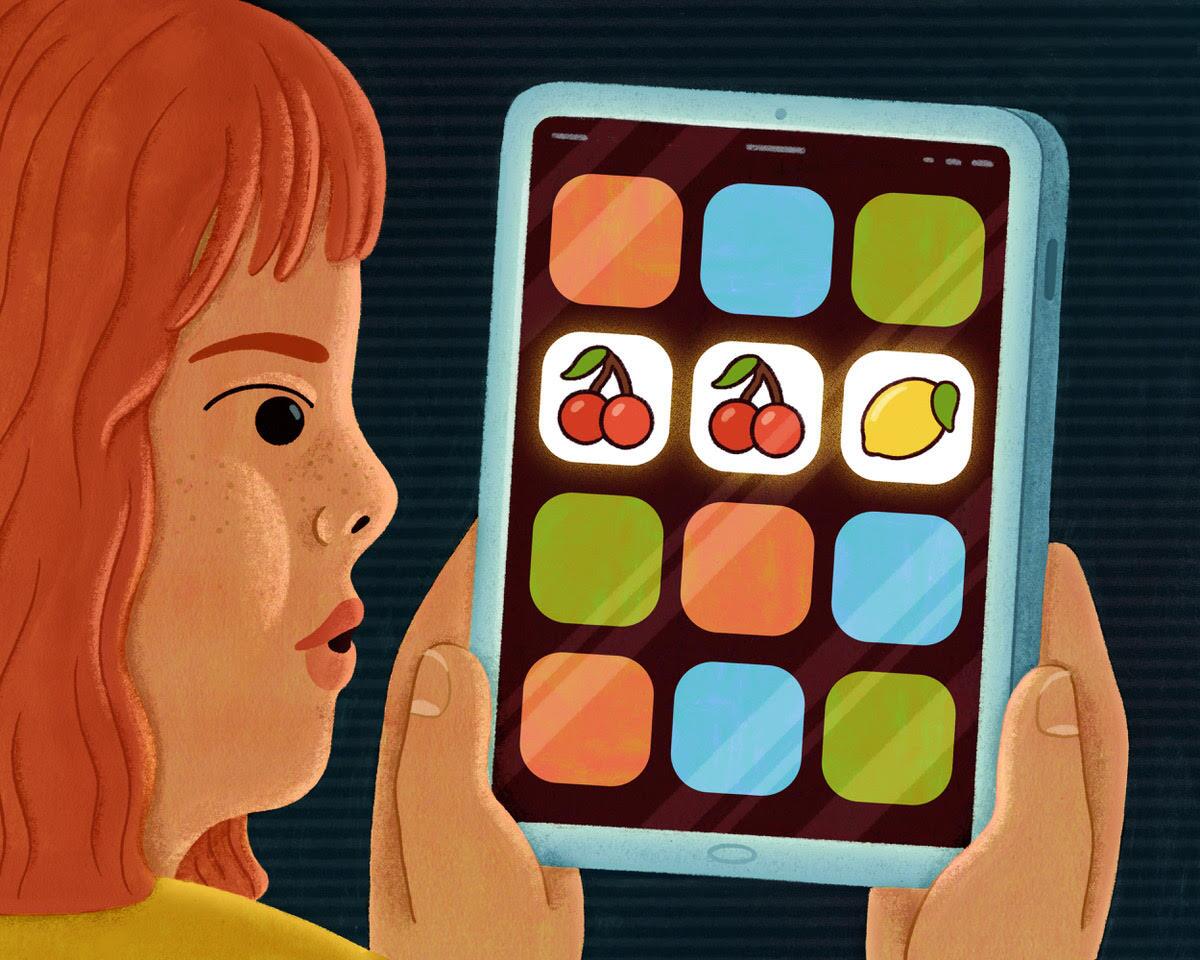
This illustration shows a child holding a smartphone. Three app icons in a row show "cherry, cherry, lemon" — symbols that you might see on a slot machine.
What makes a person keep playing a video slot machine? Some of the same features that make children stay on social media apps or video games for too long. (Paige Stampatori for NPR )

In two landmark cases, social media companies have been found liable for endangering and harming children. Meta and Google are appealing the verdicts and disputing the idea that their products are addictive. But over the course of more than a decade, scientists have identified key features of social media and other apps meant to hold children’s attention for as long as possible.

These features create a kind of superglue on the apps, says cultural anthropologist Natasha Dow Schüll at New York University, who has pioneered research in this field. “They keep us spending more time on these apps and spending more money. They drain us of our energy and ourselves.” Understanding these features offers parents a rubric for evaluating how harmful an app or device may be for kids, Schüll says.

During the trial in California, the attorney bringing the case accused Meta and Google of designing their apps to behave like “digital casinos.” That’s an apt comparison, according to Schüll’s research, because major design elements of social media have surprising roots in the gambling industry.

Pulled into the “machine zone”

Back in the 1980s and 1990s, the casino industry gradually and purposely created what many scientists consider to be the most addictive form of gambling: video slot machines. They are something like a giant app, played on a huge video screen with an ergonomic chair attached to it.

People struggling with gambling addiction often cite video slots as their game of choice, studies have found. Some people gamble on these machines for extraordinary periods of time, Schüll found in her ethnographic fieldwork. They can play for 24 hours, even 48 hours straight. Some people even told Schüll that they wear adult diapers to the casino so they don’t have to stop gambling to use the restroom.

Thirty years ago, Schüll set out on a bold mission: to figure out how these games exert this magnetic effect. What features might literally prevent flourishing?

She spent 15 years dissecting the inner workings of video slot machines. She also interviewed everyone up and down the industry, from the marketers and mathematicians to software engineers and executives, as well as people who used these devices daily.

Through her research, she uncovered four key features that, when combined together, help hold people on the gambling devices. These features trigger a trancelike or dissociative state, known as a “machine zone” or “dark flow,” in which people lose track of their sense of time and place.

To Schüll’s surprise, around the early 2010s, the same features began to appear on phone and tablet apps, including social media, games and video-streaming platforms. “These are not normal products for kids like a pair of shoes or a toy,” she says. “They create a relationship with kids.”

Here are four features that create that superglue:

Feature 1: solitude

“When the relationship is just between you and the machine, it removes social cues needed for stopping,” Schüll says. It’s harder to notice when the activity no longer serves the person playing or scrolling.

Studies have found that children who regularly use screens alone in their bedrooms have a higher risk of developing what psychologists call problematic usage. That is, they continue to use an app or play a game even when it damages their health. For example, the app may interfere with their sleep or friendships, but the child still feels compelled to stay on the app.

Feature 2: bottomlessness

Videos keep appearing on TikTok and YouTube. Photos, comments and likes keep popping up on Instagram. Apps have seemingly endless content for you to see, and it all shows or plays automatically.

“There’s no natural stopping point,” Schüll says. So you never feel finished or satisfied.

You want one more of something, endlessly. And that feeling grows even stronger with the third ingredient added into the mix.

Feature 3: speed

The faster people play video slots, the longer people gamble, Schüll found in her review of research performed by the gambling industry. Speed has a similar effect on social media and video-streaming apps, she says. The faster people can scroll, watch and then watch again, the harder it is for many to pull away from an app.

“The speed of the feedback can cause this sense that you merge with the screen. You don’t know where you begin and the machine ends,” Schüll says. “The speed really just pulls you into this flow.”

For social media, the speed at which we can find “new” material has jumped with several technological advancements, including the invention of higher-speed internet and infinite scroll.

Feature 4: teasing, or giving you almost what you want

The final ingredient is perhaps the most important, says Jonathan D. Morrow, a neuroscientist and psychiatrist at the University of Michigan. It’s all about how apps select content for you.

Here’s how it typically works. First, the software uses AI to determine what you’re hoping to find or see. “Even if you don’t know what you want, the app knows. It’s very good at figuring that out,” Morrow says.

But then, he says, the app withholds that reward: “Apps don’t give it to you. They give you something close to that, and then a few clicks later, the algorithm gives you something even closer.”

They rarely — if ever — give you what you’re looking for. “They give just enough to keep you engaged, keep you looking at the app and interacting with it as long as possible,” he adds.

This teasing gives you the feeling that you’re going to get what you’re seeking soon. “So you’ll be there all day trying to get that next big thing. There’s always a possibility you’ll finally get what you want,” Morrow says.

A recipe for overuse

When an app combines these four features — solitude, bottomlessness, speed and teasing — it creates a kind of recipe for overuse for nearly everyone, Schüll says. Sometimes Schüll gives her students at New York University this list of design features. “I say, ‘Pick a website or app. Then, using these criteria, rate how harmful it is.'”

But the recipe is especially harmful for children, she adds: “It’s a cruel setup, especially when kids are concerned. Kids are obviously more vulnerable.” Therefore, she and Morrow agree: Children need help regulating their use of these apps, but they also need protection from harmful design.


Michaeleen Doucleff has a Ph.D. in chemistry and is a longtime science journalist (including previously for NPR). She is the author of the parenting book Dopamine Kids.

Transcript:

STEVE INSKEEP, HOST:

Social media companies are appealing verdicts in two cases. Both cases found them liable for creating products that harm children. Researchers have spent more than a decade identifying features that compel kids to overuse apps, and those features have roots in the gambling industry. Science journalist Michaeleen Doucleff reports.

MICHAELEEN DOUCLEFF: Back in the ’80s and ’90s, the casino industry gradually and purposely developed what many scientists consider the most addictive form of gambling – video slot machines played on giant video screens with an ergonomic chair attached to it. Natasha Dow Schull is a cultural anthropologist at New York University. She says some people gamble on video slot machines for extraordinary periods of time – 24 hours, 48 hours straight. Some even wear adult diapers to the casino so they don’t have to stop to use the restroom. 30 years ago, Schull set out on a bold mission to figure out how these devices do this. How do they hold people so tightly on them?

NATASHA DOW SCHULL: What are the things that keep us, you know, spending more time, spending more money, draining more of us and our energy and ourselves? What might literally sort of prevent flourishing?

DOUCLEFF: She spent 15 years studying the design of video slot machines and eventually identified features that, when combined together, form a sort of super glue to grip people’s attention on video slots. Then, around 2012, to her surprise, Schull started to see the same features appear on other places – video games, streaming platforms and social media.

SCHULL: I think gambling offers a case study of what Big Tech does in a more general way.

DOUCLEFF: Schull identified four features that help to form that super glue. No. 1 – solitude. You use the app alone. It’s just you and the screen.

SCHULL: This is important because it removes social cues for stopping.

DOUCLEFF: No. 2 – bottomlessness. There’s seemingly endless content on these apps – endless photos, videos or comments – and it all appears or plays automatically.

SCHULL: There is no natural stopping point.

DOUCLEFF: So you never feel finished or satisfied. The third feature that helps grip your attention, Schull says, is speed. All this new content – the videos, the photos crop up extremely fast.

SCHULL: The speed can cause this sense where you feel like you kind of don’t have a sense of where you begin and the machine ends. And it really just pulls you into this flow.

DOUCLEFF: The final ingredient is perhaps the most important. It’s how the app selects the content for you. Jonathan Morrow is a neuroscientist and psychiatrist at the University of Michigan. He says, here’s how it typically works. First, the app uses AI to determine what you want to see.

JONATHAN MORROW: They know what you want. They’re very good at figuring that out.

DOUCLEFF: But this is key.

MORROW: They don’t give it to you. They give you something close to that.

DOUCLEFF: Then a few clicks later, the algorithm gives you something even closer.

MORROW: Just enough to keep you engaged, keep you looking at it, keep you interacting with it as long as possible.

DOUCLEFF: Morrow says that this teasing holds you on the app because it gives you the feeling that you’re going to get what you want soon.

MORROW: Because you’ll be there all day, trying to get that next big thing. Maybe it’s going to be even better. There’s always a possibility. That’s what they want.

DOUCLEFF: When an app combines these four features – solitude, bottomlessness, speed and teasing – it creates a sort of recipe for overuse for anyone. But Natasha Dow Schull says it’s especially harmful for children.

SCHULL: It’s a cruel setup, especially when kids are concerned, right? Kids are obviously more vulnerable.

DOUCLEFF: And so, she says, they need help regulating their use of apps, but they also need protection from this harmful design.

For NPR News, I’m Michaeleen Doucleff.

lower waypoint
next waypoint
Player sponsored by