For many Americans, the specter of missing children evokes forlorn images on milk cartons or Amber alerts on cell phones. But a new report from the Brookings Institution suggests that the pandemic may have created a new generation of lost kids — this time, from classrooms.
Lost but not found
The number of students who are not in school exploded in 2020 after the Covid outbreak, and many still aren’t back. The missing kids are not in private schools or being homeschooled. Many children are simply not enrolled anywhere, according to the Brookings’ analysis of federal data. Some are older teens, nearly at the end of their high school years, but many are younger. And no one knows whether these kids are getting an education.
During the 2021–22 school year, roughly 2 million additional students, ages 5 through 17, disappeared from both public and private school rolls, a 450 percent increase from 2019-20 in missing kids, according to the report. I would have guessed that families had relocated during the pandemic, temporarily or permanently, and administrative records were in too much disarray to track down everyone. But even by 2023–24, a normal school year, the share of children unaccounted for (not in public or private school) still totaled 2.1 million or almost 4 percent of the nation’s 54 million kids, ages 5 to 17, nearly five times the number before the pandemic.
To calculate the number of missing children, the Brookings researchers subtracted school enrollment figures from U.S. population data. It’s possible that there’s some statistical discrepancy between data from the U.S. Census Department and the National Center for Education Statistics that will be sorted out in the future. But it’s also possible that these missing children are not learning to read and do math, and that doesn’t portend well for the nation’s future. Analysis of state data by Stanford University professor Thomas Dee in 2023 first revealed the pandemic increase in missing children, and was publicized by the Associated Press. This Brookings report confirms that it is an enduring mystery.
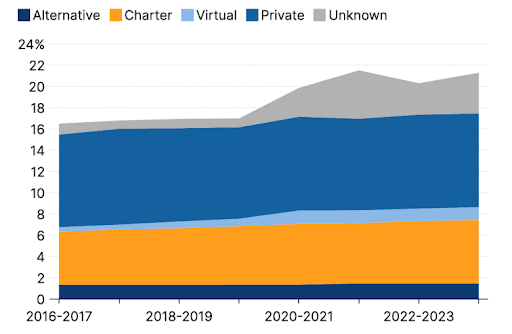
Percentage of school-aged children who are not enrolled in traditional public schools, 2016-17 to 2023-24