Time Running Out, California Stem Cell Agency Yet to Produce Big Results
California's $3 billion stem cell initiative was sold to voters with the pitch that the investment would rapidly yield cures for devastating diseases like Parkinson’s and ALS. That hasn’t happened.
Buttons with the slogan 'Save Lives With Stem Cells,' in support of Prop. 71 at the Stem Cell Research Proposition Party at the Biltmore Hotel Nov. 2, 2004 in Los Angeles, California. (Frazer Harrison/Getty Images)
It’s been more than a decade since California launched an unprecedented experiment in medical research by direct democracy, when voters created a $3 billion fund to kick-start the hunt for stem cell therapies.
The bold plan, a response to federal funding limits for embryonic stem cell research, was sold with a simple pitch: The money would rapidly yield cures for devastating human diseases such as Parkinson’s and ALS.
That hasn’t happened.
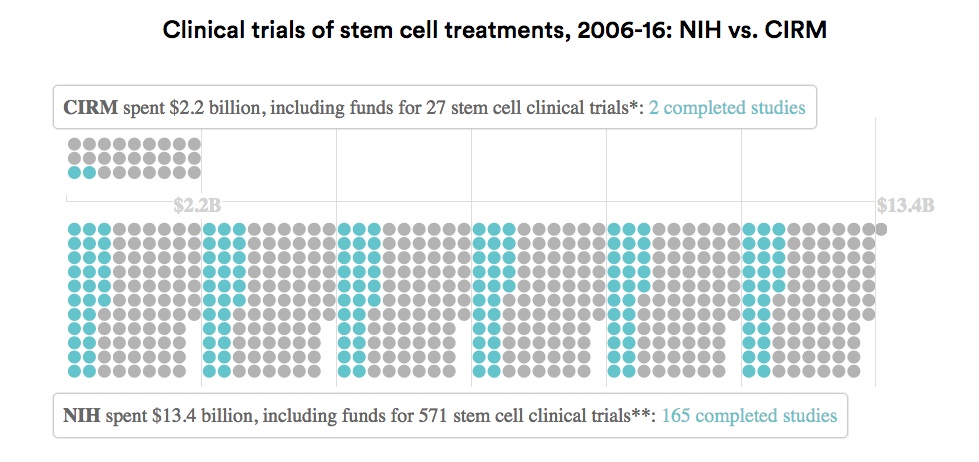
A major reason, a STAT examination found, is that the California Institute for Regenerative Medicine has been slow to move promising experimental therapies into clinical trials. The National Institutes of Health has supported three and a half times as many human trials of stem cell therapies, dollar for dollar, as the California agency has funded since it started making grants in 2006. Just two of its clinical trials have been completed.
“I am floored by the disparity,” said Jim Lott, a health care consultant and member of the state board that monitors the agency, known as CIRM. If the numbers are correct, he told STAT, “that doesn’t settle well with me as a voter. That doesn’t settle well with me as a taxpayer. That doesn’t settle well with me as a member of the oversight committee.”
CIRM has used most of the $2.2 billion in grants it has distributed so far to build labs and pay for basic research at public and private universities, such as Stanford and the University of Southern California, and private companies.
It has given more than $300 million to 27 projects that include clinical trials — though much of that funding also supported preclinical work. Meanwhile, the agency has committed about $540 million to new labs and buildings.
In part, that’s because its directors chose to focus on infrastructure early on, as well as bench experiments and animal studies given that the biology of embryonic stem cells was not well-understood and there are formidable roadblocks to moving into human studies. Much more is known about the bone marrow stem cells that are the focus of many NIH-funded clinical trials.
But critics have noted that many top grantees come from institutions that hold seats on CIRM’s governing board. The respected Institute of Medicine, in a 2013 review, said institutionalized conflicts of interest have raised questions about “the integrity and independence of some of CIRM’s decisions.” CIRM later enacted reforms that barred board members from voting directly on grants for their institutions. But the changes didn’t prevent other financial conflicts involving CIRM officers and grantees, and the flow of funds to board members’ institutions continued unabated.
Sources: California Institute for Regenerative Medicine, National Institutes of Health. *Several CIRM trials included here were announced shortly after Sept. 30, 2016, the cut-off for the NIH data. **NIH spending for 2006 and 2007 is estimated because exact figures were unavailable.NATALIA BRONSHTEIN/STAT
“You could make an argument that California taxpayer money should go to build new facilities on state university campuses,” said Marcy Darnovsky, who directs the Berkeley-based Center for Genetics and Society, a public affairs nonprofit. “But I don’t see an argument for Stanford getting fancy new buildings from California taxpayer money.”
Stanford, whose endowment is among the top five nationally, and USC have received more than $70million for major building projects, and hundreds of millions more for labs and research. Stanford alone has been favored with $1 out of every $7 CIRM has approved.
But scientists outside California said CIRM’s record is a strong one. CIRM-funded researchers have published nearly 2,000 scholarly papers. That output has helped vault California into the top ranks of stem cell science, said Dr. George Daley, the new dean of Harvard Medical School and a leading stem cell scientist who describes himself as an informal adviser and cheerleader for CIRM. “When I look at the progress my colleagues have made in California, I am duly awed,” he said.
The institute announced a year ago that it would reinvent itself to emphasize clinical research until it runs out of money in 2020 — unless voters grant a new infusion of cash. CIRM plans to fund 50 new trials with its remaining $692 million, of which 10 were announced in 2016. Just 17 trials were funded in its first decade of grants.
C. Randal Mills, CIRM’s CEO since 2014 and architect of its new strategy, said he welcomed comparisons that help benchmark CIRM’s progress. Mills, former head of Osiris Therapeutics, the first company to commercialize an approved stem cell treatment, declined to comment on STAT’s specific findings, but defended the initial emphasis on labs and basic science as underpinning future clinical work.
“We’re running our own race. … What we have to do is just continually get better” to benefit patients, Mills said in an interview. “If we’re behind [NIH], we’re going to get better.”
Lott’s teenage daughter was paralyzed in an automobile crash and he hopes for a stem cell cure. He supports the goals of CIRM and applauds much of its work, but he now has second thoughts about the governance structure, which allows board members’ institutions to benefit from CIRM grants, as well as its financing. The ballot question that created CIRM, Proposition 71, authorized bond sales to pay for the agency’s budget, raising the total cost for taxpayers to $6 billion including interest. Financial experts, however, said that relatively low interest rates paid on long-term bonds can offer advantages over funding so large a venture directly from state coffers.
Asked whether he would support a similar ballot measure today, Lott said, “We were all caught up in the time, and the events were different when we first looked at this. But not today. Not at all.”
'Lives Will Be Saved'
Californians emphatically supported CIRM, creating the stem cell colossus with 59 percent of the vote in 2004. Many were upset that President George W. Bush had sharply limited federal funding for work with embryonic stem cells, which are derived from early human embryos and able to develop into any type of tissue or organ.
But Proposition 71 also won because it was shamelessly oversold, consumer advocates and science policy experts said. Desperate patients, Nobel laureates, and A-list celebrities such as Michael J. Fox — the Hollywood star and Parkinson’s sufferer — predicted “cures” that would “save millions of lives.”
“There are more Americans than … we can count who are sick now, or are going to be sick in the future, whose lives will be saved by Prop 71,” patient advocate Joan Samuelson said in another ad. The sponsors of the measure also predicted that CIRM-generated cures would drastically reduce health care spending. No one made specific promises for the 10-year timeframe initially planned for CIRM’s work, but miracles seemed just around the corner.
“You can support embryonic stem cell research, which we do and did, and still be pretty appalled by what was going down,” said Darnovsky. “The airwaves were swamped with guys in white coats who were identified with their academic affiliation even though they were principals of private companies (some of which later got CIRM grants), and basically saying, ‘We’re going to have cures by Christmas.’”
Mills, who was not involved at the agency’s genesis, called the idea sold to voters — impending, sweeping breakthroughs — “naïve.” Radical medical change usually takes decades from idea to cure.
“But here we are,” he said. “My sole mission is to create as much value for the resources we have left, for the people of California, that I can.”
California vs. NIH
Even under Bush-era restrictions — rescinded after President Barack Obama took office — the NIH continued to support substantial stem cell research.
Since 2006, it has spent $13.4 billion on stem cell science, six times CIRM’s budget during that period. But NIH fully or partly funded 571 clinical trials, according to STAT’s review — more than 20 times the number backed by California.
While NIH in that period funded 50 Phase 3 clinical trials of stem cell therapies — generally the last step before seeking approval to market a product — CIRM has supported just three.
One, the study of a treatment for skin cancer involving immune system cells, was terminated by Caladrius Biosciences, the grantee, when it determined that existing treatments had overtaken its approach. The others — testing altered immune cells to treat brain cancer and bioengineered veins to manage vascular problems — show promise, but are still recruiting patients and will not be completed for several years, according to the NIH website, ClinicalTrials.gov.
Daley called the NIH comparison “a little unfair,” because that agency emphasized hematopoietic stem cells — blood-forming cells from bone marrow, which had been studied for decades — unlike CIRM’s sharper focus on cutting-edge embryonic stem cells. A little more than half of CIRM’s awards have gone to support research on embryonic or induced pluripotent stem cells, which are created by modifying adult stem cells to act like embryonic ones. It gave about a quarter of its awards to support adult stem cell work, and the rest for other research areas.
“In the early days of CIRM, the feeling was that the field needed deep and direct investments in the … fundamental foundation of stem cell biology, because the translational opportunities were not yet mature, certainly not using embryonic or induced pluripotent stem cells,” Daley said.
Paul Knoepfler, a University of California, Davis, researcher and CIRM grantee who writes a popular stem cell blog, agreed. “One almost had to invent a system for figuring out what would be a safe way to proceed with embryonic stem cell clinical trials because those cells are really much more powerful and also have different kinds of risks,” he said.
Knoepfler said he expected the basic science to spark clinical breakthroughs in time, citing, for example, promising early work on reversing paralysis from Asterias Biotherapeutics, located in Fremont, southeast of San Francisco. Jake Javier, a patient in a CIRM-supported Asterias trial, lost almost all use of his limbs in an accident diving into a swimming pool. He recently received an injection of a type of cell derived from embryonic stem cells that can help protect nerve cells damaged in spinal cord injuries. Javier has since regained someuse of his arms — one of five patients in early trials who have shown improvement that CIRM and the researchers attribute to the treatment. The results have not yet been published in a peer-reviewed journal.
In addition, Mills noted that grants for new labs included provisions that required grantees to raise other funds — to “leverage” economic benefits to taxpayers — and to assist future trials. The institute, for example, gave $30 million to the contract research firm Quintiles to create facilities that will conduct preclinical research, manage regulatory issues, and provide clinical support for CIRM-supported stem cell trials, all at a steep discount.
“There is no iPhone 4 without an iPhone 3 or a 2 or a 1,” Mills said. But in a world where technology advances rapidly — Apple is already selling the iPhone 7, after all — voters are still waiting for the promised cures.
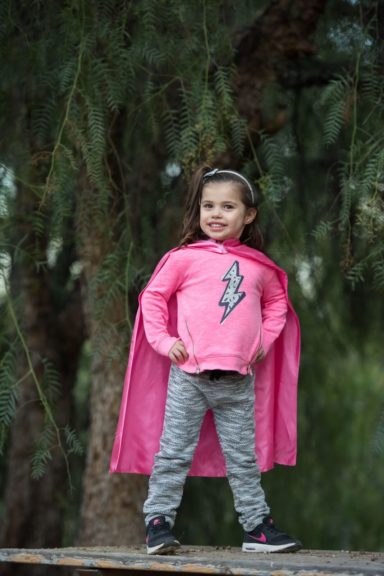
Evangelina Padilla Vaccaro in November 2016. (Nancy Ramos)
So far, CIRM has one literal poster child to show it can deliver. Four-year-old Evangelina Padilla Vaccaro, featured on the cover of CIRM’s recent annual report, was born with severe combined immunodeficiency. She had no operating immune system. Some such children have been kept alive in sterile isolation tents for a time — hence the term, “bubble baby” — but most have died from infections within a few years. A lucky few who received matching bone-marrow transplants survived.
UCLA’s Dr. Donald Kohn, supported by CIRM, cured Evangelina by extracting some of her blood stem cells, altering them to correct the genetic defect, and returning them to her body. She’s now thriving with a robust immune system.
That little girl, and 29 children like her, “are getting immunizations, they’re going to school, they’re swimming in public swimming pools, they’re eating dirt, they’re doing all the things that little kids are supposed to do,” said Steven Peckman, associate director of UCLA’s Broad Center of Regenerative Medicine and Stem Cell Research. “They get sick and their own bodies attack those viruses and bacteria. And they survive. If there’s going to be something that’s called a cure, this is it.”
That inspiring triumph was partly funded by CIRM, but Kohn’s work took three decades, was well underway long before CIRM existed, and didn’t involve embryonic stem cells — the key gap CIRM was founded to fill. Evangelina was saved by hematopoietic stem cells, the type that NIH has been more focused on.
Racing the Clock
As much as Mills defends the old CIRM, last year he announced “CIRM 2.0” — a drastic shift to speed up clinical trials before the organization’s clock runs out.
Asked whether Californians are getting good value for their money from CIRM, Mills cited economic gains to the state, then added: “I focus a lot more on the return in relief of human suffering. We’re just starting to lift off the ground on that. I hope in history, in time, the record shows CIRM was a great deal.”
To that end, CIRM has said it will focus in 2017 primarily on clinical trials and work it hopes will lay the foundation for such studies.
If the studies show clear results, Mills said, “I think it will be self-evident that CIRM should be continued” with new funding.
Lott, the state overseer, called CIRM 2.0 long overdue. “They needed to at least create something a little more tangible, more specifically measurable, for the billions of dollars that they’ve allocated,” he said. “But it may be a little too late,” he added, to convince taxpayers that CIRM should get a new infusion of funds, given its governance structure.
Even Daley — unbridled in his enthusiasm for CIRM’s work — hesitated when asked if it was a model to emulate, though for a different reason. “I reluctantly endorse it,” he said, “in part because I think it’s another argument that allows the federal government and the NIH to abdicate its responsibility for investments in biomedical research, which benefits us all.”
Yet, just as President Bush’s policy on stem cells led to CIRM’s creation, the incoming Trump administration might bail out the institute just in time. The president-elect has not weighed in on federal funding, but Representative Tom Price, his nominee for Health and Human Services secretary, has long opposed federal funding of embryonic stem cell research — a view shared by Vice President-elect Mike Pence.
“If the Trump administration takes a hostile mind toward embryonic stem cell research, and perhaps some kinds of important fetal research are restricted as well, it may give another source of energy to CIRM,” said Knoepfler. “I don’t think Californians like to be told what we can or cannot do, research-wise.”
This story was originally published by STAT, an online publication of Boston Globe Media that covers health, medicine and scientific discovery.
lower waypointnext waypoint
Player sponsored by
window.__IS_SSR__=true
window.__INITIAL_STATE__={
"attachmentsReducer": {
"audio_0": {
"type": "attachments",
"id": "audio_0",
"imgSizes": {
"kqedFullSize": {
"file": "https://ww2.kqed.org/news/wp-content/themes/KQED-unified/img/audio_bgs/background0.jpg"
}
}
},
"audio_1": {
"type": "attachments",
"id": "audio_1",
"imgSizes": {
"kqedFullSize": {
"file": "https://ww2.kqed.org/news/wp-content/themes/KQED-unified/img/audio_bgs/background1.jpg"
}
}
},
"audio_2": {
"type": "attachments",
"id": "audio_2",
"imgSizes": {
"kqedFullSize": {
"file": "https://ww2.kqed.org/news/wp-content/themes/KQED-unified/img/audio_bgs/background2.jpg"
}
}
},
"audio_3": {
"type": "attachments",
"id": "audio_3",
"imgSizes": {
"kqedFullSize": {
"file": "https://ww2.kqed.org/news/wp-content/themes/KQED-unified/img/audio_bgs/background3.jpg"
}
}
},
"audio_4": {
"type": "attachments",
"id": "audio_4",
"imgSizes": {
"kqedFullSize": {
"file": "https://ww2.kqed.org/news/wp-content/themes/KQED-unified/img/audio_bgs/background4.jpg"
}
}
},
"placeholder": {
"type": "attachments",
"id": "placeholder",
"imgSizes": {
"thumbnail": {
"file": "https://cdn.kqed.org/wp-content/uploads/2024/12/KQED-Default-Image-816638274-2000x1333-1-160x107.jpg",
"width": 160,
"height": 107,
"mimeType": "image/jpeg"
},
"medium": {
"file": "https://cdn.kqed.org/wp-content/uploads/2024/12/KQED-Default-Image-816638274-2000x1333-1-800x533.jpg",
"width": 800,
"height": 533,
"mimeType": "image/jpeg"
},
"medium_large": {
"file": "https://cdn.kqed.org/wp-content/uploads/2024/12/KQED-Default-Image-816638274-2000x1333-1-768x512.jpg",
"width": 768,
"height": 512,
"mimeType": "image/jpeg"
},
"large": {
"file": "https://cdn.kqed.org/wp-content/uploads/2024/12/KQED-Default-Image-816638274-2000x1333-1-1020x680.jpg",
"width": 1020,
"height": 680,
"mimeType": "image/jpeg"
},
"1536x1536": {
"file": "https://cdn.kqed.org/wp-content/uploads/2024/12/KQED-Default-Image-816638274-2000x1333-1-1536x1024.jpg",
"width": 1536,
"height": 1024,
"mimeType": "image/jpeg"
},
"fd-lrg": {
"file": "https://cdn.kqed.org/wp-content/uploads/2024/12/KQED-Default-Image-816638274-2000x1333-1-1536x1024.jpg",
"width": 1536,
"height": 1024,
"mimeType": "image/jpeg"
},
"fd-med": {
"file": "https://cdn.kqed.org/wp-content/uploads/2024/12/KQED-Default-Image-816638274-2000x1333-1-1020x680.jpg",
"width": 1020,
"height": 680,
"mimeType": "image/jpeg"
},
"fd-sm": {
"file": "https://cdn.kqed.org/wp-content/uploads/2024/12/KQED-Default-Image-816638274-2000x1333-1-800x533.jpg",
"width": 800,
"height": 533,
"mimeType": "image/jpeg"
},
"post-thumbnail": {
"file": "https://cdn.kqed.org/wp-content/uploads/2024/12/KQED-Default-Image-816638274-2000x1333-1-672x372.jpg",
"width": 672,
"height": 372,
"mimeType": "image/jpeg"
},
"twentyfourteen-full-width": {
"file": "https://cdn.kqed.org/wp-content/uploads/2024/12/KQED-Default-Image-816638274-2000x1333-1-1038x576.jpg",
"width": 1038,
"height": 576,
"mimeType": "image/jpeg"
},
"xxsmall": {
"file": "https://cdn.kqed.org/wp-content/uploads/2024/12/KQED-Default-Image-816638274-2000x1333-1-160x107.jpg",
"width": 160,
"height": 107,
"mimeType": "image/jpeg"
},
"xsmall": {
"file": "https://cdn.kqed.org/wp-content/uploads/2024/12/KQED-Default-Image-816638274-2000x1333-1-672x372.jpg",
"width": 672,
"height": 372,
"mimeType": "image/jpeg"
},
"small": {
"file": "https://cdn.kqed.org/wp-content/uploads/2024/12/KQED-Default-Image-816638274-2000x1333-1-672x372.jpg",
"width": 672,
"height": 372,
"mimeType": "image/jpeg"
},
"xlarge": {
"file": "https://cdn.kqed.org/wp-content/uploads/2024/12/KQED-Default-Image-816638274-2000x1333-1-1020x680.jpg",
"width": 1020,
"height": 680,
"mimeType": "image/jpeg"
},
"full-width": {
"file": "https://cdn.kqed.org/wp-content/uploads/2024/12/KQED-Default-Image-816638274-2000x1333-1-1920x1280.jpg",
"width": 1920,
"height": 1280,
"mimeType": "image/jpeg"
},
"guest-author-32": {
"file": "https://cdn.kqed.org/wp-content/uploads/2025/01/KQED-Default-Image-816638274-1333x1333-1-160x160.jpg",
"width": 32,
"height": 32,
"mimeType": "image/jpeg"
},
"guest-author-50": {
"file": "https://cdn.kqed.org/wp-content/uploads/2025/01/KQED-Default-Image-816638274-1333x1333-1-160x160.jpg",
"width": 50,
"height": 50,
"mimeType": "image/jpeg"
},
"guest-author-64": {
"file": "https://cdn.kqed.org/wp-content/uploads/2025/01/KQED-Default-Image-816638274-1333x1333-1-160x160.jpg",
"width": 64,
"height": 64,
"mimeType": "image/jpeg"
},
"guest-author-96": {
"file": "https://cdn.kqed.org/wp-content/uploads/2025/01/KQED-Default-Image-816638274-1333x1333-1-160x160.jpg",
"width": 96,
"height": 96,
"mimeType": "image/jpeg"
},
"guest-author-128": {
"file": "https://cdn.kqed.org/wp-content/uploads/2025/01/KQED-Default-Image-816638274-1333x1333-1-160x160.jpg",
"width": 128,
"height": 128,
"mimeType": "image/jpeg"
},
"detail": {
"file": "https://cdn.kqed.org/wp-content/uploads/2025/01/KQED-Default-Image-816638274-1333x1333-1-160x160.jpg",
"width": 160,
"height": 160,
"mimeType": "image/jpeg"
},
"kqedFullSize": {
"file": "https://cdn.kqed.org/wp-content/uploads/2024/12/KQED-Default-Image-816638274-2000x1333-1.jpg",
"width": 2000,
"height": 1333
}
}
},
"futureofyou_188656": {
"type": "attachments",
"id": "futureofyou_188656",
"meta": {
"index": "attachments_1716263798",
"site": "futureofyou",
"id": "188656",
"found": true
},
"parent": 187778,
"imgSizes": {
"twentyfourteen-full-width": {
"file": "https://ww2.kqed.org/app/uploads/sites/13/2016/06/StemCells-1038x576.jpg",
"width": 1038,
"mimeType": "image/jpeg",
"height": 576
},
"thumbnail": {
"file": "https://ww2.kqed.org/app/uploads/sites/13/2016/06/StemCells-400x267.jpg",
"width": 400,
"mimeType": "image/jpeg",
"height": 267
},
"fd-sm": {
"file": "https://ww2.kqed.org/app/uploads/sites/13/2016/06/StemCells-960x641.jpg",
"width": 960,
"mimeType": "image/jpeg",
"height": 641
},
"post-thumbnail": {
"file": "https://ww2.kqed.org/app/uploads/sites/13/2016/06/StemCells-672x372.jpg",
"width": 672,
"mimeType": "image/jpeg",
"height": 372
},
"kqedFullSize": {
"file": "https://ww2.kqed.org/app/uploads/sites/13/2016/06/StemCells-e1466538458286.jpg",
"width": 1920,
"height": 1282
},
"large": {
"file": "https://ww2.kqed.org/app/uploads/sites/13/2016/06/StemCells-1180x788.jpg",
"width": 1180,
"mimeType": "image/jpeg",
"height": 788
},
"guest-author-50": {
"file": "https://ww2.kqed.org/app/uploads/sites/13/2016/06/StemCells-50x50.jpg",
"width": 50,
"mimeType": "image/jpeg",
"height": 50
},
"guest-author-96": {
"file": "https://ww2.kqed.org/app/uploads/sites/13/2016/06/StemCells-96x96.jpg",
"width": 96,
"mimeType": "image/jpeg",
"height": 96
},
"medium": {
"file": "https://ww2.kqed.org/app/uploads/sites/13/2016/06/StemCells-800x534.jpg",
"width": 800,
"mimeType": "image/jpeg",
"height": 534
},
"guest-author-64": {
"file": "https://ww2.kqed.org/app/uploads/sites/13/2016/06/StemCells-64x64.jpg",
"width": 64,
"mimeType": "image/jpeg",
"height": 64
},
"guest-author-32": {
"file": "https://ww2.kqed.org/app/uploads/sites/13/2016/06/StemCells-32x32.jpg",
"width": 32,
"mimeType": "image/jpeg",
"height": 32
},
"fd-lrg": {
"file": "https://ww2.kqed.org/app/uploads/sites/13/2016/06/StemCells-1920x1282.jpg",
"width": 1920,
"mimeType": "image/jpeg",
"height": 1282
},
"fd-med": {
"file": "https://ww2.kqed.org/app/uploads/sites/13/2016/06/StemCells-1180x788.jpg",
"width": 1180,
"mimeType": "image/jpeg",
"height": 788
},
"detail": {
"file": "https://ww2.kqed.org/app/uploads/sites/13/2016/06/StemCells-150x150.jpg",
"width": 150,
"mimeType": "image/jpeg",
"height": 150
},
"medium_large": {
"file": "https://ww2.kqed.org/app/uploads/sites/13/2016/06/StemCells-768x513.jpg",
"width": 768,
"mimeType": "image/jpeg",
"height": 513
},
"guest-author-128": {
"file": "https://ww2.kqed.org/app/uploads/sites/13/2016/06/StemCells-128x128.jpg",
"width": 128,
"mimeType": "image/jpeg",
"height": 128
}
},
"publishDate": 1466538329,
"modified": 1515539971,
"caption": "Buttons with the slogan 'Save Lives With Stem Cells,' in support of Prop. 71 at the Stem Cell Research Proposition Party at the Biltmore Hotel Nov. 2, 2004 in Los Angeles, California.",
"description": "Buttons with the slogan 'Save Lives With Stem Cells,' in support of Prop. 71 at the Stem Cell Research Proposition Party at the Biltmore Hotel Nov. 2, 2004 in Los Angeles, California.",
"title": "Stem Cell Research Proposition Party",
"credit": "Frazer Harrison/Getty Images",
"status": "inherit",
"isLoading": false,
"fetchFailed": false
}
},
"audioPlayerReducer": {
"postId": "stream_live",
"isPaused": true,
"isPlaying": false,
"pfsActive": false,
"pledgeModalIsOpen": true,
"playerDrawerIsOpen": false,
"liveAudioPlayStartedAt": 0,
"liveAudioPlayContext": ""
},
"authorsReducer": {
"byline_futureofyou_322634": {
"type": "authors",
"id": "byline_futureofyou_322634",
"meta": {
"override": true
},
"slug": "byline_futureofyou_322634",
"name": "Charles Piller\u003cbr />\u003cA HREF=\"https://www.statnews.com/\">STAT\u003c/A>",
"isLoading": false
}
},
"pagesReducer": {},
"pfsSessionReducer": {},
"postsReducer": {
"stream_live": {
"type": "live",
"id": "stream_live",
"audioUrl": "https://streams.kqed.org/kqedradio",
"title": "Live Stream",
"excerpt": "Live Stream information currently unavailable.",
"link": "/radio",
"featImg": "",
"label": {
"name": "KQED Live",
"link": "/"
}
},
"stream_kqedNewscast": {
"type": "posts",
"id": "stream_kqedNewscast",
"audioUrl": "https://www.kqed.org/.stream/anon/radio/RDnews/newscast.mp3?_=1",
"title": "KQED Newscast",
"featImg": "",
"label": {
"name": "88.5 FM",
"link": "/"
}
},
"futureofyou_322634": {
"type": "posts",
"id": "futureofyou_322634",
"meta": {
"index": "posts_1716263798",
"site": "futureofyou",
"id": "322634",
"found": true
},
"articlePosition": 0,
"parent": 0,
"labelTerm": {},
"blocks": [],
"publishDate": 1484930860,
"format": "standard",
"disqusTitle": "Time Running Out, California Stem Cell Agency Yet to Produce Big Results",
"title": "Time Running Out, California Stem Cell Agency Yet to Produce Big Results",
"headTitle": "KQED Future of You | KQED Science",
"content": "\u003cp>It’s been more than a decade since California launched an unprecedented experiment in medical research by direct democracy, when voters created a $3 billion fund to kick-start the hunt for stem cell therapies.\u003c/p>\n\u003cp>The bold plan, a response to federal funding limits for embryonic stem cell research, was sold with a simple pitch: The money would rapidly yield cures for devastating human diseases such as Parkinson’s and ALS.\u003c/p>\n\u003cp>That hasn’t happened.\u003c/p>\n\u003cp>[contextly_sidebar id=\"wiA2OMIATARmkALimTVF9L5bJoRR3eQd\"]A major reason, a STAT examination found, is that the \u003ca href=\"https://www.cirm.ca.gov/\" target=\"_blank\">California Institute for Regenerative Medicine\u003c/a> has been slow to move promising experimental therapies into clinical trials. The National Institutes of Health has supported three and a half times as many human trials of stem cell therapies, dollar for dollar, as the California agency has funded since it started making grants in 2006. Just two of its clinical trials have been completed.\u003c/p>\n\u003cp>“I am floored by the disparity,” said Jim Lott, a health care consultant and member of the state board that monitors the agency, known as CIRM. If the numbers are correct, he told STAT, “that doesn’t settle well with me as a voter. That doesn’t settle well with me as a taxpayer. That doesn’t settle well with me as a member of the oversight committee.”\u003c/p>\n\u003cp>[ad fullwidth]\u003c/p>\n\u003cp>CIRM has used most of the $2.2 billion in grants it has distributed so far to build labs and pay for basic research at public and private universities, such as Stanford and the University of Southern California, and private companies.\u003c/p>\n\u003cp>It has given more than $300 million to 27 projects that include clinical trials — though much of that funding also supported preclinical work. Meanwhile, the agency has committed about $540 million to new labs and buildings.\u003c/p>\n\u003cp>In part, that’s because its directors chose to focus on infrastructure early on, as well as bench experiments and animal studies given that the biology of embryonic stem cells was not well-understood and there are formidable roadblocks to moving into human studies. Much more is known about the bone marrow stem cells that are the focus of many NIH-funded clinical trials.\u003c/p>\n\u003cp>But critics have noted that many top grantees come from institutions that hold seats on CIRM’s governing board. The respected Institute of Medicine, in a 2013 \u003ca href=\"https://www.nap.edu/catalog/13523/the-california-institute-for-regenerative-medicine-science-governance-and-the\" target=\"_blank\">review\u003c/a>, said institutionalized conflicts of interest have raised questions about “the integrity and independence of some of CIRM’s decisions.” CIRM later enacted reforms that barred board members from voting directly on grants for their institutions. But the changes didn’t prevent other financial \u003ca href=\"http://www.latimes.com/business/hiltzik/la-fi-hiltzik-20140720-column.html\" target=\"_blank\">conflicts\u003c/a> involving \u003ca href=\"http://californiastemcellreport.blogspot.com/2016/09/alan-trounson-former-ceo-of-california.html\" target=\"_blank\">CIRM officers and grantees\u003c/a>, and the flow of funds to board members’ institutions continued unabated.\u003c/p>\n\u003cfigure id=\"attachment_322983\" class=\"wp-caption aligncenter\" style=\"max-width: 979px\">\u003ca href=\"https://ww2.kqed.org/futureofyou/wp-content/uploads/sites/13/2017/01/CIRM.jpg\">\u003cimg class=\"wp-image-322983 size-full\" src=\"https://ww2.kqed.org/futureofyou/wp-content/uploads/sites/13/2017/01/CIRM.jpg\" alt=\"CIRM\" width=\"979\" height=\"462\" srcset=\"https://ww2.kqed.org/app/uploads/sites/13/2017/01/CIRM.jpg 979w, https://ww2.kqed.org/app/uploads/sites/13/2017/01/CIRM-160x76.jpg 160w, https://ww2.kqed.org/app/uploads/sites/13/2017/01/CIRM-800x378.jpg 800w, https://ww2.kqed.org/app/uploads/sites/13/2017/01/CIRM-768x362.jpg 768w, https://ww2.kqed.org/app/uploads/sites/13/2017/01/CIRM-960x453.jpg 960w, https://ww2.kqed.org/app/uploads/sites/13/2017/01/CIRM-240x113.jpg 240w, https://ww2.kqed.org/app/uploads/sites/13/2017/01/CIRM-375x177.jpg 375w, https://ww2.kqed.org/app/uploads/sites/13/2017/01/CIRM-520x245.jpg 520w\" sizes=\"(max-width: 979px) 100vw, 979px\">\u003c/a>\u003cfigcaption class=\"wp-caption-text\">Sources: California Institute for Regenerative Medicine, National Institutes of Health. \u003cspan class=\"media-source\">*Several CIRM trials included here were announced shortly after Sept. 30, 2016, the cut-off for the NIH data. **NIH spending for 2006 and 2007 is estimated because exact figures were unavailable.\u003c/span>NATALIA BRONSHTEIN/STAT\u003c/figcaption>\u003c/figure>\n\u003cp>“You could make an argument that California taxpayer money should go to build new facilities on state university campuses,” said Marcy Darnovsky, who directs the Berkeley-based Center for Genetics and Society, a public affairs nonprofit. “But I don’t see an argument for Stanford getting fancy new buildings from California taxpayer money.”\u003c/p>\n\u003cp>Stanford, whose endowment is among the top five nationally, and USC have received more than $70\u003cstrong> \u003c/strong>million for major building projects, and hundreds of millions more for labs and research. Stanford alone has been favored with $1 out of every $7 CIRM has approved.\u003c/p>\n\u003cp>But scientists outside California said CIRM’s record is a strong one. CIRM-funded researchers have published nearly 2,000 scholarly papers. That output has helped vault California into the top ranks of stem cell science, said Dr. George Daley, the new dean of Harvard Medical School and a leading stem cell scientist who describes himself as an informal adviser and cheerleader for CIRM. “When I look at the progress my colleagues have made in California, I am duly awed,” he said.\u003c/p>\n\u003cp>The institute announced a year ago that it would reinvent itself to emphasize clinical research until it runs out of money in 2020 — unless voters grant a new infusion of cash. CIRM plans to fund 50 new trials with its remaining $692 million, of which 10 were announced in 2016. Just 17 trials were funded in its first decade of grants.\u003c/p>\n\u003cp>C. Randal Mills, CIRM’s CEO since 2014 and architect of its new strategy, said he welcomed comparisons that help benchmark CIRM’s progress. Mills, former head of Osiris Therapeutics, the first company to commercialize an approved stem cell treatment, declined to comment on STAT’s specific findings, but defended the initial emphasis on labs and basic science as underpinning future clinical work.\u003c/p>\n\u003cp>“We’re running our own race. … What we have to do is just continually get better” to benefit patients, Mills said in an interview. “If we’re behind [NIH], we’re going to get better.”\u003c/p>\n\u003cp>Lott’s teenage daughter was paralyzed in an automobile crash and he hopes for a stem cell cure. He supports the goals of CIRM and applauds much of its work, but he now has second thoughts about the governance structure, which allows board members’ institutions to benefit from CIRM grants, as well as its financing. The ballot question that created CIRM, Proposition 71, authorized bond sales to pay for the agency’s budget, raising the total cost for taxpayers to $6 billion including interest. Financial experts, however, said that relatively low interest rates paid on long-term bonds can offer advantages over funding so large a venture directly from state coffers.\u003c/p>\n\u003cp>Asked whether he would support a similar ballot measure today, Lott said, “We were all caught up in the time, and the events were different when we first looked at this. But not today. Not at all.”\u003c/p>\n\u003cp>\u003cstrong>'Lives Will Be Saved'\u003c/strong>\u003c/p>\n\u003cp>Californians emphatically supported CIRM, creating the stem cell colossus with 59 percent of the vote in 2004. Many were upset that President George W. Bush had sharply limited federal funding for work with embryonic stem cells, which are derived from early human embryos and able to develop into any type of tissue or organ.\u003c/p>\n\u003cp>But Proposition 71 also won because it was shamelessly oversold, consumer advocates and science policy experts said. Desperate patients, Nobel laureates, and A-list celebrities such as \u003ca href=\"https://www.statnews.com/2016/08/30/parkinsons-study-fox-foundation-feud/\" target=\"_blank\">Michael J. Fox\u003c/a> — the Hollywood star and Parkinson’s sufferer — predicted “cures” that would “save millions of lives.”\u003c/p>\n\u003cp>“There are more Americans than … we can count who are sick now, or are going to be sick in the future, whose lives will be saved by Prop 71,” patient advocate Joan Samuelson said in another ad. The sponsors of the measure also predicted that CIRM-generated cures would drastically reduce health care spending. No one made specific promises for the 10-year timeframe initially planned for CIRM’s work, but miracles seemed just around the corner.\u003c/p>\n\u003cp>“You can support embryonic stem cell research, which we do and did, and still be pretty appalled by what was going down,” said Darnovsky. “The airwaves were swamped with guys in white coats who were identified with their academic affiliation even though they were principals of private companies (some of which later got CIRM grants), and basically saying, ‘We’re going to have cures by Christmas.’”\u003c/p>\n\u003cp>Mills, who was not involved at the agency’s genesis, called the idea sold to voters — impending, sweeping breakthroughs — “naïve.” Radical medical change usually takes decades from idea to cure.\u003c/p>\n\u003cp>“But here we are,” he said. “My sole mission is to create as much value for the resources we have left, for the people of California, that I can.”\u003c/p>\n\u003cp>\u003cstrong>California vs. NIH\u003c/strong>\u003c/p>\n\u003cp>Even under Bush-era restrictions — rescinded after President Barack Obama took office — the NIH continued to support substantial stem cell research.\u003c/p>\n\u003cp>Since 2006, it has spent $13.4 billion on stem cell science, six times CIRM’s budget during that period. But NIH fully or partly funded 571 clinical trials, according to STAT’s review — more than 20 times the number backed by California.\u003c/p>\n\u003cp>While NIH in that period funded 50 Phase 3 clinical trials of stem cell therapies — generally the last step before seeking approval to market a product — CIRM has supported just three.\u003c/p>\n\u003cp>One, the study of a treatment for skin cancer involving immune system cells, was terminated by Caladrius Biosciences, the grantee, when it determined that existing treatments had overtaken its approach. The others — testing altered immune cells to treat brain cancer and bioengineered veins to manage vascular problems — show promise, but are still recruiting patients and will not be completed for several years, according to the NIH website, ClinicalTrials.gov.\u003c/p>\n\u003cp>Daley called the NIH comparison “a little unfair,” because that agency emphasized hematopoietic stem cells — blood-forming cells from bone marrow, which had been studied for decades — unlike CIRM’s sharper focus on cutting-edge embryonic stem cells. A little more than half of CIRM’s awards have gone to support research on embryonic or induced pluripotent stem cells, which are created by modifying adult stem cells to act like embryonic ones. It gave about a quarter of its awards to support adult stem cell work, and the rest for other research areas.\u003c/p>\n\u003cp>“In the early days of CIRM, the feeling was that the field needed deep and direct investments in the … fundamental foundation of stem cell biology, because the translational opportunities were not yet mature, certainly not using embryonic or induced pluripotent stem cells,” Daley said.\u003c/p>\n\u003cp>\u003ca href=\"https://www.statnews.com/2016/01/30/paul-knoepfler/\" target=\"_blank\">Paul Knoepfler\u003c/a>, a University of California, Davis, researcher and CIRM grantee who writes a popular \u003ca href=\"http://www.ipscell.com/\" target=\"_blank\">stem cell blog\u003c/a>, agreed. “One almost had to invent a system for figuring out what would be a safe way to proceed with embryonic stem cell clinical trials because those cells are really much more powerful and also have different kinds of risks,” he said.\u003c/p>\n\u003cp>Knoepfler said he expected the basic science to spark clinical breakthroughs in time, citing, for example, promising early work on reversing paralysis from Asterias Biotherapeutics, located in Fremont, southeast of San Francisco. Jake Javier, a patient in a CIRM-supported Asterias trial, lost almost all use of his limbs in an accident diving into a swimming pool. He recently received an injection of a type of cell derived from embryonic stem cells that can help protect nerve cells damaged in spinal cord injuries. Javier has since regained some\u003cstrong> \u003c/strong>use of his arms — one of five patients in early trials who have shown improvement that CIRM and the researchers attribute to the treatment. The results have not yet been published in a peer-reviewed journal.\u003c/p>\n\u003cp>In addition, Mills noted that grants for new labs included provisions that required grantees to raise other funds — to “leverage” economic benefits to taxpayers — and to assist future trials. The institute, for example, gave $30 million to the contract research firm Quintiles to create facilities that will conduct preclinical research, manage regulatory issues, and provide clinical support for CIRM-supported stem cell trials, all at a steep discount.\u003c/p>\n\u003cp>“There is no iPhone 4 without an iPhone 3 or a 2 or a 1,” Mills said. But in a world where technology advances rapidly — Apple is already selling the iPhone 7, after all — voters are still waiting for the promised cures.\u003c/p>\n\u003cfigure id=\"attachment_322991\" class=\"wp-caption alignright\" style=\"max-width: 384px\">\u003ca href=\"https://ww2.kqed.org/futureofyou/wp-content/uploads/sites/13/2017/01/evangelina.jpg\">\u003cimg class=\"size-full wp-image-322991\" src=\"https://ww2.kqed.org/futureofyou/wp-content/uploads/sites/13/2017/01/evangelina.jpg\" alt=\"Evangelina Padilla Vaccaro in November 2016.\" width=\"384\" height=\"576\" srcset=\"https://ww2.kqed.org/app/uploads/sites/13/2017/01/evangelina.jpg 384w, https://ww2.kqed.org/app/uploads/sites/13/2017/01/evangelina-160x240.jpg 160w, https://ww2.kqed.org/app/uploads/sites/13/2017/01/evangelina-240x360.jpg 240w, https://ww2.kqed.org/app/uploads/sites/13/2017/01/evangelina-375x563.jpg 375w\" sizes=\"(max-width: 384px) 100vw, 384px\">\u003c/a>\u003cfigcaption class=\"wp-caption-text\">Evangelina Padilla Vaccaro in November 2016. \u003ccite>(Nancy Ramos)\u003c/cite>\u003c/figcaption>\u003c/figure>\n\u003cp>So far, CIRM has one literal poster child to show it can deliver. Four-year-old Evangelina Padilla Vaccaro, featured on the cover of CIRM’s recent \u003ca href=\"https://www.cirm.ca.gov/about-cirm/2016-annual-report\" target=\"_blank\">annual report\u003c/a>, was born with severe combined immunodeficiency. She had no operating immune system. Some such children have been kept alive in sterile isolation tents for a time — hence the term, “bubble baby” — but most have died from infections within a few years. A lucky few who received matching bone-marrow transplants survived.\u003c/p>\n\u003cp>UCLA’s Dr. Donald Kohn, supported by CIRM, cured Evangelina by extracting some of her blood stem cells, altering them to correct the genetic defect, and returning them to her body. She’s now thriving with a robust immune system.\u003c/p>\n\u003cp>That little girl, and 29 children like her, “are getting immunizations, they’re going to school, they’re swimming in public swimming pools, they’re eating dirt, they’re doing all the things that little kids are supposed to do,” said Steven Peckman, associate director of UCLA’s Broad Center of Regenerative Medicine and Stem Cell Research. “They get sick and their own bodies attack those viruses and bacteria. And they survive. If there’s going to be something that’s called a cure, this is it.”\u003c/p>\n\u003cp>That inspiring triumph was partly funded by CIRM, but Kohn’s work took three decades, was well underway long before CIRM existed, and didn’t involve embryonic stem cells — the key gap CIRM was founded to fill. Evangelina was saved by hematopoietic stem cells, the type that NIH has been more focused on.\u003c/p>\n\u003cp>\u003cstrong>Racing the Clock\u003c/strong>\u003c/p>\n\u003cp>As much as Mills defends the old CIRM, last year he announced “CIRM 2.0” — a drastic shift to speed up clinical trials before the organization’s clock runs out.\u003c/p>\n\u003cp>Asked whether Californians are getting good value for their money from CIRM, Mills cited economic gains to the state, then added: “I focus a lot more on the return in relief of human suffering. We’re just starting to lift off the ground on that. I hope in history, in time, the record shows CIRM was a great deal.”\u003c/p>\n\u003cp>To that end, CIRM has said it will focus in 2017 primarily on clinical trials and work it hopes will lay the foundation for such studies.\u003c/p>\n\u003cp>If the studies show clear results, Mills said, “I think it will be self-evident that CIRM should be continued” with new funding.\u003c/p>\n\u003cp>Lott, the state overseer, called CIRM 2.0 long overdue. “They needed to at least create something a little more tangible, more specifically measurable, for the billions of dollars that they’ve allocated,” he said. “But it may be a little too late,” he added, to convince taxpayers that CIRM should get a new infusion of funds, given its governance structure.\u003c/p>\n\u003cp>Even Daley — unbridled in his enthusiasm for CIRM’s work — hesitated when asked if it was a model to emulate, though for a different reason. “I reluctantly endorse it,” he said, “in part because I think it’s another argument that allows the federal government and the NIH to abdicate its responsibility for investments in biomedical research, which benefits us all.”\u003c/p>\n\u003cp>Yet, just as President Bush’s policy on stem cells led to CIRM’s creation, the incoming Trump administration might bail out the institute just in time. The president-elect has not weighed in on federal funding, but Representative Tom Price, his nominee for Health and Human Services secretary, has long opposed federal funding of embryonic stem cell research — a view shared by Vice President-elect Mike Pence.\u003c/p>\n\u003cp>“If the Trump administration takes a hostile mind toward embryonic stem cell research, and perhaps some kinds of important fetal research are restricted as well, it may give another source of energy to CIRM,” said Knoepfler. “I don’t think Californians like to be told what we can or cannot do, research-wise.”\u003c/p>\n\u003cp>[ad floatright]\u003c/p>\n\u003cp>\u003cem>This \u003ca href=\"https://www.statnews.com/2017/01/19/california-stem-cell-agency-cirm/\" target=\"_blank\">story\u003c/a> was originally published by STAT, an online publication of Boston Globe Media that covers health, medicine and scientific discovery.\u003c/em>\u003c/p>\n\n",
"disqusIdentifier": "322634 https://ww2.kqed.org/futureofyou/?p=322634",
"disqusUrl": "https://ww2.kqed.org/futureofyou/2017/01/20/time-running-out-california-stem-cell-agency-yet-to-produce-big-results/",
"stats": {
"hasVideo": false,
"hasChartOrMap": false,
"hasAudio": false,
"hasPolis": false,
"wordCount": 2723,
"hasGoogleForm": false,
"hasGallery": false,
"hasHearkenModule": false,
"iframeSrcs": [],
"paragraphCount": 51
},
"modified": 1484950180,
"excerpt": "California's $3 billion stem cell initiative was sold to voters with the pitch that the investment would rapidly yield cures for devastating diseases like Parkinson’s and ALS. That hasn’t happened.",
"headData": {
"twImgId": "",
"twTitle": "",
"ogTitle": "",
"ogImgId": "",
"twDescription": "",
"description": "California's $3 billion stem cell initiative was sold to voters with the pitch that the investment would rapidly yield cures for devastating diseases like Parkinson’s and ALS. That hasn’t happened.",
"title": "Time Running Out, California Stem Cell Agency Yet to Produce Big Results | KQED",
"ogDescription": "",
"schema": {
"@context": "https://schema.org",
"@type": "Article",
"headline": "Time Running Out, California Stem Cell Agency Yet to Produce Big Results",
"datePublished": "2017-01-20T08:47:40-08:00",
"dateModified": "2017-01-20T14:09:40-08:00",
"image": "https://ww2.kqed.org/app/uploads/sites/13/2016/06/StemCells-1180x788.jpg"
},
"authorsData": [],
"tagData": []
},
"guestAuthors": [],
"slug": "time-running-out-california-stem-cell-agency-yet-to-produce-big-results",
"status": "publish",
"nprByline": "Charles Piller\u003cbr />\u003cA HREF=\"https://www.statnews.com/\">STAT\u003c/A>",
"source": "\u003ca href=\"https://www.statnews.com/2017/01/19/california-stem-cell-agency-cirm/\">STAT\u003c/a>",
"path": "/futureofyou/322634/time-running-out-california-stem-cell-agency-yet-to-produce-big-results",
"audioTrackLength": null,
"parsedContent": [
{
"type": "contentString",
"content": "\u003cdiv class=\"post-body\">\u003cp>\u003cp>It’s been more than a decade since California launched an unprecedented experiment in medical research by direct democracy, when voters created a $3 billion fund to kick-start the hunt for stem cell therapies.\u003c/p>\n\u003cp>The bold plan, a response to federal funding limits for embryonic stem cell research, was sold with a simple pitch: The money would rapidly yield cures for devastating human diseases such as Parkinson’s and ALS.\u003c/p>\n\u003cp>That hasn’t happened.\u003c/p>\n\u003cp>\u003c/p>\u003cp>\u003c/p>\u003cp>A major reason, a STAT examination found, is that the \u003ca href=\"https://www.cirm.ca.gov/\" target=\"_blank\">California Institute for Regenerative Medicine\u003c/a> has been slow to move promising experimental therapies into clinical trials. The National Institutes of Health has supported three and a half times as many human trials of stem cell therapies, dollar for dollar, as the California agency has funded since it started making grants in 2006. Just two of its clinical trials have been completed.\u003c/p>\n\u003cp>“I am floored by the disparity,” said Jim Lott, a health care consultant and member of the state board that monitors the agency, known as CIRM. If the numbers are correct, he told STAT, “that doesn’t settle well with me as a voter. That doesn’t settle well with me as a taxpayer. That doesn’t settle well with me as a member of the oversight committee.”\u003c/p>\n\u003cp>\u003c/p>\u003c/div>",
"attributes": {
"named": {},
"numeric": []
}
},
{
"type": "component",
"content": "",
"name": "ad",
"attributes": {
"named": {
"label": "fullwidth"
},
"numeric": [
"fullwidth"
]
}
},
{
"type": "contentString",
"content": "\u003cdiv class=\"post-body\">\u003cp>\u003c/p>\n\u003cp>CIRM has used most of the $2.2 billion in grants it has distributed so far to build labs and pay for basic research at public and private universities, such as Stanford and the University of Southern California, and private companies.\u003c/p>\n\u003cp>It has given more than $300 million to 27 projects that include clinical trials — though much of that funding also supported preclinical work. Meanwhile, the agency has committed about $540 million to new labs and buildings.\u003c/p>\n\u003cp>In part, that’s because its directors chose to focus on infrastructure early on, as well as bench experiments and animal studies given that the biology of embryonic stem cells was not well-understood and there are formidable roadblocks to moving into human studies. Much more is known about the bone marrow stem cells that are the focus of many NIH-funded clinical trials.\u003c/p>\n\u003cp>But critics have noted that many top grantees come from institutions that hold seats on CIRM’s governing board. The respected Institute of Medicine, in a 2013 \u003ca href=\"https://www.nap.edu/catalog/13523/the-california-institute-for-regenerative-medicine-science-governance-and-the\" target=\"_blank\">review\u003c/a>, said institutionalized conflicts of interest have raised questions about “the integrity and independence of some of CIRM’s decisions.” CIRM later enacted reforms that barred board members from voting directly on grants for their institutions. But the changes didn’t prevent other financial \u003ca href=\"http://www.latimes.com/business/hiltzik/la-fi-hiltzik-20140720-column.html\" target=\"_blank\">conflicts\u003c/a> involving \u003ca href=\"http://californiastemcellreport.blogspot.com/2016/09/alan-trounson-former-ceo-of-california.html\" target=\"_blank\">CIRM officers and grantees\u003c/a>, and the flow of funds to board members’ institutions continued unabated.\u003c/p>\n\u003cfigure id=\"attachment_322983\" class=\"wp-caption aligncenter\" style=\"max-width: 979px\">\u003ca href=\"https://ww2.kqed.org/futureofyou/wp-content/uploads/sites/13/2017/01/CIRM.jpg\">\u003cimg class=\"wp-image-322983 size-full\" src=\"https://ww2.kqed.org/futureofyou/wp-content/uploads/sites/13/2017/01/CIRM.jpg\" alt=\"CIRM\" width=\"979\" height=\"462\" srcset=\"https://ww2.kqed.org/app/uploads/sites/13/2017/01/CIRM.jpg 979w, https://ww2.kqed.org/app/uploads/sites/13/2017/01/CIRM-160x76.jpg 160w, https://ww2.kqed.org/app/uploads/sites/13/2017/01/CIRM-800x378.jpg 800w, https://ww2.kqed.org/app/uploads/sites/13/2017/01/CIRM-768x362.jpg 768w, https://ww2.kqed.org/app/uploads/sites/13/2017/01/CIRM-960x453.jpg 960w, https://ww2.kqed.org/app/uploads/sites/13/2017/01/CIRM-240x113.jpg 240w, https://ww2.kqed.org/app/uploads/sites/13/2017/01/CIRM-375x177.jpg 375w, https://ww2.kqed.org/app/uploads/sites/13/2017/01/CIRM-520x245.jpg 520w\" sizes=\"(max-width: 979px) 100vw, 979px\">\u003c/a>\u003cfigcaption class=\"wp-caption-text\">Sources: California Institute for Regenerative Medicine, National Institutes of Health. \u003cspan class=\"media-source\">*Several CIRM trials included here were announced shortly after Sept. 30, 2016, the cut-off for the NIH data. **NIH spending for 2006 and 2007 is estimated because exact figures were unavailable.\u003c/span>NATALIA BRONSHTEIN/STAT\u003c/figcaption>\u003c/figure>\n\u003cp>“You could make an argument that California taxpayer money should go to build new facilities on state university campuses,” said Marcy Darnovsky, who directs the Berkeley-based Center for Genetics and Society, a public affairs nonprofit. “But I don’t see an argument for Stanford getting fancy new buildings from California taxpayer money.”\u003c/p>\n\u003cp>Stanford, whose endowment is among the top five nationally, and USC have received more than $70\u003cstrong> \u003c/strong>million for major building projects, and hundreds of millions more for labs and research. Stanford alone has been favored with $1 out of every $7 CIRM has approved.\u003c/p>\n\u003cp>But scientists outside California said CIRM’s record is a strong one. CIRM-funded researchers have published nearly 2,000 scholarly papers. That output has helped vault California into the top ranks of stem cell science, said Dr. George Daley, the new dean of Harvard Medical School and a leading stem cell scientist who describes himself as an informal adviser and cheerleader for CIRM. “When I look at the progress my colleagues have made in California, I am duly awed,” he said.\u003c/p>\n\u003cp>The institute announced a year ago that it would reinvent itself to emphasize clinical research until it runs out of money in 2020 — unless voters grant a new infusion of cash. CIRM plans to fund 50 new trials with its remaining $692 million, of which 10 were announced in 2016. Just 17 trials were funded in its first decade of grants.\u003c/p>\n\u003cp>C. Randal Mills, CIRM’s CEO since 2014 and architect of its new strategy, said he welcomed comparisons that help benchmark CIRM’s progress. Mills, former head of Osiris Therapeutics, the first company to commercialize an approved stem cell treatment, declined to comment on STAT’s specific findings, but defended the initial emphasis on labs and basic science as underpinning future clinical work.\u003c/p>\n\u003cp>“We’re running our own race. … What we have to do is just continually get better” to benefit patients, Mills said in an interview. “If we’re behind [NIH], we’re going to get better.”\u003c/p>\n\u003cp>Lott’s teenage daughter was paralyzed in an automobile crash and he hopes for a stem cell cure. He supports the goals of CIRM and applauds much of its work, but he now has second thoughts about the governance structure, which allows board members’ institutions to benefit from CIRM grants, as well as its financing. The ballot question that created CIRM, Proposition 71, authorized bond sales to pay for the agency’s budget, raising the total cost for taxpayers to $6 billion including interest. Financial experts, however, said that relatively low interest rates paid on long-term bonds can offer advantages over funding so large a venture directly from state coffers.\u003c/p>\n\u003cp>Asked whether he would support a similar ballot measure today, Lott said, “We were all caught up in the time, and the events were different when we first looked at this. But not today. Not at all.”\u003c/p>\n\u003cp>\u003cstrong>'Lives Will Be Saved'\u003c/strong>\u003c/p>\n\u003cp>Californians emphatically supported CIRM, creating the stem cell colossus with 59 percent of the vote in 2004. Many were upset that President George W. Bush had sharply limited federal funding for work with embryonic stem cells, which are derived from early human embryos and able to develop into any type of tissue or organ.\u003c/p>\n\u003cp>But Proposition 71 also won because it was shamelessly oversold, consumer advocates and science policy experts said. Desperate patients, Nobel laureates, and A-list celebrities such as \u003ca href=\"https://www.statnews.com/2016/08/30/parkinsons-study-fox-foundation-feud/\" target=\"_blank\">Michael J. Fox\u003c/a> — the Hollywood star and Parkinson’s sufferer — predicted “cures” that would “save millions of lives.”\u003c/p>\n\u003cp>“There are more Americans than … we can count who are sick now, or are going to be sick in the future, whose lives will be saved by Prop 71,” patient advocate Joan Samuelson said in another ad. The sponsors of the measure also predicted that CIRM-generated cures would drastically reduce health care spending. No one made specific promises for the 10-year timeframe initially planned for CIRM’s work, but miracles seemed just around the corner.\u003c/p>\n\u003cp>“You can support embryonic stem cell research, which we do and did, and still be pretty appalled by what was going down,” said Darnovsky. “The airwaves were swamped with guys in white coats who were identified with their academic affiliation even though they were principals of private companies (some of which later got CIRM grants), and basically saying, ‘We’re going to have cures by Christmas.’”\u003c/p>\n\u003cp>Mills, who was not involved at the agency’s genesis, called the idea sold to voters — impending, sweeping breakthroughs — “naïve.” Radical medical change usually takes decades from idea to cure.\u003c/p>\n\u003cp>“But here we are,” he said. “My sole mission is to create as much value for the resources we have left, for the people of California, that I can.”\u003c/p>\n\u003cp>\u003cstrong>California vs. NIH\u003c/strong>\u003c/p>\n\u003cp>Even under Bush-era restrictions — rescinded after President Barack Obama took office — the NIH continued to support substantial stem cell research.\u003c/p>\n\u003cp>Since 2006, it has spent $13.4 billion on stem cell science, six times CIRM’s budget during that period. But NIH fully or partly funded 571 clinical trials, according to STAT’s review — more than 20 times the number backed by California.\u003c/p>\n\u003cp>While NIH in that period funded 50 Phase 3 clinical trials of stem cell therapies — generally the last step before seeking approval to market a product — CIRM has supported just three.\u003c/p>\n\u003cp>One, the study of a treatment for skin cancer involving immune system cells, was terminated by Caladrius Biosciences, the grantee, when it determined that existing treatments had overtaken its approach. The others — testing altered immune cells to treat brain cancer and bioengineered veins to manage vascular problems — show promise, but are still recruiting patients and will not be completed for several years, according to the NIH website, ClinicalTrials.gov.\u003c/p>\n\u003cp>Daley called the NIH comparison “a little unfair,” because that agency emphasized hematopoietic stem cells — blood-forming cells from bone marrow, which had been studied for decades — unlike CIRM’s sharper focus on cutting-edge embryonic stem cells. A little more than half of CIRM’s awards have gone to support research on embryonic or induced pluripotent stem cells, which are created by modifying adult stem cells to act like embryonic ones. It gave about a quarter of its awards to support adult stem cell work, and the rest for other research areas.\u003c/p>\n\u003cp>“In the early days of CIRM, the feeling was that the field needed deep and direct investments in the … fundamental foundation of stem cell biology, because the translational opportunities were not yet mature, certainly not using embryonic or induced pluripotent stem cells,” Daley said.\u003c/p>\n\u003cp>\u003ca href=\"https://www.statnews.com/2016/01/30/paul-knoepfler/\" target=\"_blank\">Paul Knoepfler\u003c/a>, a University of California, Davis, researcher and CIRM grantee who writes a popular \u003ca href=\"http://www.ipscell.com/\" target=\"_blank\">stem cell blog\u003c/a>, agreed. “One almost had to invent a system for figuring out what would be a safe way to proceed with embryonic stem cell clinical trials because those cells are really much more powerful and also have different kinds of risks,” he said.\u003c/p>\n\u003cp>Knoepfler said he expected the basic science to spark clinical breakthroughs in time, citing, for example, promising early work on reversing paralysis from Asterias Biotherapeutics, located in Fremont, southeast of San Francisco. Jake Javier, a patient in a CIRM-supported Asterias trial, lost almost all use of his limbs in an accident diving into a swimming pool. He recently received an injection of a type of cell derived from embryonic stem cells that can help protect nerve cells damaged in spinal cord injuries. Javier has since regained some\u003cstrong> \u003c/strong>use of his arms — one of five patients in early trials who have shown improvement that CIRM and the researchers attribute to the treatment. The results have not yet been published in a peer-reviewed journal.\u003c/p>\n\u003cp>In addition, Mills noted that grants for new labs included provisions that required grantees to raise other funds — to “leverage” economic benefits to taxpayers — and to assist future trials. The institute, for example, gave $30 million to the contract research firm Quintiles to create facilities that will conduct preclinical research, manage regulatory issues, and provide clinical support for CIRM-supported stem cell trials, all at a steep discount.\u003c/p>\n\u003cp>“There is no iPhone 4 without an iPhone 3 or a 2 or a 1,” Mills said. But in a world where technology advances rapidly — Apple is already selling the iPhone 7, after all — voters are still waiting for the promised cures.\u003c/p>\n\u003cfigure id=\"attachment_322991\" class=\"wp-caption alignright\" style=\"max-width: 384px\">\u003ca href=\"https://ww2.kqed.org/futureofyou/wp-content/uploads/sites/13/2017/01/evangelina.jpg\">\u003cimg class=\"size-full wp-image-322991\" src=\"https://ww2.kqed.org/futureofyou/wp-content/uploads/sites/13/2017/01/evangelina.jpg\" alt=\"Evangelina Padilla Vaccaro in November 2016.\" width=\"384\" height=\"576\" srcset=\"https://ww2.kqed.org/app/uploads/sites/13/2017/01/evangelina.jpg 384w, https://ww2.kqed.org/app/uploads/sites/13/2017/01/evangelina-160x240.jpg 160w, https://ww2.kqed.org/app/uploads/sites/13/2017/01/evangelina-240x360.jpg 240w, https://ww2.kqed.org/app/uploads/sites/13/2017/01/evangelina-375x563.jpg 375w\" sizes=\"(max-width: 384px) 100vw, 384px\">\u003c/a>\u003cfigcaption class=\"wp-caption-text\">Evangelina Padilla Vaccaro in November 2016. \u003ccite>(Nancy Ramos)\u003c/cite>\u003c/figcaption>\u003c/figure>\n\u003cp>So far, CIRM has one literal poster child to show it can deliver. Four-year-old Evangelina Padilla Vaccaro, featured on the cover of CIRM’s recent \u003ca href=\"https://www.cirm.ca.gov/about-cirm/2016-annual-report\" target=\"_blank\">annual report\u003c/a>, was born with severe combined immunodeficiency. She had no operating immune system. Some such children have been kept alive in sterile isolation tents for a time — hence the term, “bubble baby” — but most have died from infections within a few years. A lucky few who received matching bone-marrow transplants survived.\u003c/p>\n\u003cp>UCLA’s Dr. Donald Kohn, supported by CIRM, cured Evangelina by extracting some of her blood stem cells, altering them to correct the genetic defect, and returning them to her body. She’s now thriving with a robust immune system.\u003c/p>\n\u003cp>That little girl, and 29 children like her, “are getting immunizations, they’re going to school, they’re swimming in public swimming pools, they’re eating dirt, they’re doing all the things that little kids are supposed to do,” said Steven Peckman, associate director of UCLA’s Broad Center of Regenerative Medicine and Stem Cell Research. “They get sick and their own bodies attack those viruses and bacteria. And they survive. If there’s going to be something that’s called a cure, this is it.”\u003c/p>\n\u003cp>That inspiring triumph was partly funded by CIRM, but Kohn’s work took three decades, was well underway long before CIRM existed, and didn’t involve embryonic stem cells — the key gap CIRM was founded to fill. Evangelina was saved by hematopoietic stem cells, the type that NIH has been more focused on.\u003c/p>\n\u003cp>\u003cstrong>Racing the Clock\u003c/strong>\u003c/p>\n\u003cp>As much as Mills defends the old CIRM, last year he announced “CIRM 2.0” — a drastic shift to speed up clinical trials before the organization’s clock runs out.\u003c/p>\n\u003cp>Asked whether Californians are getting good value for their money from CIRM, Mills cited economic gains to the state, then added: “I focus a lot more on the return in relief of human suffering. We’re just starting to lift off the ground on that. I hope in history, in time, the record shows CIRM was a great deal.”\u003c/p>\n\u003cp>To that end, CIRM has said it will focus in 2017 primarily on clinical trials and work it hopes will lay the foundation for such studies.\u003c/p>\n\u003cp>If the studies show clear results, Mills said, “I think it will be self-evident that CIRM should be continued” with new funding.\u003c/p>\n\u003cp>Lott, the state overseer, called CIRM 2.0 long overdue. “They needed to at least create something a little more tangible, more specifically measurable, for the billions of dollars that they’ve allocated,” he said. “But it may be a little too late,” he added, to convince taxpayers that CIRM should get a new infusion of funds, given its governance structure.\u003c/p>\n\u003cp>Even Daley — unbridled in his enthusiasm for CIRM’s work — hesitated when asked if it was a model to emulate, though for a different reason. “I reluctantly endorse it,” he said, “in part because I think it’s another argument that allows the federal government and the NIH to abdicate its responsibility for investments in biomedical research, which benefits us all.”\u003c/p>\n\u003cp>Yet, just as President Bush’s policy on stem cells led to CIRM’s creation, the incoming Trump administration might bail out the institute just in time. The president-elect has not weighed in on federal funding, but Representative Tom Price, his nominee for Health and Human Services secretary, has long opposed federal funding of embryonic stem cell research — a view shared by Vice President-elect Mike Pence.\u003c/p>\n\u003cp>“If the Trump administration takes a hostile mind toward embryonic stem cell research, and perhaps some kinds of important fetal research are restricted as well, it may give another source of energy to CIRM,” said Knoepfler. “I don’t think Californians like to be told what we can or cannot do, research-wise.”\u003c/p>\n\u003cp>\u003c/p>\u003c/div>",
"attributes": {
"named": {},
"numeric": []
}
},
{
"type": "component",
"content": "",
"name": "ad",
"attributes": {
"named": {
"label": "floatright"
},
"numeric": [
"floatright"
]
}
},
{
"type": "contentString",
"content": "\u003cdiv class=\"post-body\">\u003cp>\u003c/p>\n\u003cp>\u003cem>This \u003ca href=\"https://www.statnews.com/2017/01/19/california-stem-cell-agency-cirm/\" target=\"_blank\">story\u003c/a> was originally published by STAT, an online publication of Boston Globe Media that covers health, medicine and scientific discovery.\u003c/em>\u003c/p>\n\n\u003c/div>\u003c/p>",
"attributes": {
"named": {},
"numeric": []
}
}
],
"link": "/futureofyou/322634/time-running-out-california-stem-cell-agency-yet-to-produce-big-results",
"authors": [
"byline_futureofyou_322634"
],
"categories": [
"futureofyou_1062",
"futureofyou_1",
"futureofyou_73"
],
"tags": [
"futureofyou_961",
"futureofyou_80",
"futureofyou_680"
],
"featImg": "futureofyou_188656",
"label": "source_futureofyou_322634",
"isLoading": false,
"hasAllInfo": true
}
},
"podcastsReducer": {
"isFetching": false,
"fetchFailed": false,
"hasFetched": false,
"podcasts": {}
},
"radioProgramsReducer": {
"isFetching": false,
"fetchFailed": false,
"hasFetched": false,
"radioPrograms": {}
},
"radioSearchSegmentsReducer": {},
"programsReducer": {
"all-things-considered": {
"id": "all-things-considered",
"title": "All Things Considered",
"info": "Every weekday, \u003cem>All Things Considered\u003c/em> hosts Robert Siegel, Audie Cornish, Ari Shapiro, and Kelly McEvers present the program's trademark mix of news, interviews, commentaries, reviews, and offbeat features. Michel Martin hosts on the weekends.",
"airtime": "MON-FRI 1pm-2pm, 4:30pm-6:30pm\u003cbr />SAT-SUN 5pm-6pm",
"imageSrc": "https://cdn.kqed.org/wp-content/uploads/2024/04/All-Things-Considered-Podcast-Tile-360x360-1.jpg",
"officialWebsiteLink": "https://www.npr.org/programs/all-things-considered/",
"meta": {
"site": "news",
"source": "npr"
},
"link": "/radio/program/all-things-considered"
},
"american-suburb-podcast": {
"id": "american-suburb-podcast",
"title": "American Suburb: The Podcast",
"tagline": "The flip side of gentrification, told through one town",
"info": "Gentrification is changing cities across America, forcing people from neighborhoods they have long called home. Call them the displaced. Now those priced out of the Bay Area are looking for a better life in an unlikely place. American Suburb follows this migration to one California town along the Delta, 45 miles from San Francisco. But is this once sleepy suburb ready for them?",
"imageSrc": "https://cdn.kqed.org/wp-content/uploads/2024/04/American-Suburb-Podcast-Tile-703x703-1.jpg",
"officialWebsiteLink": "/news/series/american-suburb-podcast",
"meta": {
"site": "news",
"source": "kqed",
"order": 19
},
"link": "/news/series/american-suburb-podcast/",
"subscribe": {
"npr": "https://rpb3r.app.goo.gl/RBrW",
"apple": "https://itunes.apple.com/WebObjects/MZStore.woa/wa/viewPodcast?mt=2&id=1287748328",
"tuneIn": "https://tunein.com/radio/American-Suburb-p1086805/",
"rss": "https://ww2.kqed.org/news/series/american-suburb-podcast/feed/podcast",
"google": "https://podcasts.google.com/feed/aHR0cHM6Ly9mZWVkcy5tZWdhcGhvbmUuZm0vS1FJTkMzMDExODgxNjA5"
}
},
"baycurious": {
"id": "baycurious",
"title": "Bay Curious",
"tagline": "Exploring the Bay Area, one question at a time",
"info": "KQED’s new podcast, Bay Curious, gets to the bottom of the mysteries — both profound and peculiar — that give the Bay Area its unique identity. And we’ll do it with your help! You ask the questions. You decide what Bay Curious investigates. And you join us on the journey to find the answers.",
"imageSrc": "https://cdn.kqed.org/wp-content/uploads/2024/04/Bay-Curious-Podcast-Tile-703x703-1.jpg",
"imageAlt": "KQED Bay Curious",
"officialWebsiteLink": "/news/series/baycurious",
"meta": {
"site": "news",
"source": "kqed",
"order": 3
},
"link": "/podcasts/baycurious",
"subscribe": {
"apple": "https://podcasts.apple.com/us/podcast/bay-curious/id1172473406",
"npr": "https://www.npr.org/podcasts/500557090/bay-curious",
"rss": "https://ww2.kqed.org/news/category/bay-curious-podcast/feed/podcast",
"amazon": "https://music.amazon.com/podcasts/9a90d476-aa04-455d-9a4c-0871ed6216d4/bay-curious",
"stitcher": "https://www.stitcher.com/podcast/kqed/bay-curious",
"spotify": "https://open.spotify.com/show/6O76IdmhixfijmhTZLIJ8k"
}
},
"bbc-world-service": {
"id": "bbc-world-service",
"title": "BBC World Service",
"info": "The day's top stories from BBC News compiled twice daily in the week, once at weekends.",
"airtime": "MON-FRI 9pm-10pm, TUE-FRI 1am-2am",
"imageSrc": "https://cdn.kqed.org/wp-content/uploads/2024/04/BBC-World-Service-Podcast-Tile-360x360-1.jpg",
"officialWebsiteLink": "https://www.bbc.co.uk/sounds/play/live:bbc_world_service",
"meta": {
"site": "news",
"source": "BBC World Service"
},
"link": "/radio/program/bbc-world-service",
"subscribe": {
"apple": "https://itunes.apple.com/us/podcast/global-news-podcast/id135067274?mt=2",
"tuneIn": "https://tunein.com/radio/BBC-World-Service-p455581/",
"rss": "https://podcasts.files.bbci.co.uk/p02nq0gn.rss"
}
},
"californiareport": {
"id": "californiareport",
"title": "The California Report",
"tagline": "California, day by day",
"info": "KQED’s statewide radio news program providing daily coverage of issues, trends and public policy decisions.",
"imageSrc": "https://cdn.kqed.org/wp-content/uploads/2024/04/The-California-Report-Podcast-Tile-703x703-1.jpg",
"imageAlt": "KQED The California Report",
"officialWebsiteLink": "/californiareport",
"meta": {
"site": "news",
"source": "kqed",
"order": 8
},
"link": "/californiareport",
"subscribe": {
"apple": "https://podcasts.apple.com/us/podcast/kqeds-the-california-report/id79681292",
"amazon": "https://music.amazon.com/podcasts/26099305-72af-4542-9dde-ac1807fe36d5/kqed-s-the-california-report",
"npr": "https://www.npr.org/podcasts/432285393/the-california-report",
"stitcher": "https://www.stitcher.com/podcast/kqedfm-kqeds-the-california-report-podcast-8838",
"rss": "https://ww2.kqed.org/news/tag/tcram/feed/podcast"
}
},
"californiareportmagazine": {
"id": "californiareportmagazine",
"title": "The California Report Magazine",
"tagline": "Your state, your stories",
"info": "Every week, The California Report Magazine takes you on a road trip for the ears: to visit the places and meet the people who make California unique. The in-depth storytelling podcast from the California Report.",
"airtime": "FRI 4:30pm-5pm, 6:30pm-7pm, 11pm-11:30pm",
"imageSrc": "https://cdn.kqed.org/wp-content/uploads/2024/04/The-California-Report-Magazine-Podcast-Tile-703x703-1.jpg",
"imageAlt": "KQED The California Report Magazine",
"officialWebsiteLink": "/californiareportmagazine",
"meta": {
"site": "news",
"source": "kqed",
"order": 10
},
"link": "/californiareportmagazine",
"subscribe": {
"apple": "https://podcasts.apple.com/us/podcast/the-california-report-magazine/id1314750545",
"google": "https://podcasts.google.com/feed/aHR0cHM6Ly9mZWVkcy5tZWdhcGhvbmUuZm0vS1FJTkM3NjkwNjk1OTAz",
"npr": "https://www.npr.org/podcasts/564733126/the-california-report-magazine",
"stitcher": "https://www.stitcher.com/podcast/kqed/the-california-report-magazine",
"rss": "https://ww2.kqed.org/news/tag/tcrmag/feed/podcast"
}
},
"city-arts": {
"id": "city-arts",
"title": "City Arts & Lectures",
"info": "A one-hour radio program to hear celebrated writers, artists and thinkers address contemporary ideas and values, often discussing the creative process. Please note: tapes or transcripts are not available",
"imageSrc": "https://ww2.kqed.org/radio/wp-content/uploads/sites/50/2018/05/cityartsandlecture-300x300.jpg",
"officialWebsiteLink": "https://www.cityarts.net/",
"airtime": "SUN 1pm-2pm, TUE 10pm, WED 1am",
"meta": {
"site": "news",
"source": "City Arts & Lectures"
},
"link": "https://www.cityarts.net",
"subscribe": {
"tuneIn": "https://tunein.com/radio/City-Arts-and-Lectures-p692/",
"rss": "https://www.cityarts.net/feed/"
}
},
"closealltabs": {
"id": "closealltabs",
"title": "Close All Tabs",
"tagline": "Your irreverent guide to the trends redefining our world",
"info": "Close All Tabs breaks down how digital culture shapes our world through thoughtful insights and irreverent humor.",
"imageSrc": "https://cdn.kqed.org/wp-content/uploads/2025/02/CAT_2_Tile-scaled.jpg",
"imageAlt": "KQED Close All Tabs",
"officialWebsiteLink": "/podcasts/closealltabs",
"meta": {
"site": "news",
"source": "kqed",
"order": 1
},
"link": "/podcasts/closealltabs",
"subscribe": {
"apple": "https://podcasts.apple.com/us/podcast/close-all-tabs/id214663465",
"rss": "https://feeds.megaphone.fm/KQINC6993880386",
"amazon": "https://music.amazon.com/podcasts/92d9d4ac-67a3-4eed-b10a-fb45d45b1ef2/close-all-tabs",
"spotify": "https://open.spotify.com/show/6LAJFHnGK1pYXYzv6SIol6?si=deb0cae19813417c"
}
},
"code-switch-life-kit": {
"id": "code-switch-life-kit",
"title": "Code Switch / Life Kit",
"info": "\u003cem>Code Switch\u003c/em>, which listeners will hear in the first part of the hour, has fearless and much-needed conversations about race. Hosted by journalists of color, the show tackles the subject of race head-on, exploring how it impacts every part of society — from politics and pop culture to history, sports and more.\u003cbr />\u003cbr />\u003cem>Life Kit\u003c/em>, which will be in the second part of the hour, guides you through spaces and feelings no one prepares you for — from finances to mental health, from workplace microaggressions to imposter syndrome, from relationships to parenting. The show features experts with real world experience and shares their knowledge. Because everyone needs a little help being human.\u003cbr />\u003cbr />\u003ca href=\"https://www.npr.org/podcasts/510312/codeswitch\">\u003cem>Code Switch\u003c/em> offical site and podcast\u003c/a>\u003cbr />\u003ca href=\"https://www.npr.org/lifekit\">\u003cem>Life Kit\u003c/em> offical site and podcast\u003c/a>\u003cbr />",
"airtime": "SUN 9pm-10pm",
"imageSrc": "https://cdn.kqed.org/wp-content/uploads/2024/04/Code-Switch-Life-Kit-Podcast-Tile-360x360-1.jpg",
"meta": {
"site": "radio",
"source": "npr"
},
"link": "/radio/program/code-switch-life-kit",
"subscribe": {
"apple": "https://podcasts.apple.com/podcast/1112190608?mt=2&at=11l79Y&ct=nprdirectory",
"google": "https://podcasts.google.com/feed/aHR0cHM6Ly93d3cubnByLm9yZy9yc3MvcG9kY2FzdC5waHA_aWQ9NTEwMzEy",
"spotify": "https://open.spotify.com/show/3bExJ9JQpkwNhoHvaIIuyV",
"rss": "https://feeds.npr.org/510312/podcast.xml"
}
},
"commonwealth-club": {
"id": "commonwealth-club",
"title": "Commonwealth Club of California Podcast",
"info": "The Commonwealth Club of California is the nation's oldest and largest public affairs forum. As a non-partisan forum, The Club brings to the public airwaves diverse viewpoints on important topics. The Club's weekly radio broadcast - the oldest in the U.S., dating back to 1924 - is carried across the nation on public radio stations and is now podcasting. Our website archive features audio of our recent programs, as well as selected speeches from our long and distinguished history. This podcast feed is usually updated twice a week and is always un-edited.",
"airtime": "THU 10pm, FRI 1am",
"imageSrc": "https://cdn.kqed.org/wp-content/uploads/2024/04/Commonwealth-Club-Podcast-Tile-360x360-1.jpg",
"officialWebsiteLink": "https://www.commonwealthclub.org/podcasts",
"meta": {
"site": "news",
"source": "Commonwealth Club of California"
},
"link": "/radio/program/commonwealth-club",
"subscribe": {
"apple": "https://itunes.apple.com/us/podcast/commonwealth-club-of-california-podcast/id976334034?mt=2",
"google": "https://podcasts.google.com/feed/aHR0cDovL3d3dy5jb21tb253ZWFsdGhjbHViLm9yZy9hdWRpby9wb2RjYXN0L3dlZWtseS54bWw",
"tuneIn": "https://tunein.com/radio/Commonwealth-Club-of-California-p1060/"
}
},
"forum": {
"id": "forum",
"title": "Forum",
"tagline": "The conversation starts here",
"info": "KQED’s live call-in program discussing local, state, national and international issues, as well as in-depth interviews.",
"airtime": "MON-FRI 9am-11am, 10pm-11pm",
"imageSrc": "https://cdn.kqed.org/wp-content/uploads/2024/04/Forum-Podcast-Tile-703x703-1.jpg",
"imageAlt": "KQED Forum with Mina Kim and Alexis Madrigal",
"officialWebsiteLink": "/forum",
"meta": {
"site": "news",
"source": "kqed",
"order": 9
},
"link": "/forum",
"subscribe": {
"apple": "https://podcasts.apple.com/us/podcast/kqeds-forum/id73329719",
"google": "https://podcasts.google.com/feed/aHR0cHM6Ly9mZWVkcy5tZWdhcGhvbmUuZm0vS1FJTkM5NTU3MzgxNjMz",
"npr": "https://www.npr.org/podcasts/432307980/forum",
"stitcher": "https://www.stitcher.com/podcast/kqedfm-kqeds-forum-podcast",
"rss": "https://feeds.megaphone.fm/KQINC9557381633"
}
},
"freakonomics-radio": {
"id": "freakonomics-radio",
"title": "Freakonomics Radio",
"info": "Freakonomics Radio is a one-hour award-winning podcast and public-radio project hosted by Stephen Dubner, with co-author Steve Levitt as a regular guest. It is produced in partnership with WNYC.",
"imageSrc": "https://ww2.kqed.org/news/wp-content/uploads/sites/10/2018/05/freakonomicsRadio.png",
"officialWebsiteLink": "http://freakonomics.com/",
"airtime": "SUN 1am-2am, SAT 3pm-4pm",
"meta": {
"site": "radio",
"source": "WNYC"
},
"link": "/radio/program/freakonomics-radio",
"subscribe": {
"npr": "https://rpb3r.app.goo.gl/4s8b",
"apple": "https://itunes.apple.com/us/podcast/freakonomics-radio/id354668519",
"tuneIn": "https://tunein.com/podcasts/WNYC-Podcasts/Freakonomics-Radio-p272293/",
"rss": "https://feeds.feedburner.com/freakonomicsradio"
}
},
"fresh-air": {
"id": "fresh-air",
"title": "Fresh Air",
"info": "Hosted by Terry Gross, \u003cem>Fresh Air from WHYY\u003c/em> is the Peabody Award-winning weekday magazine of contemporary arts and issues. One of public radio's most popular programs, Fresh Air features intimate conversations with today's biggest luminaries.",
"airtime": "MON-FRI 7pm-8pm",
"imageSrc": "https://cdn.kqed.org/wp-content/uploads/2024/04/Fresh-Air-Podcast-Tile-360x360-1.jpg",
"officialWebsiteLink": "https://www.npr.org/programs/fresh-air/",
"meta": {
"site": "radio",
"source": "npr"
},
"link": "/radio/program/fresh-air",
"subscribe": {
"npr": "https://rpb3r.app.goo.gl/4s8b",
"apple": "https://itunes.apple.com/WebObjects/MZStore.woa/wa/viewPodcast?s=143441&mt=2&id=214089682&at=11l79Y&ct=nprdirectory",
"tuneIn": "https://tunein.com/radio/Fresh-Air-p17/",
"rss": "https://feeds.npr.org/381444908/podcast.xml"
}
},
"here-and-now": {
"id": "here-and-now",
"title": "Here & Now",
"info": "A live production of NPR and WBUR Boston, in collaboration with stations across the country, Here & Now reflects the fluid world of news as it's happening in the middle of the day, with timely, in-depth news, interviews and conversation. Hosted by Robin Young, Jeremy Hobson and Tonya Mosley.",
"airtime": "MON-THU 11am-12pm",
"imageSrc": "https://cdn.kqed.org/wp-content/uploads/2024/04/Here-And-Now-Podcast-Tile-360x360-1.jpg",
"officialWebsiteLink": "http://www.wbur.org/hereandnow",
"meta": {
"site": "news",
"source": "npr"
},
"link": "/radio/program/here-and-now",
"subsdcribe": {
"apple": "https://itunes.apple.com/WebObjects/MZStore.woa/wa/viewPodcast?mt=2&id=426698661",
"tuneIn": "https://tunein.com/radio/Here--Now-p211/",
"rss": "https://feeds.npr.org/510051/podcast.xml"
}
},
"hidden-brain": {
"id": "hidden-brain",
"title": "Hidden Brain",
"info": "Shankar Vedantam uses science and storytelling to reveal the unconscious patterns that drive human behavior, shape our choices and direct our relationships.",
"imageSrc": "https://ww2.kqed.org/radio/wp-content/uploads/sites/50/2018/05/hiddenbrain.jpg",
"officialWebsiteLink": "https://www.npr.org/series/423302056/hidden-brain",
"airtime": "SUN 7pm-8pm",
"meta": {
"site": "news",
"source": "NPR"
},
"link": "/radio/program/hidden-brain",
"subscribe": {
"apple": "https://itunes.apple.com/us/podcast/hidden-brain/id1028908750?mt=2",
"tuneIn": "https://tunein.com/podcasts/Science-Podcasts/Hidden-Brain-p787503/",
"rss": "https://feeds.npr.org/510308/podcast.xml"
}
},
"how-i-built-this": {
"id": "how-i-built-this",
"title": "How I Built This with Guy Raz",
"info": "Guy Raz dives into the stories behind some of the world's best known companies. How I Built This weaves a narrative journey about innovators, entrepreneurs and idealists—and the movements they built.",
"imageSrc": "https://ww2.kqed.org/news/wp-content/uploads/sites/10/2018/05/howIBuiltThis.png",
"officialWebsiteLink": "https://www.npr.org/podcasts/510313/how-i-built-this",
"airtime": "SUN 7:30pm-8pm",
"meta": {
"site": "news",
"source": "npr"
},
"link": "/radio/program/how-i-built-this",
"subscribe": {
"npr": "https://rpb3r.app.goo.gl/3zxy",
"apple": "https://itunes.apple.com/us/podcast/how-i-built-this-with-guy-raz/id1150510297?mt=2",
"tuneIn": "https://tunein.com/podcasts/Arts--Culture-Podcasts/How-I-Built-This-p910896/",
"rss": "https://feeds.npr.org/510313/podcast.xml"
}
},
"hyphenacion": {
"id": "hyphenacion",
"title": "Hyphenación",
"tagline": "Where conversation and cultura meet",
"info": "What kind of no sabo word is Hyphenación? For us, it’s about living within a hyphenation. Like being a third-gen Mexican-American from the Texas border now living that Bay Area Chicano life. Like Xorje! Each week we bring together a couple of hyphenated Latinos to talk all about personal life choices: family, careers, relationships, belonging … everything is on the table. ",
"imageSrc": "https://cdn.kqed.org/wp-content/uploads/2025/03/Hyphenacion_FinalAssets_PodcastTile.png",
"imageAlt": "KQED Hyphenación",
"officialWebsiteLink": "/podcasts/hyphenacion",
"meta": {
"site": "news",
"source": "kqed",
"order": 15
},
"link": "/podcasts/hyphenacion",
"subscribe": {
"apple": "https://podcasts.apple.com/us/podcast/hyphenaci%C3%B3n/id1191591838",
"spotify": "https://open.spotify.com/show/2p3Fifq96nw9BPcmFdIq0o?si=39209f7b25774f38",
"youtube": "https://www.youtube.com/c/kqedarts",
"amazon": "https://music.amazon.com/podcasts/6c3dd23c-93fb-4aab-97ba-1725fa6315f1/hyphenaci%C3%B3n",
"rss": "https://feeds.megaphone.fm/KQINC2275451163"
}
},
"jerrybrown": {
"id": "jerrybrown",
"title": "The Political Mind of Jerry Brown",
"tagline": "Lessons from a lifetime in politics",
"info": "The Political Mind of Jerry Brown brings listeners the wisdom of the former Governor, Mayor, and presidential candidate. Scott Shafer interviewed Brown for more than 40 hours, covering the former governor's life and half-century in the political game – and Brown has some lessons he'd like to share. ",
"imageSrc": "https://cdn.kqed.org/wp-content/uploads/2024/04/The-Political-Mind-of-Jerry-Brown-Podcast-Tile-703x703-1.jpg",
"imageAlt": "KQED The Political Mind of Jerry Brown",
"officialWebsiteLink": "/podcasts/jerrybrown",
"meta": {
"site": "news",
"source": "kqed",
"order": 18
},
"link": "/podcasts/jerrybrown",
"subscribe": {
"npr": "https://www.npr.org/podcasts/790253322/the-political-mind-of-jerry-brown",
"apple": "https://itunes.apple.com/us/podcast/id1492194549",
"rss": "https://ww2.kqed.org/news/series/jerrybrown/feed/podcast/",
"tuneIn": "http://tun.in/pjGcK",
"stitcher": "https://www.stitcher.com/podcast/kqed/the-political-mind-of-jerry-brown",
"spotify": "https://open.spotify.com/show/54C1dmuyFyKMFttY6X2j6r?si=K8SgRCoISNK6ZbjpXrX5-w",
"amazon": "https://music.amazon.com/podcasts/44420f75-3b0e-4301-ab3b-16da6b09e543/the-political-mind-of-jerry-brown"
}
},
"latino-usa": {
"id": "latino-usa",
"title": "Latino USA",
"airtime": "MON 1am-2am, SUN 6pm-7pm",
"info": "Latino USA, the radio journal of news and culture, is the only national, English-language radio program produced from a Latino perspective.",
"imageSrc": "https://ww2.kqed.org/radio/wp-content/uploads/sites/50/2018/04/latinoUsa.jpg",
"officialWebsiteLink": "http://latinousa.org/",
"meta": {
"site": "news",
"source": "npr"
},
"link": "/radio/program/latino-usa",
"subscribe": {
"npr": "https://rpb3r.app.goo.gl/xtTd",
"apple": "https://itunes.apple.com/WebObjects/MZStore.woa/wa/viewPodcast?s=143441&mt=2&id=79681317&at=11l79Y&ct=nprdirectory",
"tuneIn": "https://tunein.com/radio/Latino-USA-p621/",
"rss": "https://feeds.npr.org/510016/podcast.xml"
}
},
"marketplace": {
"id": "marketplace",
"title": "Marketplace",
"info": "Our flagship program, helmed by Kai Ryssdal, examines what the day in money delivered, through stories, conversations, newsworthy numbers and more. Updated Monday through Friday at about 3:30 p.m. PT.",
"airtime": "MON-FRI 4pm-4:30pm, MON-WED 6:30pm-7pm",
"imageSrc": "https://cdn.kqed.org/wp-content/uploads/2024/04/Marketplace-Podcast-Tile-360x360-1.jpg",
"officialWebsiteLink": "https://www.marketplace.org/",
"meta": {
"site": "news",
"source": "American Public Media"
},
"link": "/radio/program/marketplace",
"subscribe": {
"apple": "https://itunes.apple.com/WebObjects/MZStore.woa/wa/viewPodcast?s=143441&mt=2&id=201853034&at=11l79Y&ct=nprdirectory",
"tuneIn": "https://tunein.com/radio/APM-Marketplace-p88/",
"rss": "https://feeds.publicradio.org/public_feeds/marketplace-pm/rss/rss"
}
},
"masters-of-scale": {
"id": "masters-of-scale",
"title": "Masters of Scale",
"info": "Masters of Scale is an original podcast in which LinkedIn co-founder and Greylock Partner Reid Hoffman sets out to describe and prove theories that explain how great entrepreneurs take their companies from zero to a gazillion in ingenious fashion.",
"airtime": "Every other Wednesday June 12 through October 16 at 8pm (repeats Thursdays at 2am)",
"imageSrc": "https://cdn.kqed.org/wp-content/uploads/2024/04/Masters-of-Scale-Podcast-Tile-360x360-1.jpg",
"officialWebsiteLink": "https://mastersofscale.com/",
"meta": {
"site": "radio",
"source": "WaitWhat"
},
"link": "/radio/program/masters-of-scale",
"subscribe": {
"apple": "http://mastersofscale.app.link/",
"rss": "https://rss.art19.com/masters-of-scale"
}
},
"mindshift": {
"id": "mindshift",
"title": "MindShift",
"tagline": "A podcast about the future of learning and how we raise our kids",
"info": "The MindShift podcast explores the innovations in education that are shaping how kids learn. Hosts Ki Sung and Katrina Schwartz introduce listeners to educators, researchers, parents and students who are developing effective ways to improve how kids learn. We cover topics like how fed-up administrators are developing surprising tactics to deal with classroom disruptions; how listening to podcasts are helping kids develop reading skills; the consequences of overparenting; and why interdisciplinary learning can engage students on all ends of the traditional achievement spectrum. This podcast is part of the MindShift education site, a division of KQED News. KQED is an NPR/PBS member station based in San Francisco. You can also visit the MindShift website for episodes and supplemental blog posts or tweet us \u003ca href=\"https://twitter.com/MindShiftKQED\">@MindShiftKQED\u003c/a> or visit us at \u003ca href=\"/mindshift\">MindShift.KQED.org\u003c/a>",
"imageSrc": "https://cdn.kqed.org/wp-content/uploads/2024/04/Mindshift-Podcast-Tile-703x703-1.jpg",
"imageAlt": "KQED MindShift: How We Will Learn",
"officialWebsiteLink": "/mindshift/",
"meta": {
"site": "news",
"source": "kqed",
"order": 12
},
"link": "/podcasts/mindshift",
"subscribe": {
"apple": "https://podcasts.apple.com/us/podcast/mindshift-podcast/id1078765985",
"google": "https://podcasts.google.com/feed/aHR0cHM6Ly9mZWVkcy5tZWdhcGhvbmUuZm0vS1FJTkM1NzY0NjAwNDI5",
"npr": "https://www.npr.org/podcasts/464615685/mind-shift-podcast",
"stitcher": "https://www.stitcher.com/podcast/kqed/stories-teachers-share",
"spotify": "https://open.spotify.com/show/0MxSpNYZKNprFLCl7eEtyx"
}
},
"morning-edition": {
"id": "morning-edition",
"title": "Morning Edition",
"info": "\u003cem>Morning Edition\u003c/em> takes listeners around the country and the world with multi-faceted stories and commentaries every weekday. Hosts Steve Inskeep, David Greene and Rachel Martin bring you the latest breaking news and features to prepare you for the day.",
"airtime": "MON-FRI 3am-9am",
"imageSrc": "https://cdn.kqed.org/wp-content/uploads/2024/04/Morning-Edition-Podcast-Tile-360x360-1.jpg",
"officialWebsiteLink": "https://www.npr.org/programs/morning-edition/",
"meta": {
"site": "news",
"source": "npr"
},
"link": "/radio/program/morning-edition"
},
"onourwatch": {
"id": "onourwatch",
"title": "On Our Watch",
"tagline": "Deeply-reported investigative journalism",
"info": "For decades, the process for how police police themselves has been inconsistent – if not opaque. In some states, like California, these proceedings were completely hidden. After a new police transparency law unsealed scores of internal affairs files, our reporters set out to examine these cases and the shadow world of police discipline. On Our Watch brings listeners into the rooms where officers are questioned and witnesses are interrogated to find out who this system is really protecting. Is it the officers, or the public they've sworn to serve?",
"imageSrc": "https://cdn.kqed.org/wp-content/uploads/2024/04/On-Our-Watch-Podcast-Tile-703x703-1.jpg",
"imageAlt": "On Our Watch from NPR and KQED",
"officialWebsiteLink": "/podcasts/onourwatch",
"meta": {
"site": "news",
"source": "kqed",
"order": 11
},
"link": "/podcasts/onourwatch",
"subscribe": {
"apple": "https://podcasts.apple.com/podcast/id1567098962",
"google": "https://podcasts.google.com/feed/aHR0cHM6Ly9mZWVkcy5ucHIub3JnLzUxMDM2MC9wb2RjYXN0LnhtbD9zYz1nb29nbGVwb2RjYXN0cw",
"npr": "https://rpb3r.app.goo.gl/onourwatch",
"spotify": "https://open.spotify.com/show/0OLWoyizopu6tY1XiuX70x",
"tuneIn": "https://tunein.com/radio/On-Our-Watch-p1436229/",
"stitcher": "https://www.stitcher.com/show/on-our-watch",
"rss": "https://feeds.npr.org/510360/podcast.xml"
}
},
"on-the-media": {
"id": "on-the-media",
"title": "On The Media",
"info": "Our weekly podcast explores how the media 'sausage' is made, casts an incisive eye on fluctuations in the marketplace of ideas, and examines threats to the freedom of information and expression in America and abroad. For one hour a week, the show tries to lift the veil from the process of \"making media,\" especially news media, because it's through that lens that we see the world and the world sees us",
"airtime": "SUN 2pm-3pm, MON 12am-1am",
"imageSrc": "https://ww2.kqed.org/radio/wp-content/uploads/sites/50/2018/04/onTheMedia.png",
"officialWebsiteLink": "https://www.wnycstudios.org/shows/otm",
"meta": {
"site": "news",
"source": "wnyc"
},
"link": "/radio/program/on-the-media",
"subscribe": {
"apple": "https://itunes.apple.com/us/podcast/on-the-media/id73330715?mt=2",
"tuneIn": "https://tunein.com/radio/On-the-Media-p69/",
"rss": "http://feeds.wnyc.org/onthemedia"
}
},
"pbs-newshour": {
"id": "pbs-newshour",
"title": "PBS NewsHour",
"info": "Analysis, background reports and updates from the PBS NewsHour putting today's news in context.",
"airtime": "MON-FRI 3pm-4pm",
"imageSrc": "https://cdn.kqed.org/wp-content/uploads/2024/04/PBS-News-Hour-Podcast-Tile-360x360-1.jpg",
"officialWebsiteLink": "https://www.pbs.org/newshour/",
"meta": {
"site": "news",
"source": "pbs"
},
"link": "/radio/program/pbs-newshour",
"subscribe": {
"apple": "https://itunes.apple.com/us/podcast/pbs-newshour-full-show/id394432287?mt=2",
"tuneIn": "https://tunein.com/radio/PBS-NewsHour---Full-Show-p425698/",
"rss": "https://www.pbs.org/newshour/feeds/rss/podcasts/show"
}
},
"perspectives": {
"id": "perspectives",
"title": "Perspectives",
"tagline": "KQED's series of daily listener commentaries since 1991",
"info": "KQED's series of daily listener commentaries since 1991.",
"imageSrc": "https://cdn.kqed.org/wp-content/uploads/2025/01/Perspectives_Tile_Final.jpg",
"imageAlt": "KQED Perspectives",
"officialWebsiteLink": "/perspectives/",
"meta": {
"site": "radio",
"source": "kqed",
"order": 14
},
"link": "/perspectives",
"subscribe": {
"apple": "https://podcasts.apple.com/us/podcast/id73801135",
"npr": "https://www.npr.org/podcasts/432309616/perspectives",
"rss": "https://ww2.kqed.org/perspectives/category/perspectives/feed/",
"google": "https://podcasts.google.com/feed/aHR0cHM6Ly93dzIua3FlZC5vcmcvcGVyc3BlY3RpdmVzL2NhdGVnb3J5L3BlcnNwZWN0aXZlcy9mZWVkLw"
}
},
"planet-money": {
"id": "planet-money",
"title": "Planet Money",
"info": "The economy explained. Imagine you could call up a friend and say, Meet me at the bar and tell me what's going on with the economy. Now imagine that's actually a fun evening.",
"airtime": "SUN 3pm-4pm",
"imageSrc": "https://ww2.kqed.org/radio/wp-content/uploads/sites/50/2018/04/planetmoney.jpg",
"officialWebsiteLink": "https://www.npr.org/sections/money/",
"meta": {
"site": "news",
"source": "npr"
},
"link": "/radio/program/planet-money",
"subscribe": {
"npr": "https://rpb3r.app.goo.gl/M4f5",
"apple": "https://itunes.apple.com/us/podcast/planet-money/id290783428?mt=2",
"tuneIn": "https://tunein.com/podcasts/Business--Economics-Podcasts/Planet-Money-p164680/",
"rss": "https://feeds.npr.org/510289/podcast.xml"
}
},
"politicalbreakdown": {
"id": "politicalbreakdown",
"title": "Political Breakdown",
"tagline": "Politics from a personal perspective",
"info": "Political Breakdown is a new series that explores the political intersection of California and the nation. Each week hosts Scott Shafer and Marisa Lagos are joined with a new special guest to unpack politics -- with personality — and offer an insider’s glimpse at how politics happens.",
"airtime": "THU 6:30pm-7pm",
"imageSrc": "https://cdn.kqed.org/wp-content/uploads/2024/04/Political-Breakdown-2024-Podcast-Tile-703x703-1.jpg",
"imageAlt": "KQED Political Breakdown",
"officialWebsiteLink": "/podcasts/politicalbreakdown",
"meta": {
"site": "radio",
"source": "kqed",
"order": 5
},
"link": "/podcasts/politicalbreakdown",
"subscribe": {
"apple": "https://podcasts.apple.com/us/podcast/political-breakdown/id1327641087",
"amazon": "https://music.amazon.com/podcasts/e0c2d153-ad36-4c8d-901d-f1da6a724824/political-breakdown",
"npr": "https://www.npr.org/podcasts/572155894/political-breakdown",
"stitcher": "https://www.stitcher.com/podcast/kqed/political-breakdown",
"spotify": "https://open.spotify.com/show/07RVyIjIdk2WDuVehvBMoN",
"rss": "https://ww2.kqed.org/news/tag/political-breakdown/feed/podcast"
}
},
"possible": {
"id": "possible",
"title": "Possible",
"info": "Possible is hosted by entrepreneur Reid Hoffman and writer Aria Finger. Together in Possible, Hoffman and Finger lead enlightening discussions about building a brighter collective future. The show features interviews with visionary guests like Trevor Noah, Sam Altman and Janette Sadik-Khan. Possible paints an optimistic portrait of the world we can create through science, policy, business, art and our shared humanity. It asks: What if everything goes right for once? How can we get there? Each episode also includes a short fiction story generated by advanced AI GPT-4, serving as a thought-provoking springboard to speculate how humanity could leverage technology for good.",
"airtime": "SUN 2pm",
"imageSrc": "https://cdn.kqed.org/wp-content/uploads/2024/04/Possible-Podcast-Tile-360x360-1.jpg",
"officialWebsiteLink": "https://www.possible.fm/",
"meta": {
"site": "news",
"source": "Possible"
},
"link": "/radio/program/possible",
"subscribe": {
"apple": "https://podcasts.apple.com/us/podcast/possible/id1677184070",
"spotify": "https://open.spotify.com/show/730YpdUSNlMyPQwNnyjp4k"
}
},
"pri-the-world": {
"id": "pri-the-world",
"title": "PRI's The World: Latest Edition",
"info": "Each weekday, host Marco Werman and his team of producers bring you the world's most interesting stories in an hour of radio that reminds us just how small our planet really is.",
"airtime": "MON-FRI 2pm-3pm",
"imageSrc": "https://cdn.kqed.org/wp-content/uploads/2024/04/The-World-Podcast-Tile-360x360-1.jpg",
"officialWebsiteLink": "https://www.pri.org/programs/the-world",
"meta": {
"site": "news",
"source": "PRI"
},
"link": "/radio/program/pri-the-world",
"subscribe": {
"apple": "https://itunes.apple.com/us/podcast/pris-the-world-latest-edition/id278196007?mt=2",
"tuneIn": "https://tunein.com/podcasts/News--Politics-Podcasts/PRIs-The-World-p24/",
"rss": "http://feeds.feedburner.com/pri/theworld"
}
},
"radiolab": {
"id": "radiolab",
"title": "Radiolab",
"info": "A two-time Peabody Award-winner, Radiolab is an investigation told through sounds and stories, and centered around one big idea. In the Radiolab world, information sounds like music and science and culture collide. Hosted by Jad Abumrad and Robert Krulwich, the show is designed for listeners who demand skepticism, but appreciate wonder. WNYC Studios is the producer of other leading podcasts including Freakonomics Radio, Death, Sex & Money, On the Media and many more.",
"airtime": "SUN 12am-1am, SAT 2pm-3pm",
"imageSrc": "https://ww2.kqed.org/radio/wp-content/uploads/sites/50/2018/04/radiolab1400.png",
"officialWebsiteLink": "https://www.wnycstudios.org/shows/radiolab/",
"meta": {
"site": "science",
"source": "WNYC"
},
"link": "/radio/program/radiolab",
"subscribe": {
"apple": "https://itunes.apple.com/us/podcast/radiolab/id152249110?mt=2",
"tuneIn": "https://tunein.com/radio/RadioLab-p68032/",
"rss": "https://feeds.wnyc.org/radiolab"
}
},
"reveal": {
"id": "reveal",
"title": "Reveal",
"info": "Created by The Center for Investigative Reporting and PRX, Reveal is public radios first one-hour weekly radio show and podcast dedicated to investigative reporting. Credible, fact based and without a partisan agenda, Reveal combines the power and artistry of driveway moment storytelling with data-rich reporting on critically important issues. The result is stories that inform and inspire, arming our listeners with information to right injustices, hold the powerful accountable and improve lives.Reveal is hosted by Al Letson and showcases the award-winning work of CIR and newsrooms large and small across the nation. In a radio and podcast market crowded with choices, Reveal focuses on important and often surprising stories that illuminate the world for our listeners.",
"airtime": "SAT 4pm-5pm",
"imageSrc": "https://ww2.kqed.org/radio/wp-content/uploads/sites/50/2018/04/reveal300px.png",
"officialWebsiteLink": "https://www.revealnews.org/episodes/",
"meta": {
"site": "news",
"source": "npr"
},
"link": "/radio/program/reveal",
"subscribe": {
"apple": "https://itunes.apple.com/us/podcast/reveal/id886009669",
"tuneIn": "https://tunein.com/radio/Reveal-p679597/",
"rss": "http://feeds.revealradio.org/revealpodcast"
}
},
"rightnowish": {
"id": "rightnowish",
"title": "Rightnowish",
"tagline": "Art is where you find it",
"info": "Rightnowish digs into life in the Bay Area right now… ish. Journalist Pendarvis Harshaw takes us to galleries painted on the sides of liquor stores in West Oakland. We'll dance in warehouses in the Bayview, make smoothies with kids in South Berkeley, and listen to classical music in a 1984 Cutlass Supreme in Richmond. Every week, Pen talks to movers and shakers about how the Bay Area shapes what they create, and how they shape the place we call home.",
"imageSrc": "https://cdn.kqed.org/wp-content/uploads/2024/04/Rightnowish-Podcast-Tile-500x500-1.jpg",
"imageAlt": "KQED Rightnowish with Pendarvis Harshaw",
"officialWebsiteLink": "/podcasts/rightnowish",
"meta": {
"site": "arts",
"source": "kqed",
"order": 16
},
"link": "/podcasts/rightnowish",
"subscribe": {
"npr": "https://www.npr.org/podcasts/721590300/rightnowish",
"rss": "https://ww2.kqed.org/arts/programs/rightnowish/feed/podcast",
"apple": "https://podcasts.apple.com/us/podcast/rightnowish/id1482187648",
"stitcher": "https://www.stitcher.com/podcast/kqed/rightnowish",
"google": "https://podcasts.google.com/feed/aHR0cHM6Ly9mZWVkcy5tZWdhcGhvbmUuZm0vS1FJTkMxMjU5MTY3NDc4",
"spotify": "https://open.spotify.com/show/7kEJuafTzTVan7B78ttz1I"
}
},
"science-friday": {
"id": "science-friday",
"title": "Science Friday",
"info": "Science Friday is a weekly science talk show, broadcast live over public radio stations nationwide. Each week, the show focuses on science topics that are in the news and tries to bring an educated, balanced discussion to bear on the scientific issues at hand. Panels of expert guests join host Ira Flatow, a veteran science journalist, to discuss science and to take questions from listeners during the call-in portion of the program.",
"airtime": "FRI 11am-1pm",
"imageSrc": "https://cdn.kqed.org/wp-content/uploads/2024/04/Science-Friday-Podcast-Tile-360x360-1.jpg",
"officialWebsiteLink": "https://www.wnycstudios.org/shows/science-friday",
"meta": {
"site": "news",
"source": "npr"
},
"link": "/radio/program/science-friday",
"subscribe": {
"apple": "https://itunes.apple.com/WebObjects/MZStore.woa/wa/viewPodcast?s=143441&mt=2&id=73329284&at=11l79Y&ct=nprdirectory",
"tuneIn": "https://tunein.com/radio/Science-Friday-p394/",
"rss": "http://feeds.wnyc.org/science-friday"
}
},
"snap-judgment": {
"id": "snap-judgment",
"title": "Snap Judgment",
"tagline": "Real stories with killer beats",
"info": "The Snap Judgment radio show and podcast mixes real stories with killer beats to produce cinematic, dramatic radio. Snap's musical brand of storytelling dares listeners to see the world through the eyes of another. This is storytelling... with a BEAT!! Snap first aired on public radio stations nationwide in July 2010. Today, Snap Judgment airs on over 450 public radio stations and is brought to the airwaves by KQED & PRX.",
"airtime": "SAT 1pm-2pm, 9pm-10pm",
"imageSrc": "https://cdn.kqed.org/wp-content/uploads/2024/05/Snap-Judgment-Podcast-Tile-703x703-1.jpg",
"imageAlt": "KQED Snap Judgment",
"officialWebsiteLink": "https://snapjudgment.org",
"meta": {
"site": "arts",
"source": "kqed",
"order": 4
},
"link": "https://snapjudgment.org",
"subscribe": {
"apple": "https://podcasts.apple.com/us/podcast/snap-judgment/id283657561",
"npr": "https://www.npr.org/podcasts/449018144/snap-judgment",
"stitcher": "https://www.pandora.com/podcast/snap-judgment/PC:241?source=stitcher-sunset",
"spotify": "https://open.spotify.com/show/3Cct7ZWmxHNAtLgBTqjC5v",
"rss": "https://snap.feed.snapjudgment.org/"
}
},
"soldout": {
"id": "soldout",
"title": "SOLD OUT: Rethinking Housing in America",
"tagline": "A new future for housing",
"info": "Sold Out: Rethinking Housing in America",
"imageSrc": "https://cdn.kqed.org/wp-content/uploads/2024/04/Sold-Out-Podcast-Tile-703x703-1.jpg",
"imageAlt": "KQED Sold Out: Rethinking Housing in America",
"officialWebsiteLink": "/podcasts/soldout",
"meta": {
"site": "news",
"source": "kqed",
"order": 13
},
"link": "/podcasts/soldout",
"subscribe": {
"npr": "https://www.npr.org/podcasts/911586047/s-o-l-d-o-u-t-a-new-future-for-housing",
"apple": "https://podcasts.apple.com/us/podcast/introducing-sold-out-rethinking-housing-in-america/id1531354937",
"rss": "https://feeds.megaphone.fm/soldout",
"spotify": "https://open.spotify.com/show/38dTBSk2ISFoPiyYNoKn1X",
"stitcher": "https://www.stitcher.com/podcast/kqed/sold-out-rethinking-housing-in-america",
"tunein": "https://tunein.com/radio/SOLD-OUT-Rethinking-Housing-in-America-p1365871/"
}
},
"spooked": {
"id": "spooked",
"title": "Spooked",
"tagline": "True-life supernatural stories",
"info": "",
"imageSrc": "https://cdn.kqed.org/wp-content/uploads/2024/10/Spooked-Podcast-Tile-703x703-1.jpg",
"imageAlt": "KQED Spooked",
"officialWebsiteLink": "https://spookedpodcast.org/",
"meta": {
"site": "news",
"source": "kqed",
"order": 7
},
"link": "https://spookedpodcast.org/",
"subscribe": {
"apple": "https://podcasts.apple.com/us/podcast/spooked/id1279361017",
"npr": "https://www.npr.org/podcasts/549547848/snap-judgment-presents-spooked",
"spotify": "https://open.spotify.com/show/76571Rfl3m7PLJQZKQIGCT",
"rss": "https://feeds.simplecast.com/TBotaapn"
}
},
"tech-nation": {
"id": "tech-nation",
"title": "Tech Nation Radio Podcast",
"info": "Tech Nation is a weekly public radio program, hosted by Dr. Moira Gunn. Founded in 1993, it has grown from a simple interview show to a multi-faceted production, featuring conversations with noted technology and science leaders, and a weekly science and technology-related commentary.",
"airtime": "FRI 10pm",
"imageSrc": "https://cdn.kqed.org/wp-content/uploads/2024/04/Tech-Nation-Radio-Podcast-Tile-360x360-1.jpg",
"officialWebsiteLink": "http://technation.podomatic.com/",
"meta": {
"site": "science",
"source": "Tech Nation Media"
},
"link": "/radio/program/tech-nation",
"subscribe": {
"rss": "https://technation.podomatic.com/rss2.xml"
}
},
"ted-radio-hour": {
"id": "ted-radio-hour",
"title": "TED Radio Hour",
"info": "The TED Radio Hour is a journey through fascinating ideas, astonishing inventions, fresh approaches to old problems, and new ways to think and create.",
"airtime": "SUN 3pm-4pm, SAT 10pm-11pm",
"imageSrc": "https://ww2.kqed.org/radio/wp-content/uploads/sites/50/2018/04/tedRadioHour.jpg",
"officialWebsiteLink": "https://www.npr.org/programs/ted-radio-hour/?showDate=2018-06-22",
"meta": {
"site": "news",
"source": "npr"
},
"link": "/radio/program/ted-radio-hour",
"subscribe": {
"npr": "https://rpb3r.app.goo.gl/8vsS",
"apple": "https://itunes.apple.com/WebObjects/MZStore.woa/wa/viewPodcast?s=143441&mt=2&id=523121474&at=11l79Y&ct=nprdirectory",
"tuneIn": "https://tunein.com/radio/TED-Radio-Hour-p418021/",
"rss": "https://feeds.npr.org/510298/podcast.xml"
}
},
"thebay": {
"id": "thebay",
"title": "The Bay",
"tagline": "Local news to keep you rooted",
"info": "Host Devin Katayama walks you through the biggest story of the day with reporters and newsmakers.",
"imageSrc": "https://cdn.kqed.org/wp-content/uploads/2024/04/The-Bay-Podcast-Tile-703x703-1.jpg",
"imageAlt": "KQED The Bay",
"officialWebsiteLink": "/podcasts/thebay",
"meta": {
"site": "radio",
"source": "kqed",
"order": 2
},
"link": "/podcasts/thebay",
"subscribe": {
"apple": "https://podcasts.apple.com/us/podcast/the-bay/id1350043452",
"amazon": "https://music.amazon.com/podcasts/d800ea4c-7a2c-42f2-b861-edaf78a5db0b/the-bay",
"npr": "https://www.npr.org/podcasts/586725995/the-bay",
"stitcher": "https://www.stitcher.com/podcast/kqed/the-bay",
"spotify": "https://open.spotify.com/show/4BIKBKIujizLHlIlBNaAqQ",
"rss": "https://feeds.megaphone.fm/KQINC8259786327"
}
},
"thelatest": {
"id": "thelatest",
"title": "The Latest",
"tagline": "Trusted local news in real time",
"info": "",
"imageSrc": "https://cdn.kqed.org/wp-content/uploads/2025/05/The-Latest-2025-Podcast-Tile-703x703-1.jpg",
"imageAlt": "KQED The Latest",
"officialWebsiteLink": "/thelatest",
"meta": {
"site": "news",
"source": "kqed",
"order": 6
},
"link": "/thelatest",
"subscribe": {
"apple": "https://podcasts.apple.com/us/podcast/the-latest-from-kqed/id1197721799",
"npr": "https://www.npr.org/podcasts/1257949365/the-latest-from-k-q-e-d",
"spotify": "https://open.spotify.com/show/5KIIXMgM9GTi5AepwOYvIZ?si=bd3053fec7244dba",
"rss": "https://feeds.megaphone.fm/KQINC9137121918"
}
},
"theleap": {
"id": "theleap",
"title": "The Leap",
"tagline": "What if you closed your eyes, and jumped?",
"info": "Stories about people making dramatic, risky changes, told by award-winning public radio reporter Judy Campbell.",
"imageSrc": "https://cdn.kqed.org/wp-content/uploads/2024/04/The-Leap-Podcast-Tile-703x703-1.jpg",
"imageAlt": "KQED The Leap",
"officialWebsiteLink": "/podcasts/theleap",
"meta": {
"site": "news",
"source": "kqed",
"order": 17
},
"link": "/podcasts/theleap",
"subscribe": {
"apple": "https://podcasts.apple.com/us/podcast/the-leap/id1046668171",
"npr": "https://www.npr.org/podcasts/447248267/the-leap",
"stitcher": "https://www.stitcher.com/podcast/kqed/the-leap",
"spotify": "https://open.spotify.com/show/3sSlVHHzU0ytLwuGs1SD1U",
"rss": "https://ww2.kqed.org/news/programs/the-leap/feed/podcast"
}
},
"the-moth-radio-hour": {
"id": "the-moth-radio-hour",
"title": "The Moth Radio Hour",
"info": "Since its launch in 1997, The Moth has presented thousands of true stories, told live and without notes, to standing-room-only crowds worldwide. Moth storytellers stand alone, under a spotlight, with only a microphone and a roomful of strangers. The storyteller and the audience embark on a high-wire act of shared experience which is both terrifying and exhilarating. Since 2008, The Moth podcast has featured many of our favorite stories told live on Moth stages around the country. For information on all of our programs and live events, visit themoth.org.",
"airtime": "SAT 8pm-9pm and SUN 11am-12pm",
"imageSrc": "https://ww2.kqed.org/radio/wp-content/uploads/sites/50/2018/04/theMoth.jpg",
"officialWebsiteLink": "https://themoth.org/",
"meta": {
"site": "arts",
"source": "prx"
},
"link": "/radio/program/the-moth-radio-hour",
"subscribe": {
"apple": "https://itunes.apple.com/us/podcast/the-moth-podcast/id275699983?mt=2",
"tuneIn": "https://tunein.com/radio/The-Moth-p273888/",
"rss": "http://feeds.themoth.org/themothpodcast"
}
},
"the-new-yorker-radio-hour": {
"id": "the-new-yorker-radio-hour",
"title": "The New Yorker Radio Hour",
"info": "The New Yorker Radio Hour is a weekly program presented by the magazine's editor, David Remnick, and produced by WNYC Studios and The New Yorker. Each episode features a diverse mix of interviews, profiles, storytelling, and an occasional burst of humor inspired by the magazine, and shaped by its writers, artists, and editors. This isn't a radio version of a magazine, but something all its own, reflecting the rich possibilities of audio storytelling and conversation. Theme music for the show was composed and performed by Merrill Garbus of tUnE-YArDs.",
"airtime": "SAT 10am-11am",
"imageSrc": "https://cdn.kqed.org/wp-content/uploads/2024/04/The-New-Yorker-Podcast-Tile-360x360-1.jpg",
"officialWebsiteLink": "https://www.wnycstudios.org/shows/tnyradiohour",
"meta": {
"site": "arts",
"source": "WNYC"
},
"link": "/radio/program/the-new-yorker-radio-hour",
"subscribe": {
"apple": "https://itunes.apple.com/us/podcast/id1050430296",
"tuneIn": "https://tunein.com/podcasts/WNYC-Podcasts/New-Yorker-Radio-Hour-p803804/",
"rss": "https://feeds.feedburner.com/newyorkerradiohour"
}
},
"the-sam-sanders-show": {
"id": "the-sam-sanders-show",
"title": "The Sam Sanders Show",
"info": "One of public radio's most dynamic voices, Sam Sanders helped launch The NPR Politics Podcast and hosted NPR's hit show It's Been A Minute. Now, the award-winning host returns with something brand new, The Sam Sanders Show. Every week, Sam Sanders and friends dig into the culture that shapes our lives: what's driving the biggest trends, how artists really think, and even the memes you can't stop scrolling past. Sam is beloved for his way of unpacking the world and bringing you up close to fresh currents and engaging conversations. The Sam Sanders Show is smart, funny and always a good time.",
"airtime": "FRI 12-1pm AND SAT 11am-12pm",
"imageSrc": "https://cdn.kqed.org/wp-content/uploads/2025/11/The-Sam-Sanders-Show-Podcast-Tile-400x400-1.jpg",
"officialWebsiteLink": "https://www.kcrw.com/shows/the-sam-sanders-show/latest",
"meta": {
"site": "arts",
"source": "KCRW"
},
"link": "https://www.kcrw.com/shows/the-sam-sanders-show/latest",
"subscribe": {
"rss": "https://feed.cdnstream1.com/zjb/feed/download/ac/28/59/ac28594c-e1d0-4231-8728-61865cdc80e8.xml"
}
},
"the-splendid-table": {
"id": "the-splendid-table",
"title": "The Splendid Table",
"info": "\u003cem>The Splendid Table\u003c/em> hosts our nation's conversations about cooking, sustainability and food culture.",
"imageSrc": "https://cdn.kqed.org/wp-content/uploads/2024/04/The-Splendid-Table-Podcast-Tile-360x360-1.jpg",
"officialWebsiteLink": "https://www.splendidtable.org/",
"airtime": "SUN 10-11 pm",
"meta": {
"site": "radio",
"source": "npr"
},
"link": "/radio/program/the-splendid-table"
},
"this-american-life": {
"id": "this-american-life",
"title": "This American Life",
"info": "This American Life is a weekly public radio show, heard by 2.2 million people on more than 500 stations. Another 2.5 million people download the weekly podcast. It is hosted by Ira Glass, produced in collaboration with Chicago Public Media, delivered to stations by PRX The Public Radio Exchange, and has won all of the major broadcasting awards.",
"airtime": "SAT 12pm-1pm, 7pm-8pm",
"imageSrc": "https://ww2.kqed.org/radio/wp-content/uploads/sites/50/2018/04/thisAmericanLife.png",
"officialWebsiteLink": "https://www.thisamericanlife.org/",
"meta": {
"site": "news",
"source": "wbez"
},
"link": "/radio/program/this-american-life",
"subscribe": {
"apple": "https://itunes.apple.com/WebObjects/MZStore.woa/wa/viewPodcast?s=143441&mt=2&id=201671138&at=11l79Y&ct=nprdirectory",
"rss": "https://www.thisamericanlife.org/podcast/rss.xml"
}
},
"tinydeskradio": {
"id": "tinydeskradio",
"title": "Tiny Desk Radio",
"info": "We're bringing the best of Tiny Desk to the airwaves, only on public radio.",
"airtime": "SUN 8pm and SAT 9pm",
"imageSrc": "https://cdn.kqed.org/wp-content/uploads/2025/04/300x300-For-Member-Station-Logo-Tiny-Desk-Radio-@2x.png",
"officialWebsiteLink": "https://www.npr.org/series/g-s1-52030/tiny-desk-radio",
"meta": {
"site": "news",
"source": "npr"
},
"link": "/radio/program/tinydeskradio",
"subscribe": {
"rss": "https://feeds.npr.org/g-s1-52030/rss.xml"
}
},
"wait-wait-dont-tell-me": {
"id": "wait-wait-dont-tell-me",
"title": "Wait Wait... Don't Tell Me!",
"info": "Peter Sagal and Bill Kurtis host the weekly NPR News quiz show alongside some of the best and brightest news and entertainment personalities.",
"airtime": "SUN 10am-11am, SAT 11am-12pm, SAT 6pm-7pm",
"imageSrc": "https://cdn.kqed.org/wp-content/uploads/2024/04/Wait-Wait-Podcast-Tile-300x300-1.jpg",
"officialWebsiteLink": "https://www.npr.org/programs/wait-wait-dont-tell-me/",
"meta": {
"site": "news",
"source": "npr"
},
"link": "/radio/program/wait-wait-dont-tell-me",
"subscribe": {
"npr": "https://rpb3r.app.goo.gl/Xogv",
"apple": "https://itunes.apple.com/WebObjects/MZStore.woa/wa/viewPodcast?s=143441&mt=2&id=121493804&at=11l79Y&ct=nprdirectory",
"tuneIn": "https://tunein.com/radio/Wait-Wait-Dont-Tell-Me-p46/",
"rss": "https://feeds.npr.org/344098539/podcast.xml"
}
},
"weekend-edition-saturday": {
"id": "weekend-edition-saturday",
"title": "Weekend Edition Saturday",
"info": "Weekend Edition Saturday wraps up the week's news and offers a mix of analysis and features on a wide range of topics, including arts, sports, entertainment, and human interest stories. The two-hour program is hosted by NPR's Peabody Award-winning Scott Simon.",
"airtime": "SAT 5am-10am",
"imageSrc": "https://cdn.kqed.org/wp-content/uploads/2024/04/Weekend-Edition-Podcast-Tile-360x360-1.jpg",
"officialWebsiteLink": "https://www.npr.org/programs/weekend-edition-saturday/",
"meta": {
"site": "news",
"source": "npr"
},
"link": "/radio/program/weekend-edition-saturday"
},
"weekend-edition-sunday": {
"id": "weekend-edition-sunday",
"title": "Weekend Edition Sunday",
"info": "Weekend Edition Sunday features interviews with newsmakers, artists, scientists, politicians, musicians, writers, theologians and historians. The program has covered news events from Nelson Mandela's 1990 release from a South African prison to the capture of Saddam Hussein.",
"airtime": "SUN 5am-10am",
"imageSrc": "https://cdn.kqed.org/wp-content/uploads/2024/04/Weekend-Edition-Podcast-Tile-360x360-1.jpg",
"officialWebsiteLink": "https://www.npr.org/programs/weekend-edition-sunday/",
"meta": {
"site": "news",
"source": "npr"
},
"link": "/radio/program/weekend-edition-sunday"
}
},
"racesReducer": {},
"racesGenElectionReducer": {},
"racesGenElection2026Reducer": {},
"racesGenElection2026PresidentialReducer": {},
"radioSchedulesReducer": {},
"listsReducer": {},
"recallGuideReducer": {
"intros": {},
"policy": {},
"candidates": {}
},
"savedArticleReducer": {
"articles": [],
"status": {}
},
"newslettersReducer": {
"isFetching": false,
"fetchFailed": false,
"hasFetched": false,
"newsletters": {},
"isSubscribing": false,
"isUnsubscribing": false,
"subscribedNewsletters": {}
},
"termsReducer": {
"about": {
"name": "About",
"type": "terms",
"id": "about",
"slug": "about",
"link": "/about",
"taxonomy": "site"
},
"arts": {
"name": "Arts & Culture",
"grouping": [
"arts",
"pop",
"trulyca"
],
"description": "KQED Arts provides daily in-depth coverage of the Bay Area's music, art, film, performing arts, literature and arts news, as well as cultural commentary and criticism.",
"type": "terms",
"id": "arts",
"slug": "arts",
"link": "/arts",
"taxonomy": "site"
},
"artschool": {
"name": "Art School",
"parent": "arts",
"type": "terms",
"id": "artschool",
"slug": "artschool",
"link": "/artschool",
"taxonomy": "site"
},
"bayareabites": {
"name": "KQED food",
"grouping": [
"food",
"bayareabites",
"checkplease"
],
"parent": "food",
"type": "terms",
"id": "bayareabites",
"slug": "bayareabites",
"link": "/food",
"taxonomy": "site"
},
"bayareahiphop": {
"name": "Bay Area Hiphop",
"type": "terms",
"id": "bayareahiphop",
"slug": "bayareahiphop",
"link": "/bayareahiphop",
"taxonomy": "site"
},
"campaign21": {
"name": "Campaign 21",
"type": "terms",
"id": "campaign21",
"slug": "campaign21",
"link": "/campaign21",
"taxonomy": "site"
},
"careers": {
"name": "Careers",
"type": "terms",
"id": "careers",
"slug": "careers",
"link": "/careers",
"taxonomy": "site"
},
"checkplease": {
"name": "KQED food",
"grouping": [
"food",
"bayareabites",
"checkplease"
],
"parent": "food",
"type": "terms",
"id": "checkplease",
"slug": "checkplease",
"link": "/food",
"taxonomy": "site"
},
"education": {
"name": "Education",
"grouping": [
"education"
],
"type": "terms",
"id": "education",
"slug": "education",
"link": "/education",
"taxonomy": "site"
},
"elections": {
"name": "Elections",
"type": "terms",
"id": "elections",
"slug": "elections",
"link": "/elections",
"taxonomy": "site"
},
"events": {
"name": "Events",
"type": "terms",
"id": "events",
"slug": "events",
"link": "/events",
"taxonomy": "site"
},
"event": {
"name": "Event",
"alias": "events",
"type": "terms",
"id": "event",
"slug": "event",
"link": "/event",
"taxonomy": "site"
},
"filmschoolshorts": {
"name": "Film School Shorts",
"type": "terms",
"id": "filmschoolshorts",
"slug": "filmschoolshorts",
"link": "/filmschoolshorts",
"taxonomy": "site"
},
"food": {
"name": "KQED food",
"grouping": [
"food",
"bayareabites",
"checkplease"
],
"type": "terms",
"id": "food",
"slug": "food",
"link": "/food",
"taxonomy": "site"
},
"forum": {
"name": "Forum",
"relatedContentQuery": "posts/forum?",
"parent": "news",
"type": "terms",
"id": "forum",
"slug": "forum",
"link": "/forum",
"taxonomy": "site"
},
"futureofyou": {
"name": "Future of You",
"grouping": [
"science",
"futureofyou"
],
"parent": "science",
"type": "terms",
"id": "futureofyou",
"slug": "futureofyou",
"link": "/futureofyou",
"taxonomy": "site"
},
"jpepinheart": {
"name": "KQED food",
"relatedContentQuery": "posts/food,bayareabites,checkplease",
"parent": "food",
"type": "terms",
"id": "jpepinheart",
"slug": "jpepinheart",
"link": "/food",
"taxonomy": "site"
},
"liveblog": {
"name": "Live Blog",
"type": "terms",
"id": "liveblog",
"slug": "liveblog",
"link": "/liveblog",
"taxonomy": "site"
},
"livetv": {
"name": "Live TV",
"parent": "tv",
"type": "terms",
"id": "livetv",
"slug": "livetv",
"link": "/livetv",
"taxonomy": "site"
},
"lowdown": {
"name": "The Lowdown",
"relatedContentQuery": "posts/lowdown?",
"parent": "news",
"type": "terms",
"id": "lowdown",
"slug": "lowdown",
"link": "/lowdown",
"taxonomy": "site"
},
"mindshift": {
"name": "Mindshift",
"parent": "news",
"description": "MindShift explores the future of education by highlighting the innovative – and sometimes counterintuitive – ways educators and parents are helping all children succeed.",
"type": "terms",
"id": "mindshift",
"slug": "mindshift",
"link": "/mindshift",
"taxonomy": "site"
},
"news": {
"name": "News",
"grouping": [
"news",
"forum"
],
"type": "terms",
"id": "news",
"slug": "news",
"link": "/news",
"taxonomy": "site"
},
"newsletters": {
"name": "newsletters",
"type": "terms",
"id": "newsletters",
"slug": "newsletters",
"link": "/newsletters",
"taxonomy": "site"
},
"perspectives": {
"name": "Perspectives",
"parent": "radio",
"type": "terms",
"id": "perspectives",
"slug": "perspectives",
"link": "/perspectives",
"taxonomy": "site"
},
"podcasts": {
"name": "Podcasts",
"type": "terms",
"id": "podcasts",
"slug": "podcasts",
"link": "/podcasts",
"taxonomy": "site"
},
"pop": {
"name": "Pop",
"parent": "arts",
"type": "terms",
"id": "pop",
"slug": "pop",
"link": "/pop",
"taxonomy": "site"
},
"pressroom": {
"name": "Pressroom",
"type": "terms",
"id": "pressroom",
"slug": "pressroom",
"link": "/pressroom",
"taxonomy": "site"
},
"quest": {
"name": "Quest",
"parent": "science",
"type": "terms",
"id": "quest",
"slug": "quest",
"link": "/quest",
"taxonomy": "site"
},
"radio": {
"name": "Radio",
"grouping": [
"forum",
"perspectives"
],
"description": "Listen to KQED Public Radio – home of Forum and The California Report – on 88.5 FM in San Francisco, 89.3 FM in Sacramento, 88.3 FM in Santa Rosa and 88.1 FM in Martinez.",
"type": "terms",
"id": "radio",
"slug": "radio",
"link": "/radio",
"taxonomy": "site"
},
"root": {
"name": "KQED",
"image": "https://ww2.kqed.org/app/uploads/2020/02/KQED-OG-Image@1x.png",
"imageWidth": 1200,
"imageHeight": 630,
"headData": {
"title": "KQED | News, Radio, Podcasts, TV | Public Media for Northern California",
"description": "KQED provides public radio, television, and independent reporting on issues that matter to the Bay Area. We’re the NPR and PBS member station for Northern California."
},
"type": "terms",
"id": "root",
"slug": "root",
"link": "/root",
"taxonomy": "site"
},
"science": {
"name": "Science",
"grouping": [
"science",
"futureofyou"
],
"description": "KQED Science brings you award-winning science and environment coverage from the Bay Area and beyond.",
"type": "terms",
"id": "science",
"slug": "science",
"link": "/science",
"taxonomy": "site"
},
"stateofhealth": {
"name": "State of Health",
"parent": "science",
"type": "terms",
"id": "stateofhealth",
"slug": "stateofhealth",
"link": "/stateofhealth",
"taxonomy": "site"
},
"support": {
"name": "Support",
"type": "terms",
"id": "support",
"slug": "support",
"link": "/support",
"taxonomy": "site"
},
"thedolist": {
"name": "The Do List",
"parent": "arts",
"type": "terms",
"id": "thedolist",
"slug": "thedolist",
"link": "/thedolist",
"taxonomy": "site"
},
"trulyca": {
"name": "Truly CA",
"grouping": [
"arts",
"pop",
"trulyca"
],
"parent": "arts",
"type": "terms",
"id": "trulyca",
"slug": "trulyca",
"link": "/trulyca",
"taxonomy": "site"
},
"tv": {
"name": "TV",
"type": "terms",
"id": "tv",
"slug": "tv",
"link": "/tv",
"taxonomy": "site"
},
"voterguide": {
"name": "Voter Guide",
"parent": "elections",
"alias": "elections",
"type": "terms",
"id": "voterguide",
"slug": "voterguide",
"link": "/voterguide",
"taxonomy": "site"
},
"guiaelectoral": {
"name": "Guia Electoral",
"parent": "elections",
"alias": "elections",
"type": "terms",
"id": "guiaelectoral",
"slug": "guiaelectoral",
"link": "/guiaelectoral",
"taxonomy": "site"
},
"source_futureofyou_322634": {
"type": "terms",
"id": "source_futureofyou_322634",
"meta": {
"override": true
},
"name": "\u003ca href=\"https://www.statnews.com/2017/01/19/california-stem-cell-agency-cirm/\">STAT\u003c/a>",
"isLoading": false
},
"futureofyou_1062": {
"type": "terms",
"id": "futureofyou_1062",
"meta": {
"index": "terms_1716263798",
"site": "futureofyou",
"id": "1062",
"found": true
},
"relationships": {},
"featImg": null,
"name": "Hope/Hype",
"description": null,
"taxonomy": "category",
"headData": {
"twImgId": null,
"twTitle": null,
"ogTitle": null,
"ogImgId": null,
"twDescription": null,
"description": null,
"title": "Hope/Hype Archives | KQED Arts",
"ogDescription": null
},
"ttid": 1062,
"slug": "hopehype",
"isLoading": false,
"link": "/futureofyou/category/hopehype"
},
"futureofyou_1": {
"type": "terms",
"id": "futureofyou_1",
"meta": {
"index": "terms_1716263798",
"site": "futureofyou",
"id": "1",
"found": true
},
"relationships": {},
"featImg": null,
"name": "KQED Future Of You",
"description": null,
"taxonomy": "category",
"headData": {
"twImgId": null,
"twTitle": null,
"ogTitle": null,
"ogImgId": null,
"twDescription": null,
"description": null,
"title": "KQED Future Of You Archives | KQED Arts",
"ogDescription": null
},
"ttid": 1,
"slug": "future-of-you",
"isLoading": false,
"link": "/futureofyou/category/future-of-you"
},
"futureofyou_73": {
"type": "terms",
"id": "futureofyou_73",
"meta": {
"index": "terms_1716263798",
"site": "futureofyou",
"id": "73",
"found": true
},
"relationships": {},
"featImg": null,
"name": "KQED News",
"description": null,
"taxonomy": "category",
"headData": {
"twImgId": null,
"twTitle": null,
"ogTitle": null,
"ogImgId": null,
"twDescription": null,
"description": null,
"title": "KQED News Archives | KQED Arts",
"ogDescription": null
},
"ttid": 73,
"slug": "kqed-news",
"isLoading": false,
"link": "/futureofyou/category/kqed-news"
},
"futureofyou_961": {
"type": "terms",
"id": "futureofyou_961",
"meta": {
"index": "terms_1716263798",
"site": "futureofyou",
"id": "961",
"found": true
},
"relationships": {},
"featImg": null,
"name": "CIRM",
"description": null,
"taxonomy": "tag",
"headData": {
"twImgId": null,
"twTitle": null,
"ogTitle": null,
"ogImgId": null,
"twDescription": null,
"description": null,
"title": "CIRM Archives | KQED Arts",
"ogDescription": null
},
"ttid": 961,
"slug": "cirm",
"isLoading": false,
"link": "/futureofyou/tag/cirm"
},
"futureofyou_80": {
"type": "terms",
"id": "futureofyou_80",
"meta": {
"index": "terms_1716263798",
"site": "futureofyou",
"id": "80",
"found": true
},
"relationships": {},
"featImg": null,
"name": "kqedscience",
"description": null,
"taxonomy": "tag",
"headData": {
"twImgId": null,
"twTitle": null,
"ogTitle": null,
"ogImgId": null,
"twDescription": null,
"description": null,
"title": "kqedscience Archives | KQED Arts",
"ogDescription": null
},
"ttid": 80,
"slug": "kqedscience",
"isLoading": false,
"link": "/futureofyou/tag/kqedscience"
},
"futureofyou_680": {
"type": "terms",
"id": "futureofyou_680",
"meta": {
"index": "terms_1716263798",
"site": "futureofyou",
"id": "680",
"found": true
},
"relationships": {},
"featImg": null,
"name": "stem cells",
"description": null,
"taxonomy": "tag",
"headData": {
"twImgId": null,
"twTitle": null,
"ogTitle": null,
"ogImgId": null,
"twDescription": null,
"description": null,
"title": "stem cells Archives | KQED Arts",
"ogDescription": null
},
"ttid": 680,
"slug": "stem-cells",
"isLoading": false,
"link": "/futureofyou/tag/stem-cells"
}
},
"userPermissionsReducer": {
"wpLoggedIn": false
},
"eventsReducer": {},
"fssReducer": {},
"tvDailyScheduleReducer": {},
"tvWeeklyScheduleReducer": {},
"tvPrimetimeScheduleReducer": {},
"tvMonthlyScheduleReducer": {},
"userAccountReducer": {
"user": {
"email": null,
"emailStatus": "EMAIL_UNVALIDATED",
"loggedStatus": "LOGGED_OUT",
"loggingChecked": false,
"articles": [],
"firstName": null,
"lastName": null,
"phoneNumber": null,
"fetchingMembership": false,
"membershipError": false,
"memberships": [
{
"id": null,
"startDate": null,
"firstName": null,
"lastName": null,
"familyNumber": null,
"memberNumber": null,
"memberSince": null,
"expirationDate": null,
"pfsEligible": false,
"isSustaining": false,
"membershipLevel": "Prospect",
"membershipStatus": "Non Member",
"lastGiftDate": null,
"renewalDate": null,
"lastDonationAmount": null
}
]
},
"authModal": {
"isOpen": false,
"view": "LANDING_VIEW"
},
"error": null
},
"youthMediaReducer": {},
"checkPleaseReducer": {
"filterData": {
"region": {
"key": "Restaurant Region",
"filters": [
"Any Region"
]
},
"cuisine": {
"key": "Restaurant Cuisine",
"filters": [
"Any Cuisine"
]
}
},
"restaurantDataById": {},
"restaurantIdsSorted": [],
"error": null
},
"userAgentReducer": {
"userAgent": "Mozilla/5.0 AppleWebKit/537.36 (KHTML, like Gecko; compatible; ClaudeBot/1.0; +claudebot@anthropic.com)",
"isBot": true
},
"requestOutcomesReducer": {
"notFound": []
}
}