This partial transcript was computer-generated. While our team has reviewed it, there may be errors.
Alexis Madrigal: Welcome to Forum. I’m Alexis Madrigal.
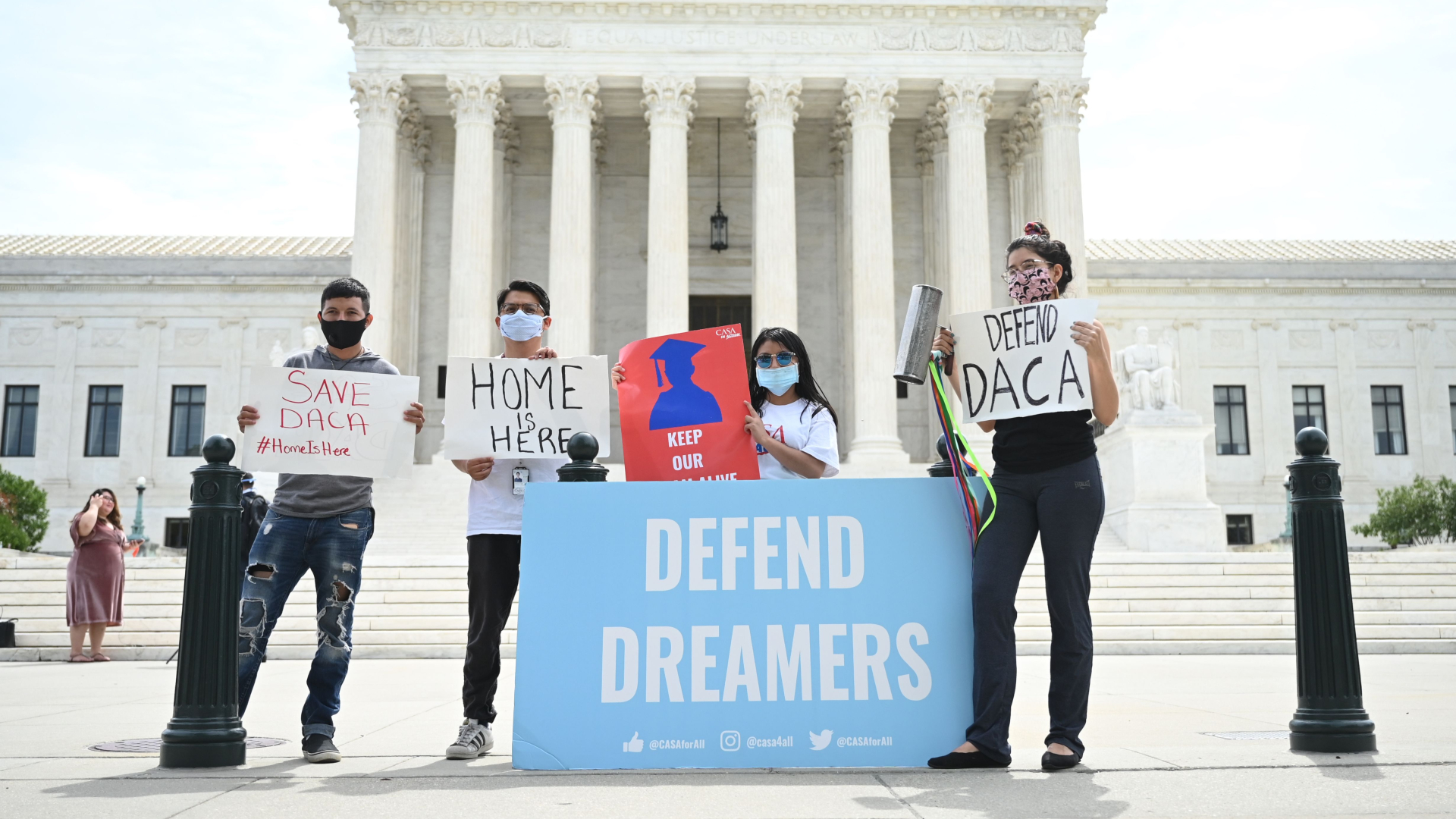
DACA was created as a temporary solution to a moral dilemma. Imagine a child brought to the US at two, five, or seven years old — they’ve grown up their entire lives here. In the early 2010s, there were hundreds of thousands of people who found themselves in this situation. To deport them to their parents’ country of origin seemed cruel, but there wasn’t a path for them to regularize their status. So the DACA program was born — Deferred Action for Childhood Arrivals.
If people registered and kept updating their status every two years, DACA recipients could go to school and work without fear of deportation. Of course, there was always risk: you were outing yourselves to the authorities in exchange for the hope of papers that would allow you to lead a normal life. At the time, it was viewed as a temporary fix. It has not turned out that way, as Congress has not been able to pass real immigration reform in the almost fifteen years since.
So DACA remains — but now there are troubling signs that the program may be under attack by the Trump administration. Here to discuss, we have three DACA recipients. Jupiter Peraza is a DACA recipient and San Francisco resident. Welcome.
Jupiter Peraza: Thank you so much for having me.
Alexis Madrigal: We also have Leo Rodriguez, a union organizer, Oakland resident, and DACA recipient. Thanks for joining us.
Leo Rodriguez: Good morning. Thank you for having me.
Alexis Madrigal: And we have Xochilt Cruz Lopez, a Richmond resident and DACA recipient who just experienced a long delay in her renewal. Thanks for joining us.
Xochilt Cruz Lopez: Good morning. Thank you.
Alexis Madrigal: Xochilt, you’re twenty-seven years old. You’ve lived in Richmond most of your life, coming to the US when you were six. How long have you been a DACA recipient, and what has the experience been like?
Xochilt Cruz Lopez: I believe I just hit ten years this month. I started the process back in 2015. Between the fees and everything, it was either my birthday gift or the application fee.
Alexis Madrigal: Your parents were like, “Your birthday gift is getting to apply for DACA.”
Xochilt Cruz Lopez: Yeah. I didn’t really understand it at the time — I was still in high school, just a teenager. Fast forward ten years later, here I am, applying for jobs and trying to continue school. It’s just me in the Bay Area and my cats.
Alexis Madrigal: So as I understand it, the renewal has been a fairly routine process — you submit it, it goes through, no big deal. You submitted your latest renewal last fall. How far ahead of the deadline were you?
Xochilt Cruz Lopez: About four months. Usually it gets approved within five or six weeks, so I thought I was safe.
Alexis Madrigal: You were early — not just on time, but early.
Xochilt Cruz Lopez: A little bit, yeah. I submitted at the end of October. But because it was mailed through a nonprofit organization, it didn’t reach USCIS until November sixth.
Alexis Madrigal: And you were hoping to hear back when?
Xochilt Cruz Lopez: By mid to late February — that’s when my DACA was set to expire.
Alexis Madrigal: Why does that matter so much, for people who haven’t had to think about it?
Xochilt Cruz Lopez: It offered a lot of protection — not just with immigration, but protection from ICE. It also allowed me to work, and my job offered benefits: health insurance, vision, dental. All the basic necessities. That’s what I relied on.
Alexis Madrigal: And you can’t work without it. At a really basic level, if you can’t work in this country, it’s hard to have health insurance or much of anything.
Xochilt Cruz Lopez: Yeah. Once it ends, you have to give up a good chunk of your stability.
Alexis Madrigal: So what happened? Were you able to get your renewal in time?
Xochilt Cruz Lopez: Luckily, my job offered a sixty-day unpaid leave of absence and was willing to hold my position. But I ran out of time — on April fifteenth, they had to let me go.
Alexis Madrigal: Oh no. And then what?
Xochilt Cruz Lopez: After that, I kept making phone calls to USCIS — case inquiries, online inquiries, calls with agents, even a congressional inquiry.
Alexis Madrigal: When you actually get someone on the phone and explain that you submitted months ago, what do they say?
Xochilt Cruz Lopez: It’s always the same response: “I don’t have an answer. Just keep waiting.” Every single time.
Alexis Madrigal: Jupiter, you also experienced a significant delay. Can you walk us through what happened?
Jupiter Peraza: It was quite similar. I applied in November of last year. My employment authorization card was set to expire April eleventh, so I applied about a hundred and forty-seven days ahead of the expiration date — right in the recommended window of a hundred and twenty to a hundred and fifty days. Even so, I still had a lapse. My DACA expired April eleventh, and I waited almost a month for approval. It finally came on May sixth, but only after I’d contacted USCIS multiple times and submitted a congressional expedite request through my congresswoman.
Alexis Madrigal: You work in politics — in Mayor Lurie’s office — so you know how these systems work. What do you think happens for people who don’t have those connections or that knowledge?
Jupiter Peraza: I definitely consider myself lucky to work in this field and to have access to resources and support. I’m grateful to be a San Franciscan and a Californian, where elected representatives are very supportive of DACA recipients and immigrants. But throughout this process — which was still very challenging — I kept thinking about DACA recipients in other states, particularly in red states, where people don’t feel comfortable calling their representatives because those officials support Trump. I thought about how isolating that must be. My heart goes out to all the DACA recipients who experienced fear just in asking for help.
Alexis Madrigal: Leo, you were recently offered a new role, but you haven’t received your renewal yet. What does that mean for your ability to take that job?
Leo Rodriguez: Thankfully, I’m covered by a collective bargaining agreement that gives me up to six months of leave of absence. But in general, it’s really frustrating. I want to keep growing in my role, keep advancing professionally — and these obstacles completely prevent that. People might think it’s just about filing paperwork and waiting, and it should be fine. But just like many Americans, we’re dealing with high rent, stress, and all kinds of pressures. You really don’t have the bandwidth to constantly be logging in, calling, and waiting for an answer. I feel like I take one step forward and someone forces me two steps back.
Alexis Madrigal: And it was already a tough situation — living on a two-year renewal cycle. If you’re submitting six months ahead of time, you really only have about eighteen months where you’re not actively sweating this. Everyone seems to acknowledge it’s a bad situation, and yet nothing actually gets done.
Leo Rodriguez: It definitely hits at the core of a broader problem — that issues are rising across affordability, education, and many other areas of life, and our leaders, whether acting in good faith or bad, are not providing solutions. The DACA program is a good example of how government once provided a solution, even if temporary, and how it’s now failing to deliver a long-term one. It’s frustrating to get a taste of what your life could be, only within an eighteen-month window. We’d like to see this country become more solution-oriented, but we have work to do.
Alexis Madrigal: Xochilt, has it always been this bad, or is this a recent change?
Xochilt Cruz Lopez: Oh, this is definitely recent. This is actually my second delay — I went through this before. Last time it hit me like a truck. This time I felt more prepared: I knew I needed to do my research and start making phone calls right away, not just sit and wait.
Alexis Madrigal: We’re talking about DACA renewal delays and the future of the program. Our guests are Xochilt Cruz Lopez, a Richmond resident and DACA recipient; Leo Rodriguez, a union organizer in Oakland; and Jupiter Peraza, a DACA recipient and San Francisco resident who serves as Mayor Daniel Lurie’s community liaison to the Tenderloin neighborhood. Jupiter, we know you have somewhere to be — thank you so much for joining us.
Jupiter Peraza: Thank you for having me. Have a good one, everybody.
Alexis Madrigal: Thank you. We want to hear from you. If you have experience with DACA, we’d love to know how you think the program has worked. We’re currently having some technical issues with our phone lines, but you can reach us by email at [email protected], or find us on social media — Bluesky, Instagram, and Discord — at KQED Forum. I’m Alexis Madrigal. Stay tuned for more right after the break.