This partial transcript was computer-generated. While our team has reviewed it, there may be errors.
Alexis Madrigal: Welcome to Forum. I’m Alexis Madrigal. The atmosphere of the 1970s remains ungraspable to me as a child of the ’80s. The radical movements of the ’60s had either dissipated or gotten serious, and among the latter group, perhaps the most prominent was the Weather Underground. A sometime and fraught partner of the underground offshoot of the Black Panther Party, the Black Liberation Army, and unabashedly anti-imperialist, the Weather Underground orchestrated a series of bombings through the years of that decade, hitting the NYPD, the Pentagon, and the Capitol building. And though they took some care to avoid hurting people with these explosions, they were nonetheless fighting a symbolic kind of insurgency against the American establishment in the 1970s.
At the same time, they were also children of the 1960s, people who were falling in love and creating families. Around here, there are many now-grown Panther cubs, and there were also the Weather kids, the children of the white underground revolutionary group.
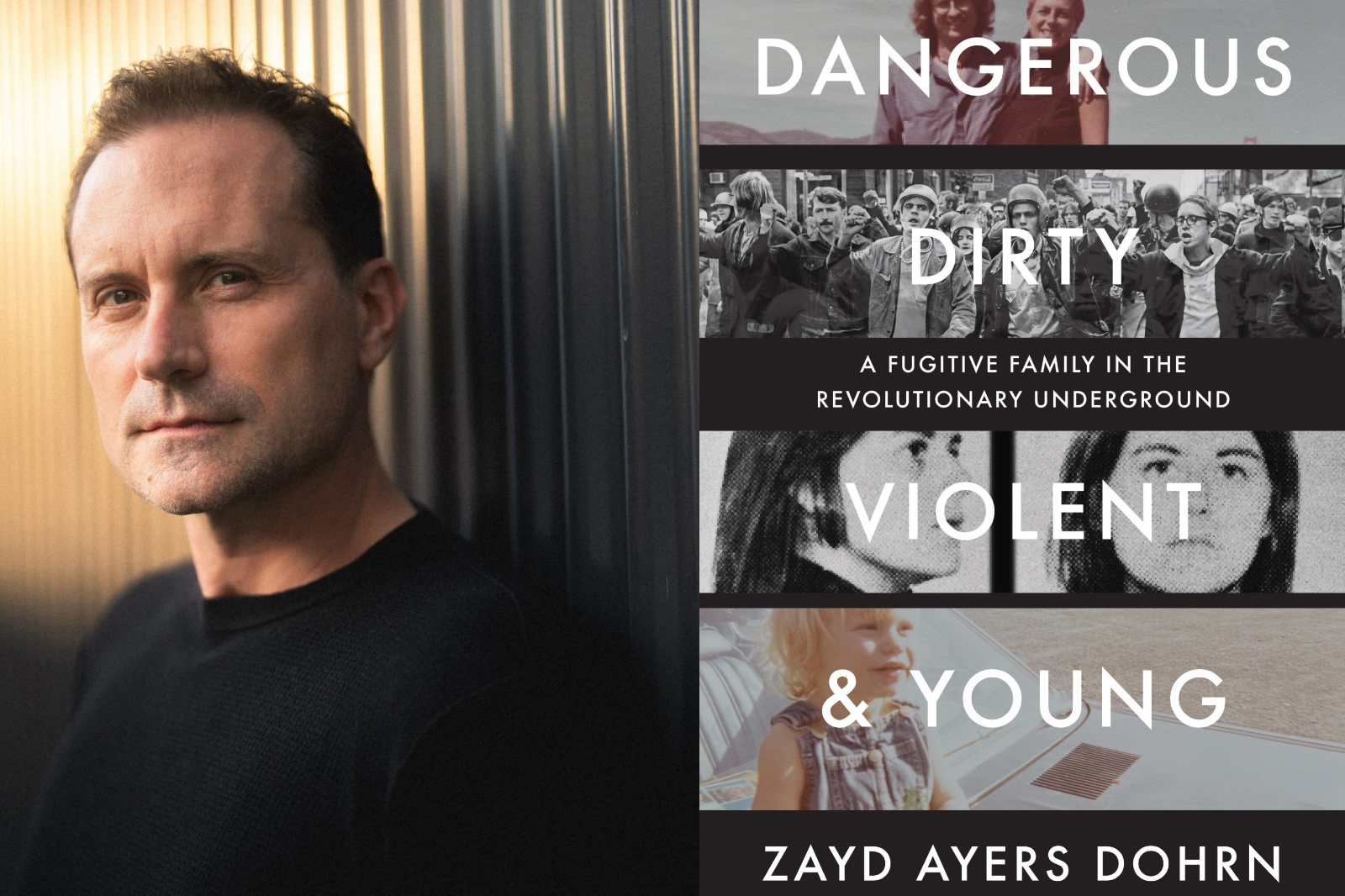
Zayd Ayers Dohrn was one of those kids. He spent seven months without his mother when she refused to testify against some comrades in a criminal case, and he grew up as a kind of adopted brother of Chesa Boudin when Boudin’s parents were sent to prison for their role in robbing an armored bank car. Now he heads the MFA program at Northwestern University, and he’s got a new memoir, Dangerous, Dirty, Violent, and Young. Welcome to Forum, Zayd.
Zayd Ayers Dohrn: Thanks, Alexis. Thanks for having me.
Alexis Madrigal: So you had these radical parents. You began to dig into their past in your work over the last decade. Were you worried about what you might find back there?
Zayd Ayers Dohrn: I think, like all kids, there are certain things when you’re growing up you don’t necessarily want to know about your parents. I always knew when I was growing up that we had a strange story. My parents never lied to me about those aspects of our lives. I mean, I knew from my very first memories that the FBI was chasing us. I knew that my mother was on the FBI’s Ten Most Wanted list. I knew that we were outlaws.
And they tried to explain it to me the way people explain things to kids. They told me we were like Robin Hood and his Merry Men, kind of robbing from the rich to give to the poor. We were like the Rebel Alliance in Star Wars, fighting an evil empire.
So I knew all those things. But yeah, as I grew up, obviously it became more complicated, and it took me a while to try to dig in and see what was the truth behind the stories I was told as a kid.
Alexis Madrigal: How’d your parents feel about it?
Zayd Ayers Dohrn: About me digging into it?
Alexis Madrigal: Yeah.
Zayd Ayers Dohrn: I think my dad, who’s a very open person and likes to tell stories — he’s written books of his own — I think he was more open to it. I think my mom, at first — she’s a pretty reserved person, pretty guarded in certain ways. And I think for her, she’d never told her story publicly. And I think it was only because I was her son, and she trusted me, that she was willing to open up and talk about some of these things. So I kind of felt, in a way, like I was helping tell her story.
Alexis Madrigal: How’d your parents meet?
Zayd Ayers Dohrn: They met in the movement. They were both members of SDS, Students for a Democratic Society. My mother was helping run the group at the time. She was one of three national leaders of SDS. My father was a kind of rank-and-file member, but they were anchoring the radical edge of that group.
And as things got more extreme, and as my mother eventually split from SDS and formed the Weathermen, my dad went with her. They were not a couple at the time. They were just comrades and fellow soldiers. It was much later, after they went underground, that they fell in love and I was born.
Alexis Madrigal: So your mom had a fairly conventional upbringing — suburbs of Milwaukee, et cetera. How do you think she got radicalized?
Zayd Ayers Dohrn: Yeah. Well, a lot of the book is about that question. I was really trying to figure out what makes a revolutionary, then and now. What aspects of a character and the historical context of a moment can turn somebody from, as you said, a fairly conventional suburban white girl into an FBI Ten Most Wanted fugitive and revolutionary outlaw?
I think for her, it was about — she was an idealistic kid. She was the first person in her family ever to go to college. She ended up at the University of Chicago, went on to law school there, and of course the civil rights movement was happening all around her.
So she decided to join up. And when Martin Luther King Jr. came to Chicago to lead the rent strike, she started volunteering as legal aid. I tell the story in the book about how over time she started as a kind of progressive lawyer —
Alexis Madrigal: Civil-rightsy —
Zayd Ayers Dohrn: Yeah. Exactly. A civil rights protester marching behind Dr. King in his march in Chicago and so on. And then Dr. King was killed, and that turned a lot of people into radicals. They felt like they’d spent years trying this kind of nonviolent approach to change, and it hadn’t worked. And then he’d been murdered by white supremacists.
So then my mother became more radical. She started helping lead SDS, and she formed a partnership with Fred Hampton and the Black Panthers in Illinois. And then Fred was murdered by Chicago police.
So I think it was this kind of multistep process of starting out believing we can change the world through peaceful protest, and then seeing the violence committed against Vietnam during the war, and also Black leaders here at home, that led her toward more revolutionary politics.
Alexis Madrigal: Yeah. And we have a cut here which I think will help people understand where your mother and father ended up during this period of their lives. Let’s listen.
Bernardine Dohrn (clip): Hello. This is Brandine Dorn. I’m going to read a declaration of a state of war. This is the first communication from the weatherman underground. Within the next fourteen days, we will attack a symbol or institution of American injustice. Kids know the lines are drawn. Revolution is touching all of our lives. If you wanna find us, this is where we are. In every tribe, commune, dormitory, farmhouse, barracks, and townhouse, where kids are making love, smoking dope, and loading guns.
Alexis Madrigal: God, what an artifact of an era. That is, of course — we put that together from Mother Country Radicals, Zayd Ayers Dohrn’s amazing podcast. One of the best ever made, I think.
Zayd Ayers Dohrn: Thank you.
Alexis Madrigal: It provided some of the underpinning for the new book we’re talking about here, Dangerous, Dirty, Violent, and Young. First of all, where did you get that tape? Because we tried to track it down too.
Zayd Ayers Dohrn: It’s a crazy tape. She first recorded it in 1970 and delivered it to police stations and news outlets all across the country. It was literally a declaration of war by the white underground against the American government.
And as you say, you can hear in her voice and in her choice of words the kind of seventies-ness of it, but also, I think, the real essential radical politics. The idea of young white college students and law students deciding to go underground and throw their lot in with Black revolutionaries — that was a pretty radical statement then, and it’s even more radical now.
Alexis Madrigal: Yeah, for sure. I mean, the other thing you hear about it is at the end — where are we? Oh, we’re making love there. That countercultural aspect of it comes as a surprise after what’s said in the first half.
Zayd Ayers Dohrn: Yeah. I think that was always one of the dichotomies of the Weather Underground. On the one hand, they were very much part of the counterculture of the ’60s and ’70s.
The title Dangerous, Dirty, Violent, and Young is taken from a Jefferson Airplane song, which they loved at the time. And Jefferson Airplane actually donated money to the underground to help these fugitives survive during those years.
So they were part of that world of rock and roll and sex, drugs, and Woodstock and all that. But they were also on a very radical fringe of the politics of the time, believing not just in peaceful protest and flower power, but in dynamite and guns and taking the fight to the government.
So it was this interesting contradiction in them.
Alexis Madrigal: And of course, finding their way to their own version of violent revolution — this is an era, kind of like the era of hijackings, that’s almost hard to believe happened in the 1970s. But of course they had this bombing campaign where they hit the Pentagon, the U.S. Capitol, and here in San Francisco they hit the Presidio.
Zayd Ayers Dohrn: Yeah.
Alexis Madrigal: How many of these acts did they commit? And did they see themselves as having success doing it?
Zayd Ayers Dohrn: Well, I think the Weather Underground took responsibility for more than twenty bombings of government buildings — the Harvard Center for International Affairs, the U.S. military base at the Presidio, New York Police Department headquarters, the U.S. Capitol, the Pentagon, the State Department. Really high-profile targets.
But the other thing — and I think you’re gesturing toward this, Alexis — is that it was of the moment in a weird way. There were thousands of attacks against government targets in those years that the Weather Underground had nothing to do with. Firebombings of military recruitment stations and Molotov cocktails thrown at university labs that were helping in the war effort.
So it was of the time in the sense that in the ’60s and ’70s there was this outpouring of anti-government rage. I think the Weather Underground was the vanguard of that and the most visible part of it.
And in a funny way, my mother wound up becoming the symbol of that rage and violence. J. Edgar Hoover, the head of the FBI, called her “the most dangerous woman in America.”
Alexis Madrigal: Which gets at this fundamental component of this book and of your life — that’s your mom. She is your mom. There are all these photos in the book of this woman who J. Edgar Hoover is saying these things about, who’s leading this organization conducting this bombing campaign, and she’s just… Mom to you.
Zayd Ayers Dohrn: She is. And she’s not just like Mom — she is Mom. She was a great mother and also a really complicated mother.
The memoir is really my attempt to wrestle with who she was and how she became the person I knew. Because, as you said, she had a pretty conventional upbringing. She was the daughter of a Jewish immigrant who lived in Wisconsin, and she was brought up to believe in the American dream.
Then she was radicalized.
So the book tells the story of her coming of age, but it also tells the story of my coming of age — growing up underground and learning to recognize undercover police officers and FBI agents, and trying to figure out what it meant to be on the run and how to live up to my mother’s example. Because she was an impressive person, an inspiring person, and also a difficult person.
Alexis Madrigal: Yeah. Uncompromising, for sure.
We’re talking to Zayd Ayers Dohrn, son of one-time fugitives and members of the revolutionary group the Weather Underground. He’s the author of Dangerous, Dirty, Violent, and Young, a memoir about his revolutionary parents, his childhood on the run, and the kind of reckoning you’re hearing about here.
I also recommend the podcast Mother Country Radicals if you want to hear some of the tape and interviews.
We want to hear from you: What’s it like for you to reckon with your parents’ choices and the way they impacted you while you were growing up? What do you remember about this time of militant activism in the ’60s and ’70s? Maybe you’re a Panther cub out there and would like to share your story as well.
You can give us a call. The number is 866-733-6786. That’s 866-733-6786.
You can email [email protected]. You can find us on social media at BlueSky, Instagram, Discord, or KQED Forum.
I’m Alexis Madrigal. Stay tuned.