This partial transcript was computer-generated. While our team has reviewed it, there may be errors.
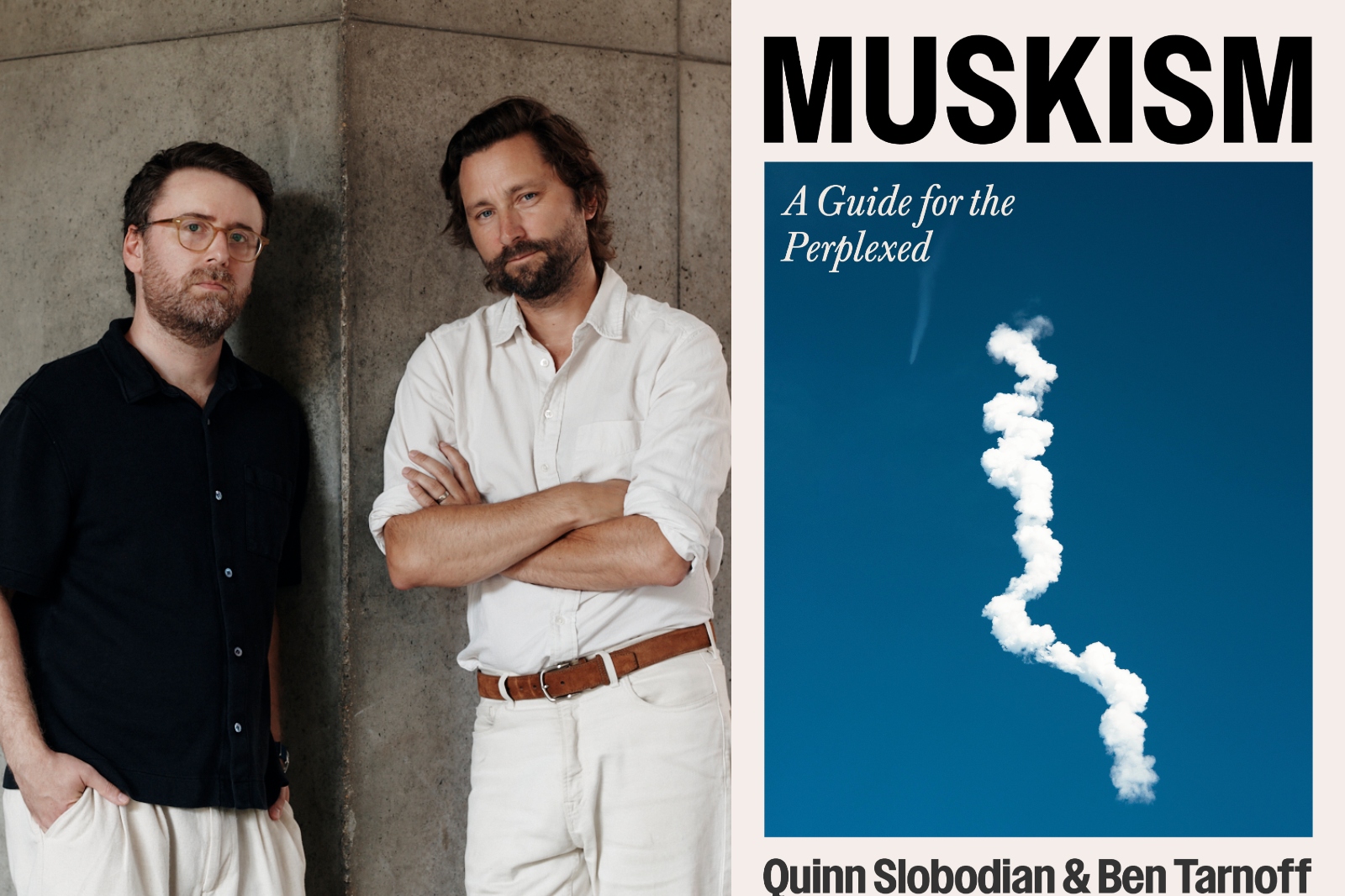
Alexis Madrigal: Welcome to Forum. I’m Alexis Madrigal. You know, Fordism was somewhat easy to explain. It was mass production plus mass consumption. You work in a factory, get paid a decent wage, spend that money on things made in your own factory and others, and it underpinned a few generations of industrial society. Muscism, by contrast, is harder to explain. In a new book, Muscism: A Guide for the Perplexed, Ben Tarnoff and Quinn Slobodian do their level best to create an overarching framework for understanding how Elon Musk sees the world. This intellectual history shows how his ideas—often incoherent, often boldly racist—have evolved not just inside his own brain, but in a recursive loop with the broader techno-political moment. The authors join us here in the studio this morning. Tech writer Ben Tarnoff, welcome.
Ben Tarnoff: Hi. Thanks so much for having us.
Alexis Madrigal: And Boston University history professor Quinn Slobodian, welcome.
Quinn Slobodian: Thank you.
Alexis Madrigal: So you two have read and heard more Elon Musk talking than almost anyone on Earth. Thank you for that. I’m also sorry. Musk is suing Sam Altman in a trial that starts today in Oakland. What do you think the trial is actually about, and how does it fit in with Musk’s other obsessions?
Ben Tarnoff: Well, nominally, this trial is about Musk suing both Altman and Greg Brockman, who’s the president of OpenAI, for breaching their charitable trust designation. If you recall, Musk co-founded OpenAI in 2015 with Altman, Brockman, and several others. At the time, it was a nonprofit research organization committed to open-sourcing its research and its AI technology. But there was a subsequent evolution where, in 2019—and in particular in 2025—there was a major for-profit restructuring that OpenAI conducted. So what Musk is trying to do is say that that was an illegal restructuring, that it needs to be rolled back to a nonprofit, and that he, as a contributor who put in about $40 million, was misled into basically financing what became a startup.
Alexis Madrigal: And Quinn, I assume that he’s doing this out of the goodness of his heart, as an altruist, just for the benefit of humanity?
Quinn Slobodian: Yeah, I mean, he’s devoted to the salvation of the human species and to making humanity multi-planetary, and everything he does is subordinate to that goal. No—actually, the subtext that’s hard to avoid is that he right now sees the future of his whole business empire in the AI part of it. That’s called xAI, and it was recently made part of SpaceX. It also swallowed up, in turn, X.com. Right now, it’s actually not doing that well—it’s a laggard in the AI race, far behind OpenAI and definitely behind Anthropic, and it’s burning cash at a rate of about a billion dollars a month. So the reason Musk is rolling out the SpaceX IPO, which I’m sure we’ll end up talking about, is basically to raise money for xAI. That’s his attempt to juice it on the one hand, and it’s hard not to see this trial as also an effort to throw tacks under the wheels of OpenAI—to slow them down and give his own company a kind of burst.
Alexis Madrigal: I mean, Ben, do you see any analogs for this kind of lawsuit or legal wrangling in Musk’s history of trying to get at competitors in any way possible?
Ben Tarnoff: Certainly. Musk is very adept at lawfare. He’s extremely litigious, and at various moments he’s used the courts—and even just the threat of legal action—to advance his business interests. We discuss this in the book. He brings a complaint with the Government Accountability Office in response to a contract that was awarded by the government to—
Alexis Madrigal: A competitor.
Ben Tarnoff: Yeah, exactly, in the space business. Through that process, he essentially forces the government to adopt a different contracting model that really rewards his style of doing business. So he’s always seen the courts not just as a place where he can get personal redress or extract money, but as a way to clear the path for his own accumulation strategies.
Alexis Madrigal: Yeah, you’re kind of describing one of the planks of what you call Muscism here. Can you lay out the others? I think this one you’d call something like state symbiosis—positioning his companies to match the needs of the state and its way of extracting money. What are the other components?
Quinn Slobodian: That was one of our main intentions with the book—to shift the conversation around the governing philosophy of Silicon Valley. One of the more misleading terms is libertarianism, and we think that misses the mark. Musk hasn’t really professed to be a libertarian. Instead, since the 1990s, he’s been keen on plugging into state services and infrastructures, then figuring out how to commercialize and privatize parts of them—from using GPS for his short-lived Zip2 business, arguably benefiting from federal deposit insurance through PayPal, and then more openly since 2002 with SpaceX, becoming a military contractor first in the global war on terror and now in broader U.S. military operations. So “state symbiosis” is a better starting point. But “crony capitalism” also isn’t quite right, because for all of Musk’s faults—and we document them across 200 pages—he does expand state capacity in certain ways. That’s why we call it Muskism. Take SpaceX: over two decades, he’s lowered the cost of putting mass into orbit by over 90 percent and made certain battlefield capabilities possible that weren’t before.
Alexis Madrigal: Thinking Starlink there.
Quinn Slobodian: Exactly. The way the Russia-Ukraine conflict has unfolded wouldn’t be the same without the ability to guide drones, munitions, and communications through low Earth orbit satellites. He started launching Starlink in 2019; now there are over 11,000, and it’s becoming a frontier of military technology. So Muskism is a promise of sovereignty through technology that expands the capacity of states and even households—but at a very high price.
Alexis Madrigal: And that price, Ben, is that one guy controls everything?
Ben Tarnoff: The cost is dependency—on him and his infrastructures. You see this vividly with SpaceX, which now controls about 90 percent of U.S. orbital launches and about half globally. On one hand, if you’re the Pentagon, you gain extraordinary capacity—you can put satellites into space much more cheaply. But on the other hand, you’re dependent on one man. As we’ve seen in the Russia-Ukraine conflict, there have been moments when Musk has limited connectivity, potentially altering the course of the war.
Quinn Slobodian: This also reflects an arc in Musk’s career—the impression of neutrality in the services he offers. At his most adept, he’s allowed different states to use his technology for their own domestic ends. A good example is the Gigafactory—
Alexis Madrigal: Where they build batteries for Teslas and other things.
Quinn Slobodian: They build the cars and the batteries. When he built a Gigafactory in Shanghai, China gave him favorable conditions because it helped boost their EV sector. CATL, now the world’s largest lithium-ion battery producer, got its start plugging into Tesla production there. So China used the Tesla brand for its own industrial strategy and electric autonomy. Germany and the U.S. have done similar things. At his best, Musk has been modular, adaptable to different political contexts. But more recently, it’s become clear there’s a sting in the tail—he’s less modest about flexing his power, especially through X.com, using it to amplify his own messaging. For example, he’s been boosting a Ronan Farrow New Yorker story about Altman on his platform, so users are more likely to encounter it algorithmically.
Alexis Madrigal: How much credit, particularly in these early ventures involving manufacturing, would you give him for creating a new production model? Or was he just in the right place at the right time with money?
Ben Tarnoff: Whenever a businessperson succeeds, you have to ask what made them successful. In Musk’s case, two things stand out. First, he’s very good at securing investor confidence—since the 1990s, he’s been able to tell compelling stories about the future that feel ambitious but plausible enough to attract capital. You can see that now with the planned SpaceX IPO. Second, he’s a supremely good rationalizer. As an industrialist, he’s obsessed with the shop floor—optimizing processes, reorganizing labor, and yes, pushing workers hard—but also introducing innovations that improve efficiency.
Alexis Madrigal: We’re talking with tech writer Ben Tarnoff and Boston University history professor Quinn Slobodian. Their book is Muscism: A Guide for the Perplexed, and we want to hear from you. Has your opinion of Elon Musk changed over the years? Do you have one of those bumper stickers on your Tesla? Call us at 866-733-6786 or email [email protected]. We’ve got more right after the break.