This partial transcript was computer-generated. While our team has reviewed it, there may be errors.
Alexis Madrigal: Welcome to Forum. I’m Alexis Madrigal.
In a concurring opinion in the case Noam v. Vasquez Perdomo, Supreme Court Justice Brett Kavanaugh wrote, “Whether an officer has reasonable suspicion depends on the totality of the circumstances. Here, those circumstances include that there is an extremely high number and percentage of illegal immigrants in the Los Angeles area; that those individuals tend to gather in certain locations to seek daily work; that those individuals often work in certain kinds of jobs, such as day labor, landscaping, agriculture, and construction, that do not require paperwork and are therefore especially attractive to illegal immigrants; and that many of those illegally in the Los Angeles area come from Mexico or Central America and do not speak much English. To be clear, apparent ethnicity alone cannot furnish reasonable suspicion under this Court’s case law regarding immigration stops. However, it can be a relevant factor.”
And with that, apparent ethnicity became an explicitly legally sanctioned relevant factor in immigration enforcement. In practice, this kind of thing had long gone on, but now the Kavanaugh standard became formalized. If you were speaking Spanish near a Home Depot, that was reasonable suspicion. If you had brown skin on a construction site, that was reasonable suspicion. If you were at a taco truck and ordered in fluent Spanish—hey, that might be reasonable suspicion, too.
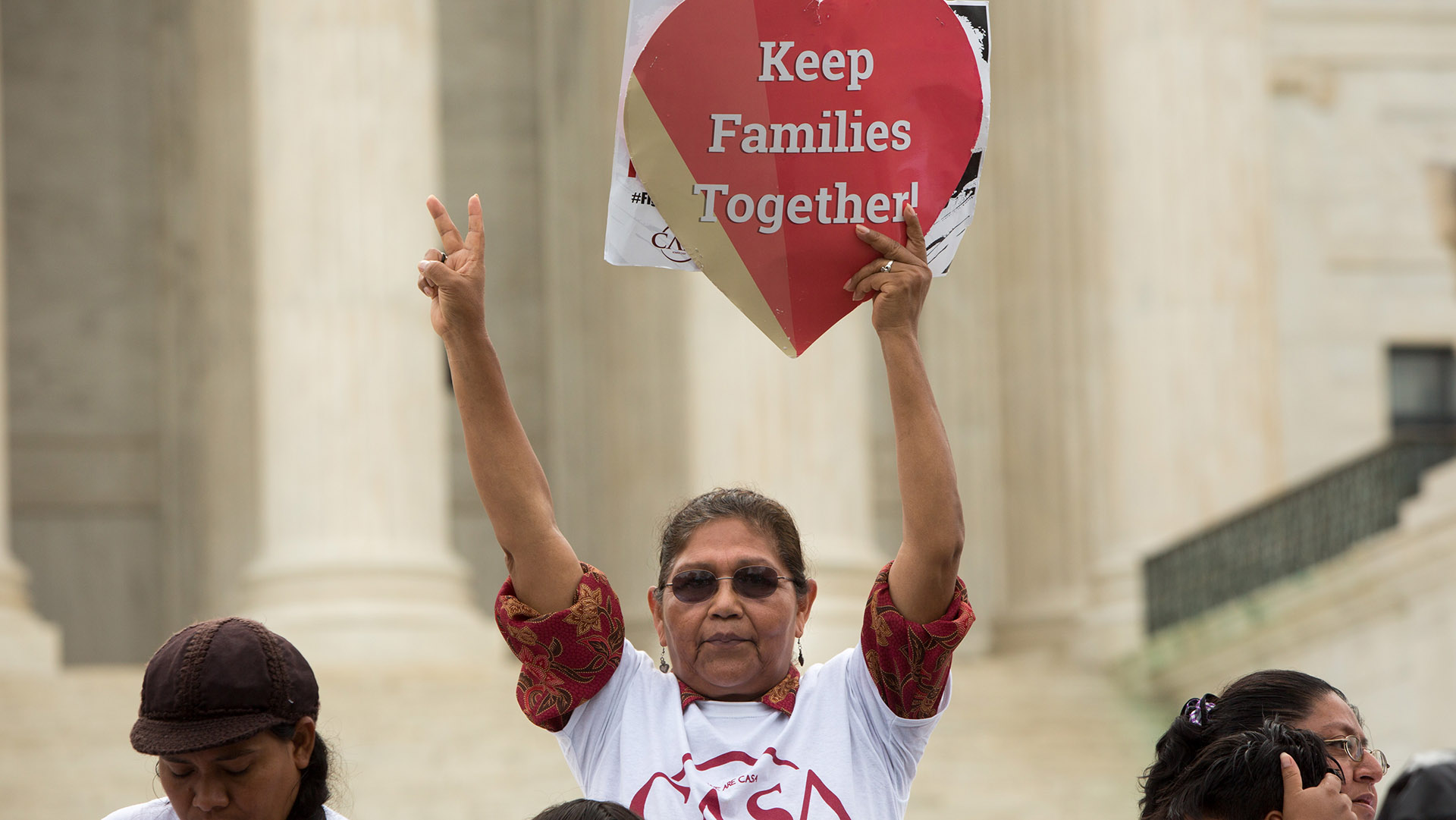
Today, we’re talking about the cultural and identity impacts—not just of this ruling, but of the broader landscape of immigration enforcement and the white nationalist rhetoric that has swamped the right wing of the United States.
Joining us this morning, we have Dr. Belinda Hernandez Arriaga, founder and chief executive officer of ALAS. She’s a licensed clinical social worker. Welcome.
Belinda Hernandez Arriaga: Thank you so much.
Alexis Madrigal: Yeah, thanks for coming on. We also have Tomás Jiménez, Joan B. Ford Professor of Sociology and director of the Institute for Advancing Just Societies. Welcome, Tomás.
Tomás Jiménez: Thanks for having me.
Alexis Madrigal: So, Tomás, give us a little bit of context for this current moment. Do you think there is precedent in American history for the kind of—not just immigration enforcement, but also the rhetoric—that we’re seeing around immigrants?
Tomás Jiménez: Well, there’s certainly precedent. I think what we’re seeing today is an extreme version of American identity that has been with us since our founding.
You can think of American identity as being like different sections of an orchestra. Some of those sections play louder than others at certain times. When leadership steps in and encourages one section to play really loudly—and right now, that’s the white nationalist section—it can overwhelm the others.
But it’s important to keep in mind that there are other sections. There are sections of the orchestra that see American identity as more than just white nationalism—not as white nationalism at all—but rather as a nation of immigrants.
So I think what we’re seeing today in modern history is somewhat unprecedented in terms of how loudly the white nationalist section is playing, both in politics and policy. But it’s also important to keep in mind—and maybe we can get to this later—that there are other sections trying to play as well.
Still, we have not, in modern history—arguably ever—seen an enforcement effort that is as ferocious or as broad-based as this.
Alexis Madrigal: And, you know, we’ve dealt a lot with the material impacts of this immigration enforcement, both in Los Angeles, Minneapolis, and other places. But what about the cultural impact of doing this? I mean, the way it makes it feel like this is a different America.
Tomás Jiménez: Yeah, I think this goes back to the point I made a second ago, which is that not only are there different versions of American identity, but our policies are not just telling us what we can and can’t do—they’re telling us who we are.
Right now, what I think Latinos in particular are feeling is a version of something they’ve actually felt for a long time. I’ve done some research on this that dates back 25 years, and even then, U.S.-born people of Mexican descent were worried that others would see them as illegal, undocumented, or unauthorized.
That concern shows up sometimes in law enforcement contexts, but often in everyday social interactions—the association between being Latino and being undocumented. The Kavanaugh quote enshrines this, but that association has been with us for a long time.
When that version of the orchestra—the policy and politics version—is playing loudly, that association becomes more prominent, not only in the minds of everyday Americans, but also among Latinos themselves. They have to think about how they present themselves in everyday interactions and how to deflect potential assumptions.
And this is not to mention people who are themselves undocumented, who in a previous period might have been more willing to engage with institutions but are now hunkering down.
Alexis Madrigal: Yeah. Belinda, your organization, ALAS, has served Half Moon Bay–based immigrants and farmworkers for years. As immigration enforcement and rhetoric have risen over the last decade, how has that changed the daily lives and culture of the people you work with?
Belinda Hernandez Arriaga: Well, sadly to say, there has always been this permeating sense of fear in our community—a sense of isolation, and even societal pressure not to be civically engaged.
I’ve seen that for years in my work in mental health with children and families. I refer to it as “undocu-trauma,” or immigration trauma, which isn’t really recognized by the field of psychology.
But now, what we’re seeing is a surge—an intensification of everyday fear. People are asking, “What’s going to happen if I go to the store? What if ICE is present?” These are everyday activities that people used to feel safe doing.
For example, schools used to be off-limits. Churches were sanctuaries. Those spaces are no longer guaranteed to be safe. What were once safe spaces for the immigrant community have, in many ways, been erased.
So there really is no safe space right now, and that’s where we’re seeing escalating fear. In my community, we’re seeing a rise in mental health needs and a growing demand for communal and emotional support.
Alexis Madrigal: Yeah. I mean, what about you personally, Belinda? You’ve got a doctorate, you’re well established, you founded an organization. Do you feel some of these cultural pressures on your own identity?
Belinda Hernandez Arriaga: I absolutely do. My experience is rooted in my own upbringing in South Texas and rural Texas, where I constantly had to question my identity—whether it was okay to speak Spanish or celebrate our culture.
I grew up in an environment where those things were not accepted, and minimizing our identity became a form of survival. That’s something my family has experienced across three generations—not because we wanted to, but because we felt we had to.
Now, as I work in the community—as an advocate, working in the fields and in the trenches—I see similar fears resurfacing. We recently went to Minneapolis to work with children and families in schools that were targeted by ICE. Teachers were telling us that everyone has to be careful, that no one really feels safe.
So yes, I think this is a new moment. Even though I’ve experienced internalized fear and oppression growing up, I also had the privilege of citizenship. But now, there’s a broader, more pervasive fear affecting Latinos in general.
Alexis Madrigal: Mm-hmm.
Belinda Hernandez Arriaga: And while we are pushing back against it, we can’t deny that for many people, that fear is very real. I hear it from so many individuals.
Alexis Madrigal: I mean, Tomás, one of the interesting things about this moment is that many of us grew up hearing stories from our families about people who stopped speaking Spanish or minimized their culture out of fear or a desire to assimilate.
But we’re also coming out of a period where Latino culture was widely celebrated. And now it feels like we’re experiencing this incredible whiplash.
Tomás Jiménez: It certainly does. To build on what Belinda said—and your question—it’s important to remember that the Mexican-origin population has been immigrating to the United States for over a hundred years. Even before that, there was a smaller population in the Southwest when it was annexed by the United States in 1848.
The idea of being a “perpetual foreigner,” even for second-, third-, or fourth-generation individuals, is something people of Mexican descent have long contended with.
If you talk to people who grew up in the 1940s and 1950s, they’ll tell you they tried to suppress their Latino or Mexican identity. That experience isn’t unique—it’s common across many immigrant groups, especially when there’s a narrow definition of what it means to be American.
Then we move into the post-1960s period, which celebrates multiculturalism. And as you mentioned, Alexis, more recently we’ve seen a broader celebration of Latino culture.
What we’re seeing now does feel like a backlash—a return to earlier fears and behaviors. But it’s not an either/or situation. Those concerns never fully went away. Even during periods of cultural celebration, people still carried those anxieties.
Again, it’s like different sections of the orchestra—different versions of identity—rising and falling in volume over time.
Alexis Madrigal: Levels of the spectrogram, yeah.
We’re talking about the cultural, psychological, and societal impacts of Trump’s immigration policies. We’re joined by Tomás Jiménez, professor of sociology at Stanford, and Dr. Belinda Hernandez Arriaga, founder and executive director of ALAS, which works with farmworkers in Half Moon Bay.
We want to hear from you. Has the immigration crackdown changed the way you see your identity—as an American or as a person? Call us at 866-733-6786, email [email protected].
I’m Alexis Madrigal. Stay tuned.